Invest in your career Take Blue Line training courses The Social Officer: Connecting Cops and Civilians Using Social Media April 26, $125.00 + HST As the founder of CIK Marketing, Chantielle Kennedy has helped numerous Ontario police services expand their understanding of social networks and engage with civilians via online platforms. This half day course, will discuss the benefits associated with creating and communicating via popular online networking sites like Facebook, Twitter and YouTube. Instructor: Chantielle Kennedy
Transitional Tactics for the Combative Subject April 26, $250.00 + HST This course will help Law Enforcement and Fire/EMS to rapidly identify, and be prepared for a crisis dealing with an agitated or combative individual needing rapid treatment and transport to the nearest Emergency Department. The goal is to help minimize the possibility of injury to the suspect and the First Responders in the field. The techniques and tactics taught go beyond didactic presentations to hands-on learning. This course offers a task oriented team approach to the agitated suspect that does not comply with traditional compliance techniques. Instructor: Michael Weaver is a 15 year veteran of the Everett Fire Department as a Firefighter/Paramedic. He is an author, instructor and advocate for the safety of all first responders. A U.S. Army Veteran, Michael volunteered for 2nd ranger battalion and successfully completed the U.S. Army Ranger School. “http://community.fireengineering.com/profile/MichaelWWeaver”
The Non-Accusatory Interview Technique April 26, $250.00 + HST This topic is designed for all police officers as well as private investigators and security people involved in interviewing suspects and/or victims. Learn the basics of: • Conducting an investigative interview in a conversational setting with the emphasis on obtaining important information. • How to establish a “free-flowing” interchange between the subject and the interviewer. • How to plan and enter into an interview and get the subject talking and keep them talking. • Current legal status of investigative interviews and how far you can pursue the truth in a legal manner. Instructor: S/Sgt Gordon MacKinnon (retired).
2011
April 26 & 27, 9am - 4pm
march 2011
2
Pre-registration & Info at BlueLine.ca Blue Line Magazine
March 2011 Volume 23 Number 3
Features 6 Inspiring youth to give
Police and students donate blood together
12 Taking pride in new services 16 Obstruct police
6
An in-depth review of a much misunderstood law
18 Buying into the full package
Is there a crisis in recruiting... or an opportunity
22 Real cops do hot yoga
Departments 38 28 29 36, 37 35 34 5 35 30
12
BlueLinks Ad Directory Deep Blue Dispatches Market Place Odditorials Product News Publisher’s Commentary Representative Profiles Technology
Case Law 31 32
16
Detention not arbitrary if grounds clearly expressed Counsel right not re-triggered by confession video
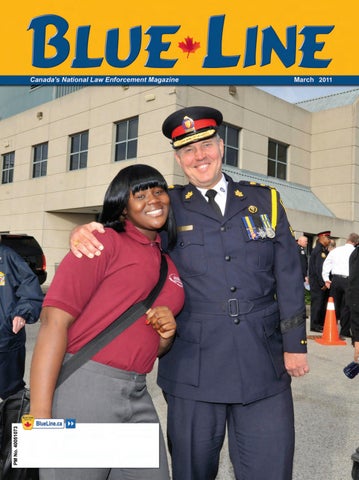
Cover: Toronto Police Chief Bill Blair congratulates high school student donor at 12 Division Bloodmobile clinic. Photos: Kevin Masterman, TPS Corporate Communications.
Blue Line Magazine
3
March 2011
Invest in your career Take Blue Line training courses Street Drug Awareness April 27, $250.00 + HST This course is unique in its scope providing important and relevant information concerning the world of street drugs to field level law enforcement officers. In this one-day course you will learn clandestine laboratory safety, recognition and investigation, current drug trends, and how to recognize drug use and handle users. Instructor: Det. Steve Walton (retired) worked 10 of his 25 year policing career with a drug unit. He has investigated more than 300 grow operations and supervised under cover teams with 120 drug operations. He is a qualified drug expert and actively instructs in the area of drug education and investigative techniques.
Detecting and Defusing Deception April 27, $250.00 + HST This topic is of interest to all police officers as well as private investigators and security people involved in interviewing suspects and/or victims. In this course you will learn: • How deceptive subjects act? • What they say and how they say it? • What they do when faced with certain probing or bait questions? • We will also cover some of the latest findings in this field and dispel some of the myths about lying. Instructor: A/Sgt Wayne van der Laan (retired).
FREE admission to the Blue Line Trade Show with course registration. Canada’s largest law enforcement exhibition of the latest products and in-demand services. Course location offers FREE parking, easy access to several major highways, a wide range of hotels, restaurants and amenities.
2011
April 26 & 27, 9am - 4pm
march 2011
4
Pre-registration & Info at BlueLine.ca Blue Line Magazine
Blue Line
Publisher’s Commentary by Morley Lymburner
Magazine Inc. PUBLISHER Morley S. Lymburner - publisher@blueline.ca General Manager Mary K. Lymburner - mary@blueline.ca SENIOR EDITOR Mark Reesor - editor@blueline.ca CREATIVE DIRECTOR E. Jolene Lymburner - jolene@blueline.ca Contributing Writers Mike Novakowski Mark Giles Robert Lunney James Clark Dorothy Cotton Dave Brown Tom Rataj Affiliations International Association of Law Enforcement Planners Canadian Advertising Rates Data International Police Association The Canadian Press Newswire Access Copyright Subscriptions $30 per year; $50 for 2yrs; US & Foreign: $100 Advertising 888-640-3048 advertising@blueline.ca
www.blueline.ca 12A-4981 Hwy7 East, Ste 254, Markham, ON L3R 1N1 Canada P: 905 640 3048 F: 905 640 7547 blueline@blueline.ca
PRINTED IN CANADA ISSN# 08478538 Blue Line Magazine was established in 1988 as an independent publication to inform, entertain, connect and educate those involved in the law enforcement profession. With no direct control from an enforcement agency, its opinions do not necessarily reflect those of any government or law enforcement agency. The authors, advisors, and publisher accept no liability whatsoever for any injuries to person(s) or property resulting from application of adoption of anything presented in this magazine. Readers are cautioned and advised that articles presented herein are edited and supplied for your personal awerness and should not be used for further actions until appropriate guidance is received from a supervisor, Crown Attorney or other persons in authority. All material submitted for publication becomes property of Blue Line Magazine Inc. unless arrangements have been made with the publisher prior to publishing. © 2011 All articles are protected by copyright. No part of this publication may be repoduced or transmitted in any form or means, electronic or mechanical, (including photocopying and recording or by any information storage or retrieval system), without prior permission. Permission to reprint may be obtained in advance from Access Copyright 1-800-893-5777.
Blue Line Magazine
Believing in the messenger Blue Line Magazine’s Police Leadership Award “I need to know who is driving scout car 4110,” the district superintendent told me. I asked why. “Because I constantly hear officers asking for his advice on the radio – even patrol sergeants,” he scowled. “Obviously I have been promoting the wrong people,” he mumbled in a lower voice. Only call signs are used on the radio, the superintendent pointed out, but obviously everyone knows him. “That man is a born leader and I want to know who he is.” I contacted communications, got his name and called him into my training office. He was an officer with about 10 years on the job. The boss is impressed with how everyone asks his advice, I told him, adding that this likely means his glide path to promotion is probably already in the works. “What if I don’t want to be promoted?” he replied. “I’m happy doing what I’m doing.” A year passed and routine orders arrived on my desk showing the officer was being promoted. I called the newly minted sergeant at his new station to congratulate him and was greeted with a less than enthusiastic voice. “You know what I am doing now” he stated rather than asked. “I am booking prisoners in and out on night shift. The most challenging part of my shift is trying to determine the sex of some of the drunks so I know which lock-up to put them in... and man, some nights that is a tough, dirty and mean job.” He also had to settle disputes between 15 officers under his command, write evaluations on them and review, file and pass along a mountain of other paperwork. “This is not why I joined the police force,” he said with a deep sigh. The newly promoted “leader” of his platoon had clearly discovered the difference between leadership as a position and leadership as an activity. Police leaders are developed and not born, however the difference between an effective and not so effective leader could very well depend when they acquired this talent. The good news is that the filtering and application process in policing encourages good leadership abilities. The bad news is that poor managers can quickly inhibit or even destroy good leadership abilities. In the military leadership is only encouraged through the promotional rank level. This has been inadvertently passed along to police. The only way to be recognized is by moving to a higher rank. Front line police officers must have leadership in their blood. They are required to take control and command of situations involving 5
the public. Whether a search for a lost child or as witnesses to an event, they must command enough respect to get the public to respond and co-operate. This is best described by Jim Kouzes and Barry Posner, recognized experts and leadership trainers. They once hypothesized that the first law of leadership is “if we don’t believe in the messenger, we won’t believe the message.” It is imperative for police to attain enough credibility with the public so those who call upon them are ready to believe the message. The Police Leadership Forum (PLF) was created in 1996 for the express purpose of encouraging and nurturing the qualities of leadership within policing. Its core value was celebrating leadership as an activity, not a position. The organization produced an award in 1999 recognizing the police leader of the year, which it presented to six individuals to recognize their core leadership abilities. On or about 1997 the organization faded out of existence. Blue Line Magazine had been a major sponsor of the PLF almost since its inception. I recognized the Forum’s basic tenets were similar to our magazine’s approach and purpose. With the blessings of those last involved with the Forum, Blue Line has now taken over the selection and presentation of this prestigious award. The word “leadership” unfortunately has many interpretations and the English language has limitations regarding precise meaning and intent of some words. The “activity” of leadership we are attempting to encourage is a personal trait as opposed to a rank, position or job. Currently we are looking for nominees for the 2010 Police Leader of the Year. The initial award will be open to active Canadian police officers, below the rank of senior officer, who have demonstrated exemplary leadership and commitment to service through deeds resulting in a measurable benefit to their peers, service and community. If you have a good idea for a recipient but are not sure if they fit all the criteria, don’t let that stop you. We will have up to six judges, well respected for their policing background, who can sort it all out. To find out more and obtain an application form visit www.blueline. ca/leadership.
March 2011
Inspiring youth to give
Police and students donate blood together by Simon Martin A group of Toronto area high school students arrive at 12 division headquarters in cruisers, not for the proverbial slap on the wrist but rather a needle in their arm. It was all part of a partnership between the Toronto Police Service, students and Canadian Blood Services (CBS) to save lives one pint of blood at a time. The initiative was the brainchild of 12 Division administrative co-ordinator Sandra McQuade. A long-time blood donor, McQuade thought it would be natural for school resource officers to encourage eligible students to donate blood at the station. The response was overwhelming, said 12 division S/Insp Dave McCormack. “The (students) were excited and taking march 2011
a great deal of pride in what they were doing.” McCormack challenged school resource officers at four other divisions to inspire eligible students to donate blood. They already had a good rapport with the students because they were in the school every day, explained McCormack, so “It just made sense.” Initially, CBS community development co-ordinator Len Rosen was a little hesitant about the idea because “It’s not the protocol we usually follow when we do mobile blood donations.” The Bloodmobile usually operates with the knowledge of how many people are donating in advance, he said. That practice had to be waived in this case. CBS launched its new mobile clinic, a climate controlled tractor trailer that can be set-up curbside or in a parking lot, in Sept. 2010. One of its perks is that it attracts more first-time donors because it can reach new neighbourhoods, Rosen said. The motivation for police to get involved was obvious, said McCormack, “As emergency responders we see the need for blood far too often.” CBS and police have a longstanding partnership through programs like Sirens for Life and this latest initiative only enhances the relationship. “When an event like this happens, Canadian Blood Services wins, 6
the police service wins and the community wins,” said McCormack. Events like this also enhance police presence, McCormack said. “We want to teach kids how we can give back to the community... It sets (students) and the community up for life.” McQuade has organized many blood clinics for police over the years and saw the new program as a chance to teach students how to help in a unique way. “I saw the opportunity to create more of a bond between police officers and students. A new experience to share together, a partnership in life saving,” she said. The student donation event was a smashing success, not only because of the participation rate but because all the students were first-time donors. Currently, only 3.5 per cent of eligible Canadians donate blood, according to Rosen. The donor population is aging and fresh blood is needed to replace people who can no longer give. He hopes the event planted a seed in some of the students. “Young people today are socially aware and are very much connected to what is going on in the world.” “Many see the act of donating blood as a social responsibility. When they find out that their single donation saves three lives they become very motivated to get involved.” Often, it is a challenge getting young people Blue Line Magazine
to become regular blood donors, said Rosen. Students may donate for short period of time but often stop after university. The police made it into a fun event for the students, said McCormack. “We wanted it to be a party type atmosphere... There was a raffle for an Ipod Nano. We had pizza. It was a great chance to build relationships with students.” In particular, McCormack recalls one heartwarming conversation he had with a donor about becoming a police officer. “It’s crucial that we’re interacting with students so we’re seen as ordinary people who students can turn to and ask for help and advice,” he said. Thirty two units of blood were collected over four hours at the station, said Rosen. Each unit of blood is separated into plasma, red blood cells and platelets. The success of the clinic was so overwhelming that Rosen said CBS plans to hold events in other areas, including 42 division, which signed up for a mobile clinic scheduled for late February. Community Relations Officer Dale Nichiporik said it was a no-brainer. “(The police) want to be approachable for students,” he said. “Instead of showing up at schools arresting people, we are helping them give back to the community.” The campaign involves putting up posters at schools across the area, he noted, although he admits to being unsure how many students will take an interest. The eligible donor pool is quite small at high schools because the minimum age for donating blood is 17-years-old. Twelve division plans to host an encore donation clinic in April. McCormack said the initiative was such a success he’s happy others are getting on board. “We’ll take full credit for them copying us,” he joked. McCormack said he looks forward to the opportunity to interact again with students, adding “I’ll do this the rest of my career. There is no reason not to.” For further information contact Len Rosen - Community Development Co-ordinator, Canadian Blood Services, at len.rosen@blood.ca. Simon Martin is a freelance writer with Blue Line Magazine.
Why you should donate blood Each blood donation saves up to three lives, according to Canadian Blood Services (CBS), and every usable part of a donation goes to a patient in need, whether it be someone hurt in an accident, having surgery or undergoing treatment. One in two Canadians say they or a family member has required blood, the CBS states, but only one in 60 donate. Hold a clinic Hosting the Bloodmobile is a great way for people in an organization to rally around a common cause, CBS states, allowing them to show the local community an organization’s
Blue Line Magazine
7
core values. It takes minimal effort to organize, CBS says, and clinics are convenient and can be scheduled with a degree of frequency that minimizes work disruptions. What’s involved The Bloodmobile is a self contained unit which doesn’t need a power source; the only thing required are washrooms nearby. A CBS representative visits a potential site before booking a clinic to make sure it’s a good fit. It’s safe to donate blood every 56 days so frequent Bloodmobile visits are encouraged, including extended stays over several days for clinics hosted by multiple organizations.
March 2011
Police
outsmart
snow thieves by Nancy Colagiacomo Thousands of ski and snowboard enthusiasts arrive at resorts looking forward to having a great day on the slopes. An increasing number leave disappointed – and without their expensive equipment. Skis/snowboards and accessories can cost even a beginner $1,000 or more. That’s a lot of bucks to leave lying around unattended but that is what most people do. The entrance to ski lodges overflow with expensive equipment just waiting to be stolen. Criminals found a new way to help themselves to gear last year in Mont Rigaud, Québec. Working mostly on weekends, they targeted only new equipment, moved it to another area and padlocked it to a rack, giving the appearance the owner was taking a break. The rightful owner would notice his gear gone and report the theft, not knowing it was still on the premises. At the end of the day, the thief picked up the equipment as though he owned it and left the grounds. Mount Rigaud is not the only ski region to fall victim to ski thefts. Edelweiss, Camp Fortune, Mont Cascades and Vorlage, both within the Public Security Service of the MRC des Collines de l’Outaouais jurisdiction, had similar problems. Police responded with a “Ski Faut Faire” (lock it up) campaign. Targeting skiers and snowboards, officers and resort owners offered to engrave equipment for free and entered participants in a raffle for free security systems. Police also patrol the slopes to deter pilfering and used a television publicity stunt to encourage ski buffs to change their habits and lock up their equipment. Thefts of skis and snowboards have significantly declined since the program began march 2011
in 2005, the MRC des Collines police say. Bromont police also instituted the program in 2005 at the booming Bromont ski resort, which is also open for night skiing, attracting many visitors. The resort has seen thefts decrease 53 per cent, from 105 to just 49 in the 2009-2010 season. Along with increased police presence, teams of officers patrol each day and night, meeting with snow buffs and staying in tune with what is going on. Undercover surveillance is planned on select days to capture thieves and a kiosk is set up several times through the season to provide tips and brochures. Signs are posted in all targeted areas reminding people to lock up their gear, lo8
cal media are involved in the prevention campaign and the resort installed cameras in strategic locations, hired full time security guards and a scanner to detect fake ski passes. “This prevention plan is the perfect example of a successful partnership between the police officers and the population,” says Bruno Grondin, assistant director of the Bromont police service. Contact Martin Fournel (mfournel@mrcdescollines.com) or Bruno Grondin (Bruno.Grondin@policebromont.ca) for more information on the campaigns. Nancy Colagiacomo is Blue Line Magazine’s Québec correspondent. Anyone with stories of interest on Québec policing may contact her at: nancy@blueline.ca.
Blue Line Magazine
Blue Line Magazine
9
March 2011
VIP for a day Riding with the Ottawa Police Service Escort Unit by Tony Palermo This three part series offers Blue Line readers an exclusive, behind-the-scenes look at VIP protection in our nation’s capital. Often a joint venture between the Ottawa Police Service (OPS) and the RCMP, parts one and two explore the municipal role. Part three shadows students of the RCMP’s National VIP Course on their final practical exam. Several OPS officers huddle around the large boardroom table in the Leitrim station briefing room, examining copies of the day’s planned escort routes. A few officers study the material and then close their eyes, visualizing familiar intersections and landmarks. Others look up towards the ceiling and mouth the street names; their eyes appear to move as if following the bends and turns of the roads they’re about to travel. It’s game day and everyone is focussed. “We’re going to have some definite challenges today because of construction,” says Sgt. Brian Mieske, breaking the silence. “This is a mock level five training day but I want to stress officer safety. Treat the day as if it’s the real thing but remember to be safe about it. Don’t take any unnecessary risks.” He looks around, making eye contact with several officers. “We’re striving for perfection,” he notes. “When we debrief at the end of each scenario, there are no ranks. If you see something that can be done better, say something.” For the first part of the morning, I’m paired with Cst. Rick Comba, a 27 year veteran officer, including 11 years in traffic enforcement. Comba was part of the original escort unit when march 2011
it formed in 2001 and is now head motorcycle instructor. He also has the distinction of having worked for several months with the RCMP’s Prime Minister’s Protection Detail. “Seeing as how we work hand-in-hand with the RCMP while doing VIP escorts, it was a great posting that allowed me to bring back some valuable experience to the OPS Escort Unit,” he says. I’ll play a VIP; Comba and another officer will alternate between being my driver and bodyguard. “What we’re mimicking today is a high-level VIP escort where we spend the day going from site-to-site, much as a visiting dignitary would do,” he says. A protection vehicle will travel in front and behind our VIP car. In a real escort, these three motorcade vehicles and its officers would normally be from the RCMP, but for today’s scenario OPS officers will play all the roles. Today’s escort is a security level five, the most dangerous type the unit performs. “It’s a high-tempo adrenalin rush where things happen in seconds,” says Comba. “The guys on the motorcycles will leapfrog each other and shut down intersections on-the-fly just prior to our motorcade passing through. As they’re doing that, they’re also securing pedestrians and other potential threats.” The next security level up, the highest, is reserved for someone like the Pope or Queen and would involve completely shutting down the entire route. “It’s a higher security package but much safer for the officers,” says Comba. “The route is locked down and secured well ahead of time.” Our first scenario begins at the Ottawa In10
ternational Airport. After a last minute briefing, the group breaks and with a smile, Comba opens the rear door to my Ford “limo,” signalling me to enter. Just as I turn my back, I hear the enormous roar of 14 Harley Davidson FLHTPI Electra Glides jump to life. Maybe I’m caught up in the excitement of it all but I’m sure I feel the ground and air around me vibrate. Comba closes the door and several bikes race off to begin securing the route. Moments later, our vehicle rolls forward and someone announces “package is moving” over the radio. “It’s game time,” says Comba. “Enjoy the ride.” The motorcade hugs the right shoulder along the Airport Parkway, in part to make more room for the motorcycles. “Four left” is broadcast across the radio and within a second, four bikes go roaring past my window, straddling the centre line. Traffic continues to roll in the opposite direction. “The marked cruiser in behind our motorcade is what we call the tail gunner,” says Comba. “Every time a bike passes us, that car calls out how many bikes and on what side. It’s another way to make it a little safer.” I ask how fast the bikes are travelling. Comba laughs. “Definitely over a buck twenty,” he says. It becomes even more impressive when we’re on Colonel By Drive, a narrow road along the historic Rideau Canal towards Ottawa’s downtown core. It’s full of connecting side streets, people and traffic. “Should we shut it down the other way?” someone asks across the radio. “No, keep it going,” is the reply. Blue Line Magazine
Hugging the centre line, the bikes pass with only a few feet to spare between the motorcade and oncoming traffic. Further along, I see a sergeant frantically motioning for another officer to move ahead. The other officer doesn’t budge. “Move! Move! Move!” comes over the radio. “Nope, wrong call,” Comba says to me. “It wasn’t safe for that officer to rejoin the group. That will be brought up in circle.” Approaching the downtown core, continuous updates are broadcast as officers report traffic conditions and identify potential threats that need to be covered. Our tail gunner continues calling out the motorcycles as they jump ahead of our convoy. Moments later, an officer reports heavy traffic and construction vehicles have everything at a standstill. The motorcade slows but continues moving. “We’ll probably need to take an alternate route,” says Comba. “You never want the motorcade to stop. A moving target is harder to hit.” Less than a minute later, someone announces that all traffic and construction vehicles have been flushed and the route is clear. Another officer congratulates everyone involved on a job well done. Only a few more seconds pass before we approach the area that, just moments before was full of vehicles at a standstill. A sea of flashing lights and yellow jackets is watching the intersections and keeping the crowds at bay. Off to the side, two officers monitor a large, spread out construction crew. “Get your wave on,” says Comba. “People eat this stuff up.” I start waving and smiling to the crew. Their hard stares turn softer and some of them wave and smile back. Our motorcade passes without incident, never stopping. “This is very much a team game,” says Comba. “You’re relying on the fact that your buddy has the intersection covered and no one is going to pop out as you’re driving through on the bike at over 120 kilometres an hour. Or, say you overshoot an intersection or something that should be covered, you call it and the next guy picks it up.” When we reach our first destination, the officers dismount and begin forming a circle. Once everyone is present, they discuss what went right and, more importantly, what could have been done better. Questions are asked, officers singled out and where faces weren’t recognized, individuals step up the plate and admit their mistakes. “Who was on that bike and refused to go when I was waving them on?” a sergeant asks. An officer raises his hand. When questioned as to why he didn’t go as directed, he explains why it wasn’t safe to do so. “Good call,” says the sergeant. “I missed that. That’s a good lesson for some of the new folks on the team. I may bump you or give you the finger to go but it’s ultimately your call. If there’s a reason to stay, you stay.” The rest of the training day consists of several more scenarios where I have the chance to talk with other officers and witness the team’s professionalism and high level of training. The circles are particularly impressive, I comment to one officer. Blue Line Magazine
“Sometimes the gloves come off and voices rise,” he says, “but at the end of the day, it’s a healthy debate all done in the name of wanting to make ourselves better. People say their piece, the issues are sorted and then we carry on. What happens in the circle stays in the circle.” I mention the comment to Comba. “Very true,” he says. “We’re a proud, dedicated group and we want to be the best. As an example, two officers came in off their annual leave today and a couple of more are sick.” Comba pauses and continues. “I’ve been fortunate in my career,” he says. “All I ever wanted was to be a motorcycle cop. It’s truly an honour to be a part of this unit.” He puts his hands together as if praying
11
and looks up towards the sky. “I thank the heavens for my job. Even after all of these years, I’m so proud being a part of the team that I truly feel as if I’ve been made chief.” Next month we look at how difficult the escort unit’s training is – it requires much more than just being able to ride – and OPS Cst. Christie Scheerder shares her terrifying experience about how quickly, even in training, permanent injuries can occur. Tony Palermo is Blue Line Magazine’s correspondent for the Eastern Ontario & Western Québec region. A freelance writer and former federal corrections officer, he welcomes all e-mails and stories of interest. Contact him at tony@blueline.ca .
March 2011
taking Pride in new
services
by Simon Martin In response to burgeoning demand for expanded services, Commissionaires Great Lakes launched a new investigations unit in December. “An investigation unit connected to a company with security consulting is just a natural step,” said director Tom O’Carroll, formerly a detective with London Metropolitan Police and manager of investigations at Microsoft Canada. With more than 30 years experience, “My forte in the investigations industry is working with the private sector,” he said. The four core services the new unit offers are: • Due diligence: Knowing who you’re working with. With more business deals happening across oceans, Commissionaires uses its global network to determine the financial strength and legitimacy of individuals and corporations, O’Carroll said. • Fraud investigation: “A number of fraud cases may go criminal,” O’Carroll said, “but others also fall into the civil realm. We can assist in ensuring that what is passed onto the police has a foundation for a criminal prosecution.” • Litigation support: Assisting lawyers in gathering information, helping sift through documents and producing detailed reports and court presentations. • Intellectual property cases: Helping clients prevent counterfeiting of their products. “We are excited to be up and running,” O’Carroll said. “The nice thing about being in investigations is there is a strong demand, march 2011
so we’ll be busy.” The organization originated in England after the Crimean War. Captain Edward Walter founded the Corps of Commissionaires in 1859 to help veterans transition back to civilian life. Established in Canada in 1925, the Commissionaires now has 17 divisions, with offices in all 10 provinces and three territories. It employs more than 20,000 former police, military and qualified individuals who provide security services to public and private entities. One of the biggest challenges O’Carroll foresees for his new unit is getting private industry on board. “Commissionaires’ story and history is well-known in federal and provincial government,” he said, “but we’re still a relative secret in the private sector.” O’Carroll, also vicepresident of the British-Canadian Chamber of Trade and Commerce, said he will spread the word to businesses and chambers that the Commissionaires is a competitive option. Return to work program Joanne Bradley was devastated. In the midst of training to go to Afghanistan with the Canadian Forces, she got sick and was diagnosed with Multiple Sclerosis. “I was really looking forward to going overseas,” she said. “To me that was the highest honour you could have as a soldier, to be able serve your country, and so when I discovered I wouldn’t be able to I went through a bit of a depression.” An administrative and finance clerk, Bradley thought it would be tough to go back 12
Cpt. Paul Guindon; and Joanne Bradley
to the military. “Every time I talk to someone they say ‘oh you’re in the military. Have you been to Afghanistan?’ I would have to say ‘unfortunately no.’ That was my dream.” It took a while to digest the news but Bradley met with a military return-to-work coordinator, who set her up with the Commissionaires’ return to work program. “It will give me some civilian experience and help me transition back to civilian life,” she said. Bradley now works for Commissionaires in payroll and said she is grateful for the opportunity. Bradley is one of many military members that enter the Commissionaires program each year. It is designed to match personnel who are no longer fit to serve full-time with employment opportunities that meet their specific need. “Our policy is quite simple,” said Captain Paul Guindon. “We will not turn people away. We find them opportunities depending on their condition.” Guindon, the Commissionaires chairman, said he’s overseen 15 veterans entering the program this year in Ottawa alone. Every case is different, he said, so it’s important to be flexible. Commissionaires signed a Memorandum of Understanding in November with the Department of National Defense and the Blue Line Magazine
Rewarding Employment The Commissionaires’ mandate to provide rewarding employment to former military and law enforcement has remained unchanged since its founding in 1925. Opportunities in security, enforcement, identification services and more are open to all, whether they have served or simply wish to gain experience before beginning a law enforcement career. Employees enjoy a culture that is caring and familiar, the agency states, reflecting the structure and values of its collective members. It promises the most extensive
and advanced security training in the industry, competitive pay and job opportunities in every part of the country. With more than 20,000 employees and 44 offices coast to coast, Commissionaires protect airports, sea ports, government facilities and commercial enterprises. Provincial and municipal governments and police use them to enforce bylaws and secure sensitive locations, provide identification and fingerprinting services, police clearances, pardons and more, the agency states.
Above: Tom O’Carroll
Canadian Forces to employ veterans injured in the line of duty. Guindon said it just made official the Commissionaires commitment to the return to work program, which was spurred by Canada’s involvement in Afghanistan. “Our mandate is to provide meaningful and rewarding employment opportunities to veterans within a nurturing environment; a mandate that is as relevant today as it ever has been,” he said. Bradley is settling into her new job and has found the Commissionaires a very accommodating place to work. “I’m able to work a modified work day, which really helps a lot,” she noted. The work ethic is very similar to the military, she added, which has eased her transition. Although her dream of serving in Afghanistan is now behind her, the next chapter has given her peace of mind. “When people ask me now, ‘where do you work?’ ‘Oh the Commissionaires,’ I say. It’s something new to be proud of.” Visit www.commissionaires.ca/hiring to learn more. Simon Martin is a freelance writer with Blue Line Magazine.
Blue Line Magazine
13
March 2011
Perception vs. reality
by Michael Weaver Title: Ventilatory and metabolic demands during aggressive physical restraint in healthy adults Abstract: We investigated ventilatory and metabolic demands in healthy adults when placed in the prone maximal restraint position (PMRP), i.e. hogtie. Maximal voluntary ventilation (MVV) was measured in seated subjects (n530), in the PMRP and when prone with up to 90.1 or 102.3 kg of weight on the back. MVV with the heaviest weight was 70 per cent of the seated MVV (122 _ 28 and 156 _ 38 L/min, respectively; po0.001). Also, subjects (n527) were placed in the PMRP and struggled vigorously for 60 seconds. During the restrained struggle, ventilatory function (V·E/ MVV) was 44 per cent of MVV in the resting PMRP. While prone with up to 90.1 or 102.3 kg on the back, the decrease in MVV was of no clinical importance in these subjects. Also, while maximally struggling in the PMRP, V·E was still adequate to supply the ventilatory needs. Authors: Betty A. Michalewicz M.S.; Theodore C. Chan,M.D.; Gary M. Vilke M.D.; Susan S. Levy, Ph.D.; Tom S. Neuman M.D.; and Fred W. Kolkhorst, Ph.D. The above title, abstract and authors were part of a 2006 University of California San Diego study in which the authors disproved previous assertions that positional restraint was the primary cause of in-custody death as a result of hogtying and prone restraint techniques. The complete study is available (free) at: http://charlydmiller.com/ LIB11/2007Jan225poundsChanEtAl.pdf The summary of this study also alluded to the need to explore other causes when faced with an in-custody death.
march 2011
Regardless of other causes which may contribute, many people perceive that the deaths are a direct result of officers’ actions on scene. Law enforcement has suffered greatly from negative public perception. This, in addition to public outcry, has possibly led officers to hesitate when they get into a physical struggle with an unarmed suspect and opt not to deploy their less than lethal device. There were 650 law enforcement officers killed in the line of duty from 2005 through 2008. It is with great reverence that I mention their ultimate sacrifice; all deserve to be honored.
14
For the purposes of this article, line of duty deaths were screened for direct physical conflict with a suspect. Assault - 4 Gunfire - 208 Heart attack - 50 Stabbed - 3 Of these 265 brave officers, it could be assumed that 33 would have benefitted from rapid deployment of a conducted energy device (CED). The initial threat level would not have warranted lethal force, though the suspects’ actions required some form of response from the officer involved. Further complicating matters is that public perception is based on emotion, not facts. The reality is that most policies of any public entity are driven by liability and public perception. This does not address the fact traditional methods fail to subdue all suspects. These individuals pose the greatest risk of harm to the officer and are the most likely to have a critical event involving first responders. It is safe to say most policies are not written by those of us serving in the field. To quote an interim report from the National Institute of Justice on the study of deaths following electro muscular disruption, “All CED use should conform to agency policies. The decision to use a CED or another force option is
Blue Line Magazine
best left to the tactical judgment of trained law enforcement at the scene.” This statement, in the context of the report it was written in, is adequate for most situations encountered in the field. It does not reflect the lack of communication and combined training that needs to occur between Fire/EMS and law enforcement to create a safer work environment and expedite the safe treatment of the “agitated subject.” There are mental health professionals who advocate “talking down” an extremely agitated individual. In the sterile environment of a mental health facility, this may be a viable option – although recent discussions with multiple state mental health facility directors have indicated they too must regularly physically restrain violent patients. Some must even be taken to the emergency department (ED) for further evaluation and treatment. In the field, there are simply too many unknowns to not place a subject behaving irrationally into custody as soon as possible. This is for the safety of the suspect (possible drug overdose, suicide ideation, psychotic event, etc,) and the need to protect the public (hostage crisis, motor vehicle accident, exchange of gunfire, etc). Traditionally, law enforcement places the individual into custody, subduing them with hard restraints. Next, a “medical emergency” is determined and Fire/EMS is requested to take them to the nearest ED. They must package the patient for evaluation, initial treatment and
Blue Line Magazine
transport in accordance with local protocols. On arrival, the patient is transferred to a hospital bed. If used, sedative drugs may or may not have taken effect. In this scenario, the at-risk individual has had no less than three violent struggles over an extended period of time. The typical scenario of securing the combative suspect involves overwhelming force or law enforcement using “less than lethal” devices (or both) without regard to the underlying cause of the individuals’ condition. In the Fire/EMS setting, overwhelming force is also used to secure the patient, typically in the form of multiple personnel, which is never without some degree of chaos. It is this witnessed chaos, along with a complete lack of communication with the public, that allows misinformation to thrive. This has cost law enforcement millions in lawsuits. Recently, the safety of electronic devices has also been called into question, but the fact remains that in-custody death is not a new phenomenon. A task-driven team oriented approach tempered with recognition of medical crisis maximizes the effectiveness of personnel on scene and minimizes the possibility of critical incidents occurring. Despite the current media attention, there have been documented, unexplained incustody deaths for many years. Causes range from the “pig pile,” lateral vascular neck hold (LVNH), pepper spray and most recently the Taser. Interestingly, there was a definitive
15
spike in in-custody deaths during the 1980’s in the United States, when cocaine was the recreational drug of choice and became available from coast to coast. Though the increase in central nervous and psycho-stimulant drug use is likely a contributing factor, another less known event also occurred during this timeframe; the complete de-institutionalization of the mentally ill and integration into the community (to be a topic for a future article). The perception of the public and the media that misinforms them is that any incustody death is preventable and the result of “police brutality.” The reality is that at the moment of struggle, officers are in the fight of their life. In light of recent tragedies and travesties against our brothers and sisters in blue, we reaffirm the hazards of our chosen profession and share our grief with the public. Perhaps we should also take the time to educate the public on the dangers and pitfalls involved with managing violent un-armed subjects; why we must manage them and what it will look like in the field. Michael Weaver is a 15 year veteran firefighter/paramedic, author, instructor and advocate for the safety of all first responders. He is the instructor of the ‘Transitional tactics for the combative subject’ course at the Blue Line Trade Show April 26. Visit the trade show training section at www.blueline.ca to register.
March 2011
Obstruct police
An in-depth review of a much misunderstood law by Mauro Succi Section 129(a) of the Criminal Code states: every one who resists or wilfully obstructs a public officer or peace officer in the execution of his duty or any person lawfully acting in the aid of such an officer is guilty of an offence. This section is often referred to as obstruct police. Although short, it nonetheless causes much debate and confusion among many front-line officers with what constitutes obstruct. There is no definition in the Criminal Code for “obstruct” – a key element in the offence. Officers are well aware of the offence when it relates to someone physically interfering with their making a lawful arrest. However, it is not as clear in other circumstances. It is under these situations that the charge of obstruct police is often misapplied. Elements of the offence For our purposes, the relevant section reads: 129(a) C.C. - Every one who wilfully obstructs a peace officer in the execution of his duty is guilty of… The three elements that must be proven are: 1. There was an obstruction. 2. The peace officer was executing his/her duty. 3. The person obstructing did so wilfully. 1 The first two elements relate to the accused’s conduct (actus reus), whereas the third requirement relates to intent (mens rea). Legal analysis There is no precise legal definition of “obstruct” as the word is used in the Criminal Code. Previous decisions illustrate courts have had difficulty measuring the interaction between individuals and peace officers and drawing the line between “innocent and culpable conduct.” 2 As a starting point, many courts have relied on the word “obstruct” as defined in Black’s Law Dictionary. It states: To hinder or prevent from progress, check, stop, also to retard the progress of, make accomplishment difficult and slow... to impede; to interpose impediments to the hindrance or frustration of some act or service, as to obstruct an officer in the execution of his duty. 3 The basic problem with this definition is a matter of degree. In the words of Justice Fradsham: All momentary lapses of good judgment exhibited by humans when they are dealing with police officers… one cannot criminalize march 2011
any and all activity that causes some small, transitory extra effort on the part of a police officer. Every occupation, including that of peace officer, carries with it some inherent difficulties. In the case of peace officers, one of those is dealing with those members of the public who are inconsiderate, rude and sometimes simply scared. These people will often do things that add to the burden of an officer. However, only when those individuals cause a problem of consequences for the officer should their conduct be characterized as criminal. 4 On the other hand, Justice Robertson did not entirely agree with this analysis: His Honour seems to be saying that certain obstructive behaviour on behalf of an accused are part of the routine duties of the police and are to be accepted by the Courts as not capable of being an obstruction. I do not agree… The act must obstruct the peace officer in the execution of his or her duty. If it obstructs it to any degree, then the offence is made out. To add a further qualification that the obstruction must result in major inconvenience is to impose a question of magnitude of the crime as opposed to a question of simply the commission of the crime. 5 Regardless of these differing opinions with the word “obstruct,” there seems to be little disagreement by the courts as to what constitutes the other two elements: ‘wilfully and lawful execution of their duty.’ Lawful execution of duty While a police officer does not have to be involved in investigating a specific crime to be 16
“in the execution of his duty,” more is required than merely being “on duty.”6 In Noel, the B.C. Court of Appeal confirmed that an officer will be engaged in execution of duty if, at any given time while on duty, their activities fall within the duties and responsibilities of a peace officer described by statute or common law. In addition, it is imperative that a peace officer demonstrate that they are lawfully in the execution of their duty. For example, a peace officer is not acting lawfully when seeking to enforce a non-existent law, even if they honestly believed it did exist. 7 In Houle, an altercation started after the officer had intended to issue a summons under the mistaken belief that a regulation existed. Unknown to them, the regulation had been rescinded a few days before. The Alberta Court of Appeal quashed the “obstruct police” conviction, stating: “I would not interpret police duties and powers as extending the duties to the enforcement of non-existent law. I would not extend the duties to embrace actions taken in ignorance of the law – an ignorance which does not excuse the citizen and should protect the peace officer.” In another example, two police officers believed an apartment building resident, Bowen-Courville, was connected with a suspect involved in a possible vehicle theft and went there to ask him about the suspect’s whereabouts. The officers did not have an arrest warrant and did not expect the suspect to be home. One knocked on the front door. Three people, including the suspect, were standing back from the doorway when it opened. One Blue Line Magazine
officer attempted to grab the suspect but he broke loose and ran off. The officers pursued, catching up to him on the balcony. A commotion followed. While the officers restrained the suspect, BowenCourville jumped onto the back of one officer, was pepper sprayed, arrested for “obstruct police” and subsequently charged. As mentioned, the officer must be acting lawfully. Conversely, when the arrest is unlawful, it cannot be argued that the officer was ‘lawfully in the execution of his duty,’ as confirmed by the judge in this decision: When the officer, from the doorway, grabbed for Gibbons, the purpose was to take him into custody and to arrest and charge him with an indictable offence in relation to the theft or possession of the vehicle which was parked in front of the apartment. The action of grabbing for Gibbons inside the apartment was an entry to the appellant’s (BowenCourville) dwelling-place. The chase through the apartment to the balcony was the result of the failed attempt to arrest Gibbons inside the door in the appellant’s apartment. For the entry to be lawful, the ‘exigent circumstances’ must exist before the dwellingplace is entered. The confusion which followed the entry of the police to the appellant’s apartment may not be relied upon in a retrospective way to justify a warrantless entry to a dwelling-place which occurred without “exigent circumstances” at the time of entry... It follows that the entry and arrest were unlawful and that any finding that the police were engaged in the execution of their duty is untenable. The appellant may well have been guilty of assault but not of obstruction of a peace officer in the execution of his duty.8
Secondly, it must be a clear obstructing a police officer ‘in the execution of duty’ and not merely obstructing a police officer who happens to be on duty. In other words, it must be demonstrated that the officer was engaged in some lawful activity that is part of their duties. Lastly, it must be shown that the obstruction was done so wilfully. Therefore, it is important, when possible, to: 1. Warn the accused that they are obstructing police; 2. State why it is an obstruction (e.g. Sir, you are interfering with me making a lawful arrest, or Madam, you are preventing me from lawfully conducting this investigation); and lastly, 3. Inform them they will be arrested for the offence if the behaviour continues. There is often such a fine line as to what constitutes an obstruction that even the courts have had difficulty grappling with it. In the end, as with most situations, it falls upon the
officer to determine when an accused has crossed that line and committed the offence. On this final point, when determining whether that line has been crossed, it is prudent to keep in mind the wise words of Justice Fradsham: I am satisfied that, in order for an accused to be guilty of obstruction, he or she, without lawful excuse, must have done something that affected the work of the police officer. It must have caused the officer to expend more than trifling additional effort. It need not have completely thwarted the work of the officer but it must result in more than a fleeting or momentary diversion or expenditure of effort. Each case will be decided on its own facts (Whalen supra). Footnotes
1. R. v. Westlie (1971) 2 C.C.C. (2d) 315 (B.C.C.A.) considered the elements of Section 129(a) of the Criminal Code. Two of the judgments, that of Branca J.A. and Robertson J.A., set out these elements in point form. Both were consistent but slightly differently expressed. 2. R. v. Gunn (1997) 113 C.C.C. (3d) 174 (Alta. Court of Appeal) 3. Black’s Law Dictionary – Fifth Edition 4. R. v. Whalen (1993) A.J. 613 5. R. v. Walcott (2006) Ont. C.J. 6. R. v. Noel (1995) 101 C.C.C. (3d) 183 (B.C.C.A.) 7. R. v. Houle (1985) 24 C.C.C. (3d) 57 (Alta. C.A.) 8. R. v. Bowen-Courville (2006) O.C.J. 9. R. v. Goodman (1951) 99 C.C.C. 366 (B.C.C.A.) Mauro Succi is an advanced patrol training instructor with the Ontario Police College. E-mail him at Mauro.Succi@ ontario.ca for a more complete dialogue on this subject.
Wilful obstruction (mens rea) A review of the various court decisions supports the conclusion that a general intent is required for the wilful obstruction to occur. Most courts have based their analyses on an interpretation of the word ‘wilful.’ In Goodman,9 after reviewing various sections in the Criminal Code which contained the word, Justice Robertson concluded that its definition should follow from the seriousness of the crime. The justice held that obstructing a police officer in executing their duty is a crime of relatively low significance and therefore requires a lower form of criminal intent. This interpretation was affirmed twenty years later by the same court in Westlie (supra). Conclusion In considering all of these court decisions (and many others), common themes appear to emerge. Firstly, the obstruction itself must go beyond a mere annoyance – non-cooperative, abusive behaviour that officers will often encounter. However troublesome or inconveniencing the conduct might be, it does not constitute an obstruction unless it is a noncooperative or another form of behaviour that interferes with an officer’s statute obligation or common law authority. Blue Line Magazine
17
March 2011
Buying into
the full package Is there a crisis in recruiting... or an opportunity by Morley Lymburner The style and history of police recruitment has changed enormously over the past 150 years or so and the process of determining suitable candidates today is daunting. That being said it is amazing how many agencies actually work against their own best interests when handling potential candidates. It wasn’t always thus. During the early part of the last century the local cop’s qualifications were nothing more than being big enough to handle a good dust-up and a willingness to work for welfare wages. By the mid 60s, police labour groups were making moves toward better pay, benefits and working conditions. In Toronto things came to a head in 1969 when Cst. Syd Brown was shown on the front cover of Toronto Life Magazine sitting on a downtown sidewalk, in full uniform, with a tin cup in his hand. The subsequent furor sparked a long battle which eventually improved things for cops everywhere. By the time I came on the scene two years later, the qualifications were basic. You had to be 21-years old, in good health, at least five foot eight inches tall, no glasses, have grade 10 or better, be of good character and pass a 10 question intelligence quiz in 10 minutes. Oh yes – and this was a biggy back then – you had to be willing to have a haircut. I did an unofficial survey of my recruit mates and half of them (including me) never thought they would be cops and a few never really wanted to be. It was tough to get steady work back then with anything near a good pay cheque. I was paid about $2,600 a year in my previous job, but earned $7,860 my first year as a cop. With the clear understanding that my recruitment process was far from stellar, I am still appalled to see what today’s recruitment candidates must endure. Needless to say, many would-be officers approaching today’s recruitment offices might as well walk under a sign reading “Abandon all hope ye who enter here.” march 2011
The shortages some agencies are enduring are close to catastrophic – and for the most part, their problems appear to be self inflicted. Too many agencies scan candidates with the hope of getting near perfection right off the street. Many recruiters have taken on the appearance of Captain Jack Sparrow, with a cutlass in their teeth as they Shanghai trained and experienced candidates. This has somehow been viewed as cost saving, with no thought about missed opportunities to custom build their own recruits. Career aspiring recruiters have created many new buzz words; “Hiring the full package” is one of the worst that comes to mind. This is an attitude of hiring only mature individuals with a range of skills, training and life experiences. The ideal candidate has had one or two jobs and are in their late 20s or early 30s. Little thought has been given to a shorter career path due to age, entrenched negative attitudes, lack of loyalty to the agency or even how this older person is going to handle shift work. A few years back the Canadian armed forces discovered that cherry picking recruits hadn’t served it well. There is a shortage of young people interested in even applying to the military these days, especially since they were expected to enter the ranks in absolute top physical form. Necessity has driven army recruiters to go back to basics. They check out backgrounds as best they can, but when it comes to physical fitness, they simply size up the candidates and decide whether that lump 18
of coal can be turned into a diamond by the end of basic training. This is precisely the attitude which existed when I signed on the dotted line with my police force 40 years ago. The hard-nosed instructors of the day were confident that training would conclude with one of two outcomes – a physically fit recruit or one who walked out the police college doors directly to the unemployment line. A few took that walk but the majority of us stuck it out; that pay cheque just looked too good. With the military’s new attitude and their dire need for people, it is high time all law enforcement agencies took a hard look at their recruitment practices. They must forget about demographic hiring quotas, payment for training and the expectation that every applicant must be built like a Greek god. It is also time for agencies to start looking at younger people. There is no comparison between today’s candidates and those of yesteryear. Today your “full package” can come much younger, with a college education in law enforcement, in better physical condition, enthusiastic and, most importantly, easily developed into a cop with a calling rather than a job. The alternative is to turn off a lot of potentially good people, who in turn bad mouth a system, which in turn reduces the number of potential candidates. Breaking this circle is necessary on so many levels and law enforcement agencies can’t afford to wait. The crisis is now... so are the opportunities. Blue Line Magazine
A decade of learning
from the best
Niagara College mentors law enforcement students with Blue Line Magazine
Niagara College students shown above are in a class, Report Writing II, instructed by Sgt. Joe Picton (shown front row second from left)
For the past ten years all students enrolled in Niagara College’s police foundations courses have been required to read Blue Line Magazine to keep up to date on current events and law changes. Staff are encouraged by the enthusiasm of students who read it and instructors test them on the contents of each issue. Gino Arcaro, B.Sc., M.Ed., Niagara College’s Coordinator of Police Foundations, Law, Security and Community Safety, proposed using the magazine as a single source for contemporary relevance in the law enforcement curriculum. “The decision to use Blue Line Magazine for our courses was a novel approach and a radical departure from other styles of teaching,” says Arcaro. “When I first made my proposal to use Blue Line in my courses it was an attempt to use contemporary publications to broaden the knowledge base of the students. It fulfilled that mandate and went far beyond what was initially required. “The information in the magazine wasn’t only up to date but fulfilled the needs of a lot of subjects, from psychology to sociology. It actually got them in tune with law enforcement right from the start.” Arcaro points out that typically each course had only one text book to study, resulting in a narrow focus for the students and a Blue Line Magazine
diminishing impact as the text became more dated as the years went by. Introducing Blue Line instilled an awareness of the continuum of knowledge so necessary to today’s law enforcement practitioner. The magazine has transformed students’ opinion of law enforcement in ways a text book could never achieve, Arcaro notes. The Niagara College staff see the relevance of matching a trade oriented publication to the actual trade or occupation being taught. This strategy has become so well accepted that many instructors have stopped searching for other relevant material. “Blue Line has satisfied all topic levels,” says Arcaro, “whether its general education, seminar, vocational, exams or discussion. It satisfies the needs of broad-based law enforcement.” “I would highly recommend other instructors utilize Blue Line Magazine as we have done,” says David Veres, Dean, School of Policing and Security. “It has done more than just add a resource to our program, it has connected academics and industry in an extremely positive manner. Doing this one simple thing of having students subscribe to the magazine adds contemporary curriculum 19
and requires no external motivation for the student to read.” “We are going into our 22nd year of publishing,” says Morley Lymburner, founder and group publisher of Blue Line. “It is initiatives like those shown by Niagara College’s staff that confirms our content is current and relevant to our readers. We are all pleased to see our magazine content being held in such high esteem.” Niagara College currently requires all 750 students in both first and second year police foundation courses to subscribe to Blue Line. The publication is sent to their home addresses rather than the college. “The rationale for this is a simple one,” says Lymburner. “Students must understand that not all the learning and reading they have to do is in the classroom. For over 10 years now Niagara College students have been starting their careers with the notion that they are responsible for keeping up to date and Blue Line Magazine is one of the ways to accomplish this.” For further information about Niagara College Contact: Ms. Jill English, Academic Student Advisor, jenglish@ niagaracollege.ca (905-735-2211, Ext. 7397) E-mail erin@blueline.ca or call her at 905 640-3048 to inquire about reduced rate bulk subscription orders.
March 2011
The Rock honours its top cops by Danette Dooley Two veteran sergeants have been named the Crime Stoppers of Newfoundland and Labrador’s Police Officers of the Year (POY). Sgt. Patrick Roche has been with the Royal Newfoundland Constabulary for more than 25 years and also served nine months with the United Nations in Kosovo as a police officer and war crimes investigator. He currently heads the RNC crimes against persons section, where he has worked for almost two decades. Roche is respected by police officers, crime prosecutors and the province’s chief medical examiner, attendees heard. He has headed several high profile homicide investigations over the years, including the Dale Worthman and Kim Lockyer murders. Roche’s face became serious when reporters asked him about such homicides after the ceremony. “You’re talking about the loss of human life and the family members and friends left behind. Those are the people you are doing the work for.” The recognition is a great honour, Roche said. Coming from a policing family (his father, retired RNC chief Richard Roche, was on hand for the ceremony), the job is a calling rather than a career. “Policing has been part of my life since I was a small child, and I’ve always had the support of my family and friends and colleagues,” he said. Sgt. Jacques Morneau, a native of Québec City, took the award for the RCMP. He joined the federal police force in 1980 and
march 2011
RNC Sgt. Patrick Roche and RCMP Sgt. Jacques Morneau, the Crime Stoppers of Newfoundland and Labrador’s 2010 Police Officers of the Year.
has spent the majority of his career policing on the Rock. Morneau currently commands the Deer Lake detachment and is operations commander for the district. He is credited with contributing not only to the RCMP but also to the communities where he polices. His investigative work resulted in the uncovering of an undercover drug operation and two charges of cocaine trafficking. Morneau is also credited with securing the scene where a suspect discharged a firearm over a victim’s head. The suspect turned himself in the day after the incident. Morneau said he was speechless when he
20
heard his name announced. He thanked his family and co-workers at the Deer Lake detachment and the community for the recognition. “Everyone working together makes our jobs a lot easier, and our local Crime Stoppers chapter in Deer Lake make our jobs a lot easier. It’s another tool for us to solve crime,” Morneau said. Provincial Justice Minister Felix Collins commended the hundreds of police officers who work to keep the province safe. “You exemplify the very best of what it means to be a police officer,” he said, calling each of the six finalists by name. Collins and RNC Chief Robert Johnston also commended Crime Stoppers for the work its people and volunteers do to help police solve crime and make the province’s 13 Crime Stoppers branches so successful. Since its inception in 1992, the organization has accepted 25,000 tips which have contributed to 1,600 cases being cleared and over 1,500 arrests, Johnston noted. Crime Stoppers has recovered $5.4 million in drugs and property over its history, RCMP C/ Supt. Rick Noble said. “Successful tips are up 400 per cent over the previous year and the average tip payout has doubled,” he added. Cst. Gregory Charlton of Roddickton and Cst. Michael Woolcock of the Placentia-Whitbourne detachment were RCMP runners-up. Cst. Scott Mosher of Corner Brook and Const. Andrew Warren of St. John’s were RNC runners-up.
Blue Line Magazine
Review of RCMP forensic services may see new business model by Jim Bronskill OTTAWA – The federal government has launched a wide-ranging review of the RCMP’s long-troubled DNA labs and other forensic services, opening the door to possible privatesector delivery. The Public Safety Department is seeking advice – including a look at how things are done in other countries – to help determine the best way forward in Canada. The RCMP’s Forensic Science and Identification Services do biology casework and toxicology tests, examine trace evidence, identify fingerprints, and analyze firearms and ballistics samples. The government says these services – popularized by television shows such as the various Crime Scene Investigation (CSI) series – have become more important to zeroing in on criminals as well as exonerating innocent people. Public Safety recently issued a tender calling for a study to determine which models are “both feasible and sustainable in the Canadian context.’’ The federal outline is the first step in a process that could radically change the way vital crime-solving services are provided to police, Crown lawyers and others. The RCMP laboratories serve much of the country, though Ontario and Quebec have their own forensic labs. The government signalled its desire for a new approach to the RCMP’s services in its most recent budget “to help law enforcement more efficiently tackle crime.’’ It aims to reduce waiting times for processing samples, ensure sound financial management and boost research and development in the forensic sciences. The RCMP has made some changes during the last decade, most notably merging its forensic branch with information and identification services four years ago. However, Canada’s spending watchdog found in May 2007 the RCMP’s forensic laboratory service did not meets its own turnaround targets for completing requests. Auditor General Sheila Fraser said that although the service could process urgent requests in less than 15 days, they accounted for only one per cent of all demands. For the remaining 99 per cent, categorized as routine, the laboratory service was generally unable to meet the 30-day target set for them. And although the labs had a national quality management system in place, Fraser said in practice there were “significant weaknesses’’ in how the laboratory service defines, records, monitors and resolves quality issues. It is unclear whether wholesale privatization is necessarily in the best interest of the administration of justice, but acknowledgment of a private-sector option is “more than welcome,’’ says Jack Laird, a forensic biologist and senior associate at an Ontario company that does DNA analysis. In a recent commentary he argues for a Blue Line Magazine
national model that harnesses the strengths of both the public and private laboratory systems. “Resources in the public sector are strained and there isn’t a laboratory director anywhere that would not welcome additional funding to improve their services,’’ he wrote. “But even if this funding was in place, public laboratories can’t be all things to all people.’’ The federal review will look at funding, current use of the services, cost-effectiveness and “alternative scenarios’’ for delivering
21
forensic work. The company that carries out the study will be expected to interview forensic service professionals in both the public and private sectors, as well as police and public service officials involved with the programs. It will run mathematical models to test the various possibilities using hypothetical caseloads – such as a mixture of DNA, fingerprint and ballistics samples – to see which one performs best. A draft report is due by next September.
March 2011
Real cops
do hot yoga
by Brenda Brooks Want to touch your toes someday? You may be ready for a hot yoga class, which will increase your flexibility, strength and elbow sweat, teach you to breathe deeply through stressful situations and provide other benefits. I discovered hot yoga six years ago and liked it enough to take an intense teacher training course. It compliments my weightlifting and cardio workouts but make no mistake – it is not for wimps! Whether you spend your days in a patrol car or hunched over a desk, this intensely concentrated exercise will relieve aches and pains. I can incorporate calm breathing while strengthening my core in a hot yoga room – we’re talking 105°F/41°C with 40 per cent humidity. I asked a friend, a plain clothes officer, to join me as a test of my theory that police can benefit immensely from hot yoga through therapeutic core strengthening. He agreed, saying “I’ll try anything once. How hard can it be – after all, it’s just yoga?” Then he added, “I’m not very flexible.” “You don’t need to be,” I told him, adding that I wasn’t either when I started. Although fit with a regular workout regime, he suffers from an autoimmune disease and I thought this might ease some of his suffering. march 2011
I warned him to wear light-weight, dark clothing because of the tendency for white or lighter items to become transparent when a person starts sweating. We met early and were both well-hydrated. It is best to drink lots of water so you don’t become dehydrated during the class and arrive on a less-than-full stomach. The teacher warned him as a newcomer, “If you feel dizzy, light-headed, or nauseous, just lie down on the mat like you are sun tanning. It will pass – and try to stay in the room, because if you leave and come back, it will seem even hotter.” His eyes flitted from her sinewy body to me as if to say ‘what is she talking about?’ “Don’t worry, you’ll be fine,” I reassured him. The sliding door of the hot yoga room opened and, like a scene out of Inferno, the hot air whooshed into our faces. He crinkled his nose like a ripple potato chip. I shrugged as if to say – here we go. I had passed on the yoga etiquette before we entered the silent room. Talking to others in the studio is frowned upon; you’ll get shushed quicker than in any library. The classes always start and end with slow, six-second inhales and just-as-slow exhales, which warm the body up from the inside out. “The whole point of the 90 minute class is to learn to deep belly breath through difficult postures,” I explained. Although yoga teachers use a different name for it, the breathing is similar to combat or tactical breathing described by retired Lt. Colonel David Grossman in his book On combat (2004). I don’t know if Grossman has ever tried hot yoga but we are certainly on the 22
same page with the idea that deep breathing is especially useful for police or the military. I have employed this technique in stressful situations such as pursuits or physical confrontations. Hot yoga offers crime fighters this practical and transferable skill. Slow deep breathing helps prevent tunnel vision by functioning as the bridge connecting the body to the brain. It can slow down the automatic ‘fight or flight syndrome’ by having the brain tell the body to calm down. The instructor told us to stand up and get started. My friend felt the three warm-up postures were not necessary – he already had rivers of sweat running into his eyes – but hung in there. It was time for another lesson; yoga is non-competitive and it isn’t fair to compare yourself with others in the room. This attitude of acceptance contributes to calmness and clarity in tense situations with aggressive, insulting people that police occasionally encounter. Half way through the class, the teacher murmured, “Lie on the floor in shivassana – dead body or corpse pose.” RELIEF! The hardest part, the standing portion, was over and we got a brief rest before continuing on with the floor series. My friend shot me a dirty look, as if I had taken him to the electric chair. His face was as red as the stripe down our pants and his soaked shorts and t-shirt clung to him like the loser in a water pistol fight. As we lay on towels on our mats, his chest expanded like a balloon. It looked like the cardio portion was definitely effective. I asked Elmira Barry of Hot Yoga on 17 Ave, one of my favourite studio owners/teachers, how hot yoga can help police. Blue Line Magazine
“They can benefit by developing strength, agility and flexibility,” she said. “Both men and women can tone their bodies with a surprising cardio workout. The postures and poses involved also strengthen core muscles (and) prevent and relieve back problems and other chronic pain or sports-related injuries. Most of all, police can relieve the mental stress and lowers the level of the stress hormone – cortisol.” She is not minimizing the cardiovascular training, which can feel like the equivalent of a couple of PARE tests. With back problems in general being so common, my own experience of wearing a gun belt, radio and other unnaturally heavy equipment demanded extra reinforcement of those crucial stomach muscles. I found building abdominal muscles necessary to prevent injury and maintain a solid core to support the gear. After moving to a desk job it became even more important to stretch after sitting most of the day hunched at a computer. “Other benefits for law enforcement officers might include weight loss, less headaches and anxiety,” Barry added. “Anyone needing to lose a few pounds can easily lose weight with a regular practice... “I imagine that police, more than a lot of people with inside jobs, require a greater range of motion, ligaments and other structures in the body. Yoga can help with that.” The list did not stop there. I agree about the improved balance, which is very important when you have to physically restrain people. Postures such as Tree requires holding your balance on one leg for about a minute. You stand on one leg with the opposite foot on the inside of your thigh, building endurance, strength and balance. Although it sounds easy, anyone who has been in a fight knows a minute can seem like forever if you’re doing something difficult. It has given me a steadier hand, sharper focus and concentration in shooting. My friend and I kept working through the floor series, beginning with the spinestrengthening sequence, a little abdominal work and some deeper postures such as Camel and Rabbit. Camel is deep backward bending while kneeling on the mat. Our bodies are not used to going backwards so this is a good posture to practice in case someone attacks you unexpectedly from behind. We finished the class with a cleansing style of breathing before collapsing to our mats. “You did great!” I told my friend, who was still sweating, his face glowed like an orange safety vest. “You managed to stay in the room the whole time and do every posture,” I congratulated him. “I feel really good,” he replied, “but I thought I was having a heart attack the way my heart was beating.” “That’s because your heart rate was in the aerobic zone,” I explained, chuckling. “Guys can burn around 700-800 calories per class! You can now have a Tim Horton’s double double guilt-free.” The teacher complimented his focus and Blue Line Magazine
determination for staying in the room and sticking with it. He agreed that yoga reduced stress and expressed a desire to improve his balance and flexibility. We met again to try another class within a week and although he hasn’t made it a regular part of his training regime, appreciates the rewards and feels better after each class. After later moving to a desk job, he mentioned that yoga helped his mobility and flexibility after sitting all day. Law enforcement personnel can benefit from a comprehensive workout that concentrates on both upper and lower body strength, balance and flexibility. Each class focuses on synchronizing breathing and movement. Hot yoga emphasizes opening the hips, which is
23
where lower back and knee pain often originate, providing an opportunity to improve spinal column mobility, muscle tone, endurance and focus – all vital to police officers. Hot yoga can help arrest symptoms of chronic pain, decrease stress and help us become leaner, firmer and stronger. Not a bad sentence in the long run. Brenda Brooks is a Calgary Police Service sergeant currently on a six-month leave of absence to finish a Master of Arts in Professional Communication at Royal Roads University. She began hot yoga in 2005, trained as a teacher in 2006 and currently practices four to five times a week. Contact her at brenda3353@shaw.ca to learn more.
March 2011
Lying Does practice make perfect? by Gord MacKinnon The more people lie, the better they become at lying, a recent study found. As university students practiced lying in a variety of situations, their “dominant truth response” was lessened, making their lies harder to detect. Whenever I see the words “student” and “university” linked to studies on deception or interviewing I am reminded of my own experiences teaching interviewing. I tried various role-playing scenarios over the years in an attempt to make the course more hands on for students. You know, student A is the interviewer and student B the bad guy. Each participant is given a scenario and certain points and the rest of us watch the interview. While it was a lot of fun, I concluded the interviews were not real or practical and stopped doing them. They ate up a big chunk of classroom time (assuming you have everyone participate) but, more importantly, there is nothing at stake. You may recall from my book, Investigative Interviewing, that an investigative interview is “a conversation with a purpose and a consequence.” In real life and particularly in law enforcement, a person, especially if they’re guilty, being interviewed about a situation knows full well there will be consequences arising out of this conversation, ranging from embarrassment all the way up to imprisonment. Something is definitely at stake. Put another way, the pressure is on. No matter how much you try, you just cannot duplicate this in a classroom. The theory that practice makes perfect and a person can train themselves to be a better liar sounds good. It’s true that police do run across very good, “practiced” liars, however the word should give you a clue how a competent interviewer can often overcome this. Particularly in major cases, suspects or people under the scope of investigation often know they will be interviewed and many rehearse their story, working out their account from start to finish. This is only logical and I would do the same thing in such a situation. When an interviewer suspects a subject has rehearsed, one of the best strategies is to take them to a point in the story and then ask them to go backwards from there. Say something like “Ok, you’ve just come out of the club with Mary – what happened just prior to that?... Before that what did you do?” You will find a person telling the truth will be able to answer, albeit with some difficulty, often pausing to visualize what they saw (Note: you need to be patient). Eventually they will be able to take you backwards march 2011
through the account because they were there and experienced it. The same situation will result in sensory overload for the practiced liar. You have upset their whole charade. It is hard enough to deliver a convincing “non-existent” account of things, but in reverse? Look for a liar to often just freeze up. No matter how good or intelligent they are, when the pressure is on and they’re looking down the gun barrel of ruin or jail time, very few individuals can pull it off. Think of the difference between playing “Texas Hold ‘em” on your computer for play money and sitting across the table from Daniel Negereau with $100,000 on the table. One obvious example is disgraced exColonel Russell Williams. Here was a man whose whole life was a “practiced lie.” He lied daily to everyone he met, from top military brass and politicians to his own men and was able to pull it off in grand fashion, but when he met his moment of truth in an Ottawa police interview room at the hands of a brilliant OPP interviewer, all of his calculated and practiced moves fell apart. Most of us watched clips of the interview, seeing Williams enter the room a cocky and assured killer and liar and then, as the low-key interview progressed, unravel to reveal the 24
horrible truth. As the evidence mounted and the pressure increased, Williams was unable to keep up the façade, despite being clever and rehearsed in his role. So, can a person practice to become a better liar? I would answer with a qualified yes only insofar as that person may get away with their lies when not under much scrutiny. A lot has to do with the people being lied to and their interest or ability in analyzing what is said to them. Combine this analysis with some simple techniques to defeat deception and the truth usually becomes readily apparent. Most people are not investigative interviewers per se and so are unlikely to pursue the “practiced” liar in day to day encounters. However, once the liar is faced with a skilled interviewer and the stakes are high, it is usually only a matter of time before pressure and human nature take over. We will discuss using the Non-Accusatory Interview Technique and the Detection of Deception at the upcoming Blue Line Show this April. Hope to see you there. Gord MacKinnon is a lecturer and author in the field of investigative interviewing and will be instructing at the Blue Line Trade Show and Training event being held April 26 and 27. For more details and to register for his course go to www.BlueLine.ca.
Blue Line Magazine
It takes a (portable) village to teach change by Vince Wurfel The Owen Sound Police Service (OSPS) has unveiled its newest initiative, “Positive Choices Community Village,” designed to enhance the safety education of local students. Complete with buildings easily assembled on a large sectional mat, the village has mock streets, sidewalks, green areas, water and six small battery operated vehicles. Completely portable, it can be set up in elementary school gymnasiums. Police officers and other community partners will use it to focus on safety education for all grade levels. First ride on the school bus, traffic safety, street proofing, Internet safety, bullying, drug awareness, youth violence and water, fire and hydro safety are just some of the topics to be discussed with students. The goal of the OSPS is to expand safety education by working with community partners to deliver an enhanced safety program to our local students. The village was unveiled Jan. 6 at Hillcrest Elementary School. OSPS chief Tom Kaye introduced the project to a large group, including mayor Deb Haswell, representatives from the school and police services boards, students and media. The service also introduced its new
Blue Line Magazine
dog mascot, “Buster.” “We are extremely pleased to be able to bring such a new and innovative way of teaching safety to children right into the schools,” Kaye stated. “We will be offering lessons to the children in more interactive and fun ways. We are very much looking forward to the positive and lasting impact this program will have in our city.” The initiative was made possible through
25
a $66,000 provincial proceeds of crime grant. It “not only deprives criminals of the proceeds of their illegal activity but also funds projects that help make Ontarians safer and stronger,” noted Jim Bradley, Minister of Community Safety and Correctional Services. Contact OSPS Insp. Vince Wurfel at vwurfel@owensoundpolice.com for more information.
March 2011
The disappearance of Helen Claire Frost
by Diana Trepkov A murdered or missing loved one leaves behind a huge void in the hearts of family and friends. The constant pain of “not knowing” is mental torture, as the family of Helen Claire Frost can attest. Every missing person case deserves to be solved, not only for the crime victim but for their families and friends. Many cases are not closed until the missing person is found, alive or dead. Frost was born in England on Oct. 17, 1952 and lived in British Columbia when she went missing at age 17, more than 41 years ago. She gave her baby girl up for adoption but later reconsidered and contacted social services to ask about getting her back. The news was not encouraging, which upset her greatly. She later broke up with her boyfriend. On the evening of October 13, 1970 Frost asked her sister Sandy to go for a walk because she wanted to tell her something. Sandy said it was too cold outside so Frost, wearing a three quarter length navy blue coat with a fur-trimmed hood and blue pants, left on her own shortly after 8 PM. She never returned. What happened to Frost has remained a mystery for nearly 40 years. There was no sign she run away because she left behind money, identification and clothes at the apartment. It’s possible she was suicidal, her sister told the
march 2011
Vancouver Sun in a 2009 interview, but there is no evidence to confirm that. Her state of mind was not good that night but she was not involved in drugs or crime. Frost was a frequent hitchhiker. Her apartment was nine blocks from Highway 16 and on a street that intersects with Highway 97. Many girls and women who hitchhiked in that area have vanished over the last 40 years. Could Frost be another victim from the well known Highway of Tears? Police are probing the murders or disappearances of 18 girls and women in the so-called Highway of Tears case. Most of the victims were young and many were hitchhiking along Highways 16, 97 and 5. Prince George RCMP is still investigating Frost’s case. Cpl. Jeff Everett from the serious crime unit and Sandy asked me to do an age progression drawing. Facial aging A lot changes in a face over 41 years. I concentrated on the effect of gravity, showing the aging in Frost’s face around her eyes, neck, checks, chin and nose. Her eyebrow corner is more pronounced, and the under eye pouch becomes more noticeable with age. The eyes are key. Look at photographs taken when you were young and you will see how your eyes travel with you as you age.
26
Another important aspect to facial aging is a person’s lifestyle before they go missing. As a certified forensic artist I take this art very serious and make sure to ask the important questions and apply the answers to my drawings. Frost wasn’t known to smoke, drink, take drugs or do a lot of tanning, for example, so I aged her in a normal and healthy lifestyle. If she was known to use drugs of any sort, for example, I would age her very differently – thin, bony, dark circles under her eyes and a very sunken face, for example. You cannot create an age progression without knowing how a face falls. Every person is unique and every face is unique. The facial triangle When we look at faces, our eyes automatically follow a facial triangle. First we stare at the eyes, nose and mouth, the “soul” of the face with the most important features which stand out in our memory. The red triangle part is the only section that remains equilateral in both relaxed and smiling faces. It relates the eyes to the mouth, also known as the center of the face. When I start an age progression drawing of any missing person, I first study all available photographs, using the facial triangle as a blueprint. Once I have a rough drawing of the positions of the eyes, nose and mouth, I focus on the gravity of facial aging as my starting point. Blue Line Magazine
Age progression drawings take a considerable amount of time. I never rush them; they are complete only when I have done the best job possible. The human face displays hills and valleys, all wrapped around a three dimensional skull. Lines, grooves and features 1. Transverse frontal lines 2. Vertical glabellar lines 3. Transverse nasal line 4. Philtrum
Blue Line Magazine
5. Mentolabial groove 6. Mental fovea 7. Superior orbital groove 8. Lateral orbital lines 9. Inferior palpebral lines 10. Inferior orbital groove 11. Orbitozygomatic line 12. Maxillary crease 13. Buccal fovea 14. Buccomandibular groove 15. Nasolabial groove 16. Oromental groove
27
17. Original hair 18. Thick eye lashes 19. Beauty marks/moles 20. Thick eyebrows 21. Lines on neck more visible/gravity takes over 22. Smaller eye 23. Ball of the nose larger with aging 24. Thinner lips with aging 25. Larger face, skin looser with aging Sandy liked my age progression drawing of Frost, saying it looked like her but just older. Her only concern was the weight. She had pictured her being much thinner and still a 17 year old girl. It was hard for her to see her sister as an older person rather than the 17-year-old girl she remembered. This is common for families of missing persons, who are usually in shock. Frost’s father, who is 89 years old, hopes to find out what happened to her before he dies. Every missing person’s family dreams of being reunited with their loved one. Finding Frost is definitely a challenge and all involved hope the age progression generates new leads. Many cold cases stand a better chance of being solved once they are made current and age progressions done. Helen Claire Frost may be missing but she is not forgotten. Visit forensicsbydiana.com or e-mail dianatrepkov@ rogers.com for more information.
March 2011
Deep Blue by Dorothy Cotton
Being nice may increase confessions The phrase “contemporary policing” has become such a mantra that most of us can pretty well recite the component parts. We know it’s supposed to be an open system relying on consultation, collaboration and cooperation with the community. Its principles include community consultation, increased communication, due process, a focus on valued customer/client services and various forms of community surveys to help meet community policing goals. No one ever really defines who “the community” is but I have a sneaky suspicion that when most of us think “community,” convicted sex offenders are not the first group of people who spring to mind. However, a recent study in the journal Psychology, Crime & Law (September, 2010) suggests we might consider speaking to them – at least if the question at hand is “how do we get sex offenders to confess?” That is the very topic Mark Kebbell from Griffith University in Australia and several colleagues asked in their article, “How do sex offenders think the police should interview to elicit confessions from sex offenders?” Generally, the goal is to get a confession. Unlike many other offences, there may not be witnesses, less solid physical evidence and greater pressure not to require the victim to give evidence in court, since that process itself sometimes amounts to re-victimizing them. Research does tell us a few things about which factors make a suspect more likely to confess – the strength or plausibility of the available evidence, for example, is a critical factor. Not surprisingly, offenders typically confess when they feel that the evidence is strong enough that police will eventually prove they committed the crime. I guess the take home message here is that you should get as much evidence as possible, but I have a feeling you already know that.
march 2011
However, when strong evidence is not available, other factors may influence the likelihood of a confession. There is a significant body of literature suggesting an “ethical” approach – typically conceptualized as being open-minded, with the goal of determining the truth as opposed to forcing a confession – is effective. It goes without saying that not all people suspected of committing a crime – any crime – are guilty. Therefore, when a line of questioning is dedicated purely to obtaining a confession, you are actually LESS likely to get one and false confessions become more likely (that’s a whole ‘nuther kettle of fish, best left to another day). Other factors suggested as possibly influencing an offender’s decision to confess include a variety of interviewing strategies: displays of humanity, statements either minimizing or maximizing the severity of the crime and the interviewer’s degree of dominance. Displays of humanity include statements conveying a positive attitude, such as friendliness, making the subject feel acknowledged
28
and respected and attitudes suggesting the interviewer perceives the offender as being cooperative. Using these strategies makes a confession more likely. Aggression, hostility and insulting and condemning behaviour – the types of things subsumed under the category of “dominance” – significantly reduce the likelihood of a confession. Minimization tends to occur when the interviewer downplays the consequences of the crime and confessing. For example, they may state that the suspect didn’t really mean for things to go as badly as they did. Maximization, on the other hand, occurs when the interviewer stresses the consequences of the crime and the potential negative outcomes of not confessing. A statement such as “you will feel worse if you don’t confess” would reflect the maximization strategy. There is some evidence in the literature that minimization strategies do work. Studies have indicated that a much greater percentage of offenders tend to confess when the interviewer minimizes the severity of their offense as opposed to when no such strategy was used. There is no empirical literature or research testing the effect of maximization. It has also been suggested interviewers who seemed to understand some of the cognitive distortions sex offenders use might also increase the likelihood of a confession. There is certainly significant evidence that sex offenders are more likely to espouse distorted beliefs such as “having sex with a child is a good way for an adult to teach the child about sex” or “sometimes children do behave in a sexually provocative way toward adults and the adult can’t be held responsible for that.” Would it help if the interviewer seemed more sympathetic or understanding of these cognitive distortions? Blue Line Magazine
Some strategies have been proven to be effective whereas others are only theoretical – but what do sex offenders think would be most effective? The 60 offenders in the study, not surprisingly, felt police would obtain more confessions if they presented more evidence. Duh. Beyond that, participants suggested confessions were more likely to occur if police used more ethical strategies. The research does show suspects who confessed perceived their interviewers to be more ethical than those who denied their offences. Curiously, when offenders did not feel pressured or coerced, they were more likely to confess. Similarly, the participants suggested that if the interviewer displayed more humanity and less dominance, they would be more likely to confess. This is a particularly significant finding in that dominance can actually be an asset (to a limited extent) for some types of interviews. Dominance is slightly more likely to result in violent offenders confessing. This means that police are challenged to disguise or avoid negative emotions such as disgust and anger, which are more likely to occur while interviewing individuals suspected of being (for example) child sex offenders. Although it may be a personal challenge, it appears that suspects are more likely to confess if they feel an officer is sympathetic, can relate to them and does not try to bully them into a confession. Good luck with that. There does not seem to be a great deal of
Blue Line Magazine
evidence to support the belief that appearing to understand cognitive distortions will increase the likelihood of a guilty suspect confessing. At least the sex offenders themselves did not seem to feel that was the case. They also did not suggest that a confession would be more likely if either minimization or maximization strategies were used. Indeed, there did not seem to be a difference between confessors and deniers depending on whether minimization or maximization strategies had been used during their police interviews. This can be a tricky area, as they may be a fine line between ethical and unethical use of the minimization strategy. It is one thing to say something like “perhaps you didn’t mean to hurt her as badly as you did,” as opposed to “she got what she was asking for given the time of night she was out and how she was dressed.” The moral of the story for much of this research may amount to “try to be nice and sympathetic to sex offenders.” This can be a challenge and may seem contra intuitive at times. Most of us work under the premise that applying a little pressure is more likely to get us the outcome that we are after. Alas, at least in this case, that proves to be untrue. I have a feeling no one has mentioned this to the folks on Law and Order: Special Victims Unit. Dr. Dorothy Cotton is Blue Line’s psychology columnist, she can be reached at deepblue@blueline.ca
29
March 2011
technology by Tom Rataj
New barcodes look like fingerprints Most people are very familiar with the now ubiquitous one-dimensional linear barcode – horizontal black stripes of varying widths, set onto a white background – which has long adorned retail and commercial packaging. Barcodes are an incredible modern convenience used internationally to identify items for a wide variety of purposes including manufacturing, inventory management and control and retail transactions. In the retail market, this barcode is king, simplifying and greatly accelerating all transactions, whether done by a cashier or self-checkout console. While the system is not flawless, it is for the most part very accurate and quick. The most significant problem is typically that the computerized database backing-up the barcode-driven front end may have the wrong price information for a particular product. Next-generation barcodes are now appearing, enabling a variety of information driven processes their linear brethren cannot handle. They are unlikely to replace the old style barcode because their strengths lie in providing data and information far beyond mere numbers. The traditional linear barcode represents only the numbers that run along the bottom. A wand type scanner shines a narrow band of red light perpendicularly across the bar-code and then reads the reflected light to decipher it. Many retail store readers project a rotating pattern of red laser light within a defined area, allowing the barcode to be read from any angle. The new codes, known as two-dimensional (2D) or matrix barcodes, typically consist of a square or rectangular field of black squares arranged on a white background. The most recognizable is the QR (Quick Response) Code, often seen inside magazines and other print media. They typically provide links to more information about a product or service, most commonly through a web site address. They can store a large variety of text and numbers, binary code and even Chinese and Japanese characters – up to 250 letters, numbers, punctuation marks and spaces, enough to accommodate all the information on a typical business card. QR codes work in conjunction with the digital cameras found on cellular and smart phones like the Blackberry and iPhone. After installing and running a free reader program, the user photographs the code. The program then deciphers the encoded information and initiates a number of different actions dependent on what it contains. Most commonly the encoded information is what is called a hard-world or physical march 2011
world hyperlink. Just like on a web page, the hyperlink takes the user to the described location by launching the phone’s web browser. QR codes can display text, add a vCard (electronic business card) to the user’s contact list or create an e-mail or text message. Programs are free and readily available for most smartphones, including the Blackberry, Apple iPhone, most Google Android based phones and Nokia’s Symbian and Maemo operating systems. Although the QR code system is patented technology, it is free to use and implement. Variety There are at least 12 variations on the QR code and a number of other 2D stacked linear barcodes used on such items as Ontario driver’s licenses and health cards. They use the Portable Data File 417 (PDF417) developed by Symbol Technologies, a large manufacturer of barcode systems and scanners. PDF417 is most commonly used for transport, identification cards and inventory management. Ontario recently announced that it will gradually phase out magnetic stripes on driver’s licenses and replace them with 2D stacked linear barcodes, which are already on its licenses. This will, of course, require police to install two scanners, one for each technology. The province is undertaking the transition because barcodes can hold more information and are immune to damage from the magnetic fields found in some retail anti-theft systems. All 2D barcodes have a number of error-correction safeguards built-in to ensure functionality if they are physically damaged or otherwise altered. Counterfeiting is still an issue, as with magnetic stripes. Microsoft has created an interesting twist on this technology with its High Capacity Colour Barcode (HCCB) system. It uses a grid of coloured triangles in an eight, four and two-colour (black and white) palette to store information and instructions. Depending on the specific application, the size of the HCCB symbol and its components can be varied. This is a lesser known technology, although it functions in the same way as QR codes. Many current Ford print ads feature the HCCB system because of Microsoft’s involvement with the Ford Sync system, an integrated entertainment and communication system available on many current models. Individual users can create their own QR and HCCB code by using free on-line codecreating web sites. I created these sample QR codes on-line in about 10 seconds each. This relatively simple QR code directs the user to Blue Line Magazine’s web site: http:// www.blueline.ca. 30
The more complex QR code (below) contains all the business card information for a fictitious officer, including address, phone and fax number, e-mail address, unit Internet page and his police service’s motto. Printed on the back of an officer’s business card, this could be a very simple way to provide contact details to a person with a smartphone.
These next-generation barcodes will become increasingly common in the next few years and could provide another convenient self-serve option for linking citizens with police service resources.
Tom Rataj is Blue Line’s Technology columnist and can be reached at technews@blueline.ca .
Blue Line Magazine
Case Law by Mike Novakowski
Detention not arbitrary if grounds clearly expressed Stopping a motorist for highway safety matters creates a different context than the investigative detention doctrine. In R. v. Adams, 2011 NLCA 3, a police officer drove onto the parking lot of a shopping plaza with restaurants and a bar. It was around 3:30 am Saturday morning and the drinking establishments were closing. He saw the accused’s vehicle pull out of a space near the bar, drive slowly along the lot and turn onto the street. There was no traffic coming but the vehicle turned very slow and awkwardly. No Highway Traffic Act offences were committed, but given the awkward driving, late hour, proximity to the bar and prior experience with people drinking and driving, the officer pulled the vehicle over to “check the situation out.” After the stop Adams subsequently provided breathalyzer readings of 110mg% and 130mg%. At trial in Newfoundland Provincial Court the judge found the stop wasn’t arbitrary. He held the police officer “had a good reason for wanting to see what was going on.” There was no s.9 Charter breach, the breathalyzer evidence was admitted and Adams was convicted of operating a motor vehicle while his blood alcohol content exceeded 80 mg%. On appeal to the Newfoundland Supreme Court the breathalyzer evidence was excluded, Adams’ conviction set aside and an acquittal entered. The appeal judge concluded his detention was based on nothing more than a hunch and was therefore arbitrary, breaching the Charter. As well, relying on R. v. Mann, the appeal judge ruled that there was no nexus between Adams’ driving and a criminal offence. The Crown appealed to the Newfoundland Court of Appeal. A detention must be “arbitrary” to breach s.9. However, the threshold for stopping a motorist is relatively low and he/she is not arbitrarily detained if the officer has reasonable grounds that can be clearly expressed for stopping a particular, as opposed to any, vehicle. It must also be recognized that stopping motorists occurs in a different context than the investigative detention doctrine outlined in Mann, where the Supreme Court of Canada dealt with stopping a pedestrian. Justice Welsh, speaking for the court, stated: (W)hen balancing the interests between the individual’s right to privacy and legitimate police functions, the factors to be considered are different when the detention involves an individual walking down the street in an area where the police are searching for the perpetrator of an offence from when the driver of a motor vehicle is stopped for highway safety reasons such as impairment by alcohol. The concept of the nexus described in Mann has no practical application to the stopping and detention of a motorist as occurred in this case (para. 16). Other courts have recognized a distinction between a pedestrian and motorist when balancing
Blue Line Magazine
the competing interests of individual liberties and legitimate police functions, such as: • Motorists have a lower expectation of privacy in their vehicles than in their home; • Driving is highly regulated. Drivers know that they may be stopped for reasons pertaining to highway safety, as in a drinking-and-driving roadblock; • There is minimal intrusion on the individual motorist’s Charter rights. The detention is generally brief and of minimal inconvenience unless incriminating evidence turns up; • The goal of roadside screening is to screen drivers at the road stop, not later at the scene of the accident; • There is a broader societal concern in dealing with the carnage caused by those who commit offences involving drinking and driving. Drunk drivers pose a menace; and • Driver’s exceeding the permissible blood alcohol content present a continuing danger to themselves, passengers in the vehicle and other highway users. The appeal judge erred by relying on Mann and injecting into the analysis the requirement for a nexus between the individual to be detained and a recent or on-going criminal offence. This factor had no practical application in the circumstances. The appeal judge also failed to consider the relevant case law regarding the detention of motor vehicles. The officer saw Adams execute a turn that was “very slow and awkward, unusual.” The bar was closing, Adams had been parked in the vicinity and, in the officer’s experience, it wasn’t
31
uncommon to encounter individuals “who’ve had too much to drink that are out driving.” Although the officer would not have had reasonable grounds for stopping Adams’ vehicle without the information about the unusual turn, the “confluence of all these factors” constituted reasonable grounds, clearly expressed, for stopping his car as distinct from other vehicles in the vicinity. Given the social policy considerations associated with drinking and driving offences, particularly the dangers posed to users of the highways, the difficulties inherent in identifying motorists who have exceeded the permissible blood alcohol content and the minimal intrusion on privacy rights, the courts have adopted a relatively low threshold for determining what constitutes reasonable grounds for stopping a motorist for highway safety reasons such as impairment by alcohol, said Welsh, speaking for the court. In the particular circumstances of this case, it cannot be said that the police officer stopped (the accused’s) vehicle arbitrarily. He testified as to objective criteria he used to establish reasonable grounds for stopping that particular vehicle. While the amount of information was minimal, it was sufficient to satisfy the requirements of section 9 of the Charter. The court found no basis on which to exclude the breathalyzer readings; the elements of operating a motor vehicle while having over 80mg% had established beyond a reasonable doubt that Adams was guilty. The Crown’s appeal was allowed, the acquittal set aside and the conviction restored.
March 2011
Case Law by Mike Novakowski
Counsel right not re-triggered by confession video Playing a video clip from an undercover sting to an arrestee did not re-trigger the right to counsel, nor was it a new (non-routine) procedure such that a further consultation with a lawyer was required. In R. v. Ashmore, 2011 BCCA 18 police obtained a wiretap authorization and began an undercover operation following a murder. An undercover officer befriended Ashmore in a “Mr. Big” style operation. Ashmore told him how he strangled the victim, killing him at the request of the victim’s common law spouse. Ashmore and three others were arrested at about 3 pm on a Friday. He was told that first degree murder carried the possibility of life imprisonment, informed of his right to remain silent, retain and instruct counsel in private without delay and that he could call any lawyer he chose. He was also told of a a 24-hour telephone number he could call to speak to a legal aid duty counsel in private and that he may be monitored by audio-video surveillance while in custody, except while speaking with counsel in private. Ashmore told officers he didn’t have a lawyer and asked to speak with a legal aid duty counsel. He was taken to police headquarters, processed and booked in to the cellblock area, then taken to a private telephone room. An officer confirmed he wanted counsel, called the 24-hour number and left a message asking for a return call. A lawyer returned the call, was told Ashmore had been arrested for first degree murder and spoke to him privately for about three minutes. Ashmore indicated he was satisfied. He was held overnight and participated Saturday morning in a teleconference hearing before a judicial justice of the peace, who ordered him detained in custody (in accordance with s. 515(11) of the Criminal Code) and to be conveyed “to a prison in the Province of British Columbia being either a federal institution, a provincial institution or a police lockup.” Ashmore was to appear before a provincial court judge on Monday. Following the hearing, Ashmore was returned to his cell and was interviewed for two hours at 1:15 PM that day. Police played a video clip of him admitting to the undercover officer that he participated in the murder. Ashmore then confessed his involvement, describing in detail his role and that of the other parties. At the end of the interview, he agreed to participate in a reenactment and was returned to his cell. About three hours later, Ashmore was taken to a different interview room for a re-enactment. He was advised that participating was up to him and that he had the right to consult with a lawyer. He asked to speak with his girlfriend’s lawyer and was told those arrangements could be made. “Let’s just do the re-enactment,” he said. The officer again advised that his participation was “strictly voluntary,” confirming he was march 2011
“sure” he did not want to speak with a lawyer. He also made sure Ashmore knew he had a right to consult a lawyer before participating, wasn’t obliged to say anything and anything he did say may be given in evidence. Using a drawing of the apartment, Ashmore described how events unfolded. Further reenactments then proceeded in three stages: (1) furniture at another police station was arranged to replicate the room in the apartment where the murder occurred. Ashmore demonstrated how the victim was killed and his body removed from the apartment; (2) at the apartment building where the murder occurred Ashmore demonstrated how the body was taken down a stairwell and placed in a vehicle; and (3) where the body was dumped Ashmore demonstrated how he disposed of it. On the way back to police headquarters the officer suggested Ashmore call his mother, which he did the following day (Mother’s Day). Ashmore admitted his involvement in the murder during the conversation, which was recorded. At trial in BC Supreme Court a jury convicted Ashmore of first degree murder. He did not deny participating but argued it wasn’t planned and deliberate. His statements and re-enactments were admitted. He appealed to the BC Court of Appeal, challenging their admissibility. He argued, among other grounds, that he should have been given further s. 10(b) advice before being shown the video clip of his statement and again before being asked to participate in the re-enactment. As well, he contended that after the JJP hearing he was in the custody of the court and police could no longer interview him without again giving him s. 10(b) rights. Right to counsel The BC Court of Appeal concluded police were not required to give Ashmore another opportunity to contact counsel before confronting him with the video or asking him to participate in the re-enactment. Neither event re-triggered the informational and implementational components of s. 10(b) because they were not new (nonroutine) procedures. When the officer played the video he “did no more than accurately disclose evidence the police had already gathered,” said Justice Frankel. “The police practice of disclosing information, be it true or false, to encourage a detainee to talk does not, without more, re-trigger s. 10(b) rights.” As for the re-enactment, Ashmore was readvised of his counsel right. Even if he hadn’t been, a re-enactment is not “a new (non-routine) procedure that falls outside of the expectations of counsel advising a detainee. “A re-enactment is nothing more than a statement by conduct. It involves a person demonstrating, rather than simply recounting, how events unfolded. It can hardly be said, for 32
example, that (Ashmore’s) response to ‘Tell me how you strangled Mr. Sabine’ is of a different character than his response to ‘Show me how you strangled Mr. Sabine’.” Furthermore, “even if a re-enactment could be considered to be a new procedure, a request to participate in one wasn’t a matter on which (the accused) required further legal advice,” the court said. “Although (the accused’s lawyer) did not specifically use the word ‘re-enactment’, he did counsel (the accused) against participating in a line-up or a lie detector test and to be aware that the police might ask him to participate in some form of ‘test’ as a ruse to get him to talk. Given that advice and the strong general admonition (the accused) received with respect to providing police information, he was in a position to be able to make a meaningful choice about whether to participate in the re-enactment.” Ashmore also submitted that once an arrestee is remanded to the custody and supervision of the court and detained, police must re-advise him of his rights in accordance with s. 10(b) of the Charter before interviewing him. The court rejected this argument, finding that a remand order did not have the effect of shielding an accused from otherwise lawful investigative action. “A remand order, by itself, neither confers new constitutional rights on a detainee nor imposes limitations on what lawful investigative techniques may be used by the police,” said Frankel, adding: (W)hen (the accused) was interviewed at police headquarters… he was lawfully detained, as the warrant of committal authorized his detention at “a police lockup.” The fact that (the accused) was questioned in interview rooms rather than in a cell is, in my opinion, of no consequence. In the circumstances of this case, it would be drawing too fine a distinction to say that the lawfulness of a detention is vitiated because a detainee is interviewed in another part of the building in which he is being lawfully held or, to use the other example… participates in an identification parade (i.e., a line-up) that takes place outside the cellblock area of a lockup or provincial jail. As (the accused’s) position vis-à-vis the investigation was the same before and after the remand order was made, the police were not required to re-advise him of his rights under s. 10(b) of the Charter (paras. 104-105). There was no material change in the accused’s situation after his consultation with a lawyer such that a new s. 10(b) warning be given. Arbitrary detention during re-enactments The court found police did breach the accused’s s. 9 right to be free from arbitrary detention when he was moved from police headquarters and participated in the re-enactments. Blue Line Magazine
Even though it was okay for police to move him from cells to another part of the same building for an interview, moving him to the other locations was problematic: The warrant of committal authorized the police to convey (the accused) to “a prison in the Province of British Columbia being either a federal institution, a provincial institution or a police lockup and deliver him/her to the keeper thereof.” It did not give the police the unilateral right to remove (the accused) from one of those places and keep him in their custody elsewhere for investigative purposes. The Crown hasn’t referred to anything that would validate their actions. Accordingly, when (the accused) was taken from police headquarters solely for the purposes of the re-enactment, he was being unlawfully detained. Such a detention is constitutionally “arbitrary” (para. 106). Although there was a temporal and tactical connection between Ashmore’s arbitrary detention and his participation in the re-enactment, the evidence was admitted nonetheless under s. 24(2), as was Ashmore’s telephone conversation with his mother, which was also temporally and tactically connected to his participation in the re-enactment. The admission would best serve the long-term interests of the administration of justice, the court ruled. Despite these warnings, the accused still confessed. Visit www.blueline.ca/resources/caselaw for complete cases. You can email Mike Novakowski at caselaw@ blueline.ca
Blue Line Magazine
Did you ever wonder what a lawyer tells a client? In R vs. Ashmore his lawyer was called to testify at trial. He was required to tell the court what advice he gives his clients. The lawyer said he frames legal advice he gives in a positive manner so as to inform those under arrest what they should do. In this case he told the accused that: • He had the right to remain silent (this was repeated two or three times); • He should not say anything to police beyond identifying himself; • Police were entitled to ask him all the questions they want and would do so, but that he should repeatedly say he does not want to talk to them; • He should assert his right to silence by using expressions such as: “I don’t want to talk to you,” “I have nothing to say to you” and “My lawyer told me not to talk to you” (this was repeated two or three times); • He should not listen to the police as they will exaggerate, misplay and lie about what evidence they have and try to trick him; • Police might put someone in his cell and “bug” his conversations; • He should act on the basis that police are listening to all his conversations except those with a lawyer;
33
• He should not provide police with, or consent to the warrantless taking of, any bodily samples such as hair, spit, blood, tissue or anything from which a DNA sample could be obtained; • He should be careful of any waste, such as blowing his nose into a tissue. Waste should either go into the toilet or be cared for; • In the event police obtain a warrant for a bodily sample, he should say “I am not consenting but I will comply with the warrant;” • Police were entitled to take his photograph but that he should not participate in any lineups or take any lie detector (polygraph) tests; • Police might ask him to participate in a test as a ruse to get him to talk; • If he wanted to apply for legal aid, he should do so at the earliest opportunity; • The legal aid office was closed on the weekend but a lawyer would be available to him at the courthouse; and • In a murder case police have 24 hours to take an accused before a judge or justice of the peace, but there is no chance of being released before going to court. He should speak to a legal aid lawyer when he gets to court to start the process of seeking release.
March 2011
product news
Mobile Systems Solutions Vortex Connect’s full suite of workforce and task management solutions can meet the wide-ranging mobile needs of your agency: mobile schedule connect, mobile employee connect, mobile manager connect, mobile task connect, alert messaging, mobile data collection, and mobile consulting & services.
Portable Breath Testers Lifeloc Technologies FC series portable breath testers (PBTs) are specifically designed for the rigorous demands of police use. Law enforcement programs include: test and evaluation, agency pricing, trade-in program, lease/purchase program, and comprehensive training.
Impala Rear Door Emergency Lock Release Kerr Industries has developed emergency rear door lock release for Impala police vehicles. It allows unlocking of rear passenger doors in the event of electrical lock failure; a manual pull stem is located in the door ‘B’ pillar area. This is an important safety backup feature for vehicles having rear door locks and handles disabled. march 2011
Reduce Vehicle Idling and Save DiCan has developed an energy recovery system (ERS) for vehicles to reduce idling. AUTOTHERM powers the vehicle’s heater, keeping the interior warm with the engine & ignition off. It works by recovering the waste heat energy generated and paid for while the vehicle was driven. The system burns no fuel and emits no pollution.
Security Window Film 3M Window Film Solutions are used for a wide variety of commercial and residential applications including sun control and safety & security. 3M manufactures all of its window film components – film, adhesive and UV coating. The comprehensive warranty covers film replacement as well as removal and replacement labour.
High Intensity Flashlight Fenix Tactical’s TK35 is a convenient extremely high intensity multifunction flashlight. Featuring a max 820 lumen output and offering four brightness levels, two different flashing functions and a signalling mode. All powered by CR123 batteries or 18650 rechargeable li-ion batteries.
Sub-Surface Penetrating Radar US Radar presents an easy-to-operate, sub-surface penetrating radar system that is able to infiltrate numerous surfaces such as soil, clay, concrete and brick. The Seeker integrates a complete imaging system into one portable, user-friendly unit, making it a convenient and practical solution for a variety of industries including military and law enforcement.
Heat-Insulating Socks Cold feet? Not with Woolpower socks from Canadian Outdoor Equipment – combine different weights to keep your feet toasty in any conditions. The terry-knitted material has excellent heat-insulating properties and warms even when wet, a crucial factor for feet. The socks absorb and transport away perspiration without losing heat-insulating properties.
SwitchBack-PC Black Diamond Advanced Technology brings the power of the desktop to a portable, rugged, hand held tablet PC with a “BackPack” module to the computer. Modules include: Routine Stop with a bar code scanner and digital camera for license plate verification, issue and print tickets, and a biometric fingerprint reader; or Breathalyzer Module to conduct and process roadside alcohol tests.
34
Blue Line Magazine
Representative Profiles Diana P. Trepkov
Charles Richer
Diana Trepkov is currently serving on the Forensic Art Subcommittee Board for the International Association for Identification. Having completed her 120th law enforcement cold case, which was for the Royal Canadian Mounted Police. Her book, Faceless, Voiceless: From Search to Closure, A Forensic Artist’s Inspirational Approach to the Missing and Unidentified – available in the spring of 2011. Contact: www.forensicsbydiana.com or dianatrepkov@rogers.com
Charles Richer recently left the RCMP, where he was posted in Hudson Bay SK, and was appointed branch manager for the Mississauga office of PES Canada. Charles has an extensive history in the field of manufacturer’s representation in Canada. PES Canada is the exclusive Code 3 distributor in Ontario and carries many other related product lines. Charles can be reached at 877-671-8168, c.richer@pescanada.com
Rinaldo Darolfi
Erin Oliver
D&R Electronics is a design and manufacturer of Emergency light, siren and mounting solutions since 1976. We currently staff 85 employees from our 36000 sq ft facility. We specialize in automotive, industrial equipment products to provide our customers with a safe and unique line of products for their vehicle requirements. 905-951-9997 www.dandrelectronics.com
Erin has been with Blue Line Magazine since 2008. She brings with her a background in arts and communication which lends itself well to the many roles she takes on. A regular Girl Friday, Erin works as an advertising sales representative and oversees the planning of the Blue Line Trade Show. Contact Erin today: 905-640-3048 or erin@blueline.ca.
Certified Forensic Artist - Author
PES Canada
D&R Electronics
Blue Line Magazine
OdditoRials BANFF, Alta. – A suspected thief literally fell into police custody at an Alberta hotel. Banff RCMP say they were investigating a robbery when one of the suspects tried to escape onto the balcony. He slipped, fell three storeys and landed on a police car. Police say he wasn’t seriously hurt and was arrested along with three others. The four men faced drug, theft and obstruction charges in Banff and Calgary. ••• BURNABY – Cops sometimes have to put up unusual circumstances when making arrests – and one Burnaby RCMP officer is down a pair of pants after a Jack Russell terrier chewed through his. RCMP responded to a call about shots fired and stopped a suspect car. While making arrests, the suspects’ dog left their vehicle and started chewing on an officer’s pants and leg. “Showing great composure, the RCMP member completed handcuffing the female suspect with the dog attached to his leg. The male driver was also arrested and a rifle was seized,” said Cpl. Brenda Gresiuk, Blue Line Magazine
Burnaby RCMP media relations officer. The dog was brought to the detachment, where it was later reunited with its owners. A male and a female were later released and the male will be appearing in court at a later date for firearms-related charges. No word on whether the pants can be salvaged. (Vancouver Province)
••• SURREY, B.C. – The 13 air fresheners in the cab of the semi truck may have been the giveaway. A 44 year old Surrey, B.C., man faces charges after officers with the Canada Border Services Agency found 37 kilograms of cocaine hidden in the cab of the truck about to cross the Canadian border. The drugs were found at the Pacific Border Crossing, prompting the CBSA to call in the Mounties’ federal drug enforcement agency to take over the investigation. RCMP say drugs aren’t normally hidden in the cab of a commercial vehicle because the acetone used to cut cocaine has a distinct smell. Ten of the 13 air fresheners found in the truck were pine scented.
35
Police haven’t proven the source of the cocaine yet, but say there’s little doubt organized crime is responsible. ••• ST. JOHN’S – The Royal Newfoundland Constabulary released a video showing two youths or young men trying to use an unusual weapon ó a musket ó in an unsuccessful robbery attempt at a St. John’s motel. Security video from a Super 8 Motel shows the pair walking into the foyer of the motel, one of them brandishing a musket. The RNC said the pair demanded cash from the clerk before leaving. One suspect is described as being five feet tall and the other five foot four inches tall. The former was also described as weighing 110 pounds, having dirty blond hair, a light complexion and “possibly acne on his face.” The latter suspect was described as being slight in build and wearing a dark coat and dark pants. Police later recovered the musket, which turned out to be imitation and made of wood and what looked to be pipe and duct tape.
March 2011
Market Place
march 2011
36
Blue Line Magazine
Market Place
Behind the badge
Engaging civilians with social media by Chantielle Kennedy After 403 tweets and 867 friend requests, Cst. Michael Pearce, public information officer at the Chatham-Kent Police Service (CKPS), is a firm believer in the benefits of social media. Pearce contacted CIK Marketing last April with the idea of incorporating online marketing methods into the service’s daily operations. The idea wasn’t necessarily to “sell” the police service to local residents – in fact, it was quite the opposite. Pearce explained that his goal was to expand the service’s knowledge of social media and “to ultimately improve how we communicate with our citizens.” It wanted to find a way to share information with the community, but more importantly, create spaces where civilians could share their thoughts and opinions with police. “It’s the opportunity to have a conversation about an issue and engage people who quite possibly would never have been engaged by their police service through traditional means,” Pearce noted. The benefits of being active on social networks are huge. Whether it’s posting daily blog articles about policy changes and upcoming events or interacting with civilians directly on forums and discussion panels, more and more police services rely on tweets and status updates, rather than radio announcements and newspaper bulletins, to share their message. “One of the key benefits (of social media) is that we have complete control over the message we are sending,” said Pearce. “Using traditional media sources (newspaper, radio, television) is an important part of our communications strategy, but ultimately those media outlets have control over the message being sent.” By creating and maintaining its own social media profiles, the CKPS is able to be 100 per cent responsible for the message it sends. As Pearce Blue Line Magazine
noted, “we now have greater creative control over how we brand our image in the community. We’re capable of responding to questions and concerns directly and are able to address any misconceptions that may appear.” It’s this level of transparency that has helped the CKPS invite civilians behind the badge, so to speak. Whether residents post a comment on its Facebook Wall (facebook.com/ckpolice) or send a direct message tweet to its Twitter account (twitter. com/CKPSMedia), they know an actual officer (often Pearce himself), will respond. What’s more, these responses are published for others to see, providing a useful resource for other community members who may have a similar question or issue. Discussions on the Facebook page range from releasing the names of accused to information on telephone scams. Pearce has also made a point to try incorporating lighter content onto the CKPS’s various social media platforms. From the unveiling of “Chatham-Kent’s Dumbest Criminal” to pictures 37
from recent events and activities, he makes sure the police service’s followers are able to see and experience the friendly side of policing. “Officers are people too and it’s platforms like Facebook and Twitter that have helped enable our service to become more humanized, and thus more approachable, in the eyes of our community.” The CKPS, with the help of CIK Marketing, has experimented on a number of social media platforms, including Twitter, YouTube, Facebook and podcasting. The Facebook page is the most popular platform by far. “The response was almost immediate, overwhelmingly positive and has remained constant since the launch last year,” said Pearce. The page includes a number of useful features, including two custom coded tab designs. While civilians regularly comment on the Wall area of the profile, it’s the separate discussion tab that generates the most interest. “Originally, when we launched the page we had reservations about opening the profile up so that the public could publish comments or questions to the page. After consulting with Chantielle at CIK we were able to fully understand the value of creating two-way conversation with our community followers.” Pearce also makes it clear that he doesn’t censor any of the comments and only removes offensive language. “This profile is as much theirs as it is ours. They have a right to voice their opinions on it.” Chantielle Kennedy, founder of CIK Marketing, will present a half-day training session on the benefits of social media for law enforcement at the Blue Line Trade Show April 26 and 27. CIK Marketing has helped CKPS, Guelph and Woodstock Police Services enhance their online engagement through social platforms.
March 2011
I’m in the
jailhouse now Advertisers Directory
by Danette Dooley After joining the RCMP in his home province of New Brunswick in 1956, Gerald Leahy was thrilled to be posted to Newfoundland. “I was only in St. John’s for about two months when they gave me about five hours to get ready to transfer to Grand Bank. I had no idea where the other member was taking me. It seemed we were driving on and on and on, all on dirt road,” he laughs. Leahy could not fathom at the time that much of his policing duties would involve testing people for drivers’ licenses, issuing bus permits and answering calls on the detachment’s “party line.” Private lines, even for police, didn’t come in effect until later, he explains. “We spent many a night walking the beach... with word that someone had gone to St. Pierre (to bring back illegal liquor). It was a cat and mouse adventure. They were making all this money at bootlegging but they could hardly afford to pay a $2 fine when they got caught.” One funny story that stays with Leahy occurred during a prisoner escort from Grand Bank to Harbour Grace. The man wasn’t dangerous; he had failed to pay some tickets. Leahy stopped at the small community of Goobies, with his prisoner, for lunch. After putting a quarter in the Nickelodeon (juke box) he was called away for a few moments and didn’t have time to punch in his next couple of song choices. Leaving the prisoner at the table, he asked a taxi driver sitting at a nearby table to choose for him. “Halfway through our meal the song comes on, ‘I got stripes and I’m in the jailhouse now,’ Leahy laughs of the appropriate Johnny Cash song. Leahy’s early Newfoundland postings also included Whitbourne, Goose Bay and Bonavista. While today considered non-policing duties, RCMP members were then responsible for ensuring people in a particular community received a salt rebate from the government based on how much salt they’d used. “We provided the documentation showing how much they’d used and we provided rabbit licences – and we never questioned doing any of that,” he laughs. In his early years of policing on The Rock, it wasn’t unusual for an RCMP officer to be both the investigator and prosecutor. “There was no Crown prosecutor. That march 2011
Learn more about these suppliers to Canadian Law Enforcement at
www.BlueLine.ca
American Military University
33
Automotive Technology Group
36
Badge and Wallet
36
Baywood Publishing Company
36
Blue Line News Week
27
Blue Line Police Leadership Award 11 Blue Line Trade Show & Training 2, 4
happened when I was in Bonavista and in Labrador,” he says. Leahy transferred to New Brunswick in 1970 where he was commissioned before being transferred to Ottawa. When offered a chance to return to Newfoundland in 1977, he jumped at the opportunity. “I ran into an officer who’d served here (Newfoundland) and was looking after transfers around the country. I had a quick discussion with him in the washroom. He was looking for someone to go to Newfoundland,” Leahy recalls. Asked if he’d be interested, Leahy said he’d need some time to think about it. “When he said, ‘Okay, I’ll do that.’ I said, ‘Okay, I’ve thought about it. I’ll go!’” Leahy laughs. Leahy remained in Newfoundland for more than a decade before being named RCMP Commanding Officer of Nova Scotia. He also spent almost five years as the force’s director of personnel in Ottawa before retiring in 1994 after 37 years service with the rank of assistant commissioner. “I left my office at five o’clock on my last day and went home feeling that I did the best I could. Sometimes the old nostalgia sets in and you think you’d like to be back, but then you tell yourself: don’t be so foolish, you had your turn,” Leahy laughs. Danette Dooley is Blue Line’s East Coast correspondent She can be reached at dooley@blueline.ca
38
C.R.A.F.M.
28
CashTech Currency Products
36
Chrysler Canada
40
Commissionaires
9
Constable Cigar
36
CopperBob.com
36
D & R Electronics
15
Dalhousie University
13
Diana Trepkov, Forensic Artist
35
Fisher Space Pen
36
Halton Regional Police Service
23
Henry’s Photo-Video-Digital
20
In the Line of Fire
29
Integral Tactical
37
Investor’s Group
36
John E Reid & Associates
17
Mr Pin Man
37
PES Canada
35
Prairie Geomatics
36
Pride in Service
36
SEALS Action Gear
14
Stokes International
37
The Patchman
36
TLC Laser Eye Centres
31
UK Products Canada
20
Victoria Police Department
27
Wolverine World Wide (Bates)
21
York Regional Police
25
Blue Line Magazine
Blue Line Magazine
39
March 2011
march 2011
40
Blue Line Magazine