YOUR SAFETY OUR MISSION PROTECTING PROTECTORS MSA offers the levels of safety needed to protect the protectors. MSA’s Police Line of products range from Respiratory protection to unmatched Ballistic protection. With today’s increasing need for specialized police protection. We have invested even more resources toward our state-of-the-art research and engineering capabilities. Call us and request a copy of our catalogue of the full line of Police Line products.
A C H H E L M E T S B O D Y A R M O R H E A R I N G P R O T E C T I O N R E S P I R AT O R Y P R O T E C T I O N I N S T R U M E N T S MARCH 2010
w w w. m s a p o l i c e l i n e . c o m 2
1 . 8 0 0 . M S A . 2 2 2 2 BLUE LINE MAGAZINE
March 2010 Volume 22 Number 3
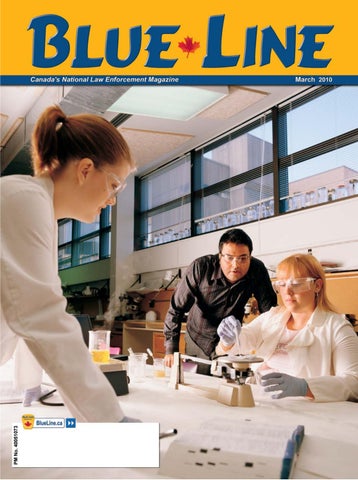
Ashvin Mohindra, Program Co-ordinator (and Professor) of the Biotechnology – Technologist Forensics program at Fleming College, is shown in one of the college’s labs. The future of crime fighting across Canada is dependent upon the learned skills of these young people and the experience they gain by working with police agencies. Blue Line’s feature story this month focuses on the co-operation and communication that has developed between Fleming College and the PeterboroughLakefield Police Service. More on page 6.
Features 6 8
Community connections shape Peterborough area policing
10
A Decade of learning from the best
22
High tech hearing protection We test the best in electronic hearing protection
Cultural change brings new career Documentary tells story of leaving domestic abuse
Niagara College mentors law enforcement students with Blue Line Magazine
28
Charter-proofing police cautions What we know so far
Departments
Case Law
38 24 34,35 36 37 5 36 16
32 33
Blue Links Ad Index Deep Blue Market Place Odditorials Product News Publisher’s Commentary Representative Profile Technology
BLUE BLUE LINE LINE MAGAZINE MAGAZINE
33
Unenclosed storage yard not “a place” Crown must prove arrest lawful in search case
MARCH MARCH 2010 2010
MARCH 2010
4
BLUE LINE MAGAZINE
PUBLISHER’S COMMENTARY by Morley Lymburner
A tale of man and “machine” I recall my number ONE Breathalyzer test. This is “the biggy” that every breath tech worries about because you can imagine what the defence lawyer could do when they found out that this is — THE FIRST. I was working a quiet afternoon shift at the Traffic front desk when Harry gave me a wink and a nod as he began his shift. Harry, we will call him McCleneghan to protect the innocent, called out to me, “Don’t worry Morley — we will get you your first drunk in no time.” I knew Harry’s reputation and he was a wonder to behold. He was known as the unit’s best drunk catcher and a record holder with a daisy chain of four prisoners, all cuffed together and stinkin drunk. As for how he managed such a record, don’t ask. Harry ain’t tellin. But I digress — again. Now Harry started his shift at 4 PM and by 4:20 he was parading an impaired (nay - drunk) driver before the sergeant at the desk. My surprise was more with the sergeant, who seemed not at all surprised. “Okay Morley, you better get that machine primed,” came the order. I dutifully corrected the sergeant that it was an “instrument and not a machine.” Off I went to the Breathalyzer office and everything I was taught kicked into high gear. I purged the instrument, timed everything and made careful notes. I qualified the ampoule containing the “clear yellow liquid” (consisting of 0.25% potassium dichromate, .025% silver nitrate and 50% by volume sulphuric acid) with the alcohol standard test, containing 3.38 milligrams of alcohol in each millilitre of solution. I purged the instrument to clear it of all residual alcohol and balanced the light meter. After making clear notes of all this I welcomed my “guest” - number ONE - into the
BLUE LINE MAGAZINE
office. Harry advised me of the circumstances of the arrest and his reasons for believing the subject to be impaired. I furiously wrote down my notes. Visions of a gruelling cross examination from a defence lawyer loomed large in my head. This one had to be letter perfect because it was — number ONE. I noted the condition of the subject carefully. Eyes - red and watery; pupils dilated; smell - alcoholic beverage... ahhh... in there somewhere... I was sure there was alcohol... and grease... dirt... and... and... oh yes!... vomit... and... Oh No!... faecal matter. “Harry - where did you find this guy?” “Just driving down Yonge Street,” Harry said cheerily. “Okay Harry. Thanks... I guess,” I responded gloomily. The smell was overpowering. Thoughts of what a maggot might smell in the disposal bin of a slaughter house on a hot day came to mind. The man was slouched in the plain steel chair. The subject lobbed his head toward me in recognition of the voice he could hear in the fog. I asked him if he could understand me. He responded with something that could have been affirmative so I demanded he blow into the plastic tube I held to his lips. He placed the tube to his mouth as I delicately withdrew my hand in time to avoid a drop of liquid bile coming from his mouth. He promptly pulled the instrument off the desk and threw it against the wall turning it instantly to rubble. The fight was on as I tackled him in the midriff and pinned him against the wall. The interview room door opened wide and the cavalry arrived just in time to see the primal hunk of sludge throw up all over my shoulder and back. As the troops carried away my chuckling subject, I could hear
5
him yelling “have a nice night copper.” I looked around the office in dismay. It was time to take notes as to what had just happened here. “My first test is a refusal,” I said to myself. “What a way to start.” I looked at the wreckage that was once my shiny Borkenstein Breathalyzer model 900A. I looked at my notes, dutifully inscribed with the number ONE, and covered in puke. Do I clean my office, myself or the notes first. I decided on the notes and then went to change my shirt. After cleaning the office, the final indignity came from the sergeant in charge of the station. “Sign here Lymburner.” He was showing me a departmental documentation for permitting a drunk to handle my “machine.” I dutifully pointed out that it was an instrument and not a “machine.” His steely eyes narrowed at me as he dutifully added to the bottom of the documentation that I was also insolent with the sergeant. The epilogue to all this is both bitter and sweet. I was called into the inspector and he docked me eight hours pay for not securing the “machine.” I thought about dutifully correcting the errant descriptor of the instrument and then remembered that closed mouths are never a temptation for a confession. I took my lumps and ever after kept a firm hand on “the machine.” And what of my subject. Two weeks later I was notified by newspaper headlines that good old “number ONE” was found shot dead outside his apartment. Apparently, the victim of a drug deal gone bad. Is there justice so fair that mere mortals can not bear?
MARCH 2010
Community connections
shape Peterborough policing
by Drew VanParys
and can now directly connect with students, faculty and staff involved in Building relationships is a key part educating and training future officers. of any successful community policing “I have always been committed to effort and an excellent manner for police community policing and to preparing services to excell in this effort is to create and supporting our front-line officers linkages to local educational institutions. in the best possible way,” said Rodd. Benefits can be quickly realized by both “Policing in today’s communities reinstitutions. The first is career progresquires a well-rounded individual with a sion of existing staff and secondarily as strong combination of law enforcement CPS Chief a pool of identifiable talent drawn from P L Murray skills and critical interpersonal and Rodd the community policed. team-building skills. A college educaBy example a long history of collaboration tion is a good tool in building that combined set between Fleming College and the Peterborough of capabilities.” Lakefield Community Police Service (PLCPS) The PLCPS polices a large geographic area in has produced tremendous results. a complex environment, serving a population of The strong connection with the local commuapproximately 80,000 out of two stations – its City nity college has been a key in producing successful of Peterborough headquarters and a detachment graduates who go on to professional policing and office in the Village of Lakefield. security careers. The link between the college, police servRelationship building has also been the hallice and community is deeply embedded. Apmark in the career of PLCPS chief and Fleming proximately 62 per cent of the civilian and sworn alumni Murray Rodd, who joined the force in 1983 members are Fleming graduates from a variety of and moved up through the ranks to inspector and disciplines, in addition to the police foundations then chief in August, 2008. He was named police (PF) program. Uniform and non-uniform staff officer of the year in 1996. include graduates of human resources manageA direct connection between the force and ment, recreation and leisure services and business college has never been more evident than now. administration. Shortly before becoming chief, Rodd was apFleming was one of the first Ontario compointed chair of the board of governors of Fleming munity colleges to offer a two-year PF diploma. MARCH 2010
6
Graduates have gone on to serve communities across Canada for more than 25 years. The program is one of the largest in the province and the largest single program offered at the college, with more than 260 students currently enrolled. Students can gain extensive applied learning through practicum and placement opportunities offered by local police forces. The program links to the community through its volunteer advisory board, which has police and community service representatives. It helps guide curriculum updates and placement opportunities and offers guidance on specific employer needs. “The Fleming experience has helped me immensely on my career path,” says Rodd. “More importantly, the connections to the people and students at Fleming that are a part of our police service and our community at large help me and our police service on a daily basis.” Rodd sees the value of connections between colleges and police forces growing in importance in the future. “Society is changing quickly and so is the role of a community police force. Working with our local college helps us link the needs of our community with the skills that we can build in new officers and employees to meet those community needs. The relationships we create only serve to make our communities stronger and safer.” The Fleming faculty has law and law enforceBLUE LINE MAGAZINE
Above: Members of the Peterborough Lakefield Police Service who are graduates of Sir Sandford Fleming College. The police service and community college have a longstanding relationship with the advantage of selecting the most talented candidates with close connections and understanding of the community.
ment experience with many police forces and, “is dedicated to providing the highest level of academic rigour and personal support in training our students,” says Paul Legacy, dean of Fleming’s School of Law, Justice and Community Services. “Our goal is to produce graduates with a well-rounded skill set and an aptitude that prepares them for the high demands placed on new police
BLUE LINE MAGAZINE
officers today... (and) diversity of environments in which they will work.” Fleming is an approved PARE testing centre and has developed articulation agreements for degree-level programs at several universities, often with significant course credits. The PF program also features an Aboriginal emphasis initiative, a special stream of curriculum
7
that is an inclusive approach to providing more understanding of Aboriginal communities, including links to police forces. For further information about Peterborough Lakefield Police go to www.peterboroughpolice.com. For more information about Fleming College go to www.flemingc.on.ca/
MARCH 2010
A decade of learning
from the best
Niagara College mentors law enforcement students with Blue Line Magazine For the past ten years all students enrolled in Niagara College’s police foundations courses have been required to read Blue Line Magazine to keep up to date on current events and law changes. Staff are encouraged by the enthusiasm of students who read it and instructors test them on the contents of each issue. Gino Arcaro, B.Sc., M.Ed., Niagara College’s Coordinator of Police Foundations, Law, Security and Community Safety, proposed using the magazine as a single source for contemporary relevance in the law enforcement curriculum. “The decision to use Blue Line Magazine for our courses was a novel approach and a radical departure from other styles of teaching,” says Arcaro. “When I first made my proposal to use Blue Line in my courses it was an attempt to use contemporary publications to broaden the knowledge base of the students. It fulfilled that mandate and went far beyond what was initially required. “The information in the magazine wasn’t only up to date but fulfilled the needs of a lot of subjects, from psychology to sociology. It actually got them in tune with law enforcement right from the start.” Arcaro points out that typically each course had only one text book to study, resulting in a narrow focus for the students and a diminishing impact as the text became more dated as the years went by. Introducing Blue Line instilled an awareness of the continuum
MARCH 2010
Niagara College students shown above are in a class, Report Writing II, instructed by Sgt. Joe Picton (shown front row second from left)
of knowledge so necessary to today’s law enforcement practitioner. The magazine has transformed students’ opinion of law enforcement in ways a text book could never achieve, Arcaro notes. The Niagara College staff see the relevance of matching a trade oriented publication to the actual trade or occupation being taught. This strategy has become so well accepted that many instructors have stopped searching for other relevant material. “Blue Line has satisfied all topic levels,” says Arcaro, “whether its general education, seminar, vocational, exams or discussion. It satisfies the needs of broad-based law enforcement.” “I would highly recommend other instructors utilize Blue Line Magazine as we have done,” says David Veres, Dean, School of Policing and Security. “It has done more than just add a resource to our program, it has connected academics and industry in an extremely positive manner. Doing this one simple thing of having students subscribe to the magazine adds contemporary curriculum and requires no external motivation for the student to read.” “We are going into our 22nd year of publishing,” says Morley Lymburner, founder
8
and group publisher of Blue Line. “It is initiatives like those shown by Niagara College’s staff that confirms our content is current and relevant to our readers. We are all pleased to see our magazine content being held in such high esteem.” Niagara College currently requires all 750 students in both first and second year police foundation courses to subscribe to Blue Line. The publication is sent to their home addresses rather than the college. “The rationale for this is a simple one,” says Lymburner. “Students must understand that not all the learning and reading they have to do is in the classroom. For over 10 years now Niagara College students have been starting their careers with the notion that they are responsible for keeping up to date and Blue Line Magazine is one of the ways to accomplish this.” For further information about Niagara College Contact: Ms. Jill English, Academic Student Advisor, jenglish@ niagaracollege.ca (905-735-2211, Ext. 7397) E-mail erin@blueline.ca or call her at 905 640-3048 to inquire about reduced rate bulk subscription orders.
BLUE LINE MAGAZINE
Fingerprints through time Guelph Police history book commemorates 180 years of policing by Eric Balnar Fingerprints through time – A history of the Guelph Police, is not your typical history book. “It’s really entertaining,” says Sgt Douglas Pflug. “There are parts that are actually quite humorous.” Pflug, head of media and communications for the service, pitched the idea to Guelph council and a police committee and received immediate approval. He says the book moved quickly because of an aggressive timeline and the fact that police are “doers... “We’ve been working hard,” says Pflug. “There were a lot of people putting in a lot of effort and a lot of passion. We wouldn’t be where we are without them.” Pflug was inspired by a July 2008 Guelph Mercury article by Nicole Visschedyk, who wrote about “Firsts in Guelph.” Visschedyk noted that the Guelph Police Service was the first to have a patrol officer on a motorcycle and to have two-way radios in patrol cars. The article sparked an interest in the need to record Guelph’s history. The book’s authors are Guelph City Councilor Leanne Piper and retired Mercury writers Bob Rutter and John D’Alton. “(They) each saw the presentation and loved it,” says Pflug. “They just had to be a part of it.” One of the main goals of the book is to educate children and give a detailed, but also entertaining, history of the fine men and women who have served the Guelph region. “To help us trudge forward we must look at the past,” says Pflug. “We want to get rid of the current notions of police officers. We are just human beings.” One of his favourite stories is about two officers charged for talking with citizens downtown in the 1920s, which was against the code of discipline. “It’s ironic,” Pflug laughs, “because this is what policing is all about today: talking to citizens, being a part of the community.” Pflug wants to use the book to show what policing is really about – community – and to connect different segments of society. “(Policing) is not just about reacting. It’s about preventing and education,” he says. The close to 25 contributors all have different roles and are from various aspects of the community. All are volunteers who are doing it as a “labour of love,” Pflug says. The book rallied the Guelph police family, with retired officers and families contributing many photos and stories, but BLUE LINE MAGAZINE
the project went beyond police circles. The Guelph museum, historical society and library also helped out. The title is also impactful. “Everyone’s time was a fingerprint in the Guelph police history,” says Pflug. “No contribution is too small or has gone unnoticed.” The large fingerprint on the cover is the first ever taken of a Guelph citizen – in
9
1827, the city’s founding year. The book is designed in a unique coffeetable style manner and has something for everyone. A chronology, the book begins with the early years – the city’s founding – and ends with “a bright future.” It also has sections highlighting equipment and technology, transportation, a hall of honour and ‘remember whens.’ It has a ‘friendly interface,’ which other police histories lack, and lots of fun facts and humour while maintaining a very analytical look at the past, Pflug states, adding most pages have a picture and are structured to give an easy read. Profits will be donated to a local charity. The service helped raise close to $130,000 for local charities in 2008. “The book is about the citizens of Guelph,” says Pflug. “It’s meant to be a celebration of people and community.” Visit http://www.guelphpolice.com/new-book/ for more information or contact Douglas Pflug at 519 824-1212, ext 253.
MARCH 2010
Highhearing tech protection We test the best in electronic earmuffs by Dave Brown Tactical is the new cool. There is even a word for it: “tacticool.” It seems everything needs to be tactical these days – from weapons and accessories to camouflage underwear for your wife or girlfriend. Perhaps my view is a little more simplistic. To me, tactical should not be just marketing labels lining the aisles of sporting goods stores; tactical means combat-ready MARCH 2010
gear made to higher standards, for use when equipment failure can lead to mission failure. Tactical means ensuring users make it home alive at the end of every shift or tour. Tactical means it just has to work. The ‘clap’ test Earmuffs that use electronic circuits to reproduce ambient sounds and cut off the damaging frequencies of gunshots have been around for awhile, but it is only recently that companies have been able to develop “intelligent” versions. Early models were heavy, expensive, ungainly and irritating to work with, especially on busy shooting ranges with multiple shots going off at random times. The latest combat-ready tactical hearing protection not only electronically amplifies sounds but also very smoothly drops the damaging frequencies of gunshots in microseconds instead of seconds, making them almost transparent to the user. 10
The ultimate test of these latest earmuffs is the handclap test. Put them on, make them comfortable and clap your hands as hard as you can in front of your face. The ‘clap’ should sound quite distant (it actually approximates the damaging frequencies of gunshots). Now turn them on, turn up the volume and try the same test. You should be able to hear even the faintest sounds clearly, but a handclap will sound almost as muffled as it did with the electronics off. Now for the ultimate test. Try carrying on a steady conversation with the muffs on and then clap your hands. The clap should sound distant, but the conversation should be almost seamless. This is known as a soft cut-off. Early designs would simply shut the entire circuitry off for a few seconds, leading to annoying dropouts in conversations. Selection criteria While there are many variations on hearing BLUE LINE MAGAZINE
Invest in your career Take Blue Line training courses Drug Investigation Techniques April 27, Fee:$250 +GST This course is designed to assist young officers or veteran officers in transfers or promotion to a drug enforcement unit through the development of appropriate skill sets that relate to drug investigation. The course includes information on: • Interception of private communications and acquiring an intercept order • Undercover techniques • Managing and initiating undercover drug operations • Search warrant acquisition • Interception of private communications and acquiring an intercept order • Drug surveillance techniques • Close quarters combat for undercover officers Instructor: Det. Steve Walton (retired).
The Non-Accusatory Interview Technique April 27, Fee:$250 +GST This topic is designed for all police officers as well as private investigators and security people involved in interviewing suspects and/or victims. Learn the basics of: • Conducting an investigative interview in a conversational setting with the emphasis on obtaining important information. • How to establish a “free-flowing” interchange between the subject and the interviewer. • How to plan and enter into an interview and get the subject talking and keep them talking. • Current legal status of investigative interviews and how far you can pursue the truth in a legal manner. Instructor: S/Sgt Gordon MacKinnon (retired).
Detecting and Defusing Deception April 28, Fee:$250 +GST This topic is of interest to all police officers as well as private investigators and security people involved in interviewing suspects and/or victims. In this course you will learn: • How deceptive subjects act? • What they say and how they say it? • What they do when faced with certain probing or bait questions? • We will also cover some of the latest findings in this field and dispel some of the myths about lying. Instructor: A/Sgt Wayne van der Laan (retired).
April 27 & 28, 9am - 4pm
Pre-registration & Info at BlueLine.ca
BLUE LINE MAGAZINE
11
MARCH MAR RCH H 2010 20 2 010 0 MARCH
protection that could be labelled “tactical,” this article will focus specifically on electronic earmuffs. They not only allow outside sounds to be heard through internal speakers in the ear cups but can also amplify ambient sounds. (This would allow, for example, SWAT teams to be able to hear whispers on the other side of a wall.) This head-to-head comparison test also focuses on compact hearing protection that will fit under a typical combat helmet and is contoured for correct cheek placement on weapon stocks. To be selected, models needed to have a communication port input designed to integrate with radio systems and a NRR (noise reduction rating) of 18 decibels or more. All of our test samples use the latest technology in impulse noise control, which provides a so-called “soft” cut-off to loud noises such as gunshots – plus, they look cool and cost a lot of money; both necessary components for anything considered to be both “tactical” and “tacticool.” Testing procedure Each test model was subjected to a battery of subjective tests and then rated on a scale of 1 to 5, with 5 being the highest. Impulse noise control was evaluated using pistols and shotguns on both indoor and outdoor shooting ranges, all with typical safety glasses or protective goggles in place. Each model was then exposed to three different sound frequency tones (250, 440 and 1000 Hz) with amplification off and evaluated for its ability to block out those specific parts of the frequency spectrum, both with and without safety glasses. It should be noted that, like most everything else in life, hearing protection is a compromise between differing and often conflicting requirements. Many models that did not meet our test criteria would do a better job of blocking gunshot noise but are not compact enough to fit under a combat helmet. Plus, even the most inexpensive passive earmuffs block more gunshot noise than most of these compact models, but they rely on tight head pressure to achieve these results. Passive muffs designed for short-term use would not be very comfortable for longer periods of wear. There are also less expensive models of electronic earmuffs that use a “hard” cut-off to control impulse noises, but this results in a very irritating (and potentially dangerous, in tactical situations) complete dropout of all sound amplifi cation for up to two or three seconds at a time. If multiple shots were fired, they would be almost useless. (See sidebar.) All test samples were purchased at retail from authorized factory dealers. (Special thanks to Seals Action Gear in Calgary for the Peltor models, Peltor Communications for responding to my inquires and for rigging up a custom two-way radio patch cord and to SRS Tactical in Calgary for the MSA-Sordin model, plus the optional gel ear cushions.) MARCH 2010
Final results Third place – The Peltor SportTac was designed more for the hunter and target shooter than the tacticool operator – they even come with replaceable ear cups in blaze orange! – but also use some of Peltor’s latest technology in intelligent noise control and soft cut-offs for impulse noise reduction. They had virtually no lag time and loud gunshots were reduced to comfortable levels without seeming to affect any other sounds. Comfortable for long-term use, one could easily carry on a conversation on an active shooting range with these muffs in place and not notice any annoying dropouts in sound.
sound suppression technology though and I liked them so much that I sought other solutions. First, changing from thick-framed to thin wire framed shooting glasses made a significant difference in their livability. Secondly, based on a recommendation from SRS, I tried Peltor’s optional gel cushions. This made such an improvement that I decided to retest the SportTacs, both with the stock foam ear cushions and with the optional gel cushions. The SportTac muffs are the least expensive ones in this test. They may have finished in third place, but they are the ones that live in my range bag and are entirely suitable for a lot of my outdoor training activities. I even switched to the bright orange ear cups for a distinctive look when working – hoping none of my students seem to be attracted to a brighter target, of course. Second place – The Peltor ComTac was the company’s very first tactical combat earmuff design and still performs very well today. (Peltor also makes a ComTac II, which has improved ergonomics and a better optional microphone boom system.)
The reason these muffs finished in third place, however, was the ear cushion seals. They may have been comfortable to wear but they let more sound in then the other two models – which probably relates to their rather soft clamping pressure. When worn with safety glasses, they were so potentially damaging that I had to terminate the test on the indoor shooting range to prevent my ears from ringing too badly. Sound leaked in through the foam ear cushions, both in front where the arms of the safety glasses entered, and underneath and behind where the back of the eyeglass arms would push the foam cushions slightly away from the ears. Due to the nature of gunshot sounds and how they tend to curl around the shooter, the gap at the rear of the cushions was probably the most damaging. Suspecting that the foam was at fault, Blue Line contacted Peltor for its view and talked to Tom Lavalle, business development and marketing manager for Peltor North America. He felt that shooters needed to purchase earmuffs and shooting glasses as an integrated system and that Peltor-branded glasses may not show this problem as much. He was nice enough to respond to our inquires and direct them as far as the engineers who designed the muffs. The reality is that these muffs are probably less suitable for indoor shooting ranges and more directed toward the outdoor enthusiast shooter and hunter. The foam cushions are noticeably stiffer than the ones in the more expensive Peltor ComTac and MSA-Sordin Supreme Pro-X muffs. The SportTac muffs do use the latest 12
The sound clarity from the ComTac was a significant step up from the SportTac and this reflects their combat heritage. All sounds were clear and there was much less hiss in background noise, even when turned up high. Two-way radio signals sounded more like music from really good headphones than the tinny sound from speakers built in to most two-way radios. Although these muffs are a few years old, the foam ear cushions remain pliable and comfortable. I never felt the need to try the optional gel cushions, either indoors or outdoors. On/off and volume is controlled by two small pushbuttons on the side of the muffs. To turn them on or off, one has to hold both buttons down for a few seconds. It was difficult to feel how hard to push them and often required two or three attempts. They amplified the sounds very well, but the volume button only has four steps from faint to loud. The Peltor Comtac and ComTac II are probably the widest-used electronic earmuffs in combat operations. They integrate with two-way radios using professional-level J22 plugs and Peltor sells optional boom microphones and a variety of push-to-talk interfaces that are as water resistant and combathardened as the muffs themselves. They even BLUE LINE MAGAZINE
Invest in your career Take Blue Line training courses Mastering Media Opportunities April 28, Fee:$250 +GST Mastering Media Opportunities, Traditional and 2.0, is an introduction to the principles and practice of media relations in the world of ever expanding conventional and new media public affairs. It will help you understand how to fine tune your audiences and craft key messages for broadcast media, print and web 2.0 (blogs, new media and the Internet). You will get the opportunity to create messages for a topic of your choosing and practice using them in an interview that will be recorded and debriefed. Instructor: Allan Joyner
Cell Phone Forensics April 27, Fee:$250 +GST Mobile Forensics Inc, the leader in mobile phone training brings a one day course that will introduce you to legal issues, service providers and current methodologies utilized in cell phone forensics. This course will prepare you to realize the need for cellular evidence from the carrier and device and learn the steps necessary to secure this valuable evidence. The course will also cover tools that are currently used for both physical and logical examinations with actual live extractions during the presentation. Topics include: • Court Paperwork • Radio Isolation: First Responders and Examiners • Troubleshooting • Software Tools • Hardware Tools • Completed Reporting Instructor: Bruce Downey
Instructor: Lee Reiber
FREE admission, with course registration, to the Blue Line Trade Show. Canada’s largest law enforcement exhibition of the latest products and in demand services. Course location offers FREE parking, easy access to several major highways, a wide range of hotels, restaurants and amenities.
April 27 & 28, 9am - 4pm
Pre-registration & Info at BlueLine.ca
BLUE LINE MAGAZINE
13
MAR MA ARCH CH 2010 2010 10 MARCH
custom-built an interface so I could plug them into a Motorola FRS radio. First place – Like Peltor, Sordin is a Swedish company specializing in face and hearing protection. Rumoured to be started by former Peltor engineers, Sordin was recently bought by Pittsburgh-based Mine Safety Appliances Inc. and the name was changed to MSA-Sordin.
Their Supreme Pro-X electronic muffs use three buttons on the side to control power and volume. Turning them on or off is quick and positive and, like the other two models in this comparison, there is a responsive beep when powering up or down. While their actual NRR was less than the other two test samples, they tended to block more frequencies than the others when off and were almost hiss- and noise-free when on. (Standards for reporting noise reduction ratings for ear protection are currently scheduled for change and there have been several different standards over the years. One should look at more factors besides the simple NRR number for electronic earmuffs.) Unlike the Peltor models, the MSASordin muffs use a standard mono 3.5mm mini-plug for radio input, which means I wanted to immediately try plugging in my iPod. Listening to tunes while awaiting your turn on a shooting range and being able to carry on a conversation with a person beside you while blocking out damaging frequencies of gunshots just seems like such an elegant way to spend an afternoon. I was amazed. The Supreme Pro-X are mono, of course, but were nearly as good fidelity as my best stereo headphones. The Pro-X model is also waterproofed to IP67 standards and I could listen to the tunes in my head in the cold, pouring rain all day long if I wanted to (although I suspect MSA-Sordin was looking more at combat conditions than some idiot like me standing in the rain listening to his iPod.) They were the heaviest and most expensive electronic muffs in this test, but were significantly better in many ways. If one needs the ultimate in combat-ready electronic earmuffs, they are well worth considering. Dave Brown is Blue Line Magazine’s Firearms Editor and staff writer. He is a tactical firearms trainer and consultant. He can be reached at firearms@blueline.ca
MARCH 2010
14
BLUE LINE MAGAZINE
Just ishow much your hearing worth? What can you buy for $50? by Dave Brown If it is made anywhere in the world, you can bet that someone in China is knocking it off for half the price. One can buy a large variety of cheap brands of electronic earmuffs, but what do you get for the price? The good news is that they are at least as good as any inexpensive passive earmuff. The bad news is that they are only as good as any inexpensive passive earmuff. They all use what I term a “hard cut-off” to reduce loud impulse noises such as gunshots. This means that they don’t smoothly ‘ramp’ down and then up to reduce gunshots, they cut out completely. Carrying on a conversation on an active shooting range is an exercise in frustration and you might as well be talking to yourself, because – most of the time, it will seem like you are. These earmuffs didn’t have a wired connection between the two sides, so they required independent on/off and volume control buttons and, for some reason,
BLUE LINE MAGAZINE
the left side will cut out for at least a second longer than the right side after a gunshot. They are even advertised as having an audio input and touted as great way to listen to music on a shooting range. If you’re old enough to remember the inexpensive ‘crystal radio’ kits that kids used to assemble, then you would recognize the tinny distorted screeches they produce – only recognizable as music if all your experience was beating on hollowed-out logs and plucking strings attached to a stick on an upside-down washtub. Actually, in retrospect, that is probably an insult to washtub musicians.
15
Just for fun, I submitted a typical Chinesemade knock off set of electronic earmuffs to the same tests as the other samples, but after awhile I began to feel nauseous from the chemical smell of the vinyl headband. (One can only imagine the working conditions and environmental impact of these factories in China.) Instead of spending your money on this simple little integrated circuit board and tiny, toy walkie-talkie style speakers, just get some good passive earmuffs – because the reality is, this is what you will be listening to most of the time anyway.
MARCH 2010
TECHNOLOGY by Tom Rataj
Invasion of the body scanners After the poorly executed Christmas Eve airplane bombing attempt, airports around the world began rushing forward with plans to install the latest generation of full body scanners. What sets these scanners apart is their ability to see through clothing and reveal liquids and powders contained in bags or pouches such as the would-be bomber used. Many critics, privacy advocates and news media call the new devices “naked scanners” because of their revealing capabilities. Many travellers appear to be resigned to the new reality of surrendering their personal privacy and dignity in exchange for what appears to be a security measure that will stop a wide variety of threats. While the new scanners are all the rage, other scanning or sensing technologies are already widely used worldwide. Most of us are familiar with the standard walk-through and wand-style metal detectors, which have been used for many years. Less common are explosive sensing booths, used at airports and other places to identify people carrying explosive materials. Intermodal cargo containers and truck trailers are routinely scanned with specialized container scanners that can see through the walls. Specially trained dogs are also used extensively to locate drugs and explosives. The naked-scanners The scanner being installed at major airports across Canada is the L3 ProVision Millimetre Wave (MMW) Checkpoint Screening System. It uses extremely high-frequency (EHF) radio waves to quickly produce a 3-dimensional black and white silhouette of a person standing inside its large booth. A complete scan takes 10-seconds and can reveal virtually any substance or material secreted under the subject’s clothing. The operator/analyst examines the image and can zoom-in on specific areas for closer examination of any irregularities. In the Canadian airport implementation, the system will be used with a number of privacy protection features activated. The operator/analyst will be located remotely so they can’t physically see the subject and the system automatically blurs facial areas so a MARCH 2010
person can’t be visually identified. The image is deleted after the examination is completed. This system is apparently quite safe to use for both the operator and subject, emitting radio frequency energy at levels 10,000 times lower than other commercial devices such as cellular phones. A number of companies produce similar MMW scanners. A comparable device based on back-scatter X-ray technology is also commercially available, but it only creates a 2D image by sensing the radiation reflecting back from objects. Metal detectors Most of us don’t even think twice about walking through a portal-type metal detector or being wanded by a handheld model because this technology has been around so long and is used extensively. Metal detectors typically use one of three major radio frequency technologies; Very Low Frequency (VLF), Pulse Induction (PI) and Beat-Frequency Oscillation (BPO), and are considered completely safe. Metal detectors are manufactured around the world by a large variety of companies and are generally very affordable. Explosives detectors There are a number of technologies and systems available for detecting a variety of explosive materials. The most common in airport applications is Ion Mobility Spectrometry 16
(IMS), which functions at the molecular level. There are also specialized x-ray machines and neutron-activation technology based machines. Explosive sniffing dogs are another effective solution and there is some promising research into using trained honey bees. The systems under development rely on advanced computer video analysis software to recognize the bees’ reaction to the presence of explosives. Drug detectors While there are not any walk-through style drug detectors available (yet), systems and kits can identify a wide variety of drugs. Most rely on a suspect sample being introduced into a machine which uses gas chromatography/ surface ionization technology to identify the drug. Other systems rely on suspect samples being introduced into reactive liquids or put on test strips. Trained dogs continue to be the leading and most reliable means of detecting drugs. Cargo containers Different technologies are also available to inspect cargo containers from the outside. Gamma-ray radiography uses radioactive materials and gamma detectors to produce good quality images of goods inside a container. Able to penetrate up to 18cm of steel, BLUE LINE MAGAZINE
these systems reveal everything inside. X-ray radiography uses a non-radioactive source to produce a high-energy Bremsstrahlung spectrum of energy to penetrate up to 40cm of steel. They are more expensive to purchase and operate than gamma-ray detectors and deliver radioactive doses that pose a hazard to operators and human cargo inside a container. They are very good at detecting nuclear materials. Both systems require moving the cargo container or trailer past the scanner or moving the scanner past the container or trailer. Dogs Our four-legged friends shine when it comes to detecting explosives, drugs, people and a wide variety of other things. With their significantly larger olfactory cortex, dogs can pick up and discriminate odours at concentrations 100 million times lower than you or I can smell. While there are certain limits on the amount and duration of the work they can do, and they are generally only trained for one type of detection work, dogs provide a more affordable option where other expensive technologies may not be practical or feasible. People While we pale in comparison to dogs and many other technologies, humans have some skills that machines cannot yet match. We can recognize behaviour and body language in people that is often indicative of criminality. Some security experts point out that careful observation and analysis of subjects’ behaviour and body language is often a better and more reliable means of identifying people that pose a threat to safety.
and detonated by a terrorist. While scanner technologies have a place in enhancing security and detecting contraband, people’s behaviour and body language, manner in which they answer questions and other generally observable behaviour is probably the best method of detecting threats to safety. Additionally, a number of suspicious circumstances related to documentation and travel arrangements
can also help identify individuals who may pose a threat. Technologies have their place in enhancing security but should not be relied on entirely, as they clearly have limitations. Tom Rataj is Blue Line’s Technology columnist and can be reached at technews@blueline.ca .
Analysis The scanners currently being installed have a number of shortcomings. Some critics quite correctly point out that people with generous bodily proportions could readily secret small items of contraband (including explosives) under their breasts or between folds of skin which scanners would not detect. A real example of this is the case of a very obese (600 lb.) individual in custody in Houston, Texas for 14 hours last August. Despite being searched and processed at several stages, the 9mm handgun and two magazines he had secreted between his voluminous layers of fatty skin were only revealed when the prisoner himself voluntarily advised jail staff that he had them. The would-be Christmas Eve bomber had only 80 gram (3 oz.) of explosives sewn into his underwear – enough to destroy the aircraft in mid-flight over southwestern Ontario if it had been successfully detonated. This is not a large amount of material so it could readily be concealed in an anus or vagina, a technique often used by drug smugglers. Properly packaged and equipped with some type of internal detonator connected to a length of virtually undetectable cotton string, an 80 gram piece of plastic explosive could easily be smuggled aboard an aircraft BLUE LINE MAGAZINE
17
MARCH 2010
Reducing the “garbage” in DNA testing by Jeremy Hainsworth Forensic investigators have battled problems with extracting and analyzing samples from contaminated evidence such as indigodyed fabrics since DNA began to be used in criminal cases. DNA debuted in British criminal casework in 1987, based on work by British genetics researcher Sir Alec Jeffreys. Canadian major crime investigators will soon have a new tool on their utility belts, says Ron Fourney, the RCMP’s director of forensic science and identification services. A breakthrough from the University of British Columbia Department of Physics and Astronomy may remove contamination roadblocks thrown in the way of extracting usable evidentiary DNA from challenging sources, including indigo dye from blue jeans, humic acid from soil, melanin from hair samples and hematin from blood. They can co-extract with DNA – and when they do, or in cases where there is insufficient DNA, it’s estimated 10 per cent of crime scene samples may fail. The new method, say investigators and prosecutors, could well provide better evidentiary samples. “It’s a great advancement for cleaning up and getting samples that in the past would be problematic,” says Fourney. The advancement affects police forces
MARCH 2010
across Canada which rely on RCMP labs or Ontario and Quebec provincial labs to process investigative DNA samples. Fourney says the RCMP had advance warning that “a new and exciting technology was around the corner.” It’s a leap forward in intelligence-led policing, he notes, adding the process seems advantageous for the recovery of DNA and biological samples where the initial sample is very small. The breakthrough is the work of Prof. Andre Marziali and his UBC team and is, “potentially useful for more challenging samples,” Marziali explains.
18
However, Fourney cautions that police need to take steps before the synchronous coefficient of drag alteration (SCODA) method can be definitively added to their toolbox and used in the charge-approval process and in prosecutions. “We would vigorously validate this, many more samples... how it would operate in the real world,” he stresses. “This is very exciting,” he adds. “The silence of the grave is a poetic anachronism,” he quips. “Volumes can be spoken to those who will listen and this is one of those situations.” Hiron Poon, the RCMP’s acting program technical leader for biological services, says Marziali’s methods can clean up a speck of blood to a billionth of a gram. Poon, who worked with Marziali on the project, says the process will allow for cleaner DNA that can be better enhanced for prosecutions. Fourney readily admits that the complexities of DNA forensic science are frequently something of a “twilight zone.” DNA, or deoxyribonucleic acid, is a nucleic acid in a double-helix chain containing the genetic instructions used in the development and functioning of all known living organisms and some viruses. Human cells contain 23 base pairs of chromosomes, each of which contains close to 100,000 genes and DNA chains made up of 100 million base pairs of nucleotides. Simply put, the complete human genetic code is based on three billion base pairs, dictating everything from height to hair colour. To build a genetic fingerprint, forensic scientists need a clean crime scene sample, which they cut to produce samples of differing lengths. Fourney has been in the DNA trenches for two decades and tips his hat to BC prosecutor Derrill Prevett as another Canadian pioneer in the field. Prevett suggests the new process is interesting as a contaminant such as indigo can inhibit the chemical scissoring process for cutting the DNA strands into segments. The segments are then sorted in a process called gel electrophoresis. Short segments move faster than long ones in the electrified process, which allows for sorting. The resulting sequences are then transferred to a nylon membrane and identified according to the code they contain using radioactive markers. The result is a series of bars – not unlike a bar code – known as short tandem repeats (STR). Just as a barcode identifies a specific product at a store checkout, a DNA sequence identifies a specific person (except in cases of identical births). In short, says Prevett, the process involves extraction, quantification, amplification and interpretation. Forensic work now uses polymerase chain reaction (PCR) processes as the standard DNA typing system, according to The DNA Handbook (by Prevett, Cecelia Hagerman and Wayne Murray). Prevett says the system allows scientists to quickly locate particular areas of DNA, “the molecular equivalent of finding a needle in a haystack.” That needle can be used to pinpoint the person from whom it came but also to rule out suspects, Prevett says, adding that everything must be seen in the context of the case. BLUE LINE MAGAZINE
“Semen left upon the body of an assault victim connotes not only timing but that its owner was the perpetrator of the sexual assault,” Prevett says. “My semen is found in a woman who is dead,” he illustrates. “Ah ha!” Then it turns out she’s my girlfriend. If it turns up in a woman I don’t know, then it has meaning.” Which brings us back to indigo dye and blue jeans. Indigo inhibits the PCR process, and that’s where SCODA comes in. Marziali says the process can reject contaminants such as indigo, acids from environmental sources, soil and blood. The clean DNA then moves into the PCR process for typing. “In small amounts we get over 100-fold recovery than other methods,” says Marziali, who has been working in DNA research at both UBC and California’s Stanford University for years. He did not set out to find the process. Rather, he explains, it’s an idea that came up over coffee with colleague Lorne Whitehead, who created the mathematical formula for the concept. The team’s method employs a DC electric current to drive negatively charged molecules, including both DNA and contaminants, into a gel in a laboratory vessel. Rotating electric fields are then applied to the gel to concentrate the DNA at the gel’s centre, which is extracted for analysis. “By exploiting the physical traits of DNA – electric charge, length and flexibility – we’ve been able to extract DNA from samples that would otherwise not produce enough clean DNA for analysis,” Marziali explains. That clean DNA, says Prevett, can be then subjected to standard DNA analysis techniques. Extracting DNA by conventional methods – which rely on the molecules’ chemical properties – has proven challenging when there are only trace amounts of DNA, notes Marziali, or when the source sample has contaminants with similar chemical traits. “We’ve found that DNA and RNA respond to electric fields in a way that is very different from other molecules. By exploiting this unique property, we were able to extract high quality DNA from a highly contaminated sample from the Athabasca oil sands.” The team successfully tested the technique on samples provided by the RCMP labs, confirms Fourney. With a climate such as Canada’s, that real-world validation means seeing how SCODA will be useful on DNA sources subjected to freezing and thawing, which can break
BLUE LINE MAGAZINE
down the nucleic acid. The problem right now is that the SCODA system is slow by current standards, with each sample taking half an hour to run. It’s a shortcoming Marziali and his team are working on. He wants to move that rate to 48 samples in the same period. Fourney says the current magnetic beadextraction process, while less efficient at producing clean samples, can process 96 samples at once. What’s more, he says, the process must leave the extracted DNA open to the possibility of replication so other labs can also examine it. The leading bead-extraction processes are marketed by ProMega and Quiagen. Marziali hopes to eventually replace those methods with SCODA but, Prevett adds, that whole validation process needs to be verified as acceptable in the chain-of-evidence process before a court. “You have to be careful that the end result will do what you want it to.” Fourney agrees. “It would have to be peer-reviewed and validated by the scientific community and presented to the court,” he says – something Marziali anticipates happening. “I don’t view it as being that hard of a sell and having it validated to a view of it being used for casework.” The SCODA technique is being commercialized through Boreal Genomics, a UBC spin-off company. It’s expected to have broad applications from basic life-science research to forensic sample analysis, bio-defence and pathogen detection for food safety and clinical diagnostics. As such, the technology is also drawing international interest from health authorities, criminal investigators and military and intelligence organizations. Fourney adds one last caution: the whole process is useless without initial investigators who know what they’re doing at a crime scene. “The police in general have very good training but they have to be flexible too,” he notes. “The technology has become so sensitive and gives us so much from so little material that it’s important those are handled carefully.” Poon agrees, adding that the chain of evidence must also be strictly maintained. “Garbage in; garbage out; the front end is critical.” For more information, contact Andre Marziali at 604822-5849 or visit www.physics.ubc.ca/~andre/ or www. borealgenomics.com .
19
MARCH 2010
Cheaper training with better results Part 2 of 3 by Tom Wetzel The strain on police budgets due to the economy will likely impact the amount of training officers receive from their agencies. Regardless of how much training budgets are reduced, police services can still provide officers valuable instruction and intelligence, particularly on arrest, use of force and emergency operation of cruisers. By utilizing approaches that take advantage of available resources, agencies can bring innovative training to their personnel at low costs – but what must be emphasized is that cheaper training doesn’t have to mean less quality. Police trainers may become particularly innovative and resourceful when forced to do so, improving the value and returns from their training over that received from more expensive academy or company based programs. Part of this may result from trainers applying cultural aspects specific to their agency or municipality. Depending on staffing strength or strategic adjustments in scheduling, overtime can be limited more effectively or not used at all. As a result, a service can provide its employees with not only cost efficient but better training, and maybe even more of it.
Use of force training This is certainly one area where going “cheap” now may cost an agency in a huge way later in injury or death to an officer. That’s why a great effort must be made to ensure officers are trained well to survive encounters with violent subjects intent on hurting them or others – but “cheap” training doesn’t have to mean “cheap” returns. If budgets also limit supplies, an agency can use scenario training with available gear, for example. With their full compliment of equipment, made safe for the exercises, officers can face training scenarios where they can get control from a range that includes verbalization to the firing of their duty weapon. This type of simple training allows exercises that task them to think fast, defend themselves and bring a situation under control. Training could be conducted within the
police agency itself or at other locations in their jurisdiction. Other officers or dispatchers can be the role players for the scenarios but consideration should be given to also using volunteers from civic groups or drama clubs. It allows them a chance to provide a valuable public service and gives actors a chance to play a new part. Depending on scheduling and staffing, these programs can be run for short periods of time either during quieter portions of a shift or on a limited overtime basis. Although we want officers to think on their feet, as is often the case when they suddenly have to defend themselves, there are situations where they know force may be a component of a call and can plan their reaction. To simulate this, a trainer can provide some advance information on certain scenarios, giving officers a chance to think about how they would want to respond. With the imaginations of the trainers, this simple type of scenario training can provide some degree of realism and allow officers to practice using their equipment without spending a lot of money. Also, officers will be applying legal training like that addressed in the first installment, as they are required to use force within limits. Tom Wetzel is a northeast Ohio suburban police lieutenant, SWAT officer, trainer and certified law enforcement executive. Contact him at wetzelfamily05@sbcglobal.net for more information.
Park it... at the
2010
Blue Line ow & Training Trainin Trade Show April 27 & 28
Register today for FREE admission! www.blueline.ca/tradeshow MARCH 2010
20
BLUE LINE MAGAZINE
Difficult drawing, successful identification by Diana Trepkov “I just wanted to inform you that one of our Jane Doe bodies was identified,” the medical examiner’s letter began. “It was a case for which you had done a sketch. Thank you!” The note sent chills down my spine. I was so relieved that the beautiful young woman had finally been given back her name. I wrote about her in the March, 2007 issue of Blue Line and my post-mortem drawing was a vital key in helping to identify her.
truck stop, would not stop. She leapt out in a bid to escape. The driver – William Walker, also known as Alanzo Fernandez – spent about four months in the county jail in 1999. The judge sentenced him to time served and a four year probation term after a plea bargain to one felony count of leaving the scene of a fatal accident. Walker immediately vanished and was on the run for nine years. A warrant was issued for Walker’s arrest and it was discovered he had been arrested in California on unrelated charges and extradited to Arizona. He was held without bond pending trial and faced up to four years in prison.
“We never knew she was killed,” Mazzone’s cousin wrote. “We thought she just ran away and still, to this day, avoided contacting anyone. It is a complete shock and it’s very tough for everyone in my family.” Having finished my 106th forensic case, each and every one has a special place in my heart but this one remains as one of the most heartfelt because the victim was so young. The news is bittersweet but I am relieved that she has been identified. Diana P. Trepkov is a certified forensic artist. Visit www. forensicsbydiana.com or contact her at dianatrepkov@ rogers.com or 647-519-9660 for more information.
Post-mortem reconstruction I found it difficult to draw the young victim. Morgue photographs of unidentified remains are extremely hard to recognize. Drowning and burn victims also look completely different than they did before they died. Their features are very distorted in photographs and I had to look past the puffiness and redness, which was caused by the effects of the blunt trauma, to see who this young girl was. Only after studying her photograph for hours did I feel confident to begin reconstructing her face. Her remains were buried at Maricopa County, Arizona’s Potter’s field, the White Tanks Cemetery in the West Valley. Unidentified and unknown, she was simply Jane Doe 99-0305. The beautiful blonde, blue eyed girl was only 17 when she was killed. Her name is Tawni Mazzone, but unfortunately no one knew who she was at that time. A brother searching for his sister Mazzone’s brother was searching the unidentified person’s section of the Maricopa County Medical Examiner’s web site in August 2008, looking for his sister. She had run away in January, 1999 and he had not seen or spoken to her since. He came across Case Number 99-0305 and knew immediately that the girl pictured was his sister. Fingerprints and dental records were collected and provided to the medical examiner that same day and a comparison revealed a match. Mazzone finally had her name back and could be laid to peaceful rest. The family was shocked but also very grateful to finally have some closure after nine years of wondering what happened to Tawni. History Mazzone was pushed – or jumped – from a Cadillac headed east on Interstate 10 near Casa Grande on Jan. 27, 1999. The car was travelling at highway speeds and she died the next day at a Scottsdale hospital. A passenger in the vehicle, which police stopped about 20 miles down the road, accused the driver of trying to force Mazzone into prostitution. The passenger – a prostitute – told investigators Mazzone begged to get out of the car but the driver, who she said was taking them to a BLUE LINE MAGAZINE
21
MARCH 2010
Cultural change brings new career Documentary tells story of leaving domestic abuse by Patrycia Thenu When Namrata (Mona) Gill came to Canada to enter into an arranged marriage, she wasn’t prepared for what life had in store for her. “I thought I was going to be the good East Indian wife, married for the rest of my life,” says Gill, who is now an officer with the Edmonton Police Service (EPS). At the age of 19, Gill was filled with dreams she hoped would come true in her new homeland. What unraveled right before her eyes, is a reality for many other East Indian women, many of whom do not get out. “The main reason I left was for my daughter. She was my inspiration and my strength,” she says. Gill shares her very personal story in Namrata, a film screened last November during the Global Visions Film Festival. The nine-minute documentary illustrates the domestic abuse she suffered for six years and her journey to free herself from the relationship and fulfill her dream of becoming a police officer. Gill arrived in Edmonton in Nov. 1991 with a husband ten years her senior who was
MARCH 2010
not her choice. A few months before, she was in her first year of college in India while her parents planned her marriage, a tradition that is still widely followed in her culture. Everything seemed normal, but the warning bells started to go off when she arrived in Canada. Her instinct at the altar was to call off the marriage, “but that’s a big no-no in India, you don’t do that. Nobody wants to marry that girl ever again. She’s thought of as damaged
22
goods,” says Gill. The abuse started in subtle ways, with her husband controlling what she did and making several requests to her father for an inheritance. She didn’t have proper winter apparel because she had no access to money. She worked in the family owned grocery store almost 15 hours a day and didn’t get paid. When her husband sponsored his mother and sister to come to Canada, the abuse became worse. She was shamed for being a female and told almost on a daily basis that she was worthless. “When his mother would be angry with me, she would cover her face when coming into the room, because she didn’t want to look at me, saying that I was cursed,” says Gill, adding that her mother-in-law would slap her and throw food on her plate. All the while, things seemed okay on the surface to others. “He was very nice and polite in front of my parents,” says Gill, explaining she was too afraid to tell them about the abuse because she wasn’t sure if they would believe or support her. She continued to manage the family store and take care of her daughter, Anmol. Over time the abuse escalated to physical beatings. “He was very clever. He never beat me on my face. I always had bruises on my stomach and my legs, never visible to the outside,” says Gill. The store regulars and people making deliveries knew something was wrong; Namrata had changed. She soon stopped sleeping, for fear of what would happen if she closed her eyes. “There was never a day that we were happy. There was always something.” One March evening in 1997, Gill was beaten and almost raped by her own husband. The next day she decided to tell her parents about her situation. “I told my dad, I’m either going to end up dead or in a mental institution,” she says. Her father came to Edmonton for a year and eventually helped her leave her marriage. She received assistance from the Indo-Canadian Women’s Association and EPS Spousal Violence Intervention Team. She lived in a women’s shelter for more than a month before getting back on her feet. She was now free to pursue her dream of becoming a police officer. “I filled out the application and went to hand it in wearing a bright pink t-shirt, a long skirt and flip-flops. I think I may have put them off,” she says, laughing. She failed two exams but wasn’t ready to give up on her dream. While finishing her first year of a nursing diploma, she received a call from Sgt. Sharon Bach of the EPS Visible BLUE LINE MAGAZINE
Minority Job Development Program, offering her a position. She completed the seven-month program while taking care of her daughter. “It wasn’t easy. I still had a lot of selfesteem issues, but I got into class, Class 96.” Life decided to throw a few more tests her way. “If it wasn’t one thing, it was something else that forced me to work extra hard,” says Gill. Two weeks into class she broke her foot on the second stress day but didn’t lose her position and was given a position in the policy management section. All the while, Gill kept up on her physical fitness training and graduated in Class 98 in 2002. She begun her career in Edmonton’s south division. “I chose a profession that is not the typical career that a traditional East Indian woman would choose, but this is what made me happy,” she says, smiling. There are times that she still faces discrimination. “I’ve gone to calls where I’ve been shunned, I’ve been called names by (Indian) men. Being a divorced woman is looked down upon in my culture.” Gill says she decided to do the documentary to show other women in the same situation that they can free themselves. She now works in the dispatch/911 section. Patrycia Thenu is a Communications Specialist assigned to the Corporate Communications Section of the Edmonton Police Service. She may be contacted by phone at 780 421-2663.
BLUE LINE MAGAZINE
Drug investigational techniques by Steve Walton Investigating drug related crime is no different than investigating any other type of criminal activity. The officer has to incorporate certain generic skills to be successful and effective, including: • Time management, • Identifying investigational objectives and priorities, • Report writing/note taking, • Exhibit handling, • Interviewing persons of interest, • Cultivating and handling confidential human sources, • Court preparation, • Developing and maintaining an investigational chronology. As with the investigation of any criminal activity, there are a group of specific skills that can and will assist the drug investigator. These beyond the norm techniques are vital to the successful investigation of drug related crimes. I would like to start with a review of the federal drug statute. Understanding and incorporating the drug laws are a fundamental component in effectively managing a drug related file. Although we do get some direction from the Criminal Code of
23
Canada, i.e. search warrant acquisition, intercept orders and proceeds of crime legislation, most of the direction law enforcement is given regarding drug crime is derived from the Controlled Drugs and Substances Act. The CDSA was enacted into law in May of 1997 and resulted in the repeal of the Narcotic Control Act and the Food and Drug Act. I will deliver a comprehensive workshop on drug investigational techniques at the Blue Line Trade Show. One component of that workshop will be an in-depth review of the most common charging sections in the CDSA, a thorough examination of the definition section and other sections that deal with search warrant acquisition. The tactic of the search warrant is a key component in a drug investigation. In fact, I believe that everything that a drug investigator does on a file leads to the swearing or affirming of a search warrant. Steve Walton is the instructor for the course Drug Investigation Techniques at the Blue Line Trade Show & Training, in April 2010. Visit www.blueline.ca for registration and info.
MARCH 2010
DEEP BLUE by Dorothy Cotton
Psst... people are talking about you! People talking about us is generally a good thing. If they don’t, how will you know what they think of you? You might even want to ask people to talk about you. One of the hallmarks of community policing is being responsive to the greater environment and the needs of your area through consultation, collaboration and increased communications with local agencies and residents. One way police organizations can find out what the community wants is through surveys, which many services now do fairly routinely, often as part of a strategic planning exercise. One of the limitations of surveys is that it can be hard to figure out exactly who “the community” is. Is it a place, a group of people, an idea? It can also be hard to identify the special interests of some community groups. You might survey a specific group, use representative sampling or talk to a specific ethnic group, gay residents or young people. Police services have focused on identifying the special concerns of many different community groups over the years – but one
MARCH 2010
special community group that has never been surveyed (to the best of my knowledge) are people with serious mental illnesses. It is rather a curious omission given that police spend substantial time with people with mental illnesses. Police organizations invest considerable resources into understanding and improving how officers interact with them. A number of studies have looked at the situation from the police point of view, asking officers what they think about mental
24
illness, what they want or need to know and the kinds of liaison or collaborative models involving mental health practitioners that work well – but what do we know about how people with mental illnesses feel about the police and their interactions with officers? Some of these interactions are not much fun. People with mental illnesses may be apprehended under a mental health act, be involved in criminal activity or be victims of crime – but other interactions with police are more supportive. Officers are often in a position to aid people in crisis, providing practical social supports or simply a friendly word or familiar face to an otherwise lonely person. We all have our own thoughts and ideas about these interactions – but what would people with mental illnesses like police to know? As a mental health care provider, I have heard of many and varied experiences. Some people avoid police like the plague for fear of being apprehended – and some are eternally thankful that the police were there and took them to hospital when they needed it. Some see
BLUE LINE MAGAZINE
the police as out to get them – and others feel police are their best friends – but again, this is my impression, and I am not the voice of people with mental illnesses. What would THEY say? Beats me. With any luck, we will know in about a year or so. As you may know, the Mental Health Commission of Canada (MHCC) is supporting a number of projects related to interactions between police and people with mental illness. One is a study about how people with mental illness perceive police and what their interactions have been like. This study is taking place in British Columbia and has the goal of improving our understanding of how people with mental illnesses perceive and interact with the police. Funded by the MHCC, the research study is being led by researchers from the Forensic Psychiatric Services Commission of the BC Mental Health and Addiction Services, Simon Fraser University and the University of British Columbia, in partnership with the Canadian Mental Health Association – BC Division. The study will help inform the development of Canadian guidelines for police education and training and also support the police in relation to their interactions with people who have severe mental illness. Through a participatory research approach, this team of researchers is examining the diversity of perceptions regarding the police and their interactions from the perspective of people with severe mental illness in British Columbia.
The study will answer four main research questions: 1. Under what circumstances do people living with a mental illness interact with police? 2. What are the factors that result in positive or negative perceptions regarding police interactions? 3. Do people with a mental illness have different attitudes toward police than the general population? 4. How do people with mental illness think that perceptions of and interactions with police can be improved? The study will include individual interviews, focus groups and a community
survey. So yes indeed – people are going to be talking about you, and that is a good thing. People with mental illnesses are part of our communities and users of our services. As a group that is sometimes vulnerable, we need to know their thoughts, their perceptions and their experiences. Stay tuned… If you’d like to know more about this study, e-mail me and I’ll put you in touch with the researchers – and if you have done community surveys of people with mental illnesses, let me know! Dr. Dorothy Cotton is Blue Line’s psychology columnist, she can be reached at deepblue@blueline.ca
New secure radio network The RCMP “O” Division in Ontario will institute a new state of the art Central Region Operation Communication System, supplied by EADS Defence & Security. The rollout is a multi-step approach with a number of phases. The first will be implemented in time for exclusive use to secure the G8 Summit and be spread out across a 360 km. corridor in Ontario. The IP based P25 digital public safety radio ensures efficient and secure communication, the RCMP says, and will be used as the primary means to provide secure wireless communication during the G8, scheduled for June. The second and larger phase will extend the network for the RCMP to cover the entire province as part of a major project as a P25 Mission Critical Region Operation Communication System. The RCMP will not operate both trunking and conventional networks, but will fast track the new P25 system across the province. The division’s 1,537 members and employees are committed to the enforcement of federal statutes and to providing investigational assistance and protective security to other departments of the federal government and law enforcement agencies. BLUE LINE MAGAZINE
25
MARCH 2010
A “textbook case” on media relations by Allan Joyner Shortly after midnight on April 6, 2008 a young woman in her final year of university was returning to her car following a formal charity fundraiser in a small Ontario city. A group of teens attacked. One young female kicked her in the head repeatedly, dislocating her jaw and giving her whiplash, adding to her bruises and severe emotional trauma. Amazingly, the attack was recorded on the cell phone of one of the attackers. This could have happened in many Canadian communities but it’s the events following the attack that created problems for the town’s police service and damaged its reputation as a safe and friendly place. It became a perfect storm in police/media relations, but it didn’t have to. As a media relations trainer I find it a textbook case for discussion and training. To understand what happened in the aftermath of what many of you would consider a routine event, you need a brief overview of the uncontested facts. The first of two 911 calls, made while the attack was underway, produced no response. A friend of the victim made a second call and was informed no response would be possible because police were dealing with a serious domestic situation. They were told to come to the station. The injured woman and two of her friends went to the station and police have not denied that they were told to get the “F” out and come back when they were sober. The member of the attacking group of teens who had made the cell phone recording accompanied them, and he left vowing to not return or get involved any further. A veteran officer interviews the victim the next morning, telling her she shouldn’t have been on the street and repeatedly refers to the attack as “alleged.” The victim departed, leaving the name of the person who took the video and the names of the primary attackers. In a follow up meeting after police secured the video, their attitude changed significantly and the victim, accompanied by her father, was told the attack was now characterized as “brutal and obviously unprovoked.” However, they were also told this kind of thing happens all the
MARCH 2010
time in their community. When questioned about the victim’s treatment during her first meeting the officer asked what she expected when she showed up with her posse. The officer had no response when asked if he felt a law abiding graduating university student and an OPP candidate in training constituted a posse. Two juvenile women were located and charged, the case went through the courts and had what everyone considers a fairly good outcome. During pre-sentencing, the victim asked for leniency because the guilty party’s life had been very difficult to that point. She offered to meet with her attacker if the woman would submit a written apology. Ultimately they did meet and a very light sentence was imposed. The father of the victim is one of Ontario’s most experienced police reporters and a senior writer at the Toronto Sun. In the days following the attack he identified himself as a reporter and immediately began trying to get to the bottom of how the department had handled things. He subsequently had several telephone and face to face meetings with members, including the force’s media relations officer. On more than one occasion during those discussions he was told “off the record” that mistakes were made by some of the police involved. To avoid affecting it in any way, he waited until the entire case went through the justice system, then wrote three columns about his daughter’s experience, criticizing in detail the
26
department’s handing of the case and the aftermath. He did not include any of the “off the record” comments. The three columns were printed in the Sun and posted on its web site. He also posted commentary to a blog that he writes for the site. All three columns generated significant comments from residents of the town and the province. A new chief was hired during the time the case was before the courts and came into office promising an in depth review of the city’s police service. “Transparency, accountability and professionalism are essential to ensure that the… police service reaches its full potential,” the chief told the local paper. Unfortunately, when it came to getting answers to the reporter’s inquiries, nothing fundamentally changed. Even after it was no longer an active investigation, no details were ever given of the serious domestic situation that had prevented the police from attending the scene of the attack. A properly filed access to information request returned a copy of the incident report with so much blacked out that is was impossible to ascertain anything about even the nature of the event. No apology was made for the treatment the victim received at the station. After personally conducting a probe into the matter, the chief told the local paper that any potential repercussions for the two officers named in the Sun articles would be dealt with as an internal matter and “not through the media.” A week after the last Sun column ran, the
BLUE LINE MAGAZINE
new chief responded. The instinct was right but the message was a disaster. In short, her message was that the media is not the way to air a complaint. “I feel that it’s unfortunate that this is the way this individual decided to deal with this situation instead of coming into the station, having his daughter – who is the victim – come in a lot sooner than now and deal with this situation... “There is a province-wide procedure for making public complaints and it is not through the media.” The columnist disagreed. He felt that the complaints process airs no details in public – even the city would have been kept in the dark about what had happened that night and how its police responded. His criticisms initially focused on what happened the night of the attack but a subsequent column he prepared after the service responded took a broader stroke. Regardless of your opinion about the substance of the stories or the columnist’s decision to publish, comments on the paper’s web site after the last story ran make one thing clear; a broad range of the public believed the service had not only done wrong that night but that the city itself wasn’t a good place to visit or even live. What went wrong? Why did the force’s response not calm the waters? Was the columnist a vengeful parent intent on smearing the reputation of a fine police force? Should the columns have been published? Did the police do the correct things to address the fact a reporter was writing about their actions? The police service clearly mishandled the aftermath. Like it or not, the media is a forum that can and will be used and reporters consider being a watchdog on public institutions a time honoured duty. It was up to the force and possibly even the city to respond in an appropriate and effective manner. If any of the facts in the columns were incorrect, they should have been clearly addressed through all the media outlets at the service’s disposal. If it was as forward thinking and acting as some agencies are, it might even have entered the debate on the blogs and other social media web sites, using them as a forum for its effective messages. If, as it appears, the service conceded in private that mistakes were made that night, then they should have been addressed openly and fairly, explaining the reasons and steps it would take to ensure they weren’t repeated. The mere fact that “off the record” comments were given is a huge error. Nothing is off the record. Even though this columnist held a strong personal view that “off the record” comments shouldn’t be used, he would be the first to concede that the information in them drove his perception of the events. The columnist wrote his stories and left it wide open for the service to respond properly. An effective media relations process would have brought the chief and municipal authorities together to produce clear and concise key messages along with a plan for how to release them in the most effective manner. In this BLUE LINE MAGAZINE
case the only key message failed because it was directed at the media instead of to the real audience. There will always be a small group in the public who are prepared to think the worst of police; nothing an agency might say in a case like this will sway their opinion. However, the vast majority will respond favourably to effective communications from the people they most trust to keep them safe and secure. Properly prepared and practiced media relations policies and procedures can cope with any event. Events like the ones that befell the columnist’s daughter should be opportunities for a police service to prove that transparency, accountability and professionalism are not just words but the very principles that make
27
them better servants of the public then they have ever been. In my next article for Blue Line, I’ll look at how police are already using digital public affairs, the evolving social media on the Internet, to keep their agency in close contact with their communities. New methods are making it increasingly possible for police officers to emulate their counterparts of days gone by who walked a neighbourhood beat and kept in close contact with their community. Allan Joyner is the instructor for the course Mastering Media Opportunities at the Blue Line Trade Show & Training event in April 2010. Visist www. blueline.ca for registration information.
MARCH 2010
Charter-proofing police cautions What we know so far by Joseph Eastwood and Brent Snook Police cautions to suspects and detainees are a crucial, but often overlooked, area of Canadian policing. Properly delivering cautions, especially the right-to-legal counsel, are essential to any investigation because a suspect’s inability to understand the legal rights contained in cautions may result in their statement being ruled inadmissible. Consider the following legal counsel caution used by the RCMP: I am arresting you for (robbery). It is my duty to inform you that you have the right to retain and instruct counsel of your choice in private and without delay. Before you decide to answer any question concerning this investigation you may call a lawyer of your choice or get free advice from duty counsel. If you wish to contact legal aid duty counsel I can provide you with a telephone number and a telephone will be made available to you. Do you understand? Do you want to call a lawyer? Without reading further, or re-reading the caution, can you identify all the rights it contains? Try reading it out loud in its entirety to a friend and ask them to explain it to you. Did they recall and understand all the rights?
Did they know the meaning of words such as “duty counsel”? We hope this short exercise will highlight the points we raise below. The Canadian Charter of Rights and Freedoms (1982) provides individuals facing a police interrogation with the right-to-silence and the right-to-legal counsel. The right-to-silence is derived from Section 7 of the Charter and dictates that interviewees must be given a free choice about whether or not to speak to the police and that police officers cannot interfere with this right (e.g., offer promises or threats in exchange for a confession, see R v. Hebert 1990). The right-to-legal counsel is contained in
Section 10 (b) of the Charter and includes the following four basic rights: (a) to retain and instruct counsel (i.e., lawyer) without delay, (b) to access immediate, temporary, legal advice irrespective of financial status (“duty counsel”), (c) to obtain basic information about how to access available services which provide free, preliminary legal advice (e.g., phone number) and (d) to access legal counsel free of charge where an accused meets prescribed financial criteria set up by provincial legal aid plans (see R v. Brydges, 1990; R v. Bartle, 1994). Although police officers deliver cautions to detainees that outline both the rights to silence and legal counsel, case law states that they are only obligated to inform detainees of their rightto-legal counsel (see R. v. Papadopoulos, 2006). As discussed in Hebert, one of the primary purposes of informing individuals of their right-tolegal counsel is to provide them with the ability to get legal advice regarding their rights, with the right-to-silence being chief among them. From a policing perspective, it is important that accused persons and suspects understand the legal counsel caution because an individual can only waive those rights if they have knowledge of it and can appreciate the consequences of giving them up (Korponay v. Attorney General of Canada, 1982; Clarkson v. The Queen, 1986). If the cautions are misunderstood from the outset, the protections that cautions are supposed to afford are missing and any evidence police gain during an interview could potentially be ruled inadmissible. Do people understand cautions? Although research on comprehension of Canadian cautions is limited, it appears that people struggle to fully understand their rights. A study by Timothy Moore and Karina Gagnier (2008) from York University tested how well 93 university students comprehended a rightto-silence caution. They found that only 43 per cent comprehended the caution fully and 15 per cent did not understand any of it. We conducted a similar study examining comprehension of both a right-to-silence and a right-to-legal counsel caution in a sample of 56 university students (Eastwood & Snook, 2009). Each caution was first presented verbally in its entirety, followed by its sentence-by-sentence presentation in written format. Participants were then asked to record their understanding of the cautions. For the silence caution, only four per cent fully understood the caution when presented verbally in its entirety. When presented in written/sentence-by-sentence format, 48 per cent understood it fully. For the legal counsel caution, only seven per cent displayed full comprehension when presented verbally in its entirety, but 32 per cent understood it fully when presented in written/sentence-by-sentence format. Interestingly, we also found that there was no relationship between participants’ confidence in their answer and the actual accuracy. This lack
MARCH 2010
28
BLUE LINE MAGAZINE
of comprehension has also been documented in a more recent study which used three different legal counsel cautions (Eastwood, Snook, & Chaulk, in press). Across the sample of 121 university students, only 23 per cent understood more than half of the information in the cautions and, on average, participants understood approximately 30 per cent of the information contained in the cautions. Three conclusions can be drawn from these studies. First, people struggle to fully understand the rights contained in current police cautions. Although comprehension levels varied across the studies, the majority of people did not even understand half of the information. Second, providing a written version of the caution and reading it sentence-by-sentence appears to increase comprehension dramatically. Even under these ideal situations, however, the majority of people did not understand all of the content in the cautions. Third, an individual’s confidence in their knowledge is not a reliable indicator of actual knowledge. That is, just because people claim to understand the caution does not mean they actually do. Explaining the lack of comprehension There are three mediums that potentially have an impact on caution comprehension: the message, the sender and the receiver. The Message: The content and format of caution delivery can potentially have an impact on what people are able to comprehend. One reason offered to explain the poor comprehension pertains to the overly complex content and structure of the caution. In other words, the cautions contain too many difficult and infrequent words and require a relatively high level of reading ability. Canadian case law has dictated that, in order to facilitate full understanding, police cautions should be as instructive and clear as possible (R v. Bartle, 1994). However, there is no guidance from the courts regarding what constitutes an instructive or clear caution and it is not known if Canadian police cautions are as informative and straightforward as they could be. In order to assess the complexity of Canadian police cautions, we collected right-to-silence and right-to-legal counsel cautions from police organizations across the county and analyzed them using five measures of reading complexity (Eastwood et al., in press). A total of 38 English versions of the right-to-silence and right-to-legal counsel cautions were obtained from police organizations across the country. Nineteen of the 38 right-to-silence cautions were unique and 25 of the 38 legal counsel cautions were unique. We found that the rightto-silence cautions ranged from 17 to 76 words and the right-to-legal counsel cautions ranged from 28 words to 133 words. We also found that many of the cautions often contained words that people may struggle to understand (e.g., “duty counsel”) and were beyond the reading capabilities of the average offender. Our analysis suggested that the overly complex nature of the cautions – the right-to-legal counsel cautions in particular – may contribute to the lack of BLUE LINE MAGAZINE
comprehension. A second reason for the poor comprehension is the format used to deliver the cautions. Typically, they are delivered verbally in their entirety, which can strain the limits of peoples’ working memory. As mentioned above, our research has shown that comprehension increases when cautions are presented in written/sentence-by-sentence format. We suspect that this format is a superior way of delivering the cautions because it eliminates the need for people to rely on their memory and allows them to better process the information by providing it in smaller chunks. The Sender: Comprehension of the caution also depends on the way in which the message is delivered. For example, if the sender fails to convey all the information or delivers the message too quickly, comprehension will suffer. In a recent study in which we analyzed how cautions were delivered, we found that although officers almost always delivered them, they often read them at a speed which was quicker than what is conducive to comprehending verbal information (Snook, Eastwood, & MacDonald, in press). This likely led to a decrease in understanding by suspects. A second way in which the sender can increase comprehension is to verify understanding of the message. Although nearly all of people being interviewed claimed to understand their rights when police asked “do you understand?”, the research mentioned earlier has shown clearly that people do not understand their rights.
29
Although interviewers are not officially required to verify understanding, this would help identify any aspect of the caution that was missed or not understood. Interestingly, our study also showed that all attempts made by interviewers to clarify the cautions were done correctly, which demonstrated that interviewers have the ability to explain the cautions to suspects. The Receiver: It goes without saying that the individual receiving the message plays a central role in how much information can be comprehended. The participants in the aforementioned comprehension studies were relatively high-functioning university students tested under ideal conditions. Given that cautions are often delivered to low-functioning individuals in stressful situations, it is expected that comprehension of cautions in real-life situations would be lower. Another potential reason for the low level of comprehension is that they are not written in a way that matches how people process verbal information (see Rubin, 1987). When listening to and processing verbal information, people have to clearly hear, remember and organize the incoming information so they can understand it. If cautions are linguistically complex and lengthy, as is often the case, the receiver will struggle to remember and understand the information being presented. It is possible to make cautions more “listenable” by repeating the content of each sentence in lay terms and alerting people to how many rights they have to remember before delivering the caution.
MARCH 2010
Preliminary research from our lab suggests that briefly explaining the information contained in each sentence of the caution before moving on to the next sentence greatly increases comprehension. Recommendations We recognize that one of an investigator’s primary goals when dealing with suspects is to elicit as much accurate information as possible, and that ensuring a suspect’s rights are protected is not the first priority. However, investigators also presumably want to avoid subsequent Charter challenges in court as a result of suspects not fully understanding their legal rights. In order for officers to avoid these potential legal challenges, we recommend the following procedures: 1. Use cautions that contain simple sentence structure and avoid words that suspects are not likely to understand. Although issues of illiteracy should be kept in mind, the suspects could also be given a written copy of the caution. 2. After reading each sentence of the caution, the interviewer should explain the meaning in their own words. 3. Interviewers should deliver the caution at a moderate rate of speech and attempt to verify understanding, perhaps by getting suspects to explain the cautions in their own words. Taken together, these recommendations should greatly increase caution comprehension and help interviewers identify any aspects that are not understood.
MARCH 2010
Although these suggestions may seem onerous, we believe that they could be easily implemented into the interview process. The process could also be made easier by training new recruits on these techniques at the beginning of their careers. We think that any difficulty associated with ensuring that suspects do understand their rights at the outset is far outweighed by the potential for an entire investigation to be derailed during the court process due to a Charter challenge. Looking to the future, we believe that it would be ideal for cautions to be standardized across the country. Although policing is ultimately a provincial responsibility, there is no reason all Canadian police agencies cannot use the same simplified and legally valid cautions. We believe this would be an improvement on the current situation, where cautions of varying length and content are used. Finally, we think that an automated delivery of police cautions, similar to the way safety instructions are provided to airline passengers before a flight, could be one way to help resolve some of our concerns about the lack of caution comprehension. Automation would ensure that all suspects receive the same message – although interviewers would still have to verify understanding after the cautions were delivered. Regardless of the exact content and delivery of cautions, care must be taken that this small, but crucial, aspect of police investigations is done properly so that peoples’ rights are
30
protected and investigators are protected from potential legal challenges. Joseph Eastwood is a graduate student in the Department of Psychology, Memorial University of Newfoundland and can be reached at je01@play.psych.mun.ca . Brent Snook is an assistant professor in the Department of Psychology, Memorial University of Newfoundland and can be reached at bsnook@play.psych.mun.ca .
Canadian Charter of Rights and Freedoms, Constitution Act, 1982. Clarkson v. The Queen. (1986). 1 S.C.R. 383. Eastwood, J., Snook, B., & Chaulk, S. J. (in press). Measuring reading complexity and verbal comprehension of Canadian police cautions. Criminal Justice and Behaviour. Eastwood, J., & Snook, B. (2009). Comprehending Canadian Charter cautions: Are the rights to silence and legal counsel understandable? Behavioral Sciences and the Law. DOI: 10.1002/bsl.898 Korponay v. Attorney General of Canada. (1982). 1 S.C.R. 41 (S.C.C.). Moore, T. E., & Gagnier, K. (2008). “You can talk if you want to”: Is the police caution on the ‘right to silence’ understandable? Criminal Reports, 51, 233-249. R v. Bartle. (1994). 3 S.C.R. 173. R v. Brydges. (1990). 1 S.C.R. 190. R v. Hebert. (1990). 2 S.C.R. 151. R v. Papadopoulos. (2006). O. J. No. 5407 (QL). Rubin, D. L. (1987). Divergence and convergence between oral and written communication. Topics in Language Disorders, 7, 1-18. Snook, B., Eastwood, J., & MacDonald, S. (in press). Administration of police cautions: A descriptive analysis of how police officers deliver the right to silence and legal counsel cautions in Canada. Canadian Journal of Criminology and Criminal Justice.
BLUE LINE MAGAZINE
The Rock’s top cops
Crime Stoppers 2009 police officers of the year: RCMP Sgt. Duane Walsh and RNC Cst. Robert Edwards.
Finalists, Front Row, L-R: Sgt. Terry Smith, Sgt. Duane Walsh, Cst. Jason Derry. Back Row, L-R: Justice minister Felix Collins, Cst. Scott Mosher, Cst. Robert Edwards and Cst. Robert Howard
by Danette Dooley When the Corner Brook Royal Bank asked students to draw a picture of their community hero, the youth made a six-foot poster of Royal Newfoundland Constabulary (RNC) Cst. Robert Edwards. The officer’s work with children and teenagers is one of the reasons why he was named Newfoundland and Labrador Crime Stoppers 2009 Police Officer of the Year for the RNC on January 27. “I’m really surprised; it’s a privilege just to get a nomination,” Edwards said shortly after hearing his name announced as winner. A native of Grand Falls-Windsor, Newfoundland and Labrador, Edwards began his policing career with the Cape Breton Regional Police in Sydney, Nova Scotia. He returned to Newfoundland, to the Corner Brook area, in 1996 and works there as the RNC’s media relations officer. He is also Drug Abuse Resistance Education (DARE) facilitator for the local schools and has built many bridges between police officers and youth in that role. “Years ago, if a police officer walked into a junior high school or if a police car was seen at the school, the first thing people would ask would be ‘What happened; who is in trouble?’ Now, because we have so many officers involved in the community, they see a police car and those questions are never asked anymore,” he said. Edwards was recently recognized by his peers when presented with the 2009 RNC Association Leadership Award of Excellence. He is also the recipient of the association’s 2002 award of excellence for community services. “Whether it’s the enforcement aspect of policing or the education aspect, you feel really satisfied if you know you’ve done the best you can do,” Edwards said. During the awards ceremony, NewfoundBLUE LINE MAGAZINE
land and Labrador Justice Minister Felix Collins noted that since 2004/05 the provincial government has added 138 new policing positions to the province. The budget supporting both forces increased from $66 million in 2003 to $104 million in 2009, he said. The top RCMP cop, Sgt. Duane Walsh, also has ties to the RNC. Walsh’s father, the late Jack Walsh, served with the constabulary for 25 years before retiring in 1967. A native of St. John’s and a 35-year veteran of the RCMP, Walsh was posted to Winnipeg Air Services when he graduated from depot. He has also served in Toronto and other areas of Ontario. He currently works in the Canadian Police Information Centre (CPIC) at RCMP headquarters in St. John’s. Police sergeant by day, cadet captain by night, Walsh is commanding officer of 508 Squadron of the Royal Canadian Air Cadets in St. John’s. “Since I became a cadet back in 1974, I’ve always volunteered with cadet squadrons
31
across the province... because I deeply believe in the organization. It’s a wonderful organization for our youth,” Walsh said. Walsh also collects donations door-to-door for the Newfoundland and Labrador Division of the Heart and Stroke Foundation. “I get a lot of personal satisfaction and joy out of the volunteer work I do but without the love and support of my family, I wouldn’t be able to do it,” he said. In addition to family support, both winners recognized their co-workers for supporting them through the years. “You’re only as good as the people you work side-by-side with,” Edwards said. Cst. Jason Derry and Sgt. Terry Smith were the other RCMP finalists. Derry is from Calgary, Alberta and began his policing career in Charlottetown. He is currently detachment commander of the RCMP’s Baie Verte dettachment. Smith is from Dildo, began his policing career in British Columbia and currently works in the St. John’s drug section. Constables Robert Howard and Scott Mosher were finalists for the RNC. Howard is from St. John’s and works in the force’s criminal investigation unit. Mosher is from Corner Brook, where he works as a patrol officer. Danette Dooley is Blue Line Magazine’s east coast correspondent. Email to dooley@blueline.ca
MARCH 2010
CASE LAW by Mike Novakowski
Unenclosed storage yard not a “place” An open space with a chain preventing vehicles from entering and exiting is not a “place” for the purposes of break and enter, the Alberta Court of Appeal has ruled. In R. v. Ausland, 2010 ABCA 17, two men were observed backing a semi tractor up to a chain between two cement posts. Secured by a padlock, the chain was the only thing controlling access to an unfenced yard used to store trailers. No physical barriers impeded pedestrian access but the yard was patrolled by security guards and there were cameras. The men cut the chain and backed the tractor up to a trailer parked in the lot, connected it and were ready to pull away when police arrived in response to an emergency call.
MARCH 2010
Although nothing was removed, Ausland was charged with breaking and entering a place, committing a theft therein and theft over $5,000. At trial in Alberta Provincial Court the judge found the storage yard to be a “place” and convicted him of breaking and entering. He was also found guilty of theft over $5,000 but that charge was stayed under the Kienapple principle. Ausland appealed to the Alberta Court of Appeal arguing, in part, that he did not break and enter a “place” as defined in section 348(3) of the Criminal Code, which says the term means, among other things, “a building or structure or any part thereof, other than a dwelling house.” This definition required the Crown to prove that the yard was a “structure” within the statutory meaning of “place.” Although the court accepted that the word “structure” had a broad and liberal interpretation, it concluded the unenclosed parking lot did not meet the definition: It is apparent from (case law) that the courts, in dealing with the break and enter sections of the Code, have interpreted the word “structure” to include, in certain
32
circumstances, spaces enclosed by a fence. In our view, however, to extend the meaning further to include unenclosed spaces, like the yard in the present case, would go too far and rob the word “structure” of any effective meaning. At the very least, a structure must be something that can be broken into and entered. In this case, entry to the lot could have been gained by simply walking around the barrier created by the chain… The fact that the yard is patrolled does not convert an open space into a structure (para. 11.) Thus, the trial judge erred in convicting the accused of breaking and entering by holding that the unenclosed storage yard was a place. However, the offence of theft over $5,000 was established. Even though the trailer wasn’t removed from the yard, the definition of “theft” includes moving something or causing it to move or to be moved, or beginning to cause it to become movable with the intent to steal it. Ausland was in the course of causing the trailer to become movable. The break, enter and theft conviction was set aside and a conviction for theft was entered.
BLUE LINE MAGAZINE
CASE LAW by Mike Novakowski
Crown must prove arrest lawful in search case When deciding whether a search incidental to arrest is lawful, the Crown must prove that there were necessary grounds for arrest; the defence does not have to prove grounds did not exist. In R. v. Besharah, 2010 SKCA 2, a police officer randomly stopped a motorist for a sobriety check. On approaching the vehicle, he smelled a strong odour of raw cannabis and arrested Besharah for possession, then searched the vehicle to locate the drug. After about 30 minutes police found 19.6 grams of marijuana inside a black duffel bag lying in the box of Besharah’s truck. Ecstasy was also found. At trial in Saskatchewan Provincial Court Besharah sought to challenge the admissibility of the evidence, arguing he had been subject to a warrantless search, a presumptively unreasonable search and seizure under s.8 of the Charter. The Crown argued that the search was incidental to lawful arrest so no warrant was required. The trial judge placed the onus on Besharah to establish the unlawfulness of his arrest, eventually ruling it lawful because the officer smelled raw marijuana and Besharah failed to establish, on a preponderance of the evidence, that the search and seizure was unlawful. Besharah was convicted of possessing marijuana and ecstasy for the purpose of trafficking. The conviction was overturned on appeal to the Saskatchewan Court of Queen’s Bench. The appeal judge ruled that Besharah was denied the opportunity to challenge the credibility of the arresting officer, rendering the trial unfair. Had the defence been permitted, it would have raised the following circumstances to challenge the officer’s credibility: • Suggesting the officer knew of Besharah before the vehicle stop and had earlier dealings with him; • Questioning whether a sobriety check was the real reason for the stop; • The officer testified to “a very strong and overpowering smell of raw marijuana” but his notes only said “odour of mj;” • After the arrest it took about half an hour to locate a relatively small amount of marijuana, inconsistent with a “strong and overpowering,” odour. As a result, a new trial was ordered. The Crown then appealed to the Saskatchewan Court of Appeal arguing, in part, that the onus to prove the arrest unlawful fell on Besharah. The initial burden on proving a Charter violation lies with the accused (applicant) but that burden may shift to the Crown. Once an accused has demonstrated that a search was warrantless, the burden then shifts to the Crown to show that it was reasonable. A search will be reasonable if it is: (1) authorized by law, (2) the law is reasonable and (3) the manner in which the search was carried out was reasonable. The Crown contended that once it is asserted that the search was conducted as an incident to a lawful arrest, it is brought within an exception to the presumption that a warrantless search is unreasonable. Thus, Besharah needed to establish that the officer lacked the necessary reasonable grounds to justify the arrest. Delivering the BLUE LINE MAGAZINE
court’s opinion, Justice Smith disagreed. Rather than Besharah having to establish that the officer did not have reasonable grounds, the Crown needed to establish that requirements for a lawful arrest had been met – the officer had reasonable grounds to believe the accused was committing or had committed an indictable offence, he wrote: (T)he statement that “searches of the person incident to arrest are an established exception to the general rule that warrantless searches are prima facie unreasonable,” does not mean that the mere allegation, by the police or the Crown, that a search was incident to a lawful arrest is sufficient to remove any onus from the Crown where the lawfulness of the arrest (or whether the search was truly incident to the arrest) is challenged by the accused. Rather, the point of the statement is simply to confirm that the common law power of search incident to arrest is sufficient to satisfy the first two of the criteria set out in Collins, that the search is authorized by law and that the law itself is reasonable, sufficient to displace the presumption of unreasonableness, where the lawfulness of the arrest and that the search was properly incidental to the arrest are established (para. 25). And further: Where the lawfulness of the police arrest is
33
put at issue on a Charter challenge, as it was here, the onus must fall on the Crown through police witnesses to establish that the police had subjectively and objectively reasonable and probable grounds for the arrest, for, as a practical matter, this proposition is asserted and relied upon by the Crown and is within the peculiar knowledge of the police. Thus, fairness requires that the burden of proving this matter fall on the Crown and that the accused have an opportunity to challenge the police evidence by way of cross-examination. This logic applies where the police have justified a search of the accused as a search incident to arrest, whether or not the accused has also challenged the lawfulness of the arrest pursuant to s.9 of the Charter. While it is true that search incident to a lawful arrest is an exception to the general rule that a warrantless search is prima facie unreasonable, it is for the Crown to establish that the pre-requisites for the exception have been satisfied (para. 35). The trial judge erred in holding that Besharah had the evidential and persuasive burden to establish that the police officer lacked reasonable grounds for his arrest. The Crown’s appeal was dismissed and the order for a new trial upheld. Visit www.blueline.ca/resources/caselaw for complete cases. You can email Mike Novakowski at caselaw@blueline.ca
MARCH 2010
MARKET PLACE
MARCH 2010
34
BLUE LINE MAGAZINE
Reforming Afghan police a daunting task Corruption, drugs, high turnover rate obstacles on road to law and order by Matthew Fisher, Canwest News Service If the mission commanded by the most senior Canadian soldier in Afghanistan fails, most observers agree there is a strong possibility that the war against the Taliban will be lost. Maj.-Gen. Mike Ward of Ottawa has the daunting task of rapidly reforming and expanding Afghanistan’s much-maligned national police, which now numbers approximately 97,000. Yet the target set last week by the Afghan government, the UN and NATO is to have 134,000 police on the beat by the end of 2011. Even if everything works out perfectly, getting the police from here to there on such a tight timetable is a herculean undertaking. The goal is to enlist about 2,100 fresh recruits for training every month. However, this is only slightly more than the number of police officers (19 per cent) who quit every year, although attrition has been trending downward recently. Moreover, tens of thousands of police officers already on the rolls must be thoroughly re-trained to improve their fighting and crime-fighting skills and to acquaint them with issues such as human rights. Corruption on the police force, as almost everywhere in Afghanistan, is pervasive. Most recruits are illiterate. Many of those expected to enforce the law are themselves drug users. “The ANP is still a very fragile institution and it carries the highest consequence of failure,” Ward said during a visit to the Afghan Police Academy in Kabul. “That is why there is an emerging recognition that we must focus our effort on the police.” As for attrition, he likened it to “chasing a runaway train.” There are 7,633 police in various stages of training right now, an increase of about
130 from last month. Recruits must attend an eight-week basic course which replaces a course that used to last two weeks. Wouldbe officers take a six-month course. Those already on the force must take an intensive two-week refresher course. As with much else in Afghanistan, drug use by police is a complicated issue. “Drugs are the first nut to crack,” Ward said. “Those taking opiates won’t get through the door. They will be thrown out.” But most Afghans do not consider use of the most common drug, cannabis, to be particularly troubling. “They don’t worry about THC. That’s like Scotch to them,” the Royal Canadian Dragoon officer and Kosovo veteran said. “But they make sure not to use it when they are on the job.” Corruption and a lack of public confidence in the police were among the most pressing challenges.
“The corruption piece will take 50 years,” Ward said. Lt.-Gen. Sayed Mohammad Qudossi, the garrulous dean of the police academy, downplayed corruption. Speaking mostly in English but sometimes in Russian, Qudossi said, “There is corruption all over the world. Our media focuses on that. If something happens, large or small, the media tells it.” Asked about the low reputation that police have among his countrymen, particularly when compared with the Afghan National Army, he replied: “The police are always out there with the people and when they act, people can become unhappy. We have more war dead than the army because more of us are on the front lines.” © Copyright (c) The Ottawa Citizen
This article was excerpted from Blue Line News Week, a weekly executive reading service emailed every Thursday. To subscribe go to www.BlueLine.ca or phone 905 640-3048.
MARKET PLACE
BLUE LINE MAGAZINE
35
MARCH 2010
REPRESENTATIVE PROFILE Orchid Cellmark DNA Jennifer Clay
Maxxam Analytics - DNA Dr. Wayne Murray
Jennifer has been with Orchid Cellmark, and its predecessor company, Helix Biotech, since 1989. Orchid Cellmark offers routine forensic DNA testing with results in 2-4 weeks as well as specialized forensic DNA technologies (Y-STR, mtDNA) which can be used when the evidence is present in small quantities or is degraded. Jennifer is available for consultation regarding any aspect of forensic DNA testing. jclay@orchid.com
In 1998, Dr. Murray (co-author of The DNA Handbook) left his position as the Head of the DNA Unit at the Centre of Forensic Sciences in Toronto to build a state of the art, accredited, private DNA testing facility. Today, Maxxam is Canada’s largest private DNA testing facility working with over 25 police agencies and 50 RCMP detachments. Expedited turnaround times of 1, 3, 5, 10 days are available. Contact Wayne at 1-877-706-7678 or at wayne.murray@maxxamanalytics.com.
Digital Alley Jeff Oost
Diana P. Trepkov Certified Forensic Artist
Jeff Oost has been named International Sales Manager for Digital Ally, Inc., manufacturer of Portable and In-Car Digital Video Systems. Jeff has been with Digital Ally, Inc. since 2006 as a sales agent, but has extensive experience in International Sales. He will be expanding Digital Ally, Inc. coverage in Canada and working directly with Canadian Law Enforcement agencies to demonstrate the advantages of the Digital Ally, Inc. solid state Digital Video systems. jeff.oost@digitalallyinc.com
Trepkov is a Certified Forensic Artist and a Toronto Police Auxiliary officer; the only Certified Forensic Artist in Canada through the International Association for Identification. She has been involved in 106 Law Enforcement Cold Cases through out Canada and the USA which involved her Forensic Artwork Techniques. Trepkov specializes in Age Progressions, Composites, Facial Reconstructions and Postmortem Drawings. She has recently helped to solve four Cold Cases. Diana’s contact: 647-519-9660, dianatrepkov @rogers.com or www.forensicsbydiana.com.
ODDITO R IALS KAMLOOPS, B.C. - It took some doing, but Todd Holmes finally convinced B.C. authorities he was the man responsible for an unsolved Toronto bank robbery, a judge heard. The 45-year-old Kamloops, B.C. man pleaded guilty in provincial court to robbery and was handed a four-year jail term in what Judge Chris Cleaveley called one of the most unusual sentence hearings he’s ever been a part of. Holmes turned himself into police not once, but twice. Late last year, he went to Vancouver police and told them he was responsible for a Toronto bank robbery in April 2008. Holmes claimed he ran from the bank with $3,000. Vancouver officers told him they could not find the file in their system and turned Holmes loose. He returned to Kamloops and went to the local RCMP detachment with the same story. Kamloops Mounties also told Holmes they could not locate that file. Holmes went on to describe when, where and how he robbed the Toronto bank. He then told investigators where he was staying, so they would know where to find him. Kamloops Mounties contacted Toronto police and officers were able to track down an unsolved bank robbery at the place and time MARCH 2010
described by Holmes. He was arrested in December and has been in custody since. Defence lawyer Don Campbell told the court his client has spent the better part of the last 30 years in jail for many, many offences. It seems the man has become “significantly institutionalized’’ and feels more comfortable in jail than out, Campbell said. The Crown asked for a jail sentence of four to seven years, noting the man has a lengthy criminal record. The judge imposed the lesser end of the Crown’s range, saying the fact that Holmes turned himself in must be taken into account. “But for that fact he may never have been apprehended for this matter,’’ Cleaveley said. (Kamloops Daily News)
••• WINNIPEG - It wasn’t officially a cold case, but police officers looking for a man who had breached a number of court orders found him hiding in a refrigerator. Court heard that Terrence Hanska was recently arrested in a west Winnipeg apartment building after another man told an officer to go look in the icebox. When the officer discovered Hanska and asked him what he was doing there, he replied he was “chillin.’’ 36
“He’s lucky he didn’t suffocate,’’ said Judge Mary Kate Harvie. “That stunt of hiding in the fridge concerns me because it shows that you are not thinking at all.’’ The judge ruled Hanska, 19, had cooled his heels in custody long enough and sentenced him to 55 days time served. Hanska’s sentence included an earlier conviction for assaulting his former girlfriend during an argument over rent money. (Winnipeg Sun)
••• SURREY, B.C. - Using boiling oil to fend off attackers, a popular way to defend castles, has proven effective against modern day thieves. Employees of a Surrey, B.C. fast-food restaurant thwarted a man, who walked up to their drive-thru brandishing a knife and demanding money, with hot oil. Police say as the suspect was reaching in through the window to grab money from the cash drawer when a restaurant worker tossed a litre of boiling oil at him. The man fled with some of the money but other bills were left on the ground. The RCMP was looking for a man in his 20s with a slender build who may be suffering from burns to his face and neck. BLUE LINE MAGAZINE
PRODUCT NEWS
DEADLY FORCE: From the Wild West to the Streets of Today.
Compression Socks and Hosiery For those who stand all day, physicians recommend wearing graduated compression leg wear which applies decreasing pressure from the ankle to the knee, forcing blood to the leg’s deep veins, reducing pooling of blood and maintaining proper flow rate of blood to the heart and lungs. Products come in three levels of compression and in a variety of styles, colours and material – dress socks, athletic socks, and stockings.
The UC3.400 Light for Life flashlight from 5.11® is unlike any flashlight you’ve ever used. Utilizing advanced capacitor technology, it uses no batteries and charges in just 90 seconds giving you up to 4 hours of run time. Priced at $249.99 it will be the last flashlight you ever need.
DEADLY FORCE begins with the Wild West and analyses the technology, procedures and landmark incidents of police deadly force to the present. A final chapter explains the mental and physical realities of police deadly force, from the moment an officer draws a gun to his court appearance. Using anecdotes, statistics and historical data, the book also aims to expose public misunderstandings of deadly force use.
Ames Walker www.AmesWalker.com 877-525-7224
5.11 Tactical www.511tactical.com 866-451-1726
Osprey Publishing www.ospreypublishing.com 718-433-4402
Light for Life Flashlight
Background Investigation Tool For Assessment OnlinePHQ is a secure, web-based questionnaire that gathers and organizes life history data from law enforcement and security applicants. The data is analyzed for critical items which predict selection or training failure, future disciplinary and performance difficulties, and/or job termination. The reports enable departments to: identify the most promising candidates, prioritize the applicant pool, and expedite the background investigation process. Institute for Personality and Ability Testing www.ipat.com 217-352-4739 BLUE LINE MAGAZINE
Air Defence System SupeRex IIIP Portable ALPR Designed specifically for environments where a dedicated patrol car may not be available, or where the system may need to move from vehicle to vehicle. It supports up to four of the low profile Slate ALPR cameras which may be mounted to the vehicle using a magnet or clip mount. A simple network cable connects the system to a laptop in the front of the vehicle. PIPS Technology 865-392-5546 www.pipstechnology.com
37
SIMBAD-RC is a remote-controlled, short-range anti-air self defence system against threats from combat aircraft and anti-ship missiles to small surface threats such as FIACs. It has one or two lightweight, gyro-stabilized turrets with a thermal camera, an optional large field of view day camera, and a dedicated compact terminal (SMURC) which can manage up to two turrets, interfaced with the ship’s combat system or surveillance sensors. MBDA Missile Systems www.mbda-systems.com 33 (0) 1 71 54 10 00
MARCH 2010
The true meaning of
diversity
Recruiting younger applicants an elixir to jaded squad rooms
www.BlueLine.ca
by Robert Lunney The Honourable Jason Kenney, minister in charge of Canada’s multicultural policy and programs, was recently musing about the language of articulating this country’s policy on cultural diversity. Canada adopted the Charter of Rights and Freedoms 30 years ago and passed the Multiculturism Act 20 years ago; since then the nation has employed the term “multiculturalism” to describe our rich blend of cultures and heritage. The latest proposal favours the term “pluralism” as defining a social organization in which diversity of racial, religious, ethnic or cultural groups are accepted. This is an appealing idea, as it broadens the definition to include all Canadians, inclusive of our French and English heritage, without losing the investment in multiculturalism, which served us well through years of extensive change in this country’s ethnic makeup. Since the Charter policing has been keenly aware of the need to ensure that our organizations reflect the communities they serve. The gender barrier was dismantled over 30 years ago and since then efforts have focussed on ethnicity, as distinguished by racial or cultural ties, and on candidates with higher education and extensive life experience. All well and good, but perhaps in our eagerness to acknowledge these desirable characteristics there are other crucial factors in the recruit selection process that are taken for granted or diminished in value. If we go back to the basics of police recruiting, once the minimum requirements are established, the next most critical concern is assessing character and motivation. Character is the distinguishing feature of human nature, as expressed by the complexity of all those attributes – behavioural, temperamental, emotional and mental – that characterizes a unique individual. The assessment of character examines those qualities of honesty, integrity, resourcefulness, versatility, adaptability and empathy. We look for candidates who express the desire to be of service and who are also possessed of a sense of adventure and curiosity. A capacity for sound practical judgement, or common sense, is a valued quality. People depend on the police to solve local problems and this is an attribute that must run like a thread all the way to the top. Policing demands also a predilection for action and thoroughness; an instinctive drive to complete well what one has begun. It’s a good thing, too, if candidates have a sense of humour because they are going to need it. An applicant’s educational achievement is an indication of character and mental capacity, but lack of credentials at the university level should not act as a competitive disqualification or relegation to a second tier. In the modern world MARCH 2010
Advertisers Directory Learn more about these Canadian Law Enforcement suppliers at
lifelong learning is the norm for all career-minded individuals and most police organizations today encourage continuing education. This is not to deny that advanced education in subjects useful to police work should be factors in the candidate’s favour, but speaking generally, character trumps schooling. This brings us to screening out by reason of age. For the last decade the average age of police recruits has drifted upwards to the late twenties. This suggests that life experience is given preferential treatment. White males in particular below the age of 25 find themselves in a deficit position competitively. They cannot offer the attributes of gender, race and extensive life experience and find themselves relegated to the largest competitive pool of candidates. Perseverance is their only hope. If our police services are to truly represent their communities, policing should give priority to screening in those candidates that offer a full palette of diversity, not just in the qualities currently dominating the process, but also in the variety of talents and character traits. Hiring at an earlier age is an efficient formula for containing wastage rates and maximizing the investment in recruiting, training, continuous education and career development. What younger applicants lack in experience and exposure they make up with youthful enthusiasm, that cherished elixir for any jaded and cynical squad room. For the most dedicated, this vocation is more than a job or career opportunity; it is a calling in the same sense that physicians and nurses respond to an innate drive to help and heal. There is no need to invest in outreach to attract candidates with this kind of motivation; they are pounding on the door. By all means recognize race, life experience and higher education to meet the standards that reflect the community, but also screen in those younger candidates who demonstrate the qualities of character and motivation so necessary for policing today and in the future. The true meaning of diversity in a pluralistic society speaks to inclusivity, not exclusivity. Let’s take that principle to the next level and recognize character and motivation as the core attributes in the selection process. Robert Lunney is the former chief of the Edmonton and Peel Regional police services. He may be contacted at lLunney@blueline.ca
38
ACF Communication Services 7 Aero Supplies Safety Products 34 Artcal Graphics 34 Badge & Wallet 34 Bates Footwear 22 Blue Line Trade Show 11, 13, 20 C.R.A.F.M. Inc 31 Canadian Outdoor Distributing 28 Constable Cigar 34 C.P. Gear 19 Dalhousie University 17 Digital Ally 36 Fallen 4 Marathon 26 Fleming College 20 Forensics by Diana 36 Halton Regional Police 27 Henrys Photo-Video-Digital 32 Home Front 24 In the Line of Fire 9 ITS Canada 34 John E. Reid 18 Key Porter Books 30 Matte Industries 34 Maxxam Analytics 36 Mega Tech 23 Meggitt Training Systems 40 Milarm Company Ltd 26 Mr. Pin Man Inc 35 MSA Canada 2 OPC Tuck Shop 34 Orchid Cellmark 36 Prairie Geomatics 34 RCMP Recruiting 4 Realestate4heroes.com 35 Royal Roads University 25 Safariland 21 SEALS Action Gear 14 Securesearch 34 SRS Tactical 8 Strath Craft 34 The Patchman 8 Thomson Carswell 19 Travel Only 34 Triform 29 Underwater Kinetics Canada 32 Vacation for Heroes 24 Western Canada Roberry Conference 30 Work Authority 33 York Regional Police 15 BLUE LINE MAGAZINE
BLUE LINE MAGAZINE
39
MARCH 2010
MARCH 2010
40
BLUE LINE MAGAZINE