Volume 13 Number 3 March 2001 Blue Line Magazine 12A-4981 Hwy 7 East Suite 254 Markham, ON L3R 1N1
Phn: 905 640-3048 Fax: 905 640-7547 e-mail: blueline@blueline.ca
- Publisher Morley S. Lymburner e-mail: bluelinepublisher@home.com - General Manager Mary Lymburner, M.Ed. e-mail: bluelinesales@home.com - Editor-In-Chief Blair McQuillan e-mail: bluelineeditor@home.com - News Editor Les Linder e-mail: bluelinenews@home.com - Advertising Mary Lymburner Rhonda Shuker Bob Murray - Pre-press Production Del Wall
- Contributing Editors Communication Skills Terry Barker Police Leadership Robert Lunney Tactical Firearms Dave Brown Technology Tom Rataj Case Law Gino Arcaro Blue Line Magazine is published monthly, September to June, by Blue Line Magazine Incorporated with a mailing address of: 12A - 4981 Hwy. 7 East, Ste. 254, Markham, Ontario, L3R 1N1. Individual magazines are $3.50 each. Subscriptions are $25.00 per year or $40.00 for 2 years. (Overseas - $50.00 U.S.)
Inside This Edition Correspondence
4
Publishers Commentary
5
Constructive chaos Chief challenges officers to think differently
6
Bloodstain pattern analysis Expert shares insight into forensic field
9
RCMP teams up with DNA experts
11
Solving crime through art Winnipeg forensic artist on success
12
Technology Liquid forensic identification
14
Technology 15 Provinces implement new computer systems Product News
16
RCMP recruits young blood into Ontario
18
New numbers on Canadian policing
20
Bandwagons A bill of rights for the boss
22
Response 2001 shaping up as a success 23 Introducing Diakonos Peace Officer Retreat Society
24
Vitality Helpful hints for purchasing appropriate footwear
24
Low-light shooting tips When the lights go out and you can’t just go home
26
Law enforcement and the fifth estate What the media had to say
28
Blue Line Response 2001 Symposium
30
Workplace Conflict Violence Identification and Prevention
32
The Last Noose Prince Edward Island
34
Blue Line Classified
36
The Back of the Book How important is forensics?
38
Blue Line Reading Library
39
© 2001 - All articles are protected by copyright. No part of this publication may be reproduced or transmitted in any form or by any means, electronic or mechanical, including photocopying and recording or by any information storage or retrieval system without permission from the publisher. Internet activity is monitored and use or reposting of material on the Internet is restricted. All material submitted for publication becomes the property of Blue Line Magazine unless other arrangements have been made with the publisher. The authors, advisors and Publisher accept no liability whatsoever for any injuries to persons or property resulting from the application or adoption of any of the procedures, tactics or considerations presented in this magazine. Readers are cautioned and advised that articles presented herein are edited and supplied for your personal awareness and should not be used for further action until appropriate advice and guidance is received from a supervisor, Crown Attorney or other person in authority. Established in 1988, Blue Line Magazine is an independent publication designed to inform, entertain, educate and upgrade the skills of those involved in the law enforcement profession. It has no direct control from a law enforcement agency and its opinions and articles do not necessarily reflect the opinions of any government, police, or law enforcement agency. Blue Line Magazine is a private venture and as such is not funded through any level of government agency, union or association. Printed in Canada by Garson Graphic Services Inc.
- Affiliations-
International Association of Law Enforcement Planners Canadian Advertising Rates & Data International Police Association The Police Leadership Forum The Canadian Press Newswire Periodical Publishers Exchange
ISSN #0847 8538
Canada Post - Canadian Publications Mail Product Sales Agreement No. 176796 March 2001
3
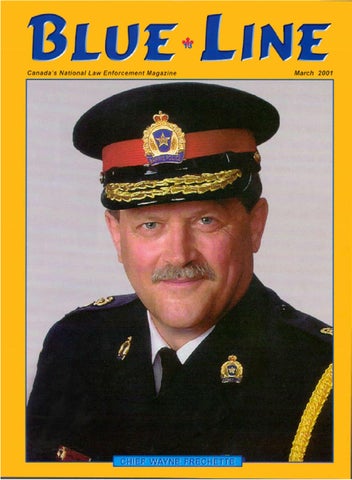
Wayne Frechette, chief of the Barrie Police Service, is featured on the cover of the March issue. In an exclusive interview with Blue Line Magazine, Frechette talks about his history with the Ontario Provincial Police, his decision to become the head of the Barrie police force and his leadership philosophy. Turn to page six for the full story. Bloodstain pattern analysis is a forensic practise that has been around for many years, but has yet to gain popularity. News Editor Les Linder spoke with Det. Cst. Craig Moore of the Niagara Regional Police Service to learn more about this intriguing science. To learn more go to page nine. Technology Editor Tom Rataj supplies a report on a “chemically unique, water-based liquid” that can help police identify the rightful owners of stolen property. To find out what this product is and how it works, turn to page 15. Do you have a favourite pair of running shoes? Are they tattered and ripped, but you refuse to toss them out because they are so comfortable? If you read the Vitality column on page 24, you may be inspired to purchase some new footwear. There is just one month to go before Response 2001, Blue Line Magazine’s fifth annual law enforcement trade show and exhibition, opens its doors to law enforcement personnel and co-ordinators are working diligently to make it a success. To learn more about the show and what you can expect to find on April 24 and 25 turn to page 23. There are a number of low-light shooting techniques. In this issue Firearms Editor Dave Brown takes a look at some of them and supplies helpful tips on which may be the most useful to you. Brown’s submission can be found on page 26. At The Back of the Book, columnist Robert Stevens asks, how important is forensics? Turn to page 38 for his answer. Blue Line Magazine
I felt I had to respond to the article submitted by Dave Brown in the January 2001 issue of the Blue Line (The 10 tips for effective shotgun training, page 16). One can put two different firearms instructors in a room and they will argue until the sun burns out which training method is the best. With that in mind, I feel that the shotgun retention method as pictured is one of the worst techniques I have seen. I will attempt to explain why I feel this way. Figure 4 and figure 6 are the only pictures where the user of the shotgun is in control. The problem is getting from figure 4 to figure 6. To get to figure 5 where the shotgun is under your arm, you have to let go of the gun, thus losing control, remember all this time the bad guy is pulling and twisting the firearm. Then again in figure 5 the weak hand goes from the side to over top of the barrel. How did the weak hand get there? You have to let go of the gun again. In my opinion in figure 5 it’s the bad guy who now has the advantage. The officer has lost control of the trigger and lost the ability to fire the shotgun should worse come to worse. In Dave’s article he calls this technique simple, I don’t see it as simple. I see it as a bad retention technique. But this is only the opinion of a police officer, who, has been a firearms instructor for 14 years. Cst. D. R. Bell Firearms Instructor Brandon Police Service
March 2001
I have read most of the January 2001 issue of Blue Line and wanted to comment on the quality of your articles. Joel A Johnston’s comments on the search for the “phaser” were right on target. While there should be a continuing search for effective “less than lethal weapons, there will always be situations when deadly force is the only recourse. The sidebar on the page dealing with “Vitality”, Working Out In The Winter” was a needed encouragement. I try to stay in shape through the winter since it is tough to “get it all back” over the summer in time for the OPP Fit Pin Testing at which I have been successful the past six years. At the back of the book I thoroughly enjoyed and agreed with Robert Stevens comments on long gun registration. It has been my studied conviction that the problem will never be solved by more legislation dealing with firearms. The problem is “one of the heart.” People’s “hearts” are desperately wicked - to quote the Bible (Jeremiah 17:9). That is where the change needs to take place. Rev. David J Robins In relation to your article on the PT Cruiser featured on the cover of the December 2000 issue (South Simcoe’s PT Cruiser cruiser, page
4
7), I would like to bring to your attention that the Halifax Regional Police have had a marked PT Cruiser for community relations since August 2000. The vehicle is used in conjunction with school programing along with being featured at many community events and parades. Many police chiefs from around the country observed our vehicle at the Canadian Association of Chiefs of Police conference in St. John, N.B., in August. Cst. Ian Burke Halifax Regional Police Full marks to Chief Bruce Davis (December 2000 issue, South Simcoe’s PT Cruiser cruiser, page 7) for his procurement of the PT Cruiser and I hope other forces adopt a similar pro-active approach. Your readers may want to view the vehicles (www.north-van.rcmp-grc.gc.ca) assigned to our School Liaison Section in North Vancouver promoting youth, education and the DARE program. Not only do we have a PT Cruiser, but have a VW Beetle, an A6 Audi Quattro, an S-Type Jaguar, Discovery II Landrover and a Mercedes M Series SUV. All are white, fully equipped and demonstrate that community partnerships are alive and well on the west coast. Jamie Graham North Vancouver RCMP
Blue Line Magazine
Mistakes are important by Morley Lymburner Good supervisors permit their people to grow from mistakes and provide an environment where mistakes can be taken in stride. They are handled, managed and learned from. The very best supervisors actually look forward to mistakes. Now I’m not talking about the conspiratorial or abusive mistakes but rather the honest mistakes and mis-queues that arc part of learning the job. Most supervisors would hesitate to think this way because they would be taking risks. Their people might make mistakes and this would reflect badly on themselves or their organization. The old theory goes that if everyone follows a predictable recipe then mistakes are not made. The problem with this theory is that when mistakes eventually do happen they and the organization are quite often ill prepared to handle them appropriately. This situation denies the inevitability of mistakes. It also encourages the intolerability of mistakes that can compound these inevitable problems. I put this idea in the realm of a sky diver. In my estimation, if I were to be thrown out of an airplane at 3,000 metres this would be a big mistake. (No kidding huh!) But now I am going down and there is no retrieving the safety of that warm and stable airplane. However the people who planned this adventure know the goal is to get me down on the ground safely. What I do after they throw me out the door is now up to me. I can go into an uncontrolled descent screaming in shear terror if I wish. I can get angry at them for throwing me out. I can get pouty and petulant as well. But this doesn’t solve the immediate problem. Even with the minimal training of learning the location of the rip chord is enough to get me down alive. Everything I learn after that lesson only removes the terror and (so I have heard) can actually replace it with pleasure. I encourage my people to make mistakes. Not overtly so, but I recognize the value of learning through mistakes. One of my jobs as a supervisor is to create an environment where mistakes can be made from which we can all survive. In other words I show them the rip chord and they jump with the intent to fly. My job is to ensure that when the mistakes are made there is an appropriate safety net in place so the organization can survive the error. I do not explain in detail or give courses on all the rules and safety nets that have been put in place. If I did this I would only be encouraging them to forever check, maintain, build, restructure and test the safety nets. If I were “Acme Safety Net Company” this would be fine but I want my people to venture forth and spread their wings. Let them dream and experiment and hopefully I can give them the tools and environment to do so. It is clear that supervisors have to monitor and readjust some of their people’s directions. March March2001 2001
As a supervisor their job is to make reasonable exceptions to established procedures because no one has ever created the ultimate and failsafe procedure manual. I know it would be difficult but sometimes supervisors should just let some mistakes happen. It would give their people the opportunity to think and talk about the mistake and, with supervisory help if necessary, guide themselves through a solution process. Most times those involved in making the
5
mistake are the best people to correct it. At times only the supervisor can correct the problem but this is probably an indication that the supervisor was not watching closely enough. My point here is that unless mistakes are irretrievably made they should be looked at as learning opportunities. If your agency is fortunate enough to have members with vision, and they are ready to spread their wings, then you should provide a smooth runway... and a cushion at the end of it.
Blue Line Magazine
Constructive chaos
Chief challenges officers to think differently by Blair McQuillan It takes just one quick glance around the office of Wayne Frechette to realize he is a leader who does not take himself too seriously. There is nothing unusual about the large desk the chief of the Barrie Police Service sits behind. Nor is there anything unusual about the bookshelf, filing cabinet or conference table which grace the large room. The thing that will undoubtedly grab the attention of any visitor is the photograph Frechette keeps in his office. It is the “unofficial” photo of the chief himself. It was taken on a hot August day shortly after he had been appointed by the local police services board to head the 178-strong police force. It shows the chief, smiling proudly, as he sports his new Barrie police dress hat and his new Barrie police jacket. Pretty standard fare for any chief of police. However, below the jacket, Frechette is clad in nothing more than a pair of shorts and sandals. “I had to have my official photo taken and I thought, ‘I’m going golfing after and I don’t want to get into pants and socks and all that,’” the chief recalled. Frechette knew it was supposed to be a head and shoulders shot, so he only wore the pieces of his uniform that would appear in the official photo. However, the photographer, who is well known to the chief, decided to take a second photo that showed a little more than the first. Frechette appreciates the humour in the picture and also enjoyed the looks on the faces of the people who happened to make their way into the studio where the photograph was taken. “I’m sitting there getting my picture taken and as normal people are coming into the place, their faces are dropping,” he said with a deep laugh. “I just looked at them and said, ‘It’s our summer dress.’”
History
Frechette is one of Canada’s newest police chiefs. He began his tenure as the head of the Barrie, Ont., municipal force in September 2000 after spending more than 32 years with the Ontario Provincial Police Service. For most of his career, Frechette worked in the area of specialized investigation. The 54-year-old officer has been involved in undercover operations, major case management, informant targeting and development, homicide investigations and polygraph and interrogation services. In 1989, Frechette was seconded to the Ministry of the Solicitor General as director of the Criminal Intelligence Service Ontario. Two years later he returned to the OPP and became the director of the criminal investigation bureau. When he left the provincial police in June 2000, he was a detective chief superintendent in charge of criminal operations. March 2001
TOP COP: Wayne Frechette has been the chief of the Barrie Police Service for the past six months. He joined the municipal force after serving with the OPP for 32 years. So, what motivates an officer who is eligi- if Barrie was to become part of the OPP comble for retirement to become the chief of police munity. in the nation’s fastest growing city? “I said, ‘Well first of all it is not my inten“This just came along at a very opportune tion, nor is it within my capability. Politicians time and at an opportune place,” Frechette said. decide who polices (a city) not policemen,’” “The timing couldn’t have happened any bet- the chief recalled. “I said, ‘But from a very selfter if I’d planned it.” ish perspective, think about this; the minute While the timing was great for the chief, the OPP comes to town, I’m out of a job.’” some officers and members of Despite concern on the the public at large didn’t feel part of a few officers regardthe same way. “The most ing his history with the proFrechette was named as force, Frechette said positive thing is vincial the force’s new top cop he was overwhelmed by how the way I’ve shortly after a costing battle quickly he was welcomed had been waged between the into the municipal police servbeen accepted Barrie Police Service and Onice. here.” tario Provincial Police. Both “The most positive thing forces were looking to take is the way I’ve been accepted over policing in the city of here,” the Barrie native said. 100,000 and the competition was tight. The “They’ve taken me unto themselves. municipal force claimed victory in the end, “You know you’ve got friends when they which left many wondering why the police serv- could have sat back and watched you get into ices board would decide to select a career pro- trouble (but) they don’t. They’ll say, ‘Hey I vincial police officer as the new chief. know you don’t have much of a history here, However, Frechette, who is married and has but we tried that once before and it was just an two children, quickly put minds at ease after unmitigated disaster and this is why.’” taking the helm. While he was in the process of In addition to having allies within the Barrie getting to know the members of the Barrie Po- Police Service, Frechette says his career with lice Service, he invited them to ask any ques- the OPP has helped him to become a successtions they had on their mind. Inevitably, there ful leader. were those who wanted to know if he was act“Having the OPP background in terms of ing as a front-man for the provincial police and all the experience that I’ve been exposed to has 6
Blue Line Magazine
been really invaluable in a lot of ways. With a lot of the day-to-day problems that come up here, I don’t have to think too far back to remember one that has been similar.”
Leadership Philosophy
Frechette is a chief who genuinely cares about the men and women under his command. He believes his job is to foster an environment that welcomes new ideas, innovation and change. “Let people be all they can be,” he said. “Now, that sounds like a recipe for chaos, but in fact there is such a thing as productive chaos. “As an example, my wife is a kindergarten teacher. If you were to march into her classroom this morning I think the first word that would pop into your mind is chaos. There are people going in all different directions and a million different activities going on, yet they’re learning from it. “I think for many years, particularly in police organizations, change was embraced with about the same enthusiasm generally reserved for the plague. Status quo and order and stability were all the things that were stressed. If you think about it, there’s kind of a fine line sometimes between stability and rigour mortis.” While Frechette wants to create an environment of freedom, he will not hesitate to reprimand officers who step too far out of line, though he never likes to have such circumstances arise. “We’ve had some internal matters,” he said. “Just prior to my arrival one of our officers was arrested. After my arrival another one of
March 2001
our officers was arrested. That’s always disappointing. “If there’s an upside, it’s the fact that they were both handled in a way that shows the Barrie taxpayer that even when we do something wrong, we’re treated no differently than anyone else. And that’s how it should be.”
The Future
In recent years, the city of Barrie has experienced a very high rate of growth. Experts estimate that within the next 20 years the city’s population will double to 200,000 people. Frechette knows that as the city grows, the municipal police force must follow suit in order to deliver effective service. The veteran officer wants to examine the city’s population trends and demographics in order to prepare for the future. Frechette says you simply cannot deal with growth on an as needed basis because you’ll never catch up to the ever increasing demand. Hiring more constables is simply not enough. The police service must prepare the recruits of today to be the leaders of tomorrow and plans to acquire additional equipment and deal with an expanding population must be implemented. “What I would like to be remembered for is having some part in the orderly growth of the department,” Frechette said. “Let’s not get into crisis management, let’s have an orderly growth plan with the appropriate infrastructure. “If I’m going to be remembered for something, I’d be happy with that. You could be remembered for a lot worse.”
8
Support for chopper grows Citizens in Edmonton continue to give generously in an effort to acquire a helicopter for city police. Money has been pouring into Spotlight On Safety (S.O.S.), a community group led by a local radio and television personality, whose goal is to have a chopper in the air before summer. Bob Layton, a journalist with 630 CHED radio and Global Television, sparked the initiative in November when he wrote a commentary asking why the city did not have a helicopter patrolling the skies of Edmonton. The commentary prompted such a huge amount of public support that Layton launched the S.O.S. program. One local businessman was so enthusiastic about the initiative that he pledged $100,000 in support if the citizens of Edmonton could match it. The sum was quickly raised and the total is still rising. As of Feb. 8, more than $310,000 had been donated. Sgt. Rick Milne, who is acting as a liaison between the S.O.S citizens group and the police, said members of the Edmonton force are excited about the project.
Blue Line Magazine
Bloodstain pattern analysis Expert shares insight into forensic field
recognized in court and is an accepted field of forensics. Subsequently, it is also utilized in court whenever pos“Who did it?” sible and it is not unheard of Ask this from a bloodto have an entire case rely stain pattern analyst at a viosolely on bloodstain analylent crime scene and he will sis. likely shrug his shoulders. While BPA is accepted However, if you ask him as evidence in court, it is still what happened, he will meopinion evidence and not ticulously point out the hard factual evidence such as events which led to the death DNA. Bloodstain analysis is of the victim. This effectively also one of the smallest fields answers the more appropriin forensics and has some ate question; “What did it?” way to go in building popuBy using bloodstain patlarity for itself. tern analysis, investigators “Fifteen years ago, DNA can interpret bloodstain eviwas almost unheard of,” dence to determine what the Moore pointed out. “But sequence of events were at a now everybody is using it. scene involving bloodshed Bloodstain analysis is growand how a person was killed. ing in popularity as it is used Det. Cst. Craig Moore, a more in court as evidence forensic identification officer it’s picking up speed.” and 17-year veteran with the Historically, BPA made Niagara Regional Police Servits presence known in North ice, says this rare field of foAmerica following the case rensics has had a tremendous of the state of Ohio vs. Dr. impact on investigative THE ANALYST: Det. Cst. Craig Moore of the Niagara Regional Police Service. Samuel H. Sheppard in 1954. work. Sheppard was sentenced to “One of the unique charlife imprisonment for the second degree murder acteristics of bloodstain pattern analysis, as hedge and collapsed where, Moore believed he of his wife, Marilyn Sheppard. opposed to DNA work, is that DNA takes sev- was beaten again. An attempt for a retrial was made and it Investigators knew they were now looking eral days to get results back, while bloodstain involved the analysis of bloodstain patterns by for suspects in a assault, not a hit-and-run. Valuanalysis takes mere moments,” Moore said. Dr. Paul Kirk. Although the retrial attempt A properly trained analyst at a crime scene able time and resources were spared in searchfailed, defence lawyer F. Lee Bailey took over ing for a non-existent driver, or attempting to can quickly formulate opinions and be able to the case in 1961 and argued his way to the U.S. tell investigators what specifically took place. find any possible witnesses to explain what Supreme Court. Through Bailey’s presentation, occurred. He can identify whether or not a person was Moore said this form of forensic work pro- which included Kirk’s bloodstain pattern analyshot in a specific room, where they were standvides information quickly for investigators and sis, sufficient doubt was created and Sheppard ing and what direction an attack came from. was acquitted of the murder. “With the information provided by the ana- carries from the crime scene, straight to the Kirk’s findings of Sheppard’s innocence courts to help hold a case together. lyst, investigators can tell how honest or forthThe technique is still viewed by lawyers as through bloodstain pattern analysis was concoming witnesses are when they are quesa new science, despite a long history which dates firmed in 1997 when DNA showed the blood tioned,” he said. did not belong to either the victim or the acThe facts brought forth by the analyst about back to 1895, when the first book was written cused. The case also resulted in the popular by Dr. Eduard Piotrowski on the topic. BPA is the scene also gives investigators a better idea of what questions to ask witnesses and suspects. While attending a suspected hit-and-run scene involving a youth last December, Moore managed to put investigators on the right track by using Bloodstain Pattern Analysis (BPA) techniques to show it was no accident. The boy was found pushed underneath hedges on the corner of an intersection. It was initially believed the boy was propelled into the hedge after being struck by a vehicle. However, bloodstains in the centre of the road indicated otherwise. By examining the way blood spattered on Don J Patterson the road and trailed off towards the hedge, Moore determined the boy had in fact been beaten by one or more assailants at the intersection. The victim then stumbled over to the For further details go to BlueLinks at www.blueline.ca by Les Linder
March March2001 2001
9
Blue Line Magazine
film, “The Fugitive” which was based on Sheppard’s story. BPA also made its way into Canada when the RCMP began training officers in the technique from 1954-1971. The Centre of Forensic Sciences in Toronto is credited with being the first lab in the country to use this form of forensics in the 1960’s. By 1990, the Ontario Provincial Police began to do some of their own bloodstain forensic work. Meanwhile, the Centre of Forensic Sciences decided to focus primarily on DNA, resulting in a cease of virtually all on-site bloodstain analysis by the lab. The gap in bloodstain forensics needed to be filled, which meant police officers had to be trained in the field so crime scene blood analysis could be done. “Unfortunately, it is still a very limited field in Canada and bloodstain analysts are scarce,” Moore said. He added that there are likely no more than 36 forensics officers across the country who are trained in BPA. Training involves a one-week course to provide an officer with the basics, followed by a one-year understudy course to achieve an in depth understanding of the topic. The RCMP initially had a BPA understudy program through the Canadian Police College last year and provided training for people who had taken the one-week introductory program. Funding cutbacks caused the program to be cancelled shortly after. “So now there is really no formal understudy training. It is up to each individual to
“I don’t need to concern myself with what people say. I only concern myself with what the physical evidence is.” seek out their own satisfactory level of education.” This is not an easy task by any means, according to Moore. Police officers who take the program have to do their studies while they continue to perform their regular duties. “Most departments don’t say to their forensic units: ‘We want you to learn bloodstains for the next 12 months and don’t worry about doing your regular work.’ You’re looking at doing 600 to 800 hours of study for the next year on top of your 2,000-hour work year.” While it can be a trying task, Moore feels that having to spend a great deal of time and training in bloodstain forensics is a good thing. “You don’t want to be playing a hunch,” he warned. “It may be opinion evidence, but you
need the knowledge to support your theories and opinions. That takes time.” Not only are there a lack of people with BPA training, but some of the people who do receive it are not getting the full training. “With all departments being under budget restraints, it is not an unlikely incident to have an officer with only one course worth of training. This person is then told to use their training when in fact they aren’t suited for the task and don’t know enough.” Bloodstain forensics training does not function the same way as other fields, Moore said. Unlike training for forensic identification officers, who can walk out of their program and use their training effectively to identify fingerprints, BPA students cannot perform their duties without additional understudy training. Even with the lack of analysts and vast dedication required in the field, Moore feels Canada is ahead of the U.S. in terms of qualified analysts. The “Canadian approach” to scene analysis involves the use of computers and a program called BackTrack. “Part of the understudy program in Canada involves learning to use the program and computer equipment. What it does is help to take away any doubts from your opinion and provides some answers on what can be found through a computer.” In the U.S., where an understudy program is not required, a large amount of bloodstain analysis is based solely on opinion, with no computer equipment to fall back on for assistance. BackTrack reduces the amount of time an analyst needs to spend at a scene by recording images of blood spatter and analyzing it. It also provides a more objective conclusion and helps to minimize arguments in court. Despite the minuscule number of bloodstain analysts, Moore, who has investigated 35 cases involving bloodstain analysis since 1997, says an interest does exist in the field. He is confident more people would undergo the required training if additional funding and time were provided. He also added it takes a certain type of individual to enter the field and that the person needs to want to do that sort of work. For those who do pursue BPA, Moore says they will be intrigued by it. “Unlike other investigative fields, I don’t need to concern myself with what people say. I only concern myself with what the physical evidence is.” By knowing how fluids behave due to gravity and air resistance, Moore can identify suspicious events and isolate what happened in a specific spot. “You get completely focused on what is at the scene. There’s no need to concern yourself with what the motives were, or why someone would do such a thing. “You just have to determine what actually happened. That’s it.” For more information contact Det. Cst. Craig Moore at 1-888-668-3911
March 2001
10
Blue Line Magazine
RCMP teams up with DNA experts by Les Linder A new alliance between the RCMP and a private company could mean trouble for criminals. A two-year contract between the RCMP and Maxxam Analytics Inc., will provide the Mounties with forensic biology case work, including analysis of DNA from crime scenes, forensic evidence testimony in court and technical assistance. The force awarded the contract to the company in January, following an eight-month search around the globe for a partner in the private sector. Federal Auditor General Denis Desautels had criticized the RCMP last year and warned them that by delaying the processing of crime scene evidence, the public was being endangered as criminals had an increased opportunity to re-offend. As much as $1 million per year has been budgeted by the RCMP to spend on the company’s assistance during the next two years. Cases will be handed to Maxxam Analytics on an as-needed basis, or if the police agency finds it has too many cases to handle alone. Robert Wiebe, business development manager with Maxxam Analytics, says the company will also work with police to develop strategies in how to proceed with an investigation.
Wiebe anticipates his company will be handling a few homicide cases as their first duties and will be working at an ongoing basis, managing several cases each month. “Scientists at Maxxam have dealt with large cases such as murders and many of them are experienced in handling them,” Wiebe said, while adding most of their scientists come from public sector labs. The company, which is based in Guelph Ont., also performs drug testing in all Canadian federal corrections facilities. It is the first enterprise in Canada to be contracted by a police agency to provide long-term work in DNA analysis. Other countries such as the United States and Great Britain have already formed alliances with private s e c t o r DNA analysis labs. “Small contracts have been made in the past with other Canadian DNA labs, but it never turned into a large combined effort such as this,” Wiebe said. Approximately a dozen companies placed bids on the contract for the position offered by
the RCMP last year. Wiebe feels Maxxam Analytics won the contract due to their experience. “We’ve taken some of the tools we acquired in our involvement with large criminal cases and applied them to other cases,” he said. Such cases include investigating product tampering, threatening mail, extortion, tampering with foodstuffs and performing testing for immigration Canada. Both the RCMP and Maxxam Analytics are accredited by the Standards Council of Canada to conduct work involving DNA. According to Wiebe, Maxxam Analytics is the only private company in Canada to be accredited for the level of work being done for the Mounties. “This contract is a great contingency plan for (the RCMP),” he added. “It acts as a safety valve for them because we’re there to help whenever they need it. Their cases are going to be dealt with more quickly, which will allow them to move on to new ones and concentrate on putting as many criminals behind bars as possible.” Representatives from the RCMP were unavailable for comment.
For further details go to BlueLinks at www.blueline.ca
March March2001 2001
11
Blue Line Magazine
Solving crime through art Forensic artist reflects on success
by Blair McQuillan When Cst. Jerry Maryniuk turns in his badge at the end of this month he will be able to look back on a distinguished and successful career. Maryniuk, a forensic artist with the Winnipeg Police Service, has helped solve dozens of cases with an arsenal that includes nothing more than pencils, pastels, charcoal and drawing paper. “My drawings are used as investigative aids and they’re used often times to eliminate suspects,” Maryniuk said. “They’ll also point police in the right direction in many cases. “When I have a case where a suspect is identified as a result of a drawing and then other conclusive evidence comes forward and the person is convicted - that’s a big high.” For more than 22 of his 26 years as a police officer, Maryniuk has produced hundreds of facial sketches, known as composite drawings, in an effort to fight crime. “My primary role is providing drawings for police investigations,” he said. “Most of these would be composite drawings based on descriptions provided by victims or witnesses to major crimes.” During the course of any given year, the forensic artist produces about 40 drawings, relating to crimes including sexual assaults, attempted murders, homicides, robberies and home invasions in the city of Winnipeg. In order to create the best possible rendering, Maryniuk conducts two interviews with the witness or victim. A composite drawing can take between a half hour and two hours to complete depending on the individual’s recollection. Knowing what questions to ask and how to ask them, also plays a major role in the information gathering process. “You’re only as good as your last drawing,” the 47-year-old said. “To be able to extract information from the witness is a difficult process and not everybody has a picture of that suspect in their mind’s eye. There’s a lot of skill that’s required to communicate and have the necessary dialogue to get that information.” If anyone knows how to gain the necessary information, it’s Maryniuk. Of all the cases he has worked on, 40 per cent have resulted in an arrest. One case which stands out in the constable’s mind occurred in the city seven years ago. It involved a young woman who was sexually assaulted in her business by an unknown assailant. The investigation initially produced few leads and after a couple of weeks had passed, Maryniuk was called in to produce a composite drawing. March 2001
Photo: The City of Winnipeg
CASE CLOSED: After 26 years as a Winnipeg officer Jerry Maryniuk is set to retire. The completed drawing, in accordance with regular procedure, was circulated throughout the police service. Two officers, in two different parts of the city were immediately able to put a name to the rendering and a suspect was soon arrested. DNA evidence gathered by investigators helped to further prove the suspect was indeed the culprit they sought. He was eventually sentenced to a 14-year prison term. “That’s very gratifying,” Maryniuk said simply. While he is proud of the success he has enjoyed, Maryniuk notes being a police artist can be a stressful task. Drawing for a living may sound like fun, but the job requires him to complete sketches on command, even on days when he doesn’t feel particularly artistic or creative. He also notes that the high number of sexual assault cases he has worked on over the years has sometimes worn him down emotionally. “I’ve without a doubt interviewed more sexual assault victims than any other police officer in the history of policing in Manitoba,” said Maryniuk, who is married and has three children. “It’s a cumulative thing where you read the report, read the horror that this person has gone through, and you sympathize with the victim. “To be effective as a police artist you have to really show compassion towards them so they feel comfortable with you. It tires you because you become emotionally involved. You 12
have to wear your heart on your sleeve to be a good police artist.” Maryniuk first put pen to paper in an effort to learn the art of being a good police artist in 1978. In addition to possessing excellent drawing skills, Maryniuk is also a cartoonist, sculptor and painter. Senior officers in Winnipeg at the time were aware of his talents and approached him to inquire if he would be interested in becoming the force’s forensic artist. Maryniuk was soon sent to Wisconsin where he completed a forensic art course at a community college. Since then, he has taken several courses to update his skills and has even ventured into other areas of the craft including skeletal remains reconstruction, postmortem drawings, age progression and two and three dimensional art. In addition to acquiring extra skills in his field, Maryniuk also teaches other police officers about forensic art. He has trained a number of Manitoba RCMP officers and is currently in the process of training two Winnipeg officers to replace him when he retires. Maryniuk said it takes a lot of dedication to acquire the skills necessary to become a successful forensic artist. Students first have to learn the theory involved before gaining the first hand experience that will help them hone their craft. “You probably wouldn’t consider yourself (to be) a competent forensic artist until you’ve been on the job for five years,” he said. “There’s quite a learning curve involved.” Blue Line Magazine
PERFECT MATCH: The composite sketch on the left, created by Maryniuk in 1994, led to the arrest of a sexual assault suspect. The man was sentenced to 14 years in prison. Maryniuk himself is still learning and perfecting his skills. In fact, he was recently called upon by the chief medical examiner’s office to use his newly acquired talents in the area of skeletal remains reconstruction to help solve a missing persons case dating back to 1978. When a skull was discovered in Belair, Man., in April 1999, investigators suspected it could be the remains of a 35-year-old woman who had gone missing, and presumably drowned, in Lake Winnipeg more than two decades earlier. After the medical examiner’s office exhausted initial attempts to have the skull identified through DNA analysis, officials approached Maryniuk to ask for his assistance. They wanted the veteran artist to complete a skeletal reconstruction that would bolster their case so they could apply to the Armed Forces Institute of Pathology in Rockville, Md, for further testing. Using the skull as a guide, the constable created a drawing of a woman’s face. When Maryniuk’s reconstruction was finished it closely matched the profile of the missing woman. The completed product was so realistic that the victim’s brother ran his hand over the artist’s rendering when he had an opportunity to view it. Using Maryniuk’s drawing as part of a detailed package, investigators applied to the pathology institute in an effort to have their case examined. The institute granted the request and it was later determined through extensive DNA testing that the skull was in fact the remains of the 35-year-old woman. As a result, a 23-year mystery had reached a conclusion and given closure to the victim’s family. While Maryniuk is retiring from the Winnipeg force, he is not completely exiting the law enforcement scene. The veteran artist plans to offer his services to police agencies across North March March2001 2001
America on a freelance basis. He also plans to continue creating works of art in granite, watercolour and ink. One art gallery in Winnipeg has even expressed interest in doing an art show featuring his pieces. “I’m only 47-years-old and that’s too young to retire,” Maryniuk said. “I plan on working until the day I die.”
For further details go to BlueLinks at www.blueline.ca
For further details go to BlueLinks at www.blueline.ca
13
Blue Line Magazine
Liquid forensic identification by Tom Rataj Identifying stolen property is often a difficult, if not impossible proposition, especially when the property does not have a serial number or other unique mark. Engraving or etching an identifying mark on some property is simply not feasible or cannot be accomplished without damaging it. SmartWater Instant, a relatively new product out of Britain, seems to be the perfect solution for this problem. It has already proven its worth by helping to stem a serious motorcycle theft problem in the United Kingdom. After undertaking an extensive program to mark motorcycles and their major components with SmartWater, more than 100 people involved in motorcycle thefts were convicted because stolen components were readily identifiable. In recognition of this, the British Motorcycle News newspaper awarded it the “Accessory Product of the Year” last year. This was the third major award given to SmartWater, following its 1996 “Prince of Wales Award for Innovation” and its 1998 British Government “Millennium Product Status Award”.
Brush-on ID
SmartWater Instant is a clear liquid that can be applied to virtually any property, providing a DNA type identification of the property. Each three millilitre bottle of SmartWater consists of a chemically unique, water-based liquid. The liquid contains several hundred microscopic “smarticles”, each measuring approximately 250x250 microns (1 millionth of a metre), which are laser-etched with a unique nine-digit ID code. Under normal lighting conditions the dried SmartWater marking is invisible, but when exposed to long wavelength ultraviolet (UV) light it glows a bright yellow-green colour. Owner identification is as simple as taking a swab sample and returning the sample to one of the Canadian testing facilities, where the ninedigit ID code can be read. Testing facilities are currently operated in an RCMP lab, Ontario’s Centre for Forensic Science, and a Customs and Excise – Revenue Canada facility. The initial purchase price, which is about $140, includes the product, instructions, an application brush and registration documents providing one-year of registration in the Canadian and international database. Registration maintenance beyond the initial one-year period is available for a nominal fee. Testing conducted by SmartWater has established that this product is very resistant to everyday wear and tear, and it is advertised as being able to withstand 100 power-washings. Additionally, it has no adverse affects on items to which it is applied. Even one small drop on a small item, like a piece of jewellery is sufficient to provide a positive identification. SmartWater is the result of a unique colMarch 2001
laboration between a private company and the Forensic Science Service (FSS), a British government agency that includes the forensic laboratories at Scotland Yard. SmartWater is manufactured under license by the FSS, which also maintains the domestic U.K. and international database. A branch of the Insurance Council of Canada maintains Canadian customer registration information.
Recovery
Needless to say, this product offers a very effective means of identifying any type of property. Although there is no outward appearance of marking, which normally has a deterrent effect, it offers a discreet method of marking valuable property. Examining a batch of recovered stolen property and attempting to establish ownership is a time consuming task. Items like stolen jewellery are often never returned to their rightful owner because they cannot be successfully identified. Normally the only identifying marks on jewellery are the manufacturer’s mark and the gold classification. A ring or other item of jewellery can quite effectively be marked with SmartWater, making it a relatively easy task to identify and return to the owner. As in the U.K. motorcycle theft experience, an extensive program of marking with SmartWater can have a significant effect on a major crime problem. In recognition of this, major insurance companies in the U.K. began offering discounts to customers that marked their motorcycles with SmartWater.
Other Products
While SmartWater Instant is the premier product, there are also a number of specialized products available from SmartWater. SmartWater Heritage is a solution designed to mark items such as gold or silver jewellery and musical instruments. It comes in a complete kit containing a 50 millilitre container of solution along with instructions and an application brush. Also included are the registration forms for a one-year registration in the Canadian and International database, 50 warning labels, an inventory form and a black light for checking the application. SmartWater Index Solution System is a complete protection system designed to protect 14
high value areas. Similar in concept to the dyepacks used in bank bait-money, the Index Solution System consists of a system that sprays the solution onto a thief who activates an alarm, such as at a safe or in a vault. This system covers the thief and his loot with quick drying SmartWater solution, thereby providing an excellent chain of evidence linking the thief directly to the location of the offence. IndSol Tracer Fluid is intended for marking any item of high value, such as computers, computer components, pagers, cellular phones and digital cameras. It is available in 200 millilitre or one litre packages. Each kit contains an application brush, marking instructions, registration documents, labels, an inventory form and a black light. The registration period for the one litre container is five-years, while the 200 millilitre kit comes with a three-year registration period. Molecular Fingerprint Solution is intended for marking most types of manufactured products. In addition to ensuring original product identification, it can also be used as an effective tool to protect against fraud and counterfeit merchandise. It uses 250 to 400 micron laser etched particles that carry a unique alphanumeric code number that can be seen through a 50X jeweller’s loop, making it a simple stand-alone product. Super Labels are designed to openly mark larger items of high value. Each Super Label incorporates four separate methods of establishing ownership. The label itself is a tamper proof label that shreds into pieces when it is removed. In addition to displaying owner-designed information, it also has a numerically sequenced detachable bar code, the registration code and a covert hologram code that is only viewable using UV light. And if all those features are not enough, it also has a unique SmartWater client code in the glue on the back of the label, so even a small amount of glue residue left on an item after the label has been removed, can successfully be used to establish ownership. Super Labels are custom manufactured and are available in sheets or rolls.
Investigative Uses
This product range has great investigative and inventory control possibilities for private security and police agencies. Certain types of undercover operations could be improved by marking items with SmartWater. Items such as drug-buy money could be marked with any one of the several SmartWater products to provide irrefutable proof of origin. Running sting operations involving property of various kinds could also be effectively aided by using these products. All high value items such as laptop computers, laser and radar guns, or even issued pistols, could be marked to aid in future recovery. The possibilities are almost endless. Visit the SmartWater web site through BlueLinks at www.blueline.ca. Blue Line Magazine
Provinces implement new computer systems Law enforcement and the justice system in two provinces are getting some additional help from four new computer systems geared towards increasing operational effectiveness. A new computer database is going to enable all police forces in British Columbia to quickly share information about suspects and crimes. The Police Records Information Management Environment (PRIME) will aid British Columbia police officers in catching criminals who operate without regard for municipal boundaries, Victoria police Chief Paul Battershill said in January. The B.C. Attorney General’s Ministry is spending $500,000 on the new system that will make it easier for police agencies to track similar crimes committed by an offender in different areas. Battershill said police agencies fax crimerelated information to each other, but that means a great deal of time must be spent by an investigator to manually search faxes for the required information. Under the PRIME system, an electronic file of a reported crime will be automatically created when 911 is first called. Information from a crime scene is added to
the file so municipal police departments and the RCMP in other communities can access the data, such as descriptions of suspects and vehicles. Results of a police investigation and a recommended charge will be sent electronically to Crown prosecutors, who will use a computer system called Justin that tracks criminal and civil cases in British Columbia. The Justin database is expected to be implemented at 400 locations in the province by
the end of the year. A computer translation system between the two systems will eventually enable anyone in the justice system to access or add data to the PRIME file as the case moves through the justice and prison process. The Ontario Provincial Police in London have also launched two of their own new computer systems to aid with police dispatch and records management. The new Computer Aided Dispatch (CAD) system will display the location of a call on a digital map and allow police to arrive on a scene in a more timely fashion. Also, the implementation of a new Records Management System (RMS) will assist officers in sharing vital investigative information. Prior to RMS, the sharing of recorded information was time consuming and not easily accessible, said a report from the OPP. The new system will provide rapid access and simple entry of information to a database. Implementation of the RMS has occurred within all detachments in the OPP’s western region, while CAD has only been established in three communication centres in the region. Both systems are expected to be operating in the five remaining OPP regions in June.
For further details go to BlueLinks at www.blueline.ca
March March2001 2001
15
Blue Line Magazine
Biohazard clean ups It is always the sudden, disturbing and messy scenes of death to which police officers get called first. Police are called to attend murders, suicides, industrial accidents, decomposed bodies of persons gone days or weeks without being found. The scenes and odours can be quite unpleasant. Many people think that the police will clean it up. Sorry. Not so. The police secure the scene, obtain important evidence, conduct an investigation of the incident and then pass the body on to a medical examiner. Then the police and emergency personnel leave and release the trauma scene. Cleaning up is a nasty mess which is also just too much for the surviving family to deal with. A compassionate person would not expect a grieving loved one to even look at the scene, let alone clean it up. But when death gets messy, forget about calling Molly Maid or any other janitorial service. You need more than a spot remover and a light vacuum. Even for the most hardened souls, the task of cleaning the physical aftermath of the event evokes disgust and repulsion. To do the job right takes a very specialized service with high professional standards, extensive experience and training in the cleaning and disposal of biohazards. As a police officer, referring the surviving family to companies that can properly take care of the cleanup process can spare them a second traumatization and help them to move beyond the event. Such a referral can be invaluable for those in need at a traumatic time. But specialized cleanups are not just required for crime scenes. Let us not forget about police vehicles and holding cells. How many people pass through your station’s holding cells and vehicles on a monthly basis? Chances are, a close look at the condition of your holding cells and your vehicles will show they may be breeding grounds for bacteria and disease. Most regular custodial cleaning staff are neither aware of, nor trained to deal with the complexities of sanitizing areas infected with bodily fluids. These biohazards require special
training, equipment and agents to properly clean. Most building cleaners will mop the floors and wipe down the sinks, taps and toilets with all-purpose commercial cleaning products which have little or no effect on some transmittable diseases. What about the walls, ceilings, doors and bars? Probably untouched. Are the cleaning agents used registered for viruses, bacteria, and fungus or rated for HIV and HBV? Among the obvious benefits of cleaning holding cells and vehicles is that police officers, station employees, the public and other prisoners are protected from the likelihood of being exposed to transmittable diseases. In addition, a bio-cleaning program can be a morale-booster for officers who see that their health and safety concerns are being protected. It can also provide protection from possible lawsuits levied on police services should anyone contract maladies as a result of their stay in a holding cell or police vehicle. Funeral Sanitation Services is one company that offers such services. The company enters a trauma scene and cleans up any biohazard waste, removes stains, and completely deodorizes the area or room to erase all reminders of what has happened there. Based in Winnipeg, the company is growing rapidly. They handle about 300 calls per year and employ seven part-time staff who are available 365 days a year. A&A Trauma Scene Cleaning & Restoration was established a year ago with the help of Funeral Sanitation Services’ owner Doug Hahn. Like Hahn, A&A owners Martin Overeem and Steve Tasse provide a special service. Kidd Cleaning Services offers both trauma scene cleaning services as well as emergency, or scheduled biowash and scrub services to police departments. Established more than four years ago, the business is owned and operated by Keith Kidd, with the assistance of trained and qualified biotechnicians. Kidd has also authored training courses on bio-safety for police officers.
PreScan enhances fingerprint image PreScan, a special non-toxic ridge enhancing formula, enhances the definition of finger ridges prior to scanning, making them more visible to live-scan systems. The applicant simply touches or rolls fingers on a ceramic pad to evenly coat the fingers. “Dry skin can affect the quality of livescan and single-digit finger scanning,” affirms Kevin Strock, Identicator, Inc., director of U.S. and Canada sales. “Dry fingers do not reflect the light back to the
March 2001
cameras causing poor images to be captured. PreScan overcomes these problems by only coating the ridges, resulting in higher quality images.” Live-scan manufacturers as well as governmental agencies and commercial concerns have all tested PreScan. Users report that PreScan improves the quality of captured fingerprint images without mess to the applicant or damage to the platen surface. Visit the companyweb site through BlueLinks at www.blueline.ca
16
New evidence cabinets introduced A new series of Mobile Evidence Drying Cabinets in three sizes, designed to provide a secure, tamper-evident area for “air drying” blood stained or wet clothing, bed sheets, blankets, towels, etc., from homicides and sexual assault cases have been introduced by Tri-Tech Inc. The drying cabinets are constructed of a sturdy PVC frame and floor pan which is covered on all six sides with a unique synthetic mesh fabric that permits air drying of evidence. The fabric does not absorb liquids and is easily cleaned with water and household detergents and can be sprayed with a 10 per cent bleach solution to eliminate blood borne pathogens and DNA cross contamination. Visit the company web site through BlueLinks at www.blueline.ca.
Company supplies antidote kits Meridian Medical Technologies Inc., announced in January that it supplied nerve agent antidote auto-injector kits to federal security forces as part of emergency medical preparedness procedures for the U.S. Presidential Inauguration. The company has also supplied the kits for such recent public events as the Olympics in Australia and the U.S. Democratic and Republican National Conventions. An original development of Meridian research, auto-injectors are prefilled, springloaded, pen-like devices that enable the user to self-inject precise dosages of medication quickly, safely and easily. Visit the company web site through BlueLinks at www.blueline.ca. Blue Line Magazine
Software to identify handwriting The researchers then ran the samples Who wrote the Jon-Benet Ramsey ransom through their software program. note? “We tested the program by asking it to deA computer program developed at the University at Buffalo (UB) that is 98 per cent ef- termine which of two authors wrote a particufective in determining authorship of handwrit- lar sample, based on measurable features,” said ten documents may soon be able to assist in Srihari. “The program responded correctly 98 percent of the time.” answering such questions. Srihari explained that huFunded by the National The idea that man experts look for arcades Institute of Justice, it’s the everyone’s and garlands, features that may first software program dedistinguish one person’s pensigned to develop computerhandwriting is manship from another’s. The assisted handwriting analysis different is current software should be tools for forensic applications. able to conduct that type of In criminal cases, the questaken for advanced analysis within the tion of who penned a ransom granted. year, he added. note or forged a cheque is The goal of authenticating solved by human handwriting documents in criminal cases analysts. However, because they are human, even the best graphologists usually is to determine whether of not a particular suspect wrote the document in quescannot claim complete objectivity. The UB software is the first that can iden- tion. However, the scientific approach Srihari and tify who wrote a particular document based on his colleagues are developing may also be usepurely scientific criteria. “A human expert may put in his or her own ful in establishing individuality in the emerging bias even unconsciously,” said UB professor field of biometrics, which is the automated idenSargur Srihari. “We have built the foundation tification of a person based on precise measurefor a handwriting analysis system that will quan- ments of physiological or behavioural charactify performance and increase confidence in de- teristics. termining a writer’s identity. For further details go to BlueLinks at www.blueline.ca “This is about validating individuality in handwriting. The idea that everyone’s handwriting is different is taken for granted. What we have done is to develop purely scientific criteria for that premise.” It is the first time researchers have attempted to do that based on a large database of Managing Police Performance: Coaching Skills for Police Workshop handwriting and by using a totally automated means of measuring specific features of human “The enthusiasm of the workshop presenters was infectious handwriting, said Srihari, who also is director and the content refreshing. The coaching philosophy is one of UB’s Centre for Document Analysis and that can be adapted by any organization and easily Recognition (CEDAR). implemented. I look forward to completing my certification CEDAR is the world’s largest universityas a Police Coach.” based research Centre devoted to new technoloOther courses in this unique distance education program include: gies that can recognize and read handwriting. It > Police Leadership and Management Development was CEDAR’s expertise in developing systems > Communication Skills for Police Personnel that can read and interpret handwritten addresses > Problem-Oriented Policing on envelopes for the U.S. Postal Service that > Community-Based Policing attracted interest - and a $428,000 grant - from > Police Human Resource Management the National Institute of Justice. > Budgeting and Financial Management Cst. Mike Massine The UB researchers developed the software Saanich Police Department > Legal Issues in Policing by first collecting a database of more than 1,000 Coaching Workshop Participant > Policing and the Law of Human Rights samples of handwriting from a pool of individu> Advanced Police Leadership als representing a microcosm of the U.S. population in terms of gender, age and ethnicity. Our next workshop will be in Surrey, BC from April 5-7. Register today! Multiple samples of handwriting were taken from subjects, each of whom was asked to write If you would like more information or wish to have a brochure mailed to you please the same series of documents in cursive. contact Sherry Carmont-MacBean, Program Manager at (902) 494-6930. You may also Instead of analysing the documents visuwrite to Sherry via e-mail at CPL@Dal.Ca or to the address below. Detailed information ally, the way a human expert would, Srihari and registration forms can also be found on our web site. explained, the researchers deconstructed each Henson College, Dalhousie University sample, extracting features from the writing, 6100 University Avenue such as measuring the shapes of individual charLearning Solutions Halifax NS B3H 3J5 acters, descenders and the spaces between lines www.dal.ca/~henson/police/indexcpl.html for a Changing World and words.
Dalhousie University
Certificate in Police Leadership
For further details go to BlueLinks at www.blueline.ca
March March2001 2001
17
Blue Line Magazine
RCMP recruits young blood into Ontario by Heather Hamilton Members of the public seldom get the chance to see a uniformed RCMP officer patrolling the streets of Ontario. So a few concerned citizens began asking questions when they spotted a Mountie driving through town in a York Regional Police cruiser last September. “There was a lot of uncertainty at first about why I was here,” says Cst. Greg Rose. “Throughout my training we had nothing but positive reaction to the RCMP uniform, that is once they got over the surprise of seeing a Mountie driving a York patrol car.” Rose is one of the first RCMP cadets to receive his on the street training in Ontario since 1994. His exposure to front-line policing was developed through a partnership built by RCMP Insp. Mike McDonell and York Regional Police Supt. George Kydd. It was McDonell’s desire to provide Rose with a snapshot of municipal policing so the RCMP could retain his expertise in Ontario and expand the profile of the RCMP within the Greater Toronto Area. Rose’s former experience as a lawyer and his previous work as a policy analyst and advisor for the RCMP Proceeds of Crime Branch in Ottawa, make him an ideal candidate for federal policing, says McDonnell. Following his graduation from Depot in July and the completion of his field training in January, Rose began work with the Commercial Crime Section in Newmarket, Ont. During his four months on patrol with field coach York Police Cst. Bill Courtice, Rose was introduced to the challenges of policing in both rural areas and urban centres. “Greg is a definite gentleman and a great
Photo: Kate Adams
GROUP EFFORT: In recognition of Cst. Bill Courtice’s thorough approach to training, Insp. Mike McDonell, OIC RCMP Toronto North presented him with a framed print “In Appreciation.” Supt. George Kydd (far right) congratulated Cst. Greg Rose with a YRPS pen set. ambassador for the RCMP,” says Kydd. Rose made several arrests and answered 150 calls involving motor vehicle accidents, missing persons, impaired driving and assaults. The experience took him beyond the classroom and exposed him to the immediate dangers that officers face on the street. “In the real world there’re no time outs,” says Rose who gained greater confidence as an officer from his time with York. “This was an excellent opportunity to reinforce the skills I learned at Depot. Some of my troop mates only had the luxury of being with a member for one week and then they were out on their own. I’ve had the luxury of tapping Bill’s 15 years of experience, as well as the experience of RCMP Coach Cst. Jim Hogan.” There was also an educational process involved for members of the York Regional Police who discovered there is no reference given to the RCMP under the Police
Services Act of Ontario. For Rose to perform his law enforcement duties, the municipal police service had to obtain permission from the solicitor general of Ontario to endorse Rose as a special constable under provincial statue. As a precaution, Kydd says their service also entered into a letter of understanding with the RCMP so that the Mounties would cover Rose’s wages and any liability expenses if he was injured on duty. Besides his practical work experience, Rose says the professional contacts he made during his training and first hand knowledge of York operations and facilities will benefit both agencies in the future. Although the York and Toronto North offices are only a few kilometres apart, Kydd says relationships can erode quickly if you don’t work at them. But with the support of Chief Robert Middaugh and the York Police Services Board, the municipal force is planning to partner with the RCMP at similar high profile exercises in the future. “I know this is not the mandate of the RCMP, but I strongly believe it will benefit both services to have the RCMP out in their vehicles at the odd ride along program,” says Kydd. “If there is a desire by the RCMP senior command to promote some profile of their officers in uniform within the community, then our organization is more than willing to participate.” Rose is hopeful the RCMP will continue to keep the option of training in Ontario open to cadets whose skills might be better suited for federal policing. “I hope I will not be the last new constable to be able to have such an experience,” he says. Heather Hamilton is a writer with the RCMP’s National Communications Service Branch in Ottawa.
Police service disbanded The RCMP took over the responsibility of policing two towns in Nova Scotia at the beginning of March. The federal force now patrols the towns of Lunnenburg and
Mahone Bay. As a result, the Lunnenburg Mahone Bay Police was disbanded and the force’s 10 officers became members of the RCMP. The new Lunnenburg Detachment will consist of 14 officers and will be responsible for policing the two towns and the surrounding area, which was already policed by the federal force. Lunnenburg and Mahone Bay have a combined population of 3,525. For further details go to BlueLinks at www.blueline.ca
March 2001
18
Blue Line Magazine
More cadets heading to central region An aging police population and the need for specialized skills in federal investigations will see more RCMP cadets making their way to Ontario and Quebec in the future, says C/ Supt. Gord Button, RCMP Human Resources Directorate. “The needs of the central region, which includes Ontario, Quebec and the national capital region, over the coming years will be significant.” says Button. “We are concerned about the pressure it places on the contract policing jurisdictions if they have to train all the cadets and then transfer them to the central region.” In the current year, up to 30 cadets are targeted to arrive in the central region from Depot, the RCMP’s training academy in Regina. The force anticipates 15 more cadets will be posted to Ontario during the next fiscal year. Plans are also in the works for the recruitment of cadets to Quebec, although that number will not be known until graduation day at Depot, says Button. The force is hopeful the posting of younger constables to these provinces will provide a better balance in the age of serving members in central region, who tend to be significantly older than members in contract policing. It will also allow for the recruitment of specialized skills required by investigation units, particularly in the areas of business, computer, investigative and language skills. The RCMP had routinely sent cadets to the central region, until 1994, when former commis-
sioner Phil Murray imposed a mandatory requirement that officers must receive three years of front-line experience in a contract province before heading to Ontario or Quebec. The exposure normally provides RCMP members with the basic foundation for policing. They receive experience making arrests, investigating complaints, giving evidence in court, drawing up legal documents and understanding the relationship police share with the community they serve — all of which plays a hand in federal investigations. “The decision to stop was based on the concern that cadets were not getting the experiential learning opportunities and exposure to basic police procedures desirable for development,” says Button. This time around, the force has developed a Cadet Field Coaching Program to control the units the cadets are posted to. Trained cadet field coaches at these units will also provide guidance and coaching. Button says management is closely monitoring the pilot program to ensure it continues to meet the best interests of the central region and ensure that cadets receive enough experience early on in their service to develop into top quality police officers. “As long as we are assured that a good field coaching milieu can be maintained and that the cadets are developing their policing skills as required, we will continue with this program,” says Button.
Mountie plans to get tough on crime Ontario’s new chief superintendent of the RCMP is planning to catch up to the province’s expanding biker gangs and crime syndicates. Chief Supt. Freeman Sheppard, who took over the position in the London-based division in January, said he is going to make up some lost ground against organized crime. Sheppard said he intends to make sure his officers are safe as the force places more pressure on crime groups, even if it means officers have to carry weapons home. Police officers are increasingly concerned with criminals seeking revenge following recent threats on police officers in Toronto, Hamilton and Vancouver, he said. Born and raised in St. John’s Nfld., Sheppard began his career with the RCMP in Nova Scotia in 1968. He holds a law degree and a bachelor’s degree in sociology. He has worked in Ottawa and Delson, Que., where he served as commander of a detachment and was credited with defusing tensions after the Oka crisis.
The buck stops here: Mounties The RCMP has not been amused by a million-dollar joke. Retailers are being asked by the RCMP to stop selling a $1-million novelty bill because it looks too much like real money. While there is little possibility of anyone trying to spend the novelty bill, the Mounties say it may be illegal. “After thorough examination of the $1-million novelty note, which has been sold at various retail outlets in Canada, we found that this product may be in contravention of the Criminal Code because it bears a distinct likeness to actual Canadian currency,” Paul Laurin of the RCMP central bureau for counterfeits, was quoted as saying. Sgt. Michael Duncan, national counterfeit co-ordinator, said the selling of fake notes may encourage counterfeiters. While the Mounties are not going directly after the phoney notes, retailers are voluntarily removing them from shelves as they are contacted by the police.
Specializing in Police & Military K-9 Training and Schutzhund Dog Sport Equipment Police Training Suits: The Ultra Kimono or Body Suit Soft Sleeves, Hidden Sleeves, Hard Sleeves, Cuffs Protective Clothing, Narcotics Training K-9 Cruise Eze Police Canine Transport Systems Muzzles, Leads & Collars, Chain Collars, Harnesses Police K-9 Uniform Accessories, Books & Videos KATS K9 Activity Tracking System
Tetragon-Tasse Distributors Inc. 2378 Dunwin Drive Mississauga, Ontario L5L-1J9 Phone (905)-828-9803 Fax (905)-828-6390 Toll Free (800)-387-6542 tetragon@idirect.com www.tetragon.ca For further details go to BlueLinks at www.blueline.ca
March March2001 2001
19
Blue Line Magazine
New numbers on Canadian policing Insightful... and challenging
by Morley Lymburner Stats Canada recently released their figures of police resources in Canada up to June 15, 2000. As is usual their figures prove to be very interesting when it comes to policing in municipalities with stand alone police services but become rather foggy with contracted and recently amalgamated municipal policing. The statistics are none the less fascinating to analyze and to use as an indicator of future trends. Sticking with the big picture across Canada the good news is that there are marginally more police officers. As of last June Canada had 56,020 sworn police officers at the Federal, Provincial and Municipal levels. Although it is difficult to see where the biggest gains have been overall the increase was a modest 1.3 per cent over the year previous. The bad news is that in general Canada is under policed by 22 per cent when compared to Great Britain and 26 percent less than the United States. Big gains have been achieved in the area of women in policing. The number of female officers increased by 7 per cent in a one year period and the overall ratio of female to male officers now stands at 14 per cent. This figure is probably affected by the increased demand for trained officers by police agencies trying to bolster their understaffed agencies. Many police services are convincing trained officers who left during child bearing years to now return to work with added incentives such as child care and improved benefits. An intriguing figure on a national scale is the number of Criminal Code incidents in Canada to the number of officers when compared historically. According to Stats Canada a police officer in 1962 would average 20 Criminal Code incidents per year. This figure climbed to a high of just over 50 incidents in 1991 and, although fluctuating downward slightly, has remained fairly constant ever since. Last year the figure was shown to be 43 Criminal Code incidents. Given these figures we would probably be looking at doubling the number of officers to get the figures down to 1962 levels and this could result in a lot less stress in the workplace. Some interesting anomalies appeared in the recent Stats Canada report. They singled out the city of Thunder Bay as having the highest police to population ratio in Canada. However these numbers become glaringly suspect upon closer scrutiny. On page 11 the charts show Thunder Bay with 248 officers. On the same chart they pointed out that the crime rate for the city was 9,109 per 100,000 population. As these figures placed them in the top of the heap regarding numbers of officers per 100,000 population I went to page 46 in the same document to gain more details. To my surprise I found the March 2001
number of officers had shrunk to 209 and the crime rate took a nose-dive over those 36 pages to 8,902. A quick call to Thunder Bay indicated their police numbers to be around 214. It was pointed out that at one point they were held up to media attention because they had the highest incidence of violent crime in Canada. A spokesman for the department pointed out that they have a zero tolerance policy in that city for family violence and do not hesitate in bringing charges when warranted. Because of this policy they realized why their statistics put them at the top of the list. They could not explain how the police figures became so large however. Upon checking the figures for Regina it was listed as 382 officers while page 54 in the same document marked it at 313. The lower number was found to be more reflective of their num-
20
bers. Windsor police showed 541 officers while page 46 showed 413. We sent a query into Stats Canada but no reply had been received by press time. This form of trouble however does bring the reliability of other stats into question. The effort Stats Canada puts into producing a data package of this nature can only be described as being Herculean. As such it is understandable that some errors must occur. During the upcoming year Blue Line Magazine will be providing vital statistics as sidebars to stories where agencies are profiled. Watch for them. To obtain a full copy of this 63 page document you can check with the Licence Services, Marketing Division, Statistics Canada, Ottawa ON K1A 0T6 and refer to document 85-225XIE or check out their web site at www.statcan.ca
Blue Line Magazine
For further details go to BlueLinks at www.blueline.ca
March March2001 2001
21
Blue Line Magazine
A bill of rights for the boss by Robert Lunney Chiefs of police seldom leave their job because of lack of challenge. Many, I suspect, depart because they just get worn down. Worn down not by the stress of operational responsibilities, but by the niggling frustrations of striving to keep people working together in a spirit of cooperation and harmony. Chester Barnard, author of “The Functions of the Executive,” wrote: “It seems to me that the struggle to maintain cooperation among men should as surely destroy some men morally as battle destroys some physically.” Top leaders depart when they have finally had enough of the burden of responsibility, and that includes being the focus and foil for all personal and career frustrations of every dissatisfied member and employee of the service. Is this a rant? Well I hope not, but on behalf of every chief, manager and supervisor in policing, I’d like to propose a new way of thinking about management rights. I’m not speaking of the management rights that are included or residual in our labour agreements, but the right to some basic expectations that ought to guide relationships in organizations.
Drafting The Bill
The boss should have the right to be treated with dignity and courtesy and without covert insults or sarcasm, and the right to be spared the dumb insolence of disaffected people. Dumb insolence is a term from military discipline to describe the many variations of covert insults conveyed by body language, uncivil acts and unresponsive verbal communication. Don’t think this is exclusive to the working level. Malcontents among senior officers may demonstrate the same behaviour. The boss should have the right to be treated with honesty and integrity and to expect that resources will be treated with care and caution. This goes for the care and maintenance of police vehicles, uniforms, buildings and computers. The boss should have the right to be guaranteed quality work performance, with a reaMarch 2001
sonable expectation that people will use their time carefully and wisely, not abusing privileges and benefits. This is the right to expect that people will deliver a day’s work for a day’s pay, dealing with the priorities identified by the supervisor, and not waste time on personal
distractions. It is reasonable to expect people to ask questions if they do not know how to perform a job instead of leaving it undone. And to have the right to be informed if a procedure is not working as it was intended. The boss should have the right to expect that work will continue when supervision is not present, and to expect that policies and procedures will be followed. The chief should have the right to a reasonable expectation that the chain of command will be followed and that people will deal with issues of obvious waste and expense without being prompted. The chief should have the right to expect that employees will inform management when they believe that the police service is facing, or will face, a threat to its integrity, or short, or long term interests. It is also reasonable to expect that all people, regardless of rank or responsibility, will act as positive motivators of others. People in authority at all levels should have the right to expect that members and employees will represent the service in a positive manner to all people they encounter. 22
Risks And Responsibilities
The philosopher and moralist Elbert Hubbard once wrote a homily on loyalty and fidelity in which he said: “If you must vilify, condemn and eternally disparage, why, resign your position, and when you are outside, damn to your heart’s content. But as long as you are part of an institution, do not condemn it. Not that you will injure the institution – not that – but when you disparage a concern of which you are a part, you disparage yourself. More than that, you are loosening the tendrils that hold you to the institution, and when the first high wind happens along, you will be uprooted and blown away – and probably you will never know why…” There is no question that people in authority carry a heavy burden of expectations for providing leadership, acting with integrity and for ensuring that members and employees are provided proper instruction, training, equipment and support. They must care for people entrusted to their supervision and be attentive to them in difficult times. These expectations must be emphasized constantly in our training and appraisals of supervisors, managers and top executives.
Balanced Contract
We could equally construct a bill of rights for members and employees to balance this pact or contract, but in most organizations those rights have been enshrined and enforced through working agreements, policies and labour legislation. My appeal is that just for a moment we reflect on the other side of the unwritten contract between people and their bosses, and recognize that the boss is entitled to rights and expectations too.
Respond to Robert Lunney on ...
Blue Line Magazine
Response 2001 shaping up to be a success Registration forms continue looking forward to being part of to come in by fax and through Response 2001,” said John email as final plans are being Arnold CPRC’s chief scientist. made for Blue Line Magazine’s “We have received a lot of posififth annual law enforcement tive feedback from officers in the trade show and exhibition. past and we always welcome the Response 2001, to be held opportunity to allow the law enin Markham, Ont., April 24 and forcement community to share 25, will feature a number of their thoughts with us regarding products and services utilized by technology which is being develthe law enforcement community. oped for their use.” “We’re very pleased with In addition, Response 2001 the number of law enforcement will also host the Blue Line Symofficers who have pre-registered posium. The symposium for this to attend the show,” said Tricia year offers two instructional Rudy, a Response 2001 cocourses which cover Investigaordinator. “We are receiving an tive Interviewing Techniques and overwhelming amount of interCritical Incident Stress Debriefest and support from the law ing. Both courses will be held enforcement community. SHOW ME: Response 2001 features hundreds of products and services. over two days and seating is re“We’re eagerly anticipating served on a first-come, firstour fifth annual trade show. We’ve enjoyed great tend the show, law enforcement officials will be serve basis. success in the past and this year should be no able to find a product or piece of equipment of different.” interest irregardless of the agency they serve, Response 2001 will be held at the Le Parc During past shows, members of the law or rank they hold,” Rudy said. Conference Centre in Markham, Ont., beenforcement community have had the opporThe Canadian Police Research Centre will tween April 24 and 25. To pre-register for tunity to view and test products and services also host a special display dubbed “Emerging Response 2001 and gain free admittance to including motorcycles, infrared camera units, Technology.” This section of the show is rethe show, complete the form on the magaduty belts, cruisers, holsters, flotation gear, served for companies displaying innovative techzine’s front outside sleeve and fax it to (905) pens, ammunition, canine body armour, batons, nology which could some day be used by the 640-7547, or go to www.blueline.ca. law enforcement community. blunt trauma vests and sunglasses. “With the wide range of exhibitors who at“The Canadian Police Research Centre is
Officer jailed after refusing appeal A police officer convicted of dangerous driving and criminal negligence in an accident that killed four fellow officers abandoned his appeal in January and has been sent to jail. Marc St-Germain was sent to a jail in Montreal after his lawyers told the Quebec Court of Appeal that St-Germain did not want to appeal the conviction. The 32-year-old father of two was convicted last July, but was released pending the appeal of the jury’s verdict. St-Germain’s four colleagues were killed after his car crashed into a centre divider on Hwy 40 and then smashed into a semi-trailer in the opposite lane. The officers were returning from a celebration in October 1994 for completing a police academy course on operating a Breathalyzer. Quebec provincial police officers Yves Bosse, Alexandre Pucar, Serge Arseneault and Denis Tremblay were killed in the impact. His trial heard he had celebrated the end of the course by having eight drinks. However, he was acquitted of impaired driving. St-Germain was initially convicted in 1996 of criminal negligence causing death and driving while impaired. He won a new trial after the Quebec Court of Appeal overturned his six-year conviction in 1999.
Westervelt College Excellence in Education Since 1885
Now Call nrol To E
Police Foundations Training delivered in an intense one-year “Police Academy” environment Advanced status available to those with: • 1 or 2 years Law and Security • 1 or more years University • Career related experience Westervelt College 1060 Wellington Road London Ontario Teaching tomorrow’s professionals, today! N6E 3W5 Toll Free 1-877-668-2001 (519) 668-2000 For further details go to BlueLinks at www.blueline.ca
March March2001 2001
23
Blue Line Magazine
Introducing Diakonos Peace Officer Retreat Society Police families experiservices, park services, cusence a series of unique tom services, and immigration stressors that have signifiservices. cant consequences to the What Can family unit. Those conseDiakonos House quences include increased diBe Used For? vorce, increased suicide, deDiakonos House is a fivecreased life expectancy, inbedroom home that can accreased substance abuse and commodate individuals or addictive behaviour and infamilies including children. creased family violence isIt can be used for: sues. • Personal time-outs or Two years ago, a team of retreat for rest or quiet time. police officers from Calgary, • A refuge during a separation Edmonton, the RCMP, a poor divorce until other lice spouse and a small group arrangements can be made. of civilians interested in sup• During a separation where porting peace officers, SAFE HOUSE: All law enforcement officials are welcome at the retreat. the couple is working on the formed the Diakonos Peace marriage issues, but need Officer Retreat Society. separate space for a short time. The goal of the society was to build and dream has become fulfilled through Diakonos • Medical situations where overnight accommaintain a retreat and conference facility where House becoming a reality. modations are necessary - particularly for out peace officers and their families could receive of town members or family. education and support for the stressors that Who Can Use Diakonos House? Diakonos House is a residential home in are unique to the profession. Who Looks After Diakonos In February 2000, Diakonos Peace Officer the city of Calgary that is open to all peace House? Retreat Society took possession of a residen- officers, spouses, children and civilian memThe Society has acquired the services of tial home in the Shawnessy area of Calgary. bers of any organization where peace officers The Calgary Police Association purchased the are employed. This will include, but is not lim- Dorothy Levandosky who will live in the house house. The association board saw the need and ited to police services, correctional services, court on a permanent basis. She is a mature school supported the goals of Diakonos. Part of the security services, environmental protection teacher with the Calgary Catholic School Board
Helpful hints for purchasing appropriate footwear Correct footwear for running is a very important consideration for those just starting out on a new running program. The act of running places an impact on your heel three times your actual bodyweight. This impact could occur up to 750 times per kilometre. Keeping this in mind, you should purchase a shoe that has a thick sole, appropriate arch support and a well padded heel area. The natural foot motion while running is outside heel to inside big toe - a smooth inside rolling motion. Problems arise because some people roll too much and others don’t roll enough. With today’s new shoe technology, you should know a few pieces of information before going to purchase new shoes. A few quick tests can help you determine what type of foot you have. Do you under or overpronate? Do you have high or low arches? Answers to these questIons are important when purchasing new running shoes. The first test is to check the wear on the bottom of an old pair of shoes. If the inside heel or big toe of the shoe is worn, you roll too much March 2001
to the inside while running and you are said to overpronate. If the outside heel or baby toe is worn, you do not roll enough and you are said to supinate. Another simple test is the wet foot test. This is a primitive test to determine what sort of arch your foot has. Simply wet the bottom of your bare foot and make a footprint on a flat surface. If you see the ball of your foot, your heel and nothing else you have a high arch. If you see the ball of your foot, your heel and a thin line connecting the two, you have a normal arch. If you see your entire footprint, you have a flat foot. Most flatfooted people overpronate and need a lot of support on the inside of their shoe to support the arch. Remember these are only guidelines and should be used as such. This information will be used to help you and the salesperson find the appropriate shoe for your running style and foot type. Your weight is also an important factor to consider. The cross-trainer shoe that is advertised as an appropriate shoe for all sporting activities is misleading. This shoe is good for general wear 24
but not for running. The shoe is not flexible and does not have the heel or sole support needed to protect your body and absorb or dissipate the shock and impact of running. Many new runners find problems with pain in their hips, knees and especially their shins. The major cause of this is improper footwear. Check out the shoes you are running in and maybe you’ll find you need to purchase a new pair. These days good running shoes go for $100 or more, depending on how elaborate you want your shoes to be, or how serious you are about your running. Shoes should be replaced every 550 km or six months, whichever comes first.
Respond to this article on ...
Articles for this column are supplied by members of the Police Fitness Personnel of Ontario. For more information on the PFPO contact Peter Shipley at 705 3297546. Blue Line Magazine
who has a tremendous gift of hospitality and the habit of spoiling any peace officer with whom she has made the acquaintance. She will be at the house to provide support where needed and to look after the house itself.
How Much Does It Cost To Stay There?
That depends totally on the ability of the person or persons using the residence to pay and will be discussed with the intake coordinator. Fees start at about $10 per day and go down as needed. Food and lodging are included in the fee.
Is It Confidential?
Absolutely. The only people that will know who is using the house will be the intake coordinators and the house attendant.
The Present
Diakonos has completed several events including four marriage banquets, an “Off Duty Partners for Life” spousal retreat, a divorce/separation workshop, and provided a nine week marriage workshop called “His Needs, Her Needs.” Just completed in February was the “Silent Retreat” at Mt. St. Francis Retreat centre in conjunction with the Calgary Police Service Chaplaincy Team. This was a spiritual retreat designed to get people in touch with themselves and their God.
The Future
The future goal of Diakonos Retreat Society is to provide a retreat and conference facility for peace officers and their families. Plans are underway to raise approximately $1.6 million to acquire the land and build or purchase an adequate facility to house the retreat and conference centre. The facility itself will provide accommodations for up to 100 guests and will be set up to support family events as well as individual events. Diakonos is presently looking for land in the foothills of the Rockies between Millarville, west of Calgary and north to the Sundre Area. Each room of the planned retreat centre will have a queen-sized bed, bunk bed and washroom facility for each family. Two cabins will be built to accommodate families who
don’t mind being together with other families. A small honeymoon or getaway cabin will be made available for the weekend away event for couples. The conference and dining facility will accommodate 100 participants. There will be children play areas and a nursery for the youngest of children. Programs and activities will be provided for the toddlers and children. Teens will be provided with excellent events to participate in, which will include horseback riding, backpacking trips, wall climbing, rope courses, rafting and canoeing. While the parents will be receiving excellent seminars and conferences, the kids will be fully entertained. The retreat will be used to provide education and support in a pro-active fashion to peace officers and their families in a relaxing and enjoyable environment. Here all members will be able to receive quality programs and conferences aimed at strengthening the individual and the families of peace officers. One exciting program to be developed is a “Parent-Teen Adventure” where the fathers will be able to participate with their teenager in various outdoor recreational activities together. The program will be aimed at strengthening and improving relationship between a parent and teen. Outdoor educational programs will also be offered for the teens of peace officers during the summer months. A business plan has been approved and a fund development committee has been established. The organizing committee’s goal is to have the land purchased by the end of 2001 and paid for by the end of 2002. The staff house should be completed in the summer of 2003. The main lodge is expected to be finished by 2004, with operations and programs beginning that same year. The Board of Diakonos Peace Officer Retreat Society is thankful for the support and shared vision of the Calgary Police Association and the Alberta Federation of Police Associations. The goal now is to broaden the support base to a national scale.
RCMP struggling to fight crime Mounties are facing an uphill battle as they struggle to keep up with proceeds of crime offences and criminal gangs involved in the illicit smuggling of migrants into Canada, a Toronto newspaper reported in January. The RCMP’s Performance Report, which was obtained by the newspaper through the Access to Information Act, said organized trans-border criminal activity of all types is currently thriving. The report says many criminal organizations are expanding their crimes to include the trafficking of migrants. Smugglers and gangs are forming pacts and truces to move migrants from all over the world into Canada, the report said. Even with the millions of dollars being spent by law enforcement and security agencies to stop the influx, the report confirmed that the illicit trade is on the rise in Canada. Despite the RCMP’s efforts and seizure of $32-million worth of criminal assets in 1999, the report shows that the force’s efforts have only put a small dent in organized crime. Credit card frauds, telemarketing scams and money laundering operations drain the Canadian economy of up to $20-billion a year.
Contact the Diakonos Intake Co- ordinators Ralph VanWalleghem at 264-5251, pager 0158, or Kevin McInnes at 264-5251, pager 0606. Email: diakonosretreat@home.com
For further details go to BlueLinks at www.blueline.ca
March March2001 2001
25
Blue Line Magazine
Low-light shooting tips When the lights go out and you can’t just go home
by Dave Brown You would think that firearms writers are paid by the word. Actually, come to think of it, we usually are. But sometimes it seems like we take advantage of that. There have probably been more words written about shooting while holding a flashlight than just about any other single firearms-related skill. This is surprising when you consider that there are no really great methods for shooting a gun while holding a light. There are some that don’t work too badly, but no one will ever be entirely comfortable trying to balance a firearm in one hand and a flashlight in the other during a real gun battle. Let’s take a look at some of the most commonly taught techniques. The only way to determine the best method is to try them for yourself on a darkened range with a safety officer. The most effective technique for you should be simple and feel almost instantly comfortable. If it takes a lot of time to learn and practice, it is unlikely to work in a real encounter.
Dumb Ideas
First, let’s check out some of the techniques that have little place in modern training. One of the oldest methods taught was to hold the flashlight extended at arm’s length high above the head. (See Figure 1.) The argument for this was that the bad guy would shoot toward the light and miss the officer standing to the side. Rarely seen today outside a few training academies, officers quickly find it never works in tight quarters and has the unfortunate side effect of clearly highlighting the officer from spill light. One also has to question the wisdom of anyone who would stand in one spot with a flashlight on while being shot at. It also relied too heavily on the fact that the bad guy had to be a good shot. Otherwise, an officer standing to the side has as much chance of being hit by a stray round as one standing directly behind the light. Most officers today
Figure 1
Figure 2
agree that it is more effective to bring the flash- prepare before you step into that dark room. In light in close and at least gain some support. tactical situations, the best method hands-down, The premise of the is mounting the flashlight next method is that the directly to the firearm. light is angled upward to Weapon-mounted lights shine in the assailant’s for tactical teams are eyes while the sidearm is available from a variety locked onto their centre of manufacturers, and can of mass. be installed on handguns, Of course this only sub-guns or shotguns. works at one specific disThe two most imtance. Unless you can get portant factors in the sethe assailant to patiently lection of a weaponstand in one exact spot mounted light are the before you shine the light quality of the mount sysin their eyes and then tem and the placement of shoot them, this method the pressure switch. Figure 5 is unlikely to succeed. In Even the lightest-weight all likelihood, either the flashlight mounted to a gun or the flashlight will end up miles away firearm takes quite a pounding, and the mount from the desired target. should be solid enough that it prevents any movement under recoil. When You Know Before You Go The pressure switch for the flashlight must The best way to hold a flashlight is de- be mounted so that the normal hand position pendent on the amount of time you have to gives clear access to the switch. It is critical to
Confrontational Simulations Equipment
Defensive Tactics Training Products Knowledgable Staff Competitive Prices 9624-74th Street, Edmonton, Alberta
Phone/Fax: 780 490-0144 Dale Kliparchuk - Director / Instructor For further details go to BlueLinks at www.blueline.ca
March 2001
26
Blue Line Magazine
survival that the light be ilgrip, or adopt any of the luminated only when reprevious techniques. quired and having a light that Thankfully, most prostays on too long because gressive departments orof a poor switch placement dered their sidearms with can be just as deadly as a some variation of night light that does not come on sights. They are a great aid at all. to shooting in dim light. The Although weaponmajority of night sights utimounted lights are the best lize a microscopic amount solution for low-light conof radioactive chemical ditions, they may not be sealed into a tiny glass vial practical for street officers. in the sight. In most cases, a flashlight They will often last for will be held in one hand and years, but they can also the firearm held in the “burn out” quickly, even in Figure 4 other. In this case, the best a brand-new gun. Every method is dependent on agency firearm should be the size of the flashlight. tested on a regular basis to ensure that the sights Large-body flashlights are generally held still glow. most comfortably with the weak hand curled If the handgun must be fired quickly in a over the top of the barrel and the index or mid- sudden confrontation, the shooting will likely dle finger resting on the switch. If a sidearm is be one-handed. This can still result in accurate to be added to the equation, the weak arm passes hits, provided the officer has practised one-hand under the strong arm and then the back of the shooting. Without a proper two-hand grip, the wrists rest against each other. This adds some officer will feel more recoil and the firearm tends degree of support and ensures that the flash- to twist more than normal. The secret to acculight will always be pointed in roughly the same rate one-hand shooting is an even rhythm. Let direction as the handgun. (See Figure 2.) the firearm dictate when it is ready for each Remember that a flashlight is to be used for subsequent shot. Do not try to “fight” the muzillumination, or perhaps even for blinding an zle down after the shot. assailant. It is never to be used as an aiming Surprisingly, handguns can also be fired point. The rules of good marksmanship are not quite effectively in total darkness without any waived, just because you have a flashlight in type of sighting aid, provided the environment the hand. is such that there is no possibility of innocent With a medium-sized barrel, the flashlight bystanders in the area. If an officer has trained is often small enough that it can be cupped in and practised enough, the draw from the holthe weak hand and then placed underneath or to ster should be a fluid and repeatable motion. the side of the handgun grip. (See Figure 3.) This means that muscle memory will often place Small-bodied flashlights sometimes provide the sights in nearly the same spot every time. the widest range of options. They can often In total darkness conditions, muscle memory work effectively when held between the index will get the sights roughly lined up with the and the middle finger of the weak hand, while target for the first shot. The muzzle flash after the officer adopts a normal two-hand grip on each shot will then illuminate the sight picture the handgun. briefly and allow the officer to readjust the sights This only works, of course, if the pressure onto the target. switch is located on the rear of the body. Lights So What Works Best For Me? that require a twist of the lens to turn on or off The best method to hold a flashlight while should simply be held in the weak hand and shooting is dependent on the size of the flashaway from the handgun. When darkness is delight and the amount of time an officer has to sired, the lens can then be placed against the adopt a good hold. There is obviously no guarbody. antee that any of the above methods will work Probably one of the best ideas in modern for everyone. flashlights is the Sure-Fire brand of “Combat Thankfully, it seems we talk about lowLight.” It uses a smaller diameter body in the light shooting far more than we actually do it. middle and a rubber ring to enhance the grip. However, unless your “clients” keep nothing Once placed in the weak hand (see Figure but banker’s hours, it is good to try a few tech4), the officer can adopt a normal two-hand niques and see what works best. grip on the sidearm. A simple pressure of the palm on the back of the flashlight turns it on or Respond to Dave Brown on ... off at will.
High court rejects officer’s appeal A police officer convicted of criminal negligence causing death in the case of native protestor Dudley George, had his appeal rejected by the Supreme Court of Canada. Ontario Provincial Police officer Kenneth Deane’s appeal centred on evidence that Deane’s lawyers believed should not have been admitted at trial without first being assessed at a closed-door hearing. Deane’s case was dismissed in January on the same day arguments were made for an appeal. Ordinarily, the Supreme Court deliberates for weeks or months before making such a ruling. Deane was convicted in 1997 and sentenced to two years to be served in the community for the shooting death of the native demonstrator at Ipperwash Provincial Park. George was among 30 aboriginal protestors who occupied the provincial park on Lake Huron, saying it was a sacred burial ground.
Surprise! Surprise!
All the above methods depend on at least some advance warning that you will need a flashlight and a sidearm at the same time. What about when you are suddenly surprised with a flashlight in one hand and your gun is in the holster? This is probably the likeliest dim-light scenario and you will not have time to readjust your March March2001 2001
Dave Brown is Blue Line Magazine’s Tactical Firearms Training Editor. He was one of the many people instrumental in the design of the new federal safety courses. For further details go to BlueLinks at www.blueline.ca
27
Blue Line Magazine
Law enforcement and the fifth estate What the media had to say
“On major stories, may call for comment or police participation on public affairs show.” “Our newsroom normally calls a spokesman for further explanation.”
by John M. Muldoon
In the fall of 2000, Bedford Communications International and Blue Line Magazine conducted a national mail-in survey with police and media to determine the state of police/media relations in Canada. Using two distinct surveys — one for the police and one for the media — they covered areas of interest specific to each. The Bedford/ Blue Line survey was sent to 27 major police services across Canada, plus the RCMP and the Ontario Provincial Police. The criteria for inclusion was the size of the police service and the likelihood of it having a dedicated media relations officer or civilian who worked with the media. Once the police services were identified, the media in each of those municipalities or regions were sent a survey with questions specifically focused on media/police relations. Of the 185 surveys sent to the media across Canada, the return rate of response was 17 per cent. For the purposes of this survey “media” included television, radio, print editors, news directors, and reporters. Similar to last month’s publication of the police survey results, below are the questions and results of the media survey. The percentages reflect the responses given for each question. Not all questions were answered by the respondents. A cross-section of added comments are included where available. Here’s what the media had to say. 1. I believe my media outlet has a good working relationship with the police in our area. Response: True: 83.9 per cent False: 16.1 per cent Comments: “We cover all (of) northern Ontario. In some areas yes, in others average, and other, it’s a real joke.” “We deal with a number of forces. A number are positive, a number negative.” “Overall yes... finding spokespeople after hours or on weekends is a chore. Still run into some officers who don’t trust the media.” “Info is virtually impossible to come by after hours and on weekends when MRO is off duty.” “Media relationship with police is mediocre at best. Some RCMP are better than others. Main RCMP media rep is good.” 2. Please indicate which of the following statements are reflective of your media outlet: • We have a dedicated reporter who deals with the police. Affirmative response: 32.2 per cent • All general reporters deal with police stories when assigned. Affirmative response: 100 per cent • We use freelance reporters. Affirmative March 2001
response: 6.5 per cent • We usually pick up the story from the news wire. Affirmative response: 6.5 per cent 3. Our first notification of most police stories is by: • A telephone call from the police. Affirmative response: 12.9 per cent • A police-issued news release. Affirmative response: 61.3 per cent • Internal sources. Affirmative response: 22.6 per cent • News wire services. Affirmative response: 0 per cent • Other media. Affirmative response: 6.5 per cent • Scanners or other electronic devices. Affirmative response: 67.7 per cent 4. Most police news releases answer the five W’s and give me enough information to complete my story. Response: Yes: 50.4 per cent No: 48.4 per cent Comments: “Too often vagueness of location, slow to release names when charged.” “Often we don’t have circumstances of the incidents.” “Releases written at head office do, but ones written by detachments do not always answer the five Ws.” “Usually one or more items that need to be clarified.” “Often not enough detail — more allegation detail is needed with regard to charges.” “They come close, but usually (we) have to call for a few more details.” “Police never have all questions answered and aren’t always available to answer and resent being asked.” “Some releases too sparse and lead to many questions and frustration. News conference is held to answer questions.” “We always try to get info that sets us apart.” 28
5. Officers in my area understand my “news needs” as a reporter/photographer, broadcaster, or for television news. Response: Yes: 51.6 per cent No: 45.2 per cent Comments: “For radio, don’t understand that morning news means before nine o’clock — often we don’t access staff before eight o’clock.” “Too often officers try to determine what media should or should not report or photograph.” “Have city police media person who used to be a TV reporter.” “Photographers and sometimes reporters are overly restricted in accessing the scene of an accident or crime.” “Generally, media officers do, although there are some who find it difficult in front of a camera, or provide no visuals for a TV story.” “Only when MRO is on duty.” “We hold news directors’ meetings with police and RCMP.” “Getting better - few understand need for visuals.” “Mostly try to prevent us from doing our jobs unless media person attends.” “Usually keep us well away from the event.” 6. News conferences are only called by the police service as needed. Response: Yes: 71.0 per cent No: 22.3 per cent Comments: “Need French-speaking spokesperson.” “Very rarely.” “Very few and far between.” “Often called to get media together all at once to avoid constant phone calls.” “Hold daily news conferences.” “News outlets pressure police until they hold a news conference.” 7. I get enough notice about the pro-active initiatives of the police service to allow me time to schedule coverage. Response: Yes: 74.2 per cent No: 22.6 per cent Comments: “Need more.” “Not always.” “Varies from one police force to another.” “Only time they make sure we know is when they want something.” “Police usually co-operative about pro-active initiatives, but not others.” “Rarely included.” “Rarely show pro-active initiatives.” Blue Line Magazine
8. I usually get co-operation from officers, detectives or civilian staff to complete my story. Response: Yes: 74.2 per cent No: 16.3 per cent Comments: “Varies from detachment.” “Often depends if it’s in officer’s interest or not, not dependent on public good to be served.” “In general, we find the higher up the chain of command with provincial/municipal forces, the less co-operative they are.” “Depends who is working (and) if media relations is unavailable.” “Usually. There are always a few officers who have no use for the media.” “Seems most info is vetted and funnelled through spokesman.” “Generally yes, because I’ve created relationships with these people. Other reporters report problems.” “Front line officers still afraid to talk.” “Always from same few.” “Usually — varies greatly from officer to officer — some have no time for the media.” 9. The police in our area treat the media as professionals in a reasonable, balanced, fair and ethical manner. Response: Yes: 80.6 per cent No: 3.8 per cent Comments: “Depending on detachment, we are treated with arrogance or in a paternalistic manner.” “Sort of.” “In most cases, except internal investigators.” “They play favourites.” “Most see us as an annoyance — appears to be part of training — some senior officers are notable exceptions.” 10. The chief and senior command are readily accessible for interviews, comments, etc. Response: Yes: 67.7 per cent No: 32.3 per cent Comments: “Few speak French so the point is moot.” “Not often if at all.” “Very accessible.” “Chief is usually accessible. Senior command is less.” “Not always — particularly CID Officers.
If you don’t get them at the scene, forget it.” “Police chief is very accessible as are most inspectors.” “Most GTA chiefs make themselves available, but some senior officers afraid of the media and rarely do interviews.” “I have to corner the chief to talk to him.” “Currently, more restricted, reserved for formal news.” “They typically use spokespeople.” 11. The media relations officer(s) in our area are: • Transferred too often. Yes: 16.2 per cent No: 77.4 per cent • Need more basic training. Yes: 38.7 per cent No: 58.0 per cent • Provide enough information. Yes: 48.2 per cent No: 48.4 per cent • Understand our deadlines. Yes: 25.8 per cent No: 67.7 per cent 12. Most police understand what makes a good photograph or what is needed by a video camera person. Response: Yes: 16.1 per cent No: 38.8 per cent Comments: “Don’t always think beat cops or cops on the scene always understand what the role of photographers/camera person is.” “They believe we simply want the “gore” and thus make our jobs more difficult.” “Weekend staff not as good.” “Needs to be explained most times.” 13. Police in our area could make great use of the Internet to deliver their materials. Response: Yes: 64.5 per cent No: 13 per cent Comments: “Would rather have individual contact first.” “Could make great use of Internet.” “City police already do.” “Most forces already have web sites — releases sent with pictures of wanted persons.” “They have a web site, but don’t use it that way.” “Debatable.” 14. I believe my local police service “plays favourites” and distributed the news to certain media outlets before others.
W
Response:Yes: 29 per cent No: 68 per cent Comments: “Absolutely.” “Not as a force-wide policy, but individual officers certainly do.” “Most other outlets would say police favour us, but it’s really a situation of sources and we’ve developed ones over the years who give us info.” “Specific officers do this.” “Happens daily — contributed to another station and makes public appearances with that station.” 15. If I had one comment for our local police service(s), it would be: “Treat us in a fair, equal manner and give us the information so we can inform the public.” “Timely information is a public service. TV needs pictures. Police are hiding behind broad definitions of FOI and Privacy Act.” “As one police corp did, they should come and visit to find out what our needs are and why.” “Update media phone line at least three times a day.” “Don’t just listen to our needs; address them.” “To improve accessibility to CID officers. A story is sometimes more credible if it comes from a detective rather than media relations officers.” “Local police are very good, but I’ve spent years cultivating and maintaining good contacts.” “With exception of a few officers, they’re not media friendly.” “Set up media liaison committee.” “Be mindful of deadlines for all media — don’t just think 6 p.m. news. Radio deadlines are every hour.” Now you have the results of both surveys. But what does it all mean? Next month we’ll analyse the data and discuss the results. John M. Muldoon, APR, is President and Senior Public Relations Counsel, Bedford Communications International, and was the former Director, Public Affairs, Peel Regional Police. He can be contacted at (905) 849-8279 or e-mail: bedford@home.com.
FUNERAL SANITATION SERVICES Cleaning, Disinfecting & Deodorizing Homes, Apartments & Vehicles Due to HOMICIDES, SUICIDES, UNNOTICED REMAINS Douglas Hahn, President Toll Free: 1-877-956-2882
Email: wfss@escape.ca Web: www.escape.ca/~wfss 24 Hour Emergency Service
Offices In: Manitoba, Saskatchewan, Alberta, British Columbia For further details go to BlueLinks at www.blueline.ca
March March2001 2001
29
Blue Line Magazine
Two courses will be offered to law enforcement personnel at the Blue Line Symposium held in conjunction with the Response Trade Show. Each of the courses will be covered over the two days, providing in depth training, and certification. Space is limited, and seats will be reserved on a first-come, first-served basis. Course One
Investigative Interviewing Techniques April 24, 9-5 p.m. and April 25, 9-4 p.m.
Course Two
Critical Incident Stress Debriefing April 24, 9-5 p.m. and April 25, 9-4 p.m.
Course Outline:
Course Outline:
Day One:
Day One: • Nature and Types of Stress • Types of Critical Incidents • The Rescue / Responder Personality • Factors Which Influence Reactions to Critical Incidents • CISM Continuum of Care and Types of Interventions, the Debriefing Model
Part One
• Introduction • Types of Witnesses and Witness Psychology • The Law Relating to Interviews (Case Law and the Charter) • Important Legal Concepts for the Interviewer • The “Non-Accusatory Interview Technique”
Day Two: • Techniques of CISD - “hands on” Demonstration • On Scene / Near Scene Services (the role of peer support) • Defusing • Demobilization • CISM Team Formation Issues
Part Two
• The Mechanics of the Interview • Detecting deception • The Essential Steps • Verbal Signs of Deception • Tactics for Overcoming deception Day Two: • Using Tactics and Thematics • Dealing with Denials • Physical Indicators of Deception (includes body language) • Analysis of statements by both witnesses and accused • Conclusion and wrap up Presenter: Det/Sgt Gordon MacKinnon, with over thirty years of experience in law enforcement, has worked in a multitude of areas including uniform patrol and criminal investigations as well as specialized in areas of underwater search and recovery, fraud investigation, and intelligence. He is an acclaimed lecturer in the techniques of Investigative Interviewing and has taught officers of police services across Canada, as well as being a course instructor at a community college. Who Should Attend: Uniform patrol officers, specialized police units, private investigators, any professional who must find the truth.
Presenter: Murray Firth has been involved in emergency service work for nearly 25 years. He held positions as Senior Fire Service Commander, and Staff Officer, Emergency Medical Attendant, and he worked for nearly 14 years as an Air Traffic Controller. Murray holds an Advanced Fire Protection Technology Diploma from the Ontario Fire College and is certified by the Ministry of Health as an Emergency Medical Care Assistant. Murray has been actively involved in the delivery of Critical Incident Stress Management education and services for the last 10 years and was Ontario’s first CISM Program Coordinator. Who Should Attend: Any person who wishes to know more about Crisis Intervention Strategies for personnel impacted by traumatic stress; emergency service workers such as police, military personnel, and chaplains; incident commanders, CISM team members, sex crime investigators.
REGISTRATION Deadline for reservation is February 15th, 2001, or when classes are full. Name:
Course 1 Course 2
Agency:
Location Le Parc Conference Centre 8432 Leslie Street, Markham, ONT. (South west corner of Hwy #7 and Leslie St.)
Cost $250.00 per person per course plus GST. Prepayment by Visa, Mastercard or Cheque.
Badge #
Phone:
Fax:
Visa, MC:
Included is free access to the Response Trade Show floor, during breaks and lunch.
Exp:
Mail to: 12A-4981 Hwy 7 East, Ste. 254, Markham, ON L3R 1N1 or Fax: 905 640-7547 - Ph: 905 640-3048
CERTIFICATES OF ATTENDANCE WILL BE PRESENTED March 2001
Position/Rank:
3 3
30
Blue Line Magazine
Cop killers need tougher terms Two police association presidents are looking for tougher jail terms for people who kill police officers. The heads of the Canadian Police Association and Ontario Association of Chiefs of Police spoke out in January after a Toronto officer received a death threat and had his truck stolen and torched. “Canada doesn’t go hard on cop killers. These people feel they Davis can get away with it,” Sgt. Grant Obst, president of the CPA, was quoted as saying. He accused correctional services and the solicitor general’s department of being lenient on killers and not taking the situation seriously. Obst referred to the case of Allan MacDonald, a former Toronto fire captain who murdered Ontario Provincial Police Cst. Tom Coffin in Penetanguishene at a bar in 1997. MacDonald was sentenced last May to life in prison with no chance of parole for 25 years. He was then moved to a minimum security
prison near Bracebridge Ont., after serving only eight months. “We as chiefs are literally outraged by the dangerous precedents being set,” OACP president Bruce Davis was quoted as saying. The OACP has sent a letter to federal Justice Minister Anne McLellan, demanding MacDonald be sent to a more secure prison, Davis said. The chief’s associaObst tion also announced in January that it will ask the province to help seek a more cost effective way to transport prisoners between jail and court. Davis said the core function of police officers should not involve “babysitting” prisoners. One proposal by the association includes using private security firms to take over prisoner transfers, except for high-risk individuals. “These duties should not take away from front-line policing when they could be provided equally as well by corrections staff or private industry,” Davis was quoted as saying.
Mounties exceeded use of force regulations, report says The RCMP violated regulations in the proper use of force when they used riot officers and police dogs during protests in New Brunswick, a two-year report concluded. An interim report made by the Commission for Public Complaints criticized RCMP field commanders for not following internal guidelines. Protests over school closures in the small towns of Saint-Simon and SaintSauveur were broken up by a Mountie riot squad in May 1997. Commission chair Shirley Heafey strongly criticized the RCMP canine team, pointing out that seven people were bitten by police dogs after protesters raised burning barricades on a highway in Saint-Simon. “The RCMP Tactical Operations Manual clearly stipulates that use of force is a last resort. Consequently, failure by these members to try and open a dialogue with the instigators of the demonstrations constitutes failure to comply with... RCMP policies,” Heafey was quoted as saying. She also recommended the RCMP should only use dogs for defensive purposes and that dog handlers in New Bruns-
wick be given extra training. After 31 recommendations from the federal commission, commanders across the country are being urged to rethink how they deal with demonstrations. Mounties were called in after a group of parents blocked a highway to protest the provincial government’s move to shut down two local elementary schools in May 1997. Police retaliated against rock-throwing protesters by deploying tear gas, dogs and a riot squad. The police said such action was needed to deal with the hostile crowds, some of whom were carrying weapons such as baseball bats. Parents accused the Mounties of overreacting. Some say their children now fear police officers as a result of the incident. A public inquiry was called for following the clash and 200 people filed complaints against the RCMP. More than 300 people were interviewed during the inquest which was launched by the complaints commission. It cost nearly $200,000 to complete.
For further details go to BlueLinks at www.blueline.ca
CUSTOM MADE DUTY CLOTHING
Made In Canada
NO ORDER TOO SMALL! Currently Supplying more than 70 Police, University, Security, Government and EMS Customers
Alpine Joe / Cadence 1-800-229-3288
For further details go to BlueLinks at www.blueline.ca
March March2001 2001
31
Blue Line Magazine
Workplace Conflict Violence Identification and Prevention
by Charles P. Galan
In human terms, American and Canadian police and security personnel have identified workplace violence as the fastest growing category of crime. Statistics from the United States reveal that homicide is the leading cause of death of women in the workplace and two of three employees do not feel secure on the job. More frightening is that few companies have structured plans to deal with conflict and potentially violent incidents in the workplace. In financial terms, health premiums, Workers Compensation rates, wages paid for workers off the job and overtime to cover lost production all impact the corporate bottom line. A spokesperson for the Great American Insurance Co. stated, “the cost of violence on the job has gone through the roof.” There are significant losses in productivity and retraining expenses when employees leave due to conflicts. Arbitration and court costs can also accumulate where incidents evolve from problems within the company. Finally, from a legal perspective, the Canada Labour Code as well as many provincial and state labour codes and OH&S statutes contain enforceable rights and responsibilities to protect workers from workplace violence.
Stay Alert
What are the imminent incident indicators? What programs can be implemented to reduce conflict and how can your organization be prepared? All conflict in the workplace does not involve physical assault. Everyday confrontations have potential to escalate. On average, supervisors and managers spend 30% to 40% of their time on conflict related matters ranging from staff not talking to each other and dysfunctional work teams to personal issues like job stress and home life problems. Most serious incidents result from an accumulation of stress, which initially manifests itself in subtle ways. People do not tend to just “wig out”. They often give signals that something is happening to them. Some companies use a “buddy system” to casually monitor each other’s general well being and to work in concert if an incident happens. Usually there is an observable pre incident movement toward irritability and aggression. Recognize the warning signs. March 2001
Early Warnings
The following can be used as early warning indicators: • Intimidation, threatens or bullying other staff (often a history of incidents). • Cannot accept criticism or discipline. • Accepts no responsibility for actions and blames others for their problems. • Harassment or stalking of other staff. • Rigid adherence to their own rules and denigration of others. • Fascination with weapons or acts of extreme violence.
• Continuous griping about management and a large number of grievances. • Exhibits low self-esteem, extreme depression or sense of hopelessness. • Records lateness or increased sick time without apparent cause. • Monitors or maintains unauthorized files on other worker’s habits or behaviours • History of abuse
Impending Signs
At this stage immediate action needs to be taken. The typical profile of violent/homicidal individuals is a white middle class male loner with a feeling that their careers have peaked and that there is nothing left for them, or that others are responsible for their lack of advancement. Here are some impeding signs: • Expressions of paranoia / someone or thing is out to get them. • Expresses irrational ideas or beliefs. • Exhibits angry unprovoked outbursts. • Inordinate fascination with weapons and their affect on people. • Starts giving away personal items to staff. • Stops discussing the future and gives impression there is no tomorrow. • Inability to accept any criticism or negative comments. • Keeps talking to co-workers about a plan or action that will make things right or resolve a perceived problem. 32
• Continuously talking about a family problem or financial duress that cannot go on. It is important that as a manager or coworker you recognize changes in behaviour and seek advise from professionals if the problem is serious.
Creating Safe And Productive Workplaces
The first step is to conduct a vulnerability audit. This is an assessment of your organization’s susceptibility to threats, both internal and external, and can be performed by your company or by an outside firm of experts. The audit should cover both the physical and procedural aspects of your business. Make it an integral part of your risk management strategy. Physically, the assessment should examine the general neighbourhood, parking areas, bus stops, the building perimeter, entry and exit points, as well as potential areas inside the structure where security and safety might be an issue. There are a lot of purchasable options out there so determine what level of security you are comfortable with before ordering everything out of the catalogue. ID cards, panic alarms, crime prevention posters and visible random security sweeps are inexpensive means of reducing a threat. In terms of policies and procedures, you need to involve your staff. Create a threat assessment team. Hold meetings and get their thoughts. Poll employees and ask them if they have had any past experiences at the workplace and what they believe are practical ways of making themselves feel safer. Basic safety issues, harassment and employee assistance programs can be covered. Anti-violence policies must be developed and written in plain language and clearly communicated to all staff. Encourage reporting of all suspicious or unacceptable behaviour and have a company wide policy of non-violence. Policies need to be reviewed frequently and updated every six months. You must also have a plan for the unthinkable. Create a critical incident stress management team who knows what to do during and after a serious incident. The team may consist of human resource staff, peer councillors, employees, an outside mental health professional and a security expert or local law enforcement resource person. Everyone should know who the onsite people are and be able to alert any of them immediately. The team’s role includes prevention, incident management, de-stressing and debriefing functions. Members must be trained to perBlue Line Magazine
form the tasks assigned to them. Live exercises several times a year are useful to debug the system. These sessions can be done in conjunction with your annual fire drill, which of course everyone does. The level and extent of training required is determined in part by your organization’s size and potential for threat. Factors such as client volume, times of operation, availability of cash or valuables and the inherent stress levels of the jobs on site all contribute to the level of threat and the resultant level of preparedness needed. Training and prevention take place on three levels: personal, corporate and external. In terms of personal preparedness, classes on self-defence, crime awareness, conflict management and employee wellness are desirable. These programs build personal confidence and create motivated safety conscious staff. Workers should acquaint themselves with the firm’s position on unacceptable behaviour and know the critical incident action plan. At the corporate level there must be a culture of non-violence with policies and practices that are consistent and applied equally. Employee assistance programs must be available and utilized with discretion and confidentiality. Supervisors and managers can contribute to a positive work environment by being respectful and genuinely interested in the well being of their staff. Everyone should feel free to discuss issues and receive an empathetic ear. Companies need to review their policies and practices frequently especially if there is a change in the operation of the business. Across Canada and the U.S., public and private sector employers are seeking conflict management and violence prevention training programs. Most provincial governments and the Government of Canada have extensive employee assistance initiatives but still require more conflict management skills training. Workplace violence and its prevention are increasingly important issues that need to be addressed by employers. Every employer must review its specific circumstances and take action otherwise, relatively small incidents may spiral into major disasters. My final words are those of James Carse who stated that, “To be prepared against surprise is to be trained; but to be prepared for surprise is to be educated.” Be prepared. Reduce your potential liability. Get the training. Charles Galan is a professional mediator with over 26 years of experience in conflict resolution. He has an honours degree in education and teaches mediation skills to business leaders, union representatives, police officers and employees of all descriptions. Galan has published several articles on the uses of mediation. He is actively involved in community relations. Galan is a member of the Canadian & Alberta Arbitration and Mediation Societies and is on the mediation rosters of numerous government agencies. He can be reached by email at cgalan@portalpoint.com. March March2001 2001
33
Blue Line Magazine
Prince Edward Island The case against Fred Phillips and Earl Lund was not air tight by any means. The evidence was circumstantial and the feeling was that the court would become more of a three ringed circus than a chamber of justice. It was the last week in June 1941 as the jurors entered the courtroom in Charlottetown, PEI. However, as the jurors took their seats their minds were quickly taken from the summer heat to a cold night on January 30, 1941. It was a little past 11:00 p.m. when Phillips and Lund made their way out of the movies at the Capitol Theatre. The two men had been drinking moonshine during the two shows they watched that night, and as they set out on the deserted streets, they tried to think of how they could acquire another bottle. Earl Lund was 29 years-old. He was a threatening character with a large crooked nose and black eyes which were permanently locked in a squint. Lund was in the midst of celebrating his parole after serving seven years of a 10 year sentence for armed robbery. His companion, Fred Phillips was a skinny blue-eyed orphan of 25 years. He had red hair and a smooth freckled face. Phillips had nothing to celebrate, he was just along for the ride. Soon the two men found themselves in front of Trainor’s Meat Market. The market was a two story building with a shop downstairs and living quarters above. When Lund and Phillips noticed a light still burned inside the establishment and found the door open, they decided to go inside. Sterns Webster and Anthony Lund, Earl’s cousin, were two of Charlottetown’s beat constables. Just before midnight they saw a man rush around the corner near the market. The snowbanks were piled so high, they could only see the top of the man’s head and his hat. The officers thought it was odd that the lights were still on at Trainor’s Market. The owner of the market, 78-year-old Peter Trainor, was a man who was routinely in bed by 10:30 p.m. Csts. Lund and Webster decided to investigate. As Cst. Lund looked through a latch hole he noticed the shadowed outline of his cousin Earl standing behind the cash register. Cst. Lund first used his billy-club to tap on the window and when there was no response, he broke the glass and went inside. At this point the lights went out. Boxes toppled and the sound of glass shattering rang out during the struggle in the dark. As the officers managed to apprehend Earl Lund, Fred Phillips stood at the top of the stairs with Peter Trainor’s .23-calibre Smith & Wesson revolver levelled at the two constables. When the gun failed to fire, Webster ran up the stairs and apprehended the second man after a short struggle. When the constables turned the lights on March 2001
Phillips
Lund
again, they found blood stains throughout the market and a distinct trail which led to the storage area. In the back room they found the body of Peter Trainor. To say Trainor had suffered a brutal fate would be a grave understatement. He had been stabbed 22 times. One wound had severed his spinal cord. The deceased man was almost completely decapitated. A foot-long wound ran from the back of Trainor’s neck to his right ear. The man’s false teeth had been knocked out and his eyes were still open. Phillips and Lund were taken to the Queen’s County Jail. The police firmly believed they had a sound case. So sound in fact that they felt their was no need to extract a verbal or written statement. However, the evidence was purely circumstantial and no one had witnessed the murder. The police remained confident none-theless. Motive, opportunity, weapon and the condition of the accused provided enough circumstantial evidence to gain a conviction. There remained however, one oddity. Of all the knives and cleavers in the store, the Crown failed to produce the actual murder weapon. The presiding judge was Albert C. Saunders, a former premier of the province. The prosecuting attorney was Thane Campbell, who happened to be the premier at the time the case went to trial. Campbell, who also shared the office of Attorney General, felt there were no existing Crown Attorneys capable of handling a capital offence prosecution. Local lawyer Lester O’Donnell acted as the defence attorney. O’Donnell based his case on the theory that the unidentified stranger the officers had observed that night committed the murder. He tried to explain that the man could have killed Trainor and left before the two accused, who were drunk, could comprehend what had happened. The first task O’Donnell accomplished was proving the weapon in the court was not the weapon used to kill Trainor. This was verified by the coroner who testified that the blade was not sharp enough to produce the wound which 34
nearly decapitated the store owner. However, Phillips and Lund pretty much managed to convict themselves on the stand. The two men maintained that they had gone into the store in search of ale but could not locate the owner of the establishment. Both men professed their innocence. The testimony of both Lund and Phillips, were similar in both nature and speech. There individual accounts seemed rehearsed and fabricated. What little damage they had not done to themselves while delivering testimony came under cross-examination conducted by Thane Campbell. “If you were in the store not doing anything improper why didn’t you open the door and let the policemen in?” Campbell asked. “They would have arrested us if there was anything wrong,” Phillips replied. “What gave you the idea there was something wrong?” “Well, by the cops hitting the window.” “In other words, your minds were rather prophetic.” “I heard lots of fellows that were innocent of things they were convicted of,” Phillips said lamely. Judge Saunders spoke to the jury for three hours and even re-enacted the murder before he allowed the jury to deliberate. At one point the judge left the bench and produced an imitation blackjack and started into a dramatic recreation of the death of the elderly storekeeper. The dramatics included voice inflections and tone changes as the jury viewed the judge take on the parts of both the victim and suspects. Quite an entertaining show. The jury returned in less than 30 minutes with a guilty verdict. Fred Phillips and Earl Lund were sentenced to be hanged on August 20, 1941. Although many pleas were made on their behalf, the two men were executed as scheduled. At a time in history when so many law abiding citizens were dying in a war overseas it was difficult to raise any sympathy for the two convicted killers. Cst. Sterns Webster witnessed the execution and in Alan Hustak’s book “They Were Hanged” described it as follows: “They finished their last meal, chicken sandwiches and tea at two o’clock in the morning, and walked to the gallows so calmly you might have thought they were going to the movies. They were really tough characters. “They stood outside the gallows which were built in a big enclosure outside the prison walls. Phillips dropped nicely, but Lund was powerfully built. He must of had an 18-inch bull-neck on him, and he was strangling. The hangman had to jump on his shoulders to help him out of his agony.” Next month: Jack Loran Blue Line Magazine
Blue Line’s Classified advertisements are a free service to law enforcement agencies and related personnel support groups. Other persons or organizations may place their notices in this section at a price of $50 per insertion up to 25 words. Pre-payment by Visa, MasterCard or Cheque only please. Send information and pre-payment to: 12A-4981 Hwy. 7 East, Ste. 254, Markham, ON. L3R 1N1 or Fax (800) 563-1792 or E-mail to bluelinesales@home.com
Up-Coming Events March 19 - 23, 2001 15th Annual Forensic Identification Seminar Toronto - Ontario This seminar, hosted by the Toronto Police Service, will include lectures, workshops and a trade show. The theme of this year’s event is forensics in the new millennium. For more information contact Anna Ferrari (416) 808-6876. March 23, 2001 Toronto Police Service Retirement Celebration Toronto - Ontario This retirement celebration will be held in honour of deputy chiefs Loyall Cann and Joe Hunter. To purchase tickets call (416) 808-6775. March 24, 2001 Patch Collectors Trade Show Brampton - Ontario Hosted by the Canadian Police Insignia Collectors Association. For more information contact Steve Van Seggelen at (905) 821-4832. April 1 - 3, 2001 Western Canada Robbery Investigators Seminar Edmonton - Alberta An opportunity for robbery investigators from other parts of Canada to meet and exchange ideas and strategies relating to robbery investigations, prosecutions and prevention. Topics include Geographical Profiling, DNA exhibit collection and handling, robbery prosecutions and at least three case studies from different police services. Please contact Robin Plomp (780) 421-3415.
April 9 - 11, 2001 Canadian Association of Police Educators Conference (CAPE) Vancouver - British Columbia Hosted by the Justice Institute of British Columbia, the 2001 CAPE conference will focus on excellence in police education and training. Visit the Conference website at w w w. j i b c . b c . c a / p o l i c e / cape2001.htm. For further details contact Sgt. Mike Novakowski at (604) 528-5733. April 24 - 25, 2001 Response 2001 Markham - Ontario Blue Line Magazine’s fifth annual trade show is the perfect venue to test, review and purchase products and services. This show is open to all law enforcement personnel. To register for Response 2001 call (905) 640-3048 or register at www.blueline.ca. April 24 - 25, 2001 Blue Line Symposium Markham - Ontario Have your personnel take advantage of two specialized courses. The first course will cover critical incident stress management, basic group crisis intervention, CISD and defusing and demobilization. The second course will cover investigative interviewing techniques. Contact (905) 640-3048.
April 30 - May 11, 2001 May 28 - June 8, 2001 Level One Coxswain Course Toronto - Ontario Back by popular demand, this 10day program boating course is for all levels of law enforcement personnel and support staff working with law enforcement. Contact Sgt. Steve Henkel at (416) 808-5800.
May 26 - June 5, 2001 IPA Canada 40th Anniversary Celebration This tour, which celebrates the anniversary of the IPA, will make stops in Hamilton, Niagara, Brantford, Orillia, Ottawa, Kingston and Toronto. For more information and to register fax (416) 221-5825.
May 1 - 3, 2001 Tourism Safety & Crime Prevention Conference Niagara Falls - Ontario The pro-active crime prevention conference will address the topics including physical security, shoplifting, pick pocketing, fraud, counterfeiting and community based policing. Contact Carolynn Ioannoni at (905) 356-7521, ext. 500.
May 30 - June 1, 2001 Reid Interview & Interrogation Techniques Oakville - Ontario For more information on this threeday course contact Cst. Kate Pulford at (905) 878-5511, ext. 5105.
May 5, 2001 Patch Collectors Trade Show Lancaster - USA Hosted by the Canadian Police Insignia Collectors Association. For more information contact Steve White at (717) 299-6774.
Consultant Consultant in Biosafety experienced in forensic laboratory design; training and protocols for biohazardous materials. Contact: M.E. Kennedy Tel (613) 257-5837. Email: kenne58@attglobal.net
March, 2001
April 28, 2001 Patch Collectors Trade Show Alliston - Ontario Hosted by the Canadian Police Insignia Collectors Association. For more information contact Bill Couldridge at (705) 733-1460.
KCS Trauma Scene Cleanup Blood * Body Fluids * Odours • Cruisers & Cells • Death Scenes • Biohazards
24 hrs Phone: 905 242-7411 Serving southern Ontario and beyond For further details go to BlueLinks at www.blueline.ca
March 2001
36
Blue Line Magazine
How important is forensics? by Robert Stevens Forensic; (1) belonging to, or used in courts of judicature or to public discussion and debate (2) argumentative, rhetorical (3) the application of scientific knowledge to legal problems (as forensic pathologist, expert.) Forensic(s) (NOUN)(1814) an argumentative exercise (Websters Dictionary). Well, then, what is forensics? Certainly all of the above. Perhaps the importance of forensics today is the best argument for elevating policing, once and for all, from a vocation to a legitimately established profession. The demand by our courts for ever more detailed and comprehensive search warrants, accompanied by compelling and convincing first-person accounts of the signatory officer’s and his associates’ investigations, to be sworn before a judge or justice of the peace, heralds the need for skilled, labour intensive approaches by investigators everywhere. Correct and methodical evidence gathering has never been more important in the history of crime fighting. I remember railing at a repeated utterance of a particularly demanding (or so I thought) detective sergeant; “the truth or facts of a crime do not matter a whit, all that matters is what you can prove to the court.” I have come to realize that the now retired detective sergeant was really before his time. Today’s post-Charter courts so accurately reflect his sentiments. The most grievous offence ever is offending the Canadian Charter of Rights and Freedoms. Given the duties they are required to perform, the most likely offenders of the Charter are, by definition, police officers. The court, in most instances, is the judge or justice presiding over the trial. In some cases, a jury may also be involved, but still even then, the judge will be the final arbiter of what evidence is allowed and what is not. The bar is a lot higher now than it was when my detective sergeant admonished me. Then, the rule was pretty much the following: “when relevant and material, evidence is admissible”. The defence still challenged evidence, but if evidence passed the test of relevancy and materiality, it almost always went in, no matter how it was collected. However, in today’s court, process is all. Overriding all other considerations now is the bringing of the administration of justice into disrepute. No matter how heinous the crime, if the evidence has been collected in such a way March 2001
that, in the opinion of a Court, offends the administration of justice and by extension, the Supreme Court, that evidence is headed for the trash can. If someone, as recently as last week, had asked me to define forensics I might have had a hard time. Perhaps I would have defined it as the study of crime and its detection, or maybe technological investigation of crime. The latter one would have been closer, but still not accurate. Crime investigation guided by forensics relates directly to accurately and convincingly proving a crime has been committed, and who has committed it, before a court of law. Forensic investigation sub-divides into specialized areas. Forensics have, in fact, a far wider application used in connection with courts of law, esList
of
AA Trauma Cleaning & Restoration Alpine Joe Sportswear BCIT Blue Links Blue Line Reading Library Blue Line Response 2001 Blue Line Symposium BMW Motorcycles Centre for Curriculum Transfer Cesaroni Technology Cogent Corporate Security Services Dalhousie University Emergency Vehicle Restorations EOD Performance Inc Ford Canada Funeral Sanitation Services Gander Brand Henry’s 38
pecially in relation to crime detection and employing forensic science. Forensic accounting is a huge field in which private fraud investigators have become involved. Frauds in the millions and billions of dollars have struck at the very heart of our relatively laissez-faire market place. Private citizens continue to be bilked of their life savings with little or no redress. Unless we wish to see the heavy hand of government intruding into every aspect of our lives, our police fraud units will have to be enlarged and better funded. Forensic medicine is that specialized area of medical practice concerned with the relationship between medicine and the law. More specifically, forensic medicine is the scientific use of medical and paramedical specialities, as well as various dental, psychological, biological, chemical and mechanical technique, in investigating the causes of a person’s death, disability, injury or disease. It is used in the pursuit of justice in court proceedings against those accused of crimes against the person and in the protection of the public from environmental hazards. Areas of application range from child abuse to murder and death from violation of civil rights. More and more, forensic sciences are considered to be an essential part of a modern police force. It is an area which, because it is costly and labour intensive, has received short shrift for too long. Jurisdictions which continually expect more of their police services, while demanding budgetary cuts and increased revenues, are placing their police personnel in an unhappy and untenable position vis-a-vis their criminal courts. And in continual conflict with the Charter.
Advertisers 26 31 21 5 39 40 30 21 25 29 37 13 17 9 25 15 29 31 37
Identicator Ken Weinberg, D Ch Kidd Cleaning Services Laser Labs Litton PRC Men’s Divorce Centre New England Press Nine-One-One Outerwear Pads Fitness & Supply Panasonic Canada Pelican Products Police Ordnance Printrak Tetragon Tasse Triform Business Systems Ltd www.Blueline.ca Westervelt College Visit the advertisers’ web sites through BlueLinks at www.blueline.ca
Blue Line Magazine
18 33 37 27 13 36 8 11 26 7 2 17 35 19 10 4 23
IMPAIRED DRIVING Forming Reasonable Grounds
N TIO EDI RD I H T
GINO ARCARO
1
$46.00
3
Described as a “Paper Police College”, this unique and comprehensive Canadian text book is designed to instruct you in the workings of the Criminal Code of Canada in a logical, easy to read fashion.
$58.95
4
Advanced material ideal for academy and departmental training programs and for all law enforcement officers. This very real-life book will not only teach you about the “Tactical Edge” it will help keep you on it.
$48.95
Tactics for armed encounters. Positive tactics designed to master real-life situations. This book deals with tactics police officers can employ on the street to effectively use their own firearms to defeat those of assailants.
5
$14.70
$17.95
6
“The ability to deal with the public in all its forms, moods and temperament with a ‘System’ allows even experienced officers to feel a new confidence.” Give Terry Barker’s “System” a try, it will prove to be a valued tool.
Written by the author of The Five Minute Police Officer, this book is a must read for anyone looking toward a managerial level career. This book has been evaluated by college training staff and psychologists around the world.
$21.00
12
19
This book is a comprehensive study of Canada’s drinking driver laws. Excellent resource for police officers, prosecutors or anyone interested in the administration of laws toward drinking drivers.
$58.95
The main concepts of Tactics for Criminal Patrol states that “vehicle stops are golden opportunities for unique field investigations which ... can lead to major felony arrests.” For officers who want to stop smugglers in transit.
BASIC POLICE PROCEDURES SECOND EDITION
The North West Mounted Police T hh ee ii rr F i r s t D e c a d e
23
$29.
95
24
Police officers are seekers of truth and facts. This book will help officers to interview people with the ultimate goal being to identify the guilty party in an effective manner, consistent with the requirements of any tribunal or court.
$24.
28
95
Gino Arcaro
$24.
95
25
This book covers the first decade in the history of the North West Mounted Police, 1873-1883, a decisive period in the history of Western Canada. The book examines the beginning of the force and the difficulties it faced.
$27.
95
William McCormack, a former Toronto police chief, relates some of the city’s most famous murder cases. The reader is taken directly into the inner circle of each investigation, where the murderer’s steps are traced.
l From legendary Sam Steele to Nelson Eddy in Rose Marie. From the Great March West to the Musical Ride, the Mountie shines as an image of strength, courage and the Canadian way. A must read for RCMP members of those interested in the force. k This book effectively bridges both the theoretical and practical aspects of police work. It surveys current research and policy to examine the structure, operation and issues facing policing in the 1990s and the approaching millennium.
26
$16.
95
$24.
95
27
From the author of the Court Jesters series comes a hilarious collection of real-life tales from those who battle crime. Stupid crooks, cops with a sense of humour, incidents gone wrong - this book has it all.
The sequel to A Double Duty, this book covers the 1885 North-West Rebellion. The role of the Mounties has been down-played by historians, but this doesn’t do justice to the officers who battled at Duke Lake, Loon Lake and more.
$45.
00
31
32
$49.00
This book is a comprehensive text that covers the most elementary knowledge that a police officer must process in order to apprehend, charge and gather evidence against the criminal element in our society.
This book, reviewed in the Jan. 2000 issue, responds to the need for a comprehensive leadership development model for the education and training of police, justice and public safety supervisors, managers and front line officers.
l Filled with up-to-date, detailed news from coast-to-coast, Blue Line News Week is a must for all law enforcement agencies who want to stay informed. All 52 weekly issues can be delivered to you by fax or mail.
29
$200 Faxed OR $100 Mailed
$45.
00
T
k Blue Line Magazine has been the officer’s choice for law enforcement news, features and information for more than 10 years. The magazine’s 10 annual issues cover topics including firearms, private policing, communications, training, computer technology, and forensics.
$ 25.00 Tax Included
B
FILL OUT THIS ORDER FORM AND SEND BY MAIL OR FAX. ORDERS MAY ALSO BE SUBMITTED VIA BLUE LINE’S WEBSITE.
ORDER FORM
Catalogue Selection Number
Amount
( + 5.00 Shipping for first book)
Name:
( + 2.00 Shipping each additional book)
City:
Province:
Postal Code:
Phone:
March 2001
Address:
7% G.S.T. Sub Total
Signature:X
Subscription to Blue Line Magazine (Tax Incl.)
Total
CARDHOLDER WILL PAY TO THE ISSUER OF THE CHARGE CARD PRESENTED HEREWITH THE AMOUNT STATED HEREON IN ACCORDANCE WITH THE ISSUER’S AGREEMENT WITH THE CARDHOLDER
Fill out and Fax to 1-800-563-1792. You can also order by phone at (905) 640-3048, on the Internet at www.Blueline.ca, or mail your order to: 12A-4981 Hwy. 7 East, Suite 254, Markham ON L3R 1N1 March March2001 2001 39
q
q
Credit Card Number
q Cheque
Enclosed
Make cheques payable to Blue Line Magazine
Date Blue Line Expiry Magazine