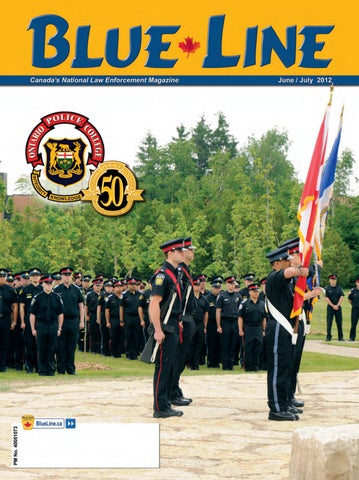
JUNE/JULY 2012
2
BLUE LINE MAGAZINE
June / July 2012 Volume 24 Number 6
Features
6
6 A commitment to a higher standard OPC 50th Anniversary
16 Instantaneous & overwhelming Halton Regional Police learn some lessons in media control
20
Blue Line Trade Show in Print
22
Realigning the flow London Police build in the future
28 Law enforcement west of the rockies Part 2
Departments 46 Blue Links Ad Directory 32 Deep Blue - Our stalwart ability to resist change 35 Dispatches 27 Letters 44, 45 Market Place 5 Publisher’s Commentary - A public trust... a surviving thread 36 Technology - End of life digital data security
16
Case Law 39 40 42
20 BLUE LINE MAGAZINE
3
Information & observation provide grounds for arrest Corroboration and quality of tip justifies warrant Honest belief not enough to justify arrest
JUNE/JULY 2012
JUNE/JULY 2012
4
BLUE LINE MAGAZINE
Blue Line
PUBLISHER’S COMMENTARY by Morley Lymburner
Magazine Inc. PUBLISHER Morley S. Lymburner - publisher@blueline.ca GENERAL MANAGER Mary K. Lymburner - mary@blueline.ca SENIOR EDITOR Mark Reesor - editor@blueline.ca CREATIVE DIRECTOR E. Jolene Dreja - jolene@blueline.ca CONTRIBUTING WRITERS Mike Novakowski Mark Giles Robert Lunney James Clark Dorothy Cotton Dave Brown Tom Rataj AFFILIATIONS International Association of Law Enforcement Planners Canadian Advertising Rates Data International Police Association The Canadian Press Newswire Access Copyright SUBSCRIPTIONS $30 per year; $50 for 2yrs; US & Foreign: $100 ADVERTISING 888-640-3048 advertising@blueline.ca
www.blueline.ca 12A-4981 Hwy7 East, Ste 254, Markham, ON L3R 1N1 Canada P: 905 640 3048 F: 905 640 7547 blueline@blueline.ca
PRINTED IN CANADA ISSN# 08478538 Blue Line Magazine was established in 1988 as an independent publication to inform, entertain, connect and educate those involved in the law enforcement profession. With no direct control from an enforcement agency, its opinions do not necessarily reflect those of any government or law enforcement agency. The authors, advisors, and publisher accept no liability whatsoever for any injuries to person(s) or property resulting from application of adoption of anything presented in this magazine. Readers are cautioned and advised that articles presented herein are edited and supplied for your personal awerness and should not be used for further actions until appropriate guidance is received from a supervisor, Crown Attorney or other persons in authority. All material submitted for publication becomes property of Blue Line Magazine Inc. unless arrangements have been made with the publisher prior to publishing. © 2011 All articles are protected by copyright. No part of this publication may be repoduced or transmitted in any form or means, electronic or mechanical, (including photocopying and recording or by any information storage or retrieval system), without prior permission. Permission to reprint may be obtained in advance from Access Copyright 1-800-893-5777.
BLUE LINE MAGAZINE
A public trust...
a surviving thread
Celebrating the Ontario Police College’s 50th anniversary brought back many memories of my days at that venerable institution. I was one of 32 freshly sworn members of the Metropolitan Toronto Police Force sent to take basic training alongside several hundred other Ontario cops. It was both a culture shock and an experience that never quite leaves you. The OPC was made mandatory for all Ontario officers about ten years before my arrival. A rather optimistically described conversion of a Second World War Air Force training base, its numerous wooden aircraft hangers and several “H” hut barracks still held together, in a fashion, 30 or so years after being constructed. The barracks had two long 32-bed halls linked in the middle with washroom and shower facilities. Before leaving Toronto’s college we were warned the OPC overfeeds officers, doesn’t have enough physical education and knows nothing about proper drill procedure. The old salt instructors warned us to run extra hard and expect re-training when we returned. Few of us had yet been issued uniforms and left for the long journey through southwestern Ontario with a half-paycheque in our sports coat pocket to tide us over. After a three-hour drive and considerable searching I found what was to be my home for the next three months. A long gleaming tiled floor lead to an older man crouched over a newspaper, lit by a small desk lamp, sitting at a small steel desk. He handed me a pillow, sheet and scratchy grey blanket and directed me to one of the 64 tube frame institutional beds with a mattress rolled up at one end. After setting things up and placing my suitcase on top, I headed for the sound of a playoff hockey game – but not before being rather sternly warned that lights go out at 10. I directed a large number of my straggling compatriots to the barrack’s troll as I headed for the television. After the game I re-entered the barracks to see many people milling about, setting up beds and arranging luggage. As promised, the lights went out right at 10, prompting many oaths and not-so-tender language as everyone scrambled to find their beds in a mostly darkened room. The old gent at the desk turned on his flashlight, yelling that it was sack time and everyone had better get themselves in order. I needed no such warning as I was already in the sack and ready to drift off. Morning brought the realization that sleeping with 60 other men – and their predilections to snoring, insomnia, flatulence and incontinence
5
brought on by over-imbibing during the hockey game – would be a challenge. Even worse was the strange red spots over my legs and arms. This was my rude introduction (and eventual tolerance of) bed bugs. “Just bang yer bed before you crawl in at night,” the night watchman sagely advised. “They’ll take off for the night.” Never was sure if it worked but there did seem to be fewer bites when I complied. One day I was pulled from class and taken to the college director’s office. As I entered his office I noted there was a large quantity of cash stacked neatly on his desk. They do periodic locker checks, he advised, and would very much like to know what I was doing with so much money. It was my accumulated pay cheques. I had no bills to pay and there was no rent or charge for meals at the college so I had simply tucked pay envelopes into my locker each pay day for the last two months. Why don’t you just deposit the money in your bank account, the director wondered. I didn’t have a bank account since I never accumulated enough from my previous jobs to actually save anything. Rather bemused, he looked over to the deputy director and suggested he accompany me to town to open an account. I signed his memo book as a receipt for the money and gratefully accepted the assistance. For me the OPC was my first coming of age – the opening of a new world, a new lifestyle and experiences which I had never dreamed of having. My life and the land would change once more as I returned to my home police service after basic training, and lessons came quickly over the next few years. Gratitude for lessons learned makes a person willing to give back. The feeling of responsibility to in-turn teach younger officers was made far easier by the examples so many others showed me over the years. Instructing others is far more than a job – it is a public trust and a surviving thread which leads from past generations to the society of tomorrow. During this 50th year of the Ontario Police College one must admire the dedication and drive of its staff, directors and instructors. They have become committed to a higher standard by continuously refining the skills necessary to maintain a public trust.
JUNE/JULY 2012
COMMITMENT
TO A HIGHER STANDARD
by Carla Garrett Nestled between Aylmer and Springfield on 168 acres of picturesque countryside, the Ontario Police College (OPC) has been a home away from home for every police officer in the province since 1962. Any recruit will tell you it’s no five-star hotel, but its professionalism and quality of training has never wavered. The OPC is celebrating 50 years of training excellence. The college in the middle of a cornfield is the envy of many. The unique concept of a centralized police college has set a new standard for police training throughout the world. “Ontario is very well served by what we have here,” says OPC Acting Director Bill Stephens. “The college has a reputation of excellence throughout the world.” In other countries, there are as many training institutions as departments. “We are consistent in our training, so that no matter where you are stopped in the province, the response is the same,” says Stephens, a former Windsor Police officer and OPC graduate. There are more than 26,000 police officers in Ontario. Each one was taught the same way to make an arrest and fire a gun – and knows what it’s like to live in a pod for weeks. “Every police officer shares that common bond; there is a sense of family and friendship with all police across the province,” says former Sarnia Sgt. John Hutton, OPC protocol officer. “It’s (the college) where the brotherhood and sisterhood join for one purpose; to do the best we can.” This extraordinary fraternity encompasses even current community safety commissioner Dan Hefky and deputy minister Ian Davidson, both OPC training graduates. The pride in the college’s 50-year history is evident by the pictures of past recruits, directors and instructors that hang on the walls JUNE/JULY 2012
throughout the campus. “It’s their college,” says Stephens. “Anyone who has been through here has an affinity for the college.” A number of initiatives have been planned to celebrate this milestone. The most notable event will be held July 12 – marking the day the college was officially announced 50 years ago. A number of dignitaries have been invited to OPC that day, including students from Class 1. A time capsule will be dedicated at the march past ceremony for future officers to open at OPC’s 100th anniversary. “It will be a busy year where we celebrate our past and look forward to an exciting future,” says Stephens. The college is also opening its doors to the public for Doors Open Elgin County this fall. Life in the barracks Patience and debauchery, combined with a lot of resilience, carried young man in the first OPC class through nine weeks of training. Retired S/Sgt. Jim Forbes of Thunder Bay police was 22 years old when he found himself unpacking his bags in the barracks of the old Royal Canadian Air Force Station. Consisting of temporary wooden buildings, the station was used in the 1940s for training pilots and was designed to last through 6
victory in Europe and Japan. The young recruit vividly remembers his quarters in the old barrack huts. There was a bed and small work area attached to a six-foot metal room divider. Thirty-two men stayed in a single room. “We had to keep telling ourselves that we were the first class ever and we had to be patient and a little flexible to the trials and tribulations we would encounter,” says Forbes. The first class arrived in January 1963. In that first year, 654 recruits were trained and 737 experienced officers went for refresher training. The food was “horrible” and the remote location just kilometers out of Aylmer offered little entertainment, but that didn’t stop recruits from making their own fun. “We weren’t always doing positive things in the sleeping quarters,” Forbes says. There was the poor guy who was handcuffed to the steam pipe, snowball fights, races in cruisers along the old runway and even a break and enter in the OPC kitchen. After all the kitchen staff had gone home for the weekend, Forbes says, the famished recruits found an unlocked window and went in for a snack. “I don’t recall what food was available but it slaked our hunger.” The entire OPC experience left an “indelible mark” on Forbes, who went on to have a long and successful career. “There was a genuine spirit of fellowship at college, at least at our level,” he says. Much has changed since those first classes, says Stephens. OPC is now a fixture for Ontario police officers. The registrar reports the college has 162,639 student training records, including the more than 42,000 recruits who have attended since 1962. The ingenious idea of creating a centralized police training facility for Ontario was born in the early 1950s. At the time only about BLUE LINE MAGAZINE
Congratulations to the ONTARIO POLICE COLLEGE
BLUE LINE MAGAZINE
7
JUNE/JULY 2012
a quarter of the province’s 300 forces carried out informal training. “Where training was provided, it was focused almost exclusively on uniform issues,” says Stephens, adding only larger departments provided any instruction in traffic, criminal investigation and identification. There was no co-ordinating body for police training in the province until OPC was established. An amendment to the police act was enacted in 1960, followed by the creation of the Ontario Police Commission, which would have authority over the new college. A number of municipalities expressed interest but with the help of influential politician Ron MacNeil, Aylmer was eventually selected as its home. Air force training at the RCAF station had been grounded, making way for a new era. Ontario’s attorney general announced the establishment of the new college on July 12, 1962. The OPC’s purpose was “to improve policing in the Province of Ontario by creating training facilities which will make police work a profession and consequently attract men of quality into the profession.” It wasn’t until the mid-70s that OPC welcomed its first female officers. “It was a very positive change,” says Stephens, adding almost 22 per cent of recruits are now women. In its first year, the college also rolled out a general police-training course for experienced officers who hadn’t been trained. As the profession gained momentum, so did OPC. More courses were added, instructors hired and space minimized. A $28-million addition officially opened in May 1977 to meet the increasing demand. Throughout the ‘80s several working groups formed to hone the business side of the college and address the long-term issues facing police training. A family of honour One hundred and 73 recruits were recently introduced to their quarters at OPC. Just as the thousands before them, these bright-eyed men and women from across the province will experience what it’s like to get their “BA.” Not a Bachelor of Arts, but to say they have “Been to Aylmer” – a common joke in the 70s and 80s. If you haven’t been to the college in the last 10 years, you will find it looking much the same. In fact, many of the same pictures still hang on the walls, documenting OPC’s rich history and infamous staff and students. The same JUNE/JULY 2012
tables and chairs await you in Mennill Hall and the same pods invoke nostalgia like no other. “As soon as you walk in the door there is a feeling of comfort,” says former recruit Briane Fleming. “I have always had a soft spot for the college.” Each year, almost 10,000 students attend courses offered by OPC both on and off site. The college’s largest recruit intake was 420 students in January 2002. Aside from providing top-notch training to its students, the college also offers a superior work environment. Fleming trained at the college in 1977 and returned as a seconded instructor in 1988. He was hired full time in 2002 after retiring from Peel Regional police. “It’s like I died and went to workplace heaven,” he says, adding, “I have enjoyed all my experiences here.” He is currently team leader for academic training for the basic constable course. OPC is among the largest employers in Malahide Township with a staff of 170. This includes 40 seconded instructors and 45 permanent instructors. “We have highly skilled and experienced staff here,” says Stephens. “They want to be here, because they chose to be here.” Fleming adds there is “tremendous value and confidence in what we do here.” That includes everyone from the director and instructors to the cleaning staff and kitchen crew. Each year, OPC kitchen staff prepares almost 300,000 meals. The menu includes lean meats, a salad bar and gluten-free products. “The menu has come a long way,” says Phyllis Therrien, who has worked in food services there since the early 1980s. There is more variety now, better quality meats and more educated chefs, she says. “It’s a very clean atmosphere with high standards,” says Therrien, adding it’s the people around her who make her job at OPC so enjoyable. “We are a family.” That sense of family has been a constant for 50 years and will be invaluable as staff work towards a sustainable future for OPC. Becoming self-sufficient The OPC is embracing technology as its key to another 50 years of success. From course development to program delivery, its future is online. 8
“We are in a period of transition, as we move from only using traditional classroom based instruction to include other methods of training, such as webinars, e-learning, videoinstruction and other emerging technologies,” says Stephens. This does not mean they are abandoning their traditional approach, he adds, but will enhance how they do business to meet all of their stakeholder needs. “The future for OPC is very bright,” says Stephens. With some external pressure from the infamous Drummond Report, alternative delivery models for police training are in development. Partnerships have been made and staff hired to carry out this transformation. Last year marked the first step for initiating technological change with the installation of wireless Internet throughout the college. “This has allowed our students more opportunities to connect with home and make use of technology for their course work,” says Stephens. They also plan to move towards a paperless recruit program, he adds, reducing the 5.3 million pages of paper OPC produces each year. This new direction will not only be more effective in connecting with students from the information age but will also provide a more efficient business model in a frugal economy. More affordable access to web-based technologies has opened the doors to more distance learning opportunities, which will be available to experienced police officers. “Students have to come here for recruit training but we want them to make OPC their choice for all of their training,” says Stephens. In September, OPC will offer its front line supervisor course online, as well as pilot introduction to crime prevention and community policing. A video-based homicide course, in partnership with the OPP, has also been developed. As always, recruit, forensic and other highly specialized training will still be offered on-site, including driving and firearms instruction in the recently renovated ranges. “While we move towards the future, we’re very conscious of our proud history and our traditions… those will never be forgotten,” Stephens says. “There are some significant changes underway… and they will put the college in a better position for the future.” BLUE LINE MAGAZINE
Range safety is a shared concern by Irene Barath and Erin Knights Safety on the firing range is a paramount concern for all involved but accidents can still occur. The OPC was reminded of this unfortunate fact when a police recruit was seriously injured from an unintentional, self-inflicted gunshot during a firearms training session. Firearms team leader Erin Knights highlighted the OPC’s response to this incident in a presentation to the International Law Enforcement Educators and Trainers Conference (ILEETA) in Wheeling, Illinois in April. She provided an overview of the OPC BCT and firearms program and the events leading up to the incident, the response to the injury and changes made to operating protocols. The focus of the presentation was the lessons learned and how the firearms training section, supported by the management team, instituted several emergency response initiatives to ensure the best possible outcome if another accident occurs. These initiatives have included: • Upgraded radio communication between ranges; • Range doors painted and numbered for easy identification; • Adjustments in service bay doors at the external range and keys made readily accessible; • Preprogrammed phone for emergency 911 response; • Up-graded trauma/first aid equipment; and • Emergency response and trauma first aid training at the start of each intake for all firearms training staff. These and other improvements have increased the level of preparedness while the OPC continues working diligently to ensure prevention is its main focus. Several attendees related similar incidents which occurred during their training and it became even more apparent how accidents involving firearms can have significant consequences. They asked some challenging questions and were pleased to be provided with reference material, such as lists of equipment for the trauma response first aid cart, enabling them to implement changes at their home departments. OPC will soon host a 90 minute operational debriefing and discussion to share this range safety information with police training bureau members, while again being respectful of privacy issues pertaining to the recruit and police service. OPC staff work diligently to ensure the safety and security of Ontario police officers who, in turn, serve their communities. Our intention is to share information and assist those involved in training who, despite their best efforts at prevention, may need to respond effectively and efficiently to ensure the best possible outcome during a training emergency.
A quarter century of promoting fitness by Lori Neufeld Ontario officers who demonstrate a commitment to personal physical fitness through testing are recognized with the Ontario Police Fitness Award (OPFA), commonly known as the ‘fitness pin.’ Officers who have earned a pin annually for the last quarter century will be recognized with a special honour this year – a 25 year pin to be presented at the Ontario Chiefs of Police (OACP) conference in June by Gary Goguen, president of the Police Fitness Personnel of Ontario (PFPO). OPFA history The OPFA program is sanctioned by the OACP and Ministry of Community Safety and Correctional Services. The PFPO began the fitness pin program in 1988 as a way to promote personal health practices through a physical fitness standard. Police recruits complete their first fitness pin qualification at the Ontario Police College (OPC), starting them on the road to continued participation in the annual testing process. After graduation, physical fitness level becomes the responsibility of the individual officer, supported by their police service. Chiefs recognize the benefits of having a fit and healthy workforce. The OPFA program is a positive process to enhance police health since so many variables (long hours, shift work, complex case loads, work overload, fatigue and stress) can create significant challenges. Many services today offer financial incentive programs to members who earn their fitness pin. Like the annual use of force qualification, it provides an excellent opportunity for assessing individual fitness and providing lifestyle coaching. The OPC hosted the PFPO Fitness and Health Conference in April. One presenter, Dr. Neda, highlighted the Ottawa Police Service
pilot “Real You” program. The outcomes are inspiring and need to be given serious consideration as a model of wellness for all police services. Changes in 2012 Recent changes to the fitness pin program include replacing the former curl-up component with a core endurance test that measures a person’s ability to engage all core muscles over a period of time. The “core” refers to the lumbo-pelvic-hip complex and the muscles surrounding it. Good core stabilization and endurance refers to how well the muscles in your pelvis, lower back, hips and abdomen work in conjunction to support the spine during physical activity. This change was based on research by Dr. Stuart McGill from the University of Waterloo, a leading expert in spine biomechanics. Police officers are already susceptible to low back injury, given the nature of their profession. Officers must carry duty belts and body armour and remain seated in a flexed position in cruisers for extended periods. They are then quickly called to action – often with no warm up. The core endurance test has less room for testing error, better assesses core endurance and better predicts low back health. The full protocol for the core endurance test was introduced to fitness appraisers at OPC during the PFPO Fitness Pin Recertification Course. Approximately 90 appraisers are now trained to properly administer it. This will be a transition year; recruits are now required to do the core endurance test but other participants have the option of choosing the curl-up test. Visit www.pfpo.org for more information. The PFPO executive will offer more recertification courses in the fall.
Irene Barath is chief instructor at the OPC. Erin Knights is the firearms team leader. Email them at erin.knights@ontario.ca or irene.barath@ontario.ca for more information.
BLUE LINE MAGAZINE
9
JUNE/JULY 2012
Patrol carbine training by John Weiler The Ontario Police College (OPC) began assisting police services in the training of front line officers with the patrol carbine nine years ago. Since 2003 many police services in Ontario have implemented usage of the patrol carbine while others are in the process of acquiring them. Of interest, the first agency to transition to the use of the patrol carbine was the Aylmer Police Service – a community partner with OPC. The program was initiated by Sergeant Michael Knight, who worked diligently to research and budget for the weapons before approaching the OPC for assistance with training. Since that time Sergeant Knight has been a resource for other police agencies in Ontario and freely gives of his time to share his police service’s experience with the Colt C8 patrol carbine. In 2003 I published an article which identified the advantages of the carbine and they are being validated by the police services who now utilize the carbine. I have had the privilege of training with several police services and feedback from trainer operators indicates the weapon is performing beyond expectations and has filled a gap that was felt to be lacking in their arsenal. At this point any of the initial safety or excessive firepower concerns have been alleviated through education, research and real-world experience with the weapon system. For police services considering the purchase of a patrol carbine, several enhancements should be considered in addition to the acquisition of the weapon itself. To enhance the carbines effectiveness and maximize its performance for officers of various stature, the following accessories are essential: a) Ambidextrous controls including safety lever, magazine release, and bolt catch lever; b) High quality, adjustable single-point sling; c) Tritium front sight insert; d) Flashlight, designed specifically for mounting on a carbine; and e) Spare magazine(s) and magazine carry pouch. Each of the recommended enhancements serves a specific operational purpose. Our research indicates ambidextrous controls are an effective way to ensure all officers are trained in the same manner and can operate the carbine regardless of dominant hand. Under extreme stress it is difficult for officers to change operating procedures based on which hand they are operating the weapon with, which may create some delay in response time. There will be occasions when the carbine was initially deployed and then due to rapidly changing circumstances reassessment is required for a more appropriate response based on the Ontario Use of Force Model. Under
JUNE/JULY 2012
these circumstances the officer must be able to secure the weapon and free both hands to perform other tasks. The easiest way to meet this objective is to equip the carbine with a single-point sling. Officers spend a considerable amount of time deployed in low light conditions where, just like the duty pistol, a tritium front insert provides an enhanced point of reference for obtaining an accurate sight picture. Additionally, a high quality, durable light mounted on the weapon provides the most efficient method of identifying potential threats, without having to remove either hand from the carbine. In any semi-automatic weapon system one area which can create operational concern is the magazine. Aside from providing access to necessary ammunition, an extra magazine allows the officer to replace a malfunctioning
10
magazine that may be causing stoppages or to tactically reload as the result of an engagement. Training identifies where this magazine should be placed to ensure accessibility when the carbine is deployed particularly under stressful circumstances. Our training practices indicate placing an extra magazine in a carrying case is not the most effective method of storing spare magazines and creates challenges for the officer trying to access them in a critical situation. A completely accessorized patrol carbine may be the tool that gives front line officers the advantage they need to quickly and safely take control of a life threatening situation. At the Ontario Police College we are pleased to be working with the police services of Ontario who are acquiring the patrol carbine. We will continue to support the efforts of police trainers to ensure training is available on how to efficiently and effectively utilize this use of force option by first responders and containment officers. The patrol carbine is a weapon system which, with proper training, can be effectively deployed with accuracy and reliability. If you have any questions about the carbine itself or the training process contact John Weiler at John.Weiler@ ontario.ca.
BLUE LINE MAGAZINE
BLUE LINE MAGAZINE
11
JUNE/JULY 2012
Transitioning from civilian to
police driving New Ontario Police College (OPC) recruits need to learn how to transition from a “civilian driver” to the higher skill level required of a “police driver.” Many new recruits have learned defensive driving techniques, which may be appropriate for civilians going with the flow of traffic, but the reality of police driving demands a recruit develop new skills to become effective and efficient. A police officer must safely operate a fully marked police vehicle during; • Patrol driving (slower than the flow of traffic); • Destination driving (with the flow of traffic); • Emergency/pursuit driving (faster than the flow of traffic). Regardless of the driving style being used, an officer must drive co-operatively with all other road users while also heavily multi-tasking with internal vehicle equipment, maintaining constant awareness of their surroundings and mentally preparing for any situation they may encounter. In Police Vehicle Operations (PVO), the new driving style is referred to as “co-operative driving” – both a mindset and collection of new skills to assist the recruit in attaining the higher driving skill level expected by both the public and their police service. PVO defines driving as a decision making process based on the visual information available at that time, combined with knowledge and experience. The OPC PVO’s co-operative driving style is a system designed to ensure the driver absorbs and prioritizes relevant information well in advance, thereby removing the possibility that an event or situation takes them by surprise. Avoiding surprises means avoiding dangerous situations and preventing collisions. The ABCs A complete understanding of the principles is the cornerstone of a police recruit’s development and transition into a professional police driver. The acronym ABC is used to assist in remembering each principle: Plan Ahead The first and most critical of the three cooperative driving principles is to plan ahead. Since driving is a decision-making process based on visual information, it is vital to collect this visual information as efficiently as possible. Recruits are taught to look well up the road into the distance (eye lead) to gather information about anything crucial to the safe operation of their vehicle, as well as interesting, unusual or unique from a police perspective. Eye lead in urban areas is recommended as eight to 12 seconds and 20 to 30 seconds on rural roads/highways. It has been demonstrated that peripheral JUNE/JULY 2012
vision is also more effective when the eyes are up and looking far ahead. Peripheral vision is triggered by movement or colour and learning to trust it is one of the greatest challenges when increasing a recruit’s visual skills. Recruits are also taught to widen their scanning from tree line to tree line or fence line to fence line or, in urban areas, from store front to store front (and right inside the stores). Scanning works together with eye lead to increase the quality and quantity of visual information gathered. This results in safer driving decisions and more effective policing, with an increased area from which the officer may detect infractions or unusual occurrences. Visual tracking is the term used to describe looking for open space while tracking a path for your vehicle. Used in conjunction with eye lead and scanning, it is a skill that recognizes an open path ahead and aims your vehicle toward it – important for emergency responders and vital for emergency collision avoidance. This new concept has the recruits looking for spaces in traffic or “looking for nothing.” Recruits are also taught to keep a minimum three second following distance (in ideal driving conditions) between their vehicle and the one in front. In addition, offsetting your cruiser into an open lane allows the driver to see past the vehicle(s) ahead. The further up the road a driver can look, the sooner they will see things important to their decision making. Be Seen Every effort is made to ensure police vehicles are seen by other motorists. Graphics, reflective stripes, emergency lighting, siren and air horn are all effective, however training recruits to move to an open lane and drop back to the minimum three second following distance ensures they can see better and other motorists can see them. 12
Create Escapes Creating escapes is simply creating opportunities to escape hazardous or dangerous driving situations likely to cause vehicle collisions. A recruit achieves this by maintaining the minimum three second following distance when in motion and a proper stationary gap between their vehicle and those in front when stopped. A proper stationary gap will provide sufficient space to get out and around a stopped vehicle in an emergency. Recruits are taught that while in motion and whenever possible, there is an open lane beside the cruiser – the shoulder or another lane of traffic – where they could move to avoid a dangerous situation. Effective use of the mirrors (every 5-8 seconds) and frequent blind spot checks ensure no other motorist has eliminated that escape route. When approaching any situation where braking might be required to avoid a collision, recruits are taught to cover the brake by lifting off the gas and hovering their foot over the pedal. These types of situations occur regularly when approaching intersections, highway merge lanes or in heavy city traffic, especially where civilian motorists may behave differently with a marked police car following them. The police driver who can plan ahead for the possibility of such an action will, by covering the brake pedal, be in a better position to stop smoothly and safely. Conclusion The co-operative driving principles taught at OPC create the groundwork needed for the new recruit to become a proficient, safe, professional police driver. They are encouraged to practice these principles when in police vehicles or their own vehicles. With experience comes smoothness and these principles will become habit. A smooth driver ultimately becomes a superior police driver, with the skills and ability to avoid surprises that may lead to dangerous situations. BLUE LINE MAGAZINE
This is no easy ride by Carla Garrett Harley Davidson has been part of police fleets for more than a century. In keeping with this rich history of supporting police, Deeley Harley, in partnership with the OPC, is offering an intensive training course for motor officers. “It’s an extraordinary partnership in which both partners are dedicated to the safety of motor officers across Canada,” says Rodney Freeman, OACP liaison to the course, which consists of 80-hours of on-bike training at OPC, with intakes from April to September. About 500 officers from across Canada and United States have mastered the complex riding skills required to pass the course. Many say it’s the best instruction they have ever taken, says chief instructor Stan Hazen but, “It’s a tough course and not one for the faint at heart.” Rain or shine, they ride. Students spend the first few days in the parking lot, getting familiar with the bike and learning how to pick up a fallen motorcycle. “Some riders have no or very little experience,” says Hazen, adding it’s not uncommon for students to drop their bike more than 20 times a day in the beginning. Officers are taken through grueling obstacle courses, involving slow-speed riding and advanced braking techniques. They learn
BLUE LINE MAGAZINE
to maneuver around debris scattered across roadways while approaching an emergency scene at high speeds. When they’re done, they can turn their bikes on a dime – or at least in an 18-foot box. “It’s a lot more intense than any civilian could do,” says Hazen. On days when the going gets too tough, Hazen says a blast of the siren indicates a class road trip in the country to regroup. Over the two-week program riders log about 1,287 kilometres on road trips, riding in heavy rain, daylight and darkness. “All environments and conditions contrib-
13
uted to the development of our professional riding skills,” says Freeman, who completed the course last fall – but the seasoned Harley rider and Woodstock police chief got a surprise the morning of his first class. The sun had yet to rise when Freeman, 55, and about a dozen other officers stepped on the tarmac with their almost 800-pound Harleys. “I found this to be the most challenging course both physically and mentally,” says Freeman. “What this course really drove home was the immense distinction between a recreational rider and a police patrol precision rider.” Many people assume that an officer is qualified for police motorcycle duty simply on the strength of prior experience operating civilian motorcycles. The high load factor of police motorcycles, along with the unusual distribution of the load, results in unique handling characteristics, according to Harley Davidson. This, plus the high speeds and maneuverability required, creates the need for higher-level skills than civilian riders are equipped to master without specialized training. “Police models have a lot of technical changes specific to assist police,” says Pat Kealey, Deeley Harley program manager. Even the seats are different to accommodate up to 18-hour rides. Deeley Harley, the exclusive Canadian Harley distributor, donates 15 new bikes to the college each year for the course. Officers are required to come with their own riding gear. Although a niche market for Harley, with only one other company providing police vehicles to services across the country, Kealey says it’s not about selling the brand. “It’s strictly about enhancing the safety of the motor officer,” says Kealey, who lost a close friend in a police motorcycling accident. Larger forces have had motor patrol for many years. Kealey says smaller forces are now also starting to use them and see the benefits. Woodstock Police added a motorcycle to its fleet two years ago. “It provides much more flexibility in deployment and in addressing traffic safety concerns,” says Freeman. It also provides officers a new and exciting mode of patrol for those looking for something different.”
JUNE/JULY 2012
Teaching experienced
police officers to teach by Irene Barath The OPC seconded officer program has been a foundational part of the BCT program for many years. Under this collaborative process between the OACP and OPC, experienced officers from all Ontario police services work with full time instructional staff to train the next generation of police professionals. Operational police officers step out of their organizations for a two year period to deliver the BCT program curriculum, often acting as liaisons between their home police service and the new recruits, assisting in managing equipment and human resource issues. They also represent their home service to all provincial, national and international services who attend the OPC. A two year commitment allows them to develop some expertise in at least one if not two subject areas. Although the application process has remained relatively consistent, the OPC has undertaken several initiatives to ensure the program optimizes the seconded experience. We have updated our orientation process for new officers to include an evaluation of necessary training requirements, a BCT training passport for tracking integration activities, an end of course feedback survey and an information sheet to assist in determining deployment and development opportunities. Selected officers enter the orientation process, where OPC determines the skills they will need to train in their assigned area. This is a critical phase as officers are sometimes assigned to areas outside the scope of their current operational expertise. OPC staff determines what development opportunities we can provide, such as the facilitating and assessing police learning and use of force courses. Once a baseline skill set has been established, officers are then provided specialized advanced training to refine skills in their assigned areas. Upon completing the first of six intakes officers are encouraged to complete an information sheet to confirm the training they have acquired JUNE/JULY 2012
since beginning their secondment, identify where they are currently assigned and state where they would like to be deployed should the opportunity arise. They can also indicate the training courses they would like to take to assist with their own career development. In our dynamic and flexible training environment, this assists managers in determining deployment and staff development initiatives on an intake by intake basis. OPC deployment decisions are also made on the basis of ongoing discussions between seconded officers, team leaders and chief instructors for the various disciplines. There are six areas for deployment within the BCT program: applied police learning (in class academic and practical sessions), fitness, firearms, defensive tactics, police vehicle operations and officer safety teams. The seconded officer program is intended to allow operational police personnel to share their experience with recruits while also furthering their own career development. The OPC attempts to deploy participants to at least two training areas. Staffing deployment is a complex process, taking into consideration the needs of the OPC for succession planning, the seconded officer’s personal development goals and the future training needs of their home service. The BCT program take an integrated approach to teaching the competencies necessary as recruits transition from civilian status to sworn officers. To effectively train recruits, officers are encouraged to monitor other sessions in the program and observe how what they teach is integrated throughout other areas of the program. They can use the BCT passport to track the sessions they have attended. Seconded officers help OPC programs remain current and relevant by sharing their operational expertise on both training and organizational effectiveness. They are encouraged after each intake to access an online survey to comment on the availability of resources, training support, deployment concerns or any other issues they feel are relevant. This information is shared with OPC management and, where possible, shortcomings 14
are addressed. If it is not possible to implement some of the suggestions then that rationale is shared with the seconded officers. The ongoing sharing of information throughout the intensive 12 week program is critical for operational adjustments and to communicate to both full time and seconded instructional staff the current status of other projects not directly related to immediate program delivery. There are several research and program development initiatives underway. The OPC continually seeks to maintain the effectiveness and currency of the programs resulting from legislative and case law decisions or other evidence based initiatives (such as the leadership training review, BCT competencies review and numerous employee wellness initiatives). Pre, mid and end of course meetings with all BCT staff offer the opportunity to troubleshoot challenges and make adjustments going forward. The new processes make the OPC more proactive about ensuring the seconded instructor program remains a ‘career best experience’ for participants. The COP model of a ‘career best experience’ involves tapping into an individual’s talents or competencies, highlighting what people are passionate about and adding value to the organization. The secondment program provides officers the opportunity to share their operational expertise while honing their training skills. It also creates developmental opportunities for the officers to return to their police service with supervisory experience and certifications to enhance their career development. The OPC and OACP continue to work together to support the training of new officers while encouraging the professional and personal development of experienced front line officers. Irene Barath is chief instructor of patrol training at OPC.
BLUE LINE MAGAZINE
PRACTICE IT OR LOSE IT Skills are perishable The OPC Defensive Tactics (DT) section trains officers to use force, teaching such skills as physical control techniques, baton, aerosol weapons, handcuffing and gunpoint arrest. Historically students were trained during focused learning sessions, each devoted to developing one or two skills, which enhanced initial competence building on previous instruction. Students were evaluated on an ongoing basis. Those that did not meet the standard for a specific skill were identified after each session and offered additional training. In many cases, skills were not significantly revisited after the development session(s). Recruits are trained at the OPC for an intense 60 day Basic Constable Training Program (BCT). The intent of DT is to provide them the basic skills to competently perform as first responders. Although officers receive further training at their police service, their most concentrated exposure occurs during their 60 days at the OPC. Many skills, habits and concepts are developed, impacting the officer’s competence
BLUE LINE MAGAZINE
throughout their entire career. Our ongoing observation of students and client consultation indicates that retaining skills and concepts is the greatest challenge to optimizing long term competence. Highly effective techniques are of minimal value if students forget them. The OPC DT section is committed to enhancing long term officer performance by maximizing the retention and integration of skills they develop. The DT section has worked diligently over the previous three intakes to simplify many
15
techniques to enhance long term retention and initial competence. These techniques include blocking, angle kicks, edged weapon awareness, handcuffing, grounding and ground defense We have also changed the breakdown of session delivery. Developing a specific skill is no longer condensed in one or two sessions but distributed over many. While initial competence may be achieved more slowly with this approach, each skill is revisited numerous times. In effect, many skills are developed and honed throughout the DT program and competence is assessed on an ongoing basis in preparation for the final practical skills examination. Through simplification, gradual skills development and repetitious exposure to techniques over many sessions, the DT training team strives to enhance long term officer performance. All skills are perishable and require maintenance but this is made easier and more effective if the initial development is constructed with the intent of optimizing long term effectiveness. Call team leader Paul Bonner at 519-773-4419 for more information.
JUNE/JULY 2012
&
INSTANTANEOUS OVERWHELMING
Halton Regional Police learn some disaster lessons in media control
by Janice Coffin and Dave Cross On Sunday, February 26, 2012, at 3:28 p.m. VIA Rail passenger train #92 jumped the tracks and came to rest behind some commercial buildings in Burlington, Ontario. Bound for Toronto, it carried 75 passengers and crew. Three VIA rail employees were killed and three passengers seriously injured. Another 42 passengers and one crew member were less severely injured and needed to be taken to area hospitals for treatment. Within 90 minutes of arriving on scene, the co-ordinated efforts of police, fire and EMS officials resulted in the extrication and evacuation of all aboard. The media response to the incident was instantaneous and overwhelming. More than 200 media enquiries were received via phone, e-mail, text and on scene in person within the first two hours. Emergency services media personnel train for such incidents, however a crisis outside of the normal scope of the job can still leave personnel scrambling. What follows are some best practices and lessons learned. Designate a media commander In an ideal situation, you will liaise with spokespersons from your partner agencies JUNE/JULY 2012
immediately at the scene and identify a lead media commander for the incident through which all responding and partner agencies provide information. This ensures that the information disseminated to the media will be factually accurate and consistent. It also ensures that sensitive information, such as the number of deceased or injured, is not released prematurely without being confirmed – and that appropriate partners are kept in the loop. You do not want your partner agencies to be put in a position where they learn critical information pertaining to the incident through the media, rather than hearing it from your agency first. Some agencies will not have personnel on scene, as their head offices may be located far from the incident. In this situation, contact the appropriate spokesperson by phone or e-mail as soon as possible. Prioritize information Every media outlet will want to pursue their own angle to the story. Do not let their individual agendas hijack your organization’s key messages. Remember that you control what is disseminated so keep your focus on the most relevant information to meet both public safety and public interest: • Factual details and status update on the ongoing rescue efforts; 16
• A ny immediate public safety concerns beyond the site of the incident (ie: traffic detours, potential chemical spills, etc.); • Stressing that all emergency services train for such events and are prepared to respond appropriately. Manage media on scene Set up a secure briefing area adjacent to the site of the incident. This allows media to get the visual footage of the rescue efforts they require but keeps them far enough away that they do not interfere with actual operations. Expect that some media personnel will bypass police barricades to get closer footage of the incident. In this case, because of where the derailment occurred, several reporters were able to directly access the site and were found on the tracks, close to the train. This could have compromised any evidence in the event the incident had been caused by a criminal act and could have also jeopardized the safety of the reporters, victims and first responders. Advise all first responders on scene to redirect straying reporters back to the media briefing area and explain that the request is for their own safety and that of victims and first responders on scene. BLUE LINE MAGAZINE
BLUE LINE MAGAZINE
17
JUNE/JULY 2012
Leverage existing relationships If you are fortunate, your agency will already have a designated media spokesperson who has established positive working relationships with local media during non-crisis situations. This is an advantage, as there will be an existing level of trust established. This will help ensure fair and balanced coverage from those outlets as the incident unfolds. That said, this trust relationship also means that local reporters will expect you to give them the ‘inside scoop’ before other media outlets. Provide all media with the same information at the same time. It is never a good idea to play favourites with reporters, especially when they are clamouring for information other media outlets do not yet have. In larger-scale incidents, there will also be numerous reporters present from national and international news agencies with whom you have not previously interacted. They may have a different reporting style or editorial focus than what you are accustomed to from your local media, so be prepared. Expect a feeding frenzy Expect a full out media feeding frenzy. In the initial minutes after they hear of the incident you will have no time to gather your thoughts or gain perspective on what has occurred before needing to respond to live, on-camera interviews. You will be peppered with multiple questions, most of which you
will not yet be able to answer. Manage the feeding frenzy by setting defined times for media updates, such as every 10 or 15 minutes. Pick an interval that is appropriate given the speed of information flowing in from the incident commander and other partner agencies responding to the scene. These updates will be more frequent at the beginning of an incident, then taper off as there is less new information to provide. Have a system in place so that you receive timely information from the incident commander and can then provide it to as many media personnel as possible in one location, at set times. This will avoid having to repeat the same facts over and over again and not being available to receive updated information. Know your scope of authority Media outlets will have a tendency to look to the police spokesperson to be the source of all information related to an incident. This is accurate in a straight-forward criminal investigation, however emergencies and disasters involve more agencies than just police. Speak only to those facts and information your agency is responsible for and refer to other agencies those matters that pertain to them. The media will also gather information from multiple sources and ask you questions citing facts that you have not yet confirmed with the incident commander. Stick to the
facts you know are confirmed and refer questions outside of your scope of authority to the appropriate spokesperson from a partner agency. For instance, many reporters were keen to find out what caused the derailment and how the process of investigating a train derailment works (ie: is there a black box similar to a plane, had it been recovered, etc.). This aspect of the investigation was the responsibility of the Transportation Safety Board of Canada and all these questions were referred to them. Partnerships are key It is impossible to build relationships during a crisis. If you spend time building and maintaining relationships with stakeholders before an emergency occurs, it will make it much easier for you to collaborate effectively when a crisis happens. Brainstorm a list of potential large-scale emergencies to which your agency may need to respond and identify your potential partner agencies for each incident. Make a connection with your media counterpart at that agency when there is no crisis, so that when that time comes, you have an established relationship you can draw on. As part of this relationship-building, establish which agencies are responsible for commenting on what aspect of the investigation, when the information will be released and in what form. If this is well understood in advance, it greatly reduces the risk that a partner agency will release inappropriate or inaccurate information outside their span of authority. Make sure your contact lists are always up-to-date. Have a social media plan Not all emergency services have an active presence on social media but there is no question that information and misinformation about an incident will be broadcast via Twitter, Facebook and other social media platforms. In many cases, the public themselves will become ‘reporters,’ broadcasting photos, videos and their personal opinions on the incident.
JUNE/JULY 2012
18
BLUE LINE MAGAZINE
As part of building your partnerships, identify which partners are best able to manage a constant flow of regular updates on social media and designate them as the lead agency for managing social media about the incident. It will consume a vast amount of resources to have every partner agency broadcasting tweets and retweets through their respective feeds. Save time and human resources by creating and designating one official feed for the incident and direct people to it. Be flexible No matter how prepared you are, always expect the unexpected. Stay flexible and adapt as the situation requires. Even with the best crisis communication plan in place, there will always be something new to learn. Debrief with partners As soon as possible after the incident is under control, schedule a debriefing with all partner agencies to identify best practices and lessons learned. Be sure to thank everyone for their teamwork in responding to the incident quickly, safely and effectively. Regardless of the type of incident, there are always opportunities to enhance and improve the way your agency interacts with the media. Effective media relations boils down to common sense: you are the public face and voice of your organization and its image and reputation is influenced by what
BLUE LINE MAGAZINE
you do and say, especially in a crisis. Act accordingly. Professionalism, courtesy and respect are the keys to success. Janice Coffin is the Director of Corporate Communications for the Halton Regional Police Service. She may be reached by email to Janice.Coffin@haltonpolice.ca
19
JUNE/JULY 2012
Check out these highlights from the 16th annual Blue Line Trade Show, held on April 24th & 25th. The show provided a forum for Canadian and American companies to show case their products and services to law enforcement professionals from municipal, provincial and federal police services, security companies. Attending government agencies, included Parks Canada, Department of National Defense, Canadan Border Services Agency, as well as Correctional Services Canada among others. The Blue Line Trade Show staff would like to thank everyone for making the show incredible!
Exhibitor’s Draw Winners 1st – 1/2pg colour ad in Blue Line Magazine: Savage Range Systems 2nd – 1/3 pg colour ad in Blue Line News Week: Fisher Space Pen 3rd – $25 Gift Card for the Keg: CCISF - Canadian Critical Incident Stress Foundation Long Term Supporters Award 10 yrs - DAVTech Analytical Services 15 yrs - Panasonic 15 yrs - MD Charlton Co
JUNE/JULY 2012
20
BLUE LINE MAGAZINE
Draw Prize
Winners
*
Shirt: Walter Waganka, Medstar First Aid Services Kobo E-reader & Case: Rob Spring, Durham Regional P.S. Single Pistol Case: Kosta Barindakis, Belleville Police Striker II Boots: Charles Wheeler, Brantford P.S.
Commemorative NASA Shuttle Space Pen: Joe Castro, Ontario Power Generation BBQ Tool Set: Tom Ungar, York Regional Police Gym Bag: Ken MacPherson, West Grey Police Service
Publisher Morley Lymburner, Blue Line Magazine, presents Det/Sgt. Duncan MacIntyre the prestigious 2011 Blue Line Police Leadership Award with York Regional Police Chief Eric Jolliffe at right. Applications for the 2012 Award may be sent by email to Leadership@blueline.ca.
$100 Gift Certificate: Derek Anderson, Toronto Community Housing Constable $100 Gift Certificate: Don Klaehn, Waterloo EMS Painting: Meredith Cutting, Toronto Police Service Streamlight Flashlight: Paolo Dellipizzi, Durham Regional PS
Boots: Reid Pridham, Waterloo Regional P.S. Boots: Arron Jackson, Halton Region Tobacco Enforcement Officer 511 Duty Bag: Bruce Bertrand, Peel Regional Police
Coolpix AW100 Camera: Sean Ryan, CBSA Boots: Damon DeBrusk, Waterloo Regional Police Shirt: A J Quinn, Force One Protection Shirt: Paul Warren, Respond Search & Rescue Shirt: William Graham, Durham Regional Police Binoculars: Brad Lawrie, Hamilton Police Service
Flashlight: Doug Lent, Durham Regional Police 1yr Membership: Mike Kurek, York Regional Police Audience Response Kit: Trevor McCuaig, Corrections Can. Photos by: Matt Tesluk; Erin Oliver; E. Jolene Lymburner; and Dave Brown *Every Draw Prize entrant receives a free one year subscription to Blue Line Magazine!
BLUE LINE MAGAZINE
21
Waterproof Jacket: Derek Stanley, TTC
JUNE/JULY 2012
REALIGNING THE FLOW London Police build into the future by Scott Blandford Located within 200 kilometers of Toronto to the east and the United States border to the southwest, London is Canada’s fifteenth largest city and renowned for its consistent, balanced growth. The city is home to 366,151 residents and occupies 422 square kilometers. Established in 1855, the London Police Service (LPS) is the largest municipal police service in Southwestern Ontario, with a complement of 825 employees: 607 police officers, 22 cadets and 196 civilians. It is the only major Ontario police service to operate all administrative and operational functions from one central location. The current headquarters building, situated on the former site of the Globe Casket Company, was built in 1974 for almost $4.5 million and has 11,789 m2 (126,800 ft2) of usable space. At that time, the LPS had 296 sworn members and 88 civilian staff. Construction began in June 1990 on a 2,508 m2 (27,000 ft2) addition, boosting space to 14,288 m2 (153,800 ft2) at a cost of approximately $4 million. A forensic laboratory was added in 2000, providing an additional 604 m2 (6,500 ft2) of specialized work spaces. Inspite of numerous and costly renovations, the service had long since outgrown the existing building, which could no longer accommodate the operational and training requirements to meet present day JUNE/JULY 2012
policing needs. The 30-year-old design also reflected an outdated approach to policing and significantly limited staff’s ability to fully address community needs. A comprehensive space needs analysis was conducted internally in 2002, followed by an external consultant’s report in 2004, resulting in recommendations ranging from a new “greenfield” building to various options for redesign and expansion. The latter option was chosen and the London Police Services Board (LPSB) signed a contract with CS&P Architects, which partnered with local firm Wasylko Architects, in October 2005. The consultant team completed the schematic design phase, which included inspecting the current HQ building, discussing options and considerations with LPS members and creating conceptual design drawings allocating space within a defined building footprint. In addition, fact finding visits to recently constructed police facilities were conducted. As part of the initial design process, extensive community consultation meetings were held, providing valuable input relative to the building’s function and appearance, including “softening” the exterior façade to present an open and inviting appearance to the public. A final design was then presented to the community for final comments and the response was extremely positive. In co-operation with London City Council, a four-year capital project funding 22
model was developed, allowing construction to move forward. In preparation, several surrounding properties were purchased and the buildings demolished in early 2007. The LPSC signed a contract with general contractor Bondfield Construction in August 2007 to build the addition. The project, valued at approximately $21 million, resulted in an additional 9,984 m2 (107,466 ft2) of functional space. Construction of Phase 1 began the next month and lasted until occupancy in December 2009. The LPS faced many disruptions to operations during this period, but the levels of service to the community were not impacted in any manner – a testament to the dedication of staff. Several unique design features were incorporated into the addition to maximize functionality and address future needs. Given the dramatic increase in staffing levels since 1974, along with the increased need to secure issued equipment, personnel lockers were one area of concern. The construction team worked with a supplier to design a locker specific to the needs of LPS members, installing 746 of the 24-inch wide lockers. One of the unique design features – each locker is connected to an exhaust ventilation system to help remove odours and moisture from the locker rooms. Each also has a removable boot tray to prevent mud and debris build-up, a large drawer for duty bag storage and a personal BLUE LINE MAGAZINE
bench into each locker to reduce the aisle width and enable floor cleaning. They are a great improvement over the previous “school” size lockers and have contributed to improved morale. One example of forward thinking in the design stage was building the wall separating the male and female locker rooms in such a way that it can be moved to accommodate a change in the gender ratio of members. One critical objective of the new design was to realign many operational units that had become disjointed over the years as the demand for office space increased. The workflow of the uniformed patrol division was analyzed and office designs attempted to maximize efficiencies. The patrol sergeants’ office was located between the shift briefing room and report writing room, allowing for the effective flow of communication and supervision. All three offices were positioned adjacent to the locker rooms on the second floor and directly over the first floor uniformed division administration offices. Patrol staff sergeants’ offices were located within this suite to increase information sharing with senior officers and streamline administrative functions. An elevator at the west end of the addition allows officers to access the garage from the second floor locker rooms. Adjacent is a washing station where officers can clean their boots before entering the office/locker areas and facilities, allowing for decontamination of biohazards. Officers trained in heavy weapons are able to access the gun cases in a secure room built near the vehicle check-out area, eliminating the need to carry the heavy cases down two flights of stairs. The new indoor firing range is state of the art, one of the most advanced designs in Canada. The 25-metre range has 10 firing positions and the sidewalls are covered with a combination of ballistic steel, plywood and 2-inch rubber panels, allowing for 180 degree, safe, live fire training. Lighting allows for a wide variety of conditions, including dimly lit parking lot situations, while an audio system, complete with subwoofers, adds realistic sound effects. A large double door configuration allows vehicles and oversize props to be taken into the range, enabling officers to experience a variety of dynamic training scenarios. The range backstop is made of chopped BLUE LINE MAGAZINE
rubber, stops bullets up to .50 calibre and can contain more than one million rounds before it must be cleaned. In addition to LPS members, some local police services have entered into agreements to use the range for their training. The new fitness area has a large room for weight training equipment and an adjacent cardio room separated by a glass wall. The fitness room floor is raised, supported by hundreds of rubber “hockey puck” dampeners covered with an additional layer of concrete and rubber floor tiles. This design isolates the noise created by weights dropping on the floor and eliminates the transmission of sound throughout the building. As a regional training centre location, the LPS conducts a wide variety of training courses year round. Adding three new classrooms, complete with fully integrated,
23
multi-media equipment and separated by motorized dividing walls, was a welcome addition. They can be used separately or in various combinations, allow for groups of 15 to 120 people and are utilized for events ranging from large seminars to graduation ceremonies. In keeping with community involvement in the project, two custom-made wooden podiums were crafted by students of the neighbouring high school woodworking classes. The existing underground parking garage had only one point of access for vehicles, presenting security concerns. With the new addition, underground parking increased from 78 spots to 173 and a second vehicle ramp was constructed. Each LPS vehicle is fitted with a transponder, allowing ease of access to the garage, which has improved building security and effi-
JUNE/JULY 2012
ciency in servicing fleet vehicles. Given the diversity of vehicles, two external garages were constructed: one at the rear of the building houses the explosive disposal unit vehicle and equipment and has a speciallydesigned vehicle examination bay for the forensic section; the second garage has four-bays and is pull-through with oversize doors, built to accommodate the mobile command vehicle, tactical rescue vehicle and assorted watercraft. Planning for phase 2 began during the last year of first phase construction. Completed by Hayman Construction of London, it involved renovating various areas of the existing building and extensive changes to the front façade. Renovations included adding six kennels for the canine unit (four indoor/outdoor) and a dedicated dog wash station. Phase 2 renovations were completed in September 2011 and the occasion was marked with a dedication ceremony attended by members of the LPSB, city council, LPS staff and community partners. The need for a community meeting room was clearly identified during consultations and was included in Phase 2. Available to a wide variety of community groups, it is located in the non-secure public area of the building, providing easy access. The end result of this extensive construction and renovation project, including all external buildings and levels of the main building, was an increase to 25,147 m2 (270,680 ft2) of floor space. Throughout the construction, business continuity and the sustainability of operations in the event of emergency or electrical power outages, as well as concepts of Crime Prevention Through Environmental Design (CPTED) and Leadership in Energy and Environmental Design (LEEDS), were incorporated. The design also incorporated London Facility Accessibility Design Standards (FADS) in all new construction and renovations. These ensure that the building is accessible and inclusive of all community members. It has always been the policy of the LPS to recognize efficiencies and work towards effective service delivery. There is, inevitably, a balancing act between services demanded by residents, resources available to the police service and the community’s ability and willingness to pay. Therefore, opportunities to work collaboratively with various city departments, consulting firms, LPS staff and residents were included throughout the process to ensure fiscal responsibility and operational efficacy. The completion of this project was the culmination of 12 years of study and cooperative effort. It was finished within the allocated budget of $33.7 million and now provides a fully operational building that meets the needs of staff and the community – and will continue to do so well into the future. Scott Blandford is a 30 year member of the London Police Service. He may be reached by email to SBlandford@police.london.ca. JUNE/JULY 2012
24
BLUE LINE MAGAZINE
BLUE LINE MAGAZINE
25
JUNE/JULY 2012
LEADING RNC A REAL HONOUR CHIEF SAYS ,
by Danette Dooley Recently appointed an Officer of the Order of Merit of the Police Forces, Royal Newfoundland Constabulary Chief Robert Johnston sees the honour as an RNC accomplishment rather than an individual achievement, accepting the investiture on behalf of the entire organization. “I’ve just been fortunate enough to facilitate some of our successes but there are many people that came before me and many that I work with today that have had a great impact on some of the successes we’ve had,” the 52-year-old said. Johnston may be chief of the oldest police force in North America but, the way he sees it, he works for the rank-and-file members of the force rather than vice-versa. “They are the people that, day in and day out, are providing the service to the public. It’s my job to ensure they are fully equipped and trained and to create an environment where they want to come to work.” Johnston has been with the RNC for 33 years, spending the majority of his career in criminal operations. He’s performed security detail for premiers, prime ministers and other high profile people but says the highlights are times he’s been able to make a difference in someone’s life. Oftentimes, that someone is a crime victim. A thank-you card from a sexual assault victim means as much as the accolades he’s received over the years. “That’s what really energizes me to do what I do,” he says.
JUNE/JULY 2012
Johnston has made a name for himself in Newfoundland and beyond for his investigative skills. He led the new investigation into the high profile Catherine Carroll murder when DNA evidence exonerated Carroll’s son Greg Parsons of the crime. Parsons had been tried and convicted of his mother’s murder but always maintained his innocence. A “Mr. Big” undercover sting operation sought out and found the real killer. “I remember telling Greg that it was over after I received a confession from Brian Doyle” – one of the memories that he says will always stay with him. Johnston was also the investigator who had to tell Diana O’Brien that police had found the engine block of her husband’s car in the
26
sea under a steep cliff just outside St. John’s. O’Brien’s estranged husband had taken the couple’s three young boys. Many suspect he drove the vehicle over the cliff with himself and the children inside. The case remains a missing persons’ file. Johnston says he’s fortunate to have met and worked with great people over the years, both in policing and political circles and in the community. “I’ve made some exceptional friends and I cherish those relationships. They’ve helped me grow as a police officer,” he says. While the current provincial government fully supports the RNC, there was a time when officers didn’t have the resources they needed. That didn’t stop them from doing their job, he says. He reminds younger officers often about the tremendous contributions RNC veterans have made and is delighted that the constabulary’s rich history, which dates back to 1729, is being put on paper. “I tip my hat to the officers that came before me. They are the ones who, when the force was under funded, made sure the community stayed safe.” However, Johnston says it takes more than money to build an effective police force. Forming partnerships with community groups is essential, he says, something the RNC has strived to do for many years. The constabulary has grown in numbers over the past eight years and now employs over 500 people. Prior to 2004 only six per cent of RNC officers were women – well below the national average of 18 per cent. Today, the national average is 19 per cent and currently 21 per cent of RNC officers are female. RNC recruits are now being educated and trained at Memorial University of Newfoundland rather than having to move outof-province. Those looking to join the force already have degrees to their credit. They are critical thinkers, the chief says, with much to contribute. “A lot of police executives told myself and my predecessor Joe Browne that we wouldn’t be able to keep those people, but they are staying because they want to give back to their community.” The RNC has also partnered with Memorial University’s PJ Gardiner Institute to offer a supervisory training program for managers. The force also has more specialized units. Officers specializing in various policing techniques are in demand across the country for their expertise. The RNC has also made great strides in terms of interviewing techniques, Johnston says. Memorial University Professor Brent Snook and RNC Cst. Todd Barron and Sgt. Pat Roche travelled to the United Kingdom to train in a new interviewing technique called PEACE (Preparation and planning, Engage BLUE LINE MAGAZINE
and explain, Account, Closure and Evaluate). Barron and Roche have trained other officers in this method of investigation, Johnston said, including investigators from as far away as Vancouver. While Johnston’s passion for his force means he can talk all day about the inroads the constabulary has made over the years, getting this chief to talk about himself is about as easy as choosing the correct 649 numbers. He reiterates several times that the recognition by the governor-general is for the RNC and he’s just fortunate to be leading the organization at this time. “To me this award says that the community has confidence in the Royal Newfoundland Constabulary and I’m humbled that I’m able to accept this appointment on their behalf.” With over three decades in the police force and two years as chief, Johnston doesn’t plan on retiring in the near future. “I enjoy coming to work every day. I enjoy working with the members of the Royal Newfoundland Constabulary and members of the community. I feel it’s an honour to be chief... and to represent its members,” he says. Johnston has shown outstanding leadership resulting in a number of achievements during his career, says Newfoundland and Labrador Justice Minister Felix Collins. He leads by example and is looked up to by all those within the ranks of the RNC, Collins says. Danette Dooley is Blue Line’s East Coast correspondent. She can be reached at dooley@blueline.ca
BLUE LINE MAGAZINE
LETTERS Again you are spot-on with your April Commentary “Justice denied is justice - in some places.” Sadly I fear you will just be another voice in the wilderness. My formative policing years were spent in Alberta in the early ‘70s. Notwithstanding the most serious of indictable offences, Crown approval or consultation for laying charges was unthinkable. Charge discretion was left to the individual officer, who often was guided by his unit commander. My next brush with a charge policy was in Newfoundland, where peace officer discretion with regard to the laying of charges was closely guarded. Unnecessary consultation with Crown was actually scrutinized in file reviews and members reminded of our independence from them when necessary. I left that province to serve in Manitoba in the mid 1980s, where I was a sub division commander. On my first file review I discovered to my horror that there was actually a form compelling Crown Counsel input prior to the laying of charges. Thinking it was an initiative instigated by the unit commander,
27
I discovered this was provincial policy. It was a complete reversal of everything I had been taught with respect to the laying of charges. The policy was clearly entrenched and to resist it would be akin to flailing at windmills. In the late 1980s I made my way to British Columbia, where charge approval policy was just being introduced. The change across the nation has been insidious and tragic for all the reasons you have outlined in your editorial. The entire justice system is now mired hopelessly because of the transition to Crown Counsel control. It has affected everything from the morale of law enforcement to the inability of the wheels of justice to turn. It should be terrifying to the citizenry when they contemplate where this is all going. I hope your thoughts contained in this issue will make a difference. Perhaps someone will listen and attempt to restore some semblance of order. Ian Parsons (Insp. retired) Alberta
JUNE/JULY 2012
LAW ENFORCEMENT WEST OF THE ROCKIES
Part two by Andrew F Maksymchuk The reasons for the demise of the British Columbia Provincial Police in 1950 are unclear. Over the years, several theories and explanations have been offered. Three of the best possibilities are: 1. The provincial government was concerned about a movement to unionize members. 2. The provincial government believed the RCMP, partly financed by the federal government, would be cheaper than the BCPP.
3. The federal government wanted the RCMP to fight communism in BC. In all probability, the effective and renowned modern policing style the BCCP established would have understandably dropped after amalgamation. It’s doubtful BC’s formerly high status was ever regained and, based on my observations and research over the past few years, BC policing remains far behind Canada’s leading law enforcement communities. If fear of a union was the basis for change, the lack of a union-like police association’s binding arbitration rights haunts today’s provincial government. Even within police organizations, the possibility exists that workers may be subjected to harassment (including sexual), workplace mistreatment, management abuses, discrimination, personality conflicts, etc.
Disgruntled employees can lead to a dysfunctional organization if issues are not quickly addressed and dealt with. Victims with nowhere to turn to grieve their alleged mistreatment may suffer depression, alcoholism, suicide, physical illnesses and mental breakdowns. Lack of an effective membership association has undoubtedly contributed to many officers (such as the recent case of Cpl. Catherine Galliford) joining the nearly 250 RCMP members on indefinite sick leave. Taxpayers not only continue to pay the salaries and treatment costs of these now unproductive police officers, they also face the consequences of reduced policing services created by their absence. Possibility number two (cost) seems unlikely since the province maintained its own force through the Great Depression, even as six other provinces succumbed – and during the resource-limiting years of WWII. If economics was the case, however, provincial leaders didn’t have much of a vision for future employment opportunities for the young BC men and women interested in a policing career – and they certainly offended the man who originally established the BCPP. When Brew insisted police officers be hired from within the community, he reiterated the words of Sir Robert Peel, the father of modern policing. One of Peel’s principles was, “the police are the public and the public are the police.” Brew was obviously aware that knowing the customs and habits of the people being policed was as important as knowing the laws and geography of the place being policed. Gaining the support and co-operation of a community without incurring the enmity of its citizens requires selecting officers from the community. The outsiders police RCMP members are hired from across Canada – a nation rightly proud of its diversity – so “outsiders” fill a major portion of the 6,000 or so BC positions (including the present top cop, born in Ontario and raised in Saskatchewan). Unfortunately, they arrive unfamiliar with the geography, provincial laws (which differ from province to province, but are the mainstream of enforcement), procedures and societal differences. While members of this transient police force try to weave themselves into the human fabric of the province, retirement vacancies and frequent transfers out of BC for any of a variety of reasons usually means another newcomer. Under contract with the RCMP, BC
JUNE/JULY 2012
28
BLUE LINE MAGAZINE
taxpayers provide equal law enforcement opportunities to the rest of Canada while, in a sense, discriminating against their own. Many BC residents are reluctant to apply to the RCMP if they wish to work and raise their families in their home province. Officers cannot choose where they will be assigned and can be transferred at any time. BC taxpayers may think they save money by contracting with the RCMP but that is difficult to prove because the provincial auditor general has never reviewed its effectiveness and determined whether they get value for money. As Albert Einstein put it, “It would be a sad situation if the wrapper were better than the meat wrapped inside it.” Although the third possibility may seem absurd in today’s society, I can personally attest to its probability. It reminded me of my RCMP interview in 1961, only 11 years after the takeover. I applied when I turned 18 and, over the next few months, passed and fulfilled all requirements up to the final stage, a one-on-one interview with a recruiter. He must have been suffering from a bad case of Canadian McCarthyism brought on by the Cold War. Almost immediately, he had me confirm what his file indicated – that my father was born in Ukraine, a colonial country dominated by the Russian Empire. Over and over he asked whether I knew the names of any relatives in the Soviet Republic, whether my father wrote to them and if I saw or read letters from anyone in the Communist Bloc. He even grilled me on whether dad ever attended meetings featuring Englishman Tim Buck, general secretary of the Communist Party of Canada. During what turned out to be an interrogation, I regret never taking a stand to inform him that my father immigrated to Canada with his parents as a teenager to avoid Soviet rule under genocidal dictator Joseph Stalin; volunteered for active service in World War II to fight for his adopted country; fought in Continental Europe; assisted in liberating Holland; and, returned home with half a dozen medals pinned to his chest. The recruiter’s parting remark was that if I did become a Mountie, I would never see service overseas due to my family connection to a communist country. I left the room dejected and wanting a shower, convinced I was covered in Red. Newfoundland resists When Newfoundland entered Confederation in 1949, the Newfoundland Constabulary – the oldest civic police force in North America – policed St. John’s while the Newfoundland Ranger Force handled the outports. In August 1950, two weeks prior to the BC takeover, the RCMP swallowed the Rangers. The historic Newfoundland Constabulary was left intact, partly due to protests from the citizenry. In the early 1980’s however, Newfoundland Premier Brian Peckford, known for his struggle against federal encroachment of provincial rights, began regaining full control over provincial law enforcement by beginning to replace the RCMP. The Royal Newfoundland Constabulary1 today serves the province’s major metropolitan areas while the RCMP – for the time being – polices smaller towns and remote areas. This stands as a good example for BC politicians. A mishmash of 10 separate municipal BLUE LINE MAGAZINE
services and at least 14 RCMP detachments police the southern tip of Vancouver Island and BC’s Lower Mainland, providing their own style of law and order. Unfortunately, as appears to always be the case, jurisdictional issues, territorial jealousies and lack of co-ordination and communication result in ineffective policing – a breeding ground for the likes of Clifford Olson and Robert Pickton and a playground for gangs, drug dealers and organized crime. Unfortunately, whenever amalgamation is raised, self-serving municipal administrators, bureaucrats, politicians in fear of losing votes and turf-protecting police managers scramble to justify the status quo. Public safety, cost and service effectiveness considerations appear to be given low priority. The RCMP, ever vigilant of threats to its BC policing dominance, took a covert, self-serving approach when rumblings of regionalizing BC’s Lower Mainland again abounded in the spring of 2003. The Mounties upset the uninformed mayors of at least two of its largest detachments (Surrey and Langley) by suddenly announcing it had set up a regional police force in the horseshoe-shaped area between Boston Bar and Pemberton. Sixteen RCMP detachments were merged into what was to be known as the RCMP Lower Mainland Police Service. Solicitor General (and former Mountie) Rich Coleman called it a longoverdue integration. Since the self-established “regional police” didn’t include any of the six municipal police services within that district, the question has to be asked, “What integration?” There were more calls for police regionalization six years later. Even though it meant their positions would become redundant, two municipal police chiefs (Kash Heed2 of West Vancouver and Paul Shrive of Port Moody) commendably acknowledged that a unified force was needed to effectively police the area.
approach to crowd management. The force “bungled its handling of demonstrations through lack of impartiality, unnecessary use of force, lack of planning, poor leadership and infringement of people’s rights,” found Ted Hughes, who led an inquiry into the police response. Most alarming was the serious suggestion that police acted on political orders from Prime Minister Jean Chrétien’s office. BC officials, who either abdicated their responsibility for administering justice or perhaps were pushed aside, sat this one out in silence – not unlike the actions of Winnipeg’s leaders almost eight decades earlier. In view of what occurred, Canadians should be thankful for the Ontario and Québec provincial police and the large municipal forces in Toronto and Montréal. Although they enjoy a co-operative and amicable working relationship with our federal force, it is well understood they will not tolerate any infringement on their policing rights. The 2009 Gordon/Stewart Report 3 states the RCMP has imperial designs. In the extreme, if permitted to dominate Canadian policing as Borden envisioned and in view of its military format and loyalty to Ottawa, could tyranny lurk in the shadows? When push comes to shove, as indicated by past actions, the RCMP as a whole is solely accountable to the federal government. Ghostly screams of the women and child victims of Pickton and Olson probably echoed in the background when BC officials signed the 20-year RCMP policing contract. Non-renewal and steps toward a unified, made-in-BC police force would have been the better option. Alas, Premier Christy Clark and solicitor general
APEC replay of Winnipeg The 1997 APEC Summit in Vancouver could be viewed as a more modern replay of the 1919 Winnipeg General Strike, indicating that perhaps the RCMP hasn’t modernized its 29
JUNE/JULY 2012
Shirley Bond were no match for the RCMP’s persuasive talents. The force has been known to use intimidating tactics in its ambitious attempts to control all law enforcement in BC. In an e-mail to me regarding the contract, Bond outlined the “mutual benefit to contract policing as an effective national policing model to address the cross jurisdictional and evolving nature of crime.” She listed the most important benefits as being the flow of intelligence and communication from local through national and international police agencies and having a large number of RCMP members available for emergency deployment. These are impressive sounding statements to someone unfamiliar with police but nothing out of the ordinary in the daily operations of any service. “The new agreement would not prevent the implementation of a regional policing model for the lower mainland,” Bond wrote. The RCMP, expecting that possibility, has already recommended it absorb the municipal police departments and become the regional police and, as previously noted, proclaimed itself the Lower Mainland Police Service. Mountie push for control In recent years, the RCMP has established “integrated” units involving several law enforcement organizations and promoted them on the basis of being “resource intensive, specialized units.” Since the RCMP is always in charge of these groups, which are nothing more than the old “joint task forces” re-named, they assist in the Mounties’ bid for complete control. A municipal police department manager
JUNE/JULY 2012
should step forward to head a regional force, similar to how former Sydney police chief Edgar MacLeod challenged the RCMP in its 1995 takeover bid for the amalgamated region of Greater Sydney. The RCMP lobbied hard, including arguing that it would be less expensive by virtue of being non-union (one of its downfalls today when the well-being of its members is considered). MacLeod was successful and became chief of the newly-formed Cape Breton Regional Police, which he developed into a high-tech, modern and efficient service. The Membertou First Nation embarrassed the dated Mounties in 2007 by opting for the up-to-date regional police when its policing contract came up for renewal. A silhouette of an RCMP member on horseback is one of Canada’s national symbols, as easily recognized throughout the world as the maple leaf. All Canadians should be proud our nation can use a police officer to stand for freedom, peace, public safety, quality of life and democracy. The RCMP is and should be, proud of its traditions and contributions to this country. We need to preserve this Canadian icon, along with the musical ride and its ceremonial units, to remind us of its members courage and sacrifices, however I believe Borden erred in his eleventh hour decision to assimilate the DP into the RNWMP. It should have been the other way around. The RCMP must focus its efforts and resources on important and vital federal matters such as international security and drug trafficking, antiterrorism, protecting federal buildings and embassies and combating organized and
30
computer crime. It should not interfere in the provincial administration of justice but be available to support the nation’s provincial, regional and municipal police services. BC’s new 20-year RCMP contract contains a two years notice opt-out provision. The government should already be taking the first steps toward forming a provincial police force to regain the law enforcement independence it lost over the past 62 years. Unfortunately, I don’t think Clark and her solicitor general are ballsy enough to take on a federal police force so desperate to maintain its high profile in BC that it disregards the best interests of the people. BC needs the strong leadership of a Peckford or a reincarnation of Oliver. It’s time to recall the BCPP back to duty. 1
In 1979, Queen Elizabeth II conferred the designation Royal on the Newfoundland Constabulary in recognition of its long history of service to Newfoundland and Labrador. 2 Elected to parliament in 2009, Heed resigned as BC’s Solicitor General in 2010 in response to an unspecified RCMP investigation involving violations of the Elections Act. 3 The 2009 Gordon/Stewart Report – The Case for the Creation of a Vancouver Metro Police Force, by Dr. Robert Gordon, Director of Simon Fraser University Criminology Department and Chief Constable (ret’d) Robert Stewart, Vancouver Police Department. Andrew F. Maksymchuk retired as an inspector after serving more than 30 years with the OPP, including five years as a CIB Det/Insp and eight years as coordinator of the elite Tactics and Rescue Unit. He wrote the book From Muskeg to Murder,Cops: A Matter of Life and Death and TRU: The last resort in policing. He retired to Vernon, BC. and may be contacted by email to oppmax@shaw.ca
BLUE LINE MAGAZINE
YOUTH EXPERIENCE
A POLICE OFFICER’S LIFE
by Elvin Klassen “The last eight days have been the most unforgettable and indescribable experiences of my entire life,” exclaimed Maple Ridge student Brandon. “It has confirmed my interest in pursuing a law enforcement career.” Brandon expressed this enthusiastic approval while awaiting the graduation ceremony for the annual RCMP Youth Academy, held during spring break. The Chilliwack RCMP Community Policing School Liaison Section organizes the camp in partnership with local school districts. RCMP detachments from Sea to Sky, Upper Fraser Regional, Surrey, Mission and RidgeMeadows assist with training. The program is designed to place students into a mini RCMP academy. They experience everything a police cadet would but in an encapsulated form, sometimes called a miniboot camp. The program is split into physical training, drill and police theory. Students are taught law, police tactics, social skills, physical training and self defense. Various specialists lecture and teach specific policing programs. This academy is not for the faint of heart. Cadets are busy from 5:30 a.m. to 10:30 p.m each day and say it was the best thing they had ever done. Grade 12 student Chris said he benefited from the time management aspect of the program, which forced him to be on time instead of his usual lateness, and the emphasis on teamwork. To be accepted into the program, Lower Mainland students must: • Have a genuine interest in policing as a career option, • Be in good standing in all classes and have a good attendance record, • Display a willingness to work hard and be a team player, • Receive a recommendation from a school staff member, • Be physically and medically fit (15 push ups, 30 sit ups and run 1.5 miles in 13 minutes), • Pass security screening, BLUE LINE MAGAZINE
• Go through a 45 minute interview at the police station. Fifty students from Surrey, Agassiz, Maple Ridge, Chilliwack, Mission, Hope, Gibsons and Squamish attended the academy, held at Stillwood Camp and Conference Centre, south and west of Chilliwack. Stillwood has proven to be an excellent facility for the event. It overlooks Cultus Lake on one side and snow-capped mountains rise up on the other. The modern sleeping quarters, dining hall, brand-new gymnasium, mountainous terrain and large open outdoor spaces make for efficient programming. The nearby RCMP Pacific Regional Training Centre is also used for some of the sessions. The hero’s run had a big influence on many cadets. It involves running up and down a steep hill for 20 minutes and is inspired by an incident which took place near Hope on September 13, 1996. Cst. Doug Lewis, an off-duty police officer and canine handler, was paged to help a highway patrol which needed a K-9 unit to track a fleeing suspect into the woods. Being off-duty, Lewis did not have a gun, radio or handcuffs. An ERT team followed him to handle the capture. All Lewis and his twoyear-old German Shepard Chip had to do was locate the suspect. The mountainside trail was rough and steep and the ERT team soon fell behind. Lewis didn’t notice. Chip lunged when they encountered the suspect and was stabbed in the throat. Lewis charged and the two fought as Chip circled around his master, accidentally entangling his feet in the 20 foot long leash. The suspect jumped on Lewis, stabbing him repeatedly in the face, arms and chest but Lewis fought on and was eventually able to flee into the woods. He found Chip and tried to stop the bleeding with his shirt but it was too late. Staggering to the highway he flagged down a passing car. The drive that fueled Lewis during this battle was ‘Never give up. Never surrender.’ 31
Those are the words the cadets chant as they run up and down the mountain as many times as they can. It was the hardest thing grade 12 student Joseph had ever done – but also, he added, the most memorable. The first three days of the camp were the most difficult, said Chilliwack student Brett. “They tried to break us and always stressed teamwork with the theme, ‘Never give up’. This challenge was the most rewarding.” Each day began with physical training at 6 a.m. Late comers risk being sent home. Then came activities such as marching and learning how to arrest and handcuff a person, observing K-9 team arrests and emergency response team instruction. Students learned the basics of policing from experts in the field and were then put to the test in life-like scenarios. The property crime, assault and impaired scenarios were very valuable learning experiences, the cadets noted. Several hundred parents and friends attended the final graduation ceremony, where all cadets were formally rewarded for their efforts with a certificate. Each of the six platoons had a valedictorian who expressed appreciation for the opportunity to attend the valuable learning experience. Speeches were frequently supported by the cadets shouting, “Never give up. Never surrender”. The ceremony climaxed with the musical formations of the RCMP Musical Ride performed by the marching students in the gymnasium. The program is wonderful example of a partnership in presenting meaningful and practical learning experiences for students, said Chris Reitsma, who represented the schools. He thanked police for the extraordinary work and time they put into the academy. A study a few years ago showed that 80 per cent of youth attending the academy pursue a career in law enforcement or related occupations. Contact Cst. Lorelei Jeffery at 604 393-3019 or Lorelei. JEFFERY@rcmp-grc.gc.ca for more information.
JUNE/JULY 2012
DEEP BLUE by Dorothy Cotton
Our stalwart ability to resist change It never ceases to amuse me how people fight tooth and nail to preserve something they really never liked to begin with. They complain bitterly about the way their organization does something – until someone decides to change it; then they immediately fight to keep things the way they were. Most of us have a stockpile of handy dandy bon mots like “but we have always done it this way,” “if it ain’t broke…” and (my personal favourite), “we tried that once and it didn’t work.” If you would like to hear all those phrases muttered in rapid succession, try talking to someone over age 35 or so about the value of e-learning. There will immediately be a lot of hand wringing and dismay about how: • People cannot possibly learn without the personal touch; • You gotta be in the same room; • Everyone will cheat; • Creativity will be lost; • It’s the networking that counts; • You can’t learn skills that way; • There is no accountability; • The weaker students will be screwed; • It will be boring; and • It will be impersonal. Did I miss anything? I actually think police people are a little ahead of the game with e-learning compared to many professions (say, psychologists for example). There is already a lot of police elearning – CPKN’s phenomenal growth, for example – but just because everyone is doing it does not necessarily mean that it is a good idea – or even that people are buying the concept. Saving money is generally the first thing on everyone’s agenda these days. You’d be hard pressed to convince anyone traditional teaching and learning formats are as affordable as e-learning, but are we throwing out the baby with the bath water here? Getting a cheaper product for less money – which is not necessarily a bargain? Do people actually LEARN anything when e-learning? I have been educated up the wazoo, doing as much schooling as anyone can possibly do. I’ve run out of degrees to get and, as a regulated health care provider, have stringent requirements about continuing education. This means I have extensive experience with traditional educational formats. My observations are: • There was never much of a personal touch; some of my university courses had hundreds of students and were on closed circuit television; • We were in the same room but it was a pretty large lecture hall; • Lots of people cheated; JUNE/JULY 2012
• Creativity was pretty much drummed out of you – hard to be creative in a multiple choice exam; • I networked with the people in my residence; • We never learned skills; • The weaker students were screwed; • It was really boring; and • It was very impersonal. These may be overstatements (ahem). There are skills that do need to be taught and assessed in person. Some of the courses in the later years of my education were wonderful. Conference sessions sometimes really blow me away and make a significant impact on my practice. The fact is though, there has always been a lot of bad teaching out there. If e-learning can replace that, I am all in favour. The research is pretty exciting. I read somewhere that technology represents the biggest advance in education since the chalkboard (mind you, I think they also said that about radio, TV, tape recorders, slide projectors... probably even chalk at one point). Early studies suggested online training was about as effective as traditional classroom training but as technology and teaching methods developed, the research is telling us very interesting things. For example, more recent studies have suggested online learning is superior to classroom-based instruction in acquiring declarative knowledge (i.e. factual information). Traditional and distance learning options are about equal in terms of procedural learning outcomes (i.e. how to perform a task). In general, online students often performed better than those receiving live, face-to-face instruction. Learners who engaged in a “blended training” format (i.e. including both online and face-to-face elements) showed significantly better learning outcomes than purely web-based learners or people taught entirely face-to-face. The difference between student outcomes for online and face-to-face classes was larger in those studies contrasting conditions that blended elements of online and face-to-face 32
instruction with conditions taught entirely face-to-face. There is also evidence that online learning can be enhanced by giving learners control of their interactions with media, building in learner reflection prompts and allowing learners to spend more time in training. However, e-learning, like traditional learning, comes in good and bad forms. A series of boring Powerpoints with a droning voice in the background is no better online than in person. Disinterested instructors can be live or online. Since e-learning is often developed by people who think playing with technology is a hot time, elaborate and complex media can overwhelm the student with too much input, thus causing them to run screaming from the room. As the field of e-learning advances, it definitely does offer answers to some of the problems of traditional education. Flexible times for interactions between instructors and students (bulletin boards as opposed to synchronous online chats) seem to lead to more student creativity and initiative. Hybrid classes where students and faculty meet in person first to get to know each other, then go away and do the rest of the work through technology, do very well. Judicious use of media leads to more learning and comprehension. Approachable faculty – whether in person or on line – are key. I don’t purport to be an expert on e-learning and have never actually “taught” an on-line course. I also hate the thought of being denied those out of town trips to conferences and meetings to schmooze with my colleagues. I am hoping that in the big scheme of things, there will be room for both e-learning and the old fashioned kind of learning – but have to confess that it’s getting increasingly tough to maintain the belief that the old way is the best way. Will e-learning ever replace traditional learning? Should it? At the end of the day, people learn how people learn. We will learn best from human contact with people we respect and admire and when information is presented in an understandable form, in digestible chunks, at speeds we can control, at a level we understand. We learn best when we see the relevance and are interested and motivated. If e-learning does those things better than some guy standing at the front of a room nattering away, then it will be successful. Chalk also works. Dr. Dorothy Cotton is Blue Line’s psychology columnist, she can be reached at deepblue@blueline.ca
BLUE LINE MAGAZINE
BLUE LINE MAGAZINE
33
JUNE/JULY 2012
Crossing the chasm Reforming police training for today’s economic reality by Sandy Sweet Police training budgets are often among the first and hardest hit during an economic downturn. This may provide some short-term relief but is contrary to the interests of both officer and public well being – but there are alternatives. Technology-supported learning is a bridge between destructive compromise and constructive innovation. The real challenge lies in crossing the chasm. Recent statistics indicate that $12 billion is spent annually on Canadian public policing. Of that, an estimated $1 billion – about eight per cent of the total police budget – is used to train officers, though there’s a lot of uncertainty around that figure. The costs could be much higher since reliable data on training spending is hard to come by. What’s unfailingly apparent is that tightening budgets and reduced resources demand a new approach. Regardless of the actual amount spent on training, there’s intense pressure to reduce it. In every sector, this environment is driving innovative solutions to increase productivity and decrease costs. To effectively assess new approaches, benchmarks are needed to calculate returns on investment. When it comes to innovating the police training model, understanding the economics around e-learning and other technologysupported approaches is becoming increasingly important. While published statistics are scarce, the Canadian Police Knowledge Network (CPKN) has accumulated significant data on e-learning adoption trends and utilization metrics in Canadian policing. In the last five years, learners registered to the CPKN online learning platform have increased by more than 1,000 per cent. Learners are also taking more courses, with completions rising from 0.7 to 3.4 courses per learner within that same period. On average, 95 per cent report that online learning ‘works well for them’. Clearly, e-learning is well accepted. From an organizational perspective, there is growing evidence to support cost and efficiency benefits. Analysis of a sample group of Canadian police services shows that over a one year period, the average cost per user for CPKN courseware was just $13. As a collaborative network, CPKN has obvious advantages that enhance cost efficiencies: partnerships with the Canadian Police Sector Council and other agencies enable the development and delivering of training to end users at no cost or at significantly reduced rates and discounting and licensing options provide increased savings on volume-based initiatives. The highly
JUNE/JULY 2012
experienced development team is able to turn out high quality courseware more efficiently, thus reducing the overall cost of production. The real value in e-learning is the ability to ‘build it once and use it many times.’ Police services that incorporate it into their training curriculums are seeing remarkable savings: • The Ottawa Police Service transitioned its bi-annual Suspect Apprehension Pursuits (SAP) recertification program to an online format, saving $500,000 annually; • Using a blended approach for general investigation training, the Toronto Police Service reduced program training time by 60 per cent while increasing training capacity by 180 per cent; • With online delivery, the OPP achieved a compliance rate of 94 per cent in just four months among more than 6,000 members on a mandatory initiative to reduce officerinvolved collisions. Time and again, the evidence shows that elearning is economical, efficient and effective. Despite significant growth and an expanding body of supporting evidence, e-learning is still only a small component of the overall training model for Canadian police. There is a tremendous opportunity to streamline and enhance police training but also a fundamental resistance to change. This is not unique to Canadian police. In a recent study 1 from the UK’s Cranfield School of Management, researchers discovered that when it comes to innovation, the justice system as a whole is limited by the innate traits of the industry. Specifically, silo configurations, reluctance to deviate from established performance targets and a traditionally risk-adverse culture have all been cited as barriers to innovation. That’s not to say there aren’t examples of innovative applications within the industry – there are many – but rather specific mechanisms for managing innovation are lacking. As a result, there is no process to proactively pursue and implement new approaches. Beyond defining the barriers to innovation, the study surveyed senior level decision-makers from numerous European justice organizations and analyzed several innovation cases studies, identifying some key elements for success.
34
Effective leadership was at the top of the list. While bottom-up input and acceptance are important drivers – like that seen in Canadian e-learning adoption rates – a command structure that creates and supports a responsive environment for innovation is critical. Publicizing the benefits of successful initiatives is also key to raising awareness within the sector. Sharing successes builds confidence in new approaches and provides other organizations with an opportunity to consider implementing similar programs. This knowledge-sharing (by way of the annual Stanhope Conference, which explores the issues and challenges surrounding e-learning in police training) has been a significant factor in increasing police agency acceptance of e-learning. Furthermore, the Cranfield study points out that on its own, technology is only a tool; effective adoption is the linchpin to realizing the true benefits of innovation. Until now, we’ve been, at best, dabblers when it comes to technology-supported learning in policing. There are pockets of genuinely innovative application but overall adoption of available technologies has been make-shift and sporadic. The time is fast approaching when the reality of today’s economy will close the gap between ‘sampling’ the technology and seriously working to reform a costly and outmoded system. The successes and lessons learned from early innovators provide valuable insight into the path ahead. Ongoing research from CPKN, the e-learning industry and the sector at large will further assist in meeting the challenge of transition. Making a change isn’t easy but rest assured, it will be a change for the better. 1. David Baxter et al., Innovation in justice: New delivery models and better outcomes (Cranfield School of Management, Dec. 2011).
Sandy Sweet is president of the Canadian Police Knowledge Network and executive director of Holland College’s Justice Knowledge Network. Specializing in IT-related project management, he regularly presents and writes about disruptive technology in the policing sector. Contact: sandy.sweet@cpkn.ca .
BLUE LINE MAGAZINE
DISPATCHES Richard Beazley took over as Chief of the South Simcoe Police Servcie on Monday, April 16 at an official change of command ceremony which saw the retirement of former Chief Bruce Davis. Chief Beazley has had an extensive policing career, which began in 1975 with the Winnipeg Police Service. His career has included uniform patrol, Homicide, Forensic Identification, Professional Standards, Services and Administration and work within the Crime Division. In April of 2000, he joined the Strathroy-Caradoc Police Service as Deputy Chief and in January of 2009, he was appointed Chief of Police. Beazley studied science at the University of Winnipeg and holds a Master’s degree in Public Administration from Western University. He also holds accreditation as a Certified Municipal Manager and is a Member of the Ontario Association of Chiefs of Police (OACP), Canadian Association of Chiefs of Police (CACP) and the Canadian Identification Society (CIS). He is active in the OACP as a sub-committee member and was formerly on the Forensic Services Advisory Committee, Office of the Chief Coroner. He has also lectured on policing issues at the Ontario Police College and at Fanshawe College. •••• Jeffrey McGuire of the Toronto Police Service has been named the new chief of the Niagara Regional Police Service. He has replaced Chief Wendy Southall who retired in March. The Niagara police board said it was impressed with McGuire’s strong operational and investigative experiences, outstanding work with diverse communities and his skills in conflict resolution. McGuire, a Toronto police service member for 34 years, was most recently assigned as Toronto’s acting deputy chief, overseeing 19 specialized units in the service. McGuire has a Bachelor of Arts degree in justice studies from Guelph University and has completed university and college courses on policing, as well as the police leadership executive program at the University of Toronto’s Rotman School of Management. He is also a graduate of the FBI National Academy and has training in combating international and domestic terrorism. •••• Durham Regional Police officially handed over the protection of the Darlington nuclear plant to Ontario Power Generation’s new armed security team on April 18. A formal change of command ceremony was held at the Bowmanville facility, with Police Chief Mike Ewles signing responsibility for plant security over to Paul Nadeau, vicepresident of nuclear security at OPG. Durham Regional Police Service has been providing Darlington security for more than 10 years. OPG invited Durham police onto the Pickering and Darlington nuclear reactor sites as security after the New York terrorist attacks on Sept. 11, 2001. In 2007, OPG announced that it would create its own armed security teams. The transition at Pickering Nuclear was done in January 2010. The DRPS officers left Darlington on April 16, in what Mr. Nadeau called an almost seamless transition. OPG works under the Canadian Nuclear Safety Commission’s security standards. OPG’s security forces are highly-trained elite recruits, according to Mr. Nadeau. “We have full-time tactical trained officers at both sites 24-7 - most of which are expolice and military officers,” said Mr. Nadeau.
BLUE LINE MAGAZINE
35
JUNE/JULY 2012
TECHNOLOGY by Tom Rataj
End of life digital data security Stop and think for a moment about how much of your personal and business life is digitised and stored on computer hard-drives, USB keys, smart-phones, PDA’s, CD’s and DVD’s. Depending on what it is, the information will have varying degrees of value to you… and to criminals. Business computer hard-drives, especially in the policing field, may also contain a substantial amount of confidential and restricted information that could jeopardise any number of sensitive investigations or prosecutions, even putting officer’s lives at risk if they were to fall into the wrong hands. We entrust most of our digital data to the lowly computer hard-drive because it has proven to be extremely reliable. Reliability is typically rated in “mean time between failure” (MTBF), expressed in hours. Many manufacturers now advertise a MTBF rating at 500,000 hours (57+ years). Drive failure Despite these seemingly lofty ratings, many of us have suffered at least one hard-drive failure at some point during the past 25 years. Most are the result of internal mechanical components failing or no longer functioning correctly, most often caused by excessive heat due to inadequate air circulation around the drive. When a hard-drive fails, the data on the storage discs within it is usually perfectly fine, but just very difficult to retrieve. Rescuing it is big business. Although expensive (thousands of dollars depending on how broken the drive is), it is technically possible and routinely done. Drive full Despite the massive capacities of typical desktop and even laptop computer hard-drives, some users do eventually run out of space and upgrade to a larger drive. The retired hard-drive often ends-up in a desk-drawer without much
thought about what to do with it and all its precious data. Life cycle In the business world, policing included, most laptop and desktop computers are leased for three or four year terms and then replaced with a new machine. The end of life-cycle computers are usually shipped back to a supplier with the hard-drive intact and loaded with gigabytes (GB’s) of readily accessible data. On your “personal” computer the hard-drive is no doubt packed with GB’s of sensitive data, including banking records and other financial files, e-mails, photos, music, videos, documents and spreadsheets. On business computers, especially those used in policing, there is probably a large amount of highly sensitive and confidential data stored on the hard-drive. Its acquisition, use and storage, decommissioning and destruction is strictly
controlled by CPIC and RCMP policy and your agency’s data access and storage rules and regulations. Many sophisticated business class photocopy machines (also often found in the policing environment) feature hard-drives used in the imaging process. These too can often contain years-worth of confidential information and should also be treated in the same manner as a failed or decommissioned computer hard-drive. Back-up, back-up… Because hard-drives do fail on occasion, backing-up their contents is also very important. In a home environment, this is usually accomplished using DVD’s or a portable harddrive. Both the Windows and Apple operating systems ship with back-up software and many DVD burners and portable hard-drives include some type of back-up software. In the business environment, most computers are routinely backed-up to one or more harddrives on a network server. One important consideration that is often overlooked when backing-up a hard-drive is storing the back-up media or device in a different physical location than the original, to safeguard against theft or calamities such as fires, floods or severe storms. Deleted! Many computer users erroneously believe that selecting a file and clicking “delete” actually erases the file. What this simple action really does is tell the computer operating system that the place occupied by the file on the hard-drive is now free to be used. Until new data is written to the actual physical location it occupied, the file can be easily retrieved. If its entire physical location
JUNE/JULY 2012
36
BLUE LINE MAGAZINE
BLUE LINE MAGAZINE
37
JUNE/JULY 2012
is over-written by a new file or other data, then a user would need a specialised “un-delete” utility to retrieve it. Higher-end commercial utilities, including the tools used by forensic accountants, police investigators and presumably CSIS and other spy-type agencies, can actually retrieve files overwritten a number of times. For the home user there are a number of free utilities that effectively delete all the data on a retired hard-drive by overwriting it with random data. Commercial versions of these tools use advanced techniques to completely delete data to top level government specifications. Digital media destruction Many people have a paper shredder at home
or use a confidential paper shredding service at the office. There are also digital media shredding services that can shred entire hard-drives in mere seconds, effectively destroying all the data on them. These services should be bonded and insured, meet a number of standards and have valid certifications such as those established by the National Association for Information Destruction (NAID). For police digital media, the contractor should also be certified by agencies such as the RCMP, CSIS or the Canadian Industrial Security Directorate (CISD). The continuity of digital media destined for the shredder must also be assured at every step of the way, starting with a secure collection, storage
and transportation container or lock-box, through to the transportation and storage of the media prior to the actual destruction process. Canadian federal standards for digital media destruction are driven by the level of confidentiality of the data, starting with unclassified, protected A, B and C, up to and including secret and top-secret. Each of the three major types of digital media has its own standards. Magnetic media For magnetic media (hard-drives, floppydiscs, magnetic tape cartridges of various types, magnetic stripe cards) there are two standards depending on the classification of the data. Destruction standards start at relatively large 76x76mm pieces for drives and discs down to pieces no larger than 6x6mm. Magnetic tape destruction standards start at pieces no longer than 50mm and end at pieces no longer than 6mm. Triple overwriting or magnetic degaussing may be recommended by a Threat and Risk Assessment (TRA) prior to being shipped for disintegration or shredding. Optical media This includes CD’s, DVD’s and other discs read by lasers. Destruction standards range from pieces no larger than 12x12mm, down to pieces no larger than 3x3mm. Grinding the disk surface to remove the optical layer and leaving behind only the clear plastic base is also acceptable. Many better quality consumer grade and most business grade paper-shredders also include an optical media shredding slot that shreds discs beyond the above standards. For small volume shredding these would suffice. Miniature electronics This standard includes such items at USB thumb drives, personal digital assistants (including smartphones such as BlackBerrys) and other flash-memory based devices (presumably including the newer solid-state hard-drives). The destruction level ranges from requiring the reduction of the device into pieces no larger than 12x12mm, down to grinding or pulverising the memory chip in the device. Resources The Government of Canada’s Communications Security Establishment web site is a good starting point. Check-out www.cse-cst.gc.ca for more information. The Information and Privacy Commissioner of Ontario, also has some good resources to provide guidance on developing and implementing information security processes. Check-out www. ipc.on.ca for more information. In southern Ontario Absolute Data Destruction Inc. is a certified handler of digital media. Check out: www.absolutedatadestruction.ca for more information. Outside of southern Ontario, search the Internet for “hard drive shredding Canada” to locate local services. Tom Rataj is Blue Line’s Technology columnist and can be reached at technews@blueline.ca.
JUNE/JULY 2012
38
BLUE LINE MAGAZINE
CASE LAW by Mike Novakowski
Information & observation provide grounds for arrest Information about a drug trafficker and subsequent police observation of a suspicious encounter were enough to justify an arrest and incidental search, Ontario’s highest court has ruled. In R. v. Caravaggio, 2012 ONCA 248a police officer had information from an unnamed previously reliable informant, known to be involved in the drug subculture, that the accused sold drugs from his vehicle. The informant provided details as to Caravaggio’s description, his residence and the colour and specific make of his car. The officer corroborated this information by running a CPIC check to determine Caravaggio’s identification and address. He also went to a location near his residence and saw a man and car matching the informant’s description. The car, with motor running, was parked in an alley near a café known for drug-dealing, and a male was leaning through the window speaking to Caravaggio. Caravaggio was arrested, searched and drugs were found in his possession. The Ontario Superior Court of Justice concluded the officer had reasonable and probable grounds for the arrest. The search was incident to arrest and there were no Charter breaches. The drugs were admissible as evidence and
BLUE LINE MAGAZINE
Caravaggio was convicted of trafficking and sentenced to 15 months in jail. Caravaggio challenged his conviction before the Ontario Court of Appeal, arguing that the trial judge erred in finding the arrest lawful and therefore the search reasonable as incident to arrest. The court rejected this argument. “While the officer could not say that he observed a drug transaction between the (accused) and the other man, their interaction certainly was suspicious and at least consistent with a drug transaction,” the court said.
39
“When combined with the information obtained from the informant, the officer’s observations of the (accused), his vehicle and its location, there was sufficient basis for the trial judge to find that the officer had reasonable and probable grounds to arrest the (accused).” Nor were the trial judge’s reasons inadequate. He confronted the inconsistencies in the evidence of the police officers and, despite them, explained why he found reasonable and probable grounds. Caravaggio’s appeal was dismissed and his conviction upheld.
JUNE/JULY 2012
CASE LAW by Mike Novakowski
Corroboration and quality of tip justifies warrant The quality of a tipster’s information and the amount of corroboration police undertake can make up for the anonymity of a source when considering whether reasonable grounds exist to issue a search warrant. In R. v. MacDonald, 2012 ONCA 244 police received a Crime Stoppers tip from an anonymous source that the accused, a known gun carrier and drug dealer, had drugs and guns at his home. The tipster claimed he had seen MacDonald “flashing his gun” and that MacDonald could be found at his mother’s or uncle’s house and was driving a rented car. The tipster said MacDonald was born on January 24 (no year provided), used the alias “Morrison” and lived with his surety in Etobicoke. MacDonald was described as a non-white male, 6-feet 2-inches tall, 160 pounds, with long black hair and brown eyes and a tattoo of a spider web on his hand. Police were able to confirm much of the information provided by the tipster: • TIP – MacDonald’s birthday is January 24. FACT – Police databases confirmed MacDonald’s date of birth was January 24, 1988. • TIP – He is male, non white, 6’ 2” tall and 160 pounds, with long black hair and brown eyes. FACT – CPIC described MacDonald as male, non white, 6’ 4” tall and 146 pounds. • TIP – He has a tattoo of a spider web on his hand. FACT – CPIC described MacDonald as having a tattoo of a spider web with flames on his left hand. • TIP – He is a drug dealer and has drugs in his house. FACT – In January 2006, MacDonald was found in possession of 6.58 grams of crack cocaine and was charged with possession for the purpose of trafficking. He was ultimately convicted of possession of cocaine. • TIP – The tipster saw him “flashing his gun” and he has guns at his house. FACT – MacDonald has a lengthy criminal record, including several serious offences of
JUNE/JULY 2012
violence, including assault, robbery, assault with intent to resist arrest, aggravated assault, carrying a concealed weapon and escaping lawful custody. In January 2006 MacDonald was found with a loaded AK 47 assault rifle that had been converted to fire in fully automatic mode. He was convicted of possessing a prohibited firearm. The police affiant, a member of the guns and gangs task force, knew that it is very common for drug traffickers to arm themselves. MacDonald was bound by two separate firearms prohibition and probation orders. • TIP – He uses the alias “Morrison”. FACT – CPIC listed “Morrison” as MacDonald’s alias. • T IP – He resides at his surety’s house. FACT – MacDonald was currently before the court, accused of aggravated assault and several related offences. The allegations pertained to a stabbing in which he allegedly chased down the victim and stabbed him in the back and slashed his face. As a result of these charges, MacDonald was bound by a recognizance requiring him to reside with his uncle under house arrest. On April 7 and 8, 2008, police observed MacDonald coming and going from his uncle’s house. • TIP – His surety’s house is in Etobicoke. FACT – MacDonald’s uncle’s house was located at 54 Alhart Drive, in the northwest area of Toronto near Islington Ave and Albion Rd. • T IP – He usually hangs out at his mother’s or uncle’s house. FACT – Police occurrence reports confirmed that MacDonald had resided with his mother in the east end of Toronto and had been investigated by police in that area on numerous occasions. • TIP – He is affiliated with a gang. FACT – No corroboration. • TIP – He drives a rental vehicle. FACT – On April 7 and 8, 2008, police observed Mac-
40
Donald driving a vehicle registered to a car rental company. On April 8 police observed him exchanging one rental car for another. Based on this information, police obtained a warrant to search the residence where MacDonald lived – his uncle’s place. They requested night time entry be granted because they wanted to ensure enough time to gather the resources necessary to execute the warrant. In their view, any delay could result in the loss of evidence or danger to the public (ie. the firearm). Before police arrived and searched around 3 AM MacDonald had been arrested for breaching his recognizance. They found two loaded handguns. MacDonald was charged with illegal possession of the handguns, breach of recognizance and several other offences. At trial in the Ontario Court of Justice, the judge ruled there were sufficient reasonable grounds for the search warrant. Although police might have done more, what they did do was reasonable considering that they had information of guns on the street. Officer investigation provided some reasonable corroboration of the information received from the anonymous tipster and, considering the totality of the circumstances, the warrant could have been issued by the authorizing justice. The evidence was admitted and MacDonald was convicted and sentenced to two years less a day and three years probation. On appeal to Ontario’s top court, Justice Laskin, delivering the decision, first outlined the legal framework of the requirements for issuing a search warrant. The justice issuing the warrant must have reasonable grounds to believe an offence has been committed. The standard is one of reasonable probability. The material in support of the warrant must raise a reasonable probability of discovering evidence of a crime. Where the application for the warrant is based largely on information coming from a
BLUE LINE MAGAZINE
confidential informant, the court must make three inquires: • Was the information predicting the crime compelling? • Was the source of the information credible? • Was the information corroborated by police before conducting the search? These are not watertight inquiries. It is the “totality of the circumstances” that must meet the reasonable probability standard. So, for example, where, as in this case, the police rely on information coming from an anonymous source, the second inquiry is problematic. The court has no way to assess the credibility or reliability of the source. Thus, the quality of the information (the first inquiry) and the amount of corroboration (the third inquiry) must compensate for the inability to assess the credibility of the source. A higher level of verification is required (references omitted, paras. 6-8). Because the source’s credibility could not be determined, the totality of circumstances assessment needed to focus on whether the tipster’s information was sufficiently compelling and sufficiently corroborated. MacDonald suggested the tipster’s information wasn’t particularly compelling while the Crown contended that it was very compelling. Laskin took middle ground on this issue, finding the information “reasonably compelling.” First, although a good deal of the information was biographical and thus likely widely known, it was nonetheless very detailed. The tipster provided specific information about the (accused’s) appearance, date of birth, place of residence, alias, bail status, family connections and driving practices. Second, the tipster had first-hand knowledge that the (accused) was involved with guns. He saw the (accused) “flash” a gun” (para. 19). Since the source was anonymous, more confirmation than otherwise was required but “police were not obliged, before conducting the search, to confirm the very criminality alleged by the tipster.” In finding that police sufficiently corroborated the information, Laskin noted officers confirmed much of the tipster’s information: police record and data banks confirmed the accuracy of the detailed biographical information given by the tipster; and police investigation also confirmed that MacDonald had in the past possessed both drugs and guns, was a known violent offender and was bound by two separate firearms prohibitions and probation orders prohibiting the possession of guns. Although each one of these facts by themselves would likely not be sufficient to justify the warrant, MacDonald’s record together with the confirmation of the detailed biographical information given by the tipster reasonably supported the trial judge’s conclusion that the authorizing justice could have granted the authorization.
exceptional cases,” the appeal court found the authorizing justice in this case had a reasonable basis to authorize such a search. “When the authorization was granted, the (accused) wasn’t in custody,” said Laskin. “The grounds in the affidavit provided a sound basis to allow the warrant to be executed at night.” In addition, police were not required to delay their search until day time because MacDonald was in custody. Police were justified in not delaying the search and instead conducting it in the middle of the night. The (accused) did not live alone; he shared the residence with others. The police had reasonable and probable grounds to believe there were firearms in that residence – and even though the (accused) was in custody, he had the opportunity to contact the other occupants and tell them to hide or remove the guns. Thus, the police had a legitimate concern that if they waited to execute the warrant, they would compromise public safety and put the community at risk. There were some factors mitigating against the intrusiveness of the search: police told MacDonald about their proposed search before they carried it out; there was no evidence that a “no knock” entry was conducted or that police had their guns drawn, or even that they frightened anyone. The night time search wasn’t unreasonable and therefore there was no s. 8 Charter breach. MacDonald’s appeal was dismissed.
Night time search Even though “night time searches of a private residence should be carried out only in BLUE LINE MAGAZINE
41
JUNE/JULY 2012
CASE LAW by Mike Novakowski
Honest belief not enough to justify arrest Even though an officer ’s subjective belief turns out to be correct, it does not follow that they acted on objectively reasonable grounds. In R. v. Brown, 2012 ONCA 225, a police officer and his partner in a cruiser saw the accused near an intersection – a 6’ 7” male wearing a distinctive green baseball cap – fully extend his right arm with a closed fist towards another person. The second person did not reciprocate in any way but turned around abruptly and quickly walked away. Brown crossed the street, keeping his closed right hand by his side. Based on the way he held his hand, the officer’s experience seeing hand-to-hand transactions and the area being known for crime, the officer believed Brown was concealing drugs in his hand. Brown was grabbed while on the sidewalk, arrested and searched. Cocaine, marijuana and a considerable amount of cash was found. At trial in the Ontario Court of Justice Brown argued that his arrest and subsequent search violated his s. 9 Charter rights and the
JUNE/JULY 2012
drugs should be excluded as evidence under s. 24(2). The judge disagreed. The officer testified he believed he had reasonable and probable grounds to arrest Brown based on the observations made from the police car. Even though the arresting officer’s partner, sitting beside him, did not see any of this “suspicious” behaviour, the judge nonetheless concluded there were “reasonable and probable grounds for (the officer) to investigate and detain (the accused) and to commence searching him in the manner that he did and then, given what he was finding (drugs), to arrest him.” In her view, police had “reasonable and probable grounds to pursue their investigation and eventually arrest (the accused)”. Brown was convicted of possessing cocaine, possessing cocaine for the purpose of trafficking and possessing marijuana. Brown successfully appealed to the Ontario Court of Appeal, alleging the arresting officer had no reasonable and probable grounds for the arrest. The court determined that the issue wasn’t whether there were grounds to detain and eventually search Brown (an approach the trial judge took), but whether the officer had grounds to arrest him when he left his cruiser and physically confronted Brown on the street. Arrest The court accepted that the officer honestly believed Brown possessed drugs and had
42
attempted a hand-to-hand transaction. Further, it accepted that the officer’s prior experience with drug dealing was properly taken into account in assessing grounds. However, the officer’s subjective belief was still not objectively reasonable: In our view however, there must be something in the conduct observed by the officer, placed in the context of the rest of the circumstances, that lends some objective justification or verification to the officer’s belief. Section 495 of the Criminal Code and, more importantly, s. 9 of the Charter, demand that the belief be “reasonable,” meaning that a reasonable person standing in the shoes of the police officer be able to see the grounds for the arrest. Without this objective component, the scope of the police power to arrest would be defined entirely by the police officer’s perception of the relevant circumstances. The individual’s constitutional right to be left alone by the state cannot depend exclusively on the officer’s subjective perception of events regardless of how accurate that perception might be. The issue is not the correctness of the officer’s belief, but the need to impose discernable objectively measurable limits on police powers. The (accused’s) interaction with the person facing him on the city sidewalk does not, in our view, provide any objective basis upon which to believe that the two persons were engaged in a drug transaction. Nor does the fact that the two persons then walked away from each other make that interaction any more suspicious. (The officer’s) evidence that the second person may have walked away from the (accused) because he or she caught sight of the police cruiser is speculation (paras. 14-15). The court noted other factors in concluding the totality of the circumstances did not provide an objectively reasonable basis for the arresting officer’s belief: • The arresting officer’s partner, who was in a better position as passenger to see Brown’s conduct, did not notice anything, suspicious or not. Even if he had witnessed the movements described, the partner testified he would not have arrested Brown based on them. Instead, he would have spoken to Brown or briefly detained him for investigative purposes. • The arresting officer did not explain why the way Brown held his right hand was of some particular significance in the drug world. Without such an explanation, these actions “(did) not elevate the circumstances to reasonable and probable grounds to arrest.” • The evidence supporting the officer’s contention that this took place in a high crime area was thin. The officers were assigned to patrol BLUE LINE MAGAZINE
this area as part of an anti-violence intervention strategy. Criminal activity, including drug activity, had apparently increased, however “the area targeted by the police activity was broad and the concerns were not particularized to drug activity or the specific location where these events occurred,” the court noted. “There was no evidence that the corner where the arrest occurred was considered to be a high drug activity area.” Although the arresting officer honestly believed he had reasonable and probable grounds to arrest Brown, that belief wasn’t objectively reasonable. The arrest was therefore unlawful and breached Brown’s s.9 Charter right not to be arbitrarily detained. The evidence In balancing the factors under the s. 24(2) framework, the court excluded the evidence.
the (accused’s) liberty and privacy interests.” The impact of the breach was still significant even if police could have briefly detained Brown for investigative purposes, despite there being insufficient grounds to arrest. While we doubt that the grounds existed even for an investigation detention, we are prepared to assume that the officer had those grounds for the purposes of a s. 24(2) analysis. The existence of a basis to detain does lessen the negative impact of the improper arrest on the (accused’s) rights, however it does not change the fact that he was physically restrained on a public thoroughfare by two police officers who had no grounds to do so. The interference remains significant even if some lesser interference was appropriate (para. 28).
Society’s interest
(in an adjudication on the merits of the case)
The evidence of the seized drugs was entirely reliable and essential to the Crown’s case, which favoured its admission, but the police conduct was serious and there was a significant impact on Brown’s liberty. Admitting the evidence would bring the administration of justice into disrepute. Brown’s appeal was allowed, the evidence excluded, his convictions quashed and an acquittal entered. Visit www.blueline.ca/resources/caselaw for complete cases. You can email Mike Novakowski at caselaw@ blueline.ca
Seriousness (of police conduct) Although the officer honestly believed he had grounds to arrest, his actions nonetheless demonstrated “a significant disregard for the (accused’s) right to be free from arbitrary detention.” In holding that the officer’s conduct pointed toward exclusion, the court stated: (The arresting officer) did not turn his mind to the possibility of exercising police powers short of actual arrest. He would not agree that any further investigation was appropriate. On any reasonable view and, we add, the view of his partner, further investigation was entirely appropriate before resorting to the coercive actions of an arrest. (The arresting officer) explained his perspective in these terms: We’re able to effect an arrest and release unconditionally if need be. Worst case scenario, if there is nothing further to investigate the individual can be released unconditionally. As in with this case, where there is further investigation warranted, it works out to a win-win situation. It is apparent that (the arresting officer) sees arrest as the best tool when investigating crime. He arrested in this case, as he apparently routinely does, without considering other options because, in his mind, if it turns out there are no grounds for the arrest, the individual will be released. To (him), there is no harm in an arrest if it is brief. The officer does not appear to understand that arrest is a serious intrusion on the personal autonomy of the person arrested. (The arresting officer’s) failure to consider less intrusive means of investigating and his somewhat cavalier attitude towards the exercise of his powers of arrest make this s. 9 violation a serious one (paras. 23-26). Impact (of breach on accused’s Charter protected interests) This too supported exclusion. “The police interference caused by his arrest was neither fleeting nor technical,” said the court. “The officers each grabbed the (accused’s) hand or arm and made an arrest on a busy public sidewalk. The police action was highly intrusive of BLUE LINE MAGAZINE
43
JUNE/JULY 2012
MARKET PLACE
JUNE/JULY 2012
44
BLUE LINE MAGAZINE
MARKET PLACE
BLUE LINE MAGAZINE
45
JUNE/JULY 2012
Policing the civil society by Robert Lunney Millions of people in democratic countries go about their business on a daily basis with no police intervention in their lives and most often no police officer in sight. The essential element that enables this cordial state of affairs is public civility, that passingly casual and perfunctory politeness characterizing the daily relationships between strangers in public places; showing regard to others in a courteous manner. The result is an agreeable self-correcting social environment that respects all persons, reinforcing the qualities of decency and propriety. A modern and professionally led police service will commit to supporting the strands of public civility by word and deed, enforcing laws in a reasoned way, collaborating with others to prevent crime and supporting those strategies that contribute to a safe and secure environment. A civil society is a self-policing society, collective in one sense and very subjective in another, calling for a personal and discrete response by the police. For at least the past two decades there is increasing pressure on front line officers to observe ever more detailed policies and procedures influenced by judicial decision, legislation or in policies issued by the police service. In each case this is justified by good intentions to install a uniform procedure that is judged to be a best practice and to prevent errors or malpractice. Changes are often introduced to respond to some perceived systemic failure. The intent is justifiable but there is growing evidence that strict observance of binding authorities can produce results where compliance excludes the use of police discretion and recognition of the principles of human rights. A policy requiring the compulsory application of handcuffs following arrest is such an example. These policies are introduced in the interests of safety of the person in custody and the officer but in the absence of discretion, unnecessary harm may result. If compulsory handcuffing is carried out on very youthful offenders, elderly or disabled persons or those
JUNE/JULY 2012
Advertisers Directory Learn more about these Canadian Law Enforcement suppliers at
www.BlueLine.ca
with a low propensity for risk, this may amount to a breach of the principles of proportionality and subsidiarity. The principle of proportionality requires that persons exercising lawful authority use their powers judiciously, in proportion to the circumstances and the threat to the public and themselves. Subsidiarity is the quality of carrying out a lawful duty with the least possible degree of intrusion or damage to persons or property. Policies that require compulsory strip searches of persons taken into custody, even if only held for a brief period, are in the same category. It would benefit the quality of justice and validate the civil society if police officers were restored some powers of discretion, particularly in dealing with minor offences and managing relationships with offenders. In the classic film Cool Hand Luke, Luke (played by Paul Newman) is locked into the hot box at the prison camp for a second time. The guard says, “Sorry, Luke, but its my job.” Luke replies, “Saying its your job, boss, don’t make it right.” Robert Lunney is the former chief of the Edmonton and Peel Regional police services. He is Blue Line Magazine’s Police Management edtior and he is the author of “Parting Shots - My Passsion for Policing.” He may be contacted by email to lunney@blueline.ca.
46
911 Gear 40 911 Supply 46 Accident Support Services Int’l 7, 41 Action Meals 45 Aimpoint 2 American Military University 23 Badge & Wallet 45 Bell Helicopter 4 Bosik Technologies 19 CashTech Currency Products 45 Chrysler Canada 48, Insert Colt Canada 10 Cornerstone Mediation 45 Constable Cigar Co 44 CPKN 39 Cummins Allison 15 Dalhousie University 13 DAVTECH Analytical Services 7, 30 Dentistry in Oak Ridges 42 DuPont Canada 17 Enjoy the Music 44 Ergocentric Seating 44 FCPO 7 Fisher Space Pen 45 Ford 11 Freedom Lock & Security 45 Humber Institute of Technology 7 Infrared Technologies Canada 15 Integral Tactical 44 Intergraph Canada 19 International Police Association 40 Investigation Counsel Network 29 Investors Group 44 Jaycan Developments 44 John E Reid & Associates 28 Ken Jackson Art 9 Maple Publications 45 Motorola 25 MPT Structures 45 Photography by Kat 44 PIPS Technology 38 Pride in Service 45 Priority Dispatch 35 ReconRobotics 37 Royal Canadian Legion 41 Savage Range Systems 33 SEALS Action Gear 36 Stokes International 44 The Patchman 44 TLC Laser Eye Centres 26 Toronto Police Gift Shop 45 Trackers Edge 44 Triform 24 Underwater Kinetics Canada 39 Vancouver Tactical Supplies 45 Visual Planning Group 7 Wolverine Supplies 18 Wolverine World Wide (Bates) 43 BLUE LINE MAGAZINE
BLUE LINE MAGAZINE
47
JUNE/JULY 2012
JUNE/JULY 2012
48
BLUE LINE MAGAZINE