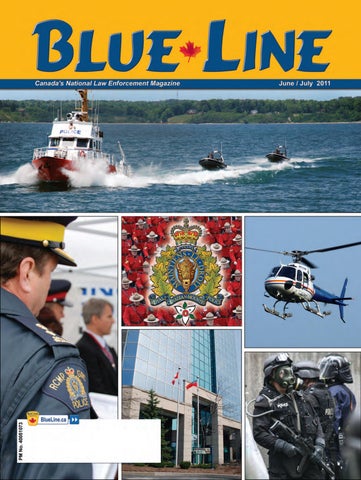
june / july 2011
2
Blue Line Magazine
June/July 2011 Volume 23 Number 6
Features 6 Supporting a vision for federal policing Inter-agency co-operation and support drives Ontario’s RCMP
10 Breaking the law of unintended consequences
6
14 Silos paralyze progress on crime against seniors 20 A good neighbour approach
Small force big on innovation, service, and efficiency
24
Blue Line Trade Show In Print
Departments 46 28 33, 38 36 17 44, 45 43 5 34
20
Blue Links Ad Directory Deep Blue Dispatches In The News Letters Market Place Product News Publisher’s Commentary Technology
Case Law 37 39 40 42
24 Blue Line Magazine
3
Random test shopping not entrapment Charter breach minor, evidence admitted Experience a factor in reasonable grounds Alternative reasoning justifies admission
June / july 2011
june / july 2011
4
Blue Line Magazine
Blue line
PuBLISHER’S COMMENTaRY by Morley Lymburner
Magazine Inc. PuBliSHeR Morley S. Lymburner - publisher@blueline.ca geneRal ManageR Mary K. Lymburner - mary@blueline.ca SeniOR eDiTOR Mark Reesor - editor@blueline.ca CReaTiVe DiReCTOR E. Jolene Lymburner - jolene@blueline.ca COnTRiBuTing WRiTeRS Mike Novakowski Mark Giles Robert Lunney James Clark Dorothy Cotton Dave Brown Tom Rataj aFFiliaTiOnS International Association of Law Enforcement Planners Canadian Advertising Rates Data International Police Association The Canadian Press Newswire Access Copyright SuBSCRiPTiOnS $30 per year; $50 for 2yrs; US & Foreign: $100 aDVeRTiSing 888-640-3048 advertising@blueline.ca
www.blueline.ca 12A-4981 hwy7 East, Ste 254, Markham, oN L3R 1N1 Canada P: 905 640 3048 F: 905 640 7547 blueline@blueline.ca
PRINTED IN CANADA ISSN# 08478538 Blue Line Magazine was established in 1988 as an independent publication to inform, entertain, connect and educate those involved in the law enforcement profession. With no direct control from an enforcement agency, its opinions do not necessarily reflect those of any government or law enforcement agency. The authors, advisors, and publisher accept no liability whatsoever for any injuries to person(s) or property resulting from application of adoption of anything presented in this magazine. Readers are cautioned and advised that articles presented herein are edited and supplied for your personal awerness and should not be used for further actions until appropriate guidance is received from a supervisor, Crown Attorney or other persons in authority. All material submitted for publication becomes property of Blue Line Magazine Inc. unless arrangements have been made with the publisher prior to publishing. © 2011 All articles are protected by copyright. No part of this publication may be repoduced or transmitted in any form or means, electronic or mechanical, (including photocopying and recording or by any information storage or retrieval system), without prior permission. Permission to reprint may be obtained in advance from Access Copyright 1-800-893-5777.
Blue line Magazine
Police own the streets and should act like it A recent story sent to me related how the Surrey Fire Department now decides whether to call police to vehicle collisions. Surprised by this backward style of events I wondered what the local police are doing that is more important than collisions. I worked most of my career as a traffic officer in Toronto. I was proud of helping people in need – much more than the five years I spent yelling at people in domestic disputes in the jungles of Jane and Finch. I have since concluded that the efforts of a well trained traffic officer does more to improve a community’s perspective on itself than any other aspect of police work. Let me explain why. I went to a ton of collision scenes over my years and, before moving to dedicated traffic work, thought I was just doing a job for the insurance companies and gathering statistics for the transportation department – but then the penny dropped, so to speak. Why did they want this information? The obvious answer – insurance companies want to help people in time of trouble and the transportation department wants to prevent people from getting hurt. Should I as a police officer be any less dedicated to these goals? I soon realized that police did much more at collision scenes than my surly compatriots espoused. The most important thing was helping people when they are dazed, confused and vulnerable, unsure about: • Their (and others) safety and health, • How they’re going to explain or justify their actions, • What they will do next, • What their insurance company (and tow truck driver) will do for/to them, • Whether they will be charged or did anything wrong, • How they’re going to get home, • Who will contact their families. Emotions usually ran high and having an officer there helped settle things down and brought a little order to a chaotic situation. It was very satisfying to ensure that my collision scene was settled and cleared in an expeditious manner and that few questions about what happened would go unanswered. I was also proud that I could help injured people in immediate need, either by bandaging a cut, putting an arm in a sling or simply suggesting they see a doctor as soon as possible. The victim was grateful and onlookers were reassured. Nothing is more spectacular than a collision scene. Most citizens rarely see one so it’s a memorable event. If they are involved, they never forget it. Seeing a well trained officer take control and work diligently to restore things to proper order is seen as nothing short of a miracle – everything from helping the injured to directing traffic is seen as wondrous. In short the basic job of a traffic officer is preventing good people from hurting good people. In regular police work, occurrences usually result 5
from greed and anger. In traffic work, they’re generally a matter of ignorance, intolerance or impatience and only rarely greed or anger. A traffic officer’s job is to enforce traffic laws to prevent collisions or investigate collisions with a goal toward preventing future ones. This preventative factor should be taken seriously and can be accomplished in a myriad of ways. A well enforced neighbourhood is a safe neighbourhood, ensuring courteous and patient motorists and obedient pedestrians. If you have neither, you have no functioning traffic officers; the number of collisions and injured citizens is the barometer. Keeping people from their own misadventure is another primary focus. How many youths believe they can drive like the stars in the Fast and Furious movies or drive perfectly well after drinking? How many drivers feel they don’t have to come to a complete stop at a stop sign? How many police departments are not concerned with these issues? Far too many. Firefighters shouldn’t decide if police are needed at collision scenes because they are seen and act like good guys. It wouldn’t take much pleading by an errant motorist to convince them to cut some slack and not call police. Not calling police serves no one. If you feel cutting traffic officers is a good way to save money, consider that every citizen in your jurisdiction is affected by traffic. Having just a few motivated, well trained and highly visible traffic officers can go a long way toward removing a community’s angst about an orderly society. As for the police in Surrey – they may be suffering from a modern day syndrome called freakenomics. When one considers the annual slicing of the emergency services pie who will now get a better argument for a bigger piece? The police or fire department? If you thought you were understaffed before just wait for it. I can only urge you to get your act together. YOU call the fire department to YOUR accident scene, not theirs. YOU own those streets because you alone are responsible for them.
june / july 2011
Supporting a vision
for federal policing Inter-agency co-operation and support drives Ontario’s RCMP by Diane Jennings With a focus on organized crime, economic integrity, border enforcement and national security, the RCMP “O” (Ontario) Division works closely with police partners and other law enforcement agencies to keep Canada safe and secure. The past year was very fast paced for the division, which has primary law enforcement authority in federal matters in Ontario outside of the National Capital Region. The more significant events included the Olympic Torch Run, Vancouver Winter Olympics, G8 and june / july 2011
G20, the Royal visit and Special Olympics. Officers from the division were also deployed to Afghanistan and United Nations missions in Sudan and Haiti during 2010. The RCMP’s association with Ontario dates from 1873 but “O” Division did not formally begin until 1920 when the “Royal North West Mounted Police” was reorganized into Canada’s federal police force and given its present name. It began with six detachments and had just 37 officers by 1923. Today it has 15 detachments, a headquarters in London, and more than 1,600 officers, civilian members and public service employees led by Commanding Officer Assistant Commissioner Steven White. The division divides the province into three districts: Greater Toronto Area (GTA), the North East (NE) District, and the South West (SW) District. Each District is led by a Superintendent. GTA: Bowmanville (Toronto East), Etobicoke (Toronto Airport Detachment), Milton (To6
ronto West) and Newmarket (Toronto North). NE: Cornwall, Kingston, Sudbury, Sault Ste. Marie and Thunder Bay (services 92 per cent of Ontario’s geographic area). SW: Hamilton Niagara Regional, Kitchener, London, Sarnia and Windsor. Federal mandate The “O” Division’s strategic objectives are aligned with the five RCMP national strategic priorities: • Effectively respond to threats to Canada’s national security. • Reduce the threat and impact of serious and organized crime. • Reduce youth involvement in crime as victims and offenders. • Contribute to safer and healthier Aboriginal communities. • Contribute to Canada’s economic integrity through reducing crime. National security: The RCMP has the primary responsibility for preventing, detecting and investigating terrorism-related criminal Blue Line Magazine
activities in Canada. The”O” Division Integrated National Security Enforcement Team (O-INSET) plays a critical role in investigations and is made up of employees from the RCMP, CSIS, CBSA, OPP, Toronto, York, Durham and Peel police and Ministry of the Attorney General and Public Prosecution Services Canada (PPSC). O-INSET successes • June 2006: O-INSET arrests 18 members of a group allegedly planning to detonate explosive devices at significant public buildings in Ontario, including Parliament Hill and the Toronto Stock Exchange. Dubbed Project OSAGE (also known as the Toronto 18), the final accused in the case was recently sentenced to life for his participation in this terrorist group. Throughout the trials, countless pieces of evidence showed the seriousness of this threat. Innocent people would have been killed and seriously injured and there would have been extensive property damage and economic and social harm. No single agency can effectively respond to all terrorist threats. This national security criminal investigation was part of a long, resource-intensive and complex investigation involving several agencies, both domestic and international. • October 2010: O-INSET and the Toronto Police Service (TPS) Intelligence Division begin a joint national security criminal investigation. On March 29 the RCMP arrest and charge an individual in the Toronto area for terrorism-related offences for attempting to participate and counselling a person to participate in terrorist activity. It is alleged that he was about to board a plane and fly to Somalia to join Al Shabaab and participate in terrorist activities. This case is currently before courts. The RCMP and TPS were able to obtain numerous critical pieces of evidence required to lay criminal charges. “The RCMP plays a critical role in the fight against global terrorism and this investigation is an example of our dedication to this important cause,” says RCMP Insp. Keith Finn, OIC of O-INSET. “We will continue to work with partners to eliminate terrorist criminal activity in Canada and abroad.” Since O-INSET’s inception the AntiTerrorism Act has been tested in the courts and the collective outcome has demonstrated Canada’s ability to respond to terrorist threats and confirmed the belief that the path to their successful disruption is paved by effective investigation. The RCMP is also committed to continuing to play a crucial role in preventing terrorist attacks and protecting the safety and security of Canadians while respecting their personal freedoms. The RCMP established the National Security Community Outreach (NSCO) initiative to engage all of Canada’s ethnic, cultural and religious communities to protect our national security. NSCO is part of a strategy to build mutual trust and understanding between the RCMP and communities affected by national security criminal investigations. It is based on the Blue Line Magazine
“O” Division
philosophy that effective counter-radicalization programming is about promoting a diverse community that is tolerant and inclusive, rather than targeting specific ideologies or beliefs. Serious and organized crime: Organized crime hurts individuals in the communities we serve, which is why detecting and deterring it is a top priority. The RCMP works with its partners to gather and analyze information, develop intelligence and identify groups to focus on. The RCMP Greater Toronto Area Drug Section, in partnership with the TPS Major Drug Unit and CBSA, completed a 15 month investigation into opium importation and heroin trafficking in the Toronto area in May 2010. Simultaneous search warrants executed at nine locations resulted in seven arrests and the seizure of approximately 10,000 ecstasy pills. Nine individuals face various charges including importing and possessing opium, conspiracy to import, trafficking heroin, possession of ecstasy for the purpose of trafficking and laundering proceeds of crime. “This investigation is a result of the collective efforts of many dedicated investigators and demonstrates that inter-agency cooperation is fundamental in tackling such complex criminal enterprises,” says RCMP Supt. Rick Penney. “The pooling and sharing of resources from multi-jurisdictional enforcement agencies combined with cooperation from the community is critical in the successful disruption and dismantling of these criminal organizations,” says TPS S/Insp. Mario Di Tommaso. Economic integrity: Maintaining investor confidence in Canada’s publicly-traded companies and capital markets is crucial for sustaining growth. The Integrated Market Enforcement Teams (IMETs) initiative strengthens the ability to detect, investigate and deter capital market fraud by focusing resources on investigating and prosecuting the most serious corporate frauds and market illegalities. The Greater Toronto Area (GTA) is home to three specialized IMET teams currently engaged in a number of investigations. Federal policing: The “O” Division federal policing services are organized into commercial crime, criminal intelligence, customs and excise, drug enforcement, federal enforcement, 7
and immigration and passport sections, which are found in most detachments. When combined with specialized units, they form into three areas with distinctive operational focus: Economic crime, border integrity and drugs and organized crime. The RCMP is also federally mandated to protect the prime minister, governor general, other Canadian executives, visiting heads of state, internationally protected persons and members of the Royal family. Protective operations is also responsible for protecting designated sites, major events, Canadian air carrier security, explosives disposal and tactical troop operations. Federal Operations Support Services (FOSB) supports criminal investigators through such services as surveillance, including electronic investigations; fixed wing aircraft and a helicopter; technical expertise to investigate computer crime, including assistance with forensic analysis; oversight of the Federal Witness Protection Program; 24 hour access to the RCMP through the Operational Communications Centre. Two additional FOSB units support Ontario’s diverse communities. The Aboriginal Policing Section works in partnership with First Nations police services, the OPP, community leaders and other organizations to provide a service in line with the community needs. The Drugs and Organized Crime Awareness Section (DOCAS) works with federal, provincial, territorial and community partners to develop unique, long-term solutions to substance abuse issues. One of its main programs is Racing Against Drugs, a community-based drug and alcohol awareness program developed by the London RCMP detachment in partnership with the staff and students of Saunders Secondary School, Whitlock/Abby Ford Quality Care racing team and Ford Canada. The primary objective is to use auto racing to capture the attention of young people and communicate with them through an exciting and high profile sport – one with no tolerance for substance abuse. The program is designed to promote healthy, drug free lifestyles and allow Grade 5 and 6 children a chance to experience the excitement of racing by competing on a video racing console for bragging rights. Partnerships and integration The RCMP has participated in multi-force operations in Ontario for more than 30 years, proudly working with partners at all levels and between organizations towards effective integrated policing in detecting, reducing and preventing organized and other serious crime. These partnerships have evolved into the ‘integrated’ policing model that is characteristic of the RCMP today. The “O” Division led integrated units are specialized, comprised of multiple federal or law enforcement agencies, include: • Combined Forces Special Enforcement Unit (CFSEU) • I mmigration Task Force (ITF) • Integrated Border Enforcement Team (IBET) June / july 2011
• Marine Security Enforcement Team (MSET) • Integrated Counterfeit Enforcement Team (ICET) • I ntegrated Market Enforcement Team (IMET) • Integrated National Security Enforcement Team (INSET) • Integrated Proceeds of Crime (IPOC) • Regional Integrated Gang Unit (RIGU) • Cornwall Regional Task Force (RTF) The integration with enforcement partners allows for greater efficiency by sharing information and working together daily using the most effective service delivery model. Partnerships with policing partners and the development of multi-disciplinary teams within the division have led to some great successes. The Contraband Tobacco Initiative is a new integrated response to combat contraband tobacco organized crime in the Greater Cornwall Region. The CFSEU has officers from the OPP, RCMP, Cornwall and Akwesasne Mohawk police and the CBSA. Members, assisted by the Cornwall Regional Task Force, arrested two residents for possessing unstamped tobacco last October. Further investigation and information that contraband tobacco was being distributed led to a search warrant and the seizure of 5850 cartons of illegal cigarettes, more than $9,000 cash and oxycodone pills. Organized crime is extensively involved in the illicit tobacco market and uses profits to fund other activities, including drug and firearms smuggling.
june / july 2011
"O" Division officer stands at Ontario Police Memorial - Queens Park - Toronto Removing borders The RCMP’s role in marine security is to enforce laws dealing with offences relating to national security, organized crime and other federal statutes, including smuggling, drug trafficking and immigration. Bridges, tolls and security booths are key indicators of international borders on land, however this line is far less distinguishable on water and has been a barrier for both Canadian and American law enforcement in disrupting organized crime. The RCMP partnered with US
8
authorities to develop Project Shiprider – the model of a new generation of integrated law enforcement – to tackle these transgressions freely across the border. The project is the first of its kind in truly co-operative cross-border law enforcement. It removes the international maritime boundary and allows both RCMP and USCG officers to continue enforcement and security operations past their international border. By being able to flow freely back and forth, they can better prevent cross-border smuggling and trafficking of contraband and people. “Cross-border criminality is a two-way street and it’s good for both the security of Canada and the United States to have a more collaborative relationship together,” says Supt. Warren Coons, IBET director. “O” Division announced in March that it would join the Operational Integration Centre (OIC) at the Selfridge Air National Guard Base in Michigan. It’s intended to be a mechanism for leveraging law enforcement capabilities to detect, deter and prevent security risks or threats along the Detroit River and Lake St. Clair area. The OIC will serve to improve unity of effort among all federal, state and local agencies in border security and public safety. RCMP participation will aid in providing front-line personnel and decision makers with on-going situational awareness of the Detroit-Windsor maritime corridor and ultimately contribute to a more comprehensive marine domain awareness picture of the entire area. The RCMP will place a full time intelligence
Blue Line Magazine
analyst in the centre. Reporting directly to the Great Lakes Marine Security Operations Centre (GL-MSOC), the analyst will gather and analyze information to assist in preparing operational and strategic bulletins, intelligence reports, threat assessments and situation reports. “The Detroit-Windsor maritime corridor, with its surrounding rivers, channels, bridges, tunnels and other critical infrastructures, plays an important role in sustaining economic health,” says RCMP S/Sgt. Steve Brown, who heads the RCMP unit at the GL-MSOC. “Maintaining vigilant situational awareness of this area is therefore important to both countries in terms of our collective economic and national security interests.” The way forward The RCMP’s vision for change is to be an adaptive, accountable, trusted organization of fully engaged employees demonstrating outstanding leadership and providing world-class police services. Leadership development and performance improvement are national priorities. Over the past few years this has resulted in the creation and implementation of supervisor and manager development programs which are strongly endorsed by “O” Division senior management. In contrast to traditional training courses, they are one year programs supporting a transformational change in RCMP culture. The programs follow a national curriculum specific to the RCMP focusing on competency
Blue Line Magazine
based management and include references specific to “O” Division and federal policing. In addition to performance improvement, they deal with a variety of concepts including coaching, leading change, ethics, harassment, workplace relations, strategic thinking, docRCMP ACommr. umenting performance Stephen White and supervising and managing the changing generations of employees. They are offered to all employees in supervisory or managerial positions or preparing to take on such a role. The overwhelming response by both participants and management has been very positive, with the results a combination of improved individual leadership skills and unit performance. Improving ways to communicate with the public, partners and clients was the driving force behind the launch of the “O” division Facebook page last September. Although the RCMP provides vast federal policing services in Ontario, many people do not realize it’s active in the province because they don’t see officers in their communities. “Facebook offers us an unprecedented opportunity to not only get our message out but to establish and encourage an active dialogue and develop relationships with the people that
9
we serve,” said Jean Floyd, the division’s New Media Specialist. CO message With the Ontario Association of Chiefs of Police marking its 60th year of being the voice of Ontario’s police executives, the RCMP is very excited to join the OPP in co-hosting the 2011 annual conference and global showcase. Contributing to safer and healthier Aboriginal communities is one of the RCMP’s five strategic priorities. The focus on policing with Aboriginal Peoples under this year’s conference theme “Together We Are Stronger” represents an opportunity for Ontario police to showcase their commitment to First Nations communities, while also highlighting our collaborative efforts to deliver professional policing services. “I look forward to joining you as we celebrate this remarkable milestone and create the foundation for the next 60 years of OACP leadership, innovation and success,” says White. “As the new commanding officer for the “O” Division RCMP, I look forward to working very closely with our law enforcement partners throughout Ontario as we envision new approaches to keeping our communities safe.” Visit http://www.rcmp-grc.gc.ca/on/ or www.facebook. com/rcmp.ontario to learn more about RCMP “O” Division. Diane Jennings (Diane.Jennings@rcmp-grc.gc.ca) is a RCMP senior communication strategist.
June / july 2011
Breaking the law of
unintended consequences by Gary James Askin During the days and weeks after 9/11 police stumbled upon a weapon so powerful it virtually halted drug trafficking and reduced crime. Best of all it was free and required no judicial oversight, legislative authority to govern or police board approval to use. As police officers, this was our finest hour and we didn’t even realize it. We unwittingly created a scenario that sociologist Robert Merton identified in 1936 and called The unanticipated consequences of purposive social action. What exactly is that? Consider this example. In the 1981 movie Body Heat, William Hurt’s lawyer character hatches a plot with his lover, played by Kathleen Turner, to murder the woman’s husband. While plotting, Hurt receives some sobering advice from an experienced criminal client, portrayed with trademark style by Mickey Rourke. “I got a serious question for you,” says Rourke. “What the (frig) are you doing? This is not for you to be messin’ with. Are you ready to hear something? I want you to see if this sounds familiar: any time you try a decent crime, you got 50 ways you’re gonna (screw it) up. If you think of 25 of them, then you’re a genius... and you ain’t no genius.” In the simplest of terms, Rourke was citing Merton’s theory, also known as The theory of unanticipated consequences. Merton discussed how our decisions and actions can and will always result in unintended consequences. Sometimes they’re positive and other times negative, but the theory holds that we cannot always know which will occur and the unanticipated consequences are often well outside our control. The power of this law has been well recognized by economists and sociologists for decades but curiously, ignored by most of us in the policing profession even though it helps us immensely when controlling crime. Much has changed since 1936 and it may be high time that we in policing explore this theory with a view to enhancing our decision-making processes. Can we couple this law with our intelligence led strategies to discover if (and then how) this 75 year old theory can be reconciled with
june / july 2011
intelligence led policing practices? In today’s world of limited options and resources, we must wring out every ounce of prospective benefit from every choice we make. This might be just the right time to enhance our daily decision making practices and gear them to obtain derivative benefit rather than collateral damage. Before exploring just how this theory reduced crime in 2001, let us first consider some examples of unanticipated consequences in action. In his 2009 book Beyond Fear, author Bruce Shneier illustrates how Merton’s law arose in the midst of a rising car theft problem in Russia. Car owners responded by installing alarms. The criminals adapted by waiting for the owners to enter their
10
cars and turn off the alarm, then shooting them and stealing their car. Clearly this wasn’t the expected outcome the owners had in mind when they installed the alarm. The Wall Street Journal recently reported that the massive flood of food, water and supplies into Haiti had the unintended consequence of putting many small businesses in jeopardy. The local proprietors could no longer sell their supplies. “Who would buy it when it is being offered for free?,” they were left to ask. It turns out the collective relief efforts of the developed world hampered Haiti’s economic return. Our noble intentions to assist were adversely affecting the people we wanted to aid. This was likely not something most of us had considered as we reached out to help. Not all unintended actions result in negative consequences. Merton himself observed that “undesired effects aren’t necessarily undesirable effects.” The US government sold a fleet of obsolete, slow and leaky wooden ships to Western Marine and Salvage after the First World War. The company subsequently went bankrupt, leaving hundreds of rotting ship hulls in Mallows Bay off the Potomac River. What started as a catastrophic embarrassment has now developed into the creation of spectacular ecosystems, home to “blue herons, osprey, fish, reptiles and mollusks.” Similar wildlife sanctuaries have risen from the mine-fields of war torn countries like Serbia. No one predicted that these undesirable situations would produce such desirable consequences. Blue Line Magazine
Blue Line Magazine
11
June / july 2011
Merton also observed that the law of unanticipated consequences is “at work always and everywhere.” Perhaps the most vivid example of this occurred during the weeks and months after September 11th when all of us who work in public safety entered an era of hyper alertness and instituted many protective security measures never before considered. Our global law enforcement response resulted in increased communication and funding, overhauling existing anti-terror programs, enhanced information management systems, target hardening of critical infrastructures, increased border and port security and integrating human systems – to name a few. Many innovative global decisions and actions were made to mitigate potential terrorist threats. Interestingly, and perhaps unexpectedly, in their 2007 report, authors Johnson and Kingshott discovered that the post 9/11 measures brought in to increase security at Chicago’s O’Hare airport had the secondary outcome of reducing larceny and motor vehicle theft at O’Hare and other US airports. In Ontario’s Waterloo Region, a similar trend was observed. The Waterloo Regional Police Service was involved in two drug investigations, one targeting high level traffickers and another focusing on street level dealers. Officers had been covertly purchasing narcotics from various street and upper level traffickers on a regular basis and soon felt the might of Merton’s Law. Within days of 9/11, the drug supply dried up and traffickers suddenly told undercover officers drugs were no longer available. Dealers could not supply the police service’s
june / july 2011
own operatives and by all accounts, there was little of anything available in the region. The town was dry and either no one was willing to move their supply of narcotics or they simply could not get any supply to sell. Our collective response to the terror issue was resulting in the unanticipated consequence of reducing the region’s drug problem. A great benefit for the community to be sure, but it wasn’t something police specifically intended when their initial intent was to combat the rising threat of terrorism. This reality should come as no surprise to experienced law enforcement professionals. Most of us have seen how targeting a crack house can reduce neighbourhood prostitution and property crimes. We have all witnessed the cascading effects of interdependency as it relates to law enforcement and life in the new millennium. Our social connections are closer, communication is instant and we have watched our world get much smaller. This certainly begs the question, if we can seriously impact the drug trade and crime with our post 9/11 terrorism response, is there anything we can do to tip the scales in our favour so everyday decisions result in more positive outcomes? Can we extrapolate Merton’s theory and partner it with our own intelligence led practices to leverage a law previously thought to be out of our control? Use the power of “cumulative advantage” to re-align our decision making approach and gain the accumulated benefit and reap the compound rewards of our experiences and successes? Merton asserted that the interplay of forces and circumstances when making a decision are so complex and numerous that prediction is beyond
12
our reach. Really? Beyond our reach? Not so fast. Police in general seem to be so fixed on managing risk to prevent organizational damage that we rarely consider pursuing ancillary benefit. We consider an absence of legal actions a success. We talk about justified shootings, a successful conviction or defeating a lawsuit and that seems to be “good enough” for us. It might well appear that everyone has thrown in the collective towel on attempting to control this law. After all, taken on its own, Merton’s Law does seem to agree that we are merely to let destiny create our history for us – but it is highly unlikely Merton ever encountered the term intelligence led policing or even considered the capacity of current information gathering processes and decision making strategies police employ today. What was it about our post 9/11 responses that lead to so many unanticipated benefits? What elements of our decision-making process differed from the past? We had been in a “war against drugs” for decades, yet our terrorism response was arguably more effective than a previous multitude of drug strategies and enforcement tactics. How did we achieve this unintended success and, more importantly, is it possible to engineer a system to reproduce it? Apparently, we did it before. Can we replicate those unanticipated post-9/11 outcomes? The answers may be found within our own decision making approaches. What changed to bring them about? The post-9/11 period saw a quickly assembled network of law enforcement, customs, border patrol, community and military working hand in
Blue Line Magazine
hand with worldwide intelligence networks. For a short time it was ‘us against them.’ We fumed watching terrorist sympathizers cheer as the Twin Towers fell. We were motivated and driven to ensure co-operative working relationships. Old biases and poor working relationships were quickly forgotten as we suddenly woke to the emerging need, enhancing our existing partnerships and forging new ones. Suddenly our emergency services partners were more important than ever and we began to understand each other’s roles and challenges. Regular meetings enhanced our mutual understanding and we quickly developed a “who else needs to know” approach to sharing our acquired data and analyzed intelligence. Joint Intelligence Groups (JIG’s) were formed and we worked closely with our partners. Such information sharing was unprecedented and for a short time community safety trumped every legislative communicationsharing barrier we had previously encountered. Intelligence branches that once had few resources were given new staff and technology. Hate crime also became a priority issue and groups such as the Waterloo Regional Policeled Hate Crime and Extremism Investigative Team (HCEIT) were formalized, funded and grew rapidly. Community members came forward and delivered like no other neighbourhood policing program we could envision. Phone lines lit up with calls about suspicious activity as communities kept a keen eye on each other and suddenly threw unwavering support behind law enforcement. Borders tightened, criminal profiling proliferated and air marshals, enhanced aviation security and anti-terror legislation were introduced. Virtually every media outlet had extensive terrorism coverage, which created mass awareness of the issues. Specific terrorism-related training was made available to police services. Our need to ensure public safety thrust the law enforcement collective into new partnerships, programs, enhanced technology, awareness, training, enhanced information sharing, funding and many spin off initiatives – all driven by a common goal towards public safety, steered by an underlying motivation that we will pay whatever is needed to ensure this terror won’t be repeated. It became very clear to all concerned that we needed to expand our decision making process to include the “unthinkable.” Today resources are once again short and money is tight. We need every break to do the job we are sworn to do and must seize every opportunity and leverage – every possible chance to forge the benefits to our communities. In Body Heat, Hurt’s character was eventually convicted and incarcerated when his lover turned the tables on him. Just as he had been warned, his character obviously could not conceive of 25 ways he could and ultimately would get caught. Like so many criminals we encounter, his intention to get rich unexpectedly landed him in jail. Merton could have warned him many years before Rourke did. Merton left us with an idea. He documented a theory that, when combined with and factored into our modern tactics and strategies, might just give police that extra edge to locate and harness the unanticipated benefits that may lurk Blue Line Magazine
within our decision making processes. This article is intentionally more anecdotal than research based. It asks more questions than it answers but is offered as a jumping-off point for a deeper exploration of new potential, hopefully beginning a search for a more strategic, inclusive and intelligence led decision-making process. As Levitt and Dubner aptly stated in their 2009 Super Freakonomics, “Many of our findings may not be all that useful or even conclusive but that’s all right. We are trying to start a conversation, not have the last word.” Similarly, our conversation should start with an awareness of what is possible. Our post 9/11 response proved the benefits of changing our tactics and employing alternative measures,
13
enhancing decision-making processes and fully understanding the value of community and law enforcement partners. We did it before. We proved it works. We also proved that, when motivated, we have the capacity for incredible ingenuity, resourcefulness and a desire to work together to benefit our communities. Organized criminals and terrorists appear to be up for just about any challenge. Are we? Supt. Gary Askin is a 30 year member of the Waterloo Regional Police Service overseeing the Strategic and Tactical Services Division, which includes intelligence, drugs, gangs, terrorism and special response. He may be contact at gary.askin@rogers.blackberry.net
June / july 2011
Silos paralyze progress on
crime against seniors by Simon Martin John Keating and Tammy Rankin are an odd couple. Keating is the senior support coordinator for the Durham Regional Police (DRP). Rankin is the Durham Elder Abuse Network chair. They’re not married but have worked together for more than two years. “I’m the mouth and she’s the brains,” joked Keating. “Our motto is Durham Region: a place where seniors want to live and abusers want to leave.” This unlikely union between police and social services came about when Keating’s position was created in January 2009. Until then Rankin had tried working with police but it wasn’t easy to be on the same page because there were no officers dedicated to senior’s issues, she said. “Historically, we worked in silos. There were the police services and social services. Without being able to work together we couldn’t make many successful inroads into elder abuse.” There was a large financial abuse case early in Keating’s tenure. A power-of-attorney daughter stole $122,000 from her mother, leaving only $250 in the bank account. An addictive gambler, she lost the money over three months at an area casino. The mother was demented and had no idea what was happening, explained Keating. “That’s when (Rankin and I) started working together,” he said. Eventually, the daughter was convicted and sentenced to two years house arrest. Canada is set to experience the “boomer tsunami,” said Rankin. According to Stats Canada approximately 4.8 million Canadians were 65 or over in 2010. That number is supposed to double in 25 years to 10.4 million. By the time 2050 rolls around, it’s estimated one in every four Canadians will be 65 or older. With the population of seniors growing at such an alarming rate Keating said it is imperative to get the structure in place to better prevent elder abuse. Currently 10 per cent of seniors in Ontario experience abuse of one form or another. “Often if a senior is being abused physically they are also being abused financially,” she said. There is one startling case that Keating and Rankin remember vividly. They were called to a home for a suspected abuse case. The elderly lady, no more than 90 pounds, was said to be locked in the basement. They found her in an unfinished room with cement floors and walls. There were no lights; only a small bed and bed-pan. When she saw Keating, Rankin and the uniformed officer she asked, “Have you come to save me?” She had marks on her face. When they were leaving with her the man asked ‘what he would do without the checks,’ recalled Rankin. “We have found a save place for her now outside the region,” she said. “She is doing well.” Keating and Rankin hit the ground running in 2009 and haven’t looked back. The first order of business for Keating was trying to knock down the silos between police, health and social services and the justice department. “In order to combat elder abuse we all have to work together,” he explained. “We understand that now.” june / july 2011
14
Blue Line Magazine
The second phase was to educate. Keating spends dozens of nights each year delivering presentations on elder abuse for seniors and those who care for them – the best way to fight crime against them, he said. According to Keating, one of the main problems with elder abuse is that it’s hidden and not often talked about in public channels. Seniors are vulnerable because they are misinformed, not because they are unintelligent. Many simply don’t know about the multitude of scams that target them. The most prominent is the grandparents scam, said Keating. The DRP gets 40 complaint calls a month about it. The culprit calls and says “Hi, Grandma.” The senior sometimes responds “Brian, is that you?” providing the scammer with their name. They might also respond by asking “Who is this?” The scammer responds with, “Come on Grandma, it’s your Grandson.” Usually, the senior will provide the name. Eventually the scammer asks their “grandparent” to wire them some money to get them out of a jam. The grandparent scam is internationally renowned, said Keating. A myriad of renovation scams also target seniors, he added. No matter how many speaking engagements Keating did, he realized that many seniors weren’t hearing his message. He needed to find a way to reach those who stay in their home, watch television and read the newspaper. Keating decided to get his educational messages out to them through the media. “Seniors are very dedicated to their community,” said Keating. “They read the local paper and watch local TV.” Keating started a show on Rogers TV Durham called “Seniors talk with Sergeant John.” Every week he covers a different topic important to them. One week he focuses on mental health, the next on pre-planning your funeral. Usually, he has an expert guest or two. There’s also some great unscripted comedy. The story of the 94-year old bee farmer who described getting stung on his private part is one classic moment. Rankin helps him put it all together behind the scenes. “It’s good police outreach,” said Keating. “We want seniors to have a trusting relationship with the police.” Rankin said that seniors really have taken a liking to Keating. “One week an old man came into the studio just because he wanted to meet John,” she said. The show has been a great success and Rogers has picked it up-for another year. Minister of state for seniors (in the minority government) and former Toronto chief Julian Fantino liked the show’s premise and said York Region should consider adding a similar show, said Keating, who is also writing a weekly column in the local newspaper and would also like to begin a senior’s radio show. It is all part of Keating’s crusade to educate seniors on how to make their world more safe. He wants to reach the lawn bowlers, quilters and Wheel of Fortune watchers. “A lady came up to me after one of my presentations and told me a lot of people in the building had been taken by the grandparents scam. It’s too bad you can’t do a newsletter to all of us and warn us,” he said. Keating took her advice and is now producing a mass-mailing to all of the organizations that include seniors in Durham Region. Another project that Keating and Rankin have devoted a lot of time to is ‘Communikit.’ “Seniors who don’t have the ability to speak often become victims of abuse,” said Rankin. The Blue Line Magazine
Tammy Rankin (left) is a Region of Durham Social Services Dept employee and is the Elder Abuse Advisor for the municipality. She is also Chair of the Durham Elder Abuse Network. Joan Pitre (right) is a local senior and an avid volunteer who helps with the distribution of information and other communication efforts with other seniors in Durham Region.
Communikit allows them to tell their story by pointing at pictures and numbers. They received federal funding for the project and went coastto-coast to make sure it was applicable for all provincial jurisdictions. “We hope to launch it in June,” said Keating. “Any senior caregiver can use it.” While a lot of the work Keating and Rankin do centers around elder abuse, they also work to support seniors. “We deal with a lot of hoarding cases,” said Keating. In one case he didn’t even make it into the house before throwing up on the driveway. Rankin lasted five minutes inside before
15
also becoming sick. “A lot of the time these people have grown-up in the Great Depression and they can’t let something go,” said Rankin. “We try and give them the help they need.” Keating would like to see other police departments across the country follow his lead and help demolish those lofty silos that can paralyze progress. “I think the key is to think outside the justice box,” he said. You may contact John Keating at JKEATING@drps.ca. Simon Martin is a Blue Line Magazine assignment writer.
June / july 2011
A new generation of management by Terry Graden The time has come for a paradigm shift in police management to address the values, norms and beliefs of Generation X and Millennial police officers. Today’s economic conditions make a partnership between managers and their employees more important than ever. Police agencies can no longer afford to allow employment conditions to account for corporate retention strategies; it is now critical to view officers as essential to the success of their organization’s strategic goals and objectives. Affording officers a sense of autonomy in their positions may just lead to an agency meeting, or exceeding, its strategic goals. Expressing corporate values requires more than the traditional clichés confirmed throughout appraisal periods; it requires an honest belief in the purported organizational values by the agency and manager who, in turn, shares them on a regular basis with the officers. Managers who honestly put the effort into improving the workplace should create an atmosphere built upon both a genuine and collective value system that speaks to the organizational culture and is exemplified throughout the organization. As the workforce transitions into the values and beliefs held by Generation X and now the Millennial, managers must be in tune to what its officers see as critical to both loyalty and
retention programs. Arguably, protean career seekers wish to take their careers into their own hands through developmental and organizational opportunities and with some level of assistance from their immediate supervisor. This in itself may provide the foundation for psychological success as opposed to the traditional hierarchal approach of assumed success. Engaging and motivating both Gen X and Millennial officers requires real opportunities for internal movement and employees like to work for an organization whose supervisors partner with them to build these opportunities. Supervisors can aid in attaining both intrinsic and extrinsic rewards through leadership
qualities that are viewed as critical to organizational values, but more importantly to Gen X and Millennial officers who view these qualities as pleasing for psychological success. What is important to note is that Gen X possess differing values than the Boomers and Millennial subsequently differ from Gen X. Rodriguez, Green & Ree (2003) report that Gen X value a challenging task that can be accomplished within the work day, flexible work hours, job sharing and meaningful work, which subsequently leads to a shift within the current police leadership and management paradigms. “Some managers not only resist change, they refuse to address any alteration in their techniques. Rather than even attempt a modification to their management approach, they are locked into their old habits and methods. Their approach may have worked with some consistency in the past; however, these managers are usually so far into their comfort zone that they don’t realize they’re losing an opportunity for real leadership” McDevitt, 1999. McAuliffe (2007) suggests that if one wishes to become a better leader, the first step involves self-reflection and a long and hard look in the mirror. Asking yourself whether you are trusted, treat people as you wish to be treated and are truly a good listener will elicit answers of whether one is truly capable of a leadership or management role. Moments of self-reflection may provide one with the opportunity for growth both in the workplace and at home. Asking for feedback from your peers can also provide one with a tremendous opportunity for self-improvement – it’s not a sign of perceived weakness. Remember, the values, norm and beliefs differ significantly within each generation. Wright (2009) points out that the term “leadership” has become such a cliché, it has nearly lost all meaning. The word has almost become synonymous with “executive” and “management” as organizations have built it into job titles. However, leadership is not a title or job – it is an act. Leadership and management entails supporting and working for those who are considered to be your organization’s best assets – the officers who are in the public eye on a daily basis. McAuliffe, M. O. (2007, June). Want to be a better leader? Look in the mirror. FBI Law Enforcement Bulletin, 76 (6), 8. McDevitt, D. (1999, July). Ineffective management strategies: And why managers use them. Law & Order, 47 (7), 143, 4 pgs. Rodriquez, R. O., Green, M. T., & Ree, M. J. (2003, Spring). Leading Generation X: Do the old rules apply?. Journal of Leadership & Organizational Studies, 9 (4), 67. R Wright, D. (2009, July). People need leadership, not management. Security Technology Executive, 19 (7), 16. Terry Graden has worked as a police officer for the past 22 years in Calgary, AB. The first eight years of were spent on general patrol followed by nine years in the canine unit. He has spend the past five years with the Professional Standards Section. Graden has a B.A. degree in Criminal Justice and an M.A. in Organizational Management. He may be reached by email to TGraden@calgarypolice.ca.
june / july 2011
16
Blue Line Magazine
Letters After reading your article “Buying into the full package” I can understand the frustrations many of my fellow auxiliary constables face in the recruitment process. Allow me to characterize myself: 36 years old, white male, 226 lbs, 6’ 0,” married five years with two children (age 2 and 6 mths), small successful business owner for over 10 years with three employees (was 13 employees up until 2008 auto sector collapse), high school education with recent courses in diversity and Spanish from our local college, financially stable without any creditor issues, sit on the board of directors for our local town community service organization and Auxiliary Constable since May 2009 devoting 897 hours last fiscal year. I just applied to the OPP on Jan 4, and am still waiting for the nerve wracking interview telephone call. Fortunately, I have multiple (20+) letters of recommendation from ALL levels of our county OPP attached to my application. I couldn’t agree more with your writing, “needless to say, many would-be officers approaching today’s recruitment offices might as well walk under a sign reading “abandon all hope ye who enter here.” So many great potential candidates have been sent away discouraged with the whole hiring process due to a single interviewer. In my opinion, every government funded agency/ service, regardless of level, should have at least two interviewers (preferably three) for the local focus interview. Just as I form opinions of potential employees based on their resume, my judgment is final although I may have just turned away the best potential candidate for the job. I learned from my mistakes. As of 2006, all my employee interviews are conducted by myself and a supervisor (I had two supervisors). Collectively we were able to surmise if the applicant was great for my company. It worked well. No employees were terminated afterwards due to willful misconduct. My business has great employees. Rumor has it today police services are overwhelmed with resume applications. Mass volumes of great applicants to select from. I’ve been told that college trained applicants are not necessarily viewed as a better candidate that someone in my shoes with only a OSSD. Many private colleges are pushing students through fast paced, high priced programs in hopes of OACP accreditation. Services want the OPC to train their officers, not a private college. I have observed and evaluated many constables perform their duties. My assessment is mixed from surprise or shock to pride. Not that my capacity has any credibility to evaluate or substance, but its fair to say that I can learn from a good officer and know I can perform better than those who shocked me. I often wonder about the very few that surprised me, who hired this officer? Great to know the majority are intelligent, highly trained, respectful and polite individuals who seem to Blue Line Magazine
understand the frustrations of daily life that the general public face. Maybe we should focus on the interviewers? Could the province create an interviewer “bank?” A panel of highly trained interviewers with police backgrounds (possibly retired officers) that tour the province, are accredited by the OACP and selected by only current top performing police officers who in turn hired them. Great interviewers hire great officers. Just my thoughts. Enjoyed your articles. Keep up the great work.
Jason Stroud, Essex ON This is regarding your article on Sgt. John Harris as Police Leader of the year in the May issue. Not to quibble about semantics but I think the distinction is important. You wrote (in the otherwise excellent article) that Harris has “increased the productivity and effectiveness of every unit he has managed.” I beg to differ. I don’t know the man, but I guarantee you that he did NOT “manage” them... he LED them... huge, huge difference. Just my two-cents. Mike Foster
17
June / july 2011
New recruits have
boundless enthusiasm by Nancy Colagiacomo The two newest members of Longueuil police, and their handlers, are ready and eager for action. Constables Steve Tremblay and Fred Ringuette are living a dream and doing their job with a renewed passion. Neither officer hesitated when their department began recruiting last year for dog handlers, knowing all along that one day they would incorporate their love of animals with their passion for fighting crime. The dogs, Sako and Nitro, and handlers underwent months of rigorous training and passed all the stages of the selection process
june / july 2011
and training program so they can effectively deal with the demanding job. The dog is rewarded every time a task is completed; often it’s all about the kong ball. It didn’t take long for the teams to prove their worth. Shortly after 2:30 a.m. April 6 patrol officers were sent to a car theft in progress and spotted the vehicle in question on their way to the call. The suspect refused to stop, abandoning the car and fleeing on foot. Officers set up a perimetre and Nitro was called in on his first mission. Although the suspect was thought to be long gone, Nitro found him after a two hour search hiding in a cedar bush in the backyard of a home.
18
“The dog is part of my life and my family. I had a kennel built at home to accommodate my new partner,” says Tremblay. “A typical work day for us is being on patrol and assisting fellow officers on their regular shifts. We don’t sit at the office and wait to be called in, a dog on patrol sort of completes the team. For now we are two, we alternate shifts so there is always one of us out there for the day and evening rounds,” he adds. All dog masters in Québec belong to the Association des Maître chien du Québec, which organizes seminars and other activities for its members. They must pass
Blue Line Magazine
physical training every year to remain on duty; the test requires them to be in great physical condition since it involves running through a series of obstacles and perform abdominal exercises and push ups. “It’s an all out effort for about ten minutes, but the look on a suspects face when he sees my dog is worth all the hard work and training,” Tremblay says. Weekly dog training is also a big chunk of the work week. Nitro and Sako must pass tests every year and “recertify” in the skills they were taught. The dogs are trained in many disciplines including screening, detection, tracking, searches, firearms and drugs. Private police dog training is not allowed in Québec; all must be trained by a Canadian police force. Nitro and Sako were trained by Montréal police canine unit experts in two stages, first with a host family, then with the dog. The dogs begin their training when they’re between eight and 10 weeks old. They are first placed with a foster family to be socialized. An initial evaluation is done at about eight months on predator instincts and courage. If the dog passes, training is pursued for another four to six months and he assigned to his new master at the age of 18 months. The dog and master now begin police dog training, which lasts for 18 weeks. The job of most teams is to search for people and objects, apprehend suspects, search buildings, detect narcotics and firearms and crime scene investigation. German Shepards have been the dog of preference for their highly developed sense of smell, strength, intelligence and loyalty. Male dogs are usually chosen as these characteristics are more dominant among males but Nitro’s mother is an exception – she is still in active duty with the Montréal police service. A police dogs career lasts about five to seven years. They are then retired with Blue Line Magazine
full benefits and in most cases are adopted by their masters. Québec now has 30 dog handlers across the province including Laval, Montréal and Québec City – and now Longueuil is part of that team. Nancy Colagiacomo is Blue Line Magazine’s Québec correspondent. Anyone with stories of interest on Québec policing may contact her at: nancy@blueline.ca.
19
June / july 2011
A good neighbour approach
Small force big on innovation, service and efficiency by Tony Palermo The Township of Stirling-Rawdon lies between the Ontario cities of Belleville and Trenton, north of the 401. With a population of just over 4,900 people (2006 Census), it’s proud of its friendly and welcoming people, natural beauty, rural heritage and family values.
june / july 2011
Stirling-Rawdon also has one of the smallest recognized police forces in Ontario. Though the team of 10 officers might be small in numbers, the Stirling-Rawdon Police Service (SRPS) exhibits innovation and forwardthinking that keeps it relevant. When then Mayor Peter Kooistra ordered a costing analysis in 2009, the report by Michael Mitchell of MPM Consulting stated that “the taxpayers
20
of Stirling-Rawdon are receiving an excellent level of service for a reasonable cost.” The analysis was requested, at least in part, because the police station needed to be replaced. Not only was it too small, it was plagued by a leaking roof, mould and holes large enough that snow blew in throughout the winter months. When it was decided that the SRPS would stay, plans for a new joint police/ fire station were drawn up. The new station officially opened Feb. 19. The cost to local taxpayers for the police side of the building worked out to... zero. “The estimated cost for the police portion of the facility was approximately $1.8 million,” says chief Brian Foley. “The federal government came up with a third of the cost, the provincial government with another third and our $600,000 was paid in full by the police services board via criminal record checks.” Even in terms of furniture, the new station is leaps and bounds above the old building, which had patrol officers sharing a discarded desk and small radio picked up from the side of the road. Looking around his new station on opening day, Foley is all smiles. “This is a real police station,” he says. “Everything about it from our secure reception area to our cellblock is professional, and our officers have space to work without being all crammed in and on top of each other.” The new, spacious bullpen work area for officers is a far cry from the road scraps crammed into a single corner of the old building just days before. It is strategically located in the centre of the police operations potion of the station, from which all other areas branch off. Walls containing maps and important information surround one side; bookshelves and storage drawers line another; separate offices for the duty sergeant and senior officers occupy the other corners. The cellblock, which is separate but only feet away, is within view of everyone thanks to a large wall-mounted camera monitor. Blue Line Magazine
The new cellblock, which contains two separate regular cells in addition to a segregation type cell, can only be described as Martha Stewart inspired. “It’s quite the site, isn’t it,” states Foley when describing the pretty-in-pink paint decor. While he says there is some science to back the calming effects of this particular shade of pink, he adds with a grin that he hopes its effects will run much deeper. “When people are brought in, I’m hoping that the colour is enough of a deterrent to keep them from coming back.” In addition to the new building, StirlingRawdon recently added a new officer to its service. Cst. Scott Preston, a 39-year old married father of four children, graduated from Ontario Police College in March 2011. “We had over 100 applicants for the job and Preston was the cream of the crop,” says Foley. “He’s eager and dedicated. His passion was always to be a cop and it shows.”
the next couple of years and when Wallwork officially retired in June 2008, was appointed chief a couple of months later.
Chief Brian Foley – 30 years in policing and 20 years with Sterling-Rawdon Police “I basically got a call in early 2006 from thenchief Frank Wallwork, who took ill. (He) said to me ‘Brian, you’re it. I may not be in for awhile.’” Foley remained the acting Chief for
Youth sports program Cst. Darrin Heasman has been with Stirling-Rawdon since 2004. He began a free youth sports group in 2005, with the idea that it would be a great way for police to get to know area youth and for the youth to get to know officers. It began small with about 10 to 15 kids, between Grades 6 though 8, attending for two hours of floor hockey, dodgeball and indoor soccer. “The first participants were told that the group was theirs and that they needed to take ownership of it,” says Heasman. “I asked them to make the rules, if they wanted any,
72 hour shifts Like most services, policing in StirlingRawdon has changed significantly over the years. Foley, who began his policing career in Peterborough in 1982 and was hired in 1992 as the third officer for the Village of Sterling, remembers working 72-hour weekend shifts alone when he first started. “Friday at noon until noon on Monday,” says Foley. “Those could be tough. We don’t have those anymore.” Another change involves technology, which Foley uses to his advantage on several fronts. Last year, he purchased a LiveScan fingerprint scanner for criminal records checks. He also negotiated a low-cost Blackberry solution which sees all officers carry a Blackberry with access to an all-inclusive, unlimited plan. He bills a small portion of the cost back to the officers – $15 – with the understanding that if he needs to reach them for operational reasons, they’ll be there to answer his call. “It’s a win-win,” says Foley. “We’re a small service but this is a way to keep us all in touch. Also, the plan is unlimited so it saves the officers a considerable amount of money if they were going to go out and get their own. I don’t take advantage of them, but the only thing I ask for is that they pick up if I’m trying to reach them.” Foley also keeps costs down by outsourcing services; Stirling-Rawdon’s communications and information technology are handled by the Belleville Police Service. He also implements the friendly country neighbour approach of “I scratch your back and you scratch mine” with surrounding police services. As an example, three of Foley’s officers are certified drug recognition experts and he has no problem lending them out as required. With Belleville being a short drive away, Foley is happy to assist the Belleville Police Service with calls for service, just as Belleville also has no problem backing up his officers. “Unless it’s something major, I don’t need to hear about it,” says Foley. “It’s just the way we work things up here. If one of us can help the other, whether it’s to assist on a call or maybe provide a breath tech, we just go ahead and do it.” Innovative ideas for a man who was thrown into the role of chief. “That’s an interesting story,” says Foley. Blue Line Magazine
21
June / july 2011
Left: Cst. Scott Burke shows their new “calming pink” cell block. Right: Cst Scott Preston with a Stirling-Rawdon Police Service cruiser.
and to determine what the penalty would be for a violation, regardless of what sport was being played. So, swearing got you five pushups and two laps of the gym. So did high-sticking and rough-play. Showing up late got you 10 pushups while the rest of the group counted out loud. I told the kids that it was their rules and I was only there to enforce them.” The program has been so wildly successful that it is now split across two groups – Tuesdays for Grades 6 through 8 and Thursdays for the younger kids in Grades 4 and 5.
june / july 2011
On average, each night will see between 20 and 25 kids playing various sports. Heasman says that he has enlisted the volunteer help of parents, students from the Loyalist College Police Foundations Program and others interested in a policing career. He adds that, whenever possible, he joins in and plays with the kids and has the scars to prove it. “Our key focus is to have fun,” says Heasman. “This point is stressed time and again because in a small hockey town like StirlingRawdon, which has produced NHL players
22
like Rob Ray and Matt Cooke, the games can get heated.” When tempers rise, Heasman says he asks if anyone is taking home the silver cup tonight. When they answer no, he then asks the group to remind him why they’re there. “To have fun,” they yell back. Tony Palermo is Blue Line’s correspondent for the Eastern Ontario & Western Québec region. A freelance writer and former federal corrections officer, he welcomes all e-mails and stories of interest at tony@blueline.ca .
Blue Line Magazine
North Bay Chief
takes honorary flight
HCol Cook with CF-18 Hornet Photo: Pte Andre Maillett, Wing Imaging
by Karen Biondi It ranks up there with astronaut, NHL star and police officer; children dream of becoming a pilot. Even more prestigious is the idea of being a fighter pilot in the Air Force. Only the most talented and hardworking are able to join this exclusive club; and the lucky. North Bay Chief of Police Paul Cook is also an Honorary Colonel of 51 Aerospace Control and Warning Squadron, 22 Wing North Bay and he recently joined the ranks of the lucky. On October 21, he had the opportunity to take part in a training exercise with the Cougars of 410 Squadron. Riding in the backseat of Commanding Officer Lieutenant Colonel “Hammy” Hamilton’s CF-18, it was the ride of a lifetime. “I loved it,” said Chief Cook. “You can tell that these guys have to be in good shape because it’s a lot of work. When you start pulling Gs, it’s pretty demanding on your body and you really feel it. I’m sure we did a quarter of what that plane is capable of doing. I have a whole new respect for fighter pilots and what they do.” The role of an Honorary Colonel is to foster morale within his unit or squadron, to help build relationships through the Honorary Colonel network and ensure that the customs and traditions of the Canadian Forces (CF) are maintained. Another task of the Honorary Colonel is to work to connect the CF with the communities where they are based. Of his appointment, HCol Cook said, “I was blown away by it. I saw it as an unbelievable opportunity to build Blue line Magazine
partnerships between our community and the military. It’s been everything I thought it would be.” He is currently partnering with other Honorary Colonels to have a CF appreciation day in North Bay which will include a game with the university hockey team. For HCol Cook, the trip to 4 Wing wasn’t just about a ride in one of Canada’s high performance fighter jets, it was a chance to visit his old stomping grounds. His father was a mechanic in the Air Force, retiring after 36 years of service as a Master Warrant Officer. The family lived in Germany for four years and in Cold Lake from 1964 to 1972 before moving on to North Bay. Other highlights of the visit included a meeting with Wing Commander Colonel Dave Wheeler, a tour of the Air Traffic Control tower and a visit to 42 Radar Squadron. The only part of the visit HCol Cook wasn’t happy about was the role he played in the training mission. In a complete role reversal for the police chief, he was the bad guy. “I wasn’t happy with that because you know that bad guy is going to lose, which we did. You don’t want the bad guy to win.” Thankfully, with the support of the Honorary Colonels network, and our world class training facilities, 4 Wing will keep working to ensure that the “Bad Guys” don’t win. HCol Paul Cook of 51 Aerospace Control and Warning Squadron, 22 Wing North Bay, stands proud for his “hero shot” prior to having the ride of a lifetime in a Hornet. Karen Biondi is a reporter with The Courier Newspaper in Cold Lake, Alberta.
23
june / july 2011
Blue Line Trade Show in Print highlights the 15th annual Blue Line Trade Show, which was held April 26 & 27. The show provided a forum for Canadian and American companies to show case their products and services to law enforcement professionals from municipal, provincial and federal police services, security companies, and government agencies including Canada Border Services Agency, Parks Canada, Department of National Defense, and Correctional Services Canada. The Blue Line Trade Show staff would like to thank everyone for making this year’s show incredible!
Exhibitor’s Draw winners Savage Range System: ½ page colour ad in Blue Line Magazine jbWand: 1/3 square page ad in Blue Line News Week integral Tactical: Keg Restaurant gift certificate Photos by: Matt Tesluk; Erin Oliver; E. Jolene Lymburner; and Dave Brown
june / july 2011
24
Blue line Magazine
Photo by Matt Tesluk
Sgt. John harris receives recognition as the recipient of the 2010 Blue Line Police Leadership Award. Shown at the award ceremony is Chief glenn De Caire, hamilton Police Service; Sgt. John harris, hamilton Police Service; Publisher Morley Lymburner, Blue Line Magazine ; Chief (Ret.) Robert Lunney, Chief Judge coordinator; and Chief (Ret.) Armand LaBarge, Panel Judge. Applications for the 2011 Award may be sent by email to Leadership@blueline.ca.
Door Prize
Winners
GRAND PRIZE DONATED BY NIKON: Coolpix P7000 Camera – Robert Moeller, Hamilton Police Service DiCAN: 32” LCD TV – Derek Stanley , TTC JIBC: Emergency Management Online Course – Scott Handler, Ottawa Police Service Music Pro: Electric Guitar – Kevin McCormack, TrackersEdge Bosik Technologies: Bullet Trap – Rene Berger, Chief West Grey Police Service Police Ordnance: GLOCK 4 Pistol Range Bag – Andy Lee, Durham Regional Police CashTech Currency Products: Garmin nuvi 265wt portable GPS – Travis Watts, Ontario Power Generation
MobileLBS: Fujifilm Digital Camera – James dePrinse, Hamilton Police Service Fisher Space Pen: Space Beam LED Spot Light & Hat – Allan MacDonald, Durham Regional Police
JbWand: • JbWand – Edward Luchian, Toronto Police Service • JbWand – Rick Koury, York Regional Police
St Johns Ambulance: • First Aid Kit – Kyle McLauchlan, Security Enforcement • First Aid Kit – Rob Huntley, OPP
DAVTECH Analytical Services: • Aqua Pac, Waterproof Camera Case – Noel Handley, Ministry of Revenue – Tashia McLellan, OSPCA – Paul Warren, Respond Search & Rescue – Steve Culos, Correctional Services Canada – Clarke Goldsmith, Peel Regional Police – Rhonda Parson, Staples Canada • $50 Keg Gift Card – Henry Gacparski, Waterloo Regional Police • $50 Keg Gift Card – Rebecca Roy, Legislative Security Service
Draeger Canada: Glass Beer Stein – Derek Morse, Royal Canadian Mint
MD Charlton Co Ltd: Duty Bag, Flashlight, Nightstick & Shirt – Bill Yetman, OPP
Integral Tactical: Poncho Tarp, Hot Socks, Sport Cap – Monty Vieselmeyer, MCSCS
C.T.O.M.S.: CFAK Slimline Individual First Aid Kit & Hat – Hans Uhr, York Regional Police
Fenix: • HP20 Flashlight – Steve Thompson, Durham Regional Police • TK50 Flashlight – Dan Tangney, Canada Border Services
MIL-SIM-FX: • Hat, Shirt, Training Course – Damon DeBrusk, Waterloo Regional Police • Polo Shirt, Hat, Golf Balls & Tees – Dave Helson, Toronto Police Retired
American Military University: iPod – Steven J Reid, Gemstar Security Soldier Gear: Armadillo Bag – Howard Clements, Toronto Police Service
Every door prize entrant receives a free one year subscription to Blue Line Magazine!
Blue line Magazine
25
june / july 2011
BEST IN SHOw Best innovations from the 2011 Blue Line Trade Show
Photos by Dave Brown
Photo by Dave Brown
Photo by Matt Tesluk
Inches can mean a lot Impressions on the 2011 Dodge Charger Enforcer by Dave Brown It’s a matter of inches. A few here or there make all the difference in the world. Too few inches of shoulder room and Chevrolet doesn’t sell as many Impalas as it hoped. A few inches short in interior dimensions and Ford has an uphill battle selling its 2012 police vehicle, built essentially on a crossover platform. But sometimes, an inch is all you need, especially when your name is Jeff Boyce and you hit your apex within a quarter of an inch, lap after lap, consistently. One can see why race driver Boyce is behind the wheel of the all-new 2011 Dodge Charger Enforcer (and not your humble Blue Line police vehicles writer). This guy is awesome. Chrysler provided Boyce and two other high-performance driving instructors and june / july 2011
four brand-new Dodge Charger Enforcers for testing at the recent Blue Line Trade Show. I should have suspected that I was in for a ride when the first thing Boyce asked was, “Do you get car sick?” “Well... no Jeff… so let’s really wring this thing out.” Test it we did. I lasted one corner before honestly thinking we were going to die. The track the Chrysler folks had set up for us was short and tight; perfect for testing acceleration, braking and handling balance. We were hard on the gas out of the gate, a quick dogbone left/ right and then heavy braking into corner one. Watching the corner cones approaching way too fast, I thought we were going to launch into the weeds (actually, the next parking lot over) but suddenly it was as if the universe dropped an anchor the size of the Titanic behind us and we easily made it through the 90-degree 26
bend. All I could stammer was, “Wow! Great brakes.” “They all say that,” Boyce replied. Yeah, I can see why. Lap after lap we circled the tight track and I was impressed with not only the immense braking power but also the neutral handling. When I had my turn behind the wheel, my initial impressions were right on; this thing has amazing brakes and incredible balance. Not once did I find myself fighting with the electronic stability control programming. With the introduction of the all-new 2011 Charger, it is nice to see Dodge getting serious about the police market. Since the Charger introduction in 2006, Dodge has made great strides in the reliability department and with the redesign in 2011, has greatly improved outward visibility. The windshield is now more aerodynamic and cuts farther back into Blue line Magazine
Photo by Matt Tesluk
the roof; the side windows are a three-window design instead of two and the front grill is more angled, allowing a significantly lowered hoodline. I certainly did not feel cramped in any way, even though I was looking through the side windows about as often as the windshield as we circled the test track. Inside, the column-mounted shifter and wide console area translates into officers never bumping heads or rubbing shoulders. The Dodge has significantly more shoulder room than the all-new Ford Police Interceptor Sedan scheduled to be introduced in early 2012. (Lest you think I am overly critical, the new Ford is only slightly larger outside than a Honda Accord, and inside a Honda beats the Ford in nearly every interior dimension, including front shoulder room, leg room, head room, hip room and overall passenger volume.) The other unknown horse in the race is, of course, Chevrolet’s Australian-built Caprice PPV. It uses a console shifter but, despite early rumours to the contrary, GM is moving the shifter forward to leave room for equipment. So until we get a chance to test the new Ford and Caprice, Dodge is the way to go, at least as far as those critical few inches here and there. Dodge has a long and proud history of building cars for the police market and it’s nice to see the Charger design has matured significantly. Welcome back Dodge; we missed you.
Photo by Matt Tesluk
Photo by Dave Brown
Dave Brown is Blue Line Magazine’s Firearms Editor and staff writer. He is a tactical firearms trainer and consultant. He can be reached at firearms@blueline.ca
Don’t miss the 16th Annual show! Blue Line’s next national law enforcement exhibition will be April 24th & 25th, 2012, at Le Parc Conference Centre in Markham ON.
See you there! Blue Line Magazine
27
June / july 2011
Deep Blue by Dorothy Cotton
Find out what really works It’s hard to read anything on policing these days without seeing articles suggesting financial doom and gloom. So far in Canada this seems to mean tighter budgets but you see horror stories from the US and UK about layoffs, fewer officers on the street and the axing of programs and services. Many areas of government service are being asked to economize. If you have any exposure to health care or education, for example, you know the drill. Schools close, wait lists get longer, teachers are laid off and nurses are replaced by lower priced help. If you’re not a little worried by this, you probably have a bag on your head (especially if you’re one of the White Shirt crowd). I am not one to get in a panic about these things – hand wringing is not a productive use of time – but I am all in favour of rational thinking and realistic planning. When the going looks like it may get tough, you might stop to think – of all the different kinds of programs and strategies we use in policing, what actually works? It’s easy to
june / july 2011
think that whatever you do has to be done and is clearly effective – but it is true? The fact is some things work better than others, and some strategies actually make things worse. In other words, just because something seems like a good idea does not mean that it actually IS.
28
So how do you know what works and what doesn’t? Well, you can conduct double blind controlled studies with comparison groups and multivariate statistics and… yeah, well... I can just see you trying to talk the local police board or politicians into funding operational research. Good luck with that. Fortunately for us, other people seem to have a done a lot of the work. There’s more than 100 rigorous and well done police evaluation studies that provide a lot of direction about what works and what doesn’t. So read them and get back to me, OK? No? Ok, I have one last suggestion. Check out The evidence-based policing matrix by Cynthia Lum, Christopher S. Koper and Cody W. Telep. You can find information about it at http://gunston.gmu.edu/cebcp/ Matrix.html . Their gist is that you can categorize studies about police effectiveness on three axes. They sorted through the literature and
Blue Line Magazine
identified well done studies – in other words, “real” research rather than simply unsupported opinion. They plug these studies into the matrix, which categorizes studies according to three common dimensions of crime prevention – the nature of the target, the extent to which the strategy is proactive or reactive and how specific or general it is. More specifically, think of a Rubik’s cube. Along one edge (the X axis perhaps), you classify studies according to the type and scope of the target of an intervention, which indicates who or what is being targeted. This can range from targeting individuals through to larger social aggregations of individuals to smaller and larger spaces they occupy, up to the jurisdictional, national, or even global level. The scope can range from strategies geared at specific individuals (e.g. repeat offenders or people who sell drugs to kids) to mid range sorts of things that focus on a neighbourhood or area and very broad things like mandatory minimum sentences. Another edge of the cube (the Y axis) is categorized according to a second common dimension of crime prevention strategies – the level of specificity of an intervention and its goals, which can vary from general to focused. Tactics that are more general may include increasing patrol presence in a neighbourhood. Crime prevention interventions become more focused when they are tailored to specific types of problems or involve more tailored prevention tactics. These might involve the coordination of multiple agencies that handle different aspects of a particular problem and target specific mechanisms that produce crime. Specific programs might include using nuisance abatement laws to reduce drug dealing on a street block or specific prosecution schemes against those caught selling drugs and armed with a weapon. The third edge or Z axis represents the level of reactivity or proactivity an intervention exhibits. In the mostly reactive realm of this scale are interventions that target the crime after or while it is occurring – in other words, most “traditional” policing strategies. The proactive to highly proactive categorizations reflect those interventions that use analysis of previous incidents to prevent future crimes. Proactive strategies include interventions to reduce a recent crime flare up or deter a crime most likely to happen tomorrow, such as crackdowns on particular high-crime areas. So now you have a cube with lots of little divisions. You map out your 100+ studies and learn what the evidence says. You get little clusters of squares and circles and triangles depending on whether the study results were good or not so good – and what does it all say? Well, you had better go check out the web site – or a more detailed article in the Journal of Experimental Criminology (September, 2010) – you can link to this from the aforementioned web site – but in essence, the evidence is that proactive, place-based Blue Line Magazine
and specific policing approaches appear much more promising in reducing crime than individual-based, reactive and general ones. It is particularly interesting to see how many studies ended up proving the opposite of what they set out to prove. Oops. You might be a little disappointed that I am not really going to tell you here exactly what works and what doesn’t. Frankly, it is a little beyond my expertise to tell you what to do and not to do. In fact, the folks that created the matrix probably aren’t going to answer all your questions either but they provide a really good framework for how to think about all this. The matrix really has two benefits. It provides an overview and summary of
29
existing research and a shorthand way for us to reap the benefits of these studies without having to track one down to read it. It also offers an ongoing and continually updating way to stay abreast of developments as they emerge. Knowing the best and more effective way of doing things is not going to put more money in your budget, but no matter what the budget is, there’s some consolation in knowing that you’re using whatever money you have as effectively as possible. Dr. Dorothy Cotton is Blue Line’s psychology columnist, she can be reached at deepblue@blueline.ca
June / july 2011
Scammers prey on seniors by Danette Dooley An Internet connection, the click of a mouse and a scam artist is all it takes to ruin people’s lives, says Sgt. Jacques Boucher, an investigator with RCMP’s Atlantic Region Technological Crime Unit in St. John’s. Boucher said many online frauds and scams target seniors. Older adults haven’t grown up with the technology like the younger generation, he says. “You met people in-person and you tended to trust people at face value. (Seniors) have carried that trust over to the cyberworld,” Boucher said during a recent interview at RCMP headquarters in St. John’s. One of the most common online scams involves an alleged overbilling contract where the fraudster says they need to funnel money through a Canadian account. “On the surface they make it seem like there’s no risk to you, that all they want is your information and your bank account. But ultimately, at some point in time, they’re going to want money from you or they’re going to send you a cheque and ask you to cash that cheque and send money back to them.” Boucher said the victim has no way of knowing that the cheque is fraudulent. There’s also a scam targeting seniors where someone claiming to be a close relative such as a grandchild e-mails saying they need money. The information, which can appear legitimate, is often gleaned from social media sites youth frequent, Boucher says. It’s difficult to prosecute online scams and frauds as the con is often sitting behind a computer on the other side of the world, he says. Victims may lose several thousand dollars to a scam artist. However, an investigation requiring assistance from other law enforcement agencies would cost tens of thousands of dollars, he said. Even then, there’s little chance of prosecution.
june / july 2011
Sgt. Jacques Boucher at the RCMP’s server in the Technological Crime Unit in St. John’s, Newfoundland. The server stores large volumes of data from suspect computers
“I’ve investigated them where one individual lost many thousand dollars but it ended up being a dead-end over in Spain.” Boucher said people have also become victims of crime by starting online romantic relationships with individuals from other countries. Within a couple of e-mails, the person claims they want to move closer to the would-be victim but need money for the move. Money is sent but that’s the end of the relationship, he said. Boucher and other RCMP and Royal Newfoundland Constabulary officers recently presented some of these scenarios during presentations to seniors about Internet frauds and scams. The sessions were hosted by the province’s Seniors Resource Centre’s Elder Abuse
30
Committee in partnership with the Coalition Against Violence – Avalon East, the RCMP, RNC and the Credit Counselling Services of Atlantic Canada. Funding was provided by the federal department of justice. Boucher is originally from Bathurst, New Brunswick. He joined the RCMP in 1989 and was stationed in Newfoundland for the first decade of his career. He then returned to New Brunswick for six years and started investigating computer crimes in 2002 in Fredericton. After four years, he went to the police college in Ottawa for several years to teach computer crime courses. In 2009 he transferred back to Newfoundland. While it’s impossible to determine whether people are legitimate when corresponding online, Boucher suggests taking a “no trust” attitude when corresponding with those you don’t know. It’s also important to contact police if you believe you’ve been scammed. Charges may not be possible but the information will help officers get the word out about the scam, he said. The information is also valuable to the RCMP in educating members about such crimes. “As much as there’s a personal sense of embarrassment because you’ve been taken advantage of, our strongest tool in trying to end this is to educate people.” Danette Dooley is Blue Line’s East Coast correspondent She can be reached at dooley@blueline.ca
Blue line Magazine
Policing in the land of
by Scott Villers From glaciers to active volcanos, Iceland is known for its natural beauty but the country only comes to the mind of most Canadians with news stories such as the 2008 bank crash and the volcanic eruption that closed down all aviation travel in Northern Europe in 2010. The responsibility for enforcing laws and maintaining order is entrusted to the Icelandic National Police (‘Rikislogreglan’ in Icelandic), which has helped keep crime rates at one of the lowest levels in the western world.
Present day The Icelandic National Police (INP) currently has 696 full-time and reserve officers serving the country’s 320,000 people. Prospective members must be citizens between 20 and 35 years old, have two years post secondary education, language skills, a driver’s license, be able to swim and have no criminal record. After passing entrance tests and interviews applicants attend the National Police College for basic training, then receive extensive field training. The force is organized into 15 Districts
with headquarters in Reykjavik. The minister of justice has overall control of the service. The INP’s main patrol car is the Volvo S80 which, not surprisingly, is the Scandinavian police vehicle of choice. Officers are normally unarmed except for OC spray and ASP batons, however all are trained to use 9mm Glock 17 pistols, which can be deployed when required. The force has a tactical unit called the Viking Squad, which can be called out to deal with situations involving criminals using weapons or terrorist incidents. This
History The country’s origins date back to AD 874 when the island was first settled by the Viking. The island came under the control of Norway in the 12th century and the Danes later took over. Iceland became an independent republic in 1944. Its parliament (the Althing) is one of the oldest such institutions in the world. Policing in Iceland began in 1778 with the appointment of night watchmen armed with a long spiked club called a morning star. By 1803 the capital, Reykjavik, saw the need for full time police officers after appointing the first bailiff and hired two officers, though one also kept his shoe maker job to supplement his income. Throughout the 19th and early part of the 20th century policing took hold and expanded throughout Iceland in the form of municipal police forces. Despite the expansion it wasn’t until 1923 that Reykjavik police began operating around the clock. In 1939 with the outbreak of war in Europe Reykjavik police officers received military training and weapons in response to the worsening international situation. Their training was cut short in May, 1940 when Britain occupied the islands to stop any German attempts to invade. Iceland was one of the founding members of NATO after the war; this decision sparked a major riot in Reykjavik which police had to suppress. In 1972 the Icelandic State Government merged all municipal police services into one national police under a commissioner. Blue Line Magazine
31
June / july 2011
unit currently has 50 officers who carry out regular policing duties but can be called upon when needed. Members use MP5 submachine guns and Steyr SSG sniper rifles. The squad was formed in 1982 and hasn’t had to use lethal force during its almost 30 year history. Iceland has no standing military forces but the INP has deployed officers to the NATO mission in Afghanistan and the Balkans. This is part of a long standing tradition of deploying police to trouble spots around the world, which began in 1950 when two officers were sent to the Middle East to assist the United Nations in Palestine. The INP has embraced community policing concepts, deploying officers in the neighborhoods around Reykjavik, which has helped bring together citizens and police to solve problems in the community. Although still very low, crime in Iceland increased five per cent overall in 2009. The country’s economic crisis has also affected the INP, which has had to deal with violent demonstrations with fewer officers – (28 have been cut since 2008). Despite these challenges the force continues to maintain law and order with the same high standards of professionalism the people it serves have come to expect. Scott Villers is a constable with the Toronto Police Service and a freelance writer with Blue Line Magazine. He can be contacted through publisher@blueline.ca
june / july 2011
32
Blue Line Magazine
Blue Line Magazine
33
June / july 2011
technology by Tom Rataj
Electronic trails can threaten privacy Stories about how Apple iPhones and 3G (cell-data) enabled iPads stored location data were all over the Internet recently. British researchers Pete Warden and Alasdair Allan discovered the database file (consolidated.db) while doing some unrelated research. The devices began recording their geographic co-ordinates with iOS4, released in June 2010, by triangulating their location using cell tower sites. Also recorded is similar information about WiFi networks the devices connected with. The file is also copied when the device is backed up or synchronised to a computer (Mac or PC). Making matters worse from a security perspective, the file and its copies are unencrypted and open to prying eyes. Physical access to the device storing the file is necessary to access it, but that still leaves it vulnerable to unauthorised (think thief, hacker or stalker) and authorised (think search warrant) access. Interestingly, the file is also restored across multiple backups and even when a user switches to a newer iPhone or iPad. Some fairly rudimentary sleuthing on a stolen or found iPhone or iPad or the computer to which the devices have been backed-up will yield the file, which will provide an accurate accounting of where the device has physically been, with date and time stamps, since the database was first created. The response Apple initially downplayed concerns by saying it collected the data (as agreed to by users who accepted their user agreement) to build a cell tower and WiFi access point database to improve wireless performance. It further pointed out that, prior to collecting the data (every 12 hours) for business purposes, it was “anonymised” so that it could not be used to identify a user and encrypted to protect the contents while in transmission. After a week of almost complete silence, Apple issued a soft-peddled response to the issue, indicating that there was a software “error” related to the compilation of the file. It promised
A map one researcher created from the database on his iPhone. to issue a software update within a few weeks to limit the data collection period to just seven days and to stop collecting the data on devices with “location services” turned off and exclude it from the backup process. iPhone tracker The researchers that discovered the file built a free “iPhone Tracker” application to allow any user to retrieve the file from a synchronised computer and then plot the data on a map. Using it, anyone – thief, hacker, stalker or police – can see where the device has been since the database file was first created. One of the researchers found 293 days worth of tracking data on his iPhone 4, even though it was his third iPhone within that time period. Plotting the data on a map, he found 220,000 individual data-points clearly showing all the places
where he had been during that time, i.e.: where he could typically be found. The file contained some location errors, but was generally very accurate. While this comes as a bit of a surprise, it should be noted that all cell devices are tracked by the network operators’ systems. The location information is used for a variety of legitimate business purposes, including improving service and for “marketing” purposes. Legal access to it generally requires a search warrant or production order. Social media Some social media applications and their web sites, such as Facebook Places and Foursquare, can automatically track and report a user’s location to their friends, using similar tracking practices. Google has admitted that Android equipped devices also collect similar data. (Android is Google’s cell phone operating system). It is not known whether other cell phone and tablet operating systems compile similar databases of location information. With Google’s growing market share (now about one third of all smartphones being sold worldwide) and most of the non-iPad tablets being shipped (Android, Honeycomb), it wouldn’t be much of a surprise if these devices also collect and upload similar data. Although most famous for its Internet search engine, Google earns billions of dollars a year from marketing associated to users’ activities on its search engine. Fairly recently, Google admitted that it had been “accidentally” collecting WiFi information from users’ devices. Geotagging Another passive electronic tracking technology which collects and stores geographic
june / july 2011
34
Blue Line Magazine
co-ordinates (longitude and latitude) when certain types of activities are engaged in, typically on GPS and cell data connected devices such as smartphone and tablets. Location aware and sharing applications such as Facebook Places and FourSquare also use geotagging technology to share real-time location information about users with their friends or associates. These applications also feature points and other virtual rewards and e-commerce elements where subscribing local merchants automatically offer coupons or other discounts to shop at their stores when the users’ smartphone or tablet indicates they are nearby. Photo geotagging Most new smartphones have integrated GPS and digital cameras. With location services (turned on by default on most devices), when a user takes a photograph, the location is added to the meta-data embedded within the electronic image file. Geographic co-ordinates embedded in photos and videos can also automatically be used by popular photo-sharing sites such as Flickr to allow visitors to see where it was taken. This technology has many legitimate business uses for professional photographers and other users of images. Some digital cameras have GPS functionality built-in specifically for geotagging purposes, automatically including the geographic location data in the image file at the time the image is recorded. There are also a number of aftermarket camera specific geotagging devices designed to work with any digital camera. Simple to operate, the user simply synchronises the date and time on both the camera and device and then downloads both the photo and GPS data to a computer. The supplied software matches the photos and GPS data and inserts the location information into the metadata for the photos.
While location based information can be a great deal of fun for social media connected young people, it also poses a potential privacy and personal safety risk. A digital camera add-on device for geotagging photos.
Tom Rataj is Blue Line’s Technology columnist and can be reached at technews@blueline.ca.
and professional data that may pose risks in a variety of ways. By intermixing personal and professional information (and electronic trails) the officer may compromise their ethical integrity by posting questionable off-duty behaviour, photos or comments about that behaviour. Using Facebook, Twitter, geotagged photos and videos and real-time location updates, the officer can very quickly build an electronic record and trail of everything they are involved in. A tech-savvy or vengeful criminal could use these electronic records and trails to stalk and track them, possibly harming the officer or their family. This is even a greater risk to an undercover officer. These technologies could potentially track them to their station, other police facilities or their home, alerting the investigative target that their new criminal associate is actually a police officer and revealing where they work and live.
Trails Geotagging, especially for young people, is just another tool to enable their “connected” lifestyle but, as with the iPhone tracking database, there are a lot of serious personal privacy implications that few users actually know about, let alone understand. Many are not even aware that their devices passively collect electronic data about their locations and so naively go about their lives, leaving a trail that can be exploited by legitimate and illegitimate businesses and persons. A CBC Marketplace investigation into geotagging found a CBC employee who put his name, age, information about his employer and job, e-mail and personal web-site address, list of friends and other information on the Internet, including photos of both the interior and exterior of his house. The person was apparently not at all concerned about all the information being “out-there.” From a law enforcement perspective these technologies have a wide variety of implications. Building electronic maps of people’s activities and connecting them with friends, associates, homes, businesses and other frequented locations can be an incredible investigative and prosecutional goldmine. Officer safety A young social media “connected” officer may inadvertently share a wealth of personal Blue Line Magazine
35
June / july 2011
In the news
Off-duty officers save troubled man’s life by Heather McLaughlin The Fredericton Gleaner FREDERICTON, NB – A former Fredericton man is alive because two Fredericton police officers were late. The timing put them in the right place at the right time to intervene in an attempted suicide. On May 5, Sgt. Tim Durling and Staff Sgt. Kathy Alchorn were en route to Charlottetown, P.E.I., to visit the Atlantic Police Academy to interview cadets for summer jobs with the Fredericton Police Force. Durling insisted they travel through Maugerville to catch a glimpse of flood conditions before hitting the four-lane Trans-Canada Highway. “If you didn’t take this cow path, we’d be halfway to Moncton right now,” Alchorn teasingly scolded Durling, who was driving. Add in a coffee run through the Tim Hortons drive-thru near the Silver Fox Irving turnoff at Salisbury and the pair was running behind schedule. “There was a million reasons why we shouldn’t have been there when we were ... Kathy and I both agree and I believe it definitely has to be divine intervention. It was just too freaky,” Durling said. About 12 kilometres past the gas station at 10:45 a.m., they crossed a highway overpass and were close to the exit off the four-lane highway that leads to Moncton and Riverview. “I observed a car parked on the side of the road with its four-way flashers on. Then I looked and saw a man sitting on the rail of the overpass with what appeared to be a white rope. Kathy and I just looked at each other and said, ‘Did you just see what I saw?’’’
june / july 2011
Alchorn had made eye contact with the man when they drove past. “He was looking over his shoulder all the time and when he turned around I looked right at him and I could see in his face, in his expression there was something wrong and when Tim started backing up, he was looking at us,” Alchorn said. “As we’re backing up, he jumped. So we jumped out and ran as fast as we could and we looked over and the rope failed,” Durling said. Below them as they peered down from the highway, Durling and Alchorn expected to see the man’s body on a roadway. Instead the motionless man lay alongside a set of train tracks. “I hollered to Kathy to call 9-1-1 and she runs to get her cell phone. I take off down the embankment to the guy and as I’m getting there, I can hear a noise that’s not familiar to me. I’m checking the guy out to see what’s going on and I look up and see a train coming. I grabbed him and moved him away from the tracks and 30 to 40 seconds later a train goes by,” Durling said. “I didn’t have a choice (about moving him). It
36
was life or limb.” When Durling propped up the man, he stirred to consciousness, although he was in shock, his neck and hands showing rope burns. “I saw you coming to help,” the man mumbled. Durling noticed the man had a set of rosary beads with him. “I knew he did some business with God, so I said ‘God’s got another plan for you buddy and it’s not to die today,’” Durling told the man. Alchorn said she would like to hear her 9-1-1 call as she stayed on the line describing the scene and location to dispatchers. “I know I was going ‘Oh, my God, he’s got him up walking. Oh, my God, there’s a train coming,” Alchorn said. As the train rumbled by, she couldn’t hear the dispatcher and they couldn’t hear her. Although the man had tied one end of his rope around the guard rail, he didn’t have a chance to firmly knot the rope around his neck because the officers were rushing towards him. But he managed to entwine it around his neck a couple of times. Durling said that helped spare his life because the rope held long enough to break the man’s fall before he hit the ground. “There’s definitely divine intervention there,” Durling said. Durling credited their police training, including the skills they develop to observe a situation, as helping them respond in the way they did. A casual driver going by might have only assumed the vehicle was broken down and not looked closely enough at the unfolding scenario. Alchorn said police and paramedics took over from the police officers to transport the man to hospital. “He’s doing pretty good. He’s in stable condition with a lot of broken bones and things of that nature,” Durling said. The man has begun talking to his family and the police officers have since learned that family issues were a factor in his decision to try to end his life. “We were glad that we were able to assist,” Durling said. “He’s alive. That’s the good side of the story. Police spokesman Cst. Rick Mooney said there’s a process to nominate police officers for life-saving efforts and it’s likely they’ll be nominated for their intervention, although both officers said they were just happy to have been able to help. Blue Line Magazine
Case Law by Mike Novakowski
Random test shopping is not entrapment Using an underage test shopper to buy cigarettes does not require a reasonable suspicion the clerk or store is selling to underage buyers, Ontario’s highest court has held. In R. v. Clothier, 2011 ONCA 27, a convenience store was randomly chosen for a spot compliance check from a master list of tobacco vendors. A tobacco enforcement officer went to the store with a 17-year-old test shopper, who bought a package of cigarettes from the 19 year-old clerk and left. At no time did Clothier, the accused, ask for age identification. The enforcement officer entered and informed Clothier he had sold tobacco to an underage person and issued a certificate of offence under s. 3(1) of Ontario’s Smoke Free Ontario Act (SFOA), which prohibits selling tobacco to anyone under age 19. At trial before a Justice of the Peace Clothier argued he was entrapped, claiming the charge should be stayed because the test shopping had been done without a reasonable suspicion that he, or the store, had previously sold tobacco to minors. The justice found there had been no entrapment and using test shoppers was an appropriate investigative technique for regulatory offences. Clothier
Blue Line Magazine
was convicted and fined $50. His appeal to the Ontario Court of Justice was dismissed. The judge ruled the tobacco enforcement officer had conducted a bona fide inquiry and was entitled to do so without a reasonable suspicion. Clothier appealed to the Ontario Court of Appeal, submitting the doctrine of entrapment applied to regulatory as well as criminal offences. The Crown contended entrapment did not apply.
37
Entrapment Entrapment is an aspect of the abuse of process doctrine and reflects judicial disapproval of unacceptable police or prosecutorial conduct in criminal investigations. The doctrine seeks to balance two competing objectives: (1) police must have considerable leeway in the techniques they use to investigate criminal activity but (2) their power to investigate should not be untrammeled. “The police should not be allowed to randomly test the virtue of citizens by offering them an opportunity to commit a crime without reasonable suspicion that they are already engaged in criminal activity; or worse, to go further and use tactics designed to induce citizens to commit a criminal offence,” said Justice Laskin. “To allow these investigative techniques would offend our notions of decency and fair play.” When entrapment is proven the essential elements of the offence have been made out but a court will stay the proceedings because fair play would be offended and the administration of justice would be brought into disrepute.
June / july 2011
Entrapment can occur in two ways: (1) Government authorities give a person an opportunity to commit a crime while not acting in the course of a bona fide investigation or without a reasonable suspicion the person is already engaged in criminal activity. An investigation will be bona fide when it is directed at a geographic area where criminal activity is reasonably suspected; police are then entitled to provide anyone in the area with an opportunity to commit the offence. Thus, police can lawfully act only on reasonable suspicion, either of an individual’s or an area’s criminal activity. (2) Government authorities, though having a reasonable suspicion or acting in the course of a bona fide investigation, go beyond providing an opportunity to commit a crime by inducing the commission of an offence. In this case the accused did not suggest that anyone threatened or induced him to sell cigarettes to the test shopper. Smoke Free Ontario Act The court rejected the notion that a reasonable suspicion should be required for compliance checks under the act. The Crown conceded that authorities did not reasonably suspect that Clothier or area stores were engaged in illegal activity before using the test shopper – but Laskin ruled they could conduct a bona fide investigation into whether they sold tobacco to minors without a reasonable suspicion. The SFOA is a regulatory statute promoting public health and safety, establishing “a legislative regime for controlling the display, promotion, packaging, sale and use of tobacco, including when, how, where and to whom tobacco can be sold,” said Laskin. “The offences under the act are strict liability offences, which means that due diligence is a defence but negligence is not. All offences are punishable by a fine, or, on multiple convictions, by a prohibition on the sale of tobacco for up to 12 months. No one can be imprisoned for a breach of the statute.” Section 3(1) prohibits the sale or supply of tobacco to a person under 19 while s. 3(2) requires vendors to check for identification when the customer appears to be under 25. The reasonable suspicion requirement does not apply to the offence and authorities can use random test shopping to monitor compliance as long as it is done in good faith. It cannot be done in a discriminatory way (such as targeting only stores owned by a particular ethnic group) or for an improper purpose. The twin rationales underpinning the reasonable suspicion branch of the entrapment doctrine in criminal law have no relevance to a charge under the SFOA. Permitting the state to offer an opportunity to commit a crime without a reasonable suspicion that a person is engaged in criminal activity amounts to random virtue testing and is an unjustifiable invasion of individual privacy – but this does not apply to stores selling tobacco because: • Stores selling tobacco operate in a regulated commercial environment. They and their employees have a responsibility to the public to exercise reasonable care to ensure that tobacco is not sold to minors. People selling june / july 2011
tobacco products have a greatly diminished expectation of privacy, as some form of monitoring will be necessary to ensure that they meet their due diligence responsibilities. “The monitoring is done, not to punish past conduct, as would be the case for an offence under the criminal law, but to deter harmful conduct in the future,” said Laskin. “In other words, to prevent harm to the public from the illegal sale of tobacco to minors.” • Using random test shopping tests compliance, not virtue. “Virtue” is irrelevant to the strict liability offence of selling tobacco to a minor. A person can be convicted for merely being negligent. • Test shopping takes place at a store that sells tobacco as part of its ordinary business. The opportunity to commit an offence when the test shopper asks to buy cigarettes is no different than that presented by any underage shopper doing the same. The shopper does not present the store or its employees with an opportunity to commit an offence that they would not otherwise encounter in the ordinary course of their business. Any invasion of the store owner’s or employee’s expectation of privacy is minimal at best. • The rationale prohibiting police offering an opportunity to commit a crime without a reasonable suspicion that a person had already engaged in criminal activity – because those who would not otherwise be involved in criminal activity might commit criminal offences – also does not apply. “The opportunity provided to the store clerk to violate s. 3(1) when the test shopper asks to buy cigarettes is exactly the same as the opportunity provided when any underage person comes into the store and asks to buy cigarettes,” said Laskin. “Test shopping does not provide an opportunity to the store clerk that is not routinely available in the course of the store’s business.” Since neither rationale underpinning the reasonable suspicion requirement of the entrapment doctrine applies, government authorities may engage in random test shopping to monitor compliance with the statute. They need not have a reasonable suspicion of illegal activity. Furthermore, “random test shopping is the most effective way to achieve the government’s purpose of ensuring compliance with the statute and deterring future illegal sales of tobacco. Surveillance... is largely ineffective and expecting minors who have purchased tobacco to co-operate with the authorities by reporting an offence or giving them information is highly unrealistic. Prosecution for an offence may have some deterrent effect but deterrence comes mainly from the threat of detection occasioned by random test shopping.” The discretion to use random test shopping, however, is not unfettered nor unreviewable by a court. It must be done in good faith, used for a proper purpose and carried out bona fide and without discrimination. If not, a court retains jurisdiction to stay proceedings under the general abuse of process doctrine. In this case, the test shopping was bona fide. The store targeted was randomly chosen from a master list of stores in the area and Clothier’s appeal was dismissed. 38
Blue Line Magazine
Case Law by Mike Novakowski
Charter breach minor, evidence admitted Failing to enquire on the availability of a judge before applying for a telewarrant was a minor breach and not enough to exclude evidence, the British Columbia Court of Appeal has held. In R. v. MacDuff, 2011 BCCA 2 two energy company employees conducted a service check at a residence and discovered the occupant was stealing electricity. The test lasted 6.2 seconds and disclosed that 19,225 watts of electricity was stolen during that brief time. They submitted a report to police outlining the wattage they believed was being taken. A police officer applied for a telewarrant to search the premises on the basis of their report and other investigations he conducted. The information to obtain stated that the telewarrant was being applied for “because it is impracticable for the informant to appear personally because: ‘There are no JJPs available at the local courthouse today or any time this week.’” Police executed the warrant and found a sophisticated, multiple room grow operation in the basement. There were 1,619 marijuana plants in two stages of production, valued between $94,000 - $141,000 per crop. They also found a hydro bypass.
Blue Line Magazine
At trial in BC Provincial Court the officer amplified the evidence regarding the impracticability of appearing in person. He said he called the courthouse prior to starting the paperwork for the warrant to see a judicial justice of the peace (JJP). He was told there would be none available for the rest of the week but didn’t ask if a judge was available to hear the warrant. The trial judge quashed the telewarrant because s. 487.1(4) requires that an officer must include a statement of the circumstances making it impracticable to appear personally before a justice, which the officer failed to do. However, the judge admitted the evidence pursuant to s. 24(2) of the Charter. MacDuff was convicted of
39
producing marijuana, possession for the purpose of trafficking and theft of electricity. MacDuff appealed to BC’s highest court, submitting the trial judge erred in admitting the evidence. Justice Bennett, speaking for the court, upheld the admissibility. Although the impact of the breach on MacDuff’s Charter-protected privacy interests was serious – police searched his home – the Charter violation was relatively minor. The police officer obtained a warrant from a member of the judiciary. He provided the JJP with all of the information he had obtained. He ensured that there was no JJP who could hear his application in person within a reasonable time frame. His only error was to fail to confirm that a judge was unavailable to hear the application, based on his (correct) understanding that judges were not to be asked to issue daytime warrants. “The trial judge found no bad faith on the part of the officer. This conduct is at the minor end of the Charter breach spectrum. As well, the evidence seized was highly reliable and key to the prosecution; without it there was no case. These factors weighed in favour of including the evidence and MacDuff ‘s appeal was dismissed.
June / july 2011
Case Law by Mike Novakowski
Experience a factor in reasonable grounds An officer’s previous experience is a factor in determining whether reasonable grounds exists, Alberta’s top court has ruled. In R. v. Mehari, 2011 ABCA 67 a young woman escaped from an apartment and called 911 after being assaulted and threatened with a knife. She told the operator she believed black males, one who had threatened her and a female acquaintance with a knife, were holding the woman in the suite against her will. Two police officers interviewed the caller in person. She did not know the apartment building address and did not go with the officers to point it out, but described where it was and how to get to the unit. One of the interviewing officers knew the building as a “run-down drug flop-house type... of apartment complex.” Backup was requested and the officers went upstairs using the directions provided. They could hear male voices and music coming from the suite. Once four officers were on the scene, they began discussing their course of action when a man began coming out of the apartment. All four officers entered with their weapons drawn, concerned about their
june / july 2011
safety and that of the woman they believed was being held. There were five men and a woman inside; all were detained to investigate the unlawful confinement complaint. They released a Caucasian man and woman and, training shotguns on the other four men, who all had dark complexions, ordered them to lay face-down on the floor while they were being handcuffed. The apartment was sparsely furnished and drug paraphernalia and two cell phones were in plain sight. While one of the other men was patted down, the accused was seen moving his hand from his back to a front right pocket. He repeated this gesture despite being told to stop. Believing he had a weapon, an officer patted Mehari’s right front pocket, feeling a hard irregular object he believed to be drugs. He was arrested for possession of a controlled substance and searched. Police found 38.9 grams of crack cocaine in rock form in a clear plastic baggie in his pocket and $1,925 cash in two tightly rolled bundles and rearrested him for trafficking in a controlled substance and possessing the
40
proceeds of crime. Neither Mehari’s clothing nor his appearance matched that of the knife-wielding assailant the caller described but he was of somewhat similar height, skin colour and age. At trial an Alberta Provincial Court judge ruled Mehari’s Charter rights had not been breached. She found the warrantless search lawful since police had reasonable grounds to believe an occupant was in distress and entry was necessary to protect life and prevent serious injury. In her view, the 911 call and subsequent interview of the caller provided such grounds. As for the lack of an actual address, it was irrelevant; the caller had provided specific information regarding the interior layout of the building, allowing police to know the location. The 911 call also provided the authority necessary to subsequently detain and pat down Mehari. Police had reasonable grounds to detain him for investigative purposes and to suspect he may be connected to the crime alleged by the caller. The search was also lawful. Although the power to detain for investigative purposes does not automatically give police the right to search an individual, the
Blue Line Magazine
judge found officer safety made it lawful to handcuff Mehari and pat him down. The arresting officer had both subjective and objective reasonable grounds to arrest him for possessing a controlled substance and search his pocket in relation to that crime. The evidence was admitted and Mehari was convicted of possessing cocaine for the purpose of trafficking. Mehari appealed, arguing the judge erred in holding that: (1) the warrantless entry and search of the apartment was lawful; (2) the officers were entitled to conduct a pat-down search; and (3) the officer had reasonable and probable grounds to arrest him. Acknowledging that these events occurred relatively quickly, the appeal court noted there were four stages culminating in the accused’s drug arrest: • the warrantless entry of the apartment in response to the 911 call; • the investigative detention; • the pat-down search; and • the pocket search. These stages involved challenges to both ss. 8 (unreasonable search and seizure) and 9 (arbitrary detention) of the Charter. Stage I: Warrantless apartment entry In certain limited circumstances, like responding to a 911 call, police may enter a home without a warrant. In such cases, the importance of the police duty to protect life warrants and justifies a forced entry into a dwelling in order to ascertain the health and safety of a 911 caller. The public interest in maintaining an effective emergency response system is obvious and significant enough to merit some intrusion on a resident’s privacy interest. However, I emphasize that the intrusion must be limited to the protection of life and safety. The police have authority to investigate the 911 call and, in particular, to locate the caller and determine his or her reasons for making the call and provide such assistance as may be required. The police authority for being on private property in response to a 911 call ends there. They do not have further permission to search premises or otherwise intrude on a resident’s privacy or property. (T)he interference must be necessary for carrying out the police duty and it must be reasonable. A reasonable interference in circumstances such as an unknown trouble call would be to locate the 911 caller in the home. If this can be done without entering the home with force, obviously such a course of action is mandated. Each case will be considered in its own context, keeping in mind all of the surrounding circumstances (citing R. v. Godoy). Even though this case dealt not with the caller’s safety but that of her friend, a higher threshold need not be placed upon police before they act. “The decision to enter the premises ought not to be based upon the location of the caller,” the court said. “Rather, it should be based on the reasonableness of the decision to enter the premises assessed against all of the circumstances, notably the extent to which interference with individual liberties is necessary to perform the officer’s duty, the liberty interfered with and the nature and Blue Line Magazine
extent of the interference.” It wasn’t necessary for the officer to take the caller to the neighbourhood and confirm the building. She gave specific information about the unit’s location within the building and described the layout, enabling an officer to identify it as one with which he was familiar. Nor did anything turn on the fact the officers spent time in the hallway outside the apartment. The officers were dealing with a complaint of a hostage situation where the caller had indicated that there were a number of men in the apartment, one of whom was armed with a knife. The decision to await backup was reasonable and the entry without backup was only prompted by one of the men leaving the apartment. Stage II: Investigative detention “The police may briefly detain a person where they have a reasonable suspicion that the person is implicated in a recent or ongoing criminal offence,” the court said. Citing Mann, “police officers may detain an individual for investigative purposes if there are reasonable grounds to suspect in all the circumstances that the individual is connected to a particular crime and that such a detention is necessary.” The trial judge found there were reasonable grounds to suspect Mehari may have been connected with the crime the caller reported. Even though his clothing did not match her description, there were valid reasons for the police suspicion: he had similar skin colour and was approximately the same age as the man described; the reported crime involved stolen drugs; and the apartment was littered with drug paraphernalia. The initial detention was lawful, as was holding Mehari during the search. The purpose of the warrantless entry was to investigate the confinement of a hostage. This would include the period of time during which police were confirming the identities of the detainees to
41
determine whether the knife-wielding suspect was in the apartment. Stage III: Pat-down search A police officer may conduct a protective pat-down search of a lawfully detained person but, unlike the search power incidental to arrest, the power to search incidental to an investigative detention is very narrow. “It arises from the general duty of the police to protect life,” said the court. “It does not exist as a matter of course. The officer must believe on reasonable grounds that his safety or the safety of others is at risk.” The pat-down in this case did not go beyond the authorized scope. The trial judge was satisfied it was conducted for officer safety, even though Mehari was face down and his arms handcuffed behind his back. The officer was concerned Mehari was trying to reach for something in his pocket that might be a weapon. Stage IV: Reasonable grounds for arrest The police officer was acting on more than merely a hunch, or intuition, that he felt drugs in Mehari’s pocket. Reasonable grounds for an arrest “is based not only upon a police officer’s subjective belief, but also in light of what a reasonable person in the position of the officer would conclude.” The officer had previous experience in conducting pat-down searches and was familiar with the tactile sensation of touching keys, wallets, money, cell phones and controlled drugs. There were also a number of objective factors, including that the 911 call had described a dispute over missing drugs, the apartment was littered with drug paraphernalia and Mehari kept trying to get at something in his pocket. The trial judge applied the proper legal test, assessing both the subjective and objective elements of reasonable grounds. Mehari’s appeal was dismissed.
June / july 2011
Case Law by Mike Novakowski
Alternative reasoning justifies admission It’s not unusual for courts to use alternative reasoning in concluding that even though police violated a person’s Charter rights, the evidence should nonetheless be admissible. A recent Ontario Court of Appeal decision, R. v. Murray, 2011 ONCA 174, provides an example. The accused was appealing his conviction, arguing his arrest was unlawful and therefore the drugs police seized should have been excluded as evidence against him. Ontario’s top court disagreed, reasoning: Assuming, without deciding, that the arrest of the (accused) in the circumstances was unlawful, given the knowledge the police officers had, they were fully justified in taking control of the (accused) and taking steps to ensure their safety as part of a lawful investigative detention. In this context, the police would have been entitled to conduct a protective pat-down search of the (accused). Had this been done, the officers would inevitably have discovered a digital scale in the (accused’s) left pants pocket. They would also have felt a large bulge, soft in texture, in his right pants pocket.
june / july 2011
Further investigation would have revealed that the (accused) had eight prior trafficking and/or possession convictions. In combination, this would have afforded the police ample reasonable grounds to arrest and search the appellant, at which point the drugs in his right hand pocket would have been discovered. Thus, even if the police lacked reasonable grounds to arrest the (accused) when and as they did, he would have been lawfully arrested in any event and the drugs seized. Consequently, the impact on the (accused’s) Charter rights is minimal. Given that there is no finding that the police deliberately or flagrantly breached the (accused’s) Charter rights and having regard to society’s interest in an adjudication on the merits, the evidence in our view would have been admitted (paras. 1-2). Murray’s appeal was dismissed. Visit www.blueline.ca/resources/caselaw for complete cases. You can reach Mike Novakowski at caselaw@ blueline.ca
42
Smell of cash and money upholds conviction The smell of freshly burnt marijuana and a wad of cash was enough evidence for police to arrest a man in Alberta four years ago, the Supreme Court of Canada says. In a short ruling handed down April 28, the court said an RCMP officer did nothing unconstitutional when he arrested Derek Loewen and then searched his car on a hunch. That search turned up more than 100 grams of cocaine. Police in Alberta pulled over Loewen for speeding on a highway just west of Edmonton. When the officer approached Loewen’s car, he smelled marijuana. He also noticed a large gym bag on the back seat. When asked, Loewen didn’t provide a driver’s licence and gave different names. The officer later searched Loewen’s pocket when he saw a large bulge. The bulge was $5,410 in cash. Given the smell of marijuana and other factors he arrested Loewen for possession of a controlled substance. The officer looked inside the gym bag in the car and found 108 grams of cocaine. Loewen’s conviction was upheld by the Alberta Court of Appeal and this was later upheld by the Supreme Court of Canada.
Blue Line Magazine
product news
The ACT System Thermal Matrix USA has a dedicated military grade infrared sensor coupled with software to automatically detect concealed objects under layers of clothing. It can be used indoors or outdoors at extreme standoff distances, to detect all types of threats, including guns, knives, or powered explosives, liquids and gels. www.thermalmatrixusa.net
Early Warning Systems The BRAKERS product, created by Early Warning Systems Canada, is designed to broadcast a 30 second message or siren sound through any electronic device equipped in cars ahead up to 500 metres. The broadcast message notifies all cars to pull over and stop or any other message appropriate for the event occurring.
Unique Body Armour System In The Line Of Fire has a unique, nonceramic body armour system that can sustain more than one bullet. In fact, Line Of Fire body armour gets stronger with each shot: in laboratory tests, the backface swelling on the armour decreased with each bullet strike. Each bullet strike causes less backface signature than the previous one. www.lineoffire.ca
Cases in Canada Red UK Products Canada is introducing a new series of cases in Canada Red. These cases are waterproof, dust proof and high impact. You can drop them, kick them, and leave them in the rain or cold. They are made from strong, durable ABS material which with stands minus 65 below cold temperatures. Over 20,000 cases are in stock at the Edmonton warehouse.
Jumbo Safety Many people find the push button safety on a Remington 870 shotgun a bit small to hit in an emergency especially when wearing gloves. S&J Hardware of Ontario manufactures a mil-spec parkerized-finish oversize safety button from special heat-treated 4041 steel for long service life. www.sjhardware.com
www.underwaterkineticscanada.com
Shadow Free Lighting Airstar offers economic and shadow-free lighting solutions while providing powerful light. The quick setup time, lightweight design, incredible light range, plus being waterproof and weather-resistant makes the lighting units ideal for checkpoints and crime scenes. www.airstarcanada.com
Forend Wrench If you have ever tried to remove or tighten the forend nut on a Remington or Mossberg police shotgun, you will find it difficult without an expensive tool. Now, S&J Hardware of Ontario manufactures a simple, inexpensive alternate out of solid stainless steel that will last a lifetime. www.sjhardware.com
Spine Immobilization Device CTOMS features the XCollar, a cervical spine immobilization device with a customizable fit. It is a ‘neck splint’ with patented side to side adjustment and maintains the patient’s neutral position. It can be used across a broad range of patient body types and sizes. The see through construction gives greater visual and physical access to ears and airway. www.ctoms.ca
Pocket Holster Safariland introduces a new Bianchi pocket holster, the Model 152 pocket piece, offering a specific firearm fit and a unique “vertical assist” finger pad to help facilitate the draw from the pocket. This full grain leather design is offered for small frame revolvers and semiautomatics. www.safariland.com
Blue Line Magazine
43
June / july 2011
Check it out at BlueLinks www.blueline.ca/bluelinks
june / july 2011
Market Place
44
Blue Line Magazine
Market Place
Blue Line Magazine
45
Check it out at BlueLinks www.blueline.ca/bluelinks
June / july 2011
your “go to” people by Tom Wetzel A friend about to be promoted to sergeant was covering my days off. Wanting a trusted officer he could turn to for insight with a problem or concern, he asked who my go to person was. Any officer on my shift, I answered. Initially meant as a kidding remark, I went on to explain that all the officers on my shift have something to help me. I hope my newly promoted friend appreciates that, although you may turn to a particular officer for help, you will be remiss if you don't take advantage of all the wisdom, enthusiasm and ideas that those who report to you may offer. The value of recognizing the potential of each officer under your direction and the usefulness of their knowledge and opinions can result in rich returns for your team. By trying to make every officer feel that they can be depended on as a "go to guy or gal," you will not only learn how to do your job better but develop their skills as officers and enhance their confidence. You will also help mold them into leaders, whether formally or informally. New (and veteran) leaders should recognize that they do not have all the answers. There is just too much to know in our line of work. When they don't know something, seasoned supervisors will seek answers and the officers who report to them can be valued resources. By asking questions and bouncing ideas off them, you will make more informed decisions and improve their "buy-in." Although there are times when quick, decisive direction by a leader is important, there are many circumstances where thoughtful deliberation with outside input is valuable. It could range from patrol tactics, scheduling, community policing ideas or which criminal charges are most appropriate for a particular situation. Who better to draw from than those who do the job? Unfortunately, some bosses may look at asking for input as somehow diminishing their role as a leader. Others may feel it makes them look uninformed or indecisive. They miss out on so much. For example, a 10 officer shift where each officer has an
june / july 2011
advertisers Directory Learn more about these suppliers at
www.BlueLine.ca
average of seven years on the road, a leader can draw from 70 collective years of police experience. Regardless of agreement, there certainly is something to be gained from all that experience. Often times, the input from those under your direction will only solidify your decisions. If they have a counter view and you listen to their reasoning, you may recognize that it is not persuasive or compelling. If it is, you may look upon a situation from a different perspective and notice something that you had overlooked. Leaders should recognize that there is much to glean from those we serve with. More importantly, when a leader seeks other officers' opinions, he is helping their development and professionalism. As a supervisor, you are the immediate face of management. When an officer feels their agency solicits and appreciates their viewpoint, they know their input can help make the department a better place to work and the area they patrol a safer place to live. Realizing their agency expects them to be one of its go to people may make them work harder to live up to that expectation. A wise leader may have a couple officers they trust implicitly but will also have a full shift of "go to officers." Tom Wetzel is a suburban police lieutenant, trainer, SWAT officer and certified law enforcement executive. Contact him at wetzel@blueline.ca with your comments or for more information.
46
911 Supply 34 Accident Support Services Int’l 19 ACF International 9 Automotive Technology group 44 Badge and Wallet 44 Baywood Publishing Co Inc 44 Blazing Lumens 45 CADSI 47 Carswell, a Thomson Reuters Business 14 CashTech Currency Products 44 Chrysler Canada 48 CIPS 21 Code Zero Licensing Int’l 44 Colt Canada 20 Commissionaires 17 Constable Cigar Co 44 CPKN 37 D & R Electronics 18 Dalhousie university 31 DAVTECh Analytical Services 42 Dell 2 Digital Evidence Int’l 45 FCPo 36 Fisher Space Pen 44 Frontline Training & Tactical Prod. 30 gieserlab 30, 35 hatashita Int’l 39 heartZap Services 45 In the Line of Fire 15 Infrared Technologies Canada 12 Integral Tactical 45 IAPE 39 International Police Association 45 International Road Dynamics Inc 27 Investors group 44 JIBC 32 John E. Reid 19 Keenbeam 45 Laser Eye Centres 41 Leupold 23 Maxxam 16 Mr Pin Man 45 Northeastern university 22 ontario Cottage Coppers 44 PES Canada 28 Photography by Kat 45 Prairie geomatics 44 Pride in Service 44 Priority Dispatch 33 Rontan Signals 8 SEALS Action gear 46 Stokes Int’l 45 Surefire 11 Teijin Aramid uSA 4 The Patchman 44 Trackers Edge 45 Triform 35 uK Products Canada 12 university of Fredericton 13 Vacations for heroes 37 Veridin Systems Canada 8 Wolverine Supplies 10 Wolverine World Wide (Bates) 29 York Regional Police 40
Blue line Magazine
Blue Line Magazine
47
June / july 2011
june / july 2011
48
Blue Line Magazine