june / july 2009
2
Blue Line Magazine
June / July 2009 Volume 21 Number 6
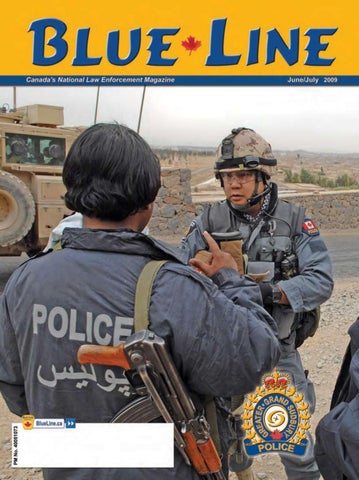
Cover & Left: Constable Ray Ealdama, of the Greater Sudbury Police Service speaks with Afghan National Police while visiting a temporary vehicle checkpoint in Kandahar, Afghanistan. Ealdama worked with the Kandahar Provincial Reconstruction Team in 2007 as part of a civilian police contingent helping train and develop local police. Ealdama will be sharing his experiences with attendees of the Ontario Association of Chiefs of Police conference later this month. For more on the Greater Sudbury Police Service see page 6.
Features 6 Problem based learning
18 Disclosing misconduct An overview of the Crown’s need to
Greater Sudbury Police fully committed to a new policing model
reveal police misconduct
10
Pandemic relief
25
14
100 years Ontario Provincial Police
28 No space to waist The battle of the belt needs more attention…
“The trouble with the world today is nobody cares”
Trade Show in Print
& solutions
Departments
Case Law
46 46 44 22 20 33, 37 34 45 19, 22 36 43 5 30
38 Blood sample analysis discoverable through breath analysis
Advertisers Index Back of the Book Blue Pages Coming Events Deep Blue Dispatches Letters Market Place News Week Odditorials Product News Publisher’s Commentary Technology
Blue Blue Line Line Magazine Magazine
33
40
Unlawful arrest a serious Charter breach
41
Border ASD test treated same as roadside demands
42
Detention justified despite description discrepancy
june June//july july 2009 2009
june / july 2009
4
Blue Line Magazine
Publisher ’s Commentary by Morley Lymburner
RCMP incompetent at Tasering H1N1 virus in pig study If that headline got your attention, then you know how helpful some media can be when a crises arises. It was a surreal experience last month when I awoke to 10 continuous minutes on the morning national newscast about the swine-flu epidemic about to hit the country. This must be a major event, I thought, since there was time for little else. Until this point, my news listening experienced ranged from the Dziekanski enquiry all the way to... the Dziekanski inquiry. An hour of interviews with pandemic experts followed the newscast. They talked about what effect the virus could have on the population. One doctor did allow, as a caveat, that so far no one in Canada had died and only a handful of people (out of 33 million) had actually showed any symptoms – and they were mild. Two days later, I was knee-deep in our annual trade show, which showcases products and education police require to meet the clear and present dangers they face daily. I awoke the morning after it ended to the same voice of doom, now saying there were plans to shut down schools and turn gymnasiums into temporary morgues. Things must have been talked out a little though, because now they managed to squeeze in time to once again talk about... the Dziekanski enquiry. I was told the next morning that the pork industry is suffering because people are worried about eating pigs because of the swine flu. The TV newscaster promises to henceforth refer to it as the “H1N1” flu. Another radio station decides the term “swine-flu” is okay, while a radio show coins the term “Pandemic Incident Germ Spreading” flu – or “PIGS flu” for short. In a vain attempt to find other news, I scan the radio dial for non-porcine news.
Blue Line Magazine
CBC appears to have something – on Tasers, of course. A Chicago study testing the effect of multiple hits... on pigs (sigh), was inconclusive in determining if they will hurt people. My conclusion: 1/ Tasers are as benign as the swine flu pandemic and; 2/ I should change my morning radio station to easy listening jazz. I am fortunate to have a donor-driven station in my region and have sent in my pledge. Speaking of pandemics, a Police Executive Research Forum (PERF) report addresses the issues of concern for police (we also have an overview of the Toronto Police Study on pandemics in this issue). Here’s the edited introduction to this paper. Police officials regularly plan for a variety of man-made and naturally-occurring hazards, especially since the September 11th attacks, but most law enforcement agencies have not yet considered the implications of a disaster that could cause tens of thousands of deaths and devastate police operations – an influenza pandemic. Many may not realize that flu pandemics are merely not a theoretical threat. As recently as 1968-69, 34,000 people died from the “Hong Kong flu” in the US. As many as 50 million people worldwide (675,000 in the US) died from the “Spanish flu” pandemic of 1918-19. There are several reasons why a flu pandemic would be a police rather than a public health problem. Officers may be called upon to enforce quarantines, provide security in hospitals swamped with patients and ensure that vaccines – when they became available in limited quantities – could be delivered to those with the greatest need. Perhaps the biggest reason – whom do people call when anything bad happens? The local public health agency? How many people even know its name, much less its phone number?
5
Public health will take the leading role in dealing with a flu pandemic, but police would be involved from start to finish. As 9-1-1 lines jam with frantic callers, police agencies would respond with a diminished workforce – many employees would be coming down with the potentially fatal flu. Others would have to stay home to care for sick family members or look after their children when schools close. PERF has produced a report to help police begin analyzing how a flu pandemic would affect their operations and how they can begin planning for such an event. Pandemic planning is particularly complicated in that it requires co-ordination with a wide variety of other public and private agencies. Advance planning is critically important, because it would almost certainly save countless lives. When a pandemic hits – and experts agree it’s not a matter of if but when – the overall national goal will be to minimize its impact and delay its spread for as long as possible. That’s because it will take the medical establishment some time to produce a vaccine and other drugs, perhaps 20 weeks or more. The more we can slow the spread, the fewer people will die in the early phases while scientists are still scrambling to develop the vaccine. We can’t afford to “wait and see,” and start thinking about a pandemic after it happens. Lives will depend on getting those plans organized now. You can get the complete study by going to the Blue Line Knowledge Portal at BlueLine.ca
June / july 2009
Problem based Greater Sudbury Police fully committed to a new policing model by Sharon Baiden A barren treeless landscape, the result of decades of mining, is what people often visualize when they think of Sudbury. While mining has helped shape the community and plays a key role in its past, present and future, Greater Sudbury has evolved from a mining town to a regional capital, a community with diverse interests, a rich cultural heritage and an internationally recognized land reclamation initiative. Formed in 2001 by amalgamating the towns and cities which comprised the Regional Municipality of Sudbury and unincorporated townships, Greater Sudbury is june / july 2009
learning the largest municipality in Northern Ontario. Greater Sudbury Police Service (GSPS) is responsible for patrolling an area covering 3,627 sq. km. (1,400 sq. mi.) with a population of 158,000. Encompassing both urban and rural areas, the city has 330 freshwater lakes, four post-secondary institutions and a diverse ethnic population, including the third largest Francophone population in Canada outside of Quebec. A bilingual community, Greater Sudbury is also home to people of diverse ethnic backgrounds, including Italian, Finnish, Greek and Native American heritage. The community’s unique geography and multicultural structure pose a number of challenges for the GSPS and the department has been evolving the process it uses to better serve the public. Problem based learning Faced with these unique markers, Sudbury’s 259 officers and 120 civilian members last year responded to more than 60,000 calls for service. There was, however, a realiza6
tion that the traditional police model was in danger of leading members to become simply “call takers.” In response the service has adopted a new way of doing business through problem based learning (PBL). This transition was the result of a full re-examination of how services are delivered. In the fall of 2008, 13 officers participated in a dynamic and unique training opportunity promoting the development of creative and innovative solutions to real life problems. The PBL model has been integrated into all sworn and civilian ranks with a full commitment throughout the organization to move forward with the new model. “We have noticed that officers throughout the ranks have felt more challenged and enthusiastic about their daily tasks,” said GSPS Chief Frank Elsner. “The new delivery method has led to a more community-minded service within Sudbury and has energized our organization.” Equipped with a new set of skills, GSPS members now examine issues with an open mind to give feedback, generate new ideas Blue Line Magazine
and create action plans for improvement with a primary focus on customer service and excellence. Each individual within the organization has the opportunity to be a key participant in activities and is encouraged to think critically, work as a group and collectively find the resources needed to solve problems. PBL Instructor, Acting Sergeant CarrieLynn Hotson is ecstatic with the progress with PBL, “Employee feedback to PBL has been positive.” Staff is encouraged by the changes, feel their concerns are being addressed and are enjoying meeting together on common ground, discussing issues and collaborating on solutions. Officers have new tools to work with the community in removing the perceived barriers to service delivery presented by the city’s sheer geographical vastness. Outlying areas will be better served through the use of the rural squad and community response unit to deliver comprehensive services. Working in partnership with the community, problematic areas are identified through crime prevention through environmental design (CPTED) audits. Both units are actively engaged with the community and have further expended their role to address issues around ATV use, snowmobiling, boating safety and other rural matters. Service wide, members appear to exhibit more confidence and creativity in their jobs. With the changing face of membership and ongoing recruitment, GSPS requires new staff members to complete a community project Blue Line Magazine
7
June / july 2009
during their orientation period to familiarize themselves with the area. Members identify a problem in their patrol area and must make several contacts with possibly affected parties and, in partnership with key stakeholders, develop responses for improved community safety. GSPS continues to protect the public with this increased focus on accountability, leadership, supervision, training and analytical thinking. As a citizen-centred police service, members are committed to a response that is becoming increasingly efficient and effective within the community. A caring community Named Canada’s fourth most caring community by the Canadian Council on Learning in 2008, Greater Sudbury has one of the highest volunteer rates per capita in Canada, according to 2004 Statistics Canada data. Caring and volunteering are key components of the PBL model, which embraces the use and recognition of the valued contributions of volunteers. The team serving in the citizens on patrol program and at storefront volunteer locations are key participants in the commitment to community mobilization and ensuring citizens are heard. GSPS will continue to evolve in response to the changing world while remaining focused on Sudbury’s ethnic diversity, vast geography and the historic roots that make the community so unique. In this respect they look to the future with energy and enthusiasm.
june / july 2009
With its multicultural roots, access to the wilderness and major attractions, Greater Sudbury has become a popular tourist destination. Annual festivals celebrate the community’s multicultural diversity and history while attractions such as Science North and Dynamic Earth are two of Canada’s largest and most innovative science centres. Ontario Chief’s conference The region has also become a choice location for hosting events. This year Sudbury will be the proud host of the 58th Ontario Association of Chiefs of Police annual conference, which runs from June 21 to 24. This year’s them, “Globalization and the impact GSPS Chief on policing,” is bound Frank Elsner. to challenge delegates in many different ways and change the way they think about law enforcement. “We are excited to be hosting this event in Sudbury,” said Elsner. “We will ensure delegates and companions alike are treated to some warm northern hospitality while gaining insight into the global issues facing police today.” The four-day conference will include a half-day event where delegates can see the latest technology, product and leading edge
8
specialized equipment used in today’s police environment. Seminars will touch on such topical issues as generational differences in policing, emergency preparedness and peace operations opportunities overseas. The conference will close on June 24 with an animated and enthusiastic presentation by Sudbury’s Gerry Lougheed Jr., who will inspire and motivate police leaders. An update on emerging legal issues in policing will follow, leading into the annual general meeting. Sharon Baiden is the GSPS director of corporate services. Contact her at sharon.baiden@police.sudbury.on.ca for more information. Visit oacp.on.ca or e-mail oacp@ absolutevents.com for more on the OACP conference.
Sudbury • Sudbury’s land reclamation program has limed and seeded 3,400 hectares and planted more than 8.9 million trees between 1978 and 2008. • T here are 5,000 km. (3,107 miles) of mining tunnels under the Sudbury area. • The Inco Superstack is the tallest freestanding chimney in the Western hemisphere and the second tallest structure in Canada after the CN Tower.
Blue Line Magazine
Blue Line Magazine
9
June / july 2009
Blue Line Journal
Pandemic
Police planning for an influenza pandemic: Case studies and recommendations from the field by Tom Imrie The Toronto Police Service (TPS) Occupational Health and Safety Program ensures that all police officers and some civilian staff are trained in managing the risk of communicable disease and appropriate personal protective equipment (PPE). The program provides PPE to every patrol officer and some civilians deemed at risk as a result of their duties, such as court security officers and staff who clean the insides of police vehicles. The equipment includes ‘officer safety kits,’ contained in pouches on an officer’s duty belt, which contain antimicrobial gloves, antiseptic towelettes, saline solution and a one-way CPR air mask. Higher-level kits are stored in the trunks of patrol vehicles and include enhanced PPE such as N95 masks, protective eye wear, waterless antiseptic hand wash, needle debris containers, Tyvex or similar material coveralls, heavy duty rubber gloves and biohazard storage bags for june / july 2009
relief
contaminated clothing. This is considered basic equipment and available to all members who may be exposed to communicable diseases. The capability to identify which officers are issued enhanced PPE was one benefit of the lessons learned during the SARS epidemic and from events such as anthrax hoaxes. Through risk assessment, the TPS determined there was a need for officers who may be called to respond to natural or manmade public health emergencies. To prepare, the department trained and equipped specific forensic identification officers in Level 4 Hazmat and issued them positive pressure self-contained breathing apparatus (SCBA) and full coverage, total isolation biohazard containment suits. They were then trained to recognize, assess and control biological hazards. In a biohazard emergency, whether natural or man made, the officers will mitigate biological hazards through appropriate means (e.g., containment, isolation, decontamination) and then investigate the cause of the event, 10
including packaging and collecting evidence of the offence. The department has also similarly trained and equipped officers who investigate clandestine drug labs and “hydroponics grow” operations. These officers can be deployed to assist in natural and manmade incidents. They are provided with SCBA, Level 1 Hazmat suits and evidence collection and packaging materials suitable to the risks present. This model has been adopted throughout Canada. This type of program gave the TPS an advantage during the SARS outbreak. All officers were supplied with PPE and the occupational health and safety unit communicated regularly with them. “In spite of more than 1,500 documented high-risk contacts,” then chief Julian Fantino wrote, “not one member of the TPS contracted SARS through an occupational exposure.” Police officers were sent to hospitals in the beginning of the outbreak to secure checkpoints and enforce safety protocols. Once the situation Blue Line Magazine
was deemed under control, hospitals employed their own security staffs to carry out those assignments.The TPS also had to re-prioritize calls due to a personnel shortage caused by the quarantining of officers as well as the additional responsibilities they undertook. “The biggest operational impact of the SARS outbreak on the Toronto Police Service was on its own personnel,” Fantino noted. “More than $560,000 was spent on quarantined members, overtime and call-back expense. More than 15,700 person-hours were dedicated to SARS-related duties.” Fantino concluded the article by grouping lessons learned into nine categories. Below is a chart developed by PERF that summarizes his analysis. Pandemic planning Subsequent to the SARS outbreak, the TPS took the lessons learned from its experience and created a draft Public health emergencies/ Pandemic response plan, written with the assistance of several agencies, including the public health department, fire and EMS. TPS also sought guidance and information from provincial and federal agencies to ensure that plan components were within the framework of other governmental and law enforcement partners in the Greater Toronto Area. Both the occupational health and safety unit and the emergency planning operations section of the public safety unit are responsible for maintaining the plan. The most current draft, used for this case study, was updated on December 15, 2006 and, at the time of this writing, had yet to be approved by the chief and police services board. The plan is divided into five main sections: situation, mission, execution, administration and communications (the last section only provides contact information for PCC staff and is not covered in this case study).
Toronto Police Service Lessons Learned from SARS Outbreak Lesson
Description
Training
• More Training needed regarding communicable diseases • More Training needed in the Incident Management System
Pandemic Disease Planning
• The SARS outbreak was the impetus behind the creation of the Toronto Police Service’s pandemic plan.
Case Tracking
• The TPS will implement a case-Tracking Program in the future that will help them follow exposed, quarantined, and/or ill personnel.
Communication
•W henever possible, there should only be one spokeperson from the TPS responsible for dealing with the issue • This spokesperson should only disseminate information when sure it is correct
Command Center
• Certain renovations to the Police Command Centre were planned after the outbreak: -H andheld communication devices were to made available to all members - Information technology issues were to be addressed. - Issues such as petty cash availability were to be addressed.
Staffing
• The TPS staffing plan for critical incidents would be reworked to “make better use of staff to improve the effciency of the [Incident Management System].”
Emergency Preparedness Plans
• TPS would work on conutuity of operations planning.
Partnerships
•S hould include emergency response agencies, health care providers, the private business community, and other city departments
Resources and Equipment
• TPS currently stockpiles N95 masks and antibacterial gel (due to shortages of both during the SARS outbreak)
Situation The first section provides a general overview of influenza and the planning being conducted by the World Health Organization, provincial authorities and Toronto Public Health. The impact a pandemic would have on the city is presented, accompanied by a table showing estimated morbidity and mortality range totals (based on 15 and 35 percent infection rates). The section concludes with an explanation of WHO’s pandemic phase designation; at the time this document was prepared, the world was categorized in Phase 3 (pandemic alert), with no or very limited human-to-human transmission of the bird flu. Mission This section lists the TPS mission statement and mission objectives during a pandemic or other public health emergency: 1. Provide priority-policing services, 2. Act as a sentinel agency and share information with health officials, 3. Provide command and control over policing operations, 4. Provide personal protective equipment, best health practices and up-to-date health Blue Line Magazine
11
June / july 2009
Toronto Police Service / Incident Management System Pandemic Organizational Chart
Post-Plan Activation Procedures and Unit Responsibilities Protecting TPS Staff and Facilities
• Toronto Police Service members are instructed to don personal protective equipement (PPE) when dealing with an individual whose health state is not known. This equipment can include: - A disposable mask - Latex-free medical examination gloves - Infection control gowns or biohazard suits (if there is potential exposure to blood or bodily fluids) - Antibacterial gel • Employees and visitors to police facilities (including the Police Command Centre) will not be allowed access until they have answered a health questionnaire and have complied with the hand washing/disinfecting protocol. The TPS Fleet and Facilities Management Unit is Responsible for installing wallmounted hand sanitizers at the entrance of each police facility.
Staffing Issues
• Each Police Unit/Division must report twice daily all sick notifications and current daily strength. • Each Uniform Division will supply a Quick Response Team to work with city Emergency Management Services teams. These teams will be available 24 hours a day and will be the only teams to be dispatched to “sudden death” calls. • The Forensic Identification Unit will dedicate personnel for record keeping regarding arrival and relocation of the deceased. A garage in the city has been secured as a temporary storage area for bodies, and TPS will provide security at the gate. • The Public Safety Unit will assist with civil unrest, security issues associated with vaccine/treatment distribution, hospital security, and apprehension orders. • With regard to prisoner screening, police are instructed to question all new custody intakes about symptoms of bird flu or recent travel to any of the affected countries/areas. A Prisoner Screening Form can be found in Appendix C. • The Toronto Police Service (through the Police Command Centre) will deal with guarding stockpiles of medical supplies and crowd control at vaccine/treatment distribution sites on a case-by-case basis.
Internal Communication
• A senior officer will be assigned by the PCC as a liaison officer to the Health Department Operations Center (HDOC). Through this assignment, the liaison officer will communicate vetted health information from the HDOC to TPS. At the same time, the PCC will provide the liaison officer with daily updates of health-related TPS issues for him/her to share with the HDOC.
june / july 2009
12
information to TPS, 5. P rovide specially trained and equipped response teams to calls that refer to a person’s sudden death, 6. Provide alternate staffing models to address personnel shortages, 7. Assist public health with the safe delivery of vaccines/treatments. Execution The bulk of the draft plan is contained in this section, which details when the plan will be activated and procedures that will be followed by police personnel. The pandemic plan can be activated when WHO declares that the phase of alert has reached level 5 (evidence of significant human-to-human transmission) or once TPS has been notified that a pandemic is pending in the area. TPS will be notified by either city or provincial health representatives. Once the police command centre (PCC) is activated, a senior officer will serve as a liaison officer between it and the healthcare divisional operations centre (HDOC). Based on the vetted information provided by this officer, the PCC will be the sole source of health information to TPS. Typically, the chief of police reports to the city’s emergency operations centre, leaving a deputy chief in charge of the PCC, which will be staffed based on the incident management system organizational chart. The primary operational response is split into two commands – area field and central field – which are led by their respective staff superintendents. Each TPS unit/division must report twice daily all sick notifications and current daily strength. The PCC will deliver daily situation reports and major event logs and will report all health information and recommendations to front line and support units. Dealing with quarantine, mass deaths and staffing changes A breakdown of quarantine strategies (for TPS members, community members and prisoners) is also found in this section of the TPS pandemic plan. As previously mentioned, TPS members who are directed to be quarantined – where it is determined to be as a result of occupational contact – will be compensated as if they were “on duty” during their regularly scheduled shifts. Either a medical officer of health or the TPS medical advisory staff can order a police employee to be quarantined. Members must immediately report this to the occupational health and safety unit, which will determine compensatory next steps with the medical officer of health. If a member of the public does not comply with a quarantine order, police may be called upon to enforce them. Toronto’s Health Protection and Promotion Act is summarized in this section of the TPS plan and it states, “The police force shall do all things reasonably able… to locate, apprehend and deliver the person in accordance with the order” (p. 16). The plan states that prisoners who show signs of illness (or those arrested under a court order) must be taken to the hospital for admittance. Blue Line Magazine
TPS is responsible for guarding these individuals until they can be looked after. Next, the role of quick response teams in dealing with mass deaths is described. Teams will be available 24/7 to respond to calls (with Toronto EMS) at private residences where a person has died. They will work with EMS to determine if the death was potentially the result of the bird flu, notify the coroner and record the event for police records. (A pandemic-specific field death report that would be completed, along with a sudden death report, was being developed by TPS at the time this document was prepared.) The plan notes, “These teams shall require a suitable number of rehabilitation breaks due to the stress of wearing personal protective equipment for extended periods of time.” The next section deals with redeployment and staffing changes as a result of “severe staff shortages.” Staff at the PCC may choose to implement a 12-hour shift schedule to make up for these shortages. Further, all leave may be cancelled and those working in plainclothes or support roles may be redeployed. All training would likely be cancelled and responses to lower-priority calls for service might have to be suspended. Administration This section of the TPS pandemic plan lists the hours of operation and staffing plan of the police command centre. Currently, the plan calls for – at a minimum – an inspector, civilian planner and uniformed sergeant from the emergency planning operations section. As the incident escalates, the following staffers could be added: • One officer from operational services, • Two officers from field planning, • Two members from occupational health and safety. Daily situation reports indicating the number of sick members, available on-duty members and a synopsis of challenges encountered during the shift must be submitted to the PCC. The number of sick or absent members will be tracked in order to determine “Hot Spots” of illness within TPS.
APPENDIX B APPENDIX B Employee/Visitor Screening Form Record35 Employee/Visitor 35 (This screening would be administered to police facilities Screening Formto visitors Record and to police employees during a pandemic.) (This screening would be administered to visitors to police facilities and to police employees during a pandemic.)
VISITORS STOP – DO NOT ENTER THIS FACILITY UNTIL YOU HAVE COMPLIED WITH THIS SCREENING VISITORS DIRECTIVE. HAVING COMPLIED WITH THIS DIRECTIVE THE VISITOR EMPLOYEEWITH SHALL SANITIZE THEIR HANDS STOP – DO NOT ENTER THIS FACILITY UNTIL YOU HAVE/COMPLIED THIS BEFORE ENTERING THE FACILITY SCREENING DIRECTIVE. HAVING COMPLIED WITH THIS or DIRECTIVE THE VISITOR To be completed by staff member other authorized person./ EMPLOYEE SHALL SANITIZE THEIR HANDS BEFORE ENTERING THE FACILITY SYMPTOMS: Are you experiencing any of the following symptoms? To be completed by staff member or other authorized person. Myalgia (muscle aches) � Yes � No SYMPTOMS: Are you experiencing any of the following symptoms? Malaise (severe fatigue or unwell) � Yes � No Myalgia (muscle aches) � Yes � No Severe headache (worse than usual) � Yes � No Malaise (severe fatigue or unwell) � Yes � No Cough � Yes � No Severe headache (worse than usual) � Yes � No Shortness of breath � Yes � No Cough � Yes � No Difficulty breathing � Yes � No Shortness of breath � Yes � No If the employee or visitor answers yes to two or more of the above Difficulty breathing � Yes � No there will be no entrance allowed to the facility If the employee or visitor yes following to two or questions. more of the above CIRCUMSTANCES: Pleaseanswers answer the there will be no entrance allowed to the facility Have you had contact with a person with or under investigation CIRCUMSTANCES: Please answer the following questions. for FLU in the last (incubation period) days?
� Yes
� No
� Yes Yes �
� No No �
Have you you been been to to (focus (endemic region) inlast the (incubation last Have of outbreak) period) days? � Yes If(incubation yes, pleaseperiod) identifydays? the date and the area?
� No
Have you you been had contact with aregion) personinwith under investigation Have to (endemic theor last for FLU in the last (incubation period) days? (incubation period) days?
EMPLOYEES Section B to be completed by Supervisory Staff Temperature
� Yes
(at or above 38 degrees °C)
� No
1. If the staff member/authorized person does not have a temperature at or above 38 °C, no abnormal clinical signs and answered no to the first two circumstantial questions, he/she may report for work. 2. If the staff member person has had contact with a person with or under investigation for FLU in the last (incubation period) days, instruct him/her to call Telehealth Ontario at 1-866-797-0000 and also contact the Public Health Department. 3. If the staff member/other person has attended (focus of outbreak) in the last (incubation period) days, he/she should submit to voluntary quarantine at home and contact his/her personal physician and the local Public Health Department. 4. If the staff member/other person has a temperature at or above 38 °C, abnormal clinical signs or answered yes to either of the first two circumstantial questions, call Telehealth Ontario at 1-866-797-0000. If a staff member is absent from work as a result of these restrictions, a medical certificate certifying fitness to return to work must be provided. The Service will cover the cost of the certificate. Name
Signature
APPENDIX C
Prisoner Screening Form36 APPENDIX C
Prisoner Screening Form36
Have you been to (focus of outbreak) last (incubation period) days? Date/Area: If yes, please identify the date and the area? An answer to one of the above will cause no admittance to the facility Date/Area:
As a result of a declaration of a Pandemic Influenza emergency, Officers-in-Charge are to use the following screening tool when booking prisoners.
An answer to one of the above will cause no admittance to the facility
Prisoner:
35. Source: Toronto Police Service Draft Public Health Emergencies/Pandemic Response Plan
Name: As a result of a declaration of a Pandemic Influenza emergency, Officers-in-Charge are to use the following screening tool when booking prisoners. Date/Time:
Chapter 3. The Toronto Police Service Case Study — 61
Prisoner: PART 1 (Symptoms subject to review) Name:
Chapter 3. The Toronto Police Service Case Study — 61
Date/Time: 62 — Chapter 3. The Police Service Do you Toronto have a cough (worseCase thanStudy usual)?
35. Source: Toronto Police Service Draft Public Health Emergencies/Pandemic Response Plan
Future directions At the time this document was released, the TPS was in the process of: • Obtaining approval of the draft plan from senior level officials, • Finalizing information on family readiness strategies, • Finalizing and obtaining approval on a “Pandemic Field Death Report” form. Tom Imrie is unit commander of the Toronto Police Service Occupational Health and Safety Program. Excerpted from the PERF document Pandemic - Critical Issues in Policing available from the Blue Line Knowledge Portal at BlueLine.ca.
Do you have a fever?
Are you having difficulty breathing?
Do you have muscle aches or pain (worse than usual) Do you have a fever?
PART 1 (Symptoms subject to review)
� Yes
� No
� Yes
� No
� Yes
� No
� Yes � Yes
� No � No
IfDo theyou prisoner YES tothan two or more of these questions and the� reason have aanswers cough (worse usual)? Yes is not�obvious No (foot pursuit, pepper spray, resisted arrest, etc.), proceed to PART 2. Are you having difficulty breathing? � Yes � No Do you have muscle aches or pain (worse than usual)
PART 2
� Yes
� No
IfHave the prisoner answers YES to two region), or more and of these questions and the� reason you traveled to (an endemic returned Yes is not �obvious No (foot spray, period) resisteddays? arrest, etc.), proceed to PART 2. withinpursuit, the lastpepper (incubation Have you attended at (focus of the outbreak if applicable) within the last 10 days?
� Yes
� No
Have you ever been told you should be quarantined? Have you traveled to (an endemic region), and returned If YES, the when you told?period) days? within lastwere (incubation
� Yes � Yes � Yes
� No � No � No
PART 2
Have you attended at (focus of the outbreak if applicable) � Yes � No Ifwithin the prisoner the lastanswers 10 days?YES to two or more of the above questions, the Officer-in-Charge shall call Telehealth Ontario at 1-866-797-0000 and obtain advice from that source and the Police Command Centre. Have you ever been told you should be quarantined? � Yes � No If YES, when were you told?
� Yes
� No
36. Source: Toronto Police Service Draft Public Health Emergencies/Pandemic Response Plan.
If the prisoner answers YES to two or more of the above questions, the Officer-in-Charge shall call Telehealth Ontario at 1-866-797-0000 and obtain advice from that source and the Police Command Centre. Chapter 3. The Toronto Police Service Case Study — 63 36. Source: Toronto Police Service Draft Public Health Emergencies/Pandemic Response Plan.
Chapter 3. The Toronto Police Service Case Study — 63
Conclusion Toronto was in the early stages of planning for a pandemic when the SARS outbreak took place. Planning resumed at the end of the outbreak and the city incorporated the lessons learned into its pandemic plan. The police service followed suit, emphasizing the following in its draft plan: • Training all personnel in daily PPE use and general disease prevention, • Employing one person to serve as the liaison between the police and health communities in the event of a public health emergency, working with city emergency management to respond to sudden death calls, • Paying quarantined members who had been exposed to a pathogen while on duty as if they were on duty, • Incorporating pandemic-specific planning elements into its existing plans. Blue Line Magazine
13
June / july 2009
Left: “Junior” Const. Hank Sayeau in the back seat of a two-door police car, apparently during the winter of 1947-48. The photo, taken at Queen’s Park where OPP orientation training was held at the time, shows a shiny 1940s Ford Mercury. (Photo courtesy Ret. C/Supt. H.M. Sayeau.) Right: Insp. Don Oerton (right) escorts U.S. astronaut Neil Armstrong at the opening of the 1978 International Plowing Match at Wingham, Ont. (Photo courtesy Ret. Insp. Don Oerton.)
“
The trouble with the world today is
nobody cares
by R.D. (Bob) Cooke, Provincial Constable (Retired) Policing isn’t for everyone It was late May 1975, two weeks into the three-week orientation course #96 at the OPP training facility on Sherbourne Street in Toronto. The day’s training had concluded with a drill on the miniscule “parade square,” located between a chain link fence and the side of the building. One of the recruits, a school teacher in his late 20s, lamented to his companions. The discipline common to every type of military or paramilitary training was getting to him. “I don’t need this,” he said. I’m going home this weekend and not coming back.” Three others who shared his sleeping quarters, a 30year-old father with some military experience, a skinny, former civilian OPP dispatcher a couple of years younger and a bull-necked farm boy around the same age, tried offering counsel. june / july 2009
“This is just basic training,” one told him. “It’s to get our attention,” said the second. “This isn’t how it will be when you get to a detachment,” said the third. They were right, of course, but despite their best efforts, there was an empty bed Monday morning. Whether the former teacher returned to his classroom, which likely would have involved addressing other discipline issues – those of his students – is unknown. Undoubtedly, most recruits prefer to continue with policing. In this case, the other three in training went on to no less than 30 years of service, as did the majority of that class. Equally certain is that it was better for the school teacher to find out early in the game that policing wasn’t for him, so it was no harm, no foul. Thousands of recruits have gone through the OPP during its 100 years, continuing on to successful and meaningful policing careers at various levels. Their reasons for becoming members are varied and in many cases difficult to articulate. A coach officer, when asked by a probation14
”
ary constable why he signed up, answered simply: “The trouble with the world today is nobody cares.” He didn’t add anything, but it was clear what he was saying. The new constable never forgot it and, in fact, adopted the same philosophy of “someone has to care.” Young soldier opts for policing Born and raised in Woodstock, Ont., Don Oerton joined the OPP in June, 1947. Some two years prior, he had been with the armoured 7th Reconnaissance Regiment (17th Duke of York’s Royal Canadian Hussars). Oerton, then 16, was underage when he joined the Canadian Army in 1941, a fact the military apparently never discovered. Units of his regiment landed on the beaches of Normandy on D-Day and Oerton was with the remainder when it landed in France later that month. Subsequently, in July, he witnessed fierce action in France, Belgium, Holland and Germany as the enemy tried to turn the tide of ultimate defeat. Back to 1947, when Oerton was origiBlue Line Magazine
nally given badge number 1065 – little did he know that years later his son Jeff would join the OPP and be given badge 5601, exactly the reverse. Six weeks of provincial police training at the Queen’s Park Crescent facility in downtown Toronto was the norm, but after only four weeks Oerton was sent to Wasaga Beach for the summer, along with two other new recruits. They worked seven days a week, no time off. “My first firearm was a .38 Webley top break-open,” he recounts, adding the revolver was “probably from the British Army.” Since this was the standard side arm issued to the armed forces of the United Kingdom during the First World War, Oerton is probably correct. “I had that (revolver) for eight to 10 years before getting the .39 Colt.” The starting salary was $1,840 and Oerton went on a merry-go-round of postings, some of which no longer exist, finally retiring in 1983 with the rank of inspector. “I have no regrets,” he says. “I never wanted to change.” Long road to chief superintendent About a year earlier, in Feb. 1946, Harry (Hank) Sayeau, badge 884, was one of 20 recruits at the Queen’s Park facility. Hailing from Kemptville, Ont. where his father was chief of a one-man police department, Sayeau joined the Royal Canadian
Blue Line Magazine
Cst. Don Oerton, seen in 1948, joined the OPP after having served four and a half years in the Canadian Army during the Second World War. Oerton lied about his age, joining when he was 16. (Photo courtesy Ret. Insp. Don Oerton.)
Air Force (RCAF) in 1942, working as an air observer and wireless operator. The closest he came to Europe was Newfoundland, which wasn’t yet part of Canada, so he qualified for a service medal. Upon
15
mustering out of the air force in 1945, Sayeau worked as a CPR telegrapher but his wish to become a police officer took him to the OPP. “I wanted to be a Mountie but I was married, so they wouldn’t consider me,” he reflects, referring to the former policy of the RCMP. Originally scheduled for the fall 1945 intake of OPP recruits, Sayeau’s start was delayed because of a Stelco strike in Hamilton. His was the second OPP class consisting of Second World War veterans. During an early posting at Alexandria, where OPP officers were required to be bilingual, Sayeau was warmly greeted by the mayor – in French – evidently because someone had assumed he could speak French, based on his last name. Alas, this wasn’t the case. The mayor wasn’t amused and the new officer found himself summarily transferred to Pembroke. Later, at Goderich, Sayeau was a corporal and the detachment’s investigator in the 1959 murder of 12-year-old Lynne Harper near RCAF Station Clinton. Today, he is the last surviving officer involved in what later became a controversial case. Like Oerton, Sayeau has no regrets. “The people I worked with were great. I only met one bad apple,” he adds. Sayeau retired as a chief superintendent in late 1979. Perhaps an acquired taste for some recruits, evidently policing is preferred by most.
June / july 2009
Pictures: William Leslie
Exciting young minds New portable safety village gets the message out “How cool is this?” OPP Cst. Gerry Dwyer says, pointing to the 40-by-50-foot vinyl mat that forms the base of a new portable safety village. His enthusiasm is clearly evident as he beams at the children soaking up the vision of it all on the inauguration day ceremonies at Orillia’s Regent Park Public School. The mat almost fills the floor of the newly renovated gymnasium and is printed with sharply coloured streets, sidewalks, parkland and even a lake used to highlight the water safety lessons. A miniature fire hall, police station with functioning jail cell and power lines sit on the mat. The whole set-up is kid-sized, right down to the electric cars and trains that students get to operate. It might sound like a lot of bells and whistles, but Dwyer says that’s what is needed to compete with video games and the Internet for today’s youngest generation. “Gone are the days when you can just stand in the class with a uniform on,” Dwyer said. He’s a veteran of two police forces with about a dozen years experience teaching safety to students. “You’ve got to get them young. When they get to high school, it’s too late,” Dwyer said. “The message just does not sink in.” Getting to the kids is half the battle. When june / july 2009
Dwyer and others in the community started dreaming up the idea of a safety village, they began with the idea of a stationary structure. They soon realized that, when the goal is to expose as many as possible to the messages, a stationary site would make the village too hard and expensive for kids to get to. A similar project in York Region required an initial investment of $4.5 million and another $500,000 annually to operate and maintain. In addition, schools are required to bus children to the village. The $80,000 bill for the portable village pales in price by comparison and the children need only walk to the gym. The initial solution was a painted-on model first tested in a Brechin school two years ago. The project, situated in the parking lot of a fire hall, impressed representatives of Union Gas so much that they kick-started the fundraising campaign with a $21,000 donation to the local Kiwanis Club. The current version can be packed into a 27-foot trailer and towed from one school to the next. Set-up takes about half a day and will rely on a network of local volunteers that Dwyer is currently working to establish. Dwyer said the village will make weeklong visits to area schools. The extended stay will allow kids access to the interactive 16
miniature town and will also capture their attention for safety lessons from fire and police departments, hydro companies and even quarry operators. “Learning is at the core of this initiative,” said Dwyer. “This is the focal point for local safety officers to attend and deliver various safety messages.” “This is a significant beginning, one that will continue to grow,” added Ramara fire chief Ted Conway. Orillia OPP, Mnjikaning Police Service, CN Police, Rama Mnjikaning EMS and the Ramara Fire Department were among several organizations involved in the design of the project. Dwyer is hoping to see the program extended to other communities in the region with the assistance of corporate sponsors. The village is meant to engage kids, but even their educators seem to bubble over with excitement. “I’m thrilled that it’s in our school,” says principal Eileen Leishman, grinning broadly, “but it’s also great for our whole community.” For further information contact Cst. Gerry Dwyer of the Orillia detatchment of the Ontario Provincial Police at 705 326-3536 ext 3355 or email to Gerald.Dwyer@ontario.ca.
Blue Line Magazine
Police leaders face
global challenges
by Danette Dooley Two-hundred police leaders from 22 countries gathered in Halifax, April 19-21, for the International Conference for Police and Law Enforcement Executives. Hosted by Halifax Regional Police (HRP), the conference attracted police chiefs, deputy chiefs, commissioners and those in similar management positions, says HRP Chief Frank Beazley. The Canadian Association of Chiefs of Police, HRP, Nova Scotia Association of Chiefs of Police, Canadian Association of Police Boards and Canadian Professional Management Services were among the sponsors of this year’s conference. The theme of this year’s conference was “Executive challenges in the global environment.” In addition to the usual presentations, Beazley says, at the end of the second day, a representative from every country gathered in one room. “You had the ability to go from country to country and ask specific questions and have further dialogue with members from the different countries. That was something new we did this year and it worked out very well.” The program is set up in such a way to allow one issue to build on another, he adds. “There was a presentation by the assistant director of the FBI that talked about setting out the challenges of policing in global villages. That presentation talked about how crimes today are borderless and policing today has to have that extra aspect to it in order to deal with borderless crime.” While necessary, such an approach to policing is challenging, Beazley says, particularly in a local, municipal or provincial environment, because, “police have to be able to effectively carry out their investigations across borders.” Presentations also focused on the challenges of leadership and the future of policing. During his keynote address, Dr. Christopher Murphy of Dalhousie University talked about what lies ahead for law enforcement and how police executives can prepare. “His talk touched upon the economic crisis that’s going on and the increasing demands for existing as well as new services, discussion around public accountability and national security,” Beazley says. Time was also set aside to discuss labour issues in a police environment. “We talked about how you deal with current labour issues. We also looked into the future in terms of demographic changes – the differences between the baby boomers and the Y generation.” A session also focused on police supervision, how leaders can work well within a union environment and the media; “Whether they are biased or unbiased in their reporting and how does the media influence people’s perception Blue Line Magazine
of what’s going on within policing.” The session involved both police officers and members of the media as presenters, Beazley says. Attendees were also interested in the session on work/life balance. “The promise of many years ago was working a 32-hour work week but we never really did achieve that.” Each day also included a “Straight talk with the experts” session, giving participants an opportunity to question the presenters. “This gave everyone an opportunity to get further information on these issues,” Beazley says. Representatives from British Columbia, Ontario and Quebec also presented on current issues related to gang violence and what’s going on across the country. “They talked about what police executives are doing to try and deal with this problem.” The conference is an opportunity for police executive in Canada to listen to not only what’s going on within other jurisdictions but to get an idea of how police executives are dealing with the issues, Beazley says. The conference gave attendees an opportunity to compare what they are doing in
17
their regions and learn new approaches along the way. Many policing issues are the same no matter the jurisdiction, Beazley says. “This conference gives you an opportunity to see how the head of the Hong Kong police force is dealing with issues like visibility in the community. That gave someone like myself an opportunity to sit down and ask him how he’s deploying his resources.” Beazley says he was pleased to be able to bring the conference to Halifax. Doing so provided the smaller police forces in his province an opportunity to participate in such a world-wide event. At the end of the day, Beazley says it’s reassuring to learn that your department is approaching policing issues the same as counterparts throughout the world. “That was the main benefit for me. To compare what I was doing with leaders from the international community. I learned some new ways of doing things and I can now bring that lesson back home.” Danette Dooley is Blue Line’s East Coast correspondent. She can be reached at dooley@blueline.ca
June / july 2009
Disclosing misconduct An overview of the Crown’s need to reveal police misconduct by Kathryn Lymburner A landmark Supreme Court of Canada decision in January on disclosure of police misconduct records, substantially expands the obligation by police and Crown to disclose information relating to misconduct. R v. McNeil directly affects how police prepare prosecution packages for the Crown and how they respond to requests for additional information regarding disciplinary records. In turn, this has a direct impact on how the Crown will prepare disclosure packages for an accused. McNeil builds on the onus set out in Stinchcombe for the Crown to disclose all relevant information in its possession to an accused. This includes both material the Crown intends to use as evidence and information that has a reasonable possibility to assist the accused in exercising their right to full answer and defence, which also includes the right to test the credibility and reliability of witnesses. The court held that in addition to these fruits of the investigation, material relating to “findings of serious misconduct by police officers involved in the investigation against the accused… where the police misconduct is either related to the investigation, or the finding of misconduct could reasonably impact on the case against the accused,” should be forwarded to the Crown by police without prompting. Production of disciplinary records and criminal investigation files in the possession of the police that do not fall within the scope of this first party disclosure package is governed by the O’Connor regime for third party production... Where the information is obviously relevant to the accused’s case, it should form part of the first party disclosure package without prompting… It becomes incumbent upon the police force, in fulfillment of its corollary duty of disclosure to the Crown, to look into those criminal cases in which the officer is involved and to take appropriate action. Of course, not every finding of police misconduct in question will be of relevance to an accused’s case. The officer may have played a peripheral role in the investigation, or the misconduct in question may have no realistic bearing on the credibility or reliability of the officer’s evidence. If the material referred to in McNeil is not disclosed and is later determined to have been necessary for full answer and defence, the inevitable result is that any conviction obtained will be overturned and a new trial ordered. In some circumstances, the charges could be judicially stayed due to the non-disclosure. Police should not review material for relevance, the court noted, but leave that assessment to the Crown as part of its obligation june / july 2009
to provide full disclosure to the accused. This review includes an assessment of relevancy, vetting to remove personal information and a determination of privileged or third party information. The court set out two categories of misconduct material that should now form part of the initial package sent to the Crown: 1. Investigations into complaints about police member misconduct relating to the same subject matter underlying the charge against the accused must be forwarded with the initial package sent to the Crown. These should be marked to identify it as a concurrent investigation, with its status clearly outlined. The investigative file must be forwarded regardless of whether it results in a criminal or misconduct charge. If disclosure will jeopardize an on-going investigation, the investigator should contact their local chief Crown (McNeil designate) to discuss delaying disclosure. 2. In relation to each member listed as a witness in the investigation, a package containing misconduct information unrelated to the investigation of the accused must also be included with the initial package. It must be clearly marked as a McNeil Package so that special attention can be given to reviewing and vetting the material. Each Crown office will designate a prosecutor to deal with disclosure and vetting of the McNeil material. The McNeil package The court expects there will be future litigation to fully identify the limits and parameters of material required in the McNeil package, but as a guideline, the package should include: 1. A list of convictions under the Criminal Code and Controlled Drugs and Substances Act for which a pardon hasn’t been granted. 2. A list of all outstanding charges under the same statutes, including those out-ofprovince. 3. A list of all convictions or finding of guilt under any other federal or provincial 18
statutes except for Traffic Safety Act speeding convictions. 4. A list of all outstanding charges or findings of guilt after a hearing for misconduct under the Police Act or RCMP Act that have not been expunged pursuant to s.22 of the Police Service Regulation. If circumstances underlying the conviction or outstanding charge or a copy of the hearing decision in this category are required, a specific and separate request will be made. Each law enforcement agency should contact their local chief Crown if any information comes to light about a member that could be considered “obviously relevant” to discuss if it should be reviewed by the prosecution for disclosure. Not every finding of police misconduct by a member involved in the investigation will be of relevance to an accused’s case. If the police witness played a secondary role in the investigation or if the material has no realistic bearing on the credibility or reliability of the witness, it need not be disclosed as the material is clearly irrelevant. Personal identifiers such as addresses, phone numbers, dates of birth, etc. will always be removed prior to disclosure to protect the privacy and security of witnesses. The McNeil decision clearly states that some material will be subject to an O’Connor application and that where material falls between Stinchcombe and O’Connor, litigation will have to set out further guidelines. Without supporting information, Crown prosecutors will advise the accused that: • Misconduct material relating to members not witnesses in the investigation; • C omplaints that were dismissed after a hearing; • C omplaints dismissed, discontinued or abandoned, regardless of whether a notice of hearing was issued; • Summary judgments of the chief; • Complaints not sent to hearing; • Expunged findings of misconduct; and • Other employment records; can only be obtained from the third party police agency through an O’Connor application. If there is such an application, the accused is obligated to serve the third parties with notice supported by appropriate affidavit evidence. If the material is privileged, regardless of relevance, it will likely bar the accused’s access unless there is an innocence at stake issue. The scheme in O’Connor applies to all third party records, regardless of a privacy interest. In most cases, a privacy or confidentiality interest will not prevent release of the information once true relevance is shown by the accused. Blue Line Magazine
Immediate steps Each police service and law enforcement agency should immediately take steps to: 1. Review all outstanding and complete investigations into complaints about member misconduct and ensure that concurrent investigations into the conduct of the accused are forwarded to the Crown on outstanding charges. If disclosure will jeopardize an ongoing investigation, contact with the local chief Crown (McNeil designate) needs to be made. 2. Create a mechanism to track all concurrent investigations to the main investigation and forward them to the Crown. 3. Review each member’s misconduct history and prepare a McNeil package for immediate release to the Crown on all outstanding criminal prosecution files. 4. Create a mechanism to ensure that McNeil packages are forwarded to the Crown for review every time a member is a witness in an investigation. 5. Create a review process to ensure that McNeil packages are up-to-date and forwarded to the Crown on all outstanding criminal matters on a regular basis. 6. Assign a contact for requests for the complete file or misconduct hearing decision relation to convictions and outstanding misconduct investigations.
Blue Line Magazine
Former police chief complains about sub-standard facilities TORONTO – A former police chief choked back tears Thursday as he told an inquest into the deaths of two prisoners that he had long complained it would take a death before anyone would pay attention to funding problems with the Nishnawbe-Aski police force. Wesley Luloff said the First Nations of Ontario deserve the same standard of policing as the rest of the province. Luloff was testifying at the inquest into the Jan. 8, 2006, deaths of Ricardo Wesley and Jamie Goodwin at the Kashechewan First Nation reserve, a fly-in community in northern Ontario. Wesley and Goodwin, who were arrested for intoxication, died in their cells in the NishnawbeAski police detachment at the Kashechewan reserve after fire broke out and engulfed the building. Efforts to save them failed after keys to the padlocked cells didn’t work and bolt cutters couldn’t be found, according to earlier testimony. Luloff said policing is a provincial responsibility and the First Nation Police Services of Ontario must have a legislative framework for
19
investigations, training, buildings and health and safety that is the same as other forces. The Kashechewan police detachment had no fire alarm, fire extinguisher or smoke detectors. Nor did the reserve at the time have a fire station or firefighting force. A fire truck sat in a junkyard, where it sat broken after arriving by barge. Luloff, a former RCMP officer who retired as Nishnawbe-Aski police chief at the end of December 2005, just days before the tragic deaths, recalled Thursday how he often told authorities it would take a death before anyone would pay attention to problems caused by a lack of adequate funding. Luloff said the police detachment building in Kashechewan had been identified as substandard by a federal government report in 2001. (Toronto Star)
This article was excerpted from Blue Line News Week. This weekly executive reading service is available for email delivery every Thursday. To subscribe to this service go to www.BlueLine.ca or phone 905 640-3048.
June / july 2009
Deep Blue by Dorothy Cotton
No one laughs at people with cancer So why make fun of the mentally ill?
Nuts. Bonkers. Looney tunes. Half a brick short of a load. Out to lunch. Fruitcake. Psycho. Has a screw loose. Flipped one’s lid. Cracked. Berserk. Stark raving mad. Mad as a hatter. Maniac. Gone to the funny farm. Nutbar. Cuckoo. Schizo. Bananas. Loco. Off the deep end. Down a quart. Wacko. It’s an odd world we live in. Why is it that the only diseases we feel free to make fun of – mental illnesses – are the ones that cause the most distress and disorder and affect the most essential organ in the human body? I can’t think of any pejorative or denigrating words that we commonly use to make fun of people with cancer, diabetes or high blood pressure. I guess that is why the Mental Health Commission of Canada has chosen stigma as one of its primary foci for the next few years. When speaking to large groups, I sometimes ask how many people have ever had
june / july 2009
the flu. Everyone raises their hands. The same thing happens when I ask how many have had an infection, and about half the room nods when I ask how many have had heart disease or blood pressure problems – but ask how many have been mentally ill and everyone in the room looks at their feet and giggles. If I were to suddenly clutch my chest, turn blue and fall to the floor while speaking, half the room would rush to my aid while the rest called for an ambulance – but if I suddenly appeared to be hearing voices and said I knew someone in the room wanted to hurt me because of my special powers, I suspect everyone would slink out as quickly as possible, leaving me alone and confused. What’s with that? There are a lot of definitions of stigma out there, but all refer in some fashion or other to the shame or disgrace attached to something regarded as socially unacceptable. The commission defines stigma “as a social process, experienced or anticipated, characterized by exclusion, rejection, blame or devaluation resulting from experience or reasonable anticipation of an adverse social judgment about a person or group.” It means we don’t really want these folks living in our building, working in our business or dating our sisters and brothers – and we certainly don’t want them babysitting our children. It also means we make fun of and isolate them. Not very nice, eh? Mental illness is complicated. I can’t even begin to talk about the various causes and treatments in this column, but people with mental illness will tell you that the way people treat them is worse than the disease itself. That’s a primary reason why the commission has made stigma a priority. The relationship between police and people with mental illness is also complex. After all, no laws give police the right to apprehend a person with diabetes or cancer. Officers are sometimes the best friend of a person with mental illness – and sometimes no friend at all. My own research has suggested that the former is probably more often the case than the latter, which is a good thing. One area where police face an inherent challenge is in dealing with the issue of stigma. It is hard to find a way around stigma when the person appearing at your door to 20
take you to hospital is wearing a police uniform and driving a car with flashing lights and a siren. There really is no easy solution to this situation, but it does mean that police have to work harder to somehow counteract the stigma – and our choice of language is an easy place to start. It is especially important that higherups and muckity mucks set the tone for the entire organization by making sure that stigma and the often resultant discrimination against people with mental illness is simply not tolerated – and that holds true whether that person is a homeless person or a fellow police officer. Like it or not, police are always near the top of the list when the public or people with mental illnesses are surveyed about who most needs anti-stigma training. It hardly matters whether the perception that police perpetuate stigma is accurate. (If it’s any consolation, mental health workers are even higher on the list.) Next time you find yourself about to jump to some negative conclusion about someone who is “mental,” stop and think about the source of your information. If a co-worker makes an apparently harmless reference to the nutbar down the road, it might be a good idea to stop and think – just exactly what is the basis for believing a person with a mental illness is weak, dangerous or not to be trusted? As your mother would say, “Watch your mouth.” Dr. Dorothy Cotton is Blue Line’s psychology columnist, she can be reached at deepblue@blueline.ca
Blue Line Magazine
PEACE is with you New interrogative techniques placed under a microscope by Peter Warrack Brent Snook and John House’s article on the P.E.A.C.E. model of conversational interviewing (Give PEACE a Chance, Nov. 2008 Blue Line) has proven to be prophetic and timely. Conversational interviewing as an alternative to traditional interrogative methods is clearly here to stay, as evidenced by a conference held recently by the Canadian Banking Association (CBA). More than 30 senior personnel attended the two-day Toronto event. Agencies included police (OPP, RCMP and Sudbury), regulators (Canada Revenue Agency, Ontario Securities Commission, Integrated Market Enforcement Teams), academics (Memorial and McMaster universities, Sheridan College and the Canadian Police College) and bank corporate security (CIBC, BMO, TD, BNS and RBC). Lawyers and human resource personnel also attended. Debate was passionate and all agreed that P.E.A.C.E. (Planning & Preparation, Engage & Explain, Account, Closure and Evaluation) provided the framework to conduct interviews of all types and levels of complexity. It maximizes the interviewing advantage (the information obtained) in a structured and uncontaminated way, is objective and seeks the truth. “The framework is simple in its approach, easily taught, but sophisticated in its outcome,” commented a senior police attendee. “It is perfect for all investigations, including homicides and whitecollar crime, ensuring a consistent and measurable approach – a method in which a second interviewer trained in the model could join an interview midway and know what the plan was and at what stage of the plan the interview had reached.” Other comments included: • The evidence to support the P.E.A.C.E. model is empirical and grounded in science. Over a decade of academic research in the UK and other countries clearly shows that it works and I predict that this is the way forward in Canada. It is clearly here to stay. • The light came on at the conference. The model doesn’t teach new tricks but rather consolidates in a consistent way the best practices of interviewing and, at the same time, causes one to reflect on the learned habits that don’t work quite so well. I really love the framework that provides consistency of approach that can be documented and delivered in a standard training format. • There are so many courses out there. I get approached in the private sector all the time. Blue Line Magazine
Everyone is trying to reinvent the wheel, regurgitating what we already know, putting their own spin on it. I look forward to the ‘train the trainer’ sessions to roll this out across our industry. • The P.E.A.C.E. model consolidates and reinforces best practice and ‘frames it.’ The last comment is important in trying to understand how the model may be applied. In simple terms, it allows existing techniques and best practice, including cognitive and behavioural methods, to be used within the model in conjunction with more advanced techniques, e.g., observing non-verbal behaviour. Regardless of the techniques used, the interviewer will be confident that all relevant aspects have been covered to the required degree of depth, and that the interview was conducted without losing sight of the objectives, i.e., it prevents interviewers from being distracted or exploring non-relevant tangents. When the core concept of the model is understood (and it is easy to understand), advanced courses can be added or existing teaching from other interview methods incorporated into the model, as long as they are objective, non-contaminating in their approach and not deceptive.
21
Next steps RBC and the OSC agreed to host a ‘train the trainers’ course for those police services in attendance and the major banks. This will happen quickly, enabling the most effective way of sharing this best practice in an exponential way. It was agreed that on-going communication between representatives from the public and private sector would continue the momentum, with a view to seeking academic accreditation and/or certification for the model to ensure the integrity of the core content. Discussions between attendees explored the idea of creating a professional association and establishing a discussion forum (bulletin board); this option is being actively explored. The intention would be to open membership to interviewing law enforcement and private sector professionals nationally and internationally – after all more than 120,000 UK police officers already use the model. Contact Peter Warrack at peter.warrack@rbc.com to learn more. A limited number of information CDs are available that contain RBC’s course pre-read – An introduction to conversational interviewing.
June / july 2009
GhostNet revealed through Canadian study NEW YORK CITY – Dubbed “GhostNet,” a cadre of hackers have targeted embassies, foreign ministries and the Dalai Lama’s offices in India, Brussels, London and New York. A 10-month University of Toronto study suggested that the GhostNet is linked to Chinese government espionage agencies. The researchers said the hackers are so skilled they can remotely plant audio and video surveillance bugs into computers they invade. A network of mystery hackers, most based in China, have been making 70,000 attempts a day to break into the NYPD’s computer system, the city’s top cop revealed in April. New York Police Commissioner Ray-
mond Kelly said the perpetrators have yet to succeed, but their relentless activities have prompted the force to raise its guard against high-tech crime. “It’s a threat that we must continue to pay close attention to every day,” Kelly said in a speech to the Council on Foreign Relations. “Perhaps it is because of the NYPD’s reach into the international arena that we are being targeted for computer hacking in much the way the Pentagon has been with its plans for the Joint Strike Fighter,” Kelly said. Sources said Internet Protocol addresses of computers attempting to breach the NYPD’s files have been tracked to China, the Netherlands and the Ukraine.
Sources said it appears the hackers have devised an automated system in which computers around the world make up to 5,000 attempts a day at pinpointing unsecured portals into the NYPD’s files. “We are constantly studying events worldwide and assessing their implications for New York,” said Kelly, adding that the NYPD now has officers stationed in Abu Dhabi, Jordan, Great Britain, France, Spain, Canada and the Dominican Republic. He said all attempts to infiltrate the NYPD’s computer files have been thwarted by “a robust protective system that we constructed over the last seven years.” The Canadian report exposed a China based electronic spy network that has invaded at least 1,295 computers in 103 countries. Chinese government officials have denied involvement in computer espionage. This article was excerpted from Blue Line News Week. This weekly executive reading service is available for email delivery every Thursday. To subscribe to this service go to www.BlueLine.ca or phone 905 640-3048.
Coming Events October 18-21, 2009 Canadian Outlaw Motorcycle Gang Investigator’s Conference (COMGIC) Saint John, N.B. Break the Cycle: Featuring police and criminal intelligence experts from across Canada, COMGIC 2009 will focus on deterring biker gang reorganization after large-scale takedowns. Registration info at : 2009comgicccebmc2009@rcmp-grc.gc.ca ••• April 27 & 28, 2010 Blue Line Trade Show Markham ON The 14th annual trade show for law enforcement personnel from across Canada to view and purchase a wide spectrum of products and services in the law enfrocement industry. For more information visit www. blueline.ca/tradeshow.
june / july 2009
22
Blue Line Magazine
Canada’s 13th Annual National Law Enforcement Exhibition April 28 & 29, 2009 Blue Line Trade Show in Print highlights exhibitors of the thirteenth annual Blue Line Trade Show, which was held April 28 & 29. The show provided a forum for Canadian and American companies to show case their products and services to law enforcement professionals from municipal, provincial and federal police services, security companies, and government agencies including Canada Border Servies Agnecy, Parks Canada, Department of National Defense, and Correctional Services Canada. Training courses included Investigative Interviewing, Ethical Decision Making, Covert Assignment Training, Street Drug Awareness, Frontline Policing: Case Law. The Blue Line Trade Show staff would like to thank everyone for making this year’s show outstanding! Pictured standing, from left: Bob Murray, Mark Reesor, Bob Rodkin, Dave Brown; seated, from left: Jolene Lymburner, Mary Lymburner, Kathryn Lymburner, Morley Lymburner, and Erin Oliver. Missing is Kieran Huggins. Special thanks to Liz Brasier-Ackerman.
Blue Line Magazine
23
June / july 2009
Investigative Solutions Network www.investigativesolutions.ca
Nelson Education www.nelson.com
ShootersGear www.shootersgear.net
Kinwood Multimedia www.kinwood.com
Niagara University www.niagara.edu
Stoeger Canada www.stoegerindustries.com
Kveta Displays www.kveta.ca
Ontario Gang Investigators Association www.ongia.org
Strategic Ops Group www.strategicops.ca
Lamperd Less Lethal www.lamperdlesslethal.com
Panasonic Canada Inc. www.Panasonic.ca
SWS Canada www.swscanada.com
Liberty Recording www.libertyrecording.com
Parkinson Society of Canada www.parkinson.ca
Target Sports Centre www.target-sports.com
M. D. Charlton Co. www.mdcharlton.ca
Peak Time Canada www.peaktimecanada.com
Union Springs Pharmaceuticals www.myclyns.com
Marketeks www.marketeks.com
Peel Regional Police Recruitment www.peelpolice.ca
Whelen Canada www.whelen.com
Matte Industries www.matte.ca
Police Ordnance Company Ltd. www.policeordnance.com
Whitmore & Hobbs www.whitmorehobbs.ca
Mawashi www.mawashi.net
Precision Camera Inc. www.pci-canada.com
Work Authority www.workauthority.ca
Microzone Corporation www.microzone.com
Real Clean Gear www.realcleangear.com
MSA Canada www.msanet.com
Segway of Ontario www.segwayofontario.com
june / july 2009
24
The 14th Annual Blue Line Trade Show will be held on April 27 & 28, 2010. 905-640-3048 for booth reservations.
Blue Line Magazine
3M www.mmm.com
Bosik Technologies www.bosik.com
EPI Emergency Products International www.epi911.com
3M Window Film Solutions www.windowfilmcanada.com
Boxer Custom Cases Inc. www.boxercase.com
Forensic Identification Services www.forensicsbydiana.com
ACF Communication Services www.acfcommunications.ca
Bridgestone Firestone Canada www.bridgestonetire.ca
Forsythe Canada www.forsythe.com
Action Meals www.actionmeals.com
CanCom Sales www.cancomsales.com
Glentel www.glentelbusiness.com
Aero Supplies Inc www.aerosuppliesinc.com
Carswell, a Thomson Reuters business www.carswell.com
Greenside Group Inc. www.greensidegroup.com
Ahearn & Soper www.ahearn.com
ClearNeed Information Systems Inc www.clearneed.com
Heat-Max www.heat-max.com
Anthony Steel Manufacturing Ltd. www.anthonysteel.com
Colt Canada www.coltcanada.com
IBM Canada Ltd www.ibm.ca
Association of Black Law Enforcers www.ablenet.ca
DAVtech Analytical Services www.davtech.ca
Identicam Systems www.identicam.com
Athabasca University MBA www.mba.athabascau.ca
Deeley Harley Davidson www.harleycanada.com
Integrys Limited www.integrys.com
Blackhawk Products Group www.blackhawk.com
Deister Electronics www.deister.com
International Police Association www.ipa-iac.org
Blue Force Police Wear www.blueforcepolicewear.com
EMC Corporation www.emc.com
Investigation Counsel Professional Corp. www.investigationcounsel.com
Blue Line Magazine
25
June / july 2009
Blue Line Trade Show 2009 Sponsors
2009 Best Dressed Police Car Award
Deputy Chief Bruce Herridge, York Regional Police, receives the award for “Best Dressed Police Car” from Blue Line Magazine publisher, Morley Lymburner.
Appreciation Awards
Stephen Wilson, Whelen Engineering, receives the award for 10 years of exhibition excellence at the Blue Line Trade Show from Kathryn Lymburner.
Marv Southcott, President of the International Police Association Canadian Section Region 2, receives an award honouring over 10 years of service and commitment to the Blue Line Trade Show.
Congratulations to the winners of the Blue Line Trade Show 2009 Draw!
1
2
st
Simon Borys of Waterloo Regional Police won a custom fit MCS Mount provided by ACF Communication Services Inc.
june / july 2009
nd
Walter Waganka of Cambridge OPP won a Pistol and Rifle Portable Bullet Trap provided by Bosik Technologies Ltd.
26
3
RD
The following winners received packages of self heating meals provided by Action Meals: Luke Pratt Mike Iszak Roy Paananen Brian Drury Vince Spagnolo Blue Line Magazine
Blue Line Magazine
27
June / july 2009
No space to waist
The battle of the belt needs more attention... and solutions by Brad Fawcett Framed photographs of past graduating classes, often dating back to the founding of the institution, adorn the walls of police academies across Canada and internationally. Examining photographs of 1970s graduates, one notes a homogenous group of white males standing 178cm (5’ 10”), weighing 77kg (170lbs) and having a waist size of 86cm (34”), thanks to the hiring standards of the day. A desire by police organizations to better represent the diverse community has significantly changed the appearance of graduating classes in the new millennium. Many agencies have adopted standard evidence-based tests of physical ability, such as the Police Officers Physical Abilities Test (POPAT), as a benchmark test for suitability. As you move down the academy hallway the class photographs depict more women and visible minorities, but gender and ethnicity are not the only differences: physical attributes have changed too. It is common for a photograph of today’s graduating class to depict a recruit standing 152cm (5’) and weighing 45kg (100lbs) beside another standing 190cm (6’3”) and weighing 100kg (220lbs). Paralleling the shift in hiring practices is the adoption of various subject control techjune / july 2009
nologies such as oleoresin capsicum spray (OCS), taper lock batons and conducted energy devices. Pistols and magazines have replaced revolvers and dump pouches. Flashlights and batons have become smaller too, but rigid holders, which ride higher on the hip, have replaced the 1970s flashlight and baton rings. Most patrol officers are equipped with belt-borne portable radios, duty belts affixed to the pants and keepers that also take up more room. Where the 1970s instructor might assume his or her recruits could be similarly effective with their tools and tactics, today’s instructor must be versatile, adapting techniques and tactics to make recruits effective and providing reasonable alternatives for their different body types. 28
For example, each of the 1970s recruits might be expected to be similarly effective in creating a motor dysfunction with a baton strike. With less body weight and shorter lever lengths, the same cannot necessarily be said of some of today’s recruits. One of the first challenges today’s trainer faces is assisting the recruit with setting up their duty belt. The location of some holders, such as the placement of the holster and magazine pouch, are dictated by operational or tactical necessity. Trainers encourage recruits to keep items off their backs to prevent injuries and strive for even weight distribution of their belt-borne equipment. Trainers guide the recruits as they place each item while advising them regarding strong hand vs. support hand placement of the carriers. It is not long before the first recruit states, “I’m out of room” with two or more items still to be placed. A visual examination reveals that every pouch and holster is sandwiched between those in front and behind and there really is no room left. What options are available for small statured officers? Each decision presents the agency and trainer with challenges. In absence of policy and/or training, officers might choose for themselves which items to carry and which to leave in lockers or duty Blue Line Magazine
bags. Some may opt to carry force options such as OCS or tools such as flashlights in pockets (and the pocket used may vary from day to day). These decisions can have catastrophic consequences if an officer is unable to locate or access the item when needed. An online search revealed that many agencies are silent on this issue. Some require officers engaged in uniformed duties to carry all their issue equipment. Such a policy creates an ethical dilemma for smaller officers. They have no room left on their belt to carry the item(s), yet policy requires they do so. Does the officer become liable for her or his decision not to carry a particular item? Is agency policy flexible enough to permit the smaller officer to carry a different baton or baton holder that might suit their needs better than the one it currently issues? Some officers may choose to gain needed space for holsters by not using keepers, or limiting the number they use to one or two proximal to their pistol holster. The type of holster the agency issues may prove unsafe for a smaller officer. Those requiring snaps in front and behind the pistol to be released simultaneously before it can be drawn may prove unsafe for an officer with small hands. Is agency policy and training flexible enough to provide the officer a holster and firearm appropriate for his or her grip? There are options available to smaller officers and agencies; load-bearing vests can allow the officer to carry items somewhere
Blue Line Magazine
other than on their waist. Which options should go on or in the vest? What are the tactical and training implications of each decision (including the decision to wear an external vest)? Can the smaller officer use a thigh holster and thereby gain 3 to 7cm of space on their waist? Again, this will have training implications with regards to weapon retention, firearms training, etc.
29
Some manufacturers sell hybrid holsters, such as a combined handcuff and magazine pouch, to address this issue. Tactical and training issues for these carrying options need to be examined and addressed before a street encounter provides a lesson on the strengths and weaknesses of the pouch combination in question. It is not sufficient to tell a smaller officer to eat more in order to fit all their issue equipment on their duty belt. They have met the agency’s hiring standards and it must provide them with the force options and other equipment necessary to safely perform their duties. The time allotted for use of force instruction should take into account variation in somatotypes (a person’s structure or build), which may require more time to provide the recruit with variations or alternatives to make them effective at controlling resistive subjects. Agencies should examine their policies to ensure officers are not abandoned and forced to make an uneducated decision about how, where or which force options or equipment they should carry. Trainers have a responsibility to provide officers with the information necessary to make informed decisions in this area of officer safety. A 19 year police veteran who has instructed nationally and internationally in use of force, police training and prohibited weapons, Brad Fawcett is a smaller officer, standing 5’ 6” (with his boots on). Contact him at bfawcett@jibc. ca for more information.
June / july 2009
Technology by Tom Rataj
& your electronics Touch, swipe shake
Back in the early days of personal computing, getting a computer to do what you wanted it to do was a complex undertaking that involved typing often cryptic text based instructions and commands. Needless to say, it was often a complex, abstract task, best left to computer programmers and “geeks.” Xerox’s Palo Alto Research Center in California demonstrated an early graphical user interface (GUI) in the early 1980s. Steve Jobs of then fledgling personal computer maker Apple and Bill Gates of upstart software publisher Microsoft both recognized the brilliant simplicity and market potential and began working on their own versions of the concept. Apple was first to market in 1984 with its Lisa personal computer, featuring a GUI based operating system controlled by a simple single button mouse. Microsoft wasn’t far behind with its release of Windows version 1.0 in late 1985. Fast forward to today, when most personal computer users know nothing else. While using the mouse to direct the cursor around the screen and interacting with icons and menus is a straightforward task, it is still an indirect connection between the user and computer. I have taught and helped people to use computers for years and am amazed how some have such difficulty in learning to use a mouse. Instead, they often point at items on the screen with their finger to indicate where they want them to go. I’m not the only one to recognize this disconnect between the screen and mouse. There has been a lot of research undertaken to remove this, primarily by providing direct and natural control, allowing users to touch the screen to complete tasks. Properly implemented touch
june / july 2009
screen software provides a great, naturally intuitive user experience without the need for other mechanical control devices. The touchscreen “tablet” laptop computer has been at the forefront of this trend, although it has only captured a small percentage of the market in the several generations that Microsoft’s Windows The first and latest in Apple technology tablet editions have been available. pearing on numerous other devices, including What is really driving this touch-screen laptop computers and other portable electronrevolution today is the massive popularity of ics. Many laptops already feature it on their small hand-held portable electronic devices navigation pads, but the big move will be such as music players and cellular phones. towards the entire screen becoming a multiApple’s trendsetting iPhone (and its phone-less touch capable touch-screen, as seen on tablet sibling music player the iPod Touch) leads the computers and the iPhone. current touch-screen revolution. While the basic touch-screen technolTouch-screen tech ogy in the iPhone is not that revolutionary, There are several touch-screen technoloimplementing “multi-touch” technology is. gies available, depending on the size and type The device can simultaneously receive input of device. The iPhone uses capacitive resistfrom more than one finger. Users viewing an ance technology that senses changes in the image can rotate it on the screen by moving electrical resistance on the screen when and two fingers around a common axis, as if turnwhere a human finger touches. This functions ing a physical item or dial. Similarly, images only with bare fingers and will not respond to can also be enlarged or shrunken by spreading a pen or gloved hand. or closing fingers. Some other portable devices, such as stylus This multi-touch technology is now apdriven touch-screen smart-phones, use a resistive type touch screen. They function by sensing the completion of a very low-level electrical circuit between two layers in the screen and can work with the light pressure from any implement, such as a finger or stylus. The most expensive and least common type of touch screen is the surface acoustic wave system, which functions by sensing disruptions in electrical waves sent across the screen from both the horizontal and vertical axis. This system also functions with any type of implement. Several computer manufacturers have already introduced all-in-one desktop computers with touch-screen navigation aimed at the home market and many next generation
30
Blue Line Magazine
laptops will be available with multi-touch capable touch screens. Microsoft has taken this further by successfully demonstrating its Surface Computing Technology, a 30” diagonal multi-touch touch-screen computer and display on a coffee table sized unit. The entire device is manipulated by touching the screen. In addition to input by hand, the system can also wirelessly interact with a variety of other electronic devices such as cameras, cell phones and MP3 players. Placing a digital camera on the display automatically downloads the image. The user can then move, resize and otherwise manipulate the images on the device. Placing another compatible device on the screen makes it available for receiving photos by simply dragging the photos onto the device’s virtual zone. Canada’s technology darling Research in Motion (RIM) recently introduced its latest Blackberry smart-phone, which features a touch-screen with an added twist. The Blackberry Storm touch screen also acts as one large button, physically travelling in and out on the face of the device. Using the onscreen keyboard, for example, the user’s finger contacts the screen, causing the letter to light-up. Pressing on it selects the letter. Its “SurePress” technology provides actual mechanical feedback through a subtle physical click. Beyond touch Actual physical contact between the user and a device may eventually be unnecessary. In the science fiction movie Minority Report, the lead
Blue Line Magazine
character (played by Tom Cruise) interacts with a computer system by simply standing in front of it and gestureing in the air. He moves items around and accomplishes various tasks without touching a single physical control button. While this appears to be purely science fiction, several television manufacturers have already demonstrated similar technology that allow a user to control a television by making a particular gesture in the air in front of it. Motion control Another interesting direct input technology being championed in the Apple iPhone and iPod Touch is motion control. Relying on accelerometers and gyroscopes inside the devices, users can manipulate the function of the devices by simply moving or rotating the device. The Blackberry Storm and other phones and electronic devices also offer this technology. These motion-sensing systems are able to recognize the orientation of the device and the screen. Rotating from a portrait orientation to landscape, for example, causes the display to rotate in the same manner so that it’s always oriented correctly towards the user. The motion controls also make possible motional controlled games and other applications. The old cereal-box prize toy featuring a small ball bearing that rolls through a maze littered with traps into which the ball could fall, has been recreated in the virtual game Labyrinth, available for the iPhone and iPod Touch. The user carefully balances and manipulates
31
the device to navigate the virtual ball bearing around the maze. The ball accurately mimics the motions of a real ball, speeding up and slowing down, bouncing off the walls (and for me, falling into the traps). Some new devices and cellular telephones also use this technology to interpret a variety of motions to accomplish basic tasks without requiring the user to push any buttons or interact with other controls. A user can shuffle the play list on the latest generation iPod Shuffle, for example, by simply shaking it. Going mobile In the mobile environment, such as with mobile computers in police cars, the touchscreen is the ideal primary control method. A properly designed touch-screen interface with large, clearly labelled, virtual on-screen buttons is by far the most effective and efficient means of controlling a computer on the go. Trying to manipulate a mouse cursor with a track-pad or track-ball is nearly impossible while mobile, whereas touching a virtual onscreen button on a large screen is far more direct and simple. The one drawback with a touch-screen is that it can get dirty or potentially be damaged. A scratch-resistant glass screen and a supply of microfibre cleaning cloths and cleaning solutions should overcome much of this problem. Tom Rataj is Blue Line’s Technology columnist and can be reached at technews@blueline.ca .
June / july 2009
Cops improving the community they live in by Danette Dooley While news from Natuashish is often negative, according to the RCMP, there are many positive initiatives taking place in the Innu community. Natuashish was developed seven years ago as a means of resettling former residents of Davis Inlet. Since an alcohol ban was put in place in 2008, things have improved a great deal in the community says RCMP Sgt. Ren Osmond, officer-in-charge of the Natuashish detachment. The new by-law prohibits selling, buying or possessing alcohol in the community. “Natuashish has come a long ways since Davis Inlet. They still have a long ways to go in various respects, but things are changing slowly and the alcohol ban is making a big difference,” Osmond says. RCMP members in Natuashish participate in the breakfast program, have an active school liaison program, work with elders to improve their quality of life and play hockey with youth in the community. “We’ve also participated in the student for a day program where we go in the classroom and sit with the kids. We do the homework the same as the students do.” There are numerous other ongoing initiatives as well, Osmond says, including the popular Drug Abuse Resistance Education
june / july 2009
(DARE) program taught by the RCMP to the school children. “We also meet with the elders every second Wednesday. There’s a hot meal cooked and served to them. Then we sit down with them and make crafts or play games or tell stories,” Osmond says. During the fall of 2008, 12 people from Natuashish attended a drug and alcohol treatment program at the community’s local
32
healing lodge. The lodge has several addiction counsellors and will be continuing to offer treatment programs on a regular basis, Osmond says, which will help people who were drinking but now need to stop because of the new by-law. “Prior to the healing lodge being built, in order to get treatment people had to leave the community and not many people went because they didn’t want to leave their communities for
Blue Line Magazine
a longer period of time,” Osmond says. Cpl. Keith Mackinnon, Cpl. Guy Caines and Const. Glenn Dudley presented a wellreceived drug, alcohol and violence presentation to the group in October. A graduation was held for participants the next month, attended by numerous Innu government officials and community members. Osmond – on behalf of the RCMP – accepted a certificate of appreciation and recognition for his members’ part in making the treatment program a success. RCMP in Natuashish celebrated Addictions Awareness Week in November by participating in a sober walk around with school children and local residents. The well attended walk was hosted by the local health commission, he says. “After the walk everyone met at the school and hotdogs and pop was served. The pop and hotdogs were donated by the local MIGS (Mushuau Innu General Store).” One of the highlights for the year, especially for the children of the community, came on December 24, 2008 when RCMP members took part in the community’s first ever Santa Claus Parade. “All three police vehicles were decorated and involved in the parade. Barry Pinhorn who is a guard at the detachment, dressed up as Santa Claus and Const. Wayne Cross dressed up as an elf,” Osmond says. Many of the children spent time around the police vehicles getting to know the officers. “Then, after the parade, members served hot dogs and hot chocolate at the Natuashish school,” Osmond recalls.
Blue Line Magazine
The parade went a long ways in bridging the gap between the police and the community’s youth. Osmond is no stranger to policing on the Labrador coast. In addition to Natuashish, he’s also policed in Hopedale, Nain and Rigolet. During his three-year Hopedale posting, he spent the first year rotating into Davis Inlet “so I can certainly see the difference between what the community (of Natuashish is now) to what Davis Inlet was.” Osmond reiterates how much healthier the community is today than it was before the alcohol ban was put in place. “A lot of our calls for service have gone down and in some cases by 50 per cent. That’s a big difference.” Helping the community means forging partnerships with all stakeholders, Osmond says. “We’ve got to play a part, the band council has to play a part, the health staff plays a part as well as many other groups in the community. It’s a big wheel with a lot of cogs in it to make it go around.” Policing in Natuashish means officers live in the community rather than come in for a few weeks at a time. That initiative has also helped lessen the gap between the police and the community, he says. “The people get to see our wives and our kids and that’s a big help as well. So when we’re improving the community, we’re improving it for our own families,” Osmond says. Danette Dooley is Blue Line’s East Coast correspondent. She can be reached at dooley@blueline.ca
33
Great Britain's top anti-terrorism expert, Assistant Commissioner Bob Quick, resigned in April after he was photographed clutching confidential documents that could clearly be seen as he arrived for a meeting with Prime Minister Gordon Brown. The documents showed details of a major anti-terror operation in northern England. In anti-terror raids, that quickly followed, police arrested a dozen men. Quick said in a statement released by the department. “I deeply regret the disruption caused to colleagues undertaking the operation and remain grateful for the way in which they adapted quickly and professionally to a revised time scale.’’ Assistant Commissioner John Yates will replace Quick as head of counter terrorism. The British government currently assesses the country’s terror threat level as "severe," the second-highest of five possible ratings. •••• Manitoba Justice Minister Dave Chomiak states the anklets used to monitor highrisk car thieves while on release, appear to be only as good as the people who are ordered to wear one. A total of 14 youths outfitted with anklets between April 2008 and 2009, successfully completed their sentences. But there were also 17 incidents of youths removing the devices, some more than once. The $330,000 program was brought in last year after several years of prodding by the opposition Tories. “The overall experience has been mixed,’’ Chomiak said. “We’re going to test it for another year because when you’re dealing with something as significant as this and you’re dealing with the potential for crime, you want to be certain of the technology application.’’ •••• British Columbia Solicitor General John van Dongen has resigned his cabinet post after losing his driver’s licence over speeding tickets. "I have heard from those who have rightly criticized my driving record that (it) has undermined their confidence in my role as solicitor general," the province’s top cop said in an April statement. van Dongen issued a statement admitting he’d received a letter from the provincial Office of the Superintendent of Motor vehicles notifying him that the licence was suspended - an office that fell within his responsibilities. "Over the course of the last year, I have met with people who have lost family members because of speeding and other illegal driving behaviour. I have let them down and I have let down my constituents who depend on me to set the highest public example," van Dongen said in his statement. "For that I am truly sorry." •••• In a surprise announcement on May 5th, Dave Wilson, president of the Toronto Police Association, announced he will be leaving his post by the end of the month. Wilson has accepted a position with the city of Brampton. In an internal memo Wilson statede, "I am proud of what we have accomplished together over the past five years and wish to acknowledge and thank the Board of Directors for their contribution in returning our reputation to an organization committed to excellence in policing." Vice-president Doug Corrigan will act as interim president. An election for Wilson's replacement will likely be held in the fall. The Toronto Police Association represents about 7,500 civilian and uniform officers.
1
June / july 2009
Letters I’ve subscribed to Blue Line Magazine for the past couple of years and enjoy it cover to cover. I’ve never written in, but if there was an ideal time, it would be now! I just returned from Winnipeg, where I did the Winnipeg Police Service’s written and physical testing for upcoming class #149. I visited interesting places like the Main Street Project, wanting to get a true feel. My time there was very good; great city, easy to get around and the people were genuinely nice! Upon my return to Toronto I was delighted to find the Feb 2009 edition of Blue Line Magazine waiting for me. Seeing the nice picture on the cover of a WPS cruiser excited me even more. Dave Brown’s article on page six was perfect, mentioning so many things that I witnessed: Officers speaking to the public while wearing their unique Canadian headwear and driving around in their cruisers; cruisers bearing the message “Community Commitment” on the side – the coincidence was too surreal. Keep up the great work! Darren Wortman, Toronto, ON ••• I read with interest your high retention holster technology article in the December 2009 issue and I’d like to take it one step further. In 2006 we had an incident at our range when a student using a Blackhawk Serpa fired a shot through the bottom of the holster during the draw stroke. Luck was on our side that day, because no injury resulted to the officer, instructors or other
students. Since that time, I have discovered that incidents like this are not uncommon with the Serpa design, utilizing the trigger finger actuated unlocking device. I am aware of other incidents where the officer hasn’t been so lucky and gunshot injury did result. Sometimes those of us in a position to know better have a duty to stand up and say “No, this is a bad idea.” I applaud Blue Line’s reporting on this. Ernie Tobin, Firearms Training Coordinator, Georgia Police Academy 1000 Indian Springs Dr. Forsyth, GA. 31029 ••• I found your May commentary, “Ordinary people doing extraordinary things,” to be quite accurate in your assessment of the officer’s lawful authority, duty to act and intentions. Were their actions perfect? No. Were they criminal? By no standard could they be considered so. The subsequent processes and media frenzy have become what will be remembered in future years as a modern-day witch-hunt. I have done what I can to try to put this into perspective with the inquiring bodies. I have worked for years at enhancing training and accountability processes. I feel that much of it has been in vain. I still believe that the public ultimately gets the policing it deserves. Ever-reduced resources directed to policing in the face of ever-increasing challenges and escalating violence – in conjunction with a reliance on an absence-of-perspective, fallacy and pseudo-science driven-media – gives the public precisely what they deserve: poorly informed policies and under-staffed, undertrained personnel. Name Withheld, BC
As a police officer with 26 years of experience, including six years as part of a mobile surveillance team, I found it disconcerting that Blue Line Magazine would publish an article on vehicle surveillance techniques (March 2009). While I understand that Blue Line is targeted towards law enforcement personnel, the fact is your magazine is readily available to the general public, including those involved in criminal activities that would benefit from such knowledge. Surveillance methods are police investigative techniques that, wherever possible, should never be revealed to the general public. Even the courts have recognized that fact. I feel that your magazine has displayed poor judgement in publishing these articles and you have done a disservice to police surveillance teams. The author, as a retired police officer with surveillance experience, should have known better. Name Withheld, Halton Regional Police Service RESPONSE
I agree that some things should not be passed on to others. The more sensitive areas were not addressed in my series. Basic mobile and foot surveillance techniques have been published in books, articles and on videos for many years. The Blue Line series did not reveal deep dark secrets. It was a basic “stay back, be discreet, don’t loose him,” course overview. It did not touch on electronic surveillance, wire taps, room probes, airplane surveillance, undercover operatives, cultivation of finks, GPS, “police friendly” list-for-the-eye location and a dozen other areas. If you Google “Caravan and Parallel Surveillance,” you will get over 4,000 returns. If you Google “Surveillance Techniques,” you will get over 621,000 returns. As far as criminals reading articles and learning police secrets, I think not. I have much more respect for organized crime. Their intelligence networks are in many ways more advanced than ours. All the other criminal types can watch TV, go on the computer or read a book. Most don’t. Hal Cunningham ••• As a loyal subscriber and avid reader of Blue Line Magazine, I wanted to comment on the advertisement in your April issue promoting the book Conducting Administrative, Oversight and Ombudsman Investigations.” The ad quotes Murray Mollard, executive director of the B.C. Civil Liberties Association (20002008) as follows: “An investigator’s investigator, Gareth Jones has written THE book on how to do investigations right. The chapter on investigating Robert Dziekanski’s death should be mandatory reading for all police recruits and officers.” As a police officer, the first thing that comes to mind is how in the world does Murray Mollard know anything about being an investigator’s investigator or how to properly conduct a police investigation? If Mollard suggests the chapter on Robert Dziekanski’s death is mandatory reading for police personnel, I would suggest that chapter
june / july 2009
34
Blue Line Magazine
be re-titled “How to sell your officers down the river and don’t even think about using force.” I find this advertisement offensive. I don’t need to read a quote in Blue Line from someone who has worked tirelessly against police to protect the rights of criminals and unfairly defame, discredit and tarnish police, all the while making it that much harder for police to protect the lawabiding. Just thought I would offer my two cents. Thanks very much for your time and keep up the good work. Faz Majid, Langley, BC ••• Morley’s comment in the May issue, “Ordinary people doing extraordinary things,” was very well put. This should be a letter to all editors or an Op-Ed Canada-wide. The fallout from this incident in BC has and is taking its toll on Canadian policing and police officers and will unfortunately be raised time and time again in the future. Continue to publish Blue Line. It certainly is an informative tool, enabling police officers to remain aware of what occurs across our country so they can be proud of their profession or, in some cases, realize what there is to safeguard themselves from as they carry out their appointed duties. Barry King Chief of Police (Rtd.) Guelph, ON
Blue Line Magazine
Regarding your May commentary, “Ordinary people doing extraordinary things,” while the officer’s intent in law wasn’t “brutal,” their application of instrument was decidedly negligent; remember the criminal code and responsibility for excess in use of force? It wasn’t the Taser that did the man in, but rather positional asphyxia and that is something that officers are (or should have been) trained to deal with and avoid. I think future attention in Blue Line might highlight the instantaneous nature of video, cell phone photos, etc. We are in an advanced “Rodney King” media age and we should collectively, as officers, be aware of where we tread. Name Withheld, Toronto, ON ••• Thank you for your April article about “Apologetic policing.” I retired from the RCMP after more than 29 years of service – much of which was serving on and/or managing traffic enforcement. I currently am employed with an Alberta county enforcement unit, again engaged specifically in traffic enforcement. It has always been a sad reality that enforcement personnel fail to accept and understand the importance of their role in creating compliance by the motoring public. I do understand the frustrations and questioning how much success each traffic violation ticket has on a driver. I also believe that many have for-
35
gotten or never learned how their own driving behaviour (leading by example) impacts how their friends, family and strangers drive. You are blessed with a venue to attempt to influence enforcement personnel with your magazine. If you are only successful in changing the actions of a few, then it has still been a success. Thanks for your interest and I hope that you have future articles to inform and influence new personnel as they begin their careers. L. E. Ireland, R.C.M.P. Retired, AB ••• I wish to thank you for running the article “Medical condition or threat? – How to tell the difference” by Judy Hazlett and Roger Buxton (April, 2009, Blue Line). In view of the fact that my good wife of 51 years has been living with Parkinson’s Disease for the past 12 years (or more), it is with gratitude that we see some education directed toward the policing community. I happen to be a member of the Board of Directors of the Parkinson’s Society of Southern Alberta (PSSA). As such, I am hopeful that this article can be reprinted in our monthly publication (and perhaps even from the national office). Again, sincere thanks for the article and your publication. Robert H.D. (Bob) Head, Assistant Commr. RCMP - Ret. Cochrane, Alberta
June / july 2009
OdditoRials HALIFAX – A store clerk in the Halifax area defused an attempted robbery with an unusual weapon – politeness. Police say a masked man walked into a convenience store in Lower Sackville demanding money and cigarettes. But the male clerk refused and asked the culprit to "please leave the store.'' RCMP spokesman Cpl. Joe Taplin says the masked man stopped, looked at the clerk, and agreed to leave. Taplin says the would-be robber told the clerk he would go because no one else had ever asked him to leave "in such a nice way.'' (Halifax Chronicle Herald)
••• VERNON, B.C. – Members of the Vernon RCMP detachment in British Columbia’s North Okanagan are used to seeing crooks hauled through their doors. But they aren’t used to seeing a suspect dragged in, almost by his ear, after being corralled by a small, irate woman furious about the theft of her pickup truck. Mounties admit they had trouble keeping straight faces as they rescued the suspect from his captor early one Friday morning. The woman says she was sitting in a nearby car, waiting for her truck to warm up, when the man jumped into the pickup and sped away. She followed in the car and, when the suspect realized he couldn’t shake his tenacious tail he
ditched the pickup – a block away from the Vernon RCMP detachment. That’s when the truculent truck owner collared the man who, it turns out, was not sobre. (CKIZ)
••• PHILLIPSBURG, N.J. – Police in New Jersey say a man stole stacks of newspapers and delivered them to unsuspecting customers for years. Phillipsburg police say Michael Farrell was delivering copies of the Express-Times of Easton for the past three years. The problem was, police say, he was stealing the papers from boxes. Newspaper officials say the man worked in the past as a carrier for the paper. Customers assumed the 53-year-old still did. Some even wrote him a cheque every month. Subscriber Mike Markle says he was satisfied with the service. He never had a problem getting his morning paper. ••• CODY, Wyo. – A man has been cited for public intoxication while riding a white horse during a snowstorm in the northern Wyoming town Cody. Police say they cited 28-year-old Benjamin Daniels after they received a call Sunday afternoon from a motorist concerned that a man was creating a road hazard by riding his horse on a street in conditions with poor visibility.
Cody assistant police chief George Menig says officers noticed Daniels was intoxicated after they stopped him to explain drivers were having difficulty spotting his slow-moving white horse. Menig said Daniels was released the following day. A friend picked up the horse. ••• DREXEL HILL, Pa. – Police in a Philadelphia suburb say a 19-year-old woman accused of arson was caught on a surveillance camera singing, 'The fire department is going to be mad at me.' Police say Amanda Gessner touched off seven blazes in trash and brush between 3 a.m. and 5:45 a.m. within blocks of where she lives in Upper Darby Township. Officials say Gessner was witnessed earlier in the evening at a local convenience store singing the ditty about the fire department and her tune was caught on the store's surveillance camera. One fire damaged a home where a family of four was sleeping but they escaped without injury. Gessner is being held on US$100,000 bail, charged with arson and related offences. Authorities say they have no reason to believe she is connected to the recent arsons in Coatesville, a few kilometres away. (The Associated Press)
••• CHULA VISTA, Calif. – Authorities in California say a man wanted for a store robbery was arrested when he showed up to take a test to become a police officer. Chula Vista police spokesman Bernard Gonzales said investigators had identified Romeo Montillano as a suspect in a Dec. 8 robbery at a Kmart. Gonzales says investigators learned that Montillano had signed up for the February police entrance exam. The 40-year-old man was arrested when he arrived to take the test. Gonzales said that when Montillano was taken into custody he asked if he would still be able to take the exam. Police said Montillano was arrested for investigation of robbery, making criminal threats and grand theft. ••• FORT PIERCE, Fla. – Authorities say a Florida woman called 911 three times after McDonald’s employees told her they were out of Chicken McNuggets. According to a police report, 27-year-old Fort Pierce resident Latreasa L. Goodman told authorities she paid for a 10-piece but was later informed the restaurant had run out. She says employees refused to give her a refund, saying all sales were final. A cashier told police she offered Goodman a larger portion of different food for the same price, but Goodman became irate. Police say Goodman was cited on a misuse of 911 charge. (The Associated Press)
These articles are excerpts from Blue Line News Week. This weekly executive reading service is available for email delivery every Thursday. To subscribe to this service go to www.BlueLine.ca or phone 905 640-3048. june / july 2009
36
Blue Line Magazine
Gerald Gallant, 58, a police informant who was already serving a life sentence for a 2001 slaying, pleaded guilty to 27 first degree murder charges and 12 charges of attempted murder in late March. The killings took place between 1978 and 2003 and involved outlaw bikers, street-gang members, mobsters and a few who had nothing to do with crime. In a prepared statement in front of survivors and relatives of victims Gallant apologized for "the hurt I have caused the victims and their families,’’ Gallant continued by saying he agreed to co-operate with police in order to repair the damage he had caused and to seek forgiveness. Outside the courtroom Crown prosecutor Martine Berube said “We have rarely seen in the annals of history this many murders and attempted murders committed by one person and which resulted in guilty pleas." Gallant is forbidden from writing a book or making a film about his crimes. •••• Transport Minister John Baird is slamming security at Pearson International Airport as “unacceptable’’ after he was able to walk unchallenged onto the airport tarmac during a scheduled weekend visit in April. Baird warned Greater Toronto Airports Authority to take the complaint seriously. “There were doors that were unlocked (and) no security present that would allow anyone from the street to be able to walk in,’’ Baird said. “What I saw was simply unacceptable.’’ A spokesperson said Transport Canada has begun a “fact finding’’ review into the airport’s security as a result of the visit. Baird and Senator Colin Kenny were able to walk unchallenged through an unlocked door and onto the tarmac, where they spent half an hour taking pictures and talking to workers. The GTAA disputed the characterization of this incident as a security breach and revoked the escort privileges of the Mounties accompanying the politicians. •••• Johnson Aziga became the first HIV-positive man in Canada to be convicted of murder for recklessly spreading the virus that causes AIDS. A jury convicted Aziga on April 5 of two counts of first-degree murder, 10 counts of aggravated sexual assault, and one count of attempted aggravated sexual assault. The Crown said he endangered the lives of 11 women by having unprotected sex with them, and not warning them he was HIV-positive. Aziga was made aware of his condition in 1996, and was under public-health orders to warn prospective sexual partners. Of the seven women he infected, two have died. Aziga is a former employee of the Ontario Ministry of the Attorney General and has been in custody since August 2003. •••• Dr. John Jones, a retired professor of ethics, has resigned as technical adviser for the ethics committee of the Canadian Association of Chiefs of Police over corporate sponsorship practices. For over three years several high profile corporations have donated millions of dollars in sponsorship of the Ottawabased chiefs association. The response by executive director essentially said they saw nothing wrong with the practice. Jones responded that “Once you’re into sponsorship, you’re into tricky territory... “Generally, commercial enterprises do not operate altruistically. When they donate money, they expect something in return.”
1 Blue Line Magazine
Correction In the May issue of Blue Line Magazine, the story on page 24 incorrectly identified the author as the Marketing Manager of Pacific Safety Products. In fact Paul Gibbons is a marketing consultant and freelance factory
37
representative and Black Hawk is not one of his representative lines. He can be reached at paulgibbons8@gmail.com or 902 826-9506. Blue Line Magazine apologizes for the error.
June / july 2009
Case Law by Mike Novakowski
Blood sample analysis discoverable through breath analysis Nova Scotia’s highest court admitted an analysis of an illegally obtained blood sample because police could have obtained the readings by demanding a breath sample. In R. v. Farrell, 2009 NSCA 3, the accused drove her vehicle into the ditch. A police officer arrived as the fire department freed her and was told by Farrell’s nephew that she had a history of drinking and driving. An ambulance attendant also gestured in a manner that the officer interpreted to mean Farrell had been drinking. The officer approached Farrell, smelled alcohol and accompanied her in the ambulance to the hospital, forming the opinion that there were sufficient grounds to demand she supply a breath or blood sample. He was also of the opinion that she would be at the hospital for some time while being examined and treated. The officer therefore read a demand for a blood sample and advised Farrell of her right to counsel, which she decided not to exercise. The emergency room physician subsequently took a sample of blood, which indicated a
june / july 2009
reading of 247 mg%. At trial in Nova Scotia Provincial Court the judge concluded the officer had the necessary grounds to demand a breath sample, but not reasonable and probable grounds to believe Farrell’s physical condition made it impracticable to obtain one. He found that the officer formed the intention to make the blood demand shortly after arriving
38
at the accident scene and before any clear indication of the extent of Farrell’s injuries. He also found the officer did not ask the attending physician if Farrell was able to provide a breath sample. The judge ruled the blood sample evidence had been obtained as a result of an unconstitutional search and seizure under s.8 of the Charter and excluded the certificate of analysis under s.24(2). Farrell was acquitted of impaired driving and driving over 80mg%. The Crown’s appeal to the Nova Scotia Supreme Court was successful. The appeal judge determined the trial judge focused on the officer’s opinion at the accident scene, rather than whether or not he had a proper basis to make the demand at the time it was given at the hospital. Farrell’s complaint of injury to her back and hip meant she could not leave. When asked about treatment, the doctor said that it was going to be a while. The appeal judge was satisfied the blood demand was appropriate – the officer had reasonable grounds to believe that
Blue Line Magazine
Farrell could not give a breath test because she was stuck in the hospital. A new trial was ordered. Farrell appealed to the Nova Scotia Court of Appeal. The appeal judge erred by substituting his view of the evidence for that of the trial judge, he argued, and concluding that the trial judge did not consider whether reasonable and probable grounds for a blood demand versus a breath demand existed at the time of the actual demand. The Crown countered, submitting that if the appeal judge erred on this point then the trial judge erred in the s.24(2) analysis by excluding the blood analysis evidence. Reasonable grounds Justice Roscoe, writing for the court, first examined the law concerning the demand for blood samples under ss. 254(3) and (4) of the Criminal Code. It is well established that s. 254(3) requires that the police officer subjectively have an honest belief that the suspect has committed the offence and objectively there must exist reasonable grounds for this belief… In addition to having reasonable and probable grounds to believe that an offence has been committed, prior to making a demand for a blood sample, the police officer must also have reasonable and probable grounds to believe that because of the person’s physical condition, there is either an incapacity to provide a sample of breath, or it would be impracticable to obtain a breath sample. It is common ground on this appeal that the belief of the police officer that the person is incapable or it is impractical to obtain a breath sample must be held at the time the demand for blood is given (reference omitted, paras. 11-12). The appeal judge erred by substituting his view of the evidence for that of the trial judge, Roscoe decided. The trial judge did consider the officer’s belief at the time of the accident, but also went on to consider the situation at the hospital, and did consider the officer’s thinking at the time he made the demand. The trial judge also quoted the relevant section of the Criminal Code and recognized that the timing of the police officer’s belief was important. The trial judge found that the officer did not consider giving a breath demand at any time. Roscoe upheld the trial judge’s findings as reasonable and supported by the evidence, stating: It is clear that the trial judge considered both the officer’s thinking at the time of the accident and again at the hospital when the demand for blood samples was made. The finding that the officer never considered the possibility of (the accused) providing a sample of breath is reasonable and consistent with the evidence. As well, the evidence supports the finding that (the officer) did not ask the doctor if (the accused) could provide a breath sample, he only asked her if she was capable of providing a blood sample. Blue Line Magazine
Nor did he ask (the accused) if she thought she was capable of providing a breath sample. That (the officer) made up his mind at the scene of the accident to seek a blood sample as soon as possible after arriving at the hospital and did not reassess the situation at the hospital is also a reasonable inference to draw from the evidence. Furthermore, the trial judge’s finding that the officer’s prime consideration was obtaining evidence before two hours passed, was also reasonable (para. 20). Admissibility Roscoe, however, reversed the trial judge’s ruling in excluding the evidence. Although the blood sample was conscriptive evidence which would generally render a trial unfair, the evidence was discoverable by an alternative means – a breath sample. The officer had the legal justification to demand a breath sample. It is a rational inference from the evidence that if (the accused) was prepared to consent to giving a blood sample, that she would have consented to providing a breath sample if she were capable of doing so. Providing a breath sample is less intrusive than allowing a sample of blood to be drawn... In this case, since the (accused) agreed to provide a blood sample, it is logical to assume that if she had been capable of providing a breath sample, she would have consented to that procedure. If (the officer) had asked the doctor if (the accused) was capable of providing a breath sample and the answer was “yes,” presumably he would have made arrangements for a breath sample to be taken. If the answer was “no,” she wasn’t capable because of her medical condition, the blood sample would have been legally provided in accordance with the legislation. In either case, if it wasn’t practicable to obtain a sample of breath, the pre-conditions for obtaining a blood sample would have been met. I agree… that the evidence in question was probably discoverable in any event and therefore its admission would not offend against trial fairness (para. 31). The breach fell somewhere between being serious and technical. Here the police officer did have reasonable and probable grounds for making a demand for a breath sample, there was no finding of bad faith on the part of police officer and the accused consented to providing the blood sample. The breach seems to have been founded in the officer’s mistaken belief in the time limit for obtaining a sample. These factors, taken together, tend to weigh in favour of admissibility of the evidence. The court concluded that admitting the blood alcohol analysis would not bring the administration of justice into disrepute. Farrell’s appeal was dismissed and the matter was remitted back to provincial court to continue the trial, with the blood analysis being admissible. 39
June / july 2009
Case Law by Mike Novakowski
Search evidence excluded Unlawful arrest a serious Charter breach Without reasonable grounds, a warrantless search incidental to an unlawful arrest is presumptively unreasonable and may be a serious enough breach to warrant excluding the evidence. In R. v. Dufault, 2009 ABCA 107, several police officers were dispatched to a report that two men and a woman had broken into an apartment while the owners were home. The owners were physically assaulted and $300 stolen. One of the men was described as average height and build and wearing a black jacket, black pants and a black hoodie. An officer saw Dufault at the rear of the building wearing a black hoodie, black jacket, and dark blue jeans. He was coming out from behind a dumpster associated with the building across the alley and was walking in the general direction of his bicycle. He wore a backpack, a toque under his hoodie and two pair of gloves covered by a pair of large mittens. He was alone, did not attempt to run and was immediately arrested for robbery. Dufault’s backpack was removed; he was handcuffed, placed in the police vehicle, cautioned and advised of his Charter rights. A search of the backpack turned up about 12 grams of
june / july 2009
methamphetamine in a glasses case, found in a pouch along with other drug-related items, bolt cutters and pliers. Dufault was charged with possessing drugs for the purposes of trafficking and possessing break-in instruments. At trial in Alberta Provincial Court the arresting officer testified he searched the backpack as an incident to the arrest. He was concerned for his safety and wanted to find evidence of the robbery. The arrest was unlawful because police did not have objective grounds for it, the trial judge ruled, but found Dufault’s s.9 Charter rights had not been infringed because police had at least sufficient grounds for an investigative detention. However, the warrantless search of the backpack incidental to the unlawful arrest was unreasonable, and thus a breach of s.8 of the Charter. Despite the breach, the judge ruled the evidence admissible under s.24(2), since it was nonconscriptive and would not affect trial fairness. The breach was not serious and police acted in good faith. After all, there is an academic debate about the scope of the search powers incidental to arrest, and police acted out of urgency. Dufault was convicted but challenged the ruling to the Alberta Court of Appeal, arguing the judge erred in admitting the evidence. Justice Conrad agreed. Evidence obtained following a Charter breach is not automatically excluded or included under s.24(2). Instead, courts make a determination by evaluating the effect of admitting it on the fairness of the trial, the seriousness of the breach and the effect of excluding it on the administration of justice, based on all of the case circumstances. The drugs found in the backpack amounted to real evidence that was non-conscriptive, so its admission would not affect trial fairness. However, contrary to the trial judge’s view, the breach was a serious violation of the accused’s Charter right to be secure against unreasonable search or seizure. The officer searched for evidence absent reasonable and probable grounds based on the mistaken belief that he had grounds for the arrest. Conrad stated: First, the trial judge used the ongoing academic debate about the scope of search powers incidental to an arrest to buttress his conclusion that the search was not a serious breach and that the evidence should not be excluded. However, this is faulty logic. The fact that there may be ongoing academic disagreement about the scope of the police power to search incidental to arrest cannot be used as a positive factor to negate the seriousness of the breach where, as here, a trial judge finds that the arrest itself is unlawful. Second, the trial judge appears to have misused the element of urgency… In evaluating the seriousness of the breach, the court is entitled to take into account whether the breach occurred in exigent circumstances where preventing the 40
loss of evidence is a legitimate consideration. Here, however, the trial judge failed to distinguish the urgency of the circumstances leading up to the arrest from the urgency behind the search itself. Instead, he used the urgent circumstances relating to the arrest to effectively find that the search of the backpack was also urgent, and having gone this far, he implicitly found that this too militated against the seriousness of the breach. However, even if the urgent circumstances surrounding the arrest justified a finding that the arrest was made in good faith, this does not mean that there was an urgent need to search the backpack. Third, the trial judge appears to have relied almost exclusively on the good faith of the officer who believed, subjectively, that he had the right to arrest [the accused]. Although the trial judge suggested that other factors needed to be taken into account, he did not address them. Finally, the trial judge failed to place on the seriousness scale one of the most important considerations in circumstances of unlawful arrest, that is, the individual’s reasonable expectation of privacy. A warrantless search is prima facie unlawful and a serious interference with privacy, and where the common law rule allowing the right to search as an incident of arrest is relied upon, it is important that grounds for this extraordinary exception exist. A warrantless search incidental to arrest is only justifiable because the arrest itself has the safeguard of requiring reasonable and probable grounds. In this instance, however, the safeguard was missing, given that the arrest was made without reasonable and probable grounds. The search, therefore, was an intrusive violation of [the accused’s] reasonable expectation of privacy with respect to the contents of his backpack, which he was carrying when stopped by the officer. Admitting the evidence in this case could be seen as the courts’ endorsement of an arrest based on a hunch in the hope that the evidence then found would be admitted in subsequent proceedings. This is one reason why courts have historically viewed Charter breaches of this kind as relatively serious. The Crown accepts that if [the accused] had been lawfully detained for investigatory purposes a search of his backpack here would not have been authorized. The Crown should not be in a better position when the arrest was unlawful, despite the officer’s good faith [paras. 10-15]. The court ruled that the administration of justice would be brought into disrepute if police succeeded in having the evidence admitted even though they didn’t meet the condition precedent for a search incident to lawful arrest. Dufault’s appeal was allowed, the evidence excluded and an acquittal entered. Blue Line Magazine
Case Law by Mike Novakowski
Border ASD test treated same as roadside demands Just because a telephone is readily available at a border crossing doesn’t mean a driver should be entitled to access to counsel before they blow into a roadside screening device. In R. v. Bilawey, 2009 SKCA 9, the accused returning from a trip to Eastern Canada via the US arrived at a port of entry in Saskatchewan. He admitted to the border services officer (BSO) at the primary inspection window that he had alcohol in his possession and had been in the US for less than 48 hours. He was asked to park his vehicle and come inside to pay duties and taxes on the alcohol. The BSO working secondary inspection smelled the odour of an alcoholic beverage when Bilawey presented himself at the counter. Bilawey’s speech and movements were affected somewhat so the BSO asked Bilawey to go to an interview room, wanting to make further inquiries about his alcohol consumption and ask for a breath sample. The BSO made an approved screening device (ASD) demand, including an admonition that refusal or failure to comply is a criminal offence and renders a person liable to criminal charges. Bilawey said that he understood the demand and was instructed to provide a smooth, steady stream of air into the device and to continue blowing until he was told to stop. After five unsuitable attempts to provide a sample, Bilawey was arrested for refusal and advised of his right to contact legal counsel. He was offered and accepted an opportunity to call Legal Aid counsel. After speaking to the lawyer he asked for another opportunity to provide a suitable sample but was told he had been given five opportunities already and that his failure constituted a refusal. A Saskatchewan Provincial Court judge found Bilawey did not have a right to contact a lawyer before blowing into the ASD. He held that it was implicit in the legislative provisions that the roadside detention of a person for the purpose of complying forthwith with an ASD demand would not engage the right to counsel. This limitation was justified under s. 1 of the Charter, given the important role of the screening device in society’s fight against impaired drivers. Bilawey was convicted of refusing to provide a breath sample under s.254(2) of the Criminal Code. An appeal to the Saskatchewan Court of Queen’s Bench was dismissed. The appeal judge found the case law clearly established that ASD demands made at ports of entry where the test could be administered without delay should not be treated differently from roadside demands simply because telephones were readily available. Bilawey appealed to the Saskatchewan Court of Appeal, which answered the question of whether an individual must be given a reasonable opportunity to contact legal counsel, as contemplated by s. 10(b) of the Charter, when a s. 254(2) demand is made at a border crossing and the ASD and telephone is immediately at hand. Justice Wilkinson, delivering the court’s judgment, agreed with the appeal judge and rejected Bilawey’s argument that a detainee should reasonably be able to extend the time for complying with the demand in order to consult with legal counsel. Instead, Wilkinson ruled that suspending the right to counsel was a reasonable limit under s.1 of the Charter as could be demonstrably justified in a free and democratic society. There was no delay in making the demand or administering the tests and, since the test was to be administered forthwith, the proximity of a phone did not impact the validity of the demand. Blue Line Magazine
41
June / july 2009
Case Law by Mike Novakowski
Detention justified despite description discrepancy Running in the right place at the right time and appearing to be avoiding police can help justify detaining a person, B.C.’s highest court has ruled. In Ward v. British Columbia, 2009 BCCA 23, police were on heightened security alert for a ceremonial opening of an entrance gate to Vancouver’s Chinatown by Prime Minister Jean Chrétien. At some point they received information someone intended to throw a pie at Chretien; the prime minister had been “pied” a year earlier, so the report was taken seriously. The suspect was decribed over the police radio as a white male, 30 to 35 years, 5’ 9,” dark, shorter hair and wearing a white golf shirt or t-shirt with some red on it and jeans or shorts. Shortly thereafter, another broadcast reported that a male matching the description was running south down a street. The plaintiff, a lawyer, was white male, mid 40s, grey or silver, collar length hair and wore jeans and a t-shirt with some red on it but predominately grey. An officer saw Ward running and yelled at him to stop. He was detained for attempted assault on the prime minister, back-up was called and he was handcuffed. Ward began to yell and create a disturbance and was subsequently arrested for breaching the peace. He was taken to jail, strip searched and held for more than four hours before being released. Ward sued police and others for wrongful imprisonment and other torts. A BC Supreme Court judge found the breach of peace arrest was lawful based on Ward’s conduct in loudly protesting his detention and drawing attention to himself. The officer had articulable cause to detain Ward for investigative purposes – he had reasonable grounds to suspect Ward was connected to a particular crime (an assault or attempted assault of the PM). He believed his detention was necessary based on the police
june / july 2009
radio broadcasts, the fact Ward was running and appeared to be avoiding the officer and because his clothing more or less matched that described in the first broadcast. The initial detention was therefore not a s.9 breach and handcufffing Ward did not amount to the tort of assault or battery because there were reasonable grounds to believe he may attempt to escape or assault the officer. The trial judge, however, found that police officers breached Ward’s Charter rights by keeping him in the police lockup longer than was necessary (wrongful imprisonment) and seizing his car. He was awarded $5,000 for the detention and $100 for the seizure. The judge also found that corrections officers breached Ward’s rights by conducting an unreasonable strip search and awarded him another $5,000. Ward appealed, among other findings, the trial judge’s ruling in holding the arrest lawful. He agreed police could stop or delay him for a short time without breaching his s. 9 Charter right “not to be arbitrarily detained” because they had “reasonable grounds” or “articulable cause” to stop him for investigative purposes. However, once the detaining officer knew that he did not fit the description of the person sought, there was no reason to detain him any further, he argued. Therefore, Ward submitted that the grounds for his detention quickly evaporated and the officer was obliged to let him go on his way – and since he wasn’t released at that point, Ward argued that he was protesting his unlawful continuing detention, so his actions could not form the basis for the breach of the peace arrest. Thus, in his view the arrest was unlawful. Justice Lowe, writing the decision for the BC Court of Appeal on this aspect of the case, concluded that the arrest was lawful. In his view, all that was known to the officer, as well as Ward’s conduct, must be taken into account. In concluding the trial judge did
42
not err in finding that the officer’s continued detention of Ward was reasonable and justified, Lowe wrote: (W)hile discussing the grounds for the arrest of Mr. Ward, the trial judge observed that although Mr. Ward’s clothing was “fairly close” to the description of the suspect’s clothing, “his height, hair colour and length and age were all different”… Mr. Ward contends that this finding should have led the judge to conclude that there was no reasonable basis for his continued detention before he protested in such a manner that would otherwise amount to a breach of the peace. I disagree. The argument ignores the second factor taken into account by the judge in reaching the above conclusion – Mr. Ward was running and appeared to be avoiding interception. (The trial judge noted earlier in his reasons that (the officer) yelled at Mr. Ward to stop but Mr. Ward kept running.)… Dissimilarities between a suspect’s physical description and the physical appearance of the person being detained are not necessarily enough to allay reasonable suspicion. The investigating officer could not safely conclude that the broadcast description was completely accurate. The dissimilarities between description and appearance no doubt would have been enough to eliminate most people encountered by (the officer) after he received the broadcast, but Mr. Ward wasn’t most people. He was in the right place at the right time, he was running and he appeared to be taking avoiding action (paras. 16-17). Since the initial and continuing detention was lawful, the arrest for breach of the peace was valid. Ward’s appeal was dismissed. Visit www.blueline.ca/resources/caselaw for complete cases. You can email Mike Novakowski at caselaw@ blueline.ca
Blue Line Magazine
Product News
High performance duty knives 5.11 edged tools are industry standouts in design, workmanship and construction. Each exceeds IACP specs for international law enforcement applications and was developed with input from more than 65 law enforcement agencies. Eight knife choices to suit the individual officer. Training video available.
5.11 Tactical
IdleRight fuel management system Municipalities spend millions of dollars on fuel used to idle vehicles that must keep their emergency lights flashing. The IdleRight monitors the battery’s condition and automatically idles your vehicle only when necessary. Havis-Shields
Disguised antennas These innovative disguised and concealed bumper mount antennas are specifically designed to fit covert vehicles of any size, make and model. The modular design integrates all the components into a compact 2”x3” waterproof housing. Sinclair Technologies
Forensic inspection kit For field use THE OFK-300 OPTIMAX Multi-Lite Forensic Inspection Field Kit, featuring a cordless flashlight with three Qwik-Connect interchangeable LED lamp heads. This portable, versatile kit is ideal for crime-scene investigation and gathering potential evidence, as well as forensic laboratory work. Spectronics Corporation
New tactical pant Engineered for action, the Propper Light Tactical Pant is made from fade resistant 65% polyester/35% cotton ripstop fabric with a D u P o n t Te f l o n coating to repel liquids and stains. Also comes with a FREE black nylon duty belt, a secure wallet pocket-in-a-pocket, a double coin/utility pocket.
POD cameras and enclosures PODs, Police Observation Devices, were first unveiled in 2003 by the Chicago Police Department. Remote-controlled cameras with zoom and 360° rotation were positioned in weatherproof enclosures to view and record potential crime in the city’s high-risk areas. Video is transmitted to police.
Propper International
Toshiba Security
First responder gear 3D cinematic video simulation training Supplier of interactive training products and services to the law enforcement announces the addition of Cinematic 3 Dimensional Full Branching Video to better train for use of force decision situations. Ti Training
Blue Line Magazine
Combine this vest with Ricochet’s EMS and technical rescue jackets, and first responders are clearly visible at an emergency scene while remaining protected against both flash fire and hazardous substances. The CROSSTECH Fabric in Ricochet gear provides a certified barrier against body fluids, bloodborne pathogens, and common chemicals.
Ricochet Manufacturing
43
Safariland introduces premiere scope to optics line This new magnified scope features a ranging component and illuminated reticle, improving aiming effectiveness in both low light and daylight conditions. Designed by Pride-Fowler, Inc., the RR-CQLR-1 provides a precise aim regardless of the power or magnification settings.
Safariland, BAE Systems
June / july 2009
Blue Pages
Leupold ER/T Riflescopes
Custom Made Sweaters
Business Intelligence software
Advanced sniper rifles only perform to their potential when paired with the advanced optics of the Leupold Mark 4 Extended Range/ Tactical (ER/T) M1 Front Focal riflescopes. Front focal plane reticle options, generous windage and elevation adjustments, and crystal clarity allow engagement of targets out to virtually any rifle’s potential. Leupold 1-800-LEUPOLD www. leupold.com
Ingo Global Manufactures the highest quality uniform sweater available in Canada. We specialize in custom made sweaters for all areas of law enforcement, fire departments and EMS. Contact us for a brochure and a listing of our many satisfied clients.
Intergraph®’s enterprise class Business Intelligence software allows you to interactively explore your data in industry-standard terms, without having knowledge of the database structure in which it is stored. An APCO Hot Product in 2008! Visit www.intergraph.ca/bi for free information.
Ingo Global Inc. 416-417-9822 www.ingoglobal.com
Intergraph® 1-800-661-8134 www.intergraph.ca
New Law Enforcement Line
Video Evidence Clears Officers Over 96% Of The Time
Blue Line Gear
CanCom Sales is pleased to announce the introduction of our new brand of personal protective and communications products. Our new line consists of tactical headsets, hearing protection, safety/shooting glasses, as well as, communications accessories such as surveillance earpieces and speaker microphones. CanCom Sales 705-326-5677 www.cancomsales.com
june / july 2009
Dropped complaints and law suits plus benefits to reporting, training, and more make video systems a great investment. Digital Ally’s InCar Video Systems are the most competitively priced, unobtrusive, and reliable high-end systems. Put us to the test today! Digital Ally, Inc. 1-800-440-4947 www.digitalallyinc.com
44 44
nisex Black Tees $15 U • Small, Medium, Large, and Extra Large. • 100% Pre-Shrunk Cotton Unisex Black and Yellow Caps $15 • One Size Fits Most, • Velcro Adjustable Back, • 100% Cotton E-mail: admin@blueline.ca to order!
Blue Line Magazine
Market Place
Blue Line Magazine
45
June / july 2009
Back of Book
The failure of drug prohibition A law enforcement perspective by David Bratzer The modern “War on Drugs” started in 1971 when US President Richard Nixon declared drug abuse “public enemy number one.” It began so long ago that many Canadians cannot remember a time when their police officers were not overwhelmed by the unintended consequences of drug prohibition. The black market for drugs has aggravated many problems: organized crime, money laundering, gang murders, property offences, homelessness, public disorder and the HIV/ Hepatitis C epidemics. In the decades since Nixon – despite intense and courageous efforts from law enforcement – illicit drugs have become cheaper, more potent and more available than ever before. Some officers blame the lenient sentencing by Canadian judges, perhaps not realizing that tough justice for drug offenders hasn’t worked in the United States. Its prisons overflow with non-violent drug offenders, forcing many states into deficit spending. America is the largest jailer in the world but, according to data from the World Health Organization, has the highest global use rates for cocaine and marijuana. Another, more permanent alternative would be to execute drug dealers. Iran uses the death penalty against drug traffickers but still has roughly two million drug addicts and the highest opiate addiction rate in the world. The fundamental problem with drug prohibition is that it does not work. After each call for service, ask yourself “was this incident related to the side effects of drug consumption, or was it actually related to drug prohibition?” Often it will be the latter. Experienced officers
can look back at major calls, such as the drug rip that resulted in a murder, or the young prostitute who died after injecting a substance of unknown purity. There are many examples to draw from. One problem with the concept of legalization is that it carries a negative connotation, conjuring an image of little kids buying flaps of heroin at the corner store. The predictable outcome is that every police officer with a son or daughter thinks, “not on my watch.” Legalization is not based on this kind of free-for-all. It is a specific crime control policy that does not involve selling drugs to minors or condoning drug abuse. It does not absolve criminal responsibility from those who would harm others while high on drugs. Nor does removing criminal enforcement preclude the continued use of social sanctions against drug use (in the same
BlueLinks Advertisers Directory www.BlueLine.ca 911 Supply Accident Support Services ACF Communications Brother Mobile Canadian Police Knowledge Network Chrysler Colt Canada Copeland Engineering Inc Dalhousie University DavTech Analytical Services Groupe Techna IAPE Infrared Technologies Canada Intergraph Canada John E. Reid
june / july 2009
42 40 8 2 32 48 11 34 22 15 29 32 29 38 13
Leupold 19 Mawashi 20 Mega Tech 31 Meggitt Training Systems 4 National Association of Fleet Managers 41 Remington 17 Safariland 9, 23 SEALS Action Gear 30 Thomson Carswell 39 Triform 33 TWB Designs 36 Underwater Kinetics Canada 35 Victoria Police Service 35 Wolverine Supplies 21 Work Authority 37
46
way that society discourages promiscuity, obesity and smoking). Officers would lose the ability to arrest adults for possessing or trafficking in most situations, but would gain the authority to enforce a variety of provincial regulations covering when, where, and how people could obtain and use drugs. Each drug would likely be regulated in a different manner. For example, marijuana might be taxed and sold like alcohol, while heroin might be available to addicts on a prescription basis (similar to the model used in Switzerland for over a decade). This would launch an economic war against organized crime by removing the profit motive from the black market. Drug use would be unlikely to explode. The idea that people secretly want to become addicted but are patiently waiting for drugs to become legal is not rational. The use of some drugs might rise temporarily with the removal of criminal sanctions, although this did not occur when Portugal decriminalized all drugs in 2001. The truth is that one could offer free drugs on every street corner and the overwhelming majority of citizens would still have the good sense to stay away from these harmful substances. No one knows exactly what our country would look like without drug prohibition and this is why it’s important to move forward gradually. There needs to be a strong focus on consultation, pilot projects and scientific evidence. Over time, our nation can become a world leader in the fields of criminal justice and public health – but first influential men and women with vision and conviction must speak out in favour of legalizing and regulating drugs. Unfortunately, both the CACP and the CPA have failed to lead on this issue. It is time for our national representatives to acknowledge the significant damage done to our vital profession through enforcing drug prohibition – diminished public respect, alienation from youth, recruiting difficulties, increased call loads, budget pressures, unfavourable case law, drug-related corruption and on-duty officer injuries and deaths. Police and the legal professions need to examine crime control efforts with a critical eye. Too much is at stake for blind orthodoxy. We have learned and re-learned the consequences of banning consensual but harmful activities. Historical examples include gambling, prize-fighting and alcohol. How much longer will it take us to learn the same lesson about drugs? David Bratzer is a member of Law Enforcement Against Prohibition (www.leap.cc) and a police officer in Victoria, B.C. He can be reached at david.bratzer@leap.cc. The opinions expressed in this essay are entirely his own.
Blue Line Magazine
Blue Line Magazine
47
June / july 2009
june / july 2009
48
Blue Line Magazine