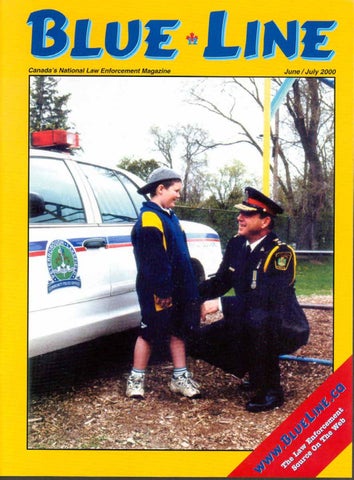
Volume 12 Number 6 June/July 2000 Blue Line Magazine 12A-4981 Hwy 7 East Suite 254 Markham, ON L3R 1N1 Phn: (905) 640-3048 Fax: (905) 640-7547 e-mail: blueline@blueline.ca
- Publisher Morley S. Lymburner e-mail: bluelinepublisher@home.com - General Manager Mary Lymburner, M.Ed. e-mail: bluelinesales@home.com - Editor-In-Chief Blair McQuillan e-mail: bluelineeditor@home.com - Advertising Mary Lymburner Rhonda Shuker Bob Murray - Pre-press Production Del Wall - News Editor Les Linder e-mail: bluelinenews@home.com - Contributing Editors Communication Skills Terry Barker Robert Lunney Police Leadership Dave Brown Tactical Firearms Tom Rataj Technology Gino Arcaro Case Law Blue Line Magazine is published monthly, September to June, by Blue Line Magazine Incorporated with a mailing address of: 12A - 4981 Hwy. 7 East, Ste. 254, Markham, Ontario, L3R 1N1. Individual magazines are $3.50 each. Subscriptions are $25.00 per year or $40.00 for 2 years. (US/Foreign - $50.00) All articles are protected by copyright. No part of this publication may be reproduced or transmitted in any form or by any means, electronic or mechanical, including photocopying and recording or by any information storage or retrieval system without permission from the publisher. Internet activity is monitored and use of material on the Internet is restricted. All material submitted for publication becomes the property of Blue Line Magazine unless other arrangements have been made with the publisher. The authors, advisors and Publisher accept no liability whatsoever for any injuries to persons or property resulting from the application or adoption of any of the procedures, tactics or considerations presented in this magazine. Readers are cautioned and advised that articles presented herein are edited and supplied for your personal awareness and should not be used for further action until appropriate advice and guidance is received from a supervisor, Crown Attorney or other person in authority. Established in 1988, Blue Line Magazine is an independent publication designed to inform, entertain, educate and upgrade the skills of those involved in the law enforcement profession. It has no direct control from a law enforcement agency and its opinions and articles do not necessarily reflect the opinions of any government, police, or law enforcement agency. Blue Line Magazine is a private venture and as such is not funded by any level of government agency, union or association. Printed in Canada by Garson Graphic Services Inc.
- AffiliationsInternational Association of Law Enforcement Planners Canadian Advertising Rates & Data International Police Association The Police Leadership Forum The Canadian Press Newswire Periodical Publishers Exchange
ISSN #0847 8538 Canada Post - Canadian Publications Mail Product Sales Agreement No. 176796 June/July 2000
Inside This Edition Publisher’s Commentary It’s time we had this little talk... again!
4
BEE-ing part of the solution Community works to eliminate bullying through new program
6
OACP 49th Annual Convention
10
Enforcing the laws of the water Marine units predict increasing compliance with new boating regulations
11
Novel approach to elder abuse puts Blue Line Magazine in the picture
14
New Westminster police crackdown on drug dealers
16
Technology Security at your fingertips
18
Correspondence Letters to the publisher
21
2000 Leadership Nominee Youth centre a reality due to officer’s hard work
22
Mail carriers join police in crime prevention
26
Vitality The silent cop killer
28
Case Law Investigative detentions and searches based on articulable cause
29
Victoria forms strike force against repeat offenders
34
Blue Line Classified
40
The Response was overwhelming Law enforcement community turns out for annual trade show
44
The Back of the Book Is Canadian society going to pot
46
The Peterborough Lakefield Community Police Service, the hosts of the 49th Annual Ontario Association of Chiefs of Police Conference, is featured in this issue. To learn more about the police service’s innovative antibullying program turn to page 10. For a breakdown of the exhibitors who will be attending this year’s OACP Conference refer to page 11. In Blue Line’s continuing effort to enhance the lives of you, our loyal readers, we bring you a new column in partnership with the Police Fitness Personnel of Ontario. The column, dubbed “Vitality”, will cover topics including physical education, stress management, nutrition and general health. You can find the first installment of this new series on page 28. Naturally, there’s also a wealth of other vital news and information for you to enjoy.
List of Advertisers Aegis Accident Support Services Applicant Testing Services Bell Mobility Blue Line CA Blue Line News Week Blue Line Reading Library Canadian Body Armour Canadian Forces Liaison Council Canada Law Book Cases Unlimited ComnetiX Constable Cigar Co Corporate Security Cruisers C.V.D.S. Dalhousie University DSM Law Enforcement Products Federal Auction Service Flex-O-Lite Flying Cross by Fechheimer Glock Inc. Gordon Contract Sales Hartt Boot & Shoe Co. Henry’s 3
34 9 36 15 30 39 39 17 17 37 32 33 36 25 43 38 19 25 21 29 47 4 20, 28 23 40
Hi-Tech Sports Canada Howard Leight Industries Laser Labs Litton PRC Marcor Automotive Maritime Services Police & Security Micro Video Pads Fitness & Supply Panasonic Canada Pelican Products PK Van Bodies Police Ordnance Pride in Service Rocky Shoes & Boots Safe Restraints Sirche Laboratories Sturm Ruger & Co. Tetragon Tasse The Walter Fedy Partnership Triform Business Systems Ltd True Traffic Safety Twaron Products Inc. Westervelt College XTE Custom Designed Outerwear
Blue Line Magazine
8 6 15 23 18 29 26 40 7 2 24 19 16 48 42 5 13 31 30 27 26 41 11 27
Its time we had this little talk... again! 2. Public Relations - The external body armour with it. Okay! Run that one around your head carriers, regardless of background coloured a while and think of all the defences that can shirts, give the officer a soldier look that is con- come from various themes that could reduce a trary to closer community interaction. Rather “murder one” to a “manslaughter”. It would If there is one bad thing about the on-set of than being approachable the officer has the take little creativity to get a cop killer out after summer it is the fact that officers will not be appearance of a Vietnam era soldier posted just five years instead of life. Yes that is right. When able to cover up those horrible dark blue body south of the DMZ. The flak suit appearance is you wear an external carrier you are wearing a armour carriers. They are dangerous and make intimidating. I could add that the same prob- cop killers defence. The only solution at this late stage is to go every officer, I mean every officer, look pretty lem exists with some of the trousers and jump ridiculous. suites officers are wearing today that bring them back to concealing the armour. And don’t give I have a three point argument to make here closer to a more military and intimidating ap- me this whining about it being too uncomfortthat I would challenge others to respond to. pearance. At one time police agencies were able. Number one - you will never see a Geormore interested in giving their officers a more gia State Trooper wearing external carriers 1. Target Zone Identification - Officers wear- dressed and authoritative appearance. There is anytime of the year. They also wear properly ing the contrasting coloured carriers are send- a place in a specialized function for special designed ribbed undershirts to draw away the This edition of Blue Line News Week has been sponsored by: ing out a strong message to an armed criminal apparel but certainly not in common usage. sweat. Number two - the armour today is a lot that freedom is theirs if you hit the target out- There are some good looking and functional lighter and more comfortable than the stuff that side the shiny dark zone. Let’s use a little com- trousers available... so why aren’t they being generated the interest in external carriers to begin with. mon sense here. Even if you are a “Rambo” cop worn? And this last point of interest... don’t make you must realize that even in the military the vests blend in colour and tone with the rest of 3. The ultimate defence - It hasn’t happened a public squabble about it. Do not make local the uniform. As the carriers are now designed yet but we have been patiently waiting. I have headlines about the issue. We want to keep the the officers are carrying a big sign that says brought this point up before and I think it is criminal element stupid about the whole issue. “don’t aim here!” And if there are any officers time it was seriously but quietly discussed. Any Never let them know your weaknesses nor all out there who still think they can shoot better officer wearing those vests could be inadvert- your strengths. Do not broadcast them. Do not than the bad guys they are wrong. These nutzoids ently helping criminals get away with murder. discuss them. And most of all don’t walk around love their guns and practice with them far more The attitude of too many lawyers these days is with them as part of your everyday attire. Your comments are expected and anonymthan the average copper. (Average? NO... ma- to get their clients off the hook any way possijority!) ble. Truth, justice and ethics has nothing to do ity respected. by Morley Lymburner
June/July 2000
4
Blue Line Magazine
BEE-ing part of the solution Community works to eliminate bullying through new program Children in the community of Peterborough Lakefield, Ont., are learning how to resolve conflicts and over come intimidation at school thanks to a partnership between teachers and the local police service. The Bullies have an Effect on Everyone, or Bee program as it is better known, is a pro-active crime prevention program which has formed a partnership between school personnel, parents, students and the Peterborough Lakefield Community Police Service. Launched in 1998, by Cst. Gary Takacs, Sgt. Chris Wilson and school principals Karen Procyk and Donna Southern, the BEE program was designed to: • provide information on bullying behaviour and aggression to school personnel, students and parents using simple, clear and consistent language. • increase problem solving and conflict resolution skills. • increase empathy and peer recognition of the effects of bullying and the damage it causes. • provide support and education to victims on
June/July 2000
WORKING TOGETHER: (L-R) Cst. Gary Takacs, Angella Windrem, Chris Tomas, Donna Southern, Stephanie Harder and Chief Terry McLaren are dedicated to the BEE program. how to protect themselves from being bullied and provide a consistent framework for dealing with acts of bullying. The BEE program, which meets the Ministry of Education and Training guidelines, in-
6
cludes three main components for delivering the program’s message. Workshops are presented to every member of the school staff to provide information continued on page 9
Blue Line Magazine
about bullying and its effects. Parents are invited to information sessions on bullying and how to help their children when they are intimidated or victimized. School assemblies are also held to supply students with information on bullying and proactive methods on how to report and deal with incidents of bullying. Students are also asked to provide information outlining where they feel most unsafe on school property. This information is then reviewed and results are shared with teaching staff so that increased adult supervision can be added to problem areas at school, such as washrooms, locker areas or playgrounds, for example. “These three components provide a common language between parents, school staff, students and police,” said Cst. Gary Takacs, the BEE program co-ordinator. “Incidents and reports of bullying are dealt with in a consistent manner. Problem solving and resolution of conflicts are key to the program. “The program is flexible and allows for schools to modify and individualize the program so it meets the needs of all students.” The BEE program was implemented at Peterborough’s Grove Public School in the fall of 1998. Located in the south end of the city, the school has a student population of 310 and serves students from kindergarten to grade eight. “Commitment was the key word to successful implementation during the first year,” said Principal Donna Southern, who oversees 17 teachers in addition to educational assistants and support workers at the school. “Many meetings took place with our community police officers and local support agencies for elementary school-aged children.” Southern said that during the first year of implementing the BEE program there were many workshops and staff development opportunities which allowed everyone to critique available resources and plan the best way to use the learning material in a classroom setting. “School assemblies and the institution of regular problem solving sessions were vital to the success of this program in the first year,” Southern said. “As a staff we believed that a common language and a predictable pattern of resolving differences would benefit everyone who works and learns at (Grove Public School).” During the first year of implementation, assemblies were held to teach students about the cornerstones of the program. During the gatherings, students learned about respect for themselves and their peers, how to differentiate between tattling and telling and had opportunities to be recognized for leadership in problem solving. Supervising teachers patrolling the school yard during recess worked to help the children turn lessons into action. Following recess, teachers are dedicated to taking time to talk with students about problems and positive outcomes. “In the second year of the BEE program we are experiencing continued growth and success,” Southern said. “It is evident that the students have begun to use a common language and that they are familiar with the process used June/July 2000
SPREADING THE WORD: A police officer explains the BEE program to school chidlren. for solving problems.” Teachers who are new to Grove Public School are given an overview of the program and a parent handbook has been published for distribution to all families who are new to the community. Daily student planners were published this year, which include a copy of the BEE program handbook and the school’s code of behaviour. “Before this program was implemented ... there was a range of needs and a variety of ways that people chose to solve problems,” said Southern. “There were altercations on the yard and there were differing opinions about conflict resolution. We ran a safe school and we believed we could make a good place better. “We still have diversity in our student population. We still have different opinions. But we are using strategies to develop respect for ourselves and each other with a common goal in mind - to reduce conflict and bullying tactics at the school.
“The BEE program has been instrumental in realizing that goal. We are proud to be on the leading edge of this positive partnership with the Peterborough Lakefield Community Police.” Since 1998, the BEE program has continued to grow. The program has recently been launched at 15 public and elementary schools and is being introduced into seven high schools within Peterborough County. Several police services in Ontario and the United States have requested and received a copy of the BEE program and are in the initial stages of adapting the program into their schools. “The success of the program is based on the commitment, caring and flexibility of all participants,” said Takacs. “The program continues to be a learning process for everyone involved. “ For information on the BEE program contact Gary Takacs at (705) 876-1122.
Bullies have an effect on everyone According to a 1997 research project conducted by Craig & Pepler, bullying occurs every seven minutes on playgrounds and every 25 minutes in the classroom. The study also found that thousands of kids stay home from school each day due to the fear of being bullied.
Bullying tends to take place in areas where groups of children congregate and where there are activities. Most incidents of bullying last less than 60 seconds and most are neither seen or reported. Boys generally bully boys, while girls will bully both sex almost equally.
Is your police service facing budget constraints? LET US HELP !
Improve service to your citizens and save money Participating police agencies realize immediate benefits Currently under contract with Toronto, London, Barrie, Thunder Bay and Ontario Provincial Police
Call Steve Sanderson for more information 111 Toryork Drive, Weston, ON M9L 1X9
Tel: 877 895-9111 Fax: 416 745-5555 Web: www.accsupport.com
SUPPORT SERVICES LTD. 9
Blue Line Magazine
ONTARIO ASSOCIATION OF CHIEFS OF POLICE 49TH ANNUAL CONFERENCE
Chief Terrance M. McLaren Host Chief
Evinrude Centre, Peterborough, Ontario June 25 - 28, 2000
Deputy Chief Ken Jackman Conference Chair
LIST OF EXHIBITORS 3M Canada Company ............................................................... 7 Accident Support Services Ltd ................................................ 56 ADT Security Services Canada Inc ....................................... 3, 4 AEGIS Engineered Textile Products Inc .................................. 70 Applicant Testing Services Inc ................................................ 67 Atlantic Police & Security Supply Ltd ...................................... 71 Avita Technologies Corporation .............................................. 58 Bell Mobility ....................................................................... 88, 89 Blauer Canada ........................................................................ 41 Blue Line Magazine ................................................................ 31 Carruthers Shaw & Partners Architecture & Design ............. 101 CGI Information Systems ........................................................ 48 Clearnet .................................................................................... 8 CODE 3 Public Safety Equipment Inc ............................... 39, 40 Coffee Reception .................................................................... 19 Ministry of Correctional Services ............................................ 33 ComnetiX Computer Systems Inc ........................................... 49 C.V.D.S. Inc ............................................................................ 66 D&R Electronics Co. ......................................................... 37, 38 Dacks Shoes ........................................................................... 75 Daymen Outdoor Marketing ...................................... 98, 99, 100 Dictaphone Voice and Data Management ............................... 94 DSM Law Enforcement Products .............................................. 5 Eurocopter Canada Limited .................................................... 25 Evin Industries Ltd ................................................................... 76 Federal Signal Corporation ............................... 73, 74, 103, 104 Ford Commercial Lending Services .......... 80, 81, 82, 95, 96, 97 Flying Cross by Fechheimer ................................................... 51 Fred Deeley Imports ................................................................ 62 General Motors of Canada Diesel Division ....................... 92, 93 Glock ....................................................................................... 86 Gordon Contract ..................................................................... 34 HI-TEC Sports Canada Ltd ..................................................... 78 IES Range 2000 ...................................................................... 57 Imagis Cascade Technologies Inc ...................................... 9, 10 Correctional Services of Canada ............................................ 26 Integrated Justice Project ....................................................... 35 Intergraph Public Safety Canada Ltd ................................ 43, 44 Kinwood Audio Visual Inc ........................................................ 15 Lees Motivation Canada ......................................................... 55 LiveLink Television Network .................................................... 17 Lucent Technologies ............................................................... 22 M.D. Charlton Co Ltd ........................................................ 46, 47 Marcor Automotive .................................................................. 79 Mega-Technical Holdings Ltd .................................................. 13 Mercury Marine Products and Services .................................. 32 Michaels of Oregon ................................................................... 6 Niagara Regional Police Video Training Alliance .................... 84 Ontario Association Property Standards Officers .................... 45 Ontario Police College ............................................................ 12 Ontario Police Supplies ............................................... 52, 53, 54 Outdoor Outfits ........................................................................ 11 Pacific Safety Products Inc ..................................................... 68 Panasonic Canada Inc ............................................................ 20 Peel Regional Police ............................................................. 102 Printrak International Inc ......................................................... 59 June/July 2000
10
Pro Install Multi Systems Inc ............................................. 29, 30 R Nicholls Distributors Inc ................................................. 27, 28 Royal Canadian Mounted Police Missing Children’s Registry 42 Schweizer Aircraft Corp ........................................................... 21 Second Chance Body Armour ................................................. 72 Serengeti / On Court Sports Ltd .............................................. 19 Sir Sandford Fleming College Centre for Law & Justice ......... 16 Strath Craft Ltd ........................................................................ 91 Streamlight Inc ........................................................................ 36 TAS Communications .............................................................. 14 The Canadian Corps of Commissionaires .............................. 83 The Walter Fedy Partnership .................................................. 85 Trilcor Correctional Industries ................................................. 69 Uniforms Uniforms .................................................................. 61 Blue Line Magazine
Enforcing the laws of the water Marine units predict increasing compliance with new boating regulations by Dave Brown “Sure, I think safety courses should be mandatory for all new boaters,” the anonymous boat owner sighed as he pointed out another boat speeding past the refueling dock while he pumped gas into his cruiser. “There are a lot of crazy people out there,” he added. “They don’t seem to know much about the rules.” When it was pointed out to him that it was illegal to pump fuel into his boat while his unsuspecting family waited patiently on board, he protested. “What do you mean? I’ve been doing this for years. How long has that been in place?” Once the boater’s family was safely on the dock and well away from the hundreds of litres of explosive gasoline gurgling into the thirsty tanks, the marine officer patiently handed out another safety booklet. Just another day on the water for one of Canada’s marine enforcement units. New Boating Regulations Prior to 1999, the rules of the waterways had not changed much in 20 years. What has changed is the increasing number of people who enjoy recreation on the water. The Canadian Coast Guard estimates that there are now over 7 million people who spend time on one of Canada’s countless waterways every year. Boating is a perfect family activity that caters to everyone from sunbathers to sightseers. Humans are naturally attracted back to the sea and it seems that boating is a package of instant fun; just add water. The Canadian Coast Guard also recognized that a significant number of boaters were not making it back to the dock at the end of the day. Every year, an average of 6,000 boating accidents resulted in more than 200 fatalities. Boating may be the last bastion of freedom in society, where you can go wherever you want to go, when you want to go, and how fast you want to go. But no one should be paying for that freedom with his or her life. In January 1999, after a three year period of consultation with various groups and individuals, the Coast Guard’s Office of Boating Safety announced changes to the Small Vessel Regulations. These changes deal with what many Canadians have been requesting in the way of operator competency provisions, age and horsepower restrictions and new mandatory safety equipment requirements. The new equipment rules, age restrictions and additional safety precautions came into effect on April 1, 1999. The operator competency provisions were introduced in a graduated manner, starting September 15, 1999. Currently, youths born after April 1, 1983 operating a motor-driven boat will require proof of competency on board. On September 15, 2002, all operators of motor-driven boats less than four meters long will require proof of competency. June/July 2000
ON PATROL: Ensuring boater safety on the water is a top priority for marine officers. By September 15, 2009, all motor boat operators will have to provide proof of competency. To meet these requirements, boaters can pass a boating safety test administered by an accredited course provider or can provide proof of passing a previous boating safety course.
Boating courses and challenge test sessions are springing up around the country. One course provider reports that he is seeing entire families show up for safety courses. “It’s great to see. Many people recognize that boating safety is not negotiable. They’re
Westervelt College Excellence in Education Since 1885
Now Call nrol To E
Police Foundations Training delivered in an intense one-year “Police Academy” environment Advanced status available to those with: • 1 or 2 years Law and Security • 1 or more years University • Career related experience Westervelt College 1060 Wellington Road London Ontario N6E 3W5 1-877-668-2001 (519) 668-2000
Teaching tomorrow’s professionals, today!
Toll Free
11
Blue Line Magazine
not waiting until it becomes mandatory. rates. At the beginning of the 1999 seaThey’re turning it into a real family son, we gave out a lot of warnings and copies of the Safe Boating Guide. Now, event.” it’s rare to inspect a boat that doesn’t Boaters will receive an operator card have everything.” valid for life if they pass the test with a Marine enforcement is a prime exscore of 75 per cent or more. ample of positive policing. Officers make Also introduced for 1999, were restricevery effort to turn encounters with boattions on unsupervised youths operating ers into a positive experience for all. motor boats. Those under 12 years old can “Most people have good intentions, only operate boats under 10 HP. Youths but sometimes they just don’t know,” between the ages of 12 and 16 can operWinnipeg Police Service River Patrol ate boats under 40 HP. No person under Officer Heather Mowat said. 16 may operate a Personal Watercraft. If she stopped a boat and all the kids Another example of the consultation were wearing their life jackets, they process at work is with the new lifejacket were handed a package of LifeSavers regulations. The Coast Guard acknowlcandy and their names were entered into edges that a Personal Floatation Device (PFD) can come in many far-out colours CRASHING THE WAVES: The RCMP patrols the water. a draw to win their very own PFD or a stuffed bear. They call this campaign these days besides the traditional orange “Be a life saver. Wear a life jacket.” or red. It is more important that people The Ontario Provincial Police hand out actually wear their PFDs than the shade of col- ter all, there are no roads, lanes or smooth pavesurvival whistles marked with the OPP logo. our. New floatation vests have been approved ment on the water. “They are a great giveaway,” reports Casey. For those not exercising due care and cauthat can appeal to fashionable boaters of all ages. And it is no longer acceptable to use those tion on the water, penalties can be imposed “They’re inexpensive, they keep people aware under the Criminal Code of Canada or the new that we’re out here, and it’s an important safety soggy old seat cushions as lifejackets. Contraventions Act. Previously, police had no item. I just wish they would give us more than choice but to lay boating charges that required the few dozen we’ve passed out already.” Enforcement on the Water What do most boaters forget? One marine Enforcing strict controls on such a popular an appearance in court. Now, they have the recreation like boating may be seen by some option of ticketing offenders in a manner simi- unit officer says, “The most responsible operators still forget their documentation. We want to as the police out to spoil people’s fun. How- lar to a traffic ticket. see proof of age and the registration for the boat.” ever, marine enforcement units not only have Predictions for 2000 to hand out the tickets, but they also have to Safety in Perspective Increased vigilance on the water seems to deal with the injuries and deaths that result from Why is public safety on the water such a be working. irresponsible behaviour. Kenora OPP Cst. Ron Casey reports, priority for police agencies in Canada? Let’s The Ontario Provincial Police, for example, report that they investigate an average of “We’re seeing a lot less alcohol on the lake put it into perspective. Ownership of a boat has 50 fatalities a year in Ontario alone. Tragedy nowadays. We mostly catch boaters with a cou- always been seen to be more socially accepton the water can happen swiftly. In July 1999, ple of beers instead of three or four cases like able than the ownership of something potentially more dangerous like a firearm. Yet, if rookie defenseman Dmitri Tertyshny of the we used to.” Winnipeg Police Service River Patrol Of- misused, both can kill. NHL’s Philadelphia Flyers was killed when he In this country, special licences to acquire was tossed over the bow of a 17-foot power- ficer Ray Duma agrees. “There’s much less alcohol on the river firearms have been required since 1978. Manboat after it struck a wave. According to RCMP in Kelowna, BC, the now. It used to be like the wild west out here datory firearms safety education has been in place since 1994. boat propeller severed Tertyshny’s carotid ar- sometimes.” Firearms operator licences, in the form of Officers also report that the new safety tery and he died before he could be rushed to Possession Licences, will be required as of shore. Indications were that the occupants were equipment requirements are becoming more January 1, 2001. Every firearm in this country consuming alcohol but an investigation deter- widely recognized by boaters. Cst. Jeff Wiebe of the Kenora Police Serv- must be registered at the latest by January 1, mined that the driver was not legally impaired. 2003. Yet, according to Statistics Canada, there Marine officers know, however, that even ice credits boat safety organizations, marine are more than three times as many people dysmall amounts of alcohol can have a major ef- dealers and retailers for really promoting the ing in boating accidents as are killed in firefect on judgement. Driving a boat takes a cer- new equipment regulations. arms accidents every year. “We’re already seeing better compliance tain amount of skill and good judgement. AfIf the Canadian Coast Guard and various marine enforcement units have their way, the number of boating fatalities is going to drop Are you prepared for a day on the water? substantially in the next few years. New equipment rules have added to the • a bailing can or manual water pump. “After all,” comments one marine patrol safety equipment that is required to be on • a sound-signalling device such as a horn officer, “it’s not rocket science. Know the rules or loud whistle. board every boat, from the smallest canoe of the road, know where you are at all times, • one Class 5BC fire extinguisher if the boat to the largest cruiser. and save the beer for relaxing on the dock.” is equipped with an inboard engine, a fixed Using an example of a typical 17-foot “And,” he added, “give boats bigger than fuel tank or a fuel-burning appliance. - a waboat equipped with an outboard motor, this you lots of room to manoeuvre. We call that tertight flashlight or three approved flares. is an outline of the minimum equipment rethe ‘Right of Weight.’” • navigation lights that meet applicable quired to be on board: standards if the boat is out after dark. • one Canadian-approved lifejacket of approWhen not hard at work writing for Blue This is only an outline of one typical boat. priate size for each person on board. Line or teaching firearms courses, Dave • one buoyant heaving line of 15 meters or For details on the requirements for each size Brown has been known to sit in his boat, boat, consult the Safe Boating Guide as pubmore. making motor boat sounds and splashing • one manual propelling device such as a lished by Canada Coast Guard, Office of cold water on his face. Contact Dave at paddle or oar, or an anchor with 15 meters Boating Safety or visit the Coast Guard web blueline@blueline.ca. site at www.ccg-gcc.gc.ca. of rope or chain, June/July 2000
12
Blue Line Magazine
Novel approach to elder abuse puts Blue Line Magazine in the picture Harm can include physical, financial or psychological abuse, and neglect can be active, passive or self-inflicted failure to look after the Reprinted with permission from The Ontario older person’s well being. So, why seniors? Well, they may be widPolice Video Training Alliance owed or living alone, which makes them an Dear Blue Line, easy target for financial abuse. Or they may be I am writing to you concerning the abuse socially isolated. There could be some degree and neglect of older persons. of physical impairment or mental incapacity. They say, a seasoned sled slides swifter than It’s the offenders that surprised me... a green one... well, I guess if I’m getting quicker they’re not always strangers. Like family memat anything, I’m fast becoming an expert on how bers, for instance. Or service providers, who tough being a senior citizen can be. have access to the older person’s home. They After 30 years on the job, I thought I’d seen may have emotional problems of their own, pretty much everything, all manner of misdeed. which may not make them the best person to But now I’m seeing another side of the fence. be looking after an ailing older person. Some I never would have guessed just how big a are dependent on the older person for money problem it is, or how only one in 25 seniors and housing. Others may be involved in subwill even report it. stance abuse, drugs or alcohol. Right now, one in three Canadians are over And then there’s the physical abuse, which 50, and the number of 65 year olds will double is any act of violence causing injury or physito 7.5 million in the next 30 years. Think about cal discomfort. It could be sexual assault, forit, most of you are included in that demographic. cible confinement, or even tampering with I am hoping that you’ll give an old veteran medication dosages. officer a few minutes of your time to report a Financial abuse is the dishonest use of an crime... the hidden crime, abuse and neglect of older person’s money or assets and psychologiour elderly. cal abuse, which is any action or comment which Just today, I discovered to my horror, that may cause emotional anguish, fear or diminish my dear neighbour Maria was defrauded out the self-esteem or dignity of the older person. of $5,000 to do roof repairs that she didn’t need. And remember, when you see one type of Turns out these repair guys showed up on her powers of attorney abuse. abuse, chances are there’ll be others. You’ve door and said they were doing work in the area These guys actually develop sucker lists, got to consider arrest, and if you do arrest, rec(and) said it was a cash only deal. selling them to one another, to bilk seniors out ommend bail conditions. I’m sure that most of your readers are think- of thousands of dollars. Financial abuse is the As for neglect, there’s active neglect, the ing, “so what.. .it’s a civil matter.. buyer beware.” most prevalent form of abuse, but it’s just the intentional failure of a caregiver to fulfil their Frankly, I probably would have said the same proverbial tip of the iceberg. care giving responsibilities. thing when I was on the job. But now that I’m After Maria got conned, I made some calls Again, you have to think about charges. on the other side of the fence I see how much and found out some police services actually Criminal negligence for example, or failure to the citizens in our communities, seniors in par- have special senior support officers. Their defi- provide necessaries of life, perhaps? ticular, really need the police. So much rests on nition of abuse and neglect of older persons is, Officers may also come across passive nethe ability, training and skill of you, the front any action or inaction by any person, includ- glect, which is the non-intentional failure of a ing the older person themselves, which causes caregiver to fulfil their responsibilities, and self line officer, to keep the sharks at bay. Poor Maria got conned by a pro, and gen- harm to the older person. neglect, which is the failure of the older person erally these guys are profesto provide for his or her own sional cons who target areas essential needs. densely populated with senSo, why are these iors. And that’s fraud folks, crimes so seldom reported? plain and simple. Section Most often it’s a failure by Life for senior citizens has just been from the community,” Latner said. 380 of the (Criminal Code) the senior to recognize that made safer thanks to the efforts and perThe project was revived on Jan. 4, was recently amended to inthey’re victims, or just desistence of the Hamilton-Wentworth po1998 and dedicated strictly to working clude the offence of... denial or rationalization. lice and a dedicated officer. for senior citizen safety and security. The frauding the public or any They may feel shame or As a result of a traumatic incident inprogram also focuses on assisting invesperson, whether ascertained guilt. It could be a fear of volving a senior, Cst. Liz Latner was comtigations of abuse and neglect of seniors. or not, of any property; reprisal, abandonment, or pelled to approach the police service and Latner’s success with the program money or valuable security, worse yet, institutionalisarequest programs to provide help for has also helped to lead Niagara, Calgary, or any service. tion. It may be cultural isabused seniors. and Edmonton police to develop their own That’s right, its no sues like customs or beliefs, Latner was given the opportunity to opsimilar programs. longer a civil matter... it’s a fear of authority, or lanerate a six-month pilot project in 1995, to Despite all the achievements, Latner criminal. guage barriers. determine the needs of seniors in the comsaid the project still needs to be expanded And that direct marketSometimes it’s a distrust munity. She followed up occurrences involvto include partnerships with crown ating, unsolicited, door to of police. A belief that the ing seniors and developed presentations and torneys, investigators and other commudoor, special price for senpolice will only make matiors con is by no means the programs specifically for them. nity partners. ters worse. only fraud perpetrated on So, what are the signs, Unfortunately, the project was termi“The issue of senior abuse cannot be the elderly. There’s the indicators you should be nated after six months. However, Latner resolved just by the police, we need the telemarketing scams, mail looking for? Due to the hidpushed to have it reinstated. community partnership,” she said. “Evemarketing scams, the phony den aspect of this abuse, the “We had such a tremendous response ryone has a role to play.” bank examiner con, and red flags are often subtle. Excerpt from Dear Blue Line: Abuse And Neglect of Older Persons
Officer dedicated to seniors
June/July 2000
14
Blue Line Magazine
In complaints of financial abuse, watch for suspicious signatures on cheques or other documents, or unusual banking withdrawals, or bogus contracts. With physical abuse, look for unexplained injuries or untreated medical problems like cuts, bruises, swelling, grip marks, burns, injuries to scalp, evidence of hair pulling, or a history of so called accidents. You may detect fear, uneasiness, depression, disorientation or withdrawal. Victims may be avoiding contact with the caregiver. You might see poor hygiene, bedsores, dehydration, or a lack of personal necessities such as dentures, eyeglasses or hearing aids. These indicators alone are not conclusive that abuse exists. Further investigation is required to allow for an accurate assessment. Investigating abuse against the elderly can be a challenge for police officers. The victim may see a police presence as intrusive, suspicious and potentially harmful, so you need to develop a sense of trust and understanding with the older person. You can accomplish this by displaying simple respect (and) protecting their dignity. Assess the victim’s needs. Is it a physical or emotional situation? Allow the victim to describe the incident in their own words. Keep questions simple and short, clear and precise. Some older adults may need time to collect their thoughts, and shouldn’t be rushed. Police are sometimes the last to find out about the abuse or neglect of an elderly person. Interview family, friends and neighbours to gain further evidence. However, it’s important to identify any
June/July 2000
other community resources that may already be involved, like the community care access centre, Health Department (and) financial institutions. The Office of the Public Guardian and Trustee may also have been involved and can provide invaluable assistance or evidence. You have a responsibility to the victim, so let them know what is going to happen next, especially if the investigation involves a family member. And keep them updated on the case status, any charges, arrests, and court dates. If they’re required to testify, explain the criminal court process to them, and offer court preparation either by police, or by victim witness assistance. And make sure that the victim knows who you are, how to contact you, and what the report number is. Finally, if the victim is determined to be at risk, then you must ensure that community support services are in place. Thank you for the opportunity to acquaint the readers of Blue Line with this issue. Dear Blue Line: Abuse And Neglect of Older Persons is an 11 minute police video that teaches officers about various forms of elder abuse. The training video writers, Jim Hayden and Liz Latner, decided to place the viewer through the eyes of a retired police officer writing a letter to the editor of Blue Line. To obtain a copy of the Elder Abuse Training video phone (905) 6883911 Ext. 4343.
15
Blue Line Magazine
New Westminster police crackdown on drug dealers by Peter Young
The City of New Westminster is the geographic centre of the Lower Mainland of British Columbia. Crime has traditionally been concentrated in the downtown area, in, around and between two of its three Skytrain Stations. Data from 1996 and 1997 indicates that in pure numbers, hard drug incidents (heroin and cocaine) were higher in New Westminster than any other Lower Mainland municipality except Vancouver. Even Vancouver, which is 10 times the size of New Westminster, had only three to four times the number of drug incidents. In late 1997 and early 1998 New Westminster was literally invaded by crack dealers. Like most law enforcement agencies, the New Westminster Police Service maintains various and flexible drug enforcement strategies. However, no matter which strategy was tried, they all failed to make a dent in the problem. In fact, drug trafficking continued to grow along with other crime such as theft from autos and break-ins. Police were frustrated and business people and residents where at their wits end. In the downtown area, business had dropped by up to 50 per cent. One business owner put it succinctly when she said, “If this continues, most local businesses will close or locate elsewhere, thus creating a true drug infested area or slum.” Some businesses did close. Because New Westminster is a core city with high population density, the local police, with a sworn strength in 1998 of 102, maintains a permanent street crime unit of 10 officers and a drug squad of four officers. Yet, that was not enough. Something more dramatic had to be done. The city hosted a two-day seminar featuring speakers from Seattle and Portland as these cities had dealt with similar problems. The police worked with other city departments and citizen groups, particularly the downtown Busi-
No Die s! r ge Cha A Ring of Exceptional Quality to Show Your “Pride in Service” CALL TODAY FOR YOUR FREE COLOUR BROCHURE Check out our new web page at www.pride-in-service.on.ca
1-800-535-9735
Pride in Service P.O. Box 705 Pickering, Ontario L1V 3T3 Fax: (905) 509-6933
June/July 2000
deploy a narcotics-trained police dog. The long-term plan was to implement drug education and rehabilitation services. The first concentrated response in March 1998 was named Project Crackdown. The plan was to flood the downtown core with a highly visible police presence for two weeks utilizing a zero tolerance approach. New Westminster Police members were accompanied by BC Transit Security and Canada Immigration. In two weeks 54 charges of trafficking or possession for the purpose of trafficking were laid against 42 individuals. The operation was a tremendous success but impossible to sustain due to the resources required. All administrative, community services and many investigative members were pressed into front line service for the two weeks. Funding was obtained from city council to hire additional members and for more overtime for members to assist downtown on their days off. This funding supported a downtown policing initiative which utilized both traditional and innovative policing methods which included: - establishing an enforcement task force linking neighbouring municipalities for a coordinated enforcement regime. • rigid enforcement of “no go” zones. • police saturation and large sweeps of the downtown augmenting on duty staff with members on call-out, administrative staff and members from other police services • increased use of police service dogs on foot • a “Van Attack” programme • increased use of “breach of the peace” and
s• ness Improvement Association, in planning and implementing strategies. A three-stage strategy was developed. The immediate plan was to develop an intensive police operation. The intermediate strategy was to: • reassignment of additional members to the street crime unit. • place additional members on street patrol duty through voluntary overtime. • open a community police resource centre in the downtown core. • assign a neighbourhood constable to the downtown core. • create a highly visible Citizens Crime Watch Patrol.
16
Blue Line Magazine
other Criminal Code remedies. • cooperative assistance with other city departments, other police agencies, Canada Immigration, Social Services and appropriate U.S. agencies. These efforts continued through the summer and fall of 1998. It was a frustrating time for police members as it seemed that no matter what they did, what strategies they used, new traffickers appeared and the crack cocaine continued to flow. All members of the New Westminster Police Service with assistance from city staff, the citizens of the community and many outside police and government agencies were committed to solving this problem. The police members continued to persevere in spite of the seem-
ingly hopeless situation. They put in extra time and gave up days off week after week. They put aside other jobs. They accepted the extra work. There were more reports, more prisoners to process, more court cases, as well as the other day-to-day demands for service. In the end, due to the commitment and perseverance of the men and women of the New Westminster Police Service, a successful conclusion was reached. By the end of October 1998, the streets were virtually clear of drug dealers. The users left. The downtown was taken back by the citizens. That may sound dramatic, but the people that lived through these times, consider it an understatement.
Over a year later, with the sustained effort of police members and citizens alike, the police service has been able to eliminate attempts by drug dealers to return. In addition, other property crimes have decreased significantly as a result.
Peter Young was sworn in as Chief Constable of New Westminster Police Service on June 2, 1996. Previous to that he spent 25 years with the Peel Regional Police in Ontario. Chief Constable Young can be reached at (604) 525-5411.
BC tightens up on organized crime The Organized Crime Agency of B.C. is trying to stay ahead of co-ordinated, smarter, and richer organized crime gangs. Dave Douglas, head of the Organized Crime Agency of B.C., told a news conference that biker gangs, Asian gangs, and other criminal organizations used to be isolated groups 10 years ago. That has since changed and now gangs are pulling together and sitting down to plan how they will organize criminal activity, Douglas said. Douglas’ comments were made just as Attorney General Andrew Petter announced $3.8 million in new funding from the provincial government for the Organized Crime Agency. “This government’s commitment was demonstrated last year when we established the agency,” Petter was quoted as saying. “We are increasing that commitment by providing new provincial funding to target organized crime groups at their highest level.” Douglas said organized crime is involved in drugs, alien smuggling, prostitution, credit card fraud, murder and other serious offences. He also said marijuana growing operations are as serious as other crimes because the money from the growing operations are used to fuel other criminal activities. The attorney general said stiffer sentences will be handed down by judges once the courts realize the growing operations are linked to serious crime. Douglas said over the past year the agency has established partnerships with other police organizations, used experts from other police departments for special operations, established its own proceedsof-crime unit and raided more than 30 marijuana growing operations, a magic mushroom factory and illegal gambling and credit card counterfeiting operations. Over the next year the agency’s priorities will include proceeds of crime, firearms trafficking and Internet pornography. June/July 2000
17
Blue Line Magazine
Security at your fingertips by Tom Rataj
Lost, forgotten, or insecure access-cards and passwords may be a thing of the past with the growth of biometric technologies
Physical security systems, whether designed to control access to a building or a computer system, are intended to allow entry only to authorised persons. Most modern systems rely on a magnetically encoded access card and/or a password. Unfortunately, both access cards and passwords are subject to loss, theft or just plain forgetfulness. In our modern world, we are often faced with remembering numerous passwords; one for one bank machine, one for the other bank machine, the office voicemail system and the mobile phone voicemail system, Internet access at home and the office, etc. To overcome these problems, people will often borrow other people’s access cards when they have forgotten their own. They use the same password for a variety of systems, or even just conveniently write their passwords down, where they are again subject to loss, theft or forgetfulness. Fortunately, the emerging biometrics industry is providing a simple, convenient array of technologies that allows for the effective implementation of an almost foolproof security process that eliminates most of the problems with current security systems. Derived from the Greek words for “life” and “measurement”, biometrics is poised to become the standard for physical security systems. Biometrics The biometrics industry encompasses a whole category of technologies that use unique physical characteristics to positively identify an individual. The more common biometrics systems use fingerprint, or iris and retina scanning to differentiate between people, while some of the less common systems use voice patterns, keystroke rhythms, and even a person’s unique odour (really, I’m not kidding).
“The biometrics industry encompasses a whole category of technologies that use unique physical characteristics to positively identify an individual.” This is a rapidly growing industry that has solutions in just about every field where positive identification is required. Fingerprint scanning is the most common, despite the fact that there is a small but vocal opposition that views it as having an aura of priminality. Iris and retina scanning technologies have also shown a great degree of success because they are viewed as being less invasive than fingerprint scanning, although there have been some concerns raised about possible eye damage.
AUTOMOTIVE COMPLETE REFIT PACKAGES FOR POLICE VEHICLES - SUSPENSION - BRAKES - DRIVELINE REBUILDING - ACCESSORIES -
“DOUBLE THE SERVICE LIFE OF YOUR FLEET”
1-800-263-8621 Service and Quality for over 22 years 516 Parkdale Ave. N., Hamilton, ON L8H 5Y5 Fax 1-800-461-1458 marcor@marcor-genie.com June/July 2000
18
How It Works While the method of reading a physical characteristic varies from system to system, the actual process generally works the same way. Physical characteristic are captured and converted into a digital form and stored for later comparison. Touchstone, a popular fingerprint scanning and authentication system developed by Toronto-based Mytec Technologies Inc., uses a process that creates a mathematical description of the unique characteristics of a person’s finger. When the person uses the system to gain access to a building, the system scans the finger, and compares the mathematical description with the one already on file. This system never stores an actual image of the finger; therefore it can never be used to create a fingerprint image such as the ones used in a police AFIS. In an implementation of Mytec’s Gateway system at Canadian Imperial Bank of Commerce (CIBC) processing facilities across the country, an additional security measure was also added to the system. A second finger was enrolled for each employee. If an employee were being forced to provide access to the facility by a criminal, they could use their “emergency finger” to silently alert security officers of a potential problem without raising any suspicions. Regardless of the type of physical characteristic used, biometrics systems also use one of two common matching schemes. In fingerprint imaging for example there are one-to-one (1:1) matches, as well as one-to-many (1:N) matches. The 1:1 system works in conjunction with another system such as a pass-card or password, while the 1:N system stands on its own, requiring nothing more than a valid characteristic to be successfully matched. Some fingerprint based systems being developed can even sense if the finger is alive and attached to a bone, thereby thwarting even the more “dedicated” criminal types. The actual fingerprint scanning technology differs from system to system. Some systems use ultrasonic scanning while others use one and two-dimensional imaging to map the characteristics of the print. The use of retinal scanning is fairly low, because it is considered to be an invasive technology. It requires the user to place their eye within several centimetres of the infrared reader that then maps the blood vein pattern in the inner area of the eye. Iris scanning, on the other-hand, is less invasive because the user can be about one metre away from the scanner. The CIBC and Royal Blue Line Magazine
Bank are both testing bank-machines outfitted with iris scanning technology developed by NCR. Facial recognition is another technology being touted by some firms because it is less invasive, and can use readily available technologies such as standard video cameras, which can be used from several metres away. One facial recognition system uses thermal imaging technology to compare bloodflow patterns, and the resultant temperature differences in a person’s face. This system has been demonstrated to work from across a room. Voice-recognition is another biometrics technology that has been available for several years. Users are enrolled into this type of system by repeating a pass-phrase several times. Future access is granted by comparing the spoken pass-phrase with the one already on file. This technology may have limited potential because of environmental conditions. Keystroke dynamics measures an individual’s typing pattern. This technology goes back over 20 years, having originally been developed at Stanford University. Keystroke dynamics is an excellent solution for computer access control since it required no additional hardware such as a fingerprint scanner.
Various vendors have developed fingerprint-scanning systems for personal computers. Either integrated into the keyboard, or as a stand-alone mouse sized device, these scanners provide a basic level of security that works best in an already secure environment. Deister Electronics demonstrated a combination fingerprint-scanner/proximity-card system at Blue Line’s Response 2000 tradeshow held this past April. User enrolment was a quick and simple process, with subsequent access approval taking only several seconds. Conclusion Biometrics technology would appear to be poised to revolutionise the entire security industry. Rapidly dropping prices and increases in the computing power required to make biometrics systems feasible are driving the industry forward in leaps and bounds.
Further information can be obtained through some of the following sources: www.mytec.com, www.polaroid.com, w w w. s i m p l e t e c h n o l o g y. c o m , www.deister.com or by searching on the Internet for biometrics.
Stalkers go on-line Cyber-stalking is a new type of crime in which women and children are particularly vulnerable, according to an Internet investigator. Cyber-stalking occurs when unwanted sexual advances or hate-filled threats are received by an individual through e-mails, chat rooms, or newsgroups. “You don’t know the person at the other end of the Internet,” Det. Cst. Bruce Headridge, an Internet investigator for British Columbia’s Organized Crime Agency, was quoted as saying. “You don’t know who they are and what they’re capable of doing.” Headridge, a 27-year Vancouver police veteran, has taken part in about 300 criminal investigations involving the Internet. Most cases involved pornography or child sexual luring, in which pedophiles try to contact potential victims through the Internet. There have been 13 reported cases in B.C. during the past two years in which on-line predators lured or attempted to lure youths away from their homes, Headridge said. The Vancouver officer also said Internet search sites used to locate friends and relatives can be used by pedophiles for sinister purposes. June/July 2000
Dalhousie University Certificate in Police Leadership “Police Leadership and Management Development really puts into perspective where I am in my professional development and what I need to improve to get to where I want to be.”
Courses in this unique distance education program include: • Police Leadership and Management Development • Communication Skills for Police Personnel • Problem-Oriented Policing • Community-Based Policing • Police Human Resource Management • Budgeting and Financial Management • Legal Issues in Policing • Policing and the Law of Human Rights • Advanced Police Leadership • Managing Police Performance: Coaching Skills *
Cst. Warren McBeath Royal Canadian Mounted Police Terrace, BC (includes a 3-day workshop)
Register for the Fall term prior to July 7, 2000 and receive $50 off your tuition. To obtain a brochure or Registration Form, call our Information By Fax line at 1-800-932-0338 or locally at 481-2408 and request Document #0211. For information on our Certificate Program, call Sherry Carmont-MacBean, Program Manager at (902) 494-6930 or write to Sherry via e-mail at CPL@Dal.Ca or to the address below: Henson College, Dalhousie University
Learning Solutions for a Changing World
6100 University Avenue Halifax NS B3H 3J5
19
Blue Line Magazine
Exterminating computer bugs by Reid Goldsborough
Nonetheless, the computer industry is largely responsible. Too many companies feel it’s cheaper to release According to popular mythology, buggy products and fix them only the term “computer bug” came about when there’s an uproar. That’s why when a moth flew into a U.S. Navy for years savvy users not in urgent computer in 1945, jamming a relay. need of the latest features have In reality, “bug” was used as far back waited until the maintenance release as Thomas Edison’s time to signify a or service pack became available glitch in a mechanical system. before upgrading their software. Whatever the origin of the name, Another long-standing word of bugs have a way of raising their ugly wisdom is to make sure you look at faces at the worst possible times, like the read-me file that usually comes when you’re rushing to finish a project with a program. That’s where the or when you’re learning new features, software developer warns you about making you feel you’re doing someincompatibilities and other issues it thing wrong. has uncovered since finalizing the Computer bugs, in short, can reprogram and printing the manual. ally bug you, and unfortunately It’s also a good idea to keep up they’re a pervasive, destructive, and BUGGING OUT: Computer bugs can do a lot of damage to systems and files. However, there are ways to keep bugs at bay. to date with the latest bug fixes for inexcusable infestation. your important programs and with The most widely talked about bug last year was the Y2K problem, caused when feel compelled to release new versions every the latest software drivers for your video card software engineers didn’t anticipate that their year or sooner to keep up with the competition and other peripherals. You can do this manuprograms would still be in use when the new and maximize quarterly earnings figures. Prod- ally by periodically visiting the web sites of uct testing is sacrificed. the respective manufacturers. Some programs millennium rolled around. To be fair, many “bugs” aren’t software or include within them automatic update rouBugs in large computer systems in the past have led to failed space missions, airplane hardware glitches at all but instead are malfunc- tines. tions caused by user error. Computer industry There are also third-party utility programs, crashes, and the death of hospital patients. In the personal computer world, bugs in insiders have a crusty acronym for what to do such as Symantec’s LiveUpdate Pro at http:// Norton Utilities 3.0 caused a huge number of about this - RTFM, which spelled out decorously www.nortonweb.com/tool_lu.shtml, that are designed to automatically update your programs problems, including corrupting vital system stands for Read The Friendly Manual. Also, many bugs are inevitable, particularly and drivers, but the number of products included files that rendered computers inoperable. Many people who upgraded to Microsoft Windows those affecting WinTel machines. The popu- in their databases is far from comprehensive. If a product’s bugs prevent you from get98 found that some of their programs or hard- larity and open architecture of PCs running ware peripherals no longer worked. Some peo- Microsoft Windows and based on an Intel or ting important work done, and phoning or eple with Iomega Zip disks today are experi- equivalent microprocessor has led to the de- mailing the manufacturer’s technical support encing the “click of death” in which drive heads velopment of hundreds of thousands of differ- staff doesn’t solve the problem, try to return it become misaligned over time, causing a click- ent software and hardware products, and track- for a refund or credit. ing the many millions of possible combinations With some bugs, the best approach is to ing sound and data loss. Most PC bugs are caused by insufficient is virtually impossible. Conflicts are the una- develop work-arounds. I frequently save e-mail and Usenet messages to my hard disk for fuproduct development cycles. Companies often voidable result. ture reference. Sometimes the save-as function works. When it doesn’t, I simply copy the text, paste it into my word processor, and save it from there. Perhaps the ultimate solution to bugs is to refuse to buy in the future from manufacturers who’ve put out seriously buggy products in the past. They’ll listen if you hit them where it hurts: their wallets. According to a recent survey of readers by PC World magazine, Intuit, Adobe, and Ottawa-based Corel are among the companies that do the best job of squashing bugs, while Microsoft and Symantec are among the worst. Additional styles available You can learn more about any specific bugs affecting your software or hardware and bugs in general at the following Web sites: BugNet at http://www.bugnet.com and ZDNet’s Bugs! at http://www.zdnet.com/ 552 QUEEN ST. W. 20 BERMONDSEY RD 288 WILLIAM AVE. zdhelp/filters/bugs. TORONTO, ON SCARBOROUGH, ON WINNIPEG, MB TEL: 416 504-5503 TEL: 416 757-6214 TEL: 204 989-2146 Reid Goldsborough is a syndicated FAX: 416 504-6818 FAX: 204 989-2106 columnist and author of the book Straight Talk About the Information Superhighway. e-mail: gordoncontract@netcom.ca He can be reached at reidgold@netaxs.com THREE LOCATIONS TO SERVE YOU BETTER or http://members.home.net/reidgold. June/July 2000
20
Blue Line Magazine
ADVERTISEMENT
I just read the letter to the editor from Cst. Scharfe of the Ottawa Carleton Police, concerning the suspenders that he has designed. I am a 13 year GD Cst. in Surrey, who has suffered with back problems since being hit on duty by a drunk driver. To ease the ongoing pain , I have tried new boots, nylon duty belts and even went as far as not wearing my body armour to ease the effects. I read an article in Blue Line Magazine about the suspenders and contacted the National Research Council for a copy of their study. I was fortunate enough to speak to someone involved in conducting the study, and after consultation with my supervisor, I became a case study for the research council. I don’t know what effect the suspenders have on the soft body armour, but I can tell you that nothing has helped my back more than these suspenders. Not only have they redistributed the weight of my duty belt, they have eased my pain 30 to 40 per cent from what it use to be. I still have worse days than others, but, I can tell you that I wouldn’t work without them now. I have found they have eliminated the need to continually pull up or adjust the duty belt and I no longer have to tuck my shirt in throughout my shift, as it stays in place. The suspenders also have improved my posture 10 fold, which in a sense is better for my health. The suspenders also work better than “keepers” and provide better support for my sidearm. I would hope that if the RCMP decides to do a study, they look at the studies that have already been completed. Most people that have tried them, will not work without them. Cst. K.A. Baltus Surrey, BC I have been receiving your magazine free of charge for the last five years. I am not working as a specialist with our Traffic Directorate
now but want to remain one of your customers. I read your magazine with a lot of attention and curiosity. I find it interesting. However, personally I want to pay for the copy you will send. Marcel Duguay Boucherville, SQ Editor’s Response What can we say Marcel? Having someone enjoy our work so much that they are willing to pay to receive it is the greatest compliment we could ever receive.
It is evident that the Canadian Firearms Centre - Firearms Act “First Annual Report” published in your February 2000 issue is pure government propaganda. The report appears intended to dupe Canadians into believing that Bill C-58 is going to reduce firearms related crime. It claims there is an “urgent” need for this legislation as during the 26 years spanning 1970 and 1996 there were “37,000 deaths from firearms wounds.” This is inflammatory and presents statistics in a manner which are partly or wholly fallacious. What the report cleverly does not state is that only a fraction or “4,000 of these deaths were murders of which approximately 364 were by rifles (or) shotguns.” The number of people murdered over the past 26 years with rifles or shotguns does not justify legislation targeting the law-abiding owners of these types of firearms. It is a fact that criminals conceal and use guns that are almost always obtained illegally in the first place. It is a fact that there are already adequate laws in existence to deal with firearms offences including there safe storage, but to be effective it is imperative that they be rigorously enforced. R. Moore Winnipeg, MB
A Weekly Digest of News for the Law Enforcement Community
If you need current information on any of the following topics you need to subscribe to Blue Line News Week Police Procedure Forensic Evidence Community Based Policing Court Rulings Legislation Awards
Criminal Code Charter of Rights Special Investigations Unit Amendments Helicopters Firearms
Major Arrests Solicitor General Correctional Service Technology Police Act Inquests
To order a subscription call 905 640-3048
52 Weekly Issues by Mail $100 per year June/July 2000
52 Weekly Issues by Fax $200 per year 21
Blue Line Magazine
The Police Leadership Forum
2000 Leadership Nominee
Youth centre a reality due to officer’s hard work Sr. Cst. John Kuehni’s initiatives involving youth in the Mattawa, Ont., area have been significant in fostering a positive relationship between area youth, the police and the community. Kuehni began to build bridges with the community when members of the public expressed concerns over idle youth congregating in the business section of Mattawa and the resulting acts of mischief. Kuehni, who has been in the service of the Ontario Provincial Police for 12 years, went into the community and identified interested people who were willing to work toward improving the issues surrounding area youth. In the fall of 1997, Kuehni organized a board of directors for the Mattawa and Area Youth centre. Kuehni, who has been a member of the Northeast Region Emergency ResponseTeam for six years and is a qualified radar instructor and a coach officer, was selected as the chairman. The board of the newly formed Mattawa and Area Youth Centre (MAYC) developed a mission statement: To provide our young people with a safe and secure haven where they can feel free to play and grow in a nurturing environment where they are valued within a positive community standard. Further to provide opportunities for youth to learn more about themselves and their world so that they can make free and informed choices about their future with the help of caring community members. In 1998, Kuehni arranged for the MAYC board to tour successful youth centres in the Ottawa Valley and to attend related seminars.
This was a valuable stage of education for the board members. The MAYC Board sought the cooperation of the Town of Mattawa and arranged for a youth night at the local arena. In the fall of 1998, a policy and procedures manual and a constitution were developed and passed by the board of directors. At this time the Mattawa and area youth centre began looking for a permanent structure. The board began negotiations with the Town of Mattawa to take possession of the old and abandoned Town Hall. This was agreed to in principle but the town required assurance that the citizens residing in the area of the proposed site would not be adversely affected and that the MAYC would not become a hang out. The MAYC then applied for and obtained a corporation number and received a non profit status. Now funds through lotter- THE VISIONARY: Sr. Cst. John Kuehni is dedicated to ies and other organizations be- maintaining a centre for youth in the Mattawa, Ont. area. came possible. The old town hall was not suitable for occupation and the town required month’s expenses each year for five years. The that the MAYC bring the structure up to stand- response was overwhelming and the MAYC ard before they would provide the lease for one raised $60,000 to cover a five-year period. dollar a year. Again, Kuehni and Vic Jeske went Kuehni met with T.L. Smith who operated into the community seeking partnerships and a local cable television station and requested financial support. that he participate in fund raising for the MAYC Presentations were conducted with area by hosting a two-day telethon featuring local businesses and community groups. The plan talent. The telethon put the MAYC into the pubwas to have each participating business or com- lic living rooms. There was a huge outpouring munity group donate $1,000 to cover one of support and the telethon generated an additional $12,000. With finances now in place, Kuehni consulted with area businesses seeking best prices or donations of material and labour required to to work under ice or near docks. bring the building up to code. “It will be of great assistance Between April and May 1999, Kuehni orto our divers... in cases where ganized and participated in work bees at the there is hazardous debris in the Old Town Hall, now known as the Mattawa water,” Denson was quoted as and Area Youth Centre. Walls, plumbing and saying. heating systems were repaired and brought up The Shadow, which is tethto standard. New flooring was laid and a fire ered to a 220-metre cable, can be escape built. operated from a remote control With the building suitable for occupation, based on a boat or land. It runs on Kuehni met with Youth Employment Services two electric motors and comes with search( Y.E.S. ), who had expressed interest in startlights and a colour video camera. ing an office in Mattawa. A lease was signed Several officers have already undergone and Y.E.S. now operates an office out of the training to operate the vehicle. Mattawa and Area Youth Centre. Police have been giving diver safety In May of 1999, the board received a famore attention since Waterloo Cst. Dave vourable response for an application for Nicholson died trying to recover the body $100,000 from Human Resources and Develof 12-year-old Mark Gage in August opment Canada. The application had been pre1998. pared and submitted to be applied to the hiring of 10 youth and a qualified co-ordinator.
New ally for Durham police divers Durham Regional police can now add a remote-controlled submarine to their list of equipment. The unmanned submarine dubbed Shadow, worth about $50,000, is being donated to the police service by SeaSmart Technologies. Durham police say the submarine is a fine addition to their dive team because it will increase diver safety. SeaSmart president Doug Carl said the vehicle will allow officers to see what is underwater without having to send a diver down. “The device can go much deeper than a diver and stay underwater almost indefinitely,” Carl was quoted as saying. Durham Deputy Chief Derek Denson said the vehicle will help officers who have June/July 2000
22
Blue Line Magazine
The Police Leadership Forum
2000Leadership LeadershipNominee Nominee 2000
able to attend schooling facilities in This program was designed to develop North Bay, a city 60 kms. west of their skills and provide them with experi“Kuehni’s effort and Mattawa. Participants are invited to atence making them more employable in the commitment to improving the tend the MAYC and use the workstation, future. which has a direct link by computer to On July 1, 1999, the MAYC opened life for citizens of the Mattawa their courses in North Bay. its doors to the public and on the July 14, area through the development The Mattawa and Area Youth Centre the grand opening was held. The opening now enjoys a clean safe building with a of the Mattawa and Area Youth was attended by local dignitaries who youth membership in excess of 250 area were escorted by the MAYC employees Centre has been outstanding.” teenagers and an average daily youth atwho proudly displayed four donated comtendance of 40. puters, two pool tables, a ping pong table, Y.E.S. holds monthly seminars at the TV room and canteen. The MAYC Board of Directors arranged and raising money for the ongoing expenses centre assisting youth in preparing for and obtaining employment through education on for local artisans to sell their crafts on a con- of the Youth Centre. signment basis creating a learning environment Kuehni and Jeske were approached about resume preparation and interview skills. Kuehni’s effort and commitment to improvfor the youth. Skills in public relations, com- the possibility of developing a partnership being the quality of life for the citizens of the puters, marketing, stock management and fi- tween the MAYC youth and the community nance management are all skills learned by the elders. From this Youth And Mattawa Seniors Mattawa area through the development of the Mattawa and Area Youth Centre has been outyouth at the centre. (Y.A.M.S.) was developed. With Kuehni’s commitment to the Town of This program was developed so that sen- standing. And through the two-and-a-half years it Mattawa that the youth centre would be more iors can call the MAYC requesting the servthan a hang out for local children, the board ices of the youth for jobs such as raking leaves, took to develop his vision, Kuehni remained one of the highest producers of criminal and had made plans to keep them busy. shovelling snow or just company. Tools are traffic related charges at the North Bay DetachParticipation in the Mattawa Voyager Days supplied by the youth centre and no fee is rement during this time. made the children responsible for running a quired from the senior. youth fun day with a barbecue, face painting, The MAYC provides a service to Contact For information on the Police Leaderswimming, skateboarding competition, tennis North which is an out reach education proship Forum contact Mark Stainsby at and a street dance in the evening. As for the gram for northern residents. The MAYC pro(416) 808-7483. rest of the weekend, Kuehni, other board mem- vides a workstation for persons that are unbers and children, could be found selling pizza
SERVICE FOOTWEAR with all the quality features of our famous Motorcycle and Riding Boots. • ‘Wetlock’ Treated, Waterproof Bogwalker Steerhide’ Uppers • 360º Solid Goodyear Welted • Durable Lug Sole • All Around Padded Topline
• 3/4' Wide Steel Shank for Support • Nickel Plated Solid Brass Eyelets • Fully Leather Lined Quality Leather • and fully Rebuildable Footwear Since 1834 They’re beautiful, comfortable and rugged. Start your own love affair Contact: Sid McInnes 595 Trethewey Drive Toronto, Ontario Canada M6M 4C1 Local 416-241-5216 Fax 416-241-5210 Toll Free 1-800-268-1433 - Comfort - Durability - Quality -
June/July 2000
23
Blue Line Magazine
Security society honours police by Les Linder Police officers and investigative units from Ontario received a well-deserved pat on the back in April for their dedication and outstanding achievements in law enforcement. A police awards luncheon, hosted by the American Society of Industrial Security (ASIS), gave recognition to several Ontario police agencies. The law enforcement appreciation luncheon, held in Toronto, was designed to honour public law enforcement officials who have saved lives, prevented loss or destruction, successfully followed a fraud case, or done other outstanding deeds. Police chiefs and deputy chiefs from the eight different police services that received awards, spoke proudly of the achievements and contributions their officers and units have made. Toronto Police Chief Julian Fantino spoke highly of the force’s Hold Up Squad for its role in robbery apprehension, suppression, and deterrence. He said the successes of the program and other initiatives resulted in a significant reduction in the number of robberies being committed annually. Fantino said there was a decrease of 30 per cent in financial institution robberies and 24 per cent in retail business robberies over 1996. “These numbers continue to decline and further reductions have already been achieved this year,” he said. In an effort to reduce the number of robberies being committed each year, Toronto police formed the Hold Up Squad as part of a robbery reduction initiative in 1996. The squad made partnerships with businesses to improve the quality of suspect photographs obtained during robberies, made frequent educational presentations, concluded several robbery investigations and made numerous arrests in high risk situations against violent criminal gangs. “In partnership with others, through hard work, dedication, and commitment, (the Hold Up Squad) will continue to play a lead role in robbery apprehension, reduction, and deterrence across the Greater Toronto Area,” Fantino said. While the Hold Up Squad was concentrat-
June/July 2000
ing on suppressing disorderly and violent robbers, the RCMP focused on pulling the reigns in on organized crime groups. The Combined Forces Special Enforcement Unit Superintendent Ben Soave, a 30-year veteran of the RCMP, is the officer in charge of the Combined Forces Special Enforcement Unit (CFSEU). He was presented with an award for his unit’s success in investigating, disrupting, and dismantling organized crime groups. Assistant Commissioner Al Hutchinson, commanding officer at O Division with the RCMP, cred- HONOURED: Det. Peter Abi-Rashed, Cst. Joanne ited Soave with expanding the Waite, Det. Cst. Monica Denreyer, Supt. Ben Soave, Sgt. CFSEU from the original comple- Joe Presad and Staff Sgt. Chris Ostler receive awards. ment of 17 members, to the current level of 60 members from Toronto, the Ontario Provincial Police, York Region, order to deal with the 3,000 vehicles stolen Peel Region and the RCMP. between 1996 and 1997, the regional police “The unit has proven to be very success- formed a task force with one goal in mind - to ful, and indeed, some of the most notable at- reduce vehicle theft. The Community Battling tacks on organized crime over the past few Auto Theft program was put in place to make years have been spearheaded by CFSEU,” it happen. Hutchinson said. Project COMBAT was implemented by Chirs Ostler, who has recently been promoted Det. Peter Abi-Rashed to staff sergeant. COMBAT provided team A complicated and difficult murder inves- members with training in case preparation and tigation posed an interesting challenge for Det. interview techniques. Peter Abi-Rashed from the HamiltonDuring the enforcement phase, investigators Wentworth Regional police Major Crime Unit. successfully identified a large number of car Abi-Rashed conducted a homicide inves- thieves and chop shops. Many suspects were tigation surrounding the discovery of a dismem- arrested and charged during the operation. Ofbered body in April 1999. His investigation lead ficers also aggressively followed up all judicial to the arrest of Sam Pirrera on charges of mur- releases to minimize the risk of recidivism. dering his wife Beverly Davidson and another Superintendent Tony Turner from Durham woman. Pirrera died of a drug overdose in Feb- Regional police said that although the probruary while waiting for his court appearance. lem still exists, the program has managed to Abi-Rashed was credited with taking on the significantly reduce vehicle thefts. monumental task of solving the nine-year-old “Over the life of the project, high-speed homicide case and bringing closure to it chases in our region were reduced 50 per cent,” through strong leadership. Turner said. “Perhaps attributable to the wide exposure of the project, or the fact that many Project COMBAT known car thieves were arrested at the time.” Auto thefts have been a ruthless problem facing Durham Region for several years. In Det. Cst. Joanne Waite In November 1999, several credits cards shipped through the mail went missing in York region. Det. Cst. Joanne Waite received several complaints that people had not been receiving their credit cards. Waite quickly followed up on the case and contacted a company known as GE Capital to determine at what point the cards were stolen. She discovered that the cards were being taken from the mail. Waite subsequently called Canada Post security and soon discovered that the cards were being stolen by a private courier company contracted by Canada Post. A sting operation was set up and resulted in the arrest of a courier after 18 pieces of mail recorded by Canada Post went missing. The ac24
Blue Line Magazine
cused was charged with various fraud and credit ing hate crimes, said Halton police Chief Ean card thefts exceeding $150,000. Algar. “This incident shows the type of coopera“The high school liaison program has been tion that police have with government and pri- extremely successful and we anticipate expandvate corporate security,” Deputy Chief Terrence ing the program in the next year,” Algar said.. Kelly told the luncheon OPP Det. Cst. Monica attendees. “By working toDenreyer was also acgether, this matter was claimed for her role and “Whether in the brought to a successful comdedication with the Caledon pletion.” Crime Unit. private sector or While other police officHowever, officers were the public ers and projects received recnot the only ones to receive ognition for their investigaappreciation at the luncheon. sector, we’re all tive successes, Sgt. Joe Many of those who attended addressing the Prasad from Halton Regional applauded ASIS president police stood out with his Ray Humphrey for his same enemies.” achievements and efforts in words on the evolving partcommunity policing as it renership between security lates to education services and law enforcement, and within the police service. for hosting the event to honIn 1990, the Halton Regional police serv- our police officers. ice pioneered a new community policing proASIS is the largest international educational gram known as the Community Consultation organization for security professionals and has Committees of Halton. The program, which more than 25,000 members worldwide. They are Prasad was responsible for, promoted the de- dedicated to increasing the effectiveness and velopment of neighbourhood committees that productivity of security professionals and makinteract with service members and provided a ing advancements in security management. link to the neighbourhood’s problems and con“Security services and police services have cerns. so much to offer one another,” Humphrey said. Prasad was selected to head-up a newly “We need to learn to partner together and help formed Education Services Unit in 1995. He each other so that we don’t end up on a collisupervised the services of eight DARE consta- sion course. bles and three high school resource officers. “Whether you’re in the private sector or The children are taught everything from the public sector, we’re all addressing the same traffic and personal safety, to issues concern- enemies.”
True Blue laid to rest A bylaw banning the Toronto police union from political fundraising was quashed in May after the union and board reached an agreement on the issue. Under the deal, which was brokered by Chief Julian Fantino, the association has agreed to fundraise for charitable, but not political, purposes. Craig Bromell, the president of the association, said he was pleased the issue had been laid to rest and that fund-raising for charities could resume. The bylaw was brought into force earlier this year when the association refused to end True Blue, a telemarketing campaign in which donors received window decals for their vehicles. Critics feared motorists with the decals would receive preferential treatment from police on the street. The association was also accused of using funds raised to eliminate political foes, a claim the union denied.
June/July 2000
25
Blue Line Magazine
Mail carriers join police in crime prevention by Les Linder Toronto police are turning to snail mail and e-mail as simple yet effective tool in crime prevention. The police service is sending out safety tips and information on wanted persons through Canada Post’s Unaddressed Add Mail Program. They also send out an autodialer form to residents requesting their name, address, and phone number so that they can be informed of community events by phone and e-mail. Csts. John Pierrepont and Dennis Cadorette brought the program to 13 Division after realizing a better way was needed to reach the community with information. “There was an autodialer back in 1998 with about 400 people on it,” Pierrepont said. “That system was four-years-old and simply was not allowing us to get a hold of enough people.” That’s when he thought of contacting Canada Post for some bulk mailing. “The whole premise to help keep people safe from crime is quite simple: just get the message out to people so they know what to look out for,” he said. “And what better way to do it than to put the message right in their hand?” “We told (Canada Post) we were on a tight budget. So we got a corporate rate and we handled the printing. We had to keep it as cheap as possible.” Pierrepont pointed out that this messaging
system can sometimes be more effective than having officers canvas a neighbourhood because the messages can be sent out to a greater number of people. “Police canvassing is still important because people need to see the officers out there trying to help” he said. “But this helps to reach a wider area that could not ordinarily be covered by officers alone.” The first mailing was done in February 1999 and included crime prevention tips, an autodialer form and a composite drawing of a sexual assault suspect.
Former Mountie selected as chief There’s a new top cop in Summerside, PEI. Ian Drummond, a veteran RCMP officer with 32 years of experience, replaced former chief George Arsenault who retired in May. Drummond, a native of Freetown, PEI, was a staff sergeant at the East Prince RCMP detachment before accepting the chief’s position in Summerside.
Prior to his service in East Prince, Drummond was an RCMP commander in West Prince and Sheet Harbour, N.S. Drummond currently lives in Summerside. The search for a new chief of police began in March, with six candidates. Arsenault retired after 38 years of policing. He served as the chief of police in Summerside for 10 years.
“We did up a small story and sent it out to about 5,000 people,” Pierrepont said. In an effort to continue a crime management initiative in the south end of 13 division, Pierrepont had about 17,000 flyers on auto theft prevention tips sent to the community. He said about 22,000 homes were reached at a cost of $1,500. Pierrepont added that he thinks Toronto is the only police service to have used such a program in Ontario and that no other division on the force, aside from his own, has even used it. “Other divisions probably aren’t using it because they lack the funding. I also think we failed to successfully sell the idea. That’s something else we would like to focus on.” After hearing about the program, Det. Sgt. David Colwell from Toronto sexual assault squad said he thought the idea was great and would like to see it being used in his unit. “This program would be excellent for us to use if we could afford it,” Colwell said. “We have to scramble about and use the community newspapers and business faxes. But if we had that program in place, it would help with public safety issues.” The program at 13 Division received funding from the Community Policing Liaison Committee(CPLC). The cost to the CPLC is $68 for every 1,000 flyers delivered by mail carriers on their daily routes. The general corporate rate from Canada Post is about $120 for 1,000 copies, Pierrepont said. “Canada Post came down dirt cheap for us and that made it a whole lot easier to run the program.” He said the program had a good response from the community and received a lot of positive feedback. He is now waiting for funding to get a mailing for this year and is hoping to distribute about 50,000 copies of community safety information packages to residents in 13 Division. Pierrepont said he is trying to establish links with community corporations to see if he can get them to help with the funding. “It will take time, but I think we’ll get there.”
_______True Traffic Safety_________ Duty equipment for the professionals in the public safety services. Complete line of Uncle Mike’s gear Streamlight, Surefire & Pelican flashlights AND MORE! Contact us for more information: Tel: 604-277-5652 and FAX: 604-277-5654 June/July 2000
26
Blue Line Magazine
Toronto police to get a makeover by Les Linder
age of police showed that the public wanted officers to be highly visible, he said. Fantino said he was also concerned about the image, culture and heritage of the police, and wanted to preserve the dignity of the uniform with the new design. The new uniform will include a black, light, malleable hat with a red rim, and black cargo pants with discreet pockets. “What we want from this new uniform is for it to be serviceable and stylish. We found a nice tailor for the pants and they look like a million dollars,” Fantino
New attire is on the mind of Toronto police Chief Julian Fantino as he works on getting a fresh look for his officers. Fantino spoke with Blue Line Magazine about his plans to overhaul the current uniforms worn by Toronto police to make them more identifiable and eliminate confusion the public may have when approached by an officer. “There are so many lookalike uniforms out there,” Fantino said. “There are many instances where security Chief Julian Fantino guards look like police officers.” Many times officers don’t have the op- proudly said. portunity to identify themselves immediHe added that while he wanted the uniately, Fantino said. form to look great, he also didn’t want to go “Some officers in certain municipalities too far with the design and turn the profeswear a hat with a red band, others wear a sion into a fashion show. black band, and some officers wear caps,” “We’re quite pleased with the uniform. he said, while adding that the use of base- The troops have given a tremendous reball caps in Toronto will be eliminated. sponse.” “These variants can get people confused as Fantino said he is hoping for the first to who’s who.” new set of uniforms to be worn by frontline Research conducted in 1990 on the im- troops in January 2001.
• MUNICIPAL POLICE • SECURITY • • RCMP • BIKE PATROL UNITS •
XTE CUSTOM OUTERWEAR INC.
All weather outdoor technical clothing custom designed to meet your specific needs and desires! SERVING THE INDUSTRY SINCE 1991
100% DELIVERY GUARANTEE #1, 5510-3rd. St. S.E. / Calgary, AB T2H 1J9
1-800-214-6861
Police officer dies in motorcycle crash More than 1,000 mourners gathered in April to pay their last respects to a British Columbia police officer who was killed in a motorcycle accident. Mark Nieuwenhuis, a constable with the Delta Police Department, died in a single vehicle accident Mark sometime after 2 a.m. on Nieuwenhuis April 8 while on routine patrol. Nieuwenhuis was last heard from prior to 2 a.m., when he called into the police department saying he would be on the look out for drag racers who were the subject of a complaint call from a citizen. The 36-year-old officer was active and well known in the community. He wrote a traffic column for a local paper, raised money for needy families, and participated in a foundation to raise money for terminally ill children. Nieuwenhuis, who joined the Delta police nine years ago, is survived by his wife and three children. An estimated 1,600 people from across Canada and the U.S. gathered together for his funeral service. Nieuwenhuis served with the Winnipeg and Vancouver police services before joining Delta. June/July 2000
27
Blue Line Magazine
The silent cop killer Who is going to be the next victim? This criminal commonly strikes without any warning and leaves death in its path. Unless you are informed and act on the following information, you may very well be the next victim of high blood pressure. High blood pressure, also known as hypertension, can strike individuals of all ages and backgrounds. Hypertension can be very dangerous, resulting in stroke, heart attack, kidney failure, blindness and even death. Many of you reading this article have high blood pressure and are not aware of it. There are no signs or symptoms. That is why it is known as the silent killer. There are many things however, that you can do to reduce your chances of developing hypertension. First, assess your risk factors. The following factors increase your risk of developing hypertension: being 10 per cent or more above your ideal weight, eating salty or fried foods, smoking, drinking more than one ounce of alcohol per day, drinking more than two cups of caffeine per day, being physically inactive, or being a male between the ages 35 and 50. If there is a history of heart disease or high blood pressure in your family, your risk level increases even further and young black males also have a higher incidence of hypertension. It is important, especially for police officers, who don’t see their physicians as often as they should, to have their blood pressure checked regularly. The certified fitness consultant in your police service is trained to administer a blood pressure evaluation for you. It takes three or four readings over a few weeks to be accurately diagnosed. High blood pressure weakens the walls of small arteries which lead to strokes, heart attacks and kidney damage. The chances of dy-
ing at a younger age increases as blood pressure rises. This effect decreases with age, which really says that the younger one is, the more serious the problem is, in part because it has a longer period over which to have its deteriorating effects. Blood Pressure Research Studies have shown that between 10 and 20 per cent of the North American (10 per cent of Canadian) population are hypertensive. At least 2 million Canadians fall into the same statistics of which only 50 per cent know it. Of this 50 per cent, only one quarter to one half are receiving adequate treatment. When one considers that therapy can control hypertension in up to 90 per cent of all patients, one realizes the needless toll taken by this disease. Effects Of High Blood Pressure Blood is the body’s food supply. It is carried throughout the body by blood vessels. If blood vessels are healthy (clear of cholesterol), blood flows smoothly through the whole body. High blood pressure indicates that the vessels are narrower than normal. If these particular vessels are the arteries which lead to the heart, brain, eyes or kidneys, the food supply is cut off and can result in serious permanent problems or ultimately in death. Factors Affecting Blood Pressure In most cases, the direct cause of high blood pressure is not known. However, we do know that certain factors seriously affect your odds of developing high blood pressure. These factors include weight, race, heredity, age and consumption of blood pressure reactors such as alcohol, cigarettes, coffee, nicotine and stress.
GET MOVING: Regular exercise can help to reduce high blood pressure. What Can Be Done? Your blood pressure should be taken regularly, particularly if you are affected by one of the causes previously listed. It takes very little time and it is painless to be tested. Besides knowing your own blood pressure reading, there are other things that can be adapted by you in order to develop positive lifestyle habits. 1) Reduce your salt intake Taste your food before you eat it. You might like it. Avoid highly salted processed foods such as snack foods, pickles, canned soups or meals. Eat a varied low-fat die. 2) Reduce your weight This can be successful by eating well balanced meals. Two pounds per year doesn’t sound like much, but over 30 years, that’s 60 unwanted pounds. 3) Exercise The key is to get regular exercise. One or two hours a week is sufficient. 4) Reduce your alcohol and caffeine consumption 5) Reduce the stresses in your life 6) Reduce cigarette consumption which causes a narrowing of the arterial walls. High blood pressure is a serious illness and a most common of all life-threatening diseases among Canadians, especially police officers. Fortunately, it is also the most easily controlled. If you learn that you have high blood pressure, seek medical help and faithfully follow the treatment program prescribed by your doctor. Your reward can be a longer and healthier life. Peter Shipley is the Physiological Health Sciences Coordinator for the Ontario Provincial Police Academy and presently serves as the President of the Police Fitness Personnel of Ontario. For further information about this program or the Police Fitness Personnel of Ontario, he may be reached at 1-883-216-2589 or via e-mail at peter.shipley@jus.gov.on.ca
June/July 2000
28
Blue Line Magazine
Investigative detentions and searches based on articulable cause by John Cameron, L.L.B. Introduction - A Case Study On October 13, 1995 at approximately 5:30 a.m. two one-man units were separately dispatched to investigate several reports of “shots fired” in West Vancouver. The first officer to arrive in the area stopped and checked two males standing by a parked vehicle. The males told the officer that they hadn’t heard any gunfire, and suggested that the sounds were from their own car, which had been backfiring and was now broken down. The officer found the story believable and agreed to assist the males by calling a taxi. A short while later, the second officer arrived. The second officer, perhaps based on his additional years of police service, found something in both the circumstances and the story of the two males to be suspicious. The more experienced officer asked a few questions and found the answers he received to be evasive. He was also suspicious about the gym bag which one male was clutching closely. The officer asked what was in the bag and the male stated: “electrical tools.” Although the males claimed to be electricians, the officer noticed that their car contained only dry-wall-
ing equipment. The experienced officer decided that, in the interests of his own safety and that of his partner, he was going to look in the gym bag. He asked the suspect if he could look in the gym bag and the male holding the bag agreed. A number of break-in tools were found and the two males were arrested for possession of break-in instruments. Good police work, right? You bet it is. However, you can also bet that in this case, as in almost every other police investigation, the following questions arose: • Did the officers have the legal authority to detain and question the two suspects? • Did the officers have the legal authority to search the gym bag? The answers to those two questions are not readily apparent. The interesting problem posed by these facts can be summarized as follows: • The officers, although investigating a “shots fired” call, clearly had no reasonable grounds to arrest the two males until they searched the gym bag and located the break-in tools.
• The authority to search a suspect usually only arises as a common law authority incidental to the power to arrest. Cloutier v. Langlois, 74 C.R. (3d) 316, 53 C.C.C. (3d) 257 (S.C.C.) Some other statutory search powers exist but also must be based on reasonable grounds. For example, section 101 of the Criminal Code allows an officer to search a person, place or dwelling house for weapons without warrant in exigent circumstances when an officer believes on reasonable grounds that a weapons offence is being or has been committed. In order to justify the detention of the suspects and the search of the gym bag, the officers would require a lawful authority to detain and search when reasonable grounds to arrest do not exist. Before discussing whether such lawful authority exists, it is useful to consider the traditionally recognized source of lawful authority for police actions - reasonable grounds. continued on page 30
Flex-O-Lite “The Safety People”
POLICE SAFETY PRODUCTS ROAD FLARES TRAFFIC VESTS PORTABLE SPEED DISPLAY SIGNS POLICE LINE TAPES TRAFFIC CONES LIGHT STICKS SPOT LIGHTS
SET THE SAFETY EXAMPLE! FLEX-O-LITE LIMITED 15 Flex-O-Lite Road St. Thomas, Ontario N5P 3N5 Telephone 800-265-7661 Fax 800-267-3265 June/July 2000
29
Blue Line Magazine
Reasonable Grounds The most fundamental and important concept in the area of police powers of arrest and search are the statutory powers based on reasonable grounds. From the start of their training at the academy, police officers are instructed and reminded that their actions must be based upon reasonable grounds. The grounds to arrest must be reasonable not only subjectively, from the officers own point of view, but also when viewed objectively by a reasonable person standing in the shoes of the officer. R v. Storrey (1990),75 C.R. (3d) 1, 53 C.C.C. (3d) 316 (S.C.C.). Reasonable grounds are a flexible standard, and depend on the circumstances of any particular case. Although difficult to define, reasonable grounds can be understood as a level of certainty well above mere suspicion, and might be described as credibly-based probabil-
ity. It is also important to note that reasonable grounds do not require absolute certainty and are not equivalent to proof beyond a reasonable doubt. In the “shots fired” case, the officers acknowledged that they did not, before looking in the gym bag, have reasonable grounds to arrest the suspects for any offence. So could the officers lawfully detain the suspects without reasonable grounds to arrest? Suspicion Until fairly recently, it would have been correct to say that police officers could not detain suspects or conduct searches of suspects without reasonable grounds. The accepted position at common law was that a police officer was entitled to ask questions of any person, whether a suspect or not, but that person was also entitled to ignore the officer and walk
Quilters share their talent with the RCMP In 1997, a B.C. Mountie wrote to a local quilting guild in the hopes of obtaining four quilts to be used by the local police service. The Mountie, Staff Sgt. Ed Hill, wanted officers to give the quilts to children they came in contact with while carrying out their duties. “By the very nature of police work, officers often find themselves dealing with young children in very stressful and unpleasant situations,” said Hill, the officer in charge of the Gibson, B.C., detachment. “The quilts are meant to be COMMUNITY SERVICE: Staff Sgt. Ed Hill, given by the police officers to children Cst. Debra Weatherall and Mrs. Foxhall. in time of distress and need.” On March 25, 2000, two years after Hill keepsake, perhaps the only positive thing to had sent his request to the Sunshine Coast come out of their misfortune,” Hill said. The gifts supplied by the Sunshine Coast Quilters Guild, the group presented the Gibson and Sechelt detachments with a to- Quilters Guild were created through sheer tal of 54 quilts. The detailed, handmade kindness and Hill said he is very touched by quilts will be divided between the two de- the group’s generosity. “It was a very heartfelt and generous tachments and placed in police vehicles to donation,” he said. “The response of the be used when a child is in need. “They will be given to them as a lasting quilters guild, for me, was overwhelming.”
away. R v. Bazinet (1986), 25 C.C.C. (3d) 273 (Ont C.A.). This common law principle reflects one of the “Judges’ Rules”, a set of guidelines to investigative practices formulated by judges in England to assist police officers. Although dated, the Judges’ Rules still reflect many of the accepted standards of police conduct. The relevant rule stated: “Where a police officer is endeavouring to discover the author of a crime, there is no objection to him putting questions to any person, whether suspected or not, from whom he believes useful information may be gathered.” The officer can only stop the person from walking away if the officer arrests the person and that arrest must be based on reasonable grounds. In the cases where an officer has strong suspicions of criminal activity but which fell short of reasonable grounds to arrest for an offence, it appeared that no power to detain or search existed. The only exception which had been recognized to this general rule occurred in the context of impaired driving cases. Police road blocks had been recognized as a justifiable detention without reasonable grounds, but the courts were very careful to limit that detention power to the specific case of briefly detaining drivers and checking for sobriety. However, a recent series of court decisions across Canada have suggested that authority exists, at common law, for police to detain suspects for investigative purposes. That lawful authority does not arise from statutory authority, but from the police officer’s common law duties. Common Law Duties All police officers are familiar with the common law duties of police to preserve the peace, protect life and property and prevent crime. These general duties are usually briefly discussed during the early stages of legal training in the police academy and then the training moves on to the more substantive law relating to criminal code sections, case decisions and the Charter. Interestingly, it is these common law du-
Your Internet Law Enforcement
Building Solutions for Today’s Policing Challenges • Community Based Police Facilities • Energy Management • Adaptive Reuse and Asset Management • Investigative Engineering • Environmental Management
Source www.BlueLine.ca June/July 2000
546 Belmont Ave. W., Kitchener, Ontario N2M 1N5
Florida Office: 101 W. Main St., Ste.221 Lakeland, Florida 33815
Phone: 1-800-685-1378 Fax: 519 576-5499 email: solutions@twfp.com website: www.twfp.com
30
Blue Line Magazine
ties which have recently been held to provide the police with the lawful authority to detain for investigation. The courts have found that the common law duties imposed on police carry with them the grant of certain reasonable powers to carry out those duties. This doctrine of “powers associated with duties” has been recognized by the Supreme Court of Canada in R. v Dedman [1990] 2 S.C.R. 1140, 45 C.R 49 (S.C.C.). Investigative Detention The first case to suggest that police officer’s common law duties provide the authority to detain a suspect for the purpose of investigation was R. v. Simpson (1993), 20 C.R. (4th) 1, 79 C.C.C. (3d) 482. In Simpson, an officer had stopped a car after it left a suspected drug house. The officer testified that he had no reasonable grounds to arrest the occupants of the vehicle, was not enforcing any laws relating to driving offences and merely wanted to ask a few questions of the occupants to see if they would trip themselves up to give me more grounds for an arrest. Although in Simpson the detention was held to be arbitrary and unlawful, the court went on to state that in some circumstances police could lawfully detain for investigative purposes when the reasonable grounds to arrest did not exist.
“Until fairly recently, it would have been correct to say that officers could not detain suspects or conduct searches of suspects without reasonable grounds.” The facts in the “shots fired” example which began this article come from the case of R v Yamanaka (18 August, 1998 ) Vancouver Registry CA023333. Yamanaka is the second in a trilogy of cases in which the B.C. Court of Appeal has considered articulable cause and investigative detention. The other cases are R. v. Ferris (1998), 126 C.C.C. (3d) 298 and R v Lal (24 October 1998) Vancouver Registry CA023104. In relation to the lawful authority of the officers to detain the suspects and search the gym bag, the Court stated: 1. Did the officers have the legal authority to detain and question the two suspects? Yes, based on investigative detention and articulable cause. “The officers had been dispatched to the area to investigate several reports of gunfire. The [suspects] seemed to be out of place in the
neighbourhood at 5:30 a.m. The [suspect] said he was an electrician, which did not fit with what the officer saw in the car. The suspect was holding the athletic bag very close to his body. These facts, in my view, constitute articulable cause temporarily to detain the [suspect] for the purposes of investigating....” 2. Did the officers have the legal authority to search the gym bag? Yes, based on a protective power of search incidental to investigative detention. “..in proper circumstances, a warrantless and non-consensual search may be lawful for the purposes of completing the on-site investigation. One basis for such search, of course, is the concern about the possibility of the detainee having weapons which constitute a safety risk to the officers.” Investigative Detention and Protective Search The cases on investigative detention have held that in addition to the power to detain for investigation, a related power to search exists. It is important, however, to distinguish the more restricted search power which may arise in the investigative detention situation from the broader search power associated to arrest based on reasonable grounds. In the case of investigative detention the search power can best be understood as primacontinued on page 32
Articulable Cause The Simpson case proposed the following test: Police officers could lawfully detain suspects for investigative purposes where they did not have reasonable grounds to arrest, but did possess “reasonable cause to suspect that the detainee is criminally implicated in the activity under investigation.” The officer need not establish reasonable grounds to believe that the accused has committed an offence, only reasonable suspicion to believe that he may be criminally involved in the activity under investigation. Although reasonable suspicion is a lower standard than reasonable grounds, it must be based on specific facts and not simply on hunches and intuition. The reasons for the detention must be reasonable cause for suspicion when viewed objectively. The basis of such an investigative detention has been referred to as “articulable cause.” The Court in Simpson stated that the officer seeking to justify the detention “must be able to point to specific and articulable facts.” After the decision in Simpson it was unclear whether other courts across Canada would authorize investigative detentions based on articulable cause. Some legal scholars argued that the Simpson decision represented an inappropriate judicial creation of new police powers. See for example R.J. Deslisle “Judicial Creation of Police Powers” 20 C.R. (4th) 29.The “Shots Fired” Case Study June/July 2000
31
Blue Line Magazine
rily a recognition by the courts of officer safety issues. In R v Ferris (1998), 126 C.C.C. (3d) 298, Madame Justice Ryan writing for the B.C. Court of Appeal stated: “If the police have the duty to determine whether a person is engaged in crime or is about to be engaged in crime they should not be obliged to risk bodily harm to do so. It is my view that the police are entitled, if they are justified in believing that the person stopped is carrying a weapon, to search for weapons as an incident to detention.” Investigative Detention and Charter Warnings The cases on investigative detention have yet to specifically comment on the nature and timing of Charter warnings which should occur during a detention based on articulable cause. On the basis of existing case law, the author suggests the following: • When an officer detains a suspect for investigation based on articulable cause , the suspect should be advised of the reasons for the detention, in compliance with Charter section 10(a). A possible warning might be: “I am detaining you because I have reason to suspect you are criminally involved in [identify offence generally ie: a weapons offence] which I am investigating.” • If an officer concludes that safety concerns justify a search incidental to detention, the suspect should be advised, when practicable, of that intention to search. A possible notice might be “I have reason to suspect you may be armed and I am going to (pat you down, look in your fanny pack, check your bag etc..) for weapons. • In the author’s opinion it is probably not necessary for an officer to provide a 10(b) right 670 Progress Ave #8 Scarborough, ON M1H 3A4 Tel: 416 289-8340 Fax: 416 289-8715
BLACK DUTY DUFFLE $99.00 Personalized embroidered name on bags: Add $10.00 Stitch your mailed in crest onto bags: Add $5.00
June/July 2000
to counsel warning in the circumstances of a brief investigatory detention. Support for this position can be obtained by analogy from the cases which have considered the right to counsel in the context of investigatory detention arising from impaired driving cases.
“Although reasonable suspicion is a lower standard than reasonable grounds, it must be based on specific facts and not on hunches and intuition.” Those cases held that it is reasonable for police to suspend the 10(b) warning during preliminary investigatory stages such as roadside screening tests and sobriety tests. The reasoning in those cases supports delaying the right to counsel during investigatory detention for two reasons. The first is that the detention is intended to be brief and is simply conducted with the purpose of confirming or allaying suspicions. The second reason is that it is recognized that it would be operationally impractical to suspend an investigatory detention to allow a suspect access to counsel. See for example R v Thomsen 63 C.R. (3d) 1, 40 C.C.C. (3d) 411 (S.C.C.) R v Bonin , (1989), 47 C.C.C. (3d) 30 (B.C.C.A.), leave to appeal to S.C.C. refused 50 C.C.C. (3d) vi. • If the investigative detention results in reasonable grounds to arrest, the suspect should be arrested and advised of both his 10 (a) and right to counsel in relation to the offence disclosed.
Investigative Detention - Recent Examples The following case summaries are provided as illustrations of the concepts of investigative detention and protective search: Decision of the Vancouver Police Board in Complaint IIS #96-04 by Lee McCulloch against Members of the Vancouver Police Department. Judgment dated March 9, 1999. Three off-duty police officers were socializing at a cafeteria in the early morning hours. They were informed by the owner of the cafeteria that a male had crouched down behind one of their private vehicles and appeared to be breaking into the vehicle. The one officer who owned that vehicle had an expensive mitre saw in the rear of the vehicle, and rushed out to check his vehicle. When the first officer confronted the male a struggle immediately ensued. The other officers joined in the struggle. The male denied that he was planning to break into the vehicle, and there were no signs of attempted forced entry. No charges were laid against the male. The male suffered some injuries in the struggle and launched a Police Act complaint against the officers alleging that he was arrested without “good and sufficient cause” and that he was the victim of unnecessary violence by the officers. In dismissing the complaint, the police board held that the first officer had articulable cause to detain the male based on the information he had received that a person had gone behind his truck for a suspiciously long period of time, the fact that it was 3:00 a.m. in an area with a recognized high theft from auto crime rate and that a valuable piece of machinery was visible from the exterior of the vehicle.
Auxiliary officers file complaint against premier A complaint was filed by a group of former RCMP auxiliary officers in April against B.C. Premier Ujjal Dosanjh for changing their duties while he was attorney general. Paul Cook and Jim Genac of the Auxiliary and Reserve Peace Officer Association initiated the complaint to the Ombudsman’s office, which included current Attorney General Andrew Petter and the ministry itself. In 1998, auxiliary officers were told to turn in their sidearms after Dosanjh ordered a review of their role. The association says Dosanjh’s amendments to the B.C. Police Act regulations is
32
a violation of basic charter rights of auxiliary and reserve constables. The amendments prohibit the auxiliary officers from identifying themselves to the public as a reserve RCMP officer without approval from the police service’s top B.C. officer. They are also not permitted to form an auxiliary police association without approval from the RCMP. Cook said the number of RCMP auxiliary and reserve officers has dropped from a high of 1,500 in 1994 to the current 497. He said there were 1,089 reserve Mounties in April 1998 when they were disarmed.
Blue Line Magazine
R v Sun News Lal Vancouver Registry CA023104 (B.C.C.A.) Officers involved in the protection of a residence in Vancouver during a gang conflict observed a vehicle known to belong to one of the rival gang members in the area of the residence. The officer’s source for the information on the vehicle had been supplied by a superior officers MDT (email) message. The officers waited for back-up, and stopped the vehicle with cover. The driver appeared extremely nervous and the officers searched his fanny pack, where they discovering a loaded handgun. The B.C. Court of Appeal held that the detaining officer possessed a reasonable suspicion that the driver of the vehicle might be engaged in criminal activity and thus was justified in making the investigatory stop. In relation to the search, the court held that scope of a protective search will be governed by the seriousness of the circumstances which led to the stop. In this case, the court held that the officers were thoroughly justified in conducting a search for weapons before dealing any further with the owner of the vehicle.
officers had articulable cause to justify the detention of the accused. The court found that there was “a constellation of objectively discernible facts” which gave the officers reasonable cause to suspect that the accused was implicated in the criminal activity under investigation. The court went on to state that although normally the more intrusive search of the inside of the accused’s pants would have been unreasonable, given the concerns for safety because of the high risk nature of the detention, it was reasonable for the police to search the accused to protect themselves against weapons.
Conclusion The recognition of a common law authority of police to detain and search in suspicious circumstances is an important development for all police officers. It is equally important for officers to recognize that investigative detentions and searches based on articulable cause will as always, be subject to scrutiny by both the Crown and the courts. John Cameron has been a member of the Vancouver Police Department since 1988. He has a L.L.B. from UBC.
R v. Seo [1995] Vancouver Registry No. 87245D (B.C.S.C.) Gang squad members were investigating a series of ongoing assaults at a pool hall in Vancouver. A number of violent incidents including a machete attack had recently occurred between two rival groups. Gang squad members also had information that these rival groups had access to weapons and in fact police had seized in recent days a rifle, handgun and ammunition from the apartment one of the gang members. Police had also received information that a drive-by shooting of the pool hall was planned in retaliation for the machete attack. A gang squad member observed one of the suspects driving in a vehicle. Although the suspect was under investigation for recent offences, there was no intention to arrest or grounds to arrest the suspect. The gang squad member radioed for cover units to assist in stopping the vehicle and checking the occupants. After stopping the vehicle, all three occupants were told to exit the vehicle and keep their hands where they could be seen. For safety, the police conducted a brief pat-down search of each of the suspects for weapons. Nothing was found. The officers were obtaining the identification from the three males when one officer noticed that one of the suspects had an obviously unnatural bulge in the upper crotch area of his blue jeans. The accused denied that he was concealing anything. Because of the high risk nature of the stop believing that the unnatural bulge could possibly be a weapon, one officer searched the accused. Inside the accused’s underwear, he located a surgical glove containing a black film canister. That film canister contained cocaine. The court held that in the circumstances the June/July 2000
33
Blue Line Magazine
Victoria forms strike force against repeat offenders by Floyd Cowan
place.” Though all the members have yet to be chosen for the strike force, another of the When Paul Battershill important elements has been put in place was not too long into with the selection of Sgt. Dan Parker as the his new position as co-ordinator. chief constable of “He will have one constable under him the Victoria, B.C., and they will identify the individuals that police department he we will be doing surveillance on,” sat contemplating a Gummer said. “They will do the backmap of the downtown ground checks, they will find out where area that was splattered with red dots. they live and what their tendencies are so He was looking at a graphic representhat we can put them in a place at a given tation of the monthly crime statistics. Each time. Then the strike force will do the surred dot showed where crimes against propveillance and gather the evidence that we erty had taken place. It frustrated him beexpect will put these people out of busicause this month’s map looked much the ness.” same as the months before. Success will be judged by the number He knew this trend couldn’t continue. of arrests that will be made. He was going to do something about it. “The key is getting these people into Having come from Vancouver, where a strike force targeting repeat offenders has THE ENFORCER: Chief Constable Paul Battershill the courts where they can be dealt with. been in place for years, he decided that this claimed war on property crime in the city of Victoria. We will show the courts the seriousness of this problem and hopefully we will get was what was needed to solve the problem of break and entries, thefts from autos, theft “The patrols have been too busy to do the type support from the courts so that they will deal with these people appropriately.” of autos and other property crimes in Victoria. of work that is necessary to do this job. “The key is that in any city there is a core If the strike force does show it is capable Staff Sgt. Gord Gummer was chosen to head the 12 member strike force, the first of its group of people who commit the largest por- of catching and convicting the repeat offendtion of B&E’s, commercial and residential, ers Gummer expects that the strike force will kind for the capital city. “Up until now we have not had the re- who break into autos or steal autos. Those are become a permanent team. “Real success will be the establishment of sources to do the work, the surveillance, to do the types of individuals we will be targeting. the background checks, to do all that is neces- We will also be targeting problem locations a second team,” he states. “Then we will have sary to target this problem,” Gummer said. where there are a lot of incidents taking shown the department and the public the importance of the work that we will be doing.” Gummer has high praise for the Vancouver Police Department and the Province’s Organized Crime Agency(OCA) who have assisted in the establishment and the training of members. “They have bent over backwards to get us going,” he states. “I have just spent three days in Vancouver and I can’t over emphasis the importance of being able to meet one to one with people who have been doing the job. Their knowledge and expertise from having done the job is invaluable. “We will probably make mistakes as we get our team up and running, but there will be a lot fewer mistakes because we have had such tremendous co-operation from Vancouver and OCA. We are relying heavily on them. “Sgt. Parker will be working with their coordinator before we implement the program. That one to one contact where you can ask questions and learn what they’ve been experienced is more important than anything else we could be doing. You can bounce ideas off them and ask them what worked and what didn’t.” It is expected that the balance of the team will be selected before the end of June. They will take a two-week training course in Vancouver that will be conducted by the Vancouver police and OCA. “Everyone is chomping at the bit to get going on this,” Gummer states. “This has been an excellent initiative by our chief constable. The concept is good and sound, and we believe that it is going to a great success.” June/July 2000
34
Blue Line Magazine
Man acquitted after Charter rights violated A British Columbia man whose Charter rights were violated during a police search of his home was acquitted in May on three charges. When police arrived at Jeffery Bohn’s home in March 1999, they did not show him the search warrant another officer had obtained just minutes earlier. Officers arrested Bohn at his back door, placed him in handcuffs and seated him in his living room. When he asked to be allowed to call his lawyer, Bohn was told he could not contact his lawyer until he arrived at the police station. The only evidence against Bohn was gathered during the search, the result of which the B.C. Court of Appeal ruled inadmissible. Rather than order a new trial, the court decided to acquit Bohn on the charges of theft of electricity, unlawful cultivation of marijuana and possession of marijuana for the purposes
of trafficking. Bohn had originally been convicted of those offences in 1997 by a B.C. Supreme Court judge. Justice Catherine Ryan, who wrote the unanimous appeal court decision found the violations of Bohn’s rights to be serious. Ryan quoted an Ontario judge in a 1997 case in her reasons for judgement: “Convictions procured by state violations of our most fundamental law lack... moral authority.” Bohn’s lawyer said it’s very unusual for an acquittal to be entered at that level. The search team entered Bohn’s home in March 1994, just 10 minutes after another officer had called them to say he had obtained a search warrant from a justice of the peace. While executing the warrant for the electrical bypass, the team found the marijuana grow operation they had been tipped off to a couple of weeks earlier.
New memorial honours fallen officers Thousands of police officers, families and nor Hilary Weston and Solicitor-General David civilians from across the country and Great Tsubouchi. The names of every fallen officer Britain gathered in Toronto in May to honour and pay homage to Ontario “Our heroes was read aloud during the service, are all around including Cst. John Fisk, who police officers that have died. us, and we drowned while transporting a prisThe new memorial is a $700,000 bronze monument of a male and fe- will not forget oner in 1804, and Cst. James McFadden, who died while on trafmale officer on top of a wall of honthem.” fic duty on Dec. 31, 1999. our and lists the names of 200 police “After so many years, it’s a wonderful tribofficers in Ontario who have died while on duty. “Our heroes are all around us, and we will ute,” Bob McGillen, whose father, Sgt. Claire not forget them,” Premier Mike Harris was McGillen of Peterborough, died in 1957 after quoted as saying, who also attended the me- testing a new police motorcycle, was quoted morial service along with Lieutenant-Gover- as saying.
Race relations put on chopping block by Les Linder After about 10 years of operation, the Centre for Police Race Relations (CCPRR) has permanently closed its doors. The board of governors of the CCPRR collectively decided that the centre would cease to provide service as of April 1. Executive director Ken Sinclair said the centre has been plagued with funding cuts by the federal government since its inception in 1991. “We lost most of the funding when (the government) switched to project-based funding,” Sinclair said. “We were unable to create projects in sufficient numbers that would justify the overhead costs of maintaining the centre.” The CCPRR had been operating with a $150,000 budget for several years. Sinclair said the centre would need about $500,000 to operate properly and be involved actively with police services. The centre was responsible for improving race relations within police services June/July 2000
across Canada and providing training sessions for officers on how to work with visible minorities and Aboriginal people. “It’s really unfortunate this happened,” Sinclair said. “It’s amazing the number of inquiries we get on a regular basis here for information from the public and police services.” Sinclair says a national program needs to be in place to work on opening channels of communication between police and different ethnic groups. “We’re a diverse country. Police services are begging for assistance in this area,” he said. “Some police services have only one or two people involved in race relations for the whole department. They are often overworked and overwhelmed.” Sinclair said he is hopeful that the government will create a new program similar to the CCPRR, but more successful. “Ultimately, it’s up to the public to determine whether or not there will be any fallout from this cancellation of the centre.” 35
Montreal officer shot during pursuit Police are investigating the conduct of officers after one of their own was shot during a pursuit in Montreal. Cst. Frederic Hutchet was shot in the hip after trying to arrest a robbery suspect in a residential neighbourhood. The suspect hijacked a car to elude police and was eventually stopped after colliding with an oncoming police car and injuring Cst. Robert Chevigny. Robert Pallagi has been charged with the attempted murder of Cst. Hutchet, kidnapping using a firearm, armed robbery and reckless driving causing injury to an officer. He was arraigned on the new federal charge of injuring an officer while fleeing police. Montreal police are also facing scrutiny after an opposition city councillor said that a superior officer had given orders to call off the chase because of the potential danger it posed to the community, but officers had ignored it. Journalists from radio and television also reported hearing the order on police scanners. “There was a problem with authority or communication,” municipal Opposition Leader Michel Prescott was quoted as saying. Vera Danyluk, who heads Montreal’s regional government, said she wants answers from the police chief. “He has to decide whether the police officers were overly zealous, but he also has to look at the human aspect,” Danyluk was quoted as saying. “We’re talking about a situation where you have a suspect that is armed, that has shot already a police officer, that is running away,” Danyluk was quoted as saying. Montreal Deputy Chief Pierre-Paul Pichette said he wants a full investigation on the matters that took place and that if the halt was ordered, why wasn’t it obeyed. Pallagi, 34, has been on parole since September 1999 and will not be considered for bail due to violating his conditional release. He was sentenced in 1998 on charges relating to counterfeiting. Under the police chase legislation, penalties of up to five years in prison can be given to anyone who tries to outrun police. The penalty increases to 14 years if someone is injured and goes up to life in prison if someone is killed. The previous penalty was a $2,000 fine and loss of license for one year.
Blue Line Magazine
Association expects officers to learn at annual conference Police officers of both sexes share many of the same job-related values. One of those is ensuring that the level of service they provide to the community is of the highest calibre. Sometimes our police agencies are not able to provide the level of training that we need to fulfil that requirement. So officers must search elsewhere. This September in Toronto, a training conference will be held that will offer the largest and most diverse selection of international police and justice-related topics and presenters ever. The International Association of Women Police (IAWP) annual conference will be held from September 23 to 27. The conference is open to members and non-members of the association, of both genders, as long as there is a police or justice affiliation. The Toronto Police Service and Ontario Provincial Police in conjunction with Ontario Women in Law Enforcement are proud to be co-hosting this year’s conference. An added feature at this year’s conference will give any accredited law enforcement officer or justice practitioner, who does not want to register for the entire conference, the opportunity to participate in one or more learning sessions, see the exhibit hall and have lunch all for $50 per day. There is no place we know where you can get this calibre of training for this amount of money. This is an opportunity not to be missed. Conference Highlights Conference registration begins on Saturday, September 23 and continues for the remainder of the conference. That evening the Toronto Police Association is pleased to welcome delegates to ‘Yorklands Station’ bar and grille for complimentary snacks, music and the chance to see old friends and welcome new ones in a relaxed atmosphere. The next day, Sunday, September 24, Queen St. in front of the Sheraton Centre will be the site of organized chaos. Delegates in dress uniform will gather in preparation for a mass march to our Opening Ceremony, sponsored by the Hamilton-Wentworth Regional Po-
lice Services Board, that will be held at Convocation Hall at the University of Toronto. This will be a sight to behold, as female and male officers from around the world will march through the streets of Toronto. After the opening ceremony delegates will return to the Sheraton Centre where the Exhibit Hall will be open featuring a variety of vendors. On Wednesday, September 27 we welcome police members who would like to sell items to raise money for team sports/trips, fitness equipment and tournaments, to set up a booth. Monday morning will see the early birds participate in a fun run to the CN Tower where they will be rewarded for their efforts with medals and breakfast while taking in the 360o vistas of the Greater Toronto Area and Lake Ontario. Once back at the hotel, delegates will start learning in earnest. Concurrent training sessions will run from Monday to Wednesday. The categories of training will be divided into four areas: • Investigation & Technology • Community & Front-line Policing • Leadership & Management • Personal & Professional Development On Monday evening conference delegates will join Chief Julian Fantino of the Toronto
CIGARS Quality cigars for professionals
IAWP 2000 is open to law enforcement and justice related professionals of both genders. Conference registration and information is available by contacting the conference office at 416-808-2000.
Interested in a career in policing... Contact:
For a complete line of cigars or humidors call...
Applicant Testing Services, Inc.
CONSTABLE CIGAR COMPANY
Phone: 1 (800) 429-7728 or (519) 659-8686 Fax: (519) 659-8757 E-mail: atsi@odyssey.on.ca
Toll Free 1-877-2 BY A CGR (1-877-229-2247)
www.thenetnow.com/atsi Licensed vendor for the Ontario Association of Chiefs of Police
www.policepride.com June/July 2000
Police Service and Commissioner Gwen Boniface of the Ontario Provincial Police at Medieval Times Dinner and Tournament. Delegates will return to the pageantry and heroism of the Middle Ages while enjoying an authentic medieval feast and watching valiant knights on Andalusian stallions compete in games of skill, hand to hand combat and of course, the joust. Tuesday afternoon is an event all International Association of Women Police members anticipate, and that is the Annual Awards Lunch sponsored this year by the Ontario Provincial Police. Exceptional IAWP members will be honoured for their contributions in the areas of excellence, valour, community service, leadership, mentoring and the officer of the year. On Tuesday evening the City of Edmonton will treat delegates to a taste of Western hospitality. As the host city of the IAWP 2001 training conference, committee representatives will be on hand to promote their conference and their city. Wednesday morning the winner of the International Recognition and Scholarship Award will be announced at the award breakfast. This award is presented to an outstanding police officer from outside North America. Qualifications for the award include community and police service of an exceptional nature. The final conference event held on Wednesday evening is the International Banquet sponsored by the Toronto Police Services Board. Delegates can take a walk down ‘International Avenue’ where they will experience the international flavour of Toronto with food, music, entertainment and a bazaar of ethic culture. Delegates will proudly display their heritage by attending in their national dress.
(OACP) Constable Selection System (CSS) Certificate of Results 36
Blue Line Magazine
June/July 2000
37
Blue Line Magazine
IDS detection equipment deployed in prisons Trace detection equipment helps enforce zero-tolerance drug policy The Analytical & Security Division of IDS Intelligent Detection Systems Inc. (TSE: ISD) has announced the recent sale of a significant number of NDS-2000 narcotics detection devices to the Correctional Service of Canada to be deployed at selected federal correctional facilities across Canada. The NDS-2000 is a hand-held device that detects traces of drugs, including cocaine, heroin, amphetamines and tetrahydrocannabinol (THC), the principal compound found in cannabis. The deployment of IDS’s trace detection equipment will enable the agency to better monitor and restrict entry of drugs into its facilities. IDS has sold similar equipment to Correctional Services in the past and this recent sale confirms their progressive attitude toward technology-based solutions for its security and safety needs. “We are delighted that the Canadian government recognizes the importance of trace detection technology in its battle against drugs. This transaction validates our strategy of mar-
ket focus and product optimization to specific applications,” said Andy Rybak, Executive Vice-President of IDS in charge of the Analytical and Security Division. The Analytical & Security Division develops, manufactures, markets, sells and supports its trace detection products and fully integrated, customized systems based on patented technologies which enable the detection of traces of vapours and/or particulates of explosives, narcotics and other chemical compounds. IDS products are deployed worldwide to assist security, law enforcement and military agencies in their daily battle against drug trafficking and the threat of terrorism. IDS is an innovative developer, manufacturer and marketer of proprietary sensory technology and communication systems. Its more
than 70 products range from drug and explosives detectors to nuclear safety control instruments, mineral and petroleum exploration instrumentation and services, and developing technologies for industrial process control and point-of-care health analysis. For additional information contact Stephanie Vuicic Telephone (613) 2241061 info@tracedetection.com
ATS develops new tracking device ATS Asset Tracking Services of Calgary, Alta., has announced the development of a new microchip-tracking device. ATS is moving forward with its reference design and intends to be in full production in the fall of this year. The Personal Tracking Device (PTD) will be inexpensive, small and very concealable. The design is tamperproof and is equipped with a four-month auxiliary battery. The enhanced OPS will be able to give location solutions for both outdoors and inside structures and buildings. ATS has designed this PTD to curb the highly lucrative auto-theft industry and for police agencies to covertly track objects, vehicles or suspects. ATS is working to bring the design down to a single (ASIC) chip design that will be the size of a fingernail that will then be integrated into most electronic devices at the factory during production. Accuracy of the location solution will be within three meters. This is scheduled for design release to Motorola in the second quarter of 2001. Should you have any questions regarding this exciting new technology please direct them to, Richard G Karst, 403 2135577, fax 403 262-7169.
The Great Mac Attack! by Tony MacKinnon
June/July 2000
38
“ I find it hard to believe that the only new equipment the marine unit gets this year are ping-pong balls for your snorkel! ”
Blue Line Magazine
Blue Line’s Classified advertisements are a free service to law enforcement agencies and related personnel support groups. Other persons or organizations may place their notices in this section at a price of $50 per insertion up to 25 words. Pre-payment by Visa, MasterCard or Cheque only please. Send information and pre-payment to: 12A-4981 Hwy. 7 East, Ste. 254, Markham, ON. L3R 1N1 or Fax (800) 563-1792 or E-mail to bluelinesales@home.com
Up-Coming Events June 13, 2000 Sixth Annual Drive Straight Golf Tournament Brampton - Ontario The Ontario Community Council on Impaired Driving is hosting this fundraising initiative for the “Arrive Alive - Drive Sober” campaign. Call (416) 485-4411. June 23 - 25, 2000 Rick McDonald Memorial Mixed Slow Pitch Tournament Azilda - Ontario Proceeds from this tournament will go to the Sgt. Rick McDonald Bursary Fund. Contact Dan McDonald at (705) 983-1621. June 25 - 28, 2000 49th Annual Ontario Association of Chiefs of Police Conference Peterborough - Ontario The annual conference will be hosted by the Peterborough Lakefield Community Police Service. Contact Deputy Chief Ken Jackman at (705) 876-1122, ext. 222. June 26 - 29, 2000 Canadian Identification Society Conference 2000 Delta - British Columbia Identification specialists from the Pacific Region RCMP and the Delta Police Department will be hosting this conference and training seminar. Contact David Winberg at (604) 946-4411, ext. 5116.
July 7 - 8, 2000 Police Horse Competition Kingston - Ontario Hosted by the Kingston Police Mounted Horse Unit, this competition will consist of an obstacle course and working uniform and track. Contact Cst. Brad Wicklam at (613) 549-4660, ext. 6082. July 10 - 14, 2000 Crime Analysis Applications Ottawa - Ontario Hosted by the Ottawa-Carleton Regional Police Service, this course will allow students to perform tasks associated with crime analysis work. It will also show how to use techniques to forecast crime and predict when and where criminals will likely strike again. Contact Graham Lineger (613) 236-1222, ext. 5152. July 17 - 21, 2000 Criminal Investigative Analysis Training Course Ottawa - Ontario Hosted by the Ottawa-Carleton Regional Police Service, this course will allow participants to learn by profiling serial rape and homicide suspects. This class is designed for investigators and crime analysts responsible for rape and homicide cases. Contact Graham Lineger (613) 236-1222, ext. 5152. June 23 - 24, 2000 Diversity in Law Enforcement Forum 2000 New Westminster - B.C. This two-day forum will touch on a variety of issues relevant to both law enforcement and community members. Contact Simmie Smith (604) 599-7689.
August 13, 2000 RCMP Musical Ride Cambridge - Ontario The musical ride will hold one afternoon and one evening show. Tickets can be purchased by calling (800) 749-7560. August 25 - 26, 2000 Second Annual Greater Toronto Region Police Motorcycle Competition Toronto - Ontario Hosted by the police services of the greater Toronto area, this event is a motorcycle competition designed to test police motorcycle operator’s skill levels by means of a series of challenging and fun courses. This is open to all law enforcement officers assigned to motorcycle duty. Contact Andy Norrie at (416) 808-1964. August 26 - 30, 2000 95th Annual Canadian Association of Chiefs of Police Conference Saint John - New Brunswick This annual conference will be hosted by the Saint John Police Force. For details call Insp. Douglas Jenner (506) 648-3254. September 23 - 27, 2000 International Association of Women Police Annual Conference This conference, which touches on a number of law enforcement-related topics, is open to members and non-members of the association. Contact the conference office at (416) 808-2000.
October 2 - 4, 2000 Women in Policing Conference Saskatoon - Saskatchewan The Saskatoon Police Service in partnership with the RCMP will be hosting this conference. Topics such as health and family, stress management, and motivational speakers will be on the agenda at this years’ conference. Contact Cst. Susan Grant at (306) 975-8235. October 12 - 14, 2000 National Aboriginal Policing Conference Regina - Saskatchewan The Regina Police Service and RCMP “F” Division Saskatchewan will host this event which will provide a forum to share successful programs and initiatives with community partners, discuss emerging challenges and effective response mechanisms and profile programs and strategies that focus on youth. Contact (306) 780-5896. October 24 - 25, 2000 Reid Interview & Interrogation Technique Oakville - Ontario The Halton Regional Police Service is hosting this course. Contact the training bureau at (905) 8785511, ext. 5105. November 11 - 15, 2000 107th Annual International Association of Chiefs of Police Conference San Diego - California For more information on this annual conference, which is regularly attended by police chiefs, senior law enforcement officials, exhibitors and other police executives from more than 100 nations, call 1-800-THE-IACP.
PADS FITNESS SUPPLIES Confrontational Simulations Equipment Defensive Tactics Training Products Knowledgable Staff Competitive Prices 9624-74th Street, Edmonton, Alberta Phone/Fax: (780) 490-0144 Dale Kliparchuk - Director / Instructor June/July 2000
40
Blue Line Magazine
Dispelling some media myths by John Muldoon Each police officer has their own likes and dislikes about their job, but one dislike that is shared by many is dealing with the news media. Some of the more common and somewhat negative thoughts about this almost universal problem area for officers are: • Journalists are not out to help us, just to get a story. • I am uncomfortable in media interviews because I’m never sure of what they are after. • It doesn’t matter what you say, the media will write it any way they want. These comments, and others like them, are based more on the mystique of the media than on fact. Sometimes, when we don’t understand something, we naturally fear it. And dealing with the media is no exception. This suspicion or dislike can be reduced, and sometimes eliminated, by a better understanding of the media. Once officers understand the roles they and the media both play, they can use this knowledge to enhance their presence as valuable police service spokespersons. Journalists Are Out to Get Us, Not Just to Get a Story Many people - officers in particular - believe journalists are so negative they constantly and intentionally target departments or individuals for critical coverage. Sometimes, this is true. Some television programs couldn’t exist without items that put politicians, and bureaucrats on the hot seat. But these items would not exist if some politicians or bureaucrats were not inept or badly out of touch. In general, the media do not invent nega-
June/July 2000
AT EASE: Microphones and cameras aren’t as intimidating if you know the media’s role. tive news: they find it. Although it may be hard to believe from reading the front pages, the bulk of media coverage is positive, not negative. In general, most news about any police service and its operations will be positive or neutral. Having said this, it is true that journalists will give preference to a negative fact over a positive fact if they believe there are “untold” facts. This is understandable if you consider the media’s side of the equation. Most events are
42
positive. Space shuttles, airplanes, cars and ships do not often crash; most banks are not robbed. Negative events are rare. Rare happenings, by definition, are more newsworthy. Would you buy a newspaper or listen to a newscast where the headline stated, “No banks robbed today,” or would you be more likely to buy a paper and listen to the news if you saw or heard, “Bank robbed today, police not disclosing all the facts.” Police have much more than their share of negative incidents and occurrences to offer to the media. This does not mean the police are perceived or reported negatively. In some cases, journalists tend to highlight negatives at the expense of the police department and its positive events. The best spokespersons can bring fairness back by levelling the playing field. Rather than providing quotes that admit to or exploit negatives, spokespersons can provide quotes that tell what is being done to address the negatives or to stress the positive sides of police work on a particular issue. For instance, consider being asked, “Isn’t it true that your police service could have caught the rapist more quickly?” You could accept this negative bent with an answer like, “That’s quite possible but on the other hand we did our best.” Or you could even the playing field with an answer like, “We moved aggressively to make an arrest and will do so in the future because of the seriousness of this sort of crime.” In the first instance, the headline could be: “Police could have moved faster to nab rapist: officer.” The second headline could be: “Aggressive police action against rapists: officer.” Blue Line Magazine
I Am Uncomfortable in Media Interviews Because I’m Never Sure of What They Are After The reporter is after information that will be understandable and interesting to the readers, viewers or listeners that he or she serves. The spokesperson that can provide this information has no need to be uncomfortable. In the final analysis, the question is not, “What are they after?”, the question is, “What do I want to give to them?” The most important thing to remember is that it is your interview. If the officer is prepared with an account that is understandable, interesting and in the public interest, there is no need for discomfort. Lack of preparation or, specifically, lack of an understanding of how to prepare and deliver a statement, is the biggest cause of discomfort for officers responsible for media relations. Like any other operational responsibility, knowledge and preparation are key to presenting an effective and professional presence. It Doesn’t Matter What You Say, the Media Will Write it Any Way They Want If a reporter wishes to manipulate information, he or she is far more likely to do it during the interview by manipulating the person being interviewed - namely you. Some reporters may attempt to put words into a spokesperson’s mouth. This is not a critical comment but a simple fact of life. Once the reporter makes notes or records an interview, he or she is less likely to change quotes or manipulate the gathered information. He or she can go to other sources that may dispute what you have said but your quotes are likely to remain intact. What you say to the media matters a great deal. It is vital to understand that reporters will use your quotes - or portions of them -verbatim. Bad quotes or manipulated quotes can harm the department. Good quotes can help the department. Being in charge of your comments to the media is the only way you can get the quotes you want. Remember, police officers and the media are both players in a scenario. Each has a job to do, and if both work together, the final outcome will achieve everyone’s objectives. John M. Muldoon, APR, is President and Senior Public Relations Counsel, Bedford Communications International, and was the former Director, Public Affairs, Peel Regional Police. He can be contacted at (905) 849-8279 or e-mail: bedford@cgocable.net CORRECTION The article on Page 20 of our May edition, Protect the keys to your digital castle, contained an improper phone number in the contact box. The correct number should have read 905 469-9988. If you are on the internet you can contact Gaderian Inc. through their Email at gaderianinc@home.com. June/July 2000
43
Blue Line Magazine
The Response was overwhelming Law enforcement community turns out for annual trade show
by Les Linder
the heaviest dogs, May said. Officers can then lift the dog with the It was another successful year harness to a spot that would be too Blue Line Magazine s annual law difficult for a dog. enforcement trade show. Glowing rods are also attached Hundreds of police officers, to the harness so officers can easily security personnel, business peospot the canine at night. ple, and civilians from across the Draeger Canada is also detercountry flocked to Response 2000 mined to enhance the work enviheld at the Le Parc Conference ronment for police canines. The Centre in Markham, Ont., to becompany is producing cooling vests hold the countless number of law to increase the amount of working enforcement products and servtime for dogs and decrease heat ices on hand. stress. The two-day event also proJoe Drouin from Draeger Canada vided seminars which included said the optimum cooling temperaspecial training sessions on topture inside the vest is 13 C and it abics such as investigative intersorbs excess heat from the dog s viewing and critical incident body. stress management. This lets the dog cool itself Ontario Solicitor General naturally and helps get rid of any David Tsubouchi who walked breathing problems from heat and through the show, said he was exhaustion, Drouin said. impressed by many of the things The vest can be recharged eashe saw being offered by exhibiily in ice water and is already is use tors at Response 2000. by several fire departments, search It s amazing what some of and rescue teams, and police departthese companies are doing with ments, Drouin said. technology, Tsubouchi said. AirMunition North America Inc. They are making just about evemanaged to grab some attention with rything imaginable for police oftheir air cartridge program which was ficers. developed to provide an alternative Seeing officers in the exhibiPOWER MEETING: Publisher Morley Lymburner (left) and to expensive live ammunition firetor hall was like looking at kids Ontario Solicitor General David Tsubouchi talk during the show. arms training. The practice ammuniin a candy store. Who could fortion is also re-usable, allowing poget the grin on the stoic face of lice departments to save a significant an ERT sniper as he crossed his arms and iron, Filippelli said. It protects the entire up- amount of money. watched two people wearing blunt-resistant per body down to the waist and can take a Kevin Dency, a carpenter who attended body armour beat one another with heavy ba- beating from even the toughest individual. the show out of curiosity, said the large varitons to display the effectiveness of their prodFilippelli said the armour would most likely ety of equipment available for police was overuct? be of use to corrections officers and riot police whelming, but reassuring to him at the same You couldn t move five feet without step- who face those types of threats. time. ping up to another booth and seeing some sort Another popular topic at the show was gear I feel better knowing cops out there have of fascinating new device, product, or service. for officers of the four-legged variety. loads of different stuff to use for different probEverything from high-tech infrared camera Gregory May from Hi-Tech Intervention lems, Dency said. They re going to have a systems to cooling vests for dogs could be seen. displayed a harness system that can help an lot of good equipment to use when (criminals) About the only thing missing was a mop to officer get their dog over obstacles such as start causing trouble. clean up the drool left behind by gawking of- fences and walls. Whether it was just a small, high-powered, ficers and civilians alike. The harness is strapped to the dog and has palm-sized flashlight, or a helicopter infrared There were some pretty hot attractions with riveted studs that can easily hold the weight of camera system capable of tracking a person large groups of people huddled together to get a from 5,000 ft, there was no shortage of equipcloser look. One such exhibit, was located in ment and services of use to the law enforcethe booth belonging to R. Nicholls Distribument community. tors. With Blue Line s first law enforcement trade There, Alain Bujold and Bobby Filippelli show of the new millennium in the history of Mawashi Inc., could be seen - and most defibooks, Response co-ordinators are now hard at nitely heard - as they showed onlookers how work planning for next year s show. their blunt trauma vest could absorb the blows So, what can you expect at Response 2001? of a baton. We ll let you know in future issues. Bujold entertained a crowd as he repeatedly struck Filippelli, who didn t so much as flinch Response 2001 will be held in Markham, from the impact, with a baton. Several people Ont., in April 2001. For exhibitor informaeven lined up to take a swing themselves. tion contact Tricia Rudy by phone at (905) This armour is a solid shell that protects a KEEPING AFLOAT: Mark Prendergust of 726-4404. person from anything like a baseball bat or tire- M&L Supplies shows some floatation gear. June/July 2000
44
Blue Line Magazine
Is Canadian society going to pot? I have just come from watching the Academy Award winning picture, American Beauty. It is a deeply cynical and troubling take on middle-class American life which I am sure could find some parallels in Canada. Among a number of themes addressed is the notion that the illegal sale, purchase and use of marijuana is so mainstream, so normal as to hardly raise more than an occasional eyebrow. In the story, the youthful pot entrepreneur who peddles large quantities of the drug from his parents’ house, without their knowledge, is portrayed as the most balanced and likeable character in the entire film. The makers of the film seem quite comfortable with their premise that the world is unfolding as it should. This might be news to the drafters and enforcers of the Controlled Drugs and Substances Act, the Food and Drugs Act and the Narcotic Control Act (now repealed). It has been hugely expensive for Canada’s police to enforce these acts. And let’s not forget about the Crown prosecutor’s offices and criminal courts which have also incurred tremendous costs. One might surmise that the war against drugs is over and that drugs have won. Three out of four drug arrests are cannabis related. As usual, statistical support is available for almost any bias one wishes to push. if all the time, energy and cash spent on combating drugs has only resulted in the wider use of illicit drugs, is it time now to talk legalization, i.e. surrender? Are we talking logic here? Why yes, and while we’re at it, since we have not won the war against thievery, fraud or assaultive behaviour, do we legalize these offences as well? Society’s battle to suppress that other drug, alcohol was certainly lost. Fine imported wines, whiskeys, liqueurs and beers vie with the domestic variety for our recreational dollars. Booze is an addictive substance every bit as lethal and destructive in its abuse as illicit drugs. But there is no better proven moneymaker for government. In moderation, alcohol is user-friendly, historically important, and figures prominently in our social rituals down through civilization from the days of the Bible. The futility of trying to ban it, though it spanned a dozen years seven decades ago, is fresh enough in our memories to recall the disastrous experiments of prohibition. The period of prohibition, which commenced at midnight on January 16,1920, saw huge crime syndicates rise and make staggering profits from the illegal manufacture, distribution and sale of all forms of consumable alcohol. Today, government pockets most of the profits. Could strict government control profit from legal marijuana too? While the prohibition laws were repealed in December of 1933, the crime organizations June/July 2000
which grew rich peddling alcohol altered our history forever. Canada had prohibition too but Canadian distillers were never outlawed in its manufacture for export and hence the notorious Canadian rum runners cynically sold and ran all manner of whiskeys and liquors across the American-Canadian boundary. Finally, the dry laws were repealed as utter failures. Meanwhile, Canada has become one of the most restrictive and repressive jurisdictions in the world for smokers of tobacco, even though tobacco remains a legal product for adults to use. But now, a growing chorus of informed opinion is stepping forward to champion the cause of legalization of marijuana and its derivatives. Marijuana is largely recognized as a “gateway” drug, an introduction to harder, more addictive drugs such as heroine and crack cocaine. Is not this just the beginning of the eventual legalization of all the rest, those hard drugs which make crooks rich, but destroy individuals who must turn to crime to finance their habit? Could legalization of these most feared drugs result in total chaos and lawlessness? Perhaps the Canadian Association of Chiefs of Police (CACP) have a solution. The CACP does support decriminalization of simple possession of marijuana but not legalization. Legalization and decriminalization are different. Many reasonable people would support the controlled use of marijuana for medical use. It is said to bring comfort and relief to cancer sufferers, AIDS sufferers, glaucoma sufferers and relief of nausea from chemotherapy. Used in Asia as a folk medicine as early as 3000 BC, marijuana did not come into use as a pleasure-inducing drug until the beginning of the 19th century. For years cannabis was widely thought to be harmless. That belief has been dispelled. While marijuana, a mixture of leaves, stems and flowers of the Indian hemp plant, is not addictive in a physical sense, users frequently develop a mental dependence on it. Marijuana has a residual effect on the body which can occasionally be triggered randomly and unexpectedly years after its use has been discontinued. From the point of view of operating skill-sensitive machinery, and in particularly, driving a car, marijuana’s effects are seriously impairing. Tetrahydrocannabinol (THC) is the active by Chad Irvine
by Robert Stevens
46
principle of cannabis. It enters the body, does its mood and mind altering best (or worst) and then, rather than leave the body through natural bodily functions such as alcohol would, tucks itself away in the body’s fat molecules for future reference. Some see this storing of THC as marijuana’s greatest danger. Users are generally enveloped in a sense of calm, well-being and what they consider superior perception and intellect, however detractors of the drug argue that users just become slow, stupid and bizarrely out of touch with reality. Much anecdotal evidence is available to support both theories. It is generally agreed that in most cases marijuana users become hallucinogenic and excessively mellow, rather than violent. But this is not a benign drug, there are real dangers. Marijuana destabilizes the frontal lobe of the brain. Non-users, unwittingly exposed for prolonged periods to marijuana’s handling, use or cultivation by others have suffered seriously from its effects. Although it hardly results in frenzied madness, as portrayed in another age, a euphoric and false sense of vast space invariably accompanies anyone high on marijuana. Accurate time perception is destroyed. A simple and reliable test for marijuana intoxication acceptable to the criminal court will need to be developed in the future so as to allow for the criminal charging of drivers impaired by consumption of marijuana. Blood testing, so vigorously opposed by the Charter as an invasion of freedom, may have to be more widely accepted as a legitimate investigative tool for use by Canadian police in determining cases of drug impairment in court. Legalization should not be in the cards now or ever. Is decriminalization, with stringent controls, the only option? The CACP resolutions passed by the executive in August 1999, supported these alternative justice measures for simple possession of pot; “Alternative justice measures should be established, as set out in Bill C-41, for summary conviction offences of possession of cannabis, after a mandatory assessment of the accused. A range of options should include, but not be limited to: drug and life skills counselling, fines, community service or a combination of alternative measures...” There is always a risk though that decriminalization even without legalization will be perceived as approval by society. Blue Line Magazine