AUGUST / SEPTEMBER 2014
2
BLUE LINE MAGAZINE
August /September 2014 Volume 26 Number 7
Features 6
Honour Through Service
12
Women in Scarlet
16
No ‘One Way’ to Deal With Grief
Celebrating 40 years of women in the RCMP
20 Using the Third Option
6
Fighting back should be a consideration with motivated assailants
24
Risk for Suicide
34
Breaking the Cycle
A National Symposium
Engaging our troubled youth
Departments 46 Book Review – Somebodies and Nobodies 46 Blue Links Advertisers Directory 32 Deep Blue – The placemat test for narrow-mindedness 9, 40 Dispatches 36 Holding the Line – Drinking poison 45 MarketPlace 5 Publisher’s Commentary – Nothing can replace street level intel 10 Technology – Sustainable Functionality
12
Case Law
20
BLUE LINE MAGAZINE
41 Officer inference need only be rational, supported by evidence 43 Search after 9-1-1 call not unreasonable 44 Speculation undermines judge’s decision 3
AUGUST / SEPTEMBER 2014
AUGUST / SEPTEMBER 2014
4
BLUE LINE MAGAZINE
Blue Line
PUBLISHER’S COMMENTARY by Morley Lymburner
Magazine Inc. PUBLISHER Morley S. Lymburner – publisher@blueline.ca GENERAL MANAGER Mary K. Lymburner – mary@blueline.ca SENIOR EDITOR Mark Reesor – editor@blueline.ca NEWS EDITOR Kathryn Lymburner – kathryn@blueline.ca CREATIVE DIRECTOR E. Jolene Dreja – jolene@blueline.ca MARKETING MANAGER April Lensen – april@blueline.ca CONTRIBUTING WRITERS Robert Lunney Dave Brown Mike Novakowski Nancy Colagiacomo Tony Palermo Stephanie Conn Tom Rataj Dorothy Cotton Brent Snook Mark Giles AFFILIATIONS International Association of Law Enforcement Planners Canadian Advertising Rates Data International Police Association The Canadian Press Newswire Access Copyright SUBSCRIPTIONS $30 per year; $50 for 2yrs; US & Foreign: $100 ADVERTISING 888-640-3048 advertising@blueline.ca
www.blueline.ca 12A-4981 Hwy7 East, Ste 254, Markham, ON L3R 1N1 Canada P: 905-640-3048 F: 905-640-7547 blueline@blueline.ca
PRINTED IN CANADA ISSN# 08478538 Blue Line Magazine was established in 1988 as an independent publication to inform, entertain, connect and educate those involved in the law enforcement profession. With no direct control from an enforcement agency, its opinions do not necessarily reflect those of any government or law enforcement agency. The authors, advisors, and publisher accept no liability whatsoever for any injuries to person(s) or property resulting from application or adoption of anything presented in this magazine. Readers are cautioned and advised that articles presented herein are edited and supplied for your personal awareness and should not be used for further action until appropriate guidance is received from a supervisor, Crown Attorney or other persons in authority. All material submitted for publication becomes property of Blue Line Magazine Inc. unless arrangements have been made with the publisher prior to publication. © 2014 All articles are protected by copyright. No part of this publication may be reproduced or transmitted in any form or means, electronic or mechanical, (including photocopying and recording or by any information storage or retrieval system), without prior permission. Permission to reprint may be obtained in advance from Access Copyright 1-800-893-5777.
BLUE LINE MAGAZINE
Nothing can replace
street level intel People ask me if the gun registry would have saved the Moncton officers. Given that the suspect was unknown to police, had no criminal record and only a few firearms but plenty of ammunition, I answer “no... but possibly.” The facts at this still early stage suggest people failed to report the suspect’s activities to police soon enough and police lacked the ears to the ground to know what was happening in the community at a micro level. This is not to dismiss the qualitative value of records; police must develop a responsible nexus to draw out the best information possible from both sources. A deeper conversation is required and I will attempt to introduce you to some subtleties developed through my understanding and experiences. As a rookie detective I found a tall, neat stack of files on my desk when I arrived at my new posting. One file detailed how two hoods victimized a storekeeper and he heard one culprit call the other “Squid.” I asked around the office and a detective said I should call the “Whiskey Dicks” and see what they know. “Who are these guys?” I asked, and was told they were plainclothes officers who inspected taverns and otherwise cultivated people in low places. I asked the radio room to have one of them call me. Within five minutes I was explaining that I was looking for a suspect named “Squid” and probably his buddy for a shoplifting incident. “What did his buddy look like?” he asked. I read the description from the incident report and he said “that sounds like Tom. We can round them up and have them in to you shortly.” My sense of wonderment only increased when, true to his word, they entered the “D Office” with two men and several boxes of clothes, stereo equipment and music tapes found in their car. A whole lot of crime in the big city was now solved. “Who are these guys?” I thought again to myself. As I began my interview the “Whiskey Dicks” began digging in the occurrence files and pulled out 10 more incident reports. Sure enough, they matched the descriptions on each one. I asked them about the two suspects. They knew them for just hanging around taverns and buying booze for underage kids but didn’t know they had got into boosting (shoplifting). They promised to check out a few more of their buddies and, true to form, there were more arrests over the next few days and more charges laid against “Squid” and company. Since I was the new guy I relied heavily on officers like these who kept their ears to the 5
ground. They related to everyone. Bartenders, waitresses, variety store owners, clergy and school teachers where among the wide array of company they kept. Oddly enough, fire-fighters were another good source for them. Almost all had secondary jobs and they tended to meet and chat at many major incidents. The firearms registry itself could not, nor was it meant to, stop shootings such as Moncton. The gun lobby would like to reduce the issue down to that singular question which, of course, gives them the answer they expect and want. Up to this point it has fought the battle playing the opposing emotions of the pro and anti lobby group. It put the registry on an emotional level and this doomed it from the beginning. The cops, on the other hand, only saw it as a tool to get guns off the street and another method to find, and get at, the bad guys. One more emotional reaction. I have always professed “responsible gun ownership” as the key. We register vehicles and licence drivers but we will never know if that saves lives. People are still killed in cars every day. The difference is the accountability process for something that can cause a lot of carnage. Car owners’ sense of responsibility increases dramatically with the knowledge they are licensed and tested. Police do not have to worry about the law abiding portion who have demonstrated responsibility and can focus on the much fewer abusers. The Canadian public must have assurances from those who want to have guns that they are responsible about their care and ownership. If they love hunting and guns, the extra effort should be worth it to them. The government’s job (and vicariously, the anti-gun lobby) is to ensure the laws are not overly onerous or complicated and enforcement for police is not heavy handed. Striking this balance, in my estimation, will create a workable environment, far from perfect, but tolerable to all. Nothing, however, can replace a vigilant and watchful body of police officers. You can store data, register people and their property, monitor the Internet and still not know what is really going on. There is no shortcut or easy replacement for good old foot pounding street slogging to learn that.
AUGUST / SEPTEMBER 2014
Honour
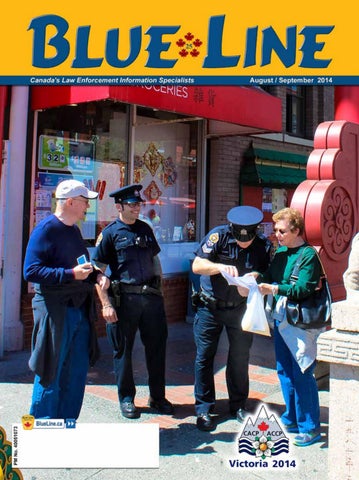
THROUGH SERVICE by Mark MacIntyre (with files from Cst. Jonathan Sheldan) The Victoria Police Department (VicPD) will be in the national spotlight this summer when it co-hosts, along with the Canadian Forces Military Police Group, the 109th annual CACP Conference August 24 to 27. Victoria is recognized as a world-class destination and capital city of British Columbia. What is less well-known is that it’s also the centre of business, commerce and entertainment for southern Vancouver Island. Its western neighbour, the Township of Esquimalt, is a vibrant and picturesque community and home base for more than a century to Canada’s Pacific Naval Fleet. Victoria and Esquimalt together represent about a third of the population of the Capital Regional District, many of its social and recreational hubs and much of its economic activity. This is the jurisdiction that comprises VicPD’s area of responsibility. The 243 sworn members and more than AUGUST / SEPTEMBER 2014
100 civilian staff and volunteers who serve with VicPD are excited at the opportunity to showcase the department to police officers from across Canada. That pride is, in part, a function of the department’s rich past as Canada’s oldest police agency west of the Great Lakes. It also reflects the innovative community work that continues to pay dividends for residents. A rich and colourful heritage In July 1858, BC Governor James Douglas appointed a commissioner of police and authorized him to hire “a few strong men with good character.” This colonial force was referred to as the Victoria Metropolitan Police and was the forerunner of the VicPD. Prior to this, policing had evolved on Vancouver Island from an armed militia style known as the “Victoria Voltigeurs” through to the hiring of one single “town constable” in 1854. By 1860, the fledgling police department has grown to 12 constables, a sanitary officer, night watchman and jailer. 6
The original police station and barracks were located in Bastion Square in what is now downtown Victoria. The men wore military-style uniforms, carried batons and were only allowed revolvers when given a warrant to serve. In the early days, the officers dealt mainly with drunk and disorderly conduct, assaults, deserters and vagrancy. People were also charged with being “rogues,” “vagabonds” and being of “unsound mind.” Reckless driving on public streets and impaired driving of horse and wagon were also fairly common. The department, now with a strength of 21 officers, moved to new headquarters in City Hall in the 1880s and in 1888 became the first Western Canada police agency to use mug shots for criminal identification. The department acquired a horse-drawn patrol wagon in 1905 so offenders no longer had to be “dragged down the street” or taken to jail in “hired hacks.” Officers of the day had to deal with various crimes and complaints. For example, Emily Carr, a renowned Canadian BLUE LINE MAGAZINE
artist, complained of boys shooting in her yard. Another resident reported that the bellowing of a cow a neighbour kept in the basement disturbed his family. Even allowing thistles to come to flower was an offence and officers were instructed to “keep a sharp look-out.” There were 54 men in the department by 1910, including officers, jailers and desk clerks. Beat officers covered an area of just over seven square miles. Victoria Police bought its first motorized patrol wagon in 1918 and later moved to a new police station on Fisgard Street. The department’s latest move was in 1996, when it moved into a new state-of-the-art facility on Caledonia Avenue, where it remains today. As local areas became incorporated, VicPD re-defined its area to what is now the City of Victoria and Township of Esquimalt. The Esquimalt Police Department amalgamated with VicPD in 2003.
Since the beginning of modern day police work the mobility of police officers has been a high priority and new modes of transpiration are always big news. Victoria’s Police Department has had a natural transition through the years. From horseback to the “horseless carriage” the modes of transportation have kept up with the times. Today we find Victoria taking the opportunity to look back with a restoration program for their former 1921 ‘Patrol Wagon,’ (below right) Since this project began in 1999, a substantial amount of research and work has gone into returning this rare truck (possibly the only truck of this model still in existence) to a restored condition. Although their restoration team has learned a tremendous amount thus far, they still have many questions to answer and problems to tackle. If you have knowledge of Commerce Trucks, Continental engines or have parts suitable for use in this project please contact The Victoria Police Historical Society.
Innovation and progress Today VicPD is a regional and provincial leader on social issues, drug addiction, homelessness and mental illness and has formed innovative partnerships with stakeholders who seek creative solutions to these issues. It continues to be a member of the successful Victoria Integrated Court, which serves as the region’s assertive community treatment, and the Victoria Integrated Community Outreach Team. VicPD was the first Canadian police department to unveil a fully interactive mobile police application. MobileVicPD was launched in October 2013 after months of BLUE LINE MAGAZINE
7
AUGUST / SEPTEMBER 2014
Q&A with the chief Prior to his appointment as VicPD Chief Constable on Jan. 1, 2014, Frank J. Elsner served with the RCMP, OPP and the Thunder Bay, Owen Sound and Greater Sudbury police services.
development and was specifically designed to enhance service delivery. It allows community members to stay up to date with all the latest information, including news releases, job postings and all of VicPD’s social media channels. The app also allows citizens to “track crime” with the Crime Reports software and report crimes online through online reporting. One of the greatest public safety features is “Alerts,” which allows officers to notify the public of important information or request assistance in ongoing investigations. It has been used several times to assist with finding missing elderly people. Community feedback has been overwhelmingly positive. Another recent advancement is the Crime Reduction Unit (CRU), which began last year. It quickly left its mark on those that would steal and trade in stolen property. From the recovery of priceless and irreplaceable church artifacts taken from Christ Church Cathedral to the consistent arrests of high-profile criminals and the seizure of drugs and guns, the CRU has been dedicated to reuniting people with their stolen property. Many CRU recoveries can be found on VicPD’s Pinterest Board, “Is This Yours?,” where stolen property is publicly posted in an effort to reunite it with its rightful owners. Commitment to community: Yesterday and today Throughout the years, the key to successfully policing Victoria and Esquimalt has been a strong connection between the department and the community it serves. VicPD emerged as a national leader in community-based policing in the 1980s when it opened the first of five community substations in 1987. Operated by sworn members and volunteers, they were a vital link with the community. The locations of the stations have changed over the years, reflecting a continuing commitment to provide the best possible service while working within the constraints of tight budgets. While this system of small satellite AUGUST / SEPTEMBER 2014
stations is no longer employed, our strong and meaningful commitment to the community has remained unchanged. Today, VicPD continues to make great strides in its efforts to connect with the community through crime prevention, public affairs and social media. The department has embraced a wide array of innovative engagement methods to ensure neighbourhoods, businesses and residents are heard when they have public safety concerns or suggestions to improve the community. VicPD also remains committed to proactively offering crime prevention information to businesses and residents. The department’s award-winning social media efforts continue to be tremendously successful and, with the public’s help, have resulted in positive case outcomes. In addition to the efforts of uniformed officers, VicPD’s 88 volunteers donate thousands of hours of time for crime prevention and safety initiatives through the Crime Watch program. Volunteers are the first friendly faces the public encounters at VicPD’s front desk and museum. Fifty reserve constables contribute countless hours to numerous community initiatives and work alongside officers every day. Finally, VicPD recently launched a newly redesigned crime prevention web site (www. vicpd.ca) that encourages residents to get involved to improve their communities. It invites residents to become more engaged in their neighbourhoods by “working together to create the safest region in Canada,” which is the main objective of the department’s Strategic Plan 2020. Through both innovative technology and proven community outreach, officers and staff continue to honour the department’s past while embracing the opportunities that lie ahead. Mark MacIntyre is the Director of Public Affairs, Crime Prevention Services, and Information Technology for the Victoria Police Department. He may be reached by email to mark.macintyre@vicpd.ca. 8
Q: What were your first thoughts when you learned you would become chief? A: I was thrilled and still am. I really enjoyed my time as chief in Sudbury and am proud of what we accomplished during my tenure. At the same time, I jumped at the chance to join VicPD. The department has a nation-wide reputation for innovation and community-based policing and I am very much looking forward to this new challenge. Q: A re there any similarities in policing between Victoria and Sudbury? A: I think there are more commonalities than differences. In terms of policing, I think both the Victoria and Sudbury police services have been very effective in listening to their communities, fighting property crime, working with service providers to tackle the issues of homelessness and addiction and ensuring the economic viability of our downtown areas. Q: How will you approach the tougher social issues? A: If, as a community, we can make gains in tackling the issue of homelessness, many other issues will also be positively affected. That is why we are working towards having our police service as a full partner with a myriad of agencies that work day and night to deal with the social disorder issues, such as homelessness. The same goes for other vulnerable groups, including sex trade workers, those struggling with addictions to alcohol or drugs and the mentally ill. We can’t “arrest ourselves” out of these problems; we have to work with partners to achieve lasting solutions. Q: What are your immediate priorities? A: My highest priority has been getting to know the members of the VicPD team and hearing from the communities of Victoria and Esquimalt. I’m now really understanding the issues that matter to our residents and we’re taking concrete steps to address them. Q: Do you miss anything about policing in Ontario? A: I miss a lot of the people I worked with and got to know, respect and count on through the years. However, the snow I can do without!
BLUE LINE MAGAZINE
DISPATCHES
Blue Line
advertisers at the CACP Accident Support Services
Facilitating centralized collision reporting, no cost to police or taxpayers. Reallocate manpower & operating cost savings. Our Microsoft Award winning Collision Reporting & Occurrence Management System (CROMS) electronically captures collision details & location (Lat/Long) to share with stakeholders in real-time. Analytics Portal allows ad-hoc queries from all reported data fields. www.accsupport.com
American Military University
More Canadian law enforcement personnel, and their colleagues in other public safety organizations, are turning to American Military University to meet their educational needs. AMU delivers convenient, affordable online programs that are specifically designed to accommodate those in public service, while fulfilling the expectations of students seeking personal growth and interests. AMU is a good choice for Canadians! PublicSafetyAtAMU. com/Canada
Priority Dispatch Corp
Priority Dispatch Corp (PDC) provides comprehensive, integrated, emergency calltaking/dispatch solutions for police, fire, and medical public safety services worldwide. Recognized by the The International Academies of Emergency Dispatch PDC incorporates the Academies’ Priority Dispatch System protocols in all their products and services including the flagship ProQA Paramount calltaking software and AQUA Evolution quality BLUE LINE MAGAZINE
assurance software. Technical and implementation support and certification training also offered. prioritydispatch.net
Commissionaires
Commissionaires is Canada’s premier security provider, offering comprehensive and cost effective non-core police services to help municipalities and police forces improve the quality of life in their communities and contain costs. With over 89 years of experience Commissionaires supports police departments across the country by taking on non-core duties including parking authority, traffic control, summons and subpoena services. commissionaires.ca
Carswell
Carswell, a Thomson Reuters business, is Canada’s leading provider of specialized information and research solutions to the legal, tax, finance, accounting and human resources markets. Headquartered in Toronto, ON, Carswell provides integrated information in a range of formats including Triform, a preferred choice of investigative recordkeeping solutions. carswell.com
MedicAlert Foundation Canada
MedicAlert Foundation Canada (MAFCA) is the largest membership-based registered charity in Canada and the leading provider of emergency medical information services for more than one million Canadians since 1961. Its mission is to protect Canadians and save lives. Universally recognized and respected, MedicAlert speaks for you, when you can’t. medicalert.ca
9
RCMP Cst. Dave Ross, 32, died as a result of gunshot wounds received while attempting to apprehend a gunman in Moncton, NB, on June 14th. Rousseau was married with an 18-month-old son and another child on the way. Originally from Victoriaville, QC, Ross joined the RCMP in 2007 after graduating from the police technical services program at La Cité College in Ottawa. He was a police dog handler with the Codiac Regional RCMP. A suspect, Justin Bourque, was arrested the day after Ross’ death in a residential neighbourhood of Moncton. ••• RCMP Cst. Douglas Larche, 40, died as a result of gunshot wounds received while attempting to apprehend a gunman in Moncton, NB, on June 14th. Originally from Saint John, NB, Larche joined the force in 2002, He worked in highway patrol and general duty policing and was an investigator with the Codiac General Investigation Section/Major Crime Unit. He was previously decorated for saving the life of an unconscious baby in 2008. He was married with one child. His wife is a teacher at the local high school. A suspect, Justin Bourque, was arrested the day after Larche’s death in a residential neighbourhood of Moncton. ••• RCMP Cst. Fabrice Gevaudan, 45, died as a result of gunshot wounds received while attempting to apprehend a gunman in Moncton, NB, on June 14th. Gevaudan was born in Boulogne-Billancourt, France and moved to Canada where he later joined the RCMP in 2007. Cst. Gevaudan was posted to “J Division”, New Brunswick, namely at the Codiac Detachment where he worked in General Duty Policing. A suspect, Justin Bourque, was arrested the day after Gevaudan’s death in a residential neighbourhood of Moncton. Gevaudan leaves behind a wife and one daughter. ••• Paul Pedersen, formerly a member of the York Regional Police for 34 years, will take over as Chief of the Greater Sudbury Regional Police. Pedersen took over from acting chief Dan Markiewich on April 9, filling a vacuum left by the departure of previous chief Frank Elsner for British Columbia. Pedersen, 52, retired at the end of January from the York force, where he served most recently as superintendent-in-charge of investigative services. Prior to that he was assigned to uniform patrol, criminal investigations, training and education and the homicide unit, as well as held the post of incident commander. Apart from his experience as a police officer, the new chief holds a master’s degree in public administration from Western University and is a grad of the police leadership program through the University of Toronto’s Rotman School of Management. He’s also taught at Sheridan College. Pedersen earned a Queen Elizabeth II Silver Jubilee medal and supporter of the Law Enforcement Torch Run for Special Olympics as well as the Ontario Association of Chiefs of Police. AUGUST / SEPTEMBER 2014
TECHNOLOGY by Tom Rataj
Sustainable functionality Much more than just a police station The County of Wellington and the Ontario Provincial Police (OPP) recently celebrated the grand opening of the North Wellington Operations Centre the county’s third such facility. It amalgamates two OPP detachment buildings and adds an additional emergency operations centre (EOC) to the north-west end of the county. The building was custom designed and built to OPP operational specifications. The OPP has a long-term lease on the county-owned facility. Detachment commander Insp. Scott Lawson is excited about the new working space. Wellington is a large, mostly rural jurisdiction about 100 km. north-west of Toronto which, like many other rural jurisdictions, contracts its policing services to the OPP. The centre is located on previously disused municipal land that had most recently been used for baseball diamonds. It is accessibly located near the intersection of two major thoroughfares at the west end of the county in Teviotdale, which was once a village. The site is located away from floodprone areas. Prairie school style Developed by two of the county’s frequent collaborators, architect +VG Architects and Collaborative Structures Ltd., the new building is designed in the attractive AUGUST / SEPTEMBER 2014
prairie school style made famous by American architect Frank Lloyd Wright and others. It features typical style elements including horizontal lines, a low-pitch hipped-roof with large overhangs and windows grouped in horizontal bands. The building is well integrated into the flat prairie-like topography of the area, with a massing that keeps the two storey, 1,728 m2 (18,600 sq. ft.) structure from overpowering the rural neighbourhood while still providing the appropriate presence for a police facility. The interior design language includes well-crafted wooden features and built-in storage cupboards in the arts and crafts architectural style. With a fair number of ground level windows and the second storey clerestory windows, much of the interior is bathed in natural daylight, making it a pleasant working space for its 50 staff members. All the areas occupied for only short periods of time such as locker rooms, bathrooms and storage spaces are in a central core. They are surrounded by a main hallway, separating them from the more continuously occupied operational and office spaces. These all have generous numbers of windows to provide daylight and a connection with the outside world. The booking and prisoner management areas and some garage space is located at the back of the facility Durability Construction began with cast-in-place concrete foundations, load bearing masonry and structural steel columns with light gauge 10
steel trusses and studs, structural insulated panels (SIP) and sprayed-in-place foam insulation. In addition to meeting Ontario Building Code requirements for police facilities, there are numerous design, engineering, construction and material elements that make the building sturdy and more resistant to seismic events and severe weather. The southwestern Ontario area sees a number of tornadoes every year so the choice of roofing and other exterior materials was carefully considered. The exterior features natural stone-cladding, prefinished aluminum panels and wood trim. The roof is finished in dark-grey stone coated steel roofing that resembles weathered cedar shakes. It can withstand severe winds and comes with a 50-year warranty. Thermally-broken aluminum window systems with double-glazed thermal glass units were used throughout. East facing windows are reinforced with a special security film to provide additional impact resistance due to the propane depot located east of the facility. Sustainability The building is custom designed for the site, taking into account the tracking of the sun for reductions in solar-heat loads, particularly in the summer. The large roof overhangs provide substantially shade the windows and there are fewer south-facing windows to further prevent heat loading. To reduce artificial lighting requirements during the daytime, the upper roof section features an almost continuous band of cleresBLUE LINE MAGAZINE
tory windows, bathing the hallway areas below with daylight. The use of occupancy sensors throughout the building also helps save energy. They feature manual overrides and multi-level adjustments. Ambient light sensors automatically adjust artificial lighting levels based on available daylight. One of the largest ongoing costs of operating any building, particularly in Canada, is heating and cooling. The centre uses a ground-source heat-pump system to provide primary heating and cooling. Heat-exchangers on the exhaust/fresh air outlet/inlet system further reduce heating and cooling costs. Rainwater from the roof is stored in an underground cistern and used for grey water purposes (toilets and non-drinking purposes) and fire-fighting. The hallways and other high traffic areas are finished in Marmoleum, a sustainable flooring product that is resilient and has low maintenance requirements. It also adds some additional splashes of colour to the interior spaces. Most office space and the EOC, which doubles as a community room, feature carpeting. The cell area floor is radiant-heated concrete. It is coated with an epoxy finish containing a non-skid additive for a high performance, slip resistant surface that can be hosed-down when the inevitable need arises. The walkway leading to the front entrance also benefits from radiant heating, keeping it free of snow and ice during the winter. EOC & community room The large EOC/community room, located just inside the front door, is well equipped for its dual purposes. It features large boardroom tables and ample seating, a large LCD TV, multimedia projector and screen, integrated sound system and small server, making it ideal for meetings and community events. Nicely diffused fluorescent lighting reflects from the vaulted wood ceiling, creating a warm working and meeting atmosphere. It has large windows at the front and is accessible from the public lobby area as well as directly from the secure operational area. Public bathrooms are located just outside the room in the lobby area. There is also a large smartboard, webcam and teleconferencing equipment, various computer connection options (for the county government and all emergency services) and BLUE LINE MAGAZINE
broadband Internet and VOIP telephony for EOC functionality. In the event of a large scale county emergency, all emergency and municipal services can quickly establish an EOC in this room to manage the emergency together. A generator can keep the entire building running during a large scale power failure and the front parking lot was designed and built with a reinforced base and paving materials so that heavy emergency vehicles and mobile command posts can set up out front without damaging the parking lot. Quality Unlike many cheaply constructed “budget” facilities, the $7.5 million Teviotdale operations centre is a solidly built and durable building that will be worth restoring in the future, says architect Paul Sapounzi. He notes the importance of “doing it right” up-front by designing and building a quality structure that will last a long time, instead of skimping, which would make occupants unhappy working there. He suggests that people working in and using a well-designed and built facility tend to be happier, which he believes translates into being happier when they are out in the community. He describes designing police facilities as “a feather in the cap for an architect,” on par with other important community buildings like a city or town hall, churches or schools. This a good example of how a collaborative design and development process can lead to the construction of a beautiful building that can be so much more than just a police station. Tom Rataj is Blue Line’s Technology columnist and can be reached at technews@blueline.ca.
11
AUGUST / SEPTEMBER 2014
WOMEN IN SCARLET by Jodi Ann Eskritt The members of Troop 17 arrived for training at “Depot” Division in September 1974 with something no other recruits had ever had in tow – the Canadian press corps. The first female recruits accepted by the RCMP, the 32 women were not aware of the full impact they would have. They were dogged throughout training by journalists eager for a “photo-op” and to document this pivotal moment in the history of one of the world’s most famous police forces. Forty-years later some may have forgotten the hurly-burly of public attention but few can deny the change they wrought on a cherished Canadian icon. Not that women hadn’t played a part in the storied history of the Mounties before 1974. At many an isolated and remote detachment, particularly in Canada’s northern regions, police wives earned the sobriquet “the second man.” We imagine today the lone Mountie bringing law and order to the barren north but this image was, in good part, made possible by the unpaid labour of his wife. The behind-the-scenes reality was familiar to some of the new female recruits – sisters AUGUST / SEPTEMBER 2014
and daughters of police officers who were very aware of the rewards and sacrifices of police life. Few, however, could predict how this new generation of women would change that life. The RCMP Heritage Centre and Historical Collections Unit are marking the 40th anniversary of women in the force with a special feature exhibition open to the public throughout the summer months. Through stories and artefacts, the exhibition explores the experiences of women in the RCMP from the historic national swearing-in ceremony of the first female members on Sept 16, 1974 to the continuing roles of women serving today. The RCMP was under a microscope in the early 1970s, suffering under the weight of recent public criticism. The 1970 October Crisis and the response to the Front de libération du Québec (FLQ) had cost it some of the public trust it had built up over almost a century of policing. The Royal Commission on the Status of Women in Canada did not spare it when recommending that women, already able to serve with municipal police forces across the country, be hired on a full, equal basis with male officers. 12
Peel’s principles reinforced the historic tradition that “the police are the public and the public are the police.” Perhaps in this difficult moment, opening the ranks to women – to a larger public – would help the RCMP become more inclusive. Headquarters studied the question for the next four years but once the final decision was made, things happened quickly. As 292 women went to detachments across the country to apply, some staff had not yet been made aware of the new policy. There would be other bumps in the road as the RCMP wrestled with the question of including women in its ranks. Depot had been given six months to prepare for the arrival of Troop 17. It designated a women’s barracks and even briefly considered putting up fencing around it, as staff were uncertain how male recruits might react to their presence. New training procedures were examined and developed. Concerns were expressed about women having the physical strength to meet the demands. Drill staff worried about the troop marching with a “wiggle.” It may have come as something of a relief when Troop 17 proved not only able to march nicely, but adapted this new skill more quickly BLUE LINE MAGAZINE
than bulky male counterparts. Their pumps didn’t create the same distinctive stomping effect of the men’s Strathcona boots, but Troop 17 was demonstrating a clear ability to adapt to the demands of training. Footwear wasn’t the only consideration. Matters of uniform were discussed and the result of these considerations was possibly one of the most unusual kit issues ever made. The key advisor was the executive director of Fashion Canada. Fashion and femininity appear to have received as much, if not more, weight as serviceability in the field. This was most evident in the female recruit’s issue black purse. The initial plan for the women’s uniform excluded the Sam Browne belt, replacing it with a service dress and a review order pattern handbag. Compartments were designed inside the dress pattern for a firearm, ammunition and handcuffs. To mediate the potential risk that resulted, the handbag was to be secured by a strap through the member’s uniform shoulder strap. Major Toole, the Advisor Women Personnel, questioned the rationale of the purse and the decision not to issue belts. Female personnel with the Canadian Forces Military Police were already wearing them. Why couldn’t a similar issue be made to female Mounties? A temporary Sam Browne belt was issued, subject to testing, and by the time of the 1975 graduation the decision to accept it had been made. Even with the Sam Browne, the female member’s uniform remained distinctive from its male counterpart. In 1990, 16 years after women were first BLUE LINE MAGAZINE
Const. Donna Rorison and Const. Darlene Tauber on duty at Edmonton Internatioinal Airport in this 1975 photo. They were among the first female RCMP officers recruited in 1974. The first troop of 32 female members arrived in 1974 to start training, ending the days when the RCMP only employed women as “matrons” to deal with female prisoners.
admitted, the distinctive female uniform was dropped. From that time forward, women would wear the same uniform as male colleagues. Today the RCMP has only two distinctly “female” uniforms: the ceremonial dress pattern with its long skirt, and the maternity dress. Questions of distinctive female dress aside, the accomplishments of early RCMP 13
women cannot be denied. They confronted the force’s masculine image head on and made significant strides in advancing equality for women. Most of all, they earned the public’s respect as figures of civil authority. Jodi Ann Eskritt is the curator of the RCMP Historical Collections Unit.
AUGUST / SEPTEMBER 2014
A SAFER WORLD...
A SAFER CANADA
25th anniversary of Canadian police involvement in international peacekeeping by Shannon Hilton
Since the first mission to Namibia, in 1989, more than 3,500 police officers have served on close to 60 peace operations in 30 countries. These officers have played a wide range of roles within each mission, from training and mentoring police counterparts and providing humanitarian assistance to ensuring security for elections and investigating human rights violations. Canadian officers have assisted in rebuilding and strengthening police services in countries that have AUGUST / SEPTEMBER 2014
experienced conflict or upheaval. Today, there are 90 Canadian police officers serving on peace operations in Haiti and the West Bank. This year marks an important milestone for our officers, 25 years of contributions Canadian police involvement in international policing. Over these years Canadian police have voluntarily served in some of the world’s most challenging places, bringing a measure of peace to communities living in poverty, chaos and fear. In doing so, they have cemented a reputation for leadership, professionalism and humanitarianism in international peace operations. These overseas experiences help officers develop leadership and problem-solving skills and enhance their ability to effectively interact with different cultures back home. The 25th anniversary is an opportunity to recognize the service and sacrifices of Canadian police who have served, as well as their families. It allows us to celebrate their contributions to international peace, in particular, and the partnerships that made 14
those accomplishments possible, of which we are very proud. Furthermore, while it is crucial to recognize the success and dedication of our officers, it is also necessary to remember that these missions can be extremely dangerous and put a great deal of stress on their families. It is important to thank them for their sacrifice and support to the security of Canada at an international level. Ultimately, Canadian police participate in peace missions overseas because a safer world means a safer Canada. Unstable societies offer ample opportunity for crime to flourish. By helping police in other countries to better fight crime on their own soil, Canadian officers may help reduce the spread of crime to our communities. “Participating in a UN mission was a highlight of both my personal and professional career,” says RCMP Sgt. Mike Toohey. “It was an honour to build upon a Canadian legacy forged by those who sacrifice time away from family and friends, which has become a part of Canadian history.” Toohey BLUE LINE MAGAZINE
has served overseas in Haiti and spent many years in Nunavut. To mark the 25th anniversary the International Police Development Branch (IPO) has chosen National Peacekeeper’s Day as the main event for celebrations. There is a gala dinner and dance on August 9 and the national ceremony on August 10. The colourful ceremony will be held at the Peacekeeping Monument in Ottawa and will feature troops of military members, veterans and police officers on parade, music by the Band of the Ceremonial Guard and a C-17 fly past. This event is open to the public. The RCMP’s IPD office looks forward to celebrating this anniversary.
They play a wide range of roles within each mission. Serving on a mission is a unique opportunity for police officers to contribute to public safety in unstable countries. Mission experience also enables officers to improve their leadership, problem-solving
and intercultural skills, which ultimately benefits participating police services and the communities they serve. Shannon Hilton is an RCMP civilian member. Contact: shannon.hilton@rcmp-grc.gc.ca
How it works Foreign requests for Canadian police participation in international peace operations come from organizations such as the United Nations or specific countries. The decision to deploy is made within the framework of the Canadian Police Arrangement (CPA), a partnership between the Department of Foreign Affairs, Trade and Development, Public Safety Canada and the RCMP. Renewed in 2011, the CPA is designed to help Canada respond to foreign requests for police participation in international missions without affecting policing at home. The RCMP manages the deployment of police officers, including planning and evaluating missions, selecting and training personnel from across the country and providing support throughout deployment. Canadian officers who serve abroad come from municipal, provincial and regional police forces from across Canada, as well as the RCMP and represent a variety of backgrounds. BLUE LINE MAGAZINE
15
AUGUST / SEPTEMBER 2014
“ ” No one way
to deal with grief by John Muldoon One of the most difficult things to deal with on the job is the “in the line of duty or off-duty” death of a colleague, especially if they were on your shift. You’re reminded every time you go into the parade room and there is an empty chair. You’re reminded when you see one radio not signed out or a spare patrol car in the parking lot. The death of an on duty police officer usually culminates with a large police funeral with thousands of officers and law enforcement personnel from across Canada and the US. The funerals are usually large affairs with much pomp, speeches, eulogies and flawless precision. The traditions’ and ceremonial nature give a measure of closure to the policing organization and communities as a whole. Combined, they all stand shocked at the death of a member(s). The funeral, both literally and figuratively, is a fitting goodbye to the departed. There may be much sadness for a fallen comrade but there is a stoic look on each officer’s face that is brave, courageous and proud. This is a public face each puts on, as they know that their job is to “serve and protect.” One day a similar ceremony could be held for them. Police funerals are a reminder that each day they face the possibility of the unexpected. The police are the frontline the ones most of us look up to, respect and expect to keep our communities safe and livable. AUGUST / SEPTEMBER 2014
The public outpouring of grief at a police funeral doesn’t usually offer the same closure to immediate family and coworkers. They are still very much in a state of numbness, shock and denial. The trauma and grief for the average officer, who didn’t know the fallen, can be assuaged by the playing of the last post or the marching egress procession after the funeral. Immediate families and close friends on the shift don’t get the same relief. The real grieving is done in the back in the locker room, at the local bar, off duty in someone’s recreation room and sometimes alone in a quiet place. Police officers are not incapable of grieving or demonstrating emotions they just do it differently. There is the family of the officer who has died and then there is the police family. Death of an off duty police officer due to an accident, sickness or natural causes is slightly different if there is not a full police funeral. In most cases there is a strong police presence but it is really a family affair. There is less formality, more time to talk to one another, more time to reminisce and yes, possibly openly grieve all out of the public view. These opening few paragraphs may be an over simplification but it is natural to mourn and grieve the loss of a spouse, family member, colleague or friend, no matter your profession. We are all human beings. Most of us don’t understand grieving 16
because we are never taught what it means to grieve. Talking about death is like the big white elephant in the room. Nobody really wants to discuss it. You only deal with it when it happens. Sometimes we think we can get through grief without too much thinking about it, but in reality our minds and bodies react in their own way. Webster’s Dictionary describes grief as “intense emotional suffering caused by a loss.” Grief’s companion word is bereavement, meaning, “to leave in a sad or lonely state as by death.” Grief is “a protest against something the bereaved didn’t want, doesn’t like, but sadly can’t change,” writes Dr. Bill Webster, noted author, academic and Executive Director of the Centre for the Grief Journey in his book Beyond the Call. The task is to help them find themselves and search for meaning in this new and unwelcome world that they know nothing about and that they, or indeed we, cannot fully understand as yet. It is important to identify some of the possible emotional, behavioral and physical reactions to the loss. By understanding that they are normal reactions, we can help make sense of this new world. Grief and bereavement are part of life when we lose a person in death. Losing a family pet, your job or even a divorce can also carry a form of grief. BLUE LINE MAGAZINE
There is no one-way or right way to grieve, nor is there a correct length of time. Each of us does it differently. Some of us will be very sad but as time passes, live with the fact that the person is gone and move on with our life. We never forget. Others have prolonged grief, which may last for quite some time. Any kind of reminder can affect our emotions as we associate it to that person. Others have what is called delayed grief weeks or months pass and we enter into a period of unexpected grief that usually catches us off guard. This is the “grief attack.” Grief affects our mind, physical body, daily routines sometimes our ability to sleep and relate to other people. We just go through the motions. Margaret Greenspan, author of Healing Through the Dark Emotion, writes: We pay psychotherapists to cure it, take Prozac to mute it, seek counseling from religions which extort us to rise above it, read inspirational books to overcome it, join recovery groups and self-help groups to cope with it, spend millions to escape it, use alcohol, drugs, food, work, possessions, sex, entertainment and all the techno-toys we can get to distract ourselves from it. Unacknowledged and unaddressed grief may manifest itself in many ways, such as: • Confusion; • Inability to concentrate; • Forgetfulness; • Indecision; • Depression; • Rage; • Fatigue; • Isolation; • Perfectionism; • Anxiety; • Eating disorders; • Irritability; • Addictions; • Abuse; • Posttraumatic stress disorder; • Acting out behaviour; • Overspending, based on the attitude “what do I have to live for, I could be gone any day or at any time. Why don’t I spend now and worry about the consequences later.” These are only a small sample of some symptoms of traumatic stress. If you think you may be suffering from any of these unacknowledged or unaddressed grief symptoms, get help. In years past, it might have been seen as weakness for an officer to need or request help after a death or traumatic experience. Now, many police services and/or associations offer employee assistance programs to their sworn and civilian members. Despite what you may think or have heard, it is confidential unless there is clear evidence that you are in immediate danger of hurting yourself or others. Otherwise, it is only between you and your EAP representative. Sometimes the best way to help you manage your grief and move forward is to seek professional assistance that is qualified to talk you through your grief. Remember, grief is not BLUE LINE MAGAZINE
simple. It will affect you both physically and mentally. You have no control over it until you understand what you are going through. You’re not weak; you’re normal when you grieve. Your police service or association should make it standard procedure to offer unlimited grief and bereavement counseling to the families of officers who have died and to their shift co-workers. Special counseling should also be offered to the family’s children and teenagers. They grieve differently from adults and need special counseling from those who specialize
17
in these two groups. Otherwise there could be long-term effects. As Dr. Webster reminds us, during times of grief you may be tempted to think you are losing your mind. You are not. The truth is that your mind is elsewhere, usually reflecting on the person whom was lost, trying to come to terms with this unimaginable situation you find yourself in. In the early days after a loss, we struggle to accept what is unacceptable; to believe what is unbelievable; and to come to terms with something that seems incomprehensible.
AUGUST / SEPTEMBER 2014
After the initial shock subsides, reactions vary from one person to another. The following, however, are some typical responses to a traumatic event: • Feelings become intense and sometimes are unpredictable. • Thoughts and behaviour patterns are affected by the trauma. • Recurring emotional reactions are common. • Interpersonal relationships often become strained. • P hysical symptoms may accompany the extreme stress. We may have to deal with guilt, anger and blame (survivor’s guilt) so we do what we can when we are experiencing any of these symptoms. Get help if you need it. Let go of the rest. As the “Serenity Prayer” reminds us: God grant me the serenity to accept the things I cannot change, the courage to change the things I can and the wisdom to know the difference. Police and many first responders usually see an outpouring of public support when members die in the line of duty. It is this public support that makes the grief journey a little easier for the families, those who were close to or knew them and those who just feel a loss. Our communities also feel a loss and are never sure what to do. They set up public memorials where an on-duty officer died or in front of police stations, sign books of condolences or tweet messages of support. Today many provinces and Ottawa have police memorials, where annually we honour those who have been killed in the line of duty a fitting way to remember those whom we have lost in the past year and a reminder to all that we never forget those who lost their lives in years past. It’s not only colleagues who grieve the loss of a police officer but also wives, husbands, children, parents, girlfriends, boyfriends and extended families. There is always an outpouring of offers of support immediately after the death but these gestures need to extend weeks, months and years after the final ceremonial sendoff is done. This is where the long term scars on those closest occur and are needed the most. This is usually the time when “the police family” really shines as they come together to try to console and offer any assistance they can. As police often say, “We look after our own.” Policing does an excellent job of handling crisis, for the most part, and funeral organization is part of the operational mentality that always comes together for a big event. More difficult is being there and understanding long after what significance this death has in the longer term for the officer who attended the funeral. Besides yourself, your fellow officers and your community, don’t forget the other groups who are grieving the same as you, senior officers and civilians, those who manage and supervise your police service. They too go through a grieving period. In many cases they know the officer who died as they came up through the ranks together or regularly interacted with them. AUGUST / SEPTEMBER 2014
Wise senior officers and civilian managers know that after a traumatic experience it is wise to provide some time off to those who were closest to the officer who died. This gives them time to process their own grief and come to grips with the “new normal.” In time, the many symptoms of grief will ease. They will probably never completely go away but as we move forward, we learn to live with our loss and remember special moments with the deceased. We remember them on their birthday and during all of the holidays. We remember them while we do our daily shifts and remember similar circumstances from years gone past when we worked with them. We won’t forget our friend, hero, partner and colleague. Their name, face and good times will always be etched into our memories and nothing will ever change that. There is a large body of academic work and literature on grief and bereavement too
large to cover all the points in detail in this article. If you’re interested in finding out more, start with an Internet search and by talking to your police service chaplain or someone in your EAP. John M. Muldoon, APR, FCPRS, LM, was the former Director Public Affairs, Peel Regional Police, and former Manager of Communications and Public Affairs, Toronto District School Board. He is a trained grief facilitator and regularly conducts grief support groups in Oakville, Ontario. Contact: johnmichaelmuldoon@gmail.com
With thanks to:
Dr. Bill Webster (author), Beyond the Call, www.GriefJourney.com Mississauga, Ontario. Dr. Alan D. Wolfelt, Ph.D, The Grieving Person’s Bill of Rights Margaret Greenspan (author), Healing Through the Dark Emotion.
The grieving person’s bill of rights by Alan D. Wolfelt, Ph.D. Though you should reach out to others as you do the work of mourning, you should not feel obligated to accept the unhelpful responses you may receive from some people. You are the one who is grieving and as such, you have certain “rights” no one should try to take away from you. The following list is intended both to empower you to heal and to help you decide how others can and cannot help. This is not to discourage you from reaching out to others for help, but rather to assist you in distinguishing useful responses from hurtful ones. 1. You have the right to experience your own unique grief. No one else will grieve in exactly the same way you do. So, when you turn to others for help, don’t allow them to tell you what you should or should not be feeling. 2. You have the right to talk about your grief. Talking about your grief will help you heal. Seek out others who will allow you to talk as much as you want, as often as you want, about your grief. 3. You have the right to feel a multitude of emotions. Confusion, disorientation, fear, guilt and relief are just a few of the emotions you might feel as part of your grief journey. Others may try to tell you that feeling angry, for example, is wrong. Don’t take these judgmental responses to heart. Instead, find listeners who will accept your feelings without condition. 4. You have the right to be tolerant of your physical and emotional limits. Your feelings of loss and sadness will probably leave you feeling fatigued. Respect what your body and mind are telling you. Get daily rest. Eat balanced meals. And don’t allow others to push you into doing things you don’t feel ready to do. 5. You have the right to experience grief “attacks.” Sometimes, out of nowhere, a
18
powerful surge of grief may overcome you. This can be frightening, but it is normal and natural. Find someone who understands and will let you talk it out. 6. You have the right to make use of ritual. The funeral ritual does more than acknowledge the death of someone loved. It helps provide you with the support of carrying people. More important, the funeral is a way for you to mourn. If others tell you that rituals such as these are silly or unnecessary, don’t listen. 7. You have the right to embrace your spirituality. If faith is part of your life, express it in ways that seem appropriate to you. Allow yourself to be around people who understand and support your religious beliefs. If you feel angry with God, find someone to talk with who won’t be critical of your feelings of hurt and abandonment. 8. You have the right to search for meaning. You may find yourself asking, “Why did he or she die? Why this way? Why now?” Some of your questions may have answers, but some may not. Comments like “It was God’s will” or “Think of what you have to be thankful for” are not helpful and you do not have to accept them. 9. You have the right to treasure your memories. Memories are one of the best legacies that exist after the death of someone loved. You will always remember. Instead of ignoring your memories, find others with whom you can share them. 10. You have the right to move toward your grief and heal. Reconciling your grief will not happen quickly. Remember, grief is a process, not an event. Be patient and tolerant with yourself and avoid people who are impatient and intolerant with you. Neither you nor those around you must forget that the death of someone loved changes your life forever.
BLUE LINE MAGAZINE
BLUE LINE MAGAZINE
19
AUGUST / SEPTEMBER 2014
USING THE THIRD OPTION Courtesy Windsor Star
Fighting back should be a consideration with motivated assailants by Michael Soden If your enemy’s tactic is to attack from behind civilians, you must fight regardless of the civilians. Otherwise this will become the choice for ALL terror groups - Deny them this. – Author Unknown Seung-Hui Cho, the assailant from the Virginia Tech shooting, stopped several times to reload. While “shelter in place” and “evacuation” are the preferred methods by which we teach, there is a third and sometimes more viable option: Fighting back. AUGUST / SEPTEMBER 2014
Motivation has produced great leaders, athletes, entrepreneurs, soldiers, teachers and police officers. On the other hand, it can also lead to some horrific disasters. Hitler was a highly motivated individual, Al Qaeda is a highly motivated group and North Korea is a highly motivated government. The United States is in the midst of highly charged conversations between advocates for gun control and “Second Amendment rights”; both highly motivated with their own agendas to support. When you cut through the rhetoric that each side spills out, they both have valid arguments for their reasoning. The debate again surged in the wake of the 2012 Sandy Hook Elementary School shooting in Connecticut. The assailant, Adam Lanza, was highly motivated and killed 26 people, 20 of them defenseless children. He allegedly had Asperger syndrome, but almost every other person with that disorder does not actively plan and kill innocent helpless people. Other incidents include: • May 18, 1927: Andrew Kehoe, another highly motivated individual, planted explosives in the Bath Elementary School in Bath, Michigan. He blew up the school, killing 38 children and 6 adults. 20
• Aug. 27, 2012: Yet another motivated individual, Robert Gladden Jr. entered Perry Hall High School in Baltimore, Maryland with a shotgun in an attempt to start another killing spree. He managed to shoot one individual, a child with Down syndrome. The major difference was that a motivated hero, guidance counselor Jesse Wasmer, met Gladden and, making a conscious decision to place himself in danger, tackled him. He ended a situation that could have taken more lives. • March 1, 2014, Kunming, China: A group of assailants wielding knives stormed into a railway station in southwestern China, slashing employees and commuters. They killed 29 people and wounded more than 140. This heinous act was committed by a group of motivated terrorists armed with edged weapons, not guns. These four examples illustrate that negative motivation can be countered with positive motivation. Guns, knives and explosives are inherently dangerous but have many constructive uses. They have built nations and saved lives. The China incident is one of the most deadly attacks carried out since the term active killer has been coined. Will it lead to edged weapon regulations? BLUE LINE MAGAZINE
School Guidance Councilor, Jesse Wasmer, tackled an armed gun man at Perry Hall High School, Baltimore.
Regulation of all potentially dangerous items is not necessarily a negative mechanism; however, unless it is deployed correctly it will fail and leave us at the mercy of negatively motivated individuals. Many people living in remote areas depend on firearms for food and protection from predators. China has some of the most restrictive gun laws in the world; civilian ownership is outlawed. Ironically, the negatively motivated individuals found a way to inflict their devastation through edged weapons instead. In this case, strict gun control and regulation failed. Firearm edicts fail to take into account the individual intent on killing. Highly motivated people will undoubtedly carry out their plans with any means at their disposal: knives, explosives, clubs, maybe even a fork. Regulating firearms will not curb violence. The reason is simple: “MOTIVATION.” You can neither stop or regulate the motivated. The more logical response is stringent and uniform procedures for the purchase of deadly weapons and ammunition and restricting sales to those without a criminal record or mental health problems. While this is not perfect and yes, some will still slip through the cracks, it seems more logical then outright restriction, which has proven time and time again to be ineffective. Water takes the path of least resistance; so do criminals. They choose their targets accordingly. We have been taught as a culture that violence is bad and in the perfect world it probably is, but there are times when violence needs to be met with violence. “Good” violence can saves lives and act as a deterrent to those who choose to harm others. We have been taught that fighting back is bad; to be the bigger person, walk away and don’t engage. That simply will not suffice in the active killer situation. When the opportunity presents itself the would-be victims must turn and become the aggressors. Yes, some may be hurt or even killed but they may actually end any further killings. These cowardly assailants have chosen to attack schools, churches and mass transit for a reason. Their targets do not put up a fight and so this has become their preferred method. The ‘violence is not the answer’ thinking has BLUE LINE MAGAZINE
put us in this position. Simply put, do not allow this to happen, own your right to fight back and end it. Self-sacrifice or the death of one is better than the death of many. That philosophy has been prominent, and hasn’t failed, throughout history. Jesse Wasmer demonstrated that immediate intervention will minimize the loss of life and assailants like him are unlikely to do anything but crumble. Another example is 9/11; three planes crashed into the World Trade Center and Pentagon, killing almost 3,000 people. The passengers on United Airlines Flight 93 decided to react differently. What precisely happened on the plane that day may never be known but one thing is for certain. Those brave passengers fought back. They lost their lives but saved countless others. If we allow assailants to continue to utilize “active killing,” they will certainly do so. If we teach the public that it is good to fight back – that calculated violence is sometimes the answer to bad situations – then surely this method will begin to subside. After all, they may be motivated, but their acts and persona are cowardly and when challenged, they will falter and fail. If you are faced with death, it is better to save others and die valiantly in battle then to cower and accept death at the hands of a coward! Prince Georges County Police Sgt. Michael Soden is an adjunct instructor with Maryland Police and Correctional Training Commissions.
21
AUGUST / SEPTEMBER 2014
Officers honoured for bravery by Danette Dooley When a call came of a man armed with a knife attempting to kick in the door of a home in Port Union, Newfoundland on March 25, RCMP Constables Justin Lyall and Devin Pulsifer responded. They were about a 10 minute drive away at the Bonavista detachment. Arriving at the home around 3:40 AM, they were told the man had left, Lyall said. Thanks to the harsh Newfoundland winter weather (snow and strong wind) the officers were able to track the man’s footprints to the harbour. The footprints ended at the end of the dock, indicating that he had jumped into the frigid water. The officers knew time was of the essence if they were to rescue him. “At first we couldn’t see him but we kept shining our flashlights around and Cst. Pulsifer ended up spotting him floating out in the middle of the harbour,” Lyall recalled. When Pulsifer called out the man told the officers they should leave and forget about him. That’s not something they were willing to do. “We ended up grabbing a boat that was tied up to the dock we used these poorly-made paddles to try to fight the current and the ice pans that were in the harbour. We finally managed to get out to him which seemed, to us, to take forever,” Lyall said. They managed to pull the man aboard and paddled back to shore, again fighting ice pans and strong current. They got him out of the boat and out of his wet clothes, wrapped him in blankets, put him in the police cruiser, turned up the heat and waited for an ambulance to arrive. “He couldn’t say a whole lot. He was pretty cold at that point. All he said was, ‘You should have left me,’” Lyall recalled. While the story has a happy ending and the man recovered from the incident, Lyall realizes that the situation could have been deadly not
RCMP A/Comm. Tracy Hardy presents Cst. Justin Lyall with his award .
only for the man but for he and his partner. Both officers were wearing full uniforms and dressed for the blustery weather conditions. Neither had personal flotation devices. “If we had to go over (the side of the boat) we would have sank like rocks, but that was the last thing from our minds at the time. We were only focused on getting out to him and getting him aboard the boat.” The likelihood of anyone else spotting the man under the cover of darkness is remote. Both officers are happy that the call turned out so well. Lyall has been with the RCMP for nine years and policed in Gander before moving to the Bonavista detachment two years ago. He knew he wanted to become a police officer by the time he started Kindergarten. “I grew up across the road from the detachment and that was a big motivator for me wanting to join.” Lyall was recently named RCMP police officer of the year for Newfoundland and Labrador. A native of Nova Scotia, Pulsifer has been
with the RCMP for six years and was stationed in Ontario before coming to Bonavista almost a year ago. He agrees with Lyall that the outcome would have been different had police not been called to respond to the call. “I fear that the man would not have survived,” he said. Pulsifer said giving the man another chance at life left him feeling like he and his partner had done something meaningful. “When something like that happens it gives you a sense of pride and accomplishment,” he said. One thing is certain, Pulsifer said other officers with the detachment would have responded to the call in the same way. “It’s a phenomenal group of people that they have working here. It really is,” he said. The RCMP recognized Lyall and Pulsifer for their courage and bravery during an awards ceremony in St. John’s in June by presenting them with Commanding Officer’s Commendations. They accepted the award with mixed emotions, Pulsifer said. “While we were there our minds were in Moncton,” he said, referring to the recent police shootings in New Brunswick. Lyall said while he was excited about the recognition when he first heard about it, his feelings changed after the shootings. “First I thought it was a pretty big deal to get an award like that, but after the incident in Moncton, it didn’t really feel as important. It felt that I was getting recognized for bravery when we had three members that were shot dead and another two that were shot and injured. So, what I did seemed to pale in comparison to what they went through.” Danette Dooley is Blue Line’s East Coast correspondent. She can be reached at dooley@blueline.ca
AUGUST / SEPTEMBER 2014
22
BLUE LINE MAGAZINE
Deceased officer’s firearm returned
Vancouver Police museum curator Kristin Hardie holds the service revolver of VPD officer Lewis Byers
VANCOUVER - Lewis Byers was the first Vancouver police officer ever killed in the line of duty. A century later, one of the key artifacts from the gunfight that led to his death has been donated to the Vancouver Police Museum – his revolver. Byers had it in his hand when he was shot and killed by Oscar Larson on March 25, 1912 near today’s Ballantyne Pier. According to various Vancouver newspaper stories, the 21-year-old Byers had been dispatched to check out reports of a belligerent drunk waving a gun around a liquor store. The drunk had left by time Byers arrived. He made some inquiries, heard that Larson lived in a floating squatter’s shack, and went down to find him. Larsen had been firing the gun on the waterfront, perhaps at a dog. Byers reached the shoreline and yelled at Larsen to stop shooting. There was no reply, so Byers went down the bank to a spot behind Larson’s shack. Eyewitness Charles Weidenr said Byers told Larson to “throw up your hands or I’ll shoot.” Again there was no answer, so Byers went behind a gasoline tank and fired a warning shot over Larson’s head. He then ran toward Larson, who shot at him. Byers turned to run for cover, but Larson fatally shot him in the heart and neck. More police arrived and engaged in a gun battle with Larson, who turned his gun on himself and shot himself five times. He had also been hit by two police bullets, but lived for several hours before dying. The Vancouver World headline the next day read “Drink Sodden Outlaw Murders Constable.” Byers had been with the Vancouver police for only five months when he was killed. He had been a member of the Northwest Mounted Police (the precursor to the RCMP), but quit when he was denied permission to marry his sweetheart Annie Woodcock. Woodcock was from Vancouver, so Byers applied to the VPD and was accepted. The couple lost their only baby when it was just a month old. BLUE LINE MAGAZINE
Several years ago, now-retired VPD Sergeant Steve Gibson and Constable Tod Catchpole put together a website honouring the 16 Vancouver policemen who have died on duty. Gibson located some of Byers’ relatives in Alberta, and found out they still had his revolver, which had been given to the family by his former partner. “We discovered that back in 2001,” Gibson relates. “But they weren’t ready to donate it to the museum back then. I kept in touch with them, and two weeks ago out of the blue they said ‘okay, we’re ready to donate it.’” The first thing you notice about the gun is that it’s quite small. “At this time the firearm was carried underneath the jacket,” explains Kristin Har-
23
die, curator of the Vancouver Police Museum. “It wasn’t until quite a bit later, after the unemployment riots of 1935, that the firearm was worn on a holster outside, visible to the public. All the officers’ firearms (in 1912) would have been concealed beneath their uniform.” The second thing you notice about the gun is that it has a small hook underneath the trigger. “The little hook underneath is called a trigger spur,” says Gibson. “It’s to give the person a better grip.” “It’s so you can have a two-handed grip,” says Hardie. “One hand would go underneath, the second would go on top.” The revolver looks like a Webley, a popular English revolver in the late 1800s. Hardie says it resembles a model made for the Royal Irish Constabulary. It was made in Belgium and is probably a .30 calibre model made by the Freres Neumann company, which marketed it under the name “Frontier Bulldog” or “Elvira Bulldog.” There were 75 police officers in Vancouver in Byers’ day, but the force didn’t issue a standard gun. “It’s hard to say if (Byers’ gun) was issued by the VPD or if it was his own firearm,” says Hardie. “We have seen other firearms that officers have used that weren’t issued by the VPD. For example, Chief Foster carried his World War Two firearm while he was on duty.”
(Vancouver Sun)
AUGUST / SEPTEMBER 2014
by Antoon A. Leenaars Hosting the first Canadian national symposium on police suicide took real courage. I especially applaud Chief Rick Hanson and Dr. Adriana Celser of the Calgary Police Service (CPS) for their role in the May 22-23 event, which attracted some 200 police officers from across Canada. More officers die by suicide than by felonious assaults and accidents combined. Silence has for too long been the only solution. We can no longer simply ignore the ever increasing numbers of police suicides and need to change what we can. The symposium was overdue and offered new hope that will help save officers’ lives. Homicide-suicide among police is at epidemic levels and has been since first being recorded in the 1930s. The IACP recently made the prevention of suicide among police a key objective. Not since the great suicide epidemic in New York in the 1930s has there been such action. On behalf of CPS, Celser planned and organized the symposium. I was honoured to be a keynote speaker. The speakers were excellent. Here are some of my personal notes of the event. In opening the conference Hanson noted that three CPS officers have taken their lives since 2007. Being a police officer puts a person at risk, he told attendees. “People in our profession see things and deal with things that most people never see or experience. It’s got an impact.” Family members and officers told Hanson after the deaths that he wasn’t doing enough. We may think we are doing everything, he AUGUST / SEPTEMBER 2014
noted, but we never are. The CPS has peer support and psychological services and, although suicide is not an epidemic, Hanson said there is more that it can do. The symposium, in response to the deaths, is an obvious example. It takes courage, he concluded. There is too much helplessness. I began my speech by asking the following questions: • Are rates of suicide in police high? • Why do suicides and homicide-suicides occur? • Are suicide and homicide related? • Why in the police? • What are the individual, relational, social, cultural and environmental factors? • Does an emotional disorder (psychopathology) increase risk? Post-traumatic stress disorder (PTSD)? Alcoholism? • Does police work-stress, divorce, domestic violence and a multi-dimensional array of other factors cause risk? • What relationship issues are figural? • Does marital situation have an impact? The “macho” (blue) culture? Does it create barriers to help-seeking (blue walls)? • Does gun availability increase risk? There are further questions: • What is effective in treating police? • Can psychotherapy help? • What help is needed if an officer is suffering work-related PTSD? • What do police services need to provide? • What help is effective? • What are police barriers to wellness? • What can police services and communities do? There are many questions; are there answers? 24
The presenters and audience offered many suggestions. Major Adrian Norbash, a psychiatrist and Canadian Forces Mental Health Clinical Lead asked whether police services provide the more extensive programs the military offers (See Leenaars, 2013.) Suicide and homicide-suicide in police are complex, multi-determined events. People are generally stressed and overwhelmed when they experience a suicide and even more so with a homicide-suicide. The most common response by survivors is that they can’t wrap their head around it. Predictive, like suicide, homicide-suicide is difficult to understand. There are at least two reasons: the very complexity of these events and the fact that suicide is a low frequency event (occurrence) in police, and homicide-suicide in police is also low (or is it?). We need to study the occurrences. In the field of suicide research (suicidology), the intensive retrospective psychological study of a case (occurrence) is called a psychological autopsy (PA). The last detailed PA was the 1930’s New York epidemic. I presented verbatim one occurrence, “Report to the London Police Service and London Community on the Deaths of David Lucia and Kelly Johnson” (Retrieved from the web page of the London Police Service, www. police.london.ca). I highly encourage you to read it. I said, of course, many more things; all presenters did (the Power Points are available from CPS). In helping to plan the event, I told Celser the most important speakers would be the fellow officers, the buddies. Cst. Raymond Wong, Calgary Police Association, opened BLUE LINE MAGAZINE
the sharing by speaking of the impact of the deaths of the three officers. Two officers told their powerful stories. There was silence in the room and understandably, some tears. Suicide, one officer said, causes fear, guilt and helplessness. I learned a long time ago that the surviving officer’s story is the heart and soul of breaking the silence of suicide among police. This story (narrative) has to be told. There was no stigma at the symposium. Silence was broken. The common stimulus in suicide is unbearable psychological pain, which never ends. The suicidal person is in a heightened state of perturbation, an intense mental anguish. They may feel any number of emotions boxed in, rejected, deprived, forlorn, distressed, shamed, disgraced (and especially) hopeless and helpless. The hopelessness is that the pain will always be this way. Nothing can change. For example, “I will never get my service gun back. I am stuck on this desk job forever. It is no job for an officer. I am worthless.” The helplessness is something like “There is nothing Chief Hanson can do. There is nothing Dr. Celser can do. There is nothing Cst. Wong can do. There is nothing any of you officers can do.” That is the helplessness of the suicidal officer and after death, that pain becomes the pain of the survivor all of us are stung! The skeletons live. We, understandably, become fearful, guilty and helpless. Stigma I later addressed the topic of stigma and police suicide. It is a HUGE risk factor. The Parliamentary Committee on Palliative and Compassionate Care invited me to address the topic nationally in February. I presented a document, “Stigma & Mental Illness: History & our Hope” (it’s in the public domain.) People are generally perplexed, stressed, confused and even experience prejudicial reactions when they are confronted by mental illness, I began. There is a tremendous stigma attached to mental illness, psychopathology, psychiatric disorder, imbalance whatever we may wish to call it. Mental disorders have always fascinated, yet frightened people. There is a modicum of comfort in regarding the imbalanced as “different” from the rest of us “healthy” Canadians. We see mental illness as something another person is plagued with, or punished with, or jailed for. We are not responsible! We, the sane Canadians, at least those who are sworn members of a police force, are immune to those sicknesses. “They” are sick, sick, sick. There are many examples, allow me one from the 1930s. There was enormous stigma to having a mental disorder then, which is no different from today. On this, we read: One manner of handling the mentally or physically ill patrolman was to take him away from regular duty. This most frequently meant placing him on the duty called “raided premises,” which usually consisted of guarding raided houses or hotels used by prostitutes. BLUE LINE MAGAZINE
a man.” In his disturbed behavior he thought people were claiming that he was “not a man.” (Leenaars, 2010, pp. 84-85). How many Canadian officers and civilian members feel this way? Estranged? Stigma is harm. There were many other points. Not talking about mental illness will cause more imbalances. The “insane” were kept secrets; a societal blue shame! The problem was kept invisible. The main reason was stigma. One would hear, “Oh, Joe is a basket case” or “Sally is crazy.” It wasn’t acceptable to be mentally ill all too often suicidal or to get help. One study in Oslo, Norway, shows only 10 per cent of officers seek help. We need to change that now. The purpose appeared to be that of keeping prostitutes from again inhabiting the place. The patrolman sat quietly by himself in one spot for a full eight-hour shift. In other instances, the recipient of light duty was given a simple errand or clerical job. In the case of both assignments, the average policeman felt much contempt for the job and condescending sympathy for those assigned to it. Some of our cases avoided and feared these assignments, saying, “I’ll be damned if I’ll cut paper dolls all day.” As one said, “It’s the next step to the nut house.” One patrolman who felt that he was being “discriminated” against refused an inside assignment with the words, “That’s no job for
25
What can we do about it? We explored many avenues; we must not be simple. We do not have to be helpless; we can help. Lives of officers have been saved! We don’t need to die by our own service pistol. Celser opened the next day’s symposium by exploring relevant factors and the impact of suicide on police services. “Why should we be concerned?”, she asked. Many participants answered. “By the very fact of being a chief, I am affected,” noted Hanson. “Like all officers, they are my responsibility.” Celser offered many insights, showing how the chief can count on the psychologist and peer support. There is help. The quality of care, of course, from the chief, sergeant,
AUGUST / SEPTEMBER 2014
psychologist, doctor and attendant, is crucial. One fact was obvious: Everyone was affected by the deaths of their three fellow officers. This would be expected. Dr. Daniel Rudofossi, a former NYPD sergeant, has noted that the things officers see and deal with are beyond what is normal. These events are traumatizing and would “horrify, repulse, disgust and infuriate any sane person.” Why should this not be true for officers? Think Moncton! There were many topics discussed, including alcohol abuse, availability of firearms, sleep and fatigue. My friend, Dr. Peter Collins, Forensic Psychiatrist, Criminal Behaviour Analysis Unit, Behavioural Sciences & Analysis Section, OPP, spoke about suicide by cop. I have worked with police forces on this topic; there is no question, it is traumatic. It understandably affects officers. Collins noted that it occurs much more frequently than thought. No single factor causes it. There are also important differences between Canada and the US; in Canada, weapons are more frequently feigned and motor vehicles more often used as a weapon. A panel I chaired, which included Hanson, Celser, Dr. Patrick Baillie, Collins, S/Sgt. Darrell Hesse, Sgt. Sergio Falzi, Dr. Cynthia Baxter and Cst. Raymond Wong, answered many questions. One could feel the energy in the air; it was hope. Among the questions: • What percentage of police suicides are related to PTSD? (Many.) • How often is alcohol a factor in police suicides? (80 per cent.) • An increasing number of therapists/psychologists/psychiatrists have raised concern that debriefings are not effective and exacerbate trauma symptoms. Is this true? (The panel agreed that this (i.e., the Mitchell socio-emotional type) is the case. Of course, this is all very different from operational debriefings.)
AUGUST / SEPTEMBER 2014
• Have there been any studies done or data collected on retired law enforcement members and suicide? (No. There is a paucity of studies and data in general. We do not know. Studies are not allowed.) • Do you think the fish caught on a yellow 5 of diamond spoon are in fact suicides first? (The panel had varying opinions; I suggested that there was a different theory: it is suicide by fisherman.) Don’t give up I directed a special message to suicidal officers and civilians. “Don’t give up the fight. There is help as you can see there is a chief, psychologist, buddy, fisherman and many who really want to help. There is hope. Persevere.” Hanson concluded the meeting with high praise and a call to action. He returned to the question asked about studies on retired officers, promising to do something about the lack of Canadian research about police suicide. He committed to speaking to other Canadian chiefs and suggested a study could be done. This will make a HUGE difference. Like any occurrence of interest, in forensic science and policing (there are many more similarities), once we understand something better, we can better predict and control it. We can prevent suicide among police! References
Leenaars, A. (2010). Suicide and homicide-suicide among police. Amityville, NY: Baywood. Leenaars, A. (2013). Suicide among the armed forces: Understanding the cost of service. Amityville, NY: Baywood. Dr. Antoon A. Leenaars, Ph.D., C.Psych., CPQ, is a Windsor forensic psychologist and the author (among many other publications) of Suicide and homicide-suicide among police and Suicide among the armed forces. Contact: draalee@sympatico.ca .
26
DISPATCHES Former Hamilton Police Deputy Chief Keith Farraway, 83, known as a “policeman’s policeman,” has died after injuring his head in a fall at his Hamilton home on July 2nd. Farraway was a masterful former homicide investigator who swiftly rose through the ranks. He is remembered for starting the department’s Crime Stoppers program and its special weapons unit. At the age of 56 he resigned after 33 years with the service. Farraway chaired the Ontario Association of Chiefs of Police drug abuse committee, was a member of the Canadian Chiefs legislation and arson committee and sat on the Law Reform Commission of Canada as a representative of the police service. Farraway is survived by his wife Carole and two children. ••• Bill Renton has been promoted to chief-designate of the Woodstock Police Service. Renton will take over the full chief position as of Jan. 1, 2015, when Chief Rod Freeman’s retirement comes into effect. Before joining the Woodstock organization in 2010, Inspector Renton spent 30 years between the RCMP, OPP and Haldimand-Norfolk Regional Police. Among the cases he handled while with the OPP were the occupation at the Douglas Creek Estates in Caledonia and the 2009 abduction and murder of Tori Stafford. Renton is currently the chair of the Ontario Homicide Investigators Association. ••• Former Waterloo Regional Police Chief Larry Gravill will serve as a part-time citizenship judge in Kitchener, Citizenship and Immigration Minister Chris Alexander announced June 26th. Gravill, who served as chief for 15 years, will now decide whether to approve citizenship applications, preside over citizenship ceremonies and administer the oath of citizenship to new Canadians. After stepping down as Waterloo Regional Police Chief in 2007, Gravill was called upon to lead a review into the University of Waterloo’s men’s football team after the school suspended the team in 2010 in response to nine players failing drug tests. He more recently chaired a working group that looked at merging the region’s four separate emergency dispatch centres to lower response times. ••• A former Truro police chief Alonzo “Lonnie” Murray passed away at the age of 80 early on June 21. Murray served with the Truro Police Service for 40 years, from 1956 to 1996, and was chief for 22 years until he retired. Friends say Murray had a “mild” personality and an open mind. Truro resident and former police chief Ken MacLean, served as deputy chief from 1988 to 1996, stepping into the chief’s position following Murray’s retirement. “He’s the best boss I ever had,” said MacLean. “He had a great passion for the community and his members.” He served during a time when call boxes were the norm, then later radios and cell phones. Murray is credited for securing body armour, dress uniforms and other safety equipment for his members. Murray is survived by his wife Anne Clair, four children, six grandchildren and seven great-grandchildren.
BLUE LINE MAGAZINE
BLUE LINE MAGAZINE
27
AUGUST / SEPTEMBER 2014
ELIMINATING “ ” THE COOL FACTOR Let’s not throw the babies out with the THC by Larry Busch How does the image of a six-year-old kid smoking pot, with his parents happily looking on, sit with you? Or is the issue really only a wedge in the door for legalizing pot for everyone? It appears many medical marijuana smokers simply enjoy the “cool factor” of having an excuse to smoke pot with impunity. With all the legal discussions and political posturing around the medical marijuana debate, why hasn’t Health Canada, the CACP, MADD and like-minded agencies recommended that the government research the benefits of “Charlotte’s Web” over traditional hallucinogenic marijuana? Charlotte’s Web, formerly “Hippie’s Disappointment,” is a strain of sativa marijuana that possesses all of the high-potency medical cannabidiol (CBD) benefits and absolutely none of the psychoactive effects of THC. It’s named after a young Colorado girl who suffered more than 300 grand mal seizures a week. Ingested, not smoked, it yielded spectacular results for Charlotte, who’s now seven years old and thriving. Her seizures only happen two to three times per month now, almost AUGUST / SEPTEMBER 2014
solely in her sleep. Not only is she walking, she can now ride her bicycle, feed herself and is talking more and more each day. Any drug manufacturer would be ecstatic if they could remove all side effects of hallucinations, links to schizophrenia, low testosterone and sperm count, mental impairment, changes in brain density etc. from a drug they were trying to get approved by the government. If Charlotte’s Web was accepted as the only strain of medical marijuana available, the requests for prescriptions would plummet. Road-side testing kits to detect THC would be simple and effective; medical marijuana grow operations would not require high security and incidents of “sky high driving” would decrease sharply. Ignoring the obvious seems to be a government trait. I’m expecting its legal types will one day recognize that somewhere down the line, some medical (THC) pot smoker will end up suing them. This will be because it knew, or ought to have known, that Charlotte’s Web is a safer product yet it failed to protect users from the harm they cause themselves. It’s the same as smokers suing cigarette manufacturers in more recent times. 28
There will also be the conspiracy theorist, who says the government intentionally let the pot smokers use (THC) “medical” marijuana as a means to wipe them out. That’s always fun! I’ll let scientific researchers argue that ingested marijuana is safer and medically more potent than smoked. There is no way smokers can cook up evidence that only smoked marijuana works, but they will most certainly try. The government may also come under fire for not protecting the many “licensed” companies spending millions of dollars growing THC medical marijuana who will go bankrupt because it didn’t do enough research before giving them licenses. This despite the fact that any half-crazed, half witted, nincompoop can put a seed in the ground and grow their own. Then there is the entertainment value of just throwing it out there and watching them fight about it in news reports and talk shows. Larry Busch served with the RCMP for 35 years and is now a Toronto area security consultant. Contact: lbusch@ strategicsecurity.ca or 905 904-0528.
BLUE LINE MAGAZINE
ADDRESSING RACIAL PROFILING
by Carol MacPherson The Ottawa Police Service (OPS) has undertaken the largest race based data collection project in Canadian policing history under an agreement with the Ontario Human Rights Commission. The Traffic Stop Race Data Collection Project requires police officers to record their perception of the driver’s race, by observation only, for all traffic stops over a two year period. Other information being collected for the study
BLUE LINE MAGAZINE
includes: location and reason for stop, driver information such as gender and age, outcome and whether race was perceived prior to the decision to stop the vehicle. On track and progressing well across the city, officers have already recorded race based data for more than 60,000 traffic stops since last June. That number is expected to grow to more than 100,000 by the time the two year data collection study ends in 2015. Race based data collection is a recognized tool to address concerns about racial profiling and is already making a positive impact in Ottawa. “Through this project, the police service
29
can continue its commitment to bias free policing and have meaningful dialogue about racial profiling concerns,” said OPS Insp. Pat Flanagan, who is responsible for the project. “It’s about building a project that will produce accurate, meaningful and measurable data and more importantly, have the confidence of our members and the communities we serve,” he said. Ottawa police continue to work closely with the human rights commission and York Research Team to build this project with community and police input. The data will be made at the end of the project. Visit ottawapolice.ca/race to learn more.
AUGUST / SEPTEMBER 2014
by Morley Lymburner My partner Stan and I headed out early one cool and misty morning to deliver a prisoner to HQ for printing, photographing and depositing at the courthouse in time for bail court. We were in the infamous Jane/Finch area, bound for Toronto. Yes indeed! Two suburban cops visiting the tough downtown. The experience of travelling across town in those days was interesting. The city had two million people and its 5,000 cops shared two radio bands, appropriately named the “North Band” and the “South Band.” I mentioned interesting because we were about to travel into the South Band with a car from the North Band radio area. The Second World War era Motorola radios were not switchable and to save broadcast confusion between 18 police stations, none were on re-broadcast. That meant you could only hear the dispatcher from your radio band. We turned off the expressway and felt our way through the mist along Bloor Street to Jarvis, where the mist melted away. We were about to go south when we noticed two men AUGUST / SEPTEMBER 2014
working on a phone booth with a tire iron. The entire box rocked back and forth as they strained to liberate the coin box. Stan was driving and our cheering prisoner was well cuffed in the back seat of our two-door Plymouth. The lookout spotted us and began running for his car. I bailed out to give chase while Stan called for assistance.... on the north band radio. “Officer needs assistance... Jarvis and Bloor.” The man in the phone booth began running in the same direction as his accomplice, only stopping to threaten me with the tire iron. As I began pulling out my gun I noticed a flurry of police cars coming in all directions, as if by magic, out of the distant mist. They screeched to a halt and the area was suddenly flooded with more police officers than I had seen since college graduation. In the sea of dark blue I saw the two suspects overwhelmed and dragged into one of the awaiting cars. Then, everyone disappeared into the misty night as suddenly as they had appeared. I stood in the lot, gun in my hand, wondering what had just happened. My partner was just as stunned as I was. “Where did they 30
come from?” I asked Stan. “More important... where did they all go?” he responded with a smile. Our prisoner in the back seat sat ramrod straight, eyes round and mouth agape. “Wow man, that was cool. Never saw so much fuzz in my life. Those were sure some unlucky dudes, man.” “Let that be a lesson for you, young man,” Stan said sternly to the prisoner as he winked at me. He put the car in drive and chuckled. “Should be interesting to see what charges they decide upon and what witnesses they are going to call to court.” It was then I realized no one asked who we are or what we saw the suspects do. “What should we do?” I asked with concern. “First things first,” Stan replied. “Just mind our own business and get this guy booked for court.” We both chuckled and continued to our prisoner booking appointment just down the street. After processing we returned our prisoner back to the car and continued over to the courthouse just as the early morning light began burning away the darkest part of the night. By the time we reached the court house sally BLUE LINE MAGAZINE
port the street lights had shut off. The prisoner was finally in the courthouse lock-up and the paperwork cleared up when we were directed to phone a police station. “Where were you guys?... I have been calling everywhere for the past hour for you.” Stan responded that we had a prisoner escort duty and a phone call to our station would have confirmed that. He further advised that since we were North band cops the radio was quiet and we thought there may be some trouble with it. The sergeant we phoned told us to go to 52 Division detective office and see the sergeant of detectives. Stan pointed out the hour and suggested someone should authorize the overtime we would no doubt be going into. “Standby,” came the response. Five minutes later he informed us the duty sergeant had authorized the OT. A rather perturbed sergeant greeted us at 52 Division, along with a hall full of red-faced officers in the detective office. Not only had no one asked who we were, no one knew where we were from. Night shift dispatchers had gone home and day shift was sorting through radio call cards. “Well gentlemen,” the detective sergeant said insincerely, firmly clutching a hand full of reports. “Care to tell me, these so-called cops and the two guys in the lock-up downstairs what it is they actually did wrong to be arrested and brought to this station?” Stan stood his ground, asking who he
BLUE LINE MAGAZINE
was referring to. I have seen corks on New Years Eve champagne bottles more stable than that red faced detective. Addressing the rather sullen looking officers at the side of the room, the sergeant exploded. “Take them down to the lock-up and see if anyone there looks familiar to them. Then maybe, just maybe, you might be curious enough to ask these officers what it was they actually saw.” He stormed out of the room. We left the station after an hour or so, rather proud of our non-arrest and the OT pay we had chalked up. Stan was still smarting and chuckling at the duty sergeant’s dressing down when he asked if they wanted us to take the two prisoners to bail court.
31
We were greeted by a rather skeptical station sergeant when we arrived back at our own station. He laughed when we explained what had happened. “Well now, you have experienced those tough downtown city-core cops. They climb all over each other like a bunch of scorpions in a pit to get an arrest.” Stan simply grinned and again winked at me. “I worked there once... glad to be here.” As we booked off-duty I mentioned to the desk sergeant that our car radio wasn’t working too well and might need to be checked by the day shift. “Did you hit it with your nightstick?” he asked. “Yes,” I responded. “Still not working.”
AUGUST / SEPTEMBER 2014
DEEP BLUE by Dorothy Cotton
The placemat test for narrow-mindedness I recently bought some ultra modern, white lacquered dining room furniture, quite out of character for me but that’s another story altogether. It occurred to me that a white table is inevitably going to get stained, thus there is a need for placemats or a table cloth. I decided to go with placemats and began looking for the definitive one. In my mind, it would protect from the single item most likely to stain a white table and I would guess that would be red wine. Have you ever noticed that placemats are not designed to accommodate wine glasses? They typically either do not have room for one or require you to cram all your utensils and dishes together in such a way that virtually guarantees you will knock over your wine glass. This seems like a bad plan to me. I hunted high and low but, to my surprise, found that placemats come in very few sizes and shapes. Basically there is rectangle and rectangle. You see the occasional oval one and maybe a shell shaped version for round tables. There are animal shaped placemats I think you have to be under 10 to use them but no parallelograms or other quadrilaterals, octagons, triangles or diamond shapes. If the rectangle ones did the job perfectly then I would understand the lack of variety but they really don’t work that well. If placemats are not your thing, let me talk about jeans. Have you tried buying them lately? If you are one of the 98 per cent of people who look really awful in skinny jeans, then you know there’s not a lot of variety on the market these days. (If you are one of the two per cent who think you look good in skinny jeans, I hate to tell you this but you are wrong.) On the other hand, heaven help you if you find and buy un-skinny jeans because they are not in fashion. So much for diversity. Usually when we talk about it we mean ethnic, racial and cultural diversity. Canadians pride ourselves on being “diverse” and embracing diversity; Alas, I think it is a crock. Don’t get me wrong, I think we are better about embracing diversity than pretty well anyone else but we are far from “there.” Aside from being quite stuck on one shape of placemat and one style of jeans, consider the other things that we reject as undesirable: • People who wear white socks with their sandals (Criminal Code 354.1(d)2, I believe); AUGUST / SEPTEMBER 2014
• Fat people – and thin people; • Old men in hats driving Buicks; • Ugly people – and very attractive people; • People who speak with accents; • People who articulate perfectly and clearly; • Lawyers, politicians, psychiatrists and people in any number of other occupations; • Accordion players; • Men with “comb-overs;” • Old people – and young people; • Anyone who looks a little weird; • People with thick glasses. I could go on but I suspect you get the point. Without going anywhere near the ‘Big Diversity Factors’ like race/ethnicity, religion, gender, physical or mental disability or sexual orientation, I can name off a whole variety of factors that cause us to judge people adversely. The fact is that we are pretty well programmed to be a little suspicious of anyone who is not pretty similar to ourselves. One can argue about whether this has been an advantage evolutionarily, but it would be hard to argue that it is adaptive nowadays. Needless to say, some of us are much better than others at challenging our biases and being open to alternative ways of doing things. People exposed to a range of options and possibilities while they are growing up tend to be more open-minded than people taught to be dogmatic and to follow-the-rules-no-matter-what-and-don’tthink-about-the-options. (This is one of the reasons that it is not unusual for very religious people to be less tolerant. Many religions are kind of “my way or the highway,” a philosophy that does not engender tolerance of diversity.) 32
Perhaps you have spent your entire life surrounded by people very similar to you so you don’t even know where to begin when you encounter something outside your range of experience. Maybe you are anxious and pretty well anything new scares you. Mind you, if you had a whole lot of these sorts of characteristics, you would not likely be in the job you are in. When psychologists assess police candidates, one of the things they look for is reasonable openness to change and new and different ideas. You don’t want to hire people with no regard for the rules and happy to try just about anything but if you have always ordered the same kind of pizza since you were 15 and avoided that new Ethiopian restaurant down the street because... well you’ve never had Ethiopian food and it is probably gross, you just might not be as open-minded as would be ideal. Do you find phrases like the following coming out of your mouth? • “But we’ve always done it this way.” • “I am sure I would not like it, but I have never tried it.” • “If it ain’t broke don’t fix it.” Do you like to vacation in the same place every year? When was the last time you changed your hairstyle? Do you order at a restaurant without opening the menu? Are all your friends and business associates exactly like you? You might want to give it some thought. It’s not just an abstract concept. Open-minded people are not only more open-minded but more tolerant, forgiving, happier, less judgmental, less stressed... and generally a lot more pleasant to be around. They also tend to make better police officers. Of course, the hitch with trying to decide whether you’re open-minded is that you are not likely to know if you’re narrow-minded. You may well see yourself as very principled and having high moral standards. If you’re not sure, I refer you back to the “pizza” question. Or you can have a look at my new prototype placemat. If you don’t like it, then you are narrow-minded. Dr. Dorothy Cotton is Blue Line’s psychology columnist, she can be reached at deepblue@blueline.ca
BLUE LINE MAGAZINE
BLUE LINE MAGAZINE
33
AUGUST / SEPTEMBER 2014
BREAKING THE CYCLE Engaging our troubled youth
by Tony Palermo A 15-year-old girl with no self-esteem and mental health issues runs away from her group home. Not surprisingly, she was less than receptive to Cst. Sherri Cameron of the Cornwall Community Police Service’s (CCPS) Youth Services Unit (YSU). Over the next several years, the girl led a hard life and continued her downward spiral. She was in-and-out of school, abused drugs, partied and started exotic dancing to make a living. She abused herself and others abused her. Cameron stayed in touch and supported the girl through her struggles. She didn’t give up on her and, although it took years, their relationship eventually changed to one of mutual respect and trust. “The girl is now 23 years old, clean, lives on her own and is in college studying social services,” says Cameron. “She’s very proud of her accomplishments and she should be.” Cameron is quick to point out that she was only one of several people and community agencies that helped the girl turn her life around. Still, there’s no denying the positive impact she and the CCPS had on the girl, who keeps in touch with Cameron. A new approach Cameron and partner Cst. Andrew Arbic began the YSU in 2005 with a simple AUGUST / SEPTEMBER 2014
goal: to reduce the level of police involvement with Cornwall’s youth, both now and in the future, by proactively engaging the youth and their family in a way not normally encountered with the typical response-based call-to-call approach. As Cameron says, the question became ‘how could the unit proactively help break the cycle of negative behaviour and assist the youth and their family to achieve stability and success?’ “It’s no secret that Cornwall and our end of the province has struggled and suffers from a higher than average rate of family dysfunction,” says Cameron. “Drug use, teen pregnancy, mental health issues and the poor development of our children are some of the issues which weigh heavily on everyone. And, like other communities, some of our children are subject to neglect and abuse which unfortunately leads to a pattern of behaviour that perpetuates from one generation to another.” With many families needing help and long waiting lists for traditional counseling providers, the officers quickly realized their role needed to be not only proactive but handson and broad; they needed to be an advocate, mediator, facilitator, supporter and counsellor for the entire family. In many cases parents 34
didn’t have the skills to deal with the issues their children were facing. “We found most parents wanted the help for their kids, even if there wasn’t a lot positive going on in their own lives,” explains Arbic. Community partnerships are extremely important and the unit continues to reach out to as many organizations as it can. As Arbic says, with many of the community agencies sharing the same clients and frustrations like lack of funding and excessive case loads, it only makes sense for everyone to work together. Case conferencing with partners has become an integral part to helping Cornwall youth and families. Receiving referrals from front-line officers and community partners, the officers take a hands-on approach to helping their clients. They examine the various criminal and familial problems, no matter how big or small, and come up with solutions to tackle them head on. For example, in addition to dealing with criminal behaviour and incidents of conflict at home and BLUE LINE MAGAZINE
on the streets, they recognize that even poor attendance at school is counterproductive to a youth’s development. Arbic and Cameron go to a truant’s home, knock on the door and, when required, literally walk up to the child’s bedroom, wake them up and deliver them to school. In extreme cases, they’ll even lay provincial offence charges against the students and/ or their parents to get a youth probation order another tool to engage and help the youth. “Many police officers feel helpless when intervening with children under the age of 12,” explains Arbic. “The child can’t be charged for criminal behaviour and warnings are weightless and give the child the impression they can get away with their actions. Now, we can engage and support them in the hopes of preventing future criminal behaviour police calls for service.” Arbic and Cameron estimate they’ve helped some 800 kids and families since establishing the unit. Each handles a caseload of 30 to 40 files at any given time, with the frequency and duration of follow-up depending on the case and level of risk. Families and youth who need a more frequent and intensive approach get it. In fact, the officers pride themselves in making sure no one has to sit on a waiting list to get access to them. The unit also continues to support youth over 18. “In fact, it’s due to those earlier years which give us that great rapport to be able to help out the youth later on,” says Arbic. Arbic and Cameron admit that many officers initially viewed their unit as “light and fluffy,” seeing it as more hand-holding than enforcement. Research shows the early years of a child’s life are extremely important to a child’s development, they point out, and can lead to a particular trajectory in life. So, as police officers, it only makes sense to intervene at a younger age before the negative pattern of behaviour is established and lays the base for conduct disorders later in life. CCPS Chief Daniel Parkinson agrees, saying the assignment of two full-time resources to the unit, even with a small service like his, is an investment, not an expense. He too remembers those early years. “This is all well and good, Chief,” a wizened patrol sergeant warned him, “but it’s going to take five, 10, maybe 15 years to show results.” “That was eight years ago,” says Parkinson, before explaining that since the unit’s inception, the CCPS has seen a 50 per cent reduction of youth criminal offences, both in the charged and not charged categories. Cameron says most cops quickly find out that the job isn’t about the big arrests or car chases that a cop is, first and foremost, a social worker. “Why chase our tails with a 25 year old dysfunctional citizen when we have the chance to intervene and support them as a child?” asks Cameron. “It makes so much more sense to prevent crime by engaging our troubled youth.” Tony is a freelance writer and Blue Line Magazine’s eastern Ontario correspondent. He can be reached at tony@blueline.ca
BLUE LINE MAGAZINE
35
AUGUST / SEPTEMBER 2014
HOLDING THE LINE by Stephanie Conn
Drinking poison
People often come to see me about “anger issues,” feeling they’re always on edge and mad at everyone. It doesn’t take long before their “anger” begins to be explained by other, more critical (vulnerable) feelings such as hurt, shock and a sense of betrayal and resentment. The problem with anger is that it can sometimes spread from being aimed at one person and situation to every other situation and person. Your anger may be justified you were passed over for a promotion or assignment despite being the most qualified, for example. Perhaps someone else got it because they had a personal relationship with the deciding supervisor. I have certainly seen that in policing. Holding onto this anger contributes to resentment, which is like drinking poison and hoping the other person dies. I’ve witnessed clients agonize over how someone else needs to change (boss, co-workers, parents). I remind them that there is no point in this suffering because we can’t change another person, no matter how much we agonize over it. It seems as though they keep saying in their head, “but they must change for me to be happy.” If this is your logic, you’ll likely never be happy. You will likely keep circling that thought, feeling powerless and defeated. You have to figure out how to let it go and not let your happiness depend on someone else’s behaviour. Unacknowledged anger and resentment tend to wreak havoc in our lives, affecting our physical and emotional health, relationships, work and, consequently, financial health. Physically, ongoing anger leads to headaches, stomach aches, muscle tension and poor focus, sleep and diet. It can wear us down emotionally, causing depression and/or anxiety from obsessive thoughts. Our personal and professional relationships suffer because the pent-up anger is released while interacting with others. You might be passive aggressive, directly aggres-
AUGUST / SEPTEMBER 2014
sive and/or inattentive to the needs of others because you are so preoccupied with your own anger. You’re probably not very fun to be around. Have you been around a person who is always angry? Every conversation somehow finds its way back to how they have been wronged. At the beginning, friends and family are empathetic to their feelings. After a while, it gets tiring for others and they tend to stop coming around. This is not to say that we should just accept abuse from others. There are situations where we should act and the “this/they must change” idea is the motivator behind advocating for that change. We just have to look at the situation and the way we are thinking about it to know whether to let it go or push for change. Do we or someone else have the power to change the situation? If so, what do we need to do to act on it? If we don’t, then we must move on and stop thinking about it. Reflect on the serenity prayer “God, grant me the serenity to accept the things I cannot change, the courage to change the things I can and wisdom to know the difference.” It might feel like defeat to accept the situation or person, but it really is like drinking poison if you don’t. It doesn’t mean that you condone or approve of it. It just means you’re wise
36
enough to know that you need to put your energy somewhere else in your life. How do you let it go? First, watch how you think about letting go. Some people have said it felt like they were losing and the other person was winning if they let it go. Yet, they don’t feel like they are winning at all. So give up that idea. You’re not winning if you’re suffering. Is there anything you can change about the situation? Maybe even ask someone else if they think there is anything you can do to change it. If the answer is “no” then it’s time to shift your mindset. Remind yourself that you can’t change another person or situation. If they are a jerk then they are probably just as miserable on the inside as they are to others on the outside. They’re not winning either. Say to yourself “I can’t change this. I can’t waste my life and my happiness thinking that I can. What can I focus on to be happier?” Then focus on that. Remember, nothing besides death is permanent (and that hasn’t been confirmed either). If you move on to other things you can control you might be surprised to find that down the road you get that promotion or assignment. You may also determine that you’re glad you didn’t get it after all. I know that has happened to me. How many times have you thought to yourself, “I’m glad that didn’t turn out as I had hoped. This is so much better.” I’ll close with a quote from Helen Keller, which I hope summarizes my message: “When one door of happiness closes, another opens; but often we look so long at the closed door that we do not see the one which has been opened for us.” I urge you to look toward that open door. Stephanie Conn is a registered clinical counsellor and former communications dispatcher and police officer. To find out more visit www.conncounsellingandconsulting. com or email her at stephanie@blueline.ca.
BLUE LINE MAGAZINE
EDMONTON’S “CAPTAIN VIDEO” by Scott Pattison It’s April in Edmonton and the weather is more conducive for those who make their living stealing the vehicles of unsuspecting recreation centre visitors. Southwest Patrol members have responded to far too many “theft-of” calls at the south-side sports complex. The file is soon dropped on Edmonton Police Service (EPS) Cst. Blake Schols’ desk. After overcoming numerous technical issues on site to obtain and study locker room and parking lot video, he quickly identifies a suspect familiar to him from his street work. The tech-savvy constable confirms, with help from the video, that the young offender appears responsible for multiple vehicle thefts. Once Schols identifies his suspect, addi-
BLUE LINE MAGAZINE
tional team members jump on board to solicit complainant statements and move the investigation forward so charges can be laid. “I’ve always had a passion for technology and getting involved in security installation complemented that,” said Schols, who formerly worked for a private security surveillance company. “When I became a police officer in December 2009, I began to notice how vitally important video surveillance footage could be in helping police to solve crimes.” The importance of that role isn’t lost on one of its principal supporters, EPS Insp. Brad Macdonald. “It’s up to us to identify crime series and trends and having regular access to important video evidence now enhances our crime management efforts,” explains Macdonald.
37
“Our chief Crown prosecutor estimates he sees a 30 per cent increase in guilty pleas when quality video evidence is discussed in docket court. That’s huge for us.” Schols misses “working the street” and attending “high priority” calls on occasion, but enjoys helping his team identify and interrupt a crime spree before it escalates. “There’s a certain level of satisfaction in putting people behind bars for longer periods of time by delivering valuable video evidence to the Crown that increases the chances for a full conviction,” says Schols. “In the bigger picture, that’s helping to keep our streets safe.” Scott Pattison is a communications advisor with the EPS Media Relations Unit. Contact: scott.pattison@ edmontonpolice.ca.
AUGUST / SEPTEMBER 2014
Co-operation key to combatting
REPTILE SMUGGLING
by Jack Saunders and Denis Labossière The illegal wildlife trade is estimated to have doubled in value worldwide over the past five years to more than $10 billion a year. As organized criminal networks span the globe to illegally harvest and transport wildlife to illicit markets, enforcement agencies increasingly collaborate in a united effort to fight back. Environment Canada (EC) has taken on an increased leadership in this fight, as two of its senior enforcement officials were appointed in November 2013 to key positions within INTERPOL’s Environmental Compliance and Enforcement Committee (ECEC). Gord Owen, EC’s Chief Enforcement Officer, was named a delegate to the executive level advisory board, while Sheldon Jordan, Director General of EC’s Wildlife Enforcement Directorate, was named chair of INTERPOL’s Wildlife Crime Working Group. In February 2014, the London Conference on Illegal Wildlife Trade concluded with a declaration that highlights several specific actions that governments must take. One directs them to “Strengthen cross-border and regional co-operation, through better co-ordination and through full support for regional wildlife law enforcement networks.” Recent verdicts delivered against Canadian reptile smuggler Dennis Day and Olivia Terrance, his American associate, illustrate the excellent enforcement collaboration between Canadian and American authorities. The co-ordinated approach between EC’s Enforcement AUGUST / SEPTEMBER 2014
Import Prohibited “pets” confiscated by Environment Canada. Right: Enforcement officer holds a Serrated Hinged Back Tortoise. Top Left: Jackson’s Chameleon, Middle Left: green-iguanas, Bottom Left:Timor Monitors.
Branch, the U.S. Fish and Wildlife Service and partner agencies proved to be highly effective in this case. The area around Cornwall, Ontario has long had to contend with smuggling. A river forms the border with the US and divides a sparsely populated Akwesasne reserve with the St. Regis reservation in upper New York State. Day of Cobden, Ontario preferred smuggling tortoises, chameleons, iguanas and more, with help from Terrance, his American cousin. Day first ran afoul of wildlife laws in the fall of 2008. He pleaded guilty to one count under WAPPRIITA (Wild Animal and Plant Protection and Regulation of International and Interprovincial Trade Act), after being charged with illegally importing 11 Burmese pythons without the required permit under CITES (Convention on the International Trade of Endangered Species of Wild Flora and Fauna). These reptiles, along with 25 leopard geckos and one Florida king snake, netted Day a conviction, $2,500 penalty and forfeiture of the animals. Day was again apprehended in Aug. 2010 during a joint force operation which culminated in one of the largest ever Canadian seizures of illegally imported reptiles. There were 205 animals, with a total estimated retail value of $50,000 (CDN), seized in Canada. On the US side, 17 shipments were found that included more than 18,000 38
endangered reptiles. Their estimated value: upwards of $800,000 (US). The Canadian legal process took more than three years to complete. Finally, in Nov. 2013, Day pleaded guilty and received a 90day jail sentence. A court ordered him to pay $50,000 to the Environmental Damages Fund and he forfeited the reptiles. This sentence was in addition to an identical one given to Day for violating the US Customs Act. A few months earlier on the American side of the border, Terrance earned herself a sentence of 18 months in a US federal prison, to be followed by three years of supervised release for participating in a conspiracy to smuggle more than 18,000 endangered and threatened reptiles. The success of this case reflects the intricate detective work that led up to these apprehensions and the teamwork between enforcement agencies on both sides of the St. Lawrence River. “After years of watchful waiting, the case began to come together,” says one of EC’s undercover intelligence officers, who cannot be named. “We had had some sporadic reports of smuggling through First Nations, Akwesasne in particular. Olivia Terrance is Day’s cousin – she said that and that the reptiles were destined for her cousin, Dennis Day. BLUE LINE MAGAZINE
She was inspected by CBSA for smuggling in reptiles on July 8, 2009 – she declared 1,000 reptiles, including alligators, red-eared sliders and tortoises – and was refused entry to Canada. By that point, I was already working with my colleagues in the U.S.” The meshing of intelligence on Day, Terrance and their expected markets in Canada coalesced in the form of leads on a delivery to take place in August 2010. “Finally, we received some information on when and where the shipment was coming from,” explains the undercover officer. “A tipster contacted law enforcement and provided details on an imminent shipment of reptiles destined for Hogansburg, New York, where Terrance was going to pick them up... “CBSA was engaged in Cornwall, because the shipment could have been coming in by land or by boat. A lot of background work was being done and there was a distinct possibility that the shipment would be going through St. Regis.” The focus for enforcement then shifted to EC officers, who would be doing the actual takedown, along with a CBSA intelligence officer, who was closely involved in the process. “Day stated that he used to be involved in cigarette smuggling and then turned to reptiles as it was more profitable,” says EC Enforcement Officer Justin Cooke. “Day would purchase the reptiles from various places in the United States, including Florida, Louisiana and California, and have them shipped to Terrance’s residence in New York. These reptiles were then smuggled across the border into Canada where they would be delivered to Day. “The day that we arrested him was a mad scramble. We had limited intelligence as to the point of crossing and who would be picking up the reptiles once they reached Canada, whether it would be Day or one of his associates. “Michelle and I met with the CBSA/ RCMP enforcement team in Cornwall. We didn’t have much information to work with, but we knew that U.S. Customs had a helicopter to follow the shipment and that when it happened, it would happen fast. However, it was a cloudy day, so the helicopter had to fly lower than normal – and they were afraid they’d be spotted, so they had to back off. “We no longer had eyes on the shipment, but our CBSA colleagues spotted a vehicle that caught their eye. The plate turned out to belong to Day’s girlfriend and he was driving it. He parked by the water and we followed him.” Active communication was the key determinant in the operation, colleague Michelle Dolbec stresses. “Day drove to a church parking lot, which overlooked the St. Lawrence and waited for the boat... Eventually, he headed for a wharf and we knew the boat must be in transit. CBSA and the RCMP saw a boat with two occupants heading for the wharf, but the takedown couldn’t happen until the packages were put into the van. Until then, we couldn’t do anything. “The two people in the boat were helping to offload; we radioed that we also wanted to see the payment exchange, if possible.” Cooke, who also conducted the interrogation, describes the takedown. “Once the boat docked, an exchange took place and that’s when the takedown happened. BLUE LINE MAGAZINE
Terrance and a male partner took off in the boat and were not immediately apprehended. Day was arrested on the spot and taken into custody. “During the interview Day mistook one of our notebooks for his receipt book and confessed ‘You got me.’ It wasn’t till later that we knew the extent of the bigger picture. In our estimate, we figure Day stood to make a profit of $80,000-$90,000 from the whole venture.” CBSA’s role cannot be overlooked in this significant case. “The day of the takedown, we had about 10 people involved,” says an intelligence officer, who also can’t be named. “This was an unusual case around here in that, primarily, the smuggling is in tobacco, or other commodities like drugs. Turtles and reptiles are not something that is smuggled on a regular basis.” EC Operations Manager Martin Thabault notes that, according to his case history records, this was one of the heaviest combined (jail plus fine) sentences handed out for any WAPPRIITA offence in Canada. Reflecting on this case, Thabault summarizes the real potential impact of wildlife crime. “This was one of the most important, if not the most important, cases I’ve dealt with–– definitely regarding reptiles. If a species goes extinct, how much is it worth? You cannot put a price on that.” Jack Saunders and Denis Labossière are enforcement officers with Environment Canada. Contact: Denis.Labossiere@ec.gc.ca
39
AUGUST / SEPTEMBER 2014
DISPATCHES Hamilton police chief Glenn De Caire, after announcing his retirement, has been given a two-year extension to his contract with an option for three more years. In a narrow vote the Hamilton Police Services Board voted to rescind an earlier decision to accept his resignation and instead extend his contract. De Caire was supposed to leave on Dec. 31, 2014, when his original five-year contract ended. In a news conference De Caire stated “The office of the chief will remain independent in terms of the fair and unbiased application of the law.” He went on to say “thousands” of people asked him to stay and he is proud “that people are so in tune with public safety.” Under De Caire, the city’s rate of violent crime has dropped significantly. ••• Len Goerke, the current deputy chief constable of the Abbotsford Police Department, has been selected to fill the position of Chief Constable with the West Vancouver Police Department. He will officially begin his duties on Aug. 5. Goerke is the fourth person in the job since former chief Scott Armstrong was fired in 2007. Former chief Kash Heed held the job for about two years before leaving to pursue a political career. After five years at the post, Peter Lepine announced his retirement this year. Goerke, who is also president of the BC Association of Chiefs of Police, says he is excited to work with his new colleagues and build on the many strengths of the West Vancouver Police Department. ••• Greater Sudbury Police Inspector Robert Keetch has been selected as the new chief for the Sault Ste. Marie Police Service. He commenced his duties on June 30th after the formal retirement of Chief Bob Davies. Before coming to the Sault, Keetch was with Sudbury police for 28 years as an inspector in charge of neighbourhood policing and worked in criminal investigations before that. Prior to Sudbury, Keetch worked in the OPP. In the Sault Keetch’s personal goal is to be as committed to the community as he was Sudbury. Keetch stated he’s a strong supporter of Ontario’s mobilization and engagement model for community policing. He will also be looking to reduce crime by working with education and health sectors. After serving as chief for 17 years, Davies, 58, is looking forward to retirement. “I am pleased that I am turning over an organization that doesn’t need fixing,” said Davies. ••• Dario Cecchin, a former RCMP officer with 28 years of experience at various locations in Canada, has accepted the position of Chief of the Stirling Rawdon Police Service. He has spent 11 years as a commander in smaller communities. Dario Cecchin says he’s looking forward to working in a small community like Ontario’s Stirling Rawdon, but he hasn’t made any decisions on changes to the operation of the police service. The new chief began work June 9. The Stirling Rawdon Police Services Board didn’t renew former Chief Brian Foley’s contract at the end of 2013.
AUGUST / SEPTEMBER 2014
40
BLUE LINE MAGAZINE
CASE LAW by Mike Novakowski
Officer’s inference need only be rational, supported by evidence Saskatchewan’s highest court has found that a police officer need not take other steps to confirm or dispel a suspicion that alcohol odour is coming from a driver before giving an ASD demand. In R. v. Yates, 2014 SKCA 52 an officer heard a motor vehicle create a very loud noise while passing the police station at about 1:20 am. He searched for and found the suspect vehicle, then followed it while it intermittently travelled at between 70 to 80 km/h in a 50 km/h zone and very abruptly moved from the left to the right lane and then back again for no apparent reason. The officer pulled the vehicle over to investigate traffic violations. While telling Yates why he had stopped him and asking for his driver’s licence, he smelled alcohol through the open window. He saw that Yates’ eyes were “somewhat bloodshot” and glossy. Based on these observations, the officer suspected Yates had alcohol in his body and, at 1:27 am, asked him to step out of his vehicle. Yates complied with an ASD demand, registered a “fail” reading and was arrested for impaired driving and advised of his right to counsel. A breath demand was made and he was taken to the police station. After speaking to a lawyer Yates gave two breath samples in excess of 80 mg% and was charged accordingly. A Saskatchewan Provincial Court judge accepted the officer’s observations as evidence but concluded that the reasonable suspicion standard for demanding a sample had not been met. In her view, the officer did not consider the source of the alcohol smell prior to making the ASD demand. He therefore did not have reasonable grounds to suspect that Yates had alcohol or a drug in his body at the time of the demand. The judge found violations of ss. 8 and s. 9 of the Charter, excluded the ASD and Intoxilyzer results and acquitted Yates. A Crown appeal to the Saskatchewan Court of Queen’s Bench was unsuccessful. An appeal judge found the burden was on the Crown to adduce evidence that substantiated the objective reasonableness of an officer’s suspicion. There were insufficient facts to infer that Yates was the source of the odour as opposed to his vehicle. “Only if the accused was alone in the vehicle could such an inference be drawn,” the judge said. Since the Crown failed to lead evidence on the number of people in the vehicle, the smell of alcohol could not form part of the objective BLUE LINE MAGAZINE
component of the officer’s reasonable suspicion to make the demand. As a result, the ss. 8 and 9 breach finding was sustained and Yates’ acquittal upheld. The Crown appealed to Saskatchewan’s top court, arguing, in part, that the police officer did not breach Yates’ Charter rights. In the Crown’s opinion, the appeal court judge misinterpreted the standard of “reasonable grounds to suspect” or misapplied the standard to the relevant facts. Justice Klebuc, speaking for the majority, first reviewed the evidentiary burdens in this case. An accused carries the burden of proving their Charter rights have been breached. A warrantless search or seizure is presumed to be unreasonable so the accused could establish a s. 8 Charter violation by demonstrating that one had taken place. The onus then shifted to the Crown to show that the warrantless search or seizure was reasonable. An ASD demand under s. 254(2)(b) of the Criminal Code is a warrantless search and will only be reasonable if authorized by law, if the law itself is reasonable and if the manner in which the search was carried out is reasonable. Reasonable grounds to suspect The Crown suggested that the lower court applied the higher evidentiary burden of “reasonable grounds to believe” to an ASD demand, rather than the lower standard of “reasonable grounds to suspect” that the driver had been drinking. Yates, on the other hand, contended that the smell of alcohol flowing from the window of his vehicle, his “somewhat bloodshot” and glossy eyes, his speeding and his erratic driving did not, collectively, amount to a “reasonable suspicion” that he had been drinking. Klebuc found the authority of a police officer to demand a breath sample from a motorist
41
under s. 254(2)(b), on the basis of “reasonable grounds to suspect,” was less onerous than the standard of “reasonable grounds to believe,” required under s.254(3). He found a valid demand under s. 254(2)(b) required: i. The police officer must subjectively (or honestly) suspect the detained driver has alcohol in his or her body; and ii. The police officer’s subjective suspicion must be based on a constellation of objectively verifiable circumstances, which collectively indicate that the suspicion that the detained driver has alcohol in his or her body is reasonable. He continued: Consequently, the constellation of circumstances need not be sufficient to prove the detained person actually has alcohol in his or her body. Nor should each circumstance in the constellation be separated, analysed and evaluated apart from the constellation. Rather, the adequacy of a police officer’s suspicion is to be... using this test: would a reasonable person, standing in the shoes of the investigating police officer and aware of all of the objectively verifiable evidence, reasonably suspect the driver had alcohol in his or her body? The reviewing court is not to consider whether the investigating officer’s suspicion was accurate or whether other inferences could be drawn from the constellation of circumstances, or to consider whether the investigating officer could have taken further steps to confirm or dispel a prima facie reasonably held suspicion that alcohol was present in the driver’s body. It is an error in law to dissect the constellation of circumstances and individually test each circumstance or the absence of other circumstances (reference omitted, para. 34). Klebuc concluded that the lower courts erroneously required the Crown to prove
AUGUST / SEPTEMBER 2014
the higher standard of reasonable belief, as opposed to the lower standard of reasonable suspicion. It wasn’t necessary for the Crown to establish that the accused probably had alcohol in his body. The proper standard only required it to prove a reasonable suspicion that a driver possibly had alcohol in his or her body. Thus, the Crown did not have to eliminate possible sources of the alcohol odour other than the accused. Furthermore, the full constellation of circumstances leading the officer to form his suspicion that the accused had alcohol in his body must be considered. In my respectful view, the requirement that an investigating officer must have direct proof of a driver having alcohol in his or her body in order to found a reasonable suspicion that the driver has alcohol in his or her body is inconsistent with the prescribed standard and the requirements of s. 254(2)(b). ... (T)he applicable evidentiary standard only requires the investigating officer to have a reasonable suspicion that a driver has alcohol in his or her body, based on a constellation of objective events. The constellation of necessity may include factors capable of an innocent or innocuous explanation... (F)actors that give rise to a reasonable suspicion may also support completely innocent explanations. This is acceptable, as the reasonable suspicion standard addresses the possibility of uncovering criminality and not a probability of doing so (reference omitted, para. 38).
Klebuc continued: There is no onus on the Crown to adduce evidence to support or disprove the alternative scenarios of the defence as to the possible source of the odour of beverage alcohol. The Crown need only prove that the inferences drawn by the investigating officer are rational and reliable on the basis of the evidence it has adduced and that, on the whole of it, the facts known to the investigating officer and inferences of fact drawn by the investigating officer reasonably support a suspicion that the accused had alcohol in his or her body. By holding the Crown to dispel speculation that other persons were in the vehicle or to definitively show that the respondent was the source (or was the probable source) of the odour of beverage alcohol, the trial court and the appeal court mistakenly elevated the evidentiary and persuasive burden imposed on the Crown and held the Crown to establish the validity of the s. 254(2)(b) demand on a standard greater than “reasonable suspicion” (paras. 45-46). The court found that “a reasonable person standing in the shoes of the officer and aware of the entire aforementioned objective factors, would reasonably suspect that the (accused) had alcohol in his body.” Yates was the driver, drove at speeds significantly greater than the posted speed limit, in an erratic manner and made excessive noise while passing the station. The odour of alcohol emanated from the driver’s door window, his eyes were “somewhat bloodshot” and glossy
and he stopped his vehicle in a safe manner. The possibility of another person or source for the odour did not undermine the rational inference that the odour might have been coming from the accused. “Given the officer had smelled the odour of beverage alcohol flowing out of the vehicle’s open window, the officer could rationally infer that the (accused) was the source of the odour,” said Klebuc. “Moreover, nothing in the evidence before the trial court eliminated the (accused) as a possible source of the odour.” The s. 254(2)(b) demand and resulting ASD test did not amount to unreasonable search or seizure, nor was it an arbitrary detention. Yates’ acquittal was set aside and a new trial ordered. A different view Justice Jackson, in dissent, concluded there were no errors made in finding ss. 8 and 9 breaches. “Having regard for the officer’s agreement that the smell of alcohol wasn’t coming from the breath or body of the accused, the totality of the circumstances could only amount to a ‘mere suspicion’ that (the accused) had alcohol in his body at the time the demand was made,” she said. Since the majority had ordered a new trial she found it unnecessary to address the trial judge’s decision to exclude the evidence under s. 24(2).
TURKS & CAICOS ISLANDS COMMISSIONER OF POLICE Closing date for receipt of applications is 12 noon on the 5th September 2014 The Turks and Caicos Islands Government is inviting applications for the position of Commissioner of Police. The Royal Turks and Caicos Islands Police Force serves all of the inhabited islands in the Turks and Caicos Islands namely, West Caicos, Providenciales, North Caicos, South Caicos, Pine Cay, Delis Cay, Ambergris Cay, Salt Cay and Grand Turk. The estimated population is approximately 32,000. The Police Force is made up of approximately 263 sworn Police Officers, a team of Special Constables, District Constables and Civilian Support staff representing different countries and nationalities. The annual budget for the service is $20m US. The successful candidate will lead delivery of the RTCIPF vision ‘to make the Turks and Caicos Islands a safe and secure country in which to visit, invest, work and live. We are seeking a highly motivated and experienced senior officer to play a leading role in the drive to maintain and improve performance by effective management and by working with partner organisations and agencies to deliver strong collaboration. Applicants must have a significant track record of leadership and strategic management including at least 25 years policing experience with at least 10 years at a senior management level. The appointment will be offered for a fixed term of up to three years at an annual salary of $125,000 plus relevant allowances. Expected starting date is 1st March 2015.
To receive a copy of the recruitment pack including the Person Specification and details on how to apply for position please contact: katherine.lee@fco.gov.uk telephone +1 649 946 2308/9. AUGUST / SEPTEMBER 2014
42
BLUE LINE MAGAZINE
CASE LAW by Mike Novakowski
Search after 9-1-1 call not unreasonable Police do not necessarily need to believe the occupants of a home on a 911 call, the Ontario Court of Appeal has said. In R. v. Depace, 2014 ONCA 519 a grandmother phoned 911 after her 11 year old grandson called to say his parents were fighting. She later said that when her grandson calls it is serious. After knocking and identifying themselves, police saw the kitchen light turn off and heard a dog barking, but no one answered the door. Officers checked their records of the home’s occupants. They had Depace’s name and photograph and information that he was associated with the Hell’s Angels. After 25 minutes they forcibly entered and saw Depace, who appeared to be drunk, and a woman and boy on the main floor of the house, which was relatively small and open. An officer decided to check both upstairs and downstairs to make sure there was no one else present who may need help, and for officer safety. He saw evidence of drug dealing in the basement, including cocaine, scales, cash and debt lists. Police then obtained a search warrant, found a large quantity of cocaine and cash and charged Depace with drug offences. At trial in the Ontario Superior Court of Justice the officer testified that he did not know exactly who was who and whether another person may have been involved in the reported fighting. The judge rejected Depace’s challenge to the initial warrantless search and introduction into evidence of the cocaine and money. He found no s. 8 Charter breach and, even if there was a violation, would have nonetheless admitted the evidence under s. 24(2). Convictions followed. Depace challenged the warrantless search to Ontario’s top court. Although he agreed that police could forcibly enter his home in response to the 911 call, he argued they were not entitled to go to the basement. In his view, the exigent circumstances permitting entry ended once police found the mother and child safe and unharmed and all three occupants of the home accounted for. He further submitted that officers could have assured themselves there was no one else present by asking the occupants. They heard no noise or anything else to suggest that there might be someone else present. The Ontario Court of Appeal rejected Depace’s submissions. The fact that the occupants denied entry to the police for 25 minutes made the 911 situation much more acute and suspicious... (I)n the context of a 911 emergency call, the police do not need to take the word of the occupant that everything is alright. They are entitled to satisfy themselves. The extent of what they may need to do will depend on the particular circumstances. BLUE LINE MAGAZINE
In this case, the grandmother did not know who might be in the house as she was called by her grandson. (In R. v. Godoy, the Supreme Court of Canada) stated the applicable principle as follows: “While there is no question that one’s privacy at home is a value to be preserved and promoted, privacy cannot trump the safety of all members of the house-hold.”
43
In this case, the search was undertaken for two legitimate purposes: to ensure no one else was there, either injured or frightened, on the one hand, or threatening on the other. The search itself was cursory and non-invasive (paras. 8-9). Since there was no s. 8 breach, s. 24(2) wasn’t triggered and the evidence was admissible.
AUGUST / SEPTEMBER 2014
CASE LAW by Mike Novakowski
Speculation undermines judge’s decision A police officer’s motive for a traffic stop isn’t rendered illegal just because of special training, experience and resources. In R. v. Brodeur, 2014 NBCA 44 a roving traffic unit member with a police service dog was patrolling the Trans-Canada Highway. While sitting in an unmarked vehicle in a 110 km/h posted zone, he captured three radar readings of 120 km/h, 125 km/h and 130 km/h. He believed a black vehicle driven by the accused was passing vehicles at the 130 km/h speed. The officer pursued Brodeur for about 1.5 km before turning on his flashing police lights and pulling him over. He approached the passenger side, smelled perfume and saw an open bottle of Axe in plain view in the vehicle’s console. As the smell dissipated, the officer could smell raw marijuana and arrested Brodeur. He searched the vehicle incident to arrest and discovered
14 pounds of marijuana in Ziploc bags, which were not vacuumed sealed. The police service dog wasn’t deployed during the stop. Brodeur was charged with possessing marijuana for the purpose of trafficking. In the New Brunswick Court of Queen’s Bench the officer, a 23 year police veteran who had worked in the drug section, testified that, based upon his experience and training, perfume is used to camouflage the odour of marijuana. The smell, in his view, was an indication the vehicle might be carrying contraband drugs. He had previously taken “Pipeline” training, which teaches police officers to notice signs and indicators of other offences while performing a routine traffic stop. Brodeur said he wasn’t speeding and believed the officer stopped the wrong vehicle. The judge accepted much of Brodeur’s evidence while rejecting the officer’s. The judge
found the officer was deliberately misleading the court and used his training, experience and resources as a basis to determine his motives; his mission was to stop and catch drug traffickers. The judge found Brodeur was arbitrarily detained under s. 9 of the Charter, excluded the evidence under s. 24(2) and found him not guilty. The Crown appealed to the New Brunswick Court of Appeal, arguing the judge erroneously grounded some of his critical factual conclusions on speculation and conjecture, including his finding about the officer’s motive based on his training, equipment, resources and duties. Justice Bell, delivering the court’s decision, agreed. Even though the officer was assigned to a traffic unit, was patrolling the only major arterial highway and was trained in radar use, his Pipeline training and the presence of a police dog caused the trial judge to speculate about the officer’s purpose for the stop. In my view, speculating about (the officer’s) motives for stopping (the accused’s) vehicle based upon equipment, resources available and direction of traffic is tantamount to questioning the motives or credibility of a police officer accused of excessive force because he happens to carry a baton or a revolver and is trained in its use. The approach adopted by the trial judge appears to advance the notion that Charter violations will be easier to prove when the arresting officer testifying is highly trained and has significant resources available to him or her, the presumption being that the police officer would use that knowledge and equipment for an improper purpose. The converse, of course, is that where police officers are poorly trained and have limited resources available, the court will be less inclined to be skeptical of their motives and less inclined to find a Charter breach. I need make no comment on the legitimacy of such an approach (para. 36). A proper inference contains two essential elements: 1. It must be rational and, 2. It must be based on the evidence. The trial judge’s conclusion about the officer’s motives and truthfulness, among other findings, was neither rational nor based on the evidence. As a result of these legal errors, the Crown’s appeal was allowed, Brodeur’s acquittal set aside and a new trial ordered. Visit www.blueline.ca/resources/caselaw for complete cases. You can email Mike Novakowski at caselaw@ blueline.ca.
AUGUST / SEPTEMBER 2014
44
BLUE LINE MAGAZINE
MARKET PLACE
BLUE LINE MAGAZINE
45
AUGUST / SEPTEMBER 2014
BOOK REVIEW
Somebodies and Nobodies Author: Robert W. Fuller Publisher: New Society Publishers Reviewed by Robert Lunney A friend and colleague retired as the police chief of a mid-West U.S. city. He became a police consultant and travelled often. One night he returned from a trip and took a seat in the shuttle bus to the airport parking lot. Another man joined him and, after a searching look, asked, “Didn’t you used to be somebody?” My friend replied, “Yes and someday I hope to be somebody again.” Interesting question: If you are not a somebody, does this make you a nobody? And who gets to decide who is a somebody and who is a nobody? A somebody in one setting can be a nobody in another and vice versa. Surely we would all prefer to be somebodies, but (with apologies to Gilbert & Sullivan) when everyone is somebody then no one’s anybody. Somebodies and Nobodies is a slim book by Robert W. Fuller, New Society Publishers, 2003. Fuller takes the issue to the next level where he addresses rankism. The author explains: Somebodies are persons with more power, signified by rank in a specific setting. Rankism is defined as abusive, discriminatory or exploitive behaviour towards people because of rank in a hierarchy. Rank-based abuse is related to bullying, racism, sexism and homophobia and it can occur in any social order. It can take many forms, such as exploiting one’s position to secure unwarranted advantage, using rank to get away with insulting or humiliating others with impunity or exporting the rank to claim superior value as a person. Rankism in policing may not be blatant but it is not unknown. A person of promoted status exercising rank to issue a lawful order is not practicing rankism, but a person of promoted rank is demonstrating rankism if he or she uses their position to humiliate or insult a person of lesser status. That same person would also be demonstrating rankism by using their position to claim an unwarranted privilege over others not associated with the job. The principle equally applies to persons in authority claiming privilege in circumstances beyond the AUGUST / SEPTEMBER 2014
limits of their station, like a police officer bulling his way to the head of the line at a coffee shop. Author Fuller proposes respect for equality of dignity as the antidote to rankism. Dignity is inherent and non-negotiable. No person’s dignity is any less worthy of respect and of less significance than anyone else’s. Healthy police organizations are respectful of the inherent dignity of all employees regardless of status or position and alert against any evidence of rankism. Police officers in a democratic society are respectful of the dignity of the citizens they encounter as they carry out their duties. Closing on a lighter but cautionary note for all would-be somebodies, this quote from comedian Lilly Tomlin: “I’ve always wanted to be a somebody... I should have been more specific.” Robert Lunney is the former chief of the Edmonton and Peel Regional police services. He is Blue Line Magazine’s Police Management editor and the author of Parting Shots - My Passsion for Policing. He may be contacted by email at lunney@blueline.ca.
46
Advertisers Directory Learn more about these Canadian Law Enforcement suppliers at
www.BlueLine.ca 5 Mile Media
45
911 Gear
45
911 Supply
31
Accident Support Services
39
American Military University
17
CRAFM
41
Carswell, Thomson Reuters
15
Chrysler Canada
48
Civic Protection Institute
29
Commissionaires
37
CruiserCam
45
Dalhousie University
25
Draeger Safety Canada
2
DuPont Canada
4
FCPO
45
Fisher Space Pen
45
Georgian College
21
German Shepherd SCC
45
Henry’s Professional Services
19
Humber College
44
Intergraph Canada
43
IPA
36
Investors Group - Croghan
45
Mag Instrument
47
Manchester Bed & Breakfast
45
MedicAlert Foundation Canada
31
Mitsubishi Motor Sales Canada
11
North Urn Ltd
45
Pelican Canada
26
Pride in Service
45
Priority Dispatch
40
Rocky Boots
36
Supply Sergeant
21
TASER International
27
Triform
39
Turks & Caicos Islands Police
42
Underwater Kinetics Canada
29
Vortex Canada
45
WatchGuard Video
33
Wolverine Supplies
22
Wolverine Worldwide Canada
35
BLUE LINE MAGAZINE
BLUE LINE MAGAZINE
47
AUGUST / SEPTEMBER 2014
AUGUST / SEPTEMBER 2014
48
BLUE LINE MAGAZINE