AUGUST / SEPTEMBER 2010
2
BLUE LINE MAGAZINE
August / September 2010 Volume 22 Number 7
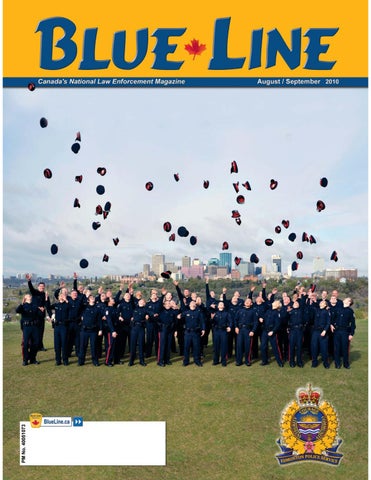
There are few things in the world as exuberant as a graduating class of police officers. In this month’s cover shot you get a taste of the enthusiasm shared by a recent graduating class of Edmonton Police officers. After the celebrations they melt into the fabric of both the police service and the community as they take on the challenges of their new career. More on page 6.
Features 6
Quality of life
34
The incident
Dedicated to protect... proud to serve
36 10
Faster results, lower costs RCMP forensics lab streamlining process “very, very positive”
38 14
Down but not out After serving and fighting for his country an officer counts on his family and friends
Relationships under fire Bullet proofing the police family unit
Blue Line advertisers at the CACP
Departments
Case Law
54 40 22 27, 39 52, 53 20 51 5 42
46 47 48 49
Advertisers Index Book News Deep Blue Dispatches Market Place Media & Public Affairs Product News Publisher’s Commentary Technology
BLUE BLUE LINE LINE MAGAZINE MAGAZINE
33
Combination of factors provide reasonable grounds Raw marijuana odour justifies arrest Judge didn’t believe officer, excluded evidence Shining light through tinted window not a search
JANUARY 2010 AUGUST / SEPTEMBER 2010
AUGUST / SEPTEMBER 2010
4
BLUE LINE MAGAZINE
PUBLISHER’S COMMENTARY by Morley Lymburner
Policing is the only economic summit success story I did not expect to write about the police handling of the economic summit. Upon viewing the event and listening over the months to all the preparations I was quite content that it was a textbook crowd control process, performed so well that nothing further needed to be said. In fact we were so sure of a successful event we assigned a photographer to get some candid shots for this issue. You can see Matt’s essay on page 32 this month. After talking to friends, family and other media people I realized that not everyone shares my opinion and are being fed considerable misinformation. So, here’s my opinion about that perfect storm and the perfect remedy supplied by a lot of dedicated people from many police services. In answer to the call for yet another expensive public inquiry, to quote Tallulah Bankhead, “There is less in this than meets the eye.” It would make a great training manual for others to follow – BUT it might give the bad guys too much information. Keeping bad guys ignorant can be a good policy. It was a simple process for me to analyse the success or failure of the economic summit policing. One only has to look at the body count. How many killed? Anyone seriously maimed? Seriously injured? How many minor injuries? My best information on the first two is zero and the remaining two... well, not much more. I understand more casualties occurred at any one of the FIFA soccer games. The only difference is the emotions of the FIFA fans were much more genuine than the economic summit demonstrators. All this comes down to a simple known philosophy. Cut corners on the budget and the body count goes up, as does property damage. This aspect should be simple common sense but it fails the smell test of most critics. If a community does not want to be known as the place where a famous person or persons were killed, it had better pony up the money
BLUE LINE MAGAZINE
to ensure the safety of high profile visitors. If anyone doubts this, simply mention Dallas and images of an assassinated president will quickly come to mind. On this note French President Nicolas Sarkozy’s words may come back to haunt him. When a reporter asked him about the $800 million price tag for the Canadian G20, he replied “As for the French G8/G20, even though I can’t confirm the Canadian numbers, they will be ten times less. Exactly.” If he sticks to that number you can bet the body count will go up. If Sarkozy actually does save money on his Nice adventure it will probably be because he learned from all that was done right in Toronto, though my bet is on creative bookkeeping and spin. One other note could be shared with the organizers of peaceful protests. They should have learned by now that being seen in company with any form of violence does their cause irreparable damage. The so-called “Black Bloc” enjoy melting into the crowds of those bent on peaceful and legitimate protests; leaders should instruct anyone carrying their
5
banners to immediately remove signs from any location where there is violence. A front page photograph of a person smashing a window along with a sign that says “Save the Ptarmigan” can be published endlessly around the world – and be endlessly associated with a negative event, especially if it becomes a file photo emblematic of that event for years to come. Protecting people and their rights is not cheap. Every demonstrator arrested or held was processed and recorded according to some stiff principles commensurate with Canadian values and expectations. New technologies were acquired, temporary facilities designed and constructed, new procedures implemented and police officers appropriately instructed and trained. The true pride that can be seen in the Toronto G20 is in the restraint shown by the hundreds of police officers brought in from across the country – from BC to Newfoundland. They remained remarkably disciplined in reacting to the crowds’ taunts and I was struck by how seamlessly they worked in unison. Above all else this is a reflection of Canadian values across the country. They were selected from a wide range of communities and all showed what their values had taught them. It was reassuring to see this restraint, discipline and compassion shown to millions around the world. I saw an officer on TV news give a protestor water to clear tear gas from his eyes. A YouTube video shows a large line of police attempting to clear a street but waiting for the crowd to finish patriotically singing the national anthem before moving them along. It reminds me of a mug full of pens standing on my desk, acquired from a long forgotten tourist trap. It simply says “Canada – The land of polite police.”
AUGUST / SEPTEMBER 2010
Quality of life Dedicated to protect... proud to serve by Patrycia Thenu The quality of life, safety and security of Edmonton’s more than one million residents are the top priorities for the Edmonton Police Service (EPS). The latest example – an annual policing plan outlining policing priorities and performance targets developed last year saw crime decrease by more than two per cent, despite the slowing economy and other environmental factors. Chief Mike Boyd The service continued to work towards its goal of reducing crime and victimization by responding to priority one calls within seven minutes, 90 per cent of the time; dedicating 25 per cent of patrol time to proactive activities; and working closely with community partners.
AUGUST / SEPTEMBER 2010
This success boosted public confidence and the overall quality of life in the city. The EPS launched a new crime-mapping online system which allows residents to view local crime statistics, providing them with knowledge about incidents occurring in their neighbourhood and empowering them to work to prevent it. Showing their true colours The service also unveiled its first colours and a redesigned crest in January, 2009. The colours were designed and approved by the Canadian Heraldic Authority. They are dark blue and have a gold fringe which contains embroidered wild roses and maple leafs. At the centre is the new crest, surrounded by the names of officers who have been killed in the line of duty. Retired EPS Chaplain Kurt Schmidlin blessed the colours, which were officially presented to the chief by Alberta Lieutenant Governor Norman L. Kwong. The motto on the new crest – integrity, courage, community – expresses the character of the service.
6
The service bought a second helicopter in September, 2009, allowing the flight operations unit to respond to more calls and provide air service seven nights per week (up from five). Air time is expected to increase to 1,500 hours a year, up from around 1,000. The flight and canine units work together closely, with an eye in the sky and noses to the ground, playing pivotal roles in attending 2,200 calls for support, resulting in 462 arrests last year. Special teams Implementing special project teams in the city’s five patrol divisions numbers was one of the service’s most significant accomplishments last year. The majority of crime and disorder is perpetrated by repeat offenders; 20 per cent commit some 80 per cent of the crime. Most prolific offenders commit crimes to support drug and alcohol addictions and specialized teams focus solely on them. Working directly with divisional intelligence and crime investigation detectives has proven to BLUE LINE MAGAZINE
be an effective and efficient mechanism to combat this problem. The teams have helped the EPS identify potential suspects and targets responsible for the majority of the crime, disorder and victimization in each division. New training A new training program is enhancing the way officers think about, respond to and describe the professional application of force. “It’s a different way of looking at use of force,” says training branch Insp. Bob Hassel. “We are changing the way we articulate use of force events and the way we explain it in our notes, our police reports and ultimately in court.” The new training paradigm is called reasonable officer response (ROR) and is based on the expectation of Canadian jurisprudence and the standard of objective reasonableness and the following factors: 1. Lawful and professional presence; 2. Tactical communication and considerations; 3. Officer perception (environmental, officer and subject factors); 4. Officer response. “Any time we use any type of force, we shall ‘test’ our actions against the following criteria: were we lawfully placed?; did the officer subjectively believe that the amount of force was reasonable?; and, would an objective, reasonable person (standing in the officer’s shoes) believe that the level of force used was reasonable?,” says Hassel. The biggest change is in how use of force events are explained. “I am confident that in most instances we are applying force in a professional manner, but in many cases in the past, we didn’t adequately articulate the ‘reasonableness’ of the use of force we were using,” says Hassel. As part of the ROR program, officers receive enhanced training on ‘tactical comBLUE LINE MAGAZINE
munication,’ including appropriate testimony in a judicial process using plain language instead of traditional police terminology. The goal is to minimize complaints, increase criminal convictions, provide more knowledge about application of force and raise the overall level of professionalism when using force, explains Hassel. “It will also give officers more confidence that they made the right decision,” he says. Approximately 1,300 officers have been trained since the first phase started in January. Phases two and three focus on patrol members and continue this fall. The program has already gained recognition and interest from the solicitor general and other Canadian and US police agencies. Recruiting The EPS continued to receive interest from people wanting to join. In 2009, 169 new recruits graduated; whether at the neighbourhood level or at a special event, residents welcome the presence of more police officers on the street. Life-saving course result of near-fatal shooting It was a few minutes after midnight on June 29, 2006 and Cst. Dan Furman was investigating a weapons complaint at a flop house in the city’s north end when he was shot several times at close range. “I looked up and saw a gun pointed at me from about three feet away. I had my Taser in my hand. I pulled the trigger and the suspect (at the same time) pulled the trigger on his gun,” he recounts. “I was shot in the chest, which fractured my sternum and knocked me down. When I came to, I saw the suspect standing over me and he shot me two more times. One bullet went through my (left) hand and the other through two ribs and my right lung, which severed a brachial artery.” 7
He lay on the floor, bleeding, wondering if he would survive. Partner Cst. Jason Mitchell, who applied advanced fi rst aid learned during his military training, saved his life. “I was told by more than one doctor that I would have died if Jason wouldn’t have had this extra training,” says Furman. Following this life-altering experience, Furman and Sgt. Dave DeMarco, who heads the officer safety unit, proposed developing the Officer Down Casualty Care Course (ODCCC). Training is based on the tactical combat casualty care course received by all military officers. The one day course was developed in collaboration with other agencies, including emergency medical services and the University of Alberta Hospital. “I saw there was a huge need for us to have this kind of training, especially since we’re pulling knives and guns off many suspects. The potential for this to happen (to another officer) is very real,” says Furman. The inherent risk and danger in policing is more real today than any previous point in history, says DeMarco. “It is certainly fair to suggest that predictable losses are mitigated through competent and credible training and preparedness. The ODCCC provides necessary skills and tactics to respond to life threatening injuries when an officer is critically injured and faced with imminent total blood loss.” The training consists of: • A motivational component, including interviews with the three officers involved in the June 29 incident; • Casualty care, including deadly bleed and direct pressure first aid; • Officer/citizen down rescue strategies and six 30-minute scenarios which take participants through dynamic, life-threatening events involving rescues and on-scene casualty care. Two lives have been saved and more than AUGUST / SEPTEMBER 2010
1,000 members have been trained since the course was first offered in the fall of 2009. The EPS is offering the training to other policing agencies and is currently working on developing a 60-minute video telling Furman’s story. Although it’s been four years since the shooting, Furman says the incident is still fresh in his mind and new emotions surface every time he talks about it. “It’s been therapeutic to speak about it and it helps me deal with what happened,” he says. “It’s also about putting the bad behind me and focusing on the positive that has come out of (the incident).” Furman currently works in forensics, which he says is “as close to operations without actually being on the street,” something that he’s not sure he’ll ever be able to do again. Chinese cards
Above: (Left to right) Constables Mike Furman and Derek Huff walk through Chinatown. Left: Cst. Mike Bates holds one of the Chinese cards being distributed to residents. The cards have opened the doors to communication and trust with the community.
A small and simple initiative which began almost a year ago has led to big changes. Three downtown division detectives discovered last summer that Chinese elders weren’t reporting crime when they were victimized due to a language barrier and strong distrust of police. The three constables, who speak fluent Cantonese and Mandarin, decided to hand out a small card with their contact information in these two languages. They call their initiative the Chinese Liaison Program. Since then, lines of communication have been established and a solid foundation of trust has been built between the community and police. Residents, business owners and especially elders are more willing to report crime and other suspicious activities. “There were some questionable and obscene things going on right in front of patrons dining at a Chinese restaurant across the street from the Hope Mission and it was making not only the business owners but also the customers feel very uncomfortable,” says downtown Cst. Mike Bates. “Before the Chinese Liaison Program we weren’t aware of this issue, but once it was brought to our attention, we could do something about it.” The solution proved to be quite simple, says Bates. “We couldn’t change some of the things that were happening on the sidewalk, but we AUGUST / SEPTEMBER 2010
were able to move the line up at the shelter to the other side of the building, which solved the problem.” Other calls that the officers have received range from harassment at bus stops to personal robberies in front of the Chinese Multicultural Centre. Some information has even led to the discovery and shut down of an illegal massage parlour and a $25,000-fraud investigation at West Edmonton Mall. One of the most significant changes is the establishment of police agent status with almost each and every single business in Chinatown. Anyone who strolls down the busy street will notice the sticker in most doors and windows. 8
“We personally visited close to 100 businesses and met with their owners,” says Cst. Derek Huff who worked alongside Furman on the initiative. “It allows us to deal with any issues immediately, like trespassing or loitering, without contacting the owners and thus eliminates a few steps and speeds up the process.” A list of Chinese-speaking officers is being compiled and the EPS is considering expanding the project to other areas of the city. Patrycia Thenu is the Senior Media Relations Specialist with the Corporate Communications Section of the Edmonton Police Service. She may be contacted at Patrycia.Thenu@edmontonpolice.ca or 780 421-2663.
BLUE LINE MAGAZINE
BLUE LINE MAGAZINE
9
AUGUST / SEPTEMBER 2010
Faster results, lower costs RCMP forensic lab streamlining process “very, very positive” by Ann Harvey Restructuring RCMP forensic laboratories is resulting in quicker turnaround, increased capacity and lower costs. The initiative, in response to demands from investigators and the auditor general for faster results, even ends some quotas, giving investigators greater access to service. The first clients Asst/Comm affected – NewfoundPeter Henschel land, Nova Scotia,
AUGUST / SEPTEMBER 2010
New Brunswick and Prince Edward Island – have already approved of the changes, according to an independent survey conducted by Malatest. RCMP labs in Vancouver, Edmonton, Regina, Winnipeg, Ottawa and Halifax serve police in all provinces and territories except Ontario and Quebec. The improvements were accomplished with no new funding, noted Asst/Comm Peter Henschel, OIC of Forensic Science & Identification Services. “We didn’t get more money. We’re in a period of fiscal restraint. Over the last year we’ve been doing this with less money than we were spending before.” Henschel is cautiously optimistic about the restructuring, saying it is “very promising and significantly improved (service)” but
10
added that transforming an entire laboratory service to a new way of working must be done slowly and carefully. The changes are being introduced a region at a time and modified as required. “We’re still early in the process and we’ve only worked with one-third of our client base. There are still many challenges ahead of us. There are a lot of positive indicators. We’re being very, very careful with staff and clients. There’s always a risk that something will cause problems. We’ll adapt as we go along.” The final phase will be to assess the transformation and make any required changes to ensure long-term sustainability, Henschel added. Henschel and Tony Yaacoub, director general of the business transformation, said the RCMP faces the same increase in demand and complaints from clients faced by laboratory services throughout the western world. “A lot of this was driven because of the DNA side, that insatiable demand that we never seemed to be able to meet,” Henschel explained. “The auditor general and our clients’ needs made it a priority... “I came into this job in November 2008. The clients had raised many concerns, mostly about delays, about backlogs; those kind of issues. We had an independent review done of our biology services by subject matter experts.” Although all disciplines, including toxicology and firearms identification, are being addressed, DNA has the highest profile. “The BLUE LINE MAGAZINE
demand and the timeliness aren’t always nearly as pressing for some of the other disciplines as for DNA.” Henschel said, “DNA was a fundamental change in forensics. Probably the last time there has been such a change was when fingerprints started being used forensically, around 100 years ago.” Since DNA analysis evidence was accepted by courts and it became possible to test smaller amounts, clients are demanding more and more tests, clogging the current system. The multiple murders of women which resulted in the conviction of Robert Pickton triggered the RCMP’s previous effort to expand its DNA analysis capacity by investing in automated equipment – robots – to analyze DNA material. It also made some other efforts to increase efficiency, but remained unable to achieve timeliness, Henschel said. Henschel and his staff used another approach this time. “We said: let’s look at the whole system and see if there isn’t another way to do this. What this transformation is about is taking a whole systems approach to client service delivery... “If we had to start fresh, (we asked ourselves), would we do it a little differently? Could we streamline, minimize bureaucracy and improve administrative processes?” They consulted with both clients and staff, Henschel said. “When we held one of our very early workshops we said we have this vision of where we want to go but we want your input. There was a lot of enthusiasm.” Ultimately they developed a process for intelligently managing exhibit submissions to the lab: communicating with investigators so they send only the number and type of exhibits that could have probative value and impact the investigation, only doing forensic work as it is required and in the most efficient manner possible and finally, streamlining reporting. “The first step is a flexible and efficient intake and triage of exhibits, to ensure that timely information can be provided to investigators,” Henschel explained. “Very early in the process, when an investigator contacts the new forensic assessment centre, there is discussion and communication.” In less complex investigations, a case advisor will advise the investigator about which exhibits to send and authorize their submission. In more complex cases, a forensic strategist will discuss the details and answer key questions from the investigator (and possibly a forensic identification specialist) to determine what is required. “That process ensures that the probative exhibits are sent in.” “First and foremost this process is about being very smart about the work we do,” Henschel said. “There are only so many resources in any lab. There is a finite amount of capacity. We want to make sure that that capacity is focused on the most important things. From our perspective, you can only do that by having that discussion with the investigator, making sure that we’re not doing things that don’t add value. “In the past investigators may have thought an exhibit would have relevance and BLUE LINE MAGAZINE
sent it in. It may not have been a good exhibit. We did work that was chewing up valuable resources.” Now the advisor or strategist explains to the investigator why an exhibit is or is not useful. “It’s also a process of information exchange, achieving common understanding of what can actually make a difference.” A peripheral benefit is educating police, he added. With baby boomers retiring, there are more less experienced investigators who can benefit from the help. Discussion and approval of the exhibits replaces the old system’s quotas, which may have reduced an investigator’s effectiveness, noted Henschel. “In the previous model we restricted (DNA) exhibits to eight,” Yaacoub explained. “In the new model there is no restriction. If you need 12, we will take 12 if they are of value.” This careful, front-end scrutiny and elimination of work without value also frees up capacity and helps ensure timely reporting, said Henschel. The investigator gets a quicker answer that may make other investigational avenues unnecessary and reduce overall costs. “It could save on all sorts of other lengthier investigative techniques that may be very costly.” Formerly, investigators would send in the exhibits they thought needed to be analyzed and the lab would prepare a report in a manner which could be presented in court, he said – but not all investigations go to court and valuable
11
time was spent making everything court-ready instead of reporting back to investigators in a timely manner. “Why would we make every case court-ready if it never gets to court?” Now the system offers preliminary reports. “We do the work as and when it is required and report on it. The Crown can always request more work as the case is being prepared for court. Then we’ll do that work in a timely manner so that it doesn’t negatively impact the case.” “We’re also doing other things like process improvements,” Henschel added. “On the DNA side, new procedures have lowered the threshold on the amount of DNA required for analysis.” Another process improvement is the volume analysis being piloted at the Edmonton lab. “With the automated process we can batch exhibits. We can push a whole bunch of cases through very quickly and get faster results.” Volume analysis allows streamlining on the administrative side too, noted Yaacoub. “The reports of those cases are simplified. A complex case might have a 20-page report. For volume analysis the reports could be a few lines or less than a page. Again this change in procedures reduces needless work and frees up capacity to allow greater timeliness and also more exhibits, if needed. Formerly, there was a quota on DNA exhibits for secondary offences, Yaacoub said. “The new process allows them to send as many secondary offences as they want.” Helping
AUGUST / SEPTEMBER 2010
investigators will also add more crime scene DNA profiles to the national DNA bank and allow for more hits, he said. Transforming the laboratory service is being done in four phases, Henschel said. “What we didn’t want to do was switch overnight. That would cause chaos.” The first phase – a pilot project in the Atlantic region, which constitutes approximately 10 per cent of the lab’s workload – began last September, with 10 per cent of the lab’s resources dedicated to the pilot. The independent surveyor, Malatest, did before and after surveys and reported that clients found the new system: • provided preauthorization more efficiently and made forms easier to complete; • was more responsive to needs, including diary dates which reflect priority of cases; • more often met agreed upon diary dates; • gave more understandable reports and improved investigation guidance; • provided more essential information in a more timely fashion; • provided improved interim/status information, and; • made it easier to contact appropriate staff. “There were significantly improved turnaround times, especially on the DNA side,” Henschel noted. “As a result of all the changes we made, we found that we had actually increased our capacity. We therefore expanded phase one to include Manitoba and Nunavut on Jan. 12 of this year.”
AUGUST / SEPTEMBER 2010
By the end of March, priority (expedited) cases for DNA had an average turnaround time of 14 days instead of the 30 days under the old system (Sept. 2008). For routine cases the average time was 30 days instead of the previous 151. The increased capacity generated an unexpected change, the assistant commissioner said – fewer expedited cases. Investigators who wanted a case expedited previously had to go through an burdensome administrative process. “This new process eliminates the investigators having to do that. If they need to have it expedited they have that discussion on the phone when they call. “A diary date is negotiated with them through the assessment. It could be 15 days instead of 30 or 40. That now has significantly reduced the burden for the investigator. It sometimes used to take one to two weeks before the case was authorized. Now cases are being authorized the same day.” Many investigators – particularly on the DNA side – now say “30 days is good enough. In many instances, they don’t see the need to expedite their cases.” Yaacoub said another streamlining initiative allows selected Atlantic-region clients to access lab reports online. “They can submit their request and receive the lab report online. They can track their case online in the same way you do for Purolator shipments. It’s a secure system.”
12
Henschel wants to provide that service to all clients when the necessary IT infrastructure becomes available. “The results of phase one have been very, very positive. It’s going so well that we’re now moving on to phase two,” Henschel said. Saskatchewan, Alberta and the Northwest Territories began on June 8 and Henschel and Yaacoub anticipated starting the phase three inclusion of British Columbia, with its huge volume and complex Lower Mainland area, sometime in the fall. Ann Harvey is Blue Line Magazine’s Western correspondent based in Alberta. Contact her at: aharvey@blueline.ca
Canadian documentary receives international recognition The Canadian documentary film, When Police become Prey, has won the much-coveted “Audience Choice for Best Documentary,” out of dozens of documentaries submitted from around the world for screening at the New Hope Film Festival in Pennsylvania (www.newhopefilmfestival.com ). The documentary investigates allegations against Saskatoon police officers regarding so-called “Starlight Tours” – the alleged practice of police dropping off aboriginal people where they do not wish to be dropped off – and concludes that Constables Ken Munson and Dan Hatchen faced a travesty of justice. “The current trend toward judges disbelieving the testimony of exemplary officers and choosing instead to rely on the word of convicted felons is alarming,” states Calgary producer Candis McLean. “No one should take the word of a constant perjurer over the word of a police officer with a record of good and honest service. The bottom line is: Justice must not only be blind, it must be colour-blind. Anything less places every single member of society at risk.” When Police become Prey was also nominated for a second category, the “Artistic Spirit” award, a category requiring both artistry in presentation and bravery in tackling the topic. “I had activists picketing the Saskatoon theatre in which I showed the documentary,” McLean says, “and many people told me they turned away rather than run the gauntlet. I carried pepper spray the entire time I was in Saskatoon. But most importantly, I faced people who called me racist simply because I was investigating a matter of straight-forward injustice. It’s sad when a person must be brave in order to be politically-incorrect in Canada.” McLean says she was astonished by the number of American police officers who told her after the screening of her documentary that they face the same issue in their country. “American police gave me their cards and said: ‘Please contact us so that we can have a voice in your upcoming book. The lack of colour-blind justice is a huge issue in America.’”
BLUE LINE MAGAZINE
BLUE LINE MAGAZINE
13
AUGUST / SEPTEMBER 2010
Blue Line advertisers at the CACP 3M Canada Company See Advertisement Page 27 3M’s Occupational Health & Environmental Safety and Traffic Safety Systems Divisions’ high quality products and technologies offer a wide array of personal safety solutions for visibility, respiratory, head, hearing, eye, face and fall protection as well as reflective sheeting for license plates, validation stickers, traffic signs, pavement markings, and embedded security marks. Offering solutions for the protection and safety of citizens and police officers, 3M is Health & Safety and Visibility Accident Support Services International See advertisement page 33 Accident Support Services facilitates centralized collision reporting to police, insurers and Provincial Ministries of Transportation, at no cost to police or taxpayers. Our Microsoft award winning Collision Reporting and Occurrence Management System (CROMS) can serve as your electronic collision database and our new CROMS Analytics Portal lets you create ad-hoc queries from your computer using any data field, for enforcement or statistical purposes. Identify hotspots, reduce traffic congestion and minimize risk of secondary collisions. Reallocate or direct your manpower to higher priority needs. Improve response times and traffic charges with proactive enforcement. Our services are flexible to meet your needs, regardless of your population through our CRC or CROMS database programs. Blue Line Magazine See advertisement page 53 Blue Line Magazine is Canada’s independent national law enforcement publication. Published monthly, it reaches the entire spectrum of Canadian law enforcement and is known for dynamic articles relevant to all levels of law enforcement. Blue Line News Week, an electronic law enforcement news digest, reaches executive law enforcers every week. Blue Line Trade Show and Blue Line.ca complement the two publications with discussion forums, training courses and exhibitions. Canada Law Book See advertisement page 12 As one of Canada’s foremost legal publishers for more than 150 years, Canada Law Book has established itself as an industry leader, publishing some of the finest legal resources available. Our continued commitment to excellence helps to ensure you meet your law enforcement responsibilities both knowledgeably and confidently every day. AUGUST / SEPTEMBER 2010
Enlist Martin’s Annual Criminal Code – Police Edition, Police Legal Access System (PLAS) on CD-ROM, and Martin’s Online Criminal Code, as your ammunition to making a difference in the line of duty. Our word is the law. Cdn Police Knowledge Network See advertisement page 37 The Canadian Police Knowledge Network (CPKN), a not-for-profit organization, is Canada’s leading provider of online training solutions for police offi cers. Created in response to a recognized need for an efficient, cost-effective training model for Canadian police services, in March 2004, members of the Canadian police community collaborated with government and academic organizations including the National Research Council Canada Industrial Research Assistance Program (NRC-IRAP) and Holland College’s Justice Knowledge Network to create CPKN. Working with subject matter experts from police training academies and police services across Canada, CPKN delivers highly effective, economical, and engaging e-learning courses to meet the needs of police services. Chrysler Canada See advertisement page 56 Chrysler now has the most impressive product range and the most valuable brands in the automotive industry. Backed by strong research and development, these brands will be at the cutting edge of technology in their respective segment, offering our customers the best there is in terms of innovation, design, safety, quality, service and the sheer enjoyment of owning one of our products. Code Zero See advertisement page 48 CODE ZERO is committed to “Lead the Quest for ZERO Crashes and Collisions” on North American roads. With years of experience teaching First-Responders vital, potentially life-saving driving techniques, CODE ZERO Licensing International Inc. is offering those same lessons to corporations, groups and the general public via their carefully-structured International Franchising System. For more information: www.codezerodriving.com Colt Canada See advertisement page 11 Colt Canada is the strategic source of supply for small arms to the Canadian government, and supplies small arms systems to roughly half of our NATO allies, including The Netherlands, Denmark and the UK. Colt Cana14
da now offers military specification equipment and services Canadian law enforcement agencies directly. Products and services include sniper systems, tactical weapons, patrol rifles, 40 mm launchers, pistols, less lethal solutions, optics, accessories, armourer’s tools, engineering, service and repair, armourer and tactical rifle training, safety equipment and technical publications. DAVTECH Analytical Services See advertisement page 15 DAVTECH Analytical Services (Canada) Inc has positioned itself to remain a leader in traffic safety products and solutions throughout Canada. Our newly expanded product line includes digital in-car video, radar, LIDAR, emergency LED lighting, accident investigation software, traffic analysis equipment, alcohol breath testing instruments, drugs of abuse testing and all related peripherals. DAVTECH is an authorized distributor for Digital Ally, Decatur Electronics, Laser Atlanta, Intoximeters, NPAS, Visual Statement, Eluminator Lighting, Metro Count, Medtox, and Tri-Tech to name a few. General Dynamics See advertisement page 43 General Dynamics is a market leader in mission-critical secure communications, information systems and mobile-rugged and commercial computing solutions. With an established Canadian presence for more than 60 years, General Dynamics draws on strong systems and software development and integration that connects governments and agencies at local, tribal, regional, national and international levels. General Dynamics Canada – www.gdcanada.com General Dynamics Itronix – www.gditronix.com Integral Tactical See advertisement page 53 Integral Tactical is a designer and manufacturer of specialized outdoor products which are sold direct to tactical and government customers. We have been in business since 1986, manufacturing the Integral Designs brand of sleep and shelter products for the mountaineering and backpacking market. The products which we design and manufacture in our own factory in Calgary include: sleeping bags (down and Primaloft), custom outerwear and personal shelter systems. Integral Tactical specializes in small production runs and “just in time” manufacturing and has a loyal following of customers who have to do the tough jobs – regardless of the weather. BLUE LINE MAGAZINE
Mega Tech See advertisement page 25 Mega-Tech is pleased to offer to our customers a full line of quality products and factory trained technicians. Our Eastern Regional office allows us to better serve you from two full service facilities. In many cases the products we offer are recognized as industry standards that offer the very best in quality and customer support. Meggitt Training Systems See advertisement page 9 Meggitt Training Systems is the only training company in Canada offering both live fire and virtual training solutions, including Road Range, a mobile training facility for both. As the world leader in R & D, we developed the BlueFire line of tether-less weapons for the most live-like virtual training. We service our customers from our offices in Medicine Hat and Montreal with service reps in Edmonton, Gagetown, Halifax and Victoria Mr. Pin Man Inc. See advertisement page 53 Mr. Pin Man Inc. Specializes in Custom Lapel Pins & Metal Products, including Key Chains, Dog Tags, Belt Buckles, Badges, Golf products and Water Bottles. Plus an extensive line of Stock Products including Law Enforcement and RCMP/GRC Licensed Products, Crime Stoppers, Victim Services plus many more. Contact us direct for more info. www.mrpinman.com
BLUE LINE MAGAZINE
Panasonic Canada Inc. See advertisement page 13 Panasonic Canada Inc. manufactures a full line of rugged and semi-rugged notebook computers. The TOUGHBOOK TM series is designed to withstand the demanding conditions of mobile professionals. Ruggedized features include a full or partial magnesium case, a shock-mounted hard drive, and sealed keyboards that resist the hazards of dirt, dust and spills. To learn more visit our web site at www. panasonic.ca The Patchman See advertisement page 42 Serving Emergency Services since 1998, we are a Rural Northern Alberta business. Our NEON HIR reflective is proven 12 X brighter than competitor graphics and we offer a broad range of other products, including Design, Patches, Uniforms and Hi Viz Wear. Please visit us at booth 910. Whelen Engineering See advertisement page 39 Whelen designs and manufactures vehicular visual and audible warning equipment including LED strobe and halogen lightbars, beacons, power supplies, sirens and secondary lighting products. Whelen products are designed and manufactured in the U.S.A.
15
AUGUST / SEPTEMBER 2010
&
Sniffing
snuffing out crime Hamilton Police marks canine unit’s 50th anniversary by Derek Donn and Denise Leonard Former and current serving members, officers and dogs of the Hamilton Police Service (HPS) Canine unit gathered in early June for a fundraising barbecue to mark the unit’s 50th anniversary. The proceeds went to the McMaster Children’s Hospital. Hamilton was one of the first police services in the country to use dogs for patrol work. The oldest unit in Ontario and second oldest in Canada, the canine unit was established in 1960. It all began with two German Shepherds, Sandy and King, donated by citizens. Within the first six months, they helped arrest prowlers, burglars and even careless drivers and were particularly effective in controlling and dispersing large crowds of disorderly people. Since then, police service dogs have been trained to detect drugs, weapons, explosives and even cash. The majority of dogs used have been German Shepherds, although the unit even boosts an honourary member – Don Cherry’s dog Blue. HPS currently has four dogs trained in tracking human scent and detecting narcotics. The unit has been responsible for thousands of arrests, recovered countless weapons and hundreds of thousands of dollars worth of illegal drugs in its half century history. It responded to more than 1,000 calls for service last year alone, attending 360 canine calls, 30 tactical calls and making 60 arrests. AUGUST / SEPTEMBER 2010
Sadly, the unit lost one of its dogs in the line of duty in 1992. Cst. Paul Johnston and his dog Troy responded to a call for a man with a gun and were searching the area when Johnston spotted the suspect pointing a rifle at another officer. He refused to drop his weapon so Troy was sent in. The officer was able to take cover as the gunman fired a single shot, killing Troy instantly. “I could go on forever about tracks, searches and apprehensions but what I remember the most was the love of the job, the partnership with my dog and the bond between my fellow handlers,” said Cst. Denise Leonard. “I spent seven years in K-9 and I wouldn’t change it for the world... “The police training and skills I gained I apply now to my general patrol duties. The passion I had for K-9 and my rule of never give up no matter what you are faced with carries into my investigations and what I do now.” Although relentless pursuit of offenders is central to the unit’s mandate, members are also very active in the community. The officers and dogs are perennial favourites for hospital and school visits and community events. Although the dogs are keenly trained in policing, they are equally skilled in meeting residents, especially children. Beating the odds A handler’s diligence and a dog’s finely tuned sense of smell can make all the difference, says Leonard, who recalls a memorable article search after a home invasion robbery. “I was dispatched to assist when patrol had stopped a male suspect on the street... a few minutes after the incident.” Officers were looking for something to tie the suspect back to the scene. It was the mid16
dle of the day and the area, all concrete, was saturated with people, she explains. “I wasn’t able to do a track but officers advised the only thing taken from the home invasion was the necklace off of the complainant. I decided to do an area search in the general vicinity... there were three or four concrete planters out front of the building and the rest was sidewalk. The suspect was arrested in front of one of the planters... “Within seconds Rocky hit on the planter where the suspect was arrested. Rocky started to dig in the crack between the planter and the building wall. I looked into the crack and was able to fish out the necklace of the complainant. With that the suspect was arrested and eventually convicted in court. Without this piece of evidence the suspect might not have been linked to the scene, arrested and eventually convicted in court. This case taught me to be diligent in what we do and go against the odds. On more than one occasion in my K-9 career, I applied this rule and beat the odds.” Murder suspect nabbed In October 2005 police were sent to investigate a number of reports of a fight between two individuals and found a 32 year-old man lying in the street. He had been stabbed in the chest and died later in hospital. Another man had fled the scene on foot. Canine handler Mike Eleftheriou and PSD Argus were called in three hours later and, after a briefing, searched alleys and backyards in the mixed residential and commercial area over a three block radius from the crime scene. Investigators felt the suspect perhaps lived in the area but was likely long gone. Some 45 minutes into the search Argus, off lead, was directed to search an abandoned BLUE LINE MAGAZINE
school property overgrown with shrubs and bushes. Within a minute he showed interest in a corner of the building and began indicating by barking at something in the bushes. Eleftheriou couldn’t see anything but closer inspection showed the suspect was hiding in the bushes. He was taken into custody without incident. The suspect made several incriminating statements and was eventually charged with first degree murder. The murder weapon was located near where he had been hiding. If not for the efforts of Argus, it’s unlikely the suspect would have been located, as numerous patrol officers had already searched the area.
BLUE LINE MAGAZINE
Missing person A woman believed suicidal had been missing for about three days. Hamilton police initiated a media blitz, giving the public her description and the plate number and particulars of the vehicle she was driving. A citizen spotted it and called police. Canine handler Derek Donn and partner PSD Sultan were called to the scene. An extensive search of the area was unsuccessful. Donn decided to check out a trucking compound. Sultan entered an abandoned storage trailer and found the missing person, who was partially conscious and needing medical attention. There is no doubt that this find saved her life.
17
Current Hamilton PS dogs Cst. Dan Forrest and Koda, a six year old German Shepherd from Ontario cross trained in detecting human scent and narcotics. Cst. Tim Knapp and Trooper, a four year old German Shepherd from Hungary cross trained in detecting human scent and narcotics. Cst. John Sabatini and Maverick, a two year old German Shepherd from the Netherlands trained in detecting human scent. Cst. Derek Donn and Sultan, a four year old German Shepherd from Germany cross trained to track and locate drugs and human scent.
AUGUST / SEPTEMBER 2010
2010 Appointments
Police Medal of Merit The Order of Merit of the Police Forces honours a career of exceptional service or distinctive merit displayed by the men and women of the Canadian Police Services, and recognizes their commitment to this country. The primary focus is on exceptional merit, contributions to policing and community development. The commissioner of the Royal Canadian Mounted Police, the principal commander of the Order, submits recommendations for appointment to the governor general on behalf of an advisory committee. Nominations for appointment to the Order may be made by submitting the name of a member or employee of a police force to the commanding officer of that police force. For further information go to www.gg.ca/ or CACP.ca COMMANDER OF THE ORDER OF MERIT OF THE POLICE FORCES
MEMBERS OF THE ORDER OF MERIT OF THE POLICE FORCES Chief Keith John Atkinson, M.O.M. Brandon Police Service, Man.
Corporal Christopher G. Gosselin, M.O.M. RCMP, Chilliwack, B.C.
Superintendent Bradley Blair, M.O.M. Ontario Provincial Police, Orillia
Sergeant Stewart C. Kellock, M.O.M., C.D. Toronto Police Service, Ont.
Dpt. Com. Lawrence Graham Beechey, O.O.M. Ontario Provincial Police, Orillia
Staff Sergeant Murray Elijah Brown, M.O.M. RCMP, Halifax, N.S.
Ast. Com. Wayne Alexander Lang, M.O.M. RCMP, Fredericton, N.B.
Chief Cst. Jamie Hamilton Graham, O.O.M. Victoria Police Department, B.C.
Chief Cst. Douglas James Cessford, M.O.M. Delta Police Service, B.C.
Ms. Brenda Lawson, M.O.M. Ottawa Police Service, Ont.
Dpt. Com. J. V. N. (Vincent) Hawkes, O.O.M. Ontario Provincial Police, Orillia
Sergeant G. Shawn Coady, M.O.M., C.D. Vancouver Police Department, B.C.
Chief Barry D. MacKnight, M.O.M. Fredericton Police Service, N.B.
Dpt. Com. Christopher D. Lewis, O.O.M. (promotion within the Order) Ontario Provincial Police, Orillia
Dpt. Chief Cst. John Alexander Ducker, M.O.M. Victoria Police Department, B.C.
Chief Super.William Fraser MacRae, M.O.M. RCMP, Surrey, B.C.
Assist. Com. Robert W. Paulson, O.O.M. (promotion within the Order) RCMP, Ottawa, Ont.
Staff Super. Michael Federico, M.O.M. Toronto Police Service, Ont.
Deputy Chief Michael S. Mann, M.O.M. Waterloo Police Service, Cambridge, ON
Inspector Joseph Lance Valcour, O.O.M. Ottawa Police Service, Ont.
Chief Inspector André Fortin, M.O.M. Sûreté du Québec, Montréal
Superintendent H. Alfred Niedtner, M.O.M. Vancouver Police Department, B.C.
Assist. Dtr. General Steven Chabot, C.O.M. (promotion within the Order) Sûreté du Québec, Montréal
OFFICERS OF THE ORDER OF MERIT OF THE POLICE FORCES
AUGUST / SEPTEMBER 2010
18
BLUE LINE MAGAZINE
Inspector André Péloquin, M.O.M. Sûreté du Québec, Montréal Deputy Chief John Allan Redford, M.O.M. Calgary Police Service, Alta.
Inspector Ronald ‘Dean’ Robinson, M.O.M. Vancouver Police Department, B.C. Constable Tom Stamatakis, M.O.M. Vancouver Police Department, B.C. Director Marc St-Laurent, M.O.M. Service de police pour le territoire de l’agglomération de Longueuil, Que. Dpt. Chief Cst. Stephen C. Sweeney, M.O.M. Vancouver Police Department, B.C. Det. Sgt. James Arthur Van Allen, M.O.M. Ontario Provincial Police, Orillia
BLUE LINE MAGAZINE
19
AUGUST / SEPTEMBER 2010
MEDIA & PUBLIC AFFAIRS by Mark Giles
The science and subtleties of social media by Mark Giles Although controversial comments made in public have often landed public officials in trouble, those made behind closed doors usually present a much lower risk. As many have learned, however, social media is changing the landscape. Although on-line comments may not feel public when made in the privacy of one’s home or place of business, they are now more public than ever – as Ontario’s ombudsman learned in July. His 87-character tweet, which – according to one journalist – has brought the provincial ombudsman’s independence into question, is a recent example of how users perhaps don’t realize the rapid reach of these social-media messages. Electronic communications are nothing new, but police organizations and individuals alike are now grappling with the realities of social media – having a second look at their on-line presence and the information it provides the world. Social media – including Twitter, YouTube, LinkedIn, Facebook and others – offers exciting new possibilities to communicate quickly to newly defined audiences, both locally and internationally. It also provides organizational and individual interaction and networking – allowing quick, extensive and inexpensive feedback and consultation with stakeholders. Twitter can be used for short, rapid updates and to drive users to an organization’s website, while YouTube allows police investigators to reach and interact quickly with a large number of potential witnesses. LinkedIn provides professional networking opportunities for individuals, on behalf of themselves and their employers. Facebook pages allow posting of announcements, links, and specific information to increase transparency with the public, manage issues and reach some audiences that increasingly use social media exclusively to communicate. On a personal level, Facebook and the use of other social media has allowed me to re-connect with many former police colleagues and old friends that I’d lost contact with over the years. Reputation, strategy and hockey cards As the Ontario ombudsman example illustrates, however, the ease and speed with which these interactions are possible is also problematic – encouraging rapidly written communications that may lead to legal or reputation-management issues. With reporters looking for story leads, individuals being disciplined or losing their AUGUST / SEPTEMBER 2010
jobs, insurance investigators questioning long-term sick claims, and recruiters doing background checks – all through the scanning of social media entries – what is said or posted online is providing exposure at a whole new level. These examples have grabbed media headlines and are now causing many to cut back on the information they make available online – especially through social media. Now that we’ve passed the early stages of social-media development and use, it’s time to ask whether organizations and individuals are engaged with a clear communications strategy in mind or whether they’re simply collecting fans, followers or what some have jokingly referred to as “hockey cards.” The visual nature of most social-media sites – with pictures attached to bios and background information – has led some to make the comparison. And with some Facebook users collecting thousands of “friends,” and televised competitions to see which celebrity can be the first to acquire a million “followers” on Twitter, the comparison appears to make some sense. Another indicator of at least individual intentions – or perhaps expectations – is that apparently 60 per cent of new Twitter users become inactive after a very short period of time. Conversely, some companies – such as Deloitte – appear to have clear intentions and a set socialmedia strategy, using Facebook, for example, to encourage use of its employee-referral program and assist with recruiting initiatives. Facebook’s recently reported difficulties with privacy protection and the alleged sharing of personal information highlight some of the more serious social media-related issues now facing corporate and individual users. While this plays out, industry competition among well-known social media sites – and other long-established players – is leading to new options, such as Google Buzz and Yahoo Pulse. 20
Subtle, secondary objectives New competition sometimes leads to new marketing strategies and secondary objectives for web-based and other more traditional companies competing for market share. Many are likely the intention of developers from the beginning – such as retailer use of loyalty cards, which are as much about tracking personal purchasing habits as saving consumers money. Still others are likely unintentional changes, flowing from changing user motives that are not linked to company objectives. LinkedIn is an interesting case. Although I think most would agree it is primarily focused on networking, one has to wonder, however, if there isn’t a subtle, secondary objective – or subtle lure out there to those with other intentions – especially when you note the married-status category on the personal profile. It’s hard to imagine why one needs to know if someone is single or married to be able to network effectively. If it’s statistical information the site’s administrators want, this could be gathered without it being publicly displayed. Could it be that LinkedIn is targeting those interested in networking, while also hoping to grab a segment of those covertly seeking partners with known professional and other interests? I’m not encouraging using LinkedIn as a dating site, but I am suggesting that organizations and individuals monitor their social-media presence carefully – noting potential trends and changes in the sites where they have an established presence. As the social-media scene evolves – and the winners and losers emerge – a good strategy might be to closely monitor the issues, trends and positioning of the various players. How individual sites position themselves – or end up being positioned by users – helps organizations and individuals determine where to most effectively commit their time and resources. We’re in a period of social-media transition – one where the ground is shifting and the outcomes are still unknown. Those that proceed with caution – with a clear strategy for engagement, and a commitment to regularly assess and monitor their on-line presence and initiatives – are far more likely to maximize the many benefits, while avoiding the pitfalls, of communicating through social media. Mark Giles is Blue Line’s correspondent for public and media relations, military and international issues. He is also a senior communications analyst for defence and foreign affairs at the Privy Council Office in Ottawa. Contact him at giles@blueline.ca
BLUE LINE MAGAZINE
BLUE LINE MAGAZINE
21
AUGUST / SEPTEMBER 2010
DEEP BLUE by Dorothy Cotton
Mental leaps key to handling moose I recently decided to do one of those quintessentially Canadian things and take the train from Kingston, Ontario to Vancouver. This confirmed my long held belief that Canada is very big and largely full of trees, with the occasional moose tossed in for good measure. Of course not all mooses (meese?) are in remote parts of Canada. Some show up in the middle of large Canadian cities. I heard a radio interview just before I left on the way police handle moose. It seems there is some debate about the way officers have handled the moose situation in various cities. While I have not seen it written into any police services act, it appears police do have the power and authority to shoot a moose if need be. Of course, it would be preferable if they did not have to. Canadians have strong feelings about moose and seem to feel that it is more appropriate to shoot them in the woods or hit them with cars than to shoot them in cities. This creates an interesting dilemma for police because – as one spokesperson said in the radio interview, “As police officers, we have a great deal of training in many different areas. However, we do not have any training that is specifically related to handling moose in the city.” I am surprised there hasn’t been a call for officers to take mandatory wild critter training. After all, officers run into more than just moose. I have heard stories about police and bears, escaped elephants, cattle and certainly nasty dogs. Yes, I think there needs to be training. In fact, I suggest a separate course of training for each animal. I am quite certain that dealing with a moose is probably very different from dealing with a bear. On the other hand, I think most officers do not spend a whole lot of time dealing with the critter issue and it’s probably hard to justify training. It would be expensive and time consuming, likely with little benefit. However, it does leave me with some concern about how police are going to deal with the next gorilla
AUGUST / SEPTEMBER 2010
or aardvark that finds its way to downtown Toronto or the shores of the Burard Inlet. I guess you’re just going to have to sort it out yourselves, somehow. You will have to take all those de-escalization skills, use of force and discretionary problem solving models and all those other police “sort it out” skills and make it up as you go along. The good news is that you can probably do that quite well. Police – like most people of average or above average intellectual ability – are quite capable of taking knowledge and skills acquired in one context and apply them elsewhere. This is called “abstract reasoning.” It’s what allows us to solve problems we have never before encountered without having to start from scratch. Abstract reasoning happens when we take knowledge that we already have and apply it to a new problem or situation. Let me give you an everyday example.
22
You’re walking down a hall on the 15th floor of a building you are in for the first time. You need to go to the first floor. You look around and see a steel door ahead. Beside the door, there is a square box on the wall and it has two little buttons on it; each has an arrow, with one pointing up and the other down. You have probably already figured out that this is an elevator and you should push the button with the arrow pointing down if you want to go to the first floor – but how did you know that? You have never been in that building before. No one told you that this was an elevator. How did you know which button to push to go down? You figured that out because you can do “abstract reasoning.” Although you have never seen this elevator before, it has a lot of things in common with other elevators you HAVE seen before. You know you should push the arrow pointing down because you know it is a symbol. It does not actually say “down” or “push here to go to the first floor,” but you know that is really what it means. This is kind of a silly example and figuring out that the door is an elevator is not all that complicated but you get the idea – life would be very difficult indeed if we had to figure out every new situation right from scratch. Most of us encounter new situations and ideas every day and generally sort them out with little difficulty. You think about “concepts” and “categories” rather than treating every situation or idea as something totally unique. You see patterns and make links to other things that you already know. Some of us are better at this than others. One of the reasons people who want to be police officers have to take a bunch of reaBLUE LINE MAGAZINE
soning tests before they get hired is because police need to be good at this kind of thinking. Every day you get thrown into situations that are new and different – like facing a moose. You can’t be trained specifically to deal with each situation; you have to be able to take general ideas and principles and apply them in new situations. Quite frankly, that requires a certain level of intellectual ability. Sometimes, the mental leaps you have to make are small, like recognizing an elevator. Sometimes, they are significant, like figuring out how to deal with a moose. Other times they’re pretty big and require a lot of abstraction, like taking a policy or bit of legislation and applying it in a new area, using it in a way no one else thought of – or perhaps noticing a well hidden similarity across a series of cases which appeared to be unrelated. By the way, if you DO decide to have moose-specific training, you might be interested to know that people who are good at abstract reasoning tend to do better at learning new things and benefit more from training. You might want to keep that in mind when selecting the officers to be trained – and do talk to the people at Via Rail about this. I am told that the folks who work on Via Train #1, the Canadian, DO get moose related training (although I gather it focuses on getting moose bits off the front of trains. Gross.) Dr. Dorothy Cotton is Blue Line’s psychology columnist, she can be reached at deepblue@blueline.ca
BLUE LINE MAGAZINE
23
AUGUST / SEPTEMBER 2010
Reunion a reflection of determination and perseverance
by Danette Dooley Retiring has not slowed down Connie Snow. The former Royal Newfoundland Constabulary (RNC) inspector recently finished organizing a 35-year reunion for her fellow RCMP troop mates, which was to be held last month on the Rock. Just out of her teens, Snow left Newfoundland for RCMP training depot in Regina in March, 1975. “We spent six months up every morning at 5:30; lights out at eleven. Lots of hard work, lots of training, lots of discipline and lots of testing,” says Snow, who was the only Newfoundlander among the group of 32 women. Thirty graduated and headed to RCMP detachments across the country. Snow’s first posting was to Grand Falls, Newfoundland, the first woman to join the 33-member detachment. She policed with the Mounties until 1980 when she became one of the first five women to join the RNC; Insp. June Layden is the only one of the five still serving. “I was fortunate that I happened to be in the right place at the right time – and when opportunities presented themselves, I was always up for a challenge,” Snow says. She describes her 30-year policing career as her “reason for being... I lived for policing and for my children,” she says. While working night shift in her early AUGUST / SEPTEMBER 2010
years while raising a family wasn’t always easy, Snow says she did what was expected of her to the best of her ability. Policing brings with it life experiences unmatched by other professions. “You could be policing downtown and could be struck by someone who was being uncooperative when you were making an arrest, then the next day you could be to escorting dignitaries while on security detail.” Snow has taken her share of black eyes, swollen lips and even had her hair pulled out – all part of the job, she says. She successfully competed for RNC promotions, retiring five years ago as an inspector, but the highlight of her Carrie came in 1998 when the International Association of Women Police (IAWP) presented her with a leadership award. Women add another dimension to the workplace and decision-making processes, especially in what was at the time a maledominated profession, Snow says. Sharing a life-changing experience with others forms a bond that distance cannot severe. “I can pick up the phone 24-7 and any of these women would be there to take my call. It’s an amazing kind of feeling to have that connection with a group of women across the country.” Snow’s troop mate Kathie King retired from the RCMP in March 2010, also with 35 24
years of service. She grew up on a farm near Elgin, Manitoba and joined the force at age 19. Her first posting was Swan River, Manitoba, followed by Morris, Falcon Lake, Winnipegosis and Dauphin – all towns in Manitoba. She eventually transferred to the Dauphin General Investigation Section (now called the Dauphin Major Crime Unit), a plainclothes unit (equivalent to detectives). She handled high profile investigations such as homicide, child abuse, break and enter rings, street level drugs and any unusual cases. King remained in this line of work for the next 24 years, moving to Winnipeg, Selkirk and back to Winnipeg. She retired as Staff Sergeant for Major Crime Services in Manitoba. “My job was extremely busy and all encompassing, but also extremely satisfying,” King says. One of her career highlights was being invested as a Member of the Order of Merit of the Police Forces. Policing has adapted over the years due to changes in society, geography and demographics. The biggest changes have come from new technology, she says, and there’s no sign of that slowing down any time soon. King says the 24 years she spent in major crime was another highlight of her career. “I loved the work passionately and as I progressed through the ranks and became a supervisor. I was blessed with exceptional members to work with and for me.” BLUE LINE MAGAZINE
The class of ‘75 35-year reunion was scheduled for July 21 to 27 in St. John’s. Snow was excited about showing her former troop mates her home province. Activities planned included everything from a whale watching excursion to an elegant meal and a night on famous George Street – a small strip of pavement peppered with pubs. “When we do get together, we can talk openly and freely with people who truly understand the significance of that experience,” says Snow. “The fact that we make this effort to reunite every five years speaks volumes about our determination, perseverance, bonding and impact.” Danette Dooley is Blue Line Magazine’s East Coast correspondent. She can be reached at dooley@ blueline.ca
BLUE LINE MAGAZINE
25
AUGUST / SEPTEMBER 2010
Officers graduate from Toronto Police Mounted Unit training by Jim Davis The winter of 2010 was, without a doubt, one of the busiest for the Toronto Mounted Unit. Not only did it have to contend with numerous mounted details, including regular patrols, demonstrations, searches and the entertainment district, it was tasked with providing two back to back training classes. The trainees were a group of officers from newly formed mounted units at Hamilton and Waterloo police services and an additional officer for the Niagara Police Mounted Unit. The second class were officers from various Toronto Police Service (TPS) divisions. Graduation ceremonies after the 15 week course were split to better accommodate the
two groups and the anticipated large attendance of senior officers, families and friends. The first ceremony – for the Hamilton, Waterloo and Niagara officers – was held in the Horse Palace ring at the Canadian National Exhibition grounds on April 13. Officers rode into the ring carrying lances and, after lining up, were introduced to the very large audience. They began their program with a mini musical ride drill to demonstrate their newly acquired skills. Much to the delight of the crowd, they rode tall and proud and completed their formations with near-perfection before lining up to receive their diplomas from their respective chiefs. Once the formalities were over the officers
put on a display of horsemanship, with some mounted games and relay races over jumps, again thrilling the crowd, which was invited to enter the ring for pictures and to meet the new mounted grads. This was followed with refreshments. The TPS graduation was held on April 15, again before a large audience of senior officers, families and friends, following the same format. Jim Davis is chair of the Canadian Mounted Police Association. The article was excerpted from its publication, Hoofbeat. For more information about this publication contact Jim by E-mail at jdavis1100@rogers.com or call 416 261-5093 for information on joining the association.
Mounted officers trained by the Toronto Police Mounted unit were, from Hamnilton Police Service: Sgt. Marty Schulenberg, Cst. Brad Adams, Cst. Preston Gabriele, Cst. Greg Mills and Cst. Vilika Zafiridies. From Waterloo Regional Police: Cst. Heather Morrow, Cst. Rebecca Lava. From Niagara Regional Police: Cst. Kevin Michener.
Graduating Mounted Officers from the Toronto Police Service were: Sgt. Geofftey Hesse, Cst. Jeremy Beaupre, Cst. Wayne Flynn, Cst. Kimberly Kelly, Cst. Graham Knill, Cst. Adamira Marques, Cst. Gregory Swift.
AUGUST / SEPTEMBER 2010
26
BLUE LINE MAGAZINE
Christopher D. Lewis has been named Commissioner of the Ontario Provincial Police (OPP) following what has been described as an open and thorough selection process. Lewis brings 32 years of experience in public service. He joined the OPP 1978. He has served in very diverse positions and assignments, including roles as the Director of Criminal Intelligence Service Ontario. He was also seconded to the RCMP from 1993 to 1994. Lewis has studied Aboriginal Government and Law at Athabasca University and Applied Management at Northwood University. He also completed the FBI National Academy Program as well as the Harvard Associates in Police Science Homicide course. In 2004, Lewis received the Order of Merit for the Police Forces and was then promoted within the Order in this past May. He will take up his new position effective August 1, 2010. •••• Cst. Chelsey Robinson, 25, was killed June 21st on a highway west of Edmonton when her police vehicle collided with a semi. She was transported to hospital but later died from her injuries. Over 1,100 people crammed into Southminster United Church for the funeral service. Robinson’s husband, Aaron, described her as a generous, caring and considerate person. Robinson’s father is the community’s volunteer fire chief. The young officer had also worked with the department before she went to university, he said. Sgt. Tim Tamaguchi, an RCMP spokesman, said the fatal collision that took Robinson’s life is a reminder that the job is a potentially dangerous one. “Kind of brings to light how dangerous and how risky police activities can be,’’ he said. “And it just shows that we have to be at a constant high awareness of the risk of police work when we’re going through our duties.’’ •••• Bruce Allan Crawford, the first Chief of the York Regional Police, passed away on June 20th in Toronto after a brief battle with cancer. Crawford, 86, initially joined the former York Township Police in 1945 which later became the Metropolitan Toronto Police in 1957. In 1966 he joined the Toronto Harbour police until taking on the top job with the newly formed York Regional Police in 1971. He retired in 1986 after guiding the agency through its initial transition and growing period. He was instrumental in initiating considerable changes and traditions. Crawford was the first to introduce white police cruisers in Ontario with a distinctive red striping referred to by many as "jam sandwiches." He also changed the cruiser slogan from "To Serve and Protect" to "Deeds Speak." Assuming responsability for policing the southern section of Lake Simcoe Crawford acquired two police boats to patrol the region. After recognizing a large traffic fatality problem he took out full-page advertisements in local papers warning residence of a dramatic increase in radar enforcement and year-round spot checks for drinking drivers. He hired York Regions first female, black and Chinese police officers and recognized the need for a vastly improved radio system to cover the entire region. Crawford was predeceased by his wife Violet Emma and is survived by sons Christian and Allan and daughter Susan.
BLUE LINE MAGAZINE
27
AUGUST / SEPTEMBER 2010
Firearms training
without the toxins
New facility aims at health, safety and sustainability by Wade Comer Lead, the prime ingredient in most ammunition, has been practically banished from Vancouver’s new Tactical Training Centre (TTC). The 4,800 sq. metre facility includes a 25 metre qualifying range and 50 metre tactical range which both use non-toxic, copper-based ammunition. Det. Mark Horsley, planning and safety supervisor and range master for the Vancouver Police Department (VPD), which operates the facility, says the decision to go non-toxic was made back in the mid 90s. “The old VPD firing range was in the basement of the 312 Main Street Building (the old headquarters, a cramped 1940s building). At the end of the day your hands were black, your nose was plugged and you had a searing headache.” The small indoor range had poor ventilation and years of lead contamination, he added. Horsley and his colleagues were all diagnosed with severe lead poisoning, leading to a series of chelation treatments to aid the body in ridding the lead and other heavy metals (antimony and barium nitrate, both found in ammunition) from their bodies. Some of the officers still suffer the long-term effects of lead poisoning. Designed by DGBK Architects of Vancouver, the TTC is a one-of-a-kind facility, specifically designed to suit the needs of tactical and force options training. It’s a one-storey, concrete tilt-up and steel framed building with a green roof system that filters and stores rainwater for exterior uses, and was developed to train VPD and other regional law enforcement agency personnel. It has become the benchmark for firearms training and tactical training facilities. With the potential to operate 24/7, it is available for rental to law enforcement and private security agencies for all training needs, including classroom instruction, control tactics, firearms maintenance, repair and qualification and tactical training. The main focus surrounds the two indoor firing ranges; a 25 metre range, primarily used for training, practice and qualification, with 12 positions and moving targets – and a 50 metre range, with 16 removable positions that can be cleared out to bring in multi-vehicle and large props for tactical training scenarios. Both ranges use a high-flow fan system that continually feeds fresh air down range, keeping the air quality as high as the outdoor environment. AUGUST / SEPTEMBER 2010
Recycled rubber lines the berms at the end of each range for the collection of ammunition and air and water filtration systems ensure that the outside environment is not exposed to airborne firearm particulate and prevents copper from reaching the water system. The non-toxic aspects of the TTC extend beyond the immediate health and safety concerns of the firearms training personnel and facility users. The energy efficiency, sustainability of the building and non-toxic ammo affords some long-term savings. The daily cleanup is considerably safer, easier and less expensive. In a lead ammo facility, the cleanup involves considerable care and sequestration of cleaning materials and clothing. It’s like working in a bio-hazard area. With non-toxic, the health and safety of the cleaning and support staff is greatly improved, the cleaning materials are less dangerous and there is much less facility down time, due to the considerations of a major annual or semi annual toxic cleanup. The non-toxic benefits also pay off in other ways. Spent cartridges and ammunition are not considered a health risk, so they can be immediately recycled, which Horsley estimates will bring in approximately $250,000 this year alone. The facility is LEED Gold Certified. The air handling units provide tons of fresh air into the ranges and the training and office spaces, 28
making for a very positive environment while mitigating any escape of the negligible particulate matter from the ammo into the outside environment. The highest standards of environmental sustainability governed the building design and construction, ensuring a safe and comfortable interior environment and minimizing impact on the exterior surroundings and the environment in general. “During the design of the facility, we were still considering being 90 per cent non-toxic and had purchased a HEPA Filter system to capture any airborne lead particulate that would be ejected,” notes Horsley. “Once the facility was completed and BLUE LINE MAGAZINE
through the testing stages, the city asked how dedicated we were to going non-toxic. We had had many discussions with the city’s health and safety department about the overall benefits, as well as our own opinion on the matter, and decided then and there to go 100 per cent non-toxic. We sold the HEPA Filter system shortly thereafter, saving more capital cost as well as long-term operations savings and less waste into the environment.” The next challenge was getting the other law enforcement agencies that will use the facility on side with non-toxic ammunition. “Many agencies still require testing and qualification with full service loads and are sceptical that non-toxic ammo is as reliable and will accurately replicate the recoil and muzzle flash of lead-based service rounds,” explains Horsley. “When other agency members come to the facility, I have a bit of educating to do on the reliability and benefits of non-toxic ammo (which has performed with a 3-in-1000 failure rate – “very acceptable,” according to Horsley). One of the main questions I ask is, why are we putting our people at risk by exposing them regularly to the effects of leaded ammunition when we don’t have to?... “Environmental standards will only become more stringent with time. What we’ve done – the architects, health and safety department and the range training team – with the design of the facility and the decision to go non-toxic is to put ourselves at least five years ahead of the curve. By making this decision now and implementing practices that
BLUE LINE MAGAZINE
will hopefully become standards, we come out ahead in the long-term, both in health and safety and environmental considerations. “When regulations eventually surpass what this facility has, we will be in a good position to upgrade without any concerns over a major retrofit. We’ll have kept our officers and staff healthy, protected the surrounding environment to the best of our technology and practices and saved money on long-term operating expenses. That is a successful project.” Wade Comer is with DGBK Architects.He may be contacted at wcomer@dgbk.com
Vancouver Tactical Training Centre features • 25m and 50m ranges • Weapons, ammunition and material storage • Two simulator training areas and classrooms • Control tactics training area • Reception, offices, washrooms and change rooms • Building, mechanical and electrical spaces Phase II – a property and forensic storage facility – is currently under construction directly adjacent and will be complete in March 2011.
29
AUGUST / SEPTEMBER 2010
Communications
& the extra “man ” detachment
by Jack Kenny Back in the 1950s, the RCMP had many one-man detachments, usually staffed by a different breed of Mountie and his wife. He worked alone and had no police radio to call for backup. When he was out of the office, his wife answered the door, the phone, and later, the radio. Detachment wives, who operated as the “extra man,” gained much police experience over the years and the two of them worked as a team. From 1955 to 1960, Ralph and Vivian Toews were stationed at Provost, Alberta, a
AUGUST / SEPTEMBER 2010
farming community in north-eastern Alberta close to the Saskatchewan border. One day, Ralph had just left the office en route to Macklin, Saskatchewan, when Vivian took a phone call from a very excited caller. He had just found a body and wanted the police ASAP. Vivian immediately phoned the local telephone operator to tell her she had received a report of a body being found and needed to contact Cst. Toews, who just left town for Macklin.
30
“Leave it with me Vivian,” she said, “I’ll get on it right away.” The operator began phoning farmers along the way to see if the police car had gone by. As several farmers reported seeing the car she extended her calls further down the line until she found a farmer’s wife who said the police car had not passed and she would go out and flag him down. Ralph was a bit surprised at seeing a woman in the middle of the road waving frantically. He stopped. “You’re wanted back at the office. Somebody just found a body.” In August 1960, the Toews, with their two small children, five and three-years old, were moved to Canmore, Alberta, another one-man detachment. Canmore is on the main TransCanada Highway between Calgary and Banff; always a busy detachment, it gets much busier during summertime with the tourist traffic. The detachment had radio communication, which Ralph explained carefully to Vivian. If she needed to get in touch with him, the mic was on the desk and the police radio was always on in the car. They were there only a month when Vivian realized her unofficial duties as “the extra man” had a whole new meaning at Canmore. She found, with small children to look after and Ralph absent, the constant phone calls, people at the door, and the police radio, that the days could be quite daunting. One day, after taking several police phone BLUE LINE MAGAZINE
calls, she decided she had had enough. She marched into the office, grabbed the mic and in a very frustrated voice shouted, “Ralph you get back here and do your own damn work.” She had just slammed the mic down and stomped back to the kitchen when the phone rang again. “Hello, Mrs. Toews? Calgary Radio Room calling. We just heard you calling for your husband to return to the office. Is there trouble? Do you need some help? There was dead silence. Ralph had told her if she needed him to just give him a call on the radio but he forgot to tell her the broadcast covered all of the Calgary Sub-Division detachments. She was still contemplating the results of her actions when the concerned caller again asked: “Hello, hello, Mrs. Toews are you still there? Do you need help?” “I’m still here. I don’t need help. I can handle it. Thanks for calling.” She hung up the phone and a few minutes later Banff Detachment phoned offering help. When Ralph returned, Vivian said, “I think we need to talk about this extra man position.” Ralph Toews, Reg. No. 15511, joined the RCMP in July 1948. All his service was in ‘K’ Division. He retired October 1973 in Calgary as a Staff Sergeant. Ralph and Vivian Toews reside in Calgary, Alberta. Jack Kenny retired from the RCMP in 1971 as a District Supervisor with the rank of Staff Sergeant. He also lives in Calgary and can be reached by email to kennyjr@shaw.ca.
BLUE LINE MAGAZINE
Legislation to clear the way for RCMP bargaining rights OTTAWA — The Harper government tabled legislation on June 17th that would ease a longstanding ban on collective bargaining in the RCMP, following a court ruling that concluded the prohibition on unionization was unconstitutional. The April 2009 decision in Ontario Superior Court gave the government 18 months to change its law, which Justice Ian MacDonnell said was a violation of the Charter of Rights and Freedoms’ guarantee of free expression. “All I can say is the court indicated there is a charter right for the RCMP to decide whether or not they wish to unionize,” Public Safety Minister Vic Toews said when asked about the issue on Parliament Hill. It was unclear how far the government’s bill will go, but a source said he expects the proposed legislation would give the members of the national police force the leeway to decide among themselves how they would like to organize. The RCMP is the only police force in the country whose members are not permitted to unionize, because of its history of being a quasi-military organization that sets it apart from the rest of the unionized public service.
31
The court ruling did not repeal a prohibition on the RCMP’s right to strike, as Mounties provide an essential service. An internal RCMP survey, released last month, showed that about half of the 6,000 officers who were surveyed favoured a revamped version of the current Staff Relations Representative Program. The employer-employee committees were created more than 35 years ago, but union advocates say they are not independent associations formed or chosen by RCMP members. Support for a union within the RCMP ranks divides largely along regional lines, with the strongest advocates living in British Columbia, Quebec and Ontario. Brian Roach, a national representative for the staff relations programs, said he hopes the government’s proposed legislation allows RCMP members to decide their own future, rather than having a union imposed on them. “The members want the right to choose their representational model,” said Roach. “This was also supported by the courts. They have to be able to choose and not have something forced on them.” - Blue Line News Week (Canwest)
AUGUST / SEPTEMBER 2010
Thanks
Blue ue e Line would would like to say
•••
for a job well done! A photo essay by Matt Tesluk
Blue Line Magazine Assignment Photographer
Canadian policing has reached a new level of professionalism. Nowhere was this more evident than when officers from across the country descended upon the city of Toronto with a common purpose of keeping people safe from their own misadventure. Never before has such a varied number of officers been placed in harms way and reacted in such a predictably restrained fashion. Never before have the citizens of this country had such an opportunity of being proud of their police. If anyone really wants to know what makes us distinctly Canadian they need not go further than to have watched our police in action last June.
AUGUST / SEPTEMBER 2010
32
BLUE LINE MAGAZINE
BLUE LINE MAGAZINE
33
AUGUST / SEPTEMBER 2010
The
INCIDENT
by Michael Weaver
The dispatch comes in as a third party report of “something medical is happening at address.” Dispatch only has a couple pieces of vague info that the reporting party thinks the individual might have a history of seizures and they were supposed to have a conference call two hours ago. Very few calls create more ambivalence than a third party report of “something medical.” Most times, it’s an over-concerned family member trying to contact an estranged relative who refuses to return calls or answer the door. The firefighters respond without the sense of urgency of a perceived “emergency.” There are no lights, sirens or tactical mindset. It’s their tenth call in eight hours; complacency and trying to figure out how to work dinner in with this kind of call volume has taken over. They arrive to a gated apartment complex with nothing out of the ordinary. It’s a very upscale area, unlike this crew’s typical call. There’s no abandoned cars on blocks, hoods up and parts scattered around; no unwatched children running in a pack, with a few wearing only a diaper; no sign their arrival has interrupted a meth deal. Nothing out of place or anything to make their “spidey senses” tingle. The apartments ease of access also contributes to their decreased awareness; no one is ever sick on the first floor of a multi-level apartment building. A nice lady asks if there’s anything she can help with; “no thank you,” the crew politely responds as they knock on the door of A109, which opens from the force of their knock. “I do hope that nothing is wrong,” the nice lady calls out. “The gentleman that lives there is the sweetest human being on earth.” The crew proceeds in to investigate and, out of nowhere, there is a booming roar. “ W H AT A R E Y O U D O I N G I N HERE??!!!!” The questioner needs only green skin to qualify as the Incredible Hulk’s stunt double. His button-up shirt is open, he has muscles on top of rippled muscles and rage emanates from every fibre of his body, “I never called for you guys. YOU ARE NOT SUPPOSED TO BE HERE!!!” Hulk blocks their way and it’s clear he doesn’t need a weapon to inflict harm. Two firefighters position a large dining table between them and the threat as the engine captain, now fully aware of the dire situation, keys his mic and calmly states, “dispatch, we have a code blue situation here.” Hearing the code, the Medics opt to stage in the area. The local police have three units AUGUST / SEPTEMBER 2010
responding and a fourth is trying to wrap up a domestic. “Now I know why they give us 12 gauge shotguns,” the first officer on the scene thinks to himself, looking at his tiny 9mm and wishing he had something bigger. Two other officers and an off-duty sergeant arrive. Hulk is still in a rage but now he’s worse. As they contemplate what to do, a 12 yearold boy outside the apartment screams “Don’t hurt my friends’ dad. He takes medicine!” “Great, now what are we going to do?” thinks the sergeant, who’s supposedly now in command of the situation. “This promotion isn’t worth the few extra bucks it will add to my retirement – if I don’t live that long.” The sergeant would have retired two years ago if the economy – and his portfolio – hadn’t tanked. A young rookie who more closely resembles the sergeant’s 15 year-old granddaughter than a police officer is trying “verbal deescalation,” based on a two-hour PowerPoint presentation by an attorney and psychologist after the last in-custody death. That individual, who spent most of his troubled adult life in and out the system, “tripped” on some very bad meth which two local dealers laced with acid. His life ended sometime after being subdued and the medics arriving. The horrific night, known as “the incident,” cost the city no less than $2 million and prematurely ended two careers. The attorney’s lesson: Get the “patient” into the ambulance so he doesn’t die in a patrol car. The psychologist’s point: Don’t 34
try to overpower the disturbed individual but “talk him down.” Neither is present to coach everyone through this precious little moment. The female officer is doing everything her brief training and short career have prepared her to do, except she will not take her gun off the enraged individual as she tries connecting. Just as well, she would probably be more successful at stopping a feeding frenzy of hungry sharks in bloodied waters than getting this guy “talked down.” Except for the deafening roar and frightening gestures, things are calmer, for now. At least the situation is inside a nice apartment and not out in the street with a soaking wet, deranged naked guy. The firefighters are reasonably safe as long as they stay behind the table; they can’t leave, but at least the “patient” can’t easily get to them. Two county sheriffs arrive and, of course, want to use their “shocker;” The municipal police would rather shoot him dead than do that – motivated by an all day class and three new policies, all a result of “the incident.” The sergeant is underwhelmed with the new policies: • treat every suspect with as much dignity and respect as the situation will allow; • involve fire and EMS as soon as a medical emergency is suspected and release control of the suspect to their care as soon as possible; • use a conducted energy weapon (CEW) only in dire circumstances and then only when all other options have been exhausted; and • the final tactical decision to deploy a CEW rests with the officer in the field. BLUE LINE MAGAZINE
All of this is very nice on paper but absolutely useless in the field. The sergeant always suspected the people writing these policies are more concerned with protecting the city against lawsuit than anyone’s safety. Well, fire and EMS are here and they can’t do anything until police get this force of nature under control. The scene is secure enough to allow the medics in; maybe together a plan can be worked out. They have been outside gathering information. All they’ve learned so far is that the subject’s name is Steve, he’s lived here for about a month, his son lives here part time and he’s friends with the young boy that said not to hurt him. The boy only knows that Steve has to take medicine every day; he has no idea what his condition is. They gather their kits and go into the already crowded apartment. “HOLY SMOKES, is that dude big,” is the only thing the senior medic can think to say. The patient responds to more strangers in his apartment with more rage. Through all the chaos, he hasn’t attacked anyone yet. With the other officers occupied, the sergeant tries to come up with a game plan with the medics. No one notices one of the firefighters is having a very hard time with the situation. He was small in grade school, had no dad at home, his mom worked all the time and he was often bullied. Hard work and dedication to wrestling helped make him a champion, but he was still haunted by past demons. With his name in the local papers, it wasn’t long before Army recruiters knocked on his door. A tour in Iraq and two in Afghanistan later and he was out using his college fund. A school buddy tested for the fire department and suggested he should too. A letter from his commander detailing his bravery in the face of battle secured the job. What the commander did not know is that his actions on the battlefield were a direct result of the years he was bullied. In the presence of uncontrolled violent conflict, attack was his only option. Disciplined, cool headed and brave without measure, his tolerance for inaction was eroding away every time the threat paced near his crew and the female officer that had placed herself between them. “How long is this going to last before someone gets hurt?” is all he can think.
BLUE LINE MAGAZINE
With help from the medics, the sergeant has formulated a plan. The patient hasn’t hurt anyone yet, he will be forced down and secured so they can start a line and possibly figure out what is wrong with this guy. “We have to go hands on, everyone holster their weapon,” he quietly announces. The more seasoned officers reholster their guns without looking, something the newest members haven’t learned to do yet because the agency no longer requires them to master this skill. As the officer by the firefighters takes her focus off the patient, his primal urge to lunge that way kicks in and all hell breaks loose. The bullied firefighter doesn’t hesitate to meet the threat head on. Instead of a nice controlled advance, possibly aided with pepper spray or even a shocker, there is now chaos. The female officer is knocked clear by the firefighter’s attack; luckily she manages to maintain control of her pistol. Her classmate is now under a 1,000 pounds of romping, stomping hell – the patient, firefighter and two county sheriffs who jumped in – and has no control of his weapon. The remaining personnel join in the fray and there’s now more than a ton of people trying to control the deranged man. The senior medic is reminded of the wild cow milking at the local rodeo that the drunk cowboys participate in every year, except this is uglier. The sergeant is seeing his career end in almost the same way as his predecessor. Somehow, order is restored out of the chaos. The patient is still alive, with a lot of fight left in him. The senior medic starts an IV and wonders if he has enough sedative to knock this guy out. A quick check reveals the answer to the million dollar question – the patient’s blood glucose is 30mmhg, 50 points below where it should be; normal people are typically unconscious by then. Twenty five grams of dextrose later, the caged animal is very apologetic and extremely polite. Luckily his problem was an easy fix, very much unlike the course of action that needs to take place when this kind of event occurs. This is the introduction to a series of articles on disorderly person confrontations. Michael Weaver is a Paramedic from Washington State and can be reached by email to michael@ccpicd.com.
35
AUGUST / SEPTEMBER 2010
Down but not out
After serving and fighting for his country an officer counts on family and friends by Tony Palermo Ottawa Police constables Brian Dyck and Trevor Dunlop knew the prostitute well. She made no attempt to hide the crack pipe in her hand as they approached from the rear on their mountain bikes. Using the element of surprise, Dyck reached out and grabbed her wrist while Dunlop secured her other arm. She struggled and both officers fell to the ground laughing while trying to gain control and handcuff her. “Oh man,” said Dyck. “She had to weigh a buck ten soaking wet. She had a lot of fight in her.” With the handcuffs on, the struggle was over and as usual, the prisoner became compliant. Dyck gave her the chance to sit or stand. She chose to stand but within minutes, was making a run for it down the street. Even cuffed, she was surprisingly fast. Dyck, a former military special forces member, gave chase, figuring he would let her tire herself out. It wasn’t long though before something didn’t feel right. Dyck realized that his left leg was starting to give out. He reached for the prostitute to end the chase. Dunlop caught up and, after making sure the prisoner was secure, looked at Dyck and started laughing again. “What the hell is up with you?” A few months later, after several doctors visits and tests, Dyck sat in the office of Dr. Pierre Bourque, a neurologist at the Ottawa Hospital’s Civic Campus. It was October 20, 2009. “Brian,” said Bourque, “all I’m seeing is ALS.” Amyotrophic Lateral Sclerosis (ALS) is a lethal neuromuscular disease often referred to as Lou Gehrig’s disease, named after the New York Yankees baseball player who died from it in 1941 at age 37. Sufferers experience a loss of control over their mobility and become progressively paralyzed, essentially trapped in their own bodies, able to still feel sensations but unable to respond. Their muscles atrophy and they physically become a shadow of their former selves. Throughout it all, their minds remain intact. The catch phrase with ALS is 3-to-5, meaning most patients die within three to five years of diagnosis. They usually die by asphyxiation, literally choking to death, fully aware but unable to do anything about it. “That’s my biggest fear,” said Dyck. “I’ve been told that most go quietly. The breathing just slows and…” A few seconds later he adds “I really hope that’s me.” Right after being diagnosed, Dyck and wife Natali, also an Ottawa police officer, went to Syracuse, New York just to get away and create some distance between them and the harsh diagnosis. A few days later, they started the emotional task of calling family and friends and Dyck was visited by an old military buddy. “He brought me his brand new Harley,” said Dyck. “He told me that it was insured and to ride the hell out of it – that as long as the handlebars came back, he’d be happy.” As Dyck pulled out of the driveway, the song “It’s not my time” by AUGUST / SEPTEMBER 2010
3 Doors Down started to play on the CD. The refrain goes: Cause it’s not my time, I’m not going There’s a fear in me, it’s not showing This could be the end of me And everything I know Oh, but I won’t go With cold tears freezing to his face, Dyck rode the hell out of that bike. Farm boy Dyck grew up on a farm in Saskatchewan. At 6’ 4” and 240 pounds at his heaviest, he had a passion for both the military and law enforcement. Determined to see the world, he enlisted as a medic, happy to get off the farm and experience the camaraderie and esprit de corps that military life offers. Nine years later, he was selected to join the elite and highly secretive Joint Task Force 2 (JTF2) unit. As a medic and JTF2 soldier he was deployed several times all over the world. The JTF2 unit is based out of Dwyer Hill on the outskirts of Ottawa and it was here that Dyck grew to love the city. Wanting to settle down and pursue his other passion, in January 2002, after 14 years serving his country, Dyck became a proud member of the Ottawa Police Service. He remained active until shortly after his diagnosis. Less than seven months after being diagnosed, Dyck struggles with daily tasks, barely able to use a walker. He needs help to eat, wash and to go to the bathroom and cannot dress himself. “I’m going to need a wheelchair soon,” he said. “The only reason I’m still using the walker is because I lock my knees. It’s almost impossible to do now. I took a good spill last week and cracked my head pretty good against the door frame. That one hurt.” ALS is a costly disease. It creates financial hardship for those who suffer from it and their families, especially if they do not have health benefits – but even with health plans and disability insurance, it can be financially crippling. There’s the loss of a full paycheque not only for the one with ALS but often the spouse, who 36
becomes their full time caregiver. Then there’s the cost of equipment like a hospital bed, specialized electric wheelchair and van capable of accommodating both the chair and patient in an upright position. Costly home renovations such as installing lifts, widening doorways and completely overhauling the toilet and shower are necessary. “Most people aren’t financially prepared for a disease like this,” said Lianne Johnston of the ALS Society in Ottawa. Despite his worsening condition, Dyck remains cautiously hopeful. In some cases, the disease progression slows and sometimes plateaus, never going away but buying more time. He struggles to lift his arm and points to his walker. “Even like this, I would take it in a heartbeat,” he said. “It would be like getting a second chance at life.” Realistically, Dyck knows that he is fighting a losing battle. Still, he feels guilty for not being able to work. “I miss riding the cruiser the most,” he said. “I also used to do 90 per cent of the cooking at home. It was a way for me to relax. So, giving up the kitchen was hard.” His greatest pain comes during the quiet hours when all he can think about is his 18 month old daughter Sophie. “She’s my Achilles Heel,” he said. “I think about all of the stuff I’m going to miss about her growing up.” Even worse, he thinks about how Sophie will grow up without her father. “I’m trying to write a diary for her. I’m also trying to record video messages to her but those are hard. I break down while making the video.” Very little is known about what causes ALS but a few studies have shown that those with prior military service are more inclined to develop it, especially if they served in the first Gulf War. Why remains a mystery but in September 2008, the United States Department of Veterans Affairs effectively recognized an apparent link between military service and the increased risk BLUE LINE MAGAZINE
of developing ALS. By doing so, US military veterans with ALS were now eligible for much needed assistance and funding. Canadian Veterans Affairs denied Dyck’s claim because it does not recognize the US studies. Even in his deteriorating condition, Dyck continues to serve his community and country. He is actively spearheading a movement to get the evidence looked at and our laws changed. “I’m taking this fight for the vets,” he said. Although shy, Dyck is also trying to increase awareness about ALS. “Three months ago, I wouldn’t have done this interview,” he said, “but it was like a little switch went off in my brain. I realized that I could still continue to help others. I could raise awareness. I could effect change.” Johnston speaks fondly of Dyck. “Our Ottawa fundraising walk will be our best walk yet. Brian has been great at stepping forward and raising awareness for ALS,” she said. Dyck recently had Valkyrie wings tattooed the length of his forearms. In Norse mythology, the Valkyrie bring their chosen warriors to Valhalla, the afterlife warrior hall of the slain, where the warriors feast and are brought their fill of mead. With twitching hands, Dyck strokes the wings of the Valkyrie. “I sure hope that I am deserving enough to go to warrior heaven.” A website (www.bdbattalion.com) has been set up for those who would like to donate to Brian, Natali and Sophie Dyck or offer them words of encouragement. Tony Palermo is a freelance writer based in the Ottawa area. He can be reached at tony@tonypalermo.ca.
BLUE LINE MAGAZINE
Facing hard times?
Talk it out and learn to receive! It took the persistence of family, friends, strangers and continued visits to a psychiatrist for Cst. Brian Dyck to get into a better place mentally. Certainly, no one would fault him. “It’s weird, isn’t it?” said Dyck. “As cops, 90 per cent of our job is social. We’re constantly asking people to tell us what happened. From call-to-call we ask them to tell us their story. We ask them to talk to us. So why then is it so hard for cops to talk?” Dyck admits that after he was diagnosed, all he wanted to do was close the door. He knew of colleagues who had turned to the bottle or other substances to cope and had seen it countless times as a front-line officer. “I was becoming one of those same people
until that little switch in my brain went off,” said Dyck. “Natali kept reminding me that people were reaching out because they wanted to help. Then she drove it home by telling me I’d be doing the same thing if I knew someone who needed help.” As hard is it was at the time to accept, Dyck knew his wife was right. He began to understand that there was nothing weak about accepting help from others. People wanted to help for any number of reasons but they all shared a common theme – they wanted to help because they cared. “If I can pass on any words of wisdom to other cops who are facing their own battles, whatever they may be,” said Dyck, “it’s that I want them to learn to receive. Don’t be shy to reach out and ask for help either. There’s nothing weak in that.”
Update as of July 15, 2010 Just over two months has passed since Brian Dyck first spoke with Blue Line Magazine. Sadly, his health continues to rapidly decline. “My legs are shot,” says Dyck. “I’m really slowing down.” He is limited to a wheelchair, sleeps in a hospital bed, and has very limited use of his arms. His lung capacity is down to about 50 per cent and he uses an assisted breathing device to help him breathe. Still, Dyck soldiers on. “I try to get out there to do events as I can,” he says.
37
Veterans Ombudsman Pat Stogran has taken an active interest in Dyck’s case. “I have asked Veterans Affairs Canada to deal with his case as a matter of urgency,” says Stogran. “Unfortunately, Brian Dyck is dying. He does not have the luxury of time.” For Dyck, the clock does not stop ticking. Seconds turn to minutes, minutes to hours and hours to days. He grows weaker. And still, Brian Dyck waits for a response from Veterans Affairs Canada.
AUGUST / SEPTEMBER 2010
Relationships under fire Bullet proofing the police family unit by Sandra Cousens Police officers are trained, educated and equipped for what to expect and do on the job. Unfortunately, they are not informed or educated about the impact their job will have on relationships with their spouse or family. The divorce rate among police officers is an astounding 76 per cent, 24 per cent higher than non-police officers. Every relationship requires work and a police relationship requires more work. There are certain “it is what it is” elements about the job that spouses just have to accept, including shift work, overtime, stress and public ignorance. One stress that puts a police relationship under fire is the negativity and cynicism, which becomes progressively worse over an officer’s career. Families of police officers are very affected by the job. Without a badge or gun, their best protection is knowledge and empathy. It is critical that police officers have family members as a support system. For a police relationship to be balanced, both of you must be willing to be flexible and creative in ways that make it work. Here are some tips to keep in mind: Shift work • Shift work can make having a relationship with family and friends difficult, so be creative with your time together. • Discover “new traditions.” Thanksgiving dinner might have to be Thanksgiving breakfast or lunch, or even held on a different day. Christmas morning gift opening may need to be on Christmas Eve, or open one gift and then save the rest for when Daddy or Mommy is home from work. Create something that works. There is no law that says traditions have to be done in a certain way. • It cannot be stressed enough – when an officer is sleeping between night shifts, let them sleep. Unless the house is on fire or there is a state of emergency, do not wake them up. • If you are at home with the kids, take the day to visit friends and family or go on an excursion. • Turn the phone off or lower the volume. • If you are afraid to sleep alone, think about buying an alarm system or a large dog – or sleep at a friend’s place or your parents until you feel confident staying home on your own. Overtime • No officer can evade overtime but they can choose whether to take extra shifts or paid duties and need to be made aware if these activities interfere with family time. • As the spouse of a police officer you need to be flexible and have plans ready from A to Z. • Don’t cancel plans because your spouse AUGUST / SEPTEMBER 2010
got stuck after a shift. If it was dinner with friends, go anyway; if it was a movie, go yourself or call a friend. Stress • There is no other job like police work. Officers see more pain and suffering in three years than you will see in a lifetime. • Stress doesn’t only come from the streets. A large percentage comes from within their own organization, as in poor leadership, substandard equipment and a lack of administrative support. • If your spouse is bringing home his or her frustrations and taking them out on you, be very clear that this is unacceptable. You are not the kind of people they deal with during their shifts. • You will never fully understand the stress of police work but you can be empathetic about it. Public ignorance • Unless you are a police officer, nobody can fully understand the job – who and what they deal with on a daily basis. This lack of public understanding, support and media sensationalizing can be very frustrating. • Avoid letting it get under your skin when people (and yes, this could include family and friends) begin “trash talking” police officers. Depending on who it is, you might be able to offer the true perspective but in some cases it won’t matter what you say. • You can end a conversation, if necessary, by learning some assertive communication skills. Have a few prepared responses (keeping it light and humorous) for when you have 38
to deal with negative comments. • Remember, there are rotten, ignorant police officers just like there are rotten, ignorant sales people, teachers, nurses and doctors, etc. Marriage and family life • Have your own social life. If you work regular Monday to Friday hours there will be many consecutive weekends where you will have to entertain yourself. • Don’t make plans to have friends over on a Friday or Saturday night knowing that your police officer spouse works the next day. • Make a commitment together to discuss weekly or monthly how your relationship is going. Know if it is heading down the wrong path taken by many police marriages. The earlier you can catch the behaviour the better chance you have of making it over the speed bump. • As a family member, you may be the first to recognize when an officer needs help. You can play a crucial role by encouraging them to seek assistance before the problem worsens. It is much easier for spouses of police officers to recognize issues if they have been offered some type of training themselves. Relationships are a lot of work, but they are the most important work you will ever do. At the end of the day all we have is family and friends. Sandra Cousens is a speaker and perspective coach with diplomas in wellness, adult psychology, fitness and leadership and more than 25 years experience in the lifeenhancing field. For more, e-mail her at sandracousens@ cogeco.ca or visit www.sandracousens.com .
BLUE LINE MAGAZINE
Winnipeg’s former police chief Jack Ewatski has been selected as one of three new deputy commissioners by the Trinidad and Tobago Police Force and Parliament. Some of the new challenges that Ewatski will face is a rising crime rate, increased gang activity, and some local opposition to foreign nationals in positions of police power.The twin islands, with a population around 2.25 million people, has a slightly declining homicide picture from a high of 529 in 2008 to 511 last year. Ewatski acknowledged Trinidad’s high crime rate, and said his continued passion for policing compelled him to apply for the job. Ewatski said there needs to be better bridges between police and the community. Ewatski served 34 years with the Winnipeg Police Service rising to the rank of Chief of Police for the last 10 years. He has also been the past president of the Canadian Association of Chiefs of Police. •••• Keith Forde, Toronto’s first black deputy police chief, credited with making the force more diverse and revamping its training programs, has announced his retirement. Forde's policing career has spanned 38 years. He was promoted to the job in August 2005. Toronto Police Services Board chair Alok Mukherjee and Chief Bill Blair said Deputy Chief Forde had attracted new recruits from the city’s minority communities and improved the force’s ties with those communities. Deputy Chief Forde joined the police force in 1972. He worked as a traffic officer, went undercover with the morality bureau before being promoted to Staff Sergeant in 1986, Staff Inspector in 1999 and head of police training facility Charles O. Bick College in 2003. He is the recipient of the Chief of Police Excellence Award, Canadian Exemplary Police Service medal and the Order of Merit of the Police Forces. Deputy Chief Forde's two sons, Roger and Ryan, both followed their father’s lead by joining th Toronto Police Service and both currently hold the rank of Sergeant. Forde’s daughter, Rhealyn, is a member of the Toronto Police communications division. •••• Roger Hollingworth will retire Aug. 27 as the Chief of the Amherstburg Police Service at which point Tim Berthiaume will be sworn in as the new chief. Pat Palumbo will replace Berthiaume as deputy chief. Hollingworth spent over four years running Amherstburg’s 31member police service south of Windsor and at the outlet of the Hollingworth Detroit River into Lake Erie. He is a former Assistant Deputy Minister of the Ontario Policing Services Division and a former Deputy Chief of Waterloo Regional Police before taking on the the top job with Amherstburg four years ago. Berthiaume is a 21-year veteran of the polcie service as well as being a life long resident. When Berthiaume looking for a successor the PSB stated that Tim Berthiaume and Pat Palumbo made it clear through their interviews they were the best candidates for the top positions. The region has always supported local policing and Hollingworth is credited with making the police service one of the most cost effective services in the province. Selecting local people for the top jobs is also seen as morale building for local police members.
BLUE LINE MAGAZINE
39
AUGUST / SEPTEMBER 2010
BOOK NEWS
A question of looking back and looking ahead Policing and the Legacy of Lawrence by Nathan Hall, John Grieve and Stephen P. Savage Willan Publishing Strategic Thinking in Criminal Intelligence (Second Edition) by Jerry H. Ratcliffe The Federation Press by Gilles Renaud These two books make significant contributions to both the theory and techniques of policing. Ignore them at your peril. They contain voluminous valuable information that the novice officer and veteran administrator alike will find of equal value. Policing and the Legacy of Lawrence draws attention to the reasons for a precise tragedy in police sciences and the aftermath of this aberration – notably developing and implementing policies and practices to avoid future allegations of racism and reforming policing to embrace racial groups and underprivileged segments of the community. Although the heart of the contributions selected by the editors teach a series of valuable lessons on identifying and eradicating racism, Canadian police (and the bench, bar and society at large) have much to gain from the many insights offered about the pernicious nature of racialized thinking and unthinking assumptions based on ethnicity. In any attempt by police to correct and regain any perceived lack of confidence, careful and coherent intelligence gathering as to the reasons for this situation and its remedies must rank at the forefront of the problem solving analysis. The book, devoted to the tragic murder of a young black man, should prove invaluable in assisting police administrators to understand fully the philosophy of police-community interactions, how best to implement broad changes to policing styles and interact with victims. In this vein, it matters little that the book concerns the theme of racism: the many references to attempts by some (and in some quarters) to undermine reforms should prove of great assistance to those tasked with bringing about any substantial shifts in the traditional patterns and policies of policing. In sum, the three editors and their contributors, who have worked in policing from entry level positions to the most senior ranks, present a systematic world view of the means of combating racism in policing, a striking achievement in itself. I encourage Blue Line AUGUST / SEPTEMBER 2010
readers to read the contributions from the more narrow but no less important perspective of how best to understand the needs of the community being served, and the chief strategies to overcome needless obstacles in grasping and meeting the continuously shifting expectations of both the protectors and the protected. I commend the second edition of Strategic thinking in criminal intelligence for the same reasons as Lawrence. Dr. Ratcliffe is a former police officer and now academic whose chief interest is crime mapping and intelligence led policing. Although his book may be read with immense profit by those keenly interested in the practical and theoretical elements of criminal intelligence, it will also greatly assist officers seeking to improve their practical skills and better understand the policy aims of policing. A number of chapters focus on the critical need to refine questions until they are as precise as possible, for example. This exercise will serve to help hone one’s analytical skills while ensuring a sound understanding of the many elements of the issues being considered, be it a policing hot spot or the tendency of crime prevention techniques to bring about (or not) a displacement effect. Stated otherwise, all police officers (and lawyers and judges) will profit from the many reviews of problem solving approaches, suggested analytical techniques and theories of reasoning, as these are bread and butter elements of everyday life. For example, Chapter 11 discusses decision-making and analysis to a quite detailed degree, although not all of the information will be of relevance to the quotidian tasks of most officers. However, the emphasis on rigour in note taking and painstakingly ordering or ranking information from the basis of its compelling or unassailable nature, to state but two examples, is immensely important to what police officers do each day. 40
Here are some specific chapters to give readers a ‘taste’ of the salient contributions to be found: Chapter 3 (Developments in UK criminal intelligence, by John Grieve): The author served with the London Metropolitan police from 1966 to 2002, earned honours and masters degrees (not to mention a QPM and CBE) and is a regular and signal contributor to debates on policing sciences. This contribution is of no less value. In the course of a tightly written contribution of 11 pages, he makes plain that whether intelligence is seen as “foreknowledge” (as suggested by Sun Tzu) or “orientation or information designed for action,” it should be understood to represent the foundation “for a number of general agendas about the development of police intelligence tactics an operations into strategy. Strategy, particularly intelligence strategy, is tactics given strategic direction and comes from within hearing of the click of the handcuffs and recognising good street-level policing practice” (page 38). Grieve further demonstrates that intelligence-led policing is not derived from a negative or failure of patrol but rather a positive evolution of street tactics designed to produce evidence in specific cases. I digress to note the delightful references to Henry Fielding’s Jonathan Wild (1743), the Bible and other works of literature, but what about Conan Doyle’s Baker Street Irregulars and Maigret’s Petr the Lett, the latter being an early example in popular literature of ‘police jargon’? Chapter 4 (Strategic aspects of the UK National Intelligence Model, by Brian Flood and Roger Gaspar): This begins with: On a long and difficult journey the starting point, sooner or later, begins to look more attractive than the destination. That is how it has been for over 30 years for the police forces in the UK as they have tried to redefine their role in modern life. It has been a journey of adaptation: from the lingering, attractive certainties of the pre- and post-war years to the uncertain, information rich, intelligence-led, 21st century world of multi-agency law enforcement. This chapter briefly charts that journey and explains how a sharp understanding both of the realities of the nature of the modern criminal justice system and of the world of the criminals themselves has led to the acceptance of a new doctrine for policing (page 47). The last line (page 64) reads: “The design of the National Intelligence Model wasn’t the conclusion of this work; merely the beginBLUE LINE MAGAZINE
ning,” a comment which serves to summarize all intelligence in police work. In between, these two quite experienced police officers, who contributed greatly to the NIM model, offer a sound, coherent and evidence-based account of how modern intelligence policing is based on what the beat cop used to do: the traditional, well understood primary purpose of policing had a fundamental preventive purpose that: was explicit in large part, a function of the constable’s knowledge of the problems on his or her beat and of the people who caused them. Nowadays, prevention is a more complex undertaking but it remains grounded in the requirement to ‘know the business’. There is nothing new in the desire to get ahead of the criminal. What is new is the formalisation of the strategic knowledge base through the compilation of assessments and problem profiles and its exploitation through tasking and coordination (refer to page 63). The authors ably trace and explain the three eras of policing, from the patrolling uniform officer with the single goal of prevention, to the patrol function which embraced reactive investigation and the turn of the second millennium era, comprised of patrol for prevention and immediate response, reactive investigation and proactively in reduction, prevention and enforcement. Also noteworthy is the interesting discussion of the ‘demand gap’ between recorded crime and police strength and the need to manage risk and second guessing, which
BLUE LINE MAGAZINE
consumes enormous resources – the emerging duty of care to human intelligence sources and the always constant in policing – knowledge about victims and how and who is the victim of crime, both personal, systems and businesses. The writers sum up by ably demonstrating how the core components (victims, volume crime, criminal specialists and criminal leaders) demand an intelligence response of the highest calibre – and more to the point, that such a response is possible. Chapter 5 (Task definition) is useful in all areas of policing. As with any other activity, policing is always enhanced if the person producing a report or analysis understands fully what the client wishes and is thus able to work to that aim – and the client understands and embraces what will be produced, its limitations and how it will be used. In effect, the analyst must relate to the client, know what he/she is doing and seek to achieve and manage their expectations. There is a difference between analysis of police officer notebook entries to assist managers in knowing how a patrol officer’s time is spent and the prosecution being able to glean what evidence the officer may be able to lead as to an event. The authors make plain that, at the end of the day, “refining the question is key.” Chapter 6 (The theory and practice of intelligence collection, by Oliver Higgins): A senior manager of the UK’s Serious Organized Crime Agency, Higgins contribution (pages 85 to 107) is quite valuable on a number of planes,
41
not least the further emphasis on the need to refine the question or task as much as possible. The chapter begins with a quotation from Donald Rumsfeld on the duty to know ‘the known’, know what is unknown and the difficulties associated with the unknown unknowns. What is of acute importance is to focus attention on the gaps in our understanding and the example given is the emergence of ecstasy and whether one ought to have known that this situation was emerging. In the movie The Battle of the Bulge, for example, Henry Fonda was keenly interested in the rubber hoses German POW’s were found to be carrying. He was left alone to attempt to ponder that this meant the enemy was facing acute fuel shortages, a bit of intelligence which might have averted an entire campaign had it been grasped earlier. The chapter is useful in making plain how best to approach collecting data and asking the right questions to frame a valuable hypothesis. I commend these two books to police officers and assure them that even skimming the many headings will suffice to command attention and compel further profitable study. The ultimate lesson consigned in both is that in police work, “It is always a question of looking back and looking ahead.” Gilles Renaud was appointed to the Ontario Court of Justice in January, 1995. He presides in Cornwall, Ontario, teaches in the police foundations program at St. Lawrence College and regularly writes and lectures on various aspects of police work and criminal law.
AUGUST / SEPTEMBER 2010
TECHNOLOGY by Tom Rataj
A new “Office” hits the streets by Tom Rataj Just over three years ago, Microsoft did the near unthinkable, completely overhauling the number one business productivity suite. It gave the core applications a complete and radical make-over, abandoning the almost 20 year-old look that dated back to the early days of Windows. The familiar menus and toolbars were replaced with the new “Fluent User Interface” (AKA the ribbon), which assembled associated controls and functions together into quick access toolbars. Many users, including me, were rather flummoxed by the sudden departure from the comfortable and familiar territory of the old Word, Excel and PowerPoint applications. Once the initial shock subsided though, the logical nature of the ribbon’s quick access toolbars quickly became apparent. Typically, such things as font controls are now all grouped together into one toolbar labelled “Font,” giving users one-stop access for all font related tasks. Various other control categories are similarly grouped together into logical toolbars that make adjusting individual controls far more efficient. Users no longer have to search various menu headings to find and change related controls. With hundreds of options available in products like Word, the old menu and toolbar standard often kept users from finding great productivity tools because they were so deeply hidden, often in different menus and submenus. Refresh vs. overhaul While Office 2007 was a complete rebuild, Office 2010 is more of a fine-tuning, building on great innovations that just missed the mark in some areas. New features have been added and
AUGUST / SEPTEMBER 2010
there are many improvements, based in large part on user feedback and Microsoft’s extensive usability testing. The ribbon is now fully implemented in all Office applications and has been freed from its Microsoft imposed shackles, allowing users to change the default items in toolbars to suit their individual preferences or needs. For those new to the whole ribbon business there is also a ‘ribbon hero’ game to help them understand it. General changes Also noticeably absent is the Office button, the round logo that replaced the individual application logos found in the top left corner of the title bar in older versions of Office and most other Windows applications. The button replaced most of the functionality of the old “file” menu, but it initially appeared to be nothing more than a decorative touch until users discovered its true utility. There is now a new “file” tab that opens the “backstage view” application, which combines most of the old file menu items and the old (pre-Office 2007) ‘options’ menu items into one application-sensitive control tool. Aftermarket and corporate IT developers can also now enhance the backstage view to suit specialised market or corporate needs. The default view contains all the options for creating, saving, sharing and printing and previewing documents and accessing recently used documents. Microsoft has done its homework, discovering through research that the undo command most often follows the paste command, apparently because users are not happy with the outcome. The ‘live preview’ functionality for formatting changes introduced in Office 2007 has now been extended to paste, allowing the
42
user to preview the outcome before actually applying it and saving them having to undo an unsatisfactory result. The new Internet related extensible markup language (XML) file format introduced in Office 2007 has become the default file format throughout Office 2010. Users can still open and save files in a variety of older Office and other text formats. Also Internet-related is the protected view application, an update of the older “isolated converter environment” first introduced in Office 2007. Files received or downloaded from potentially risky locations are now sandboxed (isolated from the operating system), preventing viruses or other malware hidden within from damaging the computer. Suspicious files are opened in ‘read-only’ mode until the user deems them safe. Images Working with images in previous versions of Office was often limited because the stock image tools were fairly rudimentary. The ‘picture tools’ tab, which appears when you click on an image, is a substantial improvement. It includes a variety of new image manipulation tools, including colour correction and artistic effects, background removal and image positioning. There are enough tools that third-party applications may no longer be necessary for basic processing of images and even videos. OneNote One of the more significant additions to all versions of Office 2010, OneNote was originally introduced in Office 2003 but only offered as an add-on, initially targeted at “tablet” editions of Windows. It is a neat multipurpose visual tool
BLUE LINE MAGAZINE
designed to accept and organise a wide variety of input, including keyboard typed text, handwriting (as on a tablet PC or drawing tablet), voice annotations, audio and video files, images, live screen-shots, web-pages and links and basically anything else that can be digitized. It uses a tabbed notebook model to help organise content. Small side notes can also be used to replace sticky notes that accumulate on some users’ monitors. The included handwriting recognition and conversion technology has received generally favourable reviews in this and previous versions. The OneNote application runs on the system tray by default and is available to receive input by a number of routes. The context sensitive right-click menu in most Windows applications now includes “send to OneNote” as one of the choices. In other Office applications it becomes available under the print menu alongside any installed printers or PDF conversion applications. OneNote also works nicely with Outlook, sending and receiving e-mails and other content in one easy step. Any content can also be dragged and dropped or copied and pasted into OneNote notebook. The application is pitched as a great tool for researchers and writers to help them collect and organise a wide variety of digital things in one place, more-or-less free from the constraints of individual Office applications. Shared notebooks can be simultaneously accessed by numerous team members, making it a great brainstorming application. This requires access to a Microsoft SharePoint server application, which is not included with Office.
and is available to anyone with a Windows Live account (also free). All created files are stored online in 25GB of free storage space. While the Web applications don’t offer all the features of their siblings, they cover all the basics and are accessible from any Internet connection, freeing them from individual computers, USB keys or other storage media – great for users on the go, as long as you trust Microsoft with your personal data. Impressions Microsoft has done a generally admirable job at refreshing Office, fine-tuning many features so they are easier to learn and use
and adding new capabilities which formerly required third-party applications to accomplish. Including OneNote with all versions adds an incredibly useful organisation, collaboration and brainstorming tool that is more natural to use than individual applications and eliminates the constraints their specialized task focus imposes. The free Office Web Apps offer decent basic functionality for some users who don’t own a computer or can’t afford the full retail product. Tom Rataj is Blue Line Magazine’s Technology columnist and can be reached at technews@blueline.ca .
More bits There is a new 64-bit version of Office for power users running 64-bit windows, offering the ability to create and work with massive files and spreadsheets more effectively. Some older 32-bit Office add-ons will not function on the 64-bit version until they too have been given a promised 64-bit upgrade. Editions and pricing The various retail editions of Office have also been reworked slightly, starting with the entry-level ‘Home and student,’ which includes Word, Excel, PowerPoint and OneNote. The high end ‘Professional’ edition also includes Outlook (for e-mail and task and contact management), Publisher (for desktop publishing tasks) and Access (a powerful database application). Pricing has also been tweaked. Owners of previous versions lose the traditional upgrade price but there is a $30 to $200 price break (depending on the version) for downloading the entire suite over the Internet. Users activate the software with a ‘Product key card,’ available at the retail level. The full DVD-based product is also still available at a list price of $160 (entrylevel), $350 (Business) and $670 (Professional). There’s even a free option for users interested in the core functionality of Word, Excel and PowerPoint but who lack the cash or computing power required to run the full applications. Office 2010 Web runs over the Internet BLUE LINE MAGAZINE
43
AUGUST / SEPTEMBER 2010
Introducing troubled youth to “normal” Working with horses as a youth helped Charlottetown Police Services (CPS) Dep/Chief Gary McGuigan through some difficult times and he wondered if it might do the same for other youth. McGuigan began developing a horse program with the Youth Intervention Outreach Program, which sees an employee of the attorney general’s office work along side front line officers in dealing with troubled youth. To the uninitiated, the program looks like a few adults and youth mucking out horse stalls, yet the reality is a well crafted series of teachable moments designed to build skills. Long before the magic happens between the horses and youth, many life skills are explored. Typically, the outreach worker refers interested youth to the program. They must complete a resume, have been dealt with by extra-judicial measures and agree to an interview with McGuigan and outreach worker Chuck MacPherson at the police station. Successful candidates are invited to begin the program at the stable. Perhaps for the first time, youth begin to see the police and other authority figures in a different light. The same person in uniform and sitting behind a desk is now dressed in a different uniform – rubber boots and stained coveralls, which may not smell the best at times. McGuigan directs his attention to the young person as a work mate, demonstrating the subtleties of barn work – cleaning stalls, placing new bedding, fresh water and hay, measuring and mixing feed and placing it in the stalls for the next morning. McGuigan then takes a mare out of the paddock and provides meticulous, age-appropriate instruction on safety and grooming practices. He discusses the pregnancy cycle and signs to look for leading up to the actual foaling. From this point on, the best he can do is to role model good work ethics, interaction between colleagues, family and youth, he says. The rest is up to the horses and this
AUGUST / SEPTEMBER 2010
is where the magic happens. “Horses provide a mirror image of the youth’s behavior,” says McGuigan. “Horses are non-judgmental, they don’t care what the youth has done in the past (and) therefore have no expectations or motives. Kids build a relationship based on trust, caring and compassion. Every time they enter the barn, they work on the relationship and build on it. The kids leave their baggage at the barn door.... “Anyone who is involved with horses knows when you do make that connection with the horse it can be a very compelling moment in their lives.” The youth not only make the connection but take on the role of teacher and caretaker for the foals, often introducing them to new situations such as brushing, hand feeding and touching, which develops trust. It is very empowering for kids to have a 1200 pound mother trust them to be around their new baby and to win the foal’s trust. These are huge accomplishments for the young person and they feel good about using newly acquired skills, says McGuigan. “All of the things they do at the barn and all
44
of the risks they take around the horses are positive events that we reinforce with praise, humor and feedback to make the experience special for the kids.” The other component of the program, which is powerful yet subtle, is how normal the setting is. McGuigan opens not only his stable but his home to troubled youth. Wife Tammy and daughter Taylor see this program as just another part of life. What’s another kid hanging around the barn? Very normal, they say, which is truly a genuine comment. It is in the sincerity and caring of the McGuigan family, including the mares, that contribute to the success of this program. Youth, especially those at high risk, have a keen sense of who are worthy of their trust. McGuigan has won this trust each and every time, building bridges between the police and youth – one kid at a time. For further details you may email D/C Gary McGuigan at gmcguigan@city.charlottetown.pe.ca
BLUE LINE MAGAZINE
CASE LAW by Mike Novakowski
Combination of factors provide reasonable grounds A police officer’s information, observations and experience are all factors that, viewed cumulatively, can provide sufficient cause to make an arrest, Alberta’s top court has ruled. In R. v. Nguyen, 2010 ABCA 146, police investigated the accused after receiving a confidential tip that two in- dividuals were trafficking drugs at a particular address. Surveillance revealed the presence of a red Corvette, linked to Nguyen, who had also been seen there. A police informant subsequently provided information that Nguyen headed a criminal network that supplied cocaine; he brought in drugs from Vancouver, drove a red Corvette, lived near a Blockbuster video store and operated out of JOX Sports Bar. Police reports about Nguyen included information that he had previously provided six ounces of cocaine to an undercover officer and had been charged with selling 58 pounds of marijuana, but had not been convicted in either incident. An intelligence log also revealed that someone told police he feared his brother, a high-level drug trafficker with the same name as the accused, would harm him. No action was taken in the incident. An unknown source had also told the drug unit that a red Corvette was seen at a known drug location and someone named Nguyen was selling large amounts of cocaine in downtown Edmonton. A records search confirmed the red Corvette was registered to Nguyen and surveillance was set up. Police saw him drive to a mall, circle the lot and then stop beside another vehicle for a discussion with two women. Two people used cell phones and one of the women was known to be involved in mid-level drug trafficking. Officers believed this was a negotiation between dealers. Nguyen then went into a condominium complex carrying a black portfolio. Four days later he drove to JOX, picked up a male and left about a minute later for the condo complex. He left about 90 minutes later with a black bag. The next day Nguyen’s vehicle was again seen parked at the condo. He left one of the units with an orange and white cell phone box, drove to JOX, sat in his car for about 20 minutes and then drove away. It was believed he used his cell phone there. The investigator directed a marked police vehicle to conduct a “traffic stop,” which was done in Nguyen’s driveway. He approached, identified himself and commented about BLUE LINE MAGAZINE
suspicious activity he had observed at JOX. When asked, Nguyen denied there was any contraband, weapons or alcohol in the vehicle. The officer opened the cell phone box, found cocaine and arrested him. A search of the car turned up more cocaine, money, three cell phones and a condo key. At trial in the Alberta Court of Queen’s Bench Nguyen alleged his rights under ss. 8 and 9 of the Charter, among others, were breached. Following a voir dire the trial judge disagreed, finding the arresting officer had reasonable grounds to arrest him for possessing illegal drugs when he ordered the vehicle stop. Nguyen was convicted on several counts of possessing drugs for the purpose of trafficking, proceeds of crime and illegal handguns. Nguyen challenged his conviction before the Alberta Court of Appeal, suggesting his arrest was illegal. Although he accepted that the arresting officer subjectively had grounds to arrest for drug possession, he submitted that the trial judge erred in the objective assessment of the grounds for arrest. The court disagreed. Under s.495(1) of the Criminal Code, a peace officer has the power to arrest without a warrant, providing they “subjectively have grounds on which to base the arrest, which must be justifiable from an objective point of view,” the court noted. In other words, the court is required to evaluate, in addition to the officer’s own belief, whether such a belief was objectively reasonable. The court must determine whether in all the circumstances at the time of the arrest, viewed objectively, did reasonable grounds exist... The legal threshold to establish reasonable grounds to arrest does not require a prima facie case but rather that the grounds for arrest in all the circumstances are reasonable. The question is whether a reasonable person standing in the position of the officer could conclude that, based on all the factors known or observed, there were reasonable grounds to arrest. This means something more than mere suspicion, but less than proof on the balance of probabilities. Moreover, the standard must be interpreted contextually, having regard to the circumstances in their entirety, including the timing involved, the events leading up to the arrest both immediate and over time and the dynamics at play in the arrest. In evaluating whether objectively reasonable grounds exist, the evidence must be viewed cumulatively (references omitted, para. 18). The trial judge considered the facts, information gleaned from police records, informants and surveillance in concluding the officer subjectively had reasonable grounds to arrest. As for the objective portion of the test, the 45
trial judge found a reasonable person standing in the arresting officer’s shoes would have reasonably believed Nguyen likely possessed drugs – considering the constellation of facts, information the officer knew, his observations and extensive experience investigating the drug trade. Even though another judge may have reached a different conclusion, the trial judge’s decision was supported by the evidence in this case. Given the confidential source information that Nguyen was involved at a high level in the drug trade, where and how he conducted his business, police intelligence on Nguyen that he had been found in possession of drugs on more than one occasion, although not convicted, his involvement with other alleged associates and their connection to drug trafficking and the surveillance conducted by police generally and (the arresting officer) specifically which confirmed some of the information – for example, a place and pattern of operating – we cannot say that the conclusion of the trial judge was unreasonable (para. 20). The officer had reasonable grounds to arrest Nguyen prior to searching the cell phone box. His appeal was dismissed.
AUGUST / SEPTEMBER 2010
CASE LAW by Mike Novakowski
Raw marijuana odour justifies arrest The smell of fresh, harvested marijuana can justify arresting a person as if they had been found committing a criminal offence, Alberta’s highest court has ruled. In R. v. Harding, 2010 ABCA 180, an Alberta police officer stopped a Dodge Durango sports utility vehicle with BC licence plates because mud obscured the plate numbers and registration tag. The officer saw Harding and noticed two large bags in the back compartment as he approached and smelled the very strong odour of raw marijuana at the passenger side window. Harding handed over his licence, registration and insurance and, when asked, said that he was from British Columbia and headed to Edmonton. The officer decided to arrest him when he smelled the raw marijuana but first wanted to find out as much information about the occupant as he could for safety reasons. A computer check revealed Harding had a criminal record and was a person of interest in a suspected grow operation. Another officer arrived to help and the rental status of the 2001 BC vehicle was verified. Harding was told he was going to be arrested and responded by rolling up his side window, locking the doors and making a call on his cell phone. He got out of the vehicle when asked and was arrested
AUGUST / SEPTEMBER 2010
for possession. Police found about 56 pounds of raw marijuana in the hockey bags and read Harding his Charter rights. An Alberta Court of Queen’s Bench judge ruled there were reasonable grounds (subjectively and objectively) for the warrantless arrest. The officer was experienced in enforcing drug laws, saw two large bags and smelled a strong odour of raw marijuana. The vehicle had BC plates (a province notorious for drug production) and was rented (a common drug trade tactic to avoid identification and detection). Even if there was an unreasonable search, the judge would have admitted the evidence. The officer acted in good faith and any breach would not have been serious. Admitting the evidence would not render the trial unfair and Harding had a reduced privacy interest in the vehicle – he didn’t own it. Harding was convicted of possessing marijuana for the purpose of trafficking but appealed to the Alberta Court of Appeal. The arrest was unlawful, the vehicle search and drug seizure unreasonable and his s.10(b) rights had not been provided in a timely fashion, he contended, thus the evidence should have been excluded.
46
Arrest An arrest may be made without a warrant under s.495 of the Criminal Code. “The arresting officer must personally believe that reasonable grounds exist and those grounds must, in addition, be justifiable from an objective point of view, i.e., a reasonable person placed in the position of the officer must be able to conclude that there were reasonable grounds for the arrest,” the court noted. “In assessing those grounds, the circumstances leading to the arrest and the arresting officer’s training and experience must be considered.” Harding conceded the initial traffic stop wasn’t arbitrary because of the obscured plate. However, just because the officer was concurrently conducting a traffic inquiry while observing grounds for a drug related offence did not make the detention arbitrary. The trial judge listed five circumstances which led the officer to make the arrest: • his great deal of experience and “know how” in enforcing drug laws; • observing the Durango approaching from the west, traveling east with licence plates from British Columbia, a notorious source of drugs;
BLUE LINE MAGAZINE
• seeing the two large bags in the back compartment; • the powerful smell of marijuana noted by his well trained nose; and • concurrently with the aroma, the determination that the vehicle was a rental car, commonly used by the drug trade to help avoid identification and detection. The only relevant objective factor, in the appeal court’s view, was the strong odour emanating from the vehicle. The other factors were mere suspicions. The smell, however, did not permit the officer to ascertain the quantity of marijuana. Possession of more than 30 grams constitutes an indictable offence while 30 grams or less is only a summary conviction offence: Without knowing the quantity, the officer could not have grounds to support a charge of possession for the purposes of trafficking. The smell of raw (harvested) marijuana alone could only provide grounds for an arrest for simple possession, a summary conviction offence. Section 495(1)(a) provides for arrest on reasonable grounds where the officer believes the person “has committed or is about to commit an indictable offence.” In this case, to arrest on a summary conviction offence without warrant, s.495(1)(b) must apply, which states an officer may arrest “a person whom he finds committing a criminal offence” (paras. 21-22.) The question then, was whether it was lawful to arrest for simple possession under that section as a person found committing based solely on the smell of marijuana. The Alberta Court of Appeal held that it was: (The officer) smelled the very strong odour of raw marijuana, not burnt marijuana. The smell of raw marijuana, given (the officer’s) experience with marijuana, constituted the observation that a crime, namely, possession of marijuana, was being committed. No inference was necessary. The possession of marijuana wasn’t a past event and the officer did not need to infer that he could find more marijuana by searching the (accused) or his vehicle. The smell of raw marijuana alone was sufficient to conclude that the (accused) was at that time in possession of marijuana (paras. 29). Thus, Harding was lawfully arrested under section 495(1)(b). Search Since the arrest was lawful, police were entitled to search Harding and his vehicle incidental to arrest; there was some rational connection between the offence for which he was arrested and the areas of the vehicle searched. Thus, the search and seizure was lawful and there was no breach of s.8 of the Charter.
often associated with drug arrests. He also took what he estimated were a few minutes to ensure that Harding lawfully possessed the rental vehicle before arresting him. “In these circumstances, the arresting officer had reasonable concerns for his own safety and the delay in informing the (accused) of his rights to counsel did not violate section 10 of the Charter,” the court found. Section 24(2) analysis Even if the police delay in informing Harding of his right to counsel was a breach, the evidence should nonetheless be admitted. The time delay was minor and the officer acted in good faith. He honestly believed he had
grounds for arrest based on the raw marijuana smell but did not immediately do so because of safety concerns. The impact of any breach wasn’t serious and resulted in no prejudice to Harding. During the delay, no evidence was conscripted, nor did Harding make any inculpatory statements. The physical evidence was reliable and excluding it would tend to undermine the truth-seeking function of the justice system and render the trial unfair from the public perspective, thus bringing the administration of justice into disrepute. Harding’s appeal was dismissed.
Right to counsel Harding argued that his rights under s.10(b) of the Charter were breached because he wasn’t informed initially of his Charter rights immediately upon the officer forming his intent to arrest. Although that section requires a person, on arrest or detention, to be informed of their right to counsel, the words “without delay” (or “immediately”) are subject to concerns for officer or public safety. The officer said he went to check into Harding’s background because of a safety concern given his experience of the danger BLUE LINE MAGAZINE
47
AUGUST / SEPTEMBER 2010
CASE LAW by Mike Novakowski
Judge didn’t believe officer, excluded evidence Although the odour of raw marijuana may be sufficient to justify an arrest, if the judge doesn’t believe the officer smelled it the arrest is unlawful and the evidence may be thrown out. In R. v. Noel, 2010 NBCA 28, a police officer, accompanied by a specially trained drug-sniffing dog, saw a vehicle traveling at a speed slightly in excess of the posted limit and decided to stop it and warn the driver. A license plate query indicated “no record found” and Noel, the lone occupant, was pulled over. The officer told Noel he stopped him so he could check the vehicle’s registration certificate. Noel explained that the vehicle was rented and handed over the rental agreement. He also produced his driver’s license when asked. The officer saw two cell phones and some food wrappers inside but no luggage. He went back to his car to check the vehicle and discovered that the return date was nine days overdue. The officer was unable to reach the rental company and went back to tell Noel that he would keep trying, so the investigative process would take a little longer. Once at the window, the officer said he was “hit” by an odour of raw marijuana but did not confront Noel about it. Instead, he obtained a phone number from him to call for rental details. A second officer, arriving to assist, reached the rental company and was told Noel remained authorized to operate the vehicle. Noel was arrested for “possession of marijuana.” Nothing untoward was found following a search of the passenger compartment, however the smell of raw marijuana became stronger during a search of the back seat area. The trunk was opened and a closed duffel bag containing numerous vacuum-sealed plastic bags of marijuana was located – 56 bags weighing a total of 30.8 pounds (14 kilograms), it was later determined. The officer put his dog through a drug sniffing exercise for training purposes after the discovery and the dog pointed to the presence of drugs in the trunk. Noel was released from custody at the roadside after promising to appear in court. He was charged with possession of marijuana for the purpose of trafficking. At trial in New Brunswick Provincial Court
AUGUST / SEPTEMBER 2010
the officer said he didn’t smell marijuana when he first approached the vehicle from the passenger side but “was hit with a smell of raw marijuana” on his second approach, in the same place, just a few minutes later. That was the sole basis for Noel’s arrest. He did not ask the second officer to corroborate the odour or deploy his drug sniffing dog prior to the arrest and search. The trial judge did not accept the officer’s evidence. The officer noted no suspicious odour during the initial contact, yet on his second visit, in exactly the same conditions as the first encounter, smelled it. There was nothing to explain this. Furthermore, the trial judge reviewed some of the officer’s other court cases where his sense of smell failed him – drugs were found in vehicles but no odour was noted. The judge rejected the officer’s key testimony that he smelled raw marijuana, concluded the arrest was “groundless” and that the follow-up search had been undertaken on a mere “hunch.” Since the arrest was unlawful, the incidental search was both unlawful and unreasonable under s.8 of the Charter. The evidence was excluded under s.24(2) and Noel was acquitted. The Crown appealed to the New Brunswick Court of Appeal, submitting the trial judge erred by relying on other cases the officer was involved with, facts which were not part of the evidentiary record. Chief Justice Drapeau agreed but concluded the judge’s rejection of the officer’s testimony about the odour wasn’t tied to this information, thus Noel’s acquittal wasn’t a product of this extraneous information. Drapeau acknowledged that had the trial judge believed the officer, reasonable grounds would have existed. The court also recognized there were two avenues by which the officer could have searched the trunk – with and without a warrant. Search with warrant The Criminal Code provides a potential avenue of relief for RCMP highway patrol officers who believe that an indictable offence has been committed and that it would be impracticable to appear personally before a provincial court
48
judge to make application pursuant to s. 487 for a warrant to search a vehicle stopped at roadside, Drapeau noted. Section 487.1 is on point and provides that they may apply for a warrant by telephone or other means of telecommunication. That provision applies to indictable offences under the CDSA by virtue of s.11(2) of that statute. Nothing in the record suggests that both processes under s.487 and s.487.1 were unavailable to (the officer). Had he obtained a search warrant, whether under s.487 or s.487.1 by means of (a) cellular phone, the onus would have been on (the accused) to establish the search of his vehicle was “unreasonable” within the meaning of s.8 of the Charter. As is well known, meeting that onus is relatively difficult having regard to the deference owed by the reviewing court to the issuing judge’s decision (para. 37). Search without warrant Since the officer proceeded without a warrant, the onus shifted the burden of establishing the search’s reasonableness to the Crown. This could have been established by demonstrating that the arrest was authorized under the Criminal Code. Section 495(1) states that a peace officer may arrest without warrant a person who has committed an indictable offence or who, on reasonable grounds, he or she believes has committed or is about to commit an indictable offence. It also authorizes a peace officer to arrest without a warrant a person whom he or she finds committing any criminal offence (para. 39). Noel contended that the officer acted without the reasonable grounds that section requires and the trial judge agreed. The court concluded that the Crown failed to show that the judge’s error in referencing the extraneous information in her reasons ultimately caused her to reject the officer’s evidence that he smelled raw marijuana. Since the trial judge found the arrest groundless, it was unlawful, as was the warrantless search, which breached s.8. The Crown’s appeal to overturn Noel’s acquittal was dismissed.
BLUE LINE MAGAZINE
CASE LAW by Mike Novakowski
Shining light through tinted window not a search An officer shining his flashlight into the back of a canopy during a traffic stop isn’t ‘searching’ it, BC’s top court has ruled. In R. v. Grunwald, 2010 BCCA 288, two police officers set up a check stop to detect possible traffic infractions. They stopped Grunwald, who was driving a Toyota pick-up with tinted windows on the canopy, at about 11 pm. One officer smelled marijuana while obtaining his driver’s licence, but did not see anything inside the cab, and checked the drivers license over the radio. A second officer walked around the truck to check the insurance decal on the rear licence plate. He also smelled marijuana and, after confirming that the insurance decal was current, began investigating the smell. He looked into the bed with his flashlight and saw garbage bags; one was open and he could see a Ziploc bag of marijuana inside. He was investigating the smell and wasn’t concerned with officer safety. He then went to the driver’s door and told Grunwald he was under arrest for possession of marijuana. The truck took off but the officers stopped it a short distance away, arrested Grunwald, gave him his s.10(b) right to counsel and searched the truck. They found $400,000 in the cab and 42 lbs of marijuana bud, worth approximately $110,000, in 80 Ziploc bags contained within the garbage bags in the back. They also found six cell phones, various cell phone cards, calculators and a notebook containing score sheets. At trial a British Columbia Supreme Court judge found Grunwald’s s.8 Charter right had been breached when the officer shone his powerful flashlight (15,000 candle power) into the truck bed through the tinted windows. Grunwald’s arrest and the search of his vehicle were both unlawful. However, the judge admitted the evidence under s.24(2). Grunwald was convicted of possessing marijuana for the purpose of trafficking. Grunwald appealed to the BC Court of Appeal arguing, among other grounds, that because his rights under the Charter were breached the evidence should have been excluded under s.24(2). The Crown argued that there were no breaches.
The court disagreed. If an officer has a lawful and reasonable basis to stop a vehicle, the fact there are other reasons to effect a stop does not necessarily transform it into an arbitrary detention. Grunwald was stopped in a road check and was still being investigated pursuant to that stop when the officer found the marijuana with his flashlight. “There was no shifting of the purpose for detention,” said Justice Bennett. “The initial detention was lawful and the fact that one officer pursued a new avenue of investigation while the original investigation was ongoing did not transform the detention into one which is arbitrary.” S.10(b) - Right to counsel Grunwald argued that upon being stopped, police were required to advise him of his right to counsel pursuant to s.10(b) of the Charter and once again when the ‘new’ investigation into the smell of marijuana began. The court also rejected this submission. Generally, traffic stops do not require police to advise the detainee of their right to counsel before an investigation proceeds. Although s.10(b) is engaged, police need not advise the detainee of the right to a
lawyer because the breach is saved by s.1 as a justifiable limit prescribed by law: Therefore, there was no violation of (the accused’s) right to counsel when he was stopped at the road check. I have already agreed with the trial judge that there was never a second detention. Accordingly, there was no requirement for the constable to advise (the accused) of his right to counsel before he looked into the back of the truck. These are fact-specific determinations and where, as here, the person is properly detained, the fact the officer looked about does not change the nature of the detention. The nature of the detention changed when (the officer) saw the marijuana. (The officers) acted appropriately and in accordance with (the accused’s) Charter rights when this occurred. (The officer) saw the marijuana and immediately arrested (the accused). (Police) advised him of his right to counsel, once his vehicle was stopped (para. 28). S.8 - Search and seizure Examining the vehicle’s interior during the course of a traffic stop with a flashlight did not constitute an unreasonable search. Police are
S.9 - Arbitrary detention Although random traffic check stops infringe a person’s right to be free from arbitrary detention under s.9, they are justifiable pursuant to s.1 of the Charter, thus there was no breach as a result of the initial stop. Grunwald contended that if a police officer wishes to investigate something unrelated to a motor vehicle infraction, they must have reasonable grounds to embark on it. Once the officer started investigating the smell of marijuana, the justification for the initial stop expired. Since a different investigation commenced in the course of the stop, he suggested the detention was no longer justified under s.1. BLUE LINE MAGAZINE
49
AUGUST / SEPTEMBER 2010
entitled to use flashlights to inspect vehicles and drivers at night and to aid in their safety – but they cannot use a random check stop to pursue an “unfounded general inquisition or an unreasonable search.” Here, “the visual inspection in this case wasn’t a necessary incident to the check stop,” said Bennett. “At the time that (the officer) shone his flashlight through the back window, he had finished with his business of inspecting the vehicle for Motor Vehicle Act violations.” Even so, there was no search. Grunwald did not have a reasonable expectation of privacy in the items in the back of his truck, which were visible through the canopy window. The totality of the circumstances did not found an objectively reasonable expectation of privacy: • it is well-established that there is a reduced expectation of privacy in a vehicle; • driving is a heavily regulated activity and motorists should and do know that while on the road, they are subject to police traffic stops, traffic cameras, streetlights and the eyes of other curious drivers; and • the marijuana was in plain sight. The canopy had windows, albeit tinted. However, it was possible to see through the tinting and to view the contents of the truck bed, as the officer did. The officer using a flashlight to see through the tinted canopy window did not render the contents of the truck out of plain sight. Nor did using the flashlight transform his visual inspection into a search: In my view, common sense tells us that the
police, working at night, will have occasion to use flashlights in the ordinary course of their duties. It is not objectively reasonable to expect that they would not. When the police are lawfully where they are permitted to be, the use of artificial illumination should not automatically constitute a search (para. 39). And further: (P)lain view is not limited to daytime hours. If a flashlight is used to see what would be visible in daylight hours, such as objects in the back of a pickup truck or the interior of a motor vehicle, the item does not cease to be in plain sight when the sun goes down. If the use of an ordinary flashlight to look through the window of a car does not constitute a search, as I have decided, then I cannot see how the use of a flashlight to look through a tinted window does. It would be absurd to tell police officers that they can use their flashlights to look through clear windows but not tinted windows. If an officer attempts to look through a tinted window with his flashlight and sees nothing, then what is on the other side of the window is not in plain sight. (The accused’s) real complaint is that his window tinting was ineffective. A police officer is not required to avert his eyes when he comes across something suspicious that is unrelated to the investigation he is pursuing. In the circumstances of this case, where (the officer) had lawfully stopped the vehicle, where the smell of marijuana was obvious and the back of the truck was open to public view, (the officer) was entitled to look through the canopy window into the back of the truck.
In these circumstances, (the accused) had no reasonable objective expectation of privacy in the back of his truck. It follows that there was no search and therefore no s. 8 violation. The officer saw the marijuana, which gave him reasonable grounds to believe that (the accused) was committing an offence. He arrested (the accused) and the marijuana was seized incidental to that arrest (paras. 45-49). Grunwald also lacked a subjective expectation of privacy. Although he had an interest in keeping the contents of his truck bed private – he used a canopy over the bed, tinting on the windows and transported the marijuana at night – he knew that it was possible to see through the windows and that was a risk he took. “A wish for privacy is not the same as an expectation,” said Bennett. Grunwald had no subjective expectation of privacy in the back of his truck. Since there was no reasonable expectation of privacy, the officer looking into the back of the truck with a flashlight and observing marijuana in plain sight wasn’t a s.8 “search” so there was no Charter violation and thus no reason to resort to s.24(2). Visit www.blueline.ca/resources/caselaw for complete cases. You can email Mike Novakowski at caselaw@ blueline.ca
Canadian Border needs more eyes Hawk-eyed western Canadians intent on maintaining a peaceful Canada-U.S. border are being encouraged to give the thumbs-up to a new crime-fighting initiative launched by the U.S. Border Patrol. The agency has rolled out a new system allowing would-be crime stoppers in the B.C. border region to report suspicious activity either by sending an anonymous text message or making a submission through a dedicated website. The initiative, intended as a way of involving more people in the fight against crossborder crime, has been designed to engage people on both sides of the frontier. “We absolutely encourage anybody in the border region, whether they’re on the U.S. or Canadian side, to send us tips on suspicious activity,’’ said agency spokeswoman Danielle Suarez. The new system relies on encryption to protect the identities of tipsters. Canadians can alert border agents to suspicious activity by sending a text message to 274637 – it spells “Crimes’’ on an alphanumeric keypad – and specifying “bordertip’’ before providing details. Alternatively, tipsters can provide information by visiting www.tipsubmit.com. Agents working along the sparsely populated border spanning central Washington, Idaho and western Montana will likely co-ordinate with the RCMP to ensure tips are acted upon quickly, Suarez said. The border is considered a hotbed of drug smuggling activity, and Canadians who want to participate in the program should keep one eye on the sky, she added. “The method that we see in our region ... is a trend of smuggling through the air,’’ Suarez said. “If somebody in the border region ... sees some type of unusual helicopter activity, let’s say a helicopter with bags strapped to the skids or slung underneath, that would be something we’re looking for with these types of tips.’’ -- Blue Line News Week
AUGUST / SEPTEMBER 2010
50
BLUE LINE MAGAZINE
Product News
Testing Electrical Performance Datrend Systems Inc has developed a new device to enable police services to test and confirm the electrical performance of its TASER arsenal on a routine basis. The tabletop device automatically performs the electrical tests recommended in the report of the Braidwood Inquiry, in addition to tests specified by the weapon manufacturer, agency or government.
Optx 20/20 Reader Lenses If you need reading glasses to read this, then you can understand the difficulty in keeping a focus on your front sight when handgun target shooting. Traditional reading glasses don’t work and bifocal safety glasses have the magnifier portion on the bottom, not the top where you need it the most while shooting. The Optx 20/20 removable magnifier lenses may be the answer. Easily applied with just water, they can be trimmed to fit and come in various strengths for any application.
Micro Sight Designed to ‘piggyback’ onto scopes or to be installed as a stand-alone sight, the Aimpoint Micro T-1 is a light and compact package. Waterproof to 80 meters, it runs up to five years of continuous use on one CR2032 cell. Its 4 MOA dot has 12 brightness settings, four of which are designed for night vision. BLUE LINE MAGAZINE
Electronic Sight
Frequency Impervious to Eavesdropping
Watch for a comprehensive test of Insight Tech Gear’s latest MRDS electronic sight in an upcoming Blue Line. The mini red dot sight has a unique feature: besides the usual range of brightness settings, users can leave it on ‘auto’ and it will self-adjust brightness based on ambient light. Ideal as a stand-alone sight or mounted on a scope, the battery will last over one year on auto.
Impervious to eavesdropping, the Motorola DTR-series radios randomly hop up and down the 900 MHz frequency spectrum, only staying on any one frequency for a few milliseconds. Look for a comprehensive review in a future Blue Line at what may be the future direction of police radio technology.
Small and Powerful Flashlight
Rapidly Adjusting Sling
Not much larger than the battery that powers it, the 4Greer WS1 EDC flashlight provides a compact 100 lumens of light and will run for over three hours on one AAA cell. It uses a CREE technology LED light and is made with aerospace-grade hard-anodized aluminum and a toughened glass lens. Waterproof to 5 meters, it even comes with spare O-rings.
The CP Gear “RapAdjust” sling is about as close to perfect as any two-point sling on the market. It rapidly adjusts length using a one-hand pull on the tri-glide slider, leaving no loose ends of webbing. One of the simplest and cleanest designs on the market, it is easily adapted to most shotguns and carbines and comes in black, olive or tan.
Adjustable Privacy Barrier SiteBloc provides for a quick and easy establishment of a 6’ tall by 36’ long privacy barrier that is adjustable in 12’ sections. It can help ease traffic congestion at accident sites and preserve the integrity and privacy at crime scenes. It is easy to assemble, is selfcontained, can be fully erected in less than 10 minutes, and fits into the trunk. 51
Powerful LED Lantern DavTech Analytical Services is promoting the new Pelican 9410 LED lantern which packs power without the weight. It features a 120° rotating head, burn time of 4.75 hrs. (low) and 1.75 hrs. (high), NiMH rechargeable batteries, battery status indicator, and a three mode switch (High, Low, Flashing). AUGUST / SEPTEMBER 2010
MARKET PLACE
AUGUST / SEPTEMBER 2010
52
BLUE LINE MAGAZINE
MARKET PLACE
BLUE LINE MAGAZINE
53
AUGUST / SEPTEMBER 2010
Why continuous improvement won’t work
Learn more about these Canadian Law Enforcement suppliers at
by Dr. Mike Webster Do you recall this charming little story? Under a bright street light, in the black of night, a drunk frantically searches for his keys. A neighbour asks what he’s looking for and the frustrated drunk responds, “My keys.” They both search in a well lit area. After many minutes and no success, the neighbour asks if he’s sure this is where he lost his keys. “Oh no, not here, over there,” the man responds, “but it’s much too dark back there.” If you recognize the reasoning, you may see the folly in the RCMP’s latest attempts at change. The point being that the drunk’s searching where his keys aren’t is as likely to succeed as the RCMP’s attempts to bring about change with “more of the same” solutions. “More of the same” is a deceptively simple formula that has become one of the most effective recipes for disaster on our planet. It has, since the origin of life, been responsible for the extinction of hundreds of species (remember the dodo bird?). It is a strategy that seems to be innate to both simple and complex organisms (including organizations). More than one highly respected management scholar has asserted “transformational change” as the only thing that will save the RCMP. A contemporary example of transformation in a time of crisis is General Motors, which appears to have survived by downsizing, restructuring, firing the old guard (senior executives) and establishing a new and intensely focused business plan. The company today is a far cry from the GM of yesterday and consequently it may survive. There is nothing transformational about recent RCMP changes, including: • Improved leadership development (yet again!); • Developing alternative service delivery models (new?); • Implementing independent investigation policy (Independent? Really?); • Paying cadets (never done before?); • Attaining new delegation of financial authorities (yawn); • Implementing a national back-up policy (transformational or catch-up?) • Decreasing vacancy rates (revolutionary!) and bureaucracy (at NHQ?); • Implementing a national police resourcing model (a what?); and • The never been done before transformative step of increasing member pay and benefits. Ask a uniform member what the “change management team” has done for them and the most common answer is “no more clip-on ties.” All of the above noted “initiatives” qualify as “more of the same,” as witnessed by the 83 per cent of members who believed the results of a 2009 internal staff survey would have no effect on their workplace. They are change weary (“here we go again”) and need a radical transformative approach to rekindle their trust and morale. The RCMP’s approach to change is retarded by the stubborn and unyielding belief that it is qualitatively different from any other police service and that difference must be preserved. AUGUST / SEPTEMBER 2010
Advertisers Directory www.BlueLine.ca
Consequently, it clings to methods of change that may have been effective, or at least had some potential, only in the distant past. Today it is tripping over its long history and rich traditions. This institutional arrogance has become problematic as police agencies, officers, the public and their expectations have changed. An agency cannot respond to its environment in a random fashion; it must develop a method of doing business to ensure success and survival. For reasons that are not entirely understood, the RCMP has shown a tendency to view its once optimal adaptations as finished products and valid forever. This unquestioned assumption has blinded it to the fact that they were bound to become more and more anachronistic over time. Moreover, it significantly reduced the chances of recognizing other, more feasible adaptations. The RCMP’s slavish devotion to “more of the same” has produced a two-fold result: i. Its approach to change has become more and more useless as its future has become increasingly hopeless. For example, under the tenure of the “change management team,” member morale has continued to slump. Seventy per cent of the 55 agree/disagree statements in the (2009) employee survey have worsened over the past two years; and, ii.The increasing misery of members (and the public), in combination with the senior executive’s unshakable belief that there is only their present solution, leaves them to draw only one conclusion – we must do “more of the same.” Finally and only because the organization seems devoted to its own destruction, I add this recipe for disaster. The “continuing improvement team” (whatever happened to the “change management team?”) need only follow two simple rules to ensure the organization is destroyed: First, there is only one possible, permitted, reasonable, logical (RCMP made) solution; if it doesn’t produce the desired effect, repeat again and again. Second, under no circumstances ever doubt the first rule; if necessary, just fiddle with it a bit. Dr. Mike Webster, Ed.D. R.Psych., is a former police officer and registered psychologist who deals exclusively with law enforcement agencies. He may be contacted at Centurion Consulting Services by phone at 250-335-2612 or email to conman@universe.com.
54
3M Canada 911 Supply Accident Support Services Int’l Aero Supplies Safety Products AIRVAC Artcal Graphics Badge and Wallet Bates Footwear Bell Helicopter Blue Line Magazine Bosik Technologies C.R.A.F.M. Inc CalAmp Call Centre Products Canada Law Book Cannetic Travel Cdn Police Knowledge Network Chrysler Canada Code Zero Licensing International Colt Canada Constable Cigar CP Gear Tactical D & R Electronics Co Ltd Dalhousie University DavTech Analytical Services Digital Ally General Dynamics Itronix Henry’s PhotoVideoDigital IBS Sigma Infrared Technologies Canada Ingo Global Integral Tactical International Police Association ITS Canada John E Reid Justice Institute of BC Leupold Matte Industries Mega Tech Meggitt Training Systems Milarm Company Ltd Mr Pin Man Inc OPC Tuck Shop Panasonic Police Ordnance Prairie Geomatics Pride in Service RadioWorks Communications Inc Realestate4heroes.com Royal LePage Kingsbury Realty SEALS Action Gear SkyTerra Communications Stokes International Strath Craft Ltd SureFire,LLC The Patchman Thomson Carswell TravelOnly Triform Underwater Kinetics Canada Unique Card Concepts Whelen Engineering Wolverine Supplies
27 35 45 52 2 52 52 23 4 53 29 22 23 52 12 31 37 56 48 11 52 30 19 25 15 17 43 37 41 41 44 53 48 52 49 46 29 52 25 9 42 53 52 13 44 52 52 46 53 52 10 47 53 19 21 42 35 52 50 31 53 39 33
BLUE LINE MAGAZINE
BLUE LINE MAGAZINE
55
AUGUST / SEPTEMBER 2010
AUGUST / SEPTEMBER 2010
56
BLUE LINE MAGAZINE