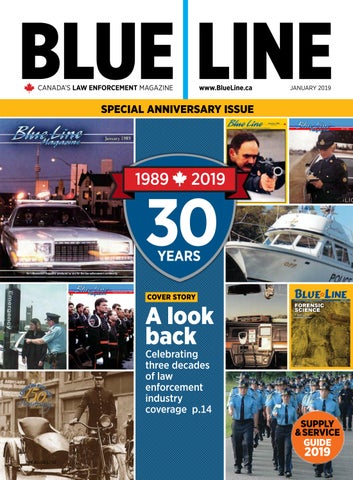
BLUE LINE CANADA’S LAW ENFORCEMENT MAGAZINE
www.BlueLine.ca
JANUARY 2019
SPECIAL ANNIVERSARY ISSUE
COVER STORY
A look back Celebrating three decades of law enforcement industry coverage p.14
Canada’s Law Enforcement Information Specialists
FORENSIC SCIENCE
A vital role in criminal justice
BlueLine.ca
SUPPLY & SERVICE GUIDE
2019
PM 40065710
March 2017
PART OF YOUR TEAM commissionaires.ca
Commissionaires supports hundreds of municipalities and regional police forces, nationwide, through bylaw enforcement and non-core police duties.
SPECIAL ANNIVERSARY ISSUE
March 2017
Canada’s Law Enforcement Information Specialists
FORENSIC SCIENCE
A vital role in criminal justice
Contents
BlueLine.ca
January 2019 Volume 31 Number 1
Features COVER STORY
14 Police work evolution
We take a look back through three decades of placing the best interests of law enforcement front and centre in the pages of Blue Line.
20 The professionalization of police training in Canada
Police leaders are recognizing they need to more closely align themselves with university research and college partners to integrate training in order to meet the future demands of the profession. By Peter Shipley
22 Annual Supply & Service Guide
Blue Line’s Supply & Service Guide is the national law enforcement community’s year-round information tool for sourcing cutting-edge products and finding new vendors and suppliers.
8 @Blue_LineMag
20
14
Columns 4 8 10 11 12 28 29 34
Editor’s commentary Q&A Holding the line Health & wellness Behavioural sciences Technology Case law Back of the book
Departments 5 5 6 6 32 32 33 30
By the numbers News Dispatches Calendar Off the shelf Product showcase Marketplace Blue Links
5 January 2019 | BLUE LINE
3
EDITOR’S COMMENTARY BY RENÉE FRANCOEUR
Blue Line turns the big 3-0
B
lue Line is kicking off 2019 in party mode: there’s 30 big candles on our cake to celebrate this month! I took this opportunity to peruse the very first issue — the one featuring the beaming, white Plymouth on the cover with the CN Tower in the background (find it on page 14). Inside, there was news of a new video (a VHS video tape, of course) for in-service training, errors happening on the redesigned accident reports (anyone recall leaving blank spaces for the ministry microfilm number?) and numerous case law examples, among other features. I especially love how Morley Lymburner, the magazine’s founder and former publisher, writes in that first editorial that Blue Line has no political preference or leaning towards management/staff; it simply seeks to keep law enforcement on the “leading edge” and is designed “in a manner that will encourage you in your chosen profession.” I believe the publication has stayed true to that for all of its 30 years and I will see that it continues to. Last November, I finally had the honour of meeting Morley and his wife Mary, who was also extremely instrumental to Blue Line’s growth and success. They graciously invited me into their Stouffville, Ont. home, where Blue Line was born. I stayed well past the one hour I’d assumed would be enough time, too enthralled in Morley’s stories from the frontline and then from the first few months running the magazine, when the couple were mailing it out themselves — sorting postal codes and bagging the issue right there at the local post office. We huddled around the island in the basement where the magic once happened via cutting and pasting, assembling the pieces of each page onto an art board like a puzzle, and then using a hand-held “wax machine” tool (which they still had in a drawer!). “It was a time of floppy disks and faxing,” Mary said. “Everything was faxed. Can you imagine doing sales over fax now?” It points to the many changes Blue Line
4
@Blue_LineMag
BLUE LINE | January 2019
www.BlueLine.ca
GROUP PUBLISHER | MARTIN MCANULTY mmcanulty@annexbusinessmedia.com EDITOR | RENÉE FRANCOEUR rfrancoeur@annexbusinessmedia.com ACCOUNT MANAGER | JANICE EATON janice@blueline.ca ART DIRECTOR | SVETLANA AVRUTIN savrutin@annexbusinessmedia.com
Morley and Mary Lymburner at the Meritorious Service Decoration ceremony in November 2018. PHOTO: TOM RATAJ
has navigated and adapted to — not just in the policing industry but also in the publishing field. That is no easy feat and I commend all former staff for seamlessly sliding the magazine along in its journey to digitalization, the online world, the social media realm and more. Next up? Podcasting! Our first episode is available to stream now on SoundCloud (blueline. ca/podcasts). Morley, who had been in newspapers in Wiarton, Ont. before becoming a Toronto Police officer, was also the creator of the monthly newsletter, The Police Informant, for his district in the ‘80s. Toronto Police loved the publication so much, they wanted to see it spread city-wide, he said. One thing led to another and the entire Canadian law enforcement community was presented with the independent Blue Line instead. “We started getting more of a demand with our third or fourth issue,” Morley said. “We thought we’d just do it for Ontario but then the Canadian Police Association received it and shipped it out. It just exploded from there.” He originally thought it would be a decent endeavour for when he retired. It turned out to be so much more and Morley was recently honoured with the Meritorious Service Decoration (M.S.M.) from the Governor General of Canada. I am so proud of Blue Line’s history and, as Morley said in the 25th anniversary issue, we will continue to “cast the light;” we don’t want anyone in law enforcement kept in the dark.
CONNECT WITH BLUE LINE
www.BlueLine.ca
BLUE LINE
www.facebook.com/BlueLineMagazine
ACCOUNT COORDINATOR | TRISH RAMSAY tramsay@annexbusinessmedia.com CIRCULATION MANAGER | BEATA OLECHNOWICZ bolechnowicz@annexbusinessmedia.com Tel: 416-442-5600 ext. 3543 PRESIDENT & CEO | MIKE FREDERICKS ANNEX BUSINESS MEDIA 111 Gordon Baker Road, Suite 400 Toronto, ON M2H 3R1 Tel. 416-442-5600 • Fax 416-442-2191
Publication Mail Agreement No. 40065710 ISSN 0847-8538 Printed in Canada SUBSCRIPTION RATES Canada — 1 Year $31.50; 2 Year $52.50 plus tax USA — 1 Year $105.00 USD CIRCULATION email: asingh@annexbusinessmedia.com Tel: 416-442-5600 ext 3553; Fax: 416-510-6875 or 416-442-2191 Mail: 111 Gordon Baker Road, Suite 400, Toronto, ON M2H 3R1 Occasionally, Blue Line will mail information on behalf of industry-related groups whose products and services we believe may be of interest to you. If you prefer not to receive this information, please contact our circulation department in any of the four ways listed above. Annex Privacy Officer Privacy@annexbusinessmedia.com; Tel: 800-668-2374 © 2019 Annex Publishing & Printing Inc. All rights reserved. Printed in Canada. No part of the editorial content of this publication may be reprinted without the publisher’s written permission. Opinions expressed in this magazine are not necessarily those of the editor or the publisher. No liability is assumed for errors or omissions. Readers are cautioned and advised that articles presented herein are edited and supplied for your personal awareness and should not be used for further action until appropriate guidance is received from a supervisor, Crown Attorney or other persons in authority. All advertising is subject to the publisher’s approval. Such approval does not imply any endorsement of the products or services advertised. The publisher reserves the right to refuse advertising that does not meet the standards of this publication.
NEWS
Boots on the Ground (BOTG) founder Dave McLennan, right, and secretary treasurer Jill Pollard, left, take a look at a donated piece of art by Shawn McCowell, founder of Police Artists of Peel and a CISM trainer for BOTG. PHOTO: RENÉE FRANCOEUR BRAMPTON, ONT.
Boots on the Ground peer support line now live
A new non-profit offering peer support is now available for first responders. Two years in the making, Boots on the Ground (BOTG) held a launch party in Brampton, Ont. on November 23. BOTG is completely run and staffed by trained volunteers, said Dave McLennan, the CEO of BOTG and a retired police officer. It provides “anonymous, compassionate and confidential peer support and suicide prevention for first responders throughout Ontario who are seeking help to prevent the development of occupational-related Post Traumatic Stress Disorder and other stress related issues they may encounter.” “This is pioneering; I haven’t heard of anything else like this anywhere,” said Dr. Vivien Lee, a BOTG clinical advisor. Reach a Boots on the Ground volunteer at 1-833-677-2668 any time. See more photos and a video from the event at bit.ly/2SjBklG. ANTARCTICA
Blue Line columnist wins Antarctica footrace
Congratulations to Blue Line’s Health & Wellness columnist, OPP officer Isabelle Sauve, who has won the women’s section in
the Last Desert 2018, Antarctica’s only multi-stage footrace. “It was pretty surreal to be running amongst penguin colonies and watching whales swim by as we travelled to race sites on zodiacs,” Sauve said. “The Drake passage was mildly rocky on the way there but brutal on the return. Even some of the ship crew members were ill. It took a few days for the world to stop moving after reaching land.”
Condon, the crime and intelligence analysis academic co-ordinator at Seneca College’s King campus, which is where the program will be based. “The market was beginning to experience a need for analysts in private and public safety applications, such as roles in banking and finance, network data protection, and security/counter-terrorism. There wasn’t a trained set of professionals readily available. We needed standardized learning but at the degree level.” Students will examine emerging topics and trends including: crime mapping, social media and social network analysis, gang intelligence and more. This program also offers an accelerated path for graduates from Ontario Police Foundations programs, as they are eligible for advanced entry into semester four. WINNIPEG
New home for Bear Clan Patrol
KING CITY, ONT.
Seneca launches crime and intelligence analysis degree
PHOTO: SENECA COLLEGE
Seneca College is launching a brand-new Honours Bachelor of Crime and Intelligence Analysis degree program in January 2019. This is the first degree of its kind in Ontario, college staff say, providing graduates with a foundation in public safety and policing with a specialization in crime and intelligence analysis. “The original idea for this program started about five to six years ago,” says Camie
The Bear Clan Patrol’s community crime prevention and intervention efforts, based in Winnipeg, Man., are seeing a $200,000 boost from the Manitoba government, meaning it will now have its own base, among other benefits. More than $126,000 is being invested through Manitoba Justice from the Proceeds of Crime Fund toward infrastructure and safety improvements, including a 15-passenger van, first aid kits and bikes for patrol. An additional $70,000 from the Municipal Relations Neighbourhood Renewal Fund will support developing a system to collect and distribute food donations to vulnerable people and partner agencies. It will also help to establish a dedicated base for Bear Clan operations for patrol co-ordination, volunteer training, equipment storage and more. The funding will enable the Winnipeg Police Service to work in partnership with the Bear Clan Patrol through information sharing.
BY THE NUMBERS
The Canadian government purchases a whole whack of ammunition on an annual basis, as reported by the Globe and Mail’s “Report on Business” in July 2018, and almost all of it comes from American defence giant General Dynamics. Discover more federal procurement data from ThinkData Works below and the full story at: tgam.ca/2mkTy8f.
$70 million $160 million $230 million amount Canada pays per year to General Dynamics Ordnance and Tactical Systems (GD-OTS) Canada, a subsidy of General Dynamics, which is based in Fairfax County, Va., for “ensuring we have a made-in-Canada supplier” when it comes to ammo
@Blue_LineMag
total annual cost of the ammo purchased for the RCMP, the country’s corrections and fisheries officers, and the Canadian Armed Forces
annual average of how much ammunition Ottawa has bought between 2009 and 2016
3
plants, where GD-OTS Canada manufactures most of the bullets supplied to the government, are currently operating in Quebec and are all federally owned
January 2019 | BLUE LINE
5
NEWS CALENDAR B.C. First Responders’ Mental Health Conference Jan. 31–Feb.1, 2019 Richmond, B.C. bcfirstrespondersmentalhealth.com Evidence in Criminal Investigations: Latest Developments in Law & Practice Feb. 8, 2019 Toronto, Ont. www.osgoodepd.ca Annual Intensive Course on Drafting & Reviewing Search Warrants March 4-5, 2019 Toronto, Ont. www.osgoodepd.ca Developing Leadership Impact Retreat March 18-21, 2019 Victoria, B.C. secure.royalroads.ca/cscourses Police Leadership Conference April 7-9, 2019 Vancouver, B.C. cacp.ca International Financial Crimes Investigators Conference April 8-12, 2019 Toronto, Ont. www.torontopolice.on.ca/seminars Risk & Recovery Conference April 10-12, 2019 Hamilton, Ont. www.riskandrecoveryconference.com Conference on Indigenous Criminal Justice Post Gladue April 13, 2019 Toronto, Ont. www.osgoodepd.ca Interac Risk and Cybercrime Conference April 24-25, 2019 Victoria, B.C. www.interac.ca/en/cybercrimeconference.html Symposium on Money Laundering & Financial Crimes April 26, 2019 Toronto, Ont. bit.ly/2ITwhmQ 6
BLUE LINE | January 2019
DISPATCHES RCMP Deputy Commissioner Gilles Michaud has been appointed Interpol’s Delegate for the Americas. Michaud is one of six new members the Assembly elected for the executive committee, the 13-member body that provides guidance and direction to the organization. Toronto Police Det. Chris Scherk received the Paul D. Bourdreau Co-ordinator of the Year award in The Hague, Netherlands, from Crime Stoppers International in late 2018. This award is given to a program co-ordinator for their “outstanding performance and commitment, personifying a spirit of community co-operation and demonstrating qualities of leadership.” The first woman to hold the reins of the Royal Canadian Mounted Police is one of the two newest members of the Senate. Beverley Busson will take the seat in B.C. Busson served as commissioner of the RCMP on an interim basis in 2006. She was part of the first wave of women to enter the force, and later she was one of the first female RCMP officers to work in plain clothes and undercover. Supt. Mitch Yuzdepski has been promoted to deputy chief of support services at Saskatoon Police Service.
Insp. Kevin Lewis, officer in charge of the RCMP Thompson detachment in Manitoba (photo), has handed the reins to Staff Sgt. Brian Edmonds from the Winnipeg RCMP. Lewis has moved to Thompson’s Manitoba North District headquarters to serve as the district operations officer. RCMP Const. Garrett Dove of North Battleford, Sask., was honoured with the Sovereign’s Medal for Volunteers recently by the Governor General of Canada. Dove was noted for going “above and beyond in mentoring and guiding First Nations youth in the communities of Pelican Narrows and Battleford, particularly by
offering valuable options for Indigenous programming during and after school.”
Dax and his grandfather, David Searle, accept the OMPF on behalf of Sgt. Marc Searle. PHOTO: MCPL MATHIEU GAUDREAULT, RIDEAU HALL © OSGG, 2018
Sgt. Marc Searle was a member of the RCMP for over 15 years. “An avid and tenacious volunteer, he spent hundreds of hours doing research to identify unmarked veterans’ graves in a Surrey, B.C. cemetery. He then ensured these graves were honoured with appropriate markers.” Searle passed away on May 17, 2016. He was posthumously awarded the Order of Merit of the Police Forces, received by his son, Dax Searle. The Governor General of Canada presented RCMP Chief Supt. Jeffery Adam (top photo) and Assistant Commissioner Barbara Fleury (bottom photo) with honours as officers of the Order of Merit of the Police Forces in Ottawa. Sgt. Michael Lamothe of the Ottawa Police Service was also presented with honours as a member of the Order of Merit of the Police Forces. An expert in cybercrime and co-chair of the Canadian Association of Chiefs of Police (CACP) E-Crime Committee, Adam is the driving force in the modernization of law enforcement’s use of digital evidence for investigative purposes. A founding co-chair of the CACP International Committee, Fleury successfully consulted with external police partners to realign global policing priorities. And Lamothe developed a training curriculum and seminars for frontline patrol officers to better cope with mental health crisis situations. PROMOTIONS, RETIREMENTS, RECOGNITION • If you have an officer in your agency recently promoted or retiring or an individual you wish to have recognized (major award or recently deceased) you can let Blue Line magazine know by email to: dispatches@blueline.ca.
www.BlueLine.ca
Watch your dreams take flight
The IG Living Plan will cover your financial health so you can focus on your mental health. Investments, Retirement Planning, Mortgage Planning, Estate Planning, Tax Planning, Risk Management, Cash Management, Business Ownership
Jill Pollard,
CPA, CMA
Consultant
Investors Group Financial Services Inc. Suite 201, 1595 16th Avenue, Richmond Hill, ON L4B 4B1 OFFICE: 905.886.3850 ext 6216 CELL:
416.706.6628
jill.pollard@investorsgroup.com
Q&A Det. Michelle Pflug is Peel Regional Police’s newest certified bloodstain pattern analyst, one of three at the Ontario service and one of about 30 across the country. She received her certification from the Ontario Police College in June 2018, after finishing a master’s of forensic science at the same time. Q: How did your career in forensic identification begin?
Q: You’re one of only about 30 bloodstain pattern analysts across the country? It sounds like such a small number!
It is. It’s very different than how it’s organized in the U.S., where they have so many more bloodstain pattern analysts. Their process is different; you take a basic 40-hour course. There’s no real control. There’s been a lot of discussion on improving that; they want a model something like what we have in Canada. We have three analysts now at Peel and other than the Ontario Provincial Police and the RCMP, we have the highest number of analysts for a municipal police force.
Q: Can you share more about the process?
The program is self-driven and the
8
BLUE LINE | January 2019
time involved to become certified varies based on each individual and the services they work for. The RCMP members typically have it done in a year or two. I completed my master’s with the University of Florida at the same time, so the other recently certified officer in Peel actually started the program after me and finished slightly before me. I’d say it’s about a three-year commitment, give or take, overall. I did my basic bloodstain course in 2010 followed by the math and physics course in 2012. In between there were tons and tons of scenes with my two mentors at the time. Then you have to decide when you’ll go for the full certification and you do a mock trial and sit on the stand for a full day. My mentor was the crown and the defense attorneys are other experts in the field. You have the best of the best in the province coming at you, grilling you.
Q: How do you manage your wellness when you’re often called to gruesome scenes?
The first thing is to acknowledge just that — you are seeing the worst of the worst. I struggled with that for the first five years. We want to help and do whatever we can, so we tend to take on too much. You have
Q: What is the best part of the job?
Snapshot of bloodstain pattern analysis in Canada
30
certified bloodstain pattern analysts across Canada, approximately
3
certified bloodstain pattern analysts at Peel Regional Police
3
years approximately to complete the certification
It’s nice having a speciality... and being able to provide that little extra bit of something to a case can be very rewarding. Most of the scenes we attend are homicides, and those victims can’t speak for themselves. Helping get their story told and presenting the evidence to do that is quite amazing. For me, that is the magic and I just love the science behind it all.
Q: What is your advice for others looking to become certified?
Research the commitment involved. It’s one thing if you can work closely with an analyst and see how the job is done before taking the leap. Discuss it with your family, not just your colleagues, as you’ll be getting calls in the middle of the night. Those happen a lot.
Q: How do you see forensic identification evolving?
I see more civilianization happening and an increased focus on education, which helps to eliminate perceived biases from a police standpoint. This is one of the big issues we’re addressing. I would never testify about bloodwork in uniform, for example. Civilianization also makes managing that bias easier. www.BlueLine.ca
PHOTO: PEEL REGIONAL POLICE
My dad was an RCMP officer and I remember him bringing home photos from crime scenes, much to my mom’s chagrin. I had a hunger to know more and to piece everything together. CSI was a big thing when I was in high-school; everyone was watching it. I went on to study forensic sciences and biology in my undergrad at the University of Toronto – Mississauga campus because science was intriguing to me. In my last year, during my co-op placement, I ended up in Peel Regional Police’s Forensic Identification Unit with their bloodstain pattern analyst. That was the tipping point. Right then and there I had more of an interest in the bloodstain side of things. At the time — around 2003 — we were still allowed to do ride-alongs. I spent less time in the office doing my project and more time going to calls with the unit. I fell in love with it and knew it was what I wanted to spend my life doing.
to learn to say, “No.” We’re very lucky to have three analysts at Peel; we support each other when we’re getting overwhelmed. Having a strong connection with family and friends outside of work is also key. My husband is a retired Guelph police officer, so he understands my job and what it entails. He’s been extremely supportive. I also make time for myself — I get my walks with the dog in whenever I can to clear my head.
READY to Roll
Build the Best. stArt here.
GFX Law developed a common electrical system between Dodge® and Ram® platforms for a highly reliable plug-and-play solution that other aftermarket or custom systems simply cannot provide. World class reliability and exceptional value is built into every GFX upfitted vehicle with industry-leading accessories and turn-around times for agencies of any size.
A truly ready to roll solution!
GFX LAW ENFORCEMENT VEHICLES
WWW.GFXLAW.COM | 1-800-739-6837
HOLDING THE LINE BY MICHELLE VINCENT
Are you a problem-solver or solution-focuser?
A
s we enter the new year, we often come up with a fresh look at what we would like to change in our lives. As I look around at the people in this world and how they go about achieving their goals, I notice there are two approaches typically taken: • an attempt to solve the “problem” • an attempt to implement a solution to solve the “problem” The process that one engages in in order to achieve that goal is interesting to look at and can enlighten one on the overall journey we are all making. When we look at this concept through a policing perspective, be it personal and/or professional, the first step might be to identify the goal we wish to achieve. It is important to return to this piece on a regular basis to ensure we are on the right track and haven’t been distracted from our focus. We will often begin by identifying a problem and sometimes that problem finds us before we find it. For example, perhaps you know you are not meeting the goals of operational excellence in the area of visiting places of worship on your shift as you patrol a busy sector and feel you do not have the time to affect this task. On the home front, perhaps your life partner has mentioned the lack of
As we identify the problem at hand — for example, “not enough time,” which is a recurring theme in most people’s lives — and become more specific, without actually entering into a “problemsolving” mode, we remain at a fork in the road.
time you spend together alone, and you think to yourself: How am I supposed to find another moment in my already packed day to make that happen? In looking at the two approaches mentioned above, we almost always require a problem to present itself in order for this brainstorming process to be initiated. As we identify the problem at hand — for example, “not enough time,” which is a recurring theme in most people’s lives — and become more specific, without actually entering into a “problem-solving” mode, we remain at a fork in the road. Here we have an opportunity to choose how we will move forward. It is at this point we become the problem-solver or solution-focuser. Two aspects worth considering are: • whether you like it or not, the more you think of something, the more you get of it • you always find what you are looking for If you can remember this and revisit the object of your goal, you are well on your way to achieving success in that area. The way in which you approach the identified problem will dictate how your mind perceives the solution. If you are a problem-solver, you will likely “go back” and look at how you arrived at the problem. You will be immersed in the prob-
10
BLUE LINE | January 2019
BL_Jan_Prod360.indd 1
lem at hand. The problem will be your focus and stepping outside of the “problem concept” may be challenging. Perhaps you are not passionately invested in solving the problem at hand. In the work example above, you may not see the necessity in visiting places of worship during an already overloaded shift. Revisiting the “problem” with this thought running through your mind may pose a challenge in finding that solution. If, on the other hand, we approach the identified problem by focusing on attaining a solution, we quickly move the mind “forward” to finding a solution that may create a mindspace of openness and thinking outside of the box. We are then immersed in the solutions — exactly what we intended when we set out to make the change in our current situation. Therefore, we may make a list of the benefits connected to making that 10-minute stop at a place of worship (i.e. an opportunity to network and create community relations so when a crime occurs, they support our investigation through the trust we have built). I have noticed that when I take the time to focus on the solution and its possible benefits, the pros of completing the problematic task in question far outweigh the cons of the time it will take to attend. Almost magically, extra time appears in my day to make this task possible as I leave behind the world of problems and sit in my world of solutions. I leave you with this question: As a leader in your organization, are you — or do you want to be — a problem-solver or a solution-focuser? Happy new year to all. Be safe. Michelle Vincent is a 17-year York Regional Police officer with a master of arts in counselling psychology and a background in equine-assisted therapy, workplace reintegration after a critical incident and long-term leave, as well as teaching. She is in the process of implementing the first non-profit treatment centre that will be occupationally specific for first responders and is working towards her PhD in Forensic Psychology/Crisis Response. She can be contacted at: michelle@smith.net.
www.BlueLine.ca 2018-11-30 9:06 AM
HEALTH & WELLNESS BY ISABELLE SAUVE
Listening for the sound of silence
S
ilence is a peculiar and multi-faceted concept. Studies demonstrate silence in its purest form is beneficial for the brain. We all need periods of silence to relax, rest, or reflect on things. Silence is linked to a number of virtues, such as respect, decorum and modesty. We hold a minute of silence out of deep respect for our fallen officers and troops. It is also an extremely powerful tool capable of conveying a strong message without a single word being spoken. Silence offers many positive effects but it can also have a dark side. This negative counterpart will be explored in this article. Research indicates persons holding back feelings view the world around them as more challenging. While silence has its place and function, it is vital to note that many officers struggle in silence with their emotional and psychological issues, further exacerbating problems and having a detrimental impact on wellness. Silence can initially provide a false sense of control for those experiencing emotional or mental struggles over which they may in fact have little control. Silence grows and delves into stronger negative emotions. A sense of disconnection in relationships often begins to occur and worsens over time. Pretending everything is fine can go on for extended periods. However, this allows for a problem to settle in and then grow in deep rootedness, complexity and impact. Repressed feelings magnify in potency and can be very damaging to one’s well-being. Significant information willfully withheld tends to resurface at random times and exerts an increasing gravitational pull on our attention over time. Silence often exists when a choice is made not to confront something or rather to hide something. Research suggests a tendency to remain silent on important issues in the world of policing largely stems from a fear of loss of status. As a result, those facing crisis may feel alone with nowhere to turn. @Blue_LineMag
While silence can be peaceful, the person remaining silent is not necessarily at peace. Silence is generally not an effective message vector; it builds assumptions and assumptions are frequently dangerously wrong. In difficult times, effective communication is key. Silence is engraved in police culture and in the training of recruits. The para-military structure often rewards subordinates for blindly following direction without question or comment. New recruits soon discover uniform inspections are conducted in silence and anyone daring to comment or speak without being directly addressed is quickly corrected. Throughout training, recruits are also subjected to a number of psychological and physical challenges aimed at personal growth. Some recruits face their greatest fears and self-doubts. Those considered the “toughest” most often submit to authority and confidently undertake tasks at hand. Those with the tendency to “suck it up” and carry on are considered exemplary. Officers are praised for their independent and unwavering ability to tackle any challenge thrown their way. A tendency to remain silent can depict a trait of character, but it should never be imposed by a society or organization. In many social and professional settings, speaking out about work-related or personal issues can make the narrator unpopular. As a result, some become prisoners of their own emotions, unable to communicate their true thoughts.
Research suggests a tendency to remain silent on important issues in the world of policing largely stems from a fear of loss of status.
Unexpressed problematic feelings are more likely to percolate and grow a life and energy of their own. The energy tends to enter into a negative spiral of struggle and frustration. Police entities as a whole have largely remained silent about issues such as officer depression, suicide and discrimination of all nature, further exasperating the problems. Stigma lives through lack of understanding and non-confrontation. Police culture is complex but the question remains: Why we allow officers in emotional or psychological distress to suffer in silence out of fear of potential consequences on their reputations or futures? Officers should not have the additional worry that career aspirations, promotional opportunities or current positions will be taken away by being open. There cannot be a sense of embarrassment, weakness or failure over experiencing personal, emotional or psychological problems. In the line of duty, officers are exposed to a multitude of situations by nature of the job. They consequently have natural reactions to abnormal situations. Creating culture change requires education around realities and myths. Only when the stigma of mental health is removed will officers feel fully comfortable breaking the silence. Recognition should be given for being strong and speaking of issues. We must all redefine “toughness.” Admitting to, communicating and facing issues takes courage and is a sign of strength. Dealing with issues, such as depression, anxiety, PTSD, or any emotional/psychological hurdle, requires toughness. Persons who engage in a journey to fight an illness, like cancer, are rightfully viewed as heroes. Those fighting personal issues or mental illness are also heroes and must be viewed as such. Isabelle Sauve is a 11-year OPP veteran currently with the Emergency Response Team (ERT) at the Almaguin Highlands Detachment in Burks Falls, about 300 km north of Toronto. She can be contacted at: isabelle.sauve@hotmail.com.
January 2019 | BLUE LINE
11
BEHAVIOURAL SCIENCES BY PETER COLLINS
Cannabis – what are the risks?
O
nce upon a time alcohol was banned in Canada. Initially the decision to ban alcoholic beverages was done by individual communities in the late 19th century. In the early 20th century, it was done by some provinces, and then there was a nation-wide prohibition from 1918 to 1920. The prohibition of cannabis has ended and it is now legal in Canada. Not unlike alcohol, there are potential benefits from using cannabis products, but there are also some potential health risks. Let’s review some of these risks.
Risk of addiction
According to the research, approximately nine per cent of those who use cannabis products will develop an addiction. This is the percentage quoted by Health Canada. That number increases to one in six (17 per cent) among those who start in their teens and 25 to 50 per cent among daily users. A teen’s increased vulnerability is due to the fact that the brain, including the endocannabinoid system, sees rapid development during adolescence. Early and regular use “predicts an increased risk of marijuana addiction, which predicts an increased risk of the use of illicit drugs.” 1 My generation would have thought it implausible that marijuana could be a regarded as a “gateway drug.” Delta-9-tetrahydrocannabinol (THC) is the primary active ingredient in marijuana. In my era, the level of THC was typically two to four per cent. On a provincially run cannabis online store there is cannabis available with as high as 23.9 per cent THC. Where obtainable, the levels are considerably higher in edible products and even more so in the potent type of cannabis concentrate known as “shatter.”
The effect on brain development
From birth to the early 20s, the brain is not fully developed. As a result, the undeveloped brain is more vulnerable to THC. Heavy use, 12
BLUE LINE | January 2019
Long-lasting changes
starting in adolescence, can lead to altered brain development, contributing to a poor educational outcome with an increased likelihood of dropping out of school. Cognitive impairment, with lower IQ, was found among those who were frequent users during adolescence.2
Relationship to mental illness
Regular marijuana use is also associated with an increased risk of anxiety and depression, but causalBoth ity has not been established. There healthcare is little doubt, however, that cannaprofessionals bis can cause psychotic-like sympand law toms, especially among people with enforcement a pre-existing genetic vulnerability professionals to psychosis, and can exacerbate have to be the course of illness in patients with aware that schizophrenia. marijuana, Heavier marijuana use, greater like other drug potency, and exposure at a drugs of younger age can all negatively affect abuse, can the disease trajectory by advancing result in the time of a first psychotic episode many by two to six years. I have assessed problems. people who present with a drug-induced psychosis, solely due to THC, and who are in their mid-30s.
Risk of motor vehicle accidents
It is a myth that cannabis users are safer drivers than those who are impaired with alcohol. THC impairs both the motor and cognitive functions needed for safe driving. Cannabis use while driving has been shown to substantially increase the risk for motor vehicle crashes and has been implicated in fatal and non-fatal crashes.3
Above and beyond recreational use, there are a number of medical conditions that can be relieved by treatment with marijuana or other cannabinoids. Both healthcare professionals and law enforcement professionals have to be aware that marijuana, like other drugs of abuse, can result in many problems. During intoxication, marijuana can interfere with cognitive function (e.g., memory and perception of time) and motor function (e.g., co-ordination), and these effects can have detrimental consequences (e.g., motor-vehicle accidents). Repeated marijuana use during adolescence may result in long-lasting changes in brain function that can jeopardize educational, professional and social achievements.4 Footnotes 1. Volkow, N., Baler, R., Compton, W., & Weiss, S. (2014) “Adverse Health Effects Marijuana Use” New England Journal of Medicine; Vol. 370 pp 2219-2227. 2. Ibid 3. Rogeberg, O. & Elvik, R. (2016). The effects of cannabis intoxication on motor vehicle collision revisited and revised. Addiction Vol 111: 1348–1359 4. Volkow, N., Baler, R., Compton, W., & Weiss, S. (2014) “Adverse Health Effects Marijuana Use” New England Journal of Medicine; Vol. 370 pp 2219-2227.
My goal, in this monthly column, is to explore a wide variety of behavioural issues that are related to law enforcement. Please don’t hesitate to contact me if you have any questions or suggestions for future topics at pcollins_blueline@gmail.com. Dr. Collins’ opinions are his own and may not reflect the opinion of the OPP, University of Toronto or his mother.
Dr. Peter Collins is the Operational Forensic Psychiatrist with the Ontario Provincial Police’s Criminal Behaviour Analysis Unit. He has also been a member of the crisis/hostage negotiation team of the Toronto Police Service Emergency Task Force since 1992. He consults to criminal justice agencies internationally. Peter’s clinical appointment is with the Centre for Addiction & Mental Health in Toronto, and he is an Associate Professor with the Division of Forensic Psychiatry at the University of Toronto.
www.BlueLine.ca
22nd International Council on Alcohol, Drugs and Traffic Safety Conference
T2019
August 18-21, 2019
Edmonton | Alberta | Canada
EEDC
Last held in Canada 16 years ago, this prestigious international conference provides an affordable opportunity for law enforcement, government and business leaders from across Canada to engage with experts from around the world .
Registration is
NOW OPEN
www.T2019.org Early Bird Deadline: April 15, 2019
SPECIAL ANNIVERSARY ISSUE
Police work evolution A look back through three decades of placing the best interests of law enforcement front and centre in the pages of Blue Line
1989
1991
trouble with a pistol’s larger grip.
1992 Fallen Canadian police officers are recognized for the first time at the National Law Enforcement Officer Memorial ceremony in Washington.
Tom Rataj writes his first technology column – part one of a series on computer woes.
The first issue of Blue Line is distributed. Police “must be a model to all of us,” notes the Ontario Task Force on Race Relations and Policing. Recommendations included mandatory minority hiring and quick promotions, quotas, improved race relations training and the establishment of a race relations and police review board.
1990
dispatchers at Canada’s busiest police department are hired, a cover story on police dispatchers notes. The Supreme Court’s Duarte decision, requiring court consent to gather electronic evidence, will severely hamper police ability to gather evidence, predicts Al Porter.
Only seven to 10 of every 100 people applying to be 14
Voice writing may be the next big thing, the Gloucester Police Force proclaims.
BLUE LINE | January 2019
A newly elected NDP government proclaims the Ontario Police Services Act, making municipal police service boards mandatory, requiring enhanced officer training and more. Canada is 20 years behind Britain when it comes to police dive teams, two visiting constables are told. Const. Rick Rozoski, co-ordinator of the International Divers Symposium, is determined to change this. Police officers are having difficulty parting with their trusty revolvers, Calgary Police Staff Sgt. Michael Dungey writes. He clears up a variety of misunderstandings about pistols – that officers may ‘spray and pray,’ or small-handed officers may have
RCMP Commissioner Norman Inkster is elected as the second Canadian president of Interpol.
1993
The huge growth in cell phone adoption has presented police with a new problem – combating a rapidly growing cell phone fraud industry. The first Canada-wide firearms amnesty is a big success, resulting in the recovery of almost 20,000 firearms. The cost of entering the CALEA (Commission on Accreditation for Law Enforcement Agencies) program is less than a new squad car, observes Edmonton Police Service Insp. Roger Simms. The EPS becomes the first Canadian police agency to earn accreditation in 1988 and hosts the first CALEA international conference in 1993. International Centre for the Prevention of Crime sets up shop in Montreal. The RCMP takes delivery of its ninth helicopter, adding to a fleet of 28 fixed wing aircraft at 25 stations across the country.
Police forces in Calgary, Edmonton and Toronto are replacing their revolvers with pistols, deciding on the Glock Model 22.
Three police associations join the battle to “dump the bullet,” saying the truncated cone threatens the safety of officers. An immediate switch to hollow point ammunition is necessary. www.BlueLine.ca
SPECIAL ANNIVERSARY ISSUE
1994
After a year-long fundraising campaign that raised more than $1.5 million, the Calgary Police Service buys Canada’s first patrol helicopter, HAWC 1. The RCMP purchases 17,200 Smith & Wesson 9mm pistols and 16,100 units of Barrday body armour.
The RCMP prepares to release version 1.0 of CPIC for Windows, Tom Rataj reports – but make sure you have a 486 computer with at least 8MB RAM to run it.
1995
The Anishinabek Police Service becomes the first Ontario police agency to switch to hollow point bullets, defying a provincial ban. Northstar unveils a prototype police cruiser so advanced the company says it could be renamed “the mobile sub-station.” The vehicle has a ‘heads-up’ display, integrated radar, night vision camera, video recording and navigation systems, and built-in communications, computer, printer and fax machine. The cost? $50,000,if mass produced. @Blue_LineMag
“Policing the internet just could be the final frontier for cops,” writes Tom Rataj. “The technical challenges facing investigators, along with legislation that is always two steps behind, make this the biggest challenge in modern law enforcement.”
Police officers are eight times more likely to die by their own hand than by homicide, a University at Buffalo study discovers. Blue Line News Week, a digest of law enforcement news from across Canada, begins publishing, first in a printed format called Ten-Seven.
The RCMP reports on its development of a conceptual design for smaller detachments.
1998
1997 Police Leader of the Year Award is established and Blue Line is a sponsor.
1996 After receiving industry requests, Blue Line creates a trade show for the entire law enforcement community, with the purpose of bringing readers in direct contact with companies’ products and services. Response ’97 was born. For a while it is known as Blue Line Trade Show. (Today it is referred to as Blue Line Expo.)
Blue Line celebrates its 10th anniversary. “We are particularly proud of the fact that we have never missed an issue,” writes publisher Morley Lymburner. “On many occasions it was difficult but we continued on regardless because we had faith in our readers...” The RCMP revokes the right for its B.C. auxiliary officers to carry sidearms. “The Star Ship Enterprise,” the affectionate name for the OPP’s new Orillia headquarters building, is one of retiring OPP Commissioner Tom O’Grady’s proudest achievements.
The Durham Police Learning Centre has fast gained a national following in its short life. Although open less than four years, similar centres are already being set up in Western Canada and the Ottawa area. The idea behind the centre is to ensure all officers are trained and kept at the same high standards as recent graduates of the police college. Issuing external carriers for soft body armour “is purely a Canadian invention,” writes Brad Fawcett. External carriers are worn in the US exclusively by tactical teams. For the first time in its 127-year history, Royal Newfoundland Constabulary members are wearing firearms, rather than carrying them in their cruiser trunks. The first female RCMP officer to rise to the ranks of inspector, superintendent and chief superintendent continues to make history. Beverley Busson is named the commanding officer of Saskatchewan’s F Division and promoted to assistant commissioner. She is the first female to hold either position.
The .40 calibre pistol “has become the darling of the Canadian law enforcement community,” Blue Line’s first Cross Canada gun survey concludes.
The federal government decides to disband the ports police and hand over the responsibility to municipalities.
A Blue Line nationwide survey of employee assistance programs (EAP) finds that they were, for the most part, in a state of turmoil. Most officers knew little or nothing of their agency’s program and some agencies had made little effort to institute a sound program.
I remember seeing Blue Line for the first time in the late 80s and being interested by the content. I must admit, as a young RCMP member, I found it a tad Toronto-centric; but as the years progressed, I saw its content and scope expand. When I became the chief of Halifax Regional Police, I learned about how diverse its reach had become as one of our Halifax Regional Police officers graced its cover as the “Police Officer of the Year” in 2013. Now I look forward to reading about the entire Canadian police community in its pages. I wish Blue Line another thirty years of successfully informing the Canadian law enforcement community and the public in general about public safety and community wellness. -Chief Jean-Michel Blais, Halifax Regional Police January 2019 | BLUE LINE
15
SPECIAL ANNIVERSARY ISSUE
The OPP swears in Gwen Boniface as its first female commissioner. Broadcasting 24/7 to a police-only audience, the Toronto Police Video Services Unit’s Live Link Television Network delivers training, officer safety bulletins, wanted pictures and joint teleconferences with the RCMP and FBI. Sent to 120 locations, the encrypted Live Link service is a cost-efficient way of delivering mandatory training without having to pull officers off the street, says unit manager John Sandeman.
1999
A federal/provincial working group advises against creating a national sex offender registry, worrying it would just drive offenders underground. The Victoria Police Department begins a six-month trial of Tasers.
The RCMP reopens its training depot after a six-month hiatus and cuts training time from 26 to 22 weeks.
2000
The RCMP announces that it may begin charging tuition and has cut its $249 weekly training allowance.
The lead story in December profiles Chrysler’s new “intrepid” prowler plus an historical overview of Chrysler police vehicles.
Stetson-wearing Mounties who pose for tourists to take photos are now seeking compensation for the time and efforts they are putting forth.
2002
Waterloo police officers can now grow beards and goatees, as long as they’re neatly trimmed and not more than 3.5 centimetres long. Many tactical training programs assume the intimidating presence of a heavily armed entry team will immediately compel all to comply, writes Joel Johnston. Not teaching realistic close quarters control tactics to handle non-compliance or aggression is a mistake, he warns, and can cause a “critical mental ‘reactionary gap’... as you attempt to recognize and identify the threat and formulate a plan to deal with it.” Guelph police officers receive a new, non-lethal tool to assist them in dealing with the public – customer service training. The Toronto Police six-month pilot helicopter project officially gets off the ground.
2001 The Blue Line Forum (forums.blueline.ca) is introduced. It is an internet chat area for everything about Canadian law enforcement. Most topics are open, while some have restricted access by job function. Shortening those emerg waiting room blues by Dr. Dorothy Cotton Ph.D., C. Psych. Constable McGillicuddy was definitely looking much older than the last time I saw him. He probably WAS much older than the last time I saw him, but at least he was alive and well. He had survived the dread emergency room experience; gives me the shivers just thinking about it. You know the drill — call comes in, man acting a little weird — off you go and find someone hiding behind a bush, muttering, carrying on an animated conversation with an invisible someone. You can make out the words, “...die... stop it!! I can’t...” but that’s about it. A long time later the two of you are cheerfully sitting in the emerg waiting room, and an even longer time later he is cheerfully heading out the door and you are still doing paper work. What’s wrong with this picture? Ah, where to start. Why don’t those doctors listen? What is their problem? Do they work on commission and get paid more for broken legs than broken minds? I don’t think there is any subject I have talked about with more police officers than the frustration of dealing with emergency rooms. So imagine my surprise when I was talking to one police officer and I started my usual “yeah, all that waiting at emerg stinks... ” line — and he said, “oh, we don’t have that problem.” Huh? Come again? “Let me get this straight,” I said. “When you take a mentally ill person to the hospital, the doctors see them right away and they get admitted to hospital in a timely fashion?” Frankly, I thought I was hallucinating. “Well,” he confessed. “It doesn’t always work. Sometimes we have to wait for an hour.” One hour? That’s hardly enough time to get cup of coffee. This situation clearly merited investigation, so I poked and prodded. How did they do this? Well, there were several things as it turns out. First, they have a liaison set up with a local mental health crisis team. When there is a situation involving a mentally ill person who might have to go to hospital, they call the mental health folks. This has a couple of benefits. They can advise what to do with the troubled person; sometimes it means taking them to hospital and sometimes doing something else. The net result is that when they get to the hospital, the docs are more likely to pay attention because they KNOW the patient has been screened. (I hope this isn’t a big surprise to y’all, but I have observed that cops and docs don’t always agree about who needs to be in hospital and who doesn’t). Just in case, this police force also has a form they use specifically for situations involving people with mental disorders. It outlines the problems and the observations in a systematic way and it is passed on to the folks at emerg. There are a number of these forms drifting around, all for the same purpose. I think the December 2001
most effective are short enough that cops actually fill them in (since we all love paperwork so much!) but also have wordings that are closely tied to the Mental Health Act so it is harder for the docs to ignore them. This particular police force also has a service agreement with not only the crisis people but also the emergency rooms in the area. It appears to work. Hot damn! Of course this is not the only police force with a plan that works. There are a number of them out there. Most involve the essential quality of actually sitting down and talking to the hospital folks. All this of course leads to an interesting question: do police really waste huge amounts of time sitting in emerg? By my calculations, if 1.75 hours of police time per day per county is used and you divide that by the square root of your shoe size, it means that seven light years of police time is used up per megawatt but only on Tuesdays. Okay, so we have no data. Very few police forces actually keep track of how much time is spent hanging around the emerg. It definitely seems like a lot. An even more interesting question is, is this time well spent? One of my police chief friends argues that all the complaining is simply sour grapes. What could possibly be a better use of time than keeping a troubled and
dangerous citizen safe and sound? Maybe sitting in the emerg is not such a waste of time. What would be really useful to know is how effective all this sitting around is. Of all the mentally disturbed folks that are taken to hospital by the police, how many are actually either treated or admitted? If most are, then I would argue that the waiting is time well spent, although cutting it down would still be a good thing. If only a small proportion of people brought in by police are admitted or treated, then one has to wonder if there isn’t another more efficient and effective way of dealing with the problem. The curious thing about this is that in most cases, we haven’t the faintest idea what happens to people brought in by the police. Seems to me we should know how many are just turfed back out, how many get treated, how many get admitted. That kind of information would surely make it easier for everyone to do their jobs. I’m ready to start counting. Care to join me? Dr. Dorothy Cotton has been practicing psychology for more than 20 years, “providing service for adults of all ages.” She holds degrees from McGill, Purdue and Queen’s Universities and can be reached by email at deepblue@blueline.ca.
BLUE LINE | January 2019
“I have a friend in the Canadian navy who mentioned they were selling a frigate for scrap — for scrap! I talked them into donating it to us for a dollar instead. We’re saving millions and the beauty of this ship is that you don’t have to spend a cent on security. It comes with a complete radar system, 57 millimetre cannons, machine gun turrets, two inch thick steel hull — no one is getting close to this thing unless we let them.” Commissioner Boniface says the OPP TRU team has already expressed interest in using the vessel to handle critical incidents on the water or homes near the shore. “They’ve wanted something like this for a long time,” says Boniface, noting that their requests for surplus military battle tanks had been turned down several times because of concerns the public would perceive their use as overly aggressive and contrary to community-based policing concepts. While performing the $40 million retro-fit, the members were especially excited about discovering 76 guided missiles that came with the ship. Word quickly arrived from the Department of National Defence indicating they were left onboard in error and will have to be returned. “We don’t think we would ever have to use them anyway,” says OPP TRU Team leader Steve Ecrof. “All we have to do is make sure suspects think we have them aboard and the standoff will be over. No one is going to risk having a tactical team fire guided missiles at them.” One of the biggest problems in renovating the frigate was cutting through the front of the hull to install a ramp so vehicles could roll out and go on patrol, says project manager Ekim Sirah. “It took us more than a week to cut an opening,” Sirah says, “and we’re still working on making it completely watertight. They really knew how to build ships back then — this one will be around long after you and I are gone.” The loading ramp will be designed to utilize the ferry docks at Tobermory and South Bay Mouth. These two locations will be used as load-up docking facilities for the beginning and end of each navigational season. Toronto Mayor Mel Lastman is a big supporter of the idea and has already suggested a use for the Boniface in the winter. He has offered a free winter berth in Toronto harbour so it can be used by members of the Canadian mili-
tary and other staff called in to help clean the snow from Toronto streets each winter. Housing the troops the last time was a major expense, Lastman says, “and since the OPP won’t be using the ship in the winter anyway, we can actually save them money by providing a place to moor it.” Toronto Police Chief Julian Fantino was less supportive of the idea, though he admitted the possibilities were intriguing. “It’s fine for the OPP, with their big budget, helicopters, corporate jet and karaoke nights but we have to face fiscal realities here in Toronto,” Fantino told a packed news conference. “We have enough trouble finding the tax money to put officers on the street to police this city the way it is. Just keeping tabs on the Mayor is taxing enough.” The idea of some sort of floating station to police the Toronto Islands and outlying areas like Scarborough does hold some attraction for Fantino though. He suggests a fast patrol craft housing a dozen or so officers, equipment and amphibious cars would be more suitable for his police service. “That way officers can go out on patrol and then drive back to where the floating station is moored,” he says, adding that the craft could feature a floating garage built on a selfpropelled barge to house the cars, which could be quickly detached in the event of a water pursuit situation. “It could even double as a second station in an emergency situation,” Fantino notes, though he hesitated when asked to comment on rumours of a third craft designed to be used as a floating retreat for senior staff. He concluded by stating categorically that neither he nor any of his staff have even entertained (the idea.) The RCMP is expressing interest in outfitting a similar ship to help it police east coast communities where it is gradually displacing municipal police forces. Corporal Ted Danson says the ship would help extend community-based policing to smaller towns and cities and would also aid in coastal defence in times of war. “Our only concern is how far up the Miramachee we could patrol with such a craft.” Other police departments are also impressed
For further details go to BlueLinks at www.blueline.ca
April 2002
. . . continued page 51
48
Blue Line publishes its first April Fools story. The story is about the acquisition of a surplus naval vessel for the OPP’s mobile police station, a vessel called The HMOS Boniface. Blue Line becomes part of the curriculum taught at Niagara College to all students involved in law enforcement-related courses.
2003
Metro Toronto Police Staff Supt. Jean Boyd, becomes the highest-ranking female police officer in Canada and one of only 385 women on the 5,621-member Toronto force. Seven years after Blue Line conducted its first Canadian firearms survey, a second one is published to see if the results have changed. Firearms editor Dave Brown finds most were largely satisfied with the choices they made. Both Manitoba and B.C. appeal courts unanimously uphold the validity of investigatory detentions and searches incidental to them. B.C. implements Canada’s first province-wide, online police information system called PRIME.
2004 For further details go to BlueLinks at www.blueline.ca
19
Dr. Dorothy Cotton contributes her first article on psychology.
“Congratulations to everyone behind Blue Line. The magazine has followed me throughout my policing career with the Edmonton Police Service and continues on into my passions in higher education teaching and learning. What can one say about a publication that provides a solid Canadian perspective on policing, community wellness and the amazing insight our law enforcement professionals provide? And it’s not just for our officers’ benefit; my law enforcement students can’t wait to receive articles that are current, relevant and add to meaningful understanding (before they are recruited). Here’s to another 30 years of commitment to our profession.” - Sgt. (Ret.) Lonnie Croal, Canadian Association of Police Educators 16
The Ontario Provincial Police has said ‘yes’ to all the communities who have heavily lobbied it to build its new regional headquarters in their community by acquiring a surplus naval craft to patrol the waters of the Great Lakes. “Who says you can’t keep everyone happy,” said a smiling Commissioner Gwen Boniface. “Rather than picking just one community and disappointing all the others, we’ve decided to provide a floating district headquarters. It will spend time in numerous communities so everyone will have access to a real fullservice police facility. “If you have a problem with policing in your community, just head to the harbour.” The ship, valued at over $238 million, will also help promote the OPP to the general public and will be a backup aid to all other police agencies in the province. The ship has been named Her Majesty’s Ontario Ship (HMOS) Boniface but will be affectionately known as the ‘OPP Cruiser.’ It will be outfitted with squad cars, motorcycles, a helicopter and several smaller patrol craft including Jet Ski boats. The OPP Planning Branch first came up with the idea as an economy measure, says Boniface, who notes that most communities in Ontario are concentrated near bodies of water that can be easily reached by the ship, its helicopter or the 23 patrol cars that can be ramped off the front end while in port.
Blue Line surveys Canadian police services on their use of body armour. The survey indicated that every agency made body armour available, however, there was no uniformity as to how they are to be worn.
Ford, Chrysler and Chevrolet are reported as being the three most sought-after fleet vehicles. The Treaty Three Police Service is Canada’s newest police agency.
Readers are introduced to the Segway and its many applications to police work. www.BlueLine.ca
SPECIAL ANNIVERSARY ISSUE
“I really love that Blue Line recognizes the importance and significance of outreach programming. With the Diversity and Indigenous Relations Section, I had the pleasure of writing two articles for the publication and both had to do with topics that are not necessarily top of mind when one pictures law enforcement. Policing is new immigrant youth programs, LGBTQ2S+ liaison officers, mental health literacy and awareness, and after-school basketball programs. Policing is building informal relationships and having positive interactions with community members. Blue Line helps to break down those myths and stigmas and draw attention to the important preventative work that our members do on a daily basis.” - Kimberly Wong, Vancouver Police Department
Staff writer Ryan Siegmund discovers how new policies for Corrections Canada officers reflect increasingly dangerous conditions in prisons. Mark Giles begins writing a regular column on media relations.
2005
Blue Line Magazine
1
JANUARY 2006
The creators of the Police Training Officer (PTO) outline the successful police training model based in problem solving and adult education philosophy.
2008
2007 Blue Line Magazine
1
JANUARY 2005
The January police vehicle edition features the Dodge Magnum as the newest patrol vehicle. The first Best Dressed Police Vehicle Awards are held. Collines (Québec) Police Service is selected as Canada’s Best Dressed Police Vehicle. Runners up are vehicles from Windsor, York Region and Gatineau police services. Hamilton Police Service features its new ‘Beat Tracker’ system, which links officers on the street with incidents and calls accumulated in their patrol sectors.
2006 Dave Brown supplies an overview of the best performing cars for police work. The Dodge Charger and Chevy Impala once again come out as keen competitors to the Ford Interceptor. @Blue_LineMag
The 50th anniversary of the Toronto Police Service is profiled by retired Insp. Mike Sale. Dave Brown accumulates and analyzes information from a “police firearms in Canada” survey. This report details changes in firearms since Blue Line’s first survey, 10 years before. During this time, many agencies disappeared and amalgamated. Blue Line publishes a brief history of women in policing and OPP Sgt. Amy Ramsay becomes president of the International Association of Women Police (IAWP).
“Acquiring police recruits in Canada has turned into guerilla warfare, with few rules of conduct,” writes Morley Lymburner in a survey of Canadian police recruiting. “There are fewer consistent standards than in the past, and even less ethical considerations” as some agencies hustle to make up for regional disparities and a declining work pool. “To suggest we are re-arranging the deck chairs on the Titanic would be optimistic.” The OPP becomes the first North American police or civilian agency to regularly operate an unmanned aerial vehicle (UAV) in civilian airspace with federal approval. The force’s nine-pound, electric powered aircraft, developed by Const. Marc Sharpe for just over $5,000, began its first
operational mission at a Fort Severn homicide scene, just four kilometres downstream from the shores of Hudson Bay. Give ‘PEACE’ a chance, urges Newfoundland professor Brent Snook and RNC Insp. John House. They are referencing the interviewing approach, PEACE (Planning and preparation, Engage and explain, Account, Closure, Evaluation), which is a non-accusatory alternative to the antiquated and coercive techniques most agencies use. Blue Line celebrates its 200th issue and 20 years of publishing.
2009 Shoulder insignia of the Ontario Provincial Police
Ontario Volunteer Constabulary 1940-1944
by Art Livingstone
Several years ago I purchased a dark blue forage cap at a flea market. I was surprised to find that it had a gold insignia in the name of the Ontario Volunteer Constabulary. I spoke to several collectors of police memorabilia and found that no one had heard of this organization. A search of the Internet also failed to turn up anything. I then did a search through the Archives of Ontario and found a file. Within weeks of my request the Archives sent me information about this volunteer organization. The Ontario Volunteer Constabulary (OVC) came into existence in October 1940, during World War II (1939-1945). They swore allegiance to the Crown, to protect life and property ‘from every form of attack and sabotage, to combat subversive elements and to assist Air Raid Precaution organizations in their activities. Its members were sworn in as Special Constables under the Constable Act A.S.O. 1937. The OVC was an auxiliary unit under the control of the Ontario Provincial Police. William Stringer was the OPP Commissioner at the time. In 1943 OVC had 750 active members and 75 members that were on leave to serve in the armed forces. OVC units throughout Ontario held their own training programs. Their training syllabus outlined in detail the instruction they received which included military drill, criminal/provincial law, arrest authority, St.John’s Ambulance, target practice using revolvers & shotguns. They also had to have an operating knowledge of a Bren Machine gun, Sub-Thompson Machine Gun and a Sten gun. Their members regularly assisted the O.P.P. with highway patrols, serious accident scenes, office duties, traffic control, holiday season patrols, blackouts and other general duties as requested. The OVC members paid for their own uniforms and expenses to operate the unit across Ontario. In July, 1943 the OVC sent letters through their chain of command to the government about the existing gasoline rationing regulations. OVC was concerned that if its members were not allotted the necessary fuel to perform their duties the unit would have to disband. In January, 1944 the OVC was informed that by order of the Attorney General of Ontario, L.E. Blackwell that they were no longer an auxiliary unit of the O.P.P. They were told that they must either disband or carry on as an Association or gun club. They were directed to return all firearms and insignia loaned by the province. A recent search of the O.P.P. website indicates that their current Auxiliary unit was formed In 1960. They make no mention of the OVC. It would appear that the Ontario Volunteer Constabulary may well have been the very first auxiliary unit of the O.P.P.
( Courtesy Waterloo Regional Police Association )
Blue line Magazine
19
OctOber 2009
The first in a seven-part series on the 100th anniversary of the OPP is published and looks at the history of a force that began with remote single officer detachments, no phones, cars or radios.
One of the first female RNC recruits makes history by becoming the force’s first female superintendent. June Layden has held every possible rank in the street patrol division. Becoming a quadriplegic in a 2001 diving accident doesn’t diminish Bryce Clarke’s desire to work. The Edmonton Police Service constable overcomes obstacles and gradually resumes his career over a two-year period, becoming one of only a few quadriplegic police officers in North America. Canada’s newest police agency, The South Coast British Columbia Transportation Authority Police Service, begins protecting the 900,000 people who ride Vancouver’s buses, rail and marine services. “Institutional inertia is not a good enough reason to maintain a prohibition on marijuana or any other drug,” argues Victoria police officer David Bratzer. “Regulating cannabis would provide a safer alternative to alcohol, eliminate most domestic drug trafficking, generate tax revenue, free up police resources and reduce abuse by young people.”
January 2019 | BLUE LINE
17
SPECIAL ANNIVERSARY ISSUE
“I first started reading the magazines back in 2006 when I was an auxiliary constable with a local RCMP detachment, and to this day I still peek through them around Saanich Police Department when I see one laying around.” - Phil Downie, Greater Victoria Crime Stoppers, Saanich Police
2010
Social media is changing the police landscape, writes Mark Giles.
Aimpoint & EOTech The two top electronic weapon sights square off in a head-to-head test
by Dave Brown The term “combat-ready” does not just mean the latest ‘tacticool’ products gracing the shelves of your favourite outdoor store; it means serious gear made to high standards for use in situations where equipment failure can lead to mission failure. It means ensuring users make it home alive at the end of every shift. It means it just has to work. This is a head-to-head test of the two leading players in combat-tested electronic weapons sights (EWS). Both are expensive, manufactured to mil-spec standards DECEMBER 2010
and made to be 100% reliable in real-life conditions. If you are looking for the best EWS under $100 or want to put a sight on your airsoft gun, you should look elsewhere. This is a showdown between the two best sights on the market, period. Head over to the ‘sandbox’ and you will see both in common usage. Check out any good police tac team and they will very likely have one of them mounted on their rifles or shotguns. After all, these are for real-life encounters. Out there isn’t a video game and there is no ‘reset’ button in life. 6
Aimpoint versus EOTech Aimpoint and EOTech run about 50/50 in surveys amongst military and law enforcement personnel. EOTech is slightly more popular in law enforcement while Aimpoint is used by more combat troops, but it is still a very even split. Deciding which one is better is not easy. There have been few head-to-head comparison tests of EWS, mostly because not many people are insane enough to spend upwards of $700 on a combat weapon sight and then try to destroy it. Fewer still will take a brand-new electronic sight and drive
2014
The Hamilton Police Service ditches all but ten of its codes in favour of plain language over the radio.
Carbon Motors is gone for good and the Australian-built Chevrolet Caprice still isn’t coming to Canada. Ford has released its first-ever non-pursuit-rated Special Service Police Sedan with an economy 2.0-litre, V6 engine for administrative duties. At the opposite end of the spectrum, Chevrolet is poised to offer its first-ever pursuit-rated four-wheel-drive (4WD) Tahoe, and Dodge is building an all-wheel-drive (AWD) version of the Dodge Charger. Ford finally knocks Dodge out of first place for the fastest accelerating police car on the planet, a position it has held since the introduction of the hemi-engined Charger in 2006, and Blue Line finally gets its fondest wish from last year’s test: a brand new 3.5-litre turbocharged Ecoboost version of the Ford Police Interceptor Utility.
Caber, the first trauma K9 dog in a Canadian victim services setting, supports victims and families after traumatic incidents.
2012
BLUE LINE MAGAZINE
Carbon Motors announces it will soon offer a new, purpose-built, diesel powered police vehicle, with delivery promised for 2012. The Integrated Security Unit policing the Vancouver Olympics has about 10,000 police and military members from across Canada and almost a billion dollar budget. Many police agencies hesitate to adopt patrol tactics and weapons that emulate the military, writes Michael Soden, “but we don’t use revolvers, wooden billy clubs or call boxes anymore; we evolved and it is the same concept with the active shooter.” Vancouver’s Tactical Training Centre offers firearms training without the toxins. The new 4,800-square metre facility has 25- and 50-metre ranges, a high flow fan system and allows only the use of non-toxic, copper-based ammunition. 18
RCMP Aux. Const. Glen Evely is killed instantly when a man struck the patrol car he was riding in but his name is not added to the Canadian Police and Peace Officer Memorial.
2013
2011 Stephen Vandenbos is the first Ontario officer to author a general warrant using facial recognition technology.
There will be fewer car chases and a safer community, promises Winnipeg Police Service Chief Keith McCaskill at the unveiling of the force’s new helicopter. Former Hamilton Tiger Cat defensive end Sgt. John Harris took on some of the toughest police jobs, including investigating biker gangs. He is the recipient of the inaugural Blue Line Police Leadership Award. “Preventing crime, 140 characters at a time.” A social media plan is a necessity in this day and age, argues Toronto Police Service Const. Scott Mills.
BLUE LINE | January 2019
The last Crown Victoria, a civilian model destined for Saudi Arabia, rolls off the assembly line on Sept. 15, 2011, concluding assembly operations at the St. Thomas, Ont. plant. First produced in 1992, the Crown Vic held a near monopoly on the police market after Chevrolet Caprice production ended in 1996. The Mental Health Commission of Canada rolls out its first ever national mental health strategy, aimed at improving the mental health and well-being of all Canadians. Canada was the only G8 country without such a strategy, says commission CEO Louise Bradley.
Over 30 terabytes of data was processed in a massive operation to identify suspects after the Vancouver riot, writes Elvin Klassen. Fifty forensic analysts from multiple agencies spent more than 4,000 hours working around the clock to tag some 15,000 criminal acts and suspected rioters. The IACP recognizes the huge effort with awards for excellence in forensic science and criminal investigation. Firearms training is evolving from static, on-the-whistle movement and unrealistic distances, threat cues and targets to a more relevant, realistic approach, writes Joel Johnston, better preparing officers for real-world armed encounters and greatly enhancing performance and survivability.
The Edmonton Police Service has approved the option for female officers of Muslim faith to wear a police-issued hijab headscarf while in uniform.
Per capita spending on criminal justice has climbed 23 per cent over the last decade, says a study by the Parliamentary Budget Office.
Blue Line is given unprecedented access to Colt Canada’s plant and an opportunity to talk with the actual designers and engineers. www.BlueLine.ca
SPECIAL ANNIVERSARY ISSUE
Two Canadian Forces members are hit in what is known as the 2014 Saint-Jean-sur-Richelieu ramming attack. Warrant officer Patrice Vincent dies of his injuries. Cpl. Nathan Cirillo, a Canadian soldier on ceremonial sentry duty at the Canadian National War Memorial in Ottawa, is killed by a gunman who then forced his way into Canada’s parliament building, where he had a shootout with an RCMP officer and parliament security personnel. With the rapidly expanding use of patrol carbines in Canada, many police agencies have turned to Colt Canada. It responds to this demand with the new LE Patrol rifle. Police in Newfoundland are setting up an online registry for people with autism.
2015 Terrorism is a serious and persistent threat to the safety and security of Canada and its citizens. Terrorist activity includes an act or omission undertaken, inside or outside Canada, for a political, religious or ideological purpose that is intended to intimidate the public with respect to its security, including its economic security, or to compel a person, government or organization (whether inside or outside Canada) from doing or refraining from doing any act, and that intentionally causes one of a number of specified forms of serious harm. (Public Safety Canada) The RCMP has the primary legislated responsibility for national security related criminal threats in Canada in partnership with intelligence and other law enforcement agencies. The EPS works with the RCMP through INSET and contributes significantly to developing and sustaining an effective integrated national security network. The EPS Counter-Terrorism Strategy focuses the efforts of law enforcement to ensure decisive action is taken toward threats that pose a risk to our community. To succeed, efforts are not limited to operations directed at groups or individuals already involved in terrorist activities, but are also preventative NOVEMBER 2015
and aimed at keeping at-risk individuals from being drawn into destructive ideology. The core objective is to build resilience against terrorism. The Strategy There are many terrorist organizations that are designated as security threats and known
BLUE LINE MAGAZINE
Statistics Canada reports there are 68,777 police officers in Canada @Blue_LineMag
2017
Bill C-51 is introduced, the Anti-Terrorism Act 2015.
The Dakota Ojibway Police Service (DOPS) snuffed out 40 candles on its birthday cake this year. It is a recognized self-administered agency located in southern Manitoba, serving the Birdtail Sioux, Canupawakpa Dakota, Long Plain First Nation, Roseau River, Sandy Bay and Waywayseecappo First Nation communities. Acting Chief Rick Head provides insight on what it’s like to lead one of the longest operating First Nation police services in Canada. Q: What is your favourite part of the job?
2016
NOVEMBER 2016 BlueLine_TeelTech_Nov.indd 1
Some of those issues include serious battery problems that only allowed use of the cameras for three-to-five hours per shift and the majority of officers work 10-hour shifts, Barsky said. There was also hope that the body cameras would have a positive effect on police officers by decreasing use-of-force incidents, but there was little effect, according to the report. But it noted officers surveyed said they felt they lost their use of discretion, which led to an increase in arrests and a decrease in warnings. Saunders said technology has changed so quickly since they began looking into body cameras two years ago that many of these problems could be resolved. ``I think at the end of the day when we take the time necessary to get the right product that will give us the best results, I think it’s going to be a win not just for law enforcement but the public as well,’’ Saunders said. Police forces have two general options for data storage: a cloud-based server hosted by a third party, usually off site, or local storage _ essentially giant hard drives that police forces own and operate themselves. Toronto police used their own hard drives, which is the single biggest cost in the program, Barsky said. The force, he said, opted for in-house storage because it wanted complete control over data for security reasons. There were also concerns that the U.S. Patriot Act allows American authorities to access data that is stored in their country. Despite the negatives, Barsky said it provides police with the best possible evidence that can be used in court. Surveys conducted by Toronto police showed 95 per cent of the public and 85 per cent of officers support the use of the cameras. Tory said he was disappointed the board didn’t receive the report until an hour before the meeting, so it will be discussed more completely at a meeting next month. Forces across the country are grappling with body cameras. What happens in Toronto could determine the situation in the rest of the province. Ontario’s police forces - save for a small force in Amherstburg that has already outfitted all 16 of its frontline officers with cameras - are watching Toronto following a directive from the Ontario Association of Chiefs of Police, which is supported by the Ministry of the Attorney General, Barsky previously told The Canadian Press. In Calgary, police had begun rolling out cameras to its front line officers after purchasing 1,100 cameras from a Utah-based company. But they had to test 150 cameras after discovering a problem with the built-in microphone. In Vancouver, police have opted out of the body camera game for now, citing the high cost of storage as a significant barrier. Montreal police are currently undergoing their own pilot project for two dozen officers to examine its potential use. 26
BLUE LINE MAGAZINE
2016-10-13 11:06 AM
BLM 2016-10_NOV.indd 26
Q: The Dakota Ojibway Tribal Council recently declared a state of emergency due to drug use. What is the situation?
Q: What is the toughest part of the job?
As in any organization, it lies in balancing the needs of policing with, ultimately, the money in your bank account. That continues to be a constant theme for many agencies. Frontline officers are always needed. It’s all interconnected: HR issues and funding.
I’m in my 25th year of policing right now and my career has taken me over four provinces and territories. My background is with the RCMP and in fact I’m still an RCMP officer — I’ve seconded to be the Acting Chief of Police at DOPS. The agreement is I’ll be with them for a year or so. I began in 1993 in Nova Scotia. I moved to Newfoundland where I was involved in many different facets of community policing and I was also a polygraph operator. I’ve lived in Iqaluit, where I was promoted to staff sergeant and commissioned to take over the RCMP detachment at Portage la Prairie and BLUE LINE | November 2017
BL_NOV2017.indd 10
the secondment for this role took place on May 15. I’m humbled to be given the opportunity to be a part of DOPS. Being chief here and working with these communities has been the highlight of my career so far.
Q: What has changed at DOPS since its inception?
DOPS has seen tremendous growth. In 1977 it began with nine police officers and one chief. Today we have 36 sworn members and 12 support staff members. A big change I’m seeing that is fantastic, and that we’re encouraging, is the incorporation of a lot of indigenous culture into the criminal justice system. We’re working on partnerships with the province now to develop a more robust youth restorative justice program along these lines. Our goal is to position ourselves as the police service of choice for First Nation communities in Manitoba and others in the province seeking alternatives in policing. Long Plain First Nation and Waywayseecappo
SNAPSHOT OF DOPS
1977
Originally established as the Dakota Ojibway Tribal Council (DOTC) Police Department
6
First Nation communities make up the jurisdiction
1997
DOPS Police Commission empowered by Council of Chiefs of the Dakota Ojibway Tribal Council
Const. John Davidson gives his life to protect the public on Nov. 6 in Abbotsford, B.C.
You have to keep it in perspective: DOPS serves six small communities in rural Manitoba, so we’re certainly not seeing the numbers that we are in the big inner cities when it comes to drug use. We haven’t had much interaction with fentanyl but we’re aware of it. We’re more concerned about methamphetamines, as they’re cheap and the effects last longer, and we have seen a degree of rise there. And alcohol abuse is still a major contributing factor to most crime we see. These are national issues; they’re not specific to First Nations communities. We’re all facing the same type of emergency when it comes to the increase of different types of drugs. The good thing about the council’s declaration is they’ve acknowledged that there’s a problem and they’ve announced they need help. And we’re here to support them.
Q: How is DOPS approaching the drug concern?
We have a full time community policing person and she has increased her efforts to educate youth in schools about drug use. Also, we’ve done a much stronger job in the past six months of utilizing intelligence www.BlueLine.ca
2018-08-09 11:03 AM
Canada’s first Aboriginal police officer is honoured with the designation of Alex Decoteau Park in Edmonton.
2016-10-21 2:43 PM
Blue Line announces new enhanced website search function.
Toronto Police ask for approval to outfit all frontline officers with body-worn cameras. A budget of nearly $54 million is announced for the National Inquiry into Missing and Murdered Indigenous Women and Girls.
2018
A man drives into Const. Mike Chernyk, then
Minutes after the Toronto van attack, Const. Ken Lam de-escalates the situation, arresting the man accused of mowing down pedestrians. Const. Sara Burns and Const. Robb Costello of the Fredericton Police Force are killed in a shooting while protecting the public. The Saskatchewan Highway Patrol hits the road. Dakota Ojibway Police Service changes its name to Manitoba First Nations Police.
The Safer Ontario Act is introduced, marking the first update to the Police Services Act in more than 25 years. A gunman opens fire on Muslim worshipers in Quebec City, killing six people. He is later arrested by Quebec police without incident.
Toronto police body camera project report TORONTO - Toronto police are asking for approval to outfit all frontline officers with body-worn cameras, despite reporting major issues after analyzing its year-long pilot project. The request to the police board comes despite the steep cost of the proposed program, which the report estimates would reach $85 million over 10 years. The vast majority of that money would go to storing the videos, according to Insp. Michael Barsky, the operational lead on the pilot project. Both Mayor John Tory and Chief Mark Saunders said one of the main concerns was the amount of time officers spent dealing with the videos after their shifts _ an average of 39 minutes and up to two hours per shift for some officers. ``This is clearly a major, major devotion of police resources to just managing video information and unless you spent a lot more money on a lot more police officers this is going to take away from policing in the community,’’ Tory said. ``So these are the kinds of things we’re going to have to take a very careful look at, but I am in favour of having cameras subject to resolving a lot of these issues.’’
First Nation have both chosen DOPS as their police service just within the last two years, so those are big changes for us.
It’s the relationships I have with all those employed at DOPS. I’ve seen a lot of courage, dedication and examples of professionalism. I see the members wearing their badges proudly, diligently supporting their communities. They are out there as role models and they always make themselves available.
10
Toronto police work with officers in Halton, Peel and York, as well as the RCMP, Canadian National Police, Canada Border Services Agency, the Insurance Bureau of Canada, the U.S. Department of Homeland Security, and authorities in Spain and Belgium to bring down a high-end vehicle theft ring.
stabs him near Commonwealth Stadium in Edmonton, fleeing and later hitting four pedestrians with a truck during a police pursuit.
Q&A
Q: You have worked in several locations. Can you share more about these experiences?
Annex Business Media purchases Blue Line Magazine Inc. and begins plans for a new logo and layout.
to be operating in Canada. Terrorist threats have evolved into being more decentralized, as seen in recent lone terrorist attacks, and include threats that are increasingly diverse. Threats manifest themselves in a variety of ways, including: Domestic or home-grown extremists are citizens or long-term residents of Canada that identify themselves with extremist beliefs. Extremists may contribute to the problem by: • Participating in disseminating propaganda and/or demonstrations; • Providing capital or instrumental in resources; • Assisting to recruiting others; or • Through criminal activism. High-risk travelers are radicalized individuals who travel abroad to participate in terrorist related activities. As the number of persons identified as possible or past high-risk travellers increases, so does the risk of terrorism incidents occurring in our communities. Revoked passports of potential high-risk travellers may further increase risk to our communities. Domestic criminal incidents are events that may result in injuries, deaths or property loss. Potential targets for domestic incidents of terrorism include critical infrastructure, such as processes, systems, facilities, technologies,
8
on May 15, 2015, representing a rate of police strength of 192 officers per 100,000 population. After increasing from 1999 to 2010, the rate of police strength in Canada has now declined for four consecutive years.
PHOTO: DOPS
Blue Line tests two of Beretta Defense Products’ top police models: the SuperNova Tactical pump-action and the Benelli M4 Tactical semi-automatic
Halton Regional Police Service launches its Public Safety Broadband Network, the first dedicated public safety LTE wireless network for Canada’s first responders.
First roadside oral fluid drug screening device is approved. Cannabis is legalized. Blue Line’s inaugural Lifetime in Law Enforcement Achievement Award is handed out at Blue Line Expo.
A CHAPLAIN’S REFLECTION: BLUE LINE CONTINUES TO BE A STRONG SOURCE OF INFORMATION Congratulations to Blue Line for a most distinguished milestone with this 30th anniversary issue. Many magazines, publications and journals, be it print or digital, seldom make it to 30 years. This is clearly a testament to the team of editors, writers and hard-working staff since 1989. Blue Line is important because it provides its readers in-depth information in a portable and readable format. By offering a variety of articles, visuals, commentary and a wide spectrum of perspective, it has managed to remain meaningful to its diverse base of an independently thinking audience. In 2016, as a chaplain with Peel Regional Police, I had the privilege of writing my first article (“Loitering with Purpose”) for Blue Line. It was an amazing experience as the staff was friendly, polite and very facilitating. The world is moving faster. Faith and spiritual growth are now increasingly not only desirable but also absolutely essential. For many first responders, the only religious exposure they may have is with a chaplain. Chaplains provide more than a religious component at ceremonies for first responders; I like to think we contribute balance and poise to any organization. Along these lines, Blue Line has a rich history of publishing content that reminds us of universally accepted principles and decorum, which provokes us to take account of our own moral compasses. Today, Blue Line stands popular in all major law enforcement services in Canada and beyond. Through my many conversations with police officers (currently serving and retired), I see Blue Line continues to be a strong source of information because: it has (and continues to) make a difference. Additionally, it delivers 360 degrees of marketing and is not afraid to follow the path of the unsafe by exposing provoking ideas. On behalf of all chaplains, especially those serving first responders, congratulations once again to the Blue Line team for this grand success. May your magazine continue to reach greater heights in the years to come and continue being a labour of love. - Imran Ally, TARIC Islamic Centre (Toronto, Ont.)
January 2019 | BLUE LINE
19
EDUCATION
The professionalization of police training in Canada
By Peter Shipley
“IT’S NOT YOUR DUTY TO BE AVERAGE. IT IS YOUR DUTY TO SET A HIGHER EXAMPLE FOR OTHERS TO FOLLOW. I DID. YOU CAN. YOU WILL.” - THE HONOURABLE LINCOLN M. ALEXANDER
This quote was selected by an Ontario Provincial Police (OPP) recruit class in 2012 and remains painted on the wall in one of the tunnels which connects the academy with general headquarters. This powerful motto could represent the expectation of every police training unit. Police agencies and educational institutions are continually striving to improve how police training, research and education are delivered. Innovative and creative change requires an understanding of how to integrate training to meet the future demands of the profession. Over the years, I have seen the implementation of what appears to be a great idea, without any evidence that the ‘new idea’ is actually valid. I am pleased and encouraged with the direction that Canadian police research, training and educational institutions are heading to improve the professionalism of how training is delivered. I am even more encouraged by the fact that police leaders recognize they need to more closely align themselves with university and college partners. There are so many fantastic Canadian resources that currently exist; but key strategic partnerships and collaborative efforts are still required to maximize the effectiveness of the quality of the training and education programs needed to develop effective police officers. I have been fortunate to be involved in police training from provincial, national and international perspectives for almost 29 years. I have had the opportunity to see firsthand how police training has evolved and improved over the years. After all of this time, one of the things that I am still excited about is the fact that police educators across the country have continued to demonstrate a strong desire to constantly improve the quality of training. 20
BLUE LINE | January 2019
The Canadian Association of Police Educators (CAPE) is one of those organizations that provides this opportunity and is unique in that it consists of police service training representatives along with university and community college criminal justice program researchers, professors, administrators and other law enforcement support organizations. These diverse perspectives allow us to link research and academic criminal justice programs with cadet/recruit training. This helps to bridge the gap between institutions’ current programs and the ever-changing expectations the public have of their frontline police officers. The dialogue on building and sustaining an evidence-based approach continues to revolve around the question, “How do we go about doing that?” There are so many innovative and creative programs being delivered across the country. It is crucial for both uniform and civilian members to attend conferences like the ones that CAPE and numerous other organizations offer. There are hundreds of exceptional Canadian resources police agencies can access to improve the kind of training and education that needs to be incorporated in police programs. The work that CAPE members and partners like the Canadian Police Knowledge Network (CPKN) and Canadian Society for Evidence Based Policing (CANSEBP) do continues to improve the professionalism of
police training in the country. The challenge is that most agencies do not have the resources to effectively keep up with the changes in society, never mind the changes in research. This could be an ongoing article series that highlights outstanding police training programs or events that are being delivered across the country. This article can only highlight a couple. One is the CAPE conference and the other is a program innovation at the Justice Institute of British Columbia (JIBC).
“Pracademics: Bridging the gap between academia and police training”
One important aspect of professionalizing police training is to ensure collaborative partnerships are pursued between university researchers and police training units. How do police organizations bridge the gap between academia and police training? There are very few Ph.D.’s who are serving police officers. So it is important for police agencies to partner, collaborate and facilitate with organizations which have or utilize research expertise. Some of these include: the Canadian Society for Evidenced Based Policing; the Canadian Council of Academies; Canadian Association of Chiefs of Police Research Foundation; Canadian Police Knowledge Network; and the Canadian Police Research Centre, among many others. The Police Research Lab (PRL) Carleton www.BlueLine.ca
University; University of Toronto (HART Lab); Wilfred Laurier and Simon Fraser University are a few of the universities who are conducting important, timely police related research and improving the professionalism of police training and education. One of the ways in which this varied information is available to police agencies is through conferences and seminars. One such venue was the 2018 Canadian Association of Police Educators (CAPE) National Conference, which occurred in June. The annual conference was hosted by the Royal Canadian Mounted Police’s Pacific Regional Training Centre in Chilliwack, B.C. The conference theme was “Pracademics: Bridging the gap between academia and police training.” The long list of expert presenters and panel members included: Chief Bob Downie (Saanich Police Department), and chair of the Canadian Association of Chiefs of Police (CACP) Research Foundation; Dr. Bill Lewinski, director of the Force Science Institute; Dr. Greg Kratzig, RCMP; President Sandy Sweet, CPKN, and many others. In the opening keynote address, Justice Michael H. Tulloch (Ontario Court of Appeal; Ontario Superior Court of Justice) kicked off the conference and outlined the importance for police leadership to continually support the education and development of police officers. One of the key points during the opening conference keynote was Justice Tulloch’s discussion regarding the criticality of ensuring that the right people who are facilitating learning for police educators are highly qualified to do so. It is through events like these that attendees can take back evidence-based research and best practices to their respective agencies.
JIBC recruit training
In the past the Ontario Provincial Police Academy implemented innovative changes in the recruit program, including providing ‘electives’ (or learning modules) that a recruit could choose from, based on what they felt they required more work on. This opportunity was offered to them after they had met the required provincial standard. This was an extraordinary step forward towards professionalizing police curriculum. Imagine learners actually having some control over their own learning. Some agencies may indicate their program incorporates adult learning principles, but when it comes to demonstrating how and @Blue_LineMag
I am even more encouraged by the fact that police leaders recognize they need to more closely align themselves with university research and college partners. where this applies in their curriculum, it is much more difficult to articulate how this actually occurs. One program that has demonstrated this progressive content is the curriculum of the JIBC. The JIBC has implemented some innovative changes that promote individualized adult learning practices. Some of the changes they have made are highlighted below: • Significantly fewer lectures and memorization. • Reliance on recruits doing the pre-reading and understanding foundational principles. • Recruits being able to come to class on the Monday ready to actively participate and apply what they have learned through the pre-reading and contribute in group cases studies that are monitored and assisted by instructors. • Recruits engaging in frequent scenarios to practice responding to the call of the week. • Case studies and scenarios involve common calls for a patrol officer. • Recruits are required to debrief scenarios and reflect on their performance. This is documented. • Recruits discuss their self-assessment with a mentor/instructor (pre-assigned) and agree on an individualized training plan. • Training plan is executed during directed study time. Should a recruit actually debrief other recruits in a scenario? There are some senior police members who may believe this is not the right thing to do. I believe that this is, in fact, a very progressive step that is in direct alignment with acceptable adult learning principles. Active, engaged education focuses on the objective of education, which is on learning not teaching (Ackoff, & Greenberg, 2008).
Leadership
The key component of action-centered leadership is: those who are in a position to take the professionalism of police training to the next level have to be bold enough
to support the education leaders within their organizations. One of the big challenges for a police agency is to ensure decisions related to training and education are not always focused on risk aversion but on evidenced-based practices. In the future, the importance of linking personal learning analytics for police recruits should be a focus of all police training institutions to consider. This will be critical as some police training institutions are still utilizing the same training format that they have had for more than 20 years. It will take bold leadership to make the changes that are necessary to prepare new officers with the skill sets that are required for the future. The fact that there is very little data on police leadership and leadership development points to the need to understand this area better (Griffiths, Murphy & Snow, 2014). The sharing of ideas, best practices and innovative practices can continue to be shared by attending the 2019 CAPE conference in Quebec City from June 3-6. Whether you are a police leader, educator, trainer, course designer, planner, administrator or officer, I would encourage you to attend not only to learn but to also share your knowledge.
References
Ackoff, R.L. & Greenberg, D. (2008, August, 20). Podcast: The objective of education is learning, not teaching. University of Pennsylvania, Wharton School of Business. Retrieved from knowledge. wharton.upenn.edu/article/the-objective-ofeducation-is-learning-not-teaching/ Griffiths, C. T., Murphy, J. J., & Snow, S. R. (2014). Economics of policing: Baseline for policing research in Canada. Retrieved from www.publicsafety.gc.ca/ cnt/rsrch/index-en.aspx Schnitzer, S. (2018, June 28). Bridging the gap between academia and police training. Presented at the 2018 Canadian Association of Police Educators Conference. Dr. Peter Shipley, Ed.D., M.O.M., serves at the Ontario Provincial Police Academy in the role of chief instructor and is also the president of the Canadian Association of Police Educators (cape-educators.ca). He has also recently served as the General Chair of the State and Provincial Police Academy Directors of the International Association of Chiefs of Police.
January 2019 | BLUE LINE
21
SUPPLY & SERVICE GUIDE 2019 CORPORATE LISTINGS
Accident Support Services International Ltd. 111 Toryork Drive Toronto, ON M9L 1X9 Tel: 416-745-3301 Toll Free: 877-895-9111 Fax: 416-745-5555 Email: info@accsupport.com Web: accsupport.com
Annex Bookstore 105 Donly Drive South Simcoe, ON N3Y 4N5 Tel: 877-267-3473 Email: info@annexbookstore.com Web: www.annexbookstore.com The Annex Bookstore provides training & education materials to the law enforcement industry and its professionals. A one-stop-shop for books, texts, DVDs, codes, and standards.
Armor Express PO Box 516 Central Lake, MI 49622 Tel: 231-544-6090 Email: sales@armorexpress.com Web: www.armorexpress.com
Axon 17800 N 85th Street Scottsdale, AZ 85255 Toll Free: 800-978-2737 Email: vishal@axon.com Web: www.axon.com The Axon Network connects people, devices, and apps to protect life in all regards. From our TASER smart weapons, to police body cameras, to our industry-leading cloud-based evidence management software, we are the world’s premier public safety company and are committed to delivering safe, secure solutions for law enforcement, militaries, and citizens alike. We are Axon.
Black Bear Gear 128 Nathan Court Amherstview, ON K7N 2A1 Tel: 613-553-2327 Email: info@blackbeargear.ca Web: www.blackbeargear.ca
22
BLUE LINE | January 2019
Black Bear Gear is a former military owned company that specializes in offering Law Enforcement duty gear, ballistic products and medical supplies. We proudly represent Hero’s Pride and Warrior Assault Systems gear. Contact us for your duty gear needs. Black Bear Gear is dedicated to providing the best Quality, Value and Service to meet our customers’ needs.
Canadian Safety Equipment Inc. 114-2465 Cawthra Road Mississauga, ON L5A 3P2 Tel: 905-949-2741 Toll Free: 800-265-0182 Fax: 905-272-1866 Email: info@cdnsafety.com Web: www.cdnsafety.com Canadian Safety Equipment offers a range of hand held personal, thermal imagers, helmets, lightbars, PAPRs, self-contained breathing apparatus and CBRN rated escape hoods and respirators.
Canadian Security Association 50 Acadia Avenue, Suite 201 Markham, ON L3R 0B3 Tel: 905-513-0622 Toll Free: 800-538-9919 Email: pstraw@canasa.org Web: www.canasa.org Canasa is the National Association Representing the Security Industry in Canada. We represent Electronic Security Companies, Guard Companies, Manufacturers of Security Products, Monitoring Stations, Cyber and IT Security Companies and a wide range of Security Related Consultants.
City of Edmonton, Traffic Safety Section #200, 9304 - 41 Avenue Edmonton, AB T6E 6G8 Tel: 780-442-6494 Email: ICADTS@buksa.com Web: www.T2019.org The City of Edmonton Traffic Safety Section is proud to host the 22nd International Council on Alcohol, Drugs and Traffic Safety Conference (T2019). T2019 brings together government, business and academic experts from across the world to share the latest research and technology relating to alcohol, drugs and traffic safety.
Commissionaires 100 Gloucester Street, Suite 201 Ottawa, ON K2G 0A4 Tel: 613-688-0715 Toll Free: 888-688- 0715 Email: info@commissionaires.ca Web: commissionaires.ca Commissionaires operates in 1,200 communities across the country, offering a suite of security solutions including non-core police services including traffic control, process serving and administrative duties. Commissionaires is Canada’s only national not-for-profit security solutions provider and the largest private sector employer of veterans of the CAF, RCMP, and police forces.
Dalhousie University 1459 LeMarchant Street, Suite 2201 Halifax, NS B3H 4R2 Tel: 902-494-6930 Toll Free: 800-565-8867 Email: police@dal.ca Web: www.dal.ca/policeleadership To ready yourself for the next step in your career you need to build your skillset and strategic perspectives. Our online courses are designed to build upon your police training, education and experience. Learn from the innovator in quality police education for over 25 years. Courses start each September and January.
Darta Fleet Solutions 91 Simona Dr. Bolton, ON L7E 4E8 Tel: 905-951-1940 Toll Free: 800-538-7338 Fax: 905-951-3037 Web: www.darta.ca “Let Darta Fleet Solution build your complete law enforcement vehicle with our industry-leading products installed by our certified experts in Bolton, Ontario. Ask us about our full pick-up and drop-off service at your doorstep. The Right Choice!”
Dasco Storage Solutions 346 Orenda Road Brampton, ON L6T 1G1 Tel: 705-718-9133 Toll Free: 800-387-2468 Email: info@dascostorage.com
Web: www.dascostorage.com Rely on durable, Dasco Storage Solutions for many types of Police applications. Visit our website to browse trusted weapon racks, cabinets, evidence storage and more. Made in Canada with strong materials and manufactured with care since 1963 & backed by a 15-year warranty. Find your storage solution today at www.dascostorage.com.
DAVTECH 133 Walgreen Road Ottawa, ON K0A 1L0 Tel: 613-831-6009 Email: sales@davtech.ca Web: www.davtech.ca DAVTECH Analytical Services (Canada) Inc. the leader in the supply of product solutions for Law Enforcement and public safety. Based in Ottawa, ON, with sales and service locations across Canada. Products include speed management devices, ALPR, Pursuit Management, Alcohol breath testing products, Pelican, In Car and Body Cameras, forensics products, and Fatal Vision.
Defense Aerosols PO Box 13 Chilliwack, BC V2P 6H7 Tel: 604-701-6495 Toll Free: 888-233-3340 Fax: 866-899-8884 Email: sales@defenseaerosols.com Web: www.defenseaerosols.com
DISTRIBUTION ELITE CANADA 74 Goodfellow Suite 110 Montreal (Delson), QC J5B 1V4 Tel: 450-874-0917 Toll Free: 888-674-5113 Email: mathieu.fortier@ distributionelitecanada.com Web: www.distributionELITEcanada. com Distribution Elite Canada specializes in the representation, distribution and sales of military, law enforcement, custom, correctional, fire, ambulance and security products. Our mission is to offer to the Canadian market the industry’s leading brands. Our clients are federal, provincial, municipal government agencies in addition to the private security sector.
www.BlueLine.ca
SUPPLY & SERVICE GUIDE 2019 • CORPORATE LISTING
DRISTEX 3330, 2e Rue Saint-Hubert, QC J3Y 8Y7 Tel: 450-676-8118 Toll Free: 800-810-0262 Fax: 450-676-2885 Email: ddrisdelle@dristex.com Web: www.dristex.com DRISTEX SOCKS are made in Canada! 25 years of experience! Pro-Uniform, Tactical, Fire Resistant Socks. Corporate orders and wholesale prices to cities, government, corporate programs. We have been supplying government tenders, municipal tenders & corporate orders for more than 10 years. We are a third generation of textile expertise and development of quality products. We are known by our quality service and by the quality and durability of our socks.
FCA Canada Inc. 6500 Mississauga Road Mississauga, ON L5N 1A8 Tel: 905-821-6000 Toll Free: 800-463-3600 Email: canadafleet@fcagroup.com Web: fleet.fcacanada.ca FCA Canada has approximately 440 dealers and markets Chrysler, Jeep, Dodge, Ram, FIAT and SRT models and distributes Alfa Romeo and Mopar products. The company has two Canadian assembly facilities, which produce the Chrysler Pacifica, Dodge Grand Caravan (Windsor), Chrysler 300, Dodge Charger, Dodge Charger Enforcer and Dodge Challenger (Brampton) as well as an aluminum casting plant (Etobicoke), a research and development centre (Windsor) and has sales and parts distribution centres throughout the country.
First Response 345 Dewitt RD Stoney Creek, ON L8E 2T1 Tel: 289-639-2020 Toll Free: 866-774-5501 Email: info@first-er.com Web: www.first-er.com FRE provides 24/7/365 Emergency Support Services to Police, Fire, and Industry. We operate several decontamination units along with a fully outfitted crew that can respond to clandestine drug labs, trauma scenes, and any other technical response or clean up. Crews and equipment are dedicated to ER and provide rapid response to the critical needs of Law Enforcement. Several Ontario locations and response centers provide
24
BLUE LINE | January 2019
immediate dispatch your needs. We are currently under contract to several Ontario Police services. Serving Ontario based Police services since 1995.
Fundy Tactical and Uniforms Ltd 8000 Hwy 27, Vaughan Vaughan, ON L4H 0A8 Tel: 905-264-6300 Email: sales@fundytactical.com Web: www.fundytactical.com Fundy Tactical & Uniforms Ltd. is part of the Fundy group of companies based out of Truro, Nova Scotia. Within our group, we have 225 plus employees, The Tactical Division, began in 2014 as a result of repeated customer requests and has grown to currently five areas including Toronto, Ottawa, Moncton, Halifax, Laval.
Georgian College 1 Georgian Drive Barrie, ON L4M 3X9 Tel: 705-722-5149 Email: parttimestudies@ georgiancollege.ca Web: georgiancollege.ca/policestudies Already work in the field? Take our ONLINE Honours Bachelor of Police Studies Degree. Qualified applicants may be eligible to receive advanced standing of up to 75 per cent of the program. Fast track, part-time. Apply today!
GLOCK Inc. 3-1750 The Queensway Toronto, ON M9C 5H5 Tel: 416-844-1064 Email: Canada@glock.us Web: https://us.glock.com
Greater Victoria Crime Stoppers 760 Vernon Ave Victoria, BC V8X 2W6 250-475-4261 Email: crimestoppers@saanichpolice.ca Web: victoriacrimestoppers.ca Greater Victoria Crime Stoppers is a community, media, and police co-operative program designed to involve the public in the fight against crime. We are located in Victoria, the capital city of British Columbia, on beautiful Vancouver Island. We encourage members of the community to assist local law enforcement agencies in the fight against crime all while remaining 100 per cent anonymous.
GROUND EFFECTS LTD./ GFX LAW DIVISION 4505 Rhodes Dr. Windsor, ON N8W 5R8 Tel: 519-944-3800 Toll Free: 800-739-6837 Email: policecars@gfxltd.com Web: www.gfxlaw.com GFX Law, a division of Ground Effect Ltd. is a Q-PRO recognized leader in upfitting FCA police vehicles in both domestic and international markets. Committed to flawless installations of industry leading accessories, GFX Law can customize any FCA police vehicle to meet the needs of both small and large agencies.
Hardenhart Media 75 Highcroft Rd. Toronto, ON M4L 3G4 Tel: 437-998-9221 Email: artbyjohndavidhart@gmail.com Web: www.zazzle.com/copnfireart
Humber College 3199 Lakeshore Blvd. W Toronto, ON M8V 1K8 Tel: 416-675-6622 Ext. 3259 Toll Free: 866-484-6622 Fax: 416-675-6622 Web: www.communityservices. humber.ca/justiceprofessionals At Humber’s School of Social & Community Services, we teach professional and practical skills you need to move up and make a difference in your community and in your career. Further your education one course at a time or work towards a diploma or a degree. The Police Foundations Leadership Diploma program provides advanced standing to those working in justice services, including security.
IG Wealth Management Suite 201, 1595 16th Avenue Richmond Hill, ON L4B 4B1 Tel: 416-706-6628 Email: jill.pollard@investorsgroup.com Web: advisor.investorsgroup.com/ en/jill_pollard IG Wealth Management is changing the way people see wealth. We look at every aspect of your finances and how they work together to help you unlock life’s possibilities. The IG Living Plan is your whole financial picture, which we proactively update to suit the changes in your life.
Jill Gunn, LL.B., LL.M., Barrister and Solicitor 58 Antares Drive, 2nd Floor Nepean, ON K2E 7W6 Tel: 613-518-5510 Email: jill@jillgunnlaw.ca Web: www.jillgunnlaw.ca Jill’s law practice involves protecting the rights of RCMP Members in labour relations processes, and working for just resolutions of workplace harassment issues. Formerly legal counsel at the RCMP External Review Committee and at York Regional Police, Jill has been advising on police labour relations matters since 2005.
John E. Reid and Associates, Inc. 209 W. Jackson Blvd., Suite 100 Chicago, IL 60012 Tel: 312-583-0700 Toll Free: 800-255-5747 Fax: 312-583-0701 Email: info@reid.com Web: www.reid.com We offer training programs in Canada entitled, The Reid PEACE Method of Investigative Interviewing, which merges core Reid tenets of rapportcentric evidence-based questioning with protocols established by the United Kingdom’s “College of Policing” on Authorized Professional Practices for law enforcement in England and Wales. Visit reid.com for training materials.
MaestroVision Inc. 21060 rue Daoust Ste-Anne-de-Bellevue, ON H9X 4C7 Tel: 514-457-5505 Toll Free: 888-424-5505 Fax: 514-457-5515 Email: info@maestrovision.com Web: maestrovision.com
Meggitt Training Systems 6140 Henri-Bourassa Ouest Montreal, QC Tel: 514 339 9938 Email: jeremy.penney@meggitt.com Web: www.MeggittTrainingSystems. com Meggitt Training Systems provides live-fire and virtual firearms training systems for military, law enforcement and commercial shooting range owners around the world. Over 13,000 live-fire ranges and 5,100 virtual systems are fielded internationally, providing judgmental, collective, situational awareness and marksmanship training, along with turnkey shooting range design, equipment and installation.
www.BlueLine.ca
Online Police Studies Degree
Northwest Law Enforcement Academy 200-1821 Wellington Ave Winnipeg, MB R3H 0G4 Tel: 204-953-8300 Email: susan.wellman@northwestlaw.ca Web: www.northwestlaw.ca
Osgoode Professional Development 1 Dundas Street West, 26th Floor Toronto, ON M5G 1Z3 Tel: 416-597-9724 • Fax: 416-597-9736 Email: osgoodepd@osgoode.yorku.ca Web: www.osgoodepd.ca Engaging learning opportunities designed by and for the law enforcement professional. Topics include: Search and Seizure, Tech Crime, Mental Disorder, Search Warrants and E-Evidence. Our criminal law programs will equip you with the practical information you need, and give you the opportunity to get concise legal updates, valuable insights and have your questions answered.
Fast-track with advanced standing Already working in the field? The part-time Honours Bachelor of Police Studies degree lets you set your own pace and workload. Qualified applicants may be eligible to receive advanced standing for up to 75 per cent of the program!
APPLY TODAY!
Call 705.728.1968, ext. 3181 parttimestudies@georgiancollege.ca OUTDOOR OUTFITS 372 Richmond Street West, 4th floor Toronto, ON M5V 1X6 Tel: 416-598-4111 • Fax: 416-598-4626 Email: INFO@OutdoorOutfits.com Web: OutdoorOutfits.com
GeorgianCollege.ca/policestudies
BlueLine_Jan_GeogianCollege.indd 1
Prod360 Inc. 1440 Avenue Bernard, Montreal, QC H2V 1W3 Tel: 438-490-5336 • Email: info@prod360.ca Web: www.prod360.ca Exclusive innovative technologies from Prod360 provide peace of mind to first responder organizations responsible for public safety and security. Scanforce. Hands-free, “all in one” metal detector gloves. Be Weapon. Weapon and equipment RFID tracking solution. Iwitness. New 4G live streaming Body Worn Cam. Protecop, protective equipment and ballistic protections.
Provix Inc. 6436 Highway 89 Alliston, ON L9R 1V2 Tel: 705-435-0253 • Toll Free: 8884340253 Email: sales@provix.net Web: www.provix.net Provix is a video integration company, specializing in vision enhancement systems for law enforcement. Provix is a certified supplier of FLIR thermal imaging cameras (handheld, marine and vehicle mounted), PTZ and mast mounted cameras, command center video, remote viewing, covert surveillance, and infrastructure protection systems. Provix specializes in providing advanced camera and monitoring systems customized for all types of law enforcement applications.
@Blue_LineMag
2017-12-15 8:53 AM
SUPPLY & SERVICE GUIDE 2019 • CORPORATE LISTING
Rampart International Corp. 2574 Sheffield Rd Ottawa, ON K1B 3V7 Tel: 514-512-1198 Email: info@rampartcorp.com Web: www.rampartcorp.com Rampart is Canada’s leading and fastest growing supplier of Operational Equipment to the Military, Special Forces, Law Enforcement, and First Responder Operators. Roger Clowater 20 Eglinton Ave East, 2nd Floor Toronto, ON M4P 1A9 Tel: 416-689-9235 Email: roger@rogerclowater.ca Are you a law enforcement professional seeking an opportunity to enhance your instructional skills in the classroom? I have opportunities for guest instructors to bring their knowledge skills and abilities to Police Foundations students interested in hearing from you. Topics include: Justice, Patrol Procedures, Community Policing, Evidence, Investigations, Criminology, Statutes.
Royal Roads University 2005 Sooke Rd Victoria, BC V9B 5Y2 Tel: 250-474-1852 Toll Free: 800-788-8028 Email: shelley.langille@royalroads.ca Web: www.royalroads.ca Located in one of Canada’s most beautiful National Historic Sites, Royal Roads University has a long history of excellence. This rich tradition has helped shape our unique educational model, with online programs that provide life changing experiences that enable professional and personal transformation.
Royal Spurs 3250 Rae St. Regina, SK S4S 1S2 Tel: 306-569-2642 Email: info@royalspurs.com Web: www.royalspurs.com The finest in long shank spurs for Stratcona boots, available in brown and black.
SAM Medical 27350 SW 95th Ave, Suite 3038 Wilsonville, OR 97070 Tel: 503-639-5474 Toll Free: 800-818-7426
26
BLUE LINE | January 2019
Fax: 503-639-5425 Email: customerservice@sammedical.com Web: www.sammedical.com For over 30 years, SAM Medical has a developed and manufactured innovative medical products used for military, law enforcement, emergency, wilderness and sports medicine, and pre-hospital care around the world. A resounding favorite of medical professionals, SAM Medical’s lineup of products is engineered to preserve life. Innovations include SAM XT Extremity Tourniquet, SAM Splint, SAM Chest Seal, SAM Junctional Tourniquet, SAM Pelvic Sling, ChitoSAM, and SAM Soft Shell Splint. SP DYNAMIC 5-420 ERB Street West, Suite 120 Waterloo, ON N2L 6K6 Tel: 519-501-7431 Email: speters@sp-dynamic.ca Web: www.sp-dynamic.ca With 25+ years of experience at various levels of physical security, SP DYNAMIC brings you a refreshing layered approach to each and every challenge. Our selection is broad: Green energy from folding solar panel with new-breed, long-life lithium battery replaces up to six marine batteries! Covert install to simple recharge of cell phones, laptops, radios in the field. Our products, experience and approach is unique and different but also far from niche. Get your SP DYNAMIC with RApid DEployment Kit! Serving all Canada.
Spacesaver Solutions Inc. 115 Engelhard Drive Aurora, ON L4G 3V1 Tel:9057263933 Email: info@spacesaver.ca Web: www.spacesaver.ca
Spirito Italia SRL Inc 7115 Tomken Road Mississauga, ON L5S 1R7 Tel: 9055657576 Fax: 9055657574 Email: changjonathan@spirito.com Web: spirito.com Building 33 years of experience, Spirito aims to provide quality uniform & work wear apparel to retail and corporate. Spirito’s commitment is to provide the best value for our customers through domestic and global sourcing as we are capable of developing products for customers from design and manufacturing of fabrics to finished garments. The main goal for Spirito is a fast turn around and reduced lead time and price for our customer’s orders.
Stoeger Canada / Beretta Defence Technologies 1010 Thornton Road South Oshawa, ON L1J 7E2 Tel: 905-436-9077 x223 Fax: 416-436-9079 Email: dmacdonald@stoegercanada.ca Web: www.berettadefence.ca
Summit Canada Distributors 1 - 700 Campbell Street Cornwall, ON K6H 6C9 Tel: 613-932-1441 Fax: 613-935-3234 Email: sales@summitcanada.ca Web: www.summitcanada.ca Summit Canada can equip you with all your law enforcement needs including: Duty Gear, Holsters, Firearms, Ammunition, Body Armor, Handcuffs, Batons, Less Lethal, Protective Apparel, Flashlights, Forensic Supplies, Drug Tests and more. Contact us at sales@ summitcanada.ca or 613-932-1441.
Tasmanian Tiger Canada 3521 Ashby Street Saint-Laurent, QC H4R2K3 Tel: 514-534-5005 Toll Free: 888-585-5005 Web: www.tasmaniantiger.ca Tasmanian Tiger is the premium supplier of professional military and police equipment. From design to conception, we only have one thing in mind – you. That’s why all of our products are made from the very best quality, with the best functionality. You can rely on Tasmanian Tiger; anywhere, any time.
The Goodyear Tire & Rubber Company 200 Innovation Way Akron, OH 44316 Tel: 330-796-8592 Email: jml@goodyear.com Web: www.//gov.goodyear.com/ police Goodyear is dedicated to providing the right tire solutions for your fleet. From maintenance and repairs to a wide selection of top-selling tires, our fleet experts offer high-quality consistent service to help keep your fleet on the road and rolling.
University of Guelph-Humber 207 Humber College Blvd Toronto, ON M9W 5L7 Tel: 416-798-1331 ext. 6056 Email: info@guelphhumber.ca Web: guelphhumber.ca/jpsdc Advance your career. Earn your Bachelor of Applied Arts with a specialization in Justice & Public Safety, part-time at the University of Guelph-Humber in Toronto. Take online and on-campus (occasional) weekend courses, while you work! Receive credit for work experience and postsecondary study. Scholarships available.
Whelen Engineering 51 Winthrop Road Chester, CT 6412 Tel: 860-526-9504 Email: autosale@whelen.com Web: www.whelen.com When lives are on the line, trust Whelen. With reliable and powerful warning lights, white illumination lighting, sirens, controllers, and high-powered warning systems, Whelen leads the industry with technical innovations. Every part of every Whelen product is designed and manufactured in America and is tested on-site to meet the toughest industry certifications. All Whelen products are proven in the harshest environments, to make sure everybody goes home at night. On the road, in the air, and around the world, Whelen is trusted to be seen, trusted to be heard, trusted to perform.
Wolverine Supplies Box 729 Virden, MB R0M 2C0 Tel: 204-748-2454 Fax: 204-748-1805 Email: sales@wolverinesupplies.com Web: www.wolverinesupplies.com Wolverine Supplies — proudly supporting Military and Law Enforcement since 1989! Understanding the special requirements for our LE, DND and government agencies, our professional staff is capable of meeting your requirements and sourcing the equipment for you, should we not have it in our inventory. We pride ourselves in working with you to fulfill your tactical equipment needs.
www.BlueLine.ca
SUPPLY & SERVICE GUIDE 2019 • PRODUCTS LISTING
PRODUCT LISTINGS Access Control Dasco Storage Solutions Ammunition Black Bear Gear Rampart International Wolverine Supplies Asset Management System MaestroVision Inc. Prod360 Inc. Asset Tracking Prod360 Inc. Association Canadian Security Association Audio/Video Aids MaestroVision Inc. Awards, Badges, Pins Black Bear Gear Royal Spurs Batteries SP Dynamic Binoculars & Telescopes Stoeger Canada / Beretta Defence Technologies Body Armour Armor Express Black Bear Gear Distribution Elite Canada Dristex Fundy Tactical and Uniforms Ltd. Prod360 Inc. Rampart International Summit Canada Distributors Wolverine Supplies Body Worn Technology Axon Prod360 Inc. Provix Inc. Boots, Shoes & Footwear Dristex Fundy Tactical and Uniforms Ltd. Royal Spurs Breathing Apparatus Canadian Safety Equipment Inc. Bullet Traps Meggitt Training Systems Cameras Axon MaestroVision Inc. Provix Inc. SP Dynamic Cases, Duty Bags, Storage Black Bear Gear Canadian Safety Equipment Inc. Dasco Storage Solutions Fundy Tactical and Uniforms Ltd. CCTV, Film SP Dynamic Provix Inc. Clothing & Outerwear Dristex Fundy Tactical and Uniforms Ltd.
@Blue_LineMag
Cooling Vests Canadian Safety Equipment Inc. Communications – Consultant Hardenhart Media Computer - Records / Management MaestroVision Inc. Spacesaver Solutions Inc. Computer – Software Axon MaestroVision Inc. Computer – Storage Devices Dasco Storage Solutions Computer – Training Georgian College Data Collection MaestroVision Inc. Data Storage MaestroVision Inc. Disaster Planning & Recovery SAM Medical Dog Training & Supplies Ground Effects Ltd./ GFX Law Division Evidence/Exhibit Storage Axon Dasco Storage Solutions MaestroVision Inc. Financial Planning/Insurance IG Wealth Management Firearms – Accessories Black Bear Gear Stoeger Canada / Beretta Defence Technologies Wolverine Supplies Firearms – Distributor Rampart International Stoeger Canada / Beretta Defence Technologies Summit Canada Distributors Wolverine Supplies Firearms – Manufacturer GLOCK Inc. Firearms – Simulation Training Meggitt Training Systems Firearms – Training Wolverine Supplies Firearms - Training Equipment Meggitt Training Systems First Aid & Medical Supplies Black Bear Gear SAM Medical Flashlights Canadian Safety Equipment Inc. Summit Canada Distributors Provix Inc. Forensic Services & Equipment Davtech Gloves Black Bear Gear Canadian Safety
Equipment Inc. Prod360 Inc. Summit Canada Distributors Gun Lockers Dasco Storage Solutions Spacesaver Solutions Inc. Hats & Head Protection Armor Express Canadian Safety Equipment Inc. Hazmat Equipment Canadian Safety Equipment Inc. Health Care SAM Medical Holsters & Accessories Black Bear Gear SAM Medical Summit Canada Distributors Tasmanian Tiger Canada Identity Management Prod360 Inc. In-Car Video Axon Investigative Support Services SP Dynamic IT / Software MaestroVision Inc. Prod360 Inc. Jewelry Royal Spurs K9 Armor Express Key Control Prod360 Inc. Legal Services Jill Gunn, LL.B., LL.M., Barrister and Solicitor License Plate Recognition Davtech Lights – Portable Canadian Safety Equipment Inc. Whelen Engineering Motorcycles & Supplies Dristex Needs Assessment Rampart International Night Vision Equipment Provix Inc. Wolverine Supplies Online Education Dalhousie University Georgian College Humber College Police Service Dristex Georgian College Promotional Items Outdoor Outfits Royal Spurs.com Protective Services Armor Express Dristex Publishers, Books, Printing Annex Bookstore
Radar & Speed Equipment Davtech First Response Records Management Axon Spacesaver Solutions Inc. Research & Testing City of Edmonton, Traffic Safety Section Riflescopes Wolverine Supplies Safety & Rescue Equipment Canadian Safety Equipment Inc. SAM Medical Tasmanian Tiger Canada Schools / Institutions Dalhousie University Georgian College Roger Clowater Security - Consulting & Systems Commissionaires SP Dynamic Security – Identification Commissionaires Security – Penal Institutions Prod360 Inc. Security – Perimeter Commissionaires Security – Products Black Bear Gear Dristex Prod360 Inc. Security – Training Commissionaires Sirens & Emergency Lighting Canadian Safety Equipment Inc. Darta Fleet Solutions Provix Inc. Whelen Engineering Souvenirs Royal Spurs Sporting/Hunting Dristex Surveillance SP Dynamic Switches and Control Systems Darta Fleet Solutions Whelen Engineering Tactical Team Equipment Armor Express Black Bear Gear Dristex Prod360 Inc. Rampart International SAM Medical Tasmanian Tiger Canada Wolverine Supplies Thermal Imaging Canadian Safety Equipment Inc. Provix Inc. Wolverine Supplies Traffic Control Canadian Safety Equipment Inc. Commissionaires
Whelen Engineering Training Courses & Services City of Edmonton, Traffic Safety Section Dalhousie University Georgian College Greater Victoria Crime Stoppers John E. Reid and Associates, Inc. Northwest Law Enforcement Academy Roger Clowater Royal Roads University SAM Medical University of Guelph-Humber Uniforms & Accessories Dristex Fundy Tactical and Uniforms Ltd Royal Spurs SAM Medical Spirito Italia SRL Inc. Tasmanian Tiger Canada Vehicles – Accessories Darta Fleet Solutions Ground Effects Ltd./ GFX Law Division Provix Inc. Whelen Engineering Vehicles – Fleet Darta Fleet Solutions FCA Canada Inc. Ground Effects Ltd./ GFX Law Division Vehicles – Lightbars Canadian Safety Equipment Inc. Darta Fleet Solutions Ground Effects Ltd./ GFX Law Division Provix Inc. Whelen Engineering Vehicles – Manufacturer Ground Effects Ltd./ GFX Law Division Vehicles – Specialty Ground Effects Ltd./ GFX Law Division Vehicles – Vehicle Tires The Goodyear Tire & Rubber Company Video - Mobile & Surveillance MaestroVision Inc. Provix Inc. SP Dynamic Video – Training MaestroVision Inc. Weapons - Non-Lethal Axon Defense Aerosols Wolverine Supplies Weapons – Security Prod360 Inc. Workforce Management Osgoode Professional Development
January 2019 | BLUE LINE
27
TECHNOLOGY BY TOM RATAJ
From paper to computers... Thirty years of technology in law enforcement
B
ack in 1989 when Blue Line was first published, technology in law enforcement was a fairly primitive affair, and much of the daily work centred around paper — lots of it. Most patrol officers carried a briefcase filled with numerous five- or six-part reports, which used thin carbon-paper inserts to transfer the hand-written word through to the parts below. More important reports — and paperwork for court — had to be done at the station, using mechanical typewriters, usually using similar five or six-part forms. Liquid-paper was a common item on everyone’s desk, to make small corrections when the inevitable typos occurred.
Computers
At larger agencies, civilian personnel codified some of the core data from all these reports onto mainframe computer systems.
The data was securely stored in those systems, but officers had to call the civilian staff to search the systems for them. Additionally, many reports sat for weeks in the data-processing in-tray while personnel worked through the perpetual data-entry backlog, causing a variety of problems. A few desktop computers had also arrived at this point, but their use was largely limited to word processing and spreadsheets for the administrative side of the operation. Email (or e-mail as it was first typed) was still a few years away, but fortunately CPIC (Canadian Police Information Centre) had already been on the scene since 1972.
Self-serve data
The late 1980s also finally saw the arrival of the first mobile data terminals (MDTs), which were just simple devices capable of sending and receiving small amounts of text-based data, displayed on tiny six-inch
DALHOUSIE’S CERTIFICATE IN POLICE LEADERSHIP
Become the leader you know you can be
monochrome screens. Most importantly though, MDTs were the beginning of selfserve data access for patrol officers. They were replaced in the early 1990s by real computers, typically the Panasonic ToughBook, which offered the ability to do direct data entry, and was the platform for many future technologies. The early 1990s also saw the mainstream availability of cellular phones, initially offering only mobile telephony, but further freeing mobile personnel from their traditional bricks-and-mortar offices. Some agencies also seized the opportunity to deploy BlackBerry smartphones, which provided rudimentary data access to officers in the field.
Internet?
When Blue Line launched in 1989, the public internet was still a few years off, so when I started writing for them in 1991, with my first personal computer (using a single-core 16MHz processor, one-megabyte RAM, a 40-megabyte hard-drive and running MSDOS 3.1), I had to print my articles on a nine-pin dot matrix printer and use the fax machine at work to submit them. At the Blue Line office, the faxes were printed, scanned and run through Optical Character Recognition software so they could be edited and electronic layout for the magazine could be completed. Blue Line joined the internet in 1996 — the year after I did —with the cryptic email address of: “102547,3140@Compuserve.”
Video
Built for modern policing, our online courses, designed and delivered by industry leaders and experts, give you the knowledge and skills to advance in your profession. Learn from the innovator in quality police education for over 25 years. DAL.CA/POLICELEADERSHIP Winter Term starts January 29
CCE
College of Continuing Education
28
In the early 1990s, some agencies began experimenting with in-car video, which typically consisted of a VHS tape-based recorder in the trunk, and a single dashboard mounted analogue video camera. Decent in-car video would have to wait another 15 years or so until it could be considered an adequate technology. In-car video now consists of a simple-touse compact system that records digital audio and video from several sources simultaneously, storing it all on tiny solid-state memory cards. Wireless microphones for the officers also record interactions with the public outside the car, offering excellent documentation of their actions. In the last few years, many larger police services have also begun deploying bodyworn digital cameras. The deployment of both is largely the result of demands for more police accountability, and in most cases have exonerated officers of any
BLUE LINE | January 2019
BL_Jan19_Dalhousie.indd 1
www.BlueLine.ca 2018-12-10 11:36 AM
wrongdoing during some tough situations. However, all this video generates massive quantities of data, which requires secure storage and efficient systems to catalogue and retrieve it, and often millions of dollars annually to acquire the hardware and maintain the systems.
Car 54
Patrol cars back in 1989 were often just civilian models with heavy-duty everything, being “equipped” with vinyl bench seats, no prisoner cage, one red light on the roof, a siren and a police radio and no air-conditioning. Thankfully all that began a rapid transition in the early 1990s, to where we are today, where the typical police vehicle is specially engineered by the vehicle manufacturers both to endure the rigors of law enforcement work, and to support all the specialty electronics installed in them. They are reasonably comfortable and thankfully have all the usual modern conveniences and safety technologies. Complete police-technology packages installed in many of these vehicles now often exceed the value of the vehicle itself.
An early generation mobile data terminal. PHOTO: TOM RATAJ
Ink & paper
Identification of criminals still relied on ink and paper, and print film in 1989. Thankfully both these technologies moved into the digital age starting in the mid1990s with the advent of electronic fingerprint terminals, and later digital still and video cameras. In 1997, I reviewed an early digital still camera: the $1,399 1.2-megapixel Kodak DC120, which featured a 3x optical zoom lens — specs that are exceeded now many times over by even the cheapest cellular phone.
Power
For the past few years, the raw data processing power of current generation
CASE LAW
BY MIKE NOVAKOWSKI
Location matters: Strip searches
D
espite the reasonable manner in which a strip search was conducted, its location nevertheless rendered it a s. 8 Charter breach. In R. v. Pilon, 2018 ONCA 959 the police obtained a warrant under the Controlled Drugs and Substances Act to search a motel room. When police entered the room, they arrested all three of its occupants, including Pilon. Pilon resisted arrest, but was eventually handcuffed behind his back where he was seen repeatedly trying to place his hands in the front and back of his shorts. As police searched him they noticed he was wearing two pairs of shorts. They removed the outer pair of shorts and discovered a roll of cash tucked in the pocket of the inner pair of shorts. Police looked inside the second pair of shorts and discovered Pilon was not wearing underwear. An officer saw the top of @Blue_LineMag
Pilon’s buttocks and an elastic band attached to his penis. Pilon remained non-compliant and continued reaching inside his shorts. Believing he was attempting to hide items and concerned for safety, police took Pilon to the motel room bathroom and strip searched him. Pilon’s waistband was pulled away from his body so his genital area could be viewed. An officer, wearing surgical gloves, reached in and pulled out a pill bottle containing fentanyl patches and a ball of electrical tape with crack cocaine inside which were attached by the elastic band. At trial in the Ontario Superior Court of Justice, Pilon did not dispute the search warrant, conceded his arrest was lawful and agreed the police were searching for evidence related to his arrest. Pilon did, however, argue that the strip search was unreasonable because the police lacked exigent circumstances to justify it be con-
computers allows for all sorts of additional technologies, including facial and image recognition software and video analytics, where computer systems can automatically analyze video and still-images for a variety of objects and even behaviours. Electronic image analysis is proving to be extremely valuable in a variety of investigations.
The future
The next 30 years will continue to see the growth of technologies in policing, enhancing and, in some cases, supplanting the role of police officers. The widespread adoption and implementation of machine learning (artificial intelligence, or “AI”) in many devices will affect society in many ways I don’t think anyone is close to understanding yet. The humble paper memo-book on the other-hand... that will still be around for many years to come. Tom Rataj is a retired police officer and the former technology editor for Blue Line for more than 25 years. He can be reached at trataj@rogers.com
ducted in the field (not at a police station). The trial judge found there were two strip searches. The first one – which did not breach s. 8 of the Charter – occurred when the officer pulled Pilon’s inner shorts away from his body and observed the elastic around Pilon’s penis. The judge found this was an accidental strip search – the officer did not anticipate Pilon would not be wearing underwear. The search was not very intrusive, was discontinued once the elastic band tied to Pilon’s penis was observed, no one else saw Pilon’s genital area and there was no bodily contact. As for the second strip search, it too was reasonable. Although there was no basis for police to believe that the item being concealed was a weapon, the judge concluded the risk to the loss of evidence (Pilon’s attempts to dispose of drugs or otherwise prevent their detection) and the danger to Pilon (the risk that he would harm himself if he was placed in a cruiser and taken to the police station) amounted to exigent circumstances that rendered a strip search in the motel room reasonable. Moreover, the second strip search was conducted in a reasonable manner. It was minimally invasive, very brief, conducted in January 2019 | BLUE LINE
29
CASE LAW
BY MIKE NOVAKOWSKI a separate room and at no time was Pilon naked. Only one officer saw Pilon’s groin area. This officer wore gloves and, if there was any contact with Pilon’s genitals, it would have been fleeting and incidental to the removal of the drugs. Furthermore, the search was only conducted after Pilon repeatedly refused to yield the drugs. Pilon was convicted of possessing crack cocaine and fentanyl for the purpose of trafficking and sentenced to 30 months’ imprisonment. Pilon appealed his convictions to Ontario’s top court, arguing that the two strip searches violated his s. 8 Charter rights and the trial judge erred in finding otherwise. Justice Hourigan, speaking for the Ontario Court of Appeal, agreed with Pilon and concluded that the strip searches were unreasonable. In his view, the strip searches should have been conducted at the police station rather than in the field.
Strip searches
A strip search has been defined by the Supreme Court of Canada in R. v. Golden, 2001 SCC 83 as “the removal or rearrangement of some or all of the clothing of a person so as to permit a visual inspection of a person’s private areas, namely genitals, buttocks, breasts (in the case of a female), or undergarments.” GOLDEN GUIDELINES
1. Can the strip search be conducted at the police station and, if not, why not? 2. Will the strip search be conducted in a manner that ensures the health and safety of all involved? 3. Will the strip search be authorized by a police officer acting in a supervisory capacity? 4. Has it been ensured that the police officer(s) carrying out the strip search are of the same gender as the individual being searched? 5. Will the number of police officers involved in the search be no more than is reasonably necessary in the circumstances? 6. What is the minimum of force necessary to conduct the strip search? 7. Will the strip search be carried out in a private area, such that no one other than the individuals engaged in the search can observe the search? 8. Will the strip search be conducted as quickly as possible and in a way that ensures that the person is not completely undressed at any one time? 9. Will the strip search involve only a visual inspection of the arrestee’s genital and anal areas without any physical contact? 10. If the visual inspection reveals the presence of a weapon or evidence in a body cavity (not including the mouth), will the detainee be given the option of removing the object himself or of having the object removed by a trained medical professional? 11. Will a proper record be kept of the reasons for and the manner in which the strip search was conducted?
30
BLUE LINE | January 2019
Strip searches can be conducted as an incident to arrest provided (1) they are conducted for the purpose of discovering weapons in the arrestee’s possession or evidence related to the arrest, (2) the police establish reasonable grounds justifying the strip search in addition to reasonable grounds justifying the arrest and (3) the strip search is carried out in a reasonable manner. A strip search should be conducted at a police station unless there are exigent circumstances requiring it be conducted in the field (prior to being transported to a police station). As well, they should not be carried out as a matter of routine nor does an arrestee’s non-cooperation and resistance necessarily entitle the police to engage in behaviour that disregards or compromises their physical and psychological integrity and safety. A series of guidelines are also to be considered in determining whether a strip search is conducted in a reasonable manner (see Golden Guidelines below). In this case, the Ontario Court of Appeal found both strip searches to be constitutionally non-compliant. As for the first search, it was not accidental. Although the officer did not anticipate that Pilon would not be wearing underwear, a strip search is defined as including the rearrangement of some or all of the clothing of a person so as to permit a visual inspection of a person’s undergarments. Hence, when Pilon’s waistband was pulled back in an effort to view his underwear, he was strip searched. The police, however, failed to establish there were exigent circumstances that justified a field search on safety grounds or the need to preserve evidence. “[The officer] testified that he observed [Pilon] attempting to reach into the waistband of his shorts,” Hourigan said. “Although he did not know what [Pilon] was reaching for, it does not appear that his concerns were safety related. Instead, he had a hunch, based on prior investigations, that [Pilon] was carrying drugs in his groin area. However, [the officer] did not attempt to justify the first strip search on the basis that there was a real possibility that evidence would be destroyed.” As for the second strip search it too failed the reasonableness test. There were no exigent circumstances, either the risk of the loss of evidence or a need to protect safety, that warranted a strip search in the field: • Preservation of evidence: Hourigan concluded there were no exigent cir-
cumstances related to destruction of evidence. Pilon “was in a confined space, handcuffed and surrounded by police officers. If he somehow was able to dispose of the drugs undetected, it is a common-sense inference that they would be easily retrievable by the police. Further, there would be strong circumstantial evidence that [Pilon] was in possession of the drugs.” • Safety concerns: Since there was nothing to lead the officers to believe the object attached to Pilon’s penis was a weapon, there were no exigent circumstances that justified a search for a weapon in the field. Nor did, as the trial judge found, Pilon’s ongoing efforts to gain access to what was hidden in his shorts and his level of physical resistance create a risk that he would harm himself if he was placed in a cruiser and taken to the police station for a strip search. “The difficulty in transporting [Pilon] is not causally connected to, let alone resolved by, the police conducting a strip search in the motel room,” Hourigan said. “[Pilon] had been defiant and physically uncooperative from the moment the police entered the motel room. There was no basis for the police to speculate or the trial judge to conclude that [Pilon] would become compliant if the strip search was conducted at the motel room. The police were still required to transport [Pilon] to the police station after the strip search was conducted.”
Admissibility analysis
Although the Court of Appeal held that both strip searches breached s. 8 of the Charter because the police failed to establish exigent circumstances justifying field searches, the evidence was nevertheless admitted under s. 24(2). The police acted in good faith. There was no evidence the searches were routine practice and, had the strip searches been conducted at the police station, they would have been reasonable. “Other than location, they were textbook examples of how strip searches should be conducted,” said the Court of Appeal. Furthermore, the evidence was highly reliable and the charges were very serious. Pilon’s appeal was dismissed and his convictions were upheld. Mike Novakowski is Blue Line’s case law columnist. He can be contacted at caselaw@blueline.ca.
www.BlueLine.ca
OFF THE SHELF
PRODUCT SHOWCASE
Armor Your Self: How to Survive a Career in Law Enforcement
STRmix v2.6 features better workflow
By John Marx; 2017, 433 pages ISBN: 978-1544661810
John Marx’s Armor Your Self “How to Survive a Career in Law Enforcement” is a worthy addition to a growing body of well-researched and thoughtfully presented books written by serving or retired police officers on career resiliency in law enforcement. What makes Armor Your Self somewhat unique is that Marx, a 23-year veteran of policing in the Unites States, has gone beyond the theoretical or experiential approach of many books on the subject. Instead he has created a “how to” practical training and educational system for both the individual and police force to follow. Armor Your Self is divided into readily understandable training segments designed to briefly discuss key topics, and then apply exercises, both practical and social, that seek to build up cultural, physical, emotional and spiritual strength. The presentation style of Marx’s book gives it the appearance of a police-training manual, and it is in this format that it is appealing and accessible to officers. It would not be hard to imagine a police service simply adopting the book wholesale, with only minor changes in some areas where department-specific language is needed. A particular strength of Armor Your Self is that it does not become mired in lengthy discussions of the tactical, psychological, or political challenges associated with modern policing. While the author has acknowledged the research on these subjects, he has shifted his attention quickly and directly to what a police officer, or their department, can do to counteract these stressors. John Marx’s Armor Your Self “How to Survive a Career in Law Enforcement” is not just another emotional survival book for police. It contains achievable and intuitively appropriate steps and training outcomes for the cultural, physical, emotional and spiritual health of police officers. It is a resource that all Canadian police should take note of. I would not be surprised if Canada’s auditor general has done so. - INSP. GIBSON GLAVIN, RCMP, RETIRED (GLAVIN RESIDES WITH HIS FAMILY NEAR EDMONTON, ALTA.,
Find more product info at www.BlueLine.ca/products
The latest version of the forensic software STRmix launched earlier in Summer 2018, following a year of development and testing. STRmix is used to resolve mixed DNA profiles previously considered too complex to interpret. STRmix Version 2.6 features a user interface that has been completely redeveloped and refreshed, providing users with improved usability and workflow. Unlike previous versions of STRmix, Version 2.6 also enables a range of contributors to be entered when performing a deconvolution, and now any type of stutter can be added and configured. strmix.esr.cri.nz
Nightstick’s remote pressure switch models Nightstick continues to grow its long-gun light lineup with the newest TWM-354 and TWM854XL remote pressure switch weapon lights. Both lights feature a remote dual-function RPS and eight-inch cable for mounting options on any Picatinny rail with the included NS-PIC1 rail connector, or integrated into a Tango Down vertical foregrip using its built-in pressure pad insert slot.Nightstick model TWM-854XL features a 850-lumen output rated for 1.75 hours, illuminating objects up to 245 meters away. Nightstick TWM-354 features a 350-lumen output rated for 2.5 hours, illuminating objects up to 215 meters. Weighing in at 4.5 ounces, constructed of aircraft-grade aluminum and rated as IP-X7 waterproof, these new weapon lights are ideal for use on rifles and carbines. www.nightstick.com
Sig Sauer introduces 223 Rem and 308 Win FMJ rifle ammo
Sig Sauer has added 223 Rem and 308 Win full metal jacket (FMJ) rounds for training to its rifle ammunition line. SIG FMJ practice ammunition is ideal for those seeking cost-efficient, high-quality rounds for target practice. The 55gr 223 Rem load has muzzle velocity of 3,240 fps with muzzle energy of 1,282 ft-lbs, and the 150gr 308 Win has a muzzle velocity of 2,900 fps with muzzle energy of 2,802 ft-lbs. www.sigsauer.com/ammunition
Urban Armor Gear’s Camo Pathfinder Series for iPhone and Samsung Galaxy S9 Urban Armor Gear, designers of lightweight mobile device cases, has announced a new “special edition” of MIL-SPEC drop-tested cases. Created with the tactical crew in mind, UAG’s new Camo line is designed to keep devices safe from everyday drops and extreme rugged activity. It features scratch-resistant skid pads, screen surround and oversized tactile buttons. Cases are available in Hunter, Arctic, & Midnight colourways. urbanarmorgear.com
AND IS A PUBLIC POLICY CONSULTANT.)
32
BLUE LINE | January 2019
www.BlueLine.ca
MARKETPLACE
Check it out at BLUE | LINKS • www.BlueLine.ca/referrals
BL_Jan_Crimestoppers.indd 1
2018-12-11 2:11 PM BlueLine_FisherSpace_Nov.indd 1
2016-10-20 10:45 AM
Stainless Steel Long Shank Spurs TORONTO POLICE MUSEUM AND GIFT SHOP
Wayne Harris (306) 529-2642
Custom rings and gifts, handcrafted in Canada since 1993 for police officers and police organizations across the country
PRIDEINSERVICE.COM 1-800-535-9735 sales@prideinservice.com
Shop on line after Jan 15, 2018 at
info@royalspurs.com
www.royalspurs.com
www.torontopolice.on.ca
or in person at 40 College St., Toronto Mon-Fri 9:30am-4pm (416) 808-7020
THE PREMIER EVENT FOR CANADA’S LAW ENFORCEMENT COMMUNITY
Pride in service.indd 1
BlueLine_ROYAL 2018-07-12 2:12 PMSPURS_2018.indd 1
BL_MK_Toronto Police Museum ad.indd 1 2018-03-21 9:23 AM
2017-10-12 12:48 PM
April 16, 2019
The International Centre Mississauga, ON Free to attend PRESENTED BY
@Blue_LineMag
Register today at
bluelineexpo.ca January 2019 | BLUE LINE
33
BACK OF THE BOOK IAN PARSONS
BLUE LINKS
Attention to detail: the value in foot drill class
Advertisers Directory
Discover more about these law enforcement suppliers at www.BlueLine.ca/referrals
S
ome of the most renowned nit- would seem that this kind of attention to pickers to frequent a police detail would be a valued asset at a scene training venue would be the drill of crime. Can it be that a young police instructors, closely followed by person accrues some talent of discovery equitation personnel. as a result of his/her exposure to a certain In fact, the police cadet of yore was amount of nitpicking? victimized and scrutinized from dawn to There has always been an argument that dusk. Every aspect of a recruit’s existence foot drill tends to turn inductees into auwas under the microscope, from five tomatons, taking away their ability to think o’clock shadows to dusty boot as individuals. The activity soles, hair length, lint, buttons… It would be seems more appropriate for an interesting to army. It would be interesting to the list seems endless. The 140 hours of equitation assess the assess the investigative abilities disappeared from RCMP training investigative of those who have experienced in the late 1960s due to the ex- abilities of a curriculum containing foot pense of maintaining 60 horses those who drill versus those who have not. and the premise that the hours have Clearance rates anyone? would be better spent learning experienced Upon embarking on their capolice-related subjects. A cost a curriculum reers, budding police officers benefit analysis no doubt contrib- containing are provided few tangible skills uted to the demise of the horse in foot drill as a result of their indoctrinabasic recruit training. Churchill’s versus those tion. Developing and improving observation, “the outside of a who have not. the power to observe, and honhorse is good for the inside of a Clearance ing attention to detail would man,” was not a strong enough rates anyone? surely be a talent enhanced endorsement. Now there is a through nitpicking. Care should feeling that foot drill has little or no place be taken so as not to eliminate the single in a modern police curriculum. remaining source of enabling greater experWhat was the purpose of all the nitpick- tise at the scene of a crime. “Stand easy, look to your front!” says ing? Why was it so necessary that every hair be in place, every button fastened? the commander. The troop complies but What relevance does it all have to actual misses not a single event that is occurpolice work? Is it possible that, through ring around them. Perhaps there is more some process of osmosis, the recruit him/ going on in foot drill class than we acherself would be imbued with a similar tually realize. ability to closely scrutinize settings to determine whether something is awry? It Insp. Ian T. Parsons (retired) is based in Courtenay, B.C.
ABM Group Canada Commissionaires Canada Dalhousie University Distribution Elite FCA Canada Inc. Fisher Space Pen Georgian College Greater Victoria Crime Stoppers Ground Effects Hudson Supplies ICADTS Investors Group (IG Wealth Management) Ottawa Police Service Pride in Service Prod360 Royal Spurs Spirito Toronto Police Museum & Gift Shop Wolverine
Reach the law enforcement community across Canada with an ad in Blue Line and/or in Blue Line News Week, our weekly eNewsletter. Contact our advertising account manager to book your space today: Janice Eaton: janice@blueline.ca 416-527-0191
Visit blueline.ca for the latest news, stories, products, videos, photo galleries and industry events
AMMUNITION
ACCESSORIES
TRAINING
OPTICS Nightvision | Thermal BLUE LINE | January 2019
LESS LETHAL
FIREARMS
PROUDLY SUPPORTING MILITARY & LAW ENFORCEMENT SINCE 1989!
BL_Jan_Wolverine.indd 1
7 31 33 10 33 25 33 34
Interested in advertising with Blue Line?
CONTACT US FOR ALL YOUR DEPARTMENTAL NEEDS!
34
33 2 28 35 36 33 25 33 9 23 13
2018-12-17 10:00 AM
www.BlueLine.ca
NEW NEWE-COMMERCE E-COMMERCEWEBSITE WEBSITEATATWWW.DISTRIBUTIONELITECANADA.COM WWW.DISTRIBUTIONELITECANADA.COM
DOWNLOAD DOWNLOAD OUR OUR LATEST LATEST 400+ 400+ PAGES PAGES CATALOG CATALOG HERE HERE ! !
LOGIN LOGIN TOTO THIS THIS SECTION SECTION FOR FOR INDUSTRY INDUSTRY SPECIAL SPECIAL PRICING PRICING
PRODUCT PRODUCT SHOWCASE SHOWCASE
PERSONAL PERSONAL PURCHASE PURCHASE PROGRAM PROGRAM AVAILABLE AVAILABLE ! ! THETHE MOST MOST COMFORTABLE COMFORTABLE DUTY DUTY BELT BELT IN THE IN THE WORLD WORLD 100100 % ERGONOMIC % ERGONOMIC & EXTENSIBLE & EXTENSIBLE ASPASP HANDCUFFS HANDCUFFS & BATONS & BATONS
® ® FN 509 FN 509 & FN15 & FN15
DRAGON DRAGON SKIN SKIN ERGONOMIC ERGONOMIC DUTY DUTY BELT BELT
Aluminum Aluminum handcuffs handcuffs andand batons batons are are much much lighter lighter yet yet equally equally powerful powerful thanthan theirtheir steel steel versions versions for maximum for maximum ergonomics. ergonomics.
TheThe world’s world’s most most battle-proven battle-proven firearms. firearms. Military-born, Military-born, forged forged on the on the battlefield, battlefield, manufactured manufactured to perfection, to perfection, builtbuilt to last. to last.
ThisThis ergonomic ergonomic dutyduty beltbelt includes includes an inner an inner andand outer outer beltbelt thatthat will will stretch stretch andand expand expand together together withwith every every body body movement. movement.
UNDER UNDER ARMOUR ARMOUR COLDGEAR COLDGEAR
LOWA LOWA TASK TASK FORCE FORCE BOOTS BOOTS
GUARDIAN GUARDIAN ANGEL ANGEL ELITE ELITE SAFETY SAFETY LIGHTS LIGHTS
Wear Wear ColdGear ColdGear to feel to feel warm, warm, dry dry andand light. light. Many Many options options available available to meet to meet youryour specific specific needs. needs.
Lowa Lowa offers offers a wide a wide selection selection of robust, of robust, stable stable andand lightweight lightweight tasktask force force boots. boots. Perfect Perfect for the for the most most challenging challenging missions. missions.
These These wearable wearable magnetic magnetic safety safety lights lights are are lightweight, lightweight, durable durable andand have have a a rechargeable rechargeable extanded extanded battery battery life.life.
U.S. model. Not available in Canada as shown.➤
THEY SERVE. AND PROTECT. As policing gets more complex and specialized, you need a vehicle that’ll keep up. Like the 2019 Dodge Durango Enforcer and 2019 Dodge Charger Enforcer. Each is loaded with safety and security features. Each, purpose-built to excel in its field. And each offering uncompromising performance, capability and reliability. Whatever your policing needs, they’ve got you covered. 2019 DODGE DURANGO ENFORCER BEST-IN-CLASS
STANDARD FUEL ECONOMY AS EFFICIENT AS 9.6 L/100 KM HWY>
2019 DODGE CHARGER ENFORCER BEST-IN-CLASS
ALL-WHEEL-DRIVE (AWD) TECHNOLOGY*
fcacanada.ca/fleet
1 800 463-3600
➤ U.S. vehicle with aftermarket equipment shown for representation purposes only. Aftermarket equipment as shown may not be available in Canada. >Based on WardsAuto Middle Sport/Utility segmentation against competitor base model standard engines. Based on combined highway/city 2019 EnerGuide fuel consumption ratings. Government of Canada test methods used. Your actual fuel consumption will vary based on driving habits and other factors. 12.7 L/100 km (22 mpg) city and 9.6 L/100 km (29 mpg) highway on Durango base models equipped with the 3.6L Pentastar VVT V6 and 8-speed automatic. Excludes other vehicles designed and manufactured by FCA US LLC. *Based on current competitive information for 2018 Ford Inceptor Sedan.