January 2012
2
Blue Line Magazine
Blue Line Magazine
3
January 2012
January 2012
4
Blue Line Magazine
January 2012 Volume 24 Number 1
8
Features 8 Canada’s Best Dressed Police Vehicles 10 Michigan State Police 2012 Police Vehicle Tests 14 A Canadian Police Icon
A history of the Crown Victoria, 1992-2011
10
17 The Chevy Caprice Missing in action?
22 Carbon Motors E7
Official vapour car of the millennium
Departments 46 Blue Links Advertisers Index 18 Company Profile – 35 years of police response 34 Deep Blue – Moving on from denial 22, 37 Dispatches 38 Letters 44, 45 Market Place 43 Product News 7 Publisher’s Commentary – Working plan ‘A’ while preparing plan ‘B’ 43 Representative Profiles 20 Technology – Coming to four wheels near you
14
Case Law 40 Urgency not a triggering factor for searching incident to arrest 41 Vague informant insufficient to justify arrest 42 Not for court to second-guess police entry
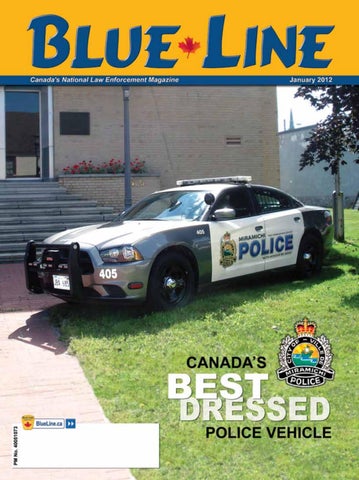
Cover: Winner of the Best Dressed Police Vehicle award, Miramichi Police Service. Read more on page 8.
Blue Line Magazine
5
January 2012
2012 Trade Show & Training Blue Line
canada’s premiere law enforcement event
April 24 & 25, LeParc Conference Centre, Markham ON – Info & FREE show registration online Proudly Sponsored by
They were ready for me www.BlueLine.ca January 2012
6
Blue Line Magazine
Blue Line
Publisher’s Commentary by Morley Lymburner
Magazine Inc. PUBLISHER Morley S. Lymburner - publisher@blueline.ca General Manager Mary K. Lymburner - mary@blueline.ca SENIOR EDITOR Mark Reesor - editor@blueline.ca CREATIVE DIRECTOR E. Jolene Lymburner - jolene@blueline.ca Contributing Writers Mike Novakowski Mark Giles Robert Lunney James Clark Dorothy Cotton Dave Brown Tom Rataj Affiliations International Association of Law Enforcement Planners Canadian Advertising Rates Data International Police Association The Canadian Press Newswire Access Copyright Subscriptions $30 per year; $50 for 2yrs; US & Foreign: $100 Advertising 888-640-3048 advertising@blueline.ca
www.blueline.ca 12A-4981 Hwy7 East, Ste 254, Markham, ON L3R 1N1 Canada P: 905 640 3048 F: 905 640 7547 blueline@blueline.ca
PRINTED IN CANADA ISSN# 08478538 Blue Line Magazine was established in 1988 as an independent publication to inform, entertain, connect and educate those involved in the law enforcement profession. With no direct control from an enforcement agency, its opinions do not necessarily reflect those of any government or law enforcement agency. The authors, advisors, and publisher accept no liability whatsoever for any injuries to person(s) or property resulting from application of adoption of anything presented in this magazine. Readers are cautioned and advised that articles presented herein are edited and supplied for your personal awerness and should not be used for further actions until appropriate guidance is received from a supervisor, Crown Attorney or other persons in authority. All material submitted for publication becomes property of Blue Line Magazine Inc. unless arrangements have been made with the publisher prior to publishing. © 2011 All articles are protected by copyright. No part of this publication may be repoduced or transmitted in any form or means, electronic or mechanical, (including photocopying and recording or by any information storage or retrieval system), without prior permission. Permission to reprint may be obtained in advance from Access Copyright 1-800-893-5777.
Blue Line Magazine
Working plan ‘A’ while preparing for plan ‘B’ Congratulations to new RCMP Commissioner Bob Paulson. His appointment from within the ranks is a coming of age for this much challenged police force. Let’s hope the reigning government supports him in making the necessary changes outlined in the Brown Report of 2007 – but I am reminded of the old saying that life is really all about how you handle plan ‘B.’ Paulson certainly is starting out with a strong footing. With eight provinces and three territories now locked and loaded to 20 year contracts, complete with federal subsidies for 20 per cent of their policing costs, a lot of pressure has been removed from the top. It is hoped the myriad of promises to those jurisdictions can now be quickly addressed and accommodated. Other issues have loomed since Brown made his 49 recommendations and more are on the horizon. It is incumbent upon the new commissioner to keep ahead of these issues and not let them pile up. I last published a list of suggestions for a better RCMP in 2007 and curiously enough most, if not all, still need addressing. Here is my new and improved list, which can also be ignored. • Reconstitute the change management team: created after Brown was released. This advisory board slowly melted away after releasing one Pollyanna report. Little was ever heard from it and it never produced a substantive progress report. • Create an association (not a union) with binding arbitration rights. The current loose knit organization of member “representatives” elected in each detachment advises compatriots who run afoul of discipline regulations. They do not negotiate wages, benefits or working conditions and only work within the system management currently permits. Every other Canadian police service has associations, which have proven to be the first line of defence against management abuses. There is no better way to determine the wants and needs of the membership. • Create a civilian oversight or police services board, a proven second line of defence against management abuses in every other Canadian police service. The RCMP would be well served by one in each province. There is no better way to determine community wants and needs. • A working agreement restricting how officers are used, setting minimum staffing levels and overtime pay and governing rules for transfers, would be a good start. • Overhaul the draconian RCMP Act. Patterned after 19th Century military regulations, it threatens officers with hard jail time for any breach, even after they leave the force. Although it’s nice to see the lash is no longer used, modern police acts aim to make better employees rather than set punitive retribution 7
for wrongdoings. •C reate a civilian public complaints commission with true investigative powers. Ontario’s Special Investigations Unit has developed considerable expertise and has earned credibility with both police and the community. They are the model. These actions can be done immediately. Here are some “blue sky ideas:” • The RCMP’s main purpose should be to improve standards by working with police colleges, conducting internal audits and developing regulations and technology to improve and encourage inter-force co-operation. • The RCMP was formerly seen as a low budget or union busting alternative to established agencies. The onerous task of recruiting, training and outfitting such a large agency is a monumental task. Each province should recruit their own officers and send them to Depot for training. • The RCMP should be responsible for all cross boundary law enforcement and combating organized crime on a national scale. • If the above occurs, the RCMP could get back into internal national security and counterintelligence. With a more centralized focus, it would be a perfect fit. • The RCMP could become the national special investigations unit; independent investigators ready to look into police corruption and serious injury or death resulting from police actions. • Develop and maintain a college of “best practices” and a police research institute. Depot or the Canadian Police College could become a “train the trainers” facility for all other police agencies. • Continue to maintain current cross jurisdictional databases such as CPIC and AFIS but also work on bridging the information sharing gap between agencies with varying hardware and software. A federally funded police service should be actively involved in a myriad of projects. One of the biggest opportunities for saving money and resources is to stop duplicating the enforcement duties of other federal agencies. The Canada Border Services Agency, which is constantly under utilized and stubbing its toes on the RCMP, is just one example. In the meantime, let’s get behind the new commissioner and wish him all the best. He has a tough job ahead. Let’s see how he moves ahead with those plan ‘A’s and how eloquently he can shift to plan ‘B’s when necessary.
January 2012
Canada’s Best Dressed
police vehicles by Dave Brown Since 2005 Blue Line Magazine has recognized creativity, visibility and community identity in police vehicle design through our annual best dressed police vehicles contest. We had no idea how things would evolve when we first began – from simple graphics on white cars to bold designs and highly reflective graphics on distinct body colours. We don’t just reward innovative designs. We also recognize that marked vehicles are a police service’s calling cards to the community; they must be highly visible and instantly recognizable for the safety of the officers within them and the citizens around them. Not that many years ago, police vehicles came in only one colour, generally chosen more for its future resale value to taxi cab owners than its visibility. At that time, graphics had to carry the design entirely and we saw some very innovative and clever layouts on a base white car. Today, as light bars get smaller and the silhouette of police cars becomes less noticeable, there is greater recognition that distinctive colours and professional graphical designs can increase visibility to the general public. We are also seeing better readability in lettering and the words on the side are now more consistent and less like a bad ransom note. Finalists for this year’s contest were selected by both Blue Line and Erik Young and his panel of judges at policecanada.ca. Entries were judged on a scale that awarded points for creativity, identity, visibility, readability and community identity. We are proud to announce the winners for 2012.
January 2012
Miramichi Police Service Situated near the mouth of the Miramichi River, Miramichi is home to 18,000 people. One of the newest cities in Canada and now the largest in northern New Brunswick, it was formed in 2005 by the amalgamation of the towns of Newcastle and Chatham and several smaller communities. Miramichi Police Service has been a consistent top finisher in our best dressed contest, finishing second in 2007 and winning the award for best community relations in 2010. We now especially like the clean and simple white-on-grey design of the new MPS cruisers and how well it fits the outlines of its 2011 Dodge Chargers. The prominent crest on the door shows respect for the community’s rich heritage and the thin black outline around the blue gradient lettering of “POLICE” adds style and visibility. The thin white stripe down the front fender line may seem like a small element but adds directionality to the design. One can see at a glance which way the vehicle is going, night or day. We applaud the effective use of the grey body colour and encourage the service to continue this theme in the future. 8
Blue Line Magazine
3
2
rd
ND
Morden Police Service The town of Morden Manitoba sits directly along the original route of the Boundary Commission/NWMP westward trek back in the late 1800s and is now in the heart of one of the fastest growing areas of Manitoba. Blue Line has recognized the Morden Police Service and agencies from the surrounding area several times in the past and it is time we also took note of its innovative police car designs. We love the unique gold-on-black design. What makes it more interesting is that body colour is not achieved by paint. It starts as an all-white vehicle and then a black decal wrapping is applied to the entire vehicle except the door panels. This is ultimately less costly than paint. What started as a quick and effective way to apply unique designs to NASCAR race cars can now be used to reduce the cost of police patrol cars. Like the other two winning designs, the scheme makes effective use of the body lines and contours of the patrol vehicle.
Kentville Police Service Named after Prince Edward Augustus, Duke of Kent, who visited the area back in 1794, the town of Kentville lies in the heart of Nova Scotia’s Annapolis Valley. Kentville Police Service provides 24-hour protection to this town of almost 6,000 people and, just to prove that creativity can be found in any size agency, we award it second place in a very close race. This was one of our favourite colour schemes. We especially liked how well the design uses the bodylines of the new Charger to enhance the effect. The ‘punch-out’ of a maple leaf on the rear quarter panel and the good use of drop shadows in “POLICE” both add unique elements to help this vehicle stand out. We also liked the shoulder patch design and how well it fit into the natural folds of the door. The red and blue swishes were used to great effect, adding emphasize to the body creases. From certain angles they add a bit of an Italian exotic car flavour to the design.
Eagle Village First Nations Police Force Eagle Village First Nation is situated along the shores of Kipawa Lake, Québec, approximately 80 kilometers west of North Bay, Ontario. Patrolling a population of 325 on-reserve residents, village police are very clear in their core values and mission. “The Eagle Village Police Force, through its members, shall strive to achieve a balanced society where every community member has an equal opportunity to fulfill their potential, in a safe and secure environment on traditional lands, where spiritual, cultural, physical and mental well being is respected” (EVPF Vision Statement, taken directly from the informative web site). One of the most interesting things about judging this contest every year is that the winning designs all seem to share one common characteristic: the best are simple, clean and instantly capture the eye. The EVPF entry is a good example of this, using its crest colours on the side of the vehicle to add a lot of movement and dynamics to the design.
Charlottetown Police Service Community relations/police promotional vehicles run a wide gamut. We have seen everything from fun and youthful vehicles right out to full-on drag racers. This year, we recognize the beautifully restored 1952 Dodge police car of the Charlottetown Police Service. Out on the road almost daily, it entertains residents and delights children who enjoy going for rides in a unique and historical police car.
Submit your police vehicle pictures, with 200 words on the design and your full contact info to BestDressed@blueline.ca Any vehicle design that has not won may enter. Previous winners may resubmit if their design has changed significantly.
Have your say about the January Automotive issue! Visit blueline.ca. Blue Line Magazine
9
January 2012
Michigan State Police
2012 Police Vehicle Tests
by Dave Brown 2012 will be a year of good news and bad news for the Canadian police vehicles market. The good news is that auto manufacturers are getting serious about police vehicles. Although all combined they may sell fewer vehicles to police each year than companies like Toyota accidentally drop into the ocean, you wouldn’t know it by the incredible lineup for 2012. The other good news is that every single car on the market is faster accelerating, harder braking, better handling and overall safer than any previous models. The Big Three have taken a serious look at what police officers really want and have responded with cars that are intelligently modified and specifically reinforced. The bad news is that one of the most anticipated new police cars isn’t making it to Canada. GM says it will not sell the Chevrolet Caprice in Canada. That is a shame because the Australianbuilt Caprice was poised to take over from the previous Ford Police Interceptor as the most popular V8 rear-wheel-drive platform on the market. This leaves Dodge alone in a market January 2012
segment that has always proved the most popular with officers across North America. The other bad news is that choosing a fleet for the coming year, which has always proved to be a bit of a daunting task, is about to get far more complicated. There will never be one perfect police vehicle for every agency in Canada. They act as office, transportation, jailhouse and protection to police officers out on the streets. Selecting them will always be a complex task, and headto-head testing by the Michigan State Police is invaluable in assisting agencies to make those important decisions. Michigan State Police annual vehicle tests Every fall the Michigan State Police (MSP), in conjunction with the US National Institute of Justice (NIJ), test the handling and performance of every new police vehicle on the market for the coming year in back-toback acceleration, braking and lap time tests. These tests are seen as the most comprehensive analysis in North America and the results are eagerly anticipated by officers and bean counters alike. The MSP publishes the results on its web 10
site (www.michigan.gov/msp) and Blue Line Magazine is once again reporting the preliminary figures. Final figures and a summary of the results should be ready by the time you read this article. Vehicles The NIJ and Michigan State Police evaluate vehicles in two categories: police-package and special-service. Police-package vehicles (PPV) are designed for the full spectrum of general police activities, including high-speed pursuit. Special-service vehicles (SSV) are designed only for specialized duties such as canine units or adverse weather conditions and are not intended or recommended for pursuits. A record 19 vehicles were submitted in the police-package category for 2012: Chevrolet Impala 9C1 (regular and E85 [85% ethanol] versions); Chevrolet Tahoe PPV(regular and E85); Chevrolet Caprice 9C1 with the new 3.6 litre V6 and 6.0 litre V8 (regular and E85); Dodge Charger 3.6 litre V6 (standard 2.65:1 and optional 3.07:1 axle ratios); Dodge Charger 5.7 litre V8 (standard 2.65:1 axle and optional 3.06:1 axle ratios); All-new 2013 Ford Police Interceptor 3.5 litre V6 (optional front-wheel and standard Blue Line Magazine
all-wheel-drive versions); regular and E85 2013 Ford Police Interceptor turbocharged 3.5 litre V6 in all-wheel-drive; 2013 Ford Police Interceptor Utility 3.7 litre V6 (optional frontwheel and standard all-wheel drive). Here is the lineup for 2012 with preliminary figures and my comments. Police package vehicles Chevrolet If GM sticks with its curious decision to not sell the Caprice in Canada, it will leave a huge hole in its lineup. Manufactured by the GM Holden plant in Elizabeth, Australia, the Caprice is a full-size, traditional bodyon-frame, rear drive vehicle powered by a 6-litre V8 engine. Its acceleration and handling
Blue Line Magazine
figures carried it to the top of this market segment. Many officers have long anticipated a return to a body-on-frame rear-wheel-drive V8. The Caprice combines a large interior volume with a tight turning radius. GM is not clear as to why it’s not bringing the new Caprice to Canada but one of many rumours cite difficulties in meeting Canadian Department of Transport regulations and problems with moving the console-mount shifter far enough forward to accommodate both laptops and two full-size police officers in winter gear. (For more on the Chevy rumours see Morley’s piece on page 17.) We seriously hope GM rethinks this strategy but the company is not completely ignoring us. It will still sell the nimble (if tightfitting) Impala and the hugely popular full-size Chevrolet Tahoe SUV.
11
Chrysler When Dodge first began building the Charger Pursuit, many people felt Chrysler was simply taking a retro muscle car platform, strapping in a big Hemi V8 motor and trying to squeeze a couple of police officers into a small cockpit as a bit of a marketing ploy or stop-gap measure. They turned out to be wrong. Not only was the company intently serious about this market, it looked at feedback from officers and fleet managers alike and made some intelligent changes to the Charger, which should put it on top of the Canadian police car market. Dodge made major changes to the Charger for 2011 and incremental improvements in the 2012 model. Cockpit size and comfort took a big step
January 2012
upward and visibility improved immensely by adding an additional side window, lowering the hood line and windshield angle and cutting back the windshield almost four inches further back into the roofline. An all-new ‘Pentastar’ V6 under the hood, now rated as a flex-fuel engine, uses variable-valve timing and a chaindriven camshaft. The optional 5.7 litre V8 comes with Dodge’s Multi-Displacement System. All Pursuits are now standard with Chrysler’s Electronic Stability Program (ESP), which uses the ABS brakes, traction control system and yaw and steering angle sensors to help keep the car stable. Brakes rotors and front hubs have been strengthened and the front seats redesigned for more comfort and support for officers wearing police gear. The transmission shifter is up on the column and when Blue Line tested the new 2011 on the racetrack during our April trade show, we found significant improvements in outward visibility, cockpit room and brakes that seemed like they could suck internal organs out through your throat if you weren’t careful. Plus, in another great tradition, Dodge still makes the most aggressive-looking police car on the planet. Ford Ford made two very smart decisions before rolling out its new lineup of police cars. One, it based the new SUV crossover Police Interceptor Utility on the all-new Ford Explorer, not the boxy (and ugly) Ford Flex like it had originally announced. Aside from the fact not too many officers were going to like driving a vehicle that looks more like the crate it came in, basing the Utility on the brand-new Explorer allowed Ford to test it for the very first time in the PPV category and not just the SSV category like previous Explorer versions. The other smart decision was to distance the new 2013 Ford Police Interceptor sedan from the Ford Taurus it is based upon. In fact, Ford makes no reference to the Taurus whatsoever in any of its police advertising, and likes to call the Police Interceptor sedan a “purpose-built” police car. Well, we might consider it more a “modified-built” police car but nevertheless, the Taurus name does not exactly invoke images of confidence and high performance. Ford makes both the Police Interceptor sedan and the Utility in standard all-wheel-drive, with front-wheel-drive available as an option. Obviously, it is looking carefully at what officers want and trying to avoid the stigma that front-wheel-drive police vehicles were never able to overcome, despite their advantages in handling in adverse conditions. The fact remains, both new vehicles are still based on what is essentially a front-wheel-drive platform, which is a first for Ford police cars. No one is going to let Ford skate into the police vehicles market on its laurels, so it needs to work very hard to prove itself to officers across Canada. It will be very interesting to see how serious it is about getting these new vehicles in the hands of test drivers and police officers for evaluation as soon as possible. January 2012
The tests Michigan State Police and the NIJ’s National Law Enforcement and Corrections Technology Center (NLECTC) test all the vehicles together over a three-day period at the Chrysler Proving Grounds and the Grattan Raceway. Each vehicle is tested without rooftop lights, spotlights, sirens or radio antennas in place. Tires are original equipment rubber provided by the manufacturer. Acceleration, braking and top speed tests are performed at the Chrysler proving ground and vehicle dynamics tests are done using the two-mile Grattan road course (all dimensions and measurements given are in U.S. numbers).
14 miles from a standing start. Each vehicle is driven through four acceleration sequences, two in each direction to allow for wind. Acceleration score is the average of the four tests. Following the fourth acceleration sequence, each vehicle continues to accelerate to its highest attainable speed within 14 miles of the standing start point.
The Results Vehicle Dynamics Testing The objective of the vehicle dynamics testing is to determine the high-speed pursuit handling characteristics. Except for the absence of traffic, the two-mile road course simulates actual pursuit conditions. It evaluates the blend of suspension components and acceleration and braking ability. Four different drivers test each vehicle over an eight-lap road course, with the five fastest laps counting toward each driver’s average lap time. Final score is the combined average of all four drivers for each vehicle. Overall Average Lap Times 1:34.39 Dodge Charger 5.7 litre 2.65:1 1:35.42
Dodge Charger 5.7 litre 3.06:1
1:35.61
Chevrolet Caprice 9C1 6.0 litre E85
1:35.85 Ford Police Interceptor Turbo AWD
Acceleration 0 - 60mph 5.83
Dodge Charger 5.7 litre 3.06:1
5.91
Chevrolet Caprice 9C1 6.0 litre
5.92
Ford Police Interceptor Turbo AWD
5.95
Chevrolet Caprice 9C1 6.0 litre E85
5.95
Dodge Charger 5.7 litre 2.65:1
7.10
Chevrolet Impala 9C1 E85
7.46
Chevrolet Impala 9C1
7.50
Chevrolet Caprice 9C1 3.6 litre
7.65
Chevrolet Caprice 9C1 3.6 litre E85
7.66
Dodge Charger 3.6 litre 3.07:1
7.75
Ford Police Interceptor Utility AWD E85
7.76
Ford Police Interceptor AWD E85
7.77
Ford Police Interceptor FWD
7.81
Dodge Charger 3.6 litre E85 2.65:1
7.93
Dodge Charger 3.6 litre 2.65:1
8.01
Chevrolet Tahoe PPV
8.01
Ford Police Interceptor Utility FWD
8.15
Chevrolet Tahoe PPV E85
8.19
Ford Police Interceptor AWD
1:36.84 Chevrolet Caprice 9C1 6.0 litre 1:37.57 Dodge Charger 3.6 litre E85 2.65:1
Acceleration 0 - 80mph 11.62
Chevrolet Impala 9C1 E85
11.93
Dodge Charger 3.6 litre 3.07:1
12.06
Chevrolet Caprice 9C1 3.6 litre
12.10
Chevrolet Impala 9C1
12.12
Chevrolet Caprice 9C1 3.6 litre E85
12.39
Ford Police Interceptor AWD E85
12.45
Dodge Charger 3.6 litre E85 2.65:1
12.52
Ford Police Interceptor Util. AWD E85
12.60
Ford Police Interceptor FWD
12.75
Dodge Charger 3.6 litre 2.65:1
12.75
Ford Police Interceptor Utility FWD
1:41.53 Ford Police Interceptor Utility FWD
13.08
Ford Police Interceptor AWD
1:42.06 Chevrolet Tahoe PPV E85
13.51
Chevrolet Tahoe PPV
1:42.10 Chevrolet Tahoe PPV
13.71
Chevrolet Tahoe PPV E85
9.18
Dodge Charger 5.7 litre 2.65:1
9.31
Dodge Charger 5.7 litre 3.06:1
9.51
Chevrolet Caprice 9C1 6.0 litre E85
9.53
Chevrolet Caprice 9C1 6.0 litre
9.57
Ford Police Interceptor Turbo AWD
1:37.65
Chevrolet Caprice 9C1 3.6 litre E85
1:37.71 Dodge Charger 3.6 litre 2.65:1 1:37.73
Dodge Charger 3.6 litre 3.07:1
1:37.80
Ford Police Interceptor AWD E85
1:37.87 Chevrolet Caprice 9C1 3.6 litre 1:39.61 Ford Police Interceptor AWD 1:39.63 Ford Police Interceptor FWD 1:39.78 Chevrolet Impala 9C1 1:40.28 Chevrolet Impala 9C1 E85 1:40.30
Ford Police Interceptor Utility AWD E85
Acceleration and top speed The objectives of the acceleration and top speed tests are to determine each vehicle’s ability to accelerate from a standing start to 60, 80 and 100 mph, and to record the top speed achieved within a distance of 12
Blue Line Magazine
Acceleration 0 - 100mph 13.65
Dodge Charger 5.7 litre 3.06:1
13.99
Chevrolet Caprice 9C1 6.0 litre E85
14.01
Dodge Charger 5.7 litre 2.65:1
14.13
Chevrolet Caprice 9C1 6.0 litre
14.50
Ford Police Interceptor Turbo AWD
17.60
Chevrolet Impala 9C1 E85 1
8.30
Chevrolet Caprice 9C1 3.6 litre E85
18.43
Chevrolet Caprice 9C1 3.6 litre
18.72
Chevrolet Impala 9C1
19.08
Ford Police Interceptor AWD E85
19.18
Dodge Charger 3.6 litre 3.07:1
19.48
Dodge Charger 3.6 litre E85 2.65:1
19.68
Ford Police Interceptor AWD
19.94
Ford Police Interceptor Utility AWD E85
20.07
Ford Police Interceptor Utility FWD
20.18
Dodge Charger 3.6 litre 2.65:1
21.08
Chevrolet Tahoe PPV
21.37
Chevrolet Tahoe PPV E85
21.68
Ford Police Interceptor FWD
9.53
Chevrolet Caprice 9C1 6.0 litre
9.57
Ford Police Interceptor Turbo AWD Top Speed
130
Ford Police Interceptor AWD
130
Ford Police Interceptor AWD E85
131
Ford Police Interceptor Utility AWD E85
131
Ford Police Interceptor Utility FWD
139
Chevrolet Tahoe PPV
139
Chevrolet Tahoe PPV E85
139
Ford Police Interceptor FWD
141
Dodge Charger 3.6 litre 2.65:1
141
Dodge Charger 3.6 litre 3.07:1
142
Dodge Charger 3.6 litre E85 2.65:1
147
Chevrolet Caprice 9C1 3.6 litre E85
148
Chevrolet Caprice 9C1 3.6 litre
148
Ford Police Interceptor Turbo AWD
149
Chevrolet Impala 9C1
150
Chevrolet Impala 9C1 E85
151
Dodge Charger 5.7 litre 3.06:1
152
Dodge Charger 5.7 litre 2.65:1
153
Chevrolet Caprice 9C1 6.0 litre E85
154
Chevrolet Caprice 9C1 6.0 litre
9.53
Chevrolet Caprice 9C1 6.0 litre
9.57
Ford Police Interceptor Turbo AWD
Braking
scored on its average deceleration rate. Each test vehicle makes two heat-up decelerations at predetermined points on the test road from 90 to 0 mph at 22 ft/sec2 using a decelerometer to maintain rate. It then turns around and makes six measured 60-0 mph stops with threshold braking applied to the point of impending wheel lock, using ABS if so equipped. Following a four-minute heatsoak, the sequence is repeated. Initial velocity of each deceleration and the exact distance required is used to calculate the deceleration rate. The resulting score is the average of all 12 stops. Stopping distance from 60 mph is calculated by interpolation of results. Ergonomics The objectives of the ergonomics and communications test are to rate a vehicle’s ability to provide a suitable environment for patrol officers to perform their job, accommodate required communication and emergency warning equipment and to assess the relative difficulty in installing this equipment. A minimum of four officers independently evaluate each vehicle on comfort and instrumentation. Michigan State Police Communications Division personnel then evaluate each vehicle on
Milage
the ease of equipment installation. A total of 28 factors are evaluated on a scale of one to 10 and averaged among all the testers. The final score is the cumulative total from the average of each of the 28 factors, such as seat design, padding, ease of entry, head room, instrument and HVAC control placement, visibility and dashboard and trunk accessibility (2011 figures). Chevrolet Tahoe PPV = 219.76 Chevrolet Caprice = 203.57 Dodge Charger = 202.70 Chevrolet Impala 9C1 = 195.95 Fuel Economy While not an indicator of actual mileage that may be experienced, the EPA mileage figures serve as a good comparison of mileage potential from vehicle to vehicle. Scores are based on data published by the vehicle manufacturers and certified by the US Environmental Protection Agency.
Braking The objective of the braking test is to determine the deceleration rate each vehicle attains on 12, 60-0 mph full stops to the point of impending skid and with ABS in operation. Each vehicle is Blue Line Magazine
13
January 2012
The Crown Victoria Police Interceptor (often referred to simply as CVPI or P71), the law enforcement version of the civilian Crown Victoria, is one of the most widely used law enforcement vehicles in the US and Canada. Ford stopped accepting orders for the CVPI in April. After the 1996 discontinuation of the Chevrolet Caprice, Ford held a near-monopoly on the market for police cruisers in North America because the conventional rear-wheel drive, V8 power and body-on-frame construction is advantageous for police use. The CVPI’s body-onframe construction allowed inexpensive repairs after accidents without the need to straighten the chassis. Rear-wheel drive made it easier to avoid spin-outs than in front drive rivals and allowed it to better withstand hard driving over curbs and other obstacles in the urban environment. Although the CVPI was not sold to the general public, decomissioned cars are widely available secondhand and in demand by those who want a safe car with room for three child seats in the back. They come equipped with many heavy duty parts such as a revised transmission and 251 HP engine. First generation (1992-1997) Though the name has been officially used since 1992, the 1978–1991 full-size LTDs and January 2012
LTD Crown Victorias and 1992 updated body style used the “P72” production code designation for both fleet/taxi and police models. The model was internally classified as S (similar to LX). From 1993 to 1997, police car models of the Crown Victoria were officially known as Crown Victoria P71s. In the 1993 model year, the Crown Vic was given a chrome front grille and reflector strip between the taillights. Another minor restyle – a new grille and taillights – followed in 1995. To accommodate the new taillights, the rear license plate was moved from the bumper to the trunk lid. Second generation (1998-2011) Ford restyled the Crown Vic in 1998, eliminating the 1992 to 1997 “aero” look and adopting the more conservative styling of the Mercury Grand Marquis. Both cars included restyled front and rear end components. The 1998 police package P71 grille, door handle trim and bumper strips were all chromed and sported a chrome-trimmed flat black rear fascia with the “Crown Victoria” badge. At this time, the car was still known as the “Crown Victoria P71.” The CVPI name was introduced in 1999, with a trunk lid badge replacing the 1998 “Crown Victoria” badge. A chrome-trimmed gloss black rear fascia, unpainted door handle trim, black 14
bumper strips, and a gloss black slatted grille were also introduced. Finally, the new “street appearance package” was introduced, intended to make the CVPI look like a Standard (P73) model. It included chrome trimming and badging. Midway through 1999, the taillights were also changed. 1998 and early 1999 models had a separate amber turn signal along the bottom edge of each taillight housing. Starting in mid1999, the extra bulbs were eliminated and the turn signals returned to the combination stop/ turn setup with red lenses found in many North American cars. Although the lenses changed, the housings retained the chambers for the separate turn signals, laving a perfect place to install strobe tubes that would not affect brake or turn signal visibility. Non-CVPIs and CVPIs equipped with the “Street Appearance Package” retained the amber turn signal. For 2000, the rear fascia and taillights lost the chrome trim and the gloss black grille was dropped in favor of a flat black slatted grille. Further refinements were made in 2001, including removal of all trim on the plastic bumper pieces and a new honeycomb-style grille, replacing the slat-style found on previous Crown Vics and CVPIs. Power adjustable pedals also became an option starting in the 2001 model year and Ford relocated the rear window defrost switch from Blue Line Magazine
the left side of the dash to the direct left of the HVAC controls. The year 2003 brought a minor redesign. The interior door panels and seats were freshened, with side-impact airbags becoming an option. The 2001–2004 CVPIs all look the same on the exterior; the way to tell the 2003+ cars from the 2001 and 2002 models is by looking at the wheels. The suspension, brakes, steering, and frame all were redesigned for the 2003 model year. Because of the new underpinnings, the wheels for the newer cars have a much higher offset. They look almost flat, compared to the concave wheels on older models. Along with a new wheel design, new hubcaps were introduced. The 2004–2011 CVPI is rated for 251 HP because of a new air intake system, including a new airbox with raised lid and deeper bottom) and integrated 80 mm (3.1 in) mass airflow (MAF) sensor that is part of the lid. This allows for much more precise flow calibration and reduces the chances of air leakage. The P71 zip tube (the flexible rubber hose between the throttle body and MAF outlet) is also used to reduce NVH (noise, vibration, and harshness) and transfer air from the airbox to the throttle body with minimal flow resistance. Standard on the 2006 model is a redesigned instrument cluster, now sporting a tachometer, digital odometer with hour meter and trip meter features, and cross-compatibility with the civilian version’s various features (these are normally locked out but can be accessed through wiring modification). Kevlar-lined front doors are optional on the 2006 CVPI. Also introduced in 2006, for P70/P72 Commercial Heavy Duty models and
Blue Line Magazine
P71 CVPIs, is a 17” steel wheel, replacing the previous 16” wheels, and new flat gray (rather than the previous years chromed) wheel covers. For 2008, the Crown Vic was restricted to fleet-only sales, and all Panther-platform cars accepted flex-fuel. The CVPI received some new options, such as the ability to have keyless entry. For the 2009 model year, the CVPI had power pedals as standard equipment. Side impact airbags and new federally mandated recessed window switches were made standard across the entire Panther line. The CVPI also received upgraded brakes for 2009. The 2011 model year Ford CVPI (and regular civilian models P74, P73, etc.) received updated larger front headrests to comply with new front crash rating standards. Engine and drive train The CVPI has an external oil-to-coolant heat exchanger to reduce engine oil temperatures, allowing it to idle for extended lengths of time without overheating. The cooler can be prone to seeping oil from the O-ring seals after high mileage operation, particularly where damaged by road salt. The engine calibration comprises a slightly higher idle speed (by approximately 40 rpm) and minor changes in the emissions settings. The computer is tuned for more aggressive transmission shift points and the transmission itself is built for firmer and harder shifts. The 2006-present CVPIs equipped with 3.27:1 or 3.55:1 rear axle ratios from the factory are electronically limited to 120 mph (193 km/h) due to the lower driveline-critical vehicle speed.
15
Those with a 3.27:1 rear axle ratio have generally been limited to approximately 130 mph (209 km/h). This compares to 110 mph (177 km/h) for the “civilian” model. Ford used an aluminum metal matrix composite driveshaft for the 1993–2005 CVPIs as a measure to allow safe operation at over 150 mph (241 km/h), but it was more expensive than the regular aluminum driveshafts. It reintroduced the 3.55:1 rear axle ratio in the 2006 model year and set the speed limiter at 120 mph (193 km/h) to reduce the risk of driveline failure. CVPIs also have a reinforced frame and body mounts and an optional limited slip rear differential. Body and chassis Another difference from the standard Crown Victoria are Ford’s “severe duty” shock absorbers, which offer a stiffer ride. They also have black steel wheels with stainless steel or chromed plastic hubcaps. All CVPIs also come with T-409 stainless steel dual exhaust systems without resonators. Standard Crown Vics have a stainless steel single exhaust system, while the handling and performance package and LX sport-equipped Crown Vics have the same exhaust system as the CVPI, with the resonators. They further reduce noise, vibration, and harshness without adding any restriction to the exhaust system. CVPIs have higher-rate coil springs, approximately 0.8 inches (20.3 mm) of additional ground clearance, and thinner rear antiroll bars (shared with the LX sport) than the handling and performance package Crown Vics; the base car does not have a rear antiroll bar.
January 2012
On 2004 and newer models, P71s have a 200 A alternator and a 78 A h battery. Ford also offered trunk packages for equipment storage and, as of 2005, an optional CVPI fire suppression system. Interior The front seats have a steel “stab plate” built into the back to protect officers. Also, most CVPIs have a break in the front “bench seat” despite having the shifter on the steering column. This gap is generally filled by a console holding radios, controls for emergency equipment, large firearms, and often a laptop computer or mobile data terminal (MDT). The CVPI also has a calibrated 140 mph (225 km/h) speedometer. Problems and criticism Following the criticism of fires following highway-speed rear-end collisions, 2005 and later model CVPIs came with an optional automatic fire suppression system and special “trunk packs” designed to prevent cargo from penetrating the fuel tank in a collision. There were also some problems with early 2003 CVPIs. The newly designed steel wheels rusted prematurely, and the rack and pinion steering units failed early. Another issue with the wheels were weld points that come loose, causing rapid air loss in tires and the potential for loss of control. Discontinuation and future On March 12, 2010, Ford Motor Company introduced the 2011 CVPI as a rebadged and reengineered version of the current Taurus.
The last Ford Crown Victoria comes off the line September 15, 2011. This new vehicle bears no relation to the Panther platform on which the previous CVPIs were built. In response, police departments bought reserve supplies of the last Crown Vics, allowing them to maintain a fleet of reliable police cars into the future. The London, Ontario, police department noted when stockpiling extra CVPI’s that while potential replacements may use less gasoline, the CVPI may be easily and cheaply converted to run on propane, giving it lower
running costs than its competitors and the Taurus Ford is touting as a replacement. The final built Crown Victoria, a civilian model destined for Saudi Arabia, rolled off the assembly line at 12:30 PM on September 15 2011, concluding assembly operations at the St. Thomas, Ontario plant. Article Sourced from Wikipedia and edited by Blue Line Magazine.
Blue Line
2012
Trade Show & Training canada’s premiere law enforcement event April 24 & 25, LeParc Conference Centre, Markham ON
Blue Line Training is designed with the most effective and professional job performance in mind to give you the upper hand for taking on tomorrow. Courses include:
RISK DT Intro (Rapid Integrated Survival Kombat – Defensive Tactics) Instructor: CTTA Canadian Tactical Training Academy
Terrorism; Understand, Investigate and Interdict Instructor: Steven Rocke
Revolvers, Pistols and Long Guns Instructor: Pierre Descotes
Detecting and Defusing Deception
Instructor: A/Sgt Wayne Vanderlaan (retired)
Practical Interviewing
Instructor: S/Sgt Gordon MacKinnon (retired)
Introduction to Concealment Instructor: Antonio Colabelli
Are you ready? – www.blueline.ca January 2012
16
Blue Line Magazine
The Chevy Caprice Missing in action? by Morley Lymburner This year the Michigan State Police Vehicle trials evaluated a record 19 vehicles produced by the big three manufacturers. You can imagine our surprise when sources advised us, at the 11th hour, that the GMs Chevrolet Caprice will not be available in Canada for police use. Since this vehicle’s operational capabilities scored well, we were concerned about why it would not be available north of the border. Despite numerous communications, General Motors was not forthcoming about the reasons behind its decision, leaving us with nothing but rumours. Its one week to press time and what are we going to say to our readers? “Let’s simply follow our nose and invite our readers along for this ride of discovery” was my reply. One rumour had it that GM’s decision was due to high import duties since the Caprice is manufactured in Australia and falls outside NAFTA, meaning it was prohibited on political grounds. The exorbitant import duty makes the Caprice uncompetitive with Ford and Chrysler cars. This was dispelled by information from CBSA sources that the duty would be no more than five or six per cent, which would not be anywhere near prohibitive for competitive bids.
Blue Line Magazine
More calls resulted in more rumours and one big question. Is it a political manoeuvre to have the vehicle manufactured in Canada? Anything can happen when a flag is waved in front of an issue as topically hot as jobs. Especially after the shut down of the Ford plant in St.Thomas and the sting of 2,700 lost jobs after 45 years of production. Leading on this was the suggestion that Transport Canada did not approve the Caprice for importation as it did not meet Canadian safety and equipment standards. Intrigued, we checked Transport Canada’s web page and found the Caprice was not on their list. This rumour made the most sense however in that its Australian manufacturer would be required to re-tool to produce it in a left hand drive configuration. Due to this form of major overhaul and coming from the temperate climes down under this model may not have been put through the rough and tumble of a Canadian winter. Now this was getting into the realm of a
17
real scoop and I certainly did not want to let go now that our imaginations were going full-bore. Inquiries with Transport Canada put us on hold for three days while they looked into the rumour. After an exhaustive check and a double check in Ottawa a rather tepid response finally came 24 hours before press time. There are no holds on the car as far as Transport Canada is concerned and never have been. But they went a step further for me and had some field operatives contact their “shoulder-to-tap-on” people at GM Canada. The apparent response was that the Caprice is most definitely available to police departments in Canada. So what’s the fuss? Okay then. We are not back at square-one but they still have my attention. Another phone call to GM media people and... and... and... the official word is that “the 2012 model Chevrolet Caprice will not be available for police in Canada.” The simple question “why” got an equally simple answer; “It was a marketing decision not to make the Caprice available in Canada.” So there you have it. You are as up to date (or as confused) as we are as of press time. Why don’t you simply call up your local dealer and tell them you want to buy one. Aha! Now there is a good piece of investigative journalism. I called up my local GM dealership. “You can’t get one unless you’re a cop in the United States.” Now why didn’t I just call them up in the first place?
January 2012
COmpany Profile
YEARS
35
of
Police Response
Bringing hi-tech to the frontier of law enforcement by Simon Martin When Rinaldo Darolfi came to Canada in 1958 from Italy he fancied himself an artist. A master plasterer, it didn’t take him long to realize plastering in Canada was mindnumbing work. “In Rome, plaster was an art. When you finish your apprenticeship you’re a maestro. You would do a lot of fancy stuff,” he said. “Here it was work, not art. I was 21 years old and I said I wouldn’t be able to do this the rest of my life.” His artistic training served him well later in life when he founded D & R Electronics in 1976, molding it into one of the most innovative manufacturers in product design for police and other emergency vehicles. Over the years, Darolfi artist’s eye helped him sculpt one of the first police car consoles and the first electronic emergency lighting switching panel in Canada. After giving-up on plaster, Darolfi turned his interest toward the field of electronics, helping design language laboratories for schools across Canada. Since he had no forJanuary 2012
mal education in electrical engineering the learning curve was steep. Luckily for him, he began working with an engineer who he described as good and lazy. “He would spend a day teaching me something that he could do in half an hour because he didn’t want to do any work,” said Darolfi. “For me it was beautiful.” Eventually, the funding dried up for schools building language labs and Darolfi felt there was no future in the business. He did, however, realize that there was a market for servicing and upgrading them. That’s when he started D & R Electronics, which was essentially a high-end stereo equipment repair shop; a very good one that counted Oscar Peterson as one of its many customers. It wasn’t until an innocuous meeting with a Smith and Wesson sales rep at a restaurant that Darolfi turned his pioneering mind towards servicing emergency vehicles. Smith and Wesson was diversifying and trying to get into the emergency lighting and sound business. They had a contract with the Ministry of Health but needed some electronic expertise, said Darolfi. “It was my introduction into emergency lighting. There was nobody in Toronto doing that service. Nobody knew anything about it because before they were using old mechanical and manual sirens.” New light bars hit the market in 1977 that nobody really knew anything about, 18
said Darolfi. He was inundated repairing unreliable electronic sirens for the ambulance service and Ontario Provincial Police. “I started repairing stuff for the OPP in 1977. I was keeping them going.” Darolfi started supplying the OPP with electronic parts from a US manufacturer but found them to be of poor quality. “So I went to Mark Thompson (director of fleet operations) and I suggested he give me a chance to design a custom panel for them and make it right here in Canada,” he said. “Basically after his consent the OPP was my start. That’s when I started manufacturing electronics for police vehicles.” Darolfi started with arrow boards and electronic controls. From there, he designed the first console that went in-between the seats and the first electronic switching to control everything. Before that time, Darolfi said everything was mechanical switching, which had a tendency to break down more frequently. “The console was something that I introduced to the market. Electronic switching too. Everybody basically followed.” Today, the company designs and manufactures a broad range of light and sound control systems. It also produce cabinets and various other products for police, fire, ambulance and other “amber” vehicles. Darolfi said D&R services customers in Canada, United States, Europe and Australia. Blue Line Magazine
Left: D&R Electronics founder Rinaldo Darolfi stands by a 2012 Chev Caprice. Currently unavailable in Canada Rinaldo obtained one to study and measure for the future needs of Canadian policing. Above: D&R head office in Bolton Ontario. A staff of 75 work diligently to full-fill orders for emergency vehicle aftermarket equipment on a global scale. “We have a place in the market. It is a fast moving market but as long as we are progressing with technology and coming out with new better products we will be good,” he said. “We have to evolve with the market.” That doesn’t seem to be a problem for Darolfi. The latest innovation from D & R is a roof light bar that converts into an arrow board which can display custom messages to motorists. Darolfi expresses his pride in the patented package, which has the same appearance on the roof as a standard low profile LED based light bar. With a flick of a switch the centre unit raises an LED board. The company is continually trying to find ways to make the police car better. It is currently developing the use of tablet computers as part of the console so as to streamline emergency lighting and records management with a unified touch-screen technology. What Darolfi is most proud of is that with all the competition in the industry his products are still made in Canada. “We start from scratch. We build stuff ourselves,” he said. “We make the molds and everything.” The headquarters in Bolton ON is outfitted with top-of-the-line equipment like a metal laser-cutter and automated turret punch press. Darolfi said the company employs 75 people. Around 90 per cent of the business is police and amber vehicles, eight per cent ambulance and two per cent fire. Customers Blue Line Magazine
include the RCMP, OPP, Toronto Police Service and US police and sheriffs departments. At the mature age of 74, Darolfi said he has no intention to retire because he still enjoys what he is doing. That being said, when he does retire there is a plan in place for the kids to take over the company. “Massimo is good at sales. Alfredo is
19
good on the mechanical side,” he said. “The kids have the intention to spend and to grow. I will help as much as I can.” You may obtain more information about D&R Electronics by going to www.dandrelectronics.com. Simon Martin is an assignment writer with Blue Line Magazine.
January 2012
technology by Tom Rataj
Coming to four wheels near you Electronic stability control (ESC) systems are finally being mandated as standard equipment on all new 2012 light passenger vehicles. Since ESC works in conjunction with ABS brakes, that system will also be standard. Numerous other safety and convenience features are becoming commonplace in many more regular (i.e.: affordable to the masses) passenger vehicles, after spending a few years being showcased in high-end luxury and performance vehicles. Light-weight materials, particularly aluminium and even carbon fibre, are increasingly appearing in more vehicles, helping to improve fuel efficiency by reducing vehicle weight. High-tensile steel is also being employed more often to strengthen frames and improve occupant safety. Voice-controlled sound and navigation systems and mobile cellular data connectivity are increasingly becoming commonplace in all market segments. Internet connected “infotainment” technologies are also rapidly encroaching into the space behind the wheel, vying for the attention of drivers’ and passengers, probably to the detriment of driving safety. Engine technologies Many new vehicles now offer 4 and 6-cylinder engines in place of the 6 and 8s in previous generations of the same model, resulting in much improved fuel economy. To accomplish this, the new engines often rely on higher compression ratios and fuel injection system pressures. Many manufacturers are moving away from throttle-body style fuel injection in favour of very high pressure direct injection, which puts fuel directly into the cylinder, as is common in European diesel engines. This results in a more complete fuel burn, better power and fewer emissions. Many smaller engines also use a turbocharger (or two) to improve efficiency and performance, making up for the loss of displacement. Some European manufacturers also offer engines (unfortunately in Europe only) that feature both a supercharger and a turbo charger, obtaining the power range benefits that each system offers. The Ford EcoBoost 3.5 litre V6 engine option found in the new Taurus based police interceptor uses two turbochargers, direct fuel injection and other technologies to produce more horsepower than the 5.0 litre V8. Transmissions Until recently 5-speed automatic transmissions were the norm for many vehicles. Six, January 2012
seven and even eight speed transmissions are quickly flooding the market to maintain performance and improve fuel economy. These transmissions are also getting substantially more complicated, with many dual-clutch models making it to market. They shift very smoothly and quickly because each gear change effectively consists of two smaller incremental changes. Continuously variable transmissions (CVT’s) are also becoming more popular. They use pulleys to continuously vary the final drive ratio between the engine and drive wheels, optimising engine speed (and efficiency) under all driving conditions. Steering Hydraulic power steering is also quickly disappearing, replaced by electronic systems. Because hydraulic systems use a mechanical pump connected to the engine, they constantly draw power. Electronic systems only draw a small amount of electricity from the alternator when needed so they help improve fuel economy. They can be controlled very precisely to provide more power at lower speeds and less at higher speeds, effectively increasing overall steering quality and consistency. Integrated sensors also typically feed information to the electronic stability control systems, further improving overall vehicle control and safety. Body structures The rigidity of vehicle bodies has increased greatly with much improved computer aided design and modelling systems. A more rigid body improves driving dynamics and handling, helping to increase overall safety. The increasing strategic use of stronger high-tensile steel in many critical areas of ve20
hicle bodies helps to improve occupant safety and crash survivability because it is better at absorbing and distributing impact forces over a wider area. Audi leads the industry in using aluminium bodies. Its new for 2012 A6 sedan uses substantially more aluminium in the body and other areas than the previous generation, reducing the overall weight and improving ride, handling and fuel economy in the process. BMW recently debuted its new “i” series models, which use significant amounts of carbon fibre reinforced plastics in the body structure and other major components. Carbon fibre is very light but extremely strong, allowing light but very safe bodies. Hybrids While hybrids can only really be considered a niche market (about 3 per cent), manufacturers continue to fine-tune the drivetrains. World leader Toyota is about to introduce a new plug-in version of the Prius, which can keep the battery topped-up when at home or work. Buick’s new mild-hybrid “e-assist” technology takes advantage of dropping lithiumion battery prices and a smaller battery pack to reduce the 2012 LaCrosse’s price to the same as the conventional V6, while improving highway fuel economy by 25 per cent. Replacing the alternator with a small electric motor, which serves dual functions, helps in this effort. Hybrids offer big mileage improvements in city driving but don’t offer similar advantages on the highway. The added cost and complexity of a hybrid vehicle often does not make financial sense unless it is used for a lot of city driving (such as a taxi). Blue Line Magazine
Electric The entirely gas-free Nissan Leaf is the first mass-market all-electric vehicle. More models from most major manufacturers will be arriving in the next few years, although range-anxiety seems to be containing buyer enthusiasm. The Leaf uses a lithium-ion battery pack and has a rated range up to 117km with a topspeed of 144km/h. It may be a perfect citycar but requires installing a special charging station at home. Electricity to recharge the Leaf also needs to be factored into the cost of operation. Several hybrids such as the new Chevy Volt and others can now drive 45 or more kilometers on a single charge, giving them good potential as city vehicles. The Volt’s gas engine automatically runs once the battery pack falls below a certain threshold.
road ahead for pedestrian and animals are improving. A new enhancement by Mercedes triggers both an audible alarm and flashes the high-beams four times when it detects an object that might be a pedestrian. Mercedes claims the system detects pedestrians 1.3 seconds earlier than a driver can. Autonomous vehicles While a number of manufacturers already offer “self-parking” systems, where a vehicle can basically park itself with no driver input, numerous other autonomous control systems are coming. Traffic jam assist from BMW introduces nearly autonomous operation in stop-and-go traffic slower than 40 km/h. The vehicle will
accelerate, brake and steer with no user input, increasing safety in the otherwise dangerous “accordion” traffic condition. Several other manufacturers also offer collision avoidance systems that automatically apply the brakes if they detect the vehicle ahead is too close. Many of the newly arriving automotive technologies will result in improved safety but also introduce some interesting quandaries for police when assessing collisions and driver behaviour and actions. Tom Rataj is Blue Line’s Technology columnist and can be reached at technews@blueline.ca .
Safety Blind-spot sensing and warning systems are common place, while lane-departure and driver fatigue systems are starting to be offered in more vehicles. These systems use various types of sensors, cameras or combinations of technologies to keep drivers in their lane and warn them if they nod off. Drying brake systems, which gently pulse the brakes when the windshield wipers are running, help to keep discs dry during wet conditions, greatly improving stopping performance. Night-vision type systems that scan the
Blue Line Magazine
21
January 2012
Carbon Motors E7
The official vapour car of the millennium by Dave Brown Notable by its absence (again) from the Michigan State Police Trials is the Carbon Motors E7, which seems to have become the ‘vapourcar’ of the decade. After six years of publicity and media announcements, not a single test car has hit the road to prove its optimistic performance figures. It will be interesting to see if Carbon can ever bring this purpose-built police car to market or if it becomes another Bricklin of failed dreams and marketing hype. Even if Carbon succeeds in keeping the curb weight under 4,000 pounds, which is unlikely, a projected 0 to 60 time of 6.5 seconds with a 250 horsepower engine doesn’t make sense, even with all its technology, BMW – suppliers of the twinturbocharged six-cylinder diesel engine – can’t produce numbers close to that except in the muchsmaller 3-series. Here in Canada, it would be difficult to find two police cars configured exactly the same, let alone cars in two different police agencies. A turn-key police car with all the equipment built-in that is designed for twice the service life of other police vehicles also means early adopters will have to live with what is essentially a beta version of an untested police car for twice as long. If it proves to be a lemon, one can’t simply strip out all the integrated police equipment and dump it to a taxicab company. Not to mention, it is just downright ugly. Someone once said that everything great in life was first designed on the back of a cocktail napkin, but this design must have been passed around an entire restaurant of committees. Other than a novelty car or two, not too many police chiefs are going to want to blow their entire vehicle budget on fewer and more expensive cars, especially when they are so ugly that most departments would be ashamed to even let one lead the annual harvest day parade. While other publications fall all over themselves to heap praise on a car that doesn’t yet exist, the publisher of this magazine and I think the numbers might January 2012
not add up and the turbo-diesel idea is a one-trick-pony. It may never meet projected mileage figures, especially in Canada where everyone knows idling diesels can’t generate enough heat to keep the electronics warm, let alone a cockpit for police officers. When one chief asked Blue Line Publisher Morley Lymburner if the Carbon police car would be viable for Canada his response was simple. “If it gets into a departmental accident, where is your replacement vehicle coming from?” Probably a Chrysler or Ford dealership. I officially challenge Carbon to send even one car to the Blue Line Trade Show next April and prove us wrong. Dave Brown is Blue Line Magazine’s Firearms Editor and staff writer. He is a tactical firearms trainer and consultant. He can be reached at firearms@blueline.ca
22
Blue Line Magazine
Face in point! by Stephen Vandenbos Criminals use high-tech means to avoid capture but there is one thing they may find difficult to change – their face! You often see television’s CSI use facial recognition software to identify their bad guy. Believe it or not, the technology is out there and is used every day by drivers licence offices across Canada. In Ontario, facial recognition is known as Photo Comparison Technology (PCT), a technology that converts a photograph of a person’s face into a unique set of numbers based on their features, thereby creating a numerical template. A computer then compares it to templates derived from other photographs. PCT has been implemented by several if not all Canadian drivers licence offices to maintain the integrity of their databases by reducing fraud, identity theft and some data entry errors. It’s used to screen all new licence photographs. Case goes cold In many fraudulent identification investigations, police have a hard time positively identifying suspects. Most often, the photo is sent out via inter-office email within a particular service for identification. Other times, it is fanned out via e-mail to other police agencies, but unless an officer knows the suspect from having dealt with them, the case goes cold.
Blue Line Magazine
I was assigned in Sept. 2010 to investigate a fraud complaint reported by a St. Catharines, Ontario bank where the suspect committed a cheque fraud for $995. Through my investigation, I learned that this was one of more than 400 government cheques stolen from a Canada Post sorting station near Toronto and subsequently cashed. The loss exceeded $800,000. The suspect had left behind a fraudulent citizenship card with his photograph on it. Emailing out the photograph produced no results and with numerous dead end and cold leads, I decided to try something new. I remembered sitting beside a woman at a fraud conference who worked for the Ontario Ministry of Transportation’s Fraud Prevention and Business Integrity Office. She mentioned that she uses PCT to identify duplicate identities within the transportation ministry database to combat fraud and duplicate identities made by clerical errors. I called and told her about my investigation but learned that since the photo wasn’t from an Ontario drivers licence, she could not legally use PCT to help me unless I had a warrant. I was quite accustomed to authoring production orders to gather information but in this case, I needed her to look for a suspect but had no idea whether he was even in her database. I would have to author a general warrant instructing her to use PCT to compare my photo with the database photos.
23
I wrote my general warrant and met with a Crown Attorney, who presented it to a judge and had it signed. I served it on the woman and waited for my result. To my amazement, it worked. The photograph I submitted was compared with millions of other photos in the drivers licence database and I received a positive hit. My suspect was identified. When I began checking into my suspects criminal history, I wasn’t surprised to learn that he had a lengthy record for fraud related offences. Some time later, my suspect was arrested and I had the privilege of interviewing him. I told him that to my knowledge, he was the first person in Ontario to be charged by using the ministry’s photo comparison technology. Knowing that this was difficult evidence to dispute, he opted to plead guilty. A great tool to combat crime As criminals use new methods to commit their crimes, we in law enforcement must also adapt how we investigate them. PCT is available to law enforcement agencies, is highly effective and I’ve proven that it does work. Stephen Vandenbos is a member of the Niagara Regional Police Service. He was the first successful officer in Ontario to author a general warrant by using facial recognition technology. For further information you may contact him by phone at 905-945-2211 ext 5401.
January 2012
January 2012
24
Blue Line Magazine
Blue Line Magazine
25
January 2012
How people disappear by John Farinaccio Over the past several years there have been plenty of news stories about investment advisors who conned their clients out of millions of dollars and disappeared, seemingly into thin air. This may seem like a new phenomenon but it is not; it has been around since the creation of the monetary system. The process for successfully disappearing under the radar must be methodical and detail-oriented, often involving months and even years of psychological and logistical planning. Like a recipe, leaving out any of the key ingredients will leave nothing but a bad taste in your mouth. Psychological preparation This is much more difficult than the logistical aspect. A decision must be made that once the disappearing act is put into effect the person can never look back. They must abandon their old life and identity and start a new one. An investment advisor – let’s call him Joseph Smith – will disappear into the mist and re-emerge as Jonathan Green, a wealthy entrepreneur. This decision may be easy for some and difficult for others. Smith has to come to grips with the fact he can never return home or call his friends and family, especially not on birthdays, anniversaries or holidays. Never attend his daughter’s wedding or be there for the birth of his grandchildren. Breaking any one of these rules will almost certainly lead to his arrest. Logistical preparation If Smith accepts the psychological challenges, he can move on to prepare logistically to ensure he can live the remainder of his days on the stolen money. Since no one will suspect him of any criminal activity prior to his disappearance, he has sufficient time to funnel money into offshore accounts, most likely to countries that have not signed the MLAT (mutual legal assistance treaty) with his home country. A name by any other As his victim’s money is being wired outside the country Smith realizes that, to increase his chances of a successful getaway, creating a new existence for himself is a must. He could use one of several methods to change his identity without attracting attention. 1. The graveyard robber: Many identity thieves steal their new identities from graveyards by finding a deceased person with approximately the same year of birth who January 2012
died before they turned 16. We won’t go any further on this one. 2. The government employee/entrepreneur: In many developing countries where the average daily salary cannot support a family, it isn’t difficult to find a government employee who, for a few thousand dollars, sometimes less, will create official documents for a new identity. 3. Passport dealers: Stolen or phony passports are a huge industry. For a few thousand dollars one can purchase a passport in almost any name. D-Day It’s 7:30 am on a Tuesday. Joseph has breakfast with his wife like normal and tells her he won’t be home for supper due to his weekly Tuesday night meetings. As he gets in his BMW he calls his secretary and tells her he will be meeting with clients all day outside the office. Instead of driving to his non-existent meetings he continues on to the airport and boards a flight to Mexico City. On arrival he discards his cell phone, credit cards, passport and any other documents linking him to his old identity. He can never use them again. He goes to his airport locker, picks up his new Jonathan Green identity and uses cash to buy a round trip ticket for Belize, which does not have a MLAT agreement with his home country. Upon arrival he visits the bank where he funnelled a portion of the money and makes a withdrawal. In the course of a business day he has made his escape and no one is the least bit suspicious. By the time law enforcement begins the search Jonathan Green could be in his fifth country using several different identities. All the authorities have is that he took a flight to Mexico and disappeared. 26
How they’re caught Only a small percentage of those who disappear and are wanted by authorities ever disappear for good. More and more countries are quickly moving towards becoming cashless societies, which means more and more transactions can be traced. That makes disappearing a lot more challenging but certainly not impossible. The most common reason for getting caught is breaking one or more of the aforementioned rules. One is all it takes. A year later, Green is living in paradise off his stolen millions, which bought him a beautiful beachfront home equipped with his very own cook and maid. He enjoys his days on a private white sandy beach with warm turquoise water. He’s feeling pretty untouchable at this point thinking, if they haven’t caught me yet, they never will. Missing his wife he decides that one phone call back home to invite her to meet him in Cancun for a week to “explain” everything wouldn’t hurt. Keeping track of all phone calls made to his wife’s phone, the authorities back home notice a phone call from Central America. The next day his wife books a ticket to Cancun, Mexico. Authorities set up surveillance on his wife and... you can guess what happens next. John Farinaccio has more than 18 years experience in investigations and intelligence gathering, has managed and lead investigation & undercover surveillance teams and spearheaded the development of advance reconnaissance teams for international protection details; many in hostile areas of operations. He founded the Canadian Private Investigators’ Resource Centre (CPIRC) in 1999 and currently serves as vice-president of the Canadian Tactical Training Academy. For more details call 514.373.8411 ext. 223
Blue Line Magazine
The future of police defensive tactics by Andrew Dugdale Growing up in an era where police tactical training consisted primarily of Jujitsu and Judo with a bit of boxing and street fighting thrown in, I believe today’s officers can benefit from the array of specifically tailored tactical training – that is, if they can sort out the good from the bad and everything in between. From the ripe old age of six, I was indoctrinated with martial arts, at least the sport version popular in the 1980’s. However it was the military which really shaped my views of tactical fighting. “Knock them down” fast and without anything fancy. The KISS rule (Keep It Simple Stupid) was the basis for these techniques. Training every member of the Canadian Forces – infantry soldier, truck driver or nurse alike – in an effective system is a daunting task at best. MDTS, PPCT and SSGT have been the patrol officer systems workhorse for years, but they require officers to learn numerous techniques for any given scenario and implement a precise series of movements to accomplish them. They also must be heavily tailored to fit any given scenario. An officer jumped in the street, where every second counts, has no time to “think” about the techniques to employ. Highly specialized military systems have been imported from other countries, with varied success. Krav Maga and Russian Systema offer the promise of specialized training, but fail to deliver a use-of-force compliant and easily learned and integrated system and require considerable alterations for police use. In recent years hybrid systems such as Tony Blauer’s SPEAR system (Spontaneous Protection Enabling Accelerated Response) and RISK DT (Rapid Integrated Survival Kombat - Defensive Tactics) have stepped in to the fray to deliver what others can’t: A simpleto-learn, easy-to-implement system designed specifically for police officers. They offer officers and agencies the best aspects and techniques available, with the forethought required to survive both the most rigorous street fight and the most aggressive cross-examination in court. RISK DT was developed from the onset to address the needs of both officers and agencies. Following the KISS strategy, it relies less on complex moves and draws from an officers’ instinctive reactions. This works to not only increase the effectiveness of techniques but also speeds up the learning curve, requiring less time to train or recertify and putting less of a strain on ever tightening purse strings. When developing the system, system architects (master and international police DT instructors) constantly sought out feedback from active law enforcement instructors, patrol and tactical officers. The result was a system that we believe incorporates every fundamental aspect an officer is likely to encounter. From Blue Line Magazine
a surprise street attack or planned takedown manoeuvre to weapons transition and ground fighting, the system delivers a solid foundation that we encourage our students to draw from. The system differs from many others primarily because its techniques are derived from the basic physics of how the human body works; anatomy, biomechanics, energy transfer and redirection. The real benefits of any DT system can only be judged on the street by officers and in the courts that oversee use-of-force action.
27
With the adoption of our systems across North America and the promise of contracts spanning the globe, the RISK system is proving itself to be the future of police defensive tactics. Andrew Dugdale is business development and assistant operations co-ordinator of Montreal-based Canadian Tactical Training Academy. He will be a defensive tactics instructor at the Blue Line Training courses on April 24 and 25, 2012. Visit the trade show section at www.blueline.ca to register or for more information.
January 2012
Firearm maintenance Field strip vs yearly inspection
by Pierre Descotes There are two types of regular firearms maintenance recommended by manufacturers – the “field strip,” done each time a weapon is fired, and the yearly inspection. The field strip is usually very simple and involves a very limited need of knowledge in firearm takedown. In the case of pistols, you normally remove the slide, which yields the barrel and recoil spring. You now have four parts or groups of parts in your hands and don’t need to go any further. With rifles, you normally remove the magazine and bolt, nothing else. On fully automatic rifles or sub-machine guns, recommendations vary between models and manufacturers but the field strip is often limited to removing the trigger group and stock. There is no takedown for revolvers other than, sometimes, removing the yoke/cylinder assembly. Again, these takedowns are what is recommended to the user to properly clean and inspect the firearm. Doing anything more than that could be risky business and may also void your warranty. In some cases, it is easy to put back parts back in the wrong place, thus taking the firearm out of service. Every manufacturer has their own recommendations for the yearly – or more – inspections but one thing remains constant: they
must be done by a trained armourer, certified by the manufacturer or at the manufacturer’s facilities. The firearm must be completely disassembled, leaving no two parts together. How can anyone inspect all parts if they are still assembled? This also makes it easy to do a perfect cleaning job while inspecting every single part before putting it back into its place. Once cleaned, parts are put back together and at every step, function testing can and must be done. The yearly inspection is not mandatory but strongly recommended by most manufacturers. Some even go further and say that it may need to be done more than once a year,
depending on the frequency of usage, but none recommends doing it less than once a year. When a firearm is returned after cleaning and inspection, a copy of all that was done and observed should be attached to it. This way, you can keep track of what happened and foresee when it may be time for a major repair or replacement. Then again, should you presume foul play with a firearm, this report will also assist you in solving that problem. For instance, there was a case where an officer had real problems with his revolver: the firing pins kept breaking. During repairs, it was also noted that the revolver was often sticky inside. After a few of the same repairs and cleaning, the officer was confronted with that issue. It turned out that he was using the hammer and firing pin to open his bottles of soda pop. By doing so, the soda pop escaped and entered the open revolver and, from time to time, the firing pin would break. Thanks to the report, this was caught before any accident happened. Without an individual report, one cannot follow what happens to any firearm. Sometimes, this report can assist you also in finding out that your weapons are subjected to an environment not friendly to a certain type of alloy or material, thus guiding your next purchase. Having steel frames in a salty environment is one example: not good. If you do not receive any individual inspection and repair report for your firearms, how can you be assured that anything was done or inspected? The cleaning and inspection of your firearms is a huge responsibility and needs to be backed up by someone with a signed report. After all, you get this for your vehicles so why not for your firearms? Just like for your car, all inspection points should be noted and given to you. Footnote: In Canada, NO knowledge or training is required to open a gunsmith shop: anyone with a personal firearms licence can do so. Although most say that they are “certified” gunsmiths, very few have real training. You have the right to ask for proof of training and that proof should be kept on file with your firearm inspection reports. Pierre Descotes is the instructor for the course How to choose a firearm, at the 2012 Blue Line Trade Show and Training event in April. Visit www.blueline.ca/ tradeshow for more info and registration.
January 2012
28
Blue Line Magazine
Amputee officer an inspiring speaker by Danette Dooley Shot in her right leg while attempting to execute a search warrant at a sex offender’s residence in Nov. 1998, RCMP “E” Division Cpl. Laurie White was keynote speaker at the 19th Annual Atlantic Women in Law Enforcement (AWLE) Conference, which wrapped up on Oct. 21. The damage to the limb was so severe that her leg had to be amputated five inches below her knee. In less than a year, White had not only returned to the job but did so without any restrictions placed on her general policing duties. White is one of the only police officer in Canadian history to do so with a prosthetic leg. “It was a dynamic and emotional presentation,” said conference co-chair Det/Cst. Carolyn Nichols of Halifax Regional Police (HRP). More than 100 female law enforcement officers from Atlantic Canada attended the conference, which was hosted by HRP and RCMP Division “H” in Nova Scotia. “It was a huge success,” said Nichols, conference co-chair with RCMP Sgt. Erica Pynn. In keeping with the conference theme, “Courage to take the lead,” female law enforcement members were encouraged to take on leadership roles in their organizations. While the number of women who have chosen a law enforcement career has increased over the years, Nichols says women in most agencies are still under-represented in management positions. “We want to support women not just taking on leadership roles but also mentoring roles,” Nichols said, adding the conference isn’t just for police agencies. There were representatives from numerous other agencies, including the Department of Fisheries and Oceans and Canada Border Services, she said. The conference is an opportunity for female peace officers to network with their peers and share and develop strategies on effective policing interventions, Nichols said. “When you bring female law enforcement officers, some from very small departments, into a room with 110 attendees or more, it’s eye-opening for everybody, including our speakers. It’s an opportunity for us to speak to one another and share our experiences,” Nichols said. There was also a presentation from female police officers who have served on United Nations peacekeeping missions – another area of policing where Nichols says women are under-represented. “There is a large recruitment drive on now to try to get women to apply for UN missions’ postings.” Other presentations included everything from undercover operations to criminal profiling. Female law enforcement professionals in leadership positions within their organizations also held a panel discussion, talking about balancing their professional and personal lives, Nichols said. In addition to learning and sharing, the conference is also an opportunity for AWLE to recognize members and the work they do within their organizations, Nichols said. Cst. Angela Hawryluk of the RCMP in Nova Scotia was named police officer of the year. Blue Line Magazine
L-R: Det/Cst. Carol Campbell-Waugh, Cst. Stephanie Motty, Cpl. Melanie Geoffrion, Cst. Jennifer Arnold and Cst. Angela Hawryluk. Right: Cpl. Laurie White Cst. Jennifer Arnold of the RCMP in Nova Scotia took the community service award. The excellence in performance award went to RNC Cst. Stephanie Motty. The leadership award was given to Cpl. Melanie Geoffrion of the Nova Scotia RCMP while Det./Cst. Carol Campbell-Waugh of HRP accepted the mentoring award. Nichols said many people came onboard to make the conference a success. “We couldn’t have done it without our sponsors and local businesses that stepped up and supported us,” Nichols said.
Visit www.iawp2012.org for more information. Danette Dooley is Blue Line’s East Coast correspondent. She can be reached at dooley@blueline.ca
International conference AWLE is partnering with the Royal Newfoundland Constabulary (RNC) and the RCMP to host the 50th annual International Association of Women Police (IAWP) conference in St. John’s from Sept. 9-13, 2012. It’s the first international event for AWLE and is expected to attract over 500 female police officers from all over the world. RNC Sgt. Suzanne Bill and RCMP Cpl. Colleen Fox are the conference co-directors. The opening ceremonies will be followed by a “Parade of Nations” through the historic streets of downtown St John’s. Retired General Rick Hillier, Patron for Women in Defense and Security, will be the keynote presenter. According to the conference’s website, other speakers include human trafficking expert, Comm. Andy Baker from the Serious and Organized Crime Agency in the United Kingdom; OPP Det/Insp. Chris Nicholas, who will present on former Canadian Forces Colonel David Russell Williams and Anne Marie Hagan, a motivational speaker from Newfoundland who witnessed her father’s murder and forgave the man who committed the crime. This will be the first time IAWP has held the conference in Atlantic Canada. 29
January 2012
Interface provides Interpol access through CPIC by Angela White Responding to an increase in police information sharing, the RCMP created the Interpol-CPIC interface. The application’s simplicity and far reaching ramifications make it a tool every Canadian police service should use. Canada became one of the first countries to give front line police access to Interpol’s immense international criminal database when it launched the interface in June 2009. Available to all Canadian law enforcement (LE) agencies, it is the result of two years of partnership between Interpol and the RCMP. The successes it brought about were immediately apparent. Nearly 50,000 queries were done in its first two months of operation alone. In fact, within one day of its launch, a query made at Toronto’s Pearson International Airport of a Swedish national travelling from Brazil lead to a hit; the individual was wanted in Sweden for tax evasion. In another instance, Passport Canada queried an individual who was the subject of a diffusion
(an international circulation of information Interpol issues prior to a notice or wanted flyer). This particular diffusion, sent out by Interpol Washington, noted the subject was suspected of terrorism related activities. Further investigation and liaison resulted in the individual’s passport being revoked. More recently, during an investigation initiated by the MV Sun Sea migrant smuggling
ship arriving off the BC coast in 2010, one of the illegal migrants was found to be subject of a notice issued by Interpol Wellington (New Zealand). A CBSA officer query determined the subject was suspected of fraud and terrorism related activities. These successes would never have been achieved without the new interface. Manually having to enter the data meant days or weeks were required to process files, causing a nine month lapse in data entry. The data in the old system wasn’t necessarily complete and only allowed access to Interpol red notices. The real-time capabilities of the new query tool have allowed for increased investigating possibilities for Canadian LE agencies. The vast information in Interpol databases allows searching for fugitives, persons of interest and lost or stolen travel documents. There have been more than 463,000 queries done since the interface was launched, resulting in passport seizures, denial of entry into Canada and persons referred to immigration for assessment. With one simple search, Canadian police officers have access to Interpol’s databases, including some 165,000 names of wanted international fugitives and information on more than 30 million stolen or lost travel documents, including 15 million passports. Every instance of a positive hit sends an electronic alert notification to the member country of potential matches. This initiative will not only improve officer safety, since quick responses to a query signal a possible need to investigate a subject further; it will also improve investigations throughout Canada by allowing access in real-time to information from Interpol’s 190 member countries. Interpol Ottawa’s employees have been hard at work assuring that all Canadian LE agencies are utilizing the interface. There are 65,000 police officers in Canada and there were 85,000 queries conducted in 2010. By the end of 2011, a vast majority of Canadian police forces will have upgraded their query mechanism to access the interface. The hope is that eventually every law enforcement and security agency in Canada will be using it. Interpol Ottawa is the initial point of contact for all Canadian LE agencies. It provides support to ongoing international fugitive investigations and is the primary link between Canadian law enforcement and the world. The work it has contributed through the interface is yet another example of how Canada is a well-established leader in the realm of international policing. Angela White is a Communication Strategist with the International Policing Branch of the RCMP. She may be reached by email to angela.white@rcmp-grc.gc.ca
January 2012
30
Blue Line Magazine
Boomers, Gen X and Y and the new reality by Nancy Colagiacomo Although there have been massive retirements in recent years, most organizations are still run by baby boomers (1946-1966) and Gen X (1966-1976) employees, who are facing the challenge of managing a new generation of workers with different priorities. Much has been said over the years about the differences between the generations and the impact on the workplace. The reality is that most police agencies today lack experience and know how. There is a large disparity between the mostly young officers and management. This surge of new officers has created a culture shock for some whose values differ from the employees they are trying to manage. The “do it because I say so” attitude does not work anymore. These officers are better educated and need to know the 5 Ws before being told to do something so they can put their knowledge to better use. They will be more motivated if they know the reason behind doing a task and managers need to take the time to explain. Another distinction worth noting is the idea of the perfect work schedule. Gen Y is looking for more flexibility when it comes to time spent at work and with family. It may seem like an absence of interest or motivation for the job to today’s manager; even lack of respect for the profession. As managers we tend to refer to what we know and experience. When we began on the job we would not question, we just did as we were told. Gone are the days when becoming a cop meant catching bad guys, working shifts and actually enjoying it. When we started working patrol we knew Christmas was a work day and that was OK, but the Y’ers saw their parents work 60 hours or more every week and they won’t buy it. Time with friends and family is much more important than higher pay and promotions. This doesn’t mean they are not loyal or dedicated, just different. Our leaders and managers need to understand where Gen Y is coming from and rethink our managerial methods. They crave feedback, growing up with progress reports and expecting the same as adults. They want to be able to contribute to the organization and make a difference. Advancement is not as important as doing something interesting, challenging and being recognized for it. For this group, expertise is more impressive than seniority. Some surveys have shown that the Y’ers don’t rely on police unions as much as the X’ers did when an issue comes up. Transparency in their superior is also valued; they want to be respected and appreciate Blue Line Magazine
knowing what is going on. The politically correct answer doesn’t cut it. Managers need to learn their language and make the workplace fun. We need to be creative in making them feel valued and not hesitate in attributing additional responsibilities. Believe the message they are sending in order to be credible; this generation is not easily fooled or satisfied. Some organizations are adapting to the new reality yet work is still needed. Police agencies need to develop competency evaluations that permit them to identify future leaders, work on improving
31
their shortcomings and plan out a career path. Organizations need leaders that are educated and can be flexible. Finding ways to motivate employees is increasingly difficult and doing so with higher educated officers is an even bigger challenge. One may not agree with these generational differences but police agencies and leaders need to accept their existence. The manager who proves they are innovative and adaptable will succeed in their role – and it doesn’t mean you can’t call an older colleague and vent once in a while. I have a great team of Y’er officers and it’s refreshing to see through their eyes occasionally. Sometimes we get swept away with less meaningful matters and it’s good to be reminded about what really matters. So what if they are playing video games or posting on Facebook on their lunch hour; it keeps us young at heart. Nancy Colagiacomo is Blue Line Magazine’s Québec correspondent. Anyone with stories of interest on Québec policing may contact her at: nancy@blueline.ca.
January 2012
Calgary vs. Edmonton
A life-saving rivalry of emergency services teams gear up for 10th annual ‘Sirens for Life’ blood donor challenge by Candace Korchinsky
There’s a battle brewing in Alberta and it hasn’t anything to do with hockey or football. Every year police, fire and EMS members in Calgary and Edmonton join forces to participate in the ultimate blood battle: The Sirens for Life Blood Donor Challenge, a major recruitment campaign for Canadian Blood Services. January 2012 marks the tenth anniversary of the friendly competition between the two rival cities to see which community January 2012
can bring in the most blood donors over the month-long competition. Police, fire, EMS and public safety communications (Calgary) encourage their members to roll up their sleeves and give blood. Friends, family and residents are also asked to step up and save lives as a nod to their city’s emergency personnel. Sirens for Life evolved from a local campaign started in Calgary in 2002. Since the challenge went provincial in 2003, playing up the rivalry between the two cities, it’s become one of the biggest, most anticipated recruitment events of the year for Canadian Blood Services. “We started the campaign because we had a real need to boost blood collections after the slow holiday season and to get people back into the habit of giving blood in the New Year,” says Susan Matsumoto, director of donor and clinic services for Canadian Blood Services, Alberta/NWT region. “The strong partnership with our emergency services teams in both cities has garnered great results. January has become one of our stronger months in terms of blood collection.” Since 2003, the Alberta Sirens for Life 32
challenge has helped bring in 71,422 blood donations from donors in both cities. Local challenges have also sprouted up in Red Deer and Lethbridge. “Thousands of blood recipients have benefited from the generosity of our emergency services teams during the Sirens for Life challenge,” adds Matsumoto. “Encouraging the friendly rivalry has really paid off for patients in need of blood.” The format has proven so successful in recruiting blood donors that the program has been adapted at Canadian Blood Services clinics across the country at various times of year, in partnership with local emergency teams. Sirens for Life traditionally launches in Alberta with a media event at blood donor clinics held at both city halls during the first week in January. Chiefs, deputy chiefs and members representing each team show up in uniform to give blood and speak about the importance of blood donation. Mascots show up to cheer on their members. At the end of January the winning city claims bragging rights for a year. In the first nine years of the challenge Edmonton has won five times to Calgary’s four. But the old adage, “winning isn’t everything,” Blue Line Magazine
certainly applies here. “Although we play on the friendly rivalry between Edmonton and Calgary and hope to win the annual competition, we know the true winners are the patients who receive blood,” stresses Edmonton Police Chief Rod Knecht. “Police, fire rescue and EMS work together daily to protect Edmontonians. Working with our emergency services partners for Sirens for Life is another way we can join together to save lives.” The team-building experience resonates with the Calgary Police Service (CPS). In 2009 the force expanded on its Sirens for Life support by joining Partners for Life, Canadian Blood Services’ year-round blood donation program. Sr. Cst. Alex Girvin, Stolen Property Unit, has been a long-time supporter helping to spearhead the program and was a major driver to get the force to commit to a more robust partnership, a relationship his chief fully supports. “Our organization has a long history of giving blood during Sirens for Life, but we know the need for blood continues long after that challenge ends,” says Calgary chief Rick Hanson. “Joining Partners for Life was a natural way for us to expand our commitment to the blood system and encourage our members to keep giving blood, year-round.” In 2010, CPS employees gave 178 blood donations and aimed to donate 200 in 2011. “Giving blood provides a unique way for our organization to rally together and give back to the Calgary community. To help ensure patients continue to get the blood they need, we encourage other organizations to join us in saving lives through Partners for Life,” adds Hanson. Canadian Blood Services has worked closely with emergency services teams in both cities to rally members to get out and donate for Sirens for Life 2012. “The Edmonton Police Service supports this challenge every year in hopes that it inspires others to give,” says Knecht. “And we’d like to see the challenge continue to grow.”
Blood facts • Every 60 seconds someone in Canada needs blood or a blood product. • The need for blood is constant. Blood is used every day to treat patients with bleeding disorders, individuals undergoing surgery, transplant recipients, cancer patients, trauma patients such as motor collision victims, newborn babies and many others. • Each unit of blood has the potential to improve or save up to three lives. • Giving blood is one of the most direct ways you can help someone. When you donate, your unit of blood is typically transfused into a patient within a week. • 52 per cent of Canadians say they or a family member have needed blood or blood products. • Canadian Blood Services needed to collect 908,000 blood donations across Canada last year. It projected a need to recruit 77,000 new donors across Canada to keep up with hospital demand – that’s more than 1,400 a week! • Eligible donors can give blood every 56 days, or about six times a year. Considering each blood donation helps save up to three lives, one individual can help up to 18 patients in just one year.
Roll up your sleeve for
Sirens for Life 2012 • P olice, fire, EMS and public safety communications members, friends and family are urged to book their appointment to donate in support of the 2012 Sirens for Life Challenge, Jan 5 - Feb 4, 2012. Call 1 888 2 DONATE or visit www.blood.ca to find a clinic and book your appointment. • Donors with questions about donation eligibility can visit www.blood.ca/ eligibility or call 1 888 2 DONATE and ask to speak with a nurse. • C algary Police Service member s should register for Partners for Life, to have their past and future donations automatically count towards CPS’ annual donation goal. Visit www.blood. ca/joinpartnersforlife and register using this ID Number: CALG000030 (four letters, six numbers)
Candace Korchinsky is a Communications Specialist with the Canadian Blood Services. She may be reached by phone: 780 431-8741; or email: candace.korchinsky@ blood.ca.
How much blood does it take? Canadian Blood Services needs organizations and communities to rally together because it takes many units of blood to save a patient. One blood donation equals one unit of blood. For example, it can take: • 50 units of blood to help someone in a motor vehicle collision • 8 units a week to help someone with leukemia • 5 units to help someone in cancer treatment • 5 units to save someone who needs cardiovascular surgery • 2 units to help someone who needs brain surgery
Blue Line Magazine
33
January 2012
Deep Blue by Dorothy Cotton
Moving on from denial by Dorothy Cotton For the past several weeks I have been trying to catch up with a retired police chief friend – but I can’t find him. It was easier when he used to have an office and an EA who would track him down (or run interference to make sure I didn’t catch up with him, depending on his mood and schedule). Now he is all over the place, taking a course, doing volunteer work, travelling and who knows what else. I think he is busier now than when he was employed. Actually a lot of retired people say that – they cannot imagine how they ever found time to hold down a full time job. Is this excessive post retirement busyness a good or bad thing? If you don’t have time to read this whole column, I’ll tell you my overall conclusion right now: I haven’t a clue. Maybe. It depends. In the case of my retired chief friend, I think it is good. He’s kind of a by-the-book person. In the couple of years before his wellplanned retirement, he started scoping out opportunities for part time work (he’s only in his late 50s so was interested in doing some work) and also started talking, thinking about and planning some of the things he had always wanted to do. He is taking a course in landscaping, finds time for the occasional golf game and consults for a security company. This gives him an irregular work schedule on an as-needed basis but he says it helps keep his hand in the trade. For this guy, the level of busyness seems appropriate to his age, health, interests, financial status – and he is apparently not driving his wife crazy, which is a good thing. However, a psychologist colleague recently consulted me about a retired police officer. He’s seeing the officer’s wife in his practice. She’s worried sick about her husband, who retired as an inspector at age 55 – about 12 years ago. He became a police officer at age 18 (as used to happen in the olden days) so had been at the game for 37 years. That’s a long time. Retiring seemed a good idea. His health wasn’t so great anymore and his family really wanted him to stop and smell the roses while he still could. So he retired – sort of. At least that was his first retirement. He immediately took on a contract job doing background investigations of new candidates for a smaller police service – but it was apparently enough work to keep him busy full time for a few years. When that dried up he took a job in the security business – also full time. He tried being “retired” for a few months between jobs but he was frantic – sitting around the house, drinking more and yes January 2012
– driving his wife crazy. He’s now 67 and still working full time. He has no hobbies or social network outside of policing. On the surface things look good, but as his wife points out, one of these days he is going to have to slow down or even stop working. Then what? I have certainly heard police officers talk about the difficulty of retiring. How do you move from days when everything is exciting, there’s always things to do and you feel like you’re contributing to society – to days when the most significant item on your plate is whether the tulips or roses need attention? You hear lots of stories about increased death rates in some occupational groups in the five years following retirement. The story is generally that (sob) people gave their heart and soul to the profession and it took a toll on their health. They were too dedicated to develop any interests outside of work and wither away and die when the job is gone. I am not convinced that this is a significant trend (let’s face it, a lot of people in a lot of professions die between the ages of 55 and 70 so how can you tell if this is specific to one kind of job or type of work?). Nevertheless, I am not sure statistics are the important story. Each of us is our own little case study. I am not sure I care about the big numbers and overall trends. I care about me and each individual person that I know or see. If you are heading toward retirement, what do you need to know in order to do it in a healthy manner? From the moment you start your job you are heading toward retirement. I agree that 27 year olds with nine months on the job should not be overly pre-occupied with the subject – but on the other hand, it’s never a bad idea to pay a little attention to the Big Picture. Besides, the principles that make for a good retirement also make for a good work life. Many psychologists have written about the various stages of life and one that comes to mind in this context is Erik Erikson. He outlines eight stages of development. I will skip over all that childhood stuff and go directly to Stage 7, which is “generativity versus stagnation.” Erikson uses the world “generativity” to refer to the idea of contributing to society and helping to guide future generations. When a person contributes during this period, perhaps by raising a family or working to better society, a sense of productivity and accomplishment occurs. The converse, stagnation, is essentially the absence of generativity and leads to dissatisfaction, a feeling of lack of productivity. The tasks of this stage of life involve solidifying close relationships, launching your kids and looking after your parents (if you have either), as well as deriving a sense of satisfaction from 34
your job. In this stage you also have to come to grips with “I’m not 25 anymore.” The eighth stage of life, according to Erikson, is wisdom: ego integrity vs. despair. The essential question is: have I lived a full life? At this point, we contemplate our accomplishments and develop integrity if we see ourselves as having lead a successful life. If we see our life as unproductive, or feel that we did not accomplish our life goals, we become dissatisfied and develop despair, often leading to depression and hopelessness. The final developmental task is retrospection: people look back on their lives, disappointments, unachieved goals and accomplishments. You might develop feelings of contentment and integrity if you believe that you have led a happy, productive life – or a sense of despair if you feel you didn’t... or you may keep working forever to avoid addressing any of these issues. My currently among-the-missing chief friend seems to be coming to grips quite nicely with the wisdom stuff. Sure, he misses a lot of police work – but he told me once that when he starts feeling useless, as inevitably happens sometimes, he makes himself stop and reflect; it usually puts things in perspective. As for that guy who is going to work himself to death, you can try to stay in stage seven forever, but the fact is that sooner or later you are forced to move on. The kind of work a police officer does is never done. There will always be more. Learning to look at your own life and assess your accomplishments and failures with some equanimity is never a bad thing. Dr. Dorothy Cotton is Blue Line’s psychology columnist, she can be reached at deepblue@blueline.ca
Blue Line Magazine
Terrorism is the new threat by Steven J. Rocke Many North Americans became familiar with the word terrorism on September 11, 2001 but it was hardly a new threat. In the days and weeks following the attacks, many media outlets spoke of this “new” phenomenon as something that had never been seen before but a terrorist attack resulting in significant loss of life on American soil wasn’t new; just ask the people of Oklahoma City. An attack on the World Trade Center wasn’t new; just eight years earlier a failed attempt to destroy the towers resulted in several deaths and hundreds of millions of dollars in damage. Using aircraft to fly into buildings wasn’t a new idea either; terrorists hijacked Air France Flight 8969 in 1994 with the intention of crashing it into the Eiffel Tower. What was truly new and unique about 9/11 was the age of instant worldwide media coverage which allowed people around the globe to watch the events as they unfolded. This brought what many viewed as something which had always happened “over there” right into our kitchens and living rooms “over-here.” It forced them to admit that there was a real and credible threat posed to society by groups or individuals who would seek to attack our way of life. What was also new was the sense of immediacy. I watched as prominent politicians took to the floor of the House of Commons to claim that Canada was safe, as nothing of this nature had ever occurred here. However, just six years earlier not one but two aircraft left Canadian airports carrying explosive devices planted by terrorists operating on Canadian soil. One device killed 329 people off the coast of Shannon, Ireland; the other killed two and wounded four in Narita, Japan. These were far from the only terrorist attacks which occurred on Canadian soil. What the events of 9/11 truly did was to focus attention on past, present and future threats posed by individuals within our own borders wishing to harm us. It also focused many law enforcement resources into gathering information on these groups and individuals and
Blue Line Magazine
implementing strategies to combat them and prevent future attacks. It also focused thinking and planning on developing effective strategies to deal with such events. Terrorism was not a new threat but one that had fatefully and finally moved up the priority list to job #1. Front line law enforcement and security officers were now tasked with investigating many reports of potential terrorists or terrorist activity but few had the training or knowledge to effectively do it. Many officers went looking for information or resources to learn about this threat but were frustrated to find the courses or material were either not available or offered only to those with specific security clearances. The task of training and educating field officers on terrorism was both immediate and overwhelming. I should point out that there were many people working the security and counterterrorism field in Canada prior to 9/11 who were well aware of the potential dangers and worked tirelessly to disrupt this activity. They were and are dedicated, well trained and enthusiastic about working to keep us safe. After the events in NYC, Pennsylvania and Washington thousands more were added to their ranks. As a student of terrorism for almost 30 years now, I know that terrorism has been
35
carried on throughout the ages around the world. It existed in the first century AD when the Sacarii Zealots attacked and killed many Jewish citizens they believed were collaborating with Rome. It has been carried out through many attacks by various groups in both the US and Canada. To believe that we are immune in Canada is both naïve and dangerous. The word terrorism has almost as many definitions as there are groups worldwide but is generally believed to involve violence or threats of violence, directed at a person or groups of people to either get them to do or not do something. The motivation is generally rooted in some idealistic, political and more recently religious ideology and cause. Terrorists groups are not generally criminal organizations and as such do not seek to benefit financially from their actions. Having said that, they do need to acquire funds to finance operations and therefore the need to follow the money trail and tighten up on financial tracking procedures is now a crucial part of the fight on terrorism. Because of its political nature terrorism is often open to interpretation and it’s difficult to come to absolute agreement on the definition. What is important is not whether it is new or can happen here, it is that terrorism is real – here – right now. We must educate ourselves about terrorist groups, their methods of operation and how we currently respond to and investigate them. We must be able to understand terrorism and plan efficient and effective prevention, mitigation and response strategies. As the famous warrior and philosopher Sun Tze once wrote “If you know the enemy and know yourself, you need not fear the results of a hundred battles.” Steven J. Rocke has over 30 years of police experience including, investigations, forensics, explosives and security intelligence. He has studied terrorism for the past 25 years. He will be instructing a course entitled Terrorism: Understand, Investigate and Interdict at the Blue Line Training courses on April 24 and 25, 2012. Visit the trade show section at www.blueline.ca to register or for more information.
January 2012
Canada’s hidden secret
Concealed compartments past, present and future by Tony Palestra Concealment and the need to covertly move illicit contraband dates back the dawn of civilization. The Greek theologian Homer told of the Trojan Horse concealing an army in its belly. Today smugglers use semi submersible submarines to conceal drug cargos. Criminal organizations use concealment to elude, deceive and evade law enforcement, attempting to dissuade further inspection and ensure safe transportation. The wild west was settled by adventurers and criminals alike and both sides used concealment measures – false bottom strong boxes to fool stage coach robbers and protect assets, for example. The first extensive use of natural voids and concealment in vehicles to transport contraband is reflected in notorious Chicago Gangster Al Capone’s reign and the bootleggers of the south during prohibition. Spawning a need to enjoy this illegal libation free of police intervention, speakeasies such as the 21 Club in New York City proudly hosted politicians and happy citizens alike, boasting a secreted lounge located behind a mechanically operated false wall with the precision of a fine Swiss watch. Space like this became not only the norm but were socially accepted. Criminal organizations found the use of concealment essential and absolute to secure property and assets from police, rival criminal organizations and violent opportunists. During the inception of the mainstream narcotics trade in the early 1990s, law enforcement failed to interdict and stem the flow of narcotics because of an inability to share information about concealment methods. Without a centralized distribution point and relevant comprehensive bank of intelligence, the
January 2012
vital information was being lost. As the intelligence community grew it implemented a more unified strategy and gathered intelligence has proven to be part of the foundation linking different agencies and cases alike. In 1994, the Canadian government sent a representative to meet with the US Drug Enforcement Administration (DEA) to glean the knowledge and methodology it used to counter the growing utilization of these “traps” by cross border smugglers. Canada Customs research determined that in 1994 a large number of vehicles used hidden compartments in the Northern Ontario region, primarily to smuggle untaxed cigarettes and alcohol across the border from the US. This research triggered a concern and law enforcement initiatives such as Project “Go North” and “Go West” were initiated by two joint forces operations and one task force. Once they ended, concealed compartment enforcement in Canada on that scale also ceased. Today criminal organizations and syndicates view North America as a borderless means of revenue, believing that a lack of training and law enforcement’s inability to detect, locate and identify compartments make borders merely a
36
nuisance rather than a deterrent. Within the last four years, the DEA attributed $27.9 million dollars in seized assets, including $25 million in seized currency, to a dedicated concealed compartment training program and intelligence sharing initiative. The Bureau of Alcohol, Tobacco and Firearms says cross border smuggling of weapons into Canada is widespread; more than 50 per cent of the crime guns recovered were identified as coming from US retailers. The Toronto area remains the primary destination for firearms trafficked into Canada, most likely due to its population and crime rate, the agency notes. It also identified the illicit cross border trade of US sourced firearms in exchange for “high grade” British Columbia grown marijuana. Statistical information generated by the New York State Police Intelligence Center highlighted border seizures directly related to the flow of BC marijuana crossing into the US and bulk currency returning to Canada. The RCMP and Royal Newfoundland Constabulary seized more than $2 million in narcotics, currency and weapons during “Operation Razorback” in Jan. 2010. The items were concealed using electronically operated concealed compartments in vehicles and driven cross country. This single case has proven that Canada is not immune to criminal concealment methods. BC passed the Armoured Vehicle and AfterMarket Compartment Control Act in Feb. 2011, making it illegal to own, operate or use a vehicle containing a concealed compartment installed post manufacture. It also makes it against the law to possess or manufacture after-market compartments which are not part of the manufacturer’s design or equipment for the vehicle and which were not incorporated into the vehicle equipment or structure at the factory. This is a progressive step forward in curtailing these organizations’ means of transportation and gives law enforcement another tool in the war on drugs. With forward thinking, enforceable legislation restricting the use of these compartments and comprehensive training such as Palestra Group International’s introduction to concealment and two day advanced concealed compartment course, Canada’s future is bright. It has been proven that the most effective way to dismantle an organization is by identifying its assets and restricting cash flow through bulk currency seizures. Law enforcement officers trained to investigate and interdict are highly successful in this genre of criminal enforcement. Palestra has trained specialized Montreal and Ottawa police service units and individual members of the Toronto Police Service to detect concealed compartments, allowing them to discover concealed compartments in both vehicular and residential scenarios. This comprehensive lecture based learning includes scenario and practical application, providing officers with the necessary tools and techniques to recognize, identify and subsequently interdict criminal transportation of illicit goods Blue Line Magazine
and currency. The course reveals their tactics, methodology and practices to conceal contraband and dissuade officers from investigating further. Using a stepped approach, it trains officers in criminal interdiction, starting with developing reasonable grounds and courtroom preparation. Interdiction investigations pose a unique and specific threat to officer safety while developing reasonable grounds. As investigations progress, the art of interview/interrogation and analytical techniques play a pivotal role. This approach also ensures that the subsequent search and seizure of illicit contraband can support a successful prosecution. Attendees are taught proven techniques to successfully interdict contraband, including the basics needed to advance a vehicle and traffic
Blue Line Magazine
stop into an interdiction investigation. Guided and assisted by instructors, students are given several exercises to reinforce the training material through actual demonstration and a hands on approach, including searching several “trapped” vehicles. Palestra Group International is a New York based law enforcement training group providing advanced training in the field of Organized Street Gangs and Narcotics Trafficking investigations.To find out more about Concealed Compartment Training both vehicular and residential visit: www.palestragroup.com. Training in this discipline will be available at the Blue Line Training sessions in April. For more information and to register go to the Trade Show and Training section at www.blueline.ca.
37
January 2012
Letters Thank you for an extremely timely, insightful and well thought out (Policing has a parallax – November 2011) editorial. It is an issue that too many police agencies have not thought through. I hope your comments will strike some chords out there. Ian Parsons, Alberta ••• I just got finished reading your article titled “Wearing our mistakes” in the November 2011 issue. Excellent article. Thank you very much for that. I do hope more officers take note of what you have detailed. I joined the OPP in 1986 and had the option of wearing concealed body armour. I wore it all the time despite the fact the double panels made us look like hunch backs. We didn’t have cross straps then for duty wear but many of the veterans at that time told me of all the issues associated with wearing a “handle” accessible to a potential assailant. Body armour became mandatory for the OPP years later. I have no idea why the OPP had to send out a press release advising the public of that, but they did. When it became mandatory officers were given the option of wearing it exterior or concealed. For all the good reasons you have given I wore it concealed and tried to convince others to do
the same. I also wore concealed armour at all times while in a suit as a detective constable and a detective sergeant. The words “Don’t be embarrassed to survive” from the old Caliber Press books have stayed with me. Not sure if you have done it but an article on tactical helmet saves wouldn’t be a bad topic. There are many in the US and I am told the recent shooting this past summer in Lindsay involving the Peterborough containment team included one officer being struck in the helmet by a pistol round. Al Penrose, Ontario ••• I just read your article in the November 2011 Blue Line, “Wearing our mistakes.” I found it very interesting considering I just received external body armour. I mostly sit at a desk job now, but when I go out I put the new armour on. I have not liked it from day one for a couple of reasons and after having read your article really don’t think they should be used. We seem to have more and more of our uniform members wearing the external armour and I agree that it does put them at risk. I have grabbed a few from behind under the back panel and have been able to move them as I please. I completely understand how a
motivated individual could put you at risk of serious injury or death. Brian Christmann, Medicine Hat, AB ••• A key issue RCMP Commissioner Bob Paulson must soon tackle is whether the force’s structure is suitable for policing Canada in the 21st Century. The force is involved in “contract policing” – some members support it, others don’t. The RCMP have contracts with various provinces and municipalities; Alberta just signed a 20-year deal for their services. Canada’s population is increasing in urban areas, decreasing in rural areas. Will the RCMP spread its scarce human resources across Canada to police small populations in rural areas and take on more and bigger municipal contracts? Or will they shrink the force, return to its original status as a “National Police Service” and leave day-to-day policing to provinces and municipalities? J.R. Kenny, Calgary, AB ••• Just read this month’s editorial (Policing has a parallax - November 2011). Brings me back to 1972 when I started off my career with Toronto Police 52 Division. Also worked at 14 Div and 1 Traffic before leaving in ‘76 to go to North Bay Police.You hit the nail right on the head. I remember all the bitching from the older guys about the Bail Reform Act changes and what the point was of charging people when they would get off and on and on. On my field training I had a few bad ones, but I also had John Latto and John Clarke, two really good guys with a good sense of values and integrity. Your article made me think of how things HAVE changed. You’re right – how do we instill values on the Afghans? Where do we get off even thinking we have the answers? Our politicians must think we do. Mike Lahaie, North Bay, ON ••• I just read the article on shotguns in Blue Line’s December issue and it reminded me of a recruit I trained about six years ago in one of the large services surrounding the GTA. She had become a police officer, never having fired a gun in her life. By the time she finished her training and was out on the road she had fired over 2,000 rounds in her pistol and she was quite comfortable with it. When it came time for her to load the shotgun for patrol use she was having issues with it and couldn’t remember how to load it. I spoke with her about this only to learn that she had fired 12 rounds from a shotgun in training and spent a half day on it. I questioned police trainers who understand the
January 2012
38
Blue Line Magazine
need to fire thousands of rounds of ammunition and spend literally weeks training on a hand gun, but 12 rounds and half a day and they deem someone competent on a shotgun. Their response was to blame money and time restraints and say they do the best they can with the time given. Personally I find this irresponsible on behalf of the trainers, the training unit and the police service. I had a former trainer spend several hours of one on one time to help her become more comfortable handling the shotgun, but even then she did not feel comfortable taking it out and, to her credit, she did not when she finished her training. Someone without prior firearms experience should not be deemed competent, in my opinion, to carry a gun in public and be authorized to fire it after only firing 12 rounds and yet this happens on a regular basis. What would happen in an ensuing investigation if this officer shot someone with a shotgun, especially if it was an innocent bystander? I believe this is extremely irresponsible and dangerous on behalf of the police service and hope other officers in her situation have the intelligence to not take out a shotgun.
If you watch people load without much training, the easiest and most natural way to do it is to hold the shotgun in the support hand and manipulate the shells into the magazine tube with the strong hand. So, why do trainers teach one way to load without stress and then advise switching hands to load while under stress? This is insane. Have we forgotten all the training advancements in handguns, where we learned about the loss of fine motor skills in high stress encounters? By emphasizing the basics, teaching a good understanding of the physiology of stress on the human body and demonstrating the simplicity of the modern police shotgun, I can take a class of six to 10 officers from the
point of never touching a shotgun before to being fast, accurate and confident... and I can do that in one day. To me, there was just no excuse for bad shotgun training, other than some dinosauric belief that “this is the way it’s always been done.” It took the worst shootout in FBI history (April 1986 in Dade County, Florida) to galvanize police trainers and revolutionize handgun training in North America forever. It’s too bad it never also sparked a revolution in shotgun training. Dave Brown, Winnipeg, MB
Name withheld ••• Once again, I would like to thank you for the ongoing value our department derives from access to your magazines. As the government arm of policing in Nova Scotia, the national perspective provided by Blue Line is invaluable. We have created a new office, the Nova Scotia Serious Incident Response Team. Its mandate is to investigate serious incidents that have occurred as a result of the actions of police officers. Blue Line’s routine coverage of incidents involving the actions of police will be of great value as this new section develops. Fred Sanford, Halifax, NS
••• I just read Dave Brown’s article about shotgun training for law enforcement in the December issue of Blue Line. I am a provincial correctional officer in Ontario and an avid shooter and collector of firearms. One of my favorite weapons is the 12 ga shotgun and I just wanted to say that this article was absolutely great and what the readers need to hear. The shotgun has been in the shadows and forgotten for far to long. Great article! Andrew
••• Further to the article in the December issue of Blue Line regarding shotgun training. I have noticed in my tactical shotgun workshops that skills have been stagnant for decades. For example, I have to ask again and again why officers are taught to speedload the shotgun with their weak hand. “This is the way the RCMP teaches it,” is a poor excuse. Blue Line Magazine
39
January 2012
Case Law by Mike Novakowski
Urgency not a triggering factor for searching incident to arrest Exigent circumstances are not required when exercising the common law power to search as an incident to arrest. In R. v. Asp, 2011 BCCA 433, the accused left a hotel in the middle of the night, making a private security guard suspicious. Asp left without informing the front desk, leaving in a vehicle with a female passenger. The guard followed and called 911, then began to scream and reported his location before the phone went dead. Police arrived and saw two males fighting. Asp’s vehicle rolled forward and struck a pole, dislodging the lid from a white box in the backseat and exposing plastic bags of marijuana. Asp and his female companion were initially arrested for possessing a controlled substance and then re-arrested for possession for the purpose of trafficking. The vehicle was towed to the station and searched without a warrant. A total of 13.59 kgs. of marijuana, found in 54 zip-lock bags, was seized. Although police never investigated, arrested or charged the accused with theft from the hotel, he was charged with possessing marijuana for the purpose of trafficking. At trial in British Columbia Supreme Court it was agreed that police could have obtained a
January 2012
search warrant had they applied for one; there were no exigent circumstances such that evidence in the vehicle might have been lost or destroyed had they waited. There was also no risk evidence would have been removed while awaiting a warrant. It was further agreed that police searched the vehicle as part of a drug investigation and did not seek Asp’s consent. The trial judge concluded they did not breach s. 8 of the Charter by searching and seizing the marijuana. She found that both the plain view doctrine and the common-law power of search incidental to arrest applied. “Neither the initial seizure of the marijuana from the (accused’s) vehicle seen by the police in plain view, nor the subsequent search of the vehicle and the further seizure of marijuana in the context of a search incidental to arrest, constituted a violation of (the accused’s) s. 8 Charter rights,” said the judge. A conviction followed. Asp appealed to the BC Court of Appeal, contending that the warrantless search and seizure of the drugs were unreasonable under s. 8 and that the drugs should have been excluded under s. 24(2). In his view, the facts neither supported the application of the plain view doctrine or the power
40
of search incidental to arrest. He submitted, among other grounds, that the search did not fall within the common-law power of search incidental to arrest because the Crown failed to establish how much time passed between the arrest and search and did not provide an explanation for the delay. Asp suggested that the distance from the place of arrest to the police station and how much time passed from the arrest until the vehicle was searched were both unknown. Search incidental to arrest Justice Frankel, authoring the unanimous opinion for the court, first cited a useful summary of the common-law power of search incidental to arrest as it applies to vehicle searches: Officers undertaking a search incidental to arrest do not require reasonable and probable grounds; a lawful arrest provides that foundation and the right to search derives from it; The right to search does not arise out of a reduced expectation of privacy of the arrested person, but flows out of the need for the authorities to gain control of the situation and the need to obtain information; A legally unauthorized search to make an inventory is not a valid search incidental to arrest; The three main purposes of a search incidental to arrest are: one, to ensure the safety of the police and the public; two, to protect evidence; three, to discover evidence; The categories of legitimate purposes are not closed: while the police have considerable leeway, a valid purpose is required that must be “truly incidental” to the arrest; If the justification for the search is to find evidence, there must be a reasonable prospect the evidence will relate to the offence for which the person has been arrested; The police undertaking a search incidental to arrest subjectively must have a valid purpose in mind, the reasonableness of which must be considered objectively (reference paras. omitted). Frankel found the search took place within a reasonable amount of time after the arrest. Although there will be some cases in which the Crown must provide a reasonable explanation for the delay between arrest and search, this wasn’t such a case. The police arrived at the scene at 3 a.m. Asp was arrested shortly after that and the date and time stamp on photographs tendered as an exhibit at trial established that the search took place approximately 2.5 hours after Asp was taken into custody and his vehicle towed. “In my view, that period is prima facie reasonable,” said Frankel. “There is no delay that the Crown needs to explain.” Since police seized the drugs in the lawful exercise of the power of search incidental to arrest, it wasn’t necessary to address the application of the plain view doctrine. Asp’s appeal was dismissed. Blue Line Magazine
Case Law by Mike Novakowski
Vague informant insufficient to justify arrest Police need specific and reliable information to justify an arrest, Ontario’s highest court has ruled. In R. v. Smith, 2011 ONCA 748, a police officer received general and generic information from a previously untested informant that the accused was selling cocaine in the Hamilton area. The informant said Smith kept the drug in his vehicle, a black Nissan with black rims, and at his house and had a firearm, though the informant didn’t know where that was kept. The informant had a lengthy criminal record, was deeply entrenched in the criminal culture and appeared to be motivated by the hope of consideration for his own outstanding charges. There was no indication where the informant got his information and no specific details of any drug transaction. Police confirmed the information about the motor vehicle Smith drove and set up surveillance on his residence. He was seen leaving and drove to a townhouse complex. A male got in to Smith’s car and it proceeded to move slowly for about 10 metres and stopped, at which point the unknown male got out and walked towards the complex. This male wasn’t detained and officers did not see him carry anything in or from the car. Because the windows were tinted no observations could be made of any activity and nothing was overheard. Smith drove to a bank and was arrested when he returned to his car and advised of his rights. He indicated he wanted to speak to counsel. However, instead of holding off questioning, a police officer asked him about the firearm and drugs at his residence. Police found cocaine in the car and cash and cell phones on his person. Using the evidence found from the post arrest searches and Smith’s statements, they obtained a tele-warrant to search his house and found cocaine, other drug paraphernalia, a sizable amount of cash, a firearm and ammunition. An Ontario Court of Justice judge found Smith’s arrest unlawful and arbitrary. The tip from an untested informant lacked any information as to the source of the tipster’s alleged assertion that Smith was a drug dealer. This, combined with a very brief observation of Smith meeting with an unidentified person in his vehicle, did not provide reasonable grounds for the arrest. “I find that the arrest fell short of passing the objective requirement insofar as reasonable grounds are concerned,” said the judge. Combining the vague information from a previously untested informant with the observation of one event which was also Blue Line Magazine
reasonably capable of innocent explanation is insufficient to meet the standard for objective belief of the commission of the offence subjectively believed by the officers. This information and observation certainly justified further observation and investigation but not an arrest. The judge also found the s. 10(b) violation, which was conceded by Crown, to be a serious breach of the accused’s right to counsel. The evidence following the arrest was excluded and could not be used to support the search warrant of Smith’s home. He was acquitted.
41
The Crown’s appeal to the Ontario Court of Appeal was dismissed. “We agree with the trial judge’s characterization of the tip provided by the informant and the surveillance observations made by the police officer,” said the court. The very short duration of the meeting between the (accused) and the unidentified person in the (accused’s) car, the only fact relied on by the police to support the inference that the meeting involved a drug transaction, was, on any reasonable view, a neutral fact. It follows from the finding that the arrest was illegal that the subsequent search of the (accused) and his vehicle were unconstitutional. The search of the residence based upon a warrant founded on information flowing from the unconstitutional arrest and searches of the (accused) and the vehicle was also unconstitutional. These Charter breaches were compounded by the serious breach of the accused’s right to counsel. The trial judge did not err in excluding the evidence under s. 24(2). (Facts of the case taken from 2009 ONCJ 641).
January 2012
Case Law by Mike Novakowski
Not for court to second-guess police entry New Brunswick top court was quick to critize a lower court’s judgment in micromanaging the police decison to wear balaclavas during a hard entry. In R. v. Sexton, 2011 NBCA 97, police swore an Information to Obtain (ITO) a warrant under the Controlled Drugs and Substances Act (CDSA) to search the accused’s apartment. In the month leading up to the entry, officers received information from various sources that Sexton was trafficking cocaine and other drugs. The ITO included information from a source that he had been at the apartment within the last 24 hours and had seen Sexton possessing what he believed to be cocaine. As part of their plan to obtain and execute the warrant, police decided to utilize a “hard” (“no-knock” or “dynamic”) entry because they were concerned about: • O fficer safety – The accused’s criminal past included convictions for weapons and drug related offences and an outstanding charge of assaulting a police officer. CPIC also contained two cautions about the accused, (i) violence and (ii) armed and dangerous; • The safety of those in neighbouring apartments if violence arose in the course of entry or conducting the search; and • Preservation of evidence: Cocaine dissolves easily and is therefore easily disposed of. Without the element of surprise, it could be quickly poured down the sink or a toilet bowl. Police confirmed Sexton was present in the apartment when two uniformed police officers knocked on the door under the ruse of looking to speak to his brother on a different matter. After they left, a team of four officers – each armed with tactical rifles, wearing helmets and goggles over balaclavas and dressed in emergency response uniforms with the word “POLICE” inscribed on the front and back of their vests – entered without notice by using a battering ram. Sexton was arrested, the search warrant executed and several charges laid under the Criminal Code and the Controlled Drugs and Substances Act, including possession of cocaine, ecstasy, hashish, LSD, a sawed-off shotgun, an operational replica AK-47 assault rifle, three 9 mm handguns and one .22 calibre handgun. At trial in New Brunswick Provincial Court the judge concluded the hard entry was unreasonable in the circumstances for January 2012
three reasons: (1) the reliance by police on the CPIC cautions was “absolutely comical” (2) police should have known Sexton wasn’t a threat because he was perfectly reasonable in his interactions with the two uniformed police officers enquiring about his brother and (3) the police officers wore balaclavas. The judge found “there was no justification whatsoever” for wearing balaclavas, citing “an innate distaste and dislike for anonymity.” The means employed to execute the warrant violated Sexton’s s. 8 Charter right and the evidence was excluded. Sexton was acquitted on all charges. The Crown appealed the judge’s findings that the search was conducted in an unreasonable fashion to the New Brunswick Court of Appeal. The court first summarized the common law “knock and announce” rule.” In the ordinary course of events, police officers are required to make an announcement before forcing entry into a dwelling house. This is accomplished by giving “(i) notice of presence by knocking or ringing the doorbell; (ii) notice of authority, by identifying themselves as law enforcement officers and (iii) notice of purpose, by stating the lawful reason for entry” (reference omitted, at para 23). However, the police may depart from “the knock and announce rule in circumstances where they have reasonable grounds to be concerned about their safety, the safety of others or the destruction of evidence.” When challenged, however, police must explain why they thought it necessary to do so. In determining whether police had reasonable grounds for concern to justify an unannounced, forced entry, their decision must be judged by what was or should reasonably have been known to them at the time, not in light of how things turned out. After the fact assessments are unfair and inappropriate where officers must exercise discretion and judgment in difficult and fluid situations. As well, police 42
must be allowed a certain amount of latitude in how they decide to enter premises. They cannot be expected to measure in advance, with nuanced precision, the amount of force the situation will require. Justice Bell found the search to be reasonable in the circumstances, noting a number of factors: • There are two practical reasons why police must take the search of someone else’s residence very seriously. First, it is highly likely suspects will know the layout of the place being searched much better than the authorities, including potential means of escape and sources of weapons. Second, the resident will, in most cases, have a better knowledge of who is present. The two unknowns of layout and occupancy provide a practical advantage to the resident if they wish to destroy evidence or obstruct, evade or injure police. • Police knew Sexton had a criminal record for weapons and drug offences and was awaiting trial on a charge of assaulting a peace officer. CPIC constitutes a source of information used by virtually every police officer in Canada and is relied upon by courts throughout the country on a daily basis. Not only should police rely upon CPIC, they would no doubt be negligent and subject to disciplinary action if they choose to disregard it. The fact the cautions did not constitute a criminal record did not render them unreliable. • The uneventful visit at Sexton’s door changed nothing about his criminal record, outstanding charges, CPIC cautions or police knowledge or lack thereof about the apartment layout and occupants. Sexton’s response to a search of his premises for cocaine and other drugs might not be the same as when responding to police questions concerning an unrelated matter. The courts are not to be “Monday morning quarterbacks” on these sorts of questions. The visit at the door was, at best, a neutral event and police continued to reasonably hold the view that a hard entry was required. • Courts should not attempt to micromanage police choice of equipment. Here, officers said they wore masks to protect them from the possibility of shattering glass or flames. Further, police were not operating anonymously. Their vests contained the inscription “POLICE” on the front and back and officers removed their balaclavas and helmets within a few minutes after securing the apartment. The Crown’s appeal was allowed, Sexton’s acquittals set aside and a new trial ordered. Visit www.blueline.ca/resources/caselaw for complete cases. You can email Mike Novakowski at caselaw@ blueline.ca
Blue Line Magazine
Representative Profiles Diana P. Trepkov – Author
Dr. David J Stern
Currently serving on the Forensic Art Subcommittee Board, and one of 22 certified world wide through the International Association for Identification, Diana has completed her 134th law enforcement case. She is the author of two books, a Forensic Art/True Crime book called Faceless, Voiceless and a NEW children’s safety book called I’m Daisy the Safety Chihuahua, both available at Amazon, Barnes and Noble, and Chapters. Contact: www.forensicsbydiana.com or dianatrepkov@rogers.com
Dr.David.J.Stern is Board Certified as a Diplomat by the American Board of Dental Sleep Medicine and treats patients in conjunction with Medical Doctors specializing in snoring and sleep apnea. Dr. Stern has dramatically improved the lives of patients he’s treated as well as their partners with custom made and very comfortable oral appliances.
David Mellor – President
Joyce Nijeboer – Partner
With over 63 years of experience Stokes International offers clients a complete line of quality crafted Badges, Embroidery, Leather Wallets, Uniform Hats, Ceremonial Regalia, Rank Insignia, Lapel Pins, Name Bars, Buckles, Awards and much much more! Stokes International is now a proud full line uniform supplier of 5.11 Tactical and Professional Uniform Clothing. You all know this quality clothing line, you’ve heard about it, you’ve seen it and now STOKES INTERNATIONAL has it!
Although Joyce has been a partner in Tactical Solutions Canada Inc. for almost two decades, it was only just over a year ago that she decided to join the firm on a full time basis and help run its flagship store, SEALS Action gear, in Calgary. After spending virtually her entire career in the high-stakes investment world, Joyce is extremely well prepared to manage the ups and downs of running a private business and enjoys dealing with the companies’ many customers from coast to coast.
Check out: www.stokes-int.com
Check out: www.sealsactiongear.com
Dentistry in Oak Ridges
IAI Certified Forensic Artist
Visit www.davidsterndds.snoringisntsexy.com
Stokes International
Tactical Solutions Canada Inc.
Product news
Blue Line Magazine
Mobile Tool Chest Pelican’s 1460TOOL features a two-level, extra deep tray system. The trays, with their interchangeable dividers, accommodate a wide variety of configurations. When the case is properly closed, its lid works with the tray system to form a seal that secures all parts inside so that the case can be flipped upside down and the contents will stay organized. The lid also opens up 180 degrees.
Born To Be Extreme Grab a rugged, waterproof, shockproof, freezeproof COOLPIX AW100 with 5x ZoomNIKKOR ED glass lens and 16-MP CMOS sensor to record action photos and full HD (1080p) movies. Life on the road deserves GPS + electronic compass, so the COOLPIX AW100 has got these features too.
Mini Scopes American Technologies Network introduces the new ATN ThOR-320, the smallest, most compact and lightweight in the ThOR series. It uses forwardlooking infrared (FLIR) that detects heat to create the visible image. The ThOR-320 provides extremely clear images through total darkness, fog or smoke. Nothing affects the sensitivity of these mini scopes, neither darkness, camouflage nor bright lights.
The PUNCH Tec-Garde Mobile Solutions’ PUNCH is built for police deployment: issuing tickets, CPIC checks, dispatch, or reading a driver’s licence. It features a handheld, or vehicle-mounted 7” tablet screen with cellular and wi-fi. Optional features include a three-inch thermal printer, signature capture, magnetic stripe, bar code readers, and more!
43
January 2012
Market Place
January 2012
44
Blue Line Magazine
Market Place
Blue Line Magazine
45
January 2012
The quest for perfection and the doctrine of “Good Enough” by Robert Lunney Canadian figure skater Elizabeth Manley entered the 1988 Winter Olympics with little expectation of success. Battling illness, she nevertheless was in third place going into the long program. Against all odds, Manley gave the performance of her life and came within a fraction of a point of defeating the favourite, Katerina Witt. At the finale of her televised performance she lifted her face upwards and we could read her lips. She said, “Perfect.” I mused about perfection recently after I watched a YouTube clip involving four young female fare evaders on the New York City subway. Two uniformed officers working transit detail apprehended them and predictably, a spectacle followed. The culprits screamed, shouted, flailed wildly and attempted to break away, creating a tumultuous scene while the officers tried to contain them. After about three minutes a plain clothes officer arrived and they calmed down. What a circus! Could you imagine any of these cops sighing “Perfect” after the fact? The reality is that most physical encounters involving police are unruly affairs. I’m sure that every police officer viewing the street action at the Toronto G20 and the Vancouver cup riot commiserated with the officers dealing with rioters in a highly charged and excited situation. In a society where the sight of violence is rare, the struggle to subdue a resisting individual looks impossibly ugly and extreme. Increasingly, video images of these encounters show up on the Internet and in the media. When the result falls short of expectations, merciless condemnation follows, because it isn’t perfect. For the consummate professional, there is no backing off the quest for perfection. Though seldom achieved, when it happens, there is immense pride and satisfaction in having got it right. Realistically, though, police deal with all conceivable flaws in human behaviour
January 2012
and every imaginable convergence of acts and omissions. Usually, the table is set before police arrive and the outcome, sadly, is not going to be perfect. In the aftermath of some celebrated breach of the peace the editorialists, scholars and pundits all take their shots, while those sagacious panels – the boards, commissions and criminal and civil courts – stand ready to pass judgement on acts committed often in the midst of a violent affray or confrontation. For the involved police, that is a difficult gauntlet to run. If the critics only knew, they are not alone. It is a characteristic of the police culture to be scathingly critical in assessing others and second-guessing their own actions. “He should have done this –,” or “If that had been me, I would have done that.” And to confidents, “If I had only done this differently.” And that is just the squad room. Yet the involved officers are just trying to cope; to do the best that they can under the circumstances. The critics on all sides need to chill out and realize that while perfection is at most times unobtainable there is another standard that can apply and that is: Good enough, or adequate to the circumstances. The doctrine of “Good Enough” is a recognized philosophical system meaning pragmatic and guided by practical experience. It seems a good fit with policing. The New York subway debacle was an utterly chaotic scene, but the police prevailed. Good enough got the job done. Like Liz Manley, we can still strive for perfection, but in an imperfect world, let’s be honest, there are many times when good enough should be good enough. Robert Lunney is a consultant in police policy and Blue Line Magazine’s police senior management advisor. He is a former RCMP superintendent and chief of the Edmonton and Peel Regional Police Services, as well as former director of Public Safety for the city of Winnipeg. He may be reached by email to Lunney@BlueLine.ca .
46
Advertisers Directory Learn more about these Canadian Law Enforcement suppliers at
www.BlueLine.ca
911 Gear 35 Accident Support Services Int’l 29 Artcal Graphics 19 Badge and Wallet 45 Blue Line Leadership Award 4 Blue Line Trade Show & Training 6, 16 Body Armour 37 Carswell, a Thomson Reuters Business 31 CashTech Currency Products 45 Chrysler Canada 24, 25, 48, Insert CornerstoneMediation 44 D&R Electronics 13 Dalhousie University 40 DAVTECH Analytical Services 17 Digital Evidence International 44 Dentistry in Oak Ridges 36, 43 Diana Trepkov Forensic Artist 43 Divetech 44 Enjoy The Music DJ Service 44 Ergocentric Seating 44 Fisher Space Pen 45 Ford 2, 3 In the Line of Fire 33 Integral Tactical 44 International Police Association 35 Investigation Counsel Network 21 Investors Group 45 John E. Reid & Associates 38 Keenbeam 44 Ken Jackson Art 28 Maple Publications 45 Mr Pin Man 44 NCIC Inmate Phone Service 45 PES Canada 23 Photography by Kat 44 PIPS Technology 39 Pride In Service 45 Royal Canadian Legion 30 SEALS Action Gear 43, 46 Stokes International 43, 44 The Patchman 45 Toronto Police Gift Shop 45 Trackers Edge 44 Tracer Watches 45 Triform 41 UK Products Canada 16 Vancouver Tactical Supplies 45 Whelen Engineering 21 York Regional Police 15 Blue Line Magazine
Blue Line Magazine
47
January 2012
January 2012
48
Blue Line Magazine