January 2011
2
Blue Line Magazine
January 2011 Volume 23 Number 1
Features 6 Canada’s Best Dressed Police Vehicles 2011 9 2011 Police Vehicle Trials 18 The challenges of moving into management
6
Survey of Canadian Police Officers
22 Training for trauma Part 2
24 When you bring in the experts The national Capital Region Emergency Response Team
18
Departments 38 30 15 36, 37 35 5 37 13
Blue Links Ad List Deep Blue Dispatches Market Place Product News Publisher’s Commentary Odditorials Technology
Case Law 24 Blue Line Magazine
31
3
No right to lawyer during interrogation
January 2011
January 2011
4
Blue Line Magazine
Blue line Magazine inc. PuBLiSHer Morley S. Lymburner - publisher@blueline.ca generaL Manager Mary K. Lymburner - mary@blueline.ca SeniOr eDiTOr Mark Reesor - editor@blueline.ca CreaTiVe DireCTOr E. Jolene Lymburner - jolene@blueline.ca COnTriBuTing WriTerS Mike Novakowski Mark Giles Robert Lunney James Clark Dorothy Cotton Dave Brown Tom Rataj aFFiLiaTiOnS international Association of Law Enforcement Planners Canadian Advertising Rates Data international Police Association The Canadian Press Newswire Access Copyright SuBSCriPTiOnS $30 per year; $50 for 2yrs; uS & Forgeign: $100 aDVerTiSing 888-640-3048 advertising@blueline.ca
www.bluelline.ca 12A-4981 HWY7 east, Ste 254, Markham, ON L3R 1N1 Canada P: 905 640 3048 F: 905 640 7547 blueline@blueline.ca
PRiNTeD iN CANADA iSSN# 08478538 Blue Line Magazine was established in 1988 as an independent publication to inform, entertain, connect and educate those involved in the law enforcement profession. With no direct control from an enforcement agency, its opinions do not necessarily reflect those of any government or law enforcement agency. The authors, advisors, and publisher accept no liability whatsoever for any injuries to person(s) or property resulting from application of adoption of anything presented in this magazine. Readers are cautioned and advised that articles presented herein are edited and supplied for your personal awerness and should not be used for further actions until appropriate guidance is received from a supervisor, Crown Attorney or other persons in authority. All material submitted for publication becomes property of Blue Line Magazine inc. unless arrangements have been made with the publisher prior to publishing. © 2011 All Articles are protected by copyright. No part of this publication may be repoduced or transmitted in any form or means, electronic or mechanical, (including photocopying and recording or by any information storage or retrieval system), without prior permission. Permission to reprint may be obtained inadvance from Access Copyright 1-800-893-5777.
Blue line Magazine
PuBLisher’s CommeNtAry by Morley Lymburner
Heed the storm warnings The radio announcer spoke with sincerity and conviction. Heavy snow is on the way. It will strike just before the morning rush hour. People should cancel appointments and stay home unless they have a dire need to get somewhere. Schools should be closed to allow crews to clear the snow without having to pull listeners out of ditches and work around cars blocking the streets. The following morning was just as blustery and miserable as the radio alert had advised. I looked out the window and saw the streets were almost deserted. What was moving were snow plows of all description, clearing the drifts and minimizing the problems and property damage which would most certainly have occurred if the warning had not been heeded. Several months back a friend invited me to meet with a few traumatized people who had attended demonstrations at the G20 in Toronto. He had read my comments in the August issue of Blue Line, where I declared the police handling of the summit to be a full success. “I have no problem meeting with these people,” I responded, “but it should be made clear my comments were in a broader perspective. Whenever you get a large group of people together (citizens and police) there are going to be miscues, temper flair ups, accidents and a lot of misinformation and misinterpretation. What I said, that is a very big truism, is that if you have a lot of people doing the work there are less problems and fewer chances of injury (Something the French will learn if they think they can spend less money). “I can speak to these people until I am blue in the face but they will still hold their opinions that they were brutalized or whatever. I have no doubt that what they experienced as individuals did make them feel they were treated unfair, brutalized etc. and in some cases, (maybe even all), they may have been. None of this changes the human element of police having to do their job and a larger group of citizens who feel they are doing what they must. “Officers have been trained to go into these situations with the understanding they may get hurt but no real sense that they will really have to do the hurting. Citizens feel they can go into these same situations and not get hurt and have a great sense of disappointment and indignation when they do get hurt. In times like these a sense of reason can fail everyone. “From my viewpoint the police were the best prepared that they could be for this event and I defy any agency anywhere, past or present, who could have done better.” My friend never responded. I really wanted to attend to learn what they expected heading down to the summit and to find out if they had heard the warnings that police may have to take extraordinary measures to put 5
down the violence. Much the same as the weather forecaster, the public was notified that a very extraordinary event was about to happen and violence was very probable. They were given clear information as to where it may happen and that police were prepared to clear the area to protect both people and property. Clearly a great number of citizens did not heed the warnings of the storm that was about to come. As with the weather warning, disregarding it would have meant many vehicles damaged or towed to clear the roads so the snow could be removed and the community made safer for the larger group of citizens who did heed the warning. Keeping with the snow analogy, this does not mean the snow plow drivers would not be held responsible for damage they may cause. Insurance companies would have to investigate on a case by case basis to determine the necessity of the vehicle being on the road and the amount of safety that could have been expected under the circumstances. “Under the circumstances” is exactly what six inquiries are currently investigating with regard to the G20; there are actually seven but the Ontario Ombudsmen investigated even though it was outside his jurisdiction. One wonders how many cases that fall under his jurisdiction had to be sacrificed or given sub-standard attention so he could investigate the summit – and whether he might be taken to task for wasting taxpayer’s money. In any event, weather forecasting is considered a science. Thanks to technology and research, it has progressed to a level of precision where most citizens heed warnings of storms and other extraordinary events. Much the same research and technology has been dedicated to policing but for some reason many see police warnings as only an opportunity for adventure. As I have often said, 90 per cent of police work is keeping people from their own misadventure. The G20 proves my point.
January 2011
CANADA’S BeST DReSSeD
PoLiCe VehiCLes
by Dave Brown
Best Dressed Vehicle
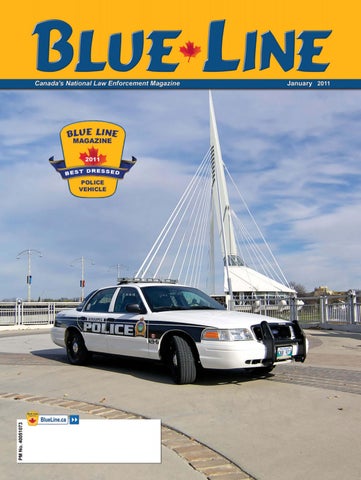
in our annual best dressed police vehicles contest, Blue Line Magazine recognizes visibility, creativity, community identity and readability in the design of graphics and logos. These are literally the calling cards of the police service for the community and we have seen some very innovative and clever designs over the years. One trend becoming more popular today is an emphasis on the importance of visibility of marked police cars for both daytime and night. The reality of police work is that officers are more likely to be injured in traffic accidents than any other single cause and collisions still remain the leading cause of death for Canadian officers. ironically, as light bars get brighter and more aerodynamic, they also become smaller and less visible when not lit. This was one of the driving forces behind the redesign initiative of this year’s winner: the Winnipeg Police Service’s clean and simple new design. its layout reveals some clever touches and maximizes use of the latest technology in reflective materials. Instantly identifiable as a police car – day or night – the design combines a nod to tradition with a modern emphasis on officer safety. Every graphic element on the car is made from highly reflective material. Blue Line congratulates the Winnipeg Police Service, chief Keith McCaskill and the officers and citizens who contributed to this new look. Overall finalists for this year’s contest were again selected by Blue Line and Erik Young and his panel of judges at policecanada.ca and judged on a scale that awards points for creativity, identity and readability of each entry. Here are the 2011 winners: January 2011
First place: Winnipeg Police service It’s no secret there is a trend back towards traditional black and white police cars. While we recognized the innovation and boldness in the earliest designs, we still like vehicles that stand out from the norm. This one does. The wide use of reflective elements not only silhouettes the car but also clearly indicates its direction of travel. The prominent and clearly readable “POLICE” on the sides and rear were cut from Reflexite V92 Daybright, with up to ten times the reflectivity ratings of previous materials. The black side panels and white lettering were all custom-made from 3M 680CR reflective material, specifically designed to angularly reflect vehicle headlights straight back toward their source. The black C-pillar panel really helps tie the entire layout together in a unique way. Plus, unlike many of the black and white designs popular today, the graphics all peel off and you won’t see every second taxicab, private security company or traffic-ticket ‘expert’ driving one down the streets of Winnipeg four years from now. With input from both within the agency and the community, it is immediately obvious why this particular design became the hands-down favourite of all WPS officers. 6
Blue line Magazine
2
second place: stirling-rawdon Police service Located 20 minutes north of Belleville, the Ontario township of StirlingRawdon is a charming village of 2,000 residents. Just to prove that you don’t need a huge budget or large agency to come up with clever graphics, the service entered this sharp new design for 2011. The “POLICE” is nicely offset using a black drop-shadow effect against a blue background graphic. The blue is almost exactly the same colour as Blue Line’s own corporate identity, but that fact had nothing to do with the judging, of course. This vehicle was near the top of everyone’s list from day one. The community name in a scripted font was a bit of a bold move and usually only works if done as clearly and tastefully as it is here. The residents of Stirling-Rawdon are justifiably proud of their community and, having just turned down an initiative to turn policing over to the province, are also clearly proud of their police service.
ND
BEST DRESSED
3
third place: r.m of Vanscoy Police service If you thought the township of Stirling-Rawdon was small, you haven’t been to Vanscoy, Saskatchewan. Located up Highway 7 near Saskatoon, the entire village is less than 400 residents and fewer than 2,200 people live in the entire rural municipality. While the area may remind folks of the fictional town of Dog River from the TV series Corner Gas, the police service is obviously not afraid of boldness and colour in its choice of graphics. They not only silhouette the shape of the truck day and night, the reflective graphics also offer a clear indication of its direction of travel. Normally, it’s hard to make traditional red and blue on white stand out from the crowd but the service did it in a clean way that also clearly identifies the community it serves. The blue “POLICE” is outlined in black and also has elements of a gradient to the shading; something usually difficult to pull off and still keep readable. While the graphics seem simple, a lot of thought went into this design.
rD
BEST DRESSED
1
st
Best Dressed Tribal Police
TRIBAL POLICE
First place: Walpole island Police service Home to aboriginal people for more than 6,000 years, Walpole Island and the surrounding region are called Bkejwanong or “where the waters divide.” Headquartered in Wallaceburg, Ontario the Walpole Island Police Service has a fresh new community police station and community identity on its vehicles. It uses a bold outline on the lettering of “POLICE” and is not afraid of letting the side graphic take up almost half the height of the door panels. The black and grey is offset with a nice amount of colour in the crest and the name of the community is instantly readable.
2
ND
TRIBAL POLICE
second place: Pessamit Police service We admit this design immediately struck our eye because of the unique colour and the way it used a yellow drop-shadow effect on the yellow lettering for “POLICE” and still makes it work. It reminded us of an artistic pen-and-ink rendering over a watercolour. The Pessamit First Nation is located on the north shore of the St. Lawrence River, 54 kilometres southwest of Baie-Comeau, and the police service patrols an area of approximately 25,000 hectares, housing approximately 3,000 residents of this Innu community.
3
rD
TRIBAL POLICE
third place: mistissini Police service The Cree nation of Mistissini is located in central Québec, right on the shores of Lake Mistissini, and the Mistissini Police Service patrols over 85,000 hectares and a community of 3,000 residents. The service’s simple design effectively uses a blue outline and blue drop-shadows to good effect to enhance readability of both “POLICE” and the community it serves. Bold sweeps of blue and white look striking on a black vehicle and one can see how it would work just as effectively on white vehicles. Blue line Magazine
7
January 2011
1
st
Best Dressed Police Promotional
PROMOTIONAL
Community and public relations vehicles are designed for show and almost anything goes. They can range from the wildly impractical to full-out race cars, but there should always be a fun element to the design. When we saw the new ‘bait car’ design from New Westminster Police Service, we knew it deserved an award. We ARE forced to wonder, though, if New Westminster Police have ever used its ‘bait car program’ car as a bait car; and if so, did they catch any crooks? Hey … stranger things have happened with today’s breed of dumb crooks.
1
Best Dressed Law enforcement
st
LAW ENFORCEMENT
When it comes to security/law enforcement vehicles, we think visibility is just as important but their purpose should be very clearly marked. We would not, for example, ever award any organization that actually tried to create confusion as to their role. To our mind, the design of the Fanshawe College Campus Security vehicle is a perfect example of how to do it right. Both visible and approachable, the design actually reminds one of the brightly coloured tail fin of an airliner. Submit your police vehicle pictures, with 200 words on the design and your full contact info to BestDressed@blueline.ca Any vehicle design that has not won may enter. Previous winners may resubmit if their design has changed significantly.
Have your say about the January Automotive issue! Visit blueline.ca.
January 2011
8
Blue line Magazine
2011 Police
vehicle trials
by Dave Brown The 2011 version of the Michigan State Police (MSP) vehicle tests may be the most anticipated report of the decade. We get to see a head-to-head comparison of the last of the Ford Police Interceptors, up against the first all-new police car from Chevrolet since 2000. Looking at the numbers, we immediately had to wonder if General Motors’ corporate HQ is reading Blue Line Magazine. Last year, we pleaded for a sensible police car that two officers in full winter gear could comfortably work in all day. Early reports are that the new Chevrolet Caprice may exactly fill that bill. The first Caprice won’t be on the streets until June but in the meantime we have the mature Chevrolet Impala, Tahoe and Dodge Charger and we will still see new Ford Police Interceptors until production shuts down in mid-2011. This is actually a pretty good time to be shopping for new police vehicles and the choice is about to become even wider yet. After all, there will never be one perfect choice for every agency in Canada. These vehicles act as office, transportation, jailhouse and protection to officers out on the streets every day. Their primary job is to get police to where they need to go and to keep them safe until the end of each shift. Selecting agency vehicles will always be a complex task and MSP head-to-head testing is valuable in assisting agencies to make those important decisions. Annual tests Every fall the MSP, in conjunction with the US National Institute of Justice (NIJ), test the Blue Line Magazine
handling and performance of every new police vehicle on the market for the coming year in back-to-back acceleration, braking and lap time tests. Seen as the most comprehensive analysis in North America, the results are eagerly anticipated by officers and bean counters alike. The force publishes the results on its web site (www.michigan.gov/msp) and Blue Line is once again reporting the preliminary figures. Final figures and a summary of the results should be ready by the time you read this article. Vehicles Vehicles are evaluated in two categories: police-package – designed for the full spectrum of general police activities including high-speed pursuit – and special-service – designed only for specialized duties such as canine units or adverse weather conditions and not intended or recommended for pursuits. Ten vehicles were submitted in the policepackage category for 2011: Chevrolet: Impala 9C1, Tahoe PPV and Caprice 9C1 – all three offered in both standard gasoline and E85 (85 per cent ethanol) versions. Dodge: Charger (3.5 litre V6 and 5.7 litre V8). Ford: Police Interceptor (3.27:1 and 3.55:1 axle ratios). Here is the lineup (with preliminary 2011 figures and additional comments from Blue Line). Police-Package vehicles Chevrolet Chevrolet may be revising an old nameplate in the Caprice PPV but it is nothing like its previous-generation namesake. While it may 9
resemble a stretched-wheelbase Pontiac G8, it is actually based on an Australian-made Holden. To be manufactured by the General Motors Holden plant in Elizabeth, Australia, the Caprice PPV is a full-size, body-on-frame, rear drive vehicle powered by a 6-litre V8 engine. It combines the nimbleness of the Impala, with top end and acceleration numbers not seen since the previous-generation Caprice, with the LT1 Corvette motor. It comes fully equipped with police-specific supportive seating, a six-speed automatic transmission and a Stabilitrak stability control system specifically programmed for police use. Police agencies have high hopes for the new Caprice and Chevrolet may just deliver. It certainly has a good understanding of handling dynamics. (Back in 1999, when Blue Line was invited to test the then-new Chevrolet Impala on the race track at Mosport, we also got a few laps in a three-year-old Caprice. It handled very well even around the tight short-course, despite seeming larger than many aircraft carriers.) The new Caprice has a larger interior volume than either Ford or Dodge, although a quick glance at the numbers at the end of this article reveal that it still gives up just over an inch of shoulder room to the Ford. Once we have a chance to test it for ourselves, we will see if that inch is critical. The Caprice also uses a console-mounted shifter instead of the on the tree shifter in the other vehicles. GM states it cannot move it to the column for technical reasons, but it has put it as far forward as possible to stay out of the way of any laptops or display terminals mounted between the seats. Speaking of shoulder room, the durable 2wd Tahoe PPV remains in the Chevrolet January 2011
Chevrolet
Dodge
lineup. Popular with officers for its handling, tight turning radius and front-seat space, it is fast, intimidating and roomy. For 2011, it comes with the new police-programmed Stabilitrak system and a five-star crash test rating. Mileage has again improved to where it even tops the Ford. Many officers report these numbers actually translate to real savings in operational use. The downside is that this large SUV is still half a ton heavier than other police models. Add that extra weight to the velocities at which police often have to travel and you can see why brake pads and rotors on earlier versions sometimes had to be changed more often than oil and filters. The Impala also remains in the GM police stable. Buyers can now choose anything from full-size body-on-frame rear-wheel-drive SUVs right down to mid-sized front-wheeldrive V6 sedans. A glance at the performance numbers show the Impala may give up a bit of shoulder room but easily holds its own on acceleration and top end speed.
(ESP) as standard equipment. It uses the ABS brakes, traction control system, a yaw sensor and a steering angle sensor to help keep the car stable. Brakes have been upgraded and have a new ‘rain brake’ sensor that moves the calipers closer to the rotors when the windshield wipers are activated to keep the rotors drier. It also has a unique police-only rear load leveling system and upgraded heavy-duty shock absorbers. An all-new interior for 2011 features improved seats, more shoulder and hip room and wider-opening front and rear doors. The transmission shifter is still up on the column, although Chrysler curiously changed it from a ‘rotational plane’ to what they term a ‘vertical arc.’ Outward visibility has also improved thanks to thinner and stronger door pillars, lower door mirrors and moving the windshield top back 3.5 inches.
Dodge While Dodge has a long and proud history of building police cars, the Charger was always seen as a bit of a stopgap vehicle, hoping to take sales away from Ford as it ramps down production of the Crown Victoria-based Police Interceptor. Charger popularity was always inversely proportional to the number of officers who had to ride up front and visibility from the inside of the vehicle was more muscle-car than police vehicle. Even the RCMP only recently broke a long-standing tradition and finally ordered just under 90 Dodge Chargers with the V6 engine, a decision already proving to be unpopular with members doing general patrol duties. Dodge has attempted to address many of these perceived shortcomings through a series of incremental improvements over the years and an almost total redesign. Plus, in the great Dodge tradition, it is still the most aggressivelooking police car on the planet. For 2011, the V6 version uses an all-new 3.6 litre ‘Pentastar’ motor, with variable-valve timing and a welcome return to a chain-driven camshaft instead of the previous timing belt. The V6 is also now rated as a flex-fuel engine and can burn up to 85 per cent ethanol. The 5.7 litre V8 comes with Dodge’s Multi-Displacement System and both cars have Chrysler’s Electronic Stability Program January 2011
Ford Regardless of what happens down the road at Dearborn, the fact is Ford still sells more police cars in Canada than all the other manufacturers combined. The ubiquitous body-on-frame design and live-axle suspension are due to be replaced by a new unibody crossover-based vehicle for next year, but the 2011 Ford will still sell in record numbers until the Woodstock, Ontario production line shuts down in mid-2011. More than one police agency is even looking at stockpiling new Ford PIs. Next year, the new Ford may be facing some tough competition from the Caprice for the dominant model on the streets but the fact remains that Canadian officers seem to prefer the solid “old-school” design philosophy of traditional body-on-frame designs. Incremental improvements over the years have endeared the big Ford to many and the 2011 model is still the only one rated for occupant survival in a 75-mph rear-end crash. The 2011 PI can be equipped with a limited-slip 3.55:1 rear axle (electronically governed to 120 mph) or a non-limited-slip 3.27:1 rear axle (governed to 130 mph.) Ballistic door panels and an onboard fire suppression system with both automatic and manual operation are all still popular options for 2011. Who’s NOT Here Carbon Motors seem to have little interest in demonstrating or promoting its prototype E7 police car up here in Canada, which is a 10
Ford
peculiar choice because we go through a lot of vehicles and trade them in for new ones quite regularly. Maybe it’s because, until proven otherwise, Carbon is seen by a lot of sensible police agencies north of the border as simply a design curiosity instead of a viable car. Any car that costs three times as much as the competition has to run three times as long to be competitive and this means having to live with its quirks three times longer. Perhaps Carbon knows what all Canadian diesel owners know – diesels generate little heat at idle so any potential fuel saving is destined to go right out the tailpipe, running day and all night just to keep officers warm in the winter. (If you thought it was hard to get the average North American police officer behind the wheel of a front-wheel-drive V6… just try to get them into a diesel!) If the long-delayed E7 ever goes into production, it may be destined to be paraded a couple times a year, used in a few Robocop movies and then disappear as surely as a DeLorean or Bricklin. The company’s anticipated performance numbers don’t add up and its projected weight figures seem optimistic. Here in Canada, we happen to believe that police agencies need simple and reliable cars that can be fixed at the local garage using parts from Canadian Tire. Forces may not want limited production vehicles with fully integrated accessories and no choice of where and how to install equipment (especially in a country with such a wide variety of agencies. One would be hard pressed to find two police cars, let alone two police agencies, who configure every vehicle the same way). Maybe that’s why Carbon is avoiding Canada for now. In the meantime, let’s move on to what is available (or soon to be available) for 2011: The tests MSP and the NIJ’s National Law Enforcement and Corrections Technology Center (NLECTC) test all the vehicles together over a three-day period at the Chrysler Proving Grounds and Grattan Raceway. Each is tested without rooftop lights, spotlights, sirens or radio antennas in place. Tires are original equipment rubber provided by the manufacturer. Acceleration, braking and top speed tests are performed at the Chrysler proving ground and vehicle dynamics tests are done using the two-mile Grattan road course. (All dimensions and measurements given are in US numbers.) Blue Line Magazine
Acceleration and top speed
Vehicle Dynamics Testing
The results Vehicle dynamics testing The objective is to determine high-speed pursuit handling characteristics. Except for the absence of traffic, the two-mile road course simulates actual pursuit conditions, evaluating the blend of suspension components, acceleration and braking ability. Four different drivers test each vehicle over an eight-lap road course, with the five fastest laps counting toward each driver’s average lap time. Final score is the combined average of all four drivers for each vehicle. Acceleration and top speed The objectives are to determine each vehicle’s ability to accelerate from a standing start to 60, 80 and 100 miles per hour and to record the top speed achieved within a distance of 14 miles from a standing start. Each vehicle is driven through four acceleration sequences, two in each direction to allow for wind. Acceleration score is the average of the four tests. Following the fourth acceleration sequence, each vehicle continues to accelerate to its highest attainable speed within 14 miles of the standing start point. Braking The objective is to determine the deceleration rate attained by each vehicle on twelve 60-0 mph full stops to the point of impending skid and with ABS in operation. Each vehicle is scored on the average deceleration rate it attains. Each test vehicle makes two heat-up decelerations at predetermined points on the test road from 90 to 0 mph at 22 ft/sec using a decelerometer to maintain rate. It then turns around and makes six measured 60-0 mph stops with threshold braking applied to the point of impending wheel lock, using ABS if so equipped. Following a four-minute heatsoak, the sequence is repeated. Initial velocity of each deceleration and the exact distance required to stop is used to calculate the deceleration rate. The resulting Blue Line Magazine
Ergonomics
Fuel Economy
Braking
score is the average of all 12 stops. Stopping distance from 60 mph is calculated by interpolating results. Ergonomics The objectives are to rate a vehicle’s ability to provide a suitable environment for patrol officers to perform their job, accommodate required communication and emergency warning equipment and to assess the relative difficulty of installation. A minimum of four officers independently evaluate each vehicle’s comfort and instrumentation. MSP Communications Division personnel then rate each vehicle on the ease of installing equipment. Twenty eight factors are evaluated on a scale of one 11
to ten and averaged among all the testers. The final number is the total cumulative score from the average of each of the 28 factors, such as seat design, padding, ease of entry, head room, instrument placement, HVAC control placement, visibility, dashboard accessibility and trunk accessibility (2010 figures). Fuel economy While not an indicator of actual mileage that may be experienced, the EPA figures serve as a good comparison of mileage potential from vehicle to vehicle. Vehicle scores are based on data published by the vehicle manufacturers and certified by the US Environmental Protection Agency. January 2011
Test vehicle specifications (Preliminary reports – All specs are subject to change)
Have your say about the January Automotive issue! Visit blueline.ca. January 2011
Dave Brown is Blue Line Magazine’s Firearms Editor and staff writer. He is a tactical firearms trainer and consultant. He can be reached at firearms@blueline.ca 12
Blue Line Magazine
technology by Tom Rataj
New police vehicle technology on the odometre reading to determine service intervals.
Big changes are coming to police vehicles. It’s the end of the line for the long-reigning volume champion Ford Crown Victoria Police Interceptor (CVPI). A famous name plate from the past, the Chevrolet Caprice, is being resurrected and the Dodge Charger is getting an equipment overhaul, a new look and the new moniker. The most significant change may be the purpose-built Carbon E7 from upstart Carbon Motors Corporation, which will raise the bar for police vehicles and the technologies that make them right for the job. Ford, Chevrolet and Dodge will have their work cut out for them if this vehicle lives up to its hype. These vehicles will usher-in a new era of state-of-the-automotive-art technologies that promise significant improvements in task-worthiness, ride and handling, performance, reliability, passenger/vehicle safety and substantially better fuel economy – all long overdue. Ford The all-new Ford Police Interceptor is based on the relatively new Ford Taurus sedan, albeit with substantial changes from the civilian model. The base engine is a 3.5 litre Ti-VCT FlexFuel V6, offering more power (280hp/250lb-ft of torque) than the current 4.6 litre V8 CPVI engine (250hp/297lb-ft of torque). The optional 3.5 litre twin-turbo EcoBoost engine promises 365hp/350lb-ft of torque. Coupled to a six-speed automatic transmission, both engines should produce substantially better real-world fuel economy compared to the rather thirsty CVPI while offering optional all-wheel drive, a big plus when it comes to the dirt roads and snow covered highways many of us work on. There’s also a long overdue vehicle stability system. The AdvanceTrac and Roll Stability Control (RSC) – working in conjunction with the ABS braking system, which help the Interceptor pass Emergency Vehicles Operations Course (EVOC) standards – should go a long way towards helping officers maintain control during pursuits and other emergency driving situations. The new model goes further toward protecting occupants by including the new Personal Safety System, incorporating rollover sensors, dual front air-bags and roll-fold side-curtain airbags. The well-designed voice control Ford SYNC system is also integrated, as are user programmable steering-wheel mounted Blue Line Magazine
controls. A reverse sensing system, rear view camera and electronic Blind-Spot Information System (BLIS) with cross-traffic alert should be helpful when backing up, as the high-beltline styling limits visibility, particularly to the rear. There are also numerous police-specific interior accommodations, including a centre dash platform for mounting radar or other police equipment and several wiring conduits and grommets to make custom installations easier. Head and tail lamps have factory installed LED police flashers preinstalled to further increase vehicle visibility. Police fleet service managers will be happy to hear that the new model includes an idle metre. It records how long the engine has been running so they don’t have to rely 13
Chevrolet After a 15-year hiatus from policing, the once famous Caprice nameplate returns this summer. As with the Ford, the Caprice Police Patrol Vehicle (PPV) is getting substantial police-specific features. The Australian built Caprice (a Holden Caprice down-under) will be available in North America only as a law enforcement vehicle. This full-sized (by today’s standards) car is rear-wheel drive and has only one engine choice, initially anyway. The massive 6-litre V8 FlexFuel engine is rated at 355hp/384lbft of torque. Potentially thirsty, it will be equipped with an Active Fuel Management system which deactivates four cylinders under certain operating conditions to conserve fuel. A six-speed, electronically controlled, heavy-duty transmission with a “sport mode” (featuring delayed upshifts and downshifts) is standard. Keeping all this power under control is a four-wheel police calibrated ABS brake system and StabiliTrak electronic stabilization system with police specific calibration and traction control. Dual-stage front airbags with passenger sensing technology, head-curtain airbags for front passengers and front seat-back thorax protection airbags offer plenty of passenger safety. For comfort, the steering wheel tilts and telescopes and the driver’s seat has eightway power adjustment. Unfortunately the front passenger seat is only four-way power adjustable. The Caprice will also be available in a “Detective” model with interesting features such as the Driver Information Centre, complete with a user selectable Speed Trap to capture the speed readout of vehicles being tracked or paced. Interior and exterior lights have a user selectable stealth mode for conducting surveillance operations. Despite all the hoopla, Chevrolet does not seem to have made really substantial changes to the way it builds and modifies vehicles for police service. Reading through its mediocre promotional material, I was rather disappointed that it still seems to be “business as usual.” Dodge The Charger gets aggressive looking, updated exterior styling to go with its new January 2011
Pursuit nameplate. The base 3.6 litre Pentastar VVT (variable valve timing) V6 engine delivers 291hp/260lb-ft of torque. If you want more power, the legendary 5.7-litre HEMI VVT V8 engine is good for an outstanding 370hp/395lb-ft of torque, with its thirst controlled by Multi-Displacement System fuel saving technology. Both engines put the power to the road through the rear wheels via a column mounted, auto-stick, five-speed transmission. Heavy-duty vented disc brakes with ABS and a two-mode, police specific tuned Electronic Stability Control system keep the power under control. All-speed traction control, Hill Start Assist and Ready Alert Braking round-out the electronic performance controls. A standard tire-pressure monitoring system ensures that the 18” high-performance wheels and tires are always in top shape. The police unique performance suspension on the Charger Pursuit features load-levelling intelligence with Monroe NIVOMAT rear shocks. Rain Brake Support pulses the brake pads close to the discs when the windshield wipers are activated, keeping them drier for better braking in wet weather. The interior receives a Police Interface Module for easy equipment installation, police specific seats and an electronically controlled stealth lighting mode, where some interior lights are turned off and others dimmed. White and red LED interior lighting is part of this package, improving operations during darkness and when using night-vision equipment. Passenger safety is ensured with standard front driver and passenger multi-stage airbags, seat mounted side-thorax airbags and front and rear outbound passenger side-curtain airbags, as well as a driver’s knee airbag and active head-restraints. The new for 2011 vehicle appears to offer a number of significant new technologies packaged into a tough-looking police version of a civilian sedan. While the Pursuit had been given the usual heavy-duty treatment it also received numerous excellent, well thought out and implemented performance, safety and police specific convenience features. Overall vehicle reliability with Dodge is still a big unknown.
Carbon The much hyped and not yet seen north of the 49th, Carbon E7 (still just its code name) promises to beat the competition in a wide variety of areas. The first true “purpose-built” law enforcement vehicle, not just a heavy-duty makeover of a standard civilian sedan, it will also sport a number of other significant firsts. Start with its BMW common-rail, turbocharged diesel engine and BMW transmission, putting a significant 250hp/400lb-ft of torque on the road while delivering combined fuel economy of 28-30 (US) mpg and 0-96km/h time of 6.5 seconds. This drive train is expected to provide a 40 per cent increase in fuel economy over comparable sedans. The E7 will be built on an all-aluminum space frame unibody structure, offering significant weight savings over a comparable steel structure. Another significant feature setting it apart from the competition – virtually all law enforcement related electronics, computers, speed enforcement and emergency lighting and systems will be fully integrated at the factory, offering a complete turn-key law enforcement vehicle that will more or less arrive ready to go on patrol. Planned integrated equipment includes heated and cooled front seats, heads-up display and reverse back-up cameras, complete 360 degree exterior surveillance system, automatic licence plate recognition system, integrated forward looking infrared system (FLIR), night vision compliant interior lighting and LED lighting for all exterior emergency and running lights. Carbon also promises ABS brakes, vehicle stability control and other technologies commonly found in civilian cars and other police vehicles.
On patrol in China by Tom Rataj Last summer while tripping around southeast Asia I happened upon some police vehicles and thought Blue Line readers would enjoy seeing what the “boys in blue” over there are driving. Top is a police SUV used by the Macau Municipal Police; the second is their regular patrol vehicle; the Black and White (Panda) patrol car is from the Bejing police, I found this one patrolling Tiananmen Square. I also found citizens and police like using motorcycles in the more populous locations.
Suzuki Toyota
About time The next year or two should prove very interesting and bring long overdue and very welcome changes to police cars, including modern automotive technologies.
Volkswagen
Tom Rataj is Blue Line’s Technology columnist and can be reached at technews@blueline.ca .
Yamaha
January 2011
14
Blue Line Magazine
This Dodge is a gas! by Joe Amaral London Police Service (LPS) has recently added two Dodge Chargers to its fleet of Ford Crown Vics but these cars are unique. They are the first propane powered, police-purpose Chargers in Canada and perhaps all of North America. A police agency examines many factors before deciding to standardize its fleet, including vehicle safety, performance, interior ergonomics, durability, purchase price and life cycle costs. Life cycle is a particular concern for the LPS, therefore how a vehicle performs on less costly propane fuel is a primary consideration. The new Chargers will be put through the day to day rigor of real life police work while being closely monitored and evaluated for safety, performance and cost savings. The LPS began testing propane powered cars in 1982. Cost savings and performance were so encouraging that for nearly three decades staff have converted all the force’s marked cars to run on propane. We presently operate 92 propane-powered Crown Vics. Simplified conversions After reviewing the conversion kits available for Chargers, the LPS decided to pilot a new propane kit from Landi Renzo, a world leader in Liquid Propane Gas (LPG) and Compressed Natural Gas (CNG) fuel systems. Based in Cavriago, Italy, the company has a 40 per cent share of the alternative fuel systems and components global market. We bought through our local distributor, National Energy Equipment (www.nee.ca). The Charger allows propane equipment to be installed without changing the suspension or trunk cavity. The major components of the conversion kit include the trunk mounted 90 litre tank and propane fill valve. The tank has sufficient capacity for the vehicle to complete a shift without refueling. The tank has no effect on ground clearance and leaves the officer with sufficient trunk space for necessary equipment. A number of the major engine compartment components, (vapourizer/regulator, injector Blue Line Magazine
rails, filters, pressure/ temperature sensors and control module), blend in so well it’s actually difficult to detect the vehicle is outfitted with a propane conversion kit under the hood. Excellent performance and fuel-cost savings Given the nature of police work, vehicle responsiveness and performance are important considerations. The initial results of the propane-powered Chargers are very encouraging. Rudimentary driving tests, vehicle acceleration and general driving feel show no difference running on propane or gasoline. The durability of the Landi Renzo system will be put through ‘real life’ operational use over the coming years. If performance is impressive, the fuel-cost savings are remarkable. Although the price spread between propane and gasoline has fluctuated significantly in recent years, our fuel contract price experience has seen propane priced at about half the cost of gasoline. That works out to a net savings of about $16,000 per vehicle over its typical life. Last year our fleet used close to 800,000 litres of propane, which translates into just over $360,000 in savings. We have saved millions of dollars over the 28 years we have used propane. Safety and the environment We have had no safety problems related to the use of propane fuel or equipment. Converted vehicles have experienced collisions from all angles and some were damaged beyond repair. The propane tanks, fuel lines and other conversion equipment have withstood the abuse. The LPS is proud to set an example by reducing its carbon footprint, demand for crude oil and taking advantage of Canada’s abundant propane resources. It has been a successful partnership and we intend to continue using propane as long as it meets our high standards of safety, performance and cost-effectiveness. Joe Amaral is the Director Fleet and Facilities for the London Police Service. Contact him at jamaral@police. london.ca or call 519 661-5657 for more information.
15
January 2011
Newest recruit inspired by Davis family Two volunteers with a great Mounted pedigree were honoured for their dedication to the Toronto Police Mounted Unit with a fourlegged legacy. New police mount Davis was named after former Cst. Jim Davis and his wife Linda, for their tireless volunteer efforts with the Mounted Unit community. “This is recognition of the constant work he and Linda have done over the last 17 years to do good things for the unit.” Mounted Unit S/Insp Bill Wardle said “They are very much considered part of the team.” He said that Jim and Linda take on all aspects of supporting the unit, from caring for horses and equipment, to supporting officers at competitions and lending advice. “We couldn’t do a lot of the things we do without them, or the many volunteers we have,” Wardle said. “We keep officers out on patrol by having volunteers with the expertise to care for horses and help us put on events.” Horse in training Davis, the four-year-old Belgian Hackney Cross, is now in training and will likely join the general pool of horses next spring. Before his retirement Jim was responsible for modernizing and shaping the way the unit trains today and, in turn, shaping mounted units across North America. Davis introduced military and obstacle
January 2011
training to the service’s oldest unit in the 80s. which has evolved into the crowd control training of today. “He was the driving force behind training,” Wardle said. “Now we’re one of the best Mounted Units in North America.” The 78-yearold was left speechless by the honour extended to him and Linda “I was shocked,” Davis said. “It look them 34 years to get rid of a Davis and now they’re bringing one back in. It’s an honour.” Davis spent his entire career with the mounted unit, having been the last person directly hired by Insp Edwin Johnson. Johnson brought Davis to the Employment Unit the day after riding alongside him at the Queen’s Plate. Davis had been riding with the Governor General’s Horse Guard, a reserve cavalry unit he rode with from
16
1950 to 1986. “All I wanted to do was ride a horse – I never wanted to be promoted,” he said, noting that, save for a stint on foot after police college and traffic, he never spent time in policing outside of the Mounted Unit. After retirement, Davis spent three weeks training Chinese officers on horseback and founded the Canadian Mounted Police Association, which keeps North American police officers on top of their field. “The Mounted officers are a very close-knit family – we all stick together,” he said, of officers from all jurisdictions. The pair travels to the North American Police Equestrian Competition each year to support the officers competing, from grooming and caring for horses to giving advice on the competition. “It’s a good feeling working with the Unit.” Davis said “It’ s a good group and we have a lot of fun together.” He said American units have gleaned a lot from Toronto as well as adopting larger horses. “Toronto has brought up their training and standards 100 per cent – which is great.” His wife, Linda, has always been a supporter of the Unit and a lover of horses. Davis’ longtime partner, TPS mount Alex, ignored Davis when his wife came to work. “When she walked into the stables, he wasn’t my horse anymore.” Davis said, noting Alex also appreciated the mints she brought along.
Blue Line Magazine
Winnipeg’s police helicopter
takes to the sky
Winnipeg Police and government officials unveiled their new police helicopter on December 6th Premier Greg Selinger, Mayor Sam Katz and Winnipeg Police Chief Keith McCaskill were on hand at the unveiling ceremony. McCaskill said the helicopter, an EC-120B Colibri, will enable police to better direct officer resources. “I think it will be safer for the community because there are going to be less car chases. We will be able to arrive on scene a lot faster,” he said. “This is an exciting day for the service. Modern-day policing in a city like Winnipeg requires deployment of equipment and technology that will improve the safety of the community and police personnel,” he said. The new machine will give police a bird’seye advantage they’ve never had before, he added. “We’ll be able to arrive on scene a lot faster when the helicopter is in the air because you’ve got an eye in the sky. If you’ve ever flown over Winnipeg, even in a small aircraft, you can pretty well see everywhere.” The province and city had previously made a funding agreement for the helicopter. In December, city council voted to spend $3.5 million to purchase the helicopter. The province has agreed to provide $1.3 million a year in operating costs as well as about $25,000 in annual inflationary costs. The province is also funding the cost of three additional officers required to staff the helicopter. “Chief McCaskill has let council know this helicopter will be a tremendous benefit to keeping our citizens safe, and we are pleased to have made it a priority and look forward to seeing the results,” said Mayor Katz.
UP & AWAY A police chopper timeline
• March 2002: Ksenia Raback-Blocker, then eight, proposes the idea of citizens raising funds to purchase a helicopter for Winnipeg police. A fund is set up and the Winnipeg Sun gets flooded with calls from people wanting to donate. Columnist Tom Brodbeck steps up as a cheerleader and Winnipeg police chief Jack Ewatski takes notice. Cops start studying the option. • Spring 2002: Businesses express interest in the project; Ewatski likes chopper idea, but says it would have to be paid for by the private sector. • Fall 2002: Take Flight Winnipeg Inc., a group of
Blue Line Magazine
BACK ROW: Manitoba Attorney General Andrew Swan; His Worship Mayor Sam Katz, Mayor of the City of Winnipeg; Chief of Police Keith McCaskill, Winnipeg Police Service; Hon.Greg Selinger, Premier of Manitoba; Colonel Yvan Boilard, Commander, 17 Wing Winnipeg. FRONT ROW, left: Chief Pilot Vern Zelent, Line Pilot Andrew Davidson; Line Pilot Renee Brindeau. ABSENT: Mr. Guillaume Leprince, Vice-President of Marketing and Sales, Eurocopter Canada.
The EC120, also known as the Hummingbird due to its ability to run quieter than all other helicopters of its size, is a Canadian law enforcement air support favourite. It is currently in use by the York Regional Police Force in Ontario, the Calgary and Edmonton police services, as well as the RCMP in the Lower Mainland of British Columbia. All agencies have reported the choppers have made a significant impact on crime in their respective locations. “The EC120 has a proven track record and has become a benchmark for police operations in Canada,” said Guy Joannes, president and CEO of Eurocopter Canada Ltd. “We are
local business people and cops formed earlier in the year, gets official charity status. Raback-Blocker hands over funds she’s raised about $1,500. • June 2003: The Winnipeg Sun offers up corporate support for a chopper. • Summer 2003: Cops and politicians head to Alberta to check out police choppers. City politicians say they ’ll support the plan if cops want it. • November 2003: Take Flight Winnipeg stalls, and having raised about $18,000, its board members resign. By February 2004 the group is finished, and chopper talk fizzles. • November 2008: In the wake of numerous run-ins between car thieves and police cruisers, Winnipeg Sun comment editor Paul Rutherford’s queries
17
delighted to welcome the Winnipeg Police Service as a customer and to the prestigious and successful group of highly specialized law enforcement operators in Canada.” Police displayed the helicopter for media at Canadian Forces Base Winnipeg 17 Wing. The long-awaited chopper has been painted a slick black and white, and features a large silver coloured Winnipeg Police Service logo, a maple leaf, and the word “police.” It is also painted with its call letters, CGAOL, which un-coincidentally is the old British spelling of the word “jail.” The helicopter is expected to be in the air assisting police beginning in January.
get police Chief Keith McCaskill thinking about a chopper; by January cops revive studies. • August 2009: McCaskill and Mayor Sam Katz get behind the chopper plan; city councillors get on board; talks start with province. • December 2009: McCaskill makes his pitch for a chopper; province pledges to pay $1.3 million in annual operation costs; city council’s EPC approves $3.5 million for its purchase and Katz says he wants the bird in the air by late 2010. • Fall 2010: Delays mean chopper doesn’t take to the skies by October as hoped. • December 2010: EC-120 Colibri chopper is introduced at 17 Wing; it’s expected to be on patrol early in the new year after training is complete.
January 2011
The challenges of moving into
management
A survey of Canadian police officers by James Hogan, Craig Bennell and Alyssa Taylor Middle managers, particularly front-line supervisors, play a challenging and important role in Canadian policing. Their primary responsibility is to balance the needs of upper management with those of front-line officers. A number of factors can contribute to the difficulty of this already formidable task, including the fact that: (1) the concerns, expectations and interests of these two different groups are often in conflict; (2) many middle managers are in their first managerial position, which often requires a transition period to learn effective management, supervision and leadership skills; and (3) middle managers almost exclusively have been promoted from within the ranks, which can potentially lead to role conflict and cause relationship stress when they are put in charge of peers. Considering the impact that good management/supervision can have on a police agency and its officers, overcoming the challenges of providing effective management/supervision is extremely important. Most police scholars believe that police reform and organizational renewal is virtually impossible without the involvement of middle managers. There is also growing evidence that the “style” of police management/supervision directly influences the way subordinates behave (good or bad behaviour depending on the example set). The role of effective management in reducing police misconduct and corruption is also well documented and supported by studies from around the world. Sound police management is even more important now than in the past. Canadian police agencies are currently undergoing (or will soon undergo) change on multiple fronts which will have clear implications for police management. The following issues are most relevant: (1) A large number of senior police officers are expected to retire in the near future, resulting in many promotional opportunities for management positions. While beneficial for those competing for promotion, this has January 2011
the potential for long-lasting negative effects if systems are not in place to maximize the chances of the right people being promoted and if credible leadership, supervision and management training are not provided. (2) Canadian police agencies will, or already are, experiencing a massive hiring period, which will result in many new and inexperienced officers working the front-line. This will pose challenges for police managers/supervisors who must oversee these new recruits and raises important questions that need to be resolved (e.g., how will having so many new employees working together impact their professional development?). (3) The profile of the new police recruit in Canada is also changing. Today’s recruit is older, better educated and comes to the job with more diverse life experiences. They will most likely expect more from their managers (e.g., with respect to better management practices) and from the job (e.g., with respect to greater personal fulfillment through work). The current study Despite its importance, relatively little is known about the role of middle management/ supervision in Canadian policing. To address this gap we surveyed Canadian police officers about their views on various management issues. Three hundred and twenty-eight male and female officers of varying age, years of service and rank were given surveys dealing with topics related to management, supervision and leadership. For the purposes of this study, the ranks of corporal, sergeant and staff sergeant 18
Table 1: Survey results Statement
Agree
Neutral
Disagree
Good management is important for the achievment of your service’s goals & objectives.
86.9
7.0
6.1
Good management is important to you in fulfilling your daily policing responsibilities.
81.0
8.8
10.0
Most police managers have been well trained.
34.4
21.3
43.8
Most police managers you have worked for have been effective.
52.8
18.6
28.7
In your experience, most supervisors or managers make the transition from the “rank and file” to middle management well.
58.5
27.1
13.7
Promotion to a management position is sought after by many officers in your service.
82.6
7.6
9.4
The promotional process in your service is fair and well understood.
32.9
17.7
49.4
The promotional process in your service results in capable, competent people being promoted.
33.8
16.5
49.7
were considered to be the supervisors/middle managers in question as appropriate to each responding officer’s particular police service. The major themes were the role and effectiveness of police management/supervision, the promotional process and availability and adequacy of training. Blue Line Magazine
Table 2: Survey results Statement
%
Frequency
To you, what are some of the challenges faced by officers moving from the ‘rank and file’ into management positions? Lack of managerial training/experience
157
48.0%
Experiencing role conflict/confusion
139
42.5%
Difficulty managing human resources
39
11.9%
Disciplinary discretion
36
11.0%
Lack of departmental support
36
11.0%
Which is most necessary for success as a police manager Front-line experience
260
79.3%
Being able to motivate others
192
58.5%
Being respected by fellow officers
182
55.5%
Being a good role model
160
48.8%
Management training
92
28.0%
When they made the transition into management well, which of the following contributed to their success? Personal Maturity
204
62.2%
Prior career experince provided good preparation
187
57.0%
Comfortable being in charge of friends and peers
113
34.5%
Able to separate self from previous role
94
28.7%
Clear role expectations for new positon
68
20.7%
3 things about the most effective police supervisor that set them apart. Professionalism
167
51.1%
Interpersonal skills
151
46.2%
Managerial training/experiencce
146
44.6%
Authoritative
124
37.9%
Communication skills
107
32.7%
The survey was sent to Canadian police agencies who distributed it to their members. An attempt was made to ensure that respondent agencies would be broadly representative of the Canadian police community as a whole (taking into account the size, location and type of agency). To ensure an adequate sample size, 450 surveys were distributed to 22 police services across the country. The response rate was 72.88 per cent (328). Results Most officers believed sound police management is very important for achieving the goals and objectives of their agency as a whole and for fulfilling their daily policing responsibilities. When queried as to why, respondents believed (amongst other things) it ensures that public trust in the service is maintained (68 per cent), an agency’s goals and objectives are achieved (60.1 per cent) and good employee morale is preserved (53.4 per cent). While most respondents did not feel police managers are adequately trained, they did feel managers they worked with were effective and transitioned well from their former rank. Survey results There was little agreement amongst respondents about the key challenges new managers/supervisors faced but more agreement when they were asked about factors relating to effective managers/supervisors. The majority indicated front-line experience is the most
important criteria for success (79.3 per cent), followed by an ability to motivate others (58.5 per cent) and showing respect to fellow officers (55.5 per cent). When asked what factors contribute to a smooth transition into management, the most common response was personal maturity (62.2 per cent), followed by relevant career experience (57.0 per cent) and an ability to feel comfortable supervising peers (34.5 per cent). The top three characteristics cited which set effective police supervisors apart from their less effective peers are professionalism (51.1 per cent), interpersonal skills (46.2 per cent) and managerial training/education/experience (44.6 per cent). When asked what factors contribute to problematic promotions, the most common response was lack of personal maturity (45.7 per cent), followed by a lack of relevant career experience (34.8 per cent) and being promoted too early (33.2 per cent). The top three characteristics setting ineffective police supervisors apart are a lack of: authoritative skills (49.5 per cent), professionalism (45.0 per cent) and managerial training/education/experience (33.6 per cent). Respondents raised role conflict most often (38.2 per cent) when asked about new managers’/supervisors’ most common mistakes, followed by inappropriate use of disciplinary discretion (22.3 per cent) and a tendency to micromanage (9.5 per cent). The most common serious mistakes cited were inappropriate use
When they did not make the transition into management well, which of the following contributed to their lack of success? Lack of personal maturity
150
45.7%
Prior career experience did not provide good preparation
114
34.8%
Promoted too early in career
109
33.2%
Lack of previous managment/ leadership experince
104
31.7%
Uncomfortable being in cahrge of friends and peers
88
26.8%
3 things about the least effective police supervisor that set them apart. Lacks authoritative skills
162
49.5%
Unprofessional
147
45.0%
Lacks managerial training/experience
110
33.6%
lacks interpersonal skills
86
26.3%
Poor communicator
78
23.9%
In your opinion, most common mistake new supervisors make is: Experiencing role conflict/confusion
125
38.2%
Disciplinary discretion
73
22.3%
Temptation to micromanage
31
9.5%
Lack of managerial training/experience
28
8.6%
Change within the department
23
7.0%
In your opinion, the most serious mistake new supervisors make is: Disciplinary discretion
84
25.7%
Experiencing role conflict/confusion
68
20.8%
Lack of managerial training/expeirence
35
10.7%
Difficulty making decisions
32
9.8%
Difficulty managing human resources
29
8.9%
Blue Line Magazine
19
January 2011
of disciplinary discretion (25.7 per cent), role conflict (20.8 per cent) and lack of managerial training/ education/experience (10.7 per cent). Most respondents agreed that many officers sought promotions, most commonly for increased pay (61.0 per cent), ambition (44.8 per cent) and a better pension (39.9 per cent). Results also indicate that many officers felt their agency’s promotional process was unfair and not well understood and did not believe it resulted in capable people being promoted. Most officers (56.7 per cent) indicated that their agency trains officers who have been promoted but few appear to provide any on-going mentoring or training to managers. There also appears to be a lack of pre-promotional training or mentoring to prepare officers for possible future management responsibilities. These findings likely explain the fact that most respondents felt their agency does not adequately prepare officers for promotion to middle management positions or allow them to develop to their full potential. Discussion Canadian police organizations are contending with pressures such as the large-scale retirement of senior officers that reinforce the need for management and supervision of the highest calibre. The next five years will see an unprecedented influx of new police officers and newly-promoted middle managers. We believe the current study can help inform Canadian police agencies during this challenging transition period. The following implications
Table 3: Survey results Statement
yes
No
Does your service provide specific management training to officers about to be promoted or newly promoted?
56.7
42.1
Does your service have any form of on-going mantoring or other training specifically for new managers?
21.6
72.9
Does your service conduct pre-promotional training, mentoring, or other development of officers to prepare them for possible future managment responsibilities?
36.3
62.5
In your opinion, does your service adequantely prepare officers for promotion to middle management ranks?
26.8
72.6
Ingeneral,is your service effective at developing the full potential of its officers?
18.6
80.5
may be particularly important: 1. The survey results present a picture of the ideal manager/supervisor. An effective manager has front-line experience, can motivate others, respects their fellow officers and is a good role model for subordinates. They are mature, professional, have good interpersonal and communication skills and have received appropriate training. Instead of experiencing role conflict, they can separate themselves from those they supervise and feel comfortable being in charge of peers. They use their disciplinary discretion appropriately and avoid micromanaging situations. 2. If future research demonstrates that these criteria do relate to managerial/supervision
effectiveness, this may allow agencies to select candidates for promotion that would perform in a manner superior to others. Basing promotions on these criteria might be useful for reducing the feelings of unfairness and confusion that officers appear to have towards current promotional practices and may increase the probability that capable people are promoted into management positions. 3. Identifying effective management/supervision criteria will also positively impact training, pre- and post-promotion. It is important to note that, when asked to list the criteria that characterize effective managers/supervisors, respondents did not list irreversible personal characteristics or rigid personality traits but rather specific skills sets or areas of knowledge that can be altered through training. The common/ serious mistakes of new managers they identified can also be used to establish specific training objectives. Conclusion Clearly the survey results simply reflect the opinions of police officers and it is important to stress that their views may be wrong (e.g., a view that adequate training opportunities do not exist does not mean this is necessarily true). While such views are important in their own right, it’s important to also study these issues in a more direct, objective and systematic fashion (e.g., by conducting formal reviews of training opportunities). It is also important to note that survey results typically lack the richness needed to gain a deep understanding of the issues of interest (e.g., while communication skills may indeed be important for effective management/supervision, it isn’t clear from the survey what specific skills are important). Thus, it will also be important to follow up this research with one-on-one interviews with officers (read a summary of their comments in next month’s issue). Despite these limitations, we believe the study results emphasize the importance of middle management in Canadian police agencies. They suggest ways of ensuring that the right people are selected for these positions and trained in such a way that they can reach their full potential. Steps taken to improve the quality of middle managers, whether through improved promotional systems or more credible leadership and management training, will necessarily and positively influence the longterm health and viability of police organizations throughout Canada. James Hogan is a sergeant with the Toronto Police Service (TPS). Craig Bennell and Alyssa Taylor are with Carleton University. The research presented was made possible through a scholarship to Hogan and a contract to Bennell from the Canadian Police College (CPC). The authors thank Catherine Lavergne of the CPC for her assistance and dedication to this project. The views expressed are those of the authors and do not necessarily represent the TPS or CPC. Contact Sgt. James Hogan at james.hogan@torontopolice.on.ca to comment or for more information.
January 2011
20
Blue Line Magazine
Technology is a
double edged sword for police
by Christine Robson Technology surrounds us and permeates everything we do. Radio, computers, cell phones, BlackBerrys and the Internet have all helped make our lives a little easier, more convenient and enjoyable – or have they? As the IT Manager for Durham Regional Police Service (DRPS), my job is to ensure we implement technology that helps front line officers do their job more efficiently and effectively – but how much is too much? We have gadgets and gizmos for almost everything and it’s dramatically changed the way policing is done. We used to actually call people or speak to them in person and write things down on paper. Now everyone seems to be addicted to technology; simple policing is no longer simple. Many officers are getting “cognitive overload.” They multitask so much that the technology distracts and stresses them. Multi-tasking is the norm in policing. Officers can’t just turn off their radios, close the door or auto-filter email. They are constantly listening to the radio, checking e-mail, running queries, texting on their Blackberry, going to calls, dealing with drunks, domestics and car accidents... the list goes on. I came from the private sector IT industry and thought police services would be very behind in technology. I honestly wondered whether I would be challenged enough. The DRPS didn’t have the equipment it does now when I began but we have tripled our IT budget in the past 10 years, adding more gadgets and gizmos in hopes of improving the way officers do their business – but did we really improve their job? Yes and no. Many applications have benefits but also drawbacks such as passwords coming out the ying yang. With all this multi-tasking, officers are interrupted every minute or two by their radios, text and cell phone messages or e-mail. Experts battle over whether technology is directly the culprit or just a contributor. Multi-tasking can cause the brain to overheat, just like a car engine. It needs periods to recover, not just sleeping at night but rest even during the day. Officers need to ensure they have rest and recovery in their eight or 10-12 hour shifts, even if it’s just one hour during the day to unplug and unwind. BlackBerrys and in-vehicle laptops can distract drivers, regardless of whether they are hands-free or touch screen devices. Just because the technology exists to allow a person to perform multiple tasks at once doesn’t mean thery are capable of processing all the information required to effectively, safely and productively use the technology. So the question boils down to how to avoid technological overdependence as I manage IT Blue Line Magazine
and expectations of our officers. We have committees to address new applications and technological advances but what are the expectations and perceptions in the field? Getting stakeholders involved is critical. Their buy in ensures success, but how do you address an organization with more than 1,200 members? Not everyone will agree on the answer; some less technologically advanced members will suggest paper and pen is fine. You have to draw a fine line and try and keep things as simple as possible; sometimes paper isn’t such a bad idea (I can’t believe I said that!) We don’t need an application to address all of our needs. We in the IT industry have come to expect that if you can do it with paper and pen, you can also build an application instead – leaving many addicted and obsessed with technology. Our officers might argue that they already have too much on their plate to deal with now, in a world overwhelmed with data and devices they have to access. How do we filter through the data efficiently enough to counteract the law of diminishing returns? Multi-tasking and data overload is never
21
ending and the stress just continues. Clear expectations need to be set of how a new application will improve, not hinder an officer’s job. Officers need guidelines so they don’t answer e-mails while driving or in meetings. The same goes for their personal time. No answering work e-mail on personal time. They need to unwind and become technologically unplugged on their days off. We need to stay in tune with new technology and be aware of how it can boost productivity but we also need to have a plan in place to curb technological overdependence. Let’s look at not only the benefits of a new application-driven device but also how it will impact officers – and how much is too much? There is nothing wrong with going back in time a little and actually speaking face to face without using technology. Not all technological advances can save the day. Good old fashioned policing still works, even in this digital generation. Christine Robson is the Information Technology Manager for Durham Regional Police. She may be contacted by email to crobson@drps.ca or by phone at 905-579-1520 ext 3318.
January 2011
Training for
Trauma Police and critical post traumatic stress disorder Part 2 of 3 by Sean P. O’Brien and James Bremner Officers in a 2006 study by Kevin Siddle were lead to believe they could be accidentally injured or killed during an experiment involving a simulated violent encounter. To increase their stress level, they were asked to sign a waiver releasing the experimenters from liability. A violent offender then confronted the officers. Their responses were recorded while various aspects of the encounter were manipulated (e.g., a loud air horn was set off to assess for auditory exclusion, etc.). The experimenters asked the participants to evaluate their performance, comparing their responses to their objective data: January 2011
Perceived
Actual
Shots fired
8.26
12.71
Targets hit
4.38
3.30
Accuracy
53.00%
24.41%
Hesitation
26.19%
10.42%
Fear/panic
4.76%
16.67%
Auditory 23.81% 58.33% exclusion It is interesting to note that the officers fired 50 per cent more shots but hit less targets than they had thought. They also appeared to display more fear and panic than initially perceived, but even though more than one in four officers felt they hesitated to react, the 22
data suggests this did not occur as often as perceived. Also significant – more than half of the officers failed to hear the loud horn during the confrontation, but only one in four recognized that auditory exclusion had taken place. A failure to recognize and cope with these hormonally-induced events can contribute to a stress reaction following a violent confrontation. We recently dealt with one young officer who was nearly beaten to death by an emotionally disturbed person who had escaped from a local hospital. The officer called for backup during the incident but perceived that no one had responded. He was also upset because he felt he failed to respond appropriately to the attack (e.g., he had struck the attacker lightly with his baton, didn’t draw his weapon and stood by idly as the attacker began his assault). Blue Line Magazine
A very different picture emerged from 911 call centre data, fellow officers, witness reports and photographs taken following the assault. The officer’s calls for help were answered immediately and at least ten other officers marked onto the call within seconds. The event lasted less than two minutes, from the start of the attack to fellow officers arresting the subject. Witness reports and photographic evidence suggested the young officer responded quickly, decisively and appropriately (e.g., he struck the attacker repeatedly with his fists and baton, drew his firearm and, even though the attacker was much larger, managed to seriously injure him during the confrontation). Regardless, the officer continued to berate himself for hesitating to react and harboured much anger towards his colleagues, believing they abandoned him during the assault. As we processed this with him, it became apparent that his reaction was marked by auditory exclusion (i.e., he could not hear responses on his radio), critical incident amnesia and numerous other perceptual disturbances. Once this became apparent, his stress reaction diminished significantly. Teaching officers to anticipate these effects and training them to use autogenic breathing techniques can help reduce the negative effects associated with a critical incident. Many are unaware that these hormonally induced effects take place because they generally do not occur during training exercises, even though heart rates can be elevated. When they do happen, they can be reduced by using autogenic breathing – a simple technique used by military and tactical trainers for years to reduce the heart rate by up to 30 per cent (Laur, 2002). If the heart rate accelerates to between 175 and 200 bpm, autogenic breathing can help reduce it to a more appropriate target range of 115-145 BPM. Unfortunately, this simple technique is often taught only to officers on tactical units, despite its potential to save lives. It involves merely slowing our breathing pattern by using “belly breaths” or diaphragmatic breathing. You can do this simply by counting to four (each time) as you breath in, hold your breath, breath out and (again) hold your breath. Continue this process and you will notice your heart rate and muscle tension begin to diminish. This can be done even in a very stressful situation. It’s important to remember to hold your breath for a count of four when breathing in and out, allowing the oxygen and carbon dioxide levels to balance and preventing many of the stress-related effects associated with hyperarousal and hyper-ventilation. There are important cognitive behavioural effects associated with exposure to a violent encounter the first is fear. Through hundreds of thousands of years of evolution, we have developed fear structures that cause us to respond to anything that threatens us (Fairbank, Ebert & Caddell, 2001; Levitt, 1967; McNally, 1999). During violent encounters we also begin to fear other forms of stimuli present, which can spread to a variety of situations through a process known as generalization. For example, if a woman is raped at a bar by a bearded man with long hair after she has been Blue Line Magazine
drinking at night, she may start to fear not only that man but all men with beards and long hair. She may also fear the smell of alcohol, being alone at night, being around parties, etc. This is a biologically programmed process. Over time the fear can begin to generalize to other stimuli so the woman begins to fear all men, pictures of alcohol, social contact and so on. Her heart rate will accelerate, stomach feel sick and she will hyperventilate and sweat when exposed to these feared situations because her body is trying to keep her alive. Avoidance can make things worse. Avoiding all these scary scenarios will reduce her fear but the ensuing relief will reinforce the belief that avoidance is a good thing. Translate this to police officers and we can see that an officer attacked by an emotionally disturbed person may come to fear not only the original attacker but all emotionally disturbed people. This can be generalized to hospitals and television programs involving hospitals to sounds or smells that remind the officer of emotionally disturbed people or any other related stimuli. In time, the officer may also develop a fear response when putting on their uniform, strapping on a duty-belt or socializing with colleagues. For the officer who is attacked on duty, close contact with another human being may induce fear. It is as though the brain says: “Be careful because something bad is going to happen.” This can contribute to an uncontrollable urge to avoid sleeping with one’s spouse or displays of affection with family members, causing the officer to conclude that they’re losing control and “going crazy.” It can also contribute to high levels of familial discord because family members don’t understand what is happening. While the rape victim may be able to avoid some anxiety provoking situations fairly easily, it can be much harder for the officer to use avoidance strategies to remain safe. Avoiding some work situations might be extremely difficult and if avoidance attempts begin to falter, some officers can turn to drugs or alcohol to calm their inner torment and turn off the alarm reaction. Quite simply, the brain is programmed to set off the alarm reaction whenever it encounters anything it believes to be harmful, and it’s impossible to fight this reaction. It would be much easier to hold your breath for six minutes than to turn it off. The brain becomes far more sensitive to threat after a serious critical incident. Psychological treatments such as cognitive-restructuring exercises and systematic-desensitization procedures are designed to normalize these experiences and can help return the officer to their normal level of adaptive daily functioning. Diagnosing PTSD Diagnosis itself is important. A high level of physiological and psychological stress in response to combat is normal but we fight those reactions if we’re not prepared to deal with them appropriately, which can lead to PTSD. In many cases, officers who suffer from it go untreated for lengthy periods of time because the symptoms are not recognized. PTSD can 23
be treated with brief forms of intervention if detected early (Fairbank, Ebert & Caddell, 2001; Foa and Rothbaum, 1998) but take years to fix if it goes undiagnosed. In some cases of severe untreated trauma, the problem will never completely resolve. According to the DSMIV-TR (our diagnostic manual for stress reactions), we must first have exposure to a traumatic event that involved actual or threatened death or serious injury. The person’s response to this event must involve intense fear, helplessness or horror. The development of symptoms comes together in three clusters. First, the traumatic event is re-experienced in one or more of the following ways: • Intrusive and distressing recollections; • Recurrent distressing dreams; • Acting or feeling as if the traumatic event were recurring (e.g., illusions, hallucinations, dissociative flashbacks, etc.); • Intense psychological distress upon exposure to internal or external cues that resemble the traumatic event; and • Physiological reactivity upon exposure to internal or external cues that resemble the traumatic event. There are also three or more symptoms that represent a persistent avoidance of stimuli associated with the traumatic event, including: • Efforts to avoid thoughts, feelings or conversations associated with the trauma; • Efforts to avoid activities, places, or people that arouse recollections of it; • An inability to recall an important aspect of the trauma; • Markedly diminished interest or participation in significant activities; • Feeling detached or estranged from others; • A restricted range of emotions (e.g., unable to have loving feelings, etc.); and • A sense of a foreshortened future (e.g., person does not expect to have a career, marriage, children or a normal life span). Finally, there are two or more symptoms of increased arousal, as evidenced by: • Difficulty falling or staying asleep; • Irritability or outbursts of anger; • Difficulty concentrating; • Hypervigilance; and • Exaggerated startle response. If the symptoms last for more than one month and cause significant distress or impairment, a post-traumatic stress disorder can be diagnosed. Dr. Sean P. O’Brien is a registered clinical psychologist practicing in Whitby, Ontario who provides clinical services to policing organizations throughout Canada. He has more than 10 years experience dealing with high-profile critical incidents, including police-related shootings, traumatic homicides, suicides and criminal investigations into police conduct. Det/Cst. James Bremner has more than 20 years experience with the Toronto Police Service in uniform patrol and the ETF, including gun team, team leader, explosives technician and tactical trainer. He’s currently on the Gun and Gang Task Force. Through his company, Bremner Associates Inc., he provides tactical training and lectures on Critical Incident Stress and PTSD. Visit www. bremnerassociates.com for more.
January 2011
When you bring in the experts The National Capital Region Emergency Response Team
by Stéphanie Dumoulin The National Capital Region hosts a vast number and variety of high profile events each year, from visiting heads of states and international leaders to major demonstrations. Their nature and visibility creates unique challenges that demand the most impressive security measures. The public faces of these operations are the frontline officers but that’s not the whole story – those behind the scenes also play a critical role. Members of the RCMP’s National Capital Region Emergency Response Team (NCR ERT) are not your typical general duty officers responding to a routine call. This team of experts relies on advanced training, the latest technology and equipment and highly specialized tactics to minimize the threat to both the public and their fellow officers in situations with a high risk of violence. “We have a great team of dedicated individuals who are definitely not scared of hard work and long hours,” notes Inspector Serge Lalonde, who had head NCR ERT program since the spring of 2009 and is not reserved when talking about his team. “Our team has been at full capacity for a while now and we practically have no turnaround in our staff. It seems like nobody January 2011
wants to leave the team. I think that says a lot about the great environment our officers work in everyday,” says Lalonde, who was a Saskatchewan ERT member and has been with the NCR for the past 17 years. RCMP ERTs date back to the mid-1970s, when the need arose for a more tactically sophisticated police response capability to effectively counter heavily armed and organized criminal groups. The program was subsequently rolled out to RCMP divisions across the country in the form of part-time, volunteer teams. Today, there are 21 teams nationally with approximately 300 members. Every province is served by a minimum of one team to support front-line operations. The NCR has had its own ERT program since 1985. It is housed within the NCR Protective Operations Directorate, part of the RCMP’s Protective Policing business line. There are several different components, including a Counter Assault Team (CAT). Its members are often assigned to motorcades and responsible for providing tactical support to the protective units in charge of VIP security. The NCR ERT also has marine operators and a nine metre tactical vessel to intercept boats or respond to missions on the water. They can be used in the Ottawa region but also assist ERT marine operations in other parts of the country. 24
Additionally, the NCR team is one of the few in Canada to have its own police dog service directly imbedded, maximizing its effectiveness and efficiency in responding to incidents. The Counter Surveillance Unit is another critical component of the program and other RCMP protective units. These members are trained to observe and detect individuals who could potentially pose a threat to VIPs and work very closely with other members. The NCR ERT is also occasionally tasked with assisting missions abroad that have a Canadian interest. “I have had the unique opportunity of participating in many overseas operations during the course of my duties,” says six year veteran Cst. Kaine, “traveling to 15 countries including several South American and African states. My international travel with ERT has generally come with little advance notice but it has been extremely rewarding.” Kaine was asked to join a team assisting a drug investigation in the spring of 2006. “The operation took me out of the country to an undisclosed location via a covert vessel for an unknown period of time. I accepted the mission and spent 43 days on the Atlantic Ocean, with a team composed of members from various divisions, taking part in the RCMP’s first ever covert drug offload on the high seas.” Several hundreds of miles off the coast of Blue Line Magazine
Angola, the team helped take several metric tons of Cannabis resin out of circulation. The drugs were used as evidence, resulting in convictions and prison terms for the suspects. Team spirit is really important if you want to be a part of ERT, notes Kaine. “Team work was essential to the operation and helped keep the morale high during an extended period of situational isolation.” The NCR ERT has been involved in a number of recent major events including the Vancouver 2010 Olympics and G8/G20 Summits. However, VIP protective duties and major events are not the only situations where the team is called upon to respond. It also assists front-line police personnel with high-risk arrests and searches, hostage rescues, armed & barricaded subjects, active-shooter responses and rural tracking and surveillance operations. The team played a major part in the August takedown of suspected terrorists in Ottawa and has assisted other RCMP ERTs and municipal police forces with a number of high risk takedowns of organized crime over the past year. Being a member is as demanding as it is rewarding. The training alone requires a huge investment of time and tremendous level of physical and mental effort. Members must be dedicated to remain at the top of their game at all times. Before a member is deemed operational, they must successfully complete an intense seven-week course which gives them the necessary theoretical and practical firearms and tactical training. A high level of fitness and stamina is a must, as is the ability to work both
Blue Line Magazine
individually and as part of a team. All aspects of the candidates’ performance are constantly assessed and not everyone is successful. Upon completion of basic training, officers can take specialized instruction to become snipers or respond to aircraft or marine situations. There are also courses given every year with different training scenarios to ensure members’ tactical skills are continually practiced and refined. Despite the inconspicuous nature of their work, NCR ERT’s members play a crucial
25
role in overcoming unique, dangerous and constantly evolving security challenges. The next time you witness a high level visit or major event come and go without incident, keep in mind not only the security presence that you see but that which you do not. Stéphanie Dumoulin is a communications strategist for the RCMP Protective Policing branch. Contact her at stephanie.dumoulin@rcmp-grc.gc.ca for more info.
January 2011
A tale of a tactless response Life was a challenge before tactical teams by Ian Parsons The elderly trapper lived alone in a small cabin in the tiny settlement of Entrance, Alberta, north of Hinton. His neighbours hadn’t seen him for some time so his concerned landlord knocked on the door. His tenant responded by firing through the door with what appeared to be .22 calibre bullets. It was early spring, 1964. The Hinton RCMP responded immediately, approaching the cabin cautiously from the rear, standing to one side of the door, knocking and identifying themselves. Another shot rang out, resulting in another hole in the door. The officers identified themselves, provoking more shots from inside. The two Mounties retreated to consider their options. They phoned RCMP Sub Division HQ in Edmonton, which dispatched reinforcements
January 2011
from nearby Edson Detachment along with the West Section Senior NCO. The Hinton personnel cordoned off the scene to protect neighbours and waited for help. Two more officers and the senior staff sergeant arrived later in the day.
26
Emergency response gear wasn’t readily available but the supervisor had acquired a US Army helmet and bullet resistant vest. The cabin occupant was hailed several times – he responded with more shots. His last responses were much
Blue Line Magazine
louder and did considerably more damage to the cabin wall – he had clearly switched to a larger calibre rifle, increasing the danger. The senior supervisor had also brought along a tear gas gun and projectiles. The officers weren’t familiar with tear gas, which was rarely used by police, particularly in rural settings. They considered giving it a try since they couldn’t approach the cabin and contacted HQ for authorization. Their request was denied due to the age of the occupant and danger of fire. Smoke could be seen rising from the cabin and the “task force” decided they could force the resident out by blocking the chimney. The cabin was ringed by heavy foliage and the small contingent of officers crawled through the dense bush to get closer, with the intention of using a long pole to lift a pail and drop it over the chimney. As the staff sergeant was suitably attired in combat gear, he volunteered for the job. The officers were dressed in heavy storm coats and wore their holstered sidearm underneath. They put their revolvers in the large pockets of the coats for easier accessibility and took up positions close to the cabin. The staff sergeant intently set up his attack on the chimney when a member approached with a problem. He lost his revolver; it had slipped out of his pocket as he struggled through the bush. His boss took a deep breath, rolled his eyes and instructed the member to retrace his steps in hope of finding it. Newly focused on the problem at hand, the staff sergeant slithered along on his belly to get as close to the chimney as possible. The
Blue Line Magazine
remainder of the contingent watched with baited breath as he ventured completely out of cover, now vulnerable to the firepower from the cabin, and slowly inched the pail toward its target. Just as he was about to slip it over the chimney, the pail slipped, dropped on the roof and bounced several times to the ground, making quite a racket. Almost simultaneously, a shot rang out from the cabin. A bullet roared through the cabin wall, splintering timber. The staff sergeant lay flat on the ground. Much to the disbelief of his troops, he tried once again to place the pail, this time successfully. The tactic worked. Andy, the elderly occupant, came to the door several times to “air out” the premises but no amount of contact could entice him to come out. Darkness was now approaching and the incident was at a stalemate. The five frustrated
27
officers used vehicles to light up the scene and settled in for a long cold vigil in sub zero temperatures. Dawn finally arrived, along with several reporters from Edmonton, hot on the story of the “Mad Trapper” under siege in the wilds of Alberta. The officers gathered to determine their next move when the cabin door suddenly opened and an elderly man sauntered out and headed for the wood pile. Two officers sprinted toward Andy. When they confronted him, he looked up at their exhausted faces and stated, “Am I ever glad to see you guys… somebody has been prowling around my cabin trying to break in!” Two rifles – a .22 caliber and a .300 calibre Savage bolt action – were found inside the cabin, along with ample ammunition. Andy had been lying on his bed with the rifles, firing randomly at any noise he heard. A footnote: Andy was declared mentally unfit and spent the remainder of his days in a rest home. The Edmonton Journal published a photo of him being taken into custody. Some days later, the detachments involved received memos of reprimand from Sub Division HQ. Apparently the investigating officers appeared in the news photo without appropriate uniform headgear. No compliments for a job well done were forthcoming. Oh yes, the lost revolver? It was found in the snow and safely returned to its rightful owner. A retired RCMP inspector, Ian Parsons resides in Courtenay, BC and may be contacted at parsonsposse@shaw.ca
January 2011
Fighting crime with technology by Ann Harvey It doesn’t take long to assemble senior leaders of the Edmonton Police Service (EPS). The chief, three deputies and virtually all division and section representatives can be immediately on hand for meetings and information sharing sessions without even leaving the building through videoconferencing. Participants in a recent 15 minute information sharing session are clearly accustomed to working “virtually.” Reports flow past at a speed difficult for the uninitiated to follow, a barrage of photos and facts as divisions advise each other of movements of criminals or suspects; groupings of particular crimes and responses planned; plus specific individuals released by courts and their release conditions. As criminals move from one division to another they remain on police radar. Unusual crimes or trends in crime are also highlighted. Questions are quick too. One division officer may request more information from another, or superiors may mandate specific actions. At one point Chief Mike Boyd says the media should be asked to help warn the public about a specific type of crime, a cue for communications staff. It’s efficient and effective, with EPS reporting a drop in crime greater than the goal Boyd set – easily beating the national average. Edmonton has linked statistics gathering, once regarded as a nuisance necessary to justify personnel and equipment requirements, with videoconferencing technology, transforming it into a valuable policing tool. It’s being used to provide flexible and proactive response, reducing crime in Alberta’s capital city. By scrutinizing the events of the previous day each morning, Boyd and his three deputy chiefs can monitor response times to ensure they are in the acceptable range for the various priority levels, see where crimes are occurring and delegate responses. Because problems are identified and acted on so quickly, the responsible criminals are stopped before they have the opportunity to commit more crimes. Boyd said the results show that this type of statistic gathering isn’t just number crunching. Instead it translates to fewer people being victims, proactive policing at its best. “Its really brought a turn-around in the way we do business.” The crime rate has dropped 18.2 per cent in the first nine months of 2010, much more quickly than Boyd’s objective of four per cent for the year. Crime in the southwest division is down 20 per cent from last year. The conference call system begins with an early-morning report of the previous day’s activity, said the chief. “The three deputy chiefs and I get together every day to have a look at the big picture. We see what happens globally in its entirety through the day.” John Warden, business performance section manager, is responsible for preparing the daily report. Showing samples on the computer terminal in his office, Warden explained the reporting over the previous 24 hours. “It’s quick communication January 2011
of all the leaders of the force every morning before they start the day.” First on the agenda is examining response times for calls at each of the five priorities. This ensures a quick study and change when the response is too slow. The statistics for each division are broken up into categories of crime and the addresses are listed. There is ongoing reporting of the change in crime rates, allowing officers to identify which methods work and which do not. The chief and deputy chiefs then go into the conference call. “There we delve right into the details, what specifically happened in the last 24 hours,” Boyd said. The videoconferencing brings together people across the city in an intense 15-minute session, allowing the linkage and disciplining the participants to quick reporting so they can go on to their daily work. They take notes and a written summary is also available. Each division first reports its highlights and planned responses, he said. This allows information sharing, recognizing that criminals are not confined to divisions. Information about them must move as freely across division borders as they do. “Every day a couple of the divisions are asked to go into how their week went,” Boyd points out. Reports include trends, photographs and intelligence. “Officers flag things for other divisions. The opportunity is there to ask questions. If we want to get more details, this is an opportunity to spotlight specific issues. “A lot of police agencies in the past – because they haven’t used the technology they’ve put in place – are very reactive,” he added. “It’s like they’re muscle-bound. They can’t twist and turn. We’ve gotten rid of that. Our aim is to become flexible and malleable. We want to be able to turn on a dime. Without the technology it would take you a week to get everybody up to date on problems that were a week old. We refresh our 28
data once a day. We’re looking at doing it more often, every few hours.” Speed of police response is one critical factor EPS watches. There are five different priority levels assigned to calls for service. The highest priority should elicit a response within seven minutes. “That’s one of the things that really concerns citizens,” the chief said. “Every day we look at that. If we didn’t meet the mark we know enough to ask the various divisions or communications why. This really helps us.” Addressing breaches of conditions of release is another top priority, he said. The issue is the vulnerability of community members when people are arrested on charges and then released. “We ask for conditions of release.” Making the system work requires sending officers up-to-date information and photos even when they are away from their in-vehicle laptops. “We’ve given every police officer a Blackberry,” he noted. Armed with the knowledge of the release conditions, the officers can watch for breaches to prevent more victimization and keep an eye out for people on warrants or being pursued following crimes. This works well, said Boyd. “We get buy-in from the police officers on the street level. They’re creative.” Simply using the information to quickly show that crimes such as burglaries or holdups are grouped in a specific area and correlate that with the addresses of known criminals is another advantage. The relevant division or divisions can then concentrate manpower on those areas to more quickly apprehend the offender. Trends in crime that require the public be warned to avoid being victims are also noted, Boyd said. Then the EPS requests help from the press and broadcast outlets. Ann Harvey is Blue Line Magazine’s Western correspondent based in Alberta. Contact her at: aharvey@blueline.ca
Blue Line Magazine
Book takes unconventional
approach to murder
by Danette Dooley It takes only seconds to commit a murder. It took Michael Winter three years to write about a homicide that happened in St. John’s, Newfoundland almost two decades ago. Most people who sit down to write a book don’t start by reading a stack of police and court papers five feet tall. Most people that is, except Winter. The Death of Donna Whalen (Hamish Hamilton Canada), which Winter refers to as “documentary fiction,” is an unconventional approach to novel writing. Brenda Young was murdered in her St. John’s home in 1993 while her two young children slept in their bedrooms. She’d been stabbed more than 30 times. Boyfriend Randy Druken was wrongfully convicted of the crime. After serving six years in prison he was exonerated and awarded more than $2-million in compensation by the provincial government. Although Winter changed all names in the book, Newfoundlanders familiar with the murder – and police officers interested in wrongful conviction cases - will know which homicide Winter is delving into. What they won’t know until they read the book, is what police were thinking throughout the investigation, how they treated witnesses, how neighbours were talking to neighbours and the realities of prison life. It’s not unusual to hear about drugs being smuggled into penitentiaries – the book explains just how it happens. The book is based on more than 10,000 pages of police wiretaps and witness interviews, newspaper articles, search warrants and everything else associated with the investigation and comes in at less than 300 pages. Winter, who was living in St. John’s at the time of the murder, says the vicious homicide galvanized people into the reality that such crimes occur in the city. “It was the first time in awhile that we realized there were bad things going on,” he said during a recent telephone interview from his home in Toronto. Winter said the book is meant to be an illumination rather than an exploitation of those who found themselves entangled in the case for years. Donna Whalen is the victim’s name in Winter’s book. Sheldon Troke is her boyfriend. A
Blue Line Magazine
hard-nosed criminal as familiar with a police interrogation room as the insides of a jail cell, it didn’t take police long to eyeball him as the killer. Winter is the first to admit that the way police investigations were carried out almost two decades ago isn’t the same as they would
be conducted today. Police were doing their job well, he says, but were set up in a system that forced them to make assumptions and gather evidence to support their conclusion. “You pinpoint your perpetrator and you turn the evidence around to make it look that way – and that’s a terrible way to go about finding out who is guilty.” Winter does a marvellous job in laying out his story to show how someone can be wrongfully accused of a crime. The victim, he said, was a beautiful, warm woman who loved life, enjoyed herself and her children. She was also a woman who had more than her share of struggles. “She was trying, like we all are, to improve her life and make things better for herself and her kids... and that’s the biggest tragedy of all – that her end was so brutal.” Winter’s book clearly shows that while many were scared of the victim’s boyfriend, he had some good qualities such as kindness and patience, particularly where her two children were concerned. When Troke takes Whalen’s daughter to the mall to get her ears pierced for her birthday and she becomes scared at the last minute, he takes her to the food court and then tries a little later. When she again backs down at the last minute, he doesn’t get upset but rather tells her that because he has already paid, she can come back some other time and get them done – when she’s ready. “I know that kind of spirit. Yes, there was an awful, awful side to the man as well but this is not a black and white novel. It’s showing humanity as it is and, to a certain extent, we all have degrees of good and bad behaviour, perhaps not as extreme as Sheldons.” Winter’s book will reach a wide audience. Police officers and others involved with the judicial system will find the read both interesting and educational. Danette Dooley is Blue Line ís East Coast correspondent. She can be reached at dooley@blueline.ca
29
January 2011
Deep Blue by Dorothy Cotton
Fret, ponder, brood – repeat Fret, ponder, brood, rehash to the nth degree... AAARRGGHH!!!! Sometimes I wish I could turn off my brain. (This is not to be confused with the times when it inadvertently turns itself off.) I did something really dumb last week and I just can’t stop thinking about it. If ruminating were an Olympic sport, I would have a shelf full of medals. Much as I would like to think that all this mental analysis and cogitation about my misdeeds is going somewhere, the research suggests that it is not. Rumination is more likely to make me depressed than bring about any enlightening thoughts or future solutions. Alas, ruminating does not lead to active problem solving, nor does it help change the circumstances that led to the problem or situation that one is ruminating about. Rather, it leads to... more ruminating. Typically, ruminating is a way of responding to distress that involves repetitively and passively focussing on symptoms of distress and on their possible causes and consequences. It may appear on the surface that thinking about stuff – even bad stuff – is a good way to deal with problems and perhaps even come up with solutions. However, ruminating is not particularly helpful and is actually generally destructive. Why? There are a bunch of reasons. First, ruminating makes distress even worse – and makes it last longer. The more you think about the bad stuff, the worse it seems to get. This leads to depression. There is quite a significant relationship. People who ruminate get depressed. Dredging up past negative thoughts can reframe things that other people would see as either positive or neutral and change them into negatives. Ruminators see the future in more gloomy terms; they minimize their successes and exaggerate their failures. I gotta tell you, as a psychologist, I do not recommend this course of action. A second reason why ruminating is a bad idea is because it gets in the way of problem solving. People who ruminate may well insist that
January 2011
Bluestien
they are working through the problem in hopes of coming up with a solution, but the more you ruminate, the bigger the problem seems – and once it gets overwhelming, you pretty well give up. You end up pessimistic and STILL have no clever solutions. Even if you do come up with a solution, ruminating makes you less able to act on it. You get so bogged down in the thoughts that you just don’t take any action. Ruminating leads to feeling less confident about your ability to solve the problem – ergo, why bother trying? Finally, ruminating drives everyone around you nuts and eventually they avoid you like the plague. In technical psychology jargon, we call this “loss of social supports.” Family and friends eventually get fed up with hearing about the alleged disaster or loss. Ruminators are seen by other people as clingy and dependant. They also appear to be manipulative – which again, kind of pisses people off. Bad idea. Social support is one of the best protective devices for depression. Driving away your social supports is not such a good idea. It may be at about this point that you’re thinking, “So what does this have to do with policing?” There are actually a couple of ways that this is relevant. Most obviously: while we
30
sometimes tend to forget this, I will point out that police are first and foremost, people. Most were people before they became police officers and most will at some point return to being people. Some even manage to be both police and people at the same time – so anything that affects people in general will also affect police. In addition, ruminating is not only a risk factor for depression but is also implicated in substance use problems, anxiety, eating disorders and self harm – oh, and did I mention post traumatic stress disorders? It may be easier to prevent some of these problems – like PTSD – rather than treat them afterwards. There is some evidence from studies done in the UK that stress management programs for police that include a hefty anti-rumination emphasis (aka emotional control strategies) help decrease absenteeism and improve subjective well-being. This makes sense since research also suggests rumination tends to prolong the physiological effects of stress. So what can you do? If you are a world class ruminator, it helps to be aware that you’re at risk for all kinds of dreadful things (like depression and PTSD). If ruminating interferes with your ability to move on and get on with life, you might want to see someone about that. There are therapies that work. For all the rest of you garden-variety ruminators, distraction is a good antidote. When you find yourself wallowing, hoist yourself up and get involved in something else. Nip it in the bud. Rumination is not the same as active reflection and problem solving. Think about whether your thinking is actually going anywhere or whether you are defeating yourself by ruminating. But don’t think too hard or too long, because then you’d be ruminating.... Dr. Dorothy Cotton is Blue Line’s psychology columnist, she can be reached at deepblue@blueline.ca
Blue Line Magazine
Case Law by Mike Novakowski
No right to lawyer during interrogation In what’s being called an interrogation trilogy, the Supreme Court of Canada has released three companion cases defining limits on the right to counsel. Fundamental questions decided include whether a detainee has a constitutional right to further consult with counsel during an interrogation, can request a lawyer be present during a custodial interrogation and to what extent police must delay questioning until they can consult with chosen counsel. The majority decision was somewhat predictable and nothing really new arose. Chief Justice McLachlin and Justices Charron, Deschamps, Rothstein and Cromwell formed the majority on all cases. Justice Binnie wrote his own view while Justices Lebel, Fish and Abella stood together. The majority largely echoed its earlier rulings and those of appellate courts. In the end, police now have some pretty solid guidelines to follow but, of course, application of these constitutional principles fell to the unique and individual facts of the case. The challenge for police is applying these legal rules to new situations as they arise. Sinclair In R. v. Sinclair, 2010 SCC 35 the accused was arrested for murder and advised of his rights to retain and instruct counsel without delay and call any lawyer, including legal aid for free. He phoned a lawyer from the detachment twice, speaking for about three minutes each time. An officer confirmed with Sinclair that he was advised and had exercised his right to counsel before interviewing him. He also warned him the interview was being recorded, could be used in court and that he didn’t have to say anything. Sinclair stated on four or five occasions during the five hour interview that he didn’t want to talk to the officer, asking to speak with his lawyer again and wanting him present during the interview. The officer deflected the requests, advising that he didn’t have that right, and continued questioning him, gradually revealing more of the evidence against him. Sinclair eventually implicated himself in the victim’s death, stating he hit him on the head with a frying pan, stabbed him several times, slit his throat and threw the body in a dumpster. Later police placed him in a cell Blue Line Magazine
with an undercover officer where he made similar incriminating statements. Sinclair also accompanied police to where the victim had been killed and participated in a re-enactment. At trial in British Columbia Supreme Court the interview statements, exchange with the undercover officer and re-enactment were proven voluntary beyond a reasonable doubt. The judge found there were no s. 10(b) Charter breaches, Sinclair’s statements were admitted and he was convicted of manslaughter. The decision was upheld by the BC Court of Appeal, which found an arrestee had no right to terminate questioning by asserting a desire to again speak with a lawyer. Sinclair appealed to Canada’s highest court, again arguing that s. 10(b) imposed a duty on police to stop questioning a detainee who had already exercised their right to counsel but wanted to again talk to a lawyer. He also argued that s. 10(b) required police, when requested, to have counsel present during a custodial interrogation. Co-authoring the majority opinion, McLachlin and Charron dismissed Sinclair’s appeal, finding that an initial warning, coupled with a reasonable opportunity to consult counsel when the detainee invokes the right, satisfy s. 10(b) in most cases. They also held that the section does not mandate that defence counsel be present throughout a custodial interrogation. One-time or continuing right? S. 10(a), the right on arrest or detention “to be informed promptly of the reasons therefor,” imposes a duty to give the detainee information at a discrete point in time, they found. There is no requirement to convey this information more than once unless the reasons themselves change. The right of habeus corpus found in s. 10(c), on the other hand, is a continuing right. The purpose of s. 10(b) is to inform the detainee of their rights and allow them to im-
mediately get legal advice relevant to their legal situation on how to exercise them. In custodial interrogations, this is primarily to understand their s. 7 right to choose whether to co-operate with police or remain silent. The purpose is fulfilled in two ways. First, the detainee must be advised of right to counsel (informational component). Second, they must be given an opportunity to exercise this right and police have a duty to delay questioning them until they have a reasonable opportunity to do so (implementational component). However, if a detainee invoking the right to counsel is not reasonably diligent in exercising it, the correlative duties on police will either not arise or be suspended. A detainee informed of their right to consult counsel may waive it. Section 10(b), on the other hand, does not provide an ongoing right to legal assistance during an interview, regardless of the circumstances. The majority stated: We conclude that in the context of a custodial interrogation, the purpose of s. 10(b) is to support the detainee’s right to choose whether to co-operate with the police investigation or not, by giving him access to legal advice on the situation he is facing. This is achieved by requiring that he be informed of the right to consult counsel and, if he so requests, be given an opportunity to consult counsel (para. 32). A detainee has an absolute right to silence and therefore ultimate control over the interrogation; they can choose to say nothing and decide what to say and when. Normally, s. 10(b) affords them a single consultation (“one-time matter”) and assumes the initial legal advice received was sufficient and correct on how the detainee should exercise their rights during the interrogation. Right to lawyer during interview The majority refused to transplant a U.S. Miranda style rule, which recognizes a right to have counsel present during a police interview:
it’s almost that time again
Blue Line TRADE SHOW & TRAINING
APRIL 26-27, 2011
blueline.ca/tradeshow 31
January 2011
We conclude that s. 10(b) should not be interpreted as conferring a constitutional right to have a lawyer present throughout a police interview. There is, of course, nothing to prevent counsel from being present at an interrogation where all sides consent, as already occurs. The police remain free to facilitate such an arrangement if they so choose and the detainee may wish to make counsel’s presence a precondition of giving a statement (para. 42). Right to re-consult There will be some circumstances where a further consultation with counsel may be constitutionally required; generally where there’s a material change in the detainee’s situation after the initial consultation. This further right will arise where new developments may render the initial advice no longer adequate and further consultation is needed to fulfill s.10(b); providing the detainee with legal advice on their choice of whether to co-operate with police. The majority provided some examples to guide police when further consultation is required. 1. New non-routine procedures, including participating in a line-up or submitting to a polygraph, which do not generally fall within the expectation of the advising lawyer at the time of initial consultation. The initial advice will be geared to the expectation that police will seek to question the detainee. It follows that to fulfill the s.10(b) purpose of providing the detainee with the information necessary to making a meaningful choice about whether to co-operate in these new procedures, further advice from counsel is necessary. 2. Change in jeopardy. The detainee is advised of the reasons for their detention (s.10(a)). The s.10(b) advice and opportunity to consult counsel follows this. The advice given will be tailored to the situation as the detainee and their lawyer then understand it. If the investigation takes a new and more serious turn as events unfold, that advice may no longer be adequate to the actual situation (or jeopardy) the detainee faces. To fulfill the purpose of s. 10(b), the detainee must be given a further opportunity to consult with counsel and obtain advice on the new situation. 3. Reason to question the detainee’s understanding of their s.10(b) right. If circumstances indicate a detainee may not have understood the initial advice about right to counsel, police may have a duty to give them a further opportunity to talk to a lawyer. Similarly, if police undermine the detainee’s legal advice, this may have the effect of distorting or nullifying it, thereby undercutting the purpose of the section. To counteract this effect, it has been found necessary to give the detainee a further right to consult counsel. The common police tactic of gradually revealing (actual or fake) evidence to a detainee to demonstrate or exaggerate the strength of their case does not automatically trigger the right to a second consultation, giving rise to renewed s.10(b) rights. However, police may allow any number of further consultations, perhaps even using this as a technique to reassure a detainee that further access will be available if needed. These few recognized exceptions or change January 2011
of circumstances must be objectively observable to trigger the additional implementational duties. For example, it is not enough for an accused to merely assert after the fact that they were confused or needed help. Sinclair did not fall into any of the recognized categories for a renewed right to counsel; his jeopardy remained the same, he wasn’t asked to participate in a line-up or confused about his legal options and police representations about the strength of evidence against him did not require talking again to a lawyer. His s.10(b) rights were not breached and the appeal was dismissed. Different views Binnie also agreed that s.10(b) doesn’t allow the presence of counsel during custodial interrogations but held that a further consultation may be required in “evolving” as well as “changed” circumstances. The detainee’s request to consult again must be (1) related to the need for legal assistance, not simply to delay or distract from the police interrogation; and (2) such a request must be reasonably justified by the objective circumstances, which were or ought to have been apparent to police during the interrogation. Binnie would have excluded the confessions and re-enactment, allowed the appeal and ordered a new trial. Lebel and Fish, writing a three member minority opinion, found Binnie’s intermediate stance on s.10(b) didn’t go far enough and favoured an ongoing right to to the effective assistance of counsel. The police are not empowered by the common law or by statute, and still less by our Condtitution, to prevent or undermine the effective exercise by detainees of either their right to silence or their right to counsel, or to compel them against their clearly expressed wishes to participate in interrogations until confession. They would also have excluded the confessions and re-enactment, allowed the appeal and ordered a new trial. McCrimmon In R. v. McCrimmon, 2010 SCC 36 the accused was arrested at his home in relation to eight assaults against five women. Upon being informed why he was arrested and his rights to remain silent and counsel, McCrimmon asked to speak to his own lawyer. Police called the office and left a message on an answering machine. McCrimmon agreed to contact legal aid and spoke to duty counsel privately for about five minutes, confirmed he was satisfied with and understood the advice. About 4.5 hours after being placed in a cell, he confirmed having spoken to legal aid and said he had nothing to say to police. During the more than three hour interrogation, McCrimmon stated several times that he would not answer questions, wanted to speak to a lawyer, have one present and return to his cell. His requests were denied and he eventually admitted to his involvement in the offences. He was charged on an eight-count indictment with offences relating to assaults against four women. A BC Provincial Court judge found Mc32
Crimmon’s s.10(b) Charter rights were met when he spoke to legal aid. He admitted his statement, convicting him of two counts each of sexual assault and administering a noxious substance. The province’s highest court upheld the convictions. Since McCrimmon had exercised his right to counsel by speaking to legal aid and expressed satisfaction with the advice, he had no right to speak to the lawyer of his choice prior to being interviewed. His contention that police could not question him once he asked to again speak with a lawyer was also rejected. McCrimmon appealed to the Supreme Court, arguing his s.10(b) rights were violated when police failed to stop the custodial interview, prevented him from having counsel present during the interview and repeatedly denied his requests for further consultation. For the reasons expressed in Sinclair, the majority rejected McCrimmon’s arguments that he was entitled to have a lawyer present during his interrogation and dismissed his other aguments. Right to counsel of choice Where the detainee opts to exercise the right to counsel by speaking with a specific lawyer, s. 10(b) entitles him or her to a reasonable opportunity to contact chosen counsel. If the chosen lawyer is not immediately available, the detainee has the right to refuse to contact another counsel and wait a reasonable amount of time for counsel of choice to become available. Provided the detainee exercises reasonable diligence in the exercise of these rights, the police have a duty to hold off questioning or otherwise attempting to elicit evidence from the detainee until he or she has had the opportunity to consult with counsel of choice. If the chosen lawyer cannot be available within a reasonable period of time, the detainee is expected to exercise his or her right to counsel by calling another lawyer, or the police duty to hold off will be suspended (para. 17). Reasonable time depends on the circumstances as a whole, including the seriousness of the charge and the urgency of the investigation. The purpose of the right to counsel on arrest or detention is intended to provide detainees with immediate legal advice about their rights and obligations under the law, most notably the right to remain silent. Because of this need for immediate legal advice, information about the existence and availability of duty counsel and legal aid plans are part of the standard caution and the detained person must exercise reasonable diligence. Since McCrimmon agreed to speak to legal aid and expressed satisfaction with the advice, there was no further obligation to delay the interrogation until his lawyer of choice became available. Renewed counsel right In Sinclair the majority concluded detainees can speak to a lawyer again during a custodial interrogation where circumstances or jeopardy change, there are new procedures or reason to believe the first information provided was deficient. There was no objectively discernable change in McCrimmon’s circumstances. The gradual or progressive revelation of evidence incriminating the detainee does not, without Blue Line Magazine
more, give rise under s. 10(b) to a renewed right to consult with counsel. His appeal was dismissed and his convictions affirmed. Different views Binnie would also have dismissed the appeal but for somewhat different reasons. In his view, McCrimmon’s s. 10(b) right to counsel wasn’t exhausted when he received his initial advice from duty counsel. Although his further requests were to satisfy a need for legal assistance, rather than delay or distraction, there wasn’t anything to suggest his requests could be reasonably justified by objective circumstances which were or ought to have been apparent to the officer. The three judge minority, on the other hand, would have excluded McCrimmon’s incriminating statements. He sought but was denied access to counsel and the right was not spent upon an initial exercise, in their view. Its renewal does not depend on a manifest or material change in jeopardy in the opinion of the police interrogator. They would have ordered a new trial. Willier In R. v. Willier, 2010 SCC 37 the accused was arrested on a Saturday in connection with a woman found stabbed to death in her house. He admitted to taking some pills, was escorted to hospital and cautioned in the emergency ward about five hours after his arrest. Police told him he could call any lawyer he wanted, informed him about free duty counsel and gave him a
Blue Line Magazine
phone book and the toll-free number for legal aid. Willier said he understood his rights and wanted to wait until the next day to contact counsel. Around midnight, after being released from hospital and taken to the detachment, he was again cautioned and asked to speak to a free lawyer. He spoke to legal aid for about three minutes in private and was placed back in his cell. Willier was offered another opportunity to speak to counsel around 8 a.m. Sunday morning. He asked to speak to his lawyer of choice and a message was left on an answering machine. An officer told Willier his lawyer would likely not be available until the next day since the office was closed and Willier opted to again speak to duty counsel – this time for about one minute. About an hour later he declined another chance to contact a lawyer, was re-cautioned about his right to silence and told anything he said could be used as evidence and that he could stop the interview at any time and call a lawyer. A police investigator then interviewed him for approximately three hours; it was videotaped. During a voir dire in Alberta Court of Queen’s Bench, Willier’s statement was held to violate his Charter right to counsel and declared inadmissible. The trial judge identified two s. 10(b) breaches. First, Willier wasn’t informed of his right to counsel immediately upon arrest, but at the hospital some hours later, although the judge found this to be insignificant because no evidence was gathered during the delay. Second, he found the police actively discouraged Willier from waiting for a return call from his lawyer of choice. Their failure to delay
33
the interrogation amounted to a s. 10(b) breach because of the lack of investigative urgency and any indication his chosen lawyer would be available within a reasonable time. The two conversations Willier did have were insufficient, given their brevity, for him to have a meaningful opportunity to retain and instruct counsel. The accused was acquitted but the court allowed a Crown’s appeal and ordered a new trial. The 2-1 majority found the trial judge erred in basing a Charter breach on the inferred inadequacy of the legal advice Willier had received. Section 10(b) does not require police to monitor the quality of legal advice. A solicitorclient communication is privileged and they’re not entitled to know its content; even if voluntarily informed about the advice, it would be inappropriate for them to second-guess its adequacy. Finally, police have a duty to ensure a detainee knows immediate and free legal consultation is available and merely fulfilled this duty by telling Willier this when his chosen lawyer could not be reached. He talked to legal aid twice, expressed satisfaction with the advice and decided not to call counsel again prior to the interview. He also waived any continuing right to speak with counsel and police were entitled to question him; their obligation to hold off was suspended. Willier appealed to Canada’s top court, claiming he had not been given a reasonable opportunity to consult his chosen counsel. His appeal was unanimously dismissed. McLachlin and Charron, again writing for a
January 2011
five justice majority, found Willier exercised his right to counsel by opting to speak with legal aid. Since he didn’t try to relinquish it, nor waive his s. 10(b) right, police did not have to warn him he had a reasonable opportunity to contact chosen counsel or of their obligation to not question him until he was given that opportunity. The majority also didn’t accept that his duty counsel consultations were insufficient. While s. 10(b) requires the police to afford a detainee a reasonable opportunity to contact counsel and to facilitate that contact, it does not require them to monitor the quality of the advice once contact is made. The solicitorclient relationship is one of confidence, premised upon privileged communication. Respect for the integrity of this relationship makes it untenable for the police to be responsible, as arbiters, for monitoring the quality of legal advice received by a detainee. To impose such a duty on the police would be incompatible with the privileged nature of the relationship. The police cannot be required to mandate a particular qualitative standard of advice, nor are they entitled to inquire into the content of the advice provided. Further, even if such a duty were warranted, the applicable standard of adequacy is unclear.… (T)here is a “wide range of reasonable professional assistance” and as such what is considered reasonable, sufficient, or adequate advice is ill defined and highly variable (para. 41). Even though Willier’s conversations were brief, unless a detainee indicates diligently and reasonably that the advice is inadequate, police may assume they are satisfied and can interview them. Willier expressed satisfaction to the interviewing officer, prior to questioning. Police did not breach his right to counsel and the court upheld the lower court’s decision. Binnie agreed that the appeal should be dismissed since Willier, prior to being questioned, expressed satisfaction speaking to legal aid and with the advice received. He did not pursue any further opportunity to contact his lawyer of choice even though offered an openended invitation. Lebel and Fish, with Abella agreeing, also upheld the new trial order. More cases to consider The Supreme Court also rejected leave to appeal last November in two more cases involving challenges to s. 10(b). In R. v. Anderson, 2009 ABCA 67 application for leave to appeal dismissed (2009) S.C.C.A. No. 428, police conducted a lengthy, undercover sting operation targeting the accused after a hotel janitor was killed during a robbery. Anderson made incriminating statements to undercover officers, including details of the murder and robbery that police had held back. They arrested him for murder, read his Charter rights and instructed on his right to free legal advice and to stay silent. He spoke to duty counsel by phone for about four minutes and was interviewed more than 1.5 hours later but not re-Chartered or re-cautioned before the interview, although he was asked if he had spoken to a lawyer and was satisfied with the advice received. At the interrogation Anderson asked to January 2011
speak to a lawyer and stated he did not want to say anything. The interview proceeded after some discussion concerning his contact with duty counsel and he made incriminating statements. An Alberta Court of Queen’s Bench judge admitted both statements into evidence, holding that there was no s.10(b) infringement in obtaining them. He wasn’t persuaded the interrogator was required to give any further Charter advisement to Anderson when the arresting officer had already done so not long before the interview. Anderson’s appeal to the Alberta Court of Appeal was dismissed. His suggestion that, regardless of the circumstances, police must delay questioning if the detainee seems diffident about answering without more legal advice was rejected. He had contended that a detainee did not have only a single opportunity to talk to a lawyer (the cinematic “one phone call”). The court found no general proposition in law that a detainee possesses a broad constitutional immunity from questioning, such that if they indicate a reluctance to answer questions absent counsel, police must treat it as triggering a fresh duty under s. 10(b) to “hold off” pending a further opportunity to speak to counsel. The police are entitled to interview detainees after they have talked to counsel provided that there is no intervening breach of the detainee’s Charter rights or involuntariness, or lack of operating mind. During such interviews, the police can “out manoeuvre” the detainee and persevere in their effort to acquire evidence by seeking to persuade the detainee to speak (at para. 32). In R. v. Alix, 2010 QCCA 1055 application for leave to appeal dismissed (2010) S.C.C.A. No. 278, the accused was charged with first degree murder and attempted murder related to two fires. The first, in 2001, killed her mother and the second, in 2003, killed her one-yearold son. Following the second fire, Alix made various statements to a number of people, including police officers, which a Québec Superior Court admitted into evidence. Included was a statement made to police the day she was arrested. A jury convicted her of two counts of first degree murder and one count of attempted murder. Alix challenged the statements admissibility on several grounds, including the violation of her constitutional right to counsel. That was based on police refusing to allow her counsel to be present during interrogation and not suspending questioning when she asked to again contact counsel. The Québec Court of Appeal found Alix had exercised her right to counsel initially, during a private phone conversation, and again during a meeting with a lawyer at the police station so nothing prevented police from starting to question her and using reasonable means of persuasion. Nor was there a requirement to have the lawyer present during questioning. Alix’s convictions were upheld and her appeal dismissed. In R. v. Wu & Huynh, 2010 ABCA 337 the Alberta Court of Appeal had to determine 34
whether recording an interview and comparing it to wiretap recordings was a “non routine” procedure envisioned in Sinclair that would entitle a further right to counsel. Police intercepted Wu and co-accused Huynh’s communications pursuant to a court order. They were arrested and advised of their Charter and counsel rights. Wu spoke to his lawyer in private for about six minutes while Huynh spoke for less than three minutes. An Alberta Court of Queen’s Bench judge admitted the recordings and the accuseds’ statements as evidence. Although they were exculpatory, police compared them with the wiretaps to identify who was speaking. The men were convicted of cocaine trafficking, conspiracy to traffic and Wu with an additional cocaine trafficking count. They appealed arguing, among other grounds, that the interview recording was a “non-routine procedure,” triggering a further s.10(b) warning and second opportunity to consult counsel. The unanimous court rejected this argument. The “non-routine procedures” mentioned in Sinclair were qualitatively different from ordinary interviews, the court stated: There is no physical difference between the police interviewing (and recording the interview) for the forensic purpose of seeking evidence from the content of the speaking and the police doing precisely the same thing for the forensic purpose of seeking evidence from the characteristics of the speaking. No different activity is involved from the perspective of the detainee. No greater participation of the detainee is sought. So the question raised by the (accuseds) turns on whether an undisclosed motive or state of mind of the police in conducting an interview changes the nature of the jural relationship between the detainee and the police such as to trigger further duties of the police under s. 10(b) of the Charter… (I)nteraction between police and a detainee may have multiple police purposes and the purposes may evolve during the interaction. The crucial question there was whether the interaction was offensive to the Charter, not whether one purpose was more important than the other. The same can be said here. In our view, the fact that the police may have had more than one purpose in mind when interviewing the appellants does not change the fact that there was no proven breach of s. 10(b) of the Charter before the interviews commenced. Nor did a s. 10(b) breach arise from any undisclosed intentions of the police. On these facts, we need not address the complex question as to when a shift in the nature and degree of the involvement of the detainee in the investigation is sufficiently different in a qualitative and juridical sense to warrant a second advisement and opportunity under s. 10(b) of the Charter. The Charter argument pressed here fails (references omitted, paras. 70-71). Wu’s and Huynh’s appeals were dismissed. Visit www.blueline.ca/resources/caselaw for complete cases. You can email Mike Novakowski at caselaw@ blueline.ca
Blue Line Magazine
product news
Armour Pad Upgrade RadioWorks Communications Inc announces the SpeedPlate by PPE. The SpeedPlate protects against newer high-speed rounds, shotgun slug, even stab threats. At only one-quarter inch thick and weighing one-half pound, it’s an ideal drop-in upgrade to your armour’s current trauma pad.
Torus LED Lightbar
Police Fleet Braking System
PES Canada features the 21TR Plus, a full featured and customizable lightbar with Torus directional lightheads, all options and build-your-own capabilities available. The Torus LED technology corner and directional lightheads provide superior directional and off-angle performance. And features a deluxe central controller with 23 flash pattern selections, Narrowstik function and corner cruise.
Raybestos brand advanced technology police disc brake pads are designed specifically for police patrol and pursuit applications. These pads utilize special materials to provide exceptional stopping power, temperature stability and provide noise-free braking performance. This exceptional product is the brand of choice as specified by numerous police agencies throughout North America.
Suicide and Homicide-Suicide Among Police Wireless In-car Video System
Vectrix Zero-emission Motorcycle
WatchGuard Video has released the WatchGuard 4RE HD wireless in-car video system, the first true high definition in-car video system for law enforcement. The WatchGuard 4RE (Four Resolution Encoding) revolutionary design provides more than 3.5 times higher image resolution than the best video quality while simultaneously lowering the overall file storage requirements.
IBS Sigma announces the powerful and fast, all electric motorcycle with zero emissions. With no oil, no filters, and no clutch the fleet requirements are minimal. Range is 35-55 miles on a single charge, plugs into any standard outlet; estimated battery lifespan is ten years.
The goal of author Antoon A. Leenaars in his new book Suicide and Homicide-Suicide Among Police is to fully explore what he refers to as “the near epidemic levels of suicide and homicide-suicide” in law enforcement officers, and ultimately to offer some recommendations and best practices with which to better address the problem. Published by Baywood Publishing.
Traffic Counter and Classifier
Breaching Tool
Light Bar with Arrow Board
International Road Dynamics Inc’s TMS-SA traffic counter/classifier provides an easy, discrete way to collect traffic data. Using the TMS-SA, police can find the peak times of day for speeding and prioritize enforcement activity. It uses a Doppler radar to provide traffic count, speed and classification data, and includes data analysis software.
The Canadian Outdoor Equipment Co. is now the exclusive distributor for Gransfors Smide Breaching tools. These Swedish made tactical tools are made with precision and superior performance in mind. Please review the specifics and contact us for a hands on demonstration.
D & R Electronics’ the Odyssey, is a full light bar with a retractable motorized arrow board / traffic director. This design gives you the full advantage of 360-degree light bar when in lower position. The hi-intensity GEN III LED arrow board provides maximum visibility and direction to on coming vehicles up to 3kms away.
Blue Line Magazine
35
January 2011
Market Place
January 2011
36
Blue Line Magazine
Market Place
Oddito Rials STOCKHOLM, Sweden – Swedish police say they’ve cleared a man who was arrested for allegedly killing his wife after deciding the culprit was most likely a moose. Police spokesman Ulf Karlsson says “the improbable has become probable’’ in the puzzling 2008 death of 63-year old Agneta Westlund. She was found dead after an evening stroll in the forest. According to news reports, the victim’s husband Ingemar Westlund, was jailed for 10 days. The case against him was dropped last year. The tabloid Expressen says hairs and saliva from a moose – aka a European elk – were found on the victim’s clothes. ••• BARRIE, ON – A Barrie man who wandered out into a major city intersection was arrested for drunken snowblowing. The man pushed a snow blower and, as rush hour traffic whizzed around him, whipped up piles of powder on the roadway. On two occasions, he was almost hit by passing cars. “His capacity to make sound decisions was obviously affected,” said Sgt. Robert Allan of the Barrie Police Service. A passing police officer pulled over and arrested him. The man was kept in a holding cell until he sobered up, given a ticket for public intoxication, and released. His name Blue Line Magazine
will not be released. Despite the dangers of operating a piece of machinery while drunk, police couldn’t charge him with anything more, as the snow blower was a push model, rather than a ride-on. Police are not entirely sure why the man wandered out onto the road or tried to clear snow from the street. “You know, people wake up in the morning and think, ‘Why did we do that?’” Allan said. “I’m sure he had one of those mornings. ••• SURREY – The Surrey RCMP got a little help from their, well, not friends exactly. As members of the RCMP were getting set to search a house in North Surrey, they knew one of the suspects inside had a tendency to run from police, so they also stationed officers at the back of the residence. Police then knocked at the front door. As expected, the occupants began “scurrying around to try to make good their escape.” One of them let off a stream of spray, believed to be bear spray as he ran out the back door. Instead of clearing the way for an escape, the spray incapacitated the group trying to rush out the back door where the officers were waiting for them. “From time to time, we run into potentially dangerous situations as police officers,” said 37
Const. Peter Neily. “The suspect inadvertently helped us to ensure that no one made good on their escape plans. “The Surrey RCMP extend their thanks to this individual for giving us a hand.” Sixteen people were detained during the execution of the search warrant. (Surrey Now)
••• KENORA, ON – Not knowing the name of the mayor of Mississauga, ON, was the downfall of a Chicago-area angler caught fishing on one of northwestern Ontario’s biggest lakes with a fraudulent Ontario Outdoors card. The Illinois man was charged after a routine boat inspection on Lac Seul determined he was not from Mississauga – the municipality he used when he purchased his card. Conservation officer Tim Neidenbach says he asked the man who the mayor of Mississauga is, but he didn’t know her name. Most people who live in Mississauga know it’s Hazel McCallion, who has been the city’s mayor for 31 years. Neidenbach says the man is an avid fisherman who had been using a fraudulent Outdoors Ontario card since 1993. Fraudulent purchases of Ontario-resident licences by Americans are more common among hunters. (Thunder Bay Chronicle-Journal) January 2011
Studying police communicator stress
Advertisers Directory Learn more about these Canadian Law enforcement suppliers at
www.BlueLine.ca
Personnel are a critical first point of contact
by Irene Barath & Janet Balch The stress associated with police work has received significant attention, leading to critical incident response units, peer support teams and wellness units, but little attention has been paid to police communications personnel. Ontario Police College (OPC) staff have partnered with Dr. Cheryl Regehr, dean of the University of Toronto’s Faculty of Social Work and Dr. Vicki LeBlanc, associate professor at the Faculty of Medicine Centre for Research and Education, to look at police communicator stress and the potential personal cost. Research into the impact of job related stressors on police communications personnel is almost non-existent. The little that can be found is primarily anecdotal. Our current project is simulation-based, designed to examine the impact of stress on performance and is supported by a grant from the Canadian Institute for Health Research, one of the three main bodies funding Canadian academic research. To maintain the integrity of the project, which is already underway, we can not discuss details of its design. Its hypothesis is that tasks associated with call taking and dispatch functions are inherently stressful and may have both short and long term impacts on performance. Through discussions during training events communicators have identified the sources and impacts of stress and recognize the need for a study such as this which gathers data for analysis. To date when a critical incident occurs many police services include communications centre personnel in their de-briefing, as required by their policies and procedures, yet there is some inconsistency in application. That can create a challenge for all personnel trying to move beyond the incident. As the first critical point of contact between the public and police, communicators deal with distraught, confused and in some cases incomprehensible people who need immediate assistance. The dynamic nature of the work means calls for service continue to come in even while an identified critical event is ongoing. Much of police work is self directed so communications centre personnel may have to continue managing incoming calls while waiting to hear from officers about their call status or self-initiated contact. When there are emergency calls for January 2011
Aero Supplies Safety Products
36
Automotive Technology Group
36
Badge and Wallet
36
Baywood Publishing Co inc
36
Blue Line Trade Show
31
Carswell, a Thomson Reuters Business service, communicators often stay on an open line with those needing assistance until officers arrive – or worse, are disconnected, leaving them to cope with an unknown turn of events, including second guessing their own actions. These are only a few of the identified stressors specific to the job. The purpose of this study is to acknowledge the absence of research into the nature of police communications work and learn how it impacts personnel. These men and women provide a critical first point of contact for both the public and officers needing assistance. They also provide a link between the public and police when they endeavour to manage the human resources available to them to allow for timely responses to emergent and non emergent calls for service. This complex series of relationships are further complicated in small communities where communicators are not only coworkers but also friends, neighbours or even family members of officers and residents. They can provide valuable insight on how to handle these complex and dynamic relationships. We are asking communications centre personnel to join their colleagues in participating in this study. The research group is available to travel to a location if several members would like to do the study during a one or two day opportunity. This can be arranged to accommodate the participants schedule. To make the findings as relevant as possible for agencies of all sizes, we are seeking a minimum of 100 participants from a cross section of Ontario police services. Not surprisingly, agencies have been overwhelmingly supportive, both through direct contact with the project co-ordinator to participate in block training events and by helping staff to participate. This co-operation is greatly appreciated and provides a valued service for their members. Personnel interested in participating can discuss arrangements with research assistant Arija Birze at ABirze@ mtsinai.on.ca or by calling 416-586-4800 x4179.
38
29
Cape Breton Regional Police
33
Chrysler
40
Code Zero Licensing int’l inc.
30
Constable Cigar Co
36
CopperBob.com
36
D & R electronics
8
Dalhousie University
21
DAVTeCH Analytical Services
16
integral Tactical
37
international Police Association 30 international Road Dynamics inc 20 Matte industries
36
Mr. Pin Man inc
37
Panasonic
4
PeS Canada
26
Photography by Kat
36
Prairie Geomatics
36
Pride in Service
36
Raybestos
2
Realestate4heroes.com
37
Royal LePage Kingsbury Realty 36 SeALS Action Gear
14
Stokes international
37
The Patchman
37
Triform
19
Underwater Kinetics Canada
27
Uniforce Tactical Gloves
25
Unique Card Concepts
37
Victoria Police Department
25
Have your say about the January Automotive issue! Visit blueline.ca. Blue line Magazine
Blue Line Magazine
39
January 2011
January 2011
40
Blue Line Magazine