January 2009
2
Blue Line Magazine
January 2009 Volume 21 Number 1
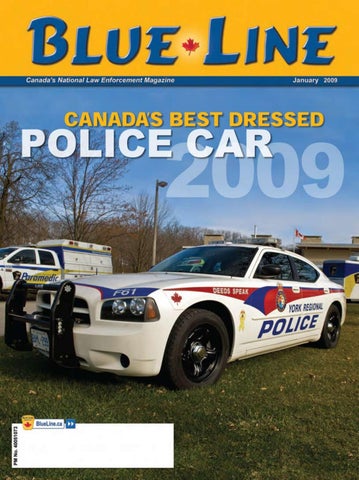
January is our annual automotive issue and this month we are proud to announce York Regional Police as the Best Dressed Police Car for 2009. In honour of this recognition this months cover photo was graciously supplied by Mike Campbell. Find out the other agencies recognized by our panel of judges from policecanada.ca and Blue Line Magazine by turning to page 6.
Features 6
The year’s best dressed police vehicles
24 Conversational Interviewing is here to stay
10 Michigan State Police 2009 police vehicle tests
30 Making the right moves ‘Irregular-regular’ commissioner promotes positive change
15 Police suicide Are you at risk
32 The Millennials are coming... or are they here now?
16 Crisis and opportunity Managing in recessionary times
Departments
Case Law
38 38 18 27 20 37 37 23, 25 21 36 5
34 35
Advertisers Index Back of Book Deep Blue Dispatches Forensic Science Letters Market Place News Week Odditorials Poduct Profile Publisher’s Commentary
Blue Blue Line Line Magazine Magazine
33
Safety sweep of residence lawful Logical & progressive search reasonable
January January 2009 2009
Canada’S PREMIERe
LAW ENFORCEMENT EVENT April 28 & 29, 2009 9am - 4pm LeParc Conference Centre, 8432 Leslie St, Markham, ON
13th
Annual
Exclusive training offered: • Covert Assignment Training • Frontline Policing: Case Law • Investigative Interviewing • Street Drug Awareness
Pre-register at BlueLine.ca or 905•640•3048 January 2009
4
Blue Line Magazine
Publisher’s Commentary by Morley Lymburner
Responsible journalism a faint hope in Canada You’re the news director at a major Canadian radio and television network. One of your investigations has uncovered that a product used across the country is not functioning properly and could be dangerous to the public. Do you: 1. Notify the users, advise them of the study and disclose the hazards you found? 2. Hold the information back until their story is broadcast? The answer, at least for the Canadian Broadcasting Corporation, is option two. Don’t expect to see anything about this on the Mercer Report. I think the paycheque is looking too good for Rick to chance this one – so as you read this piece, imagine his curly locks bobbing and weaving across your TV screen as his hands gesticulate and lips pucker up close to the camera lens. The CBC ran a story December 4 about how it had tested 41 Tasers and discovered four delivered a current up to 50 per cent higher than manufacturer specifications. All of the abnormal X26 model Tasers were manufactured before 2005. This knowledge prompted “some scientists to suggest police should stop using any older versions of the stun guns until they can be tested,” the CBC report stated. My concern is how long the CBC held back telling anyone that there was a potential danger for police to use these weapons. Having officers across the country carrying and using a device that the CBC had found to have a potentially dangerous defect was information peculiarly within its knowledge – yet it refused to release details to police until after airing the story. The RCMP, which seems to be taking the brunt of the negative press on the issue for some reason, released a response to the televised story on December 9. The release
Blue Line Magazine
indicated the Mounties met with the CBC on November 4 and were informed that tests showed some TASERS were operating outside the manufacturer’s specifications. On four separate occasions the RCMP asked for a copy of the results but the CBC refused until December 5, the day it broadcast the story across the country. Okay then CBC, whose interests concern you the most – public safety or ratings? Since you are a public broadcaster, why are ratings so important? (Mercer fade to black... Morley’s rant continues). In the absence of further assistance from the CBC, the RCMP immediately did the responsible thing, collecting samples of 30 Conducted Energy Weapons from divisions across the country and contracting an accredited, independent research centre to test them. It also pulled all units acquired prior to January 1, 2006 out of service immediately so that they also could be tested. The fact that the RCMP makes up less than 25 per cent of police in Canada is a point lost to many when discussing Tasers, but certainly involving the CACP would have been a good starting point. So now that we have determined that ratings trump public safety at the CBC, what must happen to encourage a change in attitude? I would hope that the corporation’s legal beagles take a serious look at this process and advise the news department that it should be more forthcoming when stories reveal a public danger. In this case the risk was high if a citizen was shot with a Taser that local police did not know was defective. The liability timeline for everyone was at least two months before CBC decided to reveal the danger to the public and the individuals using the tool.
5
What would have happened if the CBC had released or, heaven forbid, worked cooperatively with the RCMP? Well for one thing the sensationalism of negative press would be gone but the public’s safety would have been respected. The RCMP would have done what it did even earlier; at least a month, by all indications. The CBC could still run its story and even worked toward a more open response from the Mounties or, more appropriately, the CACP. Doing this might even have earned a little more trust from these organizations and other police agencies. In the grand scheme of things you and I, the taxpayers, have now paid and will continue to pay double for this little incident. Since the publicly financed CBC decided to spend a lot of money (we will never know how much) on this study, its only success has been to cause another taxpayer funded organization to commission another study. The CBC got half a story and the RCMP had to do double duty once again. It had to stave off the media and get the real work done. On the day I searched for the story on the CBC web site, I was immediately accosted by two ads (powered by Google AdSense) directing me to sites where I could purchase my very own Taser. One even stated that I could get it “from a reliable Canadian source.” The hypocrisy of this is mind numbing. If the CBC is going to be the centre piece of Canadian investigative journalism, as it claims, then it is time it follows through with some responsible journalism – but that seems to be a faint hope indeed.
January 2009
Canada’s Best Dressed
2009
1
st
January 2009
6
Blue Line Magazine
by Dave Brown We are either a nation of incredibly creative people with an innate need to decorate vehicles that spend six months of the year driving through snow, or we recognize that police cruisers must be both highly visible and enhance our sense of community; or maybe it’s just something in the water. The selection of 2009’s best dressed police vehicle was the tightest race in history. It literally came down to fractions of a point and one could cover the top four results with a line as thin as a government promise. Entries were submitted to policecanada.ca, where Erik Young and his panel of judges selected the finalists. Blue Line Magazine editors then evaluated each finalist on a sliding scale, awarding points for creativity, strength of identity, community connection, readability, visibility and uniqueness of design. First place was awarded to York Regional Police for the consistency and cleanliness of their design. Their design elements are found everywhere, from their police cruisers to their helicopters, boats, buses and even as far as their stationary. The design was a result of a collaborative effort, with input from Chief Armand La Barge and Deputy Chiefs Bruce Herridge and Eric Jolliffe as well as Fleet Services staff and frontline officers. The overall effect is one of both clarity and uniqueness. The design incorporates the Blue Ribbon Panel recommendation that the cruiser itself be outlined in order to ensure not just reflective decals are seen. It is also a design that others could not imitate easily. Private security organizations are notorious for imitating local police vehicle designs along with some paralegal organizations and even tow truck companies. The York design is such that imitation is difficult. The Truro Police Service and Sûreté du Québec shared second place in the award’s very first tie. Truro was recognized for its sweeping graphic design and excellent use of a drop-shadow effect while still maintaining readability. The judges appreciated the Sûreté’s very unique colours and design and checkerboard pattern touch, which is commonly used on police vehicles in Australia. Third place was awarded to Central Saanich Police Service for its clean black-and-white look. It uses all white doors on a black vehicle and the readability of its police design was second to none. (Both Ford and General Motors are rumoured to be looking towards Australia to source future police sedans.)
2
nd
tied
3
RD
1
st
Community Relations Vehicles designed for community relations must tread a fine line between looking overly intimidating and too much like a clown car. Thankfully, there were no Smart Fortwos entered this year. One must admire the steely professionalism of community relations officers forced to pull up in front of a high school in one of these ‘Barbie’s-first-cars.’ The best balance we saw between professionalism and fun was Mont Tremblant, Québec’s design. It may have been simple but when applied to a Chevrolet HHR, it became much less intimidating than, say, a Hummer H1. The single blue light on top of the roof adds a fun element to the overall design. Speaking of retro, even the RCMP is getting on board, saluting its past while moving toward the future. It took second place in the community category with a retro blue-and-white look on some of its promotional vehicles that it last used way back in 1992. Apparently, there is no move afoot to roll this out Canada-wide.
2
ND
Blue Line Magazine
7
January 2009
1
Law Enforcement
st
There are hundreds of law enforcement agencies across Canada working hard to keep us safe and their vehicles should clearly identify this important role. The Environment Canada enforcement division’s design reflects this perfectly, managing to convey professionalism while still conforming to federal government standards. In an environmental emergency, I want to see this Ford Explorer pulling up to the scene. Wilfred Laurier University took second place in our law enforcement category for its interesting use of blue and gold and a decorative title font that still manages to avoid the ‘ransom note’ look which plagues some other letter schemes. (Hey Laurier, didn’t you know that blue and gold are the colours of the Winnipeg Blue Bombers? Go Bombers go and just WAIT until 2009!)
2
ND
First Nations
1
st
Okay, I admit that I am as much a sucker for clean, well-designed websites as clean vehicle designs. When I saw all those beautiful photos on the Whapmagoostui First Nations site (www.whapmagoostuifn.ca), I had an urge to visit. Located on the shores of Hudson Bay, it is said to be the only community in Canada where the country’s two first peoples live side by side. Whapmagoostui wins first place in the First Nations category, as much for a creative photo as its clean and readable design. Second place goes to the Opaskwayak Cree Nation (OCN) in Manitoba. Located at the junction of the Saskatchewan and Pasquia Rivers, it is the second biggest employer in the area and one of the economic leaders among Manitoba’s First Nations. The blue and red lightning symbol on its police vehicles picks up the colours of the roof lights perfectly and perhaps even speaks for its successful Junior “A” hockey team, the OCN Blizzard.
2
ND
To submit a vehicle for 2009 send pictures and descriptions to Dave Brown at bestdressed@blueline.ca or policecanada.ca.
Pre-register at BlueLine.ca or 905•640•3048
April 28 & 29, 2009 9am - 4pm LeParc Conference Centre, January 2009
8
Blue Line Magazine
Surveillance
Radio Communication Skills
by Hal Cunningham Part 4 As a Surveillance operative and member of a team project, communication skills are essential to ensure trust and co-operation of all the members. During my training sessions I have the students close their eyes while I give them the play, as being called over the radio: “The target is north bound on Yonge Street in the curb lane with two shade approaching Charles Street and a fresh red. He is hung three back from the light and is now through, I’m through and Bloor Street is a fresh green. He is now through and over to the centre lane, 55 clicks (km), I have him with three shade and he is throgh Davenport, Canadian Tire on the corner...” If I am doing my job properly the entire team should be able to fully picture this movement without any questions or clarification required. The proper use of lights, landmarks, lane choice, speed, etc.. are all essential for the timing and positioning of the other members of the crew following in a “caravan” or “parallel” method of support. The second or third surveillance vehicles should be comfortable enough to hide out of view behind shade and just listen as the movement progresses. If they are offsetting their lanes to take a peak, they are either insecure or you are not calling the play properly. I refer to “exact word definition” to remove all terms that are non-conclusive, vague or only mean something to you and maybe one other person. Terms not to use are, “he is over there over here - coming to you - going this way - that way - turning, etc...” What is required is exact terminology which leaves little doubt as to the precise movements and timing. “He is driving off east bound NOW! - he is turning right and around NOW! east bound! - he is out of my sight NOW! - he has bypassed the ramp!” All of these are good examples. Voice demeanour is a determining factor of whether control is maintained due to the actions of the person calling the play. We have all worked with that high pitched neurotic that can increase our adrenaline drip with loud, fast, excited calling when nothing exciting is really occurring. A professional monotone voice calling the details clearly will settle everyone down to the task at hand. “Agent Neurotic” can set us all off into a panic to try and regain control when it was not necessarily out of control at all. “Dead Air” is Trouble with a capital “T.’ This is when everything with the play is progressing quite well when suddenly the agent on the moving “eye” has misplaced the target. When the team is not advising immediately as to Blue Line Magazine
what corrective measures each is taking, there is a long silence on the radio. This is DEAD AIR! No one knows what each is doing. There is no communication. Extremely valuable seconds are being lost as the target is driving away from this area quickly. The Road Boss should immediately request all members to advise what counter measures they are initiating. A team that holds occasional debriefings can correct any problems with voice demeanour, exact word definition and dead air situations. This is where corrections to any weak links in the team are addressed and corrective action is discussed.
9
The rolling dialogue should be maintained by the vehicle on the eye covering all the information required by the other members of the team. Of course your office will talk in a coded language but let your new members learn what to say in the proper manner before you re-teach them how to convert it into your language. The integrity of your code should be maintained. Hold anyone to task for the continual slip-ups that are giving away your units coded language. When you are stick handling through traffic and trying to assess and time your movements, proper exact, and detailed communications by each and every member of the team is paramount to your success. Hal Cunningham is presently a surveillance consultant and trainer who teaches techiques to police officers and private investigators. After 30 years with the Toronto Police Service he retired as a Staff Sergeant and was a member of the elite surveillance unit within the Intelligence Bureau. He has been declaired an expert in surveillance and countersurveillance by the courts. Hal will be presenting the classroom portion of his two-day course at the Blue Line Trade Show & Courses in 2009.
January 2009
2009
Michigan State Police
vehicle trials
Vehicles The tests are separated into two categories: police-package and special-service vehicles. The former are designed for the full spectrum of general police activities, including high-speed pursuit. The latter are designed only for specialized duties such as canine units or adverse weather conditions and not intended or recommended for pursuits. Eight vehicles were submitted to the NIJ in the police-package category for 2009: • Chevrolet Impala 9C1 and Tahoe PPV – conventional and E85 (85 per cent ethanol) • Dodge Charger with 3.5 litre V6 and 5.7 litre V8 engines • Ford Police Interceptor with 3.27:1 and 3.55:1 final axle ratios
by Dave Brown An ancient Chinese curse, it is said, loosely translates, “May you live in interesting times.” With the US now officially on the verge of a recession, the country’s three big automakers poised to collapse under the weight of a financial crisis and gas prices wildly crashing downward after spiking to their highest level in history, 2009 is dawning on interesting times indeed. Gas prices have now settled somewhat but will almost certainly increase again. While police officers should logically be given all the fuel they need to do their jobs, logic is not always a foremost consideration when approving budgets. Savings at the gas pumps can help stretch tax dollars further. Selecting new police vehicles is becoming more complex than ever. It is no longer just about the proper tools to do the job; it is also about the image they convey to the public. Like almost everything else in life, making good choices means evaluating priorities and making tradeoffs between inevitable compromises. There is no one perfect police vehicle. This is where head-to-head testing and evaluations such as the annual Michigan State Police (MSP) vehicle tests can be very valuable in assisting agencies in making these important decisions. After all, for the average officer on the street, it is not just a car – it is their workplace, jailhouse and sometimes even protection and cover. The online resource Wikipedia reports that “May you live in interesting times” is actually part of three companion curses, the other two being: “May you come to the attention of those in authority” and “May you find what you are looking for.” I can think of no better way to introduce the MSP 2009 Police Vehicle Tests. Every fall the MSP, in conjunction with the US National Institute of Justice (NIJ), test the handling and performance of every new police vehicle on the market for the coming year in back-to-back acceleration, braking and lap time tests. Seen as the most comprehensive analysis of police vehicles in North America, the results are eagerly anticipated by officers and bean counters alike. The MSP publish the results at www.michigan.gov/msp and Blue Line Magazine is once again reporting the preliminary figures. Final figures and a summary of the results should be ready by the time you read this article. January 2009
Police package Chevrolet Almost universally loved by drivers but less so by front seat passengers, the Chevrolet 9C1 Impala shows how far one can take a transverse-mounted V6 driving the front wheels. The nimble 3.9 litre Impala is still faster to 60, 80 and 100 mph than every other vehicle except the 5.7 litre Dodge Charger. The Impala’s heavy-duty oil, power steering and transmission coolers help it reach its computer-limited top end speed of 139 miles per hour (mph). Heavy-duty front and rear stabilizer bars and fully independent front and rear suspension with increased ride height springs help it stay firmly planted on the road. The 2009 Impala also features remote entry with programmable lockout protection, remote start and optional fleet-wide key and door remotes. Both Chevrolet and Ford now come standard for 2009 as ‘flexible fuel’ vehicles, which allow burning anything from 100 per cent gasoline to up to 85 per cent ethanol. If the Impala is a bit tight on front shoulder room for two wellequipped officers in full winter gear, the answer is the 2009 Tahoe. While not quite the size of a basketball court, its cavernous interior has the most shoulder and headroom of anything else on the market and, lest you think this results in a ponderous vehicle, the Tahoe still out-accelerates both Fords and the 3.5 litre Dodge all the way up to 100 mph. First tested in the police-package category in 2005, the Tahoe has proven to be a durable and popular choice for both patrol and pursuit. 10
Blue Line Magazine
GM’s Active Fuel Management system also ensures mileage figures are within a tick of the Ford Police Interceptor. Some officers have even reported on Blue Line Magazine’s web forum that the Tahoe’s day-today mileage slightly betters the Ford.
Dodge has always valued better braking performance over longer brake pad life but 2009 sees improved performance and wear with better-cooled brake calipers and rotors. Ford The Ford Crown Victoria Police Interceptor (CVPI) is the very definition of a ubiquitous police car. It is by far the most popular police car on the market and can be seen patrolling almost every street in North America and even across the straits in Russia. One of the last remaining body-on-frame V8 vehicles, it is now restricted to fleet-only sales. The 2009 Police Interceptor now includes standard power pedal adjustment – one of those ideas that seem pretty minor until you need to adjust one vehicle to many drivers and wonder why every car on the market doesn’t come with power pedals. Police Interceptors can be equipped with a limited-slip 3.55:1 ratio rear axle from the factory (electronically governed to 120 mph) or a non-limited-slip 3.27:1 rear axle (governed to 130 mph.) Ford is concerned with officer safety, as reflected by details such as optional ballistic door panels, an available onboard fire suppression system with both automatic and manual operation and crash testing that includes a 75 mph rear-end crash.
Dodge The former DaimlerChrysler has returned to just Chrysler. The parents of the Dodge Brothers are fielding what is still one of the most aggressive-looking police cars in recent history. Dodge actually has a long and outstanding history of aggressive looking and performing police vehicles and 2009 marks the fourth year that it’s offering two versions of the Charger. The police Charger is available in rear-wheel-drive only, with either the 3.5 litre V6 or 5.7 litre ‘Hemi’ V8. The V6s do an admirable job holding their own in acceleration and especially braking performance, but 75 per cent of Dodge police sales across North America include the V8. The hemispherical combustion chamber 5.7 litre V8 has been upgraded with more horsepower and an almost mind-numbing 395 pounds/ feet of torque. (Incidentally, for those of you who confuse horsepower with torque, horsepower is how fast you hit the wall; torque is how far you shove it back when you hit it.) Chargers are significantly faster to any speed than anything else on the market and lap times reflect this. Surprisingly, the V8 is no longer the first to the gas pumps; Dodge’s Multiple Displacement System and standard five-speed automatic transmission ensure EPA mileage figures actually equal the smaller V6. If things get really hairy, both Dodges come standard with Chrysler’s Electronic Stability Program (ESP), which uses the ABS brakes, traction control system and yaw and steering angle sensors to help keep the car out of the weeds. The special police version of the Chrysler ESP comes in three modes: on to enhance stability; partial off to disable traction control at low speeds; and full off, which completely disables it while retaining full ABS braking.
Blue Line Magazine
The tests Michigan State Police and the NIJ’s National Law Enforcement and Corrections Technology Center (NLECTC) test all the vehicles together over a three-day period at the Chrysler Proving Grounds and the Grattan Raceway. Each vehicle is tested without rooftop lights, spotlights, sirens or radio antennas in place. Tires are original equipment rubber provided by the manufacturer. Acceleration, braking and top speed tests are performed at the Chrysler proving ground and vehicle dynamics tests are done using the Grattan Raceway two-mile road course. (All dimensions and measurements given are in US numbers.)
11
January 2009
The results Vehicle dynamics testing The objective is to determine high-speed pursuit handling characteristics. Except for the absence of traffic, the two-mile road course simulates actual pursuit conditions, evaluating the blend of suspension components, acceleration and braking ability. Four different drivers test each vehicle over an eight lap road course, with the five fastest laps counting toward each driver’s average lap time. Final score is the combined average of all four drivers for each vehicle.
Ergonomics and communications The objectives are to rate a vehicle’s ability to provide a suitable environment for patrol officers to perform their job, accommodate required communication/emergency warning equipment and to assess how difficult it is to install it. A minimum of four officers independently evaluate each vehicle on comfort and instrumentation. MSP Communications Division personnel then assess the ease of equipment installation, evaluating 28 factors on a scale of one to 10. The results are averaged among all the testers. The final result is the total cumulative score from the average of each of the 28 factors, which include seat design, padding, ease of entry, head room, instrument placement, HVAC control placement, visibility, dashboard accessibility and trunk accessibility (2008 figures).
Just to put these lap times into perspective, Car and Driver tested three Corvettes around the identical Grattan course for its December 2008 issue and lap times ranged from 1:24.9 (ZR1) to 1:29.1 (Z51). Of course, the magazine also branded seats in all three Corvettes as “unacceptable” – and if any Corvette owners want to compare lap times with the 2009 crop of police pursuit vehicles, they should note that the $105,000 ZR1 Corvette may exceed 200 mph but good old radio signals still travel at 186,000 miles per second.
Fuel economy While not an indicator of actual mileage that may be experienced, the EPA mileage figures serve as a good comparison of mileage potential from vehicle to vehicle. Vehicle scores are based on data published by the vehicle manufacturers and certified by the US Environmental Protection Agency.
Acceleration and top speed The objectives are to determine each vehicle’s ability to accelerate from a standing start to 60, 80 and 100 mph and to record the top speed achieved within a distance of 14 miles from a standing start. Each vehicle is driven through four acceleration sequences, two in each direction, to allow for wind. Acceleration score is the average of the four tests. Following the fourth acceleration sequence, each vehicle continues to accelerate to its highest attainable speed within 14 miles of the standing start point.
2010 and beyond Several years ago, Ford announced the Crown Victoria Police Interceptor was due to be redesigned in 2009. That did not happen. Chevrolet has announced a new full-size car for 2010 that will be the basis of a new police vehicle. That may not happen either. All three automakers are fighting just to stay alive right now and their priorities may not be to a market where their entire yearly sales are probably less than what Toyota accidentally drops off the boat every week. If you have followed the MSP tests for a few years, you will note that various alternative police vehicles have come and gone. The police market is now served, and will be for a long time to come, by the typical large, heavy, overbuilt vehicles of the North American big three. Assuming they all survive the coming recession, there are few viable replacements waiting in the wings. One-off single-purpose police vehicles are on the drawing boards but there is no way a small company can compete with the amount of research and testing that goes into the modern pursuit-rated police vehicle. Single-purpose vehicles have never been able to survive long in the marketplace, no matter what their design intent. Made to do one thing really well, they all just end up being poor overall vehicles. (Remember the DeLorean, Bricklin and, if you’re as old as I am – the Tucker. All brilliant, single-minded executions of what turned out to be pretty crappy vehicles.) While we all love imports as daily drivers, few officers would want to spend an entire shift stuck in them with a burly partner, slamming over curbs and driving through ditches. Yeah, the big three are large, heavy and overbuilt. Just the way we like ‘em.
Braking The objective is to determine the deceleration rate each vehicle attains on 12 60-0 mph full stops to the point of impending skid with ABS in operation. Each vehicle is scored on the average deceleration rate it attains. Each vehicle makes two heat-up decelerations at predetermined points on the test road from 90 to 0 mph at 22 ft/sec2 using a decelerometre to maintain rate. The vehicle then turns around and makes six measured 60-0 mph stops with threshold braking applied to the point of impending wheel lock, using ABS if so equipped. Following a four-minute heat-soak, the sequence is repeated. Initial velocity of each deceleration and the exact distance required is used to calculate the deceleration rate. The resulting score is the average of all 12 stops. Stopping distance from 60 mph is calculated by interpolating the results.
January 2009
12
Blue Line Magazine
Test vehicle specifications (Preliminary reports – All specifications are subject to change)
Greening our future Is ethanol the answer?
by Dave Brown Something stinks here and it’s not just the smell of burning corn. Both Ford and GM are investing heavily in an ethanol future and now offer flexible-fuel police vehicles, able to run on gasoline or up to an 85 per cent blend ethanol as standard equipment – but are taxpayers (and the environment) willing to pay the cost? Ethanol has less energy per volume than gasoline and this is reflected by a substantial drop in fuel mileage numbers when running police vehicles on E85. Ethanol actually has slightly higher octane than gasoline and this allows a modern vehicle’s sophisticated engine controls to extract maximum horsepower from each litre, despite there being far less energy inherent in each of those litres. The fact that E85 acceleration and top speed figures are even close to their gasoline-powered equivalents is a remarkable engineering achievement. Canada is not as quick as the US to adopt 85 per cent ethanol as a motor fuel. Some provinces have mandated pumps must dispense up to 10 per cent ethanol, but the concept of burning food for fuel aside, one wonders if provincial governments have the fortitude to stick with this plan when car owners start seeing their mileage noticeably drop. Even the sustainability of ethanol as a fuel source is controversial. If every bit of energy used to plant, grow, fertilize, harvest, transport, store and convert crops into ethanol was taken into account, the US Department of Agriculture admits that it takes almost a litre of fossil fuel to create each litre of ethanol. Other experts maintain that burning natural gas to make ethanol actually adds to global warming. Cellulosic ethanol, which comes from agriculture and municipal wastes and even discarded plastic and rubber, holds the most promise on the renewable energy horizon. So, until the day that the Springfield tire dump becomes a viable energy source, the ethanol industry must depend heavily on government subsidies, mandated pump initiatives and conflicting science to justify its existence. One look at EPA fuel mileage figures shows that we are all about to be hit heavily in the pocketbook, as well as at the gas pumps, if E85 takes hold. Dave Brown is Blue Line Magazine’s Firearms Editor and staff writer. He is a tactical firearms trainer and consultant. He can be reached at firearms@blueline.ca.
Blue Line Magazine
13
January 2009
Spousal
911 Relational survival for law enforcement by Mike Novakowski The police radio crackles. It’s a domestic. Several units respond and take control. The fighting parties are separated and interviewed. The necessary grounds justifying an arrest are obtained and a suspect is taken into custody charged with assault. 911 worked well. The emergency call came in, police responded and the situation was successfully brought under control. The officers involved were highly trained and skilled in resolving the dispute – but how effective are you at resolving a conflict with your own spouse? Who can you call for backup? A career in law enforcement creates unique challenges and stresses for police families. Shift work, job dangers and the roller coaster effects of hypervigilance place a significant strain on marriage and family relationships. Many of Canada’s police officers are in a crisis situation – not on the streets, but in their homes. A high percentage of police marriages end in divorce – one of the highest rates of any profession. Some research suggests that the suicide rate for police officers is higher than that of the general population and a majority struggle with alcoholism. “The true weight of the badge is not overcome by muscle, not found in the gym, not measured on a scale,” one officer said. “This weight requires a strength and conditioning for which few officers are trained. The badge is not just pinned on a chest, it is pinned on a lifestyle.” Police train in the use of force every year. They qualify on the firing line – aimJanuary 2009
ing for excellence. Some officers practice more than the minimum. People might admire this as wanting to achieve marksmanship status, but the odds of having to fire your gun in the line of duty are slim to none. However, these odds do not prevent officers from becoming the best that they can be. Practice in this venue is seen as strength, not weakness. With marriage and emotional stresses, however, the opposite is sometimes true. Seeking marital or emotional support may be viewed as weakness. What’s wrong with your marriage that you need to get help? It’s important to remember that even people who are the best at what they do – like Tiger Woods or Michael Phelps – seek coaching. People go to the range to shoot for training, but where can you go to “train” for your relationship? How is it that some officers are able to stay married and have a great home life, while others have an increasing tendency towards failed relationships, alcohol abuse, depression and even suicide? When was the last time your mandatory training included lessons in personal relationships? Being a successful cop takes dedication, strength of character and loyalty. These same characteristics are the building blocks of a healthy marriage and family. FamilyLife Canada, a non-profit organization whose mission is to inspire family transformation, is meeting marital training needs through its Police Marriage Support Team. Led by 35-year retired RCMP member Al Knibbs and wife Susan, it reaches out to help officers serve and protect those who matter most to them – their family. There is little doubt that your home life affects your work as a cop and your work as a cop affects your home life. This is why FamilyLife has launched a new website – www.supportthebadge.ca . 14
“Police spouses provide a very important role in an officer’s emotional survival,” says Leanne Novakowski, MEd., a regular contributor to the site and a cop’s wife. “Being a police spouse requires a unique understanding of the job and how it affects your spouse.” The aim of the site is to help educate officers and their spouses and prepare them for some of the critical issues their marriage and family are likely to face as a result of their career. Support the Badge offers education, marriage conferences, online mentoring, counselor referrals and resources designed specifically to encourage and equip couples and families who earn their living in the line of fire. FamilyLife recently produced a DVD entitled Bonded (available through supportthebadge.ca) featuring practical advice from police marriage experts such as Dr. Kevin Gilmartin and interviews with couples who have been there. Police agencies train their officers proactively in the use of firearms, just in case they may need them. If they were to do it reactively, it would often be too late. Like firearms training, a successful marriage needs proactive attention. If you wait until you need help, it may be too late to salvage the relationship and families may be destroyed. Supportthebadge.ca is doing its part to provide backup for police families and the unique challenges of the job. Whether your marriage needs a minor tune-up or a major overhaul, FamilyLife offers resources for early intervention or crisis management. It’s never too late equip yourself and make a difference! Visit www.blueline.ca/resources/caselaw for complete cases. You can email Mike Novakowski at caselaw@ blueline.ca
Blue Line Magazine
Police suicide
Are you at risk?
by Orlando Ramos The suicide death of a close friend and co-worker, Trooper John Oliva, motivated me to research the very sensitive topic of police suicide. I ultimately completed my doctoral dissertation on the subject and dedicated it in his memory. Educating officers on the dangers of police suicide has become my passion. Our purpose There are many reasons why officers choose their career – to help others, make a difference, because we care about people or perhaps it’s a calling. It takes a special person to respond each day to the problems of society with a heart for service, all while protecting our community. Thinking back to academy training, a common theme seemed to quickly emerge – the importance of officer survival. Impressionable new officers are inculcated into a quasi-military environment and quickly taught to take control – of the scene, suspects and their emotions. The nature of police work is inherently negative. Citizens don’t call for us when things are good. Over the course of an officer’s career, memories of the profession are often filled with many negative thoughts and very few positive ones. The bulk of calls are geared toward taking care of others, but who is taking care of us? Why we are at risk An officer becomes at risk when they solely identify with their professional role and it can dominate other areas of our lives. The tactics and communications skills learned on the job are very effective when dealing with suspects. However, problems occur when this role is taken home and used on our significant others, family members and children. The profession can be lonely at times. Officers feel that only other cops can relate to what they are experiencing because they have been there. This can lead to cynicism and a lack of trust in others. Initially you begin to trust only other officers, then only officers in your department; over time that Blue Line Magazine
circle of trust becomes even smaller and you begin trusting only a select few officers. This dangerous cycle can easily lead to social and professional isolation. When your day is spent seeing the negativity that society has to offer, it can be difficult to see the positives. You begin to view life as one problem after another. We become consummate problem solvers, trying to take control by solving all problems quickly and effectively, including those that may arise in our personal lives. {Stress and law enforcement} Police stress is unique because it is constantly present, varying simply in degree and duration. The role itself is stressful because an officer is never off duty. Operating in an environment where high levels of frustration and danger is common leads to physical, emotional and psychological wear. This stress is kaleidoscopic in nature and may come from many directions; administration, handling of calls, media, court system and our personal lives. Unfortunately, officers lack positive coping mechanisms. Stress is most frequently reduced through work place humor and/or alcohol use. If not managed properly, officers may become prone to depression, alcoholism, anxiety disorders and burnout, which may increase risk for suicide. Suicide is about stopping the pain, not dying Some 400 US officers take their lives every year, according to the National Police Suicide Foundation. There were 397 verified officer suicides in 2007, as compared to 188 killed while on duty. Relationship problems, coupled with alcohol use and the accessibility of a firearm create a recipe for disaster among troubled officers. Most people view suicide as the only way out. They are in so much pain that they cannot see any other solution. Think about the employees in the twin towers on September 11. These corporate professionals worked their entire lives to make it to the big apple and were not viable candidates for suicide – until the planes hit. Faced with being burned to death 15
or jumping, they chose the latter to stop the pain and end their suffering. Law enforcement professionals need to be taught that the pain they may be experiencing is temporary. Suicide is a permanent solution to a temporary problem. An officer suffering from a physical condition would seek professional medical attention. What is the difference when the condition is emotional? A trained professional can help you feel better. We are taught officer survival skills while on duty, but seldom given skills on how to handle what we experience at work when we’re not on the job. No training is given on how to make the role transition from police officer to civilian life. There are many wounded warriors working among us. Officer survival should not be just a day to day on duty event. The goal should be to survive throughout your career, marriage and making a commitment to living a full life well into retirement. What can be done Training is critical in addressing the problem. Personnel need to be taught the risk factors and warning signs and family members need to be educated on the dangers of police stress and suicide. They may be the first to see changes in an officer’s mood or behaviour and can help them more smoothly transition from workplace to home life. At work, officers need to be cognizant of their individual tolerance for stress. Supervisors and peers need to respond to changes if they observe deterioration in appearance, performance, attendance or increased complaints. Members may seek confidential assistance from personal physicians, employee assistance programs, peer support teams and crisis intervention counselors. Please be safe and take care of each other. Suicide should never be the end! Dr. Orlando Ramos is also a New Jersey State Police trooper assigned to the peer advocate services unit and a member of the state critical incident response team and National Police Suicide Foundation. The views expressed are his own, not those of the state police or department of law and public safety. He can be reached at ORUSMC@ aol.com . His book, A leadership perspective for understanding police suicide, is available from amazon.ca .
January 2009
Crisis and opportunity Managing in recessionary times by Robert Lunney The greatest blunder I made as a police manger was hiring a new recruit class in the teeth of an economic recession. It cost service members money and could have cost me my job. I was Edmonton’s police chief during the 1970s oil boom, when officers were run off their feet keeping up with escalating crime and
burgeoning population growth. City council voted generous budget increases and new positions were added in successive years. Recession proof When the recession of the early 1980s began eroding economies elsewhere in Canada, Alberta was initially unaffected, leading to the belief that “it can’t happen here; our energybased economy will weather the storm.” What a mistake that was. The federal government introduced the National Energy Policy, kicking the slats out from under Alberta’s boom. The city scrambled to retrench and called for restraint from all departments. Conditioned by years of growth and easy money, I directed that
recruiting continue for the final class of the year. Halfway through training council ordered deep budget cuts and the service was suddenly told to eliminate 100 positions. In the days following I served layoff notices to the most junior officers, including the new recruits. In the midst of this crisis, police association members approved a recovery plan that committed each member to accepting a temporary pay reduction to compensate for the shortfall. The layoffs were averted. This was a serious miscalculation on my part and I was lucky to survive. It can’t happen again Ten years later, when I was chief in Peel Region, another recession arrived and all public servants in the province, including police, endured a three year wage freeze – a particularly painful experience. The Canadian economy again faces a recession of global proportions and no nation, province or region will be exempt from the consequences. Police leaders are girding up to deal once more with the twin nemesis of cut-back management and unmet expectations. Thankfully these periodic declines are separated by longer periods of relative prosperity, but as a consequence the coping strategies of managing through fiscal adversity are lost or forgotten. Reaching back to the experience of the past may be a useful exercise. Crime and the times Much is written about the economy’s impact on crime. In the past a slumping economy resulted in less property and more economic crime. Crimes against persons also increased. Family violence is a consequence of a stressed out populace; drug and alcohol offences remain constant or increase and sadly, there will be instances of economy-related suicide and more incidents attributable to mental health problems. LA police chief Bill Bratton is urging city council to sustain his department’s hiring program, claiming that the economic savings of reduced crime exceeds the cost. This can be a useful counter argument for at the least maintaining current police strength. Above all, the service should emphasize reassuring the public that, despite adversity, police remain committed to serving their needs.
January 2009
16
Blue Line Magazine
Treasure your precious people The most important resource of any police service is its people, for to quote Napoleon, “Morale is to material as ten is to one.” Regardless of restraint, there will still be hiring due to attrition. Job loss in other fields will replenish the pool of available candidates, many of whom will be skilled and successful people displaced by circumstances beyond their control and asking for nothing more than an opportunity to prove their worth. One strategy used during cutbacks dictated by earlier recessions was to reduce numbers by offering early retirement plans for veteran officers. On the surface, this seemed a reasonable move since it preserved the jobs of the newly hired while offering financial incentives to veteran officers. In reality, it depleted the agency of some of its most knowledgeable and effective people, diminishing the quality of service. The loss of experience and maturity in the squad room and detective offices was detrimental to professionalism and performance. Maintaining front line police strength with healthy retention rates is a top priority.
The blame game Budget reductions put a strain on labour relations. While chiefs may strive to inform all concerned of the impact of restraint, you can hardly expect the association to acquiesce to the threat of layoffs, pressure on benefits and the probability of minimal to non-existent pay increases. Morale will be at risk and the association will take some of the brunt of discontent. It is tempting for the association to take out its frustration on decision makers and at worst, to demonize the chief in the eyes of the general membership. All sorts of mischief arise in these circumstances, none of them good for teamwork and unity.
Hope for the best plan for... At this point, it’s not yet clear how seriously Canada will be affected by the global recession. We seem to be well positioned to ride it out, but as in the case of Alberta in the early 1980s, we could be riding for a fall. Hard times test our resolve, but also offer opportunities to those who are wise and well prepared. Robert Lunney is a consultant specializing in police management and an occasional writer for Blue Line Magazine. He is a former RCMP superintendent and chief of the Edmonton and Peel Regional Police Services, as well as the director of Public Safety for the city of Winnipeg. He may be reached by email to Lunney@BlueLine.ca .
Hold your courses Governments often react in knee-jerk fashion when ordering budget cuts and training and travel are tempting targets. While travel budgets can be offset to an extent with electronic conferences and messaging, reductions to education and training can lead to mistakes and omissions down the road that will cost far more than the initial savings. Investing in people during troubled times is a longterm commitment to skill development and employee loyalty. Capital budgets are rarely affected since they are funded by debt payable in the future and investment in infrastructure is often chosen by governments to prime the economic pump. This can be a good time to plan for new police facilities or invest in information systems that promote efficiency. Cleaning out the closet The public services – fire, police and EMS – are frequently granted special status in difficult economic times; a privilege to be appreciated and not abused. Recessionary times offer an opportunity to “clean out the closet,” for the pressures of budget constraint can be a springboard to eliminate the waste and inefficiency that exists in all bureaucracies, particularly following times of relative prosperity. Inside jobs are potential targets for elimination or civilianization and the outsourcing of non-operational activities may be a cost saver. This is an ideal time to promote energy conservation in all its forms. There will be inevitable admonitions to do more with less from struggling governments, but improvements to performance are good for everybody. There is one caution: Excessive zeal affecting employee benefits can erode the core values of morale and organizational spirit. Any contractions must be precise, supported by careful analysis and communicated with integrity. Blue Line Magazine
17
January 2009
Deep Blue by Dorothy Cotton
Self assessment is often
self delusion
Like most of you, in real life I am your basic worker bee. I have a regular job in a bureaucracy, a boss, rules, hours I am supposed to keep and a certain number of sick days. I am usually behind in my paperwork. I really enjoy parts of my job; other parts seem really dumb to me, like the periodic “mandatory training.” It infuriates me that some invisible person has decreed that I need the same continuing education as every other psychologist in the organization, regardless of what we actually know. I find myself sitting beside someone who became a psychologist yesterday and has 45 minutes of experience – and there I am, 104 years old, 74 years in the field and so full of wisdom and experience that I can hardly stand it. I know far more about certain things than others, so I should not have to go to these dumb continuing ed sessions. Every year when “mandatory training” time comes around, I go off on this rant. The problem is that I get about this far and have to stop because, unfortunately, one of the things that I actually DO know is that people as a whole are really very bad at knowing what they know and don’t know. Most worrisome is the fact that the people least able to gauge their own knowledge are those who know the least. Let me make this a little clearer. Just because you think you know everything about something doesn’t mean you actually do. In fact, the more you think you know, the less you likely DO know. This is a problem. As Confucius said, “Real knowledge is to know the extent of one’s ignorance.” Consider a study in which psychology students were asked how well they thought they had done on an exam. Students scoring in the bottom quarter of the class grossly overestimated their performance, thinking they had done better than about 60 per cent of the class when they actually fell at about the 12th percentile. This is not just a problem for psychology students. There have been a raft of studies looking at how good people thought they were at grammar, logical thinking, debating, recognizing funny jokes or shooting accurately. Medical students were asked how well they did at interviewing patients – the list goes on, but one thing remained consistent. The people near the bottom of the heap don’t seem to be aware of how poorly they perJanuary 2009
form, and therein lies the danger. If you do not know you are bad at something, you are unlikely to take steps to improve. It’s tough to make people aware of their deficits. Most of us have preconceived notions about what we are good at and not so good at. Suppose you take a defensive driving course and knock down two pedestrians going around the course. If you came in thinking you were capable, you’re likely to think “Gee, I am a good driver – I only knocked down two people. I’ll bet everyone else hit more people than I did because, after all, I am a good driver.” If you came in thinking you were not very good, you might think, “Boy, this was an easy course. I am a crappy driver and I did not hit anyone. Lucky for me, but I’ll bet no one else hit anything either.” As you can see, the amusing twist on this general phenomenon is that people who are really good at something – like in the top 25 per cent – generally underestimate their skills. If you offer training and make attendance optional, you’re likely to get all the highly skilled people – and none who really need the training. You’ll get the guy who thinks he is a bad driver (but is actually a good driver), but not the guy who is mowing down innocent bystanders, who will say “Hey, I don’t need that training.” Work around this by learning to assess 18
yourself more accurately. On what do you base the assessment of your own ability, and do you have data to support it? Do you REALLY know how others do in the same circumstance? You might want to find out if everyone else in the driving course hit two pedestrians. If you are the only one, it’s time to challenge your own beliefs. Listen carefully to the people around you. Most of us are reluctant to criticize others in a serious way but will do it in a kidding fashion. If your colleagues tease you about how many patrol vehicles you have totalled, you might want to stop and think about your driving skills. If you have not had a meaningful performance appraisal in some time, you might want to talk to your supervisor – and make it clear that you really are looking for constructive feedback. Take the time to observe others – people you admire – and see if your performance matches theirs. Read up on the subject and see if you are really up to date. The main thing is to QUESTION: don’t just assume you are fine. As Alfred North Whitehead observed, it is not ignorance but ignorance of ignorance that is the death of knowledge. For the record, I have no idea who Alfred North Whitehead is. Dr. Dorothy Cotton is Blue Line’s psychology columnist, she can be reached at deepblue@blueline.ca
Blue Line Magazine
Education is the best defence Leadership degree furthers Toronto superintendent’s career by Hayley Millard A strong cup of coffee with two sugars is the only constant in Darren Smith’s hectic, fascinating life. Smith, a Superintendent with the Toronto Police Service, constantly faces new challenges and complex problems, so he’s thankful his education aids his judgement when making quick decisions. “The nature of a superintendent’s job is risk management rather than risk aversion,” says Smith. “A good education is an asset.” To bring that asset to the police force, Smith recently completed a Master’s degree in leadership through the University of Guelph’s unique web-based platform. The flexibility of online education allowed Smith to keep up with course requirements while balancing a full-time career and time with his family. Guelph’s intensive MA Leadership courses are taught at the graduate-level by faculty in the College of Management and
Blue Line Magazine
in a broad range of fields includEconomics. Because the proing business, politics, law and gram is geared towards working also hands-on professions like professionals with at least five paramedicine and fire services. years of leadership experience in Students learn how to strategitheir career, the online learning cally confront and solve complex environment gives students the challenges from the different perflexibility to cover their 20 to 25 spectives of this diverse student hours of weekly course work at group. their convenience. While working on his degree, That flexibility works well for Smith has taken everything he’s Smith, who claims he’s always learned to work each day - from had a thirst for knowledge and has the parchment to prove it. He’s Supt. Darren Smith statistics courses to his research in community mobilization – and completed programs at Laurentian says it’s all been relevant to keeping his ToUniversity, St. Francis Xavier University, ronto community safe. York University and executive development To emulate his passion for education, through the Ontario Police College and the Smith also serves as the Commander of Canadian Police College. He keeps pushing the Toronto Police Service’s Training and for learning opportunities because he strongly Education Unit. With the state of the world believes extended education has enhanced constantly giving rise to new challenges, suhis professionalism and that reaching out perintendents such as Smith see the rewards as a better leader adds tremendous value to of more specialized education beyond high his work. “Leadership is starting to emerge school when their young officers make the as its own field of study. I’ve always been right decisions times of crisis. interested in what makes people great lead“I was putting four of my kids through ers and wanted to study this more formally,” university and college when I was in school mysays Smith. self,” he says. “We’ll always feel like it might To mould competent leaders, the pronot be the right time to invest in an education, gram’s online course discussions focus on but at some point you just have to do it.” common issues faced by senior managers
19
January 2009
Forensic Science by Brian Ward
Physical evidence
– A primer for all
It is impossible to list all types of evidence that may be found at a crime scene. You may encounter large items such as vehicles, boats, aircrafts or railroad cars or microscopic evidence that is just as vital to solving the crime. The Concise Oxford Dictionary defines evidence as “Clearness, obviousness… testimony, facts, making for a conclusion.” More common types of physical evidence found at a crime scene will include: • Fingerprints, • Footprints, • Tire tracks, • Documents, • Clothing, • Firearms and ammunition, • Hair, • Fibre from clothing, • Tool marks (pry marks from screw drivers or pliers), • Powders and residue, • Blood, • Electronic devices. Like latent fingerprints, latent evidence has to be uncovered through the work of a skilled forensic examiner combined with forensic scientists. Examples of latent evidence could include: • Forged signatures, • The presence of DNA, • Electronic data, • The presence of gases or chemicals, • Residue after the discharge of a firearm, • Altered serial numbers. Physical evidence For it to be of probative value, evidence must possess three qualities: • It must be relevant (to the case) • It must be admissible (in a court of law) • It cannot be excluded by a rule of law (illegally obtained, hearsay, spousal testimony) Evidence of any type, including physical, will only be entered with the permission of a judge or justice. In Canada, the Canada Evidence Act sets out the admissibility of verbal and written evidence but physical evidence will be deemed lawful only on a case by case basis. Properly discovered, collected and analyzed, physical evidence is a phenomenally powerful tool available to investigators to identify a criminal and bring that person to justice. “The law does not permit a man to give evidence which, from its very nature, shows that there is better evidence within his reach which he does not produce,” states the ‘Best Evidence Rule’ which is found in the Canada Evidence Act. In other words, the best evidence to produce is the original and we will examine how it is managed, processed and delivered. January 2009
Legal confusion Eyewitness testimony, statements and circumstances surrounding the crime are open to legal arguments but a fingerprint identified as belonging to the suspect is irrefutable evidence of his/her presence at a crime scene. Lawyers often do not understand physical evidence and have to rely on consultants for an opinion of its worth. Once the forensic examiner has completed collecting an item, the next step is to determine whether it came from the same source. In fingerprint comparison, for example, an examiner is able to testify with the statement that: “The latent fingerprint I found at the scene of the burglary came from one source, and one source only, namely the fingers of the accused before the court.” There is no doubt of the conclusion drawn and a number of court challenges around the world proved that the science of fingerprint comparison is now beyond reproach. Many other types of physical evidence are examined, analyzed and presented as testimony in much the same way. Often, physical evidence such as fingerprints or DNA is the only link between the crime and the accused person in court. The burden of responsibility on the person giving that evidence, then, becomes central to the case. Experts An expert witness is one who can satisfy the trial judge that they possess a skill or knowledge in their chosen profession that will aid the court in determining the truth. This knowledge is enforced by introducing an expert’s educational degrees, memberships in professional institutions, enrolment in spe20
cialized courses and publication in professional journals and publications. The judge will also take into account the length of time that they have spent in their profession. A forensic law enforcement specialist, when qualified, may introduce evidence relating to the crime scene. This includes a photographic depiction of the scene, evidence collected and how it was processed. In the case of fingerprints or other physical comparisons such as footwear, the law enforcement expert may introduce an opinion as to the source of the item examined. It is important to note that the law enforcement expert is introducing their “opinion,” which stresses complete impartiality in the proceedings. Evidence management Maintaining a chain of custody or continuity mandates the collecting officer with maintaining the identity and integrity of the evidence. This runs from the time of collection until it is presented in court. Once an item has been identified as being a piece of evidence, it should be photographed, measured and notations made. This is the time to begin the documentation of continuous possession of the object. If at all possible, the collection officer, wearing gloves, should put their initials on the object along with the date. Other suggestions: • Use permanent ink markers to initial clothing. Waist bands, labels or other contrasting surfaces are ideal; • Initial paper or cardboard items in ink (not pencil), preferably in a location that will not interfere with fingerprint evidence; Blue Line Magazine
• Officer initials can be scratched on metal surfaces; • Ensure the initial or mark is permanent and cannot be rubbed off or erased. Picture a defense counsel furiously trying to discreetly erase one of your identifying marks while you testify in court! Smaller items will be photographed in place and removed using gloved hands, forceps or lifting by tape. Place them in a suitable container, keeping in mind the fragile nature of the item and the surface of the container into which it will be placed. Paper bags or cardboard boxes are ideal containers. Wet items should be air dried in a secure location and then packaged. The seizing officer must be able to account for the chain of custody during these processes. Drying cabinets or fume hoods can be secured with a numbered, adhesive-backed forensic police seal. Photographic evidence – the next best thing In some cases it is not possible to produce the original items. This can occur where: • By its very nature the item is too fragile to transport, • There are too many pieces of evidence to bring to court, • The item may be too large or bulky to transport (large scale drug seizures), • The item may be of an extremely biohazardous nature (badly contaminated), • The item may be too dangerous (explosives, nuclear contamination), • The item may have been destroyed during collection or processing. Photographs of these types of evidence are an acceptable means of proceeding, after consulting with the investigator and prosecutor. It is a good rule to provide several copies of the photographs or a CD/DVD to each of the participants. The court will only require confirmation that the photographs represent the item in its original state and that no adjustments have been made to the images. Although this type of evidence is introduced by a qualified forensic examiner, it is prudent to avoid being qualified as an expert witness. Many forensic examiners are competent in the field of photo imaging; however because of a lack of specialized training, they have not attained expert status. The discovery of physical evidence is a team effort involving the first responding officers, forensic examiners and criminal investigators. Recovering evidence should be left to a forensic examiner who has the skill sets and training to properly prepare, collect and package the items. Proper packaging is the key to success, especially if the item is to be introduced at court as part of the Best Evidence Rule compliance. Expert testimony by qualified forensics examiners who must give impartial “opinion” evidence goes a long way to providing a better understanding of the crime scene. Continuity or chain of custody rules must be adhered to absolutely. Should an omission in the chain of custody of one piece of evidence come into question, the case has the potential of falling like a house of cards in a gust of wind!
OdditoRials WAUSAU, Wis. - Cars lining the street. A house full of young people. A keg and drinking games inside. Police in Wisconsin thought they had an underage boozing party on their hands. But although they made dozens of teens take breath tests, none tested positive for alcohol. That’s because the keg contained root beer. (The Associated Press)
••• WASHINGTON - A study says the U.S. Drug Enforcement Administration is losing fewer laptops these days, but more guns. The report from the U.S. Justice Department finds that some of the same problems cited in a 2002 audit remain. It says while policies exist for storing weapons and laptops, those policies are not always followed. And when items are lost, officials don’t regularly report it. The report credits the DEA with a 50 per cent reduction in the frequency with which laptops are lost and stolen. But the inspector general also says officials often have no idea what information was on the computers when they were stolen. As for weapons, auditors say the DEA lost 22 firearms and had an additional 69 stolen over the five and a half year period. The DEA said it has already taken several steps to improve its reporting process.
SAN CRISTOBAL DE LAS CASAS, Mexico - A prisoner is behind bars in southern Mexico for acting beastly. Residents of a town in the southern state of Chiapas say the bull devoured their corn crops and destroyed two wooden shops. So they had it thrown in the slammer. Police say the bull will not be released until the owner pays damages, to be determined by a local judge. The owner, Moises Santiz, says he’ll pay a maximum of $400. That’s the same price he forked over for the bull four months ago. (The Associated Press)
••• SPOKANE, Wash. - A Washington state woman who hid a sedated monkey under her blouse on a flight from Thailand to Los Angeles pretending she was pregnant - has been convicted of smuggling charges. Twenty-nine-year-old Gypsy Lawson of Spokane successfully passed through U.S. Customs in LosAngeles with the rhesus monkey hidden in her shirt during a November 2007 trip. Her mother, 55-year-old Fran Ogren of Northport, Wash., accompanied her daughter on the flight from Bangkok and was also convicted. A jury found the two women guilty Monday on separate charges of conspiracy and smuggling goods into the United States. They were arrested after Lawson boasted to a clothing store clerk about the airport escapade.
Brian Ward is Blue Line Magazine’s Forensic Science editor and can be reached at forensic@blueline.ca .
Blue Line Magazine
21
January 2009
LupusDeadus
Retired North Bay Chief George Berrigan has released his long awaited book entitled “Police Stories - Tales from a SmallTown Cop.” A very entertaining book focussing on the region around North Bay Ontario, it has tales of humour, tradgedy and history. With the author’s permission Blue Line has re-publshed here an excerpt we feel to be of particular significance. ‘Police Stories - Tales from a Small-Town Cop’ is available trhough the Blue Line Library, page 39. – Morley Lymburner
by George Barrigan It is a given that wolves do not understand English, but this wolf seemed to know that something bad was about to happen. It was one of those cool spring nights when the air seemed charged with oxygen. Every breath invigorated. Despite the clear starlit night, the temperature had dropped, causing the day’s melt of snow to re-freeze in the streams of roadside water. North Bay Cst. Myron Ashford and trainee Jim Stone were working together when they received a call to see a man on Airport Road. The man told the police dispatcher that he had struck a wolf with his car. Ashford was a tough, old-time policeman – the type of cop who would be pleased to
January 2009
teach you manners if you happened to forget them. He was an avid outdoorsman and a master angler. Normally he was seen with a half-chewed toothpick jutting from the corner of his mouth. Stone, on the other hand, was a rookie and that new breed of cop who actually went to school to become a police officer. He was destined to become a high-ranking officer, but he was far from that rank on this cool spring night. As the officers reached the top of Airport Hill, they saw a car pulled to the side of the road with hazard lights flashing. A young man was leaning against the vehicle. The officers activated their emergency roof lights, pulled to the rear of the car and got out. Stone, still believing that every call was
22
an adventure, evaluated the situation; after all, wolves were dangerous. He scanned the roadside for the animal but saw nothing. Ashford strode towards the young man and said, “We heard you hit a wolf.” The young man replied, “I sure did. I couldn’t miss him. He ran out of that thicket of bush. I didn’t even have a chance to touch the brakes before I heard the clunk off the fender. I’m surprised he’s still alive.” Ashford, not really wanting to ask the obvious question, asked, “How do you know it was a wolf and not a big dog?” Young Stone was hopping from foot to foot, waiting to ask where the dangerous animal was. The man responded, “Oh, it’s a wolf all right. Long legs, big eyes, big teeth, long ears – just like on TV.” Stone, not able to stand the suspense, shouted, “Where is it?” The man replied, as if it were the most natural thing in the world, “I put it in the trunk.” He nodded towards the trunk before leading the officers to the rear of the car. He removed a set of keys from his jean jacket pocket, inserted one into the trunk lock and slowly lifted the lid a matter of inches. Ashford, Stone and the young man crouched in an effort to peer into the dark receptacle – too dark! The trio once more crouched as Ashford shone his plastic flashlight into the dark void. In the same moment, he jumped back and slammed the trunk down. He shouted, “You’ve got a wolf in your trunk!” Again the trunk was opened a few inches while the trio peered inside. The image that greeted them was one of big eyes and bigger teeth. The man nodded, as if he were communicating with a pair of idiots, “Yep, I told you there was a wolf in my trunk.” The man described how, after hearing the clunk, he had stopped his car and walked back to the injured animal. The wolf could not drag itself off the roadway into the safety of the dark woods. Not wanting the wolf to be injured further, he lifted the struggling animal into his trunk before deciding what to do next. That was the question he posed to Ashford. “What do I do now?” Young Stone eagerly anticipated the response from this seer of the future, this fountain of knowledge, this icon of law and order and more importantly, his coach officer. Blue Line Magazine
Ashford replied, “Don’t ask me. You put him in the trunk. You get him out.” The man told the officers that it wasn’t really that big a problem. He said he put the wolf in the trunk and he could take it out. Ashford, having seen most everything, was enthralled with the prospect of watching the young man trying to get an angry wolf out of the trunk of his car. Stones’ two-year police law and security course at Sheridan College had not touched on situations like this. Both officers stood at the rear of their police car while the man took his denim jacket off and wrapped it around his arm. He opened the lid, reached in and gently pulled the snarling animal out of the vehicle and laid it on the pavement. Ashford, Stone and the young man huddled at the rear of the police car discussing what to do with
the injured animal. The wolf, lying on the pavement, stared at the trio with luminous eyes. It was agreed that Ashford, the seasoned hunter, would euthanize the injured beast with his service revolver. It is a given that wolves do not understand English, but this wolf seemed to know that something bad was about to happen. As Ashford shuffled forward, with gun in hand, the wolf jumped skyward with four stiff legs. In a blur, the large animal disappeared into the roadside woods. For years after, when Stone and Ashford met, Stone would look quizzically at the senior officer and say, “Myron, do you remember the time the guy had the wolf in his trunk?” Ashford would simply nod sagely, as if a wolf in the trunk was the most normal of things. The names Stone and Ashford are fictitious.
High end hackers no longer plunder... just lurk SAN JOSE, Calif. (AP) — Internet criminals have been getting more “professional” for years, trying to run their businesses like big business to get better and more profitable at selling stolen data online. Now the bad guys of the cyber-underworld are exhibiting other unexpected traits: remarkable patience and restraint in stalking their victims. A new report by antivirus software vendor Symantec Corp. details a startling trend that highlights the inventive ways criminals are figuring out ways to make money online. Hackers are sometimes breaking into online businesses and not stealing anything. Gone are the bull-in-theChina-shop days of plundering everything in sight once they’ve found a sliver of a security hole. Instead of swiping all the customer data they can get their hands on, a small subset of hackers have concerned themselves with stealing only a very specific thing from the vendors they breach — they want access to the compromised companies’ payment-processing systems, and nothing else, according to the “Symantec Report on the Underground Economy,” released on December 1. Those systems allow the bad guys to check whether credit card numbers being hawked on underground chat rooms are valid, the same way the store verifies whether to accept a card payment or not. It’s a service the crooks sell to other fraudsters who don’t trust that the stolen card numbers they’re buying from someone else will actually work, and it’s good busi-
Blue Line Magazine
ness. The bad guys hardly touch anything. The customer data for that store’s clientele remains intact. They don’t install malicious software that turns the compromised machines into spam-spewing robots. Plenty of bad guys are still looting everything in sight, according to Symantec’s study. Researchers spotted $7 billion worth of stolen credit cards and bank accounts being sold during the year-long project. That figure assumes the cards and accounts were completely drained by the crooks. The actual price for those cards and accounts could command on the black market was far less, however, because of the risk the buyer takes on in trying to extract money or make fraudulent purchases. Symantec estimated that the total value of the goods advertised for sale was more than $276 million during the time they were watching the servers from July 2007 to June 2008. The report mostly underscores the trend that online criminals are adding more touches of professionalism to their businesses, like bundling packages of exploits together and selling them, or offering up programmers — like a company would hire a consultant — to write malicious code for other people. Huger said the report just touched on the “low end” of the underground economy. The report emphasized that the potential bounty for hackers on the underground economy will only go up as “it matures and operates more like a traditional business model.” Visit BlueLine.ca to subscribe to Blue Line News Week
23
January 2009
Conversational interviewing
is here to stay
by Peter Warrack It was refreshing to read Brent Snook and John House’s article on the P.E.A.C.E. Model of interviewing (“Give PEACE a Chance,” Nov. 2008 Blue Line). Such proactive thinking by academics and law enforcement in partnership is to be encouraged if best practice is to keep pace with shifting environmental changes, including the declining acceptance by society and the legal system of the contaminating interrogative methods of the past. Courts are no longer willing to accept confessions extracted through the use of deception or lies and cases where ‘admissions’ are nothing more than an interviewee agreeing to words placed in their mouth. This was the situation in the UK, where PEACE evolved in response to harsh criticism by the courts of several cases in particular, all involving the murder/abuse of young children and confessions found to be falsely extracted from the accused. Contrary to what the previous article suggests, ‘PEACE” interviewing is already actively used in Canada, albeit largely in the private sector, and is due to roll out in the public sector shortly in the training of investigators, lawyers and accountants involved in regulating Canada’s securities industry. The Royal Bank’s investigation department started the transition from ‘corporate security’ in the traditional reactive (investigative) mode to what it is today – Corporate Investigation Services (CIS). As a professional practice, i.e. in-house investigators, analysts, forensic accountants, computer forensics and asset recovery team, CIS is in the fortunate position of recruiting the best from law enforcement and elsewhere and providing quality instruction, including interview training to support and continue to ‘professionalize’ the practice. RBC developed an end to end model focused on intelligence to prevent and detect incidents such as fraud. It views investigations not as a failure to prevent or detect, but an opportunity to learn and grow. Interviews with victims, suspects or witnesses form part of this strategy, but also are a way to gain intelligence. RBC has developed its own version of the PEACE Model and trains all of its investigators and analysts in this conversational method of interviewing. The training evolved for two reasons: • A frustration about the inconsistency and quality of training received by persons joining RBC, particularly from law enforcement, which was focused on interrogative techniques; and • The experiences of the author, whose knowledge and practical use of the PEACE Model is drawn over nearly two decades. Quite simply, it works! Prior to the internal training going live, RBC consulted extensively with Canadian colleagues in other professions, particularly the Ontario Securities Commission. January 2009
Diagram 1
Diagram 2
The concept was presented to representatives from all Canadian securities regulators at a 2007 conference; many experienced police officers from the IMET Teams were also present. The buy-in was complete and the demand for the training overwhelming. Internally within RBC care was taken to pilot the training course; attendees were a deliberate mix of novices, staff with no law enforcement experience and seasoned police veterans, including homicide and fraud squad detectives. Again, the buy-in was total. In addition to training the investigators, there is active interest in giving the same training to internal auditors and the law group. The previous article provides a basic overview of the PEACE Model and, rather than repeat this, the diagram shows what occurs within the interview and outside of it: ___diagram one___ Using the model provides structure to interviews, forces interviewers to properly plan and prepare, maximizes the amount and quality of information they obtain and, for suspects in particular, assures the admissibility of the evidence. 24
The model emphasizes the basics, including using questions smartly and in a strategic way – see extract from RBC training material below: ___diagram 2___ Once interviewers understand the basics, they can integrate training in non-verbal communication, use of statement analysis etc. as their competency grows. What is really neat about this type of training is that it allows experienced interviewers to utilize and maximize what works best for them and allows those who require it the chance to privately reflect on the efficacy of their style and practices. All can take out of the model and training what works for them and relegate any ‘bad habits’ to the trash bin. Former senior UK police officer Peter Warrack is now the Senior Manager of Intelligence, RBC Corporate Investigation Services, based in Toronto. He is keen to discuss the potential for development of best practice and training opportunities between the private, public and academic sectors and to share more information on this style of conversational interviewing. Contact him at peter.warrack@rbc.com
Blue Line Magazine
Cops must move fast to get evidence from handheld devices You have to be fast when seizing a mobile handheld device in the wake of a security breach - a dead battery or stilllive signal could wipe out or taint the evidence stored on it. As handheld devices gain more data features and storage, they also are increasingly becoming a smoking gun in an enterprise data breach, especially when it comes to the insider threat, security experts say. But getting hold of these devices and freezing the evidence on them isn’t so easy. “The biggest data breach [with handhelds] today is probably lost or stolen handhelds,” says Randy Abrams, director of technical education at Eset. “The fact that many of these devices support MicroSD card of at least 2 GB of capacity makes them extremely agile for transporting data. Insiders have no problem copying large amounts of data from a PC to their smartphone. Even if the possession of the data is legitimate, a lost device with unencrypted data can be a gold mine for the finder.” But the evidence on the devices can be easily lost or tainted. Amber Schroader, president and founder of Paraben, says the key is to maintain power on the device and protect it from any changes that could contaminate the evidence on it. “You can put aluminum foil around it to make sure the signal is blocked” or put a Faraday cage around it to protect the evidence, she said during a presentation at the recent CSI 2008 conference. The first responder to a handheld device could have less than a minute to properly seize and contain one of these “volatile” devices, she says. If the battery dies, so does the forensics data that was on a Windows Mobile device, for instance, Schroader said. “Every three days a new digital device goes into the consumer market,” she said, and there aren’t enough forensic examiners to keep up with them. Schroader noted that in many cases today, investigators are conducting full forensics analysis in the field and don’t have the luxury of sending the device off to a lab. “They’re doing more live-onthe-scene instead of processing it in the lab, which can take over nine months with an analysis,” she said. Instead, you can process and grab evidence off of a handheld right then and there, she said. “The biggest IP [intellectual property] leaks are in...my pocket,” she said. And with 2 GB SIM cards arriving next year, one of these devices could store an entire customer list that could be lost, stolen, or sold, for instance. Aside from locking down the handheld by maintaining a power supply and cutting off its wireless signal, investigators also should seize any accessories to the device that could contain evidence, Schroader said. That includes synch stations, cases, SIM and media cards, and headsets. Off-site data storage and synchronization as well as service providers could also have critical data to a forensics investigation. Blue Line Magazine
Forensic tools then help gather images and other data for the investigation. Ideally, these tools provide a repeatable process that can also verify the results, according to Schroader. What about malware attacks via a handheld device? “Antimalware for these devices is a low-cost layer of defense,” says Eset’s Abrams, whose company recently released an AV product for smartphones. “But encryption and data access
25
control are what the IT manager should be really concerned with today.” Still, handheld devices can spread malware to the enterprise. “Autorun works great with MicroSD cards,” Abrams says. “I would disable autorun in a corporate environment if security was my mandate.” Visit BlueLine.ca to subscribe to Blue Line News Week
January 2009
Telling the untold story RNC under attack during the war by Danette Dooley With the release of his latest book, Gary Browne fulfilled a promise he made to himself, in his father’s memory, almost four decades ago. To serve and protect: The Newfoundland Constabulary on the home front details untold constabulary stories of secrets, spies, censorship and suspected enemy espionage. Browne’s father, Cst. Bernard Browne, died suddenly in 1969 at age 53. Browne followed in his father’s footsteps, retiring a few years ago as the RNC’s deputy chief. He was also the first Newfoundlander and Labradorian invested into the National Order of Merit of The Police Forces in 2001 at the inaugural investiture at Rideau Hall. Browne grew up hearing stories from his father and other constabulary members about the challenges they faced and violence they encountered during the Second World War. As a former guard commander for numerous constabulary veterans’ funerals, family members often told him of their disappointment with the lack of recognition for the men’s work on the home front. Included among the book’s 273 pages are stories of a U-boat sinking, a machine gun attack on police in St. John’s, secret security memorandums and sabotage in St. John’s harbour. Much of the book (published by DRC Publishing) is based on Browne’s years of researching archival information and conversations through the years with the policing community. Some of the correspondence also comes from officers’ oral accounts. Browne gives a voice to the constabulary members’ families whose stress, worries and fears during the war years have never been highlighted or acknowledged. He describes the police wives/mothers as “the nails that hold the police family foundation together.” Browne writes about how closely the constabulary’s security division worked with members of Britain’s Security Service (MI5), Newfoundland Rangers, RCMP, FBI and numerous other military intelligence groups. The constabulary members often punched in 10-12 hour days, seven days a week, he says, as Newfoundland was turned into an island surrounded by German submarines – an island descended upon by thousands of allied soldiers, sailors, airmen, merchant mariners and military base contract labourers. Uprooted from the life they once knew, January 2009
groups of these men roamed the streets in search of booze and women. While the majority were very well behaved, others were jailed for numerous crimes, ranging from common assault to rape and other serious crime. The situation in Newfoundland became so worrisome that a member of the Air Raid Precaution Patrol (which helped police to enforce “blackout regulations”) gave his wife a “shiny chrome revolver” to carry in her purse. The stories are riveting. Browne also gives credit to the tremendous contribution outport village constables played in the war effort – areas of Newfoundland that had been sleepy hollows before the war. Browne’s research indicates that Canadian military authorities had secret plans to burn St. John’s to the ground rather than let it fall into enemy hands. The “scorched earth” policy was something authorities in Newfoundland knew nothing about, Browne says. “It is yet another example of how the ‘friendly invaders’ took Newfoundland totally for granted by not even having the decency to consult with the government of this once fiercely proud little North Atlantic Dominion,” he writes. Because of his passion for policing and roots in the constabulary, Browne articulately takes readers on the war beat alongside the veterans – something an author without policing experience would be unable to do. He also includes never before published wartime photos, many gleaned from family albums. A comprehensive list of serving wartime police members by rank, seniority and geographic posting will be interesting for both relatives and researchers. 26
No book on the war effort would be complete without a chapter on the 1942 Knights of Columbus fire – a disaster that Browne says remains one of the unsolved mysteries of the Second World War. Browne’s father and other constabulary members went to their graves believing the fire that claimed 99 lives was intentionally set and could have been the work of an enemy agent. “I don’t want to be accused of falling victim to urban legend or wartimegenerated paranoia, but I tend to agree with my father and his colleagues,” he writes. In his foreword, RNC Chief Joe Browne (no relation to the author) commends Browne for assembling, for the first time, a significant historical overview of the constabulary members who served on the home front during the war. “His passion for Newfoundland and for the Royal Newfoundland Constabulary is, in a word, infectious,” the police chief writes. RNC honourary inspector and university professor Robert Shea feels the book will be a major impetus for future research and dissemination of the history “of one of the world’s most historic police forces.” Joe Prim, a young sea-going merchant marine during World War Two who went on to become a highly respected captain with the CN vessels, was one of the first to read Browne’s book. “I think it’s the most comprehensive account of the Second World War in Newfoundland that’s ever been written,” Prim commented. Browne can be reached at gary.browne@ nf.sympatico.ca Danette Dooley is Blue Line’s East Coast correspondent. She can be reached at dooley@blueline.ca 1 - ATTACHED PIC: Padres pray over military victims of tragic Knights of Columbus Fire at St. John’s December 1942. Largest Constabulary investigation during WW2 – still an unsolved incendiary file. (Courtesy MUN Maritime Archives – Cardoulis collection) 2 - (L to R) Constables Boyd Barnes and Herb Pippy of Newfoundland Constabulary Motor Cycle Squad in front of the Bell Island Police Station just after the first German torpedo attack in 1942. (Courtesy of Dale RussellFitzpatrick, Russell Family Album)
Blue Line Magazine
In a decision released without comment in November , the Supreme Court of Canada rejected an application by Salomon Jaw to appeal his conviction for the 2001 slaying of Cst. Jurgen Seewald. He was found guilty by a jury in the remote Baffin Island community of Cape Dorset. Seewald, a veteran officer who had responded to a 9-1-1 call by Jaw’s wife during a domestic dispute, was killed with a shotgun blast. The appeal effort was whether the trial judge had peoperly instructed the jury. •••• Toronto’s police services board has been ordered to pay a woman $215,000 plus legal costs over a sexual assault almost 30 years. Marian Evans, who is now 54, was 24 when a Toronto police officer fondled and tried to kiss her after a traffic stop. An Ontario Superior Court Justice also ordered the officer, John David Sproule, to pay $25,000 in punitive damages. Sproule had pleaded guilty to indecent assault and was fined $1,000 after the 1979 incident, then quit the force and moved to Northern Ontario.The court-ordered award is a landmark decision in that for the first time a Canadian court has held a police board vicariously responsible for sexual misconduct committed by one of its officers. •••• Former Vancouver Chief, Jamie Graham, has been selected as the new Chief of Police for the city of Victoria. Graham, who was officially sworn in as chief on Jan. 1, said preserving and enhancing the safety of Victoria residents will be his top priority. Graham replaces former Victoria chief Paul Battershill, who resigned last August and is also a former Vancouver police chief. Graham has 40 years of policing experience with the RCMP, Vancouver police and the B.C. Police Commission. He said the Victoria Police Department will trumpet its accomplishments and admit its mistakes. “I believe in integrity and in doing the right thing" he said. •••• Slain Cobourg police officer Chris Garrett will be posthumously honoured with the Governor General’s Star of Courage four years after he was attacked. Cst. Garrett was stabbed in the neck while on duty in 2004 yet managed to fire back and wound his attacker. Garrett was nominated for the Cross of Valour after his killer’s court case ended in February 2007, but that was past a two-year window for submissions. The Star of Courage was granted as a substitute. A 21-year-old man, Troy Davey, was convicted of first-degree murder. •••• RCMP Deputy Commissioner Barbara George quietly retired in November. Earlier cited for contempt of Parliament George’s retirement was noted in an internal bulletin. An all-party Commons public accounts committee issued a report in February saying George had deliberately misled MPs. As a result the full Commons Voted to hold her in contempt of parliament. At issue was testimony George gave to the public accounts committee in which she denied she had “anything whatsoever’’ to do with the removal of an investigator from a police team looking into the affair. Documents tabled at the committee indicated she had.
1 Blue Line Magazine
27
January 2009
Investigative Interviewing April 28 and 29, Cost $225 This one day course, offered both days of the Blue Line Trade Show examines how to detect a liar every time by analyzing their verbal responses. Liars are frequently caught through their own verbal mistakes. You will learn: Five key words that liars use in their speech; three words that tell you a liar has left something out; One thing liars always do on paper or in person, and how to turn it around on them; How to look at a statement and know deception is taking place; Two key phrases that signal a liar is skipping over critical or sensitive information. Instructor: S/Sgt Gord MacKinnon (retired) with thirty years in law enforcement, has experience in a multitude of areas including criminal investigation, underwater search and recovery, fraud investigation and , Intelligence. Gord is an acclaimed lecturer in the techniques of investigative interviewing and is author of the book Investigative Interviewing. Instructor: A/Sgt Wayne van der Laan (retired) has 20 years experience in law enforcement that includes service in Criminal Investigation Unit, Public Order Unit, Break and Enter Unit and Auto Squad. Wayne holds a Bachelor of Commerce and a Masters Degree from the University of Guelph.
Frontline Policing: Case Law April 28 and 29, Cost: $225 A unique one-day seminar designed specifically for front-line officers will use scenario-based self-directed-learning and realitybased group case study discussion focusing on rapid decision-making, critical thinking, and problem-solving. Topics include: 911/ Distress calls and related entry and search authorities; “Common-law exigent circumstances” (CLEC) warrantless entry into houses; “Feeney” entry into houses with and without warrant; Investigative Detention; Common law search incident to arrest; Admissibility of front-line statements from suspects; Breach of the peace; 495 CC decision-making model; The sec 24(2) Charter pendulum swing. Instructor: Gino Arcaro B. Sc., M. Ed. Niagara College Coordinator - Police Foundations Program, and Law & Security Administration Program
January 2009
28
Blue Line Magazine
April 28 & 29 , 2009 , 9am - 4pm
LeParc Conference Centre , 8432 Leslie St , Markham , ON
Pre-register at BlueLine.ca or 905•640•3048
Covert Assignment Training April 28, Cost: $225 During this one day course Hal will discuss techniques of mobile and foot surveillance, proper clothing and vehicle choices, communication techniques, video techniques and surveillance during special circumstances. Guest Speaker Wally Podzyhun is a former Toronto Police Officer and now licensed Private Investigator actively involved in the training of investigators and more specifically performing one man surveillance projects almost daily. He will address this issue in detail. Jayson McQueen is the Manager of Investigations with a large corporate retail branch and will address the complexities of team surveillance and their successes during their projects. Instructor: Hal Cunningham retired from The Toronto Police Service after 30 years of service as a Staff Sergeant and former member of their elite surveillance unit. He was declared a Surveillance Expert in the High Court. For over 15 years he has been teaching techniques to Police, Corporate and Private Investigators.
Street Drug Awareness April 29, Cost: $225 This course is unique in its scope providing important and relevant information concerning the world of street drugs to field level law enforcement officers. In this one-day course you will learn clandestine laboratory safety, recognition, and investigation, current drug trends, and how to recognize drug use and handle users. Instructor: Det. Steve Walton (retired) worked 10 of his 25 year policing career with a drug unit. He has investigated more than 300 grow operations and supervised an undercover street team involved in 120 undercover drug operations. He is a qualified drug expert and actively instructs in the area of drug education and investigative techniques. Steve is the author of The First Responder Guide to Street Drugs series.
Training registration includes free admission to the Blue Line Trade Show and a one year subscription to Blue Line Magazine. Blue Line Magazine
29
January 2009
moves
Making the right ‘Irregular-regular’ commissioner promotes positive change by Mark Giles They may always get their man, but given the government and media scrutiny of recent years, the RCMP has at times appeared to be the prey. Under intense criticism for a wide range of issues, it has perhaps experienced more negative media attention than any other Canadian police agency in history. Despite the avalanche of seemingly bad news, the Mounties – as they are affectionately known – are successfully battling through the challenges. Under the guidance of a new commissioner, the RCMP is determined to address the criticism head on – working with other agencies and partners to take the positive steps needed to re-establish the organization to its historical position among the elite of law enforcement agencies. The appointment of Commissioner William Elliott in 2007 was a big part of the package aimed at moving the RCMP in the right direction. His vision includes acknowledging current realities and being open in tackling the challenges – areas he addressed while speaking to the Vancouver Board of Trade in November. “As you know, we are an organization that is often criticized – sometimes that criticism is well-based, sometimes it is not,” said Elliott, “but I think from my perspective, the more credible the independent review of our activities, our policies, our operations can be, the more credible the RCMP can be.” In an interview for Blue Line Magazine at national headquarters in Ottawa, Elliott explained that he sees providing strong leadership and making the RCMP the best it can be as his mandate. One of his top priorities is supporting the ongoing work relating to the task force, a group formed in 2007, led by Toronto lawyer David Brown, to review the RCMP. It released its report in December 2007, making a number of recommendations. Balancing backgrounds The first commissioner appointed from outside the senior ranks of the RCMP, Elliott brings a wealth of high-level, security-reJanuary 2009
lated experience to the post, having served as assistant deputy minister for safety and security at Transport Canada, assistant secretary for security and intelligence at the Privy Council Office, and as national security adviser to the prime minister. Since his arrival as the top Mountie, Elliott says he has been warmly received. Describing himself as an ‘irregular-regular’ member – now a sworn peace officer, but without the same background as other regular officers – he recognizes that not having a police background means he doesn’t have the same expertise that others with years of police experience do. For that reason, he has taken steps to ensure he collaborates with others within the RCMP, tapping into their institutional and policing knowledge. “We need to recognize the significance and complexity of the organization – the RCMP has tremendous strengths,” said Elliott. “I’ve had to rely on others and have created a team where others bring in their expertise.” By moving Deputy Commissioner Bill Sweeney to Ottawa to assume duties as his second-in command, he has established a clear number two who serves as his top police advisor. The move balances the senior deputy commissioner’s vast police management experience with the commissioner’s background in high-level decision making in the public service – experience he feels is beneficial in advancing the RCMP agenda. Elliott realizes that change is a vital part of that agenda – both broad change as a large government organization and policing 30
agency, and more specific changes targeting improvements for frontline officers. “We are taking a robust and businesslike approach to change that will build a stronger RCMP,” he said. One of the significant challenges facing the RCMP is balancing its dual role of providing both federal policing at the national level – such as criminal intelligence, and border, drug and market enforcement – and local policing services, on a contract basis, to Western and Atlantic provinces, and all three territories. Contract policing is a somewhat unique role and one the commissioner expects to continue. Current contracts expire in 2012 and all provinces and territories seem content with the current arrangement. The RCMP is looking at being more responsive to local needs and realities, giving consideration to specific proposals such as allowing provinces and territories more flexibility when dealing with police complaints – in line with their local systems. Front line issues Broad issues of federal and contract policing are important, but those impacting the day-to-day lives of RCMP members serving on the front lines are what impacts internal morale. Policing is a tough job – one that will inevitably result in citizen or workplace-related complaints, and sometimes concerns from members regarding the process. It’s an area where the commissioner recognizes the need for improvement. “The area of dealing with wrongdoing or accusations of wrongdoing, or conflict in Blue Line Magazine
the workplace, needs to be addressed,” said Elliott. “The (current) process takes too long and is overly bureaucratic.” Traditionally a regimented, paramilitary organization, the RCMP has recently introduced changes to uniform regulations and flexibility in the wearing of seasonal dress. Until recently, one fixed date was established across the country for changes from winter to summer dress and vice versa. Now these decisions can be made regionally by commanding officers who can delegate this authority further. Commanding officers also have discretion regarding the use and wearing of police-related equipment, keeping officer safety factors in mind. Recruiting has become a top priority – with retirements and other attrition demanding an increased intake of new recruits to fill frontline positions. By reinstating pay for recruits at the academy – now a weekly allowance of $500 – joining the RCMP will become more attractive and allow the organization to better compete with other Canadian police agencies that currently pay recruits during training. In simplifying the recruiting process, the time needed to go through the application and testing phase has been reduced from more than 300 days to less than 120 days, meaning that applicants are less likely to find work elsewhere during the selection period. The net result has been that 1,800 new recruits entered the RCMP academy in Regina in 2008, up from 1,500 the year before, and at least 2,000 candidates are expected to go through training in 2009. Although the vast majority of new hires will join at the constable rank, the RCMP has also brought in a few experienced senior officers from other agencies. After retiring from municipal policing as a deputy chief in 2005, and before returning as chief with the Calgary Police Service in 2007, Rick Hanson spent two years with the RCMP as a chief superintendent in Alberta. It is a practice the commissioner plans to continue, and one that will likely add depth within senior ranks. The promotional process is another significant issue of concern to the rank and file, and changes have been made. The exam for non-commissioned members is now determined on a pass-fail basis, rather than being graded – carrying less weight overall, and allowing more focus on past performance. To permit this new focus, the commissioner has insisted that annual assessments be completed. Until recently, only 30 per cent of members would actually receive a written assessment in any given year. During the last reporting period, approximately 90 per cent received an assessment, which, of course, allows promotional decisions to be made with greater emphasis on past performance.
up a strong brand over more than 100 years as Canada’s national police agency. With internal polling data placing public approval at 85 per cent, its brand image appears to have provided the RCMP with a degree of resilience through tough times. Police agencies are among the most criticized organizations in the country. The RCMP has probably experienced more criticism than most other police agencies, but is moving forward in making positive change. “I think we continue to enjoy very, very strong support from Canadians and the communities we serve,” said Elliott, speaking in Vancouver. Asked what his key message to Canadians and the police community was, Elliott was
clear and concise. “There’s a lot more right than wrong with the RCMP,” he said. With high approval ratings, the public seems to agree. Canadians want to believe they are well served by their police, including the RCMP. By making the right moves in addressing the concerns of recent years, public and media confidence will only increase. The opinions expressed in this article are those of the author. Mark Giles is Blue Line’s correspondent for media and public relations, and military and international issues. He is also a seniors communications analyst at the Privy Council Office in Ottawa with responsibility for several law enforcement and regulatory agencies. Contact him at giles@blueline.ca .
Strong brand Restoring the credibility of the RCMP with government, media and the public is a top priority. Fortunately, the force has built Blue Line Magazine
31
January 2009
The Millennials are coming...
or are they here now?
by Trevor Arnold They’ve been labelled as impatient, irresponsible and disrespectful, come with high selfesteem and high expectations and believe they can be or do anything. They’re confident, team-oriented and are great communicators; the most educated, ethnically diverse and technically savvy group in history. They are the Millennial Generation, Generation Y, the Echo-boomers – the future of Canadian policing! One of the most pressing issues in law enforcement today is how to deal with the Millennials (those born after 1980). Attraction and retention have become hot topics as organizations prepare for a labour shortage that Statistics Canada predicts will become a reality by 2011. The answer lies in understanding the attitudes and expectations of this generation and embracing the myriad of admirable characteristics they will bring to the workforce. Who are they? The typical Millennial has lived a highly supportive and over-programmed life, growing up in a society that praised participation and gave 9th place ribbons in a nine person contest! Consistently told they can do anything and be anything they desire, they now want those expectations to become reality. A recent survey of police foundations students and newly hired officers from across Ontario revealed that more than 82 per cent of Millennials expect to be promoted within the first eight years of their career; 63.5 per cent in January 2009
the first five years. Further, 48.2 per cent expect to retire at the rank of inspector or higher – significant in an industry where less than three per cent of employees attain these levels. The generation grew up watching their parents work long hours, sacrificing their personal lives to get ahead in their careers. They have more disposable income than previous generations. The events of Columbine and 9/11 had a significant impact, demonstrating that life is short and could end at any time. The result is a generation that doesn’t just WANT work/ life balance; they are DEMANDING work/ life balance. Eightyseven per cent of respondents indicated that family was the most important thing in their lives (only seven per cent said work) and 95 per cent said that work/life balance was important to them. This is not to say that family issues always need to supersede the needs of the workplace; however, services that try to accommodate members when a pressing family need becomes a reality may increase organizational loyalty. Millennials have often been labelled as lacking loyalty, which is not exactly accurate. In fact, they tend to be extremely loyal; the change has been in where their loyalties lie. They have become increasingly skeptical of organizations and institutions, resulting in placing their loyalties in people. This generation has grown up in a time when star athletes change teams, politicians change parties and employees change companies on an ever-increasing basis, all things that were an anomaly 30 years ago. The old adage ‘people don’t leave com32
panies, they leave managers’ is an important consideration when examining the retention issue. Ensuring supervisors are informed and can relate to their newest members is the first step towards solving the retention problem. Lessons to learn There are three realities that every organization needs to understand: 1) A labour shortage is forecast, which means telling Millennials ‘if you don’t like it you can leave’ will only exacerbate the problem. 2) They will soon make up the largest portion of your service (and will likely be the most vocal). 3) S ome refer to them as the next great generation, bringing to the workforce a multitude of talents and skills that will benefit the organization and community they serve. Millennials are the most technically adept generation in history. The Internet has always been a part of their lives and they have learned to communicate over a variety of different mediums. Using applications such as Facebook and YouTube, their ingenuity and understanding of technology will provide new tools in the war on crime. Millennials are arguably the most ethnically diverse group ever and are increasingly likely to embrace and celebrate diversity rather than simply accept it. They grew up with people from many different backgrounds, religions and races and probably had and still have friends ethnically different from themselves. Multiculturalism has become such a part of Blue Line Magazine
their lives that they don’t see skin colour and generally accept people for who they are. They aren’t focused on the fact that Barack Obama will be the first black president in history; they are focused on his qualifications for the job. Millennials are wonderful initiative takers, constantly looking for ways that they can improve how things are done. They have been encouraged to share their input and ideas and aren’t afraid to speak up if they feel something could be done better. Although this may present some managerial challenges for organizations like policing (with its strict adherence to chain of command), the benefits if this quality is fostered and encouraged would far outweigh any investment. Probably the most important attribute that this generation will bring to the table is its preference and proclivity towards collaboration. In an industry like policing, which relies heavily on teamwork, this fits the job description to a tee. There is no doubt that officers from this generation will thrive in this type of environment. So how do we keep them? Attracting new police officers and retaining the ones already serving is considerably more interconnected then it might first appear. It is abundantly clear that a work environment where employees feel engaged and empowered will go a long way towards retaining employees. Additionally, it will serve as the first step in a successful recruiting campaign.
Blue Line Magazine
As previously discussed, this generation is extremely adept at communication. Organizations that offer a satisfying work environment won’t have to advertise; their employees will do that for them in text, Facebook and any other medium they choose. Here are some things police services can do to make sure they are the employer of choice: 1) Awareness training for management – A literature review, previous research and the results of my study all point to one incontrovertible truth: The Millennial generation have certain attitudes and expectations entering the workforce that will require police services to adapt the way their workplace functions. First and foremost will be the need to educate management. This may be the simplest and most effective, way of addressing the change in attitudes which will come to the workplace. This awareness training should focus on two distinct areas: (a) the attitudes and expectations of these generations (b) how these attitudes and expectations were formed. This is important, as managers will need to address these needs and will have greater acceptance if they understand how they came about. Failure may result in creating a generational gap between managers and the newer officers. With increased number of Millennials occupying every new recruit class, this gap could have a disastrous impact on recruiting and retention. 2) Feedback – Millennials want regular
33
feedback and lots of it. Police services that still adhere to annual, formal evaluations containing copious amounts of documentation may find that informal, frequent and less intense evaluations are a better option. The generation has lived structured lives, always receiving feedback on its performance. They expect this in the workplace and may become disillusioned if it is not received. A great benefit to both the service and member may be realized by altering the evaluation process. Training – Expanding training offered to current members may prove to be a significant factor in retention. The Millennial generation will appreciate the investment made and is more likely to be attracted to, or continue employment with, a service willing to make that commitment to them. Canadian police services are facing a unique and vitally important time. Much of their future success will depend on the organizational changes made in response to their newest members. These will not only impact the service and its members but also the future of the policing profession. Trevor Arnold is with the Peel Regional Police and is currently serving as the Officer in Charge of their Career Development Bureau. He is also a recent graduate of the MA (Leadership) program at the University of Guelph. He can be reached at Trevor.Arnold@ peelpolice.on.ca
January 2009
Case Law by Mike Novakowski
Safety sweep of residence lawful Finding drugs while searching a house for other people after a mental health apprehension wasn’t unreasonable, Manitoba’s Court of Appeal has ruled. In R. v. Tereck, 2008 MBCA 90, a mental health worker called police at about 11 PM to report that the accused recently threatened to shoot himself in a letter to his psychiatrist. The officer called Tereck’s father and confirmed that he seemed agitated when the father last spoke to him at about 6pm that evening. A team of officers met to plan what they would do and discussed amongst themselves that Tereck could be involved in the drug trade. After receiving no answer at the door, they kicked it open, locating Tereck just inside the doorway. He was easily apprehended under s.12(1) of Manitoba’s Mental Health Act (MHA), handcuffed, searched and placed in the rear of a cruiser. Two officers then conducted a ‘sweep search’ – going from room to room doing a superficial check for other persons or weapons. They didn’t find either but did discover obvious evidence of a marijuana grow operation. The officers left to obtain a search warrant, returned and found 300 marijuana plants and equipment to convert them to a concentrated form of cannabis
January 2009
oil. Tereck was charged with producing marijuana and cannabis oil. At trial in the Manitoba Court of Queen’s Bench Tereck argued that police were not entitled to perform any form of warrantless search after he had been taken into custody. The sweep search was unlawful and therefore violated his s.8 Charter rights. The Crown, on the other hand, contended that police had not only a right but a duty to conduct a search to ensure their and public safety, flowing from s.12 of the MHA and from the common law right of search incident to any lawful power of arrest. The trial judge found the circumstances in this case were sufficiently exceptional to justify overriding the general prohibition against a warrantless search of a residence.
34
Tereck was threatening to shoot himself and the police had reasons to both apprehend him under the MHA and take any reasonable measures to discharge their duty, including the common law right to search. Police knew there was a reasonable possibility that a loaded firearm was in the house. They had just kicked open the door and it would have been irresponsible to leave a loaded firearm in unsecured premises. They also did not know if there were other persons who could pose a threat, or whether there was an injured person or unsupervised child in the residence. “Indeed, if the police had failed to conduct such a search and any of the identifiable concerns had resulted in a tragedy, the police would have been exposed to criticism,” said the trial judge. He found the warrantless search did not breach Tereck’s s.8 rights and, even if it did, the evidence was admissible under s.24(2). Tereck appealed to the Manitoba Court of Appeal. Although he agreed police had the right to enter the house to take him into custody under the MHA, he argued its powers did not extend to cover the search of his residence and the powers of search incidental to arrest did not extend to detentions. He further submitted that police had no reasonable grounds to conduct the search, nor was it required to ensure the security of officers or the public at large, and was not conducted in good faith. Justice Monnin, delivering the unanimous opinion of the Manitoba Court of Appeal, disagreed that Tereck’s s.8 Charter rights were breached: (O)n the factual matrix of the present case, the judge was correct in his finding that extraordinary circumstances existed which justified the sweep search conducted by police after having detained the accused. In addition, the judge’s factual finding, contrary to the accused’s assertion, was that the police were acting in good faith and merits deference from this court. It would have been a dereliction of their duty or plain negligence if they had left the premises with the possibility that an unsecured firearm was on those premises. In this case, the balance that is required between the interests of the state and public safety on the one hand and an individual’s reasonable expectation of privacy on the other, must fall on the side of protecting the public (para. 12). Even if Tereck’s rights were breached, Monnin also agreed with the trial judge’s s.24(2) analysis in not excluding the evidence. Tereck’s appeal was dismissed. Blue Line Magazine
Case Law
Logical & progressive search reasonable by Mike Novakowski Searching a vehicle to locate a driver’s identification after he refused to divulge his name was okay and a gun officers found was admissible as evidence, Ontario’s highest court has confirmed. In R. v. Smith, 2008 ONCA 502, members of the urban organized unit, a crime interdiction team focused on gang and gun violence in Toronto, were watching the accused and his car. He was associated with the ‘Flagstaff young assassins,’ an area gang. Initially, police followed Smith to stop him for “information purposes” (general intelligence). During the course of surveillance, Smith committed at least one Highway Traffic Act (HTA) infraction and was stopped. When two uniformed officers confronted him, he refused to identify himself as required by s.33(3) HTA. This section provides that a person who is unable or refuses to surrender their licence in accordance with a demand must provide reasonable identification when requested by a police officer. A person who fails to comply may be arrested without a warrant. Smith was arrested and his car searched to find identification. None was found but officers did discover a loaded .45 calibre firearm behind the rear passenger seat of the vehicle. He was then re-arrested for possession of a firearm. At trial in the Ontario Superior Court of Justice Smith argued his rights under ss.8 and 9 of the Charter, among others, were breached and that the evidence should be excluded under s.24(2). He suggested police already knew who he was and that the real purpose of the search was simply to see what they might find in the vehicle of a person they believed to be a gang member. In other words, police were using the HTA as a pretext to investigate Smith’s gang association. Although police initially followed the vehicle to stop and speak to the driver for general intelligence purposes, the trial judge found they observed him committing traffic violations and were entitled to stop him for this. “The fact that they had the secondary purpose in mind of finding out who he was and what he was doing for intelligence purposes did not convert a lawful stop into an unlawful or arbitrary one,” the judge wrote. Although acknowledging that the officers were curious about what they might find in a vehicle they knew to be associated with gang members, he wasn’t convinced police knew who Smith was or that the purpose of their search was other than they stated: (W)hile a search incident of lawful arrest can include the search of a motor vehicle driven by the accused for evidence of the offence, including evidence of identification when an accused is arrested for failure to identify himself under the Highway Traffic Act, the extent of the search must be reasonable in the circumstances. The search of the vehicle must be conducted in a reasonable manner. It undoubtedly would not have been reasonable for the police to start their search by Blue Line Magazine
opening the trunk, but here they conducted themselves in an entirely reasonable manner. The search was a logical and progressive one, invading places of increased privacy only as was necessary. They began by searching the person of the accused and then proceeded to searching the glove box, console, door flaps, floor and the like. They only lifted a rear seat when the search in more likely places for locating identification proved fruitless and even then, only after noticing that one of the rear seats wasn’t properly engaged. Even if police had a secondary reason for searching the car, as long as one of their purposes was proper, the search was lawful and reasonable as an incident to arrest. Smith was convicted of driving while disqualified and firearms offences and sentenced to five years in prison. Smith appealed to the Ontario Court of Appeal, arguing the trial judge erred in not finding a s.8 breach and failing to exclude the evidence. In his view, the scope of the search of the car exceeded what was reasonable in the circumstances. The Appeal Court disagreed, stating: When a pat down search of the (accused) did not reveal any identification and the (accused) continued to refuse to provide his name, (the police officer) asked the (accused) if he had
35
any identification in his vehicle. The (accused) replied, “You can’t search the car.” (Police officers) began to search the vehicle. They began by searching the glove box, front console, the door flaps and the floor. The (accused’s) baseball cap was on the back seat of the vehicle. The trial judge found that the police only lifted a rear seat when the search in “more likely places for locating identification proved fruitless and even then, only after noticing that one of the rear seats wasn’t properly engaged.” The (accused) submits that the trial judge failed to appreciate that the searching officers had exhausted all locations where identification could reasonably expect to be found and the search was therefore unreasonable. We would disagree. It was open to the trial judge to find that the search was a progressive, reasonable search and one where identity may be found. We would reject the (accused’s) submission that the trial judge erred in holding that his rights under s.8 of the Charter were violated (paras. 18-19). Smith’s appeal was dismissed. Visit www.blueline.ca/resources/caselaw for complete cases. You can email Mike Novakowski at caselaw@ blueline.ca
January 2009
Product Profile Covert dress shirt The “business casual” Covert Dress Shirt conveys a professional look as it effectively covers your gear or concealed sidearm. Moisture-wicking lining reduces printing so the exterior fabric drapes naturally. The front placket houses a unique snap/button-combination with 5.11’s RAPIDraw system for instant backup access, while patent-pending concealed pockets hide behind the placket. 5.11 Tactical
••• PIPS Technology, a leader
of automated license plate recognition (ALPR) PAGIS, the in-car officer interface to PIPS ALPR solution, now includes electronic chalking. Chalking allows Agencies to monitor time-enforced parking areas and digitally chalk vehicles. Based on user configurable time settings the system will trigger an alert when a car has overstayed the allotted time. PIPS reliable services and trusted applications allow municipalities and parking enforcement personnel to improve efficiencies, increase revenues, and optimize parking availability. This feature, added to the already robust feature set of PAGIS, will provide information to enable a more efficient and intelligent patrol. Driven largely by customer input, these updates to the PIPS’ product line extend PIPS’ position of leadership and demonstrate its commitment to law enforcement agencies worldwide to design and manufacture the best ALPR solution in the world.
water or sweat and dries quickly when wet. The new holster also incorporates a SafariSuede liner. www.safariland.com
•••
New cradles and docking Station for Panasonic Toughbooks Gamber-Johnson announces the release of three new products for Panasonic Toughbooks Ñ the CF74 Cradle, CF52 Cradle and CF52 Docking Cradle. The CF74 Cradle secures the Panasonic Toughbook 74. The CF52 Cradle hugs the Panasonic Toughbook 52. And the CF52 Docking Cradle secures the Toughbook 52. All are designed with rounded edges to enhance personal safety. Heavy gauge steel construction and a black powdercoat finish on all cradles ensure long-term durability and maximum corrosion resistance.
January 2009
www.spectroline.com
•••
www.gamberjohnson.com
••• VULCAN aerosol holder Helios Systems is proud to introduce an advanced aerosol defense holder designed to fit a great number of aerosol units in use by police and military personnel. The Vulcan securely holds and safely deploys the majority of canisters carried by today’s military and law enforcement officers. www.helios-sys.com
•••
•••
Holsters with basket weave finish Known for its incredible strength, abrasion resistance and protective qualities, the durable STX basket weave finish can withstand the rigors of the job without diminishing its quality. Heat laminated and molded to the shape of weapons and accessories for better security, the new STX basket weave will not absorb
Forensic inspection kit The OPTIMAX Multi-Lite Forensic Inspection Kit, featuring a flashlight with six Qwik-Connect interchangeable LED lamp heads and three snap-on contrast filters. This portable, versatile kit is ideal for crime-scene investigation, gathering potential evidence and forensic laboratory work. The cordless, lightweight flashlight features ultra-high-flux LED technology that is powered by a NiMH battery providing 90 minutes of continuous service between charges.
125 lumen tactical powerhouse The XTI Procyon is a simplified multifunction tactical rail-mounted LED light providing dynamic flexibility without confusing complexity. Its stunning 125 lumen highoutput LED, along with its precision focused reflector, provides exceptional brightness with a tightly focused uniform beam. www.InsightTechGear.com
36
AR-15 style rifle The M&P15R from Smith & Wesson is an AR-15 style rifle available as a high quality semi-automatic or as a complete upper receiver assembly kit. Reliability features of the gas-operated rifles include a chrome-lined gas key, bolt carrier and barrel. The rifle measures 35 inches in length when fully extended and measures a compact 32 inches with the stock collapsed. www.smith-wesson.com
••• TacLite Glove fits like a second skin Perfect for shooting, driving and conducting searches in hot weather, the new summer-weight TacLite Glove offers golf-glove dexterity in a lightweight duty glove. The ultra-thin goat leather acts like a second skin, while Lycra on the back delivers stretchy comfort. The Tactical Touch fingers provides dramatically enhanced dexterity and touch sensation. At the base of the glove is a Velcro cuff and smart strap that stays out of the way.
www.511tactical.com
Blue Line Magazine
Market Place
Letters I was pleased to see the article by Chris Lewis, D/C of the OPP. Back in the late 80s when the Ontario Police Chaplain Assoc. (precursor to the now Canadian Police Chaplain Assoc.), existed, I recall during one of our Annual Training Seminars at the Ontario Police College he came into one of our work shops and asked permission to speak to us. The main theme of his three or four minute chat was, that as chaplains, we should never forget the staff in the Comm Centre. I have never forgotten that. On my weekly tours through our station, as well as attending the briefing, I make it a point to go to the various offices of the civilian staff. They mean a great deal to the officers. I trust the officers appreciate the service and importance to them; the dispatchers, IT staff, crime analysts, the staff in the records area and others. I know the feelings of those who say: “I’m only a civilian but,” because, although I am issued a uniform, I, too, am a ‘civilian.’ Just recently I stopped in at the Comm Centre and over heard a conversation that the 911 operator was having with a young child. This little boy’s mother had collapsed and he had the wisdom to call 911. The chap taking the call was so gentle with that child, assuring him that the ambulance and firefighters and police were all on their way. We don’t often get the privilege of watching and monitoring the tasks of these civilians. This young dispatcher was far from being ‘only a civilian.’ Of course over my 20 plus years as chaplain I have seen many civilian heroes, Blue Line Magazine
but, for confidentiality I will not speak of them. Keep up the wonderful work you do. I enjoy Blue Line and the many topics that come to my attention. Sincere good wishes,
whether they have ever been a “volunteer cop” or not, to push for Auxiliary Members to be remembered with the same dignity as any other person wearing the blue. Period.
The Rev’d Michael H. Dunnill, Chaplain, Thunder Bay Police Service
Chris Drosdoski, Former President East St. Paul Police Association
••• I am writing to express my displeasure with any police memorial that would deny an Auxiliary Police Member a place among our fallen comrades. I, like many of the members on the job today, put on my first uniform as an Auxiliary Constable with the RCMP. This volunteer position had little in the way of recognition, save the many thanks from the regular members for being there, the pride of wearing the uniform, and being able to give something back to the community. Quite frankly, the pay sucked. I look back without regret on the many times that myself, and all of the other Auxiliary Members, risked our lives because we were part of the “team.” However, when someone from our “team” makes the ultimate sacrafice on the job, should their rank or annual salary have an effect on how they are remembered? When I did the job, the stripe on my pants was the same color as the people I worked with. I would encourage all members, despite
••• Just a quick email to offer congratulations to you, your wife Mary and the rest of your staff in reaching the 20 year milestone with Blue Line. In your December issue I enjoyed your article and also recapping the history and the different policing issues/ advances in technology, etc. that were highlighted each month. You really have made a tremendous contribution to the law enforcement profession!
37
Supt. Ken Cenzura Toronto Police Service
••• I received my December edition of Blue Line yesterday and knew right away it was something special, even before I opened it. I’m reading this one from cover to cover. I keep them all, but this one is really a “keeper.” What a vision! What a story! I am enjoying every page. With your team, and your youthful passion, you should be good for another 20 years. Mike Sale (Insp.Ret.) Toronto, ON
January 2009
Back of the Book
Catch and release policy a hit with criminals by Art Hanger I am totally fed up with reading about the same just-released criminal thugs wandering the streets and destroying the lives of ordinary, tax paying citizens. There is no justice in deciding to release high risk offenders by downgrading their violent tendencies and dumping them into our community. If the parole board or institutional managers believe they are acting on behalf of community safety, they had better think again. These bureaucratic folks can always fall back on their old standby position of ‘we are just following the provisions of the law;’ the Parole Act, Canada Correctional and Release Act or some other statute. Perhaps they have a point – it is the law. Many of these quasi-judicial entities cannot be touched since they were set up to be at arms length from government influence, and ministers are very quick to point out that they are restricted from interfering with a board decision because it is judicial by design. When the public complains about a notorious criminal’s release, the government throws up its arms and declares “It’s not our fault, we can’t interfere,” then sits on its collective hands and waits for the storm of protest to pass. The government of the day must be put in a position to act willingly and change this ridiculous procedure. When did this country go so tragically wrong and begin allowing this growing crescendo of violence committed by the same nasty criminal players? Who pulled the wool over our collective eyes and embarked down this trail of manipulation and deceit? Harken back to the dark days of the Trudeau era. Then Solicitor General Jean Pierre Goyer informed the Commons and, subsequently, the people of Canada, that he was about to take the federal penitentiary system into a new era of reform. His speech, as recorded by Hansard (Oct. 7, 1971)
5.11 Tacical 2 Best Glove 27 Blue Line Trade Show & Training 4,8,28,29 Canadian Police College 31 Collegé Canadien de Police 17 Copeland Engineering Inc. 34 Dalhousie University 9 Digital Ally 11 Impact Cases 35
January 2009
revealed the extent of his intended reforms. Goyer complained that there were too many repeat offenders, noting that 80 per cent of the 7,270 inmates housed in the federal system at that time were repeaters. “These figures point to the obvious conclusion that rehabilitation of offenders remains one of the major problems of our time,” he told the House. His answer to this so-called dilemma? “The present situation results from the fact that the protection of society has received more emphasis than the rehabilitation of inmates.” Wow! Just think, with only 7,270 criminals locked up and little or no parole, there was too much protecting of society. Goyer and his government proceeded to deliberately reject this fundamental principle and stumble down the destructive road of rehabilitation (page 8503, Hansard Oct 7/71). Goyer and his liberal/socialist cohorts knew there would be some opposition. “Our reforms will perhaps be criticized for being too liberal or for omitting to protect society against dangerous criminals,” he allowed. “This new rehabilitation
Int. Police Association (Canada) 13 John E. Reid 22 Mega Tech 19 Meggit Training Systems 40 Nat’l Police Officers Memorial 33 Tetragon Tasse 21 Thomson Carswell 23 Triform 16 Underwater Kinetics Canada 33 West Nippising Police Service 25
38
policy will probably demand much striving and involve some risks” (page 8505, Hansard Oct 7/71). The crafty fox then generically listed his backup references as criminologists, psychologists, psychiatrists and senior correctional officers with long experience, noting that all agreed with the premise that 80 per cent of our inmates can be rehabilitated. Odd thing, but two glaring omissions popped into my mind; no police officers were consulted, nor were the citizens of this great country asked for their thoughts or concerns. The most shameful development of the Goyer/Trudeau initiative was that there was no opposition, no honest debate and no real public consultation. Unfortunately, the Progressive Conservative Party of the day linked arms with the government members and marched down the path of failure with them. Shame! Is there any wonder that today we live constantly with the legacy of fear created by undemocratic initiatives foisted upon the people 35 years ago? Read the daily news. Those 80 per cent of un-rehabilitated offenders released onto our streets continue to express their gratitude in ways only a liberal could understand. The catch-and-release policies of our government can be overturned. Are you willing to do your part by directing your elected representative and this government to get serious about fulfilling their mandate to protect its citizens and punish the wrong doer? Contact me at art.hanger@blueline.ca if you have a story to share about the damage this catch and release program has caused. Art Hanger served with the Calgary Police Service for almost 23 years, retiring as a major crimes detective to run for federal office. First elected in 1993, he served in opposition and government, most recently as chair of the Justice Committee, before retiring earlier this year.
Blue Line Magazine
Blue Line Magazine
39
January 2009
January 2009
40
Blue Line Magazine