Volume 13 Number 1 January 2001
Inside This Edition Publisher’s Commentary What can we learn from lawyer ethics?
4
12A-4981 Hwy 7 East Suite 254 Markham, ON L3R 1N1
Graffiti - what are you prepared to do?
6
Phn: 905 640-3048 Fax: 905 640-7547 e-mail: blueline@blueline.ca
Correspondence
9
Less lethal response options The search for the “phaser” continues
10
Use of force training and transitioning options
14
Top 10 tips for effective shotgun training
16
Honouring the bravery of Ontario officers
20
Blue Line Response 2001 Symposium
21
Blue Line’s national firearms survey
22
2001 Michigan State Police Tests
24
All you need to know about ecstasy
26
Cops receive awards and issue challenge
28
Annual motorcycle competition a great success
29
Technology Help for aging computers
30
Technology GTA’s phone system to undergo overhaul
31
Supporting the thin blue line
32
Police service celebrates school program
34
Vitality Is your child active enough?
36
Blue Line Classified
37
The Back of the Book The national fixation to register long gun owners
38
The Blue Line Reading Library
39
Blue Line Magazine
- Publisher Morley S. Lymburner e-mail: bluelinepublisher@home.com - General Manager Mary Lymburner, M.Ed. e-mail: bluelinesales@home.com - Editor-In-Chief Blair McQuillan e-mail: bluelineeditor@home.com - News Editor Les Linder e-mail: bluelinenews@home.com - Advertising Mary Lymburner Rhonda Shuker Bob Murray - Pre-press Production Del Wall - Contributing Editors Communication Skills Terry Barker Police Leadership Robert Lunney Tactical Firearms Dave Brown Technology Tom Rataj Case Law Gino Arcaro Blue Line Magazine is published monthly, September to June, by Blue Line Magazine Incorporated with a mailing address of: 12A - 4981 Hwy. 7 East, Ste. 254, Markham, Ontario, L3R 1N1. Individual magazines are $3.50 each. Subscriptions are $25.00 per year or $40.00 for 2 years. (Overseas - $50.00 U.S.)
© 2001 - All articles are protected by copyright. No part of this publication may be reproduced or transmitted in any form or by any means, electronic or mechanical, including photocopying and recording or by any information storage or retrieval system without permission from the publisher. Internet activity is monitored and use or reposting of material on the Internet is restricted. All material submitted for publication becomes the property of Blue Line Magazine unless other arrangements have been made with the publisher. The authors, advisors and Publisher accept no liability whatsoever for any injuries to persons or property resulting from the application or adoption of any of the procedures, tactics or considerations presented in this magazine. Readers are cautioned and advised that articles presented herein are edited and supplied for your personal awareness and should not be used for further action until appropriate advice and guidance is received from a supervisor, Crown Attorney or other person in authority. Established in 1988, Blue Line Magazine is an independent publication designed to inform, entertain, educate and upgrade the skills of those involved in the law enforcement profession. It has no direct control from a law enforcement agency and its opinions and articles do not necessarily reflect the opinions of any government, police, or law enforcement agency. Blue Line Magazine is a private venture and as such is not funded through any level of government agency, union or association. Printed in Canada by Garson Graphic Services Inc.
- AffiliationsInternational Association of Law Enforcement Planners Canadian Advertising Rates & Data International Police Association The Police Leadership Forum The Canadian Press Newswire Periodical Publishers Exchange
ISSN #0847 8538 Canada Post - Canadian Publications Mail Product Sales Agreement No. 176796 January 2001
3
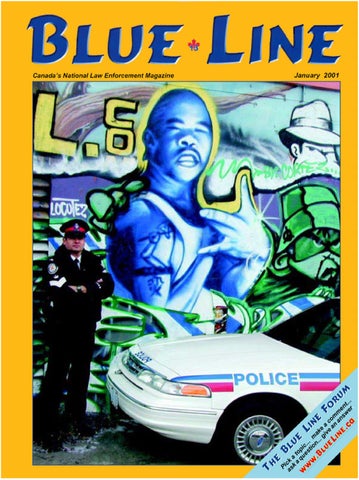
In this issue, Toronto police Staff Sgt. Heinz Kuck, who is pictured on the cover, takes an in depth look at graffiti and its affect on society. Sgt. Stephen Callaghan is credited with capturing the colourful cover shot of Kuck standing in front of a mural in the nation’s largest city. Kuck’s story can be found on page 6. On page 14, Joel Johnston has filed a submission on the quest for less lethal response options. Johnston reviews some of the options currently available and examines the consequences of using them during the course of duty. Dave Brown, Blue Line’s tactical firearms editor, shares his vast knowledge and years of experience in bringing us the top 10 tips for effective shotgun training. For more information, turn to page 16. This month, we bring you the second in our two-part series on the Michigan State Police Tests. If you’re interested in how Sport Utility Vehicles fared this year, you’ll want to take a look at page 24. Four years ago this month, Blue Line Magazine conducted a national firearms survey. In this edition, Publisher Morley Lymburner brings us a “snap shot” of the nation’s current firearms situation. The survey results can be found on page 22. In an effort to raise money for their local Cops for Cancer program last August, a group of Edmonton police officers took part in an Ironman competition. Now, they are looking to issue a challenge to all law enforcement agencies in Canada. To find out what it is, turn to page 28. Do you have an old computer in your home or office that you’re thinking of replacing? Well, don’t kick your machine to the curb just yet. Technology Editor Tom Rataj gives some helpful tips on how to breathe new life into older computers on page 30. On page 38, Robert Stevens takes aim at the federal gun registry. In this issue, Stevens asks why long gun owners are required to register their guns. Happy New Year. Blue Line Magazine
What can we learn from lawyer ethics? by Morley Lymburner Lawyer Ken Murray is finally off the hook for holding onto the Bernardo tapes for 17 months. He was found not guilty by the criminal courts and simply let off by the Law Society for professional misconduct. The legal profession is most certainly taking care of their own. Murray’s defence to the criminal courts for withholding the tapes was solicitor client privilege and a strategy that could point the finger at another suspect and perhaps reduce his own client’s culpability. His defence was that this is what lawyers do. They are to represent their clients to the best of their ability and ensure the best possible deal. In the Law Society charges his defence went even further by declaring that there are no real ethical rules in place to handle such situations. In the end, a red-faced legal profession has to wear this and not an individual lawyer. Perhaps this is just the way it should be. If the ethical gaps are so huge within the legal profession that they can’t deal with this matter then their decision to withdraw charges was most certainly the correct one. There is, however, one glaring problem here that the Law Society will have to come to terms with. That is an admission that their governance procedures do not address how to define, and successfully pursue, ethical deficiencies amongst their members. Furthermore, the law society has been so bereft of intelligence that they could never have perceived this situation as arising. In 200 years of existence, some of the greatest judges, lawyers and philosophical theorists in the country could not imagine a case such as Murray’s? It simply staggers the mind to the ragged edge of credibility. Given all that has come to light over the Murray/Bernardo/Homolka case we all have much to learn. One thing that we can learn is that as long as the legal profession continues to naval gaze, society will have to pay the price. Society must pay the heavy price of court proceedings that ultimately draw no conclusions if the risk of denigrating the legal profession exists. It has been no real secret that unscrupulous lawyers exist. Polls performed for Law Societies across the country have consistently placed lawyers among the lowest ratings. Among the traditional professions they rate the absolute lowest. I suppose that it isn’t as if lawyers themselves have not noticed this however. The California-based Practicing Law Institute says the two most popular courses taken on-line by U.S. lawyers are ethics-related. The director of the institute was quoted recently in Lawyers Weekly as saying, “Not only are ethics courses required for most lawyers, but every lawyer is keenly aware of the dangers of unanticipated ethical traps.” Perhaps they should expand into Canada. I have a firm belief, however, that it is not ethical to use “ethics” to bolster the credibility of any organization. In other words, if any organization sets up classes to teach their members about ethics only to proudly announce to the community they have done so, then they missed the whole point of the exercise. Ethics has to be a pervasive attitude that exists in an organization without being spoken about. While attending a course recently on police ethJanuary 2001
ics, held by Magna Carta Training Inc. in Toronto, instructor Robert Fitches, summed it up nicely for me by stating that it is simply not good enough to put in place mechanisms to catch misbehaviour. “Your organizations must foster a culture that honours ethical behaviour.” In the legal profession, as in the police profession, it hasn’t always been that way. I have no wish to seek revenge on Ken
Murray. He is the victim of his peer group’s intransigence to change that which must be changed. The legal profession must work more diligently on background checks of those who wish to become members. As in the case of police services across Canada, this is all that can be done to restore faith in their profession. Mental competence is no replacement for ethical values and on a balance I would place a higher value on the latter than the former.
For further details see BlueLinks at www.blueline.ca 5
Blue Line Magazine
Graffiti – what are you prepared to do? by Heinz Kuck “Picking my wall is half the fun man. The other half is right before you tag. It’s the burn… the rush. But even better, right when you hit the wall, it’s the feel of the fat cap, the smell of the aerosol, the risk of getting caught, it’s exquisite. A better high than I’d get with dope. But I’m always looking for the cops, gotta stay one step ahead, I feel like Robin f——ing Hood.” This quote came from an 18-year-old “tagger” during an interview. The teen’s sole purpose in life is to become a “masterpiecer,” one whose graffiti is held in the highest regard by the graffiti sub-culture. Take a walk through most urban centres and our senses are bombarded with a number of images. We see the hustle and bustle of the street, the people, the traffic, and businesses. However, without much effort or cause, we are transfixed by something else, the “writing on the wall” – urban graffiti. Graffiti comes from the Greek word Graphion – to write. Graffiti can be manifested a number of ways, through a scratch, an etch, aerosol paint, markers, grease pencils, stencils and slap tags, to name a few. Graffiti is specific to the unlawful defacing of both private and public property through the means of; political activism, hate crime, gang graffiti, folk epigraphy, satanic cult graffiti, and graffiti borne of the Hip Hop culture. It is the, Hip Hop variety that constitutes 90 per cent of the Toronto tagging scene, and thus the focus of this article. The Hip Hop style can be designated into three forms; “tagging” (high volume one colour monikers), “throw ups” (two colour bubble lettering), and “piecing” (short for masterpiece, which are full-size, multi-coloured murals often requiring eight or more aerosol paint cans to complete.) Graffiti writers believe their work to be “urban art” and many others who simply view the work believe graffiti to be innocuous, but both couldn’t be more wrong. The consequences associated with graffiti are far reaching. They are consequences that not only involve the life and death of a community, through urban decay, but also involve the life and death of those who practice the craft. From both police and academic sources, the cost consequences associated with graffiti can be neatly sub-divided into five areas. The first involves hard-dollar costs for the obvious graffiti removal, property restoration and urban reclamation. Most removal projects are simply “paint overs,” however, imagine the cost of tens of thousands of gallons of paint and supplies, labour hours and human resources nation-wide. It boggles the imagination. In lieu of “paint-overs,” one can also choose a more expensive path; biodegradable chemical washes, high-pressure power washes and air compressor baking soda blasters. When all that is done, we can further consider the additional cost of an anti-graffiti solvent applied to the January 2001
Photo: Stephen Callaghan
GRAFFITI: Images like this can be found in most major cities across North America. break more windows. Soon all the windows will wall to assist in efficient future clean ups. The second cost consequence exists within be broken, and now the passer-by will think the judicial arena. That is to say the prosecu- that, not only is no one in charge of the buildtion, the arrest, the charge, court costs, proba- ing, no one is in charge of the street on which it tion, and in some instances, incarceration. In- faces. Only the young, the criminal, or the foolternational law enforcement agencies estimate hardy have any business on an unprotected avthat there are approximately 900,000 “taggers” enue, and so more and more citizens will abanplying their trade in North America and each don the street to those they assume prowl it.” The next cost the experts point out is assoyear a new generation of youths joins the ranks. ciated with collateral crimes. These include the As a result, the costs continue to climb. The third area involves the psycho-social prevalence of theft or “racking” of the paint, consequences including decreased respect for markers, slap tags and other so-called weapons of the trade. In addition, authority, citizen fear and “huffing” or the sniffing diminished use of public Qualitative research of the paint fumes before, spaces. There are also inverifies that graffiti during and after use, for creases in physical disorwriting crews the high seems to have der issues such as litterare experiencing gained in sub-culture ing, posturing, transients, increasing levels of popularity. Another colpublic drunkenness, intra-group violence. lateral crime committed street level prostitution, prior to the “hit” is tresdrug dealing and public pass to property - often urination and defecation. Renown academics all put forth the argu- times climbing city bridge abutments, water ment that physical disorder (graffiti) has a di- towers, fences or rooftops in order to “get up” rect link with social disorder (crime). The writ- and make the graffiti highly visible. The fifth and final cost is referred to as ing certainly seems to be on the wall. In their book, “ Fixing Broken Windows,” “intra-group.” This relates to the ever-present authors George Kelling and Catharine Coles risk of death or injury. It happens from scaling apply the “broken window theory” to describe the bridge too high, racing the train too fast, or brushing up against the third rail. this spiral towards urban decay. Qualitative research also verifies that graf“We used the image of broken windows to explain how neighbourhoods might decay into fiti writing crews are experiencing increasing disorder and even crime if no one attends faith- levels of intra-group violence. According to acafully to their maintenance,” the book states. “If demic researcher Victoria Wilson, the catalyst a factory or office window is broken, the passer- to this violence includes “crossing out another by observing it will conclude that no one cares writers tag, ratting out crew members to police, and selling out, producing graffiti on approved or no one is in charge. continued page 8 “In time, a few will begin throwing rocks to 6
Blue Line Magazine
surfaces for profit. By 1990, graffiti-related assaults and homicides had escalated to such proportions that a Fox Television documentary labelled this new phenomenon ‘tag-banging.’” Last year, total consequential cost addressing graffiti in the U.S. amounted to $15 billion dollars. A total of $7 billion was required just for the clean up efforts. What are the consequential costs in your community? What compels these people to write? What compels them to endure the risks? It can be stated in three words; fame, artistic expression and power. Fame, the most important value of the subculture, is achieved by writing as much graffiti as possible. By sheer numbers, they perceive fame and enjoy elevated status in the group. Taggers also attempt to enhance the subcultures potency by adding their tags onto surfaces previously tagged by others. This shadowing creates what is known as the “tag multiplicity phenomenon”. Basically, whenever a new tag appears, and the property owner does not immediately remove it, within days there will suddenly be two, then four and so on. The next integral value is that of artistic expression. This involves their concept of style and form, colour choice, letter connection, flow and symmetry. They feel they are contributing to the community’s urban ambience and that their work is desired and appreciated. The third value is that of power. Research has shown that most taggers are between 12 and 20 years of age. Ninety-seven per cent are male and living in urban environments. These conditions cause a powerful mechanism to take place. Taggers feel that their legitimate means of power (i.e. ownership of property, gainful employment, and familial responsibility) is limited, or non-existent, and as such, in a response to such powerlessness, the tagger believes he can dominate and symbolically own the surface written on. We’ve discussed the types of graffiti, its sub-culture and hard costs, but what of solutions? What can be done to turn the tide of this physical disorder crime? Through consultative processes, shared North American policing experiences and international academic sources, we have developed what we feel is an effective and efficient method of graffiti abatement. The program has been titled the Graffiti Eradication Program and is a service-wide initiative to tackle graffiti head on. The program is made up of the following components; • Eradication through the physical removal of the graffiti, using victimized property owners, volunteers, students, even prisoner work programs. • Education through anti-vandalism programs through schools, community centres and places of religious worship. • Empowerment by working with business improvement associations, rate payer groups, community police liaison committees and local politicians. • Enforcement through arrest and prosecution, surveillance, informant information, Crime Stoppers, and municipal by-law enforcement January 2001
Photo: Stephen Callaghan
BACK ALLEY: This graffiti covered alley is home to numerous “tags” from artists. aimed at property owners to maintain their property to civic standards. • Economic development through urban beautification programs, graffiti transformation initiatives, youth mural businesses and tourism. Each component is linked with members of the community, the media, local agencies and ward councillors. Stakeholder inclusion is crucial to ensure program sustainability. In addition to this partnership, co-ordinators ensure that each of the five components receive some time, care and attention. Components, once evaluated against community dynamics and demographics, are then transformed into percentages to act as a guide. For example, all five components are totalled as 100 per cent. Co-ordinators might assess the program as follows; 20 per cent of program time, care and resources will be committed to eradication efforts, 20 per cent for education, 20 per cent for empowerment, 20 per cent for enforcement and 20 per cent for economic development. A more aggressive design might involve the following; 50 per cent of program time, care and resources will be committed to enforcement efforts, 10 per cent to education, 20 per cent to eradication, 10 per cent to empowerment and 10 per cent to economic development. The variables are endless. However if percentages are assessed accurately, taking service resource availability into consideration, stakeholder commitment, and of course, the level of graffiti intrusion, success may well be at our fingertips. Each one of our 17 Toronto Police Service divisions has assigned a unit Graffiti Eradication Program co-ordinator who will absorb the programs tasks in concert with their regular duties. This now creates a guiding coalition of 17 co-ordinators. They will guide personnel and resources in designing, developing and executing strategies. They will act as the communi8
ties’ sounding board and address physical disorder as a priority. The strength of the program lies not in what each individual co-ordinator achieves in their community, but in the collective action of all co-ordinators and all communities at any given time. There is strength in unity. Assessing past graffiti abatement programs is a very difficult task. Often times police services have relegated physical disorder prevention programs to the “back of the line.” For the graffiti writers, inventing new and ingenious ways in avoiding detection has become part of the game, adding to the “high.” And for our community members, the philosophical split between the concepts of liberty and community rages on. Liberty equates to freely choosing individual destinies and choices, irrespective of consequences, to be free to express opinion that graffiti is art, not crime. This is balanced against community; that no one is truly autonomous and that personal action requires familial and neighbourhood support. The battle rages on. We have entered a new and exciting millennium with complex challenges. It has become clear that physical disorder must be given its due care and attention. For disorder left unattended, allows “only the young, the criminal or the foolhardy to have any business on an unprotected avenue, and so more and more citizens will abandon the street to those they assume prowl it.” What are you prepared to do? Staff Sgt. Heinz Kuck has been a member of the Toronto Police Service since 1979. He is currently the services’ lead coordinator for its Graffiti Eradication Program. For further information, he can be contacted at 416 808-5354. Blue Line Magazine
I received enormous enjoyment from your commentary in the November issue of Blue Line Magazine (The pristine beauty of traffic, pg. 5), as well as a great deal of satisfaction. Having now been an auxiliary constable for over 20 years, a lot of which was on the highway at night, I share your concerns about the resentment expressed by motorists with the issuing of tickets for various offences which the public perceives as nonsensical at best and an infringement on their right to be stupid, at worst. I have also learned a whole new vocabulary and been invited to do many biologically impossible activities. I suspect most officers are familiar with this. It would seem that for some drivers, highway driving is just an interactive video game. However, your point that perhaps some officers regard this work as not good “police” work is well taken. I’ve worked with some, not many, who have felt that way. As you have so perfectly illustrated, education of such officers as to the real reason for writing these tickets will usually resolve such issues. I was glad to see this message broadcast to a larger audience by your editorial. Thank you. Donald G. Mills Saint John, New Brunswick Thank you very much for that editorial that you wrote in November’s edition of your magazine (The pristine beauty of traffic, pg. 5). How
January 2001
very true it is that traffic enforcement goes, at best, under appreciated. I have always felt that this specific area of enforcement can be used to many good ends. Which aspect of policing is most likely to be encountered by the average person as they go about their daily routine? A highway patrol officer or municipal traffic officer is the most likely person to carry your force’s flag. Thankfully, it is still a rather uncommon occurrence in our country for a person to be involved in a police investigation, though most of us operate some sort of motor vehicle daily. What sort of image does your force wish to project to the people whom you serve? The fact is, your uniformed traffic section (officers) are your day-in, day-out representatives to the general public. Belittling another section profits nobody. However, police officers from one end of this country to the other have dismissed the efforts of the “lowly” traffic cop for generations. I would remind all police officers wherever they may be that the “lowly” traffic cop has directly contributed to the safety and continued wellbeing of more Canadians than any other police function. We will never know how many lives have been saved. I am very proud of my time spent as a highway patrol officer and look forward to resuming such duties again. I am also very proud of my father’s continuing efforts within the force during his 30-plus years of keeping
9
Newfoundlanders safe as they navigate our highways. His is a standard seldom seen and an inspiration. Thank you for such an insightful and timely article. Cst. John D.C. Daley Bonavista RCMP Recently I read Blue Line (from) cover to cover and was very impressed by your coverage of the International Association of Women Police Annual Awards Recipients. The IAWP continues to grow both in membership and recognition and part of this development is due to people like yourselves who clearly support us. Thank you very much. Sgt. Myra JAMES Hamilton Wentworth Regional Police Vice President OWLE Region 11 Coordinator IAWP I just wanted to express how astounding and useful your (Internet) Forum is. I can’t believe you got so many moderators who are really experts for each of the many categories. I think the quality of the moderators and of the posts make it THE Internet policing resource. Keep up the good work. Marc Potvin Editor’s Note: Everyone is welcome at: The Blue Line Forum - www.blueline.ca
Blue Line Magazine
Less lethal response options The search for the “phaser” continues by Joel A. Johnston In recent months the new M26 Taser technology has been receiving a lot of media attention. A British Columbia police agency’s reported “successful” use of the Taser gun to subdue a mentally ill man was an irresponsible declaration based upon that agency’s only field-use. The incident involved one of their own police officers who attended a scene and was seriously wounded by a knife-wielding, mentally unstable man. It was publicly declared that “10 years ago he (the suspect) would have been shot, as a matter of fact, six months ago he would have been shot with a gun, maybe fatally”. This statement is, at the same time, both speculative and irresponsible. Further it encourages the increasingly held perception that the Taser gun is a viable replacement for the firearm. It is not. It is a very “Americanized” approach to try to create a gadget to solve problems. You have all probably noticed the proliferation of infomercials on television to sell gadgets that good old fashioned hard work and properly implemented problem-solving skills would preclude the need for. Whether or not the gadget is suitable for the task, safe, effective, or even truly works in the real world, seems to be of secondary concern when weighed against the potentially huge profit margins for manufacturers and the political influence of special interest groups if we can be made to believe that the gadget may work. Protection of people and the preservation of life and property are at the core of the police mandate. Law enforcement professionals all over the world endeavour to resolve conflict, de-escalate confrontation and deal effectively with violent and dangerous behaviour at the lowest possible level of intervention. It is the goal of Canadian law enforcement professionals to resolve all confrontational situations at the level of presence and communication. Sadly, sometimes the lowest possible level of intervention involves the use of a firearm, where a person is shot and may subsequently die. This normally occurs in situations where a person, acting unlawfully for whatever reason, places the life of another in imminent jeopardy of grievous bodily harm or death. While the goal of saving lives is positive and must always be striven for, it cannot be done at the expense of the lives and safety of those people sworn to uphold the law. Nor can it be at the expense of those people who would be innocently victimized by people engaging in this unlawful, dangerous and violent behaviour. The concept of weapons that are designed to have less lethal consequences is not a new one. It is ground that has been covered many times. Taser guns, stun guns, glue guns, net guns, January 2001
WHAT TO DO: Which option is the right one for dealing with this type of incident? bean-bag rounds, ARWEN guns, grapple nets and poles, mace, pepper foam, pepper sprays…the list goes on and on. Mass marketing of law, security and personal defence gadgets to a fearful, impressionable public, liability and politically conscious administrations, and organizations that are fiscally strapped to provide adequate training to their personnel, makes perfect sense to the gadget-making entrepreneur. They are all potential buyers of the solve-all gadget. Imagine if police officers didn’t need to use their guns. Even in the face of imminent deadly force by a subject engaged in violent, dangerous behaviour. Imagine if law enforcement had a tool that would ensure they never had to use physical force against people and certainly never had to shoot people with a firearm. Police officers 10
wouldn’t have to train and they wouldn’t have to worry about the high-liability issues of use of force. They also would never get hurt doing their job as long as they knew how to aim and deploy the gadget in a timely fashion. Wouldn’t that be nice? We all witnessed a great fraud perpetrated against law enforcement and the general public in the early 1990’s when pepper spray was mass marketed to the law enforcement community and an increasingly frightened public. A number of police officers were killed or seriously injured as they placed their faith in canned sprays that were touted as having the ability to stop anyone, under any circumstances. Similarly a number of women were sexually assaulted, murdered and seriously injured while holding this misplaced faith in a product Blue Line Magazine
that was, and continues to be, touted as having the ability to take the fight out of anyone. Pepper spray was the last panacea. The latest panacea is the Taser gun. Through television and various other media, public perception is shaped and moulded. Yes, these weapons exist and are available for use. However when they are repeatedly placed in the context as replacements for conventional law enforcement firearms, it is a very dangerous and misleading notion that has very real and serious repercussions. Given this contextual misplacement, we mislead the public and we begin to create standards that often are not attainable in real-world confrontations. We create indecision among law enforcement professionals when faced with a deadly threat. Specific Survival Research (Hick’s Law) demonstrates that when one has many options to consider under stressful circumstances, response time slows down. To some, the threat against a police officer is not such a serious concern, however that indecision may occur when an innocent member of the public is facing a deadly threat and the officer has to go through a mental process that could cost critical seconds. Yet the media, special interest groups and some bureaucrats cling to the notion that some magic answer, some comfortable solution, exists to deal with extreme behavioural problems where no one has to get hurt. A very key distinction must be made here between:
A number of police officers were killed or seriously injured as they placed their faith in canned sprays that were touted as having the ability to stop anyone. • A spontaneous, imminent deadly force encounter, where someone is literally about to be killed or grievously injured by someone engaged in dangerous, violent behaviour, where there is no time to escape and no opportunity to negotiate; and • A non-spontaneous, potentially dangerous situation, where time to make decisions exists, there is some distance and/or cover from the threat, and no one is in imminent jeopardy of death or grievous bodily harm. Law enforcement personnel have never trained to shoot people in these non-spontaneous situations, where time, distance and no imminent jeopardy exists. These are the situations where, if communication fails, that these less lethal options can
For further details go to
January 2001
and have been tried – often with success. At this point in time, there exists no tool Taser gun included - to solve the spontaneous, imminent deadly force encounter. Someone is about to be killed or grievously injured, imminently, by a violent lawbreaker. It may be a police officer, or it may be a son, daughter, mother, brother, father, friend, hostage or innocent victim. That means shot, stabbed, bludgeoned, run over, or hurt in any other imaginable way. Clearly there is a need to stop this imminent action immediately. There can be no room for error, and simply slowing the person down will not suffice. They must be stopped now. Should we pepper spray such a person? Hit them with a baton? Spray them with glue? Tase them? Fire a bean-bag round at them? These gadgets have all proven unreliable at stopping subjects when they most need to be stopped, for a variety of deployability and effectiveness related reasons. The firearm deployed to a vital, incapacitating target on the human body is the only tool that has a reasonable chance of stopping a person immediately. It is a last resort, but a last resort that may have to be implemented in a split second. I truly believe that if someone had a loved one in imminent danger of being killed by a violent lawbreaker, that they would want that person stopped immediately. I’m not sure that they would approve of the deployment of pepper spray or the Taser gun under such circumstances, in the hope that it would work. continued page 12
BlueLinks at www.blueline.ca
11
Blue Line Magazine
I am a proponent of less lethal force response options. They do have a place among law enforcement force response options. However, a rational and measured approach is required in evaluating these options. Above all, proper contextual placement of these options within the spectrum of force response options is critical. The Taser is one of the most effective tools that I have personally experienced. However, I still vividly recall all of the live and video-taped demonstrations of law enforcement officers that were totally incapacitated by clinical applications of pepper spray to wide open eyes at the properly prescribed distance. When it comes to the reality of THE LINE UP: Vancouver police officers display the myriad of use-of-force options available to them. street confrontations the results remain mixed. There is no doubt that when the Taser wires So now we are placing two officers at risk ployed from any distance, you could hit the are clinically applied to properly selected tar- (inside the 30 foot envelope) in dealing with the subject anywhere and it could freeze, stun, or get areas on the body and the ‘juice’ is turned high threat subject. This requires a minimum of cause them to disappear, regardless of their on that it is effective. It is not the Taser’s effec- three officers to respond now – because lethal wardrobe. Set the Phaser on freeze and the enemy was tiveness that will be its primary limitation. It force back-up must be required. And who is a will be all of the deployability issues associ- single M26 Taser round for - a not-so-violent frozen in place. He couldn’t move, he couldn’t even breathe, but yet he wasn’t hurt. Imagine if ated with use of the Taser that will limit its subject? usefulness (distance, reaction time, targeting, So the search continues for the gadget that law enforcement personnel had the phaser. The clothing, shielding, etc.). was made famous on the hit television series police could freeze people in their tracks, with A manufacturer is now recommending the ‘Star Trek’. The gadget that would truly be a the knife, club or gun in their hand. The assailsimultaneous deployment of two M26 Taser replacement for the firearm. It was called the ant could harm no one. They would not be hurt. Police could get rid of their firearms. rounds in dealing with subjects who are “ex- ‘phaser’. This is, however, a serious subject and ceedingly violent and/or focused, or present a There was no confrontational problem that higher threat level such as edged weapons”. the phaser could not solve. It could be de- street-level law enforcement is not Hollywood, it is real-life. We should never stop searching for a solution to this seemingly unsolvable problem of extreme violence. We are obligated to search for such answers. But in realistic terms we remain a long way off, and until we address the problem of mental by Ellen Barry microcapsules. Microcapsules dissolve and illness, substance abuse, and violence in our culBoston Globe activate in response to heat, pressure, ultrature, at a more grass roots level, we will conviolet light, human sweat, or salt water. It is Chris and Janet Morrises’ concept tinue to have to deal realistically with deadly anticipated that microcapsules will some day of “non-lethal weaponry” is taking some force behaviour. Under such circumstances, the be used to stop vessels by expanding inside time to catch on in many military and only real tool at our disposal remains the firetheir cooling systems. law enforcement arenas. arm. According to Janet Morris, The couple foresee a fundamental microcapsules can also be used to clear an change in the way people decide to pracRespond to Joel Johnston on ... area by releasing the intense smell of feces tice violence. Advocating the use of nonor rotting corpses - so intense, in fact, that it lethal weaponry, the Morrises’ promoted will cause people to retch or vomit. their non-violent ideological views at the The Marine Corps is experimenting with University of New Hampshire’s celebraa non-lethal foam used to disarm small-calition of its Non-Lethal Technology Innobre weapons or, in its adhesive form, to disvation Centre. able people. The crowd attending the conference In addition to being Blue Line Magazine’s Other non-lethal tactics currently in deincluded representatives from the DeUse of Force Consultant, Joel Johnston is velopment include the use of disorienting partment of Defence, the Justice Departa sergeant with the Vancouver Police Desound waves and the employment of spider ment, the FBI, the Marines, and the Separtment’s Emergency Response Team. He silk in bulletproof vests and helmets. cret Service. Non-lethal weapons curis also a court certified use of force expert, The silk, twice as tough as Kevlar, could rently in development include what an arrest and control tactics instructor possibly be developed into a lightweight chemists at the University of New trainer and a less lethal force response opbulletproof fabric. Hampshire have described as tions instructor, user and recipient.
Couple’s ideas gaining respect
January 2001
12
Blue Line Magazine
January 2001
For further details go to
BlueLinks at www.blueline.ca
13
Blue Line Magazine
Use of force training and transitioning options by Kevin Smith As a use of force trainer with 14 years of experience I have been involved in the instruction of thousands of students and have had extensive training in both armed and unarmed defensive skills. During this time I have observed dramatic changes in training methodology and even psychology. Not only must we have the ability to perform we must also have the ability to justify and articulate what and why we do what we do. During the annual requalification for Ontario’s York Regional Police, members of our training unit put the regular operational officers through two to four days of training. We train statically with basic physical skills such as striking drills using blocking shields and dynamic simulation scenarios where officers are armed with all use of force options including simunition. We train our officers to recognize and respond to threats. We continually stimulate them with threat cues in order to enhance their abilities and survivability on the street. As an example, on the range we condition response with turning targets. We also condition officers to recognize the threat by mixing in “no shoot” targets. Officers are then tested during dynamic simulation role play where their judgement is evaluated by the use of force trainers. During this training the instructors made a number of observations which were disturbing. Officers had no problem responding to deadly force threats, such as a man with knife, but they had difficulty transitioning options when the threat de-escalated. For example, the subject when “arrested” by an officer would draw a knife. The officer would draw firearm, create distance, challenge and order the subject to drop the weapon, the subject complies and is arrested. This always went along with the officers perceptions of what a subject should do. We later began to have the subject initially comply and drop the deadly threat but then the
subject would become non-compliant or even assaultive with empty hands. We observed that the officers did not transition well to their other force options. Many fought with the gun still in hand, some were disarmed and others shot the unarmed subject. During the debriefing, officers said they didn’t know what else to do. In high risk traffic stop scenarios where officers had authority to draw and order the driver out, they did so but if the driver was unarmed and verbally or physically noncompliant, our officers continued to stay at the deadly force level. Some even retreated 40 to 50 feet when pursued, continuously pointing their firearm and failing to transition to any other option such as OC spray or a baton. Again, during review they were unable to articulate why they could not, or did not, transition to a lower force option. We recognized that individual officers could be taught to hit the bag well, or swing the baton, or fire their weapon as an individual skill to meet a standard, but when mentally tasked to perform these skills in a dynamic environment the results were sometimes less than favourable. Traditionally, we expect officers to make the right decisions in transitioning options, but we have failed to provide the students with the experience necessary for them to carry out this
Toronto to test Taser Toronto police will be armed “We’re pleased to provide the with Tasers as part of a fourToronto Police Service with an month pilot project which was opportunity to test the effectiveapproved in December by the ness of this technology during the Ontario government. next four months.” The hand-held device, which Julian Fantino, the chief of can subdue assailants with a pulthe Toronto force, said his posating electrical current, has grown lice service wants to examine the in popularity as an alternative to Taser because of its potential Fantino lethal force in recent years. safety benefits for both police “Our government is commitand suspects during an appreted to providing police services with the best hension. modern law enforcement equipment to keep The Taser is currently in regular use by Ontarians safe,” Solicitor General David police in Edmonton and Victoria. The device Tsubouchi told a news conference. is also being tested by police in Ottawa.
January 2001
14
Photo: Uncle Mike’s
task. As a result of these observations, our use of force training section began a new methodology of training in order to reinforce the abilities and needs of our officers. To be able to transition force options both up and down the force continuum. This method is two fold. Typically, during the physical skills component, officers work statically striking blocking shields with empty hand techniques. They run drills without any other transition responding only to the cadence of the instructor’s count. What we have begun to do now when we run the drills is create a mental role play for the officers to respond to. They are encouraged to picture a subject actually resisting them or demonstrating assaultive behaviour. This forces them into a more realistic mind set in which to perform the drills. We then add a new component. On the instructor’s command to begin we have the officers striking the shield with empty hand techniques. They are not told how many times to strike, just that they must strike often enough to be able to create an opportunity to allow them to gain distance from the subject. They are then to access a secondary force option of their choice, such as OC spray or a baton, while using clear loud and concise verbal commands. On a whistle they stop, reholster and move on to the next station. Blue Line Magazine
Another way to practice this skill, if you do not want your members actually drawing a baton or OC spray, is to have them reach down and locate them. Then move on to next threat. In the range, we have also adopted the theory of transitioning options. Firearms training has been around a lot longer than defensive skills training. What we have seen is that quite often firearms skills were applied in isolation. Lethal force training was not mixed with less lethal defensive tactics. Some departments and trainers were even so closed minded that firearms and defensive tactics instructors did not mix or even crosstrain tactics or techniques and, as a result of this type of training, officers did not cross over with their skills. In order to help combat this, we have added transitioning options into our range details. One method is that while engaged in shooting drills and an officer is faced with a “no shoot” target they must reholster their firearm and transition to either OC spray or baton. They are encouraged to create distance and issue verbal commands. When the threat has past the officers reholster their option and the drill continues. The number of times that the officers actually transition is up to the discretion of the instructor running the program. The officers must also transition to another force option if at any time during their shooting drills they run out of ammunition. What we found was that through these repetitive motion drills the officers have learned the tactic of transitioning down from deadly force. These drills have also imprinted on the officers subconscious memory the actual location of their use of force options. Just like we have always done with teaching an officer how to access their firearm through repetitive gross motor drills, we now have a way to do this with all use of force options. As an added bonus, many officers have realised that the location of their equipment was improper and that they could not access it when they needed it and many have now relocated their batons, OC, or handcuffs. As trainers it is incumbent upon us to provide the most up-to-date and innovative ideas in training in order to better prepare our officers for the street. We believe that this form of imprint training will increase the ability of our members to transition all use of force options both up and down the force continuum. This type of training is critical to both officer survival and the liability associated with our jobs as use of force instructors.
Sgt. Kevin Smith is the co-ordinator of the use of force training section for York Regional Police. He has designed and developed many programs for police and private industry.You may contact him at 905 773-1222, ext. 7465.
In 1998 VehiTech Inc. and Volvo teamed together to introduce the S70 police package to the Canadian market. By doing so, our research and development department has been working to develop police package products for the Ford Crown Victoria and the Chevrolet Impala.
CENTRE CONSOLE • • •
Interchangeable faceplate to support the control heads . Computer solution ready with docking station Printer box available
PROTECTION BARRIER •
• • • •
Custom made for each vehicle: Ford Crown Victoria Interceptor Chevrolet Impala Police Pack Upper section: Lexan Windows Lower section: Metal or plastic ABS Installation is easy High level of security
OTHER PRODUCTS AVAILABLE • •
Electronic compartment support Trunk organizer
All these products are Canadian made Every product used was conceived, developed, and assembled in Canada For additional information on these products please contact Vehitech Phone 450 463-1649 or Toll Free at 1-888-648-3333
www.vehitech.com For further details see BlueLinks at www.blueline.ca
January 2001
15
Blue Line Magazine
Top 10 tips for effective shotgun training by Dave Brown
Figure 2
Figure 1 Shotgun training does not have to be a painful experience, dreaded by officers about as much as a good dose of OC spray. It’s all a matter of technique. With proper training, a good stance, and a careful selection of realistic techniques, shotgun training can be fun. It should also reinforce the advantages of one of the most versatile weapons at an officer’s disposal. While there have been major advances in the quality of handgun training in agencies across North America, the shotgun has sometimes been woefully forgotten. There is no reason to use the same techniques once taught to the “Revenuers” in the days of Al Capone. Anyone can be proficient with a shotgun. The ability to handle it effectively is not related to size or gender. Just like modern handgun instruction, shotgun training can be designed to reinforce the skills that work best on the street. New techniques have been developed to minimize the need for fine motor skills that just do not exist in real life situations. I have had the opportunity to demonstrate modern shotgun techniques to both street officers and Emergency Response teams over the years, and all of them have noticed a remarkable increase in their own skill levels with a few simple modifications to traditional methods. Good training is not magic. It is a study of the
science of sudden human confrontation. Here are 10 valuable training tips for instructors, designed to make officers more proficient, safer and more comfortable around shotguns. Train With Light Loads This seems to run counter to traditional thinking, but training with the same buckshot or slug loads that officers carry may be an expensive waste of time. For the cost of a few rounds of buckshot, you can train with 50 rounds of light birdshot. How much easier is it to teach basic skills with 50 repetitions than with five? Some instructors mistakenly believe that training with duty ammunition is necessary to recreate the feel of the shotgun when fired on the street. In fact, just the opposite is true. Due to the body’s natural defence mechanisms, sudden stress often causes a loss of hearing called auditory exclusion. In addition, adrenaline tends to shift the focus away from external stimuli such as recoil. In many actual shootings, officers report hearing little noise and feeling no recoil. Ask any hunter. Therefore, to train more realistically, go with the lightest and cheapest loads. Don’t confuse training with qualifying. These are two different issues. It is important to test officers’ abilities on a regular basis with the actual ammunition they carry on the street, but this does not mean that those same skills must be learned with duty ammunition.
Car thieves face loss of license Manitoba is initiating new measures to help eliminate a car theft epidemic by taking away the right to drive from car thieves. Drivers licenses will be taken away from convicted car thieves for up to 12 years. Currently, car thieves in Manitoba have their licenses taken away for one year for the first offence and five years for each repeat offence. Justice Minister Gord Mackintosh said an average of 30 cars are stolen each day in the city. Most thieves are never caught and are typically young people.
January 2001
Under the new rules which were brought forth in November, first-time convicted car thieves automatically lose their license for four years. A second offence and conviction will result in the loss of the right to drive for seven years. A third convicted offence means a loss of license for 12 years. If the thief is under 16, the suspension begins once they become old enough to drive. The new rules will be introduced to legislature in the spring of 2001.
16
Figure 3 Recoil Is A State Of Mind If ballistics is a science and marksmanship is an art, then recoil might just be a state of mind. The problem is that, even with the lightest target loads, the shotgun is perceived to “kick like a mule.” The problem is not the recoil; instructors can demonstrate shooting with one hand. The problem is mostly the perception of recoil. Here is an old instructor’s trick to keep students focused on their skills and not thinking about the kick. Once the student has mastered the loading, unloading and firing sequence using dummy shells, they are ready for the live-fire range. If students are given just one shot to fire on one target, they will anticipate a massive jolt. But if the student is expected to shoot three shots on three different targets, they will have so much to concentrate on that recoil will be forgotten. By the time they get the bead on the target, pull the trigger and pump the action, get the bead on the next target, pull the trigger and pump the action, etc., they will not even notice any kick. Reinforce A Proper Stance The correct shotgun stance is far more aggressive than a typical handgun stance. Have students stand about 45 degrees from the target, shoulder the shotgun and then tilt their entire body forward, pivoting at the ankles. The weak-side knee should have a substantial bend and the shooter’s head should be directly above the forward foot. In Figure 1, notice how the entire body slants forward from the vertical. Both knees are flexed and the back is straight. Be sure students avoid arching their backs in a misguided effort to “pull away” from the recoil. Check For Cross-dominance Problems Cross-dominance simply means that the dominant eye is not on the same side of the body as the strong hand. Many people are righthanded and left-eye dominant. This creates major problems in shotgun training if steps are not taken to identify and correct this as early as possible. Blue Line Magazine
To determine their dominant eye, have students make a circle with their thumb and forefinger. With both eyes open, raise this circle until it surrounds a small object on the wall. When they close their left eye, they will notice that the image of the object will either remain centred in the circle if they are right-eye dominant, or will disappear if they are left-eye dominant. Shooting off the opposite shoulder is not a good alternative. It is non-instinctive and lefthanded shooters end up with a face full of hot, empty hull on every shot. A better solution is to have the student shoulder an empty shotgun normally. The instructor can now stand in front of the muzzle (better double-check to make sure it’s empty), line up the front sight with the shooter’s dominant eye and then see where their pupil appears beneath their eye protection. Then, place a tiny circle of translucent tape or masking tape on the glasses directly in line with the centre of the eye. This will dim out the image of the front sight whenever the student tucks their head down on the stock to shoot. It
For as long as hunters have taken afield, there has been discussion about which type of shotgun is "the best." This, of course, is largely a matter of opinion. So, without delving into the many debatable benefits, here are the three main types of shotguns and some of the advantages each has to offer. Pump Action With pump action shotguns (like the Remington Model 870) shells are fed from the magazine into the chamber and then ejected by the back-and-forth pumping of the fore-end assembly. The "pump gun" is very versatile and often preferred for its simple, reliable design. It’s for these exact reasons that the Remington 870 is one of the most popular shotguns of all time. Autoloading Action With autoloading action shotguns (like the Remington Model 1100, Model 11-87 and Model SP10) the first shell is manually inserted into the chamber and the action is closed by depressing the carrier release. After firing, the automatic mechanism then extracts and ejects the fired shell and continues to feed successive shells into the chamber, and fire them, with successive pulls of the trigger. Autoloaders are sometimes inappropriately called "automatics." The more appropriate term is "semi-automatics" due to the fact that the trigger must be released between shots. Due to the speed of the autoloading feature, autoloaders are extremely popular among hunters and generally deliver less "felt" recoil. Break Action With break action shotguns (like the Remington Model 300 Ideal) shells are inserted by hand into the chamber and are extracted and ejected either manually or automatically as the action is opened. Break action shotguns can be further divided into three separate types: single shot, over-and-under and sideby-side. Each name is rather self-explanatory. Single shots have only one barrel and hold only one shell at a time. Over-and-unders have two barrels, one stacked on top of the other. Side-by-sides have two barrels which sit next to each other on a horizontal plane. Break action shotguns are often favored by those who shoot competitive trap and skeet or enjoy the compact feel and unique handling characteristics.
conditions the weaker eye to take over the sight picture and, with extra practice, the officer can soon shoot just as accurately as other students. Speedload with the proper hand No one knows how shotgun reloading got so backwards. Many officers were taught to keep the shotgun in the strong hand while they reloaded a spare shell with their weak hand. They rolled a shell into the open ejection port from underneath the receiver. Somehow, this method became gospel. In actual situations, officers would miss the port entirely and fling the shell over the top, or hopelessly try to jam it in backwards. Such a technique will almost invariably fail in the real world because it does not consider the normal reactions of the human body under stress. Due to a loss of fine motor skills, delicate tasks such as feeding a shell into the port should be accomplished with the strong hand, and the less delicate task of holding the shotgun should be done with the weak hand. Notice in Figure 2 how the shotgun is held near the ejection port at its natural balance point. The spare shell is retrieved from a strong-side pocket and simply dropped into the port. This speedloading technique does not rely on fine motor skills and can be performed quickly and reliably. I have seen students start with an empty shotgun and a pocketful of shells, and then steadily fire one shot every three seconds for as long as they had ammunition. Another advantage to learning to hold the shotgun by the weak hand is that it makes the transition to a pistol much simpler.
Reload The Natural Way An important skill with shotguns and their limited ammunition supply is the ability to topup the magazine with spare shells at every opportunity. It should be a simple procedure, but has also sometimes been taught backwards. Students were once taught that the best method to top up the shotgun was to keep it placed on the strong-side shoulder while the weak hand retrieved a spare shell and fed it into the magazine from the bottom. The problem with this method is that it teaches one technique for emergencies and then a totally different technique for routine handling. The most natural and instinctive way for people to load a shotgun, when they have all the time in the world, is to hold it in the weak hand while feeding the shells in with the strong hand. The exact same method should be employed to top up the magazine tube in a real encounter. When time and cover allow, the shotgun is placed into the weak hand and then the shells are fed with the strong hand. This method works much more reliably under stress. Although the shotgun is momentarily off the shoulder, it can be repositioned and fired just as quickly as replacing the hand on the pump and firing. For the unconvinced, instructors can easily demonstrate both methods using an electronic timer. See Figure 3. After all, some of us are ancient enough to still remember those “roundy-round” things called revolvers. The correct method to reload them was to transfer the gun to the weak hand while the strong hand fed the speedloader into ( Continued )
Specializing in Police & Military K-9 Training and Schutzhund Dog Sport Equipment Police Training Suits: The Ultra Kimono or Body Suit Soft Sleeves, Hidden Sleeves, Hard Sleeves, Cuffs Protective Clothing, Narcotics Training K-9 Cruise Eze Police Canine Transport Systems Muzzles, Leads & Collars, Chain Collars, Harnesses Police K-9 Uniform Accessories, Books & Videos KATS K9 Activity Tracking System
Tetragon-Tasse Distributors Inc. 2378 Dunwin Drive Mississauga, Ontario L5L-1J9 Phone (905)-828-9803 Fax (905)-828-6390 Toll Free (800)-387-6542 tetragon@idirect.com www.tetragon.ca For further details go to BlueLinks at www.blueline.ca
January 2001
17
Blue Line Magazine
Figure 6 Figure 4
Figure 5
the chambers. A basic principle in modern weapons training is that fine motor skills must either be eliminated or, at least performed by the strong hand. Teach The “Why” As Well As The “How” Most techniques in modern firearms training have been developed in consideration of the normal reactions of a human body under stress. If students understand the basics of tunnel vision, auditory exclusion and loss of fine motor skills, they will then have the ability to decide for themselves if a technique is going to work in the real world or not. The best instructors do not teach. They simply provide an environment where students teach themselves, based on the information provided to them. Once students convince themselves, the learning becomes easy.
Shotgun retention drills should be conducted in a similar fashion to handgun retention. In fact, the moves are almost identical. Retention is taught as a continuum of actions, beginning with not letting an assailant get close enough to even lay a hand on the shotgun. Verbalization, blocking, restraint and intermediate force weapons should all be considered if time allows during an escalating confrontation. If the worst happens and an assailant gets his hand on your shotgun, all is not lost if you practice a simple four-step break-away manoeuvre. See Figure 4. Step one is to wrap the arm underneath the shotgun stock behind the trigger guard. This will make it very difficult to pry the shotgun from your arms. Step two is to bend the knees to lower your centre of gravity. Step three is to step into the assailant, to push them physically and mentally off balance. Try to place your leg between the assailant’s two legs. See Figure 5. Step four is to initiate a violent twist, using the whole rotational momentum of the body to carry you around in a half-circle. Do not confuse this simple break-away technique with traditional martial arts-based retention moves. See Figure 6. In high stress situations, the human mind suffers from an impaired ability to make decisions. Simple techniques such as this one do not require that a decision be made. The move is the same if attacked from any side or any angle. Even if the assailant has watched and practised how this break-away manoeuvre works, it is unlikely that they would be able to follow through if you initiate the twist in a decisive enough manner. For more information on this simple breakaway manoeuvre as applied to handgun retention, see the April 2000 issue of Blue Line. The more traditional shotgun-butt-to-the-head method is probably one of the fastest ways I know to shoot yourself or your partner.
Emphasize a survival mentality Due to the effects of tunnel vision under stress, officers tend to lock their focus on one assailant or even an assailant’s weapon, to the detriment of their ability to discern further threats. No training exercise should ever be considered complete until every student has properly assessed the threat and then scanned to the left and right for further threats. Stressed in pistol training, scanning is sometimes overlooked in shotgun instruction. By developing basic handling and shooting skills, we are giving students the tools they need to solve problems on their own. Reinforce that point by teaching reloading and jam-clearing drills early in the program. Students must get used to fixing problems on their own. It would be tragic for an officer to give up in the middle of a real gunfight to start looking for an instructor to solve their problem. If you give students an exercise to complete, explain how they must finish it safely, no matter what. Include Retention Techniques One reason why officers are reluctant to employ the shotgun is that they consider it a hindrance if they get in a struggle with an assailant. This is an important concern and one that must be addressed by training on some simple shotgun retention moves. January 2001
Continually Stress Safety The number one most important tip in shotgun training is safety. Keep your students alive long enough to 18
hit the streets and be able to use these techniques some day. There is no excuse for exposing officers to unnecessary risks in training. If it is dangerous in training, it is likely dangerous out on the street, too. A tragic number of officers are injured or killed every year in North America in training situations. This means that a continual emphasis must be placed on good muzzle control and proper trigger finger discipline. For example, the policy of one agency’s emergency response unit is to have a dedicated range safety officer follow the team through every training scenario. That person’s sole responsibility is to observe safety skills. They have the authority to call an immediate halt to the proceedings if a muzzle is pointed in an unsafe direction or if a finger is ever inserted into the trigger guard before the decision to fire is made. Do not trivialize safety. Raise the standards high enough and the best will always rise to meet the challenge. Never again should you hear, “Uh, Sarge you won’t believe what just happened.” Systematic Training The best instructors are always seeking new ways of doing things. They look at modern police training as a science, and they deliver the necessary skills using a systematic approach. When evaluating training methods, they always consider several important criteria. Will this technique work under stress? Does it emphasize the body’s natural instincts and does it minimize any fine motor skills? After all, in an emergency, one of your most effective weapons should not remain locked up in the patrol car. Sure, shotguns can and do scare the heck out of people, but the person most afraid of it does not have to be the one behind the trigger.
Respond to Dave Brown on ...
Dave Brown is Blue Line Magazine’s Tactical Firearms Training Editor. He is considered one of the top police shotgun trainers in the country. You can reach Dave by email at blueline@blueline.ca. Blue Line Magazine
Customs officers receive training Customs officers went through self-defence classes in preparation for new extended powers of arrest and detention that will be implemented early this year. Techniques from defensive arts like judo and jujitsu were taught in a two-week session in October at a training centre in Rigaud, Quebec. Serge Charette, the national president of the Public Service Alliance of Canada said the customs officers were being taught to do their job without getting hurt and the training focused on defensive techniques. Bill C-18, passed in 1998 by the federal government, gave customs officers expanded powers, but they were not implemented for two years because the agency was busy devel-
oping policies and procedures for the new measures. Under the new expanded powers, customs officers will have the right to arrest and detain anyone they feel has violated the Criminal Code or anyone who has an outstanding warrant. The expanded powers have already been implemented at some sites, such as Windsor, Ont., but others will have to wait until some time during the first three months this year. Even with the added duties, customs officers will still not be allowed to carry firearms. The government has maintained that guns could incite violence. Charette said members will also learn pertinent aspects of the Criminal Code and how to end conflicts verbally.
Fewer tickets issued by police New photo radar statistics are indicating that more motorists are watching speed limits, Edmonton police say. Nearly twice as many vehicles were monitored last year compared to 1999, but fewer tickets were issued. Between January and September 1999, police took radar photos of 1.8 million vehi-
cles and issued more than 133,000 tickets. During the same period last year, 3.5 million vehicles were monitored and 121,000 tickets were handed out. Sgt. Rick Milne says that shows a 53 per cent decrease in traffic violations. However, it also means there was a $900,000 loss in ticket revenue. For further details go to BlueLinks at www.blueline.ca
Great Mac Attack
Dalhousie University
by Tony MacKinnon
Certificate in Police Leadership “Community-Based Policing has made me put into words some ideas that I have been thinking about. Organizing and refining those ideas has been a very fulfilling challenge.”
Courses in this unique distance education program include: > Police Leadership and Management Development > Communication Skills for Police Personnel > Problem-Oriented Policing > Community-Based Policing > Police Human Resource Management P/C Wendy Walker > Budgeting and Financial Management Orangeville Police Service, ON > Legal Issues in Policing > Policing and the Law of Human Rights > Managing Police Performance: Coaching Skills * (includes a 3-day workshop)
Our next term begins on January 29, 2001. Register today! If you would like more information or wish to have a brochure mailed to you please contact Sherry Carmont-MacBean, Program Manager, at 902 494-6930. You may also write to Sherry via e-mail at CPL@Dal.Ca or to the address below. Detailed information and registration forms can also be found on our web site. “I thought being an auxiliary officer in the CIB Unit would be great... then I got my suit.”
Henson College, Dalhousie University 6100 University Avenue Halifax NS B3H 3J5 www.dal.ca/~henson/police/indexcpl.html
Learning Solutions for a Changing World
For further details go to BlueLinks at www.blueline.ca
January 2001
19
Blue Line Magazine
Honouring the bravery of Ontario officers Police officers in Ontario were honoured for their bravery and courage at a special 25th anniversary awards presentation in the legislative building. Bravery medals were handed out in November to eight police officers and six fire fighters from across Ontario. The medals were presented by Solicitor General David Tsubouchi and Lieutenant-Governor Hilary Weston. The cross-shaped medals represent exceptional valour among recipients, both on and off duty. These awards are also designed to bring public attention and support to the men and women who provide public safety and emergency services. The eight police officers who exhibited acts of bravery and heroics that went above and beyond the call of duty include:
Cst. David Shaw When a frantic father advised that his son was trapped in the second floor bedroom of a burning Cambridge house on Aug. 27, 2000, Waterloo Regional Police Cst. David Shaw crawled up the stairs, despite the smoke and searing heat, to search for the child. After he located the boy, Shaw was guided near an exit of the house, by the voice of Cst. Kevin McCarthy, who was first on the scene. Shaw made it to a point where McCarthy could get hold of his belt and direct the officer to the front door. Both Shaw and the boy were treated for smoke inhalation and released from hospital. Shaw disregarded his own personal safety, and with the aid of McCarthy, managed to save the life of a young child.
Cst. Jay Hawley After arriving at the scene of a house fire on Dec. 3, 1999, Kingston police Cst. Jay Hawley discovered that the elderly owner might still be trapped in the smoke-filled house. Unfamiliar with the layout of the house, Hawley made his way through the home and found the occupant in the upstairs bathroom. Using only his memory as a guide, he carried the man through the heavy smoke to safety. Hawley’s brave actions have also earned him recognition in other jurisdictions.
Cst. Patrick Lenehan Oxford Community Police Service Cst. Patrick Lenehan and a fellow officer arrived at a house fire on Jan. 13, 2000 in the village of Norwich. They rushed inside the home and discovered that there were three elderly people trapped inside. Lenehan located one woman on the second floor and with help from a fellow officer brought her down to the main floor. Going back upstairs, Lenehan found an unconscious woman, whom he pulled out of the home. The temperature in the home reached a point where it melted the smoke alarm. January 2001
IN HONOUR OF THEIR COURAGE: Back Row (L-R) Michael Farley, Christopher Sajben, Jay Hawley, Patrick Lenehan. Front Row (L-R) Don Eastop, Ezra Browne, Michael Boivin, David Shaw. Sgt. Ezra Browne On the evening of Aug. 4, 2000, York Regional Police Sgt. Ezra Browne heard screams for help while he was off duty and visiting Humber Park in Toronto. A small boat, about 30 metres offshore, was sinking with the occupants still trapped inside. After instructing a friend to call 911, Browne rushed into the water and helped three struggling men to shore. When learning of a fourth man, Browne dove back into the water and spent 20 minutes in darkness trying to locate him. Despite valiant efforts, Browne could not locate the man and his body was recovered the following day.
Cst. Michael Boivin Responding to a report that a vehicle had rolled into the waters of Pure Lake in Noelville on the night of Oct. 5, 1999, Ontario Provincial Police Cst. Michael Boivin was told that a seven-year-old child was still trapped inside the car. Making a quick decision, he dove into the water in an effort to save the child from the submerged vehicle, which was 50 feet from shore and 20 feet down on the lake bottom. Boivin reached the vehicle and began rescue attempts, despite hypothermia. Forced to withdraw to shore, he located a boat and used it to return to the site to make another rescue attempt. However, due to the effects of hypothermia, he could continue his efforts no further. Although the child drowned, Boivin abandoned his own safety concerns in attempts to save the child.
Cst. Michael Farley & Cst. Christopher Sajben When Peel Regional Police Service constables Michael Farley and Christopher Sajben 20
arrived at a Missisauga apartment building on March 4, 2000, they discovered that one man was trapped inside a smoke-filled unit. After a quick assessment of the situation, both officers entered the apartment to rescue the occupants. Although the fire had already engulfed the kitchen area, Farley and Sajben moved through the flames and heavy smoke, located the unconscious victim and pulled him out of the burning apartment. Due to the efforts of the two officers, the man survived and made a full recovery.
Sgt. Don Eastop Ontario Provincial Police Sgt. Don Eastop responded to cries for help on the morning of May 8, 2000 and found an exhausted man lying on the Rahil Beach area of Red Lake. The man told Eastop that his friend was still out on the lake, clinging to a capsized canoe. Eastop took a canoe and paddled out to the man, who was thrashing in the water. When the man grabbed the canoe, he accidentally overturned it, sending the officer into the water. Eastop still managed to push the victim onto the hull of the boat until two OPP officers responded to calls for assistance in an aluminum skiff. With room for only three in the skiff, Eastop elected to stay in the lake while the victim was taken to shore. Eastop was then recovered and taken to hospital where he was treated for hypothermia and later released. The heroic efforts of Eastop and his two fellow officers averted a tragedy in the frigid waters of Red Lake. For more information on the bravery awards, contact Jim Cowan, the communications officer at the Solicitor General’s department, by phone at 416 326-5004. Blue Line Magazine
Two courses will be offered to law enforcement personnel at the Blue Line Symposium held in conjunction with the Response Trade Show. One session for each of the courses will be covered over the two days, providing in depth training, and certification. Space is limited, and seats will be reserved on a first-come, first-served basis. Course One
Course Two
Investigative Interviewing Techniques
Critical Incident Stress Debriefing
April 24, 9-5 p.m. and April 25, 9-4 p.m.
April 24, 9-5 p.m. and April 25, 9-4 p.m.
Course Outline:
Course Outline:
Day One Part One: • Introduction • Types of Witnesses and Witness Psychology • The Law Relating to Interviews (Case Law and the Charter) • Important Legal Concepts for the Interviewer • The “Non-Accusatory Interview Technique” Part Two: • The Mechanics of the Interview • Detecting deception • The Essential Steps • Verbal Signs of Deception • Tactics for Overcoming deception • Using Tactics and Thematics • Dealing with Denials • Physical Indicators of Deception (includes body language) • Analysis of statements by both witnesses and accused • Conclusion and wrap up
Day One: • Nature and Types of Stress • Types of Critical Incidents • The Rescue / Responder Personality • Factors Which Influence Reactions to Critical Incidents • CISM Continuum of Care and Types of Interventions, the Debriefing Model
Presenter: Det/Sgt Gordon MacKinnon, with over thirty years of experience in law enforcement, has worked in a multitude of areas including uniform patrol and criminal investigations as well as specialized in areas of underwater search and recovery, fraud investigation, and intelligence. He is an acclaimed lecturer in the techniques of Investigative Interviewing and has taught officers of police services across Canada, as well as being a course instructor at a community college. Who Should Attend: Uniform patrol officers, specialized police units, private investigators, any professional who must find the truth.
Day Two: • Techniques of CISD - “hands on” Demonstration • On Scene / Near Scene Services (the role of peer support) • Defusing • Demobilization • CISM Team Formation Issues Presenter: Murray Firth has been involved in emergency service work for nearly 25 years. He held positions as Senior Fire Service Commander, and Staff Officer, Emergency Medical Attendant, and he worked for nearly 14 years as an Air Traffic Controller. Murray holds an Advanced Fire Protection Technology Diploma from the Ontario Fire College and is certified by the Ministry of Health as an Emergency Medical Care Assistant. Murray has been actively involved in the delivery of Critical Incident Stress Management education and services for the last 10 years and was Ontario’s first CISM Program Coordinator. Who Should Attend: Any person who wishes to know more about Crisis Intervention Strategies for personnel impacted by traumatic stress; emergency service workers such as police, military personnel, and chaplains; incident commanders, CISM team members, sex crime investigators.
REGISTRATION Deadline for reservation is February 15th, 2001, or when classes are full. Name: Course 1 Course 2
Agency:
Location Le Parc Conference Centre 8432 Leslie Street, Markham, ONT. (South west corner of Hwy #7 and Leslie St.)
Cost $250.00 per person per course. Prepayment by Visa, Mastercard or Cheque.
Badge #
Phone:
Fax:
Visa, MC:
Included is free access to the Response Trade Show floor, during breaks and lunch.
Exp:
Mail to: 12A-4981 Hwy 7 East, Ste. 254, Markham, ON L3R 1N1 or Fax: 905 640-7547 - Ph: 905 640-3048
CERTIFICATES OF ATTENDANCE WILL BE PRESENTED January 2001
Position/Rank:
3 3
21
Blue Line Magazine
Blue Line’s national firearms survey by Morley Lymburner It has been four years since Blue Line Magazine completed and published a survey of police firearms in use across Canada. This survey is still being referred to by agencies, companies and even Stats Canada as a base for analysis. We thought it was time to re-visit this comprehensive survey with a brief one to check up on customer satisfaction. Survey forms were sent out across Canada to all chiefs of police through the mailing of Blue Line News Week. With just over 19 per cent returned, an interesting picture developed and we thought it was worth reporting some of those details to our readers.
Background In 1992, the Province of Ontario delved into an extensive research project that set out to evaluate the most appropriate firearm for police use in the province. In late 1993 the results stunned the police community. Not only did the study reveal that the revolvers carried by the province’s 20,000 officers were unsafe, but it compelled the Ministry of Labour to actually ban their use. This new legislation permitted all Ontario agencies to convert to semiautomatic weapons within a five year time frame. Almost all agencies made the transition within two years. Due to the events in Ontario, other provinces and agencies began to look at their own liability and budgets to see how they could make the same transition. Although they were not under the same time constraints, most agencies across the country followed in Ontario’s foot steps. The health and safety issues presented by Ontario’s work order was going to leave a large liability issue for every police service who did not take the issue seriously. Over the following two years 43,272 officers were re-equipped and retrained with semiautomatic weapons.
The 2000 Survey In order to get as high a percentage of surveys returned in the shortest period of time, the
IN ACTION: Glock came away as the most popular weapon in the firearm survey. Blue Line Firearms Survey asked only five questions in order to solicit responses that would give us a snapshot of current firearm satisfaction.
Type Of Sidearm Carried Glock came away as the most popular firearm. With 31 per cent of responding agencies, the Glock 40 calibre was the weapon of choice. In most cases it was pointed out that the models 22, 23, and 27 was selected because of its light weight and ease of use. Some respondents
Meet the Recoil-Tamers
Beretta’s new dimension The new remarkably compact Beretta 9000S pistols are distinguished by their light weight, compact size and potent calibers (9mm and .40 S &W), making them comfortable and practical carry guns. The high magazine capacity (12 rounds in 9mm, 10 rounds in .40 S&W) makes the 9000S pistols ideally suited for personal defense and the law enforcement profession. January 2001
pointed out it was suitable for use by smaller hands and was easy to maintain. The Beretta 40 calibre models were the second most popular with 20 per cent responding in favour. The most common reason for its selection was given as reliability. Other characteristics of note were ease of maintenance and the ability to acquire parts. Third highest selected was the Sig Sauer 40 calibre. It was noted that this weapon is preferred by many municipal police agencies
Although they are available in different frame sizes and calibers, they are similar in one respect: they all have ported barrels. Known collectively as the “C” models, these include the 17C, 19C, 20C, 21C, 22C, 23C, 24C, 31C, and 32C. All these new compensated models, except the GLOCK 24C have the same features as their counterpart non-compensated service pistols except for the addition of the barrel ports that face out and exhaust through two vents cut into the top of each slide. The GLOCK 24C is the longslide competition pistol in .40 and here the four ports are placed on top of
The frame is manufactured with a fiberglass reinforced technopolymer incorporating two special steel alloy rail inserts that guarantee perfect slide-to-frame fit and the optimal tilt barrel movement during the locking and unlocking phases. The safety/decock lever is ambidextrous. All 9000S models also feature a chamberloaded indicator. 22
the barrel to vent through the open area at the top of the slide. Shooters who are recoil sensitive will especially appreciate the GLOCK “C” models. They are also useful for young and beginning shooters. Blue Line Magazine
because of its use by cent of the respondthe Ontario Provincial ents. Police. These agenThe next largest cies work closely reason was cost, folwith OPP officers and lowed by safety and see the advantage of then reliability. Other Beretta Glock carrying similar weapfactors in descending ons. Another factor popularity were reguraising the Sig’s popu- WEAPONS OF CHOICE: These are the lation, design, accularity is the fact that firearms most police officers are carrying. racy, durability, low it is mandated by the maintenance, and province of Nova Scotia. weight. Other descriptors used included simTherefore, research was never performed plicity, handling, capacity, trigger pull, and ease at the local level in that province. In spite of of transition. this, the weapon has received a high rating with Brand Satisfaction officers using it. Most comments referred to it Over 96 per cent of those surveyed indias a smooth functioning weapon that is easy to cated they were happy with their selection of handle. firearms. Of those not satisfied, the main comOn a similar note, the province of Saskatchewan had mandated all municipal police offic- plaints were in regards to maintenance and difficulty obtaining parts. ers to carry Glock model firearms. Only three agencies advised they were looking to change firearms. One was still changing Selection Criteria from revolvers and two others were dissatisfied Most respondents to the Blue Line surwith their current weapon. One was described as vey indicated their reasons for selecting the a very rough and crude weapon. firearm was based on “performance”. This description was not detailed enough and for Length Of Service the purposes of this survey that response was This question was asked to determine the disregarded. amount of experience the surveyed agencies had Of the other reasons that were given for with the weapons being used. Over 75 per cent choice, it was found that a recommendation from of those surveyed had been using their current others and brand recognition were the main cri- firearm between five and seven years. Only three teria used when selecting a weapon. This was per cent had been using their weapons for longer by far the main reason as it was given by 25 per than 10 years.
Police video alliance wins awards The Ontario Police Video Training Alliance received a record 13 awards for production excellence in November at the 11th Annual International Law Enforcement & Emergency Services Video Association Training Conference. All of the OPVTA’s winning entries were produced by the Niagara Regional Police Service Video Unit, in conjunction with the advanced patrol training unit of the Ontario Police College. The OPVTA received the Award of Distinction for best overall production and also swept all six craft awards which recognize outstanding achievement in specific production disciplines. “Everything we do is a total team effort, from our video unit crew to the Ontario Police College staff, right down to the actors and officers from our member services who appear in the videos,” said Jon Ohlman, a video producer with the Niagara Regional Police Service. More than 130 programs from around the world were entered in this year’s competition including Australia, New Zealand, Sweden, the United Kingdom and the United States. Formed in 1996, the OPTVA provides monthly training videos and training packages to more than 15,000 Ontario police officers representing 70 police services. January 2001
23
Blue Line Magazine
2001 Michigan State Police Tests An annual report from The National Law Enforcement and Corrections Technology Center
Last month Blue Line reported on the latest general patrol vehicles test at the annual Michigan State Police Trials. This month we will show you the results of test performed on Sport Utility Vehicles designed for police use. Although there were only four general patrol vehicles submitted for testing last September vehicle manufacturers submitted a total of nine special service SUV’s. Each vehicle was subjected to six major tests and evaluations. The results are weighted to reflect the relative importance of each attribute as related to MSP operational requirements. If you are interested in the full test of all vehicles checked out you can contact the NLECTC at their web site at www.nlectc.org. What’s New For 2001 For 2001, Chevrolet reintroduced the Tahoe for special-service vehicle use, such as tactical or K-9 operations, but only 500 units will be available. This vehicle is not designed or intended for pursuit use. The Tahoe is available in 2 or 4-wheel drive, features 4-wheel antilock front and rear disc brakes, a 4800 Vortec V8 engine, and 4-speed automatic transmission with overdrive and twohaul mode.
The Jeep Cherokee by Daimler Chrysler is being offered again in 2001 in 2 or 4WD with no major changes from last year’s models. With an eye to the future Daimler Chrysler is looking toward making the Dodge Durango available with a police package but no final decisions have been made. Ford’s all new Explorer will be available for the first quarter this year but listed as a 2002 model. It includes a number of changes including a body that is 2.5 inches wider and a wheelbase that is 2 inches longer. New features include sandard independent rear suspension for improved handling, a standard 210 HP 4.0L Single Overhead Cam V6, and 16 inch wheels and tires. The police special service package will be available this fall. January 2001
24
Blue Line Magazine
The 2001 Expedition and Excursion are essentially the same as last year’s rendering. As an added comparison and special interest this year’s tests included a Hummer. Seen as the ultimate in SUV’s it has been
long dismissed by police agencies due to its high purchase price. For a full copy of this report call 301 519-5060.
For further details go to BlueLinks at www.blueline.ca
For further details go to BlueLinks at www.blueline.ca
January 2001
25
Blue Line Magazine
All you need to know about ecstasy tablets of a variety of colours and sizes. It can also be seen in gelatin capsules.
by Steve Walton Those of us in law enforcement are all aware of the diverse and unpredictable forms that danger can take. It is incumbent on us all to be constantly vigilant in order to enhance our safety and maintain the ability to perform efficiently and effectively. For police officers in the field, a major consideration when dealing with the public at large is to determine who is under the influence of drugs and or alcohol. If officers have a good understanding of the symptoms and methodology of street drugs, then they have the ability to enhance their safety. Methylenedioxymethamphetamine, better known as ecstasy, is taking our country by storm and all law enforcement officers should become familiar with it so as to gain a better understanding of its capabilities. It is a Schedule III controlled substance and is also known on the street as: XTC, Love Drug, Hug Drug, Dance Drug.
What is it? Ecstasy is a hallucinogenic amphetamine that stimulates the central nervous system.
How is it made? Ecstasy is produced in clandestine labo-
January 2001
How is it taken? Most often, this drug is taken orally in tablet form. The normal street dose is 80 to 160 milligrams. Due to its solubility in water, the drug can also be inhaled, injected, or absorbed. A point of safety for officers involved in the policing of rave events is to avoid being sprayed by what is ostensibly water in spray bottles. It has been found that the water in spray bottles sometimes actually contains ecstasy.
What is the onset of action? ECSTASY: Officers need to be aware of the effect this drug has on those who use it. ratories throughout Europe and North America. For many years the drug arrived in Canada from the Netherlands, however, as the “recipes” for the drug became available and demand increased, clandestine laboratories were established in our own country.
What form does it take? In its original form, ecstasy is a white powder. It is water-soluble and is most often seen in
26
People who consume the drug orally will experience the effects within 45 minutes of use. The effects of the drug last for approximately six hours. However the drug’s effects may persist for up to 48 hours.
What are the effects? People who use this drug will experience the following: • Increased energy. • Feelings of closeness with other people. • Increased confidence. • Hallucinations. • Suppression of appetite. • Sensory enhancement. In interviewing human sources that have consumed the drug, these individuals refer to it as the everything drug. What they mean by that is that it makes everything feel better. Users report that colours are brighter, music sounds better, the sense of smell is effected to the point where users will sniff products like Vicks vaporub from filter masks or carry and use nasal inhalers. The sense of touch is heightened and users of the drug will compulsively touch one another and will even carry stuffed toys, which are also compulsively touched. In conjunction with the above effects, it is important to note that users will also experience the following: • Increased heart rate. • Increased blood pressure. • Increased body temperature. • Jaw clenching. • Cheek biting. • Teeth grinding. • Profuse sweating. • Dehydration. • Nausea. • Anxiety. • Paranoid thoughts. • Irrational behaviour. • Depression. • Convulsions. People who consume this drug will often carry a soother, large lollipop, or toothbrush with them and will insert these objects into their mouths to avoid injury to the flesh inside the mouth and to their teeth. If law enforcement officers are interacting with individuals under the influence of this drug, Blue Line Magazine
there are several safety issues that must be addressed. First, officers should understand that as identifiable authority figures, irrational behaviour and paranoid thoughts could naturally be directed towards them. This type of attention from individuals who are impaired by this drug could manifest itself in the form of physical violence against the officer. The next safety issue is that the unpredictable behaviour could be directed towards interested, innocent third parties such as medical care workers. Lastly, people under the influence of this drug could prove to be a danger to themselves or at the very least, due to the consumption of the drug, the user will experience some form of medical emergency.
Does this drug cause physical addiction? To date, there is little evidence of physical addiction. There is however, evidence that people who use the drug can develop a strong psychological dependence to it. It has also been discovered that humans have a tendency to tolerate this drug quite rapidly. What that means is that the more often you take the drug, the more of the drug you have to take to experience the effects of the drug.
this context include Ketamine, LSD and Methamphetamine. It has also been determined that users of ecstasy are “stacking” the drug. This means that during a single high the consumer, while maintaining the original high, is taking more of the drug at regular intervals and at different doses. For example, the user will consume 100-milligrams at 1900 hours, while still under the influence of this dose, the user at 2300 hours will consume another 100milligram dose and at 0300 hours a 50-milligram dose. This practice leads to an overwhelming, long-lasting state of stimulation and intoxication. Finally, the individuals who are producing it are manipulating the purity of the ecstasy that is being produced. Recent seizures of the drug that have been analysed have revealed the presence of LSD, PMA, and DXM. It is important to remember that ecstasy in and of itself presents its own dangers and risks to law enforcement officers and users alike. These dangers and risks are compounded when the above substances are introduced to the ecstasy at the production stage or are simply trafficked as ecstasy. Steve Walton is a detective with the Calgary Police Service’s drug unit. He can be reached at 403 266-1234.
Ethics topic of two-day session Chiefs, Deputy chiefs and police services board members from across Ontario were among those attending a two day session on ethics recently. Bob Fitches and Tony Turner of Magna Carta Training Inc., and the Ontario Association of Chiefs of Police, hosted a two-day conference in Toronto which covered a number of ethic-related topics in an effort to help police leaders apply values and principles throughout their service. Topics covered during the November conference, entitled “Policing with principle - The leadership role,” included organizational ethics, principled leadership, measuring ethical performance and the institutionalization of ethics into law enforcement organizations. One seminar also examined recommendations made by the Kaufman Inquiry into the wrongful conviction of Guy Paul Morin. Magna Carta Training Inc., founded by Fitches and Turner, provides seminars, workshops and planning models to police leaders, managers and front-line officers which are designed to bring ethical focus to their organization.
At the street level, how much does the drug cost? Prices can vary depending on the circumstances of the purchase. Having said that, it is fairly standard to pay between $10 and $25 per 50-milligram dose.
Are there adverse medical ramifications to consuming this drug? The simple answer is yes. This drug affects the way in which we receive and transmit seratonin. Seratonin is an important neurotransmitter that regulates our moods, assists us in our leaning processes and contributes to memory development, storage, and retrieval. Ecstasy also impacts our metabolic rates and can cause brain damage through stroke and inter-cranial pressure. The drug can also cause heart damage due to high, sustained heart rates and can cause liver damage. Due to the fact that this drug causes the body temperature to increase, users can suffer serious and fatal complications from this phenomenon. What must be remembered is that people have died and will continue to die as a result of having consumed ecstasy. There are other factors that impact on officer safety and have profound health effects on the drug user. The first of these is the consumption of other drugs in combination with ecstasy consumption. This street drug “cocktail” can further stupefy the consumer and seriously affect their judgment, decision-making skills and the sensory perception of their surroundings. Some common drugs of choice in
Westervelt College Excellence in Education Since 1885
Now Call nrol To E
Police Foundations Training delivered in an intense one-year “Police Academy” environment Advanced status available to those with: • 1 or 2 years Law and Security • 1 or more years University • Career related experience Westervelt College 1060 Wellington Road London Ontario Teaching tomorrow’s professionals, today! N6E 3W5 Toll Free 1-877-668-2001 (519) 668-2000 For further details go to BlueLinks at www.blueline.ca
January 2001
27
Blue Line Magazine
Cops receive awards and issue challenge of us a great feeling of pride and of giving Eleven police officers were honsomething back to the community.” oured by the City of Edmonton in NoThose who received the commuvember for their athletic ability and dedinity service award included: cation to a charitable cause. • Derek Lai The officers, who are all members • Derek McIntrye on the force’s ironman team which • Steve Young raised money for the local Cops for • Mike Letourneau Cancer campaign, each received the • Michelle Milke city’s Exceptional Community Service • Paul Link Award. • Michelle Stolarchuk The officers raised $40,000 for the • Peter Ratcliff local charity last August by taking part • Kerry Nisbet in the gruelling Ironman Canada com• Susan Nisbet petition in Penticton, B.C. • John Ratcliff “Being recognized was a bonus,” said Edmonton police Staff Sgt. Kerry IRONCOP: Cst. Steve Young sweats out the 42 km The Challenge Nisbet. “It’s (nice) to see that your “Cops for Cancer Ironman” run. The Edmonton Ironcops are returnpeers, and even people from the city, “From the start of training, to crossing the ing to Penticton in August 2002 to do it all over recognize the effort that you put in has done some good for the city as well as for a charity.” finish line and everything in between, the again. This time, they are challenging all other The Ironman Canada Triathlon consists of triathlon was a gruelling endeavour, but one that law enforcement agencies across Canada to get three events, including a 3.8 km open water become immediately worthwhile when we were involved in the next ironman competition in an swim, a 180 km bike ride and a 42 km mara- able to present our cheque to the cancer soci- effort to raise more money for their local Cops thon. Contestants must complete all three events ety,” Nisbet said. “We met a young lady at the for Cancer programs. “Cops like a challenge,” said Nisbet. “Alawards banquet who has been battling cancer within a 17-hour time limit. Dubbed the “Ironcops”, the Edmonton offic- for the past nine years. I will always remember most every service I know in Canada has done ers committed themselves to an entire year of train- the look on her face and the tears in her eyes some kind of Cops for Cancer fund-raiser, whether it’s shaving your head, or golf tournaing prior to the event. They hosted social func- when she thanked us for what we had done.” “This Ironman competition not only changed ments. We’re kind of challenging these guys to tions, a silent auction and sought pledges from our athletic and professional lives, but gave each take it one step further and join us. friends and supporters in the Edmonton area. “It’s not a competition as to who’s going to come in first, but if you’ve got five or six agencies that did what we did, that would (raise) close to $250,000.” Getting into Ironman Canada is difficult, so officers are urged to sign up as soon as possible, Nisbet said. Three separate investigations lice information because investigaby two police forces have contors could not determine if the emThe History cluded that there is no evidence to ployee’s off-duty criminal contact The Cops for Cancer program began in prove claims of corruption within had jeopardized police operations. 1994, when Sgt. Gary Goulet of the Edmonton the Edmonton Police Service. An incident involving the alPolice Service heard about the plight of young “Our investigators have done leged leak of wiretap information Edmontonian Lyle Jorgensen. Lyle had recently an extremely thorough job, workin 1995 is still under investigation. been diagnosed with brain cancer and the chemoing tirelessly to ensure that no The new conflict-of-interest Wasylyshen therapy he was forced to endure had left him stone has been left unturned,” policy is the first of its kind in with no hair. As a result of being bald, Lyle Chief Bob Wasylyshen was quoted as say- Canada, Wasylyshen said. Under the new became the brunt of jokes and ridicule from the ing. rules, officers will be advised that contact with other children at his school. The investigations, which spanned 18 certain people may conflict with their duties. Gary gathered a group of Edmonton police months and ended in November of last year, This will enable the police service to initiate a officers with a plan to ease Lyle’s embarrasscost more than $1 million. The investigations comprehensive investigation into any future ment and pain. The officers all shaved their arose from allegations made in 1998, by two allegations. heads and went to Lyle’s school to show him senior detectives that members of the police The chief said that if any acts of improand the other children that being bald was cool. service had improper relationships with priety were found, punishments could range This kind act received national and international criminals. from a reprimand to dismissal. attention and quickly spawned the nation-wide “In each and every case where non-duty Complaints of corruption were first raised Cops for Cancer program. contact was established, absolutely no evi- by Det. Ron Robertson in late 1998 and then Since its humble beginning, Cops for Candence was found to show that the contact by Det. Ken Montgomery. Both alleged that cer has become one of the principal fund-raiswith the other person involved any illegal Edmonton police officers had non-duty coners for the Canadian Cancer Society and has acts,” Wasylyshen was quoted as saying. tact with members of organized crime groups, raised more than $8 million to help find a cure However, he also added that the force including biker gangs, dating back to the early for this dreaded disease. has brought in conflict-of-interest rules after 1990’s. As a result, Project Probe was discovering some employees had contact with launched as a joint Edmonton police and criminals. RCMP investigation into the complaints. Anyone who is interested in accepting the One individual, who was not identified, Robertson is currently under suspension, challenge and entering Ironman Canada can had been reassigned to a “non-sensitive po- while Montgomery has resigned from the contact Kerry Nisbet by email at sition” and will have no further access to po- force. kerry.nisbet@police.edmonton.ab.ca
Edmonton force cleared of corruption allegations
January 2001
28
Blue Line Magazine
Annual motorcycle competition a great success by Andy Norrie An American officer walked away with top honours in August at the Second Annual Greater Toronto Region Police Motorcycle Competition. Patrick O’Hara, a police officer from Fairfax County, Virginia, took first place and was named the event’s overall champion. The annual motorcycle competition, which began in 1999, has grown into a two-day event drawing close to 50 competitors from across Ontario and the United States. The competition is divided into three different sections. The first section is the main competition. In this event riders take two passes around five different courses. Like last year, a timed run off was required in the main competition to determine the winner. The second event is the slow ride, which requires the rider to travel down a 50 ft. long, 8 ft. wide lane as slowly as possible. Both the main competition and the slow ride have a team category.
BETWEEN THE PILONS: Toronto police Cst. Alex Crews. The third part of the competition is the “Challenge Event”, sponsored by the four Toronto-area Harley Davidson Dealers. The challenge is a fun and demanding timed course that isn’t revealed to the competitors until the day of the competition. Some of the most creative minds in the police community devise this course, which changes every year. This year’s
challenge included a memory test, a speed lane, a slow lane, a teetertotter and required competitor’s to shoot a paint pellet gun. The overall championship is determined using a formula combining scores from each of the events of the competition. This year’s competition was organized by representatives from the Toronto Police Service, Peel
Regional Police Service, York Regional Police, Waterloo Regional Police Service, Ontario Provincial Police - Downsview Detachment and the Blue Knights Motorcycle Club - Ontario Chapter IV. The competition was officiated by command officers from each of the organizing police services and was officially opened by The Honourable David Tsubouchi, Solicitor General for the province of Ontario. The competition is a dynamic event designed to improve the skill level of police motorcycle operators by testing all facets of motorcycle riding. I believe these types of events improve our riding ability and make the job we love safer for all involved. I encourage all police motorcycle officers near and far to attend and participate in our event.
Cst. Andy Norrie was the 2000 Chair of the Greater Toronto Region Police Motorcycle Competition. He can be reached at 416 808-1964.
GET RID OF GUNBELT BACKPAIN
Patent Pending
Duty belt suspenders take the pressure off your waist and hips to reduce back ache and future hip problems. $
7820
Includes shipping, handling. Applicable taxes extra American Express
Millennium Police Supply 4880 Baseline, Gloucester, ON Canada K1G-3N4 Toll Free 1-877-213-4735 Ph:613 795-2637 Fax 613 822-0482
Email: milenium@magma.ca
ww
w
s .su
pe
n
rs de
.ca
For further details go to BlueLinks at www.blueline.ca
January 2001
29
Blue Line Magazine
Help for aging computers by Tom Rataj Back in 1995, during the hugely promoted launch of Window 95, I scraped together my pennies and bought my second new computer. It wasn’t actually completely new, since I used a few pieces from my original computer to economise a bit. I moved up to a powerful new Pentium 75 and lavished in an incredible 16MB of memory. Initially, I still ran Windows 3.11 and everything raced along at a blistering pace compared to my old 386SX-16. When Windows 95 came out, I anxiously installed it and moved to a whole new realm of computing. Over the following several years, I added several bigger hard drives because of the huge space demands made by the newest software. I also upgraded the memory to 64MB, in order to keep up with the increased memory demands required by the newest software. Alas, the day came, where she just couldn’t keep up anymore and additional upgrades made no economic sense. So, after another raid on the piggy bank, I went out and bought a shiny new Pentium II-350. Again, everything raced along at a blistering pace. The old machine sat neglected in the corner, unable to hold her own against the allure and charm of the new machine. With changing physical dimensions and technological changes, upgrading the old machine made little sense. Since my first computer in 1990, memory modules have gone from 30 pin connectors, through 72-pin connectors, and now stand at 168-pin technology. Hard drive controllers have gone from 33MHz, through 66MHz and recently increased to 100MHz. Every other major technology and component has undergone similar changes. Fortunately, there are a few upgrades that can salvage an old machine and make it useful for most general-computing tasks.
Memory The single most beneficial upgrade to an old computer is main memory. A computer running without enough memory will not be able to run at its full potential. While Windows 95 could only use a maximum of 64MB of memory, Windows 98 and beyond can take advantage of hundreds of megabytes of memory. Upgrading memory is a simple task, once you know what type of connectors your existing modules use and how many available slots there are on the motherboard. In some cases you need to remove and replace all the old modules because they are too small and will not coexist with new larger modules. Finding memory modules with the right number of pin connectors can be a challenge, although there seems to be a decent market for used modules, albeit at a hefty price. January 2001
package comes with everything you will need, including clearly written and illustrated installation instructions, along with a CD-ROM with all the necessary software.
The Process
A NEW LIFE: With a few dollars and a little time, a computer upgrade can be had. Processor Upgrading the processor is the only other major improvement that can lengthen the usable life span of an older machine. I recently upgraded my old Pentium 75, affectionately known as “The Boat-Anchor”, by adding an upgrade processor from Evergreen Technologies. Evergreen’s “Spectra” line of upgrade processors offers a reasonably cost-effective method of upgrading existing computers with one piece of equipment. The Spectra completely replaced the existing Pentium 75 processor and fan with an AMD K6II processor mounted on a special adapter module and supplied with a new heat sink and fan. There are several models available, offering upgrades for machines ranging from 486 through Pentium II. I chose the 333MHz model designed for Pentium I machines. With taxes and shipping this model came in under $200, and boosted the Boat-Anchor’s speed to 300MHz. Now, actually installing this thing is not for the faint of heart. If you have never installed something like a hard drive or CD-ROM, you would probably want someone with a little more experience to do the installation for you. The 30
Before getting started, you need to have a few things on hand. First and foremost, is the motherboard or system manual for the machine you will be upgrading. This is important because there may be a few dip-switches that need to be manually reset on the motherboard before the processor works to its full potential. You will also need the appropriate tools (like a screwdriver) to open the computer case. Before opening the case, the computer needs to be booted using the supplied install diskette. It contains software that tests the computer for overall performance, and checks to see whether it needs a BIOS (Basic Input/ Output System) upgrade. If the machine needs one (as mine did), the utility upgrades the BIOS and runs a few tests to make sure the machine runs correctly. Once this has been accomplished, you turn the computer off, open the case, locate and remove the original processor, and carefully install the Spectra, along with its heat sink and fan. Then you restart the computer, booting from the install diskette again and watch as the install utility tests the computer’s performance and provides a “before and after” performance summary. Mine initially went from 75MHz to 248MHz, which was an incredible increase in performance. After changing one of the dipswitches on the motherboard, the performance increased to 300MHz. Unfortunately the Spectra is handicapped somewhat by the motherboard’s system bus speed, the speed at which all the components on the motherboard communicate at, which tops-out at only 60MHz. Newer motherboards, which support 100MHz and faster Pentium processors, have system bus speeds of 66MHz, which would allow this Spectra processor to run at its full rated speed.
Conclusion With prices for bare-bones budget systems routinely breaking the $1,000 level, spending hundreds of dollars to upgrade an old machine is arguably a questionable undertaking. Depending on how well an old machine is configured, it may make sense to spend the $200 for a processor upgrade. If the old machine needs a memory upgrade from 16MB to 64MB, this will cost around $200 alone because the older memory modules are relatively expensive. Also, older machines generally have hard-drives that are small by today’s standards and may need to be replaced to make room for all the bigger and newer software, which adds at least another $100 for a small 6.5GB hard-drive. Blue Line Magazine
GTA’s phone system to undergo overhaul by Tom Rataj Using the phone used to be such a simple thing. Whole areas of the city had the same initial three digits, and large geographic areas had the same area code. When a bandit told you that he lived at a certain address and that the phone number was 787-1234 for example, you knew he was lying because the phone number didn’t belong on that street or in that neighbourhood. Starting with the fax revolution in the late 1970’s, and rapidly expanding with the cellular phone explosion in the early 1990’s, the number of available telephone numbers in the Greater Toronto Area (GTA) has quickly begun to disappear. In the GTA, the situation already became critical back in 1993 when Bell Canada undertook one of the largest geographic splits. On October 4, 1993 it split the old 416 area code and implemented the new 905 area code for all former 416 municipalities outside Toronto. The available number shortage has again become so critical that on March 05, 2001, the 416 area code will be overlaid with the new 647 area code. Instead of doing a geographic split
within Toronto, Bell Canada will just add this new second area code onto the existing geographic area. Both a geographic split and an overlay are major undertakings, although the overlay process is a more efficient method of adding telephone services within a mature urban area like Toronto. Either way, the impact on local users will be significant. All local calls within Toronto will now require 10-digit dialling. The most immediate impact of course, will be that all automated telephone dialling equipment such as fax machines, dial-up Internet access, cell-phones, speed and auto-dial, call forwarding and blocking, voicemail systems and alarm and security systems, will need to be reprogrammed before that date in order to function properly. Even calling next door to a neighbour will require 10-digit dialling despite having the same area codes. There will be no impact on long distance callers, other than the fact that calling a Toronto number does not automatically mean it is a 416 number anymore. Beginning on January 8, 2001 all affected telephone users placing a local call without using 10-digit dialling will be reminded about the upcoming changes. After the March 5, 2001
implementation date, calls will not be connected without 10 digit dialling. This telephone overload problem isn’t just restricted to the City of Toronto. In the 905 area code outside Toronto, the new overlaid 289 area code will come into affect on June 9, 2001. In addition to learning to dial 10-digits for all local calls and reprogramming automated phone equipment, another major change will be required in the area of records keeping. Many databases are not correctly programmed to deal with local 10 digit dialling. This of course means that not only the data within the database needs to be amended, but also that the database needs to be redesigned to accept the additional three digits of the area code. In the long term, computer programmers need to be aware of this trend and design their products to accept these changes.
Respond to Tom Rataj on ...
Wolverine Supplies is the exclusive Canadian distributor for Accuracy International, Armalite Inc. and Barrett Firearms
In service with over 45 countries 7.62 Nato and .338 Lapua Magnum. The world’s premier Sniper Rifle.
Flat top receiver or fixed iron sights. Rifle or Carbine length. Regular or Target. - .223 or .308
Selec t Entry Fire .223 Mode l
Armalite can supply whatever configuration meets your requirements.
Coun te Targe r Sniper .308 t Mod el
LE M15A4TM Carbinea
AR-10(T)TM
BARRETT Factory rebuilt M82A1 with new barrels. Powerful .50 BMG. Police Department purchase only. NEW WOLVERINE M2000 7.62 Nato Tactical Rifle System, fitted with tuned Remington 700 action, 416 stainless 24” match-grade barrel, custom fitted into Accuracy International Chassis System with adjustable cheek piece and butt, matte black finish. Armatech MIL-STD 1913 steel base 15 MOA forward declination, Badger steel 4 screw rings and 5 rd detachable box magazine. Wt. 7.25 kg.
For more information please contact:
Box 729, Virden, MB R0M 2C0 Wolverine Supplies P.O. Phone: 204-748-2454 Fax 204-748-1805 Internet: www.wolverinesupplies.com Email: jhipwell@mb.sympatico.ca
January 2001
31
Blue Line Magazine
Supporting the thin blue line Should police grieve over colleagues’ deaths so publicly? by Jill Wragg Last year as my friend Amy and I sat watching the widely televised funeral of a police officer, she asked, “Why do you cops make such a big deal out of this?” Her question surprised me. Why indeed? Was there a need for all the posturing? For all the media attention? Wasn’t that officer merely a father, or son, or husband, or brother? What right did hundreds of police officers, who were total strangers, have to mourn him as their own? Is it really more tragic when a death occurs in the line of duty? We officers impose on the family’s right and need to mourn privately and quietly. The hype of our united presence forces the family’s names and faces into the newspapers and onto the television. With our splendid dress uniforms and elaborate ceremonies, we add hours, days and even weeks, of public mourning to the family’s grief. Then we make pilgrimages to Ottawa and Washington to salute the memorials and bring home pencil etchings of the officers’ names. Is the purpose behind all of these displays as my friend thought - simply a manifestation of “there, but for the grace of God, go I?” I often wondered - until August 27, 1999. On that day I reported to work and found a fax in my mailbox. It was from Europe and I read it eagerly, expecting a wedding announcement from my dear friends, Françoise Kiekeman and Eric Janssens, in Belgium.
But the fax was from Eric’s friend and the mourning a friend. I was a cop mourning a cop second paragraph stopped my heart. I felt weak. and it made everything different. I lost my balIt read, “Your friend Françoise is dead on patrol ance. Aug. 1.” I couldn’t concentrate at work. Every time Those words stood out from all the others I put on my uniform, the pain in my chest was as though they’d been written in blood. The overwhelming. I saw her at every traffic stop, phrase “dead on patrol” at every domestic, at every ripped a hole in my heart accident. that will never heal. I was A mere glimpse of a overcome by an emotion blue uniform would spark I’d never experienced tears. I stood in the rain complete and total anguish. next to my patrol car and The pain became worse cried. I ran a red light with when I learned that Eric had a handcuffed prisoner in been the first to the scene the car. where she died. He bears At home, I awoke that burden because he too, drenched in sweat from is a police officer. dreams that re-enacted her Like every person who death with me as a helphas died, Françoise was less witness. Everyday Françoise Kiekeman beautiful - a beloved was a new battle not to daughter, a cherished love, quit, not to give up. I a special friend. But she grieved so deeply, I thought was also a cop. She was a person who cared I’d explode. enough to step into a uniform and toe the thin The doubts that Amy had planted the year blue line every day. before vanished. I accepted the custom, the Like all the others, her death was a waste public display, the obligation, of mourning a and a tragedy. Unlike all the others, her death fellow officer by draping my badge. was a plague on society. Her dedication to huWhen I received the sometimes embarmanity, her willingness to stand between good rassed condolences from my macho co-workand evil was the monster that killed her. ers, I understood their motives. These men Françoise didn’t just die. She died because who normally scoffed at emotion and laughed she was a police officer. off pain recognized, felt and shared mine. Their Suddenly, I understood the answer to words, and their silences, showed me that it Amy’s question because I was not just a friend didn’t matter that they hadn’t known Françoise. I understood that it wasn’t our own mortality that we mourned. It was the loss of another person in uniform. The loss of another piece of us. A link had been wrenched from the bied the federal force to change its mind about chain so the remaining links stretched a little the closure. more to come together and close the gap, while Saskatchewan Justice Minister John hoping to maintain the integrity of the person Nilson says the RCMP has agreed to reconwho had gone. sider whether or not they will remove the In December, I made my pilgrimage. I DNA testing lab. traveled to Belgium to honor Françoise’s life and death.
RCMP to reconsider lab cut The RCMP is reconsidering its move to cut DNA testing at its laboratory in Regina. In early November, the Mounties said they would be removing the DNA section of their forensic lab. However, the provincial government lob-
For further details go to BlueLinks at www.blueline.ca
January 2001
32
Blue Line Magazine
As a friend, I paid my respects in a grave yard filled with old people. As a cop, I accepted one of her epaulet insignias in her honor. As a friend, I spent time with Eric and with Françoise’s family, comforting them with the knowledge that she was not alone and not forgotten. As a cop, I sought out photographs of the hundreds of officers and K-9 teams who gathered to mourn her, hoping to comfort myself with the knowledge that she was not alone and not forgotten. As a friend, I strolled through the streets and parks where she and I had walked, laughing and talking about our lives. As a cop, I rode patrol with Eric and with Françoise’s colleagues. As a friend, I helped maintain the simple beauty of her final resting place by brushing aside leaves and replacing dead flowers. As a cop, I averted my gaze to avoid seeing her name engraved in stone at the entrance to her precinct. Both as a friend and as a cop, I cried. I welcomed the turn of the century in Europe with other foreign colleagues who understood my moment of silence when I acknowledged to myself that Françoise will never spend another New Year’s Eve waiting until midnight to kiss Eric, or patrolling the streets while the members of her community celebrate without a thought for the officers who keep them safe. Françoise is gone but my questions have been answered.
Is it fair for police officers to mourn one of their own? Yes. Siblings, parents, and friends share a special bond that comes from familiarity, from love. Police officers, strangers or not, also share a special bond. It is a bond of mutual respect and understanding. The bond is a thin thread when compared to the ropes that bind families, but it is strong. It is not the shared blood that creates the bond. It is the spilled blood, and the fact that the monster that killed Françoise lives inside all of us, whether we acknowledge it or not. Is it more painful, more tragic, for a death to occur in the line of duty? Yes. Police officers may go to work expecting violence but we also expect what nurses, zoo keepers and waiters expect. We expect to return home after each shift to hug our spouses, to phone our mothers, to take our kids bowling and to let the dog out. One failure to return home weakens the chain and strengthens the monster. The adage is true - when a police officer dies, a part of society dies. I know a part of me died on August 1, 1999. Au revoir, Françoise, et bon voyage. Merci beaucoup pour la lumière du soleil.
Jill Wragg has been a police officer in Yarmouth, Massachusetts for 11 years. For further details go to BlueLinks at www.blueline.ca
Corrections officers get deal for wage increase A tentative agreement has been reached which gives Canada’s prison workers a 12.5 per cent pay increase over two years. Under the deal, which was hammered out in November, 5,800 prison workers saw a pay raise of six per cent last year and will receive another 6.5 per cent in 2001. The agreement was made between the federal Treasury Board and the Public Service Alliance of Canada. The offer came three months after a four per cent increase over two years was proposed by the Treasury Board. Lynn Ray, president of the Union of Solicitor General Employees, said the deal was a result of a joint union and management study that showed guards are paid 28 per cent less and receive 29 per cent less pension benefits than RCMP officers, but only work three per cent less. For further details go to BlueLinks at www.blueline.ca
January 2001
33
Blue Line Magazine
Police service celebrates school program by Susanne Rigglesford The members of the Brantford Police Service are currently celebrating the 10th anniversary of their High School Resource Officer Program (HSRO) - the first program of its kind in Ontario. Considering that we are a mid-size police service, serving a community of 86,000, introducing this innovative project is something that our service takes great pride in. If this sounds like we’re bragging, we are, but we also encourage all police services to consider offering the HSRO in their communities. The history of our program began in the fall of 1988, when our police services board invited both the public and separate school boards to enter a partnership to bring the program to Brantford. Chief Bob Peeling, who was then the deputy chief, provided the research and laid the groundwork for the program. Both boards initially turned the program down and the coverage by our local press was by no means positive. When the program was discussed at a Separate School Board Trustees meeting in November of 1988, the headline in the local newspaper, read, “Trustees opposed to having police joining school staff.” The following year, several presentations were made by Peeling, which subsequently resulted in the Separate School Board’s approval of placing a HSRO at St. Johns’ College, to begin in September 1990. Ted Farrell, who was the principal of St. John’s College at the introduction of the HSRO program, was appointed to act as the liaison between the police and the Separate School Board. A subsequent editorial in Brantford’s local newspaper read, “Did we miss something? Has there been some outbreak of crime at St John’s College? If so, it is a well kept secret. If not, why station a uniform police officer in this school?”. It appeared that public opinion was against the program with the major issue being that the officer would be in uniform and carrying a weapon. Farrell, who was and still remains a strong supporter of the program, remembers that the handgun was definitely a “red herring”. Attaining the approval of the Separate School Board to bring the HSRO to Brantford was an important step. The next step was the selection of an officer. When introducing any progressive initiative, it is paramount to select the appropriate individual for the job as the program’s success is a direct result of that selection. Several officers were interviewed and eventually, Cst. Bill Doherty, a 10 year veteran and graduate of St. John’s College, was appointed as the first HSRO. Since there was no HSRO Program in place in Ontario, the next step was a trip to Regina, Sask., where Farrell and Doherty observed how the HSRO operated at Balfour Collegiate and Miller High School. January 2001
A COMMON SCENE: A Brantford police officer talks to students in the hallway. Bill Doherty, who is now a sergeant sec- duties of the HSRO at St. John’s were divided onded to the Ontario Police College as an in- between the two schools. Cst. David Sinclair is structor, recalls it didn’t take long for the stu- the current HSRO assigned to these schools dents to accept him once they realized he was and advised that it doesn’t take long to get acthere as a resource, not a security guard. Doherty quainted with and gain the trust of the schools’ became acquainted with the students by eating 2,700 students. in the cafeteria, sitting with all the “cliques” Sinclair echos Doherty’s views about the and becoming involved in coaching sports. satisfaction of seeing the results, explaining that Farrell remembers that Doherty met the kids as a patrol officer he attended 10 to 15 calls per on their own turf and the rapport that he built shift, but as a HSRO you come in contact with with the students helped him become an inte- 300 students during a day. gral part of the school community. In September 1999, we were pleased to welA major issue with the students 10 years come the Public School Board to the program ago and today is confidenwith the addition of three tiality. Students seek out secondary schools taking As the program their officer for advice about part, thanks to partial fundfamily and social problems, ing from a Community Partunfolded, it soon minor sexual assaults, nerships Grant from the drugs, alcohol, and numer- became evident that Ministry of the Solicitor ous other issues. They talk General. North Park Colleit was a success to officers about problems Pauline Johnson Colwith school officals, giate, that they feel they cannot legiate and Tollgate Techniteachers, parents talk to their parents, peers cal Skills Centre came on or teachers about. and most imporantly board. Doherty stated that an Cst. Cheney Venn and the students. HSRO’s job is to scratch Cst. Gary Potts were both the surface of the problem assigned to cover the new and refer the students to schools. Both of these ofthe appropriate agency. ficers advised that at first Doherty stressed it was more than a nine to they were met with apprehension from students, five job, but that doesn’t matter when you are parents and staff at their schools. Potts comenjoying what you do and see the results. To pares his arrival to the “parting of the Red Sea”. this day, Doherty receives calls and letters from Dave Thomas, Tollgate’s vice principal, his former students and maintains that his time agrees, stating that there was definitely appreas a HSRO were the most rewarding three years hension that a cop was in the school, but apof his career. prehension was dispelled quickly. As the program unfolded, it soon became It wasn’t long before Potts found it was diffievident that it was a success with school offi- cult to walk down the hall without being stopped cials, teachers, parents and most importantly, several times by students. Potts also adds that the students. many students congregate in his office and he now In September 1992, Assumption College, a has to ensure that they aren’t supposed to be in second separate high school, was built and the class before he allows them to stay. 34
Blue Line Magazine
Joanne Alho, the principal of Tollgate Tech., advises that the HSRO is an incredible asset to the school, stating that the students see the officer as a comfort and counselor. Alho further advised that the officer is a marvelous resource for staff and parents in dealing with many varied situations. Mary Mattina, vice principal at Pauline Johnson Collegiate, echos Alho’s comments that students, parents and staff feel very comfortable with Venn and find him very approachable. She said that Venn has developed a positive relationship and a terrific rapport with his students. Venn says parents often drop by his office and introduce themselves, saying they wanted to match a face with a name. When interviewing Doherty and our current HSROs, it was evident that they all have an interest in working with teenagers and each has a different approach to the job. Each officer brings with them their individual experience and talents. Venn’s natural athletic ability has been a valuable tool in getting to know the Pauline Johnson School community by coaching football and basketball. Potts’ work with Big Brothers has been invaluable to him with North Park and Tollgate students. He also coaches volleyball, basketball and rugby. Sinclair’s keen interest in working with young people and his hobbies of skiing and hockey have also assisted him in building rapport. All officers agreed that when they walk down the halls they know whose face doesn’t belong in their school; consequently the school environment is a safer place in which to learn and work. The HSROs also attend their respective school dances and find the incidents of fights and other unpleasant occurrences have virtually disappeared. All of the officers agree that since becoming HSROs they have learned to appreciate how many good kids are in the community. They say it’s been rewarding to get to know young people again and to understand their fears and concerns. Through their work at the schools, the officers have all become involved in various community partnerships such as the Ontario Students Against Impaired Driving, Peers Against Drugs, and Safe Schools, to name a few. Two of the officers are even members of their school councils.
THE OFFICERS: (L-R) Csts.Terry Shipp, Cheney Venn, Gary Potts and David Sinclair. If you’re wondering how the HSROs find the time to become involved in all of these extra-curricular activities during a 40 hour week, they don’t. It takes over 50 hours per week, with the overtime being mostly on their own time. All principals interviewed agree that their officers work tirelessly. During July and August when schools are closed, the HSROs return to the operations branch, where their presence strengthens manpower on the platoon system during peek vacation time. We also celebrated the 10th anniversary of our HSRO Program by welcoming the final high school, Brantford Collegiate, into our partnership, during the fall of this year. The result of being a role model is certainly evident when you consider that three officers
hired by the Brantford Police Service since 1999, were students at St. John’s and frequently visited Doherty’s office. We also find it most gratifying that one of these young officer’s, Cst. Keith Tollar, who was a student at St. John’s during the first year of the HSRO Program, credits Doherty for the reason he became a police officer. We encourage all services to consider offering this important, proactive initiative in your community and hope you will share the enthusiasm and pride our community has for the High School Resource Officer Program.
For more information on the HSRO program contact the Brantford Police Service at 519 756-0113.
“Men’s Divorce Secrets Revealed...”
Bachelor of Science - Master of Science
January, 2001 - Now “male friendly” legal help on separation and divorce issues is available to men in Cdn law enforcement. The Men’s Divorce Centre’s “male friendly” counsellors and in-house lawyers will help you with little known tactics to save on legal fees, protect your child custody rights, increase your
and/or
Doctor of Philosophy in Criminal Justice Self-Paced Home Study Programs
Southwest University 2200 Veterans Blvd., Kenner, LA 70062 1-800-433-5923 — Website: www.southwest.edu
(Credit for Specialized Training and Field Experience)
chances of lowering your support payments and preserve your hard earned assets. Don’t be another victim of an unjust legal system. Call 8am - 10pm M-F, 10am-6pm Sat. EST
1-877-BREAKUP Call: 1-877-273-2527 www.mensdivorcecentre.org
For further details see BlueLinks at www.blueline.ca
January 2001
35
Blue Line Magazine
Is your child active enough? by Claire Shaw Fit or unfit? How would you rate your children? Congratulations are in order if you can say your children are among the few who are active regularly and are fit. However, if your children are among the majority of today’s youth, they will be in the unfit category. But they don’t have to stay among the majority. You can help your children become physically active, physically fit and teach them to love it. Children today are unfit for many reasons. They include: - Television and videos. - Video games. - Time constraints. - Computers. - Lack of physical education in schools. - “Energy saving” devices. - An emphasis on winning (which leaves some kids sitting on the bench). The items listed are not necessarily bad, as long as they are used in moderation. You may be able to add a few reasons of your own. What are the reasons in your household? Cardiovascular fitness, body composition, flexibility, muscular strength, muscular endurance, balance and co-ordination are all important basic elements of physical fitness. This means your children’s activities should include all of these elements in some way over the course of the week, not necessarily on a daily basis. Cardiovascular fitness includes how well your children are able to run after a ball continuously, or go for a bike ride longer than around a city block. Muscular strength entails the ability of your children to push or pull a heavy object relative to their body size, for example, the ability of a seven-year-old to lift a full picnic basket. Muscular endurance can be measured by the length of time your children can repeatedly lift the snow shovel, or the number of leg lifts they can do continuously. Flexibility includes how easily your children are able to touch their toes or roll their bodies into a tiny ball.
Activities including how long your children can stand on one leg and not fall over, or how easy it is for them to maintain control on their bike, can be used to measure balance. How well your children can walk or run sideways, crossing one foot in front of the other, or run while dribbling a basketball can indicate their level of co-ordination. Body composition is the ratio of muscle to fat tissue. We all need some body fat. Body fat is important as it supplies us with energy, stores essential vitamins and provides protection for our internal organs. If your children increase their physical activity levels and maintain the same eating patterns, the ratio of muscle to fat will increase. C h i l d r e n ’s growth is important and they should not be put on a calorie restricted program without the advice of a physician. Special activities and equipment are not needed with physically active young children. Children often naturally run and jump at higher intensity level for five to 10 minutes, slow down for an “active rest” by switching activities and then return to a more intense activity. Encourage them to play often. Children are great imitators. They love to copy what adults are doing. Yes, you do lead by example, as the old cliche says. Young children love to be with their parents. Start small and easy. Invite your child to
Working out in the winter The cooler months have arrived and it has limited the number of activities we can do outdoors. Try a weight training program and start pumping iron to stay fit and healthy. For extra motivation, partner up and help your friends by cheering them on with words of encouragement. For cardiovascular fitness and lots of fun, take up an indoor sport like badminton, squash, basketball or volleyball. Just because it’s cold outside it does not mean you have to stop exercising outdoors.
January 2001
Winter is the time to go Nordic and alpine skiing, snowboarding, play hockey, and go running or walking. Be sure you choose an activity you will participate in all winter long. Remember to bundle up with extra layers of clothing to keep your body’s warmth in. Your body loses 50 per cent of its heat from the head, so be sure to wear a hat. It might be easy to stay indoors in the comfort of your warm home, but don’t slack off during the winter months. Get out of the house, exercise, stay focused and have fun.
36
try their creativity on your driveway with sidewalk chalk. You’ll be outside together and it is not physically taxing for you, or your kids. You may enjoy the creativity it gives you too. Walk with your children to the park to watch a baseball game. Bring a ball and glove along to use during breaks. Visit a petting zoo. You’ll learn as you walk. Have fun to the level of your ability and knowledge. Your skills will increase too. Introduce your children to things that interest you. Your enthusiasm will be infectious. Household activities and chores also enhance physical fitness. For example, pushing the lawn mower builds muscle strength and endurance, washing the dishes enhances co-ordination, washing the bathroom floor builds muscle endurance and painting assists with balance, co-ordination and muscle endurance. Give your children the skills to be able to make choices that will promote an active lifestyle. This will improve health throughout their life. Increases in physical activity affect much more than the body. A few other benefits include learning to share, to care about others, to learn sport skills, to love their bodies for what they can do and to interact and communicate effectively. Children who are regularly active also have higher self-esteem than those who do not participate in physical activity. You may learn to love doing physical activities alongside your children. If not, at least you’ll feel better knowing the household and yard duties you left for your children are of great benefit for them. Your kids are worth it. Get out and enjoy them.
Respond to this article on ...
Articles for this column are supplied by members of the Police Fitness Personnel of Ontario. For more information on the PFPO contact Peter Shipley at 705 3297546. Blue Line Magazine
Blue Line’s Classified advertisements are a free service to law enforcement agencies and related personnel support groups. Other persons or organizations may place their notices in this section at a price of $50 per insertion up to 25 words. Pre-payment by Visa, MasterCard or Cheque only please. Send information and pre-payment to: 12A-4981 Hwy. 7 East, Ste. 254, Markham, ON. L3R 1N1 or Fax (800) 563-1792 or E-mail to bluelinesales@home.com
Up-Coming Events January 22 - 26, 2001 February 19 - 23, 2001 Ice Rescue Trainer Program Toronto - Ontario The Toronto Police Marine Unit will be offering this five-day program to all EMS personnel. For further details on the program contact Sgt. Steve Henkel at (416) 8085800. February 7 - 9, 2001 Fifth Annual Conference and Child Abuse Issues Niagara Falls - Ontario The Niagara Regional Police Services’ Child Abuse Unit hosts this informative conference geared to law enforcement agencies, child welfare services and any other persons involved in the field of child abuse. For further details, contact Lianne Daley at (905) 688-4111 ext. 5100. February 13, 2001 Carver Governance Seminar Oshawa - Ontario This full day seminar on the Carver Policy Governance model is being hosted by the Durham Regional Police Services Board and OASPB. Contact Karen Beeson at (905) 579-1520, ext. 4307. February 22, 2001 Zone 1A - Ontario Association of Police Services Boards Board Member Training Dryden - Ontario A training session for board members and board secretaries has been scheduled for Zone 1. For details call (800) 831-7727.
March 1 - 2, 2001 Committee Of Youth Officers Conference Niagara Falls - Ontario This conference brings together police officers, educators and probation personnel in a forum of workshops and plenary speakers to discuss issues concerning those dealing with youth. In addition, the Bud Knight Award will be presented. For more information, contact Doug Turner at (905) 4533311, ext. 4166. March 5 - 9, 2001 Sexual Assault Investigators’ Seminar Toronto - Ontario The seminar will deal with many aspects of sexual assault investigation and give the Sexual Assault Investigation specialist invaluable knowledge which will enhance their investigative skills. Seminar and panel speakers will include professionals from many different areas of expertise. Contact Tracey Marshall, (416) 8087448. March 7 - 8, 2001 41st Annual International Police Hockey Tournament Sarnia - Ontario The Sarnia Police Service is hosting this annual event. for more information, call Frank Blum at (519) 344-8861, ext. 6056. March 19 - 23, 2001 15th Annual Forensic Identification Seminar Toronto - Ontario This seminar, hosted by the Toronto Police Service, will include
lectures, workshops and a trade show. The theme of this year’s event is forensics in the new millennium. For more information contact Anna Ferrari (416) 8086876. April 1 - 3, 2001 Western Canada Robbery Investigators Seminar Edmonton - Alberta This seminar is not to be considered a training program but an opportunity for robbery investigators from other parts of Canada to meet and exchange ideas and strategies relating to robbery investigations, prosecutions and prevention. Some of the topics that will be discussed include Geographical Profiling, DNA exhibit collection and handling, robbery prosecutions and at least three case studies from different police services. If you require any further information regarding this seminar, please contact Robin Plomp (780) 421-3415. April 9 - 11, 2001 Canadian Association of Police Educators Conference (CAPE) Vancouver - British Columbia Hosted by the Justice Institute of British Columbia, the 2001 CAPE conference will focus on excellence in police education and training. Visit the Conference website at w w w. j i b c . b c . c a / p o l i c e / cape2001.htm. For further details contact Sgt. Mike Novakowski at (604) 528-5733. April 24 - 25, 2001 Response 2001 Markham - Ontario Blue Line Magazine’s fifth annual
law enforcement trade show is the perfect venue to test, review and purchase products and services. This show is open to all law enforcement personnel. To register for Response 2001 call (905) 6403048. April 24 - 25, 2001 Blue Line Symposium Markham - Ontario Have your personnel take advantage of two specialized courses. The first course will cover critical incident stress management, basic group crisis intervention, CISD and defusing and demobilization. The second course will cover investigative interviewing techniques. Please reserve your space by Jan. 15. Contact (905) 6403048. April 30 - May 11, 2001 May 28 - June 8, 2001 Level One Coxswain Course Toronto - Ontario Back by popular demand, this 10day program boating course is for all levels of law enforcement personnel and support staff working with law enforcement. Contact Sgt. Steve Henkel at (416) 8085800.
Career Opportunity Nine-One-One Outerwear, Canada’s premier law enforcement outerwear brand, requires a Brand Sales Manager. Fax resume with cover letter and contact information to: Sales Manager Search - Fax (306) 934-6022.
Confrontational Simulations Equipment
Defensive Tactics Training Products Knowledgable Staff Competitive Prices 9624-74th Street, Edmonton, Alberta
Phone/Fax: 780 490-0144 Dale Kliparchuk - Director / Instructor For further details go to BlueLinks at www.blueline.ca
January 2001
37
Blue Line Magazine
The national fixation to register long gun owners by Robert Stevens The subject was guns and gun control. Were we going to be just like the U.S.A. who have slight, slack and spotty gun control? Or, were we going to locate, limit, licence, control, register and restrict everything that went bang? Those extremes were what the gun registry advocates stressed were our only options. It was made to appear like such a stark choice of two extremes, until one stopped to realize that our societal attitude towards guns has never been remotely similar to that of the United States. Canada has tight restrictions on all handguns and dangerous weapons. Handguns are severely restricted and their owners, then, as now, have always been licensed and registered. Canadians have historically shunned the American constitutional mantra; “the right to bear arms”. America was peopled by gun-toting wagon trains moving west. Law and order followed later, through sheer necessity. By contrast, in most of Canada, law and order, in the form of the territorial police, arrived first, establishing a framework and respect for the law in new communities from the very beginning. So, let us please have no more talk of American style gun licentiousness spreading into Canada. That never had the remotest prospect of happening here. Our Canadian hunting and gun clubs understandably seethe with resentment at being characterized as “Yankee gun nuts” by our politicians. No, the big dispute has been over the socalled “long guns”. These guns are used in country and rural areas to eliminate crop and livestock destroying pests on the farm, in the hunting of bush game, for recreation, sport and also for livelihood. Hunting has, for most of Canada’s young history, been effectively supervised and controlled by hunting licence regimes, restricting the hunt to specific species, quantities, seasons and dates. Long guns are poorly adapted for criminal purposes and are rarely likely to be in the hands of criminals. On the contrary, long gun owners have always been a cautious, law abiding, well disciplined group who well understood the importance of strict adherence to the rules of safe handling, use and storage of their rifles and shotguns. Before the demand to register all long guns, there already existed strict federal laws governing the use, handling, moving and storage of rifles, shotguns and ammunition. While unregistered handguns and dangerous restricted weapons have, and continue to play, a devastating part in violent crime, long guns have had a minuscule and diminishing role in crime in Canada. Violent crime, which specifically involves long guns, never perceived as a large problem, has dropped by 30 per cent in the last 25 years. So, exactly what is the problem, and what is the purpose of the new and punitive federal gun registry being forced on to long gun owning Canadians right now? The Federal Justice Department’s PR ofJanuary 2001
fensive on gun control has been, in a word, offensive. Heavily manipulated RCMP crime figures were fed to the minister of justice and the Canadian Association of Chiefs of Police to ensure their compliance and support of the government’s showpiece gun control legislation, with its gratuitous and punitive regulatory demands on all long gun owners. Since statistics seems to be the driving force to rationalize so many government initiatives, then statistics would show plainly the need for even more gun control in a county which was already reeling with a surfeit of it. The RCMP figures would be brought into play and used to great advantage. Polls from the big cities consistently favoured ever more gun control. But, wait. In 1993, of 333 attempted or successful homicides the RCMP investigated, guns were used in six. That’s less than 2 per cent of the total. Hmm, not very impressive. Well, let’s try again. Of the 88,162 violent crimes investigated, 73 involved firearms. This amounts to less than 1 per cent. That figure is even less impressive. The Department of Justice did the math and brought in the spin doctors. These figures, without massaging, would make the government a laughing stock when meeting with the Canadian police chiefs whom they were counting on for support. What was done? The Department of Justice decided to count all violent crimes recorded where a firearm was discovered. For example, if the police investigated a domestic dispute between a husband and wife, and a firearm was discovered in a closet (which has nothing to do with the dispute) the incident was reclassified as a violent firearm crime.
As if by magic, well exactly by magic, RCMP violent gun crime incidents exploded from 73 to 623. Now, that fine lusty figure, someone said, will impress the Canadian Association of Chiefs of Police and they will support the government’s gun control registry. It did. They did. Would the justice department lie to push gun control? Would it intentionally mislead? The cost of the gun control registry, supposed to cost a mere $88 million when first introduced, has now topped half a billion dollars and headed confidently for the billion dollar mark. How much real police work would that have bought? Senseless street shootings in the big cities grab headlines and greatly enlarge support for gun control. But these violent incidents involve handguns and prohibited weapons already regulated to death by government, but readily available on the illicit gun market to a connected bandit. No amount of regulatory control will stop the random shootings with the “Saturday night special” purchased on the street for a few hundred bucks. What is needed to stop those incidents are more police, more patrols, more arrests, more charges and much more meaningful sentencing in the courts to discourage this sort of conduct. What we have is pointless, costly government harassment of long gun owners, who wouldn’t recognize a Saturday night special from an adjustable wrench. We don’t need more bean counting police officers and thousands of officious bureaucrats expensively, needlessly and rudely intruding into the lives of millions of law-abiding citizens who live in rural regions and in our vast hinterlands. Alas, it is much safer to play at fighting crime, while real crime thrives.
Long gun owners have always been law abiding.
List Blue Links Blue Line Reading Library BMW Motorcycles CAPS Inc Canadian Firearms Centre Cesaroni Technology Controlled Access Systems Dalhousie University DuPont Canada Ford Canada Henry’s Hi-Tec Intervention Laser Labs Lethbridge Community College Litton PRC Men’s Divorce Centre Micro Video Products Millenium Police Supply 38
of
Advertisers 5 39 9 19 4 32 29 19 7 11 37 33 23 33 23 35 32 29
Nine-One-One Outerwear Pads Fitness & Supply Panasonic Canada Pelican Products Police Ordnance Pro-Tech Design Response 2001 Symposium Southwest University Sturm Ruger & Co Tetragon Tasse Triform Business Systems Ltd VehiTech Westervelt College Wolverine Supplies
25 37 40 2 25 31 21 35 13 17 26 15 27 31
For further details go to BlueLinks at www.blueline.ca Blue Line Magazine
IMPAIRED DRIVING Forming Reasonable Grounds
N TIO EDI RD I H T
GINO ARCARO
1
$46.00
3
Described as a “Paper Police College”, this unique and comprehensive Canadian text book is designed to instruct you in the workings of the Criminal Code of Canada in a logical, easy to read fashion.
$58.95
4
Advanced material ideal for academy and departmental training programs and for all law enforcement officers. This very real-life book will not only teach you about the “Tactical Edge” it will help keep you on it.
$48.95
Tactics for armed encounters. Positive tactics designed to master real-life situations. This book deals with tactics police officers can employ on the street to effectively use their own firearms to defeat those of assailants.
5
$14.70
$17.95
6
“The ability to deal with the public in all its forms, moods and temperament with a ‘System’ allows even experienced officers to feel a new confidence.” Give Terry Barker’s “System” a try, it will prove to be a valued tool.
Written by the author of The Five Minute Police Officer, this book is a must read for anyone looking toward a managerial level career. This book has been evaluated by college training staff and psychologists around the world.
$21.00
12
19
This book is a comprehensive study of Canada’s drinking driver laws. Excellent resource for police officers, prosecutors or anyone interested in the administration of laws toward drinking drivers.
$58.95
The main concepts of Tactics for Criminal Patrol states that “vehicle stops are golden opportunities for unique field investigations which ... can lead to major felony arrests.” For officers who want to stop smugglers in transit.
BASIC POLICE PROCEDURES SECOND EDITION
The North West Mounted Police Mounted Their First Decade Gino Arcaro
23
$29.95
24
Police officers are seekers of truth and facts. This book will help officers to interview people with the ultimate goal being to identify the guilty party in an effective manner, consistent with the requirements of any tribunal or court.
28
95
$24.
$24.95
25
This book covers the first decade in the history of the North West Mounted Police, 1873-1883, a decisive period in the history of Western Canada. The book examines the beginning of the force and the difficulties it faced.
$27.95
William McCormack, a former Toronto police chief, relates some of the city’s most famous murder cases. The reader is taken directly into the inner circle of each investigation, where the murderer’s steps are traced.
l From legendary Sam Steele to Nelson Eddy in Rose Marie. From the Great March West to the Musical Ride, the Mountie shines as an image of strength, courage and the Canadian way. A must read for RCMP members of those interested in the force. k This book effectively bridges both the theoretical and practical aspects of police work. It surveys current research and policy to examine the structure, operation and issues facing policing in the 1990s and the approaching millennium.
26
$16.95
$24.95
27
From the author of the Court Jesters series comes a hilarious collection of real-life tales from those who battle crime. Stupid crooks, cops with a sense of humour, incidents gone wrong - this book has it all.
The sequel to A Double Duty, this book covers the 1885 North-West Rebellion. The role of the Mounties has been down-played by historians, but this doesn’t do justice to the officers who battled at Duke Lake, Loon Lake and more.
$45.00
31
32
$49.00
This book is a comprehensive text that covers the most elementary knowledge that a police officer must process in order to apprehend, charge and gather evidence against the criminal element in our society.
This book, reviewed in the Jan. 2000 issue, responds to the need for a comprehensive leadership development model for the education and training of police, justice and public safety supervisors, managers and front line officers.
l Filled with up-to-date, detailed news from coast-to-coast, Blue Line News Week is a must for all law enforcement agencies who want to stay informed. All 52 weekly issues can be delivered to you by fax or mail.
29
$200 Faxed OR $100 Mailed
00
$45.
T
k Blue Line Magazine has been the officer’s choice for law enforcement news, features and information for more than 10 years. The magazine’s 10 annual issues cover topics including firearms, private policing, communications, training, computer technology, and forensics.
$ 25.00
B
Tax Included
FILL OUT THIS ORDER FORM AND SEND BY MAIL OR FAX. ORDERS MAY ALSO BE SUBMITTED VIA BLUE LINE’S WEBSITE.
ORDER FORM
Catalogue Selection Number
Amount
( + 5.00 Shipping for first book)
Name:
City:
Province:
Postal Code:
Phone:
January 2001
( + 2.00 Shipping each additional book)
Address:
7% G.S.T. Sub Total
Signature:X
Subscription to Blue Line Magazine (Tax Incl.)
Total
CARDHOLDER WILL PAY TO THE ISSUER OF THE CHARGE CARD PRESENTED HEREWITH THE AMOUNT STATED HEREON IN ACCORDANCE WITH THE ISSUER’S AGREEMENT WITH THE CARDHOLDER
Fill out and Fax to 1-800-563-1792. You can also order by phone at (905) 640-3048, on the Internet at www.Blueline.ca, or mail your order to: 12A-4981 January 2001Hwy. 7 East, Suite 254, Markham ON L3R 1N1 3 9
q
q
Credit Card Number
q Cheque
Enclosed
Make cheques payable to Blue Line Magazine
Date Blue Line Expiry Magazine