Inside This Edition
Volume 12 Number 1 January 2000
Publisher’s Commentary
5
Close quarters control tactics
6
- Editor / Publisher Morley S. Lymburner
A dynamic entry into a building does not always ensure voluntary compliance. When they don’t comply... then what?
E-mail:blueline@blueline.ca Ph: (905) 640-3048 - Fax (905) 640-7547 General Manager Mary K. Lymburner, M.Ed. Email: bluelinesales@home.com - News Editor Blair McQuillan Email: bluelineeditor@home.com - Advertising Mary Lymburner (Director) Phone (905) 640-3048 Fax (905) 640-7547 Bob Murray Phone (905) 640-6506 Fax (905) 642-0900 - Pre-press Production Del Wall Blair McQuillan - Mechanical Specifications Gary Welch Phone (905) 466-5039 - Contributing Editors Tactical Firearms Dave Brown Police Leadership Robert Lunney Communication Skills Terry Barker Case Law Gino Arcaro Computers & Technology Tom Rataj
Case Law - by Gino Arcaro
8
A new approach to police duty belt comfort
9
Police Chaplaincy
12
As long as there is a child in need
13
Putting brakes on drunk drivers
16
Designing a tolerable work schedule 17 Shiftwork article one of four Trauma - The “Human Element”
18
Product News
22
1999 Leadership Nominee
24
Blue Line Magazine is published monthly, September to June, by Blue Line Magazine Incorporated with a mailing address of: 12A - 4981 Hwy. 7 East, Ste. 254, Markham, Ontario, L3R 1N1. Individual magazines are $3.50 each. Subscriptions are $25.00 per year or $40.00 for 2 years. (Foreign - $50.00)
Target analysis made easy
26
Book Reviews
28
All articles are protected by copyright. No part of this publication may be reproduced or transmitted in any form or by any means, electronic or mechanical, including photocopying and recording or by any information storage or retrieval system without permission from the publisher. Internet activity is monitored and use of material on the Internet is restricted. All material submitted for publication becomes the property of Blue Line Magazine unless other arrangements have been made with the publisher. The authors, advisors and publisher accept no liability whatsoever for any injuries to persons or property resulting from the application or adoption of any of the procedures, tactics or considerations presented in this magazine. Readers are cautioned and advised that articles presented herein are edited and supplied for your personal awareness and should not be used for further action until appropriate advice and guidance is received from a supervisor, Crown Attorney or other person in authority. Established in 1988, Blue Line Magazine is an independent publication designed to inform, entertain, educate and upgrade the skills of those involved in the law enforcement profession. It has no direct control from a law enforcement agency and its opinions and articles do not necessarily reflect the opinions of any government, police, or law enforcement agency. Blue Line Magazine is a private venture and as such is not funded by any level of government agency, union or association.
German police restructuring
30
Classified
32
- Contributing Writers Joel Johnston Michael Dunnill Laurie M. Martin Monica Petroski
Floyd Cowan Devon Clunis Peter C. Kratcoski Dave Brown
Blue Line Magazine is printed in Canada by Garson Graphic Services Inc.
- AffiliationsInternational Association of Law Enforcement Planners Canadian Advertising Rates & Data International Police Association The Canadian Press Newswire Periodical Publishers Exchange
ISSN #0847 8538 Canada Post Canadian Publications Mail Product Sales Agreement No. 176796 January 2000
Ten-Seven - Law Enforcement News 33 Criminally Funny
38
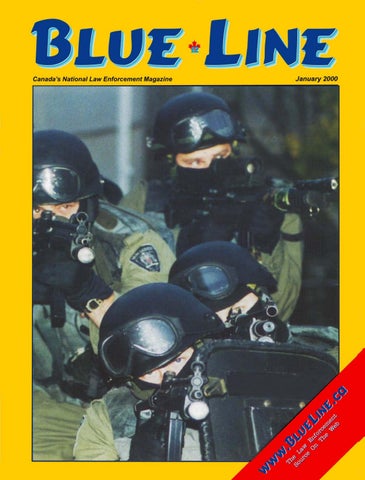
The Vancouver Police Emergency Response Team is our first feature story of the Millenium and Blue Line is certainly proud to have them grace our cover. In this edition you can learn more about close quarter control from Joel Johnston. Joel emphasizes that too few officers are training for close encounters of the nasty kind when they do their entry and room sweeps. Learn more on page 6 of this edition. This month marks the first of a four-part series on the subject of shiftwork and the police. Over the next four months we will be presenting considerable food for thought about this most serious subject. We have garnered the support of some well respected individuals to assist our readers in understanding the shift work environment. We hope to also supply some coping mechanisms to assist you. It is not an easy subject to tackle because, as one expert stated, no one has really sat down and studied the whole area in depth. It was explained that it would take a couple of years to simply gather the data, literature and information that currently exists. Then someone would have to analyze and study it. Blue Line can only do its small part and perhaps it will be enough to get people going on this much neglected subject. There is much more to find out about in this edition and we certainly hope you walk away from each issue a little wiser. That is our only real goal. Happy New Year!
List of Advertisers Blue Line News Week Blue Line Canadian Body Armour CAPS Inc Dalhousie University DuPont Henry’s Howard Leight Industries Kleen Bore Laser Labs Lethbridge Community College Matt Industries Most Wanted NOPAAT 3
33 32 7 21 17 37 27 5 8 25 31 10 34 29
Pads Fitness & Supply Panasonic Canada Pegasus R Nicholls Distributors Rocky Shoes & Boots Sokkia Corporation Sturm Ruger Tetragon Tasse Trauma Management Training Services Triform Business Systems Westervelt College XTE Custom Outerwear Zarc International
Blue Line Magazine
27 4 32 19 40 35 11 25 18 23 21 25 15
by Morley Lymburner
Blue Line has grown steadily over the past eleven years and as we step onto the threshold of our twelfth year of publishing we look back with pride on what has been accomplished. We have enjoyed a popularity that we had never envisioned in 1989 when we started. It was a bold gamble that came along just in time for a changing police profession. Blue Line is based on the principle of recognizing the need for a professional journal that is independent of both management and union agendas. Blue Line’s goal is to report the facts in as straightforward a fashion as possible and encourage those involved in law enforcement to look upon their task as a true profession. Blue Line has taken on many challenges over the years and has not shied away from controversy if it is needed. We do not believe in the principle of simply doing things because they have always been done that way. If it has to be done then we want to know why. If something is important enough to have highly trained and skilled people change their way of doing things then there must be someone who can explain the rationale. We want to know why. We want to tell you why. If we can’t find out why then we will keep asking until someone answers. You... our readers... deserve nothing less. This in-your-face type of journalism is not
January 2000
meant to be performed in a controversial or alienating fashion. We invite people to talk about their concepts in their own way. If appropriate we will give them free reign to make their point. The writer stands on the merits of what they write and you are the judge of its validity. If someone feels they have a point but not the talent to put it in print then it is our job to help them make their point and we have done so on hundreds of occasions. As we have stated before it is the issues that are important not the personalities behind them. We encourage our readers to simply get their thoughts down on paper and get them into us to work on. It is our job to make your material look good to our readers. Blue Line Magazine has evolved into a rapidly growing multi-faceted organization. We have listened to the needs of our readers and the times. To this end we are not just a magazine anymore. We are a central clearing house of law enforcement thoughts, news and information. What started simply as a magazine now has five components inter-related with each other; Blue Line Magazine being the flagship and central focus of the organization. Blue Line News Week is the news gathering and dissemination branch. It keeps its subscribers up-to-date every week with all the news across Canada that affects or can have an affect on the profession of law enforcement. The Annual Supply and Services Guide is the products and marketing information branch.
5
It is sent out with the February issue of Blue Line Magazine and is the result of an extensive annual survey of all the companies and individuals who have goods or services of interest to law enforcement. If there is an interest in you and your job they will be listed in this directory. Blue Line Response Trade Show is the faceto-face opportunity our readers are given to meet and see the goods and services available to them. Rather than simply read about it you are given an opportunity to meet and discuss your interests and needs with the people who can fulfil those needs. In its fourth successful year this show attracted over 1,000 registrants last year. The show, held the third Tuesday and Wednesday of April each year, is strategically timed and placed to facilitate these transactions. www.BlueLine.ca is our next generation of services on the internet. We have found our readers are both demanding and technologically sophisticated. When they need information quite often it is needed quickly and reliably. If you need to search for information on a wide array of subjects you will find it here. If you need to connect with other law enforcement agencies or government agencies you can find it here. In all our endeavours we aim to fulfil the needs of our constituent readers. We simply have no other purpose. We are ready to take on the next millennium.
Blue Line Magazine
Entry team close quarters control tactics When they don’t comply... then what?
by Joel Johnston Many ERT training programs do not include realistic Close Quarters Control (CQC) Tactics to deal with the reality of spontaneous unarmed non-compliance or aggression, and the reality of the ‘Survival Stress Response’. Many programs assume that everyone will comply when facing the intimidating presence of an Entry Team. They may assume that individual Team members already possess the skills to overcome such resistance if it is encountered. Some assume that deadly force is automatically justified if an Entry Team is interfered with. Programs also often fail to encourage training in the gear and with the equipment that the Team would be wearing and using during a live entry. Finally, many programs fail to train in a ‘chaotic environment’. Let us picture the scene. It’s a cocaine search warrant, you need to get the evidence before it is destroyed and along with it, a successful prosecution. You have done your reconnaissance, planned the operation and carefully detailed it in a briefing to all involved. Your Team, your support containment, the Drug Squad members all understand their roles. Since the “reccy”, the house has been under January 2000
close observation for over an hour. As you roll up to the location you visualize the approach and the entry, you know to expect a couple of ‘subjects’ inside. You move quickly from the van in full protective gear over your clearly visible police uniform. Your ‘Breacher’ hits the door knocking it wide open. Your four-shouts: “POLICE, we have a warrant!” as the Team enters. As you move through the front hall a subject appears with no shirt on and his empty hands in the air. He yells “it’s the cops!, it’s the cops!”. You shout at the man to get down on the ground as you approach. He appears to submit but as you get to contact distance he becomes resistive and blocks your path, all the while yelling apparently to someone else. As you wrestle to control this resistive subject the Team is slowed down, losing critical time and momentum. Eventually the subject is wrestled under control and the Team is able to move on. You find the second subject on the bathroom floor with several empty plastic bags at his feet and one in his hand. He gives up. The residence is searched and secured and turned over to Drug Squad investigators. Unfortunately the evidence that they hoped to retrieve is not found. Is this scenario a possibility? What would 6
you do if faced with unarmed non-compliance during an entry? The answer is the old “It depends!” It depends upon the context of the entry, and the nature of the non-compliance or resistive behavior. What is certain is that you cannot justify shooting someone simply because they resisted during a high-risk entry. Nor can you expect that everyone will comply, and when they don’t, to carry out an effective plan on the spot. ‘Survival Stress’ research clearly indicates that a critical mental ‘reactionary gap’ is likely to occur as you attempt to recognize and identify the threat and then to formulate a plan to deal with it. Most incidents of non-compliance, resistance or aggression occur spontaneously and are unexpected. They also tend to occur at very close quarters which eliminates some officer response capabilities while providing opportunities for others. Entry Teams must anticipate unarmed non-compliance or aggression and prepare for it in advance. Then when it does occur they simply react by implementing a pre-planned, trained response. The mental ‘reactionary gap’ is no longer an issue. The goal of any Entry Team must be to resolve all encounters at the lowest possible Blue Line Magazine
level of intervention. However, the immediate behavior of the subject(s), in conjunction with the totality of circumstances will dictate the response options deployed. If the subject(s) chooses to comply, high-level presence, communication and follow-up control will not be exceeded. But if the subject(s) resists, you must have viable, court defensible options at all levels. Close Quarters Control Tactics skills must be simple, both to learn and to employ. They should be based upon gross motor skills, giving officers the ability to retain and effectively use them under the stress of an actual entry situation. The number of techniques should be kept to a minimum in order to minimize response time (Hicks’ Law). Responses must be flexible allowing officers to adapt them to a variety of circumstances. For example: operating in narrow hallways, on staircases, on uneven terrain and in standing, moving and ground fighting situations while wearing and carrying specialized, cumbersome equipment. These CQC skills need to be tactically effective, specifically geared to ending the resistance or aggression in the shortest possible time frame so that the Team can keep moving to meet its objective. Generally, all members of an Entry Team are actively armed which creates some special considerations for CQC. Some Teams designate an Empty Hand Control member for CQC purposes, however this has potential serious limitations. For example, the designated member may not be the one who is attacked; the Team may break into 2’s to search multiple areas; etc. This means that all Team members must practice, consider and exercise weapon discipline during CQC. Controlling the muzzle, putting the weapon on ‘safe’ where possible, and maintaining the finger outside of the trigger guard. Team members must also be conscious of weapon retention issues for their dedicated weapon and their sidearm. Once a resistive subject is controlled they must be effectively restrained, immediately, so they can be passed off, removed, or safely left behind, and so they do not compromise the remainder of the operation either physically or audibly. Obviously this is a critical “officer and public safety” concern! The use of flex cuffs and duct tape, in a trained manner, to maximally restrain and silence a subject is necessary and justified under these circumstances. Entry Team CQC Tactics should include kicks, stuns, strikes, weapon strikes, trip throws, weapon retention, and fast subject restraint. These skills must have the adaptability to be applied at all angles, in a variety of environments (hallways, up stairs, down stairs; into small rooms, in and at corners, on the ground, etc.). Of course it is imperative that all Team members practice these skills in full working gear (having regard for safety in training!). After covering all of the theory, basic elements, and fluid drills, your CQC program must include dynamic simulation in order to create realism in training. It forces the Team to adapt the learned skills to live ‘spontaneous’ situaJanuary 2000
tions that have built in safety mechanisms. It is the closest we can get to the real world. Remember, a dynamic entry into a building, even when done in full ‘battle dress’, and with the use of diversionary devices and tactics does not always ensure voluntary compliance. But as an Entry Team you cannot afford to be impeded or to deviate from your mission. Yet if facing clearly unarmed, but non-compliant or assaultive behavior, you may not be able to justify the use of the firearm. You must have the ability to control this type of behavior worked into every entry plan. You must respond immediately in accordance with your plan in order to quickly and efficiently gain control so that you may move to your objective. You cannot do any less - people are counting on you!
7
Joel A. Johnston is a Sergeant with the Vancouver Police Department Emergency Response Team, former VPD Control Tactics Coordinator and is a Principal of DTI Defensive Tactics Inc. He is the Use of Force consultant to Blue Line Magazine. Sgt. Johnston has developed a comprehensive CQC Training program based upon these concepts. You may contact the author through the Vancouver Police Department, 312 Main Street, Vancouver, B.C., V6A 2T2.
Blue Line Magazine
Officer need not answer lawyers’ questions after an arrest by Gino Arcaro R.v. Stenset (1999) (Alta. C.A.) Issue: After a police officer arrests an impaired river, does the officer have a duty to tell the accused person’s lawyer what the reasonable grounds were for the arrest before the lawyer advises the driver whether to take a breath test? Circumstances: The accused person was stopped by the police and was arrested for impaired driving. The right to counsel was read to the accused and he was transported to the police station. The accused selected a lawyer from a list of names. The officer dialed a
number and spoke to a lawyer. The lawyer asked the officer what the reasonable grounds were to believe that the accused committed the offence. The officer declined to answer the questions. The lawyer then advised the accused not to take the breath test. The accused was convicted at his trial for refusing to provide a breath sample. The accused’s appeal to the Alberta Court of Appeal was dismissed for the following reasons: • the police have no obligation to answer questions to a lawyer, after an arrest relating to
Accused not told of immediate right to lawyer A man arrested outside a Yellowknife Post Office for possession of a package of marijuana has been found not guilty of trafficking charges because police failed to advise he had a right to speak to counsel immediately. The man pleaded guilty to simple possession of the drug and was given a fine instead of the jail term he would otherwise have been facing. Self-incriminating statements made to police during the arrest on the street and subsequent interrogations at the police station were excluded by Justice Brian Bruser of the Territorial Court Northwest Territories. The judge found that the accused “knew he had the right to talk to a lawyer, but not at
January 2000
that time... the police said nothing to him about immediately, right now or anything to that effect...” the judge ruled. After the accused incriminated himself, he was quoted by the police as saying: “in this whole time I could have not said anything at all!” The judge stated that by this statement the accused finally understood, although too late, his real situation with regard to legal advice. The judge determined the accused did have his right to counsel infringed and that all the evidence obtained via his conversation with the police was to be excluded. The Crown found itself with nothing more than a man with possession of a box full of marijuana. Accordingly the accused plead guilty to this offence.
8
what evidence constituted the reasonable grounds to arrest. • a question that asks to explain what the reasonable grounds were for an arrest is not a factual question. The request involves more than facts. It involves knowing what are the relevant legal rules. • even if the lawyer had a right to ask purely factual questions of an officer, the officer has no duty to answer.
Victims of Crime Bill proclaimed in force Bill C-79, legislation to enhance the safety and privacy of crime victims, was proclaimed in force December 1. Its new Criminal Code provisions ensure victims are aware of victim impact statements, and allows them to be read aloud in court; requires courts to consider victims’ safety in bail decisions; restricts the right of unrepresented defendants to cross-examine; permits judges to ban publication of victims’ and witnesses’ identity, and requires offenders to pay victim surcharges. Gino is a professor at Niagara College and author of Forming Reasonable Grounds. If you have questions regarding case law E-mail him at blueline@blueline.ca or Fax 905 640-7547.
Blue Line Magazine
A new approach to police duty belt discomfort Most patrol officers can relate to the physical aggravation that the modern-day 14 pound duty belt causes. After working a shift with the belt tight around the waist officers can experience a dull lower back pain, bruised hips (especially on female members), the gun digging into their hip bone and rawness of the skin in the area that the belt was rubbing. In addition to this pressure on the stomach, especially when sitting in the cruiser, will often cause acid indigestion. Over a number of years Ottawa Carleton Regional Police Constable Mark Scharfe noticed that the discomfort and debilitating pain was common to all officers. Mark was spurred into action when he discovered his Police Association voted to have their premiums increased by over $20 per month to cover chiropractors and physiotherapists. "I thought this was ridiculous," Mark states. "But I did not realize how many officers had such trouble with their backs. Officers that weren't going to chiropractors didn't want to miss this coverage because they thought they might need it one day. You would think we were unloading boxcars of potatoes all day instead of riding in police cars." In September, 1995, in an effort to solve this problem, Mark made up a prototype set of duty belt suspenders to balance the weight of the belt between his hips and his shoulders. Mark found that this permitted him to loosen off the duty belt so that when he was sitting in the cruiser, his stomach was able to expand. Mark’s doctor suggested his indigestion was caused by the tight duty belt, putting pressure on his stomach when he was sitting because it could not expand. Although not possessing a washboard stomach any more, Mark was advised that this would be a common problem for many people with a wide variety of body conditioning. Over the next few months, Mark ironed out all the bugs to the point of having leather suspenders to suit all aspects of the officer and his/her duty belt. Mark mentioned to his fellow officers the benefits he personally realized from the prototype suspenders. A number of them indicated that they had similar discomfort and suffering with their belt so Mark provided them with sets of suspenders. He was quickly advised that they would not wear the duty belt without the suspenders. Officers were going to chiropractors on their days off, suffering with colitis, acid indigestion and bruised hips. One noticeable symptom is officers continually pulling their gun belts up to relieve the pressure. Standing for hours during a shift can be extremely uncomfortable. Getting in foot pursuits or walking the beat are also obvious activities that can cause considerable discomfort as well. Given his initial success Mark spoke with Deputy Chief Alex Mackie and requested funds to have a number of officers tested at the Montfort Injured Workers Centre in Orleans, Ontario. Deputy Chief Mackie obviously remembered very well the aggravation of the duty belt and without question, authorized the testing. Eight officers, encompassing a wide range of officer activity, were tested. Selection included considerations such as age, sex, and years of service. They were tested with and without the police duty belt suspenders. The testing concluded that “the overwhelming majority of the January 2000
officers showed objective, measurable improvement in performance when tested wearing the belt supports (suspenders). This correlates positively with Mark’s subjective findings. Based on the testing preformed it was discovered that use of belt suspenders improved physical performance, decreased pain, and increased selfreported ease of functioning.” The Ottawa Carleton Region Police Service executive, on reception of this report, authorized the use of police duty belt suspenders to any member requesting them. As with any change, policy had to be implemented because under no circumstances, were the suspenders to be visible to the public. Present procedures indicate that it is imperative that they be worn under a body armour vest or jacket because of the possibility that a suspect could grab them to disable the officer. Many members have found that even in the high humidity summer days they are more comfortable wearing the suspenders. On the advice of Blue Line Magazine Mark contacted the National Research Council’s Canadian Police Research Centre (CPRC) in Ottawa with this new police product. As a result, the CPRC is conducting a national survey through their Technical Partnership Associates program on potential field evaluators of the suspenders. During Mark’s studies and other research several other benefits of the suspenders include: • Officer’s clothing and appearance is improved. Officers do not have to continually tuck in shirts in the back because the suspenders assist keeping them in place. • The belt can be kept level and at the same position at all times. This eliminates the space that forms between the bottom of the vest and the top of the belt. This is very noticeable on officers issued with different coloured shirts than vests. Mark states that he has found the three sizes, small, medium, and large, will fit all shapes and sizes of officers, both male and female. Although he had considered making them 9
from man-made woven nylon strap material, he found that to conform to the different sizes and shapes of individuals, a high quality leather provided the best comfort. Over time, the suspenders do stretch, but are easily adjustable, much like a leather belt. The suspenders have a patent pending. Mark strongly feels that any officer that suffers from the duty belt should acquire these suspenders and take the invoice to their Health and Safety co-ordinator for reimbursement. To assist in this process a copy of the testing from the Montfort Injured Workers Centre can be obtained, as well as the comments of the officers that were tested. It is presently being developed through the assistance of the National Research Council of Canada. Instructions for police duty belt suspenders The Duty Belt Suspenders are measured by the distance from the top front of the officer’s duty belt (while officer is wearing his/her duty belt in a comfortable position) to the top of the back of the officer’s duty belt-over the shoulder. It is important to measure the distance from where you want the belt to stay. This may be one or two inches higher than where it sits on your hips presently. Sizes: Small 30" - 36" Medium 36" - 41" Large 41" - 47" Xlarge 47" - 53" Further details may be obtained from the CPRC request for evaluation or contact John Arnold at the National Research Council at 613 993-3737 or by e-mail at john.arnold@nrc.ca Suspenders can be purchased from: Millennium Police Supply 4880 Baseline, Gloucester, Ontario K1G - 3N4 Phone: (613) 795-2637 Fax: (613) 822-0482 e-mail: milenium@magma.ca web page www.magma.ca/~milenium You may also buy the suspenders and speak to Mark directly at Blue Line Magazine’s Response 2000 Trade Show on April 18 and 19. Blue Line Magazine
The Odd Squad peers “Through a Blue Lens” by Floyd Cowan During their many years of working the skid row area of Vancouver veteran police Constables Al Arsenault and Toby Hinton must have often thought that if young people could see what a drug addict’s life is really like they would never want to do drugs. Cst. Arsenault began to take this thought into action when he began taking photos of the people and situations he came upon. He found they were a very effective tool when making presentations to school students. It brought home the grim and ugly effects of drug addiction. The officers then decided to take this idea one step further and film life in the Downtown Eastside, the site of the worst drug abuse and HIV epidemic in Canada. This resulted in “Through a Blue Lens”, a National Film Board of Canada production that is a graphic and realistic account of the life of drug addicts and the “hellish existence” these people endure. For one year seven officers, who call themselves the “Odd Squad,” followed the lives of six addicts, interviewing people, filming life on the street and talking about their experiences. The film is sometimes freakish as the addicts show the self inflicted damage they have done to their bodies, but more often it is sad and touching as we see the drug addicts as people and their tremendous struggle with demons they cannot shake. Equally moving is how it humanizes the police who found their attitudes changing as they learned about the addicts’ pasts, how they became addicted and how they survive on the streets. Through a Blue Lens begins with Cst. Arsenault showing high school students a picture of a wide-eyed 18 year old girl. “Does she look like a drug addict?” he asks. “No!” they respond. Then he shows another picture of the same girl, six months later, her face covered in sores, cuts and bruises and he states, “She’s on the needle. She didn’t know she had an addictive personality. She does now.” The message has hit home. The astounded
look of almost paralyzing shock on the students’ faces shows the presentation has hit them where they live. It is these young people that the cops want to get the word to. And the addicts on the street want them to get the message too. The first time Cst. Mark Steinkampf met Carlee she had just called 911 and the police and the ambulance were there, taking away her partner, John, who had just shot himself in the face and would soon die. “At first she said, ‘No, I don’t want to be interviewed. Why would you want to interview me?’ I explained that it’s to keep kids away from addiction of cocaine and heroin. And she right away said, ‘Yeah! Yeah! I’ll do that.’” The officers talk directly to the camera telling of their experience, and the camera follows them on the streets, down the back alleys where they come upon a young man who is obviously overdosed, sitting in doorway, mouth agape, eyes lifeless. The cops immediately begin to assist him, an ambulance is called, and none too soon as he stops breathing and has to be resuscitated. The message is clear, if you are going to do drugs, this is where you’re going to find yourself. Nicola, thin, pale, teeth missing, hair a tangle of filth, is chowing down on food the officers have bought for her. She wanted money for a meal, but they insisted on taking her to a nearby restaurant. “I certainly didn’t know when I was 15 years old and somebody stuck the first needle in my arm that it was as addictive as it is,” she says between mouthfuls. “It was a joke. It was a game. I had a 39-year-old inject me with the first shot of cocaine I ever had. I swear to God if anybody ever did that to my kid now, I’d probably have their fingers broken once a week. That’s just how I feel.” What touches the officers is that most of the drug addicts, with the scared faces, the emaciated bodies and the addiction they can’t kick, were normal young people. Randy was an excellent athlete, they show a photo of him as a young man getting into his hockey gear. He might have had a pro hockey career - if it
wasn’t for drugs. Others played with dolls, just like normal children, because they were. However, once they started doing drugs their lives changed, and for most of them, irrevocably. The suffering, the deterioration, the wounds their addicted, living on the streets lifestyles inflicts on their minds and bodies, is sometimes horrifying, always painful and something they battle with, but usually can’t escape. “We asked them - did you intend to become a drug addict?” says Arsenault. “And they tell us, no, we came down here to party for a while, or we just wanted to mask the pain. And now we’re in a living hell.” You want to look away when the officer asks Carlee to show her wounds, and the camera moves in close to show the ugliness that she has inflicted on herself. When she’s high she sees bugs on her arms and she picks at them. She picked away her flesh as she couldn’t leave her wounds alone long enough to heal. It is difficult to imagine Randy as having been an athlete when you see him writhing on a Vancouver street in contorted motions that look anything but athletic. Randy’s body is deteriorating on him. A small cut on his leg spread into a large and festering wound. Working in the Downtown Eastside is hard on the police, and Through a Blue Lens shows their human side. Many of them burnout after just a few years on the beat but whether they stick to the job or leave, it has an effect on them. “When I first started working down here they were all just addicts, hypes and trash... essentially human garbage,” Cst. Len Hollingsworth explains. “Just a waste of society’s money and taxpayers’ dollars. But when you get to know a little bit about these people and their stories, you can’t help but have compassion for them. These people have mothers and fathers that love them, just like we love our children.” You may find your own perspective changing as the film brings you into personal contact with the addicts. You may have nothing but loathing for them when you see them writhing on the ground in drug-induced hallucinations but when you hear their stories, when you see the police officers dealing with them in a kind and humane manner you’re reminded that they are human and not just drug addicts. As you follow their stories you no longer think of them as drug addicts first and people second, just people who have got themselves into a hellish nightmare from which their is no escape. “I’ve turned into a bit of a softie in dealing with some of these people,” admits Cst. Toby Hinton. “I was a lot more hard-nosed when I first came out of the academy. But now I understand that there’s a hell of a lot more to policing. If you want to police a neighbourhood, you want to take ownership of it. You want to become part of the solution.” For those wanting a copy of the video they can phone the NFB at 1-800-267-7710. It will be available from mid December. Cost is $39.95 if it is to be used for a public showing and $19.95 if it will be shown in the privacy of your own home.
January 2000
10
Blue Line Magazine
Police Chaplaincy - A ministry in blue to God’s people by Michael Dunnill The police chaplain’s role has changed dramatically in the past two decades. Police chaplaincy used to be a ceremonial function until the 1980s, with the chaplain called upon to dedicate the occasional police building or to say blessings at police-related functions. This is not so today. Most chaplains, like myself, are volunteers. In Canada, there are only two full-time, paid police chaplains, serving the Edmonton Police Service and the Quebec City Police. The police chaplain today is a trained professional who works with police in serving the community and attending to the officers and civilians employed by the police force. Chaplain John Price of the Albuquerque Police, a founding member of the International Conference of Police Chaplains, said in a speech to chaplains: “Response in crisis is the calling of the police chaplain. Response to God’s call is his daily fare. He is a person who brings to the lost, the least, the lonely, the love of God. Here is the arena of life, and here, people are battered and beaten and questioning the existence of God. “Here, by all the Jericho roads, lie all the victims that the frightened and fearful would pass by. Here in the gore and the grime, people cry that God, if He does exist, doesn’t care. This is where the chaplain lives.” Just what are some of the responses that a police chaplain must make? Looking at the Thunder Bay police chaplain’s logbook for the past year or so, we get a glimpse into the work both of the police and the chaplain. The past year (1997) began with three homicides in the first month. The year was less than two weeks old when a double homicide occurred and then as January ended, a third murder took place. The third murder was that of a 19-year-old gas bar attendant. Blair Aitkens was closing up the Can-Op station when he was shot. He was rushed to hospital and the watch commander called me to go to the intensive care unit. Blair died almost immediately, but his family wanted their son’s organs donated to others in need. I spent many hours with the Aitkens family in the intensive care unit and then at their home. The family did not have a church affiliation and requested that I take the service. The community was rocked by this tragic event and I found myself ministering not only to the family, but also to Blair’s many friends and, to a lesser degree, to the entire community. As it turned out, the same man had committed all three murders, and he subsequently pleaded guilty and was sentenced to life in prison with no parole for at least 25 years. January 2000
One of the common calls that come to chaplains is to accompany a police officer to make a death notification. When a person dies as a result of a traffic or industrial accident, the police must be the bearers of bad news. It is probably the task that officers dislike most. There is no easy way to tell someone that a husband, son, father, wife, daughter, or mother has died. People go out the door to their day’s work and, unfortunately, there are those who never return. The chaplain accompanies the officers to give this terrible news, not because the chaplain can do it any better, but to try to offer comfort and assistance to the bereaved. It is the role of the officer to make sure that the family’s questions regarding the cause of death are answered. The officer knows the facts of the case. The chaplain is there to help the family contact other family members and the clergy person who may be able to assist the family. In many cases, the family will ask for a prayer and help right at that time. The most frequent calls for death notification are after suicides. No two suicides are the same. There was the man who took his life in the police parking lot. Another overdosed on drugs. Others use guns. One young man soaked himself with gasoline and struck a match. Just before Christmas, a young woman hanged herself. Another died of carbon monoxide poisoning. In many of these cases, be it murder, accidental death, or suicide, the officer who is involved may also need comfort and help in coming to grips with the dark side of his or her profession. It is not easy to see what happened when someone has shot himself, or after a young boy sets fire to himself. It is not easy to have to go out to a quiet home and tell a family that a son has been murdered. It is not easy to pick up what is left of life at the scene of an accident. And then there are others who need ministry, such as the man who tried to smother the flames on the burning boy. On ten evenings in the past year I found myself in the passenger seat of a Thunder Bay Police cruiser. These evenings are called ridealongs. They give me an opportunity to understand the stresses of life as an on-duty police officer. Many evenings the calls are routine, but sometimes I find myself ministering to people in their homes as we answer calls. The calls range from breaking and entering to domestic abuse, to a teenager who has trashed a home or apartment. And there are always calls to bars where trouble has erupted. In some cases, things quiet down when the troublemakers see a priest. In other cases, the chaplain has the job of picking up officers’ hats that go flying in the scuffle. As the year ended, I was called to testify at the coroner’s inquest into the death of a young man who had taken his own life, as I had been one of the persons who had negotiated with him. Listening again to our taped conversations 12
and our pleas with the young victim, the negotiators and I were overcome by our unfortunate failure to convince this young man that he was loved. There are also pleasant tasks for a chaplain. From time to time officers have asked me to officiate at their weddings. I am also asked to speak to community groups, service clubs and churches regarding police chaplaincy. There are times when I am called upon for confidential counselling. It has been my practice to pray with the officers each Thursday morning at briefing before they head out to the streets. Throughout the year, many members of the police service, sworn and civilian, have brought their prayer concerns to me and these are remembered as we gather on Thursdays. I feel that this action has been of benefit to all as we come to think of ourselves as a “police family.” On a sad note, this can also mean comforting officers and their families when loved ones die. Towards the end of the year I spent many hours with a retired officer who was dying of cancer. And, as 1998 began, one of my first duties was to bury that man. On the last Sunday of September, the annual Police Memorial Service is held on Parliament Hill. As many of our officers never have the opportunity to attend this, I have held a similar service in Thunder Bay for the past six years, going to a different church each year. At the annual training seminar of the International Conference of Police Chaplains (ICPC) in Duluth, Minnesota, in July, I was elected to the office of first vice-president, having served two years as second vice-president. The ICPC is a worldwide, professional organization of more than 2,000 chaplains in 12 countries. There were more than 350 chaplains in attendance from Canada, the United States, Jamaica, Australia, Great Britain, Zimbabwe and Kenya. I also attend the annual training seminar of the Canadian Police Chaplains Association in Niagara Falls in October. Much of our instruction has been on problems inherent to gambling casinos. There are several new social and criminal problems that accompany the introduction of a casino to a city or town. This article is based on my annual report to the Thunder Bay Police Services Board, in which I acknowledged with thanks the patience and understanding of my wife, Marilyn. Her support allows me to spend the volunteer time and effort necessary to make this chaplaincy effective. Rev. Michael Dunnill is an Anglican priest serving as honorary assistant in the parish of St. John the Evangelist in Thunder Bay Ont. He has been chaplain to the Thunder Bay Police since 1988, as well as to the Thunder Bay Police Association. He is a recipient of the John A. Price Excellence in Chaplaincy Award and a founding member of the Canadian Police Chaplains Association. For further information you may contact him at 807 768-0457. Blue Line Magazine
As long as there is a child in need Cops’ North American tour bike ride raises over $35,000
erly receptions we received from police agencies throughout the states gave us a lot to think about.
by Devon Clunis
On a cold, rainy morning in September, the From Winnipeg to sixteen member poBrownsville lice bicycle relay For the majority of our ride throughteam embarked on out Texas, we had police escorts. Houa 3,200 kilometre ston Police alone provided five cruisers bicycle trek to which accompanied our members for Brownsville, eight hours throughout and around the Texas, a border city at its most southHouston area. Individual county officers ern boundary with Mexico. escorted us from county line to the adjaHaving traversed our country cent county, where a jurisdictional officer from coast to coast in 1995 and 1997, was waiting for our arrival. raising over $75,000 on behalf of the The team had a paradise moment Children’s Wish Foundation, the rein Corpus Cristi where we stayed at a lay team was looking for a new chalfabulous hotel right on the beach. It was lenge. With the excitement and intera tough decision choosing between Clyde Raven and members of the Waco Police Bicycle Unit national flavour of travelling to swimming in the Gulf of Mexico or in Mexico, the team voted quickly to the massive swimming pool. take on the “North American Tour” The City of Brownsville sent a contingency challenge. Our team chose this slogan to deof bicycle, motorcycle and patrol units to greet note our anticipated accomplishment of visitus twenty miles outside the city, and escorted ing Canada, U.S. and Mexico on bicycles. us right to the U.S. / Mexico border. There’s The dismal weather which bid us farewell nothing quite like the feeling of camaraderie at the morning of September 5, was a stark cona time like that. It truly served to remind us of trast to what was awaiting us as we pedalled the strong invisible thread that binds law enour way south. Torrential downpours, spectacuforcement officers. lar lightning shows, and stifling heat were some Are we there yet? of the obstacles we had to contend with in orThe team arrived in Brownsville at 4:30 der to complete this momentous ride. p.m., Friday, September 10, and ironically this The trek from Winnipeg through North is where we received the most attention from and South Dakota proved all too familiar. Flat Winnipeg media. CBC Radio called us and conprairie, after prairie, after prairie, and more praiducted a radio interview with Bob Keber at the rie. But we were thankful because it made for U.S. / Mexico border. an easy start to the ride. I only wish someone A little southern flavour The team spent the following two days in warned us about the American breed of mosThe team was lucky to have the company Brownsville and experienced a little of the southquitoes. On each stop to change riders, we were of a state trooper throughout the night. He ad- ern flavour. A highlight of the stay was an expegreeted by hordes of the pesky insects, buzz- vised when the lightning was getting too close dition to the Mexican border town of ing, biting and causing you to wish for a rela- for comfort, forcing us to take cover under an Matamoros, which was within walking distance tively peaceful night in a water filled ditch overpass at one point. Then it was out of the of our Brownsville hotel. rain and into the heat. The reality of life in Mexico, simply a hunsomewhere in Winnipeg. The first real signs of heat came when dred yards or so away from a prosperous U.S. Leaving the Dakotas we travelled south without too much excitement to the land of corn we entered Texas. The best description for the city, gave you a humble appreciation for your and more corn, Nebraska. Some of our mem- weather was, HOT, HOT, HOT. At least that’s personal circumstance. You can find little to bers had their mitts poised, waiting to see base- how I felt basking in the glorious tropical complain about when you see the conditions in ball players emerging from the endless fields weather. Thanks to the sponsorship of Coca which these people live. Each one of us shared of corn and challenge us to “play ball”. Unfor- Cola and Wal-Mart the team was supplied with the same sentiment that this is something every tunately, none of us got the chance to hit that ample water, PowerAde and snacks to get us Canadian should see first-hand. We would realsafely through the heat-zone. ize what a truly wonderful country we have and home run. Along with the heat, the team was hop- never again take any of it for granted. Then it was on to Kansas. It certainly had As we sat around the swimming pool at our a different kind of surprise in store for us. We ing to catch a glimpse of the elusive Texas knew that this was the prime tornado region, armadillo. Sad to say folks, we saw plenty of hotel and reflected on the journey; the difficult and yours truly was praying none of us would the critters, but they were all flat; a.k.a. road stretches of highway, the storms, the heat, the kill. We saw all kinds of dead things in Texas. aches and pains that some of us experienced, it end up joining Dorothy and Toto in Oz. But instead of tornadoes, our night riders We saw things we didn’t even know existed, was clear to us why we continue to do what we do. It’s our hope that the result of our efforts; were greeted with a torrential downpour, 60 and still don’t know what they were. I got the feeling that neither man, nor beast over $35,000.00 raised on this trip, gives a child mile per hour winds, and a lightning show which just didn’t know when to quit. It was was safe alone on the roads in Texas. Known a moment of rest from the hardships they enabsolutely spectacular. Still, we couldn’t help for executing more convicts than any other state dure, as they face difficulties and challenges far but feel apprehensive each time we saw light- in the U.S., they can also include “more road greater than any we face. The Winnipeg Police Bicycle Relay Team ning strikes sending sparks flying off in the kill” to that infamous honour. But when it comes to hospitality, you can’t mess with Texas. is committed to continuing its ride as long as distance. They treated us like true celebrities. The broth- there is a child in need. January 2000
13
Blue Line Magazine
An exercise in community partnership A police service’s creativity draws community resources to it. The unlikely partnership between the Waterloo Regional Police Service, an artist, and a motorcycle manufacturer provides a good example of this. In 1998, the Waterloo police force celebrated its 25th anniversary. The police service was formed in 1973 through the amalgamation of eight municipal police forces within the boundaries of the newly formed region of Waterloo, Ont. As part of the various activities planned to celebrate the silver anniversary, a well known local artist was commissioned to produce a painting that reflected the police service’s rich heritage. For more than 30 years, Peter Snyder has demonstrated his versatility in paintings of Mennonite country life as well as in scenes from across Canada and Europe. The background setting of Waterloo’s anniversary painting is the last remaining covered bridge in Ontario, a popular tourist attraction located in the village of West Montrose. Entitled “Conversations by the Covered Bridge”, the painting captures the reality of grass roots policing in a rural setting. Depicting a Waterloo Regional Police officer giving a tourist assistance with directions, the painting is representative of both the police service’s community values and motto, “people helping people”. When Sgt. Paul Driedger went to the Snyder gallery in April 1999 to pick up his copy of the framed print, he spoke to Doug Snyder, the artist’s brother and business partner. Driedger told Doug that Peter should consider creating a companion for the original print based on a traffic officer with a motorcycle. Driedger was a member of the traffic branch at the time, and had experienced first hand the public relations value of a police motorcycle. Driedger explained to Doug how the Harleys draw a great amount of interest and attention from both adults and children. January 2000
“An officer is much more approachable on a bike than in a police cruiser,” Driedger said. “A police motorcycle is instrumental for creating a positive atmosphere with people in the community.” The idea of a second police-related project seemed to interest Doug. He asked for Driedger’s business card for future reference. Little did the officer know that this meeting would develop into a most unlikely partnership. Shortly after the initial conversation, the Snyders invited Driedger and his supervisor to meet with them and discuss some options for a second painting. After subsequent meetings, the project began to take shape. The group thought that be14
cause of the significant history the Harley-Davidson had in policing, the company might be interested in participating in the project as a corporate sponsor. Driedger contacted Bruce Lewin, the logistics and service director of Fred Deeley Imports Ltd., the exclusive HarleyDavidson distributor for Canada. The sergeant invited Lewin to join an information gathering session with the partners. Lewin liked the idea of participating in the project and was especially pleased to have the opportunity to give input at the preliminary stage. Planning the content of the painting involved several brainstorming sessions that led to revisions of the original draft concept. As the meetings progressed, the partners learned that HarleyDavidson’s primary charity, the Muscular Dystrophy Association, would also benefit from the project. Although the police service’s participation in partnership with the Snyder Gallery and Harley-Davidson was an unlikely combination, it never the less turned out to be very productive in many ways. The final product, entitled “Community Service”, depicts a traffic officer at an intersection assisting with a parade. “The concept, represents the community, young and old, coming together for a little fun,” Driedger said. “Something that ordinary people can relate to. “This project is only one example of the many opportunities that exist for police organizations to promote themselves in their community. Would anyone have normally thought to partner a police agency with an artist and a motorcycle manufacturer? Only your own creativity limits the community resources that are available to you.” Both prints are available for purchase at the Snyder Gallery in Waterloo, Ont. For information call 1-800-265-8928 Blue Line Magazine
Putting the brakes on hard-core drunk drivers by Blair McQuillan Increased public awareness and legislative changes are needed to reduce the number of motorists who repeatedly drink and drive, according to an Edmonton police officer. “The first step in initiating any solution or problem solving is to identify the existence of a problem,” said Cst. Darrin Balanik, who published a report on hard-core impaired drivers in March 1998. Hard-core impaired drivers are alcohol dependent individuals who habitually operate a vehicle while intoxicated. The threat of arrest, prosecution and punishment doesn’t deter this individual from getting behind the wheel, often with blood alcohol concentrations that exceed 150 mg%. Balanik says tougher penalties and legislative changes that define the hard-core drunk driver are needed to combat this type of offence. “The most important recommendation, especially on a national level, is to specifically identify the hard-core drunk driver within the Criminal Code, as well as identifying specific sections within the Criminal Code that would directly affect this individual.” In his report, which was prepared for the Traffic Committee of the Canadian Association of Chiefs of Police, Balanik recommends that offences such as drunk driving causing bodily harm, drunk driving causing death and impaired driving should carry increased penalties for offenders who are classified as hard-core drunk drivers. The report also included proposed legislative changes which were presented to the House of Commons by the CACP during a review of impaired driving legislation. However, Balanik’s recommendations don’t just relate to law. The eight-year police veteran has called for increased public awareness regarding the dangers of impaired driving and the gravity of the offence. A 1997 report by the Canadian Centre for Justice Statistics found hard-core drunk drivers make up less than one per cent of motorists on the road at night during weekends, but their chances of being involved in a serious collision are hundreds of times greater than for sober drivers or drinking drivers with low blood alcohol concentrations. Add to this the fact that an American Automobile Association study showed the average impaired motorist drives under the influence 1,380 times for every drunk driving arrest and Balanik’s point becomes clear. “The hard core impaired driver is not a person who makes a mistake and gets caught,” he said. “They’re an alcohol dependent individual who needs treatment.” Balanik’s report suggests that police can help reduce the number of hard-core drunk drivers by making contact with them on a personal level. In Edmonton, citizens are encouraged to notify police of suspected impaired drivers through an ongoing campaign dubbed Operation Look-Out. If police fail to locate the susJanuary 2000
tance from the police station. A pect vehicle on the street, a form portable instrument would be inletter is mailed to the registered valuable not only as a time saver, owner. The letter informs the but also to obtain a breath sample owner that the vehicle was seen within the (three) hour limit.” being driven in an erratic manner, But the report also says there possibly indicating that the driver are a number of factors that could was impaired. If the same vehicle negate the benefit of having such is reported to police on three oca device. casions, an officer contacts the Each patrol vehicle would registered owner in person. have to be equipped with a cellu“My recommendation is lar phone because suspects have more of a pro-active solution,” a right to a private conversation Balanik said. with a lawyer. This means an ofAn officer should be asficer would have to stand outside signed to meet with the registered Cst. Darrin Balanik of the police vehicle so not to owner of a vehicle on the first reoverhear the conversation. In port of erratic driving in cases some parts of Canada, where winter temperawhere the vehicle is associated with a hard-core tures can drop below -35 C, an officer could impaired driver, the report said. “A personal visit allows the police mem- be standing in the cold for a long period of time. ber to identify these persons, where they live Limited cellular coverage in rural areas may also present a problem. and other vehicles at their disposal. This visit The time required to write an impaired may also encourage the individuals to re-exdriving report was another major factor, amine their behaviour.” Balanik said. However, the pro-active approach takes time “There is so much case law on (impaired and police officers cannot spend their day con- driving) that you have to take some time and centrating on one type of offence. But reducing write a very good report so that you leave noththe amount of time it takes to process an impaired ing out and there’s nothing in question when driving case would allow officers to stop more you go to court.” offenders and still respond to other calls. The Ontario Provincial Police have looked “The biggest obstacle in dealing with (im- into this and developed a software program that paired drivers) is the time commitment,” Balanik will reduce the time required to complete pasaid. “Most impaired drivers are on the street perwork. However, the program is currently during weekends between 10 o’clock at night and only being used in the Greater Toronto Area four o’clock in the morning and unfortunately and there are no plans to expand its use. that’s when our high-priority calls come in. Balanik’s report, which makes 15 recom“When we’re the busiest - that’s when the mendation on how to combat hard-core drunk most impaired drivers are on the street.” driving, has gained a lot of attention since it Using roadside evidentiary devices could was published last year. He received an honbe beneficial in some cases, Balanik’s report ourable mention for his work in August at the states. CACP’s annual police awards for traffic safety. “Depending on the size of the municipal district, the use of a portable breath evidentiary To obtain a copy of the report, or for more device might save a great amount of time,” the information on hard core impaired driving, report said. “In a rural detachment, members may contact Cst. Darrin Balanik at 780 426-8100. patrol highways one or two hours travelling dis16
Blue Line Magazine
Designing a tolerable shiftwork schedule SHIFTWORK - FIRST OF A FOUR PART SERIES ensure good lighting and ventilation; minimal isolation; and appropriate first-aid facilities. Implement it on a trial basis once a shiftwork schedule has been established. Provide training about lifestyle adaptations, work load, pace and procedures. Evaluate the success of the new schedule by monitoring health and safety. Pay attention to changes in accident rates, health levels and especially fatigue. There’s no such thing as a perfect schedule, however collaborative efforts will certainly pay off for all parties involved since worker satisfaction and productivity go hand in hand.
Excerpt from Canadian Occupational Safety Magazine Any “irregular” shift, particularly one that includes night-time work, disrupts the worker’s natural body rhythms. A poorly designed schedule can cause acute fatigue, sleep disturbances, gastro-intestinal disorders and other health problems, not to mention a disrupted social and family life. This results in a high rate of absenteeism and low employee morale, and affects productivity. Shiftwork design should be a collaborative effort between management and employees. The process involves the following: Analyze the company’s operational requirements. What are the company’s expectations in terms of productivity, costs and savings? Will shifts be fixed or rotating? How will shifts be staffed? How will communications and maintenance be handled? Survey the workforce. If workers have questions about the new schedule, obtain the answers from management. Workers should be asking about shiftwork policies and procedures. Find out workers’ preferences, and discuss their feasibility. Workers might be unaware of changes necessary to protect their health due to shiftwork demands. For example, twelvehour workdays may appeal to some because of the extra pay and long blocks of time off, but can have serious health effects on the worker. A study of authoritative Occupational Health & Safety resources, (see sidebar this page) reveals these commonly accepted shiftwork practises. Try to address all of these practises when developing policies and procedures: • Reduce night work as much as possible. The more consecutive nights worked, the more rest time should be allowed before the next rotation. • If rotating shifts are necessary, schedule rotations every two or three days if possible. Shorter rotations minimize hormonal disruptions to the body, and prevent fatigue from becoming chronic. • Always change shifts “ahead” and not “backward.” Rotate from mornings to afternoons to nights, and not the reverse. • Always maintain the same sequence of rest and activities regardless of which shift you work. Always get a full period of sleep just before the next work shift so that you are rested and alert for work. • Don’t start a shift before 6:00 a.m. The body is at its lowest peak just before sunrise. Early starting times are associated with higher accident and error rates, fatigue at work, and ineffective sleep. • Allow enough breaks to recover from fatigue during the shift. Workers must be allowed 10 to 15 minute rest breaks. The job should also allow workers to change position now and then, stretch, close their eyes or look somewhere else for a few seconds. January 2000
RESOURCE • Keep schedules as simple and predictable as possible. Inform staff well in advance of schedules. • Allow as much flexibility as possible. Consider individual needs and preferences. For example, workers over 40 have more difficulty adjusting to night shift. • Customize shifts according to tasks. Schedule shorter shifts and longer rest breaks when work requires intense mental effort, hard physical labour or toxic exposure. • Provide suitable facilities to maximize the worker’s safety and comfort. At the very least
The Canadian Centre for Occupational Health and Safety (CCOHS) Publications include Rotational Shiftwork and The Extended Workday Free Inquiries Service 1-800-263-8466 CCH Canadian Limited Master Labour Guide - A Guide to Canadian Labour Law Phone 1-800-2684522 The U.S. National Institute of Safety and Health (NIOSH) produces a wealth of health and safety information products including: Plain Language About Shiftwork a free publication Phone (513) 533-8328.
NIOSHTIC® a CD-ROM database available from CCOHS at 1-800-668-4284.
Dalhousie University Certificate in Police Leadership “Community-Based Policing is an excellent course! The assignments provide a basis for the establishment of a plan to apply Community-Based Policing to your specific department and community.”
Courses begin January 31! Other courses in this unique distance education program include: V Problem-Oriented Policing V Police Leadership and Management Development V Communication Skills for Police Personnel V Budgeting and Financial Management V Policing and the Law of Human Rights V Legal Issues in Policing V Coaching for Police (includes a 3-day workshop) V Police Human Resource Management V Advanced Police Leadership
Garry Roth Senior Constable Leduc County Constable Services Alberta
To obtain a brochure or Registration Form, call our Information By Fax line at 1-800932-0338 or locally at 481-2408 and request Document #0211. For more information, call Sherry Carmont-MacBean, Program Manager at (902) 494-6930 or write to Sherry via e-mail at CPL@Dal.Ca or to the address below:
Henson College, Dalhousie University 6100 University Avenue Halifax NS B3H 3J5 www.dal.ca/~henson/cert-pl.html
17
Learning Solutions for a Changing World Blue Line Magazine
The “Human Element” Trauma management training for law enforcement professionals in a crisis situation.
by Laurie M. Martin, CTS Sooner or later, we all endure trauma or crisis in our lives; it’s part of being human. As law enforcement professionals, however, you experience more crisis situations in the course of a workday than the rest of us will likely see in a lifetime. It’s an occupational hazard; law enforcement is a high-risk profession. But, that doesn’t mean you ever get used to trauma, or hardened to it. It certainly doesn’t mean that you should! What it does mean is that those who work in law enforcement need to acquire new skill-sets which focus on: 1. Taking care of victims; and 2. Taking care of yourself. While the seasoned front-line professional may think he’s “seen it all,” every situation is different, and each person reacts differently to the situation. If you believe you’ve seen it all, then you won’t be giving each situation the unique focus it deserves, and you may be endangering yourself or others. With “pro-active” trauma management training, you learn what to look for, how to deal with it, and how to prevent it. “Re-active” trauma training helps you accept what has happened and your reaction to it, and teaches you how to live “with” the experience, not “because” of it.
Victim “human element” concerns
n”
Trauma management training
Aside from the obvious victims of the crimes and disasters you encounter, there are many other victims in your line of work: your co-workers, your families, and you. Even if you haven’t experienced the traumatic situation first-hand, you may be affected by it. You may hear about an incident from others or in the news. Things may come out in interviews with victims or those accused of crimes. Sometimes an incident will open an old, unrelated wound. Whatever the cause, it can be difficult to admit when you need support. Perhaps you think if you “tough it out” and it will get better. Often it doesn’t. Do you know when you need help and how to ask for it? As well, most people are somewhat stressed by the time a law enforcement professional has to be called in. Chances are, they’re already angry, perhaps a little fragile, and may need to be handled with kid gloves. Do you have the necessary training and skills to accommodate them? Could you alleviate the “hostility to change” often felt by a person in a loss situation? Are you aware of the signs and symptoms of a co-worker who needs help in dealing with their experiences? Are you comfortable with helping them? Do you know how to get them to talk and do you know how to listen? Do you know how to get the best possible interview from a victim? “Human element” thinking means personalizing your reaction for the unique situation. It doesn’t necessarily mean that you have to cry with the client, or give them everything they ask for. It does mean that you should adjust your line of thinking from a rigid procedural point of view, to being more flexible, learning how to say “no” without quoting law, and remaining firm without appearing inflexible. This is a tall order, but it can make the difference between a typical situation and one that develops into a crisis.
Taking care of YOU Today, more than ever, law enforcement professionals need to know how to take care of themselves when faced with stressed-out, devastated, angry, frightened, or hostile people. Budgetary cut-backs translate into longer hours and heavier responsibilities for everyone down the line. Sometimes that means less support and more reactive decision-making. As well, any ill feelings or pent-up anger toward your profession will likely be directed at you January 2000
18
The good news is that both pro-active and re-active training, designed specifically for law enforcement professionals, is readily available. In fact, many workshops are customized to meet the unique and very specific needs of the requesting organization. As well, through “autopilot” training, specific risk management techniques can be implemented to help your organization react automatically in times of crisis. A myriad of programs are available to teach you about trauma and crisis. You can learn about: • the phases of trauma • the different stages of anger and the appropriate defusing techniques • sensitive communications (death notification, suicide intervention, how to deal with survivors • the importance of taking care of yourself during and following a traumatic incident, or when helping others through their trauma • techniques to help get the best victim interviews • supporting co-workers after a crisis • communicating properly, rather than victimizing with words • safe practices and potential triggers for violence during a home visit • victim responses and how to understand them • being “victim sensitive” (avoiding misunderstandings and complaints) and • fostering a healthy and productive recovery. One thing we need to learn is that we should support the field in the manner in which they “need” support, rather than offering what we “think” they need. To be human is to experience “crisis”, and whether an incident is positive or negative, it becomes part of who we are. As law enforcement professionals and civilians alike, we need to attain the necessary skills to embrace the bad with the good. We have to cease to be afraid of what may come, and decide to handle what is. It goes without saying that effective Trauma Management Training is essential equipment for those who have made the law enforcement profession part of their lives. Trauma Management Training Services Ltd. (TMTS) is dedicated to helping individuals and organizations understand trauma, be prepared in case it happens, and survive it if it does. Using international award-winning videos, highly-acclaimed training programs, and unique products and services, TMTS offers pro-active training and re-active support. Laurie M. Martin, CTS is President of Trauma Management Training Services Ltd., based in Guelph, Ontario. For more information on their training video and programs, please call: 1-800-345-4168, fax: (519) 824-0901, or e-mail at laurie_martin@tcubp.com.
Blue Line Magazine
Blue Line Symposium will give you a new vision for policing Don’t miss this important opportunity to expand your knowledge, understanding and skills. Blue Line Magazine’s annual trade show, ‘Response 2000’, will be taking on an entirely new dimension this year. In addition to the vast array of products and services displayed in the trade show, registrants will be given the opportunity to attend a series of courses that will broaden their knowledge in a wide range of topics related to the law enforcement profession. Each course will consist of one-half day of instruction by qualified leaders in a variety of police disciplines and expertise. These sessions can be attended either singularly or in totality according to individual interests. All courses will require pre-registration. Registrations in each course will be limited to allow for group interaction. Course I - Investigative Interviewing Techniques This practical course is applicable to all aspects of law enforcement and will be presented by Gord McKinnon the author of Investigative Interviewing. Gord, an experienced instructor, has experience in a multiple of areas including uniform patrol and criminal investigation as well as specialized areas including underwater search and recovery, fraud investigation, and intelligence.
Course II - Positive Discipline How to criticize so that the recipient will thank you for it, will be taught by consultant and author Terry Barker. It is geared towards management and administrative personnel to create a positive work environment for all staff. Terry is the author of Boss Talk and The Five Minute Police Officer and is a regular columnist with Blue Line Magazine and instructor with the Police Management courses at Dalhousie University.
organization and the new changes in regulations and their perceptions of police complaints for the future. Harry Black, legal advisor to police officers, will address the implications of the anticipated changes.
Course III - Critical Incident Stress Management. Murray Firth, a leading expert in Basic and Advanced Critical Incident Stress Management Training, will be the facilitator covering the area of critical incidence management and how to deal effectively with it. Topics will include: Suicide by Cop, Officer Suicides, Police Shooting Incidents and No-Shoot Situations, Justification of Deadly Force, and the unique responsibilities of an incident commander.
Course VI - Hazardous Material Management Hazardous Material Management as it relates to First Responders and Public Safety. More information on this course will be given in our next issue.
Course IV - The New Face Of Policing - Face I Keith Taylor, President of Perivale & Taylor Consultants, will address legal issues of policing in the 21st century and concepts surrounding the re-organizing and restructuring of policing operations. The Ontario Special Investigations Unit will be briefing attendees on the mandates of that
Course V - The New Face of Policing - Face II Detailed explanation and implications of the Integrated Justice Project with input from experts of the two leading information processing databases producers, OMPAC and CPIC.
Blue Line staff are currently working on expanding these courses and further information will be provided in upcoming issues. Certificates will be handed out at the end of each course. If you register before March 1, 2000, course prices are $ 75.00 each or 4 for $ 250.00. After March 1, 2000, prices are $ 100.00 each or 4 for $ 350.00. (GST extra) Prices include admission to Response 2000 trade show. You may find out further information by checking Blue Line’s web page at www.blueline.ca, calling 905 640-3048.
R Nicholls Distributors
January 2000
19
Blue Line Magazine
Policing and Public Order: A World Perspective by Peter C. Kratcoski, Ph.D. The Sixth International Police Executive Symposium was held in Hyderabad, India, from July 13 through July 16, 1999. The theme of the symposium was “Policing of Public Order: A World Perspective.” The symposium was hosted by H.J. Dora, Director General and Inspector General of Police of Andhra Pradesh, headquartered in Hyderabad. In keeping with the theme of the symposium, the presenters were asked to prepare papers that specifically addressed the following matters: • the definition of public disorder used in their country’s laws and regulations, • the reasons (political, social, racial, or economic) for public unrest and discontent, • the strengths and weaknesses of police methods used in combating, containing, and dealing with public unrest, • the extent of political considerations rather than professional values and skills involved in handling public disorder, and • the types of disturbances affecting public order that are anticipated in the near future, and the measures the police are planning to meet the challenges these potential disturbances may pose. The speakers revealed that only a few of the countries represented at the symposium had defined specific acts as offenses against public order. Instead, acts that interfered with public activities in public areas were more likely to be delineated in the countries’ criminal codes as unlawful interference with public business, unauthorized gathering, or rioting. Offenses that might constitute public disorder varied greatly from country to country, and ranged from holding a public gathering without a permit to acts of terrorism. Argentina has a very specific public disorder offense in its criminal code. It is a misdemeanor, but does not include such acts as terrorism or serious public order crimes. In contrast, public disorder offenses in The Netherlands could include a fight in a public park, violence at a sporting event, or even a large scale riot. Each country applies the concept of public disorder to concrete events according to its culture, laws, and forms of social organization. It is important to learn police and law makers’ perceptions of what constitutes public disorder, because these perceptions will affect how the police respond and the tactics they will use in public disorder situations. For example, if the police perceive public rallies for causes or protest marches and demonstrations as vehicles for citizens to express their individual rights, they will prepare for such activities by developing mechanisms for crowd control and protection of the demonstrators. If these same activities are perceived as threats to their authority and to the government, much more aggressive and suppressive means may be used by the police to maintain public order. It was noted that in new democracies in particular, political and social protests must be seen as normal, acceptable avenues for citizens to express opinions, demand their rights, and January 2000
seek redress for grievances. Countries with a long tradition of democratic government also have a history of public disorder protests, but these protests tend to focus on a single issue at a particular point in time (for example, the Vietnam War, civil rights, gay rights, protection of the environment against a specific threat) or involve transitory events (sports riots). In contrast, public protests in more recently formed democracies are more often related to deep seated quality of life issues (employment, housing, education, representation in government, political power) that cannot be resolved until dramatic social, economic, and political changes occur. Political unrest and fear of crime can result in social upheavals that may lead to public disorder. Representatives of countries that had gone through dramatic changes in government noted that these changes brought about serious adjustment problems for the citizens and altered the relationship between the people and the police. For example, under earlier forms of government in Guyana, South Africa, and Swaziland the police were instruments of the ruling classes and were used to suppress other classes. Even after independence, suppressive actions by the police continued, and police responses to matters that appeared to threaten public order were heavy handed. The suspicion and mistrust of the police built up during earlier times is hard to erase, even though efforts are being made to change police-citizen relationships. Dr. Mahesh Nalla stated that appropriate response strategies must be developed by the police, formulated in the context of the cultural, social, and political conditions of the respective countries. Important considerations include determining when orderly demonstrations become disorderly situations and when private disorder contributes to and creates public disorder. When the representatives were asked to evaluate the strengths of the methods used by their police in dealing with public unrest, the following factors emerged: 1. Learning from past experience helped the police develop their present policies and approaches. 2. Specific mistakes, including unlawful treatment of citizens, led to legislative or con20
stitutional changes that limited the power of the police, forcing them to change their tactics. 3. If the police are sympathetic to the causes of those creating public disorder by protesting, they will not resort to heavy-handed tactics unless this is absolutely necessary. 4. Enlisting the aid and cooperation of the general citizenry helps to isolate the impact and extent of public disorders. 5. Having good intelligence information through knowing the people of the community and the types of issues that have a potential to result in public protests and disorders and working with groups who represent these issues reduce the potential for disorder. 6. Training is invaluable in preparing police for alternative responses to public disorder situations. “Situational discretion” was described as the ability to have different response patterns available to meet the needs of the moment. 7. Responsibility for preventing public disorder can be shared with private police at sporting events, large entertainment events and appearances of controversial speakers. 8. Control can be maintained over situations and participants through strength of organization and numbers. Reasons given for weaknesses or flawed police responses in public disorder situations included: • Lack of training or planning, • Overreaction to situations, • Poor intelligence work, • Failure to enlist the support of the mass media, • Communication problems, • Alienation of the citizens by the tactics employed, and • Not being sensitive to the cultural, religious, or ethnic values, needs, concerns or issues of importance to those participating in public protests or demonstrations. The presenters noted that responses to public disorder situations in various countries depend upon how the police are structured, the types of situations that call for police action, and the culture and traditions of the country. Several speakers described the use of private police and private citizens to maintain order in such situations. For example, in Zambia, marshals are provided by those organizing Blue Line Magazine
events. Some countries, including the United Kingdom and South Africa, have developed special policing units to control public disorder. However, specialized units may be more aggressive, and suppressive in their approaches and more concerned with control than with protecting human rights. The application of community policing principles to public disorder situations was mentioned as having strong potential for effective problem resolution. Political efforts to recognize and promote cultural diversity and to accept cultural differences can reduce disorder problems, and the perception of political and social unrest as a crime problem needs to be reexamined. Police professionalism was seen as the key to successful resolution of public disorder problems. Demonstrations, marches, and similar events can have political importance, particularly if they interfere with the normal functioning of a community, tying up transportation and other services for extended periods of time. Dr. Subramaman of India noted that order has to be maintained in accordance with law. Today, people have a greater awareness of their human rights and insist that these rights be guaranteed by the government. Legal safeguards of these rights must be created. Sensitizing politicians, policy makers, and community leaders to ways they can help maintain public order and work effectively with the police is of great importance. Jan Wiarda of the Netherlands stated that police cooperation with politicians is not in opposition to professional values. Police and politicians need to cooperate to get the job done, but the police can remain professional and independent. Public disorder occurrences in the future are most likely to happen in those countries that are in transitional stages - developing economically, becoming urbanized and mechanized, seeking modem industrial development - because people in these countries are not satisfied. Some will seek changes that will improve education, health services, transportation, jobs, and housing, but others will protest because they are forced to give up old ways and life styles. The influence of other cultures through the mass media will have an effect on these situations. In countries with high standards of living and stable political situations, protests related to specific issues (minority rights, environmental issues, hate group confrontations) may trigger disorder situations. Drs. Nalla and Kumar stated that a certain amount of disorder is a sign that a society is healthy, and that those creating disruptions often emerge as the leaders of that society. No country, regardless of how traditional its values and culture are, will remain static. There is constant change, and often protests, demonstrations and strikes are the mechanisms used to bring about desired changes more quickly. If the police approach such disorder events from the perspective that these are opportunities for peaceful solutions to political or social unrest problems, the outcomes are January 2000
likely to be productive. The police can respond to social unrest by using the “soft approach,” that is, requiring permits, cooperating with demonstrators, and using force only as a last resort. If a hard policing approach is used, the need for this and its effectiveness must be evaluated. Adequate training for police responses to public disorder is vital to their success. The Seventh International Police Executive Symposium, on the theme of “Traffic Policing: An International Perspective,” will be held on July 9-12, 2000, in Evanston, Illinois, U.S.A., and hosted by the Traffic Institute of Northwestern University. The eighth symposium, on the theme of “Law Enforcement and Human Dignity,” will be held in Sao Paulo, Brazil in 2001, The ninth symposium, on the theme of “Criminal Justice and Human Rights,” will be held at Plattsburgh State University of New York in 2002. For additional information on the Sixth International Police Executive Symposium or on the upcoming symposium, contact Dr. Dilip K. Das, Telephone: 518-564-3045; fax: 518-564-3333.
Westervelt College Excellence in Education Since 1885
Now Call nrol To E
Police Foundations Training delivered in an intense one-year “Police Academy” environment Advanced status available to those with: • 1 or 2 years Law and Security • 1 or more years University • Career related experience Westervelt College 1060 Wellington Road London Ontario N6E 3W5 1-877-668-2001 (519) 668-2000
Teaching tomorrow’s professionals, today!
Toll Free
21
Blue Line Magazine
Laser Technology Helps Lake Police Target Crime Orlando Sentinel (11/19/99) P. 2 In Central Florida, the Lake County Sheriff’s Office has purchased approximately 206 laser sights with over $65,000 of seized money given to the department through a state law enforcement program. The laser sights will be installed into deputy sheriffs’ handguns and will mark anything at which the weapon is pointed at with a small red dot. Similar laser sighting has been used with rifles and larger handguns by Lake’s SWAT team members for a while, but certification for firing weapons with or without the laser sights will now be required of all officers.
New Age of Technology a Challenge for Law Officers Wisconsin State Journal (11/19/99) P. 16; Doyle, Jim Wisconsin Attorney General Jim Doyle says law enforcement officials face new opportunities and challenges as technological changes constantly redefine the way they must approach their jobs. With the coming of the new millennium, officers have the chance to apply powerful tools of science to their arsenal of weapons, such as DNA databanks, law enforcement programs, forensics, and computer information systems. But criminals have technology at their disposal as well, creating a serious challenge for law enforcement authorities. Pedophiles are finding victims and distributing child pornography in chat rooms instead of parks, and financial criminals have moved their business from the mail to the Internet. Yet, Doyle says the most important challenge that law enforcement and Wisconsin faces has nothing to do with technology, but rather the tackling of domestic violence and child abuse, two of the most serious problems in the state.
Ready... Aim... Enter Your PIN New York Times Magazine (11/21/99) P. 82; Ripley, Amanda In an effort to make guns safer, as well as gain some immunity from charges of negligence, the major gun makers are rushing to invest in new gun safety technology. For example, in October, Colt Manufacturing announced that it was limiting its gun sales to the public. However, it has also created a spin-off company, iColt, that will work to develop “smartgun” technology. Some of the safety strategies now being attempted include guns that would unlock through voice recognition and a passport, by owner fingerprint identification, or by tiny computer chips embedded in a piece of the owner’s jewelry which sends an electronic message to unlock when it comes within eight feet of the gun. All of these methods have some very real drawbacks but with the pressures gun makers are facing, its a good bet that investment to make a smart safety lock that becomes the industry standard will continue. January 2000
Police Want to Bug Some Cell Phones
School Security Handbook Available
Toronto Star (11/15/99); Millar, Cal Police officials in Ottawa are asking for new laws that would allow them to monitor cell phones and computers that are used by suspected criminals. Law enforcement agencies are not able to keep track of technical-minded criminals, and the proposed legislation would help police bypass encryption devices in order to monitor such activities as calls and e-mail. Because drug traffickers and organized crime groups use encryption on their computers and phones, it is currently difficult to probe into crimes. Police need equal technology to stay ahead of modern criminals, according to Ontario Provincial Police Commissioner Gwen Boniface. President Clinton has already asked Congress to pass a similar act in the United States.
Associated Press (10/29/99) A new safety handbook is available online to school administrators and law enforcement personnel from the U.S. Energy Department’s nuclear weapons laboratory in Sandia, N.M. The handbook provides tips on how to protect buildings and grounds, offers advice on what kind of video and weapons detection equipment to buy, and gives suggestions concerning entry control and duress alarms. An Energy Department report, which is available by visiting www.doe.gov./school security/pdf.htm, emphasizes the benefits of video surveillance cameras and closed circuit television systems. Entitled “The Appropriate and Effective Use of Security Technologies in U.S. Schools,” the report underscores the importance of controlling the access of students, parents, employees, and visitors to the school. The Appropriate and Effective Use of Security Technologies in U.S. Schools http:// www.doe.gov./schoolsecurity/pdf.htm This document is being distributed by the National Criminal Justice Reference Service (NCJRS) and may be requested by phone at 1800-851-3420.
Litton Provides a Common Information Management System—CIMS—to Seven Canadian Police Services Business Wire (11/15/99) Seven Ontario Police Services—Durham, Halton, Hamilton-Wentworth, Niagara, Peel, Waterloo, and York—have signed contracts worth more than $10 million with PRC, a subsidiary of Litton Industries, for a Common Information Management System (CIMS). The system will be built within two years and will provide the police services with the ability to manage images of mug shots, fingerprints, photos, and documents; change the system to fit specific needs of the department; share all-related information with other police agencies; restrict access based on levels of security; reduce the time it takes for an officer to complete paperwork; maintain an open communications network with other agencies, the Provincial Ministries, and the Federal Ministries; and provide information to officers’ mobile laptops. CIMS will allow officers to identify criminals more effectively and better protect the community from harm, says Leonard M. Pomata, Litton vice president and president of PRC. Litton PRC also holds a contract with the FBI on its Integrated Automated Fingerprint Identification System.
Electromagnetic Pulse Attacks: The wave of the future, panel says Federal Computer Week Online (10/12/99); Verton, Daniel The United States’ high-tech infrastructure could be susceptible to the effects of an electromagnetic pulse or EMP attack. Such an attack would require detonating a small nuclear device in the upper atmosphere, generating an electromagnetic pulse that could disrupt or destroy the integrated circuits of high-tech networks and computers. Electronic computer systems, communications, power grids, transportation systems, and the Defense Department’s ability to wage war could be impacted. Some sources claim that our society could be reduced to a pre-industrial level in a matter of moments. Just how far-reaching damage would be is not known because of the differences in the tolerances in commercial equipment and among system configurations.
Vest Saves Lieutenant in Ambush FBI Breaks Ground for New Forensics Lab Law Enforcement Technology (10/99) The Federal Bureau of Investigations has started construction on a new, state of the art forensics laboratory in Quantico, Va. The 463,000-square-foot building will have a multilevel parking garage and a stand-alone central utility plant. The first of two phases began last September. The facility will host visiting industry partners, universities, other government agencies, and national laboratories for collaborative research and development efforts, as well as offer a forum for standards for new instrumentation methods. 22
Police Chief (10/99) Vol. 66, No. 10, P. 163; Knight, Anna; Chief Brierley, William Lieutenant Frederick Boles, a seven-year veteran of the Parrish, Ala., Police Department who was wearing lightweight concealable body armor when he was assaulted by gunfire while tracking a car in his cruiser, likely owns his life to the vest, which protected him against the two AK-47 rounds that struck him in the back of the head and the middle of his back after penetrating through the rear of the driver’s seat. The two gunmen, who were carrying an AK-47 and a 9mm handgun, fired off 36 cartridges; 11 bullets went through the cruiser’s windshield, two rounds severed the brake Blue Line Magazine
lining and bore into the gas tank, and three rounds entered the rear window. Boles had only minor injuries; the gunmen are still at large.
Wounded Cops in Fair Condition ABC News Wire (10/29/99) A protective vest saved the life of officer Sam Ray in Graham, N.C., last week when Randy Lee Sellers allegedly opened fire on two officers called to a convenience store. Ray sustained a gun shot wound to the chest, while Officer Chris Denny took a bullet in the hand. Randy Lee Sellers, who was wearing a jacket with the Department of Justice logo on it, was arrested and charge with assault with a deadly weapon on law enforcement officials.
Don’t Ask, ASID Will Tell Law Enforcement Technology (11/99) Vol. 26, No. 11, P. 88; DeFranco, Liz Martinez The Automated Suspect Identification (ASID) system developed by Smith & Wesson will allow law enforcement officers to rapidly and accurately compare and match a new image of a suspect with a database of existing photos. With over two-thirds of prisoners having been incarcerated in the past, such a system can accurately locate repeat offenders who refuse to identify themselves. Using biometric recognition technology the ASID (pronounced “ACE-id”) system’s advanced search engine is able to match a digitized image of a suspect even in cases where there are differences in lighting, facial expression, age lines, or disguises like beards, glasses, or hats. ASID can also be used to generate matches with a composite based on a witness’s description generated by S&W’s Identi-Kit 2000 software.
Spring-Loaded Spies New Scientist (11/13/99) Powell, Yvonne Scientists at the University of Minnesota are currently working on creating tiny robots that can explore a particular area and send back information to law enforcement agencies through a radio link. The robots are roughly the size of a roll of toilet paper, and have the ability to move around and hop up stairs. The researchers envision many robots being released at once into a danger area, such as through a grenade launcher, and then being used to take stock of the site with video cameras, vibration sensors, and microphones. Scientists say that this “distributed robotics” technology is ideal for urban warfare or hostage situations, and can help police get a multi-angled view of a particular area. The University of Minnesota research is currently being funded by the Department of Defense, and should be completed by 2002.
Cops Use Satellite to Track Suspect Associated Press (11/21/99); Wiley, John K. The Spokane County, Wash., Sheriff’s Department was able to catch a suspect in a child’s murder through the use of Global Positioning System devices, satellite-linked transmitters commonly used for navigation. Federal authorities have been using the devices for years, but this investigation was the first time
the Spokane County Sheriff’s Department had employed the equipment. After obtaining a warrant to search Brad Jackson’s pickup, the police attached a GPS device and returned the vehicle. By using the GPS device that receives signals from three or more satellites to pinpoint a location within 10 meters, police were able to determine that Jackson visited two grave sights and exactly how long he spent at each one. His daughter, Valiree, was found in the second grave sight. Although Dave Hearrean, Jackson’s lawyer, expressed concern over the constitutional uses of GPS devices, Larry Erickson, executive director of the Washington State Association of Sheriffs and Police Chiefs, responded that GPS devices were simply another law enforcement tool. Using information from the GPS-aided surveillance, Jackson was charged last with second-degree murder and is being held on a $1 million bond.
PRODUCT NEWS is a compilation of technology news as it relates to law enforcement. Each article is supplied with full source credits. Readers wishing further details should contact the originating source of the material. Copyright is held by original sources as quoted.
PFI Brings Much-Needed Futuristic Bent to Law Enforcement Police Chief (11/99) Vol. 66, No. 11, P. 12; Pettinari, Dave The Society of Police Futurists International (PFI)—founded in 1991 by Dr. William Tafoya—is dedicated to researching possible futures in policing and stimulating new ideas on policing theories and practices. PFI’s goals are to encourage the academic community and law enforcement to work together, educate people on police futures research, and advance ethical behavior in law enforcement. PFI has been strengthening its connection with the FBI, which has produced a course called, “Futuristics and Law Enforcement: Foreseeing, Managing, and Creating the 21st Century,” taught by FBI Agent Carl Jensen. Students will study the history of law enforcement, criminology, emerging technologies, possible goals of the future, and how to achieve those visions. They will also learn quantitative forecasting, Students will complete a project that envisions futures for their agencies and various strategies for achieving that objective. PFI hopes to make the law enforcement move into the 21st century more sure-footed and thought out. January 2000
23
Blue Line Magazine
The Police Leadership Forum
1999 Leadership Nominee An Activity Not A Position
“Training the Trainers” basic theme of innovative course During February, 1998, Inspector C. Snow, Royal Newfoundland Constabulary made a submission through her chief’s office outlining a “Community Policing Training Proposal”. Funding was approved and she began a search for a qualified and experienced person to assist her. In April 1998, Inspector Snow attended the Community Policing Management Program in Orangeville, Ontario. Following enquiries and discussions with people like Nellie Mayshak from the Solicitor General’s Office, it became evident that person was Staff Inspector Bill Stephens of the Windsor Police Service. Over the next several months, they worked together via written correspondence and long distance calling to prepare a “Train the Trainers Course.” The package offered to the 23 candidates during October 1998 was evaluated by the attendees as second to none. The training was facilitated by Staff Inspector Stephens and Inspector Snow. To the best of their knowledge, no similar initiative had been offered elsewhere in the country. The need for the information was critical and timely. Given that the RNC department had been marketing their services as “community based,” the members really needed to know what that meant in their daily work. The facilitators did a good job of translating the problem oriented approach into operational challenges. Staff Inspector Stephens experiential background proved quite useful. Not only did he provide tangible examples and best practices, he was also in a position to elaborate on the “how-to” of various initiatives. Windsor’s experiences placed RNC members in a position to avoid unanticipated pitfalls. Subsequently, their future steps were outlined. As a result of the seven full days of training, those members are now expected to facilitate a two day training session for all Royal Newfoundland Constabulary employees. They will be provided with the necessary resources and encouragement to complete the task. Sessions especially designed for managers and supervisors were also presented in April of this year. Such follow-up training was seen as critical for full and meaningful support from senior staff. The strategic plan (in final draft form) places a great deal of emphasis on improving relationships with the communities the RNC serves. The entire Community Policing Training strategy, developed and delivered by Staff Inspector Stephens and Inspector Snow, has proven a valuable enabler. In today’s ever changing society, police departments are confronted with the challenge of adapting to a variety of community needs while maintaining a level of enforcement that ensures societal security. One result is that policing organizations are being asked to pursue new avenues such as community policing. In order to achieve success in community policing techniques, it is essential that outside resource persons, who are well versed in comJanuary 2000
approach. • Change from reactive to pro-active policing is required. • Increased education in specialized community policing areas is required. • Establishing building blocks is essential.
Solution(s)
Police Leadership Forum 1999 Nominees, Inspector Connie Snow, Royal Newfoundland Constabulary and Staff Inspector Bill Stevens,Windsor Police Service munity policing, instruct Royal Newfoundland Constabulary members prior to the beginning of expanded programs in the community.
Background Historically, community policing programs such as Neighbourhood Watch, or Citizens on Patrol were only understood by the few constables who were involved. Management articulated the values of community policing and communicated them to the crime prevention constables of the organization. It was ineffective, however, because only a few officers were receiving the values of this approach. To be effective in the implementation of community policing, organizational changes throughout all spheres of the department must occur. The education of police officers is of paramount importance in these structural changes.
Long-term goals The community policing approach is considered to be a high priority for this department. Pertinent training would provide our officers with the skills necessary to build frameworks for the prevention of victimization. Our department is keenly interested in building partnerships with the community, identifying problems, and mobilizing community resources that may already exist. We must manage and lead the development of community policing.
Short Term Objectives (1998-1999) To have all members versed in the philosophy of community policing and to gain an understanding of why law enforcement is only one function of the peace officer role. To supply officers with the knowledge and practical skills needed to implement community policing. Specialized knowledge in problem solving techniques, team building strategies, conflict resolution etc., will enhance the officers ability to police the community. Main themes and Issues: • Acceptance of community policing as a valid 24
In order to address the above problems it will be necessary to utilize specialists from outside the Royal Newfoundland Constabulary. They would inform officers about the principles and philosophies of community policing. By acquiring specialists in the areas of Scanning, Analysis, Response, Assessment, Conflict Resolution and Team Building, a foundation for creating successful community policing will be constructed. To minimize on the cost of information, officers will attend a single two week “train the trainers” workshop. Upon completion of the information sessions, future lectures and dissemination to the general public by constables will increase the level of knowledge about community policing.
Course Evaluation All members in attendance responded very positively to this training course. The resource material was well received and attendees appeared to glean quite a lot of information from the presentations themselves. In a pre-course survey, only 27 per cent of the respondents felt they had some knowledge about Community Policing, while a postcourse survey found 89 per cent now felt comfortable with their new level of knowledge. Noted in those same surveys, prior to the training, one person had training in problem solving while at the end, 100 per cent of the respondents understood the concepts of the three problem-solving models that were presented. The lesson plans were constructed around the long-term goals; the short term objectives; and the main themes and issues outlined in the original proposal. Based on the feedback received from the participants, I am confident that we not only met our goals and objectives, but exceeded the expectations. We also had in attendance for the duration of the course a senior manager with the Newfoundland & Labrador Housing Corporation. He proved to be a very valuable addition and provided a unique perspective to the rest of the group. Some of the comments made by participants on their course evaluation forms are quoted as follows: • “I gained an in-depth understanding of the concepts of Community Policing Problem solving methods and public messages that need to be conveyed about this change in philosophy.” • “I now have information to present this model to other members and to community groups.” • “A way to interact with the RNC on a more efficient basis as a member of the NLHC.” Blue Line Magazine
These and other sources of feedback left the facilitators with a sense of optimism about our future direction in community policing.
Inspector Connie Snow Has Been a Police Officer for 24 Years. Sworn into the RCMP in 1975 and joined the Royal Newfoundland Constabulary in 1980. • Presently, Officer in Charge of Community Services Section for the RNC • Presently, the Coordinator on Domestic Violence for the RNC in St. John’s • Spokesperson for the National Interdisciplinary Project on Domestic Violence • Member-Provincial Government Strategy on Violence Against Women • Member of Inter-agency Committee Against Violence • Member of the RCMP Veterans’ Association • Nearing Completion of a University Degree in Police Studies at Memorial University • Winner of the International Women in Policing Leadership Award for 1998 Inspector Snow has been involved with a variety of volunteer agencies over the years: Girl Guides, Red Cross, Coach House Group Home, Multiple Sclerosis Society and others. She has written articles on family violence that have been published in International magazines. Within her department, she has taught officers on numerous topics including Family Violence, Child Abuse, Effective Presentation, and Report Writing to name a few. She has won numerous awards for her commitment to her work and community.
Staff Inspector Bill Stephens Bill Stephens has been a police officer in the City of Windsor, Ontario for 27 years. He presently holds the rank of Staff Inspector, and is the officer-in-charge of Patrol Services. A strong supporter of closer police-community relations, Bill has been involved with all major Community Policing initiatives undertaken by the Windsor Police Service during the past ten years. Bill has served as a member of the organizing committee for the Community Policing Management Program during the past two years, and presented a session on Community Mobilization at their 1997 conference. He has also spoken to recruit classes at the Ontario Police College about Community Policing. A former Governor on the Board of St. Clair College of Applied Arts and Technology, Bill continues his community involvement as a member of the School Advisory Council of Forest Glade School for the Greater Essex Country District School Board.
For further information on becoming a member of the Police Leadership Forum or for nomination information for the 2000 Award contact: Scott Bleecker 613 284-4500 or Mark Stainsby 416 808-7483
XHE #1, 5510-3rd. St. S.E. / Calgary, AB T2H-1J9
*ALL WEATHER OUTDOOR TECHNICAL CLOTHING CUSTOM DESIGNED TO MEET YOUR SPECIFIC NEEDS AND DESIRES!* *SERVING THE INDUSTRY SINCE 1991* *100% DELIVERY GUARANTEE* *BUILT FOR THE BEST... BY THE BEST!*
*MUNICIPAL POLICE * SECURITY * *R.C.M.P. * BIKE PATROL UNITS*
1-800-214-6861 January 2000
25
Blue Line Magazine
How to correct basic marksmanship errors in handgun training by Dave Brown Hanging on the wall of just about every shooting range in Canada is a dusty, faded poster described as a “Target Analysis Chart.” It divides the background of a target into a number of pie-shaped slices and analyzes what it means if you tend to shoot a group of shots into any one segment of the target. If you shot into one of the upper segments, for example, you were described as “heeling the grip.” While these multi-segment analysis charts may have had some meaning for one-handed bullseyestyle shooting sports, they have little application to modern two-hand practical shooting. For the modern officer, these old target analysis charts should have been thrown out about the time that police switched from onehand shooting to two-hand shooting because they no longer had to patrol by horse and hold the reins while they shot it out with the bad guy. If we focus on the most common types of basic marksmanship errors, there are really only four possible things a shooter can do wrong. Analyzing a target to define a shooter’s basic errors can be simple.
Easy Target Analysis Placing an accurate shot into the center of the target requires a proper grip, correct sight alignment and good trigger control. Assuming the sights of the handgun are reasonably well adjusted (and most are) there are only four basic errors that the majority of shooters will experience. To determine these errors, the shooter first fires a number of rounds on a target using their normal two-hand grip and stance. A standard 20-yard bullseye target works well but the same results will be achieved using a half-sheet of plain paper. Target distance should be far enough away to provide a challenge but not so far that a recognizable group does not appear. Seven to ten meters is usually ideal. Analyze the target by locating where the majority of the shots are tending to concentrate and compare it to the four figures as described below. Multiple errors will simply exhibit combinations of the four basic errors. Group LOW If the shots are concentrating below the center of the target, the shooter is not 8 9 10 X 10 9 8 pulling the trigger smoothly to the rear. This is often called a “flinch” and is one of the most difficult problems to correct. There is no easy way to overcome a flinch. Extensive dry-fire practice or a combination January 2000
of dry- and live-fire practice will help. Simply firing repeated rounds downrange will teach the shooter nothing. Every single shot must be fired by concentrating on “pressing” the trigger to the rear instead of “pulling” or “snapping” the trigger. Group HIGH If the shots are above the centerline, this is an indication that the shooter is raising the front side above the 8 9 10 X 10 9 8 level of the rear. This is easy to do if the shooter does not realize how much front sight they should actually see within the notch of the rear sight. Often, the shooter will be found to be focusing their eye on the target instead of on the front sight. Keep focused on the front sight and concentrate on aligning the top edge of the front sight with the top edge of the rear sight. Group LEFT (or RIGHT) One of the most common problems in handgun target shooting is a tendency to 8 9 10 X 10 9 8 squeeze the gun too tightly with the strong hand. Most people will be consistent with their error so some shooters will tend to shoot right of the center and some will shoot left. The solution is the same. Squeeze the gun with the weak hand and relax the grip with the strong hand. The strong hand should be holding with a very loose grip so that the trigger finger can move smoothly to the rear. 26
This is one of the problems that even experienced shooters must work on constantly to correct. NO Group This is one of the easiest errors to correct. Assuming that the shooter knows 8 9 10 X 10 9 8 the basics of sight alignment and marksmanship, it simply illustrates a lack of concentration. A figurative “butt-kick” from the instructor is usually enough to bring the shooter’s concentration back onto their front sight and smooth trigger press. To develop concentration skills, instructors can substitute a smaller target. A plain piece of copier paper cut into four sections makes a good target. If the shooter is concentrating hard enough, they should be able to keep all their shots in the white at 15 meters.
Correcting Basic Errors Analyzing basic marksmanship errors can be easy. Correcting those errors is the hard part. It sure sounds simple in theory. To achieve a perfect shot, the straight line formed by the alignment of the front sight, rear sight and target crosses the curved path of the bullet trajectory at the target center. Essentially, the only function of the shooter is to place the sights precisely on the center at the instant that the gun fires. All other factors take care of themselves. Of course, in actual practice, the recipe for a perfect shot is not so easy. Target shooting integrates the science of ballistics with the art of marksmanship. Marksmanship is a blend of basic physical techniques, mixed with concentration and mental skills, and stirred around through constant repetition with what may sometimes seem to be more than just a little pinch of black magic. Blue Line Magazine
Trigger Control The most critical of all basic marksmanship skills, good trigger control contributes more to accuracy than all other factors combined. The trigger must be pulled smoothly to the rear without disturbing the sight alignment. It is important to realize that it does not matter how short the trigger travel is, how light the pull is or even how fast the trigger is pulled, it must always move smooth and steady. Ideally, there should be no change in the rate of the pull from beginning to end. While the pull of the trigger has often been described as a “squeeze,” I prefer to call it a “press” to the rear. The distance to the target and the apparent size of the target will dictate how quickly the trigger is pressed, but it should always be smooth. To practice good control, the firearm should be dry-fired while the shooter concentrates on focusing on the front sight. Any tendency for the front sight to “dip” in the notch of the rear sight indicates poor trigger control. Dry-fire practice can be integrated with live-fire by placing dummy cartridges in random locations in the magazine. When the shooter hits the dummy, they will get immediate feedback on their trigger control. If the front sight stayed rock-steady in the notch, the shot would have hit dead center. If the sight dipped even slightly, the shot would have been low. (If the shooter hits their toe with the muzzle, they need lots more work.) Good trigger control can be one of the most elusive skills for even the most experienced shooter. The most effective way to achieve it is through regular dry-fire practice.
Sight Picture The correct sight picture is formed by the alignment of the front sight with the rear sight and the target. The front sight must be placed precisely in the center of the notch of the rear. The top of the front sight is aligned exactly with the top of the rear sight. The top edge of the two sights is then placed across the center mass of the target. Of course, in actual practice, it is almost impossible to hold the two sights absolutely motionless. Here’s a little tip. Give up trying to always hold them steady. Concentrate solely on keeping the two sights together. If they are going to dance around, they should always be
kept locked together. If the two sights move in relation to each other, even slightly, the error is multiplied geometrically and the distance out of the center accumulates with the distance to the target. Correcting basic sight picture problems means reviewing what the sight alignment should look like on the target and ensuring that the shooter is lining up the sights with their dominant eye. While the shooter can keep both eyes open, it is often easier for beginners to close one eye. If the shooter has a cross-dominance (for example, right-handed with left-eye dominant) it should be identified before training begins and the shooter instructed to always aim the gun with their dominant eye, even if they hold the gun in one hand and aim with the other eye.
Grip Good marksmanship also requires an effective grip. While there will be a need later on to teach one-hand shooting as a tactical survival skill, all initial training should be done with two hands. The proper two-hand hold means that the strong hand is wrapped around the grip as high on the frame as the design allows. This keeps the bore line as close in to the hand as possible and reduces the perceived recoil. The weak hand is then overlapped around the strong hand so that the weak-hand forefinger contacts the bottom of the trigger guard at the second finger joint. This results in both thumbs safely out to the weak side of the frame and well away from the back of the slide. Tension is applied to the gun using the weak hand only. The only squeeze from the strong hand is just the minimum to prevent it from falling to the ground. The pressure on the frame should be roughly equal with both hands. Because the strong hand has a tendency to squeeze more, the shooter must concentrate on increasing the pressure with the weak hand and forcing the strong hand to relax. This allows the strong hand to press the trigger smoothly to the rear without tightening the grip, a difficult function of the human hand at the best of times. Any excess pressure from the strong hand will result in the sights pulled microscopically to either side while the trigger moves to the rear. Shooters will then experience a group to either the right or left side of the target.
To correct this problem, the shooter should practice extensive dry-firing of the pistol while aiming at a plain white wall. The front sight will indicate the correct grip pressure from both hands when each pull of the trigger can be accomplished while the front sight stays steady in the center of the rear sight. A tendency to grip too strongly with the strong hand will be immediately apparent when the front sights “shakes” or “shimmers” from side to side as the trigger is pulled. Lots of dry-fire practice while concentrating on the position of the front sight within the notch of the rear is the only way to correct this problem.
Real Life Skills Tactical skills build advanced training on basic techniques. If an officer cannot shoot a target accurately given lots of time, they certainly will not be able to hit a target out on the street under stress and without the luxury of a textbook-perfect grip, stance or sight picture. There are many reasons for the statistically dismal performance of officers in real encounters, but the lack of marksmanship skills should not be one of them. Instructors should have the ability to quickly identify basic errors and provide steps to correct them. In an emergency situation, it will be too late to think about such niceties as sight alignment or trigger control. Yet that is when they are most critically needed. Firearms instructors imprint basic marksmanship skills in training because students will not have time to think about them on the street. It will be the basic skills that keep them alive.
Dave Brown is Blue Line Magazine’s Tactical Firearms Training Editor. As a free-lance firearms trainer he shares his own brand of advanced tactical handgun and shotgun techniques with both officers and instructors in various police and military units. He can be reached at (204) 488-0714 or by e-mail at blueline@blueline.ca.
PADS FITNESS SUPPLIES Confrontational Simulations Equipment Defensive Tactics Training Products Knowledgable Staff Competitive Prices 9624-74th Street, Edmonton, Alberta Phone/Fax: (780) 490-0144 Dale Kliparchuk - Director / Instructor
January 2000
27
Blue Line Magazine
BOOKS
Every officer is a leader Transforming Leadership in Police, Justice, and Public Safety Reviewed by: Morley Lymburner It was the title that grabbed me first and the content that kept me going. “Every Officer is a Leader” is a concept that I have believed in since I first became involved in policing almost 30 years ago. This new text book by Terry Anderson is a terrific compilation of great works by some of North America’s most knowledgeable experts on police leadership theory and practise. Since it has a copyright dated to the new year I guess, if I put tongue firmly in cheek, it also makes it the police text book of the century. This hardbound book actually has seven authors including Terry Anderson who brought it all together. Going over their credentials can give you just an inkling of how great this book really is; ♦ Terry D. Anderson, Ph.D. - Professor, Department of Criminology and Criminal Justice, University College of the Fraser Valley, Abbotsford, B.C. ♦ Kenneth D. Gisborne, CPP - President, SRG Securty Resource Group International, Inc., ♦ Marilyn Hamilton, Ph.D. - President, Consulting Resource Group International, Inc. ♦ Pat Holiday, Dip.(HRM) - Programs Manager, Human Resources, Vancouver Police ♦ John C. LeDoux, Ed. D. - Supervisory Special Agent, Leadership and Management Science Unit, Federal Bureau of Investigation Academy, Quantico, VA ♦ Gene Stephens, Ph.D. - Police Futurist, University of South Carolina, Columbia, SC ♦ John Welter, B.A. - Assistant Chief of Police, Office of Policy and Planning, San Diego Police Department. I can give no better commentary about this book than that which has already been written in the preface of the book itself. This book is intended for a diverse readership. A rich composite of competencies is needed by the wide range of professional leaders who will read this book. The reader should expect to find examples of various concepts and skills from various working environments. These include business, education, health care, social services, criminal justice, and government because police and other justice and public safety leaders find themselves interfacing with, and learning from, all these areas where leadership is applied on a daily basis. For centuries, the Japanese have utilized mentors to practice this kind of succession planning and leadership development. Europeans have done so for decades in their apprenticeship programs. In North America, formalized coaching and mentoring programs for police January 2000
leaders are just now being initiated. The profession of coaching and mentoring is just becoming recognized in that coach certification training and certification programs are now being offered in various parts of North America and Europe (see http://www.coachu.com). For decades, police have instituted the Field Training Officer (FTO) program with great success in orienting and training recruits. But who is doing the LTO (Leadership Tranining Officer) program? Precious few agencies are preparing the leaders of the future before they get into the supervisory or managerial leadership roles for which they are now applying. In policing, many policing agencies have instituted recruit orientation and coaching programs of various sorts and have trained leaders to be more effective in supervising new recruits, especially during the first six to twelve months of service. In the business sector, mentoring programs have been established in large corporations for quite some time. Policing is lagging behind in the development of leaders: As one police chief recently said: “We have our recruit training and mentoring programs, but where are our leadership training and mentoring programs to get people ready to be supervisors and managers - we don’t have any! We now have a severe shortage of future police leaders because many of the existing ones are dying early or retiring early, or are not adequately prepared to move up from supervisory to management or executive positions.” Also, those who are newer to their external or internal consulting and training positions are often lacking in key skills that they must have to be effective in developing leadership capabilities in others. For this reason, they may need to develop in certain areas prior to attempting specific leadership development projects or programs. Every Office is a Leader will act as a personal and professional development planning guide for these younger professional trainers or supervisors who will mentor less experienced officers. It can also function as a challenging orientation for those who plan to enter the field of consulting or training in the criminal justice system. Every Officer is a Leader is also aimed at managers who have had successes in their leadership endeavours but who wish to hone their awareness and skills or develop skills they lack. Several police departments have initiated Transforming Leadership initiatives and have found that they are able to have the desired impact that they wanted to have. This book will serve as a catalyst to help individuals fill in some areas presently missing from such programs. This book is also for those new to the management or leadership arena, who have been timid in their leadership, or those who are fearful or rigid (in our experience this is a frequently encountered problem among untrained 28
leaders) due to lack of training or experience. It provides an excellent introduction to leadership for those younger officers who want to get a strong preparation and a strong launch for their leadership careers. Also, those who feel effective as leaders may want to improve their abilities by reading this book. It is often from lack of knowledge, lack of skill, lack of opportunity, or the presence of fear that many leaders fail to develop the kind of leadership impact they would really like to have. This edition of the book can be used as an adjunct to existing texts and to update the many criminology or criminal justice university programs still functioning without any kind of comprehensive theory and skills model or competency-based leadership training program. An important move is afoot in many programs to provide both a liberal arts education and competency-based educational opportunities prior to graduation with even a baccalaureate degree. Employers in the criminal justice system are demanding a wider range of such skills. The broad “mission” of this book is that individual readers will find opportunity and challenge to self-examine, gain a renewed sense of purpose, clarify their foundational beliefs, and gain a broad spectrum of knowledge and skills. These new skills will ready them to build and lead the leadership organization. In light of this stated purpose, this book seeks to present a positive and hopeful approach: an integrative and innovative self-assessment curriculum that can accomplish several objectives: 1. Identify and capitalize on strengths. 2. Act as a tool for the assessment of training requirements to pinpoint a supervisor’s or manager’s (or potential ones’) need to gain critical knowledge and skills to become a better leader of individuals, teams, and organizations. 3. Function as an integrated knowledge and theory base that an executive, manager, or supervisor can use as a planning guide for internalizing key knowledge “chunks” in areas that are self-assessed as deficient. 4. Provide a broad-based theoretical foundation for the development of leaders who will, as they become more adept, be better enabled to develop other leaders through training, coaching, and mentoring activities and programs. 5. Provide concentrated focus points for needed and specific “micro” skills training until competency is attained in the areas determined to be necessary for an individual’s effective leadership functioning. 6. Expand upon the “awareness” and “versatility” skills needed to adapt to fast-changing, dangerous, or otherwise demanding environments (role’, style’, and skill-shifting skills). 7. Have this book serve to prepare designated leaders to become competent as transforming leaders so that they can train others. 8. Point the reader toward innovative resources that can act as catalysts to facilitate further individual, group, or organization development. Blue Line Magazine
Cops Don’t Cry: A book of help and hope for police families Author: Vali Stone Publisher: Creative Bound Inc. Reviewer: Mary Lymburner M.Ed. I read with interest the book Cops Don’t Cry. Being married to a retired police officer I was interested to read about the unique challenges facing police families and the author’s perspective to help spouses better understand the dynamics of the police family. Cops Don’t Cry answers the need to educate officers and their families about the joys and pitfalls of a relationship with a police officer. From the beginning of the officers’ career, they are trained to control their emotions and how to survive. The book explores the nature of the police profession and gives insight for the spouse to deal with the fear of physical danger, adjusting to shift work, transfers, and personality changes. The book, through interviews, surveys and personal experiences, teaches the spouse how to cope with the fears, stresses on the family, and stresses on the officer. A series of appendixes, give detailed insight into surviving shift work, dealing with fear, and success in relationships. Police officers and their families who learn to adjust and accept the way police work dominates their lives, can continue to develop strong and healthy relationships. In our own experience we looked for the positive aspects of the police career. For example, shift work allowed us to go camping during the week with many sites to choose from; and allowed my spouse to take part in parenting as I attended to my own business ventures. We deliberately scheduled family time to compensate for the different shifts and had supportive friends and church activities outside the police community. Cop’s Don’t Cry is an excellent resource for police families, not only to gain an insight into the police career and the stresses that might be encountered in personal relationships, but also to develop coping strategies for a dynamic relationship.
The Great Mac Attack! by Tony MacKinnon “Cover my approach ? I’m just fine here thanks! . . . how be i cover your approach”
January 2000
29
Blue Line Magazine
German police struggle with restructuring by Monica Petroski Dr. Peter Dohm came to Canada as a visiting scholar to the University of Regina’s Faculty of Administration to conduct research for a bookin-progress. He began his career in 1975 as a police officer for the province of BadenDr. Peter Dohm Werttemberg, Germany. By 1985 he was a staffsergeant, and by 1991 a professor at the province’s University of Applied Police Sciences, teaching economics and policing, and information sciences, and completing his Ph.D. From this vantage point as an academic, and flavoured with his experiences in the force, he began his research into the reorganization projects of German police forces. Because of his expertise in policing issues, he was asked by the University of Regina’s Senior Police Executive Educational Development Program and the Regina Eastview Rotary to give this year’s Tom Savage Memorial Lecture. Indeed, the audience seemed to connect with the concerns of German police forces highlighted in this talk, given in memoriam of the popular, former Regina police chief.
Before the Reorganization Projects Baden-Werttemberg, home to the Black Forest and Lake Constanze, has approximately 10 million inhabitants, and 27,000 uniformed police officers. Unemployment is low in this province that excels in everything from software to Mercedes and Porsche production. Despite the province’s wealth, and characteristic to forces globally, Baden-Werttemberg is experiencing decreased funding, and actually has a much smaller budget compared to most of the country’s other provinces. This is strictly a provincial concern, as there have not been city police forces since 1970. Before the implementation of reorganization projects, forces were management topheavy and the distribution of power complicated. Simple budgetary decisions, says Dohm, depended on the ministries, as budgets were administered by the central government via a ‘large and ineffective administration’. He submits the example of a chief in a city whose jurisdiction includes 500,000 inhabitants and a staff of approximately 1500 police officers, who would not have the authority to buy so much as a computer for his force unless he do some ‘fancy financing’ within his allotted resources, or else take his chances with months of bureaucratic red tape. One of the results of this ineffective administrative system was the influx in the number of government employees, including police officers, hired by the province to take over tasks usually contracted out to private firms. Jobs like driving teachers, public relations workers, statisticians, information scienJanuary 2000
tists were no longer held by non-police or contract staff. This means the government was financially responsible for these employees. Though the province pays no ‘pension insurance’ during employee careers, it pays for their retirement. Subsequently, the provincial cost for both employed and retired staff currently requires about 40% of the provincial taxation income. However, given current hiring practices, by 2017 the cost will increase to about 80% of the provincial taxation income, a number that will be impossible to maintain. Dohm says when forces realized this financial forecast, they began to see how ineffective their organizations were, and they initiated massive reorganization projects. The first steps included downsizing the complicated police detachment hierarchies and giving chiefs more decision-making power independent of the government, while still adhering to the budget laws. There was resistance, as former chiefs of departments became instead ‘team leaders’ in the same departments, their charges reduced, for example, from 200 officers to 50. Dohm uses Baden-Werttemberg as an example; the province chose a ‘cost-accounting’ approach to its restructuring. They began by having police officers keep very specific records of time and resources spent on various duties during their shifts. The force was able to determine actual need in comparison with force expenses. Furthermore, officers were given access to the budget, and could see the effect of their expenditures. With this increased awareness came more responsible use of resources and time. The forces therefore found they could base fiscal decisions on measurable results, and from these results they could also pinpoint the ineffective areas of their forces. They contracted more tasks out to private firms. The result was that the departments involved ended up with new cars, computers, and all the other things that had previously been so long in coming, and they saved 30% of their budget in the process. The forces were running much more effectively. The downside was that the Ministry of Finance determined from the savings that the budgets were too high, and threatened to slash them further. The forces had to argue that with decreased finances would come the end of the reorganization projects, and so the Ministry opted to maintain the budgets.
After the Reorganization Projects Dohm admits there are still problems with the new restructuring, a main issue being lack of experience and education in economics at the police management level. While the chiefs made excellent leaders in policing, their skills in administration and economics left much to be desired. The common lament was the weighty responsibility of fiscal decisions and the increased work load. The common demand was accessible MBA-level programs. Here, the conversation turns to Germany’s policing education system, which is completely subsidized by the government. Officers have 2 + years of basic training, and after a 30
few years on-duty, and if they qualify, they can study another 2 + years at the University of Applied Police Science to obtain a ‘diploma’, the equivalent of a Master’s Degree. With this diploma, they qualify for the level of Inspector, becoming management. The problem, says Dohm, was that previously the students at this point in their training only had control over 5% of their subjects. Furthermore, they had the problem of management being trained in all areas, but specializing in none. The reorganization projects changed this, and they can now chose up to 25% of their courses. Furthermore, there is new emphasis on administration and economics. With training in specific areas, police management is more capable of prioritizing force responsibilities, and addressing more effectively staffing and budget issues. Their varied experience leads to more innovative solutions, which often leads to decreased budgets. The trick to maintaining this trend, says Dohm, is to continue to make education accessible. He points to recent distance-learning programs now made possible with the advent of the Internet. Provinces no longer have to lose as much money and manpower to extra training. However, he does not advocate for the phasing-out of institutions like his own University of Applied Police Science, saying, “we need to maintain these centres for the purposes of research. There are a lot of unanswered questions coming out of the reorganization projects, and still more research to do on the long-term effects of the changes.” Ed Swayze, former Regina Deputy Chief, appreciated Dohm’s point of ‘cost accounting’, agreeing that to organize a total restructuring, you have to start with knowing where you are spending the money. Swayze regretfully adds that when forces start attaching monetary value to services, they will be less likely to ‘share’ resources, which was a necessary part of the Canadian landscape. He cites an example of how his force used to send K-9 units as far as 300 miles away to help other forces. He feels this cooperation will now become extinct. For the most part, however, Swayze says many of Dohm’s observations of German issues in policing ring true for Canadian Police Forces, as policing ‘is generally the same everywhere, whether it’s a matter of politics, administration or internal security.’ He points out that things in Canada are not very easy, either, his old force being decreased 50 staff members since 1984. Of management he says, ‘there are lots of really good officers, but few that are academically qualified on the administration side, unless they come with previous baggage.’ He and Dohm concur the solution for German and Canadian research involves more research and better education. Monica Petroski is a member of the Police Executive Management Programs Faculty of Administration, University of Regina.
Blue Line Magazine
The tale of the “Granite Man” It all began one day in 1988 while fly fishing for trout in Skagit Valley, B.C., when Paul McCarl reached down into the water by his feet to try and catch what he thought was a small minnow. As his hand emerged from the water, it wasn’t a fish but a small piece of black granite that lay across his palm. It’s wet and silky smooth surface reflected the dwindling daylight. The mixture of the evening sunset and the passing clouds, caused the light to be reflected off the surface of the stone and into McCarl’s eyes. McCarl took a few more moments to admire the small piece of granite before gently placing the tiny rock into a pocket of his fishing vest. He later gently removed the exterior edges of the stone, allowing the emergence of the tiny fish he had originally viewed when it had been lying on the floor of the mountain stream. That was McCarl’s first stone carving. Now, 12 years later, sculpting is still his method of escape from the pressures associated with his regular job as a Serious Crimes investigator with the RCMP. The 22-year police veteran says he spends about 20 hours a week sculpting stone at his home in Abbotsford. “When I feel like cutting, sanding, or polishing stone, I just walk to the work shop and get busy,” McCarl said. But the officer’s time in his shop often isn’t his own. McCarl has an open-door policy and regularly finds himself surrounded by friends, neighbours, clients and gallery owners as he transforms granite, jade, quartz and marble into coveted works of art. And make no mistake about it - these are coveted and respected works. Some of McCarl’s pieces of art presently grace galleries throughout B.C. and are featured office center pieces at the Canadian Senate. A number of stone sculptures have been given as gifts to international dignitaries and featured as scenery enhancements in major movies. McCarl has also created commissioned works for public display and others that are part of private collections around the world. Over the past few years, McCarl has gained considerable media attention and his popularity has steadily risen. The artist, who has donated a number of his pieces to various charities, has become recognized as an accomplished stone carver and the Abbotsford community has dubbed the Guelph, Ont., native “Granite Man”. “I’ve received a lot of support,” he said. “I think it’s really positive, not just for myself, but for the whole community.” McCarl, 45, says he finds his inspiration while walking along B.C. riverbanks. He is constantly in search of boulders unearthed by natural erosion. The stones are hand picked and selected after careful inspection. The selected rocks are cut with diamonds, chipped and snapped with chisel and hammer, January 2000
“Granite Man” Paul McCarl sculpting. ground with a diamond cup grinding disc, then filed and sanded with diamond hand pads. The result are smooth finished, life-like works that appeal to the eye and call out to be touched. Currently, McCarl is sculpting a life-sized Grizzly Bear from a 12-ton boulder. He estimates that the piece - his largest work to date should take about 1,000 hours to complete. The granite sculpture was commissioned by a logging company and will be set on a mountain when finished. “It will probably be about eight or nine
31
tons when it’s done,” he said. “It’s just starting to take shape now.” McCarl admits that sculpting takes up a lot of his spare time, but he says he doesn’t let his art consume him. The married father of one grown daughter, also enjoys hiking, curling, fishing, football, hunting, hockey, skiing and baseball. While all of these activities keep him busy, McCarl always returns to the pieces of art in his workshop and hopes to continue to do so after he leaves the RCMP. “I’m hoping that when I retire I can continue,” the Granite Man said. “It’s a lot of fun.”
Blue Line Magazine
Blue Line’s Classified advertisements are a free service to law enforcement agencies and related personnel support groups. Other persons or organizations may place their notices in this section at a price of $50 per insertion up to 25 words. Pre-payment by Visa, MasterCard or Cheque only please. Send information and pre-payment to: 12A-4981 Hwy. 7 East, Ste. 254, Markham, ON. L3R 1N1 or Fax (800) 563-1792 or e-mail to bluelinesales@home.com
Up-Coming Up-Coming Events Events
ment personnel from around the world. Contact Sgt. Joe Loran at (306) 780-5470.
January 24 - 27, 2000 February 21 - 24, 2000 Ice Rescue Specialist Program Toronto - Ontario The Toronto Police Marine Unit is offering this course on two occasions. The course introduces emergency services personnel to the equipment and proper techniques to safely conduct ice rescues. Call Sgt. Stephen Henkel at (416) 808-5800.
March 6 - 10, 2000 Sexual Assault Investigators Seminar Toronto - Ontario The Toronto Police Service is hosting this five-day seminar which will deal with many aspects of sexual assault investigation. Contact Det. Cst. Tracey Marshall at (416) 808-7448.
February 10 - 11, 2000 Fourth Annual Conference on Child Abuse Issues Niagara Falls - Ontario The Niagara Regional Police Service Child Abuse Unit will host this conference geared towards law enforcement agencies, child welfare services and any other agency involved in the field of child abuse. Topics will include Shaken Baby Syndrome and the emotional effects on children who witness or suffer domestic abuse. Contact Lianne Daley at (905) 688-4111, ext. 5100. February 21 - 24, 1999 Annual International Fugitive Investigators Conference Toronto - Ontario Hosted by the Toronto Police Service’s Fugitive Squad, this seminar will address issues relating to locating and apprehending fugitives throughout the world. Contact Brian Borg at (416) 808-4550. March 5 - 10, 2000 Canadian Police Alpine Games Vernon - British Columbia The Canadian Organization of Police Skiers is hosting this recreational race open to law enforce-
April 4 - 7, 2000 14th Annual Forensic Identification Seminar Toronto - Ontario Hosted by the Toronto Police Service, this seminar will include lectures, workshops and a trade show. Contact Greg Schofield at (416) 808-6825. April 9 - 12, 2000 Policing Cyberspace Conference and Trade Exhibition Vancouver - British Columbia This conference will address critical international issues emerging from the use and abuse of cyberspace. Contact Bessie Pang at (604) 980-3679. April 18 - 19, 2000 RESPONSE 2000 Markham - Ontario Blue Line Magazine’s fourth annual trade show is the perfect place to review, test and purchase products and services. Call (905) 640-3048. April 18 - 19, 2000 Blue Line Symposium Markham - Ontario Held in conjunction with Re-
sponse 2000, the symposium will consists of four half-day courses by qualified leaders in a variety of police disciplines and expertise. Space is limited. Take advantage of the early bird special by registering before March 1. Call (905) 640-3048. April 28 - 30, 2000 Inter-Denominational Retreat Pickering - Ontario A time for personal growth and renewed hope. A pause in the hectic routine of daily life, a chance to be alone, to relax, to reflect, a time for yourself. Scriptures, audio-visuals, healing liturgy, personal counselling. Contact Insp. Larry Sinclair at (416) 808-7081. May 1 - 12, 2000 Level One Coxswains Course Toronto - Ontario This course is an introductory level program designed for law enforcement officers who are currently assigned or will be assigned to marine unit duties. Contact Sgt. Stephen Henkel for more information at (416) 808-5800. May 11 - 13, 2000 15th Annual Ontario Police Basketball Championships Sudbury - Ontario This tournament is held in different Ontario cities each year to support various charities. Contact Rob Thirkill at (705) 675-9171, voice mail 76672. May 15 - 18, 2000 28th Annual Auto Theft Investigator Training Seminar Markham - Ontario Hosted by three police services and the Insurance Crime Preven-
tion Bureau. Call Det. Cst. Doug Cousens at (705) 329-6454. May 28 - 30, 2000 Police & Information Technology: Understanding, Sharing & Succeeding Cornwall - Ontario This conference, hosted by the Canadian Police College, will focus on the impact of information technology, public security and integrated justice, system standardization and organized crime and the use of information technology. Contact Sgt. Jean-Pierre Huard at (613) 998-9253.
Employment Instructors wanted for subjects in the Police Foundations training course. Must be an excellent communicator, experienced in the specific subject and a very caring teacher. Call in confidence and ask for Mr. McGivern at (416) 4801545. Police Foundations Academy, is a division of Commercial Business College. Province of Ontario fully accredited and registered training.
Vehicles Police Boat for Lease / Sale 25’ SeaCraft Tsunami, Heavy Water Design. Twin 175 HP Mariner Outboards (50 hrs. each). Excellent, reliable craft. Available immediately. Low monthly payments. Contact Scott Tigchelaar at Scott Capital Group Inc. for this and all of your police vehicle leasing requirements. (905) 335-0279
Information is Power Blue Line News Week has that power ! Each week Blue Line Magazine publishes this law enforcement news based service. This executive level reading service, now in its fourth year, scans over 90 daily newspapers for stories of interest to those involved in law enforcement. The results of this search are published in 52 issues. It is available by fax for $200 per year and, if time is not critical, by mail for $100.
If you want to get plugged into this kind of power see Page 39 for more details. January 2000
32
Blue Line Magazine
Security boom result of budget shortfalls: Obst National union wants private police to be held more accountable for their actions A lack of funding and a shrinking number of police officers over the past decade has allowed the private security industry to flourish, the president of the Canadian Police Association says. “We’re concerned about the lack of funding for the public police services which is affecting service levels and making it impossible for the public police to deliver the service level that Canadians deserve and demand,” Grant Obst said during a national conference on police and private security held in Toronto. “We’re concerned with how that cash strapped police service is allowing a market to be created that’s being filled by private security.” Obst said his association, which represents more than 35,000 police officers, wants regulations and standards for private police in the areas of education, recruitment and training. While police officers across the country believe there is a place for private security in Canadian society, there is growing concern over their level of accountability, Obst said. “Private security is accountable to their employer, which is their client,” the CPA president said. “They’re not held to the same degree of accountability as the public police are.
Larry Gravill
Grant Obst
“We believe that if any organization is involved in law enforcement where you’re exercising authority over an individual... where you’re restricting someone’s rights as defined in the Charter of Rights and Freedoms, then you have to be accountable and there has to be a public mechanism to hold you accountable.” Ross McLeod, the owner of a private security company and a founding member of the Association of Professional Security Agencies, said the industry is already heavily regulated.
Fantino to head Toronto police Julian Fantino is returning sible in your pursuit and prosecuto the police force where it all tion,” Fantino was quoted as saystarted. ing. The former Toronto police Jeffrey Lyons, the vice-chair superintendent, was appointed of the police services board, said in November as the city’s next the new chief will bring a strong chief of police. sense of leadership to the job Fantino, currently the chief which has been needed for some of the York Regional Police, time. will return to Toronto to replace Fantino, 57, began his law David Boothby who is set to reenforcement career as a Toronto Julian Fantino police officer in 1964. During his tire on Feb. 28. The police services board time with the force he worked in selected Fantino in a 5-2 vote following a homicide, criminal intelligence and drug ennumber of interviews. forcement. The chief designate, who has long been He left Toronto in 1991 when he took known as a no-nonsense, law-and-order of- the chief’s job in London, Ont. In 1998, he ficer, wasted no time in sending a strong was appointed to his current position as the message to the criminal element after being head of the police service in York Region. appointed to the police service’s top job. Fantino applied for the Toronto chief’s “We will be diligent in every way pos- job in 1994, but lost to Boothby by one vote. January 2000
33
In Ontario, security agencies are held accountable by the local police force in the municipality where the agency is providing service, the provincial police who issue security licences, the clients who hire them and the insurance companies, who will increase rates or terminate policies if claims are made against a security agency, McLeod said. He added that his association has no objection to having additional regulations imposed on the private security industry as long as they are involved in the process. Waterloo Region Police Chief Larry Gravill, the president of the Canadian Association of Chiefs of Police, said police and private security officials need to work together to define their roles in society. “The interface between policing and private security needs to be clearly defined,” Gravill said. “For both to be effective ways need to be found to ensure that the two do not come into conflict but work co-operatively wherever possible.” The conference, held in late November, examined issues including accountability, ethics, public and private justice and the changing roles of police and security.
Police chief agrees to early retirement The chief of police in New Brunswick’s Rothesay Region has agreed to an early retirement. Tom Gladney will officially retire from the force on Feb. 1, 2000. In the meantime, he will be on medical leave due to on-going health issues. Gladney was facing charges in relation to comments he allegedly made about the past of a female judge. In a press release, Gladney said the comments attributed to him were unfortunate and an apology has been made. Police Act charges against the chief have been dropped by the Rothesay Regional Joint Board of Police Commissioners. The search for a new chief of police is now underway. Stephen McIntyre will head the force until a replacement is named. Blue Line Magazine
Former assistant commissioner criticizes Mounties Political associations and interference are primarily responsible for hindering the RCMP when it comes to enforcing laws and providing effective policing, according to a retired Mountie. “A large number of serving members, many veterans and the general public are becoming disillusioned with the force because of its inability to meet their law enforcement commitments,” Robert Head, a former assistant commissioner, wrote in a report released to the media in November. “I am supported by many when I suggest that this inability is primarily due to government interference into the management of the RCMP, coupled with a cutback in resources earmarked for crime fighting.” RCMP commissioners have been placed in “some conflict of interest” since the RCMP Act was changed in the early 1980’s and commissioners also began to take on the role of deputy solicitor generals, according the report. “One should be either a deputy minister or the head of Canada’s senior police service,
NAME: Eric Robert RUDPOLPH WANTED AS: Bombing Witness D.O.B.: 09/19/66 SEX:
Male
HEIGHT: 5’11” WEIGHT: 165 lbs. HAIR:
Brown
EYES:
Blue
ALLEGED OFFENCE: A material witness in the bombing of an abortion clinic in which a police officer was killed. IDENTIFYING MARKS: Scar on chin. OTHER DETAILS: Eric Robert RUDOLPH is charged in connection with the bombing of an abortion clinic in Birmingham, Alabama, on Jan. 29, 1998, in which a police officer was killed and a nurse critically wounded. RUDOLPH is known to own an AR-15 rifle. CONSIDERED ARMED AND DANGEROUS
January 2000
not both,” the report, entitled The Politicization of the RCMP, states. “Being in the chain of command to government means that (the commissioner) is in the loop with corrections, parole, CSIS, RCMP External Review Committee and RCMP Public Complaints Commission. As a government bureaucrat it is too easy to lose sight of law enforcement and align one’s thinking to support political initiatives.” The report suggests politics has played a role in the RCMP’s current hiring practices, the force’s support for the federal gun registry, the APEC case and AirBus affair. The current reporting relationship between the commissioner and the federal government “allows politicians to have too much knowledge and influence over the day-to-day operations of the force,” Head states in his report. “There is suspicion that lack of financial support, coupled with a concern within some government circles that the RCMP may be too influential in Canadian society, will lead to a diminished role in policing.
We Want To Help You Make An Arrest Does your agency have a wanted suspect who’s skipped town? Why not let Blue Line Magazine help in the search? If you would like to have a wanted suspect profiled in “The Rap Sheet”, please forward a photograph of the suspect, along with a synopsis of the alleged offence. The profiles should include details such as identifying marks, occupation and known habits. Photographs and profiles may be forwarded to Blue Line Magazine by mail or sent by e-mail to: bluelineeditor@home.com Any photos sent via e-mail must be in black and white, scanned at high resolution (200 dpi) and between one and three inches wide. This is a free service open to all law enforcement agencies in Canada.
34
“Whatever the case, it has led to severe budget restraint which in turn has had a negative impact on the members’ ability to investigate and incarcerate law breakers.” Head recommends that the RCMP sever its ties to the federal government by having the commissioner report directly to Parliament in a manner similar to that of the Auditor General of Canada and having candidates for the commissioner’s job examined by an all-party Parliamentary Committee. In his 45-page report, Head also recommends that: • the force first draw from a pool of former RCMP members for foreign police duties before sending current members abroad. This would reduce the manpower shortage which results from officers leaving their detachments to serve in international missions. • Ottawa create a separate agency similar to the Secret Service in the United States to provide security for the prime minister and government dignitaries. • in the annual report to parliament, the commissioner explain the impact that Charter of Right decisions and Human Rights Tribunals have on the RCMP’s ability to enforce laws. While Head’s report is critical of perceived political influence over the federal force, the RCMP maintains that the government has no involvement in the police service’s day-today operations. “Our position is that our police operations are independent from political interference and that there is a very distinct line between operations and administration,” said Stephanie Richardson, a civilian spokesperson for the RCMP.
Murray defines his style of leadership RCMP Commissioner Philip Murray has made some frank comments about his style of leadership, an Edmonton radio station reported in November. In an internal document, Murray said he prefers to work with decision makers behind the scenes to build effective relationships. The commissioner has been criticized for having a distant relationship with rank-and-file members. Murray stated that decisions need to be made quickly and consultation doesn’t always lead to consensus. He added that he makes no apologies for his style of leadership and says it would not be effective or professional to engage in a war of words in the media. The internal document was sent to all RCMP detachments. Blue Line Magazine
Customs officers upset over lack of power Delays in giving customs officers the power to make arrests could prove dangerous, according to the union that represents them. A law passed in May 1998, allowing customs officers to arrest and detain suspects, will gradually be phased in beginning in the spring, the federal government announced in November. But the Customs and Excise Union says that could compromise the safety of border communities and make it easier for criminals to enter Canada. Customs officers are currently unable to do much because they don’t have the proper tools or training, the union said. Before officers can arrest suspects, they will have to receive training and be issued pepper spray and batons. Entry points will also have to be equipped with secure holding rooms. The Canada Customs and Revenue Agency said the planned changes will cost about $19 million by the year 2002. Under the plan, officers at 32 large and medium-sized land border crossings and the four largest international airports will be able to arrest suspects beginning this spring. The remaining officers will have to wait until their points of entry are phases in, though
the agency admits it doesn’t have a specific timeline. The agency says it decided to address the ports with the largest number of incidents first and then assess the lower-risk ports later. The 32 ports scheduled to be covered in the first phase are responsible for 82 per cent of customs traffic. Union president Serge Charette said suspected criminals may have a greater oppor-
Impaired driving charges continue to decline The rate of individuals charged with impaired driving dropped by 3.6 per cent in 1998, the 15th consecutive decline, Statistics Canada reported in November. A total of 70,587 people were charged with an impaired offence last year. That is less than half the number of people who were charged in the early 1980s. The number of charges laid has declined by 65 per cent since 1981. Police charged 103 persons with impaired driving causing death in 1998, the lowest number in a decade. There were also drops in the number of charges of impaired driving causing bodily harm and accident victims found to be impaired.
Halifax police officers join UN Peacekeepers
Statistics Canada attributed the decline over the years to factors such as an aging population, stronger penalties for conviction, declining alcohol consumption among Canadians and the increased use of designated drivers. While there are indicators which point to an actual decline in drunk driving, roadside licence suspensions may also be a factor in the drop in the number of impaired driving charges, the statistics agency said. All provinces and territories recorded a reduction in the number of charges with the exception of small increases in Nova Scotia and Manitoba.
s o k k i a ™ Corporation CHOOSE THE TOTAL STATION THAT EVERYONE ELSE IS USING!
Three members of the Halifax Regional Police made history in November as they embarked on a nine month tour of duty with United Nations Peacekeepers in Kosovo. Sgt. Roger Merrick, Sgt. Bud Snow, and Cst. Don READY FOR ACTION: (L-R) Halifax officers Cst. Don Dauphinee, Sgt. Bud Dauphinee are the Snow and Sgt. Roger Merrick stand with first municipal po- UN tour facilitator Staff Sgt. Fred Sanford lice officers from At- prior to their mission. lantic Canada to have been invited to participate in a UN mission. The officers underwent strenuous physical testing, numerous psychological tests and interviews before being chosen to go. Then after mounds of paperwork and no less than 14 different inoculations, the three arrived in Ottawa for tour briefing before leaving for Pristina on Dec. 15. The three members were told they would not know their assignments or final locations until they arrived in Kosovo. Halifax Regional Police have set up a special e-mail protocol, so the officers can share their experiences with their family and friends back home. At this time, it is not known how often the officers will have access to a computer or the Internet. January 2000
tunity to enter the country illegally if they know some officers have less authority than others. Charette said that a drunk driver, for example, may use one port of entry over another if he knows officers there don’t have the power to arrest him. Once the 32 ports are phased in the remaining ports will be added at a rate of one land border crossing per month.
FACTORY DIRECT SALES/SERVICE/RENTALS/SUPPLIES Stake Flags / Paint / Flagging Tape / Safety Supplies Call for more information and a free catalogue on our full line of products and service: Toll Free: 1-800-476-5542
S O K K I A ™ Corporation 1050 Stacey Court, Mississauga, ON L4W 2X8 Telephone: 905-238-5810 Fax: 905-238-9383 email: pjhills@psinet.com 35
Blue Line Magazine
Illegal handguns popular with teens The use of small illegal handguns is growing among teenagers, a police officer told a forensic science conference in Edmonton. Bill Carver, a Victoria staff sergeant who works for the British Columbia government tracking the illegal movement of firearms, said a record check of 5,000 guns seized in the province showed that small handguns were most often found in the possession of youths between the ages of 14 and 17. Carver told a joint conference of the Canadian Bar Association and the Canadian Society of Forensic Science in November that teens are obtaining converted starter’s pistols, refurbished guns that have been ineffectively deactivated and weapons that have been smuggled from the United States. “We see these showing up in the hands of 14-year-olds,” Carver was quoted as say-
ing. “What is a kid doing with a .32-calibre or .25-calibre handgun?” He officer said the conversion of starter’s pistols into .32-calibre handguns has become a wide-spread problem in Ontario and is gaining popularity across the country. “There’s absolutely no regulation of starter’s pistols,” Carver was quoted as saying. “No registry of the sale, nothing.” He said teenagers can walk into a store and purchase one. He added that most gun shop owners won’t sell them to 12-year-olds. Weapons that have been legally deactivated also create a problem because, like starter’s pistols, they don’t require registrations. Carver, a court-qualified firearms expert, added that there are no consistent standards on how the weapons are disabled, which means it is sometimes possible to restore them to working condition.
CANUTEC OXIDIZERS GUIDE Facing a dangerous 143 or unknown substance?
(UNSTABLE)
CALL COLLECT 613 996-6666 POTENTIAL HAZARDS
FIRE OR EXPLOSION • May explode from friction, heat or contamination. • These substances will accelerate burning when involved in a fire. • May ignite combustibles (wood, paper, oil, clothing, etc.). • Some will react explosively with hydrocarbons (fuels). • Containers may explode when heated. • Runoff may create fire or explosion hazard. HEALTH • TOXIC; inhalation, ingestion or contact (skin, eyes) with vapors, dusts or substance may cause severe injury, burns, or death. • Fire may produce irritating and/or toxic gases. • Toxic fumes or dust may accumulate in confined areas (basement, tanks, hopper/tank cars, etc.). • Runoff from fire control or dilution water may cause pollution. PUBLIC SAFETY • CALL Emergency Response Telephone Number on Shipping Paper first. If Shipping Paper not available or no answer, refer to appropriate telephone number listed on the inside back cover • Isolate spill or leak area immediately for at least 50 to 100 meters (160 to 330 feet) in all directions. • Keep unauthorized personnel away. • Stay upwind. • Keep out of low areas. January 2000
• Ventilate closed spaces before entering. PROTECTIVE CLOTHING • Wear positive pressure self-contained breathing apparatus (SCBA). • Wear chemical protective clothing which is specifically recommended by the manufacturer. • Structural firefighters’ protective clothing is recommended for fire situations ONLY; it is not effective in spill situations. EVACUATION Spill • See the Table of Initial Isolation and Protective Action Distances for highlighted substances. For non-highlighted substances, increase, in the downwind direction, as necessary, the isolation distance shown under “PUBLIC SAFETY”. Fire • If tank, rail car or tank truck is involved in a fire, ISOLATE for 800 meters (1/2 mile) in all directions; also, consider initial evacuation for 800 meters (1/2 mile) in all directions. EMERGENCY RESPONSE FIRE Small Fires • Do not use dry chemicals, CO2, Halon or foams. Use water only. Large Fires • Flood fire area with water from a distance. • Do not move cargo or vehicle if cargo has been exposed to heat. • Move containers from fire area if you can do it without risk. • Do not get water inside containers: a violent reaction may occur. • Cool containers with flooding quantities of 36
Computer system too expensive for police Canadians have invented a computer system to help solve crimes, but the price tag is too expensive for our police services. The Integrated Ballistics Identification System, which was developed in Montreal, links guns to unsolved crimes. However, the $750,000 up-front cost for the computer and satellite links is more than Canadian police can afford. The system is currently in use in the United States and South Africa, delegates attending a national law enforcement conference in Edmonton heard. Earl Hall, with the RCMP’s crime lab in Vancouver, said the Mounties thought the system would be too expensive because new staff would be needed to operate it. Hall suggested that police services in the U.S. have enough unsolved crimes to make the system worth paying for. While in Vancouver, for example, the lab has dealt with just more than 40 unsolved cases over the last several years.
water until well after fire is out. • Dike fire-control water for later disposal. • ALWAYS stay away from the ends of tanks. • For massive fire, use unmanned hose holders or monitor nozzles; if this is impossible, withdraw from area and let fire burn. SPILL OR LEAK • Keep combustibles (wood, paper, oil, etc.) away from spilled material. • Do not touch damaged containers or spilled material unless wearing appropriate protective clothing. • Use water spray to reduce vapors or divert vapor cloud drift. • Prevent entry into waterways, sewers, basements or confined areas. Small Spills Flush area with flooding quantities of water. Large Spills DO NOT CLEAN-UP OR DISPOSE OF, EXCEPT UNDER SUPERVISION OF A SPECIALIST. FIRST AID • Move victim to fresh air. • Call emergency medical care. • Apply artificial respiration if victim is not breathing. • Administer oxygen if breathing is difficult. • Remove and isolate contaminated clothing and shoes. • In case of contact with substance, immediately flush skin or eyes with running water for at least 20 minutes. • Keep victim warm and quiet. • Ensure that medical personnel are aware of the material(s) involved, and take precautions to protect themselves. Blue Line Magazine
Criminally Funny Humorous tales of laughable oddities from both sides of the thin blue line
Budgets have always been tight Reprint: From The Cop Shop Oh, happy day! On October 4, 1892, all four Fredericton cops realized they were starting to get some of the recognition they so richly deserved. That was the historic day that the skinflint City Council voted to give the Fredericton Police Department permission to “procure a pair of handcuffs.” A mere forty-one years after entering the rough-and-tumble, dangerous business of hauling criminals off to jail, they finally had a pair of handcuffs they could take turns using. But that was just the start of their good fortune. The coppers were on a roll! On May 2, 1893, City Council decreed, “The Police Department is given leave to purchase a cord of hardwood for the police office this winter. The City Treasurer advances two dollars to Sergeant Phillips for this.” And then, as if all that largesse weren’t enough, on August 4, 1894, Council tossed money around wildly again, this time ruling, “The Police Department is given permission
to purchase a secure door for the cell.” The gendarmes were beside themselves with joy. After a paltry forty-three years they were getting a cell door that would lock! Well, you can imagine how thrilled the cops were when, once again, the City Fathers fell into their arms. On September 3, 1895, only nineteen years after Mr. A.G. Bell invented the contraption, Fredericton City Council proclaimed, “The Police Department is given permission to get a telephone.” “What will the police get next?” folks asked all over town. The four policemen let it be known that they sure could use a rubber raincoat—each. On November 6, 1895, City Council voted as follows: “Moved that council buy four rubber raincoats for use by the police officers while on duty in inclement weather. Motion defeated.” Well, as the old baseball saying goes, “You win some, you lose some and some are rained out.”
As you can see, We take impaired driving very seriously around here !
Better left unsaid An Ontario man was sentenced to a year in jail after he admitted his guilt to a police officer just moments after being acquitted of assault. The man was acquitted of two counts of assault in July 1998. But after the verdict was handed down, the man approached a police officer and told him he was in fact guilty. The officer testified that the man said his admission was “off the record”. The man, who was convicted of perjury in October, apologized to his family and the court during sentencing.
Walking in the snow A suspected thief apparently forgot about leaving his footprints in the snow as he made his way through the street of St. Thomas, Ont., in early November. When a passer-by noticed a parked truck with an open door at 4 a.m., police were notified. When police arrived on the scene they discovered footprints in the snow by the truck, which led them to two other vehicles that had been broken into. Police followed the footprints until they found a suspect standing in the freshest set. A 19-year-old man was arrested and charged.
Con extends himself A New Jersey man under house arrest didn’t let an inconvenience like an electronic monitoring bracelet stop him from selling drugs, according to police. The man moved the monitoring system’s base unit to the doorway of his apartment using a number of telephone extension cords, authorities said. This allowed the man to leave his apartment without triggering the alarm which would notify authorities that he had left, police said. The man was arrested in October after undercover police officers purchased heroin from him.
It’s a very good book A woman was charged with careless driving in November for reading a book while driving on a busy highway. The Phoenix, N.Y., woman was charged by an Ontario Provincial Police officer who spotted a car driving erratically and then noticed the driver was reading a book. A police spokeswoman said it took time for the driver to notice that police wanted her to pull over. There was no word on the title of the book. January 2000
38
Blue Line Magazine
IMPAIRED DRIVING Forming Reasonable Grounds
N TIO EDI RD THI
GINO ARCARO
1
$39.95
Described as a Paper Police College , this unique and comprehensive Canadian text book is designed to instruct you in the workings of the Criminal Code of Canada in a logical, easy to read fashion.
3
$58.95
4
Advanced material ideal for academy and departmental training programs and for all law enforcement officers. This very real-life book will not only teach you about the Tactical Edge it will help keep you on it.
$48.95
5
Tactics for armed encounters. Positive tactics designed to master real-life situations. This book deals with tactics police officers can employ on the street to effectively use their own firearms to defeat those of assailants.
$14.70
The ability to deal with the public in all its forms, moods and temperament with a System allows even experienced officers to feel a new confidence. Give Terry Barker s System a try, it will prove to be a valued tool.
$17.95
6
$21.00
12
Written by the author of The Five Minute Police Officer, this book is a must read for anyone looking toward a managerial level career. This book has been evaluated by college training staff and psychologists around the world.
19
This book is a comprehensive study of Canada s drinking driver laws. Excellent resource for police officers, prosecutors or anyone interested in the administration of laws toward drinking drivers.
$58.95
The main concepts of Tactics for Criminal Patrol states that vehicle stops are golden opportunities for unique field investigations which ... can lead to major felony arrests. For officers who want to stop smugglers in transit.
The North West Mounted Police Police Mounted Their First Decade
23
$29.95
Police officers are seekers of truth and facts. This book will help officers to interview people with the ultimate goal being to identify the guilty party in an effective manner, consistent with the requirements of any tribunal or court.
24
$24.95
This book covers the first decade in the history of the North West Mounted Police, 1873-1883, a decisive period in the history of Western Canada. The book examines the beginning of the force and the difficulties it faced.
25
$27.95
26
$16.95
From the author of the Court Jesters series comes a hilarious collection of real-life tales from those who battle crime. Stupid crooks, cops with a sense of humour, incidents gone wrong - this book has it all.
William McCormack, a former Toronto police chief, relates some of the city s most famous murder cases. The reader is taken directly into the inner circle of each investigation, where the murderer s steps are traced.
l From legendary Sam Steele to Nelson Eddy in Rose Marie. From the Great March West to the Musical Ride, the Mountie shines as an image of strength, courage and the Canadian way. A must read for RCMP members of those interested in the force.
28
$24.95
k This book effectively bridges both the theoretical and practical aspects of police work. It surveys current research and policy to examine the structure, operation and issues facing policing in the 1990s and the approaching millennium.
27
$24.95
30
The sequel to A Double Duty, this book covers the 1885 North-West Rebellion. The role of the Mounties has been down-played by historians, but this doesn t do justice to the officers who battled at Duke Lake, Loon Lake and more.
$14.95
This book takes you along for the ride as a 12-year veteran of the Vancouver Police Department describes some of his most interesting calls. The stories will help you understand what it s like to work Vancouver s high-crime areas.
l Filled with up-to-date, detailed news from coast-to-coast, Blue Line News Week is a must for all law enforcement agencies who want to stay informed. All 52 weekly issues can be delivered to you by fax or mail.
29
$200 Faxed OR $100 Mailed
$45.00
T
k Blue Line Magazine has been the officer s choice for law enforcement news, features and information for more than 10 years. The magazine s 10 annual issues cover topics including firearms, private policing, communications, training, computer technology, and forensics.
$ 25.00
Tax Included
B
FILL OUT THIS ORDER FORM AND SEND BY MAIL OR FAX. ORDERS MAY ALSO BE SUBMITTED VIA BLUE LINE S WEBSITE.
ORDER FORM
Catalogue Selection Number
Amount
( + 5.00 Shipping for first book)
Name:
City:
Province:
Postal Code:
Phone:
January 2000
( + 2.00 Shipping each additional book)
Address:
7% G.S.T. Sub Total
Signature: X
Subscription to Blue Line Magazine (Tax Incl.)
Total
CARDHOLDER WILL PAY TO THE ISSUER OF THE CHARGE CARD PRESENTED HEREWITH THE AMOUNT STATED HEREON IN ACCORDANCE WITH THE ISSUER S AGREEMENT WITH THE CARDHOLDER
Fill out and Fax to 1-800-563-1792. You can also order by phone at (905) 640-3048, on the Internet at www.Blueline.ca, or mail your order to: January 2000 Hwy. 7 East, Suite 254, Markham ON L3R 1N1 12A-4981
q
39
q
Credit Card Number
q Cheque
Enclosed
Make cheques payable to Blue Line Magazine
Blue Line Expiry Magazine Date