.:
•Track witnesses ·Archive statements
,:.:.. -", ,~':'\\\~\;:-. ..
..
;'.
.
·File exhibits ·Find memos ·Store correspondence
Case Designed by Investigators for Investigators, this program combines the ease of word processing* with the power of a sophisticated database to help you easily track witnesses, statements, exhibits, memos and correspondence. Completely user friendly and menu driven - requires minimum training. Runs on all IBM® or compatible computers with a minimum of 640 kilobytes of memory. May be customized to your agency's needs.
Introduce the future to your investigative office.
~roduct of
72 Orchard Park Blvd., Toronto, Ontario M4L 3E2
liaderian Incorporated (416) 699-4369
• Works with all Word Pro cs ing Programs
Why you need The Five Minute PolieelDan:
THE FIVE MINUTE POLICEMAN
Terry Barker has made common sense something that can actually be grasped and identified . You 'll not only learn a new system , and see how and why it works, but you 'll be able to identify how and why some of your own methods have worked in the past. Terry gives you The System - the tools with which you can achieve results by design . Even experienced policemen feel a new confidence , and we all know that confidence coupled with experience and ability means a polished and professional job
By Terry Barker with the assistance of Sgt. Ed Hill and the members of the Gibsons. S.c. Detachmenl. RCMP
The Five Minute Policeman - $12.95 Available from
Green Gables Book Shop 11
Main treet North , Markham , Ontario L3 P I YI
(416) 294-4773 VISA - MasterCard - American Express Accepted
January 1991
Editor's Notes
IN THIS ISSUE
C
FEATURES:
Editor's Notes
3
Letters to the Editor
4
Editorial - Cops, Courts and the 21st Century
5
Family Awareness Program - Morley Lymburner
6
True Crime - Geoff Cates
9
You Asked For It
10
A Personal View - Part 4 - Chris Braiden
12
Victim Can Sue Police
14
Profile
14
A Light in the Shadows - Murray Milligan
15
Up-Coming Events
17
The Handgun Challenge - Part 1 . Steven Sheppard
18
Pistols Vs. Revolvers - Mike Hargreaves
20
Automatice Fingerprint Identification System - Thomas Vares
21
Focus on the Line
23
Winnipeg Police Combat Auto Theft
25
Alberta RCMP Getting The FAX - Janice Murray
26
Product News
28
Rap With Rock
30
Blue Line Word Search
30
NEWS:
Transit Police Create a Cellular Crime Fighter
16
Drink Driving Limit Reduced in Sweden
16
Off-Duty Cops Must Identify Themselves
16
Japan Criticized For Investigative Techniques
17
CASE LAW:
Complainant Can Testify Behind Screen
8
Evidence Admissable Even if Cops Violate Rights
13
January 1991
3
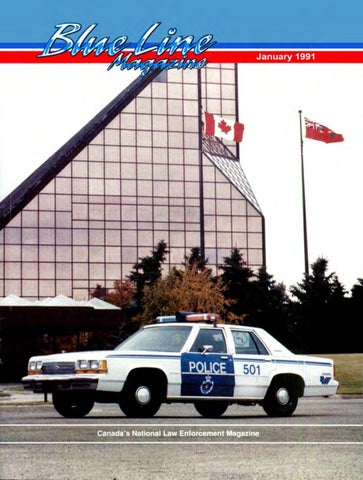
olour and uniformity are playing a bigger role in the visible aspects of policing today. With the high mobility of today's society it is important that the policing services rendered are consistent and possess some form of visual continuity. It just makes sense that a citizen of this country should expect to quickly identify a police officer no matter where he travels. The Winnipeg Police Force recently decided to change the colour of their police vehicles from predominantly black to a white vehicle with a reflective blue door and stripe. This is consistent with the general trend of most police agencies across the country. Winnipeg has also recently incorporated the red hat band on their forage caps and trousers. Again this is consistent with many other provinces that have viewed this colour to be consistent with municipal police while the yellow hat band becomes consistent with the federal police. Confusion in the eyes of citizens when confronted by an array of uniforms between fire , ambulance, police, post office, and most of all, private security is very understan dable. Until Winnipeg made their most recent uniform and shoulder patch changes there was not a lot of difference between the police force of that city and the transit bus drivers. In fact their shoulder patches, as far as a citizen was concerned , were almost identical. Police forces who have not thought about this aspect of their service should seriously consider the importance of appearances.
Letters to the Editor ALGONQUIN GRADUATES WANTED A committee has been set up by s veral graduates of the Law & Security Administration Program of Algonquin College, Ottawa, in an attempt to start an Alumni for all the former graduates of the program . We are trying to locate and contact former graduates who by now are all over Canada in various professions and police departments. Our committee would like to have Blue Line Magazine's assistance in this search by asking former graduates to contact Wayne Basaillion, Co Ordinator, Law & Security Administration Program , Algonquin College, 13 5 Woodroffe Ave., Nepean , Ontario, K2G 1V or Phone (613) 727-7612 . Hugh Purvis ecretary Law & Security Alumni Committee
••• CANADIAN BREAST BADGES I would like to obtain Blue Line's assistance with a hobby of mine. Unlike our American counterparts, it is quite rare to find police forces in Canada that wear breast badges. I am currently researching this topic, trying to find out which departments do and what those shields look like. I hope sometime in the future to publish my findings in a reference that I think does not already exist. I would appreciate hearing from anyone who could provide me with information on this, and I am looking for photgraphs, drawings, or other illustrations of them (in colour if possible) . I would like to get some hat badge information from these forces as well for comparison. Cst. Rob Halverson New Westminster Police Dept. c/ o 2207 West 32nd Avenue, Vancouver, BC V6L 2B1
CANADIAN COPS NOT SELF-RIGHTEOUS RAMBOS Thank you for finally producing a magazine that doesn't portray cops as self-righteous Rambos or Dirty Harry. Your magazine has consistently presented issues in down to earth logical terms. Please extend my present subscription for 3 years. Thanks again . I'm looking forward to my next issues. Bryan Crow London , Ontario
would appreciate hearing about the organization, training, uses and structures of Auxiliary Police across the country. I would be interested in topics such as their authority, pay structures if any, minimum training requirements, armament if any, and uniform differentials from the parent force. Send photos as well but in most cases we can not return them .
•••
COLLECTOR 'S CORNER I know that there are other departments across Canada that have collectors of departmental fashes , pins, etc. What is the chance of you finding a small corner of your magazine for a "Collectors Corner." Keep up the good work. J . Price 220-2910 East Pender Vancouver, B.C. V5K 2C3
A TREAT TO READ Just a line to say you have a super law enforcement magazine, and I find every issue a treat to read . Being a new subscriber to Blue Line, I've noticed a seldom mention ed segment of the police force overlooked in your magazine. The hard working ever enduring Auxiliary Police officer. Aux. Cst. Leslie Bluestein Durham Regional Police
••• Editor's Note: Sorry for editing your letter Leslie but this topic had crossed my mind several times. It would be nice for other agencies to see how Auxiliary members are being used. I
•••
• •• Editor's Note: Chances would be pretty good if I get enough requests. I haven't up to now and the few I do get I simply put in as a letter to the editor. Thanks for your interest.
•••
~~~~~~'------------------------------------
FLASHES by TOllY MacKinnon
"Kind of difficult puttin' the old seatbelt on when you're moving!"
4
J anuary 1991
Vo l. 3 NO.1
· January 1991
EDITORIAL
- EDlroR/ P UBLISHER Morley Lymburner - EDlroRIAL ADVISORS David H. Tsubo uchi , LL.B. Edward Gunraj (P.O.A. Consultant) Mary Lymburner B.A. M.Ed . Gerald A. Oxman 1.c.IA J aan Schaer B.A. (Metro Police E.A.P.) To m Dykes (Halton Region Police) Robert Hotsto n B.A. M.Crim. Rick Patrick (Lambto n College) The Editorial Advisors are persons from whom this p ublication seeks o ut advice and guidance. The use of their names is merely for recogni tion of their assistance and ongoing support.
- ADVERTISING Allan W. Stiver - CONTRIBUTING WRITERS Lucy Becker • Lou ise Dueck AI Porter • Richard Duplain • Daffydd Herm ann • Craig McMillan • T. Richard Colledge • Murray E. Milligan • Rock Dueck • Geoff Cates • Robert Hotsto n - ILWSTRATION Tony MacKinno n • Bette Clark Dave Sills - DESIGN AND PRODUCTION Jim Kelly Ca melot Graphic Design 97 Sir La ncelot Drive Markham , O ntario L3P 2J3
Business Office: (416) 294-4773 Editorial: (416) 293-2631 Fax: (416) 293-0526 Advertising: (416) 294-5502 Fax: (416) 294-8952 Production: (416) 471-0303 Fax: (416) 471-0305 Blue Line Magazine is p ublished monthly, te n times per year by Bl ue Line Magazine Incorporated with head office at 118 Main Street North, Markham . Ontario Canada. L3P IVl. Editorial and copy is considered to be comple tely separate from advertising sales. No committment for editorial coverage can form any part of a sale agreement. All articles a re p rotected by copyright. No part of this p ublication may be reprod uced or transm itted in any form or by a ny means, electro nic or mechan ical. including p hotocopying and recording. or by a ny informatio n storage or retrieval system witho ut permission from the publisher. The a uthors. advisors and publisher accept no liability whatsoever for any injuries to person or property resulting fro m the application or adoptio n of a ny of the p rocedures, tactics or conside ratio ns presented in this magazine. Readers are cautio ned and advised that articles presented herein are edited and supplied fo r yo ur pe rsonal awareness and should not be refe rred to for furt her action until appropriate advice and gUidance is received from a supervising office r or the advice of a Crown Attorney. Blue Line Magazine is a n independant publication desig ned to educate and upgrade the skills of those involved in the law e nforceme nt profession. It has no direct control from a law enforcement age ncy and its opinions a nd articles do not neccessaril y reflect the op inions of any government age ncy or police fo rce. Blue Line Magazine is Printed in C"nada by Joha nns Graphics. The sole a uthorized distrib utor of Blue Line Magazine is Green Gables Book S h op. Markh am. Ontario.
1!161 Associate member. Natio nal . Association of Police Planners ~ Member, Periodical
Cops, Courts and the 21st Century
W
ell it finally has come to a police officer increased from 20 to head. Technology and modem almost 50 per year. This is a staggerpolicing has caught up with the ing increase and a good indicator that Criminal Justice system. The reality of the public purse is getting a big bang this was brought firmly home by the for its buck. recent Supreme Court of Canada rulA big part of this ability to handle ing that has seen thousands of charges over double the violations as comstayed due to unreasonable delay in pared to our counterparts in the past getting them to trial. Unfortunately must be attributed to technology and many law enforcement officers have the higher quality officer attracted to been wringing hands and gnashing the profession today. Others say that the Charter of Rights teeth worrying about it. For years the nations leaders have and Freedoms (viewed as the biggest been warned that changes were make-work project for the legal prodrastically needed. What we got were fession in the history of the world) is mega-bucks invested in studies, in- to be blamed for the back-logged court quiries, and research rather than into system . courts and the administration of those What ever the reason the law encourts. While they fiddled the judicial forcement profession should not over system was burning! Unfortunately the burden their consciences about the only people held accountable are the results. Officers should just consider victims of the crimes and the officers the fact that it is their job to take the who deal with them . realities of the 20th century up to th~ There have been many who have doors of the 18th century court stated the perceived causes for this system . But don't expect to get justice deterioration but none have recogniz- suitable for the 21st Century. ed the role of the law enforcement Cops are a strange breed. They are officers. The legal profession and the greatest people in the world for judiciary had better come to their making bad rules work. If you gave a senses. The reason for the court cop a tooth brush and told him he had backlog has to do with the efficiency to groom a polecat he'd complain but of modem law enforcement. he would still be trying to figure out As hard as it may be for these peo- how he could get the job done. The ple to agree it is time they admitted best rule for each officer to remember that the average cop out there today is "don't make bad rules work. ... follow is a lot brighter then he is given credit. it to the letter and this will show the The system he has got to work with world that it just ain't workin' out today demands it. Statistics bear out there." this fact. Since 1962 the average Did anyone say it was going to be number of offences recorded per easy?
~ Publishers Exchange
ISSN #0847 8538 Second class mail registratio n No. 8242
~£_.~. ff ~ .-=-=-=-=--------------:-:--------~b1J~
Janu ary 199 1
5
rr
Family Awareness Program - Morley Lymburner -
I
n spite of the 25 people present the room was uncommonly quiet. The thin well spoken officer at the front of the class had gained their un divided attention . His sole purpose this evening was to explain to those present that their family members may undergo personality changes and mood swings in their new career that could lead them to alcoholism . With a quiet clear voice the group is further advised that the speaker came with excellent credentials. He is himself an alcoholic and had taken what he thought was the easy road out when the stresses of the job got to him . Fortunately he found that the "easy" way was not so easy. Broken family relationships, lowered performance levels at work, poor relation ships with superiors and peers, as well as a never ending chase after a bottle, finally got to him . He advised the group what he felt was lacking in his life. He needed a support group. He needed someone on his side at home who could listen and hopefully understand what was going on with him and his work. His family had a big handicap however. He wouldn't talk with them about it.
lege and other police facil ities. At each site the group of 25 people were supplied with lectures and demonstrations that helped to "bring home" what the recruit may be reacting to or speaking about when he comes home at night. Although similar programs have been presented for several years in the United States this program is the first of its kind in Canada and many other agencies are considering implemen ting the same program across the country.
Concept and Design
Assistance Program is attempting to meet with an innovative new program that targets the family members of recruit police officers. The purpose of the program is to foster understanding and awareness of the police force, its components and relevant services among family members of new recruits.
This first program began last fall and accepted its first 25 family member applicants from the current recruit class of some 60 officers. The classes were held on each Tuesday evening from 7 :00 PM . to 9 :30 PM . for an eight week period. Each candidate was given evaluations both before and
The family unit has long been recognized as a crucial support system for the police officer. The Employee Assistance personnel decided to demonstrate the importance of this Innovative Awareness role through a weekly format of It is this challenge that the Metro- seminars and visits to specific work politan Toronto Police Employee related sites such as the courts, col-
after the program ended . Attendance at 75% of the seminars and visits was required to receive a Graduation Diploma at the Police College on the same evening as their family members received their diplomas. Fortunately there were a few rules that were learned from American
6
January 1991
Police agencies that helped to pioneer the program south of the border. Firstly the recruits themselves would not be permitted to attend the courses. It was discovered that many recruits found it very difficult discussing their true fears and concerns with spouses and family members present.
The Program The first session included an orientation evening and welcoming speech from the Chief of Police, the President of the Police Association and Police College staff members. Topics discussed included such things as salaries, insurance and fringe benefits . Session two was held at the police Marine Unit and members gave a tour of the facilities and a C.P.R . demonstration . Session three was held at the Emergency Task Force Unit and demonstrations of defensive tactics, firearms safety, and traffic radar was given . Session four was a full docket. In cluded in this evening were talks from peer counsellors, the police force's child care coordinator, and a panel discussion on critical incident stress and risks of police work. The fifth session involved a tour of the police communications bureau that included a demonstration of the 911 emergency response systems . Session six was presented by the Employee Assistance Personnel and included talks about alcoholism and the Adult Children of Alcoholics syndrome. This session, in which Blue Line Magazine was invited to sit in, included a talk from a senior officer who is himself a child of an alcoholic parent. He explained how this impacted on his life and his choosing a police career to compensate. The second guest, as mentioned at the beginning, was an officer who struggled with his alcoholism and the pro-
January 1991
blems it brought about. One startling revelation included the fact that research done on all officer suicides with this police force indicated a high percentage came alcoholic families . The seventh session included a tour of the court system and a presentation by a Justice of the Peace explaining the rules of evidence and the role the police officer plays in the minor traffic court system as opposed to the criminal court system . The eighth session was the final graduation night ceremony in which the recruit class, with family members looking on , received their diplomas and awards of accomplishment. At the end of this ceremony the family members who volunteered to attend the Family Awareness Sessions received their diplomas from Chief William McCormack.
been asked for their response to the program and the following is a sampling; "I was a little nervous about the meetings when I first heard about them . I guess I didn't realize that the spouses had such an important part in their. husbands' job" "It was very reassuring to know that someone was concerned about us wives . I don't think any of us realized what kind of job our husbands were getting into." "In the country I came from the police were looked down on . I was worried when my son decided to become a police. I feel m uch better about that now." "This course got me interested to sign up." Anyone wishing further informa tion can call Mr. Jaan Schaer at (416) 365-0738 or write the Employee PartiCipant Response Assistance Program at 121 Richmond PartiCipants of this and similar pro- Street West, Ste. 1101, Toronto, On grams from other departments had tario. M5H 2Kl. ~
7
Regina Vs. W. R.C. (1022-018 4 Pages)
Complainant can testify behind screen In an August decision it was determined that an -year-old can testify behind a screen at the trial of her stepuncle on sex related offences. In the ruling Judge James H . Clarke of the Ontario District Court stated that the accused's ability to meet his accuser face to face would b only minimally impaired by the use of the screen . This is the latest in a series of recent rulings across the country that have upheld the validity of Section 4 6(2 .1) of the Criminal Code.
In this recent ruling the court heard evidence from the child's mother and a social worker and as a result were satisfied that the child was deeply afraid of the step-uncle and would be intimidated without the screen . The court determined that the child would also have a reasonable expectation of the screen being in place as it was used at the preliminary hearing. In the judgement it was determined that the screen would only limit Visibility of the child to the accused. The accused and his counsel would
8
still have opportunity to view the child and to cross examine her about her testimony. In the decision the court advised that the term "face to face must be given a large interpretation based on the actual prejudice to the accused in conducting a full defence." The court ruled that such prejudice would be miniscule and the court had to determine the rights of the accused as measured against the rights of society.
January 1991
TRUE CRIME
Birdman of Alcatraz: Fact and Fiction - Geoff Cates -
V
illains and heroes, heroes and villains. When these characters are exposed to the tender mercies of the movies and television , the two traits are often entangled. There is a blurring together, so it often becomes impossible to distinguish the good from the bad and to separate the wheat from the chaff. Robert Stroud was born in 1887. He committed his first murder at the age of 19 in Alaska, killing a bartender who had refused to pay tend dollars for one of Stroud's prostitutes. He was sentenced to 12 years in federal prisons, dividing his time between MacNeil Island and Leavenworth prisons . Stroud was a flagrant homosexual during his early years in prison and the other prisoners found him repulsive. Shortly before he was to be released from Leavenworth prison , he killed again. This time his victim was a guard at Leavenworth by the name of Andrew Turner. Stroud stabbed Turner in the heart with a knife. He never gave any reason for doing so, and never offered any explanation even after he was charged and up to and during the time of his trial. Stroud was convicted and sentenced to hang. An appeal was launched by his mother and it reached all the way to the White House. President Wilson looked into the matter and was made aware of the work and study Stroud had done in the field of ornithology (the study of birds and their diseases) . His sentence was commuted to life in solitary confinement. In solitary the wall was knocked out between cells to given Stroud a Janu ary 1991
double cell where he would have more room to keep his birds for his studies. Prison authorities considered Stroud one of the most dangerous federal prisoners in the system , and a cold-blooded killer. He possessed a brilliant mind and had an obsession for the study of birds. He became a self-taught OrnithologiSt. In 1943 he had published an immensely popular 500 page book called "Digest of Bird Diseases." He also wrote a treatise entitled "Looking Outward", criticizing the American Penal System. This was never published. Stroud was later transferred to Alcatraz, the infamous maximum security prison on the rock in San Francisco Bay. There he continued with his studies about bird diseases and was endowed with the title "The Birdman of Alcatraz." This caught the imagination of the press and he received much publicity and his life was eventually made into a movie of that name. His character, however, speaks for itself in that he was never released from prison and spent more time in solitary confinement than any other prisoner in American penal history. However a part of Stroud 's character not seen before emerged during a crisis at Alcatraz. In 1946, 6 inmates attempted an escape from the prison. It turned out to be a botched attempt, but during the initial stages of the escape, a number of prison guards were held captive and a number were wounded and killed. The prison authorities acted and overreacted . Not realizing the small number of prisoners actually involved 9
in the escape attempt, the Warden called in not only police personnel from the Bay area, but also the army. Machine gun fire, small arms fire and grenade and mortar fire were directed in the area where the rebels were thought to be. However this random fire affected th e lives of many prisoners who had no part in the escape. Hiding under beds and mattresses and whatever other shelter they could, many of the prisoners lives were in danger. Seeing this Stroud left his cell area and made his way slowly to where the guards had stationed themselves. As mortar shells and bullets thudded all around he courageously made his way until he was in position where he could talk to the guards. Stroud begged them to stop the barrage claiming it would be pure murder if this continued. One of the guards shouted at him he would be better off dead . He replied, "I don't care what you do with me. I've lived in outhouses like this all my life. If you want to kill me I'll step out now and you can shoot me." Another guard, more reasonable in his outlook told Stroud he would live to write another book. Stroud then directed them to the area the revel convicts were holed up. He then went back to his cell. The line of fire was then directed to the three convicts still fighting . They were all killed in the onslaught and the rioting was over. For the remainder of his years in prison , Stroud continued with his studies of birds and their diseases. An enigma to many, he was a withdrawn and solemn man . Robert Stroud died in prison in 1963 having spent the greater part of his life behind bars and much of that in isolation. How he developed his interest in birds remains a mystery and his philosophy regarding them was never really known , but muc h speculated over. Robert Stroud, the Birdman of Alcatraz, never realized or partook of the freedom his subjects took for granted . ~
You Asked For It •••• How's It Going? I have just commenced my subscription to your excellent magazine. Even though the odd copy circulates around my station , I felt I'd like to ensure I get a personal one so I don't miss any. As well, I'd hate to see your publication fail - so I decided to make an investment in it. Your journal is unique in that it's made for Canadian police officers. I'd like to suggest, however, that you provide an occasional update on how your subscription drive is going. Then we'll all know what's needed for Blue Line to stay in business.
R. H . New Westminster, B.c.
••• Fear not! Blue Line will not fail. The only thing that could change is the form it takes. As is the case with any good cop I always have a "Plan B '~ (Also a "C" and "D") What you see presently is plan 'Ii" striving to be an ':4 + '~ For many years I have recognized that the law enforcement community is too scattered in this country to properly communicate with each other in a truly independent fashion . Many agencies are too small and remote, and in some cases so steeped in their own internal pride, that com munication with other agencies is severely hindered. Blue Line was created to bridge this gap and let you know what's up elsewhere. It places all law enforcement agencies on the same level playing field.
They are not, in most cases, issued Independence Is The Key with a National Library of Canada I can not emphasize the value of our publications number nor registered paid subscribers strongly enough . Post for second or third with Canada They are the true backbone of what class mailing privledges. They are also we want to be. Independent! We are notorious for not delivering what they not financially supported by any goversay they will. If they print an issue at nment agency or Union / Association. all they simply print enough to deliver We seek no government grants and to each advertiser and dump what is our only concern is keeping the front left at the front doors of many police line officer up to date on current training, news and laws as it relates to their stations. Blue Line Magazine's credentials job. are solid. Your 20 bucks (25 as of this month) has supported this effort and gives us • Blue Line Magazine is listed in an opportunity to be independent of Canadian Advertising Rates and Data subtle pressures from government (CARD) under the category of "Trade agencies or private companies. We Publications - POLICE'~ All technical are independent but we do not want data about the publication is contain to alienate our readers. Features and ed in this listing and audited by sworn stories in this magazine have to affidavit. It is also listed in several benefit, uplift and support the reader. American advertising journals. For this reason we keep bitching to a • This magazine is registered and minimum. available through FAXON and SMS subscription services. No Scam Operation • The magazine Editor/ Publisher is There are a few police forces who do a standing member of the National not understand what we are all about Association of Police Planners so let me lay it on the line. We are not (NAPP) and the magazine is an a scam operation . We have printed associate member of this same over 94,000 magazines in the past organization . two years and we have delivered them to our readership on a monthly • Blue Line Magazine is a member of the Periodical Publishers Exchange (not quarterly or annual) basis. In the past several years there has (PPE) . This Toronto based organiza been a good number of scam publica- tion is the fourth largest publisher's tions that trade on the name "Police'~ association in North America and These so called "publications" have represents over 70 magazines. It en sought out small businesses and courages a free exchange of ideas and immigrant merchants to advertise in support between publishers of trade their magazines. Their interest has not magazines. Membership is quite been with the large corporations or restrictive and background checks are the advertising agencies. They do not thorough . have affiliation with advertising direc- • Blue Line Magazine is registered tories, publishing industry associations with the National Library of Canada or with police affiliated organizations. (ISSN #0847 8538) and requires
10
January 1991
~~-----------------------------------
monthly depositions to them in Ottawa . • Blue Line Magazine is qualified and fully registered with Canada Post Corporation for Second Class Mail distribution (No. 8242) This requires monthly mailings and full audited disclosure of quantities and types of deliveries. If you have read each issue since the start you have received information from over 600 stories related to your profession and your library will have twenty journals for future reference. If we were a scam operation it would be the most incompetent scam out there and what you would see would certainly be much different. We could most certainly get away with a lot less effort and make much more money but we feel that this effort is far too important. If you have found a suspicious publication in your area do a little check on the above list. If they do not meet these criteria you may have a fraud investigation on your hands. (By the way... Blue Line is not registered with the Better Business Bureau)
Subscriptions
To date Blue Line has eight police forces and 12 other groups and agencies who subscribe in bulk. Buying in bulk (five or more magazines per month going to one address) can save $5.00 off each subscription . (From a regular $25.00 down to $20.00 each). If we have a bulk subscription of 20 or more copies each month the price goes down to $15.00 per month. That's a $10.00 saving on each subscription . I have set a goal for 1991 of 100 new paid subscribers each month. I view this as an attainable goal as this was our average for the past two years. We have to increase our paid subscription base because of the requirements of Canada Post. If we do not do so we will see a huge increase in our postal costs.
January 1991
outside Canada (one American and one Maltese) who did not like the higher amount they had to pay (I wonder if any of us feel the same way about American publications?). One other would not specify his reasons and another married an officer already getting the magazine. Remember the freebees are volatile. My priority is to deliver the paid subscribers first. What ever is left goes out to encourage more subscriptions. We are currently going through our mailing list and where we find paid subscriptions going to the same address we will be cutting off the free copies. Due to pressures from Canada Post we will be altering our We have lost, on 'average, 10 mailing so that free copies will be sent subscribers each month. Most of these out on seven of the ten issues on a are due to officers forgetting to renew rotational basis. or moving and not notifying us. If you have been entertained, en(Police officers must be part Nomad). couraged or educated by what you We usually send one notice of have read in Blue Line Magazine then renewal and one reminder message we have been successful. If you wish from "Nick'; my "executioner'; to see it continue to grow in an instamped on it. Judging by the dependent fashion then you must remarks that have come in "Nick" is subscribe. If you already subscribe fast becoming a folk hero. (You cer- then encourage your colleagues to do tainly are a morbid bunch. I have likewise. We liked the thought stated included his picture here so that no by the officer writing us. '~ .. so I decidone will hold up payment to see him.) ed to make an investment in it." Your In two years we have lost only four "investment" is an acknowledgement subscribers because they no longer of our efforts and makes you a form wanted to get the magazine. Two were of shareholder in your own future.
FINAL
__.Y_S.!.I. E w . a.n.t.to_sulllb.S.C. ri.b. e.t0i.lliI!frt_ . .~ Nrume: _________________________________________________ Addr~s:
________________________________________________
__________________ Postal Code: __________ Province: __________
o Enter my subscription for the next 10 issues of Blue Line Magazine ($25.00) o I want a bulk subscription of _ _ copies sent each month o Bill me with my first issue (Your subscription begins with the next issue) (5-20 copies $20.00 each; 21 or more $15.00 each G.S.T. Included)
o Blue Line Magazine will gladly charge your subscription to your. o. MasterCard D or VISA. D
Signature: _ _ __ __ _ _ _ _ _ _ _ _ _ _ _ _ __ (Green Gabl .. Book Shop i. the eote di.1rirul<:r of Blue Line Magazine)
11
0"
Expo __1__
Part 4
A Personal View Policing at a Crossroads - Chris Braiden -
I
think that policing in Canada is at a crossroads . And I mean a significant crossroads. Not for the reasons that it is at a crossroads in Britain or Ireland or the United States. I think we are at a crossroads for different reasons. Essentially our communities are still quite peaceful. Firstly we don't have the upheaval that some of our peers in other countries are having to deal with . Secondly, police leadership in this country is very stable. Canadian police chiefs certainly stay on the job longer than the three-year average of their U.S. counterparts. Our chiefs have the job for life unless they commit murder. Due to this longevity we have a chance to try things that perhaps in other jurisdictions they couldn't try. We have the stability and we have the peace in our communities that we could try things in community policing and risk the fact that they may not work. We are not as likely to get fired for it. One reason for the crossroads, I believe, is the growth of private security. There are 100,000 fewer public police in the United States today than there were a decade ago. Private policing has grown by 11 % each year during the same period . Much of the work that is "load-shed" by us today is snapped up by those entrepreneurs. We might just be "load-shedding" ourselves out of work. How long will the same customer pay for TWO police services? There is something odd about what is happening because 150 years ago,
public policing took over policing from the private sector. And we are now bit by bit handing it back. And I'm not so sure that we're handing it back in a planned way or that we even realize we're handing it back. This is certainly something for the police unions to cogitate over a pint or two.
Let us stop and thing about the average city. Whether it be Ottawa, Edmonton , Vancouver, or Victoria . Think about the downtown and think of shopping malls. Especially think of the winters that we have. Winters are very cold so people don't stay outside much . They go inside where it's warm to do their shopping. So most of these people are gathering in places that are essentially private property. If the owners of those shopping malls wanted to say to the police "you are persona non grata," they could prevent us from entering unless we
12
had a specific legal reason for entering. So the character of the public places that we used to police, and we still police, are changing very dramatically. This is another factor in our society that we have to be aware of, and adjust to. Private security today is a lot more than a few security guards walking around . Private security has gotten into areas of our society that are having a huge effect on crime. Think of big corporations and companies . Many of them have their own private security which handles their internal crime. If it doesn't suit them , they will not release the knowledge of that crime to the public police. They will judge the crime on its commercial rather than social merits. They will keep it inside, deal with it in whatever way they want and really not concern themselves with the public good , if that suits their purpose. Another example is shoplifting in all of the big malls. The private sector will deal with it if they want, in their own way. It it's a good customer and if it's the son or daughter of some well-to do person they may not call us because they don't want to lose that customer. If it is some old tramp then they will call us. Security systems is another area . Alarms are a huge problem for police, 98% of which are false. The Private sector gets paid to install them, at our urging, but then the public police literally services them . In the final analysis, public policing might be left on the outside picking up the pieces thrown to them by capitalists and their private police. All of this could render our known crime figures meaningless. So in many ways private security is beginning to manipulate us, and beginning to dictate the public product that has been paid for by the public.
NEXT MONTH: A Personal View - Part 5 Construction Policing
Janu ary 1991
Reg ina Vs. A. and W. ~[£]lllEEEE1lEms[£]lllEEEiilli\1l'f!i]jm£llil~iilli\1mmm£llilmElllmmUEi:mmi~illl5liJlt1l2l~~ (1030-019 10 pages)
Evidence admissible even if cops violate rights In a recent unreported case out of Ontario it was decided that evidence obtained by police after a search that breached two young offenders Charter Rights was admissible against them . The case came about when police found two youths who were looking into cars in a manner that made them suspicious. One youth was carrying a knapsack and when asked what was in it the youth opened it without protest. The officer discovered that it contained car radios as well as specialized tools for breaking into cars . The youths were arrested and later charged with possession of burglary tools and possession of stolen property. At trial the Crown attempted to enter the knapsack and contents as evidence by saying the search had
been conducted with the consent of the accused . Defence council argued that the evidence should be excluded because it was obtained after a breach of Sections 8 and 9 of the Charter of Rights. These sections guarantee security from unreasonable search and detention . The judge determined that the officers had breached both of these sections of the Charter adding, "I am satisfied... that there was not an operative or meaningful consent to the search of this knapsack and that it was opened because the officers took steps to see that it was opened and the youths were unaware that they had any choice in the matter." The judge added however that he was "not convinced that exclusion of the evidence would be less harmful to the reputation of the justice
system ." He added that it is important not to condone the behaviour of the police in this case. Young people can be taken advantage of in these circumstances." He emphasized that the vulnerability of youths in this regard is not to be taken lightly. The court concluded however that there "are other remedies ... for police violations. There are complaint procedures and there are other methods of handling disciplinary police matters." He emphasized that the exclusion of evidence is not the only method of dealing with misbehaviour of police. In dismissing the application to have the evidence excluded the court stated, "Quite simply, the police behaviour is not bad enough to justify the rather drastic remedy of excluding real evidence."
CANADIAN POLICING SYS'l'EMS THAT WORK FOB YOU ASSIST: Laptop incident reporting system enabling officers to complete their paper work in the field - where they are needed. pcs:
Case management for investigation of public complaints against police officers. Conforms to Ontario's Police Services Act.
call today and learn how your organization can benefit from DARTEK'S Policing Systems.
DARTEK
~:~~YWood Drtve
THAT'S $75.00 FOR THE RED LIGHT, $3.00 COURT COST AND $5.46 GST.
SYSTEMS Markham,ON L3R5L9 (416) 474-9592
"'I
INC
E?£',,~.
./ e:J
---J~anu-ar Y~17 99:~1------------------------------13---------------------~~
Victim Can Sue Police
A
Toronto area rape victim has won an important step toward her $600,000 civil action against the Metropolitan Toronto Police after an allegation that they used her as bait to catch a rapist. A three panel Divisional Court has ruled that the victim may pursue a lawsuit that claims damages from the police on the grounds of negligence and breach of duty under the Police Act of Ontario. The action claims that the police chose or adopted a policy not to warn potential victims of the rapist because of a belief that women would become hysterical and scare off the attacker. Police had known that a serial rapist had attacked four other victims in an eight-month period and all victims had been white, single women living in second or third floor apartments in the Wellesley-Church area . In vestigating officers had decided not to warn women in the area in an attempt to catch him . The woman bringing the claim against the Police was attacked by the rapist and became the ninth victim .
Several months later a suspect was arrested and plead guilty to all the attacks . In the examination for discovery Mr. Justice Moldaver concluded that the foreseeability and proximity requirements would be satisfied if the victim is able to prove at trial that the police knew; • the rapist attacked in the WellesleyChurch area; • all victims were white, single women ; • the rapist gained entry in each case by forcing a balcony door. However the court added that in some circumstances of special proximity, the police might justify that a warning should not be given if it would lead to greater harm by causing general and unnecessary panic. In spite of this however Justice Moldaver stated that the duty to warn arises from a continuing police duty to protect citizens; therefore, the duty to protect must then be accomplished by other means where a warning is not given . Moldaver concluded that the police
"decided to use her as bait. They chose not to warn her due to a stereotypical belief that because she was a woman, she and others like her would become hysterical." He further concluded that the police had a positive statutory duty imposed on the police by the Police Act to protect the public and failure to perform that duty for improper reasons would support the claim made by the victim . The court decision claimed that if the police had chosen not to warn the local prospective victims of the attacks then they were duty bound to provide the necessary resources and personnel to protect these potential victims . In this respect the judge confirmed that it was up to the victim to prove that if she had been warned that she could have done something to protect herself from the attack. The decision went further and stated that the decision not to warn the victims in the area breached their section 15(1) Charter Right to be equally protected under the law and their section 7 Right to life liberty and security of the person .
PROFILE
Proud Brothers Constable Wayne Currie of the Halifax City Police and younger brother Constable Shawn Currie of the Metropolitan Toronto Police Force have a good understanding of pride and brotherhood. Wayne, shown here on the left, flew into Toronto last November to witness his brother at his graduation ceremony from the Metropolitan Toronto Police College. Not only was the 15 year veteran from Halifax proud to march beside his brother to greet Chief Of Police Bill McCormack but double honoured to have the Chief permit him to present his brother's graduation diploma.
-------------------- 14
January 1991
~------------~ '" . ~~ . - - -- - - - - - - - - -- -
A Light in the Shadows - Mu rray E. Milligan -
T
here was a man who was sentenced to die. He was led blindfolded into a dark cave and told that if he could find his way out of the cave he would be a free man. After the cave was sealed the man took off his blindfold and found that he could see nothing save a small glimmering light above. As the man walked around in the cave, he bumped into various sizes of rocks. He felt that if he gathered enough rocks together, he could make a small hill that might allow him to climb to the opening in the ceiling of the cave. He spent his waking hours collecting rocks and making his hill . Days past by. He grew weaker and weaker from his toil. On the twenty-eighth day, he was near to the hole in the ceiling, he reached up to grab at the opening and fell back. Too weak to pick himself up he died at the bottom of his pile of rocks. The following day his captors removed the rock from the entrance. Light flooded into the cave and revealed a three foot wide opening in the wall of the cave. The hole was an entrance to a tunnel leading out of the cave to freedom . All the prisoner had to do was find the opening and crawl to his freedom. The prisoner was so focused on the opening of light from above that it never occurred to him to look for freedom in the darkness. Liberation was there all the time, but he never saw it because it was in the dark. What's the point of this parable? Well, sometimes we need to go through the dark to get to the light. Many of our experiences in life involve the same thing, we need to
January 1991
experience the dark to know where the light is. In some ways we never really leave the darkness. It follows us like a shadow. Although we can do something about the size of that shadow. Let's start our journey through the darkness together now by having a discussion about families and family systems. As in all journeys, we must start at the beginning.
Family Systems Family system work has only been with us for about forty years now. In many respects it is in its young adult years of development. So much has been learned about the structure of families and family systems in the past few years. The German biologist, Ludwig von Bertalanffy proposed the "General System Theory", in which it is stated that everything is composed of systems and sub-systems. Each of these systems comprises a larger
15
system and requires each of its subsystems to work harmoniously together. For example, my own experiences, the essence of who I am is comprised of a circulatory system, a nervous system , a respiratory system etc. If you were to take just one of these systems you wouldn't have anything that resembles me. However, when we consider that the whole is greater than the sum of its parts, and that when all of my sub-systems are interacting together harmoniously we have Murray Milligan . We can expand or reduce this as we like and see the "General System Theory" at work. I am a member of a police community that is a part of a city that is a part of a Province that is a part of a country etc. In the words of John Bradshaw we can go "macrocosmic or micro-cosmic when dealing with systems theory and see it always at work." We are all part of a grand and magnificent system. Each of us has a small part to play, a small piece of the system . Think of a large mosaic, remove one of the tiles and the whole picture of the mosaic can be affected . Families are systems as well. They are composed of subsystems. Each member of the family is a sub-system of the family. Just as there are laws which govern systems, there are laws which govern famil ies and their behaviours . By understand ing the laws we can begin to understand their impact on our lives and on our behaviour. Next month, we'll explore further about family systems and their dynamics and impact on our lives. Hold onto your socks ... they could get knocked off! Until then , I would ask you to consider this .. . Carl Rogers, the American psychologist once said, "Whatever is most personal is most generaL" Take care and have a safe tour of duty! "9t
... news beat ... news beat ... news beat ... news beat ... Transit Police Create A Cellular Crime Fighter
Depending on the effectiveness of this first vehicle, the Transit Police plan on introducing three or four more similarly equipped vehicles in the near future. So far, Chief Bratton is optimistic.
Off-Duty Cops Must Identify Themselves
New vehicle to cut down on arrest processing time
Drink Driving Limit Reduced in Sweden
Off-duty police officers with the Metropolitan Toronto Police Force must identify themselves immediatley when they are involved in motor vehicle accidents. The new by-law, viewed by many as draconian, was passed by the Board of Commissioners of Police in a public meeting held last November. In addition this unique law states that all police officers of that agency involved in accidents must have the accident investigated by a supervisor. In spite of the fact the Commission could not specify statistics that showed there was corruption in this area they felt that the law would "protect the Force from allegations" and "en sure objectivity" in the investigations of these accidents. Officers who fail to identify themselves could face a penalty under the Police Services Act that could include dismissal. Critics of the by-law indicated that
The New York City Transit Police has unveiled its latest weapon in the fight against subway crime, A Mobile Arrest Processing Vehicle that literally serves as a police station on wheels. The vehicle is a customized New York City Transit Authority bus that contains a holding cell and a complete mobile arrest processing center. NYNEX Mobile Communications' Brooklyn Cellular Center provided the six cellular phones and two fax machines that are being used in the vehicle. "The Transit Authority modified a bus at our request so that we could reduce the time spent processing arrests," said Transit Chief William J. Bratton. "The New York Transit Police Department is taking advantage of cellular telephone technology to help save valuable crime-deterring patrol time." The vehicle will be used throughout the four boroughs served by the subway system . By conducting the entire arrest process aboard the vehicle, officer administrative time will be greatly reduced, and officers can qUickly return to patrol. Using the NYNEX Mobile cellular equipment, the officers will obtain the necessary control numbers on the detainees and run warrant checks. After the arrest papers are completed, the officer will fax documents to the district attorney, who will then begin the arraingment process. If the offender is wanted for another crime, heshe will be transported to central booking in the borough .
Sweden , which has pioneered laws against drunk driving, has introduced still tougher legislation which could tip many motorists over the limit after just one drink. The legal limit has been lowered from 50 to 20 milligrams of alcohol per 100 millilitres of blood. It has been viewed as a compromise with the countries strong temperance lobby that has been demanding a zero tolerance level for drivers. Sweden led the world over 50 years ago when it invoked their 80 milligram law on that countries drinking drivers . After much research and many reports Sweden reduced the tolerance level to 50 milligrams in 1957 . It took Canada about another 15 years to make mandatory Breath testing available to police.
FLASHES by Tony MacKinnon
" We could be in for a rough night. • -;;;;~ The other team . ; isn't even here yeti"
16
January 1991
I
... news beat ... news beat ... news beat ... news beat ... it showed a distinct lack of faith on the after they have been charged and overcrowding, sanctions the tempart of the Commission toward its there are reported cases of judges porary use of police cells to detain police officers and another example issuing extensions for more than 100 criminal suspects. Recent calls from Amnesty Internaof a Commission under extreme stress days. Human rights organizations, in- tional include reforms in the police and "running scared ." Others indicated that the law will put extra cluding Amnesty International, say custody procedures and a separation that prolonged custody in the hands of the detention and interrogation strain on front line supervisors . A spokesman for the Police of police invites abuse of suspects, facilities. Association stated that the matter was particularly since they are only entitlbeing looked into but felt that officers ed to a public attorney after being who are forced to identify themselves indicted . Allegations of police brutality have would be considered to be imbeen made by an insurance salesmediately "on-duty" and over-time woman , Junko Nakano, who was pay would be expected . arrested on suspicion of setting fire to a warehouse. She claims that she was stripped and intimately searched twice, and was interrogated for up to 10 hours a day for the 23 days she was held in custody. INSIGNIA PRODUCTS Ms. Nakano, 30, refused to confess Carlo Dalgas Ltd . specializes in The Japanese police custody system despite what she called psychological custom -made Lapel pins, Police and Military Badges, Leather I.D. cases, is a "flagrant violation of United and physical intimidation by police Embroidered Crests, Medallions, and Nations human rights principles", and investigators. She was eventualSouvenir spoons. High quality insignia human rights organizations are ly released because of insufficient products at very affordable prices are evidence to bring charges. claiming. available now. For more information The pillar of the present custody The system allows suspects to be contact: Carlo Dalgas Ltd ., 1885 Briarcrook Cres., held without charge for an average of system is Japan's prison law, passed Mississauga, Ont. L4X 1X3 more than 15 days . Suspects are in 1908 and never changed. The law, (416) 625-8061 Fax: (416) 625-4911 . often sent back to police custody even originally passed to remedy prison
Japan Criticized For Investigative Techniques
UP-COMING EVENTS January 16-1 8 EM EX '91 - Las Vegas, Nevada This is the trade show for emergency and disaster preparedness that features products and services for protection, relief and recovery from natural and manmade disasters. This years show will be held at the Sands Expo and Convention Center in Las Vegas. The show also includes a series of keynote speakers and plenary sessions. For further information contact phone (617) 449-8938 or FAX (617) 449-2674.
January 1991
May 6-9, 1991 Prince Albert, Saskatchewan The Prince Albert City Police Department will be sponsoring a four day seminar on "Sexual Abuse Development Dynamics & Profiles. This four day seminar will involve several speakers including consultants Peter M. Welsh and Brent W. Warberg. Topics will include understanding the development of juvenile sexual offenders and the issues in treating both the offender and the victim . Registration is $175.00 for three days or $50.00 for a single day. This seminar is limited to 200 persons. For further information contact: Chief of Police, Prince Albert City Police Department,
17
45-15th Street West, Prince Albert, Saskatchewan, S6V 3P4. Phone 922-4441. June 17-21 Sudbury, Ontario Ontario Chiefs Convention in Sudbury, Ontario. For further information contact: Detective O'Brien (705) 675-9171 ext. 284 August 26-30,1991 London, Ontario Canadian Association of Chiefs of Police annual convention will be hosted by the City of London, Ontario. For further information contact: Superintendent Elgin Austin (519) 661-5677 Fax: 438-7230
Part 1
The Handgun Challenge The Revolver Vs. Pistol - Steven Sheppard -
H
ardly a day goes by that some police officer doesn't ask "When are we going to get 9mm's?" My usual response is "Why do you want a 9mm?" The reply is often delayed but generally the questioner feels the need for a bigger gun . The misconception that 9mms are bigger than .38 specials has been instilled by media hype and a great deal of misinformation . A 9mm is not necessarily bigger than a .38 special revolver. More important, the size of the bullet the gun fires , (calibre and weight) , is far more critical than the actual size of the gun and the 9mm projectile is smaller in diameter and generally lighter in weight than the average 38 special bullet. Further questioning usually provides information that some officers believe they need larger capacity firearms and need semiatuomatic handguns. The reasoning for desiring semiautos is often based on the perception that police officers are "out-gunned" by criminals using sawed-off shotguns or rifles and that semiautos would afford firepower equal to the threat. This perception is only partially true. No matter what handgun we may have we will still be out-gunned when confronted with a shotgun or a rifle. Those of you who have considered the question , "Why don't we switch to semiautos?", might well consider the question , "Why should we switch ?". What makes it necessary to change from a revolver to a semiautomatic handgun . The most relevant question to answer is whether
or not the .38 special revolver is insufficient or inadequate for our policing needs . If it is insufficient or inadequate then we need to find a replacement, however, if it is sufficient and adequate then there is no need to change. This article is not design ed to answer this very controversial question but rather to take an objective look at each type of handgun and thereby help you to become better informed as to how each operates . First we need to separate the two main components of a weapons system : the gun and the projectile or bullet. The guns is merely the holding and delivery mechanism for the part that does the work, the projectile. The calibre of the gun and the type of gun are two distinct items . Most of us are familiar with the functioning and operation of the revolver but we are not as knowledgeable about the semiatuomatic pistol. Therefore, I will present a very basic examination of each of the previously-mentioned types of firearms , the revolver and the semiautomatic or self-loading pistol, discussing functions and compare relative merits and disadvantages. For this discussion we will take a reputably manufactured pistol and revolver which meets all the manufacturer's specifications and is in serviceable condition .
LOADING THE FIREARM Semiautomatic Pistols Generally pistols hold the ammunition in a magazine which is housed in the pistol grip. The magazine is removed
18
from the pistol and loaded with the appropriate number of rounds by pushing them in one by one on top of each other. The magazine is then pushed into the pistol grip well , ensuring that it locks into place. The next step is to cycle the action to chamber the first round . This is accomplished by pulling the slide all the way to the rear and letting it go forward under the return pressure. The slide, in its forward travel, pushes the top round of ammunition from the magazine out of the mag and into the chamber. When the slide is fully forward it locks and generally the internal mechanism is cocked and ready for firing . There are a great variety of semiautomatic handguns on the market , each having different features . Some, at this point of the operation , leave the hammer cocked to the rear and the external safety should be applied to prevent its unintentional firing . Some have a mechanism for decocking the pistol without pulling the trigger. Others have no external hammer and just cock a firing pin . Some newer models have a " double -action " on ly mechanism that lowers the hammer as the slide moves forward . In any case, the pistol is now ready for firing. After removing any external safety devices pressing the trigger to the rear will fire the weapon .
Revolvers Loading a revolver is accomplished by opening the cylinder, placing a round of ammunition into each chamber then closing and locking the cylinder. There are no separate magazines to load and insert, no de cocking levers to push and no external safety devices to disengage. The revolver is ready to fire. Pressing the trigger to the rear causes the hammer to move rearward and at the same time causes the cylinder to rotate, aligning a cartridge
January 1991
with the firing pin (hammer nose) and the barrel. FIRING THE WEAPON Semiautomatic Pistols After removing any external safety devices pressing the trigger to the rear will fire the weapon . When the firing pin strikes the primer of the chambered cartridge the powder is ignited . The gun powder burns very rapidly, producing gasses many times the original volume. It is the relatively high pressure created by the expanding gases that force the bullet out of the cartridge case, into, through and out of the barrel. Remember that for every action there is an equal and opposite reaction . The cartridge case and the slide are pushed to the rear under the increased pressure, Compressing the return spring. As the slide travels backward it removes the spent cartridge casing from the chamber by means of an extractor. As the slide continues its rearward motion the ejector causes the empty casing to be ejected from the pistol. The rearward movement of the slide also causes some semiautos to recock. When the slide reaches its rearward most position the return spring pushes it forward . As the slide moves forward it again pushes the top round out of the magazine into the chamber and closes and locks into battery position. All of this movement is called the "cyclic action" of the pistol. The maximum number of times an automatic could do this in a minute is termed the "cyclic rate of fire ." Any interference in the cyclic action is generally termed an unintentional stoppage. This requires a clearing routine by the shooter that I will explain later. The Revolver The same sequence of primer detonation and increased pressure due to rapid gas expansion propelling
January 1991
the bullet out of the barrel takes place when the hammer falls. ReleaSing the trigger prepares the revolver for firing again . Except for a misfire of the am munition there are no unintentional stoppages with a serviceable revolver. HANDLING MISFIRES There exists a significant difference in the immediate action for a misfire when comparing the semiauto and the revolver. The appropriate immediate action for a semiauto pistol is a two-handed operation . First "tap" the bottom of the magazine to ensure it is seated properly. Second "rack" or cycle the action by grasping the slide and pulling it all the way to the rear and letting it go forward under the return spring pressure. This ejects the misfired round and chambers a fresh one. Then press the trigger to fire the pistol "Bang". The immediate action for a misfire with a revolver is to press the trigger to the rear again to fire the weapon . The cylinder revolves and aligns a fresh round with the barrel and hammer. Semiautomatics have three other unintentional stoppages that can occur; 1) Failure to extract a spent casing, 2 ) Failure to fully eject a spent casing (fully cycle) 3) Double feed rounds. These stoppages can be either shooter induced or ammunition induced malfunctions. The appropriate immediate action for these stoppages is also a two handed operation . The magazine must be removed (rip) , and the action must be cycled manually a couple of times (rack) . Both of these measures clear any improperly fed or non-extracted rounds. A fresh magazine must then be inserted and seated (tap) . The action must be manually cycled to chamber a fresh
19
round (rack) and the trigger is then pressed to fire the pistol (bang) . The words in parenthesis are commonly used buzz words for each step of the operation. These types of stoppages do not occur while firing a revolver. It should now be evident that while disregarding calibre in either firearm the revolver and the semi-automatic pistol differ considerably in their functioning . Each requires training in proper use, maintenance and proficiency. The skill level of the officers involved and the amount of training which is either available or will be available may well have a bearing on which is more suitable.
NEXT MONTH: Handgun Challenge - Part 2 Advantages and Disadvantages
Guest Writer Steven Sheppard is a Staff Sergeant with over 22 years service with the Metropolitan Toronto Police Force. He is currently the chief armament officer and firearms instructor at the C.o. Bick College, the training unit for this force of 5 ,600 officers. He worked for nine years with the Emergency Task Force. He has attended the EB.I. Advanced firearms and firearms Insturctor's School. He also attended the Smith and Wesson Armorer's School and worked for three years as the Force's Armorer. Sheppard has competed nationally and internationally with semiautomatic pistols and revolvers. He is also a past director fo the Ontario Handgun Association . He is currently vice president of the Ontario Law Enforcement Firearms Institute Association .
The Handgun Challenge Pistols Vs. Revolvers - Mike Hargreaves -
I
n this article, I will attempt to simplify the question of handguns for police forces . Any combination of hand gun cartridge-bullet is, at best, marginal in stopping an aggressor. Hits to the brain , brain stem , or top couple of inches of the spine stop all aggressive action nearly all of the time (the goal of the defensive use of the police hand gun) , irrespective of calibre, bullet, or action type. The above statement is FACT, and not too many people argue this point. The average law enforcement officer, if there is such a person , is more accurate with a hand gun that recoils (kicks) less when fired . A fact that is true of all shooters.
- both of which have a more controllable recoil, less muzzle flash , and a corresponding lack of report when fired in comparison with the models previously mentioned.
FACT A: The police issue in Ontario, normally, a .38 Special S&W Model 10, or in stainless steel, Model 64. This can , with the correct commitment to training, place the projectile/ bullet accurately enough to stop a confrontation , most of the time. The best round (bullet) in this calibre, used by the FB.1. and our R.e.M .P is the 158g semi-wad cutter lead hollow point, according to any reports I have ever seen.
If all other factors are similar, and they are, this one feature of the 9mm pistol makes it the most sensible choice for police use at this time. This might seem like a simple deduction ; well, it is. In a worst case scenario, a police officer could face 2 or 3 - or more - armed criminals; he must have the ability to defend him / herself without a reload , if possible ; because, under extreme stress, and especially in poor light, reloading a revolver is difficult, if not impossible, in the time frame allowed, or forced on you in a violent confrontation . It is also quite difficult to reload a 9mm semi-auto in these selfsame circumstances, but much easier than a revolver, plus, you do not NEED to reload as often , when you start out with more.
FACT B:The 9mm semi-auto pistol
(self-loader is a more accurate statement) can with the correct commitment to training, place the projectile/ bullet accurately enough to stop a confrontation , most of the time. The best round / bullet in this calibre - again used by the FB.1. and D.E.A.- is the 147g Jacketed Hollow Point. Most experts seem to agree on this, and Ontario's Inquiry into On tario Police Tactical Units also concurs. What about mechanics? The modern .38 Special double action When you expand on this, in the revolver is a fine piece of machinery, real world , bullet placement is and works very well . The modern everything - only the shots that hit 9mm pistol is a fine piece of count. machinery, and works very well. Both In my opinion , we have to discount of these firearms / calibres, with the th e .357 Magnum , .44 Magnum , .40 proper training and the right ammuni&W, lOmm , .45 A.e.P - because tion , work very, very well. for the non dedicated , skilled officer/ However it is my conclusion that shooter, they just "bang, flash and the 9mm high capacity pistol has a recoil too much ." capacity of 14 to 18 rounds before a So, now we are left with the .38 reload is required . More is better Special Revolver, and the 9mm Pistol always .
20
Guest Writer Mike Hargreaves is a full time law enforcement firearms instructor, who trains police, armoured vehicle guards, embassy and diplomatic personnel, and security guards. He competes in the master class regularly in formal bullseye and shoots in the A class in IPSe. He is also an active member of the Board of Directors of the International Association of Law Enforcement Firearms Instructors.
Jan uary 1991
Expanded Automatic Fingerpri nt Identification System Urged - Thomas M. Vares -
E
xpanding the Automatic Fingerprint Identification System (AF.I.S.) to police forces across Ontario and Canada will lead to more effective criminal investigation . Detective Sergeant Gene Pankewich, the officer in charge of the Metro Toronto AF.I.S. Unit, encouraged close to 100 Ontario-wide police representatives attending the Fifth Annual Forensic Seminar, to participate in such an expansion . "The Printrak Orion AF.I.S. is a primary example of how new technology is enhancing crime investigation ," explains Pankewich, who admits he was especially pleased by the overwhelming response displayed by delegates attending the seminar held in Toronto last fall. Det./Sgt. Pankewich demonstrated the Metro Toronto Printrak Orion AF.I.S. and its capabilities for identifying and matching fingerprints electronically. This technology has been available to the Metro Toronto Police since August of 1987. He described the development of automated fingerprint technology in Canada and the critical role played by the National Fingerprint Repository in criminal investigations since its inception in 1911 . "The Repository in Ottawa has grown to over two million records" Pankewich states, "and it is increasing at 14,000 per month . More than 800 agencies in Canada are now relying on its information data base, and are contributing to its growth by information deposit." He adds, "The
January 1991
possibility of linking AF.I.S. networks to agencies in Ontario and across Canada promises to put Canadian criminal investigation on the cuttingedge of technology." The Royal Canadian Mounted Police Force has been a pioneer in the field of automated fingerprint processing since it adopted the "videofile" in the late 1960s. "This paved the way for full -scale automation of a Printrak AF.I.S. technology in 1978," explains Pankewich.
21
Printrak is a California-based corporation that has pioneered solutions in the field of automated fingerprint identification . The RCMP and Prin trak have since worked together to expand and enhance the AF.I .S. system by apply ing the latest technology in the development of the newest genera tion of tracking systems, known as "Orion". "Hooking up local agencies to permit access to the National Repository in a network environment clearly has
benefits . One of which is to facilitate access simply and quickly with the latest Printrak Orion AF.I.S.," emphasizes Pankewich . Other Printrak AF.I.S. systems are in operation in Ontario and Canada, however, most are stand -alone systems and are not, as yet, hooked into a network system . This is quickly being developed . In Ontario, Peel Regional and York Regional Police have AF.I.S. similar to that utilized by the Metro Toronto Force. However, only Peel Regional Police is currently linked to the National Repository while Metro Toronto is scheduled for a link-up within the next few months. Elsewhere in Canada, the RCMP in British Columbia , in consort with the Vancouver Police Force and 15 other B.C. agencies share a Printrak AF.I.S. In Alberta, Edmonton and Calgary Police have the NEC AF.I.S. system which is currently not compatible with Printrak. Transfer of prints is possible, however by using new "Photo-Phone" technology. Det./Sgt. Pankewich hopes that all Canadian Printrak System users will be on-line in a network linked to the National Repository within the next few years. Any police force using the system can benefit by the elimination of the lengthy delays of "mail-in" searches for fingerprints , explains Pankewich . "Print images can be automatically transmitted to and from a central file by using a single Orion Work Station terminal linked to the Network. In the future "Ten -print" searches initiated from any location linked to the Network could quickly uncover newly booked suspects" previous criminal histories, and identify if they are wanted elsewhere." Currently, the lack of a direct link to the National Repository requires most agencies to physically transfer prints to the Repository and request a search. Det. / Sgt. Pankewich emphasizes that convenience and savings in work and time are not the only benefits of
the automated system . Many of the encoding features of AF.I.S. will help revolutionize criminal investigation : • Direct Latent Encoding - eliminates the need for photographic reproduction and reduce the demand for specially-trained personnel to pre-process prints. AF.I.S. permits encoding directly onto the system . • Grey Scale Fingerprint Imaging - allows the examiner to utilize years of experience better in identifying and eliminating non -matching prints; • Core Independent Matching can achieve accurate matches from partial prints when core and delta alignment are unknown ; • Auto-Classification - (automatic encoding of pattern type and coredelta distance) frees the examiner to concentrate on crime scene and identification work. But true success is measured in performance . Between March and
November of 1990 (8 months) the Metro Toronto Police AF.I.S. system and team has achieved over 320 criminal identifications with a database of just 24,000 Ten-prints recorded . Ottawa presently has over 2 million Ten -Prints on file. "Certainly the more agencies that are hooked up to the system , the more all users benefit from a greater data base," adds Pankewich, who has seen AF.I.S. Printrak help Metro Toronto Police solve five criminal in cidents in a single four-minute search . "I hope that my demonstration at the Forensic Identification seminar en courages other forces in Ontario and across Canada to consider Printrak Orion AF.I.S. Technology" Det. Sgt. Pankewich is more than happy to respond to further inquiries about the system and can be reach ed at (416) 324-6199 .
GET IT? It's yours for the asking: a magazine, free of charge to peace officers.
Can you afford to miss even one issue? Subscribe Now! Use your Visa IMasterCard
Phone (416)294-4773 Fax (416)293-0526 I
Geoffrey Cates - Books Out of Print and Law and Rare True Crime 1268 Cedar Street Oshawa, Ontario L113S2 (416) 432-1866
22
The PEACEMAKER is published quarterly by the Canadian Fellowship of Christian Peace Officers (CFCPO), a federal non-profit corporation which encourages peace officers locally, nationally and internationally to join in fellowship. The express purpose is to reach out to officers and their families with the power of the Gospel of Life. If you would like to be placed ON OUR MAILING LIST or would like to receive INFORMATION ABOUT THE CFCPO, MEMBERSHIP APPLICATION, or " PEACE OFFICER SURVIVAL KIT," please send your request with your NAME, ADDRESS (including postal code), TELEPHONE NUMBER AND OCCUPATION to: CANADIAN FCPO PEACEMAKER, P.O. BOX 520, STATION " A", SCARBOROUGH , ONTARIO CANADA M1K 5C3 SHARING THE WAY AND THE TRUTH AND THE LIFE: OUR LORD AND SAVIOR JESUS CHRIST
January 1991
Focus On The Line on July 3rd, 1925, to Breen Motors
where it was purchased Winnipeg Police Department byin Winnipeg the Department and fitted with an H •••
where the new west begins"
O
n February 24th , 1874, Winnipeg had a population of only 2000 people, but on that day, Winnipeg had a police department consisting of three officers; 117 years later the city has grown to 618,000 and its police force has expanded to 1,140 officers. The present Police Transport Fleet numbers 246 vehicles and includes such specialized units as: mobile Crime labs, an Underwater Recovery Unit, A.L.E .R.T. Unit, Boats, 4X4
January 1991
trucks, snowmobiles, ATV's and bicycles. Recently the Winnipeg Police Museum and Historical Society was given the task of increasing the fleet by one more vehicle. The restoration of a 1925 Reo Speedwagon "Paddy Wagon" proved to be the Museum's most ambitious project to date. The Speed wagon served in the Police Transport Fleet from 1925 to 1930. It was originally shipped from the Reo factory in Lansing, Michigan
23
oak "Paddy Wagon" box. In 1930 the Speedwagon's police career came to an end when the vehicle was sold and ended up being operated as a farm truck east of Winnipeg. The final resting place for the once proud member of the Police Transport Fleet became a farmers field . Neglect and decay took over from care and service until the mid 1960 's when the vehicle was recovered by the Museum of Man and Nature and placed in storage at the Auto Museum located in Elkhorn , Manitoba. In 1986 the Reo Speedwagon was finally returned home to Winnipeg where the Museum restoration team , comprised of S/ Sgt. J . Templeman , S/ Sgt. R. Wurster, Sgt.
A. Apostle and Cst. G. McCombe, began the long task of dismantling, refurbishing and rebuilding. Replacement parts were obtained from across Western Canada and the U.S. A New Zealand Firestone Factory which speCializes in antique size tires produced the required 33" X 5" tires. Local companies donated time and material to help duplicate any rusted or unusable parts. Every part of the vehicle was removed and each nut and bolt was taken apart, cleaned and painstakingly put back together. The restored Reo Speedwagon made its modern day debut in April , 1990. The vehicle's new home is the Winnipeg Police Museum , however, much of it's time will be spent participating in local parades or special events .
Uniforms and Cars Receive Face Lift In 19 9 the police fleet and officers of Winnipeg began taking on a new look which was designed to enhance the image of the Department and create a higher visibility. The Department's new uniform has a distinction unto itself and yet is now more closely aligned with the police universe. The shirt is a navy blue and displays a new shoulder flash which focuses on the Department crest with "Police" being prominently displayed at the top. The trousers are navy blue with broad red stripes flowing down the pant legs and the forage cap now displays a wide red hat band . The Department's patrol vehicles started to hit the roads sporting a fresh paint colour and design as well as a new logo. The previous black patrol vehicle with white doors and roof was adopted in the early 1960's. Although nostalgic, the black and white did pose certain inconveniences such as absorbing the summer sun's heat. Combine this "green house" effect with the modern day realities of heat radiating Mobile Data Terminals and body armour made the working
In adopting a white police vehicle the Department was faced with the problem of overcoming the limited visibility of the unit during adverse winter conditions. To alleviate this problem the front doors have been painted a reflectorized blue with "POLICE" in large letters above a Winnipeg Police Department crest. A reflectorized blue stripe runs down the side and across the back of the vehicle as well .
~~£K~
~~ '? Have you sent in your subscription yet? environment too oppressive for the officers. Recent studies revealed that the traditional police colours of black and dark blue are some of the least perceptive colours available. White, at the other end of the spectrum is the most visible colour. It was determined that for marked police vehicles, visibility was of a high priority and the decision made to change.
" HEADS-UP-TICKETING"
• Forces officers to keep head up while writing tickets • Raises officers field of vision • Keep violators documents in plain view • Great reminder to return documents • Keep notes in view " Not only enhances my personal safety, but keeps me aware of the envIronment around me." -
Cam Woolley. Ontario Provincia l Police
" Should be In all police cars, great tool." -
Joe Oulrk. Traffic Sgt .• York Regiona l Police
H.U.T. " HEADS-UP TICKETING" "Less Expensive than a Headlight"
'''"P_E.LT. INDUSTRIES INC. (613) 726·9230
(800) 735·8462 FAX (61 3) 745·8188
24
January 1991
Winnipeg Police "Combat Auto Theft"
A
n innovative program unveiled last November by the Manitoba Public Insurance Corporation and the City of Winnipeg Police Department aims to reduce the number of automobile thefts in Winnipeg. "CAT", an acronym for 'Combat Auto Theft', is a voluntary program that encourages owners of vehicles which are not normally driven during certain early-morning hours to put a high-visibility decal on the rear window. "The identification decal shows patrolling police officers that the vehicle is not usually driven between 1:00 and 5:00 a.m .," said City of Winnipeg Police Chief Herb Stephen. "This sticker indicates that the owner has given consent to allow police to stop the vehicle if it is being driven during that period . If officers see the decal, they will stop and verify the driver's licence and registration ." Statistics show 70 per cent of vehicles in the Winnipeg area are stolen during early-morning hours. "On a per capita basis, Manitoba has the second-highest incidence of stolen vehicles in the country," said Stephen. "in Winnipeg alone, more than 3 ,000 vehicles were stolen during 1988." Stephen also noted most auto thieves target vehicles that can be stolen quickly. But because the decal is large and difficult to remove, the deterrence factor is improved . Data kept by the Manitoba Public Insurance Corporation indicate that stolen vehicles are 200 times more likely to be involved in accidents. Their concern was that this usually meant a corresponding increase in deaths and injuries.
January 1991
More than 2 ,200 claims related to theft were reported to the Corporation during the last fiscal year. Costs totalled $4.3 million, or nearly $2,000 per claim . Owners of fleet vehicles not normally driven during early-morning hours will also be encouraged to register their vehicles in the CAT program. MPIC intends to send program information to fleet owners . The Winnipeg program is presently viewed as a pilot program and if successful, the Corporation hopes to work with other police forces to implement CAT across the province. In March 1986, the City of New York Police Department introduced this Crime Prevention strategy and was the brain child of then New York State Senator, Leonard Stavisky. Their results now show that a decalled vehicle is 40 times less likely to be stolen than a vehicle not bearing a C.AT. decal. In the first year of their program nearly 21 ,000 vehicles had been decalled. Only 21 were reported stolen in a city that experiences over 115,000 vehicle thefts annually. This being in an area where auto theft increased by 40% in 1986. The New York experience produced some interesting facts . 70% of vehicle thefts occur overnight between the hours of 1 and 5 a.m . The majority of those thefts occurred from the street or driveway of the complainants home. These thefts are not normally reported to police until 8 to 10 hours after their occurrence. The program was so successful that one thief was quoted by a city newspaper saying, "I wouldn't take a car with a c.A.T. sticker on it because
25
the chances of being stopped by police are probably tripled." The program has been adopted in Philidelphia, St.Louis, and San Diego. Winnipeg City police had immediate success and tremendous public support. There were in excess of 1,000 applications during the first week of the program . Participants are requested to sign a Registration / Waiver form that reads in part; "I realize that persons operating these vehicles between the hours of 1:00 a.m. and 5:00 a.m., with my consent, are subject to a police stop. In these instances, police action will include the necessary precautions generally taken to protect officers when approaching a potentially stolen vehicle." The form continues on to explain that the registrant understands the necessity of the program and that the police have fully explained the advantages and disadvantages of this type of program . Concerns of citizens usually revolve around the loaning of the car to a friend or what about an emergency. Officers are quick to explain that it is the applicants responsibility to point out the potential problems that could arise from using their car. With regard to emergencies the officers explain, "Who else would you rather have stop you in an emergency? He just might be able to assist." ~ Any further information can be obtained by contacting the Winnipeg Police Department, Community Relations Unit, P.O. Box 1680, Winnipeg, Manitoba , R3C 227 . Phone (204) 986-6322
Alberta ReM P Getting Their Man and the FAX - Janice Murray -
A
hundred years ago when the Royal Canadian Mounted Police in Alberta set out to "get their man", they used a hammer, a nail and a wanted poster. It took days, sometimes weeks for them to cover their territory and alert local sheriffs, authorities and citizens to the identity of the culprit. A century later, the RCMP is still getting their man , only today their tools have changed; instead of ham mers, nails and posters the tools of the trade are warrants, phone lines and facsimile machines. Welcome to the last decade of the 20th Century. In many ways, not much has changed - the bad guys still rob banks, and the Mounties still go after them . The difference is the speed with which it all happens. Back then it took days, even weeks to cross the province, and the mail wasn't much faster ; today, someone in Edmonton can travel to Calgary in less than an hour. An while the telephone has been used for decades to contact authorities, important documents like warrants and photographs have been slow to follow. "You can arrest someone on the strength of the information on the police computer system, but then you have to produce a copy real quick," said Sgt. Murray Mcleod of the RCMP's Area Telecom Section in Edmonton . "The warrant has to be confirmed ." "We used to have to mail these documents, it took days. Now we fax them , and it makes it a lot easier," he added .
The times have changed , with a vengeance. The RCMP have had fax machines for about thre~ years now.
26
They recently decided to upgrade to cost-effective state -of-the -art technology, and selected a fax network designed by Pitney Bowes. Today when a court document needs to be sent, an officer at the Telecom Center in the main headquarters in Edmonton inserts it into a fax machine, pushes a couple of buttons, and the document is automatically transmitted via the fax to 20 locations province-wide. At 13 seconds per page, it all happens in less than five minutes.
-----
January 199-1- -
--------....:...
The good news is that all this technology is not only aimed at getting warrants distributed as quickly as possible, it will also cancel them quickly, too. Take speeding tickets, for example. "There might be a warrant outstanding for a speeding ticket," said Mcleod , "and the guy comes in and pays it late. We'll fax over a cancellation so it can be removed from the computer system immediately. That way he won't be stopped and in convenienced." Currently, the RCMP fields a fax network of 21 machines across the province. The main machine is a Pitney Bowes 8050 located in the Edmonton headquarters downtown, and has the capability to handle highvolume information traffic. It can automatically broadcast the same document to all other machines in the network, eliminating the need to for someone to manually re-send the same document over and over to various locations. It is capable of sending high resolution black and white photographs for identification purposes . It can even store up to 80 pages in its internal memory if it happens to run out of paper. "Many times incidents occur that require immediate attention , operationally sensitive issues for example," said Mcleod . "The Commanding Officer needs to know about these things right away, so the officer in charge will fax him a report instead of mailing it. Then, when the authorities call asking for information, he'll have it." Operationally sensitive issues aside, there is a much large question of security that comes into play. The Alberta RCMP not only support their own fax network within the province, they are also part of a nationwide "secure network" centred in Ottawa. This network handles classified information of many kinds and uses two types of machine, a top secret RCMP encoding device to scramble and descramble documents, along with a
January 1991
..
high quality facsimile machine for their transmission. And since this network involves national security questions, the RCMP is understandably not inclined to discuss it much . With a total of 21 machines currently in operation, the RCMP is already planning to expand to include their smaller detachments, the two and three man offices in small populations centers . Currently, these detachments are not even linked to the police CPIC system. "In October, we added 35 machines to the smaller detachments in the province," said Mcleod. "Currently, the only communication these offices have with us is the telephone. Soon , we'll be able to send documents and reports back and forth. This will definitely speed things up for them." The expansion of its fax network is also being discussed by the Edmonton Police Service. While it hasn't been finalized , according to Killburn its less a question of if they should ex-
pand than by how many new machines to get. The way the cost of this technology is dropping, the police will probably be using more fax machines than less. For this reason , the RCMP chose to lease their network rather than buy, and with the Pitney Bowes contract they have, they can upgrade, downgrade or increase their network whenever they choose. This is probably a good idea, since Pitney Bowes and other major manufacturers have nearly completed development on the new generation of fax machines called Group Four; these machines, among other things, will be able to transmit a full page in under two seconds. Every day in Alberta, the RCMP still patrol the streets, and as the old saying goes, they are still dedicated to "getting their man". With the support of this outstanding technology, they're simply going to get him that much faster.,
Over 25 Years Experience in Law Enforcement
The Industry Leader Providing:
PRe Public
• Computer Aided Dispatching Systems • Records Management Systems • Message Switching Systems
Management Systems 450 The West Mall Suite 700 Etobicoke, Ontario
M9C 5Jl (416) 622-1591
PRe 27
I S-03OI1 /50I/hJ 12· IK·90
p R o D u c T • N E w Put An End To Cold Feet Cold temperatures and walking the beat or patrolling the snow belt inevitably has one outcome - cold feet. But now chilled toes can be a thing of the past with the Hotronic Electronic Heating System. Hotronic Footwarmers, marketed in Canada out of Calgary, can be worn in any kind of cold-weather footwear including hunting boots, ski boots, ice skates or your police issue boots. The heatable insoles come in one size and can be cut to the size and shape of your footwear. This unit is electronically controlled and the company claims it has a unique energy-saving heat regulation systme which features four individual temperature settings. The system consists of a microprocessor built into the battery pack and a micro chip contained in the heating element located in the toe of each insole. Depending on the setting chosen , the FootWarmer will provide up to eight hours of heat. The unit comes with a 110 volt rechargable battery that can be plugged in and fully recharged over night. Suggested retail price is $120.00. For further information contact Hotronic, Canada, 48th Ave. and 145nd St. , N.W. , RR #2, Calgary, Alberta, T2P 2G5.
Carswell Announces Release of Codes The Carswell Law Book Company recently announced the release of their 1991 Pocket Criminal Code as well as the new 1991 Snow's Annotated hard cover Criminal Code.
The new Snow's Criminal Code is a bound version of the ring binder used by many law firms. This book comes complete with case law notations of the most recent rulings reported from all levels of courts. The book includes the Criminal Code and four other related statutes. The Snow's Criminal Code also includes complete
28
forms of charges and suggested wordings for over 250 Criminal offences arranged by section number. Every street cop's friend , the Pocket Criminal Code, is now ready for 1991. Not only is this little wonder packed full of law it is also well indexed . As well as the Criminal Code it also contains the Canada Evidence Act, Can a-
January 1991
p R o D u c T • N E w dian Bill of Rights , Canadian Charter of Rights and Freedoms, Criminal Records Act, Extradition Act, Food and Drugs Act, Identification of Criminals Act, Interpretation Act, Motor Vehicle Transport Act, Narcotic Control Act, and the Young Offenders Act. That is a lot of law packed into a book that will fit in your brief case or your uniform pocket. And at $15.95 it is the countries second best bargain . (A subscription to Blue line is the first!) Both the Snow's Criminal Code and the Pocket Criminal Code can be ordered by calling 1-800-387-5164 or FAX them at (416) 298 -5094. Carswell also has a 30 day risk-free guarantee.
"Non Scents" Can Clear The Air
smelly carpet. (Yes life is tough when you're a starving Editor) . I was given a 2 pound commercial applicator pack and I just let it sit on the car floor over night. The follOWing morning I was surprised to find the odour completely gone. My second problem was the pet rabbit that resides in its cage near my office. Its home includes a kitchen , living room , dining room and bathroom . All four, however, are in the same cage. Its home also comes with two maids (my daughters) who have yet to understand the importance of a clean home. Needless to say "Non Scents" was in for a real challenge. I placed two small canvas sacks of this product by the cage and found again that the product actually worked. The distributer claims that this pro.~t.V~
duct is made from a type of volcanic rock that has an electrical charge that actually attracts the microscopic particles that carry odours. The particles adhere to the product and fall to the floor. The smell, no longer airbourne, can then be vacuumed away. This product has gained popularity with real estate agents who use it in clients houses that have heavy pet and cigarette smoke odours . It comes in a shaker container, and various sizes of pouches that fit into vents and hard to get at locations. I fully endorse this product and feel there are many applications for the product in the law enforcement field . For more information you may contact Heather Senecal at (800) 866-1519 or (416) 284-6358.
' :~----------------------------------~
FLASHES Tony MacKinnon by
Reviewed by Morley Lymburner Remember the last time a drunk used your back seat as a toilet bowl? Or how about taking over the car from the only two guys left on the job who smoke? How about being assigned to the oldest, grungiest and smelliest car in the fleet and being told because of budget cut backs you have to drive it for another six months? Sound fa miliar friend? Well here is something that may help you out a bit. Recently I was introd uced to a product called "Non Scents" to try to solve some odour problems I had . I am happy to report that it is not nonsense. It really worked for me. I had two odour problems to deal with and I thought this would be a real test for this product. The first was my eleven-year old Chev with the sun bleached, damp and
Janu ary 1991
" 'Here you go j also,' isn't rea lly a good opening line."
29
Rap With Rock - Rock Dueck -
"C
6 , 1990. This man is an unemployed construction worker whose number seems to keep coming up; not only in the lotto but in the courts. This new millionaire is awaiting trial on two drug offences from July, 1988 and an additional charge of trafficking in cocaine in May, 1989. He is now the only Alberta millionaire awaiting a potential three year vacation in one of our finer penal institutions as is usually the prize awarded to traffickers on their first offence. But what about the winning ticket? Could it have been purchased with drug money? But then , how else
algary is the luckiest city in Canada" say officials from the Western Canadian Lotto Foundation . The proclamation was made in August when the thirteenth Calgarian in thirteen months won a milliondollar-plus windfall. The odds against this occurring are astronomical; as are the odds against at least seven Calgarians being struck by lightning in August alone! Although these reoccurrences are statistically unlikely, they did happen . One of the most recent winners (of the lotto, that is) was a 29 year-old man , who won $2.1 million on June
would an unemployed man pay for a ticket? When any other drug dealers are caught, they are often striped of their wealth as well as their home & car if it can be proved that they were acquired with the proceeds of selling drugs. Our winner is indeed a lucky man ... but he is also a criminal with no other visible means of support which should leave him in the same situation as any other wealthy pusher. If the ticket was purchased with drug money, would the $2 .1 million be considered proceeds of crime and therefore be forfeited to the Crown?
Blue Line Magazine - Word Search
Officer's Uniform and Tools (Solution -
K C E N 0 T S E G E V H B L L T I 0 N 0 F N N R C L R F M 0 0 E G
M E I R B 0 0 T S F E S I N U G
A
U
0
C 0
T
A T
Z B 0 P N S H I A E S L H S F C R A p I L C W H I S T
17 letters)
W 0 0 A I U L T
H E S G
T
I
L
L
T
S L H I R E S R
E
0
A
V 0
B A
E
0
G L L
L
0
A
E
A I
V A P R G T G
T
L
E
T 0
N
E
S
R E U
N
A A
T C
R B M A B 0 I P U 0 N A J Y I C A A M L C R A I K M G C E 0 A N T R N E 0 E E P V E R S K C 0 L S H I R E M A N F E I R
S U N
G L
A
S S E
S N
0 T A B
IN STRUCTIONS: Words listed below are found in the puzzle horizontally, vertically, diagonally and backwards. Circle letters in word . Letters remaining when puzzle com pleted form the solution .
A.L.E.R.T. BADGE BATON BELT BODY ARMOR BOOTS BRIEFCASE BULLETS CAP CLIPBOARD FLASHLIGHT GLOVES HANDCUFFS HOLSTER JACKET LOCKER MINIMAG
NAMETAG NECKTIE NOTEBOOK PANTS PENCIL RADARGUN RAINCOAT REVOLVER SAM BROWNE SHIRT SHOTGUN SPEEDLOADERS SUNGLASSES TIECLIP UNIFORM VEST WHISTLE
Puzzle by Dave & Nova-Lee Townsend
_ _ _ _ _ _ _~30
January 1991
r--------------------------------------. Case Law Order Form
I
I
I
Agency: ___________________ I
I I I I
I I I
Name:
I I Address: ______________________________ Phone/Fax It -------------- I I Province: ----- Postal Code: City: I FAX Number - (416) 293"{)S26 I
I
Telephone Orders Accepted For Subscribers ONLY - (416) 293-2631 ~PI~~quoteSubscriberNumbeD _ _ _ _ _ _ _ _ _ _ _ _ _ ~
L _ ____________
The full text of any Case Law articles in Blue Line Magazine may be I ordered at a cost of $1.00 per page with a minimum charge of $10.00 per I order. You may have your judgements sent via Fax at a cost of $2.00 per page I with a minimum order of $20.00 . Please enclose a cheque or Credit Card I Number with your order. I Only Subscribers may order case law by invoice I
Case Law Number
Number of Pages
I I I
Please Send Case Law by:
I I I I I
0
Mail to Address Above
0
Fax Direct To My Attention
I
Visa I MasterCard
I I I
DODD-DOD DODD- DOD
'I
~----------------- - -----
Two of the most important books ever written for those involved in law enforcement STREET SURVIVAL Tactics lor Armed Encounters Positive tactics designed to master reaHife situations. 403 pages of photos. diagrams. and the hard lessons of real experience.
$44.95
THE TACTICAL EDGE Surviving High Risk Patrol Advanced material ideal for academy and departmental training programs and all law enforcement professionals. 544 pages with over 750 photos and drawings.
$56.95
Available in Canada from
(416) 294-4773
GREEN GABLES BOOK SHOP
VISA - MasterCard
118 Main Street North, Markham Ont
American Express Accepted
BMW SPELLS SAFETY ON THEJOB IN JUST THREE LmERS: ABS Most motorcycle manufacturers put their engineering skill to work getting you going. At BMW we put our best minds to work getting you stopped . Safely. Anti -lock braking systems (ABS) have been used for years on aircraft and high performance cars . Now, BMW has integrated this state of the art technology into our motorcycles , including the K100LT Police model.
HOW IT WORKS The ABS system uses an on board computer to monitor front and rear wheel brakes. When ABS senses the brakes are about to lock, it reduces pressure in the wheel brake cylinder up to 7 times a second, and continues to do so until the risk of lock-up has been eliminated.
The BMW K100LT: The police motorcycle incorporates the ABS system designed to give the officer I more control in any road conditions. from dry pavement to rain, sleet, sand or oil patches. ~
Front and rear toothed sensors are constantly monitored by an electronic control unit to determine when in tervention by ABS is necessary.
From the officer's perspective, the only change in sensation is an incredible increase in straight line stopping ability. Even applying full brakes in an emergency straight line stop, full control of the motorcycle can be maintained . BMW motorcycles are in active use by police departments in 100 countries around the world . We know what you ' re facing on the streets in congested traffic areas , and what unexpected demands are put on you and your machine. On rain-slick city streets, BMW can provide that additional edge. And in normal traffic conditions, ABS will give you the confidence to stop consistently in the shortest possible distance.
The outrigger-equipped motorcycle, without ABS , has locked up the wheels and lost stability during hard braking on wet pavement (right). The ABS-equipped bike remains upright and controllable under the same conditions (left) .
WE HAVE WHAT YOU NEED TO GET HOME SAFELY BMW Police motorcycles and equipment are designed to meet the challenges you face on the job. The BMW System Helmet II has been positively accepted by major Canadian police forces . BMW protective suits , cold weather and rainwear all meet the toughest on the job challenges. Your job is tough enough . BMW wants to help you make it a bit safer.
BMW's System Helmet II : a un ique frontopening design ideal for police use.
Contact Tony Fletcher at BMW Canada Inc., 920 Champlain Court, Whitby Ontario L 1 N 6K9 or call (416) 683-1200.
RESPONSIBILITY MEANS NO COMPROMISE