BLUE LINE CANADA’S LAW ENFORCEMENT MAGAZINE
www.BlueLine.ca
FEBRUARY 2021
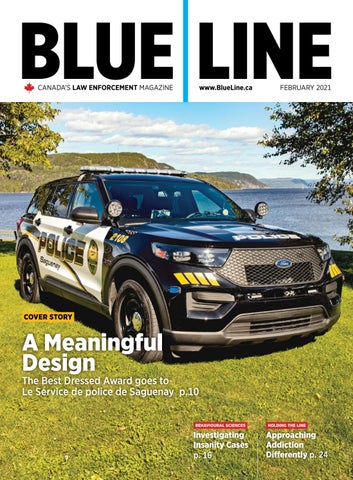
COVER STORY
A Meaningful Design
The Best Dressed Award goes to Le Service de police de Saguenay p.10 BEHAVIOURAL SCIENCES
HOLDING THE LINE
Investigating Insanity Cases p. 16
Approaching Addiction Differently p. 24
DYNAMIC DUO WE RIDE TOGETHER
GFX IS AWARDED THE FCA-MOPAR® DODGE DURANGO PURSUIT PROGRAM!
Dodge Durango SSV 2021 Sales code Guide
GFX LAW ENFORCEMENT VEHICLES
WWW.GFXLAW.COM | 1-800-739-6837
10
Contents
February 2021 Volume 33 Number 2
Features COVER STORY
10 Best Dressed Police Vehicle Award winners
Le Service de police de Saguenay comes in on top for Blue Line’s 2021 Best Dressed Police Vehicle Awards. Check out the designs that snagged top honours in all the categories. Thank you to every agency that submitted a vehicle. By Blue Line Staff
18 Results from the Michigan State Police vehicle tests
COVER PHOTO: LE SERVICE DE POLICE DE SAGUENAY TOP: SAGUENEY 2020 FORD EXPLORER
Poised to be another significant year for police vehicles in North America, 2021 will be remembered as the year of the police SUV. Learn how every new police vehicle on the market handled and performed in the Michigan State Police annual comprehensive analysis. By Dave Brown
14 18 @Blue_LineMag
Columns 4 14 16 17 23
Editor’s Commentary Q&A Behavioural Sciences Health & Wellness Interviewing & Investigations 24 Holding the Line 26 Case Law 30 Back of the Book
Departments 5 5 6 8 9 9 28 29 29
By the Numbers News News News Calendar Dispatches Product Showcase Marketplace Blue Links
24 February 2021 | BLUE LINE
3
EDITOR’S COMMENTARY BY BRIEANNA CHARLEBOIS
BLUE LINE www.BlueLine.ca
Making connections
A
s stay-at-home orders became James Jefferson, wellness co-ordinator commonplace in response to officer with the Greater Sudbury Police the continued threat of Service. Jefferson provides a first-person COVID-19, the lack of inter- account of using his experience and PTSD connectivity and human connection has to gain perspective, redefining and moldexacerbated the ongoing mental health ing it into tool to help officers within his crisis in Canada. department. Similarly, in this month’s Life as we knew it pre-pandemic no Holding the Line column, Michelle Vinlonger exists. Those who were fortunate cent addresses the correlation between a enough to keep their jobs began working lack of connectivity/human interaction from home, with the exception of frontline and addiction, posing a new approach healthcare workers and first responders, police could use in combating the ongoing who face added pressures and fears asso- opioid crisis while prioritizing their own ciated with the threat of the mental health. novel coronavirus. In April, the “As we take Departments across the counSecretary General of the United a deeper try are working to provide better Nations reported the mental look at vast mental health resources to their health and wellbeing of societies changes in officers. One such resource is the were severely affected by the law enforce- newly launched Espri by TELUS pandemic. This remains a con- ment over app, which offers a variety of tinuing and urgent priority to the past features and tools including redate. Fears about the health im- year, it’s source hub, a goal setting tool, a pacts of the virus, concerns for important group video call feature and a family members, extended social to consider resource list that links users to isolation, economic risk and un- the mental their department’s preferred certainty continue to be common health support providers. sources of mental health distress impacts of As I move into the new role of around the world. As suicide and this virus.” editor of Blue Line, I am also opioid-related deaths spiked grappling with the challenge of across the country, police officers were creating meaningful connections with my amongst the first responders to feel the new audience: you. significant impacts of the tragedies. There’s no contest: face-to-face interAs we take a deeper look at vast chan- actions create stronger bonds and allow ges in law enforcement over the past year, for deeper conversations. Though these it’s important to consider the mental aren’t possible now, I am grateful to have health impacts of the virus. The mental been embraced by many within the Canwellness crises among first responders is adian policing community and am activean ongoing occupational health hazard, ly working to make meaningful connecoften the result of a stressful work en- tions wherever possible, virtually. vironment, including exposure to signifiCountless Zoom calls later, I am conficant trauma and tragedy faced daily by dently building toward better understandpolice. Stigma also continues playing a ing the needs of Canadian law enforcement large role when accessing mental health and want to encourage continued open supports—something we, as a society, communication. So, please feel free to must work to change. reach out anytime and let’s keep breaking This edition of Blue Line addresses this down barriers and building these ever-imtheme. It features a Q&A with Const. portant connections!
Reader Service Print and digital subscription inquiries or changes, please contact Beata Olechnowicz, Audience Development Manager Tel: (416) 510-5182 Fax: (416) 510-6875 email: bolechnowicz@annexbusinessmedia.com Mail: 111 Gordon Baker Rd., Suite 400 Toronto, ON M2H 3R1 GROUP PUBLISHER | MARTIN MCANULTY mmcanulty@annexbusinessmedia.com EDITOR | BRIEANNA CHARLEBOIS bcharlebois@annexbusinessmedia.com ACCOUNT MANAGER | JANICE EATON jeaton@annexbusinessmedia.com MEDIA DESIGNER | ANDREA M. SMITH asmith@annexbusinessmedia.com ACCOUNT COORDINATOR | KATHRYN NYENHUIS knyenhuis@annexbusinessmedia.com COO | SCOTT JAMIESON sjamieson@annexbusinessmedia.com ANNEX BUSINESS MEDIA 111 Gordon Baker Road, Suite 400 Toronto, ON M2H 3R1 Tel. 416-442-5600 • Fax 416-442-2191 Publication Mail Agreement No. 40065710 ISSN 0847-8538 Printed in Canada SUBSCRIPTION RATES Canada — 1 Year $31.50; 2 Year $52.50 plus tax USA — 1 Year $136.50 CAD
Occasionally, Blue Line will mail information on behalf of industry-related groups whose products and services we believe may be of interest to you. If you prefer not to receive this information, please contact our circulation department in any of the four ways listed above. Annex Privacy Officer Privacy@annexbusinessmedia.com; Tel: 800-668-2374 © 2021 Annex Publishing & Printing Inc. All rights reserved. Printed in Canada. No part of the editorial content of this publication may be reprinted without the publisher’s written permission. Opinions expressed in this magazine are not necessarily those of the editor or the publisher. No liability is assumed for errors or omissions. Readers are cautioned and advised that articles presented herein are edited and supplied for your personal awareness and should not be used for further action until appropriate guidance is received from a supervisor, Crown Attorney or other persons in authority. All advertising is subject to the publisher’s approval. Such approval does not imply any endorsement of the products or services advertised. The publisher reserves the right to refuse advertising that does not meet the standards of this publication.
CONNECT WITH BLUE LINE
www.BlueLine.ca 4
@BlueLine_Mag
BLUE LINE | February 2021
www.facebook.com/BlueLineMagazine www.BlueLine.ca
NEWS
Espri by TELUS health app aims to provide easily-accessible mental health resources for first responders. CANADA
Edmonton’s Mental & Physical Health App Challenge
Espri by TELUS Health is a new app that delivers health and wellness resources to support the mental health pressures of first responders and their families. “The current health emergency has highlighted the unique challenges faced from our frontline workers,” said Darren Entwistle, TELUS president and CEO. “By providing access to effective mental health resources, we are able to offer critical support to our essential frontline workers, first responders and clinicians, in turn, enabling Canadians safe and well today and in the future.” The Edmonton Police Foundation (EPF) is now recognizing their work. The EPF partnered with ATB Financial to provide a $40,000 prize to an entrepreneurial app that assists first responders with mental health
challenges and physical fitness. The Espri by TELUS app was unanimously selected from more than 30 applicants to move into the second stage of the challenge (a field trial) where it will be analyzed by their Community Solutions Accelerator. “The TELUS team presented a promising, holistic solution and we are excited to see how it may improve the overall mental and physical wellbeing of EPS employees,” said Ashif Mawji, chair of the Edmonton Police Foundation. TELUS chief neuroscience officer Dr. Diane McIntosh said the app has been well-received since it was launched in October. “When the virus hit in March, first responders were tasked with managing their roles while worrying about being infected and bringing that infection home to their families,” she said. “First responders and frontline health care workers were already vulnerable [to
mental health issues] but now they’re even more vulnerable.” The ongoing mental health crises among first responders remains a continuing occupational health hazard—often stemming from a stressful work environment, that can include exposure to significant trauma and tragedy. First responders can also face stigma when accessing mental health supports, creating the need for confidential and easily accessible resources that may be best provided using an app. The app aims to mitigate these issues. It offers unique features and tools, including resource hub, a goal setting tool, a group video call feature and a resource list that links users to their organization’s preferred support providers. “Supporting our employees physically and psychologically throughout their careers and into retirement is an EPS priority,” said Edmonton Chief Dale McFee. “We are thrilled that a Canadian organization has submitted a solution that will help us work toward this goal and use today’s technology to make resources and supports more accessible.” The app began field trials with EPF in January and the review and judging of the trial is set to take place in March. If successful, the award for the challenge will be applied to a final contract for the continued use of Espri by TELUS Health by EPS staff. ALBERTA
Calgary Police mourn loss of officer killed in the line of duty
Civilians and first responders lined the streets of Calgary as police vehicles escorted
PHOTO: BLINDTURTLE/STOCK.ADOBE.COM
BY THE NUMBERS Statistics Canada found that police-reported crime statistics, measured by the Crime Severity Index (CSI), were on the rise in 2019. The CSI measures the volume and severity of police-reported crime in Canada and has a base index value of 100. All measures of the CSI increased for the fifth consecutive year, with reports of a five per cent increase in 2019. Released in October 2020, these figures are the latest nationally collected data on crime. For more information, visit statcan.gc.ca.
46%
increase in child pornography was reported in 2019, compared to 2018. Other notable increases were reported in fraud crimes, uttering threats, mischief, sexual assault (level 1) , and shoplifting of $5,000 or under.
@Blue_LineMag
21%
increase in the number of violent offences specific to firearms was reported. This was an increase of 642 incidents compared to the previous year across all three violent firearm violations.
678
homicides were reported in 2019, 20 more than the previous year. The national homicide rate increased 2 per cent. Police also reported 174 Indigenous victims of homicide, an increase from 141 in 2018.
2.2
million police-reported Criminal Code incidents (excluding traffic) were reported by police in 2019 (about 164,700 more incidents than in 2018).
February 2021 | BLUE LINE
5
NEWS
CANADA
Opioid-related deaths on the rise
The number of opioid overdoses and deaths has been growing steadily for years and the pandemic has only worsened these numbers. Increased overdose statistics have been reported in several jurisiction across the country. Ontario is among them. A recent report by Public Health Ontario showed that 695 people in Ontario died of a confirmed or suspected opioid-related death in the first 15 weeks of the pandemic 6
BLUE LINE | February 2021
Calgary police honour fallen comrade, Sgt. Andrew Harnett. alone – a 38 per cent increase compared to 15 weeks before the pandemic. Researchers estimate that numbers will show there were more than 2,200 opioid-related deaths in 2020, though data is still being collected and has yet to be released. If so, this would be the highest ever in Ontario, rising from 1,512 in 2019. NOVA SCOTIA
Nova Scotia working on legislation to regulate sale of used police vehicles
Nova Scotia is drafting legislation around the sale of used police vehicles and equipment after a man driving a replica RCMP cruiser killed 22 people last April. Justice Minister Mark Furey told reporters following a cabinet meeting on Jan. 21 that the legislation will regulate how police vehicles are decommissioned. He said this would include ensuring they are stripped of equipment and decals. “We are certainly aware of the previous circumstances and the most recent circumstances,” Furey said. The minister made the comments a day after the Mounties said a 23-year-old suspect from Antigonish, N.S., may have driven a vehicle that looked like an unmarked police car and pulled over drivers. The vehicle in question, a white 2013 Ford Taurus, is similar to the car Gabriel Wortman used during his 13-hour, deadly rampage in
northern and central Nova Scotia on April 18-19, 2020. In his statement, Furey also noted that under current law it’s illegal to impersonate a police officer. “When it comes to police articles and decommissioned police vehicles, there is certainly some work to do to fine-tune that legislation and the ability to mitigate and prevent, as best we can, access to this equipment that is used to mock-up police vehicles.” Furey said there are no plans to ban the sale of decommissioned police vehicles despite calls by the Opposition Progressive Conservatives to prohibit those sales. He said RCMP and municipal police services have been consulted and are in support of the government’s draft legislation. Furey recommended the Liberal government table a bill during the next sitting of the legislature. -Canadian Press ONTARIO
Woodstock deploys community police service
The Woodstock Police Service officially deployed their newest policing team, the Community Response Unit (CRU), in January. The CRU is a team comprised of a sergeant and two constables who will be actively working alongside the Core Beat, Traffic, Community Service, Uniform Patrol and other Woodstock Police Service units. www.BlueLine.ca
PHOTO CREDIT: CALGARY POLICE SERVICE
the body of their fallen comrade in a formal procession on Jan. 5. Sgt. Andrew Harnett, 37, joined the Calgary Police Service 12 years ago, after serving as a military police officer. He was promoted to Sergeant in 2019 and was most recently assigned to District 5. On Dec. 31, he was struck by a vehicle fleeing a traffic stop. Despite valiant attempts by his colleagues and members of EMS, he died as a result of his injuries. The two teens involved in the incident have since been charged with first-degree murder. “As a Service, we cannot fully express how immensely grateful we are for the outpouring community support we have received following the tragic loss of Sgt. Andrew Harnett,” said Chief Constable Mark Neufeld. “There is no doubt we are all feeling this loss, but please know this community support is helping us all navigate this difficult time.” The formal procession began around noon. The Calgary Police Service Skye Boat and Honour Guard accompanied by officers from the Medical Examiner’s office to the funeral home. A live stream showed officers placing Harnett’s casket, draped in a Canadian flag, in the back of a police funeral coach before beginning the hour-long processional. More than a dozen police vehicles followed the coach while uniformed first responders—police, paramedics, firefighters and Mounties—saluted along the road as the procession passed. In a statement released by the Calgary Police Service, Harnett’s family wrote, “He was proud to be a ‘street officer’ and work in District 5, where he spent his whole career, yet another demonstration of his loyalty. He knew the risks of the job and showed up every day, regardless. Andrew would have given everything for the police, and he did.”
NEWS Designed to work in collaboration with the community to determine local needs and respond with both proactive and reactive methods, this unit is responsible for anticipating, recognizing and appraising areas of crime risk and problems within the community and initiating planned action to reduce the risk and/or problem.
cancelled the practice, with Manitoba and Ontario following suit in 2020. Prince Edward Island says it will end birth alerts by the end of this month. The Northwest Territories says birth alerts haven’t been practiced there for over a decade. -Canadian Press CANADA
NEW BRUNSWICK
Fines for distracted driving, passing school bus doubling in 2021
New Brunswick motorists have some new rules to follow and can expect heftier fines if caught for distracted driving. The government is doubling fines to $280 for drivers convicted of distracted driving and to $480 for drivers who pass a school bus while its red lights are flashing. Public Safety Minister Hugh Flemming says one death or injury due to distracted driving is one too many. Drivers who encounter certain utility vehicles on the roads will be required to move over one lane and to slow down to at least half the posted speed limit. Drivers will have to give space to tow trucks, highway maintenance vehicles as well as private and public utility vehicles that have their flashing lights engaged. The updated legislation also allows police to impose zero-tolerance provisions of the law on novice drivers following a standard field sobriety test. -Canadian Press BRITISH COLUMBIA
Several Canadian provinces still issue birth alerts, deemed ‘unconstitutional and illegal’ in British Columbia
Several Canadian provinces are still issuing birth alerts, a practice that British Columbia government lawyers have called “illegal and unconstitutional’’ and that advocates say constitutes “surveillance of families.’’ A “birth alert’’ or “hospital alert’’ is when a social worker flags an expectant parent to hospital staff without their consent because they feel the parent may put their newborn at risk. The hospital then notifies the social worker when the baby is born. This practice sometimes results in child apprehension. Currently, Newfoundland and Labrador, Nova Scotia, New Brunswick, Saskatchewan and Quebec practice birth alerts. In 2019, British Columbia, Alberta and the Yukon 8
BLUE LINE | February 2021
Correctional Investigator to review Indigenous programming in prisons’
This year, Canada’s correctional investigator announced his office is launching a series of in-depth investigations looking at Indigenous programming in Canada’s prisons — specifically around access to culture and community support. “We want to hear from Indigenous inmates to learn from their experiences,” Dr. Ivan Zinger writes in his 2019-2020 annual report.“We intend to look at program participation criteria and compare results and outcomes for those who are enrolled in Indigenous-specific interventions.” An earlier investigation from Zinger revealed that the number of Indigenous inmates in Canadian prisons has reached historic highs, surpassing 30 per cent in recent years and on a trajectory to keep growing. In Fraser Valley, B.C., Correctional Service Canada (CSC) operates an Indigenous-focused minimum security institution— one of four “healing lodges” that exist across the country. At Kwìkwèxwelhp in Harrison Mills, about 50 inmates work with Elders, tend to a healing garden, and have access to a longhouse. Boyd Peters Xoyet-thet of the neighbouring Sts’ailes Nation was involved in the transition when Kwìkwèxwelhp was turned into a healing lodge in 2001. “We have the benefit of having the cultural history and teachings and knowing how much the land is healing for us,” said Peters, who is also a director with the BC First Nations Justice Council. “In our culture, we know that we need to take care of ourselves in a balanced way...the physical, the mental, the spiritual and the emotional. The mental is the education part.” Sts’ailes Nation signed a memorandum of understanding with CSC around Kwìkwèxwelhp, which means “a place to gather medicine.” Inmates are also given opportunities to upgrade their education. Though Kwìkwèxwelhp offers several educational programs, current statistics
show that more needs to be done on a national level. Aside from addressing the massive overrepresentation of Indigenous peoples in prisons, the current offerings of education in most institutions is falling short, Zinger said. In fact, three-quarters of federally sentenced individuals have some need for education or employment, according to Zinger’s 20192020 annual report. -Canadian Press CANADA
Canadian Police Services launches national methamphetamine awareness campaign
January marked Crime Stoppers Month in Canada. The theme for 2021 was “Helping All Communities Stay Safe”. In support of this theme, Crime Stoppers Canada, the Canadian Association of Chiefs of Police (CACP) and police services across the country launched a national public awareness campaign. Set to take place over the next several months, the campaign seeks to educate the public about the negative impacts of methamphetamine and how it poses a threat to the safety and well-being of communities. It will feature a variety of communication strategies to provide information on indicators of methamphetamine production and the prevalence of methamphetamine within their local communities. Police services will focus on encouraging members of the public to report suspicious activity to their local police service or remain anonymous by reporting to Crime Stoppers. Many law enforcement agencies have identified an increase in the use, trafficking, importation and production of methamphetamine. It has emerged as one of the most significant commodities within organized crime, entrenched from production, to importation and distribution. “The threat of methamphetamine production and its distribution within our communities continues to escalate. The Canadian Crime Stoppers Association and its 87 member programs that support all communities across Canada encourage the public to report any suspicious activity to Police or to Crime Stoppers anonymously,” said David J. Forster, president of the Crime Stoppers Association. “Together we can help all communities stay safe.” www.BlueLine.ca
NEWS DISPATCHES Belleville Police Service has a new deputy chief. Deputy Chief Chris Barry, who was already serving as acting deputy, was promoted to the deputy position on a permanent basis in January. Barry began his career with the Belleville Police Service in 1992 and has worked his way through the ranks in all aspects of the service including general patrol, criminal investigation and operations. He officially assumed his role on Jan. 1. Mike Callaghan, the former deputy police chief of Belleville, Ont., was promoted to the role of police chief in November. Callaghan was appointed deputy chief in 2017 and moved into the role of acting chief in October. He succeeds Chief Ron Gignac, who resigned Oct. 2 and for whom he’d served as deputy chief. Callaghan was born in Belleville and later lived in Amherstview. Callaghan’s sons Shamus and Josh, both police officers on Ottawa, presented him with his badge on Nov. 11. Jennifer Hyland was appointed as the first deputy chief constable of the Surrey Police Service in January. Hyland began policing more than 20 years ago, having served in both municipal and RCMP capacities. Hyland formerly served as superintendent officer in charge for the Ridge Meadows RCMP. She officially assumed the deputy chief role on Jan. 25.
CALENDAR police operations in 2018. Zettel was appointed deputy chief in June and moved into the role of interim chief in August. He was officially sworn in as the permanent chief on Nov. 18. After over 25 years of experience between Nelson and Calgary police services, chief constable Paul Burkart is retiring from the Nelson Police Department. Burkart became Chief Constable in February of 2016. His retirement will take effect this spring. Burkart was previously inspector and deputy chief at NPD. He also served on several community service agency boards and taught the D.A.R.E. program in Nelson schools for over ten years. The Delta Police Department in British Columbia appointed two new deputy chiefs to their service. Superintendent Harj Sidhu was promoted to deputy chief of operations in January. Sidhu is a veteran of the department, having spent his entire 27-year policing career with the DPD. Superintendent Michelle Davey will be taking on the role of deputy chief of administration in Delta. With 24 years experience with the VPD, most recently responsible for Support Services in the Investigations Division, Davey will be responsible for COVID response, training and HR.
NOTE TO READERS: check with all organizers as COVID-19 continues to affect events.
National Symposium on Sexual Assault Cases in the Criminal Court Feb. 27, 2021 Toronto, Ont. www.osgoodepd.ca Security • Police • Fire Career Expo Location: Virtual Date: March 4, 2021 » More Info www.emergencyservicesexpo.ca TACCOM 2021 Show Apr. 23-25, 2021 Mississauga, Ont. www.osgoodepd.ca Fourth International VPD Police Judo Clinic Apr. 27-30, 2021 Vancouver, B.C. policejudo.ca HK Memorial Hockey Tournament 2021 Apr. 29-30, 2021 Brampton, Ont. hkmemorial.com FutureCon: Toronto CyberSecurity Conference May 12, 2021 Toronto, Ont. futureconevents.com/events/torontoon-2020/?ref=infosec-conferences.com
Saint John Police Chief Stephan Drolet is stepping down from his role in February. Drolet joined the force on Feb. 24, 2020, after 27 years with the RCMP; most recently serving as British Columbia’s deputy criminal operations officer. According to a statement released Jan 8, he will be stepping down Feb. 20 due to personal reasons.
Tony Hayes was named deputy chief for the Saint John Police Force in October. He will be stepping into the role of interim chief on Feb. 20. Hayes joined the Saint John Police Force in 1992 and was promoted to sergeant in 2008 and to inspector in 2018. Hayes served in several divisions during his career including patrol, fraud and criminal investigations.
CANSEC 2021 June 2-3, 2021 Ottawa, Ont. www.defenceandsecurity.ca
Kevin Zettel was hired as the permanent chief of police for the Town of Saugeen Shores, Ont., in November. He started his policing career in 2002 at the Guelph Police Service before moving onto the Saugeen Shores Police Service in 2003. He was assigned to uniform patrol and criminal investigation before being promoted to uniform patrol and criminal investigations sergeant in 2010 and to inspector in charge of
Hamilton Police Chief Eric Girt is retiring this month. He served with the Hamilton Police Department for nearly 35 years and was appointed chief in May 2016. Prior to becoming chief, Girt worked as the commander of Division Two, where he successfully implemented the Neighbourhood Safety Project, a deployment strategy for the city. He also received the Order of Merit of Police Forces and the Police Exemplary Service Medal in 2011.
International Association of Directors of Law Enforcement Standards and Training 2021 Conference June 13-16, 2021 Fort Worth, Texas www.iadlest.org
@Blue_LineMag
Canada’s 911 Ride – Atlantic 2021 June 12-13, 2021 Truro, N.S. www.canadas911ride.com
Find more calendar events online at blueline.ca/events.
February 2021 | BLUE LINE
9
COVER STORY
Best Dressed Le Service de police de Saguenay comes out on top for Blue Line’s 2021 Best Dressed Police Vehicle Awards. By Blue Line Staff Congratulations to all the winners of Blue Line’s Best Dressed Police Vehicle Awards. We strive to showcase innovative and effective designs. We look for clear identification, graphic designs that enhance visibility, elements that show directionality of travel, and impressive integration of equipment and controls. Of course, we also take “green” vehicles into consideration. Thank you to everyone who submitted. Stay tuned to blueline.ca for 2022’s call for submission later this fall.
sent the geographical features of the area. Surrounded from north to south, the Mont-Valin National Park to the Laurentides wildlife reserve, the forest (represented by the green in the logo) is a symbol of Saguenay’s forestry economy and tourism. The blue and black colours represent the Fjord and Saguenay River. This vast river cuts across Jonquière and Chicoutimi then forks into an immense bay right in the middle of the La Baie district. The three lines under the word Saguenay represent the three unified districts. The 3D word ‘Police’ on the side represents their presence within the three districts. The logo was designed closely with union members, management services and an external firm. Paquet said white and black colours were chosen in order to ameliorate the car’s visibility, aided by reflective yellow accent lines.
2020 Ford Explorer
Judge Dave Brown, our fellow firearms and vehicle contributor for Blue Line, said he was struck by how the vehicle stands out in a night setting. “Saguenay is a great design and certainly has both a ‘wow’ factor and great directionality,” he said. “I really appreciate the meaning behind their design and a real community identity, with the way the swooshes represent the two rivers flowing through their community.” Paquet said the department was thrilled to hear the results of the contest. “The Service de police de Saguenay is
1ST PLACE
Quebec’s La Service de police de Saguenay didn’t want to showcase just any design for their 2020 Ford Explorer— they wanted a highly-visible and recognizable design immersed in meaning. The 2020 Ford Explorer has a hybrid engine, all-wheel drive and an automatic transmission. The department was created in 2002 with the amalgamation of Chicoutimi and Jonquière municipalities. The oval shaped logo on the side of the vehicle matches that worn daily by the department’s officers. In their submission, Captain Jerome Paquet wrote the logo, designed in 2015, was designed to repre10
BLUE LINE | February 2021
Hybrid Cruiser
www.BlueLine.ca
PHOTO: GUELPH POLICE SERVICE
LE SERVICE DE POLICE DE SAGUENAY 2020 FORD EXPLORER
placement and proportionate size of our services crest on the side of the vehicle symbolizes the department’s values: pride, service and trust “Guelph’s design is really nice. I like the gradient transition in the stripe from blue to red,” said Judge Dave Brown. “The word ‘POLICE’ really stands out.” The hybrid crests were included in the design with a touch of green to signify the department’s commitment to environmental stewardship. The transition to hybrid technology aligns with the City’s goal to be a net zero carbon community by 2050. “Our new cruiser design promotes the message that our police service upholds our city’s environmental values. While Officers patrol the city, serving the community, they are representing an environmental commitment to future generations.” very proud to win this award,” he said. “The visibility of this contest across Canada helps to increase the pride and professionalism of our police officers. These values are important to our organization.”
2ND PLACE
GUELPH POLICE SERVICE HYBRID CRUISER
PHOTO: LE SERVICE DE POLICE DE BROMONT
In 2019, when Guelph Police Chief Gord Cobey announced that Guelph Police Service would be the first in Canada to commit to an entire hybrid-marked fleet, the department decided timing was right to evolve the design to align with this direction. In the vehicle submission, Guelph said
that, instead of including the bright and bold red/blue colours to the package, they decided to have a solid singular stripe on either side which incorporated both. This solid stripe transitions from muted blue to muted red with a subtle gradient. This stripe package utilizes 3M Cast Vehicle Reflective, digitally printed and contour cut material: durability, high visibility and longevity. The two-tone base design captures both a nostalgic feel, while maintaining a distinctive police flavour. The higher visibility material and the less aggressive design lends itself to a safe and appealing vehicle. Guelph asserts that officer and public safety was a significant factor in choosing the design and clearly identifies it as a police vehicle. The
2020 Ford Hybrid Police Utility Interceptor
@Blue_LineMag
3RD PLACE LE SERVICE DE POLICE DE BROMONT 2020 FORD HYBRID POLICE UTILITY INTERCEPTOR
Le Service de police de Bromont wanted to implement a design to remember for their 2020 Ford Hybrid Police Utility Interceptor. They chose a design that paid homage to Vincent Roy, the fallen Bromont police officer who was struck by a motor vehicle in 2011. This vehicle has a 3.3L Hybrid engine and a 10-Spd Modular Hybrid Trans/Automatic transmission. In their submission, Const. William Healy wrote that the black patrol car with a wide blue line was inspired by a similar design used by a police department in the United States. The service decided to lay a thick blue line on the black vehicle and use reflective material for the word ‘POLICE’ on each side was “simple and functional with a sleek, contemporary design.” Judges Dave Brown and Rylan Simpson were in agreement and liked the simplicity of the Bromont design. “I also really liked the directionality of the thick blue line and that the word ‘POLICE’ really stands out from the border, which is a factor really important to me as far as officer-safety, plus the gradient really works with this design,” said Brown. “I also really like the nod to a fallen officer that serves as a reminder that these are the people who put their lives on the line every day to serve the citizens of their community.” February 2021 | BLUE LINE
11
COVER STORY
COMMUNITY RELATIONS ABBOTSFORD POLICE DEPARTMENT BMW X5 M COMMUNITY VEHICLE
There’s no missing Abbotsford Police Department’s Golden BMW Community Vehicle. This BMW X5 M has a 4.4L 8cyl Turbo 6A engine, all-wheel drive and an automatic transmission. In their submission, the department said they selected the golden foil due to its ability to garner attention and spread the department’s message and their goal to “Ending Gang Life” by creatively illustrating the costs of and dispel stereotypes about the “gang lifestyle”. Black matte was used to complement and provide balance to the golden “bling”/messaging component of the design. Sgt. Kelly Joiner and Insp. Casey Vinet developed the vehicle design with feedback from police officers and civilian employees to ensure the intended educational message was clear and identifiable. The vehicle has a statement alongside the hood , which reads: “This vehicle was seized by police” and the message on the hood reads: ‘Don’t be fooled. All that glitters is not gold” , which connects with the anti-gang messaging. “This vehicle represents the nexus between style, functionality and messaging. It clearly identifies itself as a police vehicle with its bold ‘POLICE’ branding but does so in such a way to highlight its key focus and purpose, which is to help deter gang involvement,” said judge Rylan Simpson. “This vehicle is a func12
BLUE LINE | February 2021
tional and creative example of how police vehicles can be used to both attract public attention to policing interventions while simultaneously promote awareness about important criminal justice topics.”
LAW ENFORCEMENT UNIVERSITY OF TORONTO
CAMPUS POLICE 2020 FORD POLICE INTERCEPTOR UTILITY
To celebrate 116 years of providing community-based policing, the University of Toronto Campus Police Department decided to redesign their fleet. It is simple, yet effective design was chosen to represent and align with the department’s mission. The hybrid vehicle was chosen
SPECIAL SERVICE SASKATOON POLICE SERVICE
MOBILE ALCOHOL & DRUG TESTING UNIT
The Saskatoon Police Service unveiled and implemented their Mobile Alcohol & Drug Testing Unit in September. Their Ford Transit van is equipped with the Draeger
PHOTO CREDIT: (LEFT) ABBOTSFORD POLICE DEPARTMENT (CENTRE) UNIVERSITY OF TORONTO CAMPUS POLICE
BMW X5 M Community Vehicle
as a contribution to the university’s goal of sustainable practices by reducing the service’s carbon footprint and 80 per cent of the fleet is now hybrid. “University of Toronto Campus Police vehicle neatly identifies itself as campus police and highlights the colours of the University of Toronto,” said Judge Rylan Simpson. “It features the department’s slogan, “Forward Together”, and smooth lines and reflective markings that enhance both the visibility and aesthetics of the vehicle.” The 2020 Ford Police Interceptor Utility fleet prominently features the University’s official colours (blue and gold) in a dual-tone stripe running along the side of the vehicle. The angled design of the stripes depict progression and movement, reflecting the lively nature of campus life. Special attention was paid to the lighting and equipment package to ensure frontline members have the tools to perform their duties more effectively and safely. The comprehensive 360-degree lighting and the new remote spotlight was also included to increase visibility for frontline members, directly contributing to enhanced officer safety.
2020 Ford Police Interceptor Utility
www.BlueLine.ca
Mobile Alcohol & Drug Testing Unit
is used as a mobile workstation for activities related to impaired driving investigations. The side decal image of an officer dressed in high-visibility apparel signaling motorists to stop as officers actively conduct a roadblock, clearly highlighting the vehicle’s purpose. “I think Saskatoon Police has to be the
Thank you to Dave Brown and Rylan Simpson, Blue Line’s Best Dressed Police Vehicle judges for their expertise and dedication to this content.
PHOTO: SASKATOON POLICE SERVICE
DrugTest 5000, a portable breathalyzer unit to measure blood alcohol levels. “We also made the decision to turn the vehicle into a kind of roving billboard by wrapping it with anti DWI imagery,” explained Sgt Patrick Barbar. Specially designed for use as part of impaired driving enforcement, the vehicle
hands-down winner for the Special Service category,” said judge Dave Brown. Judge Rylan Simpson agreed. “The vehicle’s messaging doubles as a proactive attempt to deter motorists from driving impaired while non-operational (while mobile) and a reactive attempt to catch motorists who make the decision to drive impaired while operational (while stationary),” wrote Simpson in his judging review. “Its markings, including those on the rear of the vehicle, also make it highly visible and less likely to be struck while being used operationally.” Funding for the unit was obtained through the Ministry of Corrections and Policing’s Civil Forfeiture program ($50,000) as well as through Saskatchewan Government Insurance ($25,000). The Saskatoon Police Service covered any additional costs.
@Blue_LineMag
BL_SevenView_AugSept20.indd 1
February 2021 | BLUE LINE
13
2020-07-13 1:20 PM
Q&A Const. James Jefferson, the wellness co-ordinator officer at the Greater Sudbury Police Service, discusses how he molded his trauma into purpose by educating and inspiring fellow officers. Q: Why did you pursue a career in law enforcement?
Q: How has COVID-19 impacted your role?
It’s been non-stop since the moment I started this position but I believe the mental health in our profession is at an all-time low right now. Officers and personnel are struggling. There’s a number of reasons: COVID, the racial turmoil with police that’s so prevalent right now and the anti-police movement. We can’t turn on the television nowadays without seeing something negative directed at police so, you pile on our professional experiences with everything that’s going around the world and it’s clear that our people are struggling and in need of support. I’ve been very busy but I just focus on helping one person at a time.
Q: Can you tell us about your personal experiences with PTSD?
Coming into the profession, I was completely naive. I was oblivious to mental health and didn’t know what PTSD was. The first two years on the job, I flourished but then, at about the two-year mark, I was involved in a fatal shooting; a homicide that turned into a suicide-by-police scenario. It was a moment where we were faced with a decision that no human should ever have to make: to take a life or to gamble with my own and my partner’s. There was a fall out after that and that was something I wasn’t prepared for. I was promoted into the drug unit shortly after the shooting and that’s when I really began my downward descent, in terms of depression and anxiety. In the drug unit, you deal with a lot of human tragedy and pain and it allowed me to put myself out there and into a lot of dangerous situations. As the PTSD began to grow, my thoughts of suicide began to grow too. Eventually suicide became an everyday thought and, unbeknownst to my colleagues, I did actually attempt while on shift. I wouldn’t wish PTSD or trauma on my worst enemy because losing your ability to control your own mind and thoughts, there’s nothing more tragic and humbling than that in my opinion.
Q: You have said that you struggled for several years before giving in to the healing 14
BLUE LINE | February 2021
Const. James Jefferson is the wellness co-ordinator officer with the Greater Sudbury Police Service.
process. What did that look like?
I realized I had to change the game plan. I had to recover from this because living like that couldn’t be an option anymore. It was a conscious choice to be better than this disorder, to not be defined by it but to defy it. It all began there.
Q: What was it like stepping into the role of wellness co-ordinator?
Purpose trumps fear. I had this this inner purpose and told Chief Paul Pedersen that we needed to create this position for me. He agreed and, with his support, it’s gone better than I could have imagined. The gratitude and the outreach from the members showed me that I wasn’t the only one who felt there was a lack of resources. Because I have similar lived experiences, I’ve been able to ensure that others won’t walk that same path I did. Instead, they will walk a better, more supportive path.
“I realized I had to change the game plan. I had to recover from this because living like that couldn’t be an option anymore. It was a conscious choice to be better than this disorder, to not be defined by it but to defy it. It all began there.”
Q: What are your biggest takeaways from your time in the role? What would you tell other departments who want to implement a similar position?
Several services have reached out to us and our main advice for them is that you must have the right person for it to be successful. The wellness co-ordinator must have that lived experience but also be past it and in a place of peace. I’m thankful for my experience. It changed me. It’s made me stronger but it’s also woken me up to life. I really feel like, preceding trauma, I was sleepwalking, just going through the motions of life, but my experience woke me up. I look at life differently now. It’s been a true blessing but you can’t get to that brightness without knowing how darkness feels. This episode of Blue Line Podcast was sponsored by Wilfrid Laurier University. To listen to the full podcast, visit blueline.ca. Editor’s Note: This Q&A has been edited for clarity.
www.BlueLine.ca
PHOTO CRED: GREATER SUDBURY POLICE SERVICE
Being in law enforcement was my life’s ambition. I always saw myself in this line of work and on this career path. I thought it was the perfect fit based on how I carry myself and what I brought to the table.
NEW TOTAL VEHICLE SOLUTION FOR THE
2021+ C H E V R O L E T TA H O E
2021+ Chevrolet Tahoe Wide Body Console Box with Printer Mount Item No. 7160-1566-01
RUGGED. RELIABLE. RESPONSIVE. Introducing Gamber-Johnson’s total vehicle solution for the 2021+ Chevrolet Tahoe. Featuring vehicle specific console box options for a customized fit and rugged push bumper, window barriers, partitions, and cargo storage for a complete bumper to bumper solution. To find a dealer in your area visit www.gamberjohnson.com/FindAReseller
BEHAVIOURAL SCIENCES BY PETER COLLINS
Investigating insanity cases: Part 1 Actus non facit reum nisi mens sit rea: “An actdoes not make a person guilty of a crime unless that person’s mind be also guilty.”1
T
he defence of insanity is perhaps one of the least or most poorly understood concepts in criminal law. The reason for this misunderstanding is partly due to the fact that law has borrowed a word from everyday speech and turned it into a legal concept with a very different meaning. In Court, the challenge is to ensure that this common concept of insanity does not invade the legal concept. About 25 years ago, crown attorney James Cornish and I wrote a paper for homicide detectives on how to investigate cases to determine the issue of criminal responsibility. Although distributed on a case by case basis, we never published it. In honour of James, who recently retired, I am now sharing an updated version. Part 1 will address the legal definition, the myths and realities of the Not Criminally Responsible on Account of Mental Disorder (NCRMD) and what to investigators should evaluate at the crime scene.
Insanity
It is beyond the scope of this article to examine the development and case law regarding s. 16 of the Criminal Code of Canada: Insanity is presumed not to be present and must be demonstrated to exist on a balance of probabilities, by whichever party is asserting the defence. According to section 16 of the Criminal Code of Canada, there is a prerequisite that the accused suffers from a mental disorder that affects the accused to a degree that causes the accused to lack appreciation for the nature and quality of the act committed and/or to lack knowledge or understanding of its moral and/or to lack legal wrongfulness.2
Myths and Realities3
• The insanity defence is overused: The insanity defence is raised less than one 16
BLUE LINE | February 2021
per cent of criminal prosecutions in Canada and is only successful in 10 per cent of cases in which it is raised. • Many accused are released from custody soon after being found not criminally responsible: It is very rare for an individual, who is been found NCRMD, to be released after the finding. • NCRMD accused spend less time in custody than would have been the case if they had been convicted of the offense and serve the sentence for it: The contrary is true. Those found not criminally responsible often spend considerably more time under the auspices of the provincial review board responsible for overseeing individuals who are NCRMD.
“In Court, the challenge is to ensure that this common concept of insanity does not invade the legal concept.” • A NCRMD verdict is a positive outcome for the accused, and as such, is often raised by the defence: In reality approximately 50 per cent of ‘not criminally responsible’ defences are raised by the Crown. • Outcomes of the insanity defence are a result of who is more persuasive in the “battle of experts”: The “battle of the experts” is still uncommon but, in my professional opinion, appears to be on the increase. A recent example was the attempt of the defence to have autism spectrum disorder, a mental condition that could qualify as a “disease of the mind”, which is required for an insanity plea. This is also true in cases when psychiatrists offer the opinion
that individuals with PTSD can dissociate and therefore not be responsible for their actions. The conditions more commonly found in the background to an NCR case include: schizophrenia, delusional disorder, major depressive disorder with psychotic features and mania in the context of a bipolar disorder. The vast majority of individuals who meet the criteria for these diagnoses and end up committing crimes are still responsible for their actions and are not candidates for a section 16 defence. The more bizarre or atrocious the offence or offences are, the more intuitively satisfying it will be to conclude that the offender was “crazy”. This is where, despite the law in this area, the temptation will be to find the offender insane. It is important that the investigation be thorough, and the more the assistance of an investigative support unit (i.e. the Criminal Behaviour Analysis Section of the Ontario Provincial Police or the Behavioural Sciences Sections of the Royal Canadian Mounted Police and Sûreté du Québec) can help. The behavioural experts can assist in bizarre and shocking crimes by giving focus to the investigators, identifying areas that may be important yet not obvious and providing interview strategies. In a number of cases, the author has been contacted by the police to determine whether the subject is psychologically fit to be interviewed. Part 2 will explore the investigatory aspects of these cases: crime scene considerations; interviewing the suspect; witness interviews; background investigation and information that should be obtained when the accused is in custody.
Footnotes
1. Sir Edward Coke, Beverley’s Case (1603), 4 Co. Rep. 123, 117 E.R. 1118. 2. Bloom, H. (2013) Not Criminally Responsible on Account of Mental Disorder (NCRMD). Law and Mental Disorder: a comprehensive and practical approach. Eds. H. Bloom & R. Schneider. Toronto: Irwin Law. 3. Adapted from Perlin (1993) The jurisprudence of the insanity defense. Durham, North Carolina: Academic Press
Peter Collins is the operational forensic psychiatrist with the Ontario Provincial Police’s Criminal Behaviour Analysis Section. He is also a member of the crisis/ hostage negotiation team of the Toronto Police Service Emergency Task Force. Dr. Collins’ opinions are his own. Contact him at peter.collins@utoronto.ca.
www.BlueLine.ca
HEALTH & WELLNESS BY ISABELLE SAUVÉ
Defining survivorship bias
PHOTO: ANATOLY STOJKO/STOCK.ADOBE.COM
T
imes of war and crisis have consistently set grounds for all types of research and findings. Our tumultuous history is filled with many scientific, sociological and psychological discoveries. Amongst those is a fascinating philosophical concept called “survivorship bias”, which emerged during the Second World War. Survivorship bias is defined as an error in a logical analytical process that leads to drawing false conclusions. It provides hindsight on the issue of concentrating on select people, objects or areas of focus at the expense of overlooking other key pieces. These omissions often go unnoticed because of their lack of visibility or are hidden behind obvious details. For example, researchers at the United States Center for Naval Analyses conducted a study on the damage sustained to returned mission aircrafts. As a result of their analysis, researchers recommended to augment armour in the areas that showed the most damage in order to minimize bomber loss to enemy fire in the future. Hungarian mathematician Abraham Wald thought differently. Wald, who spent his career applying statistical skills to various wartime problems, noted their study was strictly conducted on the aircraft vessels that had survived their missions and returned home. For “obvious reasons”, the bombers who were shot down and never returned were not included in the study. Wald indicated, contrary to the findings and recommendations from the Center for Naval Analyses, the areas with holes sustained from enemy fire in the returning aircrafts required no additional armour since the vessel could take the damage and still return safely. On the contrary, it was more important to reinforce the areas where the returning aircraft were unscathed because as if hit, it would cause the @Blue_LineMag
The United States Center for Naval Analyses conducted a study on the damage sustained to returned Second World War mission aircrafts.
plane to become inoperative. Wald suggested extra armour be added to these areas instead. As a result of his findings, more aircrafts and lives were saved. There are many examples of survivorship bias in our daily lives. They are often overlooked but can carry the risk of negatively impacting our ability to make sound decisions. When we consciously (or unconsciously) elude looking at all aspects of a situation, we can’t fully understand the necessary problem-solving steps. Only addressing the visible or the most prominent “weaknesses” or “strengths” doesn’t always lead to improving a situation. In the previous example, what was initially viewed as the weakness of the plane was actually its strength. We ought to develop the ability to discern between what is obvious and the more impactful, underlying factors. From a management perspective, many companies, organizations and agencies routinely make the same mistakes. There is a tendency to look for “visible issues” to justify decisions. Some managers even hide behind a title or a rank to position themselves as expert or find “holes in the aircraft” to justify a decision. The underlying effect is a recurring, overarching sense of unfairness and misunderstanding. It takes skill, education, compassion and intellectual honesty to be able to look at a situation from different
Survivorship bias is defined as an error in logical analytical process that leads to drawing false conclusions.
angles. It takes the same qualities to appreciate that a perceived weakness may actually be a strength, and vice versa. There is no doubt reinforcing strengths of employees will result in improved motivation and commitment levels. Individuals tend to gravitate toward what they do well but organizations tend to focus on addressing weaknesses. Strength-focused approaches help members to gain clarity on their natural strengths and use them more effectively. They also energizes team environments and encourage members to draw upon each other’s strengths. By focusing on strengths, the impact of weaknesses can be reduced by welcoming new strategies. Strength-focused approaches offer an optimistic lens and promote confidence and resilience. Performance dialogues and competency frameworks consist of examining what strengths were utilized rather than endorse a fixation on formulaic methods or on weaknesses. The intent isn’t to ignore weaknesses entirely but, by focusing on developing natural talent, weaknesses tend to improve. Nonetheless, the concept of focusing on strengths rather than weaknesses becomes meaningless if they can’t be adequately identified and analyzed by qualified, well-intentioned personnel. When looking at personnel or organizational development and improvement, an accurate and full understanding of strengths and weaknesses is necessary. As frontline officers, police are encouraged to “look beyond the plate” and “dig a little deeper” in the course of their duties. It’s imperative that leadership does the same. Isabelle Sauvé is a 14-year veteran with the OPP, and currently the new Psychological Services Advisor in the OPP’s Healthy Workplace Bureau. She has a MA in psychology and is a PhD candidate. She is also an ultramarathon/ endurance athlete and the Racing the Planet/4 Deserts 2018 Series winner as well as a Guinness World record holder. She can be contacted at: isabelle.sauve@hotmail.com
February 2021 | BLUE LINE
17
VEHICLES
Dodge Durango Pursuit from Fiat Chrysler Automobiles
Dodge Charger Pursuit from Fiat Chrysler Automobiles
The year of police SUVs
Results from the 2021 Michigan State Police Vehicle Tests
T
his year will truly be remembered as the year of the police SUV. Dodge is now the last remaining supplier of pursuit-rated police sedans in North America. This means 10 vehicles remain in the 2021 Michigan State Police vehicle testing. With Ford getting out of the sedan market entirely, plus selling more police SUVs than Dodge and GM combined, this was not surprising. Ford is not just the number one selling pursuit-rated police vehicle in Canada, they are also the fastest (Police Interceptor Utility SUV with the twin turbocharged 3.0L V6 EcoBoost motor, formerly only available from Lincoln) and the slowest (F-150 Police Responder pickup truck with the twin turbocharged 3.5L EcoBoost engine.) They are also the only choice in hybrid police vehicles. Fiat Chrysler has not been resting on its laurels. The new 2021 Dodge Charger Pursuit is available in an all-wheel-drive (AWD) version with a 3.6-litre V6, and a rear-wheel-drive (RWD) version with the 5.7-litre V8 motor. Dodge also sells two pursuit-rated versions of its AWD Durango. General Motors has completely redesigned the popular and roomy Chevrolet Tahoe Police Pursuit vehicle (PPV) for 2021. It is available in both a two-wheeldrive and a four-wheel-drive version. Both versions come with the 5.3-litre V8, and there are only fractions of a second differ18
BLUE LINE | February 2021
ence between the two drivetrain layouts. This can be observed in both lap times and acceleration. The Chevrolet Tahoe gets the front skid plate, front bumper and grill from the civilian Z71 Tahoe, which both improves looks and increases approach angles for hopping over curbs. With the same engine output as last year, improvements were made in breathing, crankcase ventilation (with new rocker covers from the track-ready Chevy Camaro ZL1) and in increased in cooling capacity of the engine, transmission and brakes. Of most significance is the new platform under the 2021 Tahoe, which increases cargo space and adds fully-independent rear suspension. The previous Tahoe was one of the very last full-size, body-on-frame SUVs with a solid axle rear end. The new independent rear suspension is a huge improvement over the older live-axle design. Chevrolet have always been good at designing well-handling police vehicles but, even with clever design, the solid rear axle always had a tendency to slide sideways on very rough
washboard gravel roads. The 2021 Tahoe eliminates that and vastly increases braking capability and high-speed handling. Ford, Dodge and Chevrolet are still the only pursuit-rated, purpose-built police vehicles in North America. They abound with officer-safety, performance and comfort enhancements to turn an office-on-wheels into the toughest, safest, fastest and best-handling police cars ever made. While there is no strict definition of the term “pursuit-rated”, agencies such as Michigan State Police and Los Angeles County Sheriff ’s Department extensively document and test every model offered for sale in North America. They agree that a pursuit capable police vehicle must be able to handle higher stresses than normal and perform better at high speed than their civilian counterparts. Even without any formal recognition of the term “pursuit-rated”, it will be up to individual agencies to determine if a particular vehicle is suitable for their mission.
Ford, Dodge and Chevrolet are still the only pursuit-rated, purpose-built police vehicles in North America. www.BlueLine.ca
PHOTOS THIS PAGE: FIAT CHRYSLER AUTOMIBILES
By Dave Brown
Ford F150 Responder by Ford Motor Company
MICHIGAN STATE POLICE YEARLY VEHICLE TESTS
Every fall the Michigan State Police, in conjunction with the US National Institute of Justice (NIJ), test the handling and performance of every new police vehicle on the market for the coming year in backto-back acceleration, braking and lap time tests. These eagerly anticipated tests are seen as the most comprehensive analysis of police vehicles in North America. The Michigan State Police yearly vehicle test for the 2021 model year will mark the 23rd consecutive year that Blue Line magazine has been compiling and reporting the results of the tests for police category vehicles.
PHOTO TOP LEFT: FORD MOTOR COMPANY PHOTO TOP RIGHT: GENERAL MOTORS COMPANY
Vehicles
The Michigan State Police Precision Driving Unit evaluates police vehicles in two categories: Police Category vehicles and Special Service vehicles. Police category vehicles are designed for the full spectrum of general police activities including high-speed pursuit. Special service vehicles are designed only for specialized duties, such as canine units or adverse weather conditions, and are not intended or recommended for pursuits. Thirteen vehicles were submitted to the NIJ in the Police category for the 2021 model year: • 2021 Chevrolet Tahoe PPV 5.3L RWD • 2021 Chevrolet Tahoe PPV 5.3L 4WD • 2021 Dodge Charger Pursuit 3.6L AWD • 2021 Dodge Charger Pursuit 5.7L RWD • 2021 Dodge Durango Pursuit 3.6L AWD • 2021 Dodge Durango Pursuit 5.7L AWD • 2021 Ford Police Interceptor Utility Hybrid AWD • 2021 Ford Police Interceptor Utility 3.0L EcoBoost AWD • 2021 Ford Police Interceptor Utility 3.3L AWD @Blue_LineMag
Chevrolet Tahoe from General Motors
• 2020 Ford F-150 Police Responder 3.5L EcoBoost 4WD These are the Police category vehicles that will be available for sale in Canada for 2021 (with preliminary figures from the 2021 Michigan State Police vehicle tests, and additional comments from Blue Line Magazine.)
The Tests
Michigan State Police Precision Driving Unit and the NIJ’s Justice Technology Information Center (JTIC) test all the
vehicles together over a three-day period at the Chrysler Proving Grounds and the Grattan Raceway. Each vehicle is tested without rooftop lights, spotlights, sirens or radio antennas in place. Tires are original equipment rubber provided by the manufacturer. Acceleration, braking and top speed tests are performed at the Chrysler proving ground and vehicle dynamics tests are done using the two-mile road course at the Grattan Raceway. Note: All dimensions and measurements are given in U.S. numbers.
THE RESULTS Vehicle dynamics testing
The objective of the vehicle dynamics testing is to determine the highspeed pursuit handling characteristics. Except for the absence of traffic, the two-mile road course simulates actual pursuit conditions and evaluates the blend of suspension components and acceleration, and braking ability. Four different drivers test each vehicle over an eight-lap road course, with the five fastest laps counting toward each driver’s average lap time. Final score is the combined average of all four drivers for each vehicle.
4
different drivers test each vehicle over an eight-lap road course.
Chevrolet Tahoe 5.3-litre V8 RWD
Chevrolet Tahoe 5.3-litre V8 4WD
Dodge Charger 3.6-litre V6 AWD
Dodge Charger 5.7-litre V8 RWD
Dodge Durango 3.6-litre V6 AWD
Overall average lap times
1:38.03
1:38.93
1:37.84
1:36.30
1:41.02
Lap Times
Dodge Durango 5.7-litre V8 AWD
Ford PI Utility 3.3-litre Hybrid AWD
Ford PI Utility 3.0-litre V6 EcoBoost AWD
Ford PI Utility 3.3-litre V6 AWD
Ford Police Responder F150 3.5-litre V6 EcoBoost 4WD
Overall average lap times
1:38.79
1:38.69
1:35.65
1:38.36
1:43.84
Lap Times
February 2021 | BLUE LINE
19
VEHICLES
Acceleration and Top Speed
The objectives of the acceleration and top speed tests are to determine the ability of each vehicle to accelerate from a standing start to 60 mph, 80 mph and 100 mph, and to record the top speed achieved within a distance of 14 miles from a standing start. miles per hour is Each vehicle is driven what a pursuitcapable vehicle through four acceleramust need to tion sequences, two in reach in nine seconds. each direction to allow for wind. Acceleration score is the average of the four tests. Following the fourth acceleration sequence, each vehicle continues to accelerate to its highest attainable speed within 14 miles of the standing start point.
60
Acceleration
Chevrolet Tahoe 5.3-litre V8 RWD
Chevrolet Tahoe 5.3-litre V8 4WD
Dodge Charger 3.6-litre V6 AWD
Dodge Charger 5.7-litre V8 RWD
Dodge Durango 3.6-litre V6 AWD
0 – 60 mph
7.60
7.87
7.41
5.91
8.80
0 – 80 mph
12.24
12.82
11.81
9.36
14.80
0 – 100 mph
19.17
20.19
17.97
14.14
24.72
Top Speed (mph)
130
125
140
140
128
Ford PI Utility 3.3-litre V6 AWD
Ford Police Responder F150 3.5-litre V6 EcoBoost 4WD
Acceleration
Dodge Durango 5.7-litre V8 AWD
Ford PI Utility 3.3-litre Hybrid AWD
Ford PI Utility 3.0-litre V6 EcoBoost AWD
0 – 60 mph
7.01
7.19
5.75
7.84
6.61
0 – 80 mph
11.77
11.52
9.07
12.55
10.62
0 – 100 mph
19.00
17.40
13.86
19.14
16.78
Top Speed (mph)
130
136
148
136
105
Chevrolet Tahoe 5.3-litre V8 RWD
Chevrolet Tahoe 5.3-litre V8 4WD
Dodge Charger 3.6-litre V6 AWD
Dodge Charger 5.7-litre V8 RWD
Dodge Durango 3.6-litre V6 AWD
Average deceleration rate (feet/sec2)
30.37
30.47
30.44
30.07
29.09
Projected stopping distance from 60 mph (feet)
127.50
127.10
127.20
128.80
133.10
Dodge Durango 5.7-litre V8 AWD
Ford PI Utility 3.3-litre Hybrid AWD
Ford PI Utility 3.0-litre V6 EcoBoost AWD
Ford PI Utility 3.3-litre V6 AWD
Ford Police Responder F150 3.5-litre V6 EcoBoost 4WD
Average deceleration rate (feet/sec2)
29.18
29.77
30.02
30.59
26.52
Projected stopping distance from 60 mph (feet)
132.70
130.10
129.00
126.60
146.00
Chevrolet Tahoe 5.3-litre V8 RWD
Chevrolet Tahoe 5.3-litre V8 4WD
Braking
Braking
Fuel Economy
While not an indicator of actual mileage that may be experienced, the EPA mileage figures serve as a good comparison of mileage potential from vehicle to vehicle. Vehicle figures are based on data published by the vehicle manufacturers and certified by the U.S. Enyears Blue Line vironmental Protection has been reporting Agency. Mileage figures on the Michigan State Police are given in U.S. miles vehicle tests per gallon.
23 20
BLUE LINE | February 2021
EPA Mileage (miles per U.S. gallon)
Braking
The objective of the braking test is to determine the deceleration rate attained by each vehicle on twenty 60-0 mph full stops to the point of full ABS. Each vehicle is scored on the average deceleration rate it attains. Each test vehicle makes five measured 60-0 mph stops to full ABS engagement in one direction and then five measured 60-0 mph stops to full ABS engagement in the opposite direction. After ten stops, each vehicle completes one lap around the test oval to cool the brakes, and the test is repeated. The resulting score is the average of all 20 stops. Stopping distance from 60 mph is calculated by interpolation of results.
Dodge Charger 3.6-litre V6 AWD
Dodge Charger 5.7-litre V8 RWD
Dodge Durango 3.6-litre V6 AWD
City
16
16
18
16
18
Highway
20
20
27
25
25
Ford PI Utility 3.3-litre V6 AWD
Ford Police Responder F150 3.5-litre V6 EcoBoost 4WD
EPA Mileage (miles per U.S. gallon)
Dodge Durango 5.7-litre V8 AWD
Ford PI Utility 3.3-litre Hybrid AWD
Ford PI Utility 3.0-litre V6 EcoBoost AWD
City
14
23
18
16
18
Highway
22
26
24
23
23
www.BlueLine.ca
The final communications and ergonomics score is the average of three factors including dashboard, trunk and engine compartment accessibility. Communications and Ergonomics
The objectives of the communications and ergonomics tests are to rate a vehicle’s ability to provide a suitable environment for patrol officers to perform their job, to accommodate required communication and Ergonomically emergency warning factors are evaluated on equipment and to assess a scale of one the relative difficulty in to ten. installing this equipment. A minimum of four officers independently evaluate ergonomic factors, and Michigan State Police Communications Division personnel then evaluate each vehicle on the ease of equipment installation.
27
Michigan State Police had not released Communication and Ergonomic scores for 2021 as of our deadline, so 2020 figures are listed. It is expected that 2021 figures for the Chevrolet Tahoe may be higher than 2020, due to an updated electrical system that simplifies upfitting, a redesign of the seats and an increase in cargo cap-
Total communication test scores
Total ergonomic test scores
Blue Line magazine started publishing results of the Michigan State Police vehicle testing in 1998. Since then, we’ve seen significant changes in the design, capability and safety of police vehicles. There have been increases in performance, braking, handling and fuel efficiency. We’ve seen the introduction of very capable hybrid powertrains. More than 95 per cent of all the police cars sold in Canada today are all-wheel-drive. Officer safety is an increasingly important factor in the design of modern police vehicles; not just with upgrades but with the research that goes into the proper placement of gear and accessories that allow safe deployment of airbags in crash situations. When your office is on wheels and help may be a radio-call away, safety, durability, reliability and comfort cannot just be headings in a brochure. The 2021 police vehicles are the most mature, well-developed and well-designed police cars one could ever hope to drive. Read last year’s report on the tests at https://bit.ly/3octIRs to compare with the 2021 results. Dave Brown is Blue Line’s firearms and police vehicle contributor, as well as the Best Dressed Police Vehicle Awards judge. He is a tactical firearms trainer and consultant based in Winnipeg. He can be reached at Dave.Brown@northwestlaw.ca.
acity due to the new independent rear suspension design. A total of three communications factors are evaluated on a scale of one to ten and averaged among all the testers. The final score is the overall average of all three factors, including dashboard, trunk and engine compartment accessibility.
Chevrolet Tahoe
Dodge Charger
Dodge Durango
Ford
Ford F150
8.84
8.71
9.78
9.44
8.7
Chevrolet Tahoe
Dodge Charger
Dodge Durango
Ford
Ford F150
8.92
8.74
9.13
8.29
8.77
Advance your policing career With a focus on executive leadership and international policing, the Master of Leadership and Management (Policing and Security) from Charles Sturt University will develop your senior leadership capabilities. Charles Sturt is Australia’s largest provider of education for law enforcement professionals and most experienced online university. Learn more
study.csu.edu.au/master-management-it
CRICOS Provider Number for Charles Sturt University is 00005F. © Charles Sturt University, 2020.
February 2021 | BLUE LINE
@Blue_LineMag BL_CharlesSturt_Dec20.indd 1
21
2020-11-16 10:44 AM
VEHICLES
RWD, AWD, 4WD – What’s the difference? By Dave Brown
22
BLUE LINE | February 2021
Four-wheel-drive (4WD) is a system where the vehicle is normally in twowheel-drive mode (usually to the rear axle) but the driver can selectively engage a part-time four-wheel-drive setting from an electronic selector switch in the cockpit. In the Ford pickup, the switch can go from two-wheel-drive, high gear (2H) to four-wheel-drive high (4H). When challenging mud or sand or slowly descending very steep slopes, fourwheel-drive low gear (4L) is desired. Four high and four low both lock both axles together and can only be used in slippery conditions. If either mode is engaged on dry pavement, the axles are locked together so that all four wheels rotate at the same speed. This can lead to vastly increased tire and mechanical wear and possible damage when going around corners on dry pavement. The Tahoe uses a similar system, but without four-wheel-drive low range, plus a part-time automatic four-wheel-drive (A4WD) setting. Similar to AWD, the A4WD setting can be used in any road condition and, if it detects slippage in the rear wheels, can selectively engage the front axle when needed. This setting is ideal for mixed driving conditions, and because it proportions a small amount of torque (about 5 to 10 per cent) to the front wheels all the time, even if slippage is not
yet detected, it can be used for extra stability on wet or gravel roads. In general terms, AWD means a fourwheel-drive system that is constantly engaged and can proportion torque as needed to the front, rear or both. FourWheel-Drive is a system that is normally in rear-wheel-drive mode, but four-wheeldrive can be engaged by the driver when required. So, what’s better? The availability of modern snow tires means rear-wheel-drive is not as slippery in adverse conditions as it once was, but once you have driven a vehicle in AWD or 4WD in ice and snow, you won’t want to go back. Remember: no system will lock all four wheels together. Unless there are three mechanical locking differentials–almost exclusive to very expensive or hard-core off road vehicles–one can still get stuck if two wheels on the one side are slipping. No one system is perfect. The early days of winter often show lots of SUVs spun off into the ditch, and illustrate how fourwheel-drive may be better to accelerate, but stop and turn the same as any other vehicle on the road. No computer on earth can replace the training, judgement and experience of a skilled driver behind the wheel; inexperienced drivers with fourwheel-drive can sometimes get stuck even deeper in the woods. www.BlueLine.ca
PHOTO:PROXIMA STUDIO/STOCK.ADOBE.COM
T
he Chevrolet Tahoe is available in both a rear-wheel-drive and a four-wheel-drive version. The Dodge Charger comes in allwheel-drive with the 3.6-litre V6 and rear-wheel-drive with the 5.7-litre V8 motor. The Ford Police Interceptor comes with all-wheel-drive standard in all three models, and four-wheel-drive in the F150 Responder pickup truck. Here’s more: the four-wheel-drive in the Tahoe is a single-speed, part-time/full-time four-wheeldrive system, but the standard four-wheeldrive in the F150 is a dual-speed, part-time-only four-wheel-drive system. So, what’s the difference, and which system is better for Canadian winters? Like anything else in life, it depends. Rear-wheel-drive (RWD) is familiar to most police officers in North America. All the power gets delivered to the rear wheels, through a straight driveshaft from the engine, connected to a differential that splits the power between the two back wheels. Popular since the dawn of time, the system is simple and reliable. (There has not been a front-wheel-drive police car in Canada since the demise of the Chevrolet Impala in 2018 and the last Ford FWD sedan in 2020.) All-wheel-drive (AWD) takes the power from the engine and splits it up over several differentials so that power is constantly delivered to both the front axle and the rear axle. Modern electronic AWD systems can apportion power to either the front or rear as road conditions change. Many can send as much as 100 per cent of the power to either end of the vehicle when needed. Early AWD systems needed to detect a significant amount of slippage before it would lock up torque and send it to the axle, while not slipping. This is why early AWD systems gained a reputation as both a ‘just-in-time’ traction device and a ‘never-in-time’ system. It would often jolt; sometimes seconds too late. Modern AWD systems on the other hand, detect speed differential between axles thousands of times a second and are virtually transparent to the driver. Power goes where it is needed the most, constantly and without any input needed from the driver.
INTERVIEWING & INVESTIGATIONS
A call for interview training reform By Davut Akca
PHOTO: DAVUT AKCA
T
raining plays a key role when translating research into practice in the field. Many investigative interview guidelines and training courses were designed based on field experiences, research findings and best practices. Researchers have used various methods to assess training outcomes, including pre and post training performance evaluations in lab settings, self-report of trainees on content and delivery, methods and analysis of video or audio recordings of interviews before and after the training. Interestingly, the outcomes of most studies showed that training courses have not led to the expected levels of development in interview performance. In 2012, the University of Toronto Press surveyed 171 Canadian police officers and found less than half of the participants had received formal interview training and the majority of those who received had were not satisfied with it. In a 2016 field evaluation, published in the Journal of Police and Criminal Psychology, researchers examined interviews conducted by 32 Canadian police officers before and after two weeks of training. They found that training developed their performance on relatively simple skills, such as asking more open-ended questions and the use of scripts and checklists, but their performance in the use of “complex skills”, such as memory enhancing techniques, did not change. Ten years ago, Dr. Brent Snook—whose lab has contributed to the enhancement of the quality of interviews within the departments for almost @Blue_LineMag
Mock investigative interview with Joseph Eastwood and student Devitha Kubendran in a lab study.
two decades—called for reform in investigative interviewing in Canada, providing explanations for the unexpected outcomes of training courses. First, they underlined the lack of systematic interview training delivered to police officers and found the existing courses were inconsistent in the type of guidelines, amount and quality of training. Secondly, existing training programs did not include periodic refresher sessions, evidence-based performance evaluations or regular/structured supervision. Third, the contents of the training courses were mostly based on the Reid Technique, a persuasion-based, accusatorial approach that uses psychologically coercive tactics to elicit confessions from suspects. Research shows the Reid Technique is more likely to generate false confessions. Since Snook and his team’s call for reform, there has been some developments in the interview approach of Canadian police departments. In 2015, the RCMP launched a new interview approach called Phased Interview Model (PIM),
The recommendations made a decade ago for a better interview training in Canada were clear but remain unpracticed. a hybrid approach of non-accusatory and accusatory-based interviews. The model was adopted by nine police agencies and the RCMP, and the Canadian Police College began providing training courses on their model. However, since its launch, there has been no empirical study on the PIM approach and the efficacy of the training provided. In a recent paper, Snook and colleagues described the PIM as a “toolbox” approach and outlined three major challenges: the use of some forms of minimization tactics similar to the Reid technique, the use of false evidence to elicit confession and the use of leading questions. Decades of research has shown all of these three methods cause suspects to report inaccurate information and falsely confess, which ultimately lead to wrongful convictions.
To avoid potential negative outcomes using counterproductive interview methods, the call from Snook and colleagues for reform needs to be revisited in light of the fast-growing literature in investigative interviewing and best practices across the world. The recommendations made a decade ago for a better interview training in Canada were clear but remain unpracticed. This includes: developing a standardized tier-based training program using evidence-based interview approaches; supervisory tools to allow for regular performance evaluations; establishing dedicated units in each police department to oversee interview training and supervision; advocacy by policing associations for the implementation of standardized practices; enhanced collaboration and communication between researchers and police organizations to develop evidencebased approaches based on the contemporary needs.
References
• MacDonald, S., Snook, B., & Milne, R. (2017). Witness Interview Training: A Field Evaluation. Journal of Police and Criminal Psychology, 32(1), 77–84. • Snook, B., Eastwood, J., Stinson, M., Tedeschini, J., & House, J. C. (2010). Reforming investigative interviewing in Canada. Canadian Journal of Criminology and Criminal Justice, 52(2), 215+. • Snook et al. (2020). Challenges of a “toolbox” approach to investigative interviewing: A critical analysis of the Royal Canadian Mounted Police’s (RCMP) Phased Interview Model. Psychology, Public Policy, and Law. • Snook, B., House, J. C., MacDonald, S., & Eastwood, J. (2012). Police Witness Interview Training, Supervision, and Feedback: A Survey of Canadian Police Officers. Canadian Journal of Criminology and Criminal Justice, 54(3), 363–372. Davut Akca is a research officer at the University of Saskatchewan’s Centre for Forensic Behvioural Sciences and Justice Studies. To hear more about his technique, share your expertise or find out how you can get involved, contact him at davut.akca@usask.ca.
February 2021 | BLUE LINE
23
HOLDING THE LINE
Approaching addiction differently
W
hether it’s drugs, alcohol, gambling, social media, pornography or food, addiction is prevalent in every class and culture around the world. Often considered the dirty secret, addiction presents in physical and mental forms, and has individual and societal impacts. Physically, addiction may look like an overweight individual or the glossy-eyed alcoholic we pull over as police officers in the rush hour commute. The mental components of addiction, such as gambling and pornography, are less obvious. A silent killer, addiction is not always visible and many suffer in silence. In policing, we regularly deal with addiction at incidents or calls we attend. This can take many forms: a domestic argument about finances resulted in one partner turning to gambling, or feelings of unlovability morphs into a reliance on pornography. Addiction is also prevalent within our own membership, often used to suppress mental health issues caused by occupational trauma.
These assertions won’t seem knew to any of us, but I recently came across an interesting Ted Talk by author Johann Hari titled ‘Everything you think you know about addiction is wrong’, that posed a very different perspective/conceptual approach on addiction and consequences. Throughout Hari’s career, he interviewed leading experts across the globe on addiction to glean insight into its societally-imposed repercussions. In his Ted Talk, he referenced a study conducted by Dr. Bruce Alexander wherein rats were placed alone, in an empty cage and given a choice to drink regular water and heroin-laced water. Rats chose the heroin-laced water almost every time and would die quite rapidly. Scientists then reproduced the same experiment but placed them in a community of many rats with lots of food, toys for entertainment and socialization with the same choice of water. This time, almost none of the rats used the water laced with the drugs and if they did, never overdosed. This simple and yet telling experiment, resulted into
Lack of connectivity considered a main predictor of addiction. 24
BLUE LINE | February 2021
A silent killer, addiction is not always visible and many suffer in silence.
the conclusion that addiction may be derived from unmet needs in the empty cage when compared to the “rat park”. The scientists found that, when needs are met and your “cage” is healthy and plentiful with bonding and connection, drugs aren’t abused or used compulsively, ultimately eliminating the likelihood of addiction. Another factor discussed was societal consequences of addiction in various parts of the world. Hari explained how Portugal, one of the only countries who have decriminalized the use of all drugs, has implemented a support program specifically for addicts. Large amounts of funding dedicated to job creation, loans and workplace reintegration are used within the program. Individuals are reintegrated into their previous trade whenever possible, with their pay subsidized by the government. This incentive inspires both the community to hire these recovering addicts and provides opportunity for purpose, bonding and connectivity so often lost by those struggling with addiction. Instead of punishing and shaming addicts by way of criminal charges and/or records, further disconnecting them from society, this model provides people opportunity, hope and reconnection as part of their recovery. Hari concludes, “The opposite of addiction is not sobriety. The opposite of addiction is connection.” In the world of policing, we are vulnerable to addiction because of the trauma we are so often exposed to, weakening our ability to connect and form meaningful relationships with others. Now aimed with this knowledge, let’s make it our goal to offer support and foster human connection as a proactive way to combat addiction within the police service and our communities.
Michelle Vincent is a retired York Regional Police officer and the founder of The Haven, Ontario’s first non-profit, inpatient treatment centre exclusive to first responders and uniform personnel. Contact her at michelle.vincent@ thehaven.cloud.
www.BlueLine.ca
PHOTO: SRDJAN/STOCK.ADOBE.COM
BY MICHELLE VINCENT
SECURITY • POLICE • FIRE
CAREER EXPO HEROES ARE NEEDED NOW
MORE THAN EVER
The pandemic has put a spotlight on Emergency Services like never before. With a combined history of over 130 years of service, Canadian Security, Blue Line and Canadian Firefighter are here to facilitate the hiring and training of our next generation of law enforcement, fire fighting and security professionals.
JOIN US ONLINE - MARCH 4, 2021 www.emergencyservicesexpo.ca BROUGHT TO YOU BY:
Canadian
CASE LAW
BY MIKE NOVAKOWSKI
Mistake did not render arrest illegal
S
imply because an officer made an error by believing a drug was a controlled substance, when it wasn’t, did not render an arrest for possession objectively unreasonable and therefore unlawful. In R. v. Tim, 2020 ABCA 469, the accused’s vehicle veered off the road and collided with a road sign. After Tim left the scene, a passerby called 911 and police, fire and EMS responded. A police officer located Tim’s vehicle about one kilometer away. It had become disabled and Tim was speaking with fire department personnel. When asked to provide proof of registration and insurance by the officer, Tim returned to his vehicle to retrieve it. The officer followed him. When Tim opened the door to his vehicle, the officer saw him try to hide a small zip-lock bag containing a single pill by swiping it to the ground. The officer believed this pill was Gabapentin, a substance the officer erroneously believed was a substance controlled under the Controlled Drugs and Substances Act (CDSA) and arrested Tim for possessing it. He and his vehicle were then searched by police as an incident to the arrest. Tim was patted down and escorted back to a police car. He limped and shook his leg as he walked and an officer noticed .22 calibre ammunition fall from inside his pant leg. The officer patted him down again and felt something metal in Tim’s groin area. A small double-barrelled pistol loaded with five live rounds was dislodged and fell from his pants. A search of the car revealed a folding serrated knife, a can of bear spray, fentanyl and alprazolam. A strip search was also conducted at the police station but no further drugs or firearms were located. Tim was charged with drug and firearm offences. In the Alberta Court of Queen’s Bench, Tim argued that his ss. 8 and 9 Charter rights had been violated and that the evidence resulting from the searches should be excluded under s. 24(2), but the judge found Tim’s arrest was lawful. Not only did the officer have the necessary subjective belief that an offence was being committed, but this belief was objective26
BLUE LINE | February 2021
ly reasonable. As for the searches, they were lawful as an incident to Tim’s arrest. Having had his Charter applications dismissed, Tim then pled guilty to carrying a concealed pistol, possessing a loaded pistol, possessing a pistol while prohibited, possessing Fentanyl and possessing non-prescribed drugs while bound by an undertaking not to do so. He was sentenced to 3.5 years in prison. Tim then appealed his convictions to the Alberta Court of Appeal, arguing the trial judge erred in failing to find Charter breaches and in not excluding the evidence. He submitted that his arrest was not objectively reasonable because the officer erroneously believed Gabapentin
An officer’s training and experience is important in assessing whether an arrest is objectively reasonable. was a controlled substance. In Tim’s view, his arrest was unlawful because it was based upon ignorance of the law—a “non-existent offence”. Thus, his s. 9 right to be free from arbitrary detention and his s. 8 right to be free from unreasonable search were violated. The Crown argued an arrest does not become unlawful just because an officer makes a mistake.
Was the arrest lawful?
Justices McDonald and Wakeling, forming the two-member majority of the Court of Appeal, found the police officer had a lawful basis to arrest Tim. Under s. 495(1)(b) of the Criminal Code a police officer observing an apparent offence being committed may arrest without a warrant. This requires an arresting officer’s subjective belief that and an offence was being committed to be objectively reasonable. However,
“the police officer need not demonstrate anything more than reasonable and probable grounds,” said the majority. “‘Reasonable grounds’ is a standard not only less than that required for a criminal conviction, but also less than the civil standard of proof.” Furthermore, an officer’s training and experience is important in assessing whether an arrest is objectively reasonable. In this case, the majority concluded the officer had the necessary subjective belief at the moment of arrest, which was also objectively reasonable in the circumstances: The police officer had been with [the Police Service] for roughly three years at the time of the arrest. He responded to a roadside accident, in which it appeared, at first glance, that the driver of the vehicle may have attempted to flee the scene of an accident. Upon requesting registration and insurance information, the police officer followed the [accused] back to his vehicle. He testified on cross-examination that he did not get a “great vibe” from the [accused] or the circumstances, and felt he needed to “pay more attention” to the actions of the [accused]. As the [accused] reached for his paperwork, the police officer saw him attempt to secrete a baggie containing Gabapentin by swiping it to the ground. He testified on cross-examination that he saw the [accused’s] eyes “motioned to it as well” before he swiped it to the ground. The police officer recognized the pill to be Gabapentin, a drug that in his nearly three years as a police officer he had seen traded with other illicit drugs. Considering the entire constellation of events, including that the [accused] may have been fleeing the scene of an accident, that the police officer saw the [accused] notice the pill and tried to hide it, and that he had seen this drug traded amongst people on the streets and had arrested people with it in their possession along with other drugs, and that the police officer reasonably believed Gabapentin was covered by the www.BlueLine.ca
CDSA, the police officer could conclude there were reasonable and probable grounds for the arrest. An officer, trained to detect criminal activity and patterns of behaviour which this officer had, would consider this constellation of facts in its entirety and conclude that he had reasonable and probable grounds to arrest the [accused]. [para. 27]
Non-Existent Offence
The majority also rejected Tim’s contention that the arrest was unlawful because of the officer’s belief in a non-existent offence. An officer can’t be held to a standard of perfection. In this case, the officer made a mistake but his actions needed to be assessed in light of what was reasonable in the circumstances. [T]he police officer was not enforcing a non-existent law. He was enforcing the CDSA pertaining to the possession of a controlled substance. While it is true that he was mistaken in concluding
that Gabapentin was a controlled substance listed on a schedule of the CDSA (which it was not), it cannot be said that he enforced a non-existent law. The police officer acted in good faith, he subjectively believed that the drug he saw was a controlled substance, and his belief was objectively reasonable in the circumstances. His error of law – not knowing that Gabapentin was not one of the hundreds of controlled dugs and substances on the CDSA - does not invalidate the [accused’s] arrest. The true facts were not known to the police officer. He knew the drug in question was Gabapentin, and he had seen it trafficked in conjunction with illicit street drugs before. He did not know that it was not a controlled substance – this is an error of law. On reasonable and probable grounds, he believed in the existence of a state of facts and law which, if it did exist, would have the legal result that the
person being arrested (the [accused]) committed a criminal offence, that being in possession of a controlled substance. [paras. 36-37] Since Tim’s arrest was lawful, the searches that followed were lawful as an incident to arrest. There were no breaches of Tim’s ss. 8 or 9 Charter rights and therefore no need to conduct a s. 24(2) admissibility analysis. Tim’s appeal was dismissed.
A Different View
Justice Veldhuis disagreed with the majority and concluded the officer’s subjectively held belief was not objectively reasonable. She found ss. 8 and 9 Charter breaches and would have excluded all of the evidence in acquitting Tim on all charges.
Mike Novakowski is Blue Line’s Case Law columnist.
+1 867-668-5609 publisher@canadianguns.com www.canadianguns.com
CANADIAN ACCESS TO FIREARMS
The only Canadian buy-and-sell firearms newspaper distributed across Canada! WHY ADVERTISE WITH CATF? Our paper is distributed monthly by subscription and at gun shows, gun trades, gun clubs and select stores across Canada. We shall put you in touch with the active, committed core of Canada’s firearm community!
@Blue_LineMag
BL_CATF_JanFeb20.indd 1
February 2021 | BLUE LINE
27
2019-12-03 11:03 AM
PRODUCT SHOWCASE
Find more product info at www.BlueLine.ca/products
Nite Write duty book cover
The Nite Write duty book cover allows users to write notes in complete darkness or low light conditions without affecting their night vision or silhouetting their position. The product was designed and developed by two London, Ont., police officers with over 50 years of experience. The cover is made from Microfiber leather, resistant to tearing, stretching and fading. It will not absorb liquids and can be disinfected by using an alcohol-based wipe. The durable nylon stitching, extra pocket and integrated lighting system provides increased officer safety and convenience. The incorporated plastic in the top and bottom of the cover allow for stable writing platform. The light housing is water-resistant and the LED lights are powered by one disposable AAA battery, rated for 20,000 hours of use. It is available in two sizes: NW500 (3.5”x5”) note books and NW538 (3.5” x 5 3/8”) note books. To submit orders, email orders.nitewrite@gmail.com.
Hexagon introduces assisting AI technology
Hexagon has introduced HxGN OnCall Dispatch | Smart Advisor, an assistive artificial intelligence (AI) technology designed to help public safety agencies detect and respond to complex emergencies sooner. Using AI, advanced statistics and machine learning (ML), Smart Advisor mines operational data in real-time to fill blind spots and alert agencies to the potential onset of complex emergencies, from large events to linked incidents. By detecting patterns and anomalies sooner, agencies can act faster and co-ordinate smarter to reduce the effects on communities, resources and staff. www. hxgnsmartadvisor.com
28
BLUE LINE | February 2021
BL_ILET_Dec20.indd 1
BlackPoint Tactical Receives Award for Best Holster Company
BlackPoint Tactical, Inc. was recognized as the 2020 Ballistic Best Editor’s Selects “Holster Company of the Year”. The Ballistic Best Awards from Athlon Outdoors annually recognize products and companies that are superior in quality, and innovation. Black Point Tactical manufactures custom, hand-crafted holsters built upon the ideals of optimizing both comfort and concealment. The products are designed from professionals with U.S. Special Operations experience and dozens of deployments to both permissive and non-permissive environments. For more information on BlackPoint Tactical. www.blackpointtactical.com
www.BlueLine.ca
2020-11-16 1:29 PM
MARKETPLACE
Check it out at BLUE | LINKS • www.BlueLine.ca/referrals
THE 808
TORONTO POLICE GIFT SHOP 416-808-7024 • gift.shop@tps.ca
Custom rings and gifts, handcrafted in Canada since 1993 for police officers and police organizations across the country
TORONTO POLICE MUSEUM museum@torontopolice.on.ca 416-808-7020
BL_Jan_Crimestoppers.indd 1
@BlueLineMagazine
2018-12-11 BL_Toronto 2:11 Police PM Museum_FEB_SVA.indd 1
@Blue_LineMag
PRIDEINSERVICE.COM 1-800-535-9735 sales@prideinservice.com
2021-01-18 Pride in service.indd 12:01 PM 1
@BlueLineMagazine
@bluelinemag
2018-07-12 2:12 PM
WE HAVE YOU
COVERED! Subscribe Today to Canada’s #1 Law Enforcement Magazine. Visit BlueLine.ca to subscribe for FREE!
@Blue_LineMag
February 2021 | BLUE LINE
29
BACK OF THE BOOK BY MONIQUE ROLLIN
Promotional processes and systemic gender bias
F
acing more challenges than ever competent females, but few obstacles for before, law enforcement organ- incompetent males. As a consequence, izations are considering ideas to gender differences in leadership effectiveimprove the quality and divers- ness (what it takes to perform well) are out ity of leadership without looking internal- of sync with gender differences in leaderly first. The idea of ‘systemic’ bias with ship emergence (what it takes to make it regards to gender explores how the to the top) and how we evaluate them. measure of competency is interconnected We need to reward those who are conwith unequal social and cultural cerned about the people they structures, marginalizing fe- Your femalelead. It’s as simple as asking male-identifying individuals. identifying your subordinates what they We know that the police culture, members value. Members who feel cared deeply rooted in paramilitary will tell you about, valued, respected and leadership, is still bound by they have empowered report higher leadtraditional leadership models experienced er competencies than in those and promotional processes that significant they see in constant competifocus on authoritative, individ- barriers to tion for power. Our comualistic leaders who may be in- career petency-based interview proclined to feel safe in finding development cesses do little to measure the c o m m o n c h a r a c t e r i s t i c s because most valued leadership abilities. systemic amongst one another. Leadership styles should be as Senior Command has often biases diverse as the members they been taught to fear the recogni- limited their serve. Too often, women who tion of gender differences, in- opportunities possess these skills are left becluding various communication to undertake hind in the power struggles of styles and servant leader profi- the most hierarchies when promotional ciencies rather than become rewarded processes are announced. Your female-identifying memskilled in understanding or sup- challenging bers will tell you they have exporting them. We have all been job forced to repeat the phrase,“on- assignments. perienced significant barriers to career development because ly competence counts” instead of changing our understanding of “com- systemic biases limited their opportunities petency” or considering diversity in to undertake the most rewarded, challenleadership may contribute to innovation, ging job assignments. Too often, workplace culture directly or indirectly discouraged performance and morale. Increasing diversity isn’t about quotas. them from assuming leadership styles unSome men feel that they are deeply unfair, supported by the organization. As primary while women are insulted at the idea of caregivers, women may choose positions tokenism and only being promoted be- that allow them to better support their cause of their gender. It’s about removing family needs, which can be perceived as systemic barriers and taking the weight unambitious and lead to fewer opportunaway from those coveted tasks and assign- ities, even if they possess the desirable traits ments that influence promotion decisions. or best fit job criteria. Gender bias also afThere is a great deal of pretense about fects the way applicants are perceived in inclusion and diversity in policing. Yes, we competency-based interviews. Stereotypneed to ensure more women become ical beliefs affect evaluations. When memleaders (thereby reversing their under-rep- bers are perceived as less committed, this resentation in the ranks of power) but results in limited opportunities for advancethere are misguided solutions founded on ment into senior leadership roles. The reality of the ‘meritocracy myth’ the misconception that women ought to emulate men. The thinking is “if men have exists. While many organizations pride most of the senior roles, they must be themselves on promoting candidates doing something right, so advance those based on their individual skills and qualiwho act like them”. What frustrates mem- fications, police culture and bias can sway bers with the process is not a lack of selection and promotion decisions. The
30
BLUE LINE | February 2021
BLUE LINKS Advertisers Directory
Discover more about these law enforcement suppliers at www.BlueLine.ca/referrals Annex Business Media (Career Expo) 25 CATF
27
Charles Sturt University
19
D&R Electronics Co. Ltd.
7
FCA Canada Inc. - Fiat Chrysler Automobiles
32
Gamber Johnson
15
Greater Victoria Crime Stoppers
29
Ground Effects
2
ILET Summits Inc.
28
Pride in Service
29
Seven View Chrysler
13
Sound Off Signal
31
Toronto Police Museum & Gift Shop
29
Interested in advertising with Blue Line? Reach the law enforcement community across Canada with an ad in Blue Line and/or in Blue Line News Week, our weekly eNewsletter. Contact our advertising account manager to book your space today:
C
M
Y
CM
MY
CY
Janice Eaton: 416-527-0191 jeaton@blueline.ca
CMY
K
only controversial aspect of these views is the notion that increasing female representation in leadership would augment rather than reduce meritocracy. The best gender bias intervention focuses on equality of potential and talent. That only happens when we have more gender-equal leadership to enable men to learn different leadership approaches from women as much as women have always been told to learn leadership approaches from men. To challenge systemic gender bias, we must value the experiences and perception of your members and look at your processes through their lenses. Change begins by fostering an environment where all individuals feel empowered to freely express opinions. Monique Rollin is a retired Inspector for the Sault Ste. Marie Police Service and was the first female member promoted to the rank of Inspector. She holds an executive position with the Ontario Women in Law Enforcement and serves as vice president and director of training for Canadian Critical Incident Inc.
www.BlueLine.ca
INNOVATION MINDSET + PATENTED TECHNOLOGY Innovation is how we approach every aspect of our business. It’s easy to see it in our advanced-tech products. But it’s how we thread innovation into our engineering practices, production processes, and even our customer service protocols, that show our commitment to a new way of thinking. Plus, our optic-grade silicone lenses are the only ones on the market. Period.
mpower ® 7x3 Lights Patented optic-grade silicone lens; will not break, reduces UV yellowing. Available in Warning, Backup, and Stop-Tail-Turn functionality; three mounting options. Bezels sold separately.
See Sync in action!
500 Series Siren Built-in bluePRINT Central Contoller & break out box.
CONTACT US
mpower HP 2x1 & 6x1 Shatterproof lens; hybrid optic.
bluePRINT ® Sync Coordinate your vehicle warning systems.
Manitoba and West - Cody Bock, 801-865-5023, cbock@soundoffsignal.com Ottawa and East - Tom Marty, 603-402-0671, tmarty@soundoffsignal.com SoundOff Signal Corporate - 800-338-7337
BUILT TO PROTECT THOSE WHO PROTECT.
THE 2021 DODGE CHARGER ENFORCER. Not many vehicles are designed and built based on direct officer feedback. The 2021 Dodge Charger Enforcer is one of them. It starts with your choice of a PentastarTM V6 or 5.7L HEMI ® V8 engine. A super-responsive 8-speed automatic transmission with Autostick offers a more driver-focussed feel. Its available All Wheel Drive features an active transfer case and front-axle-disconnect technology for superior handling. All-Speed Traction Control and Electronic Roll Mitigation delivers unparalleled control. Inside, the interior features sculpted front seats to accommodate a full-service duty belt. Controls and instrumentation are touch-and eye-friendly and include an available 12.1-inch integrated display touchscreen. The 2021 Dodge Charger Enforcer. One car. Zero compromise.
fcacanada.ca/fleet | 1 800 463 3600