BLUE LINE CANADA’S LAW ENFORCEMENT MAGAZINE
www.BlueLine.ca
FEBRUARY 2019
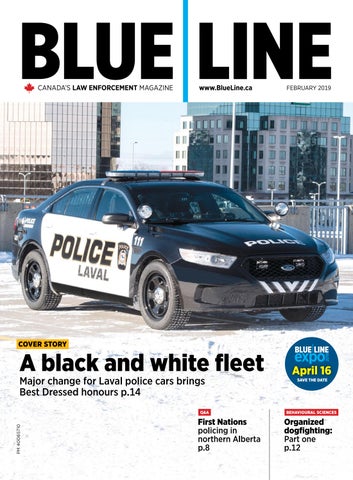
COVER STORY
A black and white fleet
PM 40065710
Major change for Laval police cars brings Best Dressed honours p.14
April 16 SAVE THE DATE
Q&A
BEHAVIOURAL SCIENCES
First Nations policing in northern Alberta p.8
Organized dogfighting: Part one p.12
UPCOMING PROGRAMS IN
CRIMINAL LAW Get up-to-date on the latest changes, cases and challenges in criminal law at a practical level.
Location Osgoode Professional Development 1 Dundas St. West, 26th Floor, Toronto, ON
• Warrant Drafting & Reviewing March 4, 2019 (Online Replay: April 29,2019; Optional In Person Workshop: March 5, 2019)
• Courtroom Testimony: A Practical Skills Workshop
Attend In Person or via Webcast
March 22, 2019
• Tech Crime and E-Evidence (Online Replay) March 22, 2019
• Indigenous Criminal Justice Post-Gladue April 13, 2019 (Online Replay: June 7, 2019)
• Money Laundering & Financial Crimes April 26, 2019 (Online Replay: June 21, 2019)
Learn more at:
osgoodepd.ca/blueline
Excellent speakers and guests, well designed and full of relevant material. Thank you! Murray Martin, Ontario Provincial Police – Technological Crime Unit
Contents
18 February 2019 Volume 31 Number 2
Features
Columns 4 8 10 11 12 23 26 30
Editor’s commentary Q&A Holding the line Health & wellness Behavioural sciences Technology Case law Back of the book
COVER STORY
14 Best Dressed Police Vehicle Award winners
Le Service de police de Laval takes home first place in Blue Line’s annual best Dressed Police Vehicle Awards. Thank you to every agency that submitted a vehicle. By staff
18 Results from the Michigan State Police vehicle tests
COVER PHOTO: LE SERVICE DE POLICE DE LAVAL
In one of the most significant years for police vehicles in North America, 2019 is poised to become the year of the SUV, plus the year that hybrid powertrains come standard on both a police category sedan and a police category SUV. By Dave Brown
8 @Blue_LineMag
14
Departments 5 5 6 6 25 28 29 30
By the numbers News Calendar Dispatches Off the shelf Product showcase Marketplace Blue Links
23 February 2019 | BLUE LINE
3
EDITOR’S COMMENTARY BY RENÉE FRANCOEUR
Collaboration on the careers front
C
ollaboration within the law lice detective, she will discuss the importenforcement sphere has been ance of collaboration for emergency exploding in the headlines I’m services and the intersectional value in the reading these days. work in these fields. Additionally, around 25 experienced Peel Regional Police is joining Halton Regional Police Service’s Public Safety mentors from the law enforcement, secBroadband Network (a high-speed wire- urity and fire worlds will be running less data communications network for roundtables, answering questions from emergency responders and public safety attendees about how to get hired, what the personnel to communicate with each industry is looking for, etc. You’ll find the other during both emergency situations president of the Ontario Special Constable Association and the deputy superintendand day-to-day operations). ent of administration at the Similarly, Motorola Solutions started off 2019 with the Critical The Security | Ontario Correctional Institute on hand, as well as senior level Connect announcement. This is Fire | Police| a solution where public safety Career Expo & officers from Hamilton Police Service, Barrie Police Service agencies from different areas Job Fair on and Toronto Police Service’s have the ability to connect to March 7 Computer Cyber Crime section each other “in minutes, regard- brings of Intelligence Services. less if it is two or 20 agencies at together Presented by Blue Line, Canaonce.” They can communicate three dian Security and Fire Fighting in via voice across their LMR sys- separate tems or via broadband push-to- fields for one Canada magazines, this is the full day of place to find more information, talk services. The Canadian Police Know- networking, whether launching your career ledge Network and Toronto Police education and or changing to something fresh. Service have developed a course first-hand As the interviewee for the first in collaboration with community advice. episode of Blue Line, The Podcast, groups on how to communicate Mick Creedon, said: policing isn’t with those with autism. just policing anymore after all: The Greater Toronto Airports Authority “Gradually we have recognized the value is using a new dispatch system that can of partnerships,” said Creedon, the former integrate with its partners for incident chief constable in Derbyshire, England. management across jurisdictions, includ- “And there’s not just law enforcement ing Mississauga Fire and Emergency Servi- partnerships; there’s the health sector, ces, and Peel Regional Police. education, social care, and then you move And here at Annex Business Media, too, beyond that into the business sector. All we’re busy buzzing with alliance conver- of which is great. From here, you can start sations... largely our new, multifaceted bringing in intelligence from the whole career expo. The Security | Fire | Police | range of partners you have.” Career Expo & Job Fair is happening on Popping silo bubbles and working togethMarch 7 at the International Centre in er towards a common goal — that’s how we Mississauga, Ont. Mark your calendars! reap all the more success in proactively It brings together three separate fields keeping the public safe, especially as our for one full day of networking, education world becomes increasingly complex. and first-hand advice. Students and anyone So why not have fire, police and security interested in starting a career (or transi- hopefuls and mentors all in one room to tioning to a new one) in policing, fire or dialogue and learn from each other? I security are encouraged to attend. think some magic just might sprout in Carmela Demkiw, senior director of such a space in 2019. security services for Rogers CommunicaRegister now and find out more at www. tions, is the expo’s keynote. A former po- emergencyservicesexpo.ca.
CONNECT WITH BLUE LINE
www.BlueLine.ca 4
@Blue_LineMag
BLUE LINE | February 2019
www.facebook.com/BlueLineMagazine
BLUE LINE www.BlueLine.ca
GROUP PUBLISHER | MARTIN MCANULTY mmcanulty@annexbusinessmedia.com EDITOR | RENÉE FRANCOEUR rfrancoeur@annexbusinessmedia.com ACCOUNT MANAGER | JANICE EATON janice@blueline.ca MEDIA DESIGNER | SVETLANA AVRUTIN savrutin@annexbusinessmedia.com ACCOUNT COORDINATOR | TRISH RAMSAY tramsay@annexbusinessmedia.com CIRCULATION MANAGER | BEATA OLECHNOWICZ bolechnowicz@annexbusinessmedia.com Tel: 416-442-5600 ext. 3543 PRESIDENT & CEO | MIKE FREDERICKS ANNEX BUSINESS MEDIA 111 Gordon Baker Road, Suite 400 Toronto, ON M2H 3R1 Tel. 416-442-5600 • Fax 416-442-2191
Publication Mail Agreement No. 40065710 ISSN 0847-8538 Printed in Canada SUBSCRIPTION RATES Canada — 1 Year $31.50; 2 Year $52.50 plus tax USA — 1 Year $105.00 USD CIRCULATION email: asingh@annexbusinessmedia.com Tel: 416-442-5600 ext 3553; Fax: 416-510-6875 or 416-442-2191 Mail: 111 Gordon Baker Road, Suite 400, Toronto, ON M2H 3R1 Occasionally, Blue Line will mail information on behalf of industry-related groups whose products and services we believe may be of interest to you. If you prefer not to receive this information, please contact our circulation department in any of the four ways listed above. Annex Privacy Officer Privacy@annexbusinessmedia.com; Tel: 800-668-2374 © 2019 Annex Publishing & Printing Inc. All rights reserved. Printed in Canada. No part of the editorial content of this publication may be reprinted without the publisher’s written permission. Opinions expressed in this magazine are not necessarily those of the editor or the publisher. No liability is assumed for errors or omissions. Readers are cautioned and advised that articles presented herein are edited and supplied for your personal awareness and should not be used for further action until appropriate guidance is received from a supervisor, Crown Attorney or other persons in authority. All advertising is subject to the publisher’s approval. Such approval does not imply any endorsement of the products or services advertised. The publisher reserves the right to refuse advertising that does not meet the standards of this publication.
NEWS
A propane installation is underway on site at the London Police Service garage. PHOTO: RENÉE FRANCOEUR
LONDON
World LPG Association highlights London Police Service The World LPG Association (WLPGA), the authoritative voice of the global LPG (liquid petroleum gas) industry, has highlighted London Police Service’s (LPS) auto propane story. The association published a video with LPS fleet manager Mike Weaver on its YouTube channel and social media accounts this past fall (find it here: bit.ly/2LXXIPq). LPS is the only police service is Canada that has almost all of its cars running on propane. The New Westminster Police Department in British Columbia has some of its fleet running on propane as well. Special thanks to LPS and Weaver for providing Blue Line with an exclusive tour of the agency’s top-notch garage recently.
LANGLEY
RCMP takes delivery of Canada’s first Airbus H145
RCMP members and Airbus personnel celebrate Canada’s first H145 for law enforcement. PHOTO: VITEK ZAWADA
CANADA
Canadian police missions overseas receive special operation status
have served on these missions may now be eligible for certain benefits, including appropriate health coverage. Since 1989, approximately 4,000 Canadian police officers participated in over 66 operations abroad. A table identifying the all 10 missions that have obtained SDO designation can be found at bit.ly/2SkA2GW.
Ten police peace and stabilization missions have been designated as Special Duty Operations (SDO), including the ongoing operations in Mali, Haiti, Palestine, Ukraine, Colombia and Iraq. Special Duty Operations status gives these Canadian police peacekeeping missions status comparable to military peace and stabilization missions, meaning police who
Airbus has delivered Canada’s first H145 helicopter to the Royal Canadian Mounted Police (RCMP). The aircraft will be based in Langley, B.C., and support operations throughout the province. This new aircraft delivery builds on Airbus’ dominant helicopter position in Canadian law enforcement, where it claims to have captured 83 per cent of the market. The light twin-engine H145 is the latest variant of Airbus’ H145 family of aircraft.
Airbus explains the RCMP’s H145 will support tactical deployments day and night over land and water, expand options in the area of fast roping and hoisting, assist with missing persons investigations, and add capabilities to search and rescue operations. The H145 has been equipped with a variety of mission-specific equipment, including external hoist and rope down device (for one to two persons), Trakka A800 searchlight, Enhanced Reality System, Health Monitoring System (HMS), FLIR, Night Vision Goggles, Tactical Flight Officer (TFO) workstation and internal long-range fuel tank system. OTTAWA
Defence Research and Development Canada completes public safety broadband trial
Defence Research and Development Canada’s Centre for Security Science (DRDC CSS), working with Motorola Solutions and Ericsson, announced they have successfully completed their research trial of a dedicated public safety broadband network using Long Term Evolution (LTE) technology. Community safety agencies throughout the National Capital Region conducted research on this network, which was built specifically to allow greater collaboration among first responders. Throughout the trial, agencies tested the ability to share high-speed data, including video and advanced public safety applications, to provide situational awareness for first responders and the people they protect. For example, the RCMP could share videos of a speeding suspect crossing provincial lines with both the Gatineau and Ottawa police services. As part of the trial, two LTE networks were successfully connected, allowing the sharing of information through roaming between public safety and commercial networks.
BY THE NUMBERS
EKOS Research Associates Inc. prepared “Public Opinion Research on Drug Impaired Driving” for Public Safety and Emergency Preparedness Canada in 2017. The survey is comprised of 2,132 completed cases, including 418 with youth who are 16 to 24, and 416 parents of youth. More from the summary of findings is below. Find the complete collection of research at: bit.ly/2utIDxK.
1 in 3
Canadians report they have ridden in a vehicle operated by a driver who was under the effects of cannabis
@Blue_LineMag
4 in 10
(among those who have driven while impaired) downplayed the risks of driving while under the influence of cannabis
25%
believe the impacts of cannabis consumption are less detrimental to driving ability than alcohol
44 %
of youth say it is easy to tell if someone is too high to drive
February 2019 | BLUE LINE
5
NEWS CALENDAR Annual Intensive Course on Drafting & Reviewing Search Warrants March 4-5, 2019 Toronto, Ont. www.osgoodepd.ca Security | Fire | Police Career Expo & Job Fair March 7, 2019 Mississauga, Ont. www.emergencyservicesexpo.ca Developing Leadership Impact Retreat March 18-21, 2019 Victoria, B.C. secure.royalroads.ca/cscourses Police Leadership Conference April 7-9, 2019 Vancouver, B.C. cacp.ca International Financial Crimes Investigators Conference April 8-12, 2019 Toronto, Ont. www.torontopolice.on.ca/seminars Risk & Recovery Conference April 10-12, 2019 Hamilton, Ont. www.riskandrecoveryconference.com Conference on Indigenous Criminal Justice Post Gladue April 13, 2019 Toronto, Ont. www.osgoodepd.ca Blue Line Expo April 16, 2019 Mississauga, Ont. www.bluelineexpo.com Interac Risk and Cybercrime Conference April 24-25, 2019 Victoria, B.C. www.interac.ca/en/cybercrimeconference.html Symposium on Money Laundering & Financial Crimes April 26, 2019 Toronto, Ont. bit.ly/2ITwhmQ
6
BLUE LINE | February 2019
DISPATCHES Auxiliary S/Sgt. Thomas Ungar has retired from serving the community for more than 43 years. Ungar began his career with the Toronto Police in 1975 (formerly the Metropolitan Toronto Police). He retired in 2004 at the rank of auxiliary superintendent after having been in charge of several units. He then began his second auxiliary policing career with York Regional Police and on Dec. 31, 2018, retired with the rank of auxiliary staff sergeant after a 15-year stint in 2 District, out of Richmond Hill, Ont. He plans to tackle a degree in criminology next. Det.-Sgt. Gary Giroux is retiring from the Toronto Police Service (TPS) after leading investigations into 100 murders and participating in 10 first-degree and 17 second-degree murder convictions. Giroux is a 40-year vet and 22-year member of the homicide squad. Starting with TPS in 1979, he joined the squad in 1997 and has become the “most recognized and respected investigator in the history of the unit.” Giroux has also been called upon by several chiefs of police to lead complex and sensitive investigations that included municipal corruption and the G20 protests. His awards are numerous and include the Billy Bishop Award for Investigative Excellence and OHIA (Ontario Homicide Investigator Association) Merit Award. Peel Regional Police Chief Jennifer Evans has retired after six years in the role and more than 35 in law enforcement. In 1996, Evans assisted Justice Archie Campbell in the review involving serial rapist and murderer Paul Bernardo. She later accepted a two-year secondment to work as a violent crime analyst at the Provincial ViCLAS Centre in Orillia, Ont. Chief Evans also worked throughout Ontario for the Office of the Chief Coroner as an investigator. Upon her return to Peel, she worked as a detective in the Homicide and Missing Persons Bureau, and several promotions later returned as the inspector in charge. In 2008, she was promoted to deputy chief and later assisted Commissioner Oppal in reviewing the police investigation for the Missing Women Commission of Inquiry.
RCMP A/Comm. (retired) Shirley Cuillierrier is one of the recipients of the Governor General’s Awards in Commemoration of the Persons Case for 2018. These awards were created in 1979 to mark the 50th anniversary of the Persons Case. Cuillierrier, a member of the Mohawk Nation from Kanesatake, Que., joined the RCMP in 1982. In 2004 she was named the Officer in Charge of National Aboriginal Policing Services. In 2010, she led the National Human Trafficking Coordination Centre and in 2017, Assistant Comm. Cuillierrier was appointed senior advisor on Reconciliation and the National Inquiry into Missing and Murdered Indigenous Women and Girls. She is a recipient of both the Queen Elizabeth II Golden and Diamond Jubilee Medals.She retired from the RCMP in 2018, after 36 years of service. Toronto Police officer Kim O’Toole is the next OWLE (Ontario Women in Law Enforcement) Canada president and she has also been promoted to inspector. Chief Supt. Lee Bergerman, a 32-year member of the RCMP, has been promoted to commanding officer of H Division in Nova Scotia, at the rank of assistant commissioner. Bergerman has spent the last 2.5 years as the officer in charge of Halifax District RCMP. Nova Scotia RCMP’s current commanding officer, A/Commr. Brian Brennan, has accepted the position of deputy commissioner of Contract and Indigenous Policing and will be transferring to Ottawa. The Greater Sudbury Police Services Board announced Supt. Sheilah Weber has been selected as the next deputy chief of police. She was officially sworn in on Jan. 17.
PROMOTIONS, RETIREMENTS, RECOGNITION • If you have an officer in your agency recently promoted or retiring or an individual you wish to have recognized (major award or recently deceased) you can let Blue Line magazine know by email to: dispatches@blueline.ca.
www.BlueLine.ca
While driving, you have enough to worry about. Let
do the thinking for you.
bluePRINT®, an automated control system from SoundOff Signal, creates a safer environment for officers through a more effective use of emergency lighting and siren technologies. This system allows you to stay focused on the task at hand while keeping your eyes on the road and hands on the wheel. Lights and siren configurations are pre-programmed and prioritized to respond to emergency situations without the officer having to determine which buttons and switches to activate while driving. Let us show you how bluePRINT can help you to reduce upfit complexity, improve the upfit quality, reduce downtime, and limit total cost of ownership regardless of agency size.
For more information, please reach out to our Canada sales reps: Western Canada - Cody Bock / cbock@soundoffsignal.com / 801.865.5023 Ontario (Central) - Gabe Casucci / gcasucci@soundoffsignal.com / 716.553.4431 Eastern Canada - Tom Marty / tmarty@soundoffsignal.com / 603.402.0671 www.soundoffsignal.com
Q&A Dale Cox is chief of police of Lakeshore Regional Police Service (LRPS), headquartered on the Driftpile Cree Nation in northern Alberta. He helped build this self-administered First Nations (FN) police agency, along with many other partners, after retiring from the RCMP. He shares how the 11-year-old service has evolved, as well as the importance of consultation and active listening when it comes to community relations. Q: You joined the RCMP in 1979. Why did you want to get into law enforcement?
munities — each with their own challenges, resources and plans. The building and maintaining of relationships is very important in First Nations communities and in order for our police service to remain effective, we must never lose sight of this. Relationships between First Nations communities and police have not always been favourable. I see the police as having an important role in resolving these concerns through open and frank dialogue, and gaining a better understanding of First Nations needs, culture and tradition.
I got into policing as a result of getting to know some RCMP members in my home town (High Prairie, Alta). From there I went into the RCMP auxiliary policing program, which was just starting, and decided policing was the type of career I would like to follow.
Q: You have been with LRPS from its inception. What was this forging experience like?
Q: What are some of the main changes you’ve noticed?
There has been a steady reduction in crime rates. There is also a noticeable increase in confidence from the communities, which is translated into the development of partnerships in programs such as restorative justice, crime prevention, addiction awareness, etc. One of our major accomplishments was the opening of our HQ building on the Driftpile Cree Nation in November 2015. With this 8
BLUE LINE | February 2019
modern facility, we have established a home for our service and shown communities we are here to stay. We also saw great success with our project “Red Feather,” which discussed things like various forms of bullying, addictions, suicide and gangs with youth. This program brought together both Indigenous and non-Indigenous children and took place on one of our First Nations. For some of these non-Indigenous children, this was the first time they had been on a First Nation. To further this experience, we also had some of the Elders give a brief description of the area’s history and explain a bit about local First Nations culture and tradition.
Q: LRPS polices in five First Nations. What else makes LRPS unique in your opinion?
FN policing is unique in its own way in that First Nations communities are self-governing and, in our case, we need to be cognizant we have five different chiefs and councils to work with and five different com-
Q: What kind of partnerships has LRPS nurtured?
Snapshot of LRPS:
2008
LRPS is established
5
First Nations make up the policing territory
8
constables are on the roster along with two clerical staff, two sergeants and one inspector
I have found that the most important aspect of the service we provide is to consult and listen to the community members to see what it is they feel they need to be safe and healthy in their communities. After all, who would know better than the people who grew up and have lived in their communities all their life? For too many years others have been coming to First Nations communities and telling them what they need instead of asking what they need. The last part of that is then asking how we can work together to achieve that goal. Through this process we have developed our crime prevention program and as well assisted in developing the Eagle Feather Court Oath program for First Nations people who desire to swear their oath on an eagle feather, as opposed to other forms of affirming. Our courthouses in Slave Lake and High Prairie have now adopted this. Others courts in Alberta are also now following this respectful manner. www.BlueLine.ca
PHOTO: LAKESHORE REGIONAL POLICE SERVICE
This was my first experience in actually building a new police service. However, throughout my career I have been involved in various aspects of change and modernization in policing. I want to be very clear that this was not only my effort in getting to where we are today. We need to acknowledge the elected officials, both provincial and federal government partners, the police commission, the police officers that came to work for us, and, most importantly, the communities who have allowed us to be their police service.
Q: What are the latest happenings at LRPS?
We continue to lobby for additional resources in order to be able to provide 24/7 police service to our communities. Our restorative justice program has been updated and is moving forward in a manner that will assist in meeting the needs of our clients in addressing the over representation of First Nations people in the justice system. It does this by being able to address some matters at the community level. Our next major project will be in moving forward with a community mobilization program in a HUB format. This will see persons in crises helped before the situation endangers the community and becomes a police matter.
Q: What is the most challenging part of the job?
Ensuring the communities and our officers are as safe as possible. Due to our limited resources, we are not able to provide 24/7 coverage, which puts a member on-call to respond after hours. With our large geo-
graphic area, this sometimes adds concerning delays in responding to high-risk calls. This also causes a delay in back-up resources. Being in a smaller police service in a remote location also has its challenges when it comes to being able to provide timely training opportunities for all our employees.
Q: In your opinion, what is needed now in FN policing?
FN policing has come a long way since I started in my position and I thank all of those who have gone before me in all their efforts. However, there are still challenges to be met. In some areas of the country, when I first started, FN policing was viewed as substandard policing for a variety of reasons. In order to dispel that idea, we needed to challenge all First Nations police services to prove we could either meet or exceed the standards set by recognized police organizations. Through the efforts of organizations like the First Nations Chiefs of Police Association as well as many self-adminis-
tered police services, we have met that challenge. We have proof through independent audits, like the Alberta Policing Standards Reviews. These have shown all First Nation police services in Alberta to routinely meet or exceed all standards expected of all police services. As a result of these efforts across Canada, I feel we have proven our ability and earned our right to be recognized as an essential service, and to move us from a grants program funded service to an “A” based funded police agency.
Q: What is your message to others in the Canadian policing community?
Self-administered FN policing has a lot to add to the overall picture of policing in Canada. To truly make policing inclusive we need these types of police services to meet a recognized and requested need in our First Nations communities. I look forward to being a part of this for the remainder of my time in policing. Visit www.lakeshoreregionalpolice.com for more information.
PART OF YOUR TEAM Commissionaires works with hundreds of municipalities to deliver administrative and non-core police support so sworn officers can focus on the jobs only they can do.
commissionaires.ca @Blue_LineMag
BL_Feb_Commissionaire.indd 1
February 2019 | BLUE LINE
9
2019-01-09 9:42 AM
HOLDING THE LINE BY MICHELLE VINCENT
Finding the mutuality in change
C
hange can be an anxiety-filled experience and yet it takes place throughout every aspect of our lives, whether we recognize it or not. Everything — from the cells in our bodies to the universe we live in — is constantly changing and evolving. I spoke of change in past articles and how our perception of that change can be viewed from a positive perspective. As the world evolves, we are also learning of and creating change with our perception of every experience. It is so exciting to know we can never unlearn anything and as such we are forever changed. When we explore the organizations in which we work, our policing world is also constantly changing. New investigative techniques and technology saturate our units and, as they do, results, followed by consequences, also evolve. I can remember when I first began with my police service. As there was a strike at the Ontario Police College, I was helping out as a recruit in our Criminal Investigation Bureau, supporting our investigative crew. I was eager and excited to serve in any way needed. One of my first tasks was to create an information brief folder for the crown. I was provided with an example of how this would look and was guided to... No, not a computer
In this day and age, having an amazing credit score might just mean you haven’t had to go through a difficult divorce or have family members who have been able to support you during challenging times.
like I expected, but a typewriter. Needless to say, it took several attempts before I was able to perfect the product of this information on what I felt was an antiquated tool. Computers were everywhere and I could not believe that policing organizations, with all kinds of other modern equipment, were still using typewriters. Where I am going with this is: how do we embrace change — both within ourselves, as well as in our organization’s leaders, who are on the leading edge of constant evolution? Mutuality is a word I have really appreciated in my vocabulary, as it implies a co-operative and peaceful component to the experience. When I was led to the typewriter, I was definitely far from being mutual with my experience in that moment. Becoming mutual might look like having a laugh and looking forward to jumping into a retro moment. I recently read an article about how the RCMP are looking to change recruiting practices as they strive to fill positions in their police service. Some might say they are lowering their standards. However, perhaps they are evolving with the change and reality of a society that is miles away from what it used to be back in the early 2000s. In this day and age, having an amazing credit score might just
mean you haven’t had to go through a difficult divorce or have family members who have been able to support you during challenging times. It may mean you didn’t have to pay for your postsecondary degree or that you were fortunate to have a good paying job that afforded you the opportunity to attend school and work. It may not have anything to do with how you are as a police officer. Changes such as these are significant. However, the need for these changes in order to remain at the forefront in policing is also significant. The key to implementing such changes within organizations that feature a strong culture may be to provide the members with a connection of mutuality. That might involve engaging the members in the process — whether it be through the creation of a committee or other newly created position. The committee might be tasked with exploring how other policing services are approaching recruiting at an international level. In this way, we involve our members in the process of change, creating a higher likelihood of mutuality. We need to consider opening up the space for creating mutuality when there is a goal to become a leading-edge organization through implementing change or multiple changes. This change will affect all of the organization’s members, in one way or another, and having that mutuality created is key in supporting the mental and physical wellbeing of the organization as a whole. Michelle Vincent is a 17-year York Regional Police officer with a master of arts in counselling psychology and a background in equine-assisted therapy, workplace reintegration after a critical incident and long-term leave, as well as teaching. She is in the process of implementing the first non-profit treatment centre that will be occupationally specific for first responders and is working towards her PhD in Forensic Psychology/Crisis Response. She can be contacted at: michelle@smith.net.
10
BLUE LINE | February 2019
www.BlueLine.ca
HEALTH & WELLNESS BY ISABELLE SAUVE
Honouring the contrast between leadership and management
T
he topic of leadership is at the forefront of various models and strategic plans amongst law enforcement organizations. Despite being recognized as a key factor to success and human resource wellness, “leadership” remains an elusive and poorly understood subject, often blurred by a number of myths. Leadership is a term and concept that defies consensus in measurement and definition. Police models have also mistakenly attempted to rhetorically and blindly communicate the “everyone is a leader” strategy. The words “leadership” and “management” are frequently used interchangeably, further complicating the topic. However, being a manager does not make one a leader simply by virtue of a position held. While leadership and management are distinct and multifaceted concepts, they are both vital to an organization. Studies suggest they are closely related but with distinguishable, albeit sometimes overlapping functions. Leaders essentially guide the direction and speed of the ship. Managers keep the ship operating smoothly. A great disservice is done when agencies assume leadership and management skills automatically follow with promotion. Some officers in management capacities have poor leadership and management qualities with long term repercussions, and with the potential of developing an unhealthy work environment. In those cases, subordinates tend to follow orders strictly out of obligation rather than out of inspiration or admiration. Leaders are followed out of respect for what they represent. Inspiration, self-confidence, vision, communication skills and ability to challenge are traits leaders usually possess. Leadership is often associated with words like dynamic, risk taking, change, creativity and vision, while management is associated with control, efficiency, procedures, paper@Blue_LineMag
work, planning, regulation, and consistency. According to The Wall Street Journal, a performing manager… “establishes appropriate targets and yardsticks, and analyzes, appraises and interprets performance. Managers understand the people they work with and know which person is the best fit for a specific task.” The most successful or respected managers also tend to display strong leadership skills. Effective management and effective leadership are necessary for the success of an organization. Strong leadership but weak management can be detrimental. A proper balance between the two is crucial. Organizations should focus on building competence over competencies, as well as on promoting organizational goals and vision over personal agendas. By acutely contrasting leadership and management, we can understand and improve the distinct roles and functions. Limited empirical efforts have been devoted to how police leadership is developed and manifested. Common themes, however, have been expressed. For example, leadership involves influencing others through demeanor, power, charisma and other behaviour. To understand leadership, it is important to examine some of its key components. Firstly, leadership is contextual. Individuals need specific situations to shine as leaders. Subsequently, leadership is a process, not a position. It is not the direct result of title or position; it is the result of interactions between
Leadership is also both a science and an art... Leaders need a proper balance between emotional and rational responses and actions.
leaders and followers. Practically, it can be exercised by the young and old in junior and senior positions of an organization or a community. Leadership is also both a science and an art. It is both rational and emotional; leaders need a proper balance between emotional and rational responses and actions. On the other hand, a number of myths hinder leadership development in many organizations. For example, the idea that good leadership is common sense. “Common sense” is an ambiguous term that is often misleading and in fact isn’t common at all. Leaders need to consider what “common sense” suggests, but they also have to make hard decisions contrary to prevailing views, be humble in the face of uncertainty, and change direction when the need is recognized. One of the challenges of leadership may well be to know when common sense applies and when it does not. Another myth is that leaders are born, not made. It is true leaders start with key innate personality traits; however, leadership skills are enhanced based on experience, training and exposure to situations. They typically shine as a result of an engrained and genuine devotion to a cause, topic or subject of interest. Finally, the belief true leadership is only developed in the “school of hard knocks” is false. While there may be some truth to this approach, developing different perspectives and insights through formal study and training can enhance leadership skills. The formal study of leadership can make one more discerning and better able to analyze experiences through different perspectives, as well as adopt a wider range of tools to draw from. This type of formal learning should be offered throughout every police officer’s career as understanding leadership theories can allow leaders to become even more effective. Isabelle Sauve is a 11-year OPP veteran currently with the Emergency Response Team (ERT) at the Almaguin Highlands Detachment in Burks Falls, about 300 km north of Toronto. She can be contacted at: isabelle.sauve@hotmail.com.
February 2019 | BLUE LINE
11
BEHAVIOURAL SCIENCES BY PETER COLLINS
Organized dogfighting is a growing problem: Part one
R
eferred to, in the academic literature, as the Violent Link, research has shown a robust connection between animal abuse and interpersonal violence (IPV) and, in particular, domestic violence (DV). Pets can be found in as many as 80 per cent of these homes and may also be at risk of suffering severe or fatal injury. Victims of domestic abuse have a strong bond with their pets and their abuser is aware of this bond and can use it as an abusive tactic against their partner. In addition, many survivors of DV will experience immediate or long-term psychological problems including anxiety, panic disorder, depression, substance abuse, eating disorders and self-harm.1 Concern for the welfare of their pet can act as a deterrent to leave the abusive relationship. Another example of the Violent Link is the connection between gang violence and animal cruelty. This can take many forms, including illegal dogfights. Dogfighting is the act of baiting two dogs against one another for entertainment or gain. It involves placing two dogs in a pit until one either quits or dies. While street fights can involve betting on the animals, the dog serves more as a status symbol for the gang member, as well as a weapon, because of the size, menacing appearance and aggressiveness of the canine. There are two main types of dogfights – the street fights (informal) and organized professional fights (formal).2 The dog becomes an “extension” of the owner’s persona and it has been argued that we should be warier of the owner than the breed themselves. Dogfighting and vicious canine behaviour (against humans) can only be effectively controlled at the level of the owners. So, why is the growing prevalence of organized dogfighting a major concern for law enforcement?
Dogfighting is a crime
Dogfighting has been illegal in Canada since 1892. It is a crime, according to section 451(1) (b) of the Criminal Code for anyone to cause unnecessary suffering of an animal or in any manner encourage, aid or assist at the fighting or baiting of animals or birds. Humane Canada, also known as the Canadian Federation of Humane Soci12
BLUE LINE | February 2019
Why dogfighting?
eties, has advocated for the review, updating and strengthening of the current animal cruelty provisions in the Criminal Code of Canada. In October 2018, using Humane Canada’s recommended language, the Minister of Justice introduced Bill C-84, which would broaden and strengthen Canada’s bestiality and animal fighting laws. It is currently in its second reading in the House of Commons.3
Dogfighting is associated with other crimes
U.S studies show when organized dogfighting events are raided by law enforcement, illegal drugs are seized and approximately two thirds of the raids result in the seizure of illegal weapons. Heger (2011) refers to dogfighting as “convenience stores” for criminals, with “illegal gambling being the preferred form of currency.”4 Like other venues attended by organized criminal gangs, offenders with outstanding arrests are found attending these fights. Disputes between warring gangs can lead to serious assaults, and even homicides, at these gatherings as well. Dogfighting enthusiasts commonly see participation in the blood sport as a family event and dogfights serve as an early introduction to gang life. Many of active street dogfighters are teenagers, with younger children often watching and even participating. In a study from the United Kingdom, some of the animal abuses, as described by the youth gang members, included cruel training techniques for fighting (e.g. using electrocution to enhance aggression), withholding medical treatment for injured dogs, poor breeding practices (resulting in severe health issues), forced dogfighting, tail docking, and physical abuse (kicking, punching, stabbing and beating dogs). Many of the youth spoke about using the dogs as weapons, against both humans and other dogs from rival gangs.5
The most common reason is greed. Major dogfighting raids have resulted in seizures of more than $500,000. It is not uncommon for $20,000 to change hands in a fight. The sale of puppies and stud fees from promising bloodlines is also quite lucrative. For others, this blood sport is machismo – a demonstration of their power, prowess and strength. However, if the dog loses, the owner will not only lose money but also status. Sadly, the dog will often lose his or her life. Others are attracted purely to the sadistic enjoyment of the brutality of dogfighting. Humane Canada is sponsoring the Canadian Violence Link Conference from Nov. 21-22, 2019, in Toronto, Ont. Find more information at clc.humanecanada.ca. Sgt. Teena Stoddart, of the Ottawa Police Service, and Dr. Rebecca Ledger, an animal welfare scientist at B.C.’s Langara College, are part of an initiative to train Canadian law enforcement on the Violent Link. Watch for my next column, “Dogfighting Part Two: The Investigation,” in the March issue of Blue Line. Footnotes 1. Campbell, A., Thompson, S., Harris, T., & Wieche, S. (2018) Intimate partner violence and pet abuse: responding law enforcement officers’ observations and victim reports from the scene. Journal of Interpersonal Violence – March. 2. Heger, M. (2011) Bringing RICO to the ring: can the anti-mafia weapon target dogfighters? Washington University Law Review, 89 (1). 3. www.humanecanada.ca/federal_legislaton 4. Heger, M. (2011) Bringing RICO to the ring: can the anti-mafia weapon target dogfighters? Washington University Law Review, 89 (1). 5. Maher, J. & Pierpoint (2011) Friends, status symbols and weapons: the use of dogs by youth groups and youth gangs. Crime, Law, & Social Change 55: Springer Science. My goal, in this monthly column, is to explore a wide variety of behavioural issues that are related to law enforcement. For any questions or suggestions for future topics, contact pcollins_blueline@gmail.com. Dr. Peter Collins is the Operational Forensic Psychiatrist with the Ontario Provincial Police’s Criminal Behaviour Analysis Unit. He is also a member of the crisis/hostage negotiation team of the Toronto Police Service. His opinions are his own and not necessarily the opinion of the OPP, CAMH, University of Toronto or his mother.
www.BlueLine.ca
COVER STORY
Hot wheels
One fleet’s major transformation seals the deal for Best Dressed Police Vehicle By staff PHOTO: LE SERVICE DE POLICE DE LAVAL
Congratulations to all the winners of Blue Line’s Best Dressed Police Vehicle Awards, which showcases innovative and effective designs. We look for clear identification, graphic designs that enhance visibility, elements that show directionality of travel and effective integration of equipment and controls. A few years ago, we wrote: “Police vehicles are not just transportation; they are the calling cards of a police service to the community.” That rings true today. Thank you to everyone who submitted. Stay tuned to blueline.ca for 2020’s call for submissions later this fall. 1ST PLACE LE SERVICE DE POLICE DE LAVAL (SPL) 2017 FORD TAURUS
Laval’s police fleet is bidding farewell to its stark white cars with the pink and blue dabs of colour, which it has had for “many years.” The major change — a return to a classic black and white choice — didn’t go unnoticed by our judge, Dave Brown, also a longtime contributor to Blue Line. And so, this year’s Best Dressed Police Vehicle Award winner is SPL’s automatic, 3.5 turbo, allwheel drive Ford Taurus, boasting updated reflective components and chevrons galore. “I started this project with Insp. Julien Kicinski and collaborated with Lt. Frédéric Jean,” says Sgt. Alain Ouellet, who has been with the force for 16 years. “Our main goal was to create a new car where everyone in the organization would have a say. We encouraged members to come to me with their ideas for the design. It was an open platform and took seven months to achieve the black-and-white conversion.” 14
BLUE LINE | February 2019
Many police fleets have leapt back to the back-and-white look, Ouellet points out, adding that statistically it’s been proven this choice is more visually oriented to police operations due to increased visibility. “We wanted citizens to see us better,” Ouellet says. “And we decided less is more.” The chevrons on the back and front bumpers also make it unique. “I did my research over a 10-month period and I couldn’t find one other police car design in Canada where there are chevrons on the front,” Ouellet notes. The fading, light grey markers on the top and bottom of the doors are also particular and attractive. Updated reflective technology from 3M was added to the design and is featured in the gold element around the “police” lettering for increased visibility. Reflective bands are also activated inside the vehicle when the trunk or any door is opened for officer safety. Laval Police Chief Pierre Brochet loved the new look right away, Ouellet says. “Without his support, this wouldn’t have happened.” “One of the elements I have always looked for is quick and clear identification as a police car,” Brown adds. “Another element I like is a design showing some directionality, so drivers can see at a glance — day or night — what direction the car is travelling. I like how Laval uses simple black letters for ‘Police’ and borders each letter in gold, picking up the same gold colour as their city crest. The italicized lettering also adds a bit of a forward slant to the words, and this helps add to the directionality of the design.” SPL has ordered 23 new Ford Taurus vehicles and three new 4x4 Dodge Chargers, all in black — to be wrapped with the new design — and slated to arrive sometime this month. They will all be patrolling the streets by summer, according to Ouellet.
“One of the elements I have always looked for is quick and clear identification as a police car.” - Dave Brown, judge www.BlueLine.ca
Reflecting the change in duties, the agency overhauled the previous white vehicles with yellow reflective stripes. “That design was dated and resembled RCMP and local police forces,” SHP states. Now, the blue stripe on the side of the vehicle matches the blue stripe worn on the uniforms of SHP officers and signifies the evolved partnership with law enforcement. “This design leaves no doubt in the eyes of the public as to who we are and what we are doing,” the agency says. SHP’s fleet manager used black reflective striping on top and below the blue panel on the sides of the vehicle for better visibility. The black chevron stripes and black lettering are more reflective than the previous blue/white chevron stripes. The crest is also reflective. “No other law enforcement agency in Saskatchewan utilizes silver patrol vehicles and these graphics are unique,” SHP says.
3RD PLACE MIRAMICHI POLICE DEPARTMENT 2018 RAM SPECIAL SERVICE
PHOTO: SASKATCHEWAN HIGHWAY PATROL
2ND PLACE SASKATCHEWAN HIGHWAY PATROL 2018 CHEVROLET TAHOE
Blue Line is breaking some rules with this one... Last summer, news on the new name and mandate for commercial vehicle enforcement officers in Saskatchewan was one of our most popular headlines online. The Saskatchewan Highway Patrol (SHP) replaced the former Commercial Vehicle Enforcement group and, while technically this vehicle should have been entered into the “law enforcement” category, our judge championed the design and we felt compelled to recognize this agency’s major milestone in joining the ranks of armed agencies. Plus, SHP is now also answering 911 calls and backing up police where needed, a new role for them, which we wanted to salute. “This clean and simple design will help move them away from the perception of being for commercial vehicle enforcement only and into a highway patrol mandate,” Brown says. “Again, the italics in the lettering adds to the directionality... The white letters embedded in the blue band (and using black borders) makes such a long name really stand out.” @Blue_LineMag
“I have always liked the Miramichi design and that it is different,” judge Dave Brown writes. “And they put a huge amount of thought into it. It seems simple, but the three-dimensional effect of the raised letters of ‘Police’ and the black outlining each letter is clear, but also very clever. The directionality of the design is enhanced by the placement of the unit number, the placement of the very prominent city crest and the alignment of Miramichi and ‘Police’ really helps show the direction a unit is travelling.” Miramichi Police Force vehicles also display the wording “with honour we serve” in English as well as in French. For night time safety, 3M reflective graphics are used on the sides, front and the rear of all of the marked vehicles. The four doors are covered in large white reflective material, while the bumper covers and front fenders have subdued, contour-fitting reflective graphics, according to Sgt. Bob Bruce, fleet co-ordinator. “Three maple leaves are displayed on each vehicle’s quarter panel, proudly promoting that we are Canadian,” he adds. Recent vehicle upgrades include: increased perimeter LED emergency light heads on lower body corners, LED spot lights for the pillar post lights, and increased interior lighting for night time ticket and note writing. All Miramichi vehicles are equipped with Watch Guard camera systems, carbines, ballistic helmets and hard body armour. PHOTO: MIRAMICHI POLICE DEPARTMENT
February 2019 | BLUE LINE
15
COVER STORY
LAW ENFORCEMENT The 1972 police vehicle design is newly showcased outside the Biosphere in Montreal, Que., as part of the 2018 Heritage Fleet Project. PHOTO: SPVM
COMMUNITY RELATIONS SERVICE DE POLICE DE LA VILLE DE MONTRÉAL (SPVM) HERITAGE FLEET PROJECT
In 2018, the SPVM celebrated the 175th anniversary of the Montréal police. This anniversary was an occasion to carry out two projects: create a heritage fleet (la flotte Héritage du SPVM) and present the new design of patrol vehicles. The heritage fleet concept was developed by the Norfolk Southern Railway company, which introduced old-fashioned locomotives to celebrate its anniversary. On Dec. 5, 2017, the SPVM officially launched its historic fleet and presented four vehicles featuring patrol car designs from 1931, 1955, 1967 and 1972. (See all the designs at: bit.ly/2SP3xRP.) Five vehicles — among the 10 vehicles in the SPVM replacement fleet — were thus dressed in a design from a past decade. They travelled throughout the territory in 2018, according to operational or promotional needs. Citizens could see these cars during special events, but also on patrol in different Montréal neighbourhoods (replacement fleet vehicles are used when regular vehicles are damaged or in maintenance, SPVM notes). “The Heritage fleet is a way to pay tribute to the police officers who have patrolled the streets of Montréal for 175 years, while making a historical nod to Montrealers,” the agency says. “It allows to create links, open dialogue and break down barriers. These out-of-the-ordinary vehicles attract attention and comment, and it is not uncommon for citizens to approach our police officers to take pictures of them with fleet cars.” 16
BLUE LINE | February 2019
ALBERTA SHERIFFS BRANCH 2016 FORD EXPLORER (POLICE PACKAGE)
In late 2017 the Alberta Sheriffs Branch embarked on a “visual identity modernization program” to modernize the brand, increase morale and recognize the 30th anniversary of the branch. A committee, made up of frontline officers — one representing each area of the Sheriffs Branch (Court Security and Prisoner Transport, Protection Services, and Highway Patrol) was established and the vehicle graphics package was re-designed. Design elements considered included: legislative requirements, visual appeal, cross-platform compatibility, recognizability, safety, visibility and cost. The new design features the provincial colours — gold and blue — combined into an elongated, curved stripe that carries down both sides of the vehicle and across the back. The design adds in a Canadian flag to honour Canada’s 150th anniversary and as homage to the Canadian Forces. The Alberta Sheriff starburst is larger than before and the words “Alberta Sheriff” are prominently displayed in retro-reflective graphics. The size of the call-sign identifiers has been increased and the Government of Alberta’s core values of “Respect, Accountability, Integrity, Excellence” have been added as well. The Alberta Sheriffs specifically chose to maintain the white base vehicle colour as opposed to a black one. This decision was to enhance approachability in the eyes of the public, ensure greater visibility and ensure the vehicle and graphics are unique to the sheriffs and not mistaken for police or other law enforcement agencies by the general public. All of the decals used in the design are retro-reflective, ensuring the vehicle is easily recognizable at night and in inclement weather. Another unique feature is the “Highway Patrol” identification overlaid on the blue horizontal striping. This identifies traffic enforcement vehicles from other units in the fleet. “Our vehicles deployed to the Alberta Legislature are similarly identified with ‘Protection Services,’” the branch states. A special legislative exemption was required from the director of law enforcement for the new design, as provincial peace officer agencies are not permitted to use curved stripes or overlay text on striping. The new graphics package is entirely cost-neutral when compared to the old package, the branch adds. “All of the design work was done in house, and by working closely with the decal vendor — Cowan Graphics in Edmonton — we were able to produce the new decal package for the exact same cost as the outgoing design.” It’s also completely scalable, according to the branch. PHOTO: ALBERTA SHERIFFS BRANCH
www.BlueLine.ca
JOB FAIR
Want a career in the
LAW ENFORCEMENT INDUSTRY? 2019
THEN ATTEND THE SECURITY • POLICE • FIRE
CAREER EXPO MARCH 7, 2019
INTERNATIONAL CENTRE MISSISSAUGA, ON
PHOTO: FREDERICTON POLICE FORCE
SPECIAL SERVICE
YOU WILL LEARN:
Fredericton Police Force’s (FPF) Armoured Rescue Vehicle (ARV) was designed to provide support to the Emergency Response Team and frontlines in high risk tactical situations, while not looking overly offensive. This vehicle was the first Cambli Blackwolf produced (a 2017 Ford F550 Super Duty chassis). It has a 6.8-litre, V10 gasoline engine with 288 horsepower, 424 lb-ft torque and block heater. It is a 4x4 single rear wheel drive — 4.88 limited slip, Hutchinson Wheels — with run flat, Goodyear G275 MSA tires and boasts a Ford OEM torque shift, six-speed automatic with OD. Vehicle modifications include: HD Fox steering damper and shocks, wireless remote for winch, B7 glass on hatch, a grab bar along A-pillar on each side, and B7/B6 ballistic armour. There was significant conversation around ensuring the community was not offended by the look of the vehicle, FPF says. “It was important to reinforce the rescue component of the vehicle and its use as another tool in our toolbox.” Originally, there had been some fear in the community that the Fredericton Police were militarizing the force by bringing in a heavily armoured “tank” into the fleet. “By designing the vehicle paint scheme as consistent with the rest of the fleet, it alleviated a lot of that fear and speculation,” FPF continues. “This vehicle has already helped evacuate citizens from a highrisk situation, keeping the public, and officers safe under the worst of circumstances.” FPF chose to make the ARV “highly visible” with the decaling and light package, consistent with the rest of the fleet. “Its clean, professional graphics give it a much less intimidating presence,” the force says. Thank you to Dave Brown, Blue Line’s longtime Best Dressed Police Vehicle Award judge for his expertise and dedication to this contest.
• What law enforcement agencies are looking for when hiring • How to network and get hired • How to make a lasting impression at an interview • What qualifications and skills hiring managers are looking for • How to increase your chance of getting hired
YOU WILL EXPERIENCE:
• Networking with experienced law enforcement service professionals • First-hand advice from leaders in law enforcement • Personal interaction with key leaders from the police services industry
YOUR REGISTRATION INCLUDES: keynote speaker, mentoring sessions, networking with Canada’s top security, fire and police companies and hiring managers, lunch, coffee breaks and the Security/Police/Fire Career Expo recruiting hall.
SECURITY
2019
FREDERICTON POLICE FORCE ARMOURED RESCUE VEHICLE
BROUGHT TO YOU BY:
CAREER EXPO
Canadian
REGISTER ONLINE AT WWW.EMERGENCYSERVICESEXPO.CA OR CALL 437-772-7557
@Blue_LineMag BL_Career Expo.indd 1
2019-01-23 11:42 AM
VEHICLES
The 2019 Chevrolet Tahoe. PHOTO: CHEVROLET
2019 marks “one of the most interesting years for police cars in decades”
Results from the Michigan State Police vehicle tests By Dave Brown
I
n one of the most significant years for police vehicles in North America, 2019 is poised to become the year of the SUV, plus the year that hybrid powertrains come standard on both a police category sedan and a police category SUV. This may be one of the most interesting years for police cars in decades, and no one is giving up without a fight. All 12 entries are among the most mature, well-developed, well-designed police cars one could ever hope to drive. While there is no official recognition of a pursuit-rated vehicle, police category vehicles are designed for the full spectrum of police work, including pursuits. Traditionally, a pursuit capable vehicle must be able to reach 60 MPH in 9.0 seconds, 100 MPH in 24.6 seconds, complete all 32 laps of the dynamic testing without major component failure, and maintain an average deceleration rate of 25.79 feet/sec2 while performing twenty threshold braking stops from 60 MPH in MSP tests. As always, it will be up to the individual agencies to determine if a particular vehicle is suitable for their mission. Read last year’s report on the tests at bit.ly/2Hferz4 to compare with the 2019 results.
18
BLUE LINE | February 2019
MICHIGAN STATE POLICE YEARLY VEHICLE TESTS
Every fall the Michigan State Police, in conjunction with the U.S. National Institute of Justice (NIJ) test the handling and performance of every new police vehicle on the market. These eagerly anticipated tests are seen as the most comprehensive analysis of police vehicles in North America.
Vehicles
The Michigan State Police Precision Driving Unit evaluates police vehicles in two categories: Police category vehicles and Special Service vehicles. Police category vehicles are designed for the full spectrum of general police activities including highspeed pursuit. Special service vehicles are designed only for specialized duties such as canine units or adverse weather conditions and are not intended or recommended for pursuits. Twelve vehicles were submitted to the NIJ in the police category for the 2019 (and early 2020) model years: • 2019 Chevrolet Tahoe PPV 5.3L RWD • 2019 Chevrolet Tahoe PPV 5.3L 4WD • 2019 Dodge Charger Pursuit 3.6L RWD • 2019 Dodge Charger Pursuit 5.7L RWD
• 2019 Dodge Charger Pursuit 5.7L AWD • 2019 Dodge Durango Pursuit 3.6L AWD • 2019 Dodge Durango Pursuit 5.7L AWD • 2020 Ford Police Interceptor Hybrid AWD • 2020 Ford Police Interceptor Utility 3.0L EcoBoost AWD • 2020 Ford Police Interceptor Utility 3.3L AWD • 2019 Ford F-150 Police Responder 3.5L EcoBoost 4WD • 2019 Ford Police Responder Hybrid Sedan FWD
THE TESTS
Michigan State Police Precision Driving Unit and the NIJ’s Justice Technology Information Center (JTIC) test all the vehicles together over a three-day period at the Chrysler Proving Grounds and the Grattan Raceway. Each vehicle is tested without rooftop lights, spotlights, sirens or radio antennas in place. Tires are original equipment rubber provided by the manufacturer. Acceleration, braking and top speed tests are performed at the Chrysler proving ground and vehicle dynamics tests are done using the two-mile road course at the Grattan Raceway. (All dimensions and measurements are given in U.S. numbers.) www.BlueLine.ca
THE RESULTS Vehicle dynamics testing
pension components and acceleration and braking ability. Four different drivers test each vehicle over an eight-lap road course, with the five fastest laps counting toward each driver’s average lap time. Final score is the combined average of all four drivers for each vehicle.
The objective of the vehicle dynamics testing is to determine the high-speed pursuit handling characteristics. Except for the absence of traffic, the two-mile road course simulates actual pursuit conditions. It evaluates the blend of susLap Times
Chevrolet Tahoe 5.3-litre V8 RWD
Chevrolet Tahoe 5.3-litre V8 4WD
Dodge Charger 3.6-litre V6 RWD
Dodge Charger 5.7-litre V8 RWD
Overall average lap times
1:40.58
1:41.24
1:38.74
1:37.61
Lap Times
Dodge Charger 5.7-litre V8 AWD
Dodge Durango 3.6-litre V6 AWD
Dodge Durango 5.7-litre V8 AWD
Ford PI Utility 3.3-litre Hybrid AWD
Overall average lap times
1:37.10
1:45.45
1:42.70
1:39.73
Lap Times
Ford PI Utility 3.0-litre V6 EcoBoost AWD
Ford PI Utility 3.3-litre V6 AWD
Ford Police Responder F150 3.5-litre V6 EcoBoost AWD
Ford Police Responder Hybrid Sedan FWD
Overall average lap times
1:36.47
1:39.96
1:43.85
1:46.31
Acceleration and top speed
Each vehicle is driven through four acceleration sequences, two in each direction to allow for wind. Acceleration score is the average of the four tests. Following the fourth acceleration sequence, each vehicle continues to accelerate to its highest attainable speed within 14 miles.
The objectives of the acceleration and top speed tests are to determine the ability of each vehicle to accelerate from a standing start to 60 mph, 80 mph and 100 mph, and to record the top speed achieved within a distance of 14 miles from a standing start. Acceleration
Chevrolet Tahoe 5.3-litre V8 RWD
Chevrolet Tahoe 5.3-litre V8 4WD
Dodge Charger 3.6-litre V6 RWD
Dodge Charger 5.7-litre V8 RWD
0 – 60 mph
7.75
7.98
7.92
6.15
0 – 80 mph
12.62
13.23
12.81
9.33
0 – 100 mph
18.91
20.16
20.01
14.66
Top Speed (mph)
134
121
141
149
Acceleration
Dodge Charger 5.7-litre V8 AWD
Dodge Durango 3.6-litre V6 AWD
Dodge Durango 5.7-litre V8 AWD
Ford PI Utility 3.3-litre Hybrid AWD
0 – 60 mph
5.87
8.59
7.08
7.27
0 – 80 mph
9.69
14.17
11.55
11.54
0 – 100 mph
14.71
22.86
18.34
17.69
Top Speed (mph)
149
117
118
137
Acceleration
Ford PI Utility 3.0-litre V6 EcoBoost AWD
Ford PI Utility 3.3-litre V6 AWD
Ford Police Responder F150 3.5-litre V6 EcoBoost AWD
Ford Police Responder Hybrid Sedan FWD
0 – 60 mph
5.77
7.84
6.90
9.24
Looking back at police cars in Canada By Dave Brown In 2019, Blue Line celebrates an incredible 30 years in publication. Looking back, we seem to be hitting 100 per cent with our predictions for the future. We have never predicted flying cars, but we did say that a full electric police vehicle will not happen for decades. (They won’t.) We called out the Carbon Motors E7 as a promise emptier than nitrogen-filled tires. The whole thing turned out exactly as we predicted — a scam. In consideration that some readers weren’t even born when Blue Line started 30 years ago, let’s have a look back.
1999
We started publishing the results of the Michigan State Police vehicle tests in December 1998 for model year 1999. That year, MSP started dividing test vehicles into two categories: Police category vehicles, designed for general patrol, and special service vehicles for K9 and other special duties. In 1999, there were only three cars: The Ford Crown Victoria, the Chevrolet Lumina and the (very curious) Volvo. The much-loved, monster-sized Chevrolet Caprice was out of production in 1996. The Ford took nine seconds to get to 60 MPH, and got a whopping 16 miles per gallon on the highway.
2000
Chevrolet rolled out their front-wheel-drive Impala as a police car, but the lack of shoulder room meant it was destined for a life of report cars, detective cars and single-officer detachments. It finally fell off the MSP radar in 2017. It handled better than anything on the market, but early models had an unnerving habit of dying as you went around a corner. Chevrolet fixed the electronics issue but they could never address the lack of shoulder room.
2001
There were only two cars tested in the police package category – The Ford Crown Victoria (soon to be called Ford Police Interceptor) and the Chevrolet Impala.
2004
0 – 80 mph
9.06
12.38
10.74
15.07
0 – 100 mph
13.59
19.33
16.48
26.00
Chrysler re-entered the police market with the front-wheel-drive Intrepid. Looking more like a fine Italian sports car, it suffered from much premature engine wear and oil consumption.
Top Speed (mph)
150
137
106
119
Continued on page 21
@Blue_LineMag
February 2019 | BLUE LINE
19
VEHICLES
The 2019 Ford F-150 Police Responder. PHOTO: FORD
The 2020 Police Interceptor Utility. PHOTO: FORD
Braking
The objective of the braking test is to determine the deceleration rate attained by each vehicle on twenty 60-0 mph full stops to the point of full ABS. Each vehicle is scored on the average deceleration rate it attains. Each test vehicle makes five measured 60-0 mph stops to full ABS engagement in one years Blue Line direction, and then five has been measured 60-0 mph reporting the results of the stops to full ABS engageMichigan State ment in the opposite Police yearly police category direction. After 10 stops, vehicles tests. each vehicle completes one lap around the test oval to cool the brakes, and the test is repeated. The resulting score is police cars in the average of all 20 1999 were tested: the Ford stops. Stopping distance Crown Victoria, from 60 mph is calculatthe Chevrolet Lumina and the ed by interpolation of Volvo. results.
21 3
Braking
Chevrolet Tahoe 5.3-litre V8 RWD
Chevrolet Tahoe 5.3-litre V8 4WD
Dodge Charger 3.6-litre V6 RWD
Dodge Charger 5.7-litre V8 RWD
Average deceleration rate (ft/sec2)
26.58
27.17
30.51
30.25
Projected stopping distance from 60 mph (feet)
145.7
142.5
126.9
128.0
Braking
Dodge Charger 5.7-litre V8 AWD
Dodge Durango 3.6-litre V6 AWD
Dodge Durango 5.7-litre V8 AWD
Ford PI Utility 3.3-litre Hybrid AWD
Average deceleration rate (ft/sec2)
28.94
30.07
29.18
29.24
Projected stopping distance from 60 mph (feet)
133.8
128.8
132.7
132.4
Braking
Ford PI Utility 3.0-litre V6 EcoBoost AWD
Ford PI Utility 3.3-litre V6 AWD
Ford Police Responder F150 3.5-litre V6 EcoBoost AWD
Ford Police Responder Hybrid Sedan FWD
Average deceleration rate (ft/sec2)
29.44
29.00
27.30
29.93
Projected stopping distance from 60 mph (feet)
131.5
133.5
141.9
129.4
Communications and ergonomics
The objectives of the communications and ergonomics tests are to rate a vehicle’s ability to provide a suitable environment for officers to perform their job, to accommodate required communication and emergency warning equipment and to assess the relative difficulty in installing this equipment. A minimum of four officers independently evaluate ergonomic factors, and Michigan State Police Communications Division personnel then evaluate each vehicle on the ease of equipment installation. 20
BLUE LINE | February 2019
Total communications test scores
Total ergonomic test scores
Chevrolet Tahoe
Dodge Charger
Dodge Durango
Ford Utility
Ford F150
Ford Sedan
8.84
8.71
9.78
9.44
8.71
6.74
Chevrolet Tahoe
Dodge Charger
Dodge Durango
Ford Utility
Ford F150
Ford Sedan
7.93
8.01
8.07
7.34
7.85
6.81
www.BlueLine.ca
The 2019 Dodge Durango Pursuit.
The 2019 Dodge Charger Pursuit.
PHOTO: FIAT CHRYSLER AUTOMOBILES CANADA
PHOTO: FIAT CHRYSLER AUTOMOBILES CANADA
A total of three communications factors are evaluated on a scale of one to 10 and averaged among all the testers. The final score is the overall average of all three factors, including dashboard, trunk and engine compartment accessibility. A total of 27 ergonomic factors are
evaluated on a scale of one to 10 and averaged among all the testers. The final score is the overall average of all 27 factors, such as seat design, padding, ease of entry, head room, instrument placement, HVAC control placement, visibility and ease of entry and exit.
Fuel economy
lished by the vehicle manufacturers and certified by the U.S. Environmental Protection Agency. Mileage figures are given in U.S. miles per gallon. Mileage figures for the Ford 2020 model year vehicles have not yet been released.
While not an indicator of actual mileage that may be experienced, the EPA mileage figures serve as a good comparison of mileage potential from vehicle to vehicle. Vehicle figures are based on data pubEPA Mileage (miles per U.S. gallon)
Chevrolet Tahoe 5.3-litre V8 RWD
Chevrolet Tahoe 5.3-litre V8 4WD
Dodge Charger 3.6-litre V6 RWD
Dodge Charger 5.7-litre V8 RWD
City
15
14
18
16
Highway
22
21
26
25
EPA Mileage (miles per U.S. gallon)
Dodge Charger 5.7-litre V8 AWD
Dodge Durango 3.6-litre V6 AWD
Dodge Durango 5.7-litre V8 AWD
Ford PI Utility 3.3-litre Hybrid AWD
City
15
18
14
TBA
Highway
23
25
22
TBA
EPA Mileage (miles per U.S. gallon)
Ford PI Utility 3.0-litre V6 EcoBoost AWD
Ford PI Utility 3.3-litre V6 AWD
Ford Police Responder F150 3.5-litre V6 EcoBoost AWD
Ford Police Responder Hybrid Sedan FWD
City
TBA
TBA
16
40
Highway
TBA
TBA
22
36
Dave Brown is Blue Line’s firearms and police vehicle contributor, as well as the Best Dressed Police Vehicle Awards judge. He is a tactical firearms trainer and consultant based in Winnipeg, Man. He can be reached at davebrown@blueline.ca.
@Blue_LineMag
2006
Chrysler (now Fiat Chrysler) resurrected the Dodge nameplate and the field now grew to six, with Chevrolet adding the two-wheel-drive Tahoe to the mix and Dodge entering two versions of their new Dodge Charger.
2011
This was the last year for the Ford Crown Victoria Police Interceptor.
2012
Ford rolled out two new models, the Police Interceptor Sedan and the Police Interceptor Utility. Many officers still missed the Crown Victoria, especially when they tried to get used to the early seating positions in the new Fords. Sales of the Dodge Charger Pursuit shot up.
2014
This was the year of both four-wheel-drive (4WD) and all-wheel-drive (AWD) as all three manufacturers now included one of those categories in their offerings. The 4WD Tahoe was finally tested in the police category. Dodge rolled out an AWD Charger with the hemi engine and Ford’s sedan and utility both came in optional AWD versions.
2018
Both the Ford Sedan and the Ford Utility had matured into some of the fastest (and most fuel-efficient) police cars on the market, and Ford celebrated by introducing the first police category hybrid. Dodge quietly made their Charger even faster and improved the brakes to the point that almost nothing except that Ford twin-turbocharged EcoBoost sedan could go as fast or stop as short as their very popular AWD Charger with the 5.7-litre hemi V8.
February 2019 | BLUE LINE
21
TECHNOLOGY
BY BRAD BREWER
Keeping officers’ eyes on the road and hands on the wheel Sound Off Signal’s bluePRINT program integrates traditional siren and lights with vehicle functionality for automated logic
A
s Canadian police fleet managers continue to deal with the ever-changing world of mobile technology, Sound Off Signal has provided a solution with a program called bluePRINT. One of the first outfitters to bring bluePRINT to Canada is AVO Vehicle Outfitting Inc. (AVO), located in Port Coquitlam, B.C. Since 1998, owners Mark and Kendra bluePRINT hardware has a main central Pare have established themselves as a controller, a remote controller node and several premier emergency vehicle outfitter in switching control heads. PHOTO: BRAD BREWER B.C. AVO runs a 5,000 square-foot climate-controlled shop with seven fully certified technicians, two service vehicles AVO recently installed and a demo bluePRINT Interceptor Utilcomplete bluePRINT ity, which allows them to deliver 500 vehicles annually. AVO says they pride systems on seven 2018 themselves on not only setting the bar Ford Police Interceptor high for workmanship but ensuring they always offer the latest technology to their Utility vehicles owned by customers. British Columbia’s Metro As a master dealer in B.C. for Sound Off Signal, AVO says it is committed to bringing Vancouver Transit Police bluePRINT technology to all its customers. (MVTP). These AVO has the training and certifications that are mandatory to service, install and war- bluePRINT vehicles were ranty bluePRINT technology. not only the first of their AVO recently installed complete bluePRINT systems on seven 2018 Ford Police kind for MVTP, but first Interceptor Utility vehicles owned by for all agencies in British Columbia’s Metro Vancouver Canada as well. Transit Police (MVTP). These bluePRINT vehicles were not only the first of its kind for MVTP, but first for all agencies in on the road and hands on the wheel. Lights Canada as well. and siren configurations are pre-programmed and prioritized to respond to What exactly is bluePRINT? emergency situations without the officer This technology is a control system pack- having to determine which buttons and age made up of hardware and software switches to activate while driving. that integrates traditional siren and lights For example, picture a traffic stop where with vehicle functionality for automated an officer wishes to gain tactical advanlogic. bluePRINT hardware has a main tage. If an officer wanted to use the high central controller, a remote controller beams to create a take down wall of white node and several switching control heads light, a matrix can be programmed such that come in either a hand-held or con- that the high beam illuminates the scene sole-mounted style, depending on oper- only when in park. ational need. Another tactical advantage feature that bluePRINT creates a safer environment can be programmed is a feature called for officers through a more effective use of Blitz. With bluePRINT, the officer actia traditional emergency lighting system. vates the Blitz function to instantly actiThis system allows officers to stay focused vate the siren and all emergency lighting on the task at hand while keeping their eyes to stun the potential offender. @Blue_LineMag
The key takeaway here is the use of technology to make that light combination decision, as opposed to the officer dropping their eyes and having to be consciously unfocused on the threat and to refocus on the vehicle’s equipment. There is no need to lose situational awareness while trying to manipulate new technology. Reverse collisions have always been something that’s plagued police fleets across North America. OEM (original equipment manufacturer) reverse lighting often isn’t enough, but by adding additional white light to the rear of the vehicle, activated automatically by the vehicle’s reverse trigger, bluePRINT can illuminate the area behind the vehicle, reducing the amount of times an officer accidentally backs into something. Code 3 response is one of the riskiest things police officers are required to do. Intersection accidents can be the most severe type of accident, causing significant damage to the vehicle and the passengers. With a press of the OEM horn, officers can create a wall of white to illuminate the intersection and sound the air horn to give added notification to traffic at the upcoming intersection. Once the OEM horn is released, bluePRINT can be programmed to set a very rapid, multi-colour warning pattern out of all the lightbar heads and an aggressive dual tone coming from the siren. This will continue for a programmed amount of time to allow the vehicle to clear the intersection. After that programmed amount of time has lapsed, it will automatically revert back to its previous state of flashing and sound. One rather unique feature is the ability to control the emergency lighting glare as the officer exits the vehicle. Lightbar corner modules can project approximately 1,800-candela into the eyes of an officer. Being able to shut off the end cap and other side lights automatically as the door opens (while keeping it off for a programmed amount of time after the door is re-shut) helps to maintain the officer’s night vision so they can see any potential dangers more clearly and react more effectively. Most officers are well aware of the mothto-flame condition. This occurs when you have a vehicle full of lights flashing at a rapid rate on the side of the road. As approaching/ same direction traffic sees this, they are drawn to it, potentially causing an accident from them inadvertently swerving in the vehicle’s direction and running into the back side of the emergency vehicle. February 2019 | BLUE LINE
23
TECHNOLOGY
BY BRAD BREWER
bluePRINT can utilize situational flash patterns. If the vehicle is sitting in park on the side of the road, it can be programmed to flash in a slow cautionary back-and-forth pattern to reduce any moth-to-flame effect. Performing traffic stops and Field Sobriety Tests (FST) in areas that are not well lit can be dangerous for the officer and the subject. bluePRINT can activate just a few modules in the front of the vehicle. This will mark the unit as law enforcement on the side of the road but will not interfere with the officer’s night vision or the FST. Leaving a patrol car running while on scene is required for certain situations, but that presents an opportunity for that vehicle to be stolen. With bluePRINT’s built-in ignition security, a connection of a few wires and a little program, the officer can now safely take the keys from the ignition while the vehicle continues to run. However, if someone enters the car to attempt to take it, the ignition will be shut down be pressing the brake or trying to take the transmission out of drive.
The central controller and node of the bluePRINT control system package. PHOTO: BRAD BREWER
bluePRINT Link is an available CAN (Controller Area Network) bus interface module that is integrated into the control system via the OBD-II (on-board diagnostics) gateway. This provides access to vehicle parameters that may have not been available before by reducing the need to splice into
Make a Difference JUSTICE STUDIES FOR WORKING FRONTLINE OFFICERS
At Humber, we teach the professional and practical skills you need to move up and make a difference in your community and in your career. Further your education one course at a time or work towards a certificate, diploma or degree. Advanced standing is available to those in the Justice Services industry.
communityservices.humber.ca /justiceprofessionals
discrete wire triggers, while also leaving the physical OBD-II port available for other vehicle equipment and functionality. The bluePRINT Link provides access to engine coolant temperature, engine RPM and throttle pedal position, to name a few. Just like the discrete wires, the vehicle parameters can be mapped as input triggers to automate the control of vehicle lighting. Not only does this reduce the time required to install a bluePRINT system into a vehicle, it also increases system reliability due to issues when wiring into discrete triggers. Fleet managers will appreciate the builtin diagnostics. Unlike traditional installs and other control systems, bluePRINT integrates real time software diagnostics. In real time, bluePRINT monitors the entire system, including input voltage. Diagnostics also monitor each output for amperage draw, duty cycle, programmed current and the capability to record seven different fault modes, and track the number of times an output has faulted. If there is a failure in the light head or wiring, the system can track and record what the failure was. This significantly reduces the amount of time needed to diagnose issues, especially the intermittent issues. bluePRINT allows for one-time set up: the installer or fleet manager configures the system with a Windows-based computer only once. That unique program or “feature build” is now transferred to every new vehicle in seconds, allowing for consistency across the fleet while saving time. The USB port allows for the configuration to transfer from a laptop to the controller. The bluePRINT central controller does not need to be installed in the trunk or rear of the vehicle. This can lead to a decrease in installation time, shorter wire runs, but more importantly, it can significantly reduce complexity of the installation, which translates into reduced failures and reduces the amount of downtime the vehicle may encounter. No need to independently wire in a separate headlight flasher or cut OEM wires to flash OEM lighting. bluePRINT is set up to fully integrate with all OEM police vehicle systems. Brad Brewer is a 30-year member of the Vancouver Police Department. He was an eight-year member of the Ford Police Advisory Board and regularly gives presentations at law enforcement conferences on mobile computing, wireless technology and police vehicle ergonomics. He can be reached at sgt1411@ gmail.com.
24
BLUE LINE | February 2019
BlueLine_Feb_Humber.indd 1
www.BlueLine.ca 2018-01-29 10:15 AM
OFF THE SHELF
DALHOUSIE’S CERTIFICATE IN POLICE LEADERSHIP
Become the leader you know you can be You Break It, You Buy It: Owning the Life Behind the Broken Reflection By Dean Young; 2018, 100 pages ISBN: 978-1-387-43130-4
Dean Young’s biographical account of his life to date as a first responder is raw and honest to the point of making the reader uncomfortable at times. Being a multi-disciplined first Built for modern policing, our online courses, designed and delivered responder, I found by industry leaders and experts, give you the knowledge and skills to myself identifying with advance in your profession. the author’s scenarios and personal struggles to the point of being overcome with emotion. Learn from the innovator in quality police education for over 25 years. Young’s self-deprecating honesty is engaging and gives real insight into the DAL.CA/POLICELEADERSHIP professional and personal struggles that come Winter Term starts January 29 from being first on the scene. The opening chapters of the book take the College of Continuing Education reader through scenarios all too familiar with first responders and follows a couple of them, including the author, from gut-wrenching scene realities back to their TM 2018-12-10 11:36 AM workplaces and homes. It is here that the BL_Jan19_Dalhousie.indd 1 book does its real work. You Break It, You Buy It is not just another how-to manual on scene logistics, but a get-your-hands-dirty, in-the-trenches account of the destructive effect of operational stress on front-liners, coworkers and on those they hold dearest: their friends and families. The last few chapters get a little cerebral and it becomes somewhat sluggish, reading more like a text book. But in the author’s defence, there is little value in looking under the bandage if you don’t offer a remedy to what you see. Young does a good job of breaking down some complicated information into useable doses and leaves no doubt that he is well read and knowledgeable, both intellectually and practically, with the topic at hand. Young’s book is well worth the read if you or someone you know is struggling with PTSD or is in an occupation where the threat of being “irreparably broken” by mental health issues is a real possibility.
CCE
BODYGUARD Apparel
● Cost Effective Uniform Solutions ● Great Quality
● In-Stock Items
● Quick Turn-Around
- JOHN ARMSTRONG, A COMMUNITY PEACE OFFICER AND EMR IN ALBERTA. HE IS ALSO THE ALBERTA ASSOCIATION OF COMMUNITY PEACE OFFICERS CHAPLAIN.
@Blue_LineMag
905.565.7576 1.800.996.9499 sales@spirito.com
www.spirito.com
CASE LAW
BY MIKE NOVAKOWSKI
Confidential informer info not sufficiently credible, compelling or corroborated
I
f a redacted ITO (information to obtain) does not disclose sufficiently compelling and corroborated information provided by a credible informer, a search warrant issued on this basis could be found invalid and the evidence obtained subject to exclusion. In R. v. Herta, 2018 ONCA 927, a man named Callahan was seen arriving at an address in Windsor, Ont. He was wanted for robbery and had a warrant for his arrest. A confidential informer (CI) told police about Callahan. The CI provided Callahan’s cell number and said that Callahan was wanted for robbery, was avoiding police by staying at different places, drove two different vehicles (including his girlfriend’s green Pontiac G6), would not stop for police if he was driving, and was staying in a specific geographical area. A few weeks later, the CI told police that they had seen Callahan within the previous 24 hours in the east end of Windsor. At that time, the CI saw Callahan with a 303 rifle and told police Callahan had the gun for “protection” because he was in a “dispute” and the CI “knew” that Callahan would “not be anywhere without the gun.” The police obtained a tracking warrant for Callahan’s cell phone, which was tracked the following morning to a Windsor neighbourhood. The next day, the affiant started looking for Callahan’s car in the general residential neighbourhood to where his phone had been tracked. The affiant drove by a Clover Avenue address at 6:13 am and saw Callahan’s Pontiac G6 there. Callahan was walking toward the front door of the residence. The affiant had driven by earlier and the car was not there. This suggested that Callahan had just arrived. The affiant then prepared an ITO for a warrant to search the Clover Avenue address. Callahan’s car was still in the driveway and his cell phone was still registering in that same residential neighbourhood. The warrant was issued at 10:20 am and the Emergency Services Unit executed it. A police K9 cleared the home and then searched for evidence. No weapons were found but drugs and drug paraphernalia were found hidden throughout the residence, including secreted inside the floor 26
BLUE LINE | February 2019
Justice Fairburn, speaking for the unan-
“Society’s interest in imous Court of Appeal, first noted that police could have obtained a Feeney warhaving an adjudication rant under s. 529 of the Criminal Code to of this case on the merits arrest Callahan. He was wanted on an outstanding arrest warrant and police beis important, but so is lieved he was present inside the home. This society’s interest in would have allowed the police to lawfully ensuring that extensive enter the residence but would have limited the search to arresting Callahan. searches of private Instead, the police chose to obtain a warrant to search the entire residence to find the residences, those rifle the CI said they had seen Callahan involving multiple police 303 carrying the day before. This search warrant would require reasonable grounds to believe officers, photos, dogs gun was inside the home. and more, are justified.” the“The warrant to search [however] was - Justice Fairburn granted without any knowledge of who
vents. Herta, who lived at the residence but was not the target of the search warrant nor known to police at the time the warrant was executed, was charged with various drug-related offences and breach of recognizance. In the Ontario Court of Justice, the ITO was heavily redacted to prevent identifying the informer. Herta, in a pre-trial motion, went on to attack the facial validity of the search warrant. He alleged that the ITO contained insufficient grounds to support its issuance. The trial judge, however, disagreed. The judge assessed whether the CI was credible, and whether the CI information was corroborated and compelling. The judge found the CI was “sufficiently credible,” that the information had been “corroborated by police investigation” and was “sufficiently specific to warrant police attention.” The CI said he has seen the gun within the previous 24 hours and referred to a specific type of gun (a 303 rifle). The judge found the redacted ITO contained sufficient grounds to support the search warrant. There were no Charter breaches and Herta was convicted. He received an 18-month sentence. Herta appealed the trial judge’s ruling to Ontario’s highest court arguing he erred in dismissing the s. 8 Charter motion. In Herta’s view, the ITO was insufficient in establishing the requisite reasonable grounds to believe Calahan was in possession of a firearm at the residence.
owned the house, who lived there or whether Callahan had any association with that location,” said Fairburn. “In other words, there was nothing about the house that connected it to a gun. It was the CI’s connection of Callahan to a gun and then Callahan’s arrival at that location that led to the extensive search of the [accused’s] entire house for the gun that was never found.”
Credibility
Here, the CI information couldn’t support the search for the gun at any location Callahan went, specifically the Clover Ave. address. Because the ITO was heavily redacted, the judge couldn’t consider the CI’s criminal record, their motivation for providing the information, the length of the CI/handler relationship, or the number of occasions the CI had provided information resulting in arrests or other outcomes. The CI’s credibility couldn’t be meaningfully assessed.
Corroboration
Moreover, there wasn’t sufficient corroboration to warrant a belief that Callahan was in possession of a gun at the Clover residence. Although some of the facts were confirmed – Callahan’s car, his phone number, where he was hanging out, that he was wanted for robbery and would not stop for police – this confirmatory information had nothing to do with Callahan and firearms. “The corroborative facts related to information that many people would know, such as Callahan’s telephone number, the www.BlueLine.ca
EXPRESS ORDER PACKAGE
ThE SmART ChOiCE!
Tired of putting together your Dodge Durango or Charger Pursuit one option at a time? Let GFX Law provide an Express Order Package (EXO) that takes care of all the basics from grille lights to siren systems. From there, customize the build with industry leading products, all installed by the experts at GFX Law. Our EXO Program simplifies ordering and reduces upfit lead time while providing world class technical expertise. Let the sales specialists at GFX Law guide you through the specification process. Make the smart choice and call!
PHOTO: NAME TKHERIOUS
CHarger express Order – paCkage
durangO express Order – paCkage
Dual LED Grille Lights & 100W Siren Speaker
OEM – AYE/AYW Prep Package
Dual LED Grille Lights & 100W Siren Speaker
Labeled 3ES Wiring & 150Amp PDC
Premium Siren System & Choice of Siren Keypad
Dual LED Deck Lights & Taillight Flasher System
Premium Siren System & Choice of Siren Keypad
Dual LED Hatch Lights & Taillight Flasher System
@Blue_LineMag
GFX LAW ENFORCEMENT VEHICLES
February 2019 | BLUE LINE
WWW.GFXLAW.COM | 1-800-739-6837
27
PRODUCT SHOWCASE
CASE LAW
BY MIKE NOVAKOWSKI
type of car he was driving and where he was hanging out,” Fairburn said. “In the context of this case, those facts demonstrated the CI knew or knew of Callahan. Although the CI’s confirmed knowledge of Callahan was one step toward reliability, in the circumstances of this case, particularly given the deficit in the credibility criteria, a larger step would have been beneficial.”
Compelling
Finally, even if the CI information was compelling, the CI saw Callahan with a gun the day before the search; it was not sufficiently compelling that the issuing justice could have been satisfied that Callahan would take the gun into the Clover Avenue address the following day. The CI information about the dispute and Callahan always having his gun was somewhat conclusory in nature. No “details” were provided and the CI did not disclose their source or means of knowledge. “Was the information about the dispute mere gossip, or did Callahan tell the CI that he was in a dispute?” Fairburn questioned. “Did someone else tell the CI that fact? Was the information about Callahan carrying the purported gun at all times gossip or conjecture on the part of the CI?” And, although an inference could be drawn that criminals who are illegally in possession of guns may have them for long periods of time, Fairburn was not convinced that just because a CI has seen someone with a gun at some point in the past, it means a search warrant can necessarily be issued for any place attended by that person in the future. In this case, the CI did not connect the firearm to the Clover address. Nor did the redacted ITO establish where the CI saw the gun (e.g. in a house, a car, a place of business, a park or any other location). Additionally, there was no information connecting Callahan to the residence other than the affiant seeing him walk toward its front door a few hours before the warrant was issued and there was no sug-
Find more product info at www.BlueLine.ca/products gestion he had anything in his hands. There was no information about who owned, lived at or frequented that home, nor whether a firearm had ever been associated with it, or whether the police had ever investigated anyone living there or attended at that residence. If the statements that Callahan was in a dispute and would not go anywhere without the gun were compelling enough to get the warrant, “this would have turned Callahan into walking, ready-made grounds for belief.” With the weak and conclusory nature of the information, the minimal information about CI credibility and the weak nature of the corroboration, the CI information was not of sufficient strength to support the search warrant for Herta’s residence. As a consequence, Herta’s s. 8 Charter rights were breached and the evidence was excluded under s. 24(2). Herta held a strong expectation of privacy in his home and the search was extensive and highly invasive. The door was breached, multiple police officers were engaged, including the Emergency Services Unit, sniffer dogs were used, photographs were taken and floor vents were searched. “Although I would place the seriousness of the state conduct at the middle of the spectrum, the impact of the breach on the Charter-protected interests of the [accused] clearly outweighs it, existing at the apex of seriousness,” Fairburn said. “Society’s interest in having an adjudication of this case on the merits is important, but so is society’s interest in ensuring that extensive searches of private residences, those involving multiple police officers, photos, dogs and more, are justified.” Herta’s appeal was allowed, the evidence was excluded and acquittals were entered on all counts.
Mike Novakowski is Blue Line’s case law columnist. He can be contacted at caselaw@blueline.ca.
WE HAVE YOU COVERED! Subscribe Today to Canada’s #1 Law Enforcement Magazine Visit BlueLine.ca to subscribe for FREE 28
BLUE LINE | February 2019
Inkas Sentry multi-purpose vehicle Inkas has unveiled its new Sentry multi-purpose vehicle (MPV) with a “pick-up truck” style rear bed. This iteration, built upon the Sentry APC platform, was designed to add more flexibility and customization options. Using mission-tested solutions, Inkas says it has improved upon previous models to design a vehicle able to adapt to any environment. Due to its lighter size and advanced off-road capabilities, the Sentry MPV can “get on site faster, making it an ideal solution for first responders, law enforcement, SWAT and border control agencies.” This model can accommodate four to six people, including the driver, and the configurable seating arrangements allow occupants to operate the MPV while maintaining all tactical positions. www.inkas.ca
Tikka T3x TAC A1 The new Tikka T3 TAC A1 is a rifle that meets “the strictest quality requirements for long range accuracy at this price range,” according to the company, headquartered in Finland. It features a double-stage trigger, an interchangeable fore-end interface and full aluminum bedding. www.tikka.fi
www.BlueLine.ca
MARKETPLACE
Check it out at BLUE | LINKS • www.BlueLine.ca/referrals
Stainless Steel eel eel Long g Shank Spurs purs u Wayne Harris rris (306) 529-2642 6 642
Custom rings and gifts, handcrafted in Canada since 1993 IRU SROLFH RI¿FHUV DQG SROLFH RUJDQL]DWLRQV DFURVV WKH FRXQWU\
PRIDEINSERVICE.COM 1-800-535-9735 sales@prideinservice.com
info@royalspurs.com
www.royalspurs.com
NEW LOOK TORONTO POLICE MUSEUM AND GIFT SHOP Shop on line after Jan 15, 2018 at
www.torontopolice.on.ca
or in person at 40 College St., Toronto Mon-Fri 9:30am-4pm (416) 808-7020
forums.blueline.ca
THE PREMIER EVENT FOR CANADA’S LAW ENFORCEMENT COMMUNITY
April 16, 2019 The International Centre Mississauga, ON
Thank you to our 2019 sponsors
PRESENTED BY Y
FREE TO O ATTEND Register today at bluelineexpo.ca @Blue_LineMag
February 2019 | BLUE LINE
29
BACK OF THE BOOK BY R.J. (BOB) FITCHES
The OPP commissioner kerfuffle: Brad Blair doesn’t deserve criticism
I
closely followed the unfortunate quest an investigation of these matters situation regarding the potential was borne from his concern for the organreplacement of the commissioner of ization; not from any sort of “sour grapes.” the Ontario Provincial Police (OPP) The premier’s off-the-cuff remarks were by Toronto Police Supt. Ron Taverner, who not helpful and, in my opinion, illustrate has been noted in the media as a “longtime a lack of understanding of the organizaally” of Ontario Premier Doug Ford. I have tional culture of police agencies in generread various responses to the situation, al — and the OPP in particular. Whether or not there was a political including the letter that was written by the acting commissioner, Brad Blair, and the “thumb on the scale” when the selection for commissioner was made, it is clear response by others to that letter. In the spirit of full disclosure, I am a re- that there is a fog of concern laying over tired OPP superintendent, having left that the process. That ought to be sufficient proud organization almost 20 years ago. for the premier to welcome an investiDuring my time with the OPP, there were gation to clear the air. One would have thought that as the political various situations that arose which leader, he would have called caused some discomfort to the If and when for it himself. It is unfortuorganization; but none as unfortu- politics is seen to have nate that someone other than nate as this, in my opinion. the acting commissioner Also, while instructing at the permeated hadn’t asked for an investigaOPP Academy in the 1980s, I had policing in tion, but since it appears that the good fortune of having a any way nobody else was moved to do bright young recruit by the name whatsoever, so, it fell on his shoulders and of Brad Blair in one of my classes. the So, although I cannot lay claim to independence he ought to be commended – not criticized. being a close friend of the acting of law In fairness to the thousands commissioner’s, I can lay claim to enforcement of men and women within the having known him in various and the OPP, in fairness to many more roles throughout his very suc- unblemished rule of law thousands of men and women cessful career. in police organizations across One comment I heard attribut- becomes Ontario and in fairness to Ron ed to Ford was that Brad Blair’s severely Taverner, this matter needs to letter was simply “sour grapes.” tainted. be investigated and the air Based on my knowledge of the OPP and also based upon my knowledge cleared of any and all suspicions of politof Brad Blair (and what I see are his values ical interference. If and when politics is and ethics), his letter was about the OPP seen to have permeated policing in any way whatsoever, the independence of law – it was not about Brad himself. Someone who is not of the policing enforcement and the unblemished rule of world would likely not understand the law becomes severely tainted. This is not about Doug Ford. This is not importance that a police organization holds to most of those who have dedicated about Brad Blair. This is not about Ron their working lives to it. As one who was Taverner. This is about an organization that is and is extremely proud of the organization, I can state without any hesitation over 100 years-old that deserves to have whatsoever that when a situation threat- its reputation protected and upheld by ens to tarnish the organization’s reputa- the government of a province that it has tion, I would do whatever I could do to so proudly and impartially served for minimize the damage caused by such a generations. situation. Although I have not discussed such motives with Brad or anyone else within the organization, I am completely satisfied R.J. (Bob) Fitches is a retired OPP superintendent. that Brad’s motivation for writing to re30
BLUE LINE | February 2019
BLUE LINKS Advertisers Directory
Discover more about these law enforcement suppliers at www.BlueLine.ca/referrals ABM Group Canada Blue Line Expo Cambli Group Inc. Canadian Safety Equipment Inc. Career Expo Commissionaires Canada Dalhousie University FCA Canada Inc. Fisher Space Pen Ground Effects Humber School of Social & Community Services Mitsubishi Osgoode Professional Development/ Osgoode Hall Law School Pride in Service Royal Spurs Sound Off Signal Spirito Toronto Police Museum & Gift Shop
29 29 13 22 17 9 25 32 29 27 24 31 2 29 29 7 25 29
Interested in advertising with Blue Line?
Reach the law enforcement community across Canada with an ad in Blue Line and/or in Blue Line News Week, our weekly eNewsletter. Contact our advertising account manager to book your space today: Janice Eaton: janice@blueline.ca 416-527-0191
Visit blueline.ca for the latest news, stories, products, videos, photo galleries and industry events
www.BlueLine.ca
OUTLANDER PHEV
THE PLUG-IN HYBRID ELECTRIC SUV
GOOD FOR YOUR COMPANY, YOUR POCKETBOOK AND YOUR PLANET. Now the vehicles in your fleet can have the efficiency of an electric vehicle with the performance of our proprietary 4WD system, Super All-Wheel Control. You can go farther with the Outlander PHEV, as it seamlessly transitions between its twin electric motors and its highly efficient gas engine.
Charge anywhere with 4 different charging options.
Visit Mitsubishi-motors.ca/fleet to learn more about adding an Outlander PHEV to your fleet. * See Owner’s Manual for proper use when towing. ** Whichever comes first. Regular maintenance not included. See dealer or mitsubishi-motors.ca for warranty terms, restrictions and details. Some conditions apply.
Ample cargo space and 1,500 lb towing capacity.*
U.S. model. Not available in Canada as shown.➤
THEY SERVE. AND PROTECT. As policing gets more complex and specialized, you need a vehicle that’ll keep up. Like the 2019 Dodge Durango Enforcer and 2019 Dodge Charger Enforcer. Each is loaded with safety and security features. Each, purpose-built to excel in its field. And each offering uncompromising performance, capability and reliability. Whatever your policing needs, they’ve got you covered. 2019 DODGE DURANGO ENFORCER BEST-IN-CLASS
STANDARD FUEL ECONOMY AS EFFICIENT AS 9.6 L/100 KM HWY>
2019 DODGE CHARGER ENFORCER BEST-IN-CLASS
ALL-WHEEL-DRIVE (AWD) TECHNOLOGY*
fcacanada.ca/fleet
1 800 463-3600
➤ U.S. vehicle with aftermarket equipment shown for representation purposes only. Aftermarket equipment as shown may not be available in Canada. >Based on WardsAuto Middle Sport/Utility segmentation against competitor base model standard engines. Based on combined highway/city 2019 EnerGuide fuel consumption ratings. Government of Canada test methods used. Your actual fuel consumption will vary based on driving habits and other factors. 12.7 L/100 km (22 mpg) city and 9.6 L/100 km (29 mpg) highway on Durango base models equipped with the 3.6L Pentastar VVT V6 and 8-speed automatic. Excludes other vehicles designed and manufactured by FCA US LLC. *Based on current competitive information for 2018 Ford Inceptor Sedan.