BLUE LINE CANADA’S LAW ENFORCEMENT MAGAZINE
www.BlueLine.ca
FEBRUARY 2018
COVER STORY
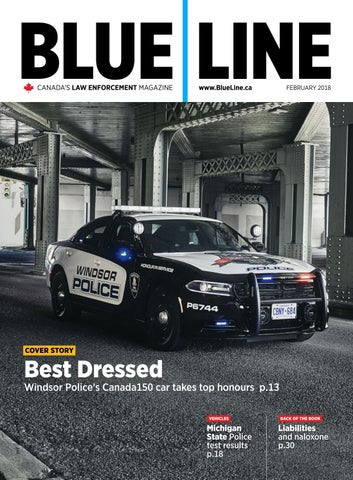
Best Dressed PM 40065710
Windsor Police’s Canada150 car takes top honours p.13 VEHICLES
BACK OF THE BOOK
Michigan State Police test results p.18
Liabilities and naloxone p.30
We do our job so you can do yours. Our proven non-core police services allow you to do what you’ve trained for.
Contents
18 February 2018
Columns
Volume 30 Number 2
4 8 10 11 12 25 26 30
Features COVER STORY
13 Best Dressed Police Vehicle Award winners
Windsor Police Service nabs top honours in Blue Line’s annual Best Dressed Police Vehicle Awards. By Renée Francoeur
18 Results from the Michigan State Police vehicle tests
Every fall, the Michigan State Police Precision Driving Unit evaluates police vehicles in two categories: police category vehicles and special service vehicles. See what was discovered about new 2018 models. By Dave Brown
24 Cybercrime’s growing need for co-ordinated response
Editor’s commentary Q&A Deep blue Holding the line Health & wellness Case law Technology Back of the book
Departments 5 5 7 7 26 28 29 30
By the numbers News Dispatches Calendar Off the shelf Product showcase Marketplace Blue Links
COVER PHOTO: CARL JONES II
Based on the global scope in which cybercrime is trending, law enforcement agencies need to be more willing to freely exchange knowledge and information. By Patricia Ariss
8 @Blue_LineMag
14
26 February 2018 | BLUE LINE
3
EDITOR’S COMMENTARY BY RENÉE FRANCOEUR
Capturing the imagination with police Porsches & blue-light Kiddie Kruzzers...
I
’ve been watching Stranger Things Sûreté du Québec, Vancouver Police Deand the German science fiction/ partment, University of Toronto - Missishorror series Dark on Netflix over sauga Campus Police, and Combined the past few months and thorough- Forces Special Enforcement Unit of ly enjoying whenever one of the retro British Columbia. police cars or trucks whizzes (or putts, as The range of colour, the attention to with that circa 1953 fir green Volkswagen enhanced visibility, the creative readpolice beetle in Dark) across the screen. ability and the community identity exPolice vehicles have always grabbed our pressed in each winning entry impressed attention throughout the decades us. They have captured what it — that’s their job. The Audi Mu- Police means to be a serious and atseum in Ingolstadt, Germany, vehicles tractive set of law enforcement knew this when it gathered 14 have always wheels. historic police cars for a special grabbed our There is one charming entry temporary exhibit dubbed attention we kept coming back to, how“Razzia” (in English “Police throughout ever, that didn’t end up plaRaid”) a couple years ago. These the decades cing. But I think it deserves a included the elegant 1930 Horch — that’s shoutout. The Brandon Police 400, one of the first motorized their job. Association (BPA) in Manicop rides in Germany, according toba has a 2017 “Kiddie Kruzzto the museum; the 1964 Porsche 356 used er” — think of those colourful strollers for highway patrol; the doorless Volkswa- shaped like cars at the mall — and it’s gen Type 18 A; and a more modern arti- equipped with the “full police associfact, a sleek 500-horsepower Lamborghi- ation decal package.” What is its primary ni Gallardo Polizia. (A 2009 Gallardo purpose? Transporting sick children from Polizia from the Lamborghini Museum in the pediatric unit of the Brandon RegionSant’Agata Bolognese is now on perma- al Health Centre to surgery and/or for nent display at the Highway Patrol Auto various testing in other hospital wings. Museum in Rome by the way. Man, that Additionally, Whelen Vertex emergency thing looks mean.) lighting has even been installed, which While the police cars of days gone by the children are able to activate while dredge up classic cop show nostalgia (and they navigate the hallways. amusement), the ones our officers are set This miniature vehicle is the first doto start patrolling in today are pretty nation to the pediatric unit the associfascinating, too. They’re chock-full of new ation has ever made, according to Bruce comforts and intuitive technology, in- Verhelst, BPA’s vice-president, in what is cluding things like rear cross path detec- hoped to be an ongoing commitment to tion, radar and forward-looking cameras. the children who pass through the cenThat brings us to the 2018 Best Dressed tre’s doors. Police Vehicle Awards. We were blown It just goes to show police vehicles get away by the submissions this year. A big the chase done, but they can also hold a thank you to every one across Canada special spot in our imaginations, and who took the time to snap a pic of some — like I’m sure many children and their pretty snazzy rides and email it in. parents at the Brandon Regional Health Congratulations to the 2018 winners: Centre would say — our hearts. No Windsor Police Service, Treaty Three wonder the lights of the lightbar are blue Police Service, Delta Police Department, and red.
CONNECT WITH BLUE LINE
www.BlueLine.ca 4
@Blue_LineMag
BLUE LINE | February 2018
www.facebook.com/BlueLineMagazine
BLUE LINE www.BlueLine.ca
GROUP PUBLISHER | PAUL GROSSINGER pgrossinger@annexbusinessmedia.com EDITOR | RENÉE FRANCOEUR rfrancoeur@annexbusinessmedia.com ACCOUNT MANAGER | JANICE EATON janice@blueline.ca ART DIRECTOR | SVETLANA AVRUTIN savrutin@annexbusinessmedia.com ACCOUNT COORDINATOR | TRISH RAMSAY tramsay@annexbusinessmedia.com CIRCULATION MANAGER | BEATA OLECHNOWICZ bolechnowicz@annexbusinessmedia.com Tel: 416-442-5600 ext. 3543 COO | TED MARKLE tmarkle@annexbusinessmedia.com PRESIDENT & CEO | MIKE FREDERICKS ANNEX BUSINESS MEDIA 111 Gordon Baker Road, Suite 400 Toronto, ON M2H 3R1 Tel. 416-442-5600 • Fax 416-442-2191
Publication Mail Agreement No. 40065710 ISSN 0847-8538 Printed in Canada SUBSCRIPTION RATES Canada — 1 Year $31.00; 2 Year $51.50 plus tax USA — 1 Year $103.00 USD CIRCULATION email: asingh@annexbusinessmedia.com Tel: 416-442-5600 ext 3553; Fax: 416-510-6875 or 416-442-2191 Mail: 111 Gordon Baker Road, Suite 400, Toronto, ON M2H 3R1 Occasionally, Blue Line will mail information on behalf of industry-related groups whose products and services we believe may be of interest to you. If you prefer not to receive this information, please contact our circulation department in any of the four ways listed above. Annex Privacy Officer Privacy@annexbusinessmedia.com; Tel: 800-668-2374 © 2018 Annex Publishing & Printing Inc. All rights reserved. Printed in Canada. No part of the editorial content of this publication may be reprinted without the publisher’s written permission. Opinions expressed in this magazine are not necessarily those of the editor or the publisher. No liability is assumed for errors or omissions. Readers are cautioned and advised that articles presented herein are edited and supplied for your personal awareness and should not be used for further action until appropriate guidance is received from a supervisor, Crown Attorney or other persons in authority. All advertising is subject to the publisher’s approval. Such approval does not imply any endorsement of the products or services advertised. The publisher reserves the right to refuse advertising that does not meet the standards of this publication.
NEWS
Public Safety Minister Ralph Goodale (left) announces more money will start flowing to communities served under the First Nations Policing Program in the 2018-2019 fiscal year. PHOTO: OFFICE OF THE MINISTER OF PUBLIC SAFETY AND EMERGENCY PREPAREDNESS
WINNIPEG
$291.2 million to be invested in First Nations police forces
The federal government has announced a cash infusion of $291.2 million over five years for policing in First Nation and Inuit communities. Public Safety Minister Ralph Goodale made the announcement in Winnipeg, saying the money will start flowing to communities served under the First Nations Policing Program (FNPP) in the 2018-2019 fiscal year. The announcement includes money for up to 110 additional officer positions, starting in 2019-2020. Provincial and territorial governments fund 48 per cent of the policing program and they will be asked to increase their spending to maintain their share of the costs. The next due date for renewing agreements with provinces, territories and Indigenous communities is April 1 of this year. In the 2015-2016 fiscal year, there were 185 police service agreements covering more than 430,000 people in 450 First Nation and Inuit communities across Canada. “The First Nations Policing Program is a critical service that protects the safety of Indigenous Peoples through culturally relevant policing,” Goodale said. “This new funding will be ongoing so communities can count on it for the long-term.” Assembly of First Nations (AFN) National Chief Perry Bellegarde said federal support for the FNPP is necessary and critical to
ensure safety and security for First Nations and First Nations police forces and officers. “Our primary concern is safety and security for First Nations, our families and First Nations police officers,” said Bellegarde. “This announcement will help ensure First Nations police officers and staff will have the tools necessary to do their jobs. These officers already put their lives on the line and should not have to face additional risks because they don’t have proper equipment. We want our police forces to be supported and funded at the same levels as other police forces in Canada and deemed an essential service.” - with files from Canadian Press
menting a new call dispatch system, Computer-Aided Dispatch (CAD), at its emergency call centre in Quebec. Comparable to the system used by 911 dispatch centres, this software is a “complete call management and allocation solution.” It has also been “completely adapted to the unique environment of airborne medical evacuations, a first in Quebec,” the company notes. Adapting the software required a full year of preparation and programming. Employing more than 150 people, Airmedic was established in 2012 and says it is the only company in Quebec operating its own fleet of aircraft exclusively dedicated to emergency medical care and transfers.
QUEBEC
Airmedic implements new call dispatch system Airmedic says it recently finished imple-
Olivier Lauzon, centre, is head of the dispatch implementation and a mission co-ordinator, along with Shanna Aristil, right. Carl Guérard, standing, is Airmedic’s vice-president of operations. PHOTO: AIRMEDIC
BY THE NUMBERS
As the world becomes more interconnected, cybercrime is continuing to escalate globally. In Canada, the majority of cybercrime substantiated by police is fraud. Below are various cybersecurity statistics, compiled from the RCMP, StatsCan and PwC, a professional services network.
40% 16% 16K 21.4% Increase in reported incidents of cybercrime to RCMP from 2011 to 2013.
@Blue_LineMag
of Canadian organizations reported losses between $50,000 and $5 million due to cybercrime, according to the 2016 Global Economic Crime Survey by PwC.
Complaints received in 2013 by the Canadian Anti-Fraud Centre of cyber-related fraud, accounting for more than $29 million in losses.
Increase in police-reported incidents of fraud between 2011 and 2015, according to Statcan’s Uniform Crime Reporting Survey.
February 2018 | BLUE LINE
5
NEWS BOLTON
D&R Electronics aims to push out 3,000 vehicles per year
D&R Electronics, an ISO 9001:2008 registered designer/manufacturer and installer of emergency vehicles and equipment, has its sights on its new year’s resolution: pushing out more vehicles. The family-run company was founded in 1976 and is based in Bolton, Ont. Darta Fleet Solutions, also in Bolton, is the dealer/distributor for D&R — known as the “one-stop-shop” for outfitting. Massimo Tari, president of Darta and VP sales manager at D&R, recently gave Blue Line staff an exclusive tour of both facilities. The company is currently pushing out around 1,600 vehicles a year. Tari says they hope to bump that to 3,000 in the very near future. Visit goo.gl/N9GW9w to watch the video from Blue Line’s D&R tour. CANADA
Auto theft down in most major cities: IBC
Insurance Bureau of Canada (IBC) has published its annual list of the Top 10 Most Frequently
Calgary Police cars for 2018 are being outfitted at Darta Fleet Solutions in Bolton, Ont. PHOTO: R. FRANCOEUR
Stolen Vehicles. Once again, Ford trucks and high-priced SUVs feature prominently. “Between 2015 and 2016, motor vehicle theft across Canada was down slightly to just over 78,000 cases,” said Dan Service, acting national director, Investigative Services, IBC. “After two years of increased reports of auto theft, 2016 saw a one per cent decline. The biggest increases were in Yukon, where stolen vehicle numbers are up 22 per cent; Nunavut, where they are up 18 per cent; and Saskatchewan, where they are up 15 per cent.” The 10 most frequently stolen vehicles: 1. 2. 3. 4. 5.
2015 Lexus GX460 4-Door AWD SUV 2007 Ford F-350 Super Duty 4WD Pickup 2006 Ford F-350 Super Duty 4WD Pickup 2005 Ford F-350 Super Duty 4WD Pickup 2001 Ford F-350 Super Duty 4WD Pickup
LETTER TO THE EDITOR Regarding Sig Sauer’s upgrade program... WE ARE CONCERNED AND DISAPPOINTED in Blue Line’s recent coverage of the Sig Sauer P320 pistol (“Factory Recall,” by Dave Brown and “Moving to the ‘Next Generation’ Handgun,” by OPP Fleet Supply and Weapons Services Bureau, both from the December 2017 issue). The P320 pistol has always met or exceeded all U.S. safety standards as well as many global military and law enforcement protocols. This includes the American National Standards Institute (ANSI), National Institute of Justice (NIJ), and U.S. Department of Justice (DOJ). Here are the facts regarding Sig Sauer’s upgrade program: Any pistol with a loaded round in the chamber is potentially capable of discharging under certain conditions, such as hitting the striker repeatedly with a mallet or dropping it from awkward angles. Nevertheless, understanding that the planned upgrade would further reduce the chance of an abusive handling discharge, the company didn’t hesitate to prioritize its upgrade. Also incorrect was Mr. Brown’s claim that the M17 pistol selection, based on the P320, resulted from Sig being the lowest bidder. The Sig M17 is the pistol of choice for the U.S. military because it provided best value to the government. Regretfully, Blue Line’s OPP Fleet Supply and Weapons Services Bureau article is likewise ill-considered. Sig Sauer voided the limited lifetime warranty on the OPP’s fleet of duty pistols due to unauthorized modifications made by OPP personnel. More recently, Sig Sauer participated in two separate Request-For-Bids over 14 months, only to see both solicitations summarily cancelled in order to allow the OPP the opportunity to purchase new firearms from a sole-sourced vendor at Canadian taxpayer expense. Sig Sauer has a long and proud history of working with Canadian law enforcement at federal, provincial and municipal levels. We appreciate the opportunity to set the record straight on these most important matters. - Allen McCormick, vice-president, marketing, Sig Sauer We always welcome your insights and feedback. Email rfrancoeur@annexweb.com or comment directly on the items you see at blueline.ca (N.B. letters may be edited for clarity and brevity.)
6
BLUE LINE | February 2018
6. 2003 Ford F-350 Super Duty 4WD Pickup 7. 2004 Ford F-350 Super Duty 4WD Pickup 8. 2016 Toyota 4Runner 4-Door 4WD SUV 9. 2002 Ford F-350 Super Duty 4WD Pickup 10. 2006 Ford F-250 Super Duty 4WD Pickup “We see from this list that criminals continue to favour all-wheel drive and four-wheel drive, older, high-end vehicles,” Service added. WINDSOR
Retirement for Windsor Police chief prolonged
Mayor Drew Dilkens and the WPS board announce Chief Frederick’s extension. PHOTO: CITY OF WINDSOR
Windsor Police Chief Al Frederick had announced he was retiring at the end of January 2018 but those plans were stalled. Mayor Drew Dilkens and members of the city’s police services board announced Frederick’s 17-month work extension, explaining they wanted “the continuity” of Frederick’s leadership as nearby Amherstburg weighs the merits of Windsor’s bid to take over the town’s policing, and implement that takeover if it’s approved. EDMONTON
EPC examines carding practices
The Street Check Policy and Practice Review project, sponsored by the Edmonton Police Commission (EPC), is now underway, led by Curt Griffiths, with the School of Criminology at Simon Fraser University in B.C. Two of the major components of the project are interviews and focus groups. These will be conducted with people from the various communities in Edmonton and also with members of the EPS. The commission expects a final report back by March 31, 2018. www.BlueLine.ca
NEWS DISPATCHES Deputy Chief Lee MacArthur (photo) has retired from Brockville Police Service along with Const. Robert Ferguson and civilian staff member Deena Shaw. Acting Det. Sgt. Mark Noonan has been selected as the next deputy chief. Sgt. Michael Elliott is the new president of the Edmonton Police Association. He is also the vice-president of the Alberta Federation of Police Associations. Darren Strongman has been appointed as deputy chief of the Port Hope Police Service (PHPS). Effective immediately, Strongman will take on the position that has been vacant since September 2014. “Deputy Chief Strongman has fulfilled his duties as inspector since April 2015,” said Port Hope Police Services Board chair Jeff Gilmer. “He is familiar with the needs of our community and has been an excellent member of the PHPS management team.” Steve Graham has retired from the board of police commissioners for the Halifax Regional Municipality. He retired in 2013 as the Deputy Commissioner responsible for all Royal Canadian Mounted Police operations east of the Manitoba-Ontario border. He has served in operations, security and staff roles, including executive leadership as the Commanding Officer of Prince Edward Island (2001–2003), New Brunswick (2004–2008) and Nova Scotia (2008-2010). Perth County OPP Sgt. Greg Wilson retired after 32 years in policing, 20 of them with the OPP in Perth County. He started as a patrol officer in South Porcupine, near Timmins, Ont. The Ontario Chiefs of Police Association welcomes Antje McNeely, deputy chief at Kingston Police, and Chief Shawn Devine of North Bay Police Service to its board of directors.
CALENDAR Const. Robert Allen has retired from the Royal Newfoundland Constabulary. The force credited him as the “top auto-theft investigator.”
Insp. Edmund Oates is now a superintendent and will lead Royal Newfoundland Constabulary’s Operational Patrol Services Division in the NEA region (Northeast Avalon). John Bates, the 25th chief of the Saint John Police Force, has announced his intention to retire this spring. He was appointed chief in October 2015, and began his policing career with the Brantford Police Service in 1985 where he served for 21 years prior to being appointed deputy chief of the Stratford Police Service in 2006. He served as both deputy chief and then as the chief in Stratford for nine years. Peterborough Police Service Chief Murray Rodd will be retiring on June 30, 2018, after 10 years in the role. He has spent 35 years overall in policing, starting with the Peterborough Police Service on June 20, 1983, after graduating from the law and security program at Fleming College. In 2011, he was awarded the Member of the Order of Merit of the Police Forces from the Governor General of Canada and in 2015 he was the recipient of the OACP’s highest honour: the President’s Award. Alex Vacca has been promoted to the rank of deputy sheriff in Portage la Prairie, Man., with the Central Plains District of the Government of Manitoba (Detachment 2IC). His roles include judicial policing and enforcement of court orders. Chris Barratt is the interim national president for the International Police Association - Canada Section (IPA Canada). Denis Nadeau has resigned due to health challenges. Barratt is also the president of IPA Canada, Region 2.
PROMOTIONS, RETIREMENTS, RECOGNITION • If you have an officer in your agency recently promoted or retiring or an individual you wish to have recognized (major award or recently deceased) you can let Blue Line magazine know by email to: dispatches@blueline.ca.
@Blue_LineMag
3rd National Symposium on Mental Disorder Feb. 23, 2018 Toronto, Ont. www.osgoodepd.ca CACP Information, Communication & Technology Committee Workshop Feb. 25-28, 2018 Vancouver, B.C. www.cpa-acp.ca Calgary Police Cyber Summit March 5-7, 2018 Calgary, Alta. www.cybersummityyc.ca International Human Trafficking Conference March 19-21, 2018 Toronto, Ont. tps-human-trafficking-conference-2018. eventbrite.ca ILEETA 2018 March 19-24, 2018 St. Louis, Mo. www.ileeta.org/ileeta-conference-expo Hardeep Kang Memorial Hockey Tournament April 19-20, 2018 Brampton, Ont. www.hkmemorial.com LEVA Level 1: Forensic Video Analysis & The Law April 30, 2018 Calgary, Alta. leva.org Blue Line Expo May 3, 2018 Mississauga, Ont. www.bluelineexpo.ca The Anti-Graffiti Symposium (TAGS) May 8-9, 2018 Moncton, N.B. www.tagsconference.ca International Police Association Canada AGM May 24-29, 2018 Vancouver, B.C. www.ipacanada.ca
February 2018 | BLUE LINE
7
Q&A When you ask a police service what they want in a patrol car, they don’t even hesitate, says OPP officer Mike Bennett. But when it comes to off-highway vehicles, it’s another story. That’s where Bennett and his company Terra Tech Off Road come in, and his latest reveal — a beefed up side-by-side called the Guardian — shows law enforcement agencies all the different types of product they can get to suit their off-road needs.
Q: Why did you found Terra Tech in 2011? My Dad was a mechanic who started working on race cars at the age of 14 so I grew up in a motorsports family. I started riding at seven, racing at 12 and I learned how to modify the machines for speed. In a commercial setting you want to modify a vehicle for survivability and operator safety 8
BLUE LINE | February 2018
as well as the environment it is going to be operated in. No one in the Canadian marketplace was doing that so I saw an opportunity and Terra Tech was born.
Q: How has your role as a police officer influenced Terra Tech? As an ATV instructor with my agency I saw first-hand what commercial use can do to a product designed for the recreational marketplace. I started looking at the common failures the machines were having and realized that several of these issues could be solved by replacing those parts with aftermarket accessories that were of a higher quality. Q: What is the latest from Terra Tech? We just finished the “Guardian” in conjunction with Can-Am marketing. The off-road border patrol UTV is based on 2017 Maverick Max X3 XDS and was designed to be the
SNAPSHOT OF THE GUARDIAN
154
horsepower engine
32
inch MRT “X Rox DD” Kevlar race radial tires
most technologically advanced LE UTV (utility terrain vehicle) ever produced. The Guardian is a combination of off-road, law enforcement and military components; it is basically a rolling billboard that allows our customers see the products we recommend. We don’t modify these vehicles to win races; we modify them to provide a significant advantage in critical situations.
137
Q: What is the Guardian suited for? The Maverick Max X3 is designed for high-speed, open desert use with its race-inspired suspension and drivetrain. We have modified the vehicle for generalized border patrol. However, with a few changes, the UTV can also be used in tight woods or urban environments.
Visit youtu.be/ x1LeZSRcyiA for a close-up video of the Guardian at the 2017 Toronto ATV Show.
Q: What makes the Guardian so innovative? We have taken a recreational product and improved it for the rigours of commercial use. One of the big-
kilometers per hour is the top speed
www.BlueLine.ca
PHOTOS: MIKE BENNETT
Q: How would you describe Terra Tech? We are an innovator in commercial OHV (off-highway vehicle) development and training, focused on the Canadian law enforcement and military marketplace. We specialize in research and development, vehicle design and testing, commercial sales, vehicle procurement and training. We consulted with the Specialized Vehicles Group at BRP over a three-year period and were instrumental in developing the first off-road vehicles offered to law enforcement agencies by an OEM (original equipment manufacturer).
BODYGUARD TM
gest changes we made to the vehicle was the addition of a tactical payload bed from RP Advanced Mobility Systems. We replaced the entire rear of the car with the aluminum cargo bed, vastly increasing the cargo capacity. The UTV is safer with a custom aftermarket roll cage and Cook Sheet Metal aluminum roof. Positional awareness is covered with a Lowrance HD7 GPS, featuring Trak Maps SD Topo cards as well as a Track 24 Whisper Vehicle Tracking System. A Power Tank compressed C02 system is bed mounted, allowing us to run air tools, fill tires and even clean weapons. Communications are handled by a Rugged Radios VHF Race radio, paired to a Shakespeare Military VFH antenna. UHMW skid plates from Factory UTV protect the chassis and drivetrain, and the front bumper was crafted by FMF and holds a Warn Industries 4500-lb winch, equipped with a Factor 55 ultra hook. Whelen supplied a WSSC30 30-watt siren. Rigid Industries supplied all of the LED lighting, including an IR driving light for full blackout operations. Tire size was increased with 32-inch MRT X Rox DD Kevlar belted race radials, paired to heavy-duty DWT beadlock wheels. Lastly, weapons security includes a pair of Santa BlueLine_Feb_Spirito.indd 1 Cruz gunlocks, mounted between the front seats.
Q: How do you see something like the Guardian being used in law enforcement? The off-road marketplace is changing and side-by-side sales are outpacing those of ATVs. I believe LE agencies will start changing over a portion of their off-road fleet for the same reasons the general public is: adaptability. A UTV can complete any number of tasks, from searches, special event support, drug eradication or tactical operations. Q: What about agencies with extra-tight budgets? The Guardian and our other project vehicles have been a great way to introduce new technologies that are available in the off-road world. In a time of fiscal responsibility, agencies are looking to extend the service life of their fleets, and with a few simple modifications we can help them do that. From updating an entire fleet or creating off-road patrol/tactical vehicles, we ensure the customer makes the right choices and budgets are met. @Blue_LineMag
Apparel
● Cost Effective Uniform Solutions ● Great Quality ● In-Stock Items ● Quick Turn-Around 905.565.7576 1.800.996.9499 sales@spirito.com
www.spirito.com
Make a Difference JUSTICE STUDIES FOR WORKING FRONTLINE OFFICERS
At Humber, we teach the professional and practical skills you need to move up and make a difference in your community and in your career. Further your education one course at a time or work towards a certificate, diploma or degree. Advanced standing is available to those in the Justice Services industry.
communityservices.humber.ca /justiceprofessionals
2018-01-24 12:13 PM
DEEP BLUE
BY DOROTHY COTTON
What to do about unfounded ideas and beliefs
A
friend of mine is developing a course about critical thinking. If I had to guess, I’d say he was doing this because he is trying to figure out why otherwise rational people voted in a rather peculiar manner in the last American presidential election. I think his premise is that if we can just teach people to think critically, evaluate information and weigh consequences, then people will make rational decisions. He has a point — but making rational decisions is actually more complex than it appears on the surface. Why do people think vaccines cause autism, global warming is a hoax, guns make people safer or longer jail sentences deter crime? I just ran across a book that addresses the subject from several angles. It is called Denying to the Grave: Why We Ignore the Facts That Will Save Us by Jack M. Gorman and Sara E. Gorman. As it turns out, the short answer is: we stick to beliefs that don’t make much sense because we as a species are not very good at changing our minds. There are a number of things that contribute to our obstinacy and our belief in things that really make no sense. Some of the things we believe give us a sense of control, when in reality we have no control. Most of us would prefer that things were predictable and logical and that we have some control over things — like our health in particular. The fact is a whole lot of health related stuff is completely random. All that randomness makes us a little queasy and uneasy. Take autism for example. We really don’t have a clue what causes it. But if I decide that vaccines cause it, then I can take some definitive action. (There...I feel better already!) How about owning a gun? The evidence is pretty clear that if you have a gun in your house, the odds of some family member shooting 10
BLUE LINE | February 2018
some other family member by accident are far greater than the odds of defending yourself successfully against an intruder. But gee... doesn’t that intruder possibility make you feel a little anxious? How about believing that the names of sex offenders should be made publicly available so we can... er... so we can what? Ensure that they are alienated and vilified so as to maximize the chances that they will reoffend? Alas, the thought of having a sex offender in the neighbourhood makes us uneasy. Sometimes we cling to false beliefs because there is a charismatic person spewing misinformation. Sometimes it is because the information you need to absorb is far beyond what you can easily understand — so you just dismiss it. Take global warming for example. I certainly struggle with the science there. Sometimes it is because the Internet ensures that misleading information is readily available — and we can find sources to confirm whatever bias we already have. And then on top of that there is the fact that we tend to pay particular attention to information that supports the point of view we already hold. This is called confirmation bias. And the fact is that you can find support for pretty well any point of view if you just look for the “evidence.”
We all hold some unfounded ideas and beliefs. Maybe you are still attached to particular interview techniques that subsequently got discredited. Maybe you are sure marijuana is a gateway drug.
Sometimes we cling to false beliefs because our peer group — whomever we identify with — all hold the same false belief and we do not want to be outsiders. What does this have to do with policing? I challenge you: when was the last time someone in your workplace confronted you with information that disproved something you thought or believed, and you responded by saying: “You’re right! I changed my mind!” If an example readily comes to mind here, then you are one of a minority of people. We all hold some unfounded ideas and beliefs. Maybe you are still attached to particular interview techniques that subsequently got discredited. Maybe you are sure marijuana is a gateway drug. If I asked you about dangerousness and mental illness, you’d tell me about all the people you have dealt with who had a mental illness and were dangerous — missing the fact that you have of course not been called to deal with the vast majority of people who have a mental illness and are not dangerous — and forgetting about the majority of people who are dangerous but do not have a mental illness. So is teaching a person about critical thinking actually a good idea? Probably, yes — as long as the training includes some discussion of how it is that people allow themselves not to think critically to start with. I am reminded of the old psychology joke that says: Q: How many psychologists does it take to change a light bulb? A: Only one — but the light bulb really has to want to change. People have a lot in common with light bulbs, I dare say. Dr. Dorothy Cotton is Blue Line’s psychology columnist. She can be contacted at: deepblue@ blueline.ca.
www.BlueLine.ca
HOLDING THE LINE BY MICHELLE VINCENT
Bringing the best of who we are to each meeting
“E
very interaction we experience as human being is a meeting of sorts.” I find this to be an interesting and yet very accurate statement. When you think about it, you get into your vehicle and engage with traffic — this is a meeting. You go to the grocery store to pick up groceries and multiple meetings involving other store patrons and the checkout clerk occur. Have you ever asked yourself: Who do I bring to these various meetings? What were the results of these meetings? We have an opportunity to bring the best of who we are to each meeting, which will have a direct impact on the outcome of said meeting. Here’s an example: You get up a little later than usual for your shift. Perhaps you start at 6 a.m., which means you want to be at the station for 5:30 a.m. to kit up, check emails and be early for parade. You jump into your vehicle with a commute ahead of you. You are already 10 minutes behind schedule and the traffic is heavy. You dart in and out of lanes attempting to be in the fastest lane. You get right up close to the vehicle in front of you. Your stress level is through the roof. You can’t be late — not in this profession. You are relieving the night shift and they need you there to take over. The vehicle in front of you has at least two car lengths in front of it and you are trying to figure out how to get around. Your movements are jerky and you cut people off, though not on purpose. You finally get to the station and immediately start snapping at those around you. You aren’t interested in taking over an arrest from the night before and think of all the work you have ahead of you. Another scenario: You are 10 minutes late, however you had a meditation prior to jumping into your car, as is your practice. @Blue_LineMag
You notice how nice the seat warmers feel and the heated steering wheel is almost as soothing as a hot coffee. You jump onto the highway and notice traffic is heavy. You have some great music or audio to listen to and think to yourself how nice it will be to have the opportunity to listen to a few extra songs as a result of this longer commute. You are far enough back to realize you might as well sit in the right-hand lane, not needing to switch back and forth in order to get ahead. You finally arrive at the station and you are refreshed and feeling good about being able to take over the night shift’s late call so they can go home. Both of these scenarios are identical, other than the “person” who attended the meeting. Every day we have a choice as to who we bring to every interaction and experience. Do we learn to incorporate mechanisms that support a rested, happy, healthy and peaceful individual in order to effect the safest execution of our duties as police officers every day? Or, do we allow life’s glitches — which are inevitable — to taint our experience and paint the rest of
Do we allow life’s glitches, which are inevitable, to taint our experience and paint the rest of our day with that same brush?
our day with that same brush? Every experience can be seen from a positive or negative viewpoint. We can choose to see traffic in our commute as stressful and ruin our drive with negativity, or we can choose to see this same scenario through a positive lens in that we have an opportunity for extra time to create lists for the day, listen to our favourite audio or simply have that peaceful time to oneself before we jump into the shift’s unpredictable calls. Attending each meeting with a clear and peaceful approach has a domino effect on subsequent meetings so, for example, one you were initially not looking forward to has the potential to become a more positive experience for all. Michelle Vincent is a 16-year York Regional police officer with a Masters Degree in Arts in Counselling Psychology and a background in equine assisted therapy, workplace reintegration and teaching. She has a practice supervised by a psychologist and is working towards her PhD in Forensic Psychology/Crisis Response. She can be contacted at: michelle@smith.net.
February 2018 | BLUE LINE
11
HEALTH & WELLNESS BY ISABELLE SAUVE
Nature versus nurture: Better wellness with DNA expression control
U
nquestionably, every law enforcement officer and their loved ones can benefit from maximizing the probability of a long and healthy life. Currently, the overarching societal perspective is anchored in the belief that we all carry a genetic inheritance/individual characteristic gene structure (DNA), which is mainly responsible for who and what we are. This has predetermined the course of our lives, including our abilities, weaknesses, sensitivities and susceptibility to disease. We are also led to believe by many pharmaceutical companies that conventional medicine is the way to fix “deficiencies” with which we were born. However, this view is increasingly being challenged. Over the past 10 years, research on genetics explains that we indeed carry a certain degree of hereditary makeup that cannot be changed; however, this complex DNA only represents a low percentage of our overall genetic pre-determination. While the actual sequence (or underlying code) of our DNA cannot be changed, the manner in which our genes are read by our cells can indeed be modified. In other words, the expression of our genes can be modified by our actions and environment. This scientific discovery is called epigenetics. Epigenetics is a complex topic with countless exciting possibilities. This article provides a brief overview of the subject, hoping to courage readers to keep an open mind and discover more on the topic. In a very simplified manner, epigenetics is the study of biological mechanisms that switch genes on and off. Dr. Joel de Rosnay with the Massachusetts Institute of Technology describes it as a revolution. Health professionals have believed this concept for a long time and can 12
BLUE LINE | February 2018
demonstrate it scientifically today. Epigenetics is in what we eat, where we live, our relationships, sleep patterns and physical activity. It is about what we do and what we are exposed to. Epigenetics proposes everything we do affects the expression of our genes. Furthermore, it says humans are fundamentally a reflection of the life they live and the lifestyle they adopt. With about 20,000 genes in our body composition, the ability to turn them on and off presents significant possibilities. The prospect of purposefully shifting the expression of our genetic makeup is exciting, particularly with respect to disease prevention and reversal, increased immunity and resilience, overall health, and life expectancy. It opens the doors to a biological revolution. Changing the expression of our genes can have an impact on numerous health circumstances — Alzheimer’s, obesity, etc. It opens the doors for programming and changing the human body over the course of a lifespan. To a large degree, it implies everyone is responsible for their own mutation and adaptation. Research indicates a change today can also have positive impact on the next generation and their subsequent offspring. It implies that by improving the expression of our genes, we are strengthening the genes of generations to come. This has profound meaning with respect
to human evolution and health. Thousands of species, including humans, have evolved slowly over thousands of years. Epigenetics is suggesting a much shorter timeframe is needed; changes can happen over the course of one single lifespan. An interesting example can be drawn from honeybees. Every colony selects a bee from the hive to which they offer royal jelly, the very best and purest nutrition. While this “queen” bee shares genetic makeup identical to the others, she typically grows larger, stronger and enjoys a longer life span. Queen bees are also the only ones gifted with the ability to reproduce, while the others become sterile. So what we put in our bodies has substantial potential implications in terms of health, reproduction and life quality/expectancy. Epigenetic studies show that we With about can turn curative medicine into 20,000 genes preventative medicine. We have in our body control over a large part of our DNA composition, expression, hence over the possibilthe ability to ity of disease prevention and cure. turn them on This has repeatedly been shown and off with type 2 diabetes. With proper presents diet and physical exercise, the dissignificant ease can be prevented. For those alpossibilities. ready living with the disease, it can be controlled and even reversed with tailored nutrition and exercise, as well as stress and rest management. Doing the right things in terms of wellness — including relationships and taking pleasure in life — now has larger implications. The choices we make have a significant impact on our bodies. Be in charge of your health and take control of the expression of your DNA. Isabelle Sauve is a 10-year OPP veteran currently with the Emergency Response Team (ERT) at the Almaguin Highlands Detachment in Burks Falls, about 300 km north of Toronto. She can be contacted at: isabelle.sauve@hotmail.com.
www.BlueLine.ca
COVER STORY
And the Best Dressed Police Vehicle is...
By Renée Francoeur
Congratulations to all the winners of Blue Line’s Best Dressed Police Vehicle Awards, which showcases innovative, sustainable and effective designs. We look for clear identification, graphic designs that enhance visibility, design elements that show directionality of travel and effective integration of equipment and controls. Thank you to everyone who submitted and stay tuned for 2019’s call for submissions.
PHOTO: CARL JONES II.
1ST PLACE
Windsor Police Service 2017 Dodge Charger
W
indsor Police officer Steven Gawadzyn, a self-proclaimed ‘gear head,’ wanted to design a tribute car for 2017, commemorating not only Canada’s 150th but also Windsor Police Service’s (WPS) coinciding 150th anniversary. With its bold custom 150th crest on the hood, the sleek black front end contrasting with the stark white roof and trunk — plus the police crest on the front quarter panel that is a throw back to the 1980s — the resulting 2017 Dodge Charger does just that and more. “The public loved this design so much the chief has decided the rest of our fleet will now look like this — with the exception of the 150th hood crest — starting in 2018,” Gawadzyn says, noting the black front end and simple white lettering recalls the police vehicle style from the 1930s, while the white sections point to the 40s through to the 60s. “The blue P-O-L-I-C-E lettering on the @Blue_LineMag
vehicles reflects the style from the early 2000s and ‘Windsor’ has been added above for a modernized approach,” he continues. The 390-horsepower Charger is an allwheel-drive (AWD), five-speed automatic with a 5.7-litre Hemi and no other performance modifications. However, you’ll find some pretty unique custom features inside and out. The rear tail lights on a Charger typically light up around the word “Dodge.” Not so with this Windsor Police car. “We put in ‘150th Anniversary’ in reflective lettering instead,” Gawadzyn says. Custom 150th Anniversary badges were also produced and affixed to the dashboard, in place of where the factory dash nameplate is usually found. “It’s just some extra cool things that no other police department has done, as far as we know,” he says. “When we introduced it to the officers, the first thing that was said was, ‘Can I drive this?’ It was time for a refresh.”
The singular anniversary badge with its red ribbon (reading 1867-2017) that dominates the hood is sure to grab some attention. Created in partnership with marketing graphics firm HCA Mindbox, the design screams out with its loud “150” and tasteful red and blue fade in the background, as well as subtly saluting Canada with a maple leaf. The assigned vehicle number is 6744, honouring the badge number and memory of Senior Const. John Atkinson, who was killed in the line of duty on May 5, 2006. “I was working that day,” Gawadzyn says. “It’s not something you ever forget. It’s our history. So I wanted to ensure this anniversary car spoke to his memory.” Atkinson’s badge is also proudly displayed on both sides of the cruiser. “Everyone loves a cool car,” Gawadzyn says. “There’s no barriers with this — it’s a common draw.” This is the second time WPS has won the Best Dressed contest. February 2018 | BLUE LINE
13
COVER STORY
2ND PLACE
Treaty Three Police Service 2017 Chevrolet Tahoe
T
he bear represents a protector in many First Nations cultures, according to Staff Sgt. Terry McCaffrey of Treaty Three Police Service (T3PS), headquartered in Kenora, Ont. — “especially here with the Treaty Three Nation,” which includes 28 First Nation communities (23 are policed by T3PS). So it was important for T3PS — Canada’s second largest First Nation policing organization — to include the finely detailed Ursidae on its new vehicle design. “We want our communities to see our vehicles and see that we are deeply rooted in our culture — that we’re a culturally sensitive police service, which we are,” McCaffrey says. The vibrant colour scheme of orange and red remains the same, complementary to the T3PS patch, which was designed by a local resident, McCaffrey adds. “The general consensus in speaking to the officers led to this new design,” he says, “and it’s night and day. Our officers are more
PHOTO: T3PS
proud of this design and far prefer driving these vehicles.” That’s no small victory, as T3PS officers do a lot of driving — the service’s territory spans 55,000 square miles of the Greater Treaty Three Region in Northwestern Ontario. About 40 per cent of vehicles have been redesigned with the bear image and McCaffrey expects the entire fleet to have been updated by the end of the year. The vehicles are serviced by Kerr Industries out of Oshawa, Ont., for lighting packages, etc., and once they reach Kenora, a local dealer (Trimline) works on the decaling. The winning Tahoe is a six-speed automatic with 383 ft-lb of torque and a 5.7-litre, 355-horsepower V8 engine. “It’s just a beauty to drive,” McCaffrey says.
3RD PLACE
Delta Police Department 2016 Ford Interceptor Utility By Chief Neil Dubord with Norm Morrison
T
o celebrate the Delta Police Department’s (DPD) 125th anniversary, the Chief Herald of Canada created a new badge, which led to a redesign of the fleet. The new badge was a departure from the traditional red and blue of the DPD, instead creating a green and gold design to reflect the municipality. Delta is a historic fishing and farming community and the predominantly green badge is a reflection of its history and culture. Current police vehicle trends are seeing black and white and solid black vehicles. During the design phase, staff conducted research into the colours and it was determined that a white vehicle reflects the principles and foundation of Delta’s community-based policing. We took the lead from the United Nations, who uses white vehicles because of the colour’s symbolic statement of peace. In order to maintain public support, and to encourage approachability of the police, a vehicle needs to be minimally aggressive yet strong in its messaging. The design, which includes a bold black stripe with pinstripes of green and gold, allows for high visibility, while creating a modern look. We believe the design strikes a balance between strength, approachability and simplicity. Daytime and nighttime effects were considered equally to improve the visibility and ultimately, officer safety. A key feature 14
BLUE LINE | February 2018
PHOTO: DELTA POLICE DEPARTMENT
is the use of illumination qualities of the 3M product. Fusing art and functionality, a subdued DPD badge on the back quarter panel is noticeable during the day, but at night it illuminates even more brightly. The vehicle is an all-wheel-drive 2016 Ford Interceptor Utility. We order the vehicle with the V6, 305-horsepower engine paired with a six-speed automatic transmission. Our order from Ford also includes driver and passenger front ballistic door panels, factory installed emergency lights in the headlight and taillight housings, lift gate emergency lights, rear audio reverse warning sensors, back-up camera and driver’s side spotlight. Several thousand dollars of additional equipment is installed by two highly skilled mechanics at the city works yard, Shayne Khan and Don Kirkpatrick. The additional aftermarket equipment includes roof light bars, front push bumpers with angle lighting and dual siren speakers, model-specific consoles to house the police radio and siren controllers, laptop stands and docking stations, prisoner compartment and rear window poly barriers, a dual weapon rack for the C-8 patrol rifle and 870 shotgun, and a tri mode roof mount antenna for the police radio, MDT and GPS. www.BlueLine.ca
HONOURABLE MENTION
Sûreté du Québec 2017 Dodge Charger By Geneviève Daoust with Daniel Thibaudeau
T
he Sûreté du Québec’s new look — black with a touch of khaki and ocher, contrasted with white on the doors — is a major change for the organization whose colours have been essentially the same for more than three decades. Similar, the former lettering has been the same since 2005. With added safety and functionality in mind, these new vehicles retain a touch of the old familiar yellow and olive green, keeping with the Sûreté’s distinctive identity and history. All aesthetics aside, North American studies confirm that these contrasting colours offer a much greater visibility, allowing increased safety for the public and our personnel. All markings are made of a highly reflective film. The contrasting black and white also provides optimum visibility under all weather conditions. We have also completely revamped our emergency lights, going
PHOTO: SÛRETÉ DU QUÉBEC
with the brighter and more energy-efficient LED systems. Aerodynamic and smaller than previous lights bars, this new technology is less demanding on the engine, leading to savings on batteries and gas. Zone Technologies Inc., based in Chambly, Que., manufactured the lights and warning beacons. The Sûreté continues its choice of the five-speed automatic, six-cylinder propulsion Dodge Charger. However, the 2017 trunk space has been reconfigured, allowing for more room and better access to essential emergency equipment. Push bars are standard on all models but now come with lateral LED lights for increased visibility. This changeover for our 1,060-vehicle fleet will take place gradually over the next three years, without any added costs to the public. The old vehicles will be simply rotated out when they have reached 200,000 km.
COMMUNITY RELATIONS
Vancouver Police Department 2016 Dodge Charger
“O
ur members are our caretakers of the city,” says Sharm Thiagarajah, the creative director in Vancouver Police Department’s (VPD) public affairs section. “It’s like Batman. So whenever they’re driving, I want them to feel empowered.” Thiagarajah and a special VPD committee are the ones behind the refreshed look for the department’s recruiting 3.6-litre Dodge Charger, featuring a non-turbocharged, V6 engine and two-wheel rear-drive. Find it throughout Vancouver at parades and other public events as well as sitting pretty, front and centre, for all kinds of educational occasions and outreach. Form and function must always go hand in hand for vehicle redesigns, according to Thiagarajah, who saw the Charger and noticed the potential in its “beautiful lines.” “When it came to the design, we wanted the car to fit with the rest of the fleet and feel like part of the family, while still being true to what recruiting is all about for us, as well as true to the soul of Vancouver.” Call it a cousin of the VPD patrol call, she says. A retro cousin. “We had to keep it sporty and punchy but also wanted a retro vibe, as VPD started in 1886.” The history component raises the car to teaching tool status, @Blue_LineMag
PHOTO: VPD
too, as “Since 1886” runs in a large outlined font on the doors. The accompanying orange font and decaling — as well as the modern hashtag #JoinUs — was also a multi-purpose choice. “Orange is one of our colours and it’s a really retro colour,” Thiagarajah says. “It is connected to the idea of strength and, like amber, it draws attention.” Additionally, orange highlights the wider Vancouver community, she says. “We are very sensitive to community needs... Everything we do, we do with diversity in mind. Orange is a multicultural colour, embraced by many cultures. It’s a powerful and spiritual colour for many of the different communities we serve.” February 2018 | BLUE LINE
15
COVER STORY
LAW ENFORCEMENT
U of T - Mississauga Campus Police 2016 Ford Explorer
T
he University of Toronto - Mississauga Campus Police says it prides itself on the “approachability” of its Police Package Ford Explorer, made over in 2016 for a more “clean and progressive” look that “echoes campus life.” The branding on the cruiser incorporates the official U of T colours (blue and white), notes Cpl. Bobbi-Jo Duff of the Campus Police Service, and all three campuses now boast the same look for uniformity. The students like how the cruiser — an all-wheel-drive sixspeed with a 304-horsepower, 3.7-litre V6 — isn’t “in your face,” Duff says. “It’s not intimidating,” she explains. “There’s a nice flow and it’s community-friendly, which is big as what we do is community focused.” This vehicle is outfitted to function as a mobile command post. Features include a custom metal slide lockbox in the trunk, 28 hidden stealth strobe lights, a provincially approved cab partition, speaker horn and shatterproof window film. The cruiser is also equipped with an Internet-connected Toshiba Toughbook to serve as a remote workspace.
PHOTO: UNIVERSITY OF TORONTO - MISSISSAUGA CAMPUS POLICE
“We really promote our cruiser on social media; it’s on the front page of our pamphlet,” Duff says. “We are very proud of it.” For more on past Mississauga campus police vehicles (including a vintage Crown Victoria with a bright forest green strip from the Erindale College days), visit their Instagram page and watch for the #ThrowBackThursday posts.
The
FLeeT AdVANTAGe GFX Law is ready to build law enforcement vehicles for fleets of any size. From electrical systems and lighting to officer safety and security - the options are practically endless. Commitment to personal service, customization and build quality are the reasons why GFX Law is the preferred upfitter for law enforcement vehicles.
GFX LAW ENFORCEMENT VEHICLES 16
BLUE LINE | February 2018
BlueLine_Feb_GFX.indd 1
www.gfxlaw.com | policecars@gfxltd.com | 1-800-739-6837 www.BlueLine.ca
2018-01-09 2:38 PM
SPECIAL SERVICE
Combined Forces Special Enforcement Unit of B.C. 2010 Cadillac Escalade Hybrid
T
PHOTO: ORGANIZED CRIME AGENCY OF B.C.
he integrated anti-gang police agency, the Combined Forces Special Enforcement Unit - B.C. (CFSEUBC), has a secret weapon in their fleet of unmarked cars and they used it not too long ago to pull over a street-level drug dealer in Abbotsford, B.C. “We ended up arresting the suspect and seizing the drugs... but all he wanted to do was get his picture with our vehicle,” says Staff Sgt. Lindsey Houghton with the Organized Crime Agency of B.C. (OCA) and CFSEUBC. “He thought it was the coolest thing; the gang cops had pulled him over in the Caddy.” From that, the unit built up more rapport with this individual and he has now exited the drug-dealing lifestyle, according to Houghton. “It’s these type of stories that show what this vehicle is all about for us.” The 2010 Cadillac Escalade Hybrid has been fully outfitted with emergency equipment — including a Howler and the Whelen Engineering Warning package that centres around the new Cencom Carbide siren system. It boasts a 6-litre aluminum V8 engine with not only variable valve timing but also active fuel management. With automatic transmission, 332-horsepower and 367 ft-lb of torque (which is less than the non-hybrid version, according to Houghton, but it can “still tow a significant amount if we need to hook up a trailer for a command post”), the hybrid Cadillac also comes with two electric motors. “We have no quote-on-quote police cars so we wanted to get a car that could not only be OCA’s first police car and only police car but also one that fits with our end gang life brand and outreach, plus one with utilitarian aspects,” Houghton says. “We smile a little bit at the cliché of a Cadillac Escalade, as its known to be a bit of a gangster car... and this one was previously owned by a drug dealer.”
Beefing up the vehicle into a one-of-akind gang squad beast went beyond slapping on some shiny reflective 3M decals, Houghton adds. The Caddy is fully shrouded in a matte black wrap, so “the yellow font and branding pops off the background,” he says. Low-profile smoked ions offer a covert look on the finish and the windshield and rear window have concealed inner edges that allow for warning lights, takedown lights as well as a Traffic Advisor. The Tracer running board lights are also
up-fitted in such a way to better utilize a light array for multiple uses, Houghton notes. Dual avenger dash lights installed in the rear windows offer alley lights and warning in an optical lighthead. Custom LED lighting has been installed in the front grill, under the vehicle and on the sides — places where the LED colours can be modified for that extra “cool factor.” “The lighting on it is unbelievable,” Houghton says. “It’s like a Clark Griswold Christmas tree. I’m pretty sure you can see if from the space station.”
DALHOUSIE’S CERTIFICATE IN POLICE LEADERSHIP
Skills for now Better career tomorrow
Built for modern policing, our online courses, designed and delivered by industry leaders and experts, give you the knowledge and skills to advance in your profession. Learn from the innovator in quality police education for over 25 years. REGISTER AT:
DAL.CA/POLICELEADERSHIP Fall Term starts September 5
February 2018 | BLUE LINE
@Blue_LineMag BlueLine_Feb_Dalhousie.indd 1
17
2018-01-24 11:41 AM
VEHICLES
Most capable, fuel-efficient vehicles lead the way into 2018 Results from the Michigan State Police vehicle tests By Dave Brown
T
his year is a significant one for pursuit-rated police vehicles in Canada. We lost a few vehicles from the 2017 tests and we gained some new ones. Gone are the Chevrolet Impala, which proved to be too small for two officers, and the Chevrolet Caprice, which was never sold in Canada anyway. Neither will be missed. Ford is the No. 1 selling pursuit-rated police vehicle in Canada, and they are stretching the envelope by pursuit-rating three new vehicles for 2018: a 2.0-litre EcoBoost front-wheel-drive (FWD) sedan previously sold only as a special service vehicle; a Ford F150 pickup with the 3.5-litre EcoBoost V6; and the very first pursuit-rated hybrid, the Ford Police Responder Hybrid Sedan with a 2.0-litre 4-cylinder gas engine combined with an 88-kW electric motor and a 7.6-kWh lithium-ion battery. This gives Ford the unique privilege of having the fastest police vehicle, testing at 5.58 seconds 0-to60 MPH (Police Interceptor 3.5-litre EcoBoost Sedan) and the slowest at 9.05 seconds 0-to-60 MPH (Police Responder Hybrid Sedan.) The most popular vehicle in the fleet remains the Police Interceptor Utility. Ford sells more SUVs than all vehicles from Dodge and Chevrolet combined, and the Interceptor Utility makes up 75 per cent of all Ford police sales in North America. 18
BLUE LINE | February 2018
9
seconds is the traditional time pursuit-capable vehicles must be able to reach 60 MPH
24
seconds is the traditional time pursuit-capable vehicles must be able to reach 100 MPH
General Motors is concentrating their police sales on the Chevrolet Tahoe, with both a rear-wheel-drive (RWD) and four-wheel-drive (4WD) version — each with the powerful 5.3-litre V8 engine. With the disappearance of the Caprice in 2017, the Chevrolet Tahoe Police Pursuit Vehicle (PPV) is the last remaining full-size body-on-frame pursuit-rated vehicle sold in North America. Fiat Chrysler continues to amp up their interior workspaces with new features in 2018. They sell the Dodge Charger with the 3.6-litre V6 engine in a RWD version, and the popular 5.7-litre V8 Hemi engine in both an all-wheel-drive (AWD) and RWD version. This means that the 2018 pursuit-rated police vehicles on the market in Canada are now the most capable, most fuel-efficient and safest vehicles ever made. Faster than most high-performance cars were even ten years ago, they also get better gas mileage than many economy cars could achieve a decade ago. While there is no strict definition of the term “pursuit-rated,” the Michigan State Police and Los Angeles County Sheriff’s Department, both of whom extensively test every model offered for sale in North America, agree that a pursuit capable police vehicle must be able to handle the higher stress of everyday police use, as well as perform better at high speed than their
civilian counterparts. Modifications are usually made to engines, suspension components, cooling systems, transmissions, tires, brakes and computer programming parameters. Traditionally, pursuit-capable vehicles must be able to reach 60 MPH in nine seconds, and 100 MPH in 24 seconds, but without any formal recognition of the term, it will always be up to the individual agencies to determine if a particular vehicle is suitable for their mission.
WHAT HAPPENS IN MICHIGAN? Every fall the Michigan State Police, in conjunction with the U.S. National Institute of Justice (NIJ) test the handling and performance of every new police vehicle on the market for the coming year in back-to-back acceleration, braking and lap time tests. These eagerly anticipated tests are seen as the most comprehensive analysis of police vehicles in North America and 2018 will mark the 20th year Blue Line has been compiling and reporting the results. The Michigan State Police Precision Driving Unit evaluates police vehicles in two categories: police category vehicles and special service vehicles. Police category vehicles are designed for the full spectrum of general police activities including high-speed pursuit. Special service vehicles are designed only for specialized duties, such as canine units or adverse weather www.BlueLine.ca
wheel to help drivers of all sizes find their optimal driving position for comfort and control.
The Chevrolet Tahoe PHOTO: CHEVROLET.
conditions, and are not for pursuits. Thirteen vehicles were submitted in the police category for 2018:
for a pursuit-rated vehicle. This package includes five different technologies:
• Chevrolet Tahoe PPV 5.3L RWD • Chevrolet Tahoe PPV 5.3L 4WD • Dodge Charger Pursuit 3.6L RWD • Dodge Charger Pursuit 5.7L RWD • Dodge Charger Pursuit 5.7L AWD • Ford Police Special Service Sedan 2.0L EcoBoost FWD • Ford Police Interceptor Sedan 3.5L FWD • Ford Police Interceptor Sedan 3.7L AWD • Ford Police Interceptor Sedan 3.5L EcoBoost AWD • Ford Police Interceptor Utility 3.5L EcoBoost AWD • Ford Police Interceptor Utility 3.7L AWD • Ford Police Responder Hybrid Sedan • Ford F-150 Police Responder EcoBoost 3.5L
• Low Speed Forward Automatic Braking automatically applies the brakes to help reduce a collision’s severity at a low speed if the system detects that a front-end collision is imminent and the driver has not already applied the brakes.
Below are the Police Category Vehicles that will be available for sale in Canada for 2018, complete with figures from the 2018 Michigan State Police vehicle tests:
Chevrolet Chevrolet is adding new safety features and options to the 2018 Tahoe Police PPV, designed to help ensure officers make it home safely at the end of every shift. The major option is a new Enhanced Driver Assist Package — the first of its kind @Blue_LineMag
• Forward Collision Alert uses radar and a forward-looking camera to measure the closing speeds between a vehicle and objects in its path. If a driver-adjustable threshold is passed, the system triggers a visual alert and audible beeps or seat pulses, if equipped. • Lane Keep Assist with Lane Departure Warning provides gentle steering wheel turns to help drivers avoid crashes due to unintentionally drifting out of their lanes when they are not actively steering and the turn signals are not activated. • Safety Alert Driver Seat gives drivers the option of getting seat-bottom vibrations instead of audible crash avoidance alerts. • Power Adjustable Pedals are combined with the standard 10way power driver seat and tilt
5.58 seconds from 0-to-60 MPH: the fastest police vehicle (Ford Interceptor 3.5-litre EcoBoost Sedan)
The Tahoe PPV also includes a number of standard safety and driver assist features: StabiliTrak Electronic Stability Control System, Bluetooth hands-free connectivity, Rear Vision Camera with Rear Park Assist, and full steering wheel controls. The 4WD Tahoe uses a true four-wheel-drive system with selections for two-wheel-drive (2WD) for better mileage in good conditions, automatic four-wheeldrive (A4WD) for variable conditions, and locked four-wheel-drive (4WD) in both high range (for slippery conditions) and low range (for descending slopes or crawling over rocks). Officers can switch back and forth between 2WD, A4WD and 4WD high range at any speed.
Ford Redesigned in 2016, the Ford Police Interceptor Utility looks more truck-like and the Interceptor Sedan now looks smoother in the front. Officer safety features abound, including anti-stab plates in the front seatbacks, front doors that are tethered to prevent them opening more than 50 degrees, Level-III ballistics shields in the front doors, and rear doors that open an inviting 90 degrees. A sensor system uses the rear-mounted backup sensor to detect anyone sneaking up from the rear and warns the driver, raises the driver’s window and locks all doors. Ford Police Interceptor models are tested with all traction-control
Without any formal recognition of the term “pursuit-capable vehicle,” it will always be up to the individual agencies to determine if a particular vehicle is suitable for their mission. February 2018 | BLUE LINE
19
VEHICLES
The Ford F-150 Police Responder. PHOTO: FORD
The Ford Police Responder Hybrid Sedan. PHOTO: FORD
and electronic stability control systems fully activated, and are also rear-crash-tested at 75 MPH. Police Interceptor sedans and SUVs are paired with a six-speed automatic transmission that features a “pursuit mode” specially programmed for law enforcement — it automatically switches from fuel-saving to pursuit mode when it detects aggressive driving.
75%
of all Ford police sales in North America go to the Interceptor Utility SUV
Ford has the unique privilege of having the fastest police vehicle... and the slowest. 20
BLUE LINE | February 2018
Options in the Sedan include a 288-horsepower 3.5-litre V6 frontwheel-drive, a 305-horsepower 3.7-litre V6 AWD and a 365-horsepower turbocharged V6 AWD. Utility models include the 305-horsepower 3.7-litre V6 and the 365-horsepower 3.5-litre EcoBoost V6 AWD. Ninety-seven per cent of all Ford sales are AWD models. In addition to the now pursuit-rated 240-horsepower 2.0-litre turbocharged V6, once tested under the Special Service category, Ford is also rolling out the very first pursuit-rated pickup truck on the market and the very first pursuit-rated Hybrid sedan ever tested. Similar in size and performance
to the civilian Ford F150 King Ranch model, the Ford Responder F150 FX4 pickup includes off-road features such as a purpose-tuned suspension, electronic-locking rear axle and underbody skid plates. At 920 kilograms, the F150 has the highest payload capacity of any pursuit-rated police vehicle and can tow up to 3,200 kilograms. At the other end of the spectrum, the new Ford Responder Hybrid Sedan can rocket to 100 MPH in under 20 seconds... but only if towed behind the new Responder F150. Otherwise, it strolls to 100 in a leisurely 25 seconds, pushing the boundaries somewhat as to what constitutes “pursuit-rated.” However, the Hybrid was not designed for high-speed chases down four-lane highways. Based on the Ford Fusion mid-sized sedan, it is designed as a reasonably capable option for urban patrol areas and to save money on fuel costs. In addition to a reduced CO2 emissions footprint, Ford estimates that the potential savings for a police agency could be as high as $3,900 U.S., perhaps considerably more in Canada. When not being driven, the Hybrid Sedan can plug in its onboard 120/240-volt battery charger, further increasing the potential range on batteries alone.
Dodge Dodge has added Rear Cross Path www.BlueLine.ca
The Dodge Pursuit Charger. PHOTO: FIAT CHRYSLER AUTOMOBILES CANADA
Detection to their Officer Protection Package, first introduced with the 2017 Charger Pursuit. This package, now standard on all Dodge Charger Pursuits, is designed to help keep officers safe by alerting them to movement at the rear or side of a parked vehicle that could indicate an ambush. Officers can activate the system whenever they are parked by pressing a dedicated auxiliary button on the steering wheel. All four doors must be closed, but the front windows can be up or down. It
THE TESTS AND RESULTS Michigan State Police Precision Driving Unit and the NIJ’s Justice Technology Information Center (JTIC) test all the vehicles together over a three-day period at the Fiat Chrysler Proving Grounds and the Grattan Raceway. Each vehicle is tested without rooftop lights, spotlights, sirens or radio antennas. Tires are original equipment rubber provided by the manufacturer. Acceleration, braking and top speed tests are performed at the Fiat Chrysler grounds and vehicle dynamics tests are done using the two-mile course at the raceway. (All dimensions and measurements are given in U.S. numbers.) Vehicle dynamics testing The objective of the vehicle dynamics testing is to determine the high-speed pursuit handling characteristics. Except for the absence of traffic, the two-mile road course simulates actual pursuit conditions. It evaluates the blend of suspension components plus acceleration and braking ability. @Blue_LineMag
then uses the 2018 Charger Pursuit’s built-in backup camera, blind spot detection and parking assistance sensors to monitor the surrounding area while officers are occupied. When the system is activated, an alert sounds, the doors lock, the front windows roll up, reverse lights turn on and the tail lights begin to flash. The 12-inch touchscreen also displays the view from the vehicle backup camera. The optional touch-screen frees up critical space in the front and includes
an interface that allows officers to quickly toggle between vehicle controls without taking their eyes off the road. Auxiliary controls on the steering wheel can also be remapped to aftermarket accessories. The 2018 Dodge Charger Pursuit comes with either a 292-horsepower 3.6-litre V6 rear-wheel-drive or a 370-horsepower Hemi V-8 in RWD or AWD. Optional axle ratios have been dropped for 2018, with RWD models coming with a 2.62:1 rear axle and the AWD with a 3.08:1 axle.
Lap Times
Chevrolet Tahoe 5.3-litre V8 RWD
Chevrolet Tahoe 5.3-litre V8 4WD
Overall average lap times
1.40.44
1.40.36
Lap Times
Dodge Charger 3.6-litre V6 RWD 2.62:1
Dodge Charger 5.7-litre V8 RWD 2.62:1
Dodge Charger 5.7-litre V8 AWD 3.08:1
Overall average lap times
1.38.25
1.37.29
1.36.42
Lap Times
Ford PI Sedan 2.0-litre V6 EcoBoost FWD
Ford PI Sedan 3.5-litre V6 FWD
Ford PI Sedan 3.7-litre V6 AWD
Ford PI Sedan 3.5-litre V6 EcoBoost AWD
Overall average lap times
1.46.37
1.38.46
1.37.96
1.35.22
Lap Times
Ford PI Utility 3.7-litre V6 AWD
Ford PI Utility 3.5-litre V6 EcoBoost AWD
Ford Police Responder Hybrid Sedan
Ford Police Responder F150
Overall average lap times
1.40.41
1.37.72
1.45.90
1.47.34
Four different drivers test each vehicle over an eight-lap road course, with the five fastest laps counting toward each
driver’s average lap time. Final score is the combined average of all four drivers for each vehicle. February 2018 | BLUE LINE
21
VEHICLES
Acceleration
Chevrolet Tahoe 5.3-litre V8 RWD
Chevrolet Tahoe 5.3-litre V8 4WD
Acceleration
Dodge Charger 3.6-litre V6 RWD
Dodge Charger 5.7-litre V8 RWD
Dodge Charger 5.7-litre V8 AWD
0 – 60 mph
7.73
7.82
0 – 60 mph
7.99
6.31
5.86
0 – 80 mph
12.74
13.02
0 – 80 mph
12.76
9.60
9.55
0 – 100 mph
19.29
19.77
0 – 100 mph
20.19
15.26
14.37
Top Speed (mph)
134
121
Top Speed (mph)
141
150
150
Acceleration and top speed The objectives of the acceleration and top speed tests are to determine the ability of each vehicle to accelerate from a standing start to 60 mph, 80 MPH and 100 MPH, and to record the top speed achieved within a distance of 14 miles from a standing start. Each vehicle is driven through four acceleration sequences, two in each direction, to allow for wind. Acceleration score is the average of the four tests. FolEach vehicle lowing the fourth is driven through acceleration sequence, each vehicle continues to accelerate to its highest acceleration attainable speed. sequences
4
Acceleration
Ford PI Sedan 2.0-litre V6 EcoBoost FWD
Ford PI Sedan 3.5-litre V6 FWD
Ford PI Sedan 3.7-litre V6 AWD
Ford PI Sedan 3.5-litre V6 EcoBoost AWD
0 – 60 mph
8.31
7.49
7.44
5.68
0 – 80 mph
13.19
12.14
11.82
8.91
0 – 100 mph
20.58
18.67
18.23
13.50
Top Speed (mph)
120
132
133
149
Acceleration
Ford PI Utility 3.7-litre V6 AWD
Ford PI Utility 3.5-litre V6 EcoBoost AWD
Ford Police Responder Hybrid Sedan
Ford Police Responder F150
0 – 60 mph
7.81
6.30
9.05
6.29
0 – 80 mph
12.50
10.07
14.76
10.06
0 – 100 mph
19.89
15.59
24.36
16.69
Top Speed (mph)
133
132
119
100
Braking
Chevrolet Tahoe 5.3-litre V8 RWD
Chevrolet Tahoe 5.3-litre V8 4WD
Braking
Dodge Charger 3.6-litre V6 RWD
Dodge Charger 5.7-litre V8 RWD
Dodge Charger 5.7-litre V8 AWD
Average deceleration rate (ft/sec2)
26.49
26.19
Averagedeceleration rate (ft/sec2)
29.14
28.81
28.51
Projected stopping distance from 60 mph (feet)
146.2
147.9
Projected stopping distance from 60 mph (feet)
132.9
134.4
135.8
Braking
Ford PI Sedan 2.0-litre V6 EcoBoost FWD
Ford PI Sedan 3.5-litre V6 FWD
Ford PI Sedan 3.7-litre V6 AWD
Ford PI Sedan 3.5-litre V6 EcoBoost AWD
Average deceleration rate (ft/sec2)
28.72
29.10
28.99
27.30
Projected stopping distance from 60 mph (feet)
134.8
133.2
133.6
141.8
Braking
Ford PI Utility 3.7-litre V6 AWD
Ford PI Utility 3.5-litre V6 EcoBoost AWD
Ford Police Responder Hybrid Sedan
Ford Police Responder F150
Average deceleration rate (ft/sec2)
29.63
28.44
28.44
27.09
Projected stopping distance from 60 mph (feet)
130.7
136.2
136.2
142.9
Braking The objective of the braking test is to determine the deceleration rate attained by each vehicle on twelve 60-0 MPH full stops to the point of impending skid and with ABS in operation. Each vehicle is scored on the average deceleration rate it attains. Each test vehicle makes two heatup decelerations from 90 to 0 MPH at 22 ft/sec2 using a decelerometer to maintain rate. The vehicle then turns around and makes six measured stops with Each vehicle threshold braking makes applied to the point of impending wheel lock, using ABS. Following a fourheat-up decelerations minute heat-soak,
2
22
BLUE LINE | February 2018
the sequence is repeated. Initial velocity of each deceleration and the exact distance required is used to calculate the deceleration
rate. The resulting score is the average of all 12 stops. Stopping distance is calculated by interpolation of results. www.BlueLine.ca
Communications and ergonomics The objectives of the communications and ergonomics tests are to rate a vehicle’s ability to provide a suitable environment for patrol officers to perform their job, to accommodate required communication and emergency warning equipment and to assess the relative difficulty in installing this equipment. A minimum of four officers independently evaluate ergonomic factors, and Michigan State Police Communications Division perA total of sonnel then evaluate each vehicle on the ease of equipment installation. ergonomic A total of three factors are evaluated communications
27
Total communications test scores
Total ergonomic test scores
Chevrolet Tahoe
Dodge Charger
Ford Sedan
Ford Utility
Ford Hybrid Sedan
Ford F150
8.84
8.71
7.44
8.63
6.74
8.71
Chevrolet Tahoe
Dodge Charger
Ford Sedan
Ford Utility
Ford Hybrid Sedan
Ford F150
8.78
8.48
7.60
7.85
7.36
8.54
factors are evaluated on a scale of one to ten and averaged among all the testers. The final score is the overall average of all three factors, including dashboard, trunk and engine compartment accessibility.
A total of 27 ergonomic factors are evaluated and the final score is the overall average of all 27 factors, such as seat design, padding, ease of entry, head room, instrument placement, HVAC control placement, visibility and ease of entry and exit.
EPA Mileage (miles per U.S. gallon)
Chevrolet Tahoe 5.3-litre V8 RWD
Chevrolet Tahoe 5.3-litre V8 4WD
EPA Mileage (miles per U.S. gallon)
Dodge Charger 3.6-litre V6 RWD
Dodge Charger 5.7-litre V8 RWD
Dodge Charger 5.7-litre V8 AWD
City
16
16
City
18
16
15
Highway
23
22
Highway
26
25
23
EPA Mileage (miles per U.S. gallon)
Ford PI Sedan 2.0-litre V6 EcoBoost FWD
Ford PI Sedan 3.5-litre V6 FWD
Ford PI Sedan 3.7-litre V6 AWD
Ford PI Sedan 3.5-litre V6 EcoBoost AWD
City
19
17
16
15
Highway
28
25
22
22
EPA Mileage (miles per U.S. gallon)
Ford PI Utility 3.7-litre V6 AWD
Ford PI Utility 3.5-litre V6 EcoBoost AWD
Ford Police Responder Hybrid Sedan
Ford Police Responder F150
City
15
15
40
19 (est)
Highway
20
20
36
23 (est)
Fuel economy While not an indicator of actual mileage that may be experienced, the EPA mileage figures serve as a good comparison of mileage potential from vehicle to vehicle. Vehicle figures are based on data published by the vehicle manufacturers and certified by the U.S. Environmental Protection Agency. Mileage figures are given in U.S. miles per gallon. Dave Brown is Blue Line’s firearms and police vehicle contributor. He is a tactical firearms trainer and consultant based in Winnipeg, Man. He can be reached at davebrown@ blueline.ca.
Are exhaust leaks poisoning police officers? By Dave Brown Possible issues with exhaust leaks into police SUVs have caused concern for police officers and led to investigations by the U.S. National Highway Traffic Safety Administration (NHTSA). No recalls have been issued and investigators have not yet determined a conclusive cause, but the aerodynamics of SUVs in general make these types of vehicles more prone to sucking in fumes from the back. Even the smallest unplugged hole in the rear body or floor area can cause intake of dangerous levels of carbon monoxide (CO) gas under certain conditions. I recommend dealers inspect and repair any holes in the rear from poorly blocked holes or improperly fitted aftermarket equipment, and check exhaust manifolds for possible cracks. Some U.S. agencies have been installing CO detectors but these do not come
@Blue_LineMag
without compromises. Battery-powered devices designed for home use will tend to give false positives due to vibration or traffic conditions, and temperatures extremes can affect the circuitry. Portable CO detectors, designed to plug into the 12-volt outlets, vary widely in quality and may not warn properly in the harsh environment of a Canadian police vehicle. Passive CO detector cards have been common in small aircraft for many years. These inexpensive cards can be hung anywhere in the passenger compartment and use a patch that changes colour if CO is detected. They typically last 12-18 months after opening the package. However, any detector system will be challenged by the variable climate in Canada and should not be relied upon to replace a proper dealer inspection.
February 2018 | BLUE LINE
23
CYBERCRIME
Cybercrime’s growing need for co-ordinated response By Patricia Ariss
T
oday, in the age of Instagram, Snapchat, Kik, Whatsapp and the Internet of Things, information can be — and is — shared instantaneously. For police and other law enforcement partners, this instant dissemination doesn’t necessarily happen, however, and this is leaving the law enforcement community playing catch-up, even though the technology to share knowledge is the best it’s ever been. Cybercrime continues to grow, year over year. In this piece, I will cite European statistics, as equivalent stats are not readily available in Canada. This, in itself is an issue. Statistics Canada did not have a category specifically for cybercrime in its 2016 police-reported crime statistics, released in July 2017. However, trends seen and documented across Europe seem to be consistent with anecdotal accounts in Canada. Calgary Police Service (CPS) Sgt. Mike Lalande heads the Cybercrime Support Team and has seen how important interjurisdictional co-operation can be. “At any given time, CPS is working with any number of international and national law enforcement agencies, border security agencies, local municipalities and financial crime departments,” he explains. As is the nature of cybercrime, it is becoming increasingly uncommon to see a file confined to municipal or even provincial limits. Lalande believes co-operation needs to become an integral part of standard investigation procedures. “There is a need for collaboration. Cyber has no borders and because of that, 24
BLUE LINE | February 2018
and the development of Dark Web markets and forums, it becomes more difficult to know where people exist and in which jurisdiction they fall,” he says. “Does that mean we don’t investigate? No.” Europol agrees, noting in its 2017 report, the International Online Crime Threat Assessment (IOCTA): “Innovation, in terms of the pro-active and adaptive approaches and counter strategies employed, and collaboration, in terms of the involvement of all relevant partners, should be at the core of any response to tackling cybercrime...” Europol says that co-operation cannot only be between law enforcement agencies. It also calls for early engagement with both the academic and private sectors.
“No longer can a police officer say, ‘I’m not a techy.’ Police have to step up and educate themselves in computer and Internetrelated crime.” - Sgt. Mike Lalande
The nature of crime is evolving. According to the same IOCTA report, “while many aspects of cybercrime are firmly established, other areas of cybercrime have witnessed a striking upsurge in activity, including attacks on an unprecedented scale, as cybercrime continues to take new forms and new directions.”1 Policing in the digital space is no longer something for which we can start to plan, agrees CPS Staff Sgt. Cory Dayley.
“We need to be at the forefront,” Dayley says. “The Internet has created a borderless, worldwide platform for all types of criminal activity and law enforcement needs to be positioned accordingly to police in this space.” Dayley has been with the CPS cyber program for five years and now helms the Cyber/Forensics Unit. He recognizes that which is recognized globally — the technology allowing people to conduct business and social interaction 24/7 is the same technology allowing criminals to victimize people in ways never before possible. As Dayley puts it, “from hacking, DDoS attacks, malware, ransomware and phishing, to identity theft, romance scams, financial crimes, online stalking and child pornography, the crime that occurs online has devastating impacts on victims around the world.” These all need to be investigated, Lalande adds. “At what point do you share knowledge? We can’t say, ‘You can’t have this information because you’re not CPS.’ We are all in the same boat, now, and we’re looking at cybercrime equally.” This burden is not only being seen at the level of specialized investigations, but on the frontlines, too. CPS Sgt. Andrew MacLeod, who heads the Cybercrime Investigations Team, says one of the biggest problems posed by the cybercrime boom is an increased number of assistance requests from patrol personnel. MacLeod says these requests are no longer basic, but far-reaching, more technical requests. Because of that, MacLeod believes the roll-out of agency-wide training is more and more important. “There are few crimes being committed that don’t involve some form of cyber element. We need to get the rest of the service caught up on techniques they can use on the street, however the training is long and arduous and by the time we get everyone trained on a certain technique, the technical aspect of cybercrime has moved on. We’re constantly playing catch up.” This is yet another anecdote backed up by the IOCTA. “Such issues require a co-ordinated and harmonized effort by law-enforcement, policy-makers, legislators, academia, civil society and training providers to effectively tackle them,” the IOCTA says, adding that adequate training of both law enforcement personnel and the general public could have a substantial effect on combatting cybercrime.2 www.BlueLine.ca
CASE LAW
BY MIKE NOVAKOWSKI Tackling the logistics of cross-border investigations is, to say the least, cumbersome. As Dayley points out, digital evidence is now housed all over the world and held, in many cases, by private industry. Production orders for many social media platforms have increasingly only provided information on whether or not the requested information resolves to the investigator’s jurisdiction. If it does not, it is likely that a Mutual Legal Assistance Treaty (MLAT) would be required. And then, even if provincial crown prosecutors approve the MLAT, it then needs to be approved by the provincial attorney general. If it passes this level of scrutiny it gets sent to the International Assistance Group in Ottawa. If it passes there, it gets sent to the original agency, which houses the requested information. This is an arduous process that takes months, at minimum.3 Many investigations can’t wait that long. Europol also recognizes the hurdles imposed by legislative changes, which make cyber enforcement much more difficult, stating: “The growing prevalence and sophistication of cybercrime requires dedicated legislation that more specifically enables law enforcement presence and action in an online environment.” 4 Recent Canadian case law, R. v. Jordan, and R. v. Marakah, show how the legislation is not enabling. As far as it relates to municipalities closer to home, Lalande sums it up nicely: “Municipalities must have a response to cybercrime. The days are long gone that police and law enforcement can only deal with break-and-enters or violent crime. No longer can a police officer say, ‘I’m not a techy.’ Police have to step up and educate themselves in computer and Internet-related crime.” The Calgary Police Service will be hosting a Cyber Summit in March 2018, which will explore the current trends in cybercrime. For more information, visit www. cybersummityyc.ca. Footnotes: 1. IOCTA 2017 2. IOCTA 2017 3. www.mlat.info 4. IOCTA 2017 Patricia Ariss is a constable with the Calgary Police Service, Cybercrime Investigations Team. She has been with CPS for six years.
@Blue_LineMag
Court is not to “Monday morning quarterback” on police entry
H
indsight is not the measuring stick by which courts should judge police decisions in how warrants are executed, so says Ontario’s top court. In R. v. Rutledge, 2017 ONCA 635, the police obtained two warrants to search a remote farmhouse for firearms, ammunition, controlled substances and related paraphernalia. Some of the many people who were believed to occupy the house had histories of violence. It was also believed that drugs were trafficked at or from the farmhouse and weapons and firearms — including a semi-automatic rifle — were present. The officer in charge of the investigation determined that an undetected approach to the farmhouse to execute the warrants was safest, including flushing out any occupants to avoid a shootout or armed standoff. Police broke a window on the ground floor of the farmhouse, tossed a tear gas canister onto the floor of a room adjacent to the broken window and rammed down the front door. The canister dispensed gas but it was not incendiary. Rutledge was the only occupant of the farmhouse and quickly left it as the tear gas spread. He coughed and was teary-eyed, but required no medical intervention or assistance, and was promptly arrested. The police found drugs, guns and ammunition. Rutledge was charged with several drug and weapons offences. Rutledge pled guilty to drug offences but went to trial in the Ontario Superior Court of Justice on weapons and ammunition offences. The judge, among other things, found the use of tear gas in the circumstances was not unjustified and the search was not executed in an unreasonable manner. “On the facts here, it is not for the court to second-guess the police discretion respecting the operational approach taken,” said the judge. Rutledge was convicted of firearms and ammunition offences, sentenced to 12 months in prison, placed on two years probation, given a 10-year firearm prohibition (and ordered to forfeit many of the guns), provide a DNA sample and pay a $600 victim surcharge. Rutledge challenged his convictions to the Ontario Court of Appeal, contending that the use of tear gas was, on its own, a discrete “search” under the Charter. This, in his view, required prior judicial authorization, which
the police did not receive, and the “search” was unreasonable and breached s. 8 of the Charter. Furthermore, he submitted that the use of tear gas rendered the manner of the search conducted under the warrants unreasonable, another s. 8 violation.
Tear gas as a “search” The Court of Appeal rejected Rutledge’s tear gas “search” argument. First, he did not advance this argument at trial. Second, “the use of tear gas in these circumstances does not fall within the plain or any extended meaning of ‘search’ within s. 8 of the Charter,” the appeal court said. “In this case, the use of tear gas was not for the purpose of obtaining personal information about the [accused], which he sought to shelter from state discovery and use. [...] Section 8 interests were not implicated by what occurred.” ITO disclosure? The Court of Appeal also rejected Rutledge’s submission that the investigative decision or plan to use tear gas should have been disclosed in the ITO. “This submission comes perilously close to micromanagement of police choices...” said the Appeal Court. “We also note that the statutory form used for an ITO, Form 1, makes no reference to the manner of execution.” Unreasonable search? The Court of Appeal stated: We also recognize that police are entitled to some latitude on how they decide to enter premises under a warrant. Omniscience is not a prerequisite for a search to be conducted in a reasonable manner. In an assessment of the manner in which a search has been executed, a reviewing court balances the rights of suspects, on the one hand, with the requirements of safe and effective law enforcement, on the other. The trial judge did this. This is no place for the Monday morning quarterback. [para. 26] Rutledge’s appeal was dismissed.
Mike Novakowski is Blue Line’s case law columnist. He can be contacted at caselaw@blueline.ca.
February 2018 | BLUE LINE
25
OFF THE SHELF
TECHNOLOGY
Mental Health Awareness: Self-Care for First Responders
Mobile, adaptive connectivity is name of the game with Desktop eXperience Station
By Stephanie Miloknay and Marc Laferriere; 2017, 128 pages ISBN: 978-1-77255-252-2
The cost of caring can be high. Stress has the potential to affect one’s physical and mental health. As an operational forensic psychiatrist with law enforcement, and as a retired military psychiatrist who has served in war zones, I am acutely aware that first responders are at a higher risk for stress-related illness. Police officers, for example, have an incidence of duty-related stress injury anywhere from 8 to 32 per cent higher than non-first responders. Even if first responders don’t meet the full diagnostic criteria for post-traumatic stress disorder (PTSD), sub-threshold PTSD can also be debilitating. Stephanie Miloknay and Marc Laferriere understand the unique challenges faced by first responders and have written a concise manual that is appropriate for both the novice and the experienced first responder. In addition to addressing the impact of abnormal stress, they offer practical suggestions for physical and psychological self-care in response to stressful events, including a concise identification and intervention guide. This handbook also contains a checklist for physical and emotional well-being, as well as a place to track personal self-care goals and outcomes. This publication is not just theoretical — Miloknay is a retired sergeant from the Halton Regional Police Service, a social worker and a professor at Mohawk College in Hamilton, Ont. Laferriere is a professor of Justice Studies at Mohawk College and an award-winning educator in the area of mental health, systems change and community development. In my professional opinion, Miloknay and Laferriere’s Mental Health Awareness: Self-Care for First Responders should be the “go-to” text found in the duty bags of all emergency professionals. It is also a valuable instructional manual to be used in the classroom training of firefighters, EMS and law enforcement personnel. - PETER I. COLLINS, OPERATIONAL FORENSIC PSYCHIATRIST ONTARIO PROVINCIAL POLICE
26
BLUE LINE | February 2018
BY GARY BAUER AND HARRY ALKEMA
When you plug your Samsung S8, S8+ or Note8 into the DeX station, your phone goes dark and all the ‘already running’ apps on the phone are presented on the connected monitor.
W
PHOTO: DARTA FLEET SOLUTIONS
hat if your officers could use one single computing device to access all their law enforcement applications and data? It’s a vision shared by many CIOs (chief information officers) and IT directors in the policing world. To do this, you would need: • Officers to be able to use a mobile device on the street and at crime scenes, in their vehicles, and in the station or detachment. • 2Factor PKI (public key infrastructure) authentication for S/MIME (secure/ multipurpose Internet mail extensions) encrypted email, secure browser access to your Ministry of Transportation portal, the Sex Offender Registry (SOR), Major Case Management, various police web apps, and for access to CPIC (Canadian Police Information Centre), Records & CAD (computer-aided dispatch). • A Virtual Desktop Interface (VDI) for connectivity back to a Windows desktop for any legacy Windows applications. • Native productivity apps, like O365 and weather, traffic, etc. This is where the Samsung Desktop
eXperience (DeX) Station could come in. When you plug your Samsung S8, S8+ or Note8 into the DeX station, your phone goes dark and all the ‘already running’ apps on the phone are now presented on the connected monitor. This monitor could be 12.1 inches in the squad car or 21-plus inches on your desktop. Now you have a full keyboard and trackpad/mouse for report composition and data entry — a much richer user experience than composing a 1,000-word report with two thumbs. With a couple of USB ports on board, and an automotive or desktop USB hub, DeX can now connect you to peripherals like driver license scanners and thermal or laser printers. The key here is a seamless transition from a crime scene (a victim’s residence, for example) to the police car, where you can complete your notes, clear the call, update your CAD status as available and proceed to your next assigned call. At the end of your shift, you can take the phone out of the phone dock, leave the vehicle and get into the station, where you can again plug in your phone to a DeX station and close out any remaining tasks/ reports before you book off and put your phone back into your pocket. www.BlueLine.ca
Darta Fleet Solutions has built a “concept police car” around a DeX, and notes it runs at about half the price of a traditional computer upfit with MDT/mount/ modem/wiring harness etc. (It’s about two-thirds of the price of the upfit if printers and scanners are included.) The car has a 12.1-inch mil spec monitor — with 1500 nits or more for sunlight readability — and a temperature range from -40 to +85 degrees Celsius. Add in a thermal printer, DL Scanner, ruggedized keyboard with trackpad, a USB automotive hub, and a phone cradle that will hold your S8/S8+ or Note8 in various ruggedized cases like the OtterBox or LifeProof, etc. Now tie all these pieces together with a DeX, and that lets you remove the computer from the car and cut out any trunk-based modem and dedicated wiring harness. In the station, imagine removing the computers and just keeping the keyboard/mouse/monitor and ethernet connection (to use the office network instead of your LTE data). There are real benefits to a homogen-
@Blue_LineMag
BlueLine_Feb_D&R.indd 1
There are real benefits to a homogeneous family of devices; it’s possible to move any phone (plus its case) into any vehicle or desktop station. eous family of devices; it’s possible to move any phone (plus its case) into any vehicle or desktop station. The smartphone itself has secure email, calendar and contacts, and it can make and receive phone calls. The first of many native RMS (MPANiche from Mobile Innovations, for example) and CAD (Mobile Responder from Hexagon, as another example) apps are available on smartphones and there are native Office productivity apps: Word, Excel, PowerPoint, etc. However, there are not yet enough native apps to perform all of your duties without a Windows computer and that’s where a Virtual Desktop Interface (VDI) fills the rest of the bill. VDI over LTE is just fine, and though it’s not enough on the phone, once that phone is connected to a fullscreen monitor and
keyboard, that VDI session is not much different than that on a Windows desktop, except that it takes place at a fraction of the capital and ongoing maintenance cost. There are still issues with pass-through of tokens and PKI Certs to that virtual desktop but various vendors are working on solving these problems, thereby enabling this vision instead of remaining among the last roadblocks. The just released “Gartner Predicts 2017 Mobile Apps and Their Development” report forecasts that by 2022, 70 per cent of all software interactions in the enterprise will occur on mobile devices. Ensuring that officers can be productive on the move — not tethered to their desktop or reliant on paper-based processes — needs to be a focus for all agencies in 2018. Harry Alkema is responsible for business solutions at Darta Fleet Solutions, based in Bolton, Ont. Contact him at harry.alkema@darta.ca or at 905-951-1940. Gary Bauer is the CEO and founder of Mobile Innovations, a privately held company specializing in mobile computing, based in Niagara Falls, Ont.
February 2018 | BLUE LINE
27
2018-01-22 11:49 AM
PRODUCT SHOWCASE
Find more product info at www.BlueLine.ca/products
Axon Citizen
Guardian Angel ‘Elite Series’ lights Guardian Angel says its latest wearable LEDs keep officers and first responders safer on duty. The ‘Elite Series’ of personal safety lights feature a polycarbonate exterior, waterproof casing (rubber gaskets line the interior) and a 360-degree light aspect ratio, which Guardian Angel says provides over 3 km of visibility. The lights also boast static and flashing modes, universal mounting options, one-touch emergency light activation, a built-in neodymium rare earth magnet and several additional mounting accessories. www.archangeldevice.com
Axon Citizen is new a public safety portal that allows community members to submit evidence directly to law enforcement agencies for open crime cases. Axon says Citizen accelerates the review of video evidence so officers can spend “more time solving the crime and less time processing mass amounts of data.” There are two ways in which officers can solicit help from the community: one-on-one between an officer and the citizen; or with a community-wide broadcast requesting information from the public on a specific crime. The product is currently only available in English-speaking Canadian cities. Abbotsford Police Department in B.C. is one of the agencies conducting trials of Axon Citizen. www.axon.com/citizen
Xplore rugged tablets
Xplore’s ruggedized, mobile law enforcement tablet PCs move easily from the patrol car to any situation where the police can safely record information and access secure CJIS information. With in-vehicle and mobile wireless connectivity, Xplore’s vibration-resistant and extreme temperature-resistant tablets survive the patrol environment, according to the company, and feature ID barcode scanners as well as E-citation abilities. www.xploretech.com
COP-TURNEDPSYCHOLOGIST STEPHANIE CONN OFFERS PRACTICAL STRATEGIES FOR POLICE EMPLOYEES & THEIR FAMILIES TO BUILD RESILIENCE AND BETTER COPE WITH TRAUMAS AND WORKPLACE STRESSORS.
“Written with heart, Dr. Stephanie Conn’s new book is easy to read and thoroughly researched. Dr. Conn has great credentials.” – Ellen Kirschman, author of I Love a Cop: What Police Families Need to Know
“This book is an essential read for all first responders seeking to better manage the stressors associated with emergency services.” –Jack A. Digliani, PhD, EdD, police psychologist
It is available for pre-order on Amazon. https://www.amazon.com/Increasing-ResiliencePolice-Emergency-Personnel/dp/1138643688
28
Roshel Defence armoured vehicle
Roshel Defence Solutions has introduced its new Observation and Video Surveillance Armoured Vehicle, based on the Toyota Land Cruiser V8 (J200) and specifically designed to provide border patrol and law enforcement agencies with “observation, surveillance and reconnaissance capabilities to facilitate their missions in various terrains.” The unit is equipped with radar and Electro-Optical System (EOS), thermal vision camera, stabilization and remote weapon system. It includes a high-power lightweight radar and the Blighter Revolutions 360 provides a 360-degree scan without any dead zones, according to the company. The radar features a 20-degree wide elevation beam, which offers coverage across all types of terrain, including complex rocky and mountainous regions. Roshel also claims the system is able to detect a single walking person at distances of up to 7.4 km and a moving vehicle at 16 km. www.roshel.ca
Visit www.BlueLine.ca for the latest news, stories, products, videos, photo galleries and industry events.
BLUE LINE | February 2018
Stephanie Conn_BOOK_3.375x5.indd 1
www.BlueLine.ca 2018-01-24 9:56 AM
MARKETPLACE
Blue Line AD R3.pdf
1
2017-09-05
3:49 PM
Check it out at BLUE | LINKS • www.BlueLine.ca/referrals
C
M
Y
CM
MY
CY
DO YOU WEAR A UNIFORM?
BlueLine_FisherSpace_Nov.indd 1
CMY
Custom rings and gifts, handcrafted in Canada since 1993 for police officers and police organizations across the country
K
PRIDEINSERVICE.COM 1-800-535-9735
2016-10-20 10:45 AM BlueLine_Moneysworth_Oct.indd 1
Shop on line after Jan 15, 2018 at
EXCLUSIVELY AVAILABLE THROUGH
BlueLine_Jan_Rampart.indd 1
2017-10-02 9:47 AM
TORONTO POLICE MUSEUM AND GIFT SHOP
THE GLOCK IOP PROGRAM OFFERS QUALIFIED MILITARY AND LAW ENFORCEMENT PERSONNEL EXCLUSIVE DISCOUNTS ON THE LATEST GLOCK PRODUCTS
WE EQUIP YOUR MISSION
Pride in service.indd 1 2017-09-06 9:55 AM
www.torontopolice.on.ca
SHIELD
or in person at 40 College St., Toronto Mon-Fri 9:30am-4pm (416) 808-7020
RAMPARTCORP.COM/SHIELD
BlueLine_Summit_Nov.indd 1 2017-11-15 9:41 AM
2016-10-13 9:57 AM BL_MK_Toronto Police Museum ad.indd 1
2017-10-12 12:48 PM
WE HAVE YOU COVERED!
Subscribe Today to Canada’s #1 Law Enforcement Magazine Visit BlueLine.ca to subscribe for FREE @Blue_LineMag
February 2018 | BLUE LINE
29
BACK OF THE BOOK RICK ROBSON
Naloxone use brings specific liabilities for police
P
olice are on the frontline of a health crisis. Again. It is hard to argue that we are in the midst of a national health crisis. Let me be more specific — a crisis of overdose deaths. With the influx of deadly narcotics, such as fentanyl and carfentanil, accidental overdoses are occurring at epidemic rates. And it’s happening from coast to coast. Like in any crises, it is difficult to stay on the sidelines as a first responder. In this case, it is impossible. The reality is: these drugs are so deadly we have to concern ourselves with our own safety when hand- PHOTO: ADAPT PHARMA CANADA ling them. That brings us to the introduc- death involving a police officer and naloxtion of naloxone. one no differently than any other scenario. From the medical expert perspective, Our partners in first response, the fire naloxone simply inhibits the services, are on the same plane as body’s ability to absorb the in- The fire any Good Samaritan, meaning gested narcotic that can lead to services are they can get and administer their life-threatening conditions. On on the same own naloxone free of charge and its own, it can’t be life threaten- plane as any conviction. Police enjoy no such ing — outside of severe allergic Good immunity. reaction. Therefor administering Samaritan, What also remains to be seen it when it is not necessary can’t meaning is the response from SIU if an cause death. Think of giving a they can get officer fails to administer naloxsuspected diabetic orange juice; and one in an overdose death. Police it might not help if you are treat- administer are duty-bound to preserve life. ing the wrong condition, but it their own If an officer has naloxone on naloxone can’t hurt either. their duty belt — in addition, So let’s agree naloxone does free of remember, to the myriad of and will save lives, lots of them charge and other use-of-force options, PPE in fact. What it will not do is conviction. (personal protective equipunpack all the other socio-eco- Police enjoy ment) and tools they carry — are nomic issues that lead to drug no such they not duty-bound to adminuse and abuse. If we can agree on immunity. ister it to save a life? Omitting to this, there is not much point in act on a duty that results in arguing whether or not we should have it death is the Criminal Code definition of in the first place. criminal negligence. Is that the definition We are also all likely agreed that the the SIU will apply in these scenarios? police are not well placed to deal with or How is it fair that the government is resolve the concurrent mental health making a life-saving drug available to crisis in which we are immersed. I can’t every citizen in Ontario, free of charge, foresee that file being taken off our hands yet the only ones to be investigated for a any time soon. crime upon its use are the police? I guess This epidemic will see most, if not all when we asked for the uniform, we forgot police officers being issued naloxone and to ask for fairness. that — much like the mental health crisis Rick Robson started as a constable with — brings some liabilities along with it. It the Sault Ste. Marie Police Service in is a sad misfortune for our frontline first 1995 and moved to London, Ont. with his responders. family in 2002. He has been the full-time Ontario’s Special Investigations Unit executive director of the London Police (SIU), to date, indicates that it will treat a Association since November 2015.
30
BLUE LINE | February 2018
BLUE LINKS Advertisers Directory
Discover more about these law enforcement suppliers at www.BlueLine.ca/referrals Blue Line Expo
31
Commissionaires
2
Darta Fleet Solutions
27
Dalhousie University
17
FCA Canada Inc.
32
First Responder Psychology
28
Fisher Space Pen
29
Ground Effects
16
Humber School of Social & Community Services
9
Moneysworth and Best Quality Shoe Care
29
Pride in Service
29
Rampart International Corp.
29
Spirito
9
Summit Canada Distributors
29
Toronto Police Museum & Gift Shop
29
Interested in advertising with Blue Line?
Reach the law enforcement community across Canada with an ad in Blue Line and/or in Blue Line News Week, our weekly eNewsletter. Contact our advertising account manager to book your space today: Janice Eaton: janice@blueline.ca 416-510-5238
Visit blueline.ca for the latest news, stories, products, videos, photo galleries and industry events
www.BlueLine.ca
THE PREMIER EVENT FOR CANADA’S LAW ENFORCEMENT COMMUNITY
May 3, 2018
The International Centre Mississauga, ON
PRESENTED BY
Agenda includes: • Smart Policing in Smart Cities • A Panel on Body Worn Cameras • Drones in Police Work And much more
REGISTER TODAY at bluelineexpo.ca
THANK YOU TO OUR GENEROUS SPONSORS FROM 2018 Silver Sponsors
fleet.fcacanada.ca
1 800 463-3600
CONGRATULATIONS TO THE BEST-LOOKING FORCES IN CANADA.
FIRST PLACE WINDSOR POLICE SERVICE HONOURABLE MENTION SÛRETÉ DU QUÉBEC
COMMUNITY RELATIONS WINNER VANCOUVER POLICE DEPARTMENT/RECRUITING