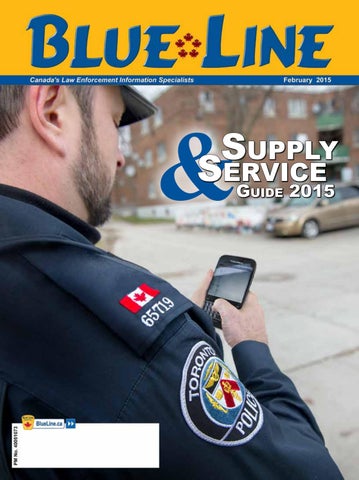
&
Supply Service G 2015 uide
FEBRUARY 2015
2
BLUE LINE MAGAZINE
February 2015 Volume 27 Number 2
Features
6
6 New era neighbourhood policing Toronto Police walk the beat with a digital twist
10
Connect and inspire
12
Who is killing community policing?
Leadership and morale impacts professionalism and productivity
18 CSI Afghanistan Canadian Forces take forensics to the battlefield 29
Supply & Service Guide 2015
Departments 54
Back of the Book – Preserving trust in policing 54 BlueLinks Advertisers Directory 40 Book Review – Champions of the dead 42 Deep Blue – Are you intuitive or delusional 44 Holding the Line – Managing traumatic reactions 24 Letters 53 MarketPlace 5 Publisher’s Commentary – ‘Moderate risk’ murderers 8 Technology – Smartphones go to work
14 29
Case Law 47 Using experience was not racial profiling 48 Supreme court sanctions cell phone searches 50 Applying investigative detention criteria can’t save unlawful arrest 52 ‘Reasonable’ privacy depends on circumstances BLUE LINE MAGAZINE
3
FEBRUARY 2015
FEBRUARY 2015
4
BLUE LINE MAGAZINE
Blue Line Magazine Inc. PUBLISHER Morley S. Lymburner – publisher@blueline.ca GENERAL MANAGER Mary K. Lymburner – mary@blueline.ca SENIOR EDITOR Mark Reesor – editor@blueline.ca NEWS EDITOR Kathryn Lymburner – kathryn@blueline.ca CREATIVE DIRECTOR E. Jolene Dreja – jolene@blueline.ca MARKETING MANAGER April Lensen – april@blueline.ca CONTRIBUTING WRITERS Robert Lunney Dave Brown Mike Novakowski Nancy Colagiacomo Tony Palermo Stephanie Conn Tom Rataj Dorothy Cotton Brent Snook Mark Giles AFFILIATIONS International Association of Law Enforcement Planners Canadian Advertising Rates Data International Police Association The Canadian Press Newswire Access Copyright SUBSCRIPTIONS $30 per year; $50 for 2yrs; US & Foreign: $100 ADVERTISING 888-640-3048 advertising@blueline.ca
www.blueline.ca 12A-4981 Hwy7 East, Ste 254, Markham, ON L3R 1N1 Canada P: 905-640-3048 F: 905-640-7547 blueline@blueline.ca
PRINTED IN CANADA ISSN# 08478538 Blue Line Magazine was established in 1988 as an independent publication to inform, entertain, connect and educate those involved in the law enforcement profession. With no direct control from an enforcement agency, its opinions do not necessarily reflect those of any government or law enforcement agency. The authors, advisors, and publisher accept no liability whatsoever for any injuries to person(s) or property resulting from application or adoption of anything presented in this magazine. Readers are cautioned and advised that articles presented herein are edited and supplied for your personal awareness and should not be used for further action until appropriate guidance is received from a supervisor, Crown Attorney or other persons in authority. All material submitted for publication becomes property of Blue Line Magazine Inc. unless arrangements have been made with the publisher prior to publication. © 2015 All articles are protected by copyright. No part of this publication may be reproduced or transmitted in any form or means, electronic or mechanical, (including photocopying and recording or by any information storage or retrieval system), without prior permission. Permission to reprint may be obtained in advance from Access Copyright 1-800-893-5777.
BLUE LINE MAGAZINE
PUBLISHER’S COMMENTARY by Morley Lymburner
‘Moderate risk’ murderers Human beings, who are almost unique in having the ability to learn from the experience of others, are also remarkable for their apparent disinclination to do so. – Douglas Adams. • A Victoria man was convicted for killing his parents and two other innocent people in cold blood in 1996. The man (and an accomplice) shot and killed his mother, father and a roomer, then ruthlessly murdered his brother’s girlfriend and left the woman’s infant child alive beside her lifeless body. The child was close to death when found several days later but was revived through extensive medical attention. After 15 years of free room and board at taxpayers expense, this mass murderer was granted a 60-day unescorted temporary absence from prison for substance abuse treatment. The parole board advised that it “recognized he is considered a low to moderate risk to re-offend.” • LaSalle Police Service Cst. Robert Carrick, 23, managed to rescue a gunman’s wife, child and babysitter in 1969 before being shot and killed in the ensuing battle. His killer shot and wounded two other officers, hitting one in the eye, before being arrested and sentenced to death. This was commuted to “life” when capital punishment was repealed the following year. He served less than 10 years in prison before receiving full parole. I will never understand why murderers sentenced to “life” are ever released. It’s particularly disturbing to see a convicted murderer described as “a low to moderate risk to re offend” ever being worthy of an unsupervised release. Murder is the final and ultimate crime and requires the final and ultimate penalty; if not capital punishment, then spending the rest of one’s life in prison. The only exception, if there has to be one, would be for people guaranteed not to re-offend – and even then, I would require them to live next door to a parole board member who voted for their release. If the member has a daughter, perhaps the parolee could date her. All too often we see tortured family members having to return time and again to explain to boards why the person who killed their loved one should not be released. In most cases, their opposition to release has nothing to do with revenge but rather a concern that no one else should suffer what they have endured. Toronto Police officer Michael Sweet slowly bled to death in 1980 after being shot by Craig and Jamie Munro. The brothers taunted him while he tried to convince them to surrender. Both suspects were convicted of murder and received “life” in prison. Jamie was later released on parole and moved to Italy, the home of his wife’s family, where he changed his name to Massimo Marra. Craig, the actual shooter, sought release and 5
confronted a very determined investigating officer and family members who simply wanted him to remain behind bars. He lost his bid for parole but won a transfer to a minimum security facility and 15-day unescorted passes from a sympathetic board. His parole was revoked when he was found to be doing drugs and spending time with hookers on his passes. It was only then that he was sent to a medium security facility and declared a “moderate risk to re-offend.” He still has a right to a parole review every two years. Munro’s youngest brother Harold recently received Dangerous Offender status after a long string of convictions for beatings, slashings and stabbings, drug trafficking, robbery and thefts. Negative stories about parole boards – and a sometimes distant and unfeeling judiciary – abound. Take career bank robber and cop hater Mickey McArthur. The criminal lifestyle he began at age 15 inspired him to write a book about his unrepentence. He told about his lifelong love of robbing banks and escaping prison. McArthur was last convicted in 1994 for wounding three Durham Regional Police officers and partially paralysing a woman caught in his hail of bullets while holding up a Port Perry, Ontario bank. Did I mention that McArthur was out on statutory release? None of the stolen money was recovered; McArthur is no doubt saving that for a pension and to fund his next book. The courts were asked to classify him as a dangerous offender but inexplicably refused. If “poor Mickey” shows a little contrition – he apparently has a way with words – and sheds a few tears, he could soon be your next door neighbour. The bottom line here is that society must be protected from individuals likely to re-offend. There must come a point where we admit there is no hope. When a person is either cold or crazed enough to take another human life, the prevailing attitude must be that they can never again be trusted. Thanks to a caring and wealthy society, they dodge the death penalty – so send them to a place where they can live out their natural days however they choose, but with no chance of harming the rest of society. The feds want people to live in the far north. Ellesmere Island has plenty of land and few neighbours to complain. Air drop food and fuel and suggest they find a way to live with one another... or not; their call.
FEBRUARY 2015
NEW ERA
NEIGHBOURHOOD
POLICING
Toronto Police walk the beat with a digital twist by Peter Sloly The Toronto Police Service (TPS) has developed a neighbourhood policing program that is increasingly enabling the delivery of core community policing in the context of a new cyber/ social/digital reality. Some of our best frontline officers have been trained on social media, equipped with BlackBerry smartphones and deployed into the city’s most safety challenged neighbourhoods. TPS cops are now “walking Toronto’s street beats and the virtual beat!” Social media and web enabled technology has changed public safety and policing in Canada. Internet enabled radicalization has caused a few Canadians to commit acts of domestic terrorism. Canadian youth are increasingly being victimized by cyber-bullying and all Canadians are more at risk of falling victim to cyber-crime. Did Sir Robert Peel anticipate these public safety issues? How do we do core FEBRUARY 2015
policing in such a complex, changing and challenging environment? Core policing seems simple. It’s community policing, as mandated by the Police Service Act, including preventing crimes, assisting victims, maintaining order, responding to emergencies and enforcing laws. Community policing also seems straight forward. It’s police officers working in the community, earning the public’s trust and forming problem solving partnerships in order to improve safety and the quality of life for all. But the “community” is NOT that simple anymore! Toronto has 2.7 million hyper-diverse residents who live in 140 neighbourhoods, each with its own unique challenges, assets, geography, demography, history and social justice issues. The Greater Toronto Area is one of the world’s largest consumers of social media and largest producers of social media applications. Police are only beginning to realize how much the Internet age, cyber space and virtual networks affect neighbourhood activity and community safety. This isn’t just happening in “the Big Smoke” – it is taking place in small, medium and large police jurisdictions right across our great country! Neighbourhood Policing Simply put, the TPS Neighbourhood Policing program is community policing 6
implemented at the neighbourhood level. It includes elements of evidence-based best practice gathered internationally and implemented locally by professional dedicated TPS members in consultation with community partners. I give special credit for the success of the concepts to a large and growing list of progressive police agencies, including London Met, Prince Albert, Waterloo Regional and Salt Lake City. Credit is also due to innovative police leaders such as Sir Robert Peel, Philadelphia Commissioner Charles Ramsey, Cornwall Chief Dan Parkinson and Dutch National Police Chief Inspector Ell De Jonge. Other references may be made to leading academic researchers, including professors David Kennedy (John Jay College), Phil Goff (UCLA), Don Tapscott (University of Toronto) and Sara Thompson (Ryerson University). Each of Toronto’s neighbourhood teams include hand-picked, high performing frontline officers who are dedicated to a single neighbourhood for a minimum of two years. Their primary responsibilities are to preserve the peace, prevent crime and reduce victimization by using community relationships, neighbourhood assets, human sources and police business information systems, along with their new social media skills/ equipment, to be more truly intelligence led and citizen focused in their activities. The teams prioritize most of their day to day efforts on preventing crime. Risk focused BLUE LINE MAGAZINE
enforcement is still a critically important part of their public safety tool kit but it’s not their first choice, nor their last resort. We know we can’t enforce our way out of the problems we face. That is why the neighbourhood teams increasingly attempt to appropriately address public safety risk issues through non-judicial channels by using local community partnerships and pre/post charge diversion programs and other innovative local community partnerships like the multi-agency “hub” service delivery program in the Rexdale neighbourhood of 23 Division. The social media training and agency issued BlackBerry smartphones allow the neighbourhood officer teams to better communicate and co-ordinate their activities within the team, with other divisional officers and amongst all the neighbourhood teams across the city. The BlackBerry phones allow them to access support from supervisors and other TPS units while still remaining on their neighbourhood beats. The neighbourhood teams can surf the World Wide Web on their BlackBerry phones to access real time open source social media information about local events, provide crime prevention information to local neighbourhood stakeholders and/or participate in problem solving partnerships on line with local community members using Twitter, Facebook, Instagram, Foursquare, LinkedIn, etc. In a city as diverse and as interconnected as Toronto, some neighbourhood issues are impacted by global events which require neighbourhood officers to have broader networks and more effective information sharing with communities of interest across the city, province, country and even around the world. Tech enabled, social media savvy neighbourhood officers are able to create a positive presence felt in both the real and virtual world! The new social media tools and skills of our Neighbourhood officers have directly contributed to some of our best frontline policing initiatives. They have helped prevent gang violence, gather criminal intelligence, solve major investigations and educate the public on a variety of emerging safety risks. Perhaps most importantly, they have provided much needed improvements in public trust and police legitimacy in neighbourhoods right across Toronto. BLUE LINE MAGAZINE
Future policing Social media and mobile Internet enabled devices are not a panacea for all the challenges facing policing. Good policing still requires good cops to work with good people to solve real community safety problems in their neighbourhoods! But social media and technology are increasingly impacting our society as a force for both good and bad. We need to ensure our officers are in the best position possible to use social media and mobile technology as both a force multiplier and as a cost reducer. Neighbourhood policing’s greater emphasis on crime prevention and diversion can also potentially reduce both the financial and social costs of policing. While a critically necessary element in effective community policing, enforcement is also the most expensive. It increases premium pay costs (overtime, call backs and off duty court), downstream judicial costs (disclosure, trials and prison) and the social costs to communities who feel they are sometimes over policed and under served. An ounce of prevention (plus a healthy dash of social media enabled neighbourhood policing) is worth more than a pound of cure! The TPS has put a greater priority on core community policing by dedicating more of our most scarce and important resources to the neighbourhood policing program – our officers, our budget and our time. We have significantly improved the capacity of our neighbourhood 7
officers to use social media and leverage technology to help them reduce crime and improve community relationships. I’m sure if Sir Robert Peel were alive today he would appreciate the complexity of the job faced by today’s cops. He would recognize the innovative ways in which the police and the public are now working together using social media. He might even Tweet out his #9Principles! The neighbourhood policing program is just one example of how the TPS is continually striving to improve the delivery of core community policing. There are many other amazing examples of how Canadian cops use social media, issued mobile devices and local community partnerships to improve public safety, public service, public trust and public value. Cops and community co-producing public safety – serving and protecting on both the neighbourhood and digital beats! Toronto Police Service Deputy Chief Peter Sloly has worked in a wide array of policing activities during his 26 years of service and is currently in charge of the TPS Community Safety Command. He oversees 4,000 officers and 200 civilian members covering 17 police divisions. Contact: Peter. Sloly@torontopolice.on.ca. or follow on Twitter @DeputySloly.
FEBRUARY 2015
TECHNOLOGY by Tom Rataj
Smartphones go to work
The smartphone world had another dynamic and interesting year in 2014, with continued growth and market positioning by manufacturers from all four major platforms. Google Android based devices dominated by market-share, mainly due to the large selection of handsets from numerous manufacturers available at every price-point. Samsung continued to be the lead brand. Apple maintained second place, finally introducing not one, but two larger iPhones: the 4.7 iPhone 6 and the even larger iPhone 6+ with its 5.5” tablet-sized display. Canadian smartphone pioneer BlackBerry and Windows Phone based devices hold the remainder of the market. Despite having a selection of solid hardware and suite of market-leading secure network services, BlackBerry continues to struggle while working through a major corporate make-over. Its core government, corporate and law-enforcement markets continue to show strength while its consumer market is still weak. Windows Phone has never gained much market traction and doesn’t seem able to present a compelling reason for users to switch or adopt the platform, despite Microsoft’s substantial marketing strengths and recent acquisition of Nokia’s handset division.
These include: loss of the device through accident or theft, loss of the often confidential data they contain, unauthorized access to corporate networks and data and interception of voice and data communications. Smartphones used for business should be protected through a strong password-based access control system and data stored on the device should be encrypted. Since business smartphones have access to corporate networks and data, that access needs to be tightly controlled. This should include controlling app installation, since some apps, especially on Android devices, are prone to malware and other security vulnerabilities. Interception of private and confidential communications between smartphones and the corporate network is also a risk. Free WiFi access points are particularly risky, so using a Virtual Private Network (VPN) and encrypting data in transit are important features. Traditional Organized Crime (TOC) groups and outlaw motorcycle gangs have the motivation, and may have the ability and necessary sophistication, to intercept unencrypted communications. The ability to wipe a lost, stolen or misplaced smartphone is also a critical feature, whether the device is used for business or personal use.
At work Smartphones continue to penetrate the business world because of their advanced computing and communications capabilities, mobility and relative affordability when compared to laptops but simply issuing phones to mobile workers or adopting the Bring-Your-Own-Device (BYOD) model is fraught with dangers.
Lack of security The most significant challenge for business use of smartphones, whether the device is company-owned or BYOD, has been the lack of strong native security on non-BlackBerry devices. Other phones have basic security features such as password access-control and add-on security apps but
FEBRUARY 2015
8
lack a security-centric foundation. Smartphone pioneer BlackBerry, on the other hand, has numerous security features built right into the operating system (OS) level on all handsets, which is far more effective than just adding them on top of the OS. Most BlackBerry devices meet government-level FIPS 140-2 certification, one of the highest security certifications available. Their network services and Enterprise Mobility Management (EMM) system is also built on a security focused foundation, extensively using encryption and various device-control and management features. The headsets feature security starts with password protection, which prevents people from using poor passwords such as password or ABC123, and passwords are not limited to simple four digit number combinations. BlackBerry Protect comes standard on each device, allowing users to locate a lost or stolen phone and remotely lock it or wipe its data. In the business environment, BlackBerry Balance provides two separate user environments on the same smartphone; a personal side that the user controls and a corporate side that the IT department controls. Data cannot be exchanged between the two environments and the user does not have administrative privileges on the corporate side of the device. BlackBerry 10 devices have 256-bit AES encryption available for stored data and memory cards. BlackBerry’s EMM solution, BlackBerry Enterprise Service (BES), is the clear market leader in terms of security, features, affordability and the ability to manage smartphones from all four platforms. BES12 was recently BLUE LINE MAGAZINE
launched to excellent reviews. Also recently launched for enterprise users is BBM Protected. It includes three layers of encryption for messages in transit, and all BBM messages and databases are encrypted on devices. BlackBerry recently completed the acquisition of Secusmart GmbH, a German firm that produces market leading high-security systems for encrypting voice and data communications on smartphones. SecuSuite for BlackBerry 10 devices is used by German government agencies and departments and Chancellor Angela Merkel. Thousands of law enforcement users around the world use BlackBerry smartphones running software from Canadian company Mobile Innovations. For smartphone access to CPIC, 2-Factor Authentication (2FA) must be in place. It generally uses a smart-card wirelessly connected to the device. The connection must remain active for CPIC access to continue. BlackBerry introduced two new smartphones aimed solidly at the business market late last year.
battery rated at 22 hours of mixed-use. It features an 8MP autofocus rear camera and a 2MP front camera, latest generation cellular, WiFi, Bluetooth and GPS connectivity, FM radio receiver, the typical compliment of sensors and a microUSB port for charging and wired connectivity. The new Classic was highly anticipated, particularly by business, because it features the return of the tool-belt, a row of four feature-buttons and an optical trackpad as last seen on the famous Bold 9900. Many existing users were apparently not willing to move to newer BlackBerry 10 smartphones because they lacked the tool-belt. It was released just before Christmas and has generated a lot of sales and excitement.
Security the key With the large amounts of information stored on smartphones, and their ability to connect to many kinds of networks, the importance of keeping the device and its data secure is becoming more important. Security of voice and data in-transit is also crucial. With the rush to add smartphone access to corporate networks, security frequently seems to either be forgotten or ignored. Tom Rataj is Blue Line’s Technology columnist and can be reached at technews@blueline.ca.
Passport The first all-new device is the radically different BlackBerry Passport, which has the same outside dimensions as a standard paper passport. It features a unique square 4.5 touchscreen with a resolution of 1440x1440 and an impressive 453 pixels per inch (PPI) density with 24-bit colour depth. It also features a revolutionary new three row mechanical keyboard that is touch sensitive in the same manner as a laptop touch-pad, allowing users to control a number of features by simply swiping their fingers over it. The Passport is powered by a 2.2GHz quad-core processor, 3GB of RAM and 32GB of user storage. A microSD slot accepts up to 128GB of additional user storage. Its massive 3,450mAh integrated battery is rated at 30 hours of mixed-use. It also features a 13MP autofocus rear camera and a 2MP fixed-focus front camera, latest generation cellular, Wi-Fi, Bluetooth and GPS connectivity, an FM-radio receiver and the typical compliment of sensors. It uses an industry-standard microUSB port for charging and wired connectivity. The Passport has been very well received, particularly by the business market, where it is proving to be a very powerful productivity device. Industrial-design and build quality are excellent. Many technical specifications best the overhyped iPhone 6 and 6+. Classic The second new device is the BlackBerry Classic, which resembles an updated Bold 9900, often considered to have been BlackBerry’s best smartphone. It features a larger square 3.5” touchscreen with a resolution of 720x720 at 294ppi. It is powered by 1.5GHz dual-core processor, has 2GB of RAM and 16GB of user storage. A microSD slot accepts up to 128GB of additional user storage. It has a non-removable 2,515mAh BLUE LINE MAGAZINE
9
FEBRUARY 2015
TRAINING
CONNECT & INSPIRE Leadership and morale impacts professionalism and productivity by Chris Lewis Morale is the state of mind. It is steadfastness and courage and hope. It is confidence and zeal and loyalty. It is elan, esprit de corps and determination. – General George Catlett Marshall.
Morale is difficult to define, but it’s quickly apparent when it falters. It’s a positive confident feeling, an energy, an enthusiasm, a spirit or a committed and united will to succeed. The impact of poor employee morale Although I speak mainly from the police leadership perspective, you’ll quickly see that this premise applies to public and private sector organizations and the not-for-profit world. The issue is not isolated to policing, but often becomes more newsworthy when it is. If you think back on your own career, I’m sure your feelings about yourself, the job and your organization varied. Most of us have had weeks, months or even years where we FEBRUARY 2015
considered changing employers or starting an entirely new career. Everyone has peaks and valleys in their working and personal lives. Unfortunately for some, personal life challenges can’t help but impact careers and vice-versa. That will always be a reality until we start hiring robots instead of human beings. Even more concerning is when an individual doesn’t have a good work life to escape to when home life isn’t stable. Or conversely, a solid personal life for positive balance when the career isn’t what it should be. When one’s personal life and job are both at extreme lows, times can be really tough. That aside, when we have been in that work life “valley,” so to speak, did our supervisors inspire us? Did they give us the confidence and support to be the best that we could be? Really care what motivated us as individuals, or what our strengths and weaknesses were? Do and say the right things and provide us with the right mentoring and encouragement to be successful? Likely not. It’s more probable that they provided little or none of that and in some cases were guilty 10
of deliberately trying to make the lives of some people a living hell. They may well have been the sole cause of the valley. In addition to the negative impacts that low morale can have on the day-to-day performance and professionalism of employees i.e. attitude, client and colleague interactions and motivation further challenges can arise when leaders aren’t properly engaged. The impact of poor morale on professionalism and productivity Closely examine any major North American policing scandal and you will find a leadership failing at some point in the chain of events. Generally not at the chief or commissioner level, but somewhere along the timeline a supervisor or manager dropped the ball, deliberately or because they just weren’t taking obvious issues head-on or doing what they were paid to do. I’m sure that applies equally to government and private sector organizations. Not that poor leadership will turn a subordinate police officer into a thug, or make them shake-down drug dealers or commit murders for the mob, but usually when things become public, officers say, “I knew something was going on,” or “it doesn’t surprise me knowing those guys.” Why didn’t sergeants, staff sergeants, inspectors or lieutenants and captains see it coming and take proper action when allegations BLUE LINE MAGAZINE
of impropriety surfaced or when they knew certain officers were living well above their means? When they saw that some officers seldom left the office and rarely laid a charge because they spent 10 hours a shift surfing inappropriate sites on the Internet? Where were supervisors and managers when the paperwork didn’t match the expenditures or when officers couldn’t account for their time? I’m not suggesting willful blindness here, although at times that has been the case. Officers involved in some of the better known scandals were NCOs or higher. We’ve all been guilty of trusting some subordinates more than we should but most often, when these calamities arise and cause an organization no end of embarrassment, some supervisors or managers, “leaders” in organizations, neglected to do something that could have mitigated or totally prevented the public shame. We have all done things in our careers that may not have been at the high professional standard at which we usually function. It may have been being rude to a member of the public, bad-mouthing a co-worker or not being totally honest with a superior. Hopefully it was an isolated instance, or perhaps several isolated situations over a long career. Most often when these behaviours occurred, it likely related to our mood or attitude of the day and I would suggest that it was often influenced by some external factor. We are all human beings, as are those we lead, and as such we have emotions that will often impact what we say and do. At times this impact is negative. At any given time in any organization, there are many people hurting in their personal lives. Financial difficulties, marital problems, personal or family health challenges, aging parents, substance abuse issues, and sadly, much more. Dealing with these problems, perhaps even a number at once, will undoubtedly affect our work-life demeanor – including our professionalism and productivity in some way. You can’t always walk into work, turn all of those other pressures off and put on a smiley-face. What happens when an employee dealing with one or more of those troubling matters, or perhaps simply physically tired or fighting a cold or flu bug, goes to work and has to deal with a supervisor that has no personality? A person who doesn’t care about anyone but him/herself, treats people like crap, doesn’t set realistic expectations, never listens to the thoughts or suggestions of the members being supervised, yadda, yadda? It’s tough to impossible for the vast majority of people to then smile and go about their business with gusto. Quite often, life could be totally wonderful at home: financially stable and completely healthy and happy. Yet we would still react negatively to a supervisor void of personality and therefore without any discernible leadership skills. We would likely still not be totally productive and consummate professionals at work. Throw in the off-duty challenges of life that we all face at times and you may have a train wreck in the making. BLUE LINE MAGAZINE
Survey 1,000 employees (including police). Guarantee anonymity. Ask them to detail something completely inappropriate and unprofessional they did on-duty in their career. Then ask them to describe the supervisor they had and what was going on in their personal life at the time. I am confident that it would quickly become abundantly clear that leadership would be the common denominator. The authors of the CACP study, “Professionalism in Policing Research Project,” stated: Generally, management practices had the most significant impact on integrity and commitment, followed by work environment variables and finally agency programs. Across all three – management practices, work environment variables and agency programs – the variables that had the largest impact on integrity were supportive supervision and perceived organizational support. In the policing context, I believe that the public’s trust in its police force can be significantly impacted by the conduct (professionalism) of its members. Similarly, public confidence can be shattered in an ineffective police service. The same concept would most often apply to client bases in the private sector upon seeing or hearing of scandals involving the professionalism of company personnel. So, bearing that in mind and accepting the premise that morale can make or break an organization; if the quality of leadership directly impacts the level of employee morale, professionalism and productivity, does it not
11
stand to reason that “leadership” can cause an organization to succeed or fail? In her article, “The Leading Edge,” author Nicole Fink describes the potential impacts morale can have on workers as follows: Morale can be the fuel that drives an organization forward or the fuel that feeds the fires of employee discontent, poor performance, and absenteeism (Ewton, 2007). With low morale comes a high price tag. The Gallup Organization estimates that there are 22 million actively disengaged employees, costing the American economy as much as $350 billion dollars per year in lost productivity, including absenteeism, illness, and other problems that result when employees are unhappy at work. Leaders must do all they reasonably can to keep employee morale high. It is paramount that they lead effectively. They must communicate, connect and inspire, because the people they lead and the people they serve deserve nothing but the best. **With excerpts from “Never Stop on a Hill” by Chris D. Lewis (unpublished as of January 2015). Former Ontario Provincial Police Commissioner Chris Lewis is the President of Lighhouse Leadership Services and may be contacted by email to cdlewis@live.ca. He will be presenting a one-day seminar, “The Engaged and Healthy Workforce,” in conjunction with the Blue Line EXPO on April 29th. Go to the EXPO section at www. blueline.ca for more details and to register.
FEBRUARY 2015
WHO IS KILLING
COMMUNITY POLICING?
by Robert Lunney The philosophy of community policing was introduced as a replacement for the professional model about 35 years ago. The primary components are partnerships, organizational transformation and problem solving. The public welcomed the change in focus, as it offered closer collaboration between communities, individuals and their police and reform of police organizations through evidence based decision making. Currently, for a combination of reasons, community policing appears to be falling out of favour, even with services who were early adopters. Let’s examine a short list of suspect interests that will slowly strangle community policing unless rolled back by resolute professional leadership with support from policing authorities and governments. Resistance to change In the absence of progressive leadership, insecure organizations retreat to their comfort zone. Imagination, determination and courage can overcome resistance to change. Misunderstanding the concept Community policing was mistaken by some for a strategy in parallel or in competition with intelligence-led policing, rather than an all encompassing philosophy that heralded a new way of thinking. In many ways, it was back to the future, because community policing is the ideal template for the practice of the nine principles of Sir Robert Peel, the foundation of our policing culture. The community policing philosophy is the cradle for cultivating and shaping art and craft and those attributes that are the essence of policing at the local level: Humanity; transparency; a sense of justice; empathy; and compassion. These qualities build trust and confidence. FEBRUARY 2015
Organizational tension Some believe that an obsessive focus on investigation inhibits the practise of prevention, as if the investigative services were in competition with community policing because prevention, when it works, reduces case loads and thus makes investigation less critical to success. This seems farfetched but cannot be dismissed. When investigative functions are also committed to prevention, criminal intent can be deftly thwarted or diverted. It is best to remind ourselves of one of the most important of Peel’s Principles, “To recognize always that the test of police efficiency is the absence of crime and disorder, and not the visible evidence of police action in dealing with them.” Political leadership and police governance Few political interests and governance boards have bought into the importance of prevention. The result is that preventive services such as crime prevention through social development and environmental design are under funded and first on the chopping block when cutbacks are threatened. Governing bodies cannot be expected to take results on faith. Policing must share responsibility because of a failure to develop convincing indicators of performance. Senior governments have failed to do their share of properly educating policing authorities on the concept of community policing and the monitoring of results. Militarism The image of police is increasingly that of the oppressive and threatening robo cop, typified by dark shirts, black gloves, identity-shrouding balaclavas, externally worn body armour, black and white cars and militarist rituals. The friendly cop on the beat has morphed into a terrapin turtle. This is not about 12
the need for protection in riot situations; it’s about everyday appearance. The trappings of militarism are seductive, but they create barriers to public acceptance of police legitimacy. Anti-intellectualism Over reliance on experience-based craft leads to denial of evidence-based research and the discounting of crime analysis and other evidence-based methodology. In an era when the educational level of police officers is rising, organizations must shake off bias, invest in research and establish a balance between these complimentary, not conflicting, approaches. Bureaucracy Bureaucracy is the enemy of community policing. Complexity, an overabundance of internal policies and a justice system that places almost unbearable demands on front line police officers all contribute to the processing of minutia of questionable value, gobbling up time that should be spent in contact with the public. Unthinking, uncaring cops Bad attitudes must be changed or the actors removed from office for the good of the service. They are a threat to developing positive relationships with the public and a hindrance to the vast majority of officers who strive to do the right thing. Careerism is another threat. This applies to those who pursue professional advancement as their sole aim, often at the expense of personal integrity. A commitment to community policing requires selfless devotion to the cause of public safety. Legalism The justice system often seems intent on criminalizing minor misbehaviour, making crimes of acts that might reasonably be dealt with through education or diversion. At BLUE LINE MAGAZINE
the same time, strict command and control systems and legal judgements are whittling away at the ability of front line officers to use discretion to solve minor problems, disorder or minor offences that could be disposed of through warnings or voluntary penalties. Front line officers should have the discretion to settle minor disputes and incidents without resort to criminal process. Training curriculum and policy must support the concept of procedural justice. Over-reliance on technology Red light cameras and photo radar has its place, but impersonal methods have alienated the public in a way that never happened with manned speed radaroperations, targeted enforcement or seat belt enforcement. The problem relates to a perceived lack of empathy and engagement, leading to resentment. Enforcement tactics in the absence of personal engagement disaffects the public and is judged as excessively punitive or at worst, viewed as a money-grabbing tactic. Body worn video (BWV) is currently in vogue as a panacea for everything from collecting evidence to reducing complaints against police, but as adoption proceeds agencies are encountering sizable challenges on issues ranging from unanticipated costs to conflict with privacy legislation. The promised advantages are worth pursuing, but technology will never take the place of face-to-face human relations.
BLUE LINE MAGAZINE
Bean counting efficiency experts In today’s increasingly tense competition for funds, boards and councils are resorting to calling in consultants with little experience in policing. Agents of a major consulting firm looked at the San Jose, CA police department’s allocation of available patrol time and noted that while 60 per cent was dedicated to call response, another 40 per cent was tabbed for community policing (prevention; engagement; collaborative community problem-solving). Because the department could not produce outcome statistics supporting this time allocation, the consultant recommended the patrol strength could be cut by 40 per cent. Municipalities are at risk when they place their faith in consultants that work out the cost of everything but know the value of nothing. While fire fighters no longer pluck cats from trees and police officers seldom help old ladies across the street, community policing is a retail service. Democratic policing exists to serve the needs of the public. The products are crime prevention, order maintenance, crime suppression and community service. Policing through collaborative partnerships serves to build up public support to carry out activities in the common good. If services beyond “response to call” and “investigations” are to be funded, police leaders must produce convincing results in the form of measurable outcomes.
13
We have seen the enemy and he is us Community Oriented Policing (COP) is the core philosophy of policing in a democracy. The principles embodied in COP are the vital centre, motive force and spirit of policing and the dynamic on which strategies play. It is also the cradle for cultivating and shaping the art and craft of policing, and the vehicle for demonstrating humanity; transparency; a sense of justice; empathy; and compassion. These qualities build trust and confidence in the police. In an organization practicing community policing, every officer is a community officer. It is not a speciality to be practiced by a few designated people. For those who need reassurance, community policing is tough policing – tough because the focus is on solving problems of crime and disorder in every dimension through rigorous attention to performance. It focuses on root causes rather than repetitive incidents. If the best promise of democratic policing is to be delivered to a deserving Canadian public, it is the responsibility of governments, governance bodies and police leadership to halt the slide towards de-construction of community policing. Robert Lunney is the former chief of the Edmonton and Peel Regional police services. He is Blue Line Magazine’s Police Management editor and the author of Parting Shots – My Passsion for Policing. He may be contacted by email at lunney@blueline.ca.
FEBRUARY 2015
Why Our Memory Fails Us by Christopher Chabris and Daniel Simons Neil Degrasse Tyson, the astrophysicist and host of the TV series “Cosmos,” regularly speaks on the appalling state of science literacy. One of his staple stories hinged on a line from President George W. Bush’s speech to Congress after the 9/11 terrorist attacks. In a 2008 talk, for example, Dr. Tyson said that in order “to distinguish we from they” – meaning to divide Judeo-Christian Americans from fundamentalist Muslims – Mr. Bush uttered the words “Our God is the God who named the stars.” Dr. Tyson implied that President Bush was prejudiced against Islam in order to make a broader point about scientific awareness: Two-thirds of the named stars actually have Arabic names, given to them at a time when Muslims led the world in astronomy – and Mr. Bush might not have said what he did if he had known this fact. This is a powerful example of how our biases can blind us, but not in the way Dr. Tyson thought. Mr. Bush wasn’t blinded by religious bigotry. Instead, Dr. Tyson was fooled by his faith in the accuracy of his own memory. In his post-9/11 speech, Mr. Bush actually said, “The enemy of America is not our many Muslim friends,” and he said nothing about the stars. Mr. Bush did once say something like what Dr. Tyson remembered; in 2003, in tribute to the astronauts lost in the Columbia space shuttle explosion, he said that “the same creator who names the stars also knows the names of the seven souls we mourn today.” Critics pointed these facts out; some accused Dr. Tyson of lying and argued that the episode should call into question his reliability as a scientist and a public advocate. When he was first asked for the source of Mr. Bush’s quotation, Dr. Tyson insisted, “I have explicit memory of those words being spoken by the president. I reacted on the spot, making note for possible later reference in my public discourse. Odd that nobody seems to be able to find the quote anywhere.” He then added, “One of our mantras in science is that the absence of evidence is not the same as evidence of absence.” That is how we all usually respond when our memory is challenged. We have an abstract understanding that people can remember the same event differently, but when our own memories are challenged, we may neglect all FEBRUARY 2015
this and instead respond emotionally, acting as though we must be right and everyone else must be wrong. Overconfidence in memory could emerge from our daily experience: We recall events easily and often, at least if they are important to us, but only rarely do we find our memories contradicted by evidence, much less take the initiative to check if they are right. We then rely on confidence as a signal of accuracy – in ourselves and in others. It’s no accident that Oprah Winfrey’s latest best seller is called “What I Know For Sure,” rather than “Some Things That Might Be True.” Our lack of appreciation for the fallibility of our own memories can lead to much bigger problems than a misattributed quote. Memory failures that resemble Dr. Tyson’s mash-up of distinct experiences have led to false convictions, and even death sentences. A critical concern about eyewitness memory is the sometimes tenuous relationship between the accuracy of a witness’s memory and his confidence in it. In general, if you have seen something before, your confidence that you have seen it and your accuracy in recalling it are linked: The more confident you are in your memory, the more likely you are to be right. New research reveals important nuances about this link. In a paper published last year, cognitive psychologists Henry L. Roediger III and K. Andrew DeSoto tested how well people could recall words from lists they had studied, and how measured they were in their recollections. For words that were actually on the lists, when people were highly confident in their memory, they were also accurate; greater confidence was associated with greater accuracy. But when people mistakenly recalled words that were similar to those on the lists but not actually on the lists – a false memory – they also expressed high confidence. That is, for false memories, higher confidence was associated with lower accuracy. To complicate matters further, the content of our memories can easily change over time. Nearly a century ago, psychologist Sir Frederic Charles Bartlett conducted a series of experiments that mimicked the “telephone” game, in which you whisper a message to the person next to you, who then passes it along to the person next to them, and so on. Over repeated tellings, the story becomes distorted, with some elements remaining, others vanishing, 14
and entirely new details appearing. When we recall our own memories, we are not extracting a perfect record of our experiences and playing it back verbatim. Most people believe that memory works this way, but it doesn’t. Instead, we are effectively whispering a message from our past to our present, reconstructing it on the fly each time. We get a lot of details right, but when our memories change, we only “hear” the most recent version of the message, and we may assume that what we believe now is what we always believed. Studies find that even our “flashbulb memories” of emotionally charged events can be distorted and inaccurate, but we cling to them with the greatest of confidence. With each retrieval our memories can morph, and so can our confidence in them. This is why a National Academy of Sciences report strongly advises courts to rely on initial statements rather than courtroom proclamations: A witness who only tentatively identifies a suspect in a police station lineup can later claim – sincerely – to be absolutely certain that the defendant in the courtroom committed the crime. In fact, the mere act of describing a person’s appearance can change how likely you are to pick him out of a lineup later. This finding, known as “verbal overshadowing,” had been controversial, but was recently verified in a collective effort by more than 30 separate research labs. The science of memory distortion has become rigorous and reliable enough to help guide public policy. It should also guide our personal attitudes and actions. In Dr. Tyson’s case, once the evidence of his error was undeniable, he recognized that the evidence outweighs his experience, and publicly apologized. Dr. Tyson’s decision is especially apt, coming from a scientist. Good scientists remain open to the possibility that they are wrong, and should question their own beliefs until the evidence is overwhelming. We would all be wise to do the same. Christopher Chabris, a psychology professor at Union College, and Daniel Simons, a psychology professor at the University of Illinois, are the authors of The Invisible Gorilla: How Our Intuitions Deceive Us.This is an edited version of an article that ran in the DEC. 1, 2014 New York Times opinion pages.
BLUE LINE MAGAZINE
BLUE LINE MAGAZINE
15
FEBRUARY 2015
PROTECTING YOURSELF
PROTECTS OTHERS Select the right armour for the hazards you face by Chris Taylor Police officers put their safety on the line every day to ensure others are secure. Tragically, 105 officers were killed in 2013 in the US alone. While absolute safety can never be guaranteed in the line of duty, body armour can help save lives and reduce the severity of injury. The wide variety of products on the market ensures officers can be protected in every situation they face from stab vests for patrolling volatile neighbourhoods to ballistic armours for armed encounters. Let’s take a look at the various types available and the benefits they offer. Patrol protection: Knife and needle armours Sharp and blunt weapons can pose a threat on any call. Edged blade protection is designed to help prevent injury from sharp items, including knives or broken glass. Depending on FEBRUARY 2015
the situation, a suspect may pull a knife with every intention of attacking, or even break a bottle as an improvised weapon. Various edged blade vests are available to suit numerous threat levels: category level II or III. The latter applies to attacks performed with a higher number of joules, and so should be worn by officers entering potentially dangerous situations. Officers may also face attacks involving sharp objects in the line of duty, typically known as spike threats. An attacker may use needles, ice picks, lengthy nails or other projected items to inflict damage if they feel under threat. As spiked weapons will penetrate most fabrics by passing through the minute spaces between threads, body armours specific to this threat are designed to stop the object completely before it can reach the flesh underneath. Kevlar is the most common material used, and has high success rates. Firearms protection: Ballistic armours Unfortunately, guns continue to be a threat. All manner of rounds and weapons can fall into the hands of criminals, with high and low velocities. However, there is no ‘one size fits all’ solution for ballistic protection and so you should always ensure you choose the right armour. 16
As with edged blade weapon vests, ballistic armour is categorized by protection level: II, IIIa or IV. Levels II and IIIa are manufactured to provide protection against the most common firearms, such as the 9mm .44 Magnum. These are typically worn for situations in which a lower level of firearms resistance is expected. However, for protection against high-velocity bullets from larger caliber weapons, level IV ballistic armour is essential. This is most commonly used by SWAT teams and military forces as it can protect against submachine guns and rifles. Level IV armour vests incorporate plates into their design, created from such robust materials as Dyneema polyethylene or even ceramics for optimum reinforcement. Being prepared for an expected threat before entering a situation is essential. To perform duties to the best of your ability, you must feel reassured that your armour will protect you. You must choose between covert, overt or covert/overt body armour. These are designed to suit various situations and selecting the right one for the right task is vital. Discrete protection: Covert As the name suggests, covert armours provide a high level of discrete protection BLUE LINE MAGAZINE
and are worn beneath clothing. They are typically donned by officers performing close protection or undercover operations, and are manufactured to be as thin as possible without compromising quality. They are generally fitted with moisture wicking fabrics for cooling comfort over long periods and are unmatched for low-key protection. Displayed protection: Overt Overt armour is worn above clothing and is most commonly black, though other colours are produced for various applications. Patrol officers and SWAT teams can be seen wearing black vests over their uniforms there is often no need to disguise protection. Overt vests are not required to be specifically thin or implement cooling fabrics. (For a warning about the hazards of exterior armour see the sidebar.) Multiple applications: Covert/Overt For officers operating in areas posing various risks (exposure to sharp and blunt weapons, firearms etc.), some armours combine covert and overt features for versatile protection. Covert/overt vests can be worn comfortably beneath or on top of clothing, for discrete or clear protection. They are designed to provide more protection than standard covert vests, but will be thinner than normal overt specific vests. Maximum coverage: Choosing the right size Size is a key factor when choosing armour, whatever the situation you face. This is more important than basic comfort, the wrong fit can leave you exposed. A vest is designed to protect vital organs from an attack, as opposed to the full torso, to ensure maximum protection, it should reach no lower than the navel. If a vest hangs around the groin, it’s too big. By stopping at the navel area, it still protects the vital organs without being cumbersome. If a vest restricts movement, it may place the wearer in danger, defeating its own purpose. An officer needs a full range of motion: sitting, bending, crouching, running your vest should never interfere with your mobility or flexibility. Size guides are available to ensure a vest matches your build.
EXTERIOR ARMOUR: POINTS TO CONSIDER
Negative aspects of the use of exterior armour: • It supplies assailants with at least six handles which are capable of incapacitating officers in a close quarter altercation; • Encourages a sloppy, unprofessional appearance while in shirt sleeve dress; • Exterior armour adds four more layers of nylon over a shirt and is therefore hotter than concealed armour; • It gives a false image to the public of being on an aggressive, combat zone, occupying army stance. Citizens might tend to shrink away from communicating with these officers; • Encourages target realignment to the head by armed assailants; • Could be a cop killer’s defence against a “murder one” charge; Better alternatives to exterior armour abound. In an effort to eliminate its use agencies should encourage conceal wear by issueing quality wick-away undergarments to those who wish to do away with exterior armours use. (Source: Blue Line Magazine – November 2011)
Safety first and foremost You should always check the condition of a vest before putting it on. If there are any signs of extensive wear or damage, DO NOT use it. If there are any flaws with the armour, this could negate its protective value, leaving you exposed to danger. Raise any concerns with a superior, and be sure you have adequate protection before entering any dangerous situation. The nature of a police officer’s work means each situation must be approached with caution and, with so many dangerous weapons in the wrong hands, protection can never be taken for granted. Armour can mean the difference between life and death. Take the time to ensure you have the best vests for the situations you face, and stay safe. Chris Taylor is the director of communications for SafeGuard Clothing. Contact: ctaylor@safeguardarmour.co.uk
BLUE LINE MAGAZINE
17
FEBRUARY 2015
CSI AFGHANISTAN
Canadian Forces take forensics to the battlefield by Tu Thanh Ha When U.S. troops entered the village of Armul in eastern Afghanistan in June, 2007, there wasn’t much left of three insurgents who had been blown up by their own bomb – torn clothes, body parts, a damaged AK-47, bits of metal and blue plastic. But among the remains was a severed hand. The soldiers took it back to their base and, using the sensor of a special biometric camera called the HIIDE (Handheld Interagency Identity Detection Equipment), scanned the fingertips and retrieved two prints. Even in death, the insurgent wouldn’t escape the gigantic biometric net that the U.S. military had cast over the country. Canada has ended its combat mission and left Kandahar. Other nations are scaling down their presence. A decade of fighting in Afghanistan and Iraq is closing in uncertain, ambiguous fashion. But the two major conflicts of the new century have altered military tactics, making them the first forensic wars. The introduction of scientific methods has reshaped counterinsurgency tactics, mixing police and military work, creating a seamless bridge between evidence collected on the battlefield and courtroom prosecutions years from now. For example, the FBI arrested an
Iraqi refugee in Kentucky, saying his fingerprints matched those on an improvised explosive device a U.S. patrol found in Iraq in 2005. The bloodshed it suffered in Afghanistan has made Canada, along with the United States, Britain and Australia, a leader in countering IEDs, the French military magazine Doctrine says. Canada opened its own forensic lab in Kandahar in 2009, one of the few nations with that in-theatre capability. That facility is now history. But in the spring of 2011, the Canadian Forces took delivery of a new deployable lab that can be loaded aboard a C-17 transport plane, with its own power generator, plumbing, optical-fibre wiring and supplies of gloves, swabs and evidence bags. The new lab is fitted for the kind of conflicts Canadian soldiers will face again and again: wars with no front line, battlefields with no clear targets, enemies with no uniforms. “We take away the enemy’s ability to be invisible in a crowd,” the lab’s commander, Navy Lieutenant Kevin McNamara, said in an interview. Members of the European Defence Agency have gone a similar path, with their own deployable lab, built in Spain and shipped to Afghanistan under French command. The Canadian Forces also want to improve
its ability to conduct “site exploitation,” the recovery of any items that could yield intelligence – weapons, computers, phones, documents. National Defence is training soldiers in site exploitation, showing them how to record fingerprints, scan eyes and extract data from captured cell phones. Bomb-disposal technicians, the coolnerved operators chronicled in the film The Hurt Locker, haven’t simply defused IEDs in Iraq and Afghanistan. They also photograph blast scenes, measure craters and test soil samples. They retrieve wires, circuit boards and triggers to reverse-engineer and identify a bomb maker’s technique, the way homicide detectives would reconstruct a killer’s modus operandi. Canadian bomb-disposal teams, which went to Afghanistan with no formal forensic training, have been collecting fingerprints and DNA since at least 2006, according to Clearing the Way, an oral history that Major Mark Gasparotto compiled about his squadron of combat engineers in Afghanistan. American troops across Iraq and Afghanistan have for a decade photographed faces, scanned eyes, collected fingerprints and swabbed for saliva or blood during patrols, at checkpoints and border crossings, on local conscripts or job seekers, on the bodies of dead
Photo, Above: Sergeant Lee Peters is a Scene of Crime Officer with the RAF Police Special Investigation Branch and one of only 5 practitioners qualified in forensic evidence recovery. (Cpl Laura Bibby) FEBRUARY 2015
18
BLUE LINE MAGAZINE
enemies, even on populations of entire towns. The U.S. military collected more than 2.2 million people, mostly Iraqis and Afghans, according to Myra Gray, head of the Pentagon’s Biometrics Task Force. Soldiers on patrols are outfitted with biometric cameras and spray cans of chemicals to test prisoners for explosives residue. The display window on their HIIDE cameras turns from blue to red if the person they screen matches someone on a watch list. The list has five types of suspects, from Level 1, a “high-value target” who has to be detained immediately, to Level 5, someone with a criminal background who is just to be barred from entering military bases. Such data helped U.S. soldiers capture 775 “high-value” suspects in 2010, General George Casey, who was U.S. Army chief of staff, told Congress. For example, a July 9, 2009, “Capture/ Kill” night raid by the U.S. 4th Airborne Brigade netted a suspect who was scrutinized on the HIIDE, according to a military log released by WikiLeaks. The machine gave a 97-per-cent probability that the man was “Objective Russian Jack,” an insurgent leader named Rashid Bawari. Canada’s special forces appear in a March 2, 2008, cable. It describes a helicopter-borne operation code-named Dropkick in which members of “CANSOF” (the Canadian Special Operations Forces) and Afghan troops would assault a compound and look for “Objective Yoda,” a bomb maker named Haji Sahib. The biometric data also screens Afghans who enter coalition facilities. A June, 2009, cable mentions a case at Forward Operating Base Joyce, in Kunar province. “We have a local national worker on FOB Joyce that has a 100% fingerprint match that was taken off an IED a year ago,” the log noted at 8:33 a.m. By noon, the worker was under arrest and waiting to be flown to the Bagram detention centre to be questioned.
photos of millions of Iraqis and Afghans. The other remains – such as the blue-plastic fragments – were of interest because, three days before, an Arizona National Guardsman was killed by an IED made with ammonium nitrate and fuel oil packed in blue-plastic jugs. The artifacts were sent to the American lab at Bagram Air Field near Kabul, to be triaged, X-rayed, photographed, measured and inspected for DNA or latent prints. In cases where the evidence is significant, it is shipped to the FBI labs in Quantico, Va., where the Terrorist Explosive Device Analytical Center keeps more than 71,000 IED artifacts. Sifting through these artifacts is tedious and exhausting work. Military labs have to process the evidence to police-level standards, meaning that a chain of custody has to be recorded for each copper wire, every strip of tape, every cigarette butt, like cataloguing a giant junkyard. One Canadian military police officer who worked in 2008 at the Bagram lab handled 14,300 artifacts in nine months. Another was commended for processing 500 pieces of evidence a week. The shortcomings Forensic work is not a panacea. Sometimes troops aren’t versed in the new procedures, and evidence is compromised. During a road-clearance operation on Jan. 23, 2008, an IED blew up under a LAV III vehicle, killing a Canadian combat engineer, Corporal Étienne Gonthier. A bomb investigator
later complained that the patrol touched the evidence with bare hands, contaminating it. “It is clear that the patrol touched the objects that were collected without gloves. Team leaders and [commanders] must conduct more appropriate and valuable site exploitation,” an investigator wrote in a report found in the WikiLeaks logs. Three months later, a convoy of the Lord Strathcona’s Horse (Royal Canadian) regiment was travelling on a mud track when a Leopard tank rolled over a powerful IED that ripped off its tracks and wheels. The driver, Corporal Mark Fuchko, lost both legs. A CEXC investigator arrived but got only 15 minutes at the scene before the soldiers prepared to leave. “The On Scene Commander (OSC) did not believe the investigation to be of importance,” the technician complained in his report. “Not providing sufficient time to exploit a scene starves the CIED process of its source of intelligence.” At the same time, the millions of biometric records and IED fragments already collected created a data bottleneck. Last May, two Iraqi refugees in Kentucky were arrested on terrorism charges. The FBI linked one of them to fingerprints on an improvised explosive device (IED) found six years previously in Iraq. One suspect, Waad Alwan, had obtained refugee status two years before he boasted to an informant that he had planted bombs in the Iraqi city of Bayji. The FBI checked an IED
Gathering the evidence Battlefield forensics often start in the chaos and bloodshed after an IED strike, even as locals scavenge metal fragments or ammunition cooks off in burning wreckage. Civilian police can take days to canvass a crime scene, but in the battlefield “you may only have 30 minutes on the ground,” said Lt. McNamara, a Navy diver who did bomb-disposal duty in Afghanistan. He recalls working in body armour in 50-degree heat, crawling in blood- and oil-splattered wrecks, the fingertips of his latex gloves puffed up from pooled sweat. While the Canadian army is tight-lipped about how it processes the biometric information it collects, details about military forensics have appeared in specialized magazines and promotional videos of U.S. forces. Take that severed hand that American soldiers recovered in Armul in 2007. Fingerprints are wired to a Pentagon facility in Clarksburg, W.Va., to be added to a database of fingerprints, iris scans and facial BLUE LINE MAGAZINE
19
FEBRUARY 2015
part recovered in the area in 2005 and made a fingerprint match. An FBI spokesman later explained that the IED hadn’t been examined before because it didn’t explode and wasn’t a priority case. In other cases, forensic evidence hasn’t held up to scrutiny. The U.S. government had to apologize and pay a $2-million settlement to an Oregon lawyer and Muslim convert after the FBI mistakenly linked him to prints found at the 2004 Madrid bomb attacks. U.S. authorities also tried to connect two Syrian detainees at Guantanamo Bay to IED evidence. Military court documents alleged that they were extremists whose DNA matched hair found on IEDs near Mosul in northern Iraq. However, the two were released without charges, a sign that the DNA link wasn’t strong. Ultimately, technology can only be a part of the solution. The U.S. created a special command to deal with the problem, the Joint IED Defeat Organization, which received $17-billion in funding. JIEDDO director Michael Oates noted in a media briefing that the IED threat would only disappear through civil reconciliation. “If you don’t work to mitigate the recruitment and the enticement for emplacement of IEDs, you will spend an enormous amount of blood and treasure dealing with each individual IED that is put against you,” Gen. Oates said. “It is not a winnable project just to kill
FEBRUARY 2015
An Afghan civilian has his photo taken by a U.S. Soldier (left) on a joint operation with a Canadian soldier (right). The U.S. soldier is using the system which captures the biometrics of individuals for use in the counterinsurgency campaign in Afghanistan. (Louie Palu/ZUMA Press)
emplacers or to just uncover the device.” But Western armies have to embrace police investigative tools because increasingly they will wage war in failed states, battling snipers, suicide attacks or roadside bombs, said Queen’s University international security expert Anthony Seaboyer. “There’s going to be more police work,”
20
he said, “because you’re going to have to do much more research to identify who you’re dealing with.” Tu Thanh Ha is a freelance writer working for The Globe and Mail, which published this story Aug. 6 2011.
BLUE LINE MAGAZINE
U.S. Police deaths on a general decline Nationwide, 126 US law enforcement officers died in the line of duty in 2014, including 50 officers killed by firearms, according to an annual report released On December 30th. The 2014 figures represent a jump from last year’s historically low tallies, when 102 officers died, including 32 by firearms, but remain below the previous decade’s average, according to the report from the National Law Enforcement Officers Memorial Fund. On average, 166 officers died in the line of duty, including 57 killed by firearms, in the first decade of the millennium, said Craig W. Floyd, the fund’s chairman. After firearm deaths, the second-leading cause of death in 2014 was traffic-related incidents, the report said, taking the lives of 49 officers. California, the nation’s most populous state, led the country in officer fatalities with 14, according to the report. Texas saw 11 officers die in the line of duty, and New York had nine, which includes two officers assassinated as they sat in their squad car this month. Floyd said he was alarmed by the 15 officer deaths that came as a result of ambushed attacks with a firearm, which matches 2012 as the most ambush attacks in a single year since 1995. Floyd was particularly worried that more shooters could be inspired by high-profile killings, including those motivated by antigovernment or anti-police sentiment. He noted the ambush killing of two Las Vegas officers at a pizza shop in June; the September shooting of two Pennsylvania state troopers, one of whom died; and the slayinng of the two New York police officers Dec. 20. “We are worried that the types of criminals the officers are having to confront are more brazen and cold-blooded than ever before,” he said. Though police shootings jumped this year, they have been on the decline for decades, according to the report and law enforcement experts. The average number of officers shot and killed has decreased from 127 per year in the 1970s, to 87 in the 1980s, 68 in the 1990s, and 57 in the 2000s, according to the report. The drop in deaths coincides with an increasing number of officers wearing soft-body armor, departments establishing specialized SWAT teams, and faster medical response times, said William Terrill, a criminal justice professor at Michigan State University. Those advances have led to a small number of police deaths relative to the number of sworn officers in the country, which Terrill estimates at 800,000. Terrill said he feared the uptick of shootings and ambushes in 2014 could further ingrain an “us versus them” mentality among BLUE LINE MAGAZINE
some police officers. “Police officers will be more apt to be more suspicious of citizens and that may cause them to be more aggressive,” he said. Terrill said that as officer deaths have been on the decline, shootings by police officers have been on the rise, according to data voluntarily submitted by local police agencies to the Federal Bureau of Investigation’s Uniform
21
Crime Reporting Program. There were 461 justifiable homicides by law enforcement officers in 2013, according to the data, up from the mid to high 300s during the 2000s. But the data are incomplete because departments volunteer the information, Terrill said, and the actual number of police shootings is likely much higher. (New York Times)Times)
FEBRUARY 2015
FOUR DECADES OF
FAITHFUL SERVICE by Danette Dooley The longest serving Mountie in Newfoundland and Labrador has hung up his spurs. S/ Sgt. Major Dave Tipple retired June 25, 2014. During his 44-plus year career with the RCMP, Tipple policed in Prince Edward Island, Ontario, Manitoba and throughout Newfoundland and Labrador. A native of Corner Brook, Newfoundland, he joined the RCMP on March 23, 1970 at age 21, one of the oldest members in his troop. “I had full intentions of doing a full career, 25 or 35 years, but I never dreamt that I would do 44,” Tipple said during a telephone interview. Tipple has seen many changes in policing over the past four decades. When he joined, the RCMP was an all-male organization, accepting only single men into its ranks. Those who wished to marry had to have three years of service and even then had to ask permission from their commanding officer. “I was in depot with about 600 single guys and when the time came, I did ask for permission from the commanding officer in PEI to get married. You had to let them know the amount of money you owed, your assets and other information. That’s the way it was back then.” Colourful career After recruit training at the RCMP’s Depot in Regina he was posted to Flin Flon, Manitoba. Tipple’s colourful career has taken him from general duty policing to highway patrol, customs and excise, drug enforcement, national intelligence, human resources and federal enforcement. He served at the G8 Summit in Toronto, the Francophone Summit in Moncton, the Summit of the Americas in Québec City, the 2010 Winter Olympics in Vancouver/Whistler and the G20 Summit in Toronto. Tipple served on the protective teams for several Prime Ministers of Canada, from
Pierre Trudeau to Stephen Harper, and several governor generals. He was assigned to protective duties for Queen Elizabeth, Prince Phillip, Prince Charles, Lady Diana, Prince Edward, Princess Anne, His Holiness Pope John Paul ll and numerous heads of state and ambassadors, including US presidents George H.W. and George W. Bush. “I’ve been pretty fortunate over the years to be selected for some of those jobs,” Tipple said. Street patrol is often touted as the heartbeat of a police force. Tipple’s words prove that’s true in his case. Although he’s protected some of the world’s most famous people, it’s his time helping common people that he said he’ll remember as the highlight of his career. “To stay for 44 years you had to like it all but I loved general policing. You’re dealing strictly with the public.” Tipple served as a pall bearer for the last father of confederation, The Honourable
Joseph R. Smallwood, and was selected for the later premier’s honour guard. Smallwood died in December 1991. “There were four RNC (Royal Newfoundland Constabulary) officers and four RCMP. While (Smallwood) was lying in state at the Confederation Building we kept a vigil at the casket. For the funeral ceremony itself, we carried the casket. That was pretty unique for me. I was younger then. I was pretty proud to be selected for that.” In 2008 he was a member of the RCMP Ceremonial Troop that performed in Hamburg, Berlin and Cologne. Also during this tour he had the opportunity of visiting Vimy Ridge Memorial and Beaumont Hamel in France. Tipple was promoted to the coveted position of RCMP Staff Sergeant Major for Newfoundland and Labrador in 2009. A press release issued by the RCMP about Tipple’s retirement notes that the S/Sgt. Major position is the highest grade of rank for noncommissioned and is the “epitome of success in policing.” A role model for other officers, the S/Sgt. Major carries out policies and standard of the performance, training, appearance and conduct of all police officers. Tipple has received numerous awards over the years including Member of Merit of the Police Forces, Queen’s Golden Jubilee Medal, Queen’s Diamond Jubilee Medal, RCMP 40 year Long Service Medal gold and silver clasp with 4 Stars and National French Defense Bronze Medal. Tipple is married to Valgene Tipple (nee Sheppard) from Bell Island, Newfoundland and Labrador. While transfers are expected of RCMP members, Tipple said frequent moves can be hard on children. “It’s tough on kids, too, no matter if you’re in Toronto (Ontario) or you’re in Burgeo (Newfoundland and Labrador). When children are growing up, where they are living is their world. When you take them out of their communities, it’s tough on them.” The Tipples have two boys, Mark and Sean, and three grandsons (Parker, Spencer and Samuel). Sean is a serving member of the RCMP stationed at Trinity Conception, Newfoundland and Labrador. Tipple would encourage young men and women to choose a career in policing. “I’ve done everything I wanted to do with the RCMP and I felt it was time to go. I had a fantastic farewell and I left with no regrets at all. Life was good. It was a great career.” Danette Dooley is Blue Line’s East Coast correspondent. She can be reached at dooley@blueline.ca.
FEBRUARY 2015
22
BLUE LINE MAGAZINE
on a mission to save lives by Patrick Armstrong The Dave Mounsey Memorial Fund was created in 2009 to honour OPP Cst. David Mounsey, who died Nov. 13, 2006 from injuries received from a collision in October while responding to a call. David and his partner Brenda ran a marathon to raise money to buy a defibrillator for the local fire department, where David was a volunteer firefighter. He never lived to see that donation. The mission of the fund is to donate life-saving defibrillators to public access buildings and companies in the name of fallen law enforcement, fire, EMS and military members killed in the line of duty. “The OPP Association is proud to have supported the Dave Mounsey Memorial Fund since its inception and will continue to do so in the future,” says Josh Jutras, OPPA Strategic Communications Co-ordinator. “The donation of a defibrillator to the community in which a fallen first responder served is such a fitting tribute that allows the legacy of a fallen member to continue to stand on guard for their community. There is no question that
BLUE LINE MAGAZINE
these donated defibrillators have saved lives.” This Ontario based charity raises money through its yearly Valentine’s Day Gala (Feb 14, 2015), Run Around The Square 5/10km Run (May 10, 2015, Goderich, Ontario) and Dancing With The Stars of 911 (October 2015, London, Ontario). To date, it has donated 36 defibrillators, 13 in the name of fallen police officers and one in the name of a turnkey (corrections). The fund is an all volunteer organization found at www. davemounsey.com. The fund celebrated its fifth “Dancing With The Stars of 911” Nov. 8, 2014 by donating a defibrillator in the name of RCMP Cst. Peter Schiemann, killed in the line of duty with three other RCMP brothers in Mayerthorpe, AB, in 2005. WestJet flew Schiemann’s parents to the event where couples from the RCMP, OPP, London Police, Strathroy-Caradoc Police, Fire and EMS danced in front of 450 people and took part in the donation itself. The defibrillator was received by Don Schiemann (Peter’s father) and Roger Ellis, Chaplain of the Sarnia Police Service.
23
The Dave Mounsey Memorial Fund is expanding in 2015 across Ontario. Four donations are already planned for this year, two in the name of Ontario police officers, Thunder Bay Police Cst. Prevett and an Ottawa constable. Defibrillators have been donated in the names of the following to date: • Cst. David Mounsey (OPP); • Cpl. Matthew Dinning (Military Police); • Senior Cst. Jame McFadden (OPP); • Sgt. Margaret Eve (OPP); • Senior Cst. Bruce Crew (OPP); • Cst. Al Hack (OPP); • D.Cst. Robert Plunkett (York Regional Police); • Cst. Andrew Potts (OPP); • Cst. Scott Rossiter (Ingersoll Police); • Senior Cst. John Atkinson (Windsor Police); • Turnkey Kearwood White (Goderich Jail); • Cst. Eric Nystedt (OPP); • Cst. D. Craig Campbell (OPP); • Cst. Vu Pham (OPP); • Cst. Peter Schiemann (RCMP). Visit www.davemounsey.com to donate or for more information. Patrick Armstrong is the Executive Director and Founder of the Dave Mounsey Memorial Fund. Contact him at pharmstrong@gmail.com for more information.
FEBRUARY 2015
LETTERS Ontario Police Firearm Deaths & Injuries (SIU Report) 2003 = 10; 2006 = 17; 2009 = 12; 2012 = 13.
Morley, I just read your commentary (Winning the wind – December 2014) and agree with you 100 per cent! I was of the same opinion from the day of the last attack on one of our Canadian soldiers. Individuals out there that are bent on attaching these attacks to terrorism should watch a few episodes of ‘Criminal Minds’! John Nowell, CPP J. R. (Security) Consulting Aurora, ON ••• In answer to your “Winning the wind” commentary in the December 2014 issue, I can wrap up my response in one word: touche. Christine Moore, MP Abitibi-Temiscamingue Deputy Critic Energy & Natural Resources Ottawa, ON ••• I recently read Mr. Ian Parsons Blue Line article regarding “Why are Canadian police shooting more citizens?” (Back of the Book – January 2015) Are there any statistics to back up his article? I have quickly done some research online. In Ontario, there appears to be no merit to this headline. The first paragraph in Mr. Parsons’ article states, “There has been a disturbing trend in Canada during the past decade or so. One only needs to scan the media to discover the increased incidents of police wounding or killing citizens.” Basic responsible journalism would suggest that this ought to be true. I don’t have access to statistical data nationwide, but a quick Google search yields the following: FEBRUARY 2015
2004 = 12; 2007 = 21; 2010 = 22;
2005 = 18; 2008 = 14; 2011 = 20;
You will note from Ontario SIU statistics that the number of non-fatal shootings in Ontario has not increased or decreased dramatically in 10 years. There simply is no pattern. I would further suggest that the statistics from Ontario are no different than the rest of Canada. Parsons continues to suggest, quite offensively, that some of the men and women who serve our communities are products of “fragmented, dysfunctional homes” and poor police training. Those statements are highly inflammatory, offensive and inaccurate. While certainly entitled to his opinion, I believe most of your readers would state that police officers today receive much better training than they did 20 years ago. I justify this comment as I myself was a recruit 20 years ago and am currently involved in the police training environment. Today’s police officers are better educated and better trained than they were when I started. In addition, they are subjected to a great deal of scrutiny in the courts and media with their conduct. This exposes them to a great deal of necessary on the job training. Editorials are meant to offer opinion. Mr. Parsons is entitled to his. However, his article starts off with bold statements that do not appear to have any factual basis. Sean Gormley Ontario ••• Just read your recent article dealing with shopping malls. (Reality check needed for shopping malls – January 2015 issue) This is an interesting subject and one that I looked at 10 years ago when consulting for Yorkdale and other similar sites across the country. I ran a hostage event at Yorkdale on a Sunday morning using the Toronto Police Emergency Task Force (E.T.F.), Ambulance and Fire (which was video taped for training). One of the issues was the effectiveness of police officers in shopping centres. As deputy chief in Toronto, I put a police sub-station in the Eaton’s Centre and the Scarborough Town Centre. After a great deal of study we concluded that putting armed officers in a mall was more likely to result in death or injury of innocent people. The E.T.F. took the position that armed offenders should be confronted once they leave the site rather than while in the building carrying out their crimes. The last thing you would want 24
is an armed police officer confronting armed robbers in the middle of Yorkdale resulting in a gun fight. There is of course a deterrent value to having police in a site, but mostly for minor offenders this can be accomplished by highly trained unarmed security officers. Terrorists, armed robbers and those who wish to commit serious offences will not be deterred by an armed police officer. It is for these reasons that I can not agree with your position. Jim Clark, Deputy Chief (Ret.) Toronto Police Service ••• I just read your commentary in the January edition of Blue Line (Reality check needed for shopping malls) and I have to agree that large public access areas should have a greater safety presence. However, I disagree that this should be imposed by commercial entities being forced to pay for contract police to provide additional services. They pay property taxes to be provided with police services and, should legislators deem the services are inadequate and require an armed response, police should not be the only entity able to provide them. These organizations, for the most part, already provide supplemental services to existing public police. They hire security, which they control and task to meet their needs. If these needs are deemed to include an armed protection component, they should have more options. The police regularly complain about the infringement of the private security industry but don’t hesitate to try to ensure they remain the only entity able to provide armed security services. You mention about two-tiered municipal systems such as hydro and sewer but neglect to mention two-tiered policing systems. You do directly mention the Transit Police in British Columbia, which is a private entity (employed by Translink, though obtaining money from the government) that regularly fights complaints that its services should be contracted to local police. Alberta’s tiered policing program has armed personnel other than police, though transit and community peace officers, who are in many cases even involved in traffic stops, continue to be unarmed. One CPO is already dead. Toronto’s Billy Bishop Airport recently wanted to employ armed special constables to provide basic services in the customs hall, as required by the NEXUS program. This was denied as the police were considered, by the police, to be the only people able to provide that service; regardless that their cost was more than double that of the proposed special constables. Blue Line has published commentary BLUE LINE MAGAZINE
from Robert Lunney about the ever increasing costs of policing and stretched resources (like the senior officer who indicated that he barely had enough officers to fill his cars). Yet you believe that they should now also be providing armed security to private commercial enterprise? Blue Line has championed the arming of the Federal Parks Wardens and the CBSA, yet still the emphasis is on more police, pushed ever further into yet another environment; for-hire armed protection. Why not push for more professionalism in the private security industry, better regulation and oversight that would allow them to provide armed personnel (at a reasonable cost) to meet their requirements? Malls most certainly do not require a fully trained police officer, with their wide array of skills, to neutralize a threat of an active shooter. If that was the case there would be no armed guards responsible for protecting/moving money. That would be a police officer’s job. Public policing should be utilized for general public safety. The police cannot, nor should they be, everything to everyone. Municipal services are providing airport security. Why don’t airports have their own specialized police, trained to operate within that distinct environment? Municipal services are forced to provide court security. Why doesn’t the onus for security of these Federal/Provincial institutions
BLUE LINE MAGAZINE
fall on the appropriate ministry? The cost of contracting police, with basic constable salaries in the $90,000 range, would not be welcomed by shopping centres. Quite simply they don’t need all or even most of the skills and abilities that come with that 90K+ salary. Neither, generally, do airports, public transit or courts. What they need are professional armed personnel; properly legislated, trained and monitored for regulatory/legislative compliance by the police. You are right, the industry and Canada in general needs to get its head out of the sand. Armed threats are increasing, not decreasing and the barbarians are at the gates of our peaceful land; running into our Parliament and facing unarmed guards. To paraphrase retired Lieutenant-Colonel Dave Grossman, how could anyone call themselves security when they can’t even protect themselves? How can we still allow unarmed CPO’s and law enforcement officers to be without the capability to protect themselves? I’m not saying arm everyone and become the U.S. but if there is truly a need for tiered law enforcement and armed security; give them the ability to do the job effectively and let the police do the job that only they can do. Sean Ryckman Ottawa, ON
25
FEBRUARY 2015
Consumer protection is the goal Many of us have “relationships” with our cars. We heap untold attention (and money) upon the curved glass and sculptured metal that is the object of our affection; we’re truly passionate. Others, however, are simply indifferent; it’s a means of transportation not linked in any way to one’s psyche or self-identity. Whether aficionado or just a daily commuter, one emotion many share is nervousness, perhaps even dread, when it’s time to buy that new ride or the new love of their life. Here’s a few tips to ensure that the new car/owner relationship starts on the right road. Assuming a consumer knows what vehicle they want to buy, the next question to consider is whether to buy from a private seller or dealer? Buying privately is, of course, not without its risks. Ontario has vigorous consumer protection laws governing car purchases but these regulations only apply to dealers. If something goes wrong in a private sale, the consumer is on their own so anyone choosing to go this route needs to get educated. Learn how to spot a curbsider (an illegal dealer of cars); in Ontario prospective buyers can ask to see the seller’s ID and make sure the car is actually registered to them; if it’s not, they should not listen to excuses – but run away – fast! Prospective buyers in Ontario should ask to see the Used Vehicle Information Package (UVIP) from the Ministry of Transportation FEBRUARY 2015
(MTO). It lists previous owners and odometer readings and provides information about registered liens on a vehicle. The seller is supposed to provide the UVIP by law. Prospective buyers should read it carefully, making sure it hasn’t been altered and no pages are missing. Many private sellers fail to disclose, or simply don’t know about, previous accidents or damage, which will be shown in vehicle history report like “CarProof” or “Carfax.” Consumers should also have a trusted mechanic inspect the vehicle. If the seller won’t allow it, or is in a hurry, that’s their signal to hurry away. Purchasing from a registered dealer in Ontario is without a doubt the safest way to buy. All dealers are governed by the Ontario Motor Vehicle Industry Council (OMVIC), the industry regulator, and must abide by the Motor Vehicle Dealers Act, Consumer Protection Act and Sale of Goods Act. Compensation fund OMVIC administers a compensation fund for eligible consumers who have sustained certain losses from dealers. OMVIC also has a stringent code of ethics. These regulations require dealers provide customers with full disclosure of the past-use, history and condition of vehicles; this includes disclosing if a vehicle was involved in a collision or any other fact the consumer believes is material. Dealers who breach any of these regulations can face serious penalties including fines, 26
loss of licence or even jail time. OMVIC’s web site (omvic.on.ca) provides details of dealers convicted or disciplined for breaching the acts or code of ethics. Fortunately, these dealers are the minority – most provide exceptional service and products in an effort to build trust and a lasting relationship with the customer. Even buying from a dealer requires consumers to educate themselves. They should know Ontario law requires dealers provide allin price advertising. Dealers cannot add additional fees, other than HST or licensing, above the advertised price – and yes – signs on the vehicle itself are considered advertisements. Should a dealer try to add fees for products or services in excess of the advertised price, prospective buyers should not sign anything, leave and report the dealer to OMVIC. Recently, some consumers have complained that dealers added fees for products/services the dealer had pre-installed on the vehicle, such as anti-theft products or nitrogen fees. “The only mandatory charge as required by regulation or law is HST,” according to OMVIC Director of Investigations Carey Smith. “Dealers may also seek reimbursement for the cost of licensing the vehicle on the purchaser’s behalf. If a dealer claims a pre-installed product is mandatory and the consumer doesn’t find it has value and doesn’t want it, tell the dealer. If the dealer refuses to remove the charge or adjust the price, the consumer should walk away and shop BLUE LINE MAGAZINE
elsewhere, but do so before signing a contract. There is no such thing as a cooling off period for car contracts.” Dealers who try charging a consumer for pre-installed products/services after they have negotiated a price could be breaching, “the requirement to conduct business with honesty and integrity, as set out in the MVDA and code of ethics,” added Smith. Savvy car shoppers can prevent this from occurring. When consumers enter into negotiations to reduce the price of a vehicle, they should make it clear at that time they are negotiating the final drive-away price and won’t consider any additional charges other than HST and licensing, unless it’s for an optional product or service the consumer agrees to purchase. Whether shopping for a new sexy set of wheels privately or a new daily commuter car, buyers should get to know their rights. Don’t get emotional, get informed. Educating police OMVIC is a member of the Criminal Intelligence Service of Ontario. Through a unique partnership, it provides training in automotive crime by delivering the Specialized Vehicle Theft Investigation Techniques Course at the Canadian Police College. OMVIC administers and enforces the Motor Vehicle Dealers Act (MVDA) on behalf of the Ontario Ministry of Government and Consumer Services. It maintains a fair and
BLUE LINE MAGAZINE
informed vehicle marketplace by regulating dealers and salespersons, regularly inspecting Ontario’s 8,000 dealerships and 25,000 salespeople, maintaining a complaint line for consumers and conducting investigations and prosecutions of industry misconduct and illegal sales.
27
These investigations are carried-out by OMVIC’s investigations division, which is staffed entirely by former police officers. The investigations division is also mandated to support all levels of law enforcement by providing advice or assisting with their investigations.
FEBRUARY 2015
TRAINING
Crossing the Line
The importance of keeping rapport
by Gord MacKinnon & Wayne Vanderlaan We are often asked when lecturing on investigative interviewing if it is ever appropriate to directly accuse a subject of committing an offence. In other words, if a person is obviously lying or hiding something, should the interviewer not point this out so as not to appear like a naive fool? The answer is always “NO.” This topic is covered at length in the book Investigative Interviewing – 2nd Edition. The point emphasized is that there are ways of conveying the accusatory message without you being the accuser. Let the case facts, evidence, witness statements etc., convey that the subject’s answers or denials are not entirely within reason. Use facts from your investigation to subtly challenge the subject’s account, timeline, sequence of events or other details to highlight the inconsistencies in their story. One can also use simple common sense to point out where a story loses credibility. When all else fails, Canadian investigators also have the ability to use deceit and trickery to encourage a lying subject to admit all or part of the truth. These tools, however, must be used intelligently and reasonably in order for the evidence obtained to be acceptable in court. We do not want to lose the common sense guidelines that the Supreme Court of Canada gave us in Oickle, Singh and Sinclair, known as the “Interrogation Trilogy.” It is this foundation that allows Canadian police investigators to use trickery and deceit within accepted guidelines in the interview room. The courts have ruled that the interviewing of suspects and persons of interest who may use various methods of obstruction and deflection can be approached by officers who use “legitimate means of persuasion” to overcome those efforts. This allows Canadian police to be creative, provided they do not go too far. Most FEBRUARY 2015
investigators would agree that this is a most valuable and welcome gift from the Supreme Court and one that, if lost, would make the detection and apprehension of serious crime that much more difficult. Any time that you outright accuse someone you break a rapport that you can never get back. You have, in essence, “crossed a line” and can’t step back. Since rapport is essential, in most cases, to obtaining a confession from a subject, the last thing we want to do is throw it away. Think of it this way; the subject may well be a seasoned liar, career criminal and/or just a very wily individual. He or she may not like the police, may not like being in the room with you or may be trying everything they can do to throw you off. If you have followed the “non-accusatory” protocol you will have started the interview with techniques aimed at gaining and maintaining rapport. You have established a relationship with the subject and they likely are hoping that you will believe what they have to say. You are still in their “friend” category and have conveyed the message that you are not a threat to them. Why change that? One of the best examples of this is OPP Det/Sgt. Jim Smyth’s interrogation of Russell Williams. It is a long interview, masterfully done by Smyth, and at no time does he ever accuse Williams of anything. Smyth takes himself out of the equation by referring to other experts and other evidence that Smyth himself purports to have no control over. He uses phrases like “your boots walked up to Jessica Lloyds house” and “your tire marks [were found in the field next to her house]”. He then humbly submits that “I’m no tire expert” and no expert on shoe tread marks either but wonders what “the experts” will have to say. He also cleverly inserts that boot marks are like fingerprints (which is not entirely true!). In doing this Smyth remains a low key bystander, not an accuser, and has not 28
broken rapport. Late in the interview, when Williams is breaking down, he reaches out to Smyth when they are talking about minimizing the impact on Williams’ wife and the Canadian Forces by asking “So how do we do that?” Williams then asks for a map and directs Smyth to the location of Jessica Lloyd’s body. Note the word “we” – they are still a “team!” Smyth, by keeping himself in a non-accusatory role, was able to maintain rapport with Williams throughout his confession. This is a very important concept in light of some recent cases in the news where the interviewers and the subject became confrontational with each other. An accusatory approach can be an easy target for criticism, especially when the interviewer and subject end up shouting at each other or the interviewer appears to be overly aggressive or insistent. With these video interviews being released to the media in recent cases, we can expect police to come under heavy scrutiny for their methods and tactics. This does not mean that you have to be timid or afraid to “push” a subject during an interview. However, you must also know when and how to “back off” and possibly regroup in order to come back from a different angle. A well conducted investigative interview should never deteriorate into a confrontation. When that happens you just know that rapport has now been broken and the interview likely has been lost. Wayne Vanderlaan and I will return to the Blue Line EXPO this April to conduct two one day seminars – “The Non-Accusatory Interview Technique” and “Detecting Deception.” We will cover rapport-building, questioning styles and other techniques that allow you to conduct an investigative interview in a fair and effective manner, defensible in court and “bullet-proof” in the media. To register go to the EXPO section at www.blueline.ca. See you there!
BLUE LINE MAGAZINE
&
Supply Service G 2015
BLUE LINE MAGAZINE
uide
29
FEBRUARY 2015
&
uide
Supply Service G 2015 CATEGORY INDEX FEBRUARY 2015
Accident Reconstruction Accreditation Agency Alcohol Detection Devices Ammunition & Weapons Disposal Armoured Vehicles Asset Management System Asset Tracking Associations Audio/Video Aids Training Courses & Services Awards, Badges, Pins Emblems & Decals Jewellry Pens Promotional Items Batons Batteries Binoculars & Telescopes Night Vision Equipment Surveillance Body Armour Bomb Disposal Boots, Shoes & Footwear Footwear General Police Supply Breathing Apparatus Bullet Traps Cameras Security – Perimeter Control Video – Mobile & Surveillance Cases, Duty Bags, Storage General Police Supply CCTV, Film Surveillance Charitable & Non-Profit Cigars & Accessories Clothing & Outerwear General Police Supply Uniforms & Accessories Collision Reporting Centres Commercial Vehicle Enforcement Communications – Base Stations Computer – Dispatching Communications – Consultant Communications – Handheld Communications – Mobile Communications – Radio Accessories Compliance Services Computer – Accessories Computer – Dispatching Communications-Base Stations Computer – Laptops Computer – Records Mgmt Computer – Software Computer – Training Cooling Vests Counterfeit & Detections/Fraud Courtmounting, Miniatures, & Ribbon Crime Scene Reconstruction Critical Incident Stress Management Data Collection Defibrillators Defensive Tactics Training Digital Imaging Disaster Planning & Recovery Distance Education Dog Training & Supplies E-Services Emblems & Decals Awards, Badges, Pins Vehicles – Accessories
EMS Software Environmental Evidence Notebooks Memo Books Evidence / Exhibit Storage Exercise Equipment & Clothing Fitness Clothing Exhibitions & Trade Shows Eye, Ear & Skin Protection Gloves Hazardous Material Handling Range Supplies Financial Planning / Insurance Fine Art Firearms – Manufacturer Firearms – Simulation Training Video – Training Weapons – Non-lethal Firearms – Training Firearms – Training Equipment Firearms – Training Facility First Aid & Medical Supplies Fitness Clothing Exercise Equipment & Clothing Flashlights Forensic Aids & Investigations Investigative Support Services Forensic Services & Equipment Form Holders General Police Supply Gloves Hazardous Material Handling General Police Supply GPS & Mapping Hats & Head Protection Hazmat Handling Health Care Helicopters & Equipment Holsters & Accessories Weapons – Accessories ID Holders Identification Idle Management Systems In-Car Video Inert Explosive Devices Investigative Support Services Jewellry Awards, Badges, Pins Promotional Items K9 Key Control Lights – Portable Marine – Electronics Memo Books Evidence Notebooks Memoirs Motorcycles & Supplies Vehicles – Off Road Narcotics Equipment & Drug Tests Forensic Services & Equipment Needs Assesment Night Vision Equipment Novelty Items Office Equipment & Supply Pens Awards, Badges, Pins Promotional Items Photo Identification Photo Imaging Promotional Items Awards, Badges, Pins Jewellry, Pens 30
Publishers, Books, Printing Training Courses & Services Radar & Speed Equipment Range Supplies Ammunition Restraining Devices Riflescopes Robots Safety & Rescue Equipment Hazardous Material Handling Schools & Institutions Defensive Tactics Training Security – Identification Security – Penal Institutions Security – Perimeter Photography Surveillance Video – Mobile & Surveillance Security – Products Security – Services Security – Training Simulation Training Sirens & Emergency Lighting General Police Supply Vehicles – Accessories Sporting & Hunting Surveillance Binoculars & Telescopes Cameras CCTV, Film Security – Perimeter Video – Mobile & Surveillance Switches & Control Systems Tactical Team Equipment Body Armour General Police Supply Telemetric Equipment Thermal Imaging Training Courses & Services Audio/Video Aids Publishers, Books, Printing Uniforms & Accessories Clothing & Outerwear Emblems General Police Supply Holsters & Accessories Vacations Vehicles – Accessories Fleet Graphics Sirens & Emergency Lighting Vehicles – Fleet Vehicles – Lightbars Vehicles – Manufacturer Vehicles – Off Road Helicopters & Equipment Motorcycles & Supplies Vehicles – Specialty Vehicles – Tracking Equipment GPS & Mapping Video – Mobile & Surveillance Security – Perimeter Surveillance Video – Training Weapons – Accessories Holsters & Accessories Weapons – Non-lethal Batons Firearms – Simulation Training Weapons – Training Wireless Communications Workforce Management
BLUE LINE MAGAZINE
Ammunition Wolverine Supplies Ammunition & Weapons Disposal Cdn. Ammunition Disposal Serv. Gunbusters
Cigars & Accessories Constable Cigar Co Smith & Wesson
Bomb Disposal Securesearch, Inc.
Clothing & Outerwear 911 Supply 911gear.ca Dristex DuPont Canada Inc. Lac-Mac Lethbridge Tactical Supply Pacific Safety Products Prefair, Imrico Ltée Stokes International True Grit Outfitters Uniform Works William Scully Ltd.
Boots, Shoes & Footwear 911 Supply 911gear.ca
Armoured Vehicles Terradyne Armoured Vehicles Asset Management System CALEA Kane’s Distributing Ltd.
WholeTracker WiseTrack
Associations American Military University Cdn. Tactical Officers Assn. Cdn. Tactical Training Academy International Police Assn. The Royal Canadian Legion Audio/Video Aids Visual Planning Corporation Awards, Badges, Pins CALEA K Foden Art Works North Urn Ltd. SGS Marketing Ltd. Stokes International The Patchman Batons Dummies Unlimited Peacekeeper Products Supply Sergeant Batteries Surefire, LLC. Bicycles & Supplies Eco Motion Solutions
Collision Reporting Centres Accident Support Services Int’l Commercial Vehicle Enforcement OMVIC Subaru Fleet Canada
Frontline Training & Tact. Prod. M D Charlton Co Millbrook Tactical Inc. Original S.W.A.T Rocky Boots Stokes International Uniform Works
Communications – Base Stations Motorola Canada Communications – Consultant Motorola Canada
Breathing Apparatus AirBoss Defense Draeger Safety Canada Ltd
Communications – Handheld CanCom Radio Accessories Motorola Canada Travers Communications
Bullet Traps Bosik Technologies Ltd. Meggitt Training Systems Pacific Safety Products Savage Range Systems
Communications – Mobile BlackBerry Mobile Innovations Motorola Canada OtterBox Products LLC PredPol Travers Communications
Cameras Canon Canada Inc. Deep Trekker Inc. Henry’s Professional Services Panasonic Canada Inc. PES Canada Inc. TASER International Inc. WatchGuard Video Winsted Group - Provix Inc
Communications/Radio Accessories Cassidian Communications Travers Communications Compliance Services CALEA
Cases, Duty Bags, Storage 911gear.ca OtterBox Products LLC Pelican Products ULC Polar Pin Supply Sergeant Tactical Innovations Canada True Grit Outfitters
Computer – Accessories Datalux Direct Mount Olympus LTD OtterBox Products LLC Pelican Products ULC Prairie Geomatics Ltd Computer – Dispatching Intergraph Priority Dispatch
Binoculars & Telescopes Canon Canada Inc. Leupold & Stevens, Inc. Vortex Canada
BLUE LINE MAGAZINE
Computer – Forensics Teel Technologies Canada Xenubis 31
PRODUCT LISTING
Asset Tracking WholeTracker WiseTrack Xenubis
Supply Service
Alcohol Detection Devices Draeger Safety Canada Ltd
Charitables & Non-Profits Canadian Blood Services Fallen 4 Marathon
Guide 2015
Accreditation CALEA OMVIC Agency OMVIC
CCTV, Film Canon Canada Inc. Winsted Group – Provix Inc
Body Armour Armor Express Bosik Technologies Ltd. Cop Shield International DuPont Canada Inc. M D Charlton Co OMEK International Pacific Safety Products Sigma Safety Corp. Teijin Aramid USA, Inc.
&
Accident Reconstruction Crime Sciences Inc. PTLights Inc. Visual Planning Corporation
FEBRUARY 2015
&
uide
Supply Service G 2015
Emblems & Decals Polar Pin Stokes International Supply Sergeant William Scully Ltd.
Computer – Hardware Datalux Direct VocaLinks Inc Computer – Laptops Panasonic Canada Inc. Prairie Geomatics Ltd
EMS Software Intergraph
Computer – Records / Management MaestroVision
Environmental Cdn. Ammunition Disposal Serv.
Computer – Software 2CRisk BAIR Analytics PredPol SketchCop Solutions Teel Technologies Canada VocaLinks Inc WholeTracker
Event Lighting & Decor Airstar Canada Inc. Evidence Notebooks Triform Visual Planning Corporation Evidence/Exhibit Storage MaestroVision
Computer – Training Teel Technologies Canada
Exercise Equipment & Clothing Force of Habit Barbell Company
Cooling Vests Draeger Safety Canada Ltd Sigma Safety Corp.
Exhibition & Trade Show
Counterfeit & Detections / Fraud CashTech Currency Products Courtmounting, Miniatures & Ribbon William Scully Ltd. Eye, Ear & Skin Protection CanCom Radio Accessories Surefire, LLC.
Crime Scene Reconstruction Crime Sciences Inc.
PRODUCT LISTING
Critical Incident Stress Management FORTLOG Services
FEBRUARY 2015
Facial Imaging & Identification Canon Canada Inc. SketchCop Solutions
Data Collection Accident Support Services Int’l PredPol Teel Technologies Canada
Financial Planning/Insurance Investors Group – L.Croghan Investors Group – S. Muldoon TD Wealth – R. Craig
Data Destruction Absolute Data Destruction
Fine Art K Foden Art Works
Data Destruction CRD Distribution Inc
Firearms – Manufacturer Colt Canada GLOCK Inc. Sig Sauer Smith & Wesson Stoeger Canada (1990) Ltd
Defensive Tactics Training Action Target Bosik Technologies Ltd. Dummies Unlimited Peacekeeper Products
Firearms – Simulation Training CAPS Inc. Cubic Simulation Systems GLOCK Inc. Laser Shot Meggitt Training Systems Smith & Wesson
Defibrillators Zoll Medical Disaster Planning & Recovery American Military University Crime Sciences Inc. Intergraph
Firearms – Training Colt Canada Frontline Training & Tact. Prod. GLOCK Inc. Millbrook Tactical Inc. Smith & Wesson Target Sports / The Shooting Edge
Distance Education American Military University CPKN Dalhousie University Dog Training & Supplies Packtrack Securesearch, Inc.
Firearms – Training Equipment Aimpoint Inc. CAPS Inc. Dummies Unlimited
E-Services CPKN 32
GLOCK Inc. Maxtact Meggitt Training Systems Firearms – Training Facility Colt Canada Meggitt Training Systems Savage Range Systems Smith & Wesson First Aid & Medical Supplies CTOMS Inc. Sportmeds Inc St. John Ambulance True Grit Outfitters Zoll Medical Fitness Clothing RCMP Heritage Centre Flashlights Davtech Analytical Services KCS Supply Mag Instrument Inc. Pelican Products ULC Fleet Graphics Artcal Graphics & Screen Print. Forensic Aids & Investigations Davtech Analytical Services Securesearch, Inc. Sensors & Software SketchCop Solutions Forensic Services & Equipment Crime Sciences Inc. Davtech Analytical Services Hamisco Industrial Sales Pelican Products ULC Savage Range Systems Sensors & Software Teel Technologies Canada Xenubis General Police Supply 911 Supply 911gear.ca Cop Shield International Eco Motion Solutions Frontline Training & Tact. Prod. My Court Calendar Pacific Safety Products Pride in Service WiseTrack Gloves AirBoss Defense KCS Supply True Grit Outfitters William Scully Ltd. GPS / Mapping Intergraph Prairie Geomatics Ltd PredPol Sensors & Software Green Technologies Grip Idle Management Hats & Head Protection Teijin Aramid USA, Inc. Hazmat Equipment AirBoss Defense DuPont Canada Inc. Hamisco Industrial Sales
BLUE LINE MAGAZINE
Memo Books 911gear.ca
RCMP Heritage Centre Securesearch, Inc. The Canadian Institute Radar & Speed Equipment CruiserCAM Inc Davtech Analytical Services M D Charlton Co Sigma Safety Corp.
Helicopters & Equipment Bell Helicopter Memoirs COP by Bill Sharp RCMP Heritage Centre
Range Supplies CAPS Inc. Maxtact Savage Range Systems
ID Holders Polar Pin
Motorcycles & Supplies Bombardier Recreational Product Digital Ally Eco Motion Solutions
Identification SketchCop Solutions
Narcotics Equipment / Drug Tests Draeger Safety Canada Ltd
Restraining Devices Peerless Handcuff Co
Identity Management Grip Idle Management
Needs Assessment CALEA
Idle Management System PES Canada Inc.
Night Vision Equipment CruiserCAM Inc Korth Group Ltd. Leupold & Stevens, Inc. Millbrook Tactical Inc. Trijicon Inc Winsted Group - Provix Inc Wolverine Supplies
Riflescopes Aimpoint Inc. C.R.A.F.M. Korth Group Ltd. Leupold & Stevens, Inc. Tactical Innovations Canada Trijicon Inc Vortex Canada Wolverine Supplies
In-Car Video 247Security Inc. Davtech Analytical Services Digital Ally Panasonic Canada Inc. PES Canada Inc. WatchGuard Video Inert Explosive Devices Securesearch, Inc.
Jewelry RCMP Heritage Centre K9
CTOMS Inc.
Key Control Visual Planning Corporation License Plate Recognition 3M Lights - Portable 911 Supply Airstar Canada Inc. Genesis Pelican Products ULC
Robots Deep Trekker Inc. Sigma Safety Corp.
Novelty Items K Foden Art Works
Safety & Rescue Equipment AirBoss Defense Bates Footwear CanCom Radio Accessories CTOMS Inc. Deep Trekker Inc. Draeger Safety Canada Ltd Hamisco Industrial Sales Pelican Products ULC
Office Equipment & Supply Visual Planning Corporation Peace Operations Cop Shield International Pens Fisher Space Pen Surefire, LLC.
Schools / Institutions
Photo Identification Georgian College Photo Imaging Canon Canada Inc. Crime Sciences Inc. Henry’s Professional Services
Cdn. Assn. of Police Educators CPKN
Photography Canon Canada Inc. Promotional Items K Foden Art Works
Durham College Georgian College
PTLights Inc. Surefire, LLC. Tactical Innovations Canada UK Products Canada Inc. Marine Electronics Deep Trekker Inc. Winsted Group - Provix Inc
BLUE LINE MAGAZINE
Pride in Service Publishers, Books, Printing 5 Mile Corner Media Blue Line Magazine Inc Carswell, Thomson Reuters COP by Bill Sharp Georgian College John E. Reid & Associates
Osgoode Pro’l. Development University of Guelph University of Guelph-Humber Vancouver Island University 33
PRODUCT LISTING
Investigative Support Services Investigative Solutions Net. Inc. OMVIC SketchCop Solutions Xenubis
Recruitment & Selection Georgian College
Guide 2015
Holsters & Accessories 911gear.ca Millbrook Tactical Inc. OtterBox Products LLC Surefire, LLC.
Supply Service
Health Care MedicAlert Foundation Can.
&
Hazmat Handling Hamisco Industrial Sales
FEBRUARY 2015
&
uide
Supply Service G 2015
Security – Consulting & Systems Civic Protection Institute
Peacekeeper Products Tactical Innovations Canada
Security – Identification Commissionaires
Telemetry Equipment Armor Express
Security – Penal Institutions Commissionaires
Thermal Imaging Korth Group Ltd. Sensors & Software Wolverine Supplies
Security – Perimeter Bosik Technologies Ltd. Commissionaires
Training Courses & Services 5 Mile Corner Media Blue Line Magazine Inc Cdn. Assn. of Police Educators CPKN CAPS Inc. CTOMS Inc. FORTLOG Services Frontline Training & Tact.Prod. Investigative Solutions Net. John E. Reid & Associates Osgoode Pro’l. Development Securesearch, Inc. The Canadian Institute
Security – Products Canon Canada Inc. Panasonic Canada Inc. Xenubis Security – Services Civic Protection Institute Commissionaires Investigative Solutions Net. Inc. Security – Training Commissionaires Cubic Simulation Systems Securesearch, Inc.
Uniforms & Accessories 911gear.ca Bates Footwear M D Charlton Co Pride in Service Stokes International Supply Sergeant Uniform Works William Scully Ltd.
PRODUCT LISTING
Simulation Training – Marine Cubic Simulation Systems
FEBRUARY 2015
Sirens & Emergency Lighting D & R Electronics PES Canada Inc. Sigma Safety Corp. Whelen Engineering USA
Vehicles – Off Road Bombardier Recreational Prod. Mitsubishi Motor Sales of Can. Vehicles – Specialty Bombardier Recreational Prod. Eco Motion Solutions Ford Fleet Canada Mitsubishi Motor Sales of Can. Subaru Fleet Canada Vehicles – Tracking Equipment WholeTracker Video – Mobile & Surveillance 247Security Inc. Canon Canada Inc. CruiserCAM Inc Digital Ally MaestroVision WatchGuard Video Video – Training John E. Reid & Associates Weapons – Accessories Aimpoint Inc. Colt Canada Korth Group Ltd. Lethbridge Tactical Supply Leupold & Stevens, Inc. Pelican Products ULC Wolverine Supplies Weapons – Non-Lethal
Unmanned Aerial Vehicles & Training Aeryon Labs
Small Craft Training Cubic Simulation Systems
Vacations International Police Assn. Vacations for Heroes
Souvenirs RCMP Heritage Centre
Vehicles - Manufacturer Bombardier Recreational Prod.
Sporting/Hunting Aimpoint Inc. Supply Sergeant Surveillance Canon Canada Inc. Deep Trekker Inc. Geofeedia
Ford Fleet Canada General Motors Fleet Mitsubishi Motor Sales of Can. Subaru Fleet Canada
Switches and Control Systems D & R Electronics Tactical Team Equipment 911 Supply Aimpoint Inc. Bates Footwear Bosik Technologies Ltd. CanCom Radio Accessories Clauma Inc. Cop Shield International CTOMS Inc. GLOCK Inc. Lethbridge Tactical Supply Leupold & Stevens, Inc. Millbrook Tactical Inc. Pacific Safety Products
Vehicles – Accessories D & R Electronics Ford Fleet Canada PES Canada Inc. Vehicles – Fleet Bombardier Recreational Prod. Mitsubishi Motor Sales of Can.
Dummies Unlimited Korth Group Ltd. M D Charlton Co Peacekeeper Products TASER International Inc. Weapons – Training CTOA CTTA CAPS Inc. Colt Canada Cubic Simulation Systems Dummies Unlimited Frontline Training & Tact.Prod. Laser Shot Peacekeeper Products Savage Range Systems Window Films 3M Wireless Communications CanCom Radio Accessories Workforce Management Intergraph OSLSolutions WholeTracker
34
BLUE LINE MAGAZINE
B
5 Mile Corner Media Saskatoon, SK 306-955-1965 www.lawprofessionalguides.com
Bell Helicopter Mirabel, QC 450-437-2763 www.bellhelicopter.textron.com
911 Supply Calgary, AB 403-287-1911 www.911supply.ca
BlackBerry Waterloo, ON 519-888-7465 www.rim.com
911gear.ca Markham, ON 866-218-5883 www.911gear.ca
Blue Line Magazine Inc Markham, ON 905-640-3048 www.blueline.ca
A
Bombardier Recreational Product Sherbrooke, QC 819-566-3356 www.brp.com
Action Target Provo, UT 801-377-8033 www.actiontarget.com
CAPS Inc. Montréal, QC 866-559-8581 www.caps-inc.com Carswell, Thomson Reuters Toronto, ON 416-609-8000 www.carswell.com CashTech Currency Products Mississauga, ON 905-696-4828 www.cashtechcurrency.com Cassidian Communications Gatineau, QC 819-778-2053 www.plantcml.com Chrysler Canada Inc. Mississauga, ON 800-463-3600 www.fleetchrysler.ca Civic Protection Institute Toronto, ON 647-501-7576 www.civicprotectioninstitute.org
Bosik Technologies Ltd. Ottawa, ON 613-822-8898 www.bosik.com
C
Clauma Inc. Sainte-Julie, QC 450-922-0424 www.clauma.ca
C.R.A.F.M. Montréal, QC 514- 635- 4867 www.crafm.com
Colt Canada Kitchener, ON 519-893-6840 www.coltcanada.com
Aeryon Labs Waterloo, ON 519-489-6726 www.aeryon.com
Cdn. Ammunition Disposal Service Hamilton, ON 905-977-9899 www.cadsammunitiondisposal.com
Aimpoint Inc. Chantilly, VA 877-246-7646 www.aimpoint.com
Cdn. Association of Police Educators Brandon, MB 800-862-6307 ext. 6216 www.cape-educators.ca
Commission on Accreditation for LE Agencies (CALEA) Gainesville, VA 703-352-4225 www.calea.org
AirBoss Defense Bromont, QC 450-534-9979 www.airbossdefense.com
Canadian Blood Services Toronto, ON 416-681-5719 www.blood.ca
Commissionaires Ottawa, ON 877- 322- 6777 www.commissionaires.ca
Airstar Canada Inc. Toronto, ON 416-919-9498 www.airstarcanada.com
Cdn. Police Knowledge Net. (CPKN) Charlottetown, PE 902- 629-4278 www.cpkn.ca
Constable Cigar Co Grand Valley, ON 519-928-2487 www.policepride.com
American Military University Manassas, VA 304-919-9051 www.amu.apus.edu
Cdn. Tactical Officers Assn. (CTOA) Toronto, ON 855-662-2862 www.ctoa.ca
COP by Bill Sharp Langley, BC 778-990-4419 www.billsharpcanada.com
Armor Express Central Lake, MI 866-357-3845 www.armorexpress.com
Cdn. Tactical Training Academy (CTTA) Montréal, QC 514-373-8411 www.ctta-global.com
Cop Shield International Saint-Charles-de-Drummond, QC 819-850-3069 www.copshield.com
BLUE LINE MAGAZINE
35
CORPORATE LISTING
Bates Footwear Oakville, ON 905-847-1682 www.batesfootwear.com
Accident Support Services Int’l Toronto, ON 877-895-9111 www.accsupport.com
Canon Canada Inc. Mississauga, ON 416-418-3420 www.canon.ca
BAIR Analytics Littleton, CO 303-346-6000 www.bairanalytics.com
3M London, ON 800-364-3577 www.3m.com
Absolute Data Destruction Toronto, ON 416-742-7444 www.absolutedatadestruction.ca
CanCom Radio Accessories Orillia, ON 705-326-5677 www.cancomradioaccessories.com
Guide 2015
2CRisk Newstead, QLD +61418893291 www.2crisk.com.au
Artcal Graphics & Screen Printing Inc London, ON 519-453-6010 www.artcal.com
Supply Service
247Security Inc. Mississauga, ON 905-362-8090 www.247securityinc.com
&
#
FEBRUARY 2015
&
uide
Supply Service G 2015
CRD Distribution Inc London, ON 519-474-3678 www.crddistribution.ca
DuPont Canada Inc. Mississauga, ON 800-387-7122 www.personalprotection.dupont.ca
Grip Idle Management Hamilton, ON 905-304-0400 www.gripidlemanagement.com
Crime Sciences Inc. Thorold, ON 905-892-1800 www.crimesciences.com
Durham College Oshawa, ON 905-721-2000 x2808 www.durhamcollege.ca/cijs
Gunbusters Chesterfield, MO 855-gun-bust www.gunbustersusa.com
CruiserCAM Inc Redcliff, AB 403-581-9295 www.cruisercam.ca
E
Eco Motion Solutions Toronto, ON 416-443-3535 www.ecomotionsolutions.com
CTOMS Inc. Edmonton, AB 780-469-6106 www.ctoms.ca
F
Fallen 4 Marathon Whitecourt, AB 780-778-5919 www.whitecourt.ca
Cubic Simulation Systems Orlando, FL 407-666-8633 www.cubic.com
Fisher Space Pen Cobourg, ON 905-753-2020 www.spacepen.ca
D
CORPORATE LISTING
D & R Electronics Caledon, ON 905-951-9997 www.dandrelectronics.com
FEBRUARY 2015
Force of Habit Barbell Company Mississauga, ON 416-487-2364 www.forceofhabit.ca
Dalhousie University Halifax, NS 902-494-6930 www.dal.ca
Ford Fleet Canada Oakville, ON 905-845-2511 www.fleet.ford.ca
Datalux Direct Winchester, VA 800-328-2589 www.datalux.com
FORTLOG Services Ottawa, ON 613-799-1050 www.fortlog.org
Davtech Analytical Services Can. Ottawa, ON 613-831-6009 www.davtech.ca
Frontline Training & Tactical Products Waterloo, ON 855-238-6262 www.frontlinetrainingproducts.com
Deep Trekker Inc. Ayr, ON 519-342-3177 www.deeptrekker.com
G
General Motors Fleet Toronto, ON 905-644-1051 www.gm.ca
Defense Aerosols Chilliwack, BC 888-233-3340 www.defenseaerosols.com
Genesis Alexandria, ON 613-525-5533 www.gearhunterz.com
Digital Ally Lenexa, KS 800-440-4947 www.digitalallyinc.com
Geofeedia Chicago, IL 312-724-8900 www.geofeedia.com
Draeger Safety Canada Ltd Mississauga, ON 905-212-6000 www.draeger.com
H
Hamisco Industrial Sales London, ON 519-652-9800 www.hamisco.com Henry’s Professional Services Toronto, ON 800-461-7960 www.henrys.com Humber College Toronto, ON 416-798-1331 www.communityservices.humber.ca
I
Intergraph Mississauga, ON 905-740-3400 www.intergraph.ca International Police Association Toronto, ON 905-640-3048 www.ipa.ca Investigative Solutions Network Inc. Pickering, ON 905-421-0046 www.investigativesolutions.ca Investors Group – Lucienne Croghan Burlington, ON 416-803-2043 www.investorsgroup.com Investors Group – Shaun Muldoon Grande Prairie, AB 780-532-3366 www.investorsgroup.com
J
John E. Reid & Associates Chicago, IL 800-255-5747 www.reid.com
K
K Foden Art Works Nelson, BC 250-505-3599 www.kfodenartworks.com Kane’s Distributing Ltd. Saint Catharines, ON 905-688-8823 www.kanesvending.com
Dristex Longueuil, QC 450-676-8118 www.dristex.com
Georgian College Barrie, ON 705-325-2740 x3065 www.georgianc.on.ca
KCS Supply Uxbridge, ON 905-242-7411 www.kcssupply.com
Dummies Unlimited Pomona, CA 909-392-7502 www.dummiesunlimited.com
GLOCK Inc. Toronto, ON 416-844-1064 www.us.glock.com
Korth Group Ltd. Okotoks, AB 403-938-3255 www.korthgroup.com
36
BLUE LINE MAGAZINE
Lethbridge Tactical Supply Lethbridge, AB 403-327-6769 www.gijen.com Leupold & Stevens, Inc. Beaverton, OR 503-646-9171 www.leupold.com
M
M D Charlton Co Brentwood Bay, BC 250-652-5266 www.mdcharlton.ca MaestroVision Vaudreuil-Dorion, QC 888-424-5505 www.maestrovision.com
Maxtact Barrie, ON 613-314-3662 www.maxtact.ca MedicAlert Foundation Canada Toronto, ON 416-696-0142 www.medicalert.ca Meggitt Training Systems Montréal, QC 514-339-9938 www.meggitttrainingsystems.com Millbrook Tactical Inc. Ottawa, ON 613-836-9119 www.millbrookcanada.ca Mitsubishi Motor Sales of Canada Mississauga, ON 905-214-9068 www.mitsubishi-motors.ca Mobile Innovations Niagara Falls, ON 416-889-9997 www.mobinnoco.com
Polar Pin Canmore, AB 877-polarEH! www.polarpin.com
North Urn Ltd. Lindsay, ON 866-333-3898 www.northurn.com
PowerFlare Corporation Campbell, CA 408-728-1703 www.pfdistributioncenter.com
O
OMEK International Pickering, ON 647-444-2884 www.omekinternational.com
Prairie Geomatics Ltd Minnedosa, MB 888-444-0302 www.gpszone.ca
Ontario Motor Vehicle Industry Council (OMVIC) Toronto, ON 800-943-6002 www.omvic.on.ca
PredPol Santa Cruz, CA 831-331-4550 www.predpol.com
Original S.W.A.T Halton Hills, ON 905-873-7030 www.originalswat.com
Prefair, Imrico Ltée Beloeil, QC 450-446-7060 www.prefair.ca
Osgoode Prof’l Development Toronto, ON 416-597-9724 www.osgoodepd.ca
Pride in Service Pickering, ON 800-535-9735 www.prideinservice.com
OSLSolutions Ottawa, ON 888-675-8255 ext. 20 www.oslsolutions.com/main
Priority Dispatch Salt Lake City, UT 800-811-0047 www.prioritydispatch.net
OtterBox Products LLC Fort Collins, CO 888-695- 8820 www.otterbox.com
PTLights Inc. Toronto, ON 416-370-2413 www.ptlights.com
P
Pacific Safety Products Arnprior, ON 613-623-6001 www.pacsafety.com
R
RCMP Heritage Centre Regina, SK 306-565-6760 www.rcmpheritagecentre.com
Packtrack Lakeland, FL 954-914-3675 www.packtrackapp.com
Rocky Boots Nelsonville, OH 519-883-8226 www.rockyboots.com
Panasonic Canada Inc. Mississauga, ON 866-413-3099 www.panasonic.ca
S
Savage Range Systems Westfield, MA 413-642-4174 www.savagerangesystems.com
Peacekeeper Products Pomona, CA 909-596-6699 www.peacekeeperproducts.com
Motorola Canada Markham, ON 905-948-5200 www.motorola.ca
Peerless Handcuff Co. Springfield, MA 413-732-2156 www.peerless.net
Securesearch, Inc. Toronto, ON 416-948-8832 www.securesearchinc.com
Mount Olympus LTD Oshawa, ON 416-856-3227 www.mount-olympus.ca
Pelican Products ULC Edmonton, AB 866-273-5422 www.pelican.ca
Sensors & Software Mississauga, ON 905-624-8909 www.gprforensics.com
BLUE LINE MAGAZINE
37
CORPORATE LISTING
Mag Instrument Inc. Ontario, CA 909-947-1006 www.maglite.com
N
Guide 2015
Laser Shot Stafford, TX 678-625-1821 www.lasershot.com
PES Canada Inc. Varennes, QC 877-671-8168 www.pescanada.com
My Court Calendar Tampa, FL 877-312-0144 www.isheriff.net
Supply Service
Lac-Mac London, ON 888-452-2622 www.lac-mac.com
&
L
FEBRUARY 2015
&
uide
Supply Service G 2015 CORPORATE LISTING FEBRUARY 2015
SGS Marketing Ltd. Calgary, AB 403-271-5926 www.afpp-international.com
TD Wealth – Randy Craig Barrie, ON 705-726-7164 www.td.com
Sig Sauer Exeter, NH 603-772-2302 www.sigarms.com
Teel Technologies Canada Victoria, BC 250-893-6125 www.teeltechcanada.com
Sigma Safety Corp. Surrey, BC 604-757-5350 www.sigmasafety.ca
Teijin Aramid USA, Inc. Conyers, GA 770-929-0781 www.teijinaramid.com
SketchCop Solutions Corona, CA 951-264-9054 www.SketchCop.com
Terradyne Armoured Vehicles Newmarket, ON 905-726-7400 www.terradyneinc.com
Smith & Wesson Springfield, MA 413-747-3270 www.smith-wesson.com
The Canadian Institute Toronto, ON 416-927-0718 www.canadianinstitute.com
Sportmeds Inc Toronto, ON 416-783-3737 www.sportmeds.ca
The Patchman Onoway, AB 866-672-4033 www.thepatchman.info
St. John Ambulance Toronto, ON 416-923-8411 ext. 252 www.sja.ca
The Royal Canadian Legion Ottawa, ON 613-591-3335 www.legion.ca
Stoeger Canada (1990) Ltd Whitby, ON 905-436-9077 www.stoegercanada.ca
Travers Communications Markham, ON 905-940-0684 www.traverscommunications.com
Stokes International Mississauga, ON 905-238-6795 www.stokes-int.com
Triform Toronto, ON 877- 874-3676 www.Triform.com
Subaru Fleet Canada Mississauga, ON 905-568-4959 x751 www.fleet.subaru.ca
Trijicon Inc Wixom, MI 248-960-7700 www.trijicon.com
Supply Sergeant Edmonton, AB 780-444-1540 www.supplysergeant.ca
True Grit Outfitters Markham, ON 905-967-2274 www.truegritoutfitters.ca
U
Surefire, LLC. Fountain Valley, CA 800-828-8809 www.surefire.com
UK Products Canada Inc. Edmonton, AB 877- 560-2350 www.underwaterkineticscanada.com
T
Tactical Innovations Canada Calgary, AB 403-818-1265 www.tacticalinnovations.ca
Uniform Works Dartmouth, NS 902-468-5367 www.uniformworks.ca
Target Sports (The Shooting Edge) Gormley, ON 905-888-8288 www.targetsportscanada.com
University of Guelph Guelph, ON 519-824-4120 www.leadership.uoguelph.ca
TASER International Inc. Scottsdale, AZ 800-978-2737 www.taser.com
University of Guelph-Humber Toronto, ON 416 798-1331 ext 6285 www.guelphhumber.ca 38
V
Vacations for Heroes Abbotsford, BC 866-994-4376 www.vacationsforheroes.com Vancouver Island University Nanaimo, BC 250-740-6529 www.viu.ca Visual Planning Corporation Montréal, QC 514-739-3116 www.visualplanning.com VocaLinks Inc Toronto, ON 905-233-1893 www.vocalinks.com Vortex Canada Guelph, ON 800-426-0048 www.vortexcanada.net
W
WatchGuard Video Allen, TX 972-423-9777 www.watchguardvideo.com Whelen Engineering USA Chester, CT 860-526-9504 www.whelen.com WholeTracker Hamilton, ON 800-930-6839 www.wholetracker.com William Scully Ltd. Montréal, QC 514-527-9333 www.williamscully.ca Winsted Group – Provix Inc Alliston, ON 866-542-1343 www.provix.net WiseTrack North Vancouver, BC 800-263-0000 www.wisetrack.com Wolverine Supplies Virden, MB 204-748-2454 www.wolverinesupplies.com
X
Xenubis Calgary, AB 403-462-3032 www.xenubis.com
Z
Zoll Medical Mississauga, ON 866-442-1011 www.zoll.com
BLUE LINE MAGAZINE
BLUE LINE MAGAZINE
39
FEBRUARY 2015
BOOK REVIEW
Champions of the Dead Author: Andrew F. Maksychuk Reviewer: Morley Lymburner I received Andrew Maksymchuk’s new book, Champions of the Dead, and true to form I had trouble putting it down. I am particularly enthralled with the historical references balanced with his personal experiences. I have read a lot of cop books and many of them focus singularly on the author. This book, however, has no high ego stuff. Just good reading from front to back. Not only does the reader learn a brief background on the Ontario Provincial Police and its roots but they are also treated with tales of many investigations which created the mystique of the Criminal Investigation Branch. This is Maksymchuk’s third book and his DNA is all over it. Very insightful, historical and abundantly readable. I will treat you to an excerpt from a particularly gruesome murder which occurred toward the end of World War II. A small reminder that niether criminals nor their pursuers were in short supply inspite of all the wartime headlines. The Hot Stove Murder While members of the armed forces were fighting and dying in the overseas battlefields, criminals continued to engage in, and even increase, their lawless trade within the homeland. During this time of war, one of the most outrageous extortion attempts, which could have come right out of an Alfred Hitchcock horror movie plot, occurred in a tiny shack near a place in northwestern Ontario rather ironically called Flanders. The bizarre case, referred to as the Hot Stove Murder, was also an excellent example of the importance of fingerprints in criminal investigations. On the evening of June 10th, 1944, Provincial Constable William A. Parfitt stationed at Fort Frances was advised that Viola Jamieson had just been brought into the local La Verendrye hospital. Jamieson was suffering from third degree burns over 30 per cent of her body, inflicted when she was attacked in her log home near Flanders some 100 kilometres east of Fort Frances. Jamieson’s common-law partner had been away at work that afternoon when she had returned from town with her sons Arthur, age ten, and Harold, age twelve. As she had entered her house she was attacked by four strange men who subdued her before locking her two boys in a root cellar some fifty metres from the dwelling. Based on rumours that Jamieson kept her savings hidden in her home, the men demanded from her the location of the treasure. Their questioning proved unsuccessful, so they tortured the petite 42-year old woman by burning her hands and feet with lighted newspapers. Apparently the gossip was true and 700 dollars belonging FEBRUARY 2015
to Jamieson and her common-law partner was hidden somewhere near the premises. But the mother of nine children was either unaware of the exact location of the money, or managed to hold out on her assailants. The unsympathetic foursome was undeterred. They lit a fire in the kitchen stove and ripped off Jamieson’s clothing. When the stove got hot, they held the horrified, nude woman on top of it, burning her arms, breasts, back and hips. They even forced a hot poker inside her. When frying her body didn’t provide them with the information they were after, the fiends carried the scorched and moaning Mrs. Jamieson to the cellar. After fruitlessly digging up its dirt floor, still in search of the loot, they locked her inside with her boys before departing in vain. As their mother lay in agony, partially buried with shovelled dirt, the terrified boys frantically dug a hole under the wall with their fingers. When it was large enough for Arthur to squeeze through, he scurried off toward Flanders to get help. On the way, he came across a road crew and breathlessly told them what had happened. The workers rushed to the Jamieson’s home and broke into the root cellar. Rigging a mattress on boards in their old truck, the men took Mrs. Jamieson into Flanders where she was treated as best they could by local housewives, until a freight train was arranged to convey her in the caboose to the hospital in Fort Frances. The Commissioner assigned Chief Inspector Albert H. Ward to the case. Ward, who had led the CIB since replacing Chief Inspector Albert B. Boyd in 1940, took Inspector Frank C. Kelly along to assist. By the time the two detectives arrived from Toronto by train, Constable Parfitt had already gathered up important physical evidence at the scene. Mrs. Jamieson’s unknown attackers had ransacked the cabin and dug up the root cellar in their search for her money, but the experienced Parfitt, aware of the importance of fingerprints, managed to secure some items he believed to be suitable for identification purposes. Noticing that it appeared as if the ruthless 40
thugs had helped themselves to food and taken time to eat, Parfitt gathered up some open jars of preserves from the kitchen table, along with a coal oil lamp chimney. Packaging them with extreme care so as not to smudge any possible prints, he sent the potential court exhibits off to the RCMP’s National Repository of Criminal Records in Ottawa for fingerprint examination and comparison with records kept on file there. Two latent fingerprints suitable for comparison were lifted from Parfitt’s shipment-one from a preserve jar and the other from the lamp chimney. After classifying the lifted fingerprints into a general category by using a magnifying glass, the Fingerprint Identification Officer checked them against the fingerprints of the Jamieson family which had been voluntarily obtained by Parfitt and sent along with the exhibits. In those pre-computer days, once it was established that neither of the lifted fingerprints belonged to anyone living in the Jamieson home, the examiner had a tedious time-consuming task ahead of him. A manual search and comparison had to be made with prints on file collected from persons across Canada that had been charged with a criminal offence. The only way this tedious search could be hastened would be for the investigators to provide the examiner with the names of possible suspects whose prints might be on file. Sometimes the examiner’s painstaking search could all be for naught. If the lifted fingerprints belonged to someone with no previous criminal record they would not be on file. In such circumstances the examiner would be required to hold them in abeyance until investigators provided prints for comparison from possible suspects. These were not always easily obtainable since persons merely suspected of a crime and not under arrest were not required by law to provide fingerprints solely for comparison purposes. Chief Inspector Ward and Inspector Kelly arrived at the La Verendrye hospital in time to re-interview Mrs. Jamieson just before she died of infectious toxemia resulting from her burns. She was unable to provide any additional information on her attackers so the detectives set about gathering as much information as possible from people connected to the family. Aware of the need for the names of suspects for fingerprint comparison, they also used the gossip mill to spread the word about the fingerprints found on Constable Parfitt’s submitted items. The latter produced a big break in the case. A Fort Frances resident approached Inspector Kelly and told him of overhearing three men in a Port Arthur (now Thunder Bay) cafe, 365 kilometres northeast, discussing the matter of the fingerprints in concerned hushed tones. He identified them as the Skrypnyk brothers and a man named Eino. BLUE LINE MAGAZINE
When the names of brothers Anthony and George Skrypnyk along with Eino Tillonen were proposed to the fingerprint examiner, he found the Skrypnyk brothers’ prints already on file. When he compared them with those lifted from the exhibits, George’s matched the one on the jar, and Anthony’s was on the lamp chimney. Bingo! Within six weeks of the attack, arrest warrants were issued. Wanted for murder were brothers Anthony, 21, and George Skrypnyk, 24, both known troublemakers from Atikokan, and Eino Tillonen, 18, of Port Arthur. The manhunt was on! From their temporary base in Fort Frances, Inspectors Ward and Kelly followed leads that took them to Port Arthur and as far as Winnipeg, Manitoba, four hundred kilometres in the opposite direction. Most of the travel by the inspectors was done by rail because the entire area of OPP jurisdiction east of Thunder Bay to the Manitoba border was being policed by 32 members with only a dozen vehicles distributed amongst 18 detachments. By the end of July, all three suspects were arrested and interrogated. On August 5th the name of the fourth suspect was provided to police by an acquaintance and a week later the RCMP in Morris, Manitoba arrested William Schmidt, 28, of Fort Frances. At the conclusion of their trial, all four were convicted of murder and sentenced to be hanged at Fort Frances. Local authorities requested the place of execution be moved to Kenora as the jail at Fort Frances had no proper gallows, but the request was refused on the ground that the murderers must die where they had committed their crime: the Rainy River District. Prior to the execution date, word came through that Tillonen’s sentence had been commuted to life imprisonment. Mainly because of his age, the eighteen-year-old had been recommended for mercy by the jury at his trial. At the Fort Frances jail, the hangman used his ingenuity to construct a makeshift gallows by having a hole cut in the floor above the basement and another above it in the ceiling through which two ropes could be suspended from heavy beams. For added assurance, the ends of the ropes were tied to the legs of a heavy steel bathtub in an adjoining upstairs room. In this make-do execution chamber, in the early morning hours of March 1st, 1945, the sentences were carried out on Schmidt and the Skrypnyk brothers. Their fingerprints had sealed their fate. For further information you may contact Andrew Maksychuk directly at oppmax@shaw.ca.
BLUE LINE MAGAZINE
41
FEBRUARY 2015
DEEP BLUE by Dorothy Cotton
Are you intuitive or delusional? I recently began watching old episodes of the British TV series Inspector Morse. In a nutshell (in case you’re not familiar with the series), Chief Inspector Morse appears to have no first name, is generally cranky, went to Oxford, loves opera and drinks too much. The series mostly takes place in the 1980s so it’s full of people with big hair, even bigger shoulder pads and no cell phones. Aside from these details however, it has one thing in common with many TV police shows: an officer with an uncanny ability for picking up cues and clues that others miss. Sullen and cynical he may be, but he seems to understand people and their motives. TV writers are often attracted to the idea that some people have this uncanny ability to perceive – consider CSI, NCIS, Barney Miller, Blue Bloods and many others. In contrast, the lead character on Bones is a forensic anthropologist most noted for her complete inability to “read” people – although fortunately she has a police/FBI sidekick who more than compensates for her weakness in this area. I doubt if TV writers are familiar with the concept, but what they are typically trying to convey in these intuitive and uncanny police officers is a characteristic know as social cognition. The term refers to the manner in which people process social information, especially its encoding, storage, retrieval, and application to social situations. On the surface, one would think that if several people were in the same room talking to the same people, they would all come away with the same understanding of what went on, but we know this is not true. There are some groups who really struggle with social cognition – people with Asperger disorder and autism and some with schizophrenia. They may not catch the subtleties (or “insinuedos,” as Archie Bunker was prone to saying), may take things said very literally and may have difficulty with some forms of humour. On the opposite end of the scale are very intuitive people who pick up on nuances that the rest of us miss and connect the dots even when they are not obvious. These people are called... I have no idea. I don’t think there is a name for them. Police officers (and psychologists) rely on social cognition in almost every encounter. Consider a pretty ordinary situation: you are called to the scene of a run-of-the-mill B & E. No big deal. The homeowners left the patio door unlocked and a bunch of electronics were stolen. The female occupant is furious at the male for his alleged carelessness (which he denies); teen age offspring roll their eyes. There have been several other similar events in this neighbourhood recently; what else is new? Where does social cognition come in? Do you believe what the homeowners are saying or figure they cooked up this whole thing for the insurance money? Why would FEBRUARY 2015
you think that? Are the residents far more – or less – traumatized by this incident than you would expect given the circumstances? Why? Are the teenagers just being normal or does their behaviour suggest there is more to this story than appears on the surface? Does it seem odd that this house, and these particular possessions, were targeted? In the Inspector Morse series, Morse (who looks to be in his 50s) is accompanied by Sgt. Lewis, an earnest and significantly younger colleague often surprised by Morse’s keen and insightful observations. Morse just seems to have that ability to “read” people. Maybe Lewis will acquire it (we will never know as the series ended). It certainly is possible to acquire greater skill in this area but there does seem to be an innate component. Our ability to form accurate social judgements about others is influenced by our attitudes, openness to alternative explanations, cultural background and ability to understand the cultures from which other people come. There’s also our ability to remember and make decisions, our behavioural experience in similar situations and biases and assumptions about human behaviour. Personal experience is a key element of social cognition because much of what we do is learned from watching others as opposed to doing something ourselves. Like many concepts in psychology, social cognition theory seems to run in circles a little. Our perceptions of others are strongly influenced by who we are and how we think – our own experiences – but our ideas of who we are and how we think are strongly influenced by how others perceive us. While you are sizing up the homeowners and the teenagers, and maybe eventually the alleged culprit, they are similarly sizing you up. In preparing to write this column, I did an extensive review of all the research that has been done about social cognition in police officers. That was pretty easy. As far as I can tell, there 42
is very little and it is confined to looking at very specific issues. Much of the literature is related to issues around racial bias and stereotyping by police officers. Some of it has to do with impairments in social cognition in officers with post traumatic stress disorder. I was a little surprised that there is so little research in this area as social cognition is clearly an asset in many aspects of police work. I was hoping there would be some definitive study of what constitutes “good” or “better” social cognition and maybe an article about how to identify people more likely to get it right. Presumably these folks would become uncannily good detectives. Eventually it occurred to me that we can never know who is good at this because we really never know the right answer when we ask questions about other people’s motives and behaviours. If it turns out that the aforementioned homeowners really are doing a scam, how can we explain that? I suppose we can ask the homeowners to explain their rationale for their behaviour, but do we believe them? Do they even know? Can they articulate it? Are they aware of their own biases and subjectivity? Or are they telling us what they think we want to hear? It gets even more complicated because we often never find out if our assumptions and intuitions are correct. We may be absolutely sure that this family is telling the truth – but that does not mean we are right. As in all areas of human endeavour, we are unfortunately not very good at assessing ourselves – so if you are one of the people who think you are better than average at reading other people, the likelihood is that you are wrong about that. Alas, as it turns out, TV is not the same as real life. Drat. Dr. Dorothy Cotton is Blue Line’s psychology columnist, she can be reached at deepblue@blueline.ca
BLUE LINE MAGAZINE
The engaged and healthy workforce MARKHAM ON - Blue Line Magazine is pleased to announce that former OPP Commissioner Chris Lewis will present a one-day seminar with Blue Line EXPO Training on April 29th. Lewis said he will focus on the importance of creating an engaged and healthy workforce. “Morale, trust, commitment, professionalism and productivity are all inextricably linked to leadership and to each other,” says Lewis. “Top managers have to ask themselves if they have what it takes to lead their organization through our rapidly changing and demanding world, while building the morale, trust and engagement of their people. Does your entire supervisory and executive leadership team? “No organization – private or public sector, will survive the good times, let alone the bad, without strong and effective leadership from top to bottom. Nor will they survive without an engaged and healthy (physically and mentally) workforce that feels connected to its’ leaders.” Chris Lewis will share his experiences, the lessons he’s learned, his candid opinions and the insights he’s gleaned from other Canadian police leaders in this one-day Blue Line EXPO learning event.
BLUE LINE MAGAZINE
“I have known Chris for many years and I have a high regard for the scope of his knowledge and the depth of his understanding,” Blue Line Magazine publisher Morley Lymburner said. “We are pleased that he has agreed to present at Blue Line EXPO Training. I have no doubt attendees will walk away better leaders.” Session Content: • The W5 of leadership. • Linkages between employee morale and organizational success. • Communicate, communicate, communicate! • People and the need to connect with them. • Trust: It works two ways. • Egotistical and insecure leadership. • Building and forging relationships. • Employee and leadership resilience. • Linkages between physical and mental health. • Operational Stress Injuries and organizational stigma. • What are our people saying about leadership? To register for this event go to blueline.ca/expo For more information, visit www.LightHouseLeadershipServices.com or contact Chris D. Lewis, President, Lighthouse Leadership Services Inc., at cdlewis@live.ca, @ChrisLewisLLS, or 705 330-9198.
43
FEBRUARY 2015
HOLDING THE LINE by Stephanie Conn
Managing traumatic reactions Police officers are exposed daily to trauma on the job, resulting in a variety of neurological, psychological and behavioural reactions in both the short and long term. While it is harder to control the immediate impact, you can take measures to mediate the long-term effects. I’ll discuss each of these reactions in turn. When a person is exposed to a traumatic event that involves shock, horror or fear it sets into motion a series of neurological events. The critical, higher-order thinking part of the brain, the cortex, is hijacked by the part of the brain that processes and stores emotions such as fear, the amygdala. It is only after several seconds of deliberate effort to get the cortex back “online” that a person can have a sense of control over thoughts, behaviours and reactions. In the meantime, the person despite any training, personality traits or amount of willpower will be at the mercy of the evolutionary-based reactions directed by the amygdala. These reactions may be surprising, given your police training and personality, as they might involve behaviours such as physical or mental retreat, loss of control over bodily functions and/or feelings of sickness. All of these are normal reactions designed to keep you safe. How you respond influences how you will adjust to the traumatic event in the long term. If you start a “shoulda” on yourself (I should’ve done this, I should not have done that) you will make your adjustment much harder and lengthier as you are asking the impossible. If, instead, you recognize that your reactions were involuntary in the situation, you can move on with accepting the realities of the traumatic response. The psychological response to trauma is greatly influenced by how we interpret the event and our sense of control over uncontrollable circumstances. For instance, we may interpret the event as preventable if only we
FEBRUARY 2015
had responded differently (faster/slower; did this, not that, etc.). Making matters worse, believing we could have done something differently to prevent the event sometimes gets mixed up with the idea that we actually caused the event. A client once told me that because he could not think quickly enough to save his friend it was his fault that the friend died. It was heartbreaking to see him take ownership of what was not his to have. His pain was immense. Unfortunately, this kind of thinking is oftentimes compounded by police officers’ mistaken belief that it was their job to prevent such an outcome. There are times when police officers are able to think and act quickly in a situation and things turn out well but many things are not in their control. These are the limits of all human beings, regardless of your training and experience. Behaviourally, police officers might wish to isolate themselves from others until they “have it all together.” Many people have told me they didn’t want to burden someone else with their problems. Instead, they withdrew from their social support family, fellow officers, and friends. They might even withdraw from situations that would remind them of the event. There are numerous problems with this way of coping. I’ve said it before but it bears repeating running from your problems is a race you will not win. In fact, you will likely feel exhausted and be no further away from your difficulty. Social support is vital to getting through traumatic events. Family and friends oftentimes can sense that something is upsetting and will draw their own conclusions if they’re not told about the officer’s struggles. Withdrawal behaviour might be misinterpreted as a lack of interest in the family. Friends might assume the
44
officer just doesn’t care to hang out anymore. Everyone suffers when the officer withdraws from those who can provide emotional or practical support. Instead, officers would be advised to talk to trusted others about what is going on for them. They don’t have to relay gory details or the particulars of a case they are not allowed to discuss in order to receive support and relief. In fact, they can just stick to talking about their reaction to the event and how they feel it is weighing on them now. In this way, others won’t be drawing their own conclusions about the officers’ behaviour and responding in a negative manner. Some may argue against the validity of the traumatic response I have outlined, stating that all one needs to do is train more or toughen up. Some have even idealized the notion of being the “strong silent type.” I’ve sat in the office with some of these people as clients. Their physical and mental health, job and families have suffered needlessly to uphold this image. Unfortunately, this opinion is sometimes voiced in response to another person’s reaction to a traumatic event. This misinformed judgment only compounds the officer’s anguish about the event and is likely based upon the judging person’s hope that he or she will be spared from the same response. No amount of training or mental toughness will spare an officer from the evolutionarily-based reaction to traumatic events that has continued for centuries. However, you can shift your perspective on these reactions and be more supportive of yourself and others. Stephanie Conn is a registered clinical counsellor and former communications dispatcher and police officer. To find out more visit www.conncounsellingandconsulting.com or email her at stephanie@blueline.ca.
BLUE LINE MAGAZINE
HOMICIDE RATE LOWEST IN 48 YEARS OTTAWA – The country’s homicide rate fell last year to 1.44 victims for every 100,000 people, its lowest level since 1966, Statistics Canada reported Monday. The agency said the 2013 rate was eight per cent lower than in 2012. That follows reports that the overall crime rate also declined in 2013 compared with 2012, falling eight per cent to its lowest level since 1969. Statistics Canada said last summer that the crime rate was continuing a long-term, downward trend that began in the early 1990s. But the drop in murders and a falling crime rate overall haven’t deflected the Harper government from its tough-on-crime agenda. And there remain concerns about the cost of fighting crime, even as the incidence falls. The Fraser Institute reported in September that police costs have soared even as crime falls. “Between 2001 and 2012, police officers per 100,000 of population in Canada rose 8.7 per cent while the crime rate declined by 26.3 per cent,’’ the institute’s report said. And while police cost more, their workload dropped, the report added. “Real per capita police expenditures in Canada between 1986 and 2012 rose 45.5 per cent while Criminal Code incidents per officer declined by 36.8 per cent.’’ The latest statistics said says police reported 505 homicides in 2013, down 38 from the previous year. In comparison, the U.S. Federal Bureau of Investigation says there were more than 14,000 homicides in the United States in 2013 for a rate of 4.5 for every 100,000 population – more than three times the Canadian rate. Statistics Canada attributes the overall decrease in homicides in 2013 to a drop of 40 deaths reported in Quebec after two years of higher-than-average numbers of homicides in the province. Quebec reported 68 homicides in 2013, representing a rate of 0.83 per 100,000 population, the lowest rate recorded in the province since reporting began in 1961. Six provinces reported modest increases in the number of homicides in 2013, although even with those increases, the homicide rates in nearly every province and territory were below their 10-year averages in 2013. The exceptions were Newfoundland and Labrador and Prince Edward Island, where the 2013 homicide rates were above their previous 10-year average. Homicide rates continued to be generally highest in the West and the North. Provincially, Manitoba reported the highest homicide rate with 3.87 per 100,000 population, followed by Saskatchewan with 2.71, Alberta at 2.04 and British Columbia with 1.66. Nunavut, with 11.24 per 100,000, and the Northwest Territories, with 4.59, reported homicide rates higher than any province, while there were no homicides in Yukon for the third consecutive year. Among metropolitan areas, Regina reported highest homicide rate, 3.84 per 100,000 population, followed by Winnipeg and Thunder Bay. Homicide rates were below the national BLUE LINE MAGAZINE
average in the two largest metropolitan areas, as Toronto had a rate of 1.34 and Montreal was at 1.08. Vancouver, at 1.72, was above the national average. Firearm-related homicides were down, but fatal stabbings increased. There were 131
45
homicides tied to guns in 2013, down 41 from 2012. This was the lowest rate of firearm-related homicide since comparable data became available in 1974. Shooting still accounted for about a quarter of homicides. Most gun-related homicides were committed with handguns, a trend that has held over the last 20 years. Despite this, the rate of handgun-related homicides reached its lowest point since 1998. The number of fatal stabbings grew by 31 cases, to 195 deaths. Knives accounted for about 40 per cent of all homicides. Gang-related homicides fell to 85 in 2013, compared with 96 reported the previous year. It was the first drop after three years of steady numbers. The rate of gang-related homicide was 0.24 per 100,000 population, its lowest level since 2004. The rate of gang killings was highest in British Columbia and Manitoba. The victims in almost 90 per cent of homicides knew their killers. The rate of stranger homicide was at its lowest level in over 40 years. The number of victims of homicide committed by a current or former spouse, common-law partner, dating partner or other intimate partner decreased in 2013. There were 68 intimate partner homicides reported in 2013, 14 fewer than in the previous year.
FEBRUARY 2015
DNA reverse lookup has arrived Snapshot gives crime solvers a new way to use DNA Parabon NanoLabs, Inc. has launched a next-generation forensic DNA phenotyping service – Snapshot. It predicts ancestry, appearance and distant kinship relationships from unknown DNA samples, helping to generate investigative leads and identify unknown remains. Parabon NanoLabs, Inc., a DNA technology company that develops next-generation forensic and therapeutic products, is proud to announce the Snapshot DNA Phenotyping Service, an investigative forensics service that produces a descriptive profile from any human DNA sample. Snapshot predicts physical characteristics including skin pigmentation, eye and hair colour, face morphology, sex, and genomic ancestry, and can identify distant familial relationships between samples. Now available, after three years of development with funding from the U.S. Department of Defense (DoD), Snapshot provides a first-of-its-kind capability for determining the physical appearance and other characteristics of an individual from a DNA sample, whether from an active crime scene or skeletal remains. These results provide investigators with information that can help determine the identity of suspects and victims. In addition to identifying the traits an individual is likely to have, Snapshot also produces high-confidence trait exclusions – for example, it might report with >99% confidence that a particular individual does not have brown or black eyes. Knowledge of what traits can be excluded from consideration allows investigators to greatly narrow their investigation and direct their resources more effectively. “Snapshot leverages recent advances in DNA sequencing technologies,” Ellen McRae Greytak, Ph.D., Parabon’s Director of Bioinformatics, explained. “It takes advantage of modern SNP technology, along with so-called ‘big data’ high-performance computing (HPC) techniques, to translate genetic markers into a number of different phenotype predictions. “It can also be used to identify distant familial relationships between two DNA samples, such as second or third cousins, which is significantly more powerful than traditional STR-based analysis. For investigators, when CODIS (Combined DNA Index System) fails to find a DNA match, their cases often go cold; a Snapshot forensic profile, however, can generate new leads and help resolve those cases.” FEBRUARY 2015
Predicting Genetic Ancestry With Snapshot Scientific analysis of human genomes from different parts of the world has shown that, on a global scale, modern humans divide genetically into seven continental populations: African, Middle Eastern, European, Central/ South Asian, East Asian, Oceanian, and Native American. These genetic divisions stem simply from the fact that these groups were isolated from one another for many generations, and thus each group has a unique genetic signature that can be used for identification. In order to determine a new subject’s genetic ancestry, Parabon Snapshot analyzes tens of thousands of SNPs from a DNA sample to determine a person’s per cent membership in each of these global populations. Other forensic ancestry approaches assume that every individual comes from only a single population, so they can easily be confounded by admixed individuals, but Snapshot allows for contributions from multiple populations, so it can detect even low levels of admixture (<5%). Snapshot requires <1 nanogram (ng) of extracted DNA, and good results have been obtained with just 50 picograms (pg). (A nanogram is a unit of mass equal to one billionth of a gram and there are 1,000 picograms within one nanogram.) Parabon scientists have built predictive models for each trait using data collected from thousands of 46
Dr. Greytak’s Snapshot prediction as compared to her actual photo. known subjects across multiple data sources. Snapshot analysts then run the genotype data collected from each unknown DNA sample through these predictive models to produce a final phenotype prediction report. Snapshot reports are generally produced within 30 days from receipt of a DNA sample and rush orders can be filled in less than two weeks. More information can be found at www.parabonnanolabs.com/snapshot or by calling (703) 689-9689 x251. Using genomic data from large populations of subjects with known phenotypes, Parabon’s bioinformaticists have built statistical models for forensic traits, which can be used to predict the physical appearance of unknown individuals.
BLUE LINE MAGAZINE
CASE LAW by Mike Novakowski
Using experience was not racial profiling CBSA officers working the frontline are not expected to ignore their experience observing people from different countries entering Canada. In Canada v. Tam, 2014 FCA 220 a 72-year-old female traveller coming from China entered Canada at the Ottawa airport. She presented a declaration card to a Canada Border Services Agency (CBSA) primary inspector stating she did not have any meat or meat products. The inspector asked Tam whether she had “any food items, plants or vegetation, candies or anything edible.” He said he asked this question because “it has been [his] experience working in the air mode stream that it is more than common that individuals of Chinese origin returning from China to bring agricultural products with them.” Tam specifically responded that she did not have any food or agricultural products in her bags. When doing so, the inspector noticed that her response was sharper and quicker then to the other questions she had been asked, and she appeared nervous. Because of her demeanor and answers, the inspector referred Tam for a secondary examination. Pork products purchased in China were discovered. She was issued a notice of violation with an $800 penalty for importing an animal by-product, contrary to s. 40 of the Health of Animals Regulation. Tam filed a request for review before the Canada Agricultural Review Tribunal, which found Tam’s referral to secondary inspection was made on the basis of race, an irrelevant consideration. In its view, there was direct evidence of racial profiling through the inspector’s own report. “The concept of racial profiling and the prohibitions against same, as developed in criminal law, are equally applicable to proceedings involving a determination to issue a notice of violation in relation to an administrative monetary penalty,” the tribunal wrote. “To maintain such proceedings when racial profiling has, as here, been admitted to by the agency, would bring the system of justice into disrepute.” Although the tribunal imputed no bad faith in relation to the primary inspector’s conduct, it nonetheless concluded that the referral to secondary inspection was initially BLUE LINE MAGAZINE
based on “discriminatory criteria” and this improper purpose contributed to the issuance of the violation notice. The tribunal rendered the notice a nullity and Tam was not liable for the penalty. The Attorney General of Canada then sought judicial review of the decision before the Federal Court of Appeal. Justice Nadon, delivering the court’s opinion, found the tribunal’s decision could not stand for the following reasons: 1. Tam did, in fact, bring pork products into Canada, which she failed to declare upon entry. 2. The tribunal failed to consider the whole of the evidence surrounding the inspector’s decision to refer Tam for a secondary examination. Not only did the officer refer to his experience in making his decision, but he considered Tam’s demeanour and the manner in which she answered questions. She appeared nervous and her response to questions regarding importing food were different than her other responses. 3. There was no evidence of racial profiling. “The officer simply asserted in his statement that in his experience it was not uncommon for Chinese persons to bring agricultural products with them upon returning from China,” said Nadon. “The officer’s hunch, based on his experience and his observance of the [traveller’s] demeanour, was confirmed by the secondary examination.” 4. Nadon said that “officers on the frontline, such as the first officer herein, cannot be expected to leave their experience, acquired usually after many years of observing people from different countries entering Canada, at home or at a place far removed from their place of work... “To find, as the tribunal did in this case, that the first officer had exercised racial profiling and that to not declare the notice of violation a nullity would tend to bring the system of justice into disrepute is, in our respectful opinion, a view which is unsupportable in the circumstances of this case and is therefore totally devoid of merit.” The Attorney General’s application for judicial review was allowed, the tribunal decision set aside and the matter was returned to the tribunal for reconsideration of whether Tam committed the violation and the penalty to be imposed. Additional case facts obtained from Tam v. Canada, 2013 CART 41.
47
FEBRUARY 2015
CASE LAW by Mike Novakowski
Supreme court sanctions cell phone searches Canada’s highest court has narrowly upheld searches of cell phones incident to arrest but modified the general framework of such searches to address heightened privacy concerns. In R. v. Fearon, 2014 SCC 77 police reasonably believed the large quantity of jewellery stolen by two men, one armed with a handgun, was readily-disposable. Officers wanted to locate the gun before it could be used again and the jewellery before it could be sold or hidden. Fearon and another man were arrested but they didn’t have the jewellery or handgun. Fearon was patted down and a cell phone was found in his pants pocket. Police looked through the phone by manipulating the key pad to enter into different modes and accessed text messages and photographs. They found photos of males and a gun, along with an unsent text message that read: “We did it were the jewelry at nigga burrrrrrrrrrr.” Police also checked some of the phone numbers called by Fearon to see if they led to possible associates. Officers eventually obtained a warrant to search a getaway vehicle they seized and secured shortly after the robbery. The search revealed a loaded Smith and Wesson silver semi-automatic handgun. Police also obtained a warrant some months later to search and download the contents of the cell phone, but no new evidence was discovered. Fearon was charged with robbery and other offences. In the Ontario Court of Justice Fearon argued that the search of his phone breached s. 8 of the Charter and that the evidence ought to have been excluded under s.24(2). The judge disagreed and found that the search was incident to arrest. He held the search was directed at public safety (locating the handgun), avoiding the loss of evidence (the stolen jewellery) and obtaining evidence of the crime (information linking the accused to the robbery and locating potential accomplices). In the judge’s view, the officer reasonably believed that the cell phone might contain evidence of the robbery. “I find that there was a reasonable prospect of securing evidence of the offence for which the accused was being arrested in searching the contents of the cell phone,” said the judge. “In particular, it was reasonable of [the officer] to believe that the arrestee... may have had communication through the cell phone before, during or after the robbery with other perpetrators or with third parties.” Police also said it was important to follow up all leads immediately because they still had outstanding jewellery, a firearm and an unidentified suspect. There was no s. 8 violation and the photos and text message were admissible. FEBRUARY 2015
The judge found that the gun recovered from the car was used in the robbery and depicted in the photo found on Fearon’s cell phone and convicted him of robbery with a firearm and related offences. Fearon challenged his convictions to the Ontario Court of Appeal, where it was unanimously dismissed. It upheld the trial judge’s conclusion that the search was incident to arrest and there was no s. 8 Charter breach. The initial search was within the ambit of the power to search incident to arrest. Police reasonably believed that they might find relevant evidence. The appeal court found it unnecessary and declined to create an exception to the power of search incident to arrest with respect to cell phones, given that the phone was not password-protected or otherwise “locked.” However, the court suggested that it would not have been appropriate to search a locked phone without a warrant. Fearon appealed to the Supreme Court of Canada. He again submitted that the draft text message and two photos were inadmissible because the search was unreasonable under s. 8. In his view, police did not have the common law power to search his cell phone incident to a lawful arrest. Search incident to arrest A majority of the Supreme Court found that cell phones could be searched as an incident to arrest, subject to certain limitations. They must, however, balance the public purposes served by effective control of criminal acts (demands of effective law enforcement) versus respect for the liberty and fundamental dignity of individuals (everyone’s right to be free of unreasonable searches and seizures). The general framework of the common law power to search incident to arrest permits searches without a warrant, even in circumstances in which the grounds to obtain a warrant do not exist. Justice Cromwell, speaking for the majority, described the general requirements this way: The common law framework requires that 48
a search incident to arrest must be founded on a lawful arrest, be truly incidental to that arrest and be conducted reasonably [para. 27]. The majority, however, went on to modify the general common law power in a way that would recognize the potentially significant informational privacy in a cell phone and the potential invasion of privacy from searching it by placing meaningful limits on the purpose, manner and extent of the search. The search of a cell phone or similar device will not be permissible on every arrest. The following factors are required for a reasonable search: • The arrest must be lawful; • The search must be truly incidental to the arrest. Police must have a reason based on a valid law enforcement purpose to conduct the search, and that reason must be objectively reasonable. Valid law enforcement purposes are: A. Protecting police, the accused or the public; B. Preserving evidence; or C. Discovering evidence, including locating additional suspects, in situations in which the investigation will be stymied or significantly hampered absent the ability to promptly search the cell phone incident to arrest. However, if ... all suspects are in custody and any firearms and stolen property have been recovered, it is hard to see how police could show that the prompt search of a suspect’s cell phone could be considered truly incidental to the arrest as it serves no immediate investigative purpose. This will mean, in practice, that cell phone searches are not routinely permitted simply for the purpose of discovering additional evidence. The search power must be used with great circumspection. It also means, in practice, that the police will have to be prepared to explain why it was not practical (and I emphasize that this does not mean impossible), in all the circumstances of the investigation, to postpone the search until they could obtain a warrant; BLUE LINE MAGAZINE
• The nature and extent of the search must be tailored to the purpose of the search. As the majority stated, generally, even when a cell phone search is permitted because it is truly incidental to the arrest, only recently sent or drafted emails, texts, photos and the call log may be examined, as in most cases only those sorts of items will have the necessary link to the purposes for which prompt examination of the device is permitted. But these are not rules, and other searches may in some circumstances be justified. The test is whether the nature and extent of the search are tailored to the purpose for which the search may lawfully be conducted; and • Police must take detailed notes of what they have examined on the device and how it was searched. [O]fficers must make detailed notes of what they have examined on the cell phone... In my view, given that we are dealing here with an extraordinary search power that requires neither a warrant nor reasonable and probable grounds, the obligation to keep a careful record of what is searched and how it was searched should be imposed as a matter of constitutional imperative. The record should generally include the applications searched, the extent of the search, the time of the search, its purpose and its duration. After-the-fact judicial review is especially important where, as in the case of searches incident to arrest, there is no prior authorization. Having a clear picture of what was done is important to such review being effective. In modifying the general framework in its approach, the majority notably rejected; (1) a categorical prohibition against searching a cell phone without a warrant; (2) imposing a requirement that officers have reasonable grounds to believe that evidence of the offence will be found on the cell phone, or (3) a prohibition of cell phone searches in all but exigent circumstances. In this case, the majority found Fearon’s arrest for robbery was lawful. The phone searches leading to the text message and handgun photo were also truly incidental to that arrest. They were conducted for valid law enforcement objectives and appropriately linked to the offence for which he had been lawfully arrested. The searches were nonetheless held to be unreasonable and therefore a s. 8 breach because there was no “detailed evidence about precisely what was searched, how and why.”
rights. But here, if the police faced a gray area, it was a very light shade of gray, and they had good reason to believe, as they did, that what they were doing was perfectly legal. As for the impact on Fearon’s Charter protected interests, his informational privacy interests were impacted, but not gravely. This factor favoured exclusion, but did so weakly. Finally, the evidence was cogent and reliable. Society’s interest in the adjudication of the case on its merits favoured admission. Crimes types The majority hinted that some crimes will more likely justify a limited search of cell phones: The law enforcement objectives served by
searches incident to arrest will generally be most compelling in the course of the investigation of crimes that involve, for example, violence or threats of violence, or that in some other way put public safety at risk, such as the robbery in this case, or serious property offences that involve readily disposable property, or drug trafficking. Generally speaking, these types of crimes are most likely to justify some limited search of a cell phone incident to arrest, given the law enforcement objectives. Conversely, a search of a cell phone incident to arrest will generally not be justified in relation to minor offences [para. 79]. Fearon’s appeal was dismissed.
Admissibility Despite the breach, the evidence was admitted under s. 24(2). The police acted in good faith, which favoured admission. The dominant view at the time of the arrest was that cell phone searches incident to arrest were permissible. “Of course, the police cannot choose the least onerous path whenever there is a gray area in the law,” said Cromwell. In general, faced with real uncertainty, the police should err on the side of caution by choosing a course of action that is more respectful of the accused’s potential privacy BLUE LINE MAGAZINE
49
FEBRUARY 2015
CASE LAW by Mike Novakowski
Applying investigative detention criteria can’t save unlawful arrest The arbitrariness of a detention must be determined by what police actually did as opposed to what they could have done. In R. v. Stevenson, 2014 ONCA 842 police suspected a woman’s estranged husband may have been involved in her shooting death. She was shot walking from her home to her van at 7:20 pm in Brockville, Ontario. A Brockville Police detective admittedly did not have grounds to arrest Stevenson, the estranged husband, but wanted to locate him and the couple’s two children. An erroneous message that Stevenson had shot his wife in the head was conveyed through police dispatch to the OPP jurisdiction where he lived. At about 9:20 pm, OPP officers arrived at Stevenson’s sister’s home and saw his car parked in the driveway. At about 9:30 pm police saw him leave with two children and walk towards his car. Officers immediately approached and ordered him to the ground at gunpoint. He was handcuffed and searched while he lay on the ground. At 9:42 pm he was arrested for homicide, advised of his right to counsel and his hands were wrapped in plastic bags in anticipation of testing them for gunshot residue (GSR). A Brockville detective arrived at the arrest scene at 10:08 pm and spoke to Stevenson’s mother and sister. They said he had left at 4:20 pm to go shopping in Brockville and returned at 8:20 pm. At 10:24 pm Stevenson was taken back to Brockville as the lead detective believed he had reasonable grounds to “continue” the arrest. At 12:04 am Stevenson was advised he was under arrest for first degree murder, informed of his right to silence and advised of his right to counsel. At 12:35 am his hands were daubed for GSR, his clothing taken and other items from his vehicle submitted for testing. Testing resulted in GSR particles being found on the back of his left hand, web and back of his right hand, right sleeve of his jacket and the front and back of his pants. He was charged with first degree murder. The Ontario Superior Court of Justice found the arrest, based on the misinformation provided by the dispatcher, was unlawful but not arbitrary because the OPP officers acted in good faith in relying on that information. The judge held that the bagging of Stevenson’s hands was not a search or seizure and therefore did not engage s. 8 of the Charter. The police conduct that led to obtaining the GSR swabbing and clothing samples actually occurred after officers had reasonable grounds to arrest Stevenson, rendering those events lawful as an incident to arrest. This evidence was admissible and, on the basis of other circumstantial evidence (eg. the nature of the shooting, motive, and opportunity), Stevenson FEBRUARY 2015
was convicted of first degree murder. Stevenson appealed his conviction to the Ontario Court of Appeal. He argued, among other grounds, that his rights under s. 8 (unreasonable search/seizure) and s. 9 (arbitrary detention) of the Charter were infringed when he was arrested and searched, and the GSR results should have been excluded as evidence under s. 24(2). Arbitrary detention Stevenson submitted that his arrest, based on the misinformation provided by the police dispatcher, was unlawful and therefore resulted in his arbitrary detention, contrary to s. 9. The Crown, on the other hand, suggested that, even if the arrest was unlawful, Stevenson’s detention was not arbitrary because police at least had grounds to detain him for investigative purposes at the time of his arrest – and within an hour of this detention had sufficient grounds to properly make an arrest. Justice Doherty, speaking for the court, first examined the police power of arrest under s. 495(1) of the Criminal Code. “An arrest without warrant is lawful if the police have reasonable grounds to believe that the person arrested has committed an indictable offence,” he said. The police must believe that reasonable grounds exist (the subjective requirement) and that belief must be based on information that would lead a reasonable person in the position of the police to conclude that reasonable grounds existed for the arrest (the objective requirement). The OPP officers were justified in arresting Stevenson based on the Brockville police dispatcher’s information, but since they did not independently assess the information, the arrest would be lawful only if Brockville police had the requisite reasonable grounds for the arrest. “In circumstances where one officer, or one police force, acts on the direction of another, the question of whether reasonable grounds for an arrest exist is answered by reference to the information available to the officer or police force giving the direction,” said Doherty. At the time of Stevenson’s initial arrest, Brockville police did not have reasonable grounds since they only considered him a suspect. His arrest was unlawful because it was not authorized by s. 495(1) of the Criminal Code or by any other law. The detention pursuant to the unlawful arrest could not be saved through application of the police power to detain for investigative purposes or to ensure the childrens’ safety. “What ever lawful police power, apart from the arrest power, the police may have had to detain the [accused], they did not purport to exercise any such power,” said Doherty. The police arrested the [accused]. The police conduct at and after the gunpoint encounter with 50
the [accused] is only consistent with a full arrest. The arbitrariness of the [accused’s] detention must be determined having regard to the police power actually exercised and not by reference to some other police power which may have been, but was not, exercised [references omitted, para. 56]. Since the arrest was unlawful, Stevenson’s detention was arbitrary. Hence, the police “could not rely on that detention to justify any further restraint on or restriction of the [accused].” The bagging of his hands in preparation to preserve evidence was as “an additional restricting feature of the arbitrary detention that further compromised the [accused’s] liberty and security interests protected by the right against arbitrary detention.” The appeal court did note, however, that Stevenson was lawfully arrested by the time the samples were taken and the clothing seized. Police did have grounds to arrest at 10:24 pm, after the lead investigator had spoken to Stevenson’s mother and sister, which occurred between the bagging and the actual taking of the samples for analysis. This was later factored into the s. 24(2) analysis. Unreasonable search or seizure Stevenson contended that the steps taken by police incidental to his unlawful arrest, including the bagging of his hands, breached s. 8. Had Stevenson’s arrest been lawful, Doherty would have found that the pocket search and hand bagging justifiable as incidental to arrest. However, the arrest by the OPP was unlawful. The search could not be explained away as one incidental to an investigative detention. “The arrest cannot be converted to an investigative detention for the purposes of determining the constitutionality of the police conduct,” Doherty said. As for whether the hand bagging actually amounted to a search or seizure in these circumstances, Doherty stated: It is somewhat artificial to describe the bagging of the [accused’s] hands as a search or seizure. The bagging is more accurately characterized as a step taken in preparation of an anticipated search or seizure. In the usual case, when the anticipated search or seizure follows upon the preparatory steps without any intervening compliance with the Charter, the entirety of the search-related conduct can be considered part of the s. 8 violation. In this case, however, a lawful arrest intervened between the step preparatory to the search, the bagging of the [accused’s] hands and the actual search, the taking of the samples and seizure of the clothing. In this unusual circumstance, it therefore becomes necessary to draw a distinction between steps in preparation of a search and the search [para. 61]. BLUE LINE MAGAZINE
As noted above, Stevenson was afforded Charter protection for the hand bagging under s. 9 without “stretching the normal meaning of the words search or seizure to include the bagging of the [accused’s] hands.” Doherty also noted that the bagging could also arguably be seen as a distinct violation of s. 7 of the Charter. Admissibility of the evidence Stevenson contended that the GSR evidence should have been excluded from evidence under s. 24(2) while the Crown opined that the results should be admitted. The appeal court agreed with the Crown, using the three pronged s. 24(2) analysis, and admitted the evidence despite the significant intrusion on Stevenson’s liberty and security. Stevenson’s appeal was dismissed and his murder conviction upheld. According to the evidence in this case, a GSR particle is not visible to the naked eye and contains fused elements of lead, antimony and barium. Particles are easily transferred by contact or air movement and their presence on any surface, including a person’s hands, does not assist in identifying how they came to be deposited on that surface. These particles could be on a person’s hands and clothing from (1) recently discharging a firearm, (2) being in close proximity when a firearm was discharged or (3) picking them up from another surface.
The Ontario Court of Appeal found the detective’s reasonable and probable grounds to arrest Stevenson as of 10:24 pm consisted of the following: 1. The circumstances of the shooting suggested a “targeted killing.” 2. Stevenson and the victim were going through a somewhat contentious divorce. 3. Stevenson was on probation for threatening the victim. 4. The victim’s boyfriend had identified Stevenson as a “possibility” when asked if he could think of anyone who might want to kill the victim. 5. Stevenson had the opportunity to commit the offence since, according to his mother and sister, he was in Brockville at the relevant time. 6. A witness had seen a dark-coloured Honda Civic leaving the area of the shooting and reported the driver as “possibly” having blond hair. Stevenson drove a red Honda and had strawberry-blond hair. 7. About a year earlier the police found marijuana plants growing on the Stevenson farm, although he was not charged. The detective, an experienced drug investigator, testified that in his experience, marijuana growers sometimes used firearms for protection. Justice Doherty did not accept that this “fact” had any relevance to the existence of reasonable grounds. BLUE LINE MAGAZINE
51
FEBRUARY 2015
CASE LAW by Mike Novakowski
‘Reasonable’ privacy depends on circumstances An arrestee may be watched by authorities when calling their lawyer provided they do not reasonably believe their conversation can be overheard. In R. v. Coaster, 2014 MBCA 108 police identified the accused, a member of the Native Syndicate gang, as one of several suspects involved in the beating death of another inmate at Stony Mountain Institution. Coaster was a maximum security prisoner and was also charged with second degree murder in an unrelated shooting death. Police arranged to interview him at his institution. He was taken to an interview room by a correctional officer and police told him he would be charged with either manslaughter or second degree murder, depending on the Crown’s review of the evidence. He was advised of his rights, including the right to consult with counsel “in private,” and indicated he wanted to speak to his lawyer. He was taken to an office with a phone but told the door would remain open so the correctional officer could keep him in sight yet remain out of earshot. He was also told he should keep his voice down so there was no chance he would be overheard. The door to the telephone room was left open about eight
inches, but the correctional officer was 10 feet away across the hallway. Police officers remained in the interview room with the door closed and could not hear Coaster. Before the interrogation began, Coaster told the investigator he had spoken to his lawyer. During the 45 minute interview that followed, Coaster admitted to striking the victim a couple of times in the jaw while he lay unconscious on the floor bleeding from the mouth. He was subsequently charged with second degree murder. In the Manitoba Court of Queen’s Bench, Coaster testified that he believed the correctional officer would try to overhear him. He also said that he could hear voices of prison staff through the open door so he saw no point in keeping his voice down. He also testified that he was unable to reach his lawyer. He then decided to make an unauthorized call to his ex-girlfriend, which was unsuccessful, and then lied to the investigator about speaking to his lawyer. The judge concluded that s. 10(b) of the Charter had not been infringed. Although the door was not completely closed and a correctional officer was within eyesight of Coaster, there was no evidence anyone overheard his
conversation. Furthermore, his behaviour in calling his ex-girlfriend, along with the set-up for his consultation with counsel, suggested his conversation was not overheard. He was convicted of manslaughter. Coaster appealed his conviction to the Manitoba Court of Appeal arguing, in part, that he was not given reasonable privacy in exercising his right to counsel. He submitted that his s. 10(b) right was breached because he was not alone – but under the watch of a correctional officer – while exercising his right to retain and instruct counsel prior to giving his statement. Justice Mainella, speaking for the court, explained that “the right to privacy, so far as circumstances permit, is inherent in the right to retain and instruct counsel without delay guaranteed by s. 10(b) of the Charter.” The level of privacy afforded to a detainee will be unreasonable where an actual invasion of privacy has been established such that police overhear a detainee’s conversation. There were, however, different legal approaches in assessing the reasonableness of privacy short of an actual invasion. Mainella preferred a broader and more flexible approach such that the analysis would focus on reasonableness from the detainee’s perspective, rather than the auditory abilities of the police. Thus, a s. 10(b) infringement could result where there was a reasonable belief (subjective/objective considerations) by the detainee that they could not speak to counsel in private, unless the Crown demonstrates otherwise (ie. the detainee did, in fact, speak to counsel in private). Of course, where the detainee unreasonably believes, in the totality of the circumstances, that police may overhear their conversation, there would be no s. 10(b) breach. Coaster was afforded reasonable privacy. First, there was no actual invasion – neither police nor the correctional officer could hear Coaster’s telephone conversation. Second, Coaster’s act in phoning his ex-girlfriend – an unauthorized call – demonstrated he did not have a reasonable belief that his conversation could be overheard. The trial judge stated and applied the correct legal principles and appropriately considered the totality of the circumstances. The appeal was dismissed. NOTE Coaster was serving a federal sentence and was charged with second degree murder when he was involved in the beating. Visit www.blueline.ca/resources/caselaw for complete cases. You can email Mike Novakowski at caselaw@ blueline.ca
FEBRUARY 2015
52
BLUE LINE MAGAZINE
MARKETPLACE
BLUE LINE MAGAZINE
53
FEBRUARY 2015
BACK OF THE BOOK Advertisers Directory Learn more about these Canadian Law Enforcement suppliers at
www.BlueLine.ca
Preserving Trust in Policing by Robert Lunney Back in 2004, urban systems guru Jane Jacobs published a slim volume entitled Dark Age Ahead that quickly became a best seller. Jacob painted a dismal view of societal failings that, if not arrested, would condemn our civilization into a downward spiral of ultimate failure. The chapter “Self-Policing Subverted” addressed seemingly widespread problems with the self-policing practices of the learned professions – architecture, medicine, engineering, the law, and the reluctance or failure of their professional colleges or associations to act to protect the public or defend their treasured professional tenets. Here is what she had to say about the police: Police officers form organizations too, which are the most self-protective of all. Even when police don’t organize into police benevolent associations, they are exaggeratedly protective of one another. Police can seldom be depended on to police themselves. ... When police crimes are unmasked, it is usually done by investigative journalists, sometimes helped by brave informants from the inside and increasingly helped by scientists such as forensic biologists and demographers. The standard reform attempted is a new layer of oversight: a civilian review board to receive and deal with accusations by the public... Short public memory – every scandal is only a nine-day wonder – and sincere but sentimentalized public appreciation of the risks police run tend to undermine civilian review boards as long-term remedies. Jacob’s goes on to state: “There is no quicker way for a profession to lose public respect than to cover up, institutionally, for members who have done arrant wrong.” For police to serve with public consent and cooperation, that public must be able to respect those who perform the policing function. When trust and confidence exists the community gives permission for police to FEBRUARY 2015
function based on a sense of legitimacy. Lacking legitimacy in the eyes of the public, the police become an arbitrary force undeserving of cooperation and support. Confidence in policing is high in Canada compared to international peers. A World Values survey found that more than 80 per cent of Canadians reported having “a great deal” or “quite a lot” of confidence in police. This compares favourably with confidence levels in the United Kingdom and the United States, and is on par with those in Australia and Switzerland. The disquieting news is that trend data from Canadian public opinion polls suggest public trust in police officers is decreasing. Ipsos Reid polls comparing 2003 with 2011 found that it had dropped 16 per cent. A 2010 survey by EKOS found a decrease over previous years. Evidence of failing support strongly suggests the need for attention to probity and first principles. The second of Peel’s Nine Principles of Policing directs officers, “To recognize always that the power of the police to fulfill their functions and duties is dependent on public approval of their existence, actions and behaviour, and on their ability to secure and maintain public respect.” It’s all very well to be faithful to those who you work with and for leadership to encourage the qualities of teamwork and loyalty, but misplaced loyalty and a failure to live up to better instincts and values will ultimately damage the trust and confidence of the public that police officers are sworn to protect and, lest anyone forget, pay for salaries and those treasured benefits. Preserving the public trust requires an overarching commitment to integrity, truth and honour. Robert Lunney is the former chief of the Edmonton and Peel Regional police services. He is Blue Line Magazine’s Police Management editor and the author of Parting Shots – My Passsion for Policing. He may be contacted by email at lunney@blueline.ca.
54
911 Gear AirBoss Defense American Military University Artcal Graphics & Screen Printing Bates Footwear Bill Sharp Memoir Blackberry Blue Line EXPO 2015 Blue Line EXPO Awards Gala Blue Line EXPO Training CAPS CPKN Chrysler Canada Commissionaires Dalhousie University Defense Aerosols Fisher Space Pen Georgian College Henry’s Professional Services Humber College International Police Association Investor’s Group – Croghan Investor’s Group – Muldoon MD Charlton Co Ltd MaestroVision My Court Calendar OMVIC Osgoode Pro’l. Development PES Canada Polar Pin PowerFlare Pride in Service Priority Dispatch Rocky Boots Smith & Wesson Subaru Fleet Canada TD Wealth – Randy Craig Teel Technologies Canada Travers Communications Triform True Grit Outfitters Uunderwater Kinetics Canada University of Guelph Vortex Canada WatchGuard Video William Scully Ltd Wolverine Supplies
53 20 11 53 51 53 9 56 39 4 17 43 34 13 19 34 53 17 15 52 23 53 53 2 31 53 27 21 44 33 33 53 41 47 55 34 53 43 53 45 53 25 25 53 49 23 22
BLUE LINE MAGAZINE
BLUE LINE MAGAZINE
55
FEBRUARY 2015
FEBRUARY 2015
56
BLUE LINE MAGAZINE