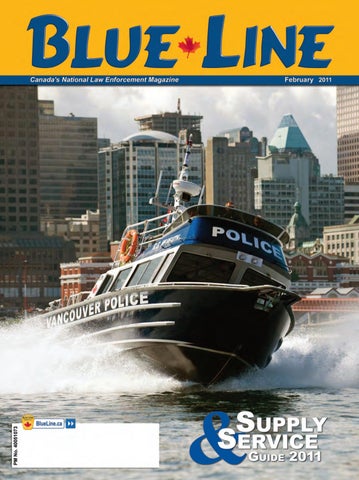
FEBRUARY 2011
2
BLUE LINE MAGAZINE
February 2011 Volume 23 Number 2
Features
6
6 Securing Vancouver’s waterfront for a century 8 Winning over the Olympic crowd was no accident 16 Training for trauma Part 3
22 The challenges of moving into management Part 2: What Canadian police really say about moving into management
33
Supply & Service Guide 2011
Departments 8
& 34
28 30 60, 61 5 51 48
Supply Service G 2011
BLUE LINE MAGAZINE
Blue Links Ad Directory Deep Blue Dispatches Market Place Publisher’s Commentary Odditorials Technology
Case Law 57 58 59
uide
3
De facto arrest arbitrary, evidence excluded Only reasonable grounds needed for arrest Police can search vehicle for ID
FEBRUARY 2011
FEBRUARY 2011
4
BLUE LINE MAGAZINE
Blue Line
PUBLISHER’S COMMENTARY by Morley Lymburner
Magazine Inc. PUBLISHER Morley S. Lymburner - publisher@blueline.ca GENERAL MANAGER Mary K. Lymburner - mary@blueline.ca SENIOR EDITOR Mark Reesor - editor@blueline.ca CREATIVE DIRECTOR E. Jolene Lymburner - jolene@blueline.ca CONTRIBUTING WRITERS Mike Novakowski Mark Giles Robert Lunney James Clark Dorothy Cotton Dave Brown Tom Rataj AFFILIATIONS International Association of Law Enforcement Planners Canadian Advertising Rates Data International Police Association The Canadian Press Newswire Access Copyright SUBSCRIPTIONS $30 per year; $50 for 2yrs; US & Foreign: $100 ADVERTISING 888-640-3048 advertising@blueline.ca
www.blueline.ca 12A-4981 Hwy7 East, Ste 254, Markham, ON L3R 1N1 Canada P: 905 640 3048 F: 905 640 7547 blueline@blueline.ca
PRINTED IN CANADA ISSN# 08478538 Blue Line Magazine was established in 1988 as an independent publication to inform, entertain, connect and educate those involved in the law enforcement profession. With no direct control from an enforcement agency, its opinions do not necessarily reflect those of any government or law enforcement agency. The authors, advisors, and publisher accept no liability whatsoever for any injuries to person(s) or property resulting from application of adoption of anything presented in this magazine. Readers are cautioned and advised that articles presented herein are edited and supplied for your personal awerness and should not be used for further actions until appropriate guidance is received from a supervisor, Crown Attorney or other persons in authority. All material submitted for publication becomes property of Blue Line Magazine Inc. unless arrangements have been made with the publisher prior to publishing. © 2011 All articles are protected by copyright. No part of this publication may be repoduced or transmitted in any form or means, electronic or mechanical, (including photocopying and recording or by any information storage or retrieval system), without prior permission. Permission to reprint may be obtained in advance from Access Copyright 1-800-893-5777.
BLUE LINE MAGAZINE
The many roads to law & order There are many roads to Mecca, the ancient saying goes. Seeking out and sustaining a safe and orderly community is not accomplished by using only one method or process, a principle well understood by those experienced in the enforcement side of the legal profession. I say “experienced” because new recruits are often not trained in some of the more subtle aspects of keeping an orderly society. This requires street experience and a willingness to think and act outside the box on occasion. I have an example, of course. “John” (his real name is close to that but of East Indian origin) was a hard working, conscientious bylaw enforcement officer. They were also locally known as “Green Hornets.” He had been given a rather hard nut to crack and asked for help to find a solution. He walked an area in the city known for its used car lots. There were no fewer than eight in his particular beat. Although his job mainly involved tagging cars on the street, the city was receiving many complaints of used car lots blocking sidewalks with their vehicles and parking them on the streets when their lots were full. John’s problem – the cars didn’t have license plates so he couldn’t issue tags. He had been constantly talking to the sales staff and owners, asking them to move their vehicles, but was met with considerable derision and low compliance. The situation had deteriorated to the point where he was encountering abusive language and had even been ordered off the property a few times. It was time for an appropriate object lesson in civic responsibility. The following morning I picked up John from his station and our morning cup of joe from the usual place and talked strategy. He had to be seen giving the orders for the day, I told him, directing not only the tow truck drivers but also myself. He was taken aback. I reassured him that this was necessary to establish himself as the authority in the area. A quick drive by established that every lot had numerous vehicles obstructing sidewalks. Armed with a briefcase full of impound report forms, I ordered up three tow trucks and,
5
while waiting for them to arrive, divided up the forms between us. When the trucks were lined up I advised John to approach the lot owner on foot. As expected, he received a considerable amount of invective and he turned away and simply waved at me. I was parked a short distance down the road and arrived quickly with two tow trucks, which immediately backed up over the sidewalk and hooked two vehicles. The lot owner and a salesman ran out, complaining wildly. I simply looked up at them as I was writing out my impound report and pointed to the bylaw officer. He was busy filling out his own impound report and simply advised that he had warned them this day was coming. The vehicles were currently in the custody of the tow truck drivers, he explained, and they would have to negotiate with them. What followed was a circus of running to the office for cash to pay the drivers their “drop fee.” As we had planned, John then directed them to hook onto another car. It didn’t take long for the owner to realize that he had better direct his staff to quickly grab the keys and move the cars. In the mean time I ordered my reserve tow truck to hook another car. He pulled it onto the street, with a salesman in hot pursuit, yelling loudly to get the driver’s attention. Too late! It was off to the vehicle impound yard... where the fees would be considerably higher. We repeated this procedure at another lot further down the street and the word spread fast. For the first time in memory we could look down the street and see the sidewalks on both sides clear of vehicles. A quick follow-up the next day revealed almost 100 per cent compliance. One week later John came in to my office and advised that he had gained new respect from the lot owners. “They actually call me sir!” he said with pride.
FEBRUARY 2011
for a century
Securing Vancouver’s waterfront
by Ron Bedard We head swiftly under the Lions Gate Bridge and out of the harbour. I look back at the Vancouver skyline glistening in the sunlight. It has changed dramatically over the past century but the harbour’s several large container ports, numerous marinas, Canada’s busiest float plane base, a heliport, various industries, cruise ship terminal and local transit Seabus route have always presented a unique policing challenge. The Vancouver Police Department celebrates the 100th anniversary of its marine unit this year. It has patrolled this busy Canadian commercial port since 1911 with noble aspirations, doing everything from enforcing moorage or anchoring to combating terrorism and maintaining national security. The squad was briefed before heading out. Although concise, it was alive with chatter and camaraderie and included topics such as identifying the master of each vessel, FEBRUARY 2011
maintenance issues, gangs, vessels of interest and local concerns such as Sea-Doos in swimming zones and abandoned sailboats left adrift. The squad currently uses two high speed vessels incorporating the latest technology, include thermal imaging cameras, surface radar, advanced communications systems, GPS tracking, high intensity sound transmitter and powerful search lights. The technology has improved but the unit’s mandate remains the same – deter illegal activity, patrol the harbour and provide security to those using it. Vancouver’s port didn’t always have a police presence. In 1910, the chief constable requested in his annual report that the city buy its first police boat. The population then was between 125,000 and 150,000. Crime had increased dramatically from the previous year, the chief constable noted, and he also asked for 50 more officers to supplement the 88 already patrolling the city. Very much a frontier port town, Vancouver was growing exponentially, leading to a 6
dramatic increase in crime, particularly theft and narcotics along the waterfront. “With a motorboat at our disposal, it would be possible to investigate these thefts more thoroughly with less loss of time, as we would be in a better position to better cover ground and the chances of tracking the criminal and bringing them to justice would be more favorable,” the chief constable argued. “The boat could be furthermore be used advantageously in the suppression of opium smuggling as this smuggling traffic is very difficult to stamp out and it has grown to such proportions that it is necessary that more vigilant methods be employed.” The new boat, named VPD 1, was bought for the kingly sum of $4,712.77 (that’s about $104,000 in today’s dollars). It was manned by a skipper and mechanic. The same year the department was given a patrol wagon and patrol car, which cost $4,000 each. The chief constable reported great success in reducing opium smuggling in his next year’s report. BLUE LINE MAGAZINE
Today the marine unit concentrates on deterrence and education. Tasks include writing tickets to promote boating safety, dealing with abandoned vessels, interagency co-operation exercises, filling gaps in national security, investigating gang use of boats, recovering the bodies of suicide and drowning victims, preventing crime and accidents, combating small vessel thefts and crowd control during events. Officers bring a wide-ranging level of experience to the unit, including accident investigation, surveillance and tactical. Each member is required to spend at least five years as a regular officer before joining the unit and must take specialized training to deal with the unique maritime environment and BLUE LINE MAGAZINE
ensure credibility. Courses and qualifications include SVOP (small vessel operators permit), maritime emergency duties, maritime first aid, heavy weather training and navigation in restricted weather and numerous Transport Canada exams all the way up to the mariners master ticket, which allows the captain/officer to command vessels up to 60 tons. Even with the unit’s advanced technological tools, its history and link to the past is still very evident. The largest vessel in the fleet was named the “RG McBeath” after World War One infantry man and Cst. Robert Gordon McBeath, who captured several enemy soldiers. McBeath moved to Vancouver after 7
the war, joined the VPD and was killed in the line of duty on October 10, 1922 pulling over a drunk driver. As the unit prepares to celebrate its 100th anniversary, it proudly displays its new “challenge coin.” Steeped in tradition and history, like the unit, the coins date back to the First World War and were given to prove membership in an armed forces company, to be used when challenged and to enhance morale; now they celebrate a unique and proudly Canadian police unit. Ron Bedard is a freelance photo journalist based in Vancouver. Contact him at ronbedard66@ yahoo.com for more information.
FEBRUARY 2011
Winning over the Olympic crowd
was no accident
by Lee Patterson One of the pleasing and lasting memories of anyone who participated in the downtown Olympic festivities is the overt and wellintentioned police/public interaction: the high fives, smiles and photographs. Vancouver Police Department (VPD) officers seamlessly emerged from the 2010 Games as gold medal winners for the way they handled the large crowds. Among the winners was a dedicated unit of all-volunteer VPD Crowd Control Unit (CCU) members. They skilfully managed the safe passage of millions along the urban corridor and also stood toe to toe with a minority of illintentioned violent protestors, refusing to allow them to overshadow the games or ruin the city’s reputation. Many expected a minority group from within well-intentioned protestors would entice police into a bloody battle, exposing their perceived heavy-handed tactics. This did not occur. The VPD CCU and Public Order Group (POG), with support from the RCMP and other police agencies, remained calm and continued positive dialogue, preventing a flashpoint and capturing the goodwill and hearts of the people they kept safe. Achieving such well deserved accolades was by no means an accident.
FEBRUARY 2011
Changing the mindset The VPD public order co-ordinator reviewed past and future deployments in 2006 and decided historical tactics were too static and did not afford the fluidity needed to participate in complex urban disorders. The unit relied on heavy padding, unit cohesion in large numbers and, to some degree, were more reactionary to large-scale disorders. It was certainly capable of controlling crowds but managing them wasn’t a specialty. It has been argued that one may prevent the other. This perceived lack of capability was pivotal in unit commanders agreeing with the co-ordinator’s suggestion to change the focus and capability. This decision wasn’t taken lightly. There was the obvious expense of new equipment and the need for buy-in from existing members. It became quite clear that units such as this one do not work in isolation. While the CCU would champion the new tactics, they would fail without departmental support and inclusion. For the CCU commander to agree that a change was required was the first step of many but the most valuable. Without him sharing the vision, the concept of change would not evolve. Historical departmental events and the specialist comradery culture seemed to be
8
the glue of such a unit. Pride, stubbornness, anxiety and resistance to change existed during the transition and had to be addressed. Some senior members were lost or chose to resign. New leaders who accepted change were developed. At times, doubt and second-guessing had to be suppressed with encouragement and positive reinforcement. It would be easy for a person not involved in crowd control or who had not served in such a unit to scoff at the suggestion that changing the culture was a massive challenge. Those on the front line understand the intricacies of ensuring members are involved in changes from the onset and believe in them. Without their buy-in such radical changes are at best dissolved before the first boot touches the ground. It was also recognized that the greater challenge wasn’t to isolate the unit; it must not be seen as working in a silo by the rest of the department. The VPD would need it at the head of public interaction but it also needed to impart these concepts and ideals to every member deployed alongside it in the field. The unit would have to become a conduit to other departmental resources to achieve success. The new model The model deemed best suited was out of the United Kingdom. The fluidity of movement BLUE LINE MAGAZINE
BLUE LINE MAGAZINE
9
FEBRUARY 2011
agreed to support changes. The CCU needed a showcase for its newfound skills and Lemcke recognized that help was needed.
of small squads and ability to cascade leadership to the lower ranks and implement low-level street tactics for crowd management – filters and simple cordons – were all an integral part of the decision-making process. These tactics would prove crucial in the years to come. Leadership development of sergeant and senior constable ranks, delegating decision making to the squad level and providing overarching strategies without micromanaging tactics was an enabling and empowering process that effectively changed the unit foundations for the better. Believing that every officer is a potential leader, new members were expected to learn words of command and lead their squad in training. This led to immediate acceptance and a sense of family, providing support and confidence, bringing a better understanding and appreciation of the individual contributor to crowd management. When deployed, each and every officer understood the difficulties of squad-level leadership and fully participated in delivering the “meet and greet” strategy to the public. The lower ranks became noticeably more attuned to their role and more confident in their leadership. The demands placed upon the unit commander decreased as others enjoyed being empowered to make decisions, thus allowing time for review, reflection and implementation of new ideas. Removing the commander from lowerlevel decision making and leadership roles was truly an early benefit of the first concepts of change. He had a heartfelt connection, strong sense of pride and was personally invested in the unit. It was difficult to listen to constructive criticism and step back but this allowed junior officers to take ownership of their squads and gave the commander time to refocus on the unit’s goal and vision. FEBRUARY 2011
The beginning of change The Granville mall was known as a hotbed for violence in 2006 and had been growing progressively worse for years. Alcohol fuelled public disorder and criminality left officers continually faced with a barrage of assaults, loutish behaviour and general drunken attitudes directed to them as they wrote tickets, arrested individuals and struggled throughout their night. Often exhausted and dishevelled they would leave the mall to get some sleep before doing it all over again the next night. The rotational concept of law enforcement was simple; you do, we see, we punish bad behaviour – but only an insane man continuously hits himself over the head with a hammer and expects a different result. Something had to change. If you cannot alter the public’s behaviour, maybe it’s time change the attitude of police. Such a strategy would no doubt incur a hail of defensive behaviour and conversation as officers and supervisors alike felt insulted and undervalued for their years of hard work. However, the simple facts were that policing impacts had not changed. The traditional methods were not making a difference to public behaviour. A new public order co-ordinator position was created to recognize and use the skills and ability of a vastly experienced UK officer. His mandate was to implement positive change to deployments, including the “meet and greet.” Simply put, it requires every officer to be accountable for every minute they are deployed, positively engage every person encountered, own seemingly small problems and positively diffuse potential flashpoints. Contrasting the ill effects of mall policing with the UK strategies and knowing how an officer’s personal ownership can positively affect crowd interaction, he met with district commander Insp. Warren Lemcke. Management 10
A simple concept The new approach was endorsed at briefings. The simple concept: smile, engage the community, be positive, have early interaction with crowds and line-ups and start enjoying your patrol time. It has to be an all-or-nothing strategy. One officer saying hello to people and another staying grim faced and gruff opposed the ideals of the model. This is not to say that strict enforcement does not have a place; it is the way it was achieved that had such a dramatic affect. Simply put, the words at the briefing mean nothing if supervisors and constables do not implement the actions. It was decided officers who could not implement the concept and remain upbeat and focused could go home. The briefings were extended to private security and other companies working at the mall and clear expectations were delivered to them to ensure compatibility of working styles. Week by week the same message was delivered. Some officers chose to remove themselves from such deployments and others needed more coaching. Natural champions of the approach were born and the idea disseminated to all positions. Morale improved and officers freely spoke about the changes in their duties. As more time was spent in a high-visibility and proactive patrol role, interacting and filtering through crowds, it soon became clear there was less need for ticketing and fighting with patrons. Removing traffic, opening up the mall to pedestrians and removing the crosswalk and sidewalk restrictions certainly helped. Officers who understood and participated in the strategy contributed to a major enhancement to downtown policing. The strategy was rehearsed at every opportunity and became a constant term in briefings. From the chief constable down, this simple phenomenon had been implemented into the department’s public order legacy. New members know no different and senior members now lead by example. Forward in unity The CCU and bicycle squad were leaders in the “meet and greet” and became the department’s examples of change. Bike squads had worked alone for years and were actually already unwittingly participating in the strategy, talking to protestors and gathering intelligence. With the CCU no longer having the no-nonsense policing mentality at large events and a more mobile and fluid deployment method, it extended its portfolio to be deployed from the onset at demonstrations and marches. Four new public order personnel carrier vans and less intimidating protective equipment meant a more rapid and meaningful deployment capability. Along with the bicycles, dogs and mounted squad, these units harmoniously worked alongside each other, gaining the valuable respect of local demonstrators BLUE LINE MAGAZINE
and making it noticeably difficult for fringe elements to escalate to violence. The apparent ability for police to be visible and appear humane and polite, yet carry out their duties, was a cornerstone of the handling of annual events such as the Celebration of Lights, New Year’s Eve and rallies. “Meet and greet,” enhanced with filters and cordons, ensured the first and last thing a member of the public saw when attending events was a smiling police officer saying hello and goodbye. Anyone who has ever visited a large US theme park would have to admit this approach is annoying but effective. Ready to go 2009 cemented the state of readiness. POG had implemented a public order strategy and trained officers to better understand crowd dynamics and basic human needs and wants. Flash and trigger points for disorders are more acute in public order situations and officers were prepared not to offer a spark. The 2010 expectation of crowd management during the Olympics was primarily to deal with a volume of well-natured spectators and revellers but to be prepared for spontaneous disorders and protests. The VPD was in an excellent position of preparedness for both contingencies. In the lead-up to 2010, it was evident that methodology and deployment capability between the VPD and RCMP were diverse and common ground was needed. It was decided the VPD’s role would be to police urban domain outside of Olympic venues while the
BLUE LINE MAGAZINE
RCMP would police inside the perimeter and provide resources when needed. The urban domain command structure would remain under VPD jurisdiction. In the week prior to the opening ceremony the VPD tactical advisors and commanders designed a local tabletop exercise for commanders of the visiting tactical troops, which was instrumental in putting faces and names to key positions of leadership. The traditional “business card swap” occurred prior to the first day of deployment and the benefits of such an exercise at ground level cannot be underestimated. It enabled the VPD leadership team to become accessible and allowed a reciprocal presentation of tactics to be made to the eagerly awaiting officers on the cruise ship moored in the harbour. Both the RCMP and POG command teams recognized that tactics and training were different and this would shape and complement the expectations of duty. Unit capability was spoken about and reservations from both sides on ability and methods of deployments appeased concerns of miscommunication. In essence, the plans came together and confirmed the tactical units were integrated in approach for the first day of the games. Green light A large demonstration was expected Feb. 12 – thousands of protestors representing many causes. Exact numbers and tactics could not be estimated due to diverse agendas and the unpredictable nature of the causes. “Prepare to
11
FEBRUARY 2011
be prepared” was the key message for commanders. As expected a gathering began outside the opening ceremony venue and, as bicycle teams passed information back to the operations centre, it was clear numbers were high and agendas varied. The POG was to be put to its first Olympic test. Protestors engaged in insults, abuse, spitting, assaults and personal belittling for many hours but both the CCU and RCMP tactical troops stood firm. Spontaneous training and reinforcement of direction was transferred from leadership to constables on the front ranks. As ground was taken by both sides, officers continued to speak respectfully and humanely to the crowd, winning mutual respect. Overt attempts by a small element of the protest group to take aggression to a higher level was evident. A barrage of missiles were thrown at officers wearing only soft caps and regular uniforms. What occurred that night was a testament to officers who took abuse and violent acts in stride. Many who witnessed what occurred wondered how it all stayed together. Not one officer stepped out of the line, despite the obvious pressure. Following the event protestors caught in the moment apologized to officers and commended their patience. Some chose to write a formal thank you to the VPD, lauding officers and acknowledging their restraint. Even under extreme conditions, the core
FEBRUARY 2011
of the “meet and greet” strategy stayed intact. Officers keeping their cool and maintaining professionalism kept the Olympic public order policing plan running smoothly and cemented an outstanding relationship with the public that will live for a long time in the city and beyond. The street-level officers individually sticking to a strategic plan through their tactical communication and actions is a great example of the importance of planning, rehearsal and understanding throughout any team. Ambiguity in the ranks It wasn’t all smooth sailing. Clearly there is a fine line between lawful protest and how much
12
abuse police have to take before being provoked into action. The pendulum swings from the public appreciating officer restraint to the many internal issues and questions relating to officer safety. Morale is seriously affected when action is not taken against continuing assaults. If police actions had been firmer that night, who knows what may have occurred; trying to second-guess action and reaction is seemingly pointless. The appreciative enquiry approach deems that police actions and the level of force did not provoke direct action against them and that should speak for itself. Many within the team still question perceived decisions but must respect the informed decisions that were made, which won over the hearts and support of the community. There was no order or directive to maintain a low level of deployment. Information was obtained at street command-level through live commentary from officers on bicycles engaging the crowd, live cameras and historical knowledge of protest groups and tactics. The decisions made were by well-trained, street level commanders and their advisors. Despite arduous and long hours of duties and exposure to a minority of instigating protestors, officers were exceptional and professionally represented the national values of Canada. The line between defence and reaction
BLUE LINE MAGAZINE
remains blurred. How tolerant would society have been if police had donned riot helmets and shields and defended personal space at the onset of deployment? These questions were dissected and discussed by public order managers and advisors attempting to address morale at the debrief the evening of Feb. 13. Many questions and concerns about officer safety remain. In future training, dialogue will diffuse conflict, enhance skillsets and extract solutions from frontline officers. Enabling bottom-up communication will no doubt improve the feeling of inclusiveness and ownership. Commanders and tactical advisors have already altered briefings; prior to the July 2010 Celebration of Lights they took extra care to explain to frontline officers how dress specifically impacts incident strategy. Debriefs will continue and officers will not leave a deployment without having a voice where their safety is concerned. No heart attacks A “heart attack” protest was planned for Feb. 13 – spontaneous actions to clog and jam major intersections and arterial routes, bringing the games logistics to a standstill. A minority of protestors wore black to hide their identity, gained momentum and went on the offensive. There was a definite escalation of violence. Buildings were attacked, pedestrians chased and intimidated and a general state of anarchy was brewing. It should not be forgotten that the same core group of officers abused and assaulted the previous night were
BLUE LINE MAGAZINE
paramount in the police operation. Now in a more proactive role, they utilized mobile tactics, were clearly heard and captured on many video clips using verbal commands of advice, remaining professional, requesting calm and communicating with protestors who tried to fight them. An effective dispersal and arrest attempt ended the violence. Gold medal The VPD POG showed restraint and switched gears to controlled authority when called upon. The RCMP remained supportive and adapted to the urban policing model for the Olympic plan. An incredible tone had been set for the remainder of the Olympics. Millions passed along extremely crowded streets in celebration, recognizing the upbeat attitude of the security force and the games became a celebration of all things Canadian. The CCU, dogs, horses, bicycles and other supporting groups became the poster of the thin blue line, smiling, handing out stickers and positively interacting with everyone. General patrol officers, auxiliary constables and everyone wearing a reflective jacket had caught and embraced the spirit. The games were a success and, at the closing ceremony, the POG received standing ovations from bar occupiers as they skilfully shepherded demonstrators. The true measure of success of years of planning, training and trying to implement a psychological change within a large organization such as the VPD culminated with international applause on the last day.
13
FEBRUARY 2011
In reflection While the Olympics were a catalyst for world attention and certainly shone a spotlight on the capability of the VPD, it was simply a stage for the performance to be seen. Like every show, the performers must rehearse, train and undergo lifestyle changes to perform at their best. Unlike performers, the POG had to be at its best prior to the Olympics and for the group, the show must go on. It is fully aware that it could participate in a thousand Olympic Games and do as well, but one bad performance would undo all the hard work. It should be acknowledged and remembered that the officers are volunteers, give up much of their free time and wholeheartedly commit to the unit’s ideology. The POG has excelled far past any expectation and is living proof that positive change in organizations is worthwhile and should be showcased to formally recognize the people involved. This unit no longer sits in back-of-house locations waiting to be unleashed on out-of-control crowds but is now a showcase example of positive community policing and an integral part of the Vancouver policing plan. Significant benefits of redefining and implementing new concepts and tactics, delivered with clearly defined “meet and greet” strategies, include: • Potentially large financial savings as larger events no longer escalate into prolonged deployments; • Better morale and less officer fatigue because duty is less arduous and confrontational; • Improved duty of care to the public through better trained and equipped staff; • A cascade of positive actions are passed from trained officers to their peers on squads; • International recognition; • Ability to redefine operational plans to streamline resources and have more of an impact; • Confidence and willingness to seek further improvements knowing the suggested changes will be considered; • Officers’ viewpoints and ideas have been recognized and valued in such a large organization; and • Training and equipment pays off for the city, most evidently in positive public reaction. This article is not intended to be an Olympic success story but rather an example of how institutional culture can be changed and the complexity and benefits that result. It has long been thought that paramilitary organizational structures are highly resistant to change. This perception has been challenged and the professionalism, dedication and ability the POG has shown is a tangible reward to an organization willing to embrace change. In return, the organization has been recognized on the world stage. Sgt. Lee Patterson (MA DEM) is the VPD Public Order Coordinator. This article does not necessarily reflect the views of the VPD but is an insight from one individual engaged in changing strategy in a large organization. It also does not diminish the hard work and professionalism of other individuals, units, departments or agencies involved in the planning or execution of any event mentioned.
FEBRUARY 2011
14
BLUE LINE MAGAZINE
Remote vehicle goes where divers cannot by Nancy Colagiacomo Québec Provincial Police used the same technology as James Cameron on Titanic to locate underwater wreckage and bodies after a recent plane crash. Two men set out on a float plane bound for a fishing camp last June, leaving Baie-Comeau on a Tuesday and due back Friday. When they didn’t return as scheduled a worried relative set out to look for them and found debris from their plane on Lac Berthé, approximately 200 kilometers north of Baie Comeau. Quite certain it was his relative’s plane, he contacted police. Québec Provincial Police divers were called in for a search and rescue mission. They found a piece of the plane’s tail and not much more. Divers quickly realized they would need specialized equipment and called Mike Roberts of Divetech, a Nova Scotia underwater survey company. Roberts and his team were pleased to help. “It’s always a great feeling to help bring closure to the families and another to know we can rely on our technology to perform in important situations like these,” said Roberts. Divetech uses a remotely operated vehicle known as the Video Ray to locate and retrieve underwater wreckage. They found the remains of the aircraft at a depth of 70 metres. Police divers then took over, recovering the pilot and the passenger from inside the airplane. Roberts can mobilize a team 24/7, 365 days a year. His team is always eager to help bring closure, especially in tragic circumstances like these.
in warm waters and freezing temperatures, unlike traditional scuba diving where underwater time is limited due to shortage of oxygen and unforeseen risks. ROVs have been used worldwide by police, coastguard and movie companies, for fishing and sea life surveys of the ocean floor, to install and repair undersea telecommunication cables and in off shore oil and gas drilling projects. They do not replace police officers but make their work more efficient, not only in search and rescue missions but also in criminal investigations. Many cases were left unresolved for lack of evidence retrieval; this tool now enables officers
to pursue investigations in a faster and safer way. Video Ray assisted police in a massive marijuana bust in Jamaica. Police, coast guards and port security, incluing the largest anthropology laboratory in the US, have used ROVs for recovery and retrieval missions. Fishing expeditions and researchers have also benefitted from ROVs. Contact Mike Roberts at divetech@eastlink.ca for more information. Nancy Colagiacomo is Blue Line Magazine’s Québec correspondent. Anyone with stories of interest on Québec policing may contact her at: nancy@blueline.ca.
How it works The Video Ray is an underwater search tool propelled by thrusters and can travel as fast as 4.1 knots. It’s computer operated wth controllers much like those on video games, making it easy enough for even a child to operate. The ROV (remote operated vehicle) is connected to a surface ship by a cable that provides electrical power and transmits commands to move the craft and operate the colour underwater video camera. Depending on the situation, a mechanical arm may be installed to pick up objects. The Video Ray may be used for sonar imaging and in low visibility or hazardous environments and situations that are too dangerous or polluted for divers to explore. It can perform BLUE LINE MAGAZINE
15
FEBRUARY 2011
Training for
Trauma
Police and critical post traumatic stress disorder Part 3 of 3 by Sean P. O’Brien and James Bremner In addition to the difficulties listed in our two previous articles, post-traumatic stress disorder (PTSD) also causes a number of other serious problems, including what psychologists call co-morbid disorders. An astonishing 80.0 to 98.8 per cent of those diagnosed struggle with at least one other clinical issue (Fairbank, Ebert & Caddell, 2001; McNally, 1999). The most common co-morbid problems include: Panic attacks – the characteristic symptoms of increased arousal can occur daily and the person experiencing them can fear they are dying or losing complete control of their mind. The symptoms of panic are usually FEBRUARY 2011
adaptive responses to stress, but often get misinterpreted because they begin to occur in response to seemingly innocuous stimuli. Depression – can result from an inability to cope with PTSD. This is significant, not only because it makes the person unhappy but because it causes structural and chemical changes in the brain that interfere with daily functioning. Substance abuse – when someone with PTSD cannot control their symptoms they can shut down and become severely avoidant or turn to alcohol and drugs to numb their torment. Some people can’t sleep without drugs or alcohol and while they offer symptomatic relief on a short-term basis, this only serves to make a bad problem much worse over the long run. 16
Anger and irritability – can occur when an officer believes they’ve been mistreated by coworkers and supervisors or in response to excessive internal stimulation. Officers who become aggressive and argumentative with colleagues, family members or the public following a critical incident should be routinely screened for signs of PTSD. Further traumatization – when an officer struggles with PTSD, depression, substance abuse and anger or irritability, this leads to a series of events that can increase the likelihood they will be harmed. We have seen many traumatized officers who struggle with shame and guilt; to cope with these symptoms they put themselves in harm’s way to prove to themselves and their peers that they’re not weak. Vicarious traumatization – this refers to BLUE LINE MAGAZINE
PTSD symptoms that develop in spouses and children of officers involved in a traumatic event. These symptoms can mimic those seen in the officers themselves and are worse in many cases. Left untreated, these problems can lead to divorce, domestic violence and other serious difficulties. Risk factors for PTSD It is difficult to predict which officers will get PTSD but we can describe three specific types of risk factors that increase the likelihood of getting it (Fairbank, Ebert & Caddell, 2001; Herman, 1997; McNally, 1999). The first group consists of pre-trauma risk factors – problems we bring to the critical incident, which can include: • A pre-existing psychological problem: This is important because it represents a vulnerability factor that can make a person more susceptible to getting PTSD. This may not seem like a critical issue until you realize that between 17-20 per cent of the general public has struggled with depression. Those who have a pre-existing history of psychological stress are twice as likely to get PTSD. • Family history of psychiatric illness: Once again, this can predispose individuals to PTSD because it may reflect an underlying predisposition toward developing the disorder. The second group are things we call peritraumatic risk factors – existing at the time that the trauma takes place – including:
BLUE LINE MAGAZINE
• A perceived life threat – this is a subjective experience that can differ between officers attending the same call. The higher the perceived life threat, the higher the risk of PTSD and in turn, the risk of developing it is doubled. • Actual injury or death – this is an objective risk factor. Being hurt or witnessing a serious injury or death increases the risk of getting PTSD. Estimates are that 45 per cent of those who perceive that their life was threatened and/or who are injured during an assault will develop PTSD. • Proximity to the trauma: The closer or more involved you are with an event, the greater your risk of developing PTSD. Close proximity can increase your risk five-fold. The third group are what we call posttrauma risk factors. The most consistently studied – a lack of social support and unit cohesion following exposure to a traumatic event – predispose officers to PTSD. Officers with good support and cohesive units tend to respond better when they develop PTSD. Unfortunately, many officers are subjected to something called the ‘Just World Hypothesis,’ a process by which colleagues react to the critical incident by blaming the person involved in it (Lerner & Miller, 1978). This occurs because many people believe the world is a just place where good things happen to good people and bad things to bad people. This doesn’t reflect reality but it is a self-protective mechanism that allows us to believe people get
17
what they deserve. Therefore, if a colleague is traumatized, it is because they are weak, poorly trained or “froze.” As a result, “what happened to them can’t possibly happen to me.” This makes us feel safe but is truly an illusion. Using the hypothesis only serves to alienate those who are traumatized and increases the likelihood that they will suffer from PTSD. Preventing and treating PTSD PTSD can be treated (cf. Fairbank, Ebert and Caddell, 2001). In order to do so effectively, it needs to be detected early or it can be very difficult to resolve and, in some cases, the officer will never recover. Getting to the symptoms early may mean resolving the condition within 12 to 16 hours of treatment. However, if the traumatic stress response is severe, resolution may take a year or more. The first thing that we can do to reduce the effects is to take it out of the closet and demystify it. It is not a sign of weakness or evidence that one is “mental.” People do not have to have their guns taken away because they have PTSD. The second thing is create programs that provide for Stress Inoculation Training (SIT). Ideally, recruits can be taught what is normal when dealing with a violent encounter, since a lack of knowledge can often lead to posttraumatic stress symptoms. The SIT programs help recruits identify these normal reactions
FEBRUARY 2011
and signs of the more serious PTSD response so they can access treatment services while they can still benefit. By learning how to respond to critical incidents, we can greatly reduce the emotional and physical impact on our officers. Third, we need to embed mental health professionals within police units. The US military has done a great job with embedding psychologist within fighting units, making it much easier for soldiers to access proper treatment services. There is also a level of comfort since soldiers are already familiar with the psychologists from training exercises and social situations. We’ve had officers contact us after being
involved with them in hockey leagues, tactical training exercises or through social activities organized by police associations. They come to trust that they can count on our support long before encountering a traumatic incident and are more likely to contact a person they know and can access us at any time. Finally, when PTSD does develop, we need to access a trained mental health professional quickly. It is important to note that untreated PTSD can lead to chemical and structural changes in the brain. These problems can be treated effectively through the use of a three-stage model developed by Judith Herman (Herman, 1997). The model teaches officers to use safety
strategies to control seemingly overwhelming symptoms (e.g., depression, panic attacks, nausea, etc.). Safety can be achieved through breathing strategies, relaxation, education about PTSD and the recovery process and possibly even the use of anxiolytic medications. In the next stage, officers learn to recall their trauma in a safe and effective manner while remaining calm and relaxed. This specialized process allows them to learn that thinking, dreaming or talking about an incident is quite different from experiencing it. In essence, this helps reset the brain’s alarm system so that it does not activate when confronted with innocuous stimuli. Over time and with the help of a trained professional, this can return an officer to a healthy and normal lifestyle. References
Bremner, J. (2006, Sept). Use of force and marksmanship in Ontario. Paper presented to the Toronto Police Service, Toronto, Canada. Cunningham, A. (2002). The healing journey: Overcoming the crisis of cancer. Toronto: Key Porter Books. Fairbank, J.A., Ebert, L. and Caddell, J.M. (2001). “Post-traumaticstress disorder.” In P.B. Sutker and H.E. Adams (Eds.), Comprehensive Handbook of Psychopathology (pp. 183-209). New York: Kluwer Academic/ Plenum Publishers. Foa, E. and Rothbaum, B.O. (1998). Treating the trauma of rape. New York: Guilford Press. Grossman, D. (1999). On Killing: The Psychological Cost of Learning to Kill in War and Society. New York: Little, Brown and Co. Herman, J. (1997). Trauma and recovery: The aftermath of violence from domestic abuse to political terror. New York: Basic Books. Hole, J.W. (2001). Human anatomy and physiology. Dubuque: Wm. C. Brown. Laur, Darren. (2002). The anatomy of fear and how it relates to survival skills training. Portland: LWC Books/ Integrated Street Combatives. Lerner, M. J., & Miller, D. T. (1978). “Just world research and the attribution process: Looking back and ahead.“ Psychological Bulletin, 85, 1030- 1051. Levitt, E.E. (1967). Psychology of anxiety. New York: Bobbs-Merrill. Lewis, C. (2004). “Police Suicide is an Alarming Problem Rarely Discussed Publicly.” “Tears of a cop.” 01 Sept. 2004. McNally, R.J. (1999). “Post traumatic stress disorder.” In T. Millon, P.H. Blaney, & R.D. Davis (Eds.), Oxford Textbook of Psychopathology (pp. 144-165. New York: Oxford University Press. Siddle, K. (2006). “Bio-psychological responses to simulated firearms events.” Paper presented to PPCT Management Systems. Siddle, K. and Grossman, D. (1998). “Effects of hormonal induced heart rate increase”. Post-Traumatic Gazette, 4(4), pp. 6-7. Turvey, B. (1995). “Police Officers: Control, Hopelessness, & Suicide,” Knowledge Solutions Library, Electronic Publication, URL: http://www. corpus-delicti.com/suicide. html, April, 1995 Dr. Sean P. O’Brien is a registered clinical psychologist practicing in Whitby, Ontario who provides clinical services to policing organizations throughout Canada. He has more than 10 years experience dealing with high-profile critical incidents, including police-related shootings, traumatic homicides, suicides and criminal investigations into police conduct. Det/Cst. James Bremner has more than 20 years experience with the Toronto Police Service in uniform patrol and the ETF, including gun team, team leader, explosives technician and tactical trainer. He’s currently on the Gun and Gang Task Force. Through his company, Bremner Associates Inc., he provides tactical training and lectures on Critical Incident Stress and PTSD. Visit www. bremnerassociates.com for more.
FEBRUARY 2011
18
BLUE LINE MAGAZINE
Street drug awareness for law enforcement by Steve Walton It’s important for law enforcement officers to be properly trained and updated on the subculture of street drugs. All too often during my career I have seen the impact made by poorly trained officers. Drug training helps officers stay safe, improves their investigative capabilities and makes them a valuable asset to the public at large. There are many aspects involved in training, which should be an on-going process. Let’s look at drug use recognition by demographics, a skill every officer needs to acquire. In the most drastic of scenarios, such as using force, articulating the condition of a subject can become vital. If an officer knows or can estimate a subject’s age, they can make an educated guess about the substances that may be influencing them. The major drug using age groups and their drugs of choice are: • Ages 7 to 12: alcohol and inhalants • Ages 13 to 17: alcohol, marijuana and tobacco products • Ages 18 and older: cocaine, heroin, illegal amphetamines, marijuana, phencyclidine Obviously, people can use any substance
BLUE LINE MAGAZINE
they can get their hands on, regardless of age, including pharmaceutical grade drugs, but research indicates age groups do tend to gravitate towards very specific drugs. Please join me April 27 at the Blue Line Trade Show for a day long training session on street drug awareness for law enforcement professionals. We will take an in depth look at recognizing drug use, current trends, drugs of choice and symptoms of their use and detecting clandestine drug laboratories.
19
FEBRUARY 2011
The universal response by Michael Weaver The call began as “police on scene request fire for eval of suspect in custody.” Firefighters find multiple officers, most disheveled and leaning against patrol cars trying to catch their breath. One points at the “patient” lying on the ground in cuffs. “I hit him twice with the TASER and he just kept coming,” one officer is overheard saying. The fire captain gets the rest of the story from the officer in charge. The pipeman and driver head over to check the suspect’s vitals. The young officer responsible for keeping an eye on the patient says he was just talking to him. Seconds later, the pipeman yells “Cap, this guy ain’t breathing!” Medics and an additional crew are dispatched for the unsuccessful code that will take place over the next 30 to 60 minutes. The event will likely end with CPR being performed on the way to the emergency department (ED) and the patient being pronounced dead after several more minutes of CPR and drug therapies mandated by whatever algorithms are
being followed. The patient’s death is only the beginning. Scrutiny, public outcry and legal proceedings soon follow. Everyone will be impacted negatively, from the highest elected official down to the newest recruit. Law enforcement has suffered greatly from negative public perception. This, in addition to public outcry, has possibly led to officers hesitating before getting into a physical struggle with unarmed suspects and opting not to deploy a less than lethal device. In the United States 650 law enforcement officers were killed in the line of duty from 2005 through 2008. It is with great reverence that I mention their ultimate sacrifice; all deserve to be honored. For the purposes of this article, lines of duty deaths were screened for direct conflict with a suspect. • Assault - 4 • Gunfire - 208 • Heart attack - 50 • Stabbed - 3 It may be assumed that 33 of these 265 brave officers would have benefited from
rapidly deploying a less than lethal device. The initial threat level would not have warranted lethal force, though the suspects’ actions required some form of response. Further complicating matters is that most often public perception is based on emotion, not the facts. The reality is that most public entity policies are driven by liability and public perception. It’s safe to say that most policies are not written by those of us serving in the field. To quote an interim report from the National Institute of Justice on the study of deaths following electro muscular disruption, “All CED (conducted energy device) use should conform to agency policies. The decision to use a CED or another force option is best left to the tactical judgment of trained law enforcement at the scene.” This statement, in the context of the report, is adequate for most situations but fails to address the rare individual who does not comply or yield to traditional methods of de-escalation, subdual and/or restraint. They represent the greatest risk to the first responder. Lack of communication and relevant training between first responders (Fire, EMS and law enforcement), security and other health care providers further complicate this low frequency high risk event. Excited Delirium Syndrome A source of controversy and skepticism, EDS is slowly gaining acceptance in the medical community as a legitimate condition that classically presents as hyperthermia, incomprehensible speech, altered mental status and, with further agitation, death. This is in no small part to the research being done at the University of Miami by Dr. Debora Mash, who says she’s isolated a gene common in cases of deaths believed to be caused by EDS. Common findings post mortem are a long history of mental illness
FEBRUARY 2011
20
BLUE LINE MAGAZINE
and/or psycho-stimulant drug use. Even if we remove the proposed legitimacy of EDS, animal models show similarities in restraint/capture and negative outcomes. The US Department of Fish and Wildlife has long noted a condition known as “capture myopathy” in wild animals. In certain areas it is not uncommon to lose as much as six per cent of animals designated for relocation. Nutrient supplements (selenium and vitamin D) prior to capture, avoiding capture and relocation attempts during hot weather and various forms of sedation post capture can help lessen but not eliminate loss. The most striking similarity to EDS occurs in domesticated swine. “Porcine stress syndrome” has been blamed for significant financial loss to the industry. Animals affected by this condition are more likely to expire during transport or are unable to walk on arrival to the slaughterhouse. A gene was isolated and given the name Hal 1843 because of Halothane sensitivity during anesthesia, which presents as hyperthermia, abnormal breathing and excitable behaviour. Interestingly, humans with Halothane sensitivity also have similar presentations. Selective breeding and gentler handling techniques during transit have decreased but not eliminated this occurrence in the swine industry. Currently there are no studies available that link Halothane sensitivity to EDS. Mash has assigned staff to check for similarities between Hal 1843 and the gene her lab has isolated in humans.
BLUE LINE MAGAZINE
Universal response I use the term “combative patient” instead of EDS, mostly because of the volume of physically violent individuals encountered that have other etiology, including: • Illicit drug use, • Non-compliance with prescription meds/ under or over medication, • Alcohol intoxication, • Mental illness, • Diabetes, • Brain injury, • Carbon monoxide poisoning. This list is not all encompassing, but a brief introduction of items to consider when encountering an individual with an “altered” presentation. Regardless of the cause, violence is something first responders must deal with every day. Before evaluation, treatment and transport can begin, the out of control individual must be subdued and restrained. Understandably, law enforcement agencies are very resistant to any outside influence in the subdual or management of suspects in custody. Agencies would be well advised to define exactly when a suspect becomes a patient and how to transition them to fire/EMS care. One local police agency’s only answer to reducing the risk of in-custody death was simply calling local fire/EMS for transport to the ED after a CEW was used. It didn’t consider fire/EMS policies that specifically state “combative patients” must be delivered to the ED in “soft restraints,” on a backboard, IV in place
21
with sedative drugs and intubation as necessary. Removing an unco-operative “patient’s” cuffs, applying soft restraints, securing them to a backboard and moving them to the medic unit for further evaluation, treatment and transport is a challenge. Police officers try to help, but their unfamiliarity with equipment and the lack of standards to orchestrate such chaos only increases stress to all involved. It also takes time; extended on-scene time has been a factor in sudden in-custody deaths but administrators were satisfied. Their new policy eliminated the risk of lawsuits by creating a situation where “if the suspect dies, it will be in a medic unit and not a patrol car.” Of course, this logic is flawed and does not foster a safe environment for anyone, nor does it remove the risk of liability to the city, which employs both agencies. Isolation and shifting blame will not reduce the risk of injury or death for the combative individual in medical crisis, nor will it provide a safer environment for first responders. What will minimize risk is developing a universal multi-discipline approach that prioritizes: • The first responder’s personal safety, • Rapid identification of the at-risk individual, • Allocation of proper resources, and • A plan of action. Michael Weaver is a 15 year veteran Firefighter/Paramedic. He is an author, instructor and advocate for the safety of all first responders. He is the instructor of the ‘Transitional Tactics for the Combative Subject’ course at the Blue Line Trade Show & Training event on April 26th.
FEBRUARY 2011
The challenges of moving into
management
What Canadian police really say about moving into management Part 2 by James Hogan, Craig Bennell and Alyssa Taylor It’s difficult for surveys to penetrate below surface views to understand why respondents believe what they do. Anticipating the problem, this study was designed to build on our previous one by asking Canadian police officers to discuss their views about management. The sample of interviewees included 50 active police professionals (38 males and 12 females of varying age, years of service and rank, including civilians working in human resources) from 11 police services across eight provinces (none took part in the previous survey). For study purposes, the ranks of corporal, sergeant and staff sergeant were considered to be the supervisors/middle managers in question as appropriate to each interviewee’s particular police service. The major themes running throughout the interview questions were the role and effectiveness of police management/ supervision, the promotional process, availability and adequacy of training and recent changes to police management/supervision. Interviews were conducted face-to-face in the police agency where the subject worked and were voluntary. Interviewees (and their agencies) were promised strict confidentiality and interviews were audio taped and transcribed verbatim so responses could be analyzed. We attempted to extract relevant themes that emerged, taking care to ensure that the concepts developed and illustrations provided typified the most common pattern in responses. RESULTS Role of middle management As in the survey, interviewees believed strongly that middle management plays an FEBRUARY 2011
important role in Canadian policing. For example, when asked how important the work of middle managers is to the success of their service, the following response was very typical: The sergeants are the ones that make the organization click and that’s, to me, the most important rank, right from the commissioner on down... because they’re out there 24 hours a day, day and night, crappy weather, good weather, whatever the case is, leading the troops, and I stand by that 100 per cent... I don’t see that changing (participant g4). In general, all interviewees viewed middle managers/supervisors as central to the organization, having a huge amount of responsibility, being held accountable for a vast range of actions and activities and playing a significant role in the day-to-day running of the agency as problem solvers, motivators and leaders. Effectiveness In line with the survey results, interviewees generally felt managers they’ve worked for have been generally effective. This despite the fact interviewees spoke of considerable challenges in transitioning from rank and file officer to supervisor. Various types of challenges were spoken of, including: • Role confusion You’re a constable one day, you get your hooks and the next day you’re a supervisor and you’re still really feeling that you’re amongst your peers (but now) you’re now the one that’s approving time off, assigning zones or assigning files; nobody really sits you down and says “okay, this is the divide” (participant j5). • Lack of knowledge The skill sets that they have (are) as either an investigator or beat officer and then they move to supervisor or a manager and they don’t necessarily have those skill sets 22
(participant e3). • Micromanaging Number one thing is quit doing your old job, do your new job… That’s the number one thing and we see it all the time, that’s exactly what it is. You come and sit in your new chair but you’re still going to go out there on the road with the boys, you’re still going to take on files because you’re not sure if your guys can do it properly and you’re still going to do a whole whack of stuff that, as a supervisor, is no longer your problem (participant h2). There was also a high level of agreement about factors that contribute to the successful transition from a rank and file officer to a manager/supervisor, including the following: • Knowledge/experience of the position They all had a good knowledge base, they had worked in several areas… so that definitely helped them because they demonstrated they could do more than one thing (participant b1). • Motivated/desire to succeed/good attitude Dedication. I think a general willingness to work at it and to do well... A genuine desire to do well with your squad and to do well in that position. So there’s a work ethic there… and I think sometimes… if they can see that you’re honestly there to try to serve, you’re 90 per cent home (participant f1). • Communication/interpersonal skills Excellent communication skills, excellent team building skills, huge feedback…They need to think that their opinion is valued and they can only get that through a feedback mechanism – you’re going out there and talking to them (participant c1). • Respect/credibility Credibility within the organization helps them from day one. The people who I’ve seen struggle at the rank of sergeant are people that got promoted that had really crappy BLUE LINE MAGAZINE
reputations, deserved or not; they struggled and got taken advantage of by their troops (participant f3). Interviewees could also identify the attributes and/or behaviours of effective supervisors. Again, several themes emerged, including: • Communication skills Communication, the power to listen and to engage people that work with you -- and to understand that people don’t work for you; my philosophy is people don’t work for you, they work with you (participant f5). • Interpersonal skills Number one you’ve got to be a people person, (able) to deal with people on different levels… Keep it personal. I mean, I became a police officer to help people, it’s no different than when you’re a sergeant. Don’t elevate yourself to a level where you think you’re better than those people (participant d2). • High integrity Your behaviour has to instill respect because the whole rank and file has to respect the position and it’s a lot easier to respect the position if you respect the person in the position (participant i1). • Strong decision making skills You can’t have things just piling up on desks. The work has to keep moving, the decision has to be there and you have to put out the direction you want your team to go in (participant h1). • Good policing knowledge You certainly have to have a certain amount of job knowledge. The more across
BLUE LINE MAGAZINE
what we call the three branches of the service the better; that would be administrative, investigative and operational (participant c1). Interviewees were also able to identify reasons for difficult transitions from rank and file policing to middle management. According to the interviewees, several factors could explain difficult transitions, including: • Poor communication skills Poor communicators… if they’re not communicating their vision, no one has a clue what they’re up to (participant c1). • Lack of training/experience Lack of preparation on their part in terms of knowing you’re going to a certain position and not bothering to figure out what goes on there before you get there (participant f2). • Overly authoritative One went with a totally autocratic leadership style –“my way or the highway” (participant b1). • Inability to accept/make changes I think that they have to be willing to accept change, to change their methods… I find in the policing industry we don’t adapt to change very well. We like doing things the same way, we get set in our methods and I think you need that quality to say, well, we need to do this a different way (participant b2). • Lack of motivation/promoted for the wrong reasons I think part of the negative thing is the sense of entitlement. There are some people who get promoted who think “well I’ve paid my dues, therefore now it’s my turn to sit at this desk and you guys go out there and do the
23
work (participant c2). • Inability to make decisions How to put this politically correct – he’s just as dumb as a post, can’t make a decision to save his life. I swear to God it probably takes him a half hour to figure out which sock to put on first in the morning (participant b1). Promotional process for middle management positions Unlike the survey results, most interviewees did not voice serious concerns about promotions. Indeed, the majority believed current promotion practices were reasonably effective at identifying officers who are ready and able to assume new and greater responsibilities. For those that did voice problems, most indicated that promotional practices were improving: At the end of the day I think there’s less of this “how the hell did he or she make it?”… I think people are qualified and are recognized as being qualified and I would hope that there’s a recognition out there, that if you spoke to someone genuinely and privately, they would acknowledge that there’s integrity in the system. I also believe that there’s no perfect system (participant b4). Many other interviewees recognized that there are inherent problems with promotional practices, but appeared to have a relatively positive view about their agency’s promotions process: It works relatively well. I’ll go back and qualify that because you can never take the human aspect out of promotions, you know “I know this guy, he’s a good guy, I like him,
FEBRUARY 2011
he’s worked for me before, I want this guy to get bumped (participant a4). Despite the fact the majority viewed the promotional process in a relatively positive light, some still held very negative views about the process: The promotional process does not identify those people who are the informal leaders on a platoon. The ability to write an exam and do an oral interview is more important than being a leader (participant d2). Adequacy of training A number of results emerged from the interviews about adequacy of training for middle managers that sat nicely with the survey results. For example, interviewees were unanimous in their view that training was very important. In fact, they highlighted a wide variety of training approaches when asked how the challenges of the new position could be overcome, including: • Formal training We don’t really prepare people, I don’t think, in advance of the position, even in terms of the formal training... we don’t go for supervisory training until after we’re actually in a position (participant b3). • Mentorship We should have a mentorship program… and when I say mentorship, I mean that is your transitional period where you are actually linked up with a supervisor and learn the supervisory role (participant a2). • More thorough orientation As far as I’m concerned, and not just here, everybody who applied... should be taken to a room and told: “boom, this is going to happen to you, boom, this is what we expect from you”... before they want to jump in that ring so they can’t say, “well I didn’t know about that (participant j3). There was also some concern raised about various aspects of training. For example, in line with the survey results, most interviewees believed pre-promotion training was inadequate: So the actual education doesn’t happen until you’re in that position and that’s been a major criticism, like “give me some training before I’m assigned to this unit, I want it before I go in.” It doesn’t happen that way because it’s not always last-minute but… you get assigned to that position and then the training happens. We just need a stronger orientation program (participant d1). In terms of long-term mentoring and/or training, interviewees varied in their views as to whether this was formally available and if so, whether it was adequate. Some were clearly aware of a mentorship program being offered in their agency: The third part of the module training system is a mentorship component involving a constable being mentored by an experienced sergeant in the duties and responsibilities of being a sergeant. Typically the mentoring is several weeks to a month in duration and concludes with an evaluation of the constable by a sergeant other than the one who was doing the mentoring (participant f5). On the other hand, many interviewees indicated that no long-term training/mentoring was in place within their agency and if it was FEBRUARY 2011
available, it was only informal: Not formally, not specifically, it would be on an ad hoc sort of basis so, depending on maybe if I was a new sergeant on a particular patrol section, I might find that my staff sergeant was a little more attentive or a little more interested in my development as a sergeant (participant b3). Having expressed these views, a number of interviewees also indicated that the situation was improving. Not surprisingly, given the concerns about promotions and training, some did not believe their agency was currently effective at developing the full potential of its officers, which is similar to what was found amongst our previous survey respondents. However, many officers believed the opposite, either feeling that there was improvement in this regard or that their agency was developing the full potential of its officers: I would say in the last couple of years we have made a conscious effort to identify the fact that we need to develop them. It’s improving (participant c4). Nearly all interviewees indicated that training is a crucial part of allowing officers to reach their full potential. In addition, a number of interviewees indicated that officers would be more likely to reach their full potential if more effort was made to understand officers. For example: I think if we had a better understanding of people’s strengths and personality traits and matching those strengths and personality traits to actual jobs and competencies, you’d get a lot more bang for your buck (participant g2). The changing face of middle management Finally, the interviewees were asked if they think the job requirements and/or role expectations of middle managers will change and, if so, how. The majority do see change ahead and think it will likely make the police middle manager job even more challenging than it already is. In terms of how the job will change, a variety of themes emerged, including: • More administrative duties I think the staff sergeant’s going to become more of an administrator and I think the sergeants are going to become more administrators (participant a3). • Younger demographic Younger people, changing demographics. As the younger generation, they’re getting on, when they get to five years. They want things (and) there aren’t opportunities for them. I think that’s going to be a very tough role as a supervisor to motivate those people who want to get ahead and there’s just not the capacity for them to get the things they want to get ahead (participant g2). • More workload A lot of stuff’s coming down to the midmanagers. I think it’s because they’re so bloody understaffed up there. They are seconding our guys to do things that really a senior manager should be doing (participant c3). • More accountability/liability More accountability to the community, doing more work with fewer resources (participant k4). 24
Discussion Currently, Canadian police organizations are contending with a number of pressures (e.g., large-scale retirement of senior officers) that reinforce the need for management and supervision of the highest calibre. The next five years will see an unprecedented influx of new police officers and newly-promoted officers into middle management roles. We believe the current study can help inform Canadian police agencies during this challenging transition period. The following implications may be particularly important: 1. As with our survey respondents, the interviewees believed strongly that middle management is a vital part of any Canadian police organization, both in day-to-day operation of the agency and in implementing long-term organizational change. As one put it, “That’s your meat and potatoes, my friend.” 2. The challenges faced by middle managers spoken about also matched the sorts of mistakes that our survey respondents said they had personally witnessed in new managers. The “big three” challenges faced by middle managers, interviewees said, were role confusion, lack of relevant knowledge related to the new management role and a tendency to micromanage. 3. As with survey respondents, interviewees appeared to have little difficulty in describing the characteristics of good managers/supervisors. The ideal: (a) understand specific job expectations before they get there; (b) have previous police experience to perform their new jobs well; (c) are motivated to succeed and sought promotion “for the right reasons;” (d) are perceived by others to have a good attitude toward their jobs and subordinates; (e) possess a high level of integrity; (f) are viewed as credible by upper management and respected by their subordinates; (g) are good communicators, both in listening and giving clear commands; (h) are interpersonally skilled and can interact comfortably with police officers of various ranks, including previous peers; (i) can make good decisions quickly, including appropriate delegation; (j) resist the temptation to micromanage; and (k) can embrace and adapt to change. 4. While the survey respondents voiced some concern about management promotions, the majority view was relatively positive. While some felt their agency’s promotional practices would be unable to identify people willing and able to take on management/supervision responsibilities, this view was very rare. Most felt that current promotional practices were improving and had a role to play in selecting effective managers/supervisors. In an attempt to understand the differences between the survey respondents and interviewees, it is noteworthy that a larger proportion of the interview sample consisted of higher ranking police officers, including current police managers and individuals with some potential stake in current promotion practices (e.g., human resource staff, who may have played a role in designing the promotion process). Given this, it is perhaps unsurprising that interviewees generally felt more positive about the promotion process than the survey respondents (they, after all, were successfully promoted into management positions). 5. The interviewees suggested several ways BLUE LINE MAGAZINE
promotions could be improved to enhance the integrity of the process: (a) better connections could be formed between police officer appraisals (e.g., annual performance reviews) and the promotion process; (b) reduce the weight put on promotion exams, as suitable candidates sometimes fail to score high enough and these exams are often viewed as less important than other criteria such as signs of leadership ability; (c) more focus on assigning promoted individuals to the right positions where their strengths can be capitalized upon; (d) early career “pathing” should be considered as a way of ensuring that suitable officers are selected for management positions and that they are prepared for the job; and (e) upper management needs to be more continually aware about which officers are showing signs of leadership (e.g., volunteering for extra duties). 6. Like the survey respondents, lack of prepromotion preparation was a concern for the interviewees, as was inadequate long-term training and mentoring. Most interviewees indicated that they felt under prepared going into their new management roles and commented that, after being promoted, long-term training and/or mentorship opportunities were only available informally and then only if they took the initiative to seek out these opportunities. 7. When asked to list the criteria that characterize effective managers/supervisors, interviewees and survey respondents did not list irreversible personal characteristics or rigid personality traits, but rather specific skills sets (e.g., communication skills) or areas of knowledge (e.g., expectations of the new position) that can potentially be altered through appropriate training. 8. Despite the fact the middle management/ police supervisor role is already exceedingly complex, it seems it is becoming even more challenging. The interviewees believed that the next five year will see middle managers experience an even greater workload than
BLUE LINE MAGAZINE
they already do, with more administrative duties and a greater level of accountability. The interviewees also appreciated that changing demographics in Canadian policing will also result in distinct challenges for middle managers and/or police supervisors (e.g., higher expectations on the part of recruits for a productive and fulfilling career). Conclusion The interview results must be interpreted with an appropriate amount of caution and cannot necessarily be generalized to police officers and agencies not sampled in the current study. We believe the results represent an important step forward in developing an understanding of issues surrounding middle management/police supervision. This is especially true when the current results are viewed in combination with the previous survey results. We believe the results emphasize the importance of middle management in Canadian policing and suggest ways of ensuring that the right people are selected for these positions and trained in such a way that they can reach their full potential. In our view, steps taken to improve the quality of middle managers, whether through improved promotional systems or more credible leadership and management training, will necessarily and positively influence the longterm health and viability of police organizations throughout Canada. James Hogan is a sergeant with the Toronto Police Service (TPS). Craig Bennell and Alyssa Taylor are with Carleton University. The research presented was made possible through a scholarship to Hogan and a contract to Bennell from the Canadian Police College (CPC). The authors thank Catherine Lavergne of the CPC for her assistance and dedication to this project. The views expressed are those of the authors and do not necessarily represent the TPS or CPC. Contact Sgt. James Hogan at james.hogan@torontopolice.on.ca to comment or for more information.
25
FEBRUARY 2011
Keeping the process quiet Police agency take-over process has no accountability by Adrian Hayes I read with great interest your Publisher’s Commentary in the December 2010 edition of Blue Line Magazine. Although the article was unnecessarily vague about the community being taken over by the Ontario Provincial Police, I assume the story referred to Leamington. For several years, I have been working on a book about the events preceding the 1989 disbandment of the Parry Sound Police Department. Chapter 2 is a lengthy summary of OPP takeovers because I believe the events in Parry Sound must be viewed in the larger context of what was happening in communities across Ontario. For almost a decade between May 1975 and March 1985, no Ontario municipal police departments were disbanded so that municipalities could enter into contracts with the Solicitor General for policing by the OPP. Between April 1985 and July 2003, however, 41 municipal police services were disbanded to allow municipalities to enter into OPP policing contracts. In each case, I studied the coverage in the local newspapers and the decisions of the Ontario Police Commission (OPC) or Ontario Civilian Commission on Police Services (OCCPS). In the December commentary Morley appeared surprised that the Leamington OCCPS decision did not state why the police service was disbanded, or how its removal will improve service to the community. Morley also seemed to be flabbergasted that the two members of OCCPS who issued the decision have no understanding of the actual day-to-day process of police work. I would like to address these two points. The OPC decision to allow the disbandment of the Napanee Police Department, issued in January 1989 — more than 20 years ago — established the precedent that the OPC’s role at a disbandment hearing was simply to determine whether an OPP proposal adequately served a municipality and not to assess the current police service. The judgement was made that the OPC did not have the power to overrule a decision by local elected officials on how to best meet the policing needs of their community. “We are unable to conclude that the present policing of this community is inadequate,” wrote the two presiding OPC members — former Ontario cabinet minister Dr. Bette Stephenson and Toronto lawyer Frank D’Andrea. After a period of severe spending restraint by the OPP, Ontario Solicitor General George W. Taylor issued a policy memorandum in April 1984 explaining under what situations the OPP could consider assuming policing FEBRUARY 2011
Ontario Provincial Police cruisers present, what many residents called, their victory parade in downtown Leamington last December. After 130 years of police service the Leamington Police Service was disbanded. duties in a municipality. The chairman of the OPC at that time was Shaun MacGrath, who had been the publisher and general manager of the Catholic Register when appointed a part-time member of the Criminal Injuries Compensation Board (CICB) in 1970. Ten years later, he was appointed to the OPC and became chairman after only three years. Although McGrath had obtained a law degree in Ireland, he never practised as a lawyer. After MacGrath’s death in 1987, his apparent successor was OPC vice-chairman Wendy Calder, a former city councillor and mayor of Woodstock. The daughter of famous criminal lawyer John J. Robinette, she had married lawyer George A. Calder and her two sisters practised law. However, Calder was not a solicitor and she also had no practical knowledge of police work. Calder was one of the three OPC members who presided over an inquiry into the administration and operation of the Parry Sound Police Department over seven days in March, April and May 1988, concluding that “the current policing situation in Parry Sound is unacceptable and cannot be allowed to continue.” Although the interim order stated the OPC would deliver written reasons for its decision at a later date, no report was ever issued. On Tuesday, Jan. 2, 1989, under the front-page headline “Staff changes sink official report,” the Parry Sound Beacon Star announced all three OPC members who heard the evidence at the inquiry had left the commission. Calder, who had been appointed chairman of the Criminal Injuries Compensation Board, told the newspaper, “No there will be nothing coming... We had hoped to carry 26
through with the inquiry by writing a report, but time ran out on us.” An eight-page embryo of the report exists in OCCPS files, but it was never released to the public. Lawyers Winfield C. McKay and David G.I. Stewart were both initially appointed as part-time OPC members for three-year-terms that expired in January 1988. Both were given three-month extensions to their appointments, followed by two one-month extensions. Their association with the OPC finally concluded as of June 30, 1988 — eight weeks after the May 5 summations at the Parry Sound inquiry. Although Calder’s term of office as parttime OPC vice-chairman was not due to expire until Feb. 4, 1990, she moved to the CICB as of July 25, 1988. However, neither the OPC nor the Ministry of the Solicitor-General bothered to notify the Town of Parry Sound that it should no longer expect any sort of report to emerge from the seven days of testimony and the council was still awaiting its arrival until days before the OPP took over policing the community after midnight on Jan. 8, 1989. Basically, little has changed in two decades. OCCPS appointees continue to be primarily lawyers by profession or academics without hands-on knowledge of policing, and it’s very rare for them to raise any concerns about an OPP costing proposal. It has also proven futile for taxpayers to present petitions to OCCPS to keep their police service or to reinstate the former police service when OPP is found to be insufficient. Adrian Hayes is a journalist from Newmarket, ON, and may be contacted by email to hayes94@bell.net.
BLUE LINE MAGAZINE
Co-operative policing
is the goal by Chris D. Lewis Commissioner – Ontario Provincial Police After reading the December 2010 issue of Blue Line Magazine, I felt compelled to respond to comments made in the Publisher ‘s Commentary section on page five. I would like to respond to comments made characterizing the transfer of municipal policing services to the Ontario Provincial Police (OPP) as usually “hostile” takeovers. I would like to emphasize that the OPP does not actively seek or, in any way, solicit policing agreements for municipal policing services. We do, however, respond to requests for municipal costings as mandated under Section 4 of the Police Services Act (PSA). The legislation clearly sets out that a municipality is responsible “to provide adequate and effective police services in accordance with its needs.” Municipalities that maintain a municipal police service must first write to the Minister of Community Safety and Correctional Services to request a costing. Only upon approval of the Minister can the OPP begin the development of a costing proposal for municipal policing. Following a comprehensive costing process, which includes an analysis of workload and consultation with the community and stakeholders, an OPP proposal is presented to municipal council. If council approves, application is then made by the municipality to the Ontario Civilian Police Commission to disband the municipal service in favour of contracting services with the OPP. The new policing model is subsequently evaluated by the Commission to ensure that the proposed new policing arrangement: • provides adequate and effective police services to the municipality; • provides facilities that are suitable for policing of the community; and • ensures current members of the municipal service are dealt with in a fair and reasonable manner. The OPP has successfully integrated hundreds of officers from 55 municipal police services that have been disbanded by the Commission since 1985. Many have enjoyed long and successful careers and retired as OPP officers, while others continue to serve the citizens of communities across Ontario. Conversely, it should be noted that since January 1, 1998, when Bill 105, the Police Services Amendment Act, came into effect, policing jurisdictions have also been transferred from the OPP, in whole or in part, to 16 municipalities. If a municipality decides not to accept the policing proposal, the OPP continues to work closely with our municipal policing partners to provide adequate and effective policing services to the citizens of Ontario. Ultimately, the OPP BLUE LINE MAGAZINE
seeks to work cooperatively with its policing partners and community stakeholders to ensure quality policing services are delivered to the citizens of this province. The excellent relationships that we enjoy within the broader policing community in Ontario are exemplified by the recent serious and comprehensive investigations in Woodstock and Belleville. These were successfully concluded through inter-jurisdictional policing cooperation and OPP assistance. In the face of serious financial challenges and an increasingly complex social and technological world, it is not surprising that municipalities re-evaluate the delivery of services in their communities, which may involve requesting a policing costing. I can assure you that the OPP approaches these situations in an unbiased, non-partisan way, ultimately seeking an outcome where the best interests of the community are achieved. Debate and discussion centering on issues of financial efficiency and quality of service can become passionate given that public safety is one of the most important services a community’s government can provide. Finally, the decision
27
to move to, or from, OPP policing does not mean that the existing service was inadequate or sub-standard. As a member of OPP Command Staff for many years, and now as the OPP Commissioner, I can assure you and your readers that the OPP approaches costings and their related discussions with professionalism. The Town of Leamington has recently chosen to have its policing services provided by the OPP and the transition to OPP services has been seamless. The Wawa Police Service will be amalgamated in the New Year following Wawa council’s decision to accept OPP policing. The OPP has welcomed many fine police officers and support staff in the past and we look forward to continuing to do so in the coming years. We are fully aware that municipal leaders often face difficult decisions when balancing their communities’ various needs and we will continue to work together in the spirit of cooperation, whatever the circumstances. Thank you for your attention to my concerns. I appreciate the role of Blue Line to inform, educate and advocate for policing excellence in our communities.
FEBRUARY 2011
DEEP BLUE by Dorothy Cotton
We all live with the details Does the name Howard Hyde ring a bell? Let me remind you. He died Nov. 22, 2007 at the Central Nova Scotia Correctional Facility in Dartmouth, Nova Scotia when his heart stopped. He also had a serious mental illness and was Tasered. These little bits of information do not really tell much of the story, however. I highly recommend you look at the inquiry report released in December – available at http://www.courts.ns.ca/hyde_inquiry/ hyde_inquiry_report.pdf . However, I will also warn you that the report is over 400 pages long, so get out a good bottle of whiskey, stock the fireplace with logs, turn off the phone and put a big pot of chili on the stove. I have a sneaking suspicion some of you may elect not to read it so allow me tell you a little about Mr. Hyde and his interesting and complex situation. On the surface, he appears to be yet another person with a mental illness who dies following an interaction with police – and in particular, following an encounter with a conducted energy weapon; but there was a long gap – 30-something hours – between Mr. Hyde’s initial contact with police and his death; and it is true that somewhere in there a CEW was involved – again, many hours removed from his death. These isolated bits of information tell us little about the overall situation – and even less about Mr. Hyde. Once you get past that superficial analysis, it turns out that his situation is not only tragic but also both interesting and informative in more ways than you can count. There are many lessons to be learned from his last couple of days. For starters, let me tell you “the story:” • Mr. Hyde had a long history of mental illness (schizophrenia) and while he is described as a sociable, outgoing and popular man with a variety of interests and talents when well, he
FEBRUARY 2011
also wasn’t fond of his medication – or the psychiatric system. • He was also not terribly enamoured with police, as he had been apprehended in the past and “Tasered,” an experience he was traumatized by and very clearly never wanted to repeat. • On Nov. 21, 2007, his common law partner called police to report an assault. • Police attended and arrested him at about 1 am. • He was taken to “booking” where he seemed anxious and stressed but was generally cooperative, until he misunderstood a comment of one officer, panicked and tried to escape from the area. • He struggled with the officers there and as a result was Tasered. • He then became unconscious. • CPR and mouth to mouth resuscitation were applied and he was revived. • Paramedics arrived and he was taken to hospital by ambulance. • He calmed down, was given psychiatric medication and kept for the rest of the night in the ER. • The next day police took him to court – he never did see anyone from psychiatry. • He was taken back to booking and while initially okay, started getting upset and agitated after a while. • Later the was taken to the courthouse cells.
28
• He was arraigned later that day but kept overnight again, this time at the Central Nova Scotia Correctional Facility in a health segregation cell. • On the morning of Nov. 22, 2007, he was taken from his cell to be transported to court. • As he was walking down a long corridor, he became extremely frightened and tried to run away. • He was resistive and then handcuffed and restrained. • He was taken to a search cell, struggled, was “proned out,” stopped breathing and died. One of the things that is particularly interesting about Mr. Hyde’s story is that there do not appear to be bad guys and good guys. We generally like stories where there is a bad guy who gets his just desserts. I actually read the whole report on this inquiry and while there are any number of things that might have been done better or different, I was unable to find a bad guy. Believe me, the cast was certainly large enough to support the presence of any number of potential bad guys, but Mr. Hyde did not appear to be a bad guy – and none of the supporting cast fit the bill either. I cannot find a single person to whom I can point and say “See????? Don’t do that!!!” On the other hand, I am also not prepared to say “oh well... it was unavoidable. These things happen.” So the question is, given that this report is over 400 pages and the complex events and recommendations, what can I possibly say here that might make a difference in future cases? I will not wade into the CEW debate, talk about the need for integrated policy, stigma and BLUE LINE MAGAZINE
mental illness, more services, better funding for research and access to more diversified types of treatment. I will not even talk about the necessity for more and better training and education – much as that is an area I have strong feelings about. I will refrain from discussing the complex decisions that must be made when a person is arrested for one thing, which dictates one course of action (e.g. domestic assault), and turns out to have other issues that affect the overall process (e.g. mental illness). I will stay away from talking about the way in which standard procedures (e.g. bail) can have an adverse effect on people who lack social supports because of the presence of mental illness. Each topic I have mentioned is deserving of discussion and was important to the outcome of this story. Indeed, one could write a book about all the issues arising from the Hyde Inquiry (and in fact, the Honourable Judge Anne Derrick, author of this report, pretty well has. Did I mention you should read it?) Instead, I will talk about communication. As one pours over this excellent and comprehensive report, it becomes apparent that in many places along the way, a lot of information got lost. From the time that Mr. Hyde’s partner phoned 911 until the time he died, it seems there were at least 50 people who had direct interactions with him. Police, paramedics, nurses, more police, sheriffs, a crown, correctional officers, another nurse... and the list goes on. There is a frequent refrain in the report that goes something like “and that piece of information wasn’t passed long,” “so and so did not have access to the information” or “no one reported that....” Mr. Hyde’s common law wife told things to the 911 dispatch person that never made it to the responding officers. These officers told things to other officers, some of whom told things to other officers. Some doctors gave information to other doctors that never got passed on. Doctors gave half bits of information to police, who passed on some but not all to correctional officers, who edited and... on and on. Some people knew that Mr. Hyde had a mental illness – and some did not. Some people knew he was terrified of police and the CEW – but others did not. Some knew he was supposed to be taking medication – but wasn’t – and others did not. Some people even tried to talk to Mr. Hyde and find out what the story was – but many did not. Some people knew he had been given medication at the ER and that it was wearing off – but most did not. Some people at the ER thought they knew what the role and responsibility of the police in this instance was – but they were wrong and either did not ask or did not listen to explanations – if the explanations were even offered. Some people assumed that certain things would happen to Mr. Hyde – like a return for a psychiatric assessment – but did not ensure BLUE LINE MAGAZINE
that there was a way for that to happen. Some people chose their words badly in speaking to Mr. Hyde (I gotta say that even at the best of times, using the phrase “cut one of those balls off” to any male person is probably less than ideal.) There are 80 fine and substantial recommendations at the end of this report – and I agree with all of them, but those of us who are frontline worker bees can’t really do much about most of them. (I will reiterate that it really is a seminal report and you really ought to read it.) What can we individually do to prevent situations like this? Personally I think we can all work on the communication part. We can talk so people listen – and understand, we can listen when people talk and ask when we don’t know. We can assume we are always missing bits of information and take as a given that there are things we don’t know – which just might lead us to find out what we don’t know. One of the keys to communication is being able to put yourself in someone else’s shoes. I wonder what would have happened in this case if every single person who had an interaction with Mr. Hyde along the way had stopped to think, “What do I need to know in order to do my job safely and effectively – and I wonder what THAT NEXT PERSON needs to know to be able to do his/her job safely and effectively?” Of course that assumes that we all have
29
FEBRUARY 2011
some understanding of what the other person’s job is. Alas, it is often the case that the ER physician does not know what the police do, police may not understand what life is like for a correctional officer and no one really understands what it is like to be terrified or paranoid – but if you don’t know, then ask!!! And if you ask, be prepared to listen to the answer. (As one wise senior police official once told me, “It took me a long time to learn that waiting my turn to talk wasn’t the same thing as listening.”) MY recommendations from this inquiry? 1. C hoose your words carefully. Whether you are referring to a person with a mental illness or giving instructions about safety, think about the words that come out of your mouth. The old adage that “sticks and stones may break my bones but words will never hurt me” is entirely untrue. We tend to be a bit rude and crude in our lines of work. Skip the jargon and slang, don’t be cute. Speak in simple and clear language – and provide more information than you are required to rather than less. 2. Think about each person you interact with as a person – and make sure you ask and listen to enough information to form a sense of who they are. Mr. Hyde wasn’t just a man who perpetrated a domestic assault. He was a musician, a man with a mental illness, a man who had been Tasered before and was very frightened. If every one of the 50 or
FEBRUARY 2011
so people who interacted with him on Nov. 21 and 22 knew just this much about him, things might have ended differently. 3. It would be ideal if it did not take 50 people to escort someone like Mr. Hyde through the system – but until that changes, how about starting each “hand off” with the question “Is there any other information I should be passing on to these folks?” Similarly, when you are on the receiving end of a transfer, how about asking, “Is there anything else I should know, anything else you can tell me about Mr. X?” Howard Hyde’s case makes you realize that every case can have a bad ending – even when there are no major mistakes. It’s all in the details. Let the politicians and bureaucrats worry about the policy. We live in the details – and that can make all the difference to the outcome. Dr. Dorothy Cotton is Blue Line’s psychology columnist, she can be reached at deepblue@blueline.ca
30
BLUE LINE MAGAZINE
Invest in your career Take Blue Line training courses The Social Officer: Connecting Cops and Civilians Using Social Media April 26, $125.00 + HST As the founder of CIK Marketing, Chantielle Kennedy has helped numerous Ontario police services expand their understanding of social networks and engage with civilians via online platforms. This half day course, will discuss the benefits associated with creating and communicating via popular online networking sites like Facebook, Twitter and YouTube. Instructor: Chantiell Kennedy
Transitional Tactics for the Combative Subject April 26, $250.00 + HST This course will help Law Enforcement and Fire/EMS to rapidly identify, and be prepared for a crisis dealing with an agitated or combative individual needing rapid treatment and transport to the nearest Emergency Department. The goal is to help minimize the possibility of injury to the suspect and the First Responders in the field. The techniques and tactics taught go beyond didactic presentations to hands-on learning. This course offers a task oriented team approach to the agitated suspect that does not comply with traditional compliance techniques. Instructor: Michael Weaver is a 15 year veteran of the Everett Fire Department as a Firefighter/Paramedic. He is an author, instructor and advocate for the safety of all first responders. A U.S. Army Veteran, Michael volunteered for 2nd ranger battalion and successfully completed the U.S. Army Ranger School. “http://community.fireengineering.com/profile/MichaelWWeaver”
The Non-Accusatory Interview Technique April 26, $250.00 + HST This topic is designed for all police officers as well as private investigators and security people involved in interviewing suspects and/or victims. Learn the basics of: • Conducting an investigative interview in a conversational setting with the emphasis on obtaining important information. • How to establish a “free-flowing” interchange between the subject and the interviewer. • How to plan and enter into an interview and get the subject talking and keep them talking. • Current legal status of investigative interviews and how far you can pursue the truth in a legal manner. Instructor: S/Sgt Gordon MacKinnon (retired).
2011
April 26 & 27, 9am - 4pm BLUE LINE MAGAZINE
Pre-registration & Info at BlueLine.ca 31
FEBRUARY 2011
Invest in your career Take Blue Line training courses Street Drug Awareness April 27, $250.00 + HST This course is unique in its scope providing important and relevant information concerning the world of street drugs to field level law enforcement officers. In this one-day course you will learn clandestine laboratory safety, recognition and investigation, current drug trends, and how to recognize drug use and handle users. Instructor: Det. Steve Walton (retired) worked 10 of his 25 year policing career with a drug unit. He has investigated more than 300 grow operations and supervised under cover teams with 120 drug operations. He is a qualified drug expert and actively instructs in the area of drug education and investigative techniques.
Detecting and Defusing Deception April 27, $250.00 + HST This topic is of interest to all police officers as well as private investigators and security people involved in interviewing suspects and/or victims. In this course you will learn: • How deceptive subjects act? • What they say and how they say it? • What they do when faced with certain probing or bait questions? • We will also cover some of the latest findings in this field and dispel some of the myths about lying. Instructor: A/Sgt Wayne van der Laan (retired).
Terrorism Awareness and Interdiction April 27, $250.00 + HST Further information to come.
FREE admission to the Blue Line Trade Show with course registration. Canada’s largest law enforcement exhibition of the latest products and in-demand services. Course location offers FREE parking, easy access to several major highways, a wide range of hotels, restaurants and amenities.
2011
April 26 & 27, 9am - 4pm
FEBRUARY 2011
BLUE LINE MAGAZINE Pre-registration & Info at BlueLine.ca
32
&
Supply Service G 2011
BLUE LINE LINE MAGAZINE MAGAZINE BLUE
33 33
uide
FEBRUARY 2011 2011 FEBRUARY
&
uide
Supply Service G 2011 CATEGORY INDEX FEBRUARY 2011
Access Control Addiction Treatment Alcohol Detection Devices Ammunition Range Supplies Architecture & Engineering Police Facilities Asset Management System Asset Tracking Associations Audio/Video Aids Training Courses & Services Automated Fingerprinting Forensic Services Awards, Badges, Pins Emblems & Decals Jewelry Pens & Promotional Items Batons Weapons – Non-lethal Batteries Bicycles & Supplies Binoculars & Telescopes Night Vision Equipment Surveillance Body Armour Bomb Disposal Hazardous Material Handling Hazmat Equipment Boots, Shoes & Footwear Footwear General Police Supply Breathing Apparatus Bullet Traps Cameras Security – Perimeter Control Video – Mobile & Surveillance Cases, Duty Bags, Storage General Police Supply CCTV, Film Surveillance Cigars & Accessories Citation Issuance Cleaning – Sanitization Clothing & Outerwear General Police Supply Uniforms & Accessories Collision Reporting Centres Commercial Vehicle Enforcement Communications – Base Stations Computer – Dispatching Communications – Consultant Communications – Handheld Communications – Mobile Computer – Accessories Computer – Dispatching Communications-Base Stations Computer – Forensics Computer – Hardware Computer – Laptops Computer – Records Mgmt Computer – Software Computer – Training Conflict Resolution Cooling Vests Counterfeit & Detections/Fraud Courtmounting, Minis & Ribbon Bars Crime Scene Reconstruction Critical Incident Stress Mgmt Data Collection Data Mining, Data Recovery Defibrillators Digital Imaging Cameras Disaster Planning & Recovery Display Trailers Distance Education DNA Testing Services Dog Training & Supplies Door Security
Emblems & Decals Awards, Badges & Pins Vehicles – Accessories Emergency Food Supply E-Ticketing Evidence Notebooks Memo Books Evidence/Exhibit Storage Exercise Equipment & Clothing Eye, Ear & Skin Protection Gloves Hazardous Material Handling Range Supplies Facilitators Firearms – Simulation Training Video – Training Weapons – Non-lethal Firearms – Training Firearms – Training Equipment Firearms – Training Facility Forensic Aids & Investigations Investigative Support Services Forensic Services & Equipment Form Holders General Police Supply GPS & Mapping Vehicle Tracking Equipment Gloves Hazardous Material Handling General Police Supply Hats & Head Protection Hazardous Material Handling Bomb Disposal Eye, Ear & Skin Protection General Police Supply Gloves Safety & Rescue Equipment Hazmat Equipment Helicopters & Equipment Holsters & Accessories Weapons – Accessories ID Holders Inert Explosive Devices Investigative Support Services Forensic Aids & Investigations Jewelry Awards, Badges, Pins Promotional Items Key Control Legal Services Licence Plate Recognition Lights – Portable Memo Books Evidence Notebooks Motorcycles & Supplies Vehicles – Off Road Narcotics Equipment & Drug Tests Forensic Services & Equipment Night Vision Equipment Cameras Nutrition Office Equipment & Supply Paging Parking Permit System Peace Operations Pens Awards, Badges, Pins Promotional Items Photo Identification Photo Imaging Photography Cameras Forensic Services & Equipment Video – Mobile & Surveillance Surveillance Promotional Items Awards, Badges, Pins Jewelry & Pens Protective Services Publishers, Books, Printing 34
Training Courses & Services Radar & Speed Equipment Range Supplies Ammunition Records Management Restraining Devices Riflescopes Safety & Rescue Equipment Hazardous Material Handling Schools & Institutions Defensive Tactics Training Security – Consulting & Systems Security – Identification Security – Penal Institutions Security – Perimeter Photography Surveillance Video – Mobile & Surveillance Security – Products Simulation Training – Marine Security – Training Sirens & Emergency Lighting General Police Supply Vehicles – Accessories Small Craft Training Surveillance Binoculars & Telescopes Cameras CCTV, Film Security – Perimeter Video – Mobile & Surveillance Switches & Control Systems Systems Integration & Support Tactical Team Equipment Body Armour General Police Supply Telemetry Equipment Thermal Imaging Ticket Holders Training Courses & Services Audio/Video Aids Publishers, Books, Printing Trauma Scene Cleaning Uniforms & Accessories Clothing & Outerwear Emblems General Police Supply Holsters & Accessories Unmanned Aerial Vehicles Vacations Vacuum Sewer Technology Vehicles – Accessories Fleet Graphics Sirens & Emergency Lighting Vehicles – Lightbars Vehicles – Off Road Helicopters Motorcycles & Supplies Vehicles – Restoration Vehicles – Specialty Vehicles – Tracking Equipment GPS & Mapping Vessels – Accessories Vessels – Simulation Training Video – Mobile & Surveillance Security – Perimeter Surveillance Video – Training Voice Logging Systems Weapons – Accessories Holsters & Accessories Weapons – Maintenance Weapons – Non-lethal Batons Firearms – Simulation Training Weapons – Security Weapons – Training Weather Monitoring Window Films Wireless Communications
BLUE LINE MAGAZINE
Constable Cigar Company Fisher Space Pen Mr. Pin Man Inc Peak Time Corp Pride in Service Stokes International Strath Craft Ltd Sun Badge Company Batons Dummies Unlimited Lamperd Less Lethal Inc Batteries Aero Supplies Safety Products CRAFM Inc Keenbeam SureFire Bicycles & Supplies CSE Ltd Binoculars & Telescopes Canadian Outdoor Distributing Infrared Technologies Canada
BLUE LINE MAGAZINE
Communications – Base Stations Gamber-Johnson Motorola Canada Inc Priority Dispatch Communications – Consultant Headset.com Motorola Canada Inc Priority Dispatch Communications – Handheld Bell Mobility CanCom Radio Accessories Comtrex Communications Headset.com Motorola Canada Inc Telus Mobility Communications – Mobile Bell Mobility Comtrex Communications Gamber-Johnson Glentel Groupe Techna Headset.com LightSquared Motorola Canada Inc Telus Mobility WCI Whyte Communications Inc & Fleet Services Xacore Compliance Services Digital Boundary Group Computer – Accessories Gamber-Johnson IBM Canada Ltd Computer – Dispatching Priority Dispatch Computer – Forensics Music Pro Ltd Computer – Hardware Automotive Technology Group EPI911 Emergency Products
911 Supply Lamperd Less Lethal Inc
One Shot Tactical Supply The Tactical Shop Corp
35
PRODUCT LISTING
Architecture & Engineering CS&P Architects Inc Asset Management System Tec-Garde Mobile Solutions Ltd Asset Tracking RadioWorks Tec-Garde Mobile Solutions Ltd Associations International Police Association International Assoc for Property and Evidence Audio/Video Aids Music Pro Ltd Visual Planning Corporation Winsted Group Inc Xacore Awards, Badges, Pins
CPGear Tactical D S Tactical ECCO Shoes Canada Gordon Contract Kolder Canada Levitt Safety Ltd M D Charlton Co Ltd Oakley Canada One Shot Tactical Supply The Tactical Shop Corp Wolverine World Wide Work Authority Breathing Apparatus Draeger Safety Canada Ltd The Cdn Outdoor Equipment Co Bullet Traps Bosik Technologies Ltd MGM Targets Cameras Canon Canada Cruisercam Digital Ally Henry’s Photo-Video-Digital Integrys Ltd Music Pro Ltd Sony Canada Winsted Group Inc Cases, Duty Bags, Storage
Supply Service
Ammunition CRAFM Inc Korth Group Lamperd Less Lethal Inc R Nicholls Distributors Inc Remington/Gravel Agency Target Sports The Shooting Edge
Guide 2011
Draeger Safety Canada Ltd
Cigars & Accessories Constable Cigar Company Cleaning – Sanitization Best Glove Clothing & Outerwear 3M Canada Company 5.11 Tactical 911 Supply Blackhawk Products Group CPGear Tactical CSE Ltd Copperbob Inc D S Tactical DuPont Canada Inc Gordon Contract Ingo Global Integral Tactical Lamperd Less Lethal Inc Levitt Safety Ltd OPC Tuck Shop R Nicholls Distributors Inc Remington/Gravel Agency SEALS Action Gear Steelite Tactical Gear Stokes International The Cdn Outdoor Equipment Co The Patchman The Tactical Shop Corp Collision Reporting Centres Accident Support Services Int’l Commercial Vehicle Enforcement
One Shot Tactical Supply Stoeger Canada The Cdn Outdoor Equipment Co Body Armour Armor Express Armor Works Bosik Technologies Ltd DuPont Canada Inc FELLFAB Limited In the Line of Fire Inc M D Charlton Co Ltd One Shot Tactical Supply Pacific Safety Products Inc R Nicholls Distributors Inc RadioWorks Safariland SEALS Action Gear Teijin Aramid Boots, Shoes & Footwear 911 Supply Alberta Boot Co
&
Accident Reconstruction Visual Planning Corporation Addiction Treatment CanAm IVD Biotechnologies Alcohol Detection Devices
FEBRUARY 2011
&
uide
Supply Service G 2011 PRODUCT LISTING FEBRUARY 2011
Gamber-Johnson General Dynamics Itronix IBM Canada Ltd TME Toronto Microelectronics Computer – Laptops D&R Electronics Co Ltd General Dynamics Itronix Getac Inc Panasonic Canada Inc WCI Whyte Communications Inc & Fleet Services Computer – Records / Management MediaSolv Solutions Corp Computer – Software Canada Law Book, a Thomson Reuters business ESRI IBM Canada Ltd Intergraph Canada MediaSolv Solutions Corp Oculus TME Toronto Microelectronics Virtual Front Counter by BackCheck Vortex Connect Computer – Storage Devices Crown North America MediaSolv Solutions Corp Conflict Resolution FORTLOG Services Counselling Services FORTLOG Services The Smart Divorce Counterfeit & Detections / Fraud CashTech Currency Products Inc Courtmounting, Miniatures & Ribbon
DNA Testing Services Maxxam Orchid Cellmark Wyndham Forensic Group Inc Dog Training & Supplies All K-9 Inc CSE Ltd Can Am Training Supplies E-Services C PKN – Canadian Police Knowledge Network E-ticketing Saltus Technologies - digiTICKET Emblems & Decals Artcal Graphics Mr. Pin Man Inc The Patchman Evidence Notebooks Triform Visual Planning Corporation Evidence/Exhibit Storage MediaSolv Solutions Corp Exercise Equipment & Clothing Copperbob Inc Eye Care TLC Laser Eye Centers Eye, Ear & Skin Protection 3M Canada Company Aero Supplies Safety Products Best Glove Blackhawk Products Group CPGear Tactical CanCom Radio Accessories Clyns Brands Oakley Canada SRS Tactical SureFire Xacore Fabric Manufacturer FELLFAB Limited Facilitators FORTLOG Services Financial Planning/Insurance CODE ZERO Licensing Int’l Inc Firearms – Simulation Training CAPS Inc Lamperd Less Lethal Inc Meggitt Training Systems Can Firearms – Training 5.11 Tactical CAPS Inc Colt Canada Lamperd Less Lethal Inc Meggitt Training Systems Can One Shot Tactical Supply Smith & Wesson TI Training Target Sports The Shooting Edge Firearms – Training Equipment Ammo-Safe Inc CAPS Inc Glock Inc Lamperd Less Lethal Inc
Critical Incident Stress Management FORTLOG Services Data Collection Tec-Garde Mobile Solutions Ltd Vortex Connect Defensive Tactics Training Bosik Technologies Ltd CSE Ltd Lamperd Less Lethal Inc Shocknife Inc Defibrillators Cardiac Science HeartZapServices Inc Laerdal Medical Canada Ltd Philips Healthcare R Nicholls Distributors Inc Digital Imaging Henry’s Photo-Video-Digital Integrys Ltd Distance Education American Military University Athabasca University CPKN – Canadian Police Knowledge Network
MGM Targets Pelican Products Canada Smith & Wesson SRS Tactical Stoeger Canada
Lakeland College Royal Roads University University of Guelph 36
Sturm, Ruger & Company Inc TI Training Firearms – Training Facility CRAFM Inc Meggitt Training Systems Can Target Sports The Shooting Edge TI Training First Aid & Medical Supplies CTOMS Inc Cardiac Science Clyns Brands HeartZapServices Inc Laerdal Medical Canada Ltd Pelican Products Canada Philips Healthcare St John Ambulance Fleet Graphics Artcal Graphics The Patchman Forensic Aids & Investigations Cogent Systems Forensic Services & Equipment Lifeloc Technologies Inc Orchid Cellmark Pelican Products Canada Wyndham Forensic Group Inc General Police Supply 911 Gear
Badge and Wallet Blackhawk Products Group Copperbob Inc Dummies Unlimited FELLFAB Limited Ingo Global Lamperd Less Lethal Inc Levitt Safety Ltd Lifeloc Technologies Inc Marketeks OPC Tuck Shop Valley Associates Gloves 911 Supply Best Glove CTOMS Inc Franklin Sports/Uniforce Tactical Gloves Oakley Canada Safariland GPS / Mapping ACF Com Services Inc ESRI Pitney Bowes Business Insight Prairie Geomatics Ltd Tec-Garde Mobile Solutions Ltd TME Toronto Microelectronics Vortex Connect Hats & Head Protection Armor Express CPGear Tactical Stokes International Teijin Aramid Hazmat Equipment AIRVAC Environmental Group Draeger Safety Canada Ltd Hazmat Handling Best Glove Health Care St John Ambulance TLC Laser Eye Centers
BLUE LINE MAGAZINE
Motorcycles & Supplies CSE Ltd Digital Ally Prairie Geomatics Ltd Narcotics Equipment / Drug Tests
Dundurn Press Emond Montgomery Publications Radar & Speed Equipment
Digital Ally Fenix Tactical Golight Inc Keenbeam Kolder Canada Mag Instrument Inc Marketeks Pelican Products Canada PT Lights SureFire The Cdn Outdoor Equipment Co Whitmore & Hobbs Emergency Technologies Marine – Rigid Hull Inflatable Boats Zodiac Hurricane Tech Inc Marine Electronics Infrared Technologies Canada Memo Books
BLUE LINE MAGAZINE
R Nicholls Distributors Inc WCI Whyte Communications Inc & Fleet Services Range Supplies MGM Targets Real Estate, Relocation Real Estate for Heroes Royal LePage Kingsbury Realty Records Management MediaSolv Solutions Corp Vortex Connect Records Management System Triform Recruitment & Selection Conestoga College John E. Reid and Associates Restraining Devices R Nicholls Distributors Inc Visual Planning Corporation Riflescopes Aimpoint Inc CRAFM Inc Canadian Outdoor Distributing Colt Canada Infrared Technologies Canada Kimber Mfg Inc Korth Group One Shot Tactical Supply Remington/Gravel Agency Stoeger Canada Wolverine Supplies Robots ITS Canada Lamperd Less Lethal Inc Safety & Rescue Equipment 3M Canada Company Aero Supplies Safety Products CanCom Radio Accessories Code 3 CSE Ltd CTOMS Inc Diver Certification Board of Can Draeger Safety Canada Ltd FELLFAB Limited HeartZapServices Inc Integral Tactical International Road Dynamics JbWand M D Charlton Co Ltd MSA – The Safety Company Pelican Products Canada Prairie Geomatics Ltd Schools / Institutions American Military University Athabasca University CPKN – Canadian Police Knowledge Network Canadian Police College Conestoga College Dalhousie University Fleming College
Infrared Technologies Canada Kimber Mfg Inc One Shot Tactical Supply Pelican Products Canada R Nicholls Distributors Inc Wolverine Supplies Office Equipment & Supply Ahearn and Soper Brother International Corp. (Canada) Ltd Cancard Inc Panasonic Canada Inc Visual Planning Corporation Parking Systems Digital Payment Technologies Peace Operations CSE Ltd Pens Fisher Space Pen Mr. Pin Man Inc SureFire Photo Identification Cancard Inc CashTech Currency Products Inc Photo Imaging Canon Canada Henry’s Photo-Video-Digital Sony Canada Photography Digital Ally Henry’s Photo-Video-Digital Promotional Items Copperbob Inc Fisher Space Pen Mr. Pin Man Inc My Discovery Tour by Cannetic Travel Peak Time Corp Robert Howson – 911 Portraits Strath Craft Ltd The Patchman Publishers, Books, Printing Baywood Publishing Co Inc
Canada Law Book, a Thomson Reuters business
37
PRODUCT LISTING
HR Consulting & Support Conestoga College ID Holders Ahearn and Soper CashTech Currency Products Inc Lamperd Less Lethal Inc Stokes International Inert Explosive Devices Securesearch Inc Investigative Support Services Oculus Wicklander-Zulawski & Associates Inc Wyndham Forensic Group Inc Jewellery Mr. Pin Man Inc Pride in Service Laser Rangefinders Stoeger Canada Wolverine Supplies License Plate Recognition Elsag North America Groupe Techna Integrys Ltd RadioWorks Whelen Engineering Lights – Portable 911 Supply Aero Supplies Safety Products
Supply Service
Lifeloc Technologies Inc Night Vision Equipment
Guide 2011
International Road Dynamics
&
Helicopters & Equipment Bell Helicopter Eurocopter Canada Limited Holsters & Accessories 911 Supply Blackhawk Products Group CRAFM Inc Lamperd Less Lethal Inc R Nicholls Distributors Inc Safariland
FEBRUARY 2011
&
uide
Supply Service G 2011 PRODUCT LISTING FEBRUARY 2011
Glock Inc In the Line of Fire Inc Integral Tactical Korth Group One Shot Tactical Supply Pelican Products Canada Safariland
HBI College JIBC Emergency Management Division John E. Reid and Associates Lakeland College Lifeloc Technologies Inc Memorial University of Nfld & Labrador Meritus University Niagara University Royal Roads University University of Guelph University of Guelph-Humber Security – Consulting & Systems Digital Boundary Group Security – Identification Ahearn and Soper Cancard Inc CashTech Currency Products Inc Virtual Front Counter by BackCheck Security – Penal Institutions Lifeloc Technologies Inc Security – Perimeter Bosik Technologies Ltd Security – Training CODE ZERO Licensing Int’l Inc Conestoga College Digital Boundary Group Emond Montgomery Publications Lamperd Less Lethal Inc Security Products 3M Window Film Solutions CRD Distribution Inc/Dahle Can International Road Dynamics ITS Canada Lamperd Less Lethal Inc Morpho Trac Panasonic Canada Inc Simulation Training – Marine Diver Certification Board of Can Sirens & Emergency Lighting ACF Com Services Inc Automotive Technology Group D&R Electronics Co Ltd EPI911 Emergency Products Federal Signal Corporation Kerr Industries Mega Tech PES CANADA Sterlmar Equipment WCI Whyte Communications Whelen Engineering Whitmore & Hobbs Emergency Technologies Small Craft Training Diver Certification Board of Can Surveillance Cruisercam ITS Canada Korth Group MobileLBS Oculus Switches and Control Systems Automotive Technology Group D&R Electronics Co Ltd EPI911 Emergency Products PES CANADA Whelen Engineering Tactical Team Equipment Aero Supplies Safety Products Aimpoint Inc Armor Express Armor Works Bosik Technologies Ltd CSE Ltd CanCom Radio Accessories D S Tactical
Smith & Wesson SRS Tactical Sturm, Ruger & Company Inc The Tactical Shop Corp Whitmore & Hobbs Emergency Technologies Thermal Imaging Draeger Safety Canada Ltd Infrared Technologies Canada Kimber Mfg Inc R Nicholls Distributors Inc Winsted Group Inc Wolverine Supplies Training Courses & Services American Military University BCIT Centre for Forensics & Security Technology Studies
CAPS Inc CODE ZERO Licensing Int’l Inc CPKN – Canadian Police Knowledge Network CTRI Inc Emond Montgomery Publications Fleming College FORTLOG Services HBI College International Assoc. for Property & Evidence JIBC Emergency Management Division
Lakeland College Lamperd Less Lethal Inc Meritus University MFI Canada The Canadian Institute University of Guelph University of Guelph-Humber Wicklander-Zulawski & Asssociates Inc Wyndham Forensic Group Inc Uniforms & Accessories 3M Canada Company Badge and Wallet CSE Ltd Copperbob Inc Gordon Contract Ingo Global Integral Tactical M D Charlton Co Ltd One Shot Tactical Supply SEALS Action Gear 38
Stokes International The Patchman Unmanned Aerial Vehicles & Training Cdn Centre for Unmanned Vehicle Systems Vacations My Discovery Tour by Cannetic Travel TravelOnly Vacations for Heroes Vacuum Sewer Technology AIRVAC Environmental Group Vehicles – Accessories
Automotive Technology Group Big Sky Racks CODE ZERO Licensing Int’l Inc Crown North America DiCAN Inc EPI911 Emergency Products Federal Signal Corporation Ford Motor Company of Can Gamber-Johnson GM Fleet Intercel Communications Inc Kerr Industries PES CANADA R Nicholls Distributors Inc Raybestos Brakes Sterlmar Equipment WCI Whyte Communications Inc & Fleet Services Whelen Engineering Vehicles – Lightbars Automotive Technology Group Code 3 Crown North America D&R Electronics Co Ltd EPI911 Emergency Products Federal Signal Corporation Golight Inc Kerr Industries PES CANADA RadioWorks Sterlmar Equipment Whelen Engineering Whitmore & Hobbs Emergency Technologies Vehicles – Off Road Crown North America Federal Signal Corporation Vehicles – Restoration Artcal Graphics Vehicles – Specialty Bell Helicopter CODE ZERO Licensing Int’l Inc Cdn Centre for Unmanned Vehicle Systems Chrysler Canada Inc Crown North America Ford Motor Company of Can GM Fleet IBS Sigma Intercel Communications Inc Kerr Industries PES CANADA Sterlmar Equipment Vehicles – Tracking Equipment ACF Com Services Inc D&R Electronics Co Ltd Intergraph Canada International Road Dynamics Oculus
BLUE LINE MAGAZINE
IBS Sigma Kimber Mfg Inc Kolder Canada Lamperd Less Lethal Inc M D Charlton Co Ltd Police Ordnance Co Inc
Supply Service
Shocknife Inc Stoeger Canada Whitmore & Hobbs Emergency Technologies Weapons – Security Police Ordnance Co Inc Weapons – Training CAPS Inc Colt Canada Lamperd Less Lethal Inc Meggitt Training Systems Can One Shot Tactical Supply Shocknife Inc Target Sports The Shooting Edge TI Training Window Films 3M Window Film Solutions Wireless Communications ACF Com Services Inc CalAmp CanCom Radio Accessories Glentel Oculus SRS Tactical Tec-Garde Mobile Solutions Ltd Telus Mobility Vortex Connect
Guide 2011
MilArm Co Ltd One Shot Tactical Supply Police Ordnance Co Inc R Nicholls Distributors Inc Remington/Gravel Agency Safariland Smith & Wesson Sturm, Ruger & Company Inc Target Sports The Shooting Edge Vault Distribution Inc Wolverine Supplies Weapons – Maintenance Colt Canada Glock Inc Smith & Wesson Weapons – Non-Lethal
&
RadioWorks Vessels – Accessories Zodiac Hurricane Tech Inc Vessels – Simulation Training Diver Certification Board of Can Video – Mobile & Surveillance iRes Technology Corp Music Pro Ltd Winsted Group Inc Voice Logging Systems CVDS Inc Philips Speech Processing Weapons – Accessories 5.11 Tactical Aimpoint Inc Ammo-Safe Inc Big Sky Racks Blackhawk Products Group CPGear Tactical CTOMS Inc Colt Canada D S Tactical Glock Inc Kimber Mfg Inc Korth Group
PRODUCT LISTING
BLUE LINE MAGAZINE
39
FEBRUARY 2011
&
uide
Supply Service G 2011
See Advertisers Directory & BlueLinks at blueline.ca 3M Canada Company London, ON 888-3M HELPS www.solutions.3mcanada.ca 3M Window Film Solutions Toronto, ON 416-233-6900 www.conveniencegroup.com 5.11 Tactical Modesto, CA 866-451-1726 www.511tactical.com 911 Gear Markham, ON 416-432-1515 www.911gear.ca
Ammo-Safe Inc Cranston, RI 866-467-9723 www.ammo-safe.com
Blue Line Magazine Inc Markham, ON 905-640-3048 www.blueline.ca
Armor Express Central Lake, MI 866-357-3845 www.armorexpress.com
Bosik Technologies Ltd. Ottawa, ON 613-822-8898 www.bosik.com
Armor Works Waterdown, ON 905-689-0564 www.armorworks.com
Brother Int’l Corp. (Canada) Ltd Montreal, PQ 888-637-1317 www.brother.ca
C
Athabasca University Athabasca, AB 780-675-6365 www.athabascau.ca Automotive Technology Group Mississauga, ON 905-238-9933 www.vehicleemergencyproducts.com
A
CORPORATE LISTING
Blackhawk Products Group Norfolk, VA 757-436-3101 www.blackhawk.com
Artcal Graphics London, ON 800-265-6128 www.artcal.com
911 Supply Calgary, AB 403-287-1911 www.911Supply.ca
FEBRUARY 2011
American Military University Charles Town, WV 877-777-9081 www.amu.apus.edu
Accident Support Services Int’l Toronto, ON 416-745-3301 www.accsupport.com
B
ACF Communication Services Inc Stouffville, ON 905-640-8336 www.acfcommunications.ca
Badge and Wallet Delta, BC 604-502-9907 www.badgeandwallet.com
Aero Supplies Safety Products Mississauga, ON 905-405-9355 www.areosafetyproducts.com
Bates Footwear Oakville, ON 905-847-1682 www.batesfootwear.com
Ahearn and Soper Pickering, ON 905-420-1639 www.ahearn.com
Baywood Publishing Company Inc Amityville, NY 631-691-1270 www.baywood.com
Aimpoint, Inc. Chantilly, VA 703-263-9795 www.aimpoint.com
BCIT Centre for Forensics & Security Technology Studies Burnaby, BC 604-412-7436 www.bcit.ca/cas/forensics
AIRVAC Environmental Group Rochester, IN 574-223-3980 www.airvac.com Alberta Boot Co Calgary, AB 403-263-4605 www.albertaboot.com All K-9 Inc Fresno, CA 559-495-9653 www.allk-9.com ALS Technologies Inc Bull Shoals, AZ 877-902-4257 www.lesslethal.com
40
CalAmp Waseca, MN 805-987-9000 www.calamp.com
Can-Am Training Supplies St. Chrystome, QC 450-826-0820 www.canam-k9.com Canada Law Book, a Thomson Reuters business Aurora, ON 905-841-6472 www.canadalawbook.ca Canadian Centre for Unmanned Vehicle Systems Medicine Hat, AB 403-488-7208 www.ccuvs.com Canadian Outdoor Distributing Cobourg, ON 866-966-0406 www.canodi.ca Canadian Police College Ottawa, ON 613-993-0406 www.cpc.gc.ca CanAm IVD Biotechnologies Penetanguishene, ON 705-549-9184 www.canambiotech.com
Bell Helicopter Mirabel, QC 450-437-3400 www.bellhelicopter.com
Cancard Inc Markham, ON 416-449-8111 www.cancard.com
Bell Mobility Mississauga, ON 800-667-0123 www.bellmobility.ca
CanCom Radio Accessories Orillia, ON 705-326-5677 www.cancomradioaccessories.com
Best Glove Knowlton, QC 866-266-0827 www.bestglove.com
Canon Canada Mississauga, ON 905-795-2111 www.canon.com
Big Sky Racks Bozeman, MT 406 586-9393 www.bigskyracks.com
CAPS Inc Pierrefonds, QC 866-559-8591 www.caps-inc.com
BLUE LINE MAGAZINE
CRD Distribution Inc./Dahle Canada London, ON 877-974-3678 www.dahle.ca
Digital Ally Overland Park, KS 800-440-4947 www.digitalallyinc.com
Crown North America Oakville, ON 888-867-4545 www.leggettcvp.com
Digital Boundary Group London, ON 800-747-3557 www.digitalboundary.net
Cruisercam Redcliff, AB 403-548-3020 www.cruisercam.ca
Digital Payment Technologies Burnaby, BC 888-687-6822 www.digitalpaytech.com
CS&P Architects Inc Toronto, ON 416-482-5002 www.csparch.com
Diver Certification Board of Canada Halifax, NS 902-465-3483 www.divercertification.com
CSE Ltd Calgary, AB 403-692-6667 www.cse-limited.com
Draeger Safety Canada Ltd Mississauga, ON 905-821-8988 www.draeger.ca
CTOMS Inc Edmonton, AB 780-469-6106 www.ctoms.ca
Dummies Unlimited Pomona, CA 909-392-7502 www.dummiesunlimited.com
CTRI Inc Winnipeg, MB 204-452-9199 www.ctrinstitute.com
Dundurn Press Toronto, ON 416-214-5544 www.dundurn.com
Current Corporation Port Moody, BC 604-461-5555 www.currentcorp.com
DuPont Canada Inc Mississauga, ON 905-821-5858 www.dupont.ca
CashTech Currency Products Inc Mississauga, ON 800-268-5457 www.cashtechcurrency.com Chrysler Canada Inc Mississauga, ON 800-463-3600 www.fleetchrysler.ca Clyns Brands Erlanger, KY 877-462-5967 www.myclyns.ca Code 3 Public Safety Equipment St. Louis, MO 314-426-2700 www.code3pse.com CODE ZERO Licensing Int’l Inc Vancouver, BC 888-263-3040 www.codezerodriving.com Cogent Systems Ottawa, ON 613-216-6215 www.cogentsystems.com Colt Canada Kitchener, ON 519-893-6840 www.coltcanada.com Comtrex Communications Toronto, ON 416-531-4405 www.comtrexcommunications.com Conestoga College Kitchener, ON 519-748-5220 www.conestogac.on.ca Constable Cigar Company Grand Valley, ON 877-229-2247 www.policepride.com Copperbob Inc Markham, ON 416-573-0111 www.copperbob.com CPGear Tactical Fredericton, NB 506-444-8959 www.cpgear.com CPKN – Canadian Police Knowledge Network Charlottetown, PE 902-629-4278 www.cpkn.ca
BLUE LINE MAGAZINE
CVDS Inc Pointe-Claire, QC 514-426-7879 www.cvds.com
E
ECCO Shoes Canada Markham, ON 905-475-9444 www.ecco.com
D
D S Tactical New Westminster, BC 604-524-5867 www.dstactical.com
Elsag North America Brewster, NY 866-967-4900 www.elsag.com
D&R Electronics Co Ltd Bolton, ON 800-538-7338 www.dandrelectronics.com
Emond Montgomery Publications Toronto, ON 416-975-3925 www.emp.ca
Dalhousie University Halifax, NS 902-494-2526 www.dal.ca/cce
EPI911 Emergency Products Woodbridge, ON 905-918-0911 www.epi911.com
Davtech Analytical Services (Canada) Inc Ottawa, ON 800-331-5815 www.davtech.ca
ESRI Toronto, ON 416-441-6035 www.esri.com
Defense Aerosols Victoria, BC 888-233-3340 www.defenseaerosols.com
Eurocopter Canada Limited Fort Erie, ON 800-267-4999 www.eurocopter.com 41
CORPORATE LISTING
Carswell, a Thomson Reuters business Toronto, ON 800-387-5164 www.carswell.com
Supply Service
DiCAN Inc Burlington, ON 905-937-9652 www.dicaninc.com
Guide 2011
CRAFM Inc Lachine, QC 514-635-4867 www.crafm.com
&
Cardiac Science Bothwell, WA 425-420-2000 www.cardiacscience.com
FEBRUARY 2011
&
uide
Supply Service G 2011
F
Federal Signal Corporation University Park, IL 800-264-3578 www.fedsig.com FELLFAB Limited Hamilton, ON 905-560-9230 www.fellfab.ca Fenix Tactical Mississauga, ON 416-836-6240 www.fenixtactical.com
Gordon Contract Toronto, ON 416-840-525 www.gordoncontract.ca
International Assoc. for Property & Evidence Burbank, CA 818-846-2926 www.iape.org
H
Fisher Space Pen Gormley, ON 888-772-2350 www.spacepen.ca
HBI College Mississauga, ON 905-949-9400 www.hbicollege.com
Fleming College Peterborough, ON 866-353-6464 www.flemingc.on.ca
Headset.com Toronto, ON 800-583-5500 www.headset.com HeartZapServices Inc North Bay, ON 866-764-8488 www.heartzap.ca
Forensic Art by Diana Trepkov Ajax, ON 647-519-9660 www.forensicsbydiana.com
CORPORATE LISTING
Intergraph Canada Calgary, AB 403-569-5596 www.intergraph.ca
Groupe Techna Montreal, QC 514-953-9898 www.gtechna.com
Ford Motor Company of Canada Ltd Oakville, ON 800-668-5515 www.fleet.ford.ca
FEBRUARY 2011
Golight Inc Culbertson, NE 308-278-3131 www.golight.com
Henry’s Photo-Video-Digital Toronto, ON 416-868-0872 www.henrys.com
FORTLOG Services Ottawa, ON 613-799-1050 www.fortlog.org
IBM Canada Ltd Markham, ON 905-316-5000 www.ibm.ca
Franklin Sports/Uniforce Tactical Gloves Stoughton, MA 781-344-1111 www.uniforcetactical.com
I
IBS Sigma St-Sauveur, QC 514-744-5082 www.ibssigma.com
G
International Police Association Brampton, ON www.ipa.ca International Road Dynamics Saskatoon, SK 306-653-6600 www.irdinc.com iRes Technology Corp Toronto, ON 416-642-3997 www.irestechnology.com ITS Canada Whitby, ON 905-665-9921 www.its.ca
J
JbWand Bolton, ON 647-404-7561 www.jbwand.com
JIBC Emergency Management Division New Westminster, BC 604-528-5800 www.jibc.ca/emergency John E. Reid and Associates Chicago, IL 800-255-5747 www.reid.com
Gamber-Johnson Stevens Point, WI 877-412-6577 www.gamberjohnson.com
In the Line of Fire Inc Edmonton, AB 780-758-3667 www.LineofFire.ca
General Dynamics Itronix Spokane Valley, WA 954-846-3000 www.gd-itronix.com
Infrared Technologies Canada Vancouver, BC 604-294-3944 www.infraredtechnologiescanada.com
Getac Inc Irvine, CA 949-681-2900 www.getac.com
Ingo Global Waterloo, ON 519-884-8180 www.ingosweaters.com
Glentel Burnaby, BC 800-453-6835 www.glentel.com
Integral Tactical Calgary, AB 403-640-1445 www.integraltactical.com
Glock Inc Smyrna, GA 770-432-1202 www.glock.com
Integrys Ltd Mississauga, ON 905-502-2071 www.integrys.com
Kolder Canada Bradford, ON 905-775-9191 www.koldercanada.com
GM Fleet Toronto, ON 416-644-1051 www.gm.ca
Intercel Communications Inc Terrebonne, QC 450-961-4115 www.intercel.ca
Korth Group Okotoks, AB 403-938-3255 www.korthgroup.com
42
K
Keenbeam Renfrew, ON 613-570-1235 www.keenbeam.com
Kerr Industries Oshawa, ON 905-725-6561 www.kerrindustries.ca Kimber Mfg Inc Kalispell, MT 914-909-1900 www.kimberamerica.com
BLUE LINE MAGAZINE
OPC Tuck Shop Alymer, ON 519-773-4238 www.opctuckshop.com Orchid Cellmark New Westminster, BC 800-563-4363 www.orchidcellmark.ca
Lamperd Less Lethal Inc Sarnia, ON 519-344-4445 www.lamperdlesslethal.com
MGM Targets Caldwell, ID 888-767-7371 www.mgmtargets.com
Leupold & Stevens Inc Beaverton, OR 503-646-9171 www.leupold.com/tactical
MilArm Co Ltd Edmonton, AB 780-424-5281 www.milarm.com
Levitt Safety Ltd Oakville, ON 905-829-3299 www.levitt-safety.com
MobileLBS Newmarket, ON 877-527-1020 www.mobilelbs.com
Lifeloc Technologies Inc Wheat Ridge, CO 800-722-4872 www.lifeloc.com
M
PES Canada Mississauga, ON 877-671-8168 www.pescanada.com
Mr. Pin Man Inc Spruce Grove, AB 780-470-0011 www.mrpinman.com
Mag Instrument Inc Ontario, CA 909-947-1006 www.maglite.com
Music Pro Ltd. Barrie, ON 705-725-1070 www.musicprobarrie.com
Marketeks Gatineau, QC 877-352-2861 www.marketeks.com
My Discovery Tour by Cannetic Travel Richmond, BC 877-665-6688 www.cannetic.com
Philips Healthcare Saint-Laurent, QC 800-291-6743 www.heartstart.com Philips Speech Processing Markham, ON 905-201-4406 www.dictation.philips.com Pitney Bowes Business Insight Toronto, ON 800-268-3282 www.pb.com Police Ordnance Co Inc Markham, ON 905-479-2223 www.policeordnance.com
N
Prairie Geomatics Ltd Minnedosa, MB 888-444-0302 www.gpszone.ca
Niagara University Niagara University, NY 716-286-8655 www.niagara.edu
Pride in Service Pickering, ON 800-535-9735 www.prideinservice.com
O
Mega Tech Edmonton, AB 800 700-7937 www.mega-tech.com
Oakley Canada St-Laurent, QC 877-625-5396 www.oakleyforces.ca
Meggitt Training Systems Canada Medicine Hat, AB 403-528-7101 www.meggitttrainingsystems.com
Oculus Toronto, ON 416-203-3003 www.geotime.com
BLUE LINE MAGAZINE
Pelican Products Canada Edmonton, AB 866-273-5422 www.pelican.ca
Motorola Canada Inc Markham, ON 905-948-5200 www.motorola.com/APX
MSA – The Safety Company Toronto, ON 800-MSA-2222 www.msanet.com
MediaSolv Solutions Corporation Herndon, VA 571-748-5100 www.mediasolvcorp.com
Peak Time Corp Mississauga, ON 905-403-1116 www.peaktimecanada.com
Morpho Trac Alexandria, VA 800-601-6790 www.morpho.com
M D Charlton Co Ltd Brentwood Bay, BC 250-652-5266 www.mdcharlton.ca
Maxxam Guelph, ON 877-706-7678 www.thednalab.com
Panasonic Canada Inc Mississauga, ON 905-624-5010 www.panasonic.ca
Priority Dispatch Salt Lake City, UT 800-811-0047 www.qualitydispatch.com PT Lights Toronto, ON 416-291-4373 43
CORPORATE LISTING
LightSquared Ottawa, ON 800-216-6728 www.lightsquared.com
P
Pacific Safety Products Inc Arnprior, ON 613-623-6001 www.pacsafety.com
Supply Service
Lakeland College Vermilion, AB 780-608-1240 www.lakelandcollege.ca/programs/ business/ba_emergency_services/
Meritus University Fredericton, NB 800-856-3940 www.meritusu.ca MFI Canada Boise, ID 800-723-9824 www.mfce.us
Laerdal Medical Canada Ltd Toronto, ON 416-298-9600 www.laerdal.com
Guide 2011
One Shot Tactical Supply Trenton, ON 613-394-5023 www.oneshottactical.com
&
Memorial University of Nfld & Labrador St. John’s, NL 709-737-8000 www.mun.ca
L
FEBRUARY 2011
&
uide
Supply Service G 2011
R
R Nicholls Distributors Inc Longueuil, PQ 450-442-9215 www.rnicholls.com RadioWorks Victoria, BC 800-591-5525 www.radioworks.ca Raybestos Brakes Mississauga, ON 905-405-0955 www.raybestos.com Real Estate for Heroes Red Deer, AB 403-505-8091 www.realestate4heroes.com Remington/Gravel Agency Quebec, QC 418-682-3000 www.gravelagency.com
CORPORATE LISTING
The Canadian Outdoor Equipment Co Mississauga, ON 416-452-3726 www.canadianoutdoorequipment.com
St John Ambulance Toronto, ON 416-923-8411 www.sja.ca
The Patchman Onoway, AB 866-672-4033 www.thepatchman.ca
Sterlmar Equipment Belleville, ON 613-966-1600 www.sterlmar.ca
The Shooting Edge Calgary, AB 403-720-4867 www.theshootingedge.com
Stoeger Canada Whitby, ON 905-436-9077 www.berettadefence.com
The Smart Divorce Toronto, ON 905-695-0270 www.thesmartdivorce.com
Stokes International Toronto, ON 800-361-2277 www.stokes-int.com
The Tactical Shop Corp Kelowna, BC 778-436-1111 www.thetacshop.ca
Strath Craft Ltd London, ON 519-686-1891 www.strathcraft.com
Robert Howson – 911 Portraits Guelph, ON 519-826-0119 www.911portraits.com
FEBRUARY 2011
SRS Tactical Calgary, AB 403-453-0040 www.srstactical.ca
Sturm, Ruger & Company Inc Newport, NH 603-865-2424 www.ruger.com
Royal LePage Kingsbury Realty Toronto, ON 416-994-7796 www.michaelmacphail.com
Sun Badge Company Ontario, CA 909-930-1444 www.sunbadgeco.com
Royal Roads University Victoria, BC 250-391-2600 www.royalroads.ca
SureFire Fountain Valley, CA 800-828-8809 www.surefire.com
S
Safariland Jacksonville, FL 800-347-1200 www.safariland.com
T
T&M Medal Mounting Calgary, AB 403-830-2229 www.tmmedalmounting.ca
Saltus Technologies Tulsa, OK 877-249-3249 www.saltustechnologies.com
Target Sports Gormley, ON 905-888-8288 www.targetsportscanada.com
SEALS Action Gear Calgary, AB 403-723-0222 www.sealsactiongear.com
Tec-Garde Mobile Solutions Ltd Toronto, ON 800-387-0000 www.tecgarde.com
Securesearch Inc Scarborough, ON 800-452-3130 www.securesearchinc.com
Teijin Aramid Conyers, GA 770-785-2145 www.teijinaramid.com
Shocknife Inc Winnipeg, MB 866-353-5055 www.shocknife.com
TI Training Golden, CO 800-634-1936 www.titaining.com TLC Laser Eye Centers Toronto, ON 416-733-2020 www.lasik.com TME Toronto Microelectronics Inc Mississauga, ON 905-362-8090 www.tme-inc.com TravelOnly Brantford, ON 866-542-8128 www.davidsonvacations.com Triform Toronto, ON 877-874-3676 www.triform.com
U
UK Products Canada Inc Edmonton, AB 780-484-2350 www.underwaterkineticscanada.com University of Guelph Guelph, ON 519-824-4120 www.mba.uoguelph.ca University of Guelph-Humber Toronto, ON 416-798-1331 www.guelphhumber.ca
V
Smith & Wesson Springfield, MA 800-331-0852 www.smith-wesson.com
Telus Mobility Scarborough, ON 866-558-2273 www.telusmobility.com
Vacations for Heroes Chilliwack, BC 866-994-4376 www.vacationsforheroes.com
Sony Canada Toronto, ON 416-495-3389 www.sony.ca
The Canadian Institute Toronto, ON 416-927-0718 www.canadianinstitute.com
Valley Associates Cumberland, ON 613-830-1880 www.valleyassociates.com
44
BLUE LINE MAGAZINE
Virtual Front Counter by BackCheck Toronto, ON 877-308-4663 www.mybackcheck.com
Whitmore & Hobbs Emergency Technologies Calgary, AB 403-457-5588 www.whitmorehobbs.ca
Work Authority Cambridge, ON 800-563-8481 www.workauthority.com
Visual Planning Corporation Montreal, QC 514-739-3116 www.visualplanning.com Vortex Connect Toronto, ON 416-203-7787 www.vortexconnect.com
W
WCI Whyte Communications Inc & Fleet Services Edmonton, AB 800-203-7938 www.wcifs.ca
Wyndham Forensic Group Inc Guelph, ON 519-822-9344 www.wyndhamforensic.ca
Wicklander-Zulawski & Associates Inc Downers Grove, IL 800-222-7789 www.w-z.com
X
Xacore Ottawa, ON 888-922-6731 www.xacore.com
Winsted Group Inc Alliston, ON 866-542-1343 www.equipmentcamera.com
Z
Wolverine Supplies Virden, MB 204-748-2454 www.wolverinesupplies.com
Supply Service
Wolverine World Wide Oakville, ON 905-847-1682 www.wolverineworldwide.com
Guide 2011
Whelen Engineering Milton, ON 905-878-8457 www.whelen.com
&
Vault Distribution Inc Vancouver, BC 604-522-1999 www.vaultdistribution.net
Zodiac Hurricane Technologies Inc Delta, BC 604-940-2999 www.zodiac.ca
CORPORATE LISTING
BLUE LINE MAGAZINE
45
FEBRUARY 2011
Preventing bad case law is the purpose of training by Gord MacKinnon When I wrote the first edition of Investigative Interviewing in 1996 my objective was a simple one. I wanted to put together a comprehensive, easy to read manual that allowed the reader to come away with a better understanding of the interview process. Over the years thousands of police officers, private investigators, military and government agents and college students have used this book to help them become better at asking questions and finding out the truth. For the past 10 years, I have presented courses at the Blue Line Training sessions each April giving lectures to many hundreds of individuals based on the Non-Accusatory Interview Technique. I am often asked by previous students and readers, “Is there anything new in the interviewing field?” I usually answer that, while there may be one or two interesting developments in the theory, much of what we have already written still applies. Thankfully, up to now, the Supreme Court of Canada has delivered sensible rulings regarding the “Confessions Rule” and the right of
FEBRUARY 2011
investigators to continue to ask questions when an accused’s “right to silence” has been invoked. The Supreme Court has continued to support an interviewers right to use “legitimate means of persuasion” during interviews. The right of the police and other investigative agencies to ask questions of witnesses lies at the very heart of the investigative interviewing process. Few crimes are detected by the “found committing” route and the reality is that most crimes are solved “after the fact.” While some defense counsel and others in the criminology fields and media may advocate that police should be using sophisticated forensic evidence and other means instead of interviewing, the fact remains that interviewing is still the primary key to the detection of crime and apprehension of criminals. Wise jurists know this and continue to allow the process. Having said this, investigators must be ever mindful that we are only one “bad” case away from losing those rights so it is essential that we conduct our interviews in a fair and lawful manner. Training is the key. If people
46
performing interviews are aware of proper methods of conducting the interview they are unlikely to draw bad case law. The ever-changing technology that police forces and investigative agencies can now access makes our task easier in many ways but also holds us more accountable than ever. Video interviews are now the norm for all police agencies and the Non-Accusatory Interview Technique is tailor-made for this. In the Blue Line Training sessions we will update attendees on the latest processes and case law pertenent to the interviewing process. The training sessions on investigative interviewing is for everyone who is tasked with doing an investigation, whether it be a serious criminal matter or simply a matter of finding out the truth – to separate the truthful from the liars and prevaricators. Gord MacKinnon is a lecturer and author in the field of Investigative interviewing and will be instructing at the Blue Line Trade Show and Training event being held April 26 and 27. For more details and to register for his course go to www.BlueLine.ca.
BLUE LINE MAGAZINE
BLUE LINE MAGAZINE
47
FEBRUARY 2011
TECHNOLOGY by Tom Rataj
Micro-system cameras are catching on
by Tom Rataj Once expensive curiosities, digital cameras have seen massive growth, particularly in the last few years. Today most people own and regularly use at least one. Point-and-shoot or compact cameras from numerous manufacturers are more powerful, sophisticated and affordable than ever before. Many decent models can be purchased for as little as $150; another $100 nets an excellent and versatile camera with great picture-quality and more sophisticated features. The versatility of compact cameras is often limited by their small 3x to 5x optical zoom lenses and scarcity of manual controls. The next step up is commonly known as the “bridge-camera,” offering more manual controls and often larger mega-zoom (15x to 25x) lenses. They typically sell in the $300$600 range. Beyond the bridge lies the broad digital single-lens reflex (D-SLR) camera, with entrylevel “beginner” models starting in the $600 range. Intermediate “professional-consumer” models start around $1,000 and professional DSLRs can run several thousand dollars and up. Beyond general capabilities and image quality, the two features which really set the D-SLR apart are their very large image sensor size – which can collect far more light, greatly improving overall image quality regardless of mega-pixel count – and ability to interchange lenses. Interchangeable lenses have far larger diameter and more optically sophisticated glass elements, which again, collect far more light and have much less optical distortion than the smaller, simple lenses found on compact/bridge cameras. This also contributes to significantly better quality and much better low-light performance. Compact cameras are easily pocketable so easy to take along. Bridge cameras are a little larger but still relatively easy to lug. D-SLRs are generally large and bulky, making them more subject to that “should I take it along?” decision. Mega-pixel (MP) counts are almost irrelevant now because even most compact cameras offer in excess of 10MP and at least 720p video recording, while more expensive FEBRUARY 2011
models often feature 1080i or 1080p video recording, resulting in excellent quality videos for watching on a big-screen HD television. Most cameras, regardless of segment, feature some type of image stabilisation, further improving the chances of taking excellent and sharp photos.
co-developed an open standard for a mirrorless interchangeable lens digital camera and trademarked the name “micro four thirds,” which refers to the size and aspect ratio of the imaging sensor (17.3 x 13mm), substantially larger than compact/bridge cameras, although still with a 4:3 aspect ratio.
Micro-system cameras Eager to exploit any untapped market, digital camera makers have introduced an entire new segment known as the “micro-system” camera, designed to fill the gap between bridge cameras and D-SLRs. Models in this growing segment offer interchangeable lenses and larger image sensors like D-SLRs, but in generally quite a bit smaller bodies because the prism and mirror mechanism has been removed. That allows the lens to be placed much closer to the image sensor, typically 20mm vs. 40mm, resulting in a much thinner camera body. The camera offers all the flexibility, manual control, larger image sensor and interchangeable lenses found in D-SLRs in a package closer to the size of a bridge camera. The image sensors on most compact/ bridge cameras typically measure just 7.6 x 5.7mm for a total area of 43.32mm2, while sensors on many mainstream D-SLRs measure 23.5 x 15.6mm for a total area of 366.6m2. Compact/bridge cameras typically use image sensors with a 4:3 aspect-ratio like standard computer monitors and older CRT based televisions. D-SLRs use a 3:2 aspect ratio, the same as 35mm colour film. This difference only becomes an issue when displaying images or printing them on standard dimension photo paper. The 4:3 aspect ratio images fill the entire screen on standard computer monitors but a portion is lost when printed on standard photo paper. The 3:2 aspect ratio photos only fill about 95 per cent of standard screens, leaving a black strip at the top and bottom, but fit perfectly on standard photo paper.
Panasonic First to market was the very impressive Panasonic Lumix G1, a modern looking camera that outwardly appeared to be a small D-SLR. Starting with an impressive 12.1 CMOS sensor, it features most of the typical bridge camera and D-SLR type controls, a fold-out, articulated LCD screen for viewing images and camera menus and settings, hot-shoe for standard camera flashes and electronic viewfinder. The Lumix G1 could shoot still images in 4:3, 3:2 and 16:9 aspect ratios in both RAW and various JPEG qualities. Unfortunately it lacked any video recording capability. It has been replaced with the much better G2 and joined by the G10, GH2 and the compact and very interesting, retro-looking GF1, a great little bridge camera sized model that jams a ton of features, including 720p HD video capability, into a very small body. This is a solid little camera that takes great photos. Panasonic Lumix Micro four-thirds cameras range in price from $599 to $1599.
Micro four thirds Panasonic and Olympus were the first major manufacturers to announce and ship products in the micro-system segment. They 48
Olympus The Olympus PEN E-P1 went on sale soon after the Panasonic. The company’s line also includes the E-P2 and the new E-PL1, ranging in price from $549 to $899. All three models feature an attractive retro-style and the same 12.3MP sensor. All are very compact bridge camera sized cameras offering 720p HD video and a wide assortment of features typically found on more advanced cameras. Samsung NX series Samsung was the third manufacturer to join the micro-system market with its NX10 and NX100 models in mid-2009. Both use a 23.4 x 15.6mm (3:2 aspect ratio) 14.6MP sensor, record 720p video in mono sound only and shoot in both 3:2 and 16:9 widescreen modes in either RAW or JPEG format. BLUE LINE MAGAZINE
The NX10 is a small D-SLR style camera with standard 18-55mm zoom lens, brilliant fixed three inch, 614,000 pixel AMOLED display screen and electronic viewfinder. It has a pop-up built-in flash, standard hot-shoe for an external flash and retails for $749. The NX100 has a smaller, compact, modern retro-styled body and the same 3” display screen as the NX10. It has a 1:1 mode and standard hot-shoe but no built-in flash. It retails for $649 with a 20-50mm lens. A wide range of accessories are available for both cameras. Sony NEX Sony was the fourth major manufacturer into the market with its impressive NEX5 and NEX3, models which launched in July 2010. They both use large 3:2 aspect ratio, 14.2MP 23.4 x 15.6mm sensors, the same size as the Samsung and larger than the Panasonic and Olympus. The top-of-the-line NEX5 is the smallest and lightest micro system camera currently on the market. Available in either a black or modern silver finish metal body, it is feature packed and takes a minimalist approach to camera controls, having only five buttons. Many controls have been moved to a welldesigned, plain language user interface on the brilliant three inch, 920,000 pixel articulated display screen. Sony’s well designed intelligent automode makes the camera a breeze to use, even for novice users. A built-in user-guide provides basic shooting advice and feature instructions. Both models ship with a removable external
BLUE LINE MAGAZINE
flash unit that uses a proprietary multi-function connector on top of the camera. Advanced features and incredible lowlight shooting capabilities make the NEX5 very versatile. It records HD 1080i video at a high 60 frames-per-second in either MP4 or AVCHD format and still images in regular 3:2 or HD 16:9 aspect ratios. Sony’s excellent sweep-panorama also allows users to shoot impressive panorama shots on the fly. It starts at $749 with a 16mm lens and $799 with the 18-55 zoom lens. The NEX3 is slightly larger and lighter, shoots only 720p video and has an all-plastic body. It starts at $649 with a 16mm lens and $699 with the 18-55 zoom lens, in black, silver or red. Memory All these micro-system cameras use Secure Digital High-Capacity (SDHC) mem-
49
ory cards to store both still and video. Several Panasonic cameras also accept the newest SDXC (Extended-Capacity) cards, while the Sony model can use either SDHC or Memory Stick Pro Duo cards. All capture and write large amounts of image data so it is important to buy higher-speed memory cards, allowing them to take the next shot faster. SD cards range from no class rating up to class 10. Budget no class cards will work but cause performance delays, particularly when shooting video. The best value are the Class 6 cards. The fastest Sony Memory Stick is the PRO-HG, which only costs about $5 more than a similar capacity regular card. Great alternative All these micro-system cameras offer a great alternative to the larger and bulkier DSLR cameras by generally providing the same image quality and advanced manual controls in a much smaller package. Remember, the camera that takes the best pictures is the one you have with you. Because of their diminutive size, these micro-system cameras are far easier to take along, offering the more creative or serious photographer that much more opportunity to capture those great shots. Tom Rataj is Blue Line’s Technology columnist and can be reached at technews@blueline.ca.
FEBRUARY 2011
A great 36 years! From being shot to meeting Joey Smallwood by Danette Dooley When Murray Evans joined the RCMP more than 56 years ago, recruiters were as interested in his physique as his intelligence. The boy from New Brunswick was 18 years old at the time. “The first time we went to the RCMP office, the sergeant said: ‘Go home and measure your chest and make sure it measures up.’ It had to be so much in expansion,” Evans recalls with a smile. Delighted that their chest sizes were acceptable, Evans and his friend went back to the office and wrote the entrance exam. “My friend who encouraged me to join didn’t pass the test so I was left alone,” Evans recalls. Evans, a carpenter at the time, soon found himself trading in his tools for a Stetson hat and red serge. “I went up to Fredericton and the sergeant said: ‘You better know, you’re signing away five years of your life, young man.’ They sent me out on the train that evening across Canada to British Columbia to the Fairmont Barracks.” Evans was raised in the fishing community of Lorenville, on the outskirts of St. John. After completing his RCMP training he was posted to St. John’s, Newfoundland. “I was so pleased to come here because when I was working with a roofing company they all talked about Newfoundland and how kind Newfoundlanders were.” The train ride across the country was, long, tiring and, in places, breathtaking. “I remember getting off the train in the Prairies with my little camera taking pictures of the oxen. Someone was calling out to me but I thought, they aren’t going to bother me – but here it was the train was pulling away without me,”
Evans laughs. Once he arrived in the province, Evans was told by his supervisors that he’d only be in St. John’s for three months before being transferred to rural parts of Newfoundland. His posting ended up spanning three years. Long drives over gravel roads were very much a part of his early duties, he says. “We went all down the Southern Shore... and to Harbour Grace. We were with the Preventive Service-Liquor-Highway Patrol... we had motorcycles back then, an old Harley Davidson belonging to the Ranger force and two English bikes. We were told we had to put 200 miles on them each day.” The young men often find their own ways of adding miles to the speedometer, he recalls. “There were times you’d be on a back road and you’d strike a blueberry patch and you’d pitch the hitch up and let it run for a few miles.” Among the highlights of his early career, Evans says was meeting and spending time with the late Premier Joseph R. Smallwood. The premier had an apartment at Fort Townsend which gave him both privacy and security working near the police in Constabulary Square. Evans says during his meetings, Smallwood was always a gentleman and great person to have a conversation with. “I had an occasion to be with Premier Smallwood just before his stroke, for the last time,” he says. When he wasn’t busy in the office, Evans and his comrades were policing in the community earning their title “Jack of all Trades.” The next 25 years of Evans’s career were
spent serving at various other detachments in Newfoundland. While much of his duties were routine, policing back in by-gone days also meant risking one’s life. While stationed outside the St. John’s area, Evans came face-to-face with the barrel of a shotgun. He and his wife Stella had two young children at the time he responded to the call about a mentally ill man shooting windows out of houses. “Myself and another constable went down. We got out by the old potato house and crawled down through the grass. I got in and jumped on his back to try to knock him down... he wouldn’t go down. He started to turn the shotgun on me so I ran out and around the corner but there was a fence there and I couldn’t go any further. I turned back and he shot me and got me in the corner of the eye. I shot him then in the leg and he fell down.” Although bleeding himself from the head, Evans rendered first aid to the man. Both were taken to hospital where Evans was treated for his eye wound. Evans has many more stories; most of the ones he cares to share bring a smile to his face. It was while heading the Corner Brook detachment that Evans welcomed the first female member into his fold. She was welcomed and accepted from the start, he says. “Our members would have to go in to St. John’s to take the female prisoners in. When this lady came, she said she’d love to do that... and our men were delighted with that,” he says. Whether travelling by boat, train, skidoo, car or cycle, Evans says he enjoyed all of his police postings. He retired in 1990 after 36 years with the RCMP. “I always said if there’s ever a day I don’t completely love my work, I’d leave, but that never happened and that’s why I stayed for so long,” he says. Danette Dooley is Blue Line’s East Coast correspondent. She can be reached at dooley@blueline.ca
FEBRUARY 2011
50
BLUE LINE MAGAZINE
ODDITORIALS KELOWNA, B.C. – Lesson one for new drivers – don’t drive and smoke pot from your bong next to a police van. A 20-year-old Kelowna, B.C., man learned that the hard way when a prisoner van covered with RCMP decals pulled up next to his passenger side at a red light. The driver reached for a glass bong, placed marijuana in the bowl, lit it and inhaled the smoke. RCMP Const. Steve Holmes says the man was clearly oblivious to the officer in the large, fully marked police van right beside him. He says the Mountie pulled the man over and smelled the burning pot inside his car, which contained a small amount of cannabis and displayed an N sticker to designate a new driver. The man received a 24-hour driving suspension for operating a vehicle under the influence and a ticket for driving without reasonable consideration. (Kelowna Daily Courier)
••• FREDERICTON – A New Brunswick driver who was speeding so he wouldn’t be late for a weekend jail sentence has been given another month behind bars for driving with a suspended licence. Shawn Elliott Griffiths of Upper Keswick, N.B., has also had his licence suspended for another 12 months. The 40-year-old logger, who pleaded guilty, told the court he was rushing to Saint John, N.B., to serve a jail sentence on weekends when he was pulled over.
BLUE LINE MAGAZINE
Griffiths was clocked at 109 kilometres an hour in a 60 km/h zone when he was pulled over. Police then found the car’s registration was expired and also determined the man’s licence had been revoked by a judge. The court didn’t hear why Griffiths was serving a weekend jail sentence.
(Fredericton Gleaner)
••• ST. CATHARINES, ON – That must have been one wild ride. A Niagara-on-the-Lake, Ont., resident has admitted to illegally loading up his van with more than 1,000 reptiles and trying to sneak them across the Canada-U.S. border. Andrew Fruck, 32, pleaded guilty in a St. Catharines, ON, court to trying to smuggle more than 1,000 tortoises, turtles, boa constrictors and pythons. Canadian border guards at the QueenstonLewiston bridge found a slew of reptiles hidden behind panels of the vehicle during a search on Sept. 15, 2009. Among the critter contraband were seven types of endangered species: 15 red-footed tortoises, three leopard tortoises, two elongated tortoises, 14 African-spurred tortoises, three macklot pythons, two forsten tortoises and six rainbow boa constrictors. Also in the shipment were 203 southern painted turtles, 1,220 redeared slider turtles, three pond turtles and four king snakes – which are not endangered.
(St. Catharines Standard)
51
FEBRUARY 2011
3rd annual Fallen Four Marathon by Ann Harvey Keeping alive the memory of the greatest loss of officers the RCMP and Canada have suffered in more than 100 years, the third annual Fallen Four Marathon on June 4 and 5 is also a chance to support today’s officers. Tina Prodaniuk, one of the event founders and organizers, explained the event is an opportunity for the community to show police their appreciation and respect. Participants walk or run 10 kilometres segments of the 42 kilometres between the two Alberta communities whose four RCMP officers were the victims. “I think that everybody realizes that the RCMP family in itself was affected. It was everybody who was part of the RCMP.” All Canadians were affected, she said. “It was an eye-opener, I think, for a lot of people to know that these guys do put their lives on the line.” As a former auxiliary officer and current Whitecourt employee who co-ordinates community policing she felt the loss and wanted to do something. The idea of a marathon arose out of an interest in fitness and conviction this
FEBRUARY 2011
could be an event for everyone. It has worked well, even attracting participants from other parts of Canada and becoming a huge event with activities for a whole weekend, she said. All police were
52
supportive. “They were out there in their uniforms and on their motorbikes, giving people the high five. I think it was really cool.” RCMP members are enthusiastic. “My detachment commander has definitely rallied and made sure that if members aren’t running they’re helping out. We had three teams out of the detachment alone running. They had never run in a race before.” The fire departments and emergency medical service help and Alliance Pipeline is a major sponsor. The third annual event features: • Kids Marathon (June 4) – participants must have run an accumulative amount of 40km prior to race day, when they run the final 2.2 kilometres to complete the total distance. All finishers will receive a T-shirt and a finishers medal. • Five-kilometre family fun run (June 4). • S unday, June 5 is the main event. The marathon begins in Mayerthorpe at the Fallen Four Memorial Park and finishes in Whitecourt at the Alliance Pipeline building. It can be run three ways: solo, as a
BLUE LINE MAGAZINE
team of four (each leg is approximately 10 kilometres) or as a team of two (each leg is about a half marathon). The event is growing quickly. The first year there were 690 runners with 1,000 participants on the highway during the two days, not including volunteers. The number climbed to 800 runners and 1,100 on the highway the next year. Prodaniuk said, “We’re hoping that it kind of snowballs from here.” The goal this year is to attract 1,500 runners. The fallen four The single worst multiple killing of RCMP officers in modern Canadian history occured March 3, 2005 on the property of
James Roszko, 46, northwest of Edmonton. Roszko shot and killed RCMP constables Peter Schiemann, Anthony Gordon, Lionide Johnston and Brock Myrol as they were executing a property seizure on the farm. Other officers initially went to the farm to assist bailiffs trying to repossess a truck, but Roszko fled in it. Numerous stolen vehicle parts and a marijuana grow-op were found on the premises. Search warrants were obtained and executed but not before the farm was searched. Gordon and Johnston provided scene security. Schiemann arrived to drop off Myrol. The four officers were ambushed inside a Quonset shed on the farm. Roszko
had returned to the property during the night and laid in wait. It was later determined Roszko killed all four officers and then turned his weapon on himself. The killing of the four junior officers appears to be unprecedented in modern Canadian history, said RCMP Asst. Comm. Bill Sweeney. “You’d have to go back to 1885, to the Northwest Rebellion, to have a loss of this magnitude. It’s devastating.” Ann Harvey is Blue Line Magazine’s Western correspondent based in Alberta. Contact her at: aharvey@blueline.ca
Cst. Peter Schiemann Born at Petrolia, Ont., he earned a bachelor of arts degree, loved to sky dive and fell in love with the RCMP after going on ride-alongs. Upon completing his training on Nov. 27, 2000, Schiemann was posted to Mayerthorpe, doing general duties and highway patrol. Cst. Lionide (Leo) Johnston Johnston, 32, was from Owl River, Alta. He and twin brother Lee joined together. Both were ace marksmen who received their Crown Pistols and Crown Rifles badges and enjoyed racing motorcycles. Johnston was in a motorcycle accident in 1997 while racing in Calgary and spent a week in a coma. He recovered and in 2001 joined the RCMP. Posted at Mayerthorpe, he had a special connection with the nearby Alexis First Nations Reserve. Cst. Brock Myrol Myrol, 29, had been on the job less than three weeks when he was shot and killed. Days after graduating from the RCMP training academy, Myrol began working in Mayerthorpe. Myrol had decided to become an RCMP officer three years before, saying he wanted to work with people and make a difference. He had worked as a security guard and took courses for an undergraduate arts degree at Red Deer College. Cst. Anthony Gordon Gordon, 28, was born in Edmonton, raised in Red Deer and joined the force there. The seed of his desire to be a Mountie was planted in Grade 1 when a member visited his school. Gordon loved the outdoors, fishing and snowmobiling. Upon completing his training on Oct. 15, 2002, Gordon was posted to Whitecourt, where he worked in general policing and highway patrol. BLUE LINE MAGAZINE
53
FEBRUARY 2011
Dave Daniels
Cop, professional bodybuilder and mentor by Tony Palermo It’s not often that you would describe a guy who stands 5’ 8” tall as massive, but even the quickest glance at 240 pound RCMP Cst. Dave Daniels makes you realize that height and size are two different things. Daniels, a Mountie for the last 18 years, competed as a professional bodybuilder before signing up and it shows. “I started training over 30 years ago,” says a smiling Daniels. “I was 17 years old when I first started working out.” Looking at least a decade or two younger than 50, Daniels could easily be the poster boy for healthy living. He lets out a deep, soulful laugh when asked to explain how a scrawny Montreal boy competed as a bodybuilder and later become a cop. Small but mighty Daniels weighed a mere 135 pounds when he began working out. Only a month into it, the trainer must have seen something because he told him he was at the wrong place – he needed a real bodybuilding gym. Daniels was sceptical but the next day followed his trainer to a gym in Montreal’s Decarie Square, where he was introduced to legendary gym owner, trainer and photographer Jimmy Caruso. Looking around, Daniels immediately felt out of place. “I was blown away,” he recalls. “These guys were pushing weights that I didn’t even think existed. I felt way out of my league.” He went to the gym over the next month but, still feeling like he did not belong, didn’t give 100 per cent. Caruso pulled the young Daniels aside and told him that he saw potential. He’d train him but, in return, Caruso expected nothing less than a full commitment – take it or leave it. Desperately wanting to get bigger, Daniels accepted the challenge and decided right then-and-there to give his all. Caruso designed a program which focussed on four essential building blocks
FEBRUARY 2011
– eating well, compound strength-training exercises, cardiovascular training and proper rest. He really stressed the importance of diet, telling Daniels to learn proper portion sizes. To properly fuel the body, Daniels needed to eat four-to-five small meals a day spaced three-to-four hours apart and limit things like white flour, salt and sugar. “In my mind, he’s the man who started it all,” says Daniels. “Imagine this Italian guy telling you to avoid pasta made with white flour. This was back in the early 80s and here we are over 20 years later and it’s what people are still talking about today.” Following the advice, it didn’t take long to see results. Those early successes fuelled a passion that carried Daniels through the next several years. He liked how his body was
54
changing and how healthy he felt. In 1983, after six years of training, he decided to take it to the next level and compete, entered his first bodybuilding competition and placed sixth in the Mr. Montreal contest. He was second the next year and in 1985, after just two years of competing professionally, took top honours. Within a few weeks, he went on to win the provincial and eastern Canadian championship. Later that month, he finished third overall in his final competition, the Canadian championship. “I did it all natural,” says Daniels. “It was a combination of proper diet, exercise and having the right mindset. Having the right mindset is just as important.” Despite enjoying training, Daniels decided he no longer wanted to compete professionally, went back to school and worked for a few years with special needs children. He continued training hard with Caruso, always striving for excellence and pushing the envelope. “Jimmy Caruso was a legend,” says Daniels. “He was a friend and mentor. For everything that he did for me, would you believe that he never accepted a penny from me?” Caruso remained his mentor and trainer until 1992 when Daniels decided to join the RCMP. “It was my turn to give back,” he says. “I wanted to work with different cultures and help people all across Canada.” Giving back Now an 18 year veteran, Daniels has spent the last eight years working as a member of the elite Prime Minister’s Protection Detail. He remains committed to a healthy lifestyle and giving back to his community – so much so, that he turned a large portion of his basement into a professional gym, earned a Can-Fit-Pro Personal Trainer certification and began training neighbourhood kids for free, just like his mentor did for him all those years ago. “Just as Jimmy expected of me, the only thing I expect from the kids is that they be good citizens and dedicate themselves 100 per cent to both their training and school,” he says. “If I see someone slacking off or I hear something from their parents, I’ll call them up to bat on it. I don’t want to waste my time if they’re not going to take this seriously.” Daniels currently trains around 10 kids and also trains adults of varying levels of fitness. He remains passionate in helping others lead healthier lifestyles. “Our fitness and overall health are not options,” says Daniels. “I’ve been working at this a long time but like I tell everyone else, it’s never too late to start. Whether it’s the kids who approach me, athletes or cops who are just looking to get back in shape, there are just some basics that everyone needs to follow. The time to start is now.”
BLUE LINE MAGAZINE
A day of eating with Dave Daniels Proteins, fats and carbohydrates – the fact is that the body needs everything. The trick is to fuel it properly by eating the proper quantities of nutritious food. Meals should be balanced and spaced three-to-four hours apart. Below, is a sample of what Daniels might eat on a typical day. 0500 – Breakfast: Oatmeal with berries & walnuts; protein shake 0830 – Snack: Tuna salad 1200 – Lunch: Chicken breast, side of salad with vegetables 1530 – Snack (before gym): Protein shake 1900 – Dinner: Fish, side of salad with vegetables Throughout the day, Daniels supplements with other nutritious snacks like yogurt, fruit and almonds. He allows himself one cheat meal a week, usually on Sundays, when he orders a large meat lover’s pizza. Tip: Not into protein shakes? Simply replace it with a light, well balanced and properly portioned meal.
Plans released for new prisons The Harper government plans to spend another $158 million on prison expansion in Alberta, Saskatchewan, Ontario and Quebec. The money will create a total of 634 new spaces - the latest in a series of federal prisonfunding announcements. The federal government will spend $2 billion over five years to absorb more prisoners due to stiffer sentencing provisions, though critics say the actual price tag will be much higher. In all, the government anticipates adding over 2,700 beds to men’s and women’s prisons across Canada in coming years. Meanwhile the Department of Public safety
released details of prison spending in January press release: Quebec: $73 million (192 beds at Cowansville Institution, 96 beds at Donnacona Institution) Alberta and Saskatchewan: $55 million (96 beds at Edmonton Institution, 50 beds at River Bend Institution in Prince Albert, Sask., 50 beds at Will Cree Institution outside Saskatoon) Ontario: $30 million (50 beds each at Frontenac and Pittsburgh institutions in Kingston, Ont., 50 new beds at Beaver Creek Institution in Gravenhurst, Ont.) TOTAL: $158 million (634 beds)
Start today Three basic tips to a healthier you Tip 1: Diet is the most important thing You need to fuel your body with a variety of healthy foods and learn about proper portion sizes. Canada’s food guide is a great place to start. Pack meals for work. If time is short, pick a day, cook all of your meals for the week and then freeze them into proper portion sizes. Be creative. Tip 2: Train the whole body Daniels sees a lot of people who don’t train the whole body. “The fact is you need to train everything,” he notes. “Strength training is just as important as cardiovascular exercise.” Find activities that you enjoy doing and learn to do them properly. With weight training, this means doing compound exercises and learning the proper movements. “Focus on your form – on doing the exercises properly,” says Daniels. “Forget the big numbers. If you’re doing the exercises properly, you will get stronger and the weight will come.” Tip 3: Stop procrastinating Make the commitment to yourself – today, right now – to start living healthier. Get yourself in the right mindset by agreeing to do something today. “Nike says ‘just do it’ but I like to add one little important word,” says Daniels. “I tell everyone who approaches me for advice to ‘just do it now’. No maybe later; no starting tomorrow. Remember, your fitness and health is important and precious.”
Tony Palermo is Blue Line’s correspondent for the Eastern Ontario & Western Quebec region. A freelance writer and former federal corrections officer, he welcomes all e-mails and stories of interest at tony@blueline.ca .
BLUE LINE MAGAZINE
55
FEBRUARY 2011
Every little bit helps Training female Afghan police officers is rewarding, but challenging for Canadian by Matthew Fisher KANDAHAR CITY, Afghanistan – Cpl. Karen Holowaychuk found out the hard way about the dangers of being a female cop in Afghanistan. One of the Mountie’s former students, Shoa Gul Bari, was murdered three months ago. Two insurgents shot her to death at the home she shared with her husband and their six daughters and one son. That Gul Bari was the target was obvious from the fact that nobody else was hurt in the attack and from numerous threats the Taliban had made against women who dared to become police officers. The six students that Holowaychuk re-
cently had in another all-female class often brought up the murder of their colleague, who had been a member of the Afghan National Police for five years. “What made them angry was the waste of it,” said the corporal, who returns to the RCMP training depot in Regina in December after nine months instructing male and female members of the Afghan National Police. “I feel quite helpless,” she said. “I don’t know who did it and whether they will be
held responsible.” What Holowaychuk has observed from her position as a police trainer – working mostly in Kandahar City, but also at a nearby U.S. army base and the national police academy in Kabul – is that “we have it pretty good in our world. Police are respected. I appreciate what we have.” The Afghan police have been heavily criticized for being corrupt and for lagging years behind the Afghan army in terms of capability and integrity. But their 40-year-old instructor from Smoky Lake, Alta., admired many of her students, who, judging by their astronomical casualty rate, have one of the most dangerous occupations in Afghanistan. “They know their days may be numbered, yet they carry on with a job that doesn’t have the same glamour as in the West. But they do it with the same honour,” Holowaychuk said. “That natural ability that we are looking for in the West shines through with some of their officers, too. I see future leaders in both the men’s and women’s classes.” Among the easier aspects of instructing police here has been teaching them how to: make arrests; handcuff suspects; gather intelligence; provide first aid; and shoot a weapon. The “worst part” has been dealing with the logistics, or rather the lack of them. “My patience has been tried a few times because I am not really familiar with their system,” said Holowaychuk, who worked general duties in Nova Scotia for six years and also worked on the drug squad. “What you need is patience and perseverance and it will eventually get worked out,” she said, adding “I am not here to change their world. I am here to assist them to be the best that they can be.” Holowaychuk frequently sprang questions drawing on the practical lessons that her students had been taught one or two weeks earlier “and they have demonstrated to me that it comes back to them. “The ANP is more visible now in the community now at police sub-stations and checkpoints. They are getting community police training. They are gaining their own identity.” Holowaychuk’s students, who were often already working members of the police before they took her course, sometimes regaled her with only-in-Afghanistan stories, such as how they had gone into compounds to search females and had found males hiding underneath burkas. “It’s time to return home. I want my own life back. And I’ve got a lot left in me to teach and to share,” she said. “But I would not have missed this experience for the world. I see schools going up. The police are being given literacy training. Every little bit helps. “Some people never get the chance to sleep under the stars in Afghanistan.” (Postmedia News)
FEBRUARY 2011
56
BLUE LINE MAGAZINE
CASE LAW by Mike Novakowski
De facto arrest arbitrary, evidence excluded An “investigative” take-down and handcuffing of a suspect actually amounted to an arrest which wasn’t based on reasonable grounds. In R. v. Orr, 2010 BCCA 513, a marijuana enforcement team executed a search warrant related only to theft of electricity at a dwelling house. Although the residence was under surveillance for about two hours before the warrant was executed, no one was seen to enter or leave. One of the officers pounded on the front door and yelled, “Police, search warrant,” but there was no response. After waiting a few minutes he yelled the same commands, again to no response. As police used a ram on the front door, a male voice from inside said something like “I’m coming.” Orr opened the door and was directed to show his hands, step out and was guided to the floor of the front porch. Casually dressed and barefoot, officers told him he was being detained for theft of hydro and that police had a warrant to search the house. Orr was cursorily searched for weapons, asked to stand up, handcuffed and a copy of the search warrant was placed in his shirt pocket. Other members of the team entered and cleared the residence, finding a 358 plant marijuana grow operation. At this point Orr was arrested for production of marijuana, read his rights and given the police warning. He was charged with producing marijuana and possession for the purpose of trafficking. At trial in British Columbia Provincial Court the officer testified he detained Orr for officer safety purposes; he did not know if there were other people in the residence and what, if any, risks he faced. Another officer testified that everyone who answered the door would be arrested and handcuffed. The trial judge held that the take-down and handcuffing of Orr before discovery of any illegal activity in the residence wasn’t merely an investigative detention but rather a de facto arrest. No electrical by-pass had been found and there was no evidence of theft of hydro at the time of the de facto arBLUE LINE MAGAZINE
rest. Nor had a marijuana grow operation yet been found. There were no suspects and Orr, who answered the door, was a stranger to police; there wasn’t anything to tie him to the suspected theft of hydro. The judge concluded that the arresting officer did not subjectively have the requisite grounds to arrest Orr, nor were the objective grounds to arrest present. The de facto arrest was unlawful and arbitrary and breached s.9 of the Charter. The second arrest for producing marijuana was also arbitrary and breached s.9 since Orr was only arrested because he was in the residence and opened the door; there wasn’t anything to link him to the residence other than his presence and nothing to link him to the marijuana grow operation. The offence was serious and there is always some concern about officer safety in investigations of this type, but the judge found the Charter breach was serious. Police had not acted in good faith and the balance tipped in favour of the rights of the individual rather than the societal interest in detecting and punishing crime. The evidence
57
of Orr’s identity was excluded under s.24(2) and he was acquitted. The Crown appealed to the BC Court of Appeal arguing the trial judge erred in finding that he was arbitrarily detained and that the evidence should not have been excluded. In the Crown’s view, police briefly detained Orr at first, then arrested him for producing marijuana. Justice Low, speaking for the court, disagreed. He concluded that the conduct of the arresting officers went well beyond a mere patdown search that attaches to an investigative detention, supporting the trial judge’s opinion that Orr was under de facto arrest. As for the second arrest, the trial judge did not err in finding it too arbitrary. There must be some connection between the person being arrested and the crime under investigation: When the ultimate arrest was effected, the arresting officer had conducted no investigation as to the use of the house generally, apart from being informed of the presence of a grow operation, or as to the connection of the (accused) to the residence, apart from the fact that he had answered the door dressed casually and barefoot. In my opinion, something more was needed to connect the presence of the (accused) in the house to the illegal drug activity. It would not have taken much more but the arresting officer chose to continue the investigation with the (accused) under arrest, rather than in less intrusive and restrictive investigative detention. In so doing, he effected an unlawful arrest in breach of the (accused’s) rights under s. 9 of the Charter (para. 14). As for the trial judge’s s. 24(2) analysis, the court was satisfied she weighed the appropriate factors in excluding the evidence. The Crown’s appeal was dismissed.
FEBRUARY 2011
CASE LAW by Mike Novakowski
Only reasonable grounds needed for arrest The test for arrest is not whether the Crown can prove the crime but whether the officer had reasonable grounds for belief. In R. v. Ash, 2010 BCCA 470, police stopped the accused for failing to wear a seat belt, an offence under BC’s Motor Vehicle Act. The officer noticed a jar in plain view on the front seat console which contained a liquid he believed to be hash oil but continued dealing with the seat-belt infraction. The container was gone when he returned to the vehicle. He asked Ash to get out and arrested him for possessing a controlled substance. A search of the vehicle incidental to the arrest uncovered drugs, a knife, bear spray, a baton and a significant amount of money. Ash was charged with drug and weapons offences. At trial in British Columbia Supreme Court Ash challenged the admissibility of the items found in his car on the basis that there were no reasonable grounds for the arrest and the search violated his rights under s.8 of the Charter. The trial judge concluded that the arrest was lawful, admitted the evidence and convicted Ash of several offences.
FEBRUARY 2011
Ash appealed to BC’s highest court, submitting that the arrest wasn’t reasonable. In Ash’s view, the officer did not have a subjective belief that he was in possession of the hash oil. The trial judge failed to apply the proper test for assessing the grounds for arrest by conflating the subjective belief of the police officer in the existence of reasonable grounds to arrest with the required objective standard. Justice Chiasson, speaking for the unanimous court, first noted that s.495(1)(a) of the Criminal Code “authorizes a peace officer to arrest without a warrant when on reasonable grounds he or she believes an indictable offence has been committed or is about to be committed.” This provision requires the arresting officer to subjectively have reasonable grounds upon which to base the arrest. Those grounds must also be justifiable from an objective point of view – a reasonable person placed in the position of the officer must be able to conclude that there were indeed reasonable grounds for the arrest. Police are not, however, required to demonstrate anything more than reasonable grounds – a prima facie
58
case for conviction is not needed before making the arrest. In this case, it was apparent to the officer that Ash was the owner and driver of the vehicle and the hash oil container was in the front seat console beside him. The officer testified that he found Ash in possession of the hash oil. It was clear that he reasonably believed Ash was in possession of the drug. “The issue is not whether the Crown would be able to prove possession,” said Chiasson, “but whether the officer had reasonable and probable grounds for believing he did so.” The court also held that the officer’s subjective belief was objectively reasonable. It rejected Ash’s assertion that the reasonableness of the officer’s belief was to be assessed from the point of view of a neutral arbiter free of the predilections and biases of police, rather than a reasonable police officer in his shoes, with his experience. The proper approach in determining reasonable grounds, however, does include the experience and training of the police officer. Ash’s appeal was dismissed.
BLUE LINE MAGAZINE
CASE LAW by Mike Novakowski
Police can search vehicle for ID Police are entitled to search a vehicle for identifying documentation when a driver being investigated for a traffic offence does not produce them, says BC’s top court. In R. v. Burachenski, 2010 BCCA 159, two uniformed motorcycle officers doing speed enforcement flagged down the accused for driving approximately 80 km/h in a 50 km/h zone. He did not immediately stop, instead pulling over some four to five car lengths down the road. Both officers associated this behaviour with someone who was unlicensed or prohibited. Burachenski said had no driver’s licence or other identification with him and said he wasn’t the registered owner of the vehicle. An officer looked at him to see if he had a bulge in his pocket which might be a wallet, but there was none. Concerned that the information provided was inaccurate, police began to check the information he provided. An officer believed he could arrest Burachenski to confirm his identification for the BC Motor Vehicle Act offence, but did not do so. He searched the SUV for identification and, upon opening the middle console, saw what he believed to be flakes of marijuana, flaps containing crystal methamphetamine and a container of ecstasy. On finding the drugs, the officer formed the view that Burachenski could be arrested for offences under the Controlled Drugs and Substances Act but told him he was being detained for drugs. A pouch of marijuana was found and Burachenski was again told he was being detained for drugs and handcuffed. In the meantime, the other officer continued searching the vehicle for identification and drugs and found marijuana and rock cocaine under the driver’s floor mat. Behind the front seat, in the foot well on the passenger side, he located a box that contained marijuana and hashish. The total value of the drugs was $740
BLUE LINE MAGAZINE
and consistent with possession for the purpose of trafficking. Two cell phones were also found; they rang 30 times over the next eight hours with callers requesting meetings. There was also a text message on one of the cell phones consistent with drug trafficking. At trial in British Columbia Provincial Court, Burachenski testified that the drugs were not his and that he did not know they were in the car, which he said had belonged to his girlfriend, but she gave it to him because he needed it for work. He said other people used the vehicle and suggested that they left the drugs and one of the cell phones in it. The trial judge found Burachenski had been de facto arrested for a drug possession investigation, the search was lawful and there was no s.8 Charter breach. He concluded Burachenski’s evidence did not raise a reasonable doubt and convicted him on six counts of possessing a controlled substance for the purpose of trafficking. He was sentenced to nine months to be served conditionally in the community. Burachenski then appealed to the BC Court of Appeal arguing, in part, that his s.8) rights were violated in relation to the search that exposed the drugs in his possession. He submitted that the entire search was unlawful because police decided to arrest him and take him to jail immediately upon stopping him. He contended that officers should have patted him down to see if he had identification and if not, checked through the police radio whether the name he provided was accurate. Further, he suggested police had no basis for searching his car and when they found drugs in the console, should have stopped and called in a police drug dog. In an oral judgment, the court disagreed. Burachenski was travelling 80 in a 50 km/h zone and police were therefore entitled to
59
stop him for the traffic violation. He said that he did not have any identification documents in his possession and the vehicle he was driving did not belong to him. An officer looked but could not see a bulge which might be a wallet. The arrest The officer subjectively believed that he had grounds to arrest Burachenski, which were objectively reasonable since he produced no identification and had apparently committed an offence. “Police officers are entitled to arrest traffic offenders when it is necessary to establish their identity,” said Justice Bennett, speaking for the court. The officer started looking in the vehicle for ID documents and asked his partner to use the police radio to try to confirm Burachenski’s identity. The search As for the search, the court noted that “The law is clear that the police are entitled to search a vehicle for identifying documentation when it is not produced by a driver who is being investigated for an offence.” Once the drugs were found, the officer was still looking for ID papers and any further drugs. Since Burachenski had been de facto arrested for an investigation into possessing drugs, the continued search of the vehicle for evidence was a search incidental to arrest. The search was lawful, there was no evidence that the conduct of the search was unreasonable and there was no violation of s.8. Whether Burachenski was properly given his right to counsel under s.10(b) wasn’t before the court. Burachenski’s appeal was dismissed. Visit www.blueline.ca/resources/caselaw for complete cases. You can email Mike Novakowski at caselaw@ blueline.ca
FEBRUARY 2011
MARKET PLACE
FEBRUARY 2011
60
BLUE LINE MAGAZINE
MARKET PLACE
Feds new law tackles
auto theft and property crime The Honourable Rob Nicholson, Minister of Justice and Attorney General of Canada, announced that Bill S-9, entitled Tackling Auto Theft and Property Crime Act, received Royal Assent on November 18, 2010. Trafficking in (or “fencing”) property obtained by crime is a complex criminal industry that moves stolen goods from the initial theft or criminal activity, to often unsuspecting consumers. Trafficking in stolen goods is what makes property crime profitable, and is a key means of financing organized crime. Trafficking in stolen cars and auto parts is a particular form of property crime that carries serious economic and public safety costs for Canadians. In 2007 approximately 146, 000 vehicles were stolen in Canada; it is estimated these crimes cost Canadians over $1 billion per year. Organized crime groups tend to participate in auto theft by: • Operating “chop shops,” where stolen vehicles are disassembled and their parts are trafficked to often unsuspecting customers; • Altering, obliterating, or destroying the vehicle identification number (VIN) of a stolen car. All vehicles in Canada are required to have a VIN in order to clearly distinguish one motor vehicle from another. Criminal car theft rings typically replace the VIN of a stolen vehicle with one from a legitimate vehicle of the same make and model, essentially altering the vehicle’s identity; and, • Exporting stolen high-end sport utility vehicles and luxury sedans. Auto theft also often results in dangerous BLUE LINE MAGAZINE
driving. High-speed chases compromise the safety on the streets, and pose a significant threat to both citizens and law enforcement in communities across Canada. Bill S-9 gives police, border officials, and prosecutors better tools to fight car thieves, particularly organized crime rings by: • Creating a separate offence of “theft of a motor vehicle,” which carries a mandatory prison sentence of 6 months for conviction of a third or subsequent offence when the prosecutor proceeds by indictment; • Establishing a new offence for altering, destroying or removing a VIN; • Making it an offence to traffic in property
61
obtained by crime; and, • Making it an offence to possess such property for the purpose of trafficking. In addition, these amendments to the Criminal Code provide for the application of customs powers to allow the Canada Border Services Agency (CBSA) to detain suspected stolen property before it is exported from the country, thus addressing the problem of the exportation of stolen vehicles from Canada by organized crime. For an online version of the legislation, visit www.parl.gc.ca.
FEBRUARY 2011
Some special constables are
denied recognition
Advertisers Directory Learn more about these Canadian Law Enforcement suppliers at
www.BlueLine.ca
by Edo van Belkom Special constables play an important role in keeping the public peace and administrating Canadian justice, yet many can never be recognized for their selfless service. The federal government created the Peace Officer Exemplary Service Medal (POESM) in 2004. Like other service medals awarded by the Governor General of Canada (Police, Fire, Corrections, EMS and Coast Guard) it is presented to peace officers who have provided 20 years of exemplary service. However, while other medals make no distinction between recipients who work for federal, provincial or municipal police, fire or EMS services, only peace officers employed by federal or provincial organizations are eligible for the POESM. This means special constables employed by municipal police services are ineligible. The order in council creating the medal stipulated only officers employed by five organizations were automatically eligible to receive the award: Canada Border Services Agency, Department of Citizenship and Immigration, Department of the Environment, Department of Fisheries and Oceans and Parks Canada. The order also created an advisory committee made up of one representative from each of the listed organizations. It can make recommendations on who is eligible – as long as they are employed by a federal or provincial organization. So far, the advisory committee has approved sheriffs officers from Alberta, British Columbia and Manitoba and Ontario Provincial Police special constables. Even though they work side-by-side with their OPP counterparts in remand centres and courthouses throughout the province, this honour is denied to special constables employed by Ontario municipal police forces. They do the same job transporting prisoners as their colleagues and also perform other duties, including court security and executing court orders. This is a double standard that has no basis in law or any other generally accepted notion about who or what a peace officer is. The Criminal Code of Canada – the highest statute governing law enforcement in the country – defines a peace officer (R.S., C.C -34, S.I.C) as a police officer, bailiff, constable or other person employed to preserve and maintain the public peace or in service or execution of civil process. Furthermore, Canadian courts have ruled on several occasions that the definition of peace Officer includes by-law and animal control officers – most notably in 2000 (R v. Turko). Nowhere in the Criminal Code or in any court decision is a distinction made beFEBRUARY 2011
tween peace officers who work for a federal, provincial or municipal organization. This issue will become a concern to OPP special constables in the very near future. Although they are eligible to receive the POESM, the force’s prisoner transport bureau is less than 10 years old. OPP special constables nominated for the award have only worked a portion of their years with the OPP. The majority of their service was done with municipal police forces before the bureau was created. Therefore, until the eligibility criteria is changed, they will be denied a prestigious national honour that they should be eligible to receive. “Canadians are proud of our nation’s open and welcoming nature,” Governor General Michaelle Jean said at the inaugural presentation of the POESM – yet this honour is denied some sworn peace officers simply because they work for a municipal force. This doesn’t seem in keeping with the Governor General’s words or the spirit of the national honours system. On behalf of OPP and municipal special constables across Canada, I ask that you write a letter to the director of the Chancellery of Honours (Gabriella D. Lappa, Director of Honours, 1 Sussex Drive, Ottawa, Ontario, K1A 0A1) urging the advisory committee to reconsider the eligibility criteria for the Peace Officer Exemplary Service Medal. If the wording was changed to include any government organization that employs peace officers, then ALL Canadian peace officers could be justly recognized for the work and contribution they make to preserve and maintain the public peace in Canada. S/Cst. Edo van Belkom works with prisoner transport with the Peel Regional Police. Contact him at edo.vanbelkom@peelpolice.ca for more information.
62
911 Supply 20 Accident Support Services Int’l 51 ACF Communications 38 Armor Express 58 Automotive Technology Group 60 Badge and Wallet 60 Baywood Publishing Company Inc 60 Bell Helicopter 9 Blue Line Trade Show 31, 32 Bosik Technologies 13 Cape Breton Regional Police 52 CAPS Inc 19 CashTech Currency Products 60 Chrysler 64 Constable Cigar Co 60 CopperBob.com 60 CPKN 49 CRAFM Inc 28 CS & P Architects 54 CTRI Inc 13 Current Corporation 37 CVDS Inc 55 D & R Electronics 12 Dalhousie University 27 DAVTECH Analytical Services 19 Defense Aerosols 39 DuPont Canada 2 Fisher Space Pen 60 Gamber-Johnson 21 Henry’s Photo-Video-Digital 49 Humber College & ISN 58 IBS Sigma 29 In The Line Of Fire 30 Infrared Technologies Canada 23 Integral Tactical 61 International Police Accosiation 59 International Road Dynamics Inc 29 John E. Reid 15 Leupold 25 Lifeloc Technologies 35 Meggitt Training 36 Mr Pin Man 61 Panasonic 4 Pelican Products 35 PES Canada 51 Police Ordnance Co 59 Prairie Geomatics 60 Pride in Service 60 Priority Dispatch 14 Royal LePage Kingsbury Realty 60 SEALS Action Gear 50 Stokes International 61 T & M Medal Mounting 36 Teijin Aramid USA Inc 47 The Patchman 60 TLC Laser Eye Centers 25 Underwater Kinetics Products 46 Uniforce Tactical Gloves 11 University of Guelph 23 Vault Distribution 35 Victoria Police Department 46 WCI Whyte Comm. & Fleet Services 56 Whelen Engineering 53 Winsted Group 11 Wolverine Supplies 57 Wolverine World Wide (Bates) 18 York Regional Police 17 Zodiac Hurricane Technologies 11
BLUE LINE MAGAZINE
BLUE LINE MAGAZINE
63
FEBRUARY 2011
FEBRUARY 2011
64
BLUE LINE MAGAZINE