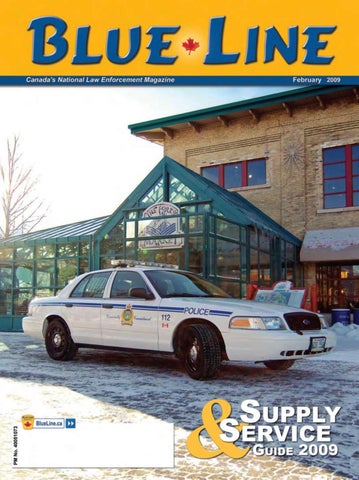
February 2009 Volume 21 Number 2
Having the words “Community Commitment” written on the door of your police car is certainly a good way to reassure citizens where your loyalties lay. Dave Brown, Blue Line feature writer and all round good guy, supplied this month’s cover shot of a Winnipeg police car at “The Forks” on a sunny winter day. Dave’s story on page 6 describes some new initiatives designed to free up officers so they can establish closer links with the citizens of Winnipeg.
Features 6
Winnipeg Police change for the better
16 Safe communities & a secure Ontario
8 Surveillence
35 Supply and Service Guide 2009
Techniques of foot surveillence
50 Inclusion is the key 12 Demanding a transformative experience in leadership studies
Innovative program keeps watch over sex offenders
Making decisions at both ends of the spectrum
Departments
Case Law
62 62 60 18 21 28 60 61 48, 52, 53 6 47
56 57 58 59
Advertisers Index Back of Book Blue Pages Deep Blue Dispatches Forensic Science Letters Market Place News Week Odditorials Publisher’s Commentary Technology
Blue Line Magazine
3
Securing evidence a valid search purpose Tip accuracy helps provide reasonable grounds Pot smoke smell supports reasonable suspicion Impairment indicia not to be examined piecemeal
february 2009
Publisher ’s Commentary by Morley Lymburner
Taking advantage of hard times “Anyone can be a good cook if they have lots of butter and cream,” my mother would often say. Her point was that the real test of skill is getting along with cheaper or even no substitutes and still keep everyone coming back for more. Living with less through the dirty thirties and then raising a family through the war years taught her how to prepare for hard times during good times – and take advantage of the benefits of hard times. “There are benefits to hard times?” I hear you ask. Yes indeed there are, and for the most part it does not even require thinking outside that proverbial box. It’s just a matter of understanding wants, needs and sources and persuading bean counters that the time is ripe to get things done. For the past several years many police services have been badgered by the seemingly insurmountable problem of staff depletion, recruitment and career competitions that siphoned off potential candidates. With the large number of layoffs in many sectors and regions across the country comes a prime opportunity to hire new members. Not only does this worker pool come with the much vaunted “life experiences,” they have a wide variety of occupational skills and interests which can greatly broaden your agency’s capabilities. These workers come with community values and understandings that would enhance your agency’s insights in many ways. Government infrastructure investment is a big advantage during recessions. In past make-work projects governments supplied wholesale work for as many people as possible. During the 1930s this translated into building dams, hydro-electric projects and highways. In 1931, Toronto’s Maple Leaf Gardens was constructed in only five months using a large number of unemployed workers. To this day it is considered to be an unparalleled accomplishment that could never have been achieved during good times.
Blue Line Magazine
The post-war challenge of millions of de mobbed soldiers saw Canada and the US build super highways and the St.Lawrence Seaway system as a means of temporarily employing a large and relatively unskilled work force. Many Canadian expressways and the United States Interstate highway system were built during this period. The skills these workers learned was a side benefit, benefiting the nation greatly during the subsequent good years. Unfortunately, many police agencies lack the creative thinking needed to understand that “infrastructure” does not simply mean roads and projects utilizing the unskilled. Improving infrastructure means getting things repaired, replaced, improved or increased to meet the needs of the community into the future. The builders of the Gardens were looking into a dismal future but built a palace to seat 16,000 potential fans – regardless of whether they immediately had the money to buy a ticket. Government infrastructure money can best be used today to build new police stations using local labour. Keeping many trades people employed locally through hard times is a definite advantage to the community and positions local police as heroes in hard times. It also permits facilities to be built at a lower labour cost and on tighter deadlines than projects commenced in a fast-paced economy. Improving infrastructure can also mean investing in new communications or electronic equipment. In recessionary periods great opportunities exist for purchasing this equipment at bargain prices and obtaining increased servicing and training for your people in its proper application. Improving infrastructure can mean changing the current resource wasting equipment you now possess. Replacing power-eating cathode ray tube (CRT) computer monitors with low energy
5
LCDs or inefficient vehicles with hybrids has far reaching benefits beyond the current recessionary period. Upgrading firing ranges is another cost saving benefit that many police agencies should seriously consider. A modern range installation can bring improvements on many levels, including ventilation systems, construction materials, location, portability and lighting capabilities suitable to practical needs and environmental efficiency. Redesigning or retrofitting range facilities to accommodate paintball or frangible bullets can save money in the long-term. Acquiring video based situational firearms training equipment can make skills enhancement training cheaper and faster. Contracting firearms training with other agencies or using transportable ranges that come to you can save the high expense of travelling and billeting. Purchasing supplies can have an entirely new dynamic during recessionary periods. Choosing the lowest bid need not mean sacrificing quality. Utilizing the increased purchasing power of recessionary periods provides a rare opportunity to stock up on stores supplies. Memo books, trousers, shirts, body armour, footwear, helmets, hats, gloves and even stationary are examples of materials available for less when corporate warehouses are full. Your only concern is finding a place to store it for the future – but hey, how about building that much needed storage room. This month Blue Line Magazine presents its annual Supply and Service Guide. The resources you require lie in the pages ahead.
february 2009
Winnipeg Police change for the better
by Dave Brown A year ago, it may have been difficult for the Winnipeg Police Service (WPS) to fulfill our simple request; a brand new marked cruiser and an officer for an hour or so to photograph against a city landmark for the cover of Blue Line Magazine. Until recently, the agency had become an almost-totally reactive police force. Officers would come to work confronted by calls-for-service queues numbering into the hundreds waiting in the dispatch system and spent their entire shift driving from call to call. There was little time for proactive police work and street officers would almost literally have to drive right by crimes-in-progress to get to the next call. Further confounded by endless paperwork requirements and slow in-car modems, this may not have been the most inspiring time to be a Winnipeg street officer. Now in office for a year, WPS Chief Keith McCaskill has already found some unique and innovative ways to restore morale to this highly respected force, which has proudly served the city’s citizens since 1874. McCaskill took the challenge, listened to his members, identified the problems and didn’t waste any time finding ways to move ahead. It obviously worked. By September 2008, dispatch queues that once reached as high as 300 calls waiting for a response fell to as few as zero. Winnipeg has made real progress. Thus, an early morning phone call from the police this past December; I could have a single-officer report car at my disposal for the next two hours. Where would I like to meet? Taking a bite out of call queues Canadians are perhaps less inclined to subscribe to overly-simplistic platitudes like the ‘broken window’ theory of police work (take care of the small stuff and the big problems take care of themselves) – or perhaps it’s because McCaskill rose through the ranks and has not forgotten his roots. Whatever the reason, the chief, his management team and support staff have obviously tried to tackle problems both big and small in his short time in office. February 2009
McCaskill laid out his new vision for the WPS in May 2008, and there were changes aplenty. Community police service centres were restructured and three smaller locations were shut down. WPS desperately needed uniformed members out on the streets, not sitting behind counters at centres that were increasingly hard to staff. The hours of the eight remaining ‘super’ centres were expanded to allow residents better access. The service’s commitment to citizens and neighbourhoods was strengthened by establishing community support units in each of the six uniform patrol districts. Their role – to build relationships with the community and listen to the residents through highly-visible foot patrols and community events. To reduce the backlog of calls awaiting police response, WPS established what it calls an ‘enhanced response to calls for service.’ This consists of alternative telephone response, where specially trained officers screen certain calls and decide if something other than dispatching a two-officer car to the scene would be a better way to respond. Another innovation, centralized report cars operate city-wide handling break-in reports and other calls that do not require an immediate response. WPS also established a full-time tactical support team to better support both community support units and the officers on the street. This puts highly trained emergency response officers on the scene quicker when serving high-risk search warrants or responding to weapons calls. The existing street crimes unit, which has established an outstanding record of high-risk offender arrests, has been strengthened. Removing members from the need to respond to lengthy call queues allows them to get out on the streets more and do what they are very good at: proper investigations, surveillance and intelligence-gathering on major crimes. The potential payoff from members talking to the public, gathering information and working with community support officers is enormous. Socalled ‘dial-a-drug’ dealers never know when their front door will be kicked in, and it can be enormously gratifying to know it’s going to spoil their whole week. There’s nothing quite as effective as 6
a flashbang tossed through a few front windows to wake up an entire neighbourhood. As one officer reported, when people see the police actually doing something about the drug dens and meth labs on their street, the calls start coming in. Another officer proudly reports that the street price of meth in Winnipeg has now gone through the roof. A better product for the people and a better place to work McCaskill hasn’t forgotten about the many officers and WPS employees who are out there serving the people of Winnipeg. One of his first internal changes was to allow uniformed members to wear winter-issue toques while on duty. He sends out regular communications to every WPS member in a conscious effort to be sure they understand the issues before reading about them in the paper the next day. He also shortened some of the paperwork requirements on minor calls. While everyone acknowledges that there can be no simple solutions to complex problems, there is certainly a more inspired feeling on the streets of Winnipeg today. Certainly, all is not perfect in the city right now and it may take time before residents even catch on to the significance of the changes, but call queues are at their lowest in years; the street price of meth continues to rise; and WPS officers are showing up for work wearing that uniquely Canadian headwear. Anyone who has ever stood in the middle of a windswept intersection (Portage and Main, anyone?) in the middle of a cold prairie winter directing traffic understands that keeping your ears warm is not just a metaphor for a new direction in thinking; it IS a step forward in itself. After all, in our never ending quest for community solutions to complex policing problems, we sometimes forget it is the little things that can go a long way. In a Winnipeg winter, for example, it is all about the toques. Welcome to Canada, eh? Dave Brown is Blue Line Magazine’s Firearms Editor and staff writer. He is a tactical firearms trainer and consultant. He can be reached at firearms@blueline.ca
Blue Line Magazine
Blue Line Magazine
7
february 2009
Surveillance
Techniques of foot surveillance
by Hal Cunningham When foot surveillance is properly executed it tends to separate the average from the exceptional operative. With foot surveillance lost is the false sense of security that a motor vehicle tends to give. It takes the competent operative to show the confidence to maintain observations without detection under these unusual conditions. The techniques of foot surveillance are more important than vehicle surveillance and are essential and must be mastered. Primarily, eye contact must never be made with the target. I’ve passed the target perhaps five or six times during a day and because I’ve acted and dressed properly and avoided eye contact, detection was never made. With the proper confidence in your ability, you would be surprised at how many times during a shift you can get close to your target. Teams are suggested over single person foot surveillance as the number of times you can get close to the target depends on your manpower. Judge the occasions that you follow the target into restaurant, offices or buildings. If you feel that observations inside do not meet your objective and you can ensure his/her exit will be covered securely, do not over expose yourself unnecessarily. If nothing is to be gained, then cover the exit(s) and his vehicle. An old rule, if you have the personnel, is to also cover the vehicle when the target is still in its immediate area. This is a nice insurance policy if he exits another door and goes directly to the vehicle. Observations of the target on foot should always be made from the opposite side of the street. This will allow a wider angle to view his movements and better ability to observe which door he has entered. This angle view will permit an unobstructed view from pedestrian traffic. If the target makes a U-turn or looks over his shoulder, he will observe everyone else but you. Ensure that you watch from a reasonable distance behind the target, depending on the area he is walking in. You must be able to follow into an office building and elevator but not too close should he decide to cross the street. As soon as he enters a building, if it can be executed safely, you will have to run quickly to close the distance. Never let the target see you running. All unusual movements, either on foot or driving, must never be done in the view of the target. While you are making observations from the opposite side of the street, other team February 2009
members will be positioned back of your location, usually out of the target’s view. They will only act as your relief if you have been with him too long or require a change. If he goes into a building you can request the next closest operative follow him inside. You then will fall back or return to your vehicle for vehicle support. Should the target decide to cross the street, you should also cross the street shortly after his movement and resume observations from the opposite side of the street. Excellent observations can be made by entering a store across from the target and standing at least six to ten feet back from the window. Using the same principle as the tinted windows on your vehicle, detection is usually improbable, due to the reflection of light on the exterior of the glass. Consider photographs or video from this location. The store employees might require some explanation for your actions if you are taping or taking photos. If this is a sensitive area that might be close to the target’s home or business, then discreet observations should be made. Any trained operative should be able to fake browsing in a store and making observations at the same time without drawing attention to him or herself. Observations in shopping malls and businesses usually are similar. Pretend to be just another shopper, also there to view the items in stock. Don’t be shy about it, you are playing a part. If it requires you to load your arms or a shopping cart with stock items then do so to ensure you are blending in with others. These items can always be discarded quickly, prior to the cashier, as the target leaves the store. Try to imitate the actions of an experienced store security investigator and make observations while acting like one of the customers. One of my colleagues followed a wallet 8
thief into a grocery store where the suspect was about to steal ladies’ wallets from their carts. The operative entered the store, assessed the action required and identified himself to a young stock boy. I was pushing a half loaded cart trying to blend in when I saw my partner wearing the white jacket from the stock boy and was totally re-arranging the shelf stock. He was able to follow the target anywhere he went. I left the observations to my partner as he totally blended in anywhere in the store. If the target makes a sudden U-turn towards you, do not jump for cover. Most often the best action is to look at something off to the side and continue on by him unnoticed. Any other action can seem too sudden and attract attention to yourself. A lot of shoppers tend to make sudden unexpected turns. The primary thing for foot surveillance to do is relax! Over-hyper agents on foot tend to attract attention to themselves while no one can pick out the target because he is behaving in a sane manner. Take a deep breath and do not commit to much movement. Park yourself and observe everything rather than look like the little duck in the shooting gallery. A formal training program of these techniques will ensure the agent is prepared for this mission. Practice proper foot techniques and with the confidence afforded by the practice you will enjoy the experience. Hal Cunningham is presently a surveillance consultant and trainer who teaches techniques to police officers and private investigators. After 30 years with the Toronto Police Service he retired as a Staff Sergeant and was a member of the elite surveillance unit within the Intelligence Bureau. He has been declared an expert in surveillance and countersurveillance by the courts. Hal will be presenting the classroom portion of his three-day course at the Blue Line Training sessions in 2009. For further inquiries phone 613 398-1113 or email: surv.consultants@sympatico.ca
Blue Line Magazine
Managing threats
&
assessing risks
by Elvin Klassen
Police and mental health workers must often make critical decisions in assessing individuals who may harm themselves or others. They sometimes have to decide in a split second; other times there is time to study the situation and discuss the case with other professionals to prevent violence. The primary goal of the Canadian Association of Threat Assessment Professionals (CATAP) is to assist its members in accurately assessing and effectively managing incidents, including intimate partner violence, stalking, sexual violence, workplace violence, child abuse, gang violence and terrorism. CATAP was formed in 2005 by professionals from law enforcement, academia, mental health and corporate/private security communities. Along with the Vancouver and Calgary police departments, CATAP conducts an annual training course on general, domestic and sexual violence, stalking and mental health disorders. “When an act of violence happens, as in the beheading incident in Manitoba on a Greyhound bus or where Mr. Lee killed his entire family in Oak Bay, the media will often comment that the person just snapped,” says CATAP President and Vancouver Police Department (VPD) Det/Cst Keith Dormond. “That is not the case. There are usually indicators that the person is moving on in a path towards violence. It is important that professionals recognize those risk factors. The goal of CATAP is to look at those different indicators towards acts of violence and make those understandable to police, Crown, health workers and practitioners.” February 2009
Detective/Constable Keith Dormond
Dormond, with the VPD Criminal Harassment Unit, is a former social worker and his 10 year police career has included general patrol, drug enforcement and domestic violence. Along with two other VPD officers, he has prepared a laminated pocket card which helps police review the various risk factors in domestic violence investigations. They are identified by finding answers to questions such as: • Are there separations and has stalking occurred in the relationship? • Are there jealousy or harassment issues? • Is there a history of violence or abuse? • Have there been assaults or threats? • Does the accused own or ever threatened to use a weapon? • Are there children involved and abuse or abduction issues? • Has employment changed? • Is the accused currently before the courts or in violation of a court order? • Is there substance abuse and does violence increase when the accused is abusing? • Are there mental health or suicidal issues? • Are there past indications or plans of violence? • Is the victim isolated, concerned about personal safety and willing to receive help? Once an officer finds answers to these questions, they are in a better position to articulate the risk factors to the Crown, victim, other police, mental health professionals and others in a way that allows the risk to be effectively managed. Risk factors for stalking, domestic violence, general and sexual violence are dealt with in detail in various resource materials available to CATAP members. CATAP’s American affiliate, the Asso10
ciation of Threat Assessment Professionals (ATAP), was formed in 1992 and is one of the first organizations of its type. There are also similar groups in Europe. Dormond emphasizes the value of being able to connect with counterparts in other countries, citing an example where a US suspect threatened a Vancouver resident on family court issues. By contacting an officer in the suspect’s state who was familiar with ATAP, police were able to discuss the risk factors, make an assessment and manage the risks. Threat charges were laid, an arrest warrant issued and border officials notified. The individual was arrested months later while attempting to cross the border. “By being a member of these organizations it makes it a lot easier to work across the various jurisdictions,” Dormond says. “There is a real benefit to increasing the membership. There are about 100 members of CATAP in Canada and becoming a member in Canada also makes you a member of ATAP.” In another example, a US officer and ATAP member called from the US Supreme Court to say police had a last name and birth date of someone who had threatened a prominent official. Membership in the same organizations promoted understanding and communication; the person issuing the threats was quickly identified as a chronic stalker from computer files. In addition, the integrated threat assessment unit and BC Sheriff Services, who are also CATAP members, shared a file they had on the subject, which included crucial threat assessment information, with US officers. “This is a good example of where rather than being reactive and wait for the offence to occur, law enforcement officers can be proacBlue Line Magazine
tive in preventing problems from happening,” explains Dr. Stephen Hart, a CATAP director and professor of forensic psychology at Simon Fraser University. “Success is not measured by having an arrest and a conviction but whether people are safe. This is a consistent philosophy with ATAP and CATAP. It is all about potential problems going away.” In another case, a security officer saw a person write about homicidal and suicidal issues, became suspicious and contacted authorities. Using the information presented, police were able to help the subject and avoid further problems from developing through threat assessment and risk management. Dormond emphasizes that the more people pick up risk factors and relay that information to the police, the more successful we will be in decreasing violence. CATAP is forging relationships with criminal justice professionals. For example, as more Crown officials attend the threat assessment training and join the association, they see the benefits. They also become more open to presenting threat assessment documents in court or having police officers declared as expert witnesses to explain an individual’s risk of carrying out violence against the victim, general public or themselves. An unfamiliarity with threat assessment has sometimes contributed to courts not being entirely receptive to police based threat assessments. Annual training sessions are held to assist with managing threat and assessing risk in
Blue Line Magazine
Above: www.catap.org; Right: Detective/Constable Keith Dormond with Dr. Stephen Hart. the field, Dormond says. About 80 per cent of participants are police; the other 20 per cent includes Crowns, security officers, school liaison workers, the private sector and health care workers. “One of the advantages of attending a CATAP conference is that people become familiar with threat assessment and continue to connect with each other and problem solving,” notes Hart, one of the key organizers of the annual conferences. The annual five day threat assessment and risk management course, hosted by the VPD and CATAP, consists of training in mental health disorders, general violence, intimate partner violence, stalking and sexual violence. Case studies, lectures and practical exercises are used as training tools. The next
11
course runs Feb. 23-27. Another training opportunity, designed to assist people with continuing education and networking opportunities, runs March 30 - April 1. This conference is designed for people that have already been through the basics. “We want to prevent violence and destroy the myth that people just snap,” notes Dormond. “There are usually signs that people are moving along the path towards violence and through threat assessment training, I am trying to help people pick up those signs. The more people aware of this the better, because we can prevent violence.” Visit www.catap.org or contact Keith Dormond at keith. dormond@vpd.ca for more information.
february 2009
Demanding a transformative experience in
leadership studies Making decisions at both ends of the spectrum by Anil Anand Leadership has drawn the attention of many behavioral researchers and theorists. Schools of thought range from viewing it as a science to regarding it as a learned trait. These designations have their basis in psychological research, management theories, behavioral science and social research. Acclaimed researchers and teachers continue to struggle with teaching leadership, often in pitifully little time, relying on motion pictures rather than attempting to struggle with the amorphous capacity of leadership themselves. The reality is that a concrete definition of leadership continues to elude the efforts of even the most well intentioned teacher. Many leadership courses, the new vogue in police studies, easily prey on the imagination of those seeking career advancement and self-actualization. In the end these courses cannot alter the reality that leadership is not restricted to certain groups or the reality that different members
February 2009
will emerge as leaders in different situations in response to their ability, credentials, proven expertise, range of contacts and charisma. Police tactical unit members will attest to the fact that neither rank nor credentials alone identify a team leader. They often defy traditional structures prescribed by organizations. A police chief, general, operating room surgeon or CEO, despite their organizations collective efforts to identify the best leader, are not necessarily successful leaders. While leadership courses tend to imply focus on the capacity of supervisors, senior officers and police managers decisions made at other organizational levels (civilian and uniform) are also important – and they may have profound effects on police performance, crime control and quality of service to the community. The reality is that the largest number of officers, those with the lowest pay and status, make some of the most important decisions imaginable. They restrict freedom and use various levels of force, up to and including taking life. When making these decisions, they operate with a great deal of discretion; supervisors are rarely present, time is usually of the essence and policies and procedures rarely provide exhaustive guidance. Of all the decisions made in police organizations, those at street-level are often the most dramatic, can have the most immediate impact and may have far-reaching consequences for citizens and their organizations alike. These individuals, on a daily basis, exhibit discretion, exercise power, effect persuasion and influence change. Decisions made by front line officers include: 1. Decide whether and how to intervene in suspicious circumstances (ignore a situation, inquire casually, formal investigation, employ force or adopt another alternative). 2. Having intervened, they must choose a disposition (arrest, summons, referral to another agency/diversion to social service, 12
mental health, juvenile services, mediation, warning or doing nothing). 3. Having arrested a person, officers may have discretion in booking and charging the suspect (release without charge, determining appropriate charge, deciding how thoroughly to search a person and their effects and determining whether the person is recommended for continued detention or show cause). 4. Patrol officers and detectives have discretion when deciding how thoroughly to investigate an incident and what methods to employ. 5. When responding to an emergency call or pursuing a traffic or criminal violator, officers decide how fast to drive and whether to violate normal traffic laws and safety rules. These decisions may affect the likelihood of apprehending a violator or taking effective action at the emergency scene. They certainly affect the safety of police, violators, other motorists, passengers and pedestrians. 6. When intervening in suspicious circumstances, disorderly situations and crimes in progress, officers decide whether to use force and how much to use. 7. W hile on self-directed patrol, officers choose how to utilize their available time. Some drive constantly while others park. Some seek out trouble spots, while others avoid trouble. Some emphasize traffic enforcement while others focus on preventing property crimes or drug offences. 8. Officers make a variety of other decisions that are not trivial to the people involved, such as whether to: ticket, warn or ignore a parking or traffic violation; tow an improperly parked vehicle; contact the media to report an arrest or accident; arrest in response to a computer hit that may be invalid; seize property only tangentially related to a crime under investigation. Furthermore, front line officers make decisions at both ends of the leadership spectrum: with actions at the most mundane level of Blue Line Magazine
detail but also with ideas at the higher levels of abstraction – being sensitive and responding to new organizational patterns, adjusting to rapidly changing social patterns, changing demographics, mobilizing communities and having to handle an ever increasing and diverse range of social problems. Front line officers are also charged with ensuring that constitutional guarantees of free speech, due process and freedom from unreasonable search and seizure are protected. They must also appreciate the need for various systems in ensuring accountability and be knowledgeable about the legislative process and functioning of the criminal justice system. They must be informed about different categories of deviant conduct, the range of behavioral problems of concern to police and the various political and social dynamics of increasingly diverse and often fragmented communities. This capacity, often underestimated, is the essential for the bottom up leadership that can and must be part of every organization’s development and success. It has become fashionable in recent years to ascribe every possible kind of organizational malady to faulty communication or gaps and promote leadership as a front end activity. Although it’s rarely recognized, leadership is often a result of the push from behind as much as a pull from the front, yet leadership studies continue to be individual-centric and focused on the heads or organizations. Too much focus has therefore been directed at attempting to isolate the common elements which define leadership. This dis-
Blue Line Magazine
tilling has lead to a myopic view which tends to present leadership as an ability defined by a common set of characteristics, some replicable and others learnable. This neglects a larger component of the characteristics and personalities of leaders, which far from being common are distinct and sometimes even contradictory. Focusing so intently on the common traits has diminished if not failed to take into account the complexity and effect of diversity on good leadership which, should not be defined by imitation but innovation. What this formulaic approach has done is create a generation of leaders who have tried to replicate leadership based on the experiences, traits and formulas of their contemporaries. This is particularly evident within corporate management and politics. Leadership has therefore increasingly become an outcome of contemporary groupthink. There is a clear danger in the formulaic training of the next generation of leaders. They are being taught using the same principles, mistakes and most significantly, ways of viewing the world as their classical counterparts. Leadership cannot be defined by any set of stagnant characteristics, no matter how effective they may be in any one situation or circumstance. Instead it must always be viewed as the capacity for integrative thinking, which changes and balances with time and circumstance. One need not look too far to see the potential consequences of monolithic thinking. The present financial crisis faced by the banking industry is
13
precisely due to the type of monolithic thinking about leadership that has lead so many experienced corporate managers to fail so dismally. Contemporary social psychology indicates that failure cannot always be attributed simply to inherent lack of ability or incompetence. Some causes may have their roots in stereotypes or preconceptions that others hold about the group to which one belongs. The social psychological research from which this idea emerges looks at how people see themselves as members of a particular group and what the implications of this are. It examines not only how we take on (internalize) and live out (externalize) identities that are shared with our peers (other members of our intergroup), but also how these implications can change. This type of research is a powerful indicator of the influence of organizational members on the individual’s self-construct, even those who are so-called leaders. There is a danger in over emphasizing the influence of a single person in effecting the outcome of an entire group. Leadership theories rarely take into account how groups produce leadership; on the contrary leadership continues for the most part to be viewed exclusively as a front end phenomenon. It is not universal and, in fact, is often if not always decided by the group – the group’s collective influence on the individual counterparts that in turn lift a person’s performance to the status of leadership. This contemporary overemphasis on individual leadership has been exhibited in the exorbitant salaries claimed by CEOs of major companies even when their corporate values plummet.
february 2009
Richard Fuld Jr of Lehman Brothers reportedly made $34 million in 2007 and an additional $490 million from selling company stock, which was followed by the company filing for bankruptcy in 2008. Stan O’Neil, the former Merrill Lynch CEO who helped drive the company into collapse, was given a “golden parachtute” worth over $160 million when he left in 2007. Martin Sullivan received $14 million in compensation from AIG in 2007; the company was subject to a federal bailed out to the tune of over $85 billion in 2008. If these leaders were merely selfcentered failures, there were those who were outrightly criminal. WorldCom CEO Bernard Ebbers elevated the company to an enormously profitable position during its prime as America’s long distance giant. Ebbers was later found to be the mastermind behind an $11 billion accounting fraud (the largest bankruptcy at the time in the U.S.) and subsequently sentenced to 25 years in federal prison. Most recently, Bernard Madoff, who served for over four decades as a trader and chair of Nasdaq, is now charged with the largest securities fraud in history, having bilked investors of upwards of $50 billion. In each of these cases the fallen CEOs were, by most industry experts’opinions, eminently qualified leaders worth unfettered trust and disproportionately large compensation packages. History is replete with instances of failed or corrupt but nonetheless remarkable leaders who, despite their abilities to achieve objective goals, have in the rear view of history, come to represent some of the darkest periods of humanity. Pol Pot, Pinochet and Saddam Hussein all emerged
February 2009
as leaders through the collective support of their citizens. Where then was the leadership failure? It has resulted, at least in great part, due to leadership being misinterpreted as the front-end activity of single individuals who are perceived to possess quantifiable traits and then attempt to replicate leadership based on the objectification of leadership qualities. The failure in leadership noted above wasn’t as much an individual failure as a failure of the collective will of the so called ‘followers’ of these ‘leaders.’ Although much reflection has been focused on the consequences and influences of such leaders, very little focus has been directed at determining why the collective wisdom of citizenry thrust such inept or evil minded men into leadership. Leadership in many classical societies wasn’t the outcome of ‘individual emergent leadership’ as much as the product of the lineal passing on of responsibility. Lineal legitimacy ascribed by the members of a group (society) that decided how lineal inheritances would determine royal ascent. Papacies and monarchs, as much as family empires and tribal chieftainships, have thus successfully lead their organizations and empires through remarkable successes; all through the group’s collective determination of leadership rather than through a Darwinian ascent of the strongest. Therefor it is important that individual members of social groups develop the collective wisom, intellect and expertise necessary to identify the challenges that their leaders must be able to handle. The quality of the leadership therefore implicitly depends on the collective
14
capacity of the social group to decide how they determine leadership. Successful organizations and societies will therefore not be characterized as much by their ability to define individual leadership as through the collective capacity of their members to drive appropriate leadership. In adapting the words of John F. Kennedy, ask not how your leader can lead you, ask how you can determine your leadership. The collective capacity of the social members is therefore critical in determining leadership – as critical as individual ability, if not more. This distinction is finely nuanced and may be difficult to distinguish. It may therefore appear that regardless of a group’s capacity to select a leader, the selected individual must first make themself sufficiently noticed. But there have been some notable leaders whose vision was simply beyond the collective abilities of their contemporaries to understand or accept. Copernicus’ vision, for example, was so alien that the collective wisdom of his contemporaries was incapable of recognizing it. One of the reasons why followers, even the most educated and experienced observers, fall to the victimization of false leadership lies in our universal inclination to belong to a team. Almost every society teaches its citizens to develop a sense of collective, loyalty and team spirit. The inclination for this groupthink, essential to the collective security and, in some instances, existence of social organizations, is the very Achilles heel that leads to blind sided victimization by false leaders, even though in hindsight they seem so clear and unbelievable. In most cases the folly of false leadership is uncovered either by the non-conformist, or after the collective awareness of the followers is elevated to a vantage point from where previously tolerated incompetencies or misconduct is no longer an acceptable norm. Slavery and the mistreatment of indigenous peoples are two examples of how collective social development have changed how previously valued norms by mobilizing the collective conscience of societies. While individuals like Abraham Lincoln and Martin Luther King Jr were arguably the catalysts for change, such arguments fail to accept that even they first needed to be accepted and promoted as being representative of the communities they advocated. To use a more contemporary example, Barack Obama, despite his personal charisma and demonstrated leadership traits, would not likely have been thrust into a position of a contender for president 30 years ago. In Obama’s own words, change would simply not have been possible without the mobilization and support of his followers – the lack of which, despite his abilities, would not likely have identified him as a leadership candidate. While some ideas about leadership have already undergone dramatic shifts in thinking – including the classic notion of IQ versus EQ, these changes are subject to tremendous resistance. The true leadership failure can not simply be ascribed to the individual but also at least equally and perhaps even more to the collective conscience of those who supported the thrust of the individual in the first place. Individuals have a constituent responsibility to monitor and direct the leadership, not only Blue Line Magazine
through the selection process but far beyond and until the leader is reassigned. This is a central concept to the notion of a civil society – the democratic right of citizens to choose and replace their leader. Therefore there is a transformational imperative, both on effective leadership but also on those civil institutions, to advance the collective ability of organizations and societies to define leadership. The real question is not how the business Ebbers, Madoff and the others maneuvered into such prominence as corporate leaders, or how each of them strayed from corporate commitment to personal greed. Rather the question about their leadership should focus on factors that so effectively contributed to the collective inability of industry experts, co-workers and share holders to allow such inept leadership to thrive despite what should have been glaring concerns. The custodian of collective norms, after all, resides with the constituent and not the individual leader; failure in leadership is a failure of the collective organism, not just the head. Leadership must be determined, defined and communicated both top down and down up. Good police leadership recognizes the importance and role of the frontline officer as leader. Without this, police managers risk continuing to preserve the status quo and enshrine dated practices and values. Elitist values that persist on defining leadership based on traits or behavior disregard the best evidence that has consistently demonstrated the value of consultative processes. Good leadership recognizes that it cannot be conscripted to a single behaviour, trait, individual or office but must instead rely on the collective
Blue Line Magazine
wisdom of the entire organization. Everyone from front line officers to sergeants, senior officers and civilian members must appreciate that organizational leadership is defined and gauged by the depth and breadth of the collective consultative participation of all members – not the autocratic, democratic, bureaucratic, participative or any other trait or capacity of any one single person. One of education’s goals is to refine the analytical qualities of an individual. Leadership courses designed with the intent of solely advancing values consistent with prescribed policing objectives – a malady particularly significant when a single institution becomes the sole disseminator of a pedagogy – fail to respect the capacity, ability and requirements of police professionals to accept the challenges which can only be provided through integrative education. Good pedagogical experience derives its strength from inquiry, challenge, variety and most importantly, integrative thinking. Roger Martin, Dean of the Rotman School of Management at the University of Toronto, notes that best practices can help in some instances, however that also poses a danger. It leads to a tendency to imitate the actions and processes of other leaders who, despite all apparent similarities, were likely dealing with an entirely different set of influences – and because each situation is distinct, such leadership training is prone to failure. Instead of focusing on what exceptional leaders do, we need to understand and emulate how they think. Integrative thinking, as Martin calls it – creatively resolving the tension in
15
opposing models by forming entirely new and superior ones. Michael Lee-Chin, perhaps one of Canada’s preeminent leaders, identifies the ability to produce integrative thinking as one of the most significant processes in leadership development. Lee-Chin describes this as “the predisposition and the capacity to hold two diametrically opposed ideas in their heads; and then, without panicking or simply settling for one alternative or the other, they are able to produce a synthesis that is superior to either opposing idea.” Students of leadership must not be lulled into believing that any single course of study alone qualifies them to become better leaders, nor fall victim to the type of self-confidence in a singular approach that has lead so many of today’s bank chief executives to the brink of collapse. Police educators and institutions engaged in the academic training of law enforcement professionals have an ethical responsibility to promote the training of the “opposable mind” – a mind which becomes capable of holding conflicting ideas and then uses the tension to think through to new and superior ideas – ideas such as promoting leadership as a bottom up process, despite the classical view of it as something that resides at the top. Leadership must be demonstrated through innovation, not imitation. Anil Anand, B.P.H.E., LLM, MBA (Can.), is with the Toronto Police Service and has more than 20 years of policing experience, including assignments to Interpol, national and international investigations, intelligence operations, and corporate risk management. Contact him at Anil.Anand@torontopolice.on.ca.
february 2009
Safe communities
&
a secure Ontario
Part 1 of 7 The rich 100-year history of the Ontario Provincial Police (OPP) lies in large part with those who are or were in the field; constables, corporals, sergeants and staff sergeants. They have made the OPP known and respected throughout the world, assisting the public, investigating traffic collisions and criminal occurrences, guiding errant youth and putting their lives on the line each day without question. The OPP is one of North America’s largest deployed police services, with more than 5,400 uniformed officers, 2,000 civilian employees and 850 auxiliary officers focused on the organization’s dual priorities of safe communities and a secure Ontario. The OPP maintains some 163 local detachment and satellite offices throughout the province – and that doesn’t include its general headquarters, five regional headquarters and the Highway Safety division. The entire organization places a significant emphasis on services related to community-level policing and traffic safety. Individual members work collaboratively with municipal leaders, police services boards, community policing advisory committees and community groups to deliver front-line municipal and First Nations’ policing services. It all began on October 13, 1909, when February 2009
a provincial order-in-council decreed the establishment of the “Ontario Provincial Police Force” – a permanent force of salaried police constables. The headquarters was established at Queen’s Park in Toronto, with divisional offices in Niagara Falls and the mining boomtown of Cobalt. During these early years, many worked in single officer detachments without benefit of telephone, radio communications or even motor vehicles. In the north, rail was the most common form of transportation for both people, cargo and mail. The successive appointments in the 1920s of two military men to commissioner defined the character of the new and expanding organization, with standing orders, badge numbers and military style uniforms and insignia. In 1930, personnel from the public highways department joined the OPP Motorcycle Patrol. By 1941, Ontario’s increasingly busy highways dictated the introduction of marked patrol cars – creating the indelible link between black and white cruiser and patrol officer. The OPPs launched the largest and most modern police radio system in Canada during the 1950s, heralding a new era in communications. By 1956, 75 per cent of members were concentrated on traffic related enforcement, reflecting a significant increase in cars and the roads necessary to accommodate them. What followed was a period of rapid growth 16
through fleet modernization, diversity and the training and expertise required to utilize them. Open-minded innovation has been a hallmark of the OPP. In 1965, it became the first Canadian police service to commence traffic law enforcement by air. Shortly thereafter, it began employing scuba equipment and using snow vehicles in the north. It was also instrumental in developing the first laser used for forensic identification. In 1974 the OPP broke the male dominated culture of policing by hiring the first women for uniform patrol duty; just over 20 years later, the first female commissioner was appointed. Being a police service of choice for over 11 million Ontarians, the OPP provides a supportive infrastructure backup for all other police services in the province. It has also become a significant policing resource reaching across the country and around the world. Members are in constant demand as special investigators and trainers by other provinces and countries. The OPP has always reached out to make improvements in telecommunications and computer technology. The 9-11 terrorist attacks had a significant impact on its proactive and reactive response to emergency situations. Creating the Provincial Emergency Response Team (PERT) in 2001, the Blue Line Magazine
Provincial Anti-Terrorism Section (PATS) in 2002 and the OPP Security Service at Queen’s Park (2003) positioned the OPP as a leader in emergency management. The Highway Safety Division was introduced in 2005, with a focus on reducing motor vehicle collision injuries and fatalities. LED light bars were installed on cruisers in 2006 to increase visibility and enhance officer safety. 2009 is not only a celebration of the past; it also continues a commitment to excellence in policing throughout the next century. Commissioner Julian Fantino was sworn in as the OPP’s 13th leader in 2006. His appointment brought with it a host of firsts and a new direction for the future. The development and evolution of the Ontario Provincial Police since 1909 has created a story of vast proportions. There are no policing styles and functions the agency hasn’t experienced or explored. No single article or even book could completely encompass the story of a police service which spans such a great distance, time and diversity. In recognition of the OPP’s 100th anniversary, Blue Line Magazine will be presenting a series of articles as both a testament to its past and encouragement to other police agencies as they move into the future. Opposite: Early Group Shot Motorcycle Patrol; Above: motorcycle patrol in winter uniform with bikes c1930s; Left: Lawrence & Clark with patrol car. Photos from Ontario Provincial Police Museum
Blue Line Magazine
17
february 2009
Deep Blue by Dorothy Cotton
Sorting the wheat from the chaff There is nothing like a retirement party to make you look back over your career and cringe. I recently attended a party for a former co-worker. The retiree reminded me of one patient we had both worked with many years ago, a very difficult young woman with many complex problems. Her case now makes me cringe, because if I knew then what I know now, I would have dealt with her in an entirely different way. Ah, there is nothing like hindsight. I did all the kinds of things that we then thought were helpful for people with the kinds of problems she had. Turns out, to cut to the chase, we were wrong about much of it. Subsequent research showed some of the things we were doing were not helpful, and might even have been harmful. Today, we do things very differently. When I think back to that time, I realize I and others fell victim to the lure of “pseudoscience.” There are techniques or findings that sound, on the surface, like they are correct, scientific and proven – but when you look a little more closely, it turns out the evidence is just not there. Sometimes this is because a technique or approach is new and there hasn’t been time to accumulate data to support or deny its effectiveness. Other times, it is because someone is trying very hard to “sell” us a technique – or we have not done our homework and are happy to simply take someone else’s word that a technique works. The October, 2008 issue of the journal Criminal Justice and Behavior is entirely about the problem of pseudoscience in policing. I encourage all of you to rush off to your local university library and check out this issue – or get your local public library to track it down for you. It is a very informative look at the problem of how easy it is to believe in processes which just don’t work. Some of the articles talk about obviously
seriously flawed techniques, like using hypnotists or psychics or conducting a personality assessment through handwriting analysis. Other articles talk about areas which are more hotly contested – various aspects of profiling, critical incident debriefing and use of polygraphs and anatomically correct dolls. There are some techniques we use simply because we are kind of stuck for an alternative. I suspect we all know eyewitness testimony is singularly unreliable, but when it’s all you have and there is a lot of pressure to solve a high profile case – well, perhaps that’s why eyewitness testimony is the major culprit in false convictions. The problem, of course, is to figure out what techniques work, which are the flavour of the month and which are maintained simply because “we’ve always done it that way.” One of the articles in this journal (by Scott Lilienfeld and Kristin Landfield at Emory University) provides some key concepts to consider when we are trying to sort the wheat from the chaff. How do you know when a theory or technique is just not all that it is cracked up to be? Here are some hints: • The theory or process is described in such a way that you really cannot test it and prove or disprove it. The authors give as an example the belief that fingerprint analysis is 100 per cent accurate. There is no way of knowing this unless you test every person and fingerprint technician on the planet. That’s not likely to happen, thus it is impossible to really know what the limits of fingerprint analysis accuracy really are. We know it is pretty good – but is that enough? • The proponents avoid peer review. This is when you give your research to an informed but disinterested party and let them form an opinion. Many pseudoscientific processes are viewed as
top secret and the advocates don’t let anyone else near them. If all the research on a certain product or process comes from the people who developed it, you might want to be cautious. If the product developers ignore the results of peer review and consistently discount the results as flawed, again – you might want to stop and think. • The theory or process does not evolve or self correct: lets face it – no one ever gets things right the first time. If an idea just stays in its original form without adapting to new knowledge, it seems likely that the product is not actually based on knowledge. • Confirmation bias: do the proponents only see what they want to see? You can always find examples to support your cause – but you have to also look at the examples that do not support it. I am reminded of the comment that “pickles are lethal because everyone who ate a pickle in 1850 is now dead.” That sounds like a pretty conclusive piece of evidence! The problem is that it ignores the fact that everyone who did not eat pickles in 1850 are also dead and that people who eat pickles today are alive. • I s there real evidence or just testimonials? Anecdotal reports of good results can be a good starting point for research in a new area – but if research never gets past that, the technique remains unproven. Anecdotal evidence is really persuasive on an individual basis. If you ask enough psychics where a body is buried, sooner or later one of them is going to be correct – especially given what they can learn about a case by reading the newspaper and good guesswork. • “We’ve done it this way forever”… they call this the ‘ad antequitem fallacy.’ In my field people sometimes tell me they do something a certain way because that’s what they learned in graduate school. If you went to school in the past five years I might buy this, but the fact is that we don’t analyze bumps on heads or perform bloodletting any more, even though once upon a time we were sure they were the answer. Wherever there are unanswered questions, there are people happy to fill the void with impressive sounding techniques and solutions. In my field, it means a new kind of therapy or medication on the market every week. In your field, it means people cooking up new ways to analyze evidence, interview suspects and detect liars each week. Some of these new techniques are good – and some come complete with Florida swamp land. Your job is to figure out which is which. Dr. Dorothy Cotton is Blue Line’s psychology columnist, she can be reached at deepblue@blueline.ca
February 2009
18
Blue Line Magazine
Fetching designs
for working dogs
Wearing the Ryerson-designed Canine Remote Deployment System, Urban Search and Rescue (USAR) dog Dare digs through rubble at a training site. Photo Natalie Ann Comeau
by Heather Kearney Search and rescue dogs are surrounded by dangerous debris when working a disaster scene, which is why the US Federal Emergency Management Agency (FEMA) requires them to work ‘naked’ – without a collar or harness. The OPP, on the other hand, routinely outfits its dogs with the Ryerson-developed Canine Augmentation Technology (CAT), a sensory feedback system that provides critical information to handlers and rescue teams. In order to safely and effectively affix the CAT system to the dogs in a way that might lead FEMA to approve the technology, Ryerson Computer Science researchers turned to their colleagues in the School of Fashion to engineer a solution. When fashion professor Lucia Dell’Agnese came on board, CAT and the Canine Remote Deployment System (CRDS) – two search and rescue technologies – were functional and revolutionary, but essentially a jumble of exposed wires and hardware haphazardly strapped to the dog. Invented by Dr. Alex Ferworn and his team, the original setup was potentially dangerous, with dangling elements that could get caught on debris. It also proved problematic if the dogs shook in an attempt to shed the gadgets. Primary design considerations were the safety and comfort of the dog and its handler, including the need for an emergency self-release mechanism and protection for the audio visual equipment and transmitters. Secondarily, Dell’Agnese was concerned with creating a design that could be adjusted to fit the various sizes of the different breeds used as search and rescue dogs. The durability and breathability of the fabric were also considered. “It was definitely a design challenge to come up with something that was comfortable, safe and that worked for the technology as well as the dogs,” said Dell’Agnese. “I also wanted the harness to be stylish and professional, giving the garment and the technology the credibility to stand alongside the OPP uniform. We field-tested the final design Blue Line Magazine
at a training exercise in Florida and the handlers were very happy with them, but most importantly, the dogs loved them.” The final product was a fabric harness that fits close to the body, hides all the loose parts, but exposes the cameras, lights and other technology through protective plexiglass domes. It features two key innovations: a magnetic self-release mechanism and an adjustable zipper system. There are four sets of magnets embedded in the fabric, placed strategically around the garment so that if the dog struggles, the magnets will come unlatched, releasing them from the harness. Each harness fits three different sizes thanks to an ingenious zipper application: three left-side sets of teeth are sewn in about an inch apart and any one of them can be zipped up with the slider on the right-side teeth. Manufactured by Dell’Agnese at home with her semi-industrial sewing machine, the harnesses don’t interfere with the search dogs’ tasks, so there is no argument against it according to FEMA guidelines. Armed with this, Ferworn and his team hope to get the device FEMA approved so the OPP dogs can also work in the US. Dell’Agnese has signed on to work on Ferworn’s next canine projects. Canine Brain Function, the current work, measures blood oxygenation levels in working dogs to examine their thoughts and experiences while on the job. Dell’Agnese’s contribution will be to devise a comfortable garment to secure the sensor technology to the dog’s head. The next project, Canine Pose, requires another garment to accommodate a set of accelerometers and a wireless signalling system to enable a pose analysis of the dog when it finds a trapped person. Dell’Agnese’s research is done in conjunction with Ryerson’s Network-Centric Applied Research Team (N-CART), lead by associate professor Ferworn in the department of computer science. Contact Heather Kearney (hkearney@ryerson.ca) for more information.
19
february 2009
Mounties help
“half-way around the world”
Barter surrounded by children in the small village of Samalai, where he handed out candy, pencils and balloons that he brought with him from Canada.
by Danette Dooley For the first time in 23 years, Harold Barter didn’t spend Christmas with his wife and children. The Newfoundland-based corporal is one of five Canadian RCMP officers deployed to Timor Leste (East Timor). The UN currently has upwards of 1,000 officers in the country, including Barter and his Canadian colleagues, who are helping rebuild by restructuring and monitoring the local police force. The mission came about as a result of internal strife and fighting that began around 1999, when the country gained its independence from Indonesia, Barter says via e-mail. The current UN mission started in 2006 when the country’s armies and police forces were fighting against each other and the country had regressed “to a lawless state,” he adds. “We work alongside the local police… mentoring and monitoring their work in order to develop their skills as police officers in all lines of work, everything from street patrols, major crime, vulnerable persons unit, task force (and) forensic identification,” Barter says. Barter is originally from Stephenville Crossing, Newfoundland and grew up in Labrador City. He joined the RCMP in 1993 after working as a provincial wildlife conservation officer for several years. He and his family live in Gander, Newfoundland where he is stationed at the enforcement section of the RCMP’s border integrity unit. He arrived in Timor Leste last August and will be there until May 1, 2009. “We all live in the communities that we February 2009
Barter at the Lalaei police station. The statue is the Island of East Timor sitting atop the fake skulls – supposedly representing the country being held up and looked after by long past ancestors.
serve, which helps us understand the people and their culture,” he says. Officers assist the communities through various projects such as the one Barter and four colleagues were recently involved in at an orphanage in the eastern part of Dili, Timor Leste’s capital city. There are currently 53 children in the orphanage, which is run by a Catholic order of nuns. The children come from various family situations, such as single parent homes where the parent cannot afford to feed them, or when both parents are deceased. The orphanage relies on the Catholic Church, as well as donations from the community and various non-government organizations to survive, Barter says. “The children are fed and housed at the orphanage and are expected to attend school. They are all part of the orphanage choir and some members have learned to play various instruments such as guitar and drums.” The RCMP officers raised $300 to help one particular young man who grew up in the orphanage. Rogerio Alves is 22 years old and now studying to become a Catholic priest. The sixth oldest of 13 children, he and three younger siblings were brought to the orphanage when Rogerio was seven years old. His parents were poor and couldn’t provide for so many children, Barter says. “They only see their parents once every one or two years,” he notes. Barter says Rogerio’s parents are proud that he’s completed high school and hope he does well as a priest. “He has always wanted to be a Catholic 20
priest and he wants to come back and help the people in Timor Leste, to give back to the church and his community,” Barter says. Part of Rogerio’s studies requires him to travel out of Timor Leste to the Philippine capital city of Manila. “While in Manila, he will undergo testing to determine if he can fulfill his dream. Once he passes the test, he will then undergo seminary training in Manila, which will be sponsored by the Catholic Church.” The money the RCMP members raised will help Rogerio buy his ticket to Manila and have a little spending money. Rogerio wasn’t the only one grateful for the donation, Barter says. “The orphanage hosted us as an appreciation for our donation. The choir and small band played music and sang songs for us. There was tea and biscuits for everyone and at the end, all of the children shook our hands and thanked us for our kindness. They were very happy that we had visited their orphanage and took the time to sit and listen to them,” Barter says. While there are many things about his home province that Barter missed at Christmas, including his family, friends and outdoor snow sports, his time in Timor Leste is proving to be rewarding, he says, especially when you can touch the life of a young man like Rogerio. “Canadians can make a difference, even if it’s half-way around the world,” he says. Danette Dooley is Blue Line’s East Coast correspondent. She can be reached at dooley@blueline.ca
Blue Line Magazine
21
february 2009
Investigative Interviewing April 28 or 29, Fee: $225 + GST This one day course, offered both days of the Blue Line Trade Show examines how to detect a liar every time by analyzing their verbal responses. Liars are frequently caught through their own verbal mistakes. You will learn: Five key words that liars use in their speech; three words that tell you a liar has left something out; One thing liars always do on paper or in person, and how to turn it around on them; How to look at a statement and know deception is taking place; Two key phrases that signal a liar is skipping over critical or sensitive information. Instructor: S/Sgt Gord MacKinnon (retired) with thirty years in law enforcement, has experience in a multitude of areas including criminal investigation, underwater search and recovery, fraud investigation and , Intelligence. Gord is an acclaimed lecturer in the techniques of investigative interviewing and is author of the book Investigative Interviewing. Instructor: A/Sgt Wayne van der Laan (retired) has 20 years experience in law enforcement that includes service in Criminal Investigation Unit, Public Order Unit, Break and Enter Unit and Auto Squad. Wayne holds a Bachelor of Commerce and a Masters Degree from the University of Guelph.
Frontline Policing: Case Law April 28 or 29, Fee: $225 + GST A unique one-day course designed specifically for front-line officers will use scenario-based self-directed-learning and reality-based group case study discussion focusing on rapid decision-making, critical thinking, and problem-solving. Topics include: 911/Distress calls and related entry and search authorities; “Common-law exigent circumstances” (CLEC) warrantless entry into houses; “Feeney” entry into houses with and without warrant; Investigative Detention; Common law search incident to arrest; Admissibility of front-line statements from suspects; Breach of the peace; 495 CC decision-making model; The sec 24(2) Charter pendulum swing. Instructor: Gino Arcaro B. Sc., M. Ed. Niagara College Coordinator - Police Foundations Program, and Law & Security Administration Program. His unique 33-year professional career has included 15 years in policing in addition to those of college program coordinator and professor, published writer, and football and strength training coach. His books are available through the Blue Line Library.
Terrorism and Canadian Law Enforcement
April 29, Fee: $225 + GST
This full-day course for law enforcement is a must take for officers working in the post-9/11 era. Topics covered will include: the war on terrorism vs information and intelligence sharing, how terrorism is affecting the Canadian and US economy, the evolution of domestic and international terrorism, the suicide bomber of the 21st century, drastic changes in the structure and behavior of terrorism, lessons learned since September 11, 2001 and an examination of Canadian immigration and privacy laws. Instructor: Marc Sand, CEO of V.I.P. Protection has a B.A. degree in Law and PhD. in Psychology. He has training in a wide array of commando, martial arts and other special operations disciplines. He is a guest lecturer on terrorism at St. Clair College in Chatham, Mohawk College campuses in Brantford and Hamilton. He has been a guest lecturer with several police services in Canada as well as the American Society of Industrial Security. February 2009
22
Blue Line Magazine
April 28 & 29 , 2009 , 9am - 4pm
LeParc Conference Centre , 8432 Leslie St , Markham , ON
Pre-register at BlueLine.ca or 905•640•3048 Training registration includes free admission to the Blue Line Trade Show and a one-year subscription to Blue Line Magazine.
Covert Assignment Training April 28, Fee: $225 + GST During this one day course Hal will discuss techniques of mobile and foot surveillance, proper clothing and vehicle choices, communication techniques, video techniques and surveillance during special circumstances. Guest Speaker Wally Podzyhun is a former Toronto Police Officer and now licensed Private Investigator actively involved in the training of investigators and more specifically performing one man surveillance projects almost daily. He will address this issue in detail. Jayson McQueen is the Manager of Investigations with a large corporate retail branch and will address the complexities of team surveillance and their successes during their projects. Instructor: Hal Cunningham retired from The Toronto Police Service after 30 years of service as a Staff Sergeant and former member of their elite surveillance unit. He was declared a Surveillance Expert in the High Court. For over 15 years he has been teaching techniques to Police, Corporate and Private Investigators.
Street Drug Awareness April 29, Fee: $225 + GST This course is unique in its scope providing important and relevant information concerning the world of street drugs to field level law enforcement officers. In this one-day course you will learn clandestine laboratory safety, recognition, and investigation, current drug trends, and how to recognize drug use and handle users. Instructor: Det. Steve Walton (retired) worked 10 of his 25 year policing career with a drug unit. He has investigated more than 300 grow operations and supervised an undercover street team involved in 120 undercover drug operations. He is a qualified drug expert and actively instructs in the area of drug education and investigative techniques. Steve is the author of The First Responder Guide to Street Drugs series.
Ethical Decision Making for Police Leaders April 28, Fee: $225 + GST Unethical behaviors frequently conflict with organizational values and their negative impacts on police services erode public confidence and trust. These same behaviors, no matter how isolated tend to taint the public’s opinion of the policing profession as a whole. This interactive program provides opportunities for police leaders (sworn and civilian) to learn about and discuss contemporary challenges facing police leaders and develop strategies to effectively manage ethical dilemmas in their organizations. Instructor: Chief John Middleton-Hope (ret’d), DEC, BA, MCE has more than 26 years policing service and has published research and presented to colleges, universities, police services and the corporate sector in Canada, the USA and Europe in the areas of police ethics, leadership and conduct management. He currently sits on the IACP Police Image and Ethics Committee, the CACP Ethics Committee and the Plano, Texas based Institute for Law Enforcement Administration’s (ILEA) Center for Ethics. Instructor: D/Chief Peter Davison (ret’d) is an FBI National Academy graduate and retired from policing after 27 years. Peter lead research, development and delivery of EDM programs for law enforcement agencies and was instrumental in the development of the Provincial Ethics Council and chaired both the Council and the Calgary Police Service’s Ethics Committee. He is a distinguished presenter in EDM programs to various levels of law enforcement in Canada and the US. Blue Line Magazine
23
february 2009
America’s 10 Most
wanted
for a drink. Meanwhile, when Dillinger and his gang heard the shots, they escaped out the back window.
Excerpt: The Best of Uncle John’s Bathroom Reader For a lot of Americans, sneaking a peek at the posters of the FBI’s 10 Most Wanted is as important a part of going to the post office as buying stamps. If you’re one of them, this article is for you. A shot in the dark In June 1932, the FBI moved in on John Dillinger and his gang — then the most notorious bank robbers in the country. Dillinger had broken out of prison and escaped in a stolen police car on March 3, 1934; three months later the FBI received a tip that he and his gang were hiding out in a lodge in Little Bohemia, Wisconsin. G-Men surrounded the lodge, and when three men came out of the building FBI agents opened fire. They killed one of the men and seriously injured the other two. Unfortunately, the men the FBI shot weren’t criminals — they were innocent bystanders, locals who had stopped by the lodge
Public Error #1 The blunder created the biggest public relations disaster in FBI history. Because FBI director J. Edgar Hoover had alerted newspapers all over the country to Dillinger’s “capture” in advance, they had plenty of room on their front pages for the story. They made the FBI look like idiots and murderers, a point that was driven home in most cases with banner headlines and photographs of the three innocent victims. Eager to blunt criticism and put his own spin on the story, Hoover doubled the number of agents tracking Dillinger, increased the reward for his capture to $10,000, and, in a Bureau first, gave John Dillinger the title “Public Enemy Number One.” The tactics paid off, and a month later the FBI redeemed itself when agents caught up with Dillinger and gunned him down. America’s most wanted No one would have guessed it at the time, but in years to come, about the only thing people would remember of the debacle at Little Bohemia was the Public Enemy Number One label
that Hoover gave Dillinger. The FBI director didn’t even invent the term; it had been circulating in newspaper circles for two years. According to Michael and Judy Ann Newton in their book The FBI Most Wanted: An Encyclopedia: “Throughout the 1930s, public enemies were named and numbered by the press, contenders moving up the ladder as their predecessors were consigned to the prison or the grave. With notoriety came nicknames — Scarface, Mad Dog, Pretty Boy — designed to make the headlines sing, surrounding thieves and killers with an air of romance and adventure.” A list is born Hoover continued to use the term “Public Enemy,” but he only applied it to one person at a time. Then, in 1949, a reporter for International News Service asked the Bureau for the names and descriptions of the “toughest guys” the bureau would like to capture. The FBI provided the information, and the news report generated so much positive press for the Bureau that Hoover turned it into an official and permanent list. On March 14, 1950, FBI’s “10 Most Wanted Fugitives” list was born. First on the list: Thomas James Holden, a bank and train robber wanted for murdering his wife and her two brothers. He was arrested in June 1951 and died in prison two years later.
Making the grade The FBI uses two criteria to determine which federal criminals belong on its 10 Most Wanted Fugitives list: 1. The candidate has to be a “particularly dangerous menace to society.” He (or she) has to have a long history of run-ins with the law. First-time offenders have to pose a special threat to public safety. 2. The FBI must be convinced that national publicity will help the case. If the fugitive is already well-known (like Patty Hearst or 0. J. Simpson), or if the hunt is being conducted only in a particular part of the country, there’s not much point in putting the person on the list, since national publicity either exists already or isn’t needed. FBI most wanted demographics • According to the FBI, the average “10 Most Wanted” fugitive is a 36-year-old male who is 5’9” and weights 167 pounds. He will have traveled an average of 969 miles in his attempts to evade capture, and will be caught 157 days after his name is added to the Most Wanted list. February 2009
24
Blue Line Magazine
Note: Does that last statistic sound a little too impressive? Critics charge that during his tenure, J. Edgar Hoover “cooked the books” by only adding people whose capture the Bureau believed was imminent. • What kind of criminals end up on the list? In the ‘50s, bank robbers, burglars, and believe it or not — car thieves, dominated the list; in the ‘60s it was antigovernment and antiVietnam radicals; and in the ‘70s it was terrorists and organized crime members. Since the early ‘80s the emphasis has been on serial murderers and other violent criminals. • Until 1961, there were never more than 10 people on the list at any given time. Since then, however, the number has occasionally risen above 10 when circumstances warrant “special postings.” The number peaked at 16 in October 1970, when radicals connected to university bombings and bank robberies were added to the list. • Where a person is placed on the list is based strictly on seniority – you have to start at the bottom and work your way to the top. The only way to become the most wanted person in America is to evade capture longer than everyone else on the list. “Top Tenners,” as the FBI calls them, have spent as little as 2 hours on the Most Wanted List before capture, and as long as 18 years, 4 months, and 9 days. That record goes to Charles Lee Herron, who was finally arrested in 1986 for the January 1968 murder of two police officers. • The 10 Most Wanted List was an exclusively all-male club until 1968, when kidnapper Ruth Eisemann-Schier was added. She was caught two months later. Since then, fewer than 10 other women have been placed on the list. • About a third of all Top Tenners are captured through tips from the public, which learns of the cases from the media and from FBI notices in post offices. According to Special Agent Jim Price, “We’ve had people turn themselves in because they kept seeing their picture everywhere.”
#2 Morley Vernon King March 15, 1950 . Two years on the list Morley Vernon King - U.S. prisoner, was apprehended October 31, 1951 in a Philadelphia, Pennsylvania restaurant, while shucking oysters; was charged with unlawful flight July 18, 1947; was charged July 12, 1947 with the murder of his wife Helen, found strangled in a steamer trunk July 9, 1947 under the back porch of a San Luis Obispo, California hotel; he had fled July 8, 1947. #3 William Raymond Nesbit March 16, 1950. Three days on the list, after missing for four years William Nesbit - U.S. prisoner at South Dakota State Penitentiary, was arrested March 18, 1950 in St. Paul, Minnesota by local police following the INS story in the St.
Paul Dispatch after being recognized by some boys as “Ray,” a man who lived in a cave near the river. Was charged with unlawful flight December 26, 1946 after disappearing from prison as a trusty driver for the warrant. September 4, 1946 while serving a life sentence, which was commuted to 20 years on February 18, 1946. Had been apprehended at Oklahoma City, Oklahoma, on February 26, 1937 for murder, having blown up an accomplice in a massive black powder explosion, and trying to kill another accomplice, after beating her in the head with a hammer during a fight in Minnehaha County while stealing dynamite to make nitroglycerin on December 31, 1936, following the December 22, 1936 burglary of jewelry company at Sioux City, Iowa.
•••
Persons on the first Top Ten List #1 Thomas James Holden March 14, 1950. One year on the list Thomas James Holden U.S. prisoner, was arrested June 23, 1951 in Beaverton, Oregon following a tip from a citizen who read the INS story in the Portland, Oregon newspaper The Oregonian and contacted the FBI. He had fled Illinois, and was charged with unlawful flight across state lines November 4, 1949; had shot to death his wife and her two brothers while drinking June 5, 1949 in Chicago; was released from Leavenworth Prison November 28, 1947; after escape, was caught with a fellow escapee by Special Agents and local police officers on a golf course at Kansas City, Missouri July 7, 1932; was alleged to be one of the “outside” crew in a sensational armed break of other prisoners from Leavenworth in December, 1931; escaped from Leavenworth in 1930; was convicted of robbing a mail train in the late 1920s. Blue Line Magazine
25
february 2009
#4 Henry Randolph Mitchell March 17, 1950. Eight years on the list Henry Randolph Mitchell- PROCESS DISMISSED July 18, 1958 after the Federal District Court at Jacksonville dropped the bank robbery charge because too much time passed; had robbed a Federal Deposit Insurance Corporation bank in Williston, Florida January 21, 1948; released from Florida State Penitentiary; was convicted in the states of Kentucky, Georgia, New York and Florida. #5 Omar August Pinson March 18, 1950. Five months on the list Omar August Pinson - U.S. prisoner at Oregon State Penitentiary September 5, 1950; was arrested August 28, 1950 at Pierre, South Dakota by South Dakota Highway Patrol and an FBI National Academy graduate; had evaded capture after a shootout with police January 30, 1950, at Polson, Montana while burglarizing a hardware store under the alias of Sam Cignitti; became wanted in 1949 in eastern Washington and Idaho for burglary under the alias Joseph Anthony Dorian; charged with unlawful flight September 7, 1949; crossed state lines after he escaped May 30, 1949 from the Oregon State Prison with a cellmate; had been sentenced May 24, 1947 to life imprisonment at Oregon State Penitentiary for first degree murder; had been captured within 24 hours by the Oregon State Police and local officers at Ordnance, Oregon; had shot and fatally wounded Oregon State Police Officer Delmond Rondeauin April 15, 1947, in Hood River, Oregon after a burglary; released from the Washington State Prison in 1945; sentenced in 1944 to the Washington State Prison, Walla Walla, Washington for burglary;
was released and then again sentenced in 1941 to the Missouri State Penitentiary for automobile tampering; had been sentenced January 1936 to 18 months in the Eldora, Iowa State Reformatory on a charge of armed robbery. #6 Lee Emory Downs March 20, 1950. One month on the list Lee Emory Downs - U.S. prisoner was returned to prison for burglary attempt of Colombian consulate in San Francisco, after his parole in 1968; was arrested April 7, 1950 with weapons, dynamite and fuses at a Daytona Beach, Florida trailer park; was charged August 3, 1948 with unlawful flight; had robbed a telephone company office in San Jose, California, June 3, 1948; an expert safecracker and skilled holdup man in three Pacific Coast states. #7 Orba Elmer Jackson March 21, 1950. Two days on the list Orba Elmer Jackson - U.S. prisoner sentenced to two years to run concurrently with his sentence being served, and returned to Leavenworth on September 19, 1950; was arrested March 23, 1950 at a poultry farm outside Portland, Oregon; was indicted by the Federal Grand Jury at Kansas City, Missouri on March 18, 1949 charged with unlawful escape; had been transferred to an honor farm September 3, 1947, but disappeared three weeks later; had been convicted April 8, 1936 and returned to Leavenworth; beat a man and robbed a store also serving as a United States Post Office near Poplar Bluff, Missouri; was sentenced again in 1928 for car theft to three years at the United States Penitentiary at Leavenworth, Kansas; released from prison in 1928; sentenced to six years at Missouri State Penitentiary at Jefferson City,
Missouri in 1924 on a charge of grand larceny of an automobile in Joplin, Missouri. #8 Glen Roy Wright March 22, 1950. Nine months on the list Glen Roy Wright - deceased in prison May 7, 1954. He was a U.S. prisoner arrested December 13, 1950 at Salina, Kansas; charged with unlawful flight February 8, 1949; escaped from prison September 14, 1948; was serving a life sentence in 1934 at the Oklahoma State Penitentiary at McAlester, Oklahoma for armed robbery; was wounded in a gun battle with police officers in Arkansas; was shot during gunbattle with police during his apprehension in Kansas; was a former associate of the Karpis-Barker Gang of the 1930s. #9 Henry Harland Shelton March 23, 1950. Three months on the list Henry Harland Shelton - U.S. prisoner serving a sentence of forty-five years for kidnapping and five years concurrently for car theft; pled guilty August 21, 1950; was wounded during gunfight with Special Agents while being arrested June 23, 1950; indicted October 14, 1949; was wanted for kidnapping and car theft on September 17, 1949 in Amasa, Michigan, extending over a couple days from Michigan, to Illinois and into Wisconsin, then back to Illinois and Indiana; had escaped September 5, 1949 from the Michigan House of Correction and Branch Prison. #10 Morris Guralnick March 24, 1950. Nine months on the list Morris Guralnick - U.S. prisoner was arrested December 15, 1950 at a Madison, Wisconsin clothing store; was charged July 22, 1948 with unlawful flight from New York; assaulted guards and escaped July 11, 1948 from Ulster County Jail at Kingston, New York; had stabbed his former girlfriend in April 1948, and bit off the finger of an arresting officer.
The Canadian alternative The Royal Canadian Mounted Police have maintained a “Most Wanted” file for over 40 years. During the 60s, 70s and 80s this took the form of a small four inch card supplied to all Canadian police officers. The card would fit in a plastic sleeve inside the forage cap for ready reference at any time. The card typically had the photographs of ten persons along with the information about the warrant for arrest and the originating police service contact information. The number of photographs were limited to ensure maximum clarity for the size of the card. During the 90s the introduction of the Internet created an increase in the number and quality of the pictures available. The service was opened up for public consumption and seven categories of wanted persons was created. Currently the site contains the photographs and descriptors of 40 wanted people in all seven categories. The RCMP site also supplies links to the FBI’s Ten Most Wanted, America’s Most Wanted, the U.S. Marshal Service Most Wanted fugitives. The latest addition is the province of Quebec’s 10 most wanted criminals.
February 2009
26
Blue Line Magazine
Walter Mokrynski
1936-2008
Many Blue Line readers may be saddened to learn of the death of Walter Mokrynski on December 5, 2008, following a long battle with cancer. Most will know Walter from his many years as a sales representative for law enforcement supplier R. Nicholls Distributors. Walter was born in 1936 in the mining town of Creighton Mine, near Sudbury, to Ukrainian immigrants. The family eventually ended up in Toronto, where Walter attended Alexander Muir Public School, Ryerson Public School and Central Tech. As a young man Walter was very interested in automobiles, and while working as a body shop man, also spent his spare time drawing original car designs which so impressed General Motors that they offered him a scholarship to come to Detroit and study. But instead Walter opted to remain in Toronto to marry his sweetheart Gwen. Having grown up during the wartime era, Walter felt a need to preserve the memory of this important period in his life and so started a collection of WWII uniforms and memorabilia, a passion that would continue till his dying day. In the early 1960s Walter found his true forte as he entered the world of sales, selling everything from flour products for Five Roses Flour, to paper products for E.B. Eddy Ltd., to automobiles at various Toronto-area dealerships. During his time in the car business, Walter prided himself on his honesty and integrity in an industry sometimes lacking these qualities. Walter’s devotion to customer satisfaction earned him great success and he was awarded the prestigious industry title of “Master Salesman” several years in a row. But the lengthy shift work involved took Walter away from his family, so next he moved on to selling refrigeration and air conditioning supplies for Eastern Refrigeration. In October 1983 Walter was finally able to incorporate his own interest in uniforms and militaria into a new job selling law enforcement equipment for Quebec-based R. Nicholls Distributors. Over the next 16 years, Walter was the face of R. Nicholls, first in the Niagara Peninsula, then having his territory expanded to include all of Southwestern and Northern Ontario. Walter greatly enjoyed his job and life on the road, travelling all over the province and constantly meeting all sorts of interesting people. But it was not without its stresses, as he sometimes had to be at police stations to measure for new uniforms from first shift at the crack of dawn till last shift late in the day, without time for proper rest or meals. This began to take its toll on his health. In 1995 he suffered a heart attack, and by March 1999 he had also developed type 2 diabetes and was forced to take early retirement for health reasons. In 2002 he was diagnosed with cancer in his lung, which subsequently spread to Blue Line Magazine
his kidneys and eventually brain. During his retirement years, Walter dabbled in some advertising sales for Blue Line Magazine and managed to keep contact with some old friends as he did so. He also cultivated a love for nature, enjoying feeding the many squirrels, pigeons and other birds that would flock to his backyard. He also had fun tracking down and or-
27
ganizing a regular reunion of his classmates from 50 years earlier at Ryerson Public School. Walter is survived by his wife of 51 years, Gwen, and their two sons. Walter’s family would like to thank all of his former customers and colleagues for having made his work life so enjoyable for him over the years. He will be missed.
february 2009
Forensic Science by Brian Ward
First on the scene?
Here’s what to do... Police are charged with responding to unlawful acts – ‘crime,’ which is defined as an act punishable by law – and bringing the perpetrator to justice. A crime scene can be defined as any place where an act contrary to the law has taken place. French scientist Edmund Locard and his theory of trace evidence is the one constant that applies to every crime scene. Criminals entering a potential crime scene bring in trace evidence and may take away traces of evidence from where they have visited, including broken glass, wood splinters, hair, fibres, footprints, fingerprints and biological evidence – bodily fluids or skin cells. A crime scene can exist anywhere and may be as large as a park, house or business or as inconspicuous as an item of clothing or weapon. Not to be forgotten are today’s electronics – computers, communication devices and cameras. Forensic examiners also include large scale disasters such as terrorist violence, aircraft or train crashes, explosions, mass murders and other large violent incidents as a crime scene. They are all managed as having the potential to yield evidence of who may have committed the crime. Crime scenes may be fraught with danger such as hidden hypodermic needles, knives, blades or other potential sources of contamination. Legal implications Prior to conducting any crime scene examination, an investigator has to assess whether a search warrant is required. If there is a doubt, consult with a senior investigator or prosecutor. First on the scene minor crimes Police are summoned to a crime scene by persons who have either witnessed or discovered a criminal event. Beginning with the radio dispatch to an address, the first responder must
February 2009
keep meticulous notes. The initial time may be of importance during future court proceedings and could corroborate witness testimony, or provide alibi evidence for an accused. All responding law enforcement personnel should be formulating a plan to handle the scene as they proceed. Further information from the communications centre should include such things as: • The type of crime. • Is someone standing by for your arrival? • Has anyone been injured? • What is their medical condition? • What other emergency services are responding? • In the case of a serious crime, is assistance being dispatched?
28
• Is there a suspect still at the scene and, if so, are they armed? • Are there any unsafe conditions anticipated at the crime scene? It is important to note at this point that, except in a few jurisdictions, crime scene processing and evidence collection is done by sworn law enforcement personnel. Crimes of a less serious nature do not present any health or safety concerns and are usually processed with the preparation of an occurrence of events and the attendance of a trained crime scene examiner. Many law enforcement agencies now use Scenes of Crime Officers (SOCOs) to process the less serious scenes. Deployed as front line officers, they are given the additional task of conducting a basic forensic examination. Their training allows them to process for fingerprints, provide basic photographic services and collect trace evidence for the presence of DNA, which is analyzed by next level forensic and fingerprint examiners. They are not to process major crime scenes alone but can assist when called upon. It is vital that the first officer on the scene of a crime maintain a line of communication regarding the nature of the crime and scene. Crimes of a more minor nature may be inspected by a supervisor but are rarely subject to a full scale response. Completion of a report documenting the crime and scene and assessing its value for the collection of trace evidence is often all that is required. Blue Line Magazine
First on the scene major crimes The primary duty of a first responder at a major crime scene involving injuries is to ensure the safety of any victims. Life should always be assumed and the correct measures taken. Assistance will arrive shortly and you should decide how to secure the crime scene. It is yours to assess and you will be in charge until supervisory help arrives. Initially you will have to deal with distraught victims or witnesses, curious bystanders and the media. Arriving back up officers should be directed to separate potential witnesses, assess victim needs and control crowds. Do not speak to the media! Advise that an official police spokesperson will be made available within a reasonable time. Disregard arguments such as “The public has a right to know,” or “I have a deadline to keep and this is an important story.” You are not authorized, nor trained, to address media concerns. Outdoor scenes should be secured by establishing a large perimeter. This can be done by erecting plastic police barricade tape. Additional barricades can be created using rope, police vehicles and other officers. A good rule of thumb when setting it up is to remember that you can always reduce your perimeter when necessary, but you can never enlarge it. Enlarging it later in the investigation exposes the case to allegations of tampering, missed evidence and sloppy work.
Blue Line Magazine
Only those necessary to the investigation, including detectives, fire and medical and, if necessary, the coroner, should be allowed beyond police lines. It is important to maintain one point of exit and entry and one path to walk to the scene. An officer must be located at the entry point to record the names of those entering and leaving. Non-essential personnel, regardless of rank, are prohibited entry. If a non-essential person insists on entry, advise them they will have to supply fingerprints and a sample of DNA to eliminate them as suspects. Also let them know you will be recording their personal information for the court notification or subpoena from the defence counsel! This method is effective, especially when an officer of lesser rank encounters a senior ranking member. Care must be taken to identify fragile evidence which may be affected by inclement weather. Footprints, shell casings, blood evidence or paper that may be connected to the occurrence should be protected. Some general rules: •E nsure the crime scene has been cleared of any hidden dangers and that it has been searched for suspects who may be hiding. •B e aware of officer protection standards and wear latex gloves while handling the scene. •F ootprints may be covered by sheets of plastic, paper, or cardboard – secured by weights – to protect them from rain or snow. •H andguns, knives, shell casings or spent bullets should be covered by plastic sheets, paper or a cardboard box.
29
• Larger items can be protected by a tarpaulin roof or tent. • Unless absolutely necessary, do not attempt to move evidence before a forensics officer arrives. • Keep meticulous notes of everything you do to document how you protected evidence. This avoids legal challenges at a subsequent trial. • Do not attempt to photograph the scene of evidence with a cellular phone camera. Images will have to be stored until trial and the phone may be seized as evidence to prevent tampering. Personal photographs, address book entries and text messages will be open to scrutiny at trial. • Notes must be kept to document your observations of the scene, including time, date, weather conditions, assisting officers, sights that greeted you on arrival, lighting conditions, odours and the path you initially took to get to the scene. • You must make a sketch of the area in your notes. The drawing does not have to be accurate but should reflect approximate measurements, location of a body, furniture and compass points including north. Although the area will be documented by forensics personnel, a diagram will refresh your memory in court. • Be prepared to remain at the scene until relieved. As first responder at a major crime scene, you will be a resource for supervisors, investigators, medical personnel and police media representatives. • Maintain radio or phone contact with your
february 2009
supervisors. They need to know what is happening and will assist in obtaining proper resources and updating senior management and other support service you feel are needed. • Do not smoke, drink, or eat within the crime scene perimeter. • Request the presence of a mobile command post or obtain a secure location nearby to accommodate the needs of investigators. • It is also mandatory that an officer accompany any victims to the hospital or morgue and await further instructions. Role of the forensics officer Fully trained forensic identification officers are mandated to attend major crime scenes and have developed standard methods. They are equipped and trained to manage and process crime scenes. Many law enforcement agencies operate mobile forensic command posts equipped with equipment necessary to examine and process major crime scenes. On arrival The forensics officers will liaise with the first responding officers and must be briefed in as much detail as possible. Communication lines are vital at this stage. Even the most insignificant details may be of vital importance later in the investigation and should not be overlooked. The initial concern should be whether a search warrant is needed to conduct the examination. An initial sweep of the area will be done. This serves two purposes:
1. Allows forensics officers to formulate an investigation plan. 2. Secure any transient or fragile evidence. Photography The second phase of the investigation involves completing detailed notes and a photographic record. Images are “frozen in time” and allow accurate recollections during follow up investigations and court proceedings. Video recordings may also be made. It is not unusual for a body, pronounced dead at the scene by medical authorities, to be left “in situ” (as it is found) for a number of hours to allow forensic investigators to collect transient evidence. Searching a scene, especially when it’s outside, requires the assistance of law enforcement personnel. Search protocols are unique to individual agencies and could include detailed sweeps of the cordoned off scene on foot. Resources such as fire department aerial ladders can be used as camera platforms. Other vantage points such as rooftops and apartment balconies may be used. Helicopter or fixed wing aerial surveillance may be required at the time or during follow up investigations. Digital cameras allow investigators almost instant access to the photographic records. Most law enforcement records management systems permit access to stored images from networked workstations. Hundreds of images will be taken of the overall scene, individual areas and details such as footprints, fingerprints, trace items or wound details. Preserving the images is vital and individual agencies have adopted policies to ensure they remain in their original format and are not altered. Measurements Accurate measurements of the crime scene must be taken, recorded and transformed into scale drawings, intended both for use as visual aids to the investigator and to help witnesses recall what they observed. Various electronic devices supplement measuring tapes, paper and pencils and have taken crime scene drawing to a different level. Surveyor’s tools, including a Total Station device that automatically plots and measures evidence and a laser-guided three dimensional scanner, are common. Evidence collection This is a skill developed after several years’ experience that combines knowledge of criminal law, rules of search, value of evidence and proper collection and analysis techniques. All steps in this process must be included in detailed notes of your work. Many agencies use separate exhibit lists that are updated as the scene examination goes on. Only qualified forensics officers are able to collect trace evidence in a manner that complies with forensic science principles. At times, they can direct other officers to assist in this collection. The absolute minimum officer protection required is rubber gloves. Should you have an allergy to latex, nitrile or other suitable materials are available. Starch powdered gloves can be used if an officer is allergic to talcum powder.
February 2009
30
More involved scenes require paper/ plastic officer protection suits. Most come with built-in footwear and head protection. In cases where DNA evidence may be crucial to the case, surgical masks should be considered. They prevent any accidental transfer of an officer’s DNA through saliva from coughing or sneezing. Evidence must be photographed in place, using close up and wide angle shots, before it is removed. It may be helpful to include a ruler in the photograph as a reference point to the exhibit’s size. The next step is to measure the evidence location as it relates to other points in the room. A rough sketch in your notes should include these measurements. Once the scene has been recorded, evidence may be collected. It is important to remember that much of what is collected is intended for further analysis, either by forensics officers or forensic scientists. Proper labelling of evidence packaging is of immense value to other examiners; especially those who have not attended the crime scene. Rules of thumb for packaging • Handle all crime scene evidence in a way that will not disturb fingerprints, hairs, fibres or fluids. • Package each item separately. • Use paper or cardboard if at all possible, which will allow exhibits to “breathe.” • There are specially constructed cardboard boxes to accommodate firearms of different sizes. • Ensure the firearm is stored in a safe manner. Use plastic electric tie backs to secure the trigger and slide mechanisms. • Wet items should be dried in air prior to packaging. This applies especially in cases where blood or other bodily fluids have soaked the exhibit. Hang the items in a safe location that provides chain of custody. Once dry, fold and package. • Plastic evidence bags may be used to store dried exhibits or documents. • Bullets and cartridges should be stored separately in small pill bottles lined with tissue or cotton to prevent movement. • Wash the bullets prior to storage. • Ensure bullets are handled with plastic forceps or fingers to avoid leaving scratches or marks that will confuse eventual identification. Search the area Once investigators agree their work has been completed, take the time to search the area one more time. Try and bring in a fresh set of “eyes” to help locate items initially overlooked. Make sure that scene notes and exhibit lists correspond to what has been located and that all the items of evidence have been accounted for. Ensure that all officers store their protection suits after use. They are important links in the chain of custody and are available to scientists for further examination should it become an issue. Remove all garbage left outside the perimeter and take down barricade tape. Brian Ward can be contacted at forensics@blueline.ca
Blue Line Magazine
Alzheimer s
’ training courses help save lives
When someone with Alzheimer’s disease becomes lost, finding them quickly is key to preventing a tragedy. In fact, research has shown that if the person is not found within 12 hours of last being seen, there is a 50 per cent chance that they will be found injured or dead from dehydration, drowning or hypothermia. To help speed up search and rescue efforts, the Alzheimer Society, in partnership with the RCMP, developed a nationwide wandering registry. To date, 30,000 Canadians have registered. Now, people with Alzheimer’s disease and their caregivers have the option of enrolling in the Safely Home program online and managing their record through a new and improved website at www.safelyhome.ca. Also, to ensure everyone is best prepared, the Alzheimer Society has also introduced two online courses to serve as a centralized resource for training people nationwide. The first course, “Plan to be prepared!
Blue Line Magazine
Bringing people with Alzheimer’s and related diseases safely home” is meant for care facilities’ staff to help them better understand the characteristics of Alzheimer’s disease, concepts of emergency preparedness and how to plan for and carry out search emergency procedures. The second course, “Search is an emergency: Bringing people with Alzheimer’s and related diseases safely home” was created for police and emergency services. “Preventing people with Alzheimer’s disease from becoming lost is our primary goal,” says Mary Schulz, Education Director at the Alzheimer Society of Canada. “However, if they do, we want to ensure that everyone who supports people living with the disease, from family to health care workers to police officers, have the training and resources to find them as quickly as possible.” In March, 2007, with the support of the RCMP, the Alzheimer Society of Canada received funding from the Search and Rescue Sec-
31
retariat to implement a two year project known as the Safely Home Community Action Plan to increase public awareness and enhance the ability of the Safely Home program nationally. Developed in 1995 in partnership with the RCMP, the Safely Home registry is a nationwide program intended to assist police in finding a person with dementia and returning them safely to their home. By enrolling in the program, vital information is stored in a secure database to be retrieved by police, from anywhere in Canada when search and rescue efforts are launched. Photo: Toronto Police Constable Trevor Rooney accesses Safely Home®, the Society’s registry, from the police computer. Police officers across Canada use Safely Home® to help find a person with Alzheimer’s disease who is lost and assist in a safe return home. Visit www.safelyhome.ca for more information about Safely Home or Alzheimer’s disease or http://www.safelyhome.ca/en/onlinetraining/onlinetraining.asp to access the on-line training courses.
february 2009
&
Supply Service G 2009 uide
&
uide
Supply Service G 2009 Category Index
Access Control Addiction Treatment Alcohol Detection Devices Ammunition Range Supplies Architecture & Engineering Police Facilities Asset Management System Asset Tracking Associations Audio/Video Aids Training Courses & Services Automated Finger Printing Forensic Services Awards, Badges, Pins Emblems & Decals Jewelry Pens & Promotional Items Batons Weapons - Non-lethal Batteries Bicycles & Supplies Binoculars & Telescopes Night Vision Equipment Surveillance Body Armour Bomb Disposal Hazardous Material Handling Hazmat Equipment Boots, Shoes & Footwear Footwear General Police Supply Breathing Apparatus Bullet Traps Cameras Security - Perimeter Control Video - Mobile & Surveillance Cases, Duty Bags, Storage General Police Supply CCTV, Film Surveillance Cigars & Accessories Citation Issuance Cleaning - Sanitization Clothing & Outerwear General Police Supply Uniforms & Accessories Collision Reporting Centres Communications - Base Stations Computer - Dispatching Communications - Consultant Communications - Handheld Communications - Mobile Computer - Accessories Computer - Dispatching Communications-Base Stations Computer - Forensics Computer - Hardware Computer - Laptops Computer - Records Mgmt Computer - Software Computer - Training Conflict Resolution Cooling Vests Counterfeit & Detections/Fraud Courtmounting, Minis & Ribbon Bars Crime Scene Reconstruction Data Collection Data Mining, Data Recovery Defibrillators Digital Imaging Cameras Disaster Planning & Recovery Display Trailers Distance Education DNA Testing Services Dog Training & Supplies Door Security
Emblems & Decals Awards, Badges & Pins Vehicles - Accessories Emergency Food Supply E-Ticketing Evidence Notebooks Memo Books Evidence/Exhibit Storage Exercise Equipment & Clothing Eye, Ear & Skin Protection Gloves Hazardous Material Handling Range Supplies Facilitators Firearms - Simulation Training Video - Training Weapons - Non-lethal Firearms - Training Firearms - Training Equipment Firearms - Training Facility Forensic Aids & Investigations Investigative Support Services Forensic Services & Equipment Form Holders General Police Supply GPS & Mapping Vehicle Tracking Equipment Gloves Hazardous Material Handling General Police Supply Hats & Head Protection Hazardous Material Handling Bomb Disposal Eye, Ear & Skin Protection General Police Supply Gloves Safety & Rescue Equipment Hazmat Equipment Helicopters & Equipment Holsters & Accessories Weapons - Accessories ID Holders Inert Explosive Devices Investigative Support Services Forensic Aids & Investigations Jewelry Awards, Badges, Pins Promotional Items Key Control Legal Services Licence Plate Recognition Lights - Portable Memo Books Evidence Notebooks Motorcycles & Supplies Vehicles - Off Road Narcotics Equipment & Drug Tests Forensic Services & Equipment Night Vision Equipment Cameras Nutrition Office Equipment & Supply Paging Parking Permit System Peace Operations Pens Awards, Badges, Pins Promotional Items Photo Identification Photo Imaging Photography Cameras Forensic Services & Equipment Video - Mobile & Surveillance Surveillance Promotional Items Awards, Badges, Pins Jewelry & Pens Protective Services 36
Publishers, Books, Printing Training Courses & Services Radar & Speed Equipment Range Supplies Ammunition Records Management Restraining Devices Riflescopes Safety & Rescue Equipment Hazardous Material Handling Schools & Institutions Defensive Tactics Training Security - Consulting & Systems Security - Identification Security - Penal Institutions Security - Perimeter Photography Surveillance Video - Mobile & Surveillance Security - Products Simulation Training - Marine Security - Training Sirens & Emergency Lighting General Police Supply Vehicles - Accessories Small Craft Training Surveillance Binoculars & Telescopes Cameras CCTV, Film Security - Perimeter Video - Mobile & Surveillance Switches & Control Systems Systems Integration & Support Tactical Team Equipment Body Armour General Police Supply Telemetry Equipment Thermal Imaging Ticket Holders Training Courses & Services Audio/Video Aids Publishers, Books, Printing Trauma Scene Cleaning Uniforms & Accessories Clothing & Outerwear Emblems General Police Supply Holsters & Accessories Vacations Vehicles - Accessories Fleet Graphics Sirens & Emergency Lighting Vehicles - Lightbars Vehicles - Off Road Helicopters Motorcycles & Supplies Vehicles - Restoration Vehicles - Specialty Vehicles - Tracking Equipment GPS & Mapping Vessels - Accessories Vessels - Simulation Training Video - Mobile & Surveillance Security - Perimeter Surveillance Video - Training Voice Logging Systems Weapons - Accessories Holsters & Accessories Weapons - Maintenance Weapons - Non-lethal Batons Firearms - Simulation Training Weapons - Security Weapons - Training Weather Monitoring Window Films Wireless Communications
Blue Line Magazine
Bomb Disposal Bosik Technologies Ltd. Proparms Ltd
Ammunition C.R.A.F.M Inc CanadaAmmo.com
Boots, Shoes & Footwear 5.11 Tactical 911 Supply APS Distributors Ltd ECCO Shoes Canada Gordon Contract HAIX North America SEALS Action Gear STC Footwear Timberland PRO Wheeler Accessories
Architecture & Engineering CS&P Architects Inc Parkin Architects Ltd RPLB Architects Stantec Architecture Ltd Asset Tracking Groupe Techna Nero Global Tracking Telus Associations Int’l Assoc. for Property & Evidence Audio/Video Aids Liberty Recording Visual Planning Corporation
Awards, Badges, Pins Artista Custom Frame Shoppe
Communications - Base Stations Daniels Electronics Ltd EADS Secure Networks Canada Hutton Communications Inc Motorola Canada Inc Positron Public Safety Systems
Breathing Apparatus Draeger Safety Canada Limited Mine Safety Appliances Company Safety Tech
Communications - Consultant Dick Buss & Associates LLC EADS Secure Networks Canada Motorola Canada Inc Northrop Grumman PSI Raytheon Company Sinclair Technologies
Bullet Traps Bosik Technologies Ltd. CCTV, Film Winsted Group Inc Cameras Digital Ally Inc Henry’s Nikon Canada Inc Pentax Canada Winsted Group Inc
Communications - Handheld CanCom Sales Inc. Motorola Canada Inc Telus Communications - Mobile Digital Ally Inc EADS Secure Networks Canada Gamber-Johnson Glentel Groupe Techna Hutton Communications Inc M/A-Com Wireless Systems Motorola Canada Inc RELM Wireless SkyTerra Telus Tyco Electronics
Cases, Duty Bags, Storage 911 Supply Ferno Canada Hardigg Cases Impact Cases Kirkpatrick’s Inc Pelican Products Prairie Geomatics Ltd Tactical Advantage LE Products
Computer - Forensics Cogent Systems Police Exemplary Service Pins Pride in Service Strath Craft Limited Batons BAE Systems Products Group Batteries Hutton Communications Inc Mobile Power Solutions Inc
Visual Planning Corporation Wheeler Accessories Cigars & Accessories Constable Cigar Company The Big Smoke Cigar Company ShotSpotter Inc
Citation Issuance Brother Mobile Solutions Inc
Computer - Hardware Secure Technologies International
Cleaning - Sanitization C.R.A.F.M Inc
Computer - Laptops Brother Mobile Solutions Inc General Dynamics Itronix Mega Tech Panasonic Canada Inc
Binoculars & Telescopes Current Corporation Kindermann (Canada) Inc Body Armour APS Distributors Ltd BAE Systems Products Group C.R.A.F.M Inc Current Corporation DuPont Canada Inc
Blue Line Magazine
Computer - Records / Management Accident Support Services Int’l Ltd CanCom Sales Inc. Digital Evidence International TranTech Inc Versaterm Inc
Trauma Tech Clothing & Outerwear 5.11 Tactical Alpine Joe Sportswear Ltd 37
Product Listing
Automated Fingerprinting Cogent Systems ComnetiX Computer Systems Inc L-1 Identity Solutions Sagem Morpho Inc
Collision Reporting Centres Accident Support Services Int’l Ltd
Guide 2009
Alcohol Detection Devices DAVTECH Analytical Services Inc Draeger Safety Canada Limited
Supply Service
Addiction Treatment SureSlim Chilliwack
Badge & Wallet Blauer Clothing Canada Goose D. Marks Uniforms Ltd DuPont Canada Inc Gordon Contract Kehoe LE Distributors Ltd Law Enforcement Training & Supplies Martin & Levesque Mocean Nine-One-One Outerwear SEALS Action Gear Tetragon Tasse Wheeler Accessories Wolverine Worldwide Canada Work Authority
First Choice Armor Gordon Contract M.D. Charlton Company Ltd Mine Safety Appliances Company O’Herron Pinnacle Armor SEALS Action Gear Teijin Aramid Ten4 - Body Armor
&
Access Control Cogent Systems Custom Card Canada Deister Electronics Inc Tomar Electronics Inc
&
uide
Supply Service G 2009
Computer - Software Canada Law Book Cogent Systems Prairie Geomatics Ltd Secure Technologies International
Emergency Food Supply Action Meals Stand Six Evidence Notebooks Triform Visual Planning Corporation
Computer - Training Canadian Police Knowledge Network Digital Boundary Group DriveWise Conflict Resolution Lethbridge College School of Just.
Evidence/Exhibit Storage Anthony Steel Manufacturing Ltd Canadian Locker Company Corporate Security Supply Ltd Fitzco Inc
Cooling Vests Draeger Safety Canada Limited Ferno Canada
Exercise Equipment & Clothing M.D. Charlton Company Ltd
Counterfeit & Detections / Fraud Digitial Evidence International MDI-Canada SecuriSource Inc
Eye, Ear & Skin Protection 3M Canada Company Bushnell Performance Optics Can. C.R.A.F.M Inc OakleyForces.ca Revision Eyewear Ltd
Courtmounting, Miniatures Police, Fire & Military Medals
Facilitators Pearson Peacekeeping Centre
Crime Scene Reconstruction ShotSpotter Inc
Firearms - Simulation Training Advanced Interactive Systems CAPS Inc
DNA Testing Services BAE Systems Products Group Maxxam Analytics Data Collection Digital Evidence International Intergraph Canada Ltd Open Text Corp
Tetragon Tasse
Product Listing
Data Mining, Data Recovery Digital Evidence International
Firearms - Training C.R.A.F.M Inc CAPS Inc Simunition Target Sports Wing’s Live Bait & Tackle
Defibrillators Hazmasters HeartZap Services Inc Laerdal Medical Canada Ltd Philips Electronics Ltd
Firearms - Training Equipment CAPS Inc Dummies Unlimited Mancom Manufacturing Inc Meggitt Training Systems Canada Sig Sauer Smith & Wesson Sturm Ruger & Company The Shooting Edge
Digital Imaging Henry’s Display Trailers Electromega Distance Education Athabasca University Cdn. Police Knowledge Network
Firearms - Training Facility Meggitt Training Systems Canada Reaction Target Systems Inc Target Sports Forensic Aids & Investigations Art Worx FoxFury Personal Lighting Solutions Liberty Recording ShotSpotter Inc
DriveWise Lakeland College Lethbridge College School of Just. Mount Royal College Niagara University Royal Roads University U. of Guelph, On-Line MA
Forensic Services & Equipment Art Worx BCIT Ion Trace Molecular World Inc
Dog Training & Supplies Securesearch Inc Tetragon Tasse E-ticketing Brother Mobile Solutions Inc Groupe Techna
Form Holders Triform
Telus General Police Supply 911 Gear
Action Meals Bridgestone Firestone Canada CanCom Sales Inc. Criminalistics Inc ECCO Shoes Canada Ingo Global Kirkpatrick’s Inc M.D. Charlton Company Ltd Nine-One-One Outerwear On Duty Equipment Revision Eyewear Ltd Gloves 5.11 Tactical 911 Supply Badge & Wallet BAE Systems Products Group Best Glove Manufacturing Ltd Ferno Canada Perfect Fit Glove Co. Superior Glove Hats & Head Protection Mine Safety Appliances Company Revision Eyewear Ltd Hazmat Equipment Bosik Technologies Ltd. Draeger Safety Canada Limited Ferno Canada FoxFury Personal Lighting Solutions Pelican Products Safety Tech Science Applications Int’l Corp Starfield-Lion Hazmat Handling Bosik Technologies Ltd. Trauma Tech Helicopters & Equipment Eurocopter Robinson Helicopter Company Holsters & Accessories 911 Supply APS Distributors Ltd Gould & Goodrich Kirkpatrick’s Inc Law Enf’t Training & Supplies SEALS Action Gear Tactical Advantage LE Products ID Holders Custom Card Canada Kirkpatrick’s Inc Tactical Advantage LE Products Inert Explosive Devices
GPS / Mapping ESRI Canada Mobile Power Solutions Inc
Emblems & Decals D. Marks Uniforms Ltd 38
Blue Line Magazine
Jewelry
Peace Operations Pearson Peacekeeping Centre
Safety & Rescue Equipment Action Meals Channellock Draeger Safety Canada Limited Ferno Canada FoxFury Personal Lighting Solutions M.D. Charlton Company Ltd Mine Safety Appliances Company Nine-One-One Outerwear Pelican Products Proparms Ltd Safety Tech Science Applications Int’l Corp Sportmeds Inc TWB Designs
Pens Matte Industries
Strath Craft Limited
Photo Identification Custom Card Canada iDenticam Systems Canada
Key Control Deister Electronics Inc
Photography Henry’s
Legal Services Pointts Advisory Prepaid Legal Services Canada
Promotional Items Constable Cigar Company Matte Industries Pride in Service Strath Craft Limited
Licence Plate Recognition Extreme CCTV Groupe Techna Lights - Portable 5.11 Tactical 911 Supply AE Light C.R.A.F.M Inc DAVTECH Analytical Services FoxFury Personal Lighting Solutions
Protective Services Sperian Protection Publishers, Books, Printing
Canada Law Book Dundurn Emond Montgomery Publications HarperCollins Law Tech Publishing Nelson Education Securesearch Inc Triform
Security - Consulting & Systems Digital Boundary Group Security - Identification Cogent Systems Custom Card Canada Security - Penal Institutions Deister Electronics Inc
Memo Books
Security - Perimeter Bosik Technologies Ltd. Ontario Power Generation Radar & Speed Equipment DAVTECH Analytical Services
Security - Training Digital Boundary Group DriveWise Ontario Power Generation Securesearch Inc Seneca College
Motorcycles & Supplies Copeland Engineering Inc Deeley Harley Davidson Canada Whelen Engineering Narcotics Equipment / Drug Tests DAVTECH Analytical Services Maxxam Analytics Needs Assessment Pearson Peacekeeping Centre Night Vision Equipment Aimpoint Inc C.R.A.F.M Inc Current Corporation Kindermann (Canada) Inc Winsted Group Inc Office Equipment & Supply Anthony Steel Manufacturing Ltd Dick Buss & Associates LLC Scheduline Visual Planning Corporation Paging PageNet of Canada
Blue Line Magazine
Security Products C.R.A.F.M Inc CVDS Inc Digital Ally Inc Panasonic Canada Inc Salient Manufacturing Secure Technologies International Securesearch Inc
Range Supplies Reaction Target Systems Inc Wing’s Live Bait & Tackle Records Management System Accident Support Services Int’l Brother Mobile Solutions Inc Digital Evidence International Liberty Recording Tiburon Inc Triform Visual Planning Corporation
Sirens & Emergency Lighting 911 PRO Inc Code 3 Inc Federal Signal Corporation Mega Tech Sirennet Canada SoundOff Signal Tomar Electronics Inc Whelen Engineering Zone Technologies
Restraining Devices Peerless Handcuff Company Riflescopes Aimpoint Inc C.R.A.F.M Inc Current Corporation Kindermann (Canada) Inc
Small Craft Training Action Meals Wing’s Live Bait & Tackle 39
Product Listing
Pelican Products Tomar Electronics Inc UK Products Canada Inc Whelen Engineering
Schools / Institutions Athabasca University BCIT Dalhousie University College of Continuing Education Lakeland College Lethbridge College School of Justice Studies Mount Royal College Niagara University Royal Roads University Seneca College U. of Guelph, On-Line MA
Supply Service
Leupold & Stevens Wolverine Supplies
Guide 2009
Parking Permit System Groupe Techna
&
Investigative Support Services Leica GeoSystems Inc Liberty Recording
&
uide
Supply Service G 2009
Surveillance
Lethbridge College, School of Just. Meggitt Training Systems Canada Modern Warrior Police Defensive Tactics Institute Niagara University Seneca College
Vessels - Accessories Titan Inflatables Inc
Trauma Scene Cleaning Trauma Scene Clean Up Trauma Tech
Decatur Electronics Inc Digital Ally Inc Infrared Technologies Canada ShotSpotter Inc
Uniforms & Accessories 911 Gear 911 Supply Alpine Joe Sportswear Ltd APS Distributors Ltd Corporate Security Supply Ltd
Switches and Control Systems Copeland Engineering Inc Proparms Ltd Whelen Engineering Zone Technologies
DuPont Canada Inc Gordon Contract Ingo Global Integral Designs Nine-One-One Outerwear Original Shoe Company Peerless Handcuff Company Revision Eyewear Ltd St Moritz Watch Corp Starfield-Lion Tactical Advantage LE Products
Systems Integration / Support Dick Buss & Associates LLC
Product Listing
Nero Global Tracking Zone Technologies
Tactical Team Equipment 5.11 Tactical 911 Gear Action Meals Aimpoint Inc APS Distributors Ltd Bock Optronics Inc Bushnell Performance Optics CanCom Sales Inc. Combined Tactical Systems Inc Corporate Security Supply Ltd Ferno Canada Gordon Contract Integral Designs ITT Industries Night Vision Leupold & Stevens M.D. Charlton Company Ltd Miltech Procurement Services Nine-One-One Outerwear Pelican Products Proparms Ltd Revision Eyewear Ltd SEALS Action Gear Starfield-Lion Tactical Advantage LE Products Tetragon Tasse TWB Designs Valley Associates Wheeler Accessories Wolverine Supplies
Vacations Vacations for Heroes Vehicles - Accessories Bridgestone Firestone Canada Copeland Engineering Inc Federal Signal Corporation Heat-Max Intercept PSE Inc Mobile Power Solutions Inc Rossbro Engineering Ltd. Sirennet Canada Star Warning Systems Zone Technologies
Telemetry Equipment Hutton Communications Inc Thermal Imaging Bock Optronics Inc Current Corporation Mine Safety Appliances Company Winsted Group Inc
Training Courses & Services Athabasca University Cdn. Police Knowledge Network CAPS Inc Chrysler Canada Dalhousie U, College of Contin. Ed Digital Boundary Group DriveWise John E Reid and Associates Inc Lakeland College
Firetide L-3 Wescam Mega Tech Videon Digital Technology Watchguard Video Video - Training DriveWise Voice Logging Systems CVDS Inc Weapons - Accessories C.R.A.F.M Inc Colt Canada FoxFury Personal Lighting Solutions Glock Gould & Goodrich Heckler & Koch Leupold & Stevens Questar International Shooters Gear Tetragon Tasse Wolverine Supplies Weapons - Maintenance Glock
Vehicles - Restoration Bridgestone Firestone Can. Inc.
Weapons - Training C.R.A.F.M Inc CAPS Inc Glock Heckler & Koch Lamperd Less Lethal
Vehicles - Tracking Equipment Bock Optronics Inc Chrysler Canada 40
Video - Mobile & Surveillance Bock Optronics Inc Chrysler Canada Cruisercam
Vehicles - Lightbars Code 3 Inc Federal Signal Corporation Intercept PSE Inc Mobile Power Solutions Inc Sirennet Canada SoundOff Signal Tomar Electronics Inc Whelen Engineering Winsted Group Inc Zone Technologies
Vehicles - Specialty BMW Canada Bridgestone Firestone Canada Chrysler Canada Deeley Harley Davidson Canada Ford Canada General Motors Corporation Masterack Northrop Grumman PSI T3 Motion Yamaha Motor Canada
Ticket Holders Triform
Zodiac Hurricane Technologies
Weapons - Non-Lethal BAE Systems Products Group Defense Aerosols Lamperd Less Lethal Piexon AG Weapons - Security Heckler & Koch
Weather Monitoring Prairie Geomatics Ltd Wireless Communications Brother Mobile Solutions Inc CanCom Sales Inc. CVDS Inc Firetide Glentel Hutton Communications Inc Telus
Blue Line Magazine
Badge & Wallet Delta BC 604-502-9907 badgeandwallet.com
911 PRO Inc Boucherville QC 450-655-9111 911pro.com
BAE Systems Products Group Jacksonville FL 904-741-5400 baesystems.com
911 Supply Calgary AB 403-287-1911 911Supply.ca
BCIT Burnaby BC 604-432-8547 bcit.ca
Accident Support Services Int’l Ltd Toronto ON 416-745-3301 accsupport.com
Advanced Interactive Systems Seattle WA 206-575-9797 ais-sim.com AE Light Grants Pass OR 541-471-8988 aelight.com Aimpoint Inc Chantilly VA 1-877-AIMPOINT aimpoint.com Alpine Joe Sportswear Ltd Vancouver BC 604-251-3843 alpine-joe.com Anthony Steel Manufacturing Ltd Brampton ON 905-791-9616 x23 anthonysteel.com APS Distributors Ltd Bedford NS 902-835-1819 apsdistributors.ca Arctic Cat Thief River Falls MN 218-681-8558 arctic-cat.com Art Worx Ajax ON 915-686-9660 forensicsbydiana.com
Blue Line Magazine
Canadian Locker Company Scarborough ON 416-439-5992 canadianlocker.com Cdn. Police Knowledge Network Charlottetown PE 866-357-2756 cpkn.ca CanCom Sales Inc. Orillia ON 705-326-5677 cancomsales.com
Best Glove Manufacturing Ltd Coaticook QC 819-849-6381 bestglove.ca
CAPS Inc Pierrefonds QC 514-696-8591 caps-inc.com
Blauer Clothing St-Romuald QC 800-567-0068 mluniforme.com
Channellock Meadville PA 800-724-3018 channellock.com
Blue Line Magazine Inc Markham ON 905-640-3048 blueline.ca
Chrysler Canada Mississauga ON 905-821-6000 fleet.chrysler.ca
BMW Canada Whitby ON 905-863-1200 bmw.ca Bock Optronics Inc Toronto ON 416-674-2804 bockoptronics.ca
Code 3 Inc St Louis MO 314-426-2700 code3pse.com
Bosik Technologies Ltd. Ottawa ON 613-822-8898 bosik.com
Cogent Systems Ottawa ON 613-216-6215 cogentsystems.com
Bridgestone Firestone Canada Inc. Mississauga ON 800-267-1318 x5268 bridgestonetire.ca
Colt Canada Kitchener ON 519-893-6840 coltcanada.com
Brother Mobile Solutions Inc Golden CO 800-543-6144 pentaxtech.com
Combined Tactical Systems Inc Jamestown PA 724-932-2177 combinedsystems.com
Bushnell Performance Optics Can. Richmond Hill ON 905-771-2980 bushnell.com
C.R.A.F.M Inc Lachine QC 514-635-4867 crafm.com
ComnetiX Computer Systems Inc Oakville ON 905-829-9988 comnetix.cm
C
Constable Cigar Company Grand Valley ON 877-229-2247 policepride.com 41
corporate Listing
Action Meals Kingston ON 613-546-4567 actionmeals.com
CanadaAmmo.com Vancouver BC 866-960-0045 CanadaAmmo.com
B
911 Gear Markham ON 416-432-1515 911gear.ca
A
Canada Law Book Aurora ON 905-841-6472 canadalawbook.ca
Athabasca University Athabasca AB 800-788-9041 athabascau.ca
Guide 2009
5.11 Tactical Modesto CA 866-451-1726 511tactical.com
Canada Goose Toronto ON 416-780-9850 canada-goose.com
Supply Service
3M Canada Company London ON 888-3M HELPS 3m.com
Artista Custom Frame Shoppe & Fine Art Gallery Kleinburg ON 905-893-0058 artista.ca
&
See Advertiser index and BlueLinks at blueline.ca
&
uide
Supply Service G 2009
Copeland Engineering Inc Chula Vista CA 619-575-4600 copelandengineering.com
Dick Buss & Associates LLC Mineral Point WI 608-987-2100 dba-llc.com
Corporate Security Supply Ltd Winnipeg MB 800-563-5566 corporatesupply.ca
Digital Ally Inc Overland Park KS 913-814-7774 digitalallyinc.com
Criminalistics Inc Morton WA 360-496-6363 criminalisticsinc.com
Digital Boundary Group London ON 519-652-6898 digitalboundary.net
Cruisercam Redcliff AB 403-548-3465 cruisercam.ca
Digital Evidence International London ON 519-471-4120 dei.ca
CS&P Architects Inc Toronto ON 416-482-5002 csparch.com
Draeger Safety Canada Limited Mississauga ON 905-821-8988 draeger.com
Current Corporation Port Moody BC 604-461-5555 currentcorp.com
DriveWise Barrie ON 705-730-1130 drivewisecanada.com
corporate Listing
Custom Card Canada Toronto ON 416-840-0571 customcardcanada.com
Dummies Unlimited Pomona CA 909-392-7502 dummiesunlimited.com
CVDS Inc Pointe-Claire QC 514-426-7879 cvds.com
Dundurn Toronto ON 416-214-5544 dundurn.com
D
DuPont Canada Inc Mississauga ON 905-821-5858 dupont.com
D. Marks Uniforms Ltd Montreal QC 514-524-3594 dmarks.ca
E
Dalhousie Uty. College of Con. Ed. Halifax NS 902-494-6930 dal.ca/cce
EADS Secure Networks Canada Aurora ON 866-977-3237 eads.com
Daniels Electronics Ltd Victoria BC 250-382-8268 danelec.com
ECCO Shoes Canada Markham ON 905-475-9444 ecco.com
DAVTECH Analytical Services Inc Ottawa ON 613-831-6009 davtech.ca
Electromega Oakville ON 905-847-5458 electromega.com
Decatur Electronics Inc Decatur IL 217-428-4315 decaturradar.com
Emond Montgomery Publications Toronto ON 416-975-3925 emp.ca
Deeley Harley Davidson Canada Concord ON 905-660-3500 harleycanada.com
ESRI Canada Toronto ON 416-441-6035 esri.com
Defense Aerosols Victoria BC 888-233-3340 defenseaerosols.com
Eurocopter Fort Erie ON 905-871-7772 eurocopter.com
Deister Electronics Inc Pickering ON 905-837-5666 deister.com 42
Extreme CCTV Burnaby BC 604-420-7711 ExtremeCCTV.com
F Federal Signal Corporation University Park IL 800-264-3578 fedsig.com Ferno Canada Mississauga ON 800-543-3766 fernocan.com Firetide Los Gatos CA 408-399-7771 firetide.com First Choice Armor Springdale NC 800-882-7667 firstchoicearmor.com Fitzco Inc Spring Park MN 800-367-8760 fitzoinc.com Ford Canada Oakville ON 905-845-2511 ford.ca FoxFury Personal Lighting Solutions Vista CA 760-945-4231 foxfury.com
G Gamber-Johnson Stevens Point WI 800-456-6868 gamberjohnson.com General Dynamics Itronix Spokane Valley WA 800-441-1309 gd-itronix.com General Motors Corporation Detroit MI 800-462-8782 gm.ca Glentel Burnaby BC 800-GLENTEL glentel.com Glock Smyrna GA 770-432-1202 glock.com Gordon Contract Toronto ON 416-840-5525 gordoncontract.ca Gould & Goodrich Lillington NC 800-277-0732 gouldusa.com
Blue Line Magazine
Hardigg Cases Sint-jean-sur-Richelieu QC 450-348-2753 hardigg.com HarperCollins Toronto ON 416-975-9334 harpercollins.com Hazmasters Pickering ON 905-427-0220 hazmasters.com HeartZap Services Inc North Bay ON 705-494-8488 heartzap.ca
Law Enforcement Training & Supplies Aylmer ON 519-773-9666 lawenforcementsup.com
Int’l Assoc. for Property & Evidence Burbank CA 818-846-2926 IAPE.org
Law Tech Publishing San Clemente CA 949-498-4815 lawtechpublishing.com
Ion Trace Stouffville ON 905-640-0295 IonTrace.com
Leica GeoSystems Inc Toronto ON 416-497-2460 leica-geosystems.com
ITT Industries Night Vision Roanoke VA 540-563-0371 nightvision.com
Lethbridge College School of Justice Lethbridge AB 403-329-7246 lethbridgecollege.ca/justice
J
Leupold & Stevens Beaverton OR 800-Leupold leupold.com
John E Reid and Associates Inc Chicago IL 312-583-0700 reid.com
Liberty Recording Richmond Hill On 905-886-7771 libertyrecording.com
K
M
Kehoe LE Distributors Ltd Kitchener ON 519-504-5141 kehoe.ca
Heckler & Koch Columbus GA 706-568-1906 hk-usa.com
M.D. Charlton Company Ltd Brentwood Bay BC 250-652-5266 mdcharlton.ca
Kindermann (Canada) Inc Markham ON 905-940-9262 kindermann.ca
Henry’s Toronto ON 416-868-0872 henrys.com Hutton Communications Inc Carrollton TX 877-648-8866 HOL4G.com
I iDenticam Systems Canada Markham ON 905-513-0373 identicam.com Impact Cases Markham ON 905-470-7888 impactcases.com Infrared Technologies Canada Vancouver BC 604-294-3944 infraredcanada.com
Mancom Manufacturing Inc Ancaster ON 905-304-6141 mancom.ca
Korth Group Barrie ON 705-322-3111 korthgroup.com
Martin & Levesque St-Romuald PQ 418-839-9999 mluniforme.com
L L-1 Identity Solutions Stamford CT 203-504-1100 l1id.com
Masterack Oakville ON 905-829-4578 masterack.com
L-3 Wescam Burlington ON 905-633-4000 l-3.com.com
Ingo Global Waterloo ON 519-884-8180 ingosweaters.com
Laerdal Medical Canada Ltd Toronto ON 416-298-9600 laerdal.ca
Integral Designs Calgary AB 403-640-1445 integraldesigns.com
Lakeland College Vermilion AB 800-661-6490 lakelandcollege.ca
Blue Line Magazine
M/A-Com Wireless Systems Markham ON 905-475-6222 macom-wireless.com
Kirkpatrick’s Inc Markham ON 905-475-2206 kpatricks.com
Matte Industries Gormley ON 888-772-2350 matte.ca Maxxam Analytics Guelph ON 905-817-5700 maxxamanalytics.com MDI-Canada Toronto ON 416-916-1558 mdicanada.ca 43
corporate Listing
Heat-Max Winkler MB 204-823-1221 heat-max.com
Intergraph Canada Ltd Misssissauga ON 905-812-9755 intergraph.ca
Guide 2009
HAIX North America Lexington KY 859-281-0111 haix.com
Lamperd Less Lethal Sarnia ON 866-358-8024 lamperdlesslethal.com
Supply Service
H
Intercept PSE Inc Ottawa ON 613-627-4328 interceptpse.com
&
Groupe Techna Montreal QC 514-953-9898 gtechna.com
&
uide
Supply Service G 2009
O
Mega Tech Edmonton AB 800-700-7937 mega-technical.com
O’Herron Danville IL 217-442-0860 oherron.com
Meggitt Training Systems Canada Medicine Hat AB 403-528-8782 meggittcanada.com
OakleyForces.ca St-Laurent QC 800-448-9714 oakleyforces.ca
Miltech Procurement Services Dorval PQ 514-631-9000 miltechltd.com
On Duty Equipment Iroquois Falls ON 705-232-4099 onduty.ca
Mine Safety Appliances Company Etobicoke ON 416-620-4225 msanet.com
Ontario Power Generation Whitby ON mypowercareer.com
Mobile Power Solutions Inc Gormley ON 905-841-3770 mobilepowersolutions.ca
Open Text. Corp. Richmond Hill ON 905-762-6000 opentext.com
corporate Listing
Modern Warrior Police Defensive Tactics Institute Lindenhurst NY 631-226-8383 ModernWarrior.com
Original Shoe Company Georgetown ON 905-873-7030 originalshoe.ca Outback Advantage Edmonton AB 780-634-3025 outbackadvantage.ca
Molecular World Inc Thunder Bay ON 807-344-7666 molecularworldinc.com
P
Motorola Canada Inc Markham ON 905-948-5200 motorola.com
PageNet of Canada Mississauga ON 800-216-0888 pagenet.ca
Mount Royal College Calgary AB 403-440-6875 conted.mtroyal.ca
Panasonic Canada Inc Mississauga ON 905-624-5010 panasonic.ca
N
Parkin Architects Ltd Toronto ON 416-467-8000 parkin.ca
Nelson Education Toronto ON 416-752-9100 nelson.com
Pearson Peacekeeping Centre Clementsport NS 902-638-8611 peaceoperations.org
Nero Global Tracking Port Coquitlam BC 604-472-1472 neroglobal.com
Peerless Handcuff Company Springfield MA 413-732-2156 peerless.net
Niagara University Niagara NY 716-286-8655 niagara.edu Nikon Canada Inc Mississauga ON nikon.ca Nine-One-One Outerwear Saskatoon SK 800-667-6831 911outerwear.com Northrop Grumman PSI Reston VA northropgrumman.com 44
Philips Electronics Ltd Markham ON 905-201-4100 philips.ca Pinnacle Armor Fresno CA 559-320-1221 pinnaclearmor.com Pointts Advisory Mississauga ON 905-286-9200 pointts.com Polar Pin Canmore AB 877-765-2734 polarpin.com Police Exemplary Service Pins Hamilton ON 905-318-0295 longservicemedal.com Police, Fire & Military Medals Barrie ON 705-728-8146 Positron Public Safety Systems Montreal PQ 800-443-3313 positron911.com Prairie Geomatics Ltd Minnedosa MB 888-444-0302 gpszone.ca Prepaid Legal Services Canada Windsor ON 519-251-9625 prepaidlegal.com Pride in Service Pickering ON 800-535-9735 pride-in-service.ca Proparms Ltd Carignan QC 450-658-5207 proparms.com
Q Questar International Barrie ON 800-985-0574 Questar.ca
R
Pelican Products Edmonton AB 780-481-6076 pelican.ca
Raytheon Company Waltham MA 781-522-3000 raytheon.com
Pentax Canada Mississauga ON 905-286-5598 pentax.ca
Reaction Target Systems Inc Sttitsville ON 613-820-1787 rts-canada.ca
Perfect Fit Glove Co. Buffalo NY 800-245-6837 perfectfitglove.com
Real Clean Gear Waterloo ON 519-725-0200 realcleangear.com
Blue Line Magazine
Revision Eyewear Ltd Williston VT 802-651-9889 revisioneyewear.com
Shooters Gear Barrie ON 705-739-9159 shootersgear.net
STC Footwear Cambridge ON 519-621-3182 stcfootwear.com
Robinson Helicopter Company Torrance CA 310-539-0508 remington.com
ShotSpotter Inc Mountain View CA 888-274-6877 shotspotter.com
StealthTech - Spoof Card Fenelon Falls ON 800-583-1554 ChangeCallDisplay.com
Rossbro Engineering Ltd. Blainville QC 450-420-3457 rossbro.com
Sig Sauer Exeter NH 603-772-2302 sigsauer.com
Strath Craft Limited London ON 519-686-1891 canadianpoliceawards.com
Royal Roads University Victoria BC 250-391-2600 royalroads.ca
Simunition Le Gardeur PQ 450-581-5999 simunition.com
Sturm Ruger & Company Newport NH 603-865-2424 ruger-firearms.com
RPLB Architects Toronto ON 416-467-8000 parkin.ca
S Sagem Morpho Inc Tacoma WA 800-346-2674 morpho.com Salient Manufacturing Brampton ON 905-456-9258 salientmfg.com Scheduline St. Davids PA 800-251-5009 scheduline.com Science Applications Int’l Corp (SAIC) Mississauga ON 905-670-7071 exploranium.com SEALS Action Gear Calgary AB 403-723-0222 sealsactiongear.com
Superior Glove Acton ON 519-853-1920 superiorglove.com
Sinclair Technologies Aurora ON 800-263-3275 sintech.com
SureSlim Chilliwack Chilliwack BC 604-847-3111 SureSlim.ca
Sirennet Canada Vancouver BC 503-670-4700 sirennetcanada.net
T
SkyTerra Ottawa ON 800-216-6728 skyterra.com
T3 Motion Irvine CA 714-619-3600 t3motion.com
Smith & Wesson Springfield MA 800-331-0852 smith-wesson.com
Tactical Advantage LE Products North Vancouver BC 604-987-6311 tacticaladvantage.org
SoundOff Signal Hudsonville MI 616-896-7100 soundoffsignal.com
Target Sports Gormley ON 905-888-8288
Sperian Protection Smithfield RI 800-343-3411 sperianprotection.com
Teijin Aramid Conyers GA 770-785-2148 teijinaramid.com
Sportmeds Inc Toronto ON 416-783-3737 sportmeds.ca
Telus Scarborough ON 416-279-3403 telus.com
St Moritz Watch Corp Vancouver BC 800-663-1881 st-moritz.com
Ten4 - Body Armor Laurierville PQ 819-365-4800 ten4bodyarmor.com
Secure Technologies International Ottawa ON 613-830-3131 securetechnologies.ca
Stand Six Barrhead AB 780-674-4685 standsix.com
Securesearch Inc Scarborough ON 416-492-5349 securesearchinc.com
Tetragon Tasse Mississauga ON 905-828-9803 tetragon.ca
Stantec Architecture Ltd Toronto ON 416-596-6666 stantec.com
The Big Smoke Cigar Company Kleinburg ON 905-893-0058 artista.ca
SecuriSource Inc Thornhill ON 416-226-5858 securisource.com
Star Warning Systems Niagara Falls ON 905-357-0222 swscanada.com
The Shooting Edge Calgary AB 403-720-4867 theshootingedge.com
Blue Line Magazine
45
corporate Listing
Safety Tech Frederick MD 301-624-5600 safetytechint.com
Supply Service
Starfield-Lion Toronto ON 800-473-5553 starfieldlion.com
Guide 2009
Seneca College King City ON 416-491-5050 senecac.on.ca/law
&
RELM Wireless West Melbourne FL 800-821-2900 relm.com
&
uide
Supply Service G 2009
Thomson Carswell Toronto ON 416-609-8000 carswell.com
Versaterm Inc Ottawa ON 613-820-0311 versaterm.com
Winsted Group Inc Alliston ON 705-435-2242 mobilesafety.net
Tiburon Inc Pleasanton CA 925-621-2700 tiburoninc. com
Videon Digital Technology Markham ON 416-410-6865 watchnetdvr.com
Wolverine Supplies Virden MB 204-748-2454 wolverinesupply.com
Timberland PRO Stratham NH 888-802-9947 timberland.com
Visual Planning Corporation Montréal QC 514-739-3116 visualplanning.com
Titan Inflatables Inc Sydney BC 250-656-3153 titanboats.com
W
Tomar Electronics Inc Gilbert AZ 480-497-4400 tomar.com
Watchguard Video Plano TX 972-423-9777 watchguardvideo.com
TranTech Inc Alexandria VA 703-671-9873 trantech-inc.com
Wheeler Accessories Fredericton NB 506-444-8959 cpgear.com
corporate Listing
Trauma Scene Clean Up Delta BC 604-598-8887 traumascenecleanup.ca Trauma Tech Brantford ON 519-717-1900 trauma-tech.com Triform Toronto ON 877-874-3676 triform.com
Wolverine Worldwide Canada Oakville ON 905-847-1682 wolverineworldwide.com Work Authority Delta BC 604-591-1334 workauthority.ca
Y Yamaha Motor Canada Toronto ON 416-498-1911 yamaha-motor.ca
Z
Whelen Engineering Milton ON 905-878-8457 whelen.com
Zodiac Hurricane Technologies Delta BC 604-940-2999 zodiac.ca
Wing’s Live Bait & Tackle Lyndhurst ON 613-928-2382
Zone Technologies Chambly QC 866-362-9663 zonetechnologie.com
TWB Designs Ancaster ON 905-977-9899 twbdesigns.com Tyco Electronics Mississauga ON 905-817-8333 macom-wireless.com
U UK Products Canada Inc Edmonton AB 780-484-2350 underwaterkineticscanada.com University of Guelph, On-Line MA Guelph ON 519-824-4120 mba.uoguelph.ca
V Vacations for Heroes Chilliwack BC 866-994-4376 vacationsforheroes.com Valley Associates Orleans ON 613-830-3008 valleyassociates.com
46
Blue Line Magazine
Technology by Tom Rataj
Vehicle electronics & control The modern vehicle is a mobile technology showcase loaded with advanced materials, engineering and electronics, making it a reliable and efficient machine with considerably cleaner emissions then ever before. At its heart is the engine control unit (ECU) computer, which not only manages and controls many of the engine, transmission, braking and electronic stability control system functions but also directs or interfaces with a wide variety of sensors, relays and other electronic control modules. These include the seatbelt and airbag systems and the event data recorder (EDR), the automotive equivalent of the ‘black box’ found in commercial aircraft. The ECU also includes an on-board diagnostic (OBD) system, which records information about the operation of the engine and key mechanical and electronic systems. An error-log details malfunctions, typically including specific details of what caused the very generic “checkengine light” and other more specific warning lights and alarms to activate. Most vehicles manufactured since the late 1980s are equipped with some type of OBD system; the second-generation OBD-II systems began arriving in the late 1990s. A multi-pin connector, generally located under the dashboard on the driver’s side, connects the OBD system to diagnostic equipment. Until fairly recently, only vehicle dealerships and large independent garages had access to OBD systems, requiring a trip to the garage to find out why that annoying check-engine light was on. Fortunately, small handheld ODB diagnostic tools, often called “scanners,” are now readily available. They can retrieve and clear error codes and guide vehicle owners and mechanics towards a successful diagnosis of the source of a problem. Event data recorders These automotive ‘black boxes’ generally record a wide variety of data related to vehicle crashes. They are connected to many of the same systems that the ECU monitors but focus exclusively on crash-related data. Some units continuously record several minutes of data in a continuous loop while others only kick in when triggered by events such as loss of vehicle control and sudden changes in velocity typically experienced during a crash. They generally record data about a wide variety of systems and their state at the time of a crash, including whether seat belts were buckled, which air bags (if any) were deployed, vehicle speed Blue Line Magazine
during and after the event, throttle position, degree and duration of brake application and ABS system activation. Depending on the type of vehicle and EDR and ECU manufacturer, the data may also include the steering angle position, how long the engine has been running, average and maximum speeds and other information. The use of EDR data in serious crash investigations can be very helpful and has successfully been used in courts throughout the world to provide accurate and impartial data about the physical conditions of vehicles before, during and after a crash. OnStar The well-known GM OnStar vehicle telematics system takes vehicle control, diagnostics and management to its most complete implementation yet. First introduced in 1996 vehicles, it was originally implemented as an automotive safety tool allowing drivers to summon assistance if they were involved in a crash or other incident. Now entering its eighth generation, OnStar has grown in sophistication in conjunction with EDU, OBD and EDR system advances. It now offers a wide variety of very useful features, including the new stolen vehicle slowdown, which can help prevent high-speed pursuits. The system uses a combination of technologies to accomplish its simple customer-service front end. Most visible to the driver is the control panel, which features a red emergency button, blue OnStar button and the white phone button. Depending on the GM brand and model, the control panel may be on the dash, bottom of the rear-view mirror or on a ceiling mounted console. The system can communicate a wide variety of data about the vehicle’s state to the monitoring centre. Advisors can remotely unlock the vehicle and flash the lights or honk the horn to help owners find their vehicles in large parking lots. OnStar uses an in-vehicle Global Positioning System (GPS) to determine location and built-in cell phone technology to send the information to the monitoring centre. Some parts of the system, such as the advanced automatic crash notification and automatic air bag response system, function with no user intervention, automatically contacting the monitoring centre if there’s a crash or the air bags deploy. The vehicle’s location is relayed and a twoway voice connection is opened, allowing the monitoring centre advisor to assess the situation and dispatch help even if vehicle occupants are unconscious. 47
The driver can also summon assistance by pressing the emergency button. The cellular system, which can also be used to make regular phone calls, uses high-end voice recognition technologies, allowing drivers to use the system hands free. OnStar’s basic features are generally available at no cost during the first year of ownership and by subscription from then on. There are several different packages currently available, starting with the $24.95 a month ‘Safe & Sound’ plan, which includes automatic crash response, automatic air bag deployment response, emergency services, vehicle diagnostics, hand-free voice activated calling, turn-by-turn navigation, stolen vehicle assistance, remote door unlock, roadside assistance, crisis assist, remote horn and lights and virtual adviser. Stopping stolen vehicles While OnStar has always had the stolen vehicle assistance technology, the stolen vehicle slowdown introduced on some 2009 vehicles is of special interest to law enforcement. It can bring a stolen vehicle to a safe stop by gradually reducing the amount of throttle control available to the driver. When an equipped vehicle is reported stolen, the monitoring centre locates it and gives the location to the local police agency. If the vehicle is moving, the centre will remain on the phone with police and advise them of location, speed and direction; an advisor can even flash the vehicle’s lights to make it easier to locate. When conditions are right, officers can ask the centre to activate the slowdown sequence, which gradually cuts the throttle, eventually all the way down to idle, while maintaining electrical and mechanical systems so that the driver can safely stop the vehicle. The system could also potentially be used to obtain vehicle location information or stop a dangerous offender, though appropriate judicial authorization may be required in all but the most extreme life threatening situations. Tom Rataj is Blue Line’s Technology columnist and can be reached at technews@blueline.ca .
february 2009
A Toronto crime analyst learned to think like a crook to catch a crook by Melissa Leong National Post A sexual predator was attacking women at dusk in the west end of the city. He often approached his victims from behind, slightly crouched and swinging his hand low, like he was bowling, in an attempt to grab them under their skirts. Toronto Police Service commanders assigned the case to their least likely theoretician: Constable Robert Tajti, a self-possessed, highly literate and tattooed 40-year-old, fond of poetry and guitars. Cst. Tajti had been with 14 Division’s team of crime analysts about a month when he was assigned to review the case. He considered the evidence and plotted the attacks of about ten women on a map. Then, he told a roomful of fellow officers at the division’s headquarters near Dundas Street West and Dovercourt Road: “Let’s do an undercover operation. You need a female undercover officer who looks like this. I suggest that she walks out of the Christie subway station between this time and this time, walks north on the east side of the street. Between this number and this number, he’s going to grab her. “And he lives on Barton.” He wasn’t wrong. As the police force’s “think-tank,” the crime analysts recommend where best to deploy manpower. Cst. Tajti jokingly calls their predictions “voodoo,” but determinations are made after the analysts pore over historical crime data, plot incidents geographically and seek out patterns. Analysis is being used more, Superintendent Ruth White says. “What can we do instead of the old-school, ‘Put a police officer on the street because everybody wants to see the yellow jacket’?” she says. “We’ve changed the way we’ve done things.... Bringing everyone into the same room to develop something, they put more thought into it, they get the bigger buy-in. “It’s [citizens’] tax dollars and they want the biggest bang for their buck.” Every office has its overachiever; Supt. White suggests that Cst. Tajti fills that role at 14 Division. He doesn’t look the part. For a recent interview, the officer arrives at an Irish pub in Liberty Village wearing a camouflage cap, a black T-shirt promoting a local guitar store and cargo pants. He has been with the Toronto force for 19 years, investigating murders, answering domestic abuse calls, and learning Vietnamese while working in the Asian crime bureau. He has cauliflower ears and bite marks February 2009
Constable Robert Tatji is a member of 14 Division’s team of crime analysts. hidden in the tattoo that covers his forearm. He is calm and measured, yet can be strikingly blunt and impassioned. He writes poetry and has a black belt in Jujitsu. He keeps a dictionary by his bedside, but he hates computers. Instinct, Cst. Tajti admits, plays a part in his analysis. “I’m a career investigator and when I look at the data, it has certain relevance to me.” For example, the data might indicate that a rash of break-ins is plaguing a neighbourhood. Experience tells him that there is likely a drug den in the area and its locals are doing “handto-mouth offences” to feed their addictions. When he applied to be a crime analyst three years ago, so he could work regular hours and spend more time with his teenaged daughter, he was told that the job was not for him. He was young and had more fieldwork to do. But a position became available last year and the division was looking for an analyst with a new perspective and an investigative background. “There’s no cure-all to crime,” Cst. Tajti says. “You can do all sorts of statistical analysis, but no mathematical algorithm will take into account the human equation, what motivates the offender. There always has to be that old-school policing, being on the street, knowing your neighbourhood.” Cst. Tajti knows his neighbourhood. He lives in his division and drives to work everyday for 5:30 a m. His daughter works at a local grocery store. He set up the closed circuit TV cameras at Queen and Bathurst streets, one of the most crime-ridden corners in the city, according to police data on violent incidents. He’s had a busy year. In March, he worked on the raids of ‘The Comfort Zone’, an underground rave scene in Chinatown, allegedly rife with drugs. In the summer, he partnered with the University of Toronto police to suggest a sting that would unwittingly catch the alleged bike thief Igor Kenk. Last month, he launched a music program 48
for at-risk youth. He came up with the idea after Operation White Rabbit – the code name for the investigation of The Comfort Zone – and after dealing with drug use within his family. He now visits Parkdale Collegiate Institute every Thursday to play donated electric guitars with the students. His boss worries that he will burn himself out. “I have to temper him and say, ‘Slow down so you can spread your passion and hard work. Sometimes you can stretch yourself too thin,’ ” Supt. White says. But he has borne the pressure of more intense projects. Almost ten years ago, Cst. Tajti spent two months undercover gathering information against the innkeepers at the Edgewater Hotel. The old inn at Queen Street and Roncesvalles Avenue was overrun with prostitutes and addicts. He became imbued in the lifestyle. He had straggly, shoulder-length dark hair, a “Fu Manchu” moustache and a hoop dangling from an infected left ear. “Just looking at myself in the mirror in the weeks after the Edgewater wrapped up, I started to have an identity crisis – having spent as much time, working on one project, looking like the consummate, greasy, tattooed, street troglodyte that I had become,” he says. But he learned that to catch a thief, you have to think like a thief, he says. Which brings us back to September of last year. Cst. Tajti and his partner, George Dubas, created a profile of the groper; they tried to get into his head: “How can I hunt this guy who is hunting women?” They suggested that the investigators contact the victims and ask them to describe themselves. How tall are you, what is your build, what were you wearing? The predator preferred petite brunettes in skirts. Also, he was hunting off the subway line. Some incidents occurred near Christie subway station. One near Lansdowne station. A few near Bathurst and Bloor streets. “What is it about the geography about Christie and Royal York? In the vicinity of both of them, there are English as a secondlanguage classes.” The division sent out three female officers as bait. The first walked out of Christie station, wearing a mini-skirt. Within 20 minutes, police watched a man sneak up from behind and grab her. The attacker, who was in Canada on a student visa, was convicted and deported back to Mexico. Blue Line News Week is a weekly executive reading service available by email delivery every Thursday. To subscribe to this service go to www.BlueLine.ca or phone 905 640-3048.
Blue Line Magazine
The case of the
missing quarters
by Tim Flynn Late one night back in the day, the early 70s to be precise a bovine critter broke out of a Toronto abattoir located in the Toronto Police Fourteen Division. The animal enjoyed its brief freedom by rampaging around the neighbourhood. Immediately, Fourteen Division officers flung into action. The station Staff Sergeant grabbed a rifle and a box of shotgun shells and also joined the foray. The beast was located in a lane which ran north off of College Street just west of Dovercourt Road. College Street is lined with small stores and apartments overhead and to make matters more interesting there was a taxidermy shop facing College Street located directly on the west side of this lane. The owner of this taxidermy shop was an outdoorsy hippy type of guy who liked to pad around Fourteen Division in his bare feet and flowing long hair. His friends were all Native Canadian. Often while on foot patrol I would bump into this fellow and his friends at the Silver Dollar Tavern on Spadina Avenue which the locals had nicknamed “The Shiny Buck.” But getting back to the story at hand, the animal was shot by police in this lane and it lay dead there with most of its rear in the backyard behind the taxidermy shop. Only the front of the animal which was directly in the lane could be seen by the copper sitting in his scout car awaiting the arrival of the abattoir owner. Yes you guessed it, the abattoir guy arrived and upon closer inspection of the animal it was discovered the hind quarters had been surgically removed. This was now a case for the seasoned detectives who attended the scene of the crime in very short order. Being astute sleuths a quick decision was made to search the taxidermy
Blue Line Magazine
where the owner and his friends were enjoying some libations. A search of the shop failed to reveal any trace of evidence and the exasperated detectives returned to their office. A few years later after I made detective I was driving past this shop and decided to drop in to talk with the owner. He still remembered me from my foot patrol days where we got along quite nicely. After some cajoling the owner with a twinkle in his eye and a smile admitted to participating in this crime from many years before with a couple of his Aboriginal friends. While butchering the hind quarters, they put the meat into garbage bags, took the bags into the rear of the store and exited the front of the store and placed the bags on the curb... as had all the other shops on the street. You see, later that morning was garbage collection for the shops on College Street. After the detectives left the business the meat was retrieved and were enjoyed later on some fine barbeques by the perpetrators and their friends. Now you know the rest of the story! Tim Flynn, is a retired Toronto Police detective. If you have a humorous short story, feel free to submit it by email to edtior@blueline.ca
49
february 2009
Inclusion is the key
Innovative program keeps watch over sex offenders by Ryan Siegmund Using the term “men who have offended sexually” rather than “sex-offenders” helps others realize that there’s more to the men than their crime, says Harry Nigh, who inadvertently began the first Circles Harry Nigh of Support and Accountability (CoSA) 14 years ago in Hamilton, ON. A Correctional Service of Canada community chaplain and Mennonite pastor, Nigh recalls being initially reluctant in reaching out to Charlie Taylor, recently released from prison after serving max-time for sex crimes against children. The notoriety of his crimes
had created a difficult reintegration situation. Bottom line is that Taylor had no place to go and no one in his life other than round the clock police supervision – but what Nigh understood at the time holds true to the Circles program goal of today: “No more victims.” This wasn’t going to be achieved by simply exhausting police resources – although major crime detectives doing surveillance on Taylor certainly appreciated their overtime hours, Nigh recalls. Police would certainly play a role, but Nigh and his assembled group of individuals had another objective in mind – supporting Taylor to ensure he was safely reintegrated into the community.
During the initial time after his release, an officer disclosed to Nigh that police were spending $350,000 over six weeks to keep an eye on him – a symbolic sum for Nigh considering the Mennonite Central Committee (MCC) Ontario CoSA program receives the same amount annually from the government today. Overseeing 70-80 men in the Toronto, Hamilton and Kitchener area, the program has certainly evolved from something originally created for one person (and then dubbed Charlie’s Angels). Now a national initiative and featured in the UK, the focus on safe reintegration/safe communities has remained the same. The volunteers, who meet as a group with their client to discuss ways they can progress in society, understand that the ex-offender, just out of prison, needs much more than assistance finding housing and work; he needs to feel relevant and come to terms with his behavioural patterns. The volunteers – many criticized for their efforts because of their clientele – deem it dangerous to not be engaged with men who have a history of sexually offending. Not all offenders are well suited for Circles – and, as some volunteers learn, not everyone is suited to working with the program. Sometimes even extensive and ongoing training cannot prepare a volunteer for the necessary work. Building a relationship and staying engaged with strangers who have horrific histories is not without its struggles. Fourteen years after Taylor, long serving and highly experienced members seemingly persevere for one main reason – positive results. Community mindset “I think what Circles has done for me is shown me that community support can work,” says volunteer and Toronto Police Service (TPS) Detective Wendy Lever. “(It) provides a very reluctant family. Whether we like it or not, they have done every day of their time and have a constitutional right to come out into a community of their choosing. “The individuals we deal with most of the time have no family support and often have limited skills. There is understandably limited housing available to sex offenders, so in finding them housing we are also dealing with their conditions; can’t be around kids, schools… the idea is to get them back into the
February 2009
50
Blue Line Magazine
community safely.” Working in the TPS Sex Crimes Unit, Lever’s experience hasn’t exactly convinced her to trust the men she puts in jail. It has, however, helped her understand the value in having CoSA work closely with the TPS High Risk and Sex Crimes units. The many people in the sex offender registry (SOR) makes it difficult for unit members to closely monitor all cases. Circles has experience working with offenders – Lever admires its volunteers, who know the risk factors and are willing to step in when nobody else will. “They are the only group that will 100 per cent accept them into the community without reservation,” she says. “Who else is going to be available for 24 hours a day to an offender coming out on warrant expiry with no conditions? We want to put that extra effort in because the last thing anybody wants is that offender going underground into another community and us not knowing where he is. If he’s in the community where he has support, we know where he is, we know what he is doing. Circles is built strictly on relationships.” Although research reports suggest CoSA programs reduce the recidivism rate, Lever is often asked how it manages to know whether a person has re-offended. “We don’t, but we will not hesitate. We do see them often enough to get an idea of what is happening and we have no hesitation to turn them in because we are concerned with public safety. Circles of Support is also the eyes and ears for the police.” Understandably, Lever was instrumental in strengthening CoSA Ontario region’s partnership with police. On many occasions, arrangements between the program and clients to be released from prison is conducted through the TPS High Risk Unit. Individuals deemed a high risk to re-offend are placed under an 810 order, which puts restrictions on them and requires them to keep police informed. The 810 can work in conjunction with Circles in reinforcing external boundaries for those who need to learn them, says Eileen Henderson, who dedicates long days and is involved in many aspects of the program – project manager, volunteer recruitment, public speaking, budgeting and support for staff. “We as a community shouldn’t be saying this is a police problem, we should be asking ‘how do we work together with the structures and powers in society to keep our community safe?’” says Henderson. “Getting tough on crime I agree with; it is how we do it and how can we provide opportunities for people who have been pushed through the margins?” In her time with Circles, Henderson’s experience has changed her “incredibly,” given her a different sense of community and an awareness to certain passions of victims. Her family will sometimes attend events that are associated with CoSA clients. She feels these occasions help the client to feel like a real human being and not an object – the mirror message of what she is trying to instill regarding their victims. The men coming out of prison aren’t always on board with the program, of course. Some who aren’t interested eventually do realize they require help; other times a family member, while not wanting to be involved in Blue Line Magazine
the individual’s life, feel someone should be. Ideally, CoSA prefers taking on clients in the early stages of release because the journey back into the community is often a tumultuous time. Most of the newly released are held until warrant expiry with no transitional release. Further escalating their risk is the institutionalized programming from which they are released, which often does not adequately prepare them for their return to the community, Henderson says. “The programs are helpful, but they are done in a vacuum because they are not done in the public,” she says. “The issues they face in programming are theoretical and they have to be able to live it out when they get out to the communities. The programs that started inside need to continue outside to help reinforce what has been taught.” By supporting the person with everyday life problems and challenges specific to their character, CoSA begins to slowly cross a bridge into the area of accountability. Restorative mindset For Circles, the accountability aspect is when a client begins to acknowledge the harm they have created and account for some of the needs of the community and victims. The relationship building is set up to ease a person into doing this, although it’s no easy task. Volunteers are often trying to move the person from a very anti-social place where everything is to their gratification. Circles will not accept clients who just want help finding a job and are not interested in meeting regularly with volunteers. “The guys we take on must have a willingness for no more victims – that is key for us,” says Henderson. “We don’t condone their past behaviour but we believe behaviour can be managed… You’ve done your time but that is only one piece of repairing harm – not that they can ever repay people for the harm they caused,” she cautions. “When somebody commits a crime, it is not only the victim, but the community at large who are all traumatized by that one response,” Henderson says. Circles also works to ensure clients follow restrictions such as avoiding alcohol and/or keeping away from children. Individuals under an 810 order in the Toronto, Hamilton and Kitchener regions can also access psychological treatment made possible by funding given to CoSA, which works in tandem with these experts in managing cases. Corrections Canada supports individuals initially if they have no place to stay when they come out of prison, but is not responsible for any psychological or psychiatric treatment. Circles clients have many deep issues that remain unresolved after re-entering the community. Their history and resume gaps make it difficult to find a job, which only aggravates these psychological issues – a precarious combination, notes Nigh. “A lot of re-offense patterns happen because it taps into that rejection, worthlessness and anguish people carry,” he says. “A feeling of rejection often precipitates a downward spiral where people act out. For a lot of them, they act out what has hurt them.” Nigh, a self-professed non-expert on people who have sexually offended, nonetheless has a lot of experience dealing with them. Many of these individuals have been victimized sexually, he notes, and a majority display mental and social deficits as well as strong 51
dependence on others. Circles, he says, has become a place where a person knows where they stand and are not alone. “When a man comes out he has to disclose his offense cycle to the circle because there are no secrets. If there is to be healing, we need him to understand that his behaviour is unacceptable and that he cannot minimize or justify it.” Nigh says while prison programs introduce victim empathy, the actual healing must happen in the community. “They only grow when they have a community that cares about them – how else do any of us change unless we have people who affirm and encourage us?” Nigh says the experience of many of the men who have sexually offended is that they “really do their time” back in the community, when the punishment of exclusion, name calling, ostracism and the inability to find work hits them. Calling a circle meeting or taking the client out for coffee can help prevent those feelings of rejection and the subsequent acting out process. “It is the everyday crises that precipitate into major crimes that cost us millions of dollars to prosecute and to treat. When you see them going offside, sometimes you get nose to nose with them… what Circles says is that as a community, we can be involved there. “We are not experts, psychologists or police; we are just people in the community who want to step up.” Ryan Siegmund is a freelance writer for Blue Line Magazine. He may be reached through publisher@blueline.ca. More information about Circles of Support may be found at http://www.acircleofsupport.com.
february 2009
Cellphone firms ordered to fix 9-1-1 system to save lives by Grant Robertson Globe & Mail Canada’s telecom regulator will force the cellphone industry to upgrade the country’s 9-1-1 system, which has fallen behind other parts of the world and may be contributing to deaths involving wireless calls for help. Government officials said they would impose a February, 2010, deadline to install the necessary equipment to give 9-1-1 dispatchers the ability to locate cellular calls in an emergency. The plan has not been disclosed to much of the telecom sector. It comes after a recent Globe and Mail investigation found there were several cases of fatal or near-fatal incidents last year alone where 9-1-1 dispatchers could not determine the location of the caller. The technology has been used in the United States since at least 2005, and in some cases the equipment needed is made in Canada. The Globe investigation found that a key impediment to updating the 9-1-1 system was a reluctance by regulators to impose a deadline,
as the United States did, to end years of industry infighting on the issue. “I thought that this would put the matter to rest,” Paul Godin, director of the Canadian Radio-television and Telecommunications Commission, said yesterday. “We are concerned about the safety and security of Canadians ... that’s sort of our guiding light if you wish.” The decision came January 6th from CRTC chairman Konrad von Finckenstein, Mr. Godin said. Further details of the plan will be made public in February. It is estimated the technology will cost at least $50-million.
The regulator is giving the industry a year so that wireless companies will have time to put a working system in place “throughout the country,” Mr. Godin said. More than half of all 9-1-1 calls in Canada come from cellphones. The regulator, wireless companies and emergency dispatchers have been stalled in a bitter debate over who should pay to upgrade the system. The industry wants public money used, while dispatchers argue the telecom sector should be forced to dip into the 9-1-1 fees it collects from consumers, which in some cases are retained as surplus revenues by the phone companies. The technology might have prevented the death of an 18-year-old man who froze in a wooded area of British Columbia last December. Matt Armstrong dialled 9-1-1 after losing his bearings overnight near Williams Lake, but dispatchers could not figure out where he was. Police found his body on New Year’s Day. The decision was welcomed by the emergency response community. Calgary RCMP Sergeant Patrick Webb said he is confident the changes will save lives. “We often have people calling 9-1-1 on behalf of their friends and they have no idea where they are. Or somebody phoning and saying ‘I’m on Highway 1 and I don’t know where I am.’ That happens on a regular basis,” he said. In September, RCMP in Alberta got a call from a man who had been beaten and left in a field near the town of Brooks. Although he dialled 9-1-1 from his cellphone, the 39-year-old man did not know where he was. Police found his body two days later after using a helicopter to search the area. “We might have saved a murder if that had been possible,” Sgt. Webb said. In another case last January, Saskatoon dispatcher Janice Marcotte struggled for three hours to keep Garth Pratt talking as ambulances searched in vain for his overturned van. Mr. Pratt had driven off a rural road in a snowstorm but was unfamiliar with the area. When ambulances found him, he was suffering from hypothermia. Ms. Marcotte said the changes will make the job easier for dispatchers. “It’s great news,” she said. “This is better than waiting, like we have been waiting.” The Feb. 1, 2010, deadline is also designed to give dispatch centres across the country enough time to upgrade their own equipment to process the data that will be collected by the cellphone companies on emergency calls. Blue Line News Week is a weekly executive reading service available by email delivery every Thursday. To subscribe to this service go to www.BlueLine.ca or phone 905 640-3048.
February 2009
52
Blue Line Magazine
OdditoRials PHOENIX - In Arizona, seeing Joe Arpaio on TV is nothing new. But the self-described “America’s toughest sheriff’’ now has a national platform to pursue lawbreakers that stretches beyond the five o’clock news. The Maricopa County Sheriff’s Office, which oversees the state’s most populous county, has a starring role in “Smile ... You’re UnderArrest!,’’a new reality show debuting on the Fox Reality Channel. A cross between “Punk’d’’ and “Cops,’’ the program sets up elaborate sting operations to snare people wanted on outstanding warrants. Actors and undercover deputies play along in faux scenarios where scofflaws are enticed to have a good time; the drama comes when cast members reveal the prank and waiting deputies slap on handcuffs. Arpaio, who has been accused of being publicity-hungry more than once, says the show is not about fame-seeking, adding that the producers approached him. “This is just another outside-the-box effort to join forces with the private industry/ Hollywood to use certain techniques,’’ Arpaio said. “It’s entertainment. But on the other hand, we’re able to accomplish a mission and also arrest people out on warrants.’’
The burglar, wearing a face-covering balaclava and carrying a bag of tools, broke into a tiny storage room inside aTavern in the tourist town of Queenstown and tried to cut into a safe containing US$12,000 worth of takings from gambling machines. After nearly an hour in the cramped space, the burglar removed his balaclava and gloves and looked around - rather red-faced from fruitless toil. As he left, the video shows the man suddenly spotting the lens of the security camera that was recording his every move. Officers posted the footage on the Queenstown Police Facebook page and identification was quick. (The Associated Press)
CHICAGO - The robber’s threatening note made a Chicago bank job easy to solve: The FBI says the suspect wrote it on his pay stub. An FBI affidavit says the man walked into a Bank and handed a teller a note that read “Be Quick Be Quit (sic). Give your cash or I’ll shoot.’’ The robber got about $400 but left half of his note. Investigators found the other half outside the bank’s front doors. Authorities say that part of the man’s October pay stub had his name and address. The suspect was arrested at his home. A judge ordered him held without bond. If convicted of bank robbery, he faces 20 years in prison.
••• BOISE, Idaho - The Tater Tots got a little too hot for firefighters in Boise, Idaho. The crew at Station Eight made a Christmas Eve medical run and left the Tater Tots cooking. The pan full of potato treats melted and set some cabinets ablaze. It didn’t take long to put out the fire. But the firefighters’ pride may have been singed a bit. Investigators say a computerized system should have turned off all the appliances automatically, but wasn’t activated. ••• SANTA BARBARA - Watch out for the Christmas tree! It’s that big one with all the lights! Police in Santa Barbara, California, report Linda Teague Goggin slammed her 1993 Lincoln into the city’s 15-metre tall Christmas tree. Police Lieutenant Paul McCaffrey says apparently Goggin mistook the lights on the tree for lights strung between buildings. She drove the Lincoln through a ring of traffic cones and crashed into the tree’s metal stand. The car was heavily damaged but the tree’s fine. Now, investigators say the woman is facing drunken driving charges. ••• WELLINGTON, N.Z. - Police in New Zealand nabbed a burglar after posting security camera footage of him trying to crack a bar’s safe on the Internet networking site Facebook. Police said it was New Zealand’s first such Facebook arrest and they would use the site again to fight crime, as law-enforcement officials and lawyers increasingly turn to online networks for purposes other than their original ones to provide social interaction. Blue Line Magazine
53
february 2009
First to respond Garda Siochana Regional Support Units by Scott Villers The Garda Siochana is radically changing the way it deals with incidents involving firearms and other lethal threats by deploying its first two armed, 24/7 Regional Support Units (RSU) in September. Background Unarmed officers has been one of the core principles of the Republic of Ireland’s national police since its formation in 1922 following independence from Britain. “The Garda Siochana will succeed not by force of arms or numbers, but on their moral
February 2009
authority as servants of the people,” its first commissioner stated. Despite this principled goal, the Garda’s detective branch has been armed from day one to respond to threats from armed criminals and terrorists. Faced with an overspill of violence from the troubles in Northern Ireland, the Garda formed the emergency response unit (ERU) in the 1970s. Based out of Dublin, it provides coverage across the republic. Despite the ERU formation, uniformed Garda have remained unarmed, carrying only a baton for self protection. The main procedure for dealing with threats from armed criminals was calling in armed detectives, who would
54
contain the situation until the ERU can reach the scene. An April, 2000 incident in the town of Abbeylara changed the way the force responds to firearm threats. Detectives from the local station responded to a call that a mentally ill man, armed with a shotgun, had barricaded himself in his house. John Cathy fired at officers several times during the 25 hour siege that followed. Cathy eventually exited the house, refused instructions to drop his shotgun and pointed the weapon at ERU officers, who shot and killed him. The Garda was criticized for how it han-
Blue Line Magazine
dled the situation, which led to the government setting up a tribunal to investigate the incident. Headed by Justice Robert Barr, it concluded the killing was not unlawful but the force made many mistakes at the scene. It recommended changes to training and procedures for sieges and similar incidents. The Garda responded by improving training and equipment, introducing Tasers, bean bag rounds and other less lethal weapons. It announced the formation of the RSU – tier two teams to provide immediate response to the five Garda Regions outside Dublin – last year. The ERU will continue to handle immediate response in the Dublin region. The RSU contains a situation until the ERU arrives, but members also have the training and equipment to respond to an immediate threat. The first two teams began operation in Cork and Limerick in September as part of the initial pilot project. Overview The RSU will ultimately consist of five teams, each made up of 24 regular patrol officers who have received an intense, 13 week training program, including use of firearms, critical incident response, tactical deployment and conflict resolution/negotiation techniques. They will support regular units during critical incidents, including hostage takings, gun calls and emotionally distressed persons. Members will also be available to assist with executing warrants in high risk situations.
Blue Line Magazine
Deployment Officers will carry out their regular policing duties, unarmed, within their assigned regions when not deployed. Members change into tactical uniforms and arm themselves only when their unit is called out, and will never answer RSU calls while wearing their regular uniform. Each region will have three RSU officers in two cars deployed 24/7, allowing Garda Detectives to concentrate on investigations instead of being on standby to provide firearms coverage for uniform patrol officers. Upon receiving orders to deploy, RSU officers remove their firearms from a secure compartment in their vehicle, change into their tactical uniforms and place an “ARMED RESPONSE UNIT” sticker on the side of their vehicle. A message bar fitted onto the emergency light bar also advises the public of the vehicle’s status. This may appear bizarrely bureaucratic
55
to Canadian police officers but it shows how sensitive the issue of arming police is to the Irish public. Equipment RSU members drive custom built Volvo XC70 4x4s with enhanced engines and braking systems. Ultimately 30 will be purchased for the five regional teams. Issued firearms include Heckler and Koch MP7 submachine guns, Sig Sauer 9mm pistols, Benelli shotguns which can fire bean bag and tear gas rounds and the X-26 Taser. All RSU officers are equipped with full ballistic protection, including body armour and helmets and carry medical equipment to provide first aid to injured suspects or victims. Scott Villers is a constable with the Toronto Police Service. He can be contacted by publisher@blueline.ca
february 2009
Case Law by Mike Novakowski
Securing evidence a valid search purpose Searching a vehicle to secure evidence related to arrest is not unreasonable under the Charter. In R. v. McCabe, 2008 NLCA 62, an informant called a police officer at around 8:05 PM. In a two to four minute conversation, the informant stated the accused would be driving a green Cavalier containing marijuana, license number AWD 761, west from St. John’s on the Trans Canada Highway within the hour. McCabe apparently knew the marijuana was in the vehicle but it belonged to his passenger, Wayne Baldwin, who intended to sell it. The officer believed the informant, who had previously supplied information and was a “recreational” drug user with a criminal record but nothing for deceit such as fraud or perjury. He also sounded as though he was giving “first-hand” information and seemed nervous, concerned that providing the information might result in the source’s identification. The tip was also related to information the officer had about the area drug trade. He had heard in previous years from other sources, unconfirmed as to reliability, that Baldwin was involved in drug trafficking. The officer drove to the Trans Canada with another officer to intercept the vehicle, stopped it at around 9:25 PM and arrested both occupants after McCabe identified himself. There wasn’t anything visible in the vehicle
February 2009
and a pat-down search failed to find drugs on either occupant. The vehicle was moved about 200 yards to an abandoned parking lot and a police dog searched the car. The dog indicated there were drugs in the sleeve of a coat on the rear seat. The drugs were seized and the men released on appearance notices. At trial in Newfoundland Provincial Court the officer testified he considered obtaining a warrant before stopping the vehicle but did not believe it was practical because the informant said the activity was to occur within the hour. He believed he had to locate the vehicle or lose the evidence. The trial judge concluded the officer did not have reasonable and probable grounds to search the vehicle. There was no objective information from another source confirming the allegation of unlawful activity, no information confirming the source of the informant’s knowledge, the tip lacked detail and there was very little objective evidence about the source’s reliability. However, he did find the informant’s information provided the officers with sufficient information to provide “articulable cause” justifying the stop as an investigative detention. The initial stop and detention was therefore not arbitrary but the continued detention wasn’t justified. There wasn’t anything in plain view and nothing had been discovered on the occupants to justify further detention. McCabe’s s.8 Charter rights were breached and the marijuana was excluded under s.24(2). The Crown appealed to the Newfoundland
56
Court of Appeal, arguing the trial judge erred in finding a s.8 breach. Justice Barry, authoring the court’s unanimous judgment, agreed. Although the trial judge was correct in holding that the search of the vehicle wasn’t justified as incidental to investigative detention, since nothing was discovered in plain view or on the pat-down searches, it was nevertheless lawful as an incident to arrest: To be authorized under the common law doctrine of search incidental to arrest, the search must be truly incidental in that the police must be able to explain, within the purposes recognized in the jurisprudence (protecting the police, protecting the evidence, or discovering evidence) or by reference to some other valid purpose, why they conducted the search (reference omitted, para. 21). In finding police had made a lawful arrest based on reasonable grounds, Barry wrote: In the present case, whether the police had reasonable grounds for arresting (the accused) depends upon whether the tip received was sufficiently reliable. This court must carefully scrutinize the facts surrounding the arrest to ensure that the police did not exceed or abuse their powers. Here the totality of the circumstances, including the fact that (the officer) had previously received information from the informant, which was confirmed as reliable when it led to a drug seizure, combined with (the officer’s) knowledge of drug trade in the area and the information (although of unconfirmed reliability) about Baldwin’s involvement in drug trafficking, is sufficient… for establishing adequate reliability of a tip. The degree of detail of the tip, relating to non-criminal aspects of the activity, would not in itself have been sufficient corroboration here. (The officer’s) belief that the informer’s source of knowledge was firsthand is worthy of some consideration, because of the officer’s experience, but it is the indicia of the informer’s reliability from past performance, combined with some slight confirmation from (the officer’s) other investigative sources, that provides the main basis for finding that, both subjectively and objectively, reasonable grounds for arrest existed. If the informer here had been anonymous the result may well have been different (para. 26). Since securing or preserving evidence relating to the offence for which an accused is arrested are valid purposes to justify a search incidental to an arrest, the search here was valid. Police had reasonable grounds to search for the purpose of securing and preserving the marijuana about which they had received the tip. The trial judge erred by failing to consider whether the search was valid as an incident to arrest. The Crown’s appeal was allowed, the evidence ruled admissible and the case sent back for trial. Blue Line Magazine
Case Law by Mike Novakowski
Tip accuracy helps provide reasonable grounds A tip’s accurate description, in this case of the unfolding events of a dial-a-dope transaction, can assist in proving reliability. In R. v. Baddock, 2008 BCCA 48, a police officer received phone numbers for dial-a-dope operations from an informant believed to be reliable. The officer called one of the numbers and set up a meet for 15 minutes after the call. A small white car was to come to a McDonald’s restaurant, located in a small mall with other stores. Within the time expected, Baddock and his passenger arrived in a small, white Honda Civic and parked in front, but neither got out. They remained parked for about two minutes before leaving. The officer followed the car and pulled it over, believing its occupants were associated with the call he had made. Approaching the vehicle, the officer again called the dial-a-dope number, noted Baddock’s phone was vibrating and arrested him. A search of the car turned up cocaine in a coin compartment between the steering wheel and driver’s side door and underneath a mat in the driver’s side area. During a voir dire in British Columbia Supreme Court, Baddock argued there were insufficient objective grounds to arrest him and, at best, only a detention and safety search was authorized. As a result of the s.8 and 9 Charter breaches, he submitted the evidence should be excluded under s.24(2), but the trial judge concluded the officer had reasonable grounds to make the arrest. He found the officer subjectively believed grounds existed and ruled that there were objective grounds. The informant’s information had face validity since he had assisted the police in other investigations. The information was also tested this time when the officer phoned the number and engaged in a drug transaction. The Honda’s appearance within the time expected, parking for a short time without attending any of the stores and then driving off added to the circumstances implicating Baddock. Police were authorized to detain him and pull the vehicle over. The officer’s suspicion was heightened to reasonable and probable grounds when he phoned the original drug transaction number and Baddock’s telephone was receiving a call. The trial judge concluded the search was subsequent to a legal arrest and the evidence was admissible. Baddock was found guilty of possessing cocaine for the purpose of trafficking. Baddock appealed his conviction to the BC Court of Appeal contending, in part, that the trial judge erred in failing to find his rights under s.8 and 9 of the Charter were violated when his vehicle was stopped and searched and in admitting the evidence. “Police may detain an individual for investigative purposes if there are reasonable grounds to suspect, in all of the circumstances, that the individual is connected to a particular crime and that such a detention is necessary.” Further, a lawful arrest in this case required the officer have a subjective belief that the driver had committed an offence, and it had to be objectively reasonable. Blue Line Magazine
Justice Levine, rendering the court’s unanimous opinion, concluded the trial judge did not err in finding the police had reasonable grounds to detain Baddock for investigative purposes when they pulled him over, thus, there was no s.9 breach at the time of the stop. When the officer again called the number and Baddock’s telephone received the call, it elevated his reasonable suspicion to reasonable and probable grounds justifying the arrest. This was so,
57
even though the officer acknowledged that he did not take steps to confirm the number he called was in fact connected to Baddock’s cell phone; the call could have been from another phone. Following a lawful arrest, the police may then search a vehicle if their object or purpose is correlated to the reasons or grounds for the arrest. Since the arrest was lawful, the search for evidence following it was also lawful and did not breach s.8. Baddock’s appeal was dismissed.
february 2009
Case Law by Mike Novakowski
Pot smoke smell supports reasonable suspicion The odour of freshly-smoked marijuana emanating from a vehicle objectively supports a reasonable suspicion the driver and/or passenger are engaged in the crime of possessing marijuana, BC’s highest court has held. In R. v. Webster, 2008 BCCA 458, a police officer on patrol noticed two people in a red Ford Mustang stopped near a pub. Someone approached the passenger-side window and had a brief interaction with those inside. The car pulled away as the officer drove up behind and he smelled the distinctive odour of freshlysmoked (or burnt) marijuana, which appeared to be coming from inside the car. The officer followed the Mustang for about 200 meters, continuing to smell the odour, and decided to pull it over to determine whether the occupants had been smoking or possessed marijuana. He smelled freshly-smoked marijuana when approaching the open driver’s window and the odour continued as he spoke to the driver, Webster, and asked him for his licence and registration. He also noticed what appeared to be a marijuana joint behind the passenger’s left ear; he motioned to it and held it out toward the officer when asked if there was any marijuana in the vehicle. The officer then directed Webster and his passenger to exit the car, arrested them both for possession of a controlled substance, read them their right to counsel and cautioned them about making statements. A search of the car turned up a plastic bag containing 76.7 grams of marijuana, portable scale, notebook containing “score sheet” entries and a plastic bag holding numerous small ziplock baggies. The men were arrested for possession of a controlled substance for the purpose of trafficking and again advised of their rights. At trial in British Columbia Provincial Court the officer testified he arrested the men because of the joint behind the passenger’s ear, smell of freshly-burnt marijuana and the passenger stating he had the drug. During the voir dire Webster argued the drugs and other evidence should have been excluded under s.24(2) of the Charter. Police breached his rights under s.9 (arbitrary detention) when they pulled the car over and arrested him, he argued, and s.8 (unreasonable search or seizure) when they searched the vehicle without a warrant. The trial judge ruled Webster’s rights were not infringed because the officer had “a hunch and suspicion based on some objectivity, namely the continuing smell of burning marijuana” when he stopped the vehicle. This was elevated to “reasonable and probable grounds by virtue of the passenger, who, in response to a question of where the smell was coming from, had indicated a joint above his left ear.” The judge found the officer had reasonable and probable grounds that marijuana was on the passenger and Webster was also arrestable February 2009
because he was in possession, as defined in s.4(3) of the Criminal Code – where one or more people with the knowledge and consent of the others have possession. The Mustang had been lawfully searched incidental to the arrests and the evidence was admissible. Even if Webster’s rights were breached, the judge would not have excluded the evidence under s.24(2). Webster then pled guilty to possessing marijuana for the purpose of trafficking, but appealed the voir dire ruling to the BC Court of Appeal, again alleging he was arbitrarily detained when the officer directed him to pull over and stop. The odour of freshly-smoked marijuana emanating from the car did not provide legal justification for the officer’s actions, he submitted, again suggesting the officer had only a bare suspicion of criminal activity which did not meet the threshold for an investigative detention. He also contended that although there may have been grounds to arrest the passenger for possession, the officer had no grounds to arrest him. In Webster’s view, it could not be inferred that he had the requisite knowledge, consent or control over the joint observed in the passenger’s personal possession. The initial detention The three member appeal court panel upheld the trial judge’s decision. Under common law, police officers have the power to detain a person for investigation if they have reasonable grounds to suspect the detainee is involved in on-going criminal activity. “A ‘reasonable’ suspicion means something more than a mere suspicion and something less than a belief based upon reasonable and probable grounds,” said Justice Frankel, adding: In my view, the odour of freshly-smoked marijuana emanating from a vehicle objectively supports, at a minimum, a reasonable suspicion that the driver and/or passenger are then engaged in criminal activity, namely, possession of marijuana. It is reasonable to suspect that persons who have just used marijuana will have more of that drug in their possession. In addition, when the odour of freshly-smoked marijuana is emanating from a vehicle, it is reasonable to suspect that the driver’s ability to operate that vehicle is impaired by a drug, an offence contrary to s.253(1)(a) of the Criminal Code… In light of this, (the accused) was lawfully detained for investigation (para. 31). The arrest Under s.495(1)(b) of the Criminal Code a peace officer may arrest a person found committing a criminal offence. This means “the arresting officer must have reasonable grounds to believe that the person to be arrested is apparently in the process of committing a crime in his or her presence.” In this case, the decision to arrest 58
Webster “wasn’t based solely on the odour of freshly-smoked marijuana emanating from the Mustang, but on that odour taken together with what appeared to be a marijuana joint behind (the passenger’s) left ear. These factors, in combination, objectively supported the officer’s belief that he had come across a crime in progress.” Webster’s submission that the passenger was the only person that could be lawfully arrested was also rejected. The definition of “possession” in s.4(3)of the Criminal Code includes “where one of two or more persons, with the knowledge and consent of the rest, has anything in his custody or possession, it shall be deemed to be in the custody and possession of each and all of them.” In holding Webster’s arrest lawful Frankel stated: With respect to deemed possession under s. 4(3)(b), “there must be knowledge, consent and a measure of control on the part of the person deemed to be in possession.” All these elements are present with respect to the standard required to arrest (the accused) on the basis of “finds committing.” With respect to “knowledge,” given the odour of marijuana in the Mustang, it cannot seriously be suggested that there is no objective basis to support a reasonable belief that (the accused) was aware that marijuana had very recently been smoked in his vehicle. Further and more importantly, it cannot seriously be suggested that there is no objective support for a reasonable belief that (the accused) was aware of the “joint” behind (the passenger’s) left ear. Turning to “consent and control,” what must be kept in mind is that for a person to be deemed to be “in possession” of an item, he or she need not have in fact exercised power over it; all that is required is an ability to exercise some power… In the context of a voir dire to determine whether someone was lawfully arrested on the basis of “finds committing,” what the Crown needs to establish is that the facts as they appeared to the arresting officer, when viewed objectively through the lens of common sense, support a reasonable belief that the person arrested was in a position to exercise some measure of control over the item in question. In my opinion, the facts in this case objectively support (the officer’s) belief that (the accused) was in a position to exercise some measure of control over the marijuana (the passenger) openly had in his possession (references omitted, paras. 40-45). Because the vehicle occupants were lawfully arrested, police had the common law power to search the vehicle’s interior to determine whether any additional drugs were present incidental to those arrests. Since there were no Charter violations, there was no need to resort to s.24(2) and the evidence was admissible. Webster’s appeal was dismissed. Blue Line Magazine
Case Law by Mike Novakowski
Impairment indicia not to be examined piecemeal An officer’s reasonable grounds are to be determined on the basis of the totality of the circumstances, not through a dissection of each factor. In R. v. Restau, 2008 SKCA 147, a police officer followed the accused home after seeing him driving an ATV without a helmet. Restau pulled into his garage and the officer parked and walked over to issue a ticket for failing to wear a helmet. As the officer walked back to the police car with Restau to write up the ticket, he noticed unsteady walking, slurred speech and could smell alcohol on Restau’s breath. The officer made a roadside screening demand. Restau’s response was delayed and his speech slurred. The officer set aside his first demand and made a demand for a breathalyzer sample. Restau was given his right to counsel at the scene but declined to exercise it because he indicated he did not know whom to call. Restau was transported to the police detachment, again read his rights to counsel, put in a holding cell containing a phonebook and advised he could call anyone he wanted or Legal Aid. He ultimately chose Legal Aid and the officer dialled the appropriate number, explained the charges to the person who answered, gave Restau the phone, left the room and closed the door. After the call ended, the officer escorted Restau to the breathalyzer room. He was subsequently charged with impaired driving and over 80mg%. At trial in the Saskatchewan Court of Queen’s Bench, Restau argued his Charter rights under s.8 and 10(b) were breached and the certificate of analysis should be excluded. The trial judge disagreed, admitted the certificate and convicted him of operating a motor vehicle with a blood alcohol level over 80mg%. He was sentenced to eight months jail, three-years probation and given a driving prohibition. Restau appealed to the Saskatchewan Court of Appeal, submitting the trial judge erred in concluding the arresting officer had reasonable and probable grounds to make the breath demand under s.254(3) of the Criminal Code and in ruling his right to counsel wasn’t violated. Reasonable grounds? Restau argued the officer made a roadside screening demand after seeing his unsteady walk and slurred speech, but changed his mind when he delayed his reply to the request and slurred when he answered “Pardon me, yup.” The officer then made a breathalyzer demand without performing the roadside screening test. Since the officer testified he did not have reasonable and probable grounds to make a breathalyzer demand until the slurred response, Restau contended this wasn’t a sufficient indicia of impairment to provide them. In other words, the trial judge placed undue weight on the slurred speech. Blue Line Magazine
The Crown, on the other hand, suggested the test for reasonable and probable grounds wasn’t onerous, but one of reasonable probability – not proof beyond a reasonable doubt nor proof of a prima facie case. In its view, indicia of impairment cannot be dissected and considered in a piecemeal fashion. Justice Lane, delivering the court’s decision, first noted that the test for establishing “reasonable and probable cause contains both a subjective and objective element. There must be both an actual belief and that belief must be reasonable – this is a question of law. The prosecution need not establish there is a prima facie case for conviction.” In this case there was no dispute the police officer believed he had reasonable and probable grounds to make the demand – the subjective aspect. Rather, it was the objective element – whether the evidence known or available to him when he formed his belief supported a finding of sufficient grounds to make a breath demand – that was in question. In concluding the officer did have proper grounds for the demand, Lane stated: The (accused) puts much stock on the officer’s testimony that until the slurred speech response the officer did not have reasonable and probable grounds to make a breath demand. Therefore it is only the indicia of slurred speech that led to the demand and is not sufficient to establish the objective element. In our view the (accused) looks at the one indicia in isolation and fails to look at all of the circumstances or, in other words, the totality of circumstances. All of the circumstances must be considered and as the respondent correctly points out, it is an error to dissect and consider the indicia of impairment in isolation. The trial judge found the officer witnessed the (accused) being unsteady on his feet and slurring his words while walking from the garage to the patrol car. After the officer entered the car he noticed a strong smell of alcohol on the (accused’s) breath. At that point the officer was clearly suspicious the (accused’s) ability to drive was impaired, therefore he decided to make a roadside demand. Immediately after making that demand the officer heard the (accused’s) slurred words and hesitant response. The trial judge found this to be a new observation, as the words were uttered in a small enclosed environment and the officer testified each separate word was slurred. In our view the trial judge did not place undue weight on the indicia of the slurred speech… In other words it was one factor out of several, which led the trial judge to conclude reasonable and probable grounds existed. The issue is whether a reasonable person would reasonably believe that the (accused’s) ability to operate a motor vehicle was impaired on the proven facts of a combination of the smell of alcohol, the unsteady walking and the slurred speech of the (accused). Numerous cases were cited by each of the parties exhibiting various factual 59
situations where indicia were found to be sufficient or not sufficient to establish the objective element but each case must turn on its own facts. In our view it was open to the trial judge to find on the evidence that a reasonable observer could have concluded the officer had reasonable and probable grounds to believe the (accused) was driving the ATV while impaired by alcohol (paras. 13-17). Right to counsel Restau also argued, in part, that the action of the officer in physically dialling the number for him violated the implementational component of the right to counsel because he wasn’t given an opportunity to properly retain and instruct counsel of his choice. Lane also disagreed with this contention. This wasn’t a case where Legal Aid was the only option given to Restau. Police made no selection of counsel, nor was any particular counsel suggested. The officer left it up to Restau to choose his own lawyer. Restau’s right to select counsel of his choice wasn’t interfered with. Visit www.blueline.ca/resources/caselaw for complete cases. You can email Mike Novakowski at caselaw@ blueline.ca
february 2009
Blue Pages
Letters I really appreciate Blue Line giving me the opportunity to get my research (and views) out there to your readers. I find publishing in Blue Line is a very rewarding experience because I know my message is getting out to those that matter the most. Brent Snook, Ph.D. Associate Professor of Psychology Memorial University of Newfoundland ••• I strongly support the new restrictions being introduced for young drivers in Ontario. In order to make Ontario’s roads and sidewalks even safer, I propose a Graduated Licensing System for pedestrians. “P1” walkers would only be allowed to walk during daylight hours, and only if accompanied by a fully licensed walker. “P2” walkers could walk at any time, but only with one other pedestrian under the age of 19. A fully licensed “P” wishing to push a baby carriage or pull a bundle buggy would need an endorsement on their walkers license. It’s all about saving lives! And what about bicycles? We’ll discuss that next month.
It is interesting hearing quotes from Andre Marin about the importance of police not investigating themselves. This comes from a lawyer who belongs to the Law Society of Upper Canada , an organization of lawyers who investigate complaints about their fellow lawyers. Then again, doctors who do things they shouldn’t are investigated by the College of Physicians and Surgeons. Guess who runs that place. And lets not forget the media. The Toronto Star, when misbehaving, is investigated by the Press Counsel. Guess where they come from? I’m all for accountability but I’m just getting tired of the hypocrisy of all these people. Jim Clark Toronto, ON
Rick Line Markham, ON
••• I would like to take this opportunity to congratulate you on 20 years of providing our law enforcement community across Canada the very best of news coverage a magazine can possibly provide. In reading the story about your early days on the force and the founding of Blue Line Magazine, I was particularly moved with your candid approach and all that you actually had gone through. I knew bits and pieces of information, but not the complete story until I had read the December publication. Thank you so much for sharing that with us, as well as the photo of that handsome young officer that Mary was attracted to.
February 2009
60
Your magazine always has so many features that capture my attention, but I was really moved when I read the story of The Christmas Angel. There are so many stories that police officers could tell that never get published, mentioned, or discussed because it is usually just the nature of the job in serving and protecting. Thank you and Andrew Maksymchuk for sharing this during the Christmas season. Brian J. Gregory Toronto ON ••• Just a quick note to thank you and your staff for selecting our police vehicles as the 2nd best dressed police cars in Canada. As a long time reader of your magazine I look forward to this annual competition and was very surprised to open up this month’s edition and see one of our cars tied for second place. The local media and the provincial paper have picked up on this and each have run stories giving our police service some positive press across Nova Scotia. Blue Line Magazine continues to be a first class publication and enhances the Canadian law enforcement community. Keep up the good work. David MacNeil Chief of Police Truro Police Service Blue Line Magazine
Market Place
Back of Book
heroes
Walking amongst by Bill Closs The deaths of police officers and soldiers is an all too frequent event these days, and we all need to acknowledge their sacrifices and those of all emergency workers. When those close to us are killed in the line of duty, little sense can be made of why it happened – or why it had to be a member of our family or community. Although I am no longer a ‘front line’ officer at risk, I speak from the heart because of my long association with so many who put others above themselves to serve and protect. Front line military, police and firefighters go to work each day never knowing what dangers lie in wait. They can never foresee what will occur during their next call for service, what evil a suspect has planned, what danger is behind the next door or building on fire or which road may contain a hidden explosive device. The experience of a young Ontario Provincial Police officer who worked under my command years ago illustrates this point. Scott reported for duty one day, just like thousands of other colleagues across the country, and jumped into his cruiser to begin his shift. He was assigned to highway traffic patrol and it wasn’t long before a speeding pick-up truck went through his radar.
5.11 Tactical 2 911 Supply 28 Best Glove 21 Blue Line Library 63 Blue Line Trade Show 22, 23 Bosik Techologies 49 C.R.A.F.M. 51 Calgary Police Service 59 Cdn. Police Knowledge Network 29 CAPS Inc 30 Copeland Engineering 56 CS&P Architects 18 CVDS Inc 57 Dalhousie University 26, 52 DavTech Analytical Services 17 Digital Ally 13 DuPont 34 Groupe Techna 31 Henrys 55 Infrared Technologies 31 John E. Reid 53
February 2009
Scott pulled him over and began to approach what we all would consider “a routine traffic stop.” The traffic violator smiled at him, said “Good evening, officer,” and then fired three shots from a 357 magnum revolver; one bullet found its target. The young traffic officer was conscious and awaiting surgery when I went to the emergency room to see how he was doing. Feeling the inadequacy of words in such a serious situation, I simply asked, “Scott, are you okay?” “Yes, sir, thank you for coming,” he responded. I will never forget how this young police officer, lying on a gurney with a bullet in him, thanked me for coming to see him instead of lamenting his predicament. Scott survived but too many others have not been so fortunate, and there are really no explanations which can satisfy their grieving families. Have you ever wondered what causes police, firefighters, military personnel, corrections and customs officers or other emergency service members to put themselves willingly in harm’s way? Something inside these individuals causes them to step forward and be prepared to make the ultimate sacrifice. Maybe it’s strength of character that gives them an amazing sense of duty and a willingness to risk emotional and physical harm to help others.
Korth Group LETS Leupold Mega Tech Meggitt Training Systems Nelson Education Niagara University Panasonic Pentax Technologies Seneca College STC Footwear Tetragon Tasse Thomson Carswell Tomar Electronics Triform Underwater Kinetics Vacation for Heroes Victoria Police Service Whelen Engineering Co Wolverine Supplies
62
25 24 7 32, 33 9 12 15 64 4 54 46 14 19 11 50 15 29 55 27 49
Just like Scott, all front line officers risk the unknown on every call. We can reduce the risk, but make no mistake: criminals have the upper hand because only they know their real intent and thus possess the element of surprise. Too often the lives of brave officers are cut short by terrible injustice triggered by violence, hate, evil or drugs. The Ontario Police Memorial pin bears the sentiments of a police officer’s widow, “Heroes in life, not death.” Police officers, military personnel, firefighters and all emergency workers are living heroes, with their efforts to effect good over evil, justice over injustice and right over wrong. This holds true whether it be stopping a speeding vehicle, walking through a door, going on a gun call, responding to a fire or leaving for a tour of duty in Afghanistan. We should all hope that they will stay safe and, on their next fateful call for service or tour of duty, that the courage which emboldens them to walk within the shadow of death will also bring them back into the sunlight of their family, friends and co-workers. There are four fallen Kingston Police Force officers memorialized on the force’s Colours: Merritt Carl Gray, Millard Brennan, Bruce Cooper and John Lau. They are also remembered, along with scores of others, at annual memorial ceremonies held at the Ontario Police Memorial in Toronto in May and at the Canadian Police Memorial in Ottawa in September. We must never forget the price paid by all the brave men and women who have fallen while performing their sworn duty. They will not have died in vain if we, their brother and sister officers, do as they did and be prepared to honour our oath to serve and protect. I am honoured to walk amongst so many heroes. Bill Closs has been in policing for over 40 years, achieving the rank of Chief Superintendent with the Ontario Provincial Police (OPP) before becoming Kingston’s Chief of Police from 1995 to 2008.
Blue Line Magazine
February 2009
64
Blue Line Magazine