BLUE LINE CANADA’S LAW ENFORCEMENT MAGAZINE
www.BlueLine.ca
DECEMBER 2020
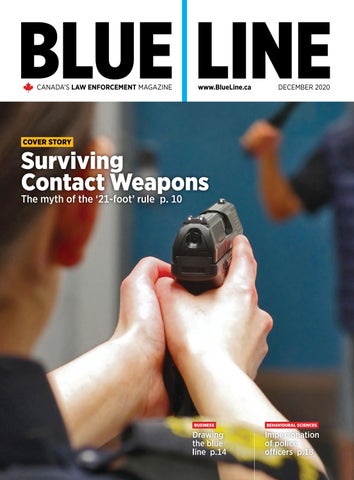
COVER STORY
Surviving Contact Weapons The myth of the ‘21-foot’ rule p. 10
BUSINESS
BEHAVIOURAL SCIENCES
Drawing the blue line p.14
Impersonation of police officers p.18
@BERETTACANADA @BDTCANADA
THE BERETTA STRIKER
APX Red Dot Optic*
*Optic Not Included
APX Full Size
TOP ERGONOMICS MAXIMUM MODULARITY SAFE STRIKER DEACTIVATION TACTICAL FUNCTIONAL DESIGN
APX FDE
BERETTACANADA.CA
10
Contents
December 2020 Volume 32 Number 10
Features COVER STORY
10 Surviving Contact Weapons
The myth of the ‘21-foot’ rule By Dave Brown and Randy LaHaie
14 Drawing the Blue Line:
Letting police get back to the business of policing by hiring more civilians and contractors. By Christian Leuprecht
24 The Science Behind the Fallibility of Eyewitness Testimony Assessing the knowledge and beliefs of students studying policing By Louise Bond-Fraser, Kyle Ferris and Ian Fraser
Columns 4 13 17 18 20 23 30
Editor’s commentary Holding the line Case law Behavioural Sciences Q&A Health and Wellness Back of the book
Departments 5 5 8 9 9 28 29 30
News By the numbers Off the shelf Calendar Dispatches Product showcase Marketplace Blue Links
26 Implications of Canada’s May 2020 “Assault-Style” Gun Ban Officers will need to follow the impact of the order-in-council closely By Robert Welsman
COVER PHOTO: DAVE BROWN
18 14 @Blue_LineMag
24 December 2020 | BLUE LINE
3
EDITOR’S COMMENTARY BY RENÉE FRANCOEUR
Memories & friendships to last a lifetime; thank you
T
his isn’t an editor’s commenI have always been passionate about tary I know how to even begin furthering important dialogue in gender to craft — my last one as Blue equality and overall inclusivity across the Line’s editor. I am moving onto board — thanks to my luminous and an exciting new role in communications self-assertive mother for the inspiration in Whitehorse, Yukon, but the decision to there. And I am so grateful to have come leave was not a light one. The Blue Line across many others who are having this team at Annex Business Media (here’s look- conversation in law enforcement. Thank ing at you Svetlana, Janice, Trish, Beata you to everyone involved in the Advancing and Martin) and the brand’s wide array of WE in Policing group, especially officers supporters have all had such a major im- Natalie Hiltz and Amy Boudreau, who pact on my career and my life. I want to both joined me in studio for podcast rethank each and every one of you for that. cordings in the early days when I was still I became Blue Line’s editor in June 2017. figuring out audio quality. There are so I was 28 years-old and the first female many more I want to name; I could fill editor of Canada’s only independent law pages! I know I will honour all of these enforcement magazine. I remember getting empowering and instructive friendships that call about the job — I was in for many years to come. New York City for a Panasonic I will never Until a fulltime, permanent press event and my godson had forget replacement has been found for also just been born in St. Johns, emceeing my role, I’d like to introduce you N.L. It was an incredibly surreal, my first Blue to Mario Cywinski, your interim magical day and I was so ready to Line Expo editor. He’s currently also the start that next chapter. I didn’t at the editor of MRO Magazine at Annex know much about the overall International Business Media. You’re in good, business of policing, but I knew Centre and capable hands. about B2B media and I was all in. handing out Thank you to everyone I’ve In our Q&As in each issue, I the Police meet over the past three years often ask the guest what was their Leadership through Blue Line — for your most memorable moment in law Award to deep thoughts on culture change, enforcement. Many struggle to Vancouver your submissions on how to pinpoint just one. Putting that Police further build up your careers and same question to myself now as I Const. Dale your learning, your accessibility reflect back, I, too, am flooded Quiring... and your kindness. Thank you with numerous clips of fond, galfor being excited about the new vanizing memories. Where do I even begin? direction Blue Line was heading in 2017 I will never forget emceeing my first Blue (and for graciously bidding farewell to the Line Expo at the International Centre and old yellow logo — unless you’re Blackhanding out the Police Leadership Award Berry’s Michael Akpata! Our chats on to Vancouver Police Const. Dale Quiring, covers will be missed, dear friend)! Never the LGBTQ liaison officer. Quiring’s On- doubt you all have deepened my undertario family members had all come out and standing and appreciation for all that goes it was a touching moment to introduce this on in this challenging but motivating humble officer, and to pay tribute to the world of Canadian community safety and many progressive changes he initiated, beyond. Keep pushing onwards and upincluding driving the Canadian rendition wards, keep the communication lines of “Safe Place,” a program that provides a open, and please always make time for safe location for LGBTQ2S members to go your own mental health first and foremost to if they need assistance. — we need you.
BLUE LINE www.BlueLine.ca
Reader Service Print and digital subscription inquiries or changes, please contact Beata Olechnowicz, Audience Development Manager Tel: (416) 510-5182 Fax: (416) 510-6875 email: bolechnowicz@annexbusinessmedia.com Mail: 111 Gordon Baker Rd., Suite 400 Toronto, ON M2H 3R1 GROUP PUBLISHER | MARTIN MCANULTY mmcanulty@annexbusinessmedia.com INTERIM EDITOR | MARIO CYWINSKI mcywinski@annexbusinessmedia.com EDITOR | RENÉE FRANCOEUR rfrancoeur@annexbusinessmedia.com ACCOUNT MANAGER | JANICE EATON jeaton@annexbusinessmedia.com MEDIA DESIGNER | ANDREA M. SMITH asmith@annexbusinessmedia.com ACCOUNT COORDINATOR | TRISH RAMSAY tramsay@annexbusinessmedia.com COO | SCOTT JAMIESON sjamieson@annexbusinessmedia.com ANNEX BUSINESS MEDIA 111 Gordon Baker Road, Suite 400 Toronto, ON M2H 3R1 Tel. 416-442-5600 • Fax 416-442-2191 Publication Mail Agreement No. 40065710 ISSN 0847-8538 Printed in Canada SUBSCRIPTION RATES Canada — 1 Year $31.50; 2 Year $52.50 plus tax USA — 1 Year $136.50 CAD
Occasionally, Blue Line will mail information on behalf of industry-related groups whose products and services we believe may be of interest to you. If you prefer not to receive this information, please contact our circulation department in any of the four ways listed above. Annex Privacy Officer Privacy@annexbusinessmedia.com; Tel: 800-668-2374 © 2020 Annex Publishing & Printing Inc. All rights reserved. Printed in Canada. No part of the editorial content of this publication may be reprinted without the publisher’s written permission. Opinions expressed in this magazine are not necessarily those of the editor or the publisher. No liability is assumed for errors or omissions. Readers are cautioned and advised that articles presented herein are edited and supplied for your personal awareness and should not be used for further action until appropriate guidance is received from a supervisor, Crown Attorney or other persons in authority. All advertising is subject to the publisher’s approval. Such approval does not imply any endorsement of the products or services advertised. The publisher reserves the right to refuse advertising that does not meet the standards of this publication.
CONNECT WITH BLUE LINE
www.BlueLine.ca 4
@BlueLine_Mag
BLUE LINE | December 2020
www.facebook.com/BlueLineMagazine www.BlueLine.ca
NEWS one-on-one, peer and group therapeutic sessions and educational programming while allowing consent-based, anonymous participation, protecting users’ safety and identity For more information please visit: www.telushealth.com and www.telus.com/ payment-solutions. YUKON
Defining new relationships with Kwanlin Dün First Nation and the RCMP CANADA
Telus launches new mental health app for frontline workers
Telus has announced the launch of Espri by Telus Health, a mobile app that delivers mental health and wellness resources to support the rising mental health pressures faced by police, correctional officers, physicians, nurses, care workers, emergency medical services, firefighters and their family members. “The current health emergency has highlighted the unique challenges faced by our hard-working frontline care workers. We are committed to improving health experiences for all Canadians, including providing impactful mental health tools to support the brave individuals who dedicate their lives to protecting us all,” said Darren Entwistle, Telus president and CEO. Frontline workers are exposed to incidents of trauma, violence, and grief, making them more likely to experience mental health issues: In 2017, a study in the Canadian Journal of Psychiatry found that 44.5 per cent of first responders, including paramedics, police officers and firefighters, screened positive for symptoms consistent with mental
disorder, four times higher than the general population (10 per cent). Similarly, the Canadian Medical Association’s 2018 National Physician Health Survey reported that one in four physicians experience high levels of burnout, with others reporting signs of depression and addiction. Frontline workers also face considerable barriers and stigma to accessing mental health resources. Developed in conjunction with first responders and under the guidance of specially-trained clinicians who are occupationally-aware and understand the needs of frontline workers, Espri by Telus Health provides timely access to features and tools for mental wellness as well as support for crisis and prevention including: • Learn — A resource hub that provides quick access to relevant, clinically-informed, and occupation-specific content from the organization, TELUS Health, and/ or third party providers. • My Plan — A goal-setting tool that helps workers build positive habits by setting and completing mental health and wellness goals • Group video — A video call feature that enables organizations to host virtual
Chief Doris Bill of Kwanlin Dün First Nation, the largest First Nation in Yukon, and Sgt. Greg Holmberg, Acting Officer in Charge of the Whitehorse RCMP Detachment, have signed a “historic document that paves the way for an improved approach to community policing built on relationships, accountability and communication.” The Letter of Expectation (LOE) defines and promotes positive and co-operative relationships and provides policing priorities, goals and strategies that are specific to the needs of Kwanlin Dün First Nation. The four priorities in the LOE are Communication, Relationship Building, KDFN Youth Partnerships, and Community Safety. Highlights include the requirement for quarterly meetings with KDFN Council and monthly policing reports. Also, KDFN will provide cultural awareness training to the officers in order to support and encourage understanding and belonging in the community. Among many ideas, the LOE also requires officers to participate in community events, interact and be visible with the public on a daily basis, as well as volunteer on KDFN boards and committees. The need for an LOE arises from the recent signing of the Community Tripartite Agreement (CTA) under the First Nations
BY THE NUMBERS
PHOTO: TELUS HEALTH
A new national poll conducted by Nanos Research on behalf of the London Abused Women’s Centre (LAWC), Concertation des luttes contre l’exploitation sexuelle (CLES) and the Coalition Against Trafficking in Women (CATW), in collaboration with Canadian organizations, has revealed Canadians’ views on legislative approaches to prostitution and other prostitution related issues
49%
of Canadians support Canada’s current prostitution legislation, which is almost five times more than those who are opposed (11 per cent)
@Blue_LineMag
61% of Canadians agree federal and provincial governments should provide appropriate funding to organizations working with women in prostitution providing long-term counselling and support services
34%
of Canadians agreed that prostitution should be viewed as a profession or job like any other profession or job, and 26 per cent disagreed
45% of Canadians were opposed when asked to what extent they support prostitution as a legal profession, with all activities around prostitution including sex purchasing, selling sexual services, pimping, trafficking and brothel ownership-operation being legal
December 2020 | BLUE LINE
5
NEWS Civil Forfeiture Program allots funding for new policing tools
Policing Program (FNPP) on June 12, 2020 between KDFN, Government of Yukon and Government of Canada. The FNPP is a federal program designed to enhance police services to First Nation and Inuit communities across Canada. As partnering First Nations are signatories, they can now shape how policing services are delivered in their communities. The LOE provides details on how police are to operate within the community. It is meant to be a living document and will be reviewed annually. The Government of Canada and Government of Yukon contribute funds to the FNPP, which provides support for 17 dedicated RCMP officers in Yukon First Nations communities with Canada funding 52 per cent and Yukon Government funding the remaining 48 per cent. CTAs have existed in Canada for decades but Yukon has only had one with the Liard FN. With the new framework agreement and additional funding, KDFN is able to establish their first CTA comprising of a compliment of three enhanced, culturally responsive, and dedicated RCMP members. The three Enhanced Officers dedicated to Kwanlin Dün will be stationed in Kwanlin Dün and will work closely with the Community Safety Officers. Two constables currently stationed in KDFN have been operating under the former Aboriginal Community Constable program since 2017. They will now fall under the new First Nation Policing Framework Agreement. A third RCMP member will be joining the team in the near future. 6
BLUE LINE | December 2020
The Saskatchewan government is providing more than $532,000 to police agencies, community-based organizations and the Victims’ Fund for new policing tools and programming through the Civil Forfeiture Program. Specifically, more than $180,000 of this will be provided to Saskatchewan police forces. The police and community program funding will be used to provide for the following: • program supplies for the “F” Division Youth Advisory Committee (RCMP); • an anti-gang initiative to provide education to youth about street gangs (Saskatoon Police Service); • a cyanoacrylate fuming chamber to assist police with advanced fingerprint identification (Weyburn Police Service); • a 3D laser scanner to improve crime scene analysis (Prince Albert Police Service); • personal safety devices for victims of domestic violence (Parkland Victims Services); • a domestic violence program to engage community and build accountability for family violence (Piwapan Women’s Centre and Lac La Ronge Domestic Violence Committee); • a pilot project to develop a Sexual Assault Centre in Moose Jaw (Regina Sexual Assault Centre); • a women’s wellness retreat for those who have survived trauma and victimization (La Loche Friendship Centre); and • the development of a crystal meth awareness strategy (Moose Jaw Partners Against Violence). CANADA
Major study reveals four mindsets driving current opinions about policing and future policy preferences
Canadians have watched protests south of the border calling for an end to police violence against Black and other Americans of colour, and participated in protests in this country calling for greater accountability and acknowledgement of what they say is systemic racism in Canadian policing as well. A comprehensive review of perspectives on policing in this country from the non-profit Angus Reid Institute has found a
country at once critical and supportive of the police in their communities. This first installment of a two-part series on policing in Canada finds three-quarters view the police in their community favourably, despite concerns about how officers may treat some demographics. For a similar number, 72 per cent, local police are a source of pride. This includes two-thirds of Indigenous and visible minority respondents. However, younger Canadians are less likely than their older peers to view the police positively. Those aged 18-24, on average, feel less secure when they see a police officer (38 per cent) than more secure (32 per cent), whereas this tendency is reversed in all older age groups. Similarly, more than one-in-three 18-24-year-olds (37 per cent) view police in their own community unfavourably, compared to just one-in-ten (11 per cent) among those 65 and up. The landscape of perspectives in Canada includes considerable nuance, such that Angus Reid Institute researchers created the Policing Perspectives Index, which categorizes Canadians based on their attitudes toward police. This report explores the views of the True Blue, Silent Supporters, Ambivalent Observers, and Defunders in great detail. More key findings include: • Looking at provincial differences, residents of Alberta and Saskatchewan lean the most towards warm perceptions of police, while Ontario has the highest proportion of those with a more negative view. • Indigenous people and those who identify as visible minorities are more likely to feel less secure around and less favourable toward police compared to Caucasians, though the proportion who feel the opposite is still higher in each case. • Two-thirds of Canadians have had at least one direct interaction with an officer over the past five years. For most, this was a comfortable experience. Negative experiences vary by age, gender, and ethnicity. Read more at angusreid.org/policing-perspectives-canada-rcmp.
ONTARIO
Ben-Gurion University researchers determine how to pinpoint malicious drone operators
Researchers at Ben-Gurion University of the Negev (BGU) have determined how to www.BlueLine.ca
PHOTO: KWANLIN DÜN FIRST NATION
SASKATCHEWAN
NEWS pinpoint the location of a drone operator who may be operating maliciously or harmfully near airports or protected airspace by analyzing the flight path of the drone. UAVs (unmanned aerial vehicle systems) pose significant security risks due to their agility, accessibility and low cost, the university noted. As a result, there is a growing need to develop methods for detection, localization and mitigation of malicious and other harmful aircraft operation. The paper, led by Dr. Gera Weiss from BGU’s Department of Computer Science, was presented at the Fourth International Symposium on Cyber Security, Cryptography and Machine Learning (CSCML 2020). The researchers trained a deep neural network to predict the location of drone operators, using only the path of the drones, which does not require additional sensors. When tested in simulated drone paths, the model was able to predict the operator location with 78 per cent accuracy. The next step in the project would be to repeat this experiment with data captured from real drones.
@Blue_LineMag
BL_SevenView_AugSept20.indd 1
NEW BRUNSWICK
RCMP partners with Codiac Regional Citizens on Patrol Association
The Codiac Regional RCMP in New Brunswick has a new partnership with the Codiac Regional Citizens on Patrol Association. This volunteer, non-profit group was created by the community to take an active role in crime prevention. Volunteers will patrol their neighbourhood and report suspicious activity they see to police. They will also deliver community public safety programs. “This is a new crime prevention initiative that is community-based where volunteers will help by being the eyes and ears in the community and report what they see and hear to police,” says Eric Larose, manager of Codiac RCMP Community Policing Unit. “Their role is not to intervene or attempt to stop a crime in process but report it to Codiac RCMP or in an emergency call 911.” The program officially starts on June 25 with six volunteers who will be concentrating
their efforts in the Old West End of Moncton. Expansion of the program, including to other neighbourhoods, will depend on the interest of the community and the number of volunteers offering to participate. If you know someone interested in volunteering, contact the Codiac Regional Citizens on Patrol Association at Crcopa.info@gmail.com for more information. BRANDON
Assiniboine launches new public safety advanced diploma
Assiniboine Community College in Brandon, Man. has launched a new one-year advanced diploma in public safety. The immersive, full-time program is designed to prepare graduates for a range of careers in the public safety sector, says the school, including municipal, regional and Indigenous police services, corrections and security. “This new post-graduate credential allows us to better meet the needs of students and employers, preparing graduates for a range of community-focused careers in public safety
December 2020 | BLUE LINE
7
2020-07-13 1:20 PM
NEWS
OFF THE SHELF
organizations,” says Ian Grant, special advisor of public safety at Assiniboine. “The growth and expansion of our public safety programming is something we continue to put a great deal of our focus and energy behind.” Grant spent 38 years working in public safety and retired as chief of the Brandon Police Service in 2017. The program centres around hands-on learning environments and scenario training that features a problem-based learning approach. As an advanced diploma program, students must have an existing degree or diploma from a college or university to enrol. The first cohort of students in the new program will begin their studies in September 2021. SUDBURY
Sudbury Police presents its own Indigenous Women and Girls Missing Persons Toolkit and Resource Guide The Greater Sudbury Police Service (GSPS) has officially unveiled its Indigenous Women
and Girls Missing Persons Toolkit and Resource Guide. “We understand that being an Indigenous woman or girl is a high-risk classification of becoming a missing person due to systemic racism and intergenerational trauma,” the service announced on its Facebook page. “Further, we acknowledge that MMIWG is not solely a national issue, but our community’s priority. Sudbury is at the heart of Anishinawbek territory with many Indigenous peoples calling this community home.” In 2016, a Victim Services Missing Persons Toolkit from Saskatoon, Sask. was given to Sudbury Chief Paul Pedersen while discussing missing and murdered Indigenous women and girls at a conference. From this toolkit, the Greater Sudbury Police Service began working with the Indigenous community on creating their own version of the toolkit. The toolkit adds a holistic perspective through suggesting various support options and by providing answers to the questions that people may have during a police investigation.
Advance your policing career With a focus on executive leadership and international policing, the Master of Leadership and Management (Policing and Security) from Charles Sturt University will develop your senior leadership capabilities. Charles Sturt is Australia’s largest provider of education for law enforcement professionals and most experienced online university. Learn more
study.csu.edu.au/master-management-it
CRICOS Provider Number for Charles Sturt University is 00005F. © Charles Sturt University, 2020.
In Search of Adventure By Helen C. Escott; 2020, 307 pages ISBN: 9781771178211
Best-selling author Helen C. Escott joined the Royal Canadian Mounted Police as a civilian member in 1998. As a communication and public relations strategist, she was essentially the “storyteller-in-chief” for the force, capturing the stories, events and the history of the RCMP “B” Division in Newfoundland and Labrador. In her latest book In Search of Adventure, Escott has carried on that same storytelling tradition by weaving together a work of historic significance to mark the RCMP’s 70th anniversary in Newfoundland and Labrador. The book provides a descriptive account of the history of the force as seen through the eyes of those who served in the various communities. Through a series of interviews, she has compiled incredible stories which will take the reader on an exciting ride through the early days of Confederation when nine Mounties arrived in St. John’s in March of 1949 and opened a division headquarters on Kenna’s Hill, to the harrowing days of the Badger Riot, 9/11 and beyond. The reader will be emotionally drawn in and fascinated by the deeply personal first-hand accounts. These include: members of the renowned Newfoundland Rangers, the first woman from Newfoundland and Labrador to join the RCMP, the first Newfoundlander to become Commanding Officer of NL, the many dedicated and hardworking civilians and public servants behind the scenes, and numerous others. Escott has done a remarkable job of assembling these wonderful and almost-forgotten stories, which all highlight the rich history of the RCMP in Newfoundland and Labrador. This book is an important part of our legacy, which I would consider required reading for anyone who has served (past or present), as well as those who want to learn more about the RCMP’s contribution and importance to Newfoundland and Labrador. - WILLIAM C. MALONE (RETIRED RCMP SUPT. AND AUTHOR OF “COPS IN KABUL – A NEWFOUNDLAND PEACEKEEPER IN AFGHANISTAN” BY FLANKER PRESS 2018)
8
BLUE LINE | December 2020
BL_CharlesSturt_Dec20.indd 1
www.BlueLine.ca 2020-11-16 10:44 AM
NEWS DISPATCHES Calgary Police Service. Insp. Frank Reuser is retiring after 46 years on the job. He is currently Calgary’s longest serving officer. Congratulations to Westville Police Chief Howard Dunbar for 40 years in policing as of May 7, 2020. Dunbar started with the Westville Police Force in Nova Scotia as a constable in 1980. Since then, he held many positions including Community Relations, Emergency Response Team, Intergraded Street Crime Unit and has been a sergeant since 2001. He was promoted to staff sergeant in 2018 and chief at the onset of 2020. Dunbar served 41 years with the Canadian Army Reserves and retired with the rank of Chief Warrant Officer. During his military and policing service, Dunbar received the Order of Merit of Police Forces, Order of Military Merit, Canadian Forces Decoration with two clasps and the Police Exemplary Service Medal.
CALENDAR Insp. Dyson Smith has been named the new Yellowknife RCMP detachment commander. Smith replaces Insp. Alex Laporte, who was posted near Ottawa after 12 years in Yellowknife. From 2018 until recently, Smith was the Officer in Charge of the North District, where he was in charge of 11 detachments, which policed 13 communities, as well as overseeing the “G” Division Relief Section. Insp. Robert W. Allan has been appointed the deputy chief of support services at Barrie Police. The Barrie Police Services Board also announced Chief Kimberley Greenwood, who was appointed as Chief of Police in 2013, will continue in this role until 2023.
Vancouver Police Supt. Marcie Flamand has retired after 33 years of service. She has been a member of the VPD’s Critical Incident Stress Management Team since 1999 and is the president of the B.C. Crime Prevention Association. She is a trustee for the Vancouver Police Officers’ Association, a committee member on the DTES (Downtown Eastside) SisterWatch program, and has participated in the Pulling Together Canoe Journey. In 2016, she received the Outstanding Alumni Award by Langara College. She has also received a Chief Constable’s Unit Citation for her work in the recruiting section, a Deputy Chief Constable’s Commendation for her work in patrol, and she received her 20-year medal for exemplary police service in 2007.
The Ontario Association of Chiefs of Police (OACP) announced Chief Antje McNeely of the Kingston Police has been elected as president of the association for 2020-2021. She succeeds Chief Paul Pedersen of the Greater Sudbury Police Service.
Emily Jones has joined the Peterborough Police Service as the new Community Development and Engagement Co-ordinator, building on what Peter Williams built in this role.
Belleville’s chief of police, Ron Gignac, is retiring. He joined the Royal Canadian Army as a cadet in 1981. He was deployed on missions to Cyprus for two tours, the Persian Gulf War and Iraq throughout his military career. He was also posted to the Canadian Forces School of Military Engineering as a mine warfare and explosives instructor. After joining the Ontario Provincial Police in 1995, Gignac climbed the ranks and then joined the Deep River Municipal Police Department in 2009. He was promoted to chief of police in 2013. In 2015, he was hired to the deputy chief post position within the Belleville Police and promoted to chief in 2017.
Woodstock Police has welcomed its new deputy chief, Rod Wilkinson, a 24-year veteran of the service. He is a graduate of the police leadership program, a collaborative effort between the University of Toronto’s Rotman School of Management and the Ontario Association of Chiefs of Police. @Blue_LineMag
OWLE (Ontario Women in Law Enforcement) Advisory Board Member Supt. Heidi Schellhorn of York Regional Police has retired after 33 years of service. Metrolinx Insp. Steve Harvey has retired after 30 years dedicated service to Go Transit, a division of Metrolinx in the Greater Toronto Area.
NOTE TO READERS: check with all organizers as COVID-19 continues to affect events.
National Symposium on Sexual Assault Cases in the Criminal Court Feb. 27, 2021 Toronto, Ont. www.osgoodepd.ca TACCOM 2021 Show Apr. 23-25, 2021 Mississauga, Ont. www.osgoodepd.ca Fourth International VPD Police Judo Clinic Apr. 27-30, 2021 Vancouver, B.C. policejudo.ca HK Memorial Hockey Tournament 2021 Apr. 29-30, 2021 Brampton, Ont. hkmemorial.com FutureCon: Toronto CyberSecurity Conference May 12, 2021 Toronto, Ont. futureconevents.com/events/torontoon-2020/?ref=infosec-conferences.com CANSEC 2021 June 2-3, 2021 Ottawa, Ont. www.defenceandsecurity.ca Canada’s 911 Ride – Atlantic 2021 June 12-13, 2021 Truro, N.S. www.canadas911ride.com International Association of Directors of Law Enforcement Standards and Training 2021 Conference June 13-16, 2021 Fort Worth, Texas www.iadlest.org Tenth National Conference on Critical Perspectives in Criminology and Social Justice: Responsibility June 17-18, 2021 Quebec City, Que. www.criticalcriminology.ca Find more calendar events online at blueline.ca/events.
December 2020 | BLUE LINE
9
COVER STORY
The myth of the ‘21-foot’ rule
Is it true that you “don’t bring a knife to a gunfight?” Have you ever practiced any “Tueller drills” or discussed the “21-foot rule” in firearms or use of force training for when people actually do bring knives?
By Dave Brown and Randy LaHaie
O
riginally designed to help officers think defensively and develop a better level of tactical awareness, the 21-foot rule was intended to illustrate the distance that an assailant could cover with an edged weapon before an officer could respond with a holstered sidearm. The problem is that widely-taught drills developed from that original concept may have reinforced a big myth: “If someone has a knife, and they’re within 21 feet, you can shoot them.” Wrong. The 21-foot rule was
10
BLUE LINE | December 2020
21-foot rule of behavior. Drills performed never intended to become a firm
RULE is a response to a known threat, and attackers rarely openly display weapons
without a better understanding of the background behind them, or without knowing more about the performance of the human body in a life-threatening situation, can confine officers into thinking there is only one solution to every deadly force confrontation. We would like to take a closer look at the background behind these drills and the science behind the action/reaction curve. We need to rethink the concept that situations involving edged, or other
Tueller Drills In a 1983 article for SWAT Magazine, titled, “How Close is Too Close?” Sergeant Dennis Tueller of the Salt Lake City Police Department examined how far away an assailant with a knife would have to be for an officer to be able to respond to a sudden deadly force attack by drawing and firing their sidearm. He timed volunteers to see how far they could cover certain distances, and timed how long it would take the average officer to draw and fire from the holster. The distance he focused on was seven yards (21-feet), and how an armed assailant could cover that distance in 1.5 seconds; not enough time for the average officer to draw a holstered firearm and fire two accurate shots to centre mass. In his series of informal tests, Tueller illustrated how the danger zone of an edged weapon can be further than many officers realize. He went on to write, “it would be safe to say then that an armed attacker at 21 feet is well within your Danger Zone.” The article evolved into a training video and training exercises variously called “the 21-foot rule” or “Tueller Drills” in police academies across the U.S. Officers would practice charging at each other with simulated knives and compare that to the time it took to draw and fire two accurate rounds. The Myth of the 21-foot Rule Sgt. Tueller opened a lot of eyes about action versus reaction, and helped revolutionize police training, but his studies may have been misinterpreted to justify shooting an assailant at a certain set distance. The 21-foot rule became part of police culture, and has been widely taught at law enforcement seminars in the U.S., but to our knowledge has never been recognized by a court in Canada. Other studies done in Canada have even suggested the action/reaction gap might be further than 21 feet. www.BlueLine.ca
PHOTO: DAVE BROWN
contact weapons, can be slotted into hard and fast rules or can be used to justify shooting a person with a knife closer than 21 feet.
We see problems with these types of simple drills, that are designed to encompass complex and unique situations. Firstly, in the real world, few people yell, “go!” or attack with a clearly visible knife. The 21-foot rule is a response to a known threat, and attackers rarely openly display weapons. (During in-service training over a period of a number of years, an informal survey of Winnipeg Police Service members who had been stabbed revealed that almost none of them saw the weapon in advance.) There are many other weapons besides knives that can cause grievous bodily harm, and a good spontaneous assault program that emphasizes prevention, avoidance and awareness should broaden the focus to include “contact weapons” and not just edged weapons. Secondly, when some officers
have performed these drills, they usually stop when the “assailant” reaches the officer or when simulated shots are fired. This goes against lessons on survival we have tried to teach for many years. Out on the street, not everybody comes to a halt because they’ve been stabbed. (They rarely even realize they have been stabbed until the smoke clears.) Similarly, highly-motivated assailants generally don’t suddenly go down because they’ve been shot.
The Reactionary Gap The reactionary gap is the distance between an officer and a subject that will allow him or her enough time to respond to a sudden and unanticipated attack. The reactionary gap is a suggestion and not a rule because there is no “standard” distance. Skills vary, and defensive tactics often dictate that officers move closer and not farther away in order
THE REACTIONARY GAP is the distance between an officer and a subject that will allow him or her enough time to respond to a sudden and unanticipated attack
to better gain control over subjects. Most officers are familiar with tunnel vision, and its detrimental effect on peripheral vision in highstress situations. Tunnel vision is a physiological reaction of the human body to a life-threatening situation, and serves to enhance focus at the center of vision, at the cost of loss of peripheral vision. Since the brain is not wired into recognizing that the center of vision is suddenly sharper than normal, it perceives threats as being larger than normal or closer than normal. (Soldiers and police officers who have stared down the barrel of a gun have sometimes described the threat as “the size of a sewer pipe.”) This is why it is difficult to judge exact distances in life-threatening situations.
Primary Response Tactics The myth of the 21-foot rule is that if a person has a deadly weapon in-
+1 867-668-5609 publisher@canadianguns.com www.canadianguns.com
CANADIAN ACCESS TO FIREARMS
The only Canadian buy-and-sell firearms newspaper distributed across Canada! WHY ADVERTISE WITH CATF? Our paper is distributed monthly by subscription and at gun shows, gun trades, gun clubs and select stores across Canada. We shall put you in touch with the active, committed core of Canada’s firearm community!
@Blue_LineMag
BL_CATF_JanFeb20.indd 1
December 2020 | BLUE LINE
11
2019-12-03 11:03 AM
COVER STORY
Officers are human beings, doing the best job they can with the circumstances they are confronted with and the training they have been given. side 21 feet, you should shoot them, which is clearly not the case. If a person has a deadly weapon and is within 21 feet or closer, officers should implement their primary response tactics to a contact weapon threat. In threat assessment, we continually evaluate three factors: threat, intent and delivery system. It is in the delivery system that provides subjects with imminent opportunity to apply damaging effects of a weapon on an intended victim using distance, position, lethality and other factors. Create distance. In an encounter, distance equals time. The more distance you can put between you and a threat (excluding firearm threats) the more time you have to respond. Distance buys you time. Distance is your friend. Move laterally. Sidestep. It is a normal reaction to a threat to backpedal and move straight back, but this can be a fatal mistake. It is highly unlikely you can run backwards faster than an attacker can run forwards. Moving back in a straight line is likely to be totally ineffective. You also can’t see where you are going and the likelihood of banging into something or tripping over an obstacle is much higher. By moving laterally, the subject has to redirect his momentum and body mass toward your new location that buys you time, even if it’s just an extra second or two to draw your gun from the holster. Use barriers. Barriers are intended to slow down or block the subject’s access to you or an intended victim. It can also buy you more time to possibly de-escalate or disengage from the encounter. A barrier can be substantial like a fence, door, or vehicle likely to block access, or as simple and temporary as pushing over furniture in the path between you and the offender. Draw and point firearm. Clearly you are justified in drawing and pointing your sidearm. Don’t hesitate. Based on the essence of the 21-foot rule, you run the risk of not being able to respond in time should the offender suddenly commit to an attack. The value of Tueller’s research is that action always beats reaction, and 12
BLUE LINE | December 2020
an assailant can attack from a greater distance than was once thought possible before you have enough time to draw your gun from the holster, acquire the target, and discharge accurate shots in time to stop the threat. Drawing and pointing a firearm is also a show of force that may discourage the offender from wanting to complete the act and run the risk of being shot. Issue a loud and clear challenge. A forceful challenge, backed up by a firearm, and loud and clear enough to penetrate through an assailant’s auditory exclusion (loss of hearing in high stress situations) may be sufficient to discourage the assailant’s desire to continue their aggressive actions. It also indicates to other officers that your firearm is out, and may be crucial in justifying an extreme level of force, such as deadly force once you preclude lower levels of force as being ineffective or inappropriate. If you have an opportunity to challenge the offender before administering lethal force (gunfire) you are legally and morally obligated to do so. This is also where training in de-escalation techniques, and using words to more effectively defuse situations of human beings in crisis can be especially valuable.
So How Close is Too Close? The 21-foot rule is, in essence, an interpretation of threat assessment. Is there a weapon? The 21-foot rule is not relevant or activated without the known or believed presence of a deadly weapon, usually assumed to be an edged or contact weapon sufficient to cause death or grievous bodily harm. Is there Intent? The officer must believe that the subject intends to attack a person with that weapon. Is there delivery system? Does the officer believe that distance, position or other factors provide the subject with the legitimate and imminent opportunity to apply damaging effects of that weapon on the intended victim? Can an assailant with a knife or other deadly weapon hurt me or someone else from where they happen to be located right now? Not if I shoot them first, in-
capacitating the threat in the process. Not if I get behind something that protects me. Not if they change their mind because I make it clear I will shoot them if they advance. Primary response tactics are designed to increase the reaction time of the officer, slow down the attacker, demotivate the attacker, and/or slow or hamper the delivery system. By implementing the primary response tactics, the 21-foot rule becomes redundant. Every encounter is as individual as the assailant holding a deadly weapon. This means that the gun does not become the solution to every potentially deadly force situation. The gun is only a tool. The mind becomes the weapon. Life is not a Hollywood movie. There is no such thing as a fair fight, and assailants don’t politely stand around in circles. Gang members don’t carry sharpened screwdrivers to tune tiny little carburetors for their grandmothers. There are no hard and fast rules in life for every situation. Officers are human beings, doing the best job they can with the circumstances they are confronted with and the training they have been given. Train hard, always maintain a level of tactical alertness on the street, watch for barriers you can use and be aware about danger signs involving contact weapons. If spotted early enough, such deadly confrontations might be defused or avoided altogether. After all, the best gunfight in the world will always be the one that never happens in the first place. Randy LaHaie is a lifelong self-defense and combative training instructor. Before his retirement from the Winnipeg Police Service, he developed, delivered and defended officer survival, use-of-force and firearms-related policies and programs for a variety of agencies. In 1994 Randy formed his own company called “protective strategies,” Recognized as a police use of force and subject matter expert, Randy continues to consult, train, write and teach. His blog on optimizing health and combative performance for law enforcement officers and high-risk professionals can be found at www.toughenup.com. Dave Brown is a professional firearms instructor and has been a contributing writer for Blue Line Magazine since 1995. Studying the performance of the human body under stress, Dave has long advocated for a better understanding of the science behind police weapons training. His common-sense approach to training integrates practical firearms training into modern dynamic shooting techniques that emphasize consistency, simplicity and repetition.
www.BlueLine.ca
HOLDING THE LINE BY MICHELLE VINCENT
Your Choice is in the Feeling, Every Time
PHOTO: AIJOHN784 - STOCK.ADOBE.COM
H
ow do we choose to feel? How often do we even consider we have the choice in how we feel? Do feelings not happen to us? As we evolve as human beings, awareness in how our mental health unfolds, shows us how we are in charge of how we feel. Gone are the days we can blame everyone around us, and what they are doing for how we feel. Don’t get me wrong, we still try to play that game (or at least I do on occasion), however those who have taken any relationship training, mental health training, or who are seeing a mental health professional, will quickly share how we feel is our responsibility every time. This is good news and bad news. The good news is we are responsible for how we feel, and the bad news is we are responsible for how we feel. If we are feeling love, elation, joy and excitement, we may be proud that we contrived those feelings. For those of us who struggle with feelings of sadness, fear, anger and despair, we may struggle to own this choice. Understanding the roots of where feelings come from and how they come about is key. The brain is comprised of various systems. One being the limbic system, which is responsible for behavioural and emotional experiences. The two most important parts of the limbic system are the amygdala and the hypothalamus, which responds and releases hormones such as serotonin, dopamine, and endorphins. Low levels are often related to sadness and higher levels support happiness. With this very basic, and surface level description of where emotions and feelings are created within the body, beliefs, memories, and thoughts are important to consider. Thoughts are like raindrops (Byron Katie) and whether we choose to believe (beliefs), which may be influenced by memories that may elicit certain feelings. How are we most likely to choose happiness? There are various lists of suggestions on how the choice of happiness is most likely to occur. 1. Being around positive people is one of them. In policing, we are often exposed to situations with people @Blue_LineMag
who are not experiencing positivity. Those we choose to engage with between calls, and outside of the job, may have the greatest influence on choosing happiness. 2. Being around positive people can be contagious, supporting the secretion of those happy hormones. 3. Another suggestion is being the best you. When we know and more importantly believe we have given our all, something that is especially important to notice in the job of policing, where judgment and criticism are rampant, happiness is prevalent. When you find aspects where we are being our best self, these happy hormones are often present. If we must compare (comparison has us losing every time), compare to our former selves. 4. Focus on what we have, want, or what makes us feel amazing. We get what
we focus on whether we like it or not, so make it positive. In combination with the focus aspect be a solution-focuser rather than a problem-solver. Again, our focus is similar to a radio wave frequency. If you want to find solutions, it is best to be on the frequency, and focus of solutions rather than problems. 5. A positive outlook or attitude is another great way to experience happiness and produce happy hormones. I like to call it our outlook, our perceptual lens, and we always have the choice in how we experience every situation or what lens we see the world through. In policing, we can choose to see our calls for service as “we supported people today in making their difficult day just a little bit better” no matter what the incident. 6. Choose to smile. Smiling makes us happy period. 7. Let go and get excited about the next chapter in our world. This is one of the most powerful lessons I have and continue to be reminded of that brings the feeling happiness and peacefulness. 8. Being generous with our kindness and time is a larger component to the release of our love hormone dopamine. Every interaction we have in policing provides us with the opportunity of being kind and generous with our time to those in our community we are serving and those we are working with. 9. Be honest. It just feels good all the way around. 10. Caring for ourselves in every capacity, mentally, physically is a great way to elicit the feeling of happiness. Say yes, every time you can. It just feels good. With the holiday season fast approaching in our ever-changing climate let’s choose our feelings wisely. The happiness choice is ready for you. Michelle Vincent is a retired York Regional Police officer and the founder of The Haven, Ontario’s first non-profit, inpatient treatment centre exclusive to first responders and uniform personnel. Contact her at michelle.vincent@thehaven.cloud.
December 2020 | BLUE LINE
13
BUSINESS
Drawing the Blue Line: Letting police get back to the business of policing by hiring more civilians and contractors
A
s police budgets escalate at a rate in excess of inflation, there is a long-standing concern the business model of policing in Canada is unsustainable. The situation is already at a breaking point in many smaller municipalities, rural areas and much of Atlantic Canada where property taxes are stagnant. New Brunswick, for instance, is currently reviewing local and provincial policing services to “find ways to improve co-operation and safety.” (More on this at bit.ly/2RumQ4I.) Across Canadian localities, between 22-30 per cent of property tax increases are driven by the rising cost of police 14
BLUE LINE | December 2020
services. That should not come as a surprise since salaries account for close to 90 per cent of police budgets. That way of doing business may still be manageable in urban centres where property values continue to appreciate, but even they are showing signs of strain, with investment in front line services, investigations unit and technology atrophying. In the rest of the country local governments are having to cannibalize other services simply to continue to pay for policing, much of which is beyond their control because it is provincially mandated. Whilst policing services across the country are under pressure from stressed municipal budgets, they are also con-
tending with increased expectations from the public, ever more accountability, the growing complexity of police services and criminal investigations, the escalating number of mental health calls (as police services are having to backfill for reductions or gaps in social services), and salary pressures due to parity benchmarking with other police services when negotiating collective agreements. A consensus is emerging among the public, politicians, police associations and chiefs that the way community safety services are delivered needs to change. Yet, how to put the delivery of policing services in Canada on a sustainable footing is highly controversial. www.BlueLine.ca
ILLUSTRATION: GETTYIMAGES
By Christian Leuprecht
On the one hand, public support for sworn police to deliver services relating to Criminal Code offences remains robust. On the other hand, the public is less supportive of police providing services such as event security, transit security, prisoner transport, investigative support, and administration and support. To that very point, the police presence at large events is largely paid-duty anyway. However, in Quebec, for example, event security is largely contracted out to civilian private security companies, who assume genuine support function in cooperation with police. At private events — such as F1 racing, trade shows, and festivals — the contractor ensures site security, at time alongside police in plain clothes; those who are expelled are handed over to police at the perimeter who arrest and process them. The converse obtains at special public events: they are responsible for access and perimeter control; local, provincial or federal police the actual event. In other words, the more official the event, the more visible the police. The former type of event is far more common than the latter. Even idiosyncrasies such as Toron@Blue_LineMag
to’s by-law requiring paid-duty policing at construction that interferes with traffic are increasingly falling by the wayside. An informed democratic conversation about alternative service delivery of police services that support sworn officers is an indispensable part of the solution: fingerprinting and court services for instance, which can readily be performed by civilians or third-party contractors, and for which a specialized expert is more suitable anyway than an expensive, highly-trained sworn generalist. However, what is understood to be a core vs. support function varies by police service, as does the way these services are operationalized. Ergo, associations are rightly concerned about “one size fits all” approaches. After all, they deliver a distinctly local service that is highly nuanced by community. The same holds true for substituting paid-duty policing requirements with security on public transit or at certain events. Alternative service delivery helps optimize the delivery of services and reduces strain on resources and budgets, while improving outcomes by enhancing expertise and quality. Many such initiatives are already in place. In some cases, they have been running successfully for decades. Rural communities with aging populations, for instance, are especially well suited to preventive policing, with greater visibility of people on the ground. In Winnipeg and Montreal, the creation of a cadet program led to more community engagement, increased police visibility, and a corresponding drop in crime. In Calgary, Transit Peace Officers reduced fare evasion and brought in $1 million in fines while improving public safety. The Vancouver Police Department successfully increased the number of civilian employees to reduce demand on sworn officers. Meanwhile, Commissionaires in Nova Scotia has a decades-long track-record in patrolling the Halifax Harbour Bridges, front-desk management, data processing, background checks, ID servi-
ces, and that’s all at demonstrably lower costs than sworn members. Similarly, since July the Surêté du Québec has contracted prisoner watch out to Garda, as has the City of St-Eustache, a function also performed by Commissionaires in select jurisdictions. The success of these programs has taken pressure and financial strain off local police departments. Yet, widespread adoption of reform remains tepid, often in the face of stiff resistance from police associations and chiefs. The current legislative environment can make alternative service delivery difficult to implement as it often burdens municipalities with excessive liability, which acts as a substantial deterrent. As a result, the extent, standards and expectations for alternative service delivery vary widely. Provincial political leadership is required in providing more permissible legislative frameworks to reduce liability while providing for a more coherent and systematic set of standards. Still, there are already successful examples of contracting out that are enabled by transparent contracts, objective Key Performance Indicators (KPIs), and continuous monitoring, oversight and accountability. The Canadian Air Transportation Safety Authority (CATSA) effectively — and successfully — contracts out matters of national security: security screening of travellers at airports. Similarly, CBSA contracts out transportation of detainees. Police departments and associations fear that such reforms may result in fewer sworn members. However, this is not what precedents across Canada show. To the contrary, such initiatives can free up sworn officers for duties for which they are best suited. Rather than reducing the number of officers, civilianization and third-party contractors can help ensure that police actually do the work that we genuinely need sworn members to do. Another concern is that civilians or contractors who handle sensitive administrative work may open the door for
Commissionaires in Nova Scotia has a decadeslong track-record in patrolling the Halifax Harbour Bridges, front-desk management, data processing, background checks, ID services, and that’s all at demonstrably lower costs than sworn members. December 2020 | BLUE LINE
15
A consensus is emerging among the public, politicians, police associations and chiefs that the way community safety services are delivered is increasingly unsustainable.
people who are unqualified or may abuse their power. However, well-qualified civil servants across all levels of government already manage all manner of sensitive tasks. CATSA, for instance, trains its contractors. This way police services retain control over the direction of a program direction. Training for support services could be conducted by unionized officers to ensure compliance to the standards of police associations standards. Clear performance indicators, exclusion criteria, comprehensive training and competitive selection on merit of qualified, appropriate, experienced contractors help assuage concerns about abuse of power, in part because higher standards attract better candidates that are better paid, with lower turnover and a commitment to the values that inform public safety. Contracted retired sworn members, already plentiful throughout the security industry and a growing talent pool due to a wave of retiring sworn members, maximize famili16
BLUE LINE | December 2020
arity with law enforcement’s institutional culture while reducing transaction costs, yet their skillset is often underutilized, limited to tasks sworn members are not keen on doing themselves, such as conducting security checks. By way of example, fraud is now consistently the fastest growing category of crime, not just in Canada but also certainly across the democratic world, possibly across the entire world. Given the vulnerabilities introduced by the Internet, this trend is bound to continue. Police forces have no great model for triaging these cases, let alone resources to investigate them. These trends risk undermining the legitimacy of law enforcement and government if citizens are left with the impression that police and government either “don’t care” or are “incompetent” at dealing effectively with the criminogenic vulnerabilities that cyber presents. Online fraud presents a particularly good
case for civilianization and contracting. In many cases, specialized civilians have better skillsets to carry out digital and online forensics. Most of these civilians will not be keen on working their way up ranks, and so police services can compete on salary the way they cannot for sworn members. Compensating for possible inexperience in running complex investigations is a function of resource optimization, such civilians teaming up with experienced retired sworn investigators. Whilst public expectations of police response have risen qualitatively in recent decades, provincial governments have effectively downloaded issues such as mental health on police through di- and under-investment in social services. As Calls for Service grow in and volume become ever more exacting, Canadian police departments have gradually had to reduce their reliance on expensive, highly-skilled, highly-trained members respond to calls where public safety is not at immediate risk. These operational trends raise the prospect of better overall services, greater efficiency, better value for money, and ultimately, better public safety outcomes for local communities. Police departments are slowly realizing that civilians can compensate for some gaps in specialized skills among sworn members, and that civilians are just as effective and efficient — or more so — in carrying out certain duties than sworn officers. Contracting out enables police forces to optimize the allocation of sworn members with an added complement of specialized services and skills. By reducing the amount and extent of noncore services performed by highly trained officers, police services can reinvest time and money into prevention, such as community policing. The end result is better overall service delivery and community outcomes. Currently Fulbright Research Chair in Canada-U.S. Relations at Johns Hopkins University’s School for Advanced International Studies, Christian Leuprecht is class of 1965 Professor in Leadership at the Royal Military College. He is also the Director of the Institute of Intergovernmental Relations at Queen’s University and Munk Senior Fellow at the Macdonald-Laurier Institute, which recently published his study entitled Where to Draw the Blue Line: How Civilians and Contractors can let Police do the Policing. Find it in full at bit. ly/2O1W3uE.
www.BlueLine.ca
PHOTO: STEPHEN BARNES/GETTY IMAGES/ISTOCKPHOTO
BUSINESS
CASE LAW
BY MIKE NOVAKOWSKI
Crown bore the burden of continuing sealing order
T
he party seeking to continue a sealing order on an executed search warrant’s supporting ITO (Information To Obtain), and thereby limit access by an interested non-accused person, bears the burden of justifying why the sealing order should continue under s. 487.3 of the Criminal Code, so says the Nova Scotia Court of Appeal. In R. v. Verrilli, 2020 NSCA 64, the applicant was under investigation for allegedly possessing cocaine for the purposes of trafficking, but he was never charged. The police had obtained three search warrants under s. 11(1) of the Controlled Drugs and Substances Act to conduct searches of Verrilli’s home, business and motor vehicles. Various items, including cellular telephones and cash were seized during the searches, but no cocaine was found. The ITOs in relation to all three search warrants were sealed under s. 487.3(1) of the Criminal Code by each issuing justice of the peace. The items that had been seized during the searches were returned to Verrilli. In Nova Scotia Provincial Court, Verrilli – as an interested non-accused party – applied under s. 487.3(4) of the Criminal Code to examine the sealed ITOs in order to determine why he had been the subject of the searches. He wanted access to the ITOs to determine whether his Charter rights under s. 8 (unreasonable search and seizure) or s. 9 (arbitrary detention or imprisonment) had been breached. The judge denied Verrilli’s application to access the sealed ITOs. In the judge’s view, Verrilli had not satisfied the burden in justifying access by showing police wrongdoing. Verrilli sought judicial review in Nova Scotia Supreme Court of the decision refusing his access to the sealed information. The Supreme Court judge found the Provincial Court judge applied the wiretap test for accessing the sealed ITOs, which was wrong: This application relates to the right of a @Blue_LineMag
“Search warrants are important investigative tools for police... Their effectiveness depends upon secrecy in the sense that the target should not be aware that a warrant has been issued. Once a warrant has been executed, the concerns over secrecy are diminished. - Chief Justice Wood non-accused target to access the ITOs that led to the issuance of three search warrants. The legislative provisions governing search warrants are very different than those involving wiretaps. There is no legislative provision placing the onus on an applicant seeking to unseal an ITO similar to the statutory onus placed on an applicant seeking to unseal a wiretap... Wiretaps are subject to very specific provisions in the Criminal Code that limit access to the presumptively sealed packet of information. The Criminal Code search warrant provisions do not mirror the wiretap provisions. However, a judicial officer may determine that an ITO should be sealed in accordance with s. 487.3 of the Criminal Code. I cannot conclude that Parliament intended these two regimes to be treated the same way. Thus, the onus was not on an applicant seeking to unseal a search warrant ITO to show evidence of an unlawful authorization. Rather, the burden rested on the Crown to justify the continuation of the sealing order. This matter was sent back to Provincial Court for a further hearing with the appropriate burden of proof placed on the Crown in accordance with s. 487.3(4) to determine whether Verrilli should have access to the sealed ITOs. The Crown then appealed to Nova Scotia’s highest court arguing that the Supreme
Court judge erred in applying the wrong legal test for Verrilli to access the sealed ITOs. But the Court of Appeal disagreed.
Sealing orders Unlike a wiretap ITO, which is automatically confidential and placed under seal, a sealing order under s. 487.3 of the Criminal Code is discretionary. Under s. 487.3, the party requesting a search warrant may also seek an order prohibiting access to the ITO. “Search warrants are important investigative tools for police,” said Chief Justice Wood. “Their effectiveness depends upon secrecy in the sense that the target should not be aware that a warrant has been issued. Once a warrant has been executed, the concerns over secrecy are diminished.” After reviewing case law, the Court of Appeal stated: [O]nce a warrant has been executed, there is a presumption that the ITO will become accessible to the public unless the party wishing to limit that access can justify the limitations being sought. This applies not just at the initial application for a search warrant where a sealing order may be requested, but also any subsequent application to vary or terminate that order under s. 487.3(4). [para. 33] In this case, after learning that he had been the target of a criminal investigation and searches which ultimately did not result in charges, Verrilli made an application under s. 487.3(4) to access the ITOs that had been used to obtain the search warrants. An application under s. 487.3(4) placed the burden on the Crown to justify the continuation of the sealing orders. Since the Crown opposed the application for unsealing, it bore the evidentiary burden of justifying that the sealing order continue. Verrilli did not have the burden to provide evidence the warrants were unlawfully granted before he was permitted access to the ITOs. The Crown’s appeal was dismissed and the matter was remitted to Provincial Court for disposition. Additional details taken from R. v. Verrilli, 2019 NSSC 263.
Mike Novakowski is Blue Line’s case law columnist.
December 2020 | BLUE LINE
17
BEHAVIOURAL SCIENCES BY PETER COLLINS
Everyone commits an offence who (a) falsely represents himself to be a peace officer or a public officer; or (b) not being a peace officer or public officer, uses a badge or article of uniform or equipment in a manner that is likely to cause persons to believe that he is a peace officer or a public officer, as the case may be. - s. 130 (1) Criminal Code of Canada
D
espite the fact that there are many reasons why an individual would want to impersonate a police officer, there has been relatively little research into this area. We all know of cases where individuals pretend to be law enforcement officers in order to sexually assault women or children, rob banks, perpetrate a home invasion, steal drugs, or — as in one case in the United States — get into the front queue of a lineup to buy the soonto-be released, updated version of Grand Theft Auto. Additionally, Freeman-on-the Land members in British Columbia used badges they ordered from a supplier to enter a government building as “Canadian Common Corps Peace Officers.” There have been tragic events where an individual will masquerade as a police officer in order to commit 18
BLUE LINE | December 2020
mass murder. In July 2011, a man dressed as a tactical officer wandered among a group of teens and young adults at a youth camp in Norway, shooting and killing more than 80 individuals. Earlier this year in Nova Scotia, a man posed as a police officer and committed multiple shootings and set multiple fires, resulting in the deaths of 22 individuals before he was shot dead. Even the perpetrators of 1929 Valentine’s Day massacre in Chicago executed nine members of an opposing gang while dressed as police officers. What about the wannabes – those who may drive cars equipped with police-style emergency lights, wear police uniforms and carry fake police badges or obsolete badges obtained from online auction sites as collectables? A few times a year, as a member of the Threat and Behavioural Analysis Team of the OPP’s Criminal Behaviour Analysis
For the most part the wannabees are insecure, power seeking individuals who are not mass murderers, but when encountered they may have the potential to act out violently as a result of their narcissistic bubble being burst by the real police.
Section, we are asked to conduct threat assessments on these individuals. Some of them are familiar to us as repeat police impersonators. This year, thus far, there have been three separate and unrelated occurrences in the province and two were repeat posers. Case Study Mr. AB is 28-year-old married man who has been arrested multiple times over the past 10 years for personation of police and assaulting police. Although he has limited financial resources, he has spent a great deal of time and money in purchasing and outfitting his car with police equipment. Banned from owning firearms by his wife, who has not objected to the modification of the family vehicle and the purchase of a Crown Victoria, he legally obtained two registered handguns under her name. Mr. AB spends time “patrolling” his neighbourhood and the highway and occasionally reports incidents that he has witnessed. He lied about his background as it relates to obtaining police training and education, and his affiliation as an auxiliary member of the RCMP. When police have cautioned him for personation of a police officer, or held him accountable to highway traffic laws prohibiting his use of police lights or speeding, it repeatedly resulted in a spontaneous hostile response in which he denied or minimized his actions. He will question the police’s authority by demanding to see their badge and warrant card, and by questioning their interpretation of the law. On other occasions he justifies his behaviour by stating his actions are not illegal, that he admires the RCMP and only wants to assist them. Rennison and Dodge (2012) stated that many of the police wannabees were enticed by the lure of authority and ego enhancement — whether it was to impress a girlfriend or to gain an upper hand www.BlueLine.ca
PHOTO: LABALAJADIA - STOCK.ADOBE.COM
The impersonation of police officers
during a confrontation in an argument with a stranger.(1) There have been documented incidents in Canada when the wannabes have pulled over an off-duty officer, or where other officers stop to assist only to find out that the person they are assisting is not a police officer. About 10 years ago, a woman pulled over an individual, claimed to be a police officer and stated that the person could pay his fine immediately. It was security cameras at an ATM machine that led to her arrest. To some of these individuals, the uniform — or the symbols of the uniform (badges) — offers a mystique that represents power. In my professional opinion, it is a variant of what is now called stolen valour. Stolen valour is a relatively new term describing what is likely centuries-old behaviour. According to a recent article in the New Yorker magazine, (2) when Walter Washington Williams, thought to be the last surviving veteran of the Confederate Army, died in 1959, President Eisenhower called for a national day
@Blue_LineMag
BL_ILET_Dec20.indd 1
of mourning. It turned out that Williams had fabricated his service and that the second-longest-surviving Confederate soldier probably had, too. In fact, according what one Civil War historian has recorded, “every one of the last dozen recognized Confederates was bogus.” It is unknown as to how many of the traffic stops perpetrated by wannabes occur. Some citizens may not be aware the person is not really a law enforcement officer. When in doubt they should call the police to double check to see whether they have been legitimately pulled over if there is something about the demeanor or the uniform that makes them suspicious. How can we make it more difficult for the police wannabes or the impersonators whose motivation is to commit violent crime? In the United Kingdom, it is against the law to sell police uniforms and police equipment for vehicles is illegal because the sale of those items can facilitate police impersonation. For the most part the wannabees are
insecure, power seeking individuals who are not mass murderers, but when encountered they may have the potential to act out violently as a result of their narcissistic bubble being burst by the real police. Be safe out there.
Footnotes
1. Rennison, C & Dodge, M. (2012) Police Impersonation: Pretenses and Predators. American Journal of Criminal Justice 37:505–522 DOI 10.1007/ s12103-011-9153-z 2. Monroe, R. (2012) Stolen Valor (on-line as How to Spot a Military Impostor: The detectives who investigate fake stories of military service use many tools, including shame). The New Yorker Magazine 26 October 2020 www.newyorker.com/ magazine/2020/10/26/how-to-spot-a-militaryimpostor Dr. Peter Collins is the operational forensic psychiatrist with the Ontario Provincial Police’s Criminal Behaviour Analysis Section. He is also a member of the crisis/hostage negotiation team of the Toronto Police Service Emergency Task Force. Dr. Collins’ opinions are his own. Contact him at peter.collins@ utoronto.ca
December 2020 | BLUE LINE
19
2020-11-16 1:29 PM
Q&A After serving 24 years with the RCMP, Keith Blake was sworn in as the fifth Chief of Police of the Tsuut’ina Nation Police Service in 2013. Throughout his time with the RCMP, he experienced firsthand the culture, pride and honour in being part of the policing in seven different First Nations communities in Alberta. Chief Blake’s operational and investigative policing experience includes both frontline uniform policing, as well as plain clothes duties in specialized units. His investigative background includes postings as a General Investigation/Major Crime Investigator, Federal Drug Unit Investigator and Integrated National Security Enforcement Team (INSET) Investigator and Supervisor, Detachment Commander, Emergency Response Team Leadership and Professional Standards. Blake shares with Blue Line how the service has adopted Indigenous ways of being within the agency at a frontline policing level and beyond to works alongside the dedicated men and women of Tosguna, and hopes for the future.
Q: Why did you decide on a career in law enforcement? My cousin was a police officer in the Royal Canadian Mounted Police and throughout my life, he was my role model. While growing up, he often shared stories with me about his career in policing which provided me an understanding of the job, but most importantly, how much of an impact you could have on someone’s life, especially when they are in crisis. Since hearing these stories, it left an impact on my life and it has truly been the only career I have ever wanted to do. I really enjoy being able to celebrate the success of people but also, I appreciate the opportunity to be there to offer my genuine support when someone may need it. I am confident that this story is similar to many officers across our country, and it is important that we continue to be role models within the profession to empower and support our communities. Q: How have things changed at the Tsuut’ina Nation Police Service since you became chief? Since becoming the chief of the Tsuut’ina Nation Police Service, there has been significant changes in the delivery of policing within Tsuut’ina Nation, in addition to the substantial growth of sworn 20
BLUE LINE | December 2020
and non-sworn member personnel. In 2013, we had a staffing compliment of 11 sworn officers with little rank structure. Today, we proudly have 27 sworn members and 13 civilian members and a successful rank structure with promotional and specialized unit opportunities. Previously, policing within the Tsuut’ina Nation Police Service was more reactionary and call response based, due to the lack of officers. With our growth also came the opportunity to be able to invest and prioritize the needs of our community to address the root causes of crime through programing and prevention. Due to our unequal funding model, we have relied upon innovation in seeking additional funding through grants to enhance our service delivery and meet the needs of community through programming, prevention and relationship building. I am extremely proud to inform that we have been successful in grant applications that have increased our policing budget by over $850,000 yearly, which enhances our ability to support our Nation’s youth, elders and at-risk individuals and families.
Q: What is the latest initiative at the Tsuut’ina Nation Police Service? Our service has made significant advancements in acquiring and utilizing new
technology to support our policing operations. New technologies, new methods, and new ideas have brought significant and important changes in policing. Axon Air is a critically important equipment acquisition to our Service that supports new concepts of operations and most importantly, enhances community and police officer safety with UAV/Drone capability. The Tsuut’ina Nation Police Service is only the second service in Alberta to fully adopt the body worn camera practice. All our frontline officers are currently deploying the most advanced body worn camera technology, the Axon Body Worn 3. This camera has several features that assist our officers to conduct perform their work more efficiently and safely. The live stream feature allows Incident Commanders to remotely assist with managing high-risk calls in real-time as they monitor the officer’s camera. In the event of a mental health crisis, the officer can also invite mental health professionals to live stream and provide the officers with real time advice or support as they deal with someone who is in crisis. We are strong believers this technology assists in transparency and supports public confidence in our police service. Technology advancements have also occurred within our officer training program, where Tosguna members now have the www.BlueLine.ca
PHOTO: TSUUT’INA NATION POLICE SERVICE
ability to practice scenario-based training through Virtual Reality technology! It is an important time for our Service, as we continue to seek new technological advancements to enhance service delivery to the Tsuut’ina Nation.
Q: How does Tsuut’ina Nation Police Service include Indigenous ways of being? As a police agency within Canada, we know that policing has not always had a positive relationship with Indigenous peoples across our country. Though, we cannot change history, we must invest in the re-design of our relationship with Indigenous peoples. The Tsuut’ina Nation Police Service is proud to acknowledge that 65 per cent of our sworn members and 85 per cent of our non-sworn members, identify as Indigenous. We must also acknowledge that within our Service there are residential school survivors, 60’s scoop survivors or individuals living with the direct impact of intergenerational trauma, actively participating in the advancement of policing within our service. Our inclusion of Indigenous ways of being is an important and genuine aspect of our agency that we hold close to @Blue_LineMag
SNAPSHOT OF THE TSUUT’INA NATION POLICE SERVICE:
2004
officially commenced full policing authority for the Tsuut’ina Nation, under Section 5 of the Alberta Police Act
250
square kilometres policed by the service
27
Sworn officer positions
our heart. We want to ensure we are promoting a space of cultural safety, respect and pride. To date, we have done significant work within finding the parallels between the western realm of policing and Indigenous ways of being. We have had significant consultation with community on an ongoing basis, in addition to recognizing social justice issues through consultation with subject matter experts, such as Marion Buller (MMIWG Chief Commissioner), to see how we can police while acknowledging the unique needs of Tsuut’ina peoples. We are proud to let Canadians know that we have adopted Indigenous ways of being within our agency at a frontline policing level but also throughout every process within our agency. A few examples include, adapting our ceremonial uniform by the adoption of ribbon skirts for those who identify as a woman, Tobacco and Ceremonial Medicine teachings, smudge offering for employees and victims of crime within our agency prior to completing an interview, Tsuut’ina language inclusion within our greetings and the formal adoption of the name Tosguna (Traditional police of Tsuut’ina Nation People). These are only a few examples of the steps taken at Tosguna to address the need to adapt policing to meet the needs of community in a culturally respectful manner.
Q: Why does community policing work? A police agency cannot support or help a community until they know what the community needs. Police are not the experts on community, which is why consistent community engagement and dialogue are key. Our community members are the subject matter experts in knowing how we can provide our support
and protection to community. A troubling and likely accurate sentiment in many Indigenous communities is that they often feel over policed and under protected. As policing organizations, we need to ensure we are not only present in the crisis related policing situations, but also in the celebrations and ceremonies.
Q: What is one thing you’re most proud of as chief of Tsuut’ina Nation Police Service? As the chief of the Tsuut’ina Nation Police Service, I am most proud of the ongoing and growing community support from the Tsuut’ina Nation Peoples and in many instances the adoption of our staff within the community. As a Service, we continue to be invited by families to attend family and community celebrations, milestones, funerals, ceremonies and are truly proud to engrain ourselves into the fabric of the community on Tsuut’ina Nation. Our community support extends to the financial support our Nation provides to its Police Service. Our growth over the last few years, is almost entirely as a result of the support of the Tsuut’ina Nation and Leadership. The Nation alone funds 16 of our officers, while the provincial and federal governments combined provide 10. In addition, the Tsuut’ina Nation fully funded our New Police Headquarters building in 2018, with no assistance from the Federal or Provincial Government Partners. Our service officers and staff clearly understand this support is unique and do not take it for granted, which also reinforces the important responsibility we have to be accountable to and engaged in our community.
The First Nations Policing Program is antiquated and does not provide the environment to support a long-term vision or the ability to secure long term sustainable funding. December 2020 | BLUE LINE
21
Q&A With more research on this interesting aspect of investigative interviewing, personality psychology has the potential to enable police departments to identify successful interviewers. Q: In your opinion, what is needed now in First Nations policing here in Canada? The First Nation Policing Program (FNPP) has experienced success and community support despite the imposed barriers and inequities in funding and authorities. Its success has primarily been built on the hard work, dedication and commitment from the officers and staff. The FNPP deserves to be designated as an essential service and on equal footing with other Canadian mainstream
Police Services. This equity must also extend to funding, which needs to be comparable, long-term and sustainable. Our funding agreements are most often only year to year, and this funding model does not allow our Services to properly and appropriately plan and prepare. Our officers and staff should experience stability and job security that other Canadian police officers often may take for granted. The First Nations Policing Program is antiquated and does not provide the environment to support a long-term vision or the ability to secure
long term sustainable funding. We want equal opportunities and equal footing with the other mainstream policing Service which means the program needs reform. We certainly are not asking for more, but not satisfied with anything less.
Q: What do you see in the near future for the Tsuut’ina Nation Police Service? The Nation is looking to support our community and future generations with visionary economic development. This development will require us to undertake a new, more urban policing model in our jurisdiction, although we need to ensure this will not change our community based First Nation policing model. In reality, we believe the two can complement each other. We envision our service to be recognized as an innovator in policing prevention and programing as well as an early adopter of technological advancements.
Special
Make Christmas 2020 Do you know a serving peace officer who could use some good news? Make this Christmas special for your colleague, friend, relative, neighbour or acquaintance who serves and protects. Our Project Sword continues to offer to any serving Canadian peace officer the special law enforcement edition of the New Testament – “The NIV Peacemakers”. We would be pleased to send a free book(s) to you, for you to place in the care of a serving officer. Order yours today by sending your name, mailing address, and the number of books desired to: fcpo.aapc@gmail.com
fcpocanada.com 22
BLUE LINE | December 2020
BL_FCPO_HP_DEC20_ASK.indd 1
Give the gift of “Help and Hope” this Christmas. www.BlueLine.ca
2020-11-25 7:39 AM
HEALTH & WELLNESS BY DAVUT AKCA
Does personality matter in investigative interviewing?
T
raining, work experience, and evidence-based methods are key factors that can lead police officers to conduct effective investigative interviews. But what about personality? An investigative interview is a complex and dynamic interaction between police and citizens. It is also one of the most challenging tasks a police officer faces for several reasons, including the unwillingness of the interviewee to talk or the high-stakes nature of the interaction. Interviewers must utilize specialized strategies and skills to overcome these challenges and generate the maximum amount of accurate and reliable information from interviewees. Research has indicated consistently, however, that most police interviewers do not follow best practices. Instead, despite being trained and/or experienced, interviewers frequently use counterproductive methods such as assumption of guilt, asking leading questions, interrupting the interviewee, acting aggressively, and talking more than the interviewee. They also often demonstrate a lack of confidence and fail to control the interview. In a recent lab study, (www.tandfonline.com/doi/abs/10.1080/156142 63.2019.1644177), Dr. Joseph Eastwood and I examined whether personality is another variable in the equation that might explain why certain people are better interviewers than others. The rationale behind this study was that previous research has focused more on training and experience to explain the variation in interview performance but paid little attention to the personality effect. In our study, we had 154 student participants interview others who watched a mock robbery crime video. We also asked the interviewers to complete the Five Factor @Blue_LineMag
Model (a.k.a. Big Five) personality test. We assessed their performance based on four measures: amount of details elicited, perception of the witness, interviewer behaviours, and question usage. We reached some meaningful results when we analyzed the relationship between personality factors and performance measures. Three dimensions of the Big Five were associated with the success measures: • Agreeableness with witness perception and appropriate questioning, • Extraversion with interviewer behaviours and inappropriate questioning, and • Openness with interviewer behaviours. So, what do these findings tell us? Briefly, people who score higher on Agreeableness, Extraversion, and Openness might perform better at interviewing than those who score lower. Having a closer look at these personality dimensions will provide a better understanding of the findings. Agreeable people, for instance, are more courteous, flexible, trusting, good-natured, and tolerant. These traits might help them to build better rapport with interviewees, which explains why they were perceived more positively by witnesses in our study. High scorers in the Openness factor are known to be imaginative, cultured, curious, broadminded, and artistically sensitive. Thus, Openness is relevant to creativity and originality, which might be two key skills to overcome the challenges of the interview process such as unpredictability of the interaction and unwillingness of interviewees to talk. Finally, the friendly, sociable, and warm nature of Extraverts might
The friendly, sociable, and warm nature of extraverts might help them to build better rapport and engage people to interview throughout the process.
help them to build better rapport and engage people to interview throughout the process. However, their talkative and assertive nature might lead them to talk more, ask leading questions, and interrupt interviewees frequently, which are not among the desired methods in evidence-based interview models. These findings are only tentative of course. More research is needed to identify the most valid predictors of interview performance. However, our findings indicate that personality matters in interview performance. Lab research findings like we reached should be supported through the examination of real-life interview performances of interviewers. This can be achieved through enhanced co-operation between practitioners and researchers. With more research on this interesting aspect of investigative interviewing, personality psychology has the potential to enable police departments to identify successful interviewers.
Sources
1. Baldwin, J. (1993). Police interview techniques; establishing truth or proof? British Journal of Criminology, 33(3), 325-352. 2. Griffiths, A. & Milne, R. (2006). Will it all end in tiers? Police interviews with suspects in Britain. In T. Williamson (Ed.), Investigative interviewing: rights, research and regulation. (pp. 167–189). Portland, OR: Willan. 3. Meissner, C., Redlich, A., Michael, S., Evans, J., Camilletti, C., Bhatt, S., & Brandon, S. (2014). Accusatorial and informationgathering interrogation methods and their effects on true and false confessions: a meta-analytic review. Journal of Experimental Criminology, 10(4), 459–486. 4. Milne, R. & Bull, R. (1999). Investigative Interviewing: Psychology and Practice. Chichester: Wiley. 5. Snook, B., Eastwood, J., Stinson, M., Tedeschini, J., & House, J. C. (2010). Reforming Investigative Interviewing in Canada. Canadian Journal of Criminology and Criminal Justice, 52(2), 215–229. 6. Snook, B., & Keating, K. (2011). A field study of adult witness interviewing practices in a Canadian police organization. Legal & Criminological Psychology, 16(1), 160–172. Dr. Davut Akca is a research officer at the University of Saskatchewan’s Centre for Forensic Behavioural Sciences and Justice Studies (https://cfbsjs.usask.ca/). To hear more about this technique, share your expertise, or find out how you can get involved contact him at davut.akca@usask.ca.
December 2020 | BLUE LINE
23
SCIENCE
The science behind the fallibility of eyewitness testimony
Assessing the knowledge and beliefs of students studying policing
P
olice officers are in the vanguard of the law enforcement process. Their initial interactions with witnesses at an accident or crime scene can have a profound effect on the entire judicial process.1 In a classic experiment by Elizabeth Loftus and John Palmer back in 1974, for example, it was demonstrated that the simple change of a word in a question can shift a person’s memory of an event. In the study, participants were shown a film of an automobile accident. The question asked of the participants was, “How fast were the cars going when they ________ into each other?” The only difference in the question asked was the word used to describe the impact: “bumped,” “collided,” “contacted,” “smashed” or “hit.” Those participants who received the word “smashed” estimated a greater rate of speed. Later, when called back and asked about the film, the participants who had estimated a greater speed claimed to have seen glass at the accident scene.2 In other words, their memories of the event were moulded simply by a word choice. Obviously, when we humans can be so easily influenced by the way a question is posed, it is important interviews be conducted in such a way that this effect is minimized. Of course, questions have to be asked, but the way in which they are framed can make a real difference. For example, questions can be either closed-ended or open-ended. Closed-ended questions are those that require a yes/ no answer. An example might be: “Was the suspect wearing a hat?” Open-ended questions, on the other 24
BLUE LINE | December 2020
hand, require the respondent to provide detail. An example might be: “Can you tell me what the suspect was wearing?” In addition, an open-ended question might be phrased as a statement to which a response is expected, for example: “Tell me about your day.” A study conducted with Canadian police officers, in which videos were taken of them conducting interviews, showed the officers began by introducing themselves and informing the witness of the interview process. The interviewing officers asked very few open-ended questions, and those that were asked tended to be posed towards the beginning and end of the inter-
Police officers are focussed on finding the truth about an accident or a crime. It is therefore important for them to be aware of how easy it is for them to alter a witness’s memory... view process. The interviewers relied more heavily on closed-ended questions, which resulted in monosyllabic answers of “yes” and “no.” On average, the interviewers interrupted the interviewees every fourand-a-half minutes. The researchers also noticed that some of the closed-ended questions were leading, which has the potential to distort the witness’s memory.3 An example of a leading question might be the closed-ended example given above, “Was the suspect wearing a hat?” The
suspect may or may not have been wearing a hat, but mentioning one may implant the idea that they had been. Psychological research has demonstrated that the best way of obtaining accurate witness accounts is to ask open-ended questions and let the witness respond without interruption.4 This is important because once a witness’s memory for an event has been altered, it is very difficult, if not impossible, for the witness to differentiate fact from fiction.5 Police officers are focussed on finding the truth about an accident or a crime. It is therefore important for them to be aware of how easy it is for them to alter a witness’s memory for an event during the investigative process and, conversely, how important it is for them to try to conserve an accurate recollection. Obviously, confounding the evidence, albeit unwittingly, can cause an innocent person to be charged with a crime, while the perpetrator goes free and remains free to reoffend. Of course, the advent of DNA evidence in the courtroom has provided the “smoking gun” evidence that has led to numerous exonerations and has forced the judiciary to rethink its procedures. Over 70 per cent of these wrongful convictions were due in part to faulty eyewitness testimony.6 As Kent Roach, a Canadian law professor and legal writer has pointed out, even if one assumes a wrongful conviction rate of just 0.5 per cent, it would still mean the possibility of 450 wrongful convictions a year among the 90,000 people who are sentenced in Canada for criminal offences.7 www.BlueLine.ca
PHOTO: STEVE DEBENPORT/GETTY IMAGES
By Louise Bond-Fraser, Kyle Ferris & Ian Fraser
minimize their impact on a person’s memory) benefits everybody. We were therefore interested in ascertaining whether students studying policing are being made aware of the scientific research pertaining to eyewitness error. We conducted a survey of students studying policing and found that their knowledge concerning the science behind the fallibility of memory was poor, with an overall average of 55.3 per cent. The students who were nearing completion of their programs performed better, with an average score of 65.2 per cent, but this still showed significant room for improvement. It is important to note here, however, that the majority of students believed that more training in the area was, indeed, necessary. The full paper may be found at: www.ijlass.org/data/ frontImages/gallery/Vol._5_No._2/6._32-47.pdf.
Making police officers aware of the way in which they may influence a person’s memory for an event (and training them in proper use of investigative tools that can
References
1. Ian Fraser, Katelyn Waite and Louise Bond-Fraser. “Canadian Police Officers’ Knowledge of the Fallibility of Eyewitness Testimony (2013). International Journal of Liberal Arts and Social Science, 1, 108. 2. Elizabeth Loftus and John Palmer, “Reconstruction of
Automobile Destruction: An Example of the Interaction Between Language and Memory” (1974). Journal of Verbal Learning and Verbal Behavior, 13, 585. 3. Alison Wright and Laurence Alison. “Questioning Sequences in Canadian Police Interviews: Constructing and confirming the course of events?” (2004). Psychology and Crime, 10, 137. 4. Coral Dando, Rachel Wilcock, and Rebecca Milne. “The cognitive interview: Inexperience police officers’ perceptions of their witness/victim interviewing practices” (2008). Legal and Criminological Psychology, 13, 59. 5. Ian Fraser, Louise Bond-Fraser, Michael Houlihan, Kimberley Fenwick, Dave Korotkov and Barry Morrison. “Witnesses and the Law” (2011). Canada Law Books, Toronto. 6. Joel Lieberman and Daniel Krauss. “Psychological expertise in court: Psychology in the courtroom. Farnham, England: Ashgate.” (2009). Information retrieved from: http://ebscohost.com/lgin. aspx?direct=ture&db=e000xna&AN= 280493&site=ehost-live&scope=site 7. Kent Roach. “Wrongful convictions in Canada” (2013. University of Cincinnati Law Review, 80, 1465. Louise Bond-Fraser, MA and Ian Fraser, PhD both teach at St. Thomas University in Fredericton, N.B. They are also co-editors of the Journal of Behavioral and Social Sciences. Kyle Ferris is a recent graduate of the University of Aberdeen, Scotland (MRes; psychology) and an alumnus of St. Thomas University.
4th Annual Lifetime in Law Enforcement Award The Lifetime in Law Enforcement Award seeks to recognize a leader in law enforcement who has a made a difference in their communities through exceptional dedication and compassion. Like the Police Leadership Award, it is open to all law enforcement officers who are below the rank of senior officer, but it specifically targets those working for organizations that are not police agencies. The winner will be selected by our staff and profiled in the April 2021 edition of Blue Line Magazine.
Deadline:
January 15, 2021 Nominate someone deserving of this prestigious recognition at
blueline.ca/leadership @Blue_LineMag
BL_LifetimeAwards_Dec20.indd 1
2020
WINNER:
PRESENTED BY
Bob Thibodeau
December 2020 | BLUE LINE
25
2020-11-18 2:35 PM
Implications of Canada’s May 2020 “assault-style” gun ban
Officers will need to follow the impact of the order-in-council closely By Robert Welsman
L
ess than two weeks after the mass homicide in Nova Scotia that left 22 innocent people dead and three others injured, the Liberal government passed an overnight ban on approximately 1,500 different types of firearms, including a variety of semi-automatic rifles whose capacities are limited to five cartridges. Although it was described as an “assault-style” weapon ban during the announcement, its legal implications appear to be much broader. For example, some manual action firearms — including certain bolt action and single-shot rifles — met the ban criteria as well. Also included were a select number of .22 rimfire rifles, some shotguns, as well as many large-bore, long-range target guns. Immediately following its passage, debate began in legal circles as to whether the order-in-council (OIC) may have inadvertently banned some 12- and 10-gauge shotguns with removeable chokes (due to the new 20-mm bore diameter limit). Minister of Public Safety Bill 26
BLUE LINE | December 2020
AR-15 The Armalite Rifle model 15 and its variants, is the most common firearm in Canada that appears on the list of banned rifles
Blair responded by stating that the OIC was not intended to include any hunting or sporting shotguns, but in the weeks following the OIC passage, some previously non-restricted shotguns have been moved to the prohibited classification, not due to bore diameter, but instead because of an aesthetic similarity to the AR15. Additionally, the classification of some centre-fire rifles that were not explicitly listed in the ban have had their legal classification changed as they have been re-examined and classified to meet the definition of an AR-15 variant.
Most patrol rifles in Canada now designated as prohibited Prior to May 1, most of the patrol rifles in use in Canada were classified as restricted firearms and those models could be purchased privately by anyone holding a restricted firearms license. These privately-owned guns, however, could only be sold with five round magazines. With the passage of the new OIC, all private sales of these firearms have
stopped. The most common firearm in Canada that appears on the list of banned rifles is the AR-15 (Armalite Rifle model 15) and its variants, which also happens to be the most common type of patrol rifle in Canada for general duty/patrol use, as well as for many specialty teams. During its time as a restricted firearm, officers who wanted to frequently practice their patrol carbine skills could purchase their own AR-15 and practice on their own time, beyond the once or twice a year mandated qualification their police service provides. These officers must now be aware that such privately owned firearms are prohibited and can no longer be trained with. Because the ban goes beyond the AR-15, any Canadian police officer who owns firearms, AR-15 or not, should carefully review the list of banned firearms and the ban criteria so as to avoid being in criminal possession at the conclusion of the two-year amnesty. The prohibited firearms must now be kept within the confines of the owner’s residence and then disposed of within the amnesty period. After that time, criminal penalties are applicable — peace officer status or not. Anyone who did not already own one of these firearms prior to May 1, 2020 is not able to acquire one of these newly-prohibited firearms. With the private ownership option gone, officers will be limited in their ability to seek out additional training from private companies who offer, or at one time offered, patrol carbine training. With this new legal framework, it will be a difficult proposition for an officer to get approval from their department to take a department-owned carbine out of service to go to outside training that hasn’t been reviewed and evaluated by the department. Permission by the department to attend private training and to use department-issued equipment could be viewed as an endorsement of the training by the police service, which is something that many liability-aware police services may be understandably hesitant to approve. In addition, firearms trainwww.BlueLine.ca
IMAGE: BRANDON LAUFENBERG/GETTY IMAGES
GUN BAN
ers, many of whom are private citizens but with former law enforcement or military backgrounds, will be unable to use for teaching the very firearms platforms that they instruct on. In the past, privately-owned patrol carbines removed these road-blocks, and now officers will be much more limited in their training options.
Impact on departmental qualifications The ban may have implications on firearm qualifications with departmental-owned patrol rifles as well. Now that privately-owned AR-15’s can no longer be taken to public ranges, there is debate within the firearms community as to whether public ranges (typically run by civilian volunteer board of directors or private businesses) should cater their ranges to allow these types of firearms to be used, department-owned or otherwise. If the vast majority of their range members will no longer be using these banned firearms, they may not accommodate police services to use theirs. Without significant capital investment by departments into these public ranges to preserve training space, or the development of their own private government ranges, departments may lose appropriate space for these types of firearms qualifications. Education, buy-back, and possible grandfathering Now that the AR-15 and other affected firearms are prohibited, officers who frequent their local shooting range, hunting field or back-country shooting locale may be pressed into on-the-spot public education when members of the gun community approach them to inquire about specifics of the OIC. In the course of police business, officers may encounter gun owners using their newly prohibited firearms in ignorance of the new law. A farmer shooting their Mini14 ranch rifle at coyotes on their cattle range may not have heard their rifle is now prohibited, especially because of how quickly the ban was enacted. As many of the firearms on the list were previously non-restricted (excluding the AR-15), there is no way to specifically locate and inform owners of these guns of the prohibition, aside from a generalized blanket letter notification to all firearms license holders. Gun owners whose rifles fall within the 10,000 joules of muzzle energy prohibi@Blue_LineMag
Any Canadian police officer who owns firearms, AR-15 or not, should carefully review the list of banned firearms and the ban criteria so as to avoid being in criminal possession at the conclusion of the two-year amnesty tion, but are not explicitly named by model on the OIC, will need to do their own research to determine if the particular calibre and barrel length of their firearm pushes it over the 10,000-joule limit. Owners of single shot .700 Nitro Express and .460 Weatherby Magnum hunting guns will not find those calibres expressly described in the OIC list of banned rifles, but they violate the 10,000-joule rule and make them liable to possession of a prohibited firearm at the end of the amnesty. Additionally, officers need to be careful not to apply the OIC too broadly — there are many non-restricted and restricted semi-automatic, 5-round rifles that function similarly to the AR-15 and have similar aesthetics, and yet they are not included in this ban. Which of these firearms are considered a variant, and which are not, continues to evolve on a daily basis as the ban criteria are fully implemented. During the announcement of the ban, the government noted there would be mechanisms for disposal of the firearms that will have to be addressed via follow-up legislation. One such avenue mentioned was a buy-back, similar to what the New Zealand government recently conducted, with questionable owner compliance. As weapons are involved, this will likely be a police-led process of collection, lodging, filing and destruction. With the number of firearms involved (in excess of at least 105,000, according to a government official at a technical briefing following the announcement of the ban), it is anticipated that there will be significant labour and logistical hurdles involved for already busy and cash-strapped police services. Initially there had also been mention of possible grandfathering — where current owners would be able keep possession of the prohibited firearms they own — but they would never be able to use them again. This option was initially listed on the Canadian Firearms Program public website but has since been removed.
An exception in the field There is an important exception on newly prohibited firearm use during the two-year amnesty period officers should be aware of which allows an individual to legally have one of these newly prohibited guns in the field. An individual whose newly prohibited firearm was previously non-restricted can use that firearm for hunting — so long as the individual is an Indigenous person exercising treaty rights to hunt or is a sustenance hunter. There does not appear to be any allowance in the law for such an individual to transport the firearm for sighting in at a range or to take it for repair at a gunsmith in preparation for hunting, however, so the exception appears to be limited to specific hunting activity. Careful study of the new law is key Due to the widespread use of these newly prohibited firearms in the Canadian gun community, police and other enforcement officers will need to closely review the newly passed OIC and any subsequent follow-up legislation that the government has indicated will be forthcoming. Further anticipated changes as announced by the Liberal government include potential prohibitions on private handgun ownership, and changes to storage regulations. These changes impact not only private gun ownership amongst officers but also their enforcement actions as well. It is also possible the OIC may be amended or repealed altogether. A public petition to the House of Commons, e-2574, has been set up to oppose the ban, and one Canadian gun advocacy group has launched a charter challenge in court. With the law evolving so quickly, officers will need to follow any changes closely to ensure they apply the law correctly both to themselves and the public they serve. Rob Welsman is a police officer and a firearms and defensive tactics instructor. You can reach him at rwelsman@outlook.com
December 2020 | BLUE LINE
27
PRODUCT SHOWCASE
Find more product info at www.BlueLine.ca/products
Delta Scientific introduces new ‘open frame’ vehicle barrier
Delta Scientific has a new shallow foundation M50/P1 DSC550 ‘open frame’ vehicle barrier. The DSC550 was tested to the new ASTM F2656-20 standard, which measures the penetration level from the leading edge of the barrier versus the back-side of the barrier like the previous standard. This can provide a difference of up to five additional feet (1.52 m.) and makes the negative penetration level even more impressive. The DSC550 barrier features a shallow foundation of only 61 cm. The open frame design additionally provides a counter-balance design with no springs that need extra maintenance. The DSC550 alleviates the concerns of interference with buried pipes, power lines and fiber optic communication lines in urban applications. The shallow foundation also reduces installation complexity, time, materials and corresponding costs. The DSC550 is perfect for high water table locations and areas with corrosive soils. The product provides an emergency fast operation of 1.5 seconds for electro-mechanical and 0.75 seconds for hydraulic operations. This allows a guard to quickly react to a perceived threat with the peace of mind knowing the barrier will deploy in a rapid manner under the most demanding scenarios. The DSC550 also provides intuitive touchscreen controls with data-logging and custom programming. www.deltascientific.com
Hard Core PT Carrier from Armour Express
Armor Express (AE) has unveiled its newest innovations in ballistic technology, carrier designs, hard armour applications and accessory tools. This includes the Hard Core PT Carrier – a low-profile option that is adjustable in both the shoulders and waist. The vest features AE’s Dynamic Cummerbund System, allowing the user to breathe and move much more efficiently, according to the company. Shoulder strap geometry features enhanced ergonomics and communication channeling as well, AE adds. www.armorexpress.com
Bianchi introduces Prevader concealment holster
Bianchi, a brand of The Safariland Group, has released the Model 4585 Prevader concealment holster. This 1050-denier ballistic weave model features the exclusive Pinch Retention Device (PRD), which secures the holstered firearm by gripping both sides of the trigger guard when the gun is fully seated. www.safariland.com
O2 Industries launches the TR2, tactical respirator O2 Industries, a manufacturer of reusable respirators since 2014, has announced the release of the Tactical Respirator II (TR2), a respirator built to protect law enforcement and military during training and operations. “The TR2 was created to protect the fighter. We wanted to create a respirator that would offer premium protection, unparalleled comfort, and the flexibility and range of movement for high-impact environments, without compromising on performance.” said Peter Whitby, CEO of O2 Industries. “More compact, comfortable and breathable than any other respirator, the TR2 is the best defence from airborne particles like pollutants, viruses, dust, mold and bacteria.” Developed in collaboration with Special Forces Units in the military, the TR2 “sets a new standard of respiratory protection for workers in high-impact environments.” The TR2 was designed to offer protection without prohibiting movement or comfort, with soft-touch medical-grade silicone, multiple strap options, and built-in flex zones for improved comfort and head articulation. “With 97 per cent filter effectiveness, the TR2 is extremely breathable, even during strenuous activities,” according to the company. Designed for configurability, the TR2 is compatible with Invisio® headsets and comes equipped with mic integration for Peltor® headsets. Its design integrates with varying kit configurations and an additional strap kit is available, which supports integration with common helmet rail systems. The TR2’s low riding seal is NVG and eye-wear compatible, and its above-chin gasket fits a wide range of face profiles. www.o2tactical.com
Active Shooter Response (ASR) Faction from Armor Express
Armor Express (AE) has unveiled its newest innovations in ballistic technology, carrier designs, hard armour applications and accessory tools. This includes the Active Shooter Response (ASR) Faction – a ‘one-size-fits-most’ plate carrier with a range of adjustment. This solution addresses large or small agencies looking for a plate carrier that fits most common sized hard armour rifle plates, along with the widest range of body types. www.armorexpress.com
28
BLUE LINE | December 2020
www.BlueLine.ca
MARKETPLACE
Check it out at BLUE | LINKS • www.BlueLine.ca/referrals
Custom rings and gifts, handcrafted in Canada since 1993 for police officers and police organizations across the country
Toronto Police Museum 416-808-7020 museum@torontopolice.on.ca
BL_Jan_Crimestoppers.indd 1
@BlueLineMagazine
2018-12-11 2:11 PM
@Blue_LineMag
The 808–Toronto Police Gift Shop 416-808-7024 gift.shop@tps.ca
PRIDEINSERVICE.COM 1-800-535-9735 sales@prideinservice.com
Pride in service.indd 1
@BlueLineMagazine
@bluelinemag
2018-07-12 2:12 PM
WE HAVE YOU
COVERED! Subscribe Today to Canada’s #1 Law Enforcement Magazine. Visit BlueLine.ca to subscribe for FREE!
@Blue_LineMag
December 2020 | BLUE LINE
29
BACK OF THE BOOK
BY LAWRENCE NABOZNIAK
A plea for fairness and common sense in the gun control debate
M
uch is made today in the deaths by firearms. media about “gun crime” in To blame firearms — or their availability general and “gun control” — for the loss of human life is as foolish, in particular. The whole in my opinion, as it is to point the finger issue is highly charged with the “con” side at vehicles as the source of the road deaths. citing studies and statistics, and the “pro” By blaming firearms, the media demonizes side citing their studies and statistics. So, the tool, not the user. And so, the “gun” who do you listen to? Who do becomes the problem. I imagine To blame you trust or believe? those who support a gun ban or I could go on at great length firearms — gun-free zones would never about the fallacies and misinfor- or their dream of proposing a car ban or mation put forward by the “an- availability a vehicle-free zone. Why? Simti-firearm” groups, but in this — for the loss ply put, the whole idea would be particular opinion piece, I wish of human life universally derided as foolish in to address one particular point... is as foolish, the extreme, and again, rightly In the liberal-left media, and in- in my so. How then can anyone with deed in the media in general, I opinion, as any common sense believe that constantly hear about how many it is to point a firearm ban, or more rethe finger at people were shot by “guns.” strictive legislation, will negaIn my 50 years as a participant vehicles as tively impact firearms deaths? in shooting sports, I’ve only heard the source We share a common border of one case (and that was anec- of the road with one of the most prolific dotal) about a hunter who failed deaths. firearms manufacturers in the to abide by the basic rules of world. The laws of supply and firearm safety. It was related to me that he demand are very germane to this point. leaned his loaded rifle against a fence and The criminal element on both sides of the when he climbed the fence to cross over, border have access to funding and illicit the rifle fell, discharged and killed him. cross-border methods. Any rational indiMy point? This is the only case where, if vidual can see that obtaining an illegal or true, I have heard of someone killed by a unregistered firearm can no more be gun. In every instance in the news, people stopped entirely than the authorities are killed by people using a gun. I am not completely halting the flow of all illegal indulging in semantics or sophistry, but I drugs or any other contraband. The black am attempting to demonstrate how market has a long history. phraseology can shape perception and Many governments have deliberately attitude, especially of those who rely on skewed and cherry-picked the information the media and/or partisan groups for their they disseminate regarding the efficacy of information. gun bans. If you are objective enough, and I often use vehicles as a comparator curious enough, a basic web search will when I’m discussing the whole issue of show some facts about the rise in crime firearms and loss of life. When the media and the negative impact upon the citizentalks of vehicular deaths, we hear: “…was ry of those governments. For example, killed by a drunken driver,” or “...was killed look at Chicago versus Kennesaw, Ga. I am still an active shooter and hunter at by a distracted driver,” or “...was killed by a speeding motorist.” We rarely hear the 69 years-old. I’ve repaired, restored and phrase: “…was killed by a car,” and this is modified firearms for many years. I do not with good reason. Vehicles don’t kill espouse any cause or issue unless I’ve exampeople. A vehicle is only a device, depend- ined all the available information so that I can ent upon the actions of the operator. arrive at an informed and objective concluTherefore, when we read about deaths on sion. I urge everyone to do the same. the road, we blame the motorist for the tragic loss of life and rightly so. By the way, Lawrence Nabozniak served in the military in Canada if you go to Statistics Canada and look at and overseas. He was an RSO (range safety officer) at loss-of-life stats where vehicles are in- the now defunct CFB Toronto and at CFB Borden Rod volved, you will see that they far outstrip & Gun Club. 30
BLUE LINE | December 2020
BLUE LINKS Advertisers Directory
Discover more about these law enforcement suppliers at www.BlueLine.ca/referrals CATF
11
Charles Sturt University
8
FCA Canada Inc.
32
Fellowship of Christian Peace Officers
22
Greater Victoria Crime Stoppers
29
ILET Summits Inc.
19
Lifetime Achievement Award
25
Pride in Service
29
Rookie of the Year Award
31
Seven View Chrysler
7
Stoeger Canada
2
Toronto Police Museum & Gift Shop
29
Interested in advertising with Blue Line?
Reach the law enforcement community across Canada with an ad in Blue Line and/or in Blue Line News Week, our weekly eNewsletter. Contact our advertising account manager to book your space today: Janice Eaton: 416-527-0191 jeaton@blueline.ca
Get our 2021 Media Kit!
Please contact Janice Eaton: 416-527-0191 • janice@blueline.ca www.BlueLine.ca
Deadline:
January 15, 2021
Leadership as an Activity not a Position... Our Rookie of the Year Award is back for its second year! Nominate someone with 3 years of service or less at bluelineexpo.com/event/awards The winner will be selected by our panel of judges and will be profiled in the April 2021 edition of Blue Line Magazine.
PRESENTED BY
THE AVERAGE TRUCK NEVER COMES WITH THIS MUCH STORAGE.
BUT THEN THIS ISN’T YOUR AVERAGE TRUCK. The 2021 Ram 1500 Special Service is no ordinary truck, starting with its legendary 5.7L HEMI® V8 engine featuring the fuel-efficient Multi-Displacement System (MDS) Fuel Saver Technology. Variable Valve Timing (VVT) delivers impressive engine performance, while its Class-Exclusive Multilink Coil Spring Rear Suspension* ensures lateral stiffness and superior vehicle control. An available RamBox® Cargo Management System* means you’ll never run out of room — whatever you bring to the job. The Ram 1500 Special Service. With so many great features, no wonder they call it Special.
CLASS-EXCLUSIVE RAMBOX CARGO MANAGEMENT SYSTEM ®
WITH BED DIVIDER*
CLASS-EXCLUSIVE MULTILINK COIL SPRING REAR SUSPENSION*
fleet.fcacanada.ca
1 800 463-3600
*Based on Automotive News Full-Size Pickup segmentation. Excludes other vehicles designed and manufactured by FCA US LLC.