BLUE LINE CANADA’S LAW ENFORCEMENT MAGAZINE
www.BlueLine.ca
DECEMBER 2019
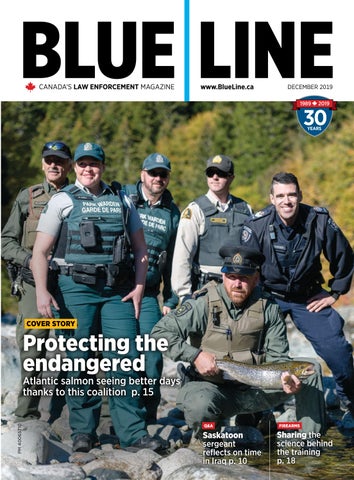
COVER STORY
Protecting the endangered PM 40065710
Atlantic salmon seeing better days thanks to this coalition p. 15 Q&A
FIREARMS
Saskatoon sergeant reflects on time in Iraq p. 10
Sharing the science behind the training p. 18
THE 2020 FORD POLICE INTERCEPTOR ® UTILITY.
IT’S FAST. AND NOT JUST ON PAPER. The 2020 Police Interceptor ® Utility EcoBoost® outperforms all competitive police vehicles tested, including V8-powered sedans.
FLEET.FORD.CA
©2019 Ford Motor Company of Canada, Limited. All rights reserved.
Contents
20 December 2019 Volume 31 Number 10
Features COVER STORY
15 Protecting the endangered
Through education, monitoring and enforcement, the Atlantic Salmon Law Enforcement Coalition is working to ensure the protection of inner Bay of Fundy Atlantic salmon during their spawning adult life stage. By Danielle Latendresse
18 The science of firearms training
If citizens understood more about the science that goes into police firearms training, they may be less inclined to quickly condemn the actions of officers who have to react in fractions of a second to save lives. By Dave Brown
20 RCMP officers trek to Herschel Island
Columns 4 10 12 13 14 24 26 30
Editor’s commentary Q&A Interviewing & investigations Health & wellness Behavioural sciences Technology Case law Back of the book
Departments 5 5 9 9 23 28 29 30
By the numbers News Calendar Dispatches Off the shelf Product showcase Marketplace Blue Links
Police members share their “unforgettable” journey to Yukon’s most northerly point with conservation officers and join up with Parks Canada for the first “Tri-Service North Slope Patrol.” By Kalah Klassen
22 Being ambassadors for mindfulness meditation
COVER PHOTO: NIGEL FEARON PHOTOGRAPHY
The third Annual Kindful Canada Symposium featured a special panel discussion on “Mental Health and Wellness for First Responders,” where presenters shared personal stories as well as advice on holistically restoring wellness. By Amy Boudreau
10 @Blue_LineMag
22
24 December 2019 | BLUE LINE
3
EDITOR’S COMMENTARY BY RENÉE FRANCOEUR
BLUE LINE www.BlueLine.ca
“Does your face light up?”
M
any of us are currently to emulate it. I can only imagine what it preparing for the holiday meant to the parents and to those kids season and I find it all too themselves, who will most likely draw on easy to end up entangled in that positive memory for years to come. the tinsel-clad hustle and bustle—like So often I hear how some of the hardest braving engorged malls to splurging on service calls involve children. How do we things I don’t need (a.k.a. glitter-covered wear our faces in those moments? In our candles in the shape of reindeer). November issue’s cover story, we learned Having a two-year-old godson how officers in Longueuil, Que. has helped reposition the magic “Let your sometimes use their wearable of this time of year. There is face speak lights to distract and entertain really nothing like the wonder what’s in children when they’re attending to flickering in children’s eyes when your heart. domestic incidents. Similarly, the someone shakes a snow globe for When they International Association of them. I can’t wait to see my god- walk in the Chiefs of Police (IACP) and Yale, son’s first bite of my homemade room my face with support from the Office of peppermint marshmallows this says I’m glad Juvenile Justice and Delinquency year. And then I start to wonder to see them. in the U.S., put together a toolkit It’s just as what else I can give to him... for law enforcement in 2017 called Upon revisiting some of my small as that, “Enhancing Police Responses to favourite works and quotes from you see?” Children Exposed to Violence,” - Toni Morrison featuring “practical tools and rethe exceptional writer Toni Morrison, who we lost earlier sources.” You can download it this year, I stumbled upon her in a May here at: bit.ly/2O4dKcd. 2000 episode of The Oprah Winfrey Show. At the same time, organizations like She essentially asked us to examine what ProAction Cops & Kids bring at-risk chilwe do when a child walks into the room. dren and officers together for fun and “Does your face light up?” Morrison trust-building events like the Durham said. “Let your face speak what’s in your River Adventure or ski-and-snowboard heart. When they walk in the room my face programs. I can bet every one of those ofsays I’m glad to see them. It’s just as small ficers who deliver the ProAction undertakas that, you see?” ings boast faces that intrinsically light up What a powerfully simple instruction. when children are around. And it took me back to a time earlier this Speaking of brightening faces, if you summer. I was outside the Roger’s Centre haven’t caught the endearing Facebook in Toronto, waiting with family members video that went viral of Sarah Routhier’s before a Blue Jays game and there were children recently opening their “Blue Line two police officers standing off to the side Bears” in Belleville, Ont., I encourage you who completely hypnotized me. to check it out. The stuffed toys were made They were keeping an eye out on the by an American non-profit that builds road that had been blocked off for chil- teddy bears out of fallen officers’ uniforms dren’s activities and they were magnetic for their coping children. According to its in their interactions. I realize now it was website, Blue Line Bears has delivered 619 in part because whenever a child timidly custom hand-sewn bears across North strolled near, the officers’ faces lit up. They America. crouched down to each child’s level, took Watching those Toronto officers was a off their hats and just glowed with a joyful great reminder for me to bring about such attentiveness. “lightness” when I’m with children. And Those two officers had long registered that’s what I want to leave you with as we Morrison’s message. It meant everything enter this busy holiday season... “Does to me to witness it, to be drawn in and wish your face light up?”
CONNECT WITH BLUE LINE
www.BlueLine.ca 4
@Blue_LineMag
BLUE LINE | December 2019
www.facebook.com/BlueLineMagazine
GROUP PUBLISHER | MARTIN MCANULTY mmcanulty@annexbusinessmedia.com EDITOR | RENÉE FRANCOEUR rfrancoeur@annexbusinessmedia.com ACCOUNT MANAGER | JANICE EATON jeaton@annexbusinessmedia.com MEDIA DESIGNER | SVETLANA AVRUTIN savrutin@annexbusinessmedia.com ACCOUNT COORDINATOR | TRISH RAMSAY tramsay@annexbusinessmedia.com CIRCULATION MANAGER | BEATA OLECHNOWICZ bolechnowicz@annexbusinessmedia.com Tel: 416-442-5600 ext. 3543 COO | SCOTT JAMIESON sjamieson@annexbusinessmedia.com
ANNEX BUSINESS MEDIA 111 Gordon Baker Road, Suite 400 Toronto, ON M2H 3R1 Tel. 416-442-5600 • Fax 416-442-2191
Publication Mail Agreement No. 40065710 ISSN 0847-8538 Printed in Canada SUBSCRIPTION RATES Canada — 1 Year $31.50; 2 Year $52.50 plus tax USA — 1 Year $105.00 USD CIRCULATION email: asingh@annexbusinessmedia.com Tel: 416-442-5600 ext 3553; Fax: 416-510-6875 or 416-442-2191 Mail: 111 Gordon Baker Road, Suite 400, Toronto, ON M2H 3R1 Occasionally, Blue Line will mail information on behalf of industry-related groups whose products and services we believe may be of interest to you. If you prefer not to receive this information, please contact our circulation department in any of the four ways listed above. Annex Privacy Officer Privacy@annexbusinessmedia.com; Tel: 800-668-2374 © 2019 Annex Publishing & Printing Inc. All rights reserved. Printed in Canada. No part of the editorial content of this publication may be reprinted without the publisher’s written permission. Opinions expressed in this magazine are not necessarily those of the editor or the publisher. No liability is assumed for errors or omissions. Readers are cautioned and advised that articles presented herein are edited and supplied for your personal awareness and should not be used for further action until appropriate guidance is received from a supervisor, Crown Attorney or other persons in authority. All advertising is subject to the publisher’s approval. Such approval does not imply any endorsement of the products or services advertised. The publisher reserves the right to refuse advertising that does not meet the standards of this publication.
NEWS
Const. Nathan Black of Wolfville RCMP carries a miniature fidget quilt at all times.
“[An individual] could get up to leave the home and go wandering sometimes... If you could give them the large quilt for 20 minutes, it can allow a family member to do the laundry and have a shower,” Parker said. Parker reports that fidget quilts have positively improved the quality of life of dementia patients. “I don’t think you need to have a strict diagnosis like autism or dementia for the concept to work for you. Once it starts getting out there, the applications are just going to grow and grow,” she added. “We’re looking at how we can realistically roll this out further. If this were to go national, that would be great.” - By Zeba Khan
PHOTO SUBMITTED BY MICHELLE PARKER
CANADA NOVA SCOTIA
Fidget quilts: Helping Kings District RCMP officers with dementia patients
Michelle Parker, a co-ordinator of Kings County Seniors’ Safety Society, remembers a woman with dementia who went missing twice in the Nova Scotia community during the holidays last winter. The woman was not from Canada, did not speak English and lived an hour and half away from her family. Her daily routine included leaving her home, walking to certain stores and then going back home. “Over the holidays, when the stores were closed, it completely threw her off since her routine changed... Caseworkers went to check on her, she wasn’t there,” Parker explained. “Police are the first line of contact in these cases. So, having that one extra tool to be able to de-escalate the situation really helps take things from a crisis to a manageable point.” That extra tool for Kings District Royal Canadian Mounted Police (RCMP) officers
comes in the form of a “fidget quilt,” or an activity blanket. Beth McBrine and Cathy Dunbar — known as “The 2 Fidgeteers” — are the inventors of the fidget quilts. They initially created them to help family members with dementia and have now distributed almost 700 quilts to care givers and police offices. There are two types of fidget quilts: small quilts with four panels, and larger quilts with 20 panels. The quilts are made of a variety of sensory pieces, activity panels and textures like Velcro or silk. Each RCMP member in the district now carries a small quilt in their duty bag for initial interactions and each detachment carries a large quilt. For initial interactions, a highly agitated person with dementia is isolated. RCMP members sit the person down and give them the small quilt to focus on. Finally, a communication strategy is used to help the person calm down. For follow-ups, a large quilt is provided to family members of dementia patients.
Niagara Falls wins bid to host IAWP 2021
The International Association of Women Police (IAWP) will host its 59th annual conference in Niagara Falls, Ont. in 2021. This year’s PHOTO VIA OWLE TWITTER conference was held in Anchorage, Alaska. “IAWP has, for the past 104 years, promoted the role of women in policing, championing change to enable women to play their full part in delivering an inclusive service to local communities,” says IAWP President Deborah Friedl. “Our belief is that women need to be recognized for their contribution. Without our annual recognition program some phenomenal women, and men, would go unrecognized for their efforts.” The association’s mission statement is to strengthen, unite and raise the capacity of women in policing internationally.
BY THE NUMBERS
The Globe and Mail says it “obtained and analyzed scores of records to find out how the country’s 22 largest public transit systems track and handle sexual misconduct. Data gaps mean the number of incidents is likely much higher.” Some of the findings are below. Visit tgam.ca/2Swrq1t for more.
4,000
incidents (approximately) of sexual assault or harassment were recorded on Canada’s 22 largest systems between 2013 and 2017, according to The Globe’s examination
@Blue_LineMag
90%
of the incidents were perpetrated against women by men
507
incidents of sexual crimes on public transit involved passengers under the age of 18 between 2013 and 2017, according to a separate set of data from the Canadian Centre for Justice Statistics, focused solely on criminal activity
726
sex crimes on public transit between 2013 and 2017 happened on a bus, with 400 happening at a bus stop (and most transit systems do not track sexual violence at bus stops and shelters, according to The Globe)
December 2019 | BLUE LINE
5
NEWS YORK REGION
York Regional Police to start managing evidence with Axon Fleet systems
York Regional Police Service announced it was stepping up its technology game by implementing in-car video systems, as well as a website where all audio and video footage will be stored. This purchase by York Regional Police consists of 270 Axon Fleet in-car video systems and 1,800 licenses to the digital evidence management solution, Axon Evidence (Evidence.com). Axon says its in-car video systems will allow York Regional Police to better perform their day-to-day duties, with features like integrations with Axon’s body cameras, infrared and zoom, wireless microphone, night-time visibility and wireless offload. “This technology provides a robust and secure platform for York Regional Police to better manage digital evidence and take the next steps in modernizing our police service,” York Regional Police Chief Eric Jolliffe said in a press release. Evidence.com will also provide cloudbased storage. All video/audio footage is uploaded to Axon’s digital evidence management system at Evidence.com where data is collected, stored and managed. Body cameras and Fleet In-Car video systems give officers an extra layer of protection, said Vishal Dhir, Axon’s managing director of Canada and Latin America, because they have a witness within the cameras. “The technology is really the gatekeeper,” Dhir said. Police stations decide when to turn on and off the cameras, how they will be used on duty and in court, and how the information is categorized, he explained. “The exciting part for York, as well as other agencies that have deployed the system, is that we offer the Crown a copy to receive the information as well,” Dhir said. “One of the biggest challenges with disclosure today is that police spend a lot of time burning disks and putting information on hard drives to share with the Crown. The Crown then has to store all those disks and hard drives, upload that information and get it ready for court.” - By Zeba Khan
Visit www.BlueLine.ca for the latest news, stories, products, videos, photo galleries and industry events.
6
BLUE LINE | December 2019
PHOTO: AXON
MANITOBA
ONTARIO
Specialized police equipment headed to Altona, Winkler
OPP opens Cyber Operations Centre
The Manitoba government announced it has invested nearly $11,000 with the Altona Police Service to purchase new specialized equipment to support officer and community safety via the province’s Criminal Property Forfeiture Fund. The Altona Police Service is purchasing mounted lights for their firearms, which will help ensure officers can respond safely and more effectively when it is dark or difficult to see. Funding will also be used to replace several older shotguns. “Police equipment is extremely expensive, so without the help of these funds the burden to pay would land firmly on our ratepayers,” said Chief Perry Batchelor, Altona Police Service. “Thanks to these funds, our officers will be much safer entering into low-light or no-light situations.” Justice Minister Cliff Cullen also highlighted several other investments made in 2019-20 totaling nearly $30,000 to other police services in the region. A regional crisis negotiation unit is being jointly developed by the Winkler, Morden and Altona police services. The unit has received more than $26,300 to equip its team, including communications tools such as a throw phone and audio recording equipment, training material for all officers and a crisis negotiator refresher course for two certified officers. The unit will ensure trained negotiators are available to de-escalate and resolve high-risk situations while limiting the potential need for use of force. They will also support the work of the agencies’ regional tactical team. The Winkler Police Service is also receiving nearly $3,200 to purchase two rechargeable lighting systems that can be used at crime scenes or collisions.
PHOTO: OPP
The Ontario Provincial Police (OPP) developed the Cyber Strategy to manage risks, reduce threats and mitigate harm caused by crimes involving digital technologies. The creation of the Cyber Operations Section (COS) is “an integral component of the strategy with the mission of enhancing capacity to support high-tech, modern, criminal investigations involving both device-based and online digital evidence,” the agency recently announced. Comm. Thomas Carrique and invited guests were on hand Sept. 30 to cut the ceremonial ribbon on the OPP Cyber Operations Centre — the new home of the Cyber Operations Section. The Cybercrime Investigations Team, Digital Forensics, and the Forensic Video Analysis Unit are all in the newly-renovated building behind the OPP Academy Residence in Orillia. “The OPP has had specialized resources that have been collaborating for several years to conduct device-based and internet-based criminal investigations,” says Chief Supt. Paul Beesley, the executive lead for the OPP Cyber Strategy since day one. “Finally, we have our talented, dedicated people and state of the art technology under one roof to continue our tradition of professional excellence.” The OPP Cyber Operations Centre is not intended nor designed for direct public access. Police agencies can contact the Cyber Operations Centre for assistance through established channels. www.BlueLine.ca
THE BERETTA STRIKER
APX Red Dot Optic*
*Optic Not Included
APX Full Size
TOP ERGONOMICS MAXIMUM MODULARITY SAFE STRIKER DEACTIVATION TACTICAL FUNCTIONAL DESIGN
PROUD SUPPORTERS OF WOUNDED WARRIORS CANADA
APX FDE
BERETTACANADA.CA
@BERETTACANADA @BDTCANADA
NEWS VANCOUVER
CANADA
Drone policy approved by police board
New certification program and talent development pilot to enhance cyber security
Vancouver Police released a new internal policy this September for the use of drones for police operations within the city. Three drones have been purchased and will be put into operation, after being approved by the Vancouver Police Board. “Remotely-piloted aerial systems, more commonly known as drones, are used by police agencies across the country,” says Supt. of Operations Steve Eely. “The system will greatly enhance our ability to keep the city safe. We are committed to full transparency with our policy for the use of the equipment and want Vancouver residents to fully understand when and how the equipment will be used.” The policy has been under development for several months now, and was developed in consultation with key stakeholder groups, including the Office of the Information and Privacy Commissioner and the B.C. Civil Liberties Association.
PHOTO: VPD VIA TWITTER
The new equipment will have many operational purposes, including investigation of motor vehicle collisions, crime scene analysis and reconstruction, search and rescue, and analysis of a disaster zone after a disaster or major event. The VPD says it will not use the drones for surveillance. The VPD’s three operational drones include a larger unit and two smaller units. In addition, the VPD has purchased three drones for training purposes only. The VPD says it will aim to incorporate the equipment into its operations before the end of 2019.
Canada has launched the CyberSecure Canada certification program to enhance cyber security to help prevent monetary losses, keep valuable intellectual property safe, and protect the privacy of consumers and businesses. The feds also announced $997,000 in funding for TechImpact to help the organization with a talent development pilot for the cybersecurity sector. CyberSecure Canada is a voluntary cyber security certification program that will help small and medium-sized organizations achieve a baseline level of cyber security, giving their customers greater confidence and providing these organizations with a competitive advantage. The CyberSecure Canada program, an initiative under the National Cyber Security Strategy, also supports Canada’s Digital Charter.
PHOTO: LONGUEUIL POLICE SERVICE
The premier event for Canada’s law enforcement community
April 21, 2020
The International Centre • Mississauga, ON
FREE TO ATTEND NEW THIS YEAR
Training + sessions Hosted by
in partnership with
8
BLUE LINE | December 2019
BLEXPO2020_ 7x5 ad.indd 1
Register today at bluelineexpo.ca www.BlueLine.ca
2019-11-13 9:32 AM
NEWS DISPATCHES Pam Mizuno is the new chief of the Windsor Police Service, confirmed three months after she was named acting chief in the wake of Chief Al Frederick’s retirement. Mizuno, a 25-year veteran of the police service, has worked in several units including 16 years in patrol. She served as a sergeant in patrol response, a staff sergeant in the drugs and guns unit (DIGS) and played a leadership role in the service’s Human Rights Project from 2011 to 2014. She was the first officer to be appointed to the provincial proceeds of crime unit. She’s the first female chief in the service’s 152-year history. UCCM Anishnaabe Police Service Chief of Police Rodney Nahwegahbow has retired after 30 years in law enforcement. He served for nine years as chief for UCCM Anishnaabe Police Service, located in the Manitoulin District of Ontario. Imran Ally, a chaplain with Peel Regional Police and a resident Imam at the Toronto and Regional Islamic Congregation (TARIC) mosque for the last 20 years, is the first Imam and Muslim chaplain in Canada to receive the Chaplain of the Year award from Badge of Life Canada (BOLC). BOLC is a peer-led, charitable volunteer organization committed to supporting police and corrections personnel who are dealing with psychological injuries diagnosed from service. In addition to being the first Muslim chaplain with Peel Regional Police, he is also the first Imam and Muslim chaplain in Canada to receive certification by the Canadian Police Chaplains Association (CPCA). Staff Sgt. Stefanie Finateri of Durham Regional Police Service was the recipient of the International Association of Women Police (IAWP) Foundation’s Mentoring & Coaching award for 2019, presented in Anchorage, Alaska, at the association’s 57th training conference. Between 2007 and 2012, Finateri was a member of the elite Drug Enforcement Unit, being the second female officer to ever work in this unit. Finateri, now @Blue_LineMag
CALENDAR in her 17th year as a police officer, is “leading the way in coaching and mentoring female members who want to follow in her undercover officer footsteps.” Myra G. James, a retired Hamilton Police sergeant, is the latest winner of the prestigious Heritage Award from the International Association of Women Police (IAWP). The Heritage Award is the highest honour bestowed by the IAWP upon an individual member to recognize “substantial and significant contributions to women police and the International Association of Women Police over a period of years and especially during milestones of the organization.” James has been a member of the IAWP since 1993 and has been a life member since 1994. She joined the Hamilton Police Service in 1988 and retired in 2018 after 30 years’ service. Deputy Chief Chris McCord has retired from Peel Regional Police Service. McCord was named acting head of the service in January after Chief Jennifer Evans announced her retirement. McCord, who began his policing career in Northern Ireland, immigrated to Canada in 1988 and started working for Peel Regional Police. He also served as Deputy Director of the Unified Command Centre in Barrie during the G20 meetings in June 2010. He has served as Deputy Chief since November 2012. Amanda Plunkett is the first York Beyond the Blue Ambassador. She is a registered psychotherapist working in Barrie, Ont. and focuses her practice on providing psychotherapy to first responders. She has additionally provided training on working with victims of crime and spoken publicly about her journey to finding strength and resilience after the line-of-duty death of her father, a police officer in York Region, Ont. PROMOTIONS, RETIREMENTS, RECOGNITION • If you have an officer in your agency recently promoted or retiring or an individual you wish to have recognized (major award or recently deceased) you can let Blue Line magazine know by emailing: rfrancoeur@annexbusinessmedia.com.
NSSF Shot Show Jan. 21-24, 2020 Las Vegas, Nev. shotshow.org 17th National Symposium on Search and Seizure Law in Canada Feb. 7, 2020 Toronto, Ont. www.osgoodepd.ca Alberta Association of Community Peace Officers Conference Feb. 10-14, 2020 Lake Louise, Alta. aacpo.ca/winter-conference/ registration-2020 CACP Information and Communications Technology Committee Summit Feb. 23-26, 2020 Vancouver, B.C. cacp.ca Courtroom Testimony: A Practical Skills Workshop for Police and Other Law Enforcement Professionals Feb. 27, 2020 Toronto, Ont. www.osgoodepd.ca Calgary Cyber Summit 2020 March 10-12, 2020 Calgary, Alta. cybersummityyc.ca 13th National Symposium on Tech Crime and E-Evidence April 3, 2020 Toronto, Ont. www.osgoodepd.ca Risk & Recovery Conference April 16-17, 2020 Hamilton, Ont. www.riskandrecoveryconference.com Canadian Police Association Conference April 20-22, 2020 Ottawa, Ont. www.cpa-acp.ca National Symposium on Sexual Assault Cases in the Criminal Court April 25, 2020 Toronto, Ont. www.osgoodepd.ca December 2019 | BLUE LINE
9
Q&A Earlier this year, Saskatoon Police Sgt. Erin Coates completed a 12-month deployment to the Police Task Force – Iraq Training Unit within the Combined Joint Task Force – Operation Inherent Resolve (CJTF-OIR). Coates was the first female Canadian law enforcement officer deployed to Iraq in a police peace operations capacity. She shares some of her memorable moments from this experience. Q: How long have you been in policing? Why did you choose this career?
in other roles, too. All of it was overwhelming; from going into the country and not knowing what to expect to walking into my first classroom with a fellow Czech instructor and seeing 133 guys in this class. I just had to walk in and think to myself, “Ok, I’m here and I can do this.”
I’ve been in policing for 19 years, all with Saskatoon Police Service. I’m the first police officer in my family; we’re a farming family and I’m originally from Roland, Manitoba. I have a document from kindergarten and it asks, “What do you want to be when you grow up?” For some reason, I wrote “police officer” and it stuck. I love people and puzzles and how you can do so many different things in policing.
Q: How did your deployment within Operation Inherent Resolve come about?
I’ve always been interested in the international deployments. I never thought I’d have the opportunity to do it; I wanted to have a family. That wasn’t happening, so I thought, well, why not try this as a next step in my career. I’ve always loved travelling, too. In 2008, I had the opportunity to go to Syria and Turkey as a tourist. It was truly just an amazing experience. The hospitality we received while we were there was next level. So, I’ve always had an interest in the Middle East and enjoyed it. This opportunity came up, the timing was right and I started my application process. I had no expectations but when I received that first phone call, I was thrilled.
Q: Are there other Saskatoon Police members on deployment? Did anyone who has done something similar inspire you?
I’ve had a couple friends who were 10
BLUE LINE | December 2019
deployed to Afghanistan so I was definitely interested in their experiences. One of our inspectors was previously deployed on the same mission as I was but in a different capacity. We have one other officer currently deployed to Iraq and two preparing to go. We also have another member in Ukraine so Saskatoon has been incredibly supportive of these opportunities.
Q: How did it feel to be the first female police officer from Canada deployed to Iraq in a police peace operations capacity?
I didn’t realize I was the first Canadian female police officer to be sent over there, honestly. There are a lot of women there with the military and
Snapshot of the Canadian Police Arrangement
30
years of RCMP participation in peace and stabilization operations
4,000+ Canadian police officers involved
66+
peace operations abroad
There was one class called “Train the Trainer.” We started with about 30 students and they are selected from a larger “Law and Order” class of about 130 students. These 30 individuals are chosen to become “trainers” so they can continue the education forward. We were halfway through class and down to about 15 students when we began the “teach backs” portion. They are given all the material and videos in Arabic, which we presented, and they have to teach it back to the small class for practice. Two of the students got up and presented on human rights and they did it better than I did. They were phenomenal. There’s a video on human rights and they chose to play it with no sound. It’s about a father who is driving his daughter to the hospital because she has been shot. They arrive at the hospital only to find it has been blown up, and his daughter dies in his arms. It was one of the most powerful experiences I’ve ever witnessed. The conversation they engaged the class in afterwards just gave me goosebumps. The quote they used that sticks with me is, “If we do our job, we give them life.” For me, I was completely taken aback. I’ll never ever forget it. www.BlueLine.ca
PHOTO: SGT. TRINA GOSSE
Q: What is your most memorable moment from the deployment?
Q: What was the most surprising thing?
When you go into the coalition setting — working with Italians, the Finnish Police, the Czech Republic, Slovakian military police — you don’t realize how different your cultures are. What may be important to me, for example, isn’t as important to someone else in the coalition. It was refreshing to see all the different perspectives and learning how to work together.
Q: Tell us more about implementing the Female Policing Course.
That course was life changing for me. It’s an Italian-run course. They develop it in consultation with the Iraqis. Sgt. Trina Gosse from the OPP, who was essentially my partner in crime for most of the mission, and I were given the opportunity to assist. So, we did everything from human rights to domestic violence to interviewing vulnerable witnesses. Trina has expertise in domestic violence and I have expertise in investigative roles and working with
vulnerable people so we brought those components to the course. We also did some rapport building with the female Iraqi police officers. We talked about where they wanted to vacation and created a relationship by sharing stories. Then we were able to hear what was happening in their communities, the challenges they were facing at work, the successes they were seeing. To establish that kind of relationship with those women was just amazing. We were pretty confined in terms of movement so they would even bring in food so we could taste the local cuisine. The classroom environment became its own little community. The course is still ongoing. I was a part of two of them. Trina and I were always trying to develop it further and make it applicable to what was going on in their country and specific to their needs.
Q: What is it like to be home again after such an experience?
Costco is a bit overwhelming right now...
UNMATCHED CAPABILITES
After living on a base for an entire year, it’s an adjustment cooking and grocery shopping again.
Q: You were away for a whole year. What makes it all so worthwhile?
The students and the teaching make it worthwhile. These students are already police officers and when you start engaging with them, you realize, as police, we are all dealing with the same issues — whether it be theft, domestic violence, terrorism, drugs. The differences are sometimes in the root causes, such as different access to resources and different ways of problem solving. At the end of the day we all want the same thing: to be safe and secure with friends and family. I’m so grateful to be a part of Team Canada in this capacity and in giving the Iraqi police more tools and skills to be problem solvers as opposed to just following military direction. I’ve learned an immense amount about Iraq and its culture and people. I struggle to put it all into words and not sound like a cliché.
We equip your mission Contact Rampart today to learn more about the GLOCK G45 MOS and available firearm accessories.
ACCESS TO
ACCESS TO
PRODUCTS
SUPPLIERS
50,000+
500+
GLOCK G45 MOS
9mm, 17 round capacity
Streamlight TLR-7
@Blue_LineMag
BL_Dec19_Colt.indd 1
December 2019 | BLUE LINE
11
2019-11-14 3:36 PM
INTERVIEWING & INVESTIGATIONS BY KERRY G. WATKINS, LL.M.
The essential – but little known – “Prosper warning”
K
nowledge of statement law is essential for investigative interviewers; this is especially true when questioning suspects who have been detained or arrested. The majority of investigators understand and comply with their duty to inform such suspects of their Charter right to legal counsel and silence. However, there is an additional legal duty, which only applies in specific circumstances, that many officers seem to be largely unaware of – the duty to provide suspects with a “Prosper warning” before questioning them. A Prosper warning is only required where a suspect first asserts their right to counsel, and then changes (or apparently changes) their mind after reasonable efforts have been made to contact counsel, but where such efforts were unsuccessful. The Supreme Court case of Prosper (1994) gave birth to the “Prosper warning” 25 years ago and reaffirmed it in Willier (2010), stating that where such circumstances exist, police are required to explicitly inform the detainee (again) of their right to a reasonable opportunity to contact counsel, and of the police duty to hold off their questioning until such an opportunity has been provided (R. v. Prosper, 1994 CanLII 65 (SCC); R v. Willier, 2010 SCC 37 (CanLII)). While the court did not prescribe the specific wording of a Prosper caution, the following elements should be communicated to a suspect:
• You have the right to remain silent. • You have the right to a reasonable opportunity to consult legal counsel and you initially indicated that you wished to do so. However, you are now indicating that you do not wish to speak to a lawyer. • Because you have changed your mind, I have a duty to advise you again that you have the right to speak to a lawyer, and that I will give you another opportunity to do so if you wish. • Until you are certain about whether or not you wish to speak with a lawyer, I am legally obligated not to attempt to take any statement from you or to ask you to participate in any investigative process that could result in you providing incriminating evidence to me. • Do you understand? • What would you like to do? The Prosper warning has been the law in Canada for more than a quarter century. Yet there are still numerous cases in which officers did not provide a Prosper warning when one was required; with many officers admitting that, prior to the issue being raised in court, they had never heard of the Prosper warning. This is problematic, first, because the failure to provide a suspect with such a warning when required constitutes a breach of the Charter; and, second, because courts are increasingly inclined to view police ignorance of the law in this area as an aggravating factor in deciding whether to exclude statement evidence (R v. Delgado,
Knowledge of statement law generally, and of special cautions such as Prosper in particular, is essential in enabling investigators to safeguard the legal integrity of suspects’ statements.
2019 ONCJ 70 (CanLII); R v. Oyston, 2019 BCSC 264 (CanLII); R v. Roberts, 2019 YKTC 2 (CanLII); R v. Dougherty, 2018 ONCJ 633 (CanLII); R v. Sivalingam, 2018 ONCJ 501 (CanLII); R v. Miller, 2018 ONCJ 465 (CanLII)). In 2017, the Ontario Court of Appeal emphasized that Prosper “… is not an obscure decision addressing a rare event. It is a long-standing precedent governing not only a ubiquitous investigative technique – the police interview – but every case where the police use a detained suspect as a source of evidence.” The failure of police to provide a detainee with a Prosper warning when required is not merely a “technical” violation of the Charter. The Prosper warning is meant to ensure individuals who have been frustrated in their attempts to exercise their right to counsel do not give it up too easily. It is “a substantial protection designed to preserve the integrity of a centrally important Charter right to secure legal advice when detained” (R. v. Fountain, 2017 ONCA 596 (CanLII), para 63, 67). A Prosper warning – where required – is essential in ensuring that where a suspect waives their right to silence they do so voluntarily and with knowledge of the consequences of that choice. Knowledge of statement law generally, and of special cautions such as Prosper in particular, is essential in enabling investigators to safeguard the legal integrity of suspects’ statements. While knowledge of reliable, evidence-based questioning techniques is essential to conducting effective suspect interviews, knowledge of the legal context in which such interviews take place is just as important, if not more so. Kerry Watkins conducted more than 2,000 interviews during his 30-year career, the majority of which was spent as a criminal investigator in specialized units investigating a wide range of matters, including police corruption, corporate fraud and homicide. He is currently director of The Interview Group, a professor at Humber College and an adjunct faculty member in the Ongoing Professional Development Program at Osgoode Hall in Toronto.
12
BLUE LINE | December 2019
www.BlueLine.ca
HEALTH & WELLNESS
ISABELLE SAUVÉ AND BRUNO SEGUIN
Ethics in leadership
L
eaders can be found at every level of an organization and leadership is a process, not a position. This process involves a complex interaction between followers and leaders with sensitivity to situations, workplaces and environments. As highlighted in a previous Blue Line Health & Wellness column, despite some degree of overlap, there is a notable distinction between managers and leaders. A conclusion can be drawn that managers focus on “doing things right,” whereas leaders focus on “doing the right things.” The key question remains: what are the right things? What are the morally right things, the ethically right things, the right things that ensure an organization and its members succeed and develop? From the moment one embarks in the recruitment process in law enforcement, it is expected a strong sense of morals and integrity will be demonstrated. “Ultimately, ethics is important not so that ‘we can understand’ philosophically, but rather so we can ‘improve how we live’” (Lafollette, 2007). By being moral, we enrich our lives and the lives of those around us. It is aligned with numerous research studies stressing “the centrality and importance of the moral dimension of leadership.” Indeed, a leader’s personal values and ethical code decisively affects the nature — as well as the outcome — of how they exercise the various sources of power available to them. As such, leaders are very often judged on the basis of a “framework of values” and not solely on the effectiveness of their work. Amongst those values or qualities that foster trust, there is first the vision as it tends to draw people together on the basis of shared and respected beliefs. It also offers a joint sense of organizational purpose and belonging. Secondly, leaders who demonstrate empathy with those around them and @Blue_LineMag
show they understand the complex environments others experience are more likely to be trusted. Thirdly, consistency in leaders’ decision making and approach towards change are required to gain and maintain trust. It is critical leaders ensure a clear understanding of the process of evolution and are transparent in light of new evidence or information. Decisions cannot be perceived as being randomly based. Trust is strongest in leaders with a high level of integrity, who demonstrate their commitment to higher principles through their own daily actions. It can be argued that, in an organization, these values can be self-serving and do not always help the individuals; nonetheless, they remain important to create a prosperous environment where individuals will be dedicated to achieving goals. Identifying the key values that permit leaders to have the trust of followers is important. It is also
Recognizing the variety of values is what makes an organization intellectually and emotionally rich.
vital for the same leaders to realize individuals in the same work unit can also have considerably dissimilar values. Identifying these values is complex as we cannot directly see them. It is only by interacting, communicating and interpreting behaviour that we can hope to understand what drives values. For example, some people will hold a set of values referred to as a ‘behaviour mode,’ such as courageous, responsible, honest and imaginative, just to name a few. Meanwhile, others will have values related to inner harmony, social recognition, family security, or a sense of accomplishment. Each work environment sets varying importance on these values despite all having their own merit. It remains important for a leader to accept not everybody has the same values. Indeed, studies have shown much of the misunderstanding that may exist between leaders and follower s— especially between the older and younger — is fed by a departure from their respective values. Recognizing the variety of values is what makes an organization intellectually and emotionally rich. Leaders failing to do so increase the likelihood they “add tension” to the interactions between them and their followers. To conclude, police agencies traditionally follow a para-military regime and could highly benefit from an alignment with leadership that addresses the interdependencies between effective leadership, particular value systems and proven management methods.
Isabelle Sauvé is a 12-year veteran with the OPP, currently with the Lanark County Detachment. She has a MA in psychology and is a PhD candidate. She is also an ultramarathon/endurance athlete and the Racing the Planet/4 Deserts 2018 Series winner as well as a Guinness World record holder. She can be contacted at: isabelle.sauve@hotmail.com. Bruno Seguin is a senior executive manager and international business consultant with experience in global operations, international business development, strategic planning, leadership and corporate governance. He is also an ultra-runner, 9th place finisher at the Racing the Planet/4 Deserts 2018 Series and fellow Guinness World record holder.
December 2019 | BLUE LINE
13
BEHAVIOURAL SCIENCES PETER COLLINS
Complicated grief
G
rief is a natural occurrence in our life and everyone grieves in their own way. In the acute stage of grief, it is normal for a bereaved person to experience intense emotions and a preoccupation with thoughts and memories of the person who died. Some individuals may feel that they will never be happy or fulfilled again but eventually, over time, most adapt to their loss and that the future holds happiness, joy, connection and meaning, albeit in a world without the deceased. The reality of the loss is accepted and the loss is no longer preoccupying or disruptive. Ultimately, the majority of individuals who grieve do not require therapy. Approximately seven to 10 per cent of those bereaved will experience a persistent, prolonged and impairing grief, a condition referred to as complicated grief. Other terms, for this condition, include “pathological grief,” or “unresolved grief,” or “prolonged grief disorder.” According to Igleicz et al (2019)1 a higher percentage of those who have lost a child or have lost a loved one from suicide, accident or murder, are at greater risk for complicated grief. Who else is more at risk for complicated grief? According to Shera et al (2011)2, complicated grief is more common in females, in individuals who have a history of a mood disorder, and individuals who are pessimistic and were overly dependent on the deceased. Without appropriate treatment, those who suffer from complicated grief are more at risk for developing a major depressive disorder and are susceptible to a general deterioration of their health, substance abuse, suicidal ideation and suicidal behaviour. Complicated grief can also impair personal, family, social, educational and occupational areas of functioning. Roadblocks to adapting to the death — which can lead to complicated grief as such — include dysfunctional thinking, maladaptive behaviour and difficulties with the regulation of emotions — especially if alcohol and/or drugs are used to self-medicate. Individuals who suffer from complicated grief may believe that nothing can assist them in getting on with life, but they should be encouraged to seek out treatment from a health professional.
14
BLUE LINE | December 2019
the death. Many people may feel that having the bereaved speak about the deceased, over time, is counterproductive and they become harsh in their insistence that the person refrain from doing so. As a result, a person experiencing complicated grief will avoid such discussions. When guided, in a professional therapeutic setting, the telling and revisiting of the story can assist the person with coping over time;
Without appropriate treatment, • Many people living with complicated those who suffer from complicated grief believe they should avoid events, grief are at risk for developing a thoughts, people, places and activities major depressive disorder... that remind them of their loss. These What can we do, in the profession of law enforcement, to assist our colleagues who may be experiencing complicated grief? Here’s a starting point: • As mentioned above, the individual should be encouraged to seek out professional assistance. Typically, a health professional will provide psycho-education on what constitutes complicated grief to the patient and why people grieve; • Individuals should monitor their grief and take five to 10 minutes at the end of each day and think back over the day and identify the time(s) the grief was at its highest and rate it on a scale of one to 10, noting what was happening at that time. Monitoring the days that are the highest for the week and lowest for the week can be useful, especially when discussed with the counsellor/therapist; • Set positive, future-oriented personal goals; • Reconnect with others in addition to making plans for interesting or fulfilling goals. The bereaved person should seek out at least one person who can act as a confidant. The bereaved person should be encouraged, over time, to re-engage in different social activities as they feel ready to do so; • Sharing the story of the loved one’s death can be therapeutic and can help the person accept the reality of the death. Telling their story shouldn’t be limited to the time immediately after
reminders should not be avoided. Although “bittersweet,” they hold benefits as well as pain. It is suggested that a ranked list of places and activities that have been avoided can be revisited, either alone or with a friend.
In summary, therapy for complicated grief addresses seven core themes: (1) understanding and accepting grief, (2) managing painful emotions, (3) planning for a meaningful future, (4) strengthening on-going relationships, (5) telling the story of the death, (6) learning to live with reminders, and (7) establishing an enduring connection with memories of the person who died. This article is dedicated to the memory of my father, Sydney P. Collins z”l (1922-2019).
References
1. Iglewicz, J., Shera, M., Reynolds, C., Simon, N., Lebowitz, B. & Zisook, S. (2019) Complicated grief therapy for clinicians: An evidence-based protocol for mental health practice. Depression and Anxiety wileyonlinelibrary.com/journals/da. doi:10.1002/ da22965 2. Shera et al (2011) “Complicated grief and related bereavement issues for DSM-5”. Depression and Anxiety. 28 (2): 103–17. doi:10.1002/da.20780
Dr. Peter Collins is the operational forensic psychiatrist with the Ontario Provincial Police’s Criminal Behaviour Analysis Unit. He is also a member of the crisis/hostage negotiation team of the Toronto Police Service Emergency Task Force. His clinical appointment is with the Centre for Addiction & Mental Health in Toronto, and he is an associate professor with the University of Toronto. Dr. Collins’ opinions are his own and may not reflect the opinion of the OPP, University of Toronto, CAMH or his mother. Contact him at peter.collins@utoronto.ca.
www.BlueLine.ca
COVER STORY
“Our role is just as much to educate as it is to enforce,” says Fisheries and Oceans Canada’s Fishery Officer Marc Levesque, far left, with Warden Dominique Audet, Sgt. Shawn Farrell, Warden Arthur Blaxley and Officer Joel Chase.
Protecting the endangered: The Atlantic Salmon Law Enforcement Coalition By Danielle Latendresse
PHOTO: PARKS CANADA
U
nrolling a thick sleeping bag on to a brown vinyl mattress, Parks Canada Warden Officer Dominique Audet prepares to stay the night at Black Hole Cabin — a remote warden cabin along the Upper Salmon River in Fundy National Park in New Brunswick. She has spent the afternoon patrolling the river and, in the morning, she will be meeting up with Fisheries and Oceans Canada for a joint patrol further downstream. @Blue_LineMag
250
or less wild Atlantic salmon returned to all rivers in the inner Bay of Fundy in 1999
The name “Black Hole” refers to a salmon pool about halfway up the Upper Salmon River. At the height of salmon fishing in the early 1960s, Black Hole and its surrounding pools — Slide Pool, Elbow Pool and Jiggers
Rock Pool — were prime locations for fishing and poaching. At the time of Fundy National Park’s establishment, wardens would hike down, patrol the popular salmon holes, and hike back up to the front country the same day.
Fundy Salmon Recovery is a true collaboration of government, community, academia and industry stakeholders... December 2019 | BLUE LINE
15
The Fundy Salmon Recovery program is the first project in the world to collect young fish from the wild and raise them in an ocean environment at a marine farm site.
Inner Bay of Fundy Atlantic salmon are legally protected under Canada’s Species at Risk Act as an endangered population.
Eventually, a warden cabin was built overlooking the pools so that there could be enforcement at the river for long periods of time. This cabin and the need for an enhanced law enforcement presence became increasingly important as it wasn’t long after this that the population of Atlantic salmon in the inner Bay of Fundy began to rapidly decline. Over a period of approximately 20 16
BLUE LINE | December 2019
years, the salmon population dropped from 40,000 fish to fewer than 250. The protection of this iconic resource became crucial. In the morning, Audet packs up and begins her patrol downstream. She stops to replace memory cards and batteries on all five trail cameras. As she patrols around the pools, it’s clear she knows every hiding spot and every rock to turn over.
1984 year of commercial harvest closure
“I’m looking for any evidence of fishing or poaching; this could be small hooks, fishing line, even finding blood or an abandoned campfire pit,” she says. “Evidence like this, if connected to a photograph from a trail camera, will be investigated and could lead to charges being filed and possible convictions.” Only finding two small camp fire pits, Audet continues her patrol downstream to meet Fisheries and Oceans Canada’s Fishery Officer Marc Levesque. This patrol was brought on by a foul-hooked salmon, which biologists discovered during a snorkel survey. The foul-hooked salmon was a female who had returned to the river to spawn but, unfortunately, an unlawful angler hooked the fish in its side in efforts to jig it out of the pool. Inner Bay of Fundy Atlantic salmon are legally protected under Canada’s Species at Risk Act (SARA) as an endangered population. It is therefore illegal to kill, harm, harass, capture or take an Atlantic salmon from the inner Bay of Fundy population. To help ensure the protection of salmon during their fresh water life stage, local law enforcement agencies are working with park wardens as part of the Atlantic Salmon Law Enforcement Coalition, which was established in 2015. Together, the coalition has increased joint patrols and surveillance on inner bay rivers, especially those which have active recovery efforts. The endangered Atlantic salmon, protected by the coalition, are part of an innovative recovery model. The Fundy Salmon Recovery program is the first project in the world to collect young fish from the wild and raise them in an ocean environment at a marine farm site. These salmon are then released into rivers in Fundy National Park as well as the traditional Mi’gmaq rivers of the Petitcodiac watershed through Fort Folly First Nation partners. Fundy Salmon Recovery is a true collaboration of government, community, academia and industry stakeholders working together to www.BlueLine.ca
PHOTOS: NIGEL FEARON PHOTOGRAPHY
COVER STORY
Team members of the Fundy Salmon Recovery program prepare to release salmon in Fundy National Park.
The Petitcodiac River is another release spot for salmon.
Warden Officer Dominique Audet replaces memory cards and batteries on trail cameras.
protect young salmon and improve their chances of survival when released back to the wild as adults. Through collaboration and innovation, the goal is to increase the number of spawning salmon in the inner Bay of Fundy. Meeting the other officers about a kilometre from the estuary, officers Audet and Levesque head downstream to check on angling activity. A road crosses at the mouth of the Upper Salmon River and it is a popular place for striped bass angling. “Many of the fishermen are locals who know and follow the fishing regulations, however, in the summer and fall we see many tourists fishing off the bridge who are unaware there is an endangered salmon population returning to this river,” Levesque explains. “Our role is just as much to educate as it is to enforce.” @Blue_LineMag
The Atlantic Salmon Law Enforcement Coalition has recently developed signage for critical salmon rivers both in and outside the park. As the value of salmon as a recreational fishery is high, collaboration amongst local law enforcement agencies is the best strategy for salmon protection. The Atlantic Salmon Law Enforcement Coalition includes the Parks Canada Wardens service, fishery officers from DFO’s Conservation and Protection branch, officers from the RCMP and Crime Stoppers, conservation officers and off-road vehicle officers from the New Brunswick Department of Justice and Public Safety, and wildlife enforcement officers from Environment Canada. Through education, monitoring and enforcement, this group is working to ensure the protection of this endangered salmon population
40,000
mature adults in the early 20th century thought to make up the wild Atlantic salmon population in the Inner Bay of Fundy
during this important spawning adult life stage and as they cross jurisdictional boundaries from within and outside Fundy National Park. To end their patrol, Audet and Levesque meet back at headquarters to check in with provincial conservation Sgt. Shawn Farrell by phone. Aside from regular duties, Farrell is also the Department of Public Safety provincial co-ordinator for Crime Stoppers in New Brunswick. Together, the three share information, set priorities and give updates on ongoing cases. Since the coalition has been formed, the increased education and enforcement has resulted in decreased violations of the Species at Risk Act and the New Brunswick regulations of the Fisheries Act. Furthermore, the enforcement of wild endangered inner Bay of Fundy Atlantic salmon has also protected thousands of adult salmon, which has resulted in a density of wild-born juveniles unseen since the population collapsed. The coalition has won the Parks Canada Chief Executive Officer Award of Excellence for its work in protection, collaboration and capacity building as well as the Crime Stoppers International Media Award for its Crime Stoppers ‘Crime of the Week’ commercial. It is an example of success through partnership, passion for conservation and excellence in enforcement. Danielle Latendresse is the program stewardship co-ordinator for Parks Canada’s Atlantic Salmon Conservation and Restoration Program.
December 2019 | BLUE LINE
17
FIREARMS
Myth versus reality: The science of firearms training By Dave Brown
L
ife is not a television show. Police officers don’t get into gunfights every week. And on those rare occasions when they do, bullets sometimes miss their intended targets or might not miss the unintended ones. When officers are forced to resort to deadly force, they cannot shoot to wound; they must shoot to stop. If citizens understood more about the science that goes into police firearms training, they may be less inclined to quickly condemn the actions of officers who have to react in fractions of a second to save lives. I encourage you to share this article with others in your lives who may not understand modern police firearms training.
The science of stress
Firearms training is not some mystical black art. Police and armed law enforcement officers in Canada receive some of the most advanced, progressive and comprehensive firearms training available today. Yet, few members of the public get to see the level of training they receive or understand how much of that training is based on science. A better understanding of the physiological and psychological effects of stress on the human body can help explain why police are trained to react in certain ways and how much of what people believe about police firearms training is just myth. Using a somewhat simplistic view of a very complex topic, we can label the physiology and psychology of sudden incident stress, the science of stress.
Physiology of stress
The human body is an amazingly resilient package, complete with built-in, automated self-defense mechanisms. These mechanisms create almost instantaneous reactions in life-threatening situations. Because the body is preparing itself for either a battle or to flee for its life, many of these reactions are loosely termed the “fight-or-flight response.” 18
BLUE LINE | December 2019
A necessary part of firearms training is to move away from firing a fixed number of rounds at a target and then reloading, and instead train officers to reload automatically when the slide locks back. When the body is threatened, it prepares itself to survive by restricting all blood flow to the centre-mass area. This is the part that contains the major muscle groups, the lungs and the main pathway to the brain. One of the first byproducts is an almost total loss of blood flow to extremities such as the arms and the legs, and the resultant loss of fine motor skills in the fingers. This is why firearms training emphasizes gross motor skills as much as possible, and also why a shot to an arm or a leg would have almost zero effect. Police officers rarely hear much of the sound of their own gunshots in life-threatening situations. This is because the brain also shuts down most of the hearing in anticipation of very loud noises. This loss of hearing is called auditory exclusion and a necessary part of firearms training is to move away from firing a fixed number of rounds at a target and then reloading, and instead train officers to reload automatically when the slide locks back. On the modern training range, both targets and officers often move – simulating the dynamism of a real-life encounter. Tunnel vision is a term familiar in everything from firearms training to pursuit driving. Tunnel vision is the natural ability of the human brain to reshape the eyeball to optimize focus on a threat. The cost of this optimized focus is the loss of peripheral vision. Officers are taught from day one to always scan for further threats before holstering their sidearm.
Tunnel vision also causes distortions in remembering reality, particularly the size or distance of threats or objects. The brain does not generally experience tunnel vision enough to perceive objects as being in sharper focus. It tends to misperceive objects as being larger or assailants being closer than they are in real life. (This is also what causes an armed robbery victim to identify almost any gun as “the size of a sewer pipe” when pointed directly at them.) Adrenalin is a natural pain-killer that is introduced into the bloodstream almost instantly and serves to reduce the pain threshold of the nerves and muscles. This can create nearly superhuman strength in life-threatening situations, but it also means that assailants can still be a deadly threat even after multiple rounds strike the centre-mass of the body. In spite of all the carnage inflicted on bad guys in movies, virtually no one goes down instantly in real life. Some gunfights are over after one shot. Some aren’t over after 10. Every situation is different.
Psychology of stress
In a life-threatening situation (or even during the intense pressure of competition) many people report a feeling that time slows down. This is known as the tachypsychia effect. These psychological distortions of time, distance and even the order in which events happen are more a function of memory and perception than physical reality, but add in the temporary inability to remember distances, time frames, size of objects and even how many rounds are fired, and one can easily see why several officers in the exact same situation may report seeing and hearing things completely different. In fact, in many legal situations, if every eyewitness tells the exact same story, something is probably wrong. In one example, a combination of tunnel vision and the tachypsychia effect caused a soldier in combat to report seeing empty shell casings fly past their face, looking “the size of beer cans, and moving so slowly I could read the writing on the headstamp.”
What every citizen should know about how police are trained to shoot:
Police don’t fire warning shots When deadly force is threatened against them or others, officers have no choice. Except in specific circumstances, officers shoot only for centre-mass of the human body. This is the only place that can stop a deadly threat as quickly and efficiently as possible. www.BlueLine.ca
In a dynamic situation where people are screaming, bullets are flying and targets are moving, every projectile that leaves an officer’s firearm must be accounted for. Any bullet that misses, has to hit something. Warning shots are dangerous to the public, plus have little to no effect. Police don’t fire warning shots. Police don’t shoot to kill Based on the science behind firearms training, shooting an assailant in the arm or the leg would have no effect. They will still be a deadly threat. This is why officers are taught to shoot for the center-mass of the body. There are no magic bullets There are no magic weapons police can employ to stop a deadly threat instantly. Tasers, batons and OC spray are intermediate-force weapons. If deadly force is threatened on another human being, there is no longer any choice except the firearm. Police cannot just “leave them alone” Criminals do not carry box-cutter knives to make greeting cards for their friends, or sharpened screwdrivers to tune tiny little carburetors. They carry these weapons to incite fear, maim and possibly kill. Police have no choice but to deal with them now. They can tactically reposition for best advantage and to avoid the use of deadly force, but police cannot just up and go home. Police are not being equipped with “assault rifles” or military weapons The patrol carbine gives police officers a defensive response to a much greater distance than they ever had before. The Armalite AR-style patrol carbine is not a “military weapon” or an “assault rifle.” It has no full-automatic capability. But it is made by the same top tier manufacturers who produce military grade weapons because they have to work the first round, every time, no matter how long they have sat in the gun rack of a boiling hot or freezing cold police vehicle. Equipped with advanced, combat-tested sight systems, officers can engage deadly threats as far out as 300 metres. In addition to being more accurate at longer distances, they are also safer for the public. Equipped with police-issue hollow point ammunition, the bullet from the patrol carbine is far less likely to over-penetrate a target or go through the walls of an apartment.
Police don’t go around shooting people One of the biggest misperceptions about armed officers is why they carry that firearm on their hip. For most, it is one more tool to help protect citizens and make it home alive to their own families. In reality, no police officer wants to get into a gunfight. They know full well that nobody “wins;” they only survive. This is why police often respond with overwhelming force in a potentially deadly situation an effort to prevent the need for deadly force before it becomes essential. Even today, most officers will go through their entire career only rarely pulling out their firearms, and even fewer will be forced to use them. Law enforcement is one of the few occupations where officers spend weeks training on a skill they hope to never use. Statistically, most police officers will draw their gun at some point. Many will draw it multiple times. But aside from training, few will ever fire a shot. Yet the first question many citizens ask when they find out someone is a police officer is, “Ever shot anybody?”
Some days you just can’t win, no matter how hard you can argue science. In March 2009, Vancouver Police were forced to shoot a man armed with a knife. Letters to the editor of a local paper for the next two weeks were full of, “Why didn’t they just shoot the knife out of his hand?” Conversely, one year earlier RCMP officers responding to a murder on a Greyhound bus had to exercise considerable restraint during a lengthy standoff but were criticized by the public afterwards for not shooting the killer, although there was no longer anyone else alive on that bus and no one’s life was in immediate danger. Will science ever win out over these common myths? All we can do is keep on sharing information like this. As a firearms writer and instructor, Dave Brown has written articles for both the Vancouver Sun and Winnipeg Free Press, plus lectured on the science behind police weapons training for the Canadian Association of Journalists and University of Manitoba Law School.
Make a Difference JUSTICE STUDIES FOR WORKING FRONTLINE OFFICERS
At Humber, we teach the professional and practical skills you need to move up and make a difference in your community and in your career. Further your education one course at a time or work towards a certificate, diploma or degree. Advanced standing is available to those in the Justice Services industry.
communityservices.humber.ca /justiceprofessionals
December 2019 | BLUE LINE
@Blue_LineMag BlueLine_Feb_Humber.indd 1
19
2018-01-29 10:15 AM
PATROL An oil rig sits frozen into the Beaufort Sea.
RCMP officers trek to Herschel Island for memorial patrol Police members make “unforgettable” journey to Yukon’s most northerly point with conservation officers and join up with Parks Canada for first “Tri-Service North Slope Patrol”
H
erschel Island, or Qikiqtaruk, was a site used by Inuvialuit for thousands of years and a trading post for whalers in the late 1800s. It is also home to the first Royal Canadian Mounted Police (RCMP) detachment in the Canadian Arctic. After the collapse of the whaling industry in 1907, most of its American population left; the Inuvialuit followed in the coming decades. In 1964, the RCMP, the only permanent population remaining on the island, left as well. At first glance, Herschel may appear abandoned, but upon further inspection, it’s clear that life is thriving. In the summer months, the island is blanketed with wildflowers, the coast is home to the largest colony of black guillemots (a seabird related to the puffin) in the western Arctic, and it is the only place in the Yukon where polar bears can be found. Interspersed with the caribou and muskox, you will also find the occasional 20
BLUE LINE | December 2019
“The patrol to Herschel Island was the experience of a lifetime and something I’ll never forget.” - Const. Emma Leslie
human. Herschel Island is now a Territorial Park and has been since 1987 — the first of its kind in the Yukon. The Inuvialuit have continued to use the land for traditional activities and the park rangers who manage the area eagerly share the history of the island with visitors. A slightly rarer sighting is that of the Yukon RCMP officers who make the trek up to Herschel every two years. Departing from Old Crow, the territory’s only fly-in post, members pack up their sleds and skimmers and make an unforgettable trip to Yukon’s most northerly point. This memorial patrol started in 2004 in partnership with the Vuntut Gwitchin First
Nation as a celebration of the last RCMP dog-team patrol in 1969. In April 2019, Const. Erin Gregorash and Const. Emma Leslie completed the 2019 edition of the patrol, along with two Yukon conservation officers: Ken Knutson and Kirby Meister. It took them four days on snowmobile to reach the island from Old Crow. Yukon weather is notoriously unpredictable and it’s no exception in the far north. As the patrol was ascending Blow Pass, it wasn’t surprising that the wind began to blow. The ensuing white-out forced them to turn around and drive 30 kilometres back to make camp. “If Mars was a white planet, that is where we were. The rolling mountains and hills of white snow surrounded us. Not a tree in sight,” Const. Gregorash said. Three full days of travel brought the group of four to the Yukon’s coast. Even in the seemingly desolate far north of Canada, human-made structures can still be found. Alongside the seals enjoying the www.BlueLine.ca
PHOTOS: YUKON RCMP
By Kalah Klassen, Yukon RCMP
Patrol members with their sleds and skimmers head south in the Blow Mountains.
sun, the Cold War era DEW line (Distant Early Warning) is visible, along with an oil rig frozen into the ice. The afternoon of day four brought their arrival to Herschel Island. After a much-needed rest, the conservation officers and RCMP members took a tour of the island. Sights of snowy owls, arctic foxes, muskox and even a polar bear were a welcome reward for their journey. As part of the patrol, members also visited the former North West Mounted Police detachment (NWMP), paid respects to two NWMP graves, and checked to see if any maintenance needed to be done to the graves or fragile wooden headstones.
@Blue_LineMag
BL_Dec19_CareerExpo_JLR.indd 1
Sgt. Eardley Aubyn Selig, #3948, died of an unknown infection on Jan. 30, 1911, while Const. Alexander Lamont, #5548, died of typhoid fever on Feb. 16, 1918. Both members died while they were serving on Herschel Island, and their final resting places are located side-by-side. The next day, the RCMP and conservation officers were joined by a Parks Canada patrol. Park Warden Matt Garnett and Parks Resource Management officers Joe Costa and Mervin Joe were in the area to patrol nearby Ivvavik National Park. Following in Herschel Island tradition, the newly formed “Tri-Service North Slope Patrol” signed a piece of driftwood and hung it on the wall among the others.
A muskox skull sits on top of Caribou antlers on Herschel Island.
A long two days of travel stood ahead and an early departure from Herschel was called for. After 820 kilometres and over 44 hours total spent on their sleds, they arrived back in Old Crow. “The patrol to Herschel Island was the experience of a lifetime and something I’ll never forget,” Const. Leslie said. “The week was absolutely incredible – challenging – but incredible. The scenery, terrain, wildlife and company were second to none. It was an amazing opportunity that I’ll cherish forever.” Kalah Klassen works with Yukon RCMP in Whitehorse.
December 2019 | BLUE LINE
21
2019-11-18 12:58 PM
OFFICER WELLNESS
Being ambassadors for mindfulness meditation By Amy Boudreau
change from being resistant to help-seeking practices. • Policing is limited to peer support programs and crisis intervention supports; more research is needed on operational stress injuries (OSI) and post-traumatic stress injuries (PTSI) as it relates to public safety personnel (PSP) in order to create effective evidence-based prevention strategies and treatment programs.
A little background: Stress & trauma
Left to right: Const. Stephanie Nassis, Venerable Dr. Bhante Saranapala and Const. Amy Boudreau discuss “Mental Health and Wellness for First Responders.”
Effect
Inhalation
Hold
Personal stories were shared on the realities of stress and trauma for first responders, and how using mindfulness modalities have built resiliency while healing holistically to restore wellness. A few key take-aways were: • You don’t need to be broken to do the work; be proactive in self-care practices. • Break the stigma at work by changing language to be more supportive. Stigma regarding mental injury persists and can be a barrier to accessing treatment. • Resiliency can be enhanced through new recruit and on the job continual training. • Police/first-responder culture needs to
Exhalation
Hold
Energize
8 counts
2
4 counts
2
Repeat
Balance
8 counts
8
8 counts
2
Repeat
Relax
4 counts
2
8 counts
2
Repeat
Improve Focus
Focus breathing at a steady pace
Count on exhale; first exhale is 1, second is 2, etc.
Count to 10 & Repeat
Deeper Relaxation
Count on inhale; first inhale is 1, second is 2, etc.
Counting on the inhale naturally deepens breath
Count to 10 & Repeat
Meditative
Remove counting and just be present, observe your breathing, empty your mind of any thoughts, if thoughts arise refocus on your breathing and body sensations, observe.
22
BLUE LINE | December 2019
Find the full, unabridged version of this article at bit.ly/36Hd9p4. Here you can also find references, more resources and information on Canadian research studies on police stress and well-being that are currently looking for participants. Amy Boudreau has spent the last eight years as a police constable with a specialty in crime prevention. She serves as a mental health ambassador and is currently enrolled in a Leadership Certificate Program at the University of Waterloo.
www.BlueLine.ca
PHOTO: R. FRANCOEUR
T
he third Annual Kindful Canada Symposium invited several speakers from a variety of disciplines to have open conversations about the importance of physical and mental health through the mindfulness meditation. Acknowledging the need for Canadian police officers to have better mental health support, this year’s symposium featured a special panel discussion on “Mental Health and Wellness for First Responders,” presented by Venerable Dr. Bhante Saranapala (The Urban Buddhist Monk), Const. Stephanie Nassis (The Zen Cop) and myself. I am known on social media as The Yoga Cop.
Our response to stress and trauma is an unconscious primal physical response. Our bodies change physiologically and chemically to get us away from danger, which is referred to as our fight/flight/ freeze response. These responses can include increased heart rate, muscle tension, rapid breathing, hyperarousal and intense emotional triggers. Trauma and stress are often remembered as a physical sensation in the body from our sensory input: sound, smell, sights. The amygdala in our brain acts as a smoke detector and either “activates” or “deactivates” these responses. In times of intense stress or trauma the amygdala essentially gets hijacked. The use of asana (postures/yoga), pranayama (breath) and meditation are three ways to reconnect the mind with the physical body and discharge stored trauma and stress. Practicing mindfulness helps shift the body out of the fight/flight/freeze response by reorganizing a person’s perception of danger. It realigns the person’s self-regulation capabilities. Somatic therapies focus on body-centred therapy to help release the trapped tension left unresolved in your body. Completing the cycle of stress/trauma through these practices provides a holistic way of healing. I’ll leave you with a breathing exercise in the chart below to get you started. Note: one count is one second.
OFF THE SHELF Cops in Kabul – A Newfoundland Peacekeeper in Afghanistan By William C. Malone; 2018, 271 pages ISBN: 978- 1771176668
More of Canada’s internationally experienced police officers should write books like that of retired RCMP Supt. William C. Malone’s Cops in Kabul – A Newfoundland Peacekeeper in Afghanistan. Cops in Kabul follows Malone’s one-year deployment to Afghanistan as the deputy Canadian police commander in Kabul, beginning in May 2011. Malone commanded Canadian police who were part of the NATO Training Mission, which was designed to develop the Afghanistan National Police into a functional, democratically-modeled police service. Malone is no stranger to international policing, having served in Africa and Haiti, and he relies upon those experiences regularly in dealing with the political and foreign service efforts of the other contributing partner countries, whose good intentions
are respected but tempered by Malone’s pragmatic operational experience. Two themes pervade Cops in Kabul. The first is Malone’s commitment to the development of a “police assessment tool,” one that would accurately reflect a civil law enforcement philosophy rather than a clumsily applied military accounting of ground pacified and ammunition expended. In this book, we frequently see the allied military presence acting as an impediment to the policing efforts. The author’s second focus is the responsibility he felt toward the health and safety of the police under his authority in this dangerous part of the world. From personally checking on the welfare of a Canadian police officer after a police station bomb attack, to ensuring the contingent’s contact with home and family was secure, Malone carried out his duty to both mission and personnel with remarkable dedication. Cops in Kabul is a thoughtful and stimulating read for anyone interested in Canada’s international policing efforts. It forces us to ask the hard questions about why international policing does not live up to its promise of creating lasting civil policing change. From what Malone has experienced,
Leadership is an Activity not a Position...
1. What will a permanent local police presence look like after the international police leave, given the history and culture of the country? 2. How can the international police force, and the local police force, protect itself so it can help bring about this permanent change? 3. How can the police assert primacy in areas of police development in the midst of a military led conflict zone? This is the international policing debate we need now in Canada. Canada has much more to offer the world in bringing about effective international policing, and we will need to look beyond the justifiable pride in our professionalism to date, in order to bring about change to how these missions are prepared for and executed. - INSP. J. GIBSON GLAVIN, RCMP, RETIRED
Deadline:
January 17, 2020 Nominate a fresh face deserving of this recognition at bluelineexpo. com/event/ awards
For years Blue Line ran an annual Police Leadership Award. This year, we’re still looking for leaders, but we’re changing things up! We’re making it more specific thanks to your feedback! And so, we present you with our brand-new Rookie of the Year Award! The award is open to active Canadian police officers who have been serving for 3 years or less and are below the rank of senior officer.
and from what experts in the field of international policing appear to suggest, we must conclude that we cannot hope to succeed in the long term unless we first have answers to three questions before a decision to deploy police is made:
PRESENTED BY
The winner will be selected by our panel of judges and will be profiled in the April 2020 edition of Blue Line.
@Blue_LineMag
December 2019 | BLUE LINE
23
TECHNOLOGY
BY TIM THOMPSON
Reliable mission critical voice communications
J
ust about everyone knows someone who works in public safety. For me, I have two close family members who are first responders. My brother-in-law is a firefighter in Fort Worth, Texas. His son, my nephew, is a paramedic. They both rely on mission critical voice communications to save lives every day, which is something I think about in my work at NIST’s (National Institute of Standards and Technology) Public Safety Communications Research division (PSCR) in Boulder, Colo. First responders have relied on radios as their primary means of voice communications for several decades. Radio systems are extremely reliable and their tower sites are hardened with bulletproof shelters. Backup power systems enable radios to continue working through unforeseen disasters, either natural or man-made. In addition to the radio, my nephew carries a smartphone to communicate with ambulance dispatchers. Modern smartphones have many new data-rich features not currently available on radio devices. For example, they often have location-based services such as GPS navigation with up-to-date traffic, online weather reports and radar. But some areas my nephew serves in the Fort Worth metroplex do not have reliable cellular coverage. In those situations, he uses the radio. First responders see the advantages of migrating from radio to smartphones. However, they like the simple yet powerful “push to talk” function in typical radios: Pressing a single button enables you to broadcast to whoever is using the channel, and releasing the button puts you in receiving mode. Many are concerned about the reliability and capabilities of smartphones’ push-to-talk communications. Plus, there is no guarantee of ubiquitous coverage. Typical commercial cell tower sites aren’t hardened to the level of radio sites and may not have bulletproof shelters or backup power — making smartphone tower sites more vulnerable to extreme events. Furthermore, cellular devices are not built to handle environmental conditions like radio handsets are; a term we often use at PSCR is “ruggedized” equipment. Additionally, smartphone push-to-talk communications are being further developed but do not currently meet the requirements of a “mission critical” system. Before first responders embrace the new technology, they need to know that smartphones will perform to the same level of confidence they have grown to expect from radio communications devices.
Measuring system performance
First responders need reliable communications to respond quickly to an emergency. So, several of us on PSCR’s Mission Critical Voice team are developing methods to equitably measure the performance of voice communications systems such as radio and push-to-talk over cellular networks. Our measurement methods team comprises five electronics engineers and three mathematicians. The electronics engineers — myself among them — provide voice communications and systems knowledge, whereas the mathematicians focus on more of the data-processing analysis and measurement uncertainty calculations. Although we have different backgrounds and skill sets, we rely on one another’s expertise to accomplish great things for public safety. We also collaborate with public safety practitioners in both Boston, Mass., and Boulder. 24
BLUE LINE | December 2019
Electronics engineer Jesse Frey measuring the spectrum of a radio system. CREDIT: J. O’BRATE/CORNER ALLIANCE
“A first responder pushes the button, speaks into the radio, and says, ‘Don’t shoot.’ Imagine the impact if the first part of that message was lost.” The Green Mountain radio tower. CREDIT: T. THOMPSON/NIST
- PSCR Division Chief Dereck Orr
Currently, our group is developing a series of measurement methods to quantify the performance of voice communication systems with the end-user experience — in this case, the first responder — in mind. These quality-of-experience measurements differ from traditional quality-of-service measurements because they focus on the external events that describe the user interaction with the system. For example, end-to-end access time is a measurement based on the receiving user hearing an intelligible voice. In contrast, quality-of-service measurements focus on the technical, internal, system-specific measurements and may not be a good indicator of the actual user experience. Previously, we developed a mission critical voice measurement that quantifies mouth-to-ear latency, which is the time it takes speech input into a voice communication transmit device to be output from the receiving device. Some members of our team developed an audio in/audio out mouth-to-ear latency measurewww.BlueLine.ca
ment system. Measurements are made using only the speech going into and out of a communications system, so they provide a fair platform for the comparisons of mouth-to-ear latency across any voice communications technologies, such as radio and cellular. This was the first mission critical voice measurement method we developed, and we have since published a paper, test results data and software.
A closer look at access delay
The second measurement method, which we are currently developing, is the aforementioned end-to-end access time. End-to-end access time describes how long it takes from a sender’s push-totalk button push to the moment a receiving user hears intelligible speech. This time comprises two sources: mouth-to-ear latency and access delay. Access delay characterizes the time it takes for a system to assign a channel upon a push-to-talk request, as well as the time for the communications devices to turn on all required systems to transmit and receive an intelligible voice. Excessive access delay could cause a first responder to not be able to communicate effectively during a crisis if the system takes too long to grant a channel. The first responder may not be able to address victims’ needs in a timely manner and may get very frustrated while waiting on the system. Even mere hundreds of milliseconds can make the difference between life and severe injury or death during an emergency response. From a user experience point of view, access delay can be defined as the minimum length of time a user must wait between pressing a push-to-talk button on a communications device and starting to speak to ensure that the start of the message is not lost. The key to the measurement then becomes determining if the start of the message is lost or not. PSCR Division Chief Dereck Orr uses this example: A first responder pushes the button, speaks into the radio, and says, “Don’t shoot.” Imagine the impact if the first part of that message was lost. This implies the need for audio intelligibility to be directly tied to any notion of access; therefore, we decided to seek out an audio intelligibility expert. Thankfully, we found Steve Voran, an electrical engineer for the Institute for Telecommunications Sciences. Voran’s decades of research in audio intelligibility has been instrumental in helping us develop this measurement method.
elevation of 1,768 metres (5,800 feet) above sea level. The tower provides coverage around the city of Boulder and beyond. The new radio system will be used solely for testing purposes once fully commissioned and it will support Project 25 (P25) Phase 1 and 2, the land mobile radio standard set by the Telecommunications Industry Association (TIA), as well as conventional operations. The capabilities of the new radio system allow us to test the various flavours of P25 digital radio so we can compare their performance in push-to-talk voice scenarios. First responders need devices they can trust. They may migrate from radio to smartphones but should feel confident about the reliability and capabilities of cellular push-to-talk communications. Here at NIST PSCR, we are committed to helping ensure first responders have communications technologies that allow them to perform their jobs and make the world a safer place. * Reprinted with permission of the National Institute of Standards and Technology (NIST). Originally published in Taking Measure, the official NIST blog here: bit.ly/2PPdSib. For further reading, visit the links below. • Mission Critical Voice QoE Mouth-to-Ear Latency Measurement Methods: www.nist. gov/ctl/pscr/mission-critical-voice-qoe-mouth-ear-latency-measurement-methods • Mission Critical Voice QoE Access Time Measurement Methods: www.nist.gov/ctl/pscr/mission-critical-voice-qoe-access-time-measurement-methods
Tim Thompson has been an electronics engineer at NIST since 2016.
A learning experience
Suffice to say, it’s been a learning experience. We had many challenges in developing the end-to-end access time measurement method, which also uses software to quantify end-to-end access time for radio communication systems. It turns out, much more exhaustive testing is required to determine speech intelligibility across multiple speakers, both male and female. Despite the challenges, we stuck with the program and have published a paper, test results data and software (bit.ly/36xNYW2). Researchers performing push-to-talk measurements can read the paper, view the test results and download the code to further assist them in their research efforts. Additionally, we are working with a private company to deploy an upper 700 MHz radio system with a repeater located on Green Mountain, on the west side of NIST’s Boulder campus. A radio repeater is similar to a base station in a wireless network and provides the communications infrastructure necessary to support radio calls over a wide geographic area. The antennas for the radio repeater are located on a 24.4-metre (80-foot) tower at an December 2019 | BLUE LINE
@Blue_LineMag BL_Dec19_Colt.indd 1
25
2019-11-14 9:15 AM
CASE LAW
BY MIKE NOVAKOWSKI
Reasonable grounds for arrest not as robust as civil standard of proof
B
ritish Columbia’s Court of Appeal has once again ruled that the standard for making an arrest need not meet the threshold of a balance of probabilities, the standard used in a civil case. In R. v. Glendinning, 2019 BCCA 365, a plainclothes drug officer was surveilling a downtown area known for its high levels of street-level drug use. It was on the edge of a “red zone” — an area in which drug trafficking was common. The officer noticed a female, who he recognized as a drug user, walking along the street. The officer had surveilled the woman before and saw her purchase drugs two years earlier in the same area. The woman walked to a nearby dog park and looked at vehicles as they approached. About five minutes later, a black Dodge pickup truck (occupied by a driver and a passenger) stopped near the woman. She ran up to the passenger side, remained there for about 10 seconds and then walked away. The truck then left. The officer believed the occupants of the truck had just sold the woman drugs. The officer noted the truck’s licence plate number, alerted other officers about his observations and requested assistance. Another drug section officer saw the truck again about 27 minutes later and followed it. There were two occupants. The truck came to a stop in front of a man in his twenties who was waiting on a street corner. There was no bus or taxi stop nearby. The young man got into the rear passenger side of the truck. The truck moved slowly around a cul-de-sac and stopped. The young man got out of the truck and walked away from it. Police decided they had enough grounds to arrest both of the truck’s occupants for drug trafficking. They boxed in the truck and the driver of the truck (Glendinning) was recognized as the same individual who had been driving at the time of the meeting with female drug user. He appeared panicky and was fidgeting with his arms. Both occupants were arrested. Glendinning was searched and found in possession of crack cocaine and a heroin/fentanyl combination. Glendinning, along with his passenger, was charged with possessing controlled substances for the purpose of trafficking. A B.C. Supreme Court judge concluded 26
BLUE LINE | December 2019
The two independent interactions the police had observed, when viewed in their totality along with the officers’ experience, were sufficient to provide reasonable grounds of dial-a-dope drug transactions. that the police had the requisite reasonable grounds to arrest Glendinning, both subjectively and objectively. “The Crown is not required to establish that it was more likely than not that an indictable offence was about to or had occurred,” the judge said. “Rather, the Crown must establish a reasonable belief or probability on the totality of the circumstances.” The two independent interactions the police had observed, when viewed in their totality along with the officers’ experience, were sufficient to provide reasonable grounds of dial-a-dope drug transactions. “Both sets of interactions within approximately 30 minutes of each other had many consistencies with the officers’ knowledge and descriptions of dial-a-dope transactions, including the presence of a waiting purchaser on the side of the road, the short interaction time, the open door, and the occasional entry into the vehicle by the purchaser for a short duration, a vehicle ride that does not change the loca-
tion of the purchaser substantially, and the parting of the purchaser and the seller in different directions,” the judge continued. “With respect to the first interaction, its location was also consistent with known dial-a-dope drug transactions generally, and for that drug purchaser in particular.” And even though innocent explanations might have been available for the two transactions, none was satisfactory from a common-sense perspective. Furthermore, it was not necessary for the officers to rule out such possible innocent explanations. There was no s. 9 Charter breach (arbitrary detention) nor was the search that followed as an incident to arrest unreasonable (s. 8). The evidence was admissible and Glendenning was convicted of two counts of possessing controlled substances for the purpose of trafficking. He was sentenced to two years plus a day in prison. Glendinning appealed to B.C.’s top court, arguing the police did not have the necessary reasonable grounds for an arrest under s. 495(1) of the Criminal Code. In his view, the trial judge applied the wrong test in finding the arrest lawful. Thus, he submitted that his rights not to be arbitrarily detained or imprisoned and to be secure against unreasonable search or seizure were violated.
Reasonable grounds for arrest
Justice Newbury, speaking for the Court of Appeal, upheld the trial judge’s ruling. In finding that the police met the reasonable grounds standard, she noted a number of considerations useful in determining whether the threshold for arrest had been met, including the following: www.BlueLine.ca
• The phrase “reasonable grounds” is the equivalent of “reasonable and probable grounds;” • The reasonable grounds standard is lower than the civil standard of proof on a “balance of probabilities;” • The Crown need not demonstrate the belief of the police (that an indictable offence had occurred) was correct on a balance of probabilities. An arresting officer need only have subjectively believed an offence had occurred and that belief must have been objectively reasonable from the viewpoint (or through the “lens”) of a person with the officer’s experience and training; • The officer must have grounds that tend to support their subjective belief and those grounds must be objectively defensible, such that the line between “mere suspicion” and “reasonable belief ” is crossed. The officer must be able to explain what objective factors, when considered through the “lens” of their experience and training, led to the belief. In this case, the trial judge did not err in describing the “reasonable grounds” standard and applying it. Even though GlendinBL_Jan_Spirito.indd 1 DALHOUSIE’S CERTIFICATE IN POLICE LEADERSHIP 2018-12-14 3:06 PM ning pointed out (1) the absence of factors common in dial-a-dope operations, (2) the Become the leader you know you can be absence of any observed hand-to-hand exchanges of drugs and (3) the two-year span from when the officer last interacted with the known female drug user, Newbury recognized that “the police officer had to make his decision based on what he did observe, not on what he did not see.” “In my view the conduct observed by the officers was highly suspicious and it was not unreasonable for the police officers here to form the opinion that a drug transaction had occurred and that the driver of the truck was trafficking in drugs on the day in question’” Newbury said. “While it is true that police must not take a cynical or highly suspicious approach to what they see, neither should they be naïve or overly cautious in enforcing Built for modern policing, our online courses, designed and delivered by the laws of the land. Their belief must be academics along with industry experts and leaders in policing, give you reached based on the totality of the circumthe knowledge and skills to advance in your profession. stances, again including their particular exLearn from the innovator in quality police education for over 25 years. pertise and experience in drug investigations.” Glendinning’s appeal was dismissed and WINTER TERM STARTS JANUARY 29 his conviction stood. DAL.CA/POLICELEADERSHIP Mike Novakowski is Blue Line’s case law columnist.
@Blue_LineMag
CCE
College of Continuing Education
PRODUCT SHOWCASE
Find more product info at www.BlueLine.ca/products
Gamber-Johnson reveals new family of Mongoose motion attachment products
XS Sights introduces 3-Dot RAM night sights
XS Sights says its RAM night sights are “the brightest sight options for fast and accurate shooting in bright and low light.” The RAM (radioactive material) night sights have a traditional three-dot tritium, notch and post sight picture. The rear sight is blacked out to increase contrast against the front sight, which is available in bright orange or green. The front sight features XS’s proprietary Ember Glow Dot technology, which absorbs ambient light and glows in low light. The front tritium lamp in the RAM sight charges the Ember Glow Dot, making the front sight glow brighter than the rear, keeping one’s focus down range.xssights.com
Genetec Clearance camera registry facilitates video sharing
Genetec Inc. announced the new camera registry module for Genetec Clearance, a digital evidence management system that facilitates collaboration between public safety agencies, corporate security departments, businesses and the public. Organizations can share a registry of the cameras they’ve deployed — including surveillance cameras, body cameras, and on-board recorders from different manufacturers — to allow authorized users to identify cameras of interest and request video to assist in an investigation. www.genetec.com/%20clearance
28
BLUE LINE | December 2019
Gamber-Johnson has introduced the new Mongoose XE and Mongoose XLE motion attachment products with various mounting patterns for technology use in public safety fleets. The new mounts are “versatile and accommodating with greater flexibility and range of movement within a mobile workspace,” according to the company. The Mongoose XLE provides that same adjustment with an extended carriage, which allows an extra four inches of positioning beyond the end of your swing arm, Gamber-Johnson says. Both the Mongoose XE and Mongoose XLE feature various technology mounting patterns that work with a diverse range of vehicle sizes and computer configurations. The products also feature colour-coded touch points. www.gamberjohnson.com
Closca Loop Helmet for the officer on two wheels
The Closca Loop Helmet features a unique folding system, which, in the event of a collision, the impact is “optimally dissipated thanks to micro-movements that are better distributed over the entire surface,” according to the company. It reduces its size by 45 per cent in one second, the company adds, and complies with the strict safety standards EN1078 and CPSC, valid for Canada and beyond. The helmet is available in two sizes: M (340g) and L (375g). closca.com
Cellebrite Field Solutions streamlines workflow for law enforcement
Cellebrite, a provider in digital intelligence solutions for the law enforcement and intelligence communities, says it has expanded its frontline solutions to encompass Cellebrite Field Solutions. This “comprehensive suite” of capabilities helps agencies build trust and ensure safer communities by allowing field personnel to collect consent-based, forensically sound digital data at the scene so investigators can make command decisions in real-time. Cellebrite Field Solutions now includes Cellebrite Frontline, UFED on Android, Kiosk, Central Management and Advanced Training to “ensure law enforcement maintains witness privacy while accelerating digital evidence gathering and insights,” according to the company. Features include: a mobile application for data collection at the front line; a self-serve kiosk at the station, border or correctional facility; a central management system for seamless management of collected data in one place; and Cellebrite training by individuals with real-world law enforcement, forensic and investigative experience. www.cellebrite.com
Panasonic’s Toughbook 55 boasts a “customer-driven modular design”
Panasonic has unveiled its Toughbook 55 with a modular design that offers customization. Expansion packs offer a variety of additional features — whether I/O ports, a fingerprint reader, dedicated graphics or a second storage drive, Panasonic notes. The Toughbook 55 offers an optional 1,000 nit touchscreen, AMD dedicated graphics and the latest Intel 8th Gen quad core i5 and i7 processors (products formerly known as Whiskey Lake). This product is the first laptop with tetra-array microphones for speech recognition accuracy. It is also the first Toughbook to offer a USB Type-C port, HDMI 2.0 and Bluetooth 5.0. Compared to previous Toughbook devices, the new laptop also offers faster Wi-Fi, louder speakers, enhanced brightness and a colour-selectable backlit keyboard. na.panasonic.com/ca
www.BlueLine.ca
MARKETPLACE
Check it out at BLUE | LINKS • www.BlueLine.ca/referrals
Stainless Steel Long Shank Spurs Wayne Harris (306) 529-2642
Custom rings and gifts, handcrafted in Canada since 1993 for police officers and police organizations across the country
PRIDEINSERVICE.COM 1-800-535-9735 sales@prideinservice.com
BL_Jan_Crimestoppers.indd 1
2018-12-11 2:11 PM Pride in service.indd 1
info@royalspurs.com
www.royalspurs.com
BlueLine_ROYAL 2018-07-12 2:12 PMSPURS_2018.indd 1
TORONTO POLICE MUSEUM AND GIFT SHOP
2018-03-21 9:23 AM
Writes in EXTREME conditions!
Museum hours Mon-Fri 9-4 • 416-808-7020 Gift shop hours Mon- Fri 9-3:30 • 416-808-7024 40 College St Toronto, ON www.torontopolice.on.ca
BL_Dec19_TorontoPoliceMuseum.indd BL_MK_Toronto Police Museum ad.indd 11
3rd Annual Lifetime in Law Enforcement Award
2019-11-05 11:38 2019-10-16 10:51 AM BL_JuneJuly_ZebraPen.indd 1
2019-05-14 2:22 PM
The Lifetime in Law Enforcement Award seeks to recognize a leader in law enforcement who has a made a difference in their communities through exceptional dedication and compassion. It is open to all law enforcement officers who are below the rank of senior officer, but it specifically targets those working for organizations that are not traditional police agencies. The winner will be selected by our staff and profiled in the April 2020 edition of Blue Line Magazine.
2019
WINNER:
Corrie Zafirides
PRESENTED BY
Deadline:
January 17, 2020 bluelineexpo.com/event/awards
@Blue_LineMag
December 2019 | BLUE LINE
29
BACK OF THE BOOK BY IAN PARSONS
BLUE LINKS
A look back: Our failure to challenge discriminatory statutes
I
t is uncomfortable to look back and recall that up to 1971, when section 94 of the Indian Act was repealed as a result of the Regina v. Drybones case, Indigenous citizens of Canada were vulnerable to arrest and detention if they were found intoxicated, or in possession of liquor, either on or off a reserve. It was a bizarre approach to socializing a specific group of Canadians in the act of consuming alcohol and is illustrative of how the Canadian government treated Indigenous people as children — and not as distinct culture groups. Banning them from the use of alcohol, something which literally “lubricated” white society was unrealistic and simplistic. In attempts to avoid detection and prosecution, some would rapidly consume the entire contents of the bottle in the hope of not being found in possession of liquor. Double jeopardy was in play when the consumer began to exhibit symptoms of intoxication. This policy of interdiction was in place for decades and clearly contributed to alcohol abuse. As young law enforcement officers emerged from training centres in the decades preceding 1971, a policy of vigorous enforcement of all aspects of the Indian Act was in play. Even some of the private residences of Indigenous peoples, where consumption of alcohol was suspected, would be entered without a search warrant, liquor seized from the premises and often the occupants were arrested. In many cases both parents would be taken into custody and the children apprehended by social services, creating trauma to both parents and children. Detachment cell blocks adjacent to In-
Advertisers Directory
digenous communities would be often occupied by Indigenous prisoners. I can recall processing 2,500 prisoners, mostly Indigenous, annually at one busy detachment in a tiny, white community in Alberta. In retrospect, I cannot cite a single instance where our supervisors, or we as young police officers, questioned this discriminatory policy. None questioned the fact that it did not seem reasonable for a specific ethnic group in Canada be subjected to laws that others were not. Looking back, it seems astonishing that, to my knowledge, not one right-thinking person ever raised a concern during this era. But, with the prevailing mindset of the time, perhaps it is not that surprising. Failing to carry out one’s duties under the Indian Act of the time could have led to stern disciplinary measures. This all leads me back to some important questions I shall pose here. How intensely is the question of ethical behaviour discussed in police training at all levels? How does a police force cope with laws and statutes that might be discriminatory? How much responsibility rests with individuals? Does society expect law enforcers to be automatons, never questioning the scope of their duties? Should our police carry out discriminatory laws even though they know they are wrong? These are questions that must be constantly examined in police training centres everywhere. Insp. Ian Parsons (retired) is based in Courtenay, B.C. and is the author of No Easy Ride.
Discover more about these law enforcement suppliers at www.BlueLine.ca/referrals Blue Line Expo
8
Blue Line Rookie of the Year
23
Central Square Technologies
32
Colt Canada
25
Dalhousie University
27
Ford Fleet Canada
2
Glock Inc.
11
GM Fleet
31
Greater Victoria Crime Stoppers
29
Humber School of Social & Community Services
19
Pride in Service
29
Royal Spurs
29
Security • Police • Fire Career Expo
21
Spirito
27
Stoeger Canada
7
Toronto Police Museum & Gift Shop
29
Wolverine Supplies
30
Zebra Pen Canada Corp.
29
Interested in advertising with Blue Line?
Reach the law enforcement community across Canada with an ad in Blue Line and/or in Blue Line News Week, our weekly eNewsletter. Contact our advertising account manager to book your space today: Janice Eaton: 416-527-0191 jeaton@annexbusinessmedia.com
CONTACT US FOR ALL YOUR DEPARTMENTAL NEEDS! PROUDLY SUPPORTING MILITARY & LAW ENFORCEMENT SINCE 1989!
THANK YOU
News Week?
FOR YOUR SUPPORT IN 2019
WE LOOK FORWARD TO SERVING YOU IN THE NEW YEAR
30
BLUE LINE | December 2019
BL_Dec19_Wolverine.indd 1
Are you receiving
Subscribe today! www.blueline.ca 2019-11-13 2:39 PM
www.BlueLine.ca
THANK YOU FOR THE THINGS YOU DO You work hard keeping us safe. We’re proud to show our appreciation by offering first responders special pricing on OnStar plans. VISIT onstar.com/ca/firstresponders OR CALL 1.888.466.7287 FOR DETAILS.
First responders employed by federal, provincial or municipal governments may be subject to restrictions that limit their ability to accept this offer. By accepting this offer, you verify that it complies with all restrictions regarding ethics and gift acceptance that apply to you. Limitations apply. Call 1.888.466.7827 for details. Services vary by model. Properly equipped vehicle required. ©2019 General Motors of Canada Company. All rights reserved.
A large majority of interactions between law enforcement and citizens have no use of force, but too much of the content on social media portrays the opposite. It’s time to change this. CentralSquare has launched a national social media campaign to spotlight police officers who go above and beyond to make a difference in their communities. For example, a commander from the Flagler County Sheriff’s Office wanted to provide a little bit of magic and joy to the children in the community. The commander hosted Christmas toy drives and parties, bought clothes for the children and brought his kid-friendly K-9 in for visits. This small act of kindness speaks volumes of the good that law enforcement does on a daily basis.
Do you have a story like this to share? Go to ShareBlueSmiles.com to submit your story today.
@ShareBlueSmiles
@ShareBlueSmiles
@Share.BlueSmiles