Canada’s Law Enforcement Information Specialists
Magazine Inc.
BlueLine.ca
December 2016
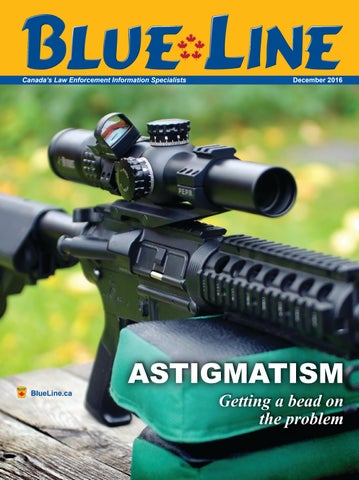
ASTIGMATISM Getting a bead on the problem
UNIFIED EVIDENCE. AUTOMATED WORKFLOW COMPLETE CONFIDENCE. Evidence.com is a scalable digital evidence management solution built entirely in the cloud. Unify your evidence in one place, and share files securely with Crown and other agencies instantly.
ca.axon.io/evidence
, A XON, A xon, Evidence.com, TASER, and ø are trademarks of TASER International, Inc., some of which are registered in the US and other countries. For more information, visit w w w.taser.com/legal. All rights reser ved. © 2016 TASER International, Inc.
December 2016 Volume 28 Number 10
Features 10
6
Astigmatism
8
Selling the carbine
10
Decision in crisis
14
The evolving nature of transnational crime
26
Everybody wins with information sharing
28
It couldn’t happen to me
30
The ultimate endurance test
Win the PR battle before it begins
Implications for tactical communication
Mental conditioning strategies for survival
Departments
26
34 21 34 13 32 16 33 32 5 18
Advertisers Index Back in the Day Back of the Book Deep Blue Dispatches Holding the Line Market Place Product Showcase Publisher’s Commentary Technology
Case Law
28 BLUE LINE MAGAZINE
Getting a bead on the problem
3
22
Valid traffic stop not a disguised investigation
24
Manner of detention matters
DECEMBER 2016
Blue Line
PUBLISHER’S COMMENTARY by Morley Lymburner
www.blueline.ca GROUP PUBLISHER Paul Grossinger – pgrossinger@annexweb.com PUBLISHER EMERITUS Morley Lymburner - morley@blueline.ca EDITOR Tom Rataj - tom@blueline.ca SENIOR EDITOR Mark Reesor - mark@blueline.ca ACCOUNT MANAGER Janice Eaton - janice@blueline.ca ACCOUNT MANAGER April Lensen - april@blueline.ca ART DIRECTOR Svetlana Avrutin - savrutin@annexweb.com ACCOUNT COORDINATOR Trish Ramsay - tramsay@annexweb.com CIRCULATION MANAGER Beata Olechnowicz bolechnowicz@annexbizmedia.com MAILING ADDRESS 222 Edward Street, Aurora, ON L4G 1W6 Publication Mail Agreement No. 40065710 CIRCULATION email: asingh@annexbizmedia.com Tel: 416-442-5600 ext 3553 Fax: 416-510-5170 Mail: 80 Valleybrook Drive, Toronto, ON M3B 2S9 SUBSCRIPTION RATES Canada — 1 Year $30.00; 2 Year $50.00 plus tax USA — 1 Year $100.00 USD PRINTED IN CANADA ISSN 0847-8538 Occasionally, Blue Line will mail information on behalf of industryrelated groups whose products and services we believe may be of interest to you. If you prefer not to receive this information, please contact our circulation department in any of the four ways listed above. Annex Privacy Officer privacy@annexbizmedia.com Tel: 800-668-2374 No part of the editorial content of this publication may be reprinted without the publisher’s written permission. © 2016 Annex Publishing & Printing Inc. All rights reserved. Printed in Canada.Opinions expressed in this magazine are not necessarily those of the editor or the publisher. No liability is assumed for errors or omissions. Readers are cautioned and advised that articles presented herein are edited and supplied for your personal awareness and should not be used for further action until appropriate guidance is received from a supervisor, Crown Attorney or other persons in authority. All advertising is subject to the publisher’s approval. Such approval does not imply any endorsement of the products or services advertised. Publisher reserves the right to refuse advertising that does not meet the standards of the publication.
BLUE LINE MAGAZINE
Peace keepers vs. peace makers A recent call to send “peace keepers” to Syria has once again confused police with soldiers in the public’s mind. The problem has become even more acute in Canada, with its many refugees and high ethnic diversity. Many of the new immigrants come from countries where there is little difference between the functions of police and the military. This is made even more difficult by some agencies permitting officers to wear military looking exterior armour. Policing in a democratic country depends on understanding the differences between policing and soldiering. Police officers and soldiers have different duties and both must understand when the other should take over. This principle of police and military being willing to relinquish control – and take it back – is what makes a stable and safe democratic society. During the 1990s Canada started placing police in active war zones. These officers were confronted with a function they were not trained to handle, causing trauma and stressors they had not anticipated when volunteering. On the other side of the coin, Canada’s over emphasis on placing soldiers on the “peace keeper” pedestal has obscured the purpose of the military. This not only confuses but also heaps far too much stress on the individual soldier and their otherwise straightforward function. Its genesis was the “Korean conflict,” when the United Nations halted the invasion of South Korea by sending in soldiers from around the world to perform what was termed “a policing action.” In the 1957 Suez crisis Canadian soldiers were once again sent in to Egypt in what was termed “a peace keeping” role. Others quickly followed – Cyprus, Bosnia and Afghanistan. We must get back to basics and understand that there is little virtue in confusing the police and military role. If there is no difference, as some suggest, why are they separate entities? Would it not be far more convenient, and fiscally responsible, to simply let police handle the military function during civil disobedience? Major events over the past century have affected and afflicted both the Canadian military and civilian police. Canadian policing took an abrupt turn just after the First World War, when de-mobbed but still military trained former soldiers backfilled the ranks of police forces across the country. This was reinforced after World War Two when huge numbers of former soldiers filled most civil service jobs. Over the years Canada de-militarized dramatically while the US increased its 5
military prowess through a mandatory draft during the 1950s and ‘60s. It still has a hybrid of this same system but rooted in the state administered national guard. As a result almost all US police agencies have military discipline, structures and outlook and officers are comfortable with this command and control style. All this is firmly reinforced by the Second Amendment, which encourages a firearms culture as a right. The opposite scenario exists here. Almost all Canadian police officers are trained from the ground up to a civilian policing style. They are taught the rudiments of military discipline but command and control is seen as subservient to individual initiative. I’ll let you judge which system is better. One of the fundamentals of modern policing, based on Peel’s principles, is that a military organization should not conduct police work. Police officers are to be selected from the general population because they best understand the populace and day-to-day functioning of the society they watch over. It is this intimate knowledge that helps them prevent crime and keep the peace. Police use force as a last resort – the vast majority of arrests an officer makes involve no resistance whatsoever. The organized use of force, and threats of it, is the primary (although far from singular) function of the military, and when called upon is either practiced or implemented daily. The future of a well managed country rests in the hands of both police and the military – and the ability of police officers and soldiers to understand their appropriate roles. There’s no better example than Haiti. UN police officers made efforts to restore order and the rule of law. Once it was recognized they could not accomplish this goal, a UN military force stepped in to restore that order. Once it was re-established, the military bowed out gracefully and police resumed their work. Restoring peace is a military function requiring discipline, command and control. Keeping the peace is a police role requiring the daily display of individual initiative to people on a one-on-one basis. It should not be rocket science, but too many people do not understand the difference.
DECEMBER 2016
ASTIGMATISM Getting a bead on the problem
by Dave Brown Red dot sights may be one of the greatest advancements in firearms accuracy for short or intermediate-range target shooting since someone cut a notch into the top of the hammer on their single-action revolver. Ideal for the modern patrol carbine, red dot sights are lightweight, quick to acquire and extremely accurate within their design range. They also have the huge advantage of allowing an officer to keep both eyes open and focus on the threat instead of the front sight. For cross-dominant officers, it also doesn’t matter which eye sees the dot or where the electronic dot is aligned in the tube; where it appears is where the round goes. Their singular pinpoint dot has one drawback however, and this is an issue that will become more common as more agencies adopt patrol carbines for street officers. It will particularly impact older officers whose eyesight may not be as sharp as it was when they were 20. As people age, the shape of their eye’s cornea and lens may tend to become more oblong and less perfectly spherical. This is known as astigmatism, and will cause the eye to focus on multiple points on the back of the eyeball instead of on one pinpoint spot. Astigmatism and accuracy Everyone has some degree of astigmatism. No eyeball is perfectly symmetrical. There are degrees, much like there are degrees in all correctable vision problems. Astigmatism is sometimes first noticed as just a faint uncomfortable feeling when driving DECEMBER 2016
at night; distant lights seem more smears than points. It often depends on how much one is willing to put up with this slight distortion and so it can go undetected and thus uncorrected for many years – but as soon as that officer tries using a modern red dot sight, they may see multiple or smeared dots or, in the worst case, a big faded globe of light instead of one sharp dot. Light sourced optics such as AimPoint, Trijicon and EOTech are particularly prone to this multiple dot characteristic. Astigmatism rarely affects both eyes equally. Some report multiple dots only in one eye and a clearly defined center point in the other. Another problem is that the multiple dots may come and go, depending on everything from how much sleep the officer had to how much coffee they drank that day. What appears as three dots one day may suddenly look like a bunch of grapes hanging from a tree the next. The result is no clearly defined centre dot and difficulty discerning which dot to consistently use to aim for pinpoint accuracy. Astigmatism and red dot sights A red dot sight is simply a non-magnifying optical sight that superimposes a glowing “dot” or lighted reticle over a weapon’s impact point. Powered by batteries, the brightness can be adjusted for various lighting conditions, including even the invisible part of the spectrum for use with night vision on certain models. The exact position of the dot can be adjusted up and down or left and right, much like a telescopic sight, to match the exact point of impact at a chosen distance. The dot or reticle itself is focused at or near infinity, allowing a 6
unique ability to focus on a target instead of the sight itself. There is no magnification in the optics so there is no requirement for a specific placement of the eyeball to the rear element, a dimension known as eye relief distance. This means that the red dot sight can be placed nearly anywhere on a rail and still work effectively. In actual use, an officer keeps both eyes open and focused on the threat. A lighted impact point is continuously superimposed over the image, and with both eyes open and the focus now way out in front of the weapon, the sight body becomes almost non-existent. The dot or reticle may be generated by a laser or light-emitting diode (LED) and can consist of a single dot, such as the Aimpoint design, or multiple dots forming a targeting reticle, such as the EOTech. Many red dots are known as “reflex sights” and project the dot into the user’s sight using a partially-reflective parabolic mirror. Others, known as “holographic sights,” use a laser pattern to project a more elaborate reticle image by hologram inside the glass of a prism. Most electronic red dot sights are termed “parallax-free” near the centre of the scope and some are considered virtually parallax-free at any viewing angle. This means that, unlike a magnifying scope, the dot or reticle does not need to be in the center of the tube or viewing glass; it will always indicate the exact impact point at the distance it is sighted for, no matter where the eye aligns with the optic. Battery life is dependant on design. The LED emitters on the combat-tested Aimpoint BLUE LINE MAGAZINE
sight can be left on for years. Once equally popular in combat, holographic sights such as the EOTech, because of elaborate reticles made up of multiple dots, have much shorter battery lives but are often designed to shut themselves off if not used after a certain period of hours. Just as nearly everyone has some degree of astigmatism, all red dot sights suffer from some degree of smeared or multiple dots that will vary widely from user to user. While some report that a reflex design is less prone to this phenomenon, tests by Blue Line Magazine have not supported this. Everyone is different and what they see will be different. Even with the same user, one eye can see multiple dots while the other clearly sees one. Is this a problem? In practical terms, some degree of astigmatism is unlikely to make much difference to most officers at the typical encounter distances of patrol carbines. One could argue that, once a red dot sight is properly sighted in at the chosen distance, multiple dots or a partially smeared image will not affect accuracy to any practical degree. This is quite true. In real life encounters, one rarely gets to fire a single aimed shot from a well-braced position. In fact, red dot sights are not made for those single aimed shots at a distance anyway; they are designed for close, fast and accurate shots, usually within 100 meters or less. This is why astigmatism may not be a major concern for many officers. Other than the fact that they will see multiple dots, they simply put the impact point onto the target and, if necessary, pull the trigger. Red dot sights are most suited for the close and intermediaterange dynamic encounter, after all. Sighting in will be more problematic in firing careful shots from a very stabilized rest in order to ensure maximum accuracy. This is where officers with a greater degree of astigmatism may need others to sight in their rifle for them.
are alternate optical solutions for short and intermediate range carbines or rifles. Low magnification or variable power scopes that go down to or near one power magnification (1X) can be a good choice. The best ones for officers with astigmatism are those with etched reticles. Having the crosshair etched directly on an internal glass element instead of stringing thin internal wires inside the scope tube seems to help many shooters with mild astigmatism. Etched designs can also come with illuminated reticles for low light conditions. Etched reticle scopes are much less prone to loss of zero if dropped and the more expensive models can be made virtually unbreakable. Most come with a variable diopter ring at the rear. While intended to help correct for near or far focus issue, it can also be helpful with some degrees of astigmatism. Some users have reported that flipping up the rear backup sights to surround the red dot with the iron sight’s rear aperture helps reduce multiple dot issues. This somewhat forces the eye to reshape and focus more rearward. Prismatic or prism scopes use a glass prism for magnification instead of internal lenses. They can be almost as compact and robust as a combat-tested red dot sight and many come with etched reticles and illuminated reticle patterns. They also use focusing eyepieces to correct for focus differences and can be useful in helping correct some degrees of astigmatism.
The downside to any scope is the fact that you lose the fast acquisition and unlimited eye relief of the red dot sight. The eyeball must be placed a precise distance away from the rear lens to work properly. They also have some degree of parallax error, where the actual impact point may vary slightly if the crosshairs or reticles are not centered in the scope tube. They are also much bulkier than a red dot sight such as the highly-recommended Aimpoint. When properly mounted and fitted to the shooter, a low or one-power prism scope such as the Burris AR-332 – or variable power scope that goes down to near one power, such as the Burris XTR II 1.5-8X scope (as featured on the cover) – can give nearly the same speed as a red dot sight and with fewer astigmatism issues. Etched reticles also have another advantage; if the batteries die or the illuminated reticle fails, the sight can still be used in most lighting conditions using the reticle etched on the internal glass. Special note for EOTech users L-3 Communications (the parent company of EOTech) reached a $25 million settlement in 2015 with the US government over problems with EOTech optics. Once widely used in police and military operations, some of the company’s claims about their sights have proven to be false or misleading. For example, EOTech claimed that its holographic sights were parallax free at any distance and could be used in operational temperatures from -40 to +60 degrees Celsius.
A Solution The good news is that the problem can be corrected. The bad news is that this correction may require eyeglasses, contacts or laser surgery. With proper vision testing from an optometrist or ophthalmologist and good prescription lenses, most astigmatism can be taken care of. Complications arise with lens corrections as officers approach 40 years of age and begin suffering from natural near-sightedness as well as astigmatism. When consulting with an eyesight professional, it is most helpful to take along the red dot sight and test or discuss the various options. Astigmatism can also be corrected by certain types of contact lenses. Consult with your eye doctor to determine if contacts are a good option. Alternate optic solutions If astigmatism is becoming frustrating and the officer cannot or chooses not to correct it with contacts, eyeglasses or laser surgery, there BLUE LINE MAGAZINE
7
BlueLine_AmericanMilitary_Nov.indd 1
DECEMBER 2016
2016-10-20 9:21 AM
Actual testing showed massive zero shifts of up to 12 minutes-of-angle (MOA) at 0 degrees C, and up to 20 MOA at -15 degrees C. Parallax error was detected as temperatures approach 0, and many samples were unable to return to the same zero as temperatures increased.
Additionally, humidity could dim reticles in older optics. It was alleged that EOTech concealed this information from end users and the government long after it was discovered, continued to maintain that existing optics met military specifications and concealed information about failures in its holographic sight system performance from government contract bidders and testing facilities. EOTech is currently offering refunds to users. As of December 2016, no solution has been found for the drifting zero with temperature changes. In the long-term test sample EOTech provided to Blue Line, the reticle has severely dimmed over the test period. When asked for a solution, L3 Communications simply suggested buying a new EOTech. A 12 MOA shift at 0 degrees means the sight can be as much as 12 inches off at 100 yards. This is unacceptable for a police weapons sight system, especially in Canada where temperatures can routinely dip far below 0. Blue Line Magazine no longer recommends EOTech for duty use.
Best solution There is no one best solution for every situation. Some officers find low power prism scopes to be an excellent choice. Others have success by flipping up the rear iron backup sight or can simply live with the multiple dots of a red dot sight. They don’t want to lose the fast acquisition, lightweight design and long battery life of a combat-tested electronic sight. While researching this article over the course of three years, Blue Line has tested nearly every modern patrol rifle optic on the market. We remain fans of the consistently reliable and virtually unbreakable Aimpoint, even with fairly pronounced astigmatism, especially if close and fast is more critical than long range accuracy – which is exactly what a patrol carbine is all about. There are also some impressive designs in combat-tested, low power, prism scopes with lighted and etched reticles on the market. The best solution of all is to see an eye specialist and obtain either an updated or corrected prescription.
Selling the carbine
Win the PR battle before it begins by Dave Brown Patrol carbines seem a logical progression in use of force options for street officers and yet appear to ignite more controversy than any other single acquisition in decades. Worse, it is not just the traditional police haters who accuse services of becoming more militarized; the main body of quiet law enforcement supporters are questioning the need for this expensive purchase. Follow social media and read comments on mainstream news sites and you will soon see that many police agencies are doing a terrible job of selling the need for patrol carbines to the public. You can’t just ignore this. It’s one public relations battle you cannot afford to lose because it’s not your usual anti-police fringe or angry motorist who just got a speeding ticket; these are your traditionally silent majority of law-abiding citizens. Ignore their concerns now and you chip away at the backbone of your taxpayer support. If you don’t listen to your citizens or find innovative ways to address their concerns and sell them on the need, you are losing a battle for the hearts and minds of the general public that you didn’t even know you were fighting. A public relations plan Budgets are approved, racks are installed, carbines are on order and training has been DECEMBER 2016
scheduled – but do you have a solid plan in place to sell the idea to the public? In the ancient book The Art of War Sun Tzu wrote that every battle is won before it is fought. With good planning, a consistent message and getting the media on board, this is one victory you can achieve before it even becomes a battle. Explain the high cost These are not “assault rifles” or military weapons. They have no full-auto capability. They may look like military issue and are made to the same standard, for the simple reason that when public and officer safety is on the line, they MUST work. They are made to military quality standards because they need to instantly perform with 100 per cent reliability in any condition. There are hundreds of cheaper-grade weapons on the market but police firearms cannot come from companies who cobble together 8
various parts from unknown suppliers. They need to rely on designs that have been tested and proven in combat. Citizens’ lives are on the line. Proper components, made to military standards and by reputable manufacturers, don’t just increase reliability; they also increase the useful service life. Well-made patrol carbines from companies such as Colt Canada and Daniel Defense use cold hammer forged barrels, which are a very expensive but also very precise way to make them accurate and durable. Colt Canada rifles are not just made to U.S. military specifications, they also meet the much higher NATO standard. Like everything else in life, this quality costs money. Lives are on the line. Explain the advantages The irony is that the more force options police have at their disposal, the less need there will be to use them. If officers can respond with overwhelming force before a single shot has been fired, it’s less likely that they will have to fire that shot. Evan back in the 5th Century BC, Tzu realized that every battle is won before it is fought. That holds true today; the best gunfight in the world is the one that never happens in the first place. Should shots be fired, stop the battle as soon as possible. The longer the firefight, the greater the hazard to citizens, potential victims, law enforcement officers and innocent bystanders. BLUE LINE MAGAZINE
Convince your allies If you don’t do a good job of stating your case, you risk distancing yourself from the vast majority of supportive citizens; the ones who have always quietly paid the bills and supported law enforcement but don’t understand why you need a “military” weapon. They are the silent majority; the ones who never write letters to the editor, post negative comments on Facebook or call talk radio shows. We’re not talking about the keyboard warriors who hate the police because they received a couple of well-deserved traffic tickets. You are risking losing their support because they just don’t see the need like you do. You have a serious problem here. You can’t disregard these concerns. It may be easy to ignore them or just shrug and say that patrol carbines will help get more officers safely home to their families at the end of every shift. That is true, but they will also help get the citizens you are paid to protect safely home to their families too. Sell them on this. Patrol carbines are a unique tool that will not be used often – but when needed, nothing else will do. •
•
•
faster you stop an active shooter, the more lives you will save. Police patrol carbines do not have the full-auto capability of military weapon but they are made to the same high standard and by the same companies as the world’s best military rifles because the basic design is a proven platform. They have a long history of protecting the lives of soldiers in combat. In fact, for the past two decades, the US military has initiated several programs designed to search for a better combat rifle. Every time, they concluded that there is little to improve upon a design originally conceived by Eugene Stoner back in the 1960s.
• •
The more trained officers and the more patrol carbines available, the less likely they will be used. Emphasize the human factor: Always stress that every citizen, including police officers, deserve to go home to their families every night. The worst feeling in the world must be knowing a fellow officer or citizen has been shot and is laying dying on the street, and no one can get to them because you don’t have the capability to defend yourself against aimed rifle fire.
Dave Brown is Blue Line Magazine’s Firearms Editor and staff writer. He is a tactical firearms trainer and consultant. He can be reached at firearms@blueline.ca.
Explain the advantages Focus on public safety: We all hope that patrol carbines will rarely need to be deployed but they are a safer and more accurate tool which can be accurately fired at a much greater distance than any other weapon agencies now have. Ballistics tests, including numerous studies by the FBI and our own Blue Line comparisons, have shown that a carbine bullet is less likely to over-penetrate a target, thus reducing the hazard to other officers or citizens in an area. Move carbines from a want list to a need list: Handguns are a seven-meter defensive weapon. Shotguns are a 20-meter defensive weapon. Beyond those ranges, accuracy drops dramatically when used in situations where people are trying to kill you. The risk to both officers and bystanders increases exponentially with distance. You can’t bring a seven-meter weapon to a 100-meter gunfight. Agencies can sell patrol carbines as tools and skills that should be in place before they are needed. Sell on the facts. Yes, every street officer will eventually be trained on them. Yes, they will rarely be deployed. Who doesn’t like the movie Top Gun? A fighter pilot sits on a parachute for years and years and no one says anything, but the moment it is needed, it no longer becomes a nice to have but a need to have. At that moment, nothing else will do. Stop pushing buttons: Avoid words on which an untrained public will focus. Patrol carbines are not a military weapon – they are a military-grade weapon. They are not an assault rifle, military rifle or machine gun. Patrol carbines are designed exclusively to save lives. Do not use the term assault rifle. They are not used for assault – they are used to save lives. The
BLUE LINE MAGAZINE
9
BlueLine_Zoll_Nov.indd 1
DECEMBER 2016
2016-10-20 2:31 PM
DECISION IN CRISIS Implications for tactical communication
by Camie Condon In September of 2013, an emotionally distraught Sammy Yatim was fatally shot by Toronto police constable James Forcillo while aboard a Toronto Transit Commission streetcar. Video surveillance of the event reveals images of Yatim threatening other passengers while wielding a knife in one hand and exposing himself with the other. After all passengers and the driver fled the streetcar safely, Yatim remained on board alone until the police arrived. He was non-compliant with officer commands to drop the knife and was shot multiple times by the officer and died of his injuries. The shooting resulted in criminal charges being laid against the officer and an eventual finding of guilt on one count of second-degree murder.
DECEMBER 2016
While Yatim’s death is an unmitigated tragedy it should be noted that the use of force in any encounter between police and the public is relatively rare, occurring in less than one per cent of incidents. Nevertheless Yatim’s death triggered public outcry and inquiries into lethal force against persons in crisis; one headed by retired Justice Frank Iacobucci in 2014 and the
second in 2016 by the Ontario Ombudsman. Both reports called for the “extensive review of police training, recruitment and use of force guidelines.” Specifically Iacobucci stated the current situation calls for increased training on a “spectrum of de-escalation” techniques “that includes verbal de-escalation.” Iacobucci also noted that officers should be “trained to stop shouting (ineffective)… commands and attempt different defusing communications strategies.” Effectiveness of options To date there has been no empirical evaluation specifically examining the effectiveness of force options and only a modicum of research on the efficacy of de-escalation techniques, particularly those focusing on communication styles. There is a small body of research examining Crisis Intervention Teams (CIT) are successful in reducing the number of use of force interactions with persons in crisis, but the results indicate that reductions are relatively small. The focus of the research has primarily examined the demeanour of the person in crisis and not the efficacy of specific de-escalation techniques. Though police defensive tactics and use of force training includes verbal de-escalation techniques, Iacobucci has indicated that practices currently in place are “insufficient.” Overhauling training procedures, including deescalation techniques, with the goal of reducing risk of injury or death will require in-depth examination of the effectiveness of different methods, language and tools. To be of any value it must be done in concert with a comprehensive understanding of how officers function under
10
BLUE LINE MAGAZINE
100 80 60 40 20 0
GRAPH 1
100 80 60 40 20 0
Pre-Scenario Post-Scenario Heart Rate
Random Words
Switches
100 The demand 80 Officers have repeatedly voiced concern 60 over the “unpredictability and potential for 40 violence” during crisis encounters, while also 20 feeling “ill prepared to provide the reporting necessary 0 services.” The precariousness of
these encounters to significant psychoHeart can Ratelead Random Switches physiological demand andWords autonomic arousal for the officers; commonly experienced through increased heart rate, blood pressure, perspiration and various auditory and visual exclusions. Psychophysiological demand also creates challenges for cognitive processes and decision making so officers rely heavily on their repetitive task training (procedural memory) to do the most basic tasks, including some defensive and use of force tactics and tactical commands.
BLUE LINE MAGAZINE BlueLine_ACS_Dec.indd 1
Pre-Scenario Post-Scenario Heart Rate
Random Words
Switches
Graph 2: Heart rate measures, random word production and word scores pre and post officer safety scenario
Graph 1: Heart rate measures, random word production and switch scores pre and post pain penalty threat scenario
the significant psychophysiological demands that occur during crisis encounters.
GRAPH 2
Repetitive rehearsal of tactical communication – short command statements spoken 100 don’t move,” loudly and clearly (e.g., “Police, “Stop resisting,” and/or “Drop 80the weapon”) is standard training practice.60The benefit of repetitive training is that recall Pre-Scenario 40 for this type of language is nearly effortless when under 20 explanation Post-Scenario heightened arousal, offering some 0 it. It has also to why officers continually repeat Heart Rate been argued that short and clear loudly spoken commands will not only ensure the suspect will hear and understand the officer but also draw the attention of bystanders who may later be able to attest to the officers warnings. Unfortunately, a person in crisis may not comprehend or follow these commands for a variety of reasons. Iacobucci notes that when officers encounter atypical non-compliance they should be trained to stop repeating the same command and attempt a different line
11
of communication. Herein lays the difficulty. Switching commands or changing tactics requires an officer to move from automated behaviours to adaptive and flexible decision making. This transition becomes more comPre-Scenario plicated to engage in when under stress. Researchers in the Tactical Decision MakPost-Scenario ing Research Group (TDMRG) at the University of Liverpool have examined the effects of Random Switches demand and arousal on psychophysiological Words during defensive tactics training and officers simulated armed confrontations. They found that increased demand produces substantial shifts in working memory functions, which govern decision making, strategizing and recall. Specifically, they found increased demand on decision making centres also presents significant challenges to verbal communication; outlining that negative emotions impair language production by eliciting a stress response,
DECEMBER 2016
2016-11-16 10:08 AM
(i.e., autonomic arousal). In particular, officers involved in high arousal scenario training reported greater difficulty in producing and comprehending complex language when experiencing strong negative emotions, e.g. threat of potential violence. Research with Canadian officers engaging in annual firearms scenario training found that when (falsely) told they would be role playing with Simunition, officers increased the total number of random words post scenario while physiological measures were highest. Random words represent automated language that results from repetitive use and therefore requires little cognitive effort to produce. Simultaneously, the same officers, again post scenario, decreased in the ability to switch from subcategories of grouped words. Switching subcategories represents complex cognitive functioning because it requires memory recall and strategizing. Switches are comparable to moving (switching) from a string of similarly structured words (cat, car, cantaloupe, etc.) to a dissimilar string (cat, car, cantaloupe, destitute, delay, delicious, etc.) The process of switching subcategories is considered higher-order cognitive processing. That’s because it requires decision making centres to identify that one string of similar words can no longer be easily retrieved from memory and switch (cognitive flexibility) to another, easily retrieved string of words in order to continue producing speech. (see Graph 1). Similar results were observed with UK
Authorised Firearms Officers (AFOs) engaged in scenarios replicating threats to officer safety. The scenarios included building searches, hostages and using Nico ‘9 bang’ distraction devices. Across all participants, in conjunction with measured increases of autonomic arousal, officers again increased random word production post scenario. In fact, total word scores during this scenario testing were well above average yet subcategory switch scores were significantly lower than pre-scenario. (see Graph 2). In both instances the increased random word production demonstrates that automated processes remained robust despite the increased psychophysiological demand, whereas the complex processes were less available. Well-rehearsed skills like that of tactical commands are typically unaffected by psychophysiological demand. The automatic aspect of overlearned skills frees up cognitive resources critical for complex decision making (e.g., increased situational awareness and complex task completion). However, it is clearly evident that officers, under certain conditions, may rigidly apply procedural tactics when the encounter requires actions other than mechanical behaviours. Decision making demands confidence In an effort to determine why some decision makers can flex while others remain rigid, TDMRG researcher Laura Bolton noted that personal confidence is strongly related to flex-
ible and adaptive decision making. Experienced (more than five years) AFOs demonstrated a distinct increase in the cognitive flexibility compared to those of the ‘novice’ AFOs. The experienced AFOs readily utilized trained, automated behaviours, particularly when they perceived control of the encounter was achievable, but when they found those ineffective they easily and confidently transitioned to non-rehearsed decision making. Novice AFOs did not display this cognitive flexibility when automated behaviours were ineffective. Experienced AFOs attributed their confidence to recognizing and transitioning from ineffectual procedural tactics to more conceptual strategies to routinely engaging in training that encouraged abstract decision making. Further, adaptive decision making was positively correlated with an officer responding quickly to varying situational cues and effectively coping with the physical changes associated with arousal. The experienced AFOs indicated that training and operating in all positions of the firearms team, creating mental models (prearrival) of possible actions and generating a large number of potential outcomes increased their confidence and responses. What is evidenced in this research is that using well-rehearsed protocols such as tactical communication can be a reliable technique for managing the effects of increased psychophysiological demand. Likewise, transitioning to atypical decision making can reduce the ineffectual use of procedural tactics. Finally, the two can be successfully combined, however, decisions and actions outside of well-rehearsed procedures can be difficult to employ due to the negative impact of high arousal. Yet, as demonstrated by experienced AFOs, improved decisional confidence seemingly reduces the rigid and repetitive application of standard tactics. Greater exposure to unpredictable situations within the confines of a training environment offers the opportunity to make decisions outside of the usual tactics, thus allowing the officer to store a greater number of mental models and the ability to confidently adapt in challenging encounters. Recent inquires have suggested revamping how officers communicate during crisis encounters. Policy-makers and trainers would do well to stop and consider if proposed revisions to use of force protocols address the complexities of psychophysical demand and the ability to make decisions in a crisis. There is considerable room for further research into effective training tactics, including how training can best incorporate automated skills with the conceptual decision making needed in unpredictable street level encounters. With increased public/ political pressures for police transparency and evidenced based practices, any changes to training will need to be well informed by sound and practical research. Camie Condon PhD is a course developer, instructor and advisor to the Wilfrid Laurier Policing BA Program, in Waterloo, ON. Contact: ccondon@wlu.ca.
DECEMBER 2016
BlueLine_ThomsonTriform_Oct.indd 1
12
2016-10-20 2:58 PM
BLUE LINE MAGAZINE
DEEP BLUE by Dorothy Cotton
Boost your SWB and be happy by Dorothy Cotton I’m writing this on a miserable Saturday morning, one of those dark, dreary, wet days when staying in bed seems the only reasonable option. Some days, the idea of doing NOTHING really appeals, but given the length of my to-do list, it’s not going to happen. There is something fundamentally wrong with the whole idea of a long to-do list for a Saturday. What ever happened to “leisure?” Shouldn’t I be eating bonbons while ready a trashy novel (or if you prefer, watching football on TV?) Isn’t that what leisure is supposed to be? Even Aristotle was a big advocate of leisure (although I find it hard to imagine him sitting with a bag of cheezies watching sports on TV). He did note that leisure experiences were one of the major determinants of happiness. As a bit of a workaholic myself, I find it useful to try to remember this. Whether you’re a young constable grabbing all the overtime you can, a mid-career officer who’s largely forgotten the whole work/life balance concept – or a senior executive with the delusional belief that the world as we know it will end of if you’re not on your toes 24/7 – consider what you’re doing with your leisure time (assuming you allow yourself any). There has been a media coverage in recent years about the whole notion of “happiness.” In Psychologyland, we call this “subjective well being (SWB).” Generally we talk about seven domains known to contribute to SWB: 1. 2. 3. 4. 5. 6.
Work Health Finances Family Self – like how we feel about ourselves Group identity, which can include culture but also a whole lot more 7. Leisure The research says these all contribute significantly to SWB – although in some cases BLUE LINE MAGAZINE
(like finances) not as much as you’d think. Work satisfaction is a big factor – but occupational achievement is not as important. Health is important and what you think of yourself overall is a biggy – but what about leisure? Well, there are a few questions there. First of all, what exactly is leisure? Is football and chips the same as volunteering for Habitat for Humanity? Curiously, the answer is, “it’s up to you.” The research typically talks about “leisure engagement.” The authors of the paper I am referring to suggest that leisure engagement is the amount of time, diversity or frequency of participation in activities that individuals view as leisure. That would include amount of time, diversity or frequency of participation in normatively defined leisure activities such as social activities, sports, games, cultural experiences... anything really. If you think it’s leisure, then it is. That’s about as clear as mud. You might ask, what do we know about the relationship between leisure engagement and SWB? Good question! The research suggests: 1. Leisure engagement does predict SWB. People who have and are invested in leisure activities tend to be happier overall. 2. Because nothing is ever simple, SWB also predicts leisure engagement. As we all know, some people tend to just be happier overall for no good reason, and some people seem to have been born grumpy. Happier people tend to be more likely to be involved in leisure pursuits. 3. Leisure satisfaction is an important part of this whole thing. There is more of an effect if you actually enjoy what you are doing with your leisure time. If you watch football and eat junk food only because your significant other likes to do so, you might not derive as much benefit as if you (for example) played the bassoon in an orchestra because you really want to. 13
So far, frankly, this all seems pretty obvious but there’s a few reasons why it’s worth thinking about. If you go back to that list of domains I mentioned earlier, you might note that most of them are outside your control. The good thing about leisure is that you actually do have some control over it. You can decide how much time to devote to it and how you spend that time. I suspect many of you are thinking “LEISURE?!?!? I work shifts, have a family and need overtime to pay the mortgage… what leisure?” OK, so how much time do you spend watching TV or playing video games? How is that working for you?” If it really makes you feel better, go for it – but if it simply passes the time, you might want to rethink it. Clients complaining about work stress are always surprised when one of the first things I do is get them working on hobbies. Usually they want advice on how to get their boss into trouble or change workplace policies that appear counterproductive. These are all worthy goals and I am a staunch advocate of good management and reasonable workplaces – but see the aforementioned caveat about what you can actually control. Trying to change the world might be easier if you’re not miserable. If you don’t have any meaningful leisure activities, you might want to work on that. Leisure satisfaction has a big spill-over effect on other things that contribute to SWB. If your leisure includes sports and physical activities, it will improve health – also a predictor of SWB. Engaging in a family activity may improve your family relations and social satisfaction – also a predictor of SWB. If you see the same people and problems day after day at work, can’t fix them and feel useless as a person, build a house with Habitat and increase your personal sense of self – also a predictor of SWB. If you engage in all sorts of leisure and never find anything rewarding or satisfying, then have a hard look at your own ways of thinking – and maybe consider a round of therapy to change it. Life is about more than just being happy, of course, and SWB is not everything. Some of the great people in history were miserable – and there are some pretty happy bad people out there – but there are many who are both happy and successful, do a good job, contribute a lot to the world – and have a high degree of SWB. I want to be one of them. The content of this column is largely derived from the paper “Leisure Engagement and Subjective Well-Being: A Meta-Analysis,” by Lauren Kuykendall, Louis Tay and Vincent Ng; Psychological Bulletin © 2015 American Psychological Association 2015, Vol. 141, No. 2, 364–403. Dr. Dorothy Cotton is Blue Line’s psychology columnist. She can be reached at deepblue@blueline.ca.
DECEMBER 2016
The evolving nature of TRANSNATIONAL CRIME by Rick Penney Transnational crime and transnational organized crime (OC) are complex and have multiple definitions; moreover, there are blurred distinctions between domestic and foreign affairs as criminals exert a global impact. According to the 2000 United Nations (UN) Convention on Transnational Organized Crime, transnational refers to offences that involve at least two countries. The UN has identified 18 categories of transnational offences, which include money laundering, theft of intellectual property, art and cultural objects, illicit arms trafficking, aircraft hijacking, sea piracy, insurance fraud, computer and environmental crime, trafficking in persons and human body parts, illicit drug trafficking, fraudulent bankruptcy, infiltration of legal business, and corruption and bribery of public or party officials. The American National Security Council defines transnational organized criminals as those who act conspiratorially in their criminal activities and possess certain characteristics that may include the following: • •
• • •
In at least part of their activities, they commit violence or other acts that are likely to intimidate, or make actual or implicit threats. They exploit differences between countries to enrich their organization, expand its power, and/or avoid detection or apprehension. They attempt to gain influence in government, politics and commerce through both corrupt and legitimate means. Their primary goal is economic gain, not only from patently illegal activities but also from investment in legitimate businesses. They attempt to insulate both their leadership and membership from detection,
DECEMBER 2016
sanction, and/or prosecution through their organizational structure. There are various examples of commodities that are used for profit by transnational organized criminals: cigarette smuggling, antiquities theft, counterfeit currency, jewel trade, drugs, human smuggling and alcohol smuggling. Canada and a historical perspective What makes Canada so attractive to criminal organizations? Simply put, there’s a deep history of opportunity that has made Canada an excellent place for transnational criminals to do business. For example, Brigus Tunnel in Newfoundland was hand blasted in the summer of 1860 to provide unhindered access to Abram Bartlett’s Wharf. It was constructed by John Hoskins, a Cornish miner, using steel spikes and black gun powder. Measuring 80 feet long, eight and a half feet high and eight feet wide, the tunnel represented an early engineering feat that took about four months to complete. Holes formed by steel spikes driven into solid rock were then filled with black gun powder and blasted during its construction. The purpose of the tunnel was to provide access to a deep water berth for the Bartlett sailing ships and the distribution of contraband alcohol. For many years, there was a thriving smuggling trade between the French island colonies of St-Pierre-Miquelon and the United States, the Bahamas and Newfoundland. With American Prohibition from 1919 to 1933, the French islands’ illegal practice took on worldwide proportions and created a lucrative transnational criminal network. Alphonse Gabriel “Al” Capone was an American gangster who led a Prohibition 14
era crime syndicate. The Chicago Outfit, which subsequently became known as the “Capones,” was dedicated to smuggling and bootlegging liquor and other illegal activities such as prostitution, in Chicago from the early 1920s to 1931. Capone needed refuge from the law and so he had cottages in far out places built around Canada and the United States. Fast forward to today, where there are criminal organizations from the former Soviet Union operating in Canada that specialize in crimes such as fraudulent use of Internet data, cybercrimes and hacking into Canadian consumer data, and selling the information back home to such places as Chechnya and Georgia. Criminal organizations from the Balkans and former Yugoslavia use Canada as a base to broker cocaine deals in order to move cocaine back to the homeland, as well as being influential in the crossborder movement of marijuana to the United States. More recently, there’s been evidence of a definite cartel presence in Canada, specifically Mexican cartels. The roles of those individuals within Canada are very much those of gatekeepers, involved in the importation and distribution of cocaine, as well as logistics and money laundering/ currency movement. Competitive and strategic markets Transnational OC presents a threat to national economic interests and can cause significant damage to the world financial system through its subversion, exploitation and distortion of legitimate markets and economic activity. Many nations worry that firms are being put at a competitive disadvantage by transnational OC and corruption, particularly in emerging markets where many perceive that the rule of law is less reliable. The price of doing business in countries BLUE LINE MAGAZINE
affected by transnational OC is also rising as companies budget for additional security costs, adversely impacting foreign direct investment in many parts of the world. Transnational OC activities can lead to disruption of the global supply chain, which in turn diminishes economic competitiveness and impacts the ability of many industrial and transportation sectors to be resilient. Further, transnational criminal organizations that leverage their relationships with state-owned entities, industries or state-allied actors, could gain influence over key commodities markets such as gas, oil, aluminum and precious metals, along with potential exploitation of the transportation sector. The World Bank estimates about $1 trillion is spent each year to bribe public officials, causing an array of economic distortions and damage to legitimate economic activity. Moreover, according to the United Nations Office for Drugs and Crime (UNODC), “the annual turnover of transnational organized crime activities such as drug trafficking, counterfeiting, illegal arms trade and the smuggling of immigrants is estimated at around $870 billion.” In Canada, it’s estimated that the amount laundered on an annual basis is somewhere between $5 and $15 billion. Trends to watch Key players in transnational crime include outlaw motorcycle gangs, drug cartels, pirates and, in some instances, government officials, such as politicians and police. With corruption comes the threat of violence to public safety officials and the threat of instability to the economy and national security. The use of bribes and pay-offs is the cost of doing business for many transnational criminal organizations — it’s a factor in their bottom line and the way in which the groups operate. In recent years, numerous criminal organizations have found the benefit of maintaining a symbiotic relationship by enmeshing themselves within a legitimate environment. For example, infiltrating the ranks of government and thus dealing with one of their own is often the best way to ensure co-operation by government institutions. This type of infiltration is found in key ports of entry such as Toronto’s Pearson International or the Port of Montreal. Legitimization is another trend among transnational criminals. Many groups attempt to distance themselves from the illegal aspects of their operations by involving themselves in legitimate business ventures that are funded by almost bottomless profits acquired through criminal activities. Others seek civic legitimacy by donating to community hospitals, charities, universities and political parties. They also try to have their photographs taken with high-ranking government officials or other high-profile personalities. Co-operation among transnational crime organizations, already a major factor in the new world order of crime, is expected to continue and expand. Partnerships, bartering arrangements and alliances, either short or long term, allow these syndicates to better evade law enforcement agencies, share existing BLUE LINE MAGAZINE
infrastructure and improve risk management. The sophistication of transnational crime is expected to increase. For instance, members of transnational criminal organizations have advanced university educations in the fields of business, accounting, chemistry, engineering and law – better equipping them for the complex world of transnational crime. Criminal enterprises such as cartels maintain their own information technology branches to better use new and emerging technologies from smartphones to PGP-encrypted BlackBerry devices. Project OSPA One tangible example of the way in which transnational OC operates is Project OSPA. This operation began in April 2008, when Australian Customs received information from the Canada Border Services Agency (CBSA) that a suspicious shipment of beauty supplies was en route to Australia from Canada. CBSA intelligence indicated that a shipment of massage chairs might have drugs concealed inside them. In May, the container arrived at Port Botany in Sydney, Australia. An examination revealed the chairs had false bottoms, under which a white powder was hidden. The powder was identified as cocaine, and the Australian Customs investigation was handed over to the Australian Federal Police. The police arrested those responsible for receiving the shipment. Organized crime groups not only produce synthetic drugs for domestic markets, but also provide significant quantities for international markets such as the United States,
15
BlueLine_Dristex_Nov.indd 1
Australia and beyond. Project OSPA clearly showed that criminal elements not even present in Canada, but rather in a third country, controlled the operation. This project resulted in the seizure of approximately $110 million worth of illicit drug products shipped from Canada, which has now moved from being a principal end-user for OC to a significant source country. Combatting transnational OC There are a number of steps that can be taken to enhance the efforts to combat transnational OC. One of the key areas to invest in is the enhancement of intelligence and information exchange amongst partners. Second is the need to improve and continuously change our policing approach to disrupt transnational OC. Lastly, there needs to be a concrete effort to re-direct intelligence and focus on long-term, strategic and aggressive intelligence operations. Ultimately it’s in everyone’s best interest to leverage all possible areas of co-operation including legal instruments, expertise and information-sharing. This article was previously published in the RCMP Gazette (Volume 75 No.1, 2013 edition page 22). Used with permission. Rick Perry was the Superintendent in Charge of the RCMP Greater Toronto Drug Section between 2009 and 2013. He can be reached at: rick901@hotmail.com
DECEMBER 2016
2016-10-20 1:51 PM
HOLDING THE LINE by Michelle Vincent
Choosing your mental health professional As I sit in the specialist doctor’s office with my mother waiting for her to be seen, I glance around and wonder how many of the clients researched and sought out this professional? Did a friend or family physician refer them, or did they end up here in a panic after a medical emergency? I pondered this deeply, which had me thinking about the mental health professionals in our lives, if we have any, and how we chose them. We often wait until we have a crisis before we reach out to a professional – a pain that’s no longer tolerable, not knowing how to move on from a break up – or our basement floods. Don’t get me wrong, reaching out for help in an emergency is an enormous step, especially in the world of mental health. In a crisis, we often grab the first available appointment with the first available professional. This is not always a constructive approach for such a sensitive, vulnerable situation. The fit may not necessarily be there and, in some cases, a mental health professional requires a strong connection. That’s not always easy to find and yet is an essential piece in successfully treating issues.
Taking this even further, as a culture of first responders, we tend to neglect those physical and mental signs and symptoms that show we need support. We write it off to the effects of shift work, a bad call or not being able to call in sick because the platoon is short. When we connect with a professional in any kind in crisis, they don’t know what our “normal” is, which makes it difficult to get a baseline as a goal they can support us in reaching. Mental health professionals will have no idea how you perceive the world when you are not in crisis. If you haven’t already, do some shopping while life is somewhat in balance or not quite in crisis, if that is an option. The best way to start this process is to talk to people you trust. That platoon mate who told you about his family, for example, or the call-taker who said they were having a rough go lately. Ask them if they are seeing or can recommend someone. If this option is not viable for you, using a search engine to pull up various professionals such as psychologists, psychotherapists and social workers is another way to explore and shop! Most will have a biography and describe modalities used and their specialties.
JUSTICE STUDIES FOR WORKING FRONTLINE OFFICERS The Police Foundations Leadership Diploma program provides advanced standing to those working in justice services, including security. Qualified students are able to complete their Diploma in less than 6 months through a combination of intensive in-class and online studies. Graduates can pursue their Degrees at the University of GuelphHumber quickly and directly after their Leadership Diploma. O
FF PAR ERED T & ON -TIME LINE
guelphhumber.ca/justice
Michelle Vincent is a 15 year York Regional Police officer with a Masters Degree in Arts in Counselling Psychology and a background in equine assisted therapy and workplace reintegration and teaching. Her counselling practice is supervised by a psychologist with a specialty in addictions and trauma. Contact: michelle@blueline.ca.
communityservices.humber.ca
DECEMBER 2016
BlueLine_Humber_Dec.indd 1
16
We have options, such as our employee assistance program (EAP), that do not cost us anything, however we are not limited to this. The work we do and our exposure to various experiences means we often require more sessions and expertise than the EAP can provide. Most police agencies have benefits that cover up to a certain dollar amount of psychological support from a psychologist or other registered mental health professional. EAPs vary in who they accept as professionals for reimbursement so be sure to research this before committing. Many mental health professionals allow for a “meet and greet” to see if there is a fit for both client and professional. They should cover their modalities (methods of approach in support), expectations of your commitment to the journey such as homework, number and frequency of sessions and the cost. See if the office space feels good and whether you connect and feel inspired to be successful. For me as a client, I need someone who uses the solution focused approach, which entails forms of positive thinking and goal orientated task sessions in its most basic form. Another modality may depress me more than it might help, which is why it’s important to discuss the approach in basic terms so you can understand how your sessions will look. Remembering that we have options and are not limited, even when in crisis. Treat choosing a mental health professional as you would any other significant partner in your life. An effective professional will want that for you and never take it personally if you decide they’re not the right fit at any point in the process! Even more importantly, do your shopping while your lives are good. A clear mind is an open mind and very powerful! Taking mental health to an operational level also makes it more digestible for seasoned officers. We talk about “Below 100” (see below100.org), an effort to permanently eliminate preventable line of duty deaths and injuries through innovative training and awareness. (The 100 refers to the program’s goal of reducing line of duty deaths to below 100, a number not seen since 1943. The average over the past 10 years, according to the program, is about 150). Adding mental health into our operational training may not only support this goal but ensure fewer names are added to our wall of fallen officers in Ottawa. What a gift it would be to pay our respects to officers who have lost their lives in the line of duty without having to add more names.
2016-11-16 9:44 AM
BLUE LINE MAGAZINE
MCX
DESIGNED TO BE SILENCED
SIG
™
Integrated Platform Taper-Lok™ System
GROUNDBREAKING FROM THE GROUND UP.
ENGINEERED FOR 300BLK / 5.56 NATO
Built to be silenced, light, and short. A complete weapon system delivering limitless possibilities and zero compromise. Introducing the adaptable rifle platform to which all others must adapt.
Subsonic / Supersonic 7.62x39 Coming Soon
SIGevolution.com/SIGMCX
SKELETONIZED FOLDING STOCK No Buffer Tube M1913 Rail Mount Low-Profile
Shown with
SIG SAUER® ELECTRO-OPTIC Tango6 1-6x24mm COMPLETE SYSTEMS PROVIDER
HEAD OFFICE 2200 Keating Cross Rd., Unit E, Victoria, BC V8M 2A6 Phone: (250) 652-5266 Fax: (250) 652-4700 Toll-Free: 1-866-652-2877 sales@mdcharlton.ca
WESTERN CANADA BC Mainland, Yukon, NW Territories 20253 Fraser Highway, Langley, BC V3A 4E7 Phone: (604) 534-1588 Fax: (604) 534-6899 saleswest@mdcharlton.ca
PRAIRIES Alberta, Saskatchewan, Manitoba Phone: (306) 445-2286 Fax: (306) 445-4801 Toll-Free: 1-866-652-2877 salescentral@mdcharlton.ca
ONTARIO 4100-B Sladeview Cres., Unit 4, Mississauga, ON L5L 5Z3 Phone: (905) 625-9846 Fax: (905) 625-3538 Toll-Free: 1-877-993-9968 ontariosales@mdcharlton.ca
66 Iber Rd, Unit 103 Stittsville, ON K2S 1E8 Phone: (613) 599-3950 Fax: (613) 599-3951 federalsales@mdcharlton.ca
ATLANTIC CANADA Phone: (902) 405-8322 Fax: (902) 405-8323 maritimesales@mdcharlton.ca QUÉBEC Phone: (450) 444-5365 Fax: (450) 444-3731 quebecsales@mdcharlton.ca
participants’ behaviour after using. Australia uses a limit of 5 nanograms per micro-litre of blood for marijuana. Legislators will need to determine a measurable limit for individual drugs. Another option would be zero tolerance, as is currently in place in many jurisdictions for novice drivers and alcohol.
TECHNOLOGY by Tom Rataj
Roadside drug testing As Canada irreversibly heads towards decriminalising marijuana, the spectre of more drug-impaired drivers is naturally a major concern. Most officers already know that it’s common to find drivers smoking a joint while driving, in the same manner as if they were smoking a cigarette. Once the new federal legislation becomes law, I would expect this to become far more common, and likely very problematic and dangerous. Unfortunately, marijuana isn’t the only drug that’s an issue, as we can see from the current crisis with Fentanyl and party drugs like ecstasy. Officers encountering drivers they suspect are drug impaired will need better training to make quick, legally-sound assessments that can withstand the rigours of the court system. The 2008 revisions to the Criminal Code provided police with more powers to better deal with drivers suspected of drug impairment. Officers can conduct a Standard Field Sobriety Test (SFST) combined with an at-scene evaluation by an officer specially trained and qualified as a Drug Recognition Evaluator (DRE). Unfortunately the number of DREs, even in larger police services, are limited, so the entire roadside evaluation process is difficult to implement consistently. More officers will need DRE training to make this effective. Roadside drug testing Fortunately, there is plenty of activity in developing point-of-contact (POC) drug screening devices. New oral-fluid testing technologies allow officers to quickly and easily undertake a preliminary examination for drug use after conducting a SFST to evaluate impairment. Most systems can simultaneously detect four or more types of drugs present in one sample. DECEMBER 2016
The Canadian Society of Forensic Science is currently conducting a scientific evaluation of roadside drug screening devices and systems from several major international manufacturers for Canada’s Department of Justice. These use a tongue-depressor sized instrument wiped over the tongue of a test subject. The sample is then analyzed in a number of different ways and results are displayed. The devices have already been used for a number of years in the UK, US, Australia and several European countries and are deemed accurate enough for investigative and enforcement purposes. The primary advantage of using oral fluids is that they provide a fairly accurate indication of recent drug use, using a toxicological method known as immunoassays, which uses antibodies to recognize chemical configurations. Alternative testing methods include taking blood or urine samples, but both would be difficult or impossible to implement on the street. Blood samples are highly accurate, but test results are not immediately available. Urine samples can only detect the presence of drug metabolites, which persist in urine long after the impairing effects of the drug has ended, so have limited value. In some countries oral fluid testing is used in the same way as a roadside breath-testing devices, providing grounds for further testing, which is typically done using a blood sample. Legal limits One of the challenges with writing any new legislation is setting legal limits for individual drugs. The Centre for Addiction and Mental Health in Toronto is already conducting research to determine at which level marijuana impairs a person’s ability to drive. It is using an advanced driving simulator to test 18
Equipment types All the testing devices being evaluated in Canada are in service elsewhere and use an oral fluid specimen collection and analysis approach. This is quick and simple and requires a minimal number of step by the officer. Some systems use a simple, non-electronic collection and testing device; others have a collection device and separate electronic analyzer. Results are available within a few minutes. Drug testing is considerably more expensive than roadside alcohol testing. Consumables for road-side breath testing cost about $0.35, compared to $35 for some drug testing devices, so it will be a challenge for police budgets. Detection Most current drug testing devices and systems test only for the presence of cannabis, cocaine, methamphetamine, opioids and ecstasy. SFSTs and DREs will still need to be relied upon for cases where there is obvious impairment but the roadside drug-test detects nothing. Prevention & deterrence Of course prevention and deterrence will be an important tool in reducing risk and improving outcomes. A highly visible education and enforcement program run by the Australian state of Victoria appears to have achieved positive behavioural changes, a high level of public awareness and the perceived likelihood of detection. Legislation should also probably include automatic roadside drivers licence suspensions and vehicle impoundments, as is done with alcohol related driving offences. Canadian police services should be proactive and begin researching and developing preventative programs in conjunction with medical health authorities and organisations such as MADD. More drug detection and training should also be initiated to prepare for the future. Resources: The manufacturers and devices chosen for review were: • • • • • •
Securetec Drugwipe 5 S distributed by Alcohol Countermeasure Systems www.acs-corp.com Draeger Drugtest 5000 www.draeger.com Alere DDS2 www.alere.com Mavand Rapid Stats www.mavand.de Cannabix (marijuana breath testing device) www.cannabixtechnologies.com Canadian Centre for Substance Abuse: www.ccsa.ca.
Tom Rataj is Blue Line’s editor and technology columnist and can be reached at tom@blueline.ca.
BLUE LINE MAGAZINE
QUICK CONFIRMATION The device controls analysis time and internal temperature for accurate results. Positive results can be confirmed with a second oral fluid sample via an independent, third-party laboratory analysis. Results are available online in a matter of days.
TWO STEP SYSTEM System components include: – DrugTest 5000 Test Kit: a ready-to-use test cassette with a built-in sample collector and volume adequacy indicator. – DrugTest 5000 Analyzer: a rechargeable, fully automated analyzer providing controlled accurate analysis on site.
STORES, MANAGES, AND PRINTS RESULTS The analyzer stores the last 500 test results, along with the date and time. You can enter additional subject or test details using the compact keyboard. Data can be downloaded to a PC or printed using the Mobile Printer.
NON-INVASIVE To protect both you and the donor, sample collection is completely noninvasive. When the cassette is handled correctly, you will not come into contact with the donor’s oral fluid.
Draeger Safety Canada Ltd 2425 Skymark Avenue, Unit 1 Mississauga, Ontario L4W 4Y6 Tel: (905) 212-6600 Fax: (905) 212-6602
6519
www.draeger.com
EVALUATES UNKNOWN SUBSTANCES You can also evaluate an unknown substance right on the spot. Simply collect a sample with the Surface Sampling Kit (SSK) 5000, transfer it onto the collection tip of the test kit, then analyze the sample for immediate results.
D-4814-2014
EASY EVALUATION The DrugTest 5000 system is designed for easy drug screening and accurate results. – Quick and simple to operate – User-friendly design – On-screen instructions guide you through the drug test
Dräger DrugTest® 5000 Test Kit
D-11437-2016
The DrugTest® 5000 is an easy to use mobile drug screening system that uses oral fluid to test for seven types of the most commonly abused drugs. This quick drug test provides a non-invasive alternative to the hassle of collecting urine or blood samples.
D-11438-2016
Dräger DrugTest® 5000
Dräger DrugTest® 5000 with Accessories
BC police carrying fentanyl antidote SURREY - The Mountie who championed the effort to have all RCMP officers equipped with the opioid overdose reversal drug naloxone used it to save someone’s life outside police headquarters. It happened just after 8:30 a.m. Oct. 22 outside the main Surrey RCMP detachment. An officer arriving for his shift was alerted by a driver that his passenger had overdosed after taking heroin. Police say the man’s breathing was shallow. Nasal naloxone spray was administered twice before the man showed improvement, according to a release. The detachment cell nurse took care of the man until emergency services arrived and took him to hospital. This is the second time naloxone has been used by Surrey RCMP officers in the last two weeks, police say. “This incident serves as another example of how important it is that all first-responders are properly equipped with life-saving equipment during the current opioid crisis,” says Surrey RCMP Sergeant Alanna Dunlop. “It is only fitting that the officer who administered the naloxone is the detachment’s drug subject matter expert and championed the effort to have all RCMP officers equipped with naloxone.” Surrey RCMP says officers are out every day in the community equipped with naloxone to potentially help save the lives of those suffering in similar situations. Langley RCMP are also now carrying naloxone kits to protect themselves from accidental overdoses. This comes after at least three police officers in B.C. accidentally overdosed on fentanyl, while either handling the deadly drug or being in contact with it while helping a person who was overdosing.
In two of those incidents, naloxone was used to revive the officers, said Vancouver Police when they issued the kits to their officers. The naloxone that Langley RCMP will carry is administered as a nasal spray. Health Canada approved the nasal sprays in July and made them available in light of the overdose crisis going on in B.C., where drug overdoses claimed 488 lives in the first seven months of this year. Figures released last August showed that 86 per cent of drugs tested over a four-week period at Vancouver’s Insite contained fentanyl. RCMP Commissioner Bob Paulson said he cannot overstate the danger of the powerful synthetic drug that has already killed thousands. “It’s spreading across the country, leaving a trail of misery and death,” he said in a news release.
“First responders and the public need to know that even being near it can make you sick, or worse.” The force released a video featuring two British Columbia officers who became sick immediately after inhaling or touching fentanyl that belonged to people they came across while on the job. Const. Rob Dupuis of Kamloops said in the video that he responded to a call about a young man who was slumped over in the driver’s seat of a vehicle that had numerous narcotics in plain view. Dupuis said he noticed a chemical smell and became nauseous and dizzy from what he later learned was fentanyl, and that tests at a hospital later showed his heart rate and blood pressure were elevated. Traces of opiates were also found in his urine, he said. “That was just after a 15-minute exposure in a vehicle,” Dupuis said, adding that officers at traffic stops may believe they are dealing with cocaine or heroin, unaware that a substance is laced with fentanyl. Const. Dawn Adams of Kelowna said she went to check on a man slumped over a table and noticed he had dropped a folded piece of paper. “When I picked it up it unfolded and basically exploded white powder in my face,” she said in the video. “I felt dizzy, I felt nauseous, I couldn’t stand up very well. I had to lean over. It was a feeling of helplessness too. Very unnerving for a police officer.” Adams said she felt better immediately after receiving a dose of naloxone, which is sold under the brand name NARCAN. To subscribe to Blue Line News Week go to www.blueline.ca.
DECEMBER 2016
20
BLUE LINE MAGAZINE
BACK IN THE DAY
by Morley Lymburner
The three-ring rule
BLUE LINE MAGAZINE
ring or the superintendent would pick it up on Having to administer the tyranny of a the fourth and everyone at the desk would be superior to those below made those stripes documented for neglect of duty. look awful heavy. It also became painfully The phone rule, along with the orderly obvious how climbing the ladder affected envelopes and properly aligned cars were just people such as that superintendent. Be careful a few examples of a long list of rules which enwhat you wish for. sured the HQ was run properly and efficiently. There was a price to pay for such efficiencies,B:4.75” of course, including the lack of people willingT:4.75”Morley Lymburner is the Publisher Emeritus of Blue Line Magazine. He can be reached at morley@blueline.ca. to work in such an environment.
The Minister of Health has signed an Interim Order under the Food and Drugs Act allowing the importation and sale of Narcan Nasal Spray 4mg as approved in the US.
FOR ORDERS PLEASE CONTACT: Adapt Pharma Canada Ltd. 1215B North Service Rd W. Oakville, ON L6M 2W2 1-877-870-2726 adaptcanada@customer-support.ca
T:7.25”
Poor management skills are nothing new and the management style which prevailed when I was a young officer had me mystified. My first days as a station duty operator at a glistening new district headquarters building is an example. Upon arrival on my first day I was faced with a problem of the utmost importance. A cadet and two constables huddled around a stack of letters and envelopes, unable to agree on which order they should be stacked. The superintendent had issued an edict that his mail was to be “properly sorted,” with the largest envelopes on the bottom and smallest on the top. Addresses were to be faced up and properly displayed. “Those not complying would be disciplined.” The cadet charged with sorting the superintendent’s daily mail became very red in the face as they debated. All but one of the envelopes were neatly stacked. The remaining one was a little shorter than its immediate predecessor, but also a little wider. They measured and discovered it had the exact same square inches as its predecessor. What to do? The dilemma escalated and, just as their voices were rising, the duty sergeant walked by and seized the envelope. He quietly told everyone to get back to work and, without a glance or another word, fed the offending envelope into a shredder. He glided back to his desk, picked up his pen and continued to write. We all stared briefly at the sergeant and then busily hurried back to our duties. As I returned to my desk I complimented the sergeant on his quick, if not risky, solution to the problem. “That’s why they pay me the big bucks son,” he humorously responded without looking up. The superintendent arrived at seven that morning and picked up his mail at the front desk. I thought he might scrutinize it and be impressed with the order, but he paid it no heed and instead barked at the sergeant. “I noticed a scout car has parked over a yellow line in the parking lot. I want the driver of the car in my office.” Without any emotion, the sergeant turned and asked me to get the fleet number of the offending car. I did as ordered and our investigation revealed the officer had gone off duty an hour before. The sergeant called and ordered him to report back to the station. As a newly minted station duty operator this was my christening under fire to the internal workings of a large police facility. It was also my first inkling that perhaps being promoted wasn’t the gleaming ideal I had once imagined. My first hint that all wasn’t quite right in paradise was when I noticed that everyone in the station quickly dropped what they were doing to answer the phone if it rang more than twice. There was a “three ring” rule, I was told. The phone must be picked up on the third
For more information on NARCAN® Nasal Spray, visit www.narcan.com Distributed by Adapt Pharma Canada Ltd., Oakville, ON L6M 2W2 CANADA © 2016 ADAPT Pharma, Inc. NARCAN® is a registered trademark licensed to ADAPT Pharma Operations Limited.
BlueLine_Adapt.indd 5
21
DECEMBER 2016
2016-11-16 3:32 PM
CASE LAW by Mike Novakowski
Valid traffic stop not a disguised investigation The manner in which police carry out an investigative detention can make it arbitrary, Newfoundland’s highest court has ruled. In R. v. Squires, 2016 NLCA 54 an anonymous tipster phoned police in the early hours of the morning to report a man in a “black jeep” near a St. John’s community centre had a firearm, possibly a shotgun or rifle. The first officer on scene saw a lone black SUV with a male occupant in the parking lot. He turned on his emergency lights, got out, drew his firearm and told the man, whom he recognized as Squires from a previous occasion, to put his hands out the window. Squires fully cooperated. A second officer arrived a few minutes later, also drew her gun and Squires was told to exit and lie face down on the ground. He was handcuffed, placed in a police car, read his rights and caution and told police were investigating a weapons complaint. He admitted there was a shotgun in his vehicle. The first officer, unaware of Squire’s statement, used a flashlight to look through the tinted glass to determine if there was anyone else inside and to ensure officer safety. Not seeing another occupant, he looked again and saw the partially covered barrel of a shotgun on the back seat. He opened the door, seized the gun and shells, and told the second officer to arrest Squires for unsafe handling of a firearm. Squires was re-advised of his rights, cautioned, then arrested for careless use of a firearm and breach of a weapons prohibition. He was charged with several firearms offences. In Newfoundland Provincial Court the first officer testified that he did not have grounds to arrest Squires prior to observing the firearm but nonetheless searched the vehicle incident to the arrest. The second officer claimed reasonable grounds for the arrest based on the phone tip, Squires’ admission about a shotgun and the fact the first officer saw the firearm. It was clear, however, that the formal arrest made by the second officer had not occurred before the gun and shells were actually observed and seized. The judge concluded that Squires’ rights under ss. 8 and 9 of the Charter had been breached. First, he found the reasonable DECEMBER 2016
suspicion standard justifying an investigative detention was not met. [The first officer] had not formed a subjective belief in the truthfulness of the tip he had received... There was no objective evidence in support of that tip beyond the presence of a black vehicle at the community centre. By removing the accused and handcuffing and searching him, from the vehicle, he arbitrarily detained the accused and violated his section 9 rights. The search of the vehicle was also unreasonable. By performing a visual search of the vehicle by examining by flashlight through the tinted windows, he violated the section 8 rights as he was basing his search as an incident of arrest and there had been no lawful arrest. The judge excluded the evidence of the shotgun and shells and acquitted Squires. The Crown appealed Squires’ acquittals to Newfoundland’s top court, arguing the trial judge erred in finding an arbitrary detention and in ruling that the vehicle search was unreasonable. Five members heard the Crown’s challenge. Investigative detention Chief Justice Green, authoring a three member majority judgment, found there was sufficient grounds to justify an investigative detention. “Upon arrival at the scene, the first officer observed a man in a vehicle that roughly fit the description given in the tip,” said Green. No one else fitting the description was present. Given the possible presence of a firearm, it was perfectly reasonable for the officer to suspect that [the accused] was connected with the alleged crime and to seek to detain him to investigate further. The safety of the public and the investigating officers was potentially engaged. However, although the detention was justified, the majority found the manner in which it was effected rendered it arbitrary: [I]n the absence of any indication of attempted flight, uncooperativeness or threatening behavior, that could have been accomplished by requiring the [accused] to exit the vehicle and to place his hands in plain sight on the top of the vehicle, preparatory to a pat down search. It did not in the circumstances require ordering him to the ground at gunpoint, handcuffing him and placing him in the police cruiser before continuing to look for any weapons. What began as a lawful detention became unlawful when excessive force and unnecessary detention methods were employed. The detention became arbitrary and was therefore a breach of section 9 of the Charter [para. 36]. 22
Unreasonable search? The vehicle search could not be justified as incident to investigative detention because the detention had become unlawful. However, it was nonetheless lawful incident to arrest because police had reasonable grounds to arrest Squires before the search was conducted. These included the presence of the shotgun the officer saw. Unlike the trial judge, the majority found looking through the window with the aid of a flashlight and seeing a portion of the shotgun did not constitute a search for Charter purposes. We rightly expect more of our police forces when conducting an investigation than for them to wander aimlessly about their business in the hopes they will stumble upon something relevant. We expect them to be purposeful, focused and methodical in what they do. One of their chief tools in carrying out an investigation is their powers of observation. If they can exercise their powers of observation productively without physically invading any private space in which the owner or occupier has a reasonable expectation of territorial privacy and without invading informational and personal privacy, the person who has not taken the trouble to conceal the item observed can hardly complain. To restrict the police from looking or, if they have already looked, to effectively pretend that what they saw did not exist, would unreasonably, unnecessarily and arbitrarily hamper them in effectively doing their duty. It must be remembered that a police officer needs no legal authority to approach or speak to a person sitting in a vehicle in a public space like a parking lot. In making such an approach the officer does not have to avert his or her eyes from looking in the vehicle and observing items in plain sight. Nor does the fact that the officer was aided in his observation by the use of a flashlight through tinted glass make any difference [references omitted, paras. 53-54]. Thus, the search of the vehicle only commenced when the officer opened the door, not when he looked in the window and saw the gun – but both actions were justified as a search incident to arrest. “Upon observing the shotgun through the window, that information, coupled with the information which initiated the attendance of the officers at the scene, and the admission by [the accused] that he had a gun in his possession, constituted reasonable and probable grounds for arrest,” said Green. The subjective and objective components of the test were satisfied. Inasmuch as the BLUE LINE MAGAZINE
CASE LAW
observation of the gun on the backseat of the vehicle did not amount to a search in itself, this is not a case of attempting to use the results of the search to constitute the grounds for arrest. Furthermore, once the items were seized, the arrest followed immediately thereafter. The seizure was therefore incident to the arrest. It can therefore be justified on that basis.
place from where the viewing can take place without invading the suspect’s zone of territorial privacy and the item is in plain view, it may be seized without a warrant. While the fact that discovery is inadvertent may reinforce the genuineness of police assertions supporting plain view, it need not be a stand-alone requirement.
arrest, the search and seizure can properly be viewed as incidental to the arrest.” However, he did not rely on the plain view doctrine in his analysis and would not extend its scope as the majority did. Rowe concurred with the majority in allowing the Crown’s appeal, admitting the evidence under s. 24(2) and ordering a new trial.
Plain view The majority also concluded that the gun seizure was authorized by the plain view doctrine, which allows for the warrantless seizure of an item in plain sight of the person. It generally requires that: (1) the officer must lawfully be in a position where the evidence is plainly in view; (2) discovery of the evidence must be inadvertent; and (3) it must be apparent to the officer at the time that the observed item may be evidence of a crime or otherwise subject to seizure. Green concluded that the firearm was discovered inadvertently – however even if it wasn’t, he opined that inadvertent discovery was not an absolute requirement. “I am satisfied that the requirements for the establishment of the plain view doctrine should not include inadvertent discovery,” he said. So long as the police are lawfully in a
s. 24(2) admissibility Even though the gun seizure did not breach s. 8 of the Charter, the s. 9 breach resulting from using excessive force during the detention required a s. 24(2) analysis. The majority, however, would have admitted the evidence. The Crown’s appeal was allowed and a new trial ordered.
A different view Justice Welsh concluded that police not only used excessive force against Squires but also conducted a de facto arrest by ordering him out, handcuffing and placing him in the police car. This was performed in the absence of the required subjective belief to ground the arrest and was thus unlawful and amounted to an arbitrary detention. “In the circumstances of this case, to require [the accused] to lie face down on the ground, and to handcuff him would amount to excessive force and an arbitrary detention as well as a de facto arrest in breach of section 9 of the Charter,” said Welsh. The search of the vehicle incident to this unlawful arrest was therefore unreasonable. Welsh would have upheld the trial judge’s decision in excluding the evidence and dismissed the Crown appeal.
BLUE LINE MAGAZINE
BlueLine_247Security_Nov.indd 1
In agreement Justice Rowe, authoring his own opinion, agreed with the majority that “a police officer standing in a public place and looking through the window of a vehicle is not conducting a “search” within the meaning of <section 8> of the Charter.” He also agreed that “where a police officer has grounds to make an arrest and where as part of a single transaction the officer first conducts a search and seizure and then carries out the
23
DECEMBER 2016
2016-10-20 8:58 AM
CASE LAW by Mike Novakowski
Manner of detention matters Harbouring a suspicion of illegal activity did not render a legitimate traffic stop unlawful, Alberta’s highest court found. In R. v Ali, 2016 ABCA 261 a police officer engaged in proactive policing saw Ali driving a Chrysler Cirrus. Although the officer did not know him, he recognized the passenger Fearon as someone who had “been involved in a variety of criminal activity... within that area.” The officer also knew from his experience that a Cirrus could be stolen very easily and that stolen vehicles do not always show up on CPIC. Ali’s driving pattern was unremarkable and a CPIC search of the vehicle disclosed nothing of concern. The officer then decided to stop the vehicle to “see what Mr. Fearon was up to” and to check if the vehicle was stolen. The officer smelled fresh marijuana when Ali rolled down the window and arrested him for possessing a controlled substance. He asked Ali to step out and another officer
saw what appeared to be a spitball of cocaine on the driver’s seat. Ali was also arrested for that and searched. Marijuana was found in his left sock and crack cocaine in his right sock. At the police station, immediately prior to a strip search, Ali stated “I will make your job easier” and handed the officer a large plastic bag filled with smaller bags. A similar bag was found in his anus during the strip search and Ali was charged with possessing cocaine for the purpose of trafficking, possessing proceeds of crime and possessing marijuana. An Alberta Court of Queen’s Bench judge found the vehicle stop lawful. Although one reason for it was to check up on Fearon, the officer also wanted to see if the vehicle was stolen. In the judge’s view, checking for ownership documents was a legitimate and lawful stop under ss. 166 and 167 of Alberta’s Traffic Safety Act (TSA) and not a ruse to carry out a criminal investigation without reasonable suspicion. Ali was convicted on all three counts. In the Alberta Court of Appeal, Ali argued
that the stop was a disguised criminal investigation, unsupported by reasonable suspicion, and not for valid traffic related concerns. The court found there was evidence showing a dual purpose (to check ownership and to check on Fearon) and the trial judge was entitled to accept these motivations for the stop. The trial judge also did not err in concluding that an officer can stop a vehicle so long as it engages an objective of the TSA, without the need for any further analysis. “Section 166(1) of the Act allows a police officer to stop a vehicle and check documents ‘for the purposes of administering and enforcing this Act,’ without any further requirement of suspicion about illegal activity,” the court said. “The most the law requires is that the grounds for stopping a motorist are rooted in the statute and are ‘reasonable and can be clearly expressed.’” Stopping the vehicle to check ownership documents was authorized by law and police
ARE YOU RECEIVING
News Week?
Subscribe today! www.blueline.ca DECEMBER 2016
BL_eNews House Ad.indd 1
24
BLUE LINE MAGAZINE 2016-11-15 4:03 PM
CASE LAW
EUPOL ends civilian policing mission in Afghanistan can randomly stop persons for traffic safety reasons where that is authorized by statute. There is no further requirement for reasonable suspicion of unlawful activity. When the “stop and search are authorized, it is not objectionable that unrelated criminal activity is discovered.” The chain of investigative activity did not offend the Charter. In this case, the initial stop to check for ownership documents, and the initial interaction between the [accused] and [the officer] at the driver’s door, were authorized by statute and lawful. At that point, the smell of fresh marijuana created reasonable grounds to arrest the [accused] for possession of a controlled substance, and it was the subsequent searches incidental to that arrest which uncovered the drugs [para. 8]. Ali’s appeal was dismissed. Mike Novakowski is Blue Line’s case law columnist. He can be reached at caselaw@blueline.ca.
BLUE LINE MAGAZINE
The European Union Police Mission in Afghanistan (EUPOL) held official end-of-mission ceremonies in Kabul on November 14, 2016, marking the end of their 9-year mission in support of the development of civilian policing in the Afghan National Police (ANP) within a framework of “rule of law” and human rights. During her speech at the ceremony, the EUPOL Head of Mission Ms. Pia Stjernvall hailed EUPOL’s nine-year partnership with the Afghan Ministry of Interior Affairs (MoI) which had borne fruit in police training, promotion of gender equality and intelligence-led policing as well as strategy and leadership, among others. She emphasized that the progress had been achieved in cooperation with other international partners such as NATO’s Resolute Support mission, the United Nations Assistance Mission in Afghanistan and the German Police Project Team. The EUPOL mission saw police officer from European police services and partner states including Canada, posted to police training centres in Kabul, Kunduz and Mazar-i-Sharif, where they taught basic to advanced policing skills to ANP officers. Although the official mission will end on December 31, 2016, the EU will continue to support the professionalization of the Afghan police and the application of the rule of law, as part of a broader international effort beyond 2016. Blue Line Magazine visited the mission in Kabul in the summer of 2013, visit www.blueline.ca to read the coverage. For more information about EUPOL, visit: http://www.eupol-afg.eu/.
25
DECEMBER 2016
Everybody wins with information sharing by Lyle Mason Police information sharing should not be limited to operational and investigative roles. Support units, such as training & education and use of force, have much to gain by sharing ideas, trends and innovations with colleagues.
College of Continuing Education
I had the pleasure of hearing Dr. Brian Crandell speak on improving LEO performance at the 2015 International Law Enforcement Educators and Trainers Association conference in Wheelin, Illinois. He showed a unique training vehicle used by the Grand Rapids Police Department during his lecture.
Certificate in Police Leadership
Only three courses required for your first certificate: • Advanced Police Leadership • Budgeting and Financial Management for Police Services • Communication Skills for Police Personnel • Ethics for Police Leaders • Legal Issues in Policing • Managing Police Performance: Coaching Skills for Police Supervisors (workshop) • Police Leadership and Management Development • Policing and the Law of Human Rights • Policing the Modern Community • Strategic Human Resource Management for Police Organizations • Strategic Policing
These online courses “are a great way to supplement your workplace learning. I’ve completed my third course. [The courses] are well planned out and allow you to work at your own speed around work commitments. The university has a wide range of experience to draw from for instructors. I would recommend these courses to any police officer at any level of service.” Cpl. Geoffrey Peters, RCMP, Teslin, YK ONLINE COURSES Winter Term begins Jan. 23, 2017 COACHING WORKSHOPS Toronto: March 24-26, 2017 Halifax: June 9-11, 2017
Prepare for career advancement today! If you would like more information or wish to have a brochure mailed to you please contact the Program Manager, Sherry Carmont, at (902) 494-6930 or toll-free at 1-800-565-8867. You may also write to Sherry via e-mail at CPL@Dal.Ca or to the address at right. Detailed information and registration forms can also be found on our website at www.dal.ca/cce.
DECEMBER 2016
BlueLine_Dalhousie_Dec.indd 1
Dalhousie University College of Continuing Education 1459 LeMarchant Street, Suite 2201 PO Box 15000 Halifax NS B3H 4R2 26
2016-11-09 12:03 PM
The blue Ford Crown Vic was repurposed as a custom training vehicle that could be used for multiple purposes, including firearms training from inside the vehicle, exiting and moving to cover, etc. This innovative idea would lead to the success of a service-wide York Regional Police (YRP) Counter Ambush program. Training vehicles are not a new idea but most trainers are not aware of their significant advantages, budget implications and how to begin such a project. We adopted this training vehicle concept at a relatively low cost while engaging the community in a positive manner and positively impacting local youth. A YRP Ford Explorer was written off after an injury free collision in 2015. With the support and assistance of supervisors and upper management, a proposal to build our own training vehicle was approved and we began searching for an outside agency to complete the needed work. Implementing an idea utilized by the OPP years ago, we decided to ask for help from auto shop students. Our school resource officers suggested talking to an extraordinary teacher at Alexander Mackenzie High School in Richmond Hill, Ontario. It was immediately apparent upon meeting with the teacher and school principal that this would become a wonderful partnership. The Explorer was towed to the school and handed over to the teacher and his students. The vehicle had to be within certain specifications to fit into our training venue so we gave guidelines to the class, which first stripped off salvageable parts (engine, doors, wheels, headlights, etc.) that we could use. Students gave us a list of needed supplies most weeks, which we promptly purchased and dropped off. The vehicle needed to be cut in half so members of our emergency response unit BLUE LINE MAGAZINE
showed up with their gas-powered saw to help out. In a matter of minutes, the onceformidable vehicle was reduced to what appeared to be scrap metal. The work done by the teachers and students was truly amazing. They worked very hard to complete this project on time and the results far exceeded our expectations. All glass was removed and sharp edging was dressed with custom coverings made by teachers and students in the wood shop. A custom high-grade aluminum frame was fabricated with locking caster wheels to allow the vehicle to be easily moved around our training venue. Everything was then painted, cleaned and turned back over to us one day before the deadline. We often stopped by to check on progress during the months the students spent working on the vehicle. Great relationships were built with both staff and students through close involvement in the project, paired with mutual respect and support. I suspect the YRPprovided pizza lunches also helped! The training vehicle was towed back to the YRP Fleet Services building to be wired and fitted with interior cabin by our mechanics, who completely replicated the interior of an operational vehicle, including LED roof lights, a dummy computer and ticket printer, in-car camera, radio system and long-gun mounts. A custom decal package was applied to the exterior along with Below 100 program logos and a special decal outlining the school’s generous efforts. The amazing work by all involved was truly realized when the vehicle was first plugged in and the roof lights activated. The concept of state dependent learning is nothing new. The learner will have a more positive experience when training in a realistic environment where their brain does not have to imagine the surroundings. This training vehicle has multiple uses and is as realistic as it can get. Not having a windshield or side windows allows learners and role players to conduct realistic forceon-force, scenario based training starting in the vehicle. It can also be used for live fire exercises and rifle/shotgun training. A project resembling this one can be done for a few thousand dollars, including cost-recovery from salvageable parts. The biggest cost is labour so when a group of eager students gets the opportunity to work on a police vehicle as a school project, it’s a win-win for both sides. The police save on labour-costs and a training vehicle while the school receives an exciting and interesting project. Another big benefit is the positive relationships that can be built with the community and the unique opportunity for police officer to engage with youth in an encouraging and positive manner. Lyle Mason is a use of force instructor with the York Regional Police. Contact: 1715@yrp.ca.
BLUE LINE MAGAZINE
27
BlueLine_Bates_Nov.indd 1
DECEMBER 2016
2016-10-20 10:39 AM
IT COULDN’T HAPPEN TO ME Mental conditioning strategies for survival
by John Walker Injuries and deaths in policing are often caused by failures of mental conditioning and lapses in several safety-critical practices. Recognizing them and how they influence tragic outcomes, and integrating that into police training programs, can reduce their frequency and severity. Regular reinforcement can also be an effective preventative tool. Their fundamental elements have direct applications to other occupations and activities such as seafaring and motorcycling. Some of these practices and methods have been thoroughly documented in Charles Remsburg’s book The Tactical Edge: Surviving High-Risk Patrol (1985).Although it has been around for several decades, injuries and deaths still result from failures to be cognizant of and consistently apply these practices and methods. The three human factors are: The 10 fatal errors These tend to vary between police jurisdictions. The original list was published after a spate of police fatalities in the 1970s which initiated a whole new paradigm in ‘officer safety’ training. 1. Complacency, apathy 2. Getting caught in a bad position 3. Not perceiving danger signals 4. Relaxing too soon 5. False perceptions and assumptions 6. Tombstone courage 7. Fatigue and stress 8. Not enough rest 9. Poor attitude 10. Equipment not maintained DECEMBER 2016
Four highway patrol officers were killed in less than five minutes after a ‘routine’ traffic-stop in Newhall, Calif. One of the surviving felons was interviewed in prison. Asked why he killed the officers, he reportedly chillingly answered, “They were so stupid they deserved to die.” In another example, several police units responded to an armed robbery call. An officer driving a marked highway patrol unit collided with an unmarked investigation unit, resulting in a fatality. The uniform officer tragically assumed that the unmarked unit pulled over to allow him to pass. He would have been conditioned by normal traffic situations and likely assumed that ‘vehicles in front always pull over when police emergency lights/siren are actuated.’ Unfortunately, the unmarked investigative unit received updated information about the robbery and pulled over to make a U-turn. The driver assumed the officer driving the marked unit had received the same radio message, but unfortunately they were on different channels. The awareness spectrum An effective situational awareness and perception management system known as the “Awareness Spectrum” identifies five levels of awareness and perception control originally referred to in Tactical Edge: Surviving High-Risk Patrol. 1. White: Situationally unaware, daydreaming, unfocussed, mind in neutral 2. Yellow: Alert, observant but relaxed, scanning, observing, attentive to the situation, broad focus 28
3. Orange: Potential threat, volatility, increased alertness, focus narrowing on threat area 4. Red: Imminent high risk danger, life threat ening, very narrow focus on source of the threat, hands, knife, gun, vehicle, etc. 5. Black: Overwhelmed by fight/flight stress (panic, paralysis) visually overwhelmed, loss of focus and inability to make a decision. A police officer writing parking tickets in a suburban supermarket lot is an example of going from condition white to black. A clearly distressed and aggressive individual approached the officer, according to a witness, and began shouting. The officer ignored the situation, turned his back on the individual (the source of threat) and continued with the ticket. He was possibly in Condition White, used to abuse and likely had a myth construct that ‘this is mundane, boring work; nothing ever happens on a Sunday here.’ Suddenly the distressed man pulled out a knife and ran at the officer, who turned around and immediately went to Black - fight/flight stress overload. He dropped his ticket book, put his hands in the air, did nothing to protect himself and was stabbed to death. The witness reported that it all happened in seconds and that the officer appeared “blank/ stunned” before being killed. On a much grander scale, the sinking of the BC ferry Queen of the North provides another good example of an awareness spectrum failure. BLUE LINE MAGAZINE
The ferry departed Prince Rupert at 8pm March 22, 2006 on its regularly scheduled service to Port Hardy at the northern end of Vancouver Island. Several hours later it failed to make a 109 degree course correction at an established way-point along the route and ran aground on Gil Island at a speed of 15.5 knots, sinking about 1 hour and 17 minutes later. Two of the 59 passengers on board were never found and eventually declared dead. The Transportation Safety Board of Canada investigation found that human error was the central cause. Only the 4th Officer (4/O) and the Quartermaster 1 (QM1) were on the bridge during the crash. They had music playing in the background and were chatting about inconsequential things while the ferry cruised along on autopilot. An internal report concluded the 4/O called in a course correction 13 minutes earlier but failed to act on it. At about 0020 the 4/O saw trees ahead and moved to the aft steering station. “Just before the crash, the 4/O screamed at the helms-woman to make a bold course correction – a 109-degree turn – and to switch off the autopilot,” reported the Vancouver Sun. “The QM1 helms-woman responded that she did not know ‘where the switch was located.’ The autopilot disengages simply with a single switch and would have been operated numerous times by [the helms-woman].” It is likely that both the 4/0 and QM1 were in Condition White (situationally unaware) and when the 4/O screamed to turn off the autopilot she immediately entered a Condition Black
BLUE LINE MAGAZINE
BlueLine_Colt_Dec.indd 1
(high-stress fight/flight) response, losing her capacity to locate and operate the switch. Myths and false beliefs A police officer responding to a Los Angeles bank alarm on a very hot day was observed shouting at a woman wearing a full length leather coat in close proximity to the bank. When she did not respond he ran up to her shouting “please get into cover, there is an armed bank hold-up close by.” The woman, who had just robbed the bank, shot and killed him with a sawed-off shotgun hidden under her coat. The officer’s likely Myth construct was ‘women don’t rob banks.’ He probably did not perceive the danger signals from the unusual heavy leather coat being worn on an extremely hot day. Compounding this, his situational awareness would have been affected by narrowed perception associated with the fight/ flight reactions in responding tragically for all the right reasons. My personal myths I failed to manage my own myths in a experience that almost resulted in my death. It was a pitch black night and I had enjoyed a few drinks with my Ulysses Club group in a Australian campground. Disregarding warnings about animals on the road, I decided to ride my motorbike back to my motel. The road was in excellent shape with wide sweeping corners. What could possibly go wrong? My personal myths at the time were ‘It
29
couldn’t happen to me’, ‘I can handle it’,’I have years of training and experience’ and ‘I’ll wake up on the ride’. Since kangaroos are mostly nocturnal and tend to graze in more open spaces, I felt quite safe and rode slowly, shifting from awareness condition Orange to Yellow while riding down a long downhill stretch with rough high-bush on either side. I began to pick up speed and suddenly, as if out of nowhere, a kangaroo jumped out of the bush above me and landed right on my windshield. My survival stress reactions kicked in immediately and it all seemed to happen in slow motion: my visual acuity magnified so much that I could, for a second, see the tiny hair roots on the kangaroo’s haunch. I hit the road hard within seconds, but still pumping with survival adrenaline and feeling no pain, I lifted my 240 kg Triumph motorbike up effortlessly and walked it across to the side of the road. The windshield and head/side lights were gone, the instruments shattered and the ignition cables ripped out. It was a mess, but I was as high as a kite with stress chemical alertness and strength and felt OK. The shakes and pain kicked in shortly after but I was alive. It did happen to me! John Walker began his career as a merchant navy officer and spent 10 years under contract to the RCMP researching, designing and delivering a wide range of human factor operational and managerial programs. Contact: johnwalker@walkerwilson.com.au.
DECEMBER 2016
2016-11-09 12:45 PM
The ultimate endurance test
Stage 3 Finish Line- Atacama Crossing Race, Chile. Photo Credit: 4Deserts / Thiago Diz
by Isabelle Sauve Frontline policing and marathons have a lot in common. They both require physical stamina, mental toughness and the same ‘never give-up warrior attitude’. Most people are likely familiar with the standard (42 km/26 mile) marathon, halfmarathon and shorter races such as the 10K. There are numerous races held around the world, including the Boston Marathon, probably the most famous race of all. Beyond the marathon is the ultramarathon, which typically begin with 50 km (31 miles) and extends to much-greater distances
on often difficult courses. Completing a marathon requires plenty of training and many of the same physical and mental characteristics required by frontline police officers. Setting small goals and consistently working to achieve them helps lead to realizing larger goals. I recently completed my inaugural “Racing the Planet - 4 Deserts Race at Atacama Crossing” ultramarathon event in Chile, a 250 km, self-supported, six stage foot race across the oldest desert in the world. (Athletes running a self-supported race must carry all needed supplies in a rucksack.) I was honoured (and surprised), to finish
Proudly introducing its newly developed APX STRIKER-FIRE PISTOL
third in the women’s category with a total time of 35:30:04, less than five minutes behind the winner and just 23 seconds behind the secondplace finisher. We are all capable of more than we think. I encourage law enforcement officers to challenge themselves in new ways to maintain BDT header physical, emotional, and psychological wellbeing and survive tough situations. Cst. Isabelle Sauve is a 10 year OPP veteran currently with the Emergency Response Team (ERT) at the Almaguin Highlands Detachment in Burks Falls, about 300 km north of Toronto. Contact: isabelle.sauve@hotmail.com
BDT logo: grey brand on blue shape
Manufactured in 9x19mm, .40 S&W , 9X21 IMI with a barrel length of 108mm and overall length of 192mm. This ambidextrous semiautomatic striker-fired pistol with tilting barrel locking system comes without pre-cocking striker block. Each slide and cold hammered forged barrel are built of high strength alloy steel with nitrating surface treatment and the lower receiver incorporates a Mil-Std 1913 picatinny rail for all pistol lights and laser options. Additional to the firing pin & trigger safety features, the APX pistol does not require pulling the trigger for field stripping and disassembly.
BDT logo: blue brand
1010 THORNTON RD. S. • OSHAWA, ONTARIO • L1J 7E2
PHONE: (905) 436-9077 • FAX: (905) 436-9079 www.stoegercanada.ca sylvain@stoegercanada.ca DECEMBER 2016
BlueLine_Stoeger_Dec.indd 1
30
BLUE 2016-11-16 LINE MAGAZINE 9:09 AM
BOOK NEWS
Exploring the aftermath PUBLISHER: Nova Science Pub Inc ISBN-10: 153610048X ISBN-13: 978-1536100488 75 Pages - $82.00 Available mid-December on Amazon.ca Billed as the first book of its kind, Listening to their Voices of Bravery and Heroism uses case studies to examine what gives officers strength during life-threatening situations. The author personally interviewed all the officers about their survival during terrorist attacks, hostage situations, mass-shootings and other dangerous encounters. He has thoroughly analysed each case to try to understand why they often jeopardized their own safety and life to protect civilians from eminent threats. All the cases examined in the book received extensive national and international media coverage at the time. The author examines the impacts that coverage had on the officer at the time and during its aftermath.
BLUE LINE MAGAZINE
31
This book should be an excellent resource for law enforcement personnel, healthcare providers and researchers studying the effects of the often traumatic situations experienced by police. It is also intended to create dialogue about the personal resilience and recovery (or adaptation) process of officers who have experienced multi-faceted trauma and to help develop evidence-based intervention and care strategies and processes. Konstantinos Papazoglou is a psychology doctoral (PhD) candidate in clinical-forensics and a Vanier Scholar at the University of Toronto. He is a former police captain with the Hellenic Police Force and the European Police College. He holds a master’s degree in mental health counseling from New York University as an Onassis Scholar. E-mail: kon.papaz@gmail.com.
DECEMBER 2016
PRODUCT SHOWCASE
3M Mobile Biometric Capture The 3M mobile biometric capture devices enable real-time identification of persons in the field. They bring the power of a full-scale Automated Fingerprint Identification System (AFIS) to your hands, offering the ability to positively identify persons anywhere. Captured fingerprints can be searched against prints stored on the device or securely transferred to a host and submitted to an AFIS for later identification.
DISPATCHES
BLueLine_911_Nov.indd 1
FLEXLITE Chest Light With 1188 lumens of high-quality LED lighting, the rechargeable FLEXLITE Chest Light provides a hands-free 130 degree wide-angle lighting solution. The lamp is mounted in a high-quality shock, water and dust resistant aluminium casing, mounted on a nylon chest harness. With three brightness settings and a strobe feature, the lamp has 4-22 hours of runtime. The system includes a flashing red safety light on the back of the harness.
HAIX Airpower P7 Mid The German engineered Haix Airpower P7 Mid (6”) tactical boot provides all-day comfort in a classic smooth waterproof leather boot. It features built-in arch support, a climate control system for temperature balance, and the Crosstech and Secura Liner which protects users against bacteria, chemicals and blood borne pathogens. The PU sole is self-cleaning and resistant to oil, fuel, and is non-marking and non-skid.
ZOLL AED Management System AEDs can save lives but to save a life, an AED has to be ready to deliver a lifesaving shock and be in the hands of a trained volunteer responder. It takes a lot to set up and maintain a successful AED program. ZOLL Medical offers a simple solution: PlusTrac - an interactive web-based AED program management system that takes care of everything: ensuring inspections are done, consumables are up to date, responders are trained and all of your AEDs are properly managed and ready for a rescue.
DECEMBER 2016
32
2016-10-19 3:10 PM
Evan Bray has been selected as the new chief of the Regina Police Service. Bray is a 21-year veteran of the RPS, which he joined in 1995 following a short career in radio and television. Most recently Bray was the inspector in charge of the north district. Bray also previously headed the Regina Police Association, the Saskatchewan Federation of Police Officers and was a director of the Canadian Police Association. Bray has an Excellence in Police Leadership Diploma from Harvard University/University of Ottawa. ••• Danny Smyth has been selected as the new chief of the Winnipeg Police Service. Smyth is a 30 year member of the service, most recently serving as deputy in charge of the investigative branch. In addition to uniform patrol he also worked in the vice and surveillance units, helped establish a full-time tactical team and the street crime unit. Smyth holds a BA and a Masters Degree in Organizational Management and lectured in the criminal-justice field at the University of Winnipeg until 2014. He was appointed the Aide de Camp to the Lieutenant Governor in 2010. ••• Gwen Boniface, the former commissioner of the Ontario Provincial Police, has been appointed to the Senate of Canada. Boniface was the first woman to hold the positions of OPP Commissioner, president of the CACP and the first Canadian to be vice-chair of the IACP Division of State and Provincial Police. Boniface is also a Commander of the Order of Canada, a Commander of the Order of Merit of Police Forces and the recipient of the Order of Ontario. She holds a BA and a LLB. ••• Jeff Szyszkowski, has been named as the new Deputy Chief of Investigative Services for the Winnipeg Police Service. Szyszkowski joined the WPS in 1989, and most recently was the Supt. in charge of the Investigative Services branch which includes major investigations units as well as the Professional Standards Unit. Szyszkowski is a member of the Manitoba Association of Chiefs of Police and was was also the VP of the Winnipeg Police Senior Officers’ Association. Szyszkowski holds a BA in Criminology from the University of Winnipeg.
BLUE LINE MAGAZINE
MARKET PLACE Don’t Drag your family through Divorce/family court. DON’T DRAG YOUR FAMILY THROUGH DIVORCE/FAMILY COURT.
Choose the civilized way to separate.
Choose the civilized way to separate.
Stop fighting, start moving forward.
Stop fighting, start moving forward.
Dawn is dedicated to YOU, your family and an
time to do the right thing for equitable agreement. Dawn is dedicated to It’s It’stime tofamily. do Over 16 years your mediating. YOU, your family and the right thing anstay equitable agreement. Save thousands … and out for your family. of court.
Over 16 years mediating.
Cornerstone Mediation.com
Save thousands ... and stay out of court. 905-567-6833
Cornterstone Mediation.com 905-567-6833 Dawn Porter-Schofield, Acc.F.M, LLM (ADR)
Dawn Porter-Schofield, Acc.F.M., LLM (ADR)
BlueLine_Artcal_Nov.indd 1
BlueLine_Cornerstone_Nov.indd 1 2016-10-20 9:27 AM
BlueLine_FisherSpace_Nov.indd 1 2016-10-20 10:30 AM
2016-10-20 10:45 AM
BlueLine_FreedomLock_Nov.indd 1
BlueLine_PrideinService_Nov.indd 1 2016-10-18 1:20 PM
2016-10-20 11:08 AM BlueLine_Scully_Nov.indd 1
2016-10-21 9:34 AM
BlueLine_Summit_Nov.indd 1
2016-10-13 BlueLine_Target_Nov.indd 9:57 AM 1
2016-10-20 11:22 AM BlueLine_TorontoMuseum_Nov.indd 1
2016-10-20 11:48 AM
Stainless Steel Long Shank Spurs Phone: 306-529-2642
www.royalspurs.com BLUE LINE MAGAZINE BlueLine_Travers_Nov.indd 1
33 BlueLine_Wealth_Nov.indd 1 2016-10-19 3:21 PM
DECEMBER 2016 2016-10-20 2:45 PM SPURS_DEC.indd 1 BlueLine_ROYAL
2016-11-02 12:09 PM
BACK OF THE BOOK
Revisionist’s approach to history is not appropriate by John Syrette I recently read the article (October 2016 issue of Blue Line) titled “Two More Years of Ball Bouncing” authored by Ian T. Parsons who is identified as a retired Inspector with the RCMP. Upon reading this article I have to say that I am disappointed. The author has chosen to ignore the role played by police as part of the current conditions faced by First Nations communities. I am the son of a mother who was removed by Agents of the Federal Government to attend residential school. Those agents were backed up by the strong arm of the law, the RCMP. Let’s not lose sight of this fact, as the author would have us do, but rather acknowledge that the police of the day were there to ensure (at times forcibly) the mandatory removal of children from their home communities was completed. Rolling the clock forward and the author bemoans that police are now tasked with having to respond to the aftermath of the residential schools and the social issues. Making this statement while refusing to acknowledge the past actions of police is inappropriate and a revisionist approach to the history of police in Canada and First Nations. It minimises the belief that many police officers have treated First Nations People poorly. One only needs to look to the ongoing investigations of police interaction with First Nations women in the Province of Quebec or the Oppal report into the Picton farm tradgedy as sad examples of that very relationship. I look to the book that Mr. Parsons has authored “No Easy Ride” and see his own recollection of how his supervisor routinely entered First Nation’s residences without warrant. I further look to this same book to see his description of the harassment of female members of the RCMP. It is apparent that his expectation that those being harassed should have been the ones responsible for stopping the harassment. Is this the kind of author Blue Line is affiliating themselves with? In his published article “Head Smashed in” Mr. Parsons muses about the passing of the buffalo in Western Canada. I don’t know if Mr. Parsons is an anthropologist but he makes this statement: “The buffalo might have survived had it not been for the European influx – white buffalo hunters and pioneers hungry for large tracts of farmland. The Indians killed more than they needed, approaching on foot and herding many buffalo toward the edge – stampeding them at the last moment so their moDECEMBER 2016
mentum carried them to their deaths – wasn’t exactly considered a conservation maneuver, but was very efficient.” I can only assume this statement is being made based on his own version of history without considering the long standing sacred relationship between the First Nations People of the West and the Buffalo. I raise this as, Blue Line Magazine has obviously struck a relationship with Mr. Parsons and has provided him a national forum to make statements about issues negatively affecting First Nations and to disparage the efforts of our political leadership to examine all aspects of the Missing and Murdered. I would have hoped that a respected publication like Blue Line Magazine would have considered a review of Mr. Parsons’ past articles and books prior to allowing him a national forum to express his opinion. John W. Syrette is the chief of the Anishinabek Police Service in Garden River, Ontario. He became a police officer in 1987 and is one of the original three members of the Indian Special Constable office. He can be reached at jsyrette@apscops.org.
34
Advertisers Directory Learn more about these Canadian Law Enforcement suppliers at
www.BlueLine.ca
247 Security Inc. 911 Gear ACS Canada Adapt Pharma American Military University Artcal Graphics Blue Line Chrysler Canada Fleet Colt Canada Commissionaires Cornerstone Mediation Dalhousie University Draeger Safety Canada Dristex Fisher Space Pen Freedom Lock & Security Georgian College Humber College MD Charlton Police Leadership Award Pride in Service Royal Spurs Smith & Wesson Stoeger Canada Summit Canada Target Sports Taser TD Wealth Thomson Reuters Toronto Police Museum Travers Communications William Scully Ltd. Wolverine Worldwide/Bates Zoll Medical
23 32 11 21 7 33 24 35 29 25 33 26 19 15 33 33 31 16 17 4 33 33 36 30 33 33 2 33 12 33 33 33 27 9
BLUE LINE MAGAZINE
THE DASH IS ALL BUSINESS. POLICE BUSINESS. Welcome to the interior of the new 2017 Dodge Charger Enforcer. Gone is the centre tray. Gone is the laptop, safely relocated to the trunk. Gone is the clutter. In its place, an available 12.1-inch touchscreen^ that works seamlessly with police software systems to deliver all the information an officer wants; in full-colour customizable displays, a variety of configurations, and dozens of graphics communicating vehicle data. It’s everything you need for a workspace. And nothing you don’t.
fleet.fcacanada.ca
^Available on select models.
1 800 463-3600
M&P® 15 SPORT . AN EXPERIENCE YOU HAVE TO FEEL TO BELIEVE. TM
FEEL PERFORMANCE BACKED BY OUR LEADERSHIP IN MODERN SPORTING RIFLES. PLUS A LIFETIME SERVICE POLICY THAT LETS YOU SET YOUR SIGHTS ON JUST ONE THING – MORE ADRENALINE. * TARGET EFFECT DRAMATIZED
#EXPERIENCE #MANDP AT SMITH-WESSON.COM/MPPISTOLS
M&P®15 SPORTTM