DECEMBER 2011
2
BLUE LINE MAGAZINE
December 2011 Volume 23 Number 10
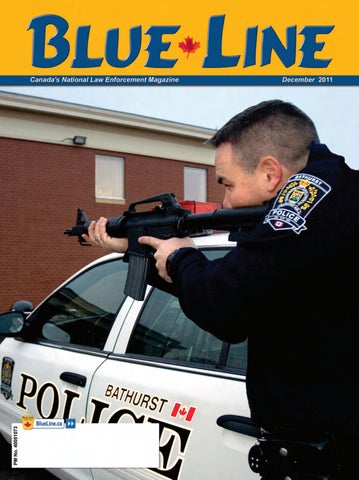
Features 6 Filling the gap Including carbines in the police arsenal
8 Shotgun training What can go right will go right
6
12
Preventing identity theft
16 On the road again From CPA President to patrol sgt., Charles Momy is living the dream
14 A few minutes can save your life 20 Established and respected
Recognizing 100 years of fingerprinting in Canada
30 Prison for Police
Departments
14
46 24
Blue Links Advertisers Directory Deep Blue – Police psychologists can do much more 23, 27 Dispatches 44, 45 Market Place 38 Movie Reviews 23 Odditorials 43 Product News 5 Publishers Commentary – Politics trumps responsible gun ownership 34 Technology – The future of computing is in the clouds
27
Case Law 38 40 41
COVER: Jeff Gauthier of the Bathurst Police Service demonstrates the AR-15 rifle carried in each police vehicle. See more on page 6. BLUE LINE MAGAZINE
3
Arrest circumstances not to be considered piecemeal Court sets aside million dollar award Tip and surveillance justifies arrest
DECEMBER 2011
DECEMBER 2011
4
BLUE LINE MAGAZINE
Blue Line
PUBLISHER’S COMMENTARY by Morley Lymburner
Magazine Inc. PUBLISHER Morley S. Lymburner - publisher@blueline.ca GENERAL MANAGER Mary K. Lymburner - mary@blueline.ca SENIOR EDITOR Mark Reesor - editor@blueline.ca CREATIVE DIRECTOR E. Jolene Lymburner - jolene@blueline.ca CONTRIBUTING WRITERS Mike Novakowski Mark Giles Robert Lunney James Clark Dorothy Cotton Dave Brown Tom Rataj AFFILIATIONS International Association of Law Enforcement Planners Canadian Advertising Rates Data International Police Association The Canadian Press Newswire Access Copyright SUBSCRIPTIONS $30 per year; $50 for 2yrs; US & Foreign: $100 ADVERTISING 888-640-3048 advertising@blueline.ca
www.blueline.ca 12A-4981 Hwy7 East, Ste 254, Markham, ON L3R 1N1 Canada P: 905 640 3048 F: 905 640 7547 blueline@blueline.ca
PRINTED IN CANADA ISSN# 08478538 Blue Line Magazine was established in 1988 as an independent publication to inform, entertain, connect and educate those involved in the law enforcement profession. With no direct control from an enforcement agency, its opinions do not necessarily reflect those of any government or law enforcement agency. The authors, advisors, and publisher accept no liability whatsoever for any injuries to person(s) or property resulting from application of adoption of anything presented in this magazine. Readers are cautioned and advised that articles presented herein are edited and supplied for your personal awerness and should not be used for further actions until appropriate guidance is received from a supervisor, Crown Attorney or other persons in authority. All material submitted for publication becomes property of Blue Line Magazine Inc. unless arrangements have been made with the publisher prior to publishing. © 2011 All articles are protected by copyright. No part of this publication may be repoduced or transmitted in any form or means, electronic or mechanical, (including photocopying and recording or by any information storage or retrieval system), without prior permission. Permission to reprint may be obtained in advance from Access Copyright 1-800-893-5777.
BLUE LINE MAGAZINE
Politics trumps responsible
gun ownership
The Conservative government has kept another long awaited promise. Emboldened by a shiny new majority with no effective opposition, it decided now was the time to kill the much vaunted and hated long gun registry. One could argue that the RCMP’s coincidental announcement that it is buying carbines for some members is welcome news. After all long gun owners can now go on a spending spree to stock up on their weapons of choice so police might as well raise the ante. A year ago I commented about the long gun registry and it is certainly worth repeating an angle not thought of during this entire debate. The notion of responsible firearms ownership has never really been discussed. My opinion (mine alone) is that the registry has never worked as a tool for police or method to reduce crime and violence. Neither has it been a tool of taxation, an attempt to disarm the citizenry or a police power grab to create a sinister dark oligarchy. If people take off the various rose and dark coloured glasses provided by political hacks and self-interest groups, the reality becomes a little clearer. The registry is about responsible ownership. Gun owners who say they are law abiding citizens yet break the law by not registering them are trying to suck and blow at the same time. A responsible owner surely wants to demonstrate that responsibility, not for the sake of police or politicians but for family, neighbours and community. If I live next door to a person who enjoys his firearms collection yet rails against laws designed to make them responsible for possessing them, what does that tell me about the security of my household? A neighbour who can convince me that he is abiding by proper rules of safety and laws regarding firearm ownership has my confidence. This is exemplified through Blue Line Magazine’s firearms editor, Dave Brown, who states that he enjoys firearms and collecting so much he has no problem taking the extra effort to register them and abide by all the laws that go along with that. Most of us similarly enjoy cars and have no problem with far more extensive rules – testing, regulations, licensing and higher fees than the long gun registry. Going through these processes indicates responsible ownership and demonstrates this to our neighbours and communities. We are all aware of individuals who cut corners, fail to get insurance or register change of ownership, let their vehicles become unsafe and drink and drive. Every responsible citizen would look upon most of this as being irresponsible. 5
Firearm lobby groups and some politicians demand no registration for rifles and shotguns. They have no issue with owners being licensed to possess a firearm, nor being screened and tested by police to purchase them – but want to keep private the models, number of guns and serial numbers that they own. It defeats my understanding of what’s rational. Police chiefs say their officers often access the registry and that it has made them safer and, in some ways, has saved lives. They have somehow confused the purpose of the registry and seem to think evidence of extensive use is a good thing. In most police training officers are encouraged to use their authority with discretion and restraint. The old adage, “if you abuse it, you lose it,” sums this up quite well. Applying this to the now doomed long gun registry, we find an attitude of wholesale usage of information for legitimate or spurious motives. Introducing a police tool with no protocols is asking for trouble. An officer investigating a bicycle theft has no reason to check the registry, yet this happens at many agencies, artificially inflating usage and, by suggestion, validating its existence. The most potentially dangerous scenario would be an officer letting down his guard after finding there are no firearms registered to an address. The registry went through a considerable crucible of fire. Originally a simple process, it very quickly became a nightmare for registrants and a boondoggle for statisticians wanting information and politicians looking for advantage. Lost in all the ensuing hoopla was the idea of demonstrating responsible gun ownership and encouraging acceptance by keeping to the basic tombstone data. Name, make, calibre, serial number and address. The money to build the registry has, rightly or wrongly, already been blown and we must salvage what we can, discarding portions if need be but not the whole thing. That would be irresponsible management of money spent. If a house is extravagantly built the wrong way we don’t put it in the dumpster. Even if the structure is unsafe, there is something that can be salvaged. If it is too expensive to maintain then reset it so it will be more economical. We should at least be able to salvage the values of responsible gun ownership to the benefit of responsible gun owners.
DECEMBER 2011
FILLING Including carbines in the police arsenal
by Matthew Kirkpatrick In recent years numerous Canadian police agencies have bought significant numbers of police carbines. Many more have ongoing or planned patrol carbine programs, needed to counter an increased threat to police and to quickly respond to terrorist and active shooter situations. Unfortunately, the debate about how to best equip officers is all too often characterized by emotional arguments, outdated perceptions and, occasionally, myths. Many observers tend to frame the discussion by insisting one weapon is better than another, and this too is a mistake. With a little investigation it becomes evident that pistols, shotguns and carbines have complimentary characteristics. Police services often overlook the very good technical information available to them. DECEMBER 2011
For this discussion “carbine” will refer to a semiautomatic, magazine fed, centre-fire rifle with a barrel shorter than 20 inches. Police carbines are almost universally chambered for the .223 Remington cartridge. Other calibres are available but rarely employed and ammunition is harder to find.
Basic characteristics Modern police carbines are invariably based on military designs that have evolved since the Second World War, based on soldier’s requirements (remarkably similar to the needs of police officers), ranging from human factors to logistics and durability, including: • Detachable high capacity magazines of 20 or 30 rounds; • Semi-automatic operation; • Superior accuracy; • Ability to mount enhanced optical sights, including night vision, and accessories such as lights; • Ease of operation and maintenance; • Operable by left and right handed officers of all sizes; • Compact and lightweight; 6
THE GAP
• Minimal recoil; • Excellent reliability; • Effective at ranges well beyond 100 meters; and • Functional in adverse conditions (including extreme cold, heat, dust, immersion and CBRN environments). Ballistics Police carbine opponents nearly always cite the “over penetration” of ammunition, referring to them as “high powered rifles.” This is a facile argument on several levels. The truth is that there is no better cartridge to produce the desired effect of human incapacitation. In a test published in Wound Ballistics Review comparing pistol calibre carbines, shotguns and .223 carbines, Dr. Gary Roberts concluded: “The routine issuing of 5.56 mm/.223 semiautomatic carbines for general purpose use would significantly enhance officer safety, increase police effectiveness and decrease the dangers to innocent bystanders in many situations requiring the use of firearms.” The FBI recommends that a police bullet should penetrate between 12 and 18 inches BLUE LINE MAGAZINE
into 10 per cent calibrated ballistic gelatin to reach vital organs from any angle, including through common intermediate barriers. The correlation between this recommendation and the effectiveness of ammunition selected using this criteria in real world police shootings is well documented in published studies. FBI testing of 12 gauge slugs, 10 mm, .40 S&W, 9 mm and .233 Remington show that, of all these cartridges, .223 is the most consistent and most closely meets the requirement. Intermediate barriers & armour Another objection is that the police carbine will penetrate officers ballistic vests. While this is true, body armour use is not limited to police and it is now necessary to have a firearm capable of penetrating it. To counter the threat of criminals with centre fire rifles, ceramic level IV plates are commonly issued alongside patrol carbines, further negating the argument that police should not carry a firearm capable of penetrating body armour. Effective penetration of other intermediate barriers such as automobile glass is also desirable. Penetration into 10 per cent calibrated ballistic gelatin after passing through standard automotive glass by .223 Remington is nearly identical to .40 S&W. In the same test both 12 gauge slugs and 9 mm prove to be ineffective. It also proves effective after being shot through sheetrock and plywood yet does not penetrate as much as any other calibre tested. The ballistic testing data, while restricted to law enforcement, is available from the FBI and widely distributed in Canadian police agencies. The construction and length to diameter ratio of a .223 bullet also means that it is more likely to disintegrate than ricochet after striking concrete or brick. These relatively light and long bullets are easily upset and lose energy very rapidly when deflected.
There is no question Canadian police need more firepower to effectively counter an increased armed threat. There is also a need to mitigate the risks of deploying that firepower amongst a population that is becoming more concentrated in urban areas. A police carbine’s greater accuracy and damage potential means less rounds fired to achieve the required effect. This is more consistent with the concept of minimal force than many other available firearms.
A police carbine is light, accurate, reliable and can be fitted with enhanced optical sights, lights for low light operation and high capacity detachable magazines. Carbines can be procured for costs that allow them to be placed in every police vehicle and officers can be trained in a relatively short time. The ammunition is widely available and proven safe and effective. Shotguns have advantages of payload type ammunition ranging from breaching rounds to less lethal. Pistols have the advantage of portability. Where the range and accuracy of these firearms are limited, the carbine fills the gaps. The demonstrated characteristics of the police carbine continues to match the needs of Canadian police services and their numbers can be expected to increase. Matt Kirkpatrick is a technical communication consultant specializing in firearms training and documentation. He has 20 years of military experience, including deployments to Afghanistan and Bosnia and has trained soldiers and police officers across Canada and internationally for more than 10 years.
.223 vs 5.56
Noise Objections surrounding the sound level of police carbines are often presented, without any support. Sound level is complicated to test, however the results of a simple sound pressure level test completed for a civilian gun range is enlightening: • 18 inch barrel, 12 gauge shotgun: 161.5 decibels; • Pistol, 9 mm: 159.8 decibels; • 18 inch barrel. .223 carbine: 155.5 decibels. Firepower Firepower is the capacity to deliver effective fire on a target, determined in this case by two factors: • Accuracy, since critical structures in a human are relatively small, with only about 17 per cent of the frontal area producing effective hits; and, • Ability of that fire to destroy those critical structures, measured by the size and depth of the tissue destroyed. Capacity can be measured by the number of rounds available for immediate use, speed of reloading and the number of weapons realistically available. BLUE LINE MAGAZINE
Can .223 Remington Cartridges be used in a 5.56 mm firearm? Yes but... The .223 Rem cartridge is subject to a voluntary standard laid out by the Sporting Arms and Ammunition Manufacturers Institute. The 5.56 mm ammunition is actually 5.56 x 45 mm NATO and must be manufactured to strict NATO standardized agreement (STANAG) 4172, which also specifies more stringent testing and tighter controls of dimensions. The 5.56 mm cartridge is a derivative of the .233 Rem but differs in a few key areas. The chamber, specifically the lead area (distance from the front of the chamber to the
7
start of the rifling), is larger in 5.56 mm firearms. The lead in .223 Rem is 0.045 inches; the 5.56 mm is 0.164 inches. This means that, while the case is identical, the overall length of 5.56 mm cartridges may be longer and may not fit into a .223 Rem chamber without crushing the bullet into the case. The 5.56 mm ammunition is also loaded to higher pressure. Accoring to SAAMI, “The .223 Remington is rated for a maximum of 50,000 CUP while the 5.56mm is rated for 60,000 CUP. That extra 10,000 CUP is likely sufficient to cause a failure in a chamber that’s only rated for the “sporting” .223 Remington.”
DECEMBER 2011
SHOTGUN
by Dave Brown Every Canadian police officer should have a good double-action-only pistol on their hip, a loaded shotgun in an overhead rack and fast access to an accurate patrol carbine. There is no room for failure and no such thing as a fair fight on the street. When human life is at stake, officers need the best gun, proper training to use it safely and effectively and enough power to stop the threat quickly and efficiently. Within its design distance, the shotgun is one of the most versatile and powerful weapons one can bring to bear in a defensive situation. With one pull of the trigger, it can put the energy equivalent to half a magazine of 5.56mm rounds into a threat. At typical police shooting distances, that impact can stop threats quicker and safer than almost any handgun or rifle on the market. So, what’s the problem? Why are some agencies looking at reducing an officer’s firepower options by taking away the shotgun? Simply put, one of the biggest reasons is training. Police handgun training was dragged kicking and screaming into the 20th century, with modern techniques and a much better understanding of how the human body performs under stress, but much of that thinking never trickled down into shotgun training. Many agencies did rudimentary training or reserved shotguns for supervisor use, dispatching wildlife or – for some insane reason – crowd control. They made the training so complicated or painful that many patrol officers today don’t even like shooting shotguns and fewer still understand the versatility, simplicity and speed of a good police shotgun. DECEMBER 2011
TRAINING
What can go right will go right While a patrol carbine is an excellent option for the patrol officer, it should not come at the expense of shotguns. The police-issue semiautomatic or pump shotgun is a simple firearm; easy to handle, easy to train on and easily and quickly fired accurately under stress by almost anyone with some degree of minimum training. Training: What did not work • First mistake: Overcomplicating the training A patrol shotgun is not a rifle and should not be treated as such. When that gunfight happens, you need to stop it now. Don’t waste valuable training time on techniques more appropriate for carbines or SWAT. One should learn the basics of safety, loading and unloading, shouldering, firing, multiple shots, shooting while moving, shooting from cover and speed reloading. Practice these basics over and over until they become automatic responses. Don’t waste time teaching things like rollover prone shooting or switching hands to shoot around a weak-side barricade. Stuff like that just hurts, has little practical application and discourages officers from ever shooting shotguns again. Trust me; in the middle of a gunfight, if your only option is to shoot from prone, you will find a way to do it. A shotgun is a simple weapon; practice simple basics. • Second mistake: Training with duty loads 8
“We need to train with the same loads that officers carry on the street.” I have heard that myth many times. Have we not learned anything about the physiology of the human body in a life-threatening situation? We teach tunnel vision, auditory exclusion and the inability to count rounds during a gunfight in handgun training, so why do we not also reinforce that in shotgun training? When that gunfight happens, officers will not feel the recoil and/or hear much noise so a better way to recreate a real situation is to train with the lightest loads possible. For the price of five slugs we can fire 50 rounds of inexpensive birdshot – and get far better reinforcement of the basics with 50 repetitions. • Third mistake: Equipping shotguns with folding stocks Ordinary citizens are quivering, sensitive creatures who quake at the mere sight of a gun in a police car and run to hide under their mothers’ skirts – at least according to some police administrators. Shotguns with foldable stocks were trendy years ago when some administrators (who had never even fired a shotgun) felt it necessary to keep them out of the general public’s sight. Well, guess what. It’s a police car. Police officers have guns. Get over it. Don’t be a lethal threat and you will never have anything to worry about it. Folding stocks are almost the invention BLUE LINE MAGAZINE
of the devil. They made training a painful experience to be avoided at all costs. Many officers still recall the pain and discomfort of their shotgun training. With the availability of good-quality overhead racks for patrol cars, there is no longer a need (nor was there ever) for folding stocks. Training: What we did learn Not every shotgun trainer was satisfied with teaching techniques that should have gone out of favour in the days of Al Capone. We have learned valuable lessons in the past few decades which have sparked renewed appreciation for the versatility of a good shotgun in certain circles. Shorter lengths-of-pull Police shotguns are equipped with shorter lengths-of-pull these days. Most older shotguns can be made shorter by reducing the stock length. Correct length-of-pull (the measurement from the trigger to the centre of the butt pad) is critical for a consistent cheek weld, but police officers need much shorter stocks than target shooters and hunters. Soft body armour adds bulk and this can make shooting a regular length shotgun a painful experience. Also, police shotgun shooting stances have gone away from the bladed angle stance and more toward the square-on stance of a handgun. This is primarily for more mobility and ease of swinging, the lack of which might cause a duck hunter to miss a bird – or a police officer under the effects of tunnel vision to miss a lethal threat. Another reason stances are less bladed today is related to the most vulnerable part of a patrol officer’s body armour – the armhole. SWAT trainers like to talk about a so-called ‘fatal funnel’ in entry training, but any stance that conditions an officer to stand sideways, exposing their armhole to a threat, could result in a tragic new meaning to the term ‘fatal funnel.’
Aimpoint Micro or EOTech are fast, accurate and rugged. They are also expensive but if an agency is going that route, it needs a proper mil-spec sight, not a cheap Chinese-made ripoff. That’s about it. The average urban patrol officer rarely needs spare shell carriers on the receiver or stock. If the gunfight is not stopped after six, it will probably not be stopped after 12. Sidesaddle shell carriers add weight, get in the way of a good speedload and sometimes drop their shells onto the ground at the most inopportune time. Spare shells can be carried in the pocket and if an agency issues buckshot duty rounds, a box or two of slugs within easy reach will take advantage of a shotgun’s ability to put out an awful lot of power downrange at short and intermediate distances. The bottom line is that the best police shotgun accessories one can buy are a good training course and two dozen boxes of shells to break it in. Police semi-automatics The pump action shotgun is simple and fast into action. It can be handled by nearly anyone with good training and can shoot a wide variety of loads. The police semi-automatic, on the other hand, is more expensive and will only fire a narrower range of duty loads. Loading and unloading a semi-auto is also more complex than a pump but with the right ammunition, it is reliable, fast and accurate – and honestly, if an officer cannot be trained to manipulate one extra lever or button under stress, they also shouldn’t be allowed to drive cars.
Yes, a good shooter on a pump can keep up with an average shooter on a semi-automatic, but given good training, the modern semiautomatic is unbeatable for speed. Electronic range timers have proved conclusively that a good pump shooter can get off two shots with shot-to-shot times under .30 seconds, but a good gas-operated semi-automatic such as the Remington 11/87 Police can easily get under .25 seconds. I have even seen a gas-assisted, inertiaoperated shotgun such as the Benelli M4 Tactical get shot-to-shot times at an incredible .18 seconds. Now, I was never very good at math but according to my calculations, that means a good semi-auto can fire off five slugs – the equivalent energy of 30-rounds of military 5.56mm rifle rounds – in under one second. I hope no one will ever need that speed but it is comforting to know that your agency has your back with quality weapons that will work when you need them and the power to instantly and accurately stop a threat. The acquisition of patrol rifles are a good two steps forward in Canada, but let’s not also take one step back. After all, the best gun in the world is the one you have when you need it the most – and the training to back it up. At typical police gunfight distances, that may very well be a shotgun. Dave Brown is Blue Line Magazine’s Firearms Editor and staff writer. He is a tactical firearms trainer and consultant. He can be reached at firearms@blueline.ca
Keep it simple There are literally thousands of ‘combatstyle’ accessories that can be hung on shotguns but few benefit those who may need their shotgun in an instant. Some aftermarket parts tend to fail just when you need them the most. What looks good hanging on some mall-ninja’s basement wall is not going to be simple and reliable when human life is at stake. This means good sights, a quality (and thoroughly tested) magazine extension tube and a high-visibility magazine follower are about the most an average patrol officer is going to need. Shotguns are versatile and applications vary. For rural or tactical use, a combat-tested light in a solid mount often helps and some officers appreciate a good two-point sling; others find it just gets in the way. A simple bead sight is still the easiest and fastest to acquire. Many modern ‘tactical’ shotguns come with ghost-ring sights but some shooters don’t like them as they are not much faster to acquire than rifle sights. A good bead can be both fast and accurate out to and beyond 50 meters. Combat-tested electronic sights such as the BLUE LINE MAGAZINE
9
DECEMBER 2011
Decoding policing Head, heart and hand by Robert Lunney Contemporary policing systems consist of three elements: Intelligence-led policing; Community policing; and Policing capacity. Think of it as a mantra: Head, heart and hand. The ability to fuse together these three elements represents a crucial challenge to police leadership today. Head Intelligence-led policing (ILP) is a strategy for targeting offenders, managing hotspots of crime and disorder, exploring linkages between serious crimes and incidents and applying preventive measures. Analytics enable predictive tactics with the potential to prevent crime. All forms of investigation, including forensics, are basic to ILP. Its strategies are associated with professionalism and an expert work force. ILP responds directly to serious crime and disorder and includes criminal intelligence.
Heart Community oriented policing (COP) is the core philosophy of policing in a democracy. The principles of COP are the vital centre, motive force and spirit of policing and the dynamic on which other strategies play. Front line officers engage the public, develop relationships and partnerships and constantly scan for anomalies. They identify threats to safety, solve community problems, provide reassurance and reduce fear. Community policing is the cradle for cultivating and shaping the art and craft of policing and the vehicle for demonstrating humanity, transparency, a sense of justice, empathy and compassion. These qualities build trust and confidence in the police.
deployment of all available resources towards prevention and driving down crime and disorder. The levers of action are budgets, human resources, equipment, transportation, information systems and facilities.
Hand Methods and techniques are of no benefit without the means to carry them out. Hand is the enabling capacity that invigorates and energizes, putting power and authority behind decision making. Decision makers direct the
Fusion The challenge for police leaders at all levels is to ensure the fusion of head, heart and hand to provide seamless protective services, combining all policing strategies into a single discipline. The elements for success are: • Unequivocal support for community policing; • Advancing information-led policing while blending in Compstat accountability; • Assuring that the appropriate resources are assembled; • Ensuring that organizational structures and systems contribute to achieving fusion, and: • C ommunicating this blending of crime strategies and policing styles internally with clarity and commitment.
Relationships Cross-cutting activities connect head, heart and hand. Problem oriented policing (POP) is a component of both community and intelligence-led policing. SARA (scan; analyze; respond; assess) and other problem-solving techniques are used to develop response strategies for both POP and ILP. Compstat is an accountability tool and a sub-set of ILP prompting quick response and accountability. Decision makers at all levels draw constantly on the enabling capacities of the service.
Robert Lunney is a consultant in police policy and Blue Line Magazine’s police senior management advisor.. He is a former RCMP superintendent and chief of the Edmonton and Peel Regional Police Services, as well as former director of Public Safety for the city of Winnipeg. He may be reached by email to Lunney@BlueLine.ca .
DECEMBER 2011
10
BLUE LINE MAGAZINE
“On the Second Day
of Christmas my true love gave to me... a 2 year subscription to
Blue Line Magazine and a cartridge in a bare tree!”
Give a Blue Line gift subscription! 10 issues a year : $30 - 1yr, $50 - 2yrs
BlueLine.ca or 888-640-3048 to order
BLUE LINE MAGAZINE
11
DECEMBER 2011
Preventing
identity theft by John Farinaccio Identity theft has become one of the fastest growing crimes in the world. Victims usually discover there’s a problem only when bills arrive or they are denied credit. By that time the criminal has probably discarded the identity and moved on to a new one. In most cases, victims do not have to pay the huge bills the thieves rack up but must face hours dealing with bill collectors, creditors and credit reporting agencies in trying to clear their names. The living are not the only victims; the dead are also often targeted. In fact, thieves often prefer stealing the identities of the dead. Who’s going to call the police? To steal an identity, the thief need only collect a few of the following pieces of personal information: birth name, address, date of birth, social insurance number and/or mother’s maiden name. They can easily get this information by stealing your mail, stealing or finding a lost wallet or sifting through your garbage for discarded credit card statements or other documents with your personal information. A new goldmine for thieves are social networking sites like Facebook. Too often people post far too much personal information like birthdays, full birth names, place of employment, telephone numbers, etc. DECEMBER 2011
Simple ways to prevent ID theft Credit & debit cards: Sign all your cards as soon as you receive them. There is no need to carry all the credit and debit cards you own. Only carry the one or two cards you use most often and cancel or safely store those that you do not use. Leave home without them: There’s no need to carry your social insurance card, passport and/or birth certificate. There are only a selected number of government departments and programs authorized to collect and use Social Insurance Numbers (SIN) – but no law prevents someone from asking you for it. Unless you’re dealing with the government you are not obliged to disclose it. Canada’s Personal Information Protection and Electronic Documents Act (PIPEDA) states that organizations like banks, telecommunications companies and airlines cannot require you to consent to the collection, use or disclosure of your personal information unless it is required for a specific and legitimate purpose. This means that unless an organization can demonstrate that your SIN is required by law, or that no alternative identifier would suffice to complete the transaction, you cannot be denied a product or service on the grounds you refused to provide it. 12
If you disagree with a request for your SIN made by an organization subject to the PIPEDA, you can complain to the federal privacy commissioner, who will investigate the complaint. Passwords & personal identification numbers (PIN): Never give anyone passwords and/or personal identification numbers and try to change them every six months. Never use your birth date as passwords and/or PINs. Always memorize them and never have a written copy. Protect your cheques: Using a pen like a Uniball 207 to sign cheques or other important documents will help protect against cheque washing. This is when a criminal uses various solvents to remove data from a signed cheque – the “pay to” name and amount – and replaces it with their own name and a larger amount. Report any problems right away: Immediately report lost or stolen cards and any discrepancies on your monthly statements to the issuing card company. Check your credit record every six months or at least once a year: Mistakes can and do happen and they can dramatically lower your overall credit score. You can do this by contacting the credit bureaus (Equifax,TransUnion). By law they are required BLUE LINE MAGAZINE
to give you one free credit report per year. Photocopy all your cards and any pieces of identification: Keep this list in a safe place (not your wallet or purse) so that you can contact each company quickly in case your cards are lost or stolen. Make a similar list for your bank accounts. Visit http://www.servicecanada.gc.ca/ eng/lifeevents/wallet.shtml for a step by step list of what to do if you lose your wallet. It also has a complete list of all financial institutions and their contact information. Destroy all evidence Every investigator knows about dumpster divers or trash archaeologists. A person can obtain invaluable amounts of information from someone’s trash. Invest in a quality paper shredder and destroy all paperwork that has any personal information you no longer need, including pre-approved credit card solicitations, convenience checks, bank statements, magazine subscription renewals, etc. Make sure the shredder has a cross-cut (not a straight-cut) action. It’s well worth the extra money. Never leave receipts at bank machines, bank wickets, trashcans or gasoline pumps. Do not leave important documents in your vehicle. (Remember what happened when a Canadian Security Intelligence Service officer left sensitive information in her car while attending a hockey game? (http://circ. jmellon.com/docs/view.asp?id=476)
computer. Even when a hard drive has been “erased,” deleted information can always be retrieved. Destroy it! Social networking Social networking sites such as Facebook are great... but they are also a playground for identity thieves. To reduce the risk of being a victim adjust the security settings as high as possible, only add people who you actually know and minimize the amount of personal information you display (i.e. your birthday) These are very simple steps that everyone can take to keep from becoming a victim of identity theft. Many have said that identity theft is
unavoidable, undetectable and unstoppable. The best piece of advice I can give is to be very conscious of who you’re giving your personal information to, where it is ending up and paying attention to the people around you when using it. John Farinaccio has more than 18 years experience in investigations and gathering intelligence. He founded the Canadian Private Investigators’ Resource Centre (C.P.I.R.C.) in 1999 and is currently vice president of the Canadian Tactical Training Academy. He has both managed and lead investigation & undercover surveillance teams and spearheaded the development of advance reconnaissance teams for international protection details, many in hostile areas of operations.
Social engineering techniques Criminals use techniques like pre-texting or phishing to collect sensitive information from people via telephone or email. Never give out personal information over the phone or email unless you are absolutely sure who’s at the other end. Secure your mail Having your mail sent to a post office box is much more secure. If you choose to have mail sent to your home install a lockable mailbox. If you are away have your mail, newspapers and magazines picked up every day. When subscribing to magazines do not include your title or actual birth name. If your name is Dr. Anthony Michael Kenton use Mike Kent. There is no need for your mailman or a mail snoop to know that you are a doctor, lawyer or other professional. The only people who are interested in your title are those who want something from you; don’t let your ego put you at risk. Your computer Another point to keep in mind is the issue of storing personal information on your computer hard drive. If you feel comfortable with doing this make sure that you protect your computer with a good anti-virus, firewall software and a log-in password. All wireless connections must be secured. Do not include the hard drive if you decide to sell your BLUE LINE MAGAZINE
13
DECEMBER 2011
A few minutes
could save your life by Pierre Descotes
Pic.1a
This second problem is as bad, if not worse, than the previous one. These days, semi-automatic By having a loose bullet not held pistols have replaced revolvers in place tightly by the casing, the in most police departments and bullet will move, but barely, when other agencies. With the new firing. As pressure cannot build technologies, we also see plenty before it leaves the casing, it will of semi-automatic support and move a few centimetres inside the tactical firearms, along with fully barrel and stop. Most of the presautomatic weapons. sure will exit to the rear when the Semi-automatic and fully autoslide/bolt moves rearward. matic firearms have many more Pic.1b With your adrenaline pumpmoving parts that require better ing, it’s quite possible you will not care and maintenance. They also notice and shoot a second round. require high quality ammunition. One thing for sure: your barrel is With the exception of long scrapped, at the very least. Your firearms or those that use rifle or firearm may still function but likely shotgun ammunition, pistols and will not. You may also be injured: sub-machine guns usually use it depends on many factors. 9mm Luger or 40S&W. The very The solution to avoid these same ammunition can also be used problems is very simple but most in semi-auto or full auto firearms. never bother to apply it. I have When revolver or rifle ammutaught this to many police departnition is made, the mouth of the Pic.3 ments but only a few enforce this casing is opened to help insert the simple safety rule: do a 360 degree bullet. Once it is seated, the bullets visual inspection of all ammunition are crimped onto the brass shell, either before or during loading. creating a resistance that will help By taking the time to visually increase the pressure by retarding inspect each round taken from the the bullet from leaving the casing. box before loading it into your Pistol ammunition is not made magazine, you will avoid facing the same way. Pistol casings are this out of battery situation or a somewhat smaller in diameter than Pic.2 bullet lodged in your barrel. the bullet and are not flared prior to Then again, from a gunsmith insertion. When the bullet is seated, point of view, if you don’t remove bullets the pressure of the casing is the only thing The slide or bolt is locked in place with a with lips in the proper way, you may damkeeping it in place. There is no crimping. live round in the chamber and it has to be age or break your extractor and damage Occasionally when the bullet is seated, sent to the armourer, with the live round in the chamber and/or barrel. Not doing this one side will catch the side of the casing, the chamber, for repair. simple inspection could cost you your life – causing what we call a “lip” and damage What if you were in a situation where or at least quite a few dollars in repair costs. which can range from minuscule to heavy. you had to use your weapon and the second Shooting with a bullet lodged in the In Pic.1a, you can see five rounds that round was one of those defective ones? You barrel and you’ll have to replace the barrel look perfect. In Pic.1b, you can see the would be facing someone shooting at you and possibly the firearm. It all depends on very same rounds from the other side. Pic.2 and not be able to defend yourself. Another the extent of the damages. magazine won’t help; removing and/or shows a rare event – the casing was too There’s little point in carrying spare changing it will not fix the problem. This tight and the bullet crushed it all around. magazines or a full box of ammunition if could be a life threatening situation. Although rare, it happens. your firearm stops functioning after the Looking at Pic.3, you can see another The pictures illustrate how easy it is to first round. type of problem that, unfortunately, is more miss a lip or damage. Please do not risk your life. Visually common than the “lip” situation. On both When a mechanism closes, it can only inspecting your ammunition before loadsets of rounds, the casing on the right wasn’t accept so much rearward movement before ing it may take a few minutes but it could tight enough to perfectly hold the bullet in being “out of battery.” This means that, save your life. place and it can easily be pushed inside the in all six examples shown, should one of casing. Remember: NO semi-auto or full these rounds be chambered, the mechanism auto pistol type ammunition is crimped. As would be so far rearward that the firearm Pierre Descotes is president of DESCOTES Canada Inc. you can see on the right of each set, a bullet would not function. Visit www.descotes.biz for more information or contact him at 1-855-296-2931. is now lower than it should be. To the left, Even worse, you will not be able to fire you can see where the bullet should be. or even open your firearm if this happens. DECEMBER 2011
14
BLUE LINE MAGAZINE
BLUE LINE MAGAZINE
15
DECEMBER 2011
ON THE ROAD AGAIN From Canadian Police Association President to patrol sergeant, Charles Momy is living the dream by Tony Palermo It’s barely 8 AM on a holiday Monday but several Ottawa Police officers in the gym at Algonquin College’s Police and Public Safety Institute have already run through videos, handcuffing drills and search techniques, part of a defensive tactics requalification course. It’s been many years since Sgt. Charles Momy has had to use these skills – at least eight, closer to 16 if you don’t include the brief six month stint on patrol in between – but he’s far from looking like a fish out of water. The instructor demos the next drill and then signals the students to try it. “Down, down, down,” yells Momy, decibels above the others, as he seamlessly moves his partner off-balance, gains wrist and elbow control and then takes him to the ground. DECEMBER 2011
“Good job Momy,” says the instructor, “And great TacComm.” Momy smiles and it quickly becomes apparent that his enthusiasm is infectious. On subsequent drills, the other students yell their instructions just as loud. Everyone is smiling and appears to be having fun. Momy smiles a lot. While genuinely pleasant by nature, many have wondered what he has to smile about. After all, he just went from being the president of the Canadian Police Association back to a patrol sergeant, a change many consider a step back. It certainly comes with a considerable loss of salary, perks and status. With only a couple of years to go before he’s eligible to retire, what motivated the 49-year-old Momy to trade a comfortable desk job with relatively normal hours for one that is much harder on the body and requires shift work? In offering opinions, people say everything from “good on him” to “he’s nuts” (though admittedly using more colourful language.) One thing everyone agrees on is that it was a hell of a drastic change. There were probably a dozen reasons why he made the switch back to the streets, Momy says. For starters, he missed the strong bonding and camaraderie that front-line police work 16
provides. He originally joined the CPA in 2003 because he hated seeing how front-line officers were being treated, or as he puts it, “dicked around.” Despite the challenges, successes and perks of the union job, Momy concedes that it was lonely at the top. Momy spent almost eight years in polygraph prior to joining the CPA and was considered one of Canada’s leading experts in interviewing, interrogation and polygraph techniques – but again, despite his successes and the thrill of eliciting a confession, it was generally a very solitary job. Other motivators: The death of Ottawa Police Cst. Eric Czapnik (stabbed to death on Dec. 29, 2009, allegedly by RCMP Cst. Kevin Gregson; the trial was tentatively set to begin Nov. 7). Momy also enjoys being a teacher and has a lot of experience that he wants to share. The fact he’s turning 50 Jan. 6 also played a part. Ultimately, Momy says that a big part of his decision was a desire to return to real front-line police work. “I want to be here and in uniform,” he says. “We become cops to help people and to make society a better place. It sounds corny but it’s so true.” While some concepts remain the same, or at least similar, there’s no denying that a lot has changed since Momy was last on patrol. BLUE LINE MAGAZINE
Laptops have replaced MDTs. New equipment and use of force options are available. There are numerous law and policy changes. Even the cruisers have more bells and whistles. “Sure, it can be a steep learning curve,” he allows. “The new technology is a big one but I’ve found it to be really intuitive. For the rest of it, it’s just like riding a bike. You just have to get your head and focus going and then it all comes back.” “Charles is a smart guy,” says instructor Cst. John McDonald. “He’s here with the right attitude and mindset. That’s half the battle. You don’t want to mentally defeat yourself before you’ve even started.”
password combinations, even one-fingered deliberate typing – no matter what he tries the system refuses to grant him access. Momy tries calling the IT helpdesk but seeing as it’s late in the evening, he gets no answer. Momy stares at the screen. “There are passwords for fucking everything.” Hearing this, Sgt. Reno Rushford, his partner for the evening and an old friend from his Gloucester Police days, comes over to help. Rushford looks over the system, then asks Momy where his e-token security key is. “You know, the thing that looks like a memory stick?” Momy begins to systematically check all
of his pockets and pouches. A few seconds later, his eyes light up and his hands stop the self-administered pat-down. He pulls out his phone, makes a quick call, hangs up and then smiles. “Mind if we make a quick stop at my place?” he asks. Rushford laughs. “You’re like a kid who went to school and forgot his lunch. Tell me, if your kid forgot his lunch on the table, what would you do?” “I’d bring him his lunch,” says Momy. “Bullshit,” replies Rushford, shaking his head. “Let’s go.” Despite the little hiccup, the rest of the shift is smooth, as are his next few shifts
First shift Inside the platoon office at the Leitrim Road detachment, several camaraderie-type pictures line the walls. A picture of Erik “Ponch” Estrada of CHiPs fame hangs near a picture of an older model cruiser. Momy beams. “That was my very first patrol car. It had an AM radio and no A/C. Ah, the good ‘ol days.” “Hey look,” says a jovial voice from across the room. “I’ve been replaced as the resident old guy.” Momy laughs. “Oh yeah? By whom?” Not everyone has been as friendly and welcoming. Understandably, some disagreed with decisions he made while heading the CPA but a few have taken it a step further, making it clear that even though he’s back in uniform, they still could care less for him. Tenure, the mandated rotation of personnel after a certain amount of time, remains a hot topic but one that Momy still stands behind. Acknowledging that some officers don’t like it because they’re forced to move positions, he maintains it creates an atmosphere of opportunities and is good for the organization. “If those individuals wanted a full-time job doing the same thing for 30 years, well, they should have gone to work for the federal government.” The lessons come quick when you’re in uniform and Momy gets his first reminder of that, albeit it gently, when he tries checking his e-mail right after the evening briefing. Uppercase/lowercase, different username/ BLUE LINE MAGAZINE
17
DECEMBER 2011
riding solo. Although the technology has changed and there might be a steep learning curve to get back into the groove, Momy points out that the core of police work remains the same. “At the end of the day,” he says, “this job is all about communicating. In most circumstances, your mouth can get you out of a major bind. Things like how to talk to a parent who just lost a child or whose daughter was just sexually assaulted. How to talk to bad-asses to get information or diffuse a situation and then at the end of it, have those same people say to you ‘you’re a good shit.’ This is the stuff that they don’t teach you in college. Communicating. Listening. Knowing how to talk to people. That’s the stuff experience brings.” Tony Palermo is Blue Line Magazine’s correspondent for the Eastern Ontario & Western Québec region. A freelance writer and former federal corrections officer, he welcomes all e-mails and stories of interest at tony@blueline.ca .
DECEMBER 2011
Sharing an inspiration In October Michelle Coghlin asked her husband, Constable Philip Coghlin of the Stratford Police Service, to bring home his complete uniform from work. Her aim was to do a police photo shoot with their new born son Caleb. This picture is one of the finished images from that shoot. Michelle noted the mood and symmetry reminded her of the daily grind of police work experienced by her husband and how it contrasted from his home life and down-time with their new son. She
18
was inspired to include the tag line and posted it on her facebook page. She had so many fans of the picture the demand for copies grew to a point where she decided to make it available to everyone in the form of gift plaques... just in time for Christmas. Anyone wishing to obtain a copy can contact Michelle by email to policeneedhugstoo@gmail.com.
BLUE LINE MAGAZINE
Human perception alters radically under extreme duress
by Taylor Clark Over a period of five years, researcher Alexis Artwohl gave hundreds of police officers a written survey to fill out about their shooting experiences. Her findings were remarkable: virtually all reported experiencing at least one major perceptual distortion and most experienced several. Time moved in slow motion for some; for others, it sped up. Sounds intensified or disappeared altogether. Actions seemed to happen without conscious control. The mind played tricks. One officer vividly remembered seeing his partner, “go down in a spray of blood,” only to find him unharmed a moment later. Another believed a suspect had shot at him, “from down a long dark hallway about 40 feet long;” revisiting the scene a day later, he found to his surprise that the suspect, “had actually been only about five feet in front of (him) in an open room.” In a particularly strange anecdote, one officer wrote that, “during a violent shoot-out I looked over... and was puzzled to see beer cans slowly floating through the air past my face. What was even more puzzling was that they had the word Federal printed on the bottom. They turned out to be the shell casings ejected by the officer who was firing next to me.” The single distortion under fire that Artwohl heard about most (reported by 84 per cent of the officers) was diminished hearing. In the jarring, electrifying heat of a deadly force encounter, Artwohl says, the brain focuses so intently on the immediate threat that all senses but vision often fade away. “It’s not uncommon for an officer to have BLUE LINE MAGAZINE
his partner right next to him cranking off rounds from a shotgun and he has no idea he was even there,” she said. Some officers Artwohl interviewed recalled being puzzled during a shooting to hear their pistols making a tiny pop like a cap gun; one said he wouldn’t even have known the gun was firing if not for the recoil. This finding is in line with what neuroscientists have long known about how the brain registers sensory data, Artwohl explains. “The brain can’t pay attention to all of its sensory inputs all the time,” she said, “so in these shootings, the sound is coming into the brain but the brain is filtering it out and ignoring it – and when the brain does that, to you it’s like it never happened.” The brain’s tendency to steer its resources into visually zeroing in on the threat also explains the second most common perceptual distortion under fire. Tunnel vision, reported by 79 per cent of Artwohl’s officers, occurs when the mind locks on to a target or threat to the exclusion of all peripheral information. Studies show that tunnel vision can reduce a person’s visual field by as much as 70 per cent, an experience that officers liken to looking through a toilet paper tube. The effect is so pronounced that some police departments now train their officers to quickly sidestep when facing an assailant, on the theory that they just might disappear from the criminal’s field of sight for one precious moment. According to Artwohl’s findings, the warping of reality under extreme stress often ventures into even weirder territory. For 62 per cent of the officers she surveyed, time seemed to lurch into slow motion during their life-threatening encounter – a perceptual 19
oddity frequently echoed in victims’ accounts of emergencies like car crashes. In a 2006 study however, the Baylor University neuroscientist David Eagleman tested this phenomenon by asking volunteers to try to read a rapidly flashing number on a watch while falling backwards into a net from atop a 150-foot-tall tower, a task that is terrifying just to read about. This digit blinked on and off too quickly for the human eye to spot under normal conditions so Eagleman figured that if extreme fear truly does slow down our experience of time, his plummeting subjects should be able to read it. They couldn’t. The truth, psychologists believe, is that it’s really our memory of the event that unfolds at the pace of molasses; during an intensely fear-provoking experience, the amygdala etches such a robustly detailed representation into the mind that, in retrospect, it seems everything transpired slowly. Memories, after all, are notoriously unreliable, especially after an emergency. Sometimes they’re eerily intricate and yet other times vital details disappear altogether. “Officers who were at an incident have pulled their weapon, fired it and reholstered it and later had absolutely no memory of doing it,” Artwohl said. If your attention is focused like a laser on a threat (say, the guy shooting at you), Artwohl says, you may perform an action (such as firing your gun) so unconsciously and automatically that it fails to register in your memory banks. This article is excerpted from Taylor Clark’s book entitled Nerve – The brave new science of fear and cool (Little Brown Publishers).
DECEMBER 2011
Established & Respected Recognizing 100 years of fingerprinting in Canada
by Morley Lymburner An arrest 24 years ago in New Orleans helped usher in the age of computerized fingerprint identification. A 21-yearold woman was shot and killed during an attempted robbery and rape and her boyfriend was seriously injured. Two fingerprints lifted from the back window of their car were entered into Inspector the police departEdward Foster ment’s new automated fingerprint identification system (AFIS). The system, developed by De LaRue Printrak Inc., searched the one million prints on file and selected eight candidates. The fingerprint examiner compared them and made a positive identification. The total process took minutes. New Orleans Police arrested the suspect and charged him with seven murders, eight rapes and more than 20 armed robberies. DECEMBER 2011
It was the first arrest leading to a conviction using the new technology, which owes a lot to history and the dogged determination of a dedicated breed of people. Who they are and the science they used to the benefit of society will be explained in this article. Edward Foster This year marks the 100th anniversary of fingerprinting in Canada. The recognition of the expertise of the late RCMP Insp. Edward Foster, the founder of Canadian fingerprinting, is an important part of this anniversary. Foster established the Canadian Criminal Identification Bureau in Ottawa in 1911 but, strangely enough, first gave fingerprint evidence in Chicago some five years earlier. This case against Thomas Jennings, charged with murder, was quite slim with the exception of fingerprints. There was little doubt that if the prints were not admitted, the case was lost. Chicago Police decided to call in some of the world’s greatest experts, including Foster. The inspector presented the case in favour of the scientific reliability of fingerprints. Under cross examination the defence attorney attempted to discredit the evidence. He began 20
by asking if the local ident officer could raise fingerprints from the rough surface of the desk he had his hands on. Foster advised the court that he could not. Flushed by this success, the defence then asked if prints could be raised off of a piece of paper; told they could, the attorney challenged Foster to demonstrate. Foster got out his powder, dusted the paper and produced the attorney’s prints. The jury appeared quite impressed – so much so that the defense attorney spilled water over the paper to destroy the demonstration. It was to no effect. The judge ruled the fingerprint evidence admissible. The accused was found guilty and hung on December 22nd, 1911. The early history Fingerprints have been used sporadically throughout history to seal contracts. Their earliest known use can be traced to a Sumerian cuneiform cylinder outlining a trade contract around 2000 B.C. One of the earliest known European publications of fingerprint observation was offered in 1684 by Dr. Nehemiah Grew of England. Grew made an intense study of the skin and minutely described the pores and ridges. Two years later, in 1686, another scientific paper appeared under the name of Marcello BLUE LINE MAGAZINE
Canadian experience Fingerprints were first introduced in Scotland Yard in 1901. In 1904 it sent John Ferrier to the St. Louis World’s Fair to guard the Crown Jewels and he talked to then Cst. Foster of the Dominion Police of Canada about the science of fingerprints. There are probably two other people who bear some influence on this part of Canadian history – Mrs. M.E. Holland, wife of the editor of the The Detective and Dominion Police Commissioner Sir Percy Sherwood. Holland, a detective in her own right, was attending the IACP convention in St. Louis with her husband and also became fascinated with fingerprinting. Her husband arranged a meeting between Foster and Ferrier. Foster’s experience convinced him that a similar organization in Canada would do much to encourage national interest and co-operation in fingerprinting. It would also help to bond all police forces together with a common technology. He talked with Sherwood and found a source of knowledge and encouragement.
Malpighi of Italy. The research work of this man was of such outstanding importance that one of the layers of human skin now bears his name. In 1788, a German doctor named Mayer was the first to make the statement that fingerprints are not duplicated by nature. The next major step was made by German university student Evangelist Purkinje, who classified nine major groups of fingerprints. The road to judicial notice It wasn’t until 1858 that Sir William Herschel, an assistant employed by the Old East India Company of Bengal, used a fingerprint impression to seal a road surfacing contract with a “Hindoo” man in the interior of Bengal. The man’s signature appeared to be so contrived that he decided to have the contract signed with both of their palm prints. He reported this to the Royal Society and Sir Francis Galton. Galton was a big supporter of Herschel’s theory that a persons fingerprints do not change their pattern throughout a lifetime. They proved this using their own prints over a period of some 31 years. Another collection was started to prove a theory of persistency between 1858 and 1913. During this time the theory became well accepted by the public but not the judiciary. Herschel’s efforts provided the foundation upon which Galton based his investigations around 1880. He began to build a classification system, which he wrote about in his book Fingerprints, published in 1893. Sir Edward Henry, inspector general of the lower provinces of India, read the book with great interest. He found some flaws in the categorization of fingerprints as written and set about to refine the system with great efficiency. The “Henry” system was then immortalized and is universally accepted.
cases where the court wished to prove a previous record and had no real investigative value. It never got off the ground because there were ample rumours it was fast being outdistanced by the fingerprint system. In 1908 the old act was replaced and the fingerprint system and photograph was instituted.
Toronto Police connection Percy believed Toronto Police D/Chief Cst. Stark would be an ideal man to interest in the project and subsequently told Foster he had received an enthusiastic response. An organizational meeting of the newly proposed group was held Sept. 6, 1905 in Toronto and one year later came the first positive action toward the founding of a national fingerprint bureau for Canada.
Bertillon vs. fingerprints Fingerprints had a real problem. They had to compete with the “Bertillon” system, which had been more readily accepted by police forces worldwide since 1879. It was based on anthropometric measurements of the adult body. An arrested person was measured in certain areas; notes were taken and placed on a file card. The system required measuring the person’s height, head, length of the middle finger of the left hand and left foot and the elbow to elbow measurement of crossed arms. Canada’s Parliament passed the Identification of Criminals Act, which provided that all persons charged with an indictable offence be subjected to the Bertillon method, in 1898. The system had many drawbacks. Many cards were misfiled, measurements were taken in a shoddy manner and differences would occur as people aged. There were also many cases of people being convicted and spending many years in jail only to have the guilty person come forth and confess. Invariably they found the measurements of both to be quite close. The Bertillon method was only useful in BLUE LINE MAGAZINE
21
DECEMBER 2011
Opposition stalled Foster’s plans and would have discouraged a less dedicated man, but he was in truth a “man with a mission.” With the support of his chief, the project was kept before the government. On July 21, 1908, an order in council was passed sanctioning the use of the fingerprint system and making the provisions of the Identification of Criminals Act applicable to it. The first Toronto Police Identification Bureau was formed in 1867, at which time records were kept only by name and physical description. The records were augmented by the introduction of the criminal photograph in 1894. Sgt. Duncan, a self taught fingerprint expert, started the Toronto collection in 1906 with 88 print sets. In 1911 Toronto handed over its entire collection to the Dominion Police (later to be amalgamated with the then RNWMP). The first conviction in Canada solely on fingerprint evidence was recorded on April 25, 1932. The testimony was given by O.E. Borland, who later became the Toronto police chief identification officer from 1943 to 1960. The computer age With the advent of the “computer age” a study began in 1965 to devise a system to search fingerprints using the speed of the new equipment. Many agencies throughout the world had attempted to perfect a system but by 1971 the Metropolitan Toronto Police Identification Bureau had its system in full operation. Its method of searching was studied by identification bureaus from Canada, the United States, Scotland Yard and New Zealand. These search principles were adopted in whole or in part by many and modern computer technology owes much to the labours of this branch. The identification of a fingerprint, regardless of technology, still depends on the personal viewing of the fingerprint by someone who has received extensive training and experience in this specialized work. Technology has made great strides in eliminating the tedious task of searching and classifying fingerprints. Experts today can spend more valuable time in searching and screening through larger and larger numbers of prints in search for the true culprits. The RCMP was the first in Canada to obtain AFIS technology. Toronto police took delivery of an identical system late in 1988 and made it possible for agencies with identical
DECEMBER 2011
Juan Vucetich made the first criminal fingerprint identification in 1892. He was able to identify Francis Rojas, a woman who murdered her two sons and cut her own throat in an attempt to place blame on another. Her bloody print was left on a door post, proving her identity as the murderer.
equipment to link in. York Regional Police was the first to do so late in 1990. Today Many positive identifications have been made over the years as ident officers scanned their case files to clear off old cases. Companies soon turned to digitized mug shots and computerized photo enhancing to further aid law enforcement. It is hard to believe that it all started in the mid-nineteenth century with a British company executive’s distrust of a local contractor’s signature. Computerization has seen the contents of more than 120 old filing cabinets filled with latent fingerprint cards digitally shrunk to fit on a few hard drives. The more than 80 million individual fingerprints can be searched in seconds. When there is a match, however, it still must be examined in the old fashioned way through the eyes and talent of fingerprint examiners just like Edward Foster. Resource information is based on articles from Blue Line (first published in March 1991) and RCMP Gazette and information from the Toronto Police Identification Bureau and Motorola Printrak International.
22
Sir Francis Galton, a British anthropologist and a cousin of Charles Darwin, began his observations of fingerprints as a means of identification in the 1880s. He later published his book, Fingerprints, establishing the individuality and permanence of fingerprints. The book included the first classification system for fingerprints. Galton’s primary interest in fingerprints was as an aid in determining heredity and racial background. While he soon discovered that fingerprints offered no firm clues to an individual’s intelligence or genetic history, he was able to scientifically prove what others had already suspected: that fingerprints do not change over the course of an individual’s lifetime, and that no two fingerprints are exactly the same. According to his calculations, the odds of two individual fingerprints being the same were 1 in 64 billion. Galton identified the characteristics by which fingerprints can be identified. A few of these same characteristics (minutia) are basically still in use today, and are sometimes referred to as Galton Details. On 12 June 1897, the Council of the Governor General of India approved a committee report that fingerprints should be used for classification of criminal records. Later that year, the Calcutta (now Kolkata) Anthropometric Bureau became the world’s first Fingerprint Bureau. Working in the Calcutta Anthropometric Bureau (before it became the Fingerprint Bureau) were Azizul Haque (pictured) and Hem Chandra Bose. Haque and Bose are the two Indian fingerprint experts credited with primary development of the Henry System of fingerprint classification (named for their supervisor, Edward Richard Henry). The Henry classification system is still used in English-speaking countries (primarily as the manual filing system for accessing paper archive files that have not been scanned and computerized).
BLUE LINE MAGAZINE
ODDITORIALS A real 12-print You could say his fingerprints – all 12 of them – were all over the crime. An accused drug-trafficker was nabbed by police in Brazil’s southern state of Santa Catarina after they confirmed his identity through the betrayal of a rare birth defect: six fingers on each hand. “We had indications that it was him, but because he presented his brother’s papers as identification we had no proof,” police commissioner Enio de Oliveira Matos told Globo’s news. Police checked identification with the state of Parana, where he was born. And that’s how he was nailed. ••• Hi tech ain’t there yet It was a typical break and enter the officer was looking at this cold rainy New England night. The south Boston police officer was on patrol when he found the door of a liquor store pried open. Going inside he found a liquor bottle partially consumed and nothing else apparently missing. It was obvious he had interrupted the culprit before much else could be taken. The officer recalled seeing an intoxicated young man walking about a block away and
BLUE LINE MAGAZINE
wondered if there might be a connection. Hopping into his cruiser he caught up to the inebriated youth and invited him to warm up a bit in the front seat of his cruiser. Asking the young man about the liquor store entry he denied having anything to do with it. The officer said that there were prints on the liquor bottle on the floor and he just wanted the young man to touch his portable fingerprint identification device to ensure he was not the one they were looking for. The young man looked hesitantly at the device presented to him. “These new devices are great.” the officer exclaimed. “I don’t have to waste a lot of time stopping too many people. It’ll take only a few seconds and once it says your clean I can go look for someone else.” The youth raised his index finger and touched the illuminated screen. The officer scrutinized the device and then looked rather sternly at the now visibly trembling young man. Before the officer could say anything else the youth admitted that he had committed the entry. At about the same time the device in the officer’s hand began to ring. The officer responded by placing it to his ear and said. “No no. Sorry honey. I won’t be able to make it home on time... I just made an arrest.”
23
DECEMBER 2011
DEEP BLUE by Dorothy Cotton
Police psychologists can do
much more
I write some of my columns at airports and train stations – I’m at O’Hare Airport in Chicago at the moment. You end up killing a lot of time when travelling so there’s time to write. It’s a good way to fill in the blank spaces. Also, travelling usually gives me a chance to step outside of my everyday life; as a result, all kinds of new and original ideas occur to me. Lucky you – you get to hear about them. Today I’m on my way home from the annual International Association of Chiefs of Police (IACP) conference, and let me tell you – it is quite a production. There are a gazillion people there, including not only senior officers but entire cadres of police psychologists, physicians, academics, people selling ‘stuff’ – and just about anyone else having anything to do with policing.
DECEMBER 2011
I have been to a number of IACP conferences over the years and my main sentiment after they’re over is always, “I am sure glad I live in Canada.” There are sessions on stuff that never would have occurred to me – like a whole epidemiological study of people who die at police academies. Really? There was a session on mandatory fitness for duty assessments for any police employee involved in domestic abuse (this seems to be a great way to generate income for psychologists, however, I remain unconvinced that it serves any useful purpose for the police organizations). There’s lots of stuff about officer safety – not surprising given that most of the IACP membership is from the US and line of duty deaths there are about triple the Canadian rate. The best part is that there are helicopters. I am a big fan. There are never helicopters at psychology conferences. (If any of you police services with helicopters ever feel the need for in-flight psychological advice or counseling, just give me a call!) Helicopters aside, one of the things that always strikes me at the IACP is how much more inclined US police organizations (and those in many other countries) are to use psychologists. Before you make a snide remark about Canadians being more psychologically intact than Americans and thus less in need of psychological services, I will point out that the difference does not seem to be in relation to clinical services. In Canada and the US, psychologists are typically involved in pre-employment and fitness for duty assessments, critical incident-related education and interventions, employee and family therapy and counseling and more general work in relation to workplace mental health. In other words, fairly generic clinical-psychologytype stuff. The differences are in other areas. What else can psychologists do for police services? Well, there is the whole organizational side of things: team-building, leadership training and selection, development of performance appraisal systems, job design – and all kinds of things related to organizational development. Yeah, we do some of this in Canada – but not a whole lot. Then there is the operational side of the
24
house – working with folks who do child abuse and child porn work, the undercover folks, threat assessment and crisis management. There’s also the whole research end of things. As is the case in any organizational culture, a lot of what goes on in policing is based on tradition and belief and not necessarily supported by evidence. It is fascinating listening to things other psychologists do in their work with police services (well, it is fascinating if you are a psychologist!) I heard an Australian and American psychologist discuss advising police services how to manage the Occupy Wall Street (or wherever) crowds. I overheard a psychologist complaining about being away from home for weeks at a time providing on-site stress management to several officers involved in an out of town, very high profile murder trial. One psychologist has special expertise assisting undercover guys in cultivating sources. Others research effective interrogation techniques – especially in cases with a risk of false confessions. Another seems to essentially be the chief’s private confident and “ear.” Needless to say, no one psychologist has all these skills. In fact, I suspect there may be very few psychologists in Canada with any experience or expertise in a few of the aforementioned areas. However that’s not to say that we don’t have a fair number of experts here. There is some pretty significant work going on in supporting officers in particularly difficult work assignments. We have expertise in things like developing appropriate line ups. There are several people looking at effective training regimes – and all manner of different psychologists providing research support of some ilk. I am kind of jealous of some of those foreign psychologists. They look like they are having a lot of fun, professionally speaking. Judging from the number of chiefs and other higher-ups at some of the police psychology sessions, I suspect many of them also know a good thing when they see it. Dr. Dorothy Cotton is Blue Line’s psychology columnist, she can be reached at deepblue@blueline.ca
BLUE LINE MAGAZINE
BLUE LINE MAGAZINE
25
DECEMBER 2011
HOW MUCH
IS TOO MUCH? by Andrew Dugdale My operational equipment kit or gear has always been a priority over my 24 year law enforcement career, whether I was policing the streets of Montréal, working in private sector security, protection and investigation assignments or handling numerous international security operations in less than touristic areas of the world. This being said, I must admit that the equipment available to all officers – military, law enforcement and security – has both evolved and increased in variety since my humble beginnings. Although efficiency is extremely important when considering how tools help us do our job, it somewhat alarms me to see exceptionally equipped officers performing in a less than exceptional manner, often due to a false sense of security that may be created by our “Kick-Ass” equipment. At the risk of angering some of my colleagues in the industry, let me explain my point. I have always seen a constant battle and struggle between agencies, departments, divisions, units and officers about guns, types of body armour and the accessories and gadgets we were either given or had to buy ourselves on our less than sufficient salaries. Many made do with what the boss gave them rather than investing in their own safety. Being one to constantly ask myself “What if?” I invested in newer, lighter, more advanced, better researched, more efficient, better looking, ‘as seen on TV’ type equipment. Being ahead of the game in gadgetry was sometimes sexy, I admit, but that was the last thing on my mind when it came to getting down and dirty on the job, wrestling with the scum who just tried to jam a knife in my gut. That’s a moment when your training, instincts, how much you practice staying alive and your desire to get back to those you love is what really protects you.
DECEMBER 2011
Due to industry evolution, modern agencies equip their officers with a variety of tools that were not available to some of us earlier in our careers. I believe this to be a natural progression in the safety of officers in the field – but the equipment industry has also evolved and continues to manufacture sexy equipment that is beyond many agency budgets. Hence, some officers are still personally investing in newer, lighter, more advanced, better researched, more efficient, better looking, ‘as seen on TV’ type equipment. Unfortunately, officers have gone from having to rely on their personal size and strength to demonstrating readiness through equipment; today police sometimes resemble the soldiers we see on TV, causing a sense of panic instead of calmness. As a law enforcement and security trainer, teaching officer survival has become more complex. My students are often confused about survival, thinking it to be directly linked to the efficiency of their equipment instead of a state of mind which enables them to use their equipment efficiently. In a world where we constantly talk about community policing and public service, the officers who patrol our streets are wearing
26
increasingly bulky and intimidating tactical body armour. Everything we used to carry on our duty belts is now carried on our upper body. Handguns, knives, handcuffs, tie wraps, pepper spray, communications, ammunition, utility tools, etc – and that doesn’t include built in features like back pockets and drag handles to pull our fellow officers out of an emergency situation. Although the operational advantages of this re-orientation in duty gear can be debated, the tactical disadvantages in a fight are undeniable to those of us who teach officers to stay on their feet. The false sense of security created by the thicker layer of protection offered by tactical vests is much too easily defeated by an assailant manipulating an officers upper body, wrestling them to the ground and even using one of the weapons on their vest to kill them. To counter this new reality, tactical instructors have to expand their training beyond the survival mentality, hand to hand techniques, intermediate and primary weapons and the all important weapon retention to avoid falling victim to our own weapons. A whole new module is needed on how to avoid being physically defeated by those trying to do us harm because of our sometimes less efficient, sexy equipment – developed by field analysts as opposed to field operators. More flash, more efficient, more comfortable, more apparently operational sometimes becomes more bulky, easier to grab and more dangerous! How much is too much? Andrew Dugdale is business development and assistant operations coordinator of the Montréal-based Canadian Tactical Training Academy. Andrew will be one of the defensive tactics instructors at the Blue Line training courses April 24 & 25, 2012. Visit the trade show section at www.blueline.ca for more information and to register.
BLUE LINE MAGAZINE
Blue Line Training is designed with the most effective and professional job performance in mind to give you the upper hand for taking on tomorrow. Courses include:
RISK DT Level 1 (Rapid Integrated Survival Kombat - Defensive Tactics) – Instructor: CTTA Canadian Tactical Training Academy
Terrorism; Understand, Investigate and Interdict – Instructor: Steven Rocke How to choose a firearm – Instructor: Pierre Descotes Detecting and Defusing Deception – Instructor: A/Sgt Wayne van der Laan (retired) Practical Interviewing – Instructor:S/Sgt Gordon MacKinnon (retired) Introduction to Concealment – Instructor: Antonio Colabelli
BLUE LINE MAGAZINE
27
DECEMBER 2011
MOVIE REVIEWS by Dave Brown Magpul Dynamics – The art of the dynamic shotgun, MSRP $39.95 DVD, $49.95 Blu-ray Magpul Dynamics’ The art of the dynamic shotgun could probably be better termed ‘the art of the dynamic instructors.’ The three-disc collection features some of the highest production values of any firearms training video and Chris Costa and Travis Haley are two of the most dynamic instructors out there. To paraphrase one of their principles, if Costa and Haley are not talking, they are demonstrating. They keep up a furious pace, which makes sense when you consider they distill three days of shotgun training down to a five-hour video set. Costa and Haley run a typical shotgun training course, taking a diverse group of nine students through the fundamentals of safety, zeroing, patterning, grip and stance, combat reloads, speed reloads, cruiser carry and slug changeovers – and that’s just day one. Everything they teach complies with their three main principles of reality, efficiency and consistency. Skills include what they call the “lost art” of shotgun shooting; they repeatedly point out and demonstrate the versatility of the modern shotgun. There are a lot of lessons here for officers and instructors alike. While the trend today is toward patrol carbines, Costa and Haley point out that the shotgun is unbeatable for speed and power at short and intermediate ranges. “It is the most violent weapons system out there. With one pull of the trigger, you can have nine rounds flying at you,” says Costa. “That is a really big force multiplier.” The shotgun is not perfect, however. It can run out of ammunition quickly and this is why the video stresses that one is always either shooting or loading. Costa and Haley are always trying to push their students to what they term the “failure point” so they learn to solve problems on their own. They also have important lessons on shotgun safety. The traditional safety rules were often thought about as “range safety rules,” they say, when in fact they should be better termed “life safety rules.” They teach the more modern square-on stance, which allows greater mobility and ease of tracking potential targets side-toside, and explain the benefits of a shorter length-of-pull stock and how it can help DECEMBER 2011
the tactical shotgun shooter. One thing to remember is that there is a lot of material for the average street officer to cover and they get into some pretty advanced skills. They also make the shotgun as complicated as possible. As Haley says, “This is one of the most complicated weapons systems out there.” Many instructors would argue that it doesn’t have to be. Shotguns bring a lot of firepower to bear, are quick into action and can be handled with minimum fine motor skills by the average officer with minimal training. The basics of shotgun shooting can usually be covered in one good day; you don’t need three full days of training unless you want to perform at the high levels demonstrated by some of the students in this video. Magpul, of course, wants to attract students to their three-day workshop. Costa and Haley urge students to do all the skill manipulations their way, which any good instructor will do, of course – but many instructors teach the basics without making a shotgun more complicated than a rifle. They also do not require the fine motor skills that an experienced instructor may possess but which may not be there for the average police officer. One example is their method of speedloading, which Costa calls a “combat reload.” While it can be quick and fast with a lot of practice, it also relies on fine motor skills and manipulating both shells and bolt release buttons with the support hand instead of the strong hand. This is fine for enthusiast shooters or perhaps SWAT officers who have time to practice, but the average street officer is probably better off using the strong hand to manipulate the shells. (In fact, at 1:03:14 into the video, one can see exactly what can go wrong with a support-hand speedload when one of the students tosses a shell onto the ground and needs to go for another round.) Costa and Haley both acknowledge that there are alternate ways of doing almost everything they teach. While this video cannot, in any way, replace a good training course, it goes a long way to demonstrating the skills that one should be learning under experienced instructors. I remember years ago, as a new – and certainly naïve – practical pistol instructor, attending a course taught by the great Rob Leatham, one of the fastest and most winning pistol shooters on the planet. He is also a laid back instructor and shooter and has no problem picking up any random handgun to demonstrate an exercise to his students. He just plain loves to shoot. I had a chance to chat with Rob and asked him about one of the basic principles we had learned as new pistol instructors – to not pick up a gun in front of your students.
28
It was felt that if a demonstration ever went wrong and you missed a target, it would impact your credibility. Rob looked at me with perhaps a bit of pity and said, “Dude, if you don’t have credibility in front of your students by that time, you probably shouldn’t be teaching.” I have tried to follow his example even today. Not every demonstration has gone perfectly but I can sometimes hold my own. Costa and Haley are perhaps way better examples of how to teach by doing. In this video, they love to shoot and it shows. ••• Paladin Press – Combat Shotgun with Louis Awerbuck, MSRP $39.95 DVD Two other names stand out in shotgun training for their common-sense approach to training and equipment: Gabe Suarez and L o u i s Aw e r b u c k . Awerbuck’s Combat shotgun is one of the older shotgun videos on the market but still one of the best. It doesn’t have the same production values as the Magpul Dynamics video but was filmed years before DVDs became popular. Awerbuck is also not as dynamic an instructor as either Haley or Costa, but if you know anything about tactical shotgun training, you know that he is a voice to listen to. Unlike the Magpul video, Awerbuck really concentrates on reinforcing the basics. He explains the many myths surrounding the shotgun and demonstrates with a volunteer student what the shotgun is capable of. He also explains how it is both a simple and complex weapon to understand and manipulate. His demonstrations using a typical student really help to show how easy the shotgun is to learn in a short period of time and how easy it is to shoot effectively. While the shotguns he uses are more dated in their choice of accessories and especially pre-date the prevalence of good quality electronic sights such as the Aimpoint (found in the Magpul video), the shotguns themselves are still the same and the necessary skills are similar. Awerbuck believes in simplicity. Too many accessories just get in the way. For example, lights on a shotgun can be very useful for home defense but can also fall off or break down when rattling around in the rack of a police car. Slings are essential for training courses or carrying shotguns for long periods in combat but for actual street use, often just get in the way. He believes in BLUE LINE MAGAZINE
tailoring a shotgun to its intended purpose and not just hanging junk off it that happens to look cool. “There are 15,000 things you can buy,” he notes. “Most, you don’t need.” Awerbuck is one of the most commonsense shotgun instructors out there and you quickly forget about his slightly monotone way of talking! Awerbuck was one of the earliest proponents of shorter length-of-pull stocks on tactical shotguns. He uses a bit more of a traditional bladed stance than the Magpul Dynamics video, but demonstrates how one can use that stance to its advantage to give almost the same mobility and field-of-fire. He also talks a lot about trigger control and how one needs to aim a tactical shotgun more like a rifle when focusing on the front bead. He emphasizes how the shooter must always try to keep the bead in focus right through the shot and recoil. There are lots of shotgun videos on the market. Many spend a lot of time discussing modifications and accessories or try to convince viewers that a shotgun can be treated like a shorter-range patrol rifle. This is not the case with Awerbuck’s 90 minute video. He may be a bit understated at times but tells it plain and simple – much like the way he likes his shotguns. Dave Brown is Blue Line Magazine’s Firearms Editor and staff writer. He is a tactical firearms trainer and consultant. He can be reached at firearms@blueline.ca
BLUE LINE MAGAZINE
Mr. Brian Burke, General Manager of the Toronto Maple Leafs, presented Toronto’s newest police horse, Moose, to Chief William Blair at the closing ceremonies of the Royal Winter Fair on Sunday November 13th. Mr. Burke donated Moose to the Service in memory of his son, Brendan Burke. Brendan, who was known as “Moose,” tragically lost his life in a motor vehicle collision in 2010. Brendan has been viewed as a pioneer advocate against homophobia in hockey, a cause that the members of the Burke family have continued to promote in Brendan’s memory.
29
DECEMBER 2011
FOR
PRISON POLICE
by Andrew E. Kramer, New York Times NIZHNY TAIGIL, Russia – Like a scene from a felon’s daydream, all the inmates at a prison compound here in western Russia – some 2,000 of them – are former policemen, prosecutors, tax inspectors, customs agents and judges. Most of the day, they mill about, glumfaced, dressed in prison clothes. The only visible hints of the policemen’s former employment are the occasional buzz cuts. Russian penitentiary authorities offered a rare tour of this specialized penal colony recently with an eye to demonstrating that these inmates receive no privileges. In some ways, the officials proved their point. At least as far as accommodations go, the prison is as grim as most. Inside the walls of unpainted concrete slabs, barbed wire slashes the prison yards into zones for those doing hard time and minor offenders. And like the men and women they put behind bars, former police officers here live in roughhewn brick barracks, toil in a workshop and eat boiled buckwheat and cabbage. But the tour of the prison, Correctional Colony 13, also underscored a point that the authorities might not have intended to highlight: most of the inmates are here for work-related infractions, from accepting bribes to attacking suspects. As Andrei V. Shumilov, a former detective, DECEMBER 2011
said of his conviction for beating a suspect with his fists during questioning: “I was investigating a crime and I committed a crime myself.” By way of justification, he mumbled that the man had suffered only “damage to soft tissue.” The 10 prisons set aside for former policemen and others in law enforcement are a legacy of a post-Stalin reform of the penal colony system that has reduced the prevalence of some of its rougher practices. One problem the reformers identified: In prisons that housed large numbers of men in shared cells, the former policemen were often the victims of violence from fellow inmates who nursed grudges against authority figures. Today, the police prisons are doing a brisk business – evidence, the authorities say, of President Dmitri A. Medvedev’s drive to clean up corruption. This penal colony, for example, houses 78 more inmates than its Soviet designers intended and about 500 more than five years ago, said Sergei B. Svalkin, the warden. The entire 10-prison system held 9,023 inmates as of Feb. 1 this year, nearly a thousand more than the 8,046 former law enforcement officials who were incarcerated in 2008, according to the federal prison service. But critics of Russia’s criminal justice system say the overflowing jails are more a measure of the scale of the corruption in law enforcement circles and among government 30
officials than any progress toward a solution. They point out, for instance, that prosecutors rarely solve politically inconvenient highprofile cases, like the death in pretrial detention of Sergei L. Magnitsky, a lawyer, after he testified about police corruption. Even Interior Minister Rashid G. Nurgaliyev acknowledged in testimony to Parliament last week that checks had revealed that many senior police officials had inexplicably acquired expensive real estate. Mr. Nurgaliyev said that more than a third of the senior officers – 94 out of 250 – vetted by an anticorruption committee this spring failed to adequately address the committee’s questions. Many own property abroad, he said, despite their former jobs’ small salaries. “We never knew it before now,” he told the lawmakers, according to the newspaper Izvestia. Separately, a member of the vetting committee told the newspaper that the property ranged from “mere apartments to colossal objects all over the world.” No matter the prisoners’ back stories, Correctional Colony 13 offers a view of how troubled Russia’s criminal justice system has become. The former officers spoke matter-offactly about what they identified as a key reason they became corrupt or abusive: tiny salaries that fed frustration and made side payments a welcome supplement. Some still seemed bewildered at being punished for actions they assumed were BLUE LINE MAGAZINE
widely accepted Russian police practice. Mr. Shumilov, the former police detective serving seven years for what he described as meting out bruises, said he was merely trying to crack a car-theft ring. Aleksei K. Bushuyev, 46, a rotund extraffic inspector, said he took bribes to cover the upkeep of his Lada police cruiser and not a ruble more. Dmitri V. Rusanov, who was a captain in the Samara Police Department, said he accepted a 10,000-ruble, or $330, bribe from a veterinarian in 2006 in exchange for not registering the man as a drug abuser in a police database. His monthly salary at the time was 8,000 rubles, about $295. “People are not worried about losing a job that pays so little,” he explained with a shrug. Georgi V. Azbarov, who was a captain in the Federal Security Service, the domestic successor agency to the K.G.B., before being convicted of trying to organize a murder for hire in 2003, said that the connection between low pay and brutality on the job should be obvious. “They call a young man an officer, but pay him so little he cannot support his family,” Mr. Azbarov said. “He cannot think of anything but groceries. At the same time, he has power and authority. That is where the problem lies.” Mr. Azbarov laid out a separate theory for higher-level corruption. Prosecutors, he said, do not follow all leads. Instead, the authorities in Moscow give carte blanche to provincial bureaucrats to make money on the side, only cracking down on those who cross the Kremlin politically. In this sense, he explained with a casual shrug, he considers many of his friends and fellow inmates in Correctional Colony 13 men as justly convicted of corruption and political prisoners at the same time. (For the record, Mr. Azbarov said he was falsely convicted; he said a corrupt regional police chief had set him up.) The Russian federal prison service allowed the journalists to stroll about Correctional Colony No. 13 for several hours, interviewing inmates randomly, but only in the company of guards, a prison service press aide and the warden. They took pains to emphasize that former law enforcement agents, judges and prosecutors were treated no differently than other convicted men in Russia, refuting local news media reports that guards were allowing the former officers access to cellphones for a small through-thebars payment. The prison puts special emphasis on vocational training because the officials cannot return to their previous professions. It operates a die-casting shop and a painting studio, a macaroni factory and a farm with cows and chickens. The breakdown of prisoners here shows that the vast majority, 1,590, are policemen. BLUE LINE MAGAZINE
But there are also 22 court bailiffs, 15 officers of the Federal Security Service, a few dozen prosecutors, tax inspectors from various agencies and two judges. Estimates vary on the scope of corruption still going on outside these walls. One came from an Interior Ministry report published in 2010 that said Russian officials had accepted $33 billion in bribes the previous year. The ministry estimated the average bribe was 23,000 rubles, or $851 at today’s exchange rate.
31
A new law on the police that passed in February – championed by Mr. Medvedev – is intended to reduce corruption, in part by raising salaries. It will whittle the one million-person force by 20 percent through a recertification program. Those who remain will earn at least 33,000 rubles, or $1,222, per month. Russia’s Parliament rejected more substantive oversight. Proposals included bans on entering homes without warrants or beating women with rubber batons at street protests. Russian lawmakers discussed the second item, but eventually dismissed it as discriminatory against men. Other changes in the law are cosmetic, including renaming the force “police” from the Soviet-era “militia.” The former officers in Colony No. 13 were particularly skeptical that the name change would make much of a difference. “Before we were the militia; now we’re the police,” scoffed Ruslan A. Aslanov, a former officer from the Ural Mountain town of Chelyabinsk, who said that he was in prison for rupturing a suspect’s spleen while making an arrest. “Nothing changed, really.” Published by the New York Times - May 30, 2011 - World News Europe. Andrew E. Kramer is an assignment writer with the New York Times
DECEMBER 2011
Texas police shrink wrap car
to preserve evidence Using a combination of investigative technology and old-fashioned police work, a Texas police department was able to solve three capital murder cases in 2010, apprehending the suspect in each case within 14 hours after the crime was committed. Their success was recognized recently with the 2011 International Association of Chiefs of Police (IACP) Award for Excellence in Criminal Investigations, sponsored by the risk, fraud and investigations business of Thomson Reuters. “Despite being chronically understaffed and having a caseload that exceeded 1,900 in 2010, the detectives in College Station pursued these cases with dogged persistence, using the new technology procured by their department in tandem with solid, exhaustive police work,” said IACP (now past) president and Smithfield, Virginia police chief Mark A. Marshall. “When faced with challenges, such as how to preserve a crime scene that needed to be transported over a long distance, these detectives proved why they’re the best of the best in investigative innovation. IACP is proud to recognize the College Station, Texas, Police Department’s Criminal Investigation Division for its industry-leading example of law enforcement excellence.” Tasked with solving three grisly murders, the CID used time-honored detective work like canvassing neighborhoods and interviewing witnesses alongside state-of-the-art technology, including video enhancement equipment
and a device which allowed investigators to capture images of microscopic evidence. Both were compatible with iPads and iPhones carried by officers across the department. In one particular case, officers had to move a vehicle which was part of a crime scene and full of important evidence back to College Station for processing. The distance equated to about four hours of travel time. Concerned that vital evidence would be contaminated or destroyed in transit, the officers decided to shrink-wrap the vehicle to protect it from the elements. This novel idea was successful and evidence later recovered from the vehicle proved to be vital to the case. The department “showed remarkable ingenuity in the ways in which they merged traditional investigative tactics with
technological devices which had only recently become available to them,” said Steve Rubley, vice president and general manager, Risk and Fraud, Thomson Reuters. “Their quick thinking and creative problem-solving skills enabled them to use every resource at hand to make sure no stone went unturned in the task of bringing murderers to justice and restoring a sense of safety within their community... “The outstanding investigatory techniques modeled by the department in College Station can serve as a model for law enforcement agencies across the nation.” The first runner-up, the Immigration and Customs Enforcement-Homeland Security Investigations division in Washington, D.C., was honored for conducting a campaign to seize Internet domain names used for selling counterfeit goods. From June 2010 through March 2011, this effort, which occurred in four separate phases, resulted in seizing or freezing 169 domain names and seizing 16 bank, advertising and brokerage accounts. Many pirated movies, music, sporting event and television show content was also seized. The second runner-up, the Los Angeles County Sheriff’s Department Special Problems Unit, Transit Services Bureau, was recognized for fighting graffiti and vandalism by deploying several novel investigative tactics. Among them was the database TAGRS, or Tracking and Automated Graffiti Reporting System, which is the first of its kind. These efforts led to a total of 183 felony and 173 misdemeanor arrests in 2010. The IACP Award for Excellence in Criminal Investigations is given to a law enforcement agency, law enforcement unit, task force or inter- agency task force in recognition of exceptional innovation and excellence in the area of criminal investigations. Judging focuses on contributions to the advancement of the art or science of criminal investigations, and innovations in the development or enhancement of investigative techniques. Learn more at http://www.theiacp.org .
DECEMBER 2011
32
BLUE LINE MAGAZINE
BLUE LINE MAGAZINE
33
DECEMBER 2011
TECHNOLOGY by Tom Rataj
The future of computing is in the clouds It seems that “The Cloud” or “Cloud Computing” is mentioned everywhere you look these days. While it may seem like just more techno-babble it’s actually something many of us already use daily in one way or another. The basics of cloud computing have been around since the early days of the Internet, but are now really gaining traction because the net is so readily available through free WiFi networks and smartphones with data-plans. Cloud computing actually encompasses a number of different technologies and computer services, almost all enabled by the Internet. Web-mail One of the most common and wellknown cloud computing applications is free Internet based e-mail such as Hotmail, Gmail or the e-mail service included in your paid Internet service provider’s (ISP’s) package. These cloud based systems are a good example of what is known as “Software as a Service” (SaaS). The software that manages the e-mail system is just a service provided to the end-user over the Internet. The user doesn’t need to install e-mail software on their own computer, they just use their web-browser to access their “webmail.” The entire e-mail system, software, hardware and information and file storage is all in the cloud (in this case, the service provider’s system). One of the biggest advantages of the SaaS model is that the service provider only needs to design, build and manage one system instead of writing specific applications for numerous operating systems, such as Windows, Mac, Linux, UNIX, Android, Blackberry, QNX etc. The front-end, which the customer sees, is written using standard Internet web-site software and technologies, which can be used by the customer’s web-browser regardless of operating system or type of device. Some more sophisticated and popular SaaS service providers, including Facebook, have developed software for specific devices, typically tablet computers and smartphones, to better access their services. DECEMBER 2011
In this case the software streamlines access and often customises the user interface so that it works better on the smaller screens found on the touchscreen user-interface of tablets and smartphones. Word-processing online One of the newer cloud computing services is online word-processing and file preparation. Users can create, save and share documents, spreadsheets, presentations and other types of typical “office” files directly on the service’s web site, without the need for any locally installed software. Google Docs is one of the more popular, offering free word-processing, spreadsheets, presentations, drawing, tables and forms. Locally created files can be uploaded in Word, Excel and PowerPoint formats. Files from Google Docs can also be downloaded and used in compatible programs on users’ computers. Basic, simply formatted files of the various types work reasonably well in both directions. The free version of Google Docs includes up to 1GB of online content storage, which can be upgraded to 20GB and beyond for a fee. Microsoft recently launched its Office 365 product line, a paired down online version of the Office productivity suite. A 34
subscription based cloud service, it starts at $6 per user/per month for professionals and small businesses and offers e-mail, documents (online versions of Word, Excel, PowerPoint and OneNote), calendar and contacts and SharePoint intranet for file sharing and co-authoring of documents. Also included are instant messaging, videoconferencing and premium anti-virus/antispam filtering and customer support. Office 365 can work as a complete standalone Internet-based system or in collaboration with a locally installed version of Office. These online application sites can be a very thrifty way of conducting business in an office environment where a constant Internet connection is present. The online nature of these systems and all their files makes the content available through any web-enabled device. This can be very effective, especially when employees often work outside the office, but there are security advantages and disadvantages. Since files are not stored locally on a device subject to hardware or software failure, theft, loss or damage, the files may actually be safer. This is particularly important if the files are confidential or sensitive in nature. The downside may be whether the service BLUE LINE MAGAZINE
provider can be trusted to safely store data so that it can’t be stolen, as has been the case with the massive security breach on the Sony PlayStation network earlier this year. The user also has a security role in this cloud-based system; to set-up, maintain and control access to their online content by using and regularly changing passwords and/or using other effective access control methods. As was seen recently with the three to four day Blackberry intermittent service outage, cloud computing does have some occasional reliability pitfalls. File sharing and back-up Online file-sharing and back-up is another great cloud computing service that can often be had for free – in limited capacities anyway. Many computer file back-up utilities offer free online back-up options for 1 or 2 GB of data. Cloud-based file sharing services such as DropBox also offer basic free services (2 GB), where users can store any type of electronic file, which they can share with other users, eliminating the need to e-mail files from one person to another. DropBox can also be set up so that the files stored on it automatically synchronize on multiple devices, ensuring that the newest version is always available. File type specific cloud based hosting and sharing services are also available with services such as Flickr, a popular photo and video site. They often have a variety of specialized utilities available, allowing users to manage, organize and even edit content.
hardware is built by manufacturers such as Samsung and Acer but the Linux-based operating system is designed to work exclusively through the Google Chrome web-browser and web-applications accessible through a constant Internet connection. The Chromebook is designed and intended primarily for users always connected to the Internet because most of it’s functionality is in the cloud. This is still an early first-generation product that has somewhat limited functionality. The ubiquitous nature of the Internet makes cloud computing a very effective tool for a wide variety of tasks. Security related issues, especially when dealing with private and confidential data, are important to consider when using any cloud based product or service. It’s also important to remember that nothing is really free and some “free” cloud based services have in the past used anonymized and aggregated user data for “research and marketing” or service improvements – whatever that really means. Private cloud computing systems and services on closed corporate networks can provide numerous business advantages and savings for computer related business processes. Tom Rataj is Blue Line’s Technology columnist and can be reached at technews@blueline.ca .
Other services A large number of companies provide a wide variety of cloud based data-processing and management services for just about any type of business. Managed service providers (MSP) are specific services often used by information technology (IT) companies, where the enduser and often the company doesn’t see or directly interact with the subscribed services, they just benefit from its provision. A very common example of this are anti-virus services Internet service providers use for their e-mail and file sharing services. Instead of buying, building, maintaining and running that portion of their system, they contract it out to a third-party service provider. Private clouds While most of the cloud computing activity is Internet-based, many closed corporate networks also run their own private cloud on internal corporate networks. Cloud based computers Google is taking the whole cloud based computing paradigm to the next level with its Chromebook portable computer. The BLUE LINE MAGAZINE
35
DECEMBER 2011
Blue Line News Week
A CHRONICLE OF NEWS FOR THE CANADIAN LAW ENFORCEMENT COMMUNITY
Replica weapons being sought
LA Police backing away from the Cloud
Paulson selected new RCMP Commissioner
The RCMP are racing to track down and seize hundreds of replica AK-47 BB guns imported from China that investigators fear can be easily reconfigured into deadly prohibited weapons. The Mounties launched raids and seizures in October on a number of gun stores in B.C., Ontario, and Quebec. Investigators believe the toys — assembled with authentic parts from the Chinese Type-56 version of the AK-47 semiautomatic assault rifle — can be transformed into weapons with a simple switch of the gun’s barrel and bolt. The weapons were allowed into the country as BB guns after being inspected and approved by the Canada Border Services Agency. Two gun sellers visited by the RCMP said police told them they are alarmed because they found one of the replica guns at the scene of another investigation, raising the spectre criminals have figured out how to get cheap AK-47s through BB gun retailers. Gun buyer and distributor North Sylva has ordered and imported the BB gun replicas over the last 14 months. A spokesman for the Toronto-based company declined an interview, but managers insist the shipments were inspected and approved by the CBSA and that their company paid taxes on the BB guns before reselling them to army surplus stores and retailers across the country. The RCMP also executed searches and seizures at a number of other retailers across the country, including at replicaairguns.com — an online BB and paintball gun seller based in Langley, B.C. Owner Michael Kaye told an online discussion group for BB and pellet gun owners, “the [body] portion of this gun is from a real AK!!” But Kaye said he is well aware of laws prohibiting the alteration of BB guns into real firearms and in a video posted on his replicairguns.com website he cautions customers: “I answer these questions over and over again,” Kaye explains in the video. “Can I use real ammo in a blank gun? Or can I convert a blank gun to shoot real ammo. First of all, this is probably highly illegal just about anywhere in the world. “If you do it, you are probably breaking all kinds of laws.”
LOS ANGELES - Two years after the City of Los Angeles approved a $7.25 million deal to move its e-mail and productivity infrastructure to Google Apps, the migration has still not been completed. The delay is because the Los Angeles Police Department and other agencies are still unsatisfied with Google’s security related to the handling of criminal history data. Los Angeles officials originally expected to roll Google Apps out to its 30,000 users by June 2010, in partnership with systems integration contractor CSC. But that number has been reduced to about 17,000 employees, largely because of security objections raised by the LAPD and other safetyrelated departments. Advocacy group Consumer Watchdog opposed the deal, and released a letter LA officials sent to CSC in August, which states “The City is in receipt of your letter dated May 13, 2011, wherein CSC indicates that it is unable to meet the security requirements of the City and the Los Angeles Police Department (LAPD) for all data and information, pursuant to U.S. DOJ Criminal Justice Information Systems (CJIS) policy requirements.” Both CSC and Google released statements. According to Network World, CSC said it has “successfully migrated all of the City of Los Angeles’s employees, except those with the City law enforcement agencies, to the new Google Apps cloud computing solution,” and “subsequent to the award of the original contract, the City identified significant new security requirements for the Police Department. CSC and Google worked closely with the City to evaluate and eventually implement the additional data security requirements, which are related to criminal justice services information, and we’re still working together on one final security requirement.” Google, meanwhile, called out Consumer Watchdog for working with Google competitors, presumably Microsoft, and said “the City recently renewed their Google Apps contract for 17,000 employees, and the project is expected to save Los Angeles taxpayers millions of dollars. … “The City has acknowledged Google Apps is more secure than its current system. Along the way, they’ve introduced new requirements which require work to implement in a cloud-computing environment, and we’ve presented a plan to meet them at no additional cost.”
OTTAWA - Veteran Mountie Bob Paulson will be the next commissioner of the RCMP, opening a new chapter for the storied police force following a difficult and turbulent stretch. Prime Minister Stephen Harper made the formal announcement November 16th, saying Paulson has had a distinguished 25-year career with the RCMP. “Mr. Paulson was chosen following a rigorous and open selection process,’’ Harper said in a statement. “As a senior police leader with broad experience across the RCMP’s complex mandate, he brings with him a deep understanding of the challenges facing the force. “Mr. Paulson will provide the leadership necessary to strengthen our national police force now and into the future.’’ Paulson is currently the deputy commissioner who heads federal policing for the force, overseeing everything from protection of key officials to investigation of organized crime. The 52-year-old Paulson is a bilingual native of Lachute, Que. He replaces William Elliott, who announced his decision to step down earlier this year. Paulson, was a member of the Canadian Forces prior to joining the Mounties 25 years ago. He spent most of his policing career in British Columbia before moving to Ottawa in 2005. Paulson has led several high-profile investigations and oversaw a major reorganization of national security operations in recent years. He gained his deputy post when Raf Souccar, one Elliott’s fiercest critics, was bumped from his post in a shakeup. Paulson will be tasked with trying to complete the force’s transformation from a rigid paramilitarystyle organization into a modern police organization that puts more emphasis on the well-being of its members. A number of recommended moves intended to modernize the force – such as appointment of an outside management board – have yet to take place.
(CBC)
(Ars Technica)
Subscribe to Blue Line News Week at www.blueline.ca DECEMBER 2011
36
BLUE LINE MAGAZINE
BLUE LINE MAGAZINE
37
DECEMBER 2011
CASE LAW by Mike Novakowski
Arrest circumstances not to be considered piecemeal The grounds justifying an arrest are to be more than mere suspicion but less than the civil standard of proof when all circumstances are considered. In R. v. Perjalian, 2011 BCCA 323, police followed a vehicle which turned abruptly into a lane, drove well over the speed limit and stopped behind an apartment building. The passenger quickly entered the building and two officers detained the driver, Ali Perjalian, to investigate the speeding violation as he exited the vehicle. One officer asked Perjalian for his licence and registration but he only produced a licence. A half-full bottle of beer was visible on the car’s centre console. When asked again for the registration, Perjalian turned towards the car, as if intending to get it, and appeared to deliberately position himself to block the officer’s view. The officer saw Perjalian reach with his right hand and drop a plastic film container on the floor, making no attempt to pick it up or look for the registration before turning back and saying he could not find it. A 28-year veteran with 10 years on the drug squad, the officer formed the belief there were drugs in the container and that Perjalian was arrestable for either possessing
them for trafficking or simple possession. He ordered Perjalian out of the car, opened the container and found 13 rocks of crack cocaine and a ball of powder cocaine. Perjalian was arrested for possessing cocaine for the purpose of trafficking, handcuffed, searched and advised of his right to retain and instruct counsel. He said he wished to speak with a lawyer. The car was then searched and a scoresheet (a form of a drug-trafficker’s bookkeeping) was found along with $270 cash. While waiting for police transport, the officer asked Perjalian if he had a crack pipe or needle, to which he responded, “Do I look like a fucking junkie?” At trial in British Columbia Provincial Court the officer testified that he believed the film container held drugs because of Perjalian’s obvious attempt to dispose of it without detection. In his experience, drug dealers used the containers extensively to store and transport their drugs. The officer also said that he did not believe he was prohibited from questioning a suspect who had asked to speak to counsel and had done so in the past. The judge found Perjalian was detained
when the officers approached him initially to investigate the traffic violation. Police breached ss. 10(a) and (b) of the Charter because they failed to immediately inform him of the reason for his detention or his right to counsel at the outset of the investigation and, later, when the officer came to believe the accused possessed drugs. Sections 10(a) and (b) were only complied with when Perjalian was arrested, some three minutes after the investigation began. The judge found the search reasonable. The officer’s subjective belief that the film container held drugs was credible and objectively reasonable based on his experience and the circumstances in which he saw the container. It wasn’t based on a mere hunch. The seizure and search of the container were also lawful. Even though Perjalian wasn’t actually arrested until shortly after the search the officer had reasonable grounds to arrest him when the search occurred so it was therefore justified as a search incidental to arrest. As for Perjalian’s statement, the officer committed a “clear, conscious and flagrant breach” of s. 10(b) in obtaining it by questioning Perjalian after he indicated he wished to speak to counsel but had not yet been given an opportunity to do so. Although the Crown did not seek to admit the statement, the judge considered this s. 10(b) breach to be relevant as part of a pattern of Charter abuse in the s. 24(2) analysis for the drugs and score sheet. The evidence was ultimately admitted and Perjalian was convicted of possessing cocaine for the purpose of trafficking. Perjalian appealed, arguing (in part) before the BC Court of Appeal that the judge erred in failing to find that police breached his s. 8 Charter rights and excluding the evidence. In his view, the Crown did not establish the subjective or objective grounds for his arrest. He had no record for drug offences and police had no information linking him or the vehicle to drug-related activity, nor did the officer see or smell drugs. Although the presence of an opaque film canister in the car and his conduct may have been suspicious, it fell far short of providing reasonable grounds to justify the arrest for a drug offence. The search Justice Neilson, writing the unanimous judgment, first noted that the “search of the film container was prima facie unlawful because it was conducted without a warrant.” However, an exception to this rule exists when a search is conducted as an incident to arrest. A lawful arrest requires reasonable grounds, which encompasses both a subjective and an objective component. In this case, (1) the officer was required to honestly believe he had grounds
DECEMBER 2011
38
BLUE LINE MAGAZINE
to arrest Perjalian for a drug offence and (2) a reasonable person standing in the officer’s position would need to find that belief objectively reasonable. In Neilson’s view, it wasn’t established that the trial judge erred in concluding the officer honestly believed Perjalian was “arrestable” at the time of the search since he had seen drug dealers use film containers many times. As for the objective grounds: The evidence relevant to that determination includes the following. (The officer) had 28 years’ experience with the Vancouver Police Department, ten years of which was with the drug squad. He estimated he had conducted 50,000 drug investigations and made about 4,000 arrests, 85 per cent of which dealt with cocaine. In his experience, film containers were used extensively by drug traffickers to store and secrete their drugs. He had encountered this several hundred times. He saw a vehicle with two occupants speed down a laneway and stop behind an apartment building, where the passenger quickly got out and went into the building. (The officer) asked the driver twice for proof of registration. On the second request, the driver turned toward the car door as if attempting to look for the registration, but made no effort to do so. Instead, he positioned himself in a manner indicative of an attempt to shield his actions from (the officer) and dropped a film canister from his right hand onto the floor of the car on the driver’s side. He then turned back to
BLUE LINE MAGAZINE
(the officer) and said he could not find the registration. The standard of proof for reasonable grounds is reasonable probability. This is something more than mere suspicion but less than the civil standard of proof. In considering whether that standard has been met the circumstances must be considered in their totality, rather than on a piecemeal basis. In the context of those principles and viewed from the perspective of (the officer’s) knowledge and experience, I am satisfied that a reasonable person would conclude there were objectively reasonable grounds to believe the film canister held drugs. (The accused’s) attempt to surreptitiously dispose of that canister in the presence of police leads to an inevitable inference that it held something illegal. (The officer’s) extensive experience with the use of such containers in the drug trade forms a proper basis for a conclusion that it was reasonably probable it contained drugs (paras. 51-53). Perjalian’s secretive conduct was sufficient to raise the officer’s subjective suspicion to an objective level. The trial judge did not give too much deference to the officer’s intuition or experience and, therefore, did not effectively render the objective element of the inquiry meaningless. The officer had reasonable grounds to arrest Perjalian for a drug offence at the time of the search. Hence the search was lawful as an incidental to arrest and did not violate s. 8 of the Charter.
39
Other breaches The appeal court also found police were not required to advise Perjalian of his right to counsel under s. 10(b) when they initially detained him to investigate the traffic violation. Although it is engaged when a suspect is detained for a motor vehicle offence, police are not required to immediately advise the detainee of the right to counsel. However, when the officer decided Perjalian was “arrestable” for possession of illicit drugs, the focus of the investigation changed from a traffic to a drug offence and he should have immediately advised him of his right to counsel. Instead he ordered him to the rear of the vehicle while he looked in the film canister. It wasn’t until Perjalian was arrested that he was advised of the reason and his right to counsel. There was a breach of s. 10(b) when the detention continued after the officer formed the belief that Perjalian was in possession of illicit drugs. Although the trial judge’s s. 24(2) analysis was upheld and the evidence admitted, Perjalian’s conviction for possessing cocaine for the purpose of trafficking was set aside and a conviction for simple possession substituted. This was a circumstantial case; a trafficking conviction requires that offence to be the only reasonable inference that can be drawn from the facts. Since a drug expert provided information that the trial judge failed to consider, along with an absence of other indicia typically found with trafficking, simple possession was an equally reasonable conclusion.
DECEMBER 2011
CASE LAW by Mike Novakowski
Court sets aside million dollar award British Columbia’s highest court has dismissed a $1.3 million award against the Canada Revenue Agency and found the search warrant that prompted the case valid. In Neumann v. Canada, 2011 BCCA 313 the principal of a company that bought and sold used mining and construction equipment used a room on the second floor of his private residence as the company’s registered office. A person receiving over $400,000 in commissions from Neumann on the sale of heavy machinery became the target of a Canada Revenue Agency (CRA) investigation for tax evasion. Neither Neumann nor his business were targets of the investigation. A CRA criminal investigator obtained a warrant to search Neumann’s house to locate and seize cheques and other business documents related to the target. CRA officials, along with two armed police officers to keep the peace, rang the doorbell at 9 am. Neumann answered, was advised of the warrant and told he wasn’t the subject of the investigation. Some files were downloaded from his office computer and he was also asked to produce other documentation from files stored in his basement. One of the officers left between 10 and 10:30 am, two searchers left at 11:30 and all but two CRA employees were gone by noon. They asked Neumann for a written statement and left a half hour later. Neumann sued the CRA in the BC Supreme Court, alleging it negligently obtained the search warrant and violated his Charter rights by searching his home. The search humiliated him, he testified, and neighbours who witnessed police at his house did not accept his explanation that the CRA was investigating someone
DECEMBER 2011
else. He also said that he could not get over the mental and physical effects the search had on him and that his business and many other aspects of his life had suffered. A psychiatrist testified that the unannounced search traumatized Neumann and he was experiencing depression and post traumatic stress disorder, which would not have occurred if advance notice had been given. Neumann argued that s. 8 of the Charter imposed a duty on the CRA investigator to minimize the intrusiveness of any search undertaken and that he negligently failed to do so when seeking and obtaining the warrant. A search warrant would give more assurance of getting all of the sought after documents, rather than simply asking for them (voluntary consent) or obtaining a production order, due to Neumann’s relationship with the investigation’s target, the investigator countered. The judge concluded the CRA agents owed a duty of care to Neumann in their search. A jury found CRA employees infringed Neumann’s s.8 Charter rights and negligently obtained and executed the search warrant, awarding him $1,300,000. The Attorney General of Canada and the CRA appealed the verdict to BC’s highest court. Justice Ryan, speaking for the court of appeal, found there was no evidence of negligence, a Charter breach or that the search warrant was improperly obtained or executed. “The arrival of police officers at one’s home armed with a warrant to search is doubtless an upsetting and frightening event for anyone who experiences it,” she said. “That said, the search warrant is an important and accepted enforcement tool utilized by those charged with investigating crime. If a search warrant is lawfully obtained and executed, those subjected to it cannot seek compensation for its unintended repercussions.”
40
Negligent investigation The law recognizes that an investigating police officer owes a duty of care to a suspect in the course of an investigation – the standard of this is a reasonable police officer in like circumstances – but Neumann was a third party, not a suspect. Assuming that the trial judge was correct in holding that the CRA owed a duty to Neumann (as a third party) in carrying out the least intrusive search in the circumstances (an issue the appeal court left for another day), the search was nonetheless reasonable. The investigator chose to obtain a warrant rather than relying on other investigative alternatives because of the close relationship that may have existed between the target and Neumann. He could not be sure Neumann would produce all of the records pertaining to the commissions if simply asked. It didn’t matter whether the investigator actually held this belief at the time he sought the warrant or whether he was simply justifying his actions at the time of trial. “The question is whether a reasonable investigator, knowing what (the investigator in this case) knew, would have concluded that a search warrant was necessary in this case,” said Ryan. “In my view, it would have been open to an investigator to reach that conclusion. In fact, one might argue that the investigator would have failed in his duties to his employer to do otherwise.” S. 8 Charter breach The court also found the search warrant justified so there was no Charter breach. “A search which is conducted under a valid warrant must be said to be a reasonable search unless the search itself is conducted unreasonably,” said Ryan. The fact that two uniformed and armed police officers accompanied the CRA agents did not render the manner in which it was conducted unreasonable. “Police are asked to accompany CRA agents in order to keep peace. In this case, as it turned out, there was no trouble that the police needed to deal with. (The plaintiff) accepted the authority of the warrant and was co-operative. Not long into the search the officers left the premises. Nothing in these events could be said to make the search unreasonable.” Nor did investigators unnecessarily intrude into other places within Neumann’s home. They searched in only two places where company records were kept. There was no evidence to support a claim of an unreasonable search and the issue should not have been left with the jury. The finding of negligence and the Charter breach were set aside and the case was dismissed. BLUE LINE MAGAZINE
CASE LAW by Mike Novakowski
Tip and surveillance justifies arrest The Supreme Court of Canada has rejected an appeal challenging an arrest based on an informer’s tip followed by police surveillance. In R. v. Whyte, 2011 SCC 49, a CBSA officer assigned to the integrated weapons trafficking investigations team received a tip. A previously reliable informant told him a black male, possibly named “Jay,” was coming to Windsor from the Toronto area for a transaction related to firearms and drugs. “Jay” would possibly be with someone else and the informer provided the address of an apartment building where the transaction was going to imminently take place. The tip was passed on to a Windsor police officer assigned to the Provincial Weapons Enforcement Unit. In the officer’s experience, Windsor was a place where people came to purchase inexpensive firearms because of its proximity to Detroit. In the officer’s view, Windsor had become a nucleus for illegal trafficking in firearms. Since drugs such as cocaine were cheaper in the Toronto area, there was a trade in firearms and drugs between the two cities. Police set up surveillance at the apartment and saw a black Pontiac Grand Prix arrive at about 5 am. A black male wearing a track suit and a black female entered the building, returned to their car about half an hour later and headed back to the Toronto area. A check of the licence plate revealed the car was rented. This was significant because, in the officer’s experience, people involved in trafficking illegal drugs and firearms tend to rent vehicles to transport their goods for asset forfeiture reasons. Surveillance was broken but Peel police found the car parked in the upper level of a parking lot outside a high rise apartment building at about 7:45 am. A black male moved the car a few minutes later and shortly after that, police found the car parked in the apartment building’s underground parking lot. About 15 minutes later, two black males and one black female came out of the apartment building and went into the underground parking lot, walking directly to the trunk of the car. One of the men, wearing a tracksuit, carried a shoebox, supporting the bottom with both hands. The two men bent over the trunk area and seemed to move things around. The man in the tracksuit pulled off the cover where the spare tire would be kept, removed the tire, replaced it with the shoebox and then put the cover back. The accused and the female then drove off. Police followed the vehicle to downtown Toronto, where a tactical team stopped it, arrested Whyte and a woman and conducted a search. Three handguns wrapped in a pillowcase were found in the shoebox, one loaded. Another loaded handgun was located in the centre console. Officers also found a backpack with some ammunition. Whyte was charged with six firearms offences. BLUE LINE MAGAZINE
At trial in the Ontario Superior Court of Justice, Whyte argued the evidence should have been excluded under s. 24(2) of the Charter. The judge found the arresting officer had the requisite subjective belief to make an arrest but lacked the objective grounds. Although Whyte conceded that the informant was credible, the judge found the tip wasn’t compelling. It was very vague and the opportunity for innocent coincidence was too high. The tip had not been independently corroborated. The fact the vehicle was rented added nothing to the grounds for arrest, nor did the handling of the shoebox indicate that its contents were contraband. While hiding it was suspicious, it did not meaningfully contribute to the existence of reasonable grounds. Considering the totality of circumstances, the trial judge held police only had a hunch or suspicion that the vehicle contained firearms, not reasonable grounds to arrest the vehicle occupants, thus Whyte’s arrest was unlawful and the search that followed unreasonable. As a result of these s. 8 and 9 Charter breaches, the evidence was excluded under s. 24(2) and Whyte was acquitted. The Crown appealed to Ontario’s top court. Justice Rosenberg, delivering the Ontario Court of Appeal’s opinion, concluded the trial judge failed to give any weight to Whyte’s concession that the police informer was credible. In addition, the totality of the information available to the arresting officers was not considered in determining whether police had the requisite objective grounds to arrest the car’s occupants. An informer’s tip and reasonable grounds The test for determining whether there were reasonable grounds based on an informer’s tip requires weighing whether the information predicting the commission of a criminal offence was compelling, the source credible and if the information was corroborated. These factors do not form separate tests, but rather must be viewed on the “totality of the circumstances.” Weaknesses in one factor may be compensated by strengths in the other two. In this case, Whyte conceded the informant was credible, not just in the general sense because he had previously provided reliable information – he had also previously provided information about firearms and drugs. The informer’s credibility wasn’t just simply a factor to consider; it could compensate for weaknesses in the other two areas, especially whether the information predicting the commission of an offence was compelling. As for the police surveillance, the trial judge had compartmentalized the information obtained from it and unreasonably discounted its value. It had confirmed elements of the tip, including the 41
attendance at the address provided by the reliable informer. Plus, driving all the way from Toronto in a rental car for a 30 minute stay was highly suspicious and provided some confirmation the people were in Windsor for a criminal purpose. “These facts, on their own, may not have been sufficient to provide the police with reasonable grounds for arrest and the police themselves recognized this fact,” said Rosenberg. “However, these facts were beginning to build a compelling picture of criminal activity as predicted by the informer.” As to the significance that the car was rented, Rosenberg added: First, whether or not there were reasonable grounds did not stand or fall on the opinion of officers as to the weight to be attached to mundane items that could be found in any vehicle, rented or otherwise. The police in this case were relying on a tip from an informer who had proved reliable in the past… Second, the inference to be drawn from the use of a rented car was simply one piece of information to be considered along with all the other information. It was entitled to some weight based on the officers’ training and experience. On its own, it could not provide objective grounds for a search. However, it could not be wholly discounted, since there was no evidence to undermine the value of the officers’ training and experience… Finally, the fact of the use of a rented car had to be placed into context. The car had been rented in the Toronto area, which confirmed the aspect of the tip that the suspects were coming from Toronto. First, whether or not there were reasonable grounds did not stand or fall on the opinion of officers as to the weight to be attached to mundane items that could be found in any vehicle, rented or otherwise (para. 26). As for police briefly losing sight of the vehicle and being unable to verify that the people who travelled to Windsor were the same ones who returned to the car with the shoebox, this surveillance was still of value. “In Windsor, a black male wearing a track suit and a black female were associated with the vehicle,” said Rosenberg. “In Toronto, a black male wearing a track suit and a black female were again associated with the vehicle, along with another black male. The police could not say for certain that they were the same people associated with the vehicle in Windsor, but it was an interesting coincidence.” The highly suspicious handling of the shoebox was also, even on its own, powerful evidence that the vehicle was carrying contraband. Viewed in isolation it wasn’t possible to say that the shoebox contained firearms as opposed to drugs or some other contraband, but it could nonetheless meaningfully contribute to the existence of reasonable grounds, contrary
DECEMBER 2011
to the trial judge’s conclusion. The surveillance wasn’t to stand on its own but independently confirmed the informer’s tip. In conclusion, Rosenberg held: To summarize, by the time the police decided to stop the vehicle they had the following information to confirm the tip from the reliable informer: •T he vehicle arrived at the Windsor apartment building address as predicted in the tip; •W indsor was known to be a location for firearm/drug transactions; • The suspects were driving a rental vehicle; •T he suspects arrived in Windsor at 5:00 a.m. and remained for only 30 minutes; • A black man wearing a track suit and a black woman were involved in both Windsor and Peel; •T he vehicle was parked in Peel for only 30 minutes before the occupants of the car were on the move again, this time with a shoebox secreted in the space where the spare tire had been. Taken together, this information was sufficient to confirm the tip from the reliable informer and provide the police with the necessary objectively reasonable grounds to arrest the occupants of the vehicle and search the vehicle… In this case, the sequence of events, from the 30 minute stay at the specified address in Windsor to the secreting of the shoebox after the 30 minute stay in Peel, sufficiently conformed to the anticipated pattern to remove the possibility of innocent coincidence. This sequence
DECEMBER 2011
of events had to be measured against the knowledge and experience that the police officers brought to the investigation in informing the inferences to be drawn from the observations. That experience included knowledge of the trafficking in firearms in the Windsor area and the use of rental cars in illegal trafficking of drugs and firearms (paras. 29-31). The court found police had reasonable subjective and objective grounds to believe the vehicle occupants possessed illegal firearms. Their arrest was lawful and the search that followed was incidental to arrest. There were no Charter breaches and the evidence was admissible. The Crown’s appeal was allowed, several weapons convictions were entered and the matter was remitted back to the trial judge for sentencing. Whyte was subsequently sentenced to 6.5 years imprisonment, with 2.5 years to be served after credit for four years of pre-trial custody. He was also given a lifetime firearms prohibition and ordered to provide his DNA and forfeit the seized weapons. The accused appealed to the Supreme Court of Canada. In a short oral judgment, Justice Deschamps, delivering the unanimous opinion, concluded that the Ontario Court of Appeal did not err and dismissed Whyte’s appeal. Visit www.blueline.ca/resources/caselaw for complete cases. You can email Mike Novakowski at caselaw@blueline.ca
42
BLUE LINE MAGAZINE
PRODUCT NEWS
Micro Unmanned Vehicle System The Aeryon Scout is a vertical take-off and landing micro unmanned aerial vehicle used for tactical, overthe-hill aerial intelligence. It instantly provides aerial intelligence to where it’s needed – to the people in the field. With a touch screen interface and a system that snaps together in seconds, any soldier, officer or civilian is capable of gathering professional quality aerial intelligence within minutes.
Surveillance Kits with Wireless Finger PTT and Body PTT Xacores’ surveillance kits were tested by NTOA under the member tested and recommended products program. Scored a 4.14 out of 5 overall in the following categories design, performance, ease of use, size, quality, durability, storage, versatility, convenience, application and comfort.
AX Rifle Line Wolverine Supplies highlights the new generation AX rifles from Accuracy International. Designed to withstand constant deployment and based on the DNA of the battle proven AW line. The new AX rifles exhibit all the features necessary to ensure superb accuracy and consistent cold shot performance in the harshest conditions.
Colt .380 Mustang Pocketlite This pistol is an improved version of a classic Colt backup gun. The aluminum alloy receiver and stainless steel barrel and slide are all CNC machined from high quality bar stock for precise tolerances, giving the gun great consistency and reliability. It measures 5.5 inches and weighs less than one pound with a loaded magazine.
Structural Tactical Acoustic Receiver and Sender (STARS) ETGI’s STARS can monitor and project sounds wirelessly through structures and other objects for crisis intervention and tactical covert audio intelligence gathering. Fourhundred feet encrypted wireless operating range via whip antenna (optional parabolic grid antenna to increase range available).
Erasing All Hard Drive Data CRU-DataPort introduces their Drive eRazer Ultra, which completely erases all data from a hard drive quickly and easily. Unlike standard computer erase methods that do not see hidden protected areas on a drive, the Drive eRazer Ultra has 10 preset erase methods and is a stand-alone operation that can easily be done.
Creative Line of Promo Products Polar Pin offers a creative line of promotional products and eco- green products. They have over 28 years of experience, constantly adding new, innovative products to the long standing classic line. They work closely with the customer from product selection and design, to samples and delivery.
Remote Controlled Robot Camera Panoscan’s the Ferret, a low profile remote controlled “robot camera” moves effortlessly under the lowest profile vehicle. Its wireless, real-time video camera “eyes” transmit razorsharp images from up to 300 meters away. The hot swap power supply allows for continuous operation. The weatherproof housing keeps the camera, lights and transmitter dry and the circular body eliminates getting stuck in a corner.
Beretta Submachine Gun Stoeger Canada features the new Beretta Mx4 Storm submachine gun, simple to use, is a defense and law enforcement firearm, ideal for professional use by police forces and special troops. Thanks to its incredibly comfortable handling, the Mx4 Storm is especially indicated for use in narrow and spacelimited places. BLUE LINE MAGAZINE
43
DECEMBER 2011
MARKET PLACE
DECEMBER 2011
44
BLUE LINE MAGAZINE
MARKET PLACE
BLUE LINE MAGAZINE
45
DECEMBER 2011
Working to reduce
teen suicides by Nancy Colagiacomo The Canadian teenager suicide rate is three times higher than our American counterparts. For teenagers in Québec, the reality is even more grim, although the numbers have diminished. Suicide remains the second leading cause of death (16.5 per cent in 2006); that’s more than road accidents. Studies show girls attempt suicide more often but boys are four times more likely to succeed in killing themselves. Gay and lesbian teens are at a 14 times higher risk. Social conditions rather than mental illness was a predictor of suicide from the late 1800s through the early 1950s, notes University of Ottawa researcher Patrice Corriveau, who has analyzed teenage suicides for years. Québec is the only province which requires a coroner’s inquest for every suicide, thus permitting more extensive studies on its causes and ways to prevent it. In many cases mental illness is a factor but other risk factors have also been identified, including anxiety, alcohol abuse, bullying and isolation. Researchers are cautious to pinpoint one main cause. Adolescence is tough and often a confusing period where issues of self confidence and emotions surface. These factors worsen when accompanied by situations out of a person’s control such as family difficulties, sexual or physical abuse and domestic violence. Some studies say the beginning and end of school years are particularly vulnerable periods. In some cases a good support system may help but there are no guarantees. Another factor is peer influence (the contagion theory). A teenager identifies with a suicide victim, triggering similar reactions, and comes to believe suicide is okay since a friend or classmate did it. It’s important for schools to have a crisis intervention session when something like this happens. Other factors, such as hereditary traits and social acceptance of suicide, have also been identified as possible explanations. The University of Montréal Faculty of Medicine study revealed that 78 per cent of teens under 19 who committed suicide had consulted a medical practitoner the year prior to their death. Unfortunately only 12 per cent received medical attention for psychiatric problems and only nine per cent actually met with a psychiatrist. These results raise the question of whether doctors should be better trained to identify teens at risk. Preoccupied with the suicide rate, Québec’s health minister implemented a strategy based on the findings of a 1998 study. The objective for project Help for Life was to stabilize and eventually reduce the province’s suicide rate. This was the first time government had DECEMBER 2011
proposed such a strategy. Its main components were to target high risk groups, improve school curriculums to promote mental health, launch anti stigma campaigns and make suicide more difficult by installing physical barriers on major structures. Ten years later the suicide rate has dropped by 50 per cent but the province’s 24-hour suicide-prevention hotline still receives an estimated 20,000 calls each year. Some centres now offer training to volunteers and other individuals most likely to interact with teens, giving them a better understanding of the problem and tools to identify the risk factors. Police officers, community workers and teachers are strongly urged to take part in the awareness program. Québec suicide associations and local organizations hold a week of prevention activities each February aimed at promoting well being. The anti-bullying campaign, launched in the wake of teen gay suicides, is another important initiative. The $7 million project was announced in May and is part of an anti-homophobia strategy. Sports associations, referees and coaches are one of the major groups targeted. It’s hoped that awareness programs and ethics in sports information will provide the proper tools to better deal with teens coping with a dilemma. The campaign also focuses on initial and continuing training for new recruits and veteran police officers on homophobia issues. Suicide is a difficult crises for everyone but some families have turned their most tragic event into something positive. The 14-year-old daughter of retired NHL player and assistant Ottawa Senators coach Luke Richardson took her life last November. There was no signs daughter Daron was unhappy. Like most parents, the Richardsons spoke to their daughter about drugs, sex and alcohol but suicide was never on the list. The family decided to speak out and honour Daron on February 8, the date of her birthday. They held the first annual fundraiser in 2011 to raise money to help suicidal teens. Nancy Colagiacomo is Blue Line Magazine’s Québec correspondent. Anyone with stories of interest on Québec policing may contact her at: nancy@blueline.ca. 46
Advertisers Directory Learn more about these Canadian Law Enforcement suppliers at www.BlueLine.ca
911 Gear 26 911 Supply 40 Badge and Wallet 45 Blazing Lumens 44 Blue Line Magazine 11 Blue Line Police Leadership Award 23 Blue Line Trade Show & Training 27 C.R.A.F.M. Inc. Insert CAPS Inc 35 Carswell, a Thomson Reuters Business 21 CashTech Currency Products 45 Chrysler Canada 48 Code Zero Licensing International Inc. 45 Colt Canada 9 Cornerstone Mediation 44 D&R Electronics Insert Dalhousie University 17 DAVTECH Analytical Services Insert Digital Evidence International 44 Delta Marine Security 45 Dentistry in Oak Ridges 32 Divetech 44 DuPont 47 Ergocentric Seating 44 Fisher Space Pen 45 Frontline Training & Tactical 10 GamberJohnson 18 George Brown College 15 HeartZap Services 44 Humber Police Foundations 31 International Police Association 26 In the Line of Fire 38 Integral Tactical 44 Investigation Counsel Network 42 Investors Group 45 Keenbeam 44 Mr Pin Man 44 NCIC Inmate Phone Service 45 Photography by Kat 44 Polar Pin Insert Pride In Service 45 R Nicholls Distributors Insert Royal Canadian Legion 23 SEALS Action Gear 22 Stoeger Canada 42 Stokes International 44 Sturm Ruger & Co 2 Surefire 4 Teijin Aramid USA 25 The Patchman 45 Trackers Edge 44 Traser Watches 45 Triform 35 UK Products Canada 29 Uniforce Tactical Gloves 29 Vancouver Tactical Supplies 45 Wolverine World Wide (Bates) 13 York Regional Police 39
BLUE LINE MAGAZINE
M<>?+_)(*&^%$#@!``123456780-=\][p
M<>?+_)(*&^%$#@!``123456780-=\][p
B
SAZX
SAZX
B
M<>?+_)(*&^%$#@!``123456780-=\][p
BLUE LINE MAGAZINE
B
47
E M<>?+_)(*&^%$#@!``123456780-=\][p
G
SAZX M<>?+_)(*&^%$#@!``123456780-=\][p
DECEMBER 2011
DECEMBER 2011
48
BLUE LINE MAGAZINE