Volume 12 Number 10 December 2000 12A-4981 Hwy 7 East Suite 254 Markham, ON L3R 1N1 Phn: (905) 640-3048 Fax: (905) 640-7547 e-mail: blueline@blueline.ca
- Publisher Morley S. Lymburner e-mail: bluelinepublisher@home.com - General Manager Mary Lymburner, M.Ed. e-mail: bluelinesales@home.com - Editor-In-Chief Blair McQuillan e-mail: bluelineeditor@home.com - Advertising Mary Lymburner Rhonda Shuker Bob Murray - Pre-press Production Del Wall - News Editor Les Linder e-mail: bluelinenews@home.com - Contributing Editors Communication Skills Terry Barker Robert Lunney Police Leadership Dave Brown Tactical Firearms Tom Rataj Technology Gino Arcaro Case Law Blue Line Magazine is published monthly, September to June, by Blue Line Magazine Incorporated with a mailing address of: 12A - 4981 Hwy. 7 East, Ste. 254, Markham, Ontario, L3R 1N1. Individual magazines are $3.50 each. Subscriptions are $25.00 per year or $40.00 for 2 years. (US/Foreign - $50.00) All articles are protected by copyright. No part of this publication may be reproduced or transmitted in any form or by any means, electronic or mechanical, including photocopying and recording or by any information storage or retrieval system without permission from the publisher. Internet activity is monitored and use of material on the Internet is restricted. All material submitted for publication becomes the property of Blue Line Magazine unless other arrangements have been made with the publisher. The authors, advisors and Publisher accept no liability whatsoever for any injuries to persons or property resulting from the application or adoption of any of the procedures, tactics or considerations presented in this magazine. Readers are cautioned and advised that articles presented herein are edited and supplied for your personal awareness and should not be used for further action until appropriate advice and guidance is received from a supervisor, Crown Attorney or other person in authority. Established in 1988, Blue Line Magazine is an independent publication designed to inform, entertain, educate and upgrade the skills of those involved in the law enforcement profession. It has no direct control from a law enforcement agency and its opinions and articles do not necessarily reflect the opinions of any government, police, or law enforcement agency. Blue Line Magazine is a private venture and as such is not funded by any level of government agency, union or association. Printed in Canada by Garson Graphic Services Inc.
- Affiliations-
International Association of Law Enforcement Planners Canadian Advertising Rates & Data International Police Association The Police Leadership Forum The Canadian Press Newswire Periodical Publishers Exchange
ISSN #0847 8538
Canada Post - Canadian Publications Mail Product Sales Agreement No. 176796 December 2000
Inside This Edition Publisher’s Commentary We need a “mission statement” not a licence
4
Correspondence
6
South Simcoe’s PT Cruiser cruiser
7
Technology Techno-mobiles hit the road
9
Camrose brings the past to the present 12 Police officer DARE(s) to be different
12
2001 Michigan State Police Tests
14
Policing the Ewatski way Winnipeg chief is committed to honesty, integrity, trust, respect and excellence
16
Guelph chief steps down
18
Beaton to head Calgary force
19
An officer and a student 20 Halifax cop poses as teen to bust criminals Ontario forces take to the sky to fight crime
21
Industry Platform Helicopters
24
List of Advertisers
25
Product News
32
Emergency-related standards A source of occupational health and safety liability
34
Bandwagons How did loyalty get a bad name?
36
Case Law Another “Sobriety Test” Analysis
38
The Blue Line Reading Library
39
Blue Line Classified
40
Women in policing conference a motivating success
42
Vitality The most common missing ingredient
44
The Back Of The Book The war against the privately owned motorcar
46
3
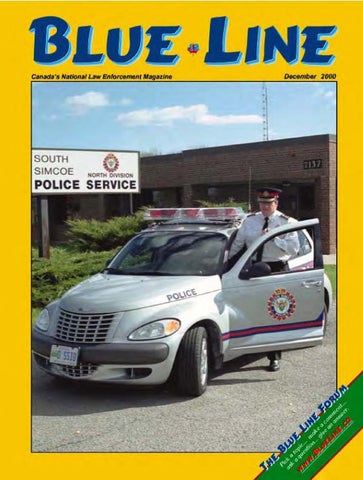
From the cover of this issue, to The Back Of The Book, it is evident that motorized vehicles is the theme for December. On the cover, South Simcoe Police Chief Bruce Davis, proudly shows off the force’s 2001 PT Cruiser. The car has become quite an attraction in the towns of Innisfil and Bradford West Gwillimbury, Ont. To learn more about this unique police vehicle turn to page 7. Car enthusiasts can also catch a glimpse of what the automobile industry has to offer by reading the submission by Technology Editor Tom Rataj. On page 9 of this edition, Tom examines the future of automobile innovations and accessories. For those of you who fancy automobiles of the past, turn to page 12. There you will find the story of a 1956 Dodge Crusader and how the Camrose Police Service turned a rusty old vehicle into a treasured jewel. A number of Ontario police services have recently taken to the sky with patrol helicopters. Some enjoyed such great success that they now operate their own air units, while others are still in the review stage. To get caught up on how these pioneers are faring, turn to page 21. When you’re done reading about the Ontario experience, check out the Industry Platform on page 24. There you will find five aviation companies willing to share their knowledge and experience regarding the manufacture and design of their machines. The Saskatoon Police Service and the RCMP were the co-hosts of Saskatoon’s Women in Policing Conference held in October. Shelley BallardMcKinlay was in attendance and files a smashing review which can be found on page 42. Don Arscott, the guest columnist for this month’s Vitality column, asks readers to identify the most common missing ingredient in most exercise routines. The answer, which can be found on page 44, may surprise you. At The Back Of The Book, columnist Robert Stevens supplies us with his views on the “war against the privately owned motorcar.” Naturally, your comments are expected. Happy Holidays. Blue Line Magazine
We need a “mission statement” not a licence by Morley Lymburner
We are living in an age when the drivers licence has no meaning. Its original concept was to prove to the police, and not necessarily the public, that the holder of the licence was tested and possessed the requisite skills to handle a motor vehicle on a public highway. This skill, although still very important, does not go far enough for the volumes of traffic the modern motorist must contend with. I would propose as an alternative, or in addition to, the drivers licence that each candidate be required to fill out a mission statement in the form of how they intend to operate their vehicle. “I, John Doe, promise to skillfully operate my motor vehicle in a manner that will be courteous and with consideration for other persons using the highway at all times.” Sound a little too far fetched? If you are walking down a sidewalk and a person stepped out in front of you from a store and narrowly misses bumping into you what would the conversation go like. In all probability you and the errant person would both start off by saying “excuse me.” The person who was the obvious innocent party would almost instinctively say “that’s okay... no harm done.” The incident would not even bear enough significance in the course of a busy day to even be remembered. In fact it is almost certain that both parties would laugh about it. The problem occurs when we place these same two people inside a steel cocoon and between the curbs of a highway. Because of the impersonal nature of steel and glass everything is transformed into hulking machinery doing the manoeuvring and apparently divorced from the obvious human behind the wheel. “That car just cut me off!” No it didn’t. That person just cut you off. And that person in all probability passed all the tests required to demonstrate their skill at not doing that in an inadvertent fashion. In other words the S.O.B. probably did it on purpose... “and my wrath must be quenched.” The modern road warrior is born and fortified by the possession of a licence reminiscent of James Bond’s own licence. You know... the “licence to kill!” The “Mission Statement”, as opposed to the drivers licence, is a public document that explains to the world that the person has promised to act in a predictable conscientious manner when they enter the roadway. The skill testing which accompanies the drivers licence gets the motor skills and road knowledge down pat. The mission statement gets the head straight. I would even suggest that every motorist be required to go to a justice of the peace or notary public and have their mission statement sworn and then attached to the dash of the car as a constant reminder. When a person fails to uphold the standards to which they have sworn then their privilege to drive is revoked until they take measures to assure the public that they intend to comply in the future. This could include such December 2000
radical ideas as a complete psychiatric evaluation and even anger management courses. This idea is not new. Way back in the late 19th century Henry Ford did just that. After an accident involving a young lad crossing a roadway Henry was so shaken that he felt he had to do something to assure the public that his future operation of the motor car was going to be performed with the utmost care and good judgement. He went to the Detroit city hall and swore out a statement that he would do just that.
5
Over a century has passed by and we still haven’t gotten the message. Before the skill is tested we should make sure the head and attitude is straight.
Respond to Morley Lymburner on
Blue Line Magazine
I believe in giving credit where credit is due. I recently turned in a paper on media and police relations, and would like to thank Blue Line Magazine on their series dealing with the media. Although police and media relations is a very important topic, there is not that much relevant info out there on the topic. I’d like to thank John Muldoon in particular for the series, and Blue Line for publishing these articles, because these articles created the base on which to write this research. Again, you have my sincerest gratitude. I’ll let you know how my paper was graded when I get it back. Pierre-Marc Larocque Posted on The Blue Line Forum
Thanks to Simonne Ferguson for her letter in response to my article on consecutive life sentences (Life sentences are only for Senators, August/September). She correctly quoted me as stating: “Convicted killers average about seven years.” I stand by what I said although I must apologize for the brevity of the statement. Ms. Ferguson, in refuting my claim, states that convicted murderers face minimum sentences greater than seven years. True enough. But my reference was to “killers”. As she well knows, not all killers who are convicted are found guilty of murder. Never the less they are guilty of culpable homicide. Consider the notorious Karla Homolka.
Apart from those convicted of criminal negligence causing death or impaired driving causing death, a number of those committing culpable homicide are allowed to plead to or are found guilty of manslaughter (as with Homolka). While the maximum penalty for manslaughter is life imprisonment, there is absolutely no minimum whatsoever, except where a firearm is used, and then it is four years. Homolka’s penalty was 12 years, unusually harsh for manslaughter, but she will be eligible for full parole much sooner. The case I best remember is from some years ago where a Toronto police detective shot his wife and dismembered her body, which he then scattered across a wide area of Ontario. He was allowed to plead out to manslaughter, for which be received a princely sentence of 10 years, but he was out in 36 months flat. More of a license than a sentence. To the best of my knowledge he still lives quietly, free as a bird on his police pension. Robert Stevens I am a graduate of the police foundations program at Niagara College. I enjoyed your magazine while I attended college and I find Mr. Arcaro’s case law articles very informative. I have been reading through the copies that I received during my last year and realized what a useful tool they are in keeping up on all the latest legal developments. Thank you very much for publishing this magazine and keep up the great work. Kate Myles In regards to your May 2000 edition article “Just being there is what counts”. I work for the Metropolitan Toronto Housing Authority, Security Services Branch, I’ve been the branches mountain bike instructor for the past six years. On page seven your magazine has a nice picture of an officer straddling a mountain bike while conversing with a student. Nice picture, however, I have some concern over the interviewing technique used by the officer. I’ve been instructing officers to never interview anyone while straddling the bike or having the bike behind you. I agree the photo makes a nice picture and no doubt set up that way by the photographer. However, practice makes perfect. The officer should be off the bike, standing behind it so the bike is between her and the student. I spend a whole day devoted to interviewing techniques, self defence etc. in addition to two days of riding skills and HTA. I trust the officers receive some training from a law enforcement agency. Please, except this as constructive criticism. You have an excellent magazine that is read by a number of our officers here and I thoroughly enjoy your articles. Keep up the great work and all the best. Ken Lewkoski
December 2000
6
Blue Line Magazine
South Simcoe’s PT Cruiser cruiser by Blair McQuillan When Bruce Davis, the chief of the South Simcoe Police Service, decided his agency needed a new community police vehicle he had a concept in mind. Davis was looking for something that would turn heads in the towns of Innisfil and Bradford West Gwillimbury, which his service is responsible for policing. He wanted a vehicle that was rare. He wanted something that would wear the emblem of his police service with class and style. He wanted something that people weren’t used to seeing on the road everyday. “It’s fair to say we wanted something that was going to be a little different,” the chief says with a smile. Enter the Chrysler PT Cruiser. Or the “PT Cruiser cruiser” as Davis likes to refer to it. The 2001 PT Cruiser has seen a lot of action in South Simcoe since it was purchased in May. The four cylinder, four-speed automatic is used as a community relations vehicle. Community service officers use it when visiting schools, it has appeared at a number of community events and will be featured in the local Santa Claus Parade. “We though it would give us the edge in dealing with kids, and even teenagers, because it’s a cool car,” said Davis, “That’s why we proceeded with it. “We’ve just had phenomenal success out
TRAFFIC STOPPER: The 2001 Chrysler PT Cruiser is a real crowd pleaser. The car has been used as a community relations vehicle by the police service since May. of it from a public relations standpoint. It really draws a crowd.” However, children and teens aren’t the only ones who are interested in viewing the “Cruiser cruiser”. The design of the car, which is a throwback to the age of the hot rods, draws the attention of older car enthusiasts as well. Davis says officers using the vehicle have been approached by people in the community
Officer remembered for love of life “As a police comMore than 200 hundred munity, we grieve the loss officers, some from as far of one of our finest, but away as Ontario, gather in for those of us who were October to pay tribute to a fortunate enough to have fallen Halifax officer. graduated from the class Cst. Sigurd Holtan, who of ’75, we share an even was also known as Ziggy, deeper loss,” Cst. Chuck died of an apparent heart atSchofield wrote in a lettack while on duty. The 25ter dedicated to Holtan. year police veteran was con“From the beginning, we ducting a stolen car investiknew that we had gation when he collapsed. amongst us a very speHoltan, 46, will be recial person, a big counmembered as a positive intry boy with a zest for dividual who was dedicated Cst. Sigurd Holtan life that would bring a to policing. He took an active roll in the community, both at work and smile to your face with every encounter.” Halifax Regional Police spokeswoman, in his spare time. The officer had a keen interest in Child Find Nova Scotia and also Judy Pal, said Holtan will be sorely missed by his family, friends and colleagues. volunteered with the Boy Scouts. December 2000
7
who want to examine the car and tell stories about the first vehicles they owned, or tales of hot rods they had which were similar to the PT Cruiser. “The design of it is really timeless,” says Davis, a self-described motoring enthusiast. With Davis currently serving as the president of the Ontario Association of Chiefs of Police, the cruiser has been on double duty. Davis has used the vehicle to help promote a number of initiatives including the association’s OACP Bell QuickChange card program. The vehicle was also a crowd-pleaser recently at a Chrysler product launch held in Toronto. Davis said many of the Chrysler corporate dealers were very impressed with the way the PT Cruiser had been incorporated into the policing culture. In fact, the chief believes the South Simcoe’s Chrysler is the only PT Cruiser being used by a police service in Canada. The Chrysler’s decal design mimics that of the police service’s regular patrol vehicles and the silver colour is the same tone used by their community service and canine vehicles. The specialized license plate “O SSID” is a reference to South Simcoe’s strict enforcement program dubbed Operation Seatbelt, Speed and Impaired Driving. So what does Davis think of the police force’s newest community service vehicle? “It really fills the need it was designed for,” he says. “And this car is really fun to drive.” Chief Bruce Davis can be contacted at 705 436-4263. Blue Line Magazine
Techno-mobiles hit the road Today’s automobile has become a mobile showcase of innovations by Tom Rataj
Greater Volts
All the high-tech gadgets and equipment being installed into modFrom its humble beginnings just ern cars also requires a more robust over 100 years ago, the automobile electrical system to work efficiently. has slowly progressed from a crudely The standard 12-volt automotive fashioned horse-less carriage, to a power system doesn’t cope very well high-tech precision automobile with all the demands (especially in packed with electronics and manufacsomething like the modern police tured with highly sophisticated macar). terials and processes. The solution to this problem, During the last 30 years there has which is being actively worked on been an increasingly rapid shift toby most major automotive compawards electronic controls and sysnies, is a 42-volt system. In all likelytems that manage every facet of a hood this will be introduced to the modern car’s design, manufacture and market within three to five years. Its function. The earliest additions inintroduction will likely coincide with NO-WHEEL STEERING: Could we someday be driving with the introduction of the first generacluded such things as electronic fuel joysticks like the ones on the Daimler-Chrysler R129? tion of fuel cell vehicles, which creinjection and generously labelled engine management “computers”. Both ates an excellent opportunity to make of these added some greatly needed electronic that it may be a contributing factor in some the switch. control and precision to the function of the en- crashes. Police equipment makers will certainly have gine and fuel system, provided improved fuel Major fleet administrators will also want to be ready to introduce products prior to the economy, cleaner combustion and improved to pay attention to the new carbon filament- switch or risk being left out. Police and other performance. reinforced ceramic brake disks developed and large fleet operators will also have to be preOn the other hand, some innovations such produced by Mercedes-Benz. With a stagger- pared to service new vehicles equipped with as digital dashboards and “talking” warning sys- ing 300,000 km (yes, a three followed by five the new 42 volt system. This will likely intems were introduced in the usual “we’re doing zeros) service life, these disks are sure to out- volve the purchase of new equipment and upit because we can” enthusiasm, while providing live the average police patrol car. Limited pro- dated training for service personnel. questionable benefits to the motoring public. duction of these brake disks has already taken The latest wave of high-tech dashboard appli- place for an exclusive version of a Mercedes Smart Cruising ances such as navigation systems and Internet model, with no apparent regular production or Another major convenience feature added enabled devices seems to follow very closely in licensing plans in the works. to cars in the last 25 years or so was cruise the footsteps of these earlier electronic gizmos. control. It is a great feature for long distance No Gasoline Fortunately, there are also numerous genudriving, which is now being upgraded to “elecPerhaps the single most significant trans- tronic proximity-controlled cruise control”. ine high-tech innovations that provide significant benefits in terms of safety and security. portation technology on the immediate horizon Using a radar sensor coupled to a small onHow these new products will affect the public is the fuel cell. In its purist form, a fuel cell board computer, the system measures a variety generates electricity by combining liquid hy- of factors and automatically adjusts the vehiat large remains to be seen. drogen and oxygen. It produces no by-prod- cle’s speed to avoid conflicts with other vehiThinking Brakes ucts other than water vapour. cles. It has been successfully tested in real-world Probably the first genuine technological inThe electricity generated by the fuel cell driving conditions and is said to provide a safe novation that really made a difference to the feeds one or more electric motors that then and relaxing drive. average motorist were anti-lock brakes (ABS). propel the vehicle. There are a variety of proAnother related technology available doPioneered in the automobile by Mercedes-Benz, totypes on the market already, some of which mestically on various cars is a reverse-sensor ABS provided real-world safety benefits to driv- can use regular gasoline in lieu of hydrogen, that is built into the rear bumper. Using the ers everywhere. although they are not zero emission vehicles. same basic concept as the proximity-controlAdapted from the aircraft industry, ABS The biggest impediments to this technology led cruise control, it provides feedback to the combines precise mechanical and electronic are the economics of producing, shipping and driver to avoid backing into objects behind the parts to provide maximum braking power. Not storing the hydrogen fuel, and building a small vehicle. only does this provide braking efficiency far enough fuel cell to fit into a typical automoAgain, from the automotive safety leader, beyond what a driver is capable of, but it also bile. Mercedes, comes the Electronic Stability Proallows the driver to steer the car while braking The world leader in this technology is Van- gram. This technology automatically stabilizes heavily (and hopefully avoiding a crash). couver-based Ballard Power Systems. A good a car that is on the threshold of going out of ABS has since gone on to become standard indicator of their expertise and the anticipated control. It controls the braking system and the equipment on most new cars, which thankfully market for this technology are the substantial engine to prevent dangerous loss of control. It also includes police cars. The leading edge of investments in Ballard made by Daimler- is the next logical extension of electronic tracABS technology includes various traction con- Chrysler, Ford Motor Co. and others. tion control and ABS. trol systems that use the ABS technology in The handling of liquid or gaseous hydrogen These technologies should provide a safety reverse by applying the brakes during accelera- also presents a wide range of problems relative benefit for most drivers and may actually pretion to stop or prevent wheel slippage. to motoring safety. Hydrogen fuelled vehicles vent some collisions. The electronic stability While the advantages of ABS are incredible, involved in collisions pose new risks to anyone system would certainly be of benefit if installed there has also been some research that shows involved in investigation or rescue. on police vehicles. December 2000
9
Blue Line Magazine
and when installed more widely, should provide some added benefit to the motoring public. Expect to see this system work its way down from the high-end of the automotive market into the mainstream within the next few years. Hopefully it will eventually trickle down to the average consumer level (including police and other emergency vehicles).
No-Wheel Steering
Daimler-Chrysler recently introduced a concept-car based on the Mercedes SL Roadster that actually has no steering wheel. The R129 uses two side-mounted joysticks (like those in fighter aircraft and for computer games) to control acceleration, braking, steering, signalling and honking of the horn. This concept car uses drive-by-wire technology to electronically control all the primary functions of the car. Drive-by-wire controls are not new, but this is the first time it has been applied directly to the steering of a car. While we are not likely to see this technology on a regular production vehicle any time soon, it presents a major change in the old automotive steering wheel based paradigm. Pilots and video-game enthusiasts will feel right at home in this car, while the rest of us will have to learn how to drive all over again.
Surfing On The Road
If you thought cell-phones were dangerous to use while driving, just imaging the carnage with the implementation of web-enabled vehicle navigation, communication and entertainment systems on the next generation of cars. Certainly it makes perfect sense to integrate many of these electronic systems into one, especially since they can use many of the same technologies. The coming revolution of digital audio broadcasting (DAB), which replaces AM and FM radio, opens the door to the successful implementation of on-board navigation systems and Internet access in cars. There are numerous on-board navigation systems on the market. Honda currently sells their Internavi system in the domestic Japanese market, although it is likely to arrive soon in North America and Europe. It provides road and Internet navigation and voice communication. Major car-audio vendors such as Blaupunkt, Alpine and Clarion, offer a variety of CD-ROM based or GPS connected navigation and entertainment units in various markets. General Motors Corp. takes a slightly different path with their OnStar system. It uses satellite-based technology to provide almost constant contact between the customer and GM’s OnStar centre. If the OnStar equipped vehicle is stolen, it can be tracked. If the vehicle breaks down, the problem can be diagnosed remotely. If the airbags are deployed or the alarm is activated, the system is automatically notified and help is sent to the vehicle location without any customer intervention. In addition to the electronic controls used by the system, operators can be called through the system to locate restaurants and hotels in the area the subscriber is calling from. Research statistics released by the American National Highway Traffic Safety Administration and others show a direct correlation between driver distractions, such as cell phones, and crashes. This whole new breed of navigation systems and Internet enabled information appliances becoming available has fortunately triggered some sober second thoughts. General Motors has started a “SenseAble Driving” initiative to study the whole issue and to come up with practical solutions. Most navigation systems shut-off the display if the vehicle is in drive. December 2000
Black Boxes
Every time I direct traffic, I find that the only group of drivers I consistently have difficulty with, are those talking on cellular phones. It does not seem to matter whether they are using hands-free devices or not, their concentration is split between driving and holding a conversation and as such they become a hazard to everyone else.
Lighting
Other than a few truck and specialty automotive applications, the sealed beam headlight is virtually a thing of the past. Regular and halogen sealed-beam units have even started to disappear from store shelves, being replaced by halogen bulbs that fit into aerodynamically efficient headlight assemblies. In the past three years the brilliantly bright Xenon (pronounced “zenon”) bulb technology has displaced the standard halogen bulb in higher-end cars. Distinguished by its bluishwhite colour and brightness, the Xenon bulb provides substantially more light than even the best halogen bulbs. Major advances in the design and manufacture of precise headlight lenses and reflectors have also allowed the Xenon bulb to make inroads in the market. This is likely to become the standard in automotive lighting within the next few years. Light emitting diode (LED) technology has also been making steady inroads in the automotive sector. First installed on small aerodynamic spoilers on the tails of sports cars, LED’s have now been utilized for general-purpose signals on cars, trucks and buses. They are also being used extensively to replace traffic signal lights. The newest generation of LED technology is up to five times brighter than previous generations, and offers a service life of more than 10,000 hours. Short of suffering physical damage in a collision, they will probably outlive the vehicles they are installed in.
Wiped?
Hella, one of the automotive world’s leading innovators in lighting has developed an automatic windshield wiper system that is available on several luxury brands such as MercedesBenz. Hella’s Raintronic system responds almost instantly and dynamically to any type of precipitation meeting the windshield. Whether it’s spray from another car or truck, driving rain or intermittent drizzle, the system automatically detects and deals with it before it becomes a problem for the driver. This is a neat little safety bonus for drivers, 10
For years, commercial passenger airliners have been equipped with flight data recorders, or black boxes, as they are more commonly known. Most large aircraft have one or more black boxes that record a wide variety of technical and mechanical information, including cockpit conversations and radio transmissions that occur during a flight. In the event of a crash or other mishap, the black boxes are retrieved, and generally detail the events leading up to the climax of the incident. As one might expect, the auto industry has followed suit and started to install a variety of “vehicle data recorders,” or black boxes. Both General Motors and Ford have begun to install various types of these devices in a variety of their vehicles. Primarily installed in fleet vehicles such as the Ford Crown Victoria and Taurus, the black boxes record a wide variety of vehicle functions. Designed with vehicle maintenance and diagnostics in mind, they can also record a wide variety of vehicle dynamics prior to and during a crash. According to information from Vertronix, a manufacturer of Crash Data Retrieval software, they have sold their software to American government agencies such as the National Highway Traffic Safety Administration and National Transportation Safety Board, as well as several state police agencies and independent reconstructionists. Dependant on the model of black box there could be some very detailed and conclusive evidence contained in it about a car crash. Electronic Concepts & Engineering Inc., an Ohio-based automotive supplier, manufacturers a variety of these tissue-box sized automotive black boxes for the Ford Motor Company. They are installed in the Explorer, Taurus, F150 Pickup and the Crown Victoria. These devices can certainly be of significant value during an investigation into a serious crash.
Conclusions
The early pioneers of the automotive industry would be absolutely mesmerized at what their crude horse-less carriages have evolved into. While many significant engineering improvements happened during the first 60 years, the rapid development of electronics and computerized design in the last 30 years has overshadowed these early advances. Some of the recent innovations have been nothing more than marketing driven toys that provided little or no actual value to the average motorist. On the other hand, such genuine revolutions as ABS and airbags have saved countless lives and prevented many injuries and crashes.
Respond to Tom Rataj on ...
Blue Line Magazine
Too many photo requests, officers say Stetson-wearing Mounties who pose for tourists to take photos are now seeking compensation for the time and efforts they are putting forth. A small Banff detachment with 16 members has been overwhelmed with requests for photos of smiling Mounties. The officers have volunteered in the past to do so for free, but are now requesting permission from headquarters to charge companies for the modelling service and pay members overtime. Constables volunteer for dress uniform service when tour companies want to provide customers with photo opportunities. Mounties would do this in exchange for a donation to local charities, but now they want to be paid. The Mounties are paid by companies that
request their presence for special events such as sporting events and rock concerts. Banff’s situation is unique in that unlike other RCMP detachments, requests for appearances are made non-stop and the RCMP policy was designed to handle one-time events. Sgt. Don Pipher, a member of the Banff detachment, says they receive at least two requests a week. “There are a lot of requests for members to go in red serge and most of the time we have to do it when members are off-duty because we don’t have enough manpower,” Pipher was quoted as saying. Regardless of what the outcome is, Pipher said the Banff Mounties will continue to have a member dressed in red serge during busy summer months for two hours a day and for community ceremonies.
British bobbies opting for firearms British bobbies in the county of Nottinghamshire aren’t just carrying batons any more. The police officers are now wearing sidearms when they are out on patrol. Senior officers have defended the use of
December 2000
firearms, saying that the increasing use of guns in violent crimes in the country have made the practice necessary. Bobbies had used small batons for protection, then moved to larger clubs a few years ago.
11
Blue Line Magazine
Camrose brings the past to present by Les Linder In March 1988, the Camrose Police Service embarked upon a crusade to locate the force’s original cruiser. The vehicle the police service was seeking was a 1956 Dodge Crusader purchased from Camrose Motors Ltd. for a $2,169.34. Months passed as officers scoured the province of Alberta with no success in locating the vehicle. They even tried to trace the serial number, to no avail. Matters were looking glum and it was beginning to be thought that the car would never be found until fate intervened. One of the crusading searchers located an identical vehicle in a field in Granum, Alta. The car, which was little more than a heaping mound of rust and dirt at the time, was towed unceremoniously back to Camrose. Countless hours of restoration would be completed over a three year span to turn the Crusader into the shining jewel of pride which it is today. With co-operation from several businesses, a complete restoration was carried out. Camrose police Cst. Bob Grant said the car was in such horrible shape when it was found, that without the resources provided by the community and businesses, the car would never have been restored.
“This thing was just a bucket of bolts and rust,” he said. “The engine was a wreck and the whole car was going to need a whole lot of work. “It was simply incredible how willing people were to come out and help us rebuild that mess. We were provided with some funding and had lots of mechanics and autobody people help us out (on) their own time.” About 15 to 20 different businesses and organizations A REAL CLASSIC: This 1956 Dodge Crusader is regudonated money and expertise. larly seen by citizens on the streets of Camrose, AB. The Crusader was given a paint-job which matched the original cruiser. transmission and an approximate top speed of It even sports the original red and blue flashing 60 mph, Grant says the Dodge Crusader prolights and siren on the roof. vides for a nice casual ride around town. “This baby is an exact replica of the origi“We make sure to keep her healthy and runnal,” Grant said with affection. ning smoothly by giving her a run around town In May 1991, the car was officially unveiled at least three times a week,” Grant said with a at the 35th Anniversary Camrose Police Ball and pride and joy. welcomed warmly into the community. The vehicle is put away into warm storage, The enormous 4,500 lb car is now used by cleaned and maintained with tender care. the Camrose Police Service and its 21 officers Grant believes the Crusader will be part of in parades, crime prevention initiatives and oc- the service for many years and that it will not casions in which dignitaries visit the small city be forgotten as it was in the past. of 14,000 people. Cst. Bob Grant can be reached at With a 230 cubic-inch engine, 125 horse780 672-5935. power, powerglide, pushbutton automatic
Police officer DARE(s) to be different by Les Linder A single motorcycle and its rider are taking on a bold endeavour to increase drug abuse awareness among young people and is doing so with resounding success. Cst. Jim Valade, a 16-year veteran of Ontario’s Halton Regional Police, is the proud owner of a 1998 Suzuki Intruder painted with the decals of the Drug Abuse Resistance Education (DARE) program. Valade, who also served with the RCMP from 1976 to 1984, joined the DARE program in 1998 with the hopes of being able to make a difference in the lives of young people and prevent them from taking the destructive path caused by drug abuse. Shortly after joining the program, Valade purchased the Intruder for his own personal use and was inspired by the idea of having his bike painted for DARE as a promotional tool. “I ride the Harleys at work and have been riding for 30 years,” Valade said. “I like to ride and I like teaching the program, the two just seemed to be a good idea to combine together.” The motorcycle accompanies Valade to drug education classes across Canada and receives rave reviews from the children who see it. “The kids in the class really enjoy seeing the bike,” Valade said. “Every DARE related function I bring it to always ends up in having December 2000
ON SHOW: Jim Valade and his Intruder. kids swarm the bike wanting to get a closer look. It’s incredible.” The 1500cc Intruder, which is the only vehicle of its kind to promote DARE, also has received some international recognition. The duo have appeared at national conferences, one of which was in Washington DC, and managed to come in second place in a vehicle competition. Valade is now in the process of trying to take the DARE motorcycle to Los Angeles to promote the program there. Placing the decals on the motorcycle did initially raise a few concerns for the safety and well-being of the bike. This point has been made to Valade by fellow officers and other individuals on a number of occasions. “People told me I was crazy to have a bike 12
that stands out so much,” he said. “I was told that people were going to slash the tires and damage the bike. But nobody has ever done anything of the sort, the response has been nothing but positive and supportive.” Valade also receives some good natured kidding from fellow officers about the bike because it is not a Harley Davidson. He chose the Intruder because he found it to be the most economical and enjoyed the “retro look” it has. “Any time you’re in a support group like this as opposed to a traditional police role, then you have to take a bit of kidding about it.” He added that for the most part his fellow officers have been supportive of the motorcycle. Valade is also hoping that his bike encourages other police officers and agencies across Canada to promote programs such as DARE. Valade says police agencies in the U.S. are already approaching Harley Davidson manufacturers to provide a motorcycle after seeing his own vehicle. Ironically, the bikes will likely be purchased with drug money seized by U.S. police forces. As for the future, Valade sees his Intruder as being an important part of the DARE program for a long time. “As long as I am in the program, my bike will be there as well. We’ve got a lot more places to see and kids to educate.” Cst. Jim Valade can be reached at 905 825-4747. Blue Line Magazine
Charities cash in on stolen car A Corvette stolen nearly 20 years ago has become a blessing for a couple of charities in Manitoba. The 1981 Corvette was stolen from a dealership and hidden in a residential garage. The vehicle was found by members of the Winnipeg Police Service in the summer of 1999 with only 56 kilometres on the odometer. Officers were told they could keep the car since the insurance company had already paid the claim. A raffle was held in which half the money would be given to the Children’s Wish Founda-
tion and the other half to a memorial fund that provides scholarships to needy Manitoba children. The 999 raffle tickets, which cost $100 apiece, quickly sold out. Maria Toscano of the Children’s Wish Foundation said that they have been receiving a staggering number of calls for tickets. “All of our offices across Canada are being bombarded with phone calls. If I would have known, I would have printed more tickets,” Toscano was quoted as saying. She said that she likely could have printed another 1,000 tickets.
Officer suspended for filing false report An officer has been suspended without pay after filing a false accident report to protect the daughter of a fellow officer. Jean-Francois Cloutier, a constable with the Quebec provincial police, was suspended for eight days after the Quebec police ethics committee said they took note of Cloutier’s good record following the incident. The 35-year old constable arrested Sophie Brodeur, the daughter of provincial officer Marcel Brodeur, on New Year’s Eve in 1997 after her car struck another vehicle, resulting in serious injures to its three passengers. Cloutier aided Marcel Brodeur in a cover-
December 2000
up of the incident, but later changed his mind and laid a drunk-driving charge. Cloutier, who testified against Brodeur, received an unconditional discharge in July and did not receive a criminal record. The police ethics committee said that by filing the false report, Cloutier “failed to meet the requirements of honesty, justice and morals and put his professional integrity in question.” Brodeur and Pierre-Yves Deragon were found guilty by a jury in December 1999, of hampering a criminal investigation. Brodeur has been serving his nine-month term since Oct. 6 and Deragon has filed an appeal of his one-year sentence.
13
XHE #1, 5510-3rd. St. S.E. / Calgary, AB T2H-1J9
*ALL WEATHER OUTDOOR TECHNICAL CLOTHING CUSTOM DESIGNED TO MEET YOUR SPECIFIC NEEDS AND DESIRES!* *SERVING THE INDUSTRY SINCE 1991* *100% DELIVERY GUARANTEE* *BUILT FOR THE BEST... BY THE BEST!*
*MUNICIPAL POLICE * SECURITY * *R.C.M.P. * BIKE PATROL UNITS*
1-800-214-6861
Blue Line Magazine
2001 Michigan State Police Tests An annual report from The National Law Enforcement and Corrections Technology Center
Patrol vehicles are one of the most critical purchases that a law enforcement agency makes. For both large and small agencies, patrol vehicle purchases frequently represent the second largest expenditure, after personnel, in their annual operating budgets. Selecting a vehicle that balances both budgetary and performance requirements has become an increasingly challenging task for police fleet administrators. Since 1981, the National Institute of Justice (NIJ), through its National Law Enforcement and Corrections Technology Center (NLECTC), has sponsored these tests through a partnership with the Michigan State Police. The 2001 model year patrol vehicles were evaluated from September 16 through 18, 2000. For the purposes of the evaluation, police-package vehicles are those that are designed and manufactured for use in the full spectrum of law enforcement patrol service, including pursuits. Each vehicle is subjected to six major tests and evaluations. The results are weighted to reflect the relative importance of each attribute as related to MSP operational requirements. If you are interested in the full test of all vehicles checked out you can contact the NLECTC at their web site at www.nlectc.org.
What’s New For 2001
For 2001, Chevrolet has enhanced its 9C1 Impala Police Package with the addition of new special equipment options that include a 10mm ground stud, located at the right side of the trunk; an assist handle, located above the right-front passenger door, to aid in getting out of the vehicle and in pursuit situations; and an exterior head and tail lamp emergency flashing system. Chevrolet continues to offer optional special equipment that includes wiring for auxiliary speakers, coaxial radio antenna cable, horn/ siren circuit, and grille lamps. The 9C1 comes with heavy-duty front bucket seats with no console between the seats. Instead, a security panel or reinforcement in the seat back protects the driver from kicks or blows to the back of the seat from an unruly rear passenger. Chevrolet also is introducing a new version of the Impala for 2001 - the 9C3 Unmarked Police Package. Although the 9C3’s standard features are almost identical to the 9C1, it is intended for covert (i.e., administrative and investigative) use and is not designed to be used as a marked patrol car. Instead of the 9C1’s bucket seats, the 9C3 has a 60/40 front split bench seat. This design reconfiguration, which allows the 9C3 to ac-
Although the other graphs in this article are self explanatory the Vehicle Dynamics test is one that needs some clarification. The general objective is to determine high-speed pursuit handling characteristics. The two mile road racing course contains hills, curves, and corners; except for the absence of traffic, it simulates actual pursuit conditions. The evaluation measures each vehicle’s blending of suspension components, acceleration capabilities and braking characteristics. Each vehicle is driven 16 timed laps by four drivers. The final score is the average of the 12 fastest laps.
commodate three front seat passengers, also changes the vehicle’s cargo weight, prompting Chevrolet’s recommendation that the 9C3 not be used for marked patrol use. Ford beefed up the Police Interceptor with a new 235-horsepower 4.6L V8 engine and reconfigured last year’s rear axle ratio of 3.55:1 to 3.27:1 for improved fuel economy. Ergonomic and safety improvements include improved seats with power lumbar adjustment offered on the driver’s side, a weapons cut-out feature added to both front seats, and optional adjustable-position accelerator and brake pedals. For personal safety, Ford engineers have designed an advanced restraint system that works
via a combination of seat belt pretensioners, dualstage air bags, and seat position sensors that adjust air bag deployment speeds. The sensors monitor both the seat position and the passenger weight of the seat occupant.
LIMITED EDITION PRINTS “Sniper” by artist Todd Gray Signed & Numbered Limited Edition Print on 100% acid free 11” x 14” paper $20. 00 plus $9. 95 for shipping & handling
Please send cheque or money order to:
Todd Gray
This test is to determine the top speeds attained within a distance of 1 mile and then a 2 mile track run. The first run is to attain 110 mph the second 120 mph.
14
Blue Line Magazine
PO Box 10, Kugluktuk, NU, Canada X0B 0E0 Email: tsgray_98@yahoo.com December 2000
For a full copy of this report call the National Law Enforcement and Corrections Technology Center at 301 519-5060.
The big issue for the new millenium appears to be fuel consumption. This year’s Trials included one vehicle supplied by Ford that was equipped with a condensed natural gas tank(CNG). Both Ford’s supplied had 4.6 L engines and the Chevrolet a 3.8 L engine. In the test the vehicle’s scores are based on estimates of city fuel economy to the nearest on-tenth of a mile per gallon from data supplied by the manufacturers. The table shown above reflects the estimated Environmental Protection Agency fuel economy ratings, rounded to the nearest whole number for city and highway driving conditions. It is interesting to note that condensed natural gas appeared to have no serious difference from gasoline. It would appear from these figures economy by fuel type will have to be determined through the market prices of each commodity. NEXT MONTH: 4wd Vehicles tested December 2000
15
Blue Line Magazine
Policing the Ewatski way Winnipeg chief is committed to honesty, integrity and excellence by Dave Brown Two days before Christmas in 1981, 16-year-old Barbara Stoppel was found brutally murdered on the floor of a Winnipeg doughnut shop. Winnipeg police soon arrested Thomas Sophonow, based on his proximity to the murder scene and his similarity to a composite drawing of a man seen running from the shop. Twice he was tried and convicted for the murder of the pretty waitress and twice his conviction was overturned. In 1985, a third court finally acquitted him of the murder. In the years following his last trial, Sophonow maintained his innocence and fought to clear his name. Not content with an acquittal, he insisted that police compare his DNA against some of the evidence found at the crime scene. With the state of technology at the time, police were not optimistic that the tests would reveal any new information. As technology advanced, several Winnipeg officers began to look closer at the exhibits to determine if they could be tested. Among them was a deputy chief named Jack Ewatski. When Ewatski became the head of the Winnipeg Police Service in 1998, the order came down to proceed with the testing. Unfortunately, the DNA tests were inconclusive. Ewatski could have left it alone at that point but there was still something about the incident that bothered him. “I was intrigued by this case,” says Ewatski. “As a former homicide investigator, you know that everyone is innocent, but this case was different. There was a constant denial of guilt and a real need by Sophonow to be found innocent. Most people that are acquitted of such a serious crime tend to be very low key, but Tom was different. “I’m not immune to any information that comes forward, even from the media. We recognize that human mistakes can happen in the justice system. I felt that the time was right and there was no harm in us reviewing the case and finally putting it to bed. I wanted another look at it using new technology and new people with a fresh view.” Ewatski assigned homicide analyst John Burchill to the case. “John did a fantastic job. He is a deep analytical thinker and has some amazing competencies. He submitted the report to me on a Friday afternoon and I took it home for the weekend. That night I literally could not put it down. I was taken aback by some of the analysis and I remember thinking that I’m glad we December 2000
AT THE PODIUM: Winnipeg Police Chief Jack Ewatski addresses citizens during a series of forums which were held to open communication between the police and public. did this, but what do we do now? If we continue with this case, it is going to be a painful experience for a lot of people, including the service and especially the family of the victim. “It was a hard decision to make, but I knew I had to make it. It was the right thing to do.” In June, Ewatski called a news conference to announce the Winnipeg Police Service had finally cleared Thomas Sophonow of the murder and wanted to issue a public apology to him. Sophonow got his long awaited exoneration. “The hardest thing for me personally was to meet with the Stoppel family,” Ewatski recalls, “I had to apologize for the pain that was going to come and I remember watching their reaction, waiting for it to rise again. I was amazed at the strength of character of that family. I had 16
to convince them that this was not just an exercise in political correctness, but that it was real. They all appreciated that fact. “We also had to enlist the co-operation of Tom Sophonow. We initially contacted him through his lawyers. You can’t blame him for expecting us to deliver a message that he’s heard before, but I can still picture the shocked look on his lawyers’ faces when I told them that we were going to clear Sophonow and announce that we had a new suspect in the case. “I then went to Vancouver specifically to meet with Tom one-on-one. Before we continued the investigation, we needed to develop a relationship. He came into the meeting with a real look of fear, but we talked for 45 minutes and I think we began a relationship that the investigators could build on.” Blue Line Magazine
Ewatski did not discuss what he said to Sophonow in those 45 minutes, but he admits a feeling of satisfaction with the result and the subsequent investigation. “It opened lots of doors - painful ones - but it was still the right thing to do. You could not write a piece of fiction with all the twists, turns, variables and dynamics that this case has had and still make it believable. “Police leaders need to understand that mistakes happen. We have seen what happens when you don’t admit mistakes. You must learn from them. We need credibility, starting with our own members. We preach that if they make a mistake, own up to it. The leadership must set the tone.”
Meaningful Dialogue
Fast forward to October. Winnipegers still recall how their police service faced its mistakes in the Sophonow incident, but other citizens have much more personal concerns with the force. Many of them are seated in a local school gymnasium, awaiting the first public forum of the fall. The public forum is attended by an impressive array of district officers, deputy chiefs and Ewatski. They came with no canned presentation, instead they were prepared to listen to the neighbourhood’s concerns. The point they stressed was that Winnipeg is not only a unique city, but each area has different problems and concerns. Before police can tailor their resources to an area, they must be prepared to listen to the local community. “We need to engage the community in mean-
ingful dialogue,” Ewatski later stated . “Community policing is not just words on paper.” He was not at all disappointed by the largely empty room. “These forums have shown us that Winnipeg citizens are generally happy with the level of service they receive, but it gives them a real opportunity to interact with their police service and develop a sense of ownership,” the chief says. “If they can be made to feel welcome enough to talk to us about their concerns and feel that their suggestions are being listened to, it’s a huge positive step.” At the public forum, every citizen’s question was answered frankly and honestly. Sometimes, however, there was no easy answer. “Having a dialogue with the police is important to us, but you may not always like the answer we are giving you,” Ewatski said in response to one citizen’s tough question. When asked about charging the parents of child prostitutes who increasingly walk the downtown streets, Ewatski admitted it’s a social problem with no easy answers. “The police are only one part of a criminal justice system,” he said. “People have to take responsibility, both for their own actions and for those under their charge.” Traffic enforcement was also on the minds of those who attended the forum. In Winnipeg, a dedicated traffic division has often been redeployed to higher priority calls. To address that problem, the chief stated continued page 18
Specialized Certificate Courses Critical Incident Stress Management Investigative Interviewing Techniques Each of the subjects will be covered over the two days, providing in depth training, and certification. Detailed course outlines will be supplied to all applicants.
Course #1: Critical Incident Stress Management: Basic Group Crisis Intervention: CISD, Defusing & Demobilization. Presented by Murray Firth. Cost is $ 250.00 and includes all handout materials, course workbook, plastic wallet cards for debriefing and defusing, and copies of overheads for reference.
Course #2: Investigative Interviewing Techniques. Learn the skills of investigative interviewing as presented by D/Sgt. Gord MacKinnon, well-known author and lecturer. Cost is $250.00 per person. Dates:
April 24 and 25th, 2001
Location:
Le Parc Conference Centre 8432 Leslie Street Markham, ONT. (South west corner of Hwy #7 and Leslie St.)
Times:
0900 - 1700 on April 24th
0900 - 1600 on April 25th
Prices also include FREE access to the Response Trade Show Floor, during breaks and lunch. Reserve your space before January 15th, 2001
Phone 905 640-3048 December 2000
or Fax to
17
1-800 563-1792 Blue Line Magazine
that he has increased traffic enforcement in their area by 67 per cent. He has now tasked all officers with traffic enforcement and promised a publicized campaign to target bad drivers. During each week of the campaign, they will focus their resources on specific violations such as speeding, running red lights and failing to signal. One former traffic officer welcomes the crackdown. “It’s like the ‘broken-window’ concept,” he says. “If people continually get away with small infractions, the larger ones naturally follow. I think there can be a direct relation between an increase in traffic deaths and a decrease in enforcement of minor violations.” The chief does admit to his audience that there is still a long way to go. “There’re a lot of bad drivers out there,” he said. “Of course, not in this room.”
Common sense also plays an important part of being a good chief. One example is the shirtcoloured external body armour that is available to his officers. “We allow the external body armour, but we subtly discourage them from wearing it. We educate them on the pros and cons of the internal versus the external armour and leave the decision to them. “I would rather they wear external armour than none at all.”
Value-based Policing
The Greatest Challenge
A recurring theme at public forums is the perception that violent crime is on the rise, in spite of statistics which prove otherwise. But statistics do not tell the whole story. They do not reflect the fear of crime, and this becomes an important concern of the police. How can an agency counter this perception? Ewatski feels that this is one of the biggest challenges faced by the Winnipeg police. “At every public forum, our community beat officers put up maps pinpointing the location of every B&E, every assault.” Citizens are often surprised when they are shown the actual crime statistics. “Countering this fear is sometimes harder to deal with than the actual crime itself,” he said. Ewatski’s vision of a community-policing model is to put officers into a neighbourhood long before there is trouble. “We need a police presence to maintain peace, but we cannot invade an area just in the bad times. They should see us in the normal times too.” The chief also stressed the importance of
RESPONSES: Ewatski fields questions during Winnipeg’s community forum. having officers interact with youth at community centres and sporting events. “This shows them that police don’t come around just to arrest them. Kids need to see that police officers are people too.”
Strength Of Character
The hallway to Ewatski’s office is lined with the portraits of former chiefs. Their faces only hint at the succession of hard-talking and popular chiefs that have led the Winnipeg force. One day, visitors will see a photograph of Ewatski on the same wall. How does he most want to be remembered? “Not for what I have done but for the type of person I am. I want the people who work with me and who follow me, to hold me in high regard as a human being and an officer who is down to earth. I want to be known as the type of person who listens and is there to offer advice and direction.”
Guelph chief steps down pacity to encourage and foster After six years at the top, growth, and involvement in their Lenna Bradburn has stepped down as the chief of the Guelph wider communities. Since entering law enforcePolice Service. ment 19 years ago, Bradburn has Bradburn became the nation’s first female chief of police been a pioneer in the field. When she joined the Toronto police in in 1994, when she joined the 1981, there was no women’s municipal force, located west of Toronto. change room at the police station where Bradburn worked and the Bradburn gained a lot of recbody armour was designed for men ognition during her tenure in Lenna Bradburn only. However, she was deterGuelph. In the April 1997 edition of the Financial Post, she was chosen as mined to stay in law enforcement. “As long as I can change things for the one of their 40 outstanding individuals under 40 years of age. better, then I’m happy,” Bradburn was once The finalists were chosen by a panel of quoted as saying. “That has always been my 18 prominent Canadians. They assessed the goal.” candidates with a number of criteria in mind: Bradburn was not immediately available vision and leadership, innovation, impact on for comment following the announcement of business and the business community, ca- her resignation from the Guelph force. December 2000
18
Ewatski pulls no punches about the type of person he wants to see wearing the uniform of the Winnipeg Police Service. “If officers intentionally break the law and are convicted of a crime, they should be fired. I don’t understand any rationale that would allow an officer to break the law and continue to hold the privilege of a police officer. “If members feel that they are the targets for false allegations, then they are undermining the very criminal justice system that they are sworn to uphold. Even the Sophonow case shows that mistakes can happen, but ultimately the justice system works. We have always told our members that if they act within the parameters of our policy and within the law, we will support them 100 per cent.” His stand has been both applauded and booed. He also knows that police associations are not likely to support him on this issue, but he still supports the need for a strong association. Ewatski points out the quality of an organization goes far beyond the office of the chief. “There is value in what everyone does in this organization, including all the support people, the people who file the records and the people who clean our buildings. They all add value to our organization and they are all part of our team. “To me, the most important quality we want in our modern officers is a well defined set of values and principles. This results in a valuebased police service that emphasizes honesty, integrity, trust, respect and a commitment to excellence.” Ewatski still clearly remembers the day in September 1973, when a boy from the north end joined the Winnipeg police. “I’m glad I made the decision to become a police officer and I hope that is reflected by how I do my job. This job always felt comfortable to me even when dealing with all the negatives. Lots of incidents have tested my dedication and commitment over the years, but that has reinforced the fact that I made the right decision in 1973. So many other incidents have given me a personal feeling of satisfaction. “I can count on the fingers of one hand the number of times I said that I don’t want to go to work today. I feel very sad for people who don’t feel that way.”
Respond to Dave Brown on ...
Blue Line Magazine
Beaton to head Calgary force After concluding a Calgary city council to help determine search for a new the attributes required for the next Calgary chief of police, chief of police. the Calgary Police Submissions were made from inCommission has recomdividual members of the public, commended that Calgary City Council ratify munity groups and other stakeholders the appointment of Jack Beaton. as part of the public consultation procChief Beaton, who served as interim ess, which was developed to assist chief since Oct. 10, has accepted the the commission in assessing the needs Jack Beaton of the community. appointment as required under the Alberta Police Act. Beaton holds several management develBeaton, who has been a member of the opment certificates from the University of Calgary Police Service for 27 years, was ap- Calgary and completed the FBI course in pointed deputy chief of the bureau of research, Quantico, West Virginia where he achieved top development and learning in 1998. marks in his class. “Jack Beaton was selected because of his The Calgary Police Service is among the outstanding credentials as a leader, his exem- five largest municipal police services in Canada plary record of working with community groups with over 1,300 sworn members and more than and tremendous commitment to the police serv- 500 civilian members. ice and people of Calgary,” stated commission chairman David Mitchell. Mitchell said the commission considered a Cops can grow beards number of candidates for the position of chief Police officers in the Ontario region of Waand added that citizens of Calgary should be proud that members of their own service rank terloo can now grow beards and goatees. Under a new policy, the beard or goatee highly in the country. The search process was undertaken by a must be grown off-duty and be worn with a Calgary firm which assessed all internal candi- moustache. It must be neatly trimmed and not exceed dates while reviewing external applications. Numerous interviews were conducted with 3.5 centimetres in length. The police board’s former no-beard policy senior members and managers of the police service, members of the police commission and was struck down by a provincial arbitrator.
December 2000
19
Blue Line Magazine
A police officer and a student Halifax cop poses as teen to bust criminals by Blair McQuillan If you had the opportunity to go back to high school again, would you? Would you want to deal with class assignments? Would you want to have to listen to all the gossip? Would you want to hang out with a bunch of teenagers? Would you do it if you could catch criminals? That’s what Christina Cuthbert did. In February, the Halifax Regional Police constable enrolled at a local high school in an effort to curb a thriving drug trade. The plan to have a police officer take on an undercover assignment as a student had been worked out well in advance when members of the drug squad approached Cuthbert. It was Friday afternoon when they asked her if she’d be willing to take on the assignment for what was then an undetermined amount of time. “They said they were going to play it by ear and see how it went because they’d never really done anything like it,” the 28-year-old constable recalls. “I said, ‘Sure, no problem.’ They obviously thought that I could fit in. I thought I could give it a try.” Just two days after agreeing to take on the roll of a teenager, the second semester at Dartmouth High School began and Cuthbert enrolled herself in two classes. Then 27 years of age with six months of police experience behind her, the constable found herself taking English and drama with kids as young as 15. “It was kind of hard because a lot of them were quite young,” Cuthbert recalls. “I hadn’t really interacted with a lot of young people like that in a long time. It was interesting to say the least.” Being the new kid in the class, the constable soon found herself fielding questions about her background. However, Cuthbert was prepared for any inquiries. She told students she was a 19-year-old transfer student who lived outside of the city. When it came to socializing, the Eastern Shore native, kept to herself.
December 2000
COP IN THE CLASS: Cst. Christina Cuthbert went undercover to nab drug dealers. “I went and did my classes and left,” she said. “I didn’t really hang out after classes with people.” Cuthbert worked hard to gain information, but keep a low profile at the same time. She made sure she did not dress or act in a way that would cause students or teachers to pay too much attention to her. “Only the principle of the school knew,” she said of her undercover role. “None of the teachers or anybody else there knew about it,
20
so I did all of my assignments and all of my quizzes.” During her six weeks at the high school, Cuthbert had to read two novels - Animal Farm and The Guns of Navarone - and complete quizzes every Friday. The constable says she made sure to stay in the middle of the pack when it came to the quizzes. She didn’t want to fail them, or do too well, because that too could draw unwanted attention. By the time her undercover roll ended, Cuthbert, who is now 28-years-old, had made a number of drug purchases which resulted in nine people being charged with more than 20 offences. As for her time as a student, Cuthbert said she found academic life has changed very little since she last entered a high school classroom more than 10 years ago. However, she did note one glaring exception. “When I went to high school you knew who the troublemakers were,” she said. “It’s pretty much the same, but everybody (is now) into drugs and talking about drugs. It’s pretty open.” Overall, Cuthbert said she enjoyed being in the narcotics unit and was glad to have had the opportunity to expand her policing skills. “I had a really good time being in the drug section. It’s interesting, you learn a lot and I got to do something I’d never done before.” Blue Line Magazine
Ontario forces take to the sky to fight crime by Les Linder The helicopter has become one of the latest and most popular tool to be used by police agencies across Canada to protect the public and maintain order. The ever-seeing eye of a patrol helicopter has given police nearly a limitless reach into crime prevention and criminal apprehension. Police agencies, like the rest of humanity, have grown and evolved in part because they have learned to use tools and technology to their advantage. From the day police officers used an automobile to extend the long-arm of the law, to the moment DNA was used to convict an offender, tools have been instrumental to the success of law enforcement. Escape from law enforcement becomes virtually impossible with a helicopter’s quick response time and ability to observe and coordinate ground forces. Even the cover of darkness, which criminals may depend on, is no obstacle for a helicopter that can peel away darkness with powerful searchlights or infrared cameras. Helicopters are also an invaluable asset for locating missing individuals and carrying out search and rescue operations. No other vehicle or device can offer such a vast array of versatile services. With such capabilities, one would wonder why so few police agencies in Canada have a helicopter. The obvious answer that cost is the only real issue preventing a police force from acquiring their own “eye in the sky” is in part true, but several Ontario police agencies are finding out there is a bit more to it than simple fiscal responsibility. Since the late 1990’s, numerous police agencies have undertaken pilot projects with helicopters for a brief period of time in the hope of ascertaining whether or not a police helicopter would be a viable and necessary tool. Reviews were, and are to this day, being conducted to crunch numbers and statistics to reveal a helicopter’s true operational worth. Durham Regional Police has one of the longest running pilot projects for a helicopter in Ontario. The initial six-month project, which was shared with York Regional Police, began in June 1999 and lasted six months. Durham Regional Police Staff Sgt. Ron Rollauer said the results from the initial project proved to be favourable. As a result, Durham acquired their own helicopter and extended their pilot project for a one year term. Their ongoing helicopter review will conclude on Dec. 31. “One of the greatest benefits of having this helicopter was for the purposes of drug eradication,” Rollauer said. Just through general patrol with the helicopter, police in Durham were able to seize nearly $1 million in marijuana plants and other narcotics. Community directed patrols, which are proDecember 2000
UP IN THE AIR: The York Regional Police helicopter, dubbed Air2, on day patrol. active patrols over industrial parks and areas, brought a decline in business area break-andenters, Rollauer added. “These are high profile patrols at night in which the searchlight shines into an area that is visible for miles,” he said. “People know that there is a helicopter in the area and that it is watching.” The search light is also used frequently near and around the Hwy. 401 corridor to remind motorists of the helicopter’s presence. The community’s perception and feelings about a police helicopter is also a large factor that comes into play when a police agency wants to go about acquiring a chopper. Rollauer feels that the Durham force won’t have any trouble
with this issue. “We’ve met with a lot of the public and everyone shows a great interest in the helicopter. It has become part of the community and many people wonder how we ever got by without it for so many years.” He did however say that the community did have to take some time to become accustomed to its presence and the occasional noise that it makes. Yet Rollauer says that the community realizes what a great deterrent of crime the helicopter is and that they have embraced its presence. However, the success rate of a police helicopter is directly related to the amount of flight time it gets. During the six-month project, Dur-
AUTOMOTIVE COMPLETE REFIT PACKAGES FOR POLICE VEHICLES - SUSPENSION - BRAKES - DRIVELINE REBUILDING - ACCESSORIES -
“DOUBLE THE SERVICE LIFE OF YOUR FLEET”
1-800-263-8621 Service and Quality for over 22 years 516 Parkdale Ave. N., Hamilton, ON L8H 5Y5 Fax 1-800-461-1458
21
Blue Line Magazine
ham had only limited success due in cruisers,” Rogers said. “The view to fewer flying hours, which reitself of the helicopter allows officsulted in not being able to show as ers to spot things suspicious in namany accomplishments. ture that may otherwise be missed The helicopter is currently flyfrom the ground.” ing 50 hours a month over Durham The helicopter is currently flyregion and can be called out at any ing an average of four hours per day, time it may be needed. six days a week. It is also in a shared However, Rollauer pointed out resource agreement with Durham that one inherit flaw with the heliRegional Police to provide services copter is that it requires sufficient to either agency. By mutually offflight hours to be completely desetting maintenance days, the two pendable and avoid circumstances police forces are able to provide air in which the helicopter fails to arsupport seven days a week, 365 rive at times when it is most needed. days a year for both regions. “The problem right now with Rogers is expecting this agreethe helicopter project is that there READY TO GO: The Toronto helicopter is prepared for action. ment to extend into Toronto as they are limits in funding which means become more involved in the prothat the helicopter can only be gram. flown at certain times and that there is only one fortunate police agencies in Canada to have their York Regional Police is also still in the prochelicopter to cover a whole city,” he said. “If own helicopter. In October 1999, while the origi- ess of compiling statistics from the pilot project we had 24-hours of coverage, we would be any- nal pilot project with Durham was still for the end of the year to make additional subwhere we are needed to be.” underway, a helicopter was donated to the York missions to the police services board. Despite this, Rollauer is optimistic that the police. The chopper, dubbed Air2, entered servIn August, about one year after Durham helicopter reviews will show that they are a ice on June 1, 2000. and York began their study, the Toronto Police tremendous contribution to virtually any poStaff Sgt. Craig Rogers says that one of the Service launched their own six-month helicoplice service. most beneficial aspects of the helicopter is its ter project. An independent evaluation of the A business plan has already been developed impressive response time. During the pilot project will be conducted by the city auditor in Durham to implement a full-time helicopter project, the average response time to a call was and the Toronto Police Service will conduct their patrol unit. The plan will be presented to the 2.8 minutes; more than twice as fast as a cruis- own review. Both will be presented to the popolice services board prior to the end of the er’s response time to a scene in many cases. lice services board for evaluation. current pilot project. “The helicopter would easily pick up on a To date, Deputy Chief Steven Reesor said One small step ahead of Durham is York suspect that would otherwise be lost since of- he is pleased with the progress of the program Regional Police, which is one of the few and ficers would have to spend time travelling there and calls the helicopter a “resounding success.” “The helicopter is an invaluable tool,” Reesor said. “Especially for tracking down fleeing suspects in a dense city such as Toronto. We can spot things that officers on the ground may miss.” The ability of the helicopter to pinpoint the exact location of a suspect who may be on foot or hiding, also helps increase safety for “The Advanced Police Leadership course provided the police officers. Any chance for a suspect to opportunity to combine the knowledge gained through my own make a surprise attack on an officer is greatly work experience, and in the other courses offered through the diminished with a helicopter that can observe Police Leadership Certificate. I was able to apply this knowledge to an in-depth analysis of a topic which interested me and which an individual’s actions and communicate directly was of concern to my organization, under the guidance of an with police. interested and experienced instructor. It was an unprecedented “With all the buildings, houses, small streets opportunity to examine an issue which has an impact on my daily and alleys, an officer can sometimes go into an work.” area half-blind and be taken by surprise by a suspect,” he said. “The helicopter helps take Other courses in this unique distance education program include: that element away.” > Police Leadership and Management Development Wendy Nicol As was expected, noise complaints were > Communication Skills for Police Personnel Strategic Intelligence Analyst > Problem-Oriented Policing made at the start of the program, but gradually Criminal Intelligence Branch RCMP > Community-Based Policing died down as time passed. Reesor believes noise Ottawa, ON > Police Human Resource Management complaints have subsided now that many peo> Budgeting and Financial Management ple are beginning to realize the benefits of hav> Legal Issues in Policing ing the helicopter in their community. > Policing and the Law of Human Rights The deputy chief is hoping that the find> Managing Police Performance: Coaching Skills * (includes a 3-day workshop) ings of the helicopter program will justify budget approval for taxpayer funding. If you would like more information or wish to have a brochure mailed to you please “At the end of the day we have to be able to contact Sherry Carmont-MacBean, Program Manager at (902) 494-6930. You may also show that the benefits of the helicopter outweigh write to Sherry via e-mail at CPL@Dal.Ca or to the address below. Detailed information the costs, because this is a costly undertaking,” and registration forms can also be found on our web site. said Reesor, who noted the price of acquiring a Henson College, Dalhousie University helicopter for a four-year period is approximately 6100 University Avenue $2.5 million. “We can say the project is successLearning Solutions Halifax NS B3H 3J5 ful, but is it successful enough that the benefits www.dal.ca/~henson/police/indexcpl.html for a Changing World
Dalhousie University
Certificate in Police Leadership
December 2000
22
Blue Line Magazine
outweigh the costs? the sharing of the heli- has been established in the U.S. for over 30 That’s what we’re hopcopter could not accu- years. It puts criminals on notice that we have ing to show.” rately show the full im- an extra tool.” However, even if pact the vehicle could For now, the Hamilton police force is conToronto were to get have had in one munici- tent to sit back and wait for cities such as Tobudget approval for a pality. The review rec- ronto to complete their reviews, at which point helicopter, they would ommended that an addi- Hamilton can examine those figures to see if not be able to have it in tional one year pilot any concrete findings come through. the air until next July, project be conducted. “The greatest difficulty and hurdle to overbecause the budget Mullan feels that the come is the expense,” Mullan said. “The cost won’t be approved unacquisition and use of air benefit analysis is what is going to drive the til April. This would support is essential in future of air support for police services. leave Toronto without a policing now and that the “Helicopters are undoubtedly an incredibly UNDER REVIEW: The fate of the Dur- entire force would like useful tool and they are definitely the future of helicopter from the end ham police chopper is still unknown. nothing more than to have policing. We just have to convince people they of January until such an approval was made. their own helicopter. are worth every penny put into them.” There is a chance the project could be ex“It brings a new dynamic in policing that tended beyond January. Toronto Mayor Mel Lastman has been highly supportive of the police helicopter and Reesor believes there is a slight possibility that an additional source of funding may come from the city. “Nothing has been identified yet, but we are hopeful,” said Reesor. “An Emergency Response Supplier” The London Police Service has taken a different approach to examine the cost-benefit Police - Fire - Ambulance - Government - and Private Security analysis of police helicopters. They are the only “We carry products that - SERVE & PROTECT YOU - Our Customers” police agency in Canada to conduct a purely scientific study in which the city is used as a giant laboratory for the helicopter. The operational component of the project began in July 1999 and wrapped up one year later. An analysis and review of the material is being conducted by Dr. Paul Whitehead, proDon Watch Jane Watch fessor of sociology at Western University. It is expected to be completed this month. Canada Wide 1-800-236-0892 In order to maintain a purely scientific reFAX (519) 364-2510 Email: protect@log.on.ca view, the London Police Service has declined to discuss any findings of the review with the meOntario Associates dia until the report is complete. Hamilton-Wentworth Regional Police participated in a joint pilot project with the Peel Regional Police and Halton Regional Police Services in June 1999. The project lasted until December and proved to be favourable for Hamilton. Hamilton-Wentworth Regional Police Supt. Max Wood Hyacinthe Miller Josiah Fred Johns Brian Mullan said officers were making one ar888-424-4496 Fax 519 364-2510 705-431-6911 Fax 705 431-6306 905 623-0687 Fax 905623-0687 rest per shift that could be directly attributed Email: protect@log.on.ca Email: Email: fjohns@sympatico.ca exemplary.consulting@canada.com to the helicopter. “These were arrests that would not have Quebec Associates normally been made if the chopper had not been flying,” Mullan said. The helicopter aided in seizing approximately $2 million in marijuana and was involved in three pursuits which resulted in arrests with loss of property or damage. The approximate response time for the helicopter was just two Yvon Bergeron Tom Reeves minutes. 877-913-4345 Fax 450-658-8667 877-913-4345 Fax 450-658-8667 “We found the response time to be highly Email: qpe@videotron.ca Email: qpe@videotron.ca effective and truly impressive,” Mullan added. The review was conducted by an independO.P.S. Inc. carries only well known brand names products ent firm. The findings showed that an additional Flying Cross By Fechhmmer - Rocky Shoes & Boots - Streamlight - Canadian Body Armour effort should be made to substantiate or disNeese Rainwear - Raines - Hatch Gloves - Bolder Technologies - Beaconway Technology prove the theory that a helicopter is a useful Saunders - Ripp - Stop Stick Ltd - W. L. Gore & Associates, Inc. asset. It also stated that the helicopter should Forensic Ident Cover-Up - Muir Cap & Regalia be located in one location and be used exclusively in that location. From Head To Toe 0.P.S. Inc. is your supplier One specific flaw the review found was that December 2000
23
Blue Line Magazine
Eurocopter and airborne law enforcement Almost since their inception, helicopters were recognized and employed as observation platforms. Their introduction into police work was a result of two key factors; manoeuvrability and visibility. Helicopters can fly fast or slow and provide an unsurpassed vista of the world below. The Montréal police started using helicopters at Expo 67. From these beginnings they went on to develop a two-helicopter patrol that lasted for more than 12 years. The program was cut back to occasional use in the early 80’s and continues to this day, sharing an aircraft with the RCMP. Calgary recognized the value of an aerial patrol after a tragic car chase provided the catalyst for a publicly funded program. HAWCS has flown daily patrols over Calgary since 1995. The Ontario Provincial Police Helicopter Unit celebrated 25 years of public service last year. They presently operate two AS355F2 TwinStars. The Sureté de Québec has also been operating two to four helicopters since 1975. The RCMP has a long involvement in helicopter operations throughout Canada, recently adding two AS350B3s to their fleet. Currently, across the country, there are studies and trial programs to test the effectiveness of helicopters in urban situations. Eurocopter Canada has been manufacturing helicopters in Canada since 1984, while Eurocopter in France and Germany have been building helicopters for much longer. In 1993, Eurocopter identified the need for a new 5-place helicopter. The prototype flew 30 months later. Operators from around the
December 2000
AN AERIAL RESPONSE: The RCMP recently added two AS350B3s to their fleet. world were invited to visit and assess this new aircraft. All input was reviewed and the result is the EC120, otherwise known as the Colibri. The first Canadian aircraft (serial #2) was delivered in December 1998. There are now approximately 130 Colibri EC120Bs flying in the world. Since its introduction, the Colibri has enjoyed a lot of attention as a potential police helicopter. The Colibri provides a roomy environment. The crashworthy seats are comfortable and adjustable. There is plenty of room for papers, heads and legs. The instrument panel can accommodate all the latest glass displays. There is plenty of space for avionics up front as well as an extra avionics rack in the back. On patrol, the helicopter is your office and a proper working environment promotes efficiency and safety. To this end, the EC120 helicopter is provided with the latest development in cockpit technology known as the Vehicle and Engine Management Display (VEMD). This dual glass display combines all three engine parameters into a single easy-to-read First Limit Indicator gauge, or FLI. It provides other basic functions such as fuel quantity and fuel flow, outside air temperature, and electrical loads. There are various aural as well as visual warnings to alert or caution the pilot. This means a reduced workload in the cockpit, and less pilot fatigue. The pilot can safely divert more attention to what is going on outside the aircraft, working effectively with his airborne partner. 24
The VEMD also incorporates a digital management system that identifies and records overlimits and/or failures. This information is stored in memory and is accessible at any time. It gives a detailed report of what happened, when it happened, and for how long. Maintenance is suddenly made easier, with power checks stored for future reference as well as a Maintenance Mode that verifies systems and identifies defective Line Replaceable Units (LRU). Although a relatively new helicopter, the Colibri’s reliability record established to date is equivalent to that of a mature aircraft. It has demonstrated remarkably few growing pains. Add to this the Maintenance Mode of the VEMD and the simplicity of routine inspections, and the result is a helicopter with less downtime. The Colibri provides excellent all-around visibility, a very important feature in the crowded skies of urban flying. Air to ground visibility is also important, not only for the observer, but for the pilot as well. In the Colibri, both the pilot and observer see the same target at the same time. A police helicopter must be able to hover, at altitude, in any direction. This requires power and stability. The Colibri has demonstrated the power to hover out-of-ground-effect at full gross weight, and matched it with the Fenestron tail rotor, capable of providing full authority under all wind directions. All these factors proBlue Line Magazine
making it effective in vide an extra margin of “On patrol, the high-speed pursuits. It safety. There are many helicopter is your is quiet, making it enviother variables to deal office and a proper ronmentally friendly. with in any operation, working environment The Fenestron tail without worrying rotor and high ground promotes efficiency about the stability of clearance provide enyour observation platand safety.” hanced safety for perform. sonnel on the ground. If there is one factor that will stunt the growth of a police heli- The aircraft is roomy, the seats ergonomically copter program, it is noise. One simple fact to designed, providing a comfortable milieu for the consider concerning the Colibri; it is the quiet- three to four hours that the aircraft can remain airborne. There is space enough for avionics est turbine helicopter in the world. The Eurocopter EC120 Colibri was de- and four passengers. Overall the aircraft is rugsigned for the next millennium. It features the ged, powerful, and reliable. So, as a new helicopter, has it seen any latest, proven technologies. The Fenestron tail rotor is a proven technology with a new twist. action as a police helicopter? Affirmative. As an example, the San Bernadino, CaliforThe venturi has been redesigned to permit a larger airflow and the number of blades have nia police currently operate four Colibris for been reduced and re-spaced. New main rotor patrol, VIP transport and search and rescue. Capt. Beltor, commander of the aviation blade design and a quiet engine have resulted in a helicopter with a 1000 foot noise level equiva- division, summed up his county’s decision by lent to ordinary conversation. The aircraft may stating, “This helicopter is millennium technology and that’s what we need.” still be seen, but not heard. A new helicopter for a new age. The Colibri features lots of cargo space more than 36 cu. ft., accessible from a side, or a rear door. A sliding passenger door is standard, For more information on Eurocopter and opening up the rear of the helicopter. The airits family of multi-mission helicopters call craft can also fly at 135 knots with the sliding 800 267-4999 in Canada. door open. The Colibri cruises in excess of 120 knots,
List
of
Advertisers
Accident Support Services Blue Line Forum Blue Line Reading Library BMW Motorcycles Canadian Body Armour Canadian Helicopters Constable Todd Gray Cruisers Inc. Dalhousie University DavTech Analytical Services EOD Performance Inc Federal Signal FLIR Systems Ford Canada General Motors Diesel Gordon Contract Sales Helmet House Henry’s Hi-Tec Intervention Laser Labs L.E.T.S. Marcor Automotive MD Charlton Mega Tech Micro Video Products National Helicopters OPS Inc. Pads Fitness & Supply Panasonic Canada Pelican Products PK Van Bodies Police Ordnance Pro-tech Design Response 2001 Symposium Rocky Shoes & Boots Schweizer Aircraft Siemens Airport Technology Sokkia Tetragon Tasse Triform Business Systems Ltd VehiTech Wescam Westervelt College XTE Custom Designed Outerwear
December 2000
26 44 39 19 15 33 14 43 22 28 25 44,45 6 11 4 34 24 40 11 19 38 21 13 41 40 29 23 40 4 2 20 17 31 17 48 5 31 42 25 30 37 8 29 13
Specializing in Police & Military K-9 Training and Schutzhund Dog Sport Equipment Police Training Suits: The Ultra Kimono or Body Suit Soft Sleeves, Hidden Sleeves, Hard Sleeves, Cuffs Protective Clothing, Narcotics Training K-9 Cruise Eze Police Canine Transport Systems Muzzles, Leads & Collars, Chain Collars, Harnesses Police K-9 Uniform Accessories, Books & Videos KATS K9 Activity Tracking System
Tetragon-Tasse Distributors Inc.
2378 Dunwin Drive Mississauga, Ontario L5L-1J9 Phone (905)-828-9803 Fax (905)-828-6390 Toll Free (800)-387-6542 tetragon@idirect.com www.tetragon.ca 25
Blue Line Magazine
MDHI focuses on customer service MD Helicopters, Inc., (MDHI) based in Mesa, Ariz., is an indirect subsidiary of RDM Holding N.V., a European-based industrial group involved in a variety of aerospace activities. MDHI purchased The Boeing Company’s commercial light helicopter product lines in February 1999. MDHI has a workforce of 300 and will continue to produce the entire line of single- and twin-engine helicopters in its current location at Mesa’s Falcon Field Airport. Henk Schaeken is the chairman and chief executive officer of MDHI. Recently, an ambitious expansion program has more than doubled the size of the MDHI complex to more than 131,000 sq. ft. The expansion has included construction of a new 35,000-square-foot warehouse and the purchase of a 40,000 sq. ft. hangar. Both moves will increase the company’s production capabilities.
Company Philosophy
As a small manufacturer, MDHI is extremely focused on providing outstanding, personalized customer service and top-quality products. MDHI has also focused its resources on improving its current product line, rather than in developing new products. MDHI has successfully positioned itself as a niche provider, specializing in the law enforcement, air medical, and corporate markets for which its products are so ideally suited.
Products
The MD Explorer is an eight-place, twinturbine helicopter that entered service in 1994. The MD Explorer already is the only helicopter in the world to have Category A, singlepilot IFR certification from both the Federal Aviation Administration and the Joint Aviation Authorities. Recently equipped with the Pratt & Whitney Canada 207E, the MD Explorer now provides even better performance on hot days, at high altitudes and when operating with one engine. The MD Explorer is proven world-
MD EXPLORER: This is one of five helicopters manufactured by MD Helicopters, Inc. wide as an air ambulance, for personal and executive transport, electronic news gathering, law enforcement, and for general utility use. The MD 600N is a light, single-turbine helicopter that tackles multiple missions with high performance and low direct operating costs. The aircraft seats seven or eight and features a versatile, spacious interior, a six-bladed main rotor system and the powerful Allison 250-C47M engine. It also is equipped with the NOTAR system for anti-torque control. The multi-mission MD 600N is well suited for law enforcement, utility, air medical and aerial tour missions. MDHI has recently developed and tested a new yaw stability augmentation system for the MD 600N. This new system significantly reduces pilot workload throughout the flight envelope, especially in gusty or turbulent weather conditions. The single-turbine MD 520N is a quiet performer with unique safety benefits. This proven,
Is your police service facing budget constraints? LET US HELP !
Improve service to your citizens and save money Participating police agencies realize immediate benefits Currently under contract with Toronto, London, Barrie, Thunder Bay and Ontario Provincial Police
Call Steve Sanderson for more information 111 Toryork Drive, Weston, ON M9L 1X9
Tel: 877 895-9111 Fax: 416 745-5555 Web: accsupport.com
SUPPORT SERVICES LTD. December 2000
26
five-place, NOTAR system-equipped aircraft also reduces pilot workload while providing the ultimate in manoeuverability and directional control. More than 80 MD 520Ns are in service around the world and they are especially popular among law enforcement agencies. Recently equipped with an improved Rolls Royce C20R turbine engine, the enhanced MD 520N provides more power and better hot-day performance. The single-turbine MD 500E is a basic helicopter with performance that’s anything but basic. The five-place MD500E delivers payload and productivity and is renowned for its speed, agility and reliability. The MD 500E also is available with a four-blade tail rotor for quiet performance. The single-engine MD 530F, is a five-place helicopter engineered to meet the requirements for hot-day, high-altitude operations. A dependable workhorse, its greater takeoff power continues at significantly higher hover ceiling levels than competitive aircraft, even at maximum gross weight. Manoeuvrable and agile, the MD 530F operates with ease in confined areas. Only MD Helicopters, including the MD Explorer, MD 600N and MD 520N, feature the patented NOTAR system for anti-torque and directional control. The NOTAR system provides operators with significant benefits, including increased safety and reduced external noise. For more information contact Claudia Becker at 480 346-6131, or Kyle Davis at 480 924-0690. Blue Line Magazine
Schweizer continues patrol tradition Patrol helicopters have been proven effective in nearly 35 years of operation and the Schweizer Model 300C has played an important role in airborne law enforcement since the beginning. Schweizer Aircraft also recently introduced the Model 333 turbine helicopter to meet the ever changing demands of the airborne law enforcement community. Schweizer Aircraft Corp. is committed to supporting the law enforcement community with the most productive and cost effective patrol helicopters available. Both the 300C and 333 are proof of that commitment. The effectiveness of law enforcement aerial patrols was first substantiated in a 1966 study in California. Operation Sky Knight was the first day-night helicopter patrol program designed to prove the effectiveness of aerial patrols in suppressing crime and supporting ground units. Two Model 269B helicopters were selected because of their cost effective operation, unparalleled 180 degree visibility and inherent safety design. Anecdotal information was gathered to substantiate an average 10 per cent reduction in crime rates in the patrolled areas. Today, the Sky Knight program, which is administered by the City of Lakewood, continues to operate three Schweizer Model 300C helicopters. Sky Knight has built an incredible safety record of nearly 100,000 accident-free flight hours with their 300C helicopters and they continue to operate today with two shifts who fly an average of eight hours a day, 365 days a year. Sky Knight was the first of many studies in the United States designed to measure the effectiveness of airborne patrols. The results of all of them were similar: the helicopter provided a unique observation platform that served as a force multiplier. More recently, the London Police Services conducted a very different type of research project. For the first time, a one-year controlled study, utilizing a Schweizer Model 300C helicopter, was conducted to determine the cost effectiveness of a helicopter patrol unit and its impact on the local crime rate. One civilian pilot and three trained observers from the London Police Service in Ontario, staffed the program. Funding was provided by a provincial government grant, many corporate sponsors and a federal search and rescue grant. Dr. Paul Whitehead, Professor of Sociology at the University of Western Ontario, was recruited to design the research project. To date, the results of this study have not yet been published. Why have more than 75 law enforcement aviation programs started their airborne units with the Model 300C? The answer is simple. The 300C is a basic helicopter in design. It is easy to fly and it’s easy to manoeuvre. The 300C is also the most cost effective piston patrol helicopter available and since 1966, it has accrued an unparalleled safety record of more December 2000
MODEL 333: This particular Schweizer aircraft can be seen over San Antonio, TX. than one million flight hours in airborne law enforcement. The Model 300C was designed with four major objectives in mind: performance, operating versatility, safety, and cost effectiveness. It has unequalled manoeuvrability, excellent visibility, low noise characteristics, and outstanding range and endurance. All of these are essential characteristics for a superior law enforcement patrol helicopter. During the past three decades, the Model 300C has allowed new aviation units to start with the basics. Because the 300C is an easy aircraft to operate, pilots and observers could confidently build time and aerial patrol experience while learning the cockpit co-ordination necessary for effective teamwork. Simultaneously, they could work with ground units to develop the most effective ways to incorporate the “aerial patrol cars” into their patrol activities. As the unit matured, they were faced with new challenges including SWAT team transport, canine support, narcotics surveillance and overwater operations. These types of operations required larger helicopters with experienced pilot/observer teams. Today, turbine helicopters, such as the Schweizer Model 333, are being operated by a majority of law enforcement agencies for many reasons. Requirements for patrol helicopters have changed because of the expanding role of the aerial patrol vehicle. The standard searchlight, PA/siren system, and police band radio have been augmented with high-tech equipment such as infrared, multi-band police radio installations, Pronet, Lojack, and microwave downlink. More equipment results in a demand for the higher useful loads found in turbine helicopters. Responding to this demand, Schweizer Aircraft introduced the new Model 333 multi-mission turbine helicopter. Its unique cockpit design, excellent performance, robust load carrying capability, designed-in safety features and low acquisition and operating costs set the 333 27
apart from other single-turbine helicopters. The 333 evolved from the 269 Series helicopters with its more than 20 million flight hours and 4,000 production units. Its spacious cabin provides unique operational flexibility and excellent crew comfort. Whether configured with three or four seats, cabin visibility is excellent from every location. Crew fatigue is reduced because of numerous ergonomic features including lumbar supports and integral headrests in all seats. Law enforcement patrol pilots appreciate the easy manoeuvrability with low stick forces and exceptional stability, both of which reduce pilot workload and make the 333 easy to fly. The 333 has low vibration levels, a level cruise attitude and low ambient cabin noise levels, all important features for the comfort of the patrol team. The Model 333’s safety and crash worthiness characteristics were carefully engineered to make this helicopter the world’s safest single engine helicopter. Forgiving flight properties and high reliability of components help reduce the risk of accident. Its unique energy absorbing structure, crash-resistant fuel bladder, designedin structural integrity, and large clearance from blade impingement all combine to provide exceptional crew protection. San Antonio, Texas operates a fleet of four Model 333 turbine helicopters. West Palm Beach, Florida has accrued 3,500 hours on its Model 330SP, predecessor to the 333, and plans to upgrade their aircraft to the 333 configuration. Houston, Texas will take delivery of two new Model 333 turbine helicopters in December, 2000. Years ago, Schweizer Aircraft Corp. made a commitment to provide superior support to the law enforcement community. With our Models 300C and 333 helicopters, Schweizer continues that commitment to law enforcement aviation units around the world. For more information contact 607 739-3821. Blue Line Magazine
The R44 police helicopter The four-seat R44 Police Helicopter is the first high-performance, affordable, turn-key aerial platform designed and equipped specifically to meet the rigorous demands of today’s law enforcement agencies. The R44 is the world’s top-selling helicopter, providing the performance of an expensive turbine helicopter at an affordable piston price. By equipping the world’s best selling helicopter with all of the technological equipment necessary for a successful air support program, the R44 Police Helicopter has set a new standard in airborne law enforcement. Air support units using the R44 Police Helicopter handle many tasks, including pursuit, patrol and surveillance, but paramount is the enhancement of officer and citizen safety. “We are able to provide our citizens and officers with an added measure of safety on a daily basis,” reports Robert Muse of California’s El Monte Police Department. “We started with an R22 during the Los Angeles riots. We were the first department to use an R22 for law enforcement because of its cost effectiveness. “We now use an R44 seven days a week, six hours a day. We perform the same missions as other agencies who operate more expensive helicopters, but without the fancy paint job.” Studies of law enforcement air support have proven a helicopter is equivalent to five or more ground units in terms of the ability to search an area effectively. As a highly visible eye in the sky, the R44 also serves as an excellent deterrent to criminals.
First On The Scene
Air support officers fly the R44 with confidence knowing its fast 130 mph cruise speed will provide rapid response to calls.
December 2000
A WORK HORSE: The R44 Police Helicopter operates 100 hours between inspections, and 12 years or 2,200 hours between overhauls. It is the world’s top-selling helicopter. During the Democratic Convention in August the Santa Monica Police Department operated R22 and R44 helicopters. “Over the course of 31 days, we selectively responded to 325 calls for service,” Sgt. D.P. Thomas reported after the convention, “The helicopter was first on scene in over 80 per cent of the calls. It was instrumental in the apprehension of 11 suspects and was also first on scene where nine other suspects were ultimately arrested or detained by ground units.” Newly developed hydraulic flight controls eliminate stick shake and control forces in flight.
28
All of the specialized police equipment, including the infrared camera system, is optimally installed to reduce drag and maximize the R44’s speed.
Mission Tested Reliability
Today’s police departments demand helicopters that can patrol 24 hours a day, seven days a week. Its unmatched reliability makes the Robinson R44 the logical choice. “We only have one R44 and it virtually never breaks down,” Muse states. The R44 operates 100 hours between in-
Blue Line Magazine
Cost Effective spections, and 12 years or 2,200 hours between overhauls. Reliability translates into safety, and NTSB statistics confirm that Robinson helicopters have fewer accidents due to aircraft or engine failure.
Equipped For Patrol
The R44 has a 28-volt electrical system with state-of-the-art communications, navigation and surveillance equipment. All equipment is installed for easy accessibility for the observer in day or night operations, including independent audio controls, map lights, and a convenient pouch for binoculars. Removable left seat pedals and collective control may be installed to allow a properly rated observer to control the aircraft using the center cyclic control should the pilot become incapacitated.
Advanced Technology Is Standard Equipment
With a fuel consumption of only 12 to 15 gph and the lowest seat-mile operating cost of any helicopter, the R44 fits into any law enforcement budget. But the R44’s affordable cost hasn’t compromised quality or performance. The R44 is “fast, reliable, and well-equipped for the law enforcement mission,” Thomas says. The FSI Inframetics 445G-MKII infrared sensor (HgCdTe Sensor, 8-12 microns) with 7X zoom colour TV camera system is standard equipment in the R44. The nose gimbal mount provides 360-degree rotation and a wide field of vision. The lightweight nine-inch diameter rugged, environmentally sealed gimbal, coupled with a streamline installation, minimizes drag and reduces fuel consumption. A fold-down video monitor with a 10-inch sunlight-readable colour LCD screen is standard. The observer can quickly raise or lower the monitor to increase outside visibility when the camera system is not in use. The monitor mount also accommodates the King KFMM 985 dual band transceiver. An optional FM control head is available with up to three FM transceivers. The Spectrolab SX5E Searchlight provides 15 to 20 million candle power using a 500-watt xenon lamp. The high-intensity focusable beam may be controlled by the observer using a hand controller, or as an option, the light can be slaved to the nose gimbal. A variety of options are available on the R44 Police Helicopter including: Four-Point Shoulder Harness System (front seats); P/A Speaker and Siren (100 watt); Microwave Downlink Capability; GPS Position Video Titler; and LoJack installation. A GPS mapping computer and image tracking system for the gimbal are under development at Robinson’s factory in southern California.
ity and reliability has made the R44 the world’s most popular helicopter. It has fewer accidents due to aircraft or engine failure than other light helicopters, and best of all, the R44 has the lowest cost-per-seat-mile of any helicopter. When the mission is law enforcement, dependability means everything. With the R44 helicopter, police agencies have a partner they can rely on and a cost-effective means to enhance the safety and security of officers and the public at large.
December 2000
Experience
Specifications Gross Weight .............................. 2,400 lbs Empty Weight (md oil & avionics)1,442lbs Standard Police Package ................. 120 lbs Standard Fuel .................. (30.6 gal)184 lbs Auxiliary Fuel ................. (18.3 gal)110 lbs Pax & Cargo w/stnd fuel ................ 654 lbs Cruise Speed .................. 130 mph (113 kt) Maximum Range (no reserve) ..... 400 miles Hover Ceiling GE @2400 lb ........ 6,400 ft. Hover Ceiling OGE @2200 lb ..... 5,100 ft. Rate-of-Climb ........................... 1,000 fpm Maximum Operating Altitude .... 14,000 ft. For more information, please contact Kurt Robinson at 310 539-0508.
National Helicopters delivers both
Phone Toll Free: 1-866-361-1100 Fax: 905 893-2700 Email: sales@nationalhelicopters.com
Westervelt College Excellence in Education Since 1885
Now Call nrol To E
Police Foundations Training
delivered in an intense one-year “Police Academy” environment Advanced status available to those with: • 1 or 2 years Law and Security • 1 or more years University • Career related experience Westervelt College
World Leader In Light Helicopters
Robinson Helicopter Company is the world’s leading producer of helicopters and recently delivered its 4,000th aircraft. Robinson’s engineering emphasis on qual-
with
1060 Wellington Road London Ontario N6E 3W5 1-877-668-2001 (519) 668-2000
Teaching tomorrow’s professionals, today!
Toll Free
29
Blue Line Magazine
The GBA experience Groen Brothers Aviation, Inc. (GBA) of Salt Lake City, Utah, has developed and is certifying with the FAA the Hawk 4 (four place) Gyroplane. Based on the lessons learned during successful flight testing of three prototypes, the Hawk 4, with its patented variable pitch rotor head, allows not only S/VTOL, but also low and slow flight characterized by unprecedented control and safety. The Hawk 4 is powered by a 450 shp Rolls-Royce Model 250 series gas turbine engine. Aerial surveillance in law enforcement requires an aircraft capable of slow speed flight in order to loiter, orbit a stationary target, or follow a slow moving target. Fixed wing aircraft cannot provide the slow, safe flight that is necessary in most law enforcement roles. Helicopters provide slow flight capabilities, but at a price in terms of cost and safety. The gyroplane and the helicopter are both rotary wing aircraft and derive lift from the spinning of the rotor blades. The area in which the blades spin is called the disk surface area, or rotor disk. If pictured as a plate on top of the aircraft, the dynamics of rotor flight can easily be understood. Picture a side view of a helicopter in flight.
December 2000
THE HAWK: Groen Brothers Aviation Inc., has developed the Hawk 4 Gyroplane. The rotor disk is tilted forward, or down, toward the nose of the aircraft, at approximately
30
10 degrees. The rotor blades are always powered, pulling air down through the rotor system, or disk. It is, in effect, a big fan blowing air down providing lift and thrust. Since the rotor blades are powered internally, from inside the helicopter, torque is created which makes the aircraft want to spin in the opposite direction of the powered rotor blades. Helicopters require tail rotors or some means of counteracting that torque. To power both the rotor blades and an anti-torque device, helicopters are a complex aircraft with transmissions, gearboxes, drive lines and many critical parts. A gyroplane’s rotor disk is tilted back. Thrust is provided by an engine-driven propeller. As the gyroplane moves forward, air flows through the rotor blades and, like air flowing through a windmill, causes the freely spinning rotor blades to turn and create lift. This is called autorotation. With an engine-driven propeller and a freely spinning rotor system, the gyroplane is a simple aircraft. If an engine fails in a helicopter, the pilot must instantly react to make the transition from powered flight to autorotation and then guide the aircraft to a safe landing. This can happen only if the aircraft has enough altitude, forward speed, or a combination of both at the time the engine fails. The gyroplane always flies in constant autorotation. If an engine failure occurs at any altitude or speed, the pilot need only guide the aircraft to a safe landing. The gyroplane is safer than fixed wing airplanes because it does not stall or spin. In an airplane, if you go too slowly, the wing will Blue Line Magazine
stop flying and the airplane will fall to earth in a spin. If you fly a gyroplane slower than the minimum airspeed required to maintain altitude, it will begin a gentle descent. To stop the descent, you simply nose the aircraft forward, accelerating to flying speed. The simple nature of the gyroplane also translates into less maintenance costs than a complex helicopter. But more importantly, the safety aspects inherent in its design become the greatest attribute. The Hawk 4 Gyroplane is clearly a safe, cost-effective choice for airborne surveillance and law enforcement. The Hawk 4 Gyroplanes will be the first in a series of S/VTOL capable aircraft. Development and certification of the Hawk 6 (six place) and Hawk 8 (eight place) will follow the Hawk 4 and preliminary designs of larger aircraft have been completed. FAA type certification of the Hawk 4 is expected to be completed in late 2001, early 2002. The flight test program for the first production Hawk 4 is underway at our flight operations facility in Buckeye, AZ. GBA has brought the gyroplane into the modern age using modern aerodynamics, materials, and manufacturing and design techniques. We have invented a proprietary rotor system that gives the pilot in-flight collective pitch control of the gyroplane rotor. This allows the pilot to get maximum performance from the rotor system no matter what
the external conditions are (weight, airspeed, altitude, temperature, etc.). It allows for higher maximum speeds and lower minimum speeds. It allows the pilot to recover from low rotor rpm conditions and also permits vertical and short roll takeoff and landing. We also have invented proprietary airfoils for our rotor blades that enable our gyroplanes to fly at airspeeds above what has been typical for helicopters. Our technology truly brings the gyroplane into the 21st century and offers law
enforcement agencies of every size a new, cost effective and safe tool for their aerial surveillance needs. The Hawk 4 Gyroplane is demonstrated on a regular basis at our Flight Operations Facility in Buckeye, AZ. If you would like to attend a demonstration, please call 801 973-0177 or email us at <sales@gbagyros.com> for additional information.
Bikers withdraw appeal The Supreme Court of Canada will not hear the appeal of an Ontario biker gang against police roadside checks. The Para-dice Riders withdrew their appeal from the high court in October without giving a reason. David Sims, a lawyer for Durham Regional Police, suggested the withdrawal may have been made due to pressure in the biker community to lay low following numerous calls for a crackdown on organized crime. The case was to focus how to control organized crime and outlaw biker gangs; an issue which Parliament has become increas-
ingly interested in. Durham Police requested the court make a ruling despite the move by the biker gang, saying that there is confusion in law about how far police can go in trying to control biker gangs. However, the justices could not allow the case to proceed without an appellant. The Durham Regional Police Service was sued by the biker gang over large-scale roadside stops of their members in 1991 and 1992. The Para-dice Riders claimed the roadside checks were harassment and arbitrary detention, a violation of their Charter rights. They lost both the trial and appeal.
A runway success To be a success you need a supplier that will make sure you have everything you want, when you want it. • Cost-effective, complete Airfield Lighting Systems • After Sales Service • Spare parts for all makes of Transport Canada approved lighting equipment on demand • Replacement lenses • Connector kits • Cable assemblies and even windsocks We are distributors for: A.D.B. Alnaco, Amerace, Jaquith, Millard, and Flash Technology. To find out how Siemens can help you become a runway success, call 905-819-5753 or fax 905-819-5790 or e-mail us at: airport@siemens.ca
The global power of innovation. December 2000
31
Blue Line Magazine
Improving Canada’s community policing with FLIR FLIR Systems has been leading the airborne law enforcement thermal and visible light imaging market since 1978. They provide local, national and international law enforcement agencies with an extensive line of airborne imaging products that solve a broad range of mission challenges. Day or night and in any type of weather, FLIR’s imaging systems provide aviation units the range and detection capabilities that consistently deliver successful results. Several factors have contributed to the rise in the use of FLIR airborne imaging systems by Canadian regional police departments, such as Durham and York. First, urban growth and the demand it puts on community policing have made many Canadian police organizations look for alternative methods to enhance public safety in a cost effective manner. Police units equipped with an airborne imaging system can cover more area and reduce, or redirect assets without compromising safety. Second, Canadian forces are well aware of the success FLIR has had in the United States. With a law enforcement airborne imaging market share that exceeds 70 per cent, FLIR imaging systems can be found working on county, city and state air units in virtually every state and have contributed to hundreds of arrests and rescues.
The Tactical Landing Light system is a self-contained, battery operated landing aid used for either fixed or rotary wing aircraft. The unit is composed of a receiver, logic decoding circuitry, and two illuminating sources, one for location and another for final approach and landing. The system is activated from an unmodulated radio transmission with a carrier frequency of 122.0 MHz. The minimum reception distance is three miles. The system has three pilot controlled modes (standby, strobe and continuous mode) and two ground user controlled modes (continuous strobe and continuous illumination modes). For information contact Siemens Canada Ltd., Airport Technology at 905-819-5753.
December 2000
and rescue tool. A high performance Indium Antimonide (InSb) infrared focal plane array (FPA) detector operating in the three to five micron range is able to sense minute thermal signatures in a variety of atmospheric conditions. The system features a 10X continuous zoom IR lens with a focal range of 25mm to 250mm, allowing crews to fly higher and see targets with better detail without losing track of a suspect when switching between magnification levels. Housed next to the infrared imager is a colour CCD camera, also featuring a 10X zoom. This visible light camera complements the infrared benefits with clear, colour pictures for daytime surveillance. An autotracking system reduces cockpit workload by helping the operator maintain target acquisition. In addition, the ULTRA 7000’s super lightweight ergonomic hand controller is designed to provide one hand control. The intuitive and user-friendly control reduces stress by allowing the user to carry out mission functions with one hand. The intuitive graphical display shows field of view, autotracker, GPS data and gain and level with clear, easily readable understood graphics. For more information on FLIR Systems Ltd., call 800 613-0507.
Why not lease a helicopter instead? There probably isn’t a law enforcement agency in the country that would turn down the opportunity to have a helicopter on regular patrol or for use in emergency situations. However, the price tag attached to most helicopters are probably more than most agencies can afford. Add to this items like fuel, maintenance, a trained pilot and a service crew and you’re looking at a bill that may be a little large for most number crunchers to swallow. But there is an alternative to purchasing a chopper. Why not lease one instead? Dan Munro, the president of National Helicopters Inc., says there is one major benefit to leasing a helicopter from a commercial operator as opposed to buying one outright. “The biggest advantage is the level of service,” Munro notes. “We have a complete infrastructure in place to deal with serviceability in a helicopter.” The initial cost of getting a heli32
copter off the ground is expensive, Munro adds. To start a flight unit on its own, a police service would have to find a place to house the aircraft, hire a pilot and purchase and install all the equipment needed to perform regular patrol duties. Then there is the additional cost of maintaining the chopper itself. Under a leasing agreement, the commercial operator provides everything except the police radio and police observers. They must also provide a similar aircraft when a police service’s regular chopper is undergoing routine maintenance or any repairs. As a result, the police force experiences no downtime. “It’s basically power by the hour and you can start tomorrow,” according to Munro. Simon Morton, a senior vicepresident with Canadian Helicopters Ltd., says a leasing agreement relieves the law enforcement agency of any management aspect, with the exception of providing the police observers. “A helicopter company like
Photo: McAlpine Helicopters Ltd.
Tactical Landing Light
“Airborne imaging plays a critical role in Canada’ s overall public safety program,” said David Llewelyn, General Manager of FLIR Systems Canada. “FLIR products, such as our ULTRA 7000, can significantly improve regional police department’s effectiveness by providing the ability to cover and survey more area, as well as track and locate targets quicker and easier.” Currently, Durham and York employ FLIR Systems Mark II airborne imager. The Mark II has gone through a couple of design and technology changes over the last couple of years and was renamed the ULTRA 7000. Building on the success of its Mark II and Mark III brethren, FLIR’s ULTRA 7000 combines advanced engineering, airborne imaging expertise and extensive user input from the field, to introduce the finest airborne law enforcement imaging system to date. This system is designed to provide 24 hour a day, higher altitude, long-range search and surveillance for rotary and fixed wing aircraft. In addition, IRIS of Vancouver, BC, depends on the ruggedness, lightweight design and thermal sensitivity of the ULTRA 7000 on their fleet of mobile infrared inspection vans for law enforcement and transportation entities to monitor and inspect commercial vehicle braking systems. Inside the compact, rugged nine inch gimbal is a dual sensor payload that defines the system’s versatility as a crime fighting and search
ourselves will step in and we will do what we are good at, while leaving the police to do what they are good at,” he said. The cost of leasing a helicopter varies depending on the amount of time a clients wants to spend in the air, the aircraft being used and the equipment it holds, said Morton. “It’s a very specialized business,” he said. “Certainly the advantage to going with the commercial operator as opposed to operating their own aviation department is the depth of experience and the safety.” Blue Line Magazine
Aerial intelligence support increases safety and efficiency On Aug. 1, 2000, the Toronto Police Service began its Air Support Unit as a six-month trial project involving two Bell 206BIII helicopters, each equipped with state-of-the-art Wescam gyro-stabilized camera systems, wireless video and audio transmission and systems integration technology. The project began its first day of operation during Caribana, Toronto’s celebration of Caribbean heritage, which attracts hundreds of thousands of visitors to the city. The value of the project was evident right away, according to Toronto police Det. Sgt. Cyril Fernandes. “It allowed us to deploy our ground units as the crowds moved or as a situation developed,” he said Fernandes directs the air support unit, reporting to Deputy Chief Steven Reesor in operational support command. Four constables and one sergeant staff the new Air Support Unit. Canadian Helicopters was the prime contractor, working with the Toronto Police Service to co-ordinate the project. “We worked with Wescam because we were looking for a partner that was the best in this technology, with proven total integrated system capability and after-sales support,” said Canadian’s Senior Vice President Simon Morton. The two helicopters are each equipped with Wescam’s new 12DS200 dual-sensor camera turret, flat screen monitor, airborne microwave video and audio transmission system, VCR and Nightsun searchlight. The Nightsun is slaved to the camera turret to allow simultaneous tracking. The advanced imaging systems provided by Wescam enable long-range detection, recognition, identification and tracking of persons and vehicles in daylight, total darkness and low light conditions. The Wescam sensor turret contains a colour video camera for daylight operations, as well as a thermal imager for night operations. Wescam’s microwave technology transmits continuous, high-quality video images and audio signals to a designated ground receive site. The signals are then relayed to Toronto police headquarters central communication centre and dispatch room in real time. Police at groundbased command locations are able to view, control and interpret information as events unfold for critical on-the-spot decision making. “In the past, we often felt we were dispatching ground units with our eyes closed. With the helicopter in the air, it’s like the lights went on,” said Reesor. Through a fibre-optic ground network, the communication centre is able to send this video and audio information out to the 17 divisional command centres across the city as well as to emergency services and neighbouring municipal law enforcement agencies. In this way, all divisional commanders have the information they need to make command decisions as events move into their jurisdiction. The gyro-stabilized sensor turret and integrated microwave communications system give the Toronto police the most advanced airborne December 2000
fective two-way communication give police officers the ability to observe and quickly co-ordinate an effective ground response to vehicle pursuits, suspect apprehension, vehicle theft, public demonstrations and disturbances, traffic management and interdiction of contraband.
Officer And Public Safety
ON BOARD: Sgt. Mike Schueller operates an imaging and microwave system. imaging and transmission technology available. “This is truly a unique system,” said Wescam’s Vice President of Commercial Systems David Smith. “It is one of the most advanced integrated aerial reconnaissance systems in police use anywhere in the world, and represents Wescam’s high level of technology providing a total visual information system for effective law enforcement.”
Strategic Deployment
Airborne reconnaissance allows officers to survey a large area and provide information to ground commanders, who can then direct personnel efficiently. From their study of the experiences of other law enforcement agencies using helicopters for aerial reconnaissance, Toronto police concluded that “a helicopter can search a square mile of terrain in about 12 minutes, while men on foot take over 450 man hours”. Daylight and thermal video imaging and ef-
Officer and public safety is a high priority among all law enforcement professionals. Routine calls for assistance can result in violence, armed confrontation and pursuit. An aerial intelligence system that provides command officers with the big picture as incidents unfold can increase the safety of a situation for both the public and uniformed personnel. Airborne observers can also assist in police and ambulance response to critical situations by helping to identify the quickest and safest route through the congestion that often accompanies an incident. The video imagery provided by the Wescam sensor system and recorded on the on-board VCR also provides important forensic evidence. Accuracy of evidence is important to provide the court with a true sense of the events and the scene, Fernandes explained. The pilot project will be evaluated early in the new year to determine whether the City of Toronto will continue with a long-term program. “The project is a model for other forces in the Greater Toronto Area,” Fernandes said. “They are watching to see how well this system performs and our success will be a key determining factor in their decision to follow with a program of their own.” For more information on Wescam contact Ken Neale at 905 689-2231.
Your Single Source to Airborne Command
Canadian Helicopters Island Shell Aerocentre Toronto, Ontario Phone: 416 203-9213 Fax: 416 203-9214 Website: www.chc.ca
33
Blue Line Magazine
Emergency-related standards A source of occupational health and safety liability? by Cheryl A. Edwards Adding to the grief, shock and questions which accompany a serious or fatal injury to a police officer during the line of duty, is a new issue: increasingly, the enforcers of workplace safety legislation are asking whether sufficient steps were taken to protect the health and safety of the officer. Imagine, for example, the loss of an officer while performing an underwater search for an item involved in an offence, or for a drowning victim, being compounded with allegations that the police force has failed to train and warn officers in accordance with appropriate diving standards. Or the loss of an officer in a side-of-thehighway-crash being accompanied by allegations that audible warning or emergency lighting equipment did not meet applicable safety-related standards. Imagine the loss of a lone officer at a remote or dangerous location compounded by allegations that his or her radio communication system was so outdated that it malfunctioned, preventing a call for back-up from being audibly received, so that back-up could be dispatched in a timely manner. Is the possibility that a federal, provincial or municipal police service could face health and safety liability for the consequences to its officers in these situations too far fetched?
Occupational Health And Safety Responsibilities
Occupational health and safety legislation across Canada establishes duties for corporate employers, workplace owners, supervisors, workers and officers and directors of corpora-
GUIDELINES: Does your police service meet established workplace standards? tions, amongst others. While the specifics of workplace health and safety legislation are often regarded as being directed to classic industrial or construction environments, legislative provisions are drafted sufficiently broadly to encompass the activities of police forces. In many provinces, “workplace” is expressly defined as including any vehicle or place at which workers may perform work. In every jurisdiction, there are broad obligations for employers and their management to take all possible precautions, or “take every precaution reasonable in the circumstances”, to protect workers. This general obligation to take all possible steps to protect workers is often regarded as an all-encompassing, elusive standard. However,
increasingly, recognized standards and guidelines from national and international bodies are utilized as a standard against which to assess the precautions taken by corporate employers and management to protect their workers. Where an employer or individual is regarded as contravening legislative standards or the obligation to “take all reasonable precautions”, compliance orders may be issued by government officials, and ultimately, enforcement can occur under federal or provincial health and safety legislation. Since the early to mid-1990’s, health and safety legislation has been amended across Canada to provide for severe penalties for corporate employers contravening standards - now some provinces and the Federal Canada Labour Code provide for penalties of up to one million dollars per offence, upon conviction.
Recent Cases Of Note
Additional styles available
552 QUEEN ST. W. TORONTO, ON TEL: 416 504-5503 FAX: 416 504-6818 HEAD OFFICE
20 BERMONDSEY RD SCARBOROUGH, ON TEL: 416 757-6214
288 WILLIAM AVE. WINNIPEG, MB TEL: 204 989-2146 FAX: 204 989-2106
e-mail: gordoncontract@netcom.ca THREE LOCATIONS TO SERVE YOU BETTER December 2000
34
In order to illustrate the scope of responsibility and potential liability under health and safety legislation relating to the three hypothetical scenarios above, it may help to examine some relevant recent health and safety cases. Several cases clearly establish responsibility and liability for employers who fail to meet well recognized, established standards for workplace activities. Cases from across Canada have established very high standards for corporate employers to consider all foreseeable dangers which may be present at a work site. For example, Ontario’s Court of Appeal in Regina v. Rio Algom Limited (1988) 1 C.O.H.S.C. 1 (Ont. C.A.) stated that corporate employers must take all the care which reasonable persons might be expected to take to avoid the circumstances which caused the accident. Where a reasonable person would have recognized that a hazard exists, a corporate employer is expected to take all steps to Blue Line Magazine
deal with that hazard. Flowing from this, several employers have been prosecuted for failing to take reasonable steps to protect workers by failing to ensure compliance with a reasonable external standard for its activities. In Regina v. Nova Scotia Power Corporation (Unreported Decision of Provincial Court Justice B. Digby, June 22, 1998), the corporation was convicted of failing to ensure that an aerial device being utilized by a worker installing a service connection met CSA Standards. Repair to the device did not meet the standard and the bucket in which the worker was raised failed at a pedestal, detached and caused fatal injuries to the worker. The corporation was fined $180,000. However, in January 1999. an appeal court found that the CSA standard which formed the basis for the conviction was not sufficiently clear that it was a mandatory standard, as opposed to a recommended standard. The conviction and sentence were overturned. Most recently, in Regina v. City of London (unreported decision of the Ontario Court of Justice, London, Ontario, March 20, 2000), a conviction and $250,000 fine against a municipal corporation for failing to take all reasonable precautions to protect a worker, specifically because it had not taken precautions set out in a provincial Gas Utilization Code, were upheld. A young worker refilling an ice resurfacer at a City of London arena was fatally injured in an explosion. Evidence established that the city had constructed the arena without reference to a standard for the installation of gas water heaters as set out in the Gas Utilization Code. The worker’s activities in refilling the ice resurfacer had resulted in gas fumes from the tank of the resurfacer exploding, causing fatal injuries to the worker. Although the code is not referenced in the Occupational Health and Safety Act of Ontario, it was used as a reasonable precaution which ought to have been taken for the protection of workers. In another case, considering the question of whether a compliance order ought to be overturned, a decision maker considering the duty of employers to take all reasonable precautions to protect workers stated: “It has frequently been the practice of occupational health and safety inspectors and adjudicators. . .to look to standards set by credible outside organizations where regulations have not been promulgated. . .that makes good sense - industry standards may be a useful source of information about what constitutes reasonable precautions for the protection of workers in a given set of circumstances. “It has become almost routine for inspectors to look to the publications of the Canadian Standards Association in cases where the CSA has provided guidance. . .an employer that, like the proverbial ostrich, chooses to put its head in the sand when confronted with a potential workplace hazard. . .is not, in my view, complying with (the obligation to take every precaution reasonable). . .One of the things that an employer such as the one in the case at hand ought to do, in my view, is consider whether any credible sources have established useful December 2000
guidelines which might reasonably be applied to the workplace” (Unreported Ontario Health and Safety Adjudication decision, Ontario Public Service Employees Union (OPSEU), Ontario Ministry of Labour and Ontario Ministry of the Solicitor General and Correctional Services (Sault St. Marie Jail), March 18, 1996).
Due Diligence And Emergency-Related Standards
One of the few defences available to a federal, provincial or municipal police service, when facing an inquiry or potential prosecution under occupational health and safety legislation, is the defence that all reasonable care or “due diligence” was exercised. Without delving into all potential elements of a due diligence defence, one of the elements routinely canvassed by the courts and bodies enforcing health and safety legislation is whether precautions consistent with foreseeable dangers and consistent with recognized, available standards, have been met. Put in this context, it does not require a significant stretch of the imagination in our three scenarios above to suggest that a police force may have health and safety-related responsibilities and potential liabilities. Let’s return to my scenarios. Currently, the RCMP is facing prosecution under the health and safety provisions of the Canada Labour Code for allegedly failing to train, equip, and supervise a member of its dive team who drowned in 1997 while searching the hull of a ship for illegal drugs at Little Narrows, N.S. In a recent parallel proceeding, an inquest into the death of a police constable with the Waterloo Regional Police Department, in Ontario, released its recommendations following the drowning of an officer while attempting an underwater rescue. The recommendations released, in June 2000, included one that emergency services dive team members receive training to the level set out in CSA Standard Z275.4. (No OH&S pros-
ecution was commenced against the police department in the matter). In connection with the faulty communication system scenario, the Niagara Regional Police, in Ontario, have received orders under Ontario’s Occupational Health and Safety legislation in relation to allegations surrounding ongoing radio system failures which, it is argued, have placed the lives of officers at increased risk. Those orders, which remain under appeal before the Ontario Labour Relations Board, include orders that the police force maintain its radio system in good condition. In regard to the emergency sirens or lighting scenario above, there are no known orders or prosecutions of a police force for failure to meet the multiple, well-known North American emergency vehicle siren standards and emergency lighting standards. Many standards exist, including S.A.E., N.F.P.A. and California Class “A” standards for emergency vehicles. In today’s environment, however, a fatal roadside or on-road-accident to an officer involving contravention of recognized, established standards could result in safety-related liability for any police department in Canada. As the decision maker stated in the Sault St. Marie Jail case cited above, municipal employers that act like “the proverbial ostrich”, ignoring emergency-related vehicle standards, do so at their peril. Cheryl A. Edwards, a former prosecutor for the Ontario Ministry of Labour, is a partner with Stringer Brisbin Humphrey, Management Lawyers in Toronto. Her management, labour and employment law practice focuses on advice and representation of private and private sector employers on health and safety-related matters.
The Great Mac Attack! by Tony MacKinnon
“WHEN THEY ANNOUNCED THAT OUR TEAMS WOULD BE REALLY BLOWN UP THIS YEAR, THIS ISN’T QUITE WHAT I HAD PICTURED!”
35
Blue Line Magazine
How did loyalty get a bad name? by Robert Lunney Loyalty is a precious quality. It represents something vital, a concept, a way of life, and an intelligent devotion to an idea, a cause, a person, or a government. Everyone has a desire even an instinct, to be loyal and a man or woman who has nothing to be loyal to is an unhappy person. The simplest form of loyalty may be summarized like this; Here is my appointed place; this is my group. I must work in and with it, and if need be I must fight for it. There are many loyalties: loyalty to one’s own principles and beliefs, loyalty to family, loyalty to a group, an organization and to one’s country. Loyalty to oneself and one’s own beliefs is something we must possess before we can truly commit our loyalty to others. At the personal level it means acting always on your own principles and beliefs and being true to yourself. At the next level, the loyalty of personal relationships is an estimable quality. It means not fading out of the picture when our friend or partner encounters problems. It includes sympathy, mutual aid and a warm appreciation of personality. Within a group, to be loyal is to be involved, to be a participant, to belong. The commitment to be loyal confirms one’s own personal significance and extends the bond of caring and commitment beyond mere acquaintancy.
Traditional Loyalty
Every member and employee has an obligation to be loyal to the service for which they work. They should be proud of the organization and feel a reflected glory when they read reports of its activities and achievements. The goodwill and loyalty of the working force is one of the essentials of a successful operation. To attain their highest development as a human being, a person needs to think well of their work. They must be proud to be a vital part of the team. Anyone who is connected with a cause or an organization in which they have no faith, cannot do their best work and will find it difficult to give their loyalty. They should look for another connection, in fairness both to themselves and the service.
What Happened?
Loyalty is also a two way street. The responsibility of those in whom loyalty is placed cannot be overemphasized. The greater the loyalty, the greater the responsibility. People and institutions must deserve loyalty; they cannot hope to win and return it unless they themselves are loyal. This is what we used to think. I’m not entirely sure we believe it any more. And if we don’t believe every word, if we have reservations, if we promise some degree of loyalty but not unequivocal loyalty, then what happened? December 2000
There are two things that have gravely affected the quality of leader/follower and employer/employee relationships within our police services. First, when wave after wave of financial cut backs struck Canadian policing in the 8O’s
work place changing, turning away from an environment which valued team work to a society that placed more emphasis on individuality. The definition of success was more often defined as personal gain. Job hopping, short-term tenure and multitrade and professional career planning gained acceptance as models for the future. When free agency came into vogue, many people decided to trade a long-term commitment for short-term opportunism. We sent loyalty into ethical exile. In policing today, we are loyal to our partner and we are loyal to our squad. We find it hard to extend it further. Those who do are often regarded as unrealistic idealists, or at worst, derided as pandering to authority or looking for favours. We don’t like ourselves as much as we used to. We have parked our pride in the common cause, in the badge, in the uniform and we are the poorer for it.
Restoring Virtue
and 90’s, police services were exhorted by boards and governments to operate like business enterprises and focus on the “bottom line” of the budget sheet. Efficiency (doing things right) and economy took precedence over effectiveness (doing the right things). Incentives were restricted, even cancelled out. In some places, police salaries were slashed and benefits reduced. The cut backs were played out in delayering, and buy-outs. People, who had been led to believe that their contribution was respected and precious, were offered money to go away. Many accepted because the offers were fair and even tempting, but they found little dignity in the process. It became evident to people in the ranks that their leaders no longer could deliver the resources necessary to keep pace with demands. Service standards fell and promises were broken. Leadership appeared powerless and morale sagged. After succeeding years of this experience, there was an important change in chemistry between the leaders and followers The process took its toll of organizational spirit and people began to question whether or not they could continue to offer unequivocal loyalty. Old codes of duty, honour and loyalty fell to the cool calculation of careerism and survival. It became every one for themselves. The second factor is that this transformation of worker attitude was not unique to policing. Many people who joined organizations to follow common ideals and who were prepared at that point to commit their loyalty, found the 36
Loyalty is not a fugitive memory. It was not lost in transition from “the old days” regardless of what the cynics claim. Loyalty remains an urgent human need in all life situations and an essential quality in every worthy relationship between people. We must take back our organizations from the uncaring technocrats, economists and political dilettantes that would have us run policing as a business. Policing is a noble cause, calling for a spiritual commitment to the common good, a quality that is inherent in all people of virtue. Good policing inherently seeks truth and justice and protects and values the human rights that ensure democratic government and freedom for all. This is for everybody, not just those appointed to lead. The first steps towards reaffirmation of loyalty must come from courageous, determined individuals at all levels in the organization as it always has; from people who are not slow or timid about proclaiming their beliefs. Loyalty is demonstrated in the hundreds of daily duties that we all must do. It embraces adherence to duty, keeping promises and being faithful to ideals. It means doing a days work in a day, in telling the truth and taking care of each other. It means being proud of your organization and what it stands for, and standing up for it when necessary. It means taking the risk of commitment to ideals and leadership. Loyalty is the life-blood of teamwork. When you do those little things and you do them consistently and well, you make the job and the organization your own again.
Respond to Robert Lunney on ...
Blue Line Magazine
Starter’s pistols are firearms, judge rules A sports store employee has been sentenced to one year in jail after a judge classified a starter pistol as a firearm for the first time in Canada. The ruling came in October after the Ontario government introduced legislation that would ban the selling of certain starter pistols that can be modified to fire live ammunition. Justice Eugene Ewaschuk of the Ontario Superior Court said that track officials would not use such a pistol, but that criminals would. Pradeep Goswami, an employee at an outdoors equipment store in Toronto, was found guilty of possession of weapons for the purpose of trafficking. His sentence carries a one-year minimum sentence. On July 7, an undercover officer purchased a pistol for $241 from Goswami and showed the officer how to convert it with a screwdriver so that it could fire live ammunition, the court was told. Undercover officers bought six more starter’s pistols a week later for $1,426. The court heard that Goswami told officers that the pistols are popular and said the store buys many of the weapons. Police charged an employee at a second Toronto sporting goods store with weapons offences in July 1999. Most hunting, sporting and gun stores in Ontario have already decided to pull the starter’s pistols off their shelves since the arrests were made last year. There are no current restrictions on the selling of starter’s pistols. Unlike replica guns, pellet guns or air pistols, starter’s pistols are not specifically mentioned in the Criminal Code. However, the code defines a firearm as a barreled weapon that is capable of causing serious bodily injury or death and also as anything that has the potential of becoming a firearm through modification. Ewaschuk said that the starter’s pistol sold at the store where Goswami worked was dramatically different from a typical starter’s pistol used in track and field. New models resemble real handguns and have grown in popularity in the city for the past three years, police say. The pistols can be modified to fire .22 or .32-calibre bullets.
December 2000
In 1998 VehiTech Inc. and Volvo teamed together to introduce the S70 police package to the Canadian market. By doing so, our research and development department has been working to develop police package products for the Ford Crown Victoria and the Chevrolet Impala.
CENTRE CONSOLE • • •
Interchangeable faceplate to support the control heads . Computer solution ready with docking station Printer box available
PROTECTION BARRIER • • • • •
Custom made for each vehicle: Ford Crown Victoria Interceptor Chevrolet Impala Police Pack Upper section: Lexan Windows Lower section: Metal or plastic ABS Installation is easy High level of security
OTHER PRODUCTS AVAILABLE • •
Electronic compartment support Trunk organizer
All these products are Canadian made Every product used was conceived, developed, and assembled in Canada For additional information on these products please contact Vehitech Phone 450 463-1649 or Toll Free at 1-888-648-3333
www.vehitech.com 37
Blue Line Magazine
Another “Sobriety Test” Analysis R.v. Sundquist (2000) (Sask. C.A.)
by Gino Arcaro
There have been a myriad of case law decisions about sobriety tests, referring to formal observations of a driver’s conduct and actions resulting from the direction of a police officer for the purpose of forming reasonable grounds of impaired ability to operate a motor vehicle. The Criminal Code does not specifically authorize a police officer to demand, compel, or direct a person to perform structured sobriety tests to form reasonable grounds of impairment. Several provincial courts of appeal have ruled about the authority to have a driver conduct sobriety tests. Each decision includes an analysis of common law combined with provincial traffic laws. In R.v. Sundquist (2000), the Saskatchewan Court of Appeal offered their interpretation. Parliament, if they so desire, could end this debate by including a Criminal Code amendment that would authorize sobriety tests.
form a set of sobriety tests. Based on the driver’s poor performance, the officer made a BAT demand and then informed the driver of his right to counsel. After the BAT tests, the driver was charged with both impaired driving and over 80.
Trial
Charges
Impaired Driving; Over 80.
Circumstances
A police officer saw a driver fail to stop for a stop sign and fail to signal a left turn. After the officer stopped the car, the driver left his car and walked to the cruiser. The officer observed unsteadiness, bloodshot eyes, smelled alcohol on the driver’s breath, and was told by the driver that he had consumed five beers during the past three hours. The officer suspected that the driver’s ability to operate a motor vehicle was impaired, but he was “not sure.” The officer would have made an ASD demand but he did not have an ASD in the cruiser. Instead, he “asked” the driver to per-
The accused was acquitted after the trial judge excluded the BAT test results and the sobriety test results because of a section 10(b) Charter violation.
Appeal to Queen’s Bench
This court set aside the acquittals and ordered a new trial, ruling that no sec. 10(b) Charter violation occurred.
Saskatchewan Court of Appeal
The accused’s appeal to the Sask. C.A. was dismissed. The judgement included the following explanation: • the sole purpose of the sobriety tests is to determine whether reasonable grounds exist “for taking further action.” Sobriety tests are
LAW ENFORCEMENT TRAINING & SUPPLIES 48 Talbot Street East (Rear) Aylmer, Ontario, N5H 1H4 Local 773-9666 Toll Free 1-888-424-4496 Fax (519) 773-8387 e-mail: lets@lawenforcementsup.com
Quality Products Competitive Pricing Uniforms – Gloves – Footwear – Accessories – Criminal Codes – Flashlights and more
Exclusive Distributor for Sentinal Paper & The Checkmate Your one-two punch for document security Visit our web site www.lawenforcementsup.com or call us for December Specials December 2000
38
not allowed to obtain evidence to support an impaired driving charge. • in general, police officers draw their authority from two sources - common law and statute. The duties of a police officer at common law are: i) preserve the peace, ii) prevent crime, and iii) protect life and property. These duties extend to law enforcement related to motor vehicle operation. R.v. Waterfield (1963), established guidelines that determine the “existence and extent of police authority “associated with these common law authorities. The officer, in this case, was under a lawful common law duty to enforce provisions of the Highway Traffic Act and Criminal Code. The court ruled that “common law authorizes police officers who detain a person on reasonable suspicion of impaired driving to conduct sobriety tests for the purposes of determining if reasonable and probable grounds exist” for making a breath demand under sec. 254(3) C.C. and suspending a driver’s licence under sec. 91 Highway Traffic Act of Saskatchewan. The next question was whether common law authorizes sobriety tests without informing the driver of the sec. 10(b) Charter right to counsel. The court referred to section 25(b) Interpretation Act as justification to specifically use common law authority to enforce the HTA and to disregard sec. 10(b) Charter for HTA enforcement. Additionally, it concluded that the police may disregard sec. 10(b) Charter to enforce sec. 254(3) C.C. in this case.
Summary
This court concluded that administering sobriety tests, in the context of the HTA, “play virtually the same role as roadside screening tests” conducted on the authority of sec. 254(2) C.C. Sobriety tests and roadside screening tests have “a common function and serve similar purposes.” For this reason: • sobriety tests are authorized at common law, • the suspect does not have to be informed of his right to counsel before administering sobriety tests. • sobriety test results are not admissible to prove a charge of impaired driving. Instead, they are admissible only to prove the validity of a BAT demand. Gino Arcaro served 15 years with the Niagara Regional Police Service. Currently, he is a professor at Niagara College and coordinator of two law enforcement programs there. He has authored six law enforcement textbooks to date. Any questions regarding case law can be directed to Gino Arcaro via email to niacolts@itcanada.com Blue Line Magazine
IMPAIRED DRIVING Forming Reasonable Grounds
N TIO EDI RD I H T
GINO ARCARO
1
$46.00
3
Described as a “Paper Police College”, this unique and comprehensive Canadian text book is designed to instruct you in the workings of the Criminal Code of Canada in a logical, easy to read fashion.
$58.95
4
Advanced material ideal for academy and departmental training programs and for all law enforcement officers. This very real-life book will not only teach you about the “Tactical Edge” it will help keep you on it.
$48.95
Tactics for armed encounters. Positive tactics designed to master real-life situations. This book deals with tactics police officers can employ on the street to effectively use their own firearms to defeat those of assailants.
5
$14.70
$17.95
6
“The ability to deal with the public in all its forms, moods and temperament with a ‘System’ allows even experienced officers to feel a new confidence.” Give Terry Barker’s “System” a try, it will prove to be a valued tool.
Written by the author of The Five Minute Police Officer, this book is a must read for anyone looking toward a managerial level career. This book has been evaluated by college training staff and psychologists around the world.
$21.00
12
19
This book is a comprehensive study of Canada’s drinking driver laws. Excellent resource for police officers, prosecutors or anyone interested in the administration of laws toward drinking drivers.
$58.95
The main concepts of Tactics for Criminal Patrol states that “vehicle stops are golden opportunities for unique field investigations which ... can lead to major felony arrests.” For officers who want to stop smugglers in transit.
BASIC POLICE PROCEDURES SECOND EDITION
The North West Mounted Police Decade Their First Decade Gino Arcaro
23
$29.95
24
Police officers are seekers of truth and facts. This book will help officers to interview people with the ultimate goal being to identify the guilty party in an effective manner, consistent with the requirements of any tribunal or court.
28
$24.
95
$24.95
25
This book covers the first decade in the history of the North West Mounted Police, 1873-1883, a decisive period in the history of Western Canada. The book examines the beginning of the force and the difficulties it faced.
$27.95
William McCormack, a former Toronto police chief, relates some of the city’s most famous murder cases. The reader is taken directly into the inner circle of each investigation, where the murderer’s steps are traced.
l From legendary Sam Steele to Nelson Eddy in Rose Marie. From the Great March West to the Musical Ride, the Mountie shines as an image of strength, courage and the Canadian way. A must read for RCMP members of those interested in the force. k This book effectively bridges both the theoretical and practical aspects of police work. It surveys current research and policy to examine the structure, operation and issues facing policing in the 1990s and the approaching millennium.
26
$16.95
$24.95
27
From the author of the Court Jesters series comes a hilarious collection of real-life tales from those who battle crime. Stupid crooks, cops with a sense of humour, incidents gone wrong - this book has it all.
The sequel to A Double Duty, this book covers the 1885 North-West Rebellion. The role of the Mounties has been down-played by historians, but this doesn’t do justice to the officers who battled at Duke Lake, Loon Lake and more.
$45.00
31
32
$49.00
This book is a comprehensive text that covers the most elementary knowledge that a police officer must process in order to apprehend, charge and gather evidence against the criminal element in our society.
This book, reviewed in the Jan. 2000 issue, responds to the need for a comprehensive leadership development model for the education and training of police, justice and public safety supervisors, managers and front line officers.
l Filled with up-to-date, detailed news from coast-to-coast, Blue Line News Week is a must for all law enforcement agencies who want to stay informed. All 52 weekly issues can be delivered to you by fax or mail.
29
$200 Faxed OR $100 Mailed
$45.
00
T
k Blue Line Magazine has been the officer’s choice for law enforcement news, features and information for more than 10 years. The magazine’s 10 annual issues cover topics including firearms, private policing, communications, training, computer technology, and forensics.
$ 25.00
B
Tax Included
FILL OUT THIS ORDER FORM AND SEND BY MAIL OR FAX. ORDERS MAY ALSO BE SUBMITTED VIA BLUE LINE’S WEBSITE.
ORDER FORM
Catalogue Selection Number
Amount
( + 5.00 Shipping for first book)
Name:
City:
Province:
Postal Code:
Phone:
December 2000
( + 2.00 Shipping each additional book)
Address:
7% G.S.T. Sub Total
Signature:X
Subscription to Blue Line Magazine (Tax Incl.)
Total
CARDHOLDER WILL PAY TO THE ISSUER OF THE CHARGE CARD PRESENTED HEREWITH THE AMOUNT STATED HEREON IN ACCORDANCE WITH THE ISSUER’S AGREEMENT WITH THE CARDHOLDER
Fill out and Fax to 1-800-563-1792. You can also order by phone at (905) 640-3048, on the Internet at www.Blueline.ca, or mail your order to: 12A-4981 Hwy. 7 East, Suite 254, Markham ON L3R 1N1 December 2000 39
q
q
Credit Card Number
q Cheque
Enclosed
Make cheques payable to Blue Line Magazine
Date Blue Line Expiry Magazine
Blue Line’s Classified advertisements are a free service to law enforcement agencies and related personnel support groups. Other persons or organizations may place their notices in this section at a price of $50 per insertion up to 25 words. Pre-payment by Visa, MasterCard or Cheque only please. Send information and pre-payment to: 12A-4981 Hwy. 7 East, Ste. 254, Markham, ON. L3R 1N1 or Fax (800) 563-1792 or E-mail to bluelinesales@home.com
Up-Coming Events January 22 - 26, 2001 February 19 - 23, 2001 Ice Rescue Trainer Program Toronto - Ontario The Toronto Police Marine Unit will be offering this five-day program to all EMS personnel. For further details on the program contact Sgt. Steve Henkel at (416) 8085800. February 7 - 9, 2001 Fifth Annual Conference and Child Abuse Issues Niagara Falls - Ontario The Niagara Regional Police Services’ Child Abuse Unit hosts this informative conference geared to law enforcement agencies, child welfare services and any other persons involved in the field of child abuse. For further details, contact Lianne Daley at (905) 688-4111 ext. 5100.
March 5 - 9, 2001 Sexual Assault Investigators’ Seminar Toronto - Ontario The seminar will deal with many aspects of sexual assault investigation and give the Sexual Assault Investigation specialist invaluable knowledge which will enhance their investigative skills. Seminar and panel speakers will include professionals from many different areas of expertise. Contact Tracey Marshall, (416) 808-7448 or Nadine Lyle, (416) 808-7449.
contact Anna Ferrari (416) 8086876.
March 19 - 23, 2001 15th Annual Forensic Identification Seminar Toronto - Ontario This seminar, hosted by the Toronto Police Service, will include lectures, workshops and a trade show. The theme of this year’s event is forensics in the new millennium. For more information
April 24 - 25, 2001 Response 2001 Markham - Ontario Blue Line Magazine’s fifth annual trade show is the perfect venue to test, review and purchase products and services. This show is open to all law enforcement personnel. To register for Response 2001 call (905) 640-3048.
April 9-11, 2001 Canadian Association of Police Educators Conference (CAPE) Vancouver, B.C. Hosted by the Justice Institute of British Columbia, the 2001 CAPE conference will focus on excellence in police education and training. Visit the Conference website at w w w. j i b c . b c . c a / p o l i c e / cape2001.htm. For further details contact Sgt. Mike Novakowski at (604) 528-5733.
April 24 - 25, 2001 Blue Line Symposium Markham - Ontario Have your personnel take advantage of two specialized courses. The first course will cover critical incident stress management, basic group crisis intervention, CISD and defusing and demobilization. The second course will cover investigative interviewing techniques. Please reserve your space by Jan. 15. Contact (905) 6403048. April 30 - May 11, 2001 May 28 - June 8, 2001 Level One Coxswain Course Toronto - Ontario Back by popular demand, this 10day program boating course is for all levels of law enforcement personnel and support staff working with law enforcement. Contact Sgt. Steve Henkel at (416) 8085800.
Information is Power Blue Line News Week has that power ! Each week Blue Line Magazine publishes this law enforcement news based service. This executive level reading service, now in its fourth year, scans over 90 daily newspapers for stories of interest to those involved in law enforcement. The results of this search are published in 52 issues. It is available by fax for $200 per year and, if time is not critical, by mail for $100.
If you want to get plugged into this kind of power see Page 39 for more details.
PADS FITNESS SUPPLIES Confrontational Simulations Equipment Defensive Tactics Training Products Knowledgable Staff Competitive Prices 9624-74th Street, Edmonton, Alberta Phone/Fax: (780) 490-0144 Dale Kliparchuk - Director / Instructor
December 2000
40
Blue Line Magazine
Women in policing conference a motivating success by Shelley Ballard-McKinlay
Bones, bodies, and modern crime scene identification was the topic of If there was only one word I could choice for Dr. Ernie Walker. From the use to describe Saskatoon’s Women in Univeristy of Saskatchewan’s DepartPolicing Conference, it would have to be ment of Anthropology and Archaeol“emotional”. From deep belly laughs to ogy, Walker showed slides of three murtears and everything in between, the der victims recently found buried on the speakers entertained and motivated. outskirts of Saskatoon and took parThe Saskatoon Police Service and the ticipants through the fascinating stages RCMP were co-hosts of the conference of finding out who the people were. The held in Saskatoon in early October. More photo superimpositions were amazthan 260 police officers, both male and ingly accurate. female, from 19 police services attended. Walker also has an interesting The conference had two main goals. project on the go. He’s burying dead The first was to provide a networking pigs in human clothing to provide the and mentoring opportunity for women means to research stages of decomposiin policing to meet others who have tion under a variety of controlled conshared similar experiences and challenges. ditions. The second was to provide both motivaCathy MacMillan, from the bioltional and operational training sessions REGISTRATION: Deanne Bakker, Lisa Lafreniere, ogy section of the RCMP Forensic Lab Mavis Derksen, and Kim Colleaux assist at the desk. in areas of interest to everyone. in Regina, discussed recent developThe conference opened with a ments in forensics and DNA analysis. prayer by native elder Maria Linklater. Wel- tigations. Just as officers try to think like crimi- This method of identification is relatively new coming remarks were provided by Carol nals in order to catch them, criminals try to for most officers and she provided many case Fiedelleck, the director of the Saskatoon Cor- think like police in order to avoid capture. examples of how DNA evidence can be colAll police officers know how important it lected. rectional Center, RCMP Assistant Commissioner Harper Boucher, and Saskatoon Police is to communicate with each other and Lines One of the most startling facts she pointed pointed out several cases where criminals have out is that there have been 61 post-conviction Chief Dave Scott. Det. Insp. Kate Lines of the Ontario Pro- taken advantage of the fact that police often exonerations in Canada and the U.S. Five of vincial Police Behavioural Sciences Section, pre- aren’t very good at this. these were in Canada. Seven of the 61 inmates Her interview and interrogation strategies were on death row. sented information on criminal profiling and how police can apply the information to their inves- were also interesting and innovative. Sleep advice for all of us shift workers was
December 2000
42
Blue Line Magazine
supplied by Dr. David Cotton of the University of Saskatchewan. He explained why shift workers often have sleep disorders and how their bodies react to day and night. He also provided delegates with suggestions on what to avoid and strategies on how to cope with the necessity of shift work. George Lafond spoke with authority on “Aboriginal Issues in the 21st Century”. As tribal vice-chief of the Saskatoon Tribal Council, he has been involved in many joint projects between the council and the Saskatoon Police Service. The overwhelming highlight of the conference was the session titled “In the Line of Fire”, which featured three officers who have been involved in deadly situations and outlined the challenges they faced on the road to recovery. While working for the RCMP in Kitimat, B.C., Cst. Laurie White was shot and ultimately lost her leg while executing a search warrant on a sexual assault suspect. Her anger at the suspect and the questions she Laurie White had to face is something all police officers can understand. The excruciating phantom pain, loss of selfesteem and having to learn how to walk and run again were not easy things to deal with. At the end of her presentation, to a standing ovation, White ran down the narrow aisle and performed a cartwheel for the delegates. She is truly an amazing lady. Prince Albert police Cst. Dave Schluff had to use deadly force on a suspect threatening him with a knife. Despite the inquiries and court cases that confirmed he made the right and only - decision, he still struggles with what happened. Counselling and the love of his family have helped him to realize that the real choice was not whether to shot someone, but whether to save his own life. Cst. Randy Goss is a man still grieving over the loss of one of his best friends. His longtime K-9 partner Caesar, was shot and killed by a man firing a shotgun near a children’s school yard in Edmonton. Randy expressed his feelings of anger and loss over what had happened, as well as his initial resentment towards his new K-9 partner. The amazing part of each officer’s presentation was the use of humour to relieve the pain and emotion they were feeling as they told their stories. Each of these incidents is something that any law enforcement officer, in the blink of an eye, could be involved in. I only hope we all have the love and support of family and friends, and the strength and determination to struggle through as these officers did. The conference was made possible through help from more than 130 corporate sponsors. With donated items used for the silent auction and prize draws, more than $2,300 was raised for Cops for Cancer. The conference was a huge success thanks to all the speakers, the participants, and all the time and effort from the organizing committee. Shelley Ballard-McKinlay is a constable with the Saskatoon Police Service. December 2000
43
Blue Line Magazine
The most common missing ingredient by Don Arscott Sounds like a cooking class but no - I’m talking about the FITT formula and what I have learned is most often missing in a fitness program. The FITT formula was developed by David N. Chisolm, M.D., and is the recommended quantity and quality of physical activity to improve and maintain aerobic fitness. Frequency: Three to five times a week. Intensity: 60 to 90 per cent of age-predicted maximum heart rate. Time: 20 to 60 minutes of continuous activity. Type: Activities which use large muscle groups and can be done in a continual, rhythmic manner. This includes brisk walking, running, cycling, swimming and continuous games. As a certified fitness consultant, I have conducted many fitness tests over the last six years. Many of our officers are committed to spending over five to six hours a week in the gym doing resistance exercises, as well as working on their cardiovascular system. Many of these officers would not perform as well as they think they could on the step test component of the Ontario Police Fitness Award Test.
December 2000
In speaking with them I learned there was a common ingredient missing from the FITT formula. The missing ingredient was intensity. They were very often below the 60 per cent of age-predicted maximum heart rate. They were gaining health benefits, but they were failing to improve their cardiovascular system. One officer, in his early 40’s started a fitness program five years ago. He scored in the mid-80’s in his fitness test and could not understand why he could not perform better considering the amount of time he was running. When he learned about the age predicted heart rate range he discovered he was working well below the age-predicted 60 per cent maximum heart rate. Over a period of six months he increased his intensity to 85 per cent and dropped his run time from 50 minutes a day five times a week to 30 minutes a day five times a week. He took his last fitness test in November 1999 and scored 97.
44
Less time, better result. The formula for learning your age-predicted heart rate range is to take the number 220 and subtract your age. Multiply that figure by 60 per cent and you get the low end of your target zone heart rate in beats per minute. If you multiply the same figure by 90 per cent you get the high end of the target zone in beats per minute. It is always best to consult with your certified fitness consultant or a professional fitness and lifestyle consultant before starting any exercise program. This is the one ingredient that is often missing from an exercise program. If you’re taking the time to work-out be sure to get the best results out of your time. Articles for this column are supplied by members of the Police Fitness Personnel of Ontario. For more information on the PFPO contact Peter Shipley at 705 329-7546.
Blue Line Magazine
Doing it all, for all by Les Linder
DUTY
The RCMP computer crime lab is the go-to-team with the answers for any police force that has the will, yet lacks the means to solve a case. The responsibilities and capabilities of the team go beyond just dealing with computer hackers and computer fraud cases. The computer crime lab, which has been operating in Ottawa under different names since 1980, is split up into several divisions all capable of doing investigations and forensics. A hightech forensics crime unit is responsible for performing analysis of exhibits and providing assistance for search and seizure, where a field unit does not have the capability to do so. Paul Teeple, senior technical liaison with the RCMP, says that the unit also does development of systems that can analyse large quantities of computer data. They also include things such as satellite decoders and gambling machines. “The forensics unit deals with all infractions you can think of,” Teeple said. “From murder to hackers, they do it all.” He said that technology is being used in all types of crime now and they now often involve
the use of devices such as computers and cell phones. “However, the bulk of the examinations and investigations done on systems pertain to organized crime and drugs.” There are 10 positions in the Ottawa division, seven of which are uniformed members with expertise in computer science. All members have training in computer science and experience in analysis of exhibits. The unit also has civilian members which are computer scientists and mostly do development of tools and work on solving problems that cannot be addressed with the techniques and tools already
GEAR
FOR YOUR
VEHICLE
being used by the RCMP. Teeple also pointed out that the RCMP works closely with the FBI and other Canadian police forces. “In most cases, other police services in the country have the cases and we have the technical capacity to solve them,” he said. “We keep close relations with various services and work with them on their cases.” He added that they also keep good links with international agencies to deal with things such as denial of service attacks, which can originate from any country. “Attacks on confidential material belonging to corporations, military, government and police are becoming more serious. They are attacking all the time now.” At the same time, Teeple did not want to get the issue blown out of proportion and pointed out that there are millions of internet users, but only a few can be bothered to learn how to attack. “It is simply the same few individuals making repeated attacks.” However, Teeple is convinced the problem is going to grow as the internet does. About 250 computer attacks are investigated each year and the number of cases investigated between 1999 to 2000 has already doubled. “That gives you an indication of how much it is growing,” he said. “But we’ll keep up, that’s our job.”
Choose from a wide selection of emergency warning products designed to meet or exceed tough standards like: • SAE lighting and audible warning standards • Title 13 lighting and audible warning standards • radio frequency interference standards
1-800-264-3578 www. fedsig.com December 2000
45
Blue Line Magazine
The war against the privately owned motorcar by Robert Stevens Despite decades of anti-car propaganda and harangue from disgruntled interest groups, municipal politicians and planners at every level, our commuting citizens, including police officers, still flock to the motorcar as their first choice of transportation. It is time motorists were shown some respect and their wishes accommodated. They deserve to be spared the gauntlet of regulatory abuse and their contribution to our economic prosperity acknowledged. A question which will have to be resolved at some time in this new millennium is whether or not citizens in a free society will continue to be allowed the privilege of owning and operating their own motor vehicles, in any size and number that they feel they can afford. Right now, there are powerful groups in society who want to further restrict the use of the private automobile. There are many problems - environmental, social and economic - faced by Canadians which can be directly traced to the automobile. However, they pale beside a society which bans the private urban motor vehicle. Still, environmental and safety issues are being addressed by both government and industry, and remarkable strides have been made. The impact of the automobile in the last hundred years has been enormous, likely more than the introduction of any other single man-made method of transportation introduced into our daily lives. The social impact of car ownership on emerging nations is staggering. It seems everybody wants to own a car and these nations often lack the road infrastructure to accommodate the thousands of cars coming on stream. Whole national economies rise or fall on the relative health of their motor vehicle industry. Canada ranks an impressive seventh in the world in the production of cars and trucks. The multinational manufacturing giants generally find this country's domestic and export market for vehicles to be favourable to them. Canada's political and economic climate, together with its workforce, is relatively stable and reliable. Thousands of Canadians are employed directly in the manufacture, exporting, importing, sale, leasing servicing and repairing of cars and also indirectly in thousands of supporting industries. Many of our communities owe most if not all of their prosperity to vehicle manufacturing. The health of these communities is directly measured by the health of their manufacturing sector. Huge segments of other industries have been lost to foreign lands where labour is cheap. Auto manufacturing has been one segment which has remained strong and competitive in Canada, and we have also managed to attract off shore auto manufacturing. December 2000
One of the most difficult phenomena of the past number of years has been the rise of special interest citizen power which influences and restricts urban traffic patterns to suit the convenience of a relatively small group of urban property owners whose arterial streets have been used by suburban and rural commuters. Certain traffic patterns, in place since roads were built, are disrupted with tedious regularity with restrictive by-laws forced through local counsels by newly empowered citizens, demanding the closure of their neighbourhoods to all but strictly local traffic. Arterial streets are closed off, creating chaos on other streets as a result.
This problem strikes at the heart of many fast growing communities across Canada. The irony is that citizens who oppose commuter traffic in their neighbourhoods, also opposed the building of in-town high speed through ways and by-passes. These individuals seem unable to grasp the fact that more and better expressways would have removed the necessity for the traffic to snake through their neighbourhoods in the first place. In Toronto, a powerful, automobile unfriendly, pro-bicycle lobby has created a traffic climate which promotes heavy gridlock. Major four-lane downtown arteries have been narrowed to two traffic lanes for cars and two lanes for bicycles. With its calamitous traffic congestion, it is a mystery to me how Toronto can possibly hope to win its bid for the Olympic Games. Do they expect everyone to arrive by train? Or bicycle? Toronto, and Metropolitan Toronto before it, has seen its early master plan of expressways sabotaged by politically activist neighbourhood mobs intent only on preserving their narrow interests without a thought to the greater good of the city, or the populace beyond who work, play and shop in Toronto. The bulk of these citizens and commuters choose to drive, 46
in spite of intimidation bordering on harassment in the form of gratuitous municipal parking and moving violations. People, it seems, cannot be bullied into using public transit, The master plan of those many years ago would have sped traffic in and out of the city on high speed corridors instead of being jammed into a tangle of city neighbourhood streets. Obviously, traffic laws and by-laws are necessary. But, enough is enough. Municipal installation of actual physical obstructions to the smooth movement of urban traffic has been dubbed with the ridiculous label of "traffic calming". These include deliberately installed road obstructions such as steel posts, raised brick boulevards, speed bumps, randomly placed parking bays and trees, on streets barely 12 metres wide to begin with. Traffic calming combined with municipal by-law signs prohibiting entry to certain streets and outlawing left and/or right turns during certain times of the day, leave motorists in a virtual maze. Vehicle owners travelling about the city are continually harassed and penalized for exercising their privilege of lawfully operating and paying for independent transportation. In the City of Vancouver, citizen power has successfully frozen out any hope of getting fast moving crosstown controlled-access motorways. This leads to daily grid-lock that grows progressively worse. Vancouver's normal city population can double or triple with visitors, day workers or motorists coming in from the surrounding suburbs. But, at least the founding fathers of Vancouver laid out some respectably direct and wide routes across town, years before left-wing tree huggers came to power. In addition, the city's borders are fixed by geography, whereas other municipalities, not similarly constrained, have spread like an ink stain across the map, further and further into the hinterland. The City of Winnipeg has, from my observation, one of the finest expressway systems anywhere. It is designed more on the style of the "ring roads" which are popular in large British cities. Winnipeg's traffic moves remarkably well and is rarely impeded, even during the worst winter months, thanks to a quick and responsive snow removal operation. Many extraneous restrictions and expenses have been imposed on motor vehicle drivers and owners, through the political process, to force them to give up their cars as their primary source of in-town and commuter travel, but to no avail. In a sentiment by no means exclusive to Canada, Canadians simply prefer to travel by car. Thank goodness. Our country's prosperity, in large measure, depends on the motor vehicle remaining an economically viable mode of transportation, for the public at large, well into the foreseeable future. Blue Line Magazine