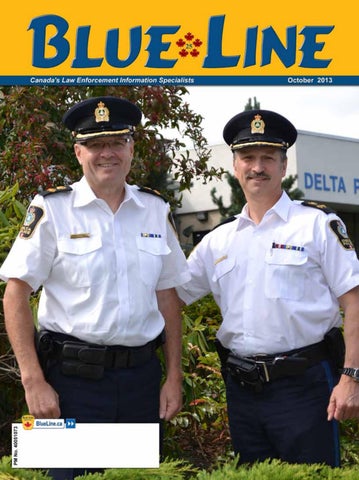
October 2013
2
Blue Line Magazine
October 2013 Volume 25 Number 8
6
Features 6 A tale of two deputies
From reserves to executives – a 35 year trek through the ranks
10 A shared response
Vancouver Police leverage best practices with interoperable capabilities
12 Excellence in giving evidence Tips for new police officers
10
16 Renewal from a community base
Afghanistan policing strives for a better future based on global norms
Departments 38 Back of Book – There is nothing as satisfying as a good firing 38 BlueLinks Advertisers Directory 28 Book Review – The Notorious Bacon Brothers 22 Deep Blue – It’s all a matter of positioning 29, 33 Dispatches 33 Education Directory 26 Holding the Line – Tired of being tired 37 MarketPlace 5 Publisher’s Commentary – A call for a little revenge 21 Science Beat – Interviewing intoxicated witnesses 30 Technology – Security tools and technology in Afghanistan
16
Case Law 34 36 Blue Line Magazine
3
Officer’s non-communicated intentions irrelevant Odour and observation justify arrest October 2013
October 2013
4
Blue Line Magazine
Blue Line
Publisher’s Commentary
PUBLISHER Morley S. Lymburner – publisher@blueline.ca
A call for a little revenge
by Morley Lymburner
Magazine Inc. General Manager Mary K. Lymburner – mary@blueline.ca SENIOR EDITOR Mark Reesor – editor@blueline.ca NEWS EDITOR Kathryn Lymburner – kathryn@blueline.ca CREATIVE DIRECTOR E. Jolene Dreja – jolene@blueline.ca Marketing Manager April Lensen – april@blueline.ca Contributing Writers Robert Lunney Dave Brown Mike Novakowski Nancy Colagiacomo Tony Palermo Stephanie Conn Tom Rataj Dorothy Cotton Brent Snook Mark Giles Affiliations International Association of Law Enforcement Planners Canadian Advertising Rates Data International Police Association The Canadian Press Newswire Access Copyright Subscriptions $30 per year; $50 for 2yrs; US & Foreign: $100 Advertising 888-640-3048 advertising@blueline.ca
www.blueline.ca 12A-4981 Hwy7 East, Ste 254, Markham, ON L3R 1N1 Canada P: 905-640-3048 F: 905-640-7547 blueline@blueline.ca
PRINTED IN CANADA
ISSN# 08478538 Blue Line Magazine was established in 1988 as an independent publication to inform, entertain, connect and educate those involved in the law enforcement profession. With no direct control from an enforcement agency, its opinions do not necessarily reflect those of any government or law enforcement agency. The authors, advisors, and publisher accept no liability whatsoever for any injuries to person(s) or property resulting from application or adoption of anything presented in this magazine. Readers are cautioned and advised that articles presented herein are edited and supplied for your personal awareness and should not be used for further action until appropriate guidance is received from a supervisor, Crown Attorney or other persons in authority. All material submitted for publication becomes property of Blue Line Magazine Inc. unless arrangements have been made with the publisher prior to publication. © 2013 All articles are protected by copyright. No part of this publication may be reproduced or transmitted in any form or means, electronic or mechanical, (including photocopying and recording or by any information storage or retrieval system), without prior permission. Permission to reprint may be obtained in advance from Access Copyright 1-800-893-5777.
Blue Line Magazine
He was perhaps 19 or 20 years old. His youthful unwrinkled face betrayed an attempt to look hardened and contemptuous. A police officer proudly standing beside him told me how he apprehended the young man carrying a stereo out the broken back door of a residence. I was new to the detective office and somewhat green in the-day-to-day mysteries of interviewing techniques. The specialty field of detective carried with it a great deal of charisma, mystique and status and newbies were expected to appreciate this. Although I had many years on the force, detective methodologies were closely guarded by those in the know and only the eager were allowed a glimpse. So here I was in my brand new suit, my partner gone, staring at a uniform that thought I should know what I was doing and a young thief who wondered what was going to happen next. The officer told me the two accomplices running away drew his attention to the rear of the house, where he captured the slowest and most heavily loaded culprit. With no other direction I felt the best tactic was the direct approach. “Who were the other guys who left you holding the bag?” “I ain’t no rat and you ain’t gettin nothin out ah me, pig. Beat me all you want, I don’t care.” I asked the young man if he was aware of what he had gotten himself into. He said he knew enough to know he had a right to a phone call and a lawyer. I shoved a phone in his direction and promised to get him a list of lawyer’s numbers but added that in the mean time, I wanted to read him something. I pulled out the Criminal Code and pointed to the section on breaking and entering. I’ll be back in a minute, I said, but thought you might be interested in reading about the penalties for your offence. His face was pale and eyes very round when I returned with the number list. “Life in prison... you gotta be kiddin me... life in prison for stealing a stereo?” “Hey, a man’s home is his castle,” I replied. “You just broke into someone’s castle and breached their feelings of security. How do you think the law makers should look at this kind of stuff?” The ensuing negotiations included a frank discussion about other burgled houses and the names of his two accomplices, punctuated by resolutions of how he wasn’t going to take the fall just because they could run faster than he could. A sense of deterrence and even revenge is missing from today’s judicial system. We have 5
become so wrapped up in rehabilitation that deterrence is no longer viewed as an effective principle. The word “punishment” elicits horror but both deterrence and punishment, also described as societal revenge, loom as large factors that work in favour of rehabilitation and should not be forgotten. Revenge is well known and understood in the criminal realm. It is the self imposed fear of “do unto me and I will do more back unto thee” which keeps many people more civil than they would otherwise be. I’m not saying deterrence and revenge is completely missing in Canadian society. The problem is it has been increasingly foisted on the shoulders of police so the judicial system can look squeaky clean by dealing solely in rehabilitation. It doesn’t have to sully its hands with such things when police are willing to handle the dirty work. This attitude is not limited to the judiciary but also reflected in such places as mental health and welfare issues. Police extra judicial exertions keep the lid on so they can turn a blind eye to cause and effect. Law makers take note. I have six points which could fix much of the problems with a meek judiciary: • Mandatory consecutive sentencing (exceptions must be argued by defence). • Reinstate capital punishment and the lash. Even if never utilized, they would show the criminal there is a societal repugnance for certain offences. • No right to a jury trial, and no parole eligibility, for organized crime figures. They have placed themselves outside the realm of societal peers and must be judged by the state. • Give deterrence a higher priority than rehabilitation. The former should be the driving force toward the latter. • Communities of no escape (the true north strong and not-so-free), with natural life sentences for recidivist criminals. Minimal guards required and remote locations would make most escapes recovery operations and repeated attempts highly unlikely. • Permit victims to be the parole board in some cases. Perpetrators must curry their favour (or that of their families) to be released. Let’s bring back penalties that crooks will clearly understand and at least pause to consider.
October 2013
A tale of
two deputies From reserves to executives – a 35 year trek through the ranks by Nikki Hewitt It was Halloween night, 1978 but it might as well have been the Wild West for a young Lyle Beaudoin. Fires were being set and fights were breaking out in his hometown of Delta, BC but the 19 year old wasn’t part of the chaos – he was trying to prevent it. It was Beaudoin’s first shift as a reserve constable with the Delta Police Department (DPD) and he remembers the night as an ‘eye opener.’ “We had vans of officers and reserves driving around putting out small fires,” Beaudoin said. “It was the youth against the police.” There were hundreds of calls and the wideeyed Beaudoin was in awe of the bravery shown October 2013
by officers, who he remembers as fearless. That first shift didn’t scare Beaudoin off – it only reaffirmed his desire to be a police officer. For the next ten months he managed 20 hours a month of volunteer time while holding down a full-time job and attending school part-time. Today, as the DPD celebrates 125 years of policing this mix of urban and rural communities, the reserve constable program is a success story worth telling. Beaudoin, now one of two DPD deputy chiefs, recounts stories of the late 1970s and of the program that gave him his start. “I didn’t like bullies. I liked people who wanted to help the underdog and I wanted to catch the bad guy,” Beaudoin said. His mom phoned the department when he was 13 to find out what he needed to join. Five years later after graduating high school the department showed a little more interest and he was encouraged to join as a reserve member. “I was able to ride along with some great officers,” Beaudoin said. “They spent time coaching and mentoring me and I got great foundational training.” In his ten months as a reserve constable, Beaudoin said he went to a cross section of calls, everything from robberies and break and enters 6
to sudden and impaired driving deaths. He and his partner officer would see up to 30 calls some nights. There was no formal training for reserve constables back then. Learning was mostly done in the cruiser’s passenger seat. “We were expected to be a back up member to the constable we were riding with,” Beaudoin said. He recalls hand writing the radio ‘10 codes’ in the cruiser and memorizing them for his next shift. It was a time before most of today’s modern police conveniences. There were no cell phones, in car computers or spike belts. Officers wrote notes by hand or on typewriters and carried revolvers, not pistols. No one had ever heard of DNA testing, the Young Offenders Act or the Charter of Rights and Freedoms. In his early years as a sworn member, Beaudoin said there were also no warrants. A designated RCMP officer with a ‘writ of assistance’ would accompany Beaudoin and his team into houses suspected of having drugs, “like a walking authorized warrant,” he recalled. Beaudoin became a sworn member of the DPD in September 1979. One year earlier, the department had shifted its hiring practices, Blue Line Magazine
committing to drawing from its pool of reserves rather than from outside departments or applicants without prior training. “The reserve constable program reaffirmed everything about policing for me,” Beaudoin said. “I learned that I was able to stay calm, cool and collected and got some great reviews and reference checks.” While the fundamentals of the program have remained the same, training and activities has evolved over time. Its current role is also much more professional compared to the 1970s and 80s. “We can’t expect them to be out there unarmed without proper training,” Beaudoin noted. Police farm team Most Delta Police reserves are accepted because they want to be sworn members. Beaudoin said his 1979 class had 20 or so reserves but only five or six really wanted to be police officers. Fast forward a couple of decades; 109 reserves went through the program between 2003 and 2012. The DPD hired 44 of them and 20 now work with other police agencies. “This really is our farm team,” noted Mike Van Hove, inspector in charge of administration. “Like the Vancouver Canucks, we have our own farm team and it’s an outstanding recruiting tool.” Today’s reserves help regular members with community events and crime prevention activities and, like in the 1970s, still have the opportunity to ride along while on patrol. “Their work is still extremely valuable, it’s just different,” Beaudoin said. “They took us pretty green back then.” Nine reserves constables were sworn in this year. Cst. Sandy Sernoski, who heads the program, believes many will go on to be hired as regular members. “Their resumes are impressive,” said Sernoski. Many of the class of 2013 are in their early to mid 20s and have loads of volunteer and coaching experience. One has taught English overseas and another graduated from university with full honours. “Our reserves go through our program and get first hand experience they can’t get anywhere else.” Sernoski said. Beaudoin’s career path has covered all of the ranks, including some that no longer exist in municipal police forces. He was promoted to corporal in 1989, sergeant in 1993, staff sergeant two years later, then superintendent and finally deputy chief in 2004. All the while a fellow officer climbed the ranks just a step behind him. Rich Drinovz was in the same class as Beaudoin. “I had already decided I wanted to be a police officer before I Blue Line Magazine
became a reserve officer,” Drinovz said. “It gave me the opportunity to confirm in my own mind that was what I wanted to do. I got a first hand look at what it was like. It was exposure you can’t get anywhere else.” Since 2009 they’ve shared the responsibilities of deputy chief; Beaudoin is responsible for operations and Drinovz administration. “Lyle was always a step ahead. When he was promoted, I would follow a year or two later,” Drinovz said. Both men juggled a couple of part time jobs and post secondary education while serving as reserves – and even though they were in the same class and signed up just six months apart, they didn’t get to know each other until 1983. That’s when they both joined the emergency response team, which was then part time. “We always worked in completely different sections before that,” Drinovz explained. Looking back on his first reserve shift, Drinovz says it wasn’t at all like Beaudoin’s. “We started at 8 in the evening and by 9, we were at the Chinese buffet for dinner. By 10 o’clock we had pulled onto the side of the road parked under an overpass and the constable I was training with fell asleep.” Drinovz remembers thinking “you’ve got to be kidding, what am I doing here?” Not long after Drinovz remembers the shift supervisor happening to drive by and saying something on the radio. “The officer I was with woke up and the rest of the night was spent on the road – a routine Friday night.” Getting to that first shift was fairly easy for Drinovz. “I showed up at the front counter wear7
ing nice clothing. The sergeant in charge of the program looked me over and took some basic information. A few days later I was at the monthly training session and then out on the road.” High standards Today, Delta reserve constables fill out the same questionnaires, have the same background and security checks and take the same polygraph as regular members. “Ninety nine per cent of our reserves want to be a regular member so we do the same checks because we need to ensure they have the highest integrity and meet the same moral and ethical standards,” Sernoski noted. They are required to take five months (90 hours) of classroom and practical training before they get to the road. After successfully completing their training they are issued body armour and everything members carry on their duty belt except a firearm – a far cry from 30 plus years ago. “We didn’t have much equipment,” Drinovz recalled. “Just a simple uniform, a nylon jacket, handcuffs, a flashlight and a note book.” “They are committed,” Drinovz said. “They invest in their work, volunteer experience and are excellent candidates for regular members.” Drinovz recalls “as a new police officer it was just you, the bad guy, your note book and finger prints. You could get a blood type but there was a lot more emphasis on investigation and interviewing skills – interviewing was a big part of an investigation.” Over the years policing has become more sophisticated but no less dangerous. “In my day it was rare for an officer to come across a handgun.” October 2013
notes Drinovz. “Today our officers could encounter a suspect with a gun any day of the week.” Drinovz took on the responsibility of coordinating the reserve program when he was promoted to corporal in 1990. “I took my duties seriously and worked hard to improve the program,” he recalled. New provincial funding in the early 90s bolstered the program and it has never looked back. In the early 2000s Drinovz recalls other departments having issues with their programs and Delta became one of the few to continue allowing reserves to ride along in patrol vehicles. “We were one of the last ones standing. Later other departments began reviving old programs but we were able to remain fully operational.” Back when he was a reserve officer, Drinovz never thought he’d be a deputy chief, never mind the first deputy in charge of administration. “I just wanted to do operational police work. Being a road constable or on the ERT was living the dream... but it’s been a highly fulfilling career.” For a couple of guys from East Vancouver, the journey to second in command has been a rewarding experience. “It’s an honour to be part of a legacy where so many have served over the past 125 years in keeping Delta a safe place to live, work and raise families,” Drinovz said. Nikki Hewitt is a member of the Delta Police Department where she works out of the Corporate Planning and Communications section. She may be reached by phone to 604 946 4411 ext 5039.
October 2013
Building on the Past, Focused on the Future
One department, policing one community, for 125 years. It’s no small feat. 2013 marks the 125th anniversary of policing for the Delta Police Department- celebrating the past, present and future. The Department has not lost its community policing approach, something the public holds dear. At the beginning of 2013, the Delta Police Department introduced its new badge. Ten years ago some members realized the badge had never been properly sanctioned by the Queen through her representative, the Chief Herald. To coincide with 125
8
years of policing in Delta, the badge was changed, giving the department a new look. The heraldry also designed and sanctioned a new flag with four corners of dogwoods representing the Province of British Columbia and bulrushes representing Delta. The 125th celebration was also marked with a flag dedication ceremony, a commemorative medal, history book, special historic display, and fundraisers for Cops for Cancer, the Law Enforcement Torch Run, local Rotary Clubs and the Delta Hospital Foundation.
Blue Line Magazine
Ramp up your consciousness Schools, colleges and universities may need your extra attention
by John Muldoon We’re a few months away from New Years Day 2014 but September marked the beginning of the unofficial New Year for many children, adults, teachers and professors. Soon after Labour Day, thousands of children ventured into a classroom for the first time; others returned to familiar buildings. Some stepped into a new “tween world” of high school, while older students began their post-secondary education. In the evenings, many schools offer adults a whole array of subjects for further education. After school many day students share and relax at local recreation centres, where learning and athletics can be just as intense as in school. And as usual, everything is back to what it should be, what we might consider “normal.” As our children have returned to their academics and associated activities, policing may have to look different for the 2013-2014 school year. Yes, many of the tried and true programs will be restarted such as school resource officers, Dare and school Crime Stoppers, Internet safety, cadets and children street proofing programs, just to name a few. Each will contribute in some way to keeping our children safe. After the Newtown, Connecticut tragedy and what seem like numerous other gunrelated incidents in schools and universities in the past number of years, policing needs to be more vigilant. The public is much more attune to crime and major incidents in schools and their communities than ever before, with the expanded use of social media platforms and the media’s decision to broadcast news from them to a more media savvy general population. Weather can also make a difference. Just remember what happened when a tornado touched down around Briarwood Elementary School in Oklahoma City this past May. Teachers this year understand and are fully aware that after the initial practice lockdown drill or fire drill, the next one may be the real thing. We know that someone, somewhere will try to copy or invent a new scenario similar to Columbine, Newtown or Montréal Polytechnique. We all hope these kinds of tragedies never happen again, but unfortunately they will. In the last few years many schools have adopted a locked front door policy. Someone, usually a secretary, buzzes visitors in after they state their business. This is fine, as long as they are not distracted with other duties. Certainly this system is a vast improvement over an open door policy but it is not perfect – and there are Blue Line Magazine
still boards that don’t have the budget for this new closed-door policy. Some US schools have authorized principals to store long guns in their office. The Associated Press reported in July that Arkansas high school assistant principal Cheyne Dougan would be one of more than 20 school district staff members carrying concealed weapons. The story notes that, under “a little-known law that allows licensed, armed security guards on campus, Dougan and other teachers at the school will be considered guards.” The subheadline read “High school says program best way to protect students.” Are these people trained and have a plan or are they just required to have a permit to carry a gun? Each police department has its own unique strategy and plan to address school safety based on local needs. Often overlooked in planning is the need for additional police surveillance of what might be considered soft targets, including recreation centres and libraries. The latter two have not been the focus of any major incident but should not be overlooked as potential places where trouble can occur. Boys and girls clubs, YMCA, YWCA and numerous other places where youth gather should be considered potential locations where incidents can occur. The majority of recreation centres, libraries, etc., still maintain an open door policy and anybody can walk in, at least to the reception desk – if there is a reception area. These soft targets are unlikely to be prepared for major incidents. Some may have an emergency plan but most have likely never considered themselves as targets. Do local police agencies have the most up-to-date contact information for these locations? Are basic floor plans available to all emergency service providers? Have police 9
recently reviewed any existing emergency plans they may have? Do they know the staff? In schools, colleges and universities, are you aware of the person in charge of night school? Many times this person is different than the daytime administrator. The 2013/2014 school year hopefully won’t be much different than years gone past but there is a new public awareness that anything can happen, any time, any place. Our children are more vulnerable today than they use to be and we need to pay more attention to their safety than we did in the past. They can face threats from strangers, abduction, bullying, cyber bullying and an increasing number of bizarre and unimaginable things. Despite diminishing police budgets and more calls for service and preventative programs, this segment of our population has to be become a bigger part of our everyday thinking. Continue running successful programs and create new ones to stay current with emerging trends and issues. Continuously review, finetune and adjust as situations change. Stay as visible as you can, both inside and outside of schools but also libraries, recreation centres, playgrounds and other places where youth gather. The goals for this school year are simple – to keep children and young adults safe through their school year. John M. Muldoon, APR, FCPRS, LM is the former Toronto District School Board Manager of Communications and Public Affairs (on disability), Peel Regional Police Director of Public Affairs and Marketing and communications supervisor for the former North York Parks and Recreation department. Contact: johnmichaelmuldoon@gmail.com .
October 2013
Vancouver Police leverage b est analytical practices with interoperable capabilities by Jun Min Chang In this IT era, police should learn to use technology as a tool to help achieve objectives, rather than as a driving force that dictates strategies and tactics. Technology carries no inherent value as good or evil. It can be used to improve or worsen the human condition either intentionally or unintentionally. Therefore, police executives should be thoughtful and strategic as they exploit the power of biometric systems, data mining systems, camera surveillance and other technological advances(Rosenbaum, 2007). In his article titled “Police innovation post 1980: Assessing effectiveness and equity concerns in the information technology era”, Dennis Rosenbaum provides important insight into the world of policing and how it has evolved to this day. The current era of intelligence-led policing employs a host of strategies and tactics to combat crime. Of the resources deployed, it is arguable that crime and intelligence analysis and computer aided data mining are the keystones to the successful deployment of an intelligence-led policing model. As Rosenbaum stated, it is important that “police should learn to use technology as a tool to help achieve objectives.” The Vancouver Police Department (VPD) is one of the Canadian leaders in using intelligence-led policing methods. The C.R.I.M.E. (Consolidated Records and Intelligence Mining Environment) system has been the backbone of the VPD’s analytical services for the past decade. Analysts have had numerous successes in aiding officers and senior investiOctober 2013
gators in a variety of cases, most notably those involving serial sex offenders. Key players C.R.I.M.E. was a VPD organizational project initiated by Special Cst. Ryan Prox. As the analytic services co-ordinator, he was required to streamline the intelligence-led analytic process and develop methods the VPD could use to realize the full potential of crime and intelligence analysis. Alongside Prox, database architect Jason Cheung and hardware engineer Bryan Vonk were integral to developing and deploying the system. Without the efforts of this core development team, it may never have gone online. The successful deployment convinced other agencies to enter into a partnership with the VPD to use the system: the National Weapon Enforcement Support Team (NWEST); Criminal Intelligence Service British Columbia (CISBC); and various municipal police agencies throughout the province (i.e. Victoria, Saanich, New Westminster, Greater Vancouver Transportation Authority Police Service). C.R.I.M.E. consists of various computer programs combined into an analytical suite and was developed in house by the VPD in partnership with venders ESRI and IBM. It essentially combines the capabilities of ESRI’s ArcGIS software and IBM’s i2 Analyst Notebook into an analytical software suite. It runs on an IBM iBase server, which provides the necessary data handling capabilities for analysts to be able to perform their duties. The VPD built data-mart takes the data, which is 10
pushed from the PRIME BC servers, and stores it locally within VPD’s own servers in an iBase format, allowing multi-level queries to be run. The system allows proactive analysis of crimes and criminal events to predict and prevent future incidents. It also addresses many of the technological, business and analytical shortcomings that existed with PRIME BC and SIUSS. The system was purpose built for the need to mine intelligence from the wealth of information stored on the multitude of data servers at the VPD’s disposal, including CABS (computer aided booking system) and CAD (computer aided dispatch). The system is stored within VPD’s own servers but is accessible both on-site as a citrix server application and off-site via the VPD intranet system. Currently, partner agencies use the system by connecting to the VPD intranet from their respective agencies. The centralization of C.R.I.M.E. on VPD servers and the capability of partner agencies to login remotely provides the best balance of function and security. All that is needed is an Internet connection for remote access. Case study one A 13 year old girl was approached by a man on a school playground April 1, 1995 and asked to help him find his child. He then grabbed her by the wrist, said he had a knife and pulled her to an outdoor stairwell attached to the school. She screamed and pleaded with him to let her go. He put his hand over her mouth and kept her in the stairwell for several minutes while sexually assaulting her. This was the first of Ibata Hexamer’s serial Blue Line Magazine
sexual assaults. The Vancouver resident was charged with 23 counts involving six different victims and subsequently pled guilty. He had no previous history of stranger sex assaults or other indicators which would have led investigators to suspect him. He committed a spree of child sexual assaults until he was finally caught in 2010. DNA analysis after a 2009 assault connected it with sex assaults of two other children. Police realized they were now dealing with a serial sex offender. A special task force was created and Project Scourge was launched. Over the next year, officers tried but failed to identify a suspect. After exhausting the list of possible suspects and leads, taskforce members turned to the VPD analytics service for help. Working long hours, the analytics team used the C.R.I.M.E. system to identify possible suspects. They poured over multiple datasets, including information from cell towers, to determine that Hexamer was the prime suspect. Within seven weeks of the team being assigned to the case, members successfully identified the offender. After obtaining and testing DNA evidence from Hexamer to confirm their suspicions, the taskforce was able to arrest and charge him. Without the C.R.I.M.E. system, it is possible that Hexamer would have continued undetected. Case study two Shalendra Kumar Sharma was charged with four counts of sexually assaulting four
Blue Line Magazine
the cases. The VPD sex crimes analyst assigned to the task was able to query relevant information across multiple jurisdictions because C.R.I.M.E. can pull its data from the PRIME BC provincial wide server. Querying information across multiple jurisdictions was important but the C.R.I.M.E. system’s ability to provide an analytical suite where spatial, temporal and other forms of analysis could be completed was key. The analysis led to Sharma being charged with 12 offences. different women from 1994 to 2011, four counts of confining the women and one count of kidnapping. In the two incidents from 2011 Sharma was also charged with two counts of assault and one count of uttering threats. Sharma is another serial sex offender caught thanks to the analysis of the criminal events by the VPD sex crimes analyst using the C.R.I.M.E. system. The Surrey resident hunted his victims in Vancouver and committed the offences in Burnaby. The trigger that set off the investigation occurred Dec. 4, 2011 when Burnaby RCMP was made aware about a possible sexual assault and robbery in the city. The victim was a sex trade worker from Vancouver’s Downtown Eastside. Another sexual assault with similar characteristics took place in Burnaby 14 days later, leading police to believe the two events may be linked. Burnaby RCMP and the VPD worked together closely to determine the suspect in
11
Conclusion There have been numerous success stories involving the C.R.I.M.E. system. Other police agencies should take note of the system and strive to head in the same direction. Those who can not create their own systems can partner with the VPD, which has co-operated with and shared system templates with agencies across Canada in an effort to improve policing nationally. While this article provides an overview into the background and capabilities of the C.R.I.M.E. system, it is truly one of those things that “you have to see to believe.” Jun Min Chang is a Practicum Student in the Analytic Services section of the Vancouver Police Department. He may be reached via email to junchang1010@gmail. com. Persons interested specifically in this project may contact Cst. Ryan Prox by email to ryan.prox@vpd.ca.
October 2013
Excellence in giving evidence Tips for new police officers
by Doug LePard & Michaela Donnelly Introduction A trial is the final step to achieving justice and the quality of your evidence can make the difference between a conviction and an acquittal of a guilty person. Becoming an excellent police witness takes practice, a commitment to continuous improvement and rigorous preparation for every case. It is important to understand that, while this guide is about giving evidence, your success as a police witness begins with the quality of your investigations, note taking and report writing. No matter how articulate and prepared you are for court, if you have not conducted a thorough and carefully documented investigation that addresses both the elements of the offence AND the potential defences, you and your case are vulnerable at trial. While it is sometimes tritely said that it is “easy to tell the truth,” there is much more to being an excellent police witness. The following is a brief series of tips to help you get started in achieving that goal, but is not intended to be an exhaustive guide. Being a great witness – The basics 1. The key to being a competent and confident witness is “preparation, preparation, preparation.” You need to know every word in your notes and report; this will make it very hard for defence counsel to trip you up or try to manipulate you. 2. Most police officers need to “refresh” their memory before they attend court to give evidence. If you regularly review your Reports to Crown Counsel for matters pending trial, you will never need to “refresh” your memory. The case will remain fresh in your mind and you will eventually have every word virtually memorized.1 Your recollection of investigations will be unassailable and you will only need to refer to your notes for very limited purposes (e.g., a serial number, to read notes of a suspect field interview, etc.). Be sure to do this sort of thorough review before your pre-trial interview with Crown so that you can both get the most out of it. 3. Consider how much of the evidence you should review. If you were the lead investigator or report writer, you ought to be familiar with all of the evidence gathered. If you played a smaller role, you should not review the statements of other officers or witnesses whose involvement mirrored your own. If they saw something that you did not, or described something differently than you did, you may either be tempted to alter your evidence as a result, or their statements may unconsciously influence your memory. You should also use caution in reviewing photographs you did not take or were not present for, particularly booking photographs of the accused which you might wish to use October 2013
as a means of refreshing your memory for identification purposes in court. Talk to the trial Crown or a senior officer first. 4. With excellent preparation, under direct examination, you should be able to give virtually all of your evidence with very little prompting from Crown.2 That doesn’t mean you WILL give your evidence without interruption, because each Crown counsel will decide how they want to present it, only that you need to have that level of preparation. Under cross examination, it will be very difficult for defence counsel to mislead you by suggesting something “close but different” to what is in your report to gain advantage if you can immediately correct them with accurate information. 5. If you are uncertain about testifying, have had little experience or the investigation is more complex than you have dealt with before, seek out the trial Crown BEFORE the trial date. Ask them if you can arrange a pre-trial interview or even a phone conversation before the trial so that you can seek advice and ensure you’re well-prepared. (Don’t leave it to the morning of trial when the Crown may only have a few minutes to speak with you.) Ask the Crown, “What sort of areas should I focus on in my preparation? What sort of questions will I be asked in cross examination?” This is particularly important if defence counsel is going to challenge your grounds for a search, for example, or the admissibility of a statement that you took from the accused. If you are uncertain how to articulate certain evidence, the trial Crown may be willing to provide you some careful guidance to assist you. You could also seek advice from a trusted police officer who is an experienced witness. 6. Demonstrate your professionalism and confidence from the minute you walk into the courtroom and display it at all times until you leave. If you appear tentative, overly nervous, unprepared or cavalier about being a witness, you will damage your reputation and credibility and your cases will suffer the consequences. Conversely, if you build 12
a reputation for excellence, that will count in your favour.3 7. Under direct examination, give your evidence chronologically – you are telling a story. Be truthful, accurate and FAIR at all times in describing facts (not opinions, except when asked). That is the reputation you want to build with Crown, defence counsel and judges. Your evidence at each trial AND your reputation will dictate the way you are treated and the way your evidence is viewed. 8. When you give evidence, whether under direct or cross examination, listen carefully to the question, think about your answer, then direct it to the judge/jury in a clear and confident voice. Do not mumble or trail off at the end of your sentences. Speak strongly enough to be heard by everyone in the courtroom. Use “active voice” (“I searched the accused”) rather than “passive voice” (“The accused was searched by me”) – it is more powerful and shows commitment to your actions. Do not try to chastise the lawyer who seems to be asking the same questions over and over by starting your answer with “As I have already said...,” “As I said previously” or, worst of all, “I think that I have already answered that question.” Your job is to answer the questions asked – trust that the Crown will object if the questions are inappropriate. 9. Speak at a moderate pace and respect the judge’s ability to keep up with note-taking, especially when relating such things as a suspect’s statements. To do this, you need to watch the judge. He/she will appreciate the courtesy and often will nod or say “go on” when ready. 10. Some people have a habit of finishing a declarative statement (“I searched the accused.”) with an upward-rising inflection (“I searched the accused?”), making every statement sound like a question. This will not instill confidence that YOU are confident in your answer – avoid this manner of speaking! 11. Do NOT be argumentative with defence counsel or interrupt their questioning, no matter Blue Line Magazine
how run-on and meandering it might be, how much they may try to rattle you or how abusive they may seem. Their job is to poke holes in your evidence and shake your credibility. YOU can control how well they do. 12. Defence counsel may try to rush you into answering without thinking. Don’t allow yourself to be bullied. Pause to think if you need to and then answer only the question asked. 13. If defence counsel has asked multiple questions, or hasn’t asked a question at all, politely ask for clarification so that you can answer properly. 14. Beware of being led into minimizing or exaggerating your experience or qualifications, or you may be setting yourself up for a fall. Just provide an accurate answer without embellishment and you will be safe. 15. Do NOT feel compelled to give a yes or no answer, even if that’s what defence asks for (or even demands). This is not TV and you are ENTITLED to provide context for your answer so as to inform rather than mislead the court by giving an out-of-context answer. For example, defence counsel might thunder at you, “Isn’t it possible that...?!” Almost anything is “possible,” but appropriate answers might be simply, “Yes,” or “I think it’s extremely unlikely because...” or “No, it’s NOT possible. I am certain of what I saw because...” 16. If you’re asked multiple questions within a question, clarify which question they want answered. 17. There is a myth that lawyers already know the answer to every question they ask. Perhaps they are taught that they SHOULD, but I can assure you they do NOT. Lawyers will often go on fishing expeditions, suggest “facts” hoping you will “bite” or simply be completely unprepared or on the wrong track. Your job is to educate the court by providing accurate information; sometimes that involves correcting defence counsel.4 18. While you are not there to entertain and you certainly don’t want to be seen as not taking your role seriously, it is perfectly alright to smile when appropriate and even to occasionally use humour where it makes sense in giving your evidence. This will come with experience, but just know that a pleasant, engaging, likeable witness is much more compelling than one who speaks in a monotone and appears devoid of personality. 19. You have probably heard police officers tell you to leave the courtroom as soon as you have finished your evidence and even (shockingly) make disparaging remarks about the trial process. If you want to learn to be an excellent witness, ignore them! When possible, try to remain in court after you give your evidence to: • Hear other police officers give evidence to see what goes well and what doesn’t (and to see the difference between good police witnesses and not so good); • See what the defence strategies are; • Hear the final submissions of Crown and defence counsel; • Hear the judges’ decisions (they no doubt will comment on your evidence); • Let the judges and Crown see you’re interested and care about the outcome; and Blue Line Magazine
•S peak to the Crown if they have time to give you feedback on your evidence (and investigation), or to arrange for another time to do so if there isn’t a break after your case. Most Crown counsel will be pleased to be asked and to help you and this is very important to ensure you don’t repeat mistakes or miss opportunities for improvement without even knowing it. Conclusion Giving excellent evidence is an important part of every operational police officer’s job. Being an excellent police witness begins with the quality of your investigations and documentation, requires excellent preparation and then is completed by being a fair, objective, respectful and knowledgeable witness, even under stressful circumstances. To use a football analogy, it doesn’t matter how many times you get the ball to the one-yard line if you can’t get it into the end zone. Investigations and arrests are the same – no matter how good you are at “catching the bad guy,” if you can’t finish the job by giving excellent evidence, you cannot be a successful police officer. With an understanding of what’s required and a commitment to continuous learning and practice, every police officer is capable of becoming an excellent witness. 1. For example, upon receiving each court notification, you could print your reports and review them regularly prior to the pre-trial interview and trial – the more complex the case and/or your involvement, the more you should review them. Since it will be many months before you go to trial (unless it is an in-custody case), you will have read your reports multiple times before you give evidence. 2. I once watched a large and very imposing sergeant with
13
a booming voice give evidence on an impaired driver. After he was sworn in, Crown asked him his first question to begin his evidence. In a confident and strong voice, he described in detail his entire, thorough investigation from start to finish including times, observations, suspect statements, the demand, BTA readings, etc., without Crown (who was smiling like the proverbial Cheshire cat) asking another question. I could see defence counsel wilting in his chair. By the time it came for cross examination, he stood up, said weakly, “No questions, your Honour” and threw in the towel. 3. One now retired judge was known to start reading a newspaper after trusted police witnesses finished their direct examination, indicating to the defence counsel that perhaps they were wasting their time with cross examination. 4. When I was a junior constable and learning as much as I could about giving evidence, I watched a legendary drug squad detective giving evidence. In the voir dire, he described how he asked a person he had arrested for PPT how much he was selling the seized drugs for (to establish the “for the purpose of trafficking” element) and the suspect replied with a dollar amount. In cross, defence counsel asked him, “Isn’t it possible you said, ‘How much do the drugs sell for?’” The detective replied strongly, “No, that is NOT possible.” Defence counsel then asked in a contemptuous and condescending tone (not realizing he was about to be handed his butt) how he could be so sure. “Because I have been in the drug squad for many years, am a qualified expert in drug trafficking and I know EXACTLY how much these drugs sell for,” the detective replied. “I asked him how much HE was selling the drugs for.” The accused was convicted of PPT. Dep/Chief Doug LePard is a 32-year member of the Vancouver Police Department who has given evidence at every rank served in, totaling hundreds of occasions. He completed 14 days of cross-examination by multiple lawyers at the Missing Women Inquiry in 2012 on his investigative review and many thousands of pages of related documents. He was described as the best witness they had ever seen. Ms. Michaela Donnelly is a 16-year Crown counsel, first as a federal prosecutor and now with the provincial crown in Vancouver. She does trial work in the provincial and supreme courts and has achieved success in the most challenging of circumstances, most recently in a notorious case involving the deaths of two teenage girls. She also finds time to contribute to police training.
October 2013
A wrap-around social service solution
by Glenn De Caire
Hamilton Poice Sgt. jay Tirner and Social Navigator Pat O’Neill in the downtown core tweeting about the Social Navigation project. (Kaleigh Rogers/CBC)
She called police 15 times in nine weeks, threatened suicide six times, hung around the downtown exhibiting reportedly disruptive behaviour and was banned from the downtown mall but kept returning. Two of our officers spent 50 hours dealing with Ann (not her real name); obviously, our response wasn’t working. Another client, “Ray,” is on our system for more than 70 incidents since 2006. He panhandles downtown to pay for his drug addiction, is very aggressive and can be violent. Every urban centre has many people like Ann and Ray. Who should people call to deal with them? Police? Emergency or social services? If someone is in distress or being disruptive and store or office managers call to have them removed, we must respond. The situation dictates the response. Police have to issue tickets but they will not pay them. We charge them criminally, knowing they will not show up for their court date. We call the paramedics to take them to hospital but know we will have to do it again once they’re released, sometimes during the same 12-hour patrol shift. This is neither effective nor sustainable This is an issue in Hamilton and, I respectfully submit, every urban centre in Canada. Hamilton Police Service (HPS), in partnership with the city’s neighbourhood development strategies, urban renewal section and para-
medic service, have done something about it through the Social Navigator Project (SNP), part of our anti-violence ACTION strategy. The results? Improved outcomes and better use of resources. Introduced in 2012, the program’s mandate is to reduce contacts with repeat offenders and get them the appropriate care that best serves their needs. The social navigator is a full-time paramedic who works very closely with ACTION officers to help repeat offenders they encounter in their deployment zones. The navigator works with a variety of social agencies to help provide the appropriate care. Ann was reconnected with her case worker, for example, and Ray was sent for addictions counseling. SNP is supported by the court system, with some repeat offenders being mandated to participate as part of their release conditions. Hamilton continually evaluates the SNP for impact and effectiveness. A report presented at the Hamilton Police Services Board April meeting showed that, as of February 2013, 81 individuals have been navigated, with 43 of them out of the program for more than six months. A comparison was done looking at their behaviour six months prior and six month post their involvement with the SNP. There were 63 offences prior to individuals being navigated (29 post navigation) and 103 mental health calls in the six months
October 2013
14
before they became involved in the program, often leading to hospital assessments. This number was reduced to only eight in the six months following their involvement. Eight of the successfully navigated clients were classified as aggressive panhandlers, meaning they had at least five aggressive panhandling charges prior to joining the program. Before SNP involvement these individuals were issued an average of one ticket every nine days. After completing the program, this dropped to an average of one ticket every 76 days. The SNP is a made-in-Hamilton solution re-connecting people in need with the services and support they require. This wraparound social service solution positively impacts people’s lives and our community and responds to their complex issues. It’s a new approach to breaking the cycle of repeat offenders which is improving outcomes and optimizing resources. Glenn De Caire is the Chief of Police, Hamilton Police Service The Hamilton Police Service received the Ontario Association of Chiefs of Police 2013 Crime Prevention Award for its Social Navigator Project on June 25, 2013.
Blue Line Magazine
Police Leadership Graduates Fall 2012 - Summer 2013
The Staff and Faculty of the Police Leadership Program want to congratulate all graduates on their success! Administration Certificate Deputy Chief Del Manak Victoria Police Dept., BC Sgt. Deon P. Marquis RCMP, Wakaw, SK Sgt. Brendan McDonald Stratford Police, ON Cst. LeRoy Pelley RCMP, Bell Island, NL Cpl. Ishwarpreet Singh RCMP, Toronto Airport, ON Sgt. Jim Wilson Stratford Police Service, ON Sgt. Shawn Wright RCMP, Mission, BC Law and Justice Certificate
Cst. Kevin Ashley RCMP, Antigonish, NS
Cst. Scott Messier RCMP, Tracadie-Sheila, NB
Cpl. Robert Beach RCMP, Ottawa, ON
Cst. Trudy Pike RCMP, Whitehorse, YK
Det/Cst. Allan Claus Barrie Police Service, ON
S/Cst. Sean C. Ryckman Ottawa Transit Law Enforcement, ON
Cst. Sam Côté Halifax Regional Police, NS
Cst. Patrick Small Fredericton Police Force, NB
Sgt. Noel Coulas North Bay Police Service, ON Cst. Michael Courty RCMP, Brooks, AB
Advanced Police Leadership Certificate Cst. Matt Conn RCMP, Shelburne, NS
Sgt. Paul Dawson RCMP, “F” Division, SK Sgt. Randall Mason OPP, General HQ, Orillia
This list is not exclusive. Some students could not be contacted and for reasons of privacy and security some did not wish to have their names included.
S/Sgt. Robert Burke Barrie Police Service, ON Cst. Donovan Irving Peel Regional Police, ON Cst. M.B. O’Connell RCMP, Surrey, BC Cpl. Erin D. Folk RCMP, Depot, SK Det/Cst. B. Ofrenchuk York Regional Police, ON Cst. Dennis Van Ember Fredericton Police Force, NB Cst. Robert Warren Saanich Police, BC Service Delivery Certificate Sgt. Kevin Lewis RCMP, “G” Division, NWT Cst. J. McCracken Peel Regional Police, ON Sgt. Scott Moreton Hamilton Police Service, ON Cst. David Thorne RCMP, Bonavista, NL Supervisory Skills Certificate Cst. Kenneth Shephard Amrow Halifax Regional Police, NS Blue Line Magazine
15
October 2013
Renewal
from a community base Afghanistan policing strives for a better future based on global norms by Tom Rataj The most recent chapter in Afghanistan’s long, complicated and often torturous history began when US-led coalition forces laid siege to the country October 7, 2001. Virtually all critical infrastructure was quickly converted into heaps of rubble and the Taliban’s barely five-year long grasp on power was broken. Since then, the arduous task of rebuilding the country and establishing a democratic system of government has been underway. Numerous setbacks have occurred as the Taliban continually tries to undermine the efforts and return to power. The coalition forces have suffered many casualties, including the 138 Canadians “killed in action” between 2002-2012. In addition to the physical infrastructure lost during the invasion, most government services, including policing, were also destroyed. Policing under the Taliban had not been much more than an instrument of the government, functionally controlling all dissent and enforcing extremist views of what an Islamic state should be. The German Police Project Team (GPPT) arrived in 2002 and began the task of establishing a civilian police service throughout the country. With a focus on developing and training police and prosecutors, the GPPT was augmented in 2007 by the larger, multicountry European Union (EU) led effort, which expanded the scope of training. The European Union Policing (EUPOL) Mission in Afghanistan draws from 23 EU member states and four contributing counOctober 2013
tries – Canada, Croatia, New Zealand and Norway. With approximately 400 personnel assigned to the mission, typically including up to 45 Canadians, EUPOL annually trains and mentors 10,000 members of the 157,000 strong Afghan police. From basic street-level policing up through several management and leadership levels, the EUPOL mission has worked painstakingly and, at times, painfully, at creating and building a civilian policing service from the ground up. Simply transplanting the western model of civilian policing into a country such as Afghanistan is an impossible and doomedto-failure approach. The EUPOL mission has gone to great lengths to work hand-in-hand with the Afghans by showing, teaching and mentoring them on how to update their policing traditions into a civilian policing model that will work in their country. ‘Transition, not transformation’ is the by-line. In a country as complex as Afghanistan – with its troubled and tumultuous past, its largely rural and tribal structure and virtually no history of civilian (as opposed to military) policing – EUPOL’s task was massive. Great progress has been made, although much more needs to be done. Unfortunately, much of the mission is scheduled to come to an end in 2014 when the coalition’s military presence ends. EUPOL is working on establishing a new participation model set to start in 2015. Media tour Before the mission ends, the EUPOL Press and Public Information Office (PPIO) 16
organized a police media tour of its operation, inviting police magazines from contributing countries to send a representative to Kabul. I was fortunate enough to join magazine staff from Sweden, Finland, Germany, The Netherlands and Romania on a one-week media tour to Kabul from June 28 to July 4. The journey proved to be an adventure in its own right, as I flew first from Toronto to Moscow (9.5 hours) with Aeroflot Russian Airlines and, after a 12 hour layover in the Sheremetyevo International Airport, continued with Aeroflot to Dubai, which took another 5.5 hours. I met Lars Hedelin and Karl Melin from Sweden and Justine Kaasjager from the Netherlands in Dubai. We had about an hour to get to get acquainted before boarding the 2.5 hour flight to Kabul with FlyDubai. We were met by our EUPOL PPIO host Edith Lommerse and a fleet of Mercedes Geländewagen (G-Wagon) armoured SUV’s staffed by a team of armed Close-Protection (CP) personnel that we soon learned would escort us everywhere. We were promptly whisked-off, convoy style, to the Green Village (GV), a fortified compound across town and each assigned accommodations for the week. The GV is a heavily fortified compound surrounded by blast-resistant walls topped with razor wire, multi-stage entrance gates and internal fortified walls and bunkers. It is operated on behalf of EUPOL by Stratex Corporation and guarded 24/7 by numerous security contractor personnel, mostly from Nepal, including members of the famous Ghurkas. As would be expected, the facility Blue Line Magazine
is also equipped with an extensive CCTV security system and other equipment which cannot be detailed due to security concerns and restrictions. At the GV we met the rest of the journalist team: Olaf Knöpken from Germany, Sari Haukka-Konu from Finland and Nicusor Dulgheru from Romania. We were each outfitted with our Personal Protection Equipment (PPE) – a ceramic ballistic body armour vest (about 20 lbs) and military style ballistic helmet. They would be our constant companions on every trip outside of secure compounds or facilities. Our initial briefing covered the alarm protocols in the GV and other EUPOL facilities, familiarizing us with what to do if the facility came under attack while we were there. This was apparently an ever-present and very real possibility. Knöpken and I were assigned to a silver G-Wagon staffed by our CP team: Peter (an ex-UK military man) as driver and Rolf (a retired South African police officer) as escort. Both worked for HART Security, one of numerous private security contractor companies operating in Afghanistan. The CP teams also wear ballistic body armour and always carry pistols and assault rifles. After the briefings we headed to the EUPOL headquarters compound across town for official introductions and an overview of operations. Deputy Head of Mission Pieter Deelman, human resources officer Sorin Hazu and Christiane Buck of the PPIO welcomed us and, despite our travel-weariness, managed to provide us with a quick overview of the EUPOL mission and the busy and interesting week in Afghanistan that lay ahead.
Blue Line correspondent, Tom Rataj, meets his close quarter protection team. come targets of shootings, suicide bombers or abduction for profit businesses run by criminal gangs or individuals. Abductees are apparently sold to the Taliban for $50,000 and then ransomed off for several hundred thousand in a purely profit-driven enterprise. On top of all the terrorist threats and activities, much of Afghanistan is also plagued by organized criminal gangs and opportunist criminal elements that take advantage of the chaos and lack of effective policing. Rampant
systemic corruption in both private enterprise and various levels of government make the cost of doing business very high. It can be very difficult to know who to trust so all Afghan nationals entering foreign operated or occupied facilities, such as the GV and EUPOL HQ, are required to first disarm. This is to prevent Green-on-Green or Blue-on-Green attacks, where apparently trusted Afghan soldiers or police officers kill foreign soldiers and police officers.
Hostile environment training Since the security situation is so tenuous, we were required to receive security and basic first-aid training, the first order of business the next day. We were driven to the HART Security compound, greeted by several company executives and given a short overview of the company’s operations and contracted services in Afghanistan and elsewhere. We were then given a very condensed Hostile Environment Awareness Training (HEAT) session to familiarize us with the threats and risks we would face everywhere in the country. EUPOL police officers normally receive a 4.5 day HEAT training session, including driver training specific to the Afghan environment. We were also given an overview of the contents of the emergency medical packs located in each truck and at strategic locations in all compounds. We learned about the Standard Operating Procedures (SOP) designed to ensure our safety when being transported. Because of the substantial risks to foreigners, you stay in your armoured vehicle under all circumstances unless instructed to exit. The Taliban or others will often stage incidents designed to entice foreigners to leave their vehicles. Once outside they beBlue Line Magazine
17
October 2013
Police HQ visit After our morning training session, we headed across Kabul for a meeting and lunch with General Ayoub Salangi, chief of the Kabul City Police. We met briefly with him and some of his key staff and EUPOL mentors. Lunch was a large and tasty spread of typical Afghani foods, including flat-breads, shish-kabob, rice and sautéed vegetables. After lunch we asked the general about his operation, the influence of EUPOL and policing in Kabul. I asked his opinion about community based policing as opposed to more traditional policing models. He answered with a short question: “What happens to the fish if you take it out of the water? It will die... It is important for the police to be with the people and to gain their trust. They need to work in the community so the people will know them.” Fighting against terrorists is the biggest challenge for police, Salangi said and Afghan police need more time, resources, technology and money to bring them up to the standards elsewhere in the world. He appreciated the support, training and mentoring from EUPOL and the help rebuilding policing, which has been one of the many casualties during the last 30 years. Police emergency call centre In the afternoon, we were given a tour of the police 119 emergency call centre in Kabul by Colonel Ayni, chief of the centre. It can be reached toll free and functions in a sort of
International Journalists meet Afghan Police Lt. General Mohammed Ayauh Salangi, at left.
hybrid model, dealing with both emergency calls (police, fire and ambulance) and just about every other governmental service need in a manner similar to a municipal 311 call centre. The 119 centre is essentially a one-stop access point for civilians. It handles calls
about everything from terrorist activities and corrupt police and government personnel practices to human rights complaints and problems with International Security Assistance Force (ISAF – coalition) personnel. We were told a number of success stories. In one case a roadside IED was being placed outside a school. The call-taker stayed on the line with the caller while arranging police response and when officers arrived, the IED’s placement wasn’t yet complete. The person placing it was arrested and the bombs were successfully defused, likely resulting in many lives saved. The mostly female call-takers sit in small booths arranged around the main room and are equipped with a desktop computer and modern Internet Protocol (IP) phone that, at this point, provide only the caller’s number. The computer has an Internet and intranet connection and acts only as a resource tool. All incoming calls are digitally recorded. The 119 centre has become quite well known, to the point where the Taliban has apparently threatened to capture and hang civilians who call it. It has also attempted to disrupt the service by running a concerted campaign to overload it with prank calls. The centre’s more than 100 staff work three shifts and typically handle more than 400 calls each day. Next month The field trip to Kunduz, graduation day, strategic objectives, justice, an interpreter’s view, Canada Day in Kabul, a truck bomb and the police staff college. Tom Rataj is Blue Line’s Technology columnist and can be reached at technews@blueline.ca.
October 2013
18
Blue Line Magazine
Exceptional bravery and
investigations honoured Increasingly violent bank robbers have been removed from the streets in Montréal and Vancouver thanks to the outstanding work of this year’s Canadian Banks’ Law Enforcement Award (CBLEA) recipients. Senior Cst. François Clavel and Cst. Bryan Brown of the Montréal Police Service and Det/Cst. Dean Wells of the Vancouver Police Service Robbery Unit each received the award during a ceremony at the CACP conference in Winnipeg. “Canadian financial institutions, their employees and customers are very grateful for the important work and dedication that these three police officers have demonstrated, which is why they are so deserving of this prestigious award,” said Nathalie Clark of the Canadian Bankers Association. “Security and safety are always the top priority for Canadian banks and that is why they work closely with police services across the country to help protect their employees and customers.” Montréal Clavel and Brown were the first to respond to an armed bank robbery in a Montréal suburb
Blue Line Magazine
in November 2012. The suspect had entered the bank and threatened the security guard, clients and staff with a gun. He made off with a small sum of money and the bank quickly notified police. Clavel and Brown responded and located the armed suspect in a park, pursuing him first by patrol car and then on foot. After a short confrontation they arrested him and seized his weapon, disguise and money. What made the case so extraordinary was that both officers pursued the armed suspect without any hesitation, risking their own lives to make sure that an arrest was made. Their bravery and determination resulted in the arrest of a dangerous and violent criminal who was later linked to other area bank robberies.
19
Vancouver Wells was assigned as lead detective in eight Vancouver area bank robberies staged by armed suspects wearing elaborate disguises. The amount of cash demanded in each robbery increased, along with the level of violence. Wells reviewed security videos and statements from all the robberies and quickly determined they were connected because of similarities in the disguises and tactics used. No forensic evidence was left at the scenes. It was through surveillance and his exceptional investigative skills that the suspects were tracked down and arrested as they left the eighth robbery. Wells’ thorough investigation, active pursuit of the suspects and determination to stop the increasingly violent robberies resulted in banks, their employees and customers and the Vancouver community as a whole being much safer. Since its creation in 1972, 226 officers from across Canada have been honoured with the Canadian Banks’ Law Enforcement Award for their outstanding bravery, dedication and other noteworthy achievements in combating crimes against Canada’s banks. Visit www.cba.ca/ award to learn more.
October 2013
Major case management training by (Allan) Wayne Shorrock
The media, police service boards and even police services are raising the question of who needs major case management training (MCMT). The issue is being considered from the perspective of community safety and the impacts of allocating valuable resources to this process, balanced with the challenge of operating efficient and effective police services. The significance of the impacts of systemic MCMT is apparent when communities become aware that a serial predator may be targeting victims in their area. The names Willie Picton, Terri-Lynne McClintic, Michael Rafferty, Russell Williams, Paul Bernardo or Clifford Olsen raise questions about the process of and applicability of major case management (MCM) practices in affected communities. Each name evokes the image of a predator, undermining public confidence and creating a climate of fear. These serial crime investigations tax human resources and diminish community, provincial and federal budgets. All were complex and multijurisdictional, with evidence of all kinds to be collected, analyzed, prioritised and investigated. All these predatory suspects met the criteria for a major case requiring experienced, dedicated, trained managers and investigators. The late Justice Archie Campbell’s report and recommendations, (Bernardo Investigation Review), published in June 1996, identified significant systemic failings in the investigation of serious criminal offences. Sixteen years later in November 2012, Commissioner Wally Oppal’s report “Forsaken” details systemic failings in the investigation of missing women in British Columbia. Both reports contain recommendations that speak to the necessity for systems to ensure serial predator behaviour is detected, identified and proactively investigated to protect the communities where they prey. They also both identified the need for structured training dedicated to ensuring consistency in applying systemic approaches to managing major cases. Campbell first articulated the need, recommending that “A major case management system is required for major and inter-jurisdictional serial predator investigations.”1 Oppal’s summary of recommendations for “enhanced police investigations” states requirements for “The provincial government (to) mandate the use of major case management for major crimes and that the director of police services develop these MCM standards in consultation with the police community and through a review of best practices in other jurisdictions.”2 There are marked similarities of experiences in the cases, including the challenges police faced in the investigation and management of a major criminal investigation. Campbell advised “specialized training for senior officers in charge, senior investigators and inter-disciplinary support teams.”3 Oppal recognized the importance of police training when he October 2013
acknowledge the challenge “… to fully implement such a major shift in policing practices, especially bearing in mind the training requirements....”4 Campbell indicated in his report that “This is a review of the work done by local and provincial law enforcement and forensic agencies during the Bernardo investigations.”5 The inquiry was ordered by Lieutenant Governor H.N.R. Jackman to review various aspects of the investigations leading to charges against Bernardo. Campbell introduced his report by stating “Between May of 1987 and December 1992, Paul Bernardo raped or sexually assaulted at least 18 women in Scarborough, Peel and St. Catharines and killed three women in St. Catharines and Burlington...6 “The Bernardo case, like every similar investigation, had its share of human error. But this is not a story of human error or lack of dedication or investigative skill. It is a story of systemic failure.”7 Campbell’s inquiry came up with 27 recommendations. The Ontario government established a committee which would evolve into the Major Case Management unit within the Ministry of Community Safety and Correctional Services, Public Safety Division. A guideline and manual were developed by operational investigators, which became a regulation supported by the Police Services Act of Ontario in January 2005. In Ontario, for identified criteria offences, police services follow the Ontario Major Case Management (OMCM) manual and use the ministry approved software Powercase. Our research indicates as of this date, Ontario is the only province to legislate MCM training and “the only place in the world to have this type of computerized network for case management.”8 To complement the OMCM and respond to Campbell’s identified need for training in this area, the Ontario Police College (OPC) was tasked with designing province wide, police specific training and plays a key role in delivering MCM training to police. OPC provides an OMCM “Principles and Practices Course” for members of the command triangle and software training on Powercase. It has delivered the course at the Justice Institute of British Columbia and routinely hosts students from police services across Canada and the rest of the world. In Ontario, recognizing the scope of demand for MCM training, OPC offers its course at the college, sends instructors to train at police services and provides OPC lesson plans and teaching materials and finds supporting resources within 20
communities to deliver the content to services in accordance with the course training standard. The OMCM Powercase course can also be OPC or service delivered. It is conducted by two operational officers, seconded from Ontario police services, to ensure current field practice and investigative procedures form part of the curriculum. OPC also offers an understudy program, allowing a police service to identify a member (sworn or civilian) proficient in Powercase to attend a 13 day course at OPC. They are tested on their knowledge, provided the course materials, then mentored and coached as they co-deliver a 10 day course with the OPC seconded officers. The understudies can then deliver the training at their police service in accordance with the course training standard. Since 1996, the OMCM system has been credited in high profile cases such as the Holly Jones murder, Cecilia Zhang abduction and murder, Bandidos massacre and Russell Williams and Tori Stafford investigations. Each shared similarities with the Bernardo investigation and posed unique challenges for investigators. MCM techniques and opportunities to enhance training continue to evolve and Ontario’s stakeholders in public safety are currently examining police practices, looking to find effective, efficient future focused strategies to deliver to police services in this fast paced, ever changing environment. Stakeholders and police leaders continue to recognize the six principles fundamental to the Police Service Act of Ontario, which declares “The need to ensure the safety and security of all persons and property in Ontario.”9 MCM and the concurrent training of members is one methodology to meet this objective. “The pattern of predatory violence was clear and should have met with a swift and severe response by accountable and professional institutions, but it wasn’t,” Oppal stated in his review of the missing women inquiry. 10 After 16 years of applied, exceptional experience using the Ontario MCM model, the question of who needs the training appears to have a very clear response; those who wish to best serve their communities. 1. Bernardo Investigation Review, Report of Mr. Justice Archie Campbell, June 1996, Queens Printer, page 319 2. Forsaken, The Report of the Missing Women Commission of Inquiry, The Honourable Wally T. Oppal, QC, British Columbia, November 19, 2012, Executive Summary, page 149 3. Bernardo Investigation Review, page 319 4. Forsaken, Executive Summary, page 99 5. Bernardo Investigation Review, page 1 6. Bernardo Investigation Review, page 1 7. Bernardo Investigation Review, page 1 8. www.mcsc.jus.gov.on.ca/english/police_serv/MajorCaseManagement/mcm.html, page 1 9. Police Services Act of Ontario, R.S.O.1990, Chapter P.15, Section 1 10. Forsaken, Executive Summary, page 4 Wayne Shorrock is a chief instructor in the Practical Police Training section of the Ontario Police College. Contact him at Wayne.Shorrock@ontario.ca or 519 7734488 for more information.
Blue Line Magazine
Science Beat by Brent Snook
Interviewing intoxicated witnesses Don’t be short-sighted about alcohol myopia Many psychologists, including myself, are likely to recommend investigators wait until intoxicated individuals sober up before interviewing them about events they have witnessed. We are also likely to caution that you’re not likely to get much of value from an impaired witness because alcohol tends to limit cognitive abilities such as attention to details and the processing of information. Such advice would likely be based upon research showing that alcohol impairs memory; albeit, for simple stimuli such as a list of words. However, new research published in Law and Human Behavior is challenging views on the link between intoxication and eyewitness testimony. A team of researchers led by Nadja Schreiber Compo at Florida International University examined the relationship between intoxication and recall performance when witnessing realistic stimuli. The researchers carefully screened 93 undergraduate students and assigned them randomly to one of three groups: alcohol, placebo or control. All participants were first asked to sit at a “bar” and watch the experimenter prepare beverages. Participants in the alcohol group were given vodka and cranberry drinks, resulting in a breath alcohol concentration of 0.06 to 0.08 g/200L some 30 to 40 minutes after intake (which was based on gender and weight). Those in the placebo group were led to believe they were given the same alcoholic drink – they were not. The control group drank cranberry juice. Each participant was later taken to a different room and asked to write down all that they could remember about the bar. Breath alcohol concentration was taken again to ensure the participants in the alcohol group met the legal definition of intoxication. A short while later, the participants witnessed a staged theft – a laptop being stolen from the room – and listened to a one-sided telephone conversation between the experimenter and a university employee about the theft. Then there was a twist! Half the participants in each of the three conditions were exposed to a telephone conversation that contained misinformation about the event. The researchers then tested memory performance for each participant (by recording the percentage of correct, false, uncertain and ‘I don’t know’ responses, accuracy rate and number of words reported). To test the misinformation effect (erroneous information provided to participants after the event ended), the researchers measured the number of misBlue Line Magazine
information items provided from the telephone conversation. Their main analysis of the data showed no difference between the alcohol, placebo or control groups on memory performance. That is, when compared against sober individuals, intoxicated participants did not provide significantly less correct information, more false information, more ‘I don’t know’ responses and were no more uncertain in their statements. Moreover, they found evidence of a misinformation effect – those exposed to misinformation reported more than those not exposed – but the intoxicated individuals did not report greater levels of post-event misinformation than sober individuals. Another interesting finding from their study pertained to interview format. Compo and colleagues found that using a cued-interview format resulted in more false information being reported from intoxicated individuals than their sober counterparts. Their findings suggest intoxicated individuals are not likely to have greater memory impairments or be more susceptible to adopting
21
misinformation than their sober counterparts. It seems they are as good eyewitnesses as sober individuals – at least when on the lower limit of intoxication. The authors argue that their counterintuitive findings can best be explained through the theory of “alcohol myopia.” When intoxicated, people have a limited attention system that focuses upon central information and ignores peripheral information. Intoxicated individuals are not able to attend to all relevant situational information so they are more likely to be influenced by the salient cues in a given situation (e.g., someone being injured) at the expense of weaker cues (e.g., the colour of a shirt). Overall, the findings suggest that it may be possible to get as much complete and accurate information from intoxicated individuals as you can from teetotalers. Brent Snook, B.A., M.Sc., Ph.D., is an Associate Professor in the Psychology branch of Memorial University in St. John’s, Newfoundland. Contact him at bsnook@mun.ca or 709 864-3101 for more information.
October 2013
Deep Blue by Dorothy Cotton
It’s all a matter of positioning I spent the morning sitting outside on my cottage deck reading. Curiously, there appear to be very few times when the stars align and the conditions are perfect for morning deck reading. The weather has to be just right – not too hot or cold. It can’t have rained overnight because I am generally too lazy to wipe down the chairs. I have to have time and not be committed to other activities, something to read – ideally something in my e-book where I can adjust the light level to suit the conditions – and be able to find my sunglasses. Notably, a number of the conditions I have outlined are outside of my control (weather, temperature). Others (the appropriate book and whether I feel like reading outside) are solely under my control. Several conditions may be controlled either by myself or someone else (the time schedule, whether the chairs have been wiped down). If for some reason my husband were particularly keen that I should be out reading rather than in the cottage (which may occur if he wants to sleep in), he can influence my behaviour. He can ensure we have no morning activities scheduled, find my book and sunglasses and leave them in an obvious location, suggest to me the night before that I might want to read outside – he might even cover one of the chairs with plastic so it will be dry in the morning. What tends not to work is for him to issue a decree to me: “You should read outside on the deck in the morning!” That kind of thing tends to get my dander up. Even though neither my husband nor I have any real control over many of the factors that influence my reading-on- thedeck behaviour, he can certainly nudge me in the desired direction. This brings me to the subject of this column, a book entitled Nudge: Improving decisions about health, wealth and happiness. The concept of nudging someone should not be unfamiliar to anyone in policing. Although people tend not to use the word “nudge,” a lot
October 2013
of what we tried to accomplish in community policing essentially constitutes nudging. It is a way of setting up conditions so that people are more likely to choose the best or most adaptive option, not forcing them into decisions but rather making it easier to make the correct choice. How do we make people want to drive at the speed limit? Put down their cell phones while driving? Not loot following a natural disaster? Refrain from joining a gang? Rat out a friend who has committed some heinous crime? For that matter, how do managers and supervisors encourage staff to make good decisions about coming to work, following policy and treating the public well even when they’re not convinced they deserve it? In many ways, you could argue that this book is Intro Psych with more amusing stories and fewer tedious academic references. It is essentially about how we get anyone to do anything. It talks about incentives, changing defaults, education... not news, I dare say, but it does make one think. Take the power of social conformity. This is also not news to most of us, of course. People like to do what other people are doing. The authors argue that one of the most persuasive ways of changing behaviour is simply telling people what others are doing.
22
They give as an example a comparison of four different strategies used in Minnesota to encourage people to file their taxes: 1. Telling people about all the good things their tax dollars are used for. 2. Telling people the penalties for noncompliance. 3. O ffering people assistance in filling out their tax forms. 4 . Telling people more than 90 per cent of residents comply with their obligations under the tax laws. The only strategy that had any effect was the last one. If you tell people everyone else is doing something, they are more likely to do it. It seems to me that this may have some interesting implications for how we talk about high crime areas and related statistics such as school dropout rates. Emphasize that two out of every 10 youth in a certain area are members of a street gang and 40 per cent of students in a given high school never graduate and you are in fact encouraging them to join the gang and drop out of school. Emphasize that eight out of every 10 youth in that area do not join gangs and 60 per cent graduate and you are encouraging a different kind of behaviour altogether. You haven’t changed the statistics or the true state of affairs but you have nudged people in the right direction. Then there was the “Don’t mess with Texas” anti-litter campaign. State officials noted that most litterers were young men 18-25 (who, as we know, seem to be responsible for 90 per cent of the world’s ills). Somehow they were not impressed by the “keep our state pretty” type campaigns that seems to resonate with little old ladies. A campaign involving huge pro football players driving big honking trucks and crushing littered beer cans with their bare hands while grunting “Don’t mess with Texas” did the trick, however. The message here? If you can relate to the messenger, you are more likely to relate to the message. A different kind of nudging can occur in a school cafeteria. You may be familiar with experiments where schools eliminated menu choices such as chocolate covered poutine and deep-fried lard in favour of lentil bisque and vegan burgers. These decisions did not result in students engaging in healthier eating but simply going across the street to the fast food joint for lunch. Simply placing the poutine and lard on a higher shelf however, slightly outside of eyeshot, and putting all the green things front and centre resulted in students making much healthier choices. They were not directed or legislated into eating differently but opted to make better Blue Line Magazine
choices. It’s all a matter of positioning. The authors talk about the role of the “choice architect.” In the above instance, the school dietitian is the choice architect by arranging things to maximize the likelihood students will make their own healthy choices. I like the phrase “choice architect,” even though the concept is not new. There are ways of setting things up so certain decisions are more likely to result. If your magazine subscription automatically renews itself if you take no action, you are likely to still be getting “Today’s Toddler” even when your kids are in college. Someone designed things so that you are more likely to keep subscribing. The magazine people are the choice architects in this case; they set things up to make it easier for you to make (in this case) the choice they want you to make. One of the things I liked about this book was that it reminds us all that some of the things that we THINK influence behaviour really don’t work. Threats of punishment, moralistic lectures? Not so much. Constant feedback, incentives, social pressure, simplifying the good choices, leveling the playing field... and a host of other things we learned in Psych 100, work better. Have a look at the book. I’ll bet you find at least one idea that will change the way you do your everyday work. Dr. Dorothy Cotton is Blue Line’s psychology columnist, she can be reached at deepblue@blueline.ca
Blue Line Magazine
Getting dementia patients safely home It’s one of the scariest and also most common behaviours associated with Alzheimer’s disease – becoming lost with no idea how to get home. People around them may want to help but don’t know where to start. That’s why Canadian MedicAlert Foundation and the Alzheimer Society of Canada have united to launch the MedicAlert Safely Home program to help Canadians with dementia live as safely as possible. The nation-wide initiative is designed to quickly help identify those who are lost and assist in a safe return home. The program uses the MedicAlert database to store full medical information about the person with dementia, including what medications they take, information about allergies or conditions and a record of their medical history.
23
MedicAlert Safely Home members select an ID to wear at all times. Through a unique 24/7 emergency hotline, inscribed on the ID, emergency services personnel are granted immediate access to a complete medical profile and emergency contact information. When a member with Alzheimer’s disease or dementia is found – even if they’re unable to answer basic personal questions like where they live – MedicAlert will provide critical information and immediately notify emergency contacts. Some 747,000 Canadians live with a form of dementia. When they wander, check for a MedicAlert ID. It’s the quickest way back home to the person’s caregiver or family. Call the 24/7 hotline. A live operator will immediately give you the person’s emergency contact details.
October 2013
Monument lifts the burden
Photo: Georgina Short
by Danette Dooley Some say the granite monument unveiled in the Town of Badger on July 31 has lifted a cloud that’s hung over the central Newfoundland town for more than half a century. Others say the monument and its storyboard tells, for the first time, what actually happened on that fateful day of March 10, 1959. Just after 6 pm, 66 officers from the RCMP and
October 2013
Newfoundland Constabulary marched along Church Road. They confronted a group of loggers, who had been lawfully on strike against their employer, the Anglo-Newfoundland Development Company, since New Year’s Day. The two groups clashed and harsh words turned to violence. Police used their 18-inch long night-sticks and the loggers hit back with sticks. William Moss, a young constabulary constable, was fatally injured in the melee.
24
The Badger Monument consists of two granite pieces, one in memory of Moss and the other to note a major turning-point in the history of labour relations in Newfoundland and Labrador. Moss’s monument, with a depiction of his likeness, reads: “We remember and honour the memory of Constable William Moss, a member of the Newfoundland Constabulary who was fatally injured in the line of duty on 10 March, 1959.” The second piece of granite reads: “We remember and honour the courage and strength of the men who took part in the 1959 loggers’ strike. They made Newfoundland a better place for themselves, their families and for all Newfoundlanders and Labradorians.” Royal Newfoundland Constabulary Chief Robert Johnston says, as the storyboard suggests – the Badger Riot, as the clash became known, was a turning-point in labour relations. The striking loggers won substantial improvements in their wages and working conditions. They and police forces alike developed mutual respect learning how to preserve the balance between public order and safety on one hand and the rights of those lawfully on strike on the other. “The monument is an opportunity for us to reflect on how far we’ve come and how important it is that we get it right when we’re involved in such things as collective bargaining and crowd management,” Johnston said. Having the monument erected will boost the town’s tourism and make a huge difference to its residents, he noted. “The story is now being told and told correctly. The tragedy that took place in Badger wasn’t the fault of Badger. There were errors made by government, labour and police that created the moment where William Moss lost his life. Now, out of that incident, we’ve come a long ways today.” Johnston says while the Town of Badger, provincial government, Newfoundland and Labrador Federation of Labour, RNC Police Blue Line Magazine
Association and many other supporters came together to make the monument a reality, one of his officers played a pivotal role. “Cst. Georgina Short provided the leadership, the continuity and the drive to make this happen, and the day we unveiled the monument, the town’s mayor made Cst. Short an honorary citizen because of the work she put into the project. As chief of police I give her a great deal of credit for the success of July 31 and that beautiful monument.” Badger Mayor Mike Patey said the constabulary’s police chief and the veteran constable were instrumental in the success of the project. “Georgina came in and helped us… She followed all the protocols and she did a wonderful job putting it all together.” Newfoundland and Labrador Premier Kathy Dunderdale also participated in the unveiling. “For all Newfoundlanders and Labradorians, Badger will forever be recognized as the place where, from one of life’s greatest tragedies, we learned one of life’s greatest lessons. We must always find ways to work through differences whenever they arise, because life is fragile and precious… Let this profound lesson be the enduring legacy of Constable William Moss.” In commenting on the second plaque the premier said while the strike resulted in significant improvements in the loggers’ working conditions, the death of Moss also had a much more
Blue Line Magazine
Photo: Rod Bennett
profound effect on the people of the province. “It came to signify the beginning of a new era – an era where health and safety and fair benefits for all workers became a priority for employees, employers and administrators,” she said. Two signs were also unveiled. One names the town’s walking trails “Logger’s Way” and the other names the ball field “Constable William Moss Memorial Softball Field.” The town’s mayor summed up well what
25
the monument means to his residents and the province. The death of a young man wasn’t something anyone could ever envision happening, he said. Yet it did happen and the town’s residents have been carrying the burden ever since – “but when we unveiled that monument that burden was lifted.” Danette Dooley is Blue Line’s East Coast correspondent. She can be reached at dooley@blueline.ca
October 2013
holding the line by Stephanie Conn
Tired of being tired It’s no secret that the demands of police work make getting good sleep difficult. Poor sleep – which could be due to shiftwork, organizational stress, personal life stressors or a traumatic event or accumulation of events – has been associated with poor job performance, accidents, increased alcohol use and health problems. 1 Let’s take a look at each factor and how it can be countered. Shift work Shift-work disorder (SWD), a mismatch between internal sleep-wake cycle and the timing demands of shiftwork, affects many police officers. Unfortunately, its impact extends beyond the shiftwork years, even into retirement, because the body has never readjusted. Research indicates that those who work straight days tend to get more sleep than those who work evenings or overnight shifts. This is, in part, due to the impact of lightness-darkness on the sleep-wake cycle. Those who work night shift are more prone to sleepiness due to the absence of light during their waking hours and the presence of light while trying to sleep. There are several things you can do to help. If you’re having trouble falling or staying asleep, taking melatonin three hours before going to bed may help – it promotes sleepiness. Making your sleep area as dark as possible and getting as much light as possible during your waking hours is also suggested. If you’re sleepy before going to work, a 20-minute nap can help. Organizational stressors One aspect of organizational stress is feeling you have no control over your personal time. A low sense of control combined with heightened levels of stress chips away at officers’ resilience and, consequently, their health. You probably can’t pick your work schedule but you can choose how you spend the hours outside work. Fill your free time with things that refill your tank – exercise, recreation, hobbies, rest, etc. There are many other organizational stressors that would require a book (or several) to cover. Suffice it to say that you have to determine what is within your control and what’s not. If you can’t change something, let it go. If it doesn’t help the situation to think about it and lose sleep over it, there’s no point in persisting to do so. If thinking about it was going to be helpful, something would have changed by now, right? Personal life stressors Having a family may make getting sleep even more difficult. Kids may not understand why mom or dad needs to sleep during the day. I remember waking up to find that my nephew had surrounded my bed with army toys so we could do battle the moment I awoke after my overnight shift. October 2013
It may also be difficult for partners, friends and adult in your life. You may feel internal or external pressure to forgo sleep so as to not miss spending time with others who have a normal schedule. Resist this urge! You wouldn’t wake your family up at 3 a.m. to watch a movie, would you? Talk to your family and friends about your need for sleep and how it affects your health and safety, then look for ways to focus on them during your waking hours or days off. It might seem that you’re occasionally missing out on events but that’s far better than completely missing out later when you are suffering from physical health problems related to sleep deprivation or the aftermath of an accident due to fatigue. Various personal life stressors such as financial strain, health concerns or relationship difficulties may also compromise your ability to get good sleep. Thoughts of these difficulties may prevent you from being able to fall or stay asleep. Keep a notebook by your bed to write down your concerns. If you find thoughts interfering with your ability to drift off, write them down and schedule a time to “worry” about them. I know it sounds strange but it works! Each time the thought comes back, remind yourself that you can’t do anything about it at the moment and have set aside a time to deal with it later. Traumatic event(s) Sometimes the intrusive thought is a memory of a traumatic event you have experienced or witnessed. This occurs because the memory hasn’t been stored in your brain properly due to the overstimulation of your amygdala.2 It will continue to intrude until you take measures to process the event. Essentially, the brain has a natural drive to heal so it keeps reminding you of the event until it “learns” it has actually ended (see Shapiro’s book for a more comprehensive description). A counsellor trained in trauma, particularly EMDR, can assist you with this process and offer additional suggestions for better sleep. Getting good sleep shouldn’t be a nightmare. Instead, diligent attention to healthy habits can result in sweet dreams. 1. Neylan, T. C., Metzler, T. J., Best, S. R., Weiss, D. S., Fagan, J. A., Liberman, A., & Marmar, C. R. (2002). Critical incident exposure and sleep quality in police officers. Psychosomatic Medicine, 64, 345–352. 2. Shapiro, F. (2012). Getting past your past: Take control of your life with self-help techniques from EMDR therapy. Rodale Books. Stephanie Conn is a registered clinical counsellor and former communications dispatcher and police officer. To find out more visit www.conncounsellingandconsulting. com or email her at stephanie@blueline.ca .
26
Sgt. Bruce MacPhail Award for Academic Excellence at Dalhousie University
Constable Robert Warren of the Saanich Police in Victoria, British Columbia, is the 2013 recipient of the Sergeant Bruce MacPhail Award for Academic Excellence in Dalhousie University’s Police Leadership Program. This award represents the attributes, ethics and self-confidence Sgt. Bruce MacPhail demonstrated in his own personal life to attain personal and professional success. The award was established in 2001 by Phyllis MacPhail in memory of her son, and commemorates his dedication to life-long learning in the field of law enforcement. Rob joined the Saanich Police in 2001. During his police service, Rob has spent nine years as a Patrol and Traffic Safety Officer in the Uniform Division and three years in the Detective Division’s Family Protection Unit conducting child abuse and internet child exploitation investigations. Rob has worked as a Legal Update and Response Options Instructor for the Saanich Police and teaches on occasion for the Justice Institute of British Columbia’s Police and Public Safety Academies. Rob has been a Hostage/Crisis Negotiator since 2009 and serves as the Crisis Negotiation Team Leader with the Greater Victoria Emergency Response Team. Rob received his Certificate in Police Leadership in the Law and Justice Concentration by completing the Police Leadership and Management Development, Legal Issues in Policing, and Policing and the Law of Human Rights courses. He also completed the Managing Police Performance: Coaching Skills for Police Supervisors course and practicum, earning his designation as a Dalhousie University Certified Police Coach. Prior to joining the Saanich Police, Rob served as an Artillery Officer with the Canadian Armed Forces and worked as a Secondary School Teacher in the Saanich School District. Rob earned his Bachelor’s Degree in Military and Strategic Studies from Royal Roads Military College in 1994 and his Secondary School Teaching Certificate from the University of Victoria in 1997. Rob’s wife Rachel and their three children provide him with ongoing encouragement and support in his personal and professional endeavours. Rob would like to thank both the Saanich Police and his course instructors for their assistance with his studies at Dalhousie University. Blue Line Magazine
Exotic pet laws are inconsistent by Olivia Schneider On Aug. 5, a holiday Monday in much of Canada, a small New Brunswick community garnered the shocked attention of the world. Two young brothers, Noah and Connor Barthe of Campbellton, were found dead, apparently killed by an African rock python. Autopsies showed the children, aged 6 and 4, had been asphyxiated. Jean-Claude Savoie found the boys dead on his living room floor, where they had spent the night as sleepover guests of he and his young son. Savoie, who owned the Reptile Ocean pet store located below his apartment, called 911. The New Brunswick RCMP determined the python, which weighed about 45 kg – about the weight of a Rottweiler – escaped from its enclosure in Savoie’s apartment, got into the home’s ventilation system and then fell through the ceiling into the living room where the boys were sleeping. Police announced they were treating the situation as a criminal investigation. Friends and supporters of Savoie took exception to this and some stood outside Reptile Ocean, yelling and swearing at police officers working the scene. In the initial days following the tragedy, there were many questions begging for answers. Snake experts asked why a seemingly unprovoked African rock python attacked the boys. Officials wanted to know why the snake was kept as a pet in a province where its ownership has been illegal since 1992. The public wondered whether Savoie had been negligent in ensuring the safety of his son and the Barthe brothers. The role of a police investigation is to answer questions and determine possible criminal liability, but the investigating team also had questions about how to proceed in the situation, unique in Canada. Sgt. Alain Tremblay was quoted by media as saying police were taking “baby steps” in the case. “Nobody in the RCMP is an expert on snakes or reptiles,” said RCMP spokesperson, Cst. Jullie Rogers-Marsh. The case quickly appeared in news stories around the world, with incorrect information initially circulated in some media. The victims’ gender and ages were sometimes wrong, as was the snake’s breed. Rogers-Marsh said the false information didn’t affect the investigation, but reflected the challenges police face when global interest is so high. “It’s very important to get accurate information out to the media,” she said. “We can’t speculate, but in some cases we just have to go with what we know and realize things are going to change as the investigation continues.” The deaths have re-opened a national discussion on the laws governing exotic pet ownership. One problem lies in the lack of consistent regulation for reptile ownership across Canada. This patchwork of laws means that snake owners with legal pets can become lawbreakers by moving from one Canadian community to another, noted Professor Patricia Farnese, an assistant law professor at the University of Blue Line Magazine
Saskatchewan who teaches property, agriculture and wildlife law. “There’s no national regime,” she said. “Usually someone, somewhere, was allowed to have a snake, but then they move or give it away and it’s illegal.” In addition, endangered species cannot be kept as pets. More illegal animals were discovered during the search of Savoie’s store, including a pregnant American alligator. Animals that could not be relocated to zoos were euthanized. That is where another challenge arises for policing illegal pet ownership: often the illegal animal’s presence is not known until there is a crisis. “You don’t go out and walk snakes,” Farnese said, “so it’s difficult to know who owns one.” Overall, Farnese described the problem of regulating exotic pet ownership as a “political hot potato.” Since animal regulation in general is such a complex issue, it’s difficult to enact change. It can also be hard to determine what makes a specific breed of snake or other exotic pet dangerous when a jurisdiction is weighing the decision to prohibit ownership – especially when there are multiple factors at play. Farnese thinks it’s important to be vigilant when considering permits, especially with densely populated areas and multifamily dwellings. In addition to human safety, there’s the issue of animal welfare to consider. Farnese said current laws are not necessarily helpful. “There’s no requirement for how the thing should be kept,
27
beyond providing the basics of food, shelter and not abusing it,” she noted. A quick review of web sites devoted to exotic pet care demonstrate contradictory advice from well-meaning owners. Few veterinarians specialize in exotic pets and those who do are generally located in larger cities. Following the death of the Barthe brothers, extremes in viewpoint have been showcased in public debate on web sites and elsewhere, with some people calling for a ban on all exotic animals and suggesting harsh penalties for those who break the rules. Others defend exotic pets, noting more people are injured each year by dog bites and cat scratches than snakes and other exotic pets. This is not a conversation unique to exotic pets, Farnese pointed out. Every few years, some type of animal becomes synonymous with violence – it became illegal to breed the pit bull in Ontario in 2005 but not in other Canadian provinces. Farnese thinks the first and best strategy would be to create national consistency around laws on exotic pet ownership instead of tightening regulations in individual communities following a tragedy. “It’s a polarizing debate,” she acknowledged, “that I’m not surprised the government doesn’t want to take up.” Olivia Schneider is Blue Line Magazine’s Maritime correspondent, and can be reached at olivia@blueline.ca.
October 2013
Book review
The Notorious Bacon Brothers – Inside gang warfare on Vancouver Streets Author: Jerry Langton Publisher: Wiley Reviewer: Morley Lymburner My eyes widened recently when reading Jerry Langton’s new book, The Notorious Bacon Brothers. The three brothers became involved in British Columbia’s drug trade right out of high school, dealing not only in the human misery of drug abuse but also the gun culture and psychopathic lifestyle of killing off the competition. This included using innocent citizens as collateral damage and pawns in support of their endeavours. The most controversial Bacon killing has become known as “the Surrey six.” While trying to kill off drug competitors in a posh apartment one of the brothers snuffed out the lives of the building superintendent and a gas maintenance man with no more remorse than stepping on ants on a sidewalk. Rubbing out a rival gang was more than enough reason to kill two innocent people. Wrong place at the wrong time. What societal attitudes prevail in a country that tolerates these types of people? After the deaths the pressure was on police to get
October 2013
to the bottom of it all and ensure it didn’t happen again. Ah yes! The dirty work was left to the cops regardless of what the judiciary would do with them, or what it had done in the past – and if anything goes wrong, of course, it is obviously a police issue and nothing more.
28
Langton’s book confirmed two things I have long suspected. First, the judiciary’s unwillingness to do anything about organized crime groups. The judiciary means nothing to these criminal organizations – a mere inconvenience to attaining their goals. Second, the ineffectiveness of fragmented police jurisdictions and the lack of community focused cops in many places. All this is quite well documented in the book. For example, as Langton points out on page 128, the notorious Bacon brothers moved from Abbotsford to Surrey. Why? I will let the author explain: The Bacons left Abbotsford on February 21, 2007 and moved into a rented but very luxurious house in Surrey. It’s interesting to note that while much smaller than Surrey, Abbottsford has a distinct police force, while Surrey is patrolled by an RCMP detachment. The feeling among many youth in the area was that it was easier to get away with crime in Surrey because the RCMP were fewer in number and more transient, caring less about the community than their career options (within the RCMP). The lack-lustre judiciary was underscored by Langton’s comments on page 148. He found many Canadians involved in the drug trade are afraid to travel to the United States, where sentences are much stiffer. A typical sentence of two years concurrent for five offences in Canada would end up being ten years consecutive in the U.S. Canadian organized crime figures have long seen Canada as a haven from real justice. Couple the Canadian judiciary’s penchant for concurrent sentencing and non-existent capital punishment results in a system which permits unlimited killings. Innocent people who get in the way mean nothing. Shootings at any place and time of day can be common. The punishment for such actions is free room and board for 10 to 20 years. Get an education or religion while in the slammer and you are back on the street in record time. As Langton explains on page 244, Judge Cullen sentenced Jarrod Bacon to 12 years, minus “five years’ credit for the time he had already spent behind bars, leaving just seven years and two months on his sentence. Barring complications, that meant the latest he would be released would be July 2019, when he would be 36 years old. Since he would be eligible for parole after half his sentence, that means he could apply as early as July 2013.” A Canadian drug trafficker convicted of a similar series of offences in an Oklahoma court was given 30 years, with no chance for parole. He had good reason to be fearful. The US courts know the value of deterrence... Canada has much to learn. Blue Line Magazine
DISPATCHES Chief Superinendent Brenda Butterworth-Carr has been selected as the new Commanding officer of the RCMP in Saskatchewan. She will commence her duties in charge of “F” Division in September after the retirement of A/Commissioner Russ Mirasty. Butterworth-Carr is from Dawson City, Yukon. She is a mother of three and a member of the Tr’ondek Hwech’in Han Nation. She has more than 25 years experience in policing. Butterworth-Carr started her career after finishing high school as a summer student in Whitehorse. She joined the Royal Canadian Mounted Police in 1987 as a Native Special Constable and spent years working in Yukon where she became a corporal in 1999. Since that time Butterworth-Carr has had a remarkable career serving in British Columbia, Ontario and Saskatchewan. While working in Ottawa, she was the first woman to lead the national bureau for aboriginal policing and crime prevention services. She is also the first aboriginal woman ever promoted to the rank of Chief Superintendent within the RCMP. She was also the first female officer to take charge of the detachment in Prince George, B.C. and was also named female superintendent in the Pacific region. ••• Terry Armstrong is the new Nishnawbe-Aski Chief of Police effective September 3, 2013. Armstrong will succeed Robert Herman, who has held the position of Acting Chief of Police since January 23 of 2013. Chief Herman took on the task as Acting Chief of Police after retiring from the Thunder Bay Police Service. Terry Armstrong spent most of his policing career with the Ontario Provincial Police (OPP) in Northwestern Ontario, and served as a First Nation Constable in Pikangikum for three years prior to becoming an OPP officer. He served many years in the Northwest Patrol and served secondments to First Nation policing, including Acting Chief of the Lac Seul Police Service. After retiring from the OPP in 2010, Terry served as Deputy Chief of Operations for the Treaty Three Police Service. ••• Bill Stephens, Director of the Ontario Police College Since May 3, 2010, announced his retirement from that position as of the end of November. Stephens accepted responsibility for one of the largest residential police training colleges in North America. With over 1300 recruits, and 8,500 senior students completing training on an annual basis – OPC plays an integral role in the training and development of police officers throughout the province. He began his policing career with the Windsor Police Service in 1971, and worked in progressively more responsible positions through the organization, including uniform patrol, intelligence branch and criminal investigation before becoming the Superintendent in charge of Patrol Training. In 2001 Stephens became the Deputy Director of the Ontario Police College, and provided leadership and direction to both the Patrol Training, and Senior and Special course areas. Bill has completed an extensive number of courses at both the Ontario Police College and the Canadian Police College. He was also a participant in the inaugural class of the Police Leadership Program at the University of Toronto, Rotman School of Management.
Blue Line Magazine
29
October 2013
technology by Tom Rataj
Security tools and tech in Afghanistan The personal security situation for foreigners working in Afghanistan is dangerous. Beyond the general chaos found in any third-world country, there are also shootings, suicide bombers on foot and in cars and trucks, remote controlled IED’s and attacks on foreign owned properties and places like hotels. The ever present risk of the “abduction for profit” business is also high. Protecting foreigners is big business for the many contractors operating in the country. They provide 24-hour armed security for facilities and safer local transportation in armoured vehicles. Armoured passenger vehicles The Mercedes Geländewagen (G-Wagon) is the leading armoured vehicle used in Afghanistan. The most common version starts-out at the Mercedes factory as just another 4-door all-wheel-drive SUV, powered by a 3.5 litre turbo-diesel engine mated to a 7-speed automatic transmission. Before being delivered for service, they undergo a substantial transformation by companies such as Alpha Armouring Panzering,
a leading German specialist with 30 years of experience. They are completely armoured using multi layer laminated glass, ballistic steel panels, reinforced roof pillars and various custom fabricated components to handle all the heavy armouring components. All seams and junction points are fortified and overlapped to prevent munitions from penetrating the cabin and to make the whole vehicle more blast resistant.
The entire suspension system and chassis is also overhauled to provide durability and to cope with the additional weight of the armouring systems while still maintaining near civilian-class driveability. The $300,000 G-Wagons used by EUPOL’s security contractor (HART Security) in Afghanistan are rated at B6+ and can protect against all small arms fire that we were likely to face, I was told, including the popular and common AK47. Alpha Armouring also produces its own house-branded Atlant variant of the G-Wagon and the Mercedes Sprinter panel van. It also produces an armoured version of the Toyota Land Cruiser. Additional equipment typically installed in the armoured SUVs included a mobile radio, GPS based navigation unit and tracking with an emergency alarm/beacon, and a jammer that jams radio signals for a short perimeter around the truck to stymie radio and cell-phone controlled IEDs from being set-off nearby. Convoy driving Being driven around the chaotic streets of Kabul in our G-Wagons was always an interesting experience. Our group of 4 trucks always drove together in a tight convoy configuration to prevent being separated. When arriving at intersections or traffic circles, the lead truck would drive into it first and block traffic until the other three trucks cleared. The driving was at times very aggressive and downright ignorant, sometimes clearly annoying and offending local motorists and pedestrians. On one occasion a young teenaged boy threw a number of large stones at the G-Wagon I was riding in, ineffectively striking the armoured glass beside me. Hesco bastion Another common piece of security equipment used extensively in Afghanistan is the Hesco bastion. It was developed in the late
October 2013
30
Blue Line Magazine
1980s as a flood and erosion control system but quickly became popular for military fortification. It is brilliant in its simplicity and an extremely effective barrier against small-arms fire, vehicle intrusion and car bombs. Available in a variety of sizes and dimensions, it consists of heavy-duty welded wire mesh panels preassembled into a four-sided module lined with a heavy duty fabric liner. They are flat packed for shipping so easily transported. Several labourers simply unfold each module and stand it on end. It is then filled with sand, dirt, gravel or any combination of readily available aggregates with front end loaders or similar machinery. They can be connected together into wall sections using specially designed fasteners installed at each corner. Hesco bastions are often assembled into multi-level wall systems topped with several rows of razor-wire, creating a quick fortified and impenetrable encampment. Bremer blast-walls Many compounds and facilities in Afghanistan are also protected with Bremer blast walls, consisting of 2.5m wide by 3.7m or 6m tall steel-reinforced precast concrete panels. They have a wider base to keep them standing and are joined with a simple lap joint. They can be quickly interconnected into complete wall syastems by tying together heavy gauge steel cables running through rebar loops cast into the walls at the top and bottom.
Blue Line Magazine
vehicles or vehicles stuck in heavy traffic and typically use some type of plastic explosive, which usually has enough of an explosive charge to seriously damage or destroy the vehicle and kill the occupants and anyone nearby. Every time we drove into a compound, part of the security screening included a physical check for sticky bombs and, in some cases, an explosives detection dog inspected each vehicle to ensure it was safe to proceed.
Rough roads and speed-bumps One of the lowest tech security measures I witnessed were massive speed-bumps and purposefully rough roads, designed to prevent insurgents driving car and truck bombs from racing up to fortified gates at compounds and facilities. Even the Mercedes SUV drivers had to slow to a crawl while navigating pothole filled streets and crossing the manufactured speedbumps. Any speed faster than about 5 km/h would result in loss of vehicle control. Sticky bombs A recent trend in Afghanistan is the “sticky bomb,” a small handheld device attached to a timed fuse and a magnetic base. They are surreptitiously affixed to parked
31
Shipping containers There were shipping containers everywhere I travelled in Afghanistan; some were actually used for shipping goods! The strong, bullet-resistant and secure steel containers have been modified to varying degrees of sophistication into standalone buildings for almost any imaginable use other than shipping. Many temporary facilities use groups of converted shipping containers, often several levels tall, for office space or accommodation. When I stayed in the temporary quarters in the German army base in Kunduz, I stayed in a very nice, commercially produced, selfcontained shipping container room, complete with hardwood laminate flooring, a bathroom, sleeping and storage space, a window and airconditioning. Tom Rataj is Blue Line’s Technology columnist and can be reached at technews@blueline.ca.
October 2013
Responding to edged weapons Time to visualize and animate the 21-foot rule
by Aaron White The Yatim shooting in Toronto once again thrust police use of force and an officer’s response to the threat of edged weapons back into the spotlight. As a use of force trainer I see every officer experience level in a variety of scenarios and hear every type of justification for the various responses to all levels of threat. Officers watching news coverage of Yatim and other high profile use of force incidents worry about having similar scrutiny applied to them. This is worrisome in the sense that I would rather not have police officers running through their own trial by public opinion while on the streets in the moment. They need to be fully present to ensure their safety. Most police who watch incident videos can name things they would do differently and critique actions. Sometimes they agree with the officers they view and other times they are shocked. It is never a universal response. The reason for this, of course, is that we all have different experiences and internal dialogues. We don’t hear, smell and feel what that officer is experiencing so sometimes we immediately agree and other times we are skeptical. Having watched and discussed one of the more recent high profile incidents in the bull pen with my coworkers I decided to conduct a quasi scientific poll/scenario. I had police
officers of various levels of experience demonstrate their “comfort level” for edged weapons. The experience of officers I polled varied from one year of service to about ten years, with varied tactical and investigative backgrounds. All could describe the “21 foot
rule” in basic terms and generally placed the threat distance between 20 and 30 feet – but all agreed that at 20 feet an edged weapon in the hands of a motivated person presented a clear and present danger. My point isn’t to rehash the 21 foot rule or its accuracy, nor to convert it to 6.4 metres for the generation raised on metric measurement. All law enforcement agencies can parrot the rule and its variants. The point of my experiment was to see what officers actually do, rather than say, when the rubber hits the road. I had officers first stand, firearm holstered and explain the 21 foot rule to the best of their recollection. Afterwards I had them visually place an adversary with a knife at the closest distance they would be confident in dealing with them – where they believed they could draw and shoot before the threat could make contact. They didn’t have a measuring tape and so had to eyeball it. All the officers gave the 21 foot rule in its basic sense, at least outlining the distance they had been taught in training within which an edged weapon would present a threat – the closest response was 20 feet. The real concern arose during the practical exercise. The average distance where officers placed the armed assailant was 16 feet. The closest was 11(!) feet and the farthest 17. The officers could tell me the minimum distance they had been taught, but when asked to put it in practice, in the most extreme case, they halved the distance. Not one was able to draw and shoot the assailant before he could get the knife to them. All would have suffered grievous injuries. Each officer was startled by the results, indicating they had been taught the rule of thumb but because they never had actually seen what the “reactionary gap” looked like, did not have a visual reference for the setup. In other words, their internal rule sets hadn’t actually seen 21 feet in practice. Police trainers should ensure they provide visual experience rather than just a verbal explanation. During scenario training it may be beneficial to discuss and show actual distances to reinforce the visual land marking. Of course it must be pointed out that a good portion of our interactions take place indoors and well within 21 feet. The 21 foot rule should be used to emphasize respect for the edged weapon rather than the hard and fast “rule” it has devolved into. Aaron White is a general duty investigator with the Royal Canadian Mounted Police working out of the Parkland, AB, Detachment. He is also a PPS instructor and can be reached by email to Aaron.White@rcmp-grc.gc.ca.
October 2013
32
Blue Line Magazine
DISPATCHES Gilles Larochelle, was officially sworn-in as the 16th Chief of the Kingston Police on Friday, June 21, 2013. He was formerly a 32 year member of the Ottawa Police Service and attained the rank of Deputy Chief prior to taking up the top job with Kingston Police. Larochelle, 52, was raised in Cornwall and began his career in policing in 1981, after working as a social worker for Children’s Aid. He holds a master’s degree in criminology and a degree in social science from the University of Ottawa. He is also a graduate of the FBI’s National Academy in Quantico, Va., and the Institute for Strategic International Studies through the Canadian Association of Chiefs of Police. He also researched and authored The History of the Ottawa Police, published in 1994. During his time with Ottawa Police, Larochelle worked in patrol, traffic, media relations, emergency operations, the criminal investigation division, tactical unit and other areas. Larochelle is married to Tessa Youngson-Larochelle, an Ottawa police officer, and has three sons, aged 13, 16 and 20. ••• RCMP Sgt. Pierre Lemaitre died on July 29 after being found in his home in Abbotsford. A news release from the coroner says emergency personnel attended Lemaitre’s home, but could not resuscitate him. Lemaitre was the police spokesman in the days following Dziekanski’s death at Vancouver’s airport, where the Polish man was stunned with a Taser during a confrontation with the police. Both police and Lemaitre in particular, faced allegations they misled the public after an amateur video emerged of the incident that appeared to contradict what Lemaitre had told reporters. Commissioner Thomas Braidwood concluded Lemaitre was “wellintentioned’’ and was doing his best to inform the public in the early stages of an investigation that had yet to determine the facts. He joined the RCMP in 1984 and during his 29 years of service worked in Kamloops, Prince George, Cranbrook, Langley and Bella Coola before taking up his duties as a media relations officer with the greater Vancouver RCMP. He is remembered by other members as being very forthright, honest and always willing to lend a hand. Lemaitre is survived by his wife and two daughters. ••• Retired Cobourg Police Chief Daniel K. McDougall, who served as chief from 1982 to 1996, died on Sept. 9. During his tenure as chief of the Cobourg Police Service, Chief McDougall led several successful changes including implementing 10-hour rotation shifts for officers in 1983. He hired the first female police officer for the Town of Cobourg in 1989 and first female Special Constable in 1994. He led the way for the successful implementation of 9-1-1 in the Town of Cobourg in 1989 and helped introduce the new Police Services Act, which established the first Police Services Board in 1991. Chief McDougall started his career in policing with the City of London police force, achieving the rank of S.Sgt. - Commander of Traffic. He died at Northumberland Hills Hospital in his 75th year surrounded by his family. He is mourned by many family members including his wife and four children.
Blue Line Magazine
Education directory
AMU has attracted hundreds of Canadian students seeking online programs that are flexible, affordable, current and relevant, with more than 70 degree programs uniquely tailored to meet the needs of today: intelligence studies, criminal justice, emergency and disaster management. American Military University is a good choice for Canadians. Visit www.PublicSafetyAtAMU.com/ Canada or contact Mike Sale (msale@apus.edu or 416-985-7253).
BCIT’s Forensic Science and Technology program is Canada’s leading educational provider in forensic studies. Our part-time programs and courses are taught by industry experts with diverse backgrounds in various areas of forensic investigation including: Computer Crime, Crime & Intelligence, Forensic Health Science, Forensic Science and Video Surveillance. 604.412.7436 bcit.ca/cas/forensics
Charles Sturt University is an internationally recognized leader in undergraduate and postgraduate education for professionals in law enforcement, counterterrorism and security, and emergency management. Courses are delivered via supported distance education, with flexible study options to fit with career and lifestyle commitments. We recognise policing experience and training for academic credit. Find out more at www.csu.edu. au/policeca
CPKN is the leading provider of online training for police and law enforcement in Canada. Working in collaboration with policing experts, CPKN delivers learning products and services that enhance the accessibility, efficiency and quality of training for frontline personnel. Visit www.cpkn.ca .
We have been providing first class leadership education to police officers since 1993. Our authors/ instructors are second to none, having a high level of academic credibility combined with direct policing experience. Our distance courses are designed and delivered so that personnel can continue to work and immediately employ skills learned. Contact: Sherry Carmont 800-565-8867, 902-494-6930 or www.dal.ca/cce. 33
Georgian College opens doors for police officers. Georgian has always been a leader in training police professionals and now the opportunities are even greater. Fast track your degree with advanced standings in the Bachelor of Human Services – Police Studies online degree. Qualified first class constables can receive advanced standing for 50% of the program and up to an additional exemption of 25% for post-secondary education. Contact: PTS-Orillia@georgianc.on.ca
Humber Institute of Technology and Advanced Learning (Humber), the University of Guelph- Humber and the University of Guelph have partnered to offer educational pathways that include tailored, streamlined programming at the diploma, undergraduate and graduate levels. Humber is prepared to assist you, a justice professional, in attaining your goals of higher education by offering a high affinity diploma in Police Foundations Leadership. Liaison: Stephen Duggan, 416-675-6622; Stephen. duggan@humber.ca
Lethbridge College has been delivering justice programming for more than 40 years. Employers hire our grads because they can count on the outstanding training and skills of our alumni. Join this prestigious group and make your community and country a better place. Visit www.lethbridgecollege. ca and welcome to your future.
Sheridan College can prepare you for your career in public safety. We offer two-year diploma programs in Police Foundations, Community and Justice Services, and Investigation – Public and Private, as well as a one-year graduate certificate in Emergency Management, at Sheridan’s Davis Campus in Brampton, Ontario. Visit www.sheridancollege.ca to learn more.
The University of Guelph’s online MA (Leadership) program offers a broad multi-disciplinary approach which deals with leadership issues relevant to the public, private and not-for-profit sectors. The program which combines e-Learning with residential components is designed to empower individuals with leadership knowledge and experience, allowing them to increase their self awareness and competency, in order to contribute to ethical leadership, organizational transformation and the betterment of society. Visit www.uoguelph.ca/cme/ma-leadership/ October 2013
Case Law by Mike Novakowski
Officer’s non-communicated intentions irrelevant Since the test for determining a Charter detention involves a detainee-centred approach, a trial judge erred when he considered unspoken intentions or thoughts in the analysis. In R. v. Koczab, 2013 MBCA 43 the accused, while driving from British Columbia to Ontario, was pulled over for speeding in Manitoba. The police officer noticed the vehicle was registered to Koczab in BC but his licence was issued in Ontario. When asked, Koczab said that was because he worked in the movie industry and lived in both places. This explanation seemed familiar to the officer. A routine police check revealed Koczab had been fingerprinted in the past for theft and drug charges, but his record showed only one criminal conviction for theft. The officer returned Koczab’s documents, gave him a verbal warning for speeding and said he was free to go. The entire stop took only 10 minutes. Believing he may have stopped Koczab previously, the officer then asked if he would mind answering a few questions. “Yeah go ahead,” Koczab replied. The officer asked a series of questions, which led him to ask what Koczab had in the back seat. A couple of suitcases, he replied, but denied there was liquor, drugs or large amounts of cash in the vehicle. When asked “So what’s in the suitcases?” Koczab said, “Clothes, do you want to see?” The officer said “Sure.” After a brief exchange, Koczab, without prompting, opened the back door and the suitcases. The officer did not search them but noticed the carpet had been altered near the back seats, causing him to suspect there was a hidden compartment. He had considerable experience in detecting and locating such compartments, having personally investigated and discovered them in some 50 other cases. The officer told Koczab he had to go to his car for a moment, then called for backup. He intended to arrest him but, before doing so, decided to give him an opportunity to provide an innocent explanation for the altered carpet. He went back to Koczab and asked the following three questions: 1. Have you had any bodywork done to the vehicle? Answer: No 2. Have you had any panels removed? Answer: No 3. Do the back seats fold down? Answer: Yeah, I’ll show you. Without being asked, Koczab proceeded to fold the seats forward. The officer noticed more damage to the carpet and smelled the strong odour of fresh silicone, a product he knew wasn’t used in factory vehicle installations. October 2013
Believing it indicated recent use to create a sealed hidden compartment that may contain drugs, he arrested Koczab for drug possession and advised him of his right to counsel. A vehicle search incidental to arrest revealed 17 one-kilogram bricks of cocaine in a silicone-sealed hidden compartment underneath the backseat. The officer arrested Koczab for cocaine trafficking and re-advised him of his rights. He was again given his right to counsel but declined to contact anyone. A Manitoba Court of Queen’s Bench trial judge concluded the officer detained Koczab before asking the three questions. In his view, Koczab was detained when the officer formulated his intention to arrest, said he would be back in a minute, returned to his car, called for back-up and came back to the SUV to ask the first question. The detention did not breach s. 9 of the Charter because the judge concluded the officer had reasonable grounds to suspect Koczab was a drug courier before he called for back-up. However, since Koczab was detained before the officer asked him the last three questions, his rights under s. 10 were breached. He had not been advised of the reason for his detention (s. 10(a)) nor told of his right to counsel before answering (s. 10(b)). The cocaine was excluded as evidence under s. 24(2) and Koczab was acquitted of trafficking and possession for the purpose of trafficking. The Crown appealed to the Manitoba Court of Appeal arguing, in part, that the trial judge erred in finding Koczab had been psychologically detained and therefore entitled to be advised of his s. 10(b) rights before being asked the last three questions. A person is detained such that Charter rights are triggered if they can demonstrate significant psychologically restraint. The test to determine this is whether police conduct would cause a reasonable person in the accused’s circumstances to conclude they were not free to go and had to comply with the direction or demand. This approach to determining detention has been described as “claimant” or “detaineecentered objective analysis.” Since the test is detainee-centered, the significance of the officer’s non-communicated mindset is largely removed. Factors to consider include the circumstances giving rise to the encounter, nature of police conduct and the particular characteristics or circumstances of the individual. The trial judge erred in considering the officer’s non-communicated thoughts and intentions to arrest Koczab in the detaineecentered objective analysis, the Crown submitted. Koczab suggested the trial judge correctly applied the proper legal test. Justice Chartier, authoring the Manitoba Court of Appeal’s majority opinion, concluded the trial judge’s finding of detention was based on the officer’s: 1. Non-communicated belief that he was going 34
to arrest the accused; 2. Implied direction or order to the accused that he wasn’t to leave; 3. Return to his car; 4. Non-communicated call for back-up; and 5. N on-communicated intention to come back and to ask the accused more questions to see if there was an innocent explanation. The problem with this, the majority noted, was that Koczab would not have known facts one, four and five (the officer’s intentions or thoughts) and they therefore were irrelevant in a detainee-centered objective analysis. Fact three was neutral while fact two – the implied direction – had to be accepted on appeal. Thus, the trial judge improperly overemphasized the officer’s non-communicated intent in concluding there had been a detention. Chartier put the detainee-centered objective approach this way: (T)he test to determine whether the accused has demonstrated the required “significant” psychological restraint is whether the police conduct would cause a reasonable person in the accused’s circumstances to conclude that the accused wasn’t free to go and had to answer the questions posed by the officer when he returned from his car. In essence, a trial judge is to evaluate the overall situation as it would be perceived by a reasonable person standing in the shoes of the accused, having regard to the following: to what that person would have said, heard, seen, thought or done; to the officer’s words or actions which would have been heard or seen by the accused; to any relevant facts surrounding the encounter; and to the accused’s personal circumstances (para. 44). So then, with the remaining facts, would a reasonable person, standing in the shoes of the accused, believe he was detained? The majority didn’t think so. Although not fatal to a determination of detention, Koczab chose not to testify so there was no evidence as to how he regarded, understood or interpreted the interaction. Using the testimony of the officer the majority concluded: .• Circumstances of the encounter: Koczab was handed back his documents, told he was free to go, asked whether he would agree to answer a few questions and consented to do so. The officer’s words, “I just have to go to my car for a minute” – characterized by the trial judge as an implied direction – were clearly not an order to stay. There was no evidence the officer made a gesture, such as lifting his index finger to indicate Koczab should wait, or expressed his words in an authoritative tone. More than just the words the officer chose was needed. Koczab was relaxed, composed and co-operative throughout the encounter, opening the back door and suitcases and inviting the officer to look in them and behind the rear seat, all on his own initiative. At no time during the encounter did Koczab’s level of co-operation, conversation or interaction change. Blue Line Magazine
• Nature of police conduct: There was no physical contact between the officer and Koczab and the interaction was polite and cordial. Voices were not raised and there was no evidence of intimidation or coercion. The encounter was relatively short: 14 minutes elapsed from the time Koczab was told he was free to go until his arrest. The officer always confirmed that Koczab let him ask further questions and look into the trunk. It was made clear, at least inferentially, that he had a choice in the interaction and his consent and co-operation were given each step of the way. • Circumstances of the accused: He was 29 years old and seemed confident and relaxed. There was no evidence he was in any way intimidated by the situation or police conduct, nor any suggestion he was under any form of duress or compulsion to comply. Instead, he was the one encouraging the officer to look
inside his vehicle and personal belongings. There wasn’t anything to show Koczab’s compliance and co-operation with the officer was anything but voluntary. There would have been no finding of a psychological detention had the trial judge considered the facts using the correct detaineecentered objective approach and not improperly focused on the officer’s non-communicated intent. Thus, his conclusion of a detention was unreasonable and not supported by the evidence. There was no s. 10 Charter breach and, even if there was, the majority would have ruled the evidence admissible under s. 24(2). Since an acquittal would not necessarily have followed had the trial judge properly applied the law, the Crown’s appeal was allowed and a new trial ordered.
A second view Justice Monnin, in dissent, concluded the trial judge did not err in finding Koczab was psychologically detained and his s. 10 rights breached: In my view, a reasonable person, having been questioned aggressively on issues relating to drug convictions and whether he was currently involved in drug trafficking, having previously been told he was free to go, but then indirectly told to stay where he was, would likely conclude that he wasn’t free to go and had to comply with that directive. It would take a brave soul in the circumstances to defy the state actor and go merrily on his way. He would, no doubt, soon be involved in a police chase (para. 93). Monnin would not have interfered with the trial judge’s ruling on the exclusion of evidence.
Cop killer denied parole – for life
TORONTO - A judge denied Toronto Police Cst. Todd Baylis’ murderer parole – and barred him from ever applying for early release again. “Clinton Gayle was found guilty of brutal and horrific crimes,” Ontario Superior Justice Ian Nordheimer wrote in his September judgment. Gayle was convicted of first-degree murder in 1996 and is serving a life sentence with no chance to apply for parole until 2019. “Any murder will have incredible and lasting impact on the family and friends of the deceased,” wrote Nordheimer. “The death of a police officer in the line of duty not only carries that same impact, but it additionally has a much broader impact on the community.” Gayle, now 45, was 26 years old when he killed Baylis with a bullet to the temple and wounded Baylis’ partner, Mike Leone, during a routine parole stop that cornered the crack dealer in the Trethewey housing complex on June 16, 1994. Nordheimer said the trial judge described the shooting as an execution. “Baylis never took out his gun and Officer Leone only did after Gayle had first fired his gun,” Nordheimer recounted. Gayle was ordered deported on March 1, 1991, after racking up a lengthy record that included cocaine trafficking and weapons offences. His deportation appeal was denied and he was detained until July 27, 1992, when — despite his violent background — he was released on a $2,000 bond. (QMI Agency)
Blue Line Magazine
35
October 2013
Case Law by Mike Novakowski
Odour and observation justify arrest An odour of vegetative marijuana plus other visual observations may provide the necessary circumstances justifying an arrest for a summary offence. In R. v. Ashby, 2013 BCCA 334, a police officer clocked a vehicle travelling 94 km/h in an 80 km/h zone and being driven outside the tracks in the snow made by other vehicles. The driver’s window was down about one-quarter of the way and the sun roof was also partly open, even though it was -21 Celsius. Concerned about the driver’s level of sobriety, the officer pulled the Hyundai over. The vehicle was a rental and the officer noted a strong odour of vegetative green marijuana, similar to the smell in a grow operation. He noted a red bag on the passenger’s seat, fast food wrappers on the floor and an odour of men’s cologne. The officer asked Ashby for her driver’s licence and the rental agreement. A computer search revealed she had a conviction for possessing a narcotic about 22 years earlier. When the officer returned to issue a warning ticket, he arrested Ashby for possessing marijuana, advised her of the right to counsel and patted her down. She wasn’t permitted to speak to counsel at the roadside, instead access was provided at the police station. A vehicle search turned up about 21 kgs. of marijuana in the trunk and $17,000 cash in the travel bag on the front passenger seat. Ashby was subsequently charged with possession for the purpose of trafficking. In British Columbia Supreme Court the officer testified he was familiar with three distinct marijuana related odours: 1. Burnt (ie. smoked), 2. Bud (ie. harvested) and 3. Plants (ie. vegetative/growing). He said the odour, along with other possible indicators of drug-related activity, provided him with the necessary grounds to believe Ashby possessed marijuana. The possible indicators of drug related activity included: • A rented vehicle – often used by drug couriers to avoid detection and seizure of their own vehicles. Also used to deny knowledge of any drugs that may be found; • The smell of men’s cologne – often used by drug couriers to mask the smell of marijuana; • Fast-food wrappers – as drug couriers do not wish to stop for very long or leave their vehicles unattended, they will pick up food from drive-through or fast-food restaurants; and • The partially open driver’s window and October 2013
sun-roof in minus 21 degree weather – Ashby may have been trying to vent the smell of marijuana from the vehicle. The trial judge concluded the arrest was lawful under s. 495(1) of the Criminal Code. First, he found that the “the strong odour of vegetative marijuana... was sufficient on its own to support a reasonable belief that Ms. Ashby was in possession of marijuana, or had committed the indictable offence of being in possession of marijuana.” There were also other indicators that added significance to the odour and informed the officer’s decision to arrest. In the judge’s view, the arrest was justified under s. 495(1) (a) (reasonable grounds to believe an indictable offence had been committed) or s. 495(1) (b) (finds committing a criminal offence), and the search of the vehicle was incident to that arrest. Ashby was convicted of possessing marijuana for the purpose of trafficking. Ashby appealed her conviction to the BC Court of Appeal, arguing her arrest was unlawful. In her view, the officer did not have reasonable grounds to believe that an indictable offence had been committed or was about to be committed (s. 495(1)(a)), nor did he make sufficient observations to support a reasonable inference that she was committing the crime of possessing marijuana (s. 495(1)(b)). The arrest Although the trial judge upheld the legality of Ashby’s arrest under both subsections, Justice Frankel, delivering the unanimous Court of Appeal judgment, found the arrest only justifiable under s. 495(1)(b). Possession of more than 30 grams of marijuana, a dual or hybrid offence, is deemed an indictable offence at the investigative stage but possession of 30 grams or less is only a summary offence. 36
The officer subjectively believed Ashby possessed marijuana but had no idea how much was involved and did not testify he believed more than 30 grams were present. “Absent a subjective belief that the amount of marijuana present was more than 30 grams, (the officer’s) powers of arrest were limited to those applicable to summary conviction offences,” said Frankel. “He only went as far as saying that he believed some unknown amount of marijuana was present.” Thus, the arrest could not be supported under s. 495(1)(a). Under s. 495(1)(b) – finds committing a criminal offence – the officer was required to have reasonable grounds to believe Ashby was apparently committing the offence of possessing marijuana in his presence. “An arrest will be lawful if the arresting officer subjectively believes he or she has the requisite reasonable grounds and those grounds are objectively reasonable,” said Frankel. Since there were additional factors considered by the arresting officer, it was unnecessary for the court to determine whether the odour of marijuana by itself was sufficient to support a reasonable belief. The court concluded that “the factual matrix that existed at the time the arrest decision was made satisfies the objective criterion.” Although some of the factors considered by the officer “standing alone can be consistent with non-criminal activity, their combined effect, when viewed through the lens of a police officer’s experience, cannot be ignored.” The court found that a reasonable person standing in the officer’s shoes would believe that Ashby was apparently committing the offence of possessing marijuana: In addition to detecting the strong odour of vegetative marijuana emanating from the Hyundai, (the officer) observed a number of things which, based on his experience, were consistent with Ms. Ashby being a drug courier. It was the cumulative effect of what his senses perceived – the totality of the circumstances – that gave rise to his belief that she was in possession of marijuana. When all of (the officer’s) olfactory and visual observations are assessed on a practical, non-technical and common sense basis, his decision to arrest is objectively justified. (reference omitted, para. 59). Ashby’s appeal was dismissed. Visit www.blueline.ca/resources/caselaw for complete cases. You can email Mike Novakowski at caselaw@ blueline.ca
Blue Line Magazine
MarketPlace
Blue Line Magazine
37
October 2013
Back of the book
There is nothing as satisfying as
a good firing
by Robert Lunney Canadians favour an understanding and sympathetic society, one that is reasonable, considerate and forgiving. A tolerance for honest mistakes, minor transgressions and misunderstandings is built into our DNA. These qualities are reflected in the Canadian Charter of Rights and Freedoms and in our court decisions. We are fortunate that Canada’s position in the world and relative economic success has enabled us to reach this level of social development. Still, every system has its limits. Once due process is scrupulously observed and a conviction under the law is registered, we have no compunction about applying the penalties prescribed. There are limits to our tolerance. It is not a new phenomenon, but in the past year the media has carried stories about police officers found guilty of serious offences against the internal code of conduct and in some cases, criminal acts. Despite an order for dismissal the culprits were ordered retained by an external review body (e.g. law enforcement appeal tribunal). There were other cases when the criminal courts seem to have diminished or dismissed evidence that would have resulted in the offender being subject to dismissal. In some cases, representations for clemency were supported by a staff association eager to prove it supports all members all of the time and at any cost. Policing is a noble profession and a calling in life for those committed to the cause of justice and the maintenance of a well-ordered society. In order to sustain
October 2013
high standards of commitment those persons who wilfully fail to comply with the codified standards of behaviour must be separated from the service. When a review board or indulgent judge allows a transgressor to remain through misguided sympathy, they send a message that they do not respect the professional standards of policing. That is pretty demoralizing. A cynical public only sees that the authorities have once again taken care of their own, contributing to disrespect of police and established institutions. The worst impact, however, is within. When some see that the standards of conduct can be stretched, they are encouraged to ignore or disparage those rules. Expectations are lowered. For the best officers, those who believe in living up to professional standards, every misguided act of forgiveness is deeply disappointing. On the contrary, when an order for dismissal is sustained, it serves as encouragement that rules have meaning and that high standards will be upheld. On more than one occasion I have noted an interesting phenomenon when a rightful dismissal is carried out. A light-hearted and uplifting wave of optimism passes through the organization. There is nothing as satisfying as a good firing. Robert Lunney is the former chief of the Edmonton and Peel Regional police services. He is Blue Line Magazine’s Police Management edtior and he is the author of “Parting Shots - My Passsion for Policing.” He may be contacted by email to lunney@blueline.ca.
38
Advertisers Directory Learn more about these Canadian Law Enforcement suppliers at
www.BlueLine.ca 5 Mile Media 37 911 Gear 37 911 Supply 38 American Military University 18 Boxer Audio 37 C.R.A.F.M. 27 Calgary Police 13 Cdn. MedicAlert Foundation 11 Carswell, Thomson Reuters 21 Case‑Tech 37 Charles Sturt University 32 Chrysler Canada 40 Crossroads Promotions 37 Dalhousie University 15 Draeger Canada Ltd 2 E‑Seek 30 Fisher Space Pen 37 Force of Habit Barbell 37 Ford 4 Georgian College 24 Glentel 8 Henry’s Photo‑Video‑Digital 39 Humber, Institute of Tech 28 Intergraph Canada 19 Int’l Police Association 31 Missing Children Society of Can. 22 Omek International 37 Photography by Kat 37 Pride in Service 37 Toronto Police Chief’s Gala 35 Triform 17 Underwater Kinetics 25 University of Guelph 31 V-Sec Systems 23 Visual Planning 25 Vortex Canada 37 Wolverine World Wide (Bates) 29 Blue Line Magazine
Blue Line Magazine
39
October 2013
October 2013
40
Blue Line Magazine