October 2010
2
Blue Line Magazine
October 2010
Volume 22 Number 8
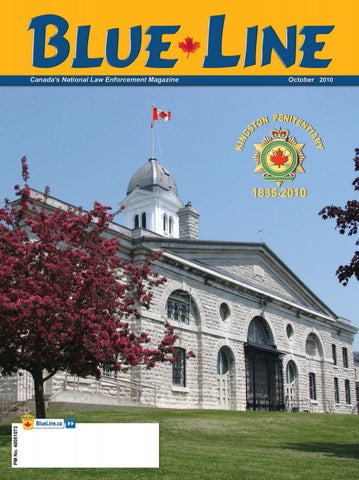
Kingston Penitentiary first opened, and then securely closed, its doors in 1835. This year celebrates its 175th Anniversary. This penal institution has had many formal name changes and even a few euphemisms over the years. The most endearing being “KP” or “The big house.” The descriptor that could be least identifiable would be “Club Fed.” Turn to page 6 and read more about this institution’s colourful history..
Features 6 Keepers of the public will
24 Volume analysis allows more DNA testing
Canada’s first penitentiary celebrates its 175th anniversary
10 Northern exposure
26 Public-private DNA testing improves delivery
14 The incident
28 The ultimate force multiplier
Departments
Case Law
38 19 13 21 31 36, 37 5 30 20
32
Forced entry justified, top court rules
34
Charter breaches net arrestee cash
An Ottawa cop’s one year walk on a frosty beat
Part 2
Advertisers Index Deep Blue Dispatches Education Directory Letters Market Place Publisher’s Commentary Representative Profile Technology
Blue Blue Line Line Magazine Magazine
33
October 2010 OCTOBER 2010
October 2010
4
Blue Line Magazine
Publisher’s Commentary by Morley Lymburner
A fear of responsible gun ownership “Deception is an arrangement of light and dark... chiaroscuro... The people must be made to see white where there is black when this is necessary to the progress of the revolution...” German communist leader Willi Munzenberg made this remark on artistic style to Lenin in 1917 as they were heading to Moscow by rail to begin the Russian revolution. The basic concept is still employed worldwide by many who seek to invoke their will on the masses. Very few issues have polarized so many Canadians as much as the great firearms registry debate. It has pitted east against west, rural against urban, rich against poor and police against public. It has framed liberal and conservative politics ruled by people only too happy to take many down murky roads of understanding where white and black are not easily identified. As in many issues that have become political, I have attempted to keep this magazine as neutral as possible, however there are times when events overtake neutrality and force us into a corner. My opinion (mine alone) is that the firearms registry has never worked as a tool for police nor as a method to reduce crime and violence. Neither has it been a tool of taxation, an attempt to disarm the citizenry or a police power grab to create a sinister dark oligarchy. If people take off the various rosy and dark glasses provided by political hacks and self-interest groups, the reality becomes a little more clear. The registry is about responsible ownership. Gun owners who say they are law abiding citizens yet break the law by not registering them are trying to suck and blow at the same time. A responsible owner surely wants to demonstrate that responsibility, not for the sake of police or politicians but for family, neighbours and community. If I live next door to a person who enjoys
Blue Line Magazine
his firearms collection yet rails against laws designed to make him responsible for possessing them, what does that tell me about the security of my household? A neighbour who can convince me that he is abiding by proper rules of safety and laws regarding firearm ownership has my confidence. This is exemplified through Blue Line Magazine’s firearms editor, Dave Brown, who states that he enjoys firearms and collecting so much he has no problem taking the extra effort to register them and abide by all the laws that go along with that. Most of us similarly enjoy cars and have no problem with far more extensive rules – testing, regulations, licensing, and higher fees than the firearms registry. Going through these processes indicates responsible ownership and demonstrates this to our neigbours and communities. We are all aware of individuals who cut corners, failing to get insurance, registering change of ownership, letting their vehicles become unsafe and drinking and driving. Every responsible citizen would look upon most of this as being irresponsible. Firearm lobby groups and some politicians demand no registration for rifles and shotguns. They have no issue with owners being licenced to possess a firearm, nor being screened and tested by police to purchase them – but want to keep private the models, number of guns and serial numbers that they own. It defeats my understanding of what’s rational. Police chiefs say their officers often access the firearms registry and that it has made them safer and, in some ways, saved lives. They have somehow confused the purpose of the registry and seem to think evidence of extensive use is a good thing. In most police training officers are encouraged to use their authority with discretion and restraint. The old adage, “if you abuse it, you lose it,” sums this up quite well.
5
Applying this to the firearms registry, we find an attitude of wholesale usage of information for legitimate or spurious motives. Introducing a police tool with no protocols is asking for trouble. An officer investigating a bicycle theft has no reason to check the registry, yet this happens at many agencies, artificially inflating useage and, by suggestion, validating its existence. The most potentially dangerous scenario is that an officer lets down his guard after finding there are no firearms registered to an address. The firearms registry went through a considerable crucible of fire. Originally a simple process, it very quickly became a nightmare for registrants and a boondoggle for statisticians wanting information and politicians looking for advantage. Lost in all the ensuing hoopla was the idea of demonstrating responsible gun ownership and encouraging acceptance by keeping to the basics. Name, make, calibre, serial number and address. The money to build the registry has, rightly or wrongly, already been blown and we must salvage what we can, discarding portions if need be but not the whole thing. That would not be responsible management of money spent. If a house is extravagantly built the wrong way we don’t put it in the dumpster. Even if the structure is unsafe, there is something that can be salvaged. If it is too expensive to maintain then reset it so it will be more economical. We should at least be able to salvage the values of responsible gun ownership, identify chiaroscuro rhetoric for what it is and look beyond political opportunists and special interest groups.
OCTOBER 2010
Keepers175
th
of the public will Canada’s first penitentiary celebrates its 175th anniversary
by Dave Johnston The first penitentiary in British North America sits on 8.6 hectares of land at 560 King Street West in the City of Kingston, County of Frontenac. The Kingston Penitentiary fronts onto Lake Ontario on the south side, a residential area to the east, the penitentiary museum and now decommissioned prison for women site to the north and the Portsmouth Olympic Harbour to the west. There surrounding stone walls contain more than 40 buildings. Originally called the “Provincial Penitentiary of the Province of Upper Canada,” (provincial penitentiary, for short), the institution was constructed in 1833-34 under the reign of King William IV. Under the direction of William Powers, an American, its design was heavily influenced by the system in place in Auburn, New York at the time. The facility consisted of a single, large October 2010
limestone cellblock containing 154 cells in 5 tiers and some wooden outbuildings used as industrial shops, sheds, stables and residences for the administration. It officially opened on June 1, 1835 with the arrival of the first six inmates. Henry Smith was the first warden and Powers was appointed as the first deputy warden. When completed, it was the largest public building in Upper Canada. The original cells measured 73.7 cm (29 inches) wide by 244 cm (8 feet) deep and 200.7 cm (6 feet, 7 inches) high. The entire compound was initially surrounded by a 12-foot high picket fence made of wood. The cells remained the same small size until the first major renovations were undertaken between 1895 and 1906. The other wings of the main building (B2, B3, B5) were begun shortly after the opening and completed in the 1840s. The stone walls, towers and north gatehouse were finished in 1845 and the dome was added between 1859 and 1861. The north wing originally housed the dining hall, kitchen, hospital, keeper’s hall, administration offices and residences. The B8 building was begun in the late 1830s as the dining hall and chapel and the B7 building was commenced in the late 1840s for use as the permanent hospital facility. Limestone industrial shops were built in the 6
southern part of the yard in 1845, containing shops for blacksmithing, carpentry, tailoring, shoemaking and a “rope walk” for making rope. The buildings now occupied by the regional treatment centre were begun in the 1850s and originally used as additional shop space. With the union of Upper and Lower Canada in 1841, the institution became known as the “Provincial Penitentiary of the Province of Canada” and, after Confederation in 1867, became more commonly known as “Kingston Penitentiary.” It was one of three such institutions placed under the federal government control – the others were in Halifax, Nova Scotia and Saint John, New Brunswick. Women were incarcerated within the institution’s walls, although segregated from men, for the first 99 years, and children as young as eight were also held in the early days. Kingston Penitentiary has experienced three major riots – in October 1932, August 1954 (causing extensive damage and the need to rebuild the central dome) and April 1971. The latter was the most serious; staff were taken hostage, inmates were killed. The south wing was so badly damaged that it never reopened as a cellblock. In the aftermath, Kingston Penitentiary became the regional Blue Line Magazine
reception centre, receiving and assessing all newly admitted inmates in the Ontario Region and classifying them for transfer to a parent institution. It held this role until 1981. Today, Kingston Penitentiary accommodates a static inmate population classified at the maximum-security level, many of whom cannot safely integrate into other institutional populations. The temporary detention unit, which was relocated from Millhaven in February 1998, can house up to 37 inmates. The unit re-assesses more than 1,000 offenders each year for placement at a parent institution.
Blue Line Magazine
The regional hospital, which provides 24 hour nursing care (including palliative) and the regional treatment centre, an independently managed mental health treatment facility, are also on site. The institution also manages the regional hospital surveillance team, providing security services for inmates admitted to community based hospitals. Most of Canada’s more notorious inmates have spent time at Kingston Penitentiary. Inmate convictions range across the broad spectrum of Criminal Code offences and the population represents a cross-section of Canadian society, including foreign nationals
7
(the majority face deportation orders upon release). Each of the buildings in the Kingston Penitentiary complex more than 40 years old were evaluated in May 1990. The north gate and main cell block complex were designated as federal heritage buildings and a recognized designation was agreed upon for the north gate, shop dome, east and west workshops, administration building and five towers. Dave Johnston is the warden’s executive assistant at Kingston Penitentiary.
OCTOBER 2010
Kingston Penitentiary
– an imposing history
by Dave St. Onge By 1834, the imposing limestone cellblock of the “Provincial Penitentiary of Upper Canada” was standing in readiness for the arrival of its initial occupants – at least physically. The building, accompanied by a few wooden outbuildings, stables and shops, was surrounded by a 12-foot high cedar plank fence as a security perimeter. There are references in the warden’s letter book to a sheriff arriving from Niagara prematurely with a few inmates in April, 1835 but Warden Henry Smith refused to receive them. He hadn’t hired any security staff and did not have enough funding to begin operations, he told the sheriff, who returned to Niagara with his charges. The first staff members were finally hired in May but the government of the day still had not provided sufficient funding to support an inmate population, nor the necessary and varied functions required to operate the facility. During the same month the steamer ‘Great Britain’ arrived in Kingston from Toronto, carrying amongst its passengers six convicts destined for the new penitentiary. Five had been sentenced in the Home District (Toronto) and the sixth in the Newcastle District (Port Hope area). Presumably having received word that the money was on its way, the six men were held briefly at the Midland District Gaol in Kingston (at the corner of present day King St East and Clarence Streets – where the current Custom House stands). The money finally arrived and Smith assigned keeper Thomas Pope and guard John Swift to retrieve the group on the morning of June 1. They were marched in ranks of two along the shore of Lake Ontario, a sombre procession over a distance of three kilometres between the two facilities. Their arrival at the penitentiary gates commenced 175 years of penitentiary history in Canada. The first six inmates were all convicted of theft related crimes. While registered inmate #1 was Matthew Tavender, he wasn’t actually the first person to be sentenced to serve time in the penitentiary. That dubious honour went to #6 – Joseph Bonsette (also recorded as Bonisette; Bouchette), who was sentenced on Jan 14, 1835. The other five, including Tavender, were sentenced on April 18th. It is likely that, as they were received at the institution, they were simply recorded in the convict ledger in the order in which they entered the building. October 2010
Despite ongoing research, very little is known about these men: #1 – Matthew Tavender, grand larceny. Sentenced April 18, 1835 to three years and discharged 18 April, 1838. He occupied Cell #4, 2nd range, east side. #2 – John Hamilton, felony. (Sentenced to three years April 18, 1835 and discharged 18 April, 1838.) #3 – Edward Middlehurst, grand larceny. He was sentenced to five years and perished while in prison due to the effects of dropsy on Sept. 12th, 1836. Aged 48. A widower, Middlehurst stood 5’ 5 ½” tall and was described as having a florid complexion, dark gray hair and grey eyes. Born in England, his trade was listed as a joiner. #4 – John O’Rorke, grand larceny. Sentenced to five years, O’Rorke died in prison of carditis on Nov. 22, 1838. He was 32 years. #5 – John Dyas, grand larceny. Sentenced to three years April 18, 1835, he was discharged April 18, 1838. #6 – Joseph Bonsette (or Bouchette), grand larceny. Sentenced to five years, he was discharged in Jan. 1840. Bonsette occupied cell # 1, 5th range, east side. He is recorded in the discharge register as having been 17 years old at conviction. Height = 5’ 3 ½”; Complexion = dark. First officers Applications were received in May, 1835 and 12 upstanding men were selected within the next 10 days to fill these somewhat unique positions. It is recorded that the first officers to actively take charge of inmates were Thomas Pope as ‘principal watchman’ and John Swift as ‘private watchman.’. The stories of Pope and Swift are quite different. Unfortunately the available information is limited. Pope, the senior officer, was hired on May 12. Little is known about him prior to his appointment or after he left the staff. It is recorded that his first assignment was to mark and take charge of the inmate clothing and the various provisions of the facility. Unfortunately, his tenure was relatively brief. In 1837 he was fired for stealing government property. It was determined that he had taken “a small quantity of peas” on a number of occasions. From this point, he appears to fade into history. Swift’s career was entirely different. For 48 years, Watchman Swift remained on staff, placing him among the longest serving correctional 8
officers in Canada. He was promoted to the rank of keeper in November 1842 and put in charge of a squad of junior officers but, for an unknown reason, he reverted back to the rank of guard in March, 1850. Swift was serving as the institutional ‘messenger’ by 1861, running mail and supplies into town and back. He retired in 1883 and died on June 29, 1884. First escapee Inmate John Jackson, sentenced to serve one year for grand larceny on Nov. 18, 1837, escaped from his cell on the night of Dec. 19, just one month after his arrival. He used a dummy placed in such a way as to appear as though he was still present. Keeper Keely, officer in charge of the gallery to which Jackson belonged, was subsequently dismissed for his negligence in not ensuring that all convicts were present on the evening of the escape. He took it upon himself to follow the fugitive’s tracks through the snowy woods and by road. He found him on Dec. 21 in the charge of a local resident named Phelps at Simmonds Mills (now Wilton, Ontario). Apparently Phelps, prompted by the $100 reward offered for Jackson’s recapture, had managed to secure him only minutes before Keely’s arrival. They returned Jackson to the penitentiary, two days after the escape. The board of commissioners later reinstated Keely due to his personal efforts in tracking the escapee and the findings of an investigation. It was determined that the hospital keeper, Christopher Julian, had also been negligent in telling Jackson to return to his cell on his own instead of making sure he was secured in his cell. Jackson was given three dozen lashes with the cat-o-nine-tails. He was described as 33 years old and of African-American descent, standing 5’ 4.5” tall. It was recorded that he was missing some toes on one foot due to frostbite, which explains his familiar contact with the hospital keeper on the day of his escape. Jackson was discharged on Nov. 18, 1838 and paid 15 shillings to cover his travelling expenses back to Toronto. Dave St.Onge is curator of the Correctional Service of Canada Museum.
Blue Line Magazine
Blue Line Magazine
9
OCTOBER 2010
exposure
Northern
An Ottawa cop’s one year walk on a frosty beat
by Tony Palermo Cst. Louise Lafleur squinted as she looked out the patrol truck window, trying to avoid the headlight’s glare on the thick blowing snow. She was carefully searching for two subjects from separate calls, both last seen on the street right behind the detachment. Lafleur knew a bad situation would likely become worse if they crossed paths. A polar bear suddenly appeared in their path. Lafleur’s partner eased their truck to a stop and for the next several moments, bear and cops stared at each other, each undoubtedly playing out situations in their minds and assessing responses. The bear eventually looked away, dismissing the officer’s presence as more of a nuisance than a threat. Reaching for her camera, Lafleur was able to snap a quick picture before trying to change its mind. She activated the siren and her partner inched the truck forward, ready to take evasive action if the bear decided to stay and fight. Fortunately, the white beast decided to flee and they followed it to the edge of town, where armed villagers on snowmobiles continued the chase. A few minutes later, the officers found their next subject, an intoxicated female completely oblivious to what had just occurred. Lafleur was only a month into a year long secondment but had already experienced so much. “Just another day in Qik,” she thought, chuckling to herself. Qikiqtarjuaq, Nunavut (Qik for short) is high up in the Arctic, off the eastern coast of Baffin Island along the Davis Strait. A vast October 2010
white tundra, it’s a harsh environment where it barely reaches above freezing in the summer and typically dips to -30C with wind chill during the winter. Two RCMP officers, on call 24/7, typically police the town’s just under 500 people. So, how did this Ottawa cop come to trade the comforts of the city for such a different environment? “I first heard about it in 2007 when a letter of interest was circulated,” says Lafleur, a veteran Ottawa Police Service (OPS) officer. The original idea was to have a few officers participate in a month long exchange with the RCMP in Nunavut. OPS chief and former RCMP C/Supt Vern White’s last posting was as commanding officer of Nunavut’s V-Division, a position he held until 2003. With 19 years of northern policing experience, he understood its unique challenges and learned on taking over as OPS chief in 2007 that Ottawa had a sizeable and fast growing Inuit population. White heard about the continuing challenge in attracting officers and recognized that a secondment opportunity could be a win-win situation for both services. OPS officers could grow and learn more about policing the city’s Inuit community and the RCMP would get some temporary relief for staffing shortages. “I knew C/Supt Marty Cheliak quite well,” says White. “I said to him ‘look, I’d love to send a couple of officers up. I think you’ll gain, they’ll gain, we’ll gain and our community will gain by us having the chance to police Ottawa’s next citizens in their own community.’” After firming up the deal, White received 28 applications in response to a letter of interest, including one from Lafleur, who has always been keenly interested in the north. She participated in a mentoring program with youth from Ranklin Inlet in 2000, based in part on a proposal she 10
Cst. Louise Lafleur and RCMP Cst. Kemp developed to address some of the challenges that they faced. This project, her leadership abilities and keen interest in the Inuit community led to her being one of the two officers White selected. Lafleur spent time at Larga Baffin, an Ottawa Inuit centre, to learn more about the people, their culture and land. She developed relationships there which would prove valuable later in her tour, took Arctic and winter survival training in February 2008 and was in Hall Beach, Nunavut by March. This brief exposure to the challenges and excitement of northern policing made it an easy decision when White asked in June 2008 if she would be interested in a longer, more isolated assignment. Lafleur arrived at Qikiqtarjuaq’s two officer detachment in October 2008 to begin her one year tour. While Lafleur’s one month posting gave her a taste of the uniqueness of northern policing, she quickly realized that her time in Qikiqtarjuaq would be even more challenging. The polar bear call is a good example of the demands. “Unless you’re from the north, nothing prepares you for how to deal with this type of call,” she notes. Interestingly, in a place where a joint typically sells for $60 and a mickey costs $120, her most common call was for intoxicated persons, followed by domestics and fights. All three can represent a serious threat to officer safety under even ideal conditions. Add the weather, limited information from dispatch, sleep deprivation, Blue Line Magazine
the community’s distrust of new officers, reluctance and fear of being seen publicly working with police and English being a second language not taught until grade five and you have a highly volatile mix. “Oh and remember it’s just you and your partner, backup is about three hours away and medical help is limited,” Lafleur adds with a laugh. “And, by virtue of their hunting culture, most of the locals are armed with all kinds of nice things like knives, rifles and harpoons. You definitely have to be quick on your feet.” Less than three months into her tour, Lafleur and her partner were dispatched to a disturbance call and learned the subject was angry, likely armed and a specially trained, reservist Canadian Forces Ranger. Within minutes, dispatch told them he had positioned himself in a defensive position on top of a nearby hill and was taking direct aim at their location. The officers and the subject’s brother, who was acting as a translator, took cover behind the patrol truck and attempted to locate him in the distance. While doing so, the subject approached from behind, drew his rifle and pointed it at them. Lafleur and her partner scrambled for cover on the other side of their truck while the brother was caught in the middle between the subject’s rifle and officer’s sidearms. They all attempted to talk down the subject; when the brother realized they were not getting anywhere, he rushed and tackled the subject, allowing the officers to move in for the arrest.
Blue Line Magazine
The courts sentenced the Ranger to nine months of probation and a condition to possess firearms only for hunting. The officers? They remained alive to patrol another day. In such a high-tempo, unpredictable environment, sometimes it’s not a matter of if but when you will get hurt – and how bad. For Lafleur, it happened a few weeks later in early January, 2009, when she and her partner were dispatched to a B&E in progress. Dispatch said a frightened mother and her children were in the house and that an intoxicated male was still on scene and trying to get in. They recognized the subject and approached him. Although intoxicated, he was compliant and, after several minutes of talking to him, they determined he wasn’t a threat. As they escorted him down the stairs, he suddenly made a move to jump the banister. Lafleur reached out to grab him but gravity and
11
his weight proved to be to much. She fell and felt a sharp pain shoot through her shoulder. “Looking back, before we left, we probably should’ve cuffed him,” says Lafleur, “but he was responding to verbal instructions and we had no reason to believe that he was going to be a problem.” Lafleur’s partner ran after the subject. With one arm virtually useless, she jumped into the patrol truck and caught up to her partner. Together they managed to cuff him but the fight was still on. Although extremely tired, the officers somehow managed to hoist him up and secure him in the 4X4. “That was tough,” says Lafleur. “It’s not like a regular cruiser where you’re lowering them down to the back seat. We had to drag this guy up into the truck and he didn’t want to go.” At 0300hrs, with the prisoner safely tucked in, it was determined that Lafleur’s shoulder injury was serious enough to require hospital treatment. The RCMP flew in a replacement officer later that morning and at 1000hrs, the now rested, sober and compliant prisoner was fingerprinted, photographed and driven home. By 1030hrs, Lafleur greeted her replacement officer as he got off the plane, boarded and flew to Iqaluit and then on to Ottawa on a commercial flight. Arriving at around 1700hrs, she was treated for a broken collar bone and on her way back home by 2300hrs. Five months later, Lafleur returned to full duty in Qik on May 15, 2009.
OCTOBER 2010
Despite the challenges of policing the north, it’s not all bad and confrontational, she stresses. “It’s only a handful of people that cause most of the problems. People skills are really important. It’s crucial to form partnerships in the community.” Building these relationships takes time and is not always easy. “Yes, it’s hard but it is possible,” she concedes. “Officers new to the north have to humble themselves and realize that they’re outsiders – that the uniform alone will not command respect from the community.” Lafleur reached out during her tour, establishing herself as competent, kind and fair, and took an active interest in helping residents. She organized a hockey equipment drive for the local youth – the community had a small arena but most residents had no equipment or skates. “I got in touch with OPS east division administrative assistant Bev Mulligan,” says Lafleur. “I asked her to send an e-mail challenging officers of the division to put together a little equipment that I could bring back with me. Well, it kind of snowballed from there.” Many OPS officers, several residents and Ottawa area companies answered the call, a plane load of equipment was shipped in and all of the children got to select a pair of skates, helmet, jersey and hockey stick. Once they had all been fitted, the adults went next. With plenty left over, the remainder was sent by the RCMP to another northern village. “It was great,” Lafleur says. “The kids were so excited that they skated on snow packed roads until the ice was ready.” For their efforts, Lafleur and Mulligan received the community service award from the
Ontario Women in Law Enforcement (OWLE). Lafleur knew that she was on the right track when she was invited by a group of locals to go seal hunting. “They had a good laugh at my expense,” says Lafleur. “I was trying to take aim at this seal in the water, far off in the distance. The boat was bobbing, the seal was bobbing and I had trouble hitting it.” Round after round, she kept missing. In fits of laughter, one of the locals piped in and said “Hey, if ever you get in trouble and Lou shows
up, just move a little and you’ll be safe.” Officers new to the north are sometimes surprised to find they’re expected to be jackof-all-trades. If someone dies, they take the body to the morgue, which in Qik is a 4’ by 6’ plywood shed. Lafleur recalls playing the role of locksmith. “I was on the phone with the locksmith company being given step-by-step directions on how to fix one of the detachment’s door locks,” she says. “You can’t just say that you can’t do something or it’s not your job. You have to make it happen. The alternative is that they have to fly someone in.” Now back at OPS patrolling out of east division, Lafleur notes it was an adjustment to return to being a city cop. She remembers one of the first nights back when her phone rang at 2300hrs. “I bolted out of bed, ready to respond to a call,” she says. “Then, just as I answered it, I realized that I wasn’t in Qik anymore.” Lafleur also found responding to city calls a bit of an adjustment. “I’d be there with another officer dealing with the call and then I’d look back and see a whole wave of blue behind us.” The comforts of the city are nice though. In Qik, everything is flown in, substantially inflating the price of goods. A box of Kraft Dinner costs more than $2, a bag of chips $8 and a case of brand-name soft drinks $84 (ironically, more than a joint and almost as much as a mickey.) “You tend to miss the things that most people take for granted,” says Lafleur. “Even something as simple as being able to take a drive – to get away and disconnect for a bit. In Qik, you’re on 24/7, and while you’re allowed on paper to be up to an hour away, you would never leave your partner or the community in that position.” She reflects on her time in Qikiqtarjuaq and the problems residents face. “Challenges? Well they certainly don’t think they have any,” she says,”but what I see is an older, traditional generation in conflict with a younger generation that is caught between our world and their northern, traditional world.” She advises officers heading north to “humble yourself. Build relationships. Have a respect for the people and try hard to earn their respect. This is their world. Learn from them and let them lead the way.” Lafleur knows she earned the respect of the people of Qik. Just before leaving, the locals held a party in her honour, something they rarely do for departing officers. The whole community showed up and as a token of appreciation, she was presented with a 3 foot Ivory Narwhal tusk by the parents of the Ranger. “That was something,” says Lafleur. “We actually had one more call about him a few weeks earlier where he had destroyed his parents home. They called us and we were able to talk their son down without incident.” Lafleur continues to take an active interest in Qikiqtarjuaq. She has organized a school exchange which will see students from Lester B. Pearson school in Ottawa spend a week there. A month later, 10 students from the village will come and spend a week in Ottawa. In a way, it is almost like she never left. Tony Palermo is Blue Line Magazine’s correspondent for the Eastern Ontario & Western Quebec region. A freelance writer and former federal corrections officer, he can be contacted at tony@blueline.ca .
October 2010
12
Blue Line Magazine
In memory of Ralph Toews Thank you for publishing the article “Communications and the extra man detachment” (Aug/Sep 2010 - pg 30). Ralph Toews got his copy of Blue Line Magazine. I spoke with him on the phone and he was pleased with the article about him and his wife Vivian. Ralph died suddenly August 16, 2010, but we were all pleased he got to read the article. I have passed along his obituary so your readers will know the rest of the story. Thanks Morley. Jack Kenny,
Blue Line Magazine
13
TOEWS, Ralph Edward John – October 1, 1929 - August 16, 2010 – Ralph was a gentle and loving man who will be missed more than words can be expressed. He was a treasured brother, husband, father, grandfather, great-grandfather. In 1948, Ralph joined the RCMP, Regimental No. 15511. In 1949, he was transferred to “K” Division and served twenty-five years in various locations throughout Alberta. He finished his dedicated twenty-five year career in Calgary where he served as SubDivision East Section N.C.O. and West Section N.C.O. He retired as S/Sgt in 1973. During that same year, he became an Investigator for the Alberta Ombudsman and retired in May 1990. Ralph will be laid to rest at the RCMP Depot in Regina.
OCTOBER 2010
The
incident
Part 2 in a series on confrontations with disorderly persons by Michael Weaver
Robert Dziekanski’s death prompted a public inquiry and nationwide debate. The Braidwood Inquiry investigated this and other incidents of Taser use and in-custody deaths. Its recommendations, originally intended for BC police, will impact all of Canada as other provinces consider legislation. Dziekanski’s death resulted in the four RCMP officers who responded to the airport that day being put through the ordeal of a criminal investigation. While I cannot reverse time to prevent such tragedy and loss, I can help readers better prepare and possibly avert such circumstances prematurely ending your career. Many things stand out from a review of the Dziekanski incident video: • Multiple discharges of the conducted energy device (CED). Exercising excessive force and “brutality” is likley the number one type of complaint against law law enforcement officers. What is not undestood, is thatvalid complaints are a reflection of unrealistic training. To this author, multiple discharges is a clear indication that the officer did not have a “plan B” if the less than lethal device failed to achieve the desired result. If we assume an officer’s lack of malice, it is obvious that the expectation is that the subject would comply with the arresting officer after the CED has been deployed. No officer, regardless of intent, would place themselves in a position that would bring such scrutiny and possibly end their career. The consequences of an “incident” is well known, especially considering the current negative media sensationalism surrounding in-custody deaths. Realistic training, not power-point presentations, give the first responder a plan of action to utilize when traditional methods fail to gain control of the extremely agitated individual. • Dziekanski was physically agitated and appeared to be sweating, even though his activity level did not appear to be enough to work up a sweat. • Dziekanski could be heard breathing, indicating extreme effort. His respiratory rate, based on observing the heaving of his chest and the audio, was more than 44 respirations per minute. While there are many physiological factors effecting ventilation and chemical balances in the body, such a prolonged respiratory effort could very easily place an individual at risk of respiratory alkalosis. If it continues untreated, that can result in effects such as altered level of consciousness, decreased cardiac output and cardiac rhythm October 2010
disturbances in certain individuals. • I could see the white of Dziekanski’s eyes. This is known as lid lift and is abnormal. In conflict, it is normal to squint to protect one of our most important senses. This presentation is a good indication that all is not right. • Defense tactics (hand-to-hand) techniques appeared “sloppy.” This is quite common, as most law enforcement agencies have de-emphasized this training with the introduction of less than lethal adjuncts; their use has come under increased scrutiny. Dziekanski was in a medical crisis, the officers involved in his subdual and restraint likely had no access to his personal history and no means to properly communicate with him. As I have seen in several other cases, they expected that deploying the conducted energy weapon (CEW) would make him comply but with altered mental states, that simply does not happen. The CEW is a tool of incapacitation and subjects should be restrained during its use. If the behaviour continues, medical intervention is needed. Basic first aid and CPR will maintain “patient” viability until the arrival of advanced life support. Unfortunately, the current economic crisis will only increase the likelihood of first responders being forced to deal with agitated and/or violent individuals. As funding is redistributed from non-critical social programs to maintain the day to day business of local government, mentally ill clients/patients will be released into the public to attempt independent living. Mental illness alone does not represent great risk but when combined with illicit drug use, we now have the potential for disaster. Below are excerpts from the Braidwood Inquiry and its recommendations (in italics), along with my comments. The focus is on CEW use, though they have far reaching impact into the day to day duties of all first responders. iii. Emotionally disturbed people In Part 9 I discussed at length the chal14
lenges that police officers face when confronted with emotionally disturbed people who display extreme behaviours, including violence, imperviousness to pain, superhuman strength and endurance, hyperthermia, sweating and perceptual disturbances. The unanimous view of mental health presenters is that the best practice is to de-escalate the agitation, which can best be achieved through the application of recognized crisis intervention techniques. Conversely, the worst possible response is to aggravate or escalate the crisis, such as by deploying a conducted energy weapon and/ or using force to physically restrain the subject (249). It is accepted that there may be some extreme circumstances, however rare, when crisis intervention techniques will not be effective in de-escalating the crisis but even then, there are steps that officers can take to mitigate the risk. Training in crisis intervention is relevant beyond the issue of conducted energy weapon use. Officers are, with increasing regularity, called upon to deal with emotionally disturbed people. The psychiatrists and other mental health professionals who made presentations during our public forums have persuaded me that the weeklong crisis intervention training that they talked about should not be tied just to use of conducted energy weapons, but should be an essential part of recruit or in-service training. Currently, the mindset between psychiatric care facilities and first responders differs greatly. On the surface, this is understandable, although when we look at any individual presenting with an “altered mental state” and realize the multiple causes of such presentations, we see that there are simply too many unknowns. The resources required to deal with that one individual are significantly higher than the average scenario so new tactics must be adopted. A resident in a psychiatric care facility or an emotionally disturbed individual on the street does not just go into a psychotic episode without warning; this event follows several days of sleep deprivation, drastic changes to diet and fluid intake, non-compliance with medications and ideations – and that’s not considering the possible use of illicit drugs. This individual is in need of emergent care, not “talking down.” There are brain and metabolic imbalances – and how much adrenaline does it take to keep a person awake for a minimum of three days? This is possibly why restraint and seclusion have ended in death in psychiatric care facilities; the patient was having a medical emergency, not a psychiatric emergency. Other precautionary measures 1. Requesting paramedic assistance The Commission’s empirical analysis showed that provincial ambulance attendants examined the subject at the scene in 33 per cent of cases, although this percentage varied widely (zero to Blue Line Magazine
71 per cent) among police departments. In 24 per cent of cases, the subject suffered a weaponrelated injury, although only two per cent were more serious than welts from push-stun mode deployment, penetration of probe darts, cuts or falls following incapacitation. In some cases, it will be self-evident to the officer whether or not paramedic assistance should be requested. What is less clear are the other instances when a medical emergency hasn’t yet occurred but medical risks are present. In such cases, prudence dictates a request for paramedic assistance either before deployment of the conducted energy weapon or as soon as practicable after deployment. Recommendation 8 I recommend that paramedic assistance be requested in every medically high-risk situation, preferably before deployment of a conducted energy weapon or, if that is not feasible, then as soon as practicable thereafter. Medically highrisk situations include, but are not limited to: • deployment in probe mode across the subject’s chest; • deployment in probe mode for longer than five seconds; • deployment in any mode against: - an emotionally disturbed person; - an elderly person; - a person who the officer has reason to believe is pregnant; or - a person who the officer has reason to believe has a medical condition that may be worsened because of the deployment (e.g., heart disease, implanted pacemaker or defibrillator, etc.).
Blue Line Magazine
What is concerning is the lack of communication with fire/EMS, medical directors and emergency physicians regarding the focus of “emotionally disturbed” individuals without considering the EMS policies on evaluation, treatment and transport of an individual in an “altered mental state.” In addition, according to recommendation #8, paramedics will be mandated to evaluate these individuals. Currently, there is no reference to what training needs to take place to enable this interaction between fire/EMS, law enforcement and the “disturbed” individual. There is also no standardization of equipment and training needed to package said individual for transport to the nearest hospital emergency department or if the “emotionally disturbed” must be taken to a psychiatric care facility. The average citizen has the option to run away in a fight or flight situation. The first responder (law enforcement, fire and EMS), has a duty to confront any threats to society and mitigate them. This selfless commitment to our chosen professions has set us up for failure in the presence of an in-custody death. With the implementation of Braidwood’s recommendations and similar laws, the first responder will need new tools and training to accommodate new policies and procedures. Michael Weaver is a Washington State paramedic who can be reached at michael@ccpicd.com . The Braidwood Inquiry’s report and recommendations can be viewed at http://www.braidwoodinquiry.ca . Other useful information may be gleaned from http://emedicine.medscape.com/ article/301680-overview .
15
OCTOBER 2010
Police Leadership Graduates Fall 2009 - Summer 2010
The Staff and Faculty of the Police Leadership Program congratulate all graduates on their success! Administration Certificate Sgt. Cory Bushell RCMP, Halifax, NS Sgt. Lyne Couture RCMP, “J” Division, NB S/Sgt. Andy Golebioski Winnipeg Police Service, MB Sgt. Wilda A. Kaiser RCMP, St. John’s, NL Sgt. Mona Kauffeld RCMP, Summerland, BC Cpl. Kevin Lewis RCMP, Iqaluit, NU Sgt. Grant MacDonald RCMP, Masset, BC Det. Greg Mason Halifax Regional Police, NS Sgt. Dwayne Pike Amherst Police Department, NS Sgt. Paul Rubner Calgary Police Service, AB
Cst. Salvatore Serrao Montréal Police Service, PQ Sgt. Wendy VanderSchee Calgary Police Service, AB Sgt. Bryant Wood Port Hope Police Service, ON Law and Justice Certificate S/Sgt. Katherine Alchorn Fredericton Police Force, NB D/Cst. Andrew Balog Brantford Police Service, ON Det. Mike Bassier Peel Regional Police Service, ON A/Sgt. Davis Baxter Peel Regional Police Service, ON S/Sgt. Murray Brown Thunder Bay Police Service, ON Sgt. Greg Doerr Hamilton Police Service, ON Det/Cst. Colin Grierson Halton Regional Police Service, ON Cst. Alana Grubb RCMP, Hamiota, MB Sgt. James D. Lamothe Durham Regional Police Service, ON
Cpl. Tim Sowers Fredericton Police Force, NB Larissa Stanton Canada Border Services Agency, Trail, BC Sgt. Andrew Toms Hamilton Police Service, ON Sgt. Stephen B. Wilson Saint John Police Force, NB Service Delivery Certificate Cst. Christopher Hastie RCMP, Bay St. George, NL Cst. Edward Jermol Waterloo Regional Police Service, ON Cst. Allan Kelly Charlottetown Police Service, PE S/Sgt. Frank Landry RCMP, Southwest Nova, NS Cst. Brent Legere Fredericton Police Force, NB Sgt. Rhonda Meakin Prince Albert Police Service, SK Cst. John Walsh RCMP, Trepassey, NL Sgt. Dean Young Seba Beach Protective Services, AB Supervisory Skills Certificate Cst. Stacey Anderson RCMP, Toronto, ON Cst. Timothy Evans Waterloo Regional Police Service, ON Cst. Amy Hachborn Waterloo Regional Police Service, ON Cst. Tracy Kirkwood Calgary Police Service, AB Cst. Tom Lee Waterloo Regional Police Service, ON Det. David MacDonald York Regional Police Service, ON A/S/Sgt. Sean McKenna Peel Regional Police Service, ON Cst. Jeff Mitchell RCMP, Halifax, NS Sgt. Kirk Robertson Kawartha Lakes Police Service, ON A/Sgt. Scott Rome OPP, Thunder Bay, ON Advanced Police Leadership Det. Doug Crippen Calgary Police Service, AB Cpl. Bobbi Simmons-Beauchamp Fredericton Police Force, NB This list is not exclusive. Some students could not be contacted and for reasons of privacy and security some did not wish to have their names included.
October 2010
16
Blue Line Magazine
Sgt. Bruce MacPhail Award 2010 Fredericton Police Force (FPF) S/Sgt. Katherine Alchorn is this year’s recipient of the Sgt. Bruce MacPhail Award for Academic Excellence in Dalhousie University’s Police Leadership Program. Established in 2001 by Phyllis MacPhail in memory of her son, the award commemorates his dedication to lifelong learning in the law enforcement field. Sgt. MacPhail completed the certificate in police leadership, supervisory skills in 2000 and was the first certified police coach in the program. Alchorn graduated from St. Thomas University in Fredericton in 1984 with a Bachelor of Arts in French and Psychology. With a desire to become bilingual, she was accepted into the French squad at the Atlantic Police Academy, graduating as the top academic cadet in 1985. Prior to being hired by Fredericton, she served in Nova Scotia with the Bridgewater Police Service from 1985 to 1989. Alchorn served in the FPF patrol response division, crime prevention unit and the inaugural mobile community police section before being promoted to corporal in 1999 and sergeant in 2004 as NCO in the patrol response division. She was transferred to the criminal investigation division as sergeant in major crime in 2005 and promoted to S/Sgt in 2007. She currently serves as the 2nd I/C of the criminal investigation division. Alchorn was chair of the 2005 “Going Home Run,” which raises money for the New Brunswick Peace Officers Memorial. She received approval in 2007 to host a “Honey I’m Home” one day workshop designed to improve understanding and communication between members and their spouses. She was subsequently awarded the Atlantic Women in Law Enforcement leadership award. She is one of eight trained FPF incident commanders and serves as an Aide de Camp for New Brunswick’s Lt. Governor, His Honour Graydon Nicholas. Alchorn enjoys time off with her 13 year old son Sidney Phillips and is thus an avid football, volleyball and basketball Mom who helped coach her son’s grade 8 basketball team. Her active lifestyle includes athletics; she was inducted into the Oromocto and Area Sports Wall of Fame in 2005 for her contributions as an athlete, coach and official in track and field while growing up in the town. Alchorn received her certificate in police leadership in the concentration of law & justice by completing the police leadership and management development, legal issues in policing and policing and the law of human rights courses. She also took communication skills for police personnel and her goal is to complete the advanced police leadership course. Alchorn is thankful for the Dalhousie Police Leadership program’s learning opportunities, which inspire career and personal character growth and development. Blue Line Magazine
17
OCTOBER 2010
Ticket to ride
Ottawa outfits bikes with portable computers by Tony Palermo The Ottawa Police Service (OPS) has successfully outfitted its fleet of 30 motorcycles with portable computers, effectively giving bike cops the same electronic capabilities as their cruiser colleagues. Officers can now access local, provincial and national databases, including CPIC and RMS; check operational policies, procedures and other internal information on the corporate intranet; view pictures such as mug shots and missing persons; create electronic reports; send and receive e-mail and process electronic tickets. Given the role motorcycles play in escort related duties, outfitting the bikes with electronic capabilities also allows supervisors to conduct roadside briefings on-the-fly. “This is really useful when we’re doing escorts,” says Sgt. Stuart Feldman, a traffic escort and enforcement officer with the emergency operations (EO) division. “We can be roadside, pull up an electronic map and go over our route plans as a team. If the circumstances warrant a change, we have all of the information to plan those changes at our fingertips.” The motorcycle officers are no longer at a disadvantage while conducting traffic enforcement either. With access to CPIC, they can now identify stolen vehicles and suspended drivers. Feldman says that although they could radio dispatch to obtain driver and vehicle information, given the volume of vehicles being stopped during traffic enforcement activities, they didn’t check every driver and vehicle they stopped. “Our dispatch would be overwhelmed with the requests for information if we did that,” says Feldman. “So, as an example, when we didn’t have access to our databases, it’s possible that a vehicle we stopped might have just been ticketed a few minutes before for another violation. Now, we see it as it happens.” “That’s an important piece to a supervisor as well,” says project lead S/Sgt. Rock Lavigne, also with the EO division. “Before we had to wait for our officers to come back and dock their handhelds in order to view their ticket information. That’s no longer the case. A supervisor can now pull up live statistics and see the whole picture, not just a piece of it.” Officer and public safety have also been improved as a result of the installation. The new solution includes GPS functionality, allowing dispatchers to visually track and dynamically assign officers to where they’re needed the most. After putting out a request for proposal and evaluating the responses, the OPS selected and partnered with Intercel Communications, a technology integrator based in Terrebonne, Québec. “Those guys were great,” says Lavigne. “They were extremely professional. Any issues we had were dealt with right away.” It cost $455,000 to equip all 30 motorcycles with a rugged, rear-mounted touring box holding a Panasonic CF-19 Toughbook, a Zebra electronic E-Ticket printer and a driver’s license October 2010
Sgt Stuart Feldman of OPS demonstrates the rear mounted touring box and equipment. card swipe. The CF-19 has a best in class 1000 NIT LCD touch screen that cuts through sunlight. It swivels, tilts and can be put in a tablet format, depending on officer preference. The keyboard is backlit for easy use in low-light conditions and the laptop is fully portable, allowing the officer to remove it from the touring box and use it elsewhere. “There’s another benefit right there,” says Lavigne. “Everything is plug-and-play. If something breaks, it can easily be swapped out, replaced and we’re back up-and-running within minutes.” Data security is provided via an e-Token using a two-factor authentication process. Because the Toughbooks are connected to the corporate network, IT administrators can deliver group security policies that control how often the officer is required to log into the computer and what information they’re allowed to access, among other things. Other features include a new LED emergency light package and a charge-guard electronic system which not only protects the motorcycle’s battery but also significantly reduces the power demand on the charging system. The OPS took a fully collaborative approach to the project. Team partners included senior management, Intercel, OPS information technology specialists and front-line officers. This ensured that the project was not only delivered on time and budget but that what was technically possible was also operationally functional for the front-line officers who would use the equipment. As an example, based on officer feedback, equipment placement was adjusted to be more ergonomic, usable and safe. When the Toughbook was originally installed on the prototype motorcycle, it faced towards the rear. Officers 18
were concerned that they would have their backs toward approaching traffic while standing at the rear of the bike to use the equipment, and their bodies would block the rear emergency lights. The simple fix was to move the Tough Book so that the keyboard faced the side, but that introduced another problem; officers now had to lean over their bikes while they were angled over towards the kickstand. Again, another simple fix– an adjustable tilt-mount was installed which not only propped the laptop up into an ergonomically friendly position, but also allowed each officer to adjust the position to their preference. Another concern officers raised was the brightness of the new LED emergency light package. While it substantially increased their visibility, they found it blinded officers in front and behind them while travelling in escort formation under low-light conditions. The fix was to install a switch allowing them to reduce brightness to 70 per cent power. These were all simple fixes and the feedback allowed design partners to iron out the kinks before deploying the package to all 30 bikes. “This was an extremely successful project,” says OPS IT Operations Manager Lucy McDonald. “Officer feedback has been positive. They’ve indicated that this project is progressive and that it’s like having a mobile office on two wheels.” “It’s like the blinders have been taken off,” Feldman agrees. “We’re no longer at a disadvantage when riding the bike instead of a cruiser.” Tony Palermo is Blue Line Magazine’s correspondent for the Eastern Ontario & Western Quebec region. A freelance writer and former federal corrections officer, he welcomes all e-mails and stories of interest at tony@blueline.ca .
Blue Line Magazine
Deep Blue by Dorothy Cotton
Finding a place for the mentally ill Issue largely unchanged 175 years later Every now and then, the government seems to go on a big building spree, sometimes because it seems to have money to burn – like back in the ‘60s and ‘70s; other times it’s for the opposite reason – no one has any money so the government is trying to get things going. Sound familiar? I am not quite sure what was going on back in 1835, but it seems the government of the day was seriously into building institutions. As noted elsewhere in this issue, it was about that time that Kingston Penitentiary was getting up and running. Curiously, just down the street, another new government facility, initially known as the Rockwood Lunatic Asylum, was being readied. Like Kingston Penitentiary (then known as the Provincial Penitentiary of the Province of Upper Canada), the ‘lunatic asylum’ has had a number of different names over time. Initially named The Rockwood Asylum for the Criminally Insane (it was built on the Rockwood Estate of the MP of the day, James Cartwright), it was subsequently variously called The Asylum for the Insane – Kingston, the Ontario Hospital – Kingston, the Kingston Psychiatric Hospital, the Providence Continuing Care Centre – Mental Health Services and then Providence Care – Mental Health Services. In 1862, the Rockwood Asylum had about 87 inpatients. That increased up to about 1,200 or so at some point in the last century but, like most psychiatric hospitals, has since dropped significantly to fewer than 200 beds today. There were 15 criminal lunatics and 8 convict lunatics in 1863. Curiously, 50 male lunatics were also cooling their heels down the street at Kingston Pen. It appears there was a lot of going back and forth between the lunatic asylum and the penitentiary. Some things really never change, do they? Back in the 1830s and 1840s it appears that criminalizing people with mental illness was an issue. There was just no place for people with mental illnesses to go if they could not be supported in their homes and by their families, the history suggests, so they ended up in gaols. As far as I can
Blue Line Magazine
tell, we have largely gone in a full circle on this issue – with the exception that we tend to say ‘jail’ instead of ‘gaol’ these days. The first piece of legislation providing any kind of care and ‘asylum’ for people with mental illnesses was passed in 1839 – after the legislature rejected it in 1832, 1833, 1835 and again in 1836. The initial intent was to remove the ‘criminally insane’ from places like Kingston Pen, where they were commonly subjected to lashings, beatings and deprivation because of their inability to follow the rules and maintain silence. Along with prison reform in the 1870s and subsequent decades came an increased awareness of mental illness, larger budgets, development of occupational therapy, a greater interest in the medical study of the mind, the early days of clinical psychology and a generally more enlightened outlook toward mental illnesses. It wasn’t all roses of course. People with mental illnesses were still largely cut off from mainstream existence and there were largely no treatments. The inmates of Rockwood Asylum lived in the stables at the Rockwood Estate – not the lovely stone houses – but an element of humanity did start to creep in. Fast forward to today: in the federal correctional system – of which Kingston Pen is, of course, a part – the number of people with mental illnesses has increased dramatically over the last decade. Inmates in the Ontario provincial prison system are:
19
• An average of 27.6 per cent (current) and 34.6 per cent (lifetime) more likely to have severe mental illness. • From one to 26 per cent more likely to have psychoses (schizophrenia, delusional disorder), from 7.2 per cent to 49 per cent more likely to have mood disorders and from 6.8 per cent to 65 per cent more likely to have anxiety disorders. • The prevalence of serious mental disorders among inmates is on average 2.5 times greater than in the general public. • Substance abuse is on average eight times higher among inmates and personality disorders are nine times more frequent. Criminal justice system re-contact rates are significantly higher for inmates with a mental illness. They are: • More likely to violate release conditions; • Equally or even less likely to re-offend; and • Less likely than other inmates to commit a violent offence. The interface between the criminal justice and mental health system is – and apparently has been for a long time – complex and convoluted. People with mental illnesses are (maybe) a tiny bit more likely to be violent and/or commit crimes, but not so much that it really accounts for the above data. We as a society still have a great deal of trouble with the whole concept of mental illness and are inclined to lump together people with mental disorders and criminals. I suspect there are as many people with mental illnesses in Kingston Pen today as there were back in the mid 1800s. In many cases, they are there for the same reasons as in 1840 – because there is no other ‘place’ for them. I am not advocating a return to the days of large psychiatric institutions. The ‘place’ I refer to is the world at large – but a world complete with services and supports – medical, psychological, social and spiritual. The difference is that nowadays, there is NO going back and forth between the prisons and the asylum down the road. It appears to be a one-way street. Dr. Dorothy Cotton is Blue Line’s psychology columnist, she can be reached at deepblue@blueline.ca
OCTOBER 2010
technology by Tom Rataj
Electronic distraction
The overwhelming popularity of cellular and smart phones (think BlackBerry), mobile music players (iPODs) and the must-have car toy (GPS) has created a whole new dangerous dimension to modern driving. The rapid rise in the availability of highspeed Internet access on mobile devices has increased the danger even more by allowing drivers to e-mail, text, Twitter and catch up on Facebook while behind the wheel. Many vehicles offer factory-installed electronics that provide access to cell phone services, the Internet and GPS navigation, often on large colour screens built into the dashboard. As law enforcement officers we are acutely aware of the degradation in driving ability that occurs when drivers are distracted while behind the wheel. Most of us have suspected erratic drivers of being impaired, only to discover on pulling up beside them that they are actually only talking on their phone. Drivers using handheld phones generally don’t check their blind-spots or signal when making lane changes because it involves too much awkward twisting and turning. Those of us with cell phones have probably had that weird feeling after talking and driving when you wonder what actually happened during the last ten or 15 minutes of the trip. A paid-duty traffic-direction detail I regularly work clearly demonstrates that motorists talking and driving are a hazard. They are by far the most likely to have delayed, confused or no responses to my directions when no other factor would have prevented them from responding promptly. We know it’s true All our personal and professional observations clearly tell us that cell phones impair driving ability. Study after study has concluded that mobile phones pose a serious danger to the driver and occupants akin to alcohol or drug impairment. There have been numerous documented cases where drivers of cars and even a train died in crashes while distracted talking on their phone. Fortunately, many jurisdictions in Canada and around the world have finally taken notice of the mounting evidence and passed legislation prohibiting the use of cell phones and other “electronic entertainment devices” by drivers. Some legislation bans drivers using the devices while their vehicle is in motion. Exceptions are often made for emergency services workers and the general public during emergency situations. While most legislation still allows handsfree use, studies have concluded that it is not significantly safer. Studies show us why An Ontario Medical Association report published in 2008 (Cellular phone use and driving: A dangerous combination) made a number of very important findings and helped spur the October 2010
Other studies have also shown that more complex conversations further decrease driving skills and abilities. In all cases, common errors include following too closely, slower braking and reaction times, maintenance of average vehicle speed and other dangerous operational errors. Hands-free – no help Reductions in critical driving skills such as response to changing traffic lights or the need to brake were typically reduced by 15 to 18 per cent even when using hands free phones. The incidents of rear-end collisions increased twofold in one study, while others showed that the amount of visual monitoring of mirrors and instruments dropped dramatically, with some drivers not doing it at all. passage of legislation in Ontario. The report looked at a variety of epidemiological, experimental and behavioural studies and how legislation in the US and Canada affected collision and fatality rates. Epidemiological studies showed that drivers were significantly more at risk of being involved in accidents when they used cell phones, even if they had stopped up to 10 minutes before an accident. Experimental and behavioural studies showed that speaking on a cell phone is cognitively distracting and negatively impacts driving functions such as braking reaction time, traffic signal recognition and other important collision avoidance functions. Again, the differences between hand-held and hands-free were found to be negligible. Digging deeper into the various studies and tests referenced in the report revealed some interesting explanations of why talking and driving is such a bad mix. In one test, researchers used a Functional Magnetic Resonance Imaging (fMRI) machine to examine the brain activity of subjects conducting tests while engaged in simulated driving tasks, including when they listened to nothing or someone talking as in a phone conversation. During the phone test, the cortical area of the brain associated with driving ability showed a considerable reduction in activity, clearly demonstrating the negative effects on driving ability just by listening to someone talking. Interestingly, different non-overlapping cortical areas of the brain are responsible for driving and auditory comprehension. This clearly shows that mental resources are diverted from driving simply by listening to someone on the phone. Other studies showed that adding a conversational task to a driving situation actually reduced the test subjects’ “functional” field of view. Even though they are looking forward and around their vehicles, their effective and timely processing of events suffers significantly; they were “seeing without seeing,” the report stated. 20
Typing and driving The OMA report briefly mentions dialing, texting, e-mailing and other usage but presents little information about the dangers, although it does recommend that they be included in government programs and policy. Other studies and simply using plain old common sense supports the fact that any activity which takes a driver’s attention away from operating their vehicle is dangerous. Fortunately most legislation dealing with cell phone use and driving recognizes this very obvious fact and bans it outright. Policy Mobile law enforcement work has benefited greatly from radios, in-car computers, mobile radar and cell phones. The amount, efficiency and quality of work able to be completed from the driver’s seat of a modern police vehicle is truly amazing but it can be distracting. How many of us have and continue to, on a daily basis, rush to emergency calls, simultaneously driving, controlling the lights and siren, listening to or talking on the radio, reading call related text and/ or viewing a map on the in-car computer? Wow, that’s a lot of distractions all at once! Service policies and training clearly need to address the use of all these distracting devices. While some cell phone legislation permits emergency services to use electronic devices while driving, the danger of doing so doesn’t somehow diminish through some magical “professional” skill. Additionally, emergency services personnel talking on cell phones while driving sets a bad example to the public and is contrary to the driving safety education campaigns we conduct. Considering the overwhelming scientific evidence clearly demonstrating the dangers of talking and driving, law enforcement agencies should seriously consider prohibiting phone use in all but the most emergent situations. Tom Rataj is Blue Line Magazine’s Technology columnist and can be reached at technews@blueline.ca .
Blue Line Magazine
Education Directory
American Military University AMU is a learning community of likeminded adult professionals with established careers in law enforcement, emergency services, national security, and intelligence. Our students persevere to reach their personal education goals while supporting their families and protecting our citizens. As a member of this community, we invite you to join them in furthering your education. Push Your Mind. Advance Your Career. Visit PublicSafetyatAMU.com for more information.
British Columbia Institute of Technology Forensics and Security Technology Studies BCIT’s Centre for Forensics and Security Technology Studies is Canada’s leading educational provider in forensic studies. Our part-time programs and courses are taught by industry experts with diverse backgrounds in various areas of forensic investigation including: Computer Crime, Crime & Intelligence,
Canadian Police College Specialized and advanced training for all police services in: investigative techniques; forensic identification; technological crime; explosives techniques; Aboriginal policing; leadership. Leading-edge programs - integrated learning approach - travel grants. •• Formation spécialisée et avancée pour tous les services de police en: techniques d’enquête; identité judiciaire; criminalité technologique; formation aux explosifs; services policiers aux Autochtones; leadership Programmes d’avant-garde - une approche de formation intégrée - remboursement des frais de voyage. Visit / visitez www.cpc-ccp.gc.ca
ZERO Licensing International Inc. is offering those same lessons to corporations, groups and the general public via their carefully-structured International Franchising System. For more information: www.codezerodriving.com
Conestoga College Conestoga offers two exciting new programs: Community and Criminal Justice This is an innovative four-year, co-op degree that could lead to a variety of careers; everything from a probation officer/counselor to a police officer. Advanced Police Studies An exciting one-year post graduate program that includes two, six-week ride along work terms with actual police forces. 519-748-5220 www.conestogac.on.ca
Canadian Police Knowledge Network (CPKN) E-Learning for Police CPKN offers a diverse range of online training courses specifically designed for frontline officers. Endorsed by the Canadian Association of Chiefs of Police, CPKN’s catalogue features more than 30 interactive and user-friendly courses that accommodate a variety of learning styles and hectic schedules. CPKN: training that’s ready when you are. 866-357-2726 www.cpkn.ca
Dalhousie University Certificate in Police Leadership We have been providing first class leadership education to police officers since 1993. Our authors/instructors are second to none, having a high level of academic credibility combined with direct policing experience. Our distance courses are designed and delivered so that personnel can continue to work and immediately employ skills learned. 902-494-6930 www.dal.ca/cce
to drive and survive Code Zero Licensing Int’l Inc. CODE ZERO is committed to “Lead the Quest for ZERO Crashes and Collisions” on North American roads. With years of experience teaching First-Responders vital, potentially life-saving driving techniques, CODE Blue Line Magazine
48 week Police Foundations Diploma Program that prepares graduates with the skills needed to secure a position in policing and related justice professions. Call Now: (905) 949-9400. Visit us online: www.hbicollege.com
HBI College HBI College is a Private Career College that is registered under the Private Career Colleges Act, 2005. HBI College offers a 21
JIBC Emergency Management Division Take your career to the next level with JIBC’s new Bachelor of Emergency and Security Management Studies degree or Diploma in Emergency and Security Management – offered completely online. Or ask about our on-site ICS, EOC and Exercise Design training, available at your location anywhere, anytime. 604.528.5800 www.jibc.ca/emergency
John E. Reid & Associates John E. Reid and Associates provides training programs on investigative interviewing and interrogation techniques. We also have produced a variety of audio and video training programs, as well as several books designed to enhance the investigator’s interviewing skills. Visit our website at www.reid.com for our complete training schedule.
Lakeland College Emergency Training Centre Emergency Services Applied Management Degree Advance your career. Join in Canada’s leading fully accredited online Emergency Services Applied Management Degree program. Learn from and network with around 200 Emergency Services professionals who are in or have taken this program from across Canada and across all Emergency Services disciplines including Police, EMS, Fire, Military, Disaster Services and Corrections. 800-661-6490 www.lakelandcollege.ca
OCTOBER 2010
From the pharmacy to the street ‘Legal’ drugs popular with addicts
by Steve Walton For decades, individuals have diverted pharmaceutical grade drugs to the street, altering the intended use of these therapeutic products. The impact is profoundly felt by law enforcement. To understand this behaviour one must examine the how and why. Individuals intent on misusing pharmaceuticals are attracted for a number of reasons; they are: • Legal, • Known dose, • Known purity, • Relatively inexpensive. Legal In most cases, the legality of pharmaceutical drugs cannot be questioned – quite simply, they enjoy legal status. Their improper use can be a unique and challenging law enforcement problem. It is common for individuals to confuse or equate legal status to lack of harm. This can be a very dangerous assumption. I have found that improperly used pharmaceutical drugs can be as dangerous as street drugs. Known dose Most of the pharmaceutical drugs are sold in dose units that are strictly measured and properly packaged. Known purity One of the major issues at the street level surrounding drug use is the tendency for drug criminals to add weight to enhance profits. This behaviour is often referred to as “cutting” or “stepping on” a drug and can compound the dangers of consumption. In the world of diverted pharmaceuticals this does not occur
and consequently the consumer feels confident in knowing that the drug they are using is what they think it is. Relatively inexpensive Compared to street drugs pharmaceuticals are very cheap when prescribed, although they can be sold for much more money on the street. Another important component in understanding the diversion of pharmaceuticals is that most often the consumer is seeking a suitable substitute for heroin. This insight does prove beneficial in identifying drugs of choice that are selected for diversion. Having said that, other drugs are diverted and heroin substitution is not the only motivation for these types of individuals. Some frequently encountered diverted opiumbased pharmaceuticals include: • Morphine • Dilaudid ® (hydromorphone hydrochloride) • Codeine • Percadan ®/ Percocet ® (oxycodone) The above drugs can sell on the street for as little as $2 or as much as $75 per tablet. Each can also be identified by some common street names: Morphine: Peelers, Old Men, Grays, Peaches, Reds, Mary, Morph, Mojo; Dilaudid®: Little D, Dillies, Hospital Heroin;
Codeine: T-threes, T-fours, Sparkle, Zoom; Percodan®/Percocet®: Paula, Percs, Roxies; Oxycontin® (time released oxycodone): OC, Ox, Oxy, Hillbilly Heroin, Poor Man’s Heroin Unfortunately this generation of pharmaceutical diverter is also gravitating towards medical stimulants such as methylphenidate and amphetamine based drugs. Some manufacturers of these drugs have identified the issues surrounding misuse and abuse and developed products where the active ingredients are not easily broken down. For example, the Janssen-Ortho company produces a methylphenidate molecule called Concerta®, which is used in the treatment of Attention Deficit Disorder (ADD). The manufacturer has surrounded the active ingredient in an outer shell that does not crush easily nor dilute in water. Other manufacturers not so inclined have produced methylphenidate drugs that are easily crushed and dissolve rapidly in water. These include Ritalin® and Novo-Methylphenidate®. The ease in which they can be altered has made them a sought after commodity on the street. Altering the original state of the drug is one of the means by which these useful drugs transition into non-therapeutic and in some cases even dangerous drugs. Once the original substance has been manipulated by altering its form, the drug consumer will also overdose the drug and consume it in a manner not anticipated nor recommended by the manufacturer and medical science. All of these activities combine to change the original intention that the drug was produced for in the first place. Like all aspects of our society law enforcement experiences the impact that this behaviour produces. Pharmaceutical diversion impacts law enforcement in two ways. 1. When pharmaceutical drugs are diverted there are very real and serious criminal overtones. Where did the drug actually originate and was it obtained by deceit or through fraudulent manipulation? Sometimes these drugs aren’t obtained by schemes but through pure or threatened violence, as witnessed in drug store robberies or break-ins. Also in this context, once an individual distributes these drugs the Controlled Drugs and Substances Act will oversee that type of endeavour. 2. Law enforcement is impacted on the front line when field level officers are forced to deal with individuals impaired by these drugs, which can affect their safety and that of the public at large. Today’s law enforcement officer faces challenges unforeseen 15 or 20 years ago. One of the challenges that should not be unforeseen is pharmaceutical diversion. Steve Walton is the author of the First Response Guide to Street Drugs books. He has instructed courses on Drug Investigation Techniques at the Blue Line Trade Show & Training. He can be reached at dopeondope@shaw.ca
October 2010
22
Blue Line Magazine
Pilot project shortens police briefs by Danette Dooley Police reports are being condensed under a pilot project underway at Halifax Regional Police (HRP), providing more vital information for use by both Correctional Services Canada (CCS) and the National Parole Board (NPB). The new reports will help the board make informed decisions about releasing offenders. In addition to keeping communities safe, the reports are also helping CCS ensure offenders are offered programs while serving time and on release to help with their rehabilitation. Project co-ordinator HRP D/Cst. Bob Lomond also created a template for the new report which incorporates completed crown briefs, police incident reports and intelligence information. “When I put the template together I wanted to make it to the point, so the one we have created is for all police agencies to use – and if every police agency would follow this simple guideline, then at the end of the day we’ll all do a better product and everybody is better off for it,” Lomond said. In previous years, he adds, the NPB would work with the crown brief for the offender’s current sentence. The new template combines all information about the offender. The report is also a good way of keeping track of transient offenders, Lomond said. “Take, as an example, an offender who is from Vancouver but stopped off in Calgary and then stopped off in Toronto and maybe Québec. Now that person is offending in Halifax. If I know that those police agencies have information on the person that I’m asked to do a report on, I would like to have all police agencies’ primary contact so that... I could contact that person, asking for a brief synopsis about what the police agencies know about the offender.” Lomond and the chair of the NPB presented the template to the Canadian Association of Chiefs of Police (CACP) Board of Directors in Ottawa several months ago. The NPB chair also presented the project at the CACP convention in Edmonton in August. “The new report is all about doing a synopsis of what we know over and above the convictionsÖ if we didn’t provide that information, the National Parole Board nor the CSC know what we know about that person. So, when they get the information, they can curtail their programming with that in mind,” Lomond said. It’s unfair, Lomond said, to expect the parole board to make decisions without all pertinent information – “and the police are usually the very first ones to complain when they see a person is released who we feel shouldn’t be walking the streets.” Brian Chase, NPB Regional Director General/Atlantic Region, agrees, saying the reports are making a big difference in the quality of Blue Line Magazine
D/Cst. Bob Lomond
Brian Chase
information stemming from HRP and nearby RCMP detachments. The new report is all about information sharing, he said. “The more information we have on individuals, the better decision we’ll be able to make in the long run,” Chase said. Prior to this project, he added, reports consisted of the officers’ observation report, which could run as many as 100 pages. Much of the information wasn’t useful to the board or CSC, he said. The reports being completed under Lomond’s
23
template run about five to six pages and contain relevant information from various databanks, Chase said. The intelligence information shared will not compromise sources or investigations, he added. Everything in the report is information the offender is already aware of, Chase said, and helps the NPB access the offender’s risk of re-offending. “It could be information on how the offender was a suspect in 25 break and enters or that there are domestic violence issues, so the additional information makes for a much better process.” Chase and Lomond have been talking to police forces throughout Atlantic Canada and other regions of the country to help sell them on the new reporting. “It’s not rocket science. It’s about providing as much information as you can about the offender,” Chase said. Contact Chase at chasebj@npb-cnlc.gc.ca or Lomond at lomondr@halifax.ca for more information. Danette Dooley is Blue Line’s East Coast correspondent. She can be reached at dooley@blueline.ca
OCTOBER 2010
Volume analysis
allows more DNA testing
by Ann Harvey Volume analysis for DNA testing – one of the RCMP’s initiatives to improve its lab service – is proving effective and efficient, helping turnaround times and allowing DNA analysis that might not otherwise have been done, says Alfred Rayment, the National Centre for Forensic Services/Alberta general manager. “With the heightened expectation for DNA analysis, we’ve had to look at different methods of increasing our throughput. We’re trying to economize and provide as much service as we can. Where we gain our efficiencies is we’re batching multiple cases.” This batching of exhibits, a pilot project at the Edmonton lab, has been applied to routine cases such as B&Es and robberies, not murders or sexual assaults. “Instead of doing one B&E case at a time,” notes Derek Sutherland, biology services reporting scientist, “we’re doing about 30 at a time – about 42 exhibits. There are three steps to the process.” First is authorization. “The investigator would have to phone and contact the Canadian Police Service Information Centre in Ottawa.” Residential B&Es qualify as they have been declared primary offences by Parliament. “Previously commercial B&Es have been queued and only a certain number were allowed, but now, if the case has qualified for the volume analysis criteria, than it’s automatically accepted and doesn’t have to get in a queue.” Exhibit types include blood swabs, cigarette butts, chewing gum and swabs from items on which saliva has been deposited (drinking containers or partially eaten food). “We don’t want bulky exhibits,” Sutherland said. There is a limit of two exhibits for a B&E and four for a robbery. “Once it’s accepted by the lab, biology has three processes. First it goes to the evidence recovery unit. They’re the ones who will examine the exhibits. They make notes on them (and) put them in microvials (test tubes which hold small amounts).” The work is then reviewed technically and administratively, part of the extensive quality control the lab uses to ensure accuracy. Next the batch is sent to the analytical unit, the reporting scientist said. Most of the work of DNA analysis is done by a robot. The DNA is extracted by breaking down cell walls with an enzyme and then measured. If there is too little to amplify, no more can be done. If there is too much, it is diluted. Amplification is done using the polymerase chain reaction (PCR) method, Sutherland said. This takes advantage of the fact that much October 2010
Above: RCMP forensic AB Josee Guindon placing tube into robot used for analysis Analyst Josee Guindon places specimens in the robot used for DNA profiling.
Derek Sutherland
Alfred Rayment
DNA is the same in all individuals, with only certain sites showing significant variation. “The PCR chain reaction zeroes in on certain sites on the DNA that are variable between individuals and makes multiple copies.” Rayment said the amplification process is mediated by activating the PCR through a temperature change and going through about 21 cycles of replication. Each time the existing DNA, plus the previously replicated strands, are replicated, making the increase in DNA exponential. To visualize this, imagine two marbles duplicated to four, then eight, 16, 32 and so on. After just 10 cycles there are 2,048. Then the analysts create a profile which, after interpretation by a reporting scientist, can be uploaded to the Crime Scene Index (CSI), a record of all DNA profiles found at Canadian crime scenes, and then compared to the Convicted Offenders Index (COI). Sutherland said the CSI is used to link 24
cases of serial B&Es. “We would generate what’s referred to as a CSI hit and we would inform the investigator those cases have been linked.” The COI links a previous offender to the case. “We have had cases where someone has been convicted of B&E and the judge makes an order that the person be entered in the COI. Similarly we got a hit to an old murder.” Reporting – the third step – is done in two steps. “First a primary reporting scientist will look at the DNA data generated and print out the DNA profiles. A second reporting scientist will look at the data and will also generate a file.” The two files are checked for concordance by a new piece of computer software. Reports are written and the hits reported to the investigator. “It’s up to the investigator to pursue that. The investigator has to get a warrant sample to compare. You’re basically doing a re-examination just to be 100 per cent sure.” Rayment said the Edmonton lab site began a trial of volume analysis in March 2009 and has handled 970 exhibits for 680 cases. “Of these we have actually extracted DNA profiles Blue Line Magazine
Left: RCMP forensic AB Wendy Lavoie placing tube in rack with others in the batch. Having prepared an exhibit for DNA profiling, analyst Wendy Lavoie places a microvial containing the testable portion of an exhibit in a microvial rack being used for a batch of specimens.
from 91 per cent of those cases. I think it’s a testament to the criteria that we set and the process that we have in place. Of those profiles that have been uploaded to the National Data Bank we have received 575 hits in either the CSI or the COI.” The turnaround time varies although it is faster, he said. “We have to wait to get enough of a batch together.”
Blue Line Magazine
Sutherland said the results have been encouraging given the demand for DNA analysis. “There are over 5,000 B&Es in Edmonton alone in one year.” Rayment said staff have found this volume work a pleasant change from their other duties. “Nobody does it full-time. Typically one or two people are involved when the evidence is received; one or two when doing the analytical portion; and then on the reporting side typically we have two reporting scientists to streamline the report and do peer review.” The feedback from clients has been positive, he said. “They’re happier with the turnaround time compared to what it used to be if they could even get their case through the door.” Ann Harvey is Blue Line Magazine’s Western correspondent based in Alberta. Contact her at: aharvey@blueline.ca
25
Blue Line Magazine Technology Editor Tom Rataj travelled to Macau, China in July with his team, the Pickering Dragon Boat Club Masters, to compete in the 7th Annual Club Crew World Championships. The Masters qualified for and competed in the “A” Division finals in both the 200m and 500m races, although stiff international competition from more experienced German, Australian and Canadian teams kept them out of the medal standings.
OCTOBER 2010
Public-private DNA testing
improves delivery
by Jack Laird More than 25 years have passed since Britain’s Sir Alec Jeffreys pioneered a DNA testing method which helped identify criminals who left behind bodily substances. Thanks to advances in technology and evolving methods, DNA testing now offers a combination of speed, sensitivity and discrimination power never been available. In turn, DNA profiles can be successfully generated from more items of evidence, solving additional cases. Canada’s National DNA Databank has proven to be an invaluable resource in the fight against crime, elevating the power of forensic testing. DNA profiles are stored in two separate indices – the Crime Scene Index (CSI) and Convicted Offender Index (COI). Operating for a decade, the databank provides key investigative information linking crimes to people and other crimes. Despite these positive developments, one thing has never changed; demand has always exceeded capacity. For police agencies wanting to maximize their investigative options, this translates to delays in testing and being forced to abide by restrictive policies imposed by public laboratories struggling to manage their workloads. The most recent example involves the expansion, in January 2008, of designated offence casework through Bills C-13 and C-18. Directors from provincial forensic labs in Ontario and Québec, appearing in 2009 before House and Senate committees, testified that they have been unable to process new cases arising from this legislation. Additionally, RCMP lab management testified about using quotas on secondary offence investigations. Inadequate capacity results in stalled investigations and an increased risk to public safety. The problem goes beyond the occasional passing of legislation and the inevitable catch-up period public labs require to secure more funding and regain their footing. At its core, the issue is that police agencies can’t always control how DNA testing is done in public labs – how many and which, if any, items/stains are tested and how quickly they’re tested – and yet in many cases they have no alternatives. Resources in the public sector are strained; all lab directors would welcome more money to improve their services – but even with more funding, public labs can not be all things to all people. There will always be cases where police need to have more testing performed, or have it done more quickly, than a public lab can accomplish. In these instances, they should be free to pursue alternative options to obtain October 2010
Top: Forensic analyst Mark Bantoft configures an instrument used to quantify the amount of DNA extracted from evidence items. Bottom: Bantoft operates an instrument used to detect and distinguish DNA profiles from samples of evidence. the tests they require, on their terms. There is no law precluding police from using fee-for-service private forensic testing labs, which are accredited to the same quality standards as their public counterparts, but there is one very significant obstacle. The national 26
databank will not accept profiles they generate unless a public laboratory uploads them – but it’s not as simple as that, even though uploading a profile is largely an administrative function. Before a public laboratory uploads a profile Blue Line Magazine
edgment of a private sector option generated by a private lab, it must is more than welcome. The Senate perform a quality audit of the lab and Standing Committee on Legal and a technical review of each profile to Constitutional Affairs also addressed be uploaded. This despite the fact all the issue. In its recently released accredited laboratories must meet report examining the provisions of pre-existing audit requirements and the DNA Identification Act, it rectheir profiles are already subject to ommended: technical review. Redundancies such “That the Government of Canada as this do little if anything to enhance explore the possibility of entering quality. Ironically, given that police into public/private partnerships with only contract with a private lab when qualified and reliable private forensic public labs are unable to meet their labs, which would allow such labs needs, these requirements create adto conduct DNA forensic analysis ditional resource burdens for public for police agencies and upload DNA labs already stretched to capacity. samples and profiles to the crime Furthermore, the power which public labs have to upload DNA pro- An alternate light source (ALS) localizes staining on a towel. scene index (CSI) at the National DNA Data Bank.” files from their private counterparts is Canada needs a national model not exercised consistently across the making testing available to police when they for forensic DNA testing which harnesses country. While the RCMP Forensic Laborarequire it. the strengths of both the public and private tory Services has committed to a process The 2010 federal budget referenced prilaboratory systems. There are numerous ways allowing its clients to pursue private testing vate sector involvement in delivering forensic a blended model could operate consistently while retaining the right to have the ensuscience services. The government pledged and efficiently while ensuring the highest ing profiles uploaded to the databank, other to “explore options for different delivery standards of quality. All that’s needed now public forensic labs have not. Regrettably, models, including potential privatization of is for both systems to get together with the this means that an Ontario police officer, for the RCMP Forensic Laboratory Services. A national databank to solve the problem. example, does not have the right, unlike counnew approach should improve the timeliness terparts in most other provinces, to pursue of processing samples, ensure sound financial private testing without forfeiting the right to Jack Laird is a forensic biologist and senior associate administration and increase research and upload eligible DNA profiles to the databank. at Wyndham Forensic Group. He formerly worked in development in forensic science.” It doesn’t have to be this way. Private scientific and management positions at Ontario’s Centre of Forensic Sciences for more than 15 years. Contact him It is unclear whether wholesale privatilabs can play a unique and important role in at jlaird@wyndhamforensic.ca. zation is necessarily in the best interests of complementing the good work already bethe administration of justice, but acknowling performed by their public counterparts,
Blue Line Magazine
27
OCTOBER 2010
The ultimate
force multiplier by Mark Yager You’ve seen it in the UK and US and it’s one of the hottest topics in Canadian policing. “It” is ALPR – Automatic License Plate Recognition – and it’s changing the way policing is done in North America. Also known as ANPR (Automatic Number Plate Recognition) and LPR (License Plate Recognition), it’s a technology that has been around for about a decade, starting in the UK in response to terrorist threats and, as it matured, migrating to police work in the UK and, in the last few years, the US. A system comprised of hardware and software, ALPR automatically scans for license plates on nearby cars, reading and comparing them against a database of wanted plates. If it finds a match, it alerts the operator. This entire process takes less than a second. Systems can capture plates at speeds up to 290km/hr closure rate and many can read more than 4,000 an hour, all day. It is the ultimate force multiplier! The Insurance Bureau Of Canada (IBC) was one of the first adopters in Canada, buying systems for use in Ontario and Alberta to search for, and hopefully recover, stolen vehicles – and that’s just one of many applications they are capable of. RCMP “E” Division (BC) Traffic Services started a formal trial of ALPR in October 2006 in Surrey. It bought seven systems, mounting five on marked traffic cars and two on covert SUVs. Initial testing was done using four unmarked vehicles over a 19 day period. They read 177,985 plates and got 3,571 ‘hits’ (matches) against a database of interest. The ‘hit’ breakdown was (numbers rounded): 70 per cent unlicensed driver, 20 per cent uninsured vehicle, 8.4 per cent prohibited drivers and one per cent stolen vehicle or plate. Prohibited drivers were of particular interest – 77 per cent had other traffic violations, 33 per cent had criminal records, 24 per cent had a history of violence and 17 per cent had other outstanding charges. UK data shows that ALPR “intercept teams” have 10 times the number of arrests October 2010
versus the UK national average. “E” Division completed its testing last year and expanded its program to fully deploy ALPR in the province. It installed systems prior to the 2010 Olympics and now has 20 in service, with more being installed every week. It loads multiple hotlists into the systems, including stolen vehicles, expired vehicle insurance and other plates of interest – some 1.7 million in all. The “hotlists” are cached on the ALPR server and not queried live with CPIC or other relevant computer systems. The volume that can be read would overwhelm the network if even a couple of cars were working at the same time. The only option is to have the data loaded onto the processor. The risk is that it may be ‘stale’ and a vehicle previously reported stolen has since been recovered. This is why it is absolutely critical that the system operator confirm all hits with CPIC or the appropriate ‘live’ data server. Deployment ALPR is best deployed on a select number of vehicles in your fleet. It need not be installed on each as the amounts of data that cars report each day would be overwhelming and many of the same plates would be read. Generally one or two cars per patrol area is enough; they should be operated by members interested in the technology and willing to seek ways to use it to its greatest potential. The in-car system is generally comprised of one to four cameras on the roof of the car. Vendors have different ways of attaching them – some require holes to be drilled in the roof and each camera bolted down. Others have a bracket that attaches to the existing lightbar, only requiring a hole for the cables. Cameras also come in a wide variety of sizes, from small to very large. Most systems are relatively simple to install, typically taking no more than one day, and use infrared (IR) light to illuminate the license plate (almost all plates have a film that’s highly reflective to IR). A clear black and white image optimizes the performance of the optical character rec28
ognition (OCR) engine, which converts it into textual data. Using IR also allows the system to operate in almost all weather conditions and from bright sunlight to complete darkness. Since the IR LEDs are fairly powerful and the light they emit is invisible, they are considered Class 1 laser devices. It’s important to select a camera system certified “eyesafe” by an independent agency and get a copy of the vendor’s certificate. Most ALPR cameras are actually two in one units – an infrared camera and a colour camera for a vehicle overview, providing the officer with a visual cue and a more comprehensive set of evidence for legal purposes. There are usually two cameras facing nearly forward, scanning adjacent lanes to the left and right, including parallel parked cars. To scan cars in parking lots (“slot” parked cars), a third, sideways-facing camera is generally required. The systems are generally not configured to read the plate of the car directly in front, as it tends to stay there for a relatively long period of time and, with ALPR, plate volume is the key to success. The cameras connect via cables to a trunkmounted processor. It is connected to the existing in-car computer, which acts simply as an interface. This processor does all the work of license plate comparison and OCR to minimize impact on other mission critical applications on the existing laptop. Note that ALPR is also available for parking enforcement and other applications; don’t assume a system good at parking applications is right for law enforcement. Parking is very different in terms of technical requirements – the target cars are stationary, plate reading happens at relatively low speed and the cameras’ physical size is generally less critical. Police ALPR systems normally require a back office server system to create and prepare hotlists for daily downloads and to receive all the data from the cars, which is kept for a predetermined amount of time, then purged. Each ALPR car’s system stores all the plates Blue Line Magazine
it sees during the day, including the date and time, location (via a GPS antenna) and colour and black and white images of the target vehicle and plate. Different vendors have vastly different back office server systems – some are extremely complex and others are powerful but easy to use. Make sure you get one that meets your needs but isn’t more of a management burden than it needs to be. Once a “hit” appears and an operator takes the appropriate action, they can record what they did using preformatted options (determined by the agency) on a touchscreen. This data is also uploaded to the server and retained for future reference. This “disposition” function allows for rapid and accurate reporting and lets the system administrator view nearreal-time reports of all their ALPR cars’ data. The workflow process is straightforward. The server system automatically downloads and prepares the hotlists, which operators load at the beginning of their shift, either wirelessly or using a USB memory stick. The ALPR system will operate autonomously in the background of their in-car computer, alerting when there’s a hit. The operator performs an “endshift” procedure at the end of their shift, transferring the day’s data to the server either wirelessly or via USB stick. In addition to standard uses (general patrol, traffic, roadside), agencies are finding ALPR is an invaluable tool at road checks. The vehicle can be positioned to read plates of traffic approaching the road check and the operator can radio hit information to road check operators, improving officer safety and overall effectiveness.
Payback The return on investment should not be the primary factor when choosing to proceed with ALPR. However, like any purchase, an agency needs to evaluate the longterm cost. When properly configured and used, a system produces several benefits: 1) M ore effective enforcement, which results in improved public safety by more proactive identification of suspect vehicles. 2) A n increased ability to prevent crimes before they occur, as stolen vehicles are typically used in, and are symptomatic of, far more serious crimes. 3) M ore tickets written. 4) T he value of each ticket written goes up by a significant amount. Rather than one officer writing four speeding tickets per hour (at $130/ticket), with ALPR they can likely write five, but at $500/ticket or more. If the agency receives a portion of ticket revenue back from the province, that’s a no brainer in terms of cost. ALPR is a powerful and effective tool for policing when used properly and to its full potential. Doing some homework and comparing the various systems on the market will allow you to get the best overall system for your needs. Mark Yager served as a reserve corporal with Victoria Police for seven years, taught motorcycle safety for five years and has been involved with traffic safety since 1986. He currently manages RadioWorks’ public safety division.
Performance ALPR is like most other equipment in that there are a couple large vendors and a host of smaller ones. One thing that differentiates systems is accuracy, the “holy grail” for vendors. All claim to be the most advanced and have the highest plate reading accuracy, but what does this actually mean? Always question a vendor’s claims and validate them by asking for a list of reference accounts and contacts. If the ultimate goal of an ALPR system is to read as many plates as accurately as possible in a given timeframe, then there are two components to consider: • Capture accuracy: How well a system can identify that a license plate is present and capture its image. • Read accuracy: A system’s ability to correctly interpret that image. Testing by a major US and Canadian law enforcement agency found that capture accuracy is a significant factor in overall system accuracy. The results were very surprising. In one test with three vendors participating, the agency counted 2,000 cars passing the ALPR vehicles. All were lined up identically and should all have captured the same plates. The top performing vendor captured more than 1,900 plates, the second place system identified just over 1,000 and the third place vendor picked up about 650 plates. While all three systems read plates captured at about 94 per cent accuracy, the latter two systems miss rates were unacceptable. Lesson: factor the number of missed vehicles in your accuracy testing. Blue Line Magazine
29
OCTOBER 2010
Representative Profile Wyndham Forensic Group Valerie Blackmore
Leupold Kevin Trepa
Valerie founded Wyndham Forensic Group in 2009 to provide an alternative, high calibre forensic biology/DNA testing lab for police and other interested parties. She holds a Master of Science degree in Molecular Biology from McMaster University and has over 13 years of experience in forensic biology and DNA analysis in both the public and private sectors.
Trepa is the Vice President of Tactical Marketing and Sales. Trepa built the foundation for a formal Tactical Optics Division at Leupold. In 2010, Trepa expanded the law enforcement sales support to a national level, reaching out to the law enforcement communities to better understand their needs and provide quality gear for patrol and sniper to help serve and protect.
Stokes International David Mellor
Diana P. Trepkov Forensic Artist - Public Speaker
David is a veteran of 22 years with Stokes and is now the President. Founded by his grandfather, Bill Stokes, in 1949, David is carrying on the family tradition and has expanded Stokes’ line of quality merchandise. www.stokes-int.com
October 2010
Trepkov is certified in Forensic Art by the Int’l Association for Identification (IAI), 1 of 26 internationally. She was recently live on CNN HEADLINE NEWS with Ali Velshi regarding the ‘1978 Baby Raymond Abduction’. Involved in 116 Law Enforcement Cases worldwide featuring her forensic art techniques: Composites (bank robberies, child abductions), Post-mortem Drawings, Facial Reconstructions, Age Progressions and Facial Comparisons. Contact: www.forensicsbydiana.com or dianatrepkov@rogers.com
Gtechna Michel Guay, CEO
Panasonic Susan Black
Gtechna welcomes Michel Guay as President and CEO. Mr. Guay brings over 25 years of international business experience and joins the team to lead gtechna into its next growth phase. Newsworthy: gtechna OfficerT Suite, the first multi-application platform designed to automate the entire law enforcement end to end process. More at www.gtechna.com
Susan Black is the National Sales and Marketing Manager for Panasonic Toughbook Notebook computers. The TOUGHBOOKTM series is designed to withstand the demanding conditions of mobile professionals. Ruggedized features include full or partial magnesium case, a shock-mounted hard drive, and sealed keyboards. Toughbook Notebooks come with a three-year international warranty. www.panasonic.ca
Blue Line Magazine Tony Palermo
Blue Line Magazine Nancy Colagiacomo
Tony Palermo has been appointed Blue Line Magazine’s regional correspondent and columnist for the greater capital region. This includes the Ottawa valley, Eastern Ontario and western Quebec along the Ottawa River. Tony has considerable previous experience as a free-lance journalist. He previously worked full-time as a Correctional Officer with Correctional Service Canada. Individuals and agencies are invited to contact Tony by email at Tony@BlueLine.ca.
Nancy Golagiacomo is Blue Line Magazine’s Quebec correspondent. She has served with the Longueuil Police Service for over 20 years and currently holds the rank of Captain. She received a Bachelors degree and then a Masters degree in Public Administration from the Montreal-based l’Université du Québec. She has had a long time interest in media and journalism and has been assigned as Blue Line’s Quebec correspondent. Anyone with information of interest about Quebec policing or law enforcement is invited to contact her (French or English) at Nancy@ BlueLine.ca.
30
Blue Line Magazine
Letters Your e-mail of April 9, 2010, has recently come to my attention. You were requesting information about the RCMP’s ongoing transformation efforts following the report of the Task Force on Governance and Cultural Change in the RCMP. The RCMP has achieved considerable progress on the recommendations of the Task Force on Governance and Cultural Change in the RCMP. For example, we increased recruitment to record numbers, improved vacancy rates, introduced a Cadet allowance, established policy requiring multi-member response in prescribed circumstances, enhanced service pay and standby pay, improved the discipline and grievance processes, provided relief for members in isolated communities, and implemented new policies on External Investigation or Review and on Conducted Energy Weapons, among other initiatives. The men and women of the RCMP throughout the Force and across the country have devoted considerable effort and expertise to bringing about these innovative changes. Of course, there remains more to be done. We continue our efforts to bring about positive change and to better implement a culture of continuous improvement. Transformation of the Force is a long-term commitment that requires strong leadership, sustained effort and the support and active participation of all employees. Therefore, our transformation initiative has evolved from a onetime project, coordinated through the Change Management Team, to an ongoing objective and activity of the entire Force. Our ongoing efforts are coordinated by a committee chaired by the Senior Deputy Commissioner, supported by our Strategic Policy and Planning Directorate. We have made substantial progress and I firmly believe that we will continue to build on that progress and achieve our vision of the RCMP to be an adaptive, accountable, trusted organization of fully engaged employees demonstrating outstanding leadership, and providing world-class police services. More information on the advances made and challenges ahead may also be found in the latest report of the RCMP Reform Implementation Council at: www.publicsafety.gc.ca/prg/le/reimp-cou-04-2010-eng.aspx. As you may know,
Blue Line Magazine
the Council is an independent body appointed to provide advice and assistance to the RCMP and the Government in support of transformation initiatives and to report publicly on our progress. You also raised the subject of overtime. The RCMP recognizes that, although all employees are encouraged to seek a healthy work/life balance, the nature of policing often requires individuals to work overtime. The Force has policies in place to compensate employees for overtime. It is not acceptable for there to be any negative consequences for employees claiming overtime and they should be supported in doing so. Any specific incidents or concerns should be brought forward and will be addressed. Thank you for your ongoing interest in the RCMP. William Elliott Commissioner RCMP ••• Thanks for the advance read of the October commentary about the Firearms Registry. One such as myself cannot dedicate a good portion of their career to keeping law enforcement officers safe out on the streets and NOT agree with responsible gun ownership and compliance with the laws of the land. I should state for the record that, as a professional firearms trainer, I enjoy shooting and I enjoy collecting but I see firearms for what they are: a tool of my profession and a source of sport, recreation and enjoyment. I see a firearm like a carpenter sees a hammer. I like a well-made hammer and I enjoy when it works to my satisfaction and helps me to do a good job. I don’t hang my hammer on the wall; I don’t sleep with it under my pillow, and I don’t worship it for being any more than a well-made tool that needs to be used legally, safely and responsibly. On the other hand, I don’t want to lose my hammer some day when neither I nor the hammer have ever done anything wrong. Dave Brown Firearms Editor Blue Line Magazine
31
OCTOBER 2010
Case Law by Mike Novakowski
Forced entry justified, top court rules In a narrow 4:3 decision the Supreme Court of Canada has ruled that a no-knock, dynamic entry by a masked police tactical team wasn’t unreasonable under the Charter. In R. v. Cornell, 2010 SCC 31, a confidential informant told police about a “dial a dope” cocaine trafficking operation. Officers obtained warrants under the Controlled Drugs and Substances Act (CDSA) to search two houses and a vehicle. The operation was believed to be connected to the “Fresh off the boat” gang, which was engaged in a violent war with another organized criminal gang, resulting in multiple shootings and killings. A tactical team was to be used at both residences and to stop the vehicle; it would secure the site so investigators could conduct a search. Cornell wasn’t the target of the investigation, but his home was believed to be used for reloading drugs. Nine tactical team members wearing balaclavas and body armour and with weapons drawn conducted an unannounced hard (or dynamic) entry, using a battering ram to open the front door while yelling “Police – search warrant.” The only person home, Cornell’s 29-year-old mentally challenged brother, was taken down and handcuffed but uncuffed and comforted within four minutes after becoming emotionally distressed. The tactical team did not have the warrant in hand when they entered. The lead investigator, who waited for the house to be secured, had a copy and entered about four minutes after the tactical team. No one asked to see the warrant at the time of entry. Police found 99.4 grams of cocaine in the corner of Cornell’s basement bedroom and he was arrested later at his workplace. At trial in the Alberta Court of Queen’s Bench, Cornell admitted possessing the cocaine for the purposes of trafficking but challenged the way the search was conducted. The trial judge upheld the search, finding police provided a reasonable explanation for conducting a forced entry in the circumstances. They wanted to ensure the cocaine wasn’t destroyed and protect officers and the public (including possible occupants of the house). Police had reasonable grounds to anticipate violence from residents, the destruction of evidence and that a cocaine trafficker associated with violent people was welcome in the home. The judge also found police had no way of
October 2010
knowing who would be in the house or whether they might destroy the cocaine, if there was any, upon learning police were at the door. They had done what could reasonably be expected in formulating their decision to use a forced entry. As for the entry team not having a copy of the warrant with them, the judge reasoned each member executing the warrant did not need to have a copy. It was reasonable to first secure the premises while the lead investigator waited outside with a copy until it was safe to enter. By a 2:1 majority, the Alberta Court of Appeal dismissed Cornell’s appeal and affirmed the conviction. “Section 8 of the Charter does not require the police to put their lives or safety on the line if there is even a low risk of weapons being present,” said Justice Slatter. The majority concluded the warrant was properly issued and the search reasonably conducted. Justice O’Brien dissented, concluding that police made no separate assessment of the residence to determine whether executing the warrant would give rise to a real threat of violence. In his view, the unannounced and violent entry into a private dwelling by masked officers, with weapons drawn and without possessing the search warrant, was unreasonable under the circumstances. Police provided no information, specific to the residence or its inhabitants, which could justify the manner of the search. He would have excluded the evidence under s.24(2). Cornell appealed to Canada’s highest court, again submitting that masked officers making a forced, unannounced entry wasn’t proper. He suggested, in part, that police had inadequate information to support using a hard entry, ought to have investigated further and that the tactical team should have carried a copy of the warrant. Before addressing Cornell’s arguments, Justice Cromwell, for the four judge majority, first summarized the law regarding unannounced, forced entries. For a search to be reasonable search under s.8, it must be: • authorized by law; • the authorizing law must itself be reasonable; and • the search must be conducted in a reasonable manner. The onus is on an accused to prove the search breached s.8.
32
Knock and announce Except in exigent circumstances, the majority stated, police officers must make an announcement before forcing entry into a dwelling house. In the ordinary case, they should give: “(i) notice of presence by knocking or ringing the door bell; (ii) notice of authority, by identifying themselves as law enforcement officers and (iii) notice of purpose, by stating a lawful reason for entry (para. 18). Where the police depart from this approach, there is an onus on them to explain why they thought it necessary to do so. If challenged, the Crown must lay an evidentiary framework to support the conclusion that the police had reasonable grounds to be concerned about the possibility of harm to themselves or occupants, or about the destruction of evidence. The greater the departure from the principles of announced entry, the heavier the onus on the police to justify their approach. The evidence to justify such behaviour must be apparent in the record and available to the police at the time they acted. The Crown cannot rely on ex post facto justifications. ... (W)hat must be present is evidence to support the conclusion that “there were grounds to be concerned about the possibility of violence” (para. 20). Thus the main question was “whether the police had reasonable grounds for concern to justify use of an unannounced, forced entry while masked.” In answering this, Cromwell noted that, in addition to according the trial judge substantial fact finding deference, two other factors were important: (1) (T)he decision by the police must be judged by what was or should reasonably have been known to them at the time, not in light of how things turned out to be. Just as the Crown cannot rely on after-the-fact justifications for the search, the decision about how to conduct it cannot be attacked on the basis of circumstances that were not reasonably known to the police at the time... Whether there existed reasonable grounds for concern about safety or destruction of evidence must not be viewed “through the ‘lens of hindsight.’ (2) Police must be allowed a certain amount of latitude in the manner in which they decide to enter premises. They cannot be expected to measure in advance with nuanced precision the amount of force the situation will require... It is often said of security measures that, if something happens, the measures were inadequate but that if nothing happens, they were excessive. These sorts of after-the-fact assessments are unfair and inappropriate when applied to situations like this where the officers must exercise discretion and judgment in difficult and fluid circumstances. The role of the reviewing court in assessing the manner in which a search has been conducted is to appropriately balance the rights of suspects with the requirements of safe and effective law enforcement, not to become a Monday morning quarterback. The majority agreed with the trial judge that police had sufficient information to justify a hard, no-knock entry and ample grounds to be concerned about violence and the destruction of evidence: Blue Line Magazine
• Police were reasonably concerned about their and occupant safety given their experience that cocaine traffickers are frequently violent. A trafficker who associated with violent people was welcome in the residence. In a dial-a-dope operation, the dealer usually has a place from which to operate which could contain drugs, money, weapons and score sheets. Reloading residences are used to reduce the risk of losing large amounts of drugs or money in police stops of those making deliveries; • Police were reasonably concerned evidence would be destroyed because there were reasonable grounds to believe cocaine would be found and it is easily destroyed; • No circumstances arose before the search warrant was executed which might remove the exigency of the situation; • Police had no way of knowing who, if anyone, was home or whether they would destroy evidence; • The fact house occupants had no prior criminal record did not affect the reasonableness of the concern. Evidence destruction can be done just as easily by someone without a criminal record; • The day before entry an individual with an extensive criminal record, including weapons and drug charges, and a person believed associated with the operation, pulled up to the rear of the accused’s residence. The driver appeared to retrieve something from the yard near the fence. Police stopped the car about an hour later and the driver wore body armour and possessed cocaine and cash. There was good reason to be concerned about violence. If this person thought his business dangerous enough to justify wearing body armour, it was reasonable for police to think the same thing. These additional facts strengthened the grounds to believe there was easily destroyed cocaine evidence in the residence and that police may encounter a violent reaction when entering. As for police use of masks, the high court found it wasn’t appropriate to review every detail of the search in isolation. Instead, the question was “whether the search overall, in light of the facts reasonably known to the police, was reasonable. Having determined that a hard entry was justified, I do not think that the court should attempt to micromanage the police’s choice of equipment,” said Cromwell. This wasn’t a case where police relied on a blanket policy to always use a hard entry during the search in the absence of evidence indicating a risk of violence or destruction of evidence, he added. Nor were police required to undertake further investigation. “Police did not just show up at a previously uninvestigated residence and barge in,” Cromwell said. They surveilled the residence on three occasions before the day of entry for almost 10 hours and continually watched the house from the morning until entry was made in the evening. They also checked several computerized databases. “Police reasonably believed that the (accused’s) residence was being used in a criminal drug dealing enterprise carried on by members of a violent criminal gang and that the (accused) had some association with at least one gang member,” wrote Cromwell. “Police were entitled to draw reasonable inferences from these facts.” The search was reasonable given the facts collectively known to police. Blue Line Magazine
Failure to have warrant in hand Cornell’s contention that the search was unreasonable because the tactical team did not have a copy of the warrant when it entered was also rejected. Section 29(1) of the Criminal Code states that “(i)t is the duty of every one who executes a process or warrant to have it with him, where it is feasible to do so, and to produce it when requested.” No one asked to see the warrant, therefore there was no issue of any failure to produce it. All 15 members (nine tactical and six investigative) were not required to have it with them. The majority said the sensible, purposive and appropriate interpretation of s.29(1) in the context of a search with multiple officers was that they were not all required to have a copy. The lead investigator had a copy and entered within four minutes. The tactical team’s role was to enter and secure the premises: (T)he purpose of s. 29(1) is to allow the occupant of the premises to be searched to know why the search is being carried out, to allow assessment of his or her legal position and to know as well that there is a colour of authority for the search, making forcible resistance improper. These purposes, in my view, are fully achieved by insisting that the warrant be in the possession of at least one member of the team of officers executing the warrant. While I think it is a better practice for someone among the first group of officers in the door to have a copy on his or her person, I would not conclude that the officers failed to have the warrant with them when a copy was in the possession of the primary investigator who was in charge of the search and immediately at hand. Moreover, it can-
33
not in my view be said that the police conduct in relation to the warrant contributed in any respect to making this search unreasonable (para. 43). Cornell’s appeal was dismissed. A different view Justice Fish, writing a three member dissenting opinion, found the force used wasn’t justified. Police had no reasonable belief that a dynamic entry was necessary to protect officers or that anyone likely to be present would conceal or destroy evidence if they did not make a swift entry. Tactical team members were bound by s.29 of the Criminal Code to have the search warrant with them and there was no evidence that this wasn’t feasible. He concluded that the search did not comply with the statutory constraints of s.12 of the CDSA, nor Cornell’s s.8 Charter rights: The absence of any prior investigation regarding the (accused’s) home and its occupants; the violence and destructiveness of the entry; the force used to subdue the sole, mentally disabled occupant of the house; the total failure to justify departure from the “knock and announce” rule in respect of the (accused’s) residence; the use of masks without justification; the use of drawn weapons without any reason to suspect that their physical security was at risk; the failure of the entering officers to have with them, as required by law, the search warrant under which they were acting; and all the other facts and circumstances I have mentioned leave me with no doubt that the police in this case violated the right of the (accused), enshrined in s.8 of the Charter, “to be secure against unreasonable search or seizure” (para. 121). The minority would have excluded the evidence under s.24(2) and acquitted Cornell.
OCTOBER 2010
Case Law by Mike Novakowski
Charter breaches net arrestee cash A remedy under s.24(1) of the Charter can include damages for constitutional violations, Canada’s highest court has unanimously held. In Vancouver (City) v. Ward, 2010 SCC 27, police were told an unknown individual (described as a 30 to 35 year old white male, 5’ 9” with dark short hair, wearing a white golf or t-shirt with some red on it) intended to throw a pie at Prime Minister Jean Chrétien at a Chinatown ceremony. The plaintiff, a Vancouver lawyer (white male, grey, collar length hair, mid 40s, wearing a grey t-shirt with some red on it), was running and mistakenly identified as the would be culprit. He appeared to be avoiding interception. Officers chased him down and handcuffed him. Ward loudly protested, creating a disturbance, and was arrested for breaching the peace, taken to the police lockup and effectively strip searched. His car was impounded so it could be searched once a warrant was obtained but detectives subsequently determined that they did not have grounds for a search warrant, nor evidence to charge Ward with attempted assault. He was held for about 4.5 hours and released several hours after the ceremony ended and Chrétien had left. Ward brought an action in tort and for breach of his Charter rights arising from the arrest, detention, strip search and car seizure. The trial judge found his arrest for breach of the peace was lawful, but held the strip search (undertaken by provincial correctional officers) and police vehicle seizure violated his s.8 Charter right to be free from unreasonable search and seizure. Ward’s s.9 rights were also breached when he was held in the police lockup longer than necessary. The judge assessed damages under s.24(1) at $100 for the car seizure, $5,000 for the strip search and $5,000 for wrongful imprisonment. He rejected the governments’ argument that damages were an inappropriate remedy for Charter breaches absent bad faith, abuse of power or tortious conduct. The province and city unsuccessfully appealed to the BC Court of Appeal. The majority agreed that bad faith, abuse of power or tortious conduct were not necessary requirements to award Charter damages. A dissenting justice would have allowed the defendants’ appeals, finding that damages could not be awarded where police did not act in bad faith and simply made a mistake as to the proper course of action. The defendants appealed to the Supreme Court of Canada. Damages under s.24(1) Section 24(1) allows courts to grant “appropriate and just” remedies for Charter breaches and this can include damages for breaching a claimant’s Charter rights, the court ruled, but Charter damages are not private law damages; they are a distinct remedy for constitutional damages. October 2010
“The nature of the remedy is to require the state (or society writ large) to compensate an individual for breaches of the individual’s constitutional rights,” said Chief Justice MacLachlin, speaking for the unanimous court. “An action for public law damages– including constitutional damages– lies against the state and not against individual actors. Actions against individual actors should be pursued in accordance with existing causes of action.” She outlined a four step process in assessing when damages under s.24(1) are available: Step one: Proof of a Charter breach– the first step is to establish a breach on which the claim is based. Step two: Functional justification of damages– the claimant must demonstrate damages are appropriate and just to the extent that they serve a useful function or purpose and further the general objects of the Charter: • Compensation– compensating the claimant for loss and suffering caused by the breach. Infringing an individual’s Charter rights may cause personal loss which should be remedied and compensated. This can include physical, psychological, pecuniary or harm to intangible interests such as distress, humiliation, embarrassment or anxiety. • Vindication: vindicating the right by emphasizing its importance and the gravity of the breach. Charter rights must be maintained and cannot be allowed to be whittled away by attrition. Vindication focuses on the harm the infringement causes the state and society as a whole, such as impairing public confidence or diminishing public faith in constitutional protections. • D eterrence: deterring state actors from committing future breaches. Deterrence has a societal purpose and seeks to regulate government behaviour generally, in order to achieve compliance with the constitution. Like “general deterrence” in criminal sentencing, which sends a message to others who may be inclined to engage in similar criminal activity, deterrence as an object of Charter damages is not aimed at deterring the specific wrongdoer, but rather at influencing government behaviour in order to secure state compliance with the Charter in the future. Step three: Countervailing factors: even if the claimant establishes that damages are functionally justified, the state has the opportunity to demonstrate, if it can, that countervailing factors defeat the functional considerations supporting a damage award and render damages inappropriate or unjust. Although a complete catalogue of countervailing considerations will develop in future jurisprudence, two considerations include the existence of alternative remedies and concerns for good governance. • A lternative remedies: If other remedies adequately meet the need for compensation, vindication and/or deterrence, a further award of damages under s.24(1), which operates concurrently with and does not replace other 34
areas of law, would serve no function and not be “appropriate and just”. Alternatives include private law (personal injury actions), declarations under s.24(1) and legislation permitting proceedings against the Crown. Once the claimant establishes basic functionality the evidentiary burden shifts to the state to show that the functions engaged can be fulfilled through other remedies. Claimants need not show that they have exhausted all other recourses. Rather, it is for the state to show that other remedies are available in the particular case that will sufficiently address the breach. The existence of a potential claim in tort does not bar a claimant from obtaining damages under the Charter. Tort law and the Charter are distinct legal avenues. However, a concurrent action in tort, or other private law claim, bars s.24(1) damages if the result would be double compensation. As well, declarations of a Charter breach may provide an adequate remedy, particularly where the claimant has suffered no personal damage. • Good governance: The concern for effective governance may negate the appropriateness of s.24(1) damages. Good governance concerns may take different forms. At one extreme, it may be argued that any award of s.24(1) damages will always have a chilling effect on government conduct and hence impact negatively on good governance. On the other hand, the state may establish that an award of Charter damages would interfere with good governance such that damages should not be awarded unless the state conduct meets a minimum threshold of gravity. For example, state action taken under a statute subsequently declared invalid will not give rise to public law damages because good governance requires that public officials carry out their duties under valid statutes without fear of liability if the statute is later struck down. Duly enacted laws should be enforced until declared invalid unless the state conduct is clearly wrong, in bad faith or an abuse of power. Step four: Quantum of s.24(1) damages: the amount must be “appropriate and just”. The objects of compensation, vindication and deterrence will determine the amount of damages awarded. Where the objective of compensation is engaged, the concern is to restore the claimant to the position they would have been in had the breach not been committed. Any claim for compensatory damages must be supported by evidence of the loss suffered. This may include pecuniary loss – injuries (physical and psychological) may require medical treatment, with attendant costs, while prolonged detention may result in loss of earnings. Non-pecuniary damages, such as pain and suffering, are harder to measure but tort law can assist. Where the objectives of vindication and deterrence are engaged, the seriousness of the breach must be evaluated with regard to its impact on the claimant and the seriousness of the state misconduct. The more egregious the Blue Line Magazine
conduct and the more serious the repercussions on the claimant, the higher the award. Damages must be appropriate and just to the claimant and the state. Large awards and the consequent diversion of public funds may serve little functional purpose in terms of the claimant’s needs and be inappropriate or unjust from the public perspective. In considering what is fair to both, the court may take into account the public interest in good governance, the danger of deterring governments from undertaking beneficial new policies and programs and the need to avoid diverting large sums of funds from public programs to private interests. To be “appropriate and just,” an award must represent a meaningful response to the seriousness of the breach and the objectives of compensation, upholding Charter values and deterring future breaches. In assessing s.24(1) damages, the court must focus on the breach of Charter rights as an independent wrong, worthy of compensation in its own right. At the same time, damages under the section should not duplicate awards under private law causes of action, such as tort, where compensation of personal loss is at issue. Strip search damages The trial judge found that the strip search violated Ward’s personal rights under s.8 (step one) and his injury was serious (step two). “He had a constitutional right to be free from unreasonable search and seizure, which was violated in an egregious fashion,” the high court said. “Strip searches are inherently humiliating and degrading regardless of the
Blue Line Magazine
manner in which they are carried out and thus constitute significant injury to an individual’s intangible interests.” Ward did not commit a serious offence, wasn’t charged with an offence associated with evidence being hidden on the body, no weapons were involved and he wasn’t known to be violent or to carry them. Nor did he pose a risk of harm to himself or others. The officers should have been familiar with settled law regarding routine strip searches and their inappropriateness. The Charter breach significantly impacted his person and rights and the police conduct was serious. The objects of compensation, vindication and deterrence of future breaches were all engaged. The state, however, did not establish any countervailing factors (step three). Alternative remedies were not available to achieve the objects of compensation, vindication or deterrence with respect to the strip search. Ward’s claims or assault and negligence had been dismissed and no tort action was available for a breach of his s.8 right. A declaration under s.24(1) would not satisfy the need for compensation. Furthermore, the state did not establish that an award under that section was negated by good governance considerations. As for quantum of damages (step four), although strip searches are inherently humiliating and a significant injury to an individual’s intangible interests, regardless of how they are carried out, this one was relatively brief and not extremely disrespectful. It did not involve removing Ward’s underwear nor exposing his
35
genitals. He was not touched during the search and there was no indication he suffered any physical or psychological injury. A moderate damage award was proper and the trial judge’s award of $5,000 was appropriate. Car seizure damages The trial judge ruled the vehicle seizure breached s.8 (step one). However, the object of compensation (step two) wasn’t engaged by the seizure because Ward did not suffer any injury as a result of it. His car was not searched and he was subsequently driven to the police compound to pick it up. Nor were the objects of vindication and deterrence compelling. While the vehicle seizure was wrong, it wasn’t of a serious nature. The officers did not illegally search the car, but arranged for its towing under the impression that it would be searched once a warrant had been obtained. When they determined they did not have grounds to obtain the warrant, it was made available for release. Thus, the Supreme Court concluded damages were not justified and a declaration under s.24(1) that the vehicle seizure violated s.8 adequately served the need for vindication and deterrence of future improper car seizures. The award of $100 was set aside and a s.24(1) declaration that the seizure of the vehicle violated s.8 was substituted. Visit www.blueline.ca/resources/caselaw for complete cases. You can email Mike Novakowski at caselaw@ blueline.ca
OCTOBER 2010
Market Place
October 2010
36
Blue Line Magazine
Market Place
Blue Line Magazine
37
OCTOBER 2010
Keep force options
accessible
by Peter Bishop You have likely heard many self-professed experts speak about equipment placement on duty belts. “Your OC MUST go here, your baton here and your cuffs here,” some preach. Others say these options have to go beside or opposite one another for quick draws or transitions. Perhaps you have seen videos of experts mugging for the camera and demonstrating how fast they can transition or draw multiple options simultaneously. That might look awesome, but consider that these moves take thought and are conducted in a sterile environment devoid of any stress. These experts sometimes have an ulterior motive, whether it be money, ego or both. The most important consideration is to place use of force options on your duty belt in a manner that makes them comfortable, accessible and retainable by either hand. Keep options to the front When possible, try to keep all force options to the front of the belt and distribute their weight evenly between the left and right side of the body (i.e., pistol on one side, radio or baton on the other). This isn’t always possible and depends on a number of factors, including the options carried and dexterity or preference of one hand over the other for certain force options. Real estate on the duty belt is limited so, if at all possible, do not place any options on the back. Uniform policing involves long stretches of sitting, generally in a cruiser. Handcuffs or a utility knife pressing into your lower back from the cruiser seat does not count as lumbar support. The body will naturally compensate for the discomfort and the end result will be sitting in an unnatural position. Longer term, this leads to further discomfort until it becomes an actual injury or chronic condition. What’s worse, significant pain or injury can occur from falling backwards, with your back landing on whatever is positioned on the rear of your belt. The most important reason to keep equipment to the front of the belt is for retention and accessibility. Force options need to be easily reachable with either hand during a struggle or if one arm or hand becomes incapacitated – and this includes your firearm! If you can not reach and unholster your pistol with your supOctober 2010
port (non-weapon) hand, it is too far back on your belt. It may look sharp to have the holster line up with the piping down the pant leg, but in most cases that means it is too far back for an officer to reach the pistol with their support hand. There is a reason we handcuff people to the rear; our arms can generally reach across the front of our torso with ease. Handcuffing to the rear better restricts and controls movement of the arms – so why would we want ANY force options placed to the rear, where we don’t have as much control, movement, or flexibility? Cross draw the CEW I am often asked where a CEW should be placed on the belt. Ideally, and if your service policy allows, the best place is probably in a drop holster on the leg or in a pouch on a load bearing vest. Belt placement should be opposite the firearm so it is cross-drawn. This is to avoid drawing and worse, firing the wrong option under stress, which is easily done, as both have similar grip/feeling in hand. Another reason is to distribute weight so as to avoid injury. I am also asked about the merits of load bearing vests and drop holsters. Many services do not like the way they look – the pros and cons of such is a topic for another time. If your service doesn’t allow either, or even if it does, consider using suspenders. They take an incredible amount of pressure off of the lower back, although they may require some getting used to. Lastly, I cannot stress enough the importance of keepers on the duty belt. I am aware of some services which require their use, especially on either side of the pistol. As the name implies, they keep your duty belt in place and allow for retention of your options – that being the entire belt– if it is removed during a violent encounter. They also keep the belt stable for ease of access and drawing of force options. The bottom line is to make sure your options are positioned on your belt so that they are comfortable but, more importantly, accessible and retainable. Stay safe! Cst. Pete Bishop is a use of force instructor with the Halton Regional Police Service. He co-ordinates advanced patrol training and CEW (TASER) training.
38
Advertisers Directory Learn more about these Canadian Law Enforcement suppliers at
www.BlueLine.ca
Aero Supplies Safety Products AIRVAC American Military University Artcal Graphics Athabasca University Badge and Wallet Bates Footwear Bosik Technologies BC Institute of Technology Call Centre Products Canadian Police College Cdn Police Knowledge Network Chrysler UM Canada Code Zero Licensing Int’l Conestoga College Constable Cigar CopperBob.com CP Gear Tactical D & R Electronics Co Dalhousie University Diana Trepkov General Dynamics Itronix Group Techna HBI College Henrys PhotoVideoDigital Integral Tactical Intercel Communications Int’l Police Association ITS Canada John E Reid Justice Institute of BC Lakeland College Leupold Matte Industries Mega Tech Mr Pin Man Inc OPC Tuck Shop Panasonic Prairie Geomatics Pride in Service Priority Dispatch Realestate4heroes.com Royal LePage Kingsbury Realty SEALS Action Gear Stokes International Strath Craft Ltd SureFire,LLC The Canadian Institute The Patchman Thomson Carswell TLC Laser Eye Centres TravelOnly Triform Underwater Kinetics Canada Uniforce Tactical Gloves Unique Card Concepts Vacations for Heroes Wolverine Supplies Wyndham Forensics
36 2 21 36 33 36 23 29 21 36 21 21, 27 40 21 21 36 37 32 15 16, 21 30 13 30 21 27 37 19 19 36 21 21 21 30 36 25 37 36 4, 30 36 36 17 37 36 31 30, 37 29 9 11 37 31 22 36 12 35 11 37 35 7 15, 30
Blue Line Magazine
2 nd Ed OUT OF PRINT ition comi ! ng soo n!
Blue Line Magazine
39
OCTOBER 2010
October 2010
40
Blue Line Magazine