October 2009
2
Blue Line Magazine
October 2009
Volume 21 Number 8
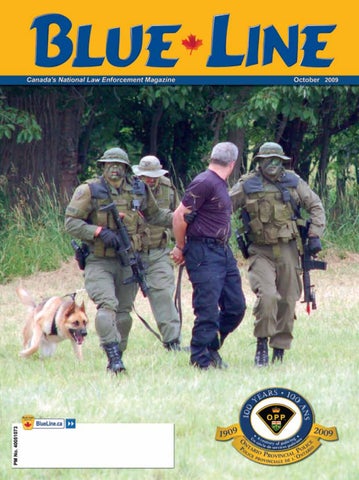
This month Blue Line Magazine joins the Ontario Provincial Police in celebrating its 100th anniversary. We have featured the OPP and specific vignettes from its past over the last seven issues. This month we continue this focus with many features reflecting the past and present of this truly amazing organization. Starting on page 6.
Features 6-19 Ontario Provincial Police
24 Breach of conditional release: Fact over fiction
20 A call to arms
30 Bringing justice to account
100th anniversary celebration The patch on the shoulder
36 Crisis Training
22 National DNA data bank website
Departments
Case Law
54 54 35 38 34 21, 39 40 44, 46 53 52 5 47 48
50
Breath demand only requires reasonable belief
51
Objectively justified officer belief okay
Back of the Book BlueLinks Ad Directory Coming Events Continuing Education Directory Deep Blue Dispatches Forensic Science Letters Market Place Product News Publisher’s Commentary Representative Profiles Technology
Blue Blue Line Line Magazine Magazine
33
october october 2009 2009
October 2009
4
Blue Line Magazine
Publisher ’s Commentary by Morley Lymburner
Tradition must be your servant Finding an Ontario Provincial Police badge the Queen had authorized more than 10 years ago – and then discovering the current senior OPP administration knew nothing about it – came as quite a shock to all concerned. The new badge was brought to my attention through a series of coincidences. I patiently awaited further information for several bewildering months before a senior member, sounding rather exasperated, called me. I bluntly asked about the implications of changing the force’s shoulder patch and crest. A new design would give it an internationally recognized symbol and much better control over its use and reproduction. (Read more on page 20). The officer challenged me to give him an argument for making a change. I addressed each impediment he raised until, with a sigh of resignation, he asked “what about – tradition? What can we say about tradition?” Traditions do not come from some mysterious cloud on a mountaintop, I replied. They come from the activities and machinations of mortals and start when people decide they should. New traditions can be started just as past traditions were instituted. They can also be altered or dispensed with once their usefulness has ended or new realities dictate their demise. The word “tradition” is much used and abused in police circles, appearing as the first level of attack upon the status quo and targeted with derision by agents of change. Supporters cite it as a quick dismissal; an escape clause for an issue or subject laced with potential problems or pitfalls. Too often it is used as a tactic to delay or transfer responsibility. In other situations, traditions are rooted in good common sense and help a well run organization. It’s not easy to trace the roots and pitfalls of tradition. Its real purpose should be to advance an organization rather than the enduring legacy of an individual. The former bonds individuals
Blue Line Magazine
while the latter does nothing but segregate, isolate and enslave groups or individuals. Carried to the extreme, a bad or poorly thought out tradition can be damaging and leave decades of embarrassment and tribulation. Military traditions, which go back thousands of years, have proven to be double edged swords. Most are instituted to work with a command structure designed to train and move great numbers of individuals in predictable unison. Thoughtfully carried out, mostly to bond people toward a common cause, they become useful. The damage occurs when tradition is implemented as living legacies of thoughtlessness and a monument to individuals. Hazing or practices which have long outlasted their usefulness and support an out of touch management style come to mind. Requiring RCMP members to wear spurs while driving patrol cars, for example, or refusing to arm RNC officers. The military background of new inductees after the First World War brought a military style to policing. The military has a need to introduce “traditions” to make their organization unique – important when delineating nation from nation. The major difference in policing, however, is the enormous need for inter-agency co-operation and members to deal with citizens one-on-one. “Every officer is a four-star general” is the way I often describe it. Where did the current OPP shoulder patch (three gold letters surrounded by a gold triangle) come from, I asked the senior officer. The short answer was 40 years ago a former commissioner felt it necessary for his force to stand out as distinct from all other agencies in the world. The argument was that since citizens referred to the agency as the “O-P-P,” members should be proud of the acronym and use it at every opportunity. This was done so enthusiastically that the letters replaced the one word which gave officers their authority and common bond with colleagues – “Police.” Not only did the OPP become the only Ca-
5
nadian police agency to not use the word on its shoulders, its desire for uniqueness left its identity open to the imagination of the beholder. Henceforth the impact of that shoulder patch would be purposefully diminished by an act of... “tradition.” Policing traditions should primarily further an agency’s goals in how it relates to the public. They must also advance the pride of the individuals expected to work within it, reflecting a kinship with other agencies instead of antagonism as one army would relate to another. A shoulder patch must clearly define for the public the authority of the individual wearing it. Without a doubt the wearer of that uniform must be a known entity. If the agency name fails them, then the universal word which bonds all agencies together must be clearly seen without equivocation or second thoughts. That person is a POLICE officer and that is a tradition we can all be proud of in this country. I think the image the Queen granted the OPP is jaw-droppingly gorgeous and its recent discovery should present an opportunity, not a problem. Adopting it would begin a new tradition with a deep pedigree, yet also be instantly “traditional” in a classic sense. To make up for lost time, mostly caused by some levels of management, the OPP should simply ask its members whether the Queen’s approved badge should be adopted in its present form. Once placed in a position of respect and clearly dignified by using the word “Police,” the Ontario Provincial Police will step into the new millennium readily identified as a partner in serving and protecting Canadians. To paraphrase the Latin phrase on the present badge, ‘they will become more illustrious through service.”
october 2009
&function Versatility meets form
S/Sgt. Brad Fishleigh
The OPP focuses on bricks and mortar by Morley Lymburner A long overdue Ontario Provincial Police detachment building opened in July for the officers who patrol Ontario’s Bruce Peninsula. The new state-of-the-art facility brings their working environs into the new millennium with a single 50 year leap. The buildings and structures which support officers and staff are an integral part of the policing experience. The new Wiarton-based building plays a strategic policing function in a very unique part of Ontario. The detachment is the main hub station for three satellite detachments (Tobermory, Lion’s Head and Sauble Beach). October 2009
Officers patrol a beat which includes three First Nations territories and three extended rural municipalities. The varied population of 16,000 is spread over a rocky peninsula stretching 100 kilometres into Lake Huron, providing some 800 kms. of coastline. Tourists and cottagers swell the population to more than 80,000 people over the summer months. The main road leading north through the middle of the peninsula carries more than 300,000 people and 90,000 vehicles annually to the Tobermory ferry docks. Officers and residents alike were relieved to finally see a new building after close to half a century of overcrowding. The long wait highlights an embarrassing lack of foresight by previous administrations. Originally designed to house only nine officers in 1960, the former Wiarton Detachment building ended up with a compliment of almost 40 members shoehorned into 2,000 square feet almost 49 years later. “There were days we actually envied the prisoners in their cells for both their space and privacy,” claimed one officer. “Just using the washroom at times had to be strategically planned and executed.” 6
Technology was as sparse as space in the overcrowded detachment, S/Sgt. Brad Fishleigh explained. The street crime unit, drug investigator and property crimes unit shared one computer and one small office, which was also used as the breathalyzer, interview, fingerprint and file storage room! The washrooms doubled as change rooms. The lunch room was also the guard station and the training room and prisoner booking area was in the middle of the administration area. There was no locker room. Members stacked their hats, in towers reaching to the ceiling, on top of a few metal storage lockers in the main work area. Officers going out on patrol would usually simply grab the closest hat that fit. Fishleigh reported that the new 11,000 square foot office not only provides ample space for today but has room to grow. “It is equipped with modern technology and all the tools and equipment that our officers and staff need to provide the service our communities have come to expect and deserve,” he proudly stated. “We are truly blessed in many ways,” he added. “Not only do we have this wonderBlue Line Magazine
Otto McLevis
- tough but fair
ful building to showcase, we have a new 24 foot boat to provide marine patrols on the waterways of the peninsula. We have two new all-terrain vehicles that have been used extensively at Sauble Beach for both trail patrols and search and rescue operations. We also have two new snow machines which perform the same tasks during the winter months.” Fishleigh points out the additional space has afforded the opportunity to create a new 10-member auxiliary unit to assist regular members. Such initiatives were severely hampered in the past, when there was no proper room to train the officers. The new facility not only has a specific office for the auxiliary personnel but ample training rooms where they can develop their skills. Another advantage is the opportunity to share space with other community partners and programs. The new station boasts a fully equipped community room next to the front foyer, complete with a large modular board room table and chairs, audio/video equipment and visual display boards. It can be used as a special projects room, by local emergency services and can also be booked for local community and social club meetings. Providing office space for probation and parole officers, victim services and (temporarily) to the local Children’s Aid Society while it waits for its new building to be completed is another opportunity to help the community. “Having the versatility to supply temporary space for local social services is important to not only the police but the community we serve in a larger sense,” Fishleigh explains. For the first time detachment members can maintain their own health in an exercise room, fully equipped through member and corporate donations. It is specifically equipped and designed to encourage maximum use by all members, regardless of their workout preferences. For many years the detachment lacked a place to take victims of crime and youth Blue Line Magazine
in distress. Officers can now provide a new “soft interview room” with a calm and more relaxed atmosphere which encourages interaction between police and victims. The regular interview room, on the opposite side of the building, is designed for proper investigative interrogations. It provides for the protection of an individual’s rights and clear and accurate evidence for the prosecution and defence alike. The same attention to detail has been incorporated into the design and processes involved in the property and evidence rooms. Space has been allocated for general property seized as evidence and secure areas for scene of crime officers. All areas were designed to ensure maximum attention to proper exhibit storage and continuity of evidence. Cells are designed to ensure those incarcerated remain safe and the area is kept clean. Full video surveillance and state of the art digital logging of videos are centralized in the secure computer and data room. The prisoner being processed is closely monitored from the time the transport enters the secure garage until they leave the premises. Citizens are increasingly being fingerprinted at police facilities for non-custodial needs – social agency background checks, for example, or parents wanting to have their children’s prints in case of emergencies. This used to mean going to the finger printing area within the secure lock up section, but the new facility has a print station in a hallway closet area near the entrance. A clean and well planned station is vitally important to policing today. With ever increasing demands on officers to fill the gaps of social shortfalls, it is crucial that police facilities are more than simply a warehouse to store stuff and people. Buildings (and officers) must be ready and remarkably versatile. The OPP Bruce Peninsula detachment has happily arrived and is well placed to lead the way. 7
The Ontario Provincial Police has a long history of providing police services throughout Ontario, including the Bruce Peninsula. The first detachment in Wiarton, as it was then called, was established in late 1927 or early 1928. One of the first officers to sign on to work for the OPP in Bruce County was Otto McLevis, who became a legend in the region. He joined the OPP after serving as Chief Constable in the Town of Wiarton. Viewed as a tough character he was a necessary countermeasure for a region rife with bootleg still operations with connections to smuggling and organized crime. During his years of policing, McLevis successfully dealt with break-ins, thefts, bootlegging and even murders, but it was his reputation as a “driving, shooting policeman” that made him famous in this region. His escapades were good copy for the newspapers of the area. McLevis was a very determined individual. He subdued bullies in monumental fist fights – recorded blow by blow in the papers; swam a river in pursuit of a fleeing bootlegger; and was involved in a number of wild car chases – driving with one hand while firing his revolver with the other. In one arrest he was taking his suspect across a river when his compatriots came to rescue him. They fired rifles in the air to scare the officer and McLevis returned fire while dragging the suspect across the stream to his awaiting police car. One story goes that McLevis was called down to Toronto to discuss with OPP Senior Command his “overly enthusiastic use of firearms.” After being counselled and returning to Wiarton he found himself in another car chase and shootout with some more bandits! After joining the OPP, McLevis lived in Walkerton and apparently devised a clever barricade at a fork in the road south of town near his home. He would stretch a chain he kept in the ditch from a telephone pole to a guard rail on the other side and, on more than one occasion, successfully wrecked a bandit’s car! This makes the use of modern spike belts a rather refined activity. McLevis was a great character and, for his time, a great officer. Of course, police tactics and strategies have changed considerably over the years but in the 1930s, some children in the region used to get their impression of police activities by counting the new bullet holes in McLevis’ car. Officer McLevis was eventually appointed a Magistrate in 1945 and was considered tough but fair in court. He served the county in this fashion for over 20 years. october 2009
Moving ahead with
a pilotless project
The OPP aerial program is maturing by Marc Sharpe The April 2008 Blue Line Magazine cover featured the OPP Unmanned Aerial Vehicle (UAV) project, which entered operational service with the Kenora Forensic Services unit in August, 2008. The original “FIU-301” system was an “in-house” design born of necessity (in my garage) to provide an efficient and economical way of obtaining high resolution aerial images at major case scenes. Despite a very modest beginning, the 301 system made aviation history as the first federally approved UAV to enter full time service with an emergency service in North America. Over the next year, we successfully deployed 301s at seven homicide scenes with a conservative estimate of $20,000 saved over our traditional charter service method. The images obtained have been accepted during court proceedings and have proved valuable court aids to judges, juries, counsel and witnesses. In the original article I emphasized the challenges and importance of obtaining and operating within the governing legislation of the Canadian Air Regulations (CARs). Issued by Transport Canada, the “Special Flight Operations Certificate” (SFOC) that must be obtained for any type or size of “non-hobby” unmanned flying machine dictates a number of operational procedures and restrictions. There is no doubt that the current legislative hurdles are the main reason more of these systems are not being used by civilian agencies. However, it is possible to continue advancing UAV use within the current rule set if we proceed properly. In January of this year, we took the next step to achieving this goal by putting a second, commercially produced, UAV into operational service within the Kenora Forensic Unit. The “Draganflyer X6” is produced here in Canada by Saskatoon-based “Draganfly Innovations” (http://www.draganfly.com/). The X6 is an innovative six rotor helicopter configuration that incorporates advanced onboard stabilization features along with a GPS hold function, providing an excellent camera platform. At just under two kilograms, this small portable electric helicopter can carry a variety of wireless, “real time” playback camera packOctober 2009
ages, including 10 megapixel still, low-light video, high-def video or micro thermal imaging. The vertical take-off and landing (VTOL) capabilities allow us to operate essentially under the same restrictions as our initial 301 system, but within a much smaller area of operations. To this end, we have already used the X6 at four homicide scenes, with the second representing another aviation first – the 1st federally approved operational use in North America of a UAV by an emergency service within an urban environment. Although the basic mission of obtaining aerial images remains essentially the same, the VTOL capabilities of the X6, advanced electronic assist functions, ease of operation and multiple camera packages lets us explore some basic tactical or search and rescue assist roles. Granted, the 15 to 20 minute operational time, weather conditions and current legislation make those mission capabilities very limited, but we have already proven the court value of basic aerial images along with demonstrated cost savings. These small systems will continue to evolve and improve with more options be8
coming available. Case in point, Draganfly recently announced a new X4 model which will offer many of the capabilities of the X6 for a lower price. Other promising systems, such as Waterloo’s Aeryon Labs “Scout” (http://www. aeryon.com/) will continually improve operational support capabilities. The price range of Blue Line Magazine
the “turn key” package systems range from $10,000 to $50,000 and certainly fall into the “doable” category when compared with similarly capable “military grade” systems. I suggest command staff, incident commanders, administrators or surveillance personel take heed. When I say moving forward in small steps, I mean very small steps. We are very likely “years” away from being allowed to operate any UAV beyond the “visual line of sight” of the operator or outside a secured police environment. Any grand ideas about highway patrols, extensive large area search and rescue operations or especially any form of surveillance should not be on any police radar (pun intended). Regardless of the circumstances, we do not have any special authority to circumvent federal aviation law in this area. The fact still remains that no specific legislation has been written to cover the operations of any UAV within civilian airspace. It is an issue that Transport Canada must eventually invest significant resources in developing. Until that time however, we are continuing to develop safe and effective operating procedures that could very well set the standards and templates for the pending legislation. Although limited, we have demonstrated that a UAV has a practical place in support of forensic services with developing elements of officer and public safety in tactical and search and rescue roles. If we keep to the basics and continue to operate safely and professionally, we can continue to creep forward. To this end, working with the Canadian Centre for Unmanned Vehicle Systems (http://www. ccuvs.com/) and the Canadian Police Research Centre (CPRC), we recently completed the first run of a “pilot project” (no pun intended) to professionally train operators of these small UAVs. The course curriculum included a precourse study package, a “ground school” element and written testing based on basic flight theory and related Canadian air regulations. Candidates also obtained an Industry Canada radio licence that will allow them to communicate on aviation frequencies. Theory was accompanied with hands-on flight training on the currently approved Draganfly X6 system Blue Line Magazine
to manufacturer standard. Six candidates from three police services participated (Saskatoon, OPP and Regina). Upon completing the training, candidates critiqued all aspects of the course so course curriculum could be refined to ensure relevancy of a future permanent training program for interested emergency services. It is anticipated within the following months that Saskatoon and Regina will have their own X6 system to put into operational service. This, of course, will depend on the two departments successfully obtaining a SFOC from Transport Canada, the foundation of which will be supported by the training program. In the interim, Saskatoon has already contracted and obtained SFOC authority to have Draganflyer Innovations perform basic aerial photography at selected scenes as required. Along with our partnered services and organizations, we are working to establish a national standard for safe, practical and 9
professional use of UAV technology that will benefit both the public and those who work for them. Keeping that in mind, I will be chairing a full day workshop at the annual UVS Canada (http://www.uvscanada.org/) Unmanned Vehicle Systems International Conference, being held in Victoria November 2 to 5. If your department is considering using UAV technology, it would be well worth the investment to send a motivated representative to this conference. It is our goal to identify and organize a central repository resource of interested agencies, expertise and resources that will benefit all police and emergency services. Working together under established standard operating procedures, training and UAV systems will pave the way for wider operational use. Contact me at marc.sharpe@ontario.ca if you are looking for more information. Marc Sharpe is an ident constable with the Kenora OPP Forensic Identification Services.
october 2009
Evolution of use of force equipment begs question:
“Where does it end?”
by R.D. (Bob) Cooke, Provincial Constable (Retired) Officers who battered their way into the old Brown Derby on Toronto’s Lakeshore Road 71 years ago might be amazed at what today’s OPP has in its arsenal of tools. In June, 1938, it took a number of sweating OPP officers 45 minutes of hard work to batter and bash an opening through the massive, reinforced oak door that guarded a huge, illegal gaming room. Only normal work tools, including axes, crowbars and sledge hammers, were available to them. Forced entry tools used by the OPP have evolved to include metal battering rams, bolt cutters and specially designed breaching equipment that can open security doors in seconds. Handguns, long arms issued Firearms supplied to OPP officers over a century have also changed, providing greater protection to police and the public. Trying to keep up with the firepower used by the bad guys has been a challenge. Members were issued Colt .32-calibre Police Positive revolvers in the early years and later given .38-calibre Colts, which many people, perhaps with good reason, believed were left over from the First World War and obtained by the government at firesale prices. Rounds fired from the original .38, a weapon still being issued in the 1970s before being replaced by the Smith and Wesson .38, were known to glance off car windshields, such was the quality of supplied ammunition. Many OPP officers referred to the .38 as a “pea shooter.” Over the years, the OPP has used shotguns, semi-automatic long guns and even the Thompson sub-machine gun, one of which is among artifacts held by the OPP Museum. In the 1990s, the .38-calibre side arm gave way to a .40-calibre P229 Sig Sauer semiautomatic pistol’s increased stopping power and ease of use. The officers of the early 1900s would be astounded; not only by the weapon itself but with the fact that such firepower has become necessary. When required, in earlier days, a .303 rifle or 20-gauge shotgun accompanied an officer, but today the semi-auto pistol has been joined by the C8 carbine, at least on a shared basis depending on the number of officers in a cruiser. Used by Canadian and other military forces, the C8 has very definite stopping power when deadly force is the only option. This 30-round, semi-auto rifle is being made standard OPP equipment, with one installed in a secure gun October 2009
Left: Sgt. Michael McNamara of Niagara Falls used this spring-trigger holster and .32-calibre Colt Police Positive revolver in the early 1920s. Beneath is the small .22-calibre Hopkins and Allen revolver carried by Prov. Const. Carr during his first posting to Red Lake in 1926, in addition to his issue .32-calibre Colt. These items are on display at The OPP Museum in Orillia. Middle: Also known as the nipper, this come-along cuff was used by Charles Knight, OPP Badge #6, while posted to Byng Inlet in Parry Sound District, three years before the OPP was officially formed. It is on display at The OPP Museum in Orillia. Right: OPP GHQ gunsmith Stuart Seki holds a Thompson sub-machine gun (left) belonging to The OPP Museum and a modern-issue C8 carbine. The Thompson is shown with a stick magazine rather than the 50-round drum usually associated with this weapon.
mount between the front seats of cruisers. All OPP members are trained on this weapon, should it be needed; for example, in cases including or similar to school lockdowns. Sadly, such incidents are becoming more common in the western world. Special OPP units, including tactical teams and drug enforcement units, get their own issue. Models supplied to tactical team officers are capable of going into full automatic mode. Conducted energy weapons introduced Something that OPP officers of the past would doubtless find mind-boggling is the X26 Taser, issued to OPP frontline supervisors and to special unit members. More than 950 are now in the field. The X26 Taser sends electrical pulses through a set of two wires and into the target body. It is seen as a viable compromise between pepper spray and greater force when there is a need to gain control of a suspect or for officer safety. Measure that against the lead-filled leather sap* which, besides the .38 revolver, was the only “weapon” issued to officers over much of the OPP’s 100 years. By comparison, the modern device known as a conducted energy weapon might be seen by officers of the 1920s and 30s as having come right out of an old Flash Gordon episode. One OPP retiree tells of being confronted by 10
a man armed with a long club and ready to use it. “He had a club and, except for my gun, all I had was a six-inch-long leather sap*,” recalls the veteran. “How was I supposed to get close enough to use it?” The officer finally managed to subdue the man, but not without a struggle that sent both tumbling down the steep shoulder of a highway and into a ditch. Fortunately the officer landed on top. The sap evolved to the wooden nightstick and then to today’s collapsible metal baton. Even handcuffs have changed over the years. Body armour is now standard issue and OPP cruisers are equipped with heavier vests for situations demanding more protection, such as occurrences known in advance to involve firearms or which deteriorate to that point. S/Sgt. Dave Phillion of the OPP General Headquarters’ Weapons Section notes it’s all “to better protect our officers.” One can only wonder where it will lead over the OPP’s next 100 years. What other challenges to keeping the peace might occur that will demand implementation of even stronger measures? *A sap is an impact weapon, about nine inches in length, with loosely-packed lead pellets at one end inside a leather casing. An officer would carry it in a speciallydesigned pocket of the police trousers, with the leather strap hanging out for quick access. They were carried for most of the OPP’s 100 years.
Blue Line Magazine
to the
Ontario Provincial Police
Niagara University’s Criminal Justice Program congratulates the Ontario Provincial Police on their 100th Anniversary
Blue Line Magazine
11
october 2009
!
OPP’s oldest
surviving member
Sid Daley looks back
by R.D. (Bob) Cooke, Provincial Constable (Retired) Sidney Daley, badge #944, was no spring chicken when he joined the OPP in the fall of 1946. Daley’s age was probably about average though, because many Second World War vets put on another uniform either immediately after being de-mobilized or within a relatively short time. At 34, Daley was a veteran beginning a 31-year career as a provincial police officer. Today, he is the oldest surviving OPP officer.* Daley greets visitors with a smile and is a gentle and soft-spoken man, possessing a ready laugh and a quick mind. Born in England and arriving with his family in Canada in 1920, he joined the local sea cadets in Sault Ste. Marie when he was 16 years old. Eventually attaining the rank of chief petty officer, he laid the foundation for what was to come. It was the dirty thirties and Daley went on to various jobs, including road construction labourer in northern Ontario and farm worker harvesting wheat in Saskatchewan, finally settling in Schreiber, ON and marrying his late wife, Hilda, in 1936. Six years later he was an ordinary seaman in the Royal Canadian Navy Volunteer Reserve. Following basic training at Port Arthur (now part of Thunder Bay), he became an instructor and, after six months, was elevated to the rank of able seaman. “I wanted to go to sea,” he recalls, “so I had to give up my rank to do so.” This led to advanced training in Cornwall, followed by gunnery training in Halifax and eventually a decision to become a gunner on a DEMS (Defensively Equipped Merchant Ship). He was posted to the vessel Queensborough Park and sailed the west coast, through the Panama Canal to New York, finally joining a convoy in the mid-Atlantic and travelling to England. It was after his return to North America that Daley suffered injuries to both legs when, in Seattle, Washington, the gang plank from ship to jetty suddenly flipped, causing him to fall. Months of hospitalization and two 28-day leaves of absence followed, during which the October 2009
At age 97, Retired Sgt. Sid Daley is the oldest surviving member of the OPP. Inset shows Second World War and other medals awarded, namely 1939-45 Star, Pacific Star, Canadian Volunteer Service Medal and clasp, War Medal 1939-45, Centennial Medal, Canada 125 Medal and Ontario Police Long Service Medal with bar.
war in Europe ended, so Daley signed up for duty in the Pacific. Before he could return to his ship, the war against Japan was over. He was discharged from the RCNVR in November 1945. From war vet to police officer Daley joined the OPP in October, 1946 and, after some initial training, was posted to Schreiber on Christmas Day. He was transferred to Armstrong during the winter of 1949-50, however it was, “not to be.” Armstrong wasn’t an inviting place and, “I took the next train out because my wife said she wasn’t staying there,” recalls Daley. On a later occasion back in Schreiber, he found himself in “immediate pursuit” of a stolen taxi cab. The driver had been robbed and left tied to a tree near Terrace Bay. With Constables Doug Hilner and Stu Loree in the car with him and acting on information received, Daley travelled out of his detachment area to finally catch up to the stolen taxi, which had been stopped at a road block. Two men who, “came out of the taxi with their hands on their heads” were arrested. Daley’s investigation also resulted in the recovery of a handgun, which was thrown from the moving car and the arrest and conviction of a bootlegger who had sold the gun to the robbers. “One of the men said he would tell me where he got the gun in exchange for some 12
tobacco,” Daley remembers. The two robbers were later convicted and sentenced to prison. “I got a blast from the district inspector for leaving my detachment area (without permission),” he relates with a laugh, adding, “later, I received a commendation from Commissioner Stringer.” He was promoted to corporal on April Fool’s Day, 1954 and posted to Haileybury as detachment commander. Some 14 years later, Daley became a sergeant and commander of Lucan Detachment in southern Ontario. The detachment was in the “oldest building in town” and his office was on the second floor. “The floors were slanted like this,” Daley demonstrates, holding his hand at a 15-degree angle. During an audit and inspection, the staff inspector observed “you have a nice detachment here,” prompting Daley to ask if the senior officer would care to sit down. When Daley stood up, “my chair left me and rolled across the floor.” Two years later, a new detachment was built and Daley retired on Aug. 31, 1977. Would he do it all over again? “If the circumstances were the same as they were then, yes, but I wouldn’t do it today,” he says. “I’m not a big man. Our uniform was respected (in the past). Not today.” *Sid Daley turned 97 on Aug. 6, 2009.
Blue Line Magazine
to the
Blue Line Magazine
Ontario Provincial Police
13
october 2009
!
The OPP today
A giant leap for progressive policing in Ontario by R.D. (Bob) Cooke, Provincial Constable (Retired) What a ride! Through its 100 years of existence, the OPP has evolved to the point of being unrecognizable in some ways but still the same in many others. Just imagine yourself, for a moment, being
one of the 45 provincial constables who, on Oct. 13, 1909, took the first steps into a century of history. The tight-collared, thigh-length tunics, issued early in 1910 and proudly worn along with the Stetson hats, were the uniform of a police force that, with apologies to astronaut Neil Armstrong, took small steps for a man but made a giant leap in
changing the face of policing in Ontario. Faced with lawlessness in northern mining and railroad construction camps and the 2,760-kilometre border with the United States, major duties for these mostly mustachioed men (it would be decades before women would be hired) included enforcing the Games Protection Act and investigating serious crimes. Keeping the peace in the north and guarding border points in the south were high on the list. Duties came to include enforcing the Ontario Temperance Act, forerunner of today’s liquor laws and, most noticeably, the Highway Traffic Act, a responsibility that continues to this day. Evolution of training, equipment The OPP experienced impressive growth and remarkable reform. Uniforms and equipment evolved to standardized issue, resulting in the professional image of the well-equipped and superbly trained officer we see today. While the radio system implemented in 1947 was heralded as the most modern of its time, it too followed a line of evolution, improving and expanding over the years to one that has become second to none. Modes of transportation have changed, from snowshoes, trains, personal vehicles and even dogsleds, to aircraft, watercraft, snowmobiles and fully-equipped cars Colt revolvers and leather saps have given way to semi-automatic pistols and telescoping batons. The Thompson sub-machine gun is now a museum piece, replaced by the C8 semi-automatic rifle (capable of fully automatic mode for special units like emergency response teams). Not only would these innovations likely cause the jaw of a 1909 constable to drop in awe, he probably would never get over the
October 2009
14
Blue Line Magazine
Number 10 District Headquarters staff with Commissioner V.A.S. Williams (front centre, in suit) on the steps of the Haileybury Courthouse, 1935. 2009.45.9 donated by Sgt. (Ret.) Bill Litowski, #1942.
OPP becoming co-ed, something that became a fact with the first hiring of women constables in 1974. Women have since served at every rank in the OPP, including that of the highest rank - commissioner. The modern OPP can lay claim to specialized training and operation in many areas of police responsibilities, including crisis negotiation, rescue and tactics, emergency response, bomb disposal, incident command, forensics, canine units, underwater search and recovery, anti-terrorism and identification techniques. First Nations policing of, by and for native peoples, has been an OPP responsibility for more than 35 years, resulting in the Indian and the First Nations Policing programs and the Aboriginal Policing Bureau. The art of laser fingerprint detection, introduced by the OPP in 1977, was a worldwide first. It has taken impressive steps in the area of blood spatter pattern analysis, working in co-operation with the RCMP to provide training in this important aspect of investigation, which has been termed “speaking for the dead.” Today, the OPP has a provincial emergency response team and anti-terrorism section and, since 2003, the OPP Security Service in the Ontario parliament buildings at Queen’s Park.
Senior Ontario government and OPP officials (including Commissioner William Stringer - fourth from left) inspect the new patrol cars at the Canadian National Exhibition grounds in Toronto, 1941.
enjoy the personal protection of the OPP Security Branch, which guards VIPs, a task that takes its members around the world – but without the dedication of yesterday, it’s unlikely there would be celebrating today. Dep/Comm Chris Lewis, in a submission to the Ontario Association of Chiefs of Police newsletter, puts it this way: “It’s important for us to remember that there are retirees out there who have been around for the past 50 or 60 years of our history and more. “We didn’t become the great organiza-
tions that we are just because we arrived on the scene. Although we certainly all contribute greatly to keeping the policing tradition strong, our organizational foundations were built through the hard work of many men and women before us. “If they hadn’t toiled under the less than favourable conditions for many years prior to us, Ontario’s police services would not be the organizations they are today.” His words are of particular relevance to the OPP as it achieves a 100-year milestone. What a ride, indeed!
Role of force expands Created to address the lawlessness of the Ontario north and along the US/Canada border, the OPP has become one of the largest deployed police forces in North America, a multi-faceted service that has earned high respect among police forces everywhere. It is involved in every kind of law enforcement, from highway traffic patrol to community policing, from murder investigations to giving safety lessons to classes of school children, from enforcing marine laws on waterways to impaired driver investigations. Even government officials and dignitaries Blue Line Magazine
15
october 2009
Sketches of
the past&present
by R.D. (Bob) Cooke, Provincial Constable (Retired) How do you record and keep track of 100 years of history? Over the century since its inception, the Ontario Provincial Police and its members have amassed a countless number of experiences. By searching through old documents, reports and newspapers and appealing to retired members and surviving family members of deceased officers, the OPP Museum has catalogued much information. Wouldn’t it have been great to have sketches of the past created at the time and preserved for a centennial celebration? Enter The OPP Review magazine. Although a prototype was created in 1964, the Review did not appear until May 1966, thus beginning 43 years and nearly 200 editions of interesting, informative and educational reading. Readership restricted Starting as a publication exclusively directed at the police community – it carried the stern notice “Confidential – For Use of Police Forces Only” – the Review has taken its place as an important eye on the activities of one of the largest deployed police forces in North America. The late Eric Silk was commissioner at its inception and, in an introduction for the modest magazine that was printed in-house, in black and white, wrote that the focus was to be on “timely articles on police techniques and procedures that will be of benefit to the Force.” Published twice yearly in its first two years, the Review was edited by PC K.F. Weekes and overseen by an editorial committee of high-ranking commissioned officers. Content not without surprise Volume 1, Number 1 included a lead article entitled “The Art of Advocacy,” by Lord Birkett, also known as Norman Birkett K.C., a judge on the British bench. Pretty highfalutin stuff for a magazine intended for police in the colonies and purporting to focus “on police techniques and procedures;” but there can be little doubt the new publication was welcomed by the OPP rank and file. Alas, intended to be 20 pages in size, the first magazine suffered at the hands of the ever-present gremlins of the publishing industry and was printed with pages 10 and 11 unintentionally blank. Volume 2, Number 1, dated JanuaryFebruary 1967, met with better fortune. It included articles on Insp. J.A. Fullerton’s October 2009
Cover of Sept 1989 In 1989, the OPP became the first police service in Canada to equip traffic officers with radar detector detectors.
ground breaking achievement as the first OPP officer appointed as an aide-de-camp to the Lieutenant Governor (then Earl W. Rowe), as well as the first of a series of articles on OPP commissioners. Joseph E. Rogers became the first commander of the OPP on October 13, 1909, but with the rank of superintendent. It wasn’t until 1921 that the rank of commissioner was created and Major General H.M. Cawthra-Elliott was given that post. The same 1967 issue contained a story 16
on OPP air patrol, tagged “Eye in the Sky.” It heralded the inauguration of this means of traffic law enforcement and was touted as being responsible for a “marked” reduction in motor vehicle accidents. After disappearing for many years, the OPP aircraft patrol returned to the skies in 2008. Yet another ground-breaking move was reported with the story of a “recently instituted” bilingual recruitment program. Of 89 Ottawa-Cornwall area applicants, 55 were Blue Line Magazine
to the
Blue Line Magazine
Ontario Provincial Police
17
october 2009
!
bilingual. Another story profiled the oldest living member of the OPP – 87-year-old C/ Insp. Frank Edward Elliott, who retired in May 1944 after 24 years service. (For the record, retired Sgt. Sid Daley passed that mark in August when he turned 97. He served 31 years.) The Review continued to evolve, including photos of people and accounts of happenings and widening its content to include feature articles on various OPP training, news of the OPP Auxiliary and even some humour. Volume 5, Number 1, the January-February 1970 issue, still marked “Confidential” and still edited by K.F. Weekes, who by now had achieved the rank of sergeant, included notice of a new OPP Veterans’ Association,
which had been incorporated the previous June. The OPPVA, with 150 members, was for ranks from constable to (perhaps surprisingly) assistant commissioner. It had plans to reach an estimated 3,000 more who had served three or more years. Probably the most tragic story ever to appear in the Review was the account, in the January-February 1971 issue, concerning the horrendous July 5, 1970 crash of an Air Canada “stretch 8” aircraft. All 109 persons aboard perished. Using half of the magazine’s 20 pages, the story provided photos and information about the involvement of 185 OPP personnel who took part in the operation to search the
wreckage for human remains. Today the Review, having abandoned its “Confidential” standing as of the May-June 1971 issue, has become a first-class production of 40 to 44 pages, full of information intended primarily for OPP employees but open to others. The publication assumed its current highprofile look in October 1997 and the following January came under the editorship of Robert Rudd. It is overseen by a publications committee chaired by Supt. Angie Howe. For nearly half of its 100 years, the OPP has had sketches of its history recorded, thanks to The OPP Review. What subject matter is destined to dominate its pages during the second century of this provincial police service?
Cover of Sept 1991 Regrettably, several magazine covers bore the news of officers killed on duty. A funeral service for Sgt. Tom Cooper, shot at Grassy Narrows, took place in Kitchener on July 30, 1991.
Cover of Jan-Feb 1971 The OPP supplied 185 personnel to assist in site security and recovery of human remains in the Toronto crash of an Air Canada passenger plane in July 1970.
Cover of July 1964 The Ontario Provincial Police experimented with a force publication, issuing this prototype in the summer of 1964, two years before The OPP Review was established.
Hat Badges of the
Ontario Provincial Police
1963 - 1983 (NCO) October 2009
1910 - 1921
1963 - 1983 (CO)
1921 - 1923
1983 - 1997 (NCO) 18
1923 - 1953
1953 - 1963
1983 - 1997 (CO)
1997 - 2008 (CO) Blue Line Magazine
Shoulder Insignia of the Ontario Provincial Police
Ontario Volunteer Constabulary 1940-1944
by Art Livingstone
Several years ago I purchased a dark blue forage cap at a flea market. I was surprised to find that it had a gold insignia in the name of the Ontario Volunteer Constabulary. I spoke to several collectors of police memorabilia and found that no one had heard of this organization. A search of the Internet also failed to turn up anything. I then did a search through the Archives of Ontario and found a file. Within weeks of my request the Archives sent me information about this volunteer organization. The Ontario Volunteer Constabulary (OVC) came into existence in October 1940, during World War II (1939-1945). They swore allegiance to the Crown, to protect life and property ‘from every form of attack and sabotage, to combat subversive elements and to assist Air Raid Precaution organizations in their activities. Its members were sworn in as Special Constables under the Constable Act A.S.O. 1937. The OVC was an auxiliary unit under the control of the Ontario Provincial Police. William Stringer was the OPP Commissioner at the time. In 1943 OVC had 750 active members and 75 members that were on leave to serve in the armed forces. OVC units throughout Ontario held their own training programs. Their training syllabus outlined in detail the instruction they received which included military drill, criminal/provincial law, arrest authority, St.John’s Ambulance, target practice using revolvers & shotguns. They also had to have an operating knowledge of a Bren Machine gun, Sub-Thompson Machine Gun and a Sten gun. Their members regularly assisted the O.P.P. with highway patrols, serious accident scenes, office duties, traffic control, holiday season patrols, blackouts and other general duties as requested. The OVC members paid for their own uniforms and expenses to operate the unit across Ontario. In July, 1943 the OVC sent letters through their chain of command to the government about the existing gasoline rationing regulations. OVC was concerned that if its members were not allotted the necessary fuel to perform their duties the unit would have to disband. In January, 1944 the OVC was informed that by order of the Attorney General of Ontario, L.E. Blackwell that they were no longer an auxiliary unit of the O.P.P. They were told that they must either disband or carry on as an Association or gun club. They were directed to return all firearms and insignia loaned by the province. A recent search of the O.P.P. website indicates that their current Auxiliary unit was formed In 1960. They make no mention of the OVC. It would appear that the Ontario Volunteer Constabulary may well have been the very first auxiliary unit of the O.P.P. ( Courtesy Waterloo Regional Police Association )
Blue Line Magazine
19
october 2009
A Call to Arms The patch on the shoulder
by Darrel E. Kennedy, Assiniboine Herald “Great Arms” immediately brings to mind an image of either body parts or firearms. However, the third meaning refers to the image that is borne as the central element on the shoulder patch. The Canadian Heraldic Authority has been designing the central pictorial device for use by municipalities and police services since June 4, 1988. That’s when Her Majesty the Queen of Canada authorized Governor General Jeanne Sauvé and her successors in office, to exercise the royal prerogative of granting armorial bearings to Canadians in Canada. Prior to this date, requests were sent to the Lord Lyon in Edinburgh, Scotland, or the Garter Principal King of Arms in London, England, as many municipalities had done. After considerable discussion, the first grant to a police force by Robert D. Watt, Chief Herald of Canada, was to the Royal Canadian Mounted Police in 1991 of a flag with emblems to identify various jurisdictions and officers. The first grant of a municipal police badge was to the Nepean Police Service in 1992. It set the style for lawfully granted police badges that speak to the identity of the police service for a municipality in a province of Canada. The central shield is generally that of the municipality, but with a scalloped upper edge. However, if the municipality itself does not have lawfully granted arms, the police service is granted a coat of arms, crest, supporters and police badge. Around the scalloped shield is an annulus bearing the motto of the police service, which can differ from that of the municipality. Enveloping the annulus is a set of gold maple leaves issuing at the base from the provincial flower. Most importantly, the Royal Crown appears at the top to indicate that the members serve to uphold the Queen’s peace, following the natural Canadian desire for “peace, order and good government.” Every design for a police badge showing the Royal Crown is prepared by the present Chief Herald of Canada, Dr. Claire Boudreau, for the governor general to forward with a recommendation for Her Majesty’s consideration. The presence of the Royal Crown is a great favour. After Her Majesty ascended the throne of Canada in 1952, she indicated that its use in any emblem was to be presented for her personal consideration and approval. Naturally, once approval is given and the grant made, then the design is not open for alteration. The images are then painted in the official document, which is signed, sealed and recorded in the Public Register of Arms, Flags October 2009
20
Blue Line Magazine
and Badges of Canada. It is later, in due course, uploaded onto the web site of the governor general at www.gg.ca under the tab “heraldry.” The grant is also announced in Part I of The Canada Gazette under ‘Government House.’ At the planning stage there is a dialogue between the petitioner and the chief herald through one of the staff heralds, who will act as a file manager. The petitioner and chief herald must agree on the design before the grant is made. The petitioning police agency can request an agent to help them with the design. Once the Queen grants the design there is a process to alter the design officially. It must be repeated in connection with only the part that is to be redesigned. Thus, for example, if the arms (the shield) needs to be changed, the discussion involves that. In the case of the OPP badge, since the shield has a crest and supporters, the new shield would probably be painted with those elements appearing again. Cost is always an open figure and depends on the amount of work expended to completion. See the online version of the procedure guide (http://www.gg.ca/heraldry/pg/index_e.asp). Everyone pays the processing fee of $435 (plus GST). Beyond that, the further costs are for art and any calligraphy. For the original grant to the OPP, the total cost of all art (preliminary and final) plus calligraphy came to $6,642. This fee reflected their more complicated jurisdictions, which required more elaborate grants. For example, the OPP and Sûreté du Québec have coats of arms, badges of offices and other insignia, in addition to badges. Once the Queen grants the charter, it is not incumbent upon agencies to transition. Of course the benefits and privileges of such a decision will not be available to those who choose not to use the granted insignia. The London Police Service received its official design and insignia in 2006, for example, but chose to delay implementation due to budget constraints. It did hold a public launch ceremony to notify the public of its acceptance. Below are badges granted by the chief herald, designed with the help of the office heralds. Each example is from a volume of the public register since the first grant of a police badge (a volume corresponds to a term of a governor general): Letters Patent Date | Registration | Agency Name
1992 February 12 | Vol. II P. 146 | Nepean Police Service 1992 May 24 | Vol. II P. 164 | Halton Regional Police Service 1992 October 20 | Vol. II P. 196 | New Westminster Police Department 1993 December 10 | Vol. II P. 271 | Sarnia Police Service 1993 July 14 | Vol. II P. 258 | Midland Police Service 1994 October 28 | Vol. II P. 356 | Winnipeg Police Service 1995 May 2 | Vol. III P. 015 | Waterloo Regional Police Service 1996 February 10 | Vol. III P. 067 | Ottawa-Carleton RPS
Blue Line Magazine
1996 February 29 | Vol. III P. 140 | Niagara Regional Police Service 1998 April 22 | Vol. III P. 237 | Ontario Provincial Police 1998 July 30 | Vol. III P. 264 | Medicine Hat Police Service 1999 April 8 | Vol. III P. 310 | Cape Breton Regional Police Service 1999 April 8 | Vol. III P. 311 | Guelph Police Service 2000 February 24 | Vol. IV P. 009 | Vancouver Police Department 2001 December 15 | Vol. IV P. 158 | Regina Police Service 2001 November 15 | Vol. IV P. 155 | Edmonton Police Service 2002 August 15 | Vol. IV P. 228 | Ottawa Police Service 2004 February 20 | Vol. IV P. 354 | Ville de Saint-Jérôme 2004 January 15 | Vol. IV P. 346 | Port Moody Police Department 2004 March 15 | Vol. IV P. 362 | Stratford Police Service 2004 May 10 | Vol. IV P. 372 | Ville de Longueuil 2004 October 15 | Vol. IV P. 412 | Lacombe Police Service 2004 October 15 | Vol. IV P. 535 | Town of Taber 2005 April 1 | Vol. IV P. 446 | Cdn Association of Chiefs of Police 2005 January 20 | Vol. IV P. 420 | BC Transportation Authority PS 2005 March 15 | Vol. IV P. 472 | Sûreté du Québec 2006 December 15 | Vol. V P. 090 | London Police Service 2007 July 20 | Vol. V P. 153 | Saskatoon Police Service 2007 June 15 | Vol. V P. 148 | Nelson Police Department 2007 November 15 | Vol. V P. 181 | Hamilton Police Services 2008 July 28 | Vol. V P. 296 | Central Saanich Police Service 2008 October 15 | Vol. V P. 350 | City of Brandon
The chief herald supports good patches that encourage a strong esprit de corps. To obtain a legally granted badge and permission to use the Royal Crown, police chiefs may contact: Dr. Claire Boudreau Chief Herald of Canada The Canadian Heraldic Authority Rideau Hall 1 Sussex Drive Ottawa, Ontario K1A 0A1
R. Gordon M. Macpherson, C.M. of Burlington, Ontario was appointed a member of the Order of Canada by the Governor General on May 15, 2009. The premier heraldic artist in Canada and among the best in the world, he has been at the vanguard of heraldic art as a designer and illustrator of coats of arms, flags and badges for more than 60 years. He has been an artist with the Canadian Heraldic Authority since its creation in 1988, helping to establish its reputation for excellence at the international level. Renowned as a bookplate designer, he is a founding member and fellow of the Royal Heraldry Society of Canada and also served as the honorary art editor of Heraldry in Canada for more than 30 years. The Order of Canada is the country’s highest civilian honour and was created in 1967, during Canada’s centennial year, to recognize a lifetime of outstanding achievement, dedication to community and service to the nation. More than 5,000 people from all sectors of society have been invested into the order over the last 40 years.
21
Chief Ron Hoath has retired from the Port Hope Police Service after 23 years as Chief of Police and almost 40 years since he first put on a police uniform. He began his career in Toronto in 1968. From 1983 to 1986, he was the chief in Harriston, a small town in central Ontario, before moving to head up the Port Hope Service. The local police service has changed over years, moving from the a small office in the back of town hall to its own building on Walton Street in 1989. The force has grown from 16 officers to 26. Deputy Chief Garry Hull will carry on as Acting Chief until a replacement is officially announced. •••• The Oxford Community Police Services Board appointed Daryl Longworth as the “Deputy Chief of Police effective Monday, October 26. Longworth was born and raised in Woodstock. He began his policing career with the Halton Regional Police Service in 1992 and joined the Woodstock City Police Service in 1995 where he was assigned to frontline patrol. As head of the Drug Enforcement and Criminal Intelligence Section he was part of the province wide investigation into the Outlaws Motorcycle Gangs. Longworth has recently completed the Police Leadership Program at Rotman School of Management at the University of Toronto. He is also working on his Bachelor of Sciences Degree – Criminal Justice Program through Athabasca University. •••• Wawa Police Service Chief Michael Knorz was suspended with pay in late August following allegations of wrongdoing, which haven’t been made public. The town of Wawa, in Northern Ontario, has been under a costing review with the Ontario Provincial Police for the past several months. The town has been reviewing whether they would be more cheaply policed after disbanding their eight member police service. Deputy Chief Bob Kates of the Sault Ste.Marie Police has taken up the duties of Acting Chief while the investigation of Knorz continues. •••• A 21-year-old Cst. Mélanie Roy, of the Levis Quebec Police Service, died in a police vehicle collision while responding to an emergency call for assistance on September 7th. The police vehicle was one of two vehicles crossing over a St. Lawrence bridge when Roy's vehicle went out of control slamming into a concrete pillar of an overpass. Roy was taken to hospital, where she later died from her injuries.The officer had only recently joined the Levis Police Service. A memorial for the officer was held on September 14 in Beauport, Quebec. •••• Ontario Public Safety Minister Rick Bartolucci met with his Quebec counterpart, Jacques P. Dupuis, to finalize an agreement which would permit Police in border communities to jump into each other's jurisdictions. The two ministers pledged to introduce legislation that will allow for “seamless policing across provincial and territorial borders."
1
october 2009
National DNA Data Bank website...
at your service
Using forensic DNA analysis to solve crime is proving to be as revolutionary as the introduction of fingerprint evidence in court more than a century ago. Although used by Canadian police for little more than a decade, it has emerged as one of the most powerful tools available. The value of DNA is enormous. Biological samples collected from a crime scene can either link a suspect to the scene, rule the suspect out as the DNA donor or identify a victim through samples from close relatives. Evidence from different crime scenes can be compared to link the same perpetrator to multiple offences locally, across the country or halfway around the world. Deoxyribononucleic acid (DNA) is a long, double-stranded molecule that looks like a twisted rope ladder or double helix. Sometimes referred to as the blueprint of life, it is the fundamental building block for your entire genetic makeup. When sperm and egg unite, equal amounts of DNA from your mother and father come together. Found in virtually every tissue in the human body, the DNA in your blood is the same as that in your skin cells, saliva and the roots of your hair. Highly discriminating, it is a powerful tool for identifying individuals. With the exception of identical twins, each person’s DNA is unique to them. Using modern technology, DNA can be extracted from a small biological sample, such as a few drops of blood, analyzed and used to create a profile. DNA drawn from a known biological sample can be compared to an unknown profile; if they match, the two samples come from the same person. The DNA molecule is very stable and can withstand significant environmental challenge, enabling forensic scientists to obtain new information from very old biological evidence or establish important data from badly degraded samples. The stability of the molecule, combined with the discriminating features of each individual’s DNA and the accuracy of current analysis techniques, makes this human identification technology a vital component of most police investigations. The National DNA Data Bank respects considerations of genetic privacy and follows strict guidelines as specified in the DNA Identification Act. The biological samples collected from convicted offenders and the resulting profiles can only be used for law enforcement purposes. The national data bank contributes to the administration of justice and the safety of Canadians by ensuring that those who commit serious crimes are identified more quickly and eliminates innocent people from suspicion. It assists law enforcement agencies October 2009
in solving crimes by: • Linking crimes together where there are no suspects; • Helping to identify suspects; • E liminating suspects where there is no match between crime scene samples and a profile in the national data bank; and • Determining whether a serial offender is involved. The national data bank is responsible for two principle indices: 1. The Convicted Offender Index (COI) is the electronic index that has been developed from profiles collected from offenders convicted of designated primary and secondary offences identified in section 487.04 of the Criminal Code; and, 2. The Crime Scene Index (CSI) is a separate electronic index composed of DNA profiles obtained from crime scene investigations of the same designated offences addressed in the act. To date, several thousand samples from convicted offenders have been processed and added to the bank, along with samples received from various crime scenes across the country. Thousands of police officers from across Canada are trained to collect samples, which are forwarded to the national data bank for analysis. The data bank is a shining example of the increasing importance of science and technology in modern law enforcement. Our complex, globalized world has created a whole new set of challenges for police. To stay ahead of the criminals, we must make better use of cutting edge science, such as 22
forensic DNA. An idea that first surfaced more than a decade ago, the national data bank has overcome major scientific and legislative hurdles along the way. One by one, each challenge has been met successfully. The final product is a forensic tool providing key evidence in criminal cases that have exonerated the innocent and brought suspected offenders before the courts. The national data bank conforms with the requirements of ISO/IEC 17025 and is recognized as an accredited testing laboratory for specific tests listed in the scope of accreditation approved by the Standards Council of Canada.
Forensic history of DNA: Highlights 1891 – Captain Juan Vucetich a young Argentinian police captain changed forensic science forever with the first use of fingerprint evidence left at the crime scene (latent fingerprint) to solve the dual murder of two young children. 1983 – A young woman was found sexually assaulted and murdered in a small town near Leicester, United Kingdom. After an intensive police investigation the case remained unsolved. Three years later, under similar circumstance and in a nearby town, another young woman was sexually assaulted and murdered. A suspect was eventually identified in the second case. Police investigators sent samples of forensic evidence from both crime scenes and a sample of the suspect’s blood to Dr. Alec Blue Line Magazine
Jeffreys, a prominent British scientist conducting research in evolution using DNA. Jeffreys was able to tell police two things: 1. The DNA evidence collected at both crime scenes came from the same person (thereby linking the crime scenes together and identifying a serial offender); and 2. The suspect’s DNA did not match the evidence from the crime scenes. This first prominent use of forensic DNA evidence led to an exoneration of an individual who confessed to the crime. Blood samples were later taken from more than 4,500 men in the surrounding communities. A match was found and one man was convicted of both murders/sexual assaults. 1989 – In early April, the RCMP first used DNA analysis in an investigation of a sexual assault in Ottawa, Ontario. The victim visually identified her assailant but the suspect denied any involvement. DNA analysis later confirmed the suspect was the perpetrator. In mid trial, but after the evidence was presented, the suspect suddenly changed his plea to guilty. 1995 – Parliament made history when Bill C-104 was unanimously passed in a single day, enabling a judge to issue a warrant allowing police to obtain DNA evidence from suspects in a criminal investigation. 1998 – A special RCMP-led DNA typing task force which included scientist from both
Blue Line Magazine
the RCMP and the Centre of Forensic Sciences, used DNA analysis to help identify human remains from the Swissair Flight 111 disaster. 2000 – Launch of the National DNA Data Bank and proclamation of Bill C-3, enabling a judge to authorize collection of samples from offenders convicted of designated offences
Canadian DNA legislation July 1995 – Bill C-104 receives Royal Assent. It amends the Criminal Code and Young Offenders Act, enabling a judge to issue a warrant allowing police to obtain DNA evidence from suspects in a criminal investigation. This is Phase I of Canada’s DNA strategy, which provided the legislative framework for evidence to be used in criminal proceedings. August 1995 – The Canadian Association of Chiefs of Police (CACP) joins hundreds of other organizations across the country in urging the government to create a National DNA Data Bank. January 1996 – Phase ll of the DNA Strategy begins with nation-wide consultations for the establishment of a national data bank. April 1997 – Bill C-104 is tabled in the House of Commons. The bill, to enable creation of a national data bank, is referred to the standing committee on justice and human rights before
23
second reading, but dies on the order paper when an election is called in June. September 1997 – Bill C-104 is re-introduced under the number C-3. December 1998 – Bill C-3 receives Royal assent. Work begins with an aggressive 18 month schedule to establish the national data bank. November 1999 – Bill S-10 is tabled in the House. Based on Senate recommendations, it contains amendments to Bill C-3 including: the taking of fingerprints for identification purposes, the inclusion of designated offenders convicted in the military justice system and a full legislative review after five years, to be conducted by the Senate and House. June 2000 – Bill S-10 receives Royal assent and both bills are proclaimed. DNA sample collections are expected to commence immediately following proclamation. May 2005 – Bill C-13 receives Royal assent. Amendments expand the retroactive scheme; clarify National DNA Data Bank of profile sharing procedures with Canadian forensic laboratories and establish procedures to confirm the validity of the national data bank orders. Other provisions of the bill will come into force on proclamation. For more information go to www.nddb-bndg.org/
october 2009
Breach of conditional release:
Fact over fiction
by Bob Elliott Fact: On average, parole is revoked for approximately 30 per cent of inmates on statutory release, 20 per cent on full parole and 13 per cent on day parole because they breach their conditions. These numbers do not include suspensions or revocation with new offences. Some 9,000 federal inmates are paroled each year. Fiction: An offender can be arrested without warrant if a police officer has reasonable grounds to believe they have, or will, breach one or more conditions of their conditional release. No legislation empowers an officer to arrest a person who breaches their conditional release, nor are there any associated deterrents such as a criminal charge. An offender can be placed on a judicial order under certain circumstances (probation, recognizance of bail and Section 810 orders) with conditions, which can include keep the peace and be of good behaviour, non-association or communication with victims and witnesses to the offence(s). Breaching the conditions can result in arrest, charge and conviction, which can include incarceration. The rationale behind placing conditions on a person charged or convicted of an offence is simple; to ensure public safety. An accused on bail hasn’t yet been found guilty of a crime. Section 810 orders impose conditions on subjects where there is a reasonable concern they might commit an offence or endanger others. Although suspects who are only alleged to have committed an offence (bail), or who may commit an offence (section 810 order), they can be charged with breaches. Parliament – and judges through case law – have determined it’s appropriate to have a criminal sanction available when these release conditions are violated. The courts take it so seriously that some offenders are acquitted of the original criminal charge(s) but convicted of breaching conditions of their release while out on bail. These powers of arrest and criminal sanctions are entirely appropriate and contribute to public safety. Offenders know there is a real consequence for ignoring release conditions and that someone might actually be watching. Those charged with failing to abide by their conditions know they may be convicted and another entry added to their criminal record. Compare these potential criminal sanctions to the regimen in place for convicted offenders on parole. The worst – repeat offenders who are among the most dangerous in the country – will likely be paroled at some point while serving their custodial sentences; only a small handful are actually locked up for the rest of their life. The purpose of parole is to safely reintegrate inmates back into society. In theory, authorities are supposed to closely monitor their progress. It’s no secret that parole officers carry numerous October 2009
files. Attempting to watch all of their assigned cases would be a daunting task indeed. Although parole can be a success for some inmates, it can be a complete failure for others. Our concern as Canadians should be to hold convicted parolees accountable. In practical terms, the ability to monitor these offenders and make them answer for serious or multiple breaches of their conditional release is very limited. Even if their parole is suspended because of a breach, this by no means guarantees that it will be revoked. National Parole Board (NPB) figures demonstrate the system has failed to protect Canadians, sometimes with deadly consequences: • A 2008 NPB study (Offenders on conditional release convicted of homicide) indicates 508 paroled offenders committed 557 homicides between April, 1975 and April, 2008. Although the annual homicide rate has decreased in the past five years, offenders still average 17 murders a year – and 60 per cent are committed by those on statutory release. Sixty three offenders committed multiple homicides, with three alone accounting for 37 of that number. A Quebec hit man was found guilty of 27 counts of manslaughter for gangland slayings, a Quebec gang member was convicted of 10 hits on rival gang members and Robert Moyes of BC was convicted of seven drug related slayings. These are just some examples. The Moyes case, investigated by a Correctional Service of Canada (CSC))/NPB Board of Review, is a textbook case of the failures that can occur in the corrections and parole system. Moyes was convicted of failing to remain at an accident scene, impaired operation and refusing to provide a breath sample while on day parole. The NPB allowed him to remain on parole and he committed seven murders within 13 months. The NPB admitted it knew Moyes was a suspect or “person of interest” in five murders throughout the entire homicide investigation. • A 2002 study (Offenders serving a life sentence for murder - a statistical overview) reveals shocking information about paroled convicted murderers. There were 11,783 convicted killers 24
on conditional release from 1975 and 1999; 37 went on to kill another 58 innocent Canadians. • The NPB publishes an annual “performance monitoring report” which addresses everything from annual budgets to success rates of parole. “The board must also deal with important challenges, amongst them low levels of public confidence in parole and parole boards,” the report admits. “A 2002 survey revealed that the public had most confidence in the police and the least in the prison system,” it continued. “There was a positive balance for all branches of the justice system – except for the prison and parole systems, with the greatest confidence deficit emerging for the parole system. Fully 88 per cent of respondents stated that they were very or somewhat confident in the police; less than half the sample expressed this level of confidence in the prison system and approximately one third of respondents expressed this level of confidence with respect to the parole system.” • Parole was revoked for 2,392 offenders who breached conditions; 819 faced criminal charges over a one year period in 2007/2008 alone. By far the greatest number of these were on statutory release. These numbers are high because there are no relevant sanctions for parole violators. During my three years working on Toronto’s Repeat Offender and Parole Enforcement Unit (ROPE) it wasn’t uncommon to arrest the same offenders time and time again. The system was a joke, they told me. Arrest them on a parole violation and they counted on soon being back on the street – and were usually right. The only downfall for a federal offender was having to go to a provincial institution until their parole officer could see them. Officers have up to 72 hours to interview an offender and decide whether to re-release them or endorse a revocation hearing. This is not a slight against parole officers, who are burdened with a large case load and a great deal of responsibility. They are overworked and underpaid. • The CSC reports approximately 7,000 parole suspensions a year. We all know some offenders are never suspended while others are multiple times. Between 8,000 and 9,000 inmates are conditionally released each year. To put those numbers into perspective – this means parole is suspended for about 80 per cent of all inmates released, on average. This takes us back to how the justice system responds differently to offenders out on parole and other forms of release. The enforcement tools available for someone on probation, bail or section 810 order compared to federal parole is best illustrated by a practical example. Currently an offender convicted of a minor theft and on probation can be arrested on the spot for breaching their probation by violating a condition. They are jailed if found guilty and the conviction goes on their criminal record. Blue Line Magazine
On the other hand, consider a repeat sex offender/predator paroled on condition they do not consume alcohol because they are more likely to re-offend when drinking. Police find him drinking in a bar but cannot arrest or charge because he is not committing a criminal offence. If an officer knows he’s on parole, he/she can send a report to parole authorities or report the breach to a 1-800 CSC hot-line (if they know the number). Even more illustrative is the petty thief on probation in company with the sex offender on parole. Both have conditions to not associate with anyone who has a criminal record. One individual can be arrested, charged, convicted and incarcerated – but not the convicted sex offender! This stark contrast in approach and response to a minor breach of probation and major parole breach does nothing to enhance public safety. Expectations attached to parolee behaviour are low and they often respond in kind. Many live down to what little expectation we have of them, with sometimes catastrophic and tragic results. Since the law is extremely limited in dealing with violators, police generally have little interaction with parolees in their communities. Ontario’s previous Conservative government recognized these problems by creating a provincial joint forces unit (ROPE) in 2001. The elite squad, made up of officers from 13 police services throughout the province, has a mandate to seek out and arrest parole violators at large. There are some 500 provincial and 250 federal offenders at large in Ontario at any given time. Over the years many have spoken out about the need to replace statutory release with earned parole and to make parole breaches an arrestable
Blue Line Magazine
Our concern as Canadians should be to hold convicted parolees accountable. criminal offence. Calls go back many years and were led by the Canadian Police Association and federal Conservative party members. There has also been ongoing support by third parties and other politicians to make parole breach a criminal/ arrestable offence. They include: • Response to the report of the sub-committee on Corrections and Conditional Release Act of the standing committee on justice and human rights: A work in progress: The Corrections and Conditional Release Act (2000). Recommendation three specifically urged that police be given the authority to arrest an individual, without a warrant, who is breaching their conditional release. • In its Martin’s Hope report (2003) the Canadian Centre for Abuse Awareness (CCAA) specifically recommended that statutory release be repealed and replaced with earned parole and breach of parole be made an arrestable/criminal offence. This after conducting round-tables with over 150 front-line Ontario criminal justice
25
professionals. The CCAA also has, formally and informally, raised these amendments to the previous minister and other justice related ministers and staff. • I spoke with then Ontario MPP Jim Flaherty about my concerns in 2005. He was shocked that breach of parole wasn’t a criminal/arrestable offence and responded immediately by inviting me to speak to a party task force. • The federal Conservative’s public policy platform, released in Jan. 2006, included a plan to replace statutory release (the law entitling a prisoner to parole after serving two-thirds of their sentence) with earned parole. It also would toughen parole provisions for persons convicted of committing an offence while on parole and eliminate parole for life after a third such conviction. • Former Public Safety Minister Stockwell Day announced in 2007 the formation of an independent corrections review team to take a long hard look at the corrections and parole system and recommend improvements. I appeared before it with the former director of public safety at the Canadian Centre for Abuse Awareness. Our recommendations included repealing statutory release and making breach of parole an arrestable offence. The correctional review committee included both in its report. • Replacing statutory release with earned parole was repeated in the Conservative and Bloc Québécois’ 2008 pre-election party platform. The CPA looked at how our judicial system treats those who kill police officers, highlighting the following deadly encounters involving parolees in a 2006 issue of its magazine.
october 2009
Canada’s corrections and parole systems Police have lost confidence in Canada’s corrections and parole systems. Several high profile incidents involving the escape and classification of convicted murderers underscore the threat to police and public safety: • In what began as a routine traffic stop, Sudbury Police Cst. Joseph MacDonald was fatally wounded by gunshots to the back of his head in Oct, 2003. Peter Pennett and Clinton Suzack were both convicted of first degree murder and received life sentences without parole for 25 years. Suzack was on parole at the time of the murder. The trial judge recommended he spend his entire term in a maximum-security facility. After serving only six years, Suzack was moved to William Head Institution, where inmates golf, fish, cook their own catch, play baseball and whale-watch. • James Hutchison walked away from a civilian escort in Nov, 2000 while on a loosely escorted pass from his minimum-security institution. Hutchison had been sentenced to life imprisonment for forcing constables Bourgeois and O’Leary to dig their own graves before shooting them execution-style. • Two women convicted of second degree murder for stabbing Toronto police Cst. Bill Hancox were being housed together in a “love shack” behind prison walls in May, 2000, despite recommendations they be kept apart. • Gary Fitzgerald murdered Huntsville OPP Cst. Richard Verdecchia in 1981 with eight shots. He was declared to have escaped the posh minimum security Ferndale Institute in 1999 after failing to show for a bed check. • Allan McDonald literally walked in a bar and coldly shot OPP officer Thomas Coffin in the head at point blank range. Convicted in May, 2000 and sentenced to life imprisonment, he was sent to a medium security institution just eight months later. • Repeat parole violator Albert Foulston helped murder Edmonton Police Cst. Ezio Faraone in June, 1990. A violent offender with 41 convictions by age 21, including armed robbery and assaulting three guards with a knife, Foulston was convicted of manslaughter and sentenced to 20 years. Despite a record of violence and drug use in prison, corrections officials repeatedly tried to parole him back into the community. Foulston is now eligible for statutory release. • Cst. Michel Vincent, 26, was killed in Nov, 1981 while responding to an attempted bank robbery in Longueuil. His partner, Cst. Serge Gagnon, was wounded by gunfire and remains handicapped. Randall Tabah was convicted of murder in 1983 and sentenced to life imprisonment with no chance of parole for 25 years. A section 745 hearing reduced his eligibility date; he was paroled after serving about 17 years and arrested in Victoria in Feb, 2002 as a suspect in a break-in and gun theft. • Standing between two dangerous parolees and their freedom, RCMP Cst. Dennis Strongquill was shot and killed in Dec, 2001 during a routine traffic stop in Russell, Manitoba. • Following his release to a local halfway house, convicted murderer and federal parolee Eric Fish was charged with brutally murdering Bill Ambrameko in Vernon, BC in Aug, 2004. He was later charged with a drug-related killing the October 2009
same month. Fish was granted day parole despite a poor history on parole and one escape from prison. He plead guilty to second degree murder in Nov, 2007 and was sentenced to life with no chance of parole for 25 years. Fish was the third convicted murderer in eight years to kill again in Vernon. • Responding to an armed robbery at a downtown restaurant, Toronto Cst. Michael Sweet was ambushed by the robbers in 1982. Craig Munro shot Sweet in the stomach with a shotgun and he and brother Jamie dragged him upstairs into the kitchen. They ignored his pleas for help while negotiating with police. Jamie was permitted to leave the restaurant twice to get booze and drugs during the standoff while his brother held a shotgun to Sweet’s head. When authorities got to Sweet, 90 minutes later, it was too late to save him. Craig was convicted of first degree murder and remains in prison to this day, but can apply for day parole at any time. He last applied in Feb, 2009, but was turned down. Brother Jamie, convicted of second-degree murder, was paroled in 1992. The NPB permitted him to move to Italy in 1994, where he lives without supervision, does not have to report to a parole officer and is not subject to drug tests. • Jeffrey Breese murdered OPP Cst. Rick Hopkins in 1982 as he was investigating a robbery. Less than an hour before, Breese reportedly held a woman and her two children hostage in their home. The Hopkins family only learned that Breese had been granted day parole and a temporary absence to visit his ailing father when notified that a judicial review had been scheduled. Breese married another first-degree murderer while in prison. She was released on parole and he was permitted to spend 72 hours each month with her at his brother-in-law’s home. Even though Breese was involved with the prison drug trade and gathered several more convictions, his parole eligibility date was reduced following a section 745 hearing. He is currently on parole. • Violent convicted serial rapist Martin Ferrier, described by one prison doctor as an “incurable psychopath,” was released from prison in Brampton in July, 2004. This despite telling officials he wanted to be a serial killer and warnings he was likely to re-offend. He was sent back to prison within a day for threatening a reporter. • Federal parolee William Tolway was shot by police in Halifax in March, 2004 after threatening them. On statutory release at the time, he had previously told officials he wanted to commit suicide by cop. • Convicted violent sex offender Michael William Gardiner was released from a Hamilton prison to a halfway house in Feb, 2004, but returned only three weeks later for unruly behaviour. The NPB re-released him on statutory release, ruling his risk could be managed in a structured environment. His SIR score (-11) indicated he was high risk. Hamilton police opposed his release to the city. Two weeks later he accosted a woman he did not know in a local shopping mall and repeatedly stabbed her, almost killing her. • Despite serving two “life” sentences, convicted murderer Conrad Brossard killed Cecile Clement in April, 2002. Brossard history dates back to 1966, when he was sentenced to seven years for armed robbery and attempted rape. On parole four years later, he murdered André 26
Lahaise and was sentenced to life. Out on a day pass in 1980, he escaped, kidnapped Marc Lapierre at gun point and said he would shoot him in the head. He fired but the gun jammed so he stabbed Lapierre 13 times, leaving him for dead. Given 23 more years for attempted murder, he moved to a halfway house seven years later, then received another life sentence for yet another attempted murder. Despite Brossard’s two life terms and a pattern of violent behaviour, the NPB released him to a Trois-Rivieres half-way house in Feb, 2002. Two months later, while working as a nursing home orderly, he befriended Clement, who was visiting her elderly mother. She was found murdered in her home. • Federal parolee Daniel Courchene shot RCMP Cst. Mike Templeton in the face in Feb, 2002 after the officer pulled over his car. Courchene was on statutory release but despite violating his conditions several times, had not been sent back to prison. • Police shot and killed convicted child murderer Travis Arbuckle in July, 2002 while he held his girlfriend hostage at knifepoint. The girlfriend and her family did not know Arbuckle used to have another name – Donald James Watson. Prior to his parole the previous year, Watson was serving a life sentence for killing his two daughters in the early 1990s in Edmonton. The corrections and parole systems must be repaired. Creating the arrestable, criminal offence of breach of parole and replacing statutory release with earned parole would do much to restore confidence in the corrections and parole system and enhance public safety. The good news is that the federal government introduced Bill C-43 June, 16. I encourage you to read the bill, as it significantly reforms conditional release, including amending the Corrections and Conditional Release Act to include: Arrest without warrant – breach of conditions 137.1 A peace officer may arrest an offender without warrant for a breach of a condition of their parole, statutory release or unescorted temporary absence unless the peace officer: (a) believes on reasonable grounds that the public interest may be satisfied without arresting the person, having regard to all the circumstances including the need to: (i) establish the identity of the person, or (ii) prevent the continuation or repetition of the breach; and (b) does not believe on reasonable grounds that the person will fail to report to their parole supervisor in order to be dealt with according to law if the peace officer does not arrest the person. This bill has only made it past first reading and still has to go through two more readings and committee, which can alter any aspect of it. This legislation is very important to the safety and security of Canadians and is a very good start to a system in desperate need of an overhaul. I hope that all parties take a non-partisan approach in passing the legislation. Speak with your MP and express your opinion. Will we allow our current “revolving door” system to continue, or will we take a stand and make our voices heard? Durham Regional Police Sgt. Bob Elliott is a use of force instructor. Contact him at 953@drps.ca for more information.
Blue Line Magazine
Blue Line Magazine
27
october 2009
Dalhousie University Police Leadership Graduates
Fall 2008 - Spring 2009 Staff & Faculty of the Police Leadership Program congratulate all graduates on their success! Administration Certificate Sgt. Jamie A. George RCMP, Prince District, PEI Cst. Christopher Hastie RCMP, Shamattawa, MB Cpl. Francois Laliberte RCMP, Montreal, QC Cpl. Ken Landry RCMP, Prince George, BC Sgt. Jacques Larouche RCMP, Ottawa, ON
Law and Justice Certificate
Supervisory Skills Certificate
Cpl. Andrew Clarke RCMP, Regina, SK
Cst. Evan W. Anderson RCMP, Buffalo Narrows, SK
Sgt. Curtis Kuzma RCMP, Edmonton, AB
A/S/Sgt. Maggie Bryant Peel Regional Police, ON
Sgt. Tanya LeBlanc Saint John City Police Force, NB
Sgt. John A. Craig Victoria Police Department, BC
Cst. David MacLean Fredericton Police Force, NB
Insp. Rob Frame RCMP, Manitoba West District, MB
Cst. Michael MacLean Fredericton Police Force, NB
S/Sgt. Scott Green Guelph Police Service, ON
Cst. Adam David Palmer RCMP, Cambridge Bay, NU
Cpl. Angela Hawryluk RCMP, Halifax, NS
Service Delivery Certificate
S/Sgt. Robert Lloyd Halton Regional Police Service, ON
Sgt. Barry Leslie Peel Regional Police, ON
Cst. Michael Bourguignon RCMP, Telegraph Creek, BC
Det. Sheri Lucas West Vancouver Police Department, BC
Sgt. Jim Desautels RCMP, Edson, AB
Cst. Cynthia-Anne Martin Waterloo Regional Police, ON
S/Sgt. Manj Kaila Port Moody Police Department, BC
Sgt. Evan Scott Rothesay Regional Police Force, NB
Det/Cst. Corey McIntyre Kawartha Lakes Police, ON
Sgt. Rajinder S. Sidhu RCMP, Prince George, BC
Cpl. Mary I. Thorne RCMP, Punnichy, SK
Cst. Shawn Michael Rowden Prince Albert Police Service, SK Sgt. Tammy Ward RCMP, Fredericton, NB Cpl. Cathy Whitehead RCMP, Stephenville, NL This list is not exclusive. Some students could not be contacted and for reasons of privacy and security some did not wish to have their names included.
MacPhail Award
for Academic Excellence Sgt. Paul Hallett of the Durham Regional Police Service is this year’s recipient of the Sgt. Bruce MacPhail Award for Academic Excellence in Dalhousie University’s Police Leadership Program. The award was established in 2001 by Phyllis MacPhail in memory of her son and commemorates his dedication to life-long learning in the field of law enforcement. Sgt. MacPhail completed the certificate in police leadership, supervisory skills in 2000 and was the first certified police coach in the program. Paul began his policing career with the uniform branch in Oshawa and subsequently held positions in the criminal investigation branch, intelligence, major crime and general occurrence audit. Paul was also a member of the major incident response team and had the opportunity to work with the homicide unit on several investigations. In 2007, Paul was promoted to sergeant and assigned to the professional standards unit as an investigator. Paul holds a Bachelor of Science degree in mechanical engineering from Kettering University in Flint, Michigan. He completed the Dalhousie University Police Leadership Program with a concentration in supervisory skills and plans to continue in the program, with a goal of completing the advanced police leadership certificate. October 2009
28
Blue Line Magazine
Blue Line Magazine
29
october 2009
Bringing “justice”
to account
Documentary exposes lies behind Saskatoon “Starlight Tours” by Angelika Harvey More than nine years after a Saskatoon incident led to the jailing of two police officers, they and their fellow Canadians are still waiting for justice, says investigative journalist Candis McLean. Her documentary, When police become prey, provides evidence that the two officers were made scapegoats through inadequate investigation and court prejudice. “It’s a horrifying miscarriage of justice that should alarm everyone, not only police,” she said recently. The documentary dialogue opens with this chilling summary of the case: Dan Hatchen: How do you talk about betrayal and the death of justice in this country? Candis McLean: Saskatoon, Saskatchewan, January 2000. Two veteran cops who had served Saskatchewan for 20 years – catching criminals, solving crimes, saving lives – were accused of unlawful confinement. Alice Kelsey: Ken would never hurt anyone and I know that; I know that. Ken Munson: We did nothing that was against Darrell Night’s wishes. Everything that happened that night he was in full control of. Candis: When the officers went to court, their testimony was ignored. Lucy Matechuck: Actually the thing that crossed my mind was: Why didn’t anybody come and talk to me? Candis: Instead, the court accepted the frequently-changing testimony of a man with a lengthy and violent criminal record. Candis: What was he like as a person to have around there? Jennifer Kormish: Trouble! Candis: In the absence of any material evidence, why would the jury believe that the exemplary officers had suddenly started lying? Alice Kelsey: Saskatoon wake up! You lost two good cops! Candis: And why would the jury believe that a man with 22 criminal convictions, including one for lying to police, was now telling the truth? Ken Munson: Do I truly believe that Darrell Night is the sole instigator of this whole case? And the answer to that is no. I think he’s being used as a puppet, much like myself and Dan. Candis: Did politics and public opinion prevail over justice? Konota Crane: I believe there’s a huge marriage between justice and politics and October 2009
there needs to be a divorce. Candis: If two cops with perfect records could be sent to prison on the inconsistent word of one convicted felon, should we be more concerned about questionable prosecution? Every one of us is at risk when police become prey. The Calgary-based investigative journalist says that she was initially taken in by reports Saskatoon senior constables Ken Munson and Dan Hatchen were guilty of conducting a “starlight tour” – dropping off Aboriginal Darrell Night against his will in an area where he could freeze to death. “The cut line on the cover of my Alberta Report story read: ‘Racist cops!’” McLean recounts. “The problem was the tragic coincidence. Within four days of Night being dropped off near the power plant, two Aboriginal men were found, frozen to death in roughly the same area of the city. Many people, including myself, leaped to the conclusion that if the two officers dropped one man off in that area, then they must have been involved with the two men who actually died in that area.” The officers were publicly condemned before 30
they had even testified in court. Munson and Hatchen were sentenced to eight months in jail, even though Night wasn’t harmed. After their release, they agreed to an interview with McLean, who had already spoken to a myriad of First Nation people who said Munson and Hatchen had been “God’s gift to the Aboriginal community.” Appalled at the injustice, she launched her own investigation, finding proof that the officers did indeed drop Night off – but it was to give him a break, not as discipline or punishment. “The critical difference is that Munson and Hatchen dropped Night off where he asked to be dropped. The police did not do anything that he did not want them to do,” she explains. “Munson and Hatchen arrested Darrell Night for disturbing the peace because he was pounding on their car and swearing. As they were driving, trying to get out of the way of other police who were doing a dog search, Night started negotiating.” Police say Night urged them to drop him off at home instead of taking him to jail, pointing to Clancy Village as they were driving. They told Night they couldn’t do that because angry people they had previously taken home had beaten up others. Night promised that if they dropped him “at the end of the road,” he would calm down while walking home. “That was a distance of two miles,” McLean says, “at minus 22 degrees Celsius. I walked that route on-camera at minus 24 degrees. I was dressed less warmly than Night, I got back to Clancy Village in 40 minutes and suffered no harm whatsoever.” From the documentary: Ken: Just over these railway tracks here is a little dirt road and we drove down here and Dan got out and opened the door for him. He made a comment, the guy, I can’t remember what it was. It was something like, Thanks guys, you know, for all the pleading and begging that he’d done not to be charged with a criminal offence and locked up and would we let him off; I took it as, umm, you know, he kind of appreciated what we’d done for him. He’d been let off a criminal charge and he knew he was angry and we said, umm, there you go. Walk up the road, go across the park, go home. Dan: I made the assessment that he was under no danger from the cold based on how he was dressed, based on how the evening was and it wasn’t like he was plowing through snowdrifts, it was just walking down a road. Blue Line Magazine
Blue Line Magazine
31
october 2009
Ken: Everything that happened to Darrell Night that – that day was his idea, and I was foolish enough when I think back, to go along with it. Am I a criminal for that? I don’t think so. Was it a great decision? No. Night did not go straight back to Clancy as promised and later claimed he did not tell police he lived there, but many miles away across town. “The judge accepted the testimony of Darrell Night, who had 22 previous convictions, including aggravated assault, possession of stolen property over $1,000 and lying to police. He had also changed his story a number of times,” McLean says. “The judge chose not to believe the testimony of two cops with 35 years exemplary service between them and no race-based complaints.” Relying extensively on the testimony of Aboriginal people for the documentary, McLean showed that, rather than being racist, the two officers were well-known for respecting and being kind to Aboriginals. Alice Kelsey (Cree): There is no justice! What are they, all stupid? You know, to pick somebody with such a long history of crimes over two police officers who never had a record in their lives except the record of compassion and helping others, keeping other people safe. And the jury, they need to like, stand up for what really is right and not just listen to false statements. Look at the facts and you’ll see that Ken and his partner are wonderful people and they shouldn’t have gone to jail, they shouldn’t have gone through this at all. They should still be cops out there protecting us.
October 2009
deemed to be acting lawfully and in the execution of the peace officer’s duty for the purposes of any proceedings under this or any other Act of Parliament. “The Criminal Code specifically protects police officers from a charge such as Munson and Hatchen were convicted,” states McLean. “I believe this makes their conviction illegal under the very same body of law used to get that conviction in the first place.” McLean explained that concern about freezing deaths ignores the simple fact that incidence such as these increase during the coldest winter months and the most vulnerable are those who are heavily under the influence of alcohol. McLean also tracked down the former apartment manager of Clancy Village, who said that Night had indeed lived there – something the RCMP investigators had not checked and which did not appear in the trial. McLean also pointed to a serious legal issue. Despite the officers’ right under the Criminal Code to arrest and release, the RCMP charged the two constables with unlawful confinement. This produces a bit of a dilemma which contradicts the legal requirements placed on all officers. CRIMINAL CODE OF CANADA Consequences of non-release Section 497 (3) A peace officer who has arrested a person ... and who does not release the person from custody as soon as practicable … shall be
32
Landis Maitland-Whitelaw, (Retired Saskatoon officer): How can a police officer go out and do his duty, protect society, when he has absolutely no protection behind him? In fact, if a criminal comes up and says, ‘He did this to me,’ then you can turn around and say, ‘No, I didn’t.’ Who is believed? I mean, we have police fired, we have them sent to jail. Pastor James Randall; (Saskatoon City Centre Church): We just had a recent issue where a young kid was stabbed in the inner city, just a block from my church. We’re dealing with the young people that are involved in these things all the time. They have a mindset that there is no police authority out here anymore. That’s terrible. We can’t afford that.
Blue Line Magazine
McLean also quoted retired Saskatchewan Judge Walter Wall in the documentary. “It seems we’ve reached the point where so many of us have a collective guilt about problems Aboriginals have faced in the past, that it has caused us to act in ways I consider irrational and potentially create some real bad law. I wouldn’t want to be a police officer accused of wrongdoing today because I wouldn’t have a lot of confidence I would get a fair shake. “The taxpayers of Saskatchewan have spent millions of dollars trying to prove that police are responsible,” McLean concludes. The Federation of Saskatchewan Indian Nations claims to have received hundreds of calls alleging inappropriate police drop-offs, yet how many charges have been laid in connection with freezing deaths? None. Not one. Why? Because ‘starlight tours’ are not happening.” Hatchen is now working as a computer programmer and Munson is looking for work. Both are so confident in their innocence that they continue to live in Saskatoon. They are attempting to raise money to take their case to the Supreme Court of Canada. McLean is now working on a book about Constables Larry Hartwig and Brad Senger, whom the Saskatoon community believes dropped off Neil Stonechild to freeze to death, based on yet another lie.
“It’s time we face the truth,” McLean firmly points out, “Police are not responsible for freezing deaths. Police are monitored minute by minute. Why would they risk losing their jobs and pensions? Saskatchewanians are paying lawyers a lot of money to find scapegoats, rather than confronting the fact that too many Aboriginal people are drinking and drugging and then hurting themselves. In AA programs across the country, that is called ‘enabling.’ Only by facing facts do you find solutions. “I feel that right now in our judicial history, our courts give more credence to the testimony of Aboriginals – people previously considered underdogs. Wake up, Canada! Police are the new underdogs. If you are a white male, particularly if you are a white male police officer, you have several strikes against you before you even get into court. “We must rebalance the scales of justice so that people are treated equally. Judges must return to colour-blind justice and the tried and true legal principle: ‘Follow the dictates of the evidence.’” The documentary is available at a cost of $25. Visit www.whenpolicebecomeprey.com for more information. Reporting on assignment for Blue Line Magazine, Angelika Harvey (AHarvey@blueline.ca) is a freelance writer and reporter based in Edmonton.
Meet Ann... Blue Line’s new Alberta correspondent
Angelika (Ann) Harvey says the best compliment she received during a 28-year career as a newspaper journalist was from a police officer. “You’re not a sheep. You’re another kind of sheep dog,” the constable said in a conversation in the fall of 2008. That told her she had been successful in an essential role of journalism and allowed her to leave her newspaper career with a sense of accomplishment. Still needing a steady infusion of ink in her blood she has agreed to become Blue Line’s Alberta/Saskatchewan correspondent. “Journalists like police may retire, but they never stop being journalists or police.” “Traditionally the fourth estate records history as it is happening,” Ann stated in a recent conversation with Blue Line. “This provides information about the greater world, but it is also the last resort for people for whom the usual safety nets fail.” “To do that well, a journalist – like a good police officer – must be unbiased and must treat everyone the same. Before any story is written it should be investigated with the same standard of proof being applied to everyone.” Ann first took a Bachelor of Science degree in microbiology completing pre-medicine requirements. Then, realizing she enjoyed the science but she hated the idea of being trapped in an office, laboratory or hospital, she never applied to any medical school. Instead she turned to another interest. Beginning in 1976 Harvey held a full-time reporting job while completing the last year of a two-year print specialty diploma at Grant MacEwan Community College. It took years until she encountered the beat that was to become her favourite. In 1987 she first got
Blue Line Magazine
a chance to cover crime and policing. “It was a revelation,” she said. “Because of my European background and, because during my childhood police did not come to schools, I never understood the role of police. I was raised to believe that people should only call police if there is a corpse somewhere. I was delighted to learn I could actually ask for help.” The police beat was fun too, she said. “In those days police still took journalists on ride-alongs. I did a dozen in B.C., Alberta and Ontario. “They allowed me to see the combination of boredom and horrendous activity which comprise a patrolling officer’s shifts, and also the specialties such as being community liaison, working with dogs or forensics. “Of the three writing awards I received, I am most proud of the one presented to me in 2000 by the Ontario Provincial Police. It was for a story and photographs detailing a ride-along in Sioux Lookout which at that time had drunks lining the downtown streets.” In 1994, she started a weekly newspaper in Enderby, B.C. Although it later folded she enjoyed the experience of being editor, reporter and photographer. In 1997, planning to write a series of novels Ann decided to see as much of Canada as possible. She had already worked in Alberta, Yellowknife, Northwest Territories, and many communities in B.C. To this she added five communities/newspapers in Ontario, one in Alberta and one in Saskatchewan to her resumé before deciding she had enough material to begin novel writing. Harvey said she missed journalism and welcomes the opportunity to contribute to Blue Line Magazine and help inform Canadian police on the news, innovations and happenings in Alberta and Saskatchewan. If you or your agency feel you have something your collegues should know about contact Ann at AHarvey@BlueLine.ca. 33
october 2009
Deep Blue by Dorothy Cotton
The thick plaid line So there I was, sitting in the Charlottetown Civic Centre listening to some folks from Abington, Pennsylvania talk about their youth “crime prevention” activities. Abington is apparently one of those nice middle class suburbs outside Philadelphia where nothing much ever happens – until one day when a bunch of kids beat another kid to death on the steps of a church. It often takes a crisis to make us stop and think about where we are going and what we’re doing. The crime spurred Abington to do a ton of community development work, resulting in a substantial decrease in youth crime, especially violent offences. Community engagement appeared to be key. While police were obviously involved in the project, they were certainly not alone. In contrast, consider a conversation that I had recently with a young police officer, only a year or two into her career. We were collaborating on what was essentially a community development project and I had the feeling that she had been “voluntold.” I asked her how she felt about the project. She looked uncomfortable and waffled a little before ‘fessing up that she really wasn’t terribly interested in it and would rather be out arresting people.
October 2009
On the surface, arresting people certainly appears to be a bread-and-butter policing activity. I have run across more than one officer who was called on the carpet for failing to make arrests, write enough tickets etc. In many instances, arrests, tickets, files etc. are the prime mechanism for monitoring performance, but are they really the be-all and end-all – or are arrests merely a means to the greater end of having a safe community? The theme for this year’s Canadian Association of Chiefs of Police conference was “Crime Prevention through Social Development.” Is there a disconnect between the ‘Big Picture’ as the higher-ups see it and life on the
34
ground as the front line sees it? Is all this talk about social development just a lot of political correctness and managerial fluff? It would not be surprising to find that opinion differs between the front lines and management. If you talk to people working in health care, education, retail sales or widget manufacturing, you will generally get a different perspective on things from the front line folks than from the Pooh-bahs. In some ways, this is a good thing. Different perspectives make for a more complete and likely more accurate picture. This is not a unique policing phenomenon. There is a good case to be made for both points of view in policing. If you want to keep the community safe, there’s something to be said for getting the bad guys off the street, sending a message to other potential bad guys and holding people accountable for their actions. However, as more than one speaker at the CACP conference explained, you cannot arrest your way out of crime. For every person you nab, there are an endless supply of other wanna-be bad guys lined up behind them to fill the gap. Are there options? Well, that’s where social development comes in. The list of why
Blue Line Magazine
people commit crimes is long, but the short answer is it’s because they have a desire, opportunity and the ability to do so. Crime prevention in the police world has typically focused on eliminating opportunity and ability while maintaining that it is difficult to do anything about desire – but a social development perspective would suggest that you can influence desire. People who are invested in the community, feel part of it and have the basic necessities of life generally feel much less desire to violate the rules of the society and commit crimes. It is far beyond the scope of this brief column to even begin to talk about what the data tells us about social development’s influence on crime. There are a lot of promising strategies for preventing crime, according to the National Working Group on Crime Prevention (2007). Some have a lot to do with policing – others, not so much. Nurses visiting new at-risk mothers in their homes has reduced child abuse and neglect by as much as 80 per cent. Not so much police involvement there, but school anti-bullying programs reduce aggression in school-aged boys and police have a role there. Then there are youth inclusion programs, neighbourhood cohesion programs, public/ private partnerships, improved job and education opportunities… the list goes on. Activities almost always involve a community and multi-agency approach. I highly recommend looking at the working group report: (http://www.ipc.uottawa.ca/ipc/eng/ documents/IPC_NatlWkgGrp-E1.pdf). It’s only 32 pages long so your head will likely not explode if you read it. There are even pictures.
I particularly recommend the bottom of page 14, which says: Evidence shows that merely increasing the number of police officers to conduct standard reactive policing activities will not produce significant or sustainable reductions in the rates of crime or sustainable reductions in the rates of crime or victimization. Police can help reduce crime, however, by adopting a problem-solving approach and partnering with agencies able to address the multiple risk factors for crime and victimization. Okay, I know you front line folks are not all going to toss your handcuffs and ticket books to the wind and rush out to start a flood of new programs and initiatives. I’m guessing you chief-like people aren’t going to turn a blind eye to constables who never arrest or
ticket anyone either. Perhaps social development, like its parent activity “community policing,” is best thought of as an attitude, style, or manner of approaching problems rather than an add-on program or replacement for reactive policing; a part of every arrest and casual interaction/contact with a person on the street; what you do during and between calls. Think of it as a frame of mind. As police officers you are not alone “out there.” Think of the “thin blue line” as one of many in a very busy plaid; I hear plaids are back in style this year. Dr. Dorothy Cotton is Blue Line’s psychology columnist, she can be reached at deepblue@blueline.ca
Coming Events October 16, 2009, 12:45 to 2:20pm Simon Fraser University - Police Studies Program Burnaby, BC Presenting Dr. Kim Rossmo’s current research and latest book: Criminal Investigative Failures. For registration contact Ms. Deena Coburn, dcoburn@ sfu.ca. No cost for police personnel. ••• October 19, 2009, 10:30am Justice Institute of BC - Police Academy Advance Training New Westminster, BC Presenting Dr. Kim Rossmo’s current research and latest book: Criminal Investigative Failures. For registration contact Ms. Karen Albrecht, kalbrecht@jibc.ca . No cost for police personnel. ••• April 27 & 28, 2010 Blue Line Trade Show Markham ON The 14th annual trade show for law enforcement personnel from across Canada to view and purchase a wide spectrum of products and services in the law enforcement industry. For more information visit www.blueline. ca/tradeshow.
Blue Line Magazine
35
october 2009
Crisis Training BLOOMINGTON (Bloomington Herald Times) - Last year, Bloomington police officer Mike Baker was dispatched to a home where a person was behaving in a hostile manner and threatening suicide. “When we arrived, the man also threatened violence to the officers who were trying to intervene,” Baker said. But Baker, armed with special training he’d received, used a series of verbal commands that helped calm the man down and de-escalate the situation. He transported the man, who had not taken his anti-psychotic medications for three days, to Bloomington Hospital’s crisis care unit. “The training helped me have a more effective response to the man and avoid a physical confrontation,” he said. “It enabled me to de-escalate the situation without the man or any law enforcement officers getting hurt.” Baker is one of the nearly 50 Bloomington Police Department officers who have received the special training, called “crisis intervention training (CIT),” designed to help them more effectively recognize and respond to people with mental illness. The training is helping police officers recognize certain forms of mental illness not
readily recognizable to the naked eye, use language that can calm potentially volatile situations and make fewer arrests of people in crisis – according to a three-year-study recently released by Cindy Stewart, a doctoral candidate in Indiana University’s Department of Criminal Justice. Between 2006 and 2009, Stewart looked at 49 CIT-trained officers and 43 non-CITtrained officers. She used statistics sheets filled out by officers that detailed their crisis
calls; and garnered more information by interviewing officers, police and hospital administrators, mental health professionals and advocates for mentally ill people. Stewart’s data showed no difference between CIT-trained officers and non-CITtrained officers when it came to how frequently, in a crisis situation, they reported persons as having mental illness. “This did not surprise me,” she said. “Most of the scholarly literature suggests that all police officers are able to recognize most forms of mental illness when they see it – it’s pretty obvious,” she said. But her study showed that CIT-trained officers were more likely (51.6 to 39.8 percent) to recognize subjects as being depressed than non-trained officers. She said this was understandable, because depression is harder for the untrained eye to see. “This is important, because if a police officer realizes a person is depressed, he can take him to the hospital for possible medical care rather than leaving him in the home,” she said. Less use of force Stewart’s data also found that CIT-trained officers are less likely to perceive subjects with schizophrenia as being dangerous to others. “The public perception is that someone with a mental illness like schizophrenia is a danger to other people and this perception tends to bleed into police officers’ perceptions,” she said. “The CIT training helped the officers realize the schizophrenic person is not necessarily dangerous to other people.” Stewart said this is an important finding because police officers who do not perceive someone as being dangerous to others are less likely to use a higher level of force against the person than those who see the person as dangerous. According to Stewart’s research, CITtrained officers are more likely, when responding to a crisis situation, to use language
October 2009
36
Blue Line Magazine
rather than force to de-escalate the situation. “I’ve been on calls where other nonCIT officers deal with someone and I kind of want to step in and assist them because I am now good at verbalizing with them and being able to get a little bit better result,” a Bloomington police officer told Stewart during an interview. The study found that 34.5 percent of the crisis calls handled by CIT-trained officers – compared to 30.1 percent of non-CIT-trained officers – resulted in subjects being voluntarily transported to the hospital for possible treatment. Stewart said officers can take people to the hospital voluntarily or involuntarily. “Officers ask subjects if they want to be taken to the hospital,” she said. “If they say yes, officers take them to a secure room where doctors can evaluate them.” She said if a person refuses to go to the hospital and the officer feels the person is a threat to himself or others, the officer will take the person to the hospital against his will for a “24-hour hold.” “During that period of detainment, the person is evaluated by a physician, who decides whether the person is released or admitted to the hospital,” she said. “It’s better to get voluntary compliance to go to treatment options rather than have to initiate legal action by involuntarily detaining someone.” Similarly, Stewart’s study found that for crisis calls, CIT-trained officers arrested 2.2 percent of the subjects, compared to a 4.9 arrest rate by non-CIT-trained officers. But Stewart issued a caveat in interpreting the difference, saying that only 3.6 percent of the crisis calls (24 cases) resulted in arrests. “That’s such a small sample that it’s hard as a researcher to say there really is a significant difference in the two arrest rates,” she said. Stewart’s study shows that even in cases in which subjects in crisis were voluntarily transported to the hospital, non-CIT-trained officers used handcuffs during de-escalation more often than CIT-trained officers – 35.3 to 20.3 percent. “What this means is that CIT-trained officers are less likely to see these individuals as a danger to themselves or others,” Stewart said. About the training Bloomington police chief Mike Diekhoff said 49 of the 92 BPD officers have completed the free CIT training, which was first offered in the summer of 2006. The 24 hours worth of training takes place over a three-day period and is offered annually. It’s taught by volunteers from the department and other local agencies. “The training covers different types of mental illness and medication and deescalation techniques and includes input from family members of people with mental illness,” Diekhoff said. “The whole goal is to help police officers know what to look for if someone is suffering from mental illness, Blue Line Magazine
help them through the crisis and de-escalate a potentially hostile situation.” Diekhoff said dispatchers and officers from other law enforcement agencies may take the training in the future. He expects all BPD officers will complete the training over the next two to three years. “It’s my belief that all police officers need to know how to recognize the signs of mental illness and what to do when they encounter someone who is mentally ill, he said.” Diekhoff said when people dial 911 to report a crisis involving a person who is mentally ill, they can request a CIT-trained officer be dispatched to the scene. “We will send one if we can, but we can’t guarantee there will be a CIT-trained officer on duty,” he said. Rookies more receptive Stewart’s study found that rookie officers seemed to feel the CIT training was more helpful than did veteran officers. “When I interviewed the officers, I found a very big distinction between the rookies – or those with just a few years on the job – and the veterans,” Stewart said. “The younger officers were very receptive and excited about being able to implement the tools they’d learned; and felt the knowledge helped them in their jobs. The veterans were more likely to say, ‘The training might have helped a little bit, but as far as how I react to cases, it’s pretty much the same as I always have.’ ” Stewart surmises that these disparate attitudes exist because, “veteran officers have become comfortable in the way they do things and are therefore more resistant to change.” Improved communication Stewart said according to officials at Bloomington Hospital, the Bloomington Police Department and Centerstone, one of the primary benefits from the CIT training has been improved communication. “Due to CIT, communication about the needs of police and the needs of the hospital were established,” she said. “Law enforcement was able to get the point across that it was frustrating that so many police hours were taken up by having to ‘baby sit’ someone in the hospital. As a result, the hospital responded to the needs of the police and the BPD and hospital worked together to make improvements.” Stewart said the institutions are all working together and moving in the same direction. “Before, when officers were transferring a person into the hospital’s custody, they would often spend 3 to 4 hours from the time they arrived at the hospital to the time when they were back on the street,” she said. “Now, officers are typically in and out of the hospital in 20 minutes and no longer than an hour.” This article was excerpted from Blue Line News Week. This weekly executive reading service is available for email delivery every Thursday. To subscribe to this service go to www.BlueLine.ca or phone 905 640-3048.
37
october 2009
Continuing Education Directory American Military University American Military University is a learning community of likeminded adult professionals with established careers in law enforcement, emergency services, national security and intelligence. Our students persevere to reach their personal education goals while supporting their families and protecting our citizens. As a member of this community, we invite you to join them in furthering your education. Affordable…Respected…Online…see us at amuonline.com.
BC Institute of Technology (BCIT) Forensic and Security Technology Studies The BCIT Centre for Forensic and Security Technology Studies is Canada’s leading educational provider in forensic studies. Our part-time programs and courses are taught by industry experts with diverse backgrounds in various areas of forensic investigation including: Computer Crime, Forensic Science, Economic Crime, Crime & Intelligence, Forensic Health, Video Surveillance. 604-412-7436 www.bcit.forensics.ca
Canadian Police Knowledge Network (CPKN) E-Learning for Police CPKN offers a diverse range of online training courses specifically designed for frontline officers. Endorsed by the Canadian Association of Chiefs of Police, CPKN’s catalogue features more than 30 interactive and user-friendly courses that accommodate a variety of learning styles and hectic schedules. CPKN: training that’s ready when you are. 866-357-2726 www.cpkn.ca
Conestoga College Conestoga offers two exciting new programs: Community and Criminal Justice This is an innovative four-year, co-op degree that could lead to a variety of careers; everything from a probation officer/counselor to a police officer. Advanced Police Studies An exciting one-year post-graduate program that includes two, six-week ride along work terms with actual police forces. 519-748-5220 www.conestogac.on.ca October 2009
Dalhousie University Certificate in Police Leadership We have been providing first class leadership education to police officers since 1993. Our authors/ instructors are second to none, having a high level of academic credibility combined with direct policing experience. Our distance courses are designed and delivered so that personnel can continue to work and immediately employ skills learned. 902-494-6930 www.dal.ca/cce John E. Reid & Associates Interviewing and Interrogation Techniques John E. Reid and Associates, established in 1947, is the world leader for providing training programs on investigative interviewing and interrogation techniques. We also have produced a variety of audio and video training programs, as well as several books designed to enhance the investigators interviewing and interrogation skills 312-583-0700 www.reid.com Lakeland College, School of Business Emergency Services Applied Management Degree Advance your career. Join in Canada’s leading fully accredited online Emergency Services Applied Management Degree program. Learn from and network with around 200 Emergency Services professionals who are in or have taken this program from across Canada and across all Emergency Services disciplines including Police, EMS, Fire, Military, Disaster Services and Corrections. 800-661-6490 www.lakelandcollege.ca Memorial University Multi-disciplinary Major Memorial University offers a multi-disciplinary major in Police Studies, a program of study which is designed for experienced police officers and for others working in a policing environment who wish to obtain a university degree. 709-737-7454 www.mun.ca/interdisciplinary/police
Mount Royal University Justice Studies Explore major components of the Canadian justice system with Mount Royal University Continuing Education’s Police Studies Certificate. The Human Justice Certificate teaches practical skills in communication, diversity, interviewing, conflict resolution, crisis intervention and case management. Both certificates may allow students to earn credit toward a degree/diploma. 866-616-3606 www. conted.mtroyal.ca 38
Niagara University Criminal Justice Administration The graduate program in criminal justice administration offers both full and part-time programs. The integrated curriculum enhances student powers of discrimination and judgment by incorporating management and administration techniques, analytical and communication skills, decision-making abilities, and professional ethics. The curriculum also helps graduates to anticipate, address and correct problems faced in the criminal justice professions in an efficient, effective and ethical manner. 716-286-8080 www.niagara.edu
Royal Roads University Conflict & Disaster Management programs Royal Roads University is a leader in providing graduate and undergraduate programs in Conflict and Disaster Management for professionals in the legal community, foreign service, military, government, police, paramedics, firefighters, humanitarian and disaster relief. Our programs develop the leadership skills and practical experience to take your career to the next level. 877-778-6227 www.royalroads.ca/bl
Seneca College Forensic Investigative Studies This unique program is taught by recognized experts and is the only part-time program in Ontario specifically designed for front-line investigations. We offer law enforcement professionals and those seeking to enter this occupation the opportunity to obtain practical, relevant education and training in this exciting and rapidly expanding field. 4156-491-5050 x5090 www.senecac.on.ca/law
University of Guelph MA (Leadership) OnLine Program The University of Guelph’s on line MA (Leadership) program offers a broad multi-disciplinary approach which deals with leadership issues relevant to the public, private and not-for-profit sectors. The MA (Leadership) program which combines eLearning with residential components is designed to empower individuals with leadership knowledge and experience, allowing them to increase their selfawareness and competency, in order to contribute to ethical leadership, organizational transformation and the betterment of society. 519-824-4120 x56607 www.leadership uoguelph.ca Blue Line Magazine
Cst. Michelle Allison Knopp, who is from Airdrie, Alta., is one of 18 people who received the Medal of Bravery from the Governor General on July 16th. Knopp was trying to help Cst. Robin Cameron and Marc Bourdages after they were shot while chasing a man near Spiritwood, Sask., in July 2006. Knopp was also struck by bullet fragments in her ear, arm and torso. RCMP say Knopp showed tremendous bravery when she put her own safety on the line to help her colleagues, who later died of their wounds. Gunman Curt Dagenais was convicted of two counts of first-degree murder and one of attempted murder •••• Chief William (Bill) Blair of the Toronto Police Service was elected President of the Canadian Association of Chiefs of Police, at the Chiefs’ 104th Annual Conference in Charlottetown in early August. Blair, who has more than 30 years of policing experience, was appointed Chief in Toronto on April 26, 2005. He is a member of the Ontario Association of Chiefs of Police, where he is Immediate Past President, the International Association of Chiefs of Police, the Canadian Director on the Board of the Major City Chiefs Association, and holds numerous other memberships and offices. He was recently appointed as Chair of the Public Safety Emergency Preparedness Canada Audit Committee. In 2007 he was named an Officer of the Order of Merit of the Police Forces. •••• The Toronto Police Services Board announced the appointment of Staff Superintendent Peter Sloly as Deputy Chief of the Executive Command of the Toronto Police Service, replacing Deputy Chief Jane Dick who recently retired from the position. The appointment took effect September 22, 2009. The Police Services Board stated Sloly’s vast and impressive background, including his work as Staff Superintendent in both Staff Planning and Community Mobilization and Operational Services, his fine leadership in various Divisions across the city, his extensive education and his commitment to international issues, as demonstrated by his involvement in the Kosovo United Nations Peacekeeping Mission. •••• Ms. Mafalda Avellino was appointed the new Executive Director to the Regional Municipality of York Police Services Board effective October 1, 2009. Ms Avellino has worked as a Planner with the York Regional Police. She holds a Master of Arts Degree in Criminology from the University of Toronto and a Bachelor of Arts Degree from McGill University in Montreal and has completed courses at the Schulich Executive Education Centre at York University. She served as a research consultant with the Guelph Police Service, the Halton Police Service and the First Nations Chief of Police Association and Human Resources Development Canada. She has also worked as an investigator with the Ontario Human Rights Commission and has undertaken specific projects with the Toronto Police Services Board. Ms Avellino has lectured on crime in Canadian society at Sheridan College and while working in South Africa, she developed a Community Policing Training Manual for the South African Police Service.
1 Blue Line Magazine
39
october 2009
Forensic Science by Brian Ward
Merging laboratories – a strong contender M O N T R E A L - Wa r n e x , a Q u e b e c company that provides laboratory services to the pharmaceutical and medical healthcare sectors, has acquired Molecular World, a Thunder Bay, Ont. forensic DNA laboratory. The new company, a subsidiary of Warnex, has been renamed Warnex PRODNA Services Inc. and is providing both law enforcement and private sectors with the latest in DNA-based analysis services. Dr. Amarjit Chahal, senior director and technical and business development head of the new company, is well known in law enforcement circles for his work solving high profile criminal cases using mitochondrial DNA technology. “We actually offer four different DNA profiling technologies,” he explained. “Most common of these is nuclear short tandem repeats, or STR; that is an analysis to detect the profile of DNA evidence.” Should the lab encounter a DNA sample from a sexual assault identifying only an overwhelming presence of female DNA, Warnex scientists can employ a modified
STR technique known as Y-STR. This enables them to isolate the sample to more effectively detect “Y” or male chromosomes. “MiniSTR” is a third profiling technique that enables us to look at evidence of degraded DNA evidence that could be missed in an initial examination,” Chahal continued. The fourth type of analysis, only performed
in Canada privately by Warnex, involves an analysis of the sample for mitochondrial or mtDNA. Chahal pointed out that this profiling technique is especially effective in searching for evidence in cases where a suspect has shed hair that does not have a root containing DNA. This technology is also recommended for scenarios where nuclear DNA testing has failed, such as skeletal remains, insufficient nuclear DNA samples, “touch DNA” and expended cartridges. The first publicized mtDNA case occurred when a US lab applied the new profiling to identify skeletal remains of the Vietnam War’s Unknown Soldier. He was identified in 1998 after several decades of traditional investigation failed. MtDNA profiling also played an important part in the identification of victim remains from the World Trade Center. Mitochondria are present in every nucleated cell and are located outside the wall of the nucleus but inside the walls of the cell. They provide up to 90 percent of the energy that the body needs to function by converting digested nutrients to energy. While there is only one nucleus in a cell and it contains one set of DNA, mitochondria are found in the thousands inside each cell. Each mitochondria contains several copies of DNA. This is important to genetic scientists because enough quantities of mtDNA are still available even if nuclear DNA has degraded to the point of being useless. Warnex now finds itself assisting in the search for missing aviator Amelia Earhart. She disappeared with her navigator and co-pilot in July, 1937. It is thought they crashed somewhere in a group of uninhabited islands in the South Pacific Ocean. A non-profit group, The International Group for Historic Aircraft Recovery, has been investigating the mystery for the last 21 years and is now speculating Earhart may have survived by landing on one of the islands. A search in 2007 uncovered artifacts that were analyzed by Warnex scientist Curtis Hildebrandt for the presence of mtDNA. Unfortunately one of the expedition members had contaminated the items with his DNA. The group hopes to return in 2010 to search for human remains and if successful, Warnex will play a role in solving one of the great aviation mysteries of all time. For more information about Warnex, call 1-877-665-9753, or email info@prodna.ca
October 2009
40
Blue Line Magazine
Forensic Science by Brian Ward
Disappearing children’s fingerprints TORONTO - The mysterious disappearance of latent children’s fingerprints has been a puzzle to forensic investigators for more than a decade. A proposed Toronto Police Service research project, in conjunction with student interns, may provide the final pieces of the puzzle. While investigating a 1995 child murder, forensic investigator Art Bohanan of the Knoxville Police Department became frustrated by the lack of latent print evidence that could have placed the victim in the vehicle belonging to the suspect. Witnesses saw the child enter his vehicle but an examination of the interior failed to turn up any physical evidence. Initially the suspect confessed to the crime, based on the lack of latent prints belonging to the victim, recanted. He was convicted at trial but the episode left Bohanan struggling for answers. A true mystery He turned to his contacts within the forensics communities of the FBI, Scotland Yard and Russia, but they had never encountered this problem. As it happened, a U.S. Department of Energy facility, the Oak Ridge National Laboratory, is located in Knoxville and Bohanan turned to them for help. As documented on the lab’s web site, scientists in the chemical and analytical sciences
Blue Line Magazine
division were assigned. Child and adult volunteers provided samples of secretions from their hands that would normally be left behind after contacting a hard surface. Bohanan and the scientists suspected that children’s fingerprints were somehow chemically different. The samples were examined using gas chromatography/mass spectrometry. The results startled the scientists, who saw that latent impressions left by children tended to evaporate due to the volatile nature of free fatty acids. Initial stir created Their findings created a bit of a stir in the
41
forensic community but funding issues at the Oak Ridges Laboratory and the diversion of staff to other projects prevented further research. Dr. William Bass of the University of Tennessee’s Anthropology Research Facility, a close friend of Bohanan’s and founder of the facility known as ‘The Body Farm,’ mentioned the mystery in one of his murder mystery novels, Carved in Bone (Harper Collins, 2006). Bohanan has retired from Knoxville Police and now works for Child Find, but the solution he has sought for more than a decade has yet to be found. Learning recently of the mysterious disappearing child prints, Sgt. Guy Coulton of the Toronto Police Service’s FIS unit has proposed it as a fall research topic for one of his unit’s university research interns. Meanwhile, forensic investigators who suspect a child may have been present at a crime scene are urged to closely examine it for latent DNA traces. Although the volatile fatty acids have evaporated, cellular DNA remains a strong tool. Source: http://www.ornl.gov/info/press_releases/get_ press_release.cfm ?ReleaseNumber=mr19950327-00 Brian Ward can be contacted at forensics@blueline.ca
october 2009
Dancing her way to a world stage Edmonton Police member wins Canadian Dance Championship by Patrycia Thenu It takes two to tango! Canadian Latin dance champion Elena Sinelnikova knows this very well – and not just on the dance floor. The Russian native and her partner won the Canadian Dance Championship in the Latin category in April – a first for an Alberta team – beating 22 other couples. Sinelnikova credits two people for helping her make it so far -- dance partner Jim Deglau and her husband. While most dancers begin when they’re very young, Sinelnikova didn’t take to the floor until her 20s. She works full time in the EPS Information Technology Section and has two young boys, juggling her dance hobby on the side. She’s away from home sometimes for three months at a time. “It’s really hard with having a family. I hardly know any dancers who have children or families. Usually they are partners who are married to each other,” she says. Sinelnikova says she wouldn’t be where she is today if it wasn’t for her husband. “When I was ready to quit dancing, he
October 2009
supported me and convinced me to continue on,” she says, explaining that at one point the stress of travel and being away from family for months in a row almost convinced her to throw in the towel. “He does such a great job of taking care of the kids while I’m away.” The computer whiz has managed to dance her way to the top with her very talented dance partner, who owns a health food store in Edmonton.
42
“It’s really hard to find a good partner,” says Sinelnikova, adding that many aspects have to fit for a team to work well. She says they have an advantage that most dance couples do not – they are partners only on the dance floor. “There are situations when you have conflicts and you have to resolve it. It’s very easy to get too emotional. I see a lot of partnerships break up just because of that,” she says, pointing out she spends more time with Deglau than with her husband. “We don’t take everything we say to each other personally.” Sinelnikova met Deglau at the University of Alberta dance club, where they were both teaching dance classes. She approached him about being her partner and things just fell into place. “It’s very important for the partnership that the personalities match and that the bodies match as well. When we tried to dance together, it was a perfect fit,” she says. They soon began taking lessons together at Edmonton’s Elite Dance Studio – coached by former 10-dance Canadian Champions Dominic Lacroix and Delphine Romaire – and first competed in 2002. Things were less than perfect initially. “The first competitions didn’t go so well,” says Sinelnikova. “For us it was a lot of work. We are not talented naturally, so we had to compensate for it with hard work.” The couple will compete at the World Championships in Belgium Oct. 16. “This is the very first world championship we’re going to attend. Only two Canadian top couples get to go to this. We are very thrilled and excited,” says Sinelnikova, pointing out victory at the worlds is the pinnacle of achievement. Even if they do bring home the top prize, they still plan to dance at the legendary Blackpool competition in May 2010. Sinelnikova feels lucky to be able to have a hobby, which is a luxury in her homeland. “In Russia it’s pretty hard to have a hobby like that because Moscow, a city with 20 million people, is a big city and even such an obstacle as traffic means a lot. We spend at least three hours, one way, to go to work,” she notes. Sinelnikova commuted to and from work each day from the small town of Vichuga. “Six hours a day you spend in your car. After that you don’t have time left for anything. I wouldn’t even think about having a hobby and kids there. That’s one of the reasons why we moved here, because life is much easier in that perspective.” She’s also grateful that she can work remotely from a computer anywhere in the world. “I really appreciate that my supervisor allows me to do that,” she says. Blue Line Magazine
Posting to top job like coming home by Danette Dooley An RCMP officer who began his career in Newfoundland and Labrador three decades ago has returned to take over as the province’s commanding officer. Bill Smith joined the RCMP in 1979 and spent his first eight years policing on The Rock. “It was very difficult getting back to the Atlantic Provinces when I graduated but Newfoundland was my first choice,” says Smith, who is now an assistant commissioner. Originally from Sydney, Nova Scotia, he is from a family of ten children – including four sets of twins. “I’m the youngest but I’m not one of the twins. The rest of the kids in the family broke ground so it was rather easy as the youngest,” he says. Two of his brothers are also RCMP members. “Joining the RCMP was one of the choices I had in mind as a career and when one of my older brothers joined and I was able to go to his graduation and observe the RCMP academy before I went there, that made my decision easier.” Smith also policed in Ontario, Saskatchewan and New Brunswick on his steady rise up through the ranks. His time in Ontario included working as the security officer to then Gov. General Romeo
Blue Line Magazine
LeBlanc. He was responsible for 107 detachments with more than 3,000 members and employees in Alberta, the second largest division in the RCMP. In 2003, he was promoted to chief superintendent in charge of criminal operations for Newfoundland and Labrador. In looking back on his career, he says he enjoyed his postings in Grand Falls-Windsor and Happy Valley-Goose Bay as well as his time in Nain – albeit the Nain posting was over two decades ago. Established in 1771 by Moravian missionaries, Nain is the northernmost municipality in the province of Newfoundland and Labrador. It is approximately 230 miles by air north of Happy Valley-Goose Bay. “We were very, very busy in Nain. There were only three of us there at the time. It was very rewarding. My wife started a Brownie troupe there. There’s no doubt the community has a lot of challenges, but you tried to do the best you could while you were there,” he said. Smith says he’s looking forward to not only working with his members but with the force’s various partners to continue to ensure that Newfoundland and Labrador is a safe place to live. “My time in Alberta over the last 18 months, I’m able to see what the economic boom does and how that will spill over into Newfoundland
43
and Labrador. Many of the programs put in place in Alberta could help police get a head start in Newfoundland in dealing with problems that go hand-in-hand with prosperity, Smith says. “The inevitable is an increase in crime and organized crime, people trying to take advantage of other people,” he says. Smith holds certificates in general and advanced police studies from the Canadian Police College, a certificate in criminology from Memorial University of Newfoundland and a Bachelor of Arts from Saint Mary’s University in Nova Scotia. He was appointed into the Member of the Order of Merit of Police Forces in June, receiving his award from Gov. Gen. Michaelle Jean. Smith takes over from Asst. Comm. Gerry Lynch, who has stepped down to take on a new role as senior RCMP envoy to Mexico and the Americas. “I really enjoyed working with Gerry. We got along well and I’m quite happy that I’ll be his replacement,” Smith says. Smith says he’s pleased to be returning to Newfoundland in his role as commanding officer, noting “It’s a rather unique opportunity to come back and lead the division where you started out as a constable.” Danette Dooley is Blue Line’s East Coast correspondent. She can be reached at dooley@blueline.ca
october 2009
Letters Mr. Lymburner, I wish to thank you for the great commentary “Ordinary People doing extraordinary things,” (Blue Line, May 2009) . Your four simple rules and its application to the Vancouver Airport incident was extremely well written. Marc Rose Pictou County District RCMP - GIS Nova Scotia ••• Morley Lymburner’s article “Ordinary People doing extraordinary things,” (Blue Line, May 2009) on the police response to the Robert Dziekanski file misses the point and runs the risk of doing a disservice to the RCMP and law enforcement generally. Public confidence in the RCMP is shaken over the Dziekanski incident, but not because people doubt the intentions of the attending officers; what is at issue are their actions at the time of the confrontation and later inaccurate testimony surrounding this. Further, there have been enough deaths directly or indirectly related to CEW use in North America to warrant genuine concern about their deployment in anything except the most dire of circumstances. Nothing released so far in the media – including the officer’s testimony – suggests that the Dziekanski case met this test. Mr. Lymburner’s point that police are authorized
“Ordinary People doing extraordinary things” to do extraordinary things when they become scared simply doesn’t make sense. What scares one person might not affect another, for example, and that is to say nothing about whether the scary situation is real, contrived or a misinterpretation. Media reporting of incidents like this tend to play on emotions and there is no question that not all accounts were unbiased or even fair. There is also no doubt police officers and others involved in this case have been personally and professionally affected by the negative attention. We can only hope that once this is resolved and the attendant lessons learned, people will be able to move forward with their lives. None of what happened justifies the kind of conclusion drawn in the article, namely that police acted reasonably and professionally in dealing with an unruly person and were justified in using the force they did because Dziekanski scared them. Particularly puzzling is Mr. Lymburner’s suggestion that the brutality of the Nazi occupation of their country in 1939 should somehow render Poles less apt to complain about the in-custody death of one of their own in Canada nearly 70 years later. Policing is a difficult job and it’s true that those analyzing the officer’s split-second decisions often have time, and a lot of it, on their side. Because of this we should be willing to cut police some slack whenever we can, but there appear
to be problems with this case from the start and so it ought to be fully scrutinized, analyzed and reviewed. Suggesting that everything unfolded as it should because the officers might have been scared or that Poles (and presumably others, as well) should know better than to complain about the police response is unhelpful all around. Dan Tanner, Nova Scotia ••• I want to thank you for writing such an amazing editorial in your May issue (“Ordinary people doing extraordinary things”). I’ve heard all sorts of discussion about the “YVR Incident,” as most of us refer to it, both in support and opposing the actions of the members, and all based upon the amateur video. I’ve always been a supporter because I see myself doing exactly the same thing in similar circumstances. That is what I was trained to do at Depot and in the real world. So many people are quick to miss the obvious; Mr. Dziekanski is not picking up the stapler because he had some last minute paperwork to do. It’s not that he grabbed a stapler, it’s that he grabbed what was close to hand to use as a weapon. He had no other reason to pick something up that did not belong to him. Whether he raised it above his head or not, you’re right, he made his intentions clear. The officers took stock of their situation calmly and appeared to have come up with a plan of action before arriving. They all fanned out to more tactically sound positions, as cover wasn’t available. They were not overly imposing by yelling or raising fists, but were prepared for any action they may need to take. They were empty handed except for the CEW trained member, who took quick control of the subject. I also cringe every time some idiot points out that there was no reason to Taser Mr. Dziekanski five times. I feel I have to point out that the CEW was only activated five times, which doesn’t mean he was actually hit with it five times. It’s quite possible the prongs were not deployed into him properly, thus repeated attempts would not be effective. It could have also been put into push stun mode at any time, which localizes the electricity and cannot cause the physical trauma needed to effect someone’s heart. Without understanding the Taser and the technology behind it, many armchair quarterbacks feel expert enough to comment on the tool and police actions and change policy. Those changes could one day mean the life of a subject, not to mention a police officer whose only desire is to serve their country and protect people who can’t protect themselves. Thank you for such a well written article. I would ask that you send it to many other media outlets to perhaps offer the general public some perspective on those events. Thank you again, Ed Zacher British Columbia
October 2009
44
Blue Line Magazine
Blue Line Magazine
45
october 2009
Letters In this day and age of free flowing information on the Internet, why not let traffic do the same thing? Why stop us at most intersections when no one is around? I have driven in Kampala, Uganda – a city of about one million people with one functioning traffic light! Surprisingly, the traffic flows well. There seems to be a cordiality between drivers, enhanced by this free flow of traffic. If people could proceed when the intersection is clear, they would be more willing to yield when traffic volume is heavy and less likely to run lights or go through stop signs! Holland removed all the barriers between traffic and pedestrians and found people slowed down for fear of hitting someone – respect for others is inherent. Our system frustrates people with its rigid control mechanisms. Solutions: 1) Traffic lights should flash red on side streets and yellow on main roads in off hours to start and eventually be phased out. 2) Replace stop signs with yield signs where applicable. 3) Replace traffic lights with roundabouts – affordable raised sections in the road, without 90 degree curbs for easy maintenance. (A full blown roundabout requires more space than is
“21st century driving – a free flow.” currently allocated for most intersections, but raised section without curbs allow trucks to turn without impediment.) 4) Educate people on the rules of round – always yield to traffic in the roundabout, stay right to turn right, move to the middle and then left as you approach the exit point to turn left, always signal your intentions. People will enjoy and respect this interactive driving style. It is high time we had 21st century driving – a free flow. Tim Wise Markham ••• I was officially sworn in as Chief of the Cape Breton Regional Police Service on May 1. Excitedly, one of the first pieces of mail I received after that day was the May issue of Blue Line Magazine, featuring our Service on the front cover. What a great way to start things off! On behalf of Jane, Crystal and myself, I want to personally thank you for the opportunity to showcase the CBRPS as your cover story. Blue Line is a respected and prominent communications vehicle for the national law enforcement sector. The CBRPS is proud to
Ecstasy awareness initiative The RCMP’s Drug and Organized Crime Awareness Service (DOCAS) recently launched Project E-Aware which is designed to increase awareness of the harmful effects of ecstasy among Canadians. E-Aware is providing factual information on a new website designed to help parents inform themselves of the dangers of the popular street drug. Erin Spanevello’s story forms the foundation of the information. Erin was a healthy and happy young adult until she died from cardiac and respiratory failure induced by a lethal dose of illegal recreational drugs at the age of 21. “Despite what many believe, ecstasy is far from being a safe or recreational drug. This illicit drug is made with a number of toxic chemicals, and can be lethal. There is no quality control, no dosage control and there is no safe amount to take” said Insp. Dan Quirion, Officer in Charge of the DOCAS program. “By telling Erin’s story through Project E-Aware we hope to encourage parents to learn about the dangers of ecstasy so that they will feel comfortable speaking with their children about the drug.” “We knew nothing about ecstasy and now Erin is dead. Talk to your kids about drugs, their lives could depend on it” emphasized Catherine Spanevello, Erin’s mom. October 2009
“As our children deal with the pressures of returning to school and many move away from home for the first time it is important that parents inform themselves of the dangers of ecstasy before it’s too late.” E c s t a s y, c o m m o n l y known on the streets as “E,” is a bright and colorful synthetic chemical drug normally ingested orally in pill form. Common effects of ecstasy include a perceived increase in stimulation, euphoria and pleasant emotions. Ecstasy is produced in Canada by organized crime groups, and with a street value as low as $5.00 per tablet is easily affordable to youth. The Drugs & Organized Crime Awareness Service is co-ordinated by specially trained RCMP personnel who are located across Canada. DOCAS works with a wide range of partners to provide pro-active initiatives in communities across the country. DOCAS programs include Drug Abuse Resistance Education (D.A.R.E.), Drug Endangered Children, Aboriginal Shield Program, Drugs & Sport and Kids & Drugs. To view the E-Aware website visit: http://www.drugawareness.bc.rcmp.gc.ca For more information: RCMP Media Relations, 613-993-2999
46
have been featured in such a positive light and one that will help to increase the profile of our Service. Timing is everything and this feature could not have come at a better time, as the CBRPS is undergoing many positive changes and emerging into new territory. Again, we thank you and your team for your work in making sure that we made the most of this chance to highlight the great work of my team, here in Cape Breton. Jane and Crystal have conveyed to me what a pleasure it was to work with you, especially considering the quick time frame we were dealing with. Much positive feedback on the issue has been received already and I can only see that continuing. Make no mistake, as Chief, I can assure you that great things will continue to come from the CBRPS. As such, I look forward to continuing to work with you in the future to keep you informed and up to speed on our progression. Thank you once again for the opportunity, profile and great work! Myles Burke Chief of Police Cape Breton Regional Police Service
Crime severity OTTAWA - The average severity of all crimes reported by police last year declined in Canada from the year previous, Statistics Canada said in a report released on July 21st. The agency gauges crime severity by using a so-called severity index, which takes into account the seriousness of sentences handed down by courts. More serious crimes with longer sentences are assigned higher weights in the index. The following shows the 2008 severity index number for each province and territory, noting the change from 2007: Newfoundland and Labrador: 71.2, down 6% Prince Edward Island: 68.2, up 7% Nova Scotia: 83.6, down 9% New Brunswick: 71.3, up 1% Quebec: 82.5, down 3% Ontario: 70.6, down 5% Manitoba: 128.7, down 14 % Saskatchewan: 156.1, down 5% Alberta: 110.1, down 4% British Columbia: 120.9, down 8% Yukon: 181.5, down 2% Northwest Territories: 337.7, up 1% Nunavut: 324.2, up 2% Canada: 90.0, down 5% (Source: Statistics Canada) This article was excerpted from Blue Line News Week. This weekly executive reading service is available for email delivery every Thursday. To subscribe to this service go to www.BlueLine.ca or phone 905 640-3048.
Blue Line Magazine
Representative Profile Defense Aerosols David Cook
MAXXAM ANALYTICS – DNA
David Cook has recently joined the Defense Aerosols team as Regional Sales Manager - Eastern Canada. David brings with him many years of experience within the LE community and looks forward to representing Defense Aerosols, a proud Canadian company. Contact David with any product, technical or training questions: david@ defenseaerosols.com or 905-814-5175.
In 1998, Dr. Murray left his position as the Head of the DNA Unit at the Centre of Forensic Sciences in Toronto to build a state of the art, accredited, private DNA testing facility. Today, Maxxam is Canada’s largest private DNA testing facility working with over 25 police agencies and 50 RCMP detachments. Expedited turnaround times of 1, 3, 5, 10 days are available. Contact Wayne at wayne.murray@maxxamanalytics.com.
Dalhousie University Sherry Carmont
Diana P. Trepkov Certified Forensic Artist
Sherry has been the Program Manager for the Police Leadership Program at the College of Continuing Education since 1998. Please feel free to contact her if you want information about the program or need assistance in course selection. She can be reached at cpl@dal.ca or 902-494-6930.
Trepkov is the only Certified Forensic Artist in Canada (IAI) and 1 of 26 internationally. Her case was recently aired on America’s Most Wanted and CTV Canada AM. Trepkov was recently live on CNN HEADLINE NEWS - NANCY GRACE. She has helped to solve three high profile cases. Also a presenter for the FBI Conference in 2009. Her latest project is a Forensic Art Book. Contact: www.forensicsbydiana.com or diana@forensicsbydiana.com.
Priority Dispatch Eric Parry
Orchid Cellmark DNA Jennifer Clay
Mr. Eric Parry is the Police Consultant for Priority Dispatch Corp. and is a 23-year veteran Royal Canadian Mounted Police officer. He has written two 9-1-1-management books and was instrumental in the launch of Canada’s first college level 9-1-1 certificate training program. Eric is a (NENA) Certified Emergency Number Professional (ENP), and Past-President of the Canadian NENA Chapter. You can contact Eric at: Toll Free: 800-363-9127, Mobile: 801-244-4182, or Email: eric.parry@prioritydispatch.net
Jennifer has been with Orchid Cellmark, and its predecessor company, Helix Biotech, since 1989. Orchid Cellmark offers routine forensic DNA testing with results in 2-4 weeks as well as specialized forensic DNA technologies (Y-STR, mtDNA) which can be used when the evidence is present in small quantities or is degraded. Jennifer is available for consultation regarding any aspect of forensic DNA testing. Contact: jclay@orchid.com.
Blue Line Alberta Writer Angelika Harvey
Investigative Solutions Network Dave Perry
Dr. Wayne Murray
Angelika (Ann) Harvey will be Blue Line Magazine’s Alberta and Saskatchewan correspondent. Since 1976 Harvey has worked in all aspects of journalism including newspaper writer, correspondent and publisher in B.C., Alberta and Ontario. Ann welcomes the opportunity to contribute to Blue Line Magazine and help inform Canadian police on innovations and happenings in the mid-west. If you or your agency feel you have something your collegues should know about contact Ann at AHarvey@BlueLine.ca.
Blue Line Magazine
Investigative Solutions Network is pleased to announce the launch of their Investigative Interviewing System. Designed and delivered by Dave Perry (Retired TPS Homicide), Jim Van Allen (Criminal Profiler) and Peter Collins (Forensic Psychiatrist). This course is a must have for those engaged in the public and private policing sectors. For more info visit www.investigativesolutions.ca or dave@ investigativesolutions.ca.
47
october 2009
Technology by Tom Rataj
Newto catch tools high tech crooks
After several years of delay, the federal government is finally moving to modernize electronic surveillance and wiretapping laws, which date back almost 40 years to the days of rotary-dial telephones. Designed to address the wide-ranging technologies in modern electronic communications, the two new bills were developed specifically with the Internet and cellular telephone technologies in mind. They will bring Canada substantially in-line with similar legislation already in place in the US, UK, Germany and other first-world countries. Criminals and terrorists have leveraged the advantages of electronic communications, taking advantage of their anonymity and freedom. Many technologies are, by their very nature, difficult if not impossible to intercept. The astounding advances in hardware and software and dropping prices has meant that virtually anyone can afford to buy and use an impressive array of communications tools and equipment. Recent implementation of third-generation (3G) cell technologies now mean that many electronic devices, not just cellular phones, are capable of connecting to the Internet at speeds similar to broadband wired-Internet. Fourth-generation (4G) technology, with even greater throughput, has already been implemented in Japan. Many current phones and the increasingly popular “smart-phones” such as the Blackberry and Apple iPhone, were designed to connect to the Internet through cell networks. Many of these devices can also connect using WiFi connections at coffee shops and other public places. For laptop computers, the popular Roger’s Rocket Stick, Fido 3G Internet Stick, Bell 3G
October 2009
Turbo Stick and Telus Mobile Internet Stick all provide Internet connectivity over a specially built cellular data network jointly operated by the big carriers. While coverage is limited to areas with cell service, this still allows for connectivity in large areas of the country. Bills introduced The new legislation, Bill C-46 (Investigative Powers for the 21st Century Act) and Bill C-47 (Technical Assistance for Law Enforcement in the 21st Century Act), effectively overhaul many of the now dated legal
48
foundations governing electronic surveillance and wire-tapping. Bill C-46 amends the Criminal Code to: • Include offences involving hate propaganda over the Internet, false information, indecent and harassing communications, devices used to steal communications services and devices used to access computer systems without authorization or to commit mischief in relation to them. • Creates a new offence of agreeing or arranging with another person through communications equipment to commit sexual offences against children. • Adds new investigative powers to deal with computer crime and the use of technology in criminal acts. Preservation orders require Internet service providers to freeze data for up to 21-days (or longer with a judge’s order). Production orders require companies to provide customer information. Tracking orders compel a cell phone company to assist police by providing tracking information for an individual phone. The bill amends the Competition Act by: • Adding provisions for demands and orders to preserve (up to 21-days) and produce data and documents relating to the transmission of communications or financial data and the location of transactions, individuals and things. • Addressing the use of electronic evidence and investigative and enforcement processes in a technologically advanced environment. • Subjecting warrants granted under the power of the act to legal thresholds appropriate to the seriousness of the offences involved. Changes to the Mutual Legal Assistance in Criminal Matters Act make it easier to execute incoming requests for assistance and for the competition commissioner to execute certain types of search warrants. Bill C-47 adds new investigative and prosecution capabilities by requiring that both cell companies and Internet service providers install hardware and software on their systems capable of intercepting information. It also requires them to provide at least basic subscriber information to police, the Canadian Security Intelligence Service (CSIS) and the competition commissioner. Basic information would include the service provider’s identity, subscriber’s name, address and telephone numbers, Internet Protocol (IP) and e-mail addresses and other data that would assist authorities in identifying and potentially locating an individual. This is particularly important during emergent circumstances such as child sexual abuse, kidnappings or incidents involving organized Blue Line Magazine
crime, drug traffickers and terrorists. The information also often provides some of the grounds to obtain a search warrant. The communications companies will be required to foot the cost to buy, implement and maintain the intercept hardware and software, although the feds will provide some reasonable compensation to assist in retrofitting the networks. The intercept technology is available now, although likely not widely installed or used. Cell companies can already track the movement of individual phones because of the nature of the technology. A phone switches between towers as it moves, constantly analyzing the strength and quality of the signals and amount of traffic within the particular cell covered by a tower. It can communicate simultaneously with several towers, allowing the cell company to triangulate its location. The legislation is designed to balance privacy rights and freedoms with investigative powers needed to protect the safety and security of Canadians, the government says. It was developed in co-operation with the telecommunications industry, civil liberties groups, victim advocates, police associations and provincial/territorial justice officials. Banks, private networks and charities are exempt from the intercept portion of the legislation, and small service providers with less than 100,000 subscribers will be given three years to make their systems intercept capable. The act also includes some provisions to address the rapidly changing and emerging nature of telecommunications, allowing service providers to implement innovative new
Blue Line Magazine
technologies as they become available. It does not propose to set standards for the type of intercept solutions, only specifying that they must meet the requirements of the act. The need to obtain court orders to intercept communication does not change under Bill C-47. The legislation proposes that a new administrative and auditable process be created to provide for the release of basic subscriber information in a timely manner. There are to be a limited number of “designated individuals” at police agencies and CSIS that will manage and handle all information requests. There will be both external and internal audits and some type of oversight to ensure accountability. Interestingly, the designated individual at a police service can request the basic subscriber information from the Internet and cell phone companies without having to reasonably suspect that a criminal offence has or is about to take place. Predictably, some civil liberties types are worried about this provision. As is now becoming more common, these bills also include provisions for review five years after they come into force. The new legislation should prove to be a very powerful tool for police to investigate a wide variety of individuals and criminal and terrorist organizations that have successfully used modern technologies to go about their business without being effectively watched. Visit www.parl.gc.ca and click on Bills currently before the Senate and the House and Government Bills (under “House of Commons”) to read the full legislation. Tom Rataj is Blue Line’s Technology columnist and can be reached at technews@blueline.ca
49
Chief states human rights standard can’t be met A human rights tribunal verdict of racial profiling against a Toronto constable sets “an impossibly high standard” that will be challenged in court, Toronto Police Chief Bill Blair said during a July press conference. The Ontario Human Rights Tribunal ruled there was no overt racism but the officer’s actions showed he acted “whether consciously or unconsciously” because the suspect was a black man in an affluent neighbourhood. That decision, said Blair, “sets a standard that’s new, that can’t be met” by any reasonable, fair-minded officer. Police lawyers are preparing a challenge to the Divisional Court of the Superior Court of Ontario, he said. “They weren’t suggesting for a moment that he was doing anything wrong,” said Blair. “Their finding demonstrates a seriously flawed misunderstanding of the duties of a police officer.” The chief sent a message to all officers through the internal mail system which stated “that they still have to do their job and it must be done courteously and free of bias. But they should know that when they conduct themselves that way they have the support of the service to do their jobs. I don’t want them to feel diminished.”
october 2009
Case Law
by Mike Novakowski
Breath demand only requires reasonable belief The test for a breath demand is reasonable belief, not a prima facie case, Canada’s highest court has made clear. In R. v. Shepherd, 2009 SCC 35, a police officer activated his lights and siren after seeing the accused roll through a stop sign and then travel 20 to 25 km/h over the posted speed limit. The vehicle slowed down, then accelerated and changed lanes multiple times over about a three kilometre distance before finally pulling over. The officer approached and informed Shepherd he was under arrest for failing to stop. Shepherd explained that he didn’t pull over because he thought the police car was an ambulance. The officer noted he looked lethargic, fatigued and had red eyes. He could smell alcohol on his breath and also noted that his movements and speech were slow and deliberate. The officer formed the opinion that Shepherd was “intoxicated,” read the Charter warning and made a breathalyzer demand. Shepherd provided samples and was charged with impaired driving, over 80mg% and failing to stop for police. Shepherd was acquitted of all charges at trial in Saskatchewan Provincial Court. Although the officer subjectively believed his ability to drive was impaired by alcohol, the belief wasn’t objectively reasonable given Shepherd’s explanation that he thought the police car was an ambulance. In the trial judge’s view, this explanation was just as valid to explain the erratic driving as the suggestion that Shepherd was impaired by alcohol. Since the officer did not have the necessary grounds to demand a breath sample, Shepherd’s s.8 Charter rights were breached and the evidence of the breath results were excluded under s.24(2). Furthermore, Shepherd’s explanation also provided a reasonable doubt as to whether he had the intention to evade police when he failed to stop. A Crown appeal on the impaired driving and over 80mg% charges was unsuccessful. The appeal judge held there was ample evidence to support the finding that the officer did not have objective grounds to make the demand. A further appeal to the Saskatchewan Court of Appeal succeeded. A majority of the court found the officer had reasonable and probable grounds to believe that Shepherd’s ability to
October 2009
operate a motor vehicle was impaired. The majority held that the trial judge failed to sufficiently consider the officer’s opinion that Shepherd was intoxicated and too much weight to Shepherd’s evidence that he thought the police car was an ambulance. The court ordered a new trial. Shepherd appealed to the Supreme Court of Canada, arguing the officer lacked the requisite grounds to make a breathalyzer demand, thereby breaching his Charter rights. The high court unanimously dismissed the appeal and confirmed the order for a new trial. Section 254(3) of the Criminal Code... requires that an officer have reasonable grounds to believe that the suspect has committed an offence under s.253 of the Code (impaired driving or over 80) before making a breathalyzer demand, the court stated. The requirement in s. 254(3) that reasonable and probable grounds exist is not only a statutory but a constitutional requirement as a precondition to a lawful search and seizure under s. 8 of the Canadian Charter of Rights and Freedoms. On the issue of reasonable grounds, the resultant breath demand and testing, the court stated: Where evidence is obtained as a result of a warrantless search or seizure, the onus is on the Crown to show that the search or seizure was reasonable. A search will be reasonable if it is authorized by law, the law itself is reasonable and the manner in which the search was carried out is reasonable. No issue is taken with the manner in which the search was carried out or the reasonableness of the breath demand provisions in the Code. Rather, the only question is whether the arresting officer complied with the statutory pre-conditions for a valid breath demand... S.254(3) of the Criminal Code requires that the officer have reasonable grounds to believe that within the preceding three hours, the accused has committed, or is committing, an offence under s.253 of the Criminal Code. The onus is on the Crown to prove that the officer had reasonable and probable grounds to make the demand because the Crown seeks to rely on breath samples obtained as a result of a warrantless search. It would also be impractical to place the burden on the accused because evidence of the presence or
50
absence of reasonable and probable grounds is within the “peculiar knowledge” of the Crown. There is both a subjective and an objective component to establishing reasonable and probable grounds; that is, the officer must have an honest belief that the suspect committed an offence under s.253 of the Criminal Code and there must be reasonable grounds for this belief (references omitted, paras. 15-17). In this case there was no dispute about whether the officer had the necessary subjective belief; the issue was whether the subjective belief was objectively reasonable in the circumstances. In finding the trial judge erred and the indicia of impairment did amount at law to reasonable and probable grounds to make the breath demand, the court held: With respect, it is our view that the trial judge erred in finding that the officer’s subjective belief of impairment wasn’t objectively supported on the facts. The officer’s belief was based not only on the accused’s erratic driving pattern but also on the various indicia of impairment which he observed after he arrested Mr. Shepherd. The trial judge placed substantial weight on Mr. Shepherd’s explanation that he thought the police vehicle was an ambulance. Leaving aside the fact that this confusion itself can be a sign of impairment, it is important to note that the officer need not have anything more than reasonable and probable grounds to believe that the driver committed the offence of impaired driving or driving “over 80” before making the demand. He need not demonstrate a prima facie case for conviction before pursuing his investigation. In our view, there was ample evidence to support the officer’s subjective belief that Mr. Shepherd had committed an offence under s.253 of the Criminal Code. We therefore conclude that the officer had reasonable and probable grounds to make the breath demand (para. 23). Since there was ample evidence to objectively support the officer’s subjective belief that Shepherd’s ability to drive was impaired by alcohol, the officer’s breathalyzer demand was lawful and Shepherd’s Charter rights were not violated. Therefore, there was no reason to resort to s. 24(2).
Blue Line Magazine
Case Law
by Mike Novakowski
Objectively justified officer belief okay Since the grounds for arrest were objectively justified, there were no s. 8 or 9 Charter breaches in a drug case, Ontario’s highest court has held. In R. v. Murtezovski, 2009 ONCA 423, police intercepted a package addressed to “K. Woodhouse” that contained three bricks of cocaine. It was removed and replaced with three similarlooking bricks containing flour and 20 grams of cocaine in the wrapping of one of the bricks. They arranged for a “controlled delivery” to K. Woodhouse’s address by an officer disguised as a UPS worker. While watching the residence police observed K. Woodhouse and another person leave separately in two of three vehicles parked at the residence shortly before the delivery. Murtezovski’s father’s car was the only vehicle left outside. Murtezovski accepted the package, signing his own name. Ten minutes later police saw him leave the residence in a car with a gym bag. He was stopped and arrested for possessing cocaine for the purpose of trafficking. Police found the gym bag with three plastic bags containing the “cocaine” bricks still sealed and unopened. Murtezovski also had a marijuana joint and twenty grams of hashish. He was charged with conspiracy to possess cocaine for the purpose of trafficking, possession of cocaine for the purpose of trafficking and possession of marijuana and cannabis resin for the
Blue Line Magazine
purpose of trafficking. During a pre-trial motion the Ontario Superior Court of Justice dismissed Murtezovski’s arguments that his ss. 8 and 9 Charter rights were breached. The conspiracy charge was dismissed but Murtezovski was convicted of possessing cocaine for the purpose of trafficking and simple possession of marijuana and cannabis resin as an included offence in the count of possessing for the purpose of trafficking. Murtezovski appealed to the Ontario Court of Appeal arguing police did not have reasonable grounds to arrest him. His submission was rejected. It wasn’t contested that the officer who decided (Murtezovski) should be arrested subjectively believed he had reasonable grounds to arrest him, the court ruled. The circumstances viewed in combination also met the objective standard required. (Murtezovski), who was the only person apparently in the house at the time of the delivery, after physically receiving the package, left shortly thereafter with a bag capable of carrying what had been delivered. Murtezovski’s Charter rights were not breached and, even if they were, the evidence would not be excluded. Visit www.blueline.ca/resources/caselaw for complete cases. You can email Mike Novakowski at caselaw@blueline.ca.
51
october 2009
Product News
MX-431 Tactical Flashlight Leupold’s MX-431 flashlight offers a wide array of illumination options. Two integral intensity settings, a bright strobe and an SOS feature let the user adapt to changing conditions. When set to the highest intensity, the MX-431 delivers a 175-Lumen output. The 10-Lumen setting provides a good balance of illumination and runtime. The flashlight is anodized to exceed military specifications, waterproof, covered lifetime warranty.
Submersible Temple Transducer Headset Xacore’s new submersible radio headset uses bone conduction technology to receive radio audio via the temples and uses a noisecancelling boom microphone to transmit audio.Bone conduction technology is ideal in covert applications to insure receiving audio does not bleed into the atmosphere. The user can wear ear plugs to protect against impulse noises that can cause hearing damage, while still receiving audio.
Panasonic’s Toughbook Arbitrator is a rugged and durable mobile digital video system for use with any laptop and specifically engineered for the law enforcement environments. This full-integrated system offers unparalleled video capture, storage and transfer and is designed to work with back-end software for seamless video management, including archiving and retrieving.
Integrated Motorcycle Radar
Fault Tolerant Servers NEC’s Express5800 fault tolerant (FT) servers provide continuous operation even in the event of a hardware failure. FT servers have no single point of failure so it’s possible for emergency call centers to achieve continuous uptime even during server maintenance. The server is designed to provide continuous availability for running mission-critical applications while delivering an intensive-critical computing environment at a low total cost of ownership.
Crime Profiler 1.0 Pitney Bowes MapInfo Crime Analysis Solution (CAS) is a comprehensive crime analysis toolkit. The Crime Profiler 1.0 allows summary statistics to be calculated in real time and helps address “what if” scenarios with a real-time interactive analytics environment – a key asset in identifying crime, formulating crime prevention strategies and deploying resources in a more effective manner.
Guardian Card Holder
Photochromic Hellfly Sunglasses
EK Ekcessories’ Guardian Card Holder is designed to reduce the loss of important credentials, while protecting from the unauthorized skimming of personal information. The Guardian features an impact resistant outer shell making it waterproof. It holds up to two smart cards and comes attached to an EK Ekcessories Sport Lanyard Plus with soft end and safety breakaway.
Revision Eyewear’s rapid light changing technology, the Photochromic Hellfly Sunglasses automatically darken to a sunglass tint when exposed to sunlight and return to their clear state in the absence of UV rays, giving a tactical edge in rapidly changing environments. In tests, the lenses took only 45 seconds to change from their darkest state to 60 per cent clear.
October 2009
Toughbook Arbitrator
52
Decatur Electronics’ new Genesis II Select Harley-Davidson utilizes a unique combination of radio interference filters in the antenna and the counting unit, plus an RFI detection system in the computer. This redundant method has improved the unit’s ability to operate imperviously in high interference environments and provide outstanding range without the false readings that can plague other long range radars.
Rugged Waterproof Fanless PC Stealth Computer releases the WPC-500F, a rugged PC that is completely water-tight, surviving liquids, chemicals, dust and dirt intrusion. The rugged aluminum chassis also dissipates internal heat and provides noise free operation. The PC utilizes special high performance hard drives that can withstand extreme temperatures, high vibration, high humidity and high latitudes. It operates from a wide range of DC input power. Blue Line Magazine
Market Place
Blue Line Magazine
53
october 2009
Back of Book
Celebrating 100 years
of illustrious service
by Commissioner Julian Fantino In this year of celebrating a century of protecting and serving the people of Ontario, it is important to remember that Ontario Provincial Police (OPP) members stand on the shoulders of their predecessors. Their presence today comes from the hard-earned wisdom of the many who have gone before. The skill set of the modern OPP officer is honed from the experiences of the past and the need for innovative solutions to the problems of today. In acknowledging and invoking this unique style of policing, the OPP has gained the trust and confidence of the public it serves. It has been three years since I took on the challenge of leading another of Ontario’s major police services. Although my law enforcement career goes back almost 40 years, I have found the position of OPP Commissioner to be my most challenging job yet. I speak not of managing over 8,800 people or the important administrative decisions that must be made every day at a modern police service – that is simply the everyday function of any police leader and requires skills already mastered, albeit on a larger scale. The challenge I speak of is in delivering policing services to a province made up of communities that are as diverse as the huge geography they inhabit. The need to have in place effective means
of internal communication to link our 165 detachments, five regional headquarters, one divisional headquarters and a general headquarters together and to ensure we are all aligned towards the same goals is critical. Through enhancements to our Provincial Communications Centres, implementation of a results driven policing framework and a renewed commitment to effective business planning, we have been able to take great strides forward.
BlueLinks Advertisers Directory www.BlueLine.ca 911 Supply BCIT Bell Helicopters Blue Line Library Cdn. Police Knowledge Network Cogent Systems CVDS Inc Dalhousie University DAVTECH Analytical Services Elbeco Eurocopter Federal Signal Corp Ford Fleet General Dynamics Itronix Glentel Henry’s Photo-Video-Digital Ingo Global Intergraph Canada In the Line of Fire International Police Association Investigative Solutions Network Leupold Marketex Apparel Mawashi Mega Tech October 2009
23 37 2 55 25 13 15 28 11 11 11 17 56 45 17, 43 13, 41 11 11 42 50 25 32 13 51 49
Meggitt Training Systems Memorial University Motorola Niagara University Parkin Architects Priority Dispatch RCMP O Division Royal Roads University Safariland SEALS Action Gear STC Footwear Strathcraft Tetragon Distributors The Patchman Thomson Carswell Triform Underwater Kinetics Canada University of Guelph Victoria Police Department Warnex Whelen Engineering Co Wm Scully Wolverine Supplies Work Authority York Regional Police Service 54
27 50 31 11 13 39 13 35 29 48 34 13 17 23 33 14 34 40 23 41 4 17 36 44 51
One of the things that make the OPP unique is our mandate to provide policing in isolated northern communities and to provide direct or supportive police services to many First Nations communities. Before coming to the OPP, I spent most of my career with large urban, southern police services. A northern policing experience has been an important and formative experience for many OPP officers, adding to the character of the entire organization. Upon my arrival at the OPP, I was also immediately struck by the many needless deaths and injuries on the roads, waterways and trails policed by the OPP. We undertook to develop and implement a consistent and unified strategy to save lives. The award winning “Provincial Traffic Safety Program” was the result and targets the “Big 3” – impaired driving, lack of occupant restraint and aggressive driving. The core components that include high police visibility, an intelligence-led approach and a return to proven safety principles have become entrenched throughout the province in every officer’s role. Speaking as a person “not cut from the OPP cloth,” so to speak, I can only stand in awe of the excellent work our officers do each day. The more than 8,800 uniform and civilian members of our service, which is recognized as one of the largest in North America, deliver contract policing services to more than 300 municipalities and patrol 922,752 square kilometres of land and 110,398 square kilometers of waterways with cars and trucks, snowmobiles, boats, aircraft, motorcycles, ATVs, bicycles and even horses. The capabilities the OPP can bring to bear are truly phenomenal. From award-winning tactical squads to state-of-the-art forensic facilities and specialized investigative services that are deployed strategically, we are able to support municipal police services throughout the province. However, it is through collaborating and partnering with municipal police services that we will reap the greatest rewards to fight the abuse and sexual exploitation of children, organized crime, the proliferation of guns, gangs and drugs in our communities among a few. Character cannot be developed in ease and quiet, as Helen Keller observed. Only through the experience of trial and suffering can the soul be strengthened, ambition inspired and success achieved. I have worked with many police services over the last 40 years. The character of the Ontario Provincial Police is impressive. Both the organization and its many members have truly grown and developed through their service over these past 100 years. Blue Line Magazine
Blue Line Magazine
55
october 2009
October 2009
56
Blue Line Magazine