BLUE LINE CANADA’S LAW ENFORCEMENT MAGAZINE
www.BlueLine.ca AUGUST/SEPTEMBER 2020
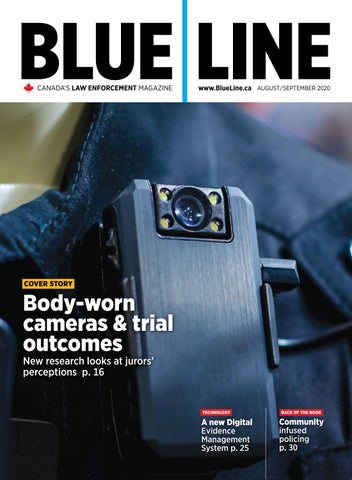
COVER STORY
Body-worn cameras & trial outcomes
PM 40065710
New research looks at jurors’ perceptions p. 16
TECHNOLOGY
BACK OF THE BOOK
A new Digital Evidence Management System p. 25
Community infused policing p. 30
THE AVERAGE TRUCK NEVER COMES WITH THIS MUCH STORAGE.
BUT THEN THIS ISN’T YOUR AVERAGE TRUCK. The 2020 Ram 1500 Special Service is no ordinary truck, starting with its legendary 5.7L HEMI® V8 engine featuring the fuel-efficient Multi-Displacement System (MDS) Fuel Saver Technology. Variable Valve Timing (VVT) delivers impressive engine performance, while its Class-Exclusive Multilink Coil Spring Rear Suspension* ensures lateral stiffness and superior vehicle control. An available RamBox® Cargo Management System* means you’ll never run out of room — whatever you bring to the job. The Ram 1500 Special Service. With so many great features, no wonder they call it Special.
CLASS-EXCLUSIVE RAMBOX CARGO MANAGEMENT SYSTEM ®
WITH BED DIVIDER*
CLASS-EXCLUSIVE MULTILINK COIL SPRING REAR SUSPENSION*
fleet.fcacanada.ca
1 800 463-3600
*Based on Automotive News Full-Size Pickup segmentation. Excludes other vehicles designed and manufactured by FCA US LLC.
Contents
18 Aug./Sept. 2020
Columns
Volume 32 Number 7
4 8 10 12 14 25 26 30
Features
B:11.125"
S:9.875"
T:10.875"
COVER STORY
16 New research shows jurors are influenced by body-worn camera footage
Departments
Body-worn cameras (BWCs) and dashcams are becoming increasingly common in policing. In turn, video evidence from these devices is also increasingly being introduced in court, including jury trials, but little is known about the impact of BWC evidence on trial outcomes. By Alana Saulnier, Kelly C. Burke, & Bette L. Bottoms
18 Peer support 2.0
Editor’s commentary Q&A Health & wellness Behavioural sciences Holding the line Technology Case law Back of the book
As police departments navigate a number of challenging new shifts in 2020, they must constantly re-evaluate the programming and support they make available to their membership. How do well-intentioned chiefs, deputies and wellness co-ordinators navigate the overwhelming number of wellness practices, tools and techniques everyone else seems to swear by? By Steven Bill, with Art Wlodyka
5 5 6 6 7 27 27 28 29 30
By the numbers News Out of the cold Letter to the editor Dispatches Off the shelf Calendar Product showcase Marketplace Blue Links
22 “Defund the police?” — How did we get here? COVER PHOTO: © OLEKSANDR LUTSENKO / ADOBE STOCK
The past months have been difficult, to say the least, for policing in Canada – and indeed globally. The current cry to “defund the police” we are seeing in Canadian protests reflects a lack of understanding of how we got here. By Joel A. Johnston
8 @Blue_LineMag
25 26 August/September 2020 | BLUE LINE
3
EDITOR’S COMMENTARY BY RENÉE FRANCOEUR
Where do we go from here? We keep going
T
om Stamatakis, president of the Canadian Police Association (CPA), is right on the nose in his June 25 piece in the National Post, titled “Opinion: Improve policing in Canada by building up, not tearing down.” As many of us grapple with heavy internal and external conversations in the wake of George Floyd’s murder and the subsequent calls to defund the police across the U.S., spilling over into Canada, Stamatakis eloquently weighs in on the budget and police reform commentary, and I salute him. “We support increased funding for social services, more focused approaches to addiction and substance abuse and measures to address socio-economic inequality,” he writes. “What we are opposed to, is a reactionary debate ignited by regrettable police events and driven more by ideology than by evidence.” You can’t argue with that. I have been asked too many times to count what I think about the trending “defund the police” hashtag and talks of abolishment. Firstly, I acknowledge systemic racism exists in our institutions and I echo Stamatakis in how I reply to these questions. Defunding — especially with no replacement plan — is not the answer. The role of the police is too multifaceted and too great. And that’s part of the problem, too, as Stamatakis wrote — we do need to clearly define the role of the police... Just before composing this commentary, I listened to a podcast episode called “Defund the police?” from Altamar, a global affairs podcast. The guest on this episode was Dr. Clifford Stott, the director of the Keele University Policing Academic Collaboration in England. He talked about how he is “so vociferously for interventions based on neighbourhood and community policing” and noted that though this is a global
problem, “the idea that there’s a one-sizefits-all solution is also really untenable.” He also shared a comment I went back to and purposely listened to again: “Policing isn’t about military oppression – it’s about policing the public by the public for the public of the public, and that is a model of policing through consent.” It’s something we all know in theory, yes, but to hear it in this specific way, with the word “consent” was profound for me. Like RCMP Sgt. Scott Hayes wrote in his June 24 op-ed on blueline.ca, titled “Peel’s principles: A redux,” maybe it is time “to look backwards and remember how we started.” He points to Sir Robert Peel’s nine principles and how “what Peel instituted was a model dependent on maintaining the trust and consent of the public, rather than relying on the might of the state to enforce its will.” There will always be a need for policing in our democracy. We can all agree there is still much work to be done. We need to be productive and collaborative, but let’s not forget such collaborations with healthcare, social services and academic partners have been happening already in many pockets in Canadian policing. In Longueuil, Que., police launched a fiveweek intensive, immersive training program last fall. Without uniforms or weapons, 30 officers volunteered to spend time in community-based organizations. Fady Dagher, the chief of police in Longueuil, hopes to host two of these programs a year. Additionally, take a look at our recent video with Brandon Police Chief Wayne Balcaen (bit.ly/2Wm97yW) to hear more about the service’s seat at the table in the Community Mobilization Westman initiative, modelled after the well-known HUB program in Prince Albert, Sask. I believe we are on the right track but we need to keep going.
CONNECT WITH BLUE LINE
www.BlueLine.ca 4
@Blue_LineMag
BLUE LINE | August/September 2020
www.facebook.com/BlueLineMagazine
BLUE LINE www.BlueLine.ca
GROUP PUBLISHER | MARTIN MCANULTY mmcanulty@annexbusinessmedia.com EDITOR | RENÉE FRANCOEUR rfrancoeur@annexbusinessmedia.com ACCOUNT MANAGER | JANICE EATON jeaton@annexbusinessmedia.com MEDIA DESIGNER | SVETLANA AVRUTIN savrutin@annexbusinessmedia.com ACCOUNT COORDINATOR | TRISH RAMSAY tramsay@annexbusinessmedia.com CIRCULATION MANAGER | BEATA OLECHNOWICZ bolechnowicz@annexbusinessmedia.com Tel: 416-510-5182 COO | SCOTT JAMIESON sjamieson@annexbusinessmedia.com
ANNEX BUSINESS MEDIA 111 Gordon Baker Road, Suite 400 Toronto, ON M2H 3R1 Tel. 416-442-5600 • Fax 416-442-2191
Publication Mail Agreement No. 40065710 ISSN 0847-8538 Printed in Canada SUBSCRIPTION RATES Canada — 1 Year $31.50; 2 Year $52.50 plus tax USA — 1 Year $136.50 CAD CIRCULATION email: bolechnowicz@annexbusinessmedia.com Tel: 416-510-5182 Fax: 416-510-6875 or 416-442-2191 Mail: 111 Gordon Baker Road, Suite 400, Toronto, ON M2H 3R1 Occasionally, Blue Line will mail information on behalf of industry-related groups whose products and services we believe may be of interest to you. If you prefer not to receive this information, please contact our circulation department in any of the four ways listed above. Annex Privacy Officer Privacy@annexbusinessmedia.com; Tel: 800-668-2374 © 2020 Annex Publishing & Printing Inc. All rights reserved. Printed in Canada. No part of the editorial content of this publication may be reprinted without the publisher’s written permission. Opinions expressed in this magazine are not necessarily those of the editor or the publisher. No liability is assumed for errors or omissions. Readers are cautioned and advised that articles presented herein are edited and supplied for your personal awareness and should not be used for further action until appropriate guidance is received from a supervisor, Crown Attorney or other persons in authority. All advertising is subject to the publisher’s approval. Such approval does not imply any endorsement of the products or services advertised. The publisher reserves the right to refuse advertising that does not meet the standards of this publication.
NEWS
Chief Dale McFee, Deputy Chief Darren Derko and Chaplain Lawrence Peck are joined at the ceremony by Const. Woodall’s colleagues, Sgt. Ray Wilson and Const. Daina Christoforou, as well as the EPS Honour Guard. PHOTO: EPS EDMONTON
CANADA
EPS marks five-year anniversary of Const. Daniel Woodall’s death
MDC celebrates 40 years with scholarship program for first responders in training
The Edmonton Police Service (EPS) marked the death of Const. Daniel Woodall with a small ceremony at his grave five years after he was killed in the line of duty. Three wreaths were laid at Woodall’s grave on behalf of the EPS, Edmonton Police Association, and the Woodall Family. Woodall was shot while he and two other members of the EPS Hate Crimes Unit attempted to arrest a suspect in a criminal harassment investigation on June 8, 2015. It was an event that shook the police service and city to the core, and brought worldwide attention to an officer who protected members of the community from hateful attacks. Since that day, EPS members have struggled to understand the tragic event and cope with the grief of losing a fellow officer. However, they are moving forward with healing and closure through the support of the organization and each other. Even on the five-year anniversary of Const. Woodall’s death, his memory lives on in the hearts and minds of friends and colleagues, and his service and sacrifice continue to be an inspiration for the police service and the community. - Chad Orydzuk, Edmonton Police Service
MDC, a distributor of law enforcement equipment and supplies, is celebrating its 40th anniversary this year. During the company’s national sales conference last year one of the major topics was how to celebrate this milestone and team members noted they wanted to invest more in their local communities, specifically with first responders in training. MDC has allocated the marketing budget for 2020 to supporting Canada’s next generation of first responders by setting up 11 scholarship awards and bursaries at colleges across the country. Amid the COVID-19 pandemic, MDC president Alec Rossa says, “we recognize the
need to do more and have increased support where possible.” Fanshawe College received a donation of 36 MDC duty bags for incoming students in the Advanced Police Studies and Advance Law Enforcement, Investigations and Security programs. “We are excited to be more engaged in the first response communities across Canada and believe our scholarship program is a great first step toward giving back in a more meaningful way,” Rossa said. The Atlantic Police Academy (APA) at Holland College received two scholarships as well; one for their graduating class and one for their incoming police cadet candidates. Award winners will also receive a night stick emergency flashlight. “Our students are beginning a new chapter in their lives,” said Forrest Spencer, APA’s executive director. “They have made the conscious decision to serve their neighbours, their communities and their fellow Canadians. MDC is recognizing their efforts. This gift is especially helpful during these difficult times.” As MDC looks toward 2021 and the future of the law enforcement industry, Rossa said he projects 2021 to be “a year to diversify product offerings, to reflect and evolve to follow the shifts in the market.”
Students at the Atlantic Police Academy at Holland College pose outside. PHOTO: INSP. STERLING MCASKILL
BY THE NUMBERS
A Parksville, B.C. man, James Warring Minnie, was sentenced to four and a half years in prison on May 8, 2020, for defrauding two B.C. investors of more than half a million dollars. This is the longest sentence ever imposed as a result of a criminal investigation by the British Columbia Securities Commission (BCSC), the independent provincial government agency responsible for regulating capital markets in B.C. through the administration of the Securities Act.
2 counts of criminal fraud over $5,000 were the charges
@Blue_LineMag
37
convictions that BCSC’s Criminal Investigations Branch has helped secure over the past decade
$543,220 amount Minnie has been ordered to repay the victims in restitution
18 people behind bars due to BCSC’s Criminal Investigations Branch over the past decade
August/September 2020 | BLUE LINE
5
NEWS COLD CASE Blue Line’s Cold Case Series:
OUT OF THE COLD File # 3: The stabbing of Cindy Halliday 28 years ago BY STEPHEN METELSKY
Waverly is a small-knit, quiet community nestled between Hwy 93 and County Rd. 23, about 35 kilometres from Barrie, Ont. Cindy Halliday was born and raised there. She had a large circle of childhood friends, including Marla Adams who lived across the street. Ominous events were not supposed to happen here, but in 1992 they did. It was April 20 and at 5:30 p.m. Halliday was looking for a ride from Barrie back to Waverly. She never made it home. A missing person’s report was filed. Hundreds of pamphlets were distributed but to no avail. As each day passed, the notion that foul play was involved in the 17-year old’s disappearance became a painful reality. “It was huge news everywhere. It was a big thing in our town,” Adams said.
On May 3, two weeks after Halliday was last seen alive, her wallet was discovered in a desolate, wooded area near Horseshoe Valley Road. The OPP K9 unit scoured the area but police found nothing. However, 10 days later, in the same wooded area, a bystander found a red, white and blue jacket that belonged to Halliday. Investigators believed the killer may have planted Halliday’s jacket after the initial, thorough police search. June revealed everyone’s worst fears when skeletal remains were located. A forensic examination confirmed it was Halliday. She had been stabbed to death. An OPP behavioural profiler examined the unsolved homicide in September 1992. The profile of the unknown perpetrator was likely a male, in his 20s or 30s who may have known Halliday. The profiler surmised the killer would have exhibited severe physical and emotional indicators leading to changes in his personality and demeanour after the homicide. Weeks turned into months. New witness information came to the surface in March 1993, indicating a teenager consistent with
Halliday’s description had been seen getting into a 1979-1981, light-coloured Chrysler LeBaron or Dodge Diplomat at a Hasty Market in Midland, Ont. In 2006, the OPP announced a $50,000 reward for any information leading to an arrest in Halliday’s murder. Yet, 28 years after Halliday was killed, her murder remains an open, unsolved file. “She [Cindy] is the reason I wanted to be a cop. It really made me want to do something to solve crimes,” confirmed Adams, currently an officer serving in the Greater Toronto Area. “It is a really hard thing to come to terms with. Her family deserves some closure.” Police are asking anyone with information to call the Simcoe County Case Files hotline at 1-844-677-5030 or anonymously at Crime Stoppers: 1-800-222-TIPS (8477).
on June 3, violence flared following one officer taking a knee, which then led to 13 arrests. The act, as it appeared, did not prevent subsequent attacks on officers. Kneeling has not been met with comprehensive approval from protestors, who largely refer to it as a public relations stunt. “Don’t let the police join our protests,” said Rev. Corine Mack of NAACP (National Association for the Advancement of Colored People). Kendrick Sampson, star of the HBO show “Insecure,” called the action of police kneeling a “farce” ... a far from assured way to achieve compliance. In Toronto, Chief Saunders knelt with his senior officers. Toronto Insp. Moyer stated, “These aren’t protestors, they’re ambassadors of peace.” In 2015, however, protestors angry at China’s human rights record — also arguably ambassadors of peace — were prevented from protesting during President Xi’s visit to London, U.K. This highlights the juxtaposition in policing when dealing with protests. The recent protests in Toronto were largely peaceful, supporting the argument that police kneeling had the desired effect. Is this
the police representing the community they serve or was this tactic effective due to its timing at the parade start? Instead of issuing strict guidance on this matter, police leaders have allowed officers to make individual judgements. The chief constable of Kent knelt on the same day the most senior U.K. officer, Cressida Dick, instructed her officers not to kneel. Anecdotally, officers have been ordered to kneel by their supervisors, a potentially unlawful order. The solution is exemplified by Sir Robert Peel, in his fifth principle. What the police must do is “seek and preserve public favour, not by pandering to public opinion, but by constantly demonstrating absolutely impartial service to law.” Continued kneeling may well be construed as tacit support by those in opposition, causing a difficult rift to heal. As unpalatable as this may be personally, as police we must remain apolitical and autonomous. By doing this, community confidence is enhanced.
You can watch a related YouTube video at youtu.be/QDS2GWMF6kw. Stephen Metelsky, M.A., is a writer, (ret.) police sergeant and professor at Mohawk College. Find him on LinkedIn, follow him @StephenMetelsky or email Stephen.Metelsky@mohawkcollege.ca.
LETTER TO THE EDITOR To take a knee or not to take a knee? Policing protests are challenging. In 2001, I was on the frontline for three days in Oldham, U.K. Petrol bombs and bricks were thrown. On one night a shotgun was discharged at the line; we held it. At no point was I required to show solidarity with either side, by word or action. Political interference, coupled with pressure from the media, have intensified due to recent events. This has brought a new challenge: Do police kneel with protestors? From the March on Washington for Jobs and Freedom in 1963, Women’s Lives in 2004, and movements such as Idle No More, police have ensured protestors can protest lawfully. They have done so by a variety of means. Could kneeling, now an almost pre-emptive approach in acquiescing to protestors demands, be another facet in preventing disorder? Appeasement should not be a consideration. Ineffectual at the G20 protests in Toronto 2010, its effects have been further evidenced at the Black Lives Matter (BLM) protests in London, U.K. At Downing Street 6
BLUE LINE | August/September 2020
- British Bobby Canadian Cop (read his blog at BritishBobbyCanadianCop.com) www.BlueLine.ca
NEWS DISPATCHES Dave Jansen is the new chief constable at the New Westminster Police Department in British Columbia. He began his policing career with the department in 1990 and became deputy chief in 2015. Jansen received his certification as a Gold Commander from the College of Policing in the United Kingdom. He has been the recipient of three senior officers’ commendations and an OIC Commendation from the RCMP. Toronto Police social media officer Const. Scott Mills is retiring. Mills began his career in 1990 with Peel Regional Police and joined Toronto Police in 2002. “Scott was one of our very early adopters of social media and our program is what it is today because of his efforts,” Chief Mark Saunders said of Mills in a Toronto Sun article.
Edmonton Police Supt. Deb Jolly has passed away after a four-month illness. She served her country while seconded to the United Nations Peacekeeping Mission in East Timor and was also a researcher of the Restorative Justice courts in Rwanda. She was with EPS for more than 30 years and served as the chief’s chief of staff up until her passing. Rest in peace. Shahin Mehdizadeh will officially take on the role of police chief in Lethbridge, Alta. on Aug. 31. He is currently the RCMP chief superintendent for the Central Alberta District. An accomplished police executive with more than 30 years’ experience with the RCMP, Mehdizadeh has worked across four provinces and has been in senior leadership roles for the past 15 years.
Retired Abbotsford Police Department family member Insp. Carol Powell has passed away following a long and courageous battle with cancer. A vintage AbbyPD police car is currently being restored and has been named ‘Carol’ in her memory. Rest in peace. Toronto Police Chief Mark Saunders has retired, noting after decades of serving, he wanted to spend more time with his family. Throughout his career, Saunders has had an extensive investigative background and served as the unit commander of the largest homicide squad in Canada. He has been the recipient of numerous awards, including Officer of the Order of Merit of the Police Forces, the Queen Elizabeth Diamond Jubilee Medal for Outstanding Community Contributions and the Black Canadians Award for Public Service.
OSGOODE’S PART-TIME PROFESSIONAL LLM IN CRIMINAL LAW & PROCEDURE
Leverage yourself to succeed amongst ever-changing criminal laws.
SPECIALIZATIONS STARTING IN JANUARY 2017:
Courses Include: · Administrative Law · Business Law · Wrongful Convictions
· Civil Litigation &
Dispute Resolution · International Criminal Law
Revolutionary change is afoot. This popular and rigorous two-year, part-time program provides you with an opportunity to get ahead of the challenging issues affecting the Canadian criminal justice system. Immerse yourself in a rich learning environment including Chiefs of Police, Senior Investigators and criminal lawyers. Apply by October 15th | Start in January 2021 Learn more at osgoodepd.ca/blueline
· Constitutional Law
Criminal and Law & Procedure · Aboriginal· People the · EnergySystem & Infrastructure Law Criminal Justice · Family Law
· General · Anti-Terrorism andLLM the Law
· Corporate WINTER and Finance Crimes 2017 APPLICATION DEADLINE: OCTOBER 26 and Compliance VIDEO CONFERENCING IS AVAILABLE FOR ALL COURSES.
Canada’s leading Professional LLM for lawyers, executives and experienced professionals
@Blue_LineMag
BL_Osgoode_AugSept20.indd 1
August/September 2020 | BLUE LINE
7
2020-07-13 12:00 PM
Q&A Vancouver Police Department Const. Chris Birkett is the president of the newly launched non-profit, Out On Patrol, a peer support organization based in British Columbia for LGBTQ2S+ members of law enforcement and allies. Below, he shares more with Blue Line on the background to building this worthwhile initiative and more. Our society has been an idea in the making for years. For me, the discussion started in 2017 when I attended a fundraiser for “CampOUT!” which sends LGBTQ2S+ youth to camp. I was a sheriff at the time and attended with a group of friends from the VPD (Vancouver Police Department) and RCMP. It gave us the opportunity to come together as LGBTQ2S+ members of law enforcement, while also raising money for a worthy cause. We got to discussing an idea of bringing LGBTQ2S+ members together and how we could really help the community at the same time. In terms of peer support, although there has been huge progress made in relation to LGBTQ2S+ rights, there are still members who do not feel comfortable talking about how they identify. My hope is with Out On Patrol, we can provide them with a space to express themselves and also demonstrate how our departments are supportive of us being who we truly are.
are going through the same experience that it is okay for them to be honest about who they are, without the fear I experienced. When I was hired as a sheriff in 2012, I had recently come out to friends and family, but I still worried how I would be perceived at work. I made the choice to go through the sheriff academy in the closet and was not honest about who I was. I was fearful of being labelled “the gay guy.” After graduating and coming out, I realized I had nothing to be afraid of and that the barriers I put up were not needed. Fast forward six years to my time in the police academy: after having a great career with the sheriffs and learning from my experiences, I did not feel I needed to hide who I was. I am happy to say I have had nothing but positive experiences with the VPD. I do recognize I am lucky to have entered law enforcement when I did, in a progressive city like Vancouver. My experience is my own and I know others have not been as fortunate as I am, which is one reason why I believe Out on Patrol is still a relevant and needed organization.
ing events. Throughout the year we will be hosting a mix of free events for members as well as ticketed events, where members will receive discounts on ticket prices. Due to the current COVID-19 restrictions, we are limited in terms of our ability to host events. However, we are already brainstorming our first event and we cannot wait for the chance to bring everyone Q: Tell us more about the society’s together! We have some other exciting plans for continuing to bridge the gap. member benefits planned, but those are Once we have a strong member base and are being kept secret for now! Q: What has the feedback been from fellow law enforcement? able to expand our passionate group of The feedback has honestly been amazing volunteers, we would love to host commun- Q: How do you think your own law and overwhelmingly positive! We have had ity events as well as in-school educational enforcement journey might have an outpouring of support from around the presentations. In law enforcement, we been different if Out On Patrol had world, everywhere from Canada to New often deal with the public in times of crisis been around when you started your Zealand! It has been so great to see the and it can feel more negative than positive, career in 2012? depending on the situation. We would love I think Out On Patrol would have had an emails and messages of support coming in. to give community members the opportun- extremely positive impact on my life if it One thing that really hits home is when I ity to interact with peace officers in a posi- would have been around in 2012 and ideal- read the thank you messages from individtive and welcoming environment, getting to ly even before that. When I was in high ual members saying how much an organizknow police as people and, in turn, helping school, I was in the closet and interested ation like Out On Patrol means to them in a career in law enforcement. I often and how they’ve been waiting for someus all understand each other. worried about how my sexuality would thing like this to come around for their Q: How many new members since impact my potential future career. I didn’t entire careers. It has really demonstrated the public launch? Why should know if there were gay police officers and to me how important our society is and it people join? if there were, I worried about how they has made me even more motivated to keep Since our launch at the very end of May, were treated. This is one of the reasons I working at making this successful. we are already at almost 100 members (by am passionate about Out On Patrol conmid-June)! Benefits include invitations to ducting in-school presentations, to lead by Find the unabridged version of this Q&A online at blueline.ca/topic/qa/. members-only peer support and fundrais- example as role models and show kids who 8
BLUE LINE | August/September 2020
www.BlueLine.ca
PHOTO COURTESY OF CHRIS BIRKETT
Q: How was Out On Patrol formed?
Protect your people – while they protect everyone else. With BlackBerry AtHoc, you’ll gain the insight you need and communicate your way through any crisis by: Keeping everyone informed Protecting your frontline workers in the field Keeping track of where everyone is at all times Staying compliant with changing regulations Sharing information with other agencies like Fire Services and EMS
www.blackberry.com/us/en/solutions/emergency-notification-systems
HEALTH & WELLNESS BY ISABELLE SAUVÉ
Standing proud in these stressful times
T
he well-known adage “any publicity is good publicity” may hold true in some circumstances. When it comes to government agencies or law enforcement organizations facing repeated negative media coverage, some will point out that adage is not the case. There is no doubt law enforcement members are feeling the impact and the repercussions of the wrong doings of a few individuals within the profession. Media of all sorts are painting police forces as systemically violent and racist. Consequently, many citizens develop a strong opinion and draw conclusions solely based on the limited information they are provided and exposed to. Sadly, deplorable actions of one or a few officers affects the image of and damages the profession as a whole. Each member is potentially adversely affected as well as their loved ones. According to Dr. Scott Wolfe’s research from the University of Texas in Austin, public safety officers’ proactivity declines when they perceive negative public scrutiny will follow, even if they are deeply motivated to help people. Negative press can result in officers questioning self-legitimacy and the tactics they have been taught. Officers may hesitate to use force even when appropriate, justified and necessary. This comes with obvious possible consequences on safety. Wolfe’s study also found a relationship between reduced motivation — as a result of negative publicity — and less willingness to engage with community members. While the immediate instinct may be to avoid speaking with members of the public, it is important to continue having positive interactions with our community members in order to abolish the negative stereotypes being shed on the law enforcement profession. Many civilians have little to no contact with police and unfortunately only have that of which is portrayed through the media as a basis upon to 10
BLUE LINE | August/September 2020
form an opinion and view of police. For this reason, it is important to use interactions with members of the public as an opportunity to educate and remind them the reputation of police as a whole cannot be based on one or two “bad apples.” We must also be patient, as it takes significant time to build trust and a good image — but only an instant to damage or lose it. Dealing with the few wrong doers as well as any consequent public demonstration and media attention should be left to trained communication experts and individuals of highest command. Individual officers should consider refraining from making public symbolic gestures, such as “taking a knee” and making public apologies for something they are not responsible for. It is important that each law enforcement officer, family member and close entourage stand proud. Make sure you are kind and educate yourself based on accurate and reliable facts. Wolfe’s study also suggested negative publicity could be counteracted if supervisors ensure fairness. Supervisors must keep in mind the factors affecting employees and support them accordingly. Even small actions go a long way. It is highly recommended during those stressful times that employers pay attention to patterns of absenteeism. It is crucial to speak to the members of concern and monitor wellness. Options for support should be communicated and made readily available. Negative press augments any pre-existing stress level and exposes officers to repeated trauma, which unaddressed can led to the onset of an occupational stress injury (OSI) or other issues. From a safety standpoint, law enforcement personnel should remain cognizant and vigilant, as sadly a small percentage of the population will utilize any opportunity to target law enforcement through various means such as verbal attacks, resisting arrest, assaults and revenge attacks on police officers.
While the immediate instinct may be to avoid speaking with members of the public, it is important to continue having positive interactions with our community members in order to abolish the negative stereotypes being shed on the law enforcement profession.
Another means to alleviate the detrimental impact of negative media is through optimism. Optimism is at the root of resilience. Current negative press is temporary and soon another story will be sensationalized. We must also remember police are receiving such generous amounts of coverage and attention as it is such an integral and important role in society. Officers must remain proud of the critical function they serve. Below are a few additional tips to nix negativity: • Remember the positives and focus on them • Know you are not alone — count on others for support and offer support in return • Talk to friends and family, and use the various online platforms to stay connected with those at a distance • Surround yourself with supportive and positive people • Engage in activities and hobbies to stay mentally and physically fit, and deal with stress in a healthy manner • Limit time listening to the radio, watching the new, and surfing social media • Avoid making political statements or demonstrations out of a feeling of guilt, obligation, fear, frustration or anger • Stand up for what is right but refrain from making apologies for something you didn’t do wrong • Remember why you joined policing • Avoid being “baited” in heated discussions over false accusations of being racist It is critical to remember it takes time to rebuild a tarnished image but it is possible. From every setback comes an opportunity which we must seize and capitalize upon. It can be concluded as such that “any publicity is good publicity” — even for law enforcement organizations as it provides an opportunity to improve and address issues. Stand proud and lead by example.
Isabelle Sauvé is a 14-year veteran with the OPP, and currently the new Psychological Services Advisor in the OPP’s Healthy Workplace Bureau. She has a MA in psychology and is a PhD candidate. She is also an ultramarathon/endurance athlete and the Racing the Planet/4 Deserts 2018 Series winner as well as a Guinness World record holder. She can be contacted at: isabelle.sauve@hotmail.com.
www.BlueLine.ca
The ONLY Proactive Peer Support and Wellness App , a custom mobile app giving each member of your organization access to and – wherever they are and whenever they need it.
Protect your most valuable asset, your officers.
+6
VIEW SUPPORT TEAM
�
�
CLOSE
MY SUPPORT TEAM � Search Contacts
Press the Request Contact
AFFORDABLE
PRIVATE
RELIABLE
SECURE
EASY TO USE
button below and a member of
Dave Adams
�
Kim Smith Kim@email.com
�
Adam Spelling
�
dave@email.com
your Support Team will connect with you using your preferred contact method as soon as
�
�
Coordinators (3)
adam@email.com
possible.
Peer Support - Previously Contacted (1)
�
Dave Adams
REQUEST CONTACT
�
Wellness workers freed to work on wellness initiatives
�
Peer Support and wellness resources in your pocket
�
dave@email.com
Peer Support (6)
Alex Monroe
Minus-Circle
Dave Adams
�
alex@email.com
If you are in a serious crisis situation, please call 911 and/or proceed to your nearest emergency room.
dave@email.com
Adam Triste
�
�
adam@email.com
Newsfeed
�
Reduce mental health related stigma
�
Share wellness KPIs, metrics and engagement reports
�
Enhances CISM, EFAP, and other programs
�
Newsfeed – real time communication/engagement reports
� �
Self-assessment – evidence based tools in your pocket
�
Recruitment – engage potential candidates
�
Decrease lost time, STD, LTD, OSI, and overtime
�
Wellness resources – PTSD/PTSI, depression, substance abuse, harm reduction and prevention
firstresponsemh.com
Connect
Resources
More
Newsfeed
Connect
Resources
More
Commit to connect.
powered by
(807) 251-9754
info@firstresponsemh.com
BEHAVIOURAL SCIENCES BY PETER COLLINS
What is the Boogaloo movement?
T
he Boogaloo movement started out as a meme. The origin of the term boogaloo comes from a movie; in 1984 the breakdancing film Breakin’ 2: Electric Boogaloo was released and the title became a joke. “Breakin” was replaced with another word or term — such as another film, event or a person of their choice.1 One of these sayings, “Civil War 2: Electric Boogaloo,” has taken on a life of its own and since 2019 it been used by a collection of rightwing, anti-government groups who identify themselves as the boogaloo boys or boogaloo bois. The boogaloo boys are preparing for the coming of the second American Civil War. This is not new in the landscape of American domestic extremism. One of the motivations for Timothy McVeigh’s bombing of the Alfred P. Murrah Federal Building in April 1995 was his belief that it would spark the second American Revolu-
In the wake of the tragic shooting rampage in Nova Scotia, and the government’s response to the possession of assault-style weapons, Canadians who self-identify as boogaloo boys have become active on social media sites. tion and would influence like-minded individuals to take up arms against the United States government. Part of the boogaloo jargon involves word play. They refer to themselves as boogs, the boojahideen, big igloo and big luau. When they attend protests the “boys” will wear Hawaiian shirts with their tactical clothing in reference to the civil war being the “big luau.” Some have adopted symbols and memes of the far-right like Pepe the Frog.2 Other symbols include an American flag, entitled the “Thick Boog Line” mimicking the
DALHOUSIE’S CERTIFICATE IN POLICE LEADERSHIP
Become the leader you know you can be
Built for modern policing, our online courses, designed and delivered by academics along with industry experts and leaders in policing, give you the knowledge and skills to advance in your profession. Learn from the innovator in quality police education for over 25 years. FALL TERM STARTS SEPTEMBER 9
DAL.CA/POLICELEADERSHIP
CCE
College of Continuing Education
12
“Thin Blue Line” of law enforcement. The line, through the flag, is a Hawaiian motif and an igloo is in the upper left corner where the stars would be. There has been a surge in the popularity of the Boogaloo movement since the onset of the COVID-19 lockdown. According to a recent report of the Tech Transparency Project (TTP), there are 125 Facebook groups devoted to the “boogaloo.” More than 60 per cent of these groups were created in the last three months, as the pandemic took hold in the U.S. They attracted tens of thousands of members in first month of the lockdown.3 In accessing a representative sample of private boogaloo Facebook groups, the TTP discovered they discussed topics such as weaponry (including flame-throwers, improvised explosive devices), tactical strategies and combat medicine. They also took inspiration from Donald Trump’s tweets about “liberating” the States where governors had imposed stay-home orders. They view the lockdown as a violation of their rights. Many boogaloo references are directed against the “alphabet boys” or “alphabet gang” – agencies like the FBI, ATF, RCMP, OPP and SQ – who they assume would assist in any gun confiscations. At the beginning of May 2020, Facebook banned the term “Boogaloo” from posts when used in conjunction with posts depicting or calling for violence. Their beliefs tend to be what the extremist watch group, the Soufan Center, refers to as a “patchwork.” While definitely right-wing, pro-gun and anti-police, many have links to white supremacy groups/neo-Nazi groups. In addition to their COVID-19 protests, they also recently used the Black Lives Matter (BLM) demonstrations, after the murder of George Floyd, as a cover for their anti-police activities.4 In March, a Missouri man with ties to neo-Nazis was shot and killed when FBI agents tried to arrest him. Timothy Wilson, 36, was planning to bomb a hospital in the Kansas City area on the day a COVID-19 stay-at-home order was scheduled to take effect, authorities said. Wilson told an undercover FBI agent that his goal was “to kick start a revolution” and referred to his plans as “operation boogaloo.”
BLUE LINE | August/September 2020
BL_Dalhousie_AugSept20.indd 1
www.BlueLine.ca 2020-07-06 9:55 AM
At the end of May 2020, the FBI arrested three individuals associated with the Boogaloo movement on their way to a BLM protest. They were in possession of incendiary devices with the intent to create civic unrest by capitalizing on the protests. All three had U.S. military experience. They have been charged with two counts each of terrorism and two counts each of possession of explosives. In a separate incident, a USAF (United States Air Force) sergeant ambushed police in Santa Cruz, Calif. on June 6, 2020, killing one officer. He is a suspect in the murder of another officer a week earlier in Oakland, Calif. At the time of his arrest, “boog” was written in blood on the vehicle he stole. His Facebook page, reportedly, was laden with memes often associated with the Boogaloo movement.5
Are they in Canada?
The internet and extremism know no boundaries. In January 2020, the FBI arrested and charged three members of an
@Blue_LineMag
BL_Prod360_AugSept20.indd 1
There has been a surge in the popularity of the Boogaloo movement since the onset of the COVID-19 lockdown. According to a recent report of the Tech Transparency Project, there are 125 Facebook groups devoted to the “boogaloo.” alleged neo-Nazi group with conspiracy to commit a murder that a former Manitoba reservist has been accused of recruiting them for. The three were allegedly preparing for “the collapse of the United States and subsequent race war, ‘boogaloo,’” according to the affidavit. In the wake of the tragic shooting rampage in Nova Scotia, and the government’s response to the possession of assault-style weapons, Canadians who self-identify as boogaloo boys have become active on social media sites. In summary, boogaloo is a non-centralized, heterogeneous group of individuals with a mixture of ideologies aligned with white supremacists, neoNazis and anarchists. They share the same
dislike of government and the police, and believe in their right to possess assault weapons. Are they coming to Canada? No, they are already here.
Footnotes
1. Anti-Defamation League (2019) www.adl.org/ blog/the-boogaloo-extremists-new-slang-termfor-a-coming-civil-war. Retrieved 15 June 2020. 2. Anti-Defamation League (2019) www.adl.org/ education/references/hate-symbols/pepe-thefrog. Retrieved 15 June 2020. 3. Tech Transparency Project (2020) www. techtransparencyproject.org/articles/extremistsare-using-facebook-to-organize-for-civil-waramid-coronavirus. Retrieved 15 June 2020. 4. The Soufan Center (2020) thesoufancenter.org/ intelbrief-the-boogaloo-movement-fromeccentric-distraction-to-domestic-terror/. Retrieved 15 June 2020. 5. Ibid.
Dr. Peter Collins is the operational forensic psychiatrist with the Ontario Provincial Police’s Criminal Behaviour Analysis Section. He is also a member of the crisis/hostage negotiation team of the Toronto Police Service Emergency Task Force. Dr. Collins’ opinions are his own. Contact him at peter.collins@ utoronto.ca.
August/September 2020 | BLUE LINE
13
2020-07-06 1:42 PM
HOLDING THE LINE BY MICHELLE VINCENT
Using out-of-the-box thinking for developing occupationally-specific programming
A
Every year organizations grow and develop new training to ensure their members are working with leading-edge information. In turn, they hope this will minimize organizational liability and also improve efficiency and the safety of their members, both sworn and civilian. Using unconventional thinking in relation to programming may support the kind of top-notch training leaders are seeking. Many of us, as sworn and civilian members, work outside of organizational time clocks in order to network, meet, train and explore additional tools and programming — many of which have the flavour of unconventional
If COVID-19 continues to teach us anything, it is how much we can accomplish when we think unconventionally. thinking. We do this so that we might support our policing family in being the best we can be. We understand there are organizational restraints and time-related challenges that prevent sending members out for these varied types of training, networking and collaborating. However, we also applaud and appreciate those members who do volunteer their time for this. I have seen some amazing programming introduced nationwide in our policing services, from writing for resiliency workshops to intensive reintegration programs, to a complete overhaul in culture change. As I continue my doctoral research, my creative juices grow and flow in this area. One idea on unconventional thinking — in relation to programming — that came to me was this: I considered how many of us have sought out mental healthcare whereby the psychologist used cognitive behavioural therapy (CBT) as a form of treatment. From a very basic perspective, CBT involves reframing thoughts that do not serve us. An example is: while attending a domestic where we are required to lay a charge, a thought that might go through our mind is: As a result of legislation and the mandatory charge laid, we are causing greater angst and discord for this family... This can feel heavy on us. Reframing this thought might include going through what will benefit the family as a result of the charges laid. They are likely to be engaged with various resources that will
support their mental well-being as well as their relationship. If we hadn’t engaged with this couple, their circumstances may have escalated to a more serious incident. Personally, I am a big believer in having this as a skillset. This is because perception is reality and it is key in our experience of the world. CBT is delivered online, which shows us how simple it can be to apply on our own and it can even be delivered right through our police training for personal use. Developing programming with CBT components, such as adding a program for our members to practice various written scenarios — to rewrite an experience with a completely different perception — may empower them to appreciate the control we truly have over our minds. There are two take-aways in this article: • If you are that go-getter who works outside of your organizational timeclock networking, researching and training because you know it will make you a better member, keep doing it. The business of empowering our world with positive energy is conducted one person at a time. What you are doing is and will continue to be contagious. • Think outside the box and encourage your organization to do the same. If COVID-19 continues to teach us anything, it is how much we can accomplish when we think unconventionally. Change is always an opportunity if we choose to see it as such. Michelle Vincent is a retired police office and the founder of The Haven, Ontario’s first non-profit, inpatient treatment centre exclusive to first responders. Email her at michelle.vincent@thehaven.cloud. -
s police officers we know training is key. In today’s climate, training is not only what we fall back on but what we will be evaluated on should our split-decision actions be questioned in an inquiry. With that being said, what kind of training do we actually practice? We have our annual requalification, which in most organizations involves defensive tactics, firearms training and thematic scenarios — often developed as a result of serious mishaps experienced throughout the year. Perhaps unconventional thinking in the development of our programming would be the missing ingredient.
14
BLUE LINE | August/September 2020
BL_Ongia_AugSept20.indd 1
www.BlueLine.ca 2020-07-07 9:46 AM
THANK YOU
TO ALL THE FRONTLINE PERSONNEL AND AGENCIES FOR KEEPING US SAFE
Panasonic Toughbook 33 Tablet DPT Full Docking Station PMT Part No. AS7.P033.112 Flat Mousetrap PMT Part No. AS5.N101.002
2020 Ford Police Interceptor Utility In-Console Printer Solution for Brother PJ7 PMT Part No. AS4.C237.501 ®
1-888-869-7652 sales@precisionmounts.com
WWW.PRECISIONMOUNTS.COM
2322 49 Ave SE Calgary, AB T2B 3E3
COVER STORY
Body-worn cameras & trial outcomes New research shows jurors are influenced by body-worn camera footage By Alana Saulnier,
Cass County (Michigan) Sheriff’s Deputy Tim Keene chats with driver Ronica Born.
B
ody-worn cameras (BWCs) and dashcams are becoming increasingly common in policing. In turn, video evidence from these devices is also increasingly being introduced in court, including jury trials. Little is known about the impact of BWC evidence on trial outcomes. Criminal justice and psychology researchers are assisting law enforcement and court practitioners by conducting studies to determine the various impacts of BWCs. Our research focuses on jurors’ perceptions of cases involving BWC evi-
250+
young adults participated in the “mock trial” study
dence. In particular, we explore how introducing BWC footage at trial affects various jurors’ perceptions (such as perceptions of involved officers) and, in turn, verdicts rendered. Our first study was recently published in the journal Behavioral Sciences and the Law. This study was carried out in America and we should not assume that the outcomes are the same as those we might see in Canada, but international studies do provide insights that are useful domestically. In this case, it is useful to think about how the findings from this study might hold up in the Canadian context.
We theorize that the introduction of video footage of police-public interactions can increase jurors’ emotional connections to what they are evaluating. 16
BLUE LINE | August/September 2020
The research we conducted was a “mock trial” study, where over 250 young adults put themselves in the role of jurors and considered evidence from an actual case where an officer’s use of force was controversial. The officer made a traffic stop of a man suspected of violating a protection from abuse order. The officer asked the driver to exit the vehicle, but the driver refused. The exchange escalated over a period of several minutes until the officer tasered the driver repeatedly. We presented the trial to our mock jurors via a narrated slide show. The driver was charged with resisting arrest. Jurors’ verdicts were undoubtedly influenced by their opinion of whether the officer used excessive force. Legally, the officer appears to be within his right to use force, but the line between justifiable and excessive became blurred by the officer’s repeated use of the taser along www.BlueLine.ca
PHOTO: CAPT. TOM JACOBS
Kelly C. Burke, & Bette L. Bottoms
Peer support 2.0 The future of law enforcement wellness By Steven Bill, with Art Wlodyka
T
he world keeps turning, despite 2020’s best efforts to slow it down, with police officers and other first responders seeing their already considerable workloads increase or change in significant ways. While the routine traffic stops, report calls and minor disputes may have slowed, each one presents a new challenge as PPE (personal protective equipment) and distancing requirements have given the mundane a new risk factor. As the pandemic has gone on, police have now seen an influx in mental health crisis calls. Many of the most vulnerable have been isolated for months, seen a reduction in social support and resorted to extreme measures such as increased illicit substance use and even suicidality. And now, at the time of writing this, officers have a compounded threat and worry with the increased social and race-based unrest, plus police officer scrutiny brought on by the tragic death of George Floyd in Minneapolis and its aftermath. As police departments navigate these shifts, literal and figurative, they must constantly re-evaluate the programming and support they make available to their membership. Gone are the days of “suck 18
BLUE LINE | August/September 2020
it up,” but how do well-intentioned chiefs, deputies and wellness co-ordinators navigate the overwhelming number of wellness practices, tools and techniques everyone else seems to swear by? We spoke with Art Wlodyka, M.A. Counseling Psychology and CISM/peer support co-ordinator with the New Westminster Police Department (NWPD) in British Columbia, about how his team is handling these recent events. We also spoke about what supports and policies he sees as being critical to handle officer wellness today as well as into the future. Steven Bill (SB): Art, I know you have been a vocal and effective advocate for officer wellness initiatives, and have had a number of pieces published previously, but we want to look at the issues police officers are facing right now, as well as what you think the landscape of wellness programming will look like as we emerge from the COVID-19 and the police accountability protests we’ve seen in the first half of 2020. To get us started, can share what’s working for you at NWPD — whether it’s a traditional type of program, or something out-of-the-box?
Art Wlodyka (AW): We have a newly created organizational wellness officer overseeing a number of new initiatives, as well as an active Critical Incident and Peer Support team. One of the best things I have seen is getting proactive messaging out about mental health and services available to our staff from our wellness officer in a variety of ways. These include washroom posters and memes on our internal network. Officers have responded really well to that. I have also seen a shift in officers feeling comfortable approaching myself or other peer team members to talk about a number of stressors happening in their lives. This covers everything from relationship issues, looking for resources for their kids, discussing burnout, some organizational stressors and just mental health in general. People also come by regularly looking for referrals to counsellors or psychologists. To meet that need our team has doubled in size — from four officers in 2015 to eight in 2020, which also includes a civilian. This is for a staff of about 160. I would say the jury is no longer out on peer support; it has been well studied and found to be effective at engaging frontline staff and acting as a ‘first step’ toward seeking more formalized assistance like an EAP (Employee Assistance Program). We’ve also been given some flexibility in determining what a peer support interaction looks like, which I think is important and something we’ll be looking at more in the future. The debriefs, phone calls and coffee chats will still be there, but www.BlueLine.ca
PHOTO: ART WLODYKA/NEW WESTMINSTER POLICE DEPT.
WELLNESS
tegration programs and greater access to first responder treatment programs is also helping to address this need. SB: Turning to the future now, what ideas do you have to enhance your current offerings, and what advice would you give to other leaders looking to start up or revamp their internal support services? AW: In conjunction with our wellness officer, we are always on the lookout for improving and expanding our programming. Recently, we’ve formed a group of CISM/Peer Support/Wellness Co-ordinators from across B.C. who meet monthly to discuss challenges and successes, so we’re able to benefit from that collaboration and groupthink. We continue to work on strategies to proactively engage our officers on a consistent basis in ways that they are able to relate to. We are now setting up a system now where we can better manage and track who has been met with, and have automated
reminders that alert the team when someone has gone a certain number of days without a peer support interaction. Again, we are not trying to force any check-ins on anyone; we just want to make sure we are not missing anyone and ensure people have the support they need. We are also excited about the simplicity of the program in being able to ask for contact with a simple click of a button, and not have to look up specific phone numbers for specific people to ask for help. We’re excited to implement this, and I’m personally very interested in a program that will also allow us to spend more time with colleagues and supporting them, and less time administratively co-ordinating follow-ups and collecting reports. SB: Any last words of wisdom for chiefs and wellness co-ordinators? AW: Continue to find new and innovative ways of supporting colleagues. While there is certainly a risk management business case around mental health and wellness supports, we must handle this in ways that feel meaningful and real to officers. Some-
times it’s around addressing specific stressors such as “staff shortages” where officers are reallocated to support the biggest need, such as patrolling the frontlines. Sometimes it’s about investing in new programs and taking chances to try something new, rather than sitting on the fence and waiting to see “what is everyone else doing?” I have seen great examples of strong leadership during the recent pandemic and look forward to open and honest dialogues at all levels of leadership moving forward. Steven Bill is the co-ordinator of communications and new media for the Thunder Bay District Health Unit (TBDHU). He has a passion for helping organizations understand what their driving purpose is, and has been an important part of TBDHU’s nationally-recognized COVID response campaigns. Art Wlodyka is a New Westminster Police Department police officer and mental health clinician. He is the founding member of a Police Mental Health Unit in 2013. Since then, he has assisted hundreds of individuals in crisis, and was awarded a Chief Constable’s Commendation in 2014.
Prepare to Serve and Protect SENECA OFFERS PROGRAMS IN: • Police Foundations • Crime & Intelligence Analysis • Advanced Investigations • Emergency Services Communications (911) Enhance your diploma or professional experience through credit transfer to gain another law enforcement credential. Start making a difference in communities across Canada.
LEARN MORE AND APPLY TODAY.
senecacollege.ca
@Blue_LineMag
BL_Seneca_AugSept20.indd 1
August/September 2020 | BLUE LINE
21
2020-07-08 1:09 PM
CULTURE
“Defund the police?” — How did we get here? Policing has been expected to do more with less
T
he past months have been difficult, to say the least, for policing in Canada – and indeed globally. The highly-public death of George Floyd, followed two weeks later by the highly-public death of Rayshard Brooks in a country in many ways far-removed from Canada have had a significant impact. Much of it has not been pretty. And much of what has been spun in the global “mainstream” news media is simply not accurate nor fairly and objectively presented to the consumers of “news.” Data has been manipulated by special interest groups to make it appear as though racism is at the root of all police interventions – which it is not. In almost every lethal force encounter, the police were put into direct contact with the person as a result of a complaint or call for service. In a fairly comprehensive review of fatal outcomes with police in Canada by a national media outlet, it was revealed that over a period of 18 years, 461 people died in police custody – of all causes. Included in this review were deaths as a re22
BLUE LINE | August/September 2020
sult of natural causes, medical complications, overdoses, etc. during an encounter with Canadian police. Some of these cases involved no physical force whatsoever. Fatal shootings comprised 329 of these encounters.1 That’s an average of 18 per year. It is conservatively estimated that police in Canada have about 30 million contacts with the public every year. This equates to a ~.0000006 per cent likelihood of being shot by police in Canada – or about one in 1.67 million. Further, the vast majority of these people were armed and imminently dangerous at the moment they were shot by police. Others were engaged in a violent fight with police during an interaction. Others were imminently endangering the life/lives of members of the public. In one 2013 fatal shooting case in Toronto, an officer was charged and convicted of attempted murder and sentenced to prison. In a 2016 non-shooting case in Ottawa, an officer has been charged with manslaughter, aggravated assault and assault with a weapon – that trial has not
concluded. The primary influencing factor in all police-related fatalities has been the behaviour of the individual whom the police are put into contact with. Fatal police encounters occur in Canada across the racial spectrum, with the majority involving Caucasian people (White ~50 per cent, Indigenous ~15 per cent, Black less than 10 per cent).2 Some, predictably, will do a “per capita” analysis and state that one race or another is “disproportionately represented.” It is a dubious argument. This disproportionate representation also occurs with respect to the commission of crime and violence in Canada. Policing resources are deployed strategically. That is, police officers are not deployed evenly across the geography of any given area. They are concentrated in zones where crime is more prevalent (think gang activity, shootings, drug dealing, robberies, violent assaults, home invasions, break-and-enters, drunk driving, etc.). Presumably people want to leverage the greatest benefit from the distribution of scarce policing resources. It makes little sense to assign police to stable, low-crime areas. People who live and operate in highcrime areas will inevitably have more frequent contact with police. This contact will include appropriate street checks, traffic stops and sometimes use of force encounters. The reasons behind why police need to be more concentrated in these areas and neighbourhoods is a question better answered by politicians who have created and/or perpetuated this reality through social-political-economic decisions across decades. More than anything else, this review of fatal outcomes with police in Canada revealed that more than 70 per cent of these incidents involved mental health and/or substance abuse as key factors.3 This reality is very instructive from a number of perspectives. www.BlueLine.ca
PHOTO: ©DISOBEYART / ADOBE STOCK
By Joel A. Johnston
CULTURE
The change became noticed in the policing sector fairly early-on. But policing was expected to “do more with less.” This is a trite phrase not achievable in the real world. One can only do different things with less – not more with less. Perhaps the police are not the best fit for conducting mental health “welfare checks” and other such calls. However, if the person in question is running around with a sword or a gun, or running through a neighbourhood naked with a pair of scissors, threatening people in the street, no social worker or health care worker is going to (or should) handle that call. Perhaps it is time to call on our governments to “re-fund” all of the social programs they spent so many years defunding. Certainly, the policing community would welcome a drop in mental health and substance abuse-related calls. The police could then focus more of their energy on actual crime. The public must be aware that “defunding the police” is not a viable solution to anything. There isn’t nearly the
24
BLUE LINE | August/September 2020
BL_TrueNorth_AugSept20.indd 1
The current cry to “defund the police” that The defunding of we are seeing in Canadian protests reflects a of understanding of how we got here. If mental health and lack defunding the police were to occur in favour addiction treatment of funding “social programs” it would be the political “bait and switch” of all time. and housing never greatest However, it ultimately all comes down to resulted in money. Difficult choices have to be made how to best serve a society and at additional funding regarding the same time keep it safe. to policing. money required to restore mental health care facilities, addiction treatment centres and affordable housing to be found in policing budgets. Further, the need for policing will never disappear in a culture where inequity, mental illness, substance abuse, greed, crime, violence and confrontation are common. Unfortunately, the police have been directed away from many criminal activities that merit their immediate attention, all of which have physical, social, emotional and financial impacts on all Canadians.
Footnotes
1. “Deadly force – Fatal encounters with police in Canada: 2000-2017,” CBC, newsinteractives.cbc.ca/ longform-custom/deadly-force. 2. Ibid. 3. Ibid.
Joel A. Johnston is a retired 28-year veteran of the Vancouver Police Department. He spent 20 years specializing in force-related training and program development, and Emergency Response (ERT). He is the principal of Joel Johnston Consulting Inc.®, a private training coach, consultant and use of force subject matter expert. Visit www.joeljohnston.com for more.
www.BlueLine.ca
2020-07-14 2:43 PM
TECHNOLOGY
BY MICHELINE MANSEAU
York Regional Police adopting new Digital Evidence Management System for more efficient policing
PHOTO: YORK REGIONAL POLICE
T
he digital revolution is not leaving York Regional Police (YRP) behind and our partners at Axon Enterprise Inc. are making sure of it. YRP is moving aggressively to ensure it remains on the leading edge of emerging technology; investing in digital evidence collection and storage, improved in-car cameras, an automatic plate reader system and a new application that will enable citizens to submit evidence, like security camera footage, to police electronically. The collecting and preserving of evidence is vital in ensuring officers can paint an accurate picture of events that transpired at a crime scene for the courts. YRP has adopted a new Digital Evidence Management System (DEMS) to manage, review and share digital evidence with the courts during the disclosure process. With the purchase of 270 in-car camera systems and 1,800 licenses to the DEMS product called Evidence.com, the system provides a central repository for all evidence in a secure cloud environment. Forty have been rolled out to frontline cruisers so far, with the balance to be installed by 2021. The system includes an automated redaction tool, audit trails for chain-of-custody purposes and will vastly improve functionality in sharing evidence with prosecutors. It modernizes outdated processes for police agencies as it will allow members to view, sort, tag, manage and securely share digital evidence with crown prosecutors and courts. Officers can easily access evidence for a case during their investigation by a simple click of a mouse. Disclosing evidence will also be much simpler as there will be no need to burn evidence to a DVD. The first phase includes the collection of in-car camera videos, 911 audio, interview room statements and close circuit television footage from police facilities. During phase two, other types of evidence — such as photos or surveillance footage — will be assessed to determine if they can be moved to the central DEMS. “We expect this new system will be a game changer for the organization and the courts on how evidence is collected, managed and shared in a timely and secure method,” said YRP Supt. Paulo Da Silva, just newly appointed to deputy chief. @Blue_LineMag
In addition to the DEMS, YRP has signed on to two other innovative solutions from Axon. Citizen for Communities is a public evidence submission portal that allows agencies to accept evidence provided by members of the community electronically during both large-scale and smaller, day-today events. This eliminates the need for officers to physically attend residences and businesses to collect surveillance video or audio. The use of Axon Citizen has been critical during the recent pandemic, allowing officers to stay safe and maintain social distancing during non-emergency calls. In addition to supporting social distancing during COVID 19, this technology assisted YRP in gathering evidence at a much quicker pace during a fatal fail-toremain collision. YRP appealed to members of the public to provide any digital evidence in the area, including residential or commercial video surveillance, dashcam footage or images. More than 100 submissions were collected in the first 24 hours through the public portal, resulting in significant time savings and which led to an arrest within days. Previously, officers would have had to canvas the area, which would have taken many days. The new DEMS allowed officers to focus on investigation tactics instead of physically canvasing houses and businesses. The second solution is called Capture Application and it allows officers to record audio or video statements from witnesses
or victims and take photos at scenes using their smartphone or tablet. “YRP continues to lead in the everchanging world of police technology,” Da Silva continued. “These investments will make our officers and our service more efficient, which will result in better service to our community.” YRP is also collaborating with Axon to deploy a new license plate reader system, powered by artificial intelligence. Officers will be beta testers for this product, which will provide members with an automated solution as opposed to manually inputting plate numbers into their computers. This tool will assist frontline patrol in their day-to-day activities, saving time and creating efficiencies. It is expected the full fleet will be equipped with this technology by the first quarter of 2021. YRP continues to move forward with the goal of ensuring the hard work officers devote to investigations does not get lost in an antiquated technical graveyard. “We are excited to be on the leading edge of this technology, a robust and secure platform for YRP to better manage digital evidence,” Chief Jim MacSween said. “These are the next steps in modernizing our police service.” Micheline Manseau is the assistant manager project management and development with York Regional Police - Information Technology.
August/September 2020 | BLUE LINE
25
CASE LAW
Warrantless swabbing of car door handle is unconstitutional
S
wabbing the door handles of a vehicle in a public parking lot and analyzing those swabs using special equipment requires a warrant, Ontario’s top court has ruled. In R. v. Wawrykiewycz, 2020 ONCA 269, the police were investigating the accused for drug trafficking. On two occasions, the police swabbed the exterior driver’s side door handle of the accused’s car when he parked it in a public place. The swabs were analyzed using an ion scanner and tested positive for cocaine. In conjunction with other information, the police used the cocaine positive ion scan results in an information to obtain (ITO) three warrants: to search his residence, a storage unit and his car. When police executed the warrants they found cocaine, methamphetamine, cutting agents, a cocaine press, ammunition and other drug paraphernalia in the storage unit. In Wawrykiewycz’s bedroom, police located $100,000 in cash while they recovered cocaine and a cutting agent from his car. In the Ontario Superior Court of Justice, Wawrykiewycz argued, among other things, the ion swab results ought to have been excised from the ITO because the taking of the swabs was a warrantless search that breached s. 8 of the Charter. In his view, the warrants should not have been issued and therefore any evidence obtained as a result was inadmissible under s. 24(2). The judge, however, dismissed Wawrykiewycz’s application for exclusion. Although she found the swabbing was a search, the police were authorized to do it under the ancillary powers doctrine. She analogized warrantless ion swabbing to the warrantless use of a police drug-sniffing dog. Reasonable, suspicion-based swabbing was an acceptable standard because it was minimally intrusive, narrowly targeted and contraband-specific. Further, swabbing provided no information about the interior of a vehicle and there was no potential for embarrassment or delay to an accused. Moreover, investigating cocaine trafficking was an important police purpose and covert swabbing allowed police to test for the presence of illegal drugs without risking disclosure of the investigation. The swabbing did not need to be excised from the ITO. The search warrants were valid and,
26
BLUE LINE | August/September 2020
“... taking samples of residue left by a suspect’s hands on the handles of a vehicle, and subjecting those samples to chemical analysis, is an intrusion for which a warrant should be required.” - Justice Pardu, Court of Appeal even if they were not, the evidence was admissible under s. 24(2). Wawrykiewycz was convicted of drug related offences and sentenced to six years in prison. Wawrykiewycz challenged his convictions before Ontario’s highest court, arguing, in part, the swabbing of his car and ion analysis was an unreasonable search and seizure under s. 8 and the information gleaned from such a technique should have been excised from the ITO. In his view, the trial judge mistakenly focused on the purpose of the swabs and ignored the possibility his DNA could have been collected. Due to the potential collection of biological information, the reasonable suspicion standard was not sufficient. Furthermore, Wawrykiewycz suggested police lacked reasonable suspicion he was involved in drug offences at the time the swabs were taken.
Door handle swabs
The Court of Appeal concluded that swabbing the door handles and analyzing them with the ion scanner required prior judicial authorization. Reasonable suspicion was not legally sufficient.
Wawrykiewycz had a reasonable expectation of privacy in the vehicle he was driving, even though it was owned by his father. It was reasonable for him to expect that others, including the police, could observe it without a warrant, such as seeing physical damage to the car or evidence on its exterior like blood spatter. Nor would all physical contact by the police with the car necessarily intrude on a reasonable expectation of privacy, such as an officer placing a hand on the hood of a car to determine whether it is warm and recently driven. “This evanescent contact is not far beyond the casual contact patrons of a parking lot might incidentally have with other vehicles,” said Justice Pardu for the unanimous Court of Appeal. “[But] taking samples of residue left by a suspect’s hands on the handles of a vehicle, and subjecting those samples to chemical analysis, is an intrusion for which a warrant should be required.” Swabbing could reveal whether Wawrykiewycz had handled cocaine, an intimate detail of his lifestyle and personal choices. Plus, swabbing could also provide DNA samples, even if that is not why they were initially collected, or what they were used for. “Given the privacy interests in the material transmitted from the [accused’s] hands to the door handles, and given the degree of intrusion, sampling, and analysis, this is not a search for which reasonable suspicion could substitute for prior judicial authorization,” Pardu continued. Since the search was warrantless, it was presumptively unreasonable and the Crown failed to rebut the presumption. The bodily residue had not been left on abandoned personal property, on public property, or on someone else’s property. Nor was there any suggestion that exigent circumstances existed to justify the warrantless search. Nevertheless, even if the warrantless door handle swabbing was excised from the ITO, there remained a sufficient basis upon which the search warrants could have been issued. The evidence obtained from the searches of Wawrykiewycz’s home, the storage unit and his car was admissible under s. 24(2). Wawrykiewycz’s appeal was dismissed.
Mike Novakowski is Blue Line’s case law columnist.
www.BlueLine.ca
PHOTO: JPGFACTORY / ISTOCK/GETTY IMAGES PLUS / GETTY IMAGES
BY MIKE NOVAKOWSKI
PRODUCT SHOWCASE
Find more product info at www.BlueLine.ca/products
SecureWatch24 offering microSURE antimicrobial solutions
Deep Trekker ROV can help out police marine units
Deep Trekker’s DTG3 is a mini observation-class underwater ROV (remotely operated vehicle) built to provide operators the ability to deploy and visually inspect within underwater environments. A special agent with the Maine State Police Computer Crimes Unit “inventively” used a DTG3 ROV to safely locate and remove a sunken ATV earlier this year in lieu of sending down a diver into dangerous conditions. Using the ROV’s 4K camera, the team was able to find the ATV within half an hour. The DTG3 was then used to tie a slipknot onto the sunken vehicle to allow it to be pulled up. Deep Trekker Inc. was founded in 2010 and the company is headquartered in Ontario. www.deeptrekker.com
SecureWatch24 is now offering a new line of cleaning and personal sanitization products designed specifically to fight the spread of infection. Available for online purchase, the microSURE family of products includes a disinfectant, wound care antiseptic and hand sanitizer that is “powerful enough to eliminate infectious germs and viruses.” Non-toxic, odorless, alcohol free and pet-safe, microSURE creates a crystalline structure that adheres to skin and surfaces that lasts up to eight hours, according to the company. www.sw24.com/strategia-disinfectant
Parrot launches ANAFI USA: a drone “designed for first responders”
Parrot, a European drone group, has announced ANAFI USA, a drone “built to meet the demands of first responders.” Featuring a 32x zoom, 4K HDR video and thermal imaging capabilities, ANAFI USA is an “ultraportable, secure and durable aerial camera platform.” The zoom image is coupled with images from ANAFI USA’s FLIR Boson camera. This enables operators to detect hot spots with the thermal camera, while the visual camera allows them to view people and other important details from up to two kilometres away. According to the company, it takes less than 55 seconds to unfold the drone, turn it on, establish the secure radio link and take off. www.parrot.com
+1 867-668-5609 publisher@canadianguns.com www.canadianguns.com
CANADIAN ACCESS TO FIREARMS
The only Canadian buy-and-sell firearms newspaper distributed across Canada! WHY ADVERTISE WITH CATF? Our paper is distributed monthly by subscription and at gun shows, gun trades, gun clubs and select stores across Canada. We shall put you in touch with the active, committed core of Canada’s firearm community!
28
BLUE LINE | August/September 2020
BL_CATF_JanFeb20.indd 1
www.BlueLine.ca
2019-12-03 11:03 AM
MARKETPLACE
Check it out at BLUE | LINKS • www.BlueLine.ca/referrals
NEW!
4TH EDITION OF THE POPULAR
INVESTIGATING IMPAIRED DRIVERS The NEW impaired driving laws analyzed and explained in plain language. A must-have resource for anyone involved in the investigation and prosecution of impaired driving.
Custom rings and gifts, handcrafted in Canada since 1993 for police officers and police organizations across the country
PRIDEINSERVICE.COM 1-800-535-9735 sales@prideinservice.com
LawProfessionalGuides.com
Are you receiving
BL_5 Mile_Market ad.indd 1
2019-12-06 9:02 AM BL_Jan_Crimestoppers.indd 1
TORONTO POLICE MUSEUM AND GIFT SHOP Museum hours Mon-Fri 9-4 • 416-808-7020 Gift shop hours Mon- Fri 9-3:30 • 416-808-7024 40 College St Toronto, ON www.torontopolice.on.ca
Are you driving
BL_Dec19_TorontoPoliceMuseum.indd BL_MK_Toronto Police Museum ad.indd 11
Pride in service.indd 2018-12-11 2:11 PM 1
News Week?
Law enforcement influencers in compelling conversation
Subscribe today! www.blueline.ca
2019-11-05 2019-10-16 11:38 10:51 AM
2018-07-12 2:12 PM
BROUGHT TO YOU BY
BROUGHT TO YOU BY
BL_PODCAST_MAY_SVA.indd 1
Canada’s Best Dressed Police Vehicle?
2020-07-08 3:02 PM
CATEGORIES Best Dressed Vehicle (regular uniform patrol vehicles)
Community Relations (promotional, drug awareness, recruiting or other non-patrol vehicles)
Law Enforcement (sheriff, CBSA, Corrections, campus or transit police/ special constables)
ENTER AT: blueline.ca/canadas-best-dressed-police-vehicle/ @Blue_LineMag
Special Service (tactical trucks, K9 vans, helicopters or other specialty response unit)
DEADLINE:
Sept. 25, 2020 The award winners will be featured in the February 2021 issue of Blue Line and honoured at BlueLineExpo.com
August/September 2020 | BLUE LINE
29
BACK OF THE BOOK BY LEANNE J. FITCH
Community infused policing: an essential service during COVID-19 and post-pandemic times
T
he first six months of 2020 has This is not the time to further erode been filled with extraordinary trust and confidence by becoming the worldwide events that we have default hammer of enforcement that is by experienced collectively in extension the political arm of government. many ways. These include natural disas- Providing a balanced community police ters, plane crashes, climate change, a service is vastly different from a communglobal pandemic, mass shootings, protests ity that needs to be policed. and anti-police sentiment fuelled by raTraditionally isolated communities by cism and police brutality. Some virtue of geography, history, days I feel that the world is on fire. Now is the race and diversity already sit Though we are all in this togeth- time to build on tender hooks with respect er — though not physically all trust and to their confidence and trust together — it is critical that we as confidence in in the role of police. I genuinepolice professionals do not lose policing. We ly believe that while the police our way during such tumultuous are at a play an essential part in helptimes. Police officers and civilian worldwide ing with social ills and crime employees of all ranks must now precipice that control, we cannot be all more than ever view their service calls for more things to all people, all the through an interdisciplinary and than reform. time. It is therefore the collaborative lens, or what I like to responsibility of police leadcall “community infused policing.” We all ers to ensure their agency’s role is balanced have a part to play in community safety and and shared with others outside of their well-being and I have long stated that ef- own organization. fective community infused policing has the Police leaders must resist over reliance potential to address issues from vandalism on already heavily burdened frontline ofto terrorism and all things in between. ficers and guard against a default to bePolicing is after all… all about people and to come “police state like hammers.” Police a lesser extent their things. officers serving our respective communThe police will always play a critical role ities continue responding to varied in society, but how that role plays out in priority and 911 calls for service day-toCanada — a country that takes pride in day and night-to-night despite the extrademocracy and our enshrined Charter of ordinary events that swirl around them Rights and Freedoms — will also be critic- during the height of human-made or al during COVID-19 and post pandemic natural disasters and crisis. Indeed, some times. The same can be said of other of their most dangerous calls for service countries as well. with respect to intimate partner violence, In Canada, I am proud we have a prime domestic violence, mental health and minister who resisted sending the mil- addictions and suicides have surely initary to our borders and who wisely creased in this unprecedented COVID resisted pressures to send armed re- time as people are isolated and confined sponse to First Nations blockades and — in some cases in their most dangerous anti-police demonstrations. of places. These places could be their own Now is the time to build trust and con- homes, locked-in shelters, prisons, care fidence in policing. We are at a worldwide facilities or conversely the streets where precipice that calls for more than reform. the vulnerable homeless have nowhere We need to evolve and build upon the else to go. founding principles of our profession. Our We all have a part to play to help our growth can position us as caring, compas- communities and frontline workers, insionate, ethical, trusted, intelligent and cluding the police, stay safe — physically, firm professionals who are dedicated to emotionally and mentally — during this serving and protecting all individuals, pandemic and the unknown times to folfamilies and communities. low. By working together, embracing the 30
BLUE LINE | August/September 2020
BLUE LINKS Advertisers Directory
Discover more about these law enforcement suppliers at www.BlueLine.ca/referrals 5 Mile Corner Media Inc. 29 Autism Canada 27 Axon Public Safety Canada (formerly Taser) 19 BlackBerry 9 CATF 28 Commissionaires Canada 32 Dalhousie University 12 FCA Canada Inc. Fiat Chrysler Automobiles 2 First Response Mental Health 11 FSET Inc. 31 Gamber Johnson 15 Greater Victoria Crime Stoppers 29 ONGIA 14 Osgoode Professional Development/ Osgoode Hall Law School 7 Pride in Service 29 Prod360 13 Reveal Media 23 Seneca College of Applied Arts & Technology 21 Seven View Chrysler 20 Toronto Police Museum & Gift Shop 29 True North Trade Craft 24 Visual Labs 27
Interested in advertising with Blue Line?
Reach the law enforcement community across Canada with an ad in Blue Line and/or in Blue Line News Week, our weekly eNewsletter. Contact our advertising account manager to book your space today: Janice Eaton: 416-527-0191 jeaton@annexbusinessmedia.com
essence of community infused policing, we will not lose our way forward. *Originally written for and published in the International Association of Women (IAWP) Police’s Women Police Magazine, 3rd quarter edition, 2020. Leanne Fitch retired in 2019 after serving seven years as Chief of the Fredericton Police Force. A published author, she is the recipient of numerous awards and is a Member of the Order of Merit for the Police Forces (M.O.M). She is now the public relations lead for the IAWP and vice -chairperson to the inaugural Management Advisory Board for the Royal Canadian Mounted Police.
www.BlueLine.ca
#MobilityFirst Infrastructure, Mobility and Managed Services for Law Enforcement.
833.321.FSET
Desktop as a Service (DaaS)
Unified Communications (UC)
Unified Endpoint Management (UEM)
NCACR Policy & Compliance
Digital Evidence Management (DEM)
CALEA Accreditation
WWW.FSET.CA
info@fset.ca
WE ALL HAVE SKILLS THAT WE CAN BRING TO THE CORPS. It was a fellow police officer who had retired and joined Commissionaires who suggested the Corps when I was thinking of retiring. I have nothing but good things to say about Commissionaires. — Kevin Hazel, Access Control Officer with our NBPEI Division
WE KNOW THE
VALUE OF A VETERAN Join Canada’s largest private sector employer of veterans
beyondservice.ca