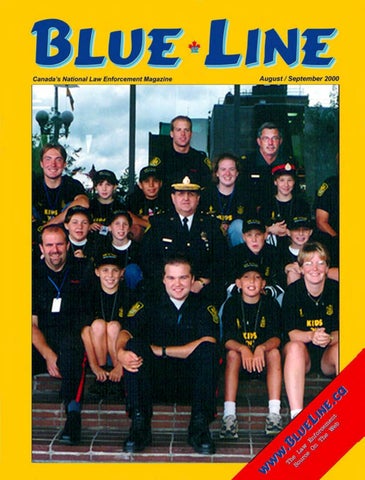
WEALTH LINE
\ LOVE LINE
""
FATE / L INE
I
20 YEARSTO · LIFE LINE
Volume 12 Number 7 August I Septernbec" 2000
Publishet·'s Commentary Who rules ... courts or cops?
4
Correspondence
6
Leading the way into the thir·d millennium The Saint John Police Force
9
CACP Trade Show Guide Floor Plan and Exhibitor List
16
Case Law Questioning an accused in absence ofa lawyer
26
Police motivational tt·ainiug
34
Technology Crime Prevention for your computer
38
From conflict to concord
46
Confet·ence highlights many issues IAWP seminars and trade show guide
52
Product News
53
Blue Line Classified
56
Vitality Proper hydration and exercise
58
The Back Of The Book Life sentences are only for senators
62
DLU£ LIN£
BW£ LIN£ MAGA%1Nl' 1~1
ltwy7 East
Suite 2!14
Marktuom, ON L3R 1 N1 (905) 640-3048 Fax: (905) lie7!147 ...,.;tblu......,.ueline.ca
""n:
- Publisher Morley S. Lymburner e-mail: bluelinepublisher@home.com - General Manager Mary Lymburner, M.Ed. e-mail: bluelinesales@home.com -Editor-In-ChiefBlair McQuillan e-mail: bluelineeditor@home.com - Advertising Mary Lymburner Rhonda Shuker Bob Murray - Pre-press Production Del Wall - News Editor Les Linder e-mail: bluelinenews@home.com - Contributing Editors Communication Skills Terry Barker Police Leadership Robert Lunney Dave Brown Tactical Firearms Tom Rataj Technology Case Law Gino Arcaro Blue Llle Magazile is pubished mOOhly. Septentlef lo June. by 8/ueUreMagame /ncorpaatedwilh a mailir'Jaddress ol: 12A • 4981 Hwy. 7 East, Sle. 254, Martcllam, Ontario, L3R l NI. lndivicbll magazinesare$3.50eadL SWlscriplions •e$25.00 per Y98f or $40.00 lor 2 years. (US/For9ign - $50.00)
Alarliclesare jlliedl!dby~ NoplllolllispUllcalion may be reprocb:ed or lransnilled in any lonn or by any means, eledroni: or mechanicaL indldng p.oJocopyng and recooling or by any inlonnalioo mage or relrieval sy5lem willxU pemission tom lhe pdllisher. lnlemel activity is monilonKI and use ol material on llle lnlemet is reelricted.
AlmalerialsaDritedlorpUllcalion becomes lhe property of BlueUne ltigazilelllless oilier .rangemenls haw! been made wilh fie publsher. The dlors, advisus and I'IJbisher accepl 00 labilly whalsoe¥er lor any irjftslo per.;onsor propertyredinglnm lhe applcalion or adoption or any or lhe proc:eWes. laclics or coosideralionspresenledillhismagazne. Reader.iarecautioned and advised llallrides presen1ed herein are edted and sqded lor ,... pnonal awMeness and shoUd nol be used lor lUther aclion IDI appropriale achi:e ani p!ance is rec:eM!d frllln a ~. em.n Allomey or oilier person i1 aulhorty. Eslablshed i11988. BJJeUm Magame is an Dlependent pd*alioodes9edlo i1lorm. ~ eiU:aleand~Wadelhe sllilsorfloseiMllvedil fie I;Mirilnemertprnlessin llhasoo lhc:t cmrol tom a law lrion:emert agerq and ilsopiWlm and ri:les do nol oecessady rellect lhe ~of any !JM!IIIIIKQ. poi:e, or law l!licnanent agerq. Blue l.inl! . , . . . ill • privale venlure IIIII • IUdl ill not flnled by any level ol ~agency, 1Don or 8I80Cilllian. Prmted m Canada by Garson GraphiC Serv1ces Inc.
ISSN #0847 8538 &anada Post· &anadln Pulllicllliona IIIII PlocU:t Sales Agreement No. 176796
1ST
OF
Accident Support Services Aegis Applicant Testing Services BCIT Bell Helicopter Bell Mobility Blue Line Reading Library BMW Motorcycles Canada Law Book Canadian Body Armour Canadian Helicopters ComnetiX Cruisers Inc C.VD.S. Dalhousie University DavTech Analytical Services DSM Law Enforcement Products FATS(Fireanns Training Systems) Flir Flying Cross by Fecbheimer Glock Inc. Hartt Boot & Shoe Co. Henry's HighPoint Security Technologies Inc Hi-Tee Intervention Hi-Tee Sports Canada Laerdal Medical Supplies Laser Labs Law Enforcement Training & Supplies Litton PRC LiveLink Toronto Police Maritime Services Police & Security MD Charlton
Police Chief C.E. (Butch) Cogswell and the members of the Saint John Police Force are proud to host the 95th Atumal Canadian Association of Chiefs of Police Conference between August 26 - 30, 2000. To leam more about the police service and the CACP Conference ttu11 to page 9. In this issue, you our loyal reader, will also find features regarding media relations tips for senior officers, police motivational training, and safety tips for investigating clandestine chug labs. Of com·se, we also bring you om· regular cohmms including case law, technology, and the views of colunuust Robert Stevens. SERS
50 27 56 19 57 11 47 31 51 49 53 37 21 43 18 26 10 5 6 63 45 15 28 36 27 48 59 31 53 15 35 36 25
Mega Tech Michaels of Oregon Micro Video NEC Nelson Thomson Publishing NOPAAT Ontario Crime Control Commission Pacific Money Laundering Conference Pads Fitness & Supply Panasonic Canada Pegasus Pelican Products PK Van Bodies Police Ordnance Pride in Service Printrak Inc Pro-Tech Design R Nicholls Rocky Shoes & Boots Second Chance Body Armor Setina Manufacturing Sirche Laboratories Sokkia Sturm Ruger & Co. Tetragon Tasse The Walter Fedy Partnership Triform Business Systems Ltd True Traffic Safety Twaron Products Inc. Westervelt College Wolverine Supplies XTE Custom Designed Outerwear
44 41 28 2 33 55 Insert
32 34 8 28 17 42 11
38, 60 20 46 13
64 7 61 4 60 39 19 34 29 56 24 22 23 29
The Searc/1 Database feature of cOMPARAPRINT"' TECH+ DB allows you to se~trch any print (in this case, the latent pslmpnnt on the right) sgamst your database of up to 500 known pnnts. "Hits• are listed In order of simHarity. and can be called Into the tell window for Side-by-Side visual companson With the tatont. Blue box Indicates area of comparison.
A latent end B known print are shown here With their sutomatically extracted points of minutia displnyed. The comparison engine rates these prints as hevlng ahigh similarity, as Indicated by the display m1109 11pper ton. Note that even Ulough the latent was a double ImpresSion, the sollware had no troubls In V911fylng the high degree ol similarity.
by Morley Lymburner Few things can be more frustrating for me than an officer-who reads too much into what the court system does or does not do. On a ride-a-long a couple ofyears ago I heard several officers from an RCMP detachment voice their concems about a judge who brought down highly questionable sentences. Tlus judge was extren1ely light on dmg offences. The type or quantity of dmgs made no difference. The officers could arrest an entire drug lab or orga1uzed gang of traffickers and the judge would sentence them to either 40 hours of commwuty service or to make a donation to a local charity in lieu of a
fme or to do both. Tllis same judge refused to convict anyone for driving a car without insurance because the mininuuu $2,000 flue was, in Ius estin1ation, too severe. This same judge was highly critical of J,>Olice use of force and would only levy a flue m the most extreme circtmlstances. Extreme meant an officer had to spend a few days in hospital. Officers, when confronted w-ith these circmnstances, should fu-st and foremost remember d1at their duty is to prevent offences in their community. Officers should also remember that the job tl1ey took on is not, and I repeat not, a popularity contest. In spite of all the glowing
Fireanns Traing System
August I September, 2000
5
literature spw1 out by the PR departments policing is not about officet-s dressed up in fuzzy little animal suits or sitting on the local dnnking m~chines for charity. It is all about preventing cnme. One big way to prevent crime is to send out a stmng enforcement in1age in the conummity. I do not ~vish to bm-st any bubbles in thejudiciary but flue c1-ime prevention is not petfOimed within the hallowed halls of the cotu"troom. It is accomplished du·ough the vision of every officer on the street doing Ius/her job of enforcement. It is the officer patrolling the conummity that sets the pace for the level of c1-ime. These officers should never be dissuaded fi·om dlls duty by a judicial system tl1at they feel does not hold up its end of the bargain. A case in point from my O\.Vll expetience was ajudge w·ho.didnot feel my laying speeding charges of 50 kmlh m a 40 km/h zone was appropnate. As charge after charge was tllrown out my fu·st thoughts were to suuply stop enforcing at these levels and reve1t back to the standards atbitnuily set by some phantomhome-sptm case law. I chose not to do this however. Instead I we11t out of my way to flood this judge's court with offences at exactly 50 km/h in a 40 km/h zone. He continued to tiu'Ow then1 out without heating my evidence. One day, however, he fu1ally let me give my ev-idence on one of ti1e tickets. ' 'It is a school zone at a time of high vehicular and pedestrian traffic. The posted'sign says 40 not 50 km/h. I am concemed with the safety of the clulch'en in ti1e school zone." This apperu·ed to be a defuling moment. The judge ordered a recess atld called me into his chatnbel-s. Not knowing w-hat to expect my apprehension level rose considerably. Surptisingly he said he could see my point and now tmderstood that we both have levels of discretion that should be working in hatmony for the good of the community. I was stmmed and appreciative of his candor. He said he was wanting to back me up on dlls lllatter and thatlked me for getting the message across to him. We retumed to the cow'll.·oom atlG he convicted the p=on and tJipled ti1e fitle that would have otherwise been paid. You n1ay or n1ay not encotmter the judge that I did but in tl1e lru·ger world of law enforcement it is not a contest tor convictions. I remember some time back that some officers in the country we1·e inappropriately evaluated by their "conviction rates" . It is not the officers duty to get a conviction. It is only llis job to b1ing a true bill to the cotuts. Extenuating ci.t·cwustances are ultin1ately up to the defe11ce to present and the courts to detennine tl1eir evidentiary wo1th. At the street level each officer must deternline w-hat level of elUOrcelnent is necessaty for the good of the commtmity rati1er than what \ov"ill please the courts. This discretionaty enforcement level should be detetmined by the officer's good conscie11ce and tempered by the w-isdom of their peers and supetiors. But nothing should prevent the officer fi·om being Ius/her OW'll tJ·end setter atld from bringing their own sense of values and creativity t; th~ job that must be done. After all is said the police selection process is SUPJ,>OSe to screen for good judgement and discretionary ability. If you cany the position of law e1uorcen1ent officer tl1en xou ru·e expected to l1ave it This Catl not be instilled by any police college ... nor by cotut judgeme11ts. 81.U£ LIN£ MAGA%1N£
I am replying to yotu· comments on the issue ofhaving to conceal body armour (It's time to talk, June/July 2000). You have valid concems. however, as a pau·ol officer of 20 years and a health and safety collllllittee member, I would like to make the following comments: I am a member of the Ottawa Carleton Regional Police and f01ttmately, om· vests are the same colour as om unifotm. We are pennitted to wear the body annour on the. outside of our tmifom1. or tmder om· shirt, however, I cannot recall the last time that I have ever seen an officer from our departlnent wearing the body amlotu· under his shirt. After the first foot pm·suit, you w-ill quickly statt wearing the body
annour over your shut.....its physically exhausting because of the heat. ...yow· t-shirt is continually soaked with sweat. I have been working on the suspender issue for the duty belts ....and wearulg the vest lUlder the shUt creates a vety difficult problem with regards to concealing the suspenders. I have been asked by several departments tl1at realize the importance of issuing suspenders to the officers to relieve the physical problems the belts cause, however, none - including myselfhave been able to address how to conceal the suspenders when the departments will not allow the officers to wear the body amotu· on the outside of their uniform.
FLIR Systems, Ltd.
August I September, 2000
6
I fully appreciate the unp01tance of health and safety, however, there is no sense in issuing somethll1g to an officer that he won't use. I was recently on a hat selection conunittee withlll our department that field tested different types of hats, including the stetson, ball cap, tilley, and ram crusher. As we had recently expanded om· department to a regional force, we had occasion to take many OPP officers on board. We sent out an email as to conunents and experienc.es that officers had with regards to the different types of hats. I believe we received 132 emails back. .. many fi:om fotmer OPP officers, begging us not to issue stetson hats for many reasons. I field tested a stetson myself and found it a very aggravatu1g experience. I am saying this to make a patticular point. An umbrella is probably the best type of protection you can get from the sun, but there is no sense u1 issuillg a piece of equipment that no one will use. In c.o nclusion, there are many issues with regards to equipment u1cludu1g practicality, acceptance by the officer and the conummity, health and safety, cost etc., however, from a patrol officers poillt of view, I wear the carrier on the outside of my unifonn because it is the most comfortable and pennits me to conceal duty belt suspenders. Sr: Cst. Mark Schaife I agree totally with your comments {It's time to talk, June/July 2000). I am a detaclunent commander ill a small northern commtmity ill the NWT and the level of v-iolent crime here is six tinles that of a southem standard. I wear a vest, and an extemal carrier, but only under a patrol jacket. The reason, because in the willter you don' t want to sweat illside and then go back out u1to the cold, it makes for a vety tmcomfortable situation. The external vest allows me to remove the vest with ease ill the willter, therefore allev-iating that problem. I had a subordinate who wore the extemal carrier throughout the stUlUller months, without a jacket, after it was issued to hUn. Previously he had wom his vest m1der his shUt. Sh01tly after he was issued the extemal crurier he changed to usillg it. I was swrunped with concems from the conummity that tlus guy was preparing for war and that they now felt vety defensive arotmd !lim. I believe this heightened the potential for violence as people saw tl1e vest as antagonistic. I also noted that even when in the office he would not remove tl1e vest 3lld extemal canier. This caused me to wonder, so I asked hll11 why, if he wasn't remov-ing the vest ill the.confines ofthe detachment, did he boilierto chattge fi:om wearing ilie vest tmdemeaili his unifonn shUt. He didn' t know. I believe it was because he saw other officers wearu1g them and iliought he would too. I also agree with you when you poillt out that om· cotmterparts ill the U.S. are never seen to be wearing these external caniers . You only have to watch COPS to see that. Why, I don't know for sttre, but I bet it is more to do with pride ill appeat'atlce than anythillg else. These extemal cattiers are not as sharp looku1g as an ironed tulifonn shUt. Don't get me \¥Tong, ru1ythll1g that encottrages officers to wear thea· vest is good, but common sense should prevail. Warren Gherasim Deline No11h West Territory 81..11£ LIN£ MAGA:ZIN£
Police Officer killed Thousands of police officers from across North America gatl1ered in JtUle to commemorate tile life of an Ontario Provincial Police officer who died following an accident on Sgt. Marg Eve Canada's busiest highway. Sgt. Marg Eve, a 14-yearveteran, was remembered as a strong woman wid1 an infectious laugh who took joy in raising her young children. "She was an officer who distinguished herself through tile caring she showed to tile colllll1tUlity she se1ved, her leadership as a sergeant and her ability to balance family life and her career," OPP Commission Gwen Boniface said during a news conference following tile officer's death. "Marg Eve touched the lives of many people and she will be sadly missed by her family, fiiends and colleagues." Eve died from massive head injuries on June 9, two days after a tractor-trailer struck three police cmisers and another vehicle stopped on the side ofHwy. 401. She is d1e first fen1ale police officer in Ontario to be killed while on duty. Two oilier provincial police officers, Csts. Patti Pask and Brad Sakalow, who were injm·ed in tile same accident, arrived for tl1e service, held in Chatl1run, Out., by ambulance. Following the se1vice, law enforcement officers from across Canada and tile United States lined the streets for more d1a11 a kilometre and stood at attention as a pipe-and-dnun band played. Hm1dreds oflocal citizens also looked on as tile funeral procession made its way to tile cemetery for a private btuial. Eve, 38, served as a11 OPP auxiliary officer before joining d1e police service in October 1985. She served in d1e Sombra detachment and Grru1d Bend slUlllner detachment before being promoted to sergeant in the Chailiam Conununication Centre. She is stuvived by her husband John, six-year-old son Ryan and three-year-old daughter Colleen. Teny DeMerchant, 26, faces munerous charges in relation to tile accident. Tlu·ee civilians were also injm·ed in the crash. August I September, 2000
SECOND CHANCE BODY ARMOR
7
81.U£ LIN£ MAGA%1N£
I
I
I
IT MAY BE SMALL , BUT IT ' S .lUST AS TOUGt-1.
lr.ttQd!Xon'} OUt Dt.W 11.1ggdwed su!t-no1ci:to11k. lfs. s:n.:.lJ~t tf••n 4 ~ litbw!-:. •lld 11'4 ~~~hit u t.ouqll l'hle L....,,_,~'s 9=11 lhf, ~~e w!~ c.~~ilty .u ow ~rndaty ( f
n 1COC!IIIOO.:..,...n ~dd .w ink'ogt•ted w:rrltss
~ :o ~C:"U ~ ~ COlO 1.a01~ cr MOI'.. ft)( net..orl. !1'1 d~ 90~ tltoe '~ t:KIIJtlprco! coc" ttvt~"<l~ W!tb •
!u.lty U!~ed k~buiHl.
qd ·unh~nN h.ud d.rloJt • nd ~ ~t ollt:i"'I}Lur colour dis"J:..y !hat's re.M$.1bk to surJ~qbl P!w '' c.tr. ~Tbsl.lnd ~!.&II <If lbr« to::ct j)f.\o solid
ccr.crttt •f, Ill" likt fhe C::·n . It ttXt b.tppcn' 1o 1:~ .s::n.,a.rr tlun" rut Sl ~ ~eboo; V:st~ w"O·S,.J.:, 5 ~m~.s (o ' .ot.fr, ~·) 6.1 br._."ldU't..tSJ~•a (Jot:lt"'''u~t Of
ICIJ'flt(cd tr..:icT.,th ~ th(!r '""'*'""lto(cJ.o,_
p.~nas01'.lC.<.t or WIt Boo 36~ ~&.
Panasonic
Leading the way into the third millennium The Saint John Police Force: where history meets the 21st Century by Mia Urquhart
It is Canada's oldest police force in Canada's oldest incorporated city. Today's force of 174 officers is a far cty fi:om the 26-member force that was swom in m April14, 1849. Law enforcement began in Saint Jolm in the early 1800s with a captain and fom· watclunen who patrolled the bustling Port City at night. By the 1840s, however, a ciJ:cus riot and a period of conflict between Catholics and Protestants proved the need for a fhll-tin1e force. Today, the Saint Jolm Police Force is a well trained and progressive force made up of 169 swom members, 16 of them female, five managers , and 24 civilian support staff. Twenty-two weU-traine.d auxiliaty members help complement the force. Many of the force 's officers have proven themselves experts in a wide range of policing services, including accident reconstruction, polygraph, canine, firearms and forensics. Outside agencies, including the Canadian Police College have re.cognize.d their expettise and have often sought their knowledge. So far this year, nine officers have been invited to train other agencies, including at the Atlantic Police Academy in Prince Edward Island. There are also several qualified in-house instmctors: two officers are qualified to instruct accident Level 2 courses; the head of the canine unit trains canine teams from all over the Maritin1es; the force's polygraph operator has recently finished a tlu-ee-year secondment to the
COMMUNITY POLICING: Membe1·s of the Saint J ohn Police Force, including Chief of P olice, C.E . (Butch) Cogswell pose in fr ont oftheir headquarters with loc.al youths. Canadian Police College; there at-e also officers qualified to insttuct in the areas ofidentification, fu·earms, and interview and interrogation. Offic.e rs have also organized the force's onthe.-job tt·aining program, a cultural awareness course, and a French language policy. The force's conunittnent to even more tt·aining and educational incentives has been guarantee-d in the latest contract. Dtu'ing negotiations, management suggested an irlllovative training
ON PATROL: Two members of th e bike unit stop to p ose in front of the city skyline. August I September, 2000
9
fi.md for career development. Each year, the force will put two per cent of an officer's annual salary into an individual tt·aining acc.otmt. The officer can then decide what kind of tt·aining would best suit his or her career aspiration and submit it to the forc.e for approval. Since the program was initiated earlier this year, 200 training positions have been approved. Witl1 so many specialized tmits within the Saint Jolm Police Force, the possibilities are endless. There is a four-team canine unit; seven commtuuty officers; five distt'ict investigators; fom· family protection officers; three fi·aud investigators; five identification specialists; six officers in the major cdme tmit; a polygraph operator; a stolen auto tuut; five officers in the street crime tulit; five in traffic; three in youth; and many more. The Saint Jolm Police Force has also recently taken over the responsibility ofpolicing the Port ofSaint Jolm fi·om the Potts Canada Police. Complementing the specialized tulits are 100 tuliformed officers of the patrol division who are responsible for policing 500 kilomett·es of stt·eets. The force 's plain-clothe.d street cdme tmit is also called upon to deal with a variety of situations, including drug enforcement at the street level and prostitution-related crimes. They also enforce the Liquor Contt·ol Act and assist the patt·ol division and other specialized tmits when called upon. TI1e four-member Farnily Protection unit has been recognized by other forces for its commendable work in serving and protecting fanulies and youth. TI1e tuut is responsible for incontinued on page 10 81.U£ LIN£ MAGA%1N£
vestigating some of the most Some residents prefer to talk heart-breaking cases in police to officers in a more infonnal work: sexual assaults, includsetting than police headquruters, which ru·e cmTently locate.d in ing that of children, domestic violence, pomography, elder the 15-floor city hall building, abuse, and others. in the heart of the downtown With today's technology, core. police forces not only have to The busy city hall location be able to track pedophiles, has proven less than ideal for a they have to be able to track police station and the force is them electronically. TI1e Saint now looking for a new home. John Police Force has recogExpe1ts in police facilities have nized tlus and has one memalready studied the force 's needs and architects are curber of the Fanlily Protection tmit leaming more about how rently working on the design pedoplules use the intemet to plans. hu·e victin1s. Until the new police staOver the last few years, tion is built, the community the Saint John Police Force offices provide tile force with ON GUARD: Two members of the Honour Guard stand in front of the a more casual atmosphere in has fully adopted the philosophy of collllllmlity-based po- Saint John Police Force's fully restorE-d 1965 Volkswagen Beattie. which to talk to members of the licing and works very hard to public. They' re open to the 1998, to allow the public a stronger voice in the maintain tl10se important ties with city resi- policing of tl1eir neighbom·hoods. public anytime between 10 a m . and 8 p m. dents. The last couple of years have seen great And its worked. To date, the force has 93 While an officer isn ' t always there, the voladvancements in collllllmlity-based policing vohmteers, who help with a wide range of com- unteers have their pager numbers if they are with the establishn1ent of five conunmuty of- mmuty events - eve1ything from bike rodeos requeste.d . fices and a strong network of vohmteers. Taking commuruty involvement one step to cormmmity barbecues. There is, of com·se, The colllllltmity offices have been set up in a core group of volm1teers who donate collllt- fulther, members of tile force drafted a 20-page each of the city's four geographical regiollS, each less hours to help keep the colnmllllity sta- doctmlent last year outlining a vohmte.e r-based with its own conumulity officer. Tius is in ad- tions nuuling smoothly. They man the desks program. Neighbourhood policing committees dition to police headqualters in the city's cen- at the stations and meet and greet other mem- provide a fonnallink between tl1e conumulity tral region and police stations in theNorth, East bers of the public who drop by. Thanks to and the Saint Jolm Police Force. TI1ere are four and West divisiollS. their help, the conummity officers can leave conmuttees - one in each of tile city's fom· diviThe COllllllllllity offices began in February the office for other calls. Sions.
Conference Highlights
DSM LAW ENFORCEMENT PRODUCTS
August I September, 2000
10
The Saint Jolm Police Force is tile proud host of the 95tll Almual Canadian Association of Chiefs of Police Conference. This year's professional development program is focused on "Leadet'Ship in the Third Millennium." The speakers include Paul Ceyssens on legal aspects of policing; Mirian1 Cruver on policy govemance; Jac-ques Duchesneau on police ethics; RobeltLmmey in ru1 open to,;vn hall meeting; and ChiefJustice Beverley McLachlin on leadership and the Supreme comt. The Saint John police band, Colllltry Blues, will also perfom1 dm1ng the conference. The bru1d, which pe1f01ms both cmmtry ru1d rock music, has been perfomungtogeilier since 1996. Their repertoire now includes many 01-iginal songs as well as traditional favom1tes. The CACP 2000 Conference and Trade Show will be held at Harbour Station. The site is coUllected by an extensive indoor pedestrian pedway system to the Saint John Hilton, the p1-incipal convention hotel, as well as the Delta Bnmswick Hotel, and a variety of hisfOl-ic attractiollS, restaurants, and retail outlets throughout downtown. 81.U£ LIN£ MAGAZIN£
Each of the committees sistance Education) progran1. meets once a month to air their The program teaches children concems to the police. The in Grades 5 and 6 to resist strucnu·e also allows them to drugs by teaching them how have some input in what the to deal with peer pressure and police do in their area. It could other u1fluences. They leam be as simple as asking for insafe ways to say no to dmgs. creased police patrols in probThe program also enlem areas or helping to set up hances the relationship beeducational p rograms in tween cluldren and police officers . For 17 weeks, a muschools. fOimed member of the Saint These four conunittees, in ttun, fom1 the grassroots porJohn Police Force visits city schools and delivers the DARE tion of an advisory network. The next level is called the philosophy. Neighbom·hood Police CotmThe Saint John Police cil, which consists of five Force is also heavily involved C.E. (But c.h) Cog,sw('ll members from each ofthe four Ul several charity ftmd-raisers, Chlef ofPolic(' regional conunittees and 10 including the Cops for Cancer other representatives - three campa1gn. F oct and bicycle patrols help complete the agencies, two organizations and five individual force's rettlfll to the streets. The first twomembers. An executive group is then selected from wheeled patrol began in 1994. Since then, the those 30 representatives. The three executives tmit has grown to eight officers, with two officjoin the chief of police and the inmlediate past ers on every shift from May 1 to late in the fall. chauperson as a direct lulk to the Saint Jelm The force has been lucky enough to have had all Board of Police Commissioners. of its bikes donated by c01runmuty orgruuzaIts ptupose, according to its guideline, is to tions and local businesses. This is another ex"address gaps in service; and conunmucate con- ample of the strong coiruntuuty-police partnercerns, issues, and proposed solutions to the ships at work in Sai11t John. The Saint John Police Force is very proud decision makers and power brokers." The Saint John Police Force's coiruntuuty- of its illustrious lustory. It's equally proud of based philosophy has also extended to school its direction entering d1e thu·d millennimn as a cluldren through the DARE (Dmg Abuse Re- leader in policing services.
OCK PERFECT10N
Arwen 37 Less Lethal \tVeopon
Police Ordnance Company Inc 1-800-387-9751 (905) 479e2223 wvvw.Po!iceOrd nance .com
BELL MOBILITY
August I September, 2000
11
81.U£ LIN£ MAGA%1N£
Moving forward together in Saint John An Update on the Progress of the Change by Keith Taylor "Absenteeism reduced by 40%!" "Grievances drop from 50 per year to uro!" These are the headlines that could announce the changes that are occurring in Saint John Police Force in New Brunswick. Since 1997. the agency has been involved in a wholesale change process and the results are now beginning to show. In 1996. the consulting firm ofPerivale and Taylor undertook a comprehe.nsive review of the department. The report of the review detailed a department beset by high absenteeism, soured labour relations, breakdowns in comnumication. an absence of basic infrastmcnu·es such as petformance appraisal processes and limited community involvement or tru·geted policing. The force was frequently the subject of media criticism ru1d staff morale was at low ebb. Titled "Moving Forward Together", the report of the review highlighted the fractured nature of the force and provided a strategic process to introduce changes to address the problelllS. Following the release of the report, the consultant was engaged to set up the prelinlinary stages of the change process. Laying a Foundation for Cl1ange Follow-ing recommendations of the report. minor changes were tnade in provincial legislation and a process was established to appoint a new police board under the Police Act. The process of appointment was an open process conducted by the council. The board was trained in the chief selection process using the competency-based system established by the Ontario Association of Police Services Boards. One of the first tasks of the new boru·d was to advettise for. and select, a new chief of police. The competition was open to internal and external applicru1ts. The new chief selected had resigned from the force several years earlier. However, he had maintained a high and very positive community profile. The selection was popular with sworn and civiliru1 staff ru1d with the conummity. A new deputy, who possessed broad planning and change management skills, was appointed from the existing management group. Twelve of the most senior officers accepted a buy-out plan and in their place six officers were brought in at recmit level. What is lost is experience and 'corporate knowledge' but amortized over several years the buy-out saved money. However. more in1portantly. the new recmits permitted the induction of male and female officers who were trained in a more client oriented approach and who were tnalleable to the new philosophy adopted in Saint John. A steering committee, the lnlplementarion Terun, was introduced to develop the components of the change and to implement elements of change according to a schedule that was established by the conunittee. Tite steering comnlittee was comprised of 12 representatives of
management. the police association. city administration and the commtmity.
to discuss and resolve issues of mutual concern.
The Changes Begin An early appointment in the force was that of a media relation's officer. The appointment provided a contact point for media inquiries and, more importantly, bec31lle an active conduit for crime and related information to the media. An active and mutually beneficial i..nfor· tnation exchange was established and media representative!. no loneer had to fill a void in infortnation received fr;;m the police. The lnlplementation Te31ll, chaired by the new chief. was the first step in a healing process. Representatives of each group were assigned to develop each of the components. Many of the proposed changes required extensive negotiation to 3111end long-standing contractual agreements. More impol1ruttly, however, the changes also required all factions in the agency to work together in the creation of an effective and efficient policing service for Saint John. Although individual officers had practiced fornts of commtmity policing. for the fu·st tin1e for many years the agency. as a whole. bega11 to consider matters such as strategic approaches, client senrice, goals and objectives and to focus on addressing community demands. A philosophical change began to occtu- parallel with the changes in internal practices. Following the early involvement of association representatives in the planning of the change process. other staff were seconded to undertake change projects or were consulted regarding the practical realities oftnaking the changes work.. A ' learning organization' was established For many officers. for the flfst time. their skills and abilities were being recognized. They were having some impact on their work environment. To identify and prevent the festering of potentially volatile internal issues. a mutual interest comnlittee of association and management representatives met on a regular basis
Setting a Course Once the foundation for the changes had been established. the Implementation T= was disbanded. In its place. the internal. and smaller. Police Plan Te31ll beean work on one of the most important facets '(;f the change process. A comprehensive strategic planning process was laid out. As buy-in was crucial, all staff was trained in the strategic planning process. The plan solicited input from civilian and sworn staff, from commtmity agencies and from the public. As a result of these consultations. a comnmtlity-oriented approach was adopted as a basic tenet of the strategic plan and of the policing approach in Saint Jolut. Like most police agencies in Canada the Saint John Force adopted a five core business strategy: • Crime Prevention • Emergency Response • Law Enforcement • Victim services Public Order TI1e agency also adopted a set of core values: • Leadership • Constant improvement • Openness and partnerships • T rnst a11d respect. and • Investing in our people. In establishing the mandate for the agency. it was deternlined that there are le!rislative. contractual and other commitments to satisfy. These are sometimes imposed, such as the Police Act, New Brunswick Policing Standards and the enforcement oflegi..slation. Sometimes these conunit:ments are negotiated such as the collective agreement. However. perhaps the most significant comtnitment that had to be changed was that of the
continued on page 14
:PRIIJlUCT, WHmf YDU NIEEil R ' Cairtl 11hl v.lliillall' niY.{y I'IIM,v.<ltd, !3!j[plt .alit I btr!l..o:ull..,. lu llt ut M ...,...,..u!l• Inti S~:~~,iHI'IIIIIDh
U OUIII:ImiJNl C!ENTI\1
Our 5mriiiii'Jugli Slt1111 15 tlz IDCibDn Dl ll.il' t.lll!llr ~:pmtd Lura:Wiu:a Can1N llua :f "- lktud mm-,lc:l ~mDIU!Jad
mudri2
1111d
V151SII~ Ill IIIllUO liD U
impmrcl
~doa..
balUslic slab va.s l
.151l'hll li."ti'l'l a n.'t'
~
\.
!llclgnr.~ ID ~u~ ug;dng .-.rnl lb.Nii11 lrltm llull!llw tttul ikwrp izi'J"Il '-"~'"l'ilfli n.. .Aftwu~ ul .Am .. r.l tM t!RIIlHih: S111b wR•L - - K IJ 01 DJ 0 3 ll!!lill!11r. l!'l!fnk.-cl!! ~~~ ....-.IL "' !:~th:trnlll lg~ i'J;k
o49S:!. Tm.DtlCJ. lnW MJu;,~
:cs £;;5.S788
74·7 l'lMttlm i\v.. St:U!tnnmph II! /lkNiryl!!v!l . Ihrrtmg!]lh
-418-:!~R IC)'!.
al!llldii:F~ .
~-!11:4
i!c41S d11 Ill Prmnt:e l!l Lln'iiVI!ll.l '1:,(1 ·Hil "r.l l!i
Thrsr liuh•w~toht \':lisa r· a lLYI:J
w11h ICDDGWmenl cuners r;; ''IIU- t.he-shul cunus m a:n DSGCi"!mE!J ul Gulll':!l'll. lndispens ahlt lueo pnlln, o::r1ettlom:ll md c~~:~:u.r:ll"t
j
$ef ii'IIOJU!I
An ~;~bl:i<ll•J"r m•1~
•w
poll~
•I!'>Urt'T or mrn"
t.J~I pl'nonnr.l Th~ Trudm.ooa 4 IQUipm£71 hg l:l m~o:!.e lmm lllupb 000 danlu r.,t.:JD 'fblll p;u ball ..Ut>~o~s. you lo pr alc:L, [i;Jfrt ~rul arR anll!JI all
ynur uqulpmw
l'l!uiUhll 1 lta.nllllflwll e..a.. •Ult 11
~ Jl bot1um
Ml 001rt • nl folQI! . . ho 111nl ~,ur.,Jw 111•11;• M11111 <tl"'l'•rl uwr,ll• 1 R 5 1, 1 I ?."It ~ 7 5 D J{m•• niT'IIbhs •1 our ~ml rl1ro~•lory prlre )' IWQu 'l liml n u,r ~~~ h•r l"1"
Hytlrw•11 or •"•' (JI,.'hyl!mll!l' ,, • '~'~ 1 l"~lor In ""''' !ltn!Y: l<.!lnlllill 'JUW llr.liiS by lb!.n.kut;o ll..... n ywr
Wa d~!HmB DD II pr 8
l:!nl
Th~ Camdli'ak 91mllh Ill 1a In• ~~" r¥..m'll!lr thll: IIIII snu:;),o on 'fWJ: ~1Hk. ~II' lJif IUJIDJI stlkll!ut.l or rlr.t dur,
~ r£. tr,dNIJo -..nclp olrtr... lrfiB lh11 r.:alll)' lltt:ti.ul. olr-ln\uty lui. 11... lull lin• ul C.....NIHILII pnJ.IWnh.d IJJ'!Ointl!O oll'11 ll."fllll-""ln l11111• R !llomnll•
~ ~·. ~ '~t!gL, ~~ 1-88 B-442-9215 lnlo@mldtohl.m.c:arn
:Pax: 450-442-958 1 www.mtr:hclbl,com
legacy of stakeholder, public and staff expectations. The Saint John force recognized the longteml approach that was required to move the organization from a reactive modus operandi to a more comnnuuty-based approach to the safety and secm·ity of the conuumuty. The plan provided stmcture to the strategic direction taken by the force. The consultative process identified seven principal directions: • Conumulity policing • Satisfy the New Bnmswick Standards by 2002 • Organization-wide sll·ategic processes • Information sharing to support the strategic processes • Enhanced career development program Evaluation of outcomes • Appropriate police facilities The plan was developed and encapsulated in a small colom·ed booklet. Tlus was made available to all staff in the force and to the public through libraries. In suppolt ofthe changes, key organizationwide initiatives were detenuined such as workload distribution analysis, a risk management program, new promotional processes and a leadership program, improved training for required skill sets at each onzanizationallevel, the identification and furth~r development of 'subject matter experts', the conduct of a service delivery analysis, revised accom1tability and decision making to lowest appropriate levels of the organization and infi·astmcttu·e systems such as revised recmitment, promotion and performance appraisal were negotiated with d1e association. In addition, to encourage officers to pursue training and education, the stun of $1 ,500 per ruunm1 was set aside.for each officer. The difference with the Saint Jolm training plru1 is that offic.ers asstuue responsibility for the use of the allotment and, beyond the core requu·ed training which is provided by the force, they are encouraged to find ru1d undertake their own job relevant trauung depending upon thea· career aspirations.
Conclus ion Over the past four years since the extemal review of the Sault Jolm Force, the swom and civilian persormel have embarked upon an ambitious process of change. This has been aclueved by changing philosophies ru1d practices so d1at info=tion is shared, staff is consulted and their contributions recognized. The change process is not complete, however, those changes that have occm1·ed have created a work envu·omuent that is more palatable than several years eru·lier. It is a workplace that is largely free of conflict and, to use the modem vemacular, has a focus on "wellness". Some of d1e 111a11y benefits for the orgrulization is an atmosphere where staff ru-e less willing to 20 sick to avoid work and are able and willing: to ~uss and resolve issttes wluch may have pr;viously resulted in expensive labour conflict. To ilie "wellness" orientedn1a11agerdllsmakesforamot-e pleasant place to work. To ilie fiscally responsible manager tilis translates into dollru-s being mot-e effectiveiy spent on operational mattet'S. The plan for change in Saint John has been established. Many of ilie c.omponents have been introduced. More importantly, the swom and civilian personnel, ilie city and provincial adnllnistration, ilie public and ilie media are 'Moving Forward Together ' to enhance policing in Sau1t John. August I September, 2000
Assisting those who serve and protect Saint John auxiliary glad to lend a hand to local police by Blair McQuillan When Clu·is McDonald saw ti1e "If he didn't tmderstand some.advertisement u1 the local newsthing, he usually worked at it on paper in early 1998 he knew he Ius own or asked a question," said had to apply. Oram, who trained the auxiliaries McDonald had been interover four months. "He was an ested in becoming: more inastute student." volved in his con:uiitulity and But some training just when he saw ti1at the Saint can' t replace. on the job exJohn Polic·e Force was reperience, as McDonald questing volunteers soonleat11ed after joinfor their new auxiling: the tulit. - While driv ing iaty police program, he felt he had fotmd home one evetling, just fue initiative he was iliree months after be.looking for. coming an auxiliaty, "I wanted to get McDonald encouninvolved u1 a conunutet·ed two men arguing u1 the street. nity program," the 23-year-old said. " I " I saw tlus male thought by helping in on the side of the road Au xiliary Officer Cht•is McDonald my community I and another male in could get to meet the uliddle of the road some new people and leat11 what police work (who) had no clothes on," McDonald recalls. "I was like." could see ilie tnale on the side of fue road tatmtSince completing the auxiliary trauling pro- ing the guy in the centre of the road." gram in Mru-d1 1999, McDonald has spent a lot When McDonald att.e mpted to manoeuvre of time serving the city he has lived u1 for the Ius tmck around the naked tnan standing: on the past 17 yeat-s. He and the other 22 auxiliaries road, he began shouting obscenities at ili~ yotmg who are palt of the newly formed milt, have auxiliaty officer. That's when he decided to take vohmteered much ofilieil· time to assisting regu- action. lar membet-s u1 emergencies, conummity policFeat-ing that a family could happen upon ulg progratUS and events. the agitated, tmcloilied man, McDonald used "I fmd that a lot of people appreciate us Ius cell phone to call ilie police dispatch. Feelworkll1g ti1e conunmuty events, barbecues and ing he had completed his civic duty, he continfundraisers," said McDonald, who works fi.tll- ued home. However, he soon decided to retmu to the scene to ensm·e that evetything tilue as a satellite installer. "We' ve gotten a lot of thanks and letters of was alri1!11t. appreciation for doing d10se types "When I came back I saw a patrol car up the street," he said. "I ofthin2s." M;;-Donald says much of the pulled up bellind the patrol car and success the tmit has enj oyed is due was going to get out to assist the office~·." to their attitude towards the work they do. Dm·ing a recent youth dance, 'When McDonald exited his velufor exruuple, the tulit took a relaxed cle, he saw the officer was sll·uggling with ilie two men he had enapproach to their duties as law enforcet-s. The auxiliaries felt that ilieu· cotmtet-ed earlier. role at the function was to oversee "As I got out of my ll·uck they took off," he said. "I identified mythe youths and ensure their safety, as opposed to acting as a sll-ict enself to the officer ru1d continued afforcement mut. ter one guy, wlule the officer followed the oilier As a result, the auxiliaries and youili were guy. able to interact without any dis comfort, "Basically, it was a short nm. He ran down McDonald said. into a field and laid down. I got up belund him, "We had a positive attitude going there. We put Ius arms arom1d his back and held lum had ftm with the kids that were ti1ere and ftm iliere." with the people that were working ti1e dance." When asked which of ilie two suspects he Cst. Greg Oram, ilie manager of ilie auxil- chased and sub sequently apprehended, iruy volm1teer program, says McDonald's suc- McDonald was quick to respond, "I didn't chase. cess as an auxiliruy is due in part to his eager- the naked guy." ness to leruu. Oram said McDonald worked vety Bolli suspects wet·e apprehet1ded and taketl hard dtumg more ilian 150 hours of ll·auung to into custody. McDonald said fiiet1ds and colleagues ensm·e he understood everyiliing he was being still remind !lim of the incident to this day. Despite d1e occasional htuuorous comn1ent taught. 14
81.U£ LIN£ MAGAZINE
about his big chase, McDonald said he has enjoyed his time with the auxilia1y tmit and is pleased with how regular police members have accepted volunteers like him. "It's been quite positive," he said. "I've had nothing but a good time and it's been a great leaming experience." During the comse. of his career as an auxilialy, McDonald has logged more than570 horns of service. On average, he works up to 60 hours a month and often works the night shift after completing a full day at his regular job. Oram says McDonald is a diligent and loyal member of the auxilia1y who has a firm tmderstanding of police work. "He's been ve1y dedicated," said Oram, a 11-year police veteran. "He's always helpful, willing to do anything and he knows his role as an auxiliary." As for the future, McDonald has set his sights on becoming a regular member with the Saint John Police Force. ' 'Now that I've been into it and know what police work is like, I have an interest in it," he said. "I plan on going to the academy within the next two years." And how do his fumily and fi:iends feel about his venture into policing? " They think it's great," McDonald exclaimed. "They have pictm·es of me all over the place. They're supportive and proud be.cause I'm the only one in the family going into this type of work."
Correctional officers request body armour With the everthink it might go inside present potential for you." " They like to think H owever, Dennis violence in prisons everything is rosy and across the count1y Finlay, a spokesman for happy. We who work Con·e.c tions Canada's pasome colTeCtional officin the trenches have cific region, said there are ers have called on their another story to tell." currently no plans to isemployer to issue stab resistant body am1our. sue stab-resistant body armour to con·ectional of"My protest is ficers. that we should be allowed to have optional use of body annour," Finaly said that with just two major assaid Neil MacLean, a chiefshop steward with saults on corre.ctional officers during the past two years, there is no evidence to support the Union of Solicitor General Employees. MacLean, who has served at the Kent the need for the protective gear. While he did federal prison in Agassiz, B.C., for 12 years, note that n>~o assaults are too many, he said said that while not all con·ectional officers officers are given sufficient prelinlinruy and agree that wearing stab resistant armotu· should ongoing training to deal with violent encounbe mandatory, they do feel they should have ters. But MacLean remains unconvinced. the option available to them. ''Prison officials, in my opinion, seem "They like the idea of optional (body armour)," he said. "We don'tnecessarily agree to be in denial," he said. ''They like to think that we should all have to wear it, but we everything is rosy and happy. We who work agree that if you feel that you should wear it in the trenches have another story to tell. "If one officer's life is saved, then it's you should be allowed to." MacLean said the potential for violence worth it.'' that exists in prisons across Canada is reason MacLean recently submitted a 50-page enough for the issuance ofprotective annour. report to Correction Canada's security and "The violence is there. We fmd weapons equipment review conuuittee to exrunine. on a regular basis. Some ofthe shanks that we He has yet to receive a response on the find would probably scare you to death to matter.
llltegrated lltfor11latioll SJ'· te1ntt~ for Public SafeiJ'
TOUGH LOVE SERVICE FOOTWEAR with all the quality features of our famous Motorcycle and Riding Boots. • 'Wetlock' Treated, Waterproof Bogwalker Steertlide' Uppers • 360° Solid Goodyear Welted • Durable Lug Sole • All Around Padded Topline • 3/4' Wide Steel Shank for Support • Nickel Plated Solid Brass Eyelets • Fully Leather Lined • and fully Rebuildable
They're beautiful, comfortable and rugged. Start your own love affair Contact: Sid Mcinnes
Quality Leather Footwear Since 1834
Comp·11ter Aided Di pa1cll
•
Reconls i~lanagemeJu
•
lt!tegr«tetl illapping a!ld A I L
•
iUohile Dnla Communic:ation.ro·.
•
Open Sy, tems -
\1ilhi-l' l,lllnrm ..,1 rr••.,.. Hll {', Il l.~ I. I ll' I
i :e 111 tallttlimHl
595 Trethewey Drive Toronto, Ontario Canada M6M 4C1 Local 416-241-5216 Fax 416-241 -5210 Toll Free 1-800-268-1433
"!filii F.xpJolf , r n.m •.• :\1o•, "~ ~~~
Uftan
• Comfort - Durability -
August I September, 2000
•
H1'" •\OIUJ:ll, ( Jm>~rlrl
PRC '1.t1 r: S1:.-lr tn.1
15
r .m uJ.t. 1-Hf ' K'I 14111<1 :! '•'~-N9 f I
81.U£ LIN£ MAGA%1N£
Trade Show Guide 95th Annual Conference
Canadian Association of Chiefs of Police August 26-30 Saint John - New Brunswick TRADE SHOW EXHIBITORS 3M Canada Company Booth 67 ADT Security Service canada Booth 162 AEGIS Engineered Textile Booth 90 Anchor Audio Inc. Booth 100 Armorshield USA Booth 166 AST canada Booth 54 Atlantic Police & Security Booth 126, 137 Biddle & Associates Booth 86 Blue Line Magazine Booth 51 Boston Whaler Booth 81 Brewers Association of Canada Booth 74 Canada Post Corporate Security Booth 17 Canada Safety Council Booth 55 Canadian Corps of Commissionaires Booth 149 Canadian Police Research Centre Booth 159 CAN COM Booth 66 Cascade Wear Ltd. Booth 174 City of Fredericton Booth 60, 61 CGI Information System CN Police Booth 146 COGENT Systems Inc. Booth 52 Command System Inc. Booth 175, 176 CALEA Booth 148 Comnetix Computer System Booth 87 D.A.R.E. Canada Booth Dack Shoes Ltd Booth 127 DavTech Analytical Service Booth 140 Department of Justice Booth 103 Dictaphone Booth 91 DND Canadian Forces Liason Booth 104 Elvin Industries Ltd. Booth 105 Entrust Technologies
Au gust I Septemb er, 2000
Booth 30, 31 Eurocopter Canada Booth 71 eTrak Corporation Booth 24, 25 F.A.T.S. Booth 26 Federal Signals Corp Booth 69. 70 General Motors - Defense Division Booth 6, 6A Glock Inc. Booth 88 Gordon Contract Shoes Booth 143 Harley Davidson Canada Booth 9 Helix Bio Tech Booth 1 Hi-Tee Intervention Booth 132 Hi-Tech Sports (Canada) Ltd. Booth 114 Highpoint Security Booth 96 Horace Small Apparel Co. Booth 131 H.T.E Inc. Booth 33 i2 Inc. Booth 72 International Association Booth lon Track Instruments Booth 56 Litton/PRC Public Safety Sector Booth 156, 169
M.D. Charleton Booth 152, 153 Maritime Services Booth 150 Martin & Levesque I Blauer Booth 155 Mega-Tech Booth 41, 42, 43, 44, 45, 46, 47, 48 Mercury Marine Ltd. Booth 123 Michaels of Oregon Booth 89 MITI Booth Mobilair Integration Booth 53 National Police Service Booth 160, 161, 162 Nelson Thomson Learning Booth 80 our Software Ltd. Booth 23 Outdoor Outfits Booth 141 Pacific Safety Products Booth 135, 136 Panasonic Canada Inc. Booth 4,5 Pearson Peacekeeping Centre Booth 15 Pelican Products Inc. Booth 101, 102 Police Executive Management Booth 34 Printrak International Inc Booth 128, 129
16
Pro-Gard Industries Booth124, 139 Public Safety Equipment Booth 125, 138 R Nicholls Distributors Inc Booth 107, 108, 109, 110, 119, 118, 120, 121, 122, 142 RCMP Veterans Association Booth 158 Schweizer Aircraft Corp Booth 106 Second Chance Body Armor Inc. Booth 154 Star Warning Systems Booth 68 Statistics Canada Booth 157 Streamlight Inc. Booth 170 Toronto Police Service Booth 65 Transport canada Rail Safe Booth 144 Trilcor Industries Booth 98 W L Gore & Associates Booth 173 Whelen Canada Booth 115, 116, 117 Versaterm Booth 97 Viking Metals & Military Supply Booth 134 XWAVE Solutions Inc Booth 49, 50
81.U£ LIN£ MAGAZINE
Cops get new tools to deal with public Customer service training helps police deal with people and colleagues taught in the initial program conflicted with an Several police services across Canada have officer's u se of force been giving their officers an additional set of training." Through the aid of tools for effectively dealing with people and the Ontario Tourism providing a higher quality of service. Tlus new tool isn't an electronic device for Corporation, a. new propolice cmisers that shuts down a suspect's en- !!ram was devise.d that gine to end police pursuits, or a new less-than- functioned to complelethal weapon that is totally non-lethal yet guar- ment an officer's police anteed to stop a raging suspect in his tracks. training. A lot of the tt·aining Nor is it a new type of pepper spray that guarantees not to cause people to c-o mplain and make in police colleges fopublic outcries when sprayed. Rather, this tool cuses on dealing with comes in the shape of a new program in cus- people that may be offenders or suspects, tomer service training. Wlule not the fotmder of the program, po- Bradburn said. "We wanted to add lice Cluef Lerma. Bra dbtun of the Guelph police service in Ontario is one the pioneers and another set of skills that innovators who struggled to bring life to the officers could draw upon program and make it something officers would to de -escalate a. tense fmd useful in conjtmction with previous train- situation before the use of force was needed." ing. The program was After seeing a similar program with the Hamilton-Wentworth police service, Bradbtun customized and began in 1998. Training then comsaid she wanted to adopt the program and make menced for the entire CO MMUNICATION: A p olice officet· talks with two youths. some changes to enhance it. " When the program was first introduced staff of the Guelph potraining program so that every year we can train to Hamilton, it wasn ' t tailored specifically lice service. ''The intent is that it will be an ongoing any new staff that come in," Bradbtun said. for police," Bradburn said. " Several things "Customer service training helps an officer deal with the public and their own colleagues more effectively. Officers need to learn that d1e people d1ey deal with every day are customers and need to be treated in such a matmer." She added that the program helps people tmderstand their own strengths and provides the tools they need to strengthen areas they may be lacking in. •t was able to use some of the skills /teamed from eroptem=Ddentea eouc;ng (POP) recently at a meeting of concerned residents... / am working with them to obtain their concerns and other infonnation After hearing about the success Guelph and to see if we can work on their problems, which I know we can... This certainly confirmed the value of Hamilton-Wentworth had w ith the program, Problem-Oriented Policing... / continue to recommend the full program and would recommend this the Stratford police service adopted it soon course. as I feel it is the way forward for Policing.· Sgt. Robin C. Sherwood, Bennu<la Police Service. after. Insp. John Hagarty of Stt-atford police said Courses in this tulique distance education program include: that while adding new types of equipment to a department helps in many ways, it is also just > Police Leadership and Management Development > Problem-Oriented Policing as important to provide officers with good com> Communication Skills for Police Personnel > Community-Based Policing nnmication skills before ever having to use that > Police Human Resource Management > Legal Issues in Policing equipment. > Policing and the Law ofHuman Rights > Advanced Police Leadership Stratford began their first one~day training > Budgeting and Financial Managementfor Police _Pllone 902-494-6930 session on Janmuy 27, 2000 and eventually had > Managing Police Performance: Coaching Skills * . Fax 902-494-2598 their entire staff of about 60 people trained. (includes a 3-day workshop) . E-mail CPL@Dal.ca The program provided training in: service and policing, teams, team stt·engths, team development, conunmucation process, and conmmRegister today. The next term begins on September 1, 2000! nication challenges. Hagarty said the most interesting thing he To obtain a brochure or Registration Fonn, call our Information By Fax line at 1-800-932-0338 or locally got out of the session was how to identify difat481-2408 an<l request Document#0211. You can also access our website at tile a<l<lress below. For ferent types of personalities. more information, contact Sherry Carmont-MacBea n, Program Manager at (902) 494-6930 or write He said people can typically be placed into to Sllerry at the a<laress below or via e-mail at CPL@Dai.Ca. several groups. "TI1ere's the why, how, and what people. You need to find out which categ01y a Henson Cottege, Dalhousie Uni\'t':JSiry person you are dealing with belongs to . 6100 Uni\'trsiry A\'tnue "TI1e program basically teaches you how to Learning Solutions Halifax NS B3H 3}5 deal with each of these different personalities in www.dalcat benson(poticeAndexcpl.hunl tor a Changing World a calm and effective manner so that both parties by Les Linder
Dalhousie University
Certificate in Police Leadership
..........
HENSON
August I September, 2000
18
81.U£ LIN£ MAGAZINE
can leave without being Hagarty said the number upset or having as little of use of force complaints "Running an effective friction as possible.'' has been diminishing. business or police service An additional benefit Most complaints four is all about providing the years ago were about be.of the program was the highest quality of service to opporttmity it gave staff ing mistreated physically, the community." whereas today the comto look into their own internal onzanization 's plaints are mostly about strengths -and weakthe quality of se1vice, Hagarty added. nesses, Hagarty said. " It doesn't take. a rocket scientist to fig:m·e "It gave our staff a good opporttmity to vent some of their frustrations within the or- out what the next step is to solve that probl~m. ganization and how we're colllllltmicating with Rather than thinking tlus is just some collllllon sense solution such as treat others as you would one another." As a result of that, the police service is now like to be treated, just give officers the fomlallooking into its perfonnance review system and ized training in how to deal with these probis aiming for a more infonnal recognition sys- lems." tem with staff. Hagarty said he would like to see other se~v Getting every officer interested in the pro- ic·es using the progrant because it is important 2tam or making: them a believer in it wasn' t to understand how people are changing in to~xactly smooth ~ailing at first. day's society, particularly yotmger people and "Most people were resistant and skeptical aging baby boomers who will have demands about something new or any changes being that need to be met. brought in,'' he said. Bradbmn also encouraged others to take up "But once we got into the program, it was the training com-se and was pleased to se.e that received well and the staff really enjoyed the representatives of other police services who opporttuuty at something that would give them observed the training thought it was an exceladditional strengths.'' lent program. A smvey was also handed out to staffwhich "Rtmning an effective business or police showed 49 respondents said they would rec- service is all about providing the highest qualommend the course, while seven said they ity ofservice to the commmuty," Bradbmn said. wouldn't. "And not unlike business, those that don't "That's a pretty good response as to how adopt quality principles and customer service g:ood this course is." approaches are likely to become the dinosaurs - Since the training was implemented, of their sector."
New Westminster chief takes early retirement Peter Yotmg, the chief constable of theNew Westminster Police Service, began an early retirement and stepped down as the force 's top cop in July. Young was swom in as cluef constable in June 2, 1996. Prior to that he spent 25 years with the Peel Regional Police in Ontario in a wide variety of supe1visory and management positions. As a superintendent and divisional conunander in Peel, Yotmg was committed to conununity policing, and witl1 the support and assistance of his staff, many new ideas and program;, were implemented for the benefit of the police and the conuuunity. Yotmg also spent 31 years with the Royal Hanlilton Light Infanby, retiring with the rank of Lieutenant Colonel.
August I September, 2000
Faren1slc Science 1'ech nol ogy Prog 11am WP.~k-long & f11,e rnel tJOurse~
t.naurne't ror III'Wl!tfgo!ions Y.pl15 ·Det 8 Onli~ rotl'it'. ln'-rn£1 colilllrt
Dlgllol Jrncglng &
fllhall((lmenl A~plluulo~ Dtr2-6 ·8:30 um 4 30
&J.,froomen'lol ~r:Htmsk fedln qtlti:S o:ir l6• 20 .8:30 nm - 4·)D
Forl~tformotlr>nl Te&, (00'1] m-ma(If (l'rll4141 2-7436 E-ll'llil· cclh;~~il.m ltllp ./lnob~M.batmt'lof!nslt
l.«ulion! Gr,rorer 'lonoouYP.
~'- ~ &.i..:• i ·- -- '\
---·
.!t'·'r'l ,' ··-~ ,• ,t' ._ .·_ )l ~. . /11.8,' .•',\f"\nt"J. .
rrr t-:::- rr"-~.·.~/(''L-:\'Jt
THE PROFESSIONAl'S CHOICE IN BLADIWARE
THE SPYDEIRCO CLIPIT™
TE'TR~GON~T'ASSI
1-800-387-6542 19
BW£ LIN£ MAGA%1N£
PRINTRAK• A Motorola Company
Complete 10 Solutfons rrom Printrak. Puttfng Your Available Data to Work. I
Omnitrak~8.0
{ Designed w•th a $i9Jllfitantly enh•n<ed •nlor!l14hon •nfrawucturc. the,......, · i AFIS ano Palmprim ldentifteation System, as.soctates all available data for gre-ater filtcrmg~ccurac)\ and tntroduccs a 140% larger tcnpcint area lot ax.p:uldcd ring~:rpruu matctdng capaDdhiQs.
. l" Enguleelcct b)' vt:tcran law onfO(cen~nt cxpCflS. Sigr'lihtant enhll~emt.'fl\.S u' matching algor•thms and
LSS 3000'"
{
flltet capab•IIUes IC( Omniuak. help you PK.'W togethc!r UW! ctuc~ faster. more accurotely enc1 rch;,bly,
I
If you'tc took,ing to n~o A lil~t•f19 dJftt'!fottcc; 1n tho v~;•y 'jOUl • 'fll~r"'C) Vhtl.r.t.:S .n f()f rrn)tiOn ~:... c:(u'l$tdllt" mOI,III.O fingc:rp(un cap.ablhtlcs. that can turn your patrol ~s mto rco'IOtO cnmc ' "'bs. l~o 25 yOillt'; or lnnovntlon m fii"W}}fPP'Int tachooiOgy
I
eomb•nc...1 with ~ nuworf! eJipcnlse or MototoiB.
(888) 493·3590 to te,e.m ebOuc hOw u n hotp yOl.. twJ"!M.)' i Call tn 1nvesttgtttions. Ot ~it u3 <It www.m o torola.com/printrnk. fllO(I.}
I t I•
Omno t~k
intelligence
G
~u,ke UM: be$\ u-.t: of )'(ltlf •Hf()tiTWtion H~')Ol,.
e verywhere·
MOTOROLA
Community policing award introduced The Ontario Association of Chiefs of Police and Accident Supp01i Services International are pleased to atlllounce the First Annual OACP Conununity Policing Award. The purpose of the award is to provide recognition and to raise awareness of the contributions made by members of Ontario police agencies in improving the safety and sectu·ity of theit· conlllmnities through cormntuuty policing itlltiatives.
Criteria for Nomination • All sworn, fi.tll-time employees of Ontario provincial and municipal police agencies. • Individuals or groups such as divisions or detaclunents are eligible. • Nominee(s) must describe a ConU11unity Policit1g itutiative inlplemented in the 2000 calendar year \cvruch aclueved measurable success in reducing specific crime, disorder or co=unity safety problems.
CRUISERS INC.
Nomination Process • Nonlination must include nominee's name(s), police service and a written sununation detailing d1e outstanding community policing achievement. • Additional materials supporting the nonunation should be it1cluded. • A setuor officer or a senior adtninistrative officer of the nominee's police agency must approve the nonlinations.
Presentation · The winner(s) will be presented with an award and certificate of merit. • TI1e award will be presented at the 2001 Ontario Association of Chiefs of Police Atlllual Conference inJtme 2001 in Peel
Region. • Travel expenses and ovemight accommodation will be provided for the recipient or a groups delegate and one travelling compruuon.
Forward Nominations To: The Ontario Association of Chiefs ofPolice Attention: OACP Conuntuuty Policit1g Conunittee P.O. Box 193 Sault Ste. Marie, ON P6A 5L6 Phone 705-946-6389 Fax 705-942-2093 email: execdlr@OACP.on.ca August I September, 2000
21
81.U£ LIN£ MAGA%1N£
Media relations tips for senior officers by J o!Jn Muldoon
egos. You want to present yom· police service in the best possible light. Senior officers across Canada face Once your spokesperson is selected, increasing workloads, multiple priorities, what is that person going to say? If they and the demand to be ready to meet the are talking about their ow n area of remedia at a moment's notice. Is there a sponsibility, they are likely to be the bag of tricks to help them be prepared? best resom·ce for preparing a statement No, there are no tricks. Instead, or preparing a sheet of practice questhere is a well planned, practised and tions that mi2ht be asked of them. A lot coordinated approach to each situation of this will d';;pend on fonnat. If you're using the appropriate the-o ry. i!.suing a prepared statement, you ' ll The ftrst question that senior comneed a printed statement to hand out mand must always address is: "Who is and a list of possible practice questions the best spokesperson for this situaarising from the statement. If you' re tion?" Too often you see a chief addoing a straight news conference, you cb·essing operational issues, when in fact will need to produce a media release and the situation really calls for an operaa list of questions that you are prepared tional inspector, a superintendent or a to answer. Detennine how much inforsenior civilian manager, speaking on matmation can be shared without jeopardizters about their own area. You need to ing the investigation. What is yom·news save the comments of the chief for more angle? policy-related items or if the matter Next, the spokesperson needs to feel you're discussing escalates to the next comfortable with the infonnation. Have level. your media relations officer or another By starting at the top of the chain of member ofyom staff ask them the quesconunand, there is nowhere for a reporter THE ADDRESS: Tomnto polic(' Chief Julian Fantino tions that the media will most likely foto go besides outside opinion and their sp('aks to ID('IDb('rs oftb(' media during a local ('Vent. cus on. They must atticulate and anow n conunents. Chiefs need to pick the swer clearly, concisely and to the.point. issues that are ore:anization-wide and issues that c-o nuuand officers address those areas for which The media are looking for clarity, not some long their constituencies would expect them to speak they are responsible. High profile doesn 't al- rambling: answer that is convoluted and is too on. Otherwise, let the deputies and the other ways mean credibility. There is no room for involved to decipher quickly. Remember the electronic media are looking for a "sound bite" (a statement between 10-20 seconds). Be succinct and to the point. Long answers to direct questions will leave the re.potter with the impression that either you don' t know the answer or you' re trying to hide some.thing. If you don 't know the answer, say so and say you' ll ftnd it out for them. But most in1portantly, do it. Review the following points to prepare: • Create the "angle" in one. sentence. • Collect the story using the 5W's ..... Who. What, When, Where and Why. You may also possibly want to cover How and How much. • List and volunteer positive!.. • Prepare for negatives - may/will/won't be asked. Professional media trainers who train police are always asked, "How much emotion should I emote ifl need to speak about a serious occm1·ence or dmmg a crisis situation?" The answer is quite simple. We are all 1mdelivered in an intense one-year "Police Academy" environment mans and so we will show emotion. Ifthe situation you're addressing is of hon-ific proporAdvanced status available to those with: tions, show some emotion. Let the conummity • 1 or 2 years Law and Security know that you feel their pain. Have empathy for the. victin1s and then address how yom· or• 1 or more years University ganization is going to handle the situation. But • Career related experience remember, the co=tmity is looking for direction and leadership, not just a shoulder to lean on. Westervelt College ~~\1fl~~ After you have had a chance to pra.c tice, 1060 Wt>llington Road ·~ leave yomself some time to mentally prepare L ondon Ontario Teachingtomorrow'sprofessionals, today! to meet the media. Close the door to yom· ofN6E 3W5 fice, take some deep breaths to relax and men(519) 668-2000 tally review some media relations mles:
Westervelt College Excellence in Education Since 1885
Police Foundations Training
-
Toll Free 1-877-668-2001
August I September, 2000
22
81.U£ LIN£ MAGAZIN£
• Do not speculate (say "I can't speculate."). • Do not discuss deliberations or negotiations (say "That's tmder review."). • Do not give personal opinions (use "We", not '~I")
• Do not allow intenuptions. • Do not repeat reporter 's words. • Do not "buy" the question. As a senior officer you also represent the visual image of your organization. If you are doing a fo=l news briefing or a news conference, weru: your un.ifom1. The uniform is one of the symbols of authority that helps gamer the respect from the conummity. Street clothes will suffice in a pinch, depending on the situation, but it shouldn' t become the norm. Even senior investigative co=alld should think in tem1s of tmiform from time to tin1e rather than the three piece suit. The un.ifonn has a high visual impact. Be conscious of yom· body language. Part of your preparation should include how you are going to present yourself in front of the media. If possible, tty to stay away from situations where you have to speak sitting at a table. Tlus visual can appear quite confining. If you must sit behind a table, position yourself on the chair alld leall forward towards the table. This pose presents a more active impression. If you lean back in the chair, you present a somewhat disinterested look. Your hands are another imp01tant prop. Always have yotu· hands on the table in the most open fonn possible. Try not to fold your atms on your chest or sit with your fmgers clasped together. Both of these gestmes suggest you are closed-minde.d alld not interested in the subject. hlStead, hold a few pieces of paper alld have a pencil or pen in the other hand. Look attentive and interested but don't fid2et. The optinuun situation-to speak is from an open floor stallding with a nucrophone in front of you. You will appear open and not luding or confined by any fi.uu.itm·e. In the next best scenario, you will be stallding behind a poditun, speaking to the media. When speaking like thi!>, stalld up stt·aight, tty not to shuffle your notes and don't hold onto the podimn as if you' re about to be swept away. hlstead, keep your hallds on your notes or, if you tend to use your hands wlule speaking, do so. Remember yom· body language is just as in1p01tant as the words you' re saying. Tlus is not a popularity contest. The media do not have to like you or you to like them - you both have jobs to do so just do it. If by chance you happen to personally connect with a reporter, that's a bonus. The media are waiting. The cameras begin rolling. You are being intt·oduced. As they say in show business, "break a leg." John M. Muldoon, APR, is President alld Senior Public RelatiotlS Cotmsel, Bedford Conunmucations hltemational, and was the fonner Director, Public Affairs, Peel Regional Police. He Call be. contacted at (905) 849- 8279 or e-mail: bedford@cgocable net August I September, 2000
It's the Victoria Day weekend. The sun will be slllning, the air will be wam1, alld people will be enjoying their favom-ite stumner activity. Undoubtedly, some people will forget about safety and get belund the wheel of their car or boat when they've been drinking. And the police will have to clean up the mess after the accidents. Every year, people urmecessarily lose d1eir lives in automobile and boating accidents. If people had called a taxi or a sober designated dt-iver, they probably wouldn't be a statistic. That's why the Ontario Association of Cluefs of Police, wid1 the help of some corporate citizetlS, are doing their patt by again making available 250,000 OACP B ell QuickChange cards at R.l.D.E. checkpoints across the prov-ince. "It's so sad when we have to notify the next of kin of people who have died as the result of all tumecessruy accident," says Chief Btuce Davis of d1e South Simcoe Police Service alld the incoming president of the Ontat-io Association of Chiefs of Police. ''We mn our R.I.D.E. spot checks all year long, alld we even increase our presence dm·ing the sununer months, especially on the holiday weekends. Giving outthe OACP Bell QuickChange Calling Card provides us with allother tool to remind people that calling a taxi or a sober designated driver is the smrutest way to get home if you've been dt-inking." According to Ontru-io Provincial Police statistics relating only to their own jtu-isdictions, dtu-ing 1999 there were 541 people killed as a result of 465 fatal motor vehicle accidents, alld 56 people killed in 39 serious boating accidents. Using d1ese same OPP statistics, dtu·ing last year 's holiday weekend, five people lost their lives in tt-affic accidents atld one person was killed in a boating accident. Each Bell QuickChallge card bears the logos of Bell Callada, the Ontario Association of the Cluefs of Police, the Province of Ontario, the Association of Canadian Distillers and the Liquor Control Board of Ontario. The card asks its new ownet· ''Please do not dt-ink alld dt-ive ..,
Chief of Police Bl'uce Davis On the reverse side, the card offet·s rebates alld other rewards to cardholders from vru-ious sponsors including Choice Hotels, Pt-ime Restam·ru1ts and Medieval Times . Logistic suppott is supplied by Ptu·olator. "This really is a win-win situation for the whole conmuuuty," says Davis. "Not ouly do we retnove impaired dtivers fi:om our roads but we educate and rewru·d otu· conuutuuty with the ongoing value of the Calling Cru·d." Tl1e phone cru·d giveaway is part of the year-rotmd R.l.D.E. program, with 250,000 cards distributed by municipal and provincial police. By the end of the stmuuet·, police across Ontario \v-ill have handed out 145,000 cards to dt-ivers alld boaters. The fi:ee phone cru·ds ru·e only patt of a Calllpaign aimed at getting dt-inking dtivers off the roads atld waterways. Each cru·d comes in a folder that contains safe dt-iv-ing renlinders from Ontru-io Solicitor Getlet·al Dav-id Tsubouclu.ru1d ChiefBmce Davis. Cru·d spotlSors will display posters alld signs in hotels, entetiaitnnetlt ru·eas, bars, restaurru1ts alld more that1600 LCBO outlets tluuughout d1e province. "Anytime we Call save a life by taking an in1paired driver or boater off the road or d1e water we are all winners," says CluefDavis. ''And tl1en maybe we will like long weekends again."
Flat top receiver or fixed iron sights. Rifle or Carbine length. Regular or Target. .223 or .308 Armalite can supply whatever configuration meets your requirements. For more information on Armalite and Acwracy International products contact:
Box 729, Virden, MB ROM 2CO Wolverine Supplies P.O. Phone: 204-748-2454 Fax 204-748-1805
Internet: www.wolvetinesupply.cjb net 23
Email jhipwell@mb.sympatico.ca 81.U£ LIN£ MAGA%1N£
Wardens take debate to Commons Federal park wardens increasingly find themselves in situations where they are approaching armed poachers and campers involved in crin1e and need to carry sidearms for safety, the Commons heritage committee was told in May. " At least if we ' re armed, we are going to be. perceived as being able to prote-c t ourselves or protect the public," Donna Crossland, a spokeswoman for the tmion representing wardens, was quoted as saying. Crossland, said that while she does not like the idea ofusing a gun, being anned would make her feel safer. Doug Martin, a union spokesman, told the committee that in most cases police backup is days, not just minutes away. Martin, who has served as a warden for 26 years, wants the right to catry a sidearm added to new park legislation. The legislation, which was intt·oduced in March, is aimed at limiting commercial de-
velopment in national parks. Martin said he has worked on many cases where poachers were ass ociated w ith other criminal activities including drug trafficking, robbery and attempted murder. Provincial pat-k rangers in e:very province except Newfoundland are allowed to carry sidearms, Ma1tin said. Liberal MP Rick Limoges wondered if amling park wardens would create.more ·violent acts. "In fact, you might have a situation where people will draw upon you sin1ply because they feat· since you have a side ann, you could be a danger to them," Limoges was quoted as saying. Bruce Amos, director general of Parks Canada, said Ottawa is exanlining ways to reduce the danger to wru·dens by posting additional members in high-risk areas and planning with police to provide backup.
Provincial cop to become chief of municipal service One of the nation's fastest 2rowine: cities has hired a provincTal police officer to take over as their new chief. Wayne Frechette, a de-tective chief superintendent with the Ontario Provincial Police, was selected to take over on Sept. 5, as Ban-ie's Frechette top cop. Frechette, a 32-yeru· OPP veteran who was born in the Batrie area, is looking forward to life as a municipal officer. "A large part of what the OPP does is assist municipal police departments, so I've spent half of the last 25 years working with them," the 53-year-old officer was quoted as saying. The police services board is pleased to have acquired someone with Frechette's expe1-ience, said chair David Blenkarn. "We get his tt·emendous expeltise to complement our police force," Blenkam was quoted as saying. Deputy Chief Steve Rogers has taken over as the force 's top cop since former chief Jack Delcomt took pre-retirement leave at the end of March.
MD Charlton
August I September, 2000
25
81.U£ LIN£ MAGA%1N£
Questioning an accused in absence of lawyer by Gino Arl'nro
Properly obtained confessions have always been and will continue to be the best evidence that can be obtained during an investigation. Interrogation skills are the product of substantial experience but are vital for successful investigations. In an era where case law decisions. and their accompanying verbiage. o vetw helm and intmdate the police with contradiction and confusion, the P.E.I. Court of Appeal made a sensible judgement in a nuu·der case. using logical rational reasoning. R. v. Gonnley (1999) is an excellent model for yotmg officers who aspire to become detectives. lt1 this case, the police demonstrated traditional perseverance and endurance to obtain a confession. The officers exemplified the detennination needed to obtain a confession while adhering to Chatter procedure throughout the investigation. Most impottantly. they did not let the accused dic.tate the nature of tile investigation and did not allow the myriad of Charter mles to impede their pursuit of a confession. R. v. Gonnley (J999) 140 C. C. C. (3d) p.JJO
"Interrogation skills are the product of substantial experience but are vital for successful investigations."
(PEIC.A. )
the right to remain silent and advised him to say nothing tmtil he anived at the police station. T11e police continued the intetmgation during a three hour interval tmtil the lawyer anived. Dtuing that tune, the accused Ul.fonued police that he would not say anything and wanted to wait for his lawyer. The lawyer an·ived at the police station and spoke privately to the accused for 19 minutes. T11e lawyer left and interrogation contumed. Police took the accused to ti1e crime scene where the accused made statemetlts. The accused was convicted and appealed to the P.E.I. C.A., arguing ti1at ti1e police tried to overwhelm him psychologically and attempted to override his lawyer's advise to remam silent.
Offen ce
Appeal
Second degree murder
Circums tances: The accused was arrested at 6:33 am. for murder and inlmediately transponed to an interview room at the police station. The police ul.fonned the accused of the right to counsel and cautioned him before the interrogation began. T11e accused declined to call a lawyer. He was questioned for 50 minutes and then invoked his right to cotmsel. He called his lawyer tw o minutes later and had a three mumte ptivate conversation with him, during which the lawyer Ul.fom1ed the accused of
The P.E.I. C.A. dismissed the appeal and mled that no sec. IO(b) Charter violation had occtured. The following reasons w ere given: • The initial right to cotUISel was properly stated and the accused was afforded every opportunity by the police to use the phone. He initially waived his right and the police told him he could use the phone at any time. • The police did not try to elicit evidence from the accused before the initial right to counsel was given. • The three miJmte conversation with the lawyer that occtu1·ed 50 minutes after the initial
waiver constituted a reasonable opportunity to retain and instruct counsel. • The police committed no violation during the three hour mterrogation between the time the accused spoke to his law-yer by phone and the time of ilie law-yer's anival at the police station. After the three mmtrte phone conversation. there was no change m the circumstances. requiring the police to cease.questionmg tmtil the accused had a fi.utber opportunity to consult with his law-yer at the police station. The police did not employ any tactics to deny the accused of his right of choice or to deprive hUn of any operating mmd. • No sec. 1O(b) Chruter violation occtu1·ed in relation to the statements made at the crime scene. No sec. 7 Chatter violation occm1·ed relatmg to the waiving of his right to remam silent. He was not deprived of the right to choose whether to speak to the police and he was not subjected to any coercion, tricket-y, misuuormation, or lack of Ul.formation, The fact that the accused did not follow his lawyer 's advise does not by itself demonstrate a lack of tmderstandmg or that his statements were mvoltmtary. • The Burlmgham case, where continued questionmg by the police despite the accused's repeated statement that he would renlain silent tmtil he consulted with his lawyer, combined with belittling the law-yer excluded a confession. did not apply in this case. The court provided valuable procedural guidelines. derived from six cases. that permit the police to question an accused m the absence of a lawyer: 1. The accused must first be informed of: a) his or her right to retain and instruct comlsel, and b) the available free services of duty counsel and Legal Aid before bemg expected to assert the tight. 2. The accused must be given a reasonable op-
B \C Dc.~lc.~f'.. l ..t:.ler-r
Alc0cScnsor IV I RBT-IV
l ~niO.IIitneters
34C I 10-4D SL"UuJa[ors
OUTH LABORATO fUES
Alcohol Solutions
Bodyco-rc ANALEX
Rep Co
Mouthpieces Y._.rdlc' II I ProfiiP II Dn~g Jc~iol) PAr II Aleo ol hrlffct
mEDTOX 'abof'atof'ica-1
PAS Jy,tcrnl
........
._
STC Tcchnolo
portunity to exercise the right to retain and instmct cotmsel with out delay. 3. The police must refrain from eliciting evidence from the accused tmtil the accused has had a reasonable opportunity to retain and instmct counsel. 4. The police must not employ tactics denying the accused the right of choice or of depriving the accused of an operating mind.
Commentary: The officers in this case need to be commended for theu· persistence and for setting an example of how to apply Charter pro-
cedures successfully during an u1ten·ogation. They provided a reminder that regardless of how much things change, the fundamentals of police work remain the sam e. The value of perseverance during inten-ogations cannot be emphasized enough. Finally, this case is a model that answers many ''what if' questions that arise during an inten·ogation. New officers are encouraged to read the entire judgement, found in Canadian Crinill1al Cases. It offers an extensive, yet sinlple, review of the mles of evidence relating to the admissibility of confessions.
Circumstances that constitute reasonable grounds Cases that decide whether a specific s et of cu·ctUllstances fonn reasonable grotmds are always valuable guidelines that apply to investigations. The following case involves the issue of whether reasonable grotmds existed to an-est an offender without a wan-ant. R. v. Ghorvei (1999) 13 C. C. C. (3d) p. 340
(Ont. C.A.) Offen c e: Trafficking, Possession of s ubstance, Breach of recognizance
Circums tanc es: A police officer s aw the accused ch-ive a passenger to a location. I11e accused remained in the car while d1e passenger walked a short distance to meet a thu·d person. The officer saw the passenger sell heroin to the third pet-son. The accused (the driver) was an-ested six days later for trafficku1g. Dm1ng a search after his an·est, the officer fotmd that the ac.c used had possess ion of heroin.
Tria l : The officer testified that he relied on the following circumstances to an·est the accused, without a wan-ant, for trafficking: • he recognized the accused as the driver of the cru: • he had infonnation fi-om a confidential source that led him to suspect that the occupants of d1e cru· might have been engaging in ch1.1g trafficking. • he had contact with the accused two mond1s earlier. • he saw the passenger of the car engage in a chug transaction. • the pw-chaser of the herou1 told the officer that he had dealt '"'1th the ch1ver, known as "Mike," once before. • he saw the car that the accused ch·ove, parked behind the passenger's residence. • between the offenc.e date and date of an·est, the officer pass ed by the passenger's residence ru1d saw the accused get out of a vehicle which was registered to the pass enger. The trial judge concluded that the circumstances constituted reasonable grotmds to arrest. The accused was convicted.
Appeal: The accused appealed to the Ontru1o Court of Appeal. One of the ru·guments for appeal was that the officer did not have reasonable grounds to
August I September, 2000
rurest the accused without a wruTant. I11e Ont. C.A. dismissed the appeal, ruling that the rurest was legal and the seru-ch incident to the rurest did not constitute a sec. 8 Chruter violation.
Gino Arcaro seJVed 15 years with the Niagara Regional Police Selvice. Cm ently, he is a professor at Niagara Colege and coordinator of two law ertorcemert progams there. He has authored six law ertorcement textbooks to date. Arrj questions reg<wdilg case law canbe <Iected toGiloArr21o via email to riacolts@itcanada.com
li!Lt
Hnt1dr:u t1~1
~adle~-cellurar phone·
lat,ex orov.es Mini r..,·~gr.;ro DC MK·3' at MK-4
,& taaoo 1!1((1/ghe~ HtJnd!}un <Jn <JmmCJ~ on om~ :<>irk, II' .:~•f·OI Pa<Clk on
che other side•. fmq vmrr .has;k w~~orte tMttlfrtJ y.ottr ..re~rlcle.
1-SSB-709...a..(JCJ• fax: (411 S) 831-S(U;S
viWfAr.hl-tuc.qc.ca
WORLD CLASS PROTECTION AND COMFORT A complete armour line (we pioneered them). The toughest protection standards (we meet them). Unlimited accessory and custom options (we offer them). As impm1ant as these features are, protective apparel in the real world demands one other critical component... comfort. That's why at lEGIS om designers place a special emphasis on material selection and fabric weaves so that our products meet yom most demanding standards of protection and dmability and are comfmi:able to wear. Day in and day out. Real world comfmi that makes lEGIS a world class body mm om supplier to national and intemational police and peace keeping forces.
JEGIS Engineered Textile Products Inc. 251 Fifth Avenue Arnprior, Ontario K7S 3M3 Tel: 613-623-6001 Fax: 613-623-6169 www.aegisinc.on.ca
BW£ LIN£ MAGA%1N£
Going 10-7: The legal status of off-duty police officers by J ohn Cameron, LL.B.
"2 Bra vo 15 is 1 0-7''. With those simple words the officers in Unit 2 Bravo 15 advise theiJ: radio dispatcher and other tmits d1at they are going "10-7" or out of service. The tenninology for going out of service may vary from depatiment to depatiment, but the message is the same. Time to change at1d go home. One thing which an officer probably doesn 't give atlY thought to is the question of w hether fmishing a shift atld going off-duty changes his or her legal status from that of a peace officer to that of an ordinary citizen. Most officers would agree that there are a lot better thil1gs to do with valuable offduty time than ponder those types of eso teric ques tions. However, in d1e s ummer of 1999, a case arose w hich tt·atlsfonned the question of whether an off-duty police officer is a police officer or a private citizen from an esoteric question into, quite liter-
ally, a million dollar question. The case had all the elements of a Hollywood script: a bag containing almost a million dollars in cash left inexplicably in a Vatlcouver park; a strange collection of characters claiming ownership of the money, including a mysterious "Mister X"; atld a man w ho inadvetiently sttunbled across the bag and money while out walking his dog Gus. That lllatl just happened to be Cst. Mel Millas, an off-duty Vancouver police officer.
Finders Keepers A munber oflegal issues arose after Millas called the police atld turned over the money he had fotmd in the park. One of the most fi.mdamental issues w as w hether Millas , as a fmder of apparently lost or abandoned propetiy, had any legal claim to the found property. The well-known expression "fmders keepers" is in many respects a fair reflection of the common law position in Cat1ada atld
Our commerdal department
s1 ands react~ to help vnth your amnging needs
BAGS • CASEs • TACTICAL RIGS • HARNESSES • Hotsn:RS • ENTRY
England on the rights of fmders of lost property. In the early case of Armory v Delamirie (1722), 1 Str. 505, 93 E.R. a young chinmey sweep fotmd a diamond ring which he gave to a jeweller to appraise. The jew eller decided to take me diamonds out of the ring and retum the ring to the bo y w ithout the stone s . The boy sued for the retum of the diamonds. The Comi held mat the chilnney sweep was entitled to the dia monds and could THE M ONEY: What happens when an keep them against officer finds $1 million? a11yone except the ri!ilitfi.u owner. The rationale from Atmory has been ap- ficers when off-duty. One viewplied in several finding cases which point w as that no distinction exhave OCCtJ1l'ed OVer me past three ists between a polic.e officer w hen centm-ies. on-duty or off-duty, and that as a If Millas was tt·eated as an or- result of the nature of me office of dinary private citizen he would constable. a police officer is never have a lee:al clain1 to the rettun of off-duty. me found-money asStlllliug the true An altemate view is that there owner did not claim it. How ever, is a valid distinction to be made if Millas was tt·eated as a police between on-duty and off-duty poofficer, he w ould be an agent of me lice officers. In place of the view Crown at1d the money would be that a police officer is on-duty at held by the govemment for the true all times, it is suggested that me owner or forfeited to the Crown. proper approach is to generally treat off-duty officers as essenUn cer tainty in the La w tially private citizens at1d only tlllSomewhat surprisingly, con- der ce1iain linute.d circtunstances siderable tmcettainty existed in law as on-duty police officers. as to me legal status of police ofh1 British Colmnbia, suppoti
Miniature &
W1reless V1deo Sys1ems Specialising in professional equipment for Low Enforcement and Military Units, we caTTy the full product line from Blackhawk, Eagle, and Arktis
96J8- 167 St , Ednnlfon, Albeltt, Canada T5P 3V7 Tel I Fax: 780 489-1802 - CPll: 780 991-1697
Call or write for a free catalogue SLINGS • VESTs • Bms • PAcKs • MAG PouCHEs • GEAR PoucHES
August I September, 2000
28
81.U£ liN£ MAGAZINE
for a distinction betwe·e n on-duty and off-duty police officers exists in the following solU'ces: • Justice Wally Oppal's report into policing in British Cohunbia; • the Police Act; • Police Training and Practices; and • case law.
Oppal Report In June 1992, by Order of Council, the Honourable Justice Wally Oppal was appointed to conduct a Conunission oflnquiry into Policing in British Columbia. The conuuission's terms o(reference were expansive. and included an extensive examination of the legislation goveming police officers and policing in British Col=bia. What was suggested in Justice Oppal's report is that police officers are to be treated as ordinaty citizens with private lives during their time off-duty, except where their conduct would injm·e the reputation of the force. During their time off-duty police officers are entitled to engage in the same activities as other private citizens . For example, they may engage in political protest, operate a business, vote, nm for political office, O\vn property and sue and be sued in their own name as private citizens. If injlU'ed while off-duty tl1ey are not entitled to collect W.C.B. or any other benefits which they would ordinarily receive ifinjlU'ed on-duty. If a police officer is involved in a motor vehicle accident while off-duty, his or her police department has no vicarious liability.
depattment witl1 which tl1e police officer is employed.
Police Training in British Columbia Police officers spend the majority of their time off-duty. While off-duty, police officers in British Colmnbia are not expected by tl1eu: police departments to be continuing in the activities and duties of an on-duty police officer. Offduty officers are not expected to patrol their neighbom·hoods or chase after and flag down speeding motorists. The trai.tung at the Justice Institute of British Columbia emphasizes the difference between the expectations on officers when tl1ey are on-duty and off-duty. Officers are instmcted that whet1 they are off-duty they are not expected to take any di.t·ect action i.t1 situations that they observe, wluch they would nonnally react to while on-duty. It is stressed that in most instances they would be w ithout back-up and appropriate weapons with which to defend themselves. They are taught, however, that there would be an expectation that they would act in some way, such as calling 911 and staying around to be a witness for tl1e investigating police officers.
Case Law Prior to Millas' case, only a handful of cases had considered the off-duty status of police
#1 , 5510-3rd. St. S.E. / Calgary, AB T2H-1J9
*ALL WEATHER OUTDOOR TECHNICAL CLOTHING CUSTOMDESIGNED TO MEET YOUR SPECIFIC NEEDS AND DESIRES!* *SERVING THE INDUSTRY SINCE 1991* *100% DELIVERY GUARANTEE* *BUILT FOR THE BEST... BY THE BEST!*
*MUNICIPAL POLICE * SECURITY * *R.C.M.P. *BIKE PATROL UNITS*
1-800-214-6861
The Police Act In 1996, as a result of Justice Oppal 's report, the Solicitor General made a munber of substantial amendments to the Police Act, including, for the fu·st tin1e, the express recogtution of the distinction between on-duty and offduty status for police officers. The Code of Professional Conduct Regulations (Reg. 205/ 98) enacted tmderthe Police Act R.S.B.C. 1996, c.367 provides for the ci.rcmnstances in which off-duty police officers may be subject to discipline as a result of their off-duty conduct:
Disciplinary Defaults
TRIFORM BUSINESS SYSTEMS LTD
4 (1 ). In this Code, "disciplinaty default" means (a) discreditable conduct; (b) neglect of duty; (c) deceit; (d) improper off-duty conduct.
Improper off-duty conduct 16. For the purposes of section 4(1), a police officer connuits the disciplinaty default of inlproper off-duty conduct if: (a) the police officer, while off-duty, assetis or purports to assett authority as a police officer and does an act that would constitute a disciplinaty default if done while the police officer is onduty, or (b) the police officer, wlule off-duty, acts in manner that is likely to discredit the reputation of the municipal police August I September, 2000
29
81.U£ LIN£ MAGA%1N£
officers. In the case of Davis v. Minister ofPensions, {1951J 2 AllER 318 (K.B.), an off-duty war reserve constable was injured on the way to work, and clain1ed compensation for a "war service injury." Eligibility for compensation depended on whether the injury arose in the course of the perfonnance of duty. The constable argued that he should be entitled to benefits because a constable is effectively " on-duty at any time" and althou2h he was outside his regular hour-s of duty, a~y accident must be treate-d as being in the pe1fonnance of his duties. The Court rejected this position by saying: "When the prescribed hours of duty of a constable have come to an end and an emergency arises it is his duty to attend to that emergency, and at that moment he is on-duty in the strict and narrow sense ( ...) but tmtil such an emergency arises he is in the position of any other civilian." In other cases off-duty police office1-s have been treated as though they were on-duty. These cases have generally fallen into two classes. The fu-st class of case is where the officer, while offduty, chooses to "put himself or herself onduty" by acting in the capacity of a police officer when he witnesses a crime in progress and decides to take action. The second class of case is where officers, although off-duty, act in a manner which is likely to discredit the reputation of their police depaltment.
Officers Putting Themsel ves OnDuty The circumstance of an off-duty officer "putting hin1self on-duty" arose in the cases of R. v. Johnston, {1966} 1 CC.C at 226 (Ont. C.A.), R. v. Crimeni ({1992}), 41 B.C M V.R. (2d). 2217 (Q.L.) 205 (B.CS.C ) and Love v. Saanich (District) Workers Compensation Review Board (BC), 1 April, 1993. Johnston involved an off-duty police officer who was employed privately to direct traffic outside a business premise. While perfOiming this off-duty fi.mction, the officer observed several individuals causing a disn~rbance and chose to make an arrest. The Comt of Appeal stated (at p . 226) that "a police officer is onduty at all times and he is quite within his rights
August I September, 2000
in making the arrest when he four1d it advisable and necessary to do so" . Although the language in Johnson apperu-s to suggest that police are always on-duty, it should be more properly seen as standing for no more than the proposition that a police officer can put themselves on-duty by acting in the capacity of a police officer. In the similar case of Crimeni. an off-duty mtmicipal police officer in British Cohnnbia observed what he believed to be an intoxicated driver operating a car. After following the car until the driver voluntarily stopped, the offduty officer presented his police identification, requested the driver smrender his licence and registration, confiscated the cb-iver's car keys and directed a p1-ivate citizen to contact the nearest police detachment. Upon arrival of the tulifomled and on-duty police office1-s, the cb-iver was arrested and subsequently charged with impaired driving. The cb-iver argued that his l-ights tmder the Charter had been v-iolated as the offduty officer had failed to advise him of his Chal·ter 1-ights to colUlSel when he stopped the driver. TI1e Court considered the issue of whether the officer, although off-duty, was a civilian or was acting within his capacity as an offic-e r when he detained the driver. The Court, after considel-ing the applicable statutory provisions in force at the time (which did not include the since enacted off-duty provisions in The Police Act) stated: "(the statutes) do not suggest that one ceases to be a police officer merely because one is not acting within the confines ofa working day". TI1e Comt then went on to emphasize the fact that although the ofl:icer was off-duty, he had acted in the capacity of a police officer ru1d relied on his police autho1-ity: ''the evidence illustrates d1at Cst. Tottenham relied on his capacity as all officer in his dealings with the accused-he approached the appellant; presented his police identification; requested the appellant surrender his cb-iver's licence and registration; confiscated his car keys: and directe-d a pl-ivate civilian to help him contact the nearest police detachment" . As a consequence, the Court held that the off-duty officer was a police officer dming the an·est of the driver and had violated the cb-iver's Cha1ter rights by not providing him with the approp1-iate Cha1ter warnings. In Love, an off-duty police officer investigated a noise outside his home late in the evening, and discovered that someone was attempting to remove a stereo from an automobile parked in his dl-iveway. He was casually diessed and was armed only with a bamboo tomato stake. The police officer was injmed in the cotu'Se of apprehending the suspect, who was convicted of attempted theft alld assault. TI1e officer claimed Workers' Compensation benefits for his injm-ies, which he asselted oc-cur1·ed in the cot!fse canying out his duties as a police officer, although he was off-duty dm·ing the incident. The Workers' Compensation Review Board concluded that the officer's inju-
30
1-ies arose "out of and in the comse of his employment within the meaning of the tem1 in the Worke1-s Compensation Act" . The Board held that although police officers who are injur·ed off-duty are not ordinarily entitled to W.C.B. compensation, in tlus case the police officer would be covered because "once he saw objective evidence of a crime in progress, his police officer role was engaged." In Johnson, Crimeni and Love off-duty police officers were treated as being on-duty because they had effectively put themselves on-duty by acting in the capacity of a police officer.
Discr edi table Off-Duty Conduct The issue of discreditable conduct by offduty officers was considered by the Albe1ta Court of Queen' s Bench in Vanovermeire v. Edmonton Police Commission {1993) , 9 AR (3d) 396. In Vanovenneire a police officer was disciplined for conducting hin1self in a manner which would bring discredit upon the Ecbnonton Police Service. While responding to a domestic abuse call, the police officer in question met the complainant, a young woman. Later, while off-duty, the police officer invited the complainant on a vacation to Illinois, dming which he allegedly sexually harassed her. The Comt decided that when considering the offence of discreditable conduct, it would be inapprop1-iate to distinguish between on and off-duty activity. It is clear from Vanovenneire case that police office1-s, even when off-duty, are accOlmtable to a certain standru·d ofbehaviour· 24 holU's a day.
Th e Million Dollar Question The question of whether Millas was a police officer or a citizen when he found the money was answered o.n December 20, 1999 when Judge Baird-Ellan heard the case Mil/as v. Attorney General of British Columbia {1999}, B.C.J. 3007 (Q.L.) (B.C.S.C.) . Counsel for Millas argued that Millas was off-duty when he found the money, that here was a difference between on-duty and off-duty police officers and that neither of the two classes of cases which would justify treating Millas as an onduty police officer were relevant in tlus case. It was subnlitted that muike the off-duty officet-s in Johnston, Crimeni and Love, Millas did not rely on his auth01-ity as a police officer in any fashion, or in allY marmer act in the capacity of a police officer when he found the money. He was not in the park in any official capacity. He was not investigating any c1-ime. He did .not uutiate an ulVestigation into who was the o"vner of the money. It was also subnutted that in this case there was no legitunate reputation or discipline issue, as Millas' behaviour· had only unproved the reputation of the force for integt-ity. In Millas, the Comt mled that there was no legal bar to tl1e money being retumed to its findet·. On the issue of off-duty status of police 81.U£ LIN£ MAGA:ZIN£
officers in British Cohunduty by acting in the capacity of a police officer or re.bia, Baird Ellan J. stated "The case had all the (at para. 7): lying on their authority as elements of a "(Counselfor Millas) has police officers. An off-duty Hollywood script: a provided the relevantporofficer w ho places thembag containing almost selves on-duty will have all tions ofthe Oppal Report a million dollars in and an exhaustive review the responsibilities of an cash left in a Vancouon-duty officer, such as givof cases dealing with the ver park and a strange ing Cha.rtet· wamings to ru·rights and duties ofoff-duty collection of characters officers. These provisions rested suspects. and authorities all support Off-duty conduct claiming ownership of the conclusion that while which is injurious to the the money." an off-duty officer may by reputation of the force cru1 his actions place himself result in an officer being on-duty and thereby attreated as, and disciplined tract the legal status that that entails, Mil/as as, a police officer regardless of when or where was not acting in an on-duty capacity at the time such off-duty conduct occ\U'S. he found the money, and therefore should be Off-duty officers may be called out for duty treated as any other member ofthe public. " by their depru'tments and will be treated as being on-duty.
Laser Labs
Conclus ion The decision in the Millas case lends additional suppol't to the position that a valid legal distinction can be drawn betw een the duties and responsibilities of a. police officer when he or she is on-duty and when he or she has gone off-duty. In S\Ulllllaty, a police officer going 10-7 will have essentially the srune legal status as a. private citizen with the following exceptions: Off-duty officers may place themselves on-
Cst. John Cruneron LL.B. is a member of the BC and Cana.diru1 B ar Associations. He is currently practising law at the Vancouver law offices of McCruthy Tetrault ru1d a Vancouver police officer. Any questions or comments can be directed t o Cameron a.t (604) 643- 5980 or jmcruneron@mccruthy.ca,
BMW MOTORCYCLES
August I September, 2000
31
81.U£ LIN£ MAGA%1N£
Criminal Investigation· Third Edition Author: Gino Arcaro Publisher: Nelson Thomson Learning This book is intended to be a "how to," guide to assist in conducting any type of investigation. It combines the intetpretation and application of mles of evidence with investigative procedm·es to help police candidates and police officers study case management principles, and provides step-by-step procedures that may be useful in both minor and major criminal investigations. The team concept is emphasized while keeping in mind that police services vary in size, requiring some officers to conduct investigations with few, or no, tean1 members. Contemporary case law is included to facilitate the res earch process for students and police officers. The text can be used in any police training progran1. Specifically, it fi.Jlfils the
Basic Police Procedures ·Second Edition Author: Gino Arcaro Publisher: Nelson Thomson Learning TI1e intent of this book is to supplement classroom learning by intetpreting relevant Canadian federal statues from which basic police procedm·es are created, and explaining how to apply them in problen1-solving procedm-es. This textbook by no means covers every aspect of policing. It explains the basic ftmdan1entals such
leaming outcomes of two Police F om1dations courses found in Ontario community colleges: interviewing and investigation and evidence and investigation.
decisions that have had a significant impact on mles of evidence such as the hearsay mle.
~ Cri!!!!I!Yutl t......-.r.'uWI•iJit
New t o This Edition
P'A CIFIC RIM Mr JN I· Y LAU :"J O f R lNC 1?.• I· JNANC IJ\L C RI t\·U:S
C O~ N F E REN C E 4,, 'Uthl•l /!fl I I ,•4fn.1 \N\ ::'IICOlJ\1£0 , '8. C. Cil'' '"d·'' t •• •t uth tn 11 h~ f h• w... _ tl ( .u utuu !\l••llt ••'•I l'ul l.. ull i ;I "' IICH I U.\lltiU \ ' JIJI 1 \ 1 ~ rtt &..•uh tlu .,.,,1 11 1,, • &t L~l I IIU fll! ,,, ... , ,._ .. , IIIIIU .. , , , 11 " " ~II' fllh ~ Ill t I IUIHI lid H•III IH I •tff ',•• '\t Ulflf 'UI ,, .~ 111-fl .. , fll • ........ I til l" , '~•u" .. , wl t u flwut l ulml• tm • 11 H 1 ,,,.,_.. m•l' 1*-•11• 1 • ml ,.,.. h • lh "I' h l ilt llh II I Ill\ I I 'I J I , , ' • ..,... J II Itt. ,, lltt 4 1•1 , " 1 o-. hi o ltttt•lotlj~, I 11 olt II"" 1 '•
~~till··~,... ~ I f!
",,
I' u 4h .muu ~mttUt 1
11.4tj tl •• ,, '. It I IIUifiiiHI lilu ultll j• • • • '• tl h
• \'~• '-II uuh •'Ill• •, u~, • II lllll ' Jt t•t
\,
I> It I'" ""' I
'"•'t
I
tU l t
I
t
t
II • f
II
Lttl
'"'I •·II 1114 1 ~'' I
t t H ..._ ,., t 'W 4 UIU
"'"ttl tl t t
~ I• lltl
\\I WW.011Htl,d rl k l iut >,m •g
Till 'olllll ' ' r•H 1111 ~ I U I!YIJI
• Hl\111\.,\l I d I f~ Pifl'-.1 lr H IL I':V II· If I<IM , , '' ''" '' . , _ Ji•JI :W L:?3JilHI 1.· ~ I t II H.2itl lJfll
August I September, 2000
32
Each chapter includes a case study, based on a real investigation, that explores a particular topic within the chapter, providing a practical example that students may use to prepare for examinations. The case study frames the chapter: at the begimung of the chapter the circumstances of the offence are laid out in detail; at the end, the conclusion of the case study exa.nllnes how the principles and procedtu·es presented in the chapter were applied. These case studies enhance the students' ability to absorb the materials covered in the chapters, and assist in the development of critical thinking skills.
.................... ····-
The third edition has been substantially expanded to include intetpretation and application of mles of evidence. Recent case law has been updated and explained in simple language designed to teach the relevant police procedures. Sections on case management, as well as infonnation relating to evidence and witness tes tin10ny, have been added. The section dealing with intetpretation ofphysical evidence has been expanded to include new DNA legislation. This updated text also includes recent case law as arrest, search and seiztu·e., release, and charging an offender. An emphasis is placed on what not to do, which is just as essential as knowing what to do. Leaming what not to do is crucial to avoid unlawful practices, which may result in a variety of consequences. Leaming these basic police procedm·es alone will not ensure a successftd policing career. A munber of
Use of Case Studies
other topics must be studied and applied in policing, but none is more important than learning basic police procedm·es. Proper application of powers of an·est is critical in a democratic society. Search authorities ru·e emcia! for self-protection and to seize ev-idence in order to prosecute offenders. Finally, a few points must be emphasized for the benefit of law enforcement students . First, the ability to execute policing tasks is leamed in a classroom but is mastered by actual on-the-job experience. Although no textbook can replace police work experience, this textbook will facilitate the leamiruz ofknowledge and skill required to help cru1didates succeed in police work. Secondly, academic success is absolutely essential. Every student who has policir1g as a career goal must strive to achieve the highest possible standards of acadenuc success. Knowing 70 per cent or 7 5 per cent of police curricuhun is ir1sufficient. Mediocre acadenuc results will translate ir1to sub-stru1dard policing, which is atl tmacceptable level when dealir1g \¥-ith the public. Lastly, law enforcement students must always realize that police officers are given enormous authority and public trust. High standards of personal integrity, ethics, and honesty are the pronlinent personal characteristics that a police candidate must possess. A candidate must always be cognizant of dus when seeking employment as a police officer. Police officers will never be petfect. Mistakes will be made dm1ng investigations. However, society has no tolet'atlce for police officers who have the inability to know 1-ight fi:om wrong. Dishonesty destroys the reputation of policir1g. Hundreds of thousands ofmen and women have worked diligently and ethically, and some have sacrificed their health atld lives, in the pursuit of building atl impeccable 1-eputation for policing. If you ru·e forttmate enough to be hired as a police officer, do not disrespect the occupation. 81.U£ LIN£ MAGAZINE
Police service and college join forces nmity to be exposed to the daily life and discipline involved in policing. A tmique new partnership between The $4 million project, dubbed The an Ontario police service and conunuCentre for Policing and Community nity college will result in improved trainSafety Studies, will be paid for by the ing, educational initiatives and cost savregional government. ings, according to Gruy Nicholls, the act"The centre is considered by all paring chief ofthe Niagara Regional Police ties as a win-win-win," Nicholls said. Service. "The college.wins because they get effec"We have really pushed the enve·tive use of theit· space and expanded edulope as far as the pru1nership is concational pi'Ogramming opport:muties. Otu· cemed," Nicholls said in a recent interservice, we \Vin by obtaining modem and view with Blue Line Magazine. ' 'It puts effective traitline: facilities vvith access to police professionals in a facility with eduacadenlic pt'Ogr;nmling and support. cational professionals for the synergy that "The regional municipality wins THE VISION: Artistic rendering of the C entre fot· can be developed around that." tluough the sharing of resources, thereUnder the new plan, a training cenduced cost and the strate2ic alliance of Policing and Community Studies at Niagara College. tre including a small-anus firing range two key public sector ag~ncies within and use-of-force.and classroom trainin2 ty's Januaty 2001 completion date. the Niagara Region." facilities will be constmcted for the police servRose says the new agreement will allow "For us it's a vety exciting pat1nership,'' ice at Niagara College in Weiland, Ont. As a she said. ''It's a partnership in supp01ti.ng each both parties to explore additional initiatives in result of the initiative, the centre will house the other in our individual traitline: endeavours. The the years ahead. Niagara Regional Polic·e Training Unit. police doing their training fo;the service offic"Otu· regional police service and the college In addition, the police service's video train- ers, theit· recmitment and training for new offic- have had a long-standing partnerslup and we ing unit will move into a facility cotmected to the ers. For us, doit1g police foundations training tmdet1ake many kinds of activities together," college's gymnasituu and classroom facilities and related trainin2. she said. "There are a variety of areas where we. where the police foundation students are taught. "It also provides us with opportunities to have been involved in pattnership progratrulling The police service also plans to constmct a collaborate on tllings like distanc·e traitling, spe- in the past and this is really providit1g a fmmdaconuuunity safety village on the campus for cialized training (and) international trait1ing tion to let us 20 even further for the future.'' school children. Constmction of the Centre for Policing and projects." B01mie Rose, Niagara College's Vice PresiRose added that students enrolled in the Commtmity Safety Studies began it1 April2000. dent of Academics, said everyone involved in college's police foundations and other law en- The 23,640 sq. ft. building was designed by the initiative is eagerly ru1ticipating the facili- forcement related courses will have an oppor- Can·utl1ers. Shaw and Pat1net·s. by Blair McQuillan
NEW
2001
CenaciU1n Crlm'l n•11fl'oeedure 1nd f:!ildenc .., 21-o
Colin Goff
Jpan EJ(ockman/ V. Gordon Rose
15'.BN. D-17-61671Y-X
CrSmh••l Justlco i4'11 Canb!da, 2f•
IS'BN 0-17-6 16777-3
VIJI.m th• N.rfl~tm rl! onuon L·•art~dng .P.r>lidns w•b·siC·• ·a'r .tfr. ne·lson. t •o m/p ofidng August I September, 2000
33
Police motivational training: The new frontier The study of employee motivation has evolved over the past 50 years. Earlier researchers beIf you don 't like policing, lieved that money was the motiMcDonald's is always hiJ:ing. vation for employee morale. As This might sound familiar challenges persisted that did not coming fi·om a supervisor to an solve this dilemma, new theories emerged. officer. At best, tlus statement represents one of the great conThe most popular theory temporary challenges facing law being d1e "Hierarchy of Needs" enforcement - police motivation. postulat ed by p sychologist Abral1am Maslow. Maslow conAsk any police chief and they will tell you that their detended that man is a wanting atupartment's morale is "good." This mal. As soon as one need has been may be the case in some depattsatisfied another one moves in to take its place. Consequently, lmments. Overall, the challenge that faces law enforcement is creating matl beings are constantly stl-iva work enviromnent conducive to ing to realize their full potential officer enrichment. or "self-actualize." The ultimate question that The complexity to understand htUllatlmotivation and emdepattments must ask is, "How do we maintain d1e shared enthuployee motivation has led to the siasm officers have once they extraction of past theories to fuse graduate from the police acadwith changing times and situaemy?" tions. Fundanlentally, there is no The average police officer one theory d1at asstunes to represent all employee motivation. appears to become disenchante.d early in his career. An independDr. Angela M. Bowey in her atiicle, "Motivation At Work: a ent study conducted by the National Institute of Ethics found key issue in remuneration," talks that, on average, an officer beabout a prevailing theoty called comes involved in tmethical acthe Contingency The01y. Under ON THE JOB: H ow do police leaders keep t hl.'ir offici.'I'S motivated? the theory, management would tivities after 7.2 years of setvice. not focus on one element of emTwo inferences can be made from this smdy: - The officer who ployee motivation, but would be is considered a veteran appears more suscepti- the more an officer is encouraged to develop open for the myt-iad of motivational factors in a ble to com.1ption d1an his younger counterpart. llimself, the less he is inclined to participate in department including pay, time off, atld career development. Ftuthennore, what might work - This munber indicates when nusconduct was tmethical acts? identified. Htmlan nattu·e suggests that we take pt-ide for one department nught not work for another. It stands to reason that officers are com- in people and things that we help create and This is a step in the right direction for employee nutting unethical acts far before they are lUl- cultivate. It would stand to reason that if a sys- dt-iven professions like law enforcement. covered. Morale and integrity share a collllllon tem was in place that dealt with developing Smprisingly, with d1e increased violence in space. Many of the same reasons w hy depatt- officers to be better individuals, they would be society and departments stluggling to increase ments suffer from low morale are much the Sallle less inclined to suffer fi·omlow morale atld less manpower, many depatiment heads really do that cause tmethical activity, i.e. low compen- likely to engage in tmethical activities. not know what the morale is in their police sation, unappreciation, apad1y and inadequate TI1e field of police motivation is largely depattments. The question apperu·s to be a nonleadership. tmdeveloped by the law enforcement commu- issue that is a pet-ilous position to asstmle. Line If there is some corollary between morale nity. TI1e actions ofpolice departments suggest officers are the backbone of any law enforceand conuption then what is the answer to de- that a pay check is sufficient motivation for ment agency and to not know how they feel continued on page 36 creasing its occun·ence? Can a case be made that persollllel. by EdwardS. Broll'n
PADS FITNESS SUPPLIES
The Walter Fedy Partnership
Confrontational Simulations Equipment
ARCHITECT$, ENGINEER$ & PROJECT MANA GERS
Defensive Tactics Training Products Knowledgable Staff Competitive Prices
... In the solutions business""
Building Solutions for Today's Policing Challenges • Community Based Police Facilities • Energy Management • Adopti ve Reuse and Asset Management • l nv~stigot ive Engineering • EnVIronmental Management
9624-74th Street, Edmonton, Alberta Phone/Fax: (780) 490-0144
546 Belmont /We. W., Kitchener, Ontario N2M 1N5
Phone :
Dale Kliparclluk - Director I I nstru.ctor August I September, 2000
e mod
34
1 -800-685- 1378 so l u tlon s@ tw fp co m
Florida Office : 10 1 W. Man St., Ste.22 1 La kela nd, Florida 33815
Fax: w ebs 1te
5 19
576-5499
www tw fp.co m
8J..U£ LIN£ MAGAZINE
Thr Toronro Polir~e Serrict! h:1s pnKiucrd J ~eties of informatin~ \·ileo}: Tnddc rilJtHJ{C 1, Tarkle riolCJlCC 2, & Pmnlt Tnlk.
THIS IDEO SERIES IS AVAILABlE fOR ONlY $100.00 Tackh Vio!t:ncc 1 & 2 are gt.ued to\rard hi~mchool J£e kicb to hd.p aLldr~s .... ..... the issw: of routh \riolence.
Pm·tut Tnlk. hosted b\' National TV talk show host Oini PettY exarnine.s rhe issues of
youd1 Yiolcncc from a parents pcr·pectivc. for more infom1ation about d1is ofier contact: VIdeo 'Senlees Unll 14161808-4336 or www.to rontopollce.on..ca/vfdeoservlcesuoll E~mall: vldeoservfGesunil@t-orontopollce.on.ca
Motivational training that outlines the methabout their respective department is counter- polic.i ng as a business with its most precious productive and destructive. odology for personal growth has been proven resomce being its people. In the January 1997 issue of INC. MagaJulian Barling, psychologist and business among c01porate personnel to em-ich employee zine, in an article entitled "Measmmg Morale,'' professor at Queen's University in Kingston, development. Companies and agencies benefit Jack Stack outlines an employee morale survey Ont., in an a1ticle by Ross Laver entitled "Why in this training by encouraging personnel to help given to a company that believed its morale Leadership Matters" says, ' ·We se.e leadership fmd solutions to old problems. People support vvhat they create. The difference was high. The pa1ticipants were asked to agre.e or disagree with the bet\¥een an employee who views himself as "semi-retired" versus a following statements: " Psychologist Abraham Maslow • At work, yotll opinions count. "go-getter" is the level of tr ust he. • Those of you who want to be a has in management's vision. contended that man is a wanting leader in this company have the Employ~es in a cross-section animal. As soon as one need has been of companies realize the benefits opportunity to become one. satisfied another one moves in to take • In the past six months someone of motivational trainine: and extol its benefits. has talked to you about yotll perits place. Consequently, human beings sonal development. "Eve1y now and then we need are constantly striving to realize their a shot in the ann... we are ban·aged The results showed that 43 per cent did not feel that their opinions on a constant basis with rejection, full potential or " self-actualize." in which you get depressed and fruscotmted, 48 per cent felt that they could not be a leader in the comtrated," says Angela Nm-se, f01mer pany if they wanted to become one employee of a Miruni-based comand 62 per cent said that no one talked to them as the ability to intellecrually stinmlate subor- puterized payroll serv-ice. "Motivational trainin the past six months about their personal de- dinates, to help them approach problems in new ing helps you get refocused. On-going positive velopment. These were the results from a com- ways and to think about what's going to benefit input is necessary for people to be successful in pany that had assumed its morale was high. the organization in the long te1m." ru1y field. You want to emulate the pattems for Law enforcement agencies with high mo- success." Companies on the cutting edge of progress Aru-ienne Booker, a senior customer servhave adopted the old adage "what gets meas- rale make for a win-win situation. Managemed gets done.'' Departments that don 't meas- ment benefits by having its goals realized, ice representative, says, "Working with the me the morale of its people are headed for a which enhanc.e s public confidence in its police public can be stressful and motivational traindownward spiral. Major c01porations are em- depa1tment. The individual officer does not ing gives us the challenge to endt11e and resolve bracing the benefits of morale and motivation fall prey to the ev-ils of domestic violence, drug fi.1tt11e problems. The training left us on a high training for its employees. Companies do not and alcohol abuse, stress, and suicide. Society note and encomaged us to move forward. It is see this training merely as a nice thing to do, but benefits by being protected by officers who essential that one absorbs that kind of positive have reasoned that it is good for busines!.. De- feel good about the job and not merely eaming energy from time to time.'' Many companies have become even more partment heads in law ~nforcement must see a paycheck.
NEW FROM
TASERTRON Tasertron's new high power police special The TE95 HP High Wattage For Positive Takedown 15 ft. or 20 ft. Cartridge Two Bay System Allows for Instant Second Shot or Regular Cartridge In One Bay· The 21 Footer In The Second or A Cartridge Of Choice In One Bay· Extended Probes In The 2nd
NIGHTSJGHT
User Friendly-Design For Offlc·er Safety like yoLr baton or flashlight -Just point and shoot Dual laser sights to ensure accuracy and for that diflicuRshot on a crouched or prone subject Does not look likea freann - Will not escalatethe incident Officer control trigger to prevent excessive force claims Wrist strap disables the weapon if tt is seized from the olfiCer (Single shot TE93 only) High pulse rate & narrower pulse width to cause maximummuscular irterference Sold Only to law enforcement agencies
I
I lfi~J ol U I
• 1) 1
I t 'U Ill
lt!I"!JI lrl
lil;:. n ~ · tl) clmrfl
r.1l1l Ill
• • 111·11
HIGHPOINT SECURITY TECHNOLOGIES Inc.
MARITIME SERVICES
R.R. #1 Morris burg, ON KOC 1XO
~UCJf>ld!l"""'' Bl<Mit Y&IIC!>hltr, BC•• tJr<J:I:I ~~~·!If.
Ph: 613 652-4623 Au gust I Septemb er, 2000
ToU&H ~~ TU ~~~)"J fA~ lil.il11'4~
Fax: 613 652-2739 36
81.U£ LIN£ MAGAZINE
i.tmovative by utilizing motivational speakers to beginmeeti.t1gs. " We traditionally bring in motivational speakers to set the tone for our meetings," says Marilyn Harper, regional hwnan resource.manager for a Cleveland, Ohio-based pharma.ceutical company. "For example, in sales, we bring in a speaker to kick-off a sales campaign to encourage employees to be top notch.'' Legal departments have also gotten into the act Tawanda Bazile, a paralegal with Californiabased Allied Signal says that as part of their Total Quality Management Program "mu· primary goal is to gain total customer achievement includmg how we relate to each other \¥-ithin our company as well as ow· extemal customer base.
I believe motivational trai.tling helped our new employees increase conmmnication." TI1e challenges that confront law enforcement as we enter a new millell1lium are not insurmotmtable. Law enforcement aeencies must commit to the idea that the devel;pment of its employees is its p1ime objective. Motivational trainmg must follow tlus idea for i.tnplementation. Tius training must be continuous and serve as a necessa1y ~omponent of the mandat01y cm1iculum. If it nuns i.t1to a tempora1y remedy for long tem1 solutions then the results will be null and void. TI1e challenges in law enforcement are the result of gradu;l evolution and the solutions to these chalienges are also gradual. Yes, McDonald's is always llliing, but who
will protect society while former police officers are flipping hambw·gers? Edward S. Brown is CEO of a success development company specializing in trai.tling law enforcement. He served eight years ~ifu tile City of Atlanta Police Department and is also tl1e aufuor of two books entitled, The Liberating Factor: Umnaski.t1g the Tmfu About Life and A Badge WifuoutBlemish: Avoiding Police Conuption. Brown may be contacted by phone (404) 767-6592 e-mail: Libfac@aol.com
Man gets life for killing provincial police officer A man was sentenced in May to life imptisonment with no chance of parole for 25 years for killing an offduty police officer. A 1 1 e n MacDonald was convicted of the Thomas Coffin first - degree murder of Ontatio Provincial Police Cst. Thomas Coffm. The 32-year-old officer was shot in the back of the head on May 31, 1997, while having a <hink at a Penetanguishene sports bat·. Dtuing the trial, the court heat·d that MacDonald, a fmmer chair of the local police services board, held a grudge against Coffin for charging him with impaired dtiving a year prior to the murder. ' 'Tile petmanent emptiness you have caused to the relatives of the deceased can never be replaced," Supetior Court Judge Peter Howden told MacDonald. ''1bis was a crime of anger, resentment at1drevenge." MacDonald was given a two-year sentence for possession of a restricted weapon at1d tln·ee-yeru· sentences each for assault with a weapon at1d pointing a fire-
,___
& ,~·
Introducing Rlcr·fo r Windows·: A cornerstone in the suite of electronic low enforcement tools from Comnefix. lh m··~lor cv· r,urof·~ of ~ltl,ollrlt;r-J, clio jtlU ~ !ltp!"~ lun:I•Onolotr m tiJ • 11qoncm nh p ~ICil lwrt'l both ling~ ond polw prtnh on UIST \t:llifi•Jd ral ond MCJ.'P DI9'1JI~ ·~utrml Wh • ffllol(h~m IN ~ion or Cor IX tk lop, 't\llll!l'f~f 1 otom11l t1 oil \tal ¢nHUI
Hdronit r "At!Jlf" lllln\ll'i1Si
(IIIS) j\-\1111~ II> \llf
ottro· hm ll!f( MIS~,~, mIS
lh 1(1 ~,' 1 ~hOI mll;!,. 0 ~~~ dc1 ~Ortlllil qunlll[ r f tiD •hh r h the ~ "" of ln•r·rltQotor d • l:.. tJ N ·~~141~ or ' ' · l'o rlul ~··dng ond ~ ur .h u • rio qu11Ur I ) lmrr s 1 ftl tit w pr,:t • prnfi!tl .~ n ch111rro· u11" • Ill 1 '' I • UP' or ptl ··r s 1., P""' c:r O'l· .uc 1 '1\ilnen •ttll "Q And bnl of nll •h·r s no n.:l~ h dup •ott dolo~·ll t/1!-:h r1
,-au chMC the full M ICI Bool !I ~~m or to pour c•hlin~ tr.oV-~ RMS swmlt•u
\Yh
dhidunl
r in 1h11 oflito or thtt p;.:r11l UP thL ~1( 1
!liHJiri~ 111 muu .hot -oduln
tllgmt•on
~ulot !OiuliOll il rour bosl ••tnru IJDD!"il u
c,, Ul o .all ond u- V.ICI IPqnu!lr A· ';GUI • c•• rh1111 tml:rll mt pr':'JIJct iodudiny ACIIS
fAutnm ... d Cnminol lnlr 'l'""~'~ lniPilllnlion S., ~t~ml d W'' {[!Yil Appl-nnl 1-r~~tw"- S),l~ml
?7
atm
He will serve tl10se sentences conctuTently witl1 the life sentence. MacDonald's lawyer said his client should have been convicted ofmanslaughter and plat1s to appeal t11e verdict.
S/"lldOf
lull o" ouur~
COM ETIX I I
I I
I
1-888-357-7448 • www.tomnetix..com 'l!n Bn•."'ll Urtle Sule 1)) O:lct It On!. i: (o•om Uri Y.iC
August I September, 2000
37
81.U£ LIN£ MAGA%1N£
7
OLOGY
Crime prevention for your computer In the wake of all the cyber-crime and computer virus troubles of late, it's time to have a new look at how to best protect your computer. by Tom Rotoj As we have just passed the halfway point of the year, the technology and computer sectors have been the darlings of the news media for most of2000. The Y2K feeding frenzy was barely over in January, when the ever-increasing Intemet-centric world was rocked by the Denial of Service attacks in early F ebma1y. The heacllines had barely subsided fi:om that, when the quaint sounding Lovebug Vims was tmleashed on millions of unsuspecting e-mail users w orldwide. Intemational intrie:ue filled the front-pages of newspapers as the manhunt shifted from "Mafiaboy" in Montreal (the alleged Denial of Service culprit) to some computer college students in Manila that "ac.c identally" released the Lovebug Virus. Computer security experts worldwide quickly began pointing fmgers and doing the "We-told-you-so" song and dance. While they were fully justified in their ac.c usations, they came up against the same complacency that the law enforcement conuuunity continually faces when ttying to sell the merits of crime prevention. Most alarm systems are installed in homes and businesses in the sh01t period of time following a break and enter. The ve1y same holds true. w hen it comes to computer security.
Physical Sec urity Considering that an average home or business computer system is worth anywhere aronnd $2,000, it's interesting that there is no physical security built into any of the hardware when it's designed and manufactured. Trying to buy secw'ity cables and other physical protection equipment is a challenge, since even the largest computer retail stores in the conntly don't seem to have much of a selection. I use a simple cable and padlock system available through Misco Canada Inc. (1 -800661-6472) . It consists of a braided steel cable and padlock, along with an adhesive plate to sectu-e the monitor and an expansion-slot bracket
Setup A. st~mu~y of filer settings.
Acecss - - - - - - - - . Web S ites: Ftlter
fJ Chat: !J Ftl~ __N_ew __ ___
CyborUSl Ki~U
L..
Ral"tgt Ttmt
CyberUST - - - - - . .
s_~ps_:_00~F-,~----~L..-C-y-be_r_N_O_~__________~
Applications :
F1lt01
Use brre filtei1ng? Yes ~rHien Mtnvtes: 10
Appl ca1t0'1l
v Cyb.e r Central Pu•CIQf41 c;w
OaJiy L'fllrt 24:00 24:00
ln;lrYt~
24:00 !; ; ; ; ;; ; ; ; ; , ; ; ; ; ; ; ; ; ; ; ; ;; 24:00
Su bscrtt>t
eo,....,..,,
R,~Of1 $11
· · ·- · ·
o.J Inti
~...,..;;.B.;.;.. ac..;... k --~1 [ He lp
•• I
Factory SettlnQ;f
to sectu'e the case (kit#: ESC5789.) The kit, which sells for nnder $40, sectu·es the computer and monitor to yotu· fwniture and prevents its theft by all but the most prepared and determined thief. Misco also canies a mm1ber of other security products for laptops and other electronic equipment byTargus (•V\vw.targus.com) as well as other manufacturers, along with a w hole range of computer products and accessories. To aid in the recovery of stolen equipment you can use a penuanent black marker to w1'ite yotu· name and phone number inside the case of the computer and tmder the monitor. Adding a few simple lines (like "This computer stolen from" with name, address and phone. mm1ber) to the Autoexec.bat file on a Wmdows PC w ill
"PRIDE, IN SE'RVICE''
CALL TODAY FOR YOUR FREE COLOUR BROCHURE
1-800-535-9735Check out our new web page at www.pride-in-service.on.ca Pride in Service P.O. Box 705 Pickering, Ontario L1V 3T3 Fax: (905) ~933
Au gust I Septemb er, 2000
~
38
• •• 24:00 • 24:00 Unefo
J ( Save
also help a shrewd investigator or tmst-w 01thy PC repair teclmician to have the PC retumed to the 1'ightful owner.
Anti-Virus Software The best-known c1'ime prevention software class is of course the anti-virus program. While many sin1ple v'imses do nothing more that cause a nuisance, many more can completely destroy or steal all the info1mation on a computer. With the right knowle.dge and equipment, an individual or criminal organization could easily daniage or destroy important and confidential data by planting a conuuon virus on a target computer. Symantec (www.symantec .com) and McAfee (www.mcafee.com) have captured control of the anti-vims market, by both providing excellent products at a reas onable p1'ice, backed-up w ith solid expertise. Computer Associates, a large software publis her not widely known in the consumer marketplace recently released their fi-ee (for personal or home use) anti-vims softwa1-e package, hmoculateiT. It is available directly over the Intemet at: W\¥w .antivims.cai.com. All these products basically look for the pattems and signattu·es of viruses hidden in the computer coding of various prograrus and some other types of files. Once a suspected file is located by the program the user is generally notified and a number of options are available. Most programs can clean an infected file without damage, and usually capture infected files
continued on page 40 81.U£ LIN£ MAGAZIN£
before the. vims can ZoneAiarm do any damage. While there are tens of thousands of known computer viruses, many of these are variations on previous versions. The Lovebug V!ms was AJ.ERTS LOCK SECURITY publicised in the media as if it was a Microsoft Outlook connecting to Internet. whole new breed of viJ:us, but it too was just another version of previously known vims that spreads through the vulnerabilities of the e-mail sy stem. Upon infect ing a computer, the Lovebug Vuus, and its various versions, basically look for any Internet address books and e-mails itself to all the addresses on tlus list, thereby very quickly spreading world-wide.
Int erne t Firewalls Whenever you computer is connected to the hltemet, either while surfing or just sending or receiving e-mail, it becomes ,,.ulnerable to being attacked by a hacker. With dial-up connections dte t-isk is fuidy small, but w-ith any kind ofhigh-speed, always-on connection such as cable (tmder the @home name. brand) or high-speed telephone such as Sympatico 's ADSL High Speed Edition, the t'isk is greatly increased. This is because the connection to your computer is always on, whether you are surfing or not and yotll' computer is there to be fonnd by any other user looking for tmprotected machines. To protect against m1wanted access to your computer, monitoring software, kno\ovn, as a
1
\. PROGRAM S
"Firewall" needs to be installed and configtu·ed. Firewalls can be relatively simple or incredibly complex packages that protect yotll' computer against hackers and tmscmpulous businesses. Zone Labs ZoneAlann (www.zonelabs.com) is an excellent and positively reviewed, free (for personal use) hltemet Firewall that provides solid basic protection for any c.omputer corutected to the hltemet. It provides thomugh monitotmg of all Intemet related activities and will aleti you to any access to yotll' computer fi·om any other computer on the hltemet. I recently downloaded and installed it on my computer and fonnd it to be a decent product that is easy to install and configure.
Technology editor shorn for charity On May 18 2000, Blue Line Magazine's own te-chnology editor, Tom Rataj, was a participant in the Cops-for-Cancer mass head-shaving event held at the base of the CN Tower in downtown Toronto. With the generous assistance of fi-iends and relatives, Tom raised just over $1 , 100 for this national ftmdraiser in supp01t of cancer research by tlte Canadian Cancer Society. The concept of Cops-for-Cancer began in Jnne 1994, when Sgt. Gaty Goulet of the Edmonton Police Set"t'ice met Lyle Jorgenson, a five-year-old boy who had cancer. Goulet had requested the meeting after learning that Lyle was the subject of t'idicule at school because of his hair loss due to chemotherapy. Goulet was so moved by the August I September, 2000
boy's story that he decide to do somedung. Goulet gathered a group of Edmonton officers who were willing to shave their own heads and joined the boy in school to show kids that being bald was cool. Goulet's activities received plenty of me.d ia coverage, along wid1 calls and letters from citize~s touched by the officers' campatgn. One letter, however, moved Goulet to do more to continue widtlus campaign. Goulet contacted the Canadian Cancer Society and the campaign grew. The head shaving caught on, and was adopted by neighbotll'ing police forces. To date, Cops for Cancer has raised $6.5 nllllion across Canada.
40
Network Ice BlackiCE Defender US$40 (wwwnetworkice.com), which is also frequently mentioned in Intemet security reviews, also provides solid basic Internet firewall protection at a reasonable price. Two other popular retail products, Norton Intemet Se.Clll'ity 2000 from Symantec, and Internet GuardDog fi'Om McAfee, both offer a complete security solution in one integrated package. In addition to a basic firewall, both packages provide a !.election of anti-virus software and parental control softw are. They retail for $90 and $60 re.spectively, and have both received favorable reviews in various computer publications. To test how secure or vulnerable your Internet computer is , Gibson Research (www.grc.com) offers a free suite of testing programs. Their ShieldsUp! testing agent takes about five nlinutes to download and nm and provides a complete summary of how secm·e your computer is against hackers. With ZoneAlam1 nmning on my machine, set to a meditm1 secm-ity level, my computer successfhlly passed all the ShieldsUp! tests. ~ 'X
Protecting Little-ones Parental control software is another class of secm·ity product that allows parents to restrict htternet access to specific sites that nught contain tmacceptable content. The most popular products are available directly over the In ternet at: w.vw.cybetpatrol.com, www.cybersitter.com, W\VW.netnanny.com, www.surfwatch.com. Norton h1temet Secm-ity 2000 and McAfee hltemet GuardDog, mentioned above, also provide parental control software as patt oftheir comprehensive packages.
Conclus ions While computers and the hlternet brings with them an nnprecedented level of infonnation access and exchange they have also spawned a whole new range of security problems. Like every other legitimate technology, computers and the Internet have been exploited by the crinlinal element. The pt'inciples of ctune prevention can be applied equally as well to this technology as to any other criminally vulnerable place or situation in society. Many computer systems contain highly sensitive information that can easily be exploited by tmscrupulous individuals and org:anisations. As outlined above, there are nu~erous simple and relatively inexpensive solutions readily available, but like any other crime-prevention strategy, they only work if they are used. 81.U£ LIN£ MAGAZIN£
~
............,u.,, .,"
..... """ .. -
.............. of
EWS Crime Rate
Drops 3.30/o
Clandestine laboratory investigation safety techniques by Steve Walton
As policing continues to present difficult challenges to police officers across the cotmtiy, one of the newest issues be.ing: faced is the safe and effective investigation o{~landestine laboratories. Increasingly, these types of operations can be linked to organized criminal groups such as outlaw motorcycle gangs. With this in mind, the major in1petus while involved in the investig:ation into a clandestine laborat01y must be the safety of the officers involved. In many cases, it is becoming more common that these types of investigations are being conducted by field officers as opposed to drug: enforcement officers. The inherent problem-faced by field officers is a lack of training in this regard. Field officers should be provided with a fimdamental knowledge of the safety techniques and tactics that can be incotporated when involved in an investigation of tlus nature. TI1e first issue that should be addressed is what is a clandestine laborat01y? Quite simply, a clandestine laboratory is a secret or concealed location where drugs and/or controlled substances are produced. Basically, police can enc.otmter five different types of clandestine laboratories. They are as follows: • Grow: In a grow laboratory, a final product is g:rown or cultivated into a mature budding or fruiting plant. The most co11llllon grow laboratory that is encountered by Canadian law enforcement officers is a carmabis marijuana grow. However, other examples of grow laboratories are, psilocybin mushrooms and peyote cactus. • Extraction.: h1 an exti·action laboratory, raw plant material is changed into a fmished product by the use of chenucal solvents. Dtu·ing this process, the chenucal structure of the of the drug is not altered. If officers attend a laborat01y of this nattu·e, it is generally in conjw1ction with having also interdicted a grow laboratory. If this is the case, officers must be cognizant of the fact that they are now in a clandestine laboratory which is in-
CAUTION: Then•at't' many factors to c.onsider before entering a drug laboratory. side another clandestine laboratory. When involved in the investigation of extraction laboratories, officers must tmderstand that the use of solvents will be prevalent and that the nattu·e of solvents is to say the least tmstable. For clarification pwposes, a solvent is a substance that helps other chenucals nlix, a solvent cools reactions, and a solvent cleans the fmished product. Examples of solvents are; Isopropanol, Freon, Ethyl Etl1er, Acetone. Some examples of extraction laboratories are; carmabis marijuana to hasllish, cannabis marijuana to marijuana oil, opitml to motphine. • Conversion: In a conversion laborat01y, a raw or tmrefmed drug product is change.d into a fnlished or refined drug. During tlus process, the chenucal stiucttu-e of the drug is changed. Examples of conversion laboratories are when motphine is converted into heroin or when cocaine hydrochloride is convetted into cocaine base. As most officers are aware, a "crack" laborat01y can be fimdamentally simple, and in most cases can be established in the kitchen portion of a residence.
COMMAND UNns.
TACTI·C AL SUPP,O RT
EXPLOSI VE DISPOSAL SPEC~Al. l"EAM·S - - - - - -- -- - - - - -
www.pk.vans. com 747 EllOOR S1' W OSHAWA ONTARIO
f1110NE. (005m1 ·11G1 FAX l00S)5i' 1·:1.183 42
• Tabl£ting: A laboratory ofthis nattu-e involves the maclline processing of the final drug product into a dosage tuut form (tablets). • Synthesis: In a synthesis laborat01y, a combination of the proper raw materials in the required p01tions, results in a finished dmg product through a chenucalreaction. As with all the laboratories that have been described here, synthesis laboratories are extremely dangerous. Operations of this nattu·e can produce methanlphetanline, phencyclidine, lysergic acid dietl1ylarnide (LSD). For the pwposes of this atticle, the focus will be on 2l'OW and/or exti·action laboratories. The reason-tl1at the emphasis is being placed on these types of operations is the frequency with which they are encountered. Officers must remember that the nattu·e of grow and exti·action laboratories are hazardous. Many is the time that officers will co11llllent that it is only a marijuana grow. This line of thinking can influence the level of safety exhibited by officers when they are involved in investigation of these types. The most prominent dangers present at grow and extraction laboratories are as follows: • Explosion. • Fire. • ElectJ·ocution. • Prolonged exposlU'e to the laboratory envirolllllent. • Presence of crinunals at the laborat01y site. In exanlining these dangers more closely, officers can better tmderstand tl1e true nature of the clandestine laborat01y. The risk of explosion and fire at a grow or extractionlaborat01y are high. One of most popular solvents at these types of operations is isopropyl alcohol. This solvent has a low flash point (between 60 and 78 degrees Fallrenheit) and in conjtmction with inexperience or careless use, the solvent can and will propagate and initiate an explosion followed by an intense ftre. 81.U£ LIN£ MAGAZIN£
When attending laboratories of this type, offic.ers also face the danger of electrocution. It is a ve1y common practice for the individuals who are managing the grow or extraction operation to have bypassed the electrical meter. In doing so, these individuals create a hazardous environment. Officers who do encounter bypassed electrical meters should not proceed with the actual deconstruction of the laborat01y until a representative from the appropriate utilities company has attended and rendered the area safe. While actively involved in the deconstmction of a 2l'OW or extraction laboratOiy officers must gi~e serious consideration to limiting their exposlU'e to the laborat01y environment. There is a significant danger with officers becoming ill through inhalation and absorption if the proper safety precautions are not followed. In order to prevent any maladies related to laborat01y over-exposlU'e, offic.e rs should limit the time spent in the laborat01y to 45 minutes. On completing a 45 minute exposure, officers should physically remove themselves for aperiod of 10 minutes. Tlus cycle should be repeated tmtil the laboratory deconstmction has been completed. The use of safety equipment such as high gauge mbber gloves, filtration masks, and exhaust fans are also recommended to address the hazardous enviromnent at a 2l'OW or extraction laboratory site. Lastly, officers must give serious consideration to the presence of criminals at these sites. The criminal tmderstands that if appre.hended, they may face the legal system and perhaps jail. Fmi her, the criminal also understands that if their laboratory sites are interdicted by the police, they lose out on the cash flow that this illegal enterprise generates. As a result of these considerations, the crinlinal may not hesitate in physically attacking the officers involved in the investigation. Each officer must be properly physically and mentally prepared to encounter subjects w hen they enter into a grow or extraction laborato1y. The next phase in the investigative chain is the actual entry into the laboratory site. As previously mentioned, the laboratories most often interdicted by field personnel are either grow or extraction operations. Once again, the focus will be du·ected at these types of laboratories. Prior to any type of ently into a clandestine laboratory, there are many logistical and tactical considerations that must be addressed. ht the pre-raid plarulingphase, dtereare a n=ber of avenues that a police officer may explore with respect to obtaining the stl·ategic intelligence which is mandatory at tlus stage. Some of these investigative avenues are: • Confidential hmnan som·ces (registered police informants). • Hmnan sources (anonymous tipsters, neighbour complaints , utilities employe.es). • Brother/Sister police officers. • Personally gathered infonnation. As the investigatutg officer, once you have organized and dissenunated your intelligence, the next logical and necessa1y step is to conduct a comprehensive, surreptitious reconnaissance of the site. Tlus "recce" is an intportant August I September, 2000
component of pre·-raid plauning and will provide the investigatutg officers with necessa1y and valuable infonnation. The intelligence gathered dm-ing the recomtaissance of the laboratOiy site will become integral to a comprehensive raid plan. While conducting a recce, consideration should be vven but not wnited to the followin2: • Address-verification and confumation. • Identify possible cotmter-surveillance points. • Presence of fortifications. • Presence of dogs. • Presence of children. • Establish prima1y and seconda1y entry poults. • Identify point to establish smveillance eye prior to actual ently. • Identify pre-raid staging area. • Identify staging area for any specialty agencies (for example, fu-e and emergency medical services). • Detennine how and at wluch locations the site will be contained during actual raid entry. • Dete1mine safest access route to the site for the ently team. Once the recce. has been completed, it is now appropriate for the investigating officer(s) to conduct a pre-raid briefmg. An intportant consideration regarding the organization of a pre•-raid briefmg is that it must include all the personnel who will be involved in the operation. The pre-raid briefmg is an important element in chain of events that lead up to the safe investi2ation of clandestine laboratories. A b~1efmg of tlus nature will detennine the followutg:
• Precise location of target site. • Point of entry (include contingency plan for seconda1y ently point) and entry responsibilities. • Arrest control and subsequent t1·ansp01tation of an·ested person(s). • Tactics and responsibilities for search once actual ently has been safely completed. Wlule the tactics of entry will va1y at each individual laboratory site, it is recommended that an ently into a clandestine laborat01y be conducted by a trained, properly equipped team which has expe1'ience in execututg raid style ent11es. In some regions, due to isolated location and/or 1nanpower constraints, fieldutg a team as described above 1nay be next to ilnpossible. With that in mind, the officers who do actually enter the laborat01y site can still conduct a recce and a pre-raid briefmg. It would also be pmdent for offic.e rs in this position to remember the dangers which are inherent to operations of this nature. It is intportant to note, that any agency tasked with interdicting a clandestine laboratory should develop and ilnplement a standard operating procedure with respect to ently into said laboratories. There are some important tactical considerations with respect to raid ently teams which must be addressed if certain, identifiable ci1te.lla exist. These crite1'ia ifp1-esent, would necessitate an altemative approach regarding w ho would be deployed as the entry team.
continued on page 45
FwiH imn A lildiOI[ veon L Re.,Dt d ln g 12 U 1-IIJ•d o"J•, tl((.'l'l;aruv•l i')ol!flotp ro B c:nJnnr'l' ..;11111111 It "'~'Ill'• P\'.'l.'ti:W..'
Large ~nsta• 1 Rfl'Clll1 D"'11~•
('!1.11GB Of l.fliTlJDf)
(1.-coess tw'Jo IPC Wo,l\stoclom> using W'wlclows 951~8111111''11 10 Rtl'it:>.'t f'I,:Jf.'lkll ' . ~ r~t,."n•'t' Ot~lr.k r;••u c hln!J b¥ ~~• mllllll!tolll~hi1nrt(<IIC·I. IDill I'M F J.ilq.Y;ll lr,1nr.o-;,f\1 ~"1D" nf o\~1'{11 ~'·;· f(ll Vtr.or.\•fll' IY'I"Jf'• ."lt,l7~ :ar~·( rt ·"'"'Ill m.•Jo n 1.'
U"icr;, (m-writ l'l'nbiV') 5_2 ·GB D'lf()· Rf!.l't1
hw 141119 IQrm A«.hivintJI MAOB O!l·llrE fiOL5•'JSP !~AID-!> llJlt ' " nvmlntlo, 11nstM L Roca£1 as ~a .. rdwn~oHif' Sorlwarn opbDn~ ln'lc:rf;;u; (;"l •o ·~IIINn..,l rlrn~ s.ources..
IRJG-B, NotCiock '", RS·23Z IJ.~'flf, a( JJ~'I.'h'lr.'>~ "• .u-.~•;~o'll'o• . IVM~I IM 1lt:llit1. Nui..J.~' OM!i Co •u•t~•x} 'olf IA "/N'Ct J IICt'''' I Jf:. UN
r,,,
II'
.D esigned and' Manufacl.u.red in Canada· v'./i:JS
IC'
t.:lll!l 1r.n...C;:II"'.:Id ~ H;tmay 1'\)r'!M Cl~h• 0 Jo<llec 1-<IR 1<':0' iT b14 ~·· ll320 :.t 4 t;.S4 il~f!o l"l:llhtln!J4!}r..d;m.- oorr
43
81.U£ LIN£ MAGA%1N£
..,you
-A -
MEGA· TECH
~ Call: 1-800.700-793 www.megs·technlcsl.com
It is suggested that if one or more of the follow ing criteria do exis t, the responsibility of the ently and all logistics associated to the ently w ill fall to your tactical entity: • Presence of fortifications on ently points that would hamper rapid ently. • Indications that fireanns are present. • Known, extremely violent subjects are present on site. It is important to note that the presence of f01tification~ and ofbooby traps require a higher level of training regarding these concepts from your ently team members. It should also be noted that often the criminals managing a laboratOiy site do not develop booby traps and incorporate on site fortifications as a tactic against the police. More often, the criminal deploys these stl·ategies to defeat fellow criminals intent on ripping off the laboratory of its product. Notwithstanding this, all police officers must remember that a booby trap or a fortification is an inanimate thin2 that tanzets all intluders generically. If the decision has been made that the ently will be completed without deploying a tactical entity, following are some in1portant considerations for the ently team with respect to the use of proper equipment: • Each ently officer must be identifiable as a police officer. • Each ently officer must be properly anned (regulation fu·eann, ently firearm for example, a shotgun, secondaty w eapons systetns for example, OC spray, expandable baton). • Each ently officer should w ear body armour.
• Each ently officer should w ear protective eye and hand 2ear. • Ently tean~ must be equipped with mechanical breaching tools (and be trained in their use) for example, ram, sledge hammer, pry bar. Once the ently phase has been successfi.llly completed, there are safety issues which surround the de-construction of the laboratory. The officers that are now tasked w ith "knockin2 the lab down" must ask themselves several s;fety oriented questions. Does the laborat01y environment require venting? On site officers can achieve this by deploying an exhaust fan or ifa fan is not available, then the officers can simply open the w indows or doors (if present) to the stl"ttcttu·e housing the laboratory. Does the laborat01y environment require monitoring? It is prudent for agencies w ho are actively involved in dte interdiction of clandestine laboratories to obtain vapour detectors.
These instnunents are capable of monitoring the oxygen content and the quality of the oxygen in the laborat01y site. D oes each officer on the de-c-o nstmction team possess fi.mctional, personal safety equipment? As discussed earlier, heavy gauge rubber gloves and protection from airbome particles such as filtration masks can prove extt·emely beneficial to the overall health of officers w hen they are engaged in an activity of this natltre. Does dte team have the appropriate tools for taking do>vn the laborat01y? In the case of a grow laboratoty, tools such as two person manual saws and heavy duty pmning shears can save time and energy while officers are dedicated to this labour intensive role. Comprehensive plarming at each stage of an investigation into a clandestine laborat01y ensures that each officer involved is properly prepared to safely enter and de,- const11.1ct the operation. This high level of preparation ensm·es that each officer enhances their safety and the safety of their colleagues.
D et. Steve Walton has been a member of the Calgaty Police Service since 1978. He has been a member of the drug unit since 1993. He has personally attended more dtan 300 indoor marihuana grow operations and has been qualified by the cotuts in Alberta as an expert with respect to the investigation of clandestine laboratories.
GLOCK INC
August I September, 2000
45
81.U£ LIN£ MAGA%1N£
From conflict to concord by James Boyer Few among tiS are more familiat· with or more capable of defhsing hostile situations than otu· police officers. Whether it's a domestic dispute htuiling out of control, a hostage-taking crisis, or an atmed stand-off bet\¥een polarized comnumities, we fi·equently look to tl1e police to mat1age conflicts in our society. As a corporal in the Royal Canadian Mounted Police with 10 years' of experience, Jennifer Strachatl has come to recognize conflict's matly faces; indeed, familiat·ity with the topic might be described as "all in a day's work" for ahnost anyone in law enforcement. Recently, however, Strachan has been studying the subject from a somewhat different vantage point. Combining her day-to-day duties as a policy analyst with the RCMP's Staffmg and Personnel Policy Unit in Vancouver with a distance education program at Royal Roads University in Victoria, Strachan is now in her second
RESOLUTIONS: J ennifer Strachan (centre) a veteran RCMP officer is currently studying conflict analysis and management. gran1 in conflict analysis and management. During this time, she has exatnined myriad elements of conflict, including early detection, strategic managen1ent., avoidance, resolution atld reconciliation. Preliminaty studies, offered in the first year of the program, have equipped her with a sotmd tileoretical understanding of the sub-
PRO-TECH DESIGN
August I September, 2000
46
ject and introduced her to a range of practical skills for dealing witi1 conflict in orgatuzational and group settings. Now working on her major research project, as a prerequisite to receiving her master's degree, Strachan has begtul to defme and focus her investigations on a specific area of conflict. Somewhat ironically, perhaps, given the breadth of experience she has gained during her time on the force, Strachan has chosen to reseat·ch the grievance process within the RCMP itself. "hl1996, the Royal Canadian Motmted Police created atl alternative dispute resolution process to help witi1 the backlog of grievances," she explains. Toward that goal, the RCMP offered a three-day course on interest-based negotiating skills to certain detachments, including the one in Kelowna, a town in the interior of British Coltuubia and ti1e locus ofStrachan's research. " I want to know whether membership is actually using ti1ese skills," she continues. '·Lots of organizations implement training programs, but they don't always follow up. That's what my research paper is designed to investigate." As her choice of topic indicates, conflict in the policing arena has many dimensions, and not all of d1em at-e inuuediately appat-ent. For Strachan, the desire to investigate the grievance procedure stemmed from her interest in the RCMP. "It's an old orgatuzation, but there have been great efforts made to implement change during the time I've been a member," she adds. "I see this as a chance to better understand the atmosphere in
which I work." Orgatlizational atld intra-group conflict happens to be one of the emphases of the progratn chosen by Strachatl. Using her ctu1·ent position in Vat1couver as her "laboratory," Strachan finds that she can put her new fotmd expetiise to immediate use. "I've been able to investigate grievances that are at a standstilL atld suggest altemative routes to resolution," she says. "Staff have fotuld this really rewarding. They appreciate having a person \>.rho will sit down and listen to them." Dispute resolution is one application, but conflict n1a11agement in a policing context has social benefits as well. Enhanced conm1tulity relations, better sectu1ty procedtu·es and systelllS, reductions in youth crime and decreased cotui costs and judiciaty backlogs hint at the potential scope. According to Strachan, one of the greatest lessons she has leatned is that conflict can be good when, for exatuple, it contributes to new solutions. After all, if her research results in a streamlined grievance procedtu·e, the benefits will go well beyond individual disputes. Another application can be fotmd in a relatively new recmit to the world of policing - that of intetllatiotlal peacekeeping. According to Alex Mon1son, the president of the Lester B. Pearson Canadiatl h1temational Peacekeeping Training Centre (PPC), in Clementsport, N.S., Canadian police officers are increasingly playing a vital role in peacekeeping operations. ''The intemational comnumity wants more police on peacekeeping missions," he says. "h1 fact, the world needs thousands more than are available at cturent levels of supply." At pt-esent, there at-e 20 United Nations peacekeeping and related missions tmder way around the world - double the munber for the SatUe period 10 years earlier. If toecent events ru·e a good batumeter, ti1e den1and for such operatiotlS will only increase in the foreseeable futtu·e. h1 keeping with Canada's exemplaty record on the peacekeeping ft·ont, 25 municipal police departments across the C·Otultly have sent officers overseas or have stated a willingness to do so according to Mon·ison. continued on page 49 81.U£ LIN£ MAGAZINE
CD $46.00 CD $58.95 Described as a " Paper Police College" , this unique and comprehensive Canadian text book is designed to instruct you in the wolkings of the Criminal Code of Canada in a logical, easy to read fashion
@
Advanced material ideal fo r academy and departmental training programs and for all law enforcement officers This very real-life book will not only teach you about the "Tactical Edge" it"'illhelpkeep you on it
@
0
Tactics for armed encounters Positive tactics designed to master real-life situations This book deals with tactics police officers can employ on the street to effectively use their own firearms to defeat those of assailan!s
"The ability to deal with the public in all its forms, moods and temperament with a ' System' allows even experienced officers to feel a new confidence " Give Terry Balker's "System" a try, it will prm-e to be a \...tued tool
Officer, this book is a must read for anyone looking toward a managerial level career This book has been evaluated by college training staffand psychologists around the world
From the author of the Court Jesters series comes a hilarious collection of real-life tales from those who battle crime Stupid crooks, cops with a senseofhumour, incidents gooewrong -this book has it all
The sequel to A Double Duty, this book CO\'eTS the 1885 North-West Rebellion The role of the Mounties has been down-played by historians, but this doesn't dojustice to the officers who battled at Duke Lake,LoonLakeandmore
@
$2995
Police officers are seeke<s of tru1h:mdtacts This book will help officm to interview people "'ilh the ultimate goal being 1o identify the guilty party in an effective manner, consistent "'ith the requiremenfs of any tribunal or court
0 $ 4 8.95
This book COVefS the first decade in the history of the North West Mounted PoJ.We, 1873-1883, a decisi\'e period in the history of Western Canada Thebook examines the beginning of the force and the difficulties it faced
$24.95
0
$17.95
Written by the author of
The Five Minute Police
® $21.00 ®
$58.95
This book is a comprehensive study of Canada' s drinking driver laws Eacellent resource for police officers~ prosecutors or anyone interested in the administration of laws tc>ward drinking drivers
The main coocepts ofTactics for Criminal Patrol states that ''vehicle stops are golden opportunities for unique field investigations "mch can lead to major felony arrests " f or officers who want to stop smugglers in transit
This book takes you along for the ride as a 12-year \'eteran of the Vancouver Police Department describes some of his most inkresting calls The stories will help you understand wbat it's like to wolk Vancouver's high~ areas
This book, reviewed in the ]an 2000 issue, responds to the need for a co~ bensi\-e leadership development model for the education and training of police, justice and public safety supervisors, managers and front line officers
$27.95
William McCormack, a former Toronto police chief, relates some of the city•s most famous mmder cases The reader is taken directly into the inner dr cle of each investigation, wher'e the lllW'derer's steps are traced
~ From legendary Sam Steele to Nelson Eddy in Rose Marie from the Great March West to the Musical Ride, the Mountie shines as an image of strength, courage and the Canadian way A must read for RCMP members of those interested in the fo rce >-This book efrec.tively hridges both the theoretical and practical aspects of police wolk It smveys current research and policy to examine the structure, operation and issues facing policing in the 1990s and the approaching millennium
$14.70
~ Filled with up-to-date, defailed news from coast-to-coast, Blue Line News Week is a mnst for all Jaw enforcement agencies wbo want to stay informed AU 52 weekly issues can be delivered to you by fax or mail
®
> Blue line Magazine has been the officer's choice for Jaw enforcement news, featmes and information for more than 10 years The magmne's 10 annual issues cover topics including firearms, private policing, coDliDllilications, training, computer technology, and forensics
$45.00
r------------------..:•l •] =t ;JI ;-J
•
FILL OUT TIDS ORDER FORM AND SEJ\'D BY MAIL OR FAX. O RDERS MAY ALSO BE SUBMITIED VIA B LUE L INE' S WEBSITE-
~)
jjj{e]
~'A . .
Name:
( + 2.00 Shipping each additional book)
Address: City:
Province:
Postal Code:
7o/oG.S.T.
Phone:
Signature:X
Total
CARDHOLDER WILL PAY TO THE ISSUER OF THE CHARGE CARD PRESENTED HEREWITH THE AMOUNT STATED HEREON IN ACCORDANCE WITH THE ISSUER'S AGREEMENT WITH THE CARDHOLDER
Fill out and Fax to 1-800-563-1792. You can also order by phone at (905) 640-3048, on the Internet at www.Biueline.ca, or mail y our order to: 12A-4981 Hwy. 7 East, Suite 254, Markham ON L3R 1N1
0
I
~ - VISA
•
0
- . - -. . 0 Enclosed Cheque Makec/JeqUespayableto Blue Line Magazine
Credit Card Number
Expiry Date
~--------------------------------------~
"Police are absolutely essential in rebuild- serves. "You also fmd plenty of opporttmities passing anned checkpoints, gaining access to existing police files, discussing procedw·e with ing civil society," he explains. "They not only to exercise your negotiating skills." help keep the peace on a UN mission, a region's local chief of police, obtainbut also, as in Kosovo, train citizens to ing pennission to see prisoners of war and subsequently gaining enhy into become civilian police." "I've been able to investigate grievances Established by the Govenunent of the POW camp itself. that are at a standstill, and suggest Canada in 1994 to provide research, "Police officel'S generally are voy education and training in peacekeeping alternative routes to resolution. Staff have good at neufl·alizing conflict," says O'Rielly, who believes that the value in all its aspects and to serve as a found this really rewarding. They tmiquely Canadian point of contact for of an officer's actt1al policing experiappreciate having a person who will sit such information, the PPC offers naence is without peer in a peacekeepdown and listen to them." ing context. '·Yow· experience tends tional and intemational participants the opporttmity to update their knowledge to kick in almost immediately, even when dealing with people in a foreign of the latest peacekeeping practices. Pa1ticipants come from all over the world. Since By way of example, he points to his time in country who don 't speak your language. Mind 1995, approximately 125 countries have sent Yugoslavia, where each day involved a succes- you, a good interpreter is critical." individuals to the centre, and graduates of the sion of negotiated agreements which included continued on page 50 PPC are actively involved in every peacekeeping mission cull'ently in operation. Participants include members of various branches of the military, police, civilians, civil servants and hwnan rights groups. The variety of backgrounds adds to the diversity of program delive1y, and the academic setting is designed for both civilians and milita1y-a fo=t not yet matched by any other organization in the world. At the PPC, participants attend classes, seminars and workshops covering topics such as negotiation and mediation, and modem i!.sues in peacekeeping. Case studies are often used to support analysis and students are expected to palticipate in role-playing exercises and other simulations. In response to the intemational conummity 's need for more police on peacekeeping missions, the PPC if> currently designing a course with the RCMP for use in training civil police in large munbers for overseas duty. " Obviously, we can' t train the thousands that are needed," says Morrison. "What we can do is train the trainers." As a trainer of trainers, Mike O' Rielly rettuns to the PPC two or three times a year as a directing staff member of the faculty. A retired chief superintendent of the RCMP, O'Rielly also serves as a training supervisor at other facilities arotmd the world, including the United Nations Office of the High Commissioner for Htunan Rights in Geneva, Switzerland, and a UN training college in Turin, Italy. "Much of the work I do concentrates on hwnan rights and policing," he says, "because the potential for abuse in this area begins as soon as a police officer meets with a civilian." Well versed in training procedures, O'Rielly also knows fu'St-hand "vhat lies in store for an officer posted to a mission. His own experiences range from a six-month stint in Namibia from 1989-' 90, to two years in the f01mer Yu20slavia from 1992-' 94 on the UNPROFOR ~sion, where he was appointed Commissioner of the UN civil police (UNCIVPOL) in Febmaiy 1993. He travelled most recently to Botswana, where he spent two weeks last year W\\ w p.w~.l c 1y. om I '' ' teaching a course on htmlan rights and policing, CJOS 17' ttJ.llJ CoJ'1 and to Indonesia, where he palticipated in a similar training program for Indonesian police officers about to be sent into East Timor. "As peacekeepers, police encounter conflict every day in munerous sitt1ations," he. ob-
Multi-threat Protection
Canadian Body Armour
August I September, 2000
49
BW£ LIN£ MAGA%1N£
Studying conflict in situations such as those encotmtered by O'Rielly would have se.emed tmthinkable even a few short years ago. In the early 1990s, conflict analysis and management was an area of study more or less restricted to the legal profession, and investigations typically focused on issues such as labour negotiations, and bilateral and multilateral trade agree-
ments. As it has become a recognized field for academic research, however, conflict analysis has also broadened its scope. Tius year marks the start of a new agreement designed to bring conflict studies under the peacekeeping umbrella - an appropriate debut, given that the United Nations has chosen the year 2000 to celebrate the culture of
Silverberg announces retirement Calgary's chief of polic.e lenniun1 with numerous successes and met ti1e challenges says she has acc.omplished everything she set out to do and set out for me by ti1e commission. I have succeeded on all has rumotmc.ed she retire in fronts." October. Christine Silverberg, who Silverberg was hired as ti1e has been the head of the second woman in the Calgruy Police Service for the Mississauga Police Depruiment last five yeru·s, said she plans in 1972, following a brief stint to go to law school and estabas a correctional officer. She lish an international consulbecrune a member of ti1e Peel tancy. Regional Police Service when While her contract with the the Mississauga force was Ch ristin e police service was about to exrunalgarnated with four other Silverber g pire, city officials had already police agencies. expressed their desire for She rose to the rank of inSilverberg to remain at the hehn for another spector in 1983, then left the Peel police five-year tenn. in 1990 to take a position as a director in "When I was hired, the Calgruy Police the Policing Services Division of the OnC.onmlission had a list of desired attributes tario Ministty of ti1e Solicitor General. In for its incumbent and I was the person who 1992, she was appointed deputy chief in best matched the list," Silverberg was Hanlllton-Wentworth, before taking the quoted as saying. "I have reached the mil- top job in Calgary tlu·ee years later.
'"ill
Commissioner to retire from RCMP RCMP Commissioner Philip MtuTay is set to retire in September. Murray, who was ap p.ointed to the top job in 1994, has served witi1 the RCMP for 38 years. "Dtu1ng his tenure, Comnussioner Murray has worked diligently to maintain the RCMP's excellent reputation both in Canada and armmd the world as a first-class police
Philip MwTay
force, " Federal Solicitor General Lawrence MacAulay said in a news release. "TI1e RCMP, thanks to the efforts of Commissioner Murray, is well-prepared to face the challenges of tl1e next millermitun and to meet fue public safety expectations of Ca11adia11S." The process to select a new conunissioner is already underway.
Is your police service facing budget constraints? LET US HELP!
Improve service to your citizens and save money Participating police agencies realize innnediate benefits Cutnntly under contnct with Toronto, London, Barrie, Thunder· Bay and Ontuio Provincial Police
Call Steve Sande rson for more informatio n 111 Toryork Drive, Weston, ON M9L 1X9 ~
Tel:8n895-9111 Fax:416745-5555 Web:accsupport.com
CC1DEN T August I September, 2000
SUPPORTSERJ ICES LID. 50
peace. A partnership between Royal Roads University (RRU) and the Pearson Peacekeeping Centre (PPC) will enable students enrolled in RRU 's master's program to direct their studies in this area during their second year. Under the Royal Roads ' partnership, students complete an optional fom·-week "Issues In Modern Peacekeeping" course at the PPC as part ofthe ctU11cuhun. Because RRU offers midcareer professionals like Jennifer Strachan a program format that combines short, intensive. residency periods with Internet-based distance learning, students who opt for ti1e peaceke.e ping concentration may also choose to complete a required practictun at the PPC. Rmmding out the specialized program is a visit to UN Headquarters inNew York and a week or more at an active international peacekeeping site. The peaceke.eping concentration will be offered for the fu·st time in October 2000. A diploma progran1 is also available. It may be the only program of its kind in the world, and the benefits attached to it can be expected to be profotu1d and inunediate. Strachan notes that if the concentration had been available when she first enrolled at RRU, she mi2ht have chosen it herself. It wouldn't have b~en her first tour of duty in the peace.keeping sphere. From April to October 1996, Strachan served as a police officer on a UN nussion to Haiti. During that time, the mandate ofher mission changed from stabilizing the cotmtry following a lengthy period of civil unrest, toward enabling a process of fi:ee and democratic elections. As a police monitor and facilitator, Strachan c.overed the gamut in her daily rotmds. "I was on a team with three officers from the Montreal city police," she says. "We did everything from attend murder scenes, to de.liver babies, to speak to children in the local schools about policing in Canada.'' Much ofher time was devoted to providing support to the over-stretched Haitian police. " Our policies and procedmes were base.d on the RCMP ideals of commtmity policing and fair treatment," she observes. "I wish I'd had my Royal Roads training before I went to Haiti - it would have helped so much to have that background in dispute resolution and ne.gotiating techniques.'' Today, Strachan views her sojourn in Haiti as a life-changing event. "To see how other countt1es mana2e when there is no infrasttucture at all- no amb~llances, no garbage.removal- is a real eye-opener," she adds. "You come away fi·om an experience like that feeling that you have made a real difference-." The same can be said for police officers tt·ained at the post-graduate level in conflict analysis and management. No matter where and in what situations Strachan uses the knowledge gained in pursuit of her degree, the benefits are bound to be felt far beyond the force itself. James Bayer, PhD, is the Dean of Peace & Conflict Studies at Royal Roads University in Victoria, BC. 81.U£ liN£ MAGAZINE
Police Leg.al Access System on CD-ROM
lrnducles f-orms of Charges
ONTAREO AND FEDERAl VERSIONS AVA E!AB LE Cr~., ·t ed Especialll' fo r Po n c in~ h u lnd i ng~
Wilh lhis CD'-R0 ,\1• ~ou can .•.
·, "•'·"' h j, ~{."t'lo' ""''· ,lftol ur nhr ,,,,,., .1•. r • "" I h1• 'it .tlllll ·~ .tn.J Ill',. 1.11 j, • If•,
• llu• c nt IJJidt• .'>'l;trll rt"~ ( wmn .tl l"od_ \',· th • I II'>'I-f I• 'fl ~ ~ -.. • • t I iun
l hh l111t'~ f-1" ••.:ide... ,1 C•!mprt l11 nc.i\~
I ~ · 1 1 nih•
• Kt'!loll• J ..,l.,'uiL·~ It • I ud ''1-:· r Jti.JLi.J (I Jr(L'l1H1 '• 1 ( Jn ldd "ih!ppin{; ·\t I { ,, trlt-r ,).1 r,·,s:l·.··· .II~ •' Irt'f•olo A'rM { r •nrwJ/t ,J JJ, u,L!• .1fld ~.Jb'-r.Jfl(_ "!> "'· t 1-do•nr•{ir .rt'llll ~~ r·r.omln,ll• ·\or 1111·-vero•l.lll€ •11 At 1 .tnd lin• \ourt'l Ol~o"n(k·r~
rlobcr• ~M I fuhba r-d, Pet er ,\f. Braufi <1111~ S• oN ok, fr·nlrm
1h.1~ Pnli• 1• ~n ILCS U'YI' ..,,.,.
md I 'fltti',JIHIO..,
'Ufl\1111 II''
W ireta !Jping and Othe r El~ec tron i c Survei II anc~e : law and Proc,e dure
"· r\Kc'>' ln·t·ln.ll
\, r
··dur<.~
pro
• ~ 1.utfl' \ f ntlo•:. • I f,Jl 11 JIIUII \', '· '"' ""'~ • :!II ~wlco l•~o O-t,lr n ~1.11Uic~ and t< ~,~u .till.,-. II• It tlt11t,; f-Itt,lm.t~
w-. t "\\' 111 .dl ut 1l1•
' CufJ\ Jl1 • pont•• \'..Jrt n'._ nl11tl f\.ll1un \ •,•orrfm~c. tmn,..,-if.\" ' •nt•• •n 1rl!•' t. )Ill • ' I j,}\'1' ~· •ur I 11Jl\ Ill I I n-RI )1\1 c u• ""''"•.,Ito> 111• lutlr· l"t1l1< t•
l.w.•mrJ fl' UL• , furL., r··~.u-.- 1111!, ,.~.-, 1111111· •IJI'. • 111.111c L'.
It i • lu•. ., imit-::hrr.. lrl II tho' l 11tf•, I
>~rlto.l1.,. 1111
hi lawG i!r>d mnrr
R. M ' pri4 0' I u"• r "" 5.1 2 r; / 'r r.
rl • >1t'lll'•
1h.11 111.1\ hL• uru...).! l tu du l L'lll:l~
J1•ll" u~,.. ur dPrlr~>m.- ~llr'\·••illil~l IM
fmtr l.it"'l .1111f II III< h 1111 ~~
Tr.JIItL \cr. ( , 1'1f1Al''-LA"t \ui11J1/o ,),,,'._. -\(1 llr!•«'r i ,,- t.'flo'(' .-\rt J'\ •lrn•
fu r \<\l'lrlduw ~ '" and
(PI C -i ol::l/5831 • M ;u ch 100U Lntt ~C' It:a - & Hindrr • (,20 p p. S 1 /5 • Supp!L"In.ent:5. ar·i!' invoiced ScpiUiltCI}' tAppro.;. lh•T,)
.lo~· n 'I• r'' ..,, t
Macin tosh ~ S)'i-tems
I~ RN (1-flRA04-107 -4
A~'i'lililhl e in Fnli~ VIEWS.
Martin's Pocket Crimina I
1\1arlin's AnnuaJ Criminal Cude Po~ic:e Ed ition, 2001
Code1 2000 Edition
i?\1'tlr JJJj1fJtltJans b~ &JL\·Jnl L Ct~~nsp.:m. q_c. J,ld
TI11., pu, kL•I -..1 t..cdifon ol Marlin's ,.._ uprl., l~'il ,mnu.lll'!10 t ru.:l ude: •~xt ot thr rrrmillifl Code
The Hommr.1bk Afr. Justice .\1om:~
M01.rtin's >\nnual Crimin01l Codc IPulicl!' IEdilion, 20111 prr l\' rl ~·" of.-t 1~ llfl'l troJIJ ,JII t-our! 1t-·~ .A.. •Lntl liM IlL' lll:OCJtl t'!:l and un epo:)rlro LJ.:.e:i char: an\ f'•lher Code. Ro:!\ ~ed and l lpn.l i (.'M Jnnu,dl~ II mtlvde; o;t.'l:f .u..rnJ rr,:p. ~c-d rlt'li~ior·s. •-upplt-·m~ ll h • H'ILI...11i 11HI; 'll.llulu ~- upu.ll~'> .luLl fi!L 1:! 1 a.mendrTlC'nb 1 plus forms or Chaf'R~'S and ar: Oftl"'CC Grid
Nei\ in tfljs edition: • ConrmfJed Dtu~;:o .1nd Sub..~Jnces \Lr F• •rl'l"~ ••I ChJn!,c>s
CJ"IC faH o) ~ P1..rbll ~h l-rl A'ugu!ol oi l:ilrh t-eil!r ~ H;ml l~o~J u nd ,,,.J'Ih pnd-cll(,r 5uppl emenl5) • 1 ,U5 1 PP- • $50 • A\•.lil.lb1e GJI Sta tldinJ; O rdw fS I.MJdin.r: Ordt't' 5u-l1scrib-crs JTCl'fH.' m:-c supplcmcntsJ • ISSN l!!i27-7B9:l
I
IIIIIJ
lo II •
~I
I
D ·~ , .. ,
ilnri 1h(' t11ll tr-'<C nt ,1 IJU tllht'!l llO
- 1111 lf{IM" lol M.1T1 n "·
3 ~
t-X.Ifll[lll'"'t 111 wf:ul.u·~
used lvrm. 0 1 d\J~
(
IJ.Idlll~·
U'IC U:H11 '" sr.1 mli n ~ Urt[t'l' (PIC b1 ~ J • C mr~r1 1 ~ ition O nly
PLrblishl'd Scplr'mb r or each rear $'24. C)S " ~1ulli t~l.. t l 'fl'}' dl " ~-l urt I.!! ava u a bl~ 4 ISSN 11 9~-i' I ~j u I J11Uf4 ·.v• huol nulu.
I 1 I til
tl! f,)tt.•d
Crminal St.Jtutc-s
un.l n
I
I
AVAILABLE FOR A 30-DAY RISK-FREE EXAMINATIOIN - ORDER TODAY!
TO ORDER:
t AU TOll FRre 1 "800~~-2037 or 1..,800:-263-3269 Toronto Area (00§~ 841..,6412 Fax- '(905} 84'1-5085 • See us on the web at www.canad alawbook.ca Mail to: Canada Law Book Inc .. Aun: Sales, 24() Ed~·.. a1d Street, AU1o 1r1. ON, L4G 3S9 1
•
aM
I
International conference highlights variety of issues by Sgt. Lisa Hodgins The d1eme oftlus year's Intemational Association of Women ~--.::,..l!o.J Police training conference being held in Toronto is "Rise to ilie Top." IAWP members from arotu1d ilie globe \¥-ill meet at the Sheraton Centre Hotel in down town Toronto September 23-27, 2000. The tl1eme challenges delegates to be ilie best they can in their chosen professions. The training package being offere.d to those registet-ing for ilie conference is designed to give each member the tools to fulfll that theme. It is important to note that attendance at IAWP 2000 is open to all law enforcement and justice practitioners of both genders, wheilier iliey are IAWP members or not. As an added bonus tl1e daily fee of $50 entitles you to attend the training sessions, ilie exhibit hall and enjoy hmch. Registration can be in advance or at tl1e hotel on tl1e day you are attending. At any given time tlu·oughout the two-anda-half days the training sessions are being offered delegates will have a choice of up to ten topics from which to choose. Here are a few lughlights of the speakers and ilieir topics.
Violence-Free Workplace Instructors: carol & Duane Fredrickson, VIOlence-Free, Minneapolis, MN, USA Become aware ofpotentially dangerous situations. Create a new mindset. Leam how to respond to victims of violence. Find out how you can offer protection for employees and businesses w-ith iliorough training and buttoned
down procedtu-es. Carol & Duane Fredrickson have an impressive list of credentials including 10-years providing executive protection for CEO's and ilieir families, extensive training in hostage negotiation, disaster preparedness and crisis management.
Reid Interviewing Technique Instructor: Mr. Joseph P. Buckley, John E. Reid & Associates, Inc., USA. h1crease yow· confession rate ! Top notch instruction from some of the best interrog:ators and instmctors in ilie world. Tius progran!i1eeds no introduction- the technique is known armmd ilie world. Joseph Buckley has conducted over 7,000 intetviews and inten·ogations and has been a Reid speaker for over 22 years. A frequent 211est on many talk and TV shows, Mr. Buckley lias authored mm1a·ous articles. and co-auiliored the book, Ct"inllnal Inteu·ogation and Confessions, Tiurd Edition. Counterfeit Merchandise: Is it Real? Instructor: Mr. Lome Upkus, LLB A dynanuc seminar wiili pletlty ofboili real and fake products on display! Can you tell the difference? If you can 't- you will be able to by the time you leave! Lome Lipkus is a lawyer specializing in cmmtetfeitmercha.ndise. He regularly addresses law enforcen1ent agencies on dtis toptc. Representatives of ilie real merchandise who will show you what to look for will assist him. When the Batterer Wears a Badge Instructor: Captain Dottie Davis, Director orTraming, Fort Wayne Police Departmert. Indiana, USA. DV101 Presetlts the dynamics of domestic v-iolence in ilie home. The second prut deals wiili inves-
Exhibitor List International Association of Women Pollc·e Conference Accident Support Services International Inc. Blue Line Magazine Centre To Prevent Handgun violence Clear Net Police Foundations Training College David Crighton Art Enterprises Edmonton 2001: Hosting IAWP 2001 Glock Incorporated
104 97
191 192 1 93 194 1
35 33
25 91 23 92
Harley Davidson Motor company Mary Kay Cosmetics Monique's Boutique Nikken Independent Distributor Omnes ad Unum Partylite Gifts Policeone.com RCMP Missing Children's Registry Salient Manufacturing Second Chance Body Armor The Blanket Doctor Time Creations Tony Saldutto U.S. Department of Energy Viking Enterprises
94 28 24 99 36 28 37 102 103 21, 22 27 32 26 30 34
1 SHERATON CENTRE Toronto, On tari o
tigating officer involved domestic violence incidents, lethality assessment, policies, employee assistance programs vs. ru1·est ru1d civil liability. TI1is course will lead you into Police Eiliics & Diva·sity training, being presented inuuediately after. Captain Davis, an 18-year mauber of ilie Fort Wayne Police Department, is Director ofTraining. She graduated from Purdue University wiili honors receiving an Associate Degree in Applied Science, and cettificates in Substance Abuse Counseling and Social Service.
Surviving Cross-Examination lnslructor: Detective Sergeart Robert Mol1rose (Rerd). Toronto Police Service, Toronto, Ortario, canada. Surv-iving Cross-Exa.nllnation is based on ilie d1e01y iliat defense cotmsel resort to certain conuuon defense approaches or techniques when cross-exanlitling witnesses. These approaches ru·e linuted in muuber and lend diemselves to description. By leaming to predict tl1e general line of questioning from counsel and by leaming the common defense approaches, ilie witness officer can heighten his/her ability to defend valid evidence givetl in comt. Det/S gt. Montrose just retired from the hlvestigative Section of ilie Training ru1d Education Unit of ilie Toronto Police Se1vice. He has over 28 years of diverse police experience including Dmg Squad, Divisional CIB, Homicide, Fugitive Squad and Fiream1s Enforcement Section.
Women & Men: Differences in Leadership Instructor: Inspector Connie Snow. Royal Newfoundland Constabulary, Newfoundland, Canada Despite ilie fact that women have risen du-ough the ranks, fought ilie "battles", and proven iliey ru-e skilled, the struggle continues ... why? Inspe.ctor Snow is a 25-year officer, currently in charge ofConuuunity Services for ilie RNC. She coordinates ilie Domestic Violence program and a spokesperson for ilie National h1terdisciplina1y Project on Domestic Violence ru1d is a metuber of ilie Provincial Goverrm1ent Strategy on Violence Against Women. Inspector Snow has received muuerous folUlS of re.c.ognition for her eff01ts including ilie 1998 lA\VP Leadership Award. Stress and the Justice Practitioner Instructor: Dr. Marilyn Hadad, Ryerson Polytechnic University, Toronto, Canada. TI1e female law enforcement officers are subjected to additional stresses in tl1e comse of the job, along with additional pt-essUI-es and conflicts. In d1e nlidst of the stress, she is mandated to keep a cool head and to reduce ilie stress of those she "serves and prote.c ts." How cru1 she tmderstand and manage the wide range of demands put on ha·? Dr. Hadad received her Ph.D. in Psychology fi·om Queens University. Shepresently teaches at Ryerson Polytechnic University. She was one of ilie original planning group for the Justice Studies degree program at Ryerson. Her main interest is in personal growth and stress ma.nagetnent. This is just a sample of the amost 50 seminars beirg offered at IAWP 2000. For mae nonnation or to r~er please cortact the conference offiCe at (41 6) 808·2000 or visit our web site at www.torontopolice.on.ca/iawp.
August I September, 2000
52
81.U£ LIN£ MAGA:ZIN£
ws Mega-Tech continues tradition of solid customer service In the ever-changing world of product distribution to the law enforcement community, one company has made an enviable mark with police forces and continues to successfully grow because of dedication to the needs of their customers. Bob Lindsay began his electronic se1vice business 15 years ago in Edmonton with a btuning ambition to provide the best possible wammty and repair service to customers who depend on the reliability of their equipment and instnunents. Keeping to his business plan to become a dominant supplier and service provider ofpolice equipment, he has resisted the temptation to move into variable products such as clothing, body vests and footwear and has concentrated his company efforts entirely on electronic and related equipment used by police forces. Mega-Tech business has blossomed over the years because they have kept pace with customer demands and listened to w·hat they expect fi·om the company. The company moved into a new 15,000 sq. ft. Edmonton building last yeru·
and it has become the central warehouse and service centre. housing a staff of 15 including six factory trained service technicians. This yeru· saw the opening ofanew sales office and setvic; centre in British Cohunbia and the appointment of Brian J . Gregory as Eastern Regional Manager. Gregory will spearhead continued growth in Eastem Canada. Mega-Tech has continued to be innovators to the law enforcement co1runtuuty by pione-ering the sales of new and exciting products such as laser speed meastu'ing instnunents, the Intoxilyzer 5000C breath alcohol instnunent, Mobile Vision in car video stuveillance system, Whelen Emergency Waming equipment, and many other products listed in their catalogue. Bob Lindsay feels that the success of Ius company is directly related to their corporate
wall'anty policy "Yom· Satisfaction is Guaranteed", the professional teatn of sales and technical personnel who are all customer oriented attd a group of outstanding suppliers who f01m dte partnership of success with Mega-Tech and their customers. Mega-Tech is excited about the next stage of growth dtat will continue to be centered on customer satisfaction and the sales and setvice of products they know best.
Pit Bull Tire Lock Corp. presents new adjustable lug blocker The manufacturers of the indestmctible Pit Bull Tu·e Lock have uttroduced a new Adj ustable Lug Blocket· designed to outsmart scofflaws and thieves. These products are used as antitheft dev-ices and wheel uumobilizers in the parkutg, rental and teleconumuucations indush-ies, and by law enforcentent agettcies, colleges and tuliversities, airports and utdividual consnnters. The Adjustable Lug Blocker, utstalled \vith the Pit Bull Tire Lock, completely conceals the wheel's lug nuts, preventing removal of the clamped tire. The new design allows the Lug Blocker to fit snugly against any size tu·e. The Lug Blocker's plate is made of oneqmuter utchheat-n·eated au·craft altulllntun alloy. The rod connectutg the Lug Blocker's atm to the plate may look vulnerable, but the H inch rod is reutforced with a three-and-a-halflllch bolt covered widt steel tubing. A hacksaw would never get dlfough it.
The Pit Bull Tu·e Lock used with the Adjustable Lug Blocker offers tamper-proof intmobilization. Tite Pit Bull Tire Lock is a streamlined device that provides tough protection fi·om thieves
by instantly inllllobilizing equipment. It attaches easily and quickly - in five seconds - to any tire or object with a gt'ip range of up to 16 utches. The Adjustable Lug Blocker adds only seconds to installation time. Would-be thieves have been tmable to cut, bend, break or remove the tu·e lock in any way without the key. The Pit Bull Tu·e Lock consists of a pair of calliper-type arms made of specialized altmlimm1 alloy desigtted in conjunction with Los Alat11os National Laboratory. One-half inch, ribbed steel rods inside the atms provide nlfther remforcement Tite lock is a tubular, pushin type, wluch spins in place to prevent ill-illme:. - Law enforcement agencies across the cotmtly use ilie device to lock down dt1lllk drivers, deadbeat parents and parkutg scofflaws. For more lltfonnation contact (905) 5226590.
Your Single Source to Airborne Command
LAw ENFORCEMENT TRAINING & SuPPLIES 48 Talbot Street East (Rear) Aylmer, Ontario, N5H 1H4 Toll Free 1-888-424-4496 Fax (519) 773-8387 e-mail: lets@lawen(orcementsup.com
Canadian Helicopters Uniforms - Equipment - Accessories - Gifts Publications
Island SheiiAerocentre Toronto, Ontario
Police- Fire- EMS- Security Correctional and rel ated Law Enforcement Professionals
Phone:416 203-9213 Fax: 416 203-9214
August I September, 2000
Website: www.chc.ca
53
81.U£ LIN£ MAGA%1N£
Innovative calculator takes the guess work out of drug charges While most people turn to either a computer or pocket calculator to make complex calculations, many law enforcement officials are instead turning to a few palm-sized calculators made fi·om sheets of paper and are typically getting faster and more consistent results. Police services, crown prosecutors, and defence lawyer across the continent have been using a paper dtug calculator to determine the street value of dtugs seized fi·om suspects and whether or not a person should be charged for possession or traffic. The chug calculator, made by Tetley, Walker & Associates , is made fi·om a sleeved sheet of paper in which cards that contain infotmation such as constunption levels, can be placed to display the required infotmation. Figtu·es such as dollar value per gram of ch·ug and the munber of days and years it would take to consume a specific quantity of ch·ugs used on a regular basis, are displayed in an easy to read table. A chart of street prices for illicit drugs is also listed on the back of the calculator for evetything fi·om marijuana to methamphetamine. Det . Pat Tetley, a 22-year veteran of the Calgary police depattment with over 7,000 dmg investigations under his belt, invented the ch·ug calculator in 1998 to bring some consistency in laying the correct charges for drug related offences. "There seemed to be a large lack of consistency on what the yields were per plant; particularly when you heard experts testify in comt," Tetley said.
Tetley pointed out that one of the biggest problems facing police officers and crown prosecutors is detennining whether a pet-son is in possession of a controlled substance for personal use, or for the ptupose of trafficking. "The dtug calculator takes the guess work out for the stt~et cop," he said. "when looking at marijuana and a person is fotmd to have 20 plants, the calculator clearly shows that will gamer you a yield of 100 ounces. That would take a guy 1.9 years to smoke if he smoked 24
hours a day for seven days a week. "There's no way this individual is using that for personal consllll1ption. The officer arresting this person can now lay the c.on·ect charge." The calculator, which is now used by every major police service in Canada and the U.S., is particularly important for street officers and crown prosecutors, said Tetley. "Prosecutot-s were giving up charges because they were either ill informed or taking mere possession charges on 30 or 40 plants. which is total nonsense." He added that police officers would some.times lay an incon·ect charge that caused fi.u·ther complications in the judicial system, or simply resulted in a person getting away with a lesser offence. Anod1er problen1 previously faced in comts were expetts providing variations as to what the constmlptionlevels are and how much of a chug would be needed to be considered used for the ptupose of trafficking. Expetts now use the calculator in cotut to provide accurate and consistent constmlption levels and is also now in use by law enforce.ment agencies and expetts in several other parts of the world. Tetley said his goal has always been to bring some consistency into the lives of police officers and the cotuts with the calculator and is proud that he has ac.complished it. "Although it's simplistic, it's something that should have been done a long time ago." To order call403-253-7417.
Team Pee/hogs win first HI-TEC Sports (Canada) Ltd. is pleased to announce that Team Peelhogs, comprised of Cst Jim Leadbetter, Cst David Luce, and Cst Tanya Philip, all of the Peel Regional Police Force, finished first place in the Services Division of the Subam I Hi-Tee Adventure Race. The one-day, three-discipline race took place on May 7, winding tlu·ough the m·ban jungle known as the City of Toronto, slatting and finishing at Cherry Beach. Tlus was the fu-st of 10 races taking place across Canada this stunmer as patt ofthe Subaru / Hi-TecAdventtu-e Racing Series. The race combines motmtain biking, tUlllung, and paddling. Between each stage, patticipants must also complete ''special events" that test both their physical and mental skills. HI-TEC Spotts is a proud supplier of the popular Magnllll1line of tactical footwear worn by many police forces across Canada. For more information on our races and/or products, please calll-800-465-5766. August I September, 2000
Digital Photo I D System manages mug shot files Digital ID Photo System keeps mug shot files intact. This tmique computer program pennits remote operation of a digital camera, generates a permanent card, and prints copies. Capture the inlage and review quality immediately. Permits fi.tll adjustment ofhue, saht-
SA
ration, tone and sharpness. Import images from existing files. Automated data entry process wid1 searchable database of personal information and MO statistics. From Sirchie Finger Print Laboratories, Inc. Calll-800-899-8181for more infom1ation. 81.U£ LIN£ MAGAZIN£
Check for fraud with The Checkmate A religious reference In today's world, verifying the authenticity of a doctunent or money is difficult, even for the professional. And with new designs and features appearing on ctu1-ency, the job is even more difficult for the ordina1y person. All of the new desil!ll features are there to make countetfeiting difficult and up until now, you needed fairly sophisticated tools to accurately verify the authenticity. Now it's been made easy and inexpensive. Using a patented design developed by the same company that puts the security features into ctm·ency, a sin1ple check using "The Checkmate" can take the wony out of the task. In policing, officers are continually being called upon to check on suspect ctu1·ency and it's emban-assing and time constuning when the responding officer is nnsm·e. If you consider the time involved in attending the call, taking down the infonuation, issuing a property receipt, ttmling it over for expert examination, and when detemlined to be genuine, rettuning the bill to the complainant, then the pm·chase of "The Checkmate" makes sense. Used once to verify a suspect bill, The Checkmate has paid for itself by saving you time and resom·ces.
books for cops
And, the officer and your police service have enhanced their reputation within the conuuunity. Once in use, officers will want to carry it with them all tl1e time. No one wants to get sttmg by a bogus bill, and no police officer wants to be emban·assed by inadvertently hying to pass one. "TI1e Checkmate" is a must have piece of issue equipment that can easily be justified for today's police officer. And, once shown how to use The Checkmate, anyone can verify real cm1·ency in a matter of seconds. Calll-888-424-4496 for fi.trther details.
In recent years, the cotmtry of Australia has been faced w-ith an influx of immigrants and refugees from all over the world. Austl·alian society, which had been homogenous, has had to adapt to the social, culttu·al, and religious diversity that these newcomers brought. The Austl-alian National Police Ethnic Adv-iSOlY Btu·eau has published "A Practical Reference to Religious Diversity for Operational Police", which prov-ides common sense advic·e for law enforcement pet-sOlmel who, in the cotu-se of their duties, must deal·with membet-s ofthe public who practice non-Christian religions. The book contains chapte1-s on the Buddhist, Hindu, Islamic, Jewish, and Sikh faiths. It provides guidance for law enforcement personnel who, for example, may have to enter a place of worship, interview family members, or request penuission for an autopsy. This guide may provide valuable insights for those designing diversity training manuals or ctu1-icula for law enforcement personnel. The book is only available in electronic format at the National Police Etlmic Advisory Bureau Web site. The site can be accessed through www.blueline.ca/investigation hun tmder the IntemetResearch heading.
Upcomin2 Courses I Fall 2000 The Northem Ontaiio Police Academy for Advanced Training is a unique training facility which offers a range ofhigh quality training and professional development. NOPAAT also customizes training to meet the needs of Police, Justice and Emergency Services Personnel.
IN OP~T Northem Ontario Police Academy for Advanced Training
T1illimn Centre 239 Montee Principale Suite 4 Azilda, Onta1io POM lBO Tel: 705-983-5726 Fax: 705-983-5696
www.nopaat.on.ca August I September, 2000
Seal'Ch Warrants Workshop ** Instructor: Chris Barrett Dates: September 12 - 13, 2000 Fee: $75 .00 + gst (includes hmches & refreshment breaks) Forensic Interviewing ** Instructor: John Kastor Dates: September 11 - 16,2000 Fee: $500.00 + gst Police Surveillance Dates: September 18 - 29, 2000 Fee: $500.00 + gst Forensic Ridgeology Course ** Instructor: David Ashbaugh Dates: September 25 - 29, 2000 Fee: $600.00 + gst Major Case Management Dates: October 16 - 27, 2000 Fee: to be detemrined Management of Evidence and Recovered Property Dates: November 06 - 08, 2000 Fee: $550.00 + gst For a ddition al information and registration, ple.ase contact us directly. NOPAAT offers on-site donnitot-ies, three fhll home cooked meals, full fitness facilities.
55
81.U£ LIN£ MAGA%1N£
Blue Li ne' s Classified advertisements are a free service to law enforcement agencies and related personnel support groups. other persons or organiza. tions may place their notices in this section at a price of $50 per insertion up to 25 words. Pre-payment by Visa, MasterCard or Cheque only please. Send information and pre-paymentto: 12A·4981 Hwy. 7 East, Ste. 254, Markham, ON. L3R l Nl or Fax (BOO) 563·1792 or E-mail to bluelinesales@ltome.com
Up-Coming Events August 13, 2000 RCMP Musical Ride Cambtidge - Ontatio The musical ride will hold one aftemoon and one evening show. Tickets can be pm·chased by calling (800) 749-7560. August 19 - 20, 2000 Second Annual Dave Nicholson Memotial Slo-Pitch Tournament Cambtidge - Ontatio This toumament is open to all members of emergency services, co!l'ections and affiliated agencies and their spouses. Contact Brad Finucan (519) 653-7700, ext. 399. August 21 - Septembet· 1, 2000 Combined Advanced Ridgeology, Demstifying Palmptints & Compatison Techniques Calgary- Albet•fa This advanced class includes all fom· of the most sought after teachers in the science of fingerprints in North America. Contact Sgt. Bill SttU'geon at (403) 206-2035. August 25 - 26, 2000 Second Annual Greater Tot•onto Region Police M otorcycle Competition Tor·onto - Ontario Hosted by the police services of the greater Toronto area, this event is a motorcycle competition designed to test police motorcycle operator 's skill levels by means of a series of challenging and fun courses. This is open to all law enforcement officers assigned to motorcycle duty. Contact Andy Non-ie at (416) 808-1964.
August 26- 30, 2000 95th Annual C anadian Association of Chief of Police Confet•ence Saint John - New Brunswick This annual conference will be hosted by the Saint John Police Force. For details call Insp. Douglas Jenner (506) 648-3254. August 28 - 30, 2000 Proftling and Intet'Viewing of Young People Chatham - Ontario Hosted by the Chatham-Kent Police Service, this training is aimed at enhancing the skills of police, child and family suppott services, the educational conununity, social service agencies, men1bers ofthe ct'imi· nal justice system and other comnuuuty stakeholder groups. Contact Dave Woodat (519) 352-1901. September 2, 2000 Patch Collectors Trade Show \Velland - Ontario For more infomtation on this event contact Ken McGregor by email atmcgregot@vaxxine.com. Septembet· 13, 2000 Drug Investigations Seminat· Cambt·idge - Ontal'io Hosted by the Southem Ontario Law Enforcement Training Association, this seminar will cover designer drugs, indicators and related topics. Contact Jeff Sandy at (905) 878-5511, ext. 2405. September 13, 2000 Tactical R ound Up Borden - Ontal'io Tius annual tactical tean1 competition is open to all tactical teams. It will include multi-weapons shooting, a confidence course, sniper shooting and more. Contact George Fan·ow at (905) 878-5511.
September 16, 2000 Patch Collectors Trade Show Calgar·y - Alberta For more inf01mation on this event contactColinMillsat(403) 938-6110. September 21, 2000 Youth Taking Action Work~hop Sul't'ey - British Columbia As part of the B .C. Crime Prevention Association's Annual Training Sympositun, the Ministty of Attomey General's Community Prom·ams Division will be holdin2 a o;;e-day training workshop fo; interested parties on preventing youth crime and violence in yotU' commtmity. Contact the B.C. Crime Prevention Association at (604) 594-1552. September 23, 2000 Patch Collectors Trade Show Ottawa - Ontatio This show will be held in conjtmc.tion with the Canadian Police Me·morial Weekend. Contact Richard Mmphy at (613) 834-1881. September 23 - 27, 2000 Inter·national Association of 'Women Police Annual Conference Tot-onto - Ontatio This conference, whicll touches on a munber of law enforcement-related topics, is open to members and non-members of the association. Contact the conference offic.e at (416) 808-2000. September 24, 2000 23rd Annual Memorial Set·vice Ottawa - Ontatio For the last two decades police and peace officers have gathered on Parliament Hill to pay tt'ibute to their fallen comrades. For more infonnation contact TI1e Canadian Police and Peace Officers Memorial at (613) 23 1-4168.
September 28, 2000 Patch Collectors Trade Show Guelph - Ontario For more infom1ation on tlus event contact Gaty Downing at (5 19) 821-9326. October 2 - 3, 2000 39th Annual Ontal'io Traffic Confer·ence I Safety Education Confe1·ence Borden - Ontatio The conference is open to law enforcement, educators, public health, social services and related organizations. The conference feattU'es a variety of speakers focusing on traffic and conummity safety related issues. Contact Cst. Chuck McDonald at (705) 423-2894. October 2 - 4, 2000 Women in Policing Conference Saskatoon - Saskatchewan TI1e Saskatoon Police Service in partnerslup with the RCMP will be hosting this conference. Topics such as health and family, stress management, and motivational speakers will be on the agenda at tlus year's conference. Contact Cst. Susan Grant at (306) 975-8235. October 12 - 15, 2000 N ational Aboriginal P olic.ing Confet·ence R egina - Saskatchewan Conference participants will discuss topics relevant to policing in ab01'iginal conununities including youth, treaties, gangs , cultttral awareness and sensitivity. More than two dozen speakers from across Canada will share their expe!'iences and expettise. For information call (877) 237-2273.
_ _ _True T raffle Safety_ _ __ Duty equipment for the professionals in the public safety services.
Inc. Phone: 1 (800) 429-7728 or (519) 659-8686 Fax: (519) 659-8757 E-mail: atsi@odyssey.on.ca
Complete line of Uncle Mike's® gear Streamlight®, Smefire® & Pelican® flashlights
www .applicanttesting.com
AND MORE!
Ucensed vendor for the Ontario Association of Chiefs of Police
Contact us for more infmm ation:
(OACP) Constable Selection System (CSS) Certificate of Results
Tel: 604-277-5652 and FAX: 604-277-5654
August I September, 2000
56
81.11£ LIN£ MAGA:ZIN£
--
-... .... ....
Proper hydration and exercise by Katfly Lepp
Adequate hydration is essential to the healthy functioning of the body and is required for optimal petfonuance dtumg exercise. Because exercise presents certain challenges to maintaining water balance, active people need to make a spe.cial effort to ensure that they are taking in enough fluids. With the latest trend towards producing and promoting sports drinks, some individuals may fmd thelllSelves wondering what and when to drink. While at rest, the body's thirst signal does an adequate job ofmaintaining water balance. However, the thirst mechanism can be affected dm·ing exercise, or oven·idden by the mind. Dtu·ing intense exercise, thirst signals do not appear tmtil fluid stores have already become depleted. In addition, water absorption can decrease somewhat during heavy physical activity. The body be-
STAY HYDRATED: Dl'inkingwatel' l-emains one ofthe best ways to avoid suffering adverse effects while exercising. comes fatigued when dehydrated and muscular work capacity can decrease with a water loss of even two per cent body weight. In hot weather, the gastm-intestinal tract may not be able to
Tips to help maintain water balance during exercise • Don't rely on feeling dursty to detemline when to drink. • Drink plenty of fluids before, dming, and after physical activity. Before: about two cups 10 to 15 nunutes before exercise. Dtumg: about one cup every 15 nlinutes dming exercise. After: about two cups after exercise. • If you are hot, drink cold water; it is more effective in cooling yom· body than room temperattu·e water. • Active individuals tend to drink more fluids if it tastes good. You may want to add lemon or lime slices to your water, or driuk fruit juice that has been diluted with water by one-half to one-tlurd. • Wetting yom· skin witl1 water will not hydrate you, nor is it effective in keeping you cool. When given the choice between drinking water or poming it over your head, dtink it.
• In hot weather. freeze water in a water bottle. It will thaw in tl1e heat at about the sa'me rate as you want to dtink it dtumg your work-out.
absorb fluids quickly enough toreplace water losses from sweat and some degree of dehydration may be inevitable. In high htu'llidity, sweat does not evaporate well because the sunuunding air is already laden wifu water. In cold weather, the body still sweats dmin!!: exercise and the fuirst mechanism-is more easily affected. As a result, it is very important to drink plenty of fluids to prevent dehydration while exercising in any weafuer. So, how can exercisers determine whether they are in fluid balance? In general, the body requires approximately 1 ml of water for evety calorie (kcal) expended. One way to detenuine water require'ments is to weigh yom·self before and after exercise. Evety pom1d of body weight lost dming physical activity must be replaced with at least one cup of water. Another way to regulate water balance is to monitor the colour and frequency of mine output. Urine should be clear in col-
om· and you should minate evety two to fom· hom-s. For generations, athletes quenched theu: thirst with water, however, today high-tee drinks have a strong presence. The spotts dtink market is now a billion dollar business, and offers more than 20 different power beverages. Spotts dt·iuks supply fluids to replace those lost dtumg exercise, but water can also do this. The sugar in sp01ts dt·inks can help to maintain blood glucose levels, but such measm·es are usefi.ll only dm·ing strenuous endurance activities lasting for more than two hom'S. Altl10ugh ingesting glucose enhances perfol1llance dmmg gruelling, competitive events, it is not an in1p01tant factor for moderate exercise, and can be cotmtetproductive when weight loss is included as a goal for exercising. Fmthem10re, sports drinks containing more than 10 per cent glucose can cause abdominal cramps, nausea, and dian·hoea. Sports dt1nks also offer soditm1 and other electrolytes to replace those lost dtu1ng exercise. Sodimn can increase fue rate that fluids are absorbed fi·om the gastro-intestinal tract and maintain plasma volmue. However, for most active individuals, it is not necessary to restore the minerals lost in sweat inuuediately aftet· exercise. A meal eaten within a few hours of exercise will replace fuese nilllet'ais soon enough. For tl1e majority of physically active people, dtinking water remains fue best way to replace fluids dming exercise.
Kathy Lepp completed the preceding atticle as a co-op student instmctor with the Ontario Police College.
The voice of la·w enforce,m ent o~ n the Internet August I September, 2000
58
81.U£ LIN£ MAGAZIN£
Int roducing t he Heart st art'' FR2 ~mi· \uiUmJII( hternal Oeflbrillator Tit~,,, 1\f.-\R I lff/llwtl-.
\\c..,...,.
tod ,,., llnl k1J'(mJcn m II~ fu'11 1Jf>111UI SC .t!
..,. lir l1l (t;;OI!Olftt G#ll~ lb.· HN.n,.Jn r~ cktt'm:l..t!t ., "
.,,
,.,.Yf\tbir..;. tbf Wool(ft\fuf Hr.wbbrt l l h N tr.(it'' \~ hatltn ~~~. Ul1fW\1:d ~f'cnl nlh.uKrd dl1.1 a~ .and m..n .\11..:"' .. \d"i' n.. ~ r-.,nd~.,. 1.00 .ht."..;. u, 1~h '' ru: k. u' p.~tt-ntnf urr I~\ _ "-.IHtorm n 1t"' ~r·
''t
~ p..~:k:nt4nM•t., h.,hnc:-.1~ '"''liNt' hld.l~
C JI I 8lm-523·H2S today! Uecau~c there'\ life after defibril latio n. tllf'll•~t l1t )•M.l
tw l.k•tWI a 1A.IIIfkt .-.uh
,,.:.,It
Laerdar
T"hn,,lo~el•·,,
I • ".W u,,_,~, ~ .tn...LII J.1 • J\1 :-.~\It !tor llt..S t 111t 41 • ' 1 n1.1 t ''""', \II\ II I 11-..rr· ....... 1.\J 111 U. fV \. \..~! •• I tt.~.. "\o.o)l u. m tom'-"'' IU ~ "' '·'-"«· • t,., 111\ !'*i lt \to • "'' tb'l,..fhn\llu
llf;t;V.-~wt
Investigation unit heralds in new era by Les Linder
Ontario's Special Investigation Unit has been revamped and given a fresh look with the opening of its new headquarters. TI1e new 18,000 sq. ft. SIU headquatters, located in Mississauga, opened in June and houses all the offices and equipment that will be use.d by the civilian agency responsible for investigating serious injuries or deatl1s involving police officers. Peter Tinsley, director of the SIU, pointed out that hist01'ically the tmit has suffered from
Pride in Service A ring of exceptional quality to show yom·
"Pride in Service"
$3995* ~e:Dlh d
* I 0 payments for the ladies 14K or the mens large I OK
800-535-9735
controversy and hopes to see that change with an-ivai of the new facility, staff, and equipment being used. T he ~rovemment embraced se;~ reconunendatiollS to improve upon the agency's rocky past through increased funding for the SIU. "With these initiatives in place, we are in a position to move beyond being a lightning rod for controversy created out of high expectations that didn't have the resources to cany them through," Tinsley said. "The building is an important step and it is essential to have the facilities in order to do the work of the tmit so the SIU can cany out efficient, thorough, objective and most impottantly, credible investigations.'' Over the past year, new personnel were hired to fill65 of90 positions available. Out of an application pool of about 2,000 people, the SIU now has in place tlu·ee investigative supervisors, two forensic identification supervisors, 10 full-time investigators, 29 patt-time investigators, and two highly qualified traffic reconstmction specialists. Tinsley assm·ed Ontario Attomey General James Flahetty that the growth ofthe SIU would
be cautious and that all staffwould be carefully selected. A full-time training coordinator is also in place to keep staff properly trained for their duties. Julian Falconer, a guest speaker at the SIU grand opening, spoke in light of suggestions made by members of the Ontario Association of Chiefs of Police to include qualified police investigators as members of the SIU. "This is not the way to go if you want the SIU to be something you want to be proud of," Falconer said. "The SIU is created as an independent organization to create and ellSure anuslength investigations ofthe police." Falconer said the SIU is a jewel that needs to be protected by the conummity, society, and police organizations. "A j ewel is something that increases in value and the more money we spend on that jewel to petfect it, the more valuable it becomes. TI1at translates into bigger buildings, better training and better equipment." Tinsley said the SIU now has a blueprint in place for the fi.Jttu'e. "We have the resmu·ces and challenge to put the 'special' back in Special Investigations Unit."
SOKKIA
August I September, 2000
60
81.U£ LIN£ MAGAZINE
SETINA MANUFACTURING
August I September, 2000
61
8W£ LIN£ MAGAZINE
Life sentences are only for senators by Robert Ste1•ens Ifdemocracy isn'tdead in Canada, it isn't very healthy either. TI1e federal goverrunent bec.o mes ever more remote from the people as more and more power rests in fewer and fewer hands. We may, from time to time, scoff at America's brash ways, but their system of goverrunent is more responsive to the people. It is far more democratic with its automatic checks and balances on the powerful, than om·s is or could ever be under the present rules. It is said, with much justification, that the Canadian nation enjoys true democracy only for one day - every folll' or five years on the day we vote in a federal election. The rest of the tin1e we toil under a democratic dictatorship ruled from the top only. No one can seriously dispute its power or the abuse of it behveen elections. Therefore, what good news it was when a govemment Member of Parliament, Liberal MP Albina Guanieri, began serious work on her own private member's bill to push for consecutive sentencing of persons convicted of1:\vo or more capital offences. If there was anything Canadians could overwhelming agree on, it is that convicted multiple mtu·derers should not serve concm1·ent tenus for their crimes. It would be a true reflection of democratic will, and of representative democracy, if Bill C-247 were now the law of the land. But is it? No! Nor is it likely to be. For many years, Canadian cotu1s have nm something of a bargain basement operation when it came to convicting a person on multiple charges. For reasons inexplicable to the rest of us, so many la\.vyers steeped in the study of criminal law (who so often find their way into power in govemment) felt that although an accused might plead guilty to, or be convicted of a munber oflike offences, and sentenced on each conviction, the penalties ought to be all served "conctul·ently", that is all sentences served at the same time. Sentencing over more recent years has become more and more lenient and nobody, but nobody knows better than the Canadian criminal that chances of his serving life inlprisonment for, say, breaking and entering, although the Criminal Code allows for a life sentence provision, are far more remote than his being struck by lightning. But then, the Canadian ct"iminal has the Chat1er on his side. He inunediately enjoys rights that law abiding citizens could not even imagine. Plus deep sentence discotmts. Paying his debt to society is not, after all, like you paying yotu-s. Would the state be so forgiving of an income tax debt owed by a law abiding citizen? August I September, 2000
Would you be forgiven two-thirds of a tax debt? What about one-third? No, you 'll pay every penny, with interest and/or penalty owing on any outstanding balance. And heaven help you if Revenue Canada suspects that you have been concealing income. TI1at's about on a par with murder, except that murderers get more respect. Convicted felons routinely get one-third to two-thirds of their time lopped off. It is important to recognize that the Charter was tailored to help special folks, like mtu·derers. The Chati.er, while long on promise, offers average, law abiding Joe Citizen absolutely nothing except a more heavily regulated lifestyle. But, I digress. The lesson a career ct"iminal can draw fium Canadian judicial sentencing practices is that he should never stop at one offence. Or even two. Conmut as many ct"inlinal offences as you catl comfortably fit into yom· day. If you need to collllllit an additionalnuu·der or two to cover up a previous murder, then, of com·se, go allead. You know the penalty is no greater. Proceed with all haste!
62
If caught (by no meatlS a certainty) and convicted (thatlks to the Chatter even less so) the dealing will start before the last report is typed. Weigh ti1e odds and chances are, the criminal is a winner. Never in om· entire hist01y have conditiotlS so favoured the crinlinal. The system is endlessly tweaked to benefit the lawless, the greedy, the larcenous, the cmel, the psychopatlllc, the tmu·derotts. The wot-se the ct"inunal, the grander his rights and fi·eedonlS. Ms. Guanieri's consecutive sentencing bill, on which she toiled for four years, was greeted \.vith enthusiasm by most, if not all, members of parliament. Then MPs voted overwhelnlingly in favour ofBill C-247 this past June. This would have enabled judges to sentence killers who nuu·der more than once to serve consecutive life tetnlS. This in tum could push pat·ole eligibility up to 50 years. TI1e bill was rushed over to the Canadian Senate (usually so good at rubber stamping govenuuent legislation) for its approval. How could this bill lose, wifu fue massive backing ofParliatnent atld huge public supp01t? WelL word obviously reached the sleepy Red Chatuber about this bill. Willi discotu·aging predictability a new headline loomed in mid-Jtme; " Senate stalls bill as Grits play gatues." Off to the newspapers shot a heavily sarcastic letter from one Liberal Senator Shat·on Carstairs (a failed politician from Manitoba), defending the integrity of herself and her fellow senators. In the letter, Ms. Carstau·s sneers: "if(the cohmmist) had bothered to read the Debates of ti1e Senate, he would have realized that, although I raised serious concems about Bill C-24... I did not u1 any way block or hu1der its passage. In fact I suppot1e.d the bill being sent to comnuttee for fi.uther study... " Thank you Ms. Carstairs! MP Guat1ieri's bill, fotu• years in the making sent for nirlher study? That's like saying 'I did not in any way block or hinder the passage of fue train, I merely atl·anged to have several huge rocks rolled onto the railway tracks to help it on its way." The newly revived senator and the govemmenthave a mission. Stop Bill C-247. Use Section 12 of fue Chatter which says in a nutshell; "Everyone has fue right not to be subjected to atly cruel or tu1usual treatment or ptulishment." Like multiple mm·derers? Senator Cat'Stairs then UlVoked fue most tu·ed of all concm1·ent life sentence defences: " ...One eatmot serve more fuatl one life sentence. Life is
life." Except that a life sentence u1 Cat1ada is not life. It is anything BUT life. Convicted killers Ul Canada average about seven yeat·s. 81.11£ LIN£ MAGAZINE
-
Sp~f.rvm'i Ultimo,. ~
~ -
Tr' . . .
·=""
""""'"' _...::::.n• :.W
I"QQX'
~ l .
"
.. . ~ .. ~u..;l ~ ~~~~;~ 'f>"'dDIIII
;om
Thinsulate. ... .. .. ".........-·~~••>,...._ -.
,
._
;
....,J<orileby, o......,WHU·-
w,.
"' Fe<h-
~ HtOO•SU•I939
v•.,. out .,..b .ti• 011 ....- .kxhh.timer corn
...
~
fet n ~ (Ot)logllll ol oil ~qvftlty f1y!"9 Crou bt fw!IIO'mor 901f1'10o'11\, jusl wnfK'O &.•ttpr11~.
llo<l, SI... 6 lloooLJ.c.
tllE aJ!AL DEALSINa mz.
WEVE
Gar You CoVERED. ~A..\
m.~
' :-w ~ ~- ''"-\., \"""" Nl1'*' .-J )'*' ~'l"""_,.. 1M'
.,...,. R•,..Lt \h..-'~.\. Jl-...•t ncllllt't ~ ll-cb ~
,_,.,-................ ._ "~'~".,..,.._ c1
• •• ..... •
,.,., ~'ttl o.- ........."!"Cft'L.
11n ,_, t ;(lllb.TEX' "'"' ... ~~-.... _,
I:DIP-..._,.. bo"""*....,.
_... ''"' ~ _.(~ IOc\ 't ' J'Nii.LIIt I "' '- f ,, ••l'~~"'C" ("ROSSTU U r.tw\C I..- '11 L.__..._.,..,..,y
"'" '~" -~., ..~, .. - - "'""'"' ~~tdr rw..""" "''"""', \': lw:l1ik:ah 1h .."-, ~tbt f"'lt'K 1.kt" J'"' lb...lnl'-""" · F.'l< • *"~-)(Ill, nU 1 ~1 -5151.
-- -
N"•
'"•t.l
------ --