BLUE LINE CANADA’S LAW ENFORCEMENT MAGAZINE
www.BlueLine.ca
APRIL 2019
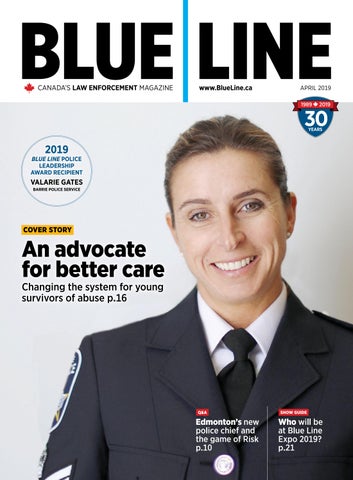
2019
BLUE LINE POLICE LEADERSHIP AWARD RECIPIENT
VALARIE GATES BARRIE POLICE SERVICE
COVER STORY
An advocate for better care Changing the system for young survivors of abuse p.16
Q&A
SHOW GUIDE
Edmonton’s new police chief and the game of Risk p.10
Who will be at Blue Line Expo 2019? p.21
TO PROTECT. SERVE. & HELP RECOVER. Using GPS technology and aerial imagery, OnStar ® can help pinpoint the exact location of a stolen vehicle. And with Remote Ignition Block™ and Stolen Vehicle Slowdown,™ OnStar can help speed up the recovery process by preventing the vehicle from being restarted or by slowing it down when conditions are appropriate. LEARN MORE AT onstar.ca
Requires paid plan, working electrical system, cell reception, GPS signal, armed GM factory-installed theft deterrent system, contact method on file and enrollment to receive alerts. All described features require customer to have an active, eligible paid plan, and properly equipped vehicle. OnStar advisors can assist law enforcement in recovery attempts, after the customer has reported the vehicle as stolen. Additional messaging and data rates may apply. Services are intended to assist with vehicle recovery and do not prevent theft or protect against damage or loss. See onstar.ca for details and limitations. ©2019 General Motors of Canada Company. All rights reserved.
Contents
20 April 2019
Columns
Volume 31 Number 4
4 10 12 14 15 28 30 34
Features COVER STORY
16 An advocate for better care
Valarie Gates of the Barrie Police Service, the recipient of Blue Line’s 2019 Police Leadership Award, has long had a passion to do more for young survivors of abuse. By Renée Francoeur
20 Photos from the Security • Police • Fire Career Expo
Blue Line collaborated with fellow Annex Business Media publications Canadian Security and Fire Fighting in Canada to host a unique career expo designed to meet the needs of up-and-coming security professionals, law enforcement officers and firefighters.
21 Blue Line Expo 2019 Show Guide
Editor’s commentary Q&A Behavioural sciences Health & wellness Holding the line Technology Case Law Back of the book
Departments 6 6 8 8 31 32 33 34
By the numbers News Calendar Dispatches Off the shelf Product showcase Marketplace Blue Links
From the conference sessions to the show floor, Canada’s premier event for the law enforcement community brings together the best of the best.
26 Delivering tough messages with kindness
COVER PHOTO: LOUISE JONES
Blue Line is proud to present the 2019 Lifetime in Law Enforcement Achievement Award to Corrie Zafirides, a probation and parole officer and an intensive supervision officer. By Landen Kruger
10 @Blue_LineMag
16
26 April 2019 | BLUE LINE
3
EDITOR’S COMMENTARY BY RENÉE FRANCOEUR
www.BlueLine.ca
Feeding the seeds
I
am fortunate to spend so much time personal schedules to offer advice to stureading about and conversing with dents and others interested in making a so many law enforcement leaders. career transition. These leaders all come with varied I watched as leaders from Hamilton Potitles from various agencies — including lice Service, Toronto Police Service, Barrie chiefs of police right down to frontline Police Service, Toronto Transit Commisconstables, civilian staff posted in IT and sion and Ontario’s Correctional Services HR, military police members, correctional (plus more from the other two fields of fire officers, conservation officers, international and security) commandeered their mentor committee members... I could go on. tables, patiently listening to questions from What do they all have in com140 attendees. They were open mon? Reflecting on this, I decid- I wish we books, sharing raw stories of ed they are all “people of action” could award challenges as well as victories. — risk takers when it comes to every officer Some of the students were new ideas, as well as lifelong who is more reserved than others, but pursuers of continuing their nominated these mentors skillfully broke education. However, this is only for both the down the barriers — they had Police the tip of the iceberg. lunch with these students, took There are a number of studies Leadership social media photos with them, and definitions when it comes to Award as practiced interviewing questions characterizing good leaders... well as the with them and just went the exOur own columnist Isabelle Lifetime in tra mile to spark excitement and Sauve pointed out in her Febru- Law create comfort. It was growth ary piece that leadership is con- Enforcement happening right in front of me. Award with a textual: This issue celebrates leaders “Individuals need specific trophy or at like those mentors. It takes a situations to shine as leaders. least some deeper look into two phenomenal Subsequently, leadership is a symbol of award winners who have worked how utterly process, not a position.” hard to create positivity and imAlong similar lines, according incredible prove difficult situations. These to Kevin Kruse, the creator of the they are. are two people who also make a Leading for Employee Engagedifference in young people’s lives ment eLearning program, “Leadership is every day, whose stories and influence a process of social influence, which maxi- ripple out well beyond the pages here. mizes the efforts of others, towards the Truly, I wish we could award every offiachievement of a goal.” cer who is nominated for both the Police Other sources, such as author J. Kelly Leadership Award as well as the Lifetime Hoey, credit leaders more specifically as in Law Enforcement Award with a trophy builders of the next generation. This is or at least some symbol of how utterly something I tend to forget; sure, leaders are incredible they are. There is not a single movers and shakers, but they are also good nomination form that does not amaze me gardeners. They want to see the seeds of in terms of impact, ability, commitment, tomorrow growing strong in encouraging passion and drive. environments, preparing to bloom. They We will be making changes to the Police understand the value of those seeds. Leadership Award for 2020. We have had I witnessed this first hand this past feedback calling to make it simpler to March. I was humbled by the genuine apply and more specific in criteria. Whatdedication and hours a number of law ever we decide, I want to thank all the enforcement leaders put into our Security judges and recipients, past and present, • Police • Fire Career Expo in Mississauga, for carving the way and caring for the Ont. Many took vacation days and pre- seeds, and know we will continue to celecious time out of their brimming work/ brate leadership in Canadian policing.
CONNECT WITH BLUE LINE
www.BlueLine.ca 4
@Blue_LineMag
BLUE LINE | April 2019
BLUE LINE
www.facebook.com/BlueLineMagazine
GROUP PUBLISHER | MARTIN MCANULTY mmcanulty@annexbusinessmedia.com EDITOR | RENÉE FRANCOEUR rfrancoeur@annexbusinessmedia.com ACCOUNT MANAGER | JANICE EATON janice@blueline.ca MEDIA DESIGNER | SVETLANA AVRUTIN savrutin@annexbusinessmedia.com ACCOUNT COORDINATOR | TRISH RAMSAY tramsay@annexbusinessmedia.com CIRCULATION MANAGER | BEATA OLECHNOWICZ bolechnowicz@annexbusinessmedia.com Tel: 416-442-5600 ext. 3543 PRESIDENT & CEO | MIKE FREDERICKS ANNEX BUSINESS MEDIA 111 Gordon Baker Road, Suite 400 Toronto, ON M2H 3R1 Tel. 416-442-5600 • Fax 416-442-2191
Publication Mail Agreement No. 40065710 ISSN 0847-8538 Printed in Canada SUBSCRIPTION RATES Canada — 1 Year $31.50; 2 Year $52.50 plus tax USA — 1 Year $105.00 USD CIRCULATION email: asingh@annexbusinessmedia.com Tel: 416-442-5600 ext 3553; Fax: 416-510-6875 or 416-442-2191 Mail: 111 Gordon Baker Road, Suite 400, Toronto, ON M2H 3R1 Occasionally, Blue Line will mail information on behalf of industry-related groups whose products and services we believe may be of interest to you. If you prefer not to receive this information, please contact our circulation department in any of the four ways listed above. Annex Privacy Officer Privacy@annexbusinessmedia.com; Tel: 800-668-2374 © 2019 Annex Publishing & Printing Inc. All rights reserved. Printed in Canada. No part of the editorial content of this publication may be reprinted without the publisher’s written permission. Opinions expressed in this magazine are not necessarily those of the editor or the publisher. No liability is assumed for errors or omissions. Readers are cautioned and advised that articles presented herein are edited and supplied for your personal awareness and should not be used for further action until appropriate guidance is received from a supervisor, Crown Attorney or other persons in authority. All advertising is subject to the publisher’s approval. Such approval does not imply any endorsement of the products or services advertised. The publisher reserves the right to refuse advertising that does not meet the standards of this publication.
NEWS TORONTO
Resident thanks Toronto detectives who gifted roses to McArthur’s neighbours last Valentine’s Day
CTV Toronto has reported an exclusive story on how two Toronto Police officers sought to bring a little light to those who lived near serial killer Bruce McArthur in the Thorncliffe Park Drive apartment last Valentine’s Day. Two forensic identification services officers who worked on the McArthur investigation, Det.-Const. Lawrence Parasram and Det.-Const. Peter Gendi, “decided to show those residents they were supported” during the difficult time. On Feb. 14, 2018, they handed out roses to the residents on floor 19. One year later, one of those who received a rose sent a note to the detectives, thanking them again for making their day and noting how “a small gesture can have such an impact on someone.” CTV talked to some of the other residents who remember the kindness of the detectives last year. “They were terrific guys; they tried to be as unobtrusive as possible and we thank them for that. They had a tough job,” one resident told the reporter. CANADA
Statistics Canada releases results from National Cannabis Survey, fourth quarter 2018
How much do you think cannabis consumption has changed since legalization? Findings from the fourth quarter of the National Cannabis Survey (NCS), which was collected from mid-November to mid-December 2018 and was designed to monitor cannabis consumption and related behaviours before and after legalization of cannabis, are now available, and include results for every province.
Detective constables Peter Gendi and Lawrence Parasram were two members helping process McArthur’s apartment last year. PHOTO: TORONTO POLICE SERVICE It found about 4.6 million or 15 per cent overall of Canadians aged 15 and older reported using cannabis in the last three months. More than half (55 per cent) of Canadians aged 15 and older indicated that they have never used cannabis, while three in 10 were former users who reported no longer using it. Take our quiz at bit.ly/2J6V4ZR to test more of your knowledge on cannabis and Canada. CANADA
Anonymous survey seeks to measure progress in Canadian police workplace culture
A former police officer turned researcher has launched a new survey open to currently serving as well as retired officers (and those on leave) across Canada to capture a clearer picture of how police culture in the workplace has changed. The anonymous, online survey is the “first of its kind” in terms of breadth and depth, says Lesley Bikos, previously a London police Lesley Bikos, a former police officer turned researcher, has launched a new survey to better understand how police culture has changed.
officer and now a PhD candidate within the Sociology Department at Western University in London, Ont. “We just don’t have this data in Canada.” It asks questions centred on the reporting of mental health issues, harassment, internal communication, the prevalence of certain stigmas and much more. It also asks about the positives of the job. “There have been studies done on policing and mental health, studies on policing and work/life balance, but this is the first that asks about a lot of different themes to do with the workplace environment and how that impacts officers both on and off duty,” Bikos says. “It’s also measuring that impact through so many different variables from rank, race, gender, sexual orientation, mental health status, region, age cohort, etc.” Once the results are in, Bikos says the hope is to understand and measure where progress has been made over the past 50 years, where the barriers remain and to whom. She notes the survey is confidential and that she will not be collecting IP addresses nor asking for the names of police agencies. The 25-minute survey was launched in mid-February and Bikos says it will be online for three months or longer if responses are still coming in by May. To participate in the “Survey of Canadian Police Officers’ Experiences in the Workplace,” visit bit.ly/2CkEaRI.
BY THE NUMBERS
The National Post submitted an access-to-information request in November for a breakdown of costs incurred by the RCMP in Quebec since the number of irregular border-crossing migrants started to rise in August 2016. Here’s the findings:
$6.6
million + is what the RCMP has spent over the past two years to process asylum-seeking migrants at Canada’s busiest illegal border crossing in Lacolle, Que.
6
BLUE LINE | April 2019
19,419 18,518 18,836
asylum seekers apprehended by RCMP last year who had entered Canada between official ports of entry
apprehensions were along the Quebec-U.S. border in 2018
apprehensions were along the Quebec-U.S. border in 2017
www.BlueLine.ca
NEWS FREDERICTON
Canada Post presents Fredericton Police Force with first responder stamp
Still recovering from the devastating shooting that took the lives of two police officers on Aug. 10, Canada Post employees have reached out and presented a special first responders stamp to the Fredericton Police Force. The stamp, commissioned by Canada Post in September 2018, is one of five that honour the bravery and sacrifice of Canadian first responders. The stamps are dedicated to police, firefighters, paramedics, search & rescue and the Armed Forces. Fredericton’s Deputy Chief of Police Martin Gaudet and other officers met with Canada Post employees at their distribution centre on Feb. 26, thanking them for their support and appreciation. “We talked about our struggles since Aug. 10, and they talked about their gratitude,” Gaudet said. “I thought it was such a caring and kind thing to do... We’ve received letters of support, an on-going thank you note, and presentations like these; and it just warms our hearts.” The Canada Post workers reached out to the police after a call-to-action was issued from their national headquarters. Canada Post made enlarged replicas of the five stamps so offices across the country could present them to their local emergency responders. “We looked at how much people value the work these heroes do, and we thought ‘Wow, we’re a national company with employees all across the country in every area.’ So, we made stamp enlargements available to all of our employees,” said Jim Phillips, stamp director at Canada Post. “If they wanted to go out and show their own appreciation to the local paramedics, or firefighters or police, they should do it.” Six months later, the replica stamps have been presented at over 1,900 offices across Canada. “The hardest thing was keeping the stamp enlargements in stock,” Phillips said, “and making sure we didn’t have three groups of people going to the same police force or fire department.” - Landen Kruger DELTA, B.C.
Delta Police first B.C. police force named as top employer The Delta Police Department (DPD) has @Blue_LineMag
PHOTO: FREDERICTON POLICE FORCE
been named as one of B.C.’s top employers in 2019. “This is the first time a police force has been named as one of our province’s top employers,” noted Delta Police Chief Neil Dubord. “We’re particularly proud of that accomplishment. Delta is one of the safest communities in Metro Vancouver. I believe it’s the commitment and dedication of our officers and police staff, with the strong support from the community, our police board and Mayor and Council that’s led to that outcome.” The B.C. Top Employer’s project for 2019 was the most competitive on record. Delta Police and other successful employers were evaluated on eight criteria: physical workplace, work atmosphere and social, health, financial and family benefits, vacation and time off, employee communications, performance management, training and skills development and community involvement. “Our workforce, both civilian and sworn, must reflect our community and its values,” Dubord said. “Delta Police is well known for its outreach and No Call Too Small approach. But we’re also known within law enforcement circles for the high calibre of our training and equipment. That’s balanced with benefits that provide for a healthy work and home life balance, to ensure our staff are ready to meet challenges. We recently were called to answer a significant challenge, when one of our off-duty officers PHOTO: DELTA POLICE DEPARTMENT
stepped in to save a woman and was seriously injured. Fortunately the Delta Police Department doesn’t often face such a test. But as this event demonstrably proved, our officers and our police staff are exceptional professionals even under extreme pressure. We may have been named one of B.C.’s Top Employers, but I think our people are more aptly described as some of the Top Employees in the province. I am so proud of them all.” OTTAWA
OPS launches new 1-800 line for human trafficking victims
The Ottawa Police Service (OPS) has a new 1-800 line to offer support and help for those trapped in the abusive cycle of human trafficking. The toll-free number, 1-800-292-1168, connects directly with the OPS Human Trafficking Unit (HTU), where victims can get the help they need to get out of their situation, no matter where they are in Canada. Sex trade trafficking victims are often rotated from city to city, along the Montreal to Toronto corridor. Sometimes they are even transported across the border, into the United States. “I’m not sure most residents of Ottawa are aware at how prevalent human trafficking is here. On any given day, there is at least one sex trade worker in every single hotel across the city,” said HTU Sgt. Damien Laflamme. “We are working closely with hotels and entertainment groups in the city to train frontline personnel on how to recognize signs of human trafficking and what they can do if they see it. But we also wanted to provide a way for victims or people with information to contact us, no matter where they are in Canada. We are here to help you.” To learn more about human trafficking visit ottawapolice.ca/HTU.
April 2019 | BLUE LINE
7
NEWS DISPATCHES York Regional Police Deputy Chief Thomas Carrique has been appointed commissioner of the Ontario Provincial Police (OPP). Carrique joined York Regional Police in 1990 and was appointed deputy chief of police in 2011. He most recently oversaw the Investigations and Support Branch and held increasingly senior roles throughout his career, including superintendent-in-charge of staff services. He also led the service’s Organized Crime Bureau and acted as a liaison officer to the Special Investigations Unit. After 37 years with the New Westminster Police Department, Chief Const. Dave Jones has accepted the position of chief officer with the Metro Vancouver Transit Police. Jones began his policing career in 1982 as a volunteer with the Reserve Police Section of the NWPD. He was later hired on as a full-time officer in 1986. In 2009, he was promoted to the position of deputy chief constable and in 2011 he was promoted to chief constable, making him one of the first members of the NWPD to work his way through the ranks to the position of chief. Jones has received recognition for various investigations and events in the form of Chief Constable Commendation, Sr. Officer’s Commendation, Queen’s Jubilee Medal and the Queen’s Diamond Jubilee Medal. In 2013, the Governor General of Canada presented him the Member of the Order of Merit of the Police Forces medal. He also recently received the officer’s level Order of Merit. Supt. Ted De Jager has been assigned president of the B.C. Association of Chiefs of Police (BCACP). Officer-in Charge of the Penticton South Okanagan Similkameen Regional RCMP Detachment, De Jage, takes over from previous year’s president, Chief Manak, Victoria Police Department. RCMP Assistant Comm. Jodie Boudreau is new “O” Division (Ontario) Commanding Officer. She began her RCMP career in 1992 as a general duty police officer in “E” Division (British Columbia). Boudreau has worked as an 8
BLUE LINE | April 2019
CALENDAR undercover operator, was a member of the Tactical Troop and became a critical incident commander, attending many calls with the Emergency Response Team. She has also served as Aide-de-Camp to Alberta’s Lieutenant Governor and is a recipient of the Queen’s Diamond Jubilee Medal and the RCMP Long Service Medal. Deputy Chief Eric MacNeil of the New Glasgow Regional Police was appointed chief after serving as the department’s acting chief for 14 months. Prior to this, he was deputy for almost 10 years in charge of police operations. RCMP inspector Gordon Cobey (photo) has been named the new police chief for the Guelph Police Service in Ontario. He replaces Jeff DeRuyter, who is retiring after 35 years. Most recently, Cobey was the officer in charge of the RCMP Toronto West Detachment and the Toronto West Serious and Organized Crime Unit. He joined the RCMP in 1993 as a constable, working in remote northern communities and rural southern communities in Manitoba. Mark Neufeld, M.O.M., is Calgary’s new chief constable. Neufeld spent 24 years with the Edmonton Police Service, and two years as chief of the Camrose Police Service. He is currently the president of the Alberta Association of Chiefs of Police, a leader of its Women in Policing committee, and Chair of the Alberta Law Enforcement Response Team (ALERT) provincial board of directors. Regina Police Staff Sgt. Paul Tate has retired after 29 years. He was one of the recipients of the Teamwork Award during the 2019 Annual Regina Police Service Awards.
PROMOTIONS, RETIREMENTS, RECOGNITION • If you have an officer in your agency recently promoted or retiring or an individual you wish to have recognized (major award or recently deceased) you can let Blue Line magazine know by email to: rfrancoeur@annexbusinessmedia.com.
Battle of the Badges II April 26, 2019 Burlington, Ont. badgebattle.info 3rd Annual International Police Judo Clinic April 30-May 3, 2019 Vancouver, B.C. policejudo.ca 10th Law of Policing April 30-May 1, 2019 Toronto, Ont. www.canadianinstitute.com/10th-lawpolicing/pricing 3rd Annual Indigenous Policing Forum May 3, 2019 Toronto, Ont. www.canadianinstitute.com/10th-lawpolicing/pricing Toronto Crime Stoppers Chief of Police Dinner May 8, 2019 Toronto, Ont. torontocrimestoppersdinner.ca HTCIA Canada Cyber Summit May 9-10, 2019 Ottawa, Ont. bit.ly/2H8a87h Niagara Counterfeit & Fraud Workshop May 22-23, 2019 Niagara Falls, Ont. www.counterfeit-investigators.com Ontario Assoc. of Police Services Board Spring Conference May 22-25, 2019 Windsor, Ont. oapsb.ca ABLE 26th Annual Scholarship Awards Ball May 25, 2019 Burlington, Ont. oapsb.ca Canadian Police Canine Association’s National Handler Development Seminar May 27-30, 2019 Halifax, N.S. www.canadianpolicecanine.com www.BlueLine.ca
Q&A
BY LANDEN KRUGER
Dale McFee is Edmonton’s new police chief, an “internationally recognized innovator and executive leader with a solid background in the fields of policing, community safety and public service.” He served as the chief of police in Prince Albert and as the deputy minister of Corrections and Policing in Saskatchewan. He digs deeper with Blue Line on how his past experiences will help shape the years ahead. Q: Why did you choose law enforcement as a career path?
I think of Prince Albert as a smaller place where you could be innovative and try some new things. Then I went on to government, dealing with corrections and policing. You can learn how to reverse engineer people that have gone to jail, and you can see those potential moments where you can intervene in their lives to help keep them out of jail. And then you come to the police service in Edmonton, which has the size and scale, and you can actually implement a lot of the things you learned along the way. You still have the ability to make decisions and act reasonably quickly, and you can impact the community a lot more than you can in government. I think it’s a natural evolution to use all those experiences.
Q: How has policing changed since you first started as an officer?
It’s like anything else, it evolves. What you are dealing with on the streets has changed. If you think of just the impact technology has had on your every day communications... the same thing has evolved in criminal activity. If you think about things that cause a police response in relation to drugs, that has completely changed, too. But on the positive side, you are seeing a well-educated police service. You are seeing a lot of diversity in police services and you are seeing a lot of talented people to combat that. We are going to have to be able to operate in what I call a “smarter environment,” which is more than just a “quicker environment.”
Q: What are some achievements you’re particularly proud of?
There are lots. Even now coming into the Edmonton Police Service is pretty humbling — to be able to lead 10
BLUE LINE | April 2019
such a great organization. My fondest memories were my times as a police officer and chief at Prince Albert, and as the deputy minister of corrections and policing for the Saskatchewan Ministry of Justice, but what I remember most are the people. My greatest achievements are building relationships with people and building leadership in my teams. I’ve been fortunate to have a lot of positive moments throughout my career. If you are in a situation and you surround yourself with good people and enable them to do the job, then everybody wins.
Q: How do you think your past jobs have prepared you for your new position?
Snapshot of Edmonton’s new police chief
23rd
chief of Edmonton Police Service
9
years as chief in Prince Albert, Sask.
26
years as an officer
Q: What did you learn from being on the other side of policing, in the government part of the job?
You understand your partner agencies differently, like health, social services and education. You understand how money flows. You understand how everyone feels that they are doing the best in their own environment. But what you really learn in government is that we have to do this collectively or we are not going to be successful. You can’t solve social issues with just one piece of the puzzle. The reality is that working across systems is the only way you can get value and impact.
Q: What do you think is needed in police leadership?
If you know what drives your work, www.BlueLine.ca
PHOTO: EDMONTON POLICE SERVICE
Growing up playing hockey on a team was always something that interested me. So was being able to do something different every day and help people. That led to me applying at the Prince Albert Police Service, and I was successful in my application. It’s been one of those careers that is really rewarding. Every day is different. Giving back to the community and working with the community are things that obviously interest me.
then you need to know what work you can do to actually fix it, and when I mean fix it, I mean reduce it. We’ve had this idea in policing that the solution is more supply. More supply looks like, “We need more officers. We have marijuana coming our way, so we need more officers to deal with that. We’ve got to do such-and-such so we need more officers.” And we do need those things; it’s important to have the tools to do the job. But equally important is: how do you reduce the demand for the services? If the job of the police is not to get themselves out of work, then we are not focusing on the right things. We all know that policing will never be out of work. It’s a necessary thing to protect society, but at the same time there is a balance we need to bring to policing. Otherwise there are never going to be enough resources and you are never going to slow down your intake. We need
our organizations to have the ability to think differently.
Q: What are some of the biggest issues you see for policing right now?
If you are talking about drivers of crime, then you are talking about meth, drugs, mental health and addictions, domestic violence and child trauma. I also think the other part to that is, how do you connect to those services and get behind them, so you collectively own the problem? The biggest thing is going to be getting everyone in the same direction. It’s like the game of Risk; if you put an army on every country, then you are first out of the game. I think we have armies all over the place, and I would almost say that we don’t have a collective fighting response to deal with the multiple issues we are facing.
Q: What do you hope to achieve over the long-term?
It’s like the game of Risk; if you put an army on every country, then you are the first out of the game.
Watch McFee’s swearing in ceremony at youtu.be/ LkiJDy9IzjQ.
I want to focus on reducing the demand for services. I want to make sure we are diligent in protecting those services that are critical to our citizens, like air patrol, investigative services — things that we are good at. And improving those things that reduce the demand. We have the people and we have money, and we just need to make sure that we are using both to make the community a safer place. A part of that is making sure we have partners at the table. We need to do whatever is in our power to make sure they are there, but also make sure they are getting some wins out of it, too. We need to set joint goals and priorities. I think that anytime you are going to do something that will reduce crime and make communities safer, it needs to be led locally. Community safety is a lot bigger than just policing and enforcement.
PART OF YOUR TEAM Commissionaires works with hundreds of municipalities to deliver administrative and non-core police support so sworn officers can focus on the jobs only they can do.
commissionaires.ca @Blue_LineMag BL_March_Commissionaires.indd 1
April 2019 | BLUE LINE
11
2019-01-09 10:23 AM
BEHAVIOURAL SCIENCES BY PETER COLLINS
Psychological debriefing – are we doing more harm than good?
A
s a physician, I believe in evidence-based medicine. The purpose of evidence-based medicine is to optimize decision making by emphasizing the use of evidence from well designed and well-conducted research. I believe the same principle should apply to the profession of policing. So why do North American law enforcement agencies regularly use psychological debriefing after a critical incident?
Critical Incident Stress Debriefing
psychological debriefing as having no research support and as potentially harmful.3 Why is psychological debriefing potentially harmful? Sitting around post incident and being encouraged or mandated to discuss your feelings, in front of your peers, ‘pathologizes’ or ‘medicalizes’ normal responses to trauma. CISD can force an individual to second guess whether their feelings, emotions and responses are maladaptive or abnormal whereas, in fact, these responses are normal and will dissipate over time. Individuals respond to trauma in a number of ways but overall most do not develop PTSD. In an insightful piece written for the American Society of Evidence Based Policing, Renee Mitchell explores the harmful effects of CISD and questions why it is still being used by police agencies, often on a mandatory basis, when it was debunked over a decade ago.4
The most common forms of psychological debriefing are Critical Incident Stress Debriefing (CISD) and Critical Incident Stress Management (CISM). CISD was developed in the late 1980s. After 9/11, a number of respected researchers, including those with the Cochrane Collaboration, studied CISD effectiveness. The Cochrane Collaboration is a non-profit/non-government research group and What should we do now? considered a gold standard of medical re- When I served with the Canadian Armed search. It is dedicated to exploring the effi- Forces in Southern Afghanistan, as the Officacy of many different types of medical cer Commanding of the Mental Health Unit, treatment so physicians and their patients the CF had already stopped using CISD. This was a decade ago. We were in good are able to make informed decisions.1 The Cochrane Collaboration company – the American Armed determined there was no evi- Sitting Forces, the Australian contingent dence that psychological debrief- around post and the Royal Navy had also ing is effective. It concluded that incident and ceased practicing CISD. compulsory debriefing of trauma being Instead, the model we used was victims should not be undertaken, encouraged psychoeducation and psychostating “there is little evidence to or mandated logical first aid. Personnel insupport the use of psychological to discuss volved in a critical incident were intervention for routine use fol- your feelings, educated as to the possible in front of lowing traumatic events.” symptoms they might experience In addition, it concluded your peers, after a traumatic event. They psychological debriefing may ‘pathologizes’ were informed these symptoms actually cause adverse effects. or can differ from person to person McNally et al (2003) echoes this ‘medicalizes’ and were a “normal” response. concern and states there is no normal These could include avoidance of convincing evidence psycho- responses to others; ruminating about the inlogical debriefing works and that trauma. cident and what they could have studies of “individualized dedone or not done; restlessness; briefing and comparative, non-randomized irritability; intrusive thoughts about the studies of group debriefing have failed to incident; insomnia and disturbing dreams, confirm the method’s efficacy. Some evi- to name a few. dence suggests that it may impede natural The facilitator is there to educate the group recovery. For scientific and ethical reasons, and to answer questions. If the symptoms are professionals should cease compulsory particularly troublesome, or persist after a debriefing of trauma-exposed people.”2 few days, the member can opt for one-to-one The American Psychological Associ- “psychological first aid.” A three- or four-day ation has also weighed in and describes prescription of a non-addictive sleep aid 12
BLUE LINE | April 2019
might be prescribed, if required, in order to regulate sleep. If needed, three to four sessions of Cognitive Behavioural Therapy (CBT) would be recommended. The purpose of this psychological education/first aid model is to: listen; convey compassion; assess needs; ensure that basic physical needs are met; not force someone to talk; encourage, but not force, social support; provide information; protect from additional harm; allow ventilation of feelings as appropriate for the individual; and when appropriate, refer to a mental health specialist.5 Mitchell & Lewis (2017) opine that “although good intentions are behind our social interventions, good intentions do not equal positive outcomes. We have an ethical duty to our public and our officers to be up to date on empirical research concerning our interventions.”6 In other words, we need to practice evidence-based medicine in policing.
References
1 www2.cochrane.org/review/en/ab000560.html 2 McNally, R., Bryant, R. & Ehlers, A. (2003). Does early psychological intervention promote recovery from posttraumatic stress? Psychological science in the public interest, 4(2), 45-79. 3 Society of Clinical Psychology, American Psychological Association www.div12.org/PsychologicalTreatments/ treatments/ptsd_debriefing.html 4 Mitchell, R. (2018) www.americansebp.org/ the-harmful-effects-of-critical-incident-stressdebriefing-cisd-why-police-departments-should-stayup-to-date-on-evidence-based-practices/ 5 McNally, R., Bryant, R. & Ehlers, A. (2003). Does early psychological intervention promote recovery from posttraumatic stress? Psychological science in the public interest, 4(2), 45-79. 6 Mitchell, R., & Lewis, S. (2017). Intention is not method, belief is not evidence, rank is not proof: Ethical policing needs evidence-based decision making. International Journal of Emergency Services, 6(3), 188-199.
My goal, in this monthly column, is to explore a wide variety of behavioural issues that are related to law enforcement. Contact me if you have any questions or suggestions for future topics at pcollins_blueline@gmail.com. Dr. Peter Collins is the Operational Forensic Psychiatrist with the Ontario Provincial Police’s Criminal Behaviour Analysis Unit. He is also a member of the crisis/hostage negotiation team of the Toronto Police Service. His opinions are his own and not necessarily the opinion of the OPP, CAMH, University of Toronto or his mother.
www.BlueLine.ca
HEALTH & WELLNESS BY ISABELLE SAUVE
Managing fear in the workplace
T
he fundamental differences between leadership and management were explored in one of my previous articles. Emphasis was placed on the notion that “organizations should focus on building competence over competencies as well as promoting organizational goals and vision over personal agendas.” Indeed, being a manager is to achieve group goals as well as to contribute to the overall productivity and wellness of an organization and its human resources. It is to assemble, organize and integrate human and other resources in an effective manner to achieve pre-determined objectives. Becoming a professional and independent police officer in Canada requires successful completion of formal training, coaching and demonstrated competence in key aspects of generalist policing. The process is designed to gradually build recruit competence and confidence. Becoming a manager should require the same focused and planned course of learning and development. Managers must incrementally build knowledge and confidence, a process which should begin prior to formal promotion. Ongoing opportunities to gain exposure to related theory, practice skills and to be coached and receive feedback should be incorporated. Management is highly multifaceted and must be learned. Those with the desire to step up to such an important and challenging role should be highly supported. Law enforcement organizations tend to rely on a structure of authority rather than apply known and empirically proven management theories to meet business priorities. Management is a discipline that is so involved and complex, it can be studied at the post graduate level and beyond. It is an integral part of an organization and must be treated as such. Regrettably, some managers are highly undertrained and inexperienced. It is a costly mistake with a 14
BLUE LINE | April 2019
detrimental impact on employee wellness and organizational effectiveness. Being undertrained — especially in a managerial role where achievement is paramount — opens the doors to a number of counterproductive and even destructive managerial styles and consequences. One of the greatest consequences is a manager’s fear of failure or of not meeting expectations. Managers who fear to fail tend to create a fear-based workplace, which has a destructive impact in an organization and promotes an unhealthy work environment. Fear is one of the strongest human emotions, triggered in the most primitive areas of our brains and it is essential for survival. The scientific word to describe the fear of failure is atychiphobia. In a workplace, atychiphobia is likely to breed a sense of loss of control in which an obsession over policy and procedures is often used as a means of compensation. Fear also promotes the “yes-person,” who blindly does and says what they believe their superiors want out of yearning for approval and reassurance. A sense of bureaucratic power and self-esteem is gained by receiving attention or positive feedback from the “higher ups.” Managers who operate largely on the basis of fear often do not even realize they are doing so. Fear is often at the root of arrogance, bullying and micromanaging. Rather than focusing on positives, fearful managers focus on what is done wrong and by consequence
Law enforcement organizations tend to rely on a structure of authority rather than apply known and empirically proven management theories to meet business priorities.
destroy creativity and morale. Sadly, many fearful managers feel threatened and insecure. This tends to trickle onto those around them. While seemingly counterintuitive, some lash out as a means of self-protection and in an attempt at gaining control. Confident managers lend credit to their teams for successes and assume accountability for problems or failures, while fearful managers take credit for successes and place blame on others. They are more likely to breed fearful and unhappy employees who do not trust them. These employees are less likely to think outside the box and demonstrate their true potential and qualities out of worry over potential reprisal. By identifying and recognizing the root of issues, steps can be taken towards positive change. Many of these managerial issues can be corrected with proper training and an opportunity to learn. It must be recognized, however, that not everyone has the skills and aptitude to be a good manager. In a time of human resource shortage and perpetual change, it is imperative to support suitable candidates stepping up to managerial roles. In a context where human capital is at the heart of the organization, it must be treated as such. Most private and public organizations recognize this necessity and highly invest in training their managers. It is false to believe desired skills and knowledge magically appear. Managers must feel empowered. Healthy and productive workplaces are those filled with employees confident within their respective roles at all levels. Confidence comes with knowledge. Isabelle Sauve is a 12-year veteran with the OPP, currently with the Lanark County Detachment. She has a MA in psychology and is a PhD candidate. She is also an ultramarathon/ endurance athlete and the Racing the Planet/4 Deserts 2018 Series winner as well as a Guinness World record holder.
www.BlueLine.ca
HOLDING THE LINE BY MICHELLE VINCENT
The magic in saying “yes”
A
s police officers, we tend to explore what opportunities await. need to know the details of how it will unwalk the line of caution and Short on time to commit? You will find fold. Just know that the opportunity came “investigate” before we pro- that time when you have the inspired your way for a reason. Looking at the details ceed into any endeavour or line passion for the right opportunity. Time will slows down the inspired action of the “yes.” of action. This is understandable, as appear, whether it is while you are watch- Just take the leap and trust that the opporeverything we do on the job can be related ing one of your children at their sporting tunity would not have presented itself if it to life and death as a result of our deci- events or during your lunch break at work. was not meant to be available to you. sion-making process. The magical piece about saying yes to Trust that everything around you is there Naturally, we take this into our opportunities that come your just waiting to support you in your success. personal lives, failing to realize We are way is the rich learning experi- When that golden opportunity, perhaps not all experiences require this taught from ence of the journey; self-discov- disguised as a challenge at first, comes your high-level cognitive processing. the onset of ery and innate happiness over- way, will you be ready to say yes? We don’t even notice our minds our careers in flow into our work and family Michelle Vincent is a 17-year York are working at this high level of policing that lives. The pride we feel in having Regional Police officer with a master of processing from an emotional we will be taken on the opportunity, in arts in counselling psychology and a and intellectual capacity — and police having boldly said, “yes!” is a gift background in equine-assisted therapy, then we wonder why we are ex- officers 24/7 that keeps on giving. workplace reintegration after a critical inciand to some hausted most of the time. Give yourself the gift of “al- dent and long-term leave, as well as teaching. She is in From shift work to the critical degree we ways doing what you are afraid to the process of implementing the first non-profit centre that will be occupationally specific for incidents we experience on a are. But do do.” Should the opportunity treatment first responders and is working towards her PhD in regular basis, we bring this neces- we have to arise, say a clear “yes” with the Forensic Psychology/Crisis Response. She can be sary high-level of decision-mak- be? understanding that you do not contacted at: michelle@vincent.net ing into our personal world without a thought. We are taught from the onset of our careers in policing that we will be police officers 24/7 and to some degree DALHOUSIE’S CERTIFICATE IN POLICE LEADERSHIP we are. But do we have to be? Become the leader you know you can be The answer to this lies in challenging ourselves by saying “yes” to any — if not all — opportunities presented to us in life. I have a throw pillow on my couch that says, “always do what you are afraid to do.” To me, this equates to always being ready to say “yes” when on my life’s journey. I notice that in everything I have said yes to, I have not only been successful, I have loved it and it has been a significant contributor to the person I have become. When we say “yes,” we open so many doors in our world — doors we were never even aware of in the first place. Think of that time you said “yes” to something you were afraid of or thought you would not be successful in. It is like the old adage: “failure is only present if you don’t attempt the task,” meaning you may or may not be Built for modern policing, our online courses, designed and delivered successful, however if you at least give it a by industry leaders and experts, give you the knowledge and skills to try, it will feel good and energizing. advance in your profession. For me, the biggest piece is saying yes to Learn from the innovator in quality police education for over 25 years. opportunities outside of policing. Examples are: writing and continuing my education in a topic I am passionate about that DAL.CA/POLICELEADERSHIP is not necessarily related to policing. So, if Fall Term starts September 5 you’re thinking, I am interested in architecture, accounting, mental health, nutrition, College of Continuing Education physical fitness, it is time to go online and
CCE
April 2019 | BLUE LINE
@Blue_LineMag BL_MAR19_Dalhousie.indd 1
15
2019-02-25 10:24 AM
COVER STORY
An advocate for better care Valarie Gates of Barrie Police has long held a passionate vision to do more for young survivors of abuse By Renée Francoeur she told me. And I thought, wow; this is why we’re doing this. This is going to make a difference in this child’s life. From that point on, I was drawn to really push forward and advocate for the children; I needed to make changes for them; for the kids that couldn’t speak out and did not feel safe.” Gates has been selected as the 2019 recipient of Blue Line’s Police Leadership Award, which honours those with outstanding leadership skills, tireless dedication and who encourage others to develop similar pacesetting abilities. (Note, at the time this nomination was made, she was a sergeant.) She is credited as being the mover and shaker in terms of securing the Barrie site of the Child Advocacy Centre (CAC) of Simcoe-Muskoka, which opened its doors in August 2017 to offer child protection services, mental health support and much more. The centre recognizes the ongoing problem of human trafficking as well as the trauma survivors of abuse experi-
1997 Gates begins policing career
2002 joins Barrie Police Service
2005 promoted to detective-constable
“She continues to bring not just members of the Barrie Police Service together, but also is always looking at things from a broader perspective — across the province, across the country — to effect change in areas that will benefit the whole community.” - Barrie Police Chief Kimberly Greenwood 16
BLUE LINE | April 2019
ence. It defines itself as “a neutral space where police officers and child protection workers conduct forensic interviews, paediatricians provide well-child examinations, and a child advocate supports and assists the child/youth and family throughout the entire process.” The Barrie site marks the seventh location of its kind in Ontario. “Val has worked tirelessly and has been instrumental in getting the program off the ground,” writes Tracy Carter, the Barrie CAC executive director. “Her passion and vision have been contagious in ensuring children of abuse have the support to improve their lives.”
Noticing a gap
Gates, whose father was a police officer, says she always knew she wanted a career in law enforcement. It was in school, when she was taking psychology, that she learned she was also drawn to learning more www.BlueLine.ca
PHOTOS: LOUISE JONES
A
profound moment that cemented what Barrie Police Staff Sgt. Valarie Gates wanted to dedicate the rest of her career to came in 2014. It was the first rendition of the Junior Constable Camp, a summer program Gates (who was a sergeant at the time) had spearheaded to further cultivate healthy relationship between police and local youth. The officers pick participants up in uniform on the first day of camp and, while it is exciting for many kids, one little girl was terrified of Gates when she showed up at the door in her vest and hat. “She didn’t want to come with us. It took some chatting with her grandma and assuring that she would be safe before she decided she would go with me,” Gates recalls. “Then, at the end of the day, she very quietly told me she hadn’t wanted to come in the morning because she was afraid of the police due to some past bad experiences. ‘But now I realize you’re my friend,’
Staff Sgt. Valarie Gates steals a hug from Moose, the specially-trained facility dog at Barrie’s Child Advocacy Centre. Gates visits the Child Advocacy Centre in Barrie, which opened in August 2017.
about the unique experience of children and she wanted to focus on having an impact in this area. “I concentrated a lot on courses involving the child and child sexual assault education,” she notes. She also worked in Barrie’s Criminal Investigative Branch, where she honed her skills investigating sexual assault and domestic violence. That being said, according to Homicide/Forensics/Tech CrimesICE Staff Sgt. Mike Winn, Gates always felt like she “could do more.” “She spends a great deal of her time outside of her working hours helping survivors,” Winn says. “It is a passion of hers. She has an incredible enthusiasm and insatiable appetitive to ensure survivors are given the support they need. She truly deserves credit for making a difference.” In 2009 she was promoted to sergeant in the Community Services Unit and set in motion a number @Blue_LineMag
of relationship-building projects, including the Annual Home Safe 5-km Run, the aforementioned Junior Constable Camp and Collaborate Barrie, a multidisciplinary, “hub-like” approach where police and community partners meet weekly to strategize for community safety concerns. “I was empowered by my leaders and mentors within the organization,” Gates explains. “We noticed a gap for the high-risk youth in our community. My senior command encouraged me to utilize the resources available to me and propose some solutions. I realized that this was my chance to really make an impact.” She began working with the local school boards to develop a list of risk factors that led to criminal behaviour, targeting those below the age of 12. Here the Junior Constable Camp was born. “We were analyzing youth through the justice system,” she says. “We
2009 promoted to sergeant
Nov. 2018 promoted to staff sergeant
developed the program where highrisk youth were nominated by their school or any other community agency and a committee would choose the youth that would attend camp based on their risk factors.” The five-week long summer camp is still happening — about 20 different children attend every week — and the Barrie Police Service is now looking to conduct a long-term study of the camp and its positive spinoffs. In fact, they know it’s having an impact, Gates adds, because every September, school resource officers are seeing children proudly wearing their camp t-shirts again on their first day of school.
No one wants to talk about child abuse...
Gates has spent the majority of her career involved with child abuse and sexual violence. She knew the system needed more than just a patch job in terms of repair. April 2019 | BLUE LINE
17
COVER STORY “When I would see these kids going through this process, it was absolutely heartbreaking,” she says. “I knew it was broken when I started policing 22 years ago: speaking to the child at a police station and then essentially leaving them and their parents to fend for themselves until you see them again in court in two years was not enough. I knew we needed wrap-around care during these investigations right through to the court process.” Ontario Provincial Police Sgt. Terry Paddon first told Gates about the CAC of Simcoe-Muskoka when it was opening in Orillia in 2014. She was pulled intuitively to get involved right away. Gates credits Paddon for his passion and desire to implement this model within his police service as well. In 2015 she became the chair of the centre’s board to learn about the model and was also transferred to the Crimes Against Persons Unit. She
Staff Sgt. Gates donates endless hours outside work to give back to her service and community.
learned more about the success behind the Sheldon Kennedy Child Advocacy Centre in Alberta (now known as the Calgary & Area Child Advocacy Centre), which was founded by the former NHL player and abuse survivor it was named for in 2010. This non-profit organization works with partner organizations to provide “wrap-around services to assess, investigate, intervene and
To find out more about the Child Advocacy Centre of Simcoe-Muskoka, visit cacsimcoemuskoka.ca.
support survivors of child abuse while bringing offenders to justice.” Gates then approached Barrie Police Chief Kimberley Greenwood about the need for such a centre in Barrie. “She supported it 100 per cent and so I started looked for fundraising and grant opportunities,” Gates says. “I felt very strongly that this had to succeed.” When it came to encouragement, especially in the new world of grant proposal writing, Gates says Greenwood was a vital and inspiring source of support. “My chief has truly mentored me and has always encouraged me to grab every opportunity that presents itself. She opened up the world of grant writing to me. After my first successful grant, I just kept writing and building on the past initiatives; each time laying the foundation for the centre as well as addressing human trafficking in our community...”
THANK YOU TO THE 2019 JUDGES PANEL
T
he Police Leadership Award was initiated and first bestowed in 1999 by the Canadian Police Leadership Forum (PLF). With support from Blue Line, the PLF presented the award annually until 2005 when the organization ceased to exist. In February 2011, Blue Line took up the challenge of a cross-Canada search for suitable candidates for recognition. Blue Line’s appointed judges have so far selected numerous worthy recipients including this year’s recipient, Valarie Gates from the Barrie Police Service. Thank you so much to our 2019 judging panel for your expertise, thoughtful insight, new ideas, steadfast dedication and valuable time.
Christine Silverberg is an accomplished lawyer and the Chief of the Calgary Police Service from 1995-2000. Christine went to law school after she retired as Chief, becoming a Partner at Gowlings LLP, then joining the independent law practices at Wolch deWit Silverberg & Watts. In 2015, Christine launched her own firm, SilverbergLegal. Christine is currently a CACP and OACP member. Among her many awards, she was most recently selected as part of the YWCA sesquicentennial project as one of 150 women who had had a significant impact on Calgary over the last 150+ years and in recognition of positive and extensive impact on community (2017).
18
BLUE LINE | April 2019
Frank Beazley is the retired Chief of the Halifax Regional Police Service in Nova Scotia. Beazley began his 42-year career with the Halifax Police Department in 1970 and became chief of the new HRPS in July 2003. He is a graduate of the Canadian Police College Executive Development program, Queen’s University executive program and numerous certificate studies concentrating in the area of business, law and human resources. He is a past and life member of the Nova Scotia Chiefs of Police Association and Canadian Association of Chiefs of Police. He is a past vice-president of the CACP and served on its board of directors. Beazley has received the distinction of Officer of the Order of Merit for the Police Forces and is a recipient of the PESM with two bars, both the Queen’s Gold and Diamond Jubilee Medals and the Province of Nova Scotia Long Service Medal and bar.
Peter German is a former Deputy Commissioner with both the Royal Canadian Mounted Police and Correctional Service Canada. He currently practices law, is a consultant on criminal justice and leadership matters, and is president of the International Centre for Criminal Law Reform at the University of British Columbia. Prior to retiring from the RCMP, he was the Deputy Commissioner for Western and Northern Canada. He holds a doctorate in law from the University of London, and is the author of a legal text, Proceeds of Crime and Money Laundering. German was awarded both the Queen’s Gold and Diamond Jubilee medals, is an Officer of the Order of Merit of Police, and was awarded his Queen’s Counsel designation in 2018.
Armand La Barge is the retired Chief of Police of York Regional Police in Ontario. La Barge began his career there in 1973 and retired in December 2010 after serving as chief for his final eight years. La Barge is the past president of the Ontario Association of Chiefs of Police and the Ontario Director of the Canadian Association of Chiefs of Police. He is a graduate of the FBI National Academy and the past chair of Special Olympics Ontario. He is also the immediate past chair of St. John Ambulance Ontario and a member of the board of governors of Trent University and Sacred Heart Catholic College. La Barge was awarded the PESM with one bar, both the Queen’s Gold and Diamond Jubilee Medals, is an Officer of the Order of Merit of the Police Forces and a Commander in the Order of St. John.
www.BlueLine.ca
Staff Sgt. Mike Winn, centre, and Barrie Police Chief Kimberley Greenwood, right, both say Staff Sgt. Gates is an incredibly inspiring member and deeply committed to her vision.
PHOTO: R. FRANCOEUR
Successfully securing a two-year grant greased the gears and before she knew it, Gates was using her Collaborate Barrie connections and buzzing around looking at building locations and leasing, possible new construction options, as well as working on lassoing community buy-in with her background as a former media officer. In fact, creating awareness was one of the biggest challenges. “No one ever wants to talk about child abuse,” Gates says. “They just don’t think it’s here in our community. We needed others to see the demand for this centre.” Sheldon Kennedy even flew in to make a speech and help garner support in Barrie. “From that day on, more people started speaking about it and the benefits associated to this type of approach to investigations,” Gates says. The yellow ribbon was cut outside the new centre in September 2017. It remains one of Gates’ most stirring, heartfelt memories.
Fixing the system
A CAC improves the quality of the investigation, the quality of disclosure from the child, even the quality of follow-up care leading up to @Blue_LineMag
2015 Collaborate Barrie is born
Aug. 2017 Child Advocacy Centre in Barrie opens its doors
The Police Leadership Award will be presented at Blue Line Expo on April 16 at the International Centre in Mississauga, Ont. Visit bluelineexpo.com.
court, Gates explains, so they feel confident and able to give that evidence in court. Gates is already noticing a difference in the number of children coming forward and a significant improvement in the quality of the forensic interviews being obtained for evidence compared to before the CAC was open. “From a policing perspective, the anticipated results will be invaluable. We will see better quality interviews which will lead to higher conviction rates of offenders. It is difficult to watch an offender walk out of court without a conviction when you know something has happened to that child. Now, with this wrap-around approach, they are getting the counselling required to heal and the support necessary to navigate all the intricacies of the criminal justice system. Now we will see a different child walking in the court room , and they will be ready to do what they need to do to close that circle and get that conviction.” The CAC in Barrie is a warm and home-like place, complete with couches, one interview room, soundproof walls and a golden furry face for cuddles. Moose, a specially-trained facility dog from COPE
(Canine Opportunity; People Empowerment), has been a huge hit with visitors, Gates says, and is also an unexpected therapeutic aid to the centre’s workers and the police officers. The CAC has now brought in a second facility dog. Recent funding has also been secured to implement CCTV (closed-circuit television) cameras at the Barrie CAC to connect to the court rooms so survivors do not have to go to court to testify. According to Gates, those cameras were to be ready by the end of March 2019. “We will be the only centre in Canada that I know of that has this option of testifying from the centre,” she says. “We were looking at the barriers in reporting sexual violence and one of those barriers is: fear of testifying and facing your offender in a courtroom. We want to ease that anxiety and feel this is part of the solution. We hope to see an increase in reporting of sexual violence as a result of the cameras. Our Crown attorneys were very supportive of this approach.” Other police services have reached out, looking for more information on galvanizing similar child advocacy centres. “I do want this to be recognized as best practices among services across the country,” Gates says. The CAC is also ready to expand. Gates notes the centre is conducting about three to four interviews a day in the one interview room. Overall, it has held more than 400 interviews since its doors opened. “Val is committed, dedicated and continuously looking at ways to improve our service delivery overall,” Chief Greenwood told Blue Line. “Her emphasis on assisting victims of crime is significant. She continues to advocate on behalf of victims. She continues to bring not just members of the Barrie Police Service together, but also is always looking at things from a broader perspective — across the province, across the country — to effect change in areas that will benefit the whole community. She is extremely deserving of the award.” April 2019 | BLUE LINE
19
Blue Line collaborated with fellow Annex Business Media
publications Canadian Security and Fire Fighting in Canada to host a career expo and job fair designed to meet the needs of up-andcoming security professionals, law enforcement officers and firefighters. The Security • Police • Fire Career Expo, held March 7 at the International Centre in Mississauga, was a huge success, drawing 140 attendees from nearby colleges and universities. Visiting students met with 25-plus booth vendors and more than 25 industry mentors were on hand to offer career advice. Keynote speaker Carmela Demkiw, senior director, corporate security services, Rogers Communications, spoke about her ca-
20
BLUE LINE | April 2019
reer in policing with the Toronto Police Service and her transition to private security in 2002. Demkiw dispensed advice on the role of business skills in security, integrating data and analytics into security programs to deliver value, the importance of following through with responsibilities and other takeaways that everyone in the room, students and professionals alike, can integrate into their work lives. Blue Line would like to thank attendees for sharing their day with us, mentors for generously giving their time and sponsors for their continued support. Special thanks to lunch sponsor G4S Canada and keynote sponsor testreadypro.com. www.BlueLine.ca
PHOTOS: LANDEN KRUGER
Security, Police and Fire collaborate for Career Expo
April 16, 2019
The International Centre Mississauga, Ont. EXHIBITOR
Booth #
Distribution Elite Canada
Hallway
Canadian Police Insignia Collector’s Association
Area A, B, C
Spirito
THE PREMIER EVENT FOR CANADA’S LAW ENFORCEMENT COMMUNITY
SHOW GUIDE
BLUE LINE EXPO 2019 FLOOR PLAN 50 49
CPICA
48 47 46
1
First Response Environmental
2
Hudson Supplies
3
Vistek
4
InBody Canada
5
Genetec Inc.
6
Cobra Cuffs
7
SP Dynamic
8
MaestroVision Inc.
9
Fundy Tactical & Uniforms Ltd.
10
Artcal
11
Association of Black Law Enforcers
12
ASIS International
13
Prod360 Inc.
14
Badge of Life Canada
15
Duck Bill Enterprises Inc.
16
Fujitsu
17
Ontario Ministry of Finance
18
Off The X Inc.
19
OmniView Tech
20
Paladin Security
21
Panasonic
22
University of Guelph-Humber
23
Brother Canada
24
SAM Medical
25
Seneca College
26
SoundOff Signal
27
Globalstar
28
Annex Bookstore
29
Humber College
30
International Police Association
31
International Police Mountain Bike Association
32 33 34
45
22 29
32 37
44
Wilfrid Laurier University
18
23 28
33 38
43
14
17
24 27
34 39
42
15
16
25 26
35 40
41
1
10
11
20
21
2
9
12
19
3
8
13
4
7
5
6
30
31
SESSIONS
36
Kehoe LE Distributors Ltd. Provix
35
Royal Roads University
36
Rampart
37
Black Bear Gear CANASA
41
Cambli Group REGISTRATION
46, 47
Rogue Data Corp. Tier One Armament
@Blue_LineMag
38, 39
48 49, 50
April 2019 | BLUE LINE
21
BLUE LINE EXPO 2019 SHOW GUIDE
EXHIBITOR LISTINGS ABLE • Booth # 12 The Association of Black Law Enforcers (A.B.L.E.) is a non-profit organization formed in 1992 to address the needs and concerns of Black and other racial minorities in law enforcement and the community. The membership includes Police Officers, Correctional Officers, Probation and Parole Officers, Immigration Officers, Customs Officers, Court Services Officers, By-law Enforcement Officers, Sheriff’s Officers, Special Constables and other valued members from the community. ableorg.ca Annex Bookstore • Booth # 29 The Annex Bookstore is a division of Annex Business Media, a dynamic B2B company comprised of over 65 forward-thinking media brands. The Annex Bookstore provides education and training materials, books, texts, videos, and other products to industry professionals across Canada, providing the information they need to train, operate, and successfully grow in their industry. annexbookstore.com
Artcal • Booth # 11 • Lanyard sponsor Artcal has been a supplier of policing graphics across Canada for over 40 years. We have the expertise in design, production and installation to provide you with high visibility graphics for your fleet. Artcal uses 3M products to ensure the highest quality vehicle graphics and our 3M certified installers are experts in graphic installations. Our commitment is to meet the demands of the Policing industry and to provide a level of service that meets or exceeds the expectations of our customers. www.artcal.com ASIS International - Toronto Chapter 193 • Booth # 13 ASIS International is global community of 34,000 security professionals that represents all aspects of security from business continuity and risk management to insider threats and active shooter incidents to IT security & cybercrime. The ASIS Toronto Chapter is in the top 10 largest chapters globally and hosts recognized industry events throughout the year. The Toronto Chapter is currently working on improving the relationship between police and the private security sector on a day to day basis along with providing resources for police officers that wish to transition into the private security world. www.asistoronto.org
22
BLUE LINE | April 2019
Badge of Life Canada • Booth # 15 Badge of Life Canada is a peer-led charitable volunteer organization committed to supporting police and corrections personnel who are dealing with psychological injuries diagnosed from service. A collaboration of academics, researchers, chaplains and positive lived experience individuals. Since we have no staff or salaries, 100 per cent charitable proceeds are applied directly to our Mission and Programs. badgeoflifecanada.org Black Bear Gear • Booth # 38 & 39 Black Bear Gear is a veteran owned company that specializes in offering Law Enforcement duty gear, ballistic products and medical supplies. We proudly represent Hero’s Pride and Warrior Assault Systems gear. Contact us for your duty gear needs. Black Bear Gear is dedicated to providing the best Quality, Value and Service to meet our customers’ needs. blackbeargear.ca Brother Canada (Mobile Solutions) • Booth # 24 Public safety professionals require fast, reliable mobile printing solutions that keep them focused on the job. At Brother, we engineer tough, portable, and extremely reliable mobile printing solutions that handle the wide variety of citations, tickets, reports quickly and easily. Explore advanced technology solutions for public safety in-vehicle and out. www.brother.ca Cambli Group • Booth # 46 & 47 Cambli Group is a family-owned business that has been involved in the design and manufacturing of armored trucks for more than 50 years. Cambli Group is also the largest armored truck manufacturer in North America. www.cambli.com Cobra Cuffs • Booth # 7 Patent Protected Cobra Cuffs® come fully assembled and folded to fit easily in carry pouches. At only 2 ounces, it’s easy to carry several for mass arrest or crowd control situations. Made of Engineered Polymers with amazing strength, Cobra Cuffs are Virtually Unbreakable. The Patented Double-Lock makes them truly unique. Since they are disposable, you can be assured that you are using a clean pair every time, reducing the risk of disease transfer vs. metal cuffs. milspecplastics.com/cobra-cuffs CPICA • Booth area A, B, C The Canadian Police Insignia Collector’s Association (CPICA) was established in 1975 and it hosts a number of Police Collectables Shows across Canada so that members can meet and swap police patches and other collectables. One of the shows
we host is the Ottawa Show which is held during the Canadian Police and Peace Officer’s Memorial every September. cpica.ca
Commissionaires • Delegate bag sponsor Commissionaires is Canada’s premiere security provider offering comprehensive and cost effective non-core police services that help police officers get back on the streets With over 90 years of experience, Commissionaires supports police departments across the country by taking on non-core duties including admin, process serving and traffic control. commissionaires.ca/en/national/ service/business/non-core-policeservices Distribution Elite Canada • Hallway Grand Entrance Distribution Elite Canada specializes in the representation, distribution and sales of military, law enforcement, custom, correctional, fire, ambulance and security products www.distributionelitecanada.com Duck Bill Enterprises Inc. • Booth # 16 Duckbill Law is the premium manufacturer of stable, comfortable and high-performance ergonomic duty belt and gear modules for law enforcement officers and agencies. This patented system improves musculoskeletal health, inhibits belt-inflicted back pain and reduces chronic fatigue. It also improves the tactical leverage of muscle memory with the exclusive clamshell docking technology that stops modules from moving on the patrol belt. The Duckbill Ergonomic Duty Belt offers not only an immediate impact to the health and welfare to police officers, but will also have a positive impact on the budgets of agencies by reducing time away from work with musculoskeletal problems. Having long term police officers on the road is a goal that benefits the agency and the community. The modern Duty Belt must be a stable and comfortable platform for the police officer’s Force Continuum. www.duckbilllaw.com First Response Environmental • Booth # 2 First Response is a full service, privately held company providing Structural Restoration, Remediation & Environmental Emergency Services to both the private and public sectors. First Response has become a reliable hub of information and consultation to the industry where experience and a
track record of execution have contributed to our success! first-er.com Fundy Tactical & Uniforms Ltd. • Booth # 10 Fundy Tactical & Uniforms Ltd. Is part of the Fundy group of companies based out of Truro, Nova Scotia. Within our group, we have 225 plus employees, produce 12,000 plus garments per day, and ship over 3,400 customers across North America. The Tactical Division, began in 2014, and has grown to currently five areas including Toronto, Ottawa, Moncton, Halifax and Laval. www.fundytactical.com Fujitsu • Booth # 17 As a world-leading manufacturer of document scanners, Fujitsu offers a family of high quality imaging products that covers the whole range of scanning applications from desktop and departmental installations to enterprise wide production environments. Fujitsu scanners deliver speed, image quality, and superior paper handling. It’s a family that continues to evolve with new products and solutions designed to meet the needs of a rapidly growing Document Imaging marketplace. www.fujitsu.com/ca/en Genetec Inc • Booth # 6 Genetec is the world leader in open-platform unified IP software solutions for the physical security and public safety industry. Genetec serves its customers worldwide through a network of over 1,500 system integrators. Powered by one of the industry’s largest R&D team, Genetec offers modern and reliable solutions for the industry. genetec.com Globalstar • Booth # 28 Globalstar is a leading provider of mobile satellite voice and data services. Police, fire, ambulance, security and other emergency services customers across Canada and the world rely on Globalstar and SPOT for emergency and redundancy communications, access to emergency personnel and to manage valued assets even when cellular services are unavailable. globalstar.com Hudson Supplies • Booth # 3 Hudson Supplies will be showcasing their latest products from their Tactical Division: LE-MIL Kit for tactical vests and backpacks, plastic cuffs, Fastmag® Gen IV magazine holders, tactical lights and a new platform to tests your shooting skills. Results can ben seen instantly on your mobile phone and can shared online. www.hudsontactical.com
www.BlueLine.ca
Humber College • Booth # 30 • Silver sponsor The school of Social and Community Services provides pathways for students to pursue a career and make a difference in their community. Outstanding student services, state-of-the-art facilities and practical work placements, along with expert faculty made for a rewarding student experience. We are dedicated to delivering more than an education — we are changing lives! www.communityservices.humber.ca InBody Canada • Booth # 5 InBody Canada is the Canadian distributor for InBody Co. Ltd., which is the world’s forerunner in body composition equipment. We have been serving the Canadian marketplace for over 9 years now and know we can benefit your health and/or your business. As the leading supplier of bioelectrical body composition scanning machines in Canada, we have made it our mission to provide exemplary service and products to important customers like you. www.inbodycanada.ca IPMBA • Booth # 32 The International Police Mountain Bike Association promotes the use of bikes for public safety, provides resources and networking opportunities, and offers the best, most complete training for public safety cyclists. www.ipmba.org IPA • Booth # 31 The International Police Association (IPA) is a social organization. This fraternal body is dedicated to unite, in service and friendship, all active and retired sworn law enforcement practitioners. The IPA strives to enhance policing in its 63 member countries, and to facilitate international cooperation through friendship between its 430,000 member law enforcement agents. www.ipacanada.ca & ipacanadaregion2.com Kehoe LE Distributors Ltd • Booth # 33 KLE Distributors Inc. is a national full-line supplier of innovative uniform and equipment solutions innovative uniform and equipment solutions to Canada’s Law Enforcement and Public Safety community. Featuring Survival Armour, Flying Cross uniforms, 5.11 Tactical, Stop Stick, Sabre OC Spray, Original Swat, ASP, Pelican, Streamlight and much more. kledistributors.com
@Blue_LineMag
Wilfrid Laurier University • Booth # 34 Wilfrid Laurier University is proud to be an exhibitor at the 2019 Blue Line Expo! Drop by our booth to learn more about our 100% Online Public Safety Degree & Diploma Programs designed for Public Safety Professionals, Honours Bachelor of Arts in Policing, Combined Honours Bachelor of Arts in Criminology & Policing, Master of Public Safety and more. We also have Graduate Diplomas in: Border Strategies Countering Crime, Emergency Management, GIS and Data Analytics, and National Security. Perfect for working professionals, our programs can be completed while you work. Take the next step in your career as a leader in public safety. laurierpublicsafety.ca MaestroVision Inc. • Booth # 9 MaestroVision is a software developer and hardware manufacturer providing audio and video management solutions within any professional, commercial and institutional environment. Founded in 1998, MaestroVision first specialized in broadcast technology. In 2013, we diversified to offer this smart technology to other markets, such as law enforcement, justice, education, government, medical. maestrovision.com Ontario Ministry of Finance • Booth # 18 Visit the Ministry of Finance booth to learn about the impact illegal tobacco has on communities, how local law enforcement can address illegal tobacco, and ministry resources available to support enforcement, including the new Tobacco Enforcement Grants Pilot Program, investigations and inspection services, and forensic data recovery and accounting services. www.ontario.ca/page/ministry-finance
Off The X Inc. • Booth # 19 • Gold sponsor Off the X Inc. is a Canadian company comprised of former and current Canadian police officers in good standing as well as engineers. OTX specializes in the development, prototyping, and sale of technologies to first responder and defence industries. Our vision is to develop products that improve officer safety. offthex.ca OmniView Tech • Booth # 20 OmniView is Canada’s largest and most reputable DJI Authorized Dealer and Service Centre. They provide end-to-end solutions for the UAV industry from consulting and technical sales, through to after-sales
support and maintenance of UAV equipment. Improve your operations, efficiency, and safety of your personnel with the use of advanced unmanned aerial vehicle systems. www.OmniViewTech.ca Paladin Security • Booth # 21 Paladin Security — Making the World a Safer and Friendlier Place! Do you have superior customer service skills and a passion for helping people? Are you able to think quickly on your feet and defuse difficult situations? Your track record of handling a great deal of responsibility combined with your varied life experience and enthusiasm for a job well done make you an ideal candidate for our team! The Paladin Difference starts with our officers; we’re the best because we hire the best. We believe in promoting from within, respecting people and their differences, providing high quality service and always having fun! If you think you have what it takes to join our team, we want to meet you! Paladin Security Group is the security company of choice amongst some of the most respected institutions in the country, protecting the public and government facilities. We are committed to offering the best employment and career development opportunities in the security industry because we want the very best and brightest people our industry has to offer. paladinsecurity.com Panasonic • Booth # 22 Panasonic is the leader for rugged Toughbook laptops and Toughpad tablets, supports the Public Safety market by offering a full range of solutions including the Arbitrator 360 HD in-car video system, Facial Search and Recognition Software, Integrated Video Surveillance Systems, Evidence Management Collection Software and Data Archiver Storage Solutions. www.panasonic.ca Provix • Booth # 35 Provix is a video integration company, specializing in vision enhancement systems for law enforcement. Provix is a certified supplier of FLIR thermal imaging cameras (handheld, marine and vehicle mounted), PTZ and mast mounted cameras, command center video, remote viewing, covert surveillance, and infrastructure protection systems. Provix specializes in providing advanced camera and monitoring systems customized for all types of law enforcement applications. www.PROVIX.net Prod360 Inc. • Booth # 14 Prod360 Inc distributes proven Tactical Innovations Solutions to make law enforcement professionals life safer! Anti-UAV and Drones Neutralization, Weapon RFID Tracking and Management, Hand Free Metal Detector Gloves, the best 4G live Streaming Worn Bodycam with reliable Digital Evidence Management System and
Automated Video Redaction, Crowd Control & Ballistic Protections. www.prod360.ca Rampart • Booth # 37 Rampart’s business was founded on our commitment to provide the best possible solutions to your operational needs with timely and efficient service. With access to over 500 industry-leading brands and hundreds of thousands of products, Rampart has the most diverse offering of equipment and kitting solutions in Canada. Bring us your mission. www.rampartcorp.com
Rogue Data Corp. • Booth # 48 • Silver sponsor Your police service deserves fast, accurate, and secure ‘end-to-end electronic’ processing of background checks. Our unique platform eliminates re-keying of information with integrated access to your police RMS/CPIC databases. Reduce wait time, backlogs and onsite visits. Enjoy speedy, tamper-proof results that improve community satisfaction while reducing your operational costs. policeservicesoftware.ca Royal Roads University • Booth # 36 Royal Roads is an extraordinary place of higher learning. Here, full-time students, professionals and lifelong learners can transform their education without putting their lives or careers on pause. All our programs are thoughtfully designed to balance both intellectual and personal growth that extends well beyond the classroom www.royalroads.ca SAM Medical • Booth # 25 For over 30 years, SAM Medical has a developed and manufactured innovative medical products used for military, law enforcement, emergency, wilderness and sports medicine, and pre-hospital care around the world. A resounding favorite of medical professionals, SAM Medical’s lineup of products is engineered to preserve life. Innovations include SAM XT Extremity Tourniquet, SAM Splint, SAM Chest Seal, SAM Junctional Tourniquet, SAM Pelvic Sling, ChitoSAM, and SAM Soft Shell Splint. www.sammedical.com Seneca College • Booth # 26 Seneca College: School of Public Safety. Get ready for an exciting career in public safety and law enforcement. Seneca offers the following diploma and certificate programs: Police Foundations, Emergency Service Communications, Advanced Investigations, and the Bachelors (Honours) degree in Crime and Intelligence Analysis (CIA) - the first degree of its kind in Ontario. Learn more: www.senecacollege.ca
April 2019 | BLUE LINE
23
INTRODUCING
THE SAINT
BLUE LINE EXPO 2019 SHOW GUIDE TM
Remote Controlled Automated Breacher The future of breaching technology
SoundOff Signal • Booth # 27 SoundOff Signal leads the vehicle lighting industry in durability, efficiency, and customer loyalty. Our patented mpower silicone light transformed LED lighting. As a world-class manufacturer of lighting and control systems, we create innovative safety solutions that work together to improve vehicle visibility. SoundOff Signal serves a wide range of customers globally. soundoffsignal.com SP Dynamic • Booth # 8 With 25+ years of experience at various levels of physical security and my own manufacturers representative firm since 2011, I bring a refreshing approach to each and every challenge. No one single product can possibly assist in all situations. A layered approach is the most effective. I have developed a steadfast reputation for finding the right product not necessarily always mainstream - to solve an issue. From POS, CCTV integration, to remote site CCTV via satellite, to access control, to loan worker, GPS tracking, to active deterrent products such as fogging device, long term data storage for video surveillance, and of course video alarm verification - the selection is broad. My products, experience and approach is unique and different but far from niche. speters@sp-dynamic.ca
WWW.OFFTHEX.CA
SALES@OFFTHEX.CA © 2019
BL_April_OffTheX.indd 1
MADE IN CANADA
877-751-5953
Spirito • Booth #1 Building on 30+ years of experience, Spirito aims to provide quality; uniform and work wear apparel to law enforcement. We commit to provide the best value and quality for our customers through domestic and global sourcing. www.spirito.com/bodyguard-navy-lawenforcement.shtml Tier One Armament • Booth # 49 & 50
2019-03-21 3:07 PM Edge Tactical Solutions offers a variety of Leading
affordable options for Less Lethal and Training aids. LETS can help bring your training department to a whole new level. www.letacticalsolution.com University of Guelph-Humber • Booth # 23 Advance your career. Earn your Bachelor of Applied Arts in Justice Studies part-time at the University of Guelph-Humber, while you work: 70% online study and 30% on-campus weekend classes. Receive credit for work experience and postsecondary study. Open up opportunities for your future: 416.798.1331 ext. 6389, info@guelphhumber.ca. guelphhumber.ca/jpsdc Vistek • Booth # 4 Audio, Video, Photo, Lighting & Digital equipment. vistek.ca
Whelen • Registration sponsor Whelen designs and manufactures vehicular visual an audible warning equipment including Super-LED light bars, LED and Strobe beacons, siren control centers, speakers and secondary lighting products. Whelen also produces a line of white Super-LED illumination lighting in a wide range of voltages. www.whelen.com
www.BlueLine.ca
CONFERENCE AGENDA 9 a.m. Registration & Conference Opens 9:30 a.m. Bringing Data to the Frontline: PSBN+ NG911 SPEAKER: Deputy Chief Nishan Duraiappah, Halton Regional Police Service. Halton Regional Police Service is ready for Next Generation 911. The service has teamed up with Motorola to commission Canada’s first public safety LTE (Long-Term Evolution) wireless network, a network for first responders. Deputy Chief Nishan (Nish) Duraiappah will speak to these advancements with LTE and how the service is moving a variety of data sets to officers in the field (video, images, etc.). He will also touch on how such a network has facilitated more collaboration across municipalities and what makes this model the next evolution of applying community safety.
11 a.m. A Look at Suicide by Cop in Officer-Involved Shootings SPEAKER: Peter Collins, the Operational Forensic Psychiatrist with the Ontario Provincial Police’s Criminal Behaviour Analysis Unit. By definition, “suicide by cop” (SBC) is a method of suicide that occurs when an individual engages in threatening behaviour, with the goal of being killed by law enforcement. Today, it has entered the language of mainstream society. Peter Collins, who has been a member of the crisis/ hostage negotiation team of the Toronto Police Service Emergency Task Force since 1992, will discuss SBC subjects and indicators, while referencing interesting case studies relevant to law enforcement today.
12 p.m. Policing in Ontario in 2019 SPEAKER: Sylvia Jones, Minister of Community Safety and Correctional Services “Every day our police do incredible work to keep our families safe,” said Sylvia Jones, Minister of Community Safety and Correctional Services, upon announcing the Comprehensive Ontario Police Services Act, 2019. “Often this work is silent, preventative and unseen. Sometimes it requires police to put themselves in harm’s way. And occasionally it requires police to make difficult life or death decisions in the blink of an eye. But, no matter what, our police can be counted on to protect us. They always have our back. It’s about time their government had theirs.” Hear more from the minister about enhancing police oversight in Ontario by creating one window for public complaints, reducing delays in the investigation process and ensuring more accountability.
1 p.m. Awards Presentation • Best Dressed Police Vehicle Awards, presented by Blue Line national account manager Janice Eaton • Police Leadership Award, presented by Blue Line editor Renée Francoeur • Lifetime Law Enforcement Achievement Award, presented by Blue Line publisher Martin McAnulty
1:30 p.m. How to Prevent Burnout in Frontline Workers: Perform Optimally on Any Shift Schedule SPEAKER: Andi Clark, lifestyle coach and founder of 911 Lifestyle. Burnout in frontline workers is becoming a crisis, resulting in more sick days taken, cases left open longer, less calls answered, higher potential for injury on duty, officer shortage, lower station moral and more. Andi will speak about shift work and other stress triggers frontline workers face on the job, giving action steps that commanding officers and frontline workers can implement right away without any additional cost to help prevent the following physical signs of burnout: • Insomnia, tired and wired, waking mid sleep • Exhaustion: mentally and physically • Anxiety and depression • Bursts of anger and mood swings • Hormonal imbalances • Brain fog, poor concentration and poor memory • And the inability to cope with smaller stressors
3 p.m. Combating Human Trafficking, Organ Trafficking, Elder Abuse and Fentanyl: A Public/Private Sector Approach SPEAKERS: Det.-Sgt. Nunzio Tramontozzi,
Toronto Police Service, and Michael Burgess the senior manager of the Major Investigations and Demarkets Teams, BMO Financial Group. Det.-Sgt. Nunzio Tramontozzi and Michael Burgess will speak on a growing trend in police/private sector partnerships relating to public safety issues facing Canadians. With the emergence of such high-profile crimes as human and organ trafficking, elder abuse and illicit fentanyl, drastic steps were taken to align law enforcement, the banking sector and financial regulators. Tramontozzi and Burgess will highlight examples of police/bank/regulator partnerships that have made a lasting impact on the safety of Canadians. Through official information sharing channels, regulatory filings and intelligence sharing, concrete steps have been taken to address these issues from an intelligence-lead posture. With the growing demands placed on law enforcement, these partnerships are now more important than ever, as the criminal element becomes better equipped, transnational, more sophisticated and better resourced. Tramontozzi and Burgess will discuss information sharing and the state of leveraging data for public good within these frameworks.
4:30 p.m. Trade Show Closes
Make a Difference JUSTICE STUDIES FOR WORKING FRONTLINE OFFICERS
At Humber, we teach the professional and practical skills you need to move up and make a difference in your community and in your career. Further your education one course at a time or work towards a certificate, diploma or degree. Advanced standing is available to those in the Justice Services industry.
communityservices.humber.ca /justiceprofessionals
April 2019 | BLUE LINE
@Blue_LineMag BlueLine_Feb_Humber.indd 1
25
2018-01-29 10:15 AM
Delivering tough messages with kindness
Probation officer wins Lifetime in Law Enforcement Achievement Award By Landen Kruger
B
lue Line is proud to present the 2019 Lifetime in Law Enforcement Achievement Award to Corrie Zafirides, who has worked as a probation and parole officer for the past 24 years and an intensive supervision officer for the past 13 in Hamilton and Brantford, Ont. This award, now in its second year, is presented to an individual who has shown exceptional leadership, dedication and passion towards their work in law enforcement. It is open to any law enforcement officer outside of a traditional policing agency. Zafirides’ position as an intensive supervision officer involves working with high26
BLUE LINE | April 2019
risk offenders and people who have been recently released from prison. Often these individuals have a history of violent crime, drug or alcohol addiction, or mental health disorders, but Zafarides says she always sees the possibility for giving people a second chance. “We all know people — maybe in our own families even — who resemble the person I am sitting across the desk from. If that were my son or daughter sitting with a probation officer, I would expect them to be treated like a human being,” Zafridies says. “The majority of people in our office are not truly bad people; they’ve made bad decisions.”
Zafirides’ positive attitude and passion for her work has made her a respected partner in the Canadian law enforcement community. “She has demonstrated the unique ability to ground her decisions in both the immediate details and also see a broader picture with potential impacts, risks and outcomes,” says Barb Forbes, regional director of Probation and Parole Services in the Western Region. “Ms. Zafirides is respected for her wisdom, her frankness and her ability to deliver tough messages with kindness and consideration.” Zafirides works hard to overcome the challenges associated with working with high-risk offenders, as well as the various social and economic problems they face. “There’s not a lot of help for mental health or addictions — there’s not an abundance of housing opportunities, and it’s difficult to help them manage this,” she says. Instead, she focuses on creating a positive relationship between herself and the offenders, as well as involving the community’s mental health and addiction organizations to help fill the gaps in these areas. “I can’t help these people by myself. I have to really establish connections with people and that’s what I love: the networking,” Zafirides says. “Making those connections so you always have somebody to pick up the phone and help you — that is key.” What makes Zafirides such a unique and successful person in her field is how she handles her clients and measures their success. She seeks to establish a personal relationship with the offenders she works with and set small goals that will help them improve their lives. It does not matter whether it is staying sober for 24 hours or completely turning their lives around, Zafirides has always strived to help these people make meaningful, positive changes. “If I can just get them to have some insight, then I feel like that’s a success. They may not be the most outstanding citizens going forward, but I would just like them to look at themselves and ask, Why am I doing this and what can I change?” One of the greatest personal achievements she has had in her job is remaining in contact with a number of former offenders who want to tell her about their successes. “I have a handful of people who are not on probation anymore. They have no requirement to come in and see me or call me, yet they continue to do so regularly because they want to show me how well www.BlueLine.ca
PHOTO: LANDEN KRUGER
LEADERSHIP
“She possesses the skills to work with the most challenging, highest risk and complex cases and has demonstrated excellence in the role of Intensive Supervision Officer for the past 10 years.” - Barb Forbes, Probation and Parole Services in the Western Region.
they’re doing,” she says. “They did the work. It’s their lives, but the fact that they’re still calling — that’s awesome.” Throughout her career Zafirides has become very knowledgeable about the Canadian law enforcement system and has a lot of ideas on what should be improved or changed to make the probation system more effective. She says more information sharing is needed between departments and organizations to help properly manage people on probation and high-risk offenders. The requirements to withhold confidential information (such as mental health or addiction records) in these offenders’ portfolios makes it very difficult to properly treat these issues when the offenders move across provinces or are transferred to different facilities. “I would love to see more resources for mentally ill people,” Zafirides says. “I find the frontline police deal with more social disorder calls; they’re dealing with addiction and mental health calls instead of actual criminal behaviour, and that trickles down to us.” Developing a good relationship and working alongside the Ontario Provincial Police and local police agencies has been incredibly important to Zafirides when she works with high-risk offenders. “I’ve worked with a lot of amazing officers at all levels — inspectors down to frontline constables. I’ve worked hard to establish those contacts because it only enhances our jobs on both sides,” Zafirides says. “I think they realize how much information we have and how we can help them and vice-versa.” One of the most challenging days of Zafirides career was June 3, 2011. There was a serious situation involving a high-risk offender from B.C. who had a history of violence and was considered a threat to the public. He had arranged to meet a woman from Ontario, but once this woman realized what kind of person she was dealing with, she feared for her own safety. Zafirides took this case upon herself and co-ordinated with all levels of government
in Canada, as well as various police organizations, to help manage this high-risk offender. She was heavily praised for her handling of this situation. “Corrie worked relentlessly and, after communicating with other police detachments and some of my counterparts across the country regarding this file, all had nothing but exemplary things to say about her. Corrie has been incredible to work with,” wrote Troy Kimber, special advisor to the assistant deputy attorney general of the Criminal Justice Branch of B.C., in a letter shortly after the 2011 situation. Zafirides says this incident made her more confident in herself and her ability to
handle these extreme situations with high-risk offenders. “She possesses the skills to work with the most challenging, highest risk and complex cases, and has demonstrated excellence in the role of intensive supervision officer for the past 10 years,” Forbes continues. “Ms. Zafirides is humble and modest but extremely proud of her profession and conducts herself consistently with the goal of excellent service, regardless of the situation.” The 2019 Lifetime in Law Enforcement Achievement Award will be presented at Blue Line Expo on April 16 at the International Centre in Mississauga, Ont. More information, including free registration, can be found at www.bluelineexpo.com.
Landen Kruger is a graduate student in contemporary journalism at Centennial College’s Story Arts centre. He has a degree in political science from Queen’s University.
NEW PROGRAMS FOR
THE FUTURE OF POLICING SENIOR POLICE LEADERSHIP Postgraduate Certificate
A unique professional program for practicing police leaders at the sergeant or supervisor level or above • Led by teaching teams of academics and serving or retired senior police managers • Designed specifically to train learners in a wide range of competencies needed to excel within senior positions in policing • Flexible part-time course schedule with short residencies
POLICING & COMMUNITY WELL-BEING B.A.* The only community-inclusive policing program of its kind in Canada Features intensive 8-month placement with police services, hospitals and community organizations Apply now for September 2019 trentu.ca/futurestudents/policing
Earn your certificate in less than 12 months, starting as early as June 2019. Apply today. trentu.ca/policeleaders
* pending Ministry approval
April 2019 | BLUE LINE
@Blue_LineMag BL_April_TrentUnisversity.indd 1
27
2019-03-21 1:35 PM
TECHNOLOGY
BY ALANA SAULNIER
The effect of body-worn cameras on public perceptions of police: A Canadian study
B
The study
From Nov. 20 to Dec. 8, 2018, Lakehead University researchers conducted an experiment alongside the Festive R.I.D.E. line with the Durham Regional Police Service (DRPS), located east of Toronto. (The Ontario R.I.D.E. program is a police initiative designed to reduce impaired driving. R.I.D.E. lines are a surprise checkpoint set up to stop motorists for a brief interview to check for intoxication.) DRPS has been researching the cost and value of a BWC program since 2014, says Sgt. Jason Bagg, the project manager for DRPS’s Body-Worn Camera Pilot Project.
“For a body-worn camera program to be viable for us, the benefits of the technology must outweigh the costs,” he says. “Our partnership with Dr. Saulnier is supporting our evaluation of the technology during our pilot deployment. This evaluation will include a cost-benefit analysis in support of evidence-based decision-making. This community perceptions study, done in co-operation with our Festive R.I.D.E. team, presents some scientific evidence of the positive benefits of body-worn cameras as they relate to police-community interactions.” The R.I.D.E. line offered a short, standardized interaction, ideal for an experiment. Here, officer behaviour was held relatively constant, whether they were wearing a BWC or not. For the 15 shifts during this time, officers wore BWCs for eight shifts and did not wear them for the remaining seven. All officers involved made the same approximately 10-second introduction to motorists stopped in the R.I.D.E. line. However, officers wearing the cameras also informed citizens that they were wearing a BWC and
TABLE 1 BWC officer
No BWC officer
Accurate
Yes
162 (82.7%)
11 (6.7%)
162
No
21 (10.7%)
125 (75.7%)
125
I can’t remember
13 (6.6%)
29 (17.6%)
Group totals
196
165
Did the officer you talked to tell you they were wearing a body-worn camera?
Total participants 28
BLUE LINE | April 2019
361
287
that the device was recording. Survey invitations were handed out to 3,636 motorists following their successful completion of the R.I.D.E. line check. The survey included questions about the citizen’s R.I.D.E. line experience, as well as their opinions of police in general. A total of 361 surveys were completed online and 287 met a level suitable for analysis. In particular, the experiment tracked whether motorists interacted with a BWC-wearing officer or not. Survey respondents who did not accurately recollect the presence of a BWC were excluded from the analyses (see Table 1).
Results
Persons who interacted with an officer wearing a BWC felt more positively about all of the outcomes measured in the survey. However, key findings are that persons interacting with officers wearing a BWC (compared to officers not wearing BWCs) had significantly more positive perceptions of… • officer politeness during the R.I.D.E. interaction • officer fairness during the R.I.D.E. interaction • DRPS performance in general (i.e., solving crime, dealing with problems, keeping order) • confidence in police in general • police fairness in general • support for police use of BWCs Due to the highly standardized nature of the interactions, these results do not suggest that public perceptions were more www.BlueLine.ca
PHOTO: AXON
ody-worn cameras (BWCs) are a technology being explored by police services in Canada and around the world. The push for frontline officers to wear BWCs is partly about improving public concerns with police accountability, based on the assumption that BWCs will discourage and/or hold officers accountable for misconduct (especially any possible mistreatment of citizens). This logic suggests BWCs improve public perceptions of police by improving officer behaviour. However, it’s possible BWCs affect public perceptions of police without impacting officer behaviour. Does the simple presence of a BWC actually affect public perceptions of an interaction with an officer? A new Canadian study provides an answer. The experiment demonstrates that in a police-citizen interaction where officers were assigned to either wear or not wear BWCs (but their behaviour was very consistent regardless), citizens reported more positive perceptions of police when they interacted with an officer wearing a BWC.
positive because officer behaviour was any different, but simply that the interaction was perceived more favourably as a result of the camera’s presence.
Discussion and conclusion
These results provide evidence that wearing and declaring a BWC... 1. positively affected public perceptions of specific encounters with DRPS officers 2. positively affected public perceptions of police more broadly 3. positively affected public support for BWCs While it cannot be discounted that the BWC might have subtly influenced officer behaviour, the study suggests public attitudes might be influenced positively by the mere presence of BWCs, apart from impacts BWCs might have on officer behaviour. Only two other known studies have used experiments to assess actual effects of BWCs on public perceptions of police following a police-citizen interaction. One study reported participants’ satisfaction with police was improved by BWCs (Urban Institute, 2017), while the other concludes that BWCs had no impact on public perceptions (Police Executive Research Forum, 2017). Neither of these projects were conducted in Canada, and the DRPS experiment is stronger in important ways. For example, it focuses only on a single type of police-citizen interaction, using research assistants to observe consistency in officer behaviour, and it keeps track of which citizens interacted with an officer wearing a BWC. Bearing these differences in mind, comparing the findings of the DRPS study to these previous studies reveals noteworthy details nonetheless. First, the DRPS findings complement the Urban Institute’s experiment and the results of both studies suggest declaring the presence of a BWC may be important to achieving positive impacts of BWCs on public perceptions. Alternatively, the DRPS findings run contrary to those from the Police Executive Research Forum (PERF), which did not demonstrate an impact on public @Blue_LineMag
Public perceptions of police are important to understand because they impact public interactions with police. perceptions from BWCs. PERF explains these results by suggesting BWCs may be less influential on public sentiments when community perceptions of police are already highly favourable. However, DRPS enjoys very positive community perceptions (91 per cent to 96 per cent confidence in recent online and phone surveys, respectively, according to the service’s 2017 report). As such, the DRPS study demonstrates that even with favourable community-police relations, BWC presence can still positively impact public perceptions of law enforcement.
Why do these results matter?
Public perceptions of police are important to understand because they impact public interactions with police. When citizens evaluate police more positively, they are more likely to comply with these legal authorities (Bradford, Jackson & Hough, 2013; Sunshine & Tyler, 2003). There has been speculation that public perceptions of police will be enhanced through the use of BWCs, and the DRPS experiment provides actual evidence of this outcome. However, this study urges consideration of how the mere presence of the BWC affects public perceptions, apart from influences on officer behaviour. “Improving the confidence of the public with respect to the police and their interactions is a goal of most police services in Canada,” adds Vishal Dhir, the managing
director for Canada and Latin America for Axon, the company providing the devices for the study. “Having evidence-based research that shows positive results for officer interactions and police confidence is very exciting; I’m looking forward to seeing how Dr. Saulnier’s work will impact how Canadian departments can use body cameras to help combat impaired driving and improving public trust.”
Acknowledgment
This research was made possible with the co-operation and support of DRPS and Lakehead University research assistants. A sincere thank you is extended to the service, officers and students for their contributions to the production of evidence-based police policy.
References
Bradford, B., Jackson, J. & Hough, M. 2013. Police futures and legitimacy: redefining “good policing”. In J. Brown, ed. The Future of Policing. Oxon: Routledge, 79-99. DRPS [Campbell, E.]. 2017. DRPS 2017 body-worn cameras public survey. Internal report. Police Executive Research Forum [PERF] [Goodison, S. & Wilson, T.]. 2017. Citizen perceptions of body worn cameras: A randomized controlled trial. Retrieved from https://perf.memberclicks.net/ assets/bodyworncameraperceptions.pdf. Sunshine, J. & Tyler, T. 2003. The role of procedural justice and legitimacy in shaping public support for policing. Law & Society Review, 548-513 :(3)37. Urban Institute [McClure, D., La Vigne, N., Lynch, M., Golian, L., Lawrence, D. & Malm, A.]. 2017. How body cameras affect community members’ perceptions of police: Results from a randomized controlled trial of one agency’s pilot. Justice Policy Center. Retrieved from www.urban.org/sites/default/ files/publication/91331/2001307-how-body-cameras-affect-community-members-perceptions-of-police_1.pdf.
Alana Saulnier, PhD, is an Assistant Professor and Criminology Program Co-ordinator at Lakehead University in Orillia, Ont.
CONTACT US FOR ALL YOUR DEPARTMENTAL NEEDS! PROUDLY SUPPORTING MILITARY & LAW ENFORCEMENT SINCE 1989!
THERMAL IMAGING
BLWolverine_April19_CSA.indd 1
SUPPRESSORS
April 2019 | BLUE LINE
29
2019-03-13 8:06 AM
CASE LAW
BY MIKE NOVAKOWSKI
Breaching recognizance mens rea is objective not subjective
I
n a 4:1 opinion, B.C.’s highest court has ruled the mens rea component of breaching a recognizance of bail is objective. In other words, the Crown need not prove subjective intent to ground a conviction. In R. v. Zora, 2019 BCCA 9, the accused, Zora, was released on a recognizance for a number of drug offences. As a result, he was required to obey an 8 p.m. curfew, including presenting himself at his front door within five minutes of a police officer or bail supervisor attending to confirm compliance with his conditions. Police had attended at the residence and Zora responded appropriately. Then, on Thanksgiving weekend, a police officer attended Zora’s home at 10:30 p.m., rang the doorbell and knocked loudly, but there was no answer. Nor was there any activity at the home; there were no lights on and no dogs barking. Two days later another police officer went to Zora’s home. The officer noted a sign on the door that said, “use the doorbell.” The officer rang the doorbell, waited for more than five minutes but saw no activity. Zora was subsequently charged with two counts of breaching his curfew and two counts of failing to comply with the condition that he present himself at the door. In B.C. Provincial Court, Zora, his mother and his girlfriend testified that they were at the residence over the Thanksgiving weekend and celebrated the holiday together. They said two dogs were usually at the residence and would bark when someone rang the doorbell or approached the residence. Zora suggested that he may have been sleeping during the two police checks, claiming it was difficult, if not impossible, to hear the doorbell from where he slept. He explained that he was undergoing methadone treatment and withdrawal from his heroin addiction, which made him sleepy, so he often went to bed earlier than usual. Consequently, Zora set up an audio/video system to help alert him to future police checks. He also changed where he slept in his home and had no further problems complying with his bail conditions. The judge applied a standard of objective mens rea. He found it was not a defence to not answer the door because an accused 30
BLUE LINE | April 2019
“Section 145(3) recognizes that persons who have been released are under a legal duty to comply with the conditions of their release; it therefore creates legal duties respecting particular persons in particular circumstances and is aimed at establishing a uniform minimum level of care undertaken by those to whom it applies.” - Justice Stromberg-Stein person did not hear the doorbell and concluded that an accused ought to arrange their life in such a way as to comply with all bail conditions if they wanted the benefit of being released on bail. The judge concluded that, although Zora had provided a possible explanation for not appearing at the door, it was not a legal defence. He found Zora guilty of the two breaches for failing to appear at the door for the curfew compliance checks. Zora was sentenced to a fine of $400 for each breach. However, the judge acquitted Zora of the curfew violations because there was no direct evidence he was outside his residence during the compliance checks. Zora appealed his convictions to B.C. Supreme Court suggesting the trial judge applied the wrong standard of fault for breaching bail under s. 145(3) of the Criminal Code. But the appeal judge upheld the convictions, applying an earlier decision of the B.C. Court of Appeal which found the mens rea for failing to comply with a recognizance was largely objective. Zora again appealed, this time to B.C.’s highest court, which agreed to hear the case before a five-member panel of judges.
The question for the Court of Appeal was whether s. 145(3) imports an objective standard of mens rea. Zora had argued that s. 145(3) was a true crime that presumes subjective mens rea and there was nothing in the provision’s wording supporting the application of an objective fault standard. After reviewing case law and applying the rules of statutory interpretation, four judges concluded s. 145(3) was a duty-based offence that attracted an objective standard of mens rea. Justice Stromberg-Stein, speaking for the majority stated: [T]he duty-based nature of s. 145(3), combined with the risk-based nature of bail provisions, support Parliament’s intention for the application of an objective fault standard. This is consistent with the plain language, context and purpose of the offence. An objective fault standard requires proof of a marked departure from what a reasonable person in the same situation would do. If there is a reasonable doubt that a reasonably prudent person would not have foreseen or appreciated the risk or could have done something to prevent the breach, an acquittal must follow. This is sufficient to ensure only the morally blameworthy will be convicted. [para. 2] And further: Section 145(3) recognizes that persons who have been released are under a legal duty to comply with the conditions of their release; it therefore creates legal duties respecting particular persons in particular circumstances and is aimed at establishing a uniform minimum level of care undertaken by those to whom it applies. The duty imposed is a societal, and not a personal, standard of conduct. The section ensures that those granted judicial interim release by means of an undertaking or recognizance made to court will comply with the terms and conditions. This ensures proper functioning of the criminal justice system generally and the bail system specifically. A review of the language, breadth, context and purpose of s. 145(3), as well as the gravity of the crime and social stigma attached, confirms the offence is duty-based, requiring objective mens www.BlueLine.ca
OFF THE SHELF
rea to establish the fault element of the offence. [paras. 66-67] Here, the trial judge found Zora’s “failure to present himself at his door for two curfew compliance checks demonstrates a marked departure from what a reasonable person would have done in the circumstances.” A “reasonably prudent person in the circumstances would have foreseen or appreciated the risk or could have done something to prevent the breach,” Stromberg-Stein said. “His explanation does not amount to a lawful excuse for the breaches.”
A Force Like No Other – The Real Stories of the RUC Men and Women Who Policed the Troubles By Colin Breen; 2017, 197 pages ISBN: 978-0856409721
Secret Victory – The Intelligence War that Beat the IRA By William Matchett; 2016, 268 pages ISBN: 978-1527202054
A second opinion
Justice Fenlon, writing a separate decision, agreed Zora’s appeal should be dismissed but for a different reason. She disagreed that the mental element for a s. 145(3) offence was objective. Instead, she was of the view that the provision imported a subjective fault standard. “I see no basis in the context or language of s. 145(3) to displace the presumption of subjective intent,” Fenlon said. “It would follow that, to prove the mental element of breach of a bail condition, the Crown must prove that the accused person knew their conduct would infringe a condition of release, was reckless, or was wilfully blind. … [S]ubjective fault may be established where the accused intentionally commits the prohibited act, or does so recklessly with knowledge of the facts constituting the prohibited conduct, or is wilfully blind.” Here, Fenlon concluded that Zora was reckless. Zora said he often went to bed early, slept heavily and was aware he could not hear someone at the front door when he was in his bedroom. “In my view, an accused who is required by his bail conditions to appear at the door when police attend, knows that he will not hear them ring or knock if he is in certain parts of his residence, and makes no effort to address that situation, displays recklessness consistent with a guilty mind,” Fenlon said. “The problem Mr. Zora ignored was readily solved after he was charged with breach of the terms of his release: he began sleeping in a different bedroom and used a commonplace baby monitor.” Zora’s appeal against conviction was dismissed. Mike Novakowski is Blue Line’s case law columnist. He can be contacted at caselaw@blueline.ca.
@Blue_LineMag
Interpol named Northern Ireland the most dangerous place in the world to be a police officer in 1983. Two fairly recent and enlightening accounts written by former members of the Royal Ulster Constabulary (RUC) offer insight into this “dangerous place” during a time that came to be known as “The Troubles.” Colin Breen’s A Force Like No Other – The Real Stories of the RUC Men and Women Who Policed the Troubles and William Matchett’s Secret Victory – The Intelligence War that Beat the IRA provide dramatic accounts of the experience of police, who were adapting to a counterinsurgency role, in a civil and democratic society. Secret Victory focuses on the role the RUC’s Special Branch (intelligence services) played in defeating the terrorist organizations. He argues “The Troubles” might have ended decades earlier if the British government had not initially given the British Army the primary role in the counterinsurgency. Westminster placed the military in charge of intelligence gathering, strategy and tactics. This relegated the police to a support role. It was only after the military approach was found to be legitimizing the IRA’s violence — and a loss of both protestant and catholic community support for the rule of law (as represented by the police) — that the RUC’s Special Branch regained its footing. One can quite easily accept Matchett’s thesis: army primacy in a civil uprising removes the community from the crucial
feeling of having a role in seeing an end to the violence. Rather, as Matchett suggests, only a civil police authority, which is supported by the courts and whose ranks come from the community, can put the community at the forefront of defeating terrorist violence. Meanwhile, A Force Like No Other presents the uniformed experience of policing the violence in Northern Ireland from the late 1960s to the late 1990s. Breen presents a collection of frontline RUC members who recall the frightening, exhilarating, mundane and bizarre events of their service. What Canadian police members will find interesting is how these accounts of the uniformed RUC members on patrol are so similar to the Canadian experience. At the same time, the RUC carried out these seemingly normal duties in the face of landmines, rocket attacks of police stations, snipers and targeted assassinations of police and their families. Stories in A Force Like No Other each begin as if they were told by an RCMP member or a municipal police constable in Canada. However, they quickly take on a surreal form when you are reminded that responding to a common “break-and-enter” required three police officers to a car — one to drive, one to investigate and one to provide lethal over-watch for the other two. Merely deciding what route to take to a complaint required detailed intelligence and planning for entry and egress. Even though I had family and a very close friend who served in the RUC during these times, and I myself have been on a patrol with the RUC in the 90s, I was shocked at what the real, day-to-day life was like policing the streets of Ulster. Both of these books reward readers with a new appreciation for their colleagues in the RUC, now known at the Police Service of Northern Ireland. Readers will also appreciate the critical role police primacy can and should play in an anti-terrorist campaign. These books also leave you with an overwhelming sense of admiration for the people of Ulster. Only a society that is uncommonly resilient, in which the vast majority of people share a common and deep moral compass in spite of different religious and cultural back-grounds, is capable of surviving such carnage and remaining committed to democracy and tolerance. - INSP. GIBSON J. GLAVIN, RCMP, RETIRED
(Glavin served with the RCMP for over 31 years. He is a public policy consultant.) April 2019 | BLUE LINE
31
PRODUCT SHOWCASE
Find more product info at www.BlueLine.ca/products
Sabre’s Safe Escape 3-in-1 Automotive Tool
Tasmanian Tiger’s TT HYP Belt 40mm The TT HYP 40mm belt features MOLLE spaced cut-outs on a double-sided coated 700 D TPU-CORDURA platform. The adjustable and partially elasticized belt features a low profile and has the Tasmanian Tiger logo on the plastic, quick-release buckle. The TT HYP 40 mm belt is made entirely without metal parts, making it “a breeze for frequent flyers.” It has been designed for customization of add-on pouches, gear and holsters. It is available in black and coyote brown, weighs 70 grams and is a unisex size (120 x 4cm). www.tasmaniantiger.info/en
Sabre’s Safe Escape 3-in-1 Automotive Tool is a compact multifunctional car safety tool that includes “maximum strength” pepper gel, a seat belt cutter and a car window glass breaker. The gel sprays up to four metres — 20 per cent farther than traditional pepper spray, according to the company. “Pepper gel is also safer than traditional pepper spray as there is virtually no blowback,” it adds. The seat belt cutter easily cuts seat belts in seconds, while the window glass breaker’s durable stainless-steel tip safely punctures glass for a speedy escape. www.sabrered.com
Samsung Galaxy S10 can now be used as bodyworn cameras Thanks to the Galaxy S10 smartphones’ new 123-degree wide-angle camera lens, and integration with Visual Labs software, the Galaxy S10 can not only be used as a body-worn camera, but also as a personnel locator, digital camera and audio recorder. All evidence can be automatically uploaded from the field to secure cloud storage, and the smartphone can still be used for telephone calls, text messaging, emails, and other Android applications. visuallabsinc.com
Slash-resistant clothing can save lives
TerraHawk mobile surveillance tower The TerraHawk mobile surveillance tower enables a single law enforcement officer to operate the observation capsule, which may be raised up to 25 feet. The tower offers “360 visibility, enabling law enforcement to observe a situation that would otherwise be blocked from sight,” the company states. The tower is fitted with long range, HD, thermal or infrared cameras that provide real-time surveillance. Other key specs include: 13-foot body base length; exterior LED clearance lights; LED stop/tail/turn lights recessed in the rear apron; automatic leveling legs in each corner of the body; multiple battery charging systems, including generator, shore power or chassis alternator; and more. terrahawkllc.com
32
BLUE LINE | April 2019
UK-based PPSS Group says it has recently seen record sales for their SlashPRO Slash Resistant Clothing brand. SlashPRO Slash Resistant Clothing is made from “100 per cent Cut-Tex PRO, a cut resistant fabric made in Great Britain.” According to the manufacturer, the fabric is comfortable to wear, skin friendly and Latex-free. The company’s CEO, Robert Kaiser said, “there are men and women out there who have made a professional choice in their lives to protect other human beings, facilities, venues, events and infrastructure from the bad guys... We at PPSS Group genuinely believe those men and women have the moral and legal right to be equipped appropriately, and slash resistant clothing is appropriate and ultimately can valuable lives.” SlashPRO Slash Resistant Clothing can be purchased directly through the company’s online shop. www.slash-pro.com
Gun Dynamics introduces the WASP and Venom angled forward grips
The patented WASP and Venom forward grips provide control at the front of the firearm, leading to greater accuracy and faster target reacquisition, Gun Dynamics says. Moreover, these grips enable expanded gross mechanics, including fast transition between primary and secondary weapons, improved weapons retention, and quick magazine change. Muzzle rise, barrel flip, and rearward recoil are not efficiently controlled with grip designs currently on the market, the company says. The WASP and Venom forward grips pro-actively address all this. The thumb paddle, index finger and lower craddle provide an adjustable three-surface contact, which provides “unprecedented control.” gundynamics.com
www.BlueLine.ca
MARKETPLACE
Check it out at BLUE | LINKS • www.BlueLine.ca/referrals
Stainless Steel Long Shank Spurs Wayne Harris (306) 529-2642
Custom rings and gifts, handcrafted in Canada since 1993 for police officers and police organizations across the country
PRIDEINSERVICE.COM 1-800-535-9735 sales@prideinservice.com
BlueLine_FisherSpace_Nov.indd 1
2016-10-20 AM Pride in 10:45 service.indd 1
info@royalspurs.com
www.royalspurs.com
NEW BlueLine_ROYAL 2018-07-12 2:12 PM SPURS_2018.indd 1 LOOK
2018-03-21 9:23 AM
TORONTO POLICE MUSEUM AND GIFT SHOP Shop on line after Jan 15, 2018 at
www.torontopolice.on.ca
or in person at 40 College St., Toronto Mon-Fri 9:30am-4pm (416) 808-7020
BL_MK_Toronto Police Museum ad.indd 1
forums.blueline.ca
WE HAVE YOU COVERED!
2017-10-12 12:48 PM
Subscribe Today to Canada’s #1 Law Enforcement Magazine blueline.ca/opinion/ Visit BlueLine.ca to subscribe for FREE corrections-corner @Blue_LineMag
April 2019 | BLUE LINE
33
BACK OF THE BOOK BY SHAWN MCCOWELL
Police artists purge work-related stress through creative process
I
grew up in a large Irish family in the east end of Hamilton, Ont., where our ex-Navy father got tired of breaking up the wrestling matches, daily fights and the assorted shenanigans we would get ourselves into. From a young age, he encouraged us to resolve our differences by lampooning each other rather than destroying parts of the house; the funniest cartoons made the fridge. There was no better reward than hearing Dad’s laughter, particularly after he would have a stressful day at work, and it was then I first began to realize a simple drawing could evoke positive emotional health effects. This tradition of drawing/cartooning continued even when I became a police officer. The profession, of course, came with its fair share of stress and then there were the typical trials and tribulations of our personal lives... Hence there was always the need for a cartoon or two to help release the pent-up emotions. As the years passed, life’s pressures and the occasional grisly nature of the job’s various assignments began to affect my moods. One day my wife, who has always been there to encourage me, remarked: “Go paint something... You’re always in a better mood when you paint.” I challenged myself to create something that would elicit more than just laughter — something that would perhaps actually mean something to someone. That was an important revelation for me — how art could not only affect the mood of the viewer, but also have positive impacts on the artist. What a powerful tool this could be in a stress-filled, fast-paced work environment where, pending one’s assignment, adrenaline levels can spike going from call to call, enormous pressure could exist to solve a case that threatens public safety, or one finds themselves dealing forensically with the visceral aftermath of 34
BLUE LINE | April 2019
a tragic accident or heinous crime. At least for some of us, art was the key. I soon realized there were other like-minded artists in the organization and in 2006, the Police Artists of Peel was formed. The Police Artists of Peel is comprised of a dozen civilian, sworn, currently serving and retired members of the Peel Regional Police. They are a collection of painters, sketchers, photographers and stainedglass artisans who work throughout the year, creating and donating original works in support of a multitude of charitable endeavours, such as Special Olympics Ontario and Boots on the Ground. In policing, we are often exposed to the harsher realities of life and the suffering of victims we are sworn to protect, whether the exposure was obtained vicariously or in our role as first responders. Each artist has his or her own story to tell through the lens of a camera or by pouring it onto a canvas, but a central theme runs through all of us and that is: to rid ourselves of the traumatic stress associated with the work we do/did. The Police Artists of Peel group and the art itself has provided us with a creative vehicle to transform the burden of carrying this stress to an honorable and charitable end. In fact, the Police Artists of Peel were recognized with the Peel Regional Police T.E.A.M. (Together Endeavours Achieve Milestones) Award in 2017 for exemplary team collaboration, service excellence and team dynamics. Creating art is not for everyone, however, most folk, even those with tired eyes, will always make time to look at a picture or a painting, or laugh at an insightful cartoon. There are many talents hidden among the rank and file of all police organizations and it simply takes a bit of motivation to connect with others of similar
BLUE LINKS Advertisers Directory
Discover more about these law enforcement suppliers at www.BlueLine.ca/referrals Central Square Technologies Commissionaires Canada Dalhousie University D&R Electronics Fisher Space Pen GM Fleet Humber School of Social & Community Services McNicholas & McNicholas LLP Mitsubishi Off the X Inc. Pride in Service Royal Spurs Spirito Toronto Police Museum & Gift Shop Trent University Whelen Engineering Company Wolverine Supplies
36 11 15 5 33 2 25 9 35 24 33 33 24 33 27 13 29
Interested in advertising with Blue Line?
Reach the law enforcement community across Canada with an ad in Blue Line and/or in Blue Line News Week, our weekly eNewsletter. Contact our advertising account manager to book your space today: Janice Eaton: janice@blueline.ca 416-527-0191
talent who want to improve the quality of life in the workplace. Pick a charity, add live music, throw in some food and voilà — you have your first art show. This simple formula has worked for the Police Artists of Peel for 11 years strong and we encourage anyone with similar interests to contact us to ask for advice on how to get started — find us on Facebook. Shawn McCowell is the chair of Police Artists of Peel. He proudly served the Peel Regional Police for 30 years in a variety of assignments, including Uniform Patrol, Use of Force, Criminal Investigation, Professional Standards, Early Intervention, Peer Support and Organizational Wellness. He recently retired as a staff sergeant. Email him at mccowellshawn@gmail.com.
www.BlueLine.ca
OUTLANDER PHEV
THE PLUG-IN HYBRID ELECTRIC SUV
GOOD FOR YOUR COMPANY, YOUR POCKETBOOK AND YOUR PLANET. Now the vehicles in your fleet can have the efficiency of an electric vehicle with the performance of our proprietary 4WD system, Super All-Wheel Control. You can go farther with the Outlander PHEV, as it seamlessly transitions between its twin electric motors and its highly efficient gas engine.
Charge anywhere with 4 different charging options.
Visit Mitsubishi-motors.ca/fleet to learn more about adding an Outlander PHEV to your fleet. * See Owner’s Manual for proper use when towing. ** Whichever comes first. Regular maintenance not included. See dealer or mitsubishi-motors.ca for warranty terms, restrictions and details. Some conditions apply.
Ample cargo space and 1,500 lb towing capacity.*