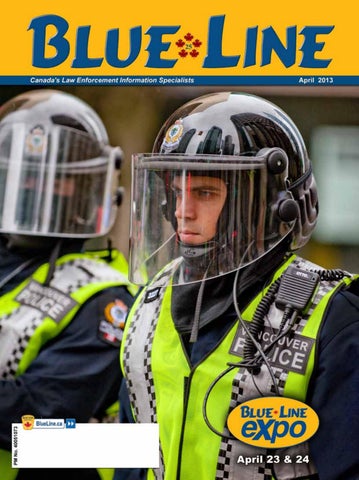
April 2013
2
Blue Line Magazine
April 2013 Volume 25 Number 4
Features 6 Busted! Riot Roundup 2
Identifying Vancouver’s riot suspects
10 Cops and Hazmat Scenes Cops need to know their dos and don’ts at hazmat scenes
12 Looking Back and Moving Forward 18 Managing the Digital World
6
The challenge of the technological evolution
25
Blue Line EXPO 2013 Guide
36 Encouraging Effort utonomy-supportive motivating style A
Departments 46 Back of the Book - Leadership, character and destiny 46 Blue Links Ad Directory 38 Book Review - Suit of Blue 22 Deep Blue - Let’s not over generalize 15 Dispatches 24 Holding the Line - Don’t be afraid to use the “F” word 45 Letters 44, 45 Market Place 5 Publisher’s Commentary - Taking control of your career 34 Technology - BlackBerry Bears New Fruit
18
Case Law
25 Blue Line Magazine
41 42
3
Inferences may justify ‘finds committing’ arrest Experience counts in reasonable grounds analysis
April 2013
April 2013
4
Blue Line Magazine
Blue Line Magazine Inc. PUBLISHER Morley S. Lymburner – publisher@blueline.ca General Manager Mary K. Lymburner – mary@blueline.ca SENIOR EDITOR Mark Reesor – editor@blueline.ca NEWS EDITOR Kathryn Lymburner – kathryn@blueline.ca CREATIVE DIRECTOR E. Jolene Dreja – jolene@blueline.ca Marketing Manager April Lensen – april@blueline.ca Contributing Writers Robert Lunney Dave Brown Mike Novakowski Nancy Colagiacomo Tony Palermo Stephanie Conn Tom Rataj Dorothy Cotton Brent Snook Mark Giles Affiliations International Association of Law Enforcement Planners Canadian Advertising Rates Data International Police Association The Canadian Press Newswire Access Copyright Subscriptions $30 per year; $50 for 2yrs; US & Foreign: $100 Advertising 888-640-3048 advertising@blueline.ca
www.blueline.ca 12A-4981 Hwy7 East, Ste 254, Markham, ON L3R 1N1 Canada P: 905-640-3048 F: 905-640-7547 blueline@blueline.ca
PRINTED IN CANADA
ISSN# 08478538 Blue Line Magazine was established in 1988 as an independent publication to inform, entertain, connect and educate those involved in the law enforcement profession. With no direct control from an enforcement agency, its opinions do not necessarily reflect those of any government or law enforcement agency. The authors, advisors, and publisher accept no liability whatsoever for any injuries to person(s) or property resulting from application or adoption of anything presented in this magazine. Readers are cautioned and advised that articles presented herein are edited and supplied for your personal awareness and should not be used for further action until appropriate guidance is received from a supervisor, Crown Attorney or other persons in authority. All material submitted for publication becomes property of Blue Line Magazine Inc. unless arrangements have been made with the publisher prior to publication. © 2013 All articles are protected by copyright. No part of this publication may be reproduced or transmitted in any form or means, electronic or mechanical, (including photocopying and recording or by any information storage or retrieval system), without prior permission. Permission to reprint may be obtained in advance from Access Copyright 1-800-893-5777.
Blue Line Magazine
Publisher’s Commentary by Morley Lymburner
Taking control of your career Alexander Pope once wrote what he called the “ninth beatitude.” Blessed are those that expect nothing for they will never suffer from disappointment. This statement of sarcasm reminds us that our passions determine what we become in life. In spite of low expectations of assistance from employers and supervisors we must identify our own positive attributes and nurture them to reality. Every police agency has a responsibility to mentor, train and promote the best people within its ranks. Policing has never been good at hiring the already trained specialist because the system too often depends on the ability to create competition. However, the private sector places great value on hiring the best talent available and laterally moving people into positions where their skills can best be used. By selecting law enforcement as a career, most of us began a path we felt would fulfill our passion or dreams and challenge what we could be – but what about our unfulfilled passions? Taking control of your career path means giving your passion a reality check – but it is rarely possible to get a reality check on your policing career. Too many officers end up doing jobs they had no intention nor inclination towards when they began their career. The first big hurdle is being accepted into policing. After that whatever ambition you gain to further that career must remain dormant until the “school of hard knocks” has taught you its lessons. Annual evaluations flow in and everything hinges on your ability to shine in the crowd and, most importantly, please the bosses. Once past all this, there are only six more hurdles: • Find the training tailored to your passion; • Hope there is no scheduling conflicts; • Hope there is a spot in that class; • Hope that your agency has the budget to pay for it; • Hope you get the approval of your superiors; and • Hope you get a good mark to justify the expense. Are you still willing to hang on? Are you still hoping, wishing and praying that all the stars will align perfectly for you? Mess up on any of the above and your career expectations “just ain’t happ’nin.” This is where you fit into the picture. Bottom line, after all the dust has settled, you are responsible for your own future. You should be following your dream and fulfilling your passion. You do not have to sit on your hands, wishing and hoping someone will notice this talented little wall flower. Solutions to all this are abundant in Blue Line Magazine’s pages. There are many courses, seminars, colleges and/or universities available to you, and law enforcement and 5
criminology courses abound. With distance education, geography and shift work are no longer limiting factors. Throughout the year Blue Line Magazine advertisers provide limitless possibilities for fulfilling passion. Offerings in this smorgasbord have included seminars on fraud and homicide investigations, forensic and crime scene analysis, accident scene reconstruction and investigative techniques for the budding detective. On-campus courses and distance education courses in police management can be found in every issue. The training component of Blue Line’s EXPO also present opportunities each year to see what tools and services are available to the law enforcement profession, along with training and courses designed to build upon your current knowledge and talents. These training sessions are a tremendous value, and have helped many to find their niche. For many it was just the edge needed to get that position they had always wanted. Others used the courses as a sampler that provided them with a better insight into what it would take to fulfill their passion or dream. The Blue Line EXPO’s training courses include instruction on: • Truth Focused Interviewing; • Crisis Intervention for First Responders; • Investigative Strategies; • Coping With Secondary Traumatic Stress; • Economic Crimes, Detection & Investigation. The courses cost money out of your own pocket, but so does the gas that gets you to work at the start of the day or the pint of beer at the end of the day. This $100 investment can make a big difference between escaping your reality and fulfilling your dream. These training courses could be the key element you need to take control of your future. If you are inspired, then register at blueline. ca; if not, take a walk through the trade show – you may just find a new inspiration. No matter what the result, you have at least done something to take control of your future. I hope to see you there. The Blue Line EXPO takes place April 23 and 24 at the LeParc Conference Centre, 8432 Leslie Street (at Hwy 7) in Markham. You can register to attend the show for free, or sign up for a training session, at www.blueline.ca . All attendees get a free one year subscription to Blue Line Magazine. So it is really all about you.
April 2013
by Elvin Klassen The Vancouver Police Department (VPD) was heavily criticized by media and residents for its perceived inaction after the Stanley Cup hockey riot. A major complaint was that no one had been charged. Fast forward to October 2012 when the IACP recognized the VPD’s efforts in investigating the riot with awards for excellence in forensic science and criminal investigation. “The IACP congratulates the Vancouver Police Department,” said president Walter McNeil. “This investigation is a prime example of the incredible outcome that can occur when law enforcement and private citizens come together to promote public safety and the pursuit of justice.” “They showed great ingenuity by deploying numerous strategies to mobilize public assistance in their pursuit of justice,” added Andy Russell of award sponsor Thomson Reuters. VPD Chief Constable Jim Chu felt vindicated by the acclaim after the severe press and public criticism for failing to quickly bring the rioters to justice. “The important thing wasn’t to rush things,” he noted at a press conference. “That would create legal loopholes that accused rioters could use to evade sentences and sanctions for their crime.” April 2013
Riot Some 150,000 people took to the streets of downtown Vancouver June 15, 2011 after the Canucks lost to the Boston Bruins in game seven of the Stanley Cup final. It didn’t take long for things to turn ugly. Rioters looted businesses, destroyed property, started fires and assaulted anyone who got in their way. Hundreds of people engaged in criminal acts while thousands more formed bands of encouraging spectators, many recording the carnage on their hand held electronic devices. A far greater audience watched the chaos on various media. In a statement before the game the VPD warned that “we want everyone to celebrate safely, but make no mistake – if you come downtown intending to make trouble, we will be waiting for you.” With regional resources, including 928 police officers, it took more than three hours to quell the riot and return order to the city. Help came from the RCMP and every municipality in the Lower Mainland. Officers that had just finished a shift left their homes to join colleagues on the streets. Ambulance and fire services also helped restore sanity. Nine officers were injured, one requiring 14 stitches to close a head wound suffered when someone threw a brick while he was trying to stop the looters. Another officer received 6
a concussion and others were bitten. Police reported making almost 100 arrests the night of the riot and had 120 calls on a tip line by 5 am. Members of the public provided many videos to supplement video shot by police. Rioters caused millions of dollars in losses, damaging or destroying 112 businesses and 122 vehicles, including two police cars, tarnishing Vancouver’s reputation around the world and depriving citizens of a sense of pride and security in their community. “Vancouver is a world-class city and it is embarrassing and shameful to see the type of violence and disorder we’ve seen tonight,” said Mayor Gregor Robertson in a news conference. Social media played a significant role in the riot. Twitter and Facebook gave the crowd up-to-the-minute details, including where police were being deployed. After the destructive event social media became the forum for discussion and videos from the riot. Participants bragged about their actions while others used it to research and identify persons involved. This resulted in the largest Canadian criminal investigation of its type and moved Vancouver onto the international stage. Police investigations On the morning of June 16, while gutted Blue Line Magazine
cars were being towed and broken glass swept up, the VPD declared that it owed it to the victims and residents of Vancouver to bring the rioters to justice. Investigators were faced with the difficulty of capturing evidence before it was removed, collecting and processing a vast quantity of video evidence that needed to be collected and processed, the sheer volume of rioters involved and the immense public and media pressure. A 70 member Integrated Riot Investigation Team (IRIT) was formed from the RCMP, New Westminster, Abbotsford, West Vancouver, Port Moody, Transit, and Delta Police Depts. It was faced with non-traditional investigative challenges never experienced before on this scale. In effect a mid-size police department was created from the ground up, complete with vehicles, office space, computers and staffing resources. It was committed to achieving the strongest sentences against those who committed crimes against Vancouver. The next steps were daunting. In addition to the huge amount of evidence that had to be tagged and tracked, IRIT members from eight different police agencies had to be trained and assigned to the various tasks. Disclosure packages needed to be prepared for Crown counsel to optimize successful prosecutions. A request for information attracted 4,464 email tips in the first seven days alone. More than 5,000 hours of video in 100 different formats was seized from the public, closedcircuit television and the media. It would have taken the VPD lab almost two years to process this video. Many criminal events needed to be investigated. Some had more than 300 suspects and many were involved in multiple events. In one instance, more than 300 looters were captured on video running into one department store alone. The VPD decided to approach the only video lab capable of forensically processing this massive amount of video evidence to a standard acceptable by the courts. On September 24 IRIT members took the mass of evidence to Indianapolis for two weeks of Blue Line Magazine
concentrated work. The Law Enforcement and Emergency Services Video Association (LEVA) lab at the University of Indianapolis joined together for the first deployment of the emergency response team. This lab was purposefully designed for large scale criminal investigations of this type. International forensic video analysts were called upon to work on the investigation. Using standardized operating procedures and best practices, the video evidence was converted into one format, ensuring investigative integrity. Video was then reviewed to “tag”
7
events and suspects, using multiple unique but standardized searchable criteria to provide individualization. Over 30 terabytes of data was processed (equivalent to 7,500 DVDs or 45,000 CDs). Fifty forensic analysts from more than 40 North American and UK law enforcement agencies worked on the project. More than 4,000 analyst hours were spent in the lab, working around the clock to tag some 15,000 criminal acts and suspected rioters. Many were the same individuals tagged from different camera angles. After the process investigators
April 2013
could search for suspects in a similar manner to using an Internet search engine. While IRIT members were at the LEVA Lab, the VPD renewed its lab by adding five new Avid work stations and upgrading three more. Using the LEVA data, investigators could search for a suspect who committed multiple offences at different locations and locate video clips and photographs to be used for interviews, disclosure and web site outreach. A database was developed, primarily as a research tool for investigators but also to automatically generate statistical reports for media releases, management decisions and workload allocation. It also enabled staff to manage the many tasks, track rioters and create investigative reports. All tasks were reviewed on a daily basis for thoroughness and accuracy and either approved or returned for further follow up when necessary. Multiple quality control steps had to be incorporated into the task review process to ensure that all regulations and procedures were strictly adhered to. Created by the VPD specifically for the file, they helped avoid unnecessary or redundant communication between the management team and investigators. Given the large size of IRIT, both in terms of resources and evidence, effective time management and communication ensured smooth day to day operations and an effective overall investigation. The investigative team overcame huge obstacles, including getting new members quickly up to speed, processing 625 separate exhibits as evidence and identifying and interviewing the large number of victims, suspects and witnesses. Identifying the rioters Thirty males and seven females had turned themselves in by July. A water polo star apologized publicly after a photo appeared on the Internet showing him holding a burning shirt in front of an uncapped car gas tank. “I was caught up in the moment,” he said, choking back tears with parents at his side. “I want to own up to what I did and encourage others to do the same. I’m just ashamed.” The VPD needed public assistance to identify other culprits. Pictures of suspects from the file were displayed on the IRIT web site and strategic news releases helped rekindle public interest. April 2013
Chu hosted a live video web cast, answering questions about the riot via Twitter and from a live studio audience to engage and encourage the public to assist in identifying rioters pictured on the web site. Through Facebook, connections were made with up to 160,000 users in the region in the 15–25 age group, the demographic of many rioters. Many pictures were printed in the Vancouver Sun and Province with an invitation for the public to assist. In a unique approach, the IRIT printed a colour fold out photo gallery entitled Riot Round-UP featuring 200 pictures of unidentified rioters. Some 100,000 posters were handed out over two days in 19 cities and 75 locations across the region by 400 volunteers and 75 police officers. The poster was a tremendous success; tips flooded in, resulting in leads on more than 50 per cent of the featured rioters. The success prompted a second poster with 104 photos, which was distributed in 12 hours by 150 volunteers and 50 IRIT members across 34 locations in the Lower Mainland including universities, colleges, high schools, malls and transit hubs. It garnered 93 tips on 48 targets. The Vancouver Police Foundation paid the $6,700 printing cost. To date, 315 rioters have been recommended to BC Crown Council for charges (194 charged). There have been 1,045 separate charges (586 approved), 2,284 web tips, 1.9 million web visits and 13 million images viewed by IRIT. Chu thanked VPD officers, other local police agencies and first responders and the 8
general public for their efforts during the riot. The outpouring of appreciation the VPD received was amazing. Many cards, letters and e-mails were displayed in the media room but he could not show the many hugs of thanks officers received. Even the police dogs were not left out – several bags of dog food arrived for them. The IRIT task force has since been decreased to a few members and the search goes on for the approximately 200 unidentified faces still listed on the IRIT web site. The search goes on for the approximately 200 unidentified faces still listed on the IRIT web site. Contact S/Sgt. Howard Chow at howard.chow@vpd. com for more information. Elvin Klassen is Blue Line Magazine’s west coast correspondent. He may be reached by email to Elvin@ blueline.ca.
Blue Line Magazine
Blue Line Magazine
9
April 2013
COPS & HAZMAT SCENES Cops need to know their “do’s and don’ts” at hazmat scenes by Ernest G. Vendrell, CPP, CPO, CEM (Reprinted from Protection News) When a hazardous materials incident occurs, prompt action by well trained and properly equipped emergency responders is essential for a successful outcome. Typically, fire departments are well prepared to handle hazmat incidents. However, the fire service is heavily dependent on lesser trained police and security personnel to evacuate civilians from affected areas as well as protect bystanders from harm by establishing and maintaining an incident perimeter. It should also be noted that, on occasion, police and security personnel have rescued victims prior to the arrival of fire and emergency services personnel. Although commendable, these courageous acts must always be considered in terms of the risk for personal injury or death. As a result, police and security personnel are sometimes at risk for being injured or April 2013
killed when responding to hazmat incidents. This threat can often be minimized by following some basic guidelines. The following is a list of hazmat related safety and scene management considerations that can be used by security personnel. Responding to the Area • Do evaluate dispatch information or how the call was received. • Do avoid the urge to rush in. By rushing in you could become part of the problem. • Do approach with caution. A hazardous materials incident should be approached upwind and upgrade. Stop and check wind direction prior to getting close to the incident site. • Do position yourself (and your vehicle) at least 300 feet from the scene of the incident for most cases. This distance can be increased further depending on the incident situation, chemical exposure hazards, etc. • Don’t respond to the hazardous incident site if you have any doubts as to the nature or type of material that is present or involved. • Do stay back at least 2,000 feet when encountering gas clouds, explosives and other extremely dangerous situations. • Do look for placards/labels, container types and ask driver/owner for waybill (train), bill of lading (transportation on roadways), airbill (airplanes), dangerous cargo manifest (ships), Material Safety Data Sheets (MSDS), any clerical paperwork that may be available, etc. • Do call for the fire department and hazmat team. Also, call for emergency medical services, environmental agencies and other 10
groups that may be needed. • Do advise responding agencies of the situation (if possible, do this even before they arrive). • Do give other responding agencies all the details regarding your observations as well as witness accounts. • Do become familiar with and use the latest edition of the North American Emergency Response Guidebook. It contains valuable information and procedures that can be used by first responders at a hazmat incident. • Do use the telephone advisory services of the Canadian Transport Emergency Centre (CANUTEC), if needed. These services are available 24 hours a day and the telephone numbers (613-996-6666 or *666 on cell phones) are listed in the Emergency Response Guidebook. Upon Arrival in the Area • Do stay back from the immediate area. In addition, remove those in the immediate and general area. • Do approach vehicle crashes cautiously. Look for leaking fluids, hazardous materials placards, cylinders, containers, etc. • Do look for placards/labels, container types, Material Safety Data Sheets (MSDS) and ask the driver/owner for the appropriate shipping documents. • Don’t drop flares to mark the area. • Do stay away from vapour clouds, fire, leaks, spills, etc. Also, remember that some vapors are not visible, have no odour, and are extremely dangerous. • Do control access to the hazmat scene by Blue Line Magazine
the public, media and other curious security personnel. • Do direct other individuals to a staging area located a safe distance away from the immediate hazard area. • Don’t allow persons that may have been exposed to a hazardous substance to leave the area or to make contact with persons that have not been exposed. Exposed individuals should be segregated upwind and at a safe distance from the incident for treatment and to limit the spread of the contamination. • Do co-operate with other agencies to resolve the problem.
After the incident • Don’t leave a hazardous materials incident scene without first being checked by emergency medical services or hazmat personnel to determine if you have been contaminated. If you have, it is imperative that a proper decontamination procedure be followed to ensure your health and the well-being of other individuals that you may come in contact with. In addition, refer to your organization’s hazardous substance standard operating procedures (S.O.P.’s) for guidance regarding further actions. • Do remember that hazardous substances retained by uniforms, including shoes, can be toxic to others who may come in contact with them (children are particularly susceptible, so be careful what you bring home). •D o document all details concerning the incident, your response and the actions of other professionals on the scene for future reference. As outlined, responding to a hazmat incident requires prompt action by individuals who are properly trained and well-equipped. Although certainly not all-inclusive, the recommendations presented here can assist security personnel to maintain a safer posture at the scene of a hazmat incident. Many of the guidelines will also serve to assist responding emergency services personnel, including hazmat specialists. CANUTEC is the Canadian Transport Emergency Centre operated by the Transportation of Dangerous Goods (TDG) Directorate of Transport Canada. The Directorate’s overall mandate is to promote public safety in the transportation of dangerous goods by all modes. CANUTEC was established in 1979 and is one of the major safety programs
If you should find yourself at the hazmat site before realizing there is a problem • Don’t take deep breaths to see what it smells like. This seems easy enough, but it is difficult even for trained personnel since it is a natural reaction. • Do be cautious where you step. You could be walking into a hazardous substance. • Don’t take action unless you have been specifically trained in the area of hazardous materials, are properly equipped, have sufficient backup, are authorized to act and are sure what to do. Improper action can have devastating effects. Remember, as a first responder, you are to operate in a defensive mode. • Don’t assume that what is marked on a label, drum, or container is what is actually inside. Many individuals involved in the illegal handling, transportation and disposal of hazardous materials often mix, or “cocktail,” these substances. • Do note any information that is marked on a drum or container. The information may assist responding hazmat personnel. • Don’t disturb or move any container or drums. They may have deteriorated from the inside out as a result of reacting with the substance inside. Any movement of a drum or container could cause container failure and release the product. • Do look for danger signs such as drums or containers that are leaking, bulging or emitting a vapour. If you have any doubts about whether what you are seeing is dangerous, leave the scene immediately. Blue Line Magazine
11
April 2013
Looking back and moving forward by Joel A. Johnston Part One Vancouver Police Department (VPD) officer Joel Johnston has been Blue Line’s defensive tactics editor since 1994 and a consultant and researcher to both police and government agencies. He is recognized for his no-nonsense approach to use of force in the Canadian context. In this three part series he reflects upon the evolution of use of force standards and equipment in Canadian policing.
April 2013
The Beginning Although it was 28 years ago, I still remember with clarity and fondness my days at the old Justice Institute of BC – Police Academy, in the high-rent area of Vancouver’s west side overlooking English Bay. It was headed by a salty, sharp-tongued, powerful-gripped ex-RCMP staff sergeant director and replete with a true cast of characters as instructors (and classmates). We were known as “the Expo class” – a mass hiring of some 70 people prompted by the 1986 Vancouver World’s Fair.
12
My colleagues have, for the most part, gone forward with successful policing careers, some serving alongside me in Vancouver since the beginning. Others decided that policing wasn’t for them and moved on. Most are in the “twilight” of their careers at this point; some have already retired and sadly, some have passed away. Policing in the 1980s A great deal has changed in policing since 1985. We became police officers three years after the Charter of Rights and Freedoms. “Old school” policing remained the order of the day. The Charter warning card was the size of a standard business card. I had an “attaché case” for my reports and patrol supplies. It was pre-emergency vehicle operation standards, pre-Young Offenders Act, pre-independent investigations offices, pre-police complaints commissioners, etc. “Check cards” were completed on the street by hand. Reports to Crown counsel were hand-written in triplicate on carbon paper, or hammered out with a typewriter. General occurrence reports were one page long. The Internet was used only at universities. It seemed a much simpler time. We were issued .38 caliber Smith & Wesson Model 10 revolvers – the first in the VPD to receive the new “bull barrel” S&Ws, a source of great consternation among some senior members. We were also among the first to be given the “new speed-loaders” – a big step up from the “speed strips” of the past. Along with the sidearm, we were issued a hefty 26-inch polycarbonate baton with rubber grommet to hold it in the belt ring. One set of handcuffs rounded out our “force options” – all carried in leather holsters on a leather belt along with large Blue Line Magazine
3-D-cell Mag-Lights (which doubled as a force option under the correct circumstances). These were essentially the days of fists, clubs and guns. My first assignment was the “skids,” now known more commonly as the “Downtown Eastside.” I worked in a mobile patrol assignment initially and then was afforded the opportunity to “walk the beat.” This was – believe it or not – a sought-after position. We dealt with robberies, assaults and drug-dealing for the most part. The ancillary crimes to drug addiction (theft-from-auto, B&E, shoplifting, etc.) rounded out our calls. The robberies and assaults usually involved knives, bottles, pint glasses, blunt objects and bodily force. Some ended as homicides. The big drugs being dealt were “T’s & R’s” (Talwin & Ritalin), which were fabricated into a poor-man’s heroin, heated in a spoon and injected directly into any open vein. Despite its unpleasantness, this was perhaps the best place to learn the ropes of policing and it was only my secondment to the Vancouver City Gaol that took me away from the skids. All newlyhired VPD members had to do their “inside time” – in the Gaol, at the public information counter or in the communications centre. The Gaol was by far the best assignment for those interested in crime and crooks. There was plenty of action – processing freshly-arrested drunk, high, angry, emotionally-charged folks. It gave you a good look at the regular “clients” and an opportunity to practice your pugilistic skills with some regularity. Assignments in patrol in the south of the city and in traffic enforcement followed.
Blue Line Magazine
in September, responsible for recruit candidate fitness testing, in-service fitness programs and semi-annual force options training and recertifications.
Igniting a Passion for Training The sergeant in charge of the VPD Training Section asked me in 1990 to take over use of force training from self defense/karate expert and former RCMP Depot self defense instructor John McKay, who had been promoted to corporal. I was practicing Shotokan karate with considerable zeal and had always been very interested in officer safety. However, at the time I was particularly enjoying my assignment riding a new Harley-Davidson police motorcycle, working with a great bunch of guys and writing well-deserved traffic violation reports (TVRs) and traffic ticket informations (TTIs) as a member of Traffic “B – shift.” The request to take this position wasn’t really a request, however, so I reluctantly accepted the assignment. This set the course for the rest of my VPD career. I “became” the VPD Fitness Co-ordinator
13
Rapid Change A number of high-profile use of force incidents garnered attention during the late 1980s and early 90s. In July 1988 a mentally ill man named Mario Deiana stabbed his landlord to death. I remember the general broadcast that afternoon shift. Two of our plainclothes members were first on scene at the call in District 3. Deiana immediately advanced aggressively with the still-bloody butcher knife held menacingly overhead and was shot dead. During the inquest, former RCMP S/Sgt. and BC Police Academy defensive tactics trainer Doug Farenholtz recommended police try out a new “jalapeno pepper spray” to stop aggressive people. The BC Police Commission struck a committee in 1989 to study less lethal weapon technology as alternatives to firearm use. Its report, released in 1991, recommended, among other things, a province-wide field-test for pepper spray and the limited use of the ARWEN (Anti-Riot Weapon Enfield) rifle, which fired rubber bullets, by specially-trained emergency response units. Three well-known American trainers – Bob Jarvis of Los Angeles, Roland Oulette of Connecticut and Larry Smith of San Diego – came to Vancouver in April 1991 to demonstrate the “Cap-Stun” pepper spray product. They said
April 2013
US police were impressed with it and that it had never caused death or serious injury but immediately disabled “all suspects, including those who may be mentally deranged, high on drugs or intoxicated,” adding that “it also works on vicious animals.” Municipal police and the BC RCMP began field tests and Oleoresin Capsicum spray soon became an accepted component of police force response options – but not without controversy or problems. Special interest groups alleged pepper spray caused deaths and was being misused by police officers. Perhaps chief among these problems was the reality that pepper spray wasn’t all that it was cracked up to be. It did NOT “immediately disable all suspects.” Police found that it failed in many circumstances – most frequently when most-needed (violent, goal-oriented, mentally ill and/or drug-induced subjects). One of the most profound examples of this reality was the death of Oregon police officer Frank Ward, who was beaten to death by a man with a piece of firewood on a domestic violence call as he clutched his now-empty canister of pepper spray. Ward was trained that pepper spray worked on everyone. It didn’t and it still doesn’t. Some subjects actually become more enraged when exposed to it. Then there was the infamous Asia-Pacific Economic Conference (APEC) in Vancouver in 1997, where a group of protestors were pepper sprayed en masse by Tactical Troop Commander Sgt. Hugh Stewart in November
April 2013
would have been ugly – and would have simply spawned a differently-focused inquiry. Ultimately pepper spray has settled into being a less-controversial, better-understood force response option. Police officers understand its strengths and weaknesses, use it less frequently and the media and public have focused their negative attention on other police force response options.
1997. Never mind that they were violating the law, were fairly warned to disperse and were blocking the imminent motorcade route of the world’s most powerful leaders. This incident took on a life of its own (as is usually the case), spawning a lengthy and expensive inquiry and prompting then-Prime Minister Jean Chretien to utter the words “… for me, pepper – I put it on my plate…”. Stewart was forevermore dubbed “Sergeant Pepper.” I still believe Stewart used necessary, appropriate and reasonable force under the circumstances. I was part of the combined VPD-RCMP Crowd Control Unit on standby at the venue. The alternative method of dispersal would have been shields and batons. It
14
The “new” impact weapon Police impact weapon technology also changed during the ‘90s when Armament Systems & Procedures Inc. (ASP) began manufacturing the ASP expandable baton. Coincidentally, in July 1990 two Port Moody police officers were disarmed by a violent career criminal while investigating suspicious circumstances in the wee hours at a strip mall. One officer confronted James Douglas Stephenson while the other watched two other suspects. As they wrestled, the officer had Stephenson in a version of a headlock while the suspect was focused on taking his revolver. The officer shouted “he’s got my gun” as he was disarmed and, as his partner moved to intervene, Stephenson spun around, striking the second officer in his mid-section and knocking him to the ground. Stephenson then put the gun to that officer’s head and snatched his revolver. As the first officer ran back to his vehicle to retrieve the shotgun Stephenson began shooting “Yosemite Sam-style” at him across the police car. The second officer had scrambled for a
Blue Line Magazine
cover position and now unable to effectively respond or defend himself. The first officer fired the shotgun across the car at Stephenson, who began to move away while still firing. A single shotgun pellet struck him in the head, knocking him down. He died enroute to hospital. Unbelievably, neither officer was hit. The other two suspects never really involved themselves and fled the immediate area. The subject of police force options came up during the Stephenson Inquest. Why did police officers not have other weapons to assist in controlling resistive, aggressive, violent people? Was it either the gun or your physical skills? Why were there no other control options or tools? Pepper spray had not yet been introduced and the reality was that very few officers carried their issue 26-inch polycarbonate or wooden baton. They were heavy, cumbersome, intrusive, inconvenient and looked “aggressive” to the public. A survey revealed that 95 per cent of VPD officers left their baton in their locker or car when attending calls so the department decided to field test the ASP baton. Ontario’s Nepean Police Department was also testing the ASP baton at the time and the field test results were very encouraging. All of the officers carried it all the time. The baton was lighter, low-profile and opened with considerable psychological effect (due to the visual expansion and simultaneous loud metallic “clack!” of the baton locking open). It was subsequently implemented across the board in
Blue Line Magazine
Nepean and Vancouver. Other Canadian agencies soon followed suit. The expandable baton has become standard issue to all Canadian police officers. Expandable baton technology has improved considerably and a number of manufacturers, including ASP, making quality “auto-lock” products. However, the baton does not seem to be frequently used by Canadian police officers. NEXT MONTH - Keeping up with the crooks - The semi-automatic pistol story. Joel Johnston is a 28-year police veteran of the Vancouver Police Department. He has served as a patrol officer, beat officer in Vancouver’s notorious “skid row”, gaoler, traffic enforcement officer, fitness co-ordinator, control tactics co-ordinator, emergency response team – squad leader, training co-ordinator, and officerin-charge, He was seconded to the Ministry of Public Safety & Solicitor General as the provincial use of force and municipal emergency response teams co-ordinator in British Columbia, Canada from 2005 – 2011. He has been a member of numerous international policing working groups on less lethal weaponry, conducted energy weapons, tactical operations, excited delirium syndrome, vascular neck restraint, patrol-based carbines, etc. and has presented at dozens of international law enforcement conferences since 1993. He served as the chief instructor for the Vancouver Police Shotokan Karate Club from 1990 – 1999. He returned to operational policing as a supervisor of a beat enforcement team in Vancouver’s “skid row” area in 2011 and is retiring from the policing profession in 2013. He has been a contributor to and defensive tactics editor for Blue Line Magazine since 1994. Joel is the co-principal of the Defensive Tactics Institute and continues to progressively train law enforcement professionals across North America. He can be reached at joel@dtidefensivetactics.com
15
DISPATCHES Dr. Paulette Laidlaw was the successful candidate in the recent competition for the position of Manager, Psychological Services for the Ontario Provincial Police. Dr. Laidlaw assumed her full time duties in this role effective February 1st. Dr. Laidlaw brings to the OPP a wealth of experience from her years as a Clinical Psychologist in private practice, and as a researcher with expertise in trauma and critical incident response. In the past six months, Dr. Laidlaw has contributed significantly to the realignment and development of psychological services within the OPP. Chief Superintendent Angie Howe stated, “Her extensive internal and external relationships are a considerable asset to the OPP. Dr. Laidlaw brings her expertise as a key advisor in mental health issues.” ••• Toronto Staff Supt. Kimberley Greenwood accepted the position of Chief of Police for the city of Barrie. The 50 year-old Greenwood is a 30-year veteran of the Toronto’s Police, where she was in charge of central field command. She began her police career as a cadet in 1981 and was assigned to a mid-Toronto division, and as a front-line officer drove a cruiser and walked a beat. She worked in youth crime, child abuse and sexual assault units for years and later moved on to become a staff sergeant, working in the notorious Jane/Finch area. Greenwood is a former hearings officer under the Police Services Act, and an adjudicator. She commenced her duties with the 336 member service on March 26, 2013 and replaced the retiring Chief Mark Neelin. ••• Kativik Police Cst. Steve Dery, 27, was shot and killed while attending a domestic dispute in the northern Quebec community of Kuujjuaq on March 2 around 9:30 p.m. His partner Cst. Joshua Boreland was wounded in the incident but reports indicated not seriously. The assailant, Jobie Saunders Jr., was later found in the residence dead from a self inflicted gun shot. Dery, whose father is a retired member of the RCMP, was born in Alberta and grew up in the Ottawa area where he attended Algonquin College and then Carleton University where he worked toward his degree in criminology. The 60 member Kativik Police Service covers all territory in northern Quebec approximately north of the 55th parallel. The community of Kuujjuaq has a population of 2,400 and is about 1,500 km. north of Montreal. A moment of silence was observed on Monday, March 4 in the House of Commons. The funeral for the officer was held and hosted by the Ottawa Police Service, the officer’s hometown, on Saturday March 9, 2013. ••• Cst. Jennifer Kovach of the Guelph Police Service died as a result of injuries sustained when her scout car came into collision with a transit bus on March 14. Kovach, 26, was extracted from her vehicle Guelph police said. She was taken to Guelph General Hospital, where she was pronounced dead. She was alone in her cruiser and was “en route to assist at a call for service” at the time of the crash, police said. Kovach had been on the force for three years. “This is a sad and tragic day for the Police Service. Cst. Kovach exemplified the values of our service and was committed to making a difference,” Guelph police said in a release. “Jennifer was fulfilling her dream as a police officer, and we will forever remember her zest for life, her strong sense of adventure and her gregarious smile that brightened all our lives.”
April 2013
if the walls
could talk
A sketchy, scratchy laneway down which all cops had to venture by Morley Lymburner Drive south along Toronto’s Yonge Street and just north of Eglinton you might spot an old brown-stone building on the west side of the street which lately has been used as a film set for a police station. That’s because, at one time... it was a police station. Back in my day 53 Division meant nothing more than the place we took our scout cars to
April 2013
get the radio fixed. The entrance way to the radio repair shop was a narrow alley barely wide enough for our old 1970s era two-door Plymouths. I understand you can still see copious amounts of chrome yellow paint left from hundreds of police cars over the years. Oh yes! If the walls could talk indeed. After doing my time walking the beat (the joy of which I failed to appreciate at the time) I was introduced to a scout car. I viewed this as an advancement in responsibilities and increased trust by my supervisors. I reacted to the opportunity with humbleness, which I thought would be appreciated. “Well sir,” I responded, “I am honoured to be selected for such duty. I am humbled by the faith you have put in me to accept this increased responsibility.” The sergeant did a double take, then looked back down at his clip board. “You’re just filling in for some guys on
16
holidays; don’t let it go to your head, rookie.” Deflated, I picked up the keys from the weary night-shift driver. “Everything okay with the car?” I asked as congenially as I could. The officer gave me the same look as the sergeant. “You mean other than the empty gas tank, two inches of dirt on the dash, the puke on the back seat and cigarette butts on the floor? Oh yeah! The radio isn’t working. You’ll have to take it to the radio repair shop.” Now this was a challenge. I approached the station sergeant with the fact the scout car might need some maintenance. “Get on the road. The dispatcher is screaming for cars. You can clean it up if you have time later.” I explained the limitations I might have with a defective radio and the sergeant stared at me as he leaned over the counter. After a couple of seconds of watching the wheels turn in his head he reached under the counter and slapped two dimes on the counter. I thought he was re-assigning me back to my walking beat, as this was the daily stipend for beat officers to check into the station. Take it down for repairs, he told me, and if there is any problem on the way, check back by land line – but first, hit the radio a couple of times with your night stick, he suggested. This was the tried and true way to get them back in working order. I went to the parking lot to check out the car, finding to my dismay that it was just as described. Thankfully the puke on the back seat was caked, dry and half worn off so the smell wasn’t as bad as I had feared. There were ashes all over the seat and dash and the car was running on fumes. At least my debriefing had been accurate. Blue Line Magazine
I circled the car to check for marks and scratches. Golly, where was I to begin? After noting a few of the larger ones in my memo book, I checked the car’s file and discovered most had not been entered. I asked the sergeant to come to the car with the file. “You know you’re a pain in the ass, don’t you?” he growled. He noted the fresher marks and curtly left my presence. I suddenly pictured many years of walking the beat in my future. As suggested I banged the radio box on the dash. Nothing! I filled the gas tank and headed out. Suddenly I realized “Out” was the operative word. I had never been outside my own division during my police career. “Where the heck is the radio repair shop?” I wondered. A strong feeling of trepidation came over me when I thought about returning to ask the sergeant for directions. Unable to communicate with other cars, I headed for the officer who walked the beat next to mine. He gave me directions to 53 Division and warned me about the alley. “It is narrow – I mean inches to spare narrow. Watch your outside mirrors closely. You might need Vaseline to fit through.” I initially missed not only the alleyway but the entire station. A few drive-bys and I found the alley. There had been no exaggeration. The narrow passage had a stone wall on one side and a brick wall on the other. “Okay,” I thought, “hundreds of other guys have manoeuvred this alley way. Surely I can too.” As I began to excrete the car down the passageway, I quickly saw why it had so many scrapes. The brick walls were covered with a two foot stripe of chrome yellow paint, beginning a few feet above the ground. This was capped by another foot of scrapes, gouges and striations of metal. If the walls could talk, I thought, they’d have to scream the expletives of a thousand injured mule skinners. I got to the end without incident. It opened to a small courtyard large enough for about eight cars. Six spaces were occupied. I made a sharp left turn into the garage and the technician came out to greet me with a tired smile. I described my adventure negotiating the alley but it clearly had no impact. He had heard it all a thousand times before. Why had nothing been done? He simply shrugged. “It’s been this way for many years and I don’t suppose things will change much over the foreseeable future.” He went to his bench, pulled out a 25L6 vacuum tube, crawled under the dash, opened the radio’s metal housing, plucked out the bad tube and effortlessly inserted the new one in its place. “Okay then,” he said curtly. “Give me your night stick.” He tapped the box twice and the staticky loud voice of the dispatcher suddenly leapt out of the Motorola speaker mounted above the dash. “Oh,” I said. “So you have to tap that box UNDER the dash.” Morley Lymburner is a former 25 year member of the Metropolitan Toronto Police and the Publisher of Blue Line Magazine.
Blue Line Magazine
17
April 2013
by Christine Robson A police officer walking the beat receives a domestic violence call. The officer pulls up the GPS co-ordinates on a Smartphone and runs a query on previous incidents at the address and individuals living there, including a CPIC check, local RMS check, PIP, Infopol and MTO drivers license report with DL photos and a weapons query. All this data is provided instantly.
April 2013
The officer arrives to find the victim is bleeding, has clearly been abused and photographs the injuries and scene. Noticing she doesn’t speak English the officer records her and pulls up an app to translate the audio into English, enabling a conversation. Fingerprints are collected and sent to a Livescan database to determine if the accused was involved in other incidents. Both parties are interviewed via the Smartphone and the video sent to the disclosure unit to be
18
collected and processed as part of the Crown brief. All of the digital evidence is collected in minutes instead of hours. Technology has increased police efficiency and radically altered the way agencies collect and process evidence but managing and storing evidence electronically has become a double edge sword, with huge impacts on budgets. Retention, data collection and processing An in car camera captures an officer pulling over a vehicle, speaking to the subject and arresting him. A second camera records the accused in the back seat as he’s taken to the station. The sergeant in cells watches the live streaming video of the physically and verbally abusive suspect on his computer. The entire two gigabyte video file now has to be seized as evidence management for the crown brief as part of the incident. Retaining and storing electronic evidence is expensive and that’s a real challenge in this time of budgetary constraint. Lack of funds may mean data is retained for only 30 days or less due to storage costs. Policing has and will continue to evolve and morph into technology that is pushed our way through commercial users, social media and smarter criminals. Technology will not stand still. We live in a globalized world and there are no longer any boundaries for criminals in a virtualized environment. With limited or even zero growth in IT budgets, it is increasingly challenging to manage digital evidence. Storing data in private clouds and stricter policies on data retention can help keep costs in check. Clearly the days of keeping data indefinitely are over. Leasing instead of purchasing equipment, which avoids large capital outlays, and sharing data between police services through portals and large networks, also help stretch budgets. Trade offs will continue to be made and vendors and technology enablers need to ensure they build with cost in mind. Blue Line Magazine
When new technology emerges, remember there is an early adopter criminal eager to exploit it. Boundaries will be electronic, not physical. Police services need to manage and keep their technical crime units abreast of changes and be strategically mindful of what is coming down the pipe. Being reactive will not help solve crime in a electronic world.
Open source and competitive procurement is another trade off for technology adapters in policing. Social media Most police services know that the way to get buy in from their communities is to stay abreast of social media changes and this includes twittering about daily incidents and events. Facebook is key to reaching young people, who have a strong online presence. Society is in flux and trends in more traditional types of crime are changing. Cyber bullying, for example, has increased dramatically over the past two years and police services need to stay connected to deal with this problem. Police services need to stay on top of emerging social and economic trends. Allow citizens to report minor crimes online, for example. Use social media to connect with the community, but guard against the dangers by instituting and enforcing guidelines for members. Inappropriate communication through social media with police officers through friends of friends can have a negative impact. Customer service and client interaction training is required to engage residents. Its not just about fighting crime anymore, its about being socially connected to the community.
in the physical world. Cyber crimes are more profitable and less risky. Think of how crimes such as money laundering, identify theft, fraud and extortion have changed with technology. A denial of service attack, where hackers use thousands of computers to deface a company’s web site with bogus communication, happens every five seconds. These are no longer amateurs but expert hackers with exceptional technological skills who obtain and share bank account numbers, passwords, pins and other information for financial gain. Keep in mind that real world crimes are taking place in virtual worlds with the use of avatars and other aliases. What is the distinction between real and virtual and how do police patrol a virtual environment and charge an avatar with virtual crimes?
New training demands eCrimes units require specialized officers who need continual and expensive training to stay abreast of technological changes. Business intelligence and analytics will increase and so will the specialized skill set that comes with data analysis. More civilians will be needed to handle administrative and technical work because they are cheaper to employ and allow officers to concentrate on what they are trained to do – patrol the streets and keep communities safe. Budget struggles, technological evolution and social developments have changed the way we do policing. Partnering with police services locally and nationally is key to future success. We all face these challenges as crime no longer has physical boundaries. Christine Robson is the Durham Regional Police Service Information Technology Manager. Contact her at crobson@drps.ca or 905 579-1520 x3318 for more information.
Criminals are on the forefront Criminals quickly adopt new technology, using skimmer devices and micro cameras to empty bank accounts and steal identities, for example. eCrime technical units have seen a dramatic increase in child porn cases. Parents worry that their children will expose themselves to sexual predators hiding as online friends. Stalking has become a serious issue and is harder to track when done online. The copious amounts of personal information available on the Internet allows criminals to access the daily schedule and life of potential victims. eCrimes units will require more resources as the amount of video and other evidence grows. One case had more than 90 terabytes of evidence, easily surpassing the storage capacity of many police services. People are now more likely to be the victim of a virtual crime than a “real” crime Blue Line Magazine
19
April 2013
Screaming Sirens welcome in Cornerbrook
by Danette Dooley There was a different twist to the RCMP “B” Division Amey/Hoey Memorial Hockey Tournament in Cornerbrook this year – an all-female entry. The women travelled from all over Newfoundland and Labrador to lace up their skates, reacquaint with members they haven’t seen in years, enjoy great meals together and, most importantly, remember two comrades who lost their lives while policing in Newfoundland and Labrador. Fallen officers Cst. Terry Hoey was 21 when he was killed Nov. 6, 1958 while serving in Botwood, Newfoundland. He and two other officers responded to a domestic dispute between the owner of a local restaurant and his son. After getting no response from the living quarters they entered a side window and knocked on the living room door. There was no answer and they found the door had been heavily barricaded. They called out to the owner, asking him to open the door.
April 2013
Immediately a shotgun blast ripped through the wood, striking Hoey in the chest. He died at the scene. Cst. Robert Amey was 24 when he was killed Dec. 17, 1964 in Whitbourne,
20
Newfoundland after four men broke out of prison in St. John’s. They stole a car and ran through a RCMP roadblock near Whitbourne. A chase ensued and the four fugitives soon abandoned their car and
Blue Line Magazine
ran for cover. They were discovered hiding but, even though cornered, refused to surrender. Amey went to the car to radio for help and the four rushed Cst. David Keith, beating him severely and taking his service revolver. Amey could see Keith was down when he ran back and that one of the fugitives was armed. He attempted to hold them at gunpoint but one fired three shots. Amey was hit in the chest and died instantly. Using Amey’s gun, Keith was able to arrest all four fugitives. Well remembered Sirens player Cpl. Ann Noel of “B” Division’s Drug and Organized Crime Awareness Services remembers her father (Royce Getson) talking about Hoey. “We have Hoey’s and Amey’s pictures in many of our offices in the province and when Dad came to visit me one day, he looked up at Cst. Hoey’s picture and he said, ‘Ann, I trained with that man.’” The Sirens lost all three of their games but took gold when it came to being the best dressed team and the squad that had the most fun on and off the ice, Noel says. “We had beautiful purple jerseys with matching socks,” she laughs. Noel says eight teams participated in the tournament – both in a fun division and a
Blue Line Magazine
more serious division where the skaters are all avid hockey players. The teams consisted of RCMP officers, retirees, civilians and others who work in law enforcement and corrections. “We had our opening ceremonies and opening remarks by a representative of our commanding officer to remind us all why we were there and to thank the membership for all the hard work that we do in the communities – work that’s not always as pleasant as the tournament,” Noel says. Noel plays recreational hockey in Gander and quickly signed up when the call went out for females to enter a team. Already, she says, women are asking about joining the team for the 2014 tournament.
21
Warm welcome The male officers were very welcoming, Noel said, though she suspects they held back while on the ice. “I don’t think they played their best against us,” she noted with a laugh. Despite losing all their games, Noel says Wanda Richards, an analyst with “B” Division Criminal Intelligence Analysis Section (DCIAS), did an outstanding job in goal. A civilian member of the force, Richards helped round up the women for the team and raise money for the jerseys. “Traditionally this has been a guy’s tournament but the organizing committee went over and above when I told them we wanted to enter an all-female team. We had a great time meeting some of the faces of our members from around the province. It was a lot of stress free, innocent fun,” she says. Both Noel and Richards say the tournament works because it is supported by the commanding officer. “Assistant Commissioner (Tracy) Hardy allowed us to use force resources like our police cars to make sure everybody could get to the tournament. It’s supported from the top down,” says Richards. Danette Dooley is Blue Line’s East Coast correspondent. She can be reached at dooley@blueline.ca
April 2013
Deep Blue by Dorothy Cotton
Let us not overgeneralize For reasons which escape me, I appear to be a member of the International Association of Chiefs of Police (IACP). As it turns out, the IACP has a whole section for police psychologists. We don’t really have such a group in Canada so it has been handy professionally to be a member and I have learned a great deal from these folks over the years. The reason I bring this up is because of the February issue of The Police Chief magazine. “The Most Pressing Issue of 2013 is….” was emblazoned on the cover but the magazine didn’t reveal just what that is. All the articles had to do with terrorism, however, so one is left to assume that terrorism is the most pressing issue of 2013 for US police folks. This left me wondering. Is terrorism the most pressing issue facing Canadian policing in 2013? I would be surprised if it is but perhaps that’s just because I’m not a police officer. As a regular citizen, I can say with some confidence that terrorism is not the most present issue in my life, or even the most pressing issue related to law enforcement and police it in my life. Am I wrong? Are those US people wrong? Perhaps the terrorism conclusion applies in some
April 2013
circumstances (US) but not others (Canada), or to some people (police) but not others (psychologists)? There are several possible explanations here. • I have no idea what is the single most pressing
22
issue for Canadian policing. • The issue that I think most pressing may not be the issue police think is most pressing. • The most pressing issue may vary from one police service jurisdiction to another. • We need to better define “most pressing.” • We do not live in the US so our most pressing issue is not necessarily the same as theirs. There are lots of differences between the US and Canada. Looking at the relative level of danger, pay rates and any number of other factors, I conclude that the differences in policing across the border are as great as the similarities. One can draw the same conclusion by looking at crime and incarceration rates. The situation is just not the same, so if this were a multiple choice question on an exam, I guess the most obvious choice is the last one – the US and Canada are not the same. I could write an entire column about why I feel Canadians rely too much on US data and practices and sometimes adopt things from south of the border that don’t really fit or apply very well here. However, what this headline really got me to thinking about was the broader issue of assessing knowledge and deciding how far you can generalize from one situation, incident or population to another. How do we decide if a certain piece of information applies to anything in a different context? Is our own experience and knowledge generalizable to anyone (or any place) else? Is knowledge from another field generalizable to another field? Is any single experience typical of all experience – or is each individual experience simply that – individual? Is your experience as a police officer with any one racial or ethnic group typical of all interactions with that group? Are the findings of a bit of research done in a lab generalizable to the “real world?” In psychology, for example, a series of studies about treating anxiety may all conclude that a particular kind of treatment works best – but what if they were all done using young and healthy people with mild anxiety? Would the same techniques work on older people with chronic diseases and severe anxiety? In medicine, do the same medications for high blood pressure work in Japan – where people have a very different diet – as Canada? In policing – and in an area I know something about – there is one particular model of police/mental health system liaison that works extremely well in the US but what about Canada, where the health care system and general level of threat and violence is different? The issue here is generalizability. When psychologists and most other scientists publish research, their articles almost invariably end with a comment on the extent to which the results might generalize and be useful beyond Blue Line Magazine
the specifics of the research. Does the research apply only to a certain type of person, disease or atomic particle, in a certain place? Do we know whether the conclusions of the research apply only on Tuesdays or to objects bigger than a breadbox? The issue of generalizability does not, of course, apply only to research. It is something we all assess (or at least ought to) every time we learn something new and consider using it in our own work. It also applies to program development. Things that work in Toronto may well be inappropriate or misguided if implemented in Moose Jaw. The answer to everyone’s prayers in Montréal may lead to disaster in Cape Breton. It also applies to each interaction with individuals. Can we assume – or generalize – that since the last person we met who had little green antennae came from Mars that the next person who appears to have green antennae must also be from Mars? What if we had 3,456 previous interactions with little green antennae people who were ALL from Mars; THEN can we generalize? The argument is not purely academic, as we all borrow knowledge from each other all the time, often in the form of programs and policy. This makes a lot of sense at one level. There are common threads that run through many police organizations regardless of size or location, but that does not necessarily mean that what works in one place will generalize to another location. Police peer support programs, for example, may be a great idea in a large organization
Blue Line Magazine
where you can talk to a “peer” you don’t have to work with every day after telling them your inner most secrets. In an organization with only 30 people however, maybe you’d rather not spill your guts to someone who might be your partner or even boss next week. It’s kind of the “what’s-good-for-the-goose-is-good-for-thegander” idea, except that sometimes it isn’t true. Seeing moves toward standardizing programs across the country makes me a little apprehensive – and I am not only talking about policing here. I’m quite comfortable with principles and standards being common from one jurisdiction to another. Common goals, beliefs and principles are all good but I remain unconvinced that specific practices or procedures are as easily standardized. This is particularly the case if one embraces the concepts of community policing as an organizational philosophy. As long as police organizations function as part of a broader social system, variations in community size, structure, nature and demographic composition will inevitably dictate differences in programs and processes. It is always easiest just to “lift” programs from other places because the work is already done – and this is often a very good place to start – but the issue of generalizability will inevitably raise its head. So is terrorism the single largest issue facing law enforcement in Canada? If so, is it equally important in Vancouver and Morden? I have no idea but I hope that before anyone makes a decision about that, they consider the local as well as the national
23
and international situation. It’s all about being an informed consumer of information. Let us not overgeneralize. Dr. Dorothy Cotton is Blue Line’s psychology columnist, she can be reached at deepblue@blueline.ca
April 2013
holding the line by Stephanie Conn
Don’t be afraid to use the “F” word The impact of police work is not confined to officers. It also affects their families, which has implications for the officers’ ability to manage the stress of the job. This was the catalyst behind the Blue Line Family Forum. Shift work wreaks havoc on the police family. Getting stuck on a call means “date night” gets delayed or cancelled. It is hard to play on a sport team because of the demands of a rotating schedule, on-call duties, late calls and exhaustion after a long day. Police parents sometimes miss parent-teacher conferences, plays and their children’s games. Police officers can also fall prey to a biological roller coaster where highs become associated with the adrenaline produced at work, leaving them to crash when off the job.1 The lows inadvertently become associated with family. Officers chase the high by working their days off or spending time with work buddies where they can retell exciting work stories. Family members, at least non-police ones, may be left behind. Communications are also impacted by the job. Police tend to be more “to the point” with questioning, finding themselves impatient
with “extra” information. Conversation details become filtered and categorized as “pertinent” and “not pertinent.” Listening just goes out the window and officers’ ability to communicate what they are experiencing is also impacted. Many times they cannot talk about work with their partner or family. The details are too gory, it is a confidential file or they wouldn’t understand anyway without a long explanation. Officers’ exposure to secondary traumatic stress also affects the police family. Hirshfeld (2005) found that spouses and partners of officers who experienced PTSD symptoms, but were not exposed to a line-of-duty critical incident, experienced secondary stress symptoms that also mirrored PTSD symptoms.2 This trauma contagion can create a PTSD family, as they struggle to support the affected officer. In a study of police wives, Thompson (2012) found hyper-vigilance, always being on-duty and being suspicious of others affected family activities.3 So how does the police family stay healthy? Talk about what is going on! Police spouses/partners should speak up at the first sign of the officer pulling away or not wanting to participate in family activities. I’m not encouraging a tug-of-war between
partners nor advocating that officers participate in all family activities at the expense of their need for rest. I am suggesting partners have candid conversations where each partner can use “f” words – FEELINGS. “I feel overwhelmed by stress at work,” “I felt lonely when you pulled away because I was hoping we would spend time together,” etc. There is a misconception that if a partner loves you he/she should know what you are thinking and feeling. The truth is that only you fully know how you feel and what you think. You have to share this with your partner. Here’s a suggested framework: I feel _______ when ________ because _________. This way, your partner gets the complete picture. You might even follow that statement with “and what would be helpful is ______”. Again, you cannot expect your partner to instinctively know what you need if he/she does not know your thoughts and feelings. If you have already noticed a change in your relationship and the thought of having an “f” word conversation is too difficult or doesn’t seem to help, seek professional guidance. Sometimes getting an outsider’s feedback and guidance can get you back on track. Check to see if your agency offers peer support for police families. If not, seek support through Blue Line’s Family Forum and/or national organizations such as Badge of Life and National Police Wives Association. Beyond talking, I encourage you to resist the urge to be a couch potato outside of work. Be engaged with your family and friends to fend off the post-shift slump. Maintain your health by being active. Pay attention to how you interact with your family. If your conversations sound more like you are taking a report or conducting an interrogation, take a deep breath and try a different approach. It is doable, and will require some effort on your part but your family is worth it. 1. Gilmartin, K. M. (2002). Emotional survival for law enforcement: A guide for officers and their families. Tucson, AZ: E-S Press. 2. Hirshfeld, A. (2005). Secondary effects of traumatization among spouses and partners of newly recruited police officers (Doctoral dissertation). (UMI No. 3191973). 3. Thompson, A. (2012). Operational stress and the police marriage: a narrative study of police spouses. (Master’s thesis, University of British Columbia).
Stephanie Conn is a registered clinical counsellor and former communications dispatcher and police officer. To find out more visit www.conncounsellingandconsulting. com or email her at stephanie@blueline.ca .
April 2013
24
Blue Line Magazine
GUIDE
Canada’s National Law Enforcement Event is Sponsored by
Blue Line Magazine
25
April 2013
GUIDE
Floor Plan
April 23rd & 24th – 9am to 4pm Le Parc Conference Centre, 8432 Leslie St Markham ON
Exhibitors • ABLE • Able Translations Inc • Ahearn & Soper • Airstar Canada • American Military University • Avenue A • CanCom Radio Accessories • CESTA Inc. • Chrysler Canada • Chu Architects & Stephens Kozak ACI • Colt Canada • Commissionaires • Dakota Creek • Darch Fire/EMS/Police
WIN!
• DAVTECH Analytical Services • Descotes Canada • Digital Ally • Fellfab • Fisher Space Pen • Ford Motor Company of Canada Ltd. • Forensics by Diana • Hard Chargers • Heather Hodgson Schleich • IGSA Management/Sportmeds • International Police Association • Investigation Counsel Professional Corp • Kain & Ball • Ontario Women in Law Enforcement
• Original S.W.A.T. Canada • OtterBox • Panasonic • PES Canada • Police Ordnance Co • PT Lights • Regard Tactical • Savage Range Systems • SEGTEC Canada Corp. • St John Ambulance • Vancouver Island University • Whelen Canada • Yamaha Motor Canada
Visit the Blue Line booth for FREE back issues of Blue Line Magazine as well as to enter our annual draw! You could win one of many amazing prizes donated by exhibiting companies! PLUS, all draw entries also receive a FREE 1 year subscription to Blue Line Magazine!
April 2013
26
Blue Line Magazine
GUIDE
Exhibitors ABLE – 601 ABLE is a non-profit organization founded in 1992 by a group of law enforcement professionals who wanted to make a difference in the community. Our primary objectives: • To build bridges between law enforcement agencies and the community; •S upport post secondary education and provide scholarship opportunities to deserving youth; • Actively participate in community programs working with young people; • I ncrease awareness of the justice system and; • Advocate for black and other visible minorities within our Canadian mosaic. Our future is our youth and we must strive to provide them with an equitable opportunity to attain safety and success. Able Translations Inc – 204 Able Translations Ltd., established in 1994, is a global provider of legal interpreters and translators in over 170 languages. Able Translations is equipped with the technical knowledge, secure infrastructure, and immediate response capabilities necessary to provide language services in the law enforcement and defence and security sectors. Able Translations Ltd. is a pioneer and leading provider of video remote interpreting which is powered by their secure web-based platform “vicki.” They also offer over-the-phone interpreting with connect times of less than one minute. For more information visit www.abletranslations.com.
Ahearn and Soper – 605 Ahearn & Soper Inc. is a systems integrator with over 130 years of experience in the deployment of data collection systems and large scale
Blue Line Magazine
projects. We are a value-added partner, reseller and service provider of Auto I.D. Technologies encompassing Photo ID card printers and software, plus accessories including badge holders, lanyards and badge reels. We are actively involved in various technologies, particularly in the field of security, access control, video surveillance and PinPoint Alert. PinPoint provides Wi-Fi panic alert systems for healthcare, education and hospitality workers. Our in-house label shop produces and supplies customers with consumables (labels, tags, cards, ribbons) for their printing and ID badging systems.
Airstar Canada Inc – 506 Airstar lighting is used throughout the world with a variety of compact, portable models that light crime scenes indoors and outdoors. Airstar portable lights produce a non-glare shadow free light ideal for search and photography. These rugged lights deploy within a couple of minutes. Lights can be mounted on tripod stands or trailer hitch for mobility. Airstar lights are typically placed in the centre of a work area for 360 degree coverage requiring 30% less light than conventional flood lights. Airstar safety lights were used extensively at the Vancouver Olympics and has many lights currently in use with security and police services across Canada. American Military University – 402 We’ve updated our Canadian landing page at www.PublicSafetyAtAMU.com/Canada so that prospective students can learn more about American Military University through the experiences of successful Canadian students. AMU continues to attract the attention and participation of Canadians from coast to coast, particularly those in public safety
27
roles of law enforcement, firefighting, emergency management and national security. With more than 110,000 students world-wide, AMU is a good choice for Canadians. Affordability, flexibility and variety are three important reasons most Canadians choose AMU. Why not visit us today to find out why? Avenue A – E5, E6 Home of the 2013 Best Dressed Police Vehicle! Avenue A is a full service advertising agency located in Owen Sound that has built its reputation on the core values of passion, honesty and accountability. With over 20 years of experience in radio, web and signage advertising, we offer our clients unprecedented reach and targeted marketing solutions for businesses and service industries alike. As social media and Search Engine Optimization specialists, we integrate your message into unique and professional reflections of your voice across a multitude of media. We also feature a full service sign shop on site, with in house large format printing available. CanCom Radio Accessories – 302 We are your single source supplier for all of your safety, communications and radio accessory product requirements. Our vast offering of products includes two-way radios, speaker microphones, earpieces, headsets, helmet kits, vehicle intercom systems, wireless solutions, cables, adapters, cases and batteries. Our offering of personal protective equipment includes eye, ear, head, face and hand protection, as well as specialty clothing. By representing and distributing a wide range of the world’s leading brands we are able to specialize in offering product solutions to a wide range of professionals and distinct clients including military, law enforcement, surveillance/security, SWAT, fire departments, HAZMAT, aviation, motorsports, hospitality, entertainment, construction and industrial. CESTA Inc – 610 CESTA Inc. has over 10 years of experience supplying high quality products to first responders
April 2013
GUIDE including Police, Fire, EMS and SAR professionals across Canada. We specialize in technical water and rope rescue product sales and training. CESTA is a Petzl authorized dealer and training provider for the Petzl EXO. CESTA represents SALUS Marine Wear for Emergency Services and Bullex Safety. We are a stocking distributor for Haix Footwear for Professionals, Petzl, Mustang Survival, NRS, Res-Q-Jack, International Stretcher Systems, Foxfury Lighting, EVAC Systems, Reach & Rescue and ResQhook. Contact Chris Pettinger at 705-774-3825 or by email at chris@cesta.ca or visit our website at www.cesta.ca
Chrysler – 208 Chrysler Canada provides law enforcement officials with the best vehicles to get their jobs done effectively and safely. The Dodge Charger Enforcer is the rear-wheel drive choice in safe, modern police sedans. Built in Brampton, Ontario, Enforcer’s pursuit-ready. Ram Special Service is the first light-duty pickup tailored to the needs of the people who protect us. Aside from its standard 5.7-litre HEMI V8 engine and go-anywhere fourwheel drive system, the truck is available with the RamBox Cargo Management system, two large, lockable, lit and drainable compartments on each side of the bed. Finally, the Dodge Durango brings no-nonsense SUV practicality to the fore of law enforcement. It was named a 2012 ‘Top Safety Pick’ by the Insurance Institute for Highway Safety. For more information visit www.fleetchrysler.ca. Chu Architects & Stephens Kozak ACI – 406 Stephens Kozak ACI Architects Inc. is a fullservice practice of 26 staff focused on protective services (municipal police, fire stations and RCMP detachments) with a portfolio of over 50 completed renovation, expansion and new-build projects. Construction budgets range between $500,000 and $40-million. Many completed and ongoing projects are LEED Silver registered or compliant. Currently, six projects are in design, with budgets of $500,000 to $18-million. Our team members have security clearances and knowledge of standards required to hit the ground running. Alberta based, our association with Chu Architects in Toronto now allows us to competitively serve eastern Canada. Colt Canada – 305 Colt Canada is the strategic source for small arms to the Canadian Government, and supplies small arms systems to our NATO allies, including Netherlands, Denmark and the UK. Colt Canada now offers military specification equipment and April 2013
Exhibitors
services directly to Canadian law enforcement agencies. Products and services include tactical weapons, patrol rifles, 40mm launchers, pistols, less lethal solutions, optics, accessories, armourer’s tools, engineering, service and repair, armourer and tactical rifle training, safety equipment and technical publications. Colt Canada’s catalogue and course schedule can be found on the web at www.coltcanada.com
Commissionaires – 405 Commissionaires is a leading national provider of advanced security services, including enforcement and non-core policing. Municipalities, police detachments, and provincial governments trust Commissionaires to provide support to police services by taking on non-core services such as bylaw, parking, photo radar and front line counter duties, helping to increase revenue and reduce costs. Commissionaires’ people are highly trained and experienced, delivering consistently, and with integrity, the highest standard of service. www. commissionaires.ca 888 688 0715 Dakota Creek – 202 A Canadian based retailer specializing in dog training equipment and supplies. The HTFx line of cooling products offers thermal management solutions for both working canines as well as their handlers. No other cooling solution can match the cooling effect, versatility, quality and durability of the HTFx dog vest or cooling pad. The pads and vests out performs other cooling products such as ice, gel or water-soaked material, and absorb heat to maintain a normal body temperature, reducing heat stress. The cooling packs recharge quickly in the field in a refrigerator or ice water and can be reused unlimited times. For more information contact: Chris or Sue Snow 519-855-6366 dakotacreekretrievers@ sympatico.ca Darch Fire/EMS/Police – W1 The goal at Darch is to provide the best equipment and vehicles for emergency service personnel so that they can work safely and protect the citizens of their communities. Our products include Holmatro tactical breaching tools, Oshkosh Defense TPV tactical vehicles, Pierce Manufacturing command post vehicles, Southcombe Brothers law enforcement gloves, Code 3 warning lights and sirens and Draeger respiratory protection and gas monitoring products. Our experienced sales and service personnel are available to assist you in any way that they can; please give them a call. 28
DAVTECH Analytical Services (Canada) Inc. – 306, 307 DAVTECH Analytical Services (Canada) Inc. is a leader in the supply of product solutions for law enforcement and public safety. Based in Ottawa, ON, we have sales and service locations across Canada. Primary product offerings include speed management devices (radar, lidar, RDD), digital in-car / personal video systems, traffic calming / analyzing devices, alcohol breath testing products (screening devices, evidentiary instruments, wetbath simulators, solution, dry gas, mouthpieces), protective cases, flashlights and remote lighting units, forensics products, presumptive drug testing products, waterproof cases, and more. DAVTECH provides complete parts, service and technical support for all product lines. DAVTECH is an authorized dealer for Decatur Electronics, Intoximeters, Guth, Pelican, MetroCount, MedTox, Aquapac and more. Descotes Canada – 604 With 30 years expertise on duty firearms, duty ammunitions and terminal ballistics, DESCOTES Canada is entirely dedicated to providing the police community and security agencies an unbiased consulting, expertise and certified gunsmithing service. No sale of firearms or ammunition: only expertise and gunsmithing. We can train your officers to do preventive maintenance on their firearms as well as how to handle, proof safe and positively identify any type of seized firearm, old or new. We can find or help you find the right firearms or ammunitions to acquire, according to your needs and applications. Custom training available. Digital Ally – 308 Digital Ally is a technology-driven company specializing in advanced digital video police cameras, fleet event recorders and law enforcement surveillance equipment. Utilizing the newest technology, we develop and manufacture the first Digital In-Car Video System integrated into a rear view mirror; compact, waterproof ATV/ boat/motorcycle video systems, personal body cameras, a video system integrated into a law enforcement style flashlight, a revolutionary wireless microphone and the most advanced LIDAR speed guns available. Used by everyone from military, correctional facilities, commercial drivers, park rangers, port authorities, police and sheriffs to private security, Digital Ally’s systems offer the features and reliability you need. Blue Line Magazine
GUIDE
Exhibitors Fellfab – 504 Established in 1952, FELLFAB is a Canadian company that engineers and manufactures innovative textile products. FELLFAB serves clients in the policing, defence/security and first responder markets and manufactures a variety of load carriage and tactical textile products. The company now offers Integral Tactical by FELLFAB products including sleeping systems, tactical outerwear as well as tents and bivys. Having many years’ experience in product design and development ensures form, fit and function of the final product. FELLFAB is a technology driven company committed to quality, manufacturing excellence and customer satisfaction. MIL spec compliant and ISO9001:2008, AS9100C:2009 registered. Fisher Space Pen – 404 The secret behind the Fisher Space Pen lies in the unique design characteristics of the ink and the high precision manufacturing tolerances of the ball point and socket. The ink is fed to the ball point by gas pressure permitting the pen to write in any position. An additional benefit of the closed design is that it keeps the pen from drying out giving the Fisher Space Pen an estimated 100 year shelf life. Due to its unique design and reputation for writing in extreme conditions the Space Pen has become the pen of choice for law enforcement, military, astronauts, tradesmen, fire-fighters, coast guard and more. Ford Motor Company of Canada, Ltd – W4, W5, W6 Ford of Canada is a leading OEM manufacturer of motor vehicles including police, special service and fleet vehicles. Ford shows its commitment to innovation throughout its vehicles line-up with outstanding fuel economy, safety and customerfocused technology. We are very pleased to announce that the new 2013 Ford Police Interceptor Sedan and Utility will
Blue Line Magazine
be on display at the 2013 Blue Line EXPO. Take this unique opportunity to come and see the new Police Interceptor and ask whatever questions you may have. These next-generation products offer increased capabilities including offering the first and only pursuit-rated all-wheel-drive police vehicles in North America. Now police departments and other law enforcement agencies can get an allnew vehicle with the same durability of the popular Crown Victoria. Forensics by Diana – 607 Trepkov has been involved in 136 law enforcement cases throughout Canada and the USA. Specializing in 2D and 3D facial reconstructions, postmortems, composites, age progressions, disguise drawings and surveillance video sketching. She is certified in forensic art by the International Association for Identification and sits on the board of the I.A.I.’s forensic art sub-committee. She is the author of two books, a forensic art/true crime book: Faceless, Voiceless and a new children’s safety book, I’m Daisy the Safety Chihuahua. Hard Chargers – 608 The Hard Chargers Law Enforcement Motorcycle Club is a family oriented correctional officer based LE motorcycle club. The first international chapter was brought to Ontario in September 2010 by two provincial correctional employees with a common interest in riding motorcycles and making a difference. The HCLEMC International has grown to 30 chapters worldwide. The Ontario Chapter currently has 12 members from many areas of law enforcement including provincial / federal corrections, border services, and provincial/municipal/ regional policing. HCLEMC Ontario in partnership with JNF Toronto organizes the Correctional Officers Ride with all proceeds to a scholarship fund for children of fallen CO’s. For more information on the Hard Chargers or the Correctional Officers Ride visit www.hcmcontario.com
29
Heather Hodgson Schleich – 606 Heather Hodgson Schleich, author of “Suit Of Blue, Could A Woman Really Bear The Full Weight Of The Badge?”, will be available to discuss her experiences as one of the first female police officers assigned to general patrol in Ontario. Some memorabilia will be on display and books will be available for sale and signing. Heather’s book provides insights into some of her experiences with Peel Regional Police from 1974 to 1991 where she attained the rank of sergeant. Prior to joining Peel, Heather was one of the first civilian dispatchers in the Toronto Police Service. IGSA Management/Sportmeds – 206 SportMeds is the Canadian supplier of Celox, Flexall and MedZone products. Celox stops bleeding fast – proven on the battlefield and saving lives on the street. Nonprescription, quick, safe, effective, non-allergenic, painless and easy to use. Blood thinners or hypothermic conditions – no problem. Flexall topical analgesic for sore muscles, aloe vera based menthol for soothing and fast relief. Non-greasy with 7% or 16% menthol for maximum strength. ChafeZone, NTOA (National Tactical Officers Association), approved anti-chafing stick prevents irritation from vests or, boots, etc. and stops “monkey butt.” PainZone, NTOA approved roll-on topical pain relief with methyl salicylate and menthol. International Police Assoc. – Lobby The International Police Association (IPA) is one of the most unique and interesting social organizations in the world. This fraternal organization is dedicated “to uniting in service and friendship all active and retired members of the law enforcement service throughout the world.” The
April 2013
GUIDE IPA strives to enhance the image of the police in its member countries, and to facilitate international co-operation through friendly contacts between police officers of all continents. Membership now exceeds 300,000 officers in over 58 countries and is steadily rising. Membership is open to any serving or former police officer meeting the requirements as set out in the Canadian Section Constitution. Investigation Counsel Professional Corporation – 508 Investigation Counsel PC is a law firm licensed as a professional corporation. The legal services we offer as lawyers are an extension of our law enforcement backgrounds. We focus on Fraud and Debt Recovery Litigation – pursuing civil recovery relating to investment, corporate, insurance, banking and relationship frauds. We also provide defences to Private Investigators and Police – responding to false arrest, investigation negligence, invasion of privacy, malicious prosecution, defamation, conspiracy, economic interference, and other investigation-related tort allegations. Call us for a complimentary review of your case. Kain Family Law – 505 Kain & Ball was founded by two veteran Bay Street lawyers in 1993 with the shared vision of providing excellent legal services to family law clients. Our legal team consists of lawyers at various levels of experience, all with expertise in all areas of family law, who are committed to assisting our clients through a client focused and results oriented approach. At Kain & Ball, we take pride in our knowledge of family law. It’s where we established our reputation over 25 years ago and it remains our sole focus today. Ontario Women in Law Enforcement – 107 The Ontario Women in Law Enforcement (OWLE) recognizes that many police services within Ontario are either too small or simply do not employ significant numbers of females to form individual organizations. OWLE provides an opportunity for members to network and access professional development opportunities. Recognizing that there exists strength in unity and numbers, Ontario Women in Law Enforcement encourages women from each and every police service, and other affiliated law enforcement agencies within the province of Ontario, to collectively address their common interests and concerns. Organizations such as corrections, border services, university security, have recognized the benefits of belonging to OWLE. OWLE’s mandate is to encourage, promote, and advance women in law enforcement. Additional information can be obtained at www.owle.org April 2013
Exhibitors
Original S.W.A.T. Canada – 304 Original SWAT focuses exclusively on tactical footwear for law enforcement, military, EMT’s and others who work on their feet for a living. Our boots are lightweight and provide tactical performance with running shoe comfort right out of the box. We have designed our tactical footwear to help you perform on the job, while providing the all-day comfort and support that you need. Tactical footwear is all we do, and we believe we do it better than anybody. Having a single focus means that all of our resources are aimed squarely at making the best tactical footwear on the planet. OtterBox – 203 OtterBox is a global leader in the production of premier protective solutions for global handheld manufacturers, wireless carriers and distributors. Incorporating creativity and cutting-edge design into every product, OtterBox creates sleek and durable cases that offer reliable protection for any lifestyle. http://www.facebook.com/OtterBox http://www.twitter.com/OtterBox Panasonic Canada Inc – 401 Panasonic manufactures a full line of rugged and semi-rugged notebook computers. The Toughbook series is designed to withstand the demanding conditions of mobile professionals. Its ruggedized features include full/partial magnesium case, shockmounted hard drive, and sealed keyboard. To learn more visit our web site at www.panasonic.ca. PES Canada – E5, E6 PES Canada manufactures, distributes, and installs warning devices and safety products and their variations on emergency and service vehicles. The company also owns the trademark Signaflex specializing in siren and control systems for emergency vehicles. Signaflex products are manufactured, distributed and installed by PES Canada. Our company also offers ergonomic modifications for all kind of vehicles. PES Canada is able to upfit interiors and exteriors of all vehicles to meet specific needs. Police Ordnance Co Ltd. – 207 Police Ordnance Company Inc., headquartered in Markham, Ontario is a premier law enforcement distributor and manufacturer serving law enforcement throughout Canada. We maintain our position as the primary distributor of GLOCK with an extensive inventory of pistols and parts available for immediate shipping, with full service and support within Canada. We also provide numerous other products including Trijicon, DOCTER and EOTech and are the sole owner and manufacturer of the ARWEN Less Lethal System. ARWEN offers a wide variety of less lethal tactical and crowd control solutions and is used world-wide by law enforcement professionals. Please consult our web site for further details. 30
PT Lights – 103 From officers’ recommendations, we have developed three unique products: Portable Traffic Light (PTL), Portable Traffic Director (PTD) and Portable Floodlight (PF). Each product features a collapsible frame, extended height 108” for increased visibility, while still fitting in the trunk of a cruiser. All products feature LEDs, and are battery operated with in vehicle recharging. The PTL can be placed in an intersection and allow an officer to remotely control traffic from a safe location. When properly positioned, the PTD can assist motorists in obeying the move-over law while the PF delivers adequate, instant portable lighting when needed. All three products reduce unnecessary exposure, increase safety for the public and officers and help save on capital and operational expenditures. Serving others. Protecting Yourselves. www.ptlights.com. Regard Tactical – E2, E3 For 30 years, Group Regard has established itself as a safety eyewear leader, servicing industrial clients, public works, law enforcement, and the military. Its ballistic division, Regard Tactical, is the exclusive Canadian distributor for the Bollé Tactical brand of eyewear. For 124 years, Bollé has built a solid reputation in eyewear, and its Tactical brand exceeds the highest standards of ballistic resistance, dust filtration, anti-fog, and optical quality. Bollé Tactical eyewear is designed, tested and certified to offer the most advanced protection in extreme environments and is the only worldwide brand offering a complete range of spectacles and goggles, certified to Ballistic Resistance standard STANAG 2920. Savage Range Systems – 109 Savage Range Systems offers total range solutions for the finest, safest, and cleanest, lowestmaintenance shooting ranges, bullet traps, and 360-degree shoothouses. Bullet traps utilizing Wet Snail technology combined with low angle ramps and 360-degree deceleration chambers, safely capture bullets while virtually eliminating splatter, ricochet and airborne lead. Specializing in custom systems including fully-automatic 50cal BMG. Design and construction of live-fire shoothouses for realistic training, reactive and non-reactive steel targetry and turning target systems, Savage is the choice for military and law enforcement agencies nationwide, commercial and private shooting ranges, and for virtually every firearms and ammunition manufacturer. Call 800-370-0712 or visit www.SavageRangeSystems.com. SEGTEC Canada Corp – 408 Segtec has been successfully providing HiTech Security Solutions to the law enforcement industry for over 10 years in Mexico and Latin America. Blue Line Magazine
GUIDE
Exhibitors Currently with offices in Mexico, Chile and now we are proud to announce SEGTEC Canada. SEGTEC has teamed up with Abel Technologies to offer an efficient and secure way to provide audio and/or video recording, in an evidentiary secure manner. This new technology is compatible with the most demanding criminal justice systems in the world. “SEGTEC… Helping Today’s World with Tomorrow’s Technology.”
St John Ambulance – 102 For over 125 years, St. John Ambulance has been training over 140,000 Ontarians annually in first aid and other health care related courses, and remains dedicated to saving lives at work, home and play. As a charitable, humanitarian organization, proceeds from St. John Ambulance’s first aid training and first aid product sales directly support
Blue Line Magazine
vital community service programs such as; medical first response, disaster response, car seat clinics, health and safety related youth programs and therapy dog services. For more information on St. John Ambulance training courses and volunteer opportunities, or to contact your local branch, visit www.sja.ca/on. Vancouver Island University – 108 Vancouver Island University’s Advanced Diploma in Forensic Accounting and Fraud Investigation (FAFI) is an intensive part–time online program that provides students with essential skills and knowledge to be financial crime and forensic fraud investigators. This program is endorsed by the Association of Certified Forensic Investigators of Canada, and provides preparation for the examination for ACFI’s professional credentials. For more info, visit www.viu.ca/management/fafi Whelen Canada – E1 Whelen Engineering is proud to design, manufacture and assemble all of our products in North America. We produce a wide range of emergency warning lights,sirens and controllers
31
to satisfy the needs of all our customers in the Fire, EMS, Police and Public Works community. Yamaha Motor Canada – 201 “If you are going to make it, make it the very best there is.” This philosophy has been adopted as a way of life since the conception of our very first motor vehicle in 1955. Built on the foundation of quality, reliability and durability, Yamaha Motor Company is a multi-national corporation that produces the best and ensures that our products exceed customer expectations. Creating a wide variety of products for commercial and recreational use, Yamaha continues to build environmentally conscious and reliable products from 60 factories in 45 countries. We are dedicated to our customers and strive to continue a tradition of excellence which has made Yamaha a global leader in the motorsports industry.
Register online for FREE admission to the Blue Line EXPO – www.blueline.ca/expo
April 2013
April 2013
32
Blue Line Magazine
Blue Line Magazine
33
April 2013
technology by Tom Rataj
BlackBerry
bears new fruit
BlackBerry pioneered the concept of the “smartphone,” a combination personal digital assistant and cellular phone. It continues to be the primary smartphone used by enterprise and government users, mainly because of its built-in security. Despite developing the concept and leading the market for many years, BlackBerry has been relegated to a niche player by massive changes in the now-consumerized smartphone market. Slow to respond to Apple’s revolutionary iPhone, introduced in 2007, it quickly lost market share, particularly in the crucial US market. The often-times fickle and fashion-conscious consumer market strongly influenced the entire smartphone business, with many users jumping on the iPhone bandwagon because it was the latest must-have electronic accessory. Google Android-based smartphones arrived on the market in late 2008, further eroding BlackBerry’s market share by offering a huge selection of touchscreen phones in every price range, from numerous manufacturers. Despite all this, BlackBerry is still the de-facto business communications tool used by about 80 million users around the world, and is the only smartphone certified for access to CPIC. After more than a year of delays, BlackBerry is back with an entirely new line of excellent smartphones capable of competing with all other current makes and models. BlackBerry 10 The company launched its first two new smartphones running the all new BlackBerry 10 (BB10) operating system (OS) at the end of January in New York City. Redesigned from scratch, BB10 is the first new mobile computing and telephony OS design since the original iPhone launch. The BB10 is built on the QNX OS, an extremely stable and reliable embedded OS used in automotive systems (telematics and infotainment), numerous industrial applications and aerospace applications, including air-traffic control systems and the International Space Station. The first BB10 phone is the Z10, an all touch-screen model. The Q10, which has a mechanical keyboard and resembles a traditional BlackBerry, is expected this month. Additional models are promised within the next year. Z10 The Z10 features a 4.2” 1280x768, 356 pixels-per-inch colour multi-touch display, April 2013
takes them further by introducing new gestures, making multi-tasking in particular a far more efficient and fluid process. Many gestures start in the bezel area and proceed onto the screen. For surfing the Internet, the Z10 features the fastest, most compatible web-browser currently on the market, fully supporting Adobe Flash, HTML 5 and other new web standards. BlackBerry’s hallmark BlackBerry Messenger (BBM) app now also includes audio and video chat.
1.5GHz dual-core processor, 2GB system memory and 16GB user storage (expandable up to 48GB). Wireless connectivity includes quad-band 4G LTE, WiFi, Bluetooth and Near-field Communication (NFC). It is equipped with two cameras: an 8MP auto-focus rear-facing (1080p HD video) and a 2MP fixed-focus front-facing (720p HD video). Sensors include an accelerometer, magnetometer, gyroscope, GPS and ambient light sensor. Physical connectivity includes a headphone jack and both a micro-USB and microHDMI jack for connecting to a computer, bigscreen TV or projector. The phone is available in black or white. (Interestingly, the Z10 bests the iPhone 5 in screen size, resolution, pixel-density, processor speed, system and user memory and connectivity. The Z10 also has the advantage of a user-replaceable 1,800mAh battery and user-expandable storage.) What really makes the Z10 stand out from the crowd is an entirely new user-paradigm, replacing the old and stale “in-and-out” model found on all other smartphones. It starts with the gesture-based concepts first introduced in the PlayBook tablet but 34
The Hub Like a universal inbox on steroids, the BlackBerry Hub is the central location to access and manage all messaging functionality on the phone. Multiple e-mail accounts, texts, phonecalls, voice-messages, BBM messages, conversations and audio or video chats, Twitter tweets, Facebook posts and messages and any other application with a messaging component can all reside here. There is no need to go to a specific app to view and respond to messages or to compose new ones. The Hub is a very powerful tool, especially for anyone connected to multiple e-mail accounts or active on social media. Peek and Flow On all other smartphones, multitasking is an in-and-out experience where the user needs to close one app before opening another. BB10 replaces this with Peek and Flow. Regardless of which app the user is currently using, when a new message notification arrives, they can simply swipe up and to the right from the bottom left bezel area to reveal the notification area and “peek” into the Hub. If a new message is important enough to require immediate attention, the user continues swiping to the right to fully reveal the Hub and deal with it. If it can wait until later, the user just swipes back to the left and returns to the app they were using. In the same scenario on other smartphones, the user would need to close the current app, then navigate to and open the correct messaging app to see and deal with the message. If it can wait, they would then need to close the messaging app and re-open the app they were previously using. Peek and Flow is much faster and more efficient in comparison. Keyboard One of the features BlackBerry has always Blue Line Magazine
been known for is excellent mechanical keyboards. Experienced users can often touchtype on a BlackBerry keyboard because of its tactile feedback. The BlackBerry Z10 on-screen keyboard manages to replicate much of that look and functionality, but also introduces features that make it the best touch-screen keyboard on the market. It includes all standard features such as predictive/suggested text, autocorrect, multi-language support, custom dictionaries and more. Its predictive/suggested text feature is unique in that it displays the text on the silver fret separating the rows of keys. To use the predicted/suggested word, the user simply selects and swipes it upward onto the screen. It is very fast and easy to type entire sentences by hitting just one or two letters. One handed typing is also quick and easy. Balance Built-in security has been BlackBerry’s forte and BB10 continues and improves on this. Its crucial FIPS 140-2 security certification ensures that it meets the strict security requirements of government and enterprise users. With the strong bring-your-own-device (BYOD) trend in the corporate world, security has become a much bigger concern. Many large corporations allow individual users to connect their own devices to corporate information-technology (IT) systems, which creates huge risks, challenges and potential liabilities. BB10 devices accommodate this trend with a feature known as BlackBerry Balance, allowing users to run both personal and corporate work spaces on one device. The corporate side is controlled through BlackBerry Enterprise Service 10 (BES10) which offers 256-bit end-to-end encryption. It also provides complete Enterprise Mobility Management (EMM), making it possible to manage all devices (BlackBerry and others) having access to corporate systems. Applications The much over-hyped app market is one area where BlackBerry has traditionally been weak. At launch, BB10 offered more than 70,000 apps (more than any competing smartphone platform at launch), with most of the important big names either already available or coming soon. BB back BlackBerry is certainly back as a viable contender in the consumer market and a continued benchmark in the all-important government, enterprise and law-enforcement markets. The Z10 is available from all major cellular providers in Canada for about $139.99 on a three year contract. Tom Rataj is Blue Line’s Technology columnist and can be reached at technews@blueline.ca.
Blue Line Magazine
35
April 2013
Encouraging effort Autonomy-supportive motivating style by Danny Thompson We all look for ways to motivate both ourselves and others to be the best that we can be. I quickly learned that the riddle of motivation has no easy answer. Every person is unique and motivated by very different reasons. It seems that, for many years, the traditional controlling motivating style was
considered to be the best way to increase employee engagement. It involves promises of reward or punishment according to the perceived level of employee effort. This style places an onus on the supervisor to regulate the employee’s behaviour rather than allowing employees to regulate their behaviour through personal level of engagement. For this reason, it can be argued that the controlling motivating style
focuses on compliance and not necessarily engagement. All people have the need for autonomy, competence and relatedness (Reeve, 2009) and the autonomy-supportive motivating style best allows for these needs. It supports the autonomy of the individual and translates into their becoming engaged in the tasks at hand. Four components of the style make it successful – nurturing inner motivational resources, relying on informational language, providing explanatory rationale and acknowledging negative feedback. Nurtures inner motivational resources Leaders who subscribe to the autonomysupportive motivating style find ways to discover strengths and provide an environment that nurtures and allows these strengths to flourish. A person’s strengths are often evident but sometimes discussion will bring them to the forefront. By nurturing the strengths we are creating within them an “intrinsic” motivation. When a person is intrinsically motivated, there is often very little need for the external motivators used in the traditional controlling motivational style such as incentives or punishments. Relies on informational language People we try to motivate often perform poorly for a variety of reasons. Supervisors that believe in the autonomy-supportive motivating style treat these types of employees as motivational challenges rather than simply writing them off as “poor performers.” Controlling motivational styles will often criticize these “poor performers” in hopes of sparking motivation (Deci, Connell, & Ryan, 1989). According to the autonomy-supportive motivating style a supervisor will use informational rather
April 2013
36
Blue Line Magazine
than rigid or shame inducing language. By acknowledging the poor performance and showing interest and concern as to why it occurred, autonomy-supportive motivators believe they will realize a greater benefit.
dialogue to resolve the negative kick back. The controlling style views the negative feedback as insubordination and resolves it by seeking compliance rather than discussion.
Provides explanatory rationales When trying to motivate others to complete uninteresting tasks, supervisors subscribing to the autonomy-supportive motivating style will explain the value in completing the task. This is opposite to the traditional controlling style, which involves directing the individual to complete the task without any explanation. By using the word “because” in the explanation of why the task is important we greatly increase the likelihood that it will be completed. Once a person understands the reason, they are more likely to put forth voluntary effort to do it. This emphasizes the importance of dialogue.
Conclusion The important points for a supervisor to remember as it relates to the autonomy-supportive motivating style include listening carefully to your members, allowing them the opportunity to speak, providing rationale, asking for input regarding the direction of the team and encouraging effort (Reeve, 2009). All have a need to feel autonomous. By supporting this need we promote healthy
motivation, strong engagement, enhanced performance and psychological well-being (Ryan & Deci, 2000b). Reference
Deci, E.L., Connell, J.P., & Ryan, R.M. (1989). Selfdetermination in a work organization. Journal of Applied Psychology, 74, 580-590. Reeve, J. (2009). Understanding Motivation and Emotion. Iowa: University of Iowa. Ryan, R.M., & Deci, E.L. (2000). Self-determination theory and the facilitation of intrinsic motivation, social development and well-being. American Psychologist, 55, 68-78. Danny Thompson is a RCMP corporal and team leader currently posted to the Guysborough District of Nova Scotia. He has 10 years of service and is currently completing his BA in Communities Studies at Cape Breton University.
Acknowledges and accepts negative feedback Sometimes the people we try to motivate provide negative feedback on our efforts – especially related to less interesting activities they are asked to complete. This resistance can sometimes be interpreted as “attitude.” People that subscribe to the autonomy-supportive motivating style look at this “attitude” as a starting point in a
Blue Line Magazine
37
April 2013
Book review
Suit of blue
Could a woman really bear the weight of the badge? AUTHOR: Heather D. Hodgson Schleich REVIEWER: Morley Lymburner I took up Heather Hodgson’s book and could not put it down. More than just a “keener cop,” Hodgson was a pioneer – and a very determined one at that. She was one of the first female officers in Canada to hit the road on patrol in the mid-70s, doing a job equal to her male counterparts. She had applied “everywhere” and was rejected “everywhere” until Peel Regional Police took her on to work in an area she knew nothing about. Reading Hodgson’s book is like eating potato chips. You nibble one, then another, and before you know it the whole bag is gone. It was entertaining on several levels. I enjoyed the walk down memory lane while relating to similar situations and being amazed that I never really experienced what she had. I always look at material submitted to Blue Line for what I call editorial hiccups. You will know what I mean if you find yourself reading a sentence over two or three times to get its meaning. Hodgson’s book, I am delighted to report, has no hiccups. I found the writing style uncomplicated, making for an easy, fast flowing read. If you don’t get hooked on reading her memoirs, then you really need to get a life. The book is available from https://www. createspace.com/4049008 or visit www. suitofblue.com for more information. Many people become disenchanted when they’re not immediately accepted after applying to a police service. The following chapter from Hodgson’s book shows there are many roads to success and she was clever enough to try most of them. Suit of blue – Civilian dispatcher, Toronto 1973 Being a civilian dispatcher was amazing. The camaraderie between the officers and civilian dispatchers was incredible. It was hectic, scary at times and frustrating because I could not do anything but dispatch the call… get back up if needed, etc. I wanted a piece of the real action, but if this was as close as I could get, I was content. We were part of an experiment. They had never had civilian dispatchers. We were not even part of the police association but paid dues “in good faith” that the experiment would be successful. Ironically, the police association was fighting to have civilian dispatchers removed because they were taking jobs that officers should have. There were six desks – one for each district. A long trough ran down the centre April 2013
of the room through which (hand written) call cards were transported to the appropriate desk. Each desk had an emergency bell and light to alert the sergeant and others that something was happening. One desk had the least number of cars. As you worked successfully through the desks, eventually you would have the toughest – six desk. That desk was responsible for 200 vehicles. When they were changing the radio systems over, six desk had three different microphones and three different sets of speakers. By the time all of the cars cleared, it was time for breaks. Calls came in a flurry and it was critical to be able to think, talk, listen and write all at once… something my psychology course told me was impossible. I was so proud when I mastered six desk. It was hectic but definitely my favourite. There were unusual “call signs” like crossing one, one tow and spot check one. Sometimes officers played pranks on dispatchers when it was slow on midnight shift. They made up call signs like, “wire tap one requesting to talk with wire tap two.” A novice would not realize that there was no such call sign as wire tap one or two and would take the bait and there would be laughter on the airwaves as a dialogue between two officers took place. Police vehicles did not have computers; in fact, one gigantic computer was housed in communications. It is hard to believe now, when a smart phone has as much memory and more speed than a computer from the 38
seventies that took up a huge room, but that is the way it was. Messages were sent from division to division using a teletype. A teletype was like a huge, electric computer that was hooked into the phone system. It was the early seventies. The computer system was quite sensitive to crashing. In fact, someone had found a name that would tie up the computer and make it crash when an officer asked for a check on the name. At the best of times computer checks took a very long time. In some cases, officers in communications had to go through card files to do checks because the information wasn’t on the computer. One call in particular still tugs at my heart. It was afternoon shift and I dispatched a car to a call about a child who had fallen from a balcony. The officers on the scene asked for roads to be blocked and to escort the ambulance to the hospital. The communications sergeant refused. “The more vehicles involved with sirens and flashing lights, the greater the risk of a collision,” he explained. I refused the officer’s request. Within minutes the emergency bell was sounding and it was for my desk. Before the call card got to me, the officer came on the air. The ambulance had been struck at an intersection. By his tone, I knew he blamed me and I took silent responsibility for following orders. At that moment I was quickly analyzing whether this was the job for me. A moment later, Bill, a communications officer, came to my desk. He asked, “Did you cause that accident?” I choked back tears and said yes. He demanded that I turn over my driver’s license. Shocked, I asked him why. His response, “Well if you caused that accident from here, you do not deserve to drive.” I told him that was ridiculous, I wasn’t driving the ambulance or the car that struck it. He smiled and I relaxed. Within a few seconds the reality of the situation had come to light. He turned, then looked back and said with a satisfied chuckle, “Now get back to work!” That’s the way it was in the radio room. There was so much support, so much respect and trust, it was incredible. Although I did not wear a suit of blue, being a civilian dispatcher made me feel part of a huge, important operation that helped people. If I could not be a police officer, I was happy with my role in communications. Suit Of Blue: Is available through the web site: www.createspace.com/4049008. For more details see also www.suitofblue.com
Blue Line Magazine
Simultaneous vs. sequential lineups by Brent Snook An investigator called me recently to ask whether he should use a “simultaneous” or “sequential” lineup for a file he was working on. We agreed that a simultaneous lineup would involve asking an eyewitness to determine if they recognize the culprit from a set of photographs (or people) presented all at once – often referred to as a photo array. Guidelines would accompany this approach to avoid making the lineup suggestive (e.g., tell the eyewitness that the culprit may or may not be present in the lineup, use similar looking people/backgrounds in pictures). We also agreed that someone conducting a sequential lineup would present one photograph (or person) at a time to the eyewitness and that some administrative guidelines would need to be followed (e.g., no side-by-side comparisons, decision must be made prior to moving on to the next photo and not allowing the person to look through the pictures again). It was my understanding that sequential lineups were “superior” but I certainly did not want to provide outdated or incorrect advice. I also wanted him to make a decision based on his viewing of the best available evidence. My search of the scientific literature revealed a summary of the research findings on the topic, which I relayed to the officer. The summary was actually a metaanalysis published in Psychology, Public Policy and Law by Nancy Steblay, Jennifer Dysart and Gary Wells. The study was a statistical summary of the tests that compared the effectiveness of the two types of lineups. As you can imagine, researchers around the world vary how they conduct their research (e.g., use live people versus photographs, vary the age of their participants, use different statistical techniques). The great thing about a meta-analysis is that it cuts through all of the differences in research approaches and potential biases and combines all of the results from the studies so that the central pattern(s) or message(s) is revealed. Steblay and her colleagues (2011) found 49 studies (varying in quality) containing 72 comparisons (using just over 13,000 participants) of the two types of lineups. The authors converted all of the results from the different comparisons into an effect size – a measure of the strength of the difference (in accuracy) between the lineups. The authors then averaged the effect sizes to get an overall measure of the difference between sequential and simultaneous lineups. Their analyses showed that: 1. When the actual culprit is present in a lineup, more correct identifications occur with simultaneous lineups (14 per cent difference in identifications); Blue Line Magazine
2. W hen the culprit is not in the lineup, more mistaken identifications occur with simultaneous lineups (22 per cent difference); and 3. When an innocent person matching the description of a culprit is included in a lineup, more false identifications are made with simultaneous lineups (14 per cent difference). Most importantly, however, a calculation of the ratio of correct to incorrect identifications for each type of lineup revealed a
39
sequential-superiority effect – a witness’ decision made from a sequential lineup is more probative of guilt. This finding was enhanced when the same analysis was performed using only the highest-quality studies. Based on the information gained by averaging the 72 sequential-simultaneous comparisons, the inquiring officer was able to make an informed decision (and support it if asked to defend it) as to which type of lineup would be best for his/her investigation. Both status quo and the fact that a simultaneous lineup would be more likely to get a positive identification (a tempting option) convinced the officer to follow the best available data on the issue. He ultimately agreed with the authors of the meta-analysis that the sequential lineup is a higher standard and more rigorous test and that he could trust the identification results more if a culprit is identified in the lineup. Brent Snook, B.A., M.Sc., Ph.D., is an Associate Professor in the Psychology branch of Memorial University in St. Johns, Newfoundland. Contact him at bsnook@mun. ca or 709 864-3101 for more information.
April 2013
Media boot camp
by Nancy Colagiacomo
One week of media training aimed at police spokespersons seemed like a great idea. After briefly reading through the course description I opted to go – after all, how difficult could it be? The six day training week was set to start early Sunday morning at the Royal Military College in Saint-Jean, roughly 45 km south of Montreal. Public relations officers from the four corners of the province arrived eager to learn new skills and tools to better handle a media storm. Nervousness and excitement resonated on our faces as we shuffled to our quarters. We had been instructed the previous week to complete four assignments and bring along our usual working gear. After the welcome session we were divided into groups of four – our public relations team for the week. The class – 14 police officers, one firefighter and one paramedic – would undergo an intense and compressed training session. The key to getting through it would be teamwork. Classes ran from 7 am to 8 pm, with a 45 minute lunch and team work assignments afterwards. The great idea seemed less fantastic two days into the demanding schedule. The RCU, (Regroupement des communi-
cateurs d’Urgence), formerly known as the SRPQ – which dispensed the training – was founded in 1992 by police media relations officers who understood the power of the media as a tool for emergency organizations. These highly trained and dedicated individuals recognized the need for high quality standards and the necessity of sharing their experience and skills. Instruction includes information on different communication methods, the photo as a means of communication and media monitoring. An ethical view and the legal issues surrounding disclosure of certain information is also discussed
in detail throughout the week by specialists in the field. Several tools are used to assist the learning process, including simulations of interviews with journalists, in class discussions and videos. During our stopover at the press rooms at the Montréal Police and Québec Provincial Police headquarters students engaged in a live press conference, complete with cameras and microphones. Guided visits to television studios such as news channels TVA, the CBC and ADR Avis de recherché (its programming is entirely devoted to prevention and public safety) were well received; it allowed everyone an opportunity to see behind the scenes. “Today’s officer has to be aware of a new challenge, the speed at which information travels,” said Ian Lafreniare, one of the RCU founders. “Means such as Twitter, YouTube and Facebook only reinforce the need for police organizations to get accurate information out fast. Often the social media is how police spokespersons become aware of an incident in their jurisdiction in the first place.” Ninety-two per cent of a survey of 600 law enforcement agencies in 48 states used social media, a 2012 IACP study found. More than half those that didn’t were considering it in the near future. “A bad news story will play out all day on more media sources today than just your local paper; a major challenge facing departments, thus creating the need to better prepare media officers to respond professionally and accurately,” said media relations trainer Michel Soutiere. “If we do not take our place up front during a crisis someone else will do it for us. We need to get our message across first hand. Relations can get tense sometimes between police and reporters. What we are teaching here is how to handle the situation by providing tools for the spokespersons upfront on camera.” Made up of 120 active members, including police officers, fire fighters, paramedics and highway controllers, the RCU is a non profit organisation. Its mission is to pass on knowledge and experience to media relations officers and spokespersons across the province, helping them develop into quality communicators. The RCU created the TUM (teleavertisseur d’urgence mediatique), an emergency paging system which allows police to send out all alerts bulletins and simultaneously contact the media with short messages when an event is taking place (something like a tweet). Law enforcement agencies no longer have a choice about dealing with the media; it’s now a matter of how well they can do it. We acquired valuable knowledge, expertise and know how to do just that during the somewhat grueling boot camp week. For more on the RCU contact info@lasrpq.org, Ian. Lafreniere@spvm or msoutiere@videotron.ca . Nancy Colagiacomo is Blue Line Magazine’s Québec correspondent. Anyone with stories of interest on Québec policing may contact her at: nancy@blueline.ca.
April 2013
40
Blue Line Magazine
Case Law by Mike Novakowski
Inferences may justify ‘finds committing’ arrest A “finds committing” arrest may be justified by drawing an inference that an offence is being committed from observed facts, but the smell of burnt marijuana wasn’t enough in a BC case. In R. v. Boyd, 2013 BCCA 19 a police officer working a roadblock screening for impaired drivers stopped a car. Standing next to the open driver’s door window, he asked Boyd, the driver and sole occupant, if he had anything to drink that evening and smelled freshly burnt marijuana. Boyd was immediately arrested for possession, searched and found to have a cell phone and four small plastic baggies each containing 0.5 grams of cocaine. He was then arrested and charged with possessing cocaine for the purpose of trafficking. In BC Provincial Court the officer testified that he had on several occasions smelled burnt marijuana, which he described as having a very distinctive smell, different from vegetative marijuana. He characterized the odour as strong, leading him to believe it had been smoked within 15 minutes prior to the stop. The officer also said he had conducted at least 30 investigations during traffic stops where he detected the odour of burnt or burning marijuana and made many drug seizures (marijuana and contaminated paraphernalia) incidental to arrest. The trial judge found Boyd’s arrest for possession was unlawful. Possession of marijuana in these circumstances could only amount to a summary offence, for which the officer would be required to find the offence being committed – s. 495(1)(b) Criminal Code: “A peace officer may arrest without warrant ... a person whom he finds committing a criminal offence.” In the judge’s view, the smell of burnt marijuana alone was insufficient to justify the conclusion that Boyd possessed it at the time. The officer did not see any marijuana nor did he see Boyd engaged in any act from which actual possession could properly be inferred. The reasonable inference to be drawn from the smell of burnt marijuana, whether one estimates the burning to have taken place in the immediate past or hours previously, is that the marijuana which was the source of that smell no longer exists, said the judge. It has been consumed by fire. In my view, it would be unreasonable, as a matter of both law and logic, to draw an inference of present possession from nothing more than evidence of past possession. Since the arrest was unlawful, the search incident to that arrest was unreasonable under s. 8 of the Charter, the cocaine was excluded under s. 24(2) and Boyd was acquitted. The Crown challenged the acquittal to the BC Court of Appeal, which first examined whether the power of arrest for a summary only offence requires an officer to actually see an offence Blue Line Magazine
being committed or whether it is enough that he/ she observes facts from which an inference may be drawn that an offence is being committed. Justice Hall, delivering the court’s unanimous opinion, found an officer can rely on inferences arising from observed facts: (I)t seems to me that a peace officer could legitimately arrest a person if it is apparent that an offence is being committed by such person. This requirement has both subjective and objective components. A peace officer exercising the arrest power must provide some sensible reason for believing an offence was being committed by the person arrested... I take the word “apparent” to require an objectively sensible apprehension by the arresting officer that an offence is being perpetrated by the person arrested (paras. 6-7). The question: was the odour of burnt marijuana by itself sufficient to provide a lawful basis for arrest? All relevant circumstances must be considered, the court stated. If they objectively support an inference that criminal activity is occurring, a judge will be entitled to find an arrest justifiable under s. 495(1)(b).
41
Different judges could reach differing conclusions about the adequacy of the arrest in this case since the grounds – burnt odour plus officer experience – were close to the line. The trial judge’s decision was therefore entitled to deference and the acquittal was upheld. The court also noted a difference between the odour of vegetative marijuana, which indicates the actual drug substance is being detected, and the odour of burnt marijuana, which merely indicates that some marijuana has been consumed by fire. Hall also twice cited the case of R. v. Webster, 2008 BCCA 458, where it was stated that the odour of freshly-smoked marijuana emanating from a vehicle objectively supported, at a minimum, a reasonable suspicion that the driver and/or passenger were then engaged in possessing marijuana. It thus appears that the odour of burnt marijuana will at least support an investigative detention. Visit www.blueline.ca/resources/caselaw for complete cases. You can email Mike Novakowski at caselaw@blueline.ca
April 2013
Case Law by Mike Novakowski
Experience counts in reasonable grounds analysis An officer’s training and experience are relevant in determining whether there are reasonable grounds for an arrest. In R. v Phung, 2013 ABCA 63 police received two tips that an Asian male was dealing drugs. Phung was put under surveillance and an officer believed he saw him engage in a drug deal. He was arrested and searched as an incident to that arrest. Police found a bag each of powder and crack cocaine and a cell phone. Four bags
of marijuana, four cell phones, bear spray and a large kitchen knife were found in his car. Police obtained search warrants for two residences linked to Phung and recovered bags of marijuana, ecstasy pills, cash, body armour, weapons, cocaine and weigh scales. He was charged with several crimes, including drug and weapons offences. An Alberta Court of Queen’s Bench judge concluded that the police officer’s observation
by itself was insufficient to provide reasonable grounds for the arrest. However, in combination with the informer tips and the officer’s experience, the standard had been met. The judge concluded that the officer had the necessary subjective belief and that his grounds were objectively reasonable. The arrest was lawful and the search incidental to that arrest was reasonable. The evidence was admissible and Phung was convicted of several offences. Phung challenged the admissibility of the evidence against him to the Alberta Court of Appeal, arguing police did not have reasonable grounds to arrest him, thereby breaching his s. 9 Charter rights. He also suggested that the incidental search was unreasonable under s. 8. In his view, the evidence should have been excluded under s. 24(2). Reasonable grounds For a search incidental to arrest to be reasonable the arrest itself must be lawful. Under s. 495(1)(a) of the Criminal Code an arrest requires reasonable grounds. The appeal court noted that the characteristics of reasonable grounds is an area of law that has been thoroughly plowed, citing a number of points: • The arresting officer must: 1. subjectively have reasonable grounds to make the arrest; and 2. those grounds must be justifiable from an objective point of view. • The existence of objectively reasonable grounds for arrest requires that a court consider whether a reasonable person would find reasonable and probable grounds for arrest. • The reasonable person is “in the shoes” of the police officer and can take into account the officer’s training and experience. • The “reasonable grounds” standard has been described as “the point where credibly-based probability replaces suspicion” and has been characterized in terms of “reasonable probability.” • Reasonable grounds is a standard higher than a reasonable suspicion but less than a prima facie case. Reasonable suspicion, by contrast, exists where there is “a constellation of objectively discernible facts which give the detaining officer reasonable cause to suspect that the detainee is criminally implicated in the activity under investigation.” • The totality of the circumstances must be considered, including the sufficiency of the informer tips, which were more than mere rumour or gossip. • I t is not the roll of an appeal “court to engage in precise margin definition regarding the interpretation of physical movements by trained police officers.” Here police had both informant tips and an observed transaction. The appeal court found no error in the trial judge’s conclusion that there were reasonable grounds to arrest Phung. There were no ss. 8 or 9 Charter breaches and no taint from the arrest to the content of the informations to obtain the search warrants for the residences. Phung’s appeal was dismissed.
April 2013
42
Blue Line Magazine
Blue Line Magazine
43
April 2013
Market Place
April 2013
44
Blue Line Magazine
Market Place
Letters Thank you for your article titled “A small sticker defends against apathy” which was published in Blue Line Magazine February 2013. I really appreciate the concept of the check 6 reminder sticker. So much of our work requires us to have our attention buried in a vehicle mounted computer screen and keyboard. Situational awareness is a key factor for Officer Safety. I would like to give these “check 6” stickers to my team. Can you let me know where to order them from? Greg Reimer Richmond BC Publisher’s Note:
I checked with the originator of the stickers, Ron Borsch, and he will grant copyright for their use but doesn’t get involved in sales and distribution. You can take the design and have them made locally. He will be pleased to know that there is more interest in their use. Stay safe out there; Morley Lymburnerer ••• My late husband, Joseph W. “Joe” Ross passed away December 20, 2012 in Ottawa. Since his retirement, Joe’s health was on a Blue Line Magazine
gradual decline. His police family was his life... to the end. The article you published in the June/ July 2007 issue of Blue Line Magazine was certainly an appropriate and accurate description of his life and accomplishments. A funeral service was held in Ottawa on December 29, 2012 and a memorial service took place in Halifax on January 12, 2013, where Joe was eulogized in a most dignified farewell. Joe always enjoyed your magazine and I just wanted to share this with you. Sincere thanks; Aline Young Ottawa ON ••• Paul Guindon, Chair of the Corps of Commissionaires, recently wrote regarding Robert Lunney’s article and our article about the Canadian Third Way for creating a national standard in private security (Blue Line Aug/ Sep 2012 and Jan. 2013 issues). He referenced our description of the Civic Protection Institute (CPI) and suggests we use flawed assumptions. I believe this compares apples to oranges. The CPI is not a security company just as CATSA is not an airport 45
security screening company. Unfortunately, while governments have legislated some standards, saying a thing does not make it so. Without an independent, auditing and compliance service – with highly skilled auditors to actually do the audits – police chief’s and boards are vulnerable. As the saying goes, the buyer must always beware. The CPI is a national “Consumer’s Report” for reducing risk to police leaders who wish to explore new alternate service delivery options in the private sector. We have the highest respect for the Corps of Commissionaires. It is non-profit, has been around for ages and, out of hundreds of security organizations in Canada, it is widely respected – but it is only one of many. CPI levels the playing field for all companies by ensuring chiefs and boards have access to a pre-qualified pool of private vendors certified at the highest standard. The CPI pool is open to any security agency in Canada. Because our standards are considerably higher than ISO and CGSB, not all companies will make the grade but those that do will be the cream of the crop. Gregory Saville, Chief Operating Officer Civic Protection Institute April 2013
back of the Book Advertisers Directory
Learn more about these Canadian Law Enforcement suppliers at
www.BlueLine.ca
Leadership, character and destiny by Robert Lunney Perhaps the least recognized goal of police college recruit training is developing leadership yet that is precisely what is expected of front line police officers from the moment of their graduation. The leadership exercised by police officers in the routine discharge of their duties is impersonal. It is leadership based upon the authority that officers represent rather than the type of leadership exercised by a supervisor. A citizen deferring to a police officer does not necessarily indicate deference to the officers’ personality. The willingness of citizens to submit to a police officers’ direction is motivated out of an appreciation of the importance of public safety and respect and confidence in the police service. Nevertheless, a powerful influence in assuring public confidence is found in the personality of members and the effect their personalities have on the citizens they contact. If the sum of these contacts is positive, then public respect and confidence is assured. This personal type of leadership suggests careful consideration of the impact of character. Personal character is a measure of moral strength and reputation. No one is born with a formed character. Family and early education provide the initial framework but the final formulation is a very personal act. Character is the sum of mental and moral qualities of the individual. The attributes of good character are: • Courtesy; • Responsibility; • Dependability; • Judgement; • Honesty; • Co-operation. April 2013
Good character is expressed in the personality traits of: • Self confidence; • Self sacrifice; • Fairness; • Initiative; • Dignity; • Courage; • Impartiality; • Moral ascendancy. We learn these virtues by listening and talking, observing decent behaviour, introduction to heroes, heroines and villains and by exposure to the meaning of fundamental ideals. Each individual makes a personal decision to adopt and emulate the admirable traits they encounter in others and to include them in their personality. Through a layering process of conscious decisions, officers in the formative years prepare themselves for an estimable life and an honourable police career. From the moment of accepting the oath of office every act performed, every decision made, every personal conclusion filed away composes the sum of individual worthiness, constitutes the reputation as a person and a police officer, and ultimately is enfolded in personal character. “Sow an act, you reap a habit; sow a habit, you reap a character; sow a character, you reap a destiny” – Charles Reade. The 2012 recipient of the Blue Line Police Leadership Award will be honoured at a banquet April 23. Tickets are $75 each and also include the mirth of comedian Simon B. Cotter. Visit blueline.ca for more information. For more on Bob Lunney, check out his blog at http://www. rla-robertlunneyassociates.com .
46
911 Gear 911 Supply Alberta Jiu-Jitsu Association American Military University Badge & Wallet Blue Line EXPO – Awards Dinner Blue Line EXPO – Trade Show Blue Line EXPO – Training Boxer Audio Calgary Police Service Carswell, Thomson Reuters Charles Sturt University Chrysler Canada Civic Protection Institute Commissionaires Crossroads Promotions & Gifts D&R Electronics Dalhousie University DAVTECH Analytical Services Digital Ally DuPont Durham College FCPO Conference Fisher Space Pen Ford Freedom Lock & Security Georgian College Glentel HandsOn Osteopathy Henry’s Photo-Video-Digital Humber Institute of Technology Integral Tactical International Police Association Investigation Counsel Network Investors Group John E Reid & Associates Kain & Ball Family Law Lawyers Linden & Associates Mobile Locksmith Northwest Law Enforce’t Academy Panasonic Pelican Canada Photography by Kat Pride in Service Priority Dispatch Professional Dev’t TSCM Group Sportmeds Stokes International Supply Sergeant Tactical Innovations The Patchman Triform Underwater Kinetics Canada Vancouver Island University Vortex Canada Whelen Engineering Whitecourt (Fallen Four) Wolverine world Wide (Bates)
27 16 45 19 44 32 26 33 44 24 41 12 48 4 31 45 18 36 14 23 9 29 20 44 43 44 22 13 45 47 40 44 44 27 45 15 21 42 37 23 2 29 44 44 17 21 45 44 11 44 44 7 20 39 45 37 11 35
Blue Line Magazine
Blue Line Magazine
47
April 2013
April 2013
48
Blue Line Magazine