GUIDE
APRIL 2011
2
BLUE LINE MAGAZINE
April 2011 Volume 23 Number 4
Features 6 The next Trans-Canada vision Emergency services lineup behind 700 MHz
12 A refuge for first responders and soldiers
6
14 Chinguacousy Township Police Celebrating 12 yrs of service... 50 years later
29
Blue Line Trade Show 2011 Guide
42
Lasers: The latest threat
45 Doing more for less with applied analytics
Departments
29
54 40 39 52, 53 5 53
Case Law
42 BLUE LINE MAGAZINE
Blue Links Advertisers Index Deep Blue Dispatches Market Place Publisher’s Commentary Odditorials
48 50
3
Phone search to identify owner allowed Good faith belief must be reasonable
APRIL 2011
APRIL 2011
4
BLUE LINE MAGAZINE
Blue Line
PUBLISHER’S COMMENTARY by Morley Lymburner
Magazine Inc. PUBLISHER Morley S. Lymburner - publisher@blueline.ca GENERAL MANAGER Mary K. Lymburner - mary@blueline.ca SENIOR EDITOR Mark Reesor - editor@blueline.ca CREATIVE DIRECTOR E. Jolene Lymburner - jolene@blueline.ca CONTRIBUTING WRITERS Mike Novakowski Mark Giles Robert Lunney James Clark Dorothy Cotton Dave Brown Tom Rataj AFFILIATIONS International Association of Law Enforcement Planners Canadian Advertising Rates Data International Police Association The Canadian Press Newswire Access Copyright SUBSCRIPTIONS $30 per year; $50 for 2yrs; US & Foreign: $100 ADVERTISING 888-640-3048 advertising@blueline.ca
www.blueline.ca 12A-4981 Hwy7 East, Ste 254, Markham, ON L3R 1N1 Canada P: 905 640 3048 F: 905 640 7547 blueline@blueline.ca
PRINTED IN CANADA ISSN# 08478538 Blue Line Magazine was established in 1988 as an independent publication to inform, entertain, connect and educate those involved in the law enforcement profession. With no direct control from an enforcement agency, its opinions do not necessarily reflect those of any government or law enforcement agency. The authors, advisors, and publisher accept no liability whatsoever for any injuries to person(s) or property resulting from application of adoption of anything presented in this magazine. Readers are cautioned and advised that articles presented herein are edited and supplied for your personal awerness and should not be used for further actions until appropriate guidance is received from a supervisor, Crown Attorney or other persons in authority. All material submitted for publication becomes property of Blue Line Magazine Inc. unless arrangements have been made with the publisher prior to publishing. © 2011 All articles are protected by copyright. No part of this publication may be repoduced or transmitted in any form or means, electronic or mechanical, (including photocopying and recording or by any information storage or retrieval system), without prior permission. Permission to reprint may be obtained in advance from Access Copyright 1-800-893-5777.
BLUE LINE MAGAZINE
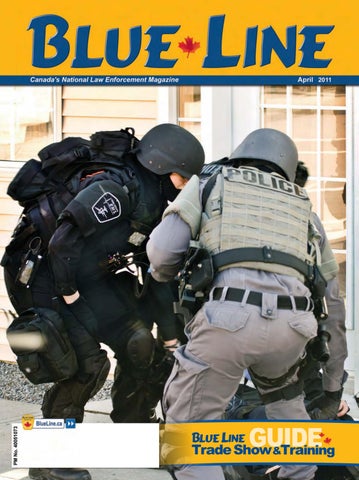
Are we paying attention? Looking at the horrific aftermath of the Japanese earthquake makes you wonder what would have happened if it had occurred in Canada. Are we as prepared as the Japanese government, their emergency services or people? It is a difficult question to answer. The most significant lesson from Japan is that disasters are never singular events. The multiple horrors the quake caused was accompanied by a Tsunami and then multiplied by exploding nuclear reactors. Disasters stretch first responders to the breaking point. Police face looting and widespread unrest, fire services strive to rescue victims while coping with multiple infernos and ambulance and hospitals are overwhelmed with thousands of victims. All of this can occur with little or no warning, making events difficult to predict before they unfold. The priority in the aftermath of a disaster becomes maintaining the health of the surviving population. This is where a myriad of other services come into play. All must be coordinated and dispatched to where they are most needed. In the Japanese quake scenario, several factors worked in the nation’s favour. Japan has the world’s third largest economy so money and resources are not a problem. It is compact, so help is never too far away, and with 127 million people, finding rescuers is not a serious issue. It is well connected and blessed with both good communications and transportation. Most importantly, its citizens are well educated, disaster savvy and did not panic in the face of so much adversity. In comparing all of these factors to Canada, it becomes clear that, given our geography, we are both blessed and cursed. We have less people, much greater distances between communities, longer communications networks and fewer seismologically sensitive areas. The Pacific Rim of British Columbia is an exception but it has no need for nuclear power plants. The Japanese experience should encourage all members of law enforcement to work closely with fire and ambulance personnel. This month’s cover is a shining example of inter-agency co-operation between the police and EMS services in York Region. Members of both agencies gear up, work and train together to maximize their effectiveness. At the very least, in times of crisis, they are familiar with each other’s approach, protocols and equipment. I encourage you to not wait until 5
disaster strikes but to follow their example. Over the past year Blue Line has presented a series of articles by firefighter, paramedic, author and instructor Michael Weaver, a strong advocate of inter-service and cross agency training. He will present a seminar at this month’s Blue Line Training sessions. Weaver’s drive for better communication, co-ordination and training between emergency services was heightened by Robert Dziekanski’s death at the Vancouver Airport. He has long believed the RCMP officers’ actions were representative of what any officer would do in the absence of proper training to identify, request resources and physically manage an extremely agitated individual in medical crisis. A “universal response” between emergency services can maximize our ability to respond to and better mitigate large and small disasters. This month’s lead story by technology editor Tom Rataj highlights the importance of obtaining appropriate, reliable communications linkages. This is underscored by the bandwidth that will become available later this year when Canadian television stops broadcasting in analog on Aug. 31. Given the multiple disasters in Japan, how much of that bandwidth will be reserved for emergency services? The Ontario Emergency Services Department invited me to a training workshop at the Ontario Police College a few years ago. I was introduced to police, fire and ambulance people all keenly interested in sticking their noses into each other’s business, so-to-speak. Questions ranged from how police officers should approach dangerous substances and how paramedics extract injured police officers from firefights to how firefighters use stretcher-boards to immobilize agitated suspects police are apprehending and how agencies can meet to talk about improving emergency preparedness. In the weeks, months and years ahead we will hear more about the Japanese experience handling multiple disasters. Let us hope that our eyes and ears are open to what they have learned and will learn. A plan of action implemented with communication, co-ordination and training between agencies and disciplines can save lives... and careers!
APRIL 2011
The next
Trans-Canada vision Emergency services lineup behind 700MHz by Tom Rataj The Constitution Act of 1867 created the “Dominion of Canada” and included a written condition to build the Intercolonial Railway as a means of unifying the new nation. Likewise, the Trans-Canada Highway Act of 1948 created a national highway network as a means of unifying a more modern motorized nation after the Second World War. Now in the 21st century, the federal government has a great opportunity to make the next great nation-unifying decision, albeit in a slightly less obvious manner unlikely to attract nearly as many votes. When analog broadcast (over-the-air) APRIL 2011
television services across Canada switch to the new digital broadcast standard at the end of August 2011, almost half of the 700MHz radio “spectrum” currently occupied by channels 62 through 69 will be available for other uses. By reserving a section of this spectrum for the exclusive use of emergency services voice and data networks, the government could ultimately provide Canada with the foundation for a state-of-the-art communications infrastructure that will benefit all Canadians. Industry Canada announced last November that it intends to auction off licenses to use this by-then available spectrum to the highest bidder in late 2012. 6
Get in line First in line are Canada’s national and regional cellular companies. They expect the data traffic on their wireless networks to double every year from now through 2014. The soon-to-be vacant spectrum would easily provide them with much of the capacity they need to match this expected demand. Many of the large players now rake in substantial profits – the wireless industry generated an estimated $39 billion in economic activity in 2008. Industry Canada will be tempted to make a quick multi-billion dollar profit by selling off the available spectrum to these cash-rich wireless service providers, as it did the last time spectrum was auctioned off. BLUE LINE MAGAZINE
Second in line, and certainly not flush with cash, are Canada’s emergency services, which also expect to see multiple-fold increases in need and demand for wireless broadband spectrum to support their growing array of communications technologies. Fortunately there is a move afoot to convince Industry Canada and legislators at all levels to reserve at least 20MHz of the 700MHz band for the exclusive use of emergency services. While some already use 24MHz of the narrow and wide band spectrum in the 700MHz band for voice and low speed data, it will not be enough to meet future demand. The sweet-spot By its very nature, the 700MHz spectrum can travel extended distances and penetrate buildings and other obstacles that typically shut-out other radio frequencies. Concurrently the next generation of wireless data technology is also arriving. Long Term Evolution Advanced-Fourth Generation (LTE-4G) wireless technology will improve wireless broadband (high-speed) performance over the current market leader (3G UMTS/HSPA+), which is already widely available across Canada. LTE-4G’s “rated” download speeds are almost double those of HSPA+ at an amazing 1Gbit/s. This kind of download speed allows many data-intensive applications in the mobile environment, which is exactly what Canadian emergency services are now implementing. Coupled with the high-performance 700MHz frequencies, this would be a major leap forward. BLUE LINE MAGAZINE
Many newer technologies – including video analytics or Intelligent Video Analysis (IVA), Automated Licence Plate Recognition (ALPR) and various biometric systems such as mobile fingerprint and iris identification – work far more efficiently when connected to live databases back at HQ. Other less cutting-edge technologies and applications already in use will also work far more efficiently when connected to a high-speed broadband wireless network. Police officers could have live video feeds in their cars from various support services, including helicopters and public CCTV cameras in schools or other public places during emergencies; the possibilities are almost endless. Firefighters could have live access to building floor-plans and hazmat inventories at fire scenes and could use systems that precisely track the location of every firefighter at a scene, all while monitoring their vital signs for any problems. EMS personnel could have live access to electronic patient records and other telemedicine systems, allowing doctors to receive live status information from monitors attached to patients in the field. This would help them provide better and more accurate treatment direction. Frequency spread Currently, emergency services voice and data networks across the country are spread-out on various frequencies. They use proprietary radio and computer systems and technologies, preventing individual 7
services from communicating with other agencies. This also prevents them from communicating directly with other emergency services such as fire and EMS during major incidents. Some existing voice and data systems operate in parts of the radio spectrum which have poor building penetration, forcing officers to stand near windows to use their portable radios – or put up with having little or no voice or data communication while in elevators or underground garages. The lack of inter-agency communications can have tragic consequences. During the attack on the World Trade Centre towers in 2001, personnel on an NYPD helicopter flying overhead warned the police command to issue an evacuation order because they believed the building was about to collapse. Unfortunately, because of a lack of direct interagency communications, the hundreds of emergency personnel inside did not receive this message. Three hundred and 43 firefighters and paramedics and 60 police officers perished when the buildings collapsed on top of them. Most Canadian emergency services operate their own private voice radio systems, allowing them to keep out eavesdroppers and ensure their systems function during power outages or other disasters. Some agencies rely on commercial cellular infrastructure for their voice radios systems and many use them for their mobile data systems. The problem with this is that the emergency service is entirely reliant on these network operators to communicate. While APRIL 2011
emergency services may have “priority access” agreements in place, the access is far from guaranteed, especially during major emergencies. During the large power outage that affected most of eastern Canada and the United States in 2003, the commercial cellular networks continued to function for the most part, but were rapidly overwhelmed by the sudden spike in demand, which greatly exceeded their capacity. Even with “priority access” agreements in place, would you want your mission critical operations impacted, especially during such an emergency situation? Committee A Tri-Service Special Purpose Committee created in 2010 by the CACP, Canadian Association of Fire Chiefs (CAFC) and the Emergency Medical Services Chiefs of Canada (EMSCC) is working to raise awareness of this unique opportunity and is lobbying all levels of government. One of its primary information access points is an excellent website (www.action700.ca), which provides a great overview of the issues and a variety of resources to help emergency services get involved in supporting this opportunity. There’s another big advantage to sharing common spectrum on the 700MHz band all across Canada. Our colleagues south of the border are well on their way to obtain-
APRIL 2011
About CITIG and 700 MHz Resources
ing the same sections of the 700MHz band. If both countries successfully implement this, we would have a continent-wide interoperable voice and data frequency standard, enabling joint operations both at home and along our lengthy mutual border. All emergency services leaders and personnel should contact their federal, provincial, territorial and municipal representatives to lobby for this important, nation-unifying opportunity. Tom Rataj is Blue Line’s Technology columnist and can be reached at technews@blueline.ca .
8
Launched in April 2007, Canadian Interoperability Technology Interest Group (CITIG) brings stakeholders together to advance public safety provider interoperability in a co-ordinated fashion. The Canadian Police Research Centre (CPRC), Canadian Association of Chiefs of Police (CACP), the Canadian Association of Fire Chiefs (CAFC) and Emergency Medical Services Chiefs of Canada (EMSCC) helped found and grow CITIG which has now emerged as the unified voice for responder interoperability in Canada. In addition to supporting efforts around 700 MHz spectrum (see www. citig.ca) and the Tri-Services Special Purpose Committee on 700 MHz Broadband (see www.action700.ca), learn firsthand about the quest for dedicated 700 MHz broadband spectrum for mission critical public safety data at the following two conferences: The Emergency Services Management Conference in Montreal, Quebec from April 17 to 19, 2011. The Fifth Canadian Public Safety Interoperability Workshop: A CITIG National Forum in Ottawa, Ontario from December 4 to December 7, 2011. Information on both these events can be found at www.cacp.ca.
BLUE LINE MAGAZINE
Invest in your career Take Blue Line training courses The Social Officer: Connecting Cops and Civilians Using Social Media April 26, $125.00 + HST As the founder of CIK Marketing, Chantielle Kennedy has helped numerous Ontario police services expand their understanding of social networks and engage with civilians via online platforms. This half day course, will discuss the benefits associated with creating and communicating via popular online networking sites like Facebook, Twitter and YouTube. Instructor: Chantielle Kennedy
Transitional Tactics for the Combative Subject April 26, $250.00 + HST This course will help Law Enforcement and Fire/EMS to rapidly identify, and be prepared for a crisis dealing with an agitated or combative individual needing rapid treatment and transport to the nearest Emergency Department. The goal is to help minimize the possibility of injury to the suspect and the First Responders in the field. The techniques and tactics taught go beyond didactic presentations to hands-on learning. This course offers a task oriented team approach to the agitated suspect that does not comply with traditional compliance techniques. Instructor: Michael Weaver is a 15 year veteran of the Everett Fire Department as a Firefighter/Paramedic. He is an author, instructor and advocate for the safety of all first responders. A U.S. Army Veteran, Michael volunteered for 2nd ranger battalion and successfully completed the U.S. Army Ranger School. “http://community.fireengineering.com/profile/MichaelWWeaver”
The Non-Accusatory Interview Technique April 26, $250.00 + HST This topic is designed for all police officers as well as private investigators and security people involved in interviewing suspects and/or victims. Learn the basics of: • Conducting an investigative interview in a conversational setting with the emphasis on obtaining important information. • How to establish a “free-flowing” interchange between the subject and the interviewer. • How to plan and enter into an interview and get the subject talking and keep them talking. • Current legal status of investigative interviews and how far you can pursue the truth in a legal manner. Instructor: S/Sgt Gordon MacKinnon (retired).
2011
BLUE LINE MAGAZINE April 26 & 27, 9am - 4pm
APRIL 2011 Pre-registration & Info at BlueLine.ca
9
The easy way to inform the public by Chantielle Kennedy When it comes to solving crimes and protecting communities, public awareness and engagement is key. An effective police service needs to be able to communicate with and collect information from the public in a quick, easy and efficient manner. When it comes to connecting with civilians and spreading important public knowledge, what better way to get your message out then via the Internet? Here’s five different ways law enforcement agencies should consider using social networks to engage and inform the communities they protect. 1) Put the police blotter online as a blog Traditionally the police blotter is published in the newspaper the following day to notify civilians about important calls and arrests or to issue public announcements – but why just release your agency’s news when you could write it yourself? Police blotter blogs enable services to control how information is released and when. Context can easily become skewed when it is reported from one source to the next; blogs help eliminate this issue, as they offer creative control over the information you release.
2) Inform the masses with Twitter Twitter is a great tool for police as the entire purpose of the platform is to spread information quickly and efficiently. While mainstream media is hampered by timelines and editing schedules, Twitter enables you to quickly publish information in real time. Tweeting information to followers about evolving situations, road closures and accident reports is a great way to keep your community informed. What’s more, your followers will help you spread the message, retweeting your alerts to their friends and coworkers.
3) Community feedback and anonymous tips Police services have always relied on civilian tips and information to help solve crimes and improve service. The Internet and social media is making this information exchange safer and easier thanks to specialized software and engagement platforms. Police can now link to secure sites like TipSubmit. com from their official web site and even Facebook Fan Pages to collect anonymous information from good civilians. They can also use social media sites to start discussions and collect feedback. 4) Video messaging on YouTube Does your police service currently market itself by handing out pamphlets to school boards and brochures to community groups? Do officers participate in fundraisers and organize events? That’s great – but why not take things a step further and also start using YouTube as a marketing tool to reach your community? Create a channel and start loading public service announcements to your account. With a little help from an IT professional you can embed a YouTube player on your official web site or Facebook page, attracting even more eyeballs. Video is a great way to personalize your service and provides viewers with another way to engage and interact with your agency. 5) Catch criminals in real time The popularity and accessibility of social networking sites make them a natural police crime fighting tool. Whether it’s loading security video to a YouTube account in hopes of identifying a perpetrator or notifying the public of a missing child via a viral Facebook message or Twitter alert, social media can help officers quickly and efficiently catch criminals. CIK Marketing founder Chantielle Kennedy will present a half-day course, The Social Officer: Connecting Cops and Civilians Using Social Media, at the Blue Line Trade Show April 26 and 27. CIK has helped the Chatham-Kent, Guelph and Woodstock police services enhance their online engagement through social platforms.
APRIL 2011
10
BLUE LINE MAGAZINE
Invest in your career Take Blue Line training courses NEW
Vehicular Concealed Compartment Identification April 27, 2011 - $250 + HST
This course will provide the Federal, Provincial, Municipal, Immigration and Border Law Enforcement Officers with the tools and techniques to recognize, identify and subsequently interdict the criminal transportation of illicit narcotics, illegal firearms and the proceeds of crime. This course reveals the tactics, methodology and practices used by these organizations to conceal contraband and dissuade officers from furthering an investigation. These techniques will ensure the safe recovery of contraband from a compartment while protecting the structural and aesthetic value of the vehicle.
Street Drug Awareness April 27, $250.00 + HST This course is unique in its scope providing important and relevant information concerning the world of street drugs to field level law enforcement officers. In this one-day course you will learn clandestine laboratory safety, recognition and investigation, current drug trends, and how to recognize drug use and handle users. Instructor: Det. Steve Walton (retired) worked 10 of his 25 year policing career with a drug unit. He has investigated more than 300 grow operations and supervised under cover teams with 120 drug operations. He is a qualified drug expert and actively instructs in the area of drug education and investigative techniques.
Detecting and Defusing Deception April 27, $250.00 + HST This topic is of interest to all police officers as well as private investigators and security people involved in interviewing suspects and/or victims. In this course you will learn: • How deceptive subjects act? • What they say and how they say it? • What they do when faced with certain probing or bait questions? • We will also cover some of the latest findings in this field and dispel some of the myths about lying. Instructor: A/Sgt Wayne van der Laan (retired).
FREE admission to the Blue Line Trade Show with course registration. Canada’s largest law enforcement exhibition of the latest products and in-demand services. Course location offers FREE parking, easy access to several major highways, a wide range of hotels, restaurants and amenities.
2011
BLUE LINE MAGAZINE April 26 & 27, 9am - 4pm
APRIL 2011 Pre-registration & Info at BlueLine.ca
11
A refuge for first responders and soldiers A Canadian soldier was seriously injured in an ambush attack in Afghanistan. Her husband, who lives in the British Columbia interior, can stay free of charge while he visits and encourages his wife.
traumatic times. New Chelsea Society, a BC affordable housing organization, provided the society a modern four-bedroom, three-bath, fully accessible townhouse called Winch House for one dollar per year while the society prepares its own house. It is a place of refuge and composure where families may stay close together while experiencing physical or emotional trauma. Winch House serves as an interim facility. Once Honour House is operational, it will be available as an additional facility. Coast Hotels of Vancouver has offered its facilities if more accommodations are needed.
Honour House Society is an independent registered charity whose objective is to provide free temporary accommodation for the families of Canadian Forces and first responders (law enforcement, ambulance and fire) while family members receive care in Metro Vancouver. Similar to the Ronald McDonald House concept, it relieves families of having to come up with the money for expensive hotel rooms during
Beginnings Captain Trevor Greene, now an honorary patron of the society, made headlines across the country in 2006 when he was gravely injured in Kandahar, Afghanistan, while meeting with village elders. Greene had removed his helmet in a show of respect and was struck in the head with an axe. The brain injury immobilized his legs and affected his speech and mobility in his hands.
by Elvin Klassen A prairie firefighter and his family were vacationing in Vancouver recently when his daughter suffered major heart failure. Needing accommodation while she was being treated, he recalled hearing about the Honour House Society, which gave them a free place to stay until their daughter was released from hospital.
APRIL 2011
12
Greene lived in Vancouver at the time and was determined to recover. His rehabilitation efforts and willingness to speak publicly about them have made the 43-yearold an inspiration to many. Vancouver realtor Allan DeGenova, who now heads the Honour House Society, felt compelled to get involved after attending a 2006 benefit concert. The event focused on the needs of Canadian troops, both overseas and those returning home. It raised awareness about young injured and wounded veterans receiving care or rehabilitation in Vancouver area medical facilities and the difficulty their out-of-town families had finding temporary housing during their care. DeGenova connected with General Rick Hillier, then Canadian Forces Chief of the Defense Staff, about the project and more people got involved. Hillier is now a “patron” of Honour House. As Greene fought for his life at Vancouver General Hospital, his fiancé and family from the Maritimes needed a place to stay. Their only option was Compassion House at Jericho Garrison, a small two-bedroom BLUE LINE MAGAZINE
bungalow available to military families for $20 a night. Green’s family was the inspiration to assist with more housing for families experiencing trauma, said Jim Stanton, vice president and a founding director. When another family needed a place to stay the Honour House Society was born. The society bought the former Blue Spruce Cottage in historic New Westminster for $2.2 million in April 2010. Constructed in 1937, the 9,000 square foot Georgian mansion has been restored and upgraded to accommodate 10 fully-accessible sleeping units and shared common areas. It will provide independent living and short term stay for visiting families. Each bedroom will be able to accommodate a small family. The plans respect the original heritage character, detail and cross access layout of the house while introducing modern convenience and comfort. Alterations to the overall exterior form have been limited to raising the third storey roof to provide additional area with traditional dormer forms at the front, while introducing dormers and an elevator at the rear of the house to ensure access to all four interior levels. The large lot, heritage trees and stone wall has been enhanced through a landscape plan compatible with the heritage neighbourhood while providing a garden amenity. Construction and renovations began in May, 2010, with the official opening in November. Final touches are being made and the first guests are due to be welcomed this spring. Guests are responsible for cooking and cleaning but the society provides everything else. “The only rules we have are no drugs, no smoking and no pets,” says Stanton. Community Support Many groups and organizations have stepped up to the plate to support Honour House. A fund raising effort with Canadian singer Sarah McLachlan attracted 800 supporters at $200 a seat. A flag was deBLUE LINE MAGAZINE
signed especially for the society. One flies at Honour House and the other hangs in New Westminster Mayor Wayne Wright’s office, who helped the society establish the home. The Vancouver Regional Construction Association has taken a leading role by providing labor and materials. The provincial government provided an interest free loan. Hard Hats for Heroes and Helmets for Heroes raised money to move the project forward. A local car dealer is donating a van and volunteers provide most of the services in the home. A local firm donated legal services. Honour House is also available for veterans or first responders seeking assistance from the Royal Canadian Legion through the UBC Veterans Transition Program, designed to assist people transitioning to civilian life. It can also be used while participating in the British Columbia Institute of Technology’s Veterans’ Re-entry Program. This educational curriculum is designed to assist with future employment, recognizing their military skills, to help them re-establish themselves in civilian life. “This has been a labour of love and a dream come true,” says Stanton. “I have a great fondness and respect for those men and women who are in our front lines in Canada and overseas. We need to do what we can to honour them and that is why we call it Honour House.” Visit www.honourhouse.ca or contact Jim Stanton at jstanton@honourhouse.ca for more information on Honour House.
13
Captain Arthur Hughes designed a flag that flies at Honour House and Winch House. The white background speaks to the role of medical personnel in times of emergency. The red maple leaf symbolizes Canada and the white letter H superimposed on the maple leaf identifies Honour House. The dark blue horizontal bar represents the navy, the red in the middle the army and the light blue the air force. The gold lines symbolize all first responders – fire, ambulance and law enforcement.
APRIL 2011
Chinguacousy Township Police Celebrating 12 years of service... 50 years later
by Simon Martin Life has calmed down considerably for retired Chinguacousy Township police chief Ken Sider. Gone are the days of midnight calls, council bickering and being the only police officer for 140 square miles. “I hold the somewhat dubious honour of being the first and last Chinguacousy Township police chief,” he said. Chingua-where? “I had never heard of the place when I saw the job posting,” admitted Sider. Chinguacousy township, pronounced tchin-ku-zi, was located in Peel County, west of Toronto. The township’s big population hub was Bramalea with 1,000 people. In 1973, Chinguacousy was absorbed into the Regional Municipality of Peel. The southern half of the township became part of Brampton while the northern half joined the town of Caledon. “You see all this,” said Sider, now 83-years-old, pointing at a subdivision along Bramalea Road. “It used to be beautiful farmland. Oh how times have changed.” Sprawling corn fields have been evicted by urban sprawl. Rows and rows of houses have been neatly planted and bath in the sunlight of the mild March afternoon. “It just ain’t what it used to be,” he said, shaking his head. Sider arrived in Chinguacousy Township in 1961, driving his two-tone, brown 1954 Oldsmobile and leaving behind northern Saskatchewan and a 10 year RCMP career. Life APRIL 2011
was too lonely there for him and his family. He worked for three years in Richmond Hill before being coaxed into applying for the police chief position in Chinguacousy. “[My co-worker] was relentless. He bugged me for two nights and I finally gave in and applied. Much to my surprise I got a call a month later,” he recalled. Part of the reason Sider accepted the position was because Bramalea was expected to grow rapidly. It was the first satellite city in Canada, he explained. One of Canada’s largest real-estate developers, Bramalea Consolidated, had purchased the farmland and planned to build a city with parks and greenbelts – but when Sider first showed-up, Bramalea was little more than a farming community. Sider was sworn in as chief in June, 1961 as the only member of the force. “The OPP stayed for about six or seven weeks while I did my orientation, then I was left all by my lonesome,” he said. “It was pretty rough. I was expected to be available seven days a week, 24 hours a day. My wife thought I was a little crazy.” He was responsible for policing 19 hamlets covering 140 square miles. Getting his feet wet as chief was a challenge. His annual budget was a paltry $5,000 in the first year – and that included his salary and vehicle. The police headquarters was a tiny basement room in a township office. “I had to spend the majority of my time in Bramalea, but by the same token I couldn’t 14
abandon the rest of the townships,” he said. “I was on the road on a continual basis. Bad accidents don’t necessarily happen between 9 and 5.” Sider lived in uniform during those early years, never having to wear his suit. The plan all along was for Sider to grow the force. By October of 1961, he finally got the go ahead to hire a couple of men, but getting more money from township counsel was like pulling teeth. “You have to remember it was a farming community. They were frugal and not progressive in their thinking,” he said. Bramalea, however, was growing rapidly so the need for a larger police department was absolutely essential, explained Sider. Sider answered to a three person township police committee and they all followed Reeve Cyril Clark, he said. “He was a real challenge,” said Sider. “It seemed like his main goal was to block the progress of the police department. He was anti-police.” Sider still remembers standing beside Clark one day, waiting for his wife to pick him up. When she arrived in that same 1954 Oldsmobile, the inside fender fell-off. “Old Cyrel turns to me and said ‘you do as I say and you’ll be driving a new one of these.’ You know what; I didn’t listen and drove that thing into the ground.” After much verbal jousting, Clark relented and bought a three-bedroom house on Balmoral Drive in Bramalea for the new Chinguacousy Police headquarters. Bramalea was growing rapidly and the police force kept hiring new people. By 1964, it was evident to BLUE LINE MAGAZINE
Sider that they needed a proper headquarters. “It was ridiculous,” he said. “We were running twenty officers through this tiny house across from the high school.” It wasn’t until 1968 that council approved a proper, 20,000 square foot police building, but Clark insisted that was too large. “We had to knock off 6,000 square feet of the darn thing. That insured it wouldn’t be big enough in 15 years,” said Sider. The building was completed in 1970. “I was quite proud of that new building,” he said. “It really elevated us to a well-functioning police force that served the community well.” The new headquarters had a proper identification section, youth bureau, criminal investigations branch and a record keeping bureau. Sider was particularly proud of the record keeping system he set-up, which he says became the norm for all small police departments across the province. He was also proud of the force’s one per cent attrition rate. “Our officers deserve the majority of the credit for our success. They really did a tremendous job and made my job easier,” he said. It was a different time. Sider recalled wanting to hire a new officer in 1963. “They ask me, ‘is he Anglo-Saxson?’ ‘Ya, I think so’ I said. ‘He wouldn’t be Catholic, would he?’ ‘Nope, Spanish.’” Sider knew the new officer was a strong Catholic but that was frowned on at the time in the township. The new officer was hired. Around the same time, Sider caught a lot of flak for hiring a female police
BLUE LINE MAGAZINE
The last members of the Chinguacousy Police detective office are shown from left: Det. J. Lewis; Cst B. Hunter; Det. J. Webster; Back row.- Cst. M. Chesterman; Cst. R. O’Kell officer. People couldn’t understand what duties she would be capable of performing, he said. Sider kept hiring new officers every year; the Chinguacousy Township Police Force had increased to 62 officers by 1973. “It was a good collection,” said Sider. “I used to catch hell from the chiefs from larger centres because we were taking their people.” Bramalea wasn’t the only area growing. A population boom was sweeping across southern Ontario. Then Ontario Premier Bill Davis introduced regional governments in 1973 and the Chinguacousy force was absorbed into the Peel
15
Regional Police (PRP). Sider’s 12 year reign as chief was over. He spent the final 12 and a half years of his career as a PRP superintendent; they were not his fondest years, he added. That tiny house on Balmoral Drive still stands to this day. Driving past, Sider said it looks exactly the same. “It’s hard to believe we had all our cruisers and everybody working there for so long,” he laughed. The new 14,000 square foot building he fought so hard for is now old and vacant, dwarfed by the Bramalea City Centre that sprawls across the horizon, covering more than a million square feet. The new 200,000 square foot PRP building casts a shadow onto the parking lot where Chinguacousy Township police cruisers used to park. Sider smiled as he passed the old rusted out fuelling station, commenting that it was nice not to worry about gas prices. Members will mark the 50th anniversary of the Chinguacousy Township Police Force’s founding in May. Sider is looking forward to seeing his officers again. They were a good group who worked well as a team, he said, adding that it was a different time. “Back then… you could arrest someone for having a roach,” Sider chuckled. “Those were difficult years full of challenges but I’m proud of what we accomplished.” Those wishing to attend the Anniversary celebrations may contact Charlie Trimble by phone 519-823-1009 or e-mail - charle332@sympatico.ca
APRIL 2011
VIP for a day High tempo, high stakes by Tony Palermo Part 2 Cst. Julie Mann has been a member of the OPS Traffic Escort Unit since 2004 and an instructor since 2009. One of 27 elite riders, Mann says it takes more than just being able to ride to make the team. “Like any specialized unit, it’s a very competitive process. You require a lot of control, dexterity and confidence.” Head Instructor Cst. Rick Comba agrees. “You can still be a good cop but not necessarily the right fit for this unit,” he says. Officers who are conditionally accepted must pass an intense three week basic operator’s course, though the word “basic” is a little misleading. The first day is spent in the classroom learning theory and reviewing the ABCs of motorcycle riding, then it’s on to all sorts of practical exercises designed to challenge the officer’s abilities. As an example, Mann says there are very tight, slow-speed drills requiring a high level of dexterity and incredible control of the clutch, throttle and rear brake. “In a lot of these exercises,” she says, “you have to lock out the fairing to the max and rub the floorboards in order to successfully complete the turns.” There are also high-speed emergency breaking drills that are extremely difficult to master. “A lot of candidates go down and then don’t have the confidence to try it again,” she notes. For some officers, the sheer weight of the motorcycle is challenge enough when they discover they’re not strong enough to lift or push it around on different surfaces. Officers who pass all the required components join the team for up to seven years. Those who don’t pass the first time through are restricted to driving cruisers within the unit. Typically they will be given another chance the following year and are reassigned from the unit after three years if they fail again. Many of the escort-related duties – whether it’s racing through busy streets in leapfrog formation at 120 kilometres an hour or straddling the centre line between a motorcade and oncoming traffic – take a lot APRIL 2011
of practice and training to safely master. On paper, the unit has one official training day a month, though additional group training occurs every time they hit the road to do traffic enforcement or other types of related escort functions. “Funeral escorts account for a lot of our level five training,” says Mann. Even in training, escorts are still high tempo, complex and dangerous, with a very real risk of injury. At least two OPS officers have been injured within the last year conducting level five training escorts. Others were injured during the basic operator’s course. “It happened so fast,” says Cst. Christie Scheerder, who took a nasty spill during week two of the course in May 2009. She was completing a counter-steering exercise through a sequence of five offset rows of large pylons. The objective was to weave left-to-right, counter-steering at a speed of around 60 kilometres an hour. Scheerder was confident she would make it through just as she had done the day before. She passed the first row but while navigating around the second, nicked the outside pylon with her bike’s crash bar, throwing her off balance. Unable to recover, she smashed into the third row of pylons. Scheerder remembers thinking that it wasn’t a big deal and she would just ride it out. A split-second later, a pylon wedged itself in the front wheel, causing the bike to flip. As a gut reaction, Scheerder’s right leg shot out, hyper-extending her knee and launching her face first through the air. She landed on her front-right side and slid along the pavement for about 15 feet, her bike flipping several times dangerously close behind 16
her. She looked up to see the bike had come to rest just a little to her left, and cursed. “I was so mad,” she says. “I wanted to get up right away, grab the bike and do it again. I wasn’t a new rider and I had done this type of manoeuvre countless times before. I was so upset with myself.” She began to get up but the instructors yelled for her not to move and everyone ran over to assess her injuries. Battered, her clothes torn and the peak of her helmet ripped off, Scheerder’s right knee and wrist hurt a little but she felt fine otherwise. She insisted that she was okay and was adamant about continuing the exercise. “I didn’t want to say that I was hurt,” says Scheerder. “I needed to do it again, right away, so that I didn’t allow the fear to get the better of me. I was concerned that I would start to doubt myself and my abilities.” After reevaluating the course, the bike and Scheerder, the instructors agreed. Determined, she completed the exercise and then scolded herself for being careless. “In hindsight,” says Scheerder, “when I started to lose it I should have just exited the exercise and started over again.” She continued her training day but a few hours later, realized that her injury was more serious than initially thought. Her right knee was swollen and the pain so intense that it was difficult to lift her leg to operate the back brake. By the end of the day, she could barely get off of the bike, let alone walk. “My right leg couldn’t support any weight,” says Scheerder. “My knee would let go and then the leg would just collapse.” At hospital later that weekend, doctors delivered the bad news. Her meniscus BLUE LINE MAGAZINE
was damaged and her MCL and PCL both partially torn. She would have to wear a full leg brace to keep her knee completely immobilized, take time off, see a specialist and undergo extensive physiotherapy. Taking the weekend to partially recover, Scheerder was determined to finish the last week of the course. “It didn’t involve any exercises,” she says. “It was group riding out on the roadway, which I knew I could do.” Friend and colleague Cst. Dan Testa, an avid and experienced rider himself, stayed close and helped her on and off the bike during the last week. “Her driving abilities were fine,” says Testa. “It was simply getting on and off the bike that was a problem for her. Testa says that, while he tried to be discreet in helping Scheerder because he didn’t want the instructors to remove her from the course, he doesn’t think they fooled anyone. “I think they just turned a blind eye to it because they could see how determined she was,” he says. “Also, they knew that Christie’s abilities on the bike were far superior to most riders and to lose her would have been a huge loss for the unit. She was nicknamed ‘silky smooth’ because she made everything look easy.” Scheerder’s injury is permanent and her knee will never be 100 per cent. Depending on the weather or if she’s been active, she still experiences pain, has been told she will develop arthritis and doctors warn her
BLUE LINE MAGAZINE
to be very careful because she is now more susceptible to injury. “It’s just the reality I have to live with,” says Scheerder. “Riding the motorcycle is a very dangerous job – I’ve experienced this first-hand – but I can’t even describe how much I enjoy it. This is an elite squad of motorcycle riders and I am very proud to be a part of the team.” Next month in part three, we shadow
17
students of the RCMP’s National VIP Course on their final practical exam and see how well these “new suits” can keep a group of visiting dignitaries safe. Tony Palermo is Blue Line’s correspondent for the Eastern Ontario & Western Québec region. A freelance writer and former federal corrections officer, he welcomes all e-mails and stories of interest at tony@blueline.ca.
APRIL 2011
RCMP to light up communities
by Winston Carston In a bold step forward detachments of the Royal Canadian Mounted Police in Manitoba are hitting the highway in a hitech way. In a rather illuminting fashion they are having their police vehicles identify with their communities. The police cars have new LED panels attached to both front doors which display the name of the community they Insp. Dean are currently patrolling. Worman “This is the perfect answer for an agency as large as ours,” says Insp. Dean Worman, unit commander of the Steinbach RCMP Detachment. “We have recognized over the years that towns and cities which contract with the RCMP would like to show the ownership they have in the police vehicles we use.” Police vehicles under Worman’s command patrol a more than 800 square kilometre area
APRIL 2011
which includes 14 municipalities. The detachment’s 12 cars could be called to any municipality in their region at any time so permanent signs were not an option. A proposal to adapt the route signs used on the front of buses was also ruled out. “They’re too large for the doors of anything smaller than Crown Vics – and even then it was a tight fit,” explains Worman. “We were also concerned officers would forget to change the signs, which have to be operated manually. There’s not a lot of love lost between some of these areas; cruisers showing the name of a neighbouring region could be vandalized or even come under attack.” The new LED signs are automatic. An integrated computer checks with the onboard GPS system and then changes the signs to reflect the area being patrolled. “We have long recognized the need to ensure each community looks upon us as their police service of choice,” Worman states. “It is important that our presence is viewed as being as much a part of the community as the
18
works or sanitation department. Our members not only work here but also live here and are part of their community.” The display units are versatile enough to also double as community message displays, show the names of missing children or highlight web pages or local phone numbers for crime watch initiatives. “The marquee mode can display directional arrows, ‘stop’ messages when roads are closed or simply wish residents a Happy Christmas, Hanukkah, Feast of St. Basil, Bodhi, Diwali or Kwanzaa, a meaningful Tenrikyo, Ramadan or Lohri or peaceful Tu b’Shvat or Lammas, Lughnassad or Guru Gobind Singh’s Birthday – depending on the area being patrolled, of course,” says Worman. The thin display screens use new full colour E Ink technology (a monochrome version can be seen on Amazon’s Kindle ebook readers). “It was fairly simple to mount the displays on cruiser doors,” says Manitoba RCMP Fleet Manager James Bliss, though he admits integrating them with the car’s computer system and adapting off the shelf GPS devices to run the signs was a little more complicated. As with all new technological advancements, Bliss admits to some minor bugs, which he says technicians are currently working hard to solve. When pressed for details, he allows that “every once in a while you can hear GPS prompts such as ‘Turn Left in 100 meters’ or ‘Exit ramp in 10 seconds.’ “We are really concerned about messages that say ‘Turn right now’ or ‘Stop and turn around’ over the cruiser PA horn.” Bliss noted. “This is not only annoying, it can be dangerous. Motorists being followed by police cars think the officer is directing them and they could turn into traffic or stop in the middle of the road. We are still trying to work out why BLUE LINE MAGAZINE
this is happening but until we figure it out, celebrity and novelty GPS voices have been banned in our test cars.” There have also been a few bureaucratic bumps along the way, including one which the detachment had not anticipated. When the display is in marquee mode, RCMP Headquarters views the messages shown as an “official communication.” All official communications are required to be in both official languages. “We’re still working on that one,” says Bliss. One solution being considered is to add dedicated French panels, though officers who are not bilingual would have to either stick to prepared messages or contact Ottawa for translations. Another issue is the force’s commitment to multiculturalism. The aim of the new displays is to bring the RCMP closer to the communities it serves so other languages must be accommodated. For example, Steinbach has a sizable population of German origin. There’s not enough room on the doors for three panels, says Bliss, and communicating messages in three or more languages can become problematic and cumbersome. None of these problems are insurmountable, stresses Bliss. He’s confident solutions will be found before the official rollout of the new signs on all municipal contract police vehicles April 1. To vote on this concept go to blueline.ca and fill in the survey supplied.
BLUE LINE MAGAZINE
Deputy Chief becomes Deputy Minister The deputy chief of Central Saanich police will become B.C.’s top bureaucrat in charge of policing. Clayton Pecknold has ended his year-long term as president of the B.C. Association of Police Chiefs to become the director of police services in the Ministry of the Solicitor General and Public Safety. He will take over from Kevin Begg who has served in that role since the early 1990s. The police services director ensures adequate levels of policing across B.C., administers policing policy, oversees the RCMP contracts and researches provincial crime data. Pecknold, who is in his late 40s, has been deputy chief of Central Saanich police since 2001. Prior to that, he spent four years as legal counsel for Victoria police and 11 years in RCMP detachments across the country including Newfoundland, Nova Scotia, Ottawa and Manitoba. In 2003, he led the police working group on integration, which sparked the creation of such specialized units as the Vancouver
19
Island Integrated Major Crime Unit. Pecknold has been an advocate of police departments working together through integration but has not declared a position on regionalization. He has said Greater Victoria might be better served with two dispatch centres instead of three. Currently, there are dispatch centres in Victoria, Saanich and the West Shore. The director of police services has the ability to wade into municipal policing issues, as Begg did in 2002 when he conducted the audit of the Esquimalt police department that led to its amalgamation with Victoria police the next year. However, Begg’s 2010 audit into that merger gave the Township of Esquimalt the option of contracting out policing, based on the service they want. Pecknold, who has a law degree from Dalhousie University, helped bring in B.C.’s electronic records-management system, PRIME, which he has said allows for “seamless” communication between municipal forces and the RCMP. (Victoria Times Colonist)
APRIL 2011
HR solutions made easy through an integrated approach by Geoff Gruson To excerpt and paraphrase a Blue Line survey (January 2011) on the “challenges of moving into management,” here are some findings that should be causing some of us to lose sleep: 1. Top three challenges of moving into management? • Lack of managerial training; • Role conflict/confusion; • Difficulty managing. 2. Most needed prerequisite? • Management training. 3. Most effective supervisors? • Have management training. 4. Least effective managers? • Lack of preparation/management training/experience. 5. How are we doing? • 21 per cent of services have ongoing training for new managers; • 36 per cent have some pre-promotional training; • 26 per cent have adequate preparation; • 18 per cent are effective at developing full management potential. In other words, not that well! So, the bad news is, we clearly have a problem developing leadership and management. The good news? The sector has already got some solutions in this critically important area that have been compiled into frameworks – guides, templates and tools – and are available to all managers. The Police Sector Council (PSC) successfully completed a multi-year project in January 2011 to develop a competency-based framework for general duty policing management of all ranks/roles – from constable to chief – with a special focus on the requirements for developing leadership at all levels.
APRIL 2011
The story by the numbers What does it take to identify a competency-based management (CBM) framework which will support the HR management issues in every police services? • $1.3 million; • Three years research; • Looking at best practices in three continents; • The efforts of 70+ members on two separate steering committees and 70 contributing police organizations; • Seven hundred subject matter experts to validate the task lists and competency profiles. We developed seven guides for managers and more than 40 tools and templates, which are now available online. The framework consists of customizable solutions to ensure your agency selects, develops and retains the talent it needs to meet the Canadian standard in public safety services. There are tools and instruction guides to support management excellence for every level. As you can appreciate, the success of your service depends upon effective HR management practices – practices that are strategic and defensible. We have gathered and leveraged
20
the policing management experts to build integrated and customizable solutions for your HR challenges. A rigorously researched and nationally validated competency-based management (CBM) regime is now available to you, at no charge, to support every HR management function. CBM in policing now consists of: A. Theory/information: based on relevant research that clearly defines the benefits of CBM B. A competency framework that presents a common language and understanding of the work and underlying competencies required for high performing “general duty” policing, including: • J ob analysis – available jobs in general duty policing, fully analyzed and defined; • Task lists by rank/role profile, including what they actually do; • Competencies defined, including what it takes to be successful in the job; • Competency profile, including all the specific competencies required to do the job well and the specific levels of proficiency expected; • A common competency dictionary built for policing, by policing. C. Seven instructive guides – a step-by-step instructions/practical tips for CBM: 1. Introduction to competency-based police service management; 2. Constable selection: a best practice approach and research update; 3. Succession management: developing a pool of potential successors for critical policing roles; 4. Leadership development: managing the development of essential leadership competencies; 5. Police executive selection: a best practice approach for police boards and commissions; 6. Mentoring and coaching: supporting leadership development; 7. Police leadership education and training: aligning programs and courses with leadership competencies. D. A customizable kit with more than 40 tools and templates that can be modified to suit the needs of your individual police service. The kit includes: • Interview and reference check guides; • Learning plan and performance management templates; • Leadership development plans; • Succession management worksheet. E. Other research and recommended reading Police management needs are unremitting BLUE LINE MAGAZINE
and the challenges unrelenting – the demographics of an aging workforce and fewer young people interested in policing, an increasingly complex work environment, rising costs and reduced budgets for getting the work done well... The challenge is to get the right people, with the right skills and tools, to do the job right – and we have to have this in place every day. Your sector council invested in developing a competency framework. This ensures a common language and clear understanding of the work and underlying competencies for all ranks of general duty policing positions. It is provided along with clear, fair and transparent management practices to support employee engagement and overall sustainability of policing at a high level of professionalism. Policing collaboration and integration has again resulted in success. All of the materials available to you are fully customizable. Adapt the templates and tools to include your own logo, vision, values, pictures and organizational messages or instructions to ensure consistency with your other management tools. Good tools for good HR management are now in-place. To borrow a powerful marketing phrase, now “just do it!” Visit www.policecouncil.ca for “rigorously developed and nationally validated materials to support strategic HR management of policing, at no charge!” Contact Geoff Gruson at ggruson@policecouncil.ca to learn more.
BLUE LINE MAGAZINE
RCMP hero and author passes KAMLOOPS, B.C. - A retired RCMP officer who once stopped a mentally ill man after he’d killed three Mounties has died. John White died in Kamloops in February at age 80. In 2002, White, who was known as Jack, co-authored a book called “Honoured in Places: Remembered Mounties Across Canada.’’ Retired officer Gerry McRae said White and his wife Helen drove around western Canada visiting graveyards and building a database about RCMP members and that some of the information they collected was included in the book. “He was a very mild-mannered person to look at and to talk to. But he had a lot of stuff inside him,’’ McRae said. When White retired after 35 years with the force, he was the contract policing officer for B.C., and his rank was Chief Superintendent. He was awarded two commendations: the Commissioner’s Commendation for Bravery
21
for his efforts in hunting down a man who killed three RCMP officers in Peterson Creek in 1962, and a Commanding Officers Commendation in 1968 for his tenacity in the murder investigation of a woman in the Vancouver area. White became known in the Kamloops area when he shot dead cop killer George Booth. Booth had shot and killed constables Don Weisgerber, E. Joseph Keck and Gordon Pedersen. At the time, they were the entire day shift for the city force. White heard an officer had been shot in the lower part of a park, so he and two other officers headed to the top to head off Booth. En route, they stopped to get their hunting rifles because they were only issued snubnosed revolvers and .303 Lee-Enfields. Booth appeared suddenly and took three shots at White before the officer returned fire. He killed Booth with one shot.
(Kamloops Daily News) Blue Line News Week
APRIL 2011
Bringing order
to chaos
Preparing for high risk events by Michael Weaver US emergency room (ER) visits related to drug and alcohol use rose from 1.6 million in 2005 to almost two million in 2008, according to the federal Substance Abuse and Mental Health Services Administration. The figures highlight the increasing threat to first responders during such calls. The number of ER visits resulting in violence increased from 16,277 in 2006 to 21,406 in 2008. Compounding the issue, there is a small subset of the mentally ill that are prone to violence. Though most psychiatric professionals dismiss this assertion, anecdotally, newspaper headlines tell a tale of random senseless violence and murder against civilians, first responders and health care providers by the unmanaged
APRIL 2011
individual that “slipped through the cracks.” There is no hard data on violence against first responders in the field but they face the reality every day. One can safely assume that if violence is increasing against health care providers and security staff in ERs, it is also increasing against first responders. As early as 1939 researchers drew a direct link between
22
cuts in social services and increases in negative occurrences with those suffering mental illness and/or addiction. The current media sensation is linking sudden death in police custody with the use of Conducted Energy Weapons. Previously, sudden deaths were associated to positional asphyxia (pig pile), pepper spray and the lateral vascular neck hold (LVNH), among others. Most North American law enforcement organizations have taken steps to lessen the likelihood of in-custody death, yet they still occur. Gordon Graham, renowned speaker, attorney and advisor to police and fire/EMS, calls sudden deaths a low frequency, high risk event. Unfavorable results and consequences are predictable, he argues, in the absence of proper risk management tools. Most, says Graham, can be linked to a breakdown in quality: 1. People doing the involved task. 2. Policy showing people how to do this task. 3. Training on how to do the task correctly. 4. Supervision ensuring the task is done right. 5. Discipline when policies are not followed. If we assume first responders intend to provide the best service possible and their agencies strive to have the highest qualified employees, we can eliminate Graham’s first point. The same logic can also apply to point two. Multiple incustody death cases have ended with the firing of “responsible” parties and large pay-outs after lawsuits against municipalities. While unsure of “quality,” discipline resulting in termination for negative field outcomes is the ultimate motivation to avoid such circumstances, thus eliminating point five. If quality people are supervising and executing a specific task, with “quality” discipline in place to deter less than optimum performance, we can possibly exclude the cause of negative outcomes resulting from first responders actions by incorporating quality policy and training. BLUE LINE MAGAZINE
Training Reactionary policy, crisis intervention training, less than lethal devices and Power Point presentations are no substitute for relevant hands-on training to manage violent individuals. Phone interviews with several state mental hospital directors confirmed that, during prolonged psychotic events, staff must physically subdue and restrain individuals so they can be medicated and taken to hospital for further evaluation and treatment. This is in a hospital setting with professionals who deal with the mentally ill every day, so the importance of being able to safely subdue and restrain the combative individual with unknown etiology in the field is paramount. The brain falls back on procedural memory during a high stress event. Simply stated, the more often you do a task, the more likely you can repeat it with minimal thought. An elite Olympic athlete, for example, must repeat a physically manipulative skill at least 500 times to be able to do it without thinking about it. This is known as unconscious competence. While a good goal to strive for, it is unrealistic to expect for a low frequency event. Relevant hands on training provides the foundation upon which to build success. This includes working with fire/EMS to determine when a subject becomes a patient and how they need to be “packaged” for rapid evaluation, treatment and transport. Officers have the right to restrain a suspect as they see fit but must keep in mind that local protocols may require fire/EMS to repackage them if they have been placed in hard restraints or a hobble. By training together, these details can be worked out long before an incident occurs, reducing time on-scene.
Parents responsible for graffiti VICTORIA - In what’s being called a precedent in Canadian law, a couple in the Victoria suburb of Langford have been found partly responsible for the damage caused by their son’s graffiti. B.C. Supreme Court Judge Robert Johnston has approved an order to certify an out-of-court settlement between the city of Langford and the parents. The city’s lawyer, Troy DeSouza, says it’s the first time the courts have acknowledged
that parents have some responsibility for acts of vandalism caused by their children. The youth, who’s now an adult, pleaded guilty to nine counts of mischief in the fall of 2008 and was fined $350, but the city felt that was insufficient and sued for damages of over $25,000. The final out-of-court settlement approved by Johnson is close to $7,500. The son has also been banned from carrying spray paint for two years. (CFAX) Blue Line News Week
Summary Time is an enemy of first responders. It takes time for fire/EMS to arrive, recognize the medical crisis, package the suspect/patient, provide medical treatment and transport them to the ER. It takes more time if the respective disciplines are not on the same page. Remember, the public is watching. Many people carry phones that can record everything you do and say and can post it on the Internet before you even leave the scene. I do not pretend I can impact reactionary policy but I can offer relevant hands-on training. The focus of my class at the Blue Line Trade Show is to keep both the first responder and combative subject safe, bring order to chaos and reinforce discipline and professionalism in the field when dealing with “out of control” subjects who don’t respond to traditional methods of de-escalation, subdual and restraint. Michael Weaver is a veteran Firefighter/Paramedic. He is an author, instructor and advocate for the safety of all first responders. He is the instructor of the ‘Transitional Tactics for the Combative Subject’ course at the Blue Line Trade Show & Training event in April. Check out blueline.ca/tradeshow/courses.
BLUE LINE MAGAZINE
23
APRIL 2011
The crime statistics debate by Scott Newark My analysis of the StatsCan 2009 police reported crime statistics in February ruffled a few feathers and attracted both critical and supportive responses. Frankly, that’s a good thing. As stated in the analysis itself, the review’s purpose wasn’t to substitute for the work of Statistics Canada but rather to identify deficiencies in what it reports in the Police Reported Crime Statistics and to offer insights and examples of the deficiencies and tangible suggestions to create more accurate and relevant information for Canadians. It does exactly that. Why doesn’t StatsCan report on the criminal profile of those charged with the defined offences? Does anyone really think it wouldn’t be helpful for systemic accountability or operational and policy decision makers not to know how many of the most serious crimes were committed by persons on bail, probation, parole, subject to criminal deportation or with previous federal incarceration? Does anyone really believe that the methodology Statistics Canada used doesn’t affect what they report? Don’t take my word for it. Here’s what StatsCan itself says: There are a number of ways of measuring the incidence of crime and each method will yield a different result. The characteristics of the counting process will affect the count which is obtained. Different data collection systems will produce different figures for the same series of events since the count of events is a reflection of the definitions which are used and the manner in which the data are gathered (Canadian Centre for Justice Statistics: Policing Services Program - Uniform Crime Reporting (05/Dec.02). Describing the Crime Severity Index (CSI) as ‘objective’ is also a stretch for anyone who actually reads how StatsCan describes it, which I invite everyone to do: In calculating the CSI, each offence is assigned a weight, derived from sentences handed down by criminal courts. The more serious the average sentence, the higher the weight for that offence. As a result, more serious offences have a greater impact on changes in the index (page 9). Got that? It’s really an undisclosed assessment of undisclosed offences based on sentences... which aren’t disclosed... and which are themselves inherently subjective... that are used for the ‘severity’ assessment. It also isn’t clear whether the ‘sentence’ is what the judge announces for the media (which takes into account extra pre-trial credit) or the real sentence, which is written on the warrant of committal. How about defined serious offences as the metric? As for comparative data, lacking a social life, I am aware that reports prior to 2008 APRIL 2011
contained crime volume and rate data for the preceding five years and, for some offences, data from ten years previously. They managed to fit it into the same sized reports as the 2009 version so maybe someone should explain why StatsCan chose to reduce the comparative data for more thorough reporting of crime volume and rate trends. Choices are made for a reason. This is an admittedly complex subject but not everything is discernible only to learned statisticians. From even the reduced comparative data (reduced in 2008) I noticed the following increases in the volume of crimes from 2008 to 2009 that are on the higher end of significance to most people. • Homicide and attempt murder increased by 84 incidents; • Sex assaults against children increased by 1185 incidents; • Using/pointing/discharging a firearm increased by 237 incidents; • Kidnapping/unlawful confinement increased by 76 incidents; • Child porn increased by 205 incidents; • Trafficking (not coke or marijuana) increased by 582 incidents. None of these facts are included in the StatsCan report “highlights” (pages 5-6) and I don’t recall hearing about this when their report was released. Do you? Because StatsCan has also chosen to alter what crimes were included in certain reported categories we are now unable to accurately report changes in robberies with firearms or aggravated assaults/assaults with weapons, both of which used to be tracked. From the data I was able to find, the aggravated assault/ assault with a weapon increased from 37,500 24
in 1999 to 49,600 in 2005, a rise of 32 per cent, while the rate per 100,000 increased from 123 to 154. Just to be clear, I was a crown prosecutor for 12 years, executive officer of the Canadian Police Association for five years and special counsel to the Ontario Office for Victims of Crime for six years. I helped Mr. Day on a three month contract after he was appointed on a variety of issues, especially in relation to border security. In short, I brought my expertise with me and retain it today. Finally, anticipating the response from the criminology and academia crowd to any criticism, I had the MacDonald Laurier Institute include this quote (page 28) at the release of the report, which has characterized my analysis of crime issues throughout my career – “… instead of being “tough” on crime, it’s better to be honest about crime so as to be smart about crime.” Vitriol aside, I’m glad to see the report has generated a discussion on these crime statistics that includes the desirability of making them as accurate and relevant as they can be. I hope my report contributes to that effort but I’d suggest a starting point is for people to actually read it and the StatsCan report it analyses. Scott Newark is a former Alberta Crown Prosecutor and executive officer of the Canadian Police Association. He has also served as Ontario’s Special Security Advisor, director of operations for the Washington DC based Investigative Project on Terrorism and as an advisor to the former public safety minister. He is currently Vice Chair of the National Security Group and a regular contributor to ipolitics.ca on criminal justice and security issues.
BLUE LINE MAGAZINE
Newfoundland was better than home
by Danette Dooley Originally from Cape Breton, Nova Scotia, Larry Power joined the RCMP and arrived in St. John’s for his first posting in 1955. “Around the end of your training, the training officer would call you in and ask where you wanted to be posted. I told them I grew up on the water and that I didn’t want to go to the Prairies, but I had no problem coming to Newfoundland,” Power recalls. Television was in its infancy at the time. His image of Newfoundland was of a few houses and some fishing stages. “Then when I got off the train (in St. John’s) I looked around and I thought, Jeez, this is better than home. There were all kinds of stores and a barbershop. I’d come from a small community so this was great,” he says. Power policed numerous Newfoundland communities during his career. “In my early days a police officer was like a priest or a doctor. We were thought to be the hierarchy of the community,” he says. Community policing back in those early days meant engrossing yourself in the town and working with your neighbours to take care of whatever job needed to be done, he says. “When I went to St. George’s, I got on the recreation committee and we built a rink. I played ball and I played hockey. We got the young fellows in high school and we’d teach them some police holds. That was what community relations was about back then. It wasn’t structured like it is today.” Officers used to respond to calls differently back then, recalls Power. “If anything happens today, a shooting or a barricade situation, they have different groups they send out, probably 20 or 30 members.” In his day, getting help was unusual, no matter what the situation. “You learn to live with that and at that time you felt you were safe. We didn’t even wear a side arm when we went on night patrol.” Power recalls responding to his first bank robbery on Duckworth Street in St. John’s. The fact that he responded to the call, unarmed, was never questioned, he says. “We got a call that buddy had a shot gun and we had to set up a road block on the Trans Canada Highway to make sure he didn’t get out of town. Here’s two of us (members) standing on the highway stopping cars and, as far as we knew, the fellow was coming towards us. Here we were, we didn’t even have a shotgun,” he says. Power downplays the seriousness of the situation. “That didn’t happen every day. If you look at the drugs and the foolishness on the go today, in my day, most of what you’d have to face was a fellow drunk with a drop of homebrew.” BLUE LINE MAGAZINE
Newfoundlanders were great thinkers when it came to finding places to hide their homebrew and other illegal liquor from the police, he notes. “One place they’d have it in a barrel and they’d hide the barrel under a hamper of dirty clothes so if you went in to search you’d never think it would be there.” Bottles were also hid in rubber boots, coat
25
sleeves and storage sheds. “You got to get up early in the mornings to beat them. I always said if the government could figure out how outport Newfoundlanders get around them, it would be some government,” he laughs. Power served 22 years with the RCMP before retiring in 1978 to work on fire and fraud investigations. He worked closely with the force and the RNC for the two decades as special assistant to the fire commissioner. “I got paid by a different group and I didn’t wear a uniform but I basically did the same work,” he says. After surviving a bout of cancer, Power remains active in the community. He serves as vice president of the province’s police and peace officers’ memorial and national president of the RCMP Veterans’ Association. “I’m proud of my service with the RCMP. I still think it’s the best police force in the world,” he says. Danette Dooley is Blue Line’s East Coast correspondent. She can be reached at dooley@blueline.ca
APRIL 2011
Would you take a letter to Garcia Doing the right things for the right reasons... without question by Chris Lewis Knowing my interest in leadership and having sat through one of my presentations on the subject, Ontario Provincial Police Sgt. Mike Harrington sent me an article written by Elbert Hubbard in 1899, entitled A message to Garcia. It chronicles events that occurred during the Spanish-American War, when US President William McKinley decided that he needed to quickly communicate with the leader of the Cuban insurgents, General Calixto Garcia, prior to invading the Spanish colony there. Garcia was believed to be somewhere in the remote mountainous region of Cuba fighting the Spanish troops and in an unknown location where he could never be reached by the conventional means of communication at that time. Finding him would not be an easy or safe task. In fact it might well be impossible. When President McKinley expressed his wish that his critical message be delivered to Garcia with haste, US Army Lieutenant Andrew S. Rowan readily accept the challenge without question or comment. He took the letter, “sealed it up in a oil-skin pouch” and set off on his mission to “carry a message to Garcia!” Hubbard’s article was reportedly written in an hour on a winter evening in February APRIL 2011
Andrew Summers Rowan (center, with the white neckerchief) and General Calixco Garcia (right). Photo taken in Cuba, 1889. Lieutenant Rowan was a “Get Things Done” (GTD) guy before his time. No dithering, no procrastination, he got right on task, one action item after another.
1899. Its focus is to query the reader as to the measure of a man that would accept such a daunting, seemingly impossible and extremely dangerous assignment without question. We all know people who would have a thousand reasons not to do the simplest of problematic tasks. We are also familiar with subordinates, leaders and colleagues who would ask hundreds of questions as to how they should approach a far less difficult assignment. How to get to Cuba; how to determine Garcia’s whereabouts; how to get to 26
his location; how to avoid the enemy; how to locate supplies – might all be questions they or even we would ask before accepting the mission. As well, how many times in our careers have we heard people say: “It’s not my job,” or “Why can’t someone else do it?,” or even worse, “Do it yourself”? We also know those that might say: “I tried, but I couldn’t find Garcia.” But Rowan apparently just took the package from the Commander-in-Chief and set about his way. Hubbard states: My heart goes out to the man who does his work when the “boss” is away, as well as when he is at home. And the man who, when given a letter for Garcia, quietly takes the missive, without asking any idiotic questions and with no lurking intention of chucking it into the nearest sewer, or of doing naught else but deliver it, never gets “laid off,” nor has to go on a strike for higher wages. Civilization is one long anxious search for just such individuals. Anything such a man asks shall be granted; his kind is so rare that no employer can afford to let him go. He is wanted in every city, town and village – in every office, shop, store and factory. The world cries out for such: he is needed and needed badly – the man who can carry a message to Garcia. In addition to the obvious portrayal of the positive traits we would all want in our BLUE LINE MAGAZINE
personnel, the article also encourages selfanalysis in terms of how the reader can apply these traits to their own life. It is touted as being one of the most widely read literary pieces in history. In fact, many military academies have made it mandatory reading for officer cadets and it is presented to noncommissioned officers on promotion within the various U.S. military divisions. As I reflected on the essay and the writings of various authors that have examined its meaning, I concluded that the reality of the applicability of this article has greatly diminished over time. In our paramilitary organizations, police leaders have long pushed the notion of having their subordinates not ask any questions, but simply get the job done. I fully believed in that approach myself over the years, both as a front-line officer and as a leader. In fact as a young constable in the 1970s, I had corporals that I lived in fear of ever questioning or challenging in anyway. At the same time, for many years we taught the theories of “participative management” to new supervisors; it was required reading in preparation for promotional interview panels at one time in the OPP. The whole theory was simple – those folks out doing the job day after day know it best and can offer the best advice on how to do it better. But God forbid we’d ever actually ask them what they thought. However, we don’t hire lemmings. We recruit intelligent and educated personnel; we encourage them to be innovative and to be in a state of continuous learning throughout their careers. We trust them to make decisions that may jeopardize their lives or those of a colleague and we authorize them to use deadly force. Although some might think that in a perfect world they would all also be like Lieutenant Rowan and accept the most difficult of assignments without hesitation or question, we cannot expect that to be reality in 2011 and onward. Our people will ask questions; will want to understand “why” we do certain things in a specific way; and will constantly look for easier and/or safer approaches and technological solutions to challenges. They will also expect to be consulted on issues that impact their lives and careers when appropriate. They are often not afraid of supervisors and senior officers. Is that a bad thing? Do “they” have a problem or do “we,” as rapidly-aging old cops from the paramilitary environment, have the problem? If we as leaders are not picking the brains of these young and capable folks, “we” are missing the boat. When difficult decisions need to be made that will impact on the employees of the organization, we owe it to them to seek their input. As leaders we aren’t all instantly brilliant and all-knowing. If we are making decisions without that input, then we are making them without necessarily having all the facts. That’s not fair to our people; not fair to the communities we’re sworn to protect; and it is not true leadership. There is a time to call for a huddle; to hold hands and sing “Kumbaya,” but there are also times when leaders have to make deciBLUE LINE MAGAZINE
sions and the troops need to carry them out post-haste. There’s no time for a group-hug when the bad guy is running out of the back door of a bank with a gun. Somebody has to make a decision and take action. If it goes well, the true leader will give credit to the troops and if it goes bad, the true leader will accept responsibility. But when operational goals and strategies are being formed and time permits, why wouldn’t we get the thoughts and suggestions of our people? We’ll most often make better decisions and we’ll more often have buy-in from the troops on those decisions if we do. That is true “participative management”. We will still always have “Lieutenant Rowans” in our services and God love them.
27
All of us can name some of them we’ve worked with or for or have supervised. We’ll also always have some people who couldn’t decide whether to come in out of the rain. Unfortunately we have promoted some of these people. But largely the vast majority of people who make up our services want to do the right things for the right reasons. They will question the how and the why of that along the way and we should question them when feasible, as we lead them and our organizations into the future. We are in this together. Anything less is a failure of leadership. Chris Lewis is the Commissioner of the Ontario Provincial Police. Your responses to this article are encouraged by email to Dan Parle at Dan.Parle@ontario.ca.
APRIL 2011
Your “go to” people by Tom Wetzel A friend about to be promoted to sergeant was covering my days off. Wanting a trusted officer he could turn to for insight with a problem or concern, he asked who my go to person was. Any officer on my shift, I answered. Initially meant as a kidding remark, I went on to explain that all the officers on my shift have something to help me. I hope my newly promoted friend appreciates that, although you may turn to a particular officer for help, you will be remiss if you don’t take advantage of all the wisdom, enthusiasm and ideas that those who report to you may offer. The value of recognizing the potential of each officer under your direction and the usefulness of their knowledge and opinions can result in rich returns for your team. By trying to make every officer feel that they can be depended on as a “go to guy or gal,” you will not only learn how to do your job better but develop their skills as officers and enhance their confidence. You will also help mould them into leaders, whether formally or informally. New (and veteran) leaders should recognize that they do not have all the answers. There is just too much to know in our line of work. When they don’t know something, seasoned supervisors will seek answers and the officers who report to them can be valued resources. By asking questions and
APRIL 2011
bouncing ideas off them, you will make more informed decisions and improve their “buy-in.” Although there are times when quick, decisive direction by a leader is important, there are many circumstances where thoughtful deliberation with outside input is valuable. It could range from patrol tactics, scheduling, community policing ideas or which criminal charges are most appropriate for a particular situation. Who better to draw from than those who do the job? Unfortunately, some bosses may look at asking for input as somehow diminishing their role as a leader. Others may feel it makes them look uninformed or indecisive. They miss out on so much. For example, a 10 officer shift where each officer has an average of seven years on the road, a leader can draw from 70 collective years of police experience. Regardless of agreement,
28
there certainly is something to be gained from all that experience. Often times, the input from those under your direction will only solidify your decisions. If they have a counter view and you listen to their reasoning, you may recognize that it is not persuasive or compelling. If it is, you may look upon a situation from a different perspective and notice something that you had overlooked. Leaders should recognize that there is much to glean from those we serve with. More importantly, when a leader seeks other officers’ opinions, he is helping their development and professionalism. As a supervisor, you are the immediate face of management. When an officer feels their agency solicits and appreciates their viewpoint, they know their input can help make the department a better place to work and the area they patrol a safer place to live. Realizing their agency expects them to be one of its go to people may make them work harder to live up to that expectation. A wise leader may have a couple officers they trust implicitly but will also have a full shift of “go to officers.” Tom Wetzel is a suburban police lieutenant, trainer, SWAT officer and certified law enforcement executive. Contact him at wetzel@blueline.ca with your comments or for more information.
BLUE LINE MAGAZINE
GUIDE
CANADA’S PREMIERE LAW ENFORCEMENT EVENT • APRIL 26 & 27, 2011 9AM - 4PM LeParc Conference Centre, 8432 Leslie St, Markham, ON
BLUE LINE MAGAZINE
PRE-REGISTER AT BLUELINE.CA OR 905•640•3048 29
APRIL 2011
GUIDE
Floor Plan
TO ATTEND PRE-REGISTER AT BLUELINE.CA OR 905•640•3048 Official Vehicle Sponsor
11 Proud 20 Sponsors
EXHIBITORS • 2 47 Security Inc, PatrolWitness Div. • 3M Canada Company • 3M Window Film Solutions • ABLE • ACF Communication Services • Ahearn and Soper • Airstar Canada • American Military University • Aprilage • Canadian Tactical Gear • CanCom Radio Accessories • Carswell, a Thomson Reuters business • CashTech Currency Products
WIN!
• Chrysler Canada • DavTech Analytical Services • Defense Optics Group • DiCAN • Draeger Canada • Early Warning Systems • FELLFAB Ltd • Fenix Tactical • Fisher Space Pen • Forensics By Diana • FORTLOG Services • FP Technologies • Frontline Training & Tactical • Integral Tactical
• JbWand • JIBC Emergency Management Div. • Kerr Industries • Lifeloc Technologies • M D Charlton Co. • MobileLBS • Morse Canada Systems Inc. • Motus Engineering • Music Pro • Nikon Canada • Ontario Women in Law Enforcement • Palestra Group International • Panasonic • Pinpoint Security Group
• Police Ordnance Co. • Real Clean Gear • Royal Roads University • Savage Range Systems • St John Ambulance • Tec-Garde Mobile Solutions Ltd • Veridin Systems • Vortex Connect • WCI Whyte Communications & Fleet Services • Whelen Engineering • Wicklander - Zulawski and Assoc. • York Regional Police, Recruiting Unit
Visit the Blue Line booth to enter our annual draw! You could win a Nikon Coolpix P7000 Camera, a GLOCK 4 Pistol Range Bag from Police Ordnance Co, and great prizes from MD Charlton, Integral Tactical and more!
New this year! Chrysler Ride and Drive Event! APRIL 2011
Come and Test Drive the 2011 Dodge Charger Enforcer! 30
BLUE LINE MAGAZINE
GUIDE 247 Security Inc, PatrolWitness Division 201
PatrolWitness is 247Security’s dedicated line-up of Digital Video Solutions for Law Enforcement, Fire & EMS, and public safety services. Patrol Witness was conceived to merge security technology, developed over the last 20 years, with intense scrutiny and input from active law enforcement and public safety personnel; resulting in rugged, state-of-the-art products specifically designed for these applications. Our mission at PatrolWitness is to deliver the most advanced evidentiary recording systems to withstand the rugged daily environments of public service vehicles, to improve public safety, and to enhance safety and performance of our finest men & women and in the line of duty.
504
3M has your health and safety needs covered. When you have a job to do, the least of your worries should be your personal safety. Put your mind at ease when you protect yourself with 3M safety products. You will find a vast range of effective occupational health and safety products for eye protection, hearing protection, active communications, respiratory protection, fall protection and welding protection to provide the utmost in quality that meets and exceeds the most stringent safety requirements. 3M backs all product lines with qualified and knowledgeable local experts from the field. No matter the application, you’ll find what you need because 3M is Health & Safety.
BLUE LINE MAGAZINE
Exhibitors
3M Window Film Solutions E3
3M invented window film in 1966 and continues to provide the broadest range of technologies in the market. The 3M warranty, which in most cases covers film, removal and replacement labour, provides peace of mind and is second to none in the industry. Films include Sun Control (solar), Safety & Security, Architectural and Graphic. Our highly trained sales reps will provide solutions that will help you save energy, increase comfort, protect people/property, mitigate blast, enhance your image, or create privacy. Our national network of certified 3M dealer/applicators allows us to provide central billing and coordinate true multi location installations.
ABLE 107
ABLE is a non-profit organization founded in 1992 by a group of law enforcement professionals who wanted to make a difference in the community. Our primary objectives: • To build bridges between Law Enforcement agencies and the community; • Support post secondary education and provide scholarship opportunities to deserving youth; • Actively participate in community programs working with young people; • Increase awareness of the justice system &; • To be an advocacy for black and other visible minorities within our Canadian mosaic. Our future is our youth and we must strive to provide them with an equitable opportunity to attain safety and success.
ACF Communication Services 208
Founded in 1995, ACF Communication Services keeps you connected, from project start-up to completion and beyond. We are ready to design, create and deliver a superior product and service package to meet your on-the-road needs. At ACF we specialize in vehicle mounting and docking solutions for laptops and toughbook computers. We also provide technical support, service and installation of
31
wireless and voice data equipment to the commercial, industrial and government sectors.
604
Ahearn & Soper is an Automatic Identification Solutions Provider with over 30 years experience in the deployment of industrial barcode, RFID and mobility data collection systems that help customers sharpen their competitive edge. Our tailored solutions include off-the-shelf and custom-based barcode software and scanners, photo ID, access control systems and Livescan fingerprint systems, mobile handheld computers, barcode printers and networks based on 802.11x and WWAN technology. Custom software solutions cover inventory management, work-in-process, warehousing and asset management applications. We provide pre-sales consulting, installation, training, after-sales support and repair service. We stand behind the products and systems we sell with a 129 year commitment to customer service.
506
Airstar Lighting is used throughout the world with a variety of compact, portable models that light crime scenes indoors and outdoors. Airstar portable lights produce a non-glare shadow free light ideal for search and photography. These rugged lights deploy within a couple of minutes. Lights can be mounted on tripod stands or trailer hitch for mobility. Airstar lights are typically placed in the center of a work area for 360 degree coverage requiring 30% less light than conventional flood lights. Airstar safety lights
APRIL 2011
GUIDE were used extensively at the Vancouver Olympics and has many lights currently in use with security and police services across Canada.
American Military University 402
Serve. Learn. Lead. American Military University is the online learning experience of choice for Canadian law enforcement personnel! With more than 70 Associate, Bachelors and Masters degrees, AMU has a program for you in emergency management, intelligence, homeland security, criminal justice, business, public administration and management. Convenient, affordable, flexible, relevant, accessible and leading edge, American Military University has welcomed more than 60,000 students worldwide. Most students can transfer credits from previous studies. To find out what hundreds of Canadians have already discovered at AMU visit www.PublicSafetyatAMU. com/canada.
Aprilage 104
APRIL Age Progression (“face aging”) software is a unique computer program that shows people how they will look as they age. APRIL® creates a series of images of a person’s face as it changes with age. Health and lifestyle effects such as smoking, sun exposure, and BMI (body mass index) can also be applied to display a side-by-side, comparative aging. It is a personal and powerful visual tool. APRIL® can produce agings over various time spans from childhood to old age. APRIL® is patent protected and produced by Aprilage Inc. of Toronto, Canada.
Canadian Tactical Gear 408
Canadian Tactical Gear supplies the best tactical gear available on the market. Our equipment is used by military, police and EMS teams all over the world. We have hand picked products that will endure the harsh conditions in the field and perform beyond your expectations. We cater to individuals as well as volume orders. You can come see us at our retail store or we can come to you. Our products can also be purchased online.
CanCom Radio Accesories 302
We are your single source supplier for all of your safety, communications and radio accessory product requirements. Our vast offering of products includes two-way radios, speaker microphones, earpieces, headsets, helmet kits, vehicle intercom systems, wireless solutions, cables, adapters and batteries. Our offering of Personal Protective Equipment includes eye, ear, head, face and hand protection, as well as specialty clothing. By representing and distributing a wide range of the world’s leading brands we are able to specialize in offering product solutions to a wide
APRIL 2011
Exhibitors
range of professionals and distinct clients including military, law enforcement, surveillance/security, SWAT, fire departments, HAZMAT, aviation, motorsports, hospitality, entertainment, construction and industrial.
able now through Chrysler Canada’s fleet operations. For more information, visit www.fleetchrysler.ca
Carswell, a Thomson Reuters business 406
Carswell, a Thomson Reuters business has been providing intelligent information solutions to legal, tax, finance, and human resources professionals in Canada for over 145 years. Our products and services help professionals make better decisions faster.
204
CashTech is your precision partner, our commitment to quality products and meticulous maintenance, creates a cost-effective advantage for our customers. As a trusted Datacard Reseller we provide ID Solutions for any size organization. Our portfolio supports high-volume and instant card issuance, as well as a wide range of complete digital photo ID systems including production, delivery, fulfillment and packaging. We sell Datacard ID card printers, ID card software and supplies allowing you to increase security, enhance quality and reduce total cost of ownership. Our expert service and on-going maintenance support for Datacard ID printers and ID software is available across Canada.
308
2011 Dodge Charger Enforcer Canada’s high-performance police vehicle — the all-new 2011 Dodge Charger Enforcer — has arrived, providing law-enforcement the best combination of tactical technology, safety and an iconic design that makes any suspect stop in a panic. The all-new Dodge Charger Enforcer’s performance suspension tuning, heavy-duty anti-lock vented-disc brakes (ABS), 18-inch performance tires make it hot-pursuit ready. It also features a rearwheel drive design to deliver a smooth comfortable ride for Canadian law enforcement officers. Dodge Charger Enforcer surrounds the heroic men and women who protect us with uncompromising safety and security equipment, including standard advanced multistage driver and front-passenger air bags and more. Built at the Brampton Assembly Plan in Brampton, Ontario, the Dodge Charger Enforcer is avail-
32
306, 307
DAVTECH Analytical Services (Canada) Inc. is a leader in the supply of product solutions for law enforcement and public safety. Based in Ottawa, ON, we have sales and service locations across Canada. Primary product offerings include speed management devices (radar, lidar, RDD), digital in-car video systems, traffic calming / analyzing devices, alcohol breath testing products (screening devices, evidentiary instruments, wetbath simulators, solution, dry gas, mouthpieces), protective cases, flashlights and remote lighting units, forensics products, presumptive drug testing products, waterproof cases, and more. DAVTECH provides complete parts, service and technical support for all product lines. DAVTECH is an authorized dealer for Decatur Electronics, Laser Atlanta, Intoximeters, Guth, Pelican, MetroCount, MedTox, Aquapac and more.
Defense Optics Group E2
Defense Optics Group Corporation (DOGC) supplies law enforcement and military worldwide with night vision, daytime optics, door-breaking tools and many other LE related products. We work with you to find the right solution the first time. RBR North America, a subsidiary company of DOGC, is the North American distributor for LBA International armour and RBR tactical helmets. Multi shot Dyneema body armour is light, non-fragile and buoyant for waterborne operations. Available in levels IIIA soft, III & IV hard. Each RBR Helmet comes with a mil-spec TeamWendy liner that is adjustable by the operator for a perfect form fit.
DiCAN 207
Since 2000, DiCAN has been supporting all levels of fleet. DiCAN’s focus is to offer you customized safety solutions. Our success comes from providing excellent service, technical expertise and a distinct, growing line of products. Two of these are: ProMax: DiCAN’s battery protection device is an automatic computerized voltage that disconnects the system and protects your starting power, battery and alternator. Autotherm: No Idle Vehicle Heating System is a non-fuel burning, non-emitting and maintenance free vehicle interior heating system. Once turned on by the driver the system operates and terminates
BLUE LINE MAGAZINE
GUIDE operation automatically when the engine coolant reaches 35 degrees celsius. DiCAN offers quality products and workmanship by qualified technicians.
Draeger 502
Draeger is an international leader in the fields of medical and safety technology. Technology for Life is the guiding philosophy. Whether in clinical applications, industry, mining or fire and emergency services, Draeger products protect, support and save lives. The safety division offers customers consultancy, products and services for an integrated hazard management, especially for personal and facility protection. The current portfolio comprises stationary and mobile gas detection systems, respiratory protection equipment, fire training systems, as well as alcohol and drug detection units.
Early Warning Systems Canada 106
Early Warning Systems Canada has developed a system which will inform drivers in advance that emergency vehicles are approaching from within their own car. Regardless of what function the radio is in at the time of the broadcast, our system will take priority and be heard through the speakers of the radio (even if it is off). After which the radio will return to its original function. The transmitter will have multiple messages to select from. These messages will be customized (including dialect) for each department making it easy to focus on your issues in your area. See you there!
FELLFAB Limited 505
FELLFAB® is a leading manufacturer of engineered textile products for a variety of defence, law enforcement and first responder clients. FELLFAB® manufactures an extensive line of textile products for military, law enforcement and first responder end-use. with an in-house en-
BLUE LINE MAGAZINE
Exhibitors
gineering department, FELLFAB® works closely with clients to develop and build products that suit their specific needs. Established in 1952, FELLFAB® has manufactured a vast assortment of products suited for both patrol and tactical operations including tactical vests, backpacks, pressure infused intravenous (IV) systems, stowage bags, modular tentage and customized equipment covers. FELLFAB® is registered under ISO 9001:2008 and AS9100(Rev.B).
Fenix Tactical 303
Fenix Tactical manufactures, sells and exports a full line of professional and recreational flashlights. Product line includes military/tactical, outdoor flashlights, and emergency lights for car, boat, house, and cottage. Our flashlights are tested by international consumer and technical authorities and granted five star rating in all categories. Very powerful (hand held – up to 830 lumens), and low energy consuming lights made under strict military specs. Special programs for developing nations, military/police, government agencies and NGOs. Visit us at: www.fenixtactical.com for information about our latest products. You can depend on our lighting systems!
Fisher Space Pen 403, 404
The secret behind the Fisher Space Pen lies in the unique design characteristics of the ink and the high precision manufacturing tolerances of the ball point and socket. The ink is fed to the ball point by gas pressure permitting the pen to write in any position. An additional benefit of the closed design is that it keeps the pen from drying out giving the Fisher Space Pen an estimated 100 year shelf life. Due to its unique design and reputation for writing in extreme conditions the Space Pen has become the pen of choice for law enforcement, military, astronauts, tradesmen, fire-fighters, coast guard and more.
33
607
Trepkov has been involved in 121 law enforcement cases throughout Canada and the USA. Specializing in two and three Dimensional Facial Reconstructions, Postmortems, Composites, Age Progressions, Disguise Drawings and Surveillance Video Sketching. She is Certified in forensic art by the International Association for Identification and sits on the board of the I.A.I.’s forensic art sub-committee. Her book “Faceless, Voiceless: From Search to Closure” (A Forensic Artist’s Inspirational Approach to the Missing and Unidentified) is now available. Trepkov has helped to solve many high profile cases.
W2
FORTLOG Services, developing healthier people for healthier organizations, offers Critical Incident Stress Management Training and Certification through ICISF (International Critical Incident Stress Foundation) as well as individual, peer and family support. We serve primarily police officers, paramedics, fire fighters emergency doctors, schools and other front line emergency workers, providing proactive and interactive interventions and support before, during and after an incident. John Robertson, our main trainer, is a CTS (Certified Trauma Specialist through ATSS), has a values based style, addresses causes with root concerns (not just symptoms) and is an experienced and proven trainer.
APRIL 2011
GUIDE FP Technology W6
We are a North American company specializing in LED technology; our specialty is an innovative hands free device called FleXlite. FleXlite is not a flashlight; our products emit a powerful 130° angle lighting rather than a narrow beam, and comes with a new lithium-ion battery technology that has no memory effect. More powerful than two four-foot fluorescent light with a quick deployment of less than 30 seconds. Used by specialized Units: K9, bomb squad, search & rescue, divers, traffic accident investigator, crime scene investigators, and tactical forces and many other applications.
Frontline Training & Tactical Products Inc. 205
Frontline Training & Tactical Products Inc. offers tactical and special operations unit training and products for law enforcement. Courses are designed to include the most recent, relevant, realistic training and are available at your facility eliminating travel or accommodation costs. Frontline offers a wide range of law enforcement equipment including duty gear, clothing, footwear, body armour, less lethal chemical munitions, night vision and emergency equipment, all from trusted manufacturers. Frontline is your one-stop source for all your tactical training and equipment needs.
Integral Tactical 606
Integral Tactical is a designer and manufacturer of specialized outdoor products which are sold direct to tactical and government customers. We have been in business since 1986, manufacturing the Integral Designs brand of sleep and shelter products for the mountaineering and backpacking market. The products which we design and manufacture in our own factory in Calgary include: sleeping bags (down and Primaloft), custom outerwear and personal shelter systems. Integral Tactical specializes in small production runs and “just in time” manufacturing and has a loyal following of customers who have to do the tough jobs regardless of the weather.
Exhibitors
police in its member countries, and to facilitate international co-operation through friendly contacts between police officers of all continents. Membership now exceeds 300,000 officers in over 58 countries and is steadily rising. Membership is open to any serving or former Police Officer meeting the requirements as set out in the Canadian Section Constitution.
JB Wand W1
A multifunctional, interchangeable, rechargeable, super bright LED traffic light wand with long lasting power per charge. Consciously developed with safety in mind for the front line law enforcement officer. Newly issued patented design made waterproof and manufactured using strong polycarbonate plastic. Enables the JbWand to withstand high impact and tolerate the rigours of various environmental elements. Offering years of reliability and service. Unlike many other rechargeable products, our battery packs are replaceable and 100% recyclable. The only light you would need for your shift. See and be seen!! One shift one light JbWand.
JIBC Emergency Management Division 103
An accredited post-secondary institution, the JIBC has been educating Canada’s public safety professionals for more than 30 years. Visit our booth and find out more about our Bachelor of Emergency and Security Management Studies (with a Diploma exit option) – available in fulltime on-site or part-time online options. Public safety professionals will also benefit from our flagship Emergency Management Certificate and Emergency Management Exercise Design Certificate, while organizations can take advantage of our customized training options in Incident Command System, Emergency Operations Centre and Exercise Design – available at your location anywhere across Canada or internationally. Visit www.jibc.ca/emergency.
Kerr Industries E1
Lobby
The International Police Association (IPA) is one of the most unique and interesting social organizations in the world. This fraternal organization is dedicated “to unite in service and friendship all active and retired members of the law enforcement service throughout the world.” The IPA strives to enhance the image of the
APRIL 2011
Kerr Industries specializes in the installation and integration of emergency and warning equipment such as sirens and light bars into cars and trucks. Since 1952 we have used sound automotive engineering principals and strict quality control to ensure your equipment works properly with the vehicle so it is safe, reliable and will not void any factory warranties. Kerr is a tier one supplier to General Motors, is MOHLTC approved and certified and follows TS169494 guidelines. We apply the same methodology and high level of service to all customers whether their fleet consists of one vehicle or hundreds.
34
405
Lifeloc Technologies has been a recognized leader in the breath alcohol testing industry for three decades. Today, this expertise includes a range of leading edge portable and evidential breathalyzers, drug screening products, training and certification programs, supplies, accessories and five star customer service. All Lifeloc equipment is designed and manufactured in the US. The organization is honored to serve customers in more than 45 countries and in the law enforcement, corrections, workplace safety, military, education, maritime, and consumer markets. Additional company information is available on the web at www.lifeloc.com.
M D Charlton Co Ltd 301
M D Charlton has been providing a wide range of top quality equipment to Canadian law enforcement agencies and security companies for the past 32 years. Featured will be MDC tactical apparel, Streamlight flashlights, Original SWAT boots, ASP batons and tactical handcuffs, Hatch gloves and Gould & Goodrich nylon belt accessories. We will be featuring Blackhawk Warrior Wear apparel, Serpa Holsters and Tactical Gear.
MobileLBS 203
MobileLBS provides self-contained GPS trackers for law enforcement “bait” and “covert” applications utilizing GSM and Inmarsat based autonomous, assisted, hybrid-assisted GPS tracking equipment. Our equipment technology along with our advanced mapping software allows vehicles and assets to be tracked in any environment for extended periods of time. Devices can be tracked via any internet accessible computer or smartphone.
Morse Canada Systems Inc 305
Morse Canada Systems Inc. is an established Canadian company serving Canadian businesses in government and private sectors since 1994. Morse Canada Inc., based in Brampton, Ontario, has dealers/ resellers across Canada. Our experience and expertise focuses towards the security industry, specializing in Electronic Guard Patrol Systems and Computerized Key Management Systems developed and manufactured by Morse Watchman Inc. We have implemented the KeyWatcher in several different organizations and applications such as major hotels, government institutions, hospitals, property management, universities, car dealerships, casinos and other industries across Canada. All of our clients have consistently provided positive feedback regarding our system, our service and the positive impact in their unique environments.
BLUE LINE MAGAZINE
GUIDE
503
Motus Engineering is here to provide a solution that greatly reduces injuries and even fatalities to the people in your workforce. The Roll Over Protection Structure for pick-up trucks is a heavily engineered, tested and certified safety product that installs on any pick-up truck. Even with today’s current designs, the safety of a pick-up truck during a roll over is not at the level it should be. With our product installed, it will dissipate the force of the impact away from the cabin and protect the occupants during a roll over. To find out more information, please visit our website at www.motusengineering.com
Music Pro W4, W5
What’s a guitar store doing at the Blue Line Show? Yes, Music Pro is a full line Music Store, but also a vast supplier of audio and video products. Third generation owned, the Johnstone brothers, Ted and Bryan, build and supply audio and video products for military and law enforcement applications. Interview audio/video recording kits with wireless monitoring, date time stampers, recording and viewing direct to DVD and SD are one of the solutions they have successfully addressed. Need a connector or a cable, off the shelf or custom made, we speak the language. Hundreds of brands including Roland, Marantz, Audio Technica, Alesis, Shure, Sanyo projectors, Qomo Interactive White Boards.
Nikon Canada 105
Nikon imaging products have been the choice of law enforcement professionals, not only in Canada, but across the world. Nikon cameras, lenses, flashes
BLUE LINE MAGAZINE
Exhibitors
and accessories are used by forensic identification specialists, scene of crime officers, surveillance personnel, as well as traffic services across the country. Nikon cameras are also the brand of choice at the Ontario and Canadian Police Colleges. We are dedicated to providing our law enforcement agencies with the best products as well as best service, with three service depots in Vancouver, Toronto, and Montreal. Come see us at booth 105 for a look at the latest products. www.nikon.ca
Ontario Women in Law Enforcement 605
The Ontario Women in Law Enforcement (OWLE) recognizes that many police services within Ontario are either too small or simply do not employ significant numbers of females to form individual organizations. OWLE provides an opportunity for members to network and access professional development opportunities. Recognizing that there exists strength in unity and numbers, Ontario Women in Law Enforcement encourages women from each and every police service, and other affiliated law enforcement agencies within the province of Ontario, to collectively address their common interests and concerns. Organizations such as Corrections, Boarder, University Security, have recognized the benefits of belonging to OWLE. OWLE’s mandate is to encourage, promote, and advance women in law enforcement. Additional information can be obtained at www.owle.org .
Palestra Group International E6
Palestra Group International is a New York based law enforcement training group addressing the current trends in criminality. We provide advanced training in the field of Organized Street Gangs and Narcotics Trafficking Organizations investigations. Our training focuses on the current methodology used by these criminal organizations specific to the transportation and concealment of narcotics, firearms and bulk currency. Each team member provides their own experience and knowledge specific to the
35
subject matter as well as officer safety issues. We provide a level of training which is extremely accurate, based on experience, established results, wide spread knowledge and dedication that far exceeds industry standards.
401
Panasonic Canada Inc. manufacturers a full line of rugged and semi-rugged notebook computers. The TOUGHBOOKTM series is designed to withstand the demanding conditions of mobile professionals in fields that include law enforcement, military, utility, oil and gas, healthcare and first response markets. Ruggedized features include a full or partial magnesium case, a shock-absorbing polymer gel mounted hard drive, and a sealed and spill resistant keyboard and LCD that resist the hazards of dirt, dust and spills. Toughbook notebooks undergo rigorous testing and come with a three-year limited international warranty. To learn more, visit our web site at www.panasonic.ca.
Pathocept W3
Pathocept TM is the latest advancement in the fight against infectious outbreaks. Based on the science behind IIypochlorous Acid, Pathocept is an aerolized, non-toxic, broad spectrum disinfectant against simple and complex bacteria, virus, fungus, and spores. In as little as 30 seconds you can Point. Press. Protect. With confidence. Pathocept the new circle of protection.
Pinpoint Security Group E4
Pinpoint Security is a world leader in telematics information gathering, including GPS tracking and other covert investigation solutions.Our
APRIL 2011
GUIDE
Exhibitors
solutions are deployed across the world by leading law enforcement and other government agencies. Our telematics offerings include: hard wired and battery operated covert tracking solutions (vehicles, trailers, high value cargo as well as personnel and patrol (CAD integration) and wireless CCTV using the GSM/GPRS network. Contact us for when you need critical location and status information, done right.
scores for academic and faculty quality, programmarketplace relevance, staff support, and more. These results underscore Royal Roads strategic direction: high-quality teaching, applied research, and meeting both professionals’ and employers needs in an ever-evolving global marketplace.
Police Ordnance Co Ltd. 609
Savage Range Systems offers total range solutions for the finest, safest, and cleanest, lowest-maintenance shooting ranges, bullet traps, and 360-degree shoothouses. Bullet traps utilizing Wet Snail technology combined with low angle ramps and 360-degree deceleration chambers safely capture bullets while virtually eliminating splatter, ricochet and airborne lead. Specialize in custom systems including fullyautomatic 50cal BMG, design and construction of live-fire shoothouses for realistic training, and reactive and non-reactive steel targetry and turning target systems. Savage is the choice for military and law enforcement agencies nationwide, commercial and private shooting ranges, and for virtually every firearms and ammunition manufacturer. Visit www.SavageRangeSystems.com.
Police Ordnance Company Inc., headquartered in Markham, Ontario is a premier Law Enforcement distributor and manufacturer serving Law Enforcement throughout Canada. We maintain our position as the primary dealer of GLOCK® with an extensive inventory of pistols and parts available for immediate shipping, with full service and support within Canada. We also provide numerous other products including Trijicon, DOCTER® and EOTech® as well as being the sole owner and manufacturer of the ARWEN® Less Lethal System. ARWEN® offers a wide variety of less lethal tactical and crowd control solutions and is used world-wide by Law Enforcement professionals. Please consult our web site for further details.
Real Clean Gear W3
Real Clean Gear specializes in the care and maintenance of PPF, including shared equipment worn by law enforcement agencies. With increased recruiting, budget constraints and anti-biotic resistant bacteria, the risk involved with the improper maintenance of shared equipment is on the rise. With unrivaled procedures, ecological measures, and superior customer service, your shared equipment isn’t clean unless it’s Real Clean.
Remington Law Enforcement Canada 308
Remington Arms Company, Inc., headquartered in Madison, NC, designs, produces and sells sporting goods products for the hunting and shooting sports markets under a family of famous brands including Remington, Marlin, Harrington & Richardson (H&R), New England Firearms, L.C. Smith and Parker as well as solutions to the military, government and law enforcement markets. Founded in 1816 in upstate New York, the Company is one of the nation’s oldest continuously operating manufacturers. Remington is the only U.S. manufacturer of both firearms and ammunition products and is the largest domestic producer of shotguns and rifles. The Company distributes its products throughout the U.S. and in over 55 foreign countries.
Royal Roads University 407
Royal Roads University is like no other in Canada: 227 hectares of ocean-side parkland, with a hundred year-old castle as its centerpiece, offering 21st century graduate and undergraduate degrees, certificates, diplomas, and executive education. In a blended offline and online model, students from around the world can continue working, while furthering their education. In a recent Canada-wide survey, Royal Roads graduates received very high
APRIL 2011
Savage Range Systems 102
St John Ambulance 202
For over 125 years, St. John Ambulance has been training over 140,000 Ontarians annually in first aid and other health care related courses, and remains dedicated to saving lives at work, home and play. As a charitable, humanitarian organization, proceeds from St. John Ambulance’s first aid training and first aid product sales directly support vital community service programs such as; medical first response, disaster response, car seat clinics, health and safety related youth programs and therapy dog services. For more information on St. John Ambulance training courses and volunteer opportunities, or to contact your local branch, visit www.sja.ca/on.
Tec-Garde Mobile Solutions Ltd 508
Tec-Garde Mobile Solutions Ltd is Canada’s premier distributor of mobile productivity devices, and related software products, featuring BlackBerry operating systems. We service all of the Americas, and provide a wide range of data collection and communication devices and software: bar-code scanning, RFID, signature capture, passport readers, mobile fingerprint readers, mobile payment processing, GPS tracking, 100% secure mobile data terminals, printers, vehicle mounting systems, rugged devices, and more. Tec-Garde markets mobile “time and attendance” and “mass-notification” software, used when the ability to communicate with large numbers of staff or others in a short time-frame is imperative, such as crisis situations, disaster management, workforce mobilization.
Veridin Systems 108
Veridin Systems Canada, a leader in enterprise-level security technology, services a range of clients throughout North America. Since 1991, Veridin has gained a reputation for technologically advanced security solutions including systems
36
sintegration, CCTV, access control, IP-enabled systems, mobile surveillance and more. Veridin now offers its state-of-the-art Mobile Surveillance Unit or MSU for clients looking to add leverage to their surveillance resources. The MSU, available exclusively from Veridin, is a command centre with full video surveillance capabilities.The MSU provides operational and tactical support for a variety of fast- response circumstances, including emergency situations, crime scenes and corporate security.
Vortex Connect 206
Vortex Connect provides real-time mobile solutions enhancing operational, emergency, case management and workforce needs across the organization. Leveraging two-way messaging such as SMS, email and IVR, smartphone technology such as iPhone, BlackBerry and Droid and a robust and secure infrastructure, organizations are ensured a successful mobile experience.
WCI Whyte Communications & Fleet Services 304
WCI Whyte Communications & Fleet Services Inc has been serving the public safety industry for over 17 years. Our product line has grown with our customers and is directly related to the technological requirements of our ever changing public safety market. From radios to radars, lasers to fleet GPS solutions, light bars to prisoner transport solutions, tough books, docking stations as well as a fully leased enforcement vehicles which are ready to report from the minute it leaves our shop! WCI Whyte Communications & Fleet Services Inc is ready to serve YOU!
Whelen Canada 109
Whelen Engineering is proud to design, manufacture and assemble all of our products in North America. We produce a wide range of emergency warning lights, sirens and controllers to satisfy the needs of all our customers in the fire, EMS, police and public works community.
Wicklander-Zulawski & Associates, Inc. 501
Wicklander-Zulawski & Associates, Inc. (WZ) provides standard and customized training in multiple techniques of interview and interrogation including the WZ Non-Confrontational Method, the Behavioral Analysis Interview and the Accusatory Method. WZ’s method is proven to reduce objections and denials, and provides more reliable information compared to the direct positive interrogation methods. Investigators are taught how to elicit relevant information and actionable intelligence, obtain cleaner admissions, use the most appropriate method for each case and subject, and ensure the defendant’s statements will be admissible at trial. WZ conducts over 350 onsite seminars each year and has trained over 100,000 law enforcement professionals.
BLUE LINE MAGAZINE
Drug Hummer “rapped” with new message
by Mike Novakowski Abbotsford police transformed a drug dealer’s forfeited Hummer into a rolling billboard to discourage youth from gang and criminal activity. “Crime prevention is a key goal of B.C.’s civil forfeiture program and the Abbotsford Police have a record of innovation in giving youth powerful anti-crime, anti-gang and anti-drug education,” said Solicitor General Rich Coleman. “Through a unique agreement, we are providing this SUV to help the department illustrate the high costs of choosing a criminal lifestyle.” In its previous life, the sand-coloured 2004 H2 was used to traffic heroin and evade arrest in Victoria. Its forfeiture coincided with a request from Abbotsford Police for a vehicle it could display at local schools and community events. “We believe this vehicle’s history and
BLUE LINE MAGAZINE
new look will help us to reinforce messages about everything you risk when you choose to be gang-involved,” said Abbotsford Police Department (APD) Chief Bob Rich. “We want youth to know that you can lose your fancy ride, your cash, even your house – and more importantly, you can put your friends, family members and your own life at great risk.” Coleman noted this is the first time the province is using forfeited property – which is usually sold – to support crime prevention directly. By agreement, APD can use the vehicle for two years before returning it to B.C.’s civil forfeiture office, which will then sell it. Recent gang-related homicides in Abbotsford include the murders of two high-school students in 2009. APD crime strategies in local schools over the past year have included a series of vivid anti-gang posters and videos, plus presentations to more than 12,000 middle and secondary school students.
37
APRIL 2011
Drug search warrants by Steve Walton Search warrant acquisition is an important skill set for police officers to develop. This ability provides a greater service to the public and also enhances the officer’s diversity. Section 11 of the Controlled Drugs and Substances Act (CDSA) authorizes search warrants for drugs and other controlled substances based essentially on three criteria: • Reasonable grounds; • Approved signing authority; • Information provided on oath or affirmation by affiant. The warrant is basically divided into two separate components; the actual warrant and the information to obtain it – the practical, working component and contents contained therein are what the signing authority will base their decision on whether to authorize the search. To increase the chances that a warrant is signed, I recommend that officers maintain a real time chronology of the investigation, which should include: • Informant debriefings;
APRIL 2011
• Relevant surveillance notes; • Undercover drug purchases. This permanent record of the progress of the investigation will transition seamlessly into the actual data on the information to obtain the search warrant. Once the investigation has progressed to the point where the reasonable grounds criterion has been met, you can then apply for the warrant. In conjunction with authorizing a search warrant, section 11 also allows for the following: • In accordance with section 487 of the Criminal Code infor mation to obtain can be communicated by telephone or other telecommunication device. • The signing authority can authorize the actual search to take place outside of the province of jurisdiction, providing a signing authority with provincial jurisdiction has reviewed the search warrant. • All peace officers with provincial jurisdiction can assist in executing the warrant and subsequent seizure of items named. • A peace officer may, under the authority of a section 11 warrant, search persons found in
38
the named place based on reasonable grounds. • A peace officer may seize the things mentioned in the warrant, and: Any controlled substance or precursor in respect of which the peace officer believes, on reasonable grounds, that this Act has been contravened; Any thing that the peace officer believes on reasonable grounds to contain or conceal a controlled substance or precursor... Any thing that the peace officer believes on reasonable grounds is offence-related property; or Any thing that the peace officer believes on reasonable grounds will afford evidence in respect of an offence under this Act. • I n exigent circumstances enter and exercise all powers identified herein without a warrant. Drug crime and drug criminals continue to pose a significant threat to all Canadians. The ability of individual officers to understand and practically apply section 11 of the CDSA goes a long way to assist in mitigating the inherent harm of drug crime in our society. Steve Walton is the author of the First Response Guide To Street Drugs series, and is the instructor for the Drug Investigation Techniques course at the Blue Line Trade Show & Training, in April. Visit www.blueline.ca for registration and info.
BLUE LINE MAGAZINE
BLUE LINE MAGAZINE
39
APRIL 2011
DEEP BLUE by Dorothy Cotton
Musical detectives
I recently attended a conference devoted to the psychological assessment of police candidates and officers. They mostly talked about what to look for – and avoid – in new candidates. There is a lot of research in this area so we have a reasonable idea about what is adaptive and what is not. They also talked a fair bit about psychological fitness for duty assessments. This is pretty mainstream clinical work, so again we know a fair bit about what is a problem and what is not. Finally, they said about 10 words about psychological assessments for experienced police officers applying for specialized assignments – tactical teams, undercover, canine and jobs that involve looking at a whole ton of really unpleasant stuff on computers. The gist of this part of the presentation was basically, “Good luck.” Other than making sure someone was psychologically healthy, there were not many clear indicators of attributes which clearly predict performance in these specialized assignments. I have been giving this matter a lot of thought and decided to propose a way to determine who would be a good detective. I think you should only hire musicians. Why musicians? As it turns out, they are particularly good at divergent thinking and I suspect that is a good characteristic for a detective.
Divergent thinking refers essentially to the ability to go off in a variety of directions at once. It is an approach to a situation or concept which focuses on exploring as many aspects of it as possible. Divergent thinking involves things like creativity and “out of the box” thinking and contrasts with convergent thinking, in which many ideas are brought together to a single focus, often by following a series of logical steps. On the surface, it seems like a convergent thinker would make a good detective – you take all the little bits of information, organize and pull them together and reach a single logical conclusion. I suspect convergent thinking works well when the answer – or culprit – is fairly obvious and you are simply trying to make a case, but I wonder if convergent thinking might also lead to wrongful convictions. You often hear that one of the reasons people are erroneously convicted is because police somewhat blindly followed a single lead or had a single suspect in mind. While thoroughly investigating everything related to that particular suspect they may have missed cues or hints that would have taken them off in a completely different direction. Perhaps officers involved in false convictions were convergent rather than divergent thinkers. People who are nonconformist, like to take
risks, are curious and persistent (they probably HAVE to be persistent because co-workers roll their eyes when they appear to be going off in odd directions) are typically divergent thinkers. They tend to use both sides of their brain to solve a problem – musicians have to do this, which is perhaps why they are good divergent thinkers. Even if you are not inherently a divergent thinker, there are ways to develop and utilize divergent thinking strategies. Activities like creating lists of ideas or questions, setting aside time for thinking and meditation, brainstorming, keeping a journal, creating artwork and free writing, where a person writes about one particular topic or idea non-stop for a short period of time in a stream of consciousness fashion. In essence, these all involve focusing on and exploring as many aspects of an idea as possible. Starting with a single idea, the divergent thinker allows their mind to wander off in many different directions, gathering numerous thoughts and ideas relating to the concept. To some, the divergent thinker may seem like a bit of space cadet. I suppose that could be a problem. Much as the divergent thinker might come up with all kinds of ideas and directions that others would miss, they might also have a hard time pulling information together to form a logical decision. Hmmmm – maybe you also need some convergent thinkers in detective work. In contrast to their divergent peers, the convergent thinker is likely conformist, logical and systematic. Whereas divergent thinkers start out thinking about a single concept and develop many solutions and approaches, the convergent thinker brings many ideas together to a single conclusion, often by following a series of logical steps to arrive at this point. Convergent thinkers tend not to be particularly creative – but they do better in school and on tests where there is a single “right” answer. One definition of convergent thinking is that it is “the ability to narrow the number of possible solutions to a problem by applying logic and knowledge.” I might have to reconsider. Maybe convergent thinkers would make better detectives. Or maybe you need a few divergent thinkers to get an investigation started and make sure you have covered all the options. Then you need convergent thinking to pull together all the bits and draw a conclusion. Perhaps this is why we invented teamwork – and is also the reason there are no clear psychological patterns or indicators to tell us who would be the best person to do a specific type of police work. Maybe there are several ways to skin the cat. I suspect we can guess that very sloppy and inattentive people might not make good detectives (Columbo notwithstanding) – and that overly emotional and sensitive people might not be great at spending days on end viewing images of child porn – but otherwise? Variety is the spice of life – and probably of police work too. Dr. Dorothy Cotton is Blue Line’s psychology columnist, she can be reached at deepblue@blueline.ca.
APRIL 2011
40
BLUE LINE MAGAZINE
This CSI works to prevent crime by Danette Dooley The acronym is CSI but police in junior high schools in St. John’s, Newfoundland are aiming to help students stay safe rather than investigating a scene after a crime has been committed. The Royal Newfoundland Constabulary (RNC) launched its latest initiative in February to help keep children safe on the Internet when using mobile phones and other technology. Cst. Tanya Campbell recently presented the Computer Safety Information (CSI) program to Grade 7 students at St. Paul’s junior high in St. John’s. Ten of the students took part in the launch at their school and had no trouble answering a question Campbell put to them. “Be safe, smart and secure,” they shouted when the officer asked them to name the three things they need to remember when online. CSI covers both the positives and negatives of using the Internet, looking at a wide range of topics, including luring, online chatting, cyber bullying and photo sharing. Campbell said it’s important for students to know who they are chatting with. “We’re teaching young people to be smart about using the Internet and to recognize the threats and the risks.” Campbell will present the one-hour program to all Grade 7 students on the province’s Avalon Peninsula and in Corner Brook and Labrador West. These are the three main areas the RNC polices. Twelve-year-old Erin McGrath has a cell phone and uses the Internet regularly. “I learned that you shouldn’t chat with people that you don’t know... and I never exchange pictures on my cell phone,” she said. Erin said the program has also taught her to be careful about which photos she shares online. Brandon Dodd also has a cell phone. The 12-year-old said he’s learned that the Internet can be “a little bit dangerous.” Thanks to CSI Brandon knows just what to do if he ever feels uneasy while online. “When you’re on Facebook and you’re talking to people you don’t know, they could ask you where you live, what’s your age, how old you are. They could try and find your information. If that happened to me it would make me feel a little bit uncomfortable and I’d tell my parents.” Cst. Lisa Harris designed the program. She said one of the main points the students need to learn is what can happen to photos once they are uploaded onto a computer. “They have no control over how it’s used in the future... once it’s sent online they lose total access to it,” she said. It’s not unusual for junior high students to have cell phones, said vice-principal BLUE LINE MAGAZINE
Royal Newfoundland Constabulary Cst. Lisa Harris chats with Grade 7 students, Erin McGrath and Brandon Dodd, about Internet safety. Dale Lambe, but they are not permitted to use them during class time. “We encourage our students to leave their cell phones at home or in their locker and we remind them every morning to make sure, if they have them with them, that they are turned off.” Lambe said the RNC’s presence in the school is positive on many fronts. It’s an opportune way for students to get to know the officers and to learn more about the RNC’s role in the community, he noted. “There are just so many issues that arise
41
when it comes to electronics. So this gives our students a great educational opportunity to learn the potential hazards that are out there as well as how to use the Internet more effectively and with discretion.” The program also includes a session for parents. Any parent, no matter the age of their children, is invited to sit in on a presentation, Harris said. Danette Dooley is Blue Line’s East Coast correspondent. She can be reached at dooley@blueline.ca
APRIL 2011
Lasers: The latest threat The rapid evolution of laser technology, specifically high power pointers, has created new concerns for policing, health and safety by Jeff Sharp The rapid evolution of laser technology, specifically high power laser pointers, has created new concerns for policing, health and safety. Lasers, the brightest source of artificial light ever created, were first developed in the late 50s. The initial invention has been described as “a solution looking for a problem.” Currently however, numerous types of lasers are used in manufacture of a wide variety of products ranging from ubiquitous consumer electronics to specialized medical or military devices. All lasers are generally categorized within classes I through IV, with class III further divided as “a” or “b.” Class I and II are low power and present no real concern. Class IIIa lasers are considered to be “eye safe,” as the eye’s blink reflex will react to their light within about a quarter of a second, APRIL 2011
protecting the retina. However, lasers at or above IIIb can cause permanent and irreversible eye damage quicker than the blink reflex can react. Currently, green laser pointers (GLPs), specifically class IIIb, are most prevalent primarily due to their impressive performance and low cost. Class IV lasers present an increased eye hazard and are also capable of igniting combustible material at close distances. Laser pointers The laser “pointers” most people are familiar with are used indoors as a lecture aid. Early models appeared in the 1980s, cost hundreds of dollars and projecting a relatively dim red dot with a power up to about 1 milliwatt (mW). Modern high powered pointers, with an output of 5mW or above, are class IIIb or IV, depending upon their power, which can currently be as much as 1000 mW. These pack as much or more power than some laboratory lasers did a number of years ago, at a fraction of the cost. The main reason for the dramatic drop in price is that pointers share a component that is also used in the manufacture of CD/DVD devices, the demand for which has grown exponentially since their introduction. Modern “pointers” or “handhelds,” some no larger than an oversized pen, project light through semiconductor diode technology. They are battery powered, easy to carry or conceal, openly available to consumers at an increasing array of retailers and can cause blinding visual effects over significant 42
distances. The effects and associated hazards increase as the distance between the device and the target decreases. Further, there is little doubt, looking ahead, that power levels offered to consumers will continue to increase. Across Canada, GLPs have been used to intentionally target civil and military aircraft, police helicopters, air ambulances, other motor vehicles and even players during professional sporting events. More than just an instrument of annoyance, they can be used as a weapon capable of causing a temporary effect or permanent injury. They can also be used to block the “view” or permanently render CCTV cameras inoperable. They present a threat to pilots, drivers, operators of any vehicle or machine or to anyone engaged in a task that requires attention, focus or visual acuity. Green is the colour of choice for the majority of lasers users because the human eye is most sensitive to green light. This sensitivity peaks at wavelength of approximately 555 nanometers (nm). GLPs typically emit visible light at 532 nm. As this is very close to the eye’s peak sensitivity, green will appear significantly brighter than other colours from a laser of equal power. Aside from their low cost, their effectiveness is a major factor in their proliferation. Astronomy enthusiasts frequently use GLPs. Their highly visible beam allows for effective outdoor “observing sessions” or “sky tour” events, which are frequently held by clubs across the country. Some people BLUE LINE MAGAZINE
have therefore attributed aircraft strikes to this activity, but it is doubtful that bona fide astronomers would partake in this stupidity. While possible that a small percentage of aircraft strikes occur through accident or ignorance, it appears the vast majority are intentional. A Swiss teenager recently suffered permanent, irreversible retinal damage when the beam of a 150 mW, class IIIb, GLP (ordered online) accidentally reflected off a mirror and shone into his eyes. The case was documented in various medical journals around the globe. In June 2010, a powerful and dangerous, 1000 mW, class IV, blue laser became available through an online retailer for $199. Previously, lasers of this power, class and colour would have only been available in a laboratory format and cost thousands of dollars. Reportedly, the manufacturer struggled to meet demand and is currently offering a third generation, now equipped with an interlock switch, for $299. The Laser Strike Project The Peel Regional Police Service Airport Division recently began a project to engage aviation, policing and regulatory stakeholders in examining aircraft laser strikes with the intent to improve our response and to raise awareness of the issue. Occurrences are fundamentally challenging to investigate. Direct communication
BLUE LINE MAGAZINE
isn’t possible with commercial aircraft, as it flows indirectly via “air traffic control,” creating a barrier to expedient communication. The duration of the actual offence may only be seconds, minimizing an opportunity for witnesses. The public may not recognize this activity as being dangerous or criminal and therefore may not contact police. It is also challenging to determine an offender’s location, which isn’t necessarily static. Once pilots have identified that they are being targeted, they are trained to look away from the light or shield their eyes to minimize further exposure. However, without visually acquiring a ground reference point or reasonably definable area to investigate, a police response for the culprit isn’t possible. If an arrest is made under authority of the Criminal Code, additional charges pertaining to projecting a bright light into navigable airspace and engaging in a behaviour that endangers an aircraft in flight should be considered under the Canadian Aviation Regulations and the Aeronautics Act. Effects on air crews When a laser’s beam is directed into the darkened cockpit of an aircraft at night, it can impact the crew in a number of ways. It can cause a “startling” effect, as the laser’s light is generally unforeseen prior to the illumination. The intense light can end the crew’s “dark adaptation,” which takes
43
time to re-acquire. Spatial orientation can be disrupted and the light can also create a range, or combination, of temporary visual impairments, from a minor distraction up to flash blindness. The light’s impact depends on the distance between the laser and target, duration of time on the target, colour of the laser, its power and beam divergence and other factors, including battery performance and environmental conditions. To date no accidents have been reported from laser strikes anywhere in the world, but the potential for a catastrophe cannot be overstated. Aviation accidents have occurred where a natural or other artificial source of light was found to be a contributing factor. Some aviators warn that it’s just a matter of time before an accident occurs as a result of this behaviour and government inaction. Most aircraft approaching or departing from international airports are large, carry multiple passengers and, in some cases, fly over densely populated areas. Pilots are under their highest workload during these phases of flight and, contrary to popular belief, are actually “flying” the aircraft, not just managing automated systems. Vision is intimately connected to their ability to do their job. The reasons for this dangerous activity, which has been steadily increasing, are unclear but advancing technology and availability, coupled with decreasing prices and lack of government control, are playing a
APRIL 2011
role. These devices may also present a technological allure that some find too strong to resist, possibly bolstered with a belief of anonymity in committing an offence. Increasing incidents Currently air crews approaching or departing Pearson International Airport report about 40 incidents annually, with elevations ranging from as little as 200’ up to 15,000’. There were 209 incidents reported in 2010 across Canada, with civil aircraft alone up from 108 the previous year. This issue has become a global problem in a relatively short period of time. The US logged more than 2,800 reports in 2010 and approximately 1,500 in 2009. Concerns beyond aviation Effects are usually temporary and do not cause an “injury” to pilots because of the typical distance between the offender and aircraft. That being said, some pilots have suffered eye injuries. Helicopter pilots are at a greater risk than commercial fixed wing crews, as most fly visually (VFR) and typically operate lower, slower and are surrounded by a windscreen. GLPs not only present a legitimate threat to aviation safety but also officer safety and the general public. Lasers at riots and demonstrations Media reports began documenting public
APRIL 2011
order units targeted with GLPs in 2008 at riots and demonstrations in Greece, Northern Ireland, the UK and Sweden. Although it appears no permanent eye injuries resulted, the temporary visual effects would have impacted the officers’ ability to do their job safely. Police officer injured An Oregon deputy sheriff was completing some paperwork in his cruiser in July 2010 when he was targeted by a class IIIb, green laser from a distance of 423 feet. He immediately and understandably perceived the threat to be a laser sighted firearm, exited his cruiser and sought cover. He didn’t realize until later that the threat was actually the laser itself. The retina of his left eye was burned, leaving him with a permanent injury. Eye protection It’s counter-intuitive but sunglasses don’t offer protection from lasers. They reduce ambient light, causing the pupils to dilate. This allows more laser energy to enter the eye and increases the likelihood of retinal injury. Laser safety goggles and glasses are widely available, however they need to be selected based upon a number of factors, one of which is the colour or wavelength of the laser involved. As these factors would likely be unknown in a public order or assault scenario, protective eyewear would be difficult to select
44
proactively. However, as GLPs are most prevalent it would be logical to consider protection in this wavelength. Little regulation Currently lasers are only marginally regulated in Canada. Anyone can buy any class. Lasers are required to comply with “The Radiation Emitting Devices Act” and the International Electrotechnical Commission’s document, “IEC 60825-1,” but neither contains a mechanism to control sales. Prohibited weapon? The potential danger that these devices present to aviation, policing and the public in general is significant. Legislative changes are required now, in an effort to protect society. Class IIIb and IV lasers should be included in the Prohibited Weapon/Device definitions of the Criminal Code, with a provision to permit only those who can demonstrate a legitimate need to possess them. Consideration could also given to following the lead of the United States, which is currently in the process of creating a federal offence for the act of pointing a laser at an aircraft in flight. Cst. Jeffrey Sharp is a community liaison officer with the Peel Regional Police Airport Division. Contact him at Jeffrey.sharp@peelpolice.ca for more information.
BLUE LINE MAGAZINE
Doing more for less
with applied analytics
by Carla Garrett The old proverb ‘there’s power in numbers’ has taken on a new meaning in law enforcement information technology. By breaking down the numbers and asking more questions, police agencies across North America are locking up more criminals, boosting crime prevention and cutting costs. Data mining helps police find ways of doing more with less – a growing trend in this weakened economic climate. Police agencies are using applied analytics on a day-to-day basis to make data-driven decisions. “Business analytics provide a revolutionary functionality; this is a game changer,” says John Warden of Edmonton Police Service (EPS). “We are policing now better than we have ever done before. We are looking at the numbers everyday and when we see even a small increase, we’re all over it, right away,” says a 30-year EPS plain-clothes detective working in patrol. “This is the best stuff to happen in policing in 30 years.” Inspired by the best business practices of big-box stores like Wal-Mart, Vancouver, London and Edmonton police have each developed new deployment strategies, staffing levels and BLUE LINE MAGAZINE
performance measures – but the power of data doesn’t stop there. While they may extrapolate the data in their own unique way, the end result is the same – “better policing.” From a tactical point of view, this oftenmundane data has unlocked intelligence to help agencies proactively fight crime in their communities. “The goal or role of applied analytics is to tell you who and where you should target. That’s how you prevent a crime before it’s committed,” says Simon Demers, audit manager of Vancouver Police Department. By strategically deploying patrols and resources, Vancouver police put a dent in property crimes after identifying a list of more than 400 chronic offenders; Edmonton police busted a ring of vehicle break and enters and London police tracked down serial car thieves. That’s just a few examples of how these forces are embracing this new culture. The availability of data mining software is driving the trend towards analytics. What was once a time-consuming, labour intensive process can now be done in seconds with the click of a mouse. “The tools now are so powerful,” says Eldon Amoroso, senior director of London Police 45
support services division. “We can now sort, drill down, drill up and sideways into the details and push it out to members daily.” Crime analysis has been widely used by US police departments, most notably LAPD and NYPD, but “Canada is catching up very quickly,” says Demers.” We have been ahead of the curve in business analytics, which drives policies and standardized information systems such as CPIC and VICLAS, he says. “At the end of the day, it’s about making sense of, or explaining the data operationally,” says Demers. Robert McNamara, US Secretary of Defence during the Vietnam War, invented systems analysis in a tactical approach. In his book Tragedy and Lessons of Vietnam (1995), McNamara stated he believed the success of the war could be measured by statistical data, such as body count and number of seized weapons. This theory was never proven. Vancouver Police Dept (VPD) The VPD added 25 names to its most-wanted list after analyzing data in its computer system. It began using data in the PRIME system – a sophisticated database exceeding CPIC capabilities – in 2008 to identify chronic violent offenders in the APRIL 2011
city’s Downtown Eastside. “We identified individuals who were charged or suspected of committing four or more violent offences with the previous year,” says D/Chief Cst. Adam Palmer of the VPD support services division. “Using this threshold we currently have 25 subjects who are regularly monitored by our district two patrol officers.” The program has also been expanded to include 15 sexual offenders identified by the high risk offenders unit. By determining the worst of the worst, officers immediately know whom they are dealing with and can more easily track an offender’s movements and make a quick arrest if necessary. “Other means such as surveillance are sometimes utilized to target high-risk subjects that pose a particular risk to public safety,” says Palmer. By keeping pressure on these “noted” offenders and following up on their conditional releases, “crime went way down.” This is just one of many examples of how data has become the basis for new ways of preventing and fighting crime. “Modern applied analytics at the VPD truly started with the visionary leadership of a few key officers and civilians who recognized that people and information were the two most vital assets of the police,” says Simon Demers, VPD audit manager. These people, he says, played an important role in implementing the information systems, building the analytical capacity and designing the business processes that made data analysis
APRIL 2011
Many policies, including VICLAS, are founded on data analysis. “They are driven by data, information and evidence,” says Demers. “Gut feeling and intuition is still welcome as part of the analysis process but it becomes the starting point of the analysis instead of the conclusion.” By extrapolating existing data, Demers says, it is possible to predict what could happen in the future. “Applied analytics has played an important role at VPD and has allowed us to take the pulse of crime,” says Demers. “It has been very successful.” possible. Another example of applied analytics in action at the VPD was deciding whether to assign one or two officers to cars. “We undertook an extensive analysis of historical calls for service and a very complicated analysis breaking down shifts hour by hour, week by week,” says Demers. The result; it was determined the best model was a hybrid of both one and two officer cars. “Sixty per cent are two-officer units and 40 per cent at single officers,” says Demers. Applied analytics at VPD has also been used to design shift schedules, deployment strategies and performance measures and polices. “People have bought into it quickly and it has created a mindset shift here,” says Demers. “It’s now one of the first things people think of – and almost a requirement – before implementing new strategies or making important business decisions.” One policy of note involved “greening” the force’s fleet after analysis showed how much time cruisers were left idling.
46
Edmonton Police Service (EPS) Hidden among the thousands of numbers stored in EPS databases was the formula for reducing crime. Using that data to its advantage resulted in 500 fewer robbery and an 18 per cent reduction in the crime rate. Officers analyze crime data daily and make intelligence-led decisions on what, where, when and who they should focus on. “Analytics provides the opportunity to see how we are doing and also to see what crime we need to focus on in order to do better,” says Warden. “Analytical agility supports tactical agility.” He explained how information about three house break-ins was immediately conveyed to the appropriate commander, who took immediate action by deploying officers to the “hot spot of the day.” “A team was put together and at 11a.m. they were out in the neighbourhood. By 1 p.m. they had two people in custody, not just for the break-ins but for 18 other break and enters across the city,” says Warden. In the past, it took seven weeks of consistent break-ins before the bad guy was caught. “That would never happen today. Today we would be on them right away.” After identifying a spike in robberies across the city, Edmonton police made this violent crime an organizational priority. “We analyzed our robbery data and realized that we were not capturing personal robbery data, so we created new data fields to do so,” says Warden. This led to a co-ordinated effort among ranks to focus their tactics on catching the bad guys. “It’s a crime fighting masterpiece,” says Warden. Since 2007, robberies are down 30 per cent. The EPS pioneered a new “intelligence-led policing model” in 2003, with the core principle that performance would be driven by analysis. This new approach embraces a common policing principle: the test of police efficiency is the absence of crime and disorder, not the visible evidence of police action in dealing with it. With that in mind, EPS is striving “to do better” to achieve an absence of crime and disorder through proactive policing. “Our organizational success will be measured by a reduction in crime and disorder and increased public confidence in the Edmonton Police Service,” says former chief Mike Boyd, who led the service from 2006 to 2010. He says analysis provides “operational focus” to reduce crime and achieve desired results by putting people in the right places at the right time. The service has also set a goal to have 25 per cent – or 660 minutes – of an officer’s 11-hour shift spent on proactive policing. After building an analytical platform, the service measured every minute of what police were doing on the street and how it was spent. “Then we tore it apart to see what we can do BLUE LINE MAGAZINE
better and where we can tweak this to meet the 25 per cent goal,” says Warden. The data was then broken down again to reflect each patrol and each officer. The EPS is also getting to high priority calls faster. Through analysis, it was able to prove that more criminals would be caught if police got on scene quicker. “We found by getting there quickly our apprehension rate improved by 30 per cent,” says Warden. Boyd adds it’s also a great way to secure “short-lived” evidence and arrive in time to find witnesses. Officers now strive to respond to Priority 1 calls within seven minutes. “We are hitting that 83 per cent of the time,” says Warden, adding they have seen a 20 per cent improvement over three years. So confident in how applied analytics can help drive down crime, Boyd publicly announced an annual crime reduction target of minus four per cent. “Without analytics it would be very difficult,” he says, adding EPS has become a high performance policing organization. London Police Service (LPS) Shaving two minutes off the overall average call time saved LPS the equivalent time of five officers. Drilling down into the details of the data, the force was able to attack the most critical “consumers of time.” “Time means money and this way we can show better control of a large part of the budget,” says Amoroso. People make up 92 per cent of the agency’s costs – 50 per cent of that is on patrol. In anticipation of budgetary constraints, LPS undertook a comprehensive look at patrol time. “We started looking at things we really never would have looked at before,” says Amoroso. “Our ability to mine through the data changed and it was the first time we had the tool to tear everything back.” The study, based on applied analytics, broke down an officer’s day minute by minute in an attempt to better manage existing resources. After implementing changes from the three-year study of patrol time, the LPS reduced the average time per call down to 110 minutes from about 120 – the equivalent of 25 officers, notes Amoroso. “To put an officer on the street may be a rough equivalent to $100,000 per year.” Ten minutes may appear insignificant but when broken down, a reduction in one minute per call over 120,000 calls equals 2,000 hours. While mining through the data, the agency discovered
BLUE LINE MAGAZINE
call times were going up each and every year. Deputy Chief Ian Peer says pressures from outside agencies and new legislation were eating up officers’ time. For example, he said, new rules under the Mental Health Act require an officer to stay with a patient until a psychiatrist admits them. That could tie up an officer for 430 minutes – triple their average call time – said Peer. While the LPS cannot control the number or nature of calls, Peer says they can control the time spent on each call and how officers respond. “We needed to control workload on the street,” he adds. The analysis discovered many call types were actually shorter than in previous years, but those that were longer were much longer due to the new adequacy standards and changes in legislation – in other words, “paperwork.” While it will come as no surprise to anyone in law enforcement that requirements for reporting family violence have increased, London police found their average time had jumped from 2.5 to nine hours. This led to an extensive look at how statements were taken and reports written. “We wanted to find ways to reduce duplicate work as a result of provincial legislation,” says Amoroso. Working with the Crown attorney’s office, the LPS developed 10 templates for common charges. “Many (reports) were long and rambling,” says Peer, adding the templates are much less work and better for prosecution. Investigative requirements were also redefined based on solvability to reduce time. This means officers are only required to write a full report on incidents if there is a high chance of solving the crime. If not, a case summary is sufficient. The LPS also changed how it attacks crime by redirecting its focus from reactive to proactive policing. Instead of waiting to catch the bad guy in a stolen car, Peer says officers attack areas where there were recent reports of trespassers, thefts from vehicles and/or damage. “By watching it day by day, it brought the number of stolen cars down significantly,” he notes. Future analysis will include looking at deployment based on specific seasons and automatic vehicle location data to see if new zones need to be established. “It’s limitless,” says Peer. Eldon Amoroso may be email at eamoroso@police.london.ca John Warden may be reached by email to john.warden@ edmontonpolice.ca Adam Palmer may be reached at adam.palmer@vpd.ca Carla Garrett is a freelance writer with Blue Line Magazine.
47
APRIL 2011
CASE LAW by Mike Novakowski
Phone search to identify owner allowed Ontario’s top court has found that police were entitled to search a cell phone following an arrest to identify its owner. In R. v. Manley, 2011 ONCA 128 officers received confidential information identifying the accused as a suspect in a music store robbery. A CPIC check revealed an outstanding break and enter warrant for Manley. Police also had information he had stolen cell phones and used them with stolen access cards. He was arrested for the robbery and warrant and frisked incidental to arrest. Police found a concealed knife, cell phone, two GM car keys (one apparently modified to break into cars), hypodermic needle, handcuffs and a handcuff key capable of unlocking standard
APRIL 2011
police handcuffs, binoculars and local garbage bag tags. Police examined the cell phone to identify its lawful owner. There wasn’t anything on the exterior to identify its owner so they opened it. An officer pushed various scroll and other buttons to observe the saved data and, in the process, found a photograph of Manley holding a sawed off shotgun, taken
48
the day after the music store robbery. The phone was losing power so, in order to preserve the image, it was downloaded and copied. A warrant was subsequently obtained to search the phone contents. At trial in the Ontario Superior Court of Justice Manley did not challenge the lawfulness of his arrest but argued the photo should be excluded as evidence. It was unlawful for police to examine the phone’s contents without a warrant, he submitted, and the subsequent warrant they did obtain was tainted by the earlier warrantless search. The trial judge ruled the search reasonable, finding it and the seizure were carried out for three reasons: (1) police and public safety, since Manley was suspected of committing crimes with weapons; (2) to check who owned the items he possessed; and (3) to check for evidence and protect it from destruction. The search warrant was valid and, even if there was a Charter breach, the photo would have been admissible under s.24(2). A jury convicted Manley of several offences related to the music store and another retail robbery. He was sentenced to eight years’ imprisonment. Manley challenged the ruling to the Ontario Court of Appeal arguing, in part, that the trial judge erred in holding that police were entitled to search the saved phone data without a warrant as an incident to arrest. In his view, the only thing taken in the robbery had been cash and there was no reasonable prospect searching the cell phone would provide evidence of it. Further, he contended that even if police had grounds to believe the phone had been stolen, they had no power to search the saved data without a warrant. The Crown suggested Manley was also arrested for a break and enter and police had information he had used stolen cell phones in the past. They were therefore entitled to conduct a cursory warrantless inspection of the phone, including its stored data, to determine if it was stolen – a valid purpose connected to the arrest. If the phone wasn’t Manley’s, it could serve as evidence of a break and enter and the rightful owner could be informed it had been recovered. The Crown also submitted that police were entitled to conduct warrantless searches of cell phones seized as an incident to a lawful arrest. Justice Sharpe, authoring the court’s opinion, partially agreed with the Crown. He first summed up the power of search incident to arrest in this way: It is common ground that incident to a BLUE LINE MAGAZINE
lawful arrest, the police have the power to search the person arrested without a warrant for the purpose of ensuring officer safety and, if there is “some reasonable prospect of securing evidence of the offence for which the accused is being arrested,” to secure and preserve that evidence (para. 33). He then accepted the Crown’s first narrow and confined submission that police were entitled to search the phone in this case to establish ownership: The (accused) was arrested for break and enter and, when arrested, he was in possession of a number of unusual and suspicious items. The police had information from a confidential informant that in the past the (accused) had stolen cell phones. Ownership of the cell phone was relevant to the offences for which the (accused) had been arrested. In my view, this combination of circumstances provided the police with a lawful basis for conducting a cursory search of the cell phone to determine whether it had been stolen. As I can see no basis to interfere with the trial judge’s factual finding that the first officer came upon the photograph while conducting a search of the cell phone to determine its ownership, I would uphold the trial judge’s determination that the cursory search of the cell phone was lawful. I wish to emphasize, however that my decision rests on two points. First, that the police had a legitimate interest in determining whether the cell phone had been stolen and second, that the police did not search the stored data in the cell phone for any other purpose. According to the testimony on the voir dire that was accepted by the trial judge, the cell phone’s telephone number was identified after the discovery of the photograph. A telephone number is sufficient information from which the ownership of a phone may be determined. Had the examination of the phone continued after the telephone number had been found, this would be a different case. If the telephone number had been written or inscribed on the exterior of the cell phone or visible or easily found when the phone was opened, any further search obviously could not be justified as a cursory inspection to determine ownership. Likewise, in a case where there was no reason to doubt the arrested party’s ownership of the phone and no link between ownership and the offence for which the person was arrested, a search of the stored data in the phone could not be justified on the basis that the police were simply trying to determine who owned the phone (paras. 37-38). As for the Crown’s more general and broad proposition that police could simply search a cell phone incident to arrest, Sharpe found it “neither necessary nor desirable to attempt to provide a comprehensive definition of the powers of the police to search the stored data in BLUE LINE MAGAZINE
cell phones seized upon arrest,” but cautioned: I would observe it is apparent that the traditional rules defining the powers of the police to conduct a search incident to arrest have to be interpreted and applied in a manner that takes into account the facts of modern technology... Cell phones and other similar handheld communication devices in common use have the capacity to store vast amounts of highly sensitive personal, private and confidential information – all manner of private voice, text and e-mail communications, detailed personal contact lists, agendas, diaries and personal photographs. An open-ended power to search without a
49
warrant all the stored data in any cell phone found in the possession of any arrested person clearly raises the spectre of a serious and significant invasion of the Charter-protected privacy interests of arrested persons. If the police have reasonable grounds to believe that the search of a cell phone seized upon arrest would yield evidence of the offence, the prudent course is for them to obtain a warrant authorizing the search. Manley’s appeal was dismissed. Visit www.blueline.ca/resources/caselaw for complete cases. You can email Mike Novakowski at caselaw@ blueline.ca
APRIL 2011
CASE LAW by Mike Novakowski
Good faith belief must be reasonable Good faith is more than just having an honest belief. The belief must also be reasonable. In R. v. Caron, 2011 BCCA 56 a police officer on highway patrol clocked a vehicle on radar traveling at 165 km/h per hour in a 100 km/h zone. He turned on his emergency lights and siren and pursued it as, at one point, it slowed to 120 km/h, crossed over a doubleyellow centre line and into the on-coming lane to pass a truck. The officer followed for approximately two kilometers before it pulled over. He arrested Caron, the driver and sole occupant, for dangerous driving. He was advised of his rights, handcuffed and placed in the rear of the police vehicle. The officer went back to Caron’s vehicle and looked in the glove compartment for the registration but did not find it. Finding a digital camera, he turned it on and scrolled through the photographs, thinking there may be pictures of Caron’s speedometer showing a high rate of speed. This belief was based on his previous experience encountering people
APRIL 2011
taking pictures of themselves while engaged in criminal activity. He had not seen Caron holding a camera or reaching for the glove compartment, but felt he was so focused on his driving that he hadn’t noticed the police car behind him. After scrolling through some family photos, the officer came across several photographs of Caron and others with firearms. The pictures heightened the officer’s concern for his safety because it appeared Caron had access to guns. He was also concerned about firearms being left inside the vehicle, as he was going to have it towed. He searched the vehicle and found a cardboard box containing $60,000 (30 bundles x $2,000) inside the hatch-back and a backpack containing a loaded 9 mm semi-automatic pistol. A British Columbia Supreme Court judge found that even if the officer had a subjective belief for examining the camera’s contents to find evidence of speeding, his belief wasn’t subjectively reasonable. It seems to me that this comes very close to the line and I am concerned that absent
50
evidence of wide practice that persons actually photograph their speedometer while they are speeding, I think that it would be dangerous to permit that type of search to continue... It is close to the line of what might be legitimate versus indiscriminate fishing for evidence. Nonetheless, the judge admitted the pistol and money as evidence under s. 24(2) of the Charter. It was non-conscriptive and would not undermine trial fairness. As well, the judge found the officer acted in good faith with an honest subjective belief that there may be photographs of the vehicle’s speedometer, which, among other things, mitigated the seriousness of the Charter breach. The offences were very serious, the gun and cash were crucial to the Crown’s case and excluding the evidence would bring the administration of justice into disrepute. Caron was convicted of unauthorized possession of a restricted weapon (the loaded pistol) and property obtained by crime (the money). Caron appealed to the BC Court of Appeal, arguing the trial judge erred in admitting the evidence. The Crown disagreed.
BLUE LINE MAGAZINE
Good faith Justice Frankel, speaking for the court, held the officer wasn’t acting in good faith, contrary to the trial judge’s finding. “’Good faith’ and its polar opposite, ‘bad faith’ (or ‘flagrant’ disregard), are terms of art in the s. 24(2) lexicon,” he said. “The absence of bad faith does not equate to good faith, nor does the absence of good faith equate to bad faith. To fall at either end of this spectrum requires a particular mental state.” Since good faith connotes an honest and reasonably held belief, if the belief is not reasonable the officer will not be acting in good faith. The search was warrantless, purportedly undertaken under the common-law power to search a vehicle incidental to arrest, and the Crown bore the burden of proving it was reasonable. Although the officer believed the camera might contain photos of the speedometer, there was no evidence he thought he was entitled to examine it pursuant to the power of search incidental to arrest. Without a finding that the officer believed he was engaging in a lawful search, he cannot be said to have acted in good faith. Even if he had such a belief, it would not have been objectively reasonable. Although the reasonable grounds standard that evidence will be found does not apply to searches incident to arrest, there is still a “reasonable basis” requirement. The officer did not elaborate on the circumstances of previously seeing photographs of speedometers at high rates of speed. He didn’t see Caron
BLUE LINE MAGAZINE
holding a camera or reaching for the glove compartment. It was only speculation that Caron photographed his speedometer and put the camera in the glove compartment. The officer never turned his mind to whether there was a reasonable prospect such evidence would be found in the circumstances in which the camera was discovered. He “either knew, or ought to have known, that before conducting a search incidental to arrest he was required to consider whether, on the specific facts of his investigation, there was a reasonable prospect that what he wished to search for would be found,” Justice Frankel said in the s. 24(2) analysis. The legal framework for searches incidental to arrest was established ten years before this case arose. It is (the officer’s) failure to consider whether the examination of the camera fell within the parameters set by the Supreme Court of Canada that makes the breach here more serious than one which is the result of mere inadvertence or an error in judgment. Thus, the trial judge erred in considering good faith as a mitigating factor in his s. 24(2) analysis. Safety concerns Had the camera examination been lawful, the court opined that the photographs the officer saw would have justified searching for firearms on the basis of safety concerns even though Caron was handcuffed and in custody.
51
He was using a pistol in what appeared to be an unlawful manner. Although the officer did not know when or where the photos were taken, his concern that Caron had access to firearms was legitimate and would have provided a reasonable basis for searching the vehicle. That (the accused) was restrained before his vehicle was searched did not have the effect of negating the concerns that (the officer) had for his own safety. By definition, a search incidental to arrest takes place after someone is taken into custody and has had his or her immediate ability to harm others substantially diminished. However, the opportunity for harm is not completely eliminated as there is always a possibility that the arrestee will break free and seek to use a weapon in the immediate vicinity. A search intended to lessen that possibility falls within the valid objectives of the criminal justice system. As well, it was legitimate for (the officer) to be concerned about a vehicle that might contain firearms being towed to a relatively insecure storage facility. If there were firearms is the vehicle and if those firearms fell into the wrong hands, then the public would be at risk (paras. 49-50). Caron’s appeal was allowed and the evidence excluded. His convictions were set aside and he was acquitted. Visit www.blueline.ca/resources/caselaw for complete cases. You can email Mike Novakowski at caselaw@ blueline.ca
APRIL 2011
MARKET PLACE
APRIL 2011
52
BLUE LINE MAGAZINE
MARKET PLACE
ODDITORIALS PORTSMOUTH, N.H.– A New Hampshire man has been arrested for the 153rd time, this time after he was accused of punching someone in the face. Forty-nine-year-old Portsmouth resident Paul Baldwin planned to plead guilty to the assault, along with trespassing and alcohol charges. He says he’s had a long battle with alcohol and was trying to correct the problem during his most recent one-year jail term, which ended the week before he was arrested. The Foster’s Daily Democrat newspaper says Baldwin’s record dates to 1984 and includes 152 other arrests, eight trespass orders, 75 citations, four Social Security aliases and 17 name aliases. Prosecutor Rena DiLando says she didn’t have time to read Baldwin’s full criminal record because it’s so long. (The Associated Press)
••• WOODSTOCK, ON. – Police and firefighters were called out to a greasy, squirmy mess at an accident scene near Woodstock, Ont. A cube truck hauling worms and a transport carrying fertilizer crashed. Two people from Hamilton in the cube truck were taken to hospital for observation and the truck driver from Mount Elgin was uninjured. Firefighters from South West Oxford were tasked with cleaning up the mess. Police say charges are pending. (CIHR)
••• KINGSTON, PA – “Well, here’s another nice mess you’ve gotten me into.” Laurel and Hardy have been jailed on drug charges. Carlos Laurel, 31, and Andre “Sug” Hardy, 39, of Kingston, Pennsylvania face eight charges related to cocaine trafficking. They were arrested after allegedly delivering 50 bags of cocaine to an apartment. Hardy, who is on federal parole for previous cocaine distribution charges, also had 10 bags of marijuana hidden in his waistband, cash and a cell BLUE LINE MAGAZINE
phone. Laurel is on probation until 2013 and has been previously arrested on drug-related charges. The hapless pair face multiple felony charges and spent the night as guests of the state. (citizensvoice.com)
••• WINNIPEG – Mounties searching a central Alberta home for stolen art only had to look at the walls. Displayed in the home in Red Deer, Alta., was a stolen limited edition print dubbed “Busted.’’ Police also found another stolen print by the same artist entitled “Heist.’’ Red Deer City RCMP Const. Sabrina Grunow said the “unique art depicted crime activity.’’ The theft happened at The Editions Gallery in Red Deer’s Bower Mall. Now both framed pieces, which retail for about $1,700 to $2,000 each, are up for grabs – to paying customers. (Calgary Sun)
••• SARNIA, ON. – Customs guards say a Texan jailed after he – accidentally – entered Canada with 3.3 kilograms of marijuana is not an isolated incident. Mike Coene, of the Customs and Immigration Union in Sarnia, says hundreds of Americans haplessly cross the border each year. He says the Blue Water Bridge approach in Port Huron, Michigan is confusing and lacks a turnaround lane. And GPS units often direct drivers from the US midwest to the bridge because it’s the shortest route to the eastern states. Coene says people will approach the border and say “We didn’t want to come to Canada!’’ (The Canadian Press, Sarnia Observer)
••• FAIRFIELD, Conn. (AP) – Police in Connecticut say they had ample warning of a bank robbery because the two suspects called the bank ahead of time and told an employee to get a bag of money ready. 53
Police arrested 27-year-old Albert Bailey and an unidentified 16-year-old boy on robbery and threatening charges at a People’s United Bank branch in Fairfield. Sgt. James Perez says the two Bridgeport residents showed up about 10 minutes after making the call and were met by police in the parking lot. Perez told the Connecticut Post the suspects were “not too bright.” It’s not clear if Bailey and the teen have lawyers. ••• LONDON, ON.– A man perched on the roof of a moving car had an interesting excuse when pulled over by police – he was using a designated driver. Officers in London, Ont., say they spotted a vehicle driving slowly with someone sitting on the roof. Police say the 25-year-old man jumped down from the roof when stopped by the officers and indicated that he was the owner of the vehicle, but was using a designated driver. The 24-year-old driver was arrested and charged with impaired driving and dangerous driving. The owner of the car was given a ticket for not occupying a seat with a seatbelt. (CJCS, CJDL)
••• LONDON, ON – A towel, or even a good hair blower might have been better options for this driver in London, Ont. Police say an officer operating a radar gun clocked a car going 107 kilometres an hour in a 50 kilometre an hour zone. Traffic Sgt. Tom O’Brien says the man told the officer he was going fast because he just washed the vehicle and he wanted to dry it off. The driver was ticketed for racing in the incident – a penalty that packs a $2,000 fine if convicted. The car was also impounded for seven days, at the owner’s expense. O’Brien jokes that the car should be dry by then. (London Free Press)
APRIL 2011
Taking control
of your career by Morley Lymburner Alexander Pope once wrote what he called the “ninth beatitude.” Blessed are those that expect nothing for they will never suffer from disappointment. This statement of sarcasm reminds us that our passions determine what we become in life. In spite of low expectations of assistance from employers and supervisors we must identify our own positive attributes and nurture them to reality. By selecting law enforcement as a career, most of us began a path we felt would fulfill our passion or dreams and challenge what we could be – but what about our unfulfilled passions? Taking control of your career path means giving your passion a reality check – but it is rarely possible to get a reality check on your policing career. Too many officers end up doing jobs they had no intention nor inclination towards when they began their career. The first big hurdle is being accepted into policing. After that whatever germinations you gain to further that career must remain dormant until the “school of hard knocks” has taught you its lessons. Annual evaluations flow in and everything hinges on your ability to shine in the crowd and, most importantly, please the bosses. Once past all this, there are only six more hurdles: • Find the training tailored to your passion; • Hope there is no scheduling conflicts; • Hope there is a spot in that class; • Hope that your agency has the budget to pay for it; •H ope you get the approval of your superiors; • Hope you get a good mark to justify the expense. Are you still willing to hang on, hoping, wishing and praying that all the stars will align perfectly for you? Mess up on any of the above and your career expectations just ain’t happ’nin. Every police agency has a responsibility to mentor, train and promote the best people within its ranks. Policing has never been good at hiring the already trained specialist because the system too often depends on the ability to create competition. The private sector, however, places great value on hiring the best talent available and laterally moving people into positions where their skills can best be used. This is where you fit into the picture. Bottom line, after all the dust has settled, you are responsible for your own future. You should be following your dream and fulfilling your passion. You do not have to sit on your hands, wishing and hoping someone will notice this talented little wall flower. Solutions to all this are abundant in Blue Line Magazine’s pages. There are many courses, seminars, colleges and/or universities available to you, and law enforcement and APRIL 2011
criminology courses abound. With distance education, geography and shift work are no longer limiting factors. Throughout the year Blue Line Magazine advertisers provide limitless possibilities for fulfilling passion. Offerings in this smorgasbord have included seminars on fraud and homicide investigations, forensic and crime scene analysis, accident scene reconstruction and investigative techniques for the budding detective. On-campus courses abound and distance education courses in police management can be found in every issue. Blue Line even has a list of books related to law enforcement available in each issue. Look for the title that interests you and have it delivered. Take your time, read up on your passion and make a decision from that point. Blue Line’s Trade Show and Training also present opportunities each year to see what tools and services are available to the law enforcement profession, along with training and courses designed to build upon your current knowledge and talents. These training sessions are a great value, and have helped many to find their niche. For many it was just the edge needed to get that position they had always wanted. Others used the courses as a sampler that provided them with a better insight into what it would take to fulfill their passion or dream. This year’s Blue Line training courses include instruction on: • Non-Accusatory Interviewing; • Utilizing Social Media by Police; • Transitional Tactics for the Combative Subject; • Street Drug Awareness; • Detecting and Defusing Deception; • Advanced Concealed Compartment Training. The courses cost money out of your own pocket, but so does the gas that gets you to work at the start of the day or the pint of beer at the end of the day. The difference boils down to escaping your reality – or fulfilling your dream. These training courses could be the key element you need to take control of your future. If you are inspired, then register at blueline.ca; if not, take a walk through the trade show – you may just find a new inspiration. No matter what the result, you have at least done something to take control of your future. I hope to see you there. The Blue Line Trade Show takes place April 26 and 27 at the LeParc Conference Centre, 8432 Leslie Street (at Hwy 7) in Markham. You can register to attend the show for free, or sign up for a training session, at www.blueline.ca . All attendees can sign up for a free one year subscription to Blue Line Magazine.
54
Advertisers Directory Learn more about these Canadian Law Enforcement suppliers at
www.BlueLine.ca
American Military University 15 Armor Express 38 Artcal Graphics & Screen Printing 41 Automotive Technology Group 52 Badge and Wallet 52 Baywood Publishing Company Inc 52 Bell Helicopter 2 Blue Line Trade Show 9,11 CanCom Radio Accessories 31 CashTech Currency Products 52 Chrysler 56 CODE ZERO International 31 Colt Canada 48 Commissionaires 23 Constable Cigar Co 52 CPKN 38 CRAFM Inc 20 D & R Electronics 21 Dalhousie University 10 DAVTECH Analytical Services 28 Fallen Four Marathon 22 Fisher Space Pen 52 Frontline Training Products 18 Gamber-Johnson 44 Groupe Techna 43 Hatashita International 43 Henry’s Photo-Video-Digital 51 In the Line of Fire 25 Infrared Technologies Canada 51 Ingo Global 33 Integral Tactical 53 International Police Association 35 International Road Dynamics Inc 46 Investors Group 52 Leupold 47 MD Charlton Co Ltd 37 Mr Pin Man 53 OALEP 17 One Shot Tactical 33 Ontario Cottage Coppers 52 PES Canada 50 Photography by Kat 52 Police Ordnance Co 17 Prairie Geomatics 52 Pride in Service 52 Priority Dispatch 39 SEALS Action Gear 47 Stoeger Canada 8 Stokes International 53 Surefire 4 The Patchman 52 TLC Laser Eye Centres 37 UK Products Canada 8 Veridin Systems Canada 17 WCI Whyte Comm. & Fleet Services 35 Whelen Engineering 49 Wolverine World Wide (Bates) 27 York Regional Police 19
BLUE LINE MAGAZINE
BLUE LINE MAGAZINE
55
APRIL 2011
APRIL 2011
56
BLUE LINE MAGAZINE