APRIL 2010
2
BLUE LINE MAGAZINE
April 2010 Volume 22 Number 4
Cover and Photo - Elvin Klassen - Blue Line Magazine
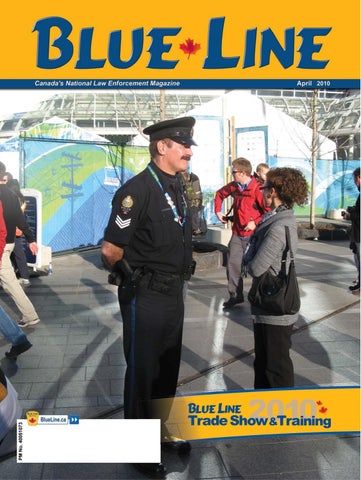
The Vancouver Olympics not only showed the world the best in Canadian athletes but also Canadian hospitality through the many and varied police officers in attendance. The cover picture, taken by Blue Line’s west coast correspondent Elvin Klassen, features Sgt. Pat Severyn, a 28 year member of the Nelson Police Department. Pat was stationed at the Main Media Centre and was an excellent ambassador for the Olympics and his Department. The picture opposite shows members from Durham Regional Police, Montréal Police, Québec Provincial Police, BC Sheriffs Department and RCMP. They assisted many people and spoke many languages. In this issue Vancouver Chief Jim Chu passes along a special message of gratitude. See Page 6
Features 6
18
The pride and the challenge Never has so much been owed to so many
Tiered policing Not if, but how
8
Patrolling the downtown east side
24
Blue Line Trade Show 2010 Guide
13
Annual report is “very interesting”
34
Steel town no longer “steal town”
Departments
Case Law
46 16 33 45, 31 44 5 20
40
Blue Links Ad Index Deep Blue Dispatches Letters Market Place Publisher’s Commentary Technology
BLUE BLUE LINE LINE MAGAZINE MAGAZINE
33
Evidence excluded because officer didn’t know the law
APRIL 2010 2010
APRIL 2010
4
BLUE LINE MAGAZINE
PUBLISHER’S COMMENTARY by Morley Lymburner
Taking a sober, deep look at Canadian policing We have heard very little about the progress of changes to the RCMP recommended by the Brown Task Force since its report was released more than two years ago. In fact, getting RCMP HQ people to even call us back with good news has been a challenge in my office. So much so that for the past year we have had to dig up our own good news about the Mounties from our own sources. That is why I was pleased to see Thin Bruised Line, a new book by Doug Clark, if only to stir things up. It has been just over a year since the release of Paul Palango’s controversial book, Dispersing the Fog. Clark’s book has a lot of similarities to it and yet differs considerably in its approach. The former tackles the towers of power and the latter gets into the gritty grunt work challenges of grass-roots police work. Palango concludes his book by pining the loss of investigative journalists and the art of investigative journalism. I was pleased to find that Clark is not only an award winning investigative journalist but also a teacher, published author and former emergency services worker. With this in mind, I commenced reviewing his book with enthusiasm. The Thin Bruised Line, unlike Palango’s book, places the entire field of policing in Canada under a microscope and dispenses as much as possible with the crystal ball. The book reveals it is not only the RCMP that needs a sober second look. The broad scope of Clark’s research unceremoniously places all police services in Canada on notice that it is time to re-think everything about how the job is done, who does it, who pays for it and who should and should not control it. Clark hasn’t as much revealed stunning insights as much as held a mirror up to show us a condensed version of the blemishes which need correcting. The nine chapters cover a wide range of topics, including women in policing, First Nations policing, organized crime, recruitment, the media, racial profiling and the new
BLUE LINE MAGAZINE
populist styles of police management. Much of the content analyses media and inquiry reports, underscored by extensive quotes from Canada’s most influential police moguls. A good number of interviews are included with retired senior officers from many police agency backgrounds, and much of what they said enlightened me. One small section in the introduction caused me to pause and I feel it is worth repeating. Much has changed in policing because much has changed in Canadian society and the police are expected to reflect our diversity and our values – particularly the impact of the Canadian Charter of Rights and Freedoms on a country founded on “Peace, Order and Good Government” and the rise of human rights tribunals where the accused seem to be presumed
5
guilty until proven innocent. The “enlightened” response to rename police forces as “services” does little to demonstrate progress or enlightenment and nothing to enhance officer and public safety. In an era of mission statements, slick slogans and organizational values, the police role risks falling from the mandate of catching bad guys to the doomed bid to be all things to all people. The reality for police today is that any problem – criminal, social, financial, political and even some health issues – left unresolved by agencies created and funded to address them, will be dumped in the police’s lap and they will be told: “Fix this.” Yet when they do – as they almost always do, if only to slap a band-aid on the symptom of a larger problem not of their creation (police can always get a person to a shelter but they can’t cure homelessness) – there is scant praise or recognition for a job well done. The police must simply suck it up and resume their frantic call-to-call duties patrolling our city streets and rural roads. But if the police seem to be struggling to redefine their identity, was it stolen or crippled in a self-inflicted wound? And what does the answer to that question mean to the men and women on the front lines? The thin blue line has become a thin bruised line... grayed, frayed and stretched to the breaking point. It is obvious that the RCMP will require a considerable overhaul to make it in the new millennium but Clark’s book also points out that the rest of Canadian policing can not be too smug about how it goes about its business. Here is a book worthy of the attention of all police officers and anyone interested in what Canadian policing is – and what it should be.
APRIL 2010
The pride and the challenge Never has so much been owed to so many
by Paul Patterson ‘Olympic effort’ is an over-worked cliche that seldom reflects the true nature of an endeavour, but no phrase is more apt to describe policing the 2010 Olympic Winter Games. The Integrated Security Unit (ISU) swelled to some 10,000 police and military members, with an operating budget of about $900 million. Some 120 police agencies and military units from across Canada flowed into Vancouver to ensure the safety of athletes and the public. RCMP members from detachments across the country made up the bulk of the police presence, along with officers from Montréal, Toronto, Edmonton, Calgary, Newfoundland, Charlottetown and many other agencies, including just about every municipal force in British Columbia. Thousands of officers were housed in three cruise ships docked in the city’s harbour. ISU members were responsible for protecting the athletes, VIPs and attendees within the sporting venues and taking care of security issues surrounding the games. The Vancouver Police Department (VPD) was responsible for policing the “urban domain,” which proved to be a daunting challenge that stretched the resources of every sworn and civilian member. Imagine that the Super Bowl is being held in your city and your force must keep everyone APRIL 2010
safe. Then imagine the equivalent of three Super Bowls every day and you get an idea of the crowds in downtown Vancouver. An average 200,000 people a day partied from morning until late into the night on all the main downtown streets. The vast majority were good natured, cheerful and cheering in a display of patriotic fervour seldom seen in our country. On occasion spontaneous street hockey games would break out in the middle of a crowd chanting “Go Canada Go.” At “centre ice,” a Vancouver Police officer dropped the puck – but there were also challenges that tested the restraint and professionalism of officers. 6
While the world marvelled at the spectacle of the opening ceremonies, outside the arena a crowd of about 2,000 protestors surged towards the stadium. A thin blue line of 100 VPD officers, backed by a contingent of RCMP, stood face to face with the protestors. It would prove to be a defining moment in the history of the Vancouver games. For hours the members stood their ground, their arms interlocked as protestors spit on them, threw sticks and other missiles and attempted to goad officers into a violent reaction. The resolve of the members never wavered. In the face of relentless provocation they refused to budge or over react. Observers marvelled at their restraint and dedication, which drew praise from every circle – even from among the protestors themselves. Shena Meadowcroft, a 53-year-old Gabriola Island writer and artist, went to Vancouver to protest homelessness and Olympics-related violations of civil rights. She joined the protest crowd and found herself pinned against the police line as agitators in the group surged forward. “I wish that I could personally thank each and every one of the police officers who showed the utmost concern to my well-being that night,” she wrote in an e-mail. “Your officers were continuously insulted and spat upon, screamed at. At no time did I see any of them respond with anything but BLUE LINE MAGAZINE
civility and politeness. What I can say is that no one deserves the continual berating and harassment, obscenities and personal attacks that these men were subject to that night. “When I read about or watched the “violent police arrests” the following day I shake my head at the stupidity of the reporters who haven’t a clue about what really goes on out there. Personally, if I am at another protest or rally that these little shits attend I will be ripping off their balaclavas and exposing them myself and doing whatever I can to stop their violence. “To all the officers who were on the left hand corner of the protest facing BC Place: I don’t know who you are, but you do. Thank you is simply not enough to show you my gratitude, respect and above all, admiration. May you all remain safe in these times. I have never been surrounded by so many ladies and gentlemen in my life.” The next day the protestors who failed to achieve the reaction they wanted from police stepped up the violence by smashing
BLUE LINE MAGAZINE
windows, vandalizing vehicles and intimidating anyone who objected. Chief Constable Jim Chu told the international media that while the VPD respected everyone’s right to protest, that did not include the right to commit crimes. He identified a criminal element within the protest groups and promised that there would be arrests. Seven were arrested that day and three more in the following days, including the ring leader. As subsequent protests remained peaceful the VPD focus shifted to the safety of the hundreds of thousands of revellers. Public drunkenness threatened that safety. Liquor pours were in the thousands. The VPD took the unprecedented step of asking for an early closure of downtown liquor stores on some evenings. This made an immediate and dramatic difference in the public consumption of liquor. One hundred additional police offers were deployed in the downtown perimeter to intercept drunks and illegally possessed liquor before they
7
reached the celebration zones. The first night’s extra policing complement was bolstered by officers from nearby police agencies and RCMP detachments. On subsequent nights they were assisted by re-deployed ISU resources. These measures contributed to the maintenance of a fun and happy environment for all. Vancouver 2010 will be remembered not for violent clashes with police but for the images of hundreds of thousands of happy, cheering people taking part in one of the greatest shows of Canadian patriotism this country has ever seen. The VPD thanks all peace officers for their dedication and resourcefulness under trying circumstances. You have shown the world what Canadian hospitality and professionalism is all about. Paul Patterson is the Senior Director Public Affairs with the Vancouver Police Department. He may be reached by email to paul.patterson@vpd.ca
APRIL 2010
by Ron Bedard The early morning air is wet and humid. There’s a slow buzz in Vancouver’s Downtown East Side (DTES) as drug dealers take their favorite positions in alleys. Their customers, the shells of once human beings, reemerge from trances and near over doses and venture out from doorways and government housing, their shelter from the dampness. DTES beat cops begin their morning parade, updating information from the previous nights activities before setting out on the foot patrols which provide a semblance of civility in this “civilized” city. A new day has begun but the morning ritual never changes. Once a working middle class neighbourhood where children played and went to afternoon movies and families shopped at department
APRIL 2010
stores which have all but disappeared, the DTES has changed drastically over the past 25 years. Shawn Shipper and Ken Smith keep a sharp eye out for the sideways glances of drug dealers avoiding direct eye contact or the quick U-turn of someone with something to hide as they walk the streets. Shipper recalls how he and his friends “would come down here, cash bottles and go see movies” when he was 10 years old; that was 20 years ago, and is not something you are likely to see today. Shipper, aka Miami (because of the red hair he shares with David Caruso from CSI Miami) and his partner both see these streets as a place where their contribution is felt immediately and directly by the people who struggle for survival. The job is “being part of the community, getting to know people, getting trusted and helping out,” says Shipper. “Maintain the peace, apprehend offenders and be positive contributors.” Shipper did several “walk-alongs” with the Vancouver Police Department (VPD) in
8
his younger days and assisted as a gaffer or gopher on the police documentary Through the blue lens. He moved to Japan shortly after, learned another language and, after some life experience, decided to become a police officer. His goal was to be a part of something bigger than himself. Smith was born in Canada but moved to the US at age five when his father was transferred. After university, he worked as a registered nurse in hospital emergency wards for 10 years. Discouraged and frustrated with the commercialized US healthcare system and missing his family, he returned to Canada. He initially worked as a RN but decided he could have a greater influence on the community as a police officer. We turn the corner into one of the areas numerous infamous alleys, well remembered by many a tourist who made a right instead of a left while visiting Gastown. Ahead of us are 20 to 30 people milling around large garbage bins, hiding in the recesses of buildings and using
BLUE LINE MAGAZINE
Pre-Registr Closes Apri ation l 23rd
April 27 & 28, 9am - 4pm
Pre-registration & Info at BlueLine.ca
Proud Sponsors
Drug Investigation Techniques
April 27, Fee:$250 +GST
This course is designed to assist young officers or veteran officers in transfers or promotion to a drug enforcement unit through the development of appropriate skill sets that relate to drug investigation. The course includes information on: • Interception of private communications and acquiring an intercept order • Undercover techniques • Managing and initiating undercover drug operations • Search warrant acquisition • Interception of private communications and acquiring an intercept order • Drug surveillance techniques • Close quarters combat for undercover officers Instructor: Det. Steve Walton (retired).
The Non-Accusatory Interview Technique
April 27, Fee:$250 +GST
This topic is designed for all police officers as well as private investigators and security people involved in interviewing suspects and/or victims. Learn the basics of: • Conducting an investigative interview in a conversational setting with the emphasis on obtaining important information. • How to establish a “free-flowing” interchange between the subject and the interviewer. • How to plan and enter into an interview and get the subject talking and keep them talking. • Current legal status of investigative interviews and how far you can pursue the truth in a legal manner. Instructor: S/Sgt Gordon MacKinnon (retired).
Detecting and Defusing Deception
April 28, Fee:$250 +GST
This topic is of interest to all police officers as well as private investigators and security people involved in interviewing suspects and/or victims. In this course you will learn: • How deceptive subjects act? • What they say and how they say it? • What they do when faced with certain probing or bait questions? • We will also cover some of the latest findings in this field and dispel some of the myths about lying. Instructor: A/Sgt Wayne van der Laan (retired).
BLUE LINE MAGAZINE
9
APRIL 2010
the shadows as sanctuary. The smell of urine and decay is the neighbourhood potpourri and the writings and graffiti of tortured minds plaster the area. The mob slowly moves out of our way as we advance, presumably into the light of day. I look back and see the slow moving people shuffling back into place behind us, seeking refuge from the morning light. The alley seems emptier now than when there was no one there. A fellow who looks to be in his 50s rides up on a BMX bike which is too small for his frail frame. He sports a worn and chipped ski helmet and timidly shows us his swollen and bruised cheek and a once white eyeball that’s now red from a ruptured blood clot. He was hit with a rock, presumably to teach him a lesson. We head over to the heart of the neighbourhood, known as Carnegie Centre, which is celebrating its 30th year as a community centre. We are met with hard, vacant stares from the people sitting on the steps of this historic building. One man fidgets with excitement, anticipating the $40 he will receive for a two foot length of copper electrical wire at his feet. Behind him, a fellow leaning against the building quickly glances away when we look in his direction, inviting further attention. A quick question about the day’s dealings soon produces a box of tic tacs, used as a vending container for $10 crack rocks, and a pill bottle which contains black miniature plastic balls filled with powdered cocaine. As we walk to the station, Shipper and Smith build their rapport with the fellow, empathizing with his plight and the spiral of
APRIL 2010
addetion that will likely lead to his death. He agrees that the damage to the area and its residents is profound. The main dealers provide just enough product and payment to keep street dealers hooked. The city’s programs enable an endless supply of addicted customers and street dealers who cycle through the justice system with no break in the supply chain. Back on the street after hours of paperwork, we talk with a couple who is proud their child has been placed in a good foster home. The future they see is not for them but maybe
10
for their child. Shipper and Smith speak with and check in on residents throughout the day, looking for the predatory drug dealers that feed on these weakened beings. “There are still poorer working class people here,” notes Shipper, “but their survival is at the whim of the city’s drug policies. The more (clean) needles you have, the more dirty needles. The more drug addicts and programs to enable drug users, the more drug dealers you have and ultimately, more drug violence. This is the aftermath.” In front of the government funded Insite facility, a man has just injected publicly funded slow death and is entering his own makebelieve world. Obsessed by a metal chain, he fidgets and caresses it with unrelenting violent jerky motions as the drug floods his nervous system. The lobby of the facility is filled with “clients” waiting to shoot up. The chaos and noise is similar to that of an airport check-in counter after passengers have been told their flight is cancelled. A feeding frenzy of desperation and rage fills the air. The scene outside Insite is no better. It’s like some deranged factory where people rush in, only to emerge less than human and oblivious to the world; the urine they sit in or the oozing wounds which cover their bodies are like a rite of passage in this neighbouyrhood. Vancouver’s harm reduction programs are gaining popularity in other areas as emissaries tout their benefits. The humanitarian yardstick measures the benefits in dollars and cents through reduced healthcare costs, removal of unsightly addicts shooting up on the streets, free drug paraphernalia and providing a safe environment to inject drugs bought with government handouts. From the street viewpoint, this allows addicts an additional supply of the tools needed to maximize the benefits of the mental escape narcotics, complimented by what the street already offers. In business terms, this market seems to be saturated by product suppliers and the city is funding an economic initiative to provide more potential customers, thereby increasing demand. “Its all drugs, it’s the life blood of this neighbourhood,” says Shipper. “Instead of demanding more treatment facilities, harm reductionists champion the replacement of heroin with BLUE LINE MAGAZINE
Pre-Registra tion Closes April 23rd
April 27 & 28, 9am - 4pm
Pre-registration & Info at BlueLine.ca
Proud Sponsors
Mastering Media Opportunities
April 28, Fee:$250 +GST
Mastering Media Opportunities, Traditional and 2.0, is an introduction to the principles and practice of media relations in the world of ever expanding conventional and new media public affairs. It will help you understand how to fine tune your audiences and craft key messages for broadcast media, print and web 2.0 (blogs, new media and the Internet). You will get the opportunity to create messages for a topic of your choosing and practice using them in an interview that will be recorded and debriefed. Instructor: Allan Joyner
Cell Phone Forensics
April 27, Fee:$250 +GST
Mobile Forensics Inc, the leader in mobile phone training brings a one day course that will introduce you to legal issues, service providers and current methodologies utilized in cell phone forensics. This course will prepare you to realize the need for cellular evidence from the carrier and device and learn the steps necessary to secure this valuable evidence. The course will also cover tools that are currently used for both physical and logical examinations with actual live extractions during the presentation. Topics include: • Court Paperwork • Radio Isolation: First Responders and Examiners • Troubleshooting Instructor: Bruce Downey
• Software Tools • Hardware Tools • Completed Reporting
Instructor: Lee Reiber
FREE admission, with course registration, to the Blue Line Trade Show. Canada’s largest law enforcement exhibition of the latest products and in demand services. Course location offers FREE parking, easy access to several major highways, a wide range of hotels, restaurants and amenities. See website for deatils and pre-registration (until April 23rd). 11 APRIL 2010 www.blueline.ca/tradeshow
BLUE LINE MAGAZINE
methadone, a substitution of one life sucking poison with another… addicts routinely talk of having to use heroin to get off of methadone. “Insite, in many ways, was like a bulldozer that took down the rickety dam that was preventing the Downtown East Side from being overwhelmed by the drug world.” The stories of survival and devastated faces of days, months or years of drug use are everywhere. On the edge of a city park we speak with several users. One woman looks at a tattered glamour magazine while a girl in her teens, a recent DTES arrival, looks at us, and the camera in my hands, with suspicion. Day turns to night and the police radio crackles with calls for assistance. There’s a
APRIL 2010
stabbing in a local bar, domestic violence at a government funded housing project and someone has broken into a car. All are commonplace events in this several block neighbourhood. How can the utter hopelessness and devastation of this neighbourhood not become an overwhelming force of its own, I ask Shipper. “We are part of the community,” he answers, “and we care very deeply for the people and are looking for ways to help them. “We want to see them get help, get into detox. We wish the city would get behind that, but instead they are pouring millions into keeping these people enslaved.” No one argues that foot patrols provide a more personal interaction with the commu-
12
nity, and neighbourhoods such as the DTES demand individual attention. The personal reward is measured in the smallest of successes. Shipper mentions a few instances when someone tells him the respect he shows helped convince them to get into detox and begin choosing a different path. Shipper and Smith attribute the success solely to individual willpower but its clear the respect they show in their daily interactions helps addicts to feel worthy and begin thinking about turning their life around. Ron Bedard is a freelance photo journalist based in Vancouver. He may be reached by email to ronbedard66@ yahoo.com
BLUE LINE MAGAZINE
Annual report is “
very entertaining
”
by Rebecca Wellman It’s easy to conjure up images of graphs and statistics, dry content and facts, numbers and point form accomplishments when you think of an annual report. While you may get a shiny publication with ever-improving photography and graphics, it is still, generally, a stapled book of a year gone by and, if we’re honest, often gets casually perused, then remains somewhat unread. The Victoria Police Department set a goal of delivering something different. With more emphasis on visual interest and technology these days, the VicPD’s 2008 annual report was timely in its delivery – providing an interactive, light and informative online publication which caught the attention of peer departments, creative and technical gurus and the public alike. “Very entertaining and made me want to stay on the site to read more!” a Victoria City councilor commented. That was part of the goal. The growing trend of captivating web sites, Facebook presence and Twitter updates by police departments and other government agencies has prompted more organizations to use online tools to share news and promote recruiting and initiatives. Often the focus in today’s media scramble, police are subject to constant public scrutiny and opinion. Fair game, sure, but VicPD thought it important to change the perception of police, providing an alternative to the para-military persona stereotype. It wanted to remind the public that police are human, working in high risk jobs and dealing with high risk offenders. “It’s lovely. I think you were captured particularly well,” commented a public relations executive at the Vancouver Police Department, reflecting a common thread in the feedback received from other agencies. The basis of the report is to show the faces of the VicPD. Real staff tell real stories, complete with video introductions by the actual officers and civilian staff who took part in a specific incident. Staff involvement doesn’t stop there. The photography, writing and programming was all done by civilian staff. “This raises morale (and) instills a sense of pride,” says Hervey Simard, the backbone behind the project. “We are lucky to have such talent within the department.” It goes without saying that the budget for the project also benefits from such expertise. Other benefits of the project as laid out are purely technical. There is no way of knowing how many people view a paper report. We can imagine and hope folks sit at their breakfast tables reading with rapture, but nothing can compare to web analytics, which show daily visits to the report, how long they stayed (indicating, hopefully, a good read of the content) where they exited from and if they came back. The delivery also provides readers with a segue to the main VicPD site. Reaction to the new format has been generally good but not all feedback was positive; public affairs staff knew they were taking a BLUE LINE MAGAZINE
risk. Some found the lighthearted opening, with Chief Jamie Graham walking down the street into the building, too casual and cartoonish. They found the whistling in the elevator almost dismissive, as though the chief was bored and disinterested. As we all know, you can’t please all of the people all of the time. The creative brains behind the project will take this criticism constructively, using it to improve next year’s report. I’m sure by now you’re dying to see what the fuss is all about. Visit www.vicpd.ca and follow the link to the 2008 annual report – and be prepared for a humorous and lighthearted delivery of the year’s accomplishments. While that is a main objective, it is important to point out that the facts are still there.
13
The crime stats for 2008, for example, or how many priority calls for service were handled – they’re just... bouncier. “You got my attention big time,” commented a mainland police chief. “Wow, I love it! How did you do this? You amaze me… talk about putting me in my place and ‘back to zero.’ I’ve got to tell you – it takes a lot to impress me – and you sure did that. Can you help me get close to your level of greatness?” Hmm. No pressure, I’m sure. It seems the bar has been raised. It will be interesting to see what the VicPD comes up with next. Contact VicPD web/media analyst Hervey Simard at vi50675@vicpd.ca or 250 995-7423 for more information.
APRIL 2010
Justice on target
Ontario’s strategy for faster, focused criminal justice by Debra Whittall Ontario police are playing an important role in an innovative, province-wide strategy to make the criminal justice system faster and more effective. The Justice on Target strategy (JOT) has been introduced at dozens of court sites to date. In the coming months, police and other justice participants will identify and implement local solutions to address delays at every criminal court. The OPP is working along side municipal police services in some sites. “We will all benefit from a process that brings justice partners together to talk about common issues, identify challenges and develop solutions,” says Dep/Comm Chris Lewis, who is on the JOT steering committee and is committed to finding solutions. “There has been some great work to date in identifying initiatives to move criminal cases through the system more quickly,” he adds. “The “pay off” for the OPP will hopefully be more time available for our officers to be on the highways and in our communities.” Criminal court statistics have been posted on the Ministry of the Attorney General web site (http://www.attorneygeneral.jus.gov.
APRIL 2010
Ontario Attorney General Chris Bentley explains new justice initiative to a community focus group In Waterloo, Ontario.
on.ca/english) so that everyone can follow the progress of the program and see its impact on courthouses in their communities. The JOT goal is a 30 per cent reduction in the number of appearances and days needed to complete a criminal case by June 2012. “When we achieve our target it will mean that we will be dealing with half a million fewer court appearances every year,” notes Ontario Attorney General Chris Bentley. “That means there will be half a million fewer court appearances for everyone involved.” The police chief of Ontario’s largest city
14
agrees. “We want a justice system that is efficient and accessible,” says Toronto Police Service Chief William Blair. “Reducing the number of court appearances means everyone – the police, the victim and the accused – will not experience delays with having their day in court.” As many police officers have known for years, some straightforward cases can spend as much time in the court system and take as much time as the most serious, complex cases. Less serious cases can inevitably take up as much of an officer’s time as more serious cases. The goal of JOT is to reduce the administrative burden on all justice participants, including police, to ensure that resources are devoted to the cases that need them the most. “Finding new approaches to the way we move cases through the justice system benefits everyone, including police,” said Daniel Parkinson, president of the OACP and a member of an expert advisory panel to the JOT implementation team. Parkinson is one of eight experts representing all aspects of criminal justice in Ontario. The panel includes Ontario’s commissioner of community safety and former OACP president Ian Davidson. In addition to police, judges, justices of the peace, Crown attorneys, defence counsel, corrections and court staff, Legal Aid Ontario and other organizations – everyone involved in the justice system – participate in JOT. In the first phase of the strategy, representatives at three “action sites” began working together to identify challenges and solutions to criminal court delay. Local leadership teams were formed to ensure that every group was represented and that the initiative remained “ground-up” rather than “boardroom-out.” “This process helped us foster the change that we all recognize is necessary,” says York Regional Police Supt. Bill Faulkner. “This area is growing so fast, we just can’t continue with business the way we have done for the past 25 years. In the past, with smaller caseloads, it worked. It wasn’t working anymore and this was something that all of us realized before JOT walked in the door.” BLUE LINE MAGAZINE
Faulkner is a member of the local leadership team in Newmarket and says while police have always had good relationships with other justice participants, there was a recognition that more could be done. It was necessary for different groups to work together to change the system. JOT, he points out, allowed the communication and negotiation to happen while everyone, particularly the judiciary, remained impartial and autonomous. The result is that police and other justice participants in the three initial sites were able to identify some common initiatives to help move cases through the system faster. The details differ from site to site, reflecting the fact that these initiatives were designed by local participants to suit local needs. Police working out of all three sites have been instrumental in identifying these initiatives, including a faster and more streamlined disclosure process. The new approach includes an initial and much-reduced disclosure package earlier in the process to allow the opportunity for earlier screening. A second, more detailed disclosure would be made if a decision is made to go to trial. This “two-step,” streamlined disclosure process ensures that all justice participants, including Crown, defence counsel and accused, get the information they need earlier in the process. Quality assurance resides with the police. Signing off on disclosure sooner usually means the investigating officer doesn’t have to be involved again until, or if, a decision is made to call the case to trial. “JOT acted as a catalyst,” says London Police Service Dep/Chief and local leadership team member Ian Peer. “We all know the process ought to work so much better and through Justice on Target, everyone has come to the table and identified ways to ensure the disclosure process works better for everyone.” Peer points out the initiative needs to be monitored to ensure its success and the collaboration with justice partners needs to continue. He adds, “You’re dealing with a group of ‘independent practitioners’ in the justice system, who have to figure out how we all fit into the system in order to make sure it works effectively.” More and more sites are becoming actively engaged, including two of Ontario’s busiest, Toronto’s Old City Hall court and Brampton. Each court receives between 30,000 and 45,000 charges every year. Initiatives identified through the JOT strategy are not aimed at influencing the decisions of any justice participants, but rather focus on getting to the decision point faster and ensuring that resources are available for the cases that need them most. It is this spirit of cooperation that sets the strategy apart from other initiatives to improve the justice system. JOT is not a study. It is a sustained effort by all participants to reduce delay in the criminal justice system.
Headquarters staff pitch in to help Haitian relief A generous donation is reflected by a generously sized cheque. The Canadian Red Cross recently received $10,595 from the Ontario Provincial Police Headqarters staff in Orillia desitined for the Haiti Earthquake Relief Fund. Shown above (Left to right) are: Superintendent Mal Chivers (Bureau Commander of Fleet Supply and Weapons Support Bureau), Brian Cowan (Manager of Fleet Services), Sandra Carter (Bureau Administrator), Nancy Wagg (Manager of Finance/Admin.), Linda Manovich (Bureau Reception), Bonnie Keayes (Bureau Administrator), Retired Sergeant Peter McGuinness (Canadian Red Cross) and Kerry Woodward (Canadian Red Cross).
Debra Whittall is with the communications branch at the Ontario Ministry of the Attorney General. Contact her at Debra.Whittall@ontario.ca for more information.
BLUE LINE MAGAZINE
15
APRIL 2010
DEEP BLUE by Dorothy Cotton
What we’ve got here is failure to function executively It was one of those overcast days when you feel like lying in bed forever listening to the pitter-patter of the rain on the roof. I was in that state of semi-sleep limbo – not quite awake and not quite asleep, feeling like I might be dreaming, except that I seemed to have some control over what I was dreaming. I rolled over, nearly strangling myself in the covers and reflected to myself... I am such a moron. It was a weekend and I should not have been working that day but I had somehow committed to speaking to a community group. This would not have been a huge problem had I not also committed to playing in a concert at the same time (I play in various orchestras in my spare time). Sometimes I am organizationally challenged. Generally, I’m not too bad at keeping track of what I am supposed to be doing. I don’t think you want to hire me to be your EA, but most of the time I manage to be in the right place at the right time. However, there are moments…. Sometimes I get in trouble because I simply forget to write things down. Someone calls and asks “weren’t you supposed to pick up that file from me this afternoon?” This is an error of sloppiness on my part.
APRIL 2010
Sometimes I write things in my day planner and simply forget to look at it. This is an error of carelessness. Other times I write it down. Later someone asks me to do something else at the same time and I write that down too. This is where it gets scary. I know I have two things I am supposed to do at the same time – or two places I am supposed to be – and I don’t see that there is a problem. Luckily I am a psychologist so I can come up with fancy names for common every day human occurrences. So rather than deciding I was a moron, I decided to reframe: I was having a failure of executive function, which is, by and
16
large, what the front part (frontal lobes) of the brain do; that’s the part up there behind your eyes and in front of your ears. Aside from being responsible for holding your hair in place (should you actually have hair), the frontal lobes are kind of like senior management in an organization. No one knows exactly what they do and they often seem to be doing nothing of any consequence. They are not involved in the real “product line” of an organization. If you work in a widget factory, for example, you will never see them actually having anything to do with making a widget. If you are in a hospital, they will not be treating the patients. If you work in a police organization, they are not running around doing frontline police work. It is often a mystery what managers do, locked away in offices hiding behind enormous piles of paper, but we do know that if you do not have any management folks, then things do not run well. You might get away with not having them for short periods, but eventually someone has to figure out what to do and not do, set priorities and decide when things will get done, who will do them, how they will get paid for, what to do when there is a disagreement…. In the brain, the frontal lobes have that job and make us different from other animals. They plan, organize, keep track of stuff, start and stop activities, anticipate the consequences of our actions, control impulses, perceive the effect we have on others – all that “management” sort of stuff. They don’t really “do” anything in the same way senior management doesn’t really “do” anything, but they oversee all the processes. I suspect that by now you are wondering why I am writing about this and what on earth it has to do with policing. A lot actually – and it also has a lot to do with criminal behaviour. To make a long story short, it tends to be really helpful if police people have good frontal lobes. Mind you, we actually have no way of knowing how good or bad they are in a person. They might be missing altogether (as mine apparently are) and we would have no way of knowing unless someone’s forehead caved in or something, but we can assess executive function through behaviour. In an occupation like policing, there is often very little structure in the day and many competing demands. Good officers need to be able to manage their time well – and that means constant planning and organizing. They need to juggle a number of activities at once, set priorities and inhibit responses (while we acknowledge there are times when you might want to bop a person you’re dealing with, one is generally encouraged to refrain from actually doing so). Officers need to anticipate the consequences of their actions – in other words, think more than five minutes down the road. They also need to exercise judgment. It is all well and good to be able to drive a car backwards at 100kph, but you also have to be able to figure out whether or BLUE LINE MAGAZINE
not it is a good idea to actually DO that. As you might guess, a lot of our clientele are not so good at these tasks. We have all been dumbfounded by a crime which seems so poorly thought out and ill conceived that we can only wonder what the offender was thinking. We all know repeat offenders who do not really seem like bad people and who genuinely seem to want to stay out of trouble – but just don’t seem to be able to exercise the judgment or control to NOT offend when the opportunity arises. Sometimes these characteristics appear in people who are simply not very intelligent – but not always. Sometimes they are people with significant impulse control problems or who are unable to foresee the likely outcomes of their actions. In any case, I need to work on my scheduling. I know this is not my strong suit. I am a little weak in this area of executive function. I also have a little difficulty inhibiting verbal responses – another aspect of executive function. ‘Difficulty inhibiting verbal responses’ is also known as ‘shooting off one’s mouth.’ I don’t think I am likely to suddenly acquire an inherent ability in this area. As is the case with most personal strengths and weaknesses, you have to play the hand you are dealt, so I am not likely to change me, but I can learn to work around me. It probably means I would make a lousy police officer. I think we knew that already. Dr. Dorothy Cotton is Blue Line’s psychology columnist, she can be reached at deepblue@blueline.ca
BLUE LINE MAGAZINE
Calling all aspiring drug officers by Steve Walton When I took command of the DUST 40s (Drug Undercover Street Team) in the mid 1990s, I had an initial meeting with the group and told them what I expected of them. My expectations included that they know how to cultivate and manage confidential human sources, properly craft and acquire search warrants and co-exist in a team environment. I would have the same expectations today for any officer aspiring to succeed in a drug enforcement unit. To compliment those skills, a successful drug investigator has to understand the process associated in lawfully intercepting private communications, including where this authority comes from, and how this most intrusive of police investigative tactics contributes to a drug file. Other skills and techniques I will discuss at the Blue Line Trade Show will include:
17
• Managing undercover drug operations (team composition and roles); • Drug surveillance techniques (loss versus burn, team composition, expectations); • How to conduct effective and well managed drug investigations; and • Close quarters combat for undercover drug officers (survival in a hostile environment). Steve Walton is the instructor for the course Drug Investigation Techniques at the Blue Line Trade Show & Training, in April 2010. Visit www.blueline.ca for registration and info.
APRIL 2010
Tiered policing Not a question of “if,” but “how” by Robert Lunney The time to formally embrace tiered policing in Canada is overdue. At every level of full service policing – federal, provincial and municipal – the single tier system is challenged by complexity, increasing demands for higher levels of performance and new rules for accountability. At the same time, escalating police costs are challenging government’s ability to pay, squeezing out other valued services. Budgets for education, social programs, recreation and transportation are all affected. Reduced or limited services in these areas have a corrosive impact on quality of life, inevitably contributing to an increase in crime and disorder. This represents an ethical dilemma for police leaders. Should the police insist on maintaining the conventional model of doing business, or is it responsible to propose options? Tiered policing is one such alternative, splitting off repetitive tasks, administrative duties and regulatory law enforcement from general duty policing to a second tier for cost efficiency. Policing is not the only profession to confront this challenge. Nursing long ago adapted to a tiered service delivery system and paralegals now carry out routine tasks formerly the work of lawyers. It is doubtful that the current monopoly of full service policing can continue to resist rationalization.
College of Continuing Education
Despite these examples, there remains no standard accepted framework for tiered policing.
Defining tiered policing Tiered policing is a framework of roles and rules distinguishing levels of police and regulatory responsibilities. For example, the RCMP is the primary federal law enforcement agency but there are other bodies managing specified roles; the Canada Border Services Agency, National Park Wardens and the railway police are well recognized. Most provinces have created special purpose organizations – sheriffs services, for instance – to provide court security and prisoner escort. At the county and municipal level, peace officers perform specified regulatory enforcement.
Certificate in Police Leadership
Courses in this unique distance education program for police include: t "EWBODFE 1PMJDF -FBEFSTIJQ t #VEHFUJOH BOE 'JOBODJBM .BOBHFNFOU for Police Services t $PNNVOJDBUJPO 4LJMMT GPS 1PMJDF 1FSTPOOFM t &UIJDT GPS 1PMJDF -FBEFST t -FHBM *TTVFT JO 1PMJDJOH t .BOBHJOH 1PMJDF 1FSGPSNBODF $PBDIJOH 4LJMMT for Police Supervisors (workshop) t 1PMJDF -FBEFSTIJQ BOE .BOBHFNFOU %FWFMPQNFOU t 1PMJDJOH BOE UIF -BX PG )VNBO 3JHIUT t 1PMJDJOH UIF .PEFSO $PNNVOJUZ t 4USBUFHJD )VNBO 3FTPVSDF .BOBHFNFOU GPS Police Organizations t 4USBUFHJD 1PMJDJOH
Managing Police Performance: Coaching Skills for Police Supervisors workshop: Halifax, NS May 7-9, 2010
“I found this workshop [Managing Performance: Coaching Skills] to be extremely relevant in managing the workforce as it exists today.” S/Sgt. Phil Spencer, #$ 4IFSJGG 4FSWJDFT
The next term will begin on August 31.
Prepare for your promotional opportunity today! If you would like more information or wish to have a brochure mailed to you please contact the Program Manager, Sherry Carmont, at (902) 494-6930. You may also write to Sherry via e-mail at CPL@Dal.Ca or to the address at right. Detailed information and registration forms can also be found on our website at www.dal.ca/cce.
APRIL 2010
Dalhousie University College of Continuing Education 1535 Dresden Row, Suite 201 Halifax, NS B3J 3T1
18
The UK experience The most extensive tiered policing arrangement is in the UK, which recently added 16,000 Police Community Support Officers (PCSO’s) in high visibility uniforms to the streets of London and other towns and cities. Introduced by the Police Reform Act of 2002, these second tier officers are assigned to selective roles carrying out non-confrontational duties. They provide reassurance through police presence while dealing with anti-social behaviour, low-level crime and other minor incidents. Their pro-active role is public engagement and problem solving on quality of life issues, including support for victims and vulnerable people. PCSO’s also perform limited traffic duties and assist in crowd control. If you visited the UK in recent years, you may have noticed that they have replaced the traditional British bobby on city sidewalks. The system is not without its critics. A recent survey by the UK Home Office found that much of the populace feel PCSO’s lack sufficient powers, are ineffective and in some ways represent ‘policing on the cheap.’ Police authorities reject this appraisal as neither accurate nor fair, but indicative of a perceived lack of clarity around the role. The UK system also promotes a system of neighbourhood wardens, who may be either publicly or privately funded. The wardens are similar to the Ambassador programs sponsored by business improvement associations in Canadian cities, a service most recently the subject of controversy in Vancouver. There are also situations where private agencies are contracted to work in the public domain. The combination of tiered services in the UK is often referred to as ‘the extended police family.’ Canadian experience Past experience with tiered policing in Canada is mixed. A sheriff service created in the 1980s to carry out traffic enforcement in New Brunswick did not survive a change of government. The RCMP special constables that once policed Canada’s federal airports were subsumed into the regular ranks. Ports Canada Police was dissolved in 1997. Recognition of the need for an effective framework of tiered policing at the provincial and municipal level has been slow in developing, although the CACP drew attention to the challenge with a panel on multi-tiered policing at its Vancouver conference in 2007. President Jack Ewatski called for less ambiguity and complacency around the question of community safety and rallied the membership to clarify the questions of: Who does what; under what authority; within what limitations; using what tools and techniques; and with what resources and towards what specific goals? BLUE LINE MAGAZINE
Alberta framework While all provinces are supporting some form of tiered law enforcement, the strategy is uniquely advanced in Alberta which, following study and consultation, adopted the Peace Officer Act in 2007. It created two categories: Alberta Peace Officers (APO) and Community Peace Officers (CPO). Each category has two levels and the peace officer appointment falls within the scope of Section 2 of the Criminal Code. APO Level 1 includes appointees of the Alberta Sheriffs Service with the authority to enforce specific provisions of federal and provincial statues. This includes enforcing traffic violations on Alberta highways, transporting prisoners and court security and offering protective services for provincial officials. There are surveillance support teams and fugitive apprehension teams, which support provincial and municipal police, in Calgary and Edmonton. Within the scope of Level 2, APOs employed by the provincial and federal governments may also conduct a range of duties, including fraud, fish and wildlife investigations and other compliance requirements for provincial statutes There are approximately 700 sheriffs, including more than 100 on traffic duties, and about 400 on security operations. Level 1 Alberta Government Peace Officers/Federal Peace Officers carry firearms. In a few instances, Level 2 officers may also be armed via an enactment other than the Peace Officer Act. Alberta municipalities and counties may employ Level 1 CPOs for a wide range of roles, including enforcing provincial statutes. They
BLUE LINE MAGAZINE
enforce moving violations under the Traffic Safety Act and elements of the Gaming and Liquor Act. Examples of this category are county and municipal patrol services and public transit and security officers in some post-secondary educational institutions. The county or municipality can also task Level 1 CPOs with the authority to respond to non-urgent community calls and investigate notin-progress offences under the Criminal Code, specifically theft and mischief not exceeding $5,000. They may also be authorized to detain, arrest and release and investigate and submit reports involving non-injury motor vehicle collisions. A Level 1 officer may be armed with a baton and/or OC spray but no CPOs carry firearms. About 300 of the approximately 3,000 CPOs are Level 1 and perform patrol duties for counties or municipalities. The remainder are Level 2 and fulfill a range of inside duties requiring peace officer authority. Roles and rules While more complex functionally than it first appears, the Alberta framework is an advanced approach to multi-tiered policing and rests on a solid platform of past experience with county and municipal enforcement services. Many of the past failures with tiered policing are attributable to a lack of sound and sustainable political strategy, clearly defined roles of demarcation between the tiers and the absence of strictly enforced rules. Without effective roles and rules tiered policing systems lack cohesion and co-ordination and confusion, conflict and mission creep is inevitable. The onus is on government to provide for
19
effective oversight and inspection and unwavering political leadership at provincial, county and municipal level. Internal success factors include steady and experienced local leadership and a collaborative and mutually respectful attitude towards partner organizations. The aspirational goals established in Alberta are instructive: The system must be co-ordinated and seamlessly integrated; closely connected to the community; roles and responsibilities must be clarified and assigned for efficiency and effectiveness; collaboration between the tiers is a requirement and there must be minimum competency and training standards. The problem with aspirational goals is that they are not specific, measurable and timed. Public surveys will reveal whether people feel better served by the tiered policing system and cost comparisons will answer the question of relative efficiency. Not if but how Now is the time to answer the challenge posed by the CACP. Tiered policing is no longer a question of if but how. The UK experience is helpful, particularly in its belated recognition of the need for standardizing powers. The Alberta framework remains a work in progress. There is as yet no indication of its impact on citizen satisfaction and cost control, but it provides a marker for others to study while constructing a model to suit their own unique needs. Robert Lunney is the former chief of the Edmonton and Peel Regional police services. He may be contacted at lunney@blueline.ca
APRIL 2010
TECHNOLOGY by Tom Rataj
Rugged cell phones
The incredible affordability of cellular phones has entrenched them in the lives of almost everyone, including most emergency services personnel. Many carry them so that they can stay in touch with family and friends while away from home on their varied shifts. Their phones often do double-duty by also filling-in as an additional business communications tool, effectively covering gaps in even the most extensive corporate voice and data networks. The ability to make local toll-free business calls using star (*) numbers, whether to the station or other places, make them a virtually free tool that helps to get the job done. Many agencies issue cell phones to select personnel such as mobile supervisors or higher ranking personnel because they are such powerful and effective tools. Unfortunately the vast majority of cell
phones, particularly those available for free or next to nothing when combined with multi-year plans, are really just cheaply built plastic toys that won’t survive even the slightest bit of rough handling. I’m sure we all know someone whose personal phone has paid the ultimate price in the line of duty. Many emergency services personnel carry their personal phone in a prominent and easy to reach place on their uniforms, making it very vulnerable to damage during even the slightest altercation or situation. Fortunately, phone manufacturers do produce a number of rugged phones designed to withstand a wide variety of tough conditions and mishaps. Many meet portions of the US military standard (Mil-Std) 810F, which requires equipment to continue functioning despite rough handling and other severe service conditions.
Mil-Std All the cell phones reviewed here meet a number of the individual conditions listed in Mil-Std 810F and are subjected to laboratory tests designed to replicate the effects of the environment on them. The standard includes tests for low pressure (altitude), exposure to very high and low temperatures both in operation and in storage, rain (both driven and freezing), humidity, fungus, salt-fog (for resistance to corrosion), dust and sand exposure, explosive atmospheres, leakage, acceleration (G-forces) and a variety of shocks (physically dropped or bumped and vibration from gunfire and other random sources). There is quite a bit of latitude in how manufacturers conduct their standard compliance testing so even though they claim to meet 810F, the product may not necessarily meet all the specifications of the standard. It is fair to fair that any phone advertised as meeting some of the standards is much more rugged than a regular consumer-grade phone. Telus Telus currently offers three rugged models from Motorola, all featuring the MIKE Direct Connect push-to-talk technology that allows them to function as two-way radios. The Brute i680 looks sturdy and feels solid. It’s a flip-type phone with a rubberized exterior skin that makes it easier to hold on to and provides some extra cushioning in the event of an unplanned tumble. Despite its ruggedness, it still has most of the usual consumer features, including a 2.0 megapixel camera, GPS, stereo Bluetooth wireless and integrated music player software, speaker phone, Internet browsing and texting.
APRIL 2010
20
BLUE LINE MAGAZINE
It can be set to a silent vibration mode for incoming calls and texts, which is important for tactical operations. The Brute has a reasonable 175 minutes of talk-time and 79 hours of standby time and retails for $230 when purchased with a three year plan. Telus also offers the smaller, more lightly featured and less expensive Mike i580 rugged phone, which has a similar feature-set. For those needing more text-intensive communications, the QWERTY keyboard Mike Clutch i465 resembles many full-keyboard equipped smart phones but also meets several mil-std standards. Bell Currently Bell offers only one rugged phone, the Sanyo PRO-700, which is a ruggedized version of the smaller and cheaper, consumer oriented PRO-200. It meets mil-std standards for dust, shock and vibration and is packed with the usual consumer features, including Bluetooth, voicedialling, text-messaging, GPS and Internet connectivity over Bell’s EVDO network. Interestingly, it does not feature a camera. This phone also offers Bell’s 10-4 walkietalkie service, which is similar to Telus’s MIKE network. A group of up to five users can talk to and from anywhere in Canada at the push of a button without incurring long distance charges. This service costs $15 per month for unlimited usage or $1 a day for
BLUE LINE MAGAZINE
unlimited single-day usage. The PRO-700 comes in a standard all-black design but is also available in two-tone yellow and black and costs $150 on a three year plan. Rogers Rogers also offers three rugged phones. The Motorola VA76R is advertised as the first HSPA (Roger’s latest high-speed cellular communications technology on its GSM network) capable rugged phone. It is a large, handsomely sturdy looking flip-phone design with a small antenna stump and includes a 2.0 megapixel camera, texting, Internet access, music player and the like. It’s rated at four hours (240 minutes) talk-time and 14-days of standby time. Interestingly this phone uses the Research In Motion Blackberry operating system and comes standard with 50MB of data storage, which is expandable to 4GB with a microSD card. It is priced at $200 on a three year plan. Rogers also offers the ZTE Rock F165 “job-site ready” rugged phone, which has a larger, single piece “candy-bar” design. The body is an attractive modern black and silver design which includes an extendable antenna that can be pulled out of its stump and is advertised to greatly improve reception, especially in rural areas. This phone is designed to withstand dust, shock, vibration, solar radiation, altitude and extreme temperatures and includes the usual features such as a 2.0 megapixel camera with 3x
21
digital zoom and internal memory expandable to 2GB. It costs just $20 on a three year plan. Rogers’ third phone is the Samsung Rugby, a medium-sized rugged flip-phone built to meet 810F standards for resistance to shock, vibration, rain, humidity, solar radiation altitude and extremely high and low temperatures. The Rugby is a nicely designed, basic consumer style phone and includes a 1.3 megapixel camera (with video capability), stereo Bluetooth wireless, basic music and picture management tools, a web-browser, GPS and 131MB built-in memory expandable up to 8GB. It is also mobile TV capable and features an FM radio and a large speaker for the speaker-phone capability. Battery life is rated at up to five hours talk-time and up to 300 hours standby time. It operates on Roger’s latest generation 3G HSPA network for fast downloads and data access and comes in either all-black or in a two-tone black and yellow design for $130 on a three year contract. Conclusion Purchasing a regular consumer-grade cell phone for emergency service use makes little sense, especially when all three major cell phone companies offer reasonably priced rugged models. Tom Rataj is Blue Line’s Technology columnist and can be reached at technews@blueline.ca .
APRIL 2010
A chief for all ages by Eileen Argyris One of Ontario’s longest-serving police chiefs, Ron Hoath, 66, retired at the end of September, capping off a career spanning close to four decades, including 23 years at the helm of the Port Hope Police Service. Hoath has had a variety of jobs in policing since first pinning on the badge in 1969 and highly recommends that kind of versatile career to today’s recruit. “Don’t be afraid to take different assignments,” he advises. “You can try it for a while and transfer out if you don’t like it.” Born and raised in Owen Sound, Hoath was attracted to electronics and policing at an early age. He enrolled in the Radio College of Canada in 1963 and learned to repair, build and operate electronic equipment, but policing’s appeal remained strong. At 21, while still in college, he applied to the OPP, thinking that his education would make him a natural as an radio operator – “but an RCMP officer talked me out of it,” he recalls. “He advised me to stay in school, so I did.” After 12 months in college the OPP sent him an “invitation.” With the recruiter’s advice still fresh in his mind, he turned it down, opting instead for a job with McPhar Geophysics in Toronto. He worked in the “rope test”
APRIL 2010
division, testing products that would be used on ski-tows, mines and most notably, on the lunar landing module during the first manned flight to the moon. In that job, he travelled all over North America. “That’s when I got the travelling bug,” he says. “It was a good job for a single guy.” Of course, it’s possible to get too much of a good thing. “I’d wake up in the morning and have to look at the phone book to remember where I was,” he notes, and after four years
22
“sick and tired of travelling,” Hoath saw an ad for the OPP auxiliary. “I took the training and I really liked it. I got to go out with the officers on patrol,” he recalls. He decided to change careers and go to police college, graduated in March 1968, got married the same year and then joined Metro Toronto police. From the beginning, he loved the lack of routine in police work. “I like to be outside, doing things, be where the action is,” says the chief who, to the end of his career, was always willing to strap on a gun and do prisoner escorts or help out whenever there was a need. “Once you’re out on the road, anything can happen. That appealed to me.” He recalls walking the beat in the years before cell phones, when officers would be issued two dimes at the start of each shift so they could call in. “Toronto’s 53 Division was at the centre of the city. Every day you would run into a huge variety of things. There was such a crosssection of people, from the folks up in Forest Hill to the winos who hung around liquor stores and subway stations.” He got to use a police car for one hour a day while the more experienced officers who usually drove it took a lunch break. He recalls the Yugoslavian consulate, at the corner of Spadina and Montclair, as a hot spot. “Croat (activists) blew the place up a couple of times,” he remembers. “It had to be guarded 24/7 in all kinds of weather and was used as a punishment detail.” He made sergeant in 1975, shortly after attaining a new rank in his personal life: father. He and wife Pat became parents to Mark in 1973 and Keri in 1974. That was around the time he transferred to 33 Division in Don Mills. In those days, famous Canadian horse breeder E. P. Taylor had his Winfield Farm at York Mills and Leslie. Hoath was on uniformed patrol in criminal investigations from 1975-78 and then assigned to community services and traffic safety, crime prevention and community relations. “From ‘78-’81, I sat on a lot of committees. I got to meet a lot of interesting people, especially in the Jamaican Canadian Association. It was a very positive thing for me because it gave me a different perspective,” he says. “You can get pretty pigeon-holed as a cop when all you see are criminals. I think that experience opened up my mind and prepared me to be a chief.” A transfer to traffic in 1981 – “if you want to get promoted, accept transfers,” he advises – offered an eye-opening experience. “We always thought traffic cops got all the juicy calls,” he remembers. Working with them, he “found they were totally dedicated, the hardest working group I was ever with. They’d go to all the traffic fatalities, all across North York; I saw a lot of death.” Back then, before they were mandatory, “a lot of people didn’t use seat belts and a lot of BLUE LINE MAGAZINE
them went through the windshields.” Hoath recalls paid-duty assignments such as guarding celebrities like former prime minister Pierre Trudeau and the Osmond Brothers. When the Osmonds visited the former CHUM radio station, he remembers, crazed fans ripped his shirt and “my hat was long gone.” Speaking of radio, he also did a brief on-air stint as a disc jockey for country radio station CHOO, where he would always try to fit in a special requests from his kids for Glen Campbell’s Rhinestone Cowboy. “At the time, police officers weren’t allowed to work at extra jobs, but everybody did,” he notes. He left policing for a year in the early ‘80s to work for Rotesco, which tests steel wire ropes. “It looked like a good business opportunity,” he explains, “but then the recession hit and I went back to policing.” A small town police service advertising for a chief drew him back into law enforcement. Harriston, north of Listowel, ON, was looking for someone to head its force, which had four full-time and two part time officers. “When I went to Harriston, there were 154 police agencies in the province; now there are fewer than 60.” He spent three years in the farm country, “working alone a lot of the time... I was responsible for the administration, as well as working shifts.” As chief, he became a member of the OACP, which offered great contacts and useful information. Upon retirement, he was awarded a life membership. He took over as Port Hope’s chief in 1986 and found a hotbed of activity in the picturesque
BLUE LINE MAGAZINE
town about 100 km. east of Toronto. A suspect in a series of rapes of elderly women was still at large and a bitter strike raged at Westinghouse (nuclear). Radioactive pellets were found scattered on a public thoroughfare. Workers at the town’s other nuclear industry, Eldorado, had also walked out and police were frequently required to keep order on the picket lines. Hoath was glad for his experience in community and media relations with Toronto police but recalls thinking, “what have I got myself into?” However, it quickly became apparent that these things were anomalies in an otherwise quiet community. During his years in Port Hope, Hoath turned another interest into a vocation. “I always thought it would be fun to drive a bus,” he says, noting that the “travelling bug” he had as a young man never really died. On weekends and during vacations Hoath would take off for destinations all over Canada and the US, driving tour coaches, meeting all kinds of people and having a great time. He once drove Jean Chrétien when the former PM was leader of the opposition. Basically, he says, the job combined the fun of a vacation with the benefit of a salary. He continued ‘on the buses’ until 2007. Hoath points with pride to several initiatives that served the community well. Marketing police screening services was a good idea to begin with, he says, but after the events of Sept. 11, 2001, security became paramount in all kinds of organizations and that end of the service really took off. “We (in Port Hope) were so far ahead of
23
the rest of the country on that one,” he reflects. “Two years ago, we made over a million dollars just doing screening checks.” Even after other services jumped on the bandwagon, Port Hope still had an edge by virtue of being first and by offering a very fast turnaround while protecting an individual’s rights. Port Hope has also led the way in developing domestic violence protocols, formulated in concert with police, the Crown attorney’s office, Children’s Aid and Northumberland Services for Women. The protocols are designed with three priorities in mind: protecting children and other victims, ensuring perpetrators are properly dealt with and making sure victims have a safe place to go. “It became a model for others across the province,” Hoath states with pride. Divorced since 1991, Hoath looks forward to sharing his retirement years with fiancée Jeanne Nielsen. The couple plan to wed this year and visit children and grandchildren in their motorhome, spending the winter in warm spots, “moving north with the birds” next spring. By summer, they’ll be sailing on Rice Lake, north of Port Hope. “I’ve always loved my work and I’m looking on retirement as another adventure,” Hoath says with a smile. Then, serious again, he adds, “I would strongly recommend policing as a career with a terrific future for the person with the right qualifications and personality.” Eileen Argyris is the former editor of the Northumberland Today newspaper and currently a communications officer for the Municipality of Port Hope.
APRIL 2010
Proud Sponsors
EXHIBITORS • 3M Canada • 3M Window Film Solutions • ABLE • Aero Supplies Safety Products • Ahearn and Soper • Automotive Technology Group • Blackhawk Products Group • Blue Line Magazine Inc. • Brother International Corp.(Canada) Ltd • Canadian Centre for Unmanned Vehicle Systems (CCUVS) • Canadian Outdoor Distributing • CanCom Radio Accessories
WIN!
• Canon • Carswell, a Thomson Reuters business • Colt Canada • CTOMS • DAVTech Analytical Services • Ensil Canada Ltd. • Forensics by Diana • Genesis Enterprise • Group W Inc./DCM Technical Services • Heartsafe EMS • Henry’s • Integrys Limited • iRes Technology Corp
• International Police Association • JbWand • Justice Institute of British Columbia • M D Charlton Co Ltd • Marketeks • Matte Ind. • Mobile Forensics Inc./MFI Canada • MSA Canada • Native Women’s Association of Canada • Niagara Univsersity • ONGIA • OPP UAV • Panasonic Canada Inc.
• Philips Speech Processing • Pitney Bowes • Police Ordnance Co Ltd. • PTLights Inc. • R Nicholls Distributors Inc • Stoeger Canada • Streamlight/Danner • Union Springs Pharmaceuticals • Whelen Canada • Whitmore & Hobbs • Woolpower Thermal Wear • Work Authority
Visit the Blue Line booth to enter our annual draw to WIN fantastic prizes from Canon, Aero Supplies Safety Products, Henry’s Commercial Sales Department, Police Ordnance Company, MD Charlton, Matte Industries, and CTOMS!
CANADA’S PREMIERE LAW ENFORCEMENT EVENT • APRIL 27 & 28, 2010 9AM - 4PM LeParc Conference Centre, 8432 Leslie St, Markham, ON APRIL 2010
24 PRE-REGISTER AT BLUELINE.CA OR 905•640•3048
BLUE LINE MAGAZINE
3M Canada Company Booth 106 Has Your Health and Safety Needs Covered. When you have a job to do, the least of your worries should be your personal safety. Put your mind at ease when you protect yourself with 3M safety products. Not only will you find a vast range of effective occupational health and safety products for eye protection, hearing protection, active communications, respiratory protection, fall protection and welding protection to provide the utmost in quality that meets and exceeds the most stringent safety requirements. 3M backs all product lines with qualified and knowledgeable local experts from the field. No matter the application, you’ll find what you need because 3M is Health & Safety.
3M Window Film Solutions Booth 106 3M invented window film in 1966 and continues to provide the broadest range of technologies in the market. The 3M warranty, which in most cases covers film, removal and replacement labour, provides peace of mind and is second to none in the industry. Films include Sun Control (solar), Safety & Security, Architectural and Graphic. Our highly trained sales reps will provide solutions that will help you save energy, increase comfort, protect people/property, mitigate blast, enhance your image, or create privacy. Our national network of certified 3M dealer/applicators allows us to provide central billing and co-ordinate true multi-location installations. www.windowfilmcanada.ca
Association of Black Law Enforcers Booth 107 ABLE is a non-profit organization founded in 1992 by a group of law enforcement professionals who wanted to make a difference in the community. Our primary objectives: • To build bridges between Law Enforcement agencies and the community; • Support post secondary education and provide scholarship opportunities to deserving youth; • Actively participate in community programs working with young people; • Increase awareness of the justice system &; • To be an advocate for black and other visible minorities within our Canadian mosaic. Our future is our youth and we must strive to provide them with an equitable opportunity to attain safety and success.
Aero Supplies Booth 207 Aero Supplies Safety Products is a family owned company located in Mississauga and provides a variety of eye protection, safety gloves, hand cleaners and collapsible traffic cones, handheld directional flashlights emergency portable light towers and fire extinguishers to meet your needs. We would most definitely be an asset to you in regards to stock, and customer service. Our sales staff welcomes the opportunity to quote on any items you may be looking
BLUE LINE MAGAZINE
for See what Aero Supplies Inc for. Inc. can do for you you. Please see our website www.aerosafetyproducts.com 2010 Sponsor
Ahearn & Soper Booth 104
For complete photo ID & access control solutions, Ahearn & Soper Inc. provides powerful and reliable card printers to personalize and encode your own identification and security cards. Our card printers print cards faster and have high-definition print quality, while guaranteeing a low cost per card. We can print high resolution texts, colour logos, pictures, signatures and barcodes in a few seconds. Ahearn & Soper Inc. is a 125-year old company providing high-tech solutions to industries and agencies across Canada. We are proud to be making ID cards for Blue Line Trade Show attendees. Ensure that your law employees are wearing Canada’s bestdressed cards - Ahearn & Soper is your turnkey solution provider for the best card printing on the market.
Automotive Technology Group Booth 201
investing in mobile printing since they may cost effectively complement other automation and mobility processes. Come and visit us to find out how mobile printing solutions can help your business.
Canadian Centre for Unmanned Vehicle Systems Booth 203 The Canadian Centre for Unmanned Vehicle Systems (CCUVS) is a federally registered not for profit company, whose purpose is to facilitate sustained, profitable growth in the Canadian unmanned vehicles systems sector. CCUVS is governed by a Board of Directors, drawn from across Canada, representing Academia, Industry and Government. CCUVS’ services include: unmanned systems standards work, influencing research, technology solutions development, expanded learning and skills, running the Unmanned Systems Training Centre, provision of facilities (such as access to test ranges and UAS launcher services), publishing studies, consultancy, promoting civil and commercial use of unmanned systems and stimulating Canadian economic growth. www.ccuvs.com
Automotive Technology Group (ATG) services many corporations across North America in the automotive electronics sector in a cost effective / professional manner. ATG specializes in Police, Fire, EMS, Armoured & Municipal vehicle outfitting. Our services include: project consultation, manufacturing, engineering, installation, fleet communication, navigation, man-down-technologies, fleet deployment, vehicle procurement / sales, vehicle emergency lighting & equipment, GPS / tracking systems, vehicle armoring, vehicle maintenance / service, live video & mobile DVR’s / CCTV, mobile computing, custom controllers and integration. ATG is a team of dedicated professionals committed to undertaking your challenges and providing effective solutions on budget and on time.
Canadian Outdoor Distributing is the Canadian distributor of Swarovski Optik products. Based in Austria, Swarovski is a world leader in the manufacture of high quality riflescopes, binoculars and spotting scopes. Austrian designed and manufactured utilizing the highest quality of glass and proprietary coatings to ensure maximum peripheral focus and lifelike colour reproduction. Accessories make it very simple to observe or photograph distant images in the greatest detail. Swarovski optical products are utilized and trusted by many government, military, and police agencies throughout the world. www.canodi.ca
Blackhawk Products Booth 206
CanCom Radio Accessories Booth 605
Blackhawk Products Group has been providing cutting edge tactical gear to the law enforcement and military market since 1993. In 2008 Blackhawk launched their Warrior Wear Apparel line to meet the clothing needs of operators across the spectrum. Included in Blackhawks clothing offering are several innovative models of tactical pants and shirts, polo shirts, multi-layer jackets, socks, gloves, balaclavas and boots. In Canada, Blackhawk has partnered with M.D. Charlton Co. Ltd. and their dealers to distribute the Warrior Wear apparel line. For information on Warrior Wear in Canada or for a list of dealers near you please contact M.D. Charlton Co. Ltd. at (877)993-9968 or (905)625-9846.
We are your single source supplier for all of your safety, communications and radio accessory product requirements. Our vast offering of products includes two-way radios, speaker microphones, earpieces, headsets, helmet kits, vehicle intercom systems, wireless solutions, cables, adapters and batteries. Our offering of personal protective equipment includes eye, ear, head, face and hand protection, as well as specialty clothing. By representing and distributing a wide range of the world’s leading brands we are able to specialize in offering product solutions to a wide range of professionals and distinct clients including military, law enforcement, surveillance/security, SWAT, fire departments, HAZMAT, aviation, motorsports, hospitality, entertainment, construction and industrial.
Brother International Corp. Booth 205 Brother’s mobile workforce solutions can be used for just about any workforce’s mobile printing needs. In a struggling economy, companies are constantly looking for ways to cut costs, particularly in the realm of operational expenses. Because of this, more companies are discovering that Brother mobile printing solutions are an ideal option and they are 25
Canadian Outdoor Distributing Booth 501
Canon Canada Booth 108 Canon Canada Inc. was established in 1973 with headquarters in Mississauga, Ontario to sell and promote its line of camera and optical products. Today Canon Canada is a highly respected Canadian market leader in business and consumer imaging APRIL 2010
equipment and information systems. The extensive Canon product line includes full-colour and black and white copiers, networked office systems, facsimile machines, image filing and micrographics systems; small office and home office products such as personal copiers, faxphones, bubble jet and multifunction printers; cameras and lenses including a full range of digital, 35mm SLR, and APS formats; 8mm, Hi8 and digital camcorders; binoculars; calculators; and broadcast lenses and equipment.
Colt Canada Booth 305
LyteFlar is a safe and highly effective night time re-placement for ordinary road flares. Flashing for 400 hours without a battery change, replacing 700 incendiary flares, the VestLyte, designed to be worn or used as a protective marker system for personnel, equipment and traffic control, is capable of continuous operation for up to 1 week on one set of AA batteries. Come visit Ensil for a product demonstration.
Forensics by Diana Booth E4
Colt Canada is the strategic source of supply for small arms to the Canadian government, and supplies small arms systems to roughly half of our NATO allies, including Netherlands, Denmark and the UK. Colt Canada now offers military specification equipment and services directly to Canadian law enforcement agencies. Products and services includes sniper systems, tactical weapons, patrol rifles, 40 mm launchers, pistols, less lethal solutions, optics, accessories, armourer’s tools, engineering, service and repair, armourer and tactical rifle training, safety equipment and technical publications. Colt Canada’s catalogue and course schedule can be found on the web at www.coltcanada.com
Diana P. Trepkov is a Certified Forensic Artist specializing in facial reconstructions, postmortems, composites, age progressions, disguise drawings and surveillance video sketching. Trepkov has been involved in 101 law enforcement cases throughout Canada and the USA and is the only Certified Forensic Artist in Canada through the International Association of Identification, one of 26 internationally. Trepkov has helped to solve three high profile cases in the States; the Melinda Harder (Murdered in 1980) case, the Tawni Mazzone (99-0305) case and the Victor Ortiz (99-1297) case in the year 2008. Forensic Art is an essential tool for bank robberies, age progressions, attempt abductions, postmortems and unidentified skulls because Everyone Deserves to Be Identified.
CTOMS Booth E3
Genesis Booth 607
CTOMS’ goal is to provide the highest, unmatched quality of training and equipment in high threat environment casualty management for law enforcement officers. Our training is tailored specifically to the end user, be it patrol or tactical officer or tactical paramedic, and is based on the concepts of tactical combat casualty care incorporating our exclusive training methodology of a Human Performance in Combat Casualty Care. Our training teaches very realistic and practical trauma self-aid and buddy aid when an active threat still exists. Our equipment meets the demands of catastrophic injuries. We provide a comprehensive suite of training and equipment to increase officer survival in worst case scenarios. www.ctoms.ca
At Genesis we understand that your life may one day depend on the gear you use, that’s why we bring to you the brightest LED technology from the most dependable manufacturers incorporated with our innovative features. The highest lumen tactical torches are GENESIS – At the forefront of LED technology.
DavTech Analytical Services Booth 306 & 307 DavTech Analytical Services (Canada) Inc. has become a leader in traffic safety products and solutions in Canada. This is maintained by continually providing reliable, cost effective products that consistently outperform and outlast others similar in design. Our product specialty line includes radar, lidar, traffic analysis equipment, alcohol breath test Instruments (evidential, roadside & workplace testing), drugs of abuse Testing and related forensic devices. DavTech is an authorized sales and service depot for Intoximeters, Guth Labs, Decatur Electronics, Laser Atlanta, Medtox and Tri-Tech Forensics to name a few. Have a look at our new website at www.davtech.ca for more information.
Ensil Canada Ltd Booth 504 Ensil introduces the NEW Vestlyte and LyteFlare to law enforcement agencies across Canada. APRIL 2010
Group W Booth 505 Group W Inc is a company that is involved in the research and development of lighting and applications of light used in forensics and testing application. We continue to design and manufacture cost effective forensic lighting. We also have designed technology for measuring bullet trajectories, which have greatly improved forensic documentation of shooting scenes. DCM Technical Services is a collision reconstruction and forensic measurement firm with a specialization in photogrammetry. Being a PhotoModeler Authorized Service Firm and official contracted provider of PhotoModeler training, DCM Technical Services can help you with all of your photogrammetric and forensic measurement needs.
Heartsafe EMS Booth 503 Heartsafe EMS Inc. has been an industry leader in first aid training and heart defibrillator sales since 1995. We are a federally and provincially approved workplace provider of first aid, CPR and AED training, in accordance with the Ontario WSIB Regulation 1101, HRSDC Labour Program and The Heart and Stroke Foundation of Canada. Our instructors who teach you how to perform first aid and use a heart defibrillator are very experienced. They’re paramedics and fire fighters—real-life professional, 26
rescuers and heroes. Our company is an Authorized National Distributor for Philips Health Care. Philips is the leader in defibrillation technology.
Henry’s Booth 302 Henry’s has long been known in the Canadian photographic industry as the source for the latest products coupled with the most knowledgeable staff, superior customer service and competitive pricing. Henry’s is a family owned and operated business that opened its doors in 1909 and has evolved into Canada’s largest independent photographic and digital retailer. Our commercial sales department offers convenient payment by purchase order, credit card and direct billing. Take advantage of fast, convenient shipping anywhere in Canada. Use www. henrys.com as your online catalogue and call us for preferred pricing on select items at 1-800-461-7960.
Integrys Booth 102 Since 1960, the ACA group of companies has combined Canadian technical expertise and premier products from around the world for the benefit of Canadian markets. Integrys’ long history in electronic vision systems, embedded computing, and communications technology, make us a one-stop solution centre. We bring that expertise to the law enforcement and security community through our many partnerships in the sector. Integrys partners with Vigilant Video to bring the most advanced infra-red License Plate Recognition (LPR) systems to Canadian law enforcement agencies. We also feature Perceptics’ visible spectrum LPR solutions for border and perimeter security applications, the unique Under Vehicle Inspection Systems (UVIS), and RedSpeed International’s Red Light and Speed Infraction systems, along with the communications and infrastructure to make them all work together in your environment. We deliver complete solutions.
International Police Assoc. Booth 308 The International Police Association (IPA) is one of the most unique and interesting social organizations in the world. This fraternal organization is dedicated, “to unite in service and friendship all active and retired members of the law enforcement service throughout the world.” The IPA strives to enhance the image of the police in its member countries, and to facilitate international co-operation through friendly contacts between police officers of all continents. Membership now exceeds 300,000 officers in over 58 countries and is steadily rising. Membership is open to any serving or former police officer meeting the requirements as set out in the Canadian Section Constitution.
iRes Technology Corp. Booth 304 iRes Technology Corp. is the manufacturer of uCorder – a miniature wearable video recorder. uCorder is the most portable, effective and economical tool for officers / guards in capturing evidence. At just 3.5” high, 1” wide and 0.5” thick, it clips right on to your clothing and allows you to record
BLUE LINE MAGAZINE
your activities hands-free at the touch of a single button. Wear it, Watch it. Store up to 7 hours of footage on a single unit. iRes also offers a CCTV lineup of video surveillance camera systems. Law Enforcement professionals save 20%.
JbWand Booth W1 This multifunctional, interchangeable, rechargeable, super bright LED traffic light wand with long lasting power per charge was conscientiously developed with safety in mind for the front line law enforcement officer. JbWand’s newly issued patented design is waterproof and manufactured using strong polycarbonate plastic enabling the JbWand to withstand high impact and tolerate the rigours of various environmental elements backed by years of reliability and service. Unlike many other rechargeable products, our battery packs are replaceable and 100% recyclable. The only light you will need for your shift. See and be seen! One shift, one light, JbWand.
The Justice Institute of British Columbia Booth W1 A public post-secondary institution, the JIBC is Canada’s leading public safety and security educator. Visit us at Booth 105 to find out more about our new online Diploma in Emergency and Security Management and our Emergency Management Exercise Design Certificate - now available in Ontario. And we’re Canada’s premier Incident Command System and Emergency Operations Centre trainer – available at your location anywhere, anytime. From our accredited courses to customized programs and exercises, we’ve been training law enforcement, first responder agencies, government agencies and private organizations across Canada for more than 30 years. Contact information: www.jibc.ca/emergency or www.esmdiploma.com 2010 Sponsor
Marketeks Booth 507
At Marketeks, our mission is to bring innovative ideas to market with energy and passion to ensure success. We believe in the products we represent and only work on projects that meet our high standards for excellence. We invent and develop products for clients and ourselves. We design and patent these concepts or produce marketing plans for clients with existing patents or ideas. We also help finance the inventions to bring them to the market. Nothing excites us more than guiding a great idea and having it gain acceptance in the marketplace. www. marketeks.com
Matte Industries Booth 403 & 404 The cartridges of conventional ball point pens are open allowing ink to be fed to the point. The secret behind the Fisher Space Pen lies in the unique design characteristics of the ink and the high precision manufacturing tolerances of the ball point and socket. The ink is fed to the ball point by gas pressure permitting the pen to write in any position. An additional benefit of the closed design is that it keeps
BLUE LINE MAGAZINE
the pen from drying out giving the Fisher Space Pen an estimated 100 year shelf life. Due to its unique design and reputation for writing in extreme conditions the Space Pen has become the pen of choice for law enforcement, military, astronauts, tradesmen, fire-fighters, coast guard and more.
MD Charlton Booth 301 MD Charlton has been providing a wide range of top quality equipment to Canadian law enforcement agencies and security companies for the past 31 years. Featured will be MDC Tactical apparel, Streamlight flashlights, Original SWAT boots, ASP batons and tactical handcuffs and NEW Tunsten lights, Hatch gloves, Hiatt handcuffs, Black Hawk tactical gear and Gould & Goodrich nylon belt accessories. We will also be displaying Laser Devices Inc tactical weapon-mounted lighting systems and Crimson Trace laser grips along with Salient search tools.
Mobile Forensics Inc Booth 604 Is a training and consulting company for law enforcement, corporations and security professionals. MFI is leading the way in training, educating and supporting these groups in the methods of cellular data extraction. Mobile Forensics Inc has been conducting training classes since 2005 and is a leader in the training industry, focusing on a forensic approach to cellphone examinations. MFI has recently partnered with AccessData, a leader in the computer forensics world, to offer mobile phone training around the world. MFI offers both classroom solutions as well as online courses and can be found at www.mobileforensicsinc.com and followed on Twitter at MFITraining.
MSA Booth 402 MSA is a global company engaged in the design, marketing, manufacturing, distribution, sales and servicing of high quality safety and instrument products. Safety has been our sole focus since 1914, when we first protected miners from lethal dangers underground. Our police line of products range from respiratory protection to unmatched ballistic protection. With today’s increasing need for specialized police protection, we have invested even more resources toward our state-of-the-art research and engineering capabilities. Our mission at MSA is to provide high-quality products, instruments and services that protect people’s health and safety throughout the world and fulfills their trust in us.
Native Women’s Assoc. of Can. Booth 502 Over the past five years, the Native Women’s Association of Canada (NWAC) has been leading the way in research, education and awareness relating to the disturbingly high numbers of missing and murdered Aboriginal women and girls in Canada. With a comprehensive understanding of the experience and trends of violence and victimization against Aboriginal women and girls, NWAC has been working with various levels of police and justice officials 27
to educate and provide training related to working with Aboriginal women. A representative from the NWAC’s Sisters In Spirit initiative will be available to discuss Professional Development Training opportunities regarding issues of violence against Aboriginal women and girls and community policing, specifically developed for police executives, as well as new recruits. This is a unique opportunity to learn more about these issues from experts in this field, and is becoming an essential course for any officer responsible for the safety and protection of communities that include Aboriginal peoples.
Niagara University Booth 602 Niagara University combines a uniquely qualified faculty and a diverse student body to provide an interesting and relevant program. Courses are offered with an international perspective, as a number of our students work in Canada. Classes integrate management and administration techniques, analytical and communication skills, decision-making abilities and professional ethics. Students’ powers of discrimination and judgment are enhanced, enabling them to function effectively in any organizational environment upon graduation. Graduates know how to anticipate, address and correct problems faced in the criminal justice professions in an efficient, effective and ethical manner.
Ontario Gang Investigators Assoc. Booth 506 ONGIA is a non-profit organization committed to addressing the street gang phenomenon, and consists of law enforcement professionals and members of the criminal justice community throughout Ontario, Canada and North America. ONGIA encourages its members to network with their community to better educate everyone about gang prevention, education and suppression. ONGIA is committed to educating youth, parents, school officials, social workers and the community on gang related issues. The Ontario Gang Investigators Association works countless volunteer hours to deliver and maintain their training on gang related issues.
OPP UAV Booth 608 The Ontario Provincial Police will display their unmanned aerial vehicle (UAV) systems, currently used in support of the Northwest Region Forensic Units. In October of 2007, the OPP became the first civilian agency of any type in North America, to begin regular operational use of UAV systems in civilian airspace with federal government approval. The initial “fixed wing” prototype was retired and replaced in January of 2009 with the commercially produced “DraganFly X-6,” a lightweight battery powered rotary-craft platform. Used for aerial photography by the Kenora and Thunder Bay Forensic Units, the two operational DraganFly systems are working regularly at homicide, accident and major case scenes with a 3rd, “Aeryon Scout” system, receiving recent federal approval for operations in 2010. Both system are “made in Canada” and continue to demonstrate cost savings over traditional APRIL 2010
methods with every use. Perhaps more importantly, these systems provide the ability to fully explore the full potential of this technology specific to the safety of the public and the officers sworn to protect them.
Panasonic Canada Booth 401 Panasonic Canada Inc. manufactures a full line of rugged and semi-rugged notebook computers. The TOUGHBOOK series is designed to withstand the demanding conditions of mobile professionals. Ruggedized features include a full or partial magnesium case, a shock-mounted hard drive, and sealed keyboards that resist the hazards of dirt, dust and spills. To learn more visit our web site at www. panasonic.ca
Philips Speech Processing Booth 508 Philips Speech Processing has been helping professionals in many industries to become more productive through effective handling of just that… speech processing. The heart of our solution is SpeechExec Enterprise, a powerful dictation software solution based on the experience of over 50 years as an industry leader. Our dedication to quality, reliability and innovation, bolstered by uncompromising user friendliness, has established our devices at the forefront of the speech processing industry. The SpeechMike and the Digital Pocket Memo have become indispensable tools for professionals’ world-wide, increasing productivity on both a personal and organizational level. Most recently our software/hardware solutions have been utilized in the public safety sector with recent installs in a number of police departments and Sheriff’s offices in the US. We look forward to working more closely with this industry as we move forward. 2010 Sponsor
Pitney Bowes Booth 204
Pitney Bowes Business Insight, formerly MapInfo and Group 1 Software, helps law enforcement agencies capitalize on their organization’s IT and data for better strategic planning, tactical analysis and resource deployment. With PBBI technology, law enforcement agencies can better plan strategy by easily identifying crime hotspots, calculating drive times to emergency services, augmenting crime data with economic, transportation and other information and gaining the big picture of the impact of location on crime. PBBI helps with the delivery of services and resource deployment – making information available to front line officers on the move and reducing response times with up-to-date data availability, for example. PBBI also facilitates the analysis of the effectiveness of strategy for better decision making. www.pbinsight.com
Police Ordnance Company Inc Booth 609 Police Ordnance Company Inc., headquartered in Markham, Ontario is a premier law enforcement distributor and manufacturer serving law enforcement throughout Canada. We maintain our position as the primary dealer of GLOCK with an extensive APRIL 2010
inventory of pistols and parts available for immediate shipping, with full service and support within Canada. We also provide numerous other products including Trijicon, DOCTER and EOTech as well as being the sole owner and manufacturer of the ARWEN Less Lethal System. ARWEN offers a wide variety of less lethal tactical and crowd control solutions and is used world-wide by law enforcement professionals. Please consult our web site for further details. www.PoliceOrdnance.com
PT Lights Booth 103 Here at PTLights Inc., we engineered one-ofa-kind safety devices providing greater safety for both the police and traffic. Our products revolve around battery-powered portable traffic light system, making them easy to operate and transport. In one instance, the presiding officer places the portable traffic light in the intersection and from a safe distant away, remotely controls traffic. In another instance, the device can alternatively be used as a traffic director. We also offer a traffic director for highways. Our products feature LEDs and excellent visibility. www.ptlights.com
R. Nicholls Distributors Inc. Booth 208 After 30 years, R. Nicholls Distributors is the largest Canadian distributor for some of the most advanced law enforcement products from Canada and around the world. Whether it is firearms, ammunition, traffic products, uniforms / clothing items, tactical gear, night vision products or body armour – we have the experience, knowledge and training required to help you make an informed choice. Call for a sales representative in your region: 888-4429215 www.rnicholls.com
Sterlmar Booth E5 We’re a proven, quality, distributor, installer and service provider. Our goal is to provide you with the best and widest range of products that the market offers: Whelen, Setina, Pro-Gard, Jotto-Desk, Federal Signal, Streamlight, Patriot Products and more. We can custom design and install equipment packages for your fleet vehicles. Serving central and eastern Canada and beyond with experienced factory trained professionals with fire and police backgrounds. Knowing the equipment helps us understand your needs. We have expanded our Canadian Command Vehicle division and offer custom designed and built command units for Police, Fire and EMS. www.sterlmar.ca
Stoeger Canada/Beretta Booth 603 Founded in 1977, Stoeger Canada is the Beretta owned Canadian importer and distributor for the full line of the Beretta group of company product lines for Canada. Beretta is the oldest firearms manufacturer in the world, dating back to 1526. Beretta offers dedicated solutions able to meet the stringent requirements of today’s armed and police forces worldwide, with a catalogue of products with a reputation for reliability and 28
excellence. The Beretta group of companies include: BERETTA: pistols, carbines, assault rifles, grenade launchers. BENELLI: tactical shotguns. SAKO and TIKKA: precision sniper and tactical rifles. FRANCHI: unique shotguns. STOEGER: affordable shotguns and pistols. BURRIS: hi-tech optical systems.
Streamlight/Danner Booth 303 Streamlight is a “hands-on” company. We learn by doing, so we understand what our customers need because we’re out there doing what they do, using the same lighting tools in the same ways. We take courses in low-light shooting. Many of our law enforcement sales managers are gun collectors, hunters and competitive shooters. We believe it’s our hands-on, real-world experience that leads to new ideas and innovations that set Streamlight apart. Streamlight warrants its products to be free of defect for a lifetime of use. We are craftsmen. We pay attention to details. We understand there may be similar ways to craft a boot but there are not similar standards. And, true to the Danner name, we pride ourselves in crafting the highest standards. Danner became the first boot maker to use GORE-TEX liners. We consider this setting standards, not just meeting them. The only way to ensure the quality of a Danner boot is to ensure the quality of the materials we use. That’s why every hide of leather is graded through a series of six tests which check for strength, flexibility, durability and more.
Thomson Carswell Booth 406 For over 140 years, Carswell, a Thomson Reuters business has been the market leading provider of authoritative information solutions for law, tax, finance, accounting, and human resources professionals. With innovative online, print, and CD-ROM resources, Carswell delivers trusted solutions that help Canadian professionals make better decisions, faster.
Union Springs Pharmaceuticals Booth E1 Union Springs Pharmaceuticals (USP) is pleased to offer MyClyns, the only non-alcohol first response antiseptic you can spray directly into your eyes, ears, nose, mouth, and open wounds. MyClyns contains a fast-acting solution with germ-killing action that is safe to use on all mucous membranes. Independent lab tests show that the solution in MyClyns kills 99.99% of HIV-1, Hepatitis B & C, MRSA and nearly 60 other pathogens. MyClyns is portable and convenient to carry so you have it when you need it. MyClyns allows you to protect yourself immediately after exposure to potentially harmful pathogens. Learn more about MyClyns or find a local distributor at www.myclyns.ca.
Whelen Canada Booth 109 Whelen designs and manufactures state-of-theart visual and audible warning equipment including strobe and halogen lightbars, power supplies, sirens and secondary lighting products.
BLUE LINE MAGAZINE
Whitmore and Hobbs Booth 610
Woolpower Thermal Wear Booth 408
Work Authority Booth 202
Whitmore and Hobbs is involved in procurement and manufacturing of emergency and protective equipment for military, firefighters, police, SAR and corrections. We bring our customers the best equipment available from around the globe and have decades of experience selling to military and emergency responders. Our 45+ dealers serve every province and territory of Canada with our uncomplicated sales philosophy. We source out and manufacture the best products available – then we back it up with the best warranty in the industry. We supply FireIce Fire Gel, FoxFury LED Lights, ShadowShield, Star (Signal) Emergency Vehicle Equipment & VXII Extrication Gloves. www.whitmorehobbs.ca
Woolpower garments are part of a complete thermal system used in multiple applications. The material is made in varying thickness utilizing a specific blend of merino wool and synthetic fibres. These garments have many benefits including the ability to wick moisture, absorb odour and most importantly, keep you warm even when wet. The synthetic/merino blend makes for a hardwearing product that can be washed in hot water and put in the dryer! Woolpower is manufactured in Sweden and used by NATO, police departments, utility workers and outdoor enthusiasts. The Canadian Outdoor Equipment Co. represents Woolpower Thermal Wear here in Canada. Please be sure to visit our booth for more information. www.canadianoutdoorequipment.com
Work Authority is Canada’s leading provider of first responder footwear, uniform dress shoes and parade boots to the emergency medical services community. We provide footwear from around the world and work closely with the manufacturers to develop new innovative styles to address your rapidly changing needs. Please visit our booth for more information on our products and programs.
Visit www.blueline.ca for more trade show details. Pre-registration closes April 23rd.
ADVERTORIAL
The power of insight More than 80 per cent of all crime and disorder related data has a geographic component. The challenge has been to unlock the full potential of this information, taking it from the individual silos where it was used exclusively for one specific purpose and incorporating it with other data for increased effectiveness and response. Pitney Bowes Business Insight solutions support instant access to crime reports and location-based analysis for officers, local government and citizens alike. These capabilities are being delivered reliably and securely over the Web and even to mobile devices such as mobile phones, PDAs and even to police vehicles equipped with mobile workstations. With PBBI software officers are equipped with the information they need, on hand when it is needed most. Such capabilities enable us to maximize the value of your data, turning it into valuable insight for users – strategic decision makers, crime analysts or field patrol – to make better, more informed decisions. Some examples of the capabilities of PBBI technology include: Plan. Law enforcement agencies can better plan strategy by easily identifying crime hotspots, calculating drive times to emergency services, augmenting crime data with economic, transportation and other information and gaining the big picture of the impact of location on crime. Deliver. PBBI helps with the delivery of BLUE LINE MAGAZINE
services and optimal resource deployment – making information available to front line officers on the move and reducing response times with up-to-date data availability, for example. By using PBBI technology in conjunction with existing systems and internal data, officers can easily access critical, up-to-date information exactly when needed. For example, in a matter of clicks, specify a type of crime, choose a division, select a date range and print a report that will include a map displaying all the locations where incidents of that type took place and the details of each incident. Sharing such relevant information across the organization with such ease and efficiency puts the power of insight into the hands of decision makers for the most strategic deployment of resources. Review. Develop theories about why crime and disorder tends to occur in certain locations, review the effect that strategic plans have had on crime and analyze crime and disorder data alongside demographic and other factors. Such assessment and analysis 29
helps decision makers make better, more informed decisions. Police forces throughout the world have made Pitney Bowes Business Insight software the tool of choice for crime mapping and analysis. These include some of the most high profile and successful forces in the world, such as the Toronto Police Service, New York Police Department and London’s Metropolitan Police. With PBBI every law enforcement agency can access the power of location intelligence to store, manage, access, visualize and analyze the vast amounts of geographically-based data it possesses, as it seamless integrates with existing systems, both packaged and custom. Contact us to learn more about how Pitney Bowes Business Insight software and solutions enable agencies to get the most out of their existing software investments while adding the power of location intelligence to create more powerful solutions for better decision making and strategic resource deployment.
Chief Level Sponsor of the Blue Line Trade Show Booth 204 www.pbinsight.com 1-800-268-DATA (3282) pbbi.sales.canada@pb.com APRIL 2010
Knowing is more than half the battle by Michael Soden In an occupation where we may have to use deadly force and certainly will be involved in a critical incident, how do you prepare? Countless hours at the range can hone your marksmanship skills. Scenarios involving deadly force with some type of marking round are also useful, but you are still only 15 per cent prepared. Survivability for the PREPARED individual in lethal force encounters is 75 per cent mental, 15 per cent skill, five per cent physical ability and five per cent luck, says Charles Remsberg, author of Tactical Edge. If you’re unprepared, that shifts to five per cent mental, 15 per cent skills, five per cent physical ability and 75 per cent luck. Although luck may be a very real factor in the equation where an officer can do everything right and lose, or everything wrong and win, luck should not be as much of a factor for a prepared officer. Physical training is extremely important; it develops muscle memory, builds confidence, allows you to see your strengths and areas that need to be improved and is also the first step in mental training. Knowing how your body reacts during critical incidents is crucial. There are four possible reactions: flight, fight, freeze and training mode. When you perceive a threat your brain begins to go into self preservation mode and more than 100 different chemical reactions occur. A massive
APRIL 2010
amount of adrenalin is dumped into the blood stream, blood is diverted from the core and sent to your limbs, capillaries begin to constrict, your field of vision narrows, hearing transforms and time begins to distort. Flight and freeze are obviously not options for police officers; the fight response really isn’t the best choice, as you usually revert back to primal instinctual fighting, which will not be effective. The training mode or conditioned response in a deadly force encounter/critical incident is how the body needs to react. Train regularly and you are on the right track. The first step in developing the training mode/ conditioned response is to know what happens to the body when it’s under stress, thus allowing you to understand and control your reactions. One of the first things that you will notice upon perceiving a threat is that your heart rate begins to quickly rise. It is important to gain control of this.
30
Your fine motor skills begin to deteriorate at 115 beats per minute, complex motor skills at 155 bpm and your odds of surviving the incident decrease greatly at 175 bpm. This can be controlled with combat breathing; take a deep breath in through the nose, held for one to three seconds then exhale through the mouth. Repeat for at least three cycles. Do this anytime but especially during vigorous exercise; practiced enough, it will become conditioned when you feel yourself getting excited. Tunnel vision and auditory exclusion are also common reactions that can be very detrimental. Combat them by innoculating yourself to stressful situations. Reality based training provides an excellent platform. The Boyds or OODA loop demonstrates how an officer can fall into the flight, fight or freeze responses. The progressive cycle of Boyds is OBSERVE, ORIENT, DECIDE and ACT. During the observation phase, you are gathering information at a high speed, which is analyzed and cross checked with possible courses of action during orientation. You can act only after you choose a proper course of action during the decision phase. The problem with an officer who lacks critical incident experience is that he/she will often get stuck between the observation and orientation modes, since there is no previous experiences or programmed responses upon which to draw. They become disorientated and cannot make a
BLUE LINE MAGAZINE
decision and then act. Reality based training is designed to give officers deadly force/critical incident experiences to draw upon on, thus allowing them to progress through the loop and not be relegated to flight, fight or freeze responses. Mental rehearsal Every great athlete will tell you that they envision themselves performing before doing so. Mark McGuire hitting a homerun, Michael Jordan shooting a basketball, Wayne Gretzky scoring – this is what makes them successful. Mentally preparing yourself for a lethal force encounter is a crucial step needed to be successful in an encounter. You should envision yourself drawing your weapon, coming up on target, discharging rounds and the suspect going down. It has limitless pos-
sibilities; walking into a robbery in progress, envision what you will do and how you will react; it is your chance to script the outcome exactly the way you want it. Mental preparation will greatly increase your survivability and success in a deadly force/critical incident. Your body is going through many changes and cycles under stress. As a trained police officer you expect to perform accordingly, however you cannot predict with 100 per cent certainty whether you will respond with flight, fight, freeze or a trained response. When your mind is going through its observe, orient, decide and act phases, it’s looking for prior responses/experiences to make comparisons; if there is none you may freeze. If you had mentally rehearsed a similar scenario your mind will have that experience to draw on and you will likely perform in a similar
successful manner. As officers we do many different things hundreds of times, however very rarely do we take the time to mentally rehearse deadly force encounters. With your life at stake in these events, I find it illogical to not take the time to do so. Five minutes a day envisioning scenarios and how you will respond/react in them can determine whether you will go home after a shift. Knowing how you and your body will react can make all the difference in the world. You may not be able to choose the time, place or conditions in which you will be in a gun battle, but you can choose your mindset. Prince Georges County Police Cpl. Michael Soden is an adjunct instructor with Maryland Police and Correctional Training Commissions. He can be reached at mrsoden@co.pg.md.us .
LETTERS I like the commentary in the January issue of Blue Line Magazine about overseas missions for a number of reasons, mainly because I think you are right. Here is some input. I have been around military recently at Wainwright and CFB Edmonton with PPCLI and I don’t know that they are taught to dehumanize the Taliban the way we dehumanized the Japanese and the Germans in WW2. They seem to lean more to a self-defence philosophy that suggests that if they don’t kill the Taliban in Afghanistan, they will be in Canada’s back yard. They don’t like them at all but the police don’t like criminals either. My take on it is that their training is more like policing in the self-defence sense than one might think. In Afghanistan they work with the villagers and have learned some language and certainly some of the customs. On the training front, they certainly get tons of good training in very big operations with air support, armoured vehicles and artillery. Having said that I think the police role in Canada is framed in protecting lives and property and less with taking lives, which is seen as a rare event even in the modern police organizations. In the military, killing is expected and the psychological and physical training certainly reflects that role. I think it is a bigger jump to go from the policing psychology to a military war zone than from military psychology to policing. I think you are entirely correct in suggesting that rather than Canadians training Afghanistan forces in the western role and our values, it would make more sense to train trainers and let then make the adjustments once they return to their country. I am not sure that Canadians are able to bridge the cultural gap because, as you know, trainers must have credibility. Do our police have any credibility in Afghanistan? From listening to the stories about Canadian trainers in Abu Dhabi, I really doubt it. John McKay Vancouver BC BLUE LINE MAGAZINE
31
APRIL 2010
How to spot a liar by Wayne van der Laan Last year a local radio program interviewed a colleague about a course he was teaching on detecting deception. The radio host dubbed him the “human lie detector.” He acknowledged the comment while making it clear that he could not claim to be anything of the sort. Wouldn’t it be nice to be able to know for certain each and every time someone lies to you? It would be a huge advantage in business meetings, social interaction or police interviews, being able to get accurate and reliable information and filter out all of the needless “noise” that people tend to place into their everyday communications. The reality is that there is no such thing as a foolproof way to detect deception all of the time. Even mechanical lie detectors operated by the most experienced polygraph examiners often come up with “inconclusive” results, so what do we as investigators do to find the truth? Gregory Hartley, the author of “How to Spot a Liar” (Career Press, 2005, with assistance from Maryann Karinch), learned his interviewing and interrogation skills while working in a US military intelligence unit specifically tasked with extracting information from captured combatants in Iraq and Afghanistan. He argues that if you train yourself in the techniques of how and why people lie and learn to spot the psychological and physiological signs of stress, then you can become very close to the human lie detecting machine that we would all like to be. The book’s information mirrors a number of studies and publications dealing with interview skills and deception. It tends to reinforce techniques taught for many years rather than trying to put forth a brand new approach to finding and dealing with liars. It serves as an amalgamation of what has been successful in the past, emphasizing some techniques that have been particularly well utilized by police.
The book starts off by examining the human brain and how it reacts to a perceived threat by stimulating certain components of the body while simultaneously turning off other parts to better prepare for a “fight or flight” reaction. This activity causes certain outward and inward reactions, many which an observer can perceive. We see them as signs of stress and they can include increased respiration, sweating, a pallid complexion, increased heart rate and so on. The main point is that these reactions are mainly involuntary, in that the subconscious mind reacts so quickly to the threat that our conscious mind cannot control what is happening. Stress can therefore be used as a tool during interviews and interrogations to assist the examiner in determining a subject’s truthfulness. Lying goes against what we are programmed to do as human beings and will almost inevitably cause stress. The more important the lie and the more an examiner develops and tests it, the more stress the subject will exhibit. In some cases this level will be brought to the breaking point, leading to an admission or full confession. The mechanics of lying, personality types and how humans sort and store information is vital to an interviewer. Understanding how an individual thinks is the key to establishing rapport and earning trust. It is also important to understand how a subject expresses themselves and presents information, as this will greatly assist in raising and lowering a subject’s stress level at certain points in the interview. It also provides clues to detecting deception, as the interviewer should be alert to when the subject shifts from one style to another or presents information in a way that is not natural to them. We also know that planning and preparation are vital to the interview process and in
detecting deception in general. This is one of the key tools to finding lies in a subject’s account of an incident or explanation of the matter under investigation. The more that you know about the incident, the subject’s background and supporting facts and evidence, the better able you are to cast a critical eye on what you are being told. It also allows you to formulate your line of questioning around what you know to be key areas that are important to the subject and present them in ways that compliment or oppose their thought and memory patterns. Baselining, including facial, body and auditory signs, enunciation, word choice, response time to a question and trailing are all tools used to detect deception and other stress in a subject. This then leads to a discussion of how to extract information using six basic steps: establishing control and rapport, using the appropriate approach, active questioning, following source leads and termination. Most of the information in the book isn’t cutting edge research or a brand new approach to interviewing and interrogation but a compilation of tried and tested techniques that have been taught and learned through experience by interviewers for many years. When we teach our courses on investigative interviewing we are often asked “Is there anything new in the field?” Although we can answer with a qualified “yes,” these are minor “tweaks” at best. We must concede that most interviewing techniques have come down through generations of investigators. While generational values and mores may change, the ways people try to evade telling the truth stays much the same. Whether criminal acts, unpleasant facts or just inconvenient truths, we are dealing with human interaction and people tend to avoid truth telling in much the same way as their ancestors did. I agree with a point Hartley makes early on in his book – the amount of training available for persons interested in advanced interviewing techniques such as detecting deception is extremely limited. However, for those who take the time to seek out and attend a course of this nature, the benefits to your investigative ability can be enormous. That’s why I and my associate Gord MacKinnon will again be presenting a course in “Detecting and Dealing with Deception” at the Blue Line Trade Show April 27 and 28. Many of the techniques mentioned above will be part of our presentation and assist the attendee in developing this particular interviewing skill, which can be used in both police and civilian settings. No one will leave the class as a ‘human lie detector’ but all will take that all important first step to developing the skills necessary to detect deception and deal with it appropriately. Wayne van der Laan is the instructor for the course Detecting and Defusing Deception at the Blue Line Trade Show & Training, in April 2010. Visit www.blueline.ca for registration and info.
APRIL 2010
32
BLUE LINE MAGAZINE
Peel Region police Cst. Artem (James) Otchakovski died on March 1st, 2010 as a result of a collision while responding to another officer's call for assistance. The 36-year-old officer was a married father of a three-year-old son. Described by Chief Mecalf as the ideal recruit James spoke several languages including Russian, Hebrew and Ukrainian. Otchakovski, who lived in Barrie, Ont., went to university in Moldova before he emigrated to Israel, where he worked at a hotel as a chef. He came to Canada in 1995 and worked for Brinks, where he met his wife. He joined the Peel police force in 2008. A full police funeral was held on March 9th. James left behind is wife, Erin, and three-year-old son, Owen. A trust fund was set up in support of family. Donations can be made through any TD Canada Trust branch to "In trust for the family of James Otchakovski." under account number 0159- 6529108. •••• Ontario Provincial Constable Vu Pham, 37, died Monday March 8, 2010, after being shot in an incident that observers said set off a close-range gun fight between police and a suspect on a southwestern Ontario rural road. Pham, a 15-year veteran of the force, died several hours after pulling over a pick-up truck on the morning of March 8th. Police have said Pham was critically shot and immediately incapacitated. A suspect was wounded and taken into custody at the scene. Pham, who was born in Vietnam and joined the police force in 1995, had previously served with the OPP in Cochrane and West Parry Sound. He was currently posted to the Huron County detachment. Pham is survived by his wife Heather and children Tyler, 12, Jordan, 10, and Joshua, 7. Pham was a dedicated husband and father as well as a deacon in his home church in Wingham ON. Donations are being accepted at all Scotiabank branches under account number 410120217921. Cheques made payable to “in trust for Heather Pham.” •••• Ontario Provincial Police Inspector, and former Kincadine Police Chief, Gerry Mann died on March 10 at the age of 59. Born in Kitchener, Ont., he first put on a uniform as an army cadet in high school, and joined the Canadian Forces as a radio technician in 1970. He left the military three years later to become a police officer with the Waterloo Regional Police. He rejoined the military as a reserve officer and simultaneously served for eight years. His military and police careers moved in tandem for several years, then in 1986 he left policing to teach law and security at a local College. In 1989 he became the Chief of the Kincardine Police Force Service. After amalgamating the service with the OPP Gerry was taken on strength and moved to headquarters in Orillia and later rose to the rank of Inspector. On the military side of his life he was promoted to the rank of Colonel and became the commanding officer of the Grey and Simcoe Foresters infantry regiment. During this time he served a tour of duty with the UN mission in Kosovo, where he established an inspections team for the 4,500-strong international police force. During this tour he held the rank of Deputy Commissioner. Gerry leaves behind his wife Nancy, and children Tina and Harmon. A military funeral was held in Barrie on March 15th.
BLUE LINE MAGAZINE
33
APRIL 2010
Steel Town no longer ‘Steal Town’ by Paul Downey “Stay out of Hamilton,” the bad guys say. The good guys are saying three little words that every cop loves to hear – “we got him!” The Hamilton Police Service (HPS) Break and Enter, Auto and Robbery Unit (BEAR) is marking its tenth year. Debriefing and determination by members have led to a significant decline in property crimes in the city. Break and enters and robberies were trending upward in the late 1990s. Hamilton police were making arrests but clearances remained very low and victims were increasingly unhappy, prompting several scathing stories in the local media. A comprehensive report on the alarming trend, including a full analysis of B&Es, auto theft and robberies from 1989 to 1998, identified a combination of policy and operational issues, highlighted by a lack of a coordinated system to fight ‘serial’ criminals. Offenders were more specialized and experienced and the service needed to move towards a more centralized and specialized response. The BEAR Unit was formed in March
APRIL 2010
2000 to target professional burglars and robbers through intelligence by providing: • A centralized location for investigation of break and enters; • A group of experienced and focussed investigators; • An effective and efficient manner to identify, investigate and target serial criminals; • A way to reduce caseloads, allowing divisional detectives to become more effective; • Improved clearance rates by emphasizing debriefing on a regular basis; • Valuable intelligence to front-line officers on an ongoing basis; and • Quality service to the public.
34
The results were immediate and the trend line began its downward descent. Yearly totals of entries and robberies dropped from 2,394 in 1999 to 1,327 in 2009. Most importantly, this decline meant significantly fewer victims. Looking at the last five years specifically, several factors have contributed to the success. The responsibility of selecting new BEAR members was given to the officers who will supervise them. High-level performers are identified through their consistent performance and submission of quality intelligence and occurrence reports. These exceptional officers are driven and dedicated to their work and make many sacrifices to achieve the unit’s success. Continuity at the supervisory level ensures the consistency required to properly develop BEAR officers. This also greatly assists in identifying criminals through their past modus operandi, associates and trends associated to them. The supervisory structure allows for great rapport with community partners in the probation and parole offices. Through 2005, targeted businesses became clearer as reports came in. To develop consistency in responding to these incidents, offenders and their techniques, officers were given specific methods of entry to investigate, gather intelligence and monitor their offenders. These areas include rooftops, ATM machines, glass smashes/ lock spins, sports/alcohol and computers. The officers maintain their assigned tasks for clearances and to quickly identify offenders upon their release from custody. Many are creatures of habit. The recidivists carry out their crimes in the same manner as they had done prior to incarceration. BEAR officers perform consistent surveillance on crime groups and individual offenders. Periodic checks of repeat offenders and parolees are a clear indicator to the offender that their past dealings with the unit have made them a higher priority. This ultimately leads them to cease their previous activity. Unit members perform several debriefs of arrested offenders. We consistently attend the holding room and custody areas of each of our three patrol divisions and can often be found at the Hamilton Wentworth Detention Centre. As an intelligence-led policing organization, these debriefs are used to further enhance our knowledge base and provide higher clearance rates for BLUE LINE MAGAZINE
similar offences. We have an officer specifically assigned to collect and disseminate all of the intelligence reports and other information that comes into the unit. BEAR has grown to include specialized scrap, pawn, arson and auto investigators. The last key component was adding a fulltime DNA warrant writer’s position. Prior to this, BEAR members had to write, swear and execute these warrants, which were often executed out of their jurisdiction. This all too frequently took them away from their regular duties. The DNA warrant writer has alleviated this problem and is achieving much better results. The unit’s reputation has extended beyond the policing community in the last few years. The bad guys are advising others to “stay out of Hamilton” to avoid capture – and perhaps the best line we’ve heard from one accused is “what took you so long?” For more information contact Catherine Martin, with the Corporate Communications branch of the Hamilton Police Service 905-546-4764.
Violent pawn shop robbery by Ian Matthews Two men robbed a Hamilton pawn shop in Sept. 2004, pistol whipping the owner and his assistant and firing two shots from a handgun. The BEAR Unit soon took over the investigation and arranged for the security video of the assault to be broadcast on the late local television news. Within 30 seconds, a tip was called in which identified an area where the two suspects may be. We set up surveillance and the suspects went mobile, to a hotel. Out of concern for officer safety, we kept our distance. The suspects stripped off their clothes and jumped into a hot tub. Determining that they were unlikely to be armed, we moved in, arresting both men and during the debrief, got a confession for another robbery. Both suspects were convicted, with one sentenced to 17-years and the other to 12 years. One of the best parts of BEAR is being able to draw on the resources we did in this investigation. Ian Matthews is a HPS Staff Sergeant.
Quick change for quick change by Paul Downey Our crime analyst gave us a short list of suspects in a few robberies we were investigating, including a bank holdup. We set up on one of the suspects at a fast food place in an area mall. He walks into a washroom and a few minutes later walks out, this time wearing sunglasses, ball cap and a hoodie. Our detective follows him and he leads us right into a bank. We arrest him before he gets to the teller and find his ‘give me all your money’ note. During the debrief, he confessed to six other robberies. Thus, another mini-crime wave was over. Paul Downey is an HPS Detective Sergeant.
BLUE LINE MAGAZINE
35
APRIL 2010
Iron dogs prove their mettle Photograph by Sandra Kay
by John Gerrits The Toronto Police Service (TPS) K9 Unit hosted the third annual Ontario Iron Dog Endurance Run in conjunction with its 20th anniversary celebrations. The Sept 24 event, modelled after similar US competitions, presents realistic challenges for both dog and handler. The Toronto unit’s headquarters and training centre are located in the heart of the city, on parkland in the former Borough of East York. Unlike the annual police dog re-certifications and training seminars, Iron Dog is a one day fun event for both officers and their canine partners. The course is set up to be challenging but not impossible to complete. Although
everyone attends to have fun, the event turns competitive when dogs and handlers compete for top team in Ontario honours. The event also gives K-9 units an opportunity to get together, develop their training and share information, enhancing the capability of all units. The endurance race tests the abilities of handler and dog as they negotiate a timed four km. course through overgrown fields, woods, jumps and other obstacles and obstructions. The handlers shoot at targets and must cross a river. This year the teams crossed the Don River in a small boat. Handlers had to carry their dog over the last 25 metres of the course. As a final reward
and demonstration of discipline and training, the dog then apprehended a fleeing suspect in a bite suit. The event is timed and the clock stops after the suspect is apprehended and the handler has the dog back under control. Penalties are added to the team score if they miss a obstacle. Twenty eight teams participated in this year’s event, including competitors from the London, Guelph, Halton, Peel, York and Toronto police services. York and Peel regional police organized the first two events, which were held in conservation areas.
Results Men over 30 First: Lee Currah and PSD Chase, London Police Service (19.56) Second: Mike McGuigan and PSD Ranger, York Regional Police (YRP) (20.52) Third: Mark Burnett and PSD Sherlock, YRP (21.07) Men under 30 First: Ryan Boulay and PSD Knox, YRP (20.57) Second: Sean Thrush and PSD Sirk, TPS (22.14) Third: Blair Steer and PSD Duke, YRP (22.21) Men over 40 First: Scott Fowlds and PSD Ranger, TPS (21.23) Second: David O’Brien and SAR Sheriff, TPS (21.47) Third: Tom Pethick and PSD Bruin, TPS (23.54) Women over 40 First: Jennifer Powis and PSD Rio, TPS (32.04) APRIL 2010
36
BLUE LINE MAGAZINE
Dedicated, professional, inclusive by Lori Doonan There’s not a police service in Ontario that doesn’t want to be known for those three words. And while every employee – uniform and civilian – would readily say their service is dedicated and professional, for those who also belong to the Lesbian, Gay, Bi-sexual and Trans-gendered (LGBT) community, “inclusive” is perhaps a far bigger stretch. Many services across the province have made significant strides towards becoming diverse and equitable places of employment. For instance, recruitment has been focused, human rights and anti-discrimination programs have been implemented and internal support networks (formal or not) have flourished. These initiatives have been made possible because of the many progressive, forward-thinking senior managers, who are now leaders in our police organizations. In a similar vein, in October 2006, at the University of Toronto Faculty Club, a small group gathered and resolved to build an alliance that would acknowledge the challenges of being an open member of the LGBT community in a law enforcement agency. Today, that small group has grown into Serving with Pride (SWP), an organization with members from across the province, working together to further promote diversity, integrity, awareness and non-discrimination of LGBT personnel and equity of all persons within policing.
BLUE LINE MAGAZINE
Members of SWP participating in Capital Pride Parade - Ottawa, August 2009 SWP is a provincial, not-for-profit organization that encourages LGBT law enforcement personnel to be out at the workplace to ensure visibility, be valued as an asset and to challenge the myths and misconceptions surrounding sexual and gender diversity. SWP works for its members and the communities they serve through education, mentoring, leadership, support and effective professional networking. While the current Board of Directors consists of members of the Durham Regional Police Service, the Ottawa Police Service, the York Regional Police Service, the Toronto Police Service and the Ontario Provincial Police, they are working to share the goals and vision of SWP with law
37
enforcement personnel everywhere. SWP is a true representation of “dedicated, professional, inclusive,” providing a safe and supportive forum for LGBT law enforcement professionals to network and communicate more effectively with each other throughout the Province of Ontario. SWP memberships are available to LGBT law enforcement personnel (open or not), law enforcement personnel who share our vision and goals, and members of related public safety agencies and organizations. For further information about SWP, or to learn how you can join, visit our website at www.servingwithpride.ca.
APRIL 2010
New techniques used in cold case homicide investigation by Danette Dooley The Royal Newfoundland Constabulary has used cutting-edge advances in forensic science to breathe new life into a cold case murder. In addition to the new science, investigators commissioned a new craniofacial reconstruction. It is hoped that the combined work will assist them in finding whoever is responsible for a murder which first came to light in May 2001. That’s when hikers discovered a completely skeletonized human skull in a bag in a wooded area of Conception Bay South, just outside St. John’s. The matter has been investigated as a homicide, but with very little evidence and no clue to the person’s identity, the case quickly went cold. While not involved in the original investigation, RNC Insp. John House was aware of the remains and eventually reviewed the cold case file. He researched a number of possibilities and in 2006 met with homicide investigators speaking at the Atlantic Women in Law Enforcement (AWLE) Conference in St. John’s. The investigators were presenting on how stable isotope analysis had been helpful in the case of a murdered young child whose badly decomposed remains were found in the Thames River in London. While it did not identify the child, the analysis suggested the victim likely came from western Africa, specifically a region of Nigeria. “I could see the potential application of this science in our case,” says House, who contacted Maria Hillier, a Ph.D. candidate at Simon Fraser University. She was exploring the forensic application of stable isotope analysis at the Max Planck Institute for Evolutionary Anthropology at Leipzig, Germany. Biological material was extracted from the
remains (teeth, bone and hair) and sent to Leipzig. “It was hoped that this analysis might offer some information regarding the possible geographic origins or spatial movements of our victim while alive,” House says. At the time, Dr. Vaughan Grimes was also working at the institute. Currently an assistant professor in Memorial University of Newfoundland’s archaeology department, Grimes worked closely with Hillier on the case. While conducting further research on how investigators might be able to more precisely estimate the victim’s age and time of death, House found a paper published by scientists measuring the spike of carbon-14 levels caused by atomic bomb testing in the 1950s and 1960s. They estimated date-of-birth from carbon-14 levels in tooth enamel. He contacted two of the scientists: Dr. Kirsty Spalding at the Karolinska Institute in Stockholm,
Sweden and Dr. Bruce Buchholz at the Lawrence Livermore National Laboratory in California. They both agreed to work with him on the cold case and House sent tooth enamel to Spalding and hair samples to Buchholz. Spalding estimates that the victim was born around January 1958, +/- 2.3 years. Based on similar analysis of the hair, it was possible for Buchholz to estimate death at approximately June 1995 +/- 1.7 years. “From what I have been told, this is the first homicide investigation in Canada to employ stable isotope analysis and one of the first in the world to employ carbon-14 bomb-pulse dating,” House says. As a result of the analysis, investigators have also determined that the victim, a white male, lived for extended periods in southern Ontario, southern Quebec and/or Atlantic Canada – or possibly the north-eastern United States. The RNC released a facial approximation in 2001 prepared by an RCMP forensic artist in Ottawa. “We felt that it might be useful to attempt another approximation,” says RNC Cst. Sharon Warren. Armed with the new scientific information, RCMP Sgt. Michel Fournier, a New Brunswickbased forensic artist, completed a craniofacial approximation of the victim. It’s important, Fournier says, to remember that the facial approximation is just that: an approximation. “Having only a skull, it’s impossible to capture every little facial detail,” Fournier says, adding that he could only guess at the shape of his nose, lips, eye colour and other features. With that said, however, he’s optimistic that the approximation points to an overall facial profile. The RNC is offering a reward of up to $50,000 for information leading to the arrest and conviction of the person or persons responsible for the homicide. Danette Dooley is Blue Line Magazine’s east coast correspondent. Email to dooley@blueline.ca
APRIL 2010
38
BLUE LINE MAGAZINE
Québec police counter shooting rampages by Nancy Colagiacomo The Sureté du Québec is training its officers to save lives by teaching them how to respond to active shooters in schools and other institutions. Québec’s provincial police force, in collaboration with the MRC (regional county municipality) of Haute-Yamaska and Brome-Missisquoi, introduced the Response Plan for Safe Educational Establishments (RPSE) (Plan de réponse pour des établissements sécuritaires) in the fall of 2008. This program was developed to sharpen police skills in shooting rampage situations such as the École Polytechnique, Concordia University and Dawson College massacres. Coroner Jacques Ramsay, who conducted the Dawson inquest, recommended that police work with schools to develop up to date emergency and communication plans, including GPS systems for police vehicles to improve deployment. He also called for a ban on semi-automatic weapons and for gun registries to be made more accessible to health and education officials. The RPSE program has four phases – preparatory, prevention, intervention and re-establishment. Police visit local schools to gather information, including names of teachers and registered students, and photograph the area, including taking aerial shots of the building. They collect pertinent details that will allow them to quickly react to a situation and contain and neutralize the threat. Police have conducted simulation exercises
BLUE LINE MAGAZINE
at several schools, including containment/confinement exercises. After first notifying parents, officers partnered up with the school commission, teachers and staff to inform students of the principle guidelines of the program without revealing the date of the actual practice. All involved responded favourably and the pilot projects were a great success. The main purpose of the simulations is to test the feasibility of RPSE and make the necessary adjustments, all while teaching students and teachers how to react during an active shooter incident. In the next two years the Sureté intends to co-ordinate practices in all 1,500 schools in its territory. Montreal police (SPVM) responded to the Dawson shooting by training almost 100 officers to respond to an active shooter situation. These officers trained 2,600 field officers in crisis situations. “Vacant schools were requisitioned to make it
39
as realistic as possible,” says SPVM Sgt Richard Thouin. “The process took a little over a year.” École Polytechnique students produced a 17 minute DVD addressing active shooter situations in co-operation with the force. “At first the partners involved were a little apprehensive about the whole thing, given the events that took place in 1989,” notes SPVM Sgt. Claude Dumas, “but the further along we got into the project, the more enthusiastic they became.” The DVD was presented at a seminar on civil protection held in February. Ramsay’s report motivated the Québec government to introduce the strictest gun control legislation in the country. Known as the Anasthasia Law (named after one of the Dawson victims), it came into effect in Sept. 2008. Applicants wanting a firearm must now apply in person at a police station and guns are banned in schools, daycare centres and on public transportation. The law also gives police more power. They may now search a person and their immediate environment, without a warrant, if they have reasonable grounds to believe a person is armed in an area where firearms are banned. Gun club owners, doctors and teachers must report any suspicious behaviour to police, even if doing so breaches rules of confidentiality. Nancy Colagiacomo is Blue Line Magazine’s new Québec correspondent. Anyone with information of interest about Québec policing are invited to contact her, Nancy@BlueLine.ca.
APRIL 2010
CASE LAW by Mike Novakowski
Evidence excluded because officer didn’t know law A police officer’s ignorance of a law he should have known and the resulting violation of an accused’s rights is a breach which must be treated seriously, BC’s highest court has warned. In R. v. Reddy, 2010 BCCA 11 an officer was dispatched to a report of two “suspicious males,” one in an older Dodge and the other in a newer Mercedes, who had parked on a street for several hours. The caller thought they might be selling drugs. The officer saw two vehicles matching the description; the Dodge was parked behind the Mercedes and two men were in the front seat.
APRIL 2010
He drove around the block and pulled in behind the Dodge, approaching the drivers side while a backup officer went to the passenger side. Reddy sat in the fully reclined driver’s seat – the passenger seat was upright – said he didn’t have any identification but provided his name, date of birth and address. Asked what he was doing, he said he was waiting for a friend, who lived nearby, to return home. He pointed to the house, which the officer knew belonged to a drug dealer. The officer remembered a case eight months earlier where Reddy was a passenger in a car driven by a prohibited driver in which six machetes were found under the driver’s seat. Reddy said it was too hot to wait inside the house and that he had been waiting in the car about seven minutes. A computer check showed the Dodge was registered to an older Asian male and
40
that Reddy’s probation prohibited him from possessing a cell phone or pager or being in a vehicle with them. The officer asked Reddy to step out, telling him he had conditions and was going to check for cell phones or pagers. Reddy asked if he could remove his thin red track jacket, as it was hot; the officer agreed and he struggled to take it off, draped it over the driver’s seat and was told to stand by the curb. As the officer crouched to look under the driver’s seat, Reddy bolted, ignoring a command to stop. The officer began to pursue, but changed his mind because there were no arrest warrants outstanding, the conditions of the probation order were not particularly stringent and he knew Reddy’s identity. He went back to continue his search and picked up the jacket, which felt heavy. There was a Beretta .380 pistol inside one pocket and a Colt .45 pistol in the other, both loaded. At trial in BC Provincial Court the officer said he decided to detain Reddy “for investigation” and search the Dodge for cell phones and pagers. The officer’s articulable cause to detain was based on the following: • Reddy said they were there for seven minutes. There was no reason to prefer the information from the anonymous complainant, but it was a basis for suspicion. • Reddy had no identification on him, nor did he own the vehicle. • Reddy said he was waiting for a friend in the nearby house, which the officer believed was associated with drug dealing. • The officer had dealt with Reddy previously when the machetes were found. • Reddy was on probation with conditions. The trial judge found the search proper. Although the officer didn’t suspect anything specific, he was concerned about weapons and whether Reddy was complying with his probation order, among other things. “The courts rely on the police to monitor compliance with probation orders and the public relies on the police to maintain order,” said the judge. “In the circumstances here, where a search of the vehicle and not the person would be only moderately intrusive and where the vehicle wasn’t even owned by the accused, a search, even for such cause and even though no specific offence was suspected, was justified.” Reddy also fled, which demonstrated a consciousness of guilt. “With the added ingredient of the flight,” he noted, “there is BLUE LINE MAGAZINE
no question that the police had good cause to search the vehicle.” Since there were no Charter breaches, the handguns were admissible – and even if the Charter was violated, the judge would have admitted the guns under s.24(2). Reddy was convicted of two charges each of carrying a concealed weapon and carrying a firearm in a careless manner. Reddy appealed to the BC Court of Appeal contending, among other grounds, that his rights under s.8 (unreasonable search or seizure) and s.9 (arbitrary detention) were breached and that the handguns should have been excluded under s.24(2). He was detained when directed to get out of the car, he argued, even though the officer had only a hunch he might be breaching his probation order. The Crown suggested Reddy was neither physically nor psychologically detained – and even if he was, it wasn’t arbitrary.
based solely on the probation order and hunch or bare suspicion, which was not sufficient to rise to the level of suspicion necessary to interfere with someone’s liberty. Since there was no lawful basis for detention, it was arbitrary and breached s. 9. The search Searching a vehicle to ensure compliance with a probation order on nothing more than a hunch is unlawful. Frankel noted: (T)here is no support for the proposition that, when the police have a bare suspicion that a person in a vehicle is in breach of a condition of a probation order, they have
authority to search that vehicle for evidence of that breach. Further, even when police officers lawfully detain someone reasonably suspected of being in breach of a probation order, they do not have a general power to search incidental to that detention for evidence of the suspected breach. It is clear that police officers may only conduct relatively non-intrusive protective searches incidental to a lawful investigative detention and that such searches can be undertaken only when the officers have a reasonable basis for believing that their safety, or the safety of others, is at risk. More specifically… (the decision to search) cannot be justified on the basis of a
Detention Justice Frankel, authoring the majority judgment, first reviewed the test for determining whether a person has been detained. He noted it is “an objective one, although the particular circumstances and perceptions of the individual involved may be relevant.” The officer was engaged in something more than preliminary investigative questioning. He told Reddy he wanted to check for phones and pagers and told him to get out. Reddy complied and moved to where he was directed. His flight did not contradict the notion of psychological detention, since by then he had already been detained. “A reasonable person directed by a police officer to get out of a vehicle would not question or challenge the officer’s authority, but would comply in the belief that he or she had no other option,” said Frankel. “That (the accused) did not remain at the curb for very long does not negate the fact that he was detained at the beginning of his encounter with (the officer).” Police have a common law power to detain a person for investigation if they have reasonable grounds to suspect they are involved in on-going criminal activity. An officer invoking that power must subjectively believe the requisite standard has been met and the belief must be objectively reasonable. The officer presented no evidence that he subjectively suspected Reddy was committing an offence: The fact that (the accused), who properly identified himself, was sitting in someone else’s vehicle outside the home of a known drug dealer and that his statement as to how long he had been there conflicted with information provided by an unknown 911 caller, does not, in my view, support a reasonable suspicion that he was in breach of the terms of his probation order. Nor does the additional fact that some eight months earlier (the accused) had been a passenger in a vehicle in which machetes had been found, lend support to a reasonable suspicion that (the accused) was in breach of the probation order (para. 69). The decision to detain and search was BLUE LINE MAGAZINE
41
APRIL 2010
vague or non-existent concern for safety, nor can the search be premised upon hunches or mere intuition (references omitted, para. 73). The officers’ only (and stated) purpose was to determine whether Reddy was breaching a probation condition. There was no recognized common law or statutory warrantless search power to search in these circumstances, and Reddy’s flight made no difference. Although “flight can be both a subjective and objective factor in a reasonable belief or a reasonable suspicion determination,” the officer’s bare suspicion was not elevated to a subjective reasonable suspicion that Reddy was in breach of a condition. Even if he did have both subjective and objective grounds for a reasonable suspicion by reason of flight, the officer never detained on that basis: More importantly, in my view, (the accused’s) flight cannot be considered at all in determining whether a reasonable suspicion existed regarding his involvement in criminal activity... (since he) was fleeing from an unlawful detention... (The officer) exceeded his powers when he directed (the accused) to get out of the Dodge and stand near the curb. (The accused) had every right to disregard those directions and it would be wrong to use his eventual disobedience of them against him. What occurred is comparable to a situation in which someone who refuses to comply with an order that a police officer has no authority to give is arrested for obstruction and then searched incidental to that arrest. As the officer wasn’t in the execution of his duty
APRIL 2010
when he gave the direction, the arrest would be unlawful and so would the search (para. 78). Standing The Crown’s submission that Reddy had no standing to object to the search because he had no privacy interest in the Dodge was rejected, since he had a privacy interest in his jacket. He did not deliberately absent himself at the time of the search, abandon the jacket or renounce any ownership interest in it. His actions (flight) taken in response to an unlawful investigative detention did not support a finding that he abandoned his privacy interest. “To accept the Crown’s argument that (the accused), by acting as he did in the face of an unlawful detention, lost his privacy interest in the jacket, would be to turn the law on its head,” said Frankel. “It would mean that a person who refuses to submit to an unlawful interference with his or her constitutional rights would, by that act of refusal, be abandoning other constitutional rights. This is illogical, unprincipled and not in keeping with a purposive interpretation of the Charter. The search of the jacket violated Reddy’s s.8 Charter rights.” Exclusion The majority excluded the evidence. Using the three lines of enquiry under s.24(2), admitting it would have brought the administration of justice into disrepute because of: (1) The seriousness of the Charter-infringing state conduct (admission may send the message the justice system condones seri-
42
ous state misconduct); (2) The impact of the breach on the Charterprotected interests of the accused (admission may send the message that individual rights count for little); and (3) Society’s interest in the adjudication of the case on its merits. Charter-infringing state conduct Wilful or reckless disregard for Charter rights will tend to support excluding evidence. A court will be more concerned about dissociating itself from conduct and excluding the evidence if there is a major departure from Charter standards or police know (or should have known) that their conduct wasn’t Chartercompliant. If a breach was merely of a technical nature or the result of an understandable mistake, dissociation is much less of a concern. The officer effected an investigative detention only to search, 11 months after the Supreme Court of Canada released its seminal judgment on investigative detention (R. v. Mann). That decision accepted that police have the power, at common law, to detain individuals for an investigative purpose in the absence of grounds for an arrest, and a limited power to conduct incidental protective searches – but the court also delineated the thresholds that must be met before they can exercise either power. Thus, the police officers were not operating in circumstances of considerable legal uncertainty: The critical factor in situating (the officer’s) conduct along that fault line (blameless conduct, through negligent conduct, to conduct demonstrating a blatant disregard for Charter rights) is that at the time of his encounter with (the accused) he either knew, or ought to have known, that he did not have the power (a) to detain someone for investigation on a bare suspicion that that person might be in breach of a condition of a probation order, or (b) to conduct a search incidental to an investigative detention that is unconnected to any safety concerns. Whatever uncertainly may have existed with respect to those aspects of investigative detention had been swept away by Mann. Although… instant knowledge of court decisions is not to be attributed to the police, they are expected to comply with those decisions within a reasonable time… In (R. v. Brydges), the Supreme Court held that, by reason of s. 10(b) of the Charter, the police have a duty to advise a detainee of the existence and availability of legal aid plans and duty counsel. However, to give the police time to take the steps necessary to implement that decision the Court provided a 30-day transitional period. I am not suggesting that 30 days is the outside limit with respect to the time within which the police are expected to bring their practices into conformity with pronouncements by the Supreme Court of Canada. In Brydges, the Court was of the view that 30 days was “sufficient time for the police forces to react and to prepare new cautions.” Other decisions may well take longer to implement BLUE LINE MAGAZINE
such as, for example, where it is necessary for police forces to update their operations manuals and provide training. However, in my view, 11 months was ample time for police officers to bring their investigative-detention practices into conformity with the dictates of Mann. Accordingly, I consider the violation of (the accused’s) rights to lie at the serious end of the breach-spectrum (references omitted, paras. 101-102). Impact Reddy, “could reasonably expect that he would not, in the absence of lawful authority, be directed to get out of the vehicle in which he was sitting and have his jacket searched.” The breaches were a significant, but not egregious, intrusion on Reddy’s Charter-protected interests.
vehicle. The fruits of the search were the two handguns found in the jacket the appellant had just removed and left in the vehicle. It perhaps bears observing that if the police had been supine in this instance and not pursued an investigation and, later, one of the guns was employed (not, unfortunately, an uncommon scenario in the drug world), the public would be extremely critical of such police action, or more properly, inaction (para. 144). In weighing all of the s.24(2) factors, the nature of police conduct, the relatively nonintrusive search and the nature of the offence disclosed, the evidence should have been admitted, Hall wrote. The lapses of police conduct were not at the extreme end of the scale, the search was in no way personal or
intrusive and the guns were highly reliable. A factor here in considering the repute of the administration of justice is that there has been an unfortunate level of gun violence in the Lower Mainland area of British Columbia in the recent past... To order the exclusion of the evidence in this case would, in my opinion, do harm to the repute of the administration of justice, whereas the admission of the evidence would enhance the repute of the administration of justice. Hall would have dismissed the appeal and upheld the convictions. Visit www.blueline.ca/resources/caselaw for complete cases. You can email Mike Novakowski at caselaw@blueline.ca
Societal interest The pistols were highly reliable evidence and critical to the prosecution of serious offences. The public had an interest in the successful prosecution of persons who unlawfully carry loaded handguns. On the one hand, “the dangers that such conduct creates cannot be overstated (but) the public also expects those engaged in law enforcement to respect the rights and freedoms we all enjoy by acting within the limits of their lawful authority.” In balancing all the factors, the majority concluded that the repute of the administration of justice would be adversely affected by admitting the pistols. The law relating to investigative detentions was clear and the “failure to act in accordance with the limits set by the highest court in the land tips the s.24(2) scales towards exclusion.” The guns were excluded and Reddy was acquitted. A different view Justice Hall viewed the detention as lawful. Although the officer should have advised Reddy of his rights when he was detained (told to get out of the car), there were no ss.8 or 9 breaches. This wasn’t a random stop or groundless search of a vehicle, nor was it a situation where police had no reason to suspect criminal activity. The officer was focussed on possible possession of paraphernalia prohibited by his probation. “The information in hand, including the proximity of the parties to the drug house, made it entirely appropriate for the officer to undertake a search of the vehicle,” said Hall. As for the s.10(b) breach, it was primarily theoretical since Reddy fled almost immediately upon exiting the car. “His actions were not indicative of any likelihood that he would have been interested in consulting counsel,” said Hall. His action of running away from the scene also afforded a sensible reason for the officer to carry on with some examination of the vehicle, for it was a fair inference that the car contained something illegal that motivated the (accused) to flee, presumably to escape apprehension... The police did not act in an oppressive or cavalier fashion and had an articulated reason to detain Reddy and enter upon a search of the BLUE LINE MAGAZINE
43
APRIL 2010
MARKET PLACE
APRIL 2010
44
BLUE LINE MAGAZINE
MARKET PLACE
LETTERS Morley, I am retiring after 45 years in policing and I had to send you a note of appreciation in regards to the contributions you and your family have made to law enforcement across Canada and beyond. Your magazine and Blue Line News Week are well known in policing circles and your publications provide an important link for officers/civilians regarding matters of interest to them, including some sad stories like the four officers murdered near Seattle. Supt. Kenneth Cenzura Toronto Police Service ••• I have had the opportunity to read the article in Blue Line News Week about the death of my son, Anthony. It was well covered and I appreciate the picture and the comments. I felt that the tremendous effort that was put into the funeral et al by the Halifax Regional Police Force wasn’t recognized. I have been to many funerals and ceremonies over my years in policing and have never been at one where the attention to detail was so evident. The consideration shown to my other son Jeffrey and his wife Stephanie, who are both members of the Halifax Regional Police, as well as my wife Gail and I was heartwarming. BLUE LINE MAGAZINE
Your article noted that there were 100 members from around Atlantic Canada in attendance. I have attached an article from the Truro Daily news, the community where Anthony lived, that more clearly reflected the numbers. The article indicated that around 800 members were in attendance. One more slight modification should be noted in that there were in excess of 100 Royal Canadian Mounted Police members included in this number. During the service there were several mentions of the “police family” and it was pointed out that the turnout reflected this. The recognition that the police fraternity comes together to show their respect and support at a time of tragedy like this is the purpose for sending you this letter. Thank you for all your support over the years. Chief (Ret.) G.M. Carlisle, O.O.M. Fredericton, New Brunswick ••• On behalf of all the dedicated men and women of the new Woodstock Police Service, I would like to extend our most sincere “thank you” for showcasing our agency in the December ‘09 issue of Blue Line Magazine. 45
The profile written by Carla Garrett was a real boost to policing within our community. We have a new organization that we are extremely proud of and our members are fully dedicated to fulfilling our motto of “Protecting Our Community.” We collectively thank you for allowing us to “strut our stuff” on a nationwide stage. Best wishes to all your staff for a safe, healthy and prosperous New Year in 2010! Rodney B. Freeman, M.O.M., P.E.S.M., B.A.A., C.M.M. III Chief of Police, Woodstock Police Service ••• We received your published article, Protectors of the land – A look at federal game officers, featured in the February issue. We are circulating the story throughout our enforcement branches in every region. The story has generated great excitement for us internally and the stories have made our officers feel extra proud of the work they do. Thank you so much! Tracy Lacroix Environment Canada Enforcement Branch
APRIL 2010
Taking control
of your career
by Morley Lymburner We are all sculptors and painters, and our material is our own flesh and bones. This quote is attributed to Henry Thoreau, a 19th Century author who reminds us that our passions determine what we become in life. In other words, we must identify our positive attributes and nurture them to reality. By selecting law enforcement as a career, most of us began a path we felt would fulfill our passion or dreams and challenge what we could be – but what about our unfulfilled passions? Taking control of your career path means giving your passion a reality check – but it is rarely possible to get a reality check on your policing career. Too many officers end up doing jobs they had no intention nor inclination towards when they began their career. The first big hurdle is being accepted into policing. After that whatever germinations you gain to further that career must remain dormant until the “school of hard knocks” has taught you its lessons. Annual evaluations flow in and everything hinges on your ability to shine in the crowd and, most importantly, please the bosses (there seems to be no shortage of those people). Once past all this, there are only four more hurdles: • Finding training tailored to your passion, presented at the right time and at a cost your agency is willing to pay; • Finding a spot in that one class a year that fits those requirements; • Gaining the approval of your superiors; and • Earning a good mark to justify the expense. Are you still willing to hang on, hoping, wishing and praying that all the stars in the cosmos will align perfectly for you? Mess up on any of the above and your career passion just ain’t happ’nin. Every police agency has a responsibility to mentor, train and promote the best people within its ranks. Policing has never been good at hiring the already trained specialist because their system too often depends on the ability to create competition. The private sector, however, places great value on hiring the best talent available and laterally moving people into positions where their skills can best be used. This is where you fit into the picture. Bottom line, after all the dust has settled, you are responsible for your own future. You should be following your dream and fulfilling your passion. You do not have to sit on your hands, wishing and hoping someone will notice this talented little wall flower. There are many courses, seminars, colleges and/or universities available to you, and law enforcement and criminology courses abound. With distance education, geography and shift work are no longer limiting factors. APRIL 2010
The only limit is yourself. The courses cost money out of your own pocket, but so does the gas that gets you to work at the start of the day or the pint of beer at the end of a day. The difference boils down to fulfilling your dream – or escaping your reality. Throughout the year Blue Line Magazine provides limitless possibilities for fulfilling passion. Offerings in this smorgasbord have included seminars on fraud and homicide investigations, forensic and crime scene analysis, accident scene reconstruction and investigative techniques for the budding detective. On-campus courses abound and distance education courses in police management can be found in every issue. The opportunity to glimpse all those possibilities is available anytime. Blue Line even has a list of books related to law enforcement available in each issue. Look for the title that interests you and have it delivered. Take your time, read up on your passion and make a decision from that point. We also present an opportunity each year to see what tools and services are available to the law enforcement profession, along with training and seminars designed to build upon your current knowledge and talents. These training sessions are a great value, and have helped many to find their niche. It was just the edge some needed to get that position they had always wanted. Others sampled and re-evaluated their interests by getting a better insight into what it would take to fulfill their passion or dream. No matter the result, everyone taking a course, training or a series of studies develops a clearer vision of where they need to go or what they need to do to achieve their goals. This year’s training courses include instruction on: • Non-Accusatory Interviewing • Cell Phone Forensics • Mastering Media Opportunities • Drug Investigation Techniques • Detecting and Defusing Deception These training courses could be the key element you need to take control of your future in law enforcement. If you are inspired, then move on; if not, take a walk through the trade show – you may just find a new inspiration. No matter what the result, you have at least done something to take control of your future. I hope to see you there. The Blue Line Trade Show takes place April 28 and 29 at the LeParc Conference Centre, 8432 Leslie Street (at Hwy 7) in Markham. You can register to attend the show for free, or sign up for a training session, at www.blueline.ca . At the show, all attendees can sign up for a free one year subscription to Blue Line Magazine.
46
Advertisers Directory Learn more about these Canadian Law Enforcement suppliers at
www.BlueLine.ca
ACF Communications 7 Aero Supplies Safety Products 44 AIRVAC 4 Artcal Graphics 44 Badge & Wallet 44 Bates Footwear 15 Best Glove 33 Blue Line Trade Show & Training 9, 11, 48 C.R.A.F.M. Inc 20 Call Centre Products 45 Canada Law Book 34 Canadian Centre for Unmanned Vehicle System 38 Canadian Outdoor Distributing 22 Canadian Police Knowledge Network 23 Colt Canada 16 Constable Cigar 44 CP Gear Tactical 32 Dalhousie University 18 DavTech Analytical Services 39 Digital Ally 17 Fellowship of Christian Peace Officers 45 General Dynamics Itronix 31 Henrys Photo-Video-Digital 23 HomeFront 12 In the Line of Fire 42 Infrared Technologies Canada 12 International Police Accosiation 45 ITS Canada 44 John E. Reid 14 Matte Industries 44 Mega Tech 37 Milarm Company Ltd 10 Mr. Pin Man Inc 45 MSA Canada 19 Niagara University 19 OPC Tuck Shop 44 Pelican Products 30 Pitney Bowes 10 Prairie Geomatics 44 Pride in Service 44 Priority Dispatch 35 Realestate4heroes.com 45 Remington 36 SEALS Action Gear 13 Securesearch 44 SkyTerra Communications 41 SureFire,LLC 2 The Patchman 10 TravelOnly 44 Underwater Kinetics Canada 21 Vacations for Heroes 21 Whelen Engineering 43 Wolverine Supplies 40
BLUE LINE MAGAZINE
BLUE LINE MAGAZINE
47
APRIL 2010
Mark your Calendar! Join us April 27–28, 9am – 4pm for the 14th annual
Blue Line Trade Show
Le Parc Conference Centre, 8432 Leslie St, Markham, ON
Discover, learn and shop for the latest products and services for your industry. $10 at the door or pre-register online for FREE admission.
Register for our training courses too!
Registration: BlueLine.ca/tradeshow 905-640-3048 tradeshow@blueline.ca
d Prouo rs s n o p S Attend the show and enter Blue Line’s annual draw for your chance to WIN fantastic prizes from
Canon, Aero Supplies Safety Products, Henry’s Commercial Sales Department, Police Ordnance Company, M.D.Charlton, Matte Industries, and CTOMS! APRIL 2010
48
BLUE LINE MAGAZINE