April 2009
2
Blue Line Magazine
April 2009 Volume 21 Number 4
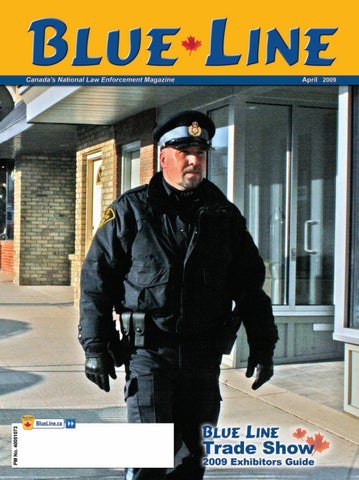
Cover: Provincial Cst. Mike Nunn on foot patrol in the downtown area of Tillsonburg. Mike transitioned to the Ontario Provincial Police from the former Tillsonburg Police Service. The Oxford county detachments are fast becoming models for contract policing as they modify and transition from their traditional roles of rural policing and highway patrol. Left: Former Tillsonburg police officers Frank Berenz and Vern Fleming are shown with Inspector Jack Goodlett and Cst. Dave Ongena outside the Tillsonburg police building. See page 6.
Features 6 Bringing urban skills to rural policing
16 Surveillance
Ontario’s Oxford County helps mould a new style of provincial policing
Obtaining that surveillance interview and career
20 SNIF noses out canines in sensing scents
12 Medical condition or threat? Here’s how to tell the difference
24 Blue Line Trade Show
14 The trauma of using deadly force
2009 Exhibitors Guide
Seek help to recover from the scars
Departments
Case Law
46 46 38 35 18 43 22 45 21 40 32
42 Endorsement not needed for dynamic search 44 Arrest standard doesn’t require prima facie case for conviction
Advertisers Index Back of the Book Black on Blue Coming Events Deep Blue Dispatches Forensic Science Market Place News Clip Product Profile Technology
Blue Blue Line Line Magazine Magazine
33
April April 2009 2009
April 2009
4
Blue Line Magazine
Publisher ’s Commentary by Morley Lymburner
Apologetic policing
can cost lives
One of my neighbours recently got a speeding ticket for going five kilometres over the limit in a 40 km zone. I asked how fast he was really going and he smiled. “Well, I was actually doing 63 km/h but the officer was so nice that she lowered it for me.” Three weeks later another friend showed me a ticket he received for doing 55 km/h in a 50 zone. He sheepishly admitted he was actually doing 67 and the nice officer lowered it for him. I told both people how lucky they were, pointing out that the officers were probably new, not married, childless and/or had not seen enough dead bodies. What I did not share verbally was my concern that the officers were trivializing a serious problem. Looking at the Blue Line Forum, I came across a discussion about legalizing drugs. The theme essentially went that almost everyone uses the stuff anyway so why not just make it legal and tax it like alcohol and tobacco. The conversations went around to “charging the dealers and importers” and blah, blah, blah, blah. All of this comes from a lack of understanding cause and effect. Too many officers have a deminished opinion of the effect they have on the public and are confused as to what their function really is. I am sure the officers who liberally lowered their speeding tickets did not really want to be doing the job they were doing. It is obvious that they were seduced by the “good cop” image. The new era attitude that to get along with the public you must be ready to show them the human, fuzzy, warm side of policing all the time.
Blue Line Magazine
The long and short of it is that they have not seen enough injured school children and mangled bodies to understand the importance of not speeding; the devastation that can come from being the driver of a car that kills an innocent child; how the child, driver and both their families become victims – this and more can result from an officer not wanting to be looked upon as mean. Drug enforcement, likewise, suffers from the same dilemma. Drug usage in some communities has become so rampant that there is a high level of tolerance and ignorance about the problems associated with it. Couple this with the good-guy cop image and we have campaigns develop that “go after the drug traffickers.” Time for a wake-up call here, people. The traffickers are doing well because the demand for their product is high. The reason demand is so high is because users are not being charged and popular media stars make light of their own illicit drug use. Unfortunately, the stars can afford the habit and every person with a ‘meltdown brain’ thinks they can be just as cool by doing the same dope. Mix in the upcoming BC Olympics and you have a lot of potential business awaiting whomever comes out on top of the current body count on Vancouver streets. And those bodies are sure piling up. “Okay then,” you may ask, “how does the carnage on Vancouver streets relate back to speeders getting a break in Ontario?” Once again a lot of it comes back to how police officers are influenced these days. If their service’s primary concern is public image, public safety will suffer and officers
5
on the street will reflect this fact. Leaving enforcement of the law as the collateral damage that happens when officers are trying to win popularity contests is wrong headed. Enforce speeding laws because speeding vehicles kill, injure and harm tens of thousands of people every year. Enforce drug laws because drug usage (not trafficking) also causes a high body count and untold misery. No one is waving a checkered flag in a school zone and drug dealers are not tackling people on the sidewalks to inject them with drugs. It’s all voluntary on the perp’s part – encouraged, in no small measure, by the long odds against getting caught and the likelihood of being let off entirely, or with just a slap on the wrist, on the rare occasion they are nabbed. In the grand scheme of life, the root of all evil grinds down to impatience, intolerance, ignorance and greed. Officers should not under estimate their societal impact in keeping this under control. Likewise legislators should realize that simplifying the laws to encourage more enforcement can be the biggest help. Make charging a drug user (not an addict) as easy to enforce as speeding and we will go a long way towards cleaning up the streets. As a cop on the street, you must not supply the community with apologetic policing. By all means, use discretion, but ensure that it is purposeful and not routine.
April 2009
Bringing urban skills to
rural policing
Ontario’s Oxford County helps mould a new style of provincial policing by Carla Garrett Tucked away in rural southwestern Ontario is a small urban centre built primarily on the now dying tobacco industry. Despite this setback, Tillsonburg continues to prosper, attracting families and seniors. The growing town faces some unique challenges. It draws many residents from surrounding rural communities during the day, and its population also swells during the summer months as hired help from nearby farms go to town. “The transient nature of people introduces a greater responsibility for the town, including policing,” says Tillsonburg Mayor Stephen April 2009
Molnar. “We service a population of 80,000 – far more than our tax base of 15,000.” Despite a fluctuating population, overall crime has dropped since the Ontario Provincial Police (OPP) started patrolling the town’s streets. “Even though the population is growing, violent crimes are not spiking,” says OPP Insp. Jack Goodlett, Oxford County detachment commander, “and there are no alarming trends of things increasing.” Since the fall of 2000, the men and women in gold and blue have provided policing under a five-year, renewable contract with the town. Goodlett says the OPP has grown as an organization from contract policing. “We have learned the value of urban policing and have been able to take the lessons we have learned and apply it to policing in general to come out with a better product,” he says. “I believe we have all become better police officers as a result.” Tillsonburg has also benefitted, recently attracting two new regional OPP projects. “We are very proud to welcome a regional forensics lab and now the announcement of an 6
OPP training facility,” says Molnar. “These opportunities became available because of the positive working relationship between the town and OPP.” The force looks forward to fostering that relationship and enhancing the quality of service in the future, he adds. Coming together as one Tillsonburg and other municipal police services began looking at other policing options when then premier Mike Harris’s government focused on cutting costs. Legislation also changing the way police services were to operate and the new requirements threatened to substantially increase costs for municipal forces. The town started investigating a contract with the OPP in 1998. Around the same time, four other Oxford County communities began forming a new policing partnership which later became the Oxford Community Police Service. Several informational sessions were held, leading to the decisions to amalgamate Tillsonburg Police Service (TPS) into the Blue Line Magazine
OPP Cst. Laura Langdon speaks to a girls health class at Ingersoll District Collegiate Institute. Langdon is the schools youth resource officer. Left: OPP Insp. Goodlett, Oxford County detachment commander.
Oxford OPP and move the provincial force’s Woodstock detachment 37 kilometres south to Tillsonburg. “The OPP brought great value to our community,” says Molnar. “Residents and the town are extremely well serviced by the partnership we entered into with an OPP contract.” The TPS had a chief and deputy, four sergeants, 17 constables, two clerical and one civilian court officer. The OPP contract replaced the chief with an inspector and cut two sergeants. Three more constables were added in 2006, bringing the total complement to 20. Detachment members were assigned to the former TPS building, a modern station and one of the nicest offices in the OPP, says Goodlett. “It’s still one of the best in the province,” says the inspector, who has a bright corner office. The administration centre for the Oxford detachment, the Tillsonburg office is nestled between the fire station and Oxford County EMS base, which are central to the town. Three years after Tillsonburg joined the provincial force, another Oxford town, Ingersoll, also opted to dissolve its municipal force and sign a contract with the OPP. “The OPP has provided many services to the town that would have been much more costly if we had to provide these services Blue Line Magazine
through a municipal force,” says Ingersoll Mayor Paul Holbrough. “Examples of these services are the canine unit and tactics and rescue unit (TRU) teams.” The OPP took over a modern police station in the town to use as a satellite office. The Oxford County detachment currently includes the municipalities of Tillsonburg, Ingersoll, South-West Oxford and Zorra and is poised to expand this summer with the addition of Norwich, Blandford-Blenheim and East ZorraTavistock townships. The detachment will then employ about 100 officers, up from 69. Presently, about 40 to 45 people work out of the 85,000-squarefoot building in Ingersoll, as officers from Zorra and the OPP Highway Safety Division report there. Before the amalgamation, Ingersoll Police Service had one chief, three sergeants and 13 constables. The contracted service from the OPP on Feb. 13, 2003 was one inspector, three sergeants and 15 constables. A high school resource officer was added in 2006, bringing the total constables to 16. The town, which renewed the contract last year, “has a range of populations that are well served by the community-based policing model of the OPP,” says Holbrough. “Our youth resource officer works in the local high school and youth centre and has built a positive relationship with our youth.” The number of calls historically associated with youth have dropped, Holbrough points out. Since 2006, reported incidents of mischief in Ingersoll have dropped to 130 from 187, while thefts under $5,000 shrunk to 144 from 180. There were also 32 fewer break and enters in 2008 than 2007. “As you total the numbers, there is a reduction,” says Goodlett, adding as long as the totals go down, “we are making a difference.” 7
It’s a similar story in Tillsonburg, where annual calls for service have declined. “Stats show Tillsonburg is a safe community,” says the mayor. Over an 11-year period, break and enters in Tillsonburg dropped to 77 from 157 in 1996. Traffic collisions also flat lined over the past few years, coming down from about 300 in 1996 to 193 in 2008. The crime rate decreased in both communities from 2006 to 2007, with an overall clearance rate of about 84 per cent for all calls. While it’s great to catch the bad guys, reducing and preventing crime is more important, says Goodlett. “It’s not a cookie-cutter solution for each community. Different problems are present in different places.” The OPP tackles the communities’ individual needs through community-driven policing and by incorporating specialized programs and public relations tools, such as Oxford the dog, he adds. Last year there were just over 5,500 reported offences in Tillsonburg and about 4,200 in Ingersoll. Goodlett says the OPP’s continued success in both communities rests largely on the co-operative effort of everyone involved. “It’s a team effort, not an individual,” he says, adding that all police officers are trained at the Ontario Police College and Provincial Police Academy. While the process of combining the services wasn’t without growing pains, Goodlett says it has created something “better” collectively. “Everyone learns from each other in an amalgamation,” adds Goodlett. The face of Oxford OPP Some former municipal officers joined the OPP, bringing continuity to Tillsonburg – something the mayor says is important to April 2009
community policing. “We also find officers are very active in the community and contributing to the town far beyond their time in uniform,” says Molnar. “We are very proud of that.” One of the familiar faces is the detachment commander himself. Goodlett is a Tillsonburg resident with strong ties to the community, including children who attended the local schools. Despite his familiarity, he continues to learn more about the areas his detachment services. “I like to visit other areas and meet people outside of the office,” he says. Although he is shared amongst four Oxford municipalities, his motto is, “I’ll be there.” The 55-year-old inspector joined the OPP in 1974 and has worked in several communities, including Toronto, Simcoe and a remote village near Thunder Bay. “I remember my first day on the job as if it were yesterday,” he says. “I am having too much fun (to go yet).” The day that changes, he says, is the day he will sign his resignation. The job is not without its setbacks. In December the OPP lost a beloved Ingersoll constable and her family. Long-time
April 2009
Tillsonburg Population Officers Pop To Cop Civ Members Budget Cost Per Capita Clearance Rate
15,826 22 1:719 3 $2,272,017 $144 41
(Criminal Offences)
Crime Rate Change
-15
Ingersoll
community services officer Cst. Laurie Hawkins – a pillar of the community who worked passionately with youth and seniors – and her family died after an accidental carbon monoxide leak in their home. “We have had a lot of challenges over the years... but the officers live through those things,” says Goodlett. “It makes you stronger once you work through those things.”
8
Population Officers Pop To Cop Civ Members Budget Cost Per Capita Clearance Rate
12,083 19 1:636 2 $2,072,171 $171 33
(Criminal Offences)
Crime Rate Change
-11
Source: Police Resources In Canada - 2008
Blue Line Magazine
Blue Line Magazine
9
April 2009
A centre for
policing excellence
Crime fighting in Southwestern Ontario got a big boost over the past few months when the OPP opened two field support units in Tillsonburg. A new forensic identification services unit officially opened last November and an in-service training facility began March 1. The new $5.4 million, 13,000 square foot forensics facility will provide police with new and advanced tools to analyze evidence and solve crimes. It houses state-of-the-art laboratories and storage facilities to perform modern forensic investigations and combines units formerly located at detachments in London and Simcoe. OPP Commissioner Julian Fantino thanked government and citizens for their support, stating that the new unit “provides the tools and technology OPP investigators need to do their jobs efficiently.” It is an essential part in keeping communities safe, Fantino added. The new forensic unit includes: • a biohazard/chemical laboratory and blood stain room for blood splatter examination; •m odern fingerprinting technologies; and • a specially designed heating, ventilation and air conditioning system to reduce exposure of
April 2009
personnel to harmful chemicals. The Ontario government has replaced or upgraded two other forensic facilities and two more projects are underway. The OPP units are responsible for crime scene management and evidence processing. It is not just about convicting the guilty; clearing those who might otherwise be wrongly suspected is just as important, says Fantino. Tillsonburg’s new regional training facility is housed in a former community centre. The OPP has leased the space for one five-year term with the option to renew. It will use the space to train officers in the latest policies and techniques, including law changes, use of force, first aid/ CPR and “scenario-based training.” A sergeant and two constables from the OPP academy are assigned to the centre fulltime and will train some 450 uniform and civilian members each year. Tillsonburg Mayor Stephen Molnar touts the facility as a regional centre of excellence for policing and is quick to point out the economic benefits of hundreds of officers coming to his town.
10
Cst. Kevin Broughton uses a forensic light to discover evidence on a plastic spoon.
Blue Line Magazine
Blue Line Magazine
11
April 2009
Medical condition or threat?
Here’s how to tell the difference
by Judy Hazlett and Roger Buxton As Parkinson’s and other medical disorders become more common, it’s crucial for police to learn to distinguish between unusual but benign behaviours and threatening actions. Officers can quickly resolve and minimize the trauma of people behaving strangely in public. Police services have a responsibility to learn the most commonly misinterpreted medical conditions and how they can assist an affected individual if needed. Take people with Parkinson’s (disease), for example – it’s quite easy to think they are drunk or high on drugs. As a result, patients have been denied service at liquor stores or escorted out of shopping malls by security against their will. This violates their right to freedom from discrimination due to handicap, contained in provincial and federal human rights statutes. Patients want to go about their normal activities in public knowing that police will not only correctly identify their condition but also know how to help them if and when they need it. Parkinson’s is a movement disorder which most commonly affects the elderly (about one per cent of people over 60 have it), though a growing number – about 15 per cent – contract it at a much younger age, some even in their 20s. Symptoms are mild at the onset and can
April 2009
be well controlled by medications, but as the condition progresses over several years, become more severe and drugs less effective. This results in uncontrolled visible symptoms, often causing equally disturbing and attention-attracting side effects. Thus, both the inherent symptoms of the condition and side-effects of medication can be misinterpreted. In its later stages, a person is typically so severely afflicted that no anti-social behaviour is inferred. Consequently, people in the middle stage of progression, particularly if they are young or middle-aged, are most at risk for misinterpretation of condition or intent based on their behaviour. The symptoms of Parkinson’s are best described by the acronym STOP, which is especially useful to remember as the basic characteristic of Parkinson’s is to stop a person
12
from moving. • S stands for SLOW, referring to the slowness of movements, which is most evident in reduced manual dexterity. It is also seen in general paucity and speed of motion and reduced facial expression, often resulting in an apparently angry stare and reduced loudness, intonation and clarity of speech. Muscles become stiff and strength and stamina are diminished, frequently resulting in fatigue. • T stands for TREMOR, probably the best known symptom, which usually affects the arms but can also involve the head and legs, often in only one limb. The tremor occurs when the limb is at rest and can disappear when one consciously undertakes a task. • O stands for OK INTELLECTUALLY. Cognitive faculties are rarely diminished by Parkinson’s, though it is easy to think that they are when a person has difficulty speaking, looks vacant and doesn’t convey body language. • P stands for POSTURE. The typical posture is stooped, bent forward at the waist and tipped forward on the toes, leading to a rapid, shuffling gait verging on a trot, with precarious balance. The inability to initiate walking, called ‘freezing,’ can be particularly difficult. Falling forward is a common hazard. It’s important to appreciate that every person with Parkinson’s has their own unique set of
Blue Line Magazine
symptoms, so don’t expect to see all of them in any one person. However, their severity increases under stress and likewise diminishes when calm is restored, so you can expect to see them change when they encounter a police officer. Medication used to alleviate symptoms – there is presently no cure or accepted method to halt the condition’s progression – also causes changes over a fairly short time period. The drugs take about 15 minutes to an hour to work after swallowing and wear off after 30 minutes to several hours. This timing becomes more unpredictable and drugs wear off more rapidly as the disease progresses, so a person can change from normal to being totally unable to move, or vice versa, in just a few minutes. Such large and rapid changes in mobility can easily create a credibility problem, especially when they involve the use of handicapped facilities such as wheelchairs and disabled parking permits, yet these fluctuations are entirely unavoidable. People with Parkinson’s invariably carry their medications (tablets) with them and take them as infrequently as once per day or as often as every half-hour. Officers should be aware of this necessity and allow patients to take their medications when required. Another consequence of medications at the middle-to-advanced stage of progression is dyskinesias – repetitive writhing motions of the body and head and swinging of the limbs. This is frequently combined with facial, arm and wrist contortions and laboured speech. Like the regular symptoms of Parkinson’s, it can easily be misinterpreted as being drunk or high and, in severe cases, can resemble a seizure. It always attracts attention and often causes concern and sometimes fear in onlookers, which is why police are called to intervene. Dyskinesias is simply due to the inability of the body to use Parkinson’s medications smoothly. It most commonly affects middle-aged people who have had Parkinson’s for 10 years or more – about 20 per cent of patients. It can last from 15 minutes to a few hours, come on rapidly and without warning and wear off just as abruptly. A person can often go from/to an immobile state without any significant time in an intermediate normal state. Such wide fluctuations in ability to move are challenging enough without having to endure the skepticism and suspicion of disbelieving members of the public. A police officer can provide an immense level of comfort and relief by understanding the situation and providing protection and whatever other assistance may be requested. It should be clear by now that any person with Parkinson’s exhibiting significant symptoms in public is unlikely to be up to no good. They don’t make good bank robbers, as they cannot write the demand note legibly or steadily aim a gun; they will also fumble and drop the money and cannot make a fast getaway! Instead, the difficulty in performing any normal voluntary act of motion, especially with their hands and walking, makes them physically vulnerable in public. For example, they: • Often cannot cross a road within the time allocated by pedestrian signal lights; • Are at significant risk for being knocked over or tripping and falling in crowds or doorways, revolving doors, turnstiles and escalators; • Often experience fatigue in large public spaces such as stores and supermarkets and need a place to sit (which is often non-existent); Blue Line Magazine
•B ecome embarrassed when dropping utensils and eating sloppily in restaurants; • Worry about being robbed when handling money; and • Are regarded suspiciously when trying to enter a debit card PIN at a cash register or bank ATM. Patients are always concerned about their medications wearing off unpredictably, leaving them immobile in an unsuitable location. Whether ‘off’ (the medications are not working) or dyskinetic, they are prone to being labelled strange, weird, crazy, drunk, drugged or some other similar epithet which could result in police being called to intervene. Once a police officer correctly assesses the nature of their behaviour, the tasks a person with Parkinson’s requests of police are quite simple, yet can be of monumental importance to someone unable to move freely. Use the acronym APE to guide your actions: • Assist their physical situation. • Protect from injury, criminal opportunism or other risk. • Enforce human rights codes which make it an offence to discriminate on the basis of handicap. ASSIST is another useful acronym: • Ask if they have a medical condition and if so, what it is. About one third of people with Parkinson’s wear a MedicAlert bracelet, so if you have trouble hearing what the person is saying, ask to see the bracelet. Most importantly, ask what you can do to help. • Safety – maintain the person’s safety and reduce vulnerability. Do not restrain if he/she is dyskinetic.
13
• Stress – minimize stress and create calm. • Individual – every person with Parkinson’s symptoms and response is unique, so don’t make assumptions about what they require. • Satisfy the person’s immediate stated needs. They will probably be simple, like accompanying them to a place to sit, phoning their home or calling a taxi, obtaining a drink or possibly assisting in taking medication out of a container in a pocket or purse. • Trust the person with Parkinson’s. They usually know what they need and want to be treated with respect and dignity as if they were your own parent. These are straight forward actions which will be greatly appreciated. We hope you will see the value of including this material in your training programs because people with Parkinson’s want, and need, police to respond correctly to their situation. Judy Hazlett developed Parkinson’s in her 20s, taught for many years and was an award winning special education teacher. She benefited greatly from an experimental treatment and keeps moving by dancing, doing yoga and hiking despite additional disabling conditions. She has received many awards for providing services to the Parkinson’s community. Contact: jhazlett@istar.ca . Roger Buxton participates in his wife’s many endeavours and runs his own consulting company. Contact: rbuxton@ inforamp.net . The couple give multimedia presentations about Parkinson’s to police services and have made a short video, in conjunction with the Toronto Police Service, called Recognizing the symptoms of Parkinson’s. Contact Debbie Davis at Parkinson Society Canada (800-565-3000 or debbie. davis@parkinson.ca) for more information. The society web site – www.parkinson.ca – provides medical and patient services information.
April 2009
The trauma of using deadly force Seek help to recover from the scars by Michael Soden Firing at another human being can be the only way for a police officer to protect their life or that of a partner or citizen. After using deadly force, the initial adrenaline rush subsides, you secure the scene and realize you’re safe – but then what? On Nov. 6, 2006, I and two other officers – good friends – responded to a home invasion robbery call. Our response time was less then 90 seconds. We made a quick plan of action and set up our perimetre, much like we have done many times before. The difference this time was that the three bad guys came out shooting instead of giving up. They didn’t hesitate and showed no respect for the law or human life. We didn’t have time to do anything other than what we had trained to do. We spend countless hours training, both at the academy and in-service courses, learning to act in stressful life or death situations and control our emotions. We were all on auto pilot. Auditory exclusion, time slowing down and speeding up, distance distortion – they all occurred over the 10 seconds of sustained gunfire among six individuals. Some 50 rounds were fired by the time
the confrontation ended. No officers were struck. One suspect lay dead, another was struck and apprehended and a third was hit but managed to get away and remains at large. We headed back to headquarters to meet with the Fraternal Order of Police attorney, internal affairs, the chief and whoever else wandered by to say “good job...” My training over the years prepared me for this. All of the Simunitions and firearms judgment practice paid off. All three of us were okay; we had killed one bad guy and caught another one. Then at headquarters, we were given an advice of rights form by the internal affairs investigator, the same form we give to suspects. All of that training hadn’t prepared me for what was yet to come. I began work that evening at 1900 hours. The ordeal began at 0130 hours and I arrived home at 1000 hours the next morning. I should have been exhausted but was instead wired and ready to go. My adrenaline dump was still going strong and continued for 72 hours before I crashed and was finally able to sleep. Within those 72 hours, I watched my incident play on the news countless times – and let’s not forget about seeing my name in the newspaper. There were hundreds of concerned phone calls that usually included the “what was it like?” question, which made me re-live the experience. I also had to call my family and explain to them what I had just been involved
in – not as easy as you think. “Morning mom and dad. How are you doing this morning? Me? Well I got into a gun battle last night and we killed a guy.” Now I have hysterical parents asking me a million questions. The next thing I have to contend with is departmental policy requiring me to re-qualify with my firearm, go through judgment enhancement scenarios and visit psychological services, all within 10 days. None of that was a big deal, but I felt like I had no time to decompress. After completing all that, I was placed on administrative duty and relegated to sorting tickets and data entry. No one asked me what I might like to do. All of this culminated into a dirty little acronym – PTSD (Post Traumatic Stress Disorder). I had to deal with irregular sleep patterns, nightmares and the hyper vigilance that comes with an extremely overactive sensory system. There was also a high degree of paranoia since, let’s not forget, we still had an outstanding suspect. Where do you seek help, especially in a job where being “macho” has been ingrained? You can go to the department’s psychological services, but at what cost? Tell the “shrink” all this and then have him pull me off the job for being nuts? I don’t think so. You have a few other options; you can internalize it and self destruct, externalize it at someone else’s expense or seek outside help. I did saw a psychologist and he was some help, but did he really know what I was going through? As with many police officers, I have a hard time taking advice/help from someone on a subject they have never experienced. All I ended up doing was rehashing everything and sometimes left more frustrated then when I arrived. I tried talking to my peers but there was lots of that “macho” stuff going on. One lieutenant told me that other officers had been through it and are fine, but are they really? Was it all a façade, or was I crazy? I began speaking with those other officers and found their reactions varied. The one thing they had in common was that all suffered some type of lingering response, some worse then others. The ones who spoke about it seemed much better off than those who kept things to themselves. Some officers may never recover from the scars but, for most, the damage dissipates with time. I am working to develop an awareness class regarding some of the things that I have discussed. My goal in writing and lecturing about a critical incident such as mine is to give officers some sense of what to expect and how they can deal with the stress that comes with coping and surviving the aftermath of a police-involved shooting. I can’t help but reiterate that all that training we go through should include setting aside some time to learn about what happens AFTER a critical incident. Failing to do so may result in the loss of another life – that of the officer involved. I hope this helps to begin the discussion, with more to follow. Prince Georges County Police Pfc. Michael Soden is an adjunct instructor with Maryland Police and Correctional Training Commissions. Contact him at mrsoden@co.pg. md.us for more information.
April 2009
14
Blue Line Magazine
Study finds serious
Taser injuries are rare
WINSTON-SALEM, N.C. – An emergency medicine researcher at Wake Forest University Baptist Medical Center has just published the first large, independent study of injuries from Taser use, finding that serious injuries occurred in fewer than one percent of 1,201 Taser uses by law enforcement officers. The study, led by William P. Bozeman, M.D., of Wake Forest University School of Medicine, was published online in the Annals of Emergency Medicine. The findings represent a three-year review of 1,201 uses of conducted energy weapons (CEW) at six law enforcement agencies across the United States. The study was funded by the National Institute of Justice. “These weapons appear to be very safe, especially when compared to other options police have for subduing violent or combative suspects,” Bozeman said. “That is not to say that injuries and deaths are impossible. Police and medical personnel need to be aware of the potential for serious injury and look for evidence that a person subdued by a Taser has been hurt.”
Blue Line Magazine
The study reports that 99.75 percent of criminal suspects shocked by a CEW received no injuries or mild injuries only, such as scrapes and bruises. Of the 1,201 criminal suspects, 492 suffered mild injuries, mostly (83 percent) superficial puncture wounds from the Taser probes. Of the three subjects who sustained significant injuries, two suffered from head injuries related to falls; the third developed rhabdomyolysis, or a rapid breakdown of muscle tissue. Ninety-four percent of the suspects were male, and alcohol or
15
intoxication was documented in almost half of the cases (49.5 percent). A physician at each participating agency reviewed police and medical records after each CEW use. Injuries were identified and classified as mild, moderate or severe. More than two-thirds of United States law enforcement agencies currently use CEWs. They are credited with decreasing police officer and suspect injuries and deaths due to police use of force. However, the devices have been surrounded with controversy. “While injuries from Taser use are uncommon, they are not unheard of,” Bozeman said. “Subjects exposed to a CEW discharge should be assessed for injuries, and appropriate medical evaluation should be provided when non-trivial injuries are apparent or suspected. Existing medical and/or psychiatric conditions in the suspect may also cause or contribute to the behaviour that leads police to use a Taser or other physical force. These underlying conditions may require medical assessment and treatment, independent of Taser exposure.” Visit www.annemergmed.com for more information.
April 2009
Surveillance
Obtaining that surveillance interview and career Part 7 of 7 by Hal Cunningham Law enforcement officers reach a point in their career where they need further experiences and challenges. Surveillance offers that unique opportunity only experienced by a few fortunate individuals. Preparing yourself for the surveillance unit takes planning and some preparation. Firstly, as in any highly demanding profession, surveillance is not for everyone. Try and decide if it sounds like it is right for you and be mature enough to acknowledge the fact, at any time, that you might not be suited for this type of work. You must be an above average driver with aggressive driving skills and in total control of your vehicle at all times. Exceptional powers of observation and being able to be a team player are a must. This is not the place for an individual who is used to doing everything him/herself and not able to trust others. Teamwork is the predominant requirement for a successful surveillance unit.
April 2009
Most experienced police officers that are trying to enter a surveillance unit have proven themselves as aggressive above average performers in all areas, responsible and possessing a higher than average level of interpretative skills. Ensure that your sick and driving records are free of any unfavourable
16
occurrences because they will be examined closely. If you have the opportunity to enter a structured surveillance training program you will have a big jump over all other candidates. This will give you more time to adjust and practice the new techniques you will learn. A structured program showing mobile and foot techniques, counter surveillance techniques, communication skills, clothing and equipment needs, and the rules of surveillance will ensure you have acquired the basic knowledge to talk the talk. You must accept that you are lacking the experience to apply this newly acquired knowledge and willing to admit that you still have a lot to learn and more than willing to accept the surveillance unit’s way of performing surveillance and adapt to their style. I have always found that calling the officer in charge (OIC) personally and requesting an interview is the best way to have your possible new boss meet you and put a face to the name. As in any interview, this is your opportunity to sell yourself and ask questions as to what is to be expected of you and for you to express what you can offer the surveillance unit. Be careful to express that you have limited knowledge and experience in surveillance and can be taught their methods and are more than willing to learn. It is extremely impressive to be able to discuss the need for shade, the eye and paralleling techniques. This should be done without trying to show off but convey that you understand the need for professionalism in the way these techniques are to be performed. The OIC would much rather prefer a non-experienced student that his staff can train and mould rather than try and re-train an experienced operative with some poor habits. If I had it to do all over again at the inBlue Line Magazine
terview stage, I’d offer the opportunity for the OIC to escort me for a 20 minute drive. This would give me the chance to show my aggressive and confident driving skills and carry on a rolling dialogue discussing shade, distance, light timing and lane choices all while following a moving target. Again, be humble and show your acquired knowledge and the need for more experience on the road with the surveillance unit. Hopefully you have prepared yourself and impressed the OIC that you are the type of person that they need in their office to complement their staff. If you are successful in obtaining your transfer, the work has only begun for you. It is a difficult transition to be the big man on the block back at your old unit where you may have “run circles” around most others and won the praise of your supervisors to now being a trainee. Let’s face it, that’s why you got where you are. Now you have gone from “Victor Veteran” back to “Roger Rookie.” I’d strongly suggest you close your mouth and open your ears. It does take six full months to learn surveillance techniques and practice them daily until you are showing a return. Look, listen and learn and wait the six months before you offer your opinion or make suggestions for change. Too many officers can not handle this transition and come across extremely poorly; with an attitude. You do not want your team members to shut you out if they suspect you have a know-it-all attitude. Be a team player and trust your other mates without being the weak link. As expressed earlier, if you continually make mistakes and feel uncomfortable, admit that surveillance is not right for you. This is not a personal reflection on you but rather an admission that your best skills remain elsewhere. Go back to your previous job function where you excelled and felt more comfortable. I saw one colleague suffer for two years until the right supervisor made him happy and returned him to his original unit. Now is the time to show the OIC that you are a good investment and practice all the proper techniques you were taught. Do not settle for average but look for the better con to play or the better eye to get and show how you as a person can apply your acquired knowledge like no one else ever has. While still being a team player you can excel as an individual with your footwork, driving ability, communication skills and powers of observation. With proper training, planning and preparation you increase your chances of success. Hal Cunningham is a surveillance consultant and trainer who teaches techniques to police officers and private investigators. After 30 years with the Toronto Police Service he retired as a Staff Sergeant and was a member of the elite surveillance unit within the Intelligence Bureau. He has been declared an expert in surveillance and counter surveillance by the courts. Hal will be presenting the classroom portion of his three-day course at the Blue Line Training sessions. Register at www.blueline.ca/tradeshow.
Blue Line Magazine
17
April 2009
Deep Blue by Dorothy Cotton
Long pointy nose hurts sex life Anyone ever involved in advertising – or writing for the popular media – knows that headlines can make or break an article or ad, but the fine art of attracting the reader is often lost in serious professional publications. Research articles often have long, cumbersome and incomprehensible titles like Effect of 5-HT-sub-7 antagonist SB-269970 in the modulation of working and reference memory in the rat. This is not always the case, though. Somewhere out there, at least one journal editor has a sense of humour. Take Cutting off the nose to save the penis, for example. Now this research article caught my interest! I guessed it would be about angry wives wreaking havoc on their hubbies for some unforgivable lapse in judgment – or some strange disease that affects one’s extremities, with cutting off the nose the only known cure. Turns out I was completely wrong. The article was actually about the adverse effects of traditional bicycle seats on police bicycle officers. Ok, I confess, I initially thought it was tongue in cheek. It is full of words like Rigiscan assessment, penile vibrotactile sensitivity threshold assessed by computerized biothesiometery and urogential paresthesia. I am not exactly sure what most of those words mean – but the general gist seemed both relevant and important. If you’re a bicycle officer, pay attention! Riding on a traditional bicycle seat with the long pointy nose might make your naughty parts fall off, paralyze your bum and force you to kiss your sex life goodbye. Drs. Steven M. Schrader, Michael J. Breitenstein and Brian D. Lowe at the National Institute
for Occupational Safety and Health in Cincinnati, OH, published the article in the Journal of Sexual Medicine last year. Apparently it is well documented in the medical literature (who knew?) that spending long periods on a bicycle does not do wonders for a man’s sex life. Previous research has indicated bicycling can have an effect on nocturnal erections and generally on blood flow to the nether regions. However, the authors encountered some resistance when they suggested to police that riding on a traditional bicycle seat for 24 to 30 hours a week perhaps wasn’t such a great idea. First, the popular bicycle media tends to dismiss such concerns – and police officers expressed concern about other possible ill effects of riding using noseless seats (one proposed solution to the problem). Some were afraid that the slightly altered
riding position would result in increased stress on the hands and wrists. Others worried that they would do even worse harm to themselves if the seat nose were not there to shield from the evil cross bar. Some expressed concern that they would not have the same degree of control over the bike without the pointed seat. Generally, they seemed to feel that the risks of giving up the old seats outweighed the benefits. The good thing about research is that it allows you to find out if concerns are legit or merely idle speculation. The researchers assembled 121 male bike-riding police officers from five major US cities and set out to see what would happen. First, they ran the officers through a whole barrage of tests to measure things like saddle pressure, extent and nature of any erectile dysfunction, hand and foot pressure while riding and overall sensitivity of both the finger tip and the tip of the penis. Once all these preliminary measures were done, they installed noseless seats and sent them on their way for six months. Actions often speak louder than words – and certainly louder than incomprehensible statistics. After six months, they tracked down 90 of the original 121 guys and only three had returned to the original bicycle seat. No one had experienced a blunt trauma to the groin area – and generally there was a whole lot more going on ‘down there’ than there had been when the original seats were used. There was an overall reduction in perineal pressure (I believe ‘perineal’ is a polite word for ‘ass’ – the portion of the body in the pelvis occupied by urogenital passages and the rectum, bounded in front by the pubic arch, in the back by the coccyx and laterally by part of the hipbone). Seventy three per cent of the officers indicated they experienced numbness to the buttocks, scrotum or penis while using traditional saddles at the beginning of the study. This number dropped dramatically; only 18 per cent indicated they experienced such numbness after using no-nose saddles for six months. There was also an overall improvement in reported erectile quality. The evidence was a little less clear about whether the noseless seats had a negative effect on the hands and feet. The jury is still out, but my guess is that if you gave most guys a choice between damaging their hands or damaging their penises… You might want to think about this if you are a bicycle officer or buy bicycles. While the study referred to here only involved men, there is existing evidence that long stretches in the bicycle seat does not do wonders for women either. Let me know at deepblue@blueline.ca if you’d like a detailed reference to this study. Dr. Dorothy Cotton is Blue Line’s psychology columnist, she can be reached at deepblue@blueline.ca
April 2009
18
Blue Line Magazine
Photo: Anthony Suau
US Economy in Crisis March 26, 2008, Cleveland, Ohio The above picture shows an armed officer of the Cuyahoga County Sheriff’s Department moving through a home in Cleveland, Ohio, following eviction as a result of mortgage foreclosure. Officers have to ensure that the house is clear of weapons, and that the residents have moved out. If no one is there, then he must authorize that the door be forcibly opened. He then enters and clears the house at gunpoint in hopes that there are no squatters or inhabitants to threaten himself or the movers. All emotions and fears are on the surface as some residents greet him by crying on his shoulder while others can threaten him with a weapon. The international jury of the 52nd annual World Press Photo Contest selected this image by American photographer Anthony Suau as World Press Photo of the Year 2008. This winning photograph, taken in March 2008, is part of a story commissioned by Time Magazine. The story as a whole won second prize in the “Daily Life” category of the contest. Jury chair MaryAnne Golon said: “The strength of the picture is in its opposites. It’s a double entendre. It looks like a classic conflict photograph, but it is simply the eviction of people from a house following foreclosure. Now war in its classic sense is coming into people’s houses because they can’t pay their mortgages. The jury gave prizes in 10 theme categories to 64 photographers of 27 nationalities. For further details go to www.worldpressphoto.org.
Blue Line Magazine
19
April 2009
SNIF
noses out canines in sensing scents by Allain Gest Ottawa-based Ambrose Scientific says it has come up with an ‘artificial nose’ as sensitive as that of the best tracking dog. The new device, which can be used with a wireless helmet mounted ‘heads-up’ display or hand-held like a metal detector, identifies more than 134 pre-determined scents or can find and follow specific odours once it has been introduced to the device. Dr. John D. Odeur, chief executive officer and head scientist for Ambrose Scientific, stated the new device will revolutionize the way police and military personnel conduct searches for contraband, track suspects from crime scenes or search for lost persons. “There will no longer be a need to utilize
April 2009
dogs, pigs or other scent seeking creatures,” Odeur stated. “This device will essentially turn the work over to the human seekers instead.” The new portable device, known as the Super Nasal Identi-Fier (SNIF), is the result of years of research. Funding for the research was supplied by a Federal government inscentive program developed through the cooperation of the departments of Environment and Heritage Canada. These two agencies were approached by Ambrose Scientific three years ago and granted $50 million to develp it further. Another $20 million came from the Solicitor General’s department and RCMP and Nortel pension funds. “The device itself is a testament to the dogged determination of these government and private agencies,” Dr. Odeur stated. “Their
20
faith in our ability to keep our nose to the ground is enviable.” The SNIF device can use a wireless headsup display similar to modern jet fighters or night vision devices. The display is connected to a computer about the size of an iPod, which is connected to the SNIF intake. A user must first ‘sniff’ themselves with the SNIF so it can detect and screen out the scents emanating from their person. This process can take from mere seconds to as long as 10 minutes, depending on the operator’s personal hygiene, Ambrose notes. The company’s testing demonstrated that not all officers are “compatible” with the device, he adds, and some should stay “well clear” of the search area, especially during calibration. Several prototypes had to be scrapped after sensitive
Blue Line Magazine
scent detectors were overloaded. SNIF is pre-programmed to immediately identify cordite, heroin, marijuana, gasoline and other scents. When used in the field to search for suspects, cadavers or lost children, SNIF can combine preprogrammed data with scents presented to it from clothing, shoes or other personal items. The helmet display will show the operator the scent identified, along with a range finding image of scent strength displaying along a projected path of strongest exposure. “The display shows the user a mixture of actual and projected paths of travel. This was developed from years of research, combined with biological and computer algorithms,” states Odeur. “Once the detecting device has filtered out scents of no significance to the search, it is free to hone in on aromas actually being sought.” Sensitivity has been a problem with the device, Odeur admits. Unlike dogs, SNIF can be “overwhelmed” by “odour-rich” areas. “It should be kept clear of intense areas such as station locker rooms, drunk tanks and especially the back seats of certain squad cars, which can knock out its sensitive detectors,” Odeur warns. “We could make it less sensitive but that would dramatically decrease its tracking performance in the field.” Ambrose is working on a attenuation device so the operator can dial in less sensitivity in more odourific areas. This would have the added benefit of allowing the device to be operated by less “neutral” personnel. The company is also considering moving its laboratory and production facility from its current location, which is near Parliament Hill, to a “less intense” area, Odeur adds. “That will make unit calibration and testing much easier.” Scientists have previously devised methods for quantifying the intensity of odours, particularly for analyzing unpleasant or objectionable smells released by industry. A field olfactometer such as the ‘Nasal Ranger,’ for example, can determine the magnitude of an odour, but is nowhere near as sensitive as SNIF, Odeur explains. A dog’s nose is much more sensitive than a human’s, but dogs have drawbacks, says Odeur, including cost of ownership, distractibility and inability to get into small spaces. “SNIF can be carried in your trunk and used only when needed without any special expertise or training. Pull it out, sniff yourself and you’re ready to go without having to wait for the canine team to arrive.” Although the SNIF unit will be released for sale on April 1st, Ambrose plans to unveil the device at the Blue Line Trade Show and demonstrate it on staff, exhibitors and attendees. The demonstration will be presented at the Blue Line centre exhibit on both days of the show. “I suspect some people may be surprised by what it can detect,” he says, “but there’s no need to worry. We’ll use the heads-up display so only staff will know from whom odours emanate!”
News Clip Police need to improve community relations WINNIPEG - A new report says the Winnipeg Police Service has a “clearly strained’’ relationship with the community and needs to improve relationships with ethnic groups in the city. The finding was made by three high-ranking U.S. police officers as part of an assessment by the Commission on Accreditation for Law Enforcement Agencies. Winnipeg police Chief Keith McCaskill acknowledged there’s still work to do persuading minority applicants to apply for police jobs and to improve the public perception of police.
The accreditation commission evaluates police agencies using 460 standards related to all major aspects of policing. Winnipeg’s police service has been accredited by CALEA for the past 15 years. The report was submitted as a result of a re-certification process that must be performed every three years after the initial accreditation. The report also notes that Winnipeg police are doing a better job when it comes to electronic stun-gun training and evidence storage. (Winnipeg Free Press)
For further information about the SNIF device go to BlueLinks from the Blue Line Magazine web page.
Blue Line Magazine
21
April 2009
Forensic Science by Brian Ward
Sleep:Friend or foe? The worst thing in the world is to try to sleep and not to – F. Scott Fitzgerald Sudden death investigations are all too common, especially early morning dispatches to a home where someone collapsed and is not breathing, or collisions where a driver, for no apparent reason, veered off the road and crashed. The cause is often put down as a heart attack or stroke, driver inattention or perhaps even a suicide attempt, but the underlying cause may be victim fatigue due to such orders as obstructive sleep apnea. It’s a potentially serious disorder found mainly in older men, according to the prestigious Mayo Clinic, especially those who are overweight. Breathing repeatedly stops and starts and symptoms include hypersomnia (extreme daytime sleepiness). The risk of high blood pressure (hypertension) can be about two to three times greater in those with the disorder, and the more severe the sleep apnea, the greater the risk. If there’s underlying heart disease, these multiple episodes of
low blood oxygen (hypoxia or hypoxemia) can lead to sudden death from a cardiac event. Can a simple, untreated ailment be a contributing factor to many of the sudden death incidents police investigate? Perhaps forensic investigators should take a closer look at a victim’s past sleep history as a clue to the cause of death. Closer to home Perhaps we should also look at personal lifestyles to determine if our own lives and careers may be affected by this ailment. Kiran Takhar, a registered respiratory therapist with more than 14 years experience in treating sleep disorders, says stress can contribute to sleep apnea. Takhar, who works for Toronto based RestAssure, explains that sleep apnea is most commonly treated through the use of a continuous positive airway pressure (CPAP) device. Produced by a number of manufacturers, the devices use a small pump to move warmed,
humidified and pressurized air through a tube into a mask the patient wears while sleeping. “I like to call it ‘splinting’ the airway open,” Takhar says in describing the technology. The right help The first step in getting help is recognizing the symptoms, says Takhar. The Mayo Clinic list includes: • Excessive daytime sleepiness (hypersomnia); • Loud snoring, which is usually more prominent in obstructive sleep apnea; • Observed episodes of breathing cessation during sleep; • Abrupt awakenings accompanied by shortness of breath; • Awakening with a dry mouth or sore throat • Morning headache; • Difficulty staying asleep (insomnia). The loud snoring, which often can be heard even through the walls of a home, results in family and marital discord, Takhar has found. “Sleep apnea cannot kill you,” she assures, “and it is not caused by shift work. It is caused by factors such as excessive weight, alcohol and tobacco use and physiological factors, but it is the effect on already existing conditions such as high blood pressure or heart ailment that may be fatal.” The first step in getting help is to visit a family doctor, who will refer a patient to a specialist in sleep medicine. That doctor will book an overnight stay in a sleep clinic, where a complex set of monitoring devices will determine the next course of treatment. Some of the alarming symptoms include the cessation of breathing as the patient’s airway closes; this can happen between five and 110 times per hour, with each episode lasting a minimum of 10 seconds. Each time the breathing stops, the brain sends a signal to the body and the patient awakens, often without knowing, and resumes breathing. The clinic also monitors body movement, breathing patterns, brain wave activity and the amount of oxygen present in the blood during sleep. “I have treated a three month old child for sleep apnea and my oldest patient is 80 years of age,” Takhar notes. Financial assistance to help purchase a CPAP machine is often available through group medical benefits. Ontario partially covers the machines under its assistive devices program. Brian Ward can be contacted at forensics@blueline.ca
April 2009
22
Blue Line Magazine
Blue Line Magazine
23
April 2009
Book Signing!
Win!
A custom fit MCS Mount from ACF Communication Services for your service or agency!
Tues, April 28 11:00 - 1:00 Law Enforcement Handbook by Desmond Rowland & James Bailey Nelson Education Ltd, Booth 506
Exhibitors • 3M • ACF Communication Services Inc. • Action Meals • Ahearn and Soper Inc. • Anthony Steel Manufacturing • Association of Black Law Enforcers • Athabasca University • Blackhawk Products Group • Blue Force Police Wear • Boxer Custom Cases • Bosik Technologies Ltd. • Bridgestone Firestone Canada Ltd. • Code3 Responders Inc. • Colt Canada
• DAVTech Analytical Services Inc • Deeley Harley Davidson • Deister Electronics • Forensic Identification Services • Glentel • Greenside Group Inc • Heat-Max • IBM Canada Ltd • Integrys Limited • International Police Association • Investigation Counsel Professional Corp • Investigative Solutions Network • Kinwood Multimedia Inc. • Lamperd Less Lethal
• Liberty Recording • Marketeks • Matte Industries • Mawashi • MD Charlton Co Ltd • Microzone Corporation • MSA Canada • Nelson Education Ltd. • Niagara University • ONGIA • Panasonic Canada Ltd. • Peak Time Trading • Peel Regional Police • Police Ordnance Co. Inc
• Precision Camera Incorporated • Real Clean Gear • Rossbro Engineering Ltd. • Segway of Ontario • ShootersGear • SWS Canada • Stoeger Canada • Strategic Ops Group • Target Sports Centre • Thomson Carswell • Union Springs Pharmaceuticals • Whelen Canada • Whitmore & Hobbs • Work Authority
Canada’S PREMIERe LAW ENFORCEMENT EVENT • April 28 & 29, 2009 9am - 4pm LeParc Conference Centre, 8432 Leslie St, Markham, ON
Pre-register at BlueLine.ca or 905•640•3048 April 2009
2009 rs Sponso
24
Blue Line Magazine
3M Booth 504 3M is a leading manufacturer of hearing, eye, respiratory, head and face protection, as well as fall arrest equipment and communication headsets. Sold under the 3M, E.A.R., AOSafety, Peltor and Safewaze brands, 3M occupational health & environmental safety products offer a well-earned reputation for quality, selection, dependability and customer satisfaction. 3M takes pride in leading the industry in new product development and strives to develop meaningful and innovative products that provide solutions for today’s workforce. 3M’s brands are well known for providing personal safety products that are engineered for safety, designed for comfort and style. To view all brands and product lines, go to www.3m.com/occsafety. 2009 r Sponso
Booth 308 Keeping you connected since 1995. From project start-up to completion and beyond, we are ready to design, create and deliver a superior product and service package to meet your on-the-road needs. At ACF we specialize in vehicle mounting and docking solutions for laptops and toughbook computers. We also provide technical support, service and installation of wireless and voice data equipment to the commercial, industrial and government sectors. Win! A custom fit MCS Mount from ACF Communication Services for your service/agency. www. acfcommunications.ca Action Meals Booth 206 Action Meals® delicious pre-cooked meals and heaters heat your food to 83° C in 12 minutes. These meals are designed specifically for use in areas lacking infrastructure. There is no need for refrigeration, stove, electricity, fire, matches, pots, or even boiling water. Action Meals® are already cooked and sealed within a flexible foil pouch. The heater has no toxic by-products. Action Meals® hearty 265-gram meals provide a balanced diet and it has been the top choice for police, firefighters, coast guard, and search and rescue teams. They have five year best before dates. www.actionmeals.com 2009 r Sponso
Booth 402 For complete photo ID and access control solutions, Ahearn & Soper Inc. provides powerful and reliable card printers to personalize and encode your own identification and security cards. Our card printers print cards faster and have high-definition Blue Line Magazine
print quality, while guaranteeing a low cost per card. We can print high resolution texts, colour logos, pictures, signatures and barcodes in a few seconds. Ahearn & Soper Inc. is a 125-year old company providing high-tech solutions to industries and agencies across Canada. We are proud to be making ID cards for Blue Line Trade Show attendees. Ensure that your law employees are wearing Canada’s best-dressed cards – Ahearn & Soper is your turnkey solution provider for the best card printing on the market. Anthony Steel Manufacturing Booth 106 Anthony Steel Manufacturing takes great pride in its ability to produce law enforcement lockers to meet almost any requirements meeting all specs by architects. We have the skill and experience to fill a variety of custom metal requirements. Specializing in lockers, storage cabinets and locker room benches. For over 30 years, Anthony Steel MFG has manufactured law enforcement products, from personal euty lockers and firearm storage to evidence lockers and have supplied many law enforcement agencies and buildings over the years. All units are fully assembled. The innovative features built into our law enforcement lockers make ASM the benchmark design for the industry.
Blackhawk Products Group Booth 302 Blackhawk products Group has been providing cutting edge tactical gear to the law enforcement and military market since 1993. In 2008 Blackhawk launched their Warrior Wear Apparel line to meet the clothing needs of operators across the spectrum. Included in Blackhawks clothing offering are several innovative models of tactical pants and shirts, polo shirts, multi-layer jackets, socks, gloves, balaclavas and boots. In Canada, Blackhawk has partnered with M.D. Charlton Co. Ltd. and their dealers to distribute the Warrior Wear apparel line. For information on Warrior Wear in Canada or for a list of dealers near you please contact M.D. Charlton Co. Ltd. at (877)993-9968 or (905)625-9846. Blue Force Police Wear Booth W4 Blue Force Police Wear, 6 years in operation, is a company dedicated to the correct placement of your bulletproof panels with a proper vest cover (carrier). Our carriers, that you design yourself, stop your panels from sliding, curling and bunching up on your torso. This cover was designed by you the police officer, with the emphasis on safety and comfort with an awarded patent and exceeds all other carriers in safety/comfort. Check us out. You’ll love the difference. Thousands of orders already in New York City and Philadelphia and several police departments all across the USA and Canada. www. blueforcepolicewear.com
Association of Black Law Enforcers Booth B ABLE is a non-profit organization founded in 1992 by a group of law enforcement professionals who wanted to make a difference in the community. Our primary objectives: • To build bridges between law enforcement agencies and the community; • Support post secondary education and provide scholarship opportunities to deserving youth; • Actively participate in community programs working with young people; • Increase awareness of the justice system and; • To be an advocate for black and other visible minorities within our Canadian mosaic. Our future is our youth and we must strive to provide them with an equitable opportunity to attain safety and success.
Boxer Custom Cases Booth 605 Now in our 11th year, Boxer Custom Cases continues to design and manufacture high-quality shipping and storage cases for a broad range of customers who require customized reusable packaging. Located in Pickering, Ontario, we serve clients both locally and worldwide. Our products include: lightweight, extremely rugged shipping cases, computer designed and cut foam inserts, and specialized solutions to a host of shipping, storage and handling challenges. Call or email for a quotation on your project. We offer fast turnarounds and stand behind every product we manufacture. www. boxercase.com
Athabasca University Booth 303 Athabasca University, Canada’s Open University, is dedicated to the removal of barriers that restrict access to and success in university-level study and to increasing equality of educational opportunity for adult learners worldwide. Athabasca University was established by an Order in Council of the Governmentof Alberta on June 25, 1970. Today, AU is one of the world’s foremost and fastest growing online and distance education institutions, serving over 37,000 students worldwide.
Bosik Technologies Ltd. Booth 407 Bosik Technologies Ltd., located in Ottawa, is known for their engineering design, development and manufacturing of safety and security products. Bosik operates a ballistic testing facility (CGSB, NIJ, DND, EN1063 Standards) for testing from hard armour to soft body armour to ammunition and weapons evaluation. Look for the BOSIK Suspect Package Container, a lightweight, mobile, and economical solution for safe handling and removal of suspicious packages
25
April 2009
from high traffic areas, ensuring public safety and minimizing operational downtime. Also check out BOSIK Portable Bullet Trap, a lightweight, low-priced safety device for protection against accidental discharge of a pistol or rifle during loading or unloading. Bridgestone Firestone Canada Booth 508 As the largest tire and rubber company in the world, Bridgestone has a full offering of tires covering most applications. This includes tires in both the Bridgestone and Firestone brand. Amongst our tire offerings are the Firehawk Police Pursuit Tires in the 16, 17 and 18 inch applications. Used by many of the large police forces across Canada, both the All Season Firehawk GT Pursuit or PV41 and the Winter Firehawk PVS provide excellent traction and mileage at very competitive prices. Visit us at booth #508, to view the tires and obtain more information. Code3 Responders Inc. Booth 201 Code 3 Responders Inc, (C3R) distributes and manufactures in Canada our own line of police, fire, EMS, and public safety equipment. Ranging from LED lightbars, surface mount LED lights, undercover lights and sirens, including RAM Mounts Tough Consoles, Tough Docks for Laptops and Camera Mounts. For more information visit us online at www.code3r.com or contact us at 905-918-3033. Don’t miss us at the Blue Line Trade Show entrance in booth 201, look at our demo car and products live! Colt Canada Booth 305 Colt Canada is the strategic source of supply for small arms to the Canadian government, and supplies small arms systems to roughly half of our NATO allies, including The Netherlands, Denmark and the UK. Colt Canada now offers military specification equipment and services Canadian law enforcement agencies directly. Products and services include sniper systems, tactical weapons, patrol rifles, 40 mm launchers, pistols, less lethal solutions, optics, accessories, armourer’s tools, engineering, service and repair, armourer and tactical rifle training, safety equipment and technical publications. Colt Canada’s catalogue and course schedule can be found on the web at www.coltcanada.com DAVTech Analytical Services Booths 306 & 307 DAVTECH Analytical Services (Canada) Inc has positioned itself to become a leader in traffic safety products and solutions throughout Canada. Our product line of digital in-car video, radar, LIDAR, emerApril 2009
gency LED lighting, accident investigation software, traffic analysis equipment, alcohol breath testing instruments, drugs of abuse testing and all related peripherals enable us to supply the sale while also providing authorized technical support for all of our lines. DAVTECH is an authorized distributor for Digital Ally, Decatur Electronics, Laser Atlanta, Intoximeters, NPAS, Visual Statement, Eluminator Lighting, Metro Count, Medtox and Tri-Tech to name a few. Deeley Harley-Davidson Booth 208 Deeley Harley-Davidson Canada is the exclusive Canadian distributor for Harley-Davidson motorcycles, parts, accessories and branded products and related services. Deister Electronics Booth 405 Recognized as a leading RFID company, Deister Electronics has been developing security solutions for over 30 years. Supplying OEM’s, system integrators and installers worldwide with a wide range of security solutions, including: proxMagic®, the original multi-technology access control reader, allows clients to use a number of existing card technologies on one reader; ipEntry®, true IP network solutions for access control, addresses the needs of both physical security and the IT team; proxSafe®, provides electronic management and auditing of keys and valuables. Allows fast, safe and secure access to keys, with minimal supervision; dataLog®, the rugged data collection system for guard tour and safety inspections. Uses Bluetooth communications for fast reliable proof that patrols and work are done. Forensic Identification Services Booth 607 Certified Forensic Artist Diana P. Trepkov, specializes in facial reconstructions, postmortems, composites, age progressions, disguise drawings and surveillance video sketching. Trepkov has been involved in 101 law enforcement cases throughout Canada and the USA. She is the only Certified Forensic Artist in Canada through the International Association of Identification and one of twenty-six internationally. In 2008 Trepkov helped solve three high profile cases in the states; the Melinda Harder (murdered in 1980) case, the Tawni Mazzone (990305) case and the Victor Ortiz (99-1297) case. Forensic Art is an essential case tool for solving bank robberies, age progressions, attempt abductions, postmortems and unidentified skulls because “Everyone Deserves to Be Identified.” Glentel Booth 207 With over 45 years experience, Glentel is a leading provider of integrated wireless communica26
tions solutions throughout North America. We offer real-time voice and data communications through a wide selection of wireless terrestrial and satellite products and services. We partner with our clients to provide customized solutions that best suit their needs. Our highly knowledgeable team will work with you to create a unique integrated solution based on your requirements. Our implementation and services team will work to ensure your solution is working all the time, every time. Our wireless solutions are developed to optimize both voice and data communications and ultimately your profitability. Greenside Group Booth 107 Greenside Group is introducing the new SpeechScribe Video, a transcription system for digital video recordings. As digital video recording has increased in popularity the need for a well-rounded transcribing solution was also needed. Greenside Group is a Canadian company, based in Toronto and has been involved with the distribution of recording and transcription products for over 15 years. As the Canadian distributor of Sanyo dictation and recording products we have provided recording and transcribing solutions to law enforcement agencies, across Canada. For more information on transcribing from DVD and other video formats, as well as digital audio recording, we would be happy to show you our solutions at booth 107. www.speechscribe.ca Heat-Max Booth W3 Heat-Max Pro Safety Blade is a year round wiper blade with a special feature for winter driving. The blade is heated which improves safety for winter driving conditions. This universal blade fits cars, trucks, vans, buses, construction equipment or anything else which utilizes standard windshield wiper blades. The thermostatically controlled Heat-Max Safety Blade will heat automatically when freezing conditions exist, keeping your windshield wiper clear of ice and snow. The element is removable for easy replacement of blades (squeegees). Replacement squeegees are also available. IBM Canada Ltd Booth 604 The IBM Entity Analytic Solutions (EAS) product is a real time collaborative criminal investigation and analysis solution built upon: • IBM Global Name Recognition: Recognizes names across multiple cultural variations. • IBM Identity Resolution: Identities “Who is Who?” • IBM Relationship Resolution: Identifies “Who Knows Who?” across multiple degrees of separation. • IBM Anonymous Resolution: Allows multiple organizations to share identity and relationship data Blue Line Magazine
anonymously that never exposes the identity of an individual. For more information visit: http://www01.ibm. com/software/data/ips/products/masterdata/eas/ Integrys Limited Booth 204 Integrys supplies to the Canadian law enforcement market, the industry’s most effective automated license plate recognition solution. Integrys specializes in the following: Imaging systems: Help our cities manage traffic, help our law enforcement agencies find stolen vehicle, and often provide eyes where human lives can’t be risked. Our imaging know-how extends well into the harshest environment. Video systems requirements in harsh environments are an Integrys specialty. Rugged Computing: Many client applications have extreme performance requirements; vibrations that would destroy a standard PC in a day. Integrys has shock, vibration and pressure experience in land, sea and air deployments, and more. Integrys designs, installs and services systems like this daily. Harsh environment, embedded and industrial computing is another Integrys specialty. International Police Association Booth E The International Police Association (IPA) is one of the most unique and interesting social organizations in the world. This fraternal organization is dedicated, “to unite in service and friendship all active and retired members of the law enforcement service throughout the world.” The IPA strives to enhance the image of the police in its member countries, and to facilitate international co-operation through friendly contacts between police officers of all continents. Membership now exceeds 300,000 officers in over 58 countries and is steadily rising. Membership is open to any serving or former Police Officer meeting the requirements as set out in the Canadian Section Constitution. Investigation Counsel Professional Corporation Booth 205 Unique Experience, Unique Approach As former police officers, Investigation Counsel’s lawyers are well placed to handle civil matters with a criminal dimension. The firm particularly excels in the design, supervision and execution of plaintiff-side civil fraud investigations and associated litigation. In doing so, Investigation Counsel’s primary focus is on the recovery of absconded funds, leaving the determination of culpability to the police and the courts. Investigation Counsel has also been successful in supporting police investigations through sharing information gathered in the civil process, without becoming agents of the state. Blue Line Magazine
Investigative Solution Network Booth 501 Investigative Solutions Network (ISN) is pleased to announce the launch of their Investigative Interviewing System. Designed and delivered by Dave Perry (Retired TPS Homicide), Jim Van Allen (Criminal Profiler) and Dr. Peter Collins (Forensic Psychiatrist) this course is a must have for those engaged in the public and private policing sectors, corporate investigations, and human resource professionals. The ISN Investigative Interviewing Course encapsulates 10 key components which are delivered over a 3 day period, including theoretical and practical teaching methods. All content is delivered with 100% Canadian relevance. For more information and our complete profiles please visit www.investigativesolutions.ca . Kinwood Multimedia Inc. Booth 108 For almost 20 years Kinwood Multimedia has been Canada’s largest stocking distributor of blank recording media. In addition to the wide range of packaging and accessory items, Kinwood provides manufacturing, duplication, replication, silkscreening, warehousing and fulfillment services. Kinwood continues to meet the demands of the police services throughout Canada, offering customized products to meet your individual department requirements and media for the use of archiving, surveillance, interviews and much more! Kinwood brings vast experience and knowledge of this industry to your service and continues to provide individualized cost-effective solutions. Feel free to browse our website kinwood.com Lamperd Less Lethal Booths E5 & E6 The Lamperd FTS system is the best approach to a complete judgmental system for today’s law enforcement. The simulator is based on video scenarios of high risk assignments that require judgment skills and problem solving techniques. The system is designed with 60% judgment applications, and supports a full array of firearm training software programs that will interact and stress basic fundamentals of marksmanship. The unit is very portable, easy to use and very affordable. This allows management to have the option of more units to train. See Lamperd Less Lethal for firearms training systems, less lethal ammunition and weapon systems, and crowd control pepper spray for correctional and law enforcement agencies. Liberty Recording Booth 505 Liberty Recording, an Ontario based company, manufactures three PC-based law enforcement specific digital audio recording solutions: Liberty Court Recorder, for recording audio and associated notes of court proceedings; 27
Liberty Meeting Recorder, for town council and board meetings integrates with Microsoft Word, allowing the user to create “bookmarks” as cue points in audio files. The clerk can perform votes, motions, roll calls and post files to the web; Liberty Interview Recorder, for investigators and police personnel to record audio, video and notes during the interview process of suspects, witnesses and victims. 2009 r Sponso
Booth 608 We at Custom Tactical Gear manufacture highperformance safety products and tactical equipment. Our commitment to you: Integrity, Ingenuity and Quality. We want you to have the best performance products--customized to your specific needs. From Luminite Inflatable light towers and high-angle tactical suits, to scoop stretchers and military thigh bags currently in use in Afghanistan. We are committed to all our clients for the long term, as partners in safety. Custom Tactical Gear is a division of Marketeks. Visit www.customtacticalgear.com Matte Industries Booth 404 The cartridges of conventional ball point pens are open allowing ink to be fed to the point. The secret behind the Fisher Space Pen lies in the unique design characteristics of the ink and the high precision manufacturing tolerances of the ball point and socket. The ink is fed to the ball point by gas pressure permitting the pen to write in any position. An additional benefit of the closed design is that it keeps the pen from drying out giving the Fisher Space Pen an estimated 100 year shelf life. Due to its unique design and reputation for writing in extreme conditions the Space Pen has become the pen of choice for law enforcement, military, astronauts, tradesmen, firefighters, coast guard and more. Mawashi Booth 304 Mawashi is the industry leader in blunt impact PPE for correctional services, law enforcement, and military. With over 10 years experience in human factors & ergonomics and protective technologies Mawashi provides the most innovative and ergonomic suits available for cell extractions, inmate disturbances, riot control, crowd management, and related operations. www.mawashi.net MD Charlton Co Ltd Booth W5, W6, 601 For the past 30 years M.D Charlton Co. Ltd has been providing various brands of high quality April 2009
equipment & clothing to Canadian law enforcement agencies and the security market. We are the exclusive Canadian Distributor for ASP, Taser, Damascus, Gould & Goodrich, Black Hawk Warrior wear to name a few. This year we will be featuring products from Black Hawk (booth 302), ASP, S&W, Hatch, Streamlight, Damascus, MDCTACT (our own custom clothing line) and many others. Please stop by and visit us at booth # W6, W5, 601. Microzone Corporation Booth 103 Microzone Corporation offers a complete line of pre-engineered portable containment products for use in forensic laboratories. Our products provide either a degree of user protection while handling crime evidence exhibits, or a clean sterile environment while analyzing crime evidence exhibits, or a combination of both these environments. The products offered include: fingerprint dusting hoods, evidence drying/ collection cabinets, ninhydrin wet process stations, class II biological safety cabinets, class I reverse flow hoods (non-vented), and standard chemical fume hoods. Please visit us on the web at www. microzone.com or contact our sales department at 1-877-252-7710 for more information. MSA Canada Booth W2 MSA is a global company engaged in the design, marketing, manufacturing, distribution, sales and servicing of high quality safety and instrument products. Safety has been our sole focus since 1914, when we first protected miners from lethal dangers underground. Our police line of products range from respiratory protection to unmatched ballistic protection. With today’s increasing need for specialized police protection, we have invested even more resources towards our state-of-the-art research and engineering capabilities. Our mission at MSA is to provide highquality products, instruments and services that protect people’s health and safety throughout the world and fulfills their trust in us. Nelson Education Ltd. Booth 506 Nelson Education Ltd. is Canada’s leading educational publisher providing innovative products and training solutions for learners of all ages and the market-leading publisher of Canadian Criminal Justice training resources. We are proud to announce that the new Fourth Edition of the long-awaited Law Enforcement Handbook written by Desmond Rowland and James Bailey has now been published. We will be hosting an author signing event at the Blue Line Trade Show on Tuesday, April 28th from 11:00 to 1:00. See you at Booth #506! Niagara University Booth 503 Niagara University combines a uniquely qualiApril 2009
fied faculty and a diverse student body to provide an interesting and relevant program. Courses are offered with an international perspective, as a number of our students work in Canada. Classes integrate management and administration techniques, analytical and communication skills, decision making abilities and professional ethics. Students’ powers of discrimination and judgment are enhanced, enabling them to function effectively in any organizational environment upon graduation. Graduates know how to anticipate, address and correct problems faced in the criminal justice professions in an efficient, effective and ethical manner. ONGIA Booth A ONGIA is a non-profit organization committed to addressing the street gang phenomenon, and consists of law enforcement professionals and members of the criminal justice community throughout Ontario, Canada and North America. ONGIA encourages its members to network with their community to better educate everyone about gang prevention, education and suppression. ONGIA is committed to educating youth, parents, school officials, social workers and the community on gang related issues. The Ontario Gang Investigators Association works countless volunteer hours to deliver and maintain their training on gang related issues. Panasonic Canada Ltd. Booth 301 Panasonic Canada Inc. manufactures a full line of rugged and semi-rugged notebook computers. The TOUGHBOOK series is designed to withstand the demanding conditions of mobile professionals. Ruggedized features include a full or partial magnesium case, a shock-mounted hard drive, and sealed keyboards that resist the hazards of dirt, dust and spills. To learn more visit our web site at www. panasonic.ca Peak Time Trading Booth 606 Peak Time is pleased to be exhibiting at the Blue Line Trade Show for the first time. Peak Time is a wholesale company that specializes in quality collectibles and custom products. We are a licensee for the Royal Canadian Mounted Police supplying them with figurines, commemorative coins and jewelry. We are a family owned and operated business in Mississauga, Ontario and are proud of our twentyyear history. Please come and visit us at the Blue Line Trade Show! Peel Regional Police Booth W1 Peel Regional Police is an equal opportunity employer, seeking applicants who reflect the diversity of our community. We are currently hiring police 28
constables with or without policing experience and cadets. Peel Regional Police is an accredited police service dedicated to providing the citizens of Peel Region with the best police service possible, utilizing the diverse skills, abilities, roles and views of our community. Police Ordnance Co. Inc Booth 609 Police Ordnance Company Inc., headquartered in Markham, Ontario is the premier Law Enforcement distributor and manufacturer serving Law Enforcement throughout Canada. We maintain our position as the primary dealer of GLOCK® with an extensive inventory available for immediate shipping, including full service and support. We also provide numerous other products including Trijicon, DOCTER® and EOTech®. Police Ordnance Company Inc. is the sole owner, manufacturer and provider of the ARWEN® Less Lethal System. ARWEN® is used world-wide by Law Enforcement professionals. 22 Riviera Drive Markham, ON L3R 5M1, Tel: 905-479-2223, www.PoliceOrdnance.com. Precision Camera Incorporated Booth 105 In 1979, Precision Camera Incorporated (PCI), a leading distributor and authority on professional broadcast and production products, opened its doors to meet the needs of the fledgling Canadian film and video industry. When the AV and IT industries merged, we became a sales and service outlet for this industry. Our recent foray into the security market, specifically IP monitoring, is a natural extension of our broadcast roots. We offer unique perspectives and innovative turnkey solutions for all your security demands - whether it means covering the city with IP cameras on a fibre backbone, or providing a simple two camera solution for a small office. Visit us at booth 105 at the 2009 Blue Line Trade Show and experience just a small sampling of what we have to offer: Sony IP monitoring solutions (including HD CODEC cameras), mini digital video recorders, network recorders, recording/monitoring software and covert cameras. Real Clean Gear Booth E3 Real Clean Gear is in the business of cleaning, decontaminating, restoring and maintaining personal Protective Equipment (PPE). We serve many markets including: police and fire departments, EMS locations, utilities and industry. We clean and maintain the following police gear: fist suits, helmets, neck and groin protection, pants, batons, focus mitts, Thai pads, kicking Blue Line Magazine
pads and red guns. We offer a complete cleaning and maintenance program which includes: scheduled pick-ups and deliveries, inventory tagging, cleaning, decontaminating, inspecting, repairing, retiring, tracking and reporting. For more information visit realcleangear.com or contact Charlie McMane at 519-725-0200. Rossbro Engineering Ltd. Booth E4 For the past 14 years, Rossbro Engineering Ltd has earned a reputation for designing, manufacturing vehicle accessory supports for radios, GPS, and rugged laptops and touchscreens. Most products are either patented or patent pending. Rossbro has succeeded in designing the most user friendly vehicle notebook supports, which come with a certificate meeting provincial test standards. More than just a designer & manufacturer of vehicle notebook support units, Rossbro as a consultant, assures complete satisfaction, in designing a solution to your mounting requirements with no obligation or up front costs. Segway of Ontario Booth 102 The Segway i2 and x2 police models are the industry leaders in alternative, green transportation for law enforcement and security professionals’ patrol and emergency response duties. The global Segway client base of police, military, and security customers spans over 900 agencies and the benefits to officer and community safety are universal. The Segway improves patrol coverage and response time, promotes community interaction and awareness, and reduces costs and emissions from traditional fuel vehicles. Segway of Ontario is a dealer for Segway PT sales, service, and accessories. For more information see www.segwayofontario.com, email sales@segwayofontario. com or call 416-642-0008. ShootersGear Booth 202 Offering custom made carrying devices for firearms and accessories, ShootersGear supplies goods to police services, tactical units, and weapons manufacturers. We manufacture products made in Canada by Canadians of materials purchased in Canada and the USA. Drop by and check out the new products at Booth 302 or call us at: 705-739-9159 SWS Canada Booth 603 Established in 1969 SWS Canada is a leading manufacturer of warning lights and related products. Being a proud distributor and service centre for the Signal Vehicle products line allows us to offer our emerBlue Line Magazine
gency market customers an excellent quality product offering serviced in Canada. Come to our both to see the new Laser Lightbar. www.SWSCanada.com Stoeger Canada/Beretta LE Booth 602 Founded in 1977, Stoeger Canada. has served as the importer and distributor of Beretta’s Commercial Product line in Canada. Effective January 1, 2009 it also serves as the exclusive importer of law enforcement and military products throughout Canada. Beretta is the oldest firearms manufacturer in the world, dating back to 1526. Beretta offers dedicated solutions able to meet the stringent requirements of today’s Armed and Police Forces worldwide, with a catalogue of products with a reputation for reliability and excellence. • Beretta: pistols, carbines, assault rifles. • Benelli: tactical shotguns, grenade launchers. • Sako and Tikka: precision sniper and tactical rifles. • Franchi: unique shotguns. • Stoeger: affordable shotguns and pistols. • Burris: hi-tech optical systems. Strategic Ops Booth 507 Suppliers of the worlds leading tools and equipment to Canadian military, law efnorcement, security and rescue services. When lives are at stake you don’t want to second guess your equipment. That’s why Strategic Ops Group (SOG) delivers the world’s leading brands to your team. Only the products that meet or exceed our stringent standards for quality and durability are carried and distributed to our clients. Call SOG today for a complete list of our premium product offering or check us out on line at www. strategicops.ca Target Sports Centre Booth 109 Target Sports Centre is Southern Ontario’s premier indoor shooting facility. We have a 25m Olympic-Class range divided into two bays of 10 lanes each, with dividers and an automatic return target system. Groups can reserve one whole side of the range with exclusive access to the attached classroom. We have a small lounge area and a well stocked pro-shop catering primarily to the tactical shooting community. Our facility recently underwent a $40,000 upgrade in security, lighting and ventilation, and is the envy of shooting clubs province wide. Our in-house club, The Grange FA, is currently accepting new members. www.target-sports.com Thomson Carswell Booth 406 For over 140 years, Carswell, a Thomson Reuters business has been the market leading provider of authoritative information solutions for law, tax, finance, accounting, and human resources professionals. With innovative online, print, and CD-ROM resources, 29
Carswell delivers trusted solutions that help Canadian professionals make better decisions, faster. Union Springs Pharmaceuticals Booth 408 Springs Pharmaceuticals (USP) is currently launching a new, breakthrough personal protection product called MyClynsT in the Canadian market. MyClynsT is the only non-alcohol first response antiseptic you can spray directly into your eyes, ears, nose, mouth, and open wounds. MyClynsT contains a fast-acting solution with germ-killing action that is safe to use on all mucous membranes. Independent lab tests show that the solution in MyClynsT kills 99.99% of HIV-1, Hepatitis C, MRSA and nearly 60 other pathogens. MyClynsT is portable and convenient to carry so you have it when you need it. MyClynsT allows you to protect yourself immediately after exposure to potentially harmful pathogens. Learn more about MyClynsT or find a local distributor at www.myclyns.ca Whelen Canada Booths E1 & E2 Whelen designs and manufactures stateof-the-art visual and audible warning equipment including strobe and halogen lightbars, power supplies, sirens and secondary lighting products. Whitmore & Hobbs Booth 610 Whitmore & Hobbs is the Canadian Distributor of: Tactical, Fire, SAR, Military & Corrections Equipment. We represent FoxFury Personal Lighting. Signal Emergency Vehicle Equipment. Tuff-N-Lite slash proof clothing. TheShadowShield can make an officer disappear right in front of you. Apollo Video Technology Mil. Spec. DVR evidence systems .The Fraternal Blue Line is a website and I.D. system for Police Officers and their families only. Ph.403-457-5588 Email intersec@shaw.ca www.whitmorehobbs.ca Work Authority Booth 203 In 1938, a one-man company began that would become the pre-eminent provider of managed footwear programs to Canadian industry. Operating under the name Industrial Safety Equipment Company (ISECO), it built a reputation over almost seven decades for leadership and innovation. It was instrumental in working with the Canadian Standards Association (CSA) in the 1960s to develop safety footwear and equipment standards. It was the first to offer a technology solution to provide customers with “managed footwear programs” in the 1990s. We are proud to continue building on that tradition today, with leading “no cost” innovations like ProPass. www.workauthority.ca. April 2009
2009 rs p S onso
Investigative Interviewing
April 28 or 29, Fee: $225 + GST
This one day course, offered both days of the Blue Line Trade Show examines how to detect a liar every time by analysing their verbal responses. Liars are frequently caught through their own verbal mistakes. You will learn: Five key words that liars use in their speech; three words that tell you a liar has left something out; One thing liars always do on paper or in person, and how to turn it around on them; How to look at a statement and know deception is taking place; Two key phrases that signal a liar is skipping over critical or sensitive information. Instructor: S/Sgt Gord MacKinnon (retired) with thirty years in law enforcement, has experience in a multitude of areas including criminal investigation, underwater search and recovery, fraud investigation and , Intelligence. Gord is an acclaimed lecturer in the techniques of investigative interviewing and is author of the book Investigative Interviewing. Instructor: A/Sgt Wayne van der Laan (retired) has 20 years experience in law enforcement that includes service in Criminal Investigation Unit, Public Order Unit, Break and Enter Unit and Auto Squad. Wayne holds a Bachelor of Commerce and a Masters Degree from the University of Guelph.
Ethical Decision Making for Police Leaders April 28, Fee: $225 + GST Unethical behaviours frequently conflict with organizational values and their negative impacts on police services erode public confidence and trust. These same behaviours, no matter how isolated tend to taint the public’s opinion of the policing profession as a whole. This interactive program provides opportunities for police leaders (sworn and civilian) to learn about and discuss contemporary challenges facing police leaders and develop strategies to effectively manage ethical dilemmas in their organizations. Instructor: Chief John Middleton-Hope (ret’d), DEC, BA, MCE has more than 26 years policing service and has published research and presented to colleges, universities, police services and the corporate sector in Canada, the USA and Europe in the areas of police ethics, leadership and conduct management. He currently sits on the IACP Police Image and Ethics Committee, the CACP Ethics Committee and the Plano, Texas based Institute for Law Enforcement Administration’s (ILEA) Center for Ethics. Instructor: D/Chief Peter Davison (ret’d) is an FBI National Academy graduate and retired from policing after 27 years. Peter lead research, development and delivery of EDM programs for law enforcement agencies and was instrumental in the development of the Provincial Ethics Council and chaired both the Council and the Calgary Police Service’s Ethics Committee. He is a distinguished presenter in EDM programs to various levels of law enforcement in Canada and the US. April 2009
30
Blue Line Magazine
April 28 & 29 , 2009 , 9am - 4pm
LeParc Conference Centre , 8432 Leslie St , Markham , ON
Pre-register at BlueLine.ca or 905•640•3048 Training registration includes free admission to the Blue Line Trade Show and a one-year subscription to Blue Line Magazine.
Covert Assignment Training April 28, Fee: $225 + GST During this one day course Hal will discuss techniques of mobile and foot surveillance, proper clothing and vehicle choices, communication techniques, video techniques and surveillance during special circumstances. Guest Speaker Wally Podzyhun is a former Toronto Police Officer and now licensed Private Investigator actively involved in the training of investigators and more specifically performing one man surveillance projects almost daily. He will address this issue in detail. Jayson McQueen is the Manager of Investigations with a large corporate retail branch and will address the complexities of team surveillance and their successes during their projects. Instructor: Hal Cunningham retired from The Toronto Police Service after 30 years of service as a Staff Sergeant and former member of their elite surveillance unit. He was declared a Surveillance Expert in the High Court. For over 15 years he has been teaching techniques to Police, Corporate and Private Investigators.
Street Drug Awareness April 29, Fee: $225 + GST This course is unique in its scope providing important and relevant information concerning the world of street drugs to field level law enforcement officers. In this one-day course you will learn clandestine laboratory safety, recognition, and investigation, current drug trends, and how to recognize drug use and handle users. Instructor: Det. Steve Walton (retired) worked 10 of his 25 year policing career with a drug unit. He has investigated more than 300 grow operations and supervised an undercover street team involved in 120 undercover drug operations. He is a qualified drug expert and actively instructs in the area of drug education and investigative techniques. Steve is the author of The First Responder Guide to Street Drugs series.
Frontline Policing: Case Law April 28 or 29, Fee: $225 + GST A unique one-day course designed specifically for front-line officers will use scenario-based self-directed-learning and reality-based group case study discussion focusing on rapid decision-making, critical thinking, and problem-solving. Topics include: 911/Distress calls and related entry and search authorities; “Common-law exigent circumstances” (CLEC) warrantless entry into houses; “Feeney” entry into houses with and without warrant; Investigative Detention; Common law search incident to arrest; Admissibility of front-line statements from suspects; Breach of the peace; 495 CC decision-making model; The sec 24(2) Charter pendulum swing. Instructor: Gino Arcaro B. Sc., M. Ed. Niagara College Coordinator - Police Foundations Program, and Law & Security Administration Program. His unique 33-year professional career has included 15 years in policing in addition to those of college program coordinator and professor, published writer, and football and strength training coach. His books are available through the Blue Line Library. Blue Line Magazine
31
April 2009
Technology by Tom Rataj
Mega-zoom digital cameras Digital cameras had a banner year in 2008. Mega-pixel counts got more “mega” and even entry level models include advanced “smart” features, including face/smile recognition and image-stabilization/anti-shake technologies. The number of advanced Digital Single Lens Reflex (D-SLR) models also grew. Prices have continued to fall substantially despite the many improvements, because of a number of factors, including intense competition. One of the more interesting developments is a class of cameras aimed at the “professional consumer,” amateurs who have outgrown pointand-shoot capabilies but are not quite ready, willing or able to move up to a D-SLR. Prosumer cameras are essentially high-end point-and-shoots with many of the more advanced features usually found only in D-SLR’s. Since many also come with powerful optical zoom lenses, they have come to be known as “mega-zoom cameras,” with magnification ranging from 12X to 20X – equivalent to a 420mm to 520mm zoom lens on a 35mm camera. They generally look like compact D-SLRs but, unlike their professional big brothers, have lenses which are not removable or interchangeable. Most point-and-shoots have very small diametre lens and very short ranges of travel, resulting in magnification factors of only 3X or 4X. By comparison, mega-zooms lenses have larger diametres and longer range of travel. Most mega-zooms have nine or 10 mega-pixel (MP) resolution, compared to the 7.2mp resolution commonly found on point-and-shoots. Many also offer video recording capability, even in 720p (16:9 high-definition aspect ratio) or higher and feature large 2.5 or 3.0” LCD displays. Some models allow the user to pull the display away from the back of the camera body and then tilt, pivot or rotate it in multiple directions. This is particularly effective when taking photos over the heads of crowds or trying to take “discreet” surveillance type shots.
April 2009
Casio EX-FH20 The Casio Exilim EX-FH20 is one of the more interesting mega-zooms. In addition to its class toping 20x optical zoom lens (equivalent to 26-520mm on a 35mm camera) it has the unique capability to capture an amazing 40 frames-persecond (FPS) in still mode, allowing users to capture action they would miss even with an expensive D-SLR (most do only four to six FPS). Listing at $599, the camera is loaded with a unique video capture mode that can capture an astounding 1,000 frames-per-second – more information than even the human eye can take in. Casio loaned me a EX-FH20 to put through its paces for 30-days. I found it to be a comfortable compact size and weight and very easy to hold and use. First impressions were that it is solidly constructed and very thoroughly engineered. The right side of the body forms a grip
32
that makes it easy to hold – the front and back feature in-laid textured rubber areas to ensure a secure hold and also houses four AA batteries and the secure digital (SD) card slot. The shutter release and zoom control, on/off switch and mode-selection dial are on top of the grip, and the microphone and speaker are beside it. Other buttons switch between play and capture modes and handle most other functions. The DISP (display) switch allows toggling the display between several modes, including a clean screen with only the image, overlaid menu items and a graphical histogram chart displaying details about the balance of light and dark areas in an image. The clearly designed plain language menus that control most of the camera’s core functions are accessed through the MENU button. The structure is logically divided into REC (record), Quality and Set-Up tabs. Within each tab, there are several pages of features that can be accessed and modified by using a round four-way controller to navigate in all directions. The SET button at the centre acts as the selection key. A BS (best shot) button is Casio’s cleverly designed “scene mode.” Instead of picking from icons or icons with text-labels to select the type of scene, pressing the BS button brings up a two-page gallery of full-colour thumb-nail sample shots. Select the sample most closely resembling the type of photo you’re taking and the camera modifies a variety of settings to capture the best possible image; the feature offers 18 predefined scenes and can be programmed to include up to 981 more. As with most digital cameras these days, the camera does not come with a memory card but does have 31.9MB of built-in memory. It accepts SD, SD-High Capacity (SD-HC), Multi Blue Line Magazine
Brand
Model
List price
Zoom
Range
MP
Fps
Sony
DHCS50
$329.99
15X
31-465mm
9.1
n/a
Kodak
EasyShare Z1050 IS
$299.99
15X
28-420mm
10.0
2.1
Nikon
Coolpix P80
$399.95
18X
27-486mm
0
13.0
Fuji
FinePix 8100fd
$379.99
18X
27-486mm
10.0
13.0
Panasonic
DMC-FZ28
$449.99
18X
27-486mm
10.1
2.5
Olympus
SP-570uz
$449.99
20X
26-520mm
10.1
13.5
Casio
EF-HX20
$599.99
20X
26-520mm
9.0
40.0
Media and MMCplus cards. I used an 8GB SDHC card which can hold 1,744 full resolution (9mp) images. Hits • Class leading 20X optical zoom lens offers amazing reach and excellent picture quality; • Amazing high-speed still and video photography features; • Solid, well engineered compact body with logically placed control dial and buttons; • Excellent 3” LCD display, with logically ordered, clear, easy to use plain language menus; • Solid basic controls for the new photographer and loads of well-designed buttons for the advanced photographer; • Passes my “unpack and start using without having to look at a manual first” test. Misses • Does not ship with rechargeable NiMH or Lithium-ion batteries and a charger. (Regular alkaline batteries do not have the longevity required, but the camera does take AA batteries, which are almost universally available) ; • Does not come with a carrying case. Considering that even excellent quality cases are available for $25 to $30 retail, a $600 camera should include a decent basic case;
Blue Line Magazine
• Does not come with a decent sized memory card. A very useful 4GB card retails for just $10 these days and one should have been included; • The LCD screen is fixed to the back of the body, which limits the camera’s versatility; • About $150 more than the next most expensive mega-zoom. Overall impressions The Casio is an excellent all purpose digital camera for both personal and professional use with features that put it at the top of the megazoom market segment and would be excellent for law enforcement use. Most agencies and investigative units can afford it. Using it to conduct surveillance would draw far less attention than pulling out a full-sized D-SLR with a five to six inch zoom lens. Its 20X capability is more powerful and versatile than general-purpose binoculars while also allowing all the action to be recorded from a safe distance. The camera performed solidly during my testing, other than battery life – but I usually use cameras with Lithium-Ion batteries. The above chart shows how the Casio stacks up to other mega-zooms. Tom Rataj is Blue Line’s Technology columnist and can be reached at technews@blueline.ca .
33
April 2009
Province recognizes
officer bravery
by Danette Dooley
wanted us to go to a restaurant for lunch but we’re going to go out on Police officers from Newthe ice again instead. I told him I’ll foundland and Labrador were supply the tea bags and he’s going honoured in St. John’s recently to bring the capelin.” when Crime Stoppers announced Both officers hail from The the province’s 2008 Police OfficRock. McDonald joined the ers of the Year. RCMP in 2008 while Pack has Cst. Mark McDonald and Cpl. been with the force for two decRandy Pack shared honours for the ades. Both are now stationed in RCMP while Cst. Preston Duffy Holyrood, Newfoundland. was named the Royal NewfoundAnother Newfoundland naland Constabulary’s top cop. tive, Duffy joined the RNC in McDonald and Pack were 2007 and now polices in St. recognized for bravery in risking John’s. He was honoured for their lives to save a 72-year-old helping to save the life of an man whose all-terrain vehicle eight-year-old boy involved in a L-R: RCMP Cst. Mark McDonald, Cpl. Randy Pack and RNC Cst. Preston Duffy crashed through the ice Dec. 28. car accident on July 25. The near tragedy occurred on Duffy and his family were Colliers Big Pond in Mahers. travelling on the Burin Peninsula Highway the water. He was taken to shore where waiting The man’s head was barely above water and were one of the first to arrive on the acemergency personnel took him to hospital. when the officers arrived. His dog sat on a cident scene. He found a boy lapsing in and McDonald made sure the dog was also nearby ice pan. They found a boat and quickly out of consciousness and administered first rescued, Pack notes. The officers have since set out towards him. He was in advanced aid while wife Annette went to a nearby resort met the man who, they say, is extremely gratestages of hypothermia and unable to hold the for help. ful for their efforts. rope they threw to him. The child’s health deteriorated. With the “I’ve been to see him a couple of times and A second boat and other rescue personnel help of other motorists, Duffy retrieved an old we’ve become buddies,” McDonald says. “He arrived and were able to pull the man out of piece of plywood to use as a stretcher while can’t express his gratitude enough to us. He
April 2009
34
Blue Line Magazine
someone else volunteered their vehicle to rush the boy to hospital in Clarenville. Duffy got in with the boy, placing his own body over the child to stabilize him on the make-shift stretcher. A nurse, alerted to the accident by Annette, also went along. The vehicle was eventually met by an ambulance and the boy was taken to hospital. Duffy soon found out that the boy had been transferred to a St. John’s hospital with injuries which included a broken leg and two skull fractures. When he visited, the boy’s parents introduced him to their child as his “guardian angel,” Duffy recalls. After receiving his award, a still overwhelmed Duffy said his wife also played a part in the positive outcome. When pressed about
his role in the rescue, he said, “being a police officer with the RNC, I was trained by the best and, being a father, it was a lot of instinct.” Other RCMP finalists for the award included Sgt. Paul MacDougall and Cpl. Dion Foote. Cst. Amy Mollon and Cst. Karen Hemmens were among the RNC finalists. “These seven officer nominees represent everything that is right in our police forces,” Justice Minister Tom Marshall said at the ceremony, noting that more than 100 new police officers have been hired in the province over the past few years. After congratulating all the nominees, RNC Chief Joe Browne spoke of the importance of Crime Stoppers, which has helped to solve nearly 1,400 cases, resulting in more
than 1,300 arrests. Nearly 10,000 tips have been reported to Crime Stoppers over the years. It has paid out almost $140,000 in rewards and its tips have led to the recovery of $1.5 million in property and the seizure of $3.4 million in drugs. “The award today recognizes individual officers, however, what goes on behind the scenes at home makes it possible for police officers to do their jobs,” said RCMP Asst. Comm. Gerry Lynch in thanking not only the province’s police officers but also their families. Danette Dooley is Blue Line’s East Coast correspondent. She can be reached at dooley@blueline.ca
Coming Events April 28 & 29, 2009 Blue Line Training Courses Markham ON Enhance your professional skills and knowledge by taking training courses at the Blue Line Trade Show. Day 1, Choose From: Investigative Interviewing Frontline Policing: Case Law Covert Assignment Training Ethical Decision Making Day 2, Choose From: Investigative Interviewing Frontline Policing: Case Law Street Drug Awareness Course registration and information is available at www.blueline.ca/ tradeshow or 905-640-3048. ••• April 28 & 29, 2009 Blue Line Trade Show Markham ON The 13th annual trade show for law enforcement personnel from across Canada to view and purchase a wide spectrum of products and services in the law enforcement industry. Pre-register for free admission at www.blueline.ca/tradeshow Registration at the door is $10.
Blue Line Magazine
35
April 2009
The child porn challenge Canadian cops mastering the technology
The Canadian Press TORONTO - Police battling the scourge of child pornography are busting more and more people for trading in the horrific images and while there are tens of thousands of known suspects, Canadian authorities lament they don’t have the time or resources to investigate them all. While authorities say tough laws are already in place to deal with child pornographers, rapidly evolving technologies and a lack of consensus among experts about why people abuse children makes it nearly impossible to “arrest our way out of this.’’ “I’m not sure what the answer is,’’ conceded Paul Gillespie, former head of Toronto police’s groundbreaking child exploitation unit. “But I think we need to do research with regards to their DNA to potentially, some day, identify that one gene or that one thing that causes these very anti-social impulses that they can’t control.’’ Officials estimate there are at least 65,000 people in Canada - and up to 600,000 in the United States - trading pictures and videos of the sexual abuse of children. “There’s just not enough manpower to go and identify and arrest these 65,000 individuals,’’ said Gillespie, now president and CEO of the Kids’ Internet Safety Alliance. “That’s where it gets scary and people sort of change the channel, because they don’t want to hear that the police know there’s 65,000 suspects
April 2009
they’re never going to get to.’’ The magnitude of the problem is a “significant challenge for law enforcement, said Staff Sgt. Rick Greenwood, who provides support and strategic planning for the RCMP’s National Child Exploitation Co-ordination Centre. “It’s not just here in Canada,’’ he warned. “It’s global.’’ The Ontario Provincial Police special child pornography unit always has a backlog of cases. “The OPP is arresting about 75 of these offenders a year, when we know there are tens of thousands of them,’’ said Insp. Andy Stewart. “We’re never going to be in a position to arrest our way out of this.’’ Stewart called the 65,000 a “very conservative’’estimate for the number of Canadians collecting, trading and selling child pornography. The provincial force is trying to identify criteria that they can use to properly triage child pornography cases to make sure they’re going after the ones who pose the biggest threat to children, he added. “You can imagine if we’re only arresting a very small number of the people that are committing these offences, the chances of somebody that’s
36
a very dangerous predator slipping through our fingers is pretty high,’’ Stewart said. Gillespie said when he was in charge of the Toronto unit, they had 40 arrests and about 800 open files. “They’re very onerous investigations, and thus we just couldn’t get to enough of the criminals,’’ he said. The RCMP said police are getting more effective tools to track online predators, but will need extra resources to keep pace with “technically savvy’’ offenders who spend up to 20 hours a day at their computer. “We’re no longer fumbling in the dark. Our ability to protect people is increasing all the time,’’ said Greenwood. “However, the technology is a challenge, as is identifying the people and having the resources to make those arrests and prosecutions.’’ Police estimate child pornography is a $2- to $3-billion industry, with over 20,000 new images posted on the Internet every week. The ease with which digital photographs and videos can be shared online has meant police are
Blue Line Magazine
discovering huge collections of child pornography when they make arrests. “Years ago a large seizure might be 1,500 to 2,000 images, but with the electronic sharing of images,’’ Stewart said. “The average is now 100,000 images, and we’ve had seizures with well over 1,000,000 images and 1,200 videos.’’ An investigating officer has to document each of those disturbing images. The detectives do it knowing that each picture could help them identify, locate and rescue a child who is being sexually abused, Stewart said. About child pornography • Statistics Canada, using information from the courts, shows the number of child pornography charges rose from 515 in 2004-05 to 757 in 200607. However, experts caution that a large portion of cases are not reported. • Recidivism rates for child pornography vary depending on the survey, methodology and the time period studied, but range from a low of 14 per cent in five years to as high as 88 per cent in 25 years. • Only about 38 per cent of child sexual exploitation cases in Canada result in a conviction, compared with the 60 per cent conviction rate for all offences. • One study found that children depicted in the images are becoming younger, with roughly 10 per cent of female images being of babies and toddlers. • A n overwhelming majority of images are of Caucasian children. • In the U.S., the FBI reported a 2,062 per cent increase in the number of child pornography files opened between 1996 and 2007, from 112 to 2443.
Blue Line Magazine
Two children rescued after police probe The Canadian Press TORONTO - Two children were rescued from sexual abuse in an extensive child pornography investigation that resulted in 93 charges against 31 people, Ontario provincial police said Thursday. A four-year-old boy and a 12-year-old girl were rescued as a result of the probe, said Det. Staff-Sgt. Frank Goldsmith. “We have identified and ended the abuse for two children who were victims of these terrible crimes,’’ Goldsmith said. Wednesday’s provincewide arrests were the result of the “largest co-ordinated effort of its kind in the history of the province of Ontario,’’ he added. The arrests are a direct result of, among other things, improved tools to track down alleged child pornographers on the Internet, said Ontario Provincial Police Commissioner Julian Fantino. “The Internet continues to pose a threat to children, parents and certainly we feel challenged in our ability to keep up, to
37
keep pace, with the pervasive use being made of it by those who seek to victimize children,’’ Fantino said. “The arrests... are directly attributed to the acquisition of better equipment, consistent training, centralized co-ordination and a determined effort to do all we can to protect our children.’’ The 31 people arrested included three youths and a 60-year-old man. The charges include sexual assault, sexual interference, making child pornography, distribution of child pornography, and possession of child pornography. More charges are pending, police said. Prior to Wednesday’s arrests, the provincial strategy to combat child pornography – comprised of some 18 police forces in co-operation with provincial police – laid 1,983 charges against 634 people since August 2006. The provincial force’s child sexual exploitation unit laid an additional 392 charges against 144 people during the same period.
April 2009
Black on Blue by Harry G. Black
The frailties of video images I recently successfully defended an officer charged with assault causing bodily harm. The case will interest others because it highlights the frailties of video images. Imagine this situation. An officer is struck by a suspect’s car during an attempted take down and knocked 20 feet through the air. He is unable to work and his status is “injured on duty.” Driving his personal vehicle to a medical appointment one weekday morning, he is on Queen Street approaching Bay in Toronto, one of the busiest intersections in the country. A bicyclist is also travelling east, directly in front of the officer’s car. The street has two lanes each way but there are streetcars and other vehicles to the officer’s left. He honks his horn so that the cyclist will, as required by the Highway Traffic Act, turn in to the right to allow his vehicle to pass in safety. Instead, the cyclist looks back and slows down. The officer honks again and this time the cyclist turns around, smiles and stops his bike suddenly, directly in front of the officer’s car, takes out a cell phone and makes a call. The officer, suspecting that the cyclist
April 2009
wants some sort of a confrontation, stays in his car and waits. He is 5’9”, about 170 pounds and still recovering from injuries. The cyclist is over 6’ tall and about 250 pounds. Finishing his call, the cyclist dismounts, puts the kick-stand down on his bike, which is still blocking the officer’s car, and moves to the curb where he stands, facing the officer, with his arms folded across his chest. The officer gets out and tries to reason with him. It goes something like this: Officer - Hey guy, please move your bike so I can get by.
38
Cyclist - No. Officer - Why not? Cyclist - That’s my bike. Officer - If you won’t move your bike, I will move it. Cyclist - That is my bike. Don’t touch it. Officer - (Pointing to the line of stopped cars behind him) - Look, no one can get by. Please move your bike. Cyclist - (stands and stares at the officer) At this point the officer attempts to move the bike to the curb. The cyclist grabs it and begins to lift it over his head. The officer releases his grip and backs away. The cyclist puts it back down and says “if you touch my bike, I will throw it through your windshield.” By this time other motorists are honking their horns and passers-by are slowing to watch. The cyclist seems to be enjoying the attention. More time passes. The man stands on the curb staring at the officer, who repeatedly pleads with him to move the bike; he refuses. The officer is not in uniform and does not identify himself because he believes doing
Blue Line Magazine
so will only make the individual even more determined to create a spectacle. Finally, in frustration, he attempts to sweep the bike onto the curb with his foot. The cyclist picks up the bike and attempts to throw it at the windshield of the officer’s car. The officer punches him quickly three times, the first in the mouth. As the cyclist turns away from the blows he grabs the officer’s arm and twists it, tearing the rotator cuff. The officer feels a sharp pain in his shoulder and is unable to move his arm. The cyclist drops the bike, blades his body and begins to walk toward the officer with his fists out, ready to fight. The officer, in pain, backs away, gets in his car and drives away. A group of high school students downtown for a school project videotape and photograph the incident. Someone calls the police, who arrive and interview the cyclist and high school girls who, by this time, have become interested in and sympathetic to the cyclist. The cyclist proclaims his innocence, telling police his assailant knocked his tooth out and pointing to the tooth on the sidewalk. This incident actually happened. The officer was later arrested and charged with assault causing bodily harm. The girls provide the video to the media and it is posted online under the caption “road rage cop caught on video” and has since been seen all over the world. Like so many pieces of video, on its face it appears absolutely damning, but it captured only the few seconds before the first punch and none of what had occurred before. Such is the false allure of so many video images. I have found that the most significant thing about them is not what they show but what they fail to show. This case was no exception. Video images have many frailties. They are two dimensional, shot from a single vantage point, capture only a fraction of what occurs and catch only instants in time. However, the brain cannot register all that the eye can see. As is often the case, the video images may be silent, impacting the observer’s attention on what is captured in isolation from that which happens before and after. In other words, we cannot always believe our eyes. The officer was found not guilty at trial after we were able to demonstrate the many shortcomings of video evidence. The cyclist’s testimony was completely discredited during cross-examination. The officer simply told the court the truth about what had happened. We relied specifically on s27 of the Criminal Code as the foundation for his defence, which states: 27.Everyone is justified in using as much force as is reasonably necessary (a) to prevent the commission of an offence (i) for which, if it were committed, the person who committed it might be arrested without warrant and (ii) that would be likely to cause immediate and serious injury to the Blue Line Magazine
person or property of anyone; or (b) to prevent anything being done that, on reasonable grounds, he believes would, if it were done, be an offence mentioned in paragraph (a). In acquitting the officer the trial judge noted: The defendant was justified in using force to prevent Mr. Sokol from damaging the defendant’s vehicle. The issue is whether he used excessive force. It is possible that the defendant might have been able to stop Mr. Sokol from damaging his vehicle with the application of less force, but that is a matter of speculation. An alternative approach might also have been unwise, since the risk of injury to the
39
defendant was a very real consideration. As it happened the defendant’s split-second decision was to rain three quick blows on Mr. Sokol. While the defendant wasn’t entitled to use excessive force, he was entitled to use reasonable force. Also, the criminal law does not require that the defendant measure his blows with precision. This case had a happy ending in criminal court. I am also very pleased to advise that after reviewing a transcript of the trial judge’s reasons, all of the Police Services Act charges against the officer arising out of the incident were withdrawn in Service Court. For more information, contact Harry G. Black, Q.C. at hblackqc@bellnet.ca or 416 860-9400.
April 2009
Product Profile Improved fingerprint id 3M Canada’s Novec 7100 Engineered Fluid is a carrier solvent for fingerprint development with performance equal to, or better than, CFC-113, but with an excellent environmental profile and without the health and safety concerns of other CFC alternatives.
ambidextrous and durable design. The AWL-P is waterproof to 60 ft / 18 m, for any length of time, and will function even if full of mud. •••
•••
Ambidextrous, waterproof pistol light FoxFury introduces the Amphibious Weapon Light for Pistols (AWL-P), which offers a waterproof, mud resistant, and truly
April 2009
Revolutionary flashlight re-charges in 90 seconds, operates without batteries 5.11 Tactical launches an extraordinary rechargeable flashlight. The Light for Life UC3.400 Flashlight fully charges in 90 seconds and delivers up to 23.5 hours of total runtime in a 24-hour period and contains no batteries, but utilizes environmentally friendly ultracapacitors that manage how energy is loaded into the flashlight.
40
In-car video and data system Federal Signal announces VelocityCAM in-car video and data system that offers virtual DVR eliminating the need for extra hardware to store video data. VelocityCAM features integrates with Mobile Data Systems and interfaces to Computer-Aided Dispatch (CAD) and Records Management Systems (RMS).
Blue Line Magazine
Product Profile Holster accommodates weapon with light attached Gould & Goodrich is pleased to introduce the B873 concealment holster. The B873 is offered for a variety of weapons with a Streamlight M3, M6 or TLR-1 or TLR-2 attached and features a dual use belt mounting system that will accommodate belts up to 1 ¾” wide. ••• Pocket book on infectious diseases A must have for all law enforcement officers, The Blue Book is a pocket sized reference companion listing the numerous viral, bacterial, and fungal organisms that officers and, most importantly, what an officer can do to limit their risk of exposure while on the job.
Blue Line Magazine
Upgrades to toughbook19 and 30 mobile laptops Both of these Panasonic Canada Toughbooks incorporate 1,000 nit LCDs, circular polarization and anti-glare (AG) plus anti-reflective (AR) screen treatments to enhance screen viewability, further improving in-field usability for mobile workers. Additional upgrades include improved security and remote management, expanded memory capabilities, 40% longer battery lives, larger capacity hard drives, and optional SSDs.
41
Lightweight layers for warmer temperatures MEDALIST Performance Sports Apparel offers the Lightweight 2-Layer tactical short sleeve tee, part of their tactical head-to-toe layering system, for elevated activity levels in warmer temperatures. This tee has a 99.9% pure silver technology that eliminates odor-causing bacteria, is thermodynamic regulating body temperature and accelerates the movement of moisture away from the skin.
April 2009
Case Law by Mike Novakowski
Endorsement not needed for dynamic search Police do not require a judge to sign off on a no knock entry pursuant to a Controlled Drugs and Substances Act (CDSA) search warrant, New Brunswick’s highest court has held. In R. v. Perry & Richard, 2009 NBCA 12 police received reliable information that the accused was trafficking in cocaine and unlawfully possessed a handgun. They conducted surveillance on him and swore an information to obtain a search warrant under the CDSA to search his home. The information to obtain read, in part, that a rapid and effective entry of the residence without announcement was needed to secure the evidence and for officer safety, but an endorsement for the no-knock wasn’t specifically requested nor obtained. Police met to plan the warrant’s execution and used a battering ram to force entry. With guns drawn, officers entered and yelled “police.” They arrested Perry and Richard, the only two occupants, and charged them with several drug, firearm and other offences. At trial in New Brunswick Provincial Court the judge ruled the evidence was obtained in the course of an unreasonable search, contrary to s.8 of the Charter. The no knock entry was unreasonable, in her view, because the issuing judge had not endorsed the warrant to authorize it. She concluded that in the absence of exigent circumstances, the issuing judge must endorse a dynamic entry.
April 2009
She also refused to allow the Crown to lead evidence, other than what was explained in the information to obtain, to justify the “no knock” entry. The evidence was excluded under s. 24(2) of the Charter and Perry and Richard were acquitted. The Crown appealed to the New Brunswick Court of Appeal, arguing the trial judge erred in holding that a judge’s no knock endorsement was required and in excluding relevant evidence offered to explain the need for such an entry. Before rendering its opinion, the court made clear that the search was for items that could easily be destroyed or hidden, and that one item (the handgun) could create a potential danger to police. This wasn’t a warrantless residential search, police weren’t looking for a marijuana grow operation and special rules did not apply, as they would for a lawyers or media office, for example. Rather, this was the type of search that obligated compliance with statutory requirements and proper announcement prior to entry, except in exigent circumstances. Included within the definition of exigent circumstances are the need to prevent the
42
destruction of evidence and considerations of officer safety and the safety of persons within the premises, said Justice Bell, authoring the unanimous judgment. If evidence is led that an announcement by the police, prior to entry, might result in the destruction of evidence, risks to officer safety or risk to the safety of someone on the premises, then no notice is necessary. The reasonableness of the manner in which the search is conducted can only be measured by an assessment of the circumstances within the knowledge of the police prior to and during the course of the search. The court concluded that prior authorization (endorsement) wasn’t required for a dynamic search. Bell stated: (T)here is no legislative provision which requires or permits such an endorsement, no doubt for good reason. It does not take much imagination to think of situations where circumstances change after the issuance of a warrant, which either eliminate the need for a “no knock” entry or require one which was previously thought unnecessary. Following the issuance of the warrant, police officers and judges should not be required to meet again to address the appropriate mode of entry. To impose such a requirement upon police and the judiciary would result in the micro-management of police investigations. The development of the law should not sanction the management of police operations by the judiciary except where necessary in the course of fulfilling judicial functions. I do not consider the pre-determination of the method by which police are to exercise their discretion and respond to changing circumstances in executing the search of a suspect’s premises to constitute part of the judicial function (at para. 6). Bell continued: I can find no authority for the proposi-
Blue Line Magazine
tion, in either the statute law or at common law, that an issuing judge has the authority to determine, a priori, whether a “no knock” entry will be permitted in cases involving a search with warrant of a suspect’s premises or residence. In the present case, information on oath was laid before a judge setting out the suspect’s alleged implication in serious criminal conduct. Such alleged criminal conduct, supported by oath, wasn’t a feature in any of the media and law firm cases to which reference has been made. The alleged criminal conduct involved possession of contraband that could be easily disposed of and one item, a handgun, that presented a potential danger to police officers (para. 17). Unlike the provisions Parliament enacted following the Supreme Court’s Feeney decision, which required prior judicial authorization for unannounced entries to arrest (s. 529.4 Criminal Code), the court ruled there is no similar requirement in executing a search warrants under the CDSA. The common law continues to occupy the field in these situations. The reasonableness of a no knock entry, like that of the search itself, is subject to scrutiny in the “manner” that it was carried out. This reality obviates the need for prior judicial authorization for a “no knock” entry, wrote Bell. Trial judges are required to assess the allegation of unreasonableness, including the method of entry, based upon all of the evidence
Blue Line Magazine
available. In determining the reasonableness of a search, trial judges are not limited to the information available to the issuing judge but must consider all evidence available to the police at the relevant time(s). The trial judge was unable to fully assess the reasonableness of the no knock search because she limited the police testimony on the voir dire. In allowing the appeal and ordering a new trial, Bell stated: I am of the opinion trial judges are required to consider all of the circumstances surrounding the search in order to determine whether exigent circumstances exist for a “no knock” entry and whether the search (including the entry) was conducted in an unreasonable manner. Police are to be given full opportunity to explain their actions. In assessing whether exigent circumstances exist to justify a “no-knock” entry, the court must not limit the testimony of police officers, or anyone else for that matter, to the evidence contained in the information to obtain. The whole of the circumstances within the knowledge of the police must be available to the trial judge. I am of the view the trial judge erred in limiting the police officer’s testimony. As a result of that error, she could not make an informed decision on whether or not exigent circumstances existed and furthermore, whether the accused had succeeded in meeting the onus upon them to demonstrate that the search was conducted in an unreasonable manner (para. 28).
43
James Page Mackey, who served as Metropolitan Toronto Police Chief from 1958 to 1970, died Friday, February 27th at his Bracebridge home at the age of 95. Mackey was the second to lead the Toronto area police force, then made up of 2,300 officers and civilians. Mackey originally joined the Toronto City Police in 1938, taking leave shortly after to serve with the Royal Canadian Air Force. He was promoted to Inspector in 1954 and promoted to Chief after the untimely death of Chief John Chisholm. Mackey's wife, Anne, passed away three years ago after 69 years of marriage. •••• West Vancouver Chief Kash Heed submitted his resignation last month, citing personal reasons. In a statement released February 22, Heed says it has been an honour to serve the people of West Vancouver and says the district is well positioned to become the safest in Canada. Insp. Jim Almas, a 28-year veteran of the West Vancouver police force, will serve as acting chief until a successor is found. Heed took over the department in August 2007 after serving as a Vancouver police officer for almost 30 years. Heed has been an outspoken supporter of a Metropolitan Vancouver Police Department. •••• In a scathing report Federal Information Commissioner Robert Marleau gives six of 10 federal agencies poor grades on their compliance with a law that is supposed to give Canadians access to government files. He calls the situation a “major information management crisis.’’The information watchdog cites in particular Canada Border Services Agency, and the RCMP for their lack of co-operation and efficiency in sharing information. Marleau makes several recommendations, including calls to establish a formal training program and certification standards for access personnel and Improve tracking and reporting. •••• Cory McMullan, a former Inspector with the Peterborough Lakefield Police, took up her duties as Chief of Police for the Belleville Police Service on March 30th. She's the first woman to lead Belleville's police service. and the first woman promoted to Inspector in Peterborough. She'll be leading a force of 80 officers and 30 civilians. She joined the Peterborough police force in 1986 and she has worked in uniform patrol, criminal investigations, fraud and crisis negotiation. McMullan will be taking over from Brian Harder, who has been Belleville's acting police chief since the departure of Steve Tanner last fall. •••• Deputy Chief Frank Elsner of the Greater Sudbury Police has been appointed Chief of the 260 member northern Ontario Police service. Elsner joined Greater Sudbury Police in January, 2007 to take on his current post. He has more than 27 years of policing experience, starting his career with the RCMP in 1982, moving to the Ontario Provincial Police in 1985. Elsner then joined the Thunder Bay Police Service and later became Deputy Chief of the Owen Sound Police Service.
1
April 2009
Case Law by Mike Novakowski
Arrest standard doesn’t require prima facie case for conviction Swabbing for powder residue after a shooting and lawful arrest is reasonable as an incident to arrest, Alberta’s top court has ruled. In R. v. Nguyen, 2009 ABCA 38, police were dispatched at about 3 pm to a shooting at a shopping mall. Shots had reportedly been fired and two vehicles occupied by younger Asian males were said to be involved. One car was a newer black BMW with a license plate which matched the accused’s vehicle. Officers conducted a high risk vehicle stop of Nguyen’s BMW about 20 minutes after getting the call. Nguyen was handcuffed, placed in a squad car, told he was under arrest for weapons offences, Chartered and cautioned. His person, clothing, car and fingerless gloves found in the trunk were swabbed. Gunshot residue was found on Nguyen’s right hand, right side of his face, gloves, interior and exterior of the driver’s side door and driver’s seat. Police testified at trial that they stopped and arrested Nguyen because there was a bullet hole in the rear window and his vehi-
April 2009
cle and plate matched witness descriptions. He was convicted of two firearms offences but appealed to the Alberta Court of Appeal, suggesting that police did not have reasonable grounds to believe the driver had committed an indictable (weapons) offence since they said they believed the BMW had also been shot at. Nguyen contended that potential involvement in a crime – police belief that the car had been involved in a shooting – did not meet the required threshold of reasonable grounds to arrest the driver. The arrest was therefore unlawful, as was the search for gun residue as an incident to arrest, thus unreasonable under s.8 of the Charter. The court rejected his argument. In order to arrest without a warrant,
44
a police officer must have reasonable and probable grounds to believe the suspect has committed an indictable offence.... The test has subjective and objective elements (and) police are not required to establish a prima facie case for conviction, the ruling noted. It is both subjectively and objectively reasonable and probable that the young Asian male driver of a vehicle with a bullet hole in the back windshield, which has a license plate and characteristics matching those of a vehicle involved in a shooting 20 minutes prior, committed a weapons offence. That the BMW was likely shot at does not in anyway diminish the probability that someone in the BMW was also a shooter, given the information available to the police. It must be remembered that eye-witnesses to the shooting indicated that the shooter associated with the BMW fired multiple shots at those associated with the Honda (para. 33). Since Nguyen’s arrest was lawful the trial judge properly found that the search for gun residue was conducted as incident to arrest. Visit www.blueline.ca/resources/caselaw for complete cases. You can email Mike Novakowski at caselaw@blueline.ca
Blue Line Magazine
Market Place
Blue Line Magazine
45
2009 rs Sponso
April 2009
Back of Book
Taking control of your career by Morley Lymburner We are all sculptors and painters, and our material is our own flesh and bones. This quote is attributed to Henry Thoreau, a 19th Century author who reminds us that our passions determine what we become in life. In other words, we must identify our positive attributes and nurture them to reality. By selecting law enforcement as a career, most of us began a path we felt would fulfill our passion or dreams and challenge what we could be – but what about our unfulfilled passions? Taking control of your career path means giving your passion a reality check – but it is rarely possible to get a reality check on your policing career. Too many officers end up doing jobs they had no intention nor inclination towards when they began their career. The first big hurdle is being accepted into policing. After that whatever germinations you gain to further that career must remain dormant until the “school of hard knocks” has taught you its lessons. Annual evaluations flow in and everything hinges on your ability to shine in the crowd and, most importantly, please the bosses (there seems to be no shortage of those people). Once past all this, there are only four more hurdles: • Finding training tailored to your passion, presented at the right time and at a cost your agency is willing to pay; • Finding a spot in that one class a year that fits those requirements;
ACF Communications Best Glove Brother Mobile C.R.A.F.M. Calgary Police Service Canada Law Book Canadian Police Knowledge Network Chrysler Code 3 Responders Colt Canada Copeland Engineering Inc Dalhousie University DavTech Analytical Services General Dynamics - Itronix Gordon Contract Sales Groupe Techna Hamilton Police Service Henry’s Photo-Video-Digital IAPE Infrared Technologies Canada Investigative Solutions Newtork
8 17 2 36 37 43 37 9 15 10 33 14 40 4 10 12 42 34 41 12 41
• Gaining the approval of your superiors; and • Earning a good mark to justify the expense. Are you still willing to hang on, hoping, wishing and praying that all the stars in the cosmos will align perfectly for you? Mess up on any of the above and your career passion just ain’t happ’nin. Every police agency has a responsibility to mentor, train and promote the best people within its ranks. Policing has never been good at hiring the already trained specialist cop because too much rides on the ability to create competition. Understandable as this may be, the private sector places great value on hiring the best talent available and laterally moving people into positions where their skills can best be used. This is where you fit into the picture. Bottom line, after all the dust has settled, you are responsible for your own future. You should be following your dream and fulfilling your passion. You do not have to sit on your hands, wishing and hoping someone will notice this talented little wall flower.
John E. Reid 13 Kawartha Lakes Police Service 15 Mega Tech 20 Meggitt Training Systems 23 National Association of Fleet Managers 19 Niagara University 38 Ontario Power Generation 35 Safariland 11 SEALS Action Gear 32 STC Footwear 19 Thomson Carswell 33 Triform 16 TWB Designs 36 Underwater Kinetics Canada 44 University of Guelph College of Mgmt 18 Vacation for Heroes 38 Victoria Police Service 34,44 Whelen Engineering Co 21 Whitmore & Hobbs 42 Wolverine Supplies 22 Work Authority 39
There are many courses, seminars, colleges and/or universities available to you, and law enforcement and criminology courses abound. With distance education, geography and shift work are no longer limiting factors. The only limit is yourself. The courses cost money out of your own pocket, but so does a pint of beer at the end of a day or your annual vacation. The difference boils down to fulfilling your dream – or escaping your reality. Throughout the year Blue Line Magazine provides limitless possibilities for fulfilling passion. Offerings in this smorgasbord have included seminars on fraud and homicide investigations, forensic and crime scene analysis, accident scene reconstruction and investigative techniques for the budding detective. On-campus courses abound and distance education courses in police management can be found in every issue. The opportunity to glimpse all those possibilities is available anytime. Blue Line even has a list of books related to law enforcement available in each issue. Look for the title that interests you and have it delivered. Take your time, read up on your passion and make a decision from that point. We also present an opportunity each year to see what tools and services are available to the law enforcement profession, along with training and seminars designed to build upon your current knowledge and talents. These training sessions are a great value, and have helped many to find their niche. It was just the edge some needed to get that position they had always wanted. Others sampled and re-evaluated their interests by getting a better insight into what it would take to fulfill their passion or dream. No matter the result, everyone taking a course, training or a series of studies develops a clearer vision of where they need to go or what they need to do to achieve their goals. This year’s training courses include instruction on: • Investigative interviewing • Case law analysis • Ethical decision making for police leaders • Covert assignment training • Street drug awareness These training courses could be the key element you need to take control of your future in law enforcement. If you are inspired, then move on; if not, take a walk through the trade show – you may just find a new inspiration. No matter what the result, you have at least done something to take control of your future. I hope to see you there. The Blue Line Trade Show takes place April 28 and 29 at the LeParc Conference Centre, 8432 Leslie Street (at Hwy 7) in Markham. You can register to attend the show for free, or sign up for a training session, at www.blueline.ca . All attendees can sign up for a free one year subscription to Blue Line Magazine by visiting our booth.
April 2009
46
Blue Line Magazine
Blue Line Magazine
47
April 2009
Book Signing!
Tues, April 28 11:00 - 1:00 Law Enforcement Handbook by Desmond Rowland & James Bailey
Win!
A custom fit MCS Mount from ACF Communication Services for your service or agency!
Nelson Education Ltd, Booth 506
Canada’S PREMIERe LAW ENFORCEMENT EVENT 2009 rs Sponso
Pre-register at BlueLine.ca or 905•640•3048 April 28 & 29, 2009 9am - 4pm April 2009
LeParc Conference Centre, 8432 Leslie St,48 Markham, ON
Blue Line Magazine