April 2008
2
Blue Line Magazine
April 2008
Volume 20 Number 4
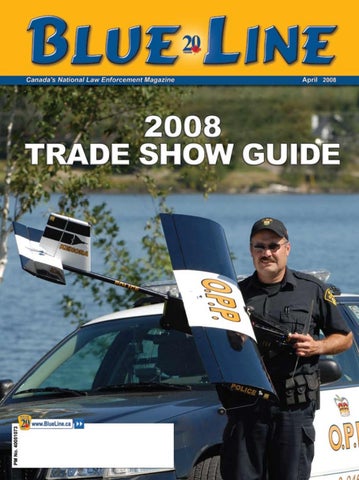
The Ontario Provincial Police (OPP) has become the first North American police agency to regularly operate an unmanned aerial vehicle (UAV) in civilian airspace with federal approval. The device was utilized to view and map a homicide scene at Fort Severn. See more on this historical event beginning on page 6.
6 Forensics take to the sky 10
Forensics move into the future
14 Getting it back in line
Surveying recruitment in Canadian policing
he Ontario Provincial Police open first T purpose-built facility
22
12 Juvenile justice in Canada - Part 3
27
Blue Line Trade Show 2008
54 54 41 51 40, 49 52 46 45 53 37 39 5 44
48 50
Warrantless search to render aid legal Police detainee breach overturns conviction
Advertisers Index Back of Book Blue Line Journal Coming Events Dispatches Deep Blue Health & Fitness Letters Market Place Media & Public Affairs Odditorials Publisher’s Commentary Technology
Blue Line Magazine Magazine
33
The voice of Afghan police
Canadian Cops are making a difference
April April 2008 2008
April 2008
4
Blue Line Magazine
It’s time to kill that cash cow – or let the blind rule by Morley Lymburner To paraphrase an old saying, in the land of the blind, he who has vision is king. In the police recruiting arena, the opportunity for vision awaits any agency willing to change. We presented a straw survey of the current status of Canadian police recruiting in the March edition of Blue Line. This quick study, intended to profile the immediate recruiting needs and capabilities of various areas of the country, was very revealing and showed a dire need for much work to be done... fast. There were four aspects that I found troubling: • Applicants charged for the privilege of applying; • An attitude of preferring mature (mid 20s) recruits; • Recruits having to pay for training; • Recruits not being paid while they train. If you want to hire the best candidates, this has to change and anyone who does will have such a tremendous advantage over all other recruiters that they will probably be able to send all the rest great quantities of rejects. Too many police agencies treat their training like a university or college course. I do not know where this wrong headed idea started, but I can guess. It would appear the recruiting office has become populated by university grads who saw promotion written all over this idea. All I can say is, even if it was once a great idea, it isn’t now and should immediately be scrapped. The biggest flaw in the whole concept is the theory that universities charge to educate students, so why not police colleges? There is a huge difference; universities and colleges do not train students to work for themselves or any single company or agency. Their graduates can go wherever their qualifications will take them, and are rewarded for
Blue Line Magazine
high marks and academic achievements. No strings attached. This pay-as-you-go attitude has been partially successful. As many police agencies have discovered, students will pay – but then they go. A student forced to pay for their own education feels a sense of entitlement to that knowledge and, just as with a college diploma or university degree, expects it to be portable. After earning their BA (Been to Aylmer), they look for the best job they can find. Most feel little obligation to ‘dance with the one who brung them.’ Unlike police recruiters, academic institutions do not choose only the best candidates. They look at basic high school grads and then take anyone who meets their minimum standard – and has the money. While on the topic of money, there are many cascading issues with the ‘show me the money’ attitude of police educators. One rather large agency advises that while it does not charge recruits for attending training, it has a “graduation” fee of around $4,600. If recruits don’t pay, they do not graduate. The money is for such incidentals as gun cleaning solvent, boot polish, paper, pens and binders. So let’s get this straight – a recruit has to pay for solvent to clean the agency’s gun and shoe polish to shine the agency’s issued boots? Training standards require both to be maintained, so the supplies are hardly “incidental.” Furthermore once hired there will never be a shortage of pens, paper and binders for the rest of their career. So why is this money being demanded? This is a fine example of an agency running on empty and sending applicants the image that it does not have enough money. It must rely on its image and the enthusiasm of youth to attract applicants. But wait – it doesn’t want youth, it wants mature candidates... . With maturity comes the ability to see
5
the real world for what it is. Life experiences include having a reasonable understanding of when something is not in your favour, and understanding who has the best offer. This agency’s ideal candidate is in their mid 20s, with established work experience, training and expertise other than policing, likely married with children – and is expected to sign up for six months, travel far away from family and friends, and endure gruelling training and a steep learning curve for no pay? What kind of “mature” candidate would opt for this? “Show me the money” issues do not stop there. How about agencies that charge fees as high as $200 for simply filling out an application form. Have your wallet ready if you pass, since there’s another fee for stage two and then the final wallop of paying for training. Many of these agencies look for a mix of ethnic recruits that reflect their community. The fees are unlikely to help them achieve their goal, and certainly sends the wrong message to potential recruits. Police agencies have a vested interest in treating their recruits properly, from the very first contact until the day they graduate. One bit of controversy – one hint that they have been scammed – immediately chips away at their loyalty. Things are not going to get any better as their careers progress, and small abuses are magnified and amalgamated with future big and small injustices. It is time for recruiters to kill the cash cow... and get some real vision of the world as it is today. Either pay them fully from the start or cut the ties with training and let the community colleges take over completely.
April 2008
Forensics take to the sky by Marc Sharpe The Ontario Provincial Police (OPP) has become the first North American police or civilian agency to regularly operate an unmanned aerial vehicle (UAV) in civilian airspace with federal approval. With no fanfare or media attention, 11 investigators assembled along the cool, windy shores of the Severn River last October, four kilometres downstream from the shores of Hudson Bay. They were there to watch the nine pound, electric powered aircraft launch skyward to capture a tiny bit of aviation history. The UAV, with Transport Canada designation “FIU-301” prominently displayed, was embarking on its first operational mission at a Fort Severn, Ontario homicide scene. The story began in January of 2004 when I transferred into the Kenora Forensic Unit. In conjunction with Thunder Bay, the unit provides forensic identification services for the 560,000 sq/kms of the OPP’s Northwest Region. With a high volume of major case work and vast geographical challenges, obtaining timely and quality aerial photos, suitable for court presentation, was an expensive underApril 2008
taking. Regional logistics dictated chartering aircraft for these shots at a cost, in some cases, of more than $3,000. Spotting an opportunity to mix my hobby with work and with confidence born of 15 years as an avid modeller of radio controlled aircraft, I approached unit commander Sgt Carmen McCann in early 2005 with a plan. For the cost of one or two charter flights, I could build a system to do the job. With his support, we began looking for seed money, which we eventually obtained from regional command. To keep costs low, I designed and developed the system in my home shop. The system had to be electric powered, rugged and have a modular design for ease of transport and operational use. More importantly, Transport Canada needed to be involved in the development process to ensure it would approve the system for operational use. The cold hard fact is that ANY size unmanned aircraft, leaving the ground for ANY purpose outside of hobby or pleasure use, requires an operation certificate. It wasn’t long before my great idea of taking my hobby to work turned into taking 6
my work home! After some three years and 400 hours spent designing, constructing and testing three aircraft configurations, reams of paper entrails and cultivation and consultations with industry and government contacts, we had a system ready for operational deployment. It was developed with a single mission purpose: “To obtain high quality digital aerial images of major case scenes in a timely and efficient manner while operating within a secure police environment.” The aircraft weighs in at just under nine pounds ready to fly, has a 75 inch wingspan and its electric power system can pull it straight up under full power. The airframe is constructed from aluminium, light plywood, balsa wood and Styrofoam. An infra-red “pilot assist” on board helps maintain a level altitude when at shooting altitude. There is no autopilot system, as the aircraft must be operated within “line-of-sight” of the pilot. It is modular and quickly breaks down into seven major components, with aircraft and all ground support gear stored in two hard cases for transport. The design’s flying qualities allow it to work within a relatively small Blue Line Magazine
area and remain aloft for 20 to 30 minutes. There are two on-board cameras – an eight megapixel (MP) digital still on a rotating mount and a small colour video camera in the nose to assist in navigating over the target area. A live wireless downlink provides the camera operator a real time view of what they are seeing – a big help in accurate target imaging. There are two separate control systems on board; a 2.4 Ghz system for flight control and a 72 Mhz FM system for camera control. The ground station consists of the live link receiver, antennas and digital cassette player or laptop for monitoring. Additional batteries, testers, chargers, a two-way approved aviation radio, supporting documentation, flight and maintenance logs are contained within the transport cases.
Blue Line Magazine
Operational protocols Safe operation is our number one priority when deciding to deploy. We must strictly adhere to safety procedure and operating restrictions contained within our standing Special Flight Operations Certificate (SFOC). It’s renewable annually but Transport Canada can suspend it at any time for safety concerns, accident or other related issues. As the police UAV leader, we have an eye toward future development for all police services and want to demonstrate safe and responsible operations. Operational deployment must be within a secure police area and there must be at least three officers dedicated to operating the UAV – pilot, camera operator and safety officer. Some of the key restrictions include: •O peration only within the northwest region;
7
• Maximum operating altitude of 400 feet; • Daylight hours only; • The uav must remain within the pilot’s line-of-sight; • Winds cannot be above 30 km/h; • There can be no precipitation; • No operation over non-police personnel; • No flights over private property without permission; • Flight control services within any operating area have the authority to prohibit our operation. Cost The total cost of the current system came in at just over $5,000. As of February 2008, we have successfully used it at three homicide scenes so, considering the cost of charter
April 2008
services, it has already paid for itself twice-over. Future development It must be stressed that the system’s sole purpose is to obtain overall aerial images at major case scenes within our region of operation. It has met or exceeded expectations to date, but requires too much piloting skill to be practical for widespread use. Regulating agencies in Canada, the US and Europe are proceeding very cautiously in allowing any type of UAV to work in “civil airspace.” To this end, Transport Canada has begun the long process of drafting comprehensive legislation to regulate all aspects of UAV systems. Our unit was positioned uniquely for success due to the population density of our region, my personal aviation-related experience and the ability to immediately put the system to work in a secure police operational environment. Police services considering ANY type of UAV system need to clearly understand the need for Transport Canada operational approval before expending significant resources. That said, we have learned much and I believe there is room for wider police use of UAVs within current rules – if agencies proceed carefully and methodically. If properly approached, in partnership with Transport Canada, all police agencies and federal regulators can benefit from the emergence of this new tool by setting standards for future legislation. The two immediate police functions that make the most sense to pursue for broader service are forensic and tactical support. Officer and public safety must be emphasized. It is very unlikely that operation “beyond line of site” by civilian UAVs will be approved anytime soon.
Surveillance systems should not be pursued due to added legal complications and (justified) public and media concern about privacy issues. Surveillance issues and the resulting negative PR impact have demonstrated the ability to quickly overwhelm the potential public benefits these systems can offer. If beyond line of sight operations are to be pursued, I would suggest that search and rescue missions in unpopulated areas should be the catalyst. Our system is an initial step in demonstrating to Transport Canada and international regulators that police services can safely operate unmanned aerial systems, on a limited basis, within civil airspace. I believe the next step to broader police use is to focus on forensic and tactical safety applications with very reliable and easy to operate systems that can launch and recover within a standard sized residential lot. We must continue to maintain line-of-sight operation, using UAVs for individual incident deployment and keeping them as light as possible while operating below 300 feet. To be successful, we need to work with commercial
manufacturers to develop systems and, in consultation with Transport Canada, establish training protocols and standard operating procedures for deployment and maintenance for each individual system. I envision individually approved systems for police use that would meet risk assessment standards set by Transport Canada. In this way, a police service would then be able to choose from approved systems and receive certified training from the manufacturer as part of the purchase agreement. The final phase would be registering their system with Transport Canada and following a standard set of operational rules and regulations. Setting the dull regulatory stuff aside, an ideal aerial platform which can progress to the next stage would: • B e as small and light as operationally practical; • Require minimal assembly; • Be capable of vtol (vertical take off & landing); • Not be configured as a traditional helicopter (too many moving parts/difficult to operate and transport); • Have no external launch system; • Have a hands-off altitude and position hold system while hovering; • Have a minimum 15 minute hover capability; • Have an interchangeable high-res digital still camera (minimum 8 mp) and either high quality colour video or low light/ir video cameras; • Be transportable as a complete system in no more than two portable hard cases. Our success has opened the door to the possibility of testing/operating commercial systems within our unit that can meet these preferred criteria. We intend to use the opportunity to work towards the stated goals of developing systems, training and operational procedures that can be applied across the country and perhaps beyond. Stay tuned. Parts sources • The main camera is essentially a “point-nshoot” NIKON; • The nose camera and live video downlink components (airborne & ground based) were purchased “off the shelf” and are available from Sony and Black Widow AV; • Geoff Child of Winnipeg, a modelling associate, designed and built an electronic switch which toggles between both camera views. Child’s home based business is “GC Custom Electronics” (http://www.gccustomelectronics.ca/about_us.html); • The aircraft construction materials, motor, batteries, remote camera and flight control equipment are all “off the shelf” equipment purchased through radio control aircraft hobby suppliers. The only exception is the aluminium shower curtain rod I purchased from a local hardware store (aircraft tail boom). Marc Sharpe can be reached at Marc.Sharpe@ontario.ca.
April 2008
8
Blue Line Magazine
Blue Line Magazine
9
April 2008
by Brian Ward The Ontario Provincial Police Forensic Identification Service (FIS) has begun a massive project across the province to construct dedicated forensic identification laboratories over the next several years. Located in the OPP’s Eastern Region, the Belleville-based FIS facility was the first to open last September and is under the command of Forensic Sgt Dave Tovell. It was previously housed in the Belleville OPP detachment, in cramped quarters not suited to the requirements of a modern facility. Serving a diverse region, the unit has a unique character. Located in the city and adjacent to Highway 401, the area is home to town and country residents, summer cottages, military base and several federal correction institutes. Prior to 2004, a portion of the area, including Trenton, was serviced by the Quinte West Regional Police Service. It amalgamated withe the OPP in 2004 and offices shifted to Trenton April 2008
in a move that left an OPP detachment open for development. The vacant facility was taken over by the forensics unit later that year and Tovell, then an acting sergeant, was put in charge. He played an active role in planning the new facility, working with architectural firm Norr Ltd. and OPP facilities management staff. Construction began in late 2006 and took a year to complete. The building is divided into three distinct areas; an administrative section, laboratories capable of handling biohazardous materials and a detached vehicle examination garage located approximately 150 metres from the main building. Staffed by a sergeant, five forensic constables, a civilian administrative assistant and maintenance engineer, the unit is responsible for providing forensic identification services for an area of more than 2,000 square kilometres. General policing in this region is the 10
responsibility of seven OPP detachments and supplementary forensic support is provided by a team of 30 scenes of crime officers. Card controlled access Access to the forensics building is controlled by proximity cards, beginning with restricted public access through the front door. There are sensors placed above every card controlled door that record the movement of everyone walking through, Tovell points out. If a group walks through the door, the system captures each person. An accurate audit of evidence handling witnesses can be provided should it be required. Once inside, the visitor is struck by the large, clean and bright rooms. “This can be very deceiving,” notes Tovell. “We regularly hold training and education sessions for police that will see upwards of 35 people occupying our boardroom, and once we start getting crime scene exhibits, this place fills up pretty quickly.” Blue Line Magazine
The building is equipped with three examination laboratories; each must be entered in a three step process. First is a small ante room where officers can don protective clothing such as gowns and masks. Lab cleaning supplies are stored in a second room and the third door leads to the laboratory/examination room. Computer controlled fans built into a Hepa filtered ventilation system provide three levels of negative air pressure to each of the laboratory areas. The pressure ramps up in each ante room, providing a clean air environment. A cop and an engineer “I always thought of myself as a cop,” Tovell said, grinning, “but it seems I have a new career as an engineer.” In fact, he can access any of the building’s environmental controls from anywhere in the world through a website set up by the OPP. The main laboratory houses an examination table illuminated by a surgical light, drying cabinets, chemical examination sinks and a small incubator for processing paper exhibits. Latent print development, photography, alternate light source work and secondary chemical processes are done in a separate examination room. Tovell, who spent seven years with the Guelph Police Service prior to joining the OPP in 1997, now chairs an OPP committee set up to guide all future provincial forensic facilities.
Blue Line Magazine
Sharing the expertise “We also try to share with Belleville and Kingston Police Services,” Tovell said as he opened the doors to the stand-alone garage examination building. “They are invited for training sessions and they can make use of this garage.” Illegal drug use and crime associated with these activities, especially robberies, comprise a major portion of the facility’s workload,
11
but with a major Canadian highway on the doorstep and two federal corrections facilities operating in the area, it is also called on to investigate numerous other types of crime. The unit operates a day shift seven days a week, as well as an on-call service to the region. David Tovell may be contacted at David.Tovell@ontario. ca. Brian Ward is Blue Line Magazine’s Forensics edtior and may be reached at Forensics@BlueLine.ca
April 2008
Part 3 - The reform impulse Although children were subjected to adult legal standards, there were growing signs early in the nineteenth century that attitudes were changing. The reform movement that emerged in Canada owed an intellectual debt to the eighteenth-century Age of Enlightenment. The eighteenth century witnessed a great intellectual ferment in science and philosophy as a new generation of thinkers challenged long-standing ways of looking at and explaining society. Enlightenment thinkers were absorbed with an interest in humanity and a belief that society could be improved. They sought reform of economics, of ethics, of religion, of government and of society. Some called for the abolition of slavery; some demanded education for the masses; some campaigned for democratic government; and
April 2008
some, such as Cesare Beccaria, called for an end to the cruel practices and injustices that characterised the penal system throughout the world. Early penal reform ideas found a ready reception in Canada. For example, an 1816 Act of the Nova Scotia Legislature acknowledged that putting people in jail for minor criminal offences was a useless expense. The Act also included the reformation rather than simply the punishment of the offender as an objective for those in jail. A more comprehensive expression of reformist ideas was contained in an 1836 report by Charles Duncombe to the House of Assembly of Upper Canada. Duncombe was a physician and politician elected to the Legislature of Upper Canada in 1834. He was
12
chairman of a commission appointed to report on the subject of prisons and penitentiaries. He held the view that prisons should not be merely for punishment but places of reformation and of moral and intellectual improvement. Condemning the corrupting effects of indiscriminately grouping together persons of all ages and degrees of guilt, Duncombe called for an effective system for the classification of convicts. He made a special point of calling for dramatic changes in the treatment of young offenders. Duncombe argued that municipal governments had an obligation to help and protect unfortunate children and that these juveniles should be able to look upon the authorities as fathers. He extended this responsibility to the entire community, suggesting that everyone should be concerned with the problem of juvenile delinquency. He closed his remarks with the proposal that the community help the law enforcement agents in rescuing those pitiable victims of neglect and wretchedness from the melancholy fate that almost inevitably results from an apprenticeship in common prisons. Duncombe’s attitude was a distinct departure from the philosophy that prevailed at the time, which blamed individual character defects for human distress. He was among the first of the early Canadian reformers to suggest publicly and officially that the roots of juvenile delinquency lay outside the person and that the entire community bore a responsibility in dealing with the problem. Although he did not offer a specific remedial plan, he made it clear that treating young offenders like adult criminals was not a proper solution. He was equally clear on the issue of keeping delinquents out of jail. For advocates of reform in the treatment of juvenile delinquents, another early source of encouragement came from the report of the 1849 commission headed by George Brown. The commissioners devoted a section of their report to the treatment of juveniles, observing that in waging war with crime, there is no department so satisfactory, so encouraging, as the rescue and reformation of the young; and there it is the battle should be fought with utmost warmth. In this spirit they recommended the construction of houses of refuge for young offenders, suggesting that one be established at either Montreal or Quebec City in Lower Blue Line Magazine
example, as early as 1845 polall offenders, including the Canada and another at Toronto or Hamilton iticians and officials expressed young, should be punished. in Upper Canada. concern over the treatment of They argued that lenient treatThe refuges, according to the commissionjuveniles, and there were perment would simply encourers, should be divided into two departments, iodic discussions in the House age the young to more crime. one to accommodate neglected or undisciAssembly on such matters Consequently, the progress of plined children and the other to house those YOUR AD HASofBEEN COSTED FOR: CLIENT: BCPSA as schooling, segregation and reform was held up by debate convicted of a crime. The Brown Commission separate facilities. But it is only over questions of treatment. On further recommended that the centres be put FORMAT: 1/2 Page (7.25 x 4.75) HR CONTACT: in 1895 that the province opened the one hand, there were those under the control of the penitentiary inspectors hr KEY NO.: BCPSA46395 its first industrial home. Between who, upset that current sancandcommunications that a board of managers be appointed HR to PHONE: MINISTRY: Employment & Income 1846Magazine and 1857, more than 300 tions were ineffective, called Assistance MEDIA: Blue Line make weekly visits, look after the apprenticing youngsters under 18 years of for even harsherJerad penalties. of the children and oversee the philanthropic DATES: April, 2008 MINISTRY CONTACT: Larson age were sentenced to the New On250.387.0204 the other hand, a growing activities of the institution. The young people INSERTION COST: $2343.00 PHONE: Brunswick prison. constituency argued that it was would be offered educational and vocational Charles Duncombe (Excluding production/transmission & GST) EMAIL: Jerad.Larson@gov.bc.ca Throughout the country morally detrimental for chilinstruction, and they could be apprenticed out (1794-1867) FINANCIAL CODE: even rudimentary changes, such dren to be put in penal facilities, for trades training. The commissioners envisOFF: Jerad, Pat / Angela as schooling for children in prison, were not and that under no circumstances should they SIGN aged a system that would be a combination of without controversy. Some argued be incarcerated for minor offences. education, labour and healthful exercise. The PROOF-READ (Midlyn HRC): R that, since POSTED TO EXTRANET: 9:10, Feb 27 the majority of children in jail and prisons came There were also children apprenticed out would remain under CLIENT DEADLINE: Febsome 28, practical 3pm difficulties. from the lower classes, too much education Since there were no social agencies or welfare the authority of the board of managers and would encourage ideas of rising above their services, officials faced a choice of either putcould be taken back to the house of refuge if situation. In Upper Canada in the early 1850s, ting young offenders in jail, returning them to they misbehaved. prison inspectors favoured a program at the often times bad home situations or turning them Reformist ideas did not go unchallenged, common school level but not beyond, so that — loose to fend for themselves. Also, communities nor did they generate immediate action. In in their words — “undue aspirations will not be were reluctant to spend money on separate contrast to views such as those expressed by entertained nor will ambition lead astray.” facilities for the young. In New Brunswick, for Charles Duncombe, many still believed that
Ministry of Employment and Income Assistance L Prevention Loss Management Services Branch
Ministry Investigators Take a new direction in your law enforcement career—Victoria, Surrey & Various Locations We are looking for seasoned law enforcement professionals ready to take a new path in their career. We offer well-rounded pay and benefits, a collegial teamwork environment, excellent working conditions and opportunities in a variety of locations within British Columbia.
offences; appear in court as an expert witness; and have the authority of a Special Provincial Constable.
You will play a key role in maintaining the integrity of British Columbia’s Employment and Assistance program by planning and conducting criminal investigations on persons suspected of having committed offences under the statutes administered by the Ministry of Employment and Income Assistance and under the Criminal Code of Canada.
You have a minimum of Grade 12 plus one year of post-secondary education. You have developed your law enforcement proficiency and stayed current through ongoing training and participation in educational opportunities such as criminology, law, commerce, accounting and business administration. Your expertise has been attained through operational law enforcement experience, and you have a successful record in major crime investigation spanning several years.
You may also be called upon to conduct internal investigations that may result in disciplinary proceedings, dismissal or criminal proceedings. You will work with senior Ministry officials, law enforcement agencies, Crown counsel and the public; gather and evaluate evidence related to alleged
A Ministry Investigator is a Special Provincial Constable pursuant to the Police Act. As such, you must qualify for and retain a Special Provincial Constable appointment. You must also qualify for and maintain an appointment as a Commissioner for Taking Affidavits.
To learn more about these positions and the more than 200 career opportunities available with the BC Government, visit www.employment.gov.bc.ca
Blue Line Magazine
13
April 2008
Recruitment into the police sector has been inconsistent in recent years. Based on the available funding, the sector has sought and achieved recruitment levels ranging from as low as 300 to over 3,000 per year (see chart below). The average level of recruitment in the years 2000 – 2004 was 2,760, although over the last 20 years the average is closer to 1,800. Finding candidates has not generally been a problem; finding the right candidates has been more of a challenge. Anecdotal evidence from Human Resource professionals, depending on the screening process used, suggests that in some cases as many as 90 per cent of applicants are rejected and almost all Human Resource Leaders and Police Chiefs report problems in meeting their diversity objectives.
From 1983 the number of women recruited into the sector increased reaching a peak approaching 700 in 2001, but has stalled since then. Women now represent approximately 22 per cent of new recruits in the sector and 17.3 per cent of all employees in 2005. This percentage of recruits has been consistent for the last decade and, given that the impending retirements are largely male, the overall proportion in the workforce will rise to 20 per cent by 2012, but will not increase much further, given the unique challenges of the life of a police officer. Canada is growing more diverse in terms of culture, ethnicity and lifestyle and it is widely accepted (inside the sector and outside) that police organizations should recruit from diverse groups to “live” the diversity of the communities they are serving. Most police organizations are introducing special initiatives to attract visible minorities and aboriginals and are having mixed success. There are some best practices, which can be shared within the sector to improve performance, but police organizations need to break down the fears that many ethnic groups have of April 2008
police and policing. The immigrant population is growing at twice the domestic population growth rate and this will need to be a significant source of new recruits, even though it is particularly difficult (and expensive) to validate the qualifications and character of applicants who have limited history in the country. Projections for the future levels of recruitment vary significantly in detail but not in direction – they all indicate an increasing requirement. The drivers of this demand include: • Demographics – increasing numbers retiring leading to the need to replenish the workforce; • Increasing work demands – the nature of crime and the expectations of the public are creating a situation where the work is more time consuming, hence more resources are needed; and, • Current low levels of resourcing – in Canada in 2005 the police sector provided 186 police officers per 100,000 persons in the general population, this is down from 207 in 1975 and below the average of most other developed countries (e.G. Usa 326, australia 304, uk 258). The updated Police Sector Study, Policing Environment 2005, indicated that the annual number of recruits would need to increase to 4,300 in 2010 just to maintain current officer strength at all levels, and would have to be in excess of 3,000 recruits per year for the next 20 years. This is only one estimate, but it is safe to assume that recruitment levels will have to at least double in the next decade compared with the previous decade. The current recruitment process does not facilitate meeting this challenge. Any process that takes six months or more and rejects up to 90 per cent of applicants is too time consuming and is either attracting the wrong type of applicants or rejecting people on unreasonable grounds. Our survey of police officers indicates that 38 per cent of them are unable to agree with the statement “My Service hires the recruits who are able to do the work required of them.” and 72 per cent are unable to agree with “My Service attracts enough new recruits to meet current needs.” The historical abundance of applications is beginning to disappear. Recruitment strategies, with the exception of targeted diversity groups, have typically been passive reflecting a notion that good people who are interested in policing know where you are and how to find you. This notion is changing as the Human Resource 14
Leaders recognize the fact of the looming “war for talent.” This war is against the various other career choices available to potential recruits, which include both resurgence in the skilled trades and the growth of private sector security operations. As an illustration of this impact, many police organizations took the almost unheard of step of entering the market and actively recruiting in 2006. The sector recognizes that it will have to be more active and even aggressive in selling itself to the modern youth as well as the immigrant population in the years ahead. The application process is not integrated in most parts of the country. An interested candidate has to apply to each police organization in which they are interested independently. The application forms vary as does the process. The role of a police officer is essentially the same across the country – indeed, the public demands this, yet the criteria used to select or reject candidates are not consistent. There is a reasonable consensus as to the attributes of an ideal candidate (aged 26/27, college educated, physically fit, with no history of criminal activity, with strong interpersonal competencies, a real desire to serve the community, and meeting as many diversity attributes as possible); the issue is how far from this ideal each different police organization is willing to compromise. • How important is post-secondary education? • Is some drug use in the past acceptable? • Will we take a 21-year-old university graduate who appears to have strong competencies? • The answers to these questions vary from police organization to police organization. A particular concern appears to be the age at which recruits are hired. A little over half of police organizations indicate that their preferred age for new hires is in the 26 – 29 range, in order to ensure that recruits have some life experience to build on. Indeed, the use of competency-based assessment techniques have validated that important competencies are often not found (at an adequate degree of development) in younger candidates. However, this means that young people will have to embark on a different career following their education (be that from high school, college or university) and the police sector has to win these people back at a later stage. Certainly today’s youth are open to the notion of switching careers, but it appears that concerns over age and experience may be choking off the supply of good young people. Blue Line Magazine
MOTOA4 Mission Critical Portfolio
A BETTER VIEW FOR BETTER DECISIONS AND BETTER OUTCOMES When you’re responsible for the safety of an entire community, complicated and difficult decisions are part of the job. But Motorola can help make it easier. The MOTOA4 portfolio of mission critical voice and data networks deliver mobility at high speeds and enable secure interoperability between disparate agencies. When coupled with our suite of advanced applications and mission critical devices, real-time information is seamlessly delivered to responders so they can make better, faster and safer decisions. Innovative solutions that work like they are second nature, so you can focus on your mission and not the technology. It’s just another way Motorola puts Seamless Mobility in the palm of your hand. HELLOMOTOTM Learn how MOTOA4 innovative mobile solutions can help save lives and protect communities by visiting motorola.com/secondnature/blueline
MOTOROLA and the Stylized M Logo are registered in the US Patent & Trademark Office. All other product reserved. 2008 15 or service names are the property of their respective owners. ©Motorola, Inc. 2008. All rightsApril Blue Line Magazine
Serial killer #1 (Courtesy The Bathroom Reader Volume 15)
Herman Mudgett. Yes, we know you’ve never heard of him. That’s sort of the idea when you’re a serial killer, now, isn’t it? There is not much good one can say about serial killers. First and most obviously, killing people is just plain wrong, unless it’s selfdefence, or a war, or your stuffed animals have told you that Jesus wouldn’t mind. But more than that is the fact that serial killers, as a class, simply exhibit poor form. While it’s all very fun and ironic to follow the exploits of crazed murderers as if they were sports heroes (the gruesome collection of Serial Killer trading cards several years ago made this point rather forcefully), the metaphor is in fact entirely wrong. Outside of hockey, the aim of sports is not to actually brutally murder your opponent, and even if it was, your opponents would generally not be terrified student nurses. Fact is, serial killers go for the easy targets, under false pretences. They’re not like the gangsters in the 1920s, when if you saw a guy in a pinstripe suit coming at you with a violin case, you knew you were gun butter – and that you probably had it coming. Serial killers lure you in, offering sex or money or candy or whatever, a terminal bait-and-switch, and the next thing you know, you’re dead, your pancreas is being fried up, and some guy is using your skull for a candle holder. Meet Mr. Mudgett Mudgett (or Henry Holmes, his alias at the time) operated in Chicago at the time of the 1892 Columbian Exposition, and he is a perfect example of this concept. Mudgett killed women in a baroque chamber of horrors he had secretly built into his mansion/ hotel on 63rd Street (how does one manage to build a secret chamber of horrors? By changing contractors frequently during the construction process, so no one person – besides Mudgett – knows the set-up of the entire house), and he lured them into the place by offering them jobs. He needed a secretary, you see, someone who could take dictation, file, and then die. If it’s Tuesday, it must be Betsy During two years, Mudgett had something on the order of a hundred secretaries, a fact
April 2008
you’d think someone would notice (“You’re Ethel? What happened to Helen? And, come to think of it, what happened to Bonnie, Daisy, and June?”), but apparently no one did. Maybe they thought that Mudgett was a harsh boss. Well, and he was. More to the point, however, this was 1892, and the sort of woman who had to work out of the home was also the sort of woman who was less likely to be missed. Mudgett also went out of his way to “employ” new arrivals to town, who had the added benefit of no one to look out for them. A man of many interests Mudgett was not just a crazed whacko who liked killing people, mind you. He was a crazed whacko who liked killing people and taking their money. Before he offed his victims, he would gain their trust (often by making them his mistress – so these days not only would he be liable for murder, he’d also be slapped with one hell of a sexual harassment suit) and then convince them to give him their life savings. His rationale, perhaps, was that once he was done with them, they wouldn’t need it anyway. Say Ahhh! As it happens, Mudgett had a long history of gruesome moneymaking schemes. While he was in medical school, he would steal cadavers, burn them horribly with acid, and them set them in a place that had a lot of insurance in hopes of extorting a settlement of some kind – not unlike the old “cockroach in the salad bar” manoeuvre, except in this case the “cockroach” used to be someone’s Uncle Ted. Gory details This is not to say it was all just business for Mudgett. No, he was, in fact, seriously
16
screwed up. Abusive parents, early episodes of animal mutilation, all the classic signs of total bonkerness. His torture chamber on 63rd Street was just that. Mudgett used his medical expertise to perform horrifying “experiments” on his victims, most of which, as you might imagine, ended quite badly for the patient. After he had his fun, Mudgett disposed of the evidence in a special cremation oven in the basement (oh, sure, it’s a furnace...), or, if he chose to sell the bones to a local medical school, as he did from time to time, there was always the lime pit. What time is check out? No one knows how many people Mudgett killed; estimates go up into the hundreds. Beyond the “secretaries,” Mudgett also offed guests at his hotel – like a roach motel, they checked in but didn’t check out. His cover was the Columbian Exposition, a huge World’s Fair taking place a few blocks away; it attracted a vast number of people from faraway places. They wouldn’t be missed, at least not by anyone local who might put two and two together. And he never got caught. Not for the murders in Hotel Hell, in any event. Mr. Mudgett’s budget Mudgett’s downfall came in the form of Benjamin Pitezel, the Igor to his Dr. Frankenstein, whom a penny-pinching Mudgett (hey, murdering hundreds of people costs money!) decided to kill for insurance purposes. Wouldn’t you know, the insurance company had suspicions, as did Pitezel’s wife. Mudgett’s response was to try to kill off every member of Pitezel’s family, a tactic that he apparently seemed to think wouldn’t look in the least bit suspicious. He murdered three of Pitezel’s kids before the cops got him in Boston. At which point they worked backward, found Mudgett’s hotel (now a smoking ruin – another insurance scam) and the evidence of his terrifying serial murders. Mudgett was tried, convicted, and, on May 7, 1896, hanged. Mudgett’s last words were to the effect that he had really only killed two women. Odd statement to make as your last on this planet, considering that even only one murder was more than enough to stretch your sorry neck. Nothing but the best There’s no doubt Mudgett was a horrible man who preyed on the weak and the innocent. The worst thing about it was that he was as good at it as anyone in his line of work – possibly the best ever. That is, that we know about. The real best serial killer of all time we probably will never know about. Think about that the next time you meet a smooth-talking stranger. Blue Line Magazine
Blue Line Magazine
17
April 2008
Turning Blue to Green No gas guzzling at the Olympics
by Laslo Linden The new Vancouver Integrated Olympic Police Authority (VIOPA) has given Blue Line an exclusive preview of the new Olympic patrol vehicle it’s about to introduce to Canada and the world. VIOPA has chosen to go with a design by Yugoslavia-based Clever Car Company. Base vehicles are expected to cost around $15,000, with fully equipped police versions topping out at around $28,000. VIOPA says the standard Clever Car will be substantially enhanced with the addition of some Canadianmade innovations. “The base vehicle alone comes with considerable advantages in design and function suited to the conditions expected for the 2010 Winter Olympics,” states Insp. Roy Beane, VIOPA fleet management team leader. “The vehicles weigh in at less than 400 kg. and can carry two officers. With a few modifications, we feel it will work extremely well for our purposes.” The Clever Car was first introduced in 2006 by a consortium of French engineers, with the assistance of Zastava Auto’s consulting division, Belgrade based New Yugo Ltd. It is a compact city vehicle sporting tandem seats, 2,450 mm wheelbase and track width of 835 mm. It has a 17” front wheel and two 18” rear wheels. Thanks to its low height, the vehicle is designed to tilt when cornering and has a computer-controlled hydraulic rolling system, resulting in a driving experience with zero lateral forces at tilting angles of up to 45°, April 2008
similar to riding a motorcycle. The stock vehicle has a top speed of 80 km/h, goes from zero to 65 km/h in 27 seconds and emits only about two thirds as much carbon dioxide as a full-sized conventional car, Beane points out. Fuel consumption is equivalent to 3.37 litres per 100 kilometres, but VIOPA’s special hybrid human/gas/electric “tri-energy” police version will do even better. In tune with the spirit of the Olympics, it has been customized with an innovative, Canadianbuilt Peda-Boost generator. The driver/rider and passenger will help move the vehicle, recharge the battery, power peripherals and take some of the load off the gasoline-powered generator. Actual fuel economy will depend on the strength and enthusiasm of the vehicle occupants, Beane said. The Peda-Boost can be used by the driver, passenger or both, according to Beane. Two 18
strong ‘human generators’ could potentially make the Clever Car a true “green, zero emission vehicle,” he added, supplying all the energy needed without help from the generator – assuming efficiency improvements are as dramatic as designers promise. “We see this specific Canadian innovation as being compatible with the spirit of the Games and assisting in lowering the carbon footprint made by police,” notes Beane. “As a side benefit, the workout derived from using the system is a life enhancing opportunity for VIOPA officers and sure to increase fitness levels.” Considerable thought and research went into developing the Peda-Boost. Assisted by a federal grant of $770 million, awarded to Quebec-based Can Err Industries, the “Can Errcharge” is seen as leading edge technology. President Ricardo Volare says it took just three years and 1,220 Blue Line Magazine
scientists and engineers to develop. “No one in the world had thought to build such a unit for this purpose,” Beane says. “We were amazed that Can Err came forward so quickly to take on the challenge.” The new “human dynamo” unit currently can output as much as 675 milliwatts, more than enough to power the police radio. “This is just the prototype though,” Volare asserts. “The rare earth magnets, platinum wire coils, gold connections, neodymium iron boron magnets and high frequency design in the production version will be much more efficient and well-worth the modest extra cost.” Volare refused to be more specific about just how modest that extra cost will be, but is not concerned. “The federal government has agreed to fully fund the cost overrun under its new ‘Vancouver Olympic Technology Efficiency Strategy’ (VOTES),” he explains. Several dozen Quebec companies have already benefitted from the initiative. An Olympic-calibre cyclist pedalling the production version Can Errcharge can generate more than 500 watts, Volare says, “so your average police officer should be able to manage at least 30 watts.” With its low curb weight and front-end surface area of just one square metre, the Clever Car functions with only a 15 kW gas powered generator (depending on the weight of the occupants), says S/Sgt John Rowan of VIOPA’s planning and research branch. “The manufacturer states the engine generates CO2 emissions of less than 60 g/km, but the prototype has reduced this to only 58 g/km,” says Rowan. “The standard operating range has increased to more than 207 km from 200. Rowan expects even better performance with the production Can Errcharge installed, which VIOPA plans to test with currently serving officers instead of retired volunteers. The Clever Car has an aluminium frame and plastic body. Rowan estimates that, after taking into account carbon emitted during its construction, it will account for a net CO2 reduction in as soon as 23 years. Other new innovations on the Clever Car include front wheel ski adapters and a ‘pedalert’ device that automatically stops the vehicle when it gets within ten feet of a pedestrian. “This new stop device has two advantages,” Rowan says. “First, it will ensure that none of the thousands of visitors to the Olympics will be struck by police. The last thing Vancouver needs is another international incident. “Secondly, it is an opportunity for officers to get out of their vehicles and walk when the crowds get too large.” Rowan was unable to say how the feature would affect pursuits or vehicle use during emergencies, but says engineers are currently considering installing an “officer override switch.” VIOPA planned to introduce the production police version of the Clever Car April 1 in Vancouver. Tentative plans called for Vancouver mayor to arrive at Port Vancouver with the vehicle aboard the Greenpeace ship Rainbow Warrior and then be driven to the City Hall unveiling ceremony.
Police in need of higher profile across Canada Feb 27 2008
TORONTO (National Post) - The former commissioner of the RCMP has lashed out at his old bosses, blaming a lack of government leadership for what he says is a growing gap between the demands on police and the resources allotted to them. Giuliano Zaccardelli, who resigned as top Mountie a year ago, told the Senate National Security Committee that police budgets are not keeping pace with the increasing challenges posed by crime, terrorism and organized criminality. He testified that Canada has 195 police officers for every 100,000 citizens, which he said is the lowest ratio among the world’s top 25 developed countries. While governments were cutting police budgets, “crime did not take a cut,” he added. New legislation has meant more paperwork for police, he said, citing a study that claimed it takes officers 58 per cent longer to process a break-and-enter case than it did a decade ago, and 250 per cent longer for an impaired-driving charge. “No corresponding budget increases were given to the police every time a court decision or a new piece of legislation increased the processing time. All that took place in a policing environment of more public oversight, more media scrutiny and more expectations for an accountability bar set higher than any other profession,” he said. Mr. Zaccardelli resigned after admitting he had given incorrect testimony to a parliamentary committee examining Canada’s role in the torture of Maher Arar by Syria. A special investigator appointed to examine the RCMP’s troubles was later critical of the commissioner’s leadership style. The career police officer said he was testifying only as an individual with a passion for public safety.
The Senate committee called the hearing to examine Canada’s emergency preparedness. Mr. Zaccardelli testified in Ottawa on Monday but a transcript of his comments was only released yesterday. Since coming to office two years ago, the Conservatives have been trying to position themselves as a law-and-order government. Melisa Leclerc, spokeswoman for Public Safety Minister Stockwell Day, said yesterday the government was committed to ensuring the RCMP was effective and accountable. She said the Conservatives had invested $37-million toward the expansion of the RCMP training depot in Regina and were hiring an additional 1,000 RCMP personnel. Yesterday’s budget also committed $400-million for the hiring of 2,500 more police officers across the country, she said. But Mr. Zaccardelli said Canadian policing was approaching “a crisis point, and we may already be there in certain parts of the country.” “On organized crime and terrorism, for example, the RCMP is seriously deficient when it comes to terrorism. Two years ago, when I came here, I said we can only deal with about 30 per cent of all the organized crime groups that we know. I am afraid it is probably getting worse,” he said. “We are talking about huge gaps that have to be overcome. The gap will not be closed by small incremental increases. There has to be serious recognition of the problem.” The problems are particularly bad at the borders, he said. “Especially since 9/11, in my view, we have not responded in the way we need to when you talk about the border weakness in this country,” he said. “We have had miniscule resources in the past. When you look at the potential threat we face, it is simply not enough and we have to get serious about that.”
Visit www.viopa.ca for more on the Clever Car and Olympic policing.
Blue Line Magazine
19
April 2008
‘All things to all people’ is not
an organizational strategy
by Robert Lunney
linkages and support for Canadian foreign policy abroad. In the aftermath of the Air India disaster and 9/11, confronting terrorism added another major dimension to the already heavy burden of federal responsibilities. The RCMP expanded services to marine and ports security and environmental crime and reacted to various exigent demands. There was the Canadian Air Carrier Protective Program (Canada’s version of the Sky Marshals), enforcement of intellectual property rights, war crimes investigations, airport federal enforcement... the list goes on.
A lowly caterpillar, unhappy with his pathetic state, approached the wise old owl for advice. After quiet contemplation, the owl spoke. “You should transform yourself into a beautiful butterfly.” The caterpillar wiggled away, captivated with the idea, but soon turned back. “I love the concept, but how exactly do I transform myself into a beautiful butterfly?” “Listen, kid, I’m a consultant,” the owl snapped. “Don’t bother me with those operational details.” Likewise, I will outline some thoughts about structural changes to the RCMP; just don’t expect the operational details. What is our business? Management guru Peter Drucker incessantly repeats three questions in his writings: What is our business? What should it be? What will it have to be? These questions are the challenges facing the modern RCMP. The Force currently manages a sprawling diversity of roles and responsibilities that dangerously stretches the limits of its capability. This monolithic structure is the product of a culture too willing to accept every mission that came its way. If not reformed, the influ-
ence of this cause and effect will dangerously impair the image of the RCMP as a symbol of excellence. In the not too distant past, the RCMP’s federal law enforcement duties were rather narrowly limited to immigration and revenue laws and, for the most part, confined to Canada. The federal role began assuming critical importance in the 1980s, with growing demands for attention to criminal intelligence, organized crime, drug law enforcement, financial crime, protective policing, international
Focus on federal policing Now more than ever, the top national priority is for a robust and nimble federal law enforcement agency under a unified command; well resourced, co-ordinated and staffed by expert investigators. This suggests consolidating international and protective policing into federal policing. Unifying the federal roles would symbolize an important sharpening of priorities. The government and RCMP should make it explicitly clear that federal policing is the RCMP’s core function. Contract policing The Force contracts to deliver provincial and municipal policing in eight of ten provinces under authority of the RCMP Act, and also polices three territories. This bifurcated responsibility between federal and contract policing is baffling to many in central Canada, who wonder why the other provinces do not simply organize OPP or SQ equivalents, leaving the RCMP to focus on its federal duties. This is either a non-starter or at best, problematic, to Atlantic and western residents. The presence of the Mounted Police in the west is an historic convention and the RCMP has performed ably in both the west and the east. Commitment to federal policing as its core business line implies a severance from contract policing and the demise of the two-hatted police officer. Federal policing will have a separate and distinct function and personality in all parts of Canada. This has major implications for the federal/provincial costing formulae and opens up consideration of other options. National police services National police services provide invaluable services to the RCMP and other police agencies nationwide, ranging from informatics, co-ordination of criminal intelligence, provision of forensic laboratories, sophisticated technical expertise and the National Child Exploitation Co-ordination Centre. These are important mandates, vital to the integration of policing in Canada. National police services is a legitimate and justifiable
April 2008
20
Blue Line Magazine
secondary business line for the RCMP, but there is one questionable element. The role of the Canadian Police College under national police services merits an organizational study. Once the crown jewel of police education, the institution lost its standing when funding was slashed in the early 1990s. More provinces are investing in their own police education programs and university-based business schools have supplanted the college in the executive development field. Perhaps its future lies in providing in-service training for federal policing and as a research arm of the RCMP. Corporate re-structuring The first order of business for structural reform is recognizing one core business line – federal policing – and two secondary lines – contract policing and national police services – effectively consolidating five business lines into three. This would clarify roles and priorities and provide a balanced platform for a focus on performance. The RCMP would retain a capstone corporate mission and values statement, with each business line organized under a purposedesigned statement of objectives recognizing their functional dissimilarity, distinctly different operating policies and differing education, skills and abilities requirements for personnel. This corporate model would free headquarters to concentrate on developing and implementing a revised vision and strategy for the new RCMP, administrating corporate services, directing inspection and audit functions, estab-
Blue Line Magazine
lishing a central research branch and rationalizing the organizational structure. Organizational garage sale The task force on governance and cultural change found the RCMP was overextended because it accepted new responsibilities without a clear understanding of resource demands or the provision of funds. An organizational garage sale would give the RCMP an opportunity to shed extraneous activities which do not contribute measurably to its core and secondary business lines. A variety of functions under the heading of ‘assistance to other federal departments’ could be more effectively performed by those departments in-house. The ports police could be restored within Transport Canada. “Sky marshals” could be a function of Transport Canada. Canada Border Services Agency could be tasked with added responsibilities and the wardens of Parks Canada could be empowered as peace officers, relieving the RCMP of its protective responsibilities for wildlife. The coast guard could also assume added law enforcement duties. There are those who think it unwise to expand the number of peace officer appointments. The enduring example of two highly professional railway police services and the successful introduction of an armed agent presence by Canada Border Service counters this argument. Transferring the scattering of extraneous and lower tier activities to other departments could free up resources for more
21
vital tasks such as investigating top level financial crime, a field where the Force is criticized for ineffectual performance. The principle for the RCMP should be: stick to what you do best. Stop doing jobs that other agencies could be doing just as well or better. This is the second in a series about RCMP renewal. The next article will discuss the future of contract policing. A former senior officer with the RCMP, Edmonton and Peel Regional police, Robert Lunney can be contacted at lunney@blueline.ca.
April 2008
by Danette Dooley Barry Pitcher went to Afghanistan to help train police officers, but the accomplishment he is most proud of has nothing to do with arrests, drug seizures or crowd control. Sitting behind his desk in St. John’s, the RCMP corporal brings up a series of photos on his computer, stopping at a picture showing him bandaging an Afghan police officer’s arm. Two other Afghan men are sitting nearby, applying similar bandages to each other’s arms. This simple first aid training will help save lives. “We made a small team of Afghan policemen medics because we found that, quite often, we’d have a truck pull up to our gates. They’d have driven for two or three hours and they’ve have two or three policemen that had bled out in the back of the pickup,” Pitcher explains. The casualties would be the result of their vehicle hitting an improvised explosive device (IED), he says. “Three of four would have limbs missing and they didn’t know what to do – casualty care, triage – they didn’t know, so we took it upon ourselves to do this course and it was a huge success.” Each one of Pitcher’s photos tells a story. “This was a suicide vehicle that had come into Kandahar from Kabul with a shipment of explosives,” he says, pointing to an old beat up white four-door sedan. “It’s a rigged car and these jerry cans were filled with gasoline and soap. What this does is create a homemade bomb,” Pitcher says of two April 2008
large yellow plastic containers next to the car. The main explosives were stored in the trunk. The suicide vehicle was stopped just outside the gates where Pitcher was policing. “He was likely waiting for one of our patrols to come out through the gates where he would ram his vehicle into it and explode it,” Pitcher says. “It would have destroyed two city blocks and would have obliterated our vehicles.” Moving to the next photo, Pitcher points to a field covered in green, just one example of the flourishing marijuana crops that are abundant in Afghanistan. Plants grow 12 feet high, he says. “There’s nothing done about it. It’s a way of life. There are fields as far as the eye can see. In many of the villages you’ll hardly see mud huts anymore because there is so much marijuana drying on the roofs – and as you drive through the villages, it’s all you can smell.” Pitcher’s next photo is of another field, this one filled with beautiful white and pink flowers. Ninety per cent of the world’s opium now comes from Afghanistan, he says. Every pink flower has a bulb, Pitcher explains, which Afghan farmers slice with a small razor. They dry the residue and it eventually becomes heroin. “It’s then refined and moved over the mountains and most of the opium then moves from Pakistan into North America – the United States and Canada.” Peacekeepers are very much aware that the Taliban and al-Qaida groups depend on the money they make from the opium fields 22
to operate. However, even though such corruption and drug cultivation has become a way of life in Afghanistan, putting an end to the trade is “counterproductive to battling the insurgency,” Pitcher says. “If we dip too much into trying to shut down people’s way of life with the opium growth, we create more enemies and therefore, we create more allies for the Taliban.” During his year in Afghanistan, Pitcher was embedded with the Provincial Reconstruction Team (PRT) at Camp Nathan Smith, where he helped train members of the Afghan National Police Force in basic police procedures such as handcuffing and searching for IEDs. In 2007 alone, 656 Afghan police officers were killed in Southern Afghanistan, he notes. “I always tell my teammates we are the voice of the (Afghan) officers at the checkpoints; the little man in dress shoes, a ripped hat, a tattered uniform and an AK-47 with five bullets in it.” A dirty looking aluminium pot is the focus of the next photo. In Canada we’d use it to boil eggs; in Afghanistan, it’s used to kill people. “This is the most common IED,” Pitcher says. The cover is bolted to the pot and the explosives are inside. The bomb is detonated by four C-cell batteries, can be activated by a common device such as a garage door opener and can “blow a hole through a light-armoured vehicle.” Pitcher’s job also involved combat operations with the Canadian military. “One minute you could be training them in handcuffing, the next minute you could be shot at,” he says, Blue Line Magazine
OPPOSITE: Rigged with explosives, this vehicle was stopped just outside the gates where Pitcher was policing. It had the most explosives ever seized in a suicide vehicle in Kandahar since the war started, Pitcher notes, and the explosion could have destroyed two city blocks; LEFT: Afghanistan produces 90 per cent of the world’s opium; MIDDLE: Old cooking pots and household batteries are commonly used to make bombs. This IED is capable of blowing a hole through a light armoured vehicle; RIGHT: The Aches is the main intersection in Afghanistan.
turning to a photo which he calls “the Taliban trench.” He and two Afghan officers are sitting on the side of the trench, with mountains in the background. “This was probably one of my most intensive experiences because it was direct-action combat. We were being fired at and the dirt from the bullets was being kicked up in my face,” he says. Before joining the RCMP, Pitcher spent seven years as a military officer, which he credits with helping him adjust to life in a war zone. While there are several photos of police officers with firearms in hand and in convoy situations, the pictures which bring a smile to Pitcher’s face are those where he’s chatting with the country’s most vulnerable citizens. “The difference we make in Afghanistan
Blue Line Magazine
is going to be with these children right here,” he says, pointing to a photo where he’s buying peanuts from some children. “They’re so innocent, they’re uncorrupted and they’re so fascinated with us,” he says. Several day-care centres and schools sent him supplies while he was in Afghanistan, and “every time I’d get a box of gifts, I’d distribute them to the children. They loved getting crayons,” he says, pointing to a photo of two shy-looking children accepting his gift. The hardest part of the mission, Pitcher says, was being away from his wife and two children. Life in Afghanistan taught him many lessons, including to be more grateful for the little things. “You don’t take things for granted anymore... (like being) able to drive in traffic and not worry that someone’s going to try to
23
ram your vehicle.” Pitcher is adamant that Canadians are making their mark in Afghanistan and need to be there for the long haul, “but it’s small steps – and even in these small steps, we’ve sacrificed a lot,” he admits. He’ll now draw on his experience to help educate students and other groups about the Afghan mission. “For every one run-in with the Taliban, there are 100 instances where we’ve done something good, and that’s what I hope to talk about. “Everybody who goes over there believes in their hearts that they’re doing the right thing – and when somebody dies over there, it’s the children that they’re dying for.” Danette Dooley can be reached at dooley@blueline.ca
April 2008
RCMP help bring hope to Hopedale by Danette Dooley When RCMP Const. Greg Mitchell laced up his skates and headed to the local ice-covered pond in Hopedale, Labrador over a year ago, he had no idea a casual conversation with a government official would lead to a project that has, to date, raised over $1 million. Mitchell’s initiative is a superb example of what community policing is all about. “Minister Greg Flowers of the Nunatsiavut Government was there and his daughter was skating as well,” the officer recalls. “I said to him, ‘It would be really nice if we had some type of stadium facility here for the kids.’” When Flowers showed enthusiasm for the project, Mitchell began networking with other people in the community who he thought might also come on board. One of his first people to hear of his plan was Clara Winters, an RCMP civilian member who also works out of the Hopedale detachment. “Clara’s husband Ian is a fisheries guardian for the Nunatsiavut Government. The three of us came up with the idea of forming an arena committee so that we could start lobbying for money to build a stadium for the kids,” Mitchell says. Mitchell was quick to volunteer as chair of the Hopedale Arena Committee (HAC). The committee’s goal was to address the need for more accessible and equitable sport and recreation opportunities, not only for Hopedale residents but all Labrador Aboriginals. In April, 2007 the RCMP in Hopedale organized and funded a trip that saw more than 20 Hopedale volunteers travel by skidoo and komatik to the former community of Davis Inlet to obtain the hockey rink boards, which were located in an old, unused building. It was about a two-and-a-half hour ride each way. The trip by the volunteer group, which has both youth and adults, helped build bridges not only between the various age groups but also between the community and police. “This was a labour intensive venture as the rink boards were dismantled and transported to Hopedale via snowmobile and
komatik,” Mitchell says. During the fall of 2007, the RCMP and other volunteers erected the rink boards near the detachment to give the youth an outdoor arena. “Myself and Cst. Peter Gosse, with the help of some local volunteers, have been flooding the rink and maintaining it for the kids,” Mitchell says. Thanks to the hard work of Mitchell’s committee, numerous financial supporters have signed on to the initiative, including the Hopedale Inuit Community Government, the province, Voisey’s Bay Nickel, Tasiujatsoak Trust Fund, Kamatsiatet Committee Group and the RCMP Mounted Police Foundation. Negotiations are also underway with other agencies who may be interested in supporting the project, Mitchell says. The arena construction is a communitybased project that will provide meaningful work experience to all employed while, at the same time, lead to completion of a state
of the art building. The long-term goal of the project is to encourage youth and others to live an active and healthy lifestyle, part of which is achievable through increased participation in sport and physical activity. The spin-off benefits of such a lifestyle include increased self-esteem, leadership capacity, community-connectedness and pride. Physical exercise is not only necessary for growth, development and the promotion of self-esteem but carries an added benefit. Recent studies have shown that young people who participate in sports and recreation programs are less likely to engage in delinquent activities. There has been a marked decline in youth crime since the outdoor rink was completed, Mitchell says. That’s no doubt due, in part, to the fact that the local RCMP officers are such positive role models for these young people. “We spend time down there with the youth, playing hockey with them and teaching them different skating skills – and this is really something they look forward to doing,” Mitchell says. Once constructed, the arena also has the potential to combat many of the community’s issues, many of which are rooted in substance abuse. While initial plans were to construct an arena only, that project will likely be expanded to include an attached community centre, Mitchell says. The $1 million the HAC has raised will be a great starting base for the facility. “Our committee’s goal was to raise awareness of the needs of the youth in our community and to raise money so that we could offer our kids a sporting venue,” Mitchell says, “and we’ve done that.” Danette Dooley can be reached at dooley@blueline.ca
April 2008
24
Blue Line Magazine
Long-term goals: • Reach out to young Aboriginals and work with them to bring out their thoughts and ideas around sport and physical activity in their communities, making a broad spectrum of young people, in essence, ‘advisors’ to the program’s development. • Inspire young leaders to step forward, make plans to enable and/or lead sport and physical activity initiatives in their communities and learn from their experiences. • Inspire young Aboriginals in general to be more active and to take part in community sport and physical activity (leadership, support and/or participation). • Help develop young Aboriginals as role models and leaders in their own communities by developing and nurturing feelings of accomplishment and self-worth.
Short-term goals of the arena project: • Create jobs that provide participants with the opportunity to gain meaningful recent work experience to add to their resumes. Combined with contacts made on the job, this increases their chances of successfully finding long-term employment.
Blue Line Magazine
• The completed project will address the need for more accessible and equitable sport and recreation opportunities for Aboriginal peoples. • Once in operation the Hopedale Sports Arena will support the revitalization of Aboriginal sport by promoting Indigenous games and traditional and holistic approaches to amateur sport. • P romote a philosophy of Aboriginal culture and community development that encourages healthy lifestyles through sport, recreation and fitness. • P romote gender equity and cultural values within both the Aboriginal and mainstream sport systems.
25
April 2008
April 2008
26
Blue Line Magazine
Blue Line
Trade Show & Courses Canada’s 12th Annual National Law Enforcement Exhibition April 29 & 30, 2008 LeParc Conference Centre, 8432 Leslie Street, Markham ON • Over 65 companies showcasing products & services • Shopping on the trade show floor • Nine training courses over 2 days • Ample free parking
• Open to all law enforcement and security sectors • Free admission by pre-registration prior to April 21 • Registration at the door is $25.00
Exhibitors • Aearo • Ahearn & Soper • Artworx by Diana • Association of Black Law Enforcers • Blue Line Magazine Inc • Canada Goose • CanCom Sales • Current Corporation • Danner • DAVTech Analytical Services • Deeley Harley Davidson • Deister Electronic • Draeger Safety Canada • Ferno Canada • Gerber-Brunton • Giantscape • Glass Protection Solutions • Groupe Techna • Hardigg Cases • IGSA Management Group
Blue Line Magazine
• Impact Cases • International Police Association • ITS Canada Inc • Lamperd Less Lethal • Leica Geosystems Inc • Mancom Manufacutuing Inc • Matte Industries • M D Charlton Co Ltd • Mega Tech • MSA Canada • Niagara University • ON Gang Investigators Assoc. • ON Women in Law Enforcement • OPP Recruitment • OPP UVA • Overwatch Inc • PageNet Canada • Panasonic Canada • Panasonic Security Systems • Pearlene’s Designs
• PQI Canada • PrePaid Legal Care of Canada • Professional Development TSCM Group • RCMP N-III Project • Reaction Target Systems Inc • Royal Roads University • Security Equipment Corp • Stand Six Inc • Strategic Ops Group • Streamlight • Thomson Carswell • Time Keeping Systems • TSL Aerospace Technologies Ltd • U. of Guelph CME Executive Programs • Virtual Marine Technology • Whelen Canada • Winsted Group • Xtract • Zoll Canada • Zone Technologies
27 www.blueline.ca or 905-640-3048 to register
April 2008
Blue Line
Trade Show Exhibitors Aearo Booth 504 Aearo is a leading manufacturer of hearing, eye, respiratory, head and face protection, as well as fall arrest equipment and communication headsets. Sold under the E.A.R., AOSafety, Peltor and Safewaze brands, Aearo safety products offer a well-earned reputation for quality, selection, dependability and customer satisfaction. Aearo takes pride in leading the industry in new product development and strives to develop meaningful and innovative products that provide solutions for today’s workforce. Aearo’s brands are well known for providing personal safety products that are lightweight, comfortable and effective at providing needed protective properties all day long. To view all brands and product lines, go to www.aearo.com. Ahearn & Soper Booth 402 For complete photo ID & access control solutions, Ahearn & Soper Inc. provides powerful and reliable card printers to personalize and encode your own identification and security cards. Our card printers print cards faster and have high-definition print quality, while guaranteeing a low cost per card. We can print high resolution texts, colour logos, pictures, signatures and barcodes in a few seconds. Ahearn & Soper Inc. is a 125-year old company providing high-tech solutions to industries and agencies across Canada. We are proud to be making ID cards for Blue Line Trade Show attendees. Ensure that your law employees are wearing Canada’s best-dressed cards - Ahearn & Soper is your turnkey solution provider for the best card printing on the market. Artworx by Diana Booth 502 As a forensic artist, I specialize in: Three Dimensional Facial Reconstructions - clay method on original skull; Two Dimensional Facial Reconstructions - drawing on transparent paper on top of photo of the skull; Postmortem Drawings - based on a facial photograph, generally of a decomposing person with severe facial trauma; Comprehensive Composite Drawings - interviewing the victim and drawing from memory; Age Progression to a Missing Child - age a child to current the date; Age Progression to a Missing Fugitive - age the missing fugitive to the current date; Disguise Drawings - add facial features, different hair styles, glasses etc; Video Sketching - identify the assailant on camera through measuring the proportions; Courtroom Sketching quickly rendered sketches for documentation. Association of Black Law Enforcers Booth 506 ABLE is a non-profit organization founded in 1992 by a group of law enforcement professionals who wanted to make a difference in the community. Our primary objectives: -To build bridges between Law Enforcement agencies and the community; -Support post secondary education and provide scholarship opportunities to deserving youth; -Actively participate in community programs working with young people; -Increase awareness of the April 2008
justice system &; -To be an advocacy for black and other visible minorities within our Canadian mosaic. Our future is our youth and we must strive to provide them with an equitable opportunity to attain safety and success. Blue Line Magazine Centre Booth Featured will be the complete list of books regularly listed on the Blue Line Reading Library page in the magazine and on the website. A variety of Blue Line Magazine back issues will also be available. Canada Goose Booth 105 For over 50 years, the Canada Goose Tactical and Industrial Division products have been used across Canada by many departments in the following fields: Ministry of Environment, Corrections, Transport Canada, Ontario Air Ambulance, all divisions of Law Enforcement, and Canadian Coast Guard. The line of tactical product offering includes: the Tactical Parka, Squall Jacket, Down Special Parka, Tactical Pants, Peace Keeper Extreme Cold Weather Parka, and Wilderdown Extreme Cold Weather Pant. For further information on our tactical and industrial products, please contact Natalie Gagnon at ngagnon@canada-goose.com or 416-780-9850 ext 246. CanCom Sales Inc Booth 401 CanCom Sales Inc is a Canadian representative & distributor for many quality law enforcement products including safety equipment, communications gear and batteries. Our products include: McKay Communications: McKay Canada offers high quality and cost effective solutions to meet all of your radio accessory needs including speaker microphones, earpiece/surveillance kits, high noise and lightweight headsets. Elvex Safety: Personal protection equipment including hearing protection, tactical earmuffs, and protective glasses & goggles. North American Battery Company (NABC): Quality land mobile radio batteries for all makes/models of two-way radios and Pulse Power Chargers for automatic rapid charging with conditioning. UltraLast Alkalines and rechargeable batteries make NABC the solution for all of your battery needs. Lenbrook Canada: Quality Motorola 2-way radio products. CanCom Sales Inc represents the industries’ best products and is a proud partner to the public safety community. Current Corporation Booth 606 Current Corporation supplies image intensified night vision, thermal imaging, xenon searchlights, and holographic weapon sights to the Canadian Law Enforcement market. Worldwide Current Corporation manufactures and markets Night Navigator camera systems to image intensified night vision, thermal imaging, and day vision onboard yachts, ferries, police vessels, and coast guard vessels to provide safety and security day or night. For more information please visit Current Corporation at www.currentcorp.com 28
Danner Booth 308 An expert is the toughest customer to satisfy. When a product fails to meet their expectations, they simply will not use it. As such, our sole aim is to satisfy the footwear needs of experts in the industry, military, law enforcement, hunting and outdoor recreation. We do this by putting more into our product than any normal person would expect – in a word, we overbuild. Overbuilding improves performance. Overbuilding shows value. Overbuilding separates our brand in an overcrowded marketplace and sets the tone for our entire company. For to overbuild is to overserve – an approach that directly affects how someone is greeted by customer service, how a boot feels in the field and how we aid our partners at sporting goods, hunting and workwear stores. This focused commitment has allowed our brand to accomplish what few can claim: instead of simply being viewed as a product, the Danner name today serves as a badge of self-expression for those at the top of their vocation, as well as those who aspire to be. DAVTech Analytical Services Booth 306, 307 DAVTECH Analytical Services (Canada) Inc has positioned itself to become a leader in Traffic Safety Products and Solutions throughout Canada. Our product line of Digital In-Car Video, Radar, LIDAR, Emergency LED Lighting, Accident Investigation Software, Traffic Analysis Equipment, Alcohol Breath Testing Instruments, Drugs of Abuse Testing and all related peripherals enable us to supply the sale while also providing authorized technical support for all of our lines. DAVTECH is an authorized distributor for Digital Ally, Decatur Electronics, Laser Atlanta, Intoximeters, NPAS, Visual Statement, Eluminator Lighting, Metro Count, Medtox and Tri-Tech to name a few. Deeley Harley Davidson Booth 208 Deeley Harley-Davidson Canada is the exclusive Canadian distributor for Harley-Davidson motorcycles, parts, accessories and branded products and related services. Deister Electronic Booth 405 Deister Electronics develop, manufacture and distribute a wide range of security products, including Electronic Verification and Key Management Systems. Electronic verification uses a two checkpoint option (barcode and/or proximity) and applications include security patrol, weapons control and evidence tracking. The Proxsafe Key Cabinet prevents the removal of keys and small articles from secured areas, holds up to 32 key bunches and can be expanded up to 32 cabinets. The Amantag Compact Reader sounds a visible and/or audible alarm when it detects transponder tagged articles being removed from monitored locations. Both Key Control Systems are compatible with most existing security systems or can be stand alone. Blue Line Magazine
Blue Line
Trade Show Exhibitors Draeger Safety Canada Booth 207 Draeger Safety, a global company is a leading manufacturer of gas detection & respiratory protection products and has been since 1889. From the single-gas Draeger Pac 3000, ultra compact, gas measuring and warning device to the Xam series multi-gas monitors used for confined space and toxic gas measuring, Draeger products protect human life and the environment. The Draeger CMS unit is designed for accurate, reliable measurement of hazardous gases as an electronic detector tube system that is fast, easy and accurate. In breathing protection Draeger offers a complete line of products from five-minute escape systems to disposable air purifying products all the way to SCBAs and four-hour rebreathers. We also specialize in Simulation and Training products, such as the Confined Space Training Trailer, the Live Fire Training Systems, the Swede Survival Flashover Systems and Submarine Escape Devices. Draeger products create better and safer conditions for industry, fire, mining and military personnel. Ferno Canada Booth 607 Ferno’s “Driven by Mass Disaster, Emergency Preparedness and Tactical Operation” Blue Line promotion will feature such new products as Microflex’s MidKnight Black medical glove and Salus Marine’s Transport Canada, CGSB and NFPA approved SAR Operations and Technician Rescue Vests as well as its full-line of CMC Tactical Operation product line. In addition, Ferno’s Command Post shelters and the Pelican Tactical Lighting and Protector Case product-lines will be available. See you at Booth 607. Gerber-Brunton Booth 308 We’re proud to serve those who serve our country. These law enforcement & military-related products also have National Stock Numbers associated with them. If you know what an NSN is, then we’re guessing you’ll also know how to use it. Giantscape Booth 403 From your vision or ours, GIANTSCAPE will design, create, and install remarkably real life size, any size, even giant-size structures with amazing detail that result in extraordinary points of interest to people of all ages and cultures. Our sculptures are precision-carved from expanded polystyrene, and if large enough, fitted with internal steel armatures for added strength and mounting capabilities. Industrial grade armoured coatings are applied for reliable endurance, protection and quality over time in any outdoor temperature or environment. We can apply an infinite range of finishes to create the effect you desire: from realistic mineral, plant and animal textures, to smooth wood grains or marbles, rough water waves or stones, famous or fictional characters and forms, gigantic tempting food creations, authentic and detailed film sets, startling museum pieces, and much more... absolutely EVERYTHING IS POSSIBLE! Blue Line Magazine
Glass Protection Solutions Booth 305 Glass Protection Solutions specializes in glass fragmentation retention systems. Anchoring systems, along with security window films, provide a cost effective solution against loss of life and property from broken glass. Glass Protection Solutions is an accredited company, both with the International Window Film Association and with HanitaTek Advanced Security Systems. Groupe Techna Inc Booth 109 Groupe Techna’s MES, mobile enforcement solution, is a premiere electronic citation issuance and management solution. MES enables law enforcement agencies to create E-TICKETS for parking, traffic and city code enforcement, improving officer productivity, reducing errors and improving departmental efficiencies. E-tickets drastically improve your collection rate because up to 20 percent of manual paper-based citations are unenforceable due to officer errors or illegible handwriting. With over 15 years of experience in mobile computing software applications, EZ TAG has made it simple and affordable to acquire ETICKETING technology. We offer turn key leasing plans that allow cash strapped agencies to implement E-TICKETS. Instead of a large up front capital expenditure, we offer affordable monthly or per citation lease payments which allows agencies to reap economic benefits immediately. Hardigg Cases Booth W4 Hardigg designs, develops, tests, manufactures and distributes rotationally and injection moulded reusable containers. The company now offers the largest range in the world, with over 15 standard colours and over 500 standard container sizes readily available. For several decades, the company has been the benchmark manufacturer and major supplier of rugged deployable cases for military applications. Each and every one of our plastic containers have been designed, tested and proven – in the lab and on the ground – to withstand impact, rough handling, and the elements. Our engineers have designed numerous patented features, and we continually test products to ensure they satisfy the toughest standards. IGSA Management Group Booth 103 Our electroflares are immediately deployable, environmentally friendly and safe. Ideal for R.I.D.E, accident/crime scene investigations and spills with flammable materials, these rechargeable electronic and highly visible LEDs -- available in red, amber or blue -- are waterproof, can float and even operate in sub-zero conditions. Electroflares come in kits of 6 in a smart charging station / carrying case (12V/110V). SHOW SPECIAL: 6 cone toppers included with each order, a value of $200.00. Our Electronic Air Cleaner, ideal for forensic labs, holding areas, autopsy theatres and field use, cleans room air of infectious bacteria. 29
Impact Cases Booth 201 Impact Cases helps customers protect their mission critical equipment. We offer a wide choice of ultra-rugged aluminum and injection moulded cases that have proven themselves repeatedly in military, aerospace and law enforcement applications. Impact’s aluminum cases are manufactured from aircraft grade aluminum making them tougher and stronger. Our Explorer line of injection moulded cases are crush proof, shock proof, and designed to protect even in extreme environments. For optimal protection when carrying or shipping tactical gear, detection systems and countermeasure equipment, look no further than Impact Cases. For more information please call us at 1-800-881-7544 or visit our website at www.impactcases.com today! International Police Association Booth E3 The International Police Association (IPA) is one of the most unique and interesting social organizations in the world. This fraternal organization is dedicated “to unite in service and friendship all active and retired members of the law enforcement service throughout the world.” The IPA strives to enhance the image of the police in its member countries, and to facilitate international co-operation through friendly contacts between police officers of all continents. Membership now exceeds 300,000 officers in over 58 countries and is steadily rising. Membership is open to any serving or former Police Officer meeting the requirements as set out in the Canadian Section Constitution. ITS Canada Booth W3 I.T.S. Canada Inc. (Intelligence, Tactical, Surveillance) since 1989 has been a manufacturer’s agent and distributor serving the Law Enforcement and Military industry in the consultation, engineering, supply and service of advanced optical and imaging systems, overt and cover audio and video surveillance systems, rapid deployment and tactical devices for emergency response teams, and Technical Security Countermeasures Systems for counter technical intrusion applications. Lamperd Less Lethal Booth 604, 605 The Lamperd FTS system is the best approach to a complete judgmental system for today’s law enforcement. The simulator is based on video scenarios of high risk assignments that require judgment skills and problem solving techniques. The system is designed with 60% judgment applications, and supports a full array of firearm training software programs that will interact and stress basic fundamentals of marksmanship. The unit is very portable, easy to use and very affordable. This allows management to have the option of more units to train. See Lamperd Less Lethal for firearms training systems, less lethal ammunition and weapon systems, and crowd control pepper spray for correctional and law enforcement agencies. April 2008
Blue Line
Trade Show Exhibitors Leica Geosystems Inc Booth 104 The Leica Geosystems ScanStation, is a state-of-the-art forensic 3D laser scanner which enables investigators to remotely measure, model and diagram crime scenes with amazing detail. The ScanStation makes millions of 3D measurements in just minutes preserving the crime scene exactly the way it was found, forever. Long after the scene has been forensically examined and released, investigators can virtually return to the scene of the crime to make additional measurements or verify witnesses’ testimony. Data can also be used to create compelling jury exhibits and animations allowing jurors to easily understand the layout of a crime scene. With close to 200 years of pioneering solutions to measure the world, Leica Geosystems products and services are trusted by professionals worldwide to help them capture, analyze, and present spatial information. The site link is www. leica-geosystems.us/forensic. Mancom Manufacturing Booth 204 Founded in 1972, and specializing in control systems, communications and electronics, Mancom has evolved to become a global leader in designing the most reliable and innovative live firearms training solutions. With the robustness of our Touch Plus™ target equipment, Mancom is a preferred vendor to numerous law enforcement agencies across North America including such notable organizations as the FBI Training Academy, Royal Canadian Mounted Police, US Customs and Border Protection, and the Sûreté du Québec. Mancom also has put together a team of experts who can assist you with all aspects of your indoor, outdoor, or tactical range development. Matte Industries Booth 404 The cartridges of conventional ball point pens are open allowing ink to be fed to the point. The secret behind the Fisher Space Pen lies in the unique design characteristics of the ink and the high precision manufacturing tolerances of the ball point and socket. The ink is fed to the ball point by gas pressure permitting the pen to write in any position. An additional benefit of the closed design is that it keeps the pen from drying out giving the Fisher Space Pen an estimated 100 year shelf life. Due to its unique design and reputation for writing in extreme conditions the Space Pen has become the pen of choice for Law Enforcement, Military, Astronauts, Tradesmen, Firefighters, Coast Guard and more. MD Charlton Co Ltd Booth W5, W6 MD Charlton has been providing a wide range of top quality equipment to Canadian law enforcement agencies and security companies for the past 29 years. Featured will be MDC Tactical apparel, Streamlight flashlights, Original SWAT boots, ASP batons and tactical handcuffs and NEW Tunsten lights, Hatch gloves, Hiatt handcuffs, Black Hawk tactical gear and Gould & Goodrich nylon belt accessories. We will also be displaying Laser Devices Inc tactical weapon-mounted lightApril 2008
ing systems and Crimson Trace laser grips along with Salient search tools. MegaTech Booth W1 Mega-Tech is pleased to offer our customers a full-line of quality products and factory trained technicians. Our new Ontario installation facilities allow us to better serve you from three full service facilities. In many cases the products we offer are recognized as industry standards that offer the very best in quality and customer support. MSA Canada Booth W2 MSA is a global company engaged in the design, marketing, manufacturing, distribution, sales and servicing of high quality safety and instrument products. Safety has been our sole focus since 1914, when we first protected miners from lethal dangers underground. Our Police Line of products range from respiratory protection to unmatched ballistic protection. With today’s increasing need for specialized police protection, we have invested even more resources toward our state-of-the-art research and engineering capabilities. Our mission as MSA is to provide high-quality products, instruments and services that protect people’s health and safety throughout the world and fulfills their trust in us. Niagara University Booth 503 Niagara University combines a uniquely qualified faculty and a diverse student body to provide an interesting and relevant program. Courses are offered with an international perspective, as a number of our students work in Canada. Classes integrate management and administration techniques, analytical and communication skills, decision-making abilities and professional ethics. Students’ powers of discrimination and judgment are enhanced, enabling them to function effectively in any organizational environment upon graduation. Graduates know how to anticipate, address and correct problems faced in the criminal justice professions in an efficient, effective and ethical manner. Ontario Gang Investigators Association Booth 407 ONGIA is a non-profit organization committed to addressing the street gang phenomenon, and consists of law enforcement professionals and members of the criminal justice community throughout Ontario, Canada and North America. ONGIA encourages its members to network with their community to better educate everyone about gang prevention, education and suppression. ONGIA is committed to educating youth, parents, school officials, social workers and the community on gang related issues. At present, membership is open to sworn members of law enforcement agencies. This includes, but is not restricted to: police officers, probation officers, corrections officers, immigration officers and customs officers. The Ontario Gang Investigators Association works countless volunteer hours to deliver and maintain their training on gang related issues. 30
Ontario Women in Law Enforcement Booth 304 Ontario Women in Law Enforcement (OWLE) grew from an idea to bring together female members of the law enforcement field from across the province recognizing that many police services within Ontario are either too small or simply do not employ significant numbers of females to form individual organizations. The organization provides an opportunity for members to network and access professional development opportunities. Recognizing that there exists strength in unity and numbers, OWLE encourages women from each and every police service, and other affiliated law enforcement agencies within the province of Ontario, to collectively address their common interests and concerns. OWLE was granted official affiliate status with the International Association of Women Police (IAWP) in 1997. OPP Recruitment Booth 108 The OPP, one of North America’s largest deployed police services, plans and delivers law enforcement services throughout Ontario, including traffic management, enforcement, criminal investigation, community policing, and responding to calls for service. The OPP continues to recruit from diverse communities to sustain a workforce representative of all Ontarians. Provincial Constable eligibility requirements include: Canadian citizen/permanent resident; 18 years of age; physically/mentally fit; valid Class G licence - no more than 6 demerit points/full driving privileges; Grade 12/ equivalent; no criminal record for which a pardon has not been received or absolute/conditional discharge has not been sealed; and meet vision/hearing standards. Information at www.opp.ca, 1-877-677-4473, or opp.uniform.recruitment@ontario.ca. OPP UAV Booth 108 The Ontario Provincial Police unmanned aerial vehicle will be on display. Last August the OPP not only became the first police agency, but also the first civilian agency of any type in North America, to begin regular operational use of an unmanned aerial vehicle (UAV) in civilian airspace with federal government approval. This system is an initial step in demonstrating that police services can safely operate unmanned aerial systems within civil airspace. The next step to broader police use is with systems that can launch and recover within a standard sized residential lot. Overwatch Inc Booth 202 Overwatch Inc. is in the Canadian market selling SAIC RTR-4 Digital X-ray units along with a wide assortment of radiation detectors. In addition, Overwatch provides hands-on training in the use of radiation detectors, both search and find units and those for personal dosimetry and alarm. One of the best radionuclide identification instruments is the SAIC GR-135 Identifier which will be on display at the show for you to try out. The Identifier is the present standard for Canadian police forces and military and is the hand-held unit found at all U.S. Homeland Security Ports of Entry. Blue Line Magazine
Blue Line
Trade Show Exhibitors PageNet Canada Booth 303 PageNet Canada is a Canadian company specializing in paging and Two Way wireless messaging. With the most extensive, nation-wide paging network, PageNet is proud to list the country’s leading law enforcement, EMS, health care and financial institutions as its client base. If it’s mission critical communications you need, count on PageNet’s advanced design, best network, best coverage and best price! Panasonic Canada Booth 301 Panasonic Canada Inc. manufactures a full line of rugged and semi-rugged notebook computers. The TOUGHBOOKTM series is designed to withstand the demanding conditions of mobile professionals. Ruggedized features include a full or partial magnesium case, a shock-mounted hard drive, and sealed keyboards that resist the hazards of dirt, dust and spills. To learn more visit our website at www.panasonic.ca. Panasonic Security Systems Booth 301 Panasonic Security products are among the best built in the industry. Period. Better materials, better construction, worry-free performance year after year. The kind of reliability that in the long run actually reduces your total cost of ownership. And every Panasonic product is backed by a history of innovation spanning 50 years. So it’s not surprising experts have relied on us for everything from pedestrian bridges to university campuses. It’s security you can count on, from a name you know and trust. For more information visit us at www.panasonic.ca. Pearlene’s Designs Booth 602 The Ultimate Scarf is an innovative twist on traditional winter wear. Designed and produced in Winnipeg by fashion designer Pearlene, the Ultimate Scarf appeals to anyone who has to spend time outdoors in winter conditions. The Ultimate Scarf incorporates unmatched warmth with exceptional safety, having been endorsed as a safe alternative to the strangling risk associated with traditional scarves. The Ultimate Scarf is unisex, appeals to all ages, is loved by snowmobilers, hunters, fishermen; law enforcement officers, and can be ordered in custom color with your logo. Visit us at www.pearlenes.com or www. ultimatescarf.com. PQI Canada Limited Booth 508 PQI Canada Limited (Pro Quip International) is pleased to be a part of the upcoming Blue Line Trade Show. As Canadian distributor of Nova Electronics and its quality products we look forward to meeting with informed customers on how these products can be utilized in their applications. Nova Electronics Inc, designs and manufactures quality, high-intensity LED and strobe warning systems for the automotive, police, fire, motorcycle, constructing and school bus industries. Nova has Blue Line Magazine
an LED or strobe product for every application. Made in the USA, we look forward to showcasing, products by a preferred and trusted name in innovative high quality safety products. Prepaid Legal Care of Canada Booth 302 Legal Plans / Identity Theft Shield What can you buy for a dollar and 18 cents a day? Maybe a newspaper or a cup of coffee? What about an entire day’s worth of legal rights protection? There’s no substitute for good legal counsel, especially today. Legal situations and questions pop up without notice. Any one of them could become a serious problem. Pre-Paid Legal helps you prepay for the legal help you are likely to need most. Because when you’re facing a legal problem, no other legal service plan available today gives you more legal rights protection than a Pre-Paid Legal membership. Professional Development TSCM Group Booth 507 The Professional Development TSCM Group Inc, specializes in providing professional Technical Surveillance Countermeasures (TSCM), Communication Security (COMSEC), Electronic Countermeasures (ECM), Eavesdropping Detection (Debugging) and Counter-Intelligence (CI) related services. Professional Development TSCM Group Inc, also provides the only advanced TSCM certification training available in North America under the operational umbrella of our Technical Security Branch (TSB) and TSB Operational Standard. RCMP N-III Project Booth 106 The National Integrated Interagency Information System (N-III) is leading the way to interoperability by providing technology that supports the integrated, intelligence-led law enforcement efforts of Canadian police services and public safety agencies. Led by the Royal Canadian Mounted Police (RCMP), in partnership with Public Safety (PS) and on behalf of the Canadian law enforcement community, N-III is building on the success of the Canadian Association of Chiefs of Police and several Ontario and British Columbia police services. N-III is developing and implementing technology solutions that facilitate communication, enhance investigative work and prevent crime. Reaction Target Systems Inc Booth E6 Reaction Target Systems Inc. is the leading Canadian supplier of training products for military, police and tactical units across Canada. All of our products are manufactured in house, just minutes from Canada’s capital region.Our product line consists of steel and paper targets, bullet traps, firearms cabinets, entry tools and automated target systems, just to name a few. Choose from our product line or have us custom fabricate products to suit your needs. All of our products are proven and provide the end users with the best possible training aids in the industry. 31
Quality, durability and customer satisfaction are our priorities. For our full product line visit us at www.rts-canada.ca Royal Roads University Booth 107 Royal Roads University is the only public university in Canada exclusively devoted to meeting the immediate needs of working professionals. We pioneered the best model of learning by combining short on-campus residencies with team-based online learning to enable you to maintain your life and get ahead in your career. Our applied and professional programs are developed in collaboration with industry experts and taught by leading practitioners ensuring current and immediately applicable knowledge and skills. For those who wish to quickly complete an undergraduate degree, we also offer an intensive on-campus model that combines years three and four of a bachelor’s degree in 12 months. Security Equipment Corp Booth 308 For over thirty years Security Equipment Corporation (SEC) has been a leading worldwide manufacturer of self-defense sprays. SEC’s product line consists of: SABRE Civilian Defense Sprays; FRONTIERSMAN Bear Attack Deterrent; SABRE Dog Attack Deterrent; SABRE Law Enforcement Aerosol Projectors, Training Projectors, and Decontaminates. SABRE provides the safest, most effective and highest quality defense sprays in the industry. As a result of the independent testing, Security Equipment Corporation recently received an award from the Professional Gun Retailers Association for being “Manufacturer of the Most Potent Defense Spray”. Stand Six Inc Booth 203 Stand Six Inc is an innovative company that recognizes the unique health challenges that face individuals that work in law enforcement. Our founder, Brad McNish, spent 18 years as a police officer before launching a successful business manufacturing nutritional products. He has combined his experience, knowledge and manufacturing capabilities with his passion for the people that wear the uniform to launch Stand Six, a multi-faceted health and wellness company. Stand Six has a strong emphasis on education as it relates to maintaining and improving all areas of health. We have developed many programs, nutritional products and information resources that address the specific needs of active and retired police officers. We work to promote healthier bodies within the law enforcement community and healthier attitudes towards police in the community at large. Strategic Ops Group Booth 505 We are suppliers of the world’s leading tools and equipment to Canadian Military, Law Enforcement, Security and Rescue Services. When lives are at stake you don’t want to second guess your equipment. That’s why Strategic Ops Group (SOG) delivers the world’s leading brands to your team. Only the products that meet or exceed our stringent standards for quality and durability are carried and distributed to our clients. April 2008
Blue Line
Trade Show Exhibitors Streamlight Booth 308 Law enforcement officers around the world, from the Royal Canadian Mounted Police to New York City patrolmen, count on Streamlight®. From the ultrabright, dependable Stinger® -- the standard light for law enforcement – to our lithium ion rechargeable flashlight like the 4.6 oz. Strion, we give police officers the power, performance and the features they need to make their jobs a little easier and a lot safer. Many of our law enforcement sales managers are gun collectors, hunters and competitive shooters. We believe it’s our hands-on, real-world experience that leads to new ideas and innovations that set Streamlight apart. Thomson Carswell Booth 406 For over 140 years, Thomson Carswell has been the market leading provider of authoritative information solutions for law, tax, finance, accounting, and human resources professionals. With innovative online, print, and CD-ROM resources, Thomson Carswell delivers trusted solutions that help Canadian professionals make better decisions, faster. Time Keeping Systems Booth 205 TimeKeeping Systems, Inc. manufactures Guard1 Plus, a system for documenting officer patrols, cell checks, suicide watches, safety checks, and more. Guard1 Plus and The PIPE are currently in use in hundreds of correctional facilities. The system includes The PIPE, an extremely rugged data recorder, and PrisonProof™ hardened steel checkpoints. TSL Aerospace Technologies Ltd Booth E4 & E5 TSL Aerospace Technologies are suppliers of a wide range of equipment for Police, First Responder, CBRN, Military and Industrial community. Products include: a full line of portable, rapid deploy decontamination shelters/showers systems; chemical and biological agent decontamination
foams and radiation collection solution; secure ID property bags; RSDL (Reactive Skin Decontamination Lotion); a new line of NIOSH approved PAPR’s with unique full face masks using; standard replaceable filter canisters; a new line of CBRN protective suits worn by tactical teams, first responders and the military; and a new simple product for collecting, testing and detecting the existence of peroxide based (Triacetone Triperoxide TATP) explosives. See www.tslaerospace.com for more details. University of Guelph Booth 102 The University of Guelph, the University of Guelph-Humber and Humber Institute of Technology and Advanced Learning have partnered to offer educational pathways that include tailored programming at the diploma, undergraduate and graduate level in a streamlined manner. These programs have been specifically designed to fully recognize and credit working experience gained by professionals in the justice field. All programs are offered in a convenient and flexible format for working professionals: Ladder 1: Police Foundations Leadership Diploma (Humber College); Ladder 2: Bachelor of Applied Arts – Justice, General Degree (University of Guelph-Humber); Ladder 3: Master of Arts in Leadership Studies (University of Guelph). Virtual Marine Technology Booth 501 Virtual Marine Technology offers innovative solutions that establish and maintain skills in the areas of emergency evacuation at sea, water-borne fast response teams, and search and rescue. Boat operators can gain critical skills in navigation through either full mission, desktop, and/or webbased simulation. VMT employs various combinations of simulation technology, expert instruction, and performance management tools to enable our clients to reduce training time while ensuring optimum outcomes for their marine teams, when it counts the most. VMT is located in St. John’s, Newfoundland and has its roots in Canada’s premier offshore and maritime research community.
Whelen Canada Booth E1, E2 Whelen designs and manufactures stateof-the-art visual and audible warning equipment including strobe and halogen lightbars, power supplies, sirens and secondary lighting products. Winsted Group Booth 408 Winsted Group Inc is a mobile video system specialist, providing cameras, monitoring and recording components to end users across North America. The cruiser mounted Police DVR system establishes a new industry benchmark by providing a recording loop time of up to 12 days. Multi-camera systems with remote audio recording capabilities ensure that your officers have the ability to gather the evidence required, while stationary or in pursuit. A complete line of thermal imaging cameras enable officers to pinpoint suspects’ location in the dark, as well as identify any roadside hazards such as disabled vehicles, pedestrians or wildlife entering the roadway. Xtract Booth 601 Xtract is your one stop software solution to pawnshops, second-hand and scrap metal dealer’s reporting to police and checking against stolen property records. The software operates on an Internet web browser and is free to any participating merchant. Xtract provides instant, real time notification of matches to investigators via pager, Internet, email, or digital phone. Instead of submitting paper transaction reports to police, merchants submit their information electronically. Without a comprehensive electronic reporting system, it would be impossible to extend the scope of transactional surveillance beyond that which is already overloading police with unmanageable paper submissions. The accumulation of information within and between departments also builds an intelligence repository that facilitates both better use of police resources, and evidence-based policy and planning. Zoll Canada Booth 206 According to the American Heart Association, portable automated defibrillation has the potential to be the single greatest advance in the treatment of ventricular fibrillation cardiac arrest since the invention of CPR. ZOLL’s AED Plus with Instantaneous CPR Feedback, designed specifically for non-medical professionals, is the only public access defibrillator available today that coaches rescuers through all steps of the American Heart Association’s Chain of Survival. It provides vital visual and audio cues to ensure effective defibrillation and CPR technique to help achieve the recommended depth and rate of chest compressions. Defibrillation combine with better CPR technique means a better chance of saving a life. Zone Technologies Booth 608 We are a Canadian manufacturer and master distributor of emergency vehicle lighting, electronics and accessories. Zone Technologies is your “one stop shop” for emergency vehicle up fitting.
April 2008
32
Blue Line Magazine
Blue Line
DAY 1
Trade Show & Courses Covert Assignment Training April 29: 0900-1600 Fee: $225 + GST
This one-day course is a comprehensive examination of the essential skills pre-requisite to effective covert operations. The training regimen includes: Understanding undercover objectives; Identifying operational responsibilities and duties; Covert operations checklist; Counter surveillance techniques; Close quarters combat techniques.
Instructor: Detective Steve Walton (retired) was a member of the Calgary Police Service for twenty five years. For the last ten years of his career Steve was attached to the Drug Unit and was responsible for managing a drug undercover street team and high level drug investigations. Steve has supervised more than 120 undercover drug operations, 220 surveillances related to drug enforcement, and 780 undercover drug transactions. He is the author of the First Response Guide to Street Drugs books.
Terrorism vs Canada in the 21st Century April 29: 0900:1600 Fee: $225 + GST
This one-day course is an examination of terrorism and the information an officer needs for effective policing in the midst of this threat. The course will include: An introduction to terrorism including types and infrastructure; How terrorism will change the way police officers do their jobs; Understanding the importance of intelligence and information; Evolution of terrorism.
Instructor: Marc Sand, CEO of V.I.P. Protection has a B.A. degree in Law and PhD. in Psychology. He has training in a wide array of commando, martial arts and other special operations disciplines. He is a guest lecturer on terrorism at St. Clair College in Chatham, Mohawk College campuses in Brantford and Hamilton. He has been a guest lecturer with several police services in Canada as well as the American Society of Industrial Security.
Detecting Deception by Verbal Analysis April 29: 0900-1600 Fee: $225 + GST
This one-day course will examine how you can detect a liar every time by analyzing their verbal responses. Liars are frequently caught through their own verbal mistakes. You will learn: Five key words that liars use in their speech; Three words that tell you a liar has left something out; One thing liars always do on paper or in person, and how to turn it around on them; How to look at a statement and know deception is taking place; Two key phrases that signal a liar is skipping over critical or sensitive information.
Instructor: S/Sgt Gord MacKinnon (retired) with thirty years in law enforcement, has experience in a multitude of areas including criminal investigation, underwater search and recovery, fraud investigation and, Intelligence. Gord is an acclaimed lecturer in the techniques of investigative interviewing and is author of the book Investigative Interviewing.
Ontario Gang Investigators Course April 29: 0900-1600 Fee: $225 + GST
The impact of street gangs has reached into every facet of law enforcement. From policing and courts to corrections and immigration, the activities of gang members require law enforcement professionals to be current and knowledgeable in order to maintain their personal safety and the safety of the communities they serve.
Ontario Gang Investigators Association (ONGIA) will feature keynote speaker Ron “Cook” Barrett, Gang Prevention Specialist from Albany, New York. Also presenting will be: D/Cst Chris Dodds, Halton Police, on weapon concealment; D/Cst Mike Press, Toronto Police, on gangs, weapons and firearms; and D/Cst Doug Minor, Toronto Police, on gangs in pop culture. Course Registration includes free admission to the Blue Line Trade Show and a one year subscription to Blue Line Magazine.
April 29-30, 2008 at Le Parc Conference Centre, 8432 Leslie St., Markham, Ontario
Blue Line Magazine
Register by Phone: 905 640 3048
33
Register Online: www.blueline.ca
April 2008
Blue Line
DAY 2
Trade Show & Courses Search Warrant Preparation April 30: 0900-1600 Fee: $225 + GST
This one-day course is an invaluable resource for any investigator. Participants will learn the proper way to draft a warrant while avoiding the various hurdles placed in the way. You will learn: Theory and case law; Types of warrants; How to write a “charter proof” warrant; Exceptions when you don’t need a warrant; Telewarrants, and more.
Instructor: A/Sgt Wayne van der Laan (retired) has 20 years experience in law enforcement that includes service in Crim-
inal Investigation Unit, Public Order Unit, Break and Enter Unit and Auto Squad. Wayne holds a Bachelor of Commerce and a Masters Degree from the University of Guelph.
Crime Scene Management April 30: 0900-1200 Fee: $125 + GST
This half-day course will look at crime scenes; Crime Scene management and, Handling of evidence for front line officers.
DNA: Evidentiary Uses & Misuses April 30: 1300-1500 Fee: $125 + GST
Both of Brian Ward courses may be combined for a fee of $225. This half-day course will examine the history of DNA; A discussion of the national DNA databank and, The importance of Scene preservation for DNA management.
Instructor: Brian Ward retired from policing in 2006 in the rank of Staff Sergeant. His career included 20 years with the Toronto Police Forensic Identification Service. He is forensic technology editor for Blue Line Magazine, teaches at Humber College and Durham College and provides private forensic consulting services.
Managing the Pandemic
April 30: 0900-1600 Fee: $225 + GST
This one-day conference examines the latest facts used by the medical community to articulate its Pandemic Influenza Doctrine. Then will consider how these facts are analyzed by government ministries and businesses as they prepare for an outbreak; including considerations that police services must take as they develop their plans, and the challenges faced as the Ministry of Attorney General attempts to ensure the orderly performance of the courts. The conference closes with a presentation of the best practices and innovations being developed and applied by emergency management professional.
Moderator: Jay Hope, Ontario’s Commissioner of Emergency Management, is a distinguished police veteran with a career in public service and community safety spanning almost 30 years. Appointed as the OPP’s Deputy Commissioner, Strategic Services, in November 2004, he was responsible for developing the OPP’s strategic vision, including Aboriginal and First Nations policing, and media and corporate relations, policy, municipal policing contracts and training.
The In-depth World of Insurance Investigations April 30: 0900-1200 Fee: $125 + GST
This one-half day course will include: Use of experts such as engineers, reconstructionists, ploygraph, DNA, forensic accountants, locksmiths; Use of such experts in arson, auto theft, break & enters and auto accidents; Summary of insurance legislation and how it aids in the investigative process; Police access to insurance investigation file.
Instructor: Sue Collings is a former Toronto Police Officer who has worked for the past 12 years as an insurance investigator. Sue is currently the president of the Canadian Association of Special Investigations Units. Course Registration includes free admission to the Blue Line Trade Show and a one year subscription to Blue Line Magazine.
April 29-30, 2008 at Le Parc Conference Centre, 8432 Leslie St., Markham, Ontario
April 2008
Register by Phone: 905 640 3048
34
Blue Line Magazine
Register Online: www.blueline.ca
Writing warrants is “a simple process” So don’t complicate it!
by Wayne Van der Laan Sometimes you can end up with a lot more than you bargained for when you ask a simple question. I recently was doing a search warrant return in front of a Toronto justice of the peace and mentioned I had been asked to write an article on search warrant issues for Blue Line Magazine. I asked if she had any comments on warrants brought before her in recent months – and ended up taking three pages of notes and having to cut off the discussion. She gave me more than enough ammunition to write this article. Her main concern was that officers didn’t have a basic understanding of the requirements which must be satisfied to obtain a warrant. Too often, they rely on the approach taken in previous warrants, to the point where they would “cut and paste” sections of old warrants into new ones. This became obvious when the justice would read the information and find the officer who prepared the warrant had forgotten to change names or addresses when pasting a section into their document. “What I want to hear is the story of your investigation, not someone else’s,” she told me, stressing that each investigation is different and there is no pro forma or boilerplate for writing search warrants. If the investigation is tailored to suit the crime, so too should the warrant. Another point that came out of our discussion is that officers seem afraid to use their own language and instead write in a style they think is appropriate for legal documents. Officers should use familiar language and tell the story simply and plainly, she said. This makes it easier on both the reader and the writer, as the writer can express themselves in a clear and concise manner and the reader is better able to understand the real idea behind what they have written. On the formatting side, the justice advised that she preferred the use of headers throughout the document, which draw the reader’s attention to the salient points being made and supported. She likes when officers draw a nexus between certain facts, rather than simply stating the information and leaving it to her to interpret if the points are related in some way. There is nothing wrong with stating a belief and then showing how you have been led to that conclusion, drawing upon information throughout the warrant, she said. The justice cautioned against investigators going on “fishing trips” and advised that it is obvious to her when officers stretch a point to shortcut the warrant process. She recognizes the difficultly of police work and the frustration involved in gathering enough information to meet the “reasonable grounds” hurdle, but stresses that she is bound by law to ensure there is sufficient evidence to justify issuing a warrant. Evidence gathered under a warrant that is weak, poorly supported or unreasonable will likely fail in court and also bring down Blue Line Magazine
any subsequent evidence arising out of the original search. When it came to presenting a warrant to a justice, she suggested officers have a colleague read the information before bringing it to court. Someone who has little or no knowledge of the case would be best, serving as a good initial test of the information in the warrant. If a fellow investigator is unconvinced or confused by what has been written, then the justice will likely be just as confused. It is far better for an officer’s credibility to only present complete warrants that are likely to be signed the first time through, rather that having to make repeated trips back with corrections and additions.
35
The justice went on to talk about disclosure, sourcing, jurisdiction issues, sufficiency and several other points but made one point very clear. “It’s a simple process, don’t complicate it.” This seems to be somewhat counter to what most police officers believe, but as someone with a great deal of exposure to a variety of warrants, her advice is well taken. I realize that this one account is somewhat anecdotal and may be contrary to what others in the system may believe, but the central theme of her point is that officers need to have a basic understanding of what’s required for a search warrant to be issued. This belief is not new and their lack of understanding has been commented on many times in the past. Proper education is the key, however many police organizations are already strained keeping up with the training needs mandated by standards and unable to offer much in the way of search warrant training. For officers interested in learning more, I will be teaching a one day introduction to the search warrant process April 30th at the Blue Line Trade Show. The topics we will cover include search warrant basics, sourcing, formatting, troubleshooting and many other points that will give you the basic tools necessary to understand the process.
April 2008
No one bats a thousand Interviewing is not a battle of egos
by Gord MacKinnon I learned early in my police career that you just never know how an interview will turn out. Many people look at interviewing as a contest with the subject. We don’t want to ‘lose’ and we certainly don’t want to concede that they have won. Beware the ego and subsequent feeling that the suspect in an interview has somehow managed to overcome our best efforts and come out ahead. Investigative interviewing is about discovering the truth and bringing the subject to a point where they realize that we have BOTH come to the same conclusion. People who have ‘done something’ and are now being interviewed about it by a person in authority are naturally going to be on the defensive. They will always tell you ‘their truth,’ hoping this will be enough to satisfy you and keep you at bay. Here is where it gets difficult. You now have to go further and probe that ‘truth.’ As I have often said before, interviewers should always make the subject explain themselves, which puts them on the spot. Among the things to ask: • What do you mean by that? • How is that? • I don’t understand what you mean. • Why do you say that?
April 2008
LISTEN to their responses. Great interviewers always use this tactic. Don’t think of this as your interview. Think of it as their explanation to the matter at hand. Think of yourself as a ‘facilitator’ – someone who just wants to help them arrive at the moment of truth and get their story out. As an interviewer, your impartiality is your best weapon. It will serve you best, not only in the interview room but later on in court. Whatever tactics you employ (and we will be sharing many of these at the Blue Line Trade Show), your position should always be one of a facilitator seeking the truth. Do not look upon it as a contest. In baseball, a player’s batting average revolves around the term “batting 1000” (which means perfect – a hit every at bat). The reality is that good hitters will only get a hit three times out of every ten at-bats (batting 300), and this is considered good. As investigative interviewers, we can probably do a little better than three confessions out of every ten interviews but we will never bat 1000. There will be people who will not be interrogated: A grocery store cashier and single mother conspired with a female co-worker to fraudulently acquire groceries for both their families. After almost six hours of interrogation, she looked me in the eye and said “I don’t like
36
you – and there is no way I’m going to give you the satisfaction of saying what you want to hear. I hate people like you!” Ten minutes later, another officer got her to confess. There will be times when you should probably turn the interview over to someone who might better ‘connect’ with the subject. This is no reflection on you, simply a wise course of action. In an investigative setting – be it police, government or private agency – always think of it as a team endeavour. The end result – a confession or concession of facts – is what you are after. We will stress the use of “non-accusatory” techniques when we look at “detecting deception through verbal analysis” April 29th at the Blue Line Trade Show.
Control tactics for covert officers by Steve Walton As a career police officer, I have always found that training and preparation enhanced safety and improved an officer’s capability to respond to a myriad of situations. This year my training platform focuses on the pre-requisite skill sets associated to covert assignment training. In previous articles, I have outlined some of the information we will go over in this year’s Blue Line Trade Show seminar. This month I will summarize a necessary and relevant concept – close quarters combat for undercover officers. The nature of undercover duties as they relate to drug enforcement can be challenging and hazardous, requiring strong close quarters combat techniques. Any officer trained in covert duties is expected to have a comprehensive understanding of the subject. This enables them to assist a fellow officer engaged in undercover drug operations who has become involved in a force application. We will examine the following: • Environmental assessment • Tactical body positioning • Combat priorities • Pre-assignment checklist • Cover team duties • Recovery team duties As both an undercover and covertly trained police officer, I am excited about this year’s training program and very much looking forward to seeing you on April 29th. This is the second year that I have been associated with the magazine in this capacity; I have been a contributing writer and avid reader for considerably longer!
Blue Line Magazine
Softening and suppression
Euphemisms and sometimes censorship used to alter perceptions by Mark Giles “Christmas” has a specific meaning and shouldn’t be replaced with “Happy Holidays,” award-winning journalist Roland Martin argued on CNN in late 2007, bucking the trend towards softening words or phrases that have traditional meaning, but could be seen – even remotely – as offensive. These types of push-back – by those who believe that using euphemisms distort the real meaning of what an individual, group or organization is really trying to say or do – are directed at subtle changes in the use of words or phrases that impact how someone or something is perceived. Some police organizations have also succumbed to this trend – avoiding terminology that reflects reality in favour of softer wording, which doesn’t clearly articulate a unit’s real work or mandate. This seemed to be the case with one Western Canadian police service in a city beginning to experience gang-related crime in the 1990s. Perhaps not wishing to be associated with the big-city crime of some other North American cities, the police agency carefully avoided using the “G” word in both public communications and unit titles. When gang crime was pursued, it was by youth or other general investigative units with softer, less specific and more acceptable names. One senior detective sarcastically summed up the situation at the time. “We don’t have gangs,” he said. “We have loose associations of (problematic) youth.” Police organizations aren’t likely to enter the Christmas-Happy Holidays debate, but using softer terminology for gang crime didn’t work too well. It was misunderstood by external audiences and led to a loss of credibility internally when officers realized they were fighting gang crime, but pretending they weren’t. After perhaps realizing they were failing to communicate effectively, many agencies now seem more willing to acknowledge the obvious and have established specific gang units. In some cases, however, the move towards softer terminology may be appropriate – such as the almost universal adoption of the word “service” rather than the traditional “force” or “department” – especially where it better reflects the actual work being done in a new environment or changing times. Another example is the move from “internal affairs,” which carried a negative connotation of bad policemen, to “professional standards”. Using accurate terminology is part of organizational transparency. Although finding appropriate wording can be challenging, avoidance through subtle changes can often result in a lower awareness or misunderstanding of public information, ultimately impacting transparency in a negative way.
actually censor public information provided internally to minimize its impact. Given the nature of the business, police frequently find themselves the target of negative media stories – sometimes deservingly. While no media monitoring unit can catch every story – positive or negative – it is unusual to miss repeated prominent or controversial stories. If that’s happening, it is more than likely intentional. One well-known police organization was recently doing just that – having communications staff remove print stories on specific issues with negative, unwanted headlines and content from its internal daily news summary. To be fair, some negative stories about the organization made it into the daily news summary, but once an issue was put on the unofficial censorship list, related articles were pulled from daily distribution. The result was a carefully screened selection of stories – generally positive or at least neutral in tone and content – being seen by employees at work. When staff saw negative stories in media outside of work – in one case reporting criminal allegations against a senior official – that didn’t also appear in the daily summary, they were surprised. It also raised questions about the credibility of the organization and those who restricted access to public information on issues deemed too negative for employees. Police information can often be legitimately
withheld – for operational security, officer safety, court or privacy reasons – but tampering with an open media monitoring process will surely backfire. Hiding bad news stories not only opens up a huge credibility gap, it also means suppressing management and communication staff efforts to professionally manage a negative issue. This can result in a downwards spiral and further credibility loss if it becomes public, which is very likely sooner or later. Blatant censorship is likely to severely damage credibility with internal audiences, and eventually also with the public. Subtle changes to titles and descriptive words that don’t accurately represent reality – although far less extreme – may also affect perceptions held by both internal and external audiences. Perception is reality and once established, can take considerable effort to change. By avoiding both blatant and subtle violations, police organizations are more likely to deal effectively with the broad range of issues in the middle of the transparency spectrum. This will result in greater credibility with their internal audience and the communities they serve. Mark Giles is Blue Line’s correspondent for public and media relations, military and international issues. He is also a senior communications analyst for defence and foreign affairs at the Privy Council Office in Ottawa. Contact him at giles@blueline.ca
Suppressing bad news Subtle misuse of terminology – whether intentional or not – may inaccurately reflect reality to internal and external audiences, but at the other extreme are organizations that Blue Line Magazine
37
April 2008
by W. Jon McCormick You’re a vehicle thief, but not the grab, drive, dump and burn variety. You’re a pro, stealing for a living from rural British Columbia residents. Ford F-350 pick-ups are your favourite vehicle because they bring you the big bucks. You’ll grab the ‘05s. If there’s no Fords, ‘98 Dodge Rams will do – or the 9th and 10th top choices of thieves, Chevy Cavaliers and Chrysler Neons. Whatever brings in the most cash. Criminals often target rural communities, thinking residents leave their doors unlocked, recreational equipment readily available and are lax in securing their property – but not so in the BC hinterland. The RCMP’s British Columbia Rural Crime Watch (RCW) program is designed to reduce crime in rural and small municipalities. Members – ranchers, business owners, home and resort owners and transplanted urbanites – have a vested interest because their active involvement with crime prevention techniques improves their security and quality of life. “(It is) a co-operative community effort aimed at reducing crime in rural British Columbia,” explains Cpl. Ralph Overby of the RCMP’s “E” Division Livestock Section. “It is based on the observation that crime is least likely to occur in a community where people are alert to the potential for crime and willing to look out for each other and work closely with their police force.” “Think of a blanket or a shroud that offers protection or, in this case, prevention and you’ll understand the concept,” says Cst. Paul Robinson, former Livestock Section provincial co-ordinator. A community effort, Robinson says RCW works in conjunction with Citizens on Patrol (COP), blanketing “each detachment’s geography... with population pockets cranking up crime prevention with COP patrols.” The RCW objectives are: 1. To reduce the opportunity for crime to persons and property by improving and implementing security practices in homes, outbuildings, vehicles and machinery. Such practices include property identification conducted by the RCMP, RCW signage and vigilant observation of neighbouring properties. 2. To become familiar with educational strategies by actively participating in crime prevention awareness programs. 3. To ensure good communication between April 2008
association members, the RCMP and other interested parties such as the BC Cattlemen, conservation and forestry officers, BC Wildlife Federation, Wilderness Watch and various commercial enterprises. 4. To communicate with all members through an RCMP telecomputer fan-out phone system. Members display a yellow and black RCW sign on their property at the roadside, notifying would be thieves that they are aware and have taken precautionary measures to safeguard their property and possessions. “Even if we added 20 additional members to our detachment, 72,000 square kilometres is just too vast an area to cover as effectively as we would like,” noted former RCMP 100 Mile House interim detachment commander Sgt. Kevon Sellers. “RCW is perfect for our area. Our statistics and those of other detachments prove the program’s success.” The computer fan-out system, which contains the phone numbers of all members, is the heart of RCW. When a crime occurs, the investigating member records a message explaining what s/he is looking for. For example: “This is Cst. John Grierson of the 100 Mile RCMP detachment. I am seeking your assistance in locating a 2003 Blue Honda Accord, license number xxx xxx, last seen in the vicinity of the Interlakes area. If you have seen this vehicle or can offer any information regarding 38
its whereabouts, please contact me at the detachment at 395-2456.” The computer then calls everyone on the list and, when a person or machine answers, plays the message. If there’s no answer, it goes on to the next number and retries the unanswered numbers at the end of the sequence. Two excellent examples of the system’s efficiency and precision police work occurred recently: • A suspect stole a pick-up from a 100 Mile House restaurant parking lot. The theft was noticed and reported almost immediately by the owner. The RCMP implemented the fan-out as they proceeded to corral the suspect, pursuing him in their 4x4 trucks. With the net tightening, the suspect bailed, headed in to the bush with Mounties and dogs close behind. • A Mountie stopped a vehicle for a traffic violation and immediately identified the driver as being wanted on a Canada Wide warrant. The suspect picked up on the identification and took off. The officer called in his pursuit, began the fan-out and, along with other officers, boxed in the suspect and laid a spike belt. The suspect fled for the bush, hotly pursued by officers and dogs. He ran through swamp, discarding his jacket and shirt to conceal his identity, only to emerge into the cuffs of two waiting Mounties. Criminals think they can escape in rural BC because of its remoteness and many trails and access roads. They soon learn better. The RCMP’s strong leadership, team work, speed, precision, accuracy and timing in these examples was assisted by 650 RCW members keeping their eyes and ears open for the thieves. School bus drivers, logging, lumber and log home building company employees are members, each with their own fan-out system. Bus drivers receive the message from their dispatcher and tell their passengers, who scan the road looking for the suspect, vehicle, etc. Too often folks think they can handle crime prevention alone, but this is not possible in today’s social climate. RCW believes community members need to work together as a team to send bad guys a message – commit crimes in rural BC and you will be caught. Visit www.ruralcrimewatch.com for more information. W. Jon McCormick is a member of the American Society of Law Enforcement Trainers and taught defensive tactics to various Canadian and US law enforcement agencies. He now teaches privately. Visit www.bcinternet.net/jm for more information.
Blue Line Magazine
HIGHLAND TOWNSHIP, Michigan Michigan police say two men face drunken driving charges after losing control of their cars and simultaneously driving into the same business. The 21-and 22-year-old drivers both lost control of their vehicles and drove into the Carpet Classic Floor Studio. Police say the drivers ran from their cars, but deputies tracked them down at their nearby homes. Authorities are still investigating. (The Associated Press)
••• SANTA FE - If you’re meeting with your probation officer - you might want to leave the stolen Rolex at home. Police in Santa Fe, New Mexico, report Victor Lopez was wearing a $2,500 watch to his appointment at the Probation and Parole Department. His probation officer was suspicious and called the cops. Lopez was busted on a probation violation for possessing stolen property. “These guys aren’t the sharpest tools in the shed,” notes Santa Fe Deputy Police Chief Aric Wheeler. ••• ELMWOOD PARK, N.J. - When a thief started taking cash from his register, Dunkin’ Donuts employee Dustin Hoffmann fought back by clobbering the man with a ceramic mug. But Hoffmann admits he was less worried about the stolen cash than how he might look on the video-sharing site YouTube. “What was going through my mind at that point was that the security tape is either going to show me run away and hide in the office or whack this guy in the head, so I just grabbed the cup and clocked the guy pretty hard,’’ Hoffmann said. The man came into the shop and ordered
Blue Line Magazine
a pastry, according to Elmwood Park Police Chief Donald Ingrasselino. Once Hoffmann opened the register, the man jumped over the counter and started taking cash. Police said Hoffmann grabbed the man’s wrists while hitting him with the mug, which is used to hold tips. Hoffmann managed to scare away the man, who made out with just $90 and left behind a baseball cap police are holding to test for DNA evidence. Hoffman planned to post the surveillance video when he can. “There are only a few videos like that on YouTube now, so mine’s going to be the best,’’ he said. “That’ll teach this guy.’’ ••• OGDEN, Utah - It’s not a good idea to mess with the mayor, even if he isn’t very big. Mayor Matthew Godfrey and his wife were awakened recently when somebody tried to break into their house through a side and then a rear door. Godfrey jumped out of bed, checked on his children and went outside. “He was heading across the front lawn riding a bike of ours,’’ Godfrey said. “I ran him down and tackled him, wrestled him and put him in a headlock.’’ He held the man down while his wife called 911. Godfrey, a long-distance runner, stands 5-foot-6 and weighs 135 pounds. Poorman, 20, weighs 163 pounds and has a 5-foot-11 frame, jail records said. Asked if it was wise to take on an intruder in an early morning break-in, Godfrey said he would encourage others to let the police handle it. “It should be left to mayors who are determined to make their streets safe and the police. Everyone else should call 911,’’ he said.
39
April 2008
April 2008
40
Blue Line Magazine
Learning thru déjà vu
“I remain your humble and obedient servant?” by John Lyons and Gregory Saville Citizens in a democracy owe allegiance to the state in return for certain rights, privileges and protections. They must vigilantly guard against the unwitting transfer of their citizenship responsibilities and powers to “professionals” employed by the state. Today we see levels of bureaucracy and technocracy that defy common sense. They block our ability to control crime and create safer places. Nowhere is this more evident than in the recent RCMP leadership scandals. Policing faces this challenge in countering the powers invested in the technocrats, who convince communities they are the professionals and will take care of things. This phenomenon is as true for policing as social services, education, public health care and other professional services. Many, including John McKnight of Northwestern University’s Asset-Based Community Development Institute, believe it has been a failure. Some people need to be locked up for public safety. That makes sense. Nonetheless, policing must recognize that the justice system’s focus on people’s deficiencies contributes to a downward driven spiral of hopelessness and despair. If there is no hope, there is no future.
Blue Line Magazine
Communities, not justice systems, heal people. Communities focus on gifts and capacities in people to generate hope for a different future. What do these realities mean for the contemporary police officer in Canada? The good old days Police professionalism was an important step in its time, leading to better education, systematic methods for service delivery (radio dispatch, zone policing) and accountability systems to root out street level corruption. Such progress is now entrenched, but there is a flip side. Beginning in the 1970s, we saw a steep decline in municipal budgets and an increase in police workload. Administrators were asked to do more with
41
less. Staffing increases became more difficult to justify purely on crime statistics. Scholars quickly recognized that ordinary people of all descriptions had lost their moral authority and power to safeguard their communities. It had been too easy for them to abrogate citizenship responsibilities, leaving community problems to police, regulators, social workers, educators, public health services and courts – anyone but themselves. Although the cost of government services was escalating exponentially and legions of bureaucrats and technocrats evolved to deliver public services, there was little evidence of effectiveness. The most pressing need in policing to this day, in our view, is learning how to regenerate and sustain citizenship in communities. This calls for us to remember that policing’s future is in the hands of those uniform officers who learn skills to re-engage communities in solving the crime problems important to them. “We can’t solve problems by using the same kind of thinking we used when we created them,” Einstein observed. Transforming how policing is delivered takes a different leadership style. Working the street John Lyons policed in Northern Manitoba during the early 1970s, working alone for
April 2008
weeks on end at isolated First Nations’ reserves, seeing first hand how the paternalistic, aristocratic mind-set inherited from England destroyed a people. To the aristocrat, they were uneducated and unsophisticated, needing the oversight of society’s gentlemen in the same way the British peasant needed guidance. In return, the king expected servitude. Within a generation, First Nations’ peoples were robbed of the capacity to take care of themselves through their traditional ways. They were subjected to poverty, “saved” by Christianity and inhibited from pursuing their own spirituality. Their children were sent off to residential schools to learn the white man’s way. It’s useful to ponder whether we are learning anything from the near destruction of a culture and its people. Is the mind-set that destroyed their way of life affecting ours today? Certain Aboriginal leaders would likely have thoughts on this. Western culture has more material things than ever, but in important ways westerners suffer internally, spiritually and emotionally. Lyons discovered that the most spiritually fulfilling memories of policing are in serving community – including simply solving problems in small town Manitoba and on First Nations’ reserves. This is where he made a difference, contributing in some way as a role model and problem-solver. In stark contrast, Saville worked street patrol in a Toronto suburb where a real “community” was difficult to find, much less impact. Calls came coldly via 911 and were dispatched by a distant voice on the radio (or worse, typed on a computer screen). It’s true, resolving the immediate dispute and emergency has temporary allure, but a call for service loop cannot create job satisfaction and will never build communities or solve longer-term problems. This is not about the difference between small town and big city policing. Even cops in large cities can help neighbours solve problems. It’s encouraging to hear the stories of beat cops in Robert Lunney’s series of Blue Line profiles, particularly those who work tirelessly in harsh urban environments. Their stories are inspiring. They are out there quietly and unceremoniously making a difference – and more importantly, believing that they do! Perhaps police executives should listen more often to the voices of their beat officers! It’s encouraging to hear about managers like Sudbury chief Ian Davidson, who reach out to front line officers and take time out from management and political tasks to patrol and answer a few calls for service. We rarely hear about the small successes occurring each day in the uniform ranks. They are the players – along with educators, social workers, public health workers and other knowledge workers. They apply their skills, knowledge and leadership qualities to solve problems by engaging disenfranchised, unhealthy communities to create pathways that provide hope for a different future. The boiling frog The mind-set of aristocrats during the era of kings doesn’t sound a whole lot different than that of bureaucrats and industrialists in today’s large organizations, be they corporate or government. They are products of the Industrial Age. What value is placed on human beings April 2008
when employees are seen only as organizational assets or “human resources?” Examine any balance sheet and you see equipment listed as an asset and employees as an expense. The boiling frog theory is a popular analogy in management courses. Drop a frog into boiling water and it will immediately jump out. Place it in cold water, turn on the heat and it will remain there to boil to death. Are we like that second frog, slowly watching our quality of life boil to death in an ever increasing pace of change? Are we asleep in a global economy focused on quarterly results, waking only long enough to shop for some new product shown on a TV ad? Many of our advancements have been very worthwhile; some of the trappings, not so much. What are the trade-offs? Out of the volumes we read on management, leadership, motivation and personal/organizational transformation, Stephen Covey’s latest book, The 8th habit: From effectiveness to greatness has clarity. Read the comments by ordinary people at the beginning of the first chapter. He describes pain in the postindustrial workforce that is historically unprecedented – the pain of today’s worker, who does not feel valued or trusted. The most educated and sophisticated population in history, emerging into the Information Age, is enslaved in the management style of the Industrial Age, Covery says. In their working paper, How’s the job? Wellbeing and social capital in the workplace, University of British Columbia economists Helliwell and Huang identify the most important non-financial values to employees. Trust was strikingly high on the list. Britain lost its empire As we get older and further away from our police careers, we think about things differently. Part of our careers focused on the American style of “law enforcement” as the higher order of business in policing. Except for cases where it was important to get dangerous people off the street, we don’t think we accomplished much. This style leaves the power and authority in the prosecutor’s office and courts. They say good law enforcers die young! It’s well and good that successes such as the Toronto street gang arrests receive accolades – so they should – but ultimately they provide only short-term comfort. A more pressing question is whether anyone is addressing the root 42
causes. Street gang members are not recruited from the kids in our neighbourhoods, who have hope, dreams and aspirations they believe can be fulfilled. Where are the resources to transfer those hopes, dreams and aspirations to the very places where they are needed? Even though we saw pockets of light during our careers, our profession hasn’t mastered the art of re-engaging and sustaining communities and associations of people to solve their problems. We need to recreate the “act of citizenship” and we need public safety models for community development to do that. Covey writes about the need for a new style of leadership. The Industrial Age technocratic mind-set is like the black hole in space – no light can escape from it. The gravitational pull to continue business as usual is strong. The single biggest challenge in policing is making a break with the 200 year old stranglehold of conventional wisdom on how people in organizations are valued. Simply put, in this age of the “knowledge worker,” organizations must shift employee value from the liability to the asset side of the balance sheet. The recent RCMP debacle is typical of a political culture treating symptoms and not the cause. Like many good men and women before him, the political system served up a commissioner, like a turkey at a Christmas dinner, as the source of a very deep seated problem. Was this the result of misguided loyalty? We may never know. He was certainly in the wrong place at the wrong time. Perhaps he outlived his political usefulness in a system that has needed fixing for quite some time. This is the danger for police executives serving political masters and not the community directly. Loyalty to policing would dictate listening to, and acting upon, the voices of those who are being policed. Is this what politicians really want? Is it a coincidence that our federal police force offers a “Queen’s Commission” to mid-level mangers, or that you can read RCMP investigation reports well into the 20th Century signed, “I remain your humble and obedient servant.” This reveals a culture with its origins in the patriarchal British aristocracy, subsequently transferred to the technocrats of the Information Age. We suspect the executives implicated in the RCMP debacle were doing the best job they could. They are generally honourable men and women who operated within the culture and Blue Line Magazine
mandate their political masters handed them. Not having walked in their shoes, we can but imagine that the pressure to make decisions addressing political concerns is immense. In this era, being the head of a police service can be a thankless job, caught between the world of the politician – who attempts to manage public perception – and the rank and file police officer. It must be a very delicate balancing act. Ultimately these issues raise two critical questions, which are not seen in the headlines. They are like the elephant in the room that we try to avoid. First, what is the role of police leadership, and what kind do we need? Are the competency requirements for commissioners, chiefs of police and senior police executives adequate to meet today’s challenges? Being a humble and obedient servant may meet the needs of the 19th Century British Empire (and some politicians today), but not citizens in the Information Age. We need a competency test for the political system that selected these executives, now vilified by the RCMP rank and file and politicians. We should not shoot the messenger.
Despite struggles to adopt community based policing and problem solving, these strategies are still largely unrealized or relegated to small numbers of specialists. Clearly policing is far from its potential, as described so many years ago by Sir Robert Peel. The best chance for reducing crime and disorder is for citizens, in partnership with skilled problem-solvers and community builders, to identify and attack the root causes of the problems important to them. We don’t have to look far to find new models for public safety through community development. One example we currently employ is SafeGrowth: A new way forward. We must find leaders willing to craft policing into such models, not the other way around. It will not be easy. Many police
organizations are trapped by the same ruleby-regulation, militaristic and technocratic mind-sets of the late Industrial Age. They are the boiling frog. John Lyons’ 28 year RCMP career included co-ordinating FBI investigations in Canada, assisting Interpol and assessing terrorist/extremist threats. He worked with Gregory Saville from 1994 to 1997 on a national strategy introducing problem-oriented policing and community problem solving. His current interests are in reducing identity-based crime and fraud controls in health payment systems. He can be reached at John_Lyons@cogeco.ca. Gregory Saville spent nine years as a police officer, eight with Peel Regional Police. He is a director of AlterNation, an international consulting firm based in Vancouver and Washington state. He is adjunct professor at the University of Calgary and University of New Haven. He can be reached at gregorysaville@gmail.com.
A new role for politicians The second question: What is the new role for our political leaders – mayors, police boards and others responsible for police affairs? We need to figure out how our political leaders can improve the hiring, support and accountability of police executives. As recent events suggest, this happens too infrequently. The stories of exceptional police executives – especially those focused on neighbourhood safety and community partnerships – should be the norm, not the exception. Political leaders have a direct role in making that happen. We need to tell them that this is what we expect. This applies to the whole police executive “system” and its leadership, not just the RCMP. For example, the commissioner appointment process certainly isn’t a confidence builder for those who follow the federal and provincial auditor reports. Peter Senge says it best in his book The Fifth Discipline – a country cannot be competitive until it shifts its management culture from compliance to passionate, visionary and outspoken leadership. The challenge for the foreseeable future is how to locate and solicit leaders who don’t claim to have all the answers, but instead show a passion, vision and inspiration to lead others forward into action. We are convinced that the answers for safer places are in our communities. Transforming policing out of the Industrial Age and away from its stoic command-andcontrol management style will require trust and faith in experienced and properly trained front line police officers and the citizens they serve. We honour those leaders who build these kinds of relationships, but believe they are scarce and their opposition legion. This must change. Politics has an important role in a democratic society, however it’s a mistake for citizens to leave their safety solely in the hands of politicians or the police. Politicians are in the business of managing perception, with hordes of spin doctors to support their cause. They will not produce quantitative or qualitative results on crime and disorder. Conversely, policing is a very imperfect and still-evolving model of public safety. Blue Line Magazine
43
April 2008
The Thomas A. Swift Electric Rifle by Tom Rataj The Taser has received a lot of bad press recently. A closer look at the technology behind it appears to confirm that it’s unlikely to have directly caused any deaths, although it may be one contributing factor among several. When brothers Tom and Rick Smith founded Taser International back in 1993, they envisioned developing a device modelled to some degree after the famous Star Trek “phaser” – but without the ability to vaporize villains, of course! They hired inventor Jack Cover, who had already been experimenting with electroshock weapons. He created the acronym “Taser” by borrowing (and adjusting) the name of a device in the Tom Swift series of juvenile “inventionfiction” novels, which date back to 1910. The company worked diligently during the 1990’s to produce marketable products, but it wasn’t until 2003 that it came to market with the M26, the first Taser Electronic Control Device (ECD). The X26, which is now the most popular Taser model in the law enforcement market, followed. The Taser can incapacitate a person for about five seconds by overpowering the electrical pulses normally used to control their skeletal-muscle system. Once finished, a person almost instantly regains control without
a Taser at the intended target and pull the trigger. It fires a pair of sharp, stainless-steel tipped aluminium probes at about 49m (160’) per second up to a distance of 10.6m (35 feet), depending on the type of cartridge used. The probes are designed to penetrate up to about 5cm (2”) of clothing and lodge in the target’s skin. Once there, an open-circuit peak voltage of 50,000 volts is delivered to establish an initial arcing circuit between the probes. The electrical charge is then scaled down to an average of less than one volt during the standard five second application. It is delivered in a series of 100-microsecond pulses at a rate of 19 pulses per second for the first two seconds and then scales back to 15 pulses per second for the remaining three seconds. This completely disrupts the target’s skeletal muscle system, causing them to lose all control and seize-up until the electrical charge ends.
any lasting or adverse effects, although the sudden ‘jolt’ is likely to leave them somewhat disoriented. This is what makes the Taser such a good use-of-force option. The Taser in action Resembling a typical pistol and used in much the same manner, you simply point or aim
Almost amperage free The target is not electrocuted because the high voltage is accompanied by only 2.1 milliamperes (mA – one thousandth of an amp) of current, which is only about one per cent of the amperage needed to cause a typical adult male’s heart to fail. Electrocution deaths are normally caused by high amperage. By comparison, a typical household electrical circuit runs at 15 to 30 amps, much more than the Taser X26’s 0.0021 amps. Additionally, the Taser is incapable of directly causing a person’s death because the electric shock it applies is restricted to the skeletal muscle system. Because it is arranged in a band type structure around the skeletal bones, any electrical activity applied to them naturally runs along their length. A Taser’s electric shock follows this natural structure around the outside of the skeleton instead of penetrating into the chest cavity, so it doesn’t affect the heart and other vital organs. Additionally, the natural timing requirements of the skeletal and heart muscles are completely different. The current and pulse length of the Taser’s electrical waveform is also tuned or optimized for the skeletal muscles and is substantially different from the electrical waveform that could disrupt the heart. Around the X26 The Taser X26 resembles a small pistol and is configured in a similar fashion. It looks decidedly high-tech and is manufactured from a high-impact black polymer similar to the Glock and other modern police pistols. A Digital Power Magazine (DPM), consisting of a pair of 6-volt Lithium batteries, is located inside the base of the grip in a manner similar to a pistol magazine. It provides all the power for the application of the weapon and the electronics that control it. The Digital Pulse Controller (DPC), essentially the brain of the weapon, is located inside the frame, just above the DPM. It measures and controls the power output when
April 2008
44
Blue Line Magazine
the weapon is fired. A digital readout on the rear face of the frame displays the current level of battery power – from 99 per cent down to 0 – a timer which counts down from 5 to 0 during application of the weapon and the current date, time, temperature and warranty information. Targeting sights consist of a fixed yellow “u” shaped sight on top of the back of the frame, just above the digital display, and a small fixed yellow sight located on top of the frame, just forward of the trigger guard. An ambidextrous manual safety lever is located immediately above the trigger. A small yellow button on the top of the frame, above the handle, allows the user to control the red targeting laser and bright-white 2-LED flashlight located at the front. The user can select from laser with flashlight, either laser or flashlight only, or stealth mode. The Shaped Pulse Generator (SPG), which is responsible for transmitting the electrical pulse through the leads into the target, is located inside the forward portion of the frame. The LED flashlight and red targeting laser are at the bottom of the front face, just below the receiver for the ‘air cartridge.’ Also in the receiver area are two fixed probes which can be directly applied to a target to maintain control after an initial application with the probes has ended. The single use air cartridge, which is the business end of the Taser, snaps into the receiver in the front face. It contains a small 1,800 psi nitrogen propellant cartridge, the probes, the fine insulated wires that transmit the charge from the weapon to the target, and up to 40 small Anti-felon Identification (AFID) tags. These identify which cartridge was fired. The front of the air cartridge is covered by polymer blast doors that protect the contents during routine handling. They are ejected when the weapon is fired.
We have reviewed your article (March 2008 - “Getting it back in line”). Many of us are concerned about the part where you refer to the cadet’s “costs” at Depot, the RCMP’s training facility located in Regina, Sask. Our Recruiting team has been working diligently to convey to our potential applicants that, unlike many other policing organizations across Canada, training at Depot is virtually cost free. For the 24-week training period, the following expenses are paid: scenario-based and classroom training, lodging, meals, uniforms and flights to and from Depot. Your article may cast doubt over these facts. In the article, you state that, (the RCMP)... “not only charges for training, but pays recruits nothing until they graduate six months later.” The RCMP does not charge for training, although there are small expenses for items related to training, such as pens, binders, highlighters, crayons and erasers. The cadet must also pay for dry cleaning the uniform, polish for the boots and personal hygiene products. Other expenses which the cadet may incur is based on personal choices, such as entertainment, restaurants, etc. As a rule of thumb, the recruiters tell the potential applicants that, in total, expenses run an average of $2,500 to $5,000 for the duration of the 24-week training period. These costs may fluctuate depending on choice of activities outside training hours. Therefore, for accuracy, we are asking that you publish these clarifications in the next issue of Blue Line Magazine. 1) There is no fee for training. Meals, lodging,
scenario-based and classroom instruction, uniforms and return flight to Depot, Regina, Sask., are paid by the RCMP. 2) At this time, cadets do not receive financial compensation for training, but upon graduation, they become salaried employees. 3) A Constable will receive maximum pay after three years, not four, as indicated in your article. I trust that this new information will help clear up some misconceptions. Roxanne Ouellette Communication & Marketing Strategist, Central Region Recruiting, RCMP,
Publisher’s Response My concern is that the information I received from your web-site indicates recruits must pay a set fee for these “expenses”, (the number I have indicates $4600) and it must be paid or else they will not graduate. I agree the recruit can supply their own underwear, deodorant and toothpaste but the rest should be covered if you are really interested in getting lots of applicants. The only difference anyone can see is that the fee is paid at the end of training rather than the beginning. The RCMP should be the gleaming hope of policing across Canada. They should be leading the way for change in recruiting practices and not be debased by tight-fisted bean counters or legal people giving advice on training liability issues. It’s a big agency run by a big government. If you can’t do it who else has a chance.
Accountability In addition to the AFID tags, the X26 is also equipped with a DataPort function which records all usage of the weapon, including dates, time, duration of application and even the temperature. The data is electronically recorded in a secure encrypted data file and can be downloaded to a Windows based computer through a USB cable and accompanying software. An optional Taser CAM can also be fitted to the base of the weapon. It records a monochrome MPEG4 audio-visual file of every deployment, providing a complete record of use. The recording starts when the safety is disengaged and stops when it’s re-engaged. The camera is capable of recording in complete darkness. Causes of death Numerous studies and rulings in law suits against Taser International have concluded that deaths occurring after Taser use are primarily the result of other factors, including excessive drug use, underlying medical conditions, excited delirium and positional asphyxia. Tom Rataj is Blue Line’s technology columnist and can be reached at technews@blueline.ca.
Blue Line Magazine
45
April 2008
A health perspective on police work by Brad McNish Good health is our birthright. It forms the cornerstone of all we do and directly influences how we live our lives. Choosing a law enforcement career means agreeing to work in an environment with many direct health challenges, not the least of which is shift work, which exerts major influences on the physiological functions of the human body. Although long term studies on health issues and Canadian police officers are virtually non-existent, there is relevant data available from the US and Europe. There has also been an abundance of studies in the occupational and environmental medicine fields that outline a very clear association between shift work and the prevalence of many medical conditions. My own quest for a greater understanding of my personal health began when I was diagnosed with Crohn’s Disease at age 28. I was a member of the Calgary Police Service Tactical Unit at the time and had been on the job about seven years. Dealing with this disease and learning all I could about health and nutrition ultimately led me to where I am today. I retired after 17 years with Calgary and began my own company manufacturing nutri-
April 2008
tion products. ‘Stand Six’ focuses on improving the health and spirit of law enforcement officers worldwide. A police officer’s health profile differs from that of the general population. For example, they have a higher risk and incidence of heart disease. Numerous studies have found a 40 per cent increased risk among shift workers (Boggilid et al.1999), which is even more pronounced in the 45-55 age bracket, which is ironically when most police officers retire (Knutsson et. al. 1999).
46
Metabolic syndrome is a term characterizing metabolic risk factors which can predispose a person to serious disease such as cardiovascular disease and diabetes. Factors include: • Excess abdominal fat, specifically around the trunk where the sam browne belts rest; • High blood cholesterol levels; • High triglyceride levels; • High blood pressure; • Impaired glucose tolerance. There is a definite association between metabolic syndrome and shift work (Karlsson et. al. 2001). Other studies have shown increased risk to common infections due to reduced antioxidant activity (Sharifan et. al. 2005) in shift workers. Cancer is another area where police officers and/or shift workers show increased risk. Presently published studies conclude women working shifts have a more than 1.5 times higher risk of developing breast cancer then a day worker (Megdal et. al. 2005) . Gastrointestinal disorders are often sited as one of the most common problems in law enforcement officers. This includes disrupted digestive systems with symptoms such as increased gas, bloating and diarrhea, inflam-
Blue Line Magazine
matory bowel disease such as Crohn’s and Colitis and Colon cancer. Working non-adaptive shifts (rotational shifts, as opposed to working nights for months at a time) disrupts circadian rhythms – our innate biological clock. Set before we are born, they regulate sleep and wake patterns and control key physiological processes. Changes can alter physiological processes and ultimately lead to chronic disease. Other factors also play a role, of course, including individual genetic predisposition and lifestyle. Going against our innate rhythm of being awake during the day and sleeping at night brings many complex changes, but here are two examples which give some sense of the effects: • Working the night shift means having meals at times your body wasn’t designed to eat. Think of the supper at 2200, before things get really busy on the street, or the 0400 meal once things have quieted down. Your body does not react to these meals the same way it would if you ate the same meal at 1700 hours. A study found meals eaten at night elevated triglyceride levels, decreased glucose tolerance and increased insulin resistance compared to the exact same meal eaten during the day. This tells us is we are far more sensitive to glucose and fat in our foods at night, and the elevated triglycerides and insulin resistance is likely what predisposes us to cardiovascular disease (Morgan et. al. 1998, Lund et. al. 2001). This also hints at some strategies on timing and nutrient content of foods that are useful when working shift work. • Our bodies release certain hormones that tell us when to sleep and wake. During normal conditions, our bodies release melatonin at night to help keep us sleeping, and cortisol in the early morning to help us wake up. Working nights disrupts these
Blue Line Magazine
normal processes. We are now awake when our body’s hormone system is telling us to sleep. Our bodies adapt, but not quickly, which is why it often takes a few shifts before you have a good sleep. Even then, base levels of melatonin and cortisol are not ‘normalized’ as they are during a normal day-night cycle. This further disrupts key physiological processes and, simply put, wreaks havoc on our bodies. It is fair to say that younger officers do not notice these effects so much. They begin to show up as years of service increase, first as small alterations of bodily functions. One of the underlying premises of an in-depth course on functional medicine which I recently completed was that chronic disease is almost always preceded by a lengthy period of declining function in one or more of the body’s systems. Returning to health requires reversing or mitigating the specific dysfunctions that have contributed to the disease. These are the result of lifestyle, genetic predisposition and lifelong interactions with our environment. The men and women I worked alongside all too often develop serious health issues. I often send a care package of health products or offer advice on things that worked for me. We have a connection and I feel a fondness and respect for them and the tough job they do under tough circumstances. I have learned so much through courses and trial and error that can help current front line officers. Watch for more detail on health issues and specific solutions in future issues. Brad McNish spent 18 years as a police officer and graduated with a degree in Agribusiness from Harvard Business School. After building a successful business manufacturing nutritional products, he has now combined his experience, knowledge and manufacturing capabilities with his passion for the people that wear the uniform to launch Stand Six Ltd., a multi-faceted health and wellness company. He can be reached at health@blueline.ca
47
April 2008
Warrantless search to render aid legal by Mike Novakowski A police search for residents requiring assistance was justified, even though officers suspected the house may be a grow operation. In R. v. Wu, 2008 BCCA 7, a person called police from a mall pay phone around 8 am to report an injured person at the accused’s residence. An officer went to the mall to investigate whether the call was a hoax but discovered nothing useful. Officers checked the exterior of the house. They saw no signs of forced entry but did notice condensation on the windows, a rapidly spinning hydro meter and indications the house was divided into two separate suites. A computer check revealed the residence was a possible marijuana grow operation. Police knocked on the front door but received no answer. An officer heard what he believed was someone leaving by the back and found Wu standing near the bottom of a staircase. He was promptly detained in handcuffs, searched and questioned. When asked repeatedly, he indicated someone in the house was injured.
April 2008
Police took him to the rear door and requested he ask the occupant to let them in. Wu’s girlfriend opened the door, police entered and checked the rooms on the main floor. About 30 minutes had passed from the initial telephone call to the time of entry. During their search officers discovered two women and a child and noted a strong smell of marijuana. They forced open a padlocked door leading to the basement, discovered a marijuana grow-op and arrested Wu and his girlfriend. They later obtained a search warrant for the sophisticated operation. Wu was charged with producing marijuana and possession for the purpose of trafficking. He argued at trial in British Columbia Provincial Court that the initial house search was warrantless and therefore breached his Charter rights. The judge found police had received what they believed to be a 911 call, tried to locate the caller to determine his concern and then went to the house to discover what was wrong. Wu confirmed someone in the house was injured and a complete search was inevitable. Although these efforts took some time, they did not detract from the necessity for police to enter and search the entire house. They were motivated by a concern to ensure no
48
one needed assistance, rather than looking for the grow-op, the judge found. “The reluctance of the occupants to respond to the police presence, (Wu’s) sudden appearance at the rear of the house, his confirmation that someone inside needed help and his assertion that the occupants were frightened increased the concerns of the officers,” the judge wrote. She held that Wu’s Charter rights were not breached and the evidence was admissible. He was given a nine-month conditional sentence order and the residence was ordered forfeited. Wu appealed to the BC Court of Appeal, again arguing, among other things, that the search violated the Charter. The type of phone call made to police had on occasion been found to be a ruse, he submitted, and they should have been more alert to this. He contended the trial judge should have found police were suspicious of the call’s bona fides, since they went to the mall to check it out. Suspicions of a grow-op, not concern for a person needing assistance, was the real reason for their entry and initial search. Justice Hall, authoring the unanimous judgment, first noted that a warrantless search is prima facie unreasonable and that an individual enjoys a high expectation of privacy in their residence. Police searches may be permitted in a possible emergency situation but such cases are essentially fact driven. In upholding the trial judge’s conclusion finding initial entry wasn’t motivated by suspicion of a marijuana grow operation, Hall stated: It seems appropriate to observe that, on occasion, premises where marijuana grow operations exist have been scenes of violence and injury. The police officers attending at the house would be entitled to take account of such circumstances in assessing the likelihood or possibility that there could be an injured person inside this house who needed assistance. I consider there was a sufficient evidentiary basis for the judge to conclude, as she did, that the police were motivated by safety concerns at the time they made their warrantless entry into this house. I would not disturb her factual finding on this issue. When the police entered the premises, they simply made a cursory search of the premises to make certain that no one was injured or needed police assistance. When they had satisfied themselves as to this, they left the premises and obtained a search warrant before conducting a full investigation of the basement area where the marijuana was being grown. In my view, the police did not go beyond what was necessary and appropriate in their initial search of the house. Their conduct was justifiable having regard to all the circumstances (paras. 16-17). The accused’s conviction appeal was dismissed. Blue Line Magazine
Blue Line Magazine
49
April 2008
Police detainee breach overturns conviction by Mike Novakowski Police failure to tell a detainee why they stopped him rendered his statement about living at a house where police found a marijuana grow operation inadmissible. In R. v. Nguyen, 2008 ONCA 49, police executed a Controlled Drugs and Substances Act search warrant at an unoccupied house and located a sizeable marijuana grow operation in the basement. An officer wearing a vest marked “Police” left the house to change into a protective suit, in preparation to dismantle the grow op. He saw a van driven by the accused pull into the driveway. Nguyen briefly stopped and then began to reverse out of the driveway. The officer approached, stated “police, stop” and asked if he lived there. Nguyen said he did, was arrested for production and possession of marijuana and advised of his right to counsel. At trial in the Ontario Court of Justice, the Crown relied, almost exclusively, on Nguyen’s answers to the police officer connecting him to the grow operation and establishing knowledge and control of it. The officer testified he believed he could detain Nguyen at common law. The trial judge ruled that Nguyen was detained when the officer told him to “stop,” violating his rights under s. 10 of the Charter, but nonetheless
April 2008
admitted the evidence under s.24(2). Nguyen was convicted of producing marijuana and sentenced to five months in prison. Nguyen appealed to the Ontario Court of Appeal, arguing the trial judge erred in not excluding his statement. The Crown did not contest that the officer failed to comply with s. 10(a) of the Charter, which requires an officer “promptly” advise a detainee of the reasons for arrest or detention. It also didn’t dispute that the officer’s ability to quickly inform Nguyen why he was stopped before questioning him about the residence wasn’t impeded.
50
The appeal court excluded the statement, ruling police had executed a search warrant and were in the process of investigating a grow-op. The accused was subjected to an investigative detention and his questioning was in the context of a heightened degree of criminal jeopardy, which demanded that particular attention be paid to the informational component of s.10(a). That section provides the detainee with the right to be informed of the reasons for detention. In practical terms, police must inform the person why their liberty is being restrained. This information is important because of two aspects: (1) a person is not obliged to submit to an arrest or detention if he/she does not know the reason for it; and (2) its adjunct to the right to counsel conferred by s. 10(b) (a person can only exercise that right in a meaningful way if they know the extent of their jeopardy). Providing reasons for detention or arrest is really part of the detaining or arresting process itself and does not need to be expressed in technical or precise language. The word “promptly” found in s.10(a) means immediately – “without delay,” found in s.10(b), does not necessarily convey immediacy. The court stated: “Here, it would have been simple for the arresting officer to provide Nguyen with the information that led to his detention. The officer could easily have said “police, stop, we’re investigating a marijuana grow op in this house.” The breach of Nguyen’s s.10(a) rights was so minor that the evidence of the oral statement ought not to be excluded, the Crown submitted. In rejecting this notion, the court stated: Once detained, an individual is at the mercy of state actors. Thus, in circumstances where the informational component of s. 10(a) of the Charter is easy to fulfill – as it was in this case – the breach of the obligation to provide that information cannot be considered a trivial matter. We say this because, as the jurisprudence illustrates, the right against self-incrimination is fundamental to the spirit of s.10. It is conceded that the (accused’s) s.10(a) right was violated in this case. The violation of that right gave rise to the very evidence that Blue Line Magazine
resulted in the (accused’s) conviction. Had the information required by s.10(a) been conveyed to the (accused), he may not have answered the police officer’s questions and the police thus may not have obtained the evidence relied on by the Crown to obtain the (accused’s) conviction (references omitted, paras. 20-22). In determining the admissibility of unconstitutionally obtained evidence pursuant to s. 24(2), a court must apply a threefold test: (1) would the admission of evidence affect the fairness of the trial?; (2) the seriousness of the constitutional misconduct; and (3) the effect of excluding/ including on the administration of justice. Nguyen’s oral statement in response to questioning was conscriptive evidence, which would generally tend to render a trial unfair
if admitted. He was compelled as a result of a Charter breach to participate in the creation or discovery of self-incriminating evidence and there wasn’t anything to mitigate trial fairness. He was given no advice about his right to counsel or why he was being detained, nor was there anything about the officer’s initial question that suggested answering it could give rise to criminal jeopardy. Nguyen had no basis for making an informed choice about whether or not to answer. His statement did not bear the hallmarks of reliability associated with real evidence. Nor did the officer in this case think that he had not detained Nguyen – he specifically ordered him to stop. Even if the officer did not intentionally breach Nguyen’s s.10(a) rights, they were en-
gaged and could easily have been respected. As a result, the question the officer posed – “do you live here?” – compromised Nguyen’s right against self-incrimination. Because he answered in the affirmative, he was convicted. In the court’s view, the admission of his oral statement rendered the trial unfair. Thus, failing to exclude it would bring the administration of justice into disrepute. Nguyen’s conviction was set aside. However, since the arresting officer found a key to the residence on Nguyen – evidence capable of connecting him to the grow operation – a new trial was ordered. Visit www.blueline.ca/resources/caselaw for complete cases. You can email Mike Novakowski at caselaw@blueline.ca
April 29 & 30, 2008 Blue Line Trade Show & Courses Markham, ON The 12th Annual trade show for law enforcement personnel from across Canada to view and purchase a wide spectrum of products and services in the law enforcement industry. Show admission is free with online preregistration or $25 at the door. Visit www. blueline.ca to register now.
••• April 29 & 30, 2008 Blue Line Courses Markham, ON Stay effective in your job. Enhance your professional skills and knowledge by taking a Blue Line Course. Day 1, Choose from: • Covert Assignment Training • Terrorism vs Canada • Detecting Deception by Verbal Analysis • Ontario Gang Investigators Day 2, Choose from: • Search Warrant Preparation • Crime Scene Management • DNA:Evidentiary Uses & Misuses • Managing the Pandemic • In-Depth World of Insurance Investigations Registration and information available at www.blueline.ca.
••• May 2, 2008 Ontario Women in Law Enforcement Mississauga, ON 10th annual awards banquet at the Capitol Banquet Centre, 6435 Dixie Rd, Mississauga featuring Major Awards, Service Recognition Awards for 25, 30, 35 and 40 years Service, Heritage Award and Presidential Award. Pre registration for banquet tickets is available on line at www.owle.org . Blue Line Magazine
51
April 2008
Doing wrong by making it seem right by Dorothy Cotton I recently had the pleasure of attending a graduation at the RCMP Academy in Regina. You can’t help but be impressed by all the keen, eager, fit and freshly scrubbed new officers of every conceivable size, gender, age and colour. They are an inspiration to us all. Yet, every now and then you come across stories in the newspaper of police officers “gone bad.” They all started out as wide-eyed and idealistic recruits, so what happened? What causes people to fall of the wagon? For that matter, what causes any person to fall off the moral bandwagon? It’s not only police officers who sometimes succumb to the urge to do things that are not morally correct. Some people do this often (the offenders we all deal with) and almost all of us do it now and then. It can be something as trivial as cutting corners on paperwork or running personal errands on work time – or something major like fraud or undue use of force. How does that work? How do we allow ourselves to engage in these kinds of behaviour? It is actually not that easy to do bad things if you are a good person. Think back to the last time you did something bad and you will probably recall (I hope) that it made you feel uncomfortable.
Doing things inconsistent with your own view of yourself does tend to make you uncomfortable. We call such behaviours “ego dystonic.” It means that the behaviour is essentially at odds with what you think about yourself – how you view yourself. Engaging in ego dystonic behaviours creates a lot of self doubt, fussing, fuming and other unpleasant psychological states, so you have two options. First, (my personal recommendation): QUIT IT. If something makes you squirm morally, maybe you should not be doing it. There’s a reason you’re getting those squirmy feelings. You are sending yourself a message to have a second thought. Let’s say you REALLY want to do the evil behaviour. There is money just sitting there waiting to be taken or a bad guy who desperately needs a little kick in the butt. Maybe you are really tired and no one will notice if
you have a little snooze, take off an hour early or fudge the paperwork a bit. We’ve all been there. The little voice is telling you NO but… but… but… . In psychologyland, we talk about “moral disengagement,” the process by which we somehow manage to convince ourselves that our misdeeds are actually acceptable. There are a number of methods: • Moral justification: after all stealing is not REALLY stealing if the end justifies the means, is it? Maybe you perceive what you are doing as really for the greater good – even though the activities themselves are not okay. • Euphemistic language: taking someone else’s car isn’t stealing, just joy riding or borrowing – and I was “just joking” when I made offensive comments about someone’s ethnic heritage or gender. • Advantageous comparisons: well, what I did is nowhere near as bad as what others are doing... • Displacement of responsibility: given the circumstances, you can’t really blame me. It wasn’t my fault. Someone else made me this way. • Diffusion of responsibility: don’t blame me – everyone was doing it; it’s part of the culture. • Distorting consequences: well gee, it’s not like anyone was hurt. • Attribution of blame: not my fault – the way they treat you around here and the culture pretty much encourages it… • Dehumanization: I only hurt people who deserve it. These are very handy strategies if you want to do something bad and need to convince yourself it is okay. I’m sure you can remember using them yourself at times. They really are quite effective at making us feel okay about doing things we should not be doing. We see these kinds of distortions of thinking in offenders. For example: • The sex offender who claims an 8 year old was “coming on to him;” • The burglar who only steals from people who “have too much anyhow and will never notice something is missing;” • The gang member who claims “the whole neighbourhood is like this;” • The speeder who says “but others were going faster.” I am sure you have heard all of these excuses. The trick is to make sure that they do not spill over into our own work. It’s easy to cross the line and it can be tempting in the type of work we all do. Like I said earlier, if something is making you uncomfortable, the goal is not to rationalize it – it is to QUIT IT. Dr. Dorothy Cotton is Blue Line’s psychology columnist, she can be reached at deepblue@blueline.ca
April 2008
52
Blue Line Magazine
Blue Line Magazine
53
April 2008
Driving while black by Thomas Sowell Twice within the past few years, I have been pulled over by the police for driving at night without my headlights on. My car is supposed to turn on the headlights automatically when the light outside is below a certain level, but sometimes I accidentally brush against the controls and inadvertently switch them to manual. Both times I thanked the policeman because he may well have saved my life. Neither time did I get a ticket or even a warning. In each case, the policeman was white. Recently a well-known black journalist told me of a very different experience. He happened to be riding along in a police car driven by a white policeman. Ahead of them was a car driving at night with no headlights on and, in the dark, it was impossible to see who was driving it. When the policeman pulled the car over, a black driver got out and, when the policeman told him that he was driving without his lights on, the driver said, “You only pulled me over because I am black!” This was said even though he saw the black man who was with the policeman. The driver got a ticket.
5.11 Tactical 2 Aimpoint 43 BC PSA Employment & Income Assist. 13 Best Glove 49 Blue Line Library 55 Blue Line Trade Show & Courses 33, 34 CACP Traffic Committee 25 Canada Law Book 11 Can-Am Police-Fire Games 11 Cdn. Police Knowledge Network 21 Chyrsler Canada 4 Cogent Systems 21 Copeland Engineering 8 Dalhousie University 37 Dupont 17 Ferno Canada 40 Groupe Techna 39 Hardigg Cases 48 Impact Cases 19 Infrared Technologies Canada 46 Itronix 56 John E. Reid 44
April 2008
Later, when the journalist asked the cop how often he got such responses from black drivers, the reply was “About 80 percent of the time.” When the same journalist asked the same question of black cops, the answer was about 30 percent of the time — lower, but still an amazing percentage under the circumstances. Various black “leaders” and supposed friends of blacks have in recent years been pushing the idea that “driving while black” is enough to get the cops to pull you over for one flimsy reason or another. Heather MacDonald of the Manhattan
LETS Mega Tech Motorola Niagara University Original Shoe Co Owen Sound Police Service Pentax Technologies Pride in Service SEALS Action Gear Seneca College Stand Six Starfield Lion Telus Business Solutions Thomson Carswell Triform Underwater Kinetics Canada Uty. of Guelph College of Mgmt. Victoria Police Department Visions 2008 Whelen Engineering Co Whitmore & Hobbs Wolverine Supplies
54
47 23 15 41 47 25 26 16 24 7 35 36 9 39 20 41 12 46 52 51 50 45
Institute wrote a book titled Are cops racist? which examined the empirical evidence behind similar claims. The evidence did not support the claims that had been widely publicized in the media, but her study was largely ignored by the media. Maybe it would have spoiled their stories. Even before reading her book, I found it hard to accept the sweeping claims about the dangers of “driving while black.” Looking back over a long life, I could think of a number of times that I had been pulled over by the police in a number of states, without any of the things happening that are supposed to happen when you are “driving while black.” Nor could I recall any member of my family who had told me of any such experiences with the police. It was hard to believe that we had all just led charmed lives all these years. Only about half the times that I was pulled over did I end up being given a ticket. Once a policeman who pulled me over and asked for my driver’s license said wearily, “Mr. Sowell, would you mind paying some attention to these stop signs, so that I don’t have to write you a ticket?” Recently I pulled off to the side of a highway to take a picture of the beautiful bay below, in Pacifica, California. After I had finished and was starting to pack up my equipment, a police car pulled off to the side of the highway behind me. “What’s going on here?” the policeman asked. “Photography,” I said. “You are not allowed to park here,” he said. “It’s dangerous.” “All right,” I said, “I am packing to leave right now.” “Incidentally,” he said as he turned to get back in his car, “You can get a better view of the bay from up on Roberts Road.” I then drove up on Roberts Road and, sure enough, got a better view of the bay – and I didn’t get a ticket or a warning. In a world where young blacks, especially, are bombarded with claims that they are being unfairly targeted by police, and where a general attitude of belligerence is being promoted literally in word and song, it is hard not to wonder whether some people’s responses to police officers do not have something to do with the kind of response they get from police officers. Neither the police nor people in any other occupation always do what is right, but automatic belligerence is not the answer. Dr. Thomas Sowell is a graduate of the University of Chicago and has published numerous books, including his own biography A man of letters. Others include A conflict of visions, Ethnic America: A history, The quest for cosmic justice and Black rednecks and white liberals. Visit www. tsowell.com for more information.
Blue Line Magazine
Blue Line Magazine
55
April 2008
April 2008
56
Blue Line Magazine