Volume 13 Number 4 April 2001 Blue Line Magazine 12A-4981 Hwy 7 East Suite 254 Markham, ON L3R 1N1 Phn: 905 640-3048 Fax: 905 640-7547 e-mail: blueline@blueline.ca
- Publisher Morley S. Lymburner e-mail: bluelinepublisher@home.com - General Manager Mary Lymburner, M.Ed. e-mail: bluelinesales@home.com - Editor-In-Chief Blair McQuillan e-mail: bluelineeditor@home.com - News Editor Les Linder e-mail: bluelinenews@home.com - Advertising Mary Lymburner Rhonda Shuker Bob Murray - Pre-press Production Del Wall - Contributing Editors Communication Skills Terry Barker Police Leadership Robert Lunney Tactical Firearms Dave Brown Technology Tom Rataj Case Law Gino Arcaro Blue Line Magazine is published monthly, September to June, by Blue Line Magazine Incorporated with a mailing address of: 12A - 4981 Hwy. 7 East, Ste. 254, Markham, Ontario, L3R 1N1. Individual magazines are $3.50 each. Subscriptions are $25.00 per year or $40.00 for 2 years. (Overseas - $50.00 U.S.) © 2001 - All articles are protected by copyright. No part of this publication may be reproduced or transmitted in any form or by any means, electronic or mechanical, including photocopying and recording or by any information storage or retrieval system without permission from the publisher. Internet activity is monitored and use or reposting of material on the Internet is restricted. All material submitted for publication becomes the property of Blue Line Magazine unless other arrangements have been made with the publisher. The authors, advisors and Publisher accept no liability whatsoever for any injuries to persons or property resulting from the application or adoption of any of the procedures, tactics or considerations presented in this magazine. Readers are cautioned and advised that articles presented herein are edited and supplied for your personal awareness and should not be used for further action until appropriate advice and guidance is received from a supervisor, Crown Attorney or other person in authority. Established in 1988, Blue Line Magazine is an independent publication designed to inform, entertain, educate and upgrade the skills of those involved in the law enforcement profession. It has no direct control from a law enforcement agency and its opinions and articles do not necessarily reflect the opinions of any government, police, or law enforcement agency. Blue Line Magazine is a private venture and as such is not funded through any level of government agency, union or association. Printed in Canada by Garson Graphic Services Inc.
- AffiliationsInternational Association of Law Enforcement Planners Canadian Advertising Rates & Data International Police Association The Police Leadership Forum The Canadian Press Newswire Periodical Publishers Exchange
ISSN #0847 8538 Canada Post - Canadian Publications Mail Product Sales Agreement No. 176796 April 2001
Inside This Edition Commentary Those who serve in lonely places
5
Correspondence
6
Bicycle patrols hit the street Establishing a bike unit means real community involvement
9
One-on-one with the RNC’s top cop
12
How does shift work affect cops? Canadian professor voices serious concerns
14
Vitality Healthy cops save money, study says
17
Technology Intelligent digital tailoring
18
Co-operating for cost effectiveness Agencies unite to develop purchasing network
20
Law enforcement in the north One officer detachments
22
Mounties pressured to act alone
24
Front wheel drive police cruisers
26
RESPONSE 2001
28
Examining police pursuits Part 1
36
Law enforcement and the fifth estate 40 The thin line between the police and media The Last Noose Saskatchewan
42
External body armour carriers Readers speak out on Blue Line Forum
44
Aging ballistic armour integrity Are we ready to address this penetrating issue?
46
Blue Line Reading Library
48
Product News
50
Blue Line Classified
52
List of Advertisers
54
Back of the Book The Youth Criminal Justice Act
55
3
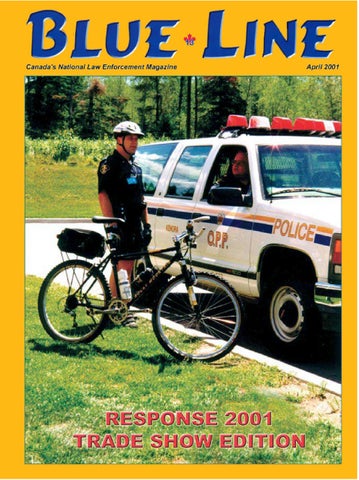
On the cover of the April issue we find Ontario Provincial Police Cst. Troy Carlson (left) and Sgt. Don Denver enjoying spring weather. Carlson, and the bike patrol unit of the OPP’s Kenora Detachment are profiled by Dave Brown on page 9 of this edition. Richard Deering, a former member of the OPP, recently left the provincial police to become the chief of the Royal Newfoundland Constabulary. Deering’s philosophies on police leadership can be found on page 12. In an exclusive interview with Blue Line Magazine, Professor Ralph Mistlberger talks about shift work and its adverse affects on police officers. This story, filed by Les Linder, is on page 14. The laws of Canada must be enforced no matter where the location. In this issue, Blair McQuillan profiles three RCMP officers who are working in one officer detachments. To learn more about policing the small communities of Nunavut, turn to page 22. Response 2001, Blue Line Magazine’s Annual Law Enforcement Trade Show and Exhibition, will be held on April 24 and 25. For a complete list of exhibitors and detailed conference information, turn to page 28. Law enforcement officials have had to deal with police pursuits since the first car rolled off the assembly line. In the first of a two part series on the topic, Keith A. Gehrand examines the definition of a pursuit, attitudes towards them and the liabilities involved. The police and media are both tasked with uncovering the truth and finding the facts. However, these two professions often clash on a number of issues. In the final submission of his three part series, John Muldoon attempts to find some common ground between them. To learn more, turn to page 40. The topic of external body armour carriers versus concealed armour has been the source of heated debate on the Blue Line Forum during the past several months. On page 44, we bring the debate to print and let readers have their say. Blue Line Magazine
Those who serve in lonely places by Robert Lunney I can’t claim to be a dyed-in-the-wool northerner, but I volunteered for northern service with the RCMP and spent a few years at Whitehorse in the Yukon. Later, as a personnel officer working from “A” Division in Ottawa, my responsibilities included the eastern arctic detachments as well as northern Ontario. I had the opportunity to visit police posts from Frobisher Bay to Coppermine, including the detachments on Hudson’s Bay. Northern service was the halcyon days of my police career. Whitehorse was a hard drinking town and while we experienced more serious crime than you might think for a town of 6,000, we were preoccupied with drunkenness and its effects in the community. It was normal to work the late shift alone with no back up. I still have a vivid recollection of entering a bar to confront a violent drunk much bigger than I swinging a broken chair while the patrons cowered in the corner. Although there were firearms in almost every house and vehicle in the territory there was an unwritten rule that the police didn’t carry sidearms and the population didn’t take up arms against us. The north gave me my education as a police officer. Later, when I had the opportunity to visit detachments on the “other side”, I met more RCMP officers and their wives stationed at isolated one-officer detachments or in two’s or three’s. They made me very proud to be a member of the RCMP. By the time I became involved with municipal policing the situation on the streets of big city Canada was much different. Police were encountering more guns, drugs and violence than we had ever faced before. Of necessity we got smarter on officer safety, improved our defensive weaponry and adopted concealable body armour. I accommodated to patrol systems that offered rapid response of back up units, and encouraged officers to practice defensive tactics and restraint in approaching potentially dangerous situations. I like to think that as a result of the changes we adopted, lives were saved. As urban society became more sophisticated, the gulf in working conditions between city policing and policing in the remote areas of Canada grew wider. I at one time listened to urban police officers complain about a delay in back up, and contrast that with the lot of the rural detachment officer patrolling alone, policing settlements where substance abuse was a way of life and violence never far from any encounter. Different expectations; different people. I doubt if many of the RCMP, QPF or OPP officers serving in the isolated posts would care to change places with their urban counterparts. There are many factors leading to the choices we make in our work and personal lives. But the men and women serving in the far reaches of April 2001
Canada deserve our admiration and our heart felt thanks. Their’s is a hard life, and though death and injury thankfully does not come often, when it does there is sorrow and regret that they were asked to accept so much risk for such relatively little reward or recognition. There are many heroes to be found in the ranks of police officers across Canada. The officers who serve in the lonely places rank among them.
5
Retired chief Robert Lunney was asked to share some thoughts about policing in Canada’s more remote areas in response to this month’s feature on single officer detachments. Lunney’s comments were reflections made after the death of RCMP Cst. Jurgen Seewald.
Blue Line Magazine
Is anyone aware of any independent studies, statistics, etc. showing the long term effectiveness (or ineffectiveness) of school locker searches by police dogs? I know that many Ontario police services have had long running locker search programs but can’t seem to find any material supporting their effectiveness. Common sense says the dog should be effective at discouraging the influx of drugs into schools, however, does this stand up to statistical or scientific scrutiny? In addition to this, I am also looking for any other proactive measures other police services are enlisting to help keep drugs out of schools. Any help you could provide would be greatly appreciated. Cst.Mike Field School Liaison Officer North Cowichan/Duncan RCMP Editor’s Note Blue Line Magazine would also be interested in sharing this information with our readers. Our investigations came up with nothing more than some case law on the issue. I am writing in response to a misleading article “The national fixation to register long gun owners” by Robert Stevens in the January issue of your magazine. The issue Mr. Stevens raises regarding
April 2001
RCMP crime statistics was cleared up several years ago. His claim that the Department of Justice misrepresented these statistics is false. The statistics Mr. Stevens refers to were part of a larger report of the Firearms Smuggling Work Group, a group consisting of various federal and provincial governments and law enforcement agencies brought together to assess the magnitude of the threat to public safety posed by smuggled firearms. The working group’s report, “The Illegal Movement of Firearms in Canada,” was the result of consultations with experts in police and law enforcement agencies and research data on firearms recovered by police in nine Canadian cities and various detachments of the RCMP. The report clearly states the research method used and the differences between the statistics in this report and those produced later by the RCMP was due to a different research approach. The RCMP publicly agreed that the approach taken by the working group was reasonable. Both the RCMP and the Canadian Firearms Centre are in full agreement on this matter and are committed to working together to implement the new firearms legislation. The article purports to deal with registration but in fact is a general thrust at all elements of the legislation. Mr. Stevens also misleads readers regarding how often long guns are used in crime. Too often in common parlance when it comes to firearms, “crime” is
6
meant to mean street crime or gang crime only. The unfortunate truth is that non-restricted rifles and shotguns are the firearm of choice for the majority of domestic homicides. We must recognize that the same firearms preference holds for suicide cases. We must start off with the premise that society should not be helping criminals obtain firearms through the absence of controls. Just about every firearm in the hands of a criminal today came from a legitimate source somewhere in North America. Safe storage laws go a long way towards preventing theft. Registration makes negligence less probable and collusion less appealing. Border controls and expanding the expertise in the police community in the area of smuggling and trafficking investigations will do much to reduce access to firearms by criminals further. There is no such thing as an innocent sale to a criminal. Weapons smuggling and trafficking serve only one purpose - to put guns in hands of persons threatening the lives and safety of police officers and other citizens. We must do everything possible to keep firearms in the legitimate inventory from leaking into illegal hands. We must limit access to firearms in those violent and potential violent events where tragedy occurs in a moment. With this law we can and will. David Austin Communications and Public Affairs Canadian Firearms Centre
Blue Line Magazine
Bicycle patrols hit the street Establishing a bike unit means real community involvement by Dave Brown “Bike patrol units are not for everyone,” says Ontario Provincial Police Cst. Troy Carlson. “Anyone with a reasonable level of fitness should be able to do it, but it’s not a job for rookies. “After all, when things go wrong you don’t have the protection of all that metal to hide behind.” Every community has unique problems. Establishing a bicycle patrol unit is one way officers can meet some of those needs and interact directly with citizens on the street. Bike patrols can supplement the more traditional role of investigating crimes after the fact by identifying and preventing problems before they happen. The story of how one community successfully established a bike unit can provide reallife lessons for other agencies. Community Initiative For young people in a small town, boredom can sometimes lead to crime. As the community services officer for the Kenora OPP detachment, Carlson is familiar with this concept. Even in the heart of a vacation paradise like northwest Ontario, residents of the Kenora and Keewatin district experience the usual petty crimes of any other small community. With the Kenora Police Service to handle the town of Kenora, the Ontario Provincial Police patrol the entire surrounding region. Increasing patrols in some of the problem areas would have done little to address the issue, especially when the youth simply vanish at the sight of a patrol car. Foot patrols were considered but the wide streets and scattered settlement of the resort community meant officers could be seen at a distance.
Bicycles were thought to be a relatively quick and silent method of patrol. Not just cost effective, they give police a chance to interact with the citizens. Listening to the concerns of the youth even sparked the creation of a popular skateboard park for the area. First successfully used in Seattle in 1987, bike patrols are now showing up in both large and small communities across North America. Figures cited by the Ontario Provincial Police show that bike officers have an average of 20 times more contact with the public than police officers in patrol cars and five times more than officers on foot. While agencies are quickly recognizing the advantages of bicycle patrols, they are not always able to provide fiscal support. This is ON PATROL: Cst. Troy Carlson stops to talk to youth. where the community can really step in to help. Once the OPP approved the formation of a “By asking for cash instead of product dodistrict bike unit in 1996, Carlson hit the streets nations, we were able to select appropriate bikes to solicit funding. for our needs and to locally purchase bikes and Simply asking a bike shop to donate moun- accessories,” reports Carlson. tain bikes to the unit was considered too much The mountain bike manufacturer even got of a burden on one small business, so cash do- involved and passed on a discount to the dealer. nations were solicited from many local organiThe OPP has responded to these donations zations. Once Carlson was able to convince the by ensuring that the bikes are seen at all comcommunity of the cost-effective way to increase munity events and local parades. In addition to police visibility, it became a local initiative. their use in general patrol duties, they are also CrimeStoppers donated $500 toward the used to visit local schools for safety lectures formation of the unit and area Kinsmen raised and to patrol the many beaches and trails in the another $1,500. A local bike shop agreed to sup- area. ply two Rocky Mountain bikes at cost and “We had to counter one perception that we contributed free maintenance on them for the were ‘anti-bicycle’ officers,” says Carlson. “We continued page 10 first two years.
For further details go to BlueLinks at www.blueline.ca
April 2001
9
Blue Line Magazine
are a law enforcement tool and are there to enforce all the laws of a community, not just ticket kids on bikes. We are no more an ‘anti-bicycle’ unit than a canine officer is there to enforce dog bylaws.” Bike Selection The selection of appropriate bikes is one of the first priorities in the formation of any new unit. A well-made mountain bike will stand up to long term use and ensure that the community gets full value for their money. This is one area especially where a product donation may not be an advantage. Top quality mountain bikes are both light and strong and are designed for ease of maintenance. Weight is critical, considering that officers are going to propel both the weight of themselves and the bikes around for eight hours each day. Neither inexpensive mass-market bikes, nor pure competition machines would last long in this environment. Good front shocks contribute to both comfort and control and seat shocks add to the ability to last a full shift in the saddle. An odometer is important for tracking daily mileage and handlebar ends help in climbing the many hills in the area. The bikes were also equipped with a full light package for riding at night and reflective tape was added to comply with highway traffic regulations. The type of pedal is often left up to individual officers. “I encourage officers to ride with clipless pedals,” says Carlson. “They aid in jumping over obstacles and curbs and they provide more power, especially going up hills. Clipless pedals also mark the rider as a ‘serious’ biker.” Carlson points out that the perception by local youth that the officer is a serious rider should not be underestimated for its value in approaching young people on the bike. Each mountain bike is also equipped with a nylon bag containing spare parts, wrenches, tire
“We are no more an ‘anti-bicycle’ unit than a canine officer is there to enforce dog bylaws.” levers, tire tubes and the ever-important sunscreen. The bags also contain necessary police gear such as enforcement acts, ticket books and a traffic vest. “I select the bike and components carefully,” says Carlson. “For example, we have found that some components are not suitable for police use. Aluminum frames are great for racing but they do not stand up well to longterm use.” Training The other necessary component in any successful bike unit is a good rider. “We need officers with both the desired commitment to the unit and the experience to know when not to ride full out and then arrive at a situation with nothing left,” Carlson said. The OPP has developed a Level I and Level II Bicycle Safety and Patrol Course, in addition to a Safety and Patrol Instructors Course. They have based much of their training material on a manual written by Cst. Bert Rainey of the Vancouver Police Department. The Level I course covers most of the basics, including personal equipment such as bike shoes, gloves, helmets and uniforms. Good mountain bike shoes are particularly
important, because too little flex can lead to leg injuries over time. Dedicated racing shoes also may not provide the necessary traction when an officer dismounts. Specialized bike shorts are important as they act as the only contact with the seat for the length of the shift. Personal health and nutrition topics are included in the Level I course. As Carlson points out, “Cycling around all day in a heavy vest means officers must keep themselves particularly healthy. This means getting enough water and staying out of the sun as much as possible.” Fitting the bike to the rider is another important factor in the ability to ride for long hours and the course covers basic maintenance, daily checks and monthly inspections. Riding skills are an important topic and new riders must quickly get used to dealing with traffic. Most vehicle / bicycle collisions happen at intersections and these are covered in depth. Carlson emphasizes strict adherence to traffic laws at all times when on the bike. The Level II Bicycle Safety and Patrol Course begins with a review of basic riding skills and then discusses the negotiation of a variety of obstacles. The course extensively covers police patrol procedures and uses a variety of exercises and simulations to demonstrate how to use the bike as an effective tool. The Bicycle Safety and Patrol Instructors Course begins with a competency ride and then uses a cone course to test the ability of riders in both routine and emergency turning and braking manoeuvres. Traffic safety skills are emphasized again and students are tested on both their skills and their ability to teach the skills to others. Course preparation and presentation skills are included at the instructor level and students are expected to prepare and deliver several presentations. A firearms training component is part of the Instructors Course. Students spend half a day on the range practicing subject contacts, dismounts, shooting while astride the bike, onehand shooting and proper takedown procedures. Officer safety is continually emphasized throughout all three courses. This includes not just the usual practice on one and two-bike vehicle stops and defensive tactics, but adds unique traffic accident prevention skills and emergency avoidance manoeuvres. Out On The Streets Both the Kenora OPP Detachment and the Kenora Police Service have active bike units patrolling the streets of their respective communities. Officers install bike racks on the back of their patrol cars and are in radio contact so that they are prepared to respond to emergencies near and far. They have found that the youth of the region are more approachable and more willing to talk to officers on the street, especially when they see bike unit officers as fellow bikers and “insiders”. Supporting a local bike unit is one area where communities can make a meaningful contribution toward greater safety and police presence.
For further details go to BlueLinks at www.blueline.ca
April 2001
10
Blue Line Magazine
Fitting the bike to the rider A properly fitted bike is essential to long-term comfort and maximum efficiency. Frame Size The frame is sized properly if the rider can sit astride the frame with feet flat on the ground and two to three inches clearance from the bottom of the crotch to the top of the frame tube. Seat Adjustment To adjust the seat, have a partner steady the bike while the rider places the heel flat on the pedal. With the pedal rotated until it is parallel to the seat tube, the seat height is correct if the leg is nearly straight. The seat angle should be parallel to the ground, or positioned with a slight forward tilt for female riders. The seat fore-and-aft position is set correctly if a plumb line from the knee falls to the mid-point of the pedal axle when the foot is placed correctly on the pedal and the crank is at the three and nine o’clock position. The ball of the foot should be directly over the pedal axle for maximum efficiency. When seat height is adjusted correctly,
April 2001
the legs should be almost but not quite straight at the very bottom of the downstroke. While it may be disconcerting for beginning riders, the seat should be high enough that the feet do not touch the ground when properly seated. Handlebar Adjustment The rider should be relatively upright when riding. Patrol bikes often require an aftermarket handlebar stem with a shorter stem and a higher rise. Cadence The correct pedaling motion delivers a smooth, continuous flow of energy from the legs to the pedals. The spin should be as fluid as possible and the feet should be slightly pigeon-toed inward on the pedals. Proper gear selection should ensure that the legs spin the pedals at as close to an ideal 80 revolutions-per-minute as much as possible. When building strength in the legs and especially in the knees, it is far better to spin at a faster revolution that to try to push too “tall” a gear.
11
Memorial ceremony to be held in May The first annual remembrance ceremony will be held at the Ontario Police Memorial on May 6. During this year's ceremony, the Ontario Police Memorial Foundation will add the name of Ontario Provincial Police Sgt. Margaret Eve to the list of officers who have lost their lives in the Margaret Eve line of duty. Eve died from massive head injuries in June 2000, after a tractor-trailer struck three police cruisers and another vehicle stopped on the side of Hwy. 401. She is the first female police officer in Ontario to be killed while on duty. In addition to Eve, eight other officers who have been identified through ongoing research into Ontario's policing history, will have their names added to the memorial. The Ontario Police Memorial was unveiled last May. It is located in Toronto and serves as a tribute to the officers who have given their lives in the service of the people of Ontario. For more information on the memorial ceremony contact Bill Baines at (519) 344-8861, ext. 6104.
Blue Line Magazine
One-on-one with the RNC’s new top cop by Danette Dooley Though he brings with him from the Ontario Provincial Police more than three decades of experience, the Royal Newfoundland Constabulary’s new top cop is very much aware that he’s an outsider. Over the next few months Richard (Rick) Deering will keep his eyes focused, his ears open, and his mouth shut. It’s all part of the learning process. “I plan to be an interested observer for the next while,” Deering says during an interview at a local hotel, just days before being sworn in as police chief. “I think the worst thing that any new person in an organization could do is come in and make massive changes without having some good basis for it. So I want to learn as quickly as I can about the issues, the culture and the political climate and then go about doing business.” While those who grade the 49-year-old Marmora, Ont., native on his performance during the next several months may be disappointed, it’s obvious early into the interview that he’s done his homework. Deering is familiar with the issues and challenges he’ll be facing. Dealing With Youth “I’m a real supporter of crime prevention and public education especially when dealing with youth,” he explains. “If the trends in policing are true, then I think youth crime and youth issues, if they’re not already an issue in Newfoundland and Labrador, will be an issue here before too much time because I’ve seen that trend come across Ontario in the last three or four years.” The Government’s Role In Policing One of the major long-term issues of the Royal Newfoundland Constabulary Association is that the chief of police reports to the Minister of Justice. Therefore, they cannot adequately put forward the concerns of the force. While Deering sees the government’s responsibilities as setting policy issues within the police force, he believes operational issues are the responsibility of the police chief.
Photo: Danette Dooley
NEW BEGINNING: Royal Newfoundland Constabulary Chief of Police Richard Deering accepts his Commission of Office from Provincial Justice Minister Kelvin Parsons. “My role as the chief of police is to move roadblocks for my officers and to provide them with the resources they need to do their jobs,” says Deering, who as chief superintendent with the OPP, was responsible for 36 detachments, about 1,200 officers and a couple of hundred civilian employees. “The relationship I envision is that government has to have confidence in their chief of police to run the operational issues. My job is to keep them in touch with what’s happening and government is there to set the parameters in which a police service or any other government agency has to live.” Women In Policing Throughout his career, he’s seen a change of attitude concerning women in policing. When he joined the OPP in 1970, the force was completely male dominated. At the time of his recent departure, about one quarter of the officers who reported to him were female. “It was around 1974 when we hired our first women and I saw the growing pains that
905-713-1690
those individuals went through in terms of acceptance within the organization. And in terms of how they were treated within the OPP, it wasn’t really fair,” he says. “My hat’s off to the women who persevered and stuck it out because they have proven that there is an important place for women in policing and some have moved to the top.” Deering uses his former organization as an example of how far women have come in the police field. “Gwen Boniface is the commissioner of the Ontario Provincial Police. And she’s a good commissioner. She’s doing a very good job.” Use Of Force With two police shootings during the last six months, one of the main issues the constabulary has recently faced is use of force when dealing with serious situations. Because of pending court action, it’s a topic the RNC has not been willing to discuss with the media. However, talking in general terms, Deering has some strong opinions on specialized training for officers dealing with such explosive situations. “I’ve been involved in shootings where mental health was an issue and I sat on a committee that looked at community mental health issues and policing. It’s an issue that’s relevant across Canada. Unfortunately, many times when lethal violence is involved, one of the contributing factors is a mental health issue.” In continuing to talk about use of force, he notes that the role of a police officer is a multifaceted one, in which officers are required to wear many hats. “You’re a police professional and you’re a quasi-lawyer, a quasi-social worker, a quasipsychologist, a quasi-mental health worker and, in a number of those areas we have very little formal training,” he says.
For further details go to BlueLinks at www.blueline.ca
April 2001
12
Blue Line Magazine
“So I think it’s important to address community mental health from that perspective that perhaps we need to be better educated and we need to work more closely as professional partners - i.e. the Mental Health Association, the psychiatric hospital and all those types of things.” Becoming chief of police is a dream many career-minded officers have at some point in their lives. Deering is one of the few that has turned his dream into reality. It’s not something he takes for granted. “If someone had come to me six months ago and told me this is where I’d be today, I would have laughed at them,” he smiles warmly. “But, I was really humbled when I got this job. I knew that it was a nation-wide search, I knew the calibre of some of the people who were in
the process, and I didn’t think for a million years that I would ever get this job.” Now that he has secured the top spot in one of North America’s oldest police forces, he’ll be under a microscope for the next few months, especially by RNC officers who are taking the “wait and see” approach before passing comment on their new chief. Deering vows to be honest and forthright when dealing with his officers. While he’ll recognize a job well done, he’ll also discipline poor work performance - once he’s had time to adjust to his new surroundings that is. “It’s not my expectation that the Newfoundland constabulary is going to adapt to Rick Deering. It’s absolutely the direct opposite. Rick Deering has to adapt to the Newfoundland constabulary.”
The Great Mac Attack! by Tony MacKinnon Apparently some blond girl broke into their home...
For further details go to BlueLinks at www.blueline.ca
For further details go to BlueLinks at www.blueline.ca
April 2001
13
Blue Line Magazine
How does shift work affect cops? Canadian professor voices serious concerns by Les Linder All shift workers including police officers should be better educated on how to deal with shift work and new methods are needed to lessen its debilitating impact on people, according to a Canadian university professor. “The problem with shift work is that it goes against a person’s natural behaviour which is regulated by the circadian clock,” said Ralph Mistlberger, a professor of psychology and biological rhythms at Simon Fraser University in Vancouver. The circadian clock is an internal biological timer which operates on a 24 hour cycle. “This internal clock functions on rhythms which are independent of the outside world,” Mistlberger told Blue Line Magazine in an interview. “So even if a person were placed into a time-free environment with no indication of actual time, the body will continue to express these rhythms and still have a 24-hour sleepwake cycle.” Mistlberger noted that although the biological clock is independent of the environment, it still takes time cues from it. “When we see light in the morning on the way to work, that has an affect on the clock and adjusts it so we do not drift out of synchrony with the outside world,” he explained. By constantly taking information from the environment, the clock will know when to tell a person to fall asleep or wake up. The clock wakes an individual up in the morning through the secretion of hormones that help sustain consciousness. At night, the clock does the opposite and gradually shuts the body down to induce sleep, Mistlberger said. When an individual is on a rotating shift schedule from days, to evening, to nights, that person’s biological clock will not be able to shift and synchronize with the new sleep-wake cycle as quickly as the work schedule changes. “A person that alternates from day shift to night shift, with only a day or two off in between, will not be able to adjust their biological clocks for at least two to three weeks,” the professor said. “The clock won’t change substantially enough so that the preferred wake time is
now the night and preferred sleep time is the day.” Even if an individual is provided with at least three weeks to adjust their circadian rhythms, it will only result in a partial adjustment. Mistlberger said studies have shown that even long-time permanent night workers do not completely adapt to their schedule. As far as the circadian clock is concerned, when daylight is received, the clock still believes it is time to wake up, not sleep. This makes shifting the internal clock difficult because it does not realize when the person actually needs to sleep or be awake. “Convincing the clock to think otherwise takes a great deal of time,” Mistlberger said. Due to the amount of time it takes for the
clock to make even a partial adjustment, working fast rotations prevents any adjustment to the new work cycles. Mistlberger says this makes weekly rotations particularly bad because just as the clock begins to synchronize, it is suddenly interrupted as the rotation to a new shift begins. As a result, the internal clock is constantly left out of synchrony with the work schedule. “People who work on weekly rotations tend to have the poorest adaptation and complain of fatigue on the job, insomnia, digestion problems, intestinal problems and moodiness. All of these problems derive from matching the circadian clock with the work schedule.” Finding solutions for this problem is an ongoing, yet incredibly slow task due to the lack of research and studies. The “holy grail” would involve finding a way to reset the internal clock instantaneously. Mistlberger believes the ideal solution would shift the clock overnight so the system is set to work optimally during the work schedule. “A drug or environmental tool, such as a powerful bright light set up at a particular time, could possibly provide a significant shift in the clock to help prevent sleeping disorders,” he said. Pharmaceutical companies and academic research programs have been working on a solution for about 20 years but to little avail. Mistlberger says current research has not been able to develop a drug that can shift the circadian clock.
For further details go to BlueLinks at www.blueline.ca
April 2001
14
Blue Line Magazine
He said the only drug that comes close, yet Mistlberger expressed concern that police is unlikely to fulfil its promise, is Melatonin. officers, doctors and construction workers could This drug, which is also produced naturally in also be more likely to make poor life or death the brain to induce sleep, has been used for decisions while under alternating work patterns. several years to aid the visually impaired, peoEssential services such as police also need ple who suffer from jet lag and those who have to carefully observe how they manage their shift difficulty sleeping. workers, as the consequences of their mistakes “There was initially some excitement that can be devastating, he said. Melatonin might be able to shift the biological “An exhausted and irritable police officer clock as well,” Mistlberger said. “People were isn’t likely going to make some of the best quick, responding well to it for other purposes, but it critical decisions when they’ve been working a is not fully clear how it 12-hour shift all week. I affects the clock, since all also would personally not “People who work on it does is cause the body want to be relying on a weekly rotations tend to to fall asleep.” doctor at three in the complain of fatigue on He feels that more morning to perform emerstudy is needed into the gency surgery.” the job, insomnia, drug to determine the Unfortunately, there digestion problems, proper dosage and time to is no perfect shift work intestinal problems use it. Another concern schedule. The best schedand moodiness.” about Melatonin is it may ule depends on the indinot be powerful enough to vidual and the job. Ideal shift the clock if a person schedules would involve a does not control their exposure to daylight. group of permanent night workers and another However, while certain drugs may be able group of permanent day workers, leaving plenty to help shift the clock, natural light is by far the of time for both sides to adjust their circadian most powerful stimulant. Mistlberger is con- clocks as needed without interruption. vinced that certain schedules of exposure to However, the number of people willing to natural or simulated sunlight, will be required in work on a permanent night-time basis is any future attempts to change the circadian miniscule. Mistlberger finds that most people clock. By convincing the circadian clock that would rather put up with the difficulty of doing the individual does not operate at usual hours, shift rotations than work permanently at night. shift workers should be able to better adapt to Whether a 12-hour shift is better than an working conditions and be less likely to make eight-hour shift, is not clearly known. A 12dangerous mistakes. hour shift can compensate a person psycho“Forty years of research have shown that logically because it provides longer periods of people do not work as well at night as they do time off and can be a more attractive prospect. during the day,” the professor said. “It isn’t so “People could be fooling themselves devastating that people can’t actually do night though,” Mistlberger cautioned. “Most shift shift, just that they are more likely to make workers do not tend to have quality time off.” devastating errors.” If a shift worker is provided with two days This makes service industries which involve off, the first day is immediately lost to recovinteraction with many people more difficult ery, he explained. Even with longer blocks of because the shift worker is likely fatigued, not time-off, the first few days can simply be spent alert, or possibly even impaired by irregular recovering. By maximizing the number of conwork hours. secutive days off, a person will have sufficient “Shift workers involved in positions that time to rest, partially re-adjust their circadian require constant vigilance are more likely to clock and then enjoy some recreational time. cause critical mistakes,” Mistlberger warned. Studies still need to be done to determine if The Three Mile Island nuclear incident and doing shorter shifts, but having fewer days off Chernobyl nuclear plant disaster were caused consecutively, would be better than longer shifts in part by a breakdown in communication be- with more consecutive days off. continued on page 16 tween fatigued workers on exhausting shifts.
For further details go to BlueLinks at www.blueline.ca
April 2001
15
Blue Line Magazine
Anyone who decides to enter a job involving shift work will undoubtedly find it a challenge, as it is psychologically, physically and socially draining. Shift workers will be hard pressed to find time to spend with family and friends while under alternating work hours. A significant number of people also quit shift work because they find they simply cannot handle the strain it places on them. “The people who do shift work for many years are a survivor population who adapt adequately to the stress and although they may be unhappy, they are in fact able to handle the job,” Mistlberger said. “This type of work isn’t for everyone.” The key to handling shift work and discovering whether it is the right move for particular people, is to gather as much information as possible about the matter. Mistlberger encourages others to read manuals available in libraries, book stores and on the Internet so they become aware of problems they will face. Talking to people who already do shift work and asking how they manage the challenges is also advisable. “People need to understand that their lives will not quite be the same. Shift work is socially isolating and makes having a relationship with family and friends who work regular hours very difficult.” Family and friends also need to be informed and understand the importance of not disturbing a shift worker’s sleep. This can easily occur as people go about their daily lives and forget how a shift worker’s schedule is set.
Despite the difficulties and tough hours associated with working shifts, Mistlberger does not foresee a decline in the number of people who take on shift work. The current trend seems to involve more shift work in various areas of employment. “It is more cost effective to keep certain operations and services running all day, which means shift work is not going away.” In the late 1980’s to early 1990’s, approximately 25 per cent of the work force worked on shifts. Mistlberger believes this number could stabilize or slowly increase in years to come. While it won’t go away, shift work can be optimized to make somewhat more ideal working conditions. By simulating outdoor light with powerful artificial lights, or seeking natural light
during the day, a worker’s alertness can be enhanced and the functions of internal clock may even be improved. Better food access and proper diets can also make the work more manageable. “Many shift workers live off junk food,” Mistlberger pointed out. “Most people who work at night rarely have access to healthy food and are forced to eat food out of vending machines or fast food places. “People who are fit and have healthy diets can handle the strains of shift work much more easily than those who don’t.” Another problem Mistlberger would like to see addressed is the lack of information provided by employers to their shift workers. “When I ask shift workers what kind of education they get from their employer about handling the strains of shift work, the answer is typically ‘nothing.’” Mistlberger is hoping the federal government will eventually require or encourage businesses to provide programs, workgroups or documents about shift work to their employees so it can be handled more effectively. While the belief is that shift work is a cost effective means of conducting operations, it can also cost the economy billions of dollars in injuries, accidents and lost productivity due to exhausted workers. “It is in everybody’s best interest to start doing more research, more education and taking more action to deal with the problems and losses which derive from shift work,” Mistlberger said. “A rested worker is an efficient worker.”
Promoting alertness at work
Specializing in Police & Military K-9 Training and Schutzhund Dog Sport Equipment Police Training Suits: The Ultra Kimono or Body Suit Soft Sleeves, Hidden Sleeves, Hard Sleeves, Cuffs Protective Clothing, Narcotics Training K-9 Cruise Eze Police Canine Transport Systems Muzzles, Leads & Collars, Chain Collars, Harnesses Police K-9 Uniform Accessories, Books & Videos KATS K9 Activity Tracking System
Tetragon-Tasse Distributors Inc. 2378 Dunwin Drive Mississauga, Ontario L5L-1J9 Phone (905)-828-9803 Fax (905)-828-6390 Toll Free (800)-387-6542 tetragon@idirect.com www.tetragon.ca
Just as you can take steps to ensure a good night’s - or day’s - sleep, you can try these steps to stay alert on the job. • Take short breaks throughout the shift. • Try to work with a “buddy.” Talking with co-workers can help keep you alert. And co-workers can be on the lookout for signs of drowsiness in each other. • Try to exercise during breaks. Use the employee lounge, take a walk, shoot hoops in the parking lot, or climb stairs. • Try to eat three normal meals per day. Eat healthy snacks, avoiding foods that may upset your stomach. • If you drink a caffeinated beverage (coffee, tea, colas), do so early in the shift, e.g., before 3 a.m. for the night worker. • Don’t leave the most tedious or boring tasks to the end of your shift when you are apt to feel the drowsiest. Night shift workers hit their lowest period around 4 a.m. • Exchange ideas with your colleagues on ways to cope with the problems of shift work. Set up a support group at work so that you can support and learn from each other. Source: National Sleep Foundation
For further details go to BlueLinks at www.blueline.ca
April 2001
16
Blue Line Magazine
Healthy cops save money, study says Statistics Canada reports that employee absenteeism in 1998 increased by half a day per year, costing companies $20 billion annually. A research project was initiated by the Ontario Provincial Police to review the financial benefit, if any, of having physically fit employees. A review of the literature shows very clearly that there are financial benefits to implementing wellness programs. These benefits are both quantitative and qualitative in nature. This column will review investing public funds in these types of programs and whether or not there is a positive impact, specifically on short term sickness credits. Process The methodology included the identification of those officers who have received the Ontario Police Fitness Award (OPFA) for at least five years and were the holders of the five year OPFA certificate. These individuals, by maintaining their fitness level for this length of time, generally indicate a personal commitment to fitness and general good health practices. Only those who volunteered to participate were included. The research review was conducted over a three year period from March 1996 to March 1999. These dates were picked at random and were not significant in any way. Assistance from human resources was requested and received. There were 56 subjects in this study, of which 48 were males and eight were females. The distribution was a cross section of the organization with the majority being provincial constables and sergeants. OPP Results The results during the three year study period indicate that for each year of the study, the fitness subjects used less sick time than the OPP average. During the study period subjects have saved the OPP more than $171,360 in potential lost wages based on the concept of universal attendance. Similar findings have been reported by other police services. Research conducted by the Hamilton Police Service indicates that physically fit individuals are not only less absent from work, but they are more punctual as well. The potential unrealized savings of having a physically fit OPP workforce translates into approximately $6.2 million per year based on 100 per cent universal attendance (cost savings of approximately $1,020 per employee). A NASA study reported a 12.5 per cent increase in productivity in those who exercise. They found that those who exercised worked at full efficiency for the entire day, while average employees lost 50 per cent efficiency for the final two hours. The exercising group also demonstrated increased stamina, performance, concentration and decision making abilities. This can have huge consequences in regards to productivity levels when deciding on eight, 10, or 12 hour shift schedules.
ON THE JOB: Healthy police officers take less days off and do more work as a result. Benefits The benefits of having a physically fit police agency can be directly linked to performance. The rationale focuses on what the average OPP officer produces over 4.24 days. It is estimated that the fit group (56) by virtue of the fact they work 4.24 more days than the OPP average, would have on average at least three more charges than those who did not work these days. Additionally, it is estimated that collectively this group would have laid 175 charges during this additional 4.24 days of work based on data from the 1999 OPP Annual Report. If every OPP constable (3,645) laid three more charges per year there would be a total of 10,935 extra charges per year. Conclusions Although actual monetary benefits in this area can be difficult to accurately quantify, this study has reinforced the existing literature in that physically fit OPP officers have saved the organization, thus the public purse, hundreds of thousands of dollars. Thus it would stand to reason that a further investment in health and wellness programs would be a very cost-effective expenditure. Although quantitative performance measures are required, it would be important to include qualitative performance measures also when reporting any potential benefits of wellness programs.
and visit us at Response 2001, booth 405.
To obtain a copy of the complete study, contact Physiological Sciences Health Coordinator Peter Shipley at (705) 329-7546. Articles for the Vitality column are supplied by members of the Police Fitness Personnel of Ontario. For further details go to BlueLinks at www.blueline.ca
April 2001
17
Blue Line Magazine
Intelligent digital tailoring by Tom Rataj Outfitting a new recruit class with properly fitting uniforms is a time consuming, labour intensive task. Each recruit needs to be accurately sized by a tailor, various garments need to be tried-on for general fit and pants and dress tunics generally need to be altered for an exact fit. The process usually starts with the recruit’s own estimate of sizing, followed by a series of trials. A new electronic “digital” body measurement system has been developed by Dr. Shi Yin of Toronto, in an effort to streamline this process. Not only does the system provide an accurate measurement of the six major body dimensions, but it can also be tied to the actual finished sizes of the standard garments to provide a “best-fit” recommendation. ICESS The Intelligent Clothing and Equipment Sizing System (ICESS) was developed for uniform distribution in the Canadian Forces. Using simple off the shelf hardware components and a custom software package, the system is designed to measure a person’s stature, neck, chest, waist and hip circumference, as well as sleeve length. The measurement and information processing phase of the system takes less than two minutes and produces a simple one page report which details the body measurements, as well as the standard garment and equipment sizes. Yin’s newly formed company, VisImage Systems Inc., is commercializing this system for military and other uniform wearing organizations. No Need To Smile The system uses two Kodak DC-210 digital still cameras, connected to a standard Windows based computer, with the ICESS software installed. The subject stands in a specially designed two-sided cubicle wearing a pair of tight-fitting red cotton shorts. The cubicle itself consists of two walls measuring 2.2 metres high by 1.1 metres wide. The walls are covered in a blue fabric and feature a number of small red reference points used by the software to make accurate measurements. The square floor, which measures 1.1 metres by 1.1 metres, has a pair of footprint on which the subject stands. Once in the booth, the subject must stand in a particular position that assists the system in making the accurate measurement. Once the subject is in position, the system simultaneously takes two digital photographs, one from the front and one from the subject’s right side. The digital images are then analyzed by the software, which examines the level of contrast between the subject’s skin colour and the blue background to create a silhouette of the body. This essentially works the same as the blue backgrounds used in the television and movie industries to electronically insert an image behind a subject. April 2001
Once the silhouette is established, the software then determines 13 landmark points on the frontal view and 10 landmark points on the side view. From these landmarks the system then determines the six primary body measurements. When tied to a database of the actual measurements of the finished garments, the system can recommend the actual garment sizes to pick from stock, accounting for the size differences between manufacturers. The system is easy to use as it requires little training and only basic computer skills. Because it uses off the shelf components, the hardware costs remain fairly low. Although actual pricing has not been firmly established, the system should be available for a single unit cost of under $30,000. Potential This system can accelerate the fitting of uniforms for new recruits, and if connected to, or operated by a uniform manufacturer, could be used to have custom-made uniforms manu18
factured for every officer. Although this may seem extravagant and expensive, in the long term it would likely be cheaper, because the amount of clothing and equipment required to be stocked could be dramatically reduced. Current stockroom standards used by the military require between 20 per cent and 30 per cent extra stock for standard uniform items, in order to ensure reasonable availability when new or replacement clothing and equipment needs to be issued. Simply changing suppliers or styles of clothing can often create fitting problems. Changing the cut of a pair of pants can result in officers having to change pant sizes in order to fit properly, as well as requiring extensive tailoring to achieve a proper fit. Using this system would prevent this problem and reduce the amount of tailoring required to achieve the proper fit. Hands And Feet Other related systems in development by VisImage include Hand Scan and Foot Scan. UsBlue Line Magazine
ing a standard off the shelf flatbed scanner these systems use similar technology to make accurate measurements of the hands and feet. Hand Scan measures 14 individual hand dimensions to accurately determine palm width, hand crotch-height and finger and thumb length and width. Foot Scan measures eight individual foot dimensions; foot length, foot-width, heel-width, inner and outer planner arch-length, ball-flex angle and anterior and posterior flexion angle. Competition While the VisImage systems are a relatively affordable homegrown solution to uniform measurement, there are also other commercial systems available worldwide, although they are far more complex and expensive because of the proprietary equipment used. American catalogue clothing giant, Land’s End, has been using a body scanning system developed by Image Twin. The primary objective of Land’s End’s use of body scanning technology is to increase customer satisfaction and reduce the number of product returns by mailorder customers. The customers can now go to one of the Land’s End stores and have their body dimensions determined by the body scanning system. The dimensions can then remain on file and the customers can more accurately select clothing sizes before ordering. TC2, another American company, has also developed a 3D body measurement system,
which uses a white light-based scanner and their proprietary software to create a complete 3D body image for catalogue and online shoppers. Wick and Wilson Limited in Hampshire, U.K., has also developed a commercial body-scanning system that creates a 3D colour scan of customers in less than eight seconds. The American military also tried a system called ARNscan to process 8,000 recruits during a six month period, issuing 88,000 clothing items. They reported achieving an accuracy rate of 88 per cent over traditional sizing measurement accuracy of only 56 per cent, when tracking the issuance of dress coats, shirts and trousers. The WBX scanner system they used takes 46 seconds to completely process each recruit. Conclusion Electronic body measurement systems hold great promise both in a commercial environment and in a uniform clothing environment such as the police and military. Stocking and issuing clothing and equipment is an expensive component of uniform clothing. A poorly fitted uniform certainly detracts from the professional image police managers strive to create and maintain. Whether individual agencies can afford to purchase and operate their own body scanning equipment remains to be seen, although it certainly makes business sense for uniform clothing manufacturers to offer body scanning as a value added service.
For further details go to BlueLinks at www.blueline.ca
For further details go to BlueLinks at www.blueline.ca
April 2001
19
Blue Line Magazine
Co-operating for cost effectiveness Agencies unite to develop purchasing network by Les Linder What began as a combined effort to save money for the Toronto Police Service and Ontario Provincial Police, has developed into a cost saving co-operative network for more than 45 Ontario police agencies. The Police Co-operative Purchasing Group (PCPG), which began in 1996, was formed with the intent to bring police services together to exchange market information and avoid duplication of effort in research. Frank Chen, administrative officer with the Toronto Police Service and chair of the PCPG committee, created the organization along with the OPP. They had initially planned to use the organization as a means of co-operating in the purchase of police vehicles. “We then realized it would be possible for us to use this plan with other items as well and not just cars,” Chen said. “The plan was then to see if other Ontario forces wanted to join on, in hope that we could all work cooperatively and share our costs and prices we pay.” The PCPG has two sub-committees concentrating separately to unify and standardize specifications on police related items, such as car tires and police uniforms. Joining the group is voluntary, free and enables the agencies to purchase items from a manufacturer at the PCPG’s price, which is equal for all member agencies. The system works by placing a purchase order for a particular piece of equipment, which is then posted on the group’s website. Information on all the specifications, vendor, price and contact names are provided. “Any member police service can then go to the website, look at the pricing and then make an order with the purchase agreement number, taking advantage of the PCPG price,” Chen explained. The website, which is part of the OACP website, requires a password to access. The site also provides links to specific items available from their manufacturers, which sell to members of the group at an agreed upon and
GEARED UP: The PCPG is dedicated to getting the best price for police products. competitive price. Chen said one of the most appealing reasons to become a member for most agencies has been because of the highly competitive and “sharpened pencil” prices of equipment. He estimates the Toronto force saved approximately $400,000 in 1997 on footwear, ammunition, clothing and tires. A newly added bulletin board system on
No Die s! rge Cha A Ring of Exceptional Quality to Show Your “Pride in Service” C A L L TO D AY F O R Y O U R F R E E C O L O U R B R O C H U R E
1-800-535-9735 Check out our new web page at www.pride-in-service.on.ca Pride in Service P.O. Box 705 Pickering, Ontario L1V 3T3 Fax: (905) 509-6933
the website also allows police services to sell or buy used items from one another. It is not used for ordering, but rather to give other services an idea as to what used items members are willing to sell. The latest move of the PCPG has been to find a way to standardize the specifications of marked police cars. Specifications for a basic police package vehicle were provided to the group’s committee by the Durham Regional Police. Needed options were listed and the specifications were taken to two potential manufacturers. In time, the group received bids from Ford for the Crown Victoria and the Impala from General Motors, thereby providing members with a competitive and affordable price for police vehicles, Chen said. Prices for the vehicles and various listed options are available to all members of the PCPG and payment is made to the manufacturer, who pays the dealer to deliver the vehicle to the member service. Chen said the PCPG is now also looking into the possibility of providing plain cars as well. Despite the advantages and savings the
For further details go to BlueLinks at www.blueline.ca
April 2001
20
Blue Line Magazine
group presents to its members, it still faces several challenges. “We face a few problems with clothing, uniforms in particular,” Chen said. “We currently have one manufacturer that supplies uniforms, however, each agency has their own specific preferences for uniforms. Because of this, the manufacturer warehouse has to include a rack for each member service.” He added this system becomes ineffective because they may not be able to promise delivery in the required time. “If they don’t have a Halton uniform in supply, they have to go make one for them. Uniforms are lacking in commonality, each one can be significantly different.” Also, some suppliers do not want to keep excess inventory when they come near the end of their contract, out of fear that they will be saddled with the remaining inventory if the contract is lost. However, Chen insists the PCPG is making headway in this area. The organization is experimenting with a common uniform that would be easily adaptable for a police agency’s specifications. There are already two common tunics which the committee is looking at and presenting to member services for approval. If they go with the design, they could get better service at a faster turnaround, Chen said. The possibility of a manufacturer going bankrupt or facing a strike, is also a matter Chen is constantly aware of. If the supplier can no
longer provide for the group, every member will be effected by it. Chen believes this issue, for the most part, is a moot point because the PCPG picks manufacturers carefully, based on reputation and the quality of the service or product. Recently, the PCPG has also had discussions with the RCMP and both are considering a long-range goal to develop a Canada-wide purchasing network of police equipment. While having the Mounties as a member could help the organization realize its goal sooner, Chen says he is also conscious of the possible inherent problems with having such a large and influential force in the group. However, he said the PCPG does not want to use that possibility to discourage any opportunities. “We haven’t pursued the matter yet to the point of even being able to try things out. There is an opportunity to see what their needs are, what our needs are, and seeing if we can bring our specifications to match with theirs, or their specifications to match with ours.” In the future, Chen is hoping to see more common specifications for equipment and would like to work closer with other police services, big and small. “We want to continue to refine the quality of items and explore other opportunities, such as pepper spray, forensic tools, and firearms. For more information on the Police Co-operative Purchasing Group contact Frank Chen at (416) 808-8005. For further details go to BlueLinks at www.blueline.ca
For further details go to BlueLinks at www.blueline.ca
April 2001
21
Blue Line Magazine
Law enforcement in the north One officer detachments by Blair McQuillan Imagine you were offered a new job. As part of this new job you would have the opportunity to pack up your belongings and move up north. Way up north. You would face harsh conditions, but would still be exposed to seven hours of day light during the darkest time of the year and due to your new remote location, you would have to be prepared to pay liberally for necessities. A loaf of bread for example, would cost about three dollars. You would be promoted if you took this job and be responsible for policing a community of 400 people on the southern tip of Baffin Island - by yourself - for two years. You would have your own office and be outfitted with equipment including a truck, snowmobile, boat, ATV, two computer workstations and a base radio. Would you take the job? Dan Mayer did. Mayer, a corporal with the Royal Canadian Mounted Police, has served as the lone officer in Kimmirut, Nunavut since December 1999. “It’s community policing at its most raw form,” the 15-year veteran says of his posting. “The advantage is you get to work very closely with the people.” Mayer has enjoyed a diversified career in terms of geography. He worked in Nova Scotia and Quebec before taking a one year assignment in Haiti. The corporal was also posted in the Nunavut capital of Iqualuit for one year before accepting the opening in Kimmirut. However, Mayer did not come to Kimmirut without knowing what he was getting into. He had the opportunity to fill in for his predecessor in October 1999 when the officer went on vacation. Mayer found he enjoyed his time in the community and when the opportunity to become Kimmirut’s full-time officer came up, the 35-year-old applied for the job. “It wasn’t an easy decision,” said Mayer, who, like all Mounties who accept postings in one officer detachments, was promoted to corporal after taking the assignment. “The promotion itself didn’t mean much. I found by coming here it was a great opportunity to see what it was like among the Inuit and get a taste of their culture. “The Inuit here live a traditional life style. For the most part (the men) go out and they hunt on the land and fish. The women usually stay behind and mind the kids.” Mayer had a family of his own to think of before accepting his current posting. The officer and his wife, a social worker who is employed in the community, decided Kimmirut would be a positive environment for their two young children to spend time in. April 2001
LONE OFFICER: RCMP Cpl. Dan Mayer has been policing Kimmirut, Nunavut for the last 16 months. The community, located on Baffin Island, has a population of 400 people. “The people are very friendly,” Mayer said. “Everybody helps one another.” RCMP Cpl. Debra Morris, the sole officer in Nunavut’s Grise Fiord, has enjoyed an experience similar to Mayer’s. The 20-year veteran has spent the past 19 months in Canada’s most northern community, located on the southern shore of Ellesmere Island. “We’re the gateway to the south,” Morris says in a deadpan manner. “I love the north. I’ve spent all of my service time in the north.” Morris’ admiration for northern living is probably due in part to the fact that she grew up in the Yukon Territory. After serving for one year in the Northwest Territories and 18 years in the Yukon, she decided she wanted a change. “I wanted the experience in the eastern arctic,” she said enthusiastically. “I just love policing small communities.” Morris, who along with her husband, is an avid hunter and angler, said she enjoys being in a remote community because it allows her to be her own boss. “You’re very much on your own,” the 40year-old officer said. “It’s a great community to work in as a police officer.” Morris said one aspect that makes her job so enjoyable is that while an officer in Grise Fiord handles an average of 60 cases per year, she has not yet had to arrest a single person. “I’ve been fortunate since I’ve come here,” Morris says of her empty holding cell. RCMP Cpl. David Gray also works in a remote community. Gray, a 10-year member of the RCMP, is posted in Nunavut’s Coral Harbour. For the past 19 months he has been the lone officer in the community of 800 located on Southhampton Island, which lies at the north end of Hudson Bay. “I’ve been very well received by the community,” said Gray, who added that the people 22
he is sworn to protect are very pro-police. “I’ve enjoyed working with the community.” However, while Gray describes Coral Harbour as an “excellent” area to police, he notes that being the only police officer in the community can be an extremely taxing task. “There’s a lot of work to be done here and when you’re the only officer, it can be a heavy load,” the 39-year-old said. “To be perfectly frank, it’s taken a heavy toll on me. I don’t think you can accurately reflect the work that’s required. Because I’m the only one here I’m doing the administration, the community policing, the operational files and I make myself available to the community 24-hours-a-day.” Gray notes, however, that he is not completely alone. He does receive some assistance from two community constables who are on call to provide help and work in the office when extra hands are needed. The corporal has also learned that Coral Harbour is scheduled to have an additional officer assigned to the detachment. “I have been requesting an extra member since I got here,” Gray said. “I don’t know when I’ll see that second officer.” Gray is not alone in his desire for additional manpower. Both Mayer and Morris expressed the need for an extra officer due to concerns about safety. “I don’t encourage one person detachments,” Morris said. “I am not having any problems here, but for officer safety I do not think that one person detachments should still exist. It’s just not safe to be working alone.” “The main drawback would be back up in the event of an incident involving potential violence, like domestic disputes or assaults,” Mayer said. “You’re called on to respond to them and you don’t have anybody to back you up.” Sgt. Paul Marsh, a media relations officer in Blue Line Magazine
Ottawa, says small detachments consisting of one to four officers are not unique to the north. “Other divisions, including Newfoundland, Alberta and Manitoba have members in these types of smaller detachments,” Marsh said. “Even in larger detachments, members are called upon on occasion to respond to calls by themselves.” He added that no matter what the situation the RCMP teaches its members to use other resources at their disposal, such as telecoms and auxiliaries to minimize the risk involved both to themselves and the public. “The number of members per detachment is determined by the population, crime statistics, geographic size and location and financial resources,” Marsh said. “General resourcing members per division - is established by negotiations between the commanding officer and provincial or territorial government. There is no standard, or one size fits all model.” An RCMP task force is currently working to develop minimum resource standards to be applied in the future. In the meantime, Mayer says one way to overcome the possibility of facing violence is
to develop strong ties with the community. “Because I know just about everyone in the community, that helps. I’m not seen as being as much of a threat to them because they know me as Dan Mayer, not necessarily as ‘police officer Dan.’” And just how often is Mayer called upon to be “police officer Dan”? The officer says the number of calls for service in Kimmirut can vary greatly. “I can (have) four or five complaints in one day and then I can go for a week without a complaint,” he said. “On average, I get 200 files a year and I deal with about 15 to 20 prisoners a year.” Despite the workload and shortage of manpower, Mayer said he would recommend a one officer posting to other members. While it can be difficult to keep up with administrative responsibilities, maintain cases and conduct community policing, an ever-positive Mayer says the workload prevents him from becoming idle. “You never get bored,” he says with a laugh. “I don’t regret my experience at all. I’ve made a lot of good friends here and I’ve had a lot of good experiences.”
Officer killed in the line of duty A veteran RCMP officer was shot and killed on March 5 during a scuffle with a suspect when he responded to a domestic dispute in Jurgen Seewald Cape Dorset, Nunavut. Cst. Jurgen Seewald, 47, responded to the call alone and was fatally wounded after an altercation with a suspect, an RCMP spokes person stated. Another RCMP member arrived on the scene and took Seewald to a nursing station, where he died shortly after. The suspect was later arrested. The Brantford, Ont., native was posted to Cape Dorset in the fall of 2000 as part of a 26-year career that had seen him policing communities in Nova Scotia and the Northwest Territories. In 1993, he served as a United Nations peacekeeper in the former Yugoslavia and earned the UN Peacekeeping Medal and Canadian Peacekeeping Medal. Fellow RCMP officers remember Seewald as a “gentle giant” who made work enjoyable.
For further details go to BlueLinks at www.blueline.ca
April 2001
23
Blue Line Magazine
Mounties pressured to act alone, association says by Les Linder Police officers in small RCMP detachments face unnecessary risks because they are pressured not to call for assistance when responding to calls, the president of the RCMP Members Association says. Gaetan Delisle said officers in one to fourman detachments are placed under pressure to handle calls alone because calling for backup can be costly for the RCMP. “The pressure is there not to call for assistance if it means calling in an overtime officer,” Delisle said from his home in an interview with Blue Line Magazine. “If you’re alone and need to make the decision to call for backup or not, you’re not likely to make that call,” he said. “The boss is not going to enjoy that decision if it is made.” He said when an officer calls for assistance, it results in increased costs for the force as manpower and other resources are used. This could affect the detachment’s evaluation by RCMP officials. “There is undoubtedly pressure put on these members in small detachments in the form of peer pressure, management pressure and fiscal pressure.” In much larger detachments, this pressure is downloaded onto the supervisors. This means an officer is more likely to call for backup because there is no direct pressure placed on him not to do so, Delisle added.
This issue is not a new one to the force and the RCMP has been haunted by the question of why small and single officer detachments don’t have a system in place for immediate backup, Delisle said. Currently, the RCMP is not required to meet health and safety standards laid out in the Canada Labour Code. Delisle said the RCMP is currently in the courts trying to keep things that way. The case which will decide this involved an RCMP diver in Nova Scotia who died during a water rescue operation. “If the RCMP wins that case and is told the Canada Labour Code does not apply to RCMP members, then the RCMP will continue to do as it pleases and probably continue to avoid health and safety concerns,” Delisle said. The issue also affects more RCMP officers than some would believe, he pointed out. When an officer from a small detachment takes leave for vacation or additional training, the detachment can frequently be left with no more than one or two officers to manage it for as long as a month. Because of this, that officer has to make decisions on how to manage the detachment and any calls that come in, the association president said. “Now what do you think happens should
they ever have to call for help from an overtime officer? “Their evaluation ends up suffering and they limit their chances of being promoted.” While he understands it is costly, Delisle insists the basic principles of health and safety should apply. “This is an issue that the RCMP needs to address for the safety of its members, but the management is not taking care of the problem and are playing deaf towards it.”
For further details go to BlueLinks at www.blueline.ca
April 2001
24
Blue Line Magazine
Front wheel drive police cruisers by Don McKnight
rear wheel drive cars. It has been argued that rear wheel drive cars are faster than While front-wheel drive veFWD based on the observahicles (FWD) have been around tion that all of the quickest racfor more than 60 years, their ing cars in the world continue numbers have increased signifito deliver power through the cantly in North America within rear wheels. By placing both the past two decades. steering and acceleration loads Down sizing the gigantic on the front tires, the limit of American car became necessary available traction on dry pavewhen the first significant postment will be reached sooner in war gasoline shortage occurred in a FWD car when compared the early 1970’s. Vehicle manuwith a similar rear wheel drive facturers were forced to reduce vehicle. the weight of their cars in an efThe argument therefore fort to increase fuel mileage. The has validity in a high performchallenge they faced was to de- ON THE TRACK: The Impala is part of the front wheel drive family. ance driving context, but only sign a car that offered the spaIncreased acceleration, in an effort to pull at the very limits of adhesion which typically cious interior that the North American consumer the car around the corner, causes total loss of occur on race tracks and not on public streets in demanded but in a smaller, lighter package. The layout of front-wheel drive is ideally steering response preventing the vehicle from traffic. The added stability of FWD is a much suited in this regard. By housing all of the drive negotiating the intended arc of the corner. As more significant benefit in that experienced drivtrain components under the hood, the interior with other innovations in vehicle design (such ers can more easily exploit the limits of adhedimensions could be increased dramatically due as ABS), drivers quickly learned the subtle dif- sion on different surfaces. to the removal of intrusions previously occu- ferences between cornering in front and rear Introduction Of pied by the driveshaft tunnel, transmission and wheel drive and have, over time, altered their FWD Police Cruisers driving technique accordingly. differential housings. While front wheel drive police vehicles have A problem that was associated with early FWD designs was known as “torque steer”. been in use for decades in many other parts of Characteristics Of Front Under heavy acceleration, the vehicle would pull the world, full size rear wheel drive patrol cars The Wheel Drive An important handling characteristic that strongly to one side and when the driver decel- have generally remained the preferred choice in FWD offers is excellent stability, even at high- erated, pull in the opposite direction. This ten- North America subject to availability. Early attempts at modifying smaller FWD way speeds. This is significant in that the dency was caused primarily by different length smaller FWD model vehicles “feel” very solid drive shafts made necessary by the transverse passenger cars met with limited success in poon the road and give the impression of being method of mounting the engine. Over the years, licing and these vehicles were often restricted to non-uniform functions. The new FWD this problem has been virtually eliminated. much heavier than is actually the case. The most obvious benefit of FWD is the Chevrolet Impala has been recently introduced This trait is the result of the drive wheels pulling rather than pushing the vehicle. This superior traction when accelerating on slippery into the police market to replace the discontincharacteristic was heavily exploited during ini- surfaces. There is simply no comparison be- ued full-size Caprice. This particular vehicle has undergone sigtial marketing schemes designed to promote tween front and rear wheel drive in this catnificant modifications to withstand the rigors FWD vehicles over their rear wheel drive (RWD) egory. The improved traction is a result of having of uniform patrol duty. Also noteworthy is the counterparts. Drivers were given the impression that by the weight of the engine and transmission di- fact that the interior dimensions are almost idenapplying acceleration on any surface, a FWD rectly over the drive wheels. This layout also tical to both the full-size Caprice that it recar would simply “pull” itself around a corner. provides the necessary traction to reverse out places and the Ford Crown Victoria. Concern over the transition from RWD to On very slippery surfaces, however, accelera- of snowdrifts if the vehicle was to become stuck. tion sufficient to cause the drive wheels to spin When backing up, even more traction is avail- FWD police vehicle operation has been temwill result in the front end plowing straight able due to the weight transfer onto the drive pered by the length of time that it has taken for wheels. Again this is a significant advantage over this type of vehicle to filter into the marketahead. place. In 1990, 60 per cent of recruits entering the Ontario Police College reported gaining the majority of their driving experience in a rear wheel drive car. Today, 65 per cent of recruits indicate they obtained this experience in a FWD car. Similarly, many experienced officers in the field currently drive a FWD car as their personal vehicle. From a policing standpoint, FWD offers many advantages over RWD in winter driving conditions although some of these benefits may not be obvious to skilled drivers who enjoy the ability to “kick” the tail end of a RWD cruiser out on loose surfaces. This technique is frequently utilized when performing a “U” turn from a gravel shoulder or in snow. While the latest FWD cruiser will turn around in a shorter radius than its RWD counterpart, any excess For further details go to BlueLinks at www.blueline.ca
April 2001
26
Blue Line Magazine
acceleration will of course cause the front end to plow, thus lengthening the turning radius. One prediction that has been expressed regarding police emergency operation in FWD focuses on the increased damage that may result from hitting curbs with the front driving wheels, while turning around quickly, due to the mechanical complexity housed in that location. Striking curbs in any car, front or rear drive will, at the very least, cause damage to the tires and wheel alignment that may present a potential future hazard for other officers assigned to that particular vehicle. Cars in general have become progressively more fragile as they have become more technologically advanced and, in spite of the heavy duty construction of police equipped vehicles, must be driven accordingly.
creasingly in an effort to force the car to turn. This action will simply cause the vehicle to continue to plow, without steering control, toward the edge of the road. At this late stage of the skid, the novice driver tends to finally lift off the accelerator. If the skid is allowed to progress to this point, the series of events that will occur as a result of these driver actions make recovery almost impossible. Vehicle weight will pitch forward onto the front wheels causing them to immediately regain steering ability. Due to the sharp steering angle, the front end turns abruptly and the back end of the vehicle may snap around in a violent rear end skid. For this reason it is important that drivers develop a habit of quickly easing off the accelerator at the first sign of the front end skidding. This simple action will restore steering ability and prevent any further corTHE DRIVE: Technique is needed in handling the FWD car. rective driver actions. This is the key to maintaining diFWD Driving Techniques This is not the case with FWD, in that the rectional control with FWD. There are more Many drivers are unable to detect any dif- driver experiences a less sensational drifting of advanced FWD high performance driving techference between today’s front and rear drive the front end. It is critical that the appropriate niques for winter conditions that are not cited cars when operated under routine conditions driver response occurs during this early stage here due to the intense practice required to mason dry and wet pavement. of loss of control because if allowed to progress ter these skills. When using moderate to high inputs of ac- further, the corrective measures become increasceleration in FWD, a firm grip on the steering ingly more difficult to perform successfully. Conclusion wheel is required. The effect of driving the front Front wheel drive has often been associWhen the front end begins to lose steering steering wheels at high speeds can be felt through control due to wheelspin, the driver should im- ated with smaller sized cars, and while this was the steering wheel much more than in a RWD mediately ease off the accelerator, rather than the case many years ago, the North American car. It may be advantageous to alter the tradi- attempting to steer out of trouble. industry has shifted toward FWD in almost all tional North American hand-over-hand steering Some late model cruisers have sensors ca- of its passenger cars. method to the British style “push-pull” tech- pable of detecting wheelspin caused by excesThe operation of vehicles utilizing this nique in which the hands are always in contact sive acceleration that will automatically reduce mode of power delivery has evolved gradually with the steering wheel and never cross over engine power. Selecting “neutral” is another over the past two decades, thereby allowing each other. the necessary driver familiarization to take place method of immediately stopping wheelspin. Only when pushing the vehicle to the limGentle corrective steering in the intended naturally over time. The integration of FWD into police fleets its of adhesion (winter conditions for the aver- direction of travel should occur only after the age motorist and emergency driving for police) front wheels have regained traction. will occur quickly in the next few years. Within does FWD require a slightly altered set of skills This technique can be safely practiced at the framework of patrol operations, predictcompared to RWD. Having experienced FWD very slow speeds in snow (under 10 km/h) while ably, FWD cruisers will undergo the same scruover a significant period of time, many drivers travelling in the right lane on an empty road- tiny and teething problems similar to any new have already made the transition. The most sig- way. By applying a brief burst of acceleration piece of police equipment. While differences between modes of power nificant difference noticeable to the driver oc- sufficient to spin the front wheels, the driver curs during wheelspin caused by excessive ac- will experience the front end begin to slide. By delivery exist, the advantages of FWD in our celeration, resulting in a skid. immediately easing off on the accelerator, the winter months alone, would seem to outweigh The term “skidding” is generally perceived front wheels will regain traction and steering the tradition of rear wheel drive cruisers as poto mean a rear, or “fishtail”, type of skid com- control will resume. licing enters into the new millennium. mon to rear wheel drive vehicles. If a driver, It is important that drivers acquire an autowhen travelling in the right lane of a straight matic response sequence of immediately reducsection of icy roadway, applies excessive accel- ing acceleration before attempting corrective eration in a rear wheel drive car sufficient to steering measures. Don McKnight has been the co-ordinator spin the wheels, the rear end of the car will When negotiating snow or ice covered corof police driving courses at the Ontario Pobegin to slide, generally to the right, down the ners, the laws of physics apply equally to front lice College for the past 15 years. He has crown, or slope of the road. The same set of and rear wheel drive. If, when exiting a corner, spent 26 years in the driver improvement circumstances in a FWD car will result in the excessive acceleration is applied sufficient to industry. McKnight has experience in front end beginning to slide. cause wheelspin, a RWD car may experience a policy writing as it pertains to police vehiWhile the initial corrective driver reactions fishtail type of rear end skid. Under the same cle operation and has recently been involved are similar to those in a rear wheel drive car, the circumstances, a FWD car may experience loss with the development of the Suspect Apstimulus for reacting quickly is less apparent of steering control with the result that the front prehension Pursuits Regulation and the imwith FWD. What causes drivers to react imme- end of the vehicle will begin to plow straight plementation of province-wide training. He diately to a rear end skid is the sensation of ahead. can be reached at (519) 773-4241. instability resulting from the tail of the car beDrivers unaccustomed to FWD may conginning to rotate. tinue to accelerate while continuing to steer inApril 2001
27
Blue Line Magazine
Canada’s National Law Enforcement Exhibition April 24 - 25, 2001
LIST OF EXHIBITORS Advantage Internet Software Solutions Inc 401 Alcom / Clearnet 512 Anytrack Solutions 317 Bodycote Ortech 303 Call Center Products 414 Canadian Law Enforcement Training (RCMP) 403 Code 3 Public Safety Equipment Lobby Cogent Systems Inc 609 Command System Inc 101, 103 Crime Scene Law Enforcement Supplies 406 Crown North America Lobby Deister Electronics Inc 301 Draeger 503 EOD Performance Inc 502 Essential Service Providers 305 Federal Auction Services 405 Flying Cross by Fechheimer E Gentex International 310 Henry’s 202 Hi-Tec Intervention Inc 404 Innovative Security Solutions Inc 611 Ion Track Instruments 504 KCS Kidd Cleaning Services 601 Lloyd Libke Police Sales 402 Maritime Services 412 Martin & Levesque \ Blauer 400 Matte Industries 211 M D Charlton Co Ltd C, 302 Multi-Trek Safety & Rescue Training 313 Nelson Thomson Learning 106 Nine-One-One Outerwear 409 O.P.S. Inc (Ontario Police Supplies Inc) E Outdoor Outfits 112 Pacific Safety Products Inc A Panasonic Canada Inc D
Pelican Products Inc (Canada) Peltor Communications Police Artists Association of Canada Police Ordnance Company Inc R Nicholls Distributors Inc Ron Cormier & Associates Rapid Rotation Baton Canada Salient Manufacturing & Security Products Saucony Canada Second Chance Body Armor Special Electronics & Designs Inc Starfield Safetywear Manufacturing Stop Tech Ltd Tele-Find Tetratec PTFE Technologies Incorporated The Current Corporation The Quartermasters Warehouse / Virtual Depot Trauma Management Training Services Uniform Uniforms Whelen Canada Xenex Software Inc
201 203 200 603 B 105 208 304 204 500 501 104 509 307 F 300 306 315 605 113 208
Emerging Technologies Sponsored by The Canadian Police Research Centre (National Research Council of Canada) AutoVu Technologies CPRC PS-3 Project Future Developments Ltd Inner-Tec Security LiveWires Design Ltd P-CELL Pine Tree Law Enforcement Products Polar Digital Technologies VisionSphere Technologies Inc Voice IQ
RESPONSE 2001 LeParc Conference Centre 8432 Leslie Street, Markham ON Canada April 24, 2001 0900 to 1700 April 25, 2001 0900 to 1600
Registration Pickup your FREE pre-registration badges at the door To pre-register fill out the card attached to this issue of Blue Line Magazine, or check the web page at www.blueline.ca or call 905 640-3048 Non-registered guests pay $10.00 admission at the door. April 2001
28
Blue Line Magazine
Blue Line Magazine is pleased to present its fifth annual trade show designed specifically for buyers and sellers of law enforcement goods and services. This year’s event features companies, individuals and organizations with a keen interest in showing and demonstrating what they have to improve the day to day operations of officers and civilians engaged in this noble task. Whether you are involved in public or private law enforcement initiatives or simply have an interest in what is new in the field you will find Response Trade Show to be a worthwhile event to attend.
Emerging Technologies
The Emerging Technologies section of the Response Trade Show is a collaborative effort of the Canadian Police Research Centre (CPRC) with Blue Line Magazine. The intention is to provide a venue for new ideas and concepts to be shared with the end user and provides an opportunity for evaluation and feedback as to the utility of such new ideas. The CPRC is a partnership between the Canadian Association of Chiefs of Police (CACP), the Royal Canadian Mounted Police (RCMP) and the National Research Council (NRC) Canada and is staffed by personnel from the RCMP and NRC. Its structure and terms of reference allow it to deal effectively with police equipment and information research, development and evaluation. The CPRC has a national focus, a single coordinated effort to support research and develop technologies for Canada’s law enforcement community, and it promotes interaction between the police community, government, industry, universities and other research organizations. The CPRC provides "technology partner" evaluation services to Canadian police agencies, participating government agencies, security firms, and Canadian industry. The third aspect to the Response Trade Show is the Blue Line Symposium. This year Blue Line Magazine presents two parallel courses spanning two days. Course One is a two-day course on Investigative Interviewing by renowned author and presenter Gord MacKinnon. Course Two is a twoday course presented by Murray Firth on Critical Incident Stress Debriefing. Both of these courses are certificate level courses.
EXHIBITORS Advantage Internet Software Solutions Inc Exhibit 401 Our flagship product “CasePrep” is a comprehensive, easy to use Windows program that effortlessly manages the creation of essential crown brief documents. Saving officers “hours” of work, it cuts down on overtime and saves money! Features include an intuitive TreeView interface similar to Windows’ Explorer, simplified wizards, unlimited charges or forms capabilities, password encrypted crown brief files, and the most current Forms of Charges from Martin’s Annual Criminal Code. An extensive array of Search Warrants, Release Documents and Notices makes this package irresistible! In use since 1996, CasePrep continues to outperform anything on the market today! It’s worth every penny! Alcom / Clearnet Exhibit 512 On display will be the Mike Network and Clearnet PCS.
pendent test facility, recongized by the Standards Council of Canada, with a competent ballistics lab. They have conducted many National Institute of Justice verification tests on both old and new armour for Canadian manufacturers and police agencies alike for over 20 years. Call Center Products “The Headset Doctor” Exhibit 414 The largest selection and choice of headsets in Canada! Choose from over 80 models of headsets for almost every imaginable application including, wireless and Bluetooth products. Also available recording and monitoring devices, teleconferencing units, ACD reader boards, workstation cleaners and much more for your call center. From repairs to spares to gently used headsets, our service cannot be beat! We offer onsite demonstration and evaluation of products for your convenience. Visit our completely new e-commerce website www.headset.com
AnyTrack Solutions Exhibit 317 AnyTrack Solutions offers a complete turnkey solution for fixed and mobile applications for Public Safety, Anti-theft, Commercial and Private fleets, Transit, SCADA, and Telemetry. The AnyTrack solution is a comprehensive tool enabling monitoring, tracking, routing, reporting and managing of all your vehicles or assets. Our technology integrates Mobitex, Microburst or Satellite platforms which allows dispatchers, supervisors, managers, and even the public to see the current position and status of assets from remote locations on computer displayed maps via our client or web-based tracking software.
Canadian Law Enforcement Training (RCMP) Exhibit 403 Canadian Law Enforcement Training is a unit of the Royal Canadian Mounted Police. The unit’s mission is to provide the highest quality of training to outside law enforcement agencies via experienced, professional trainers, and state of the art methodology, facilities and technology. We are dedicated to meeting the individual needs and budgets of agencies world-wide. We are prepared to work with these agencies to do a needs assessment and customize a course to suit their unique training requirements. The unit operates on a cost recovery basis, which enables organizations to get the maximum value for their training dollars.
Bodycote Ortech Exhibit 303 Bodycote Ortech in Mississauga, is an inde-
Code 3 Public Safety Equipment Lobby Code 3, the leader in emergency vehicular light-
April 2001
29
ing and sound products, will be introducing it’s new D-TECH light bar to the Canadian marketplace, at this year’s RESPONSE 2001 trade show. Advanced technology, borrowed from the NASA space program, has helped Code 3, create the first real advancement in Police lighting in forty years. Cogent Systems Inc Exhibit 609 Cogent Systems, Inc. offers the most accurate, advanced - yet mature Automated Palm and Fingerprint Identification System (APFIS) in the world. Cogent’s fully integrated software-based solutions operate on industry-standard UNIX and Windows NT platforms. Our guiding development principles include interoperability and cost reduction. As a result clients benefit from both price and performance improvements in the marketplace. Today, Cogent is a global technology provider for law enforcement agencies at local, state, federal and national levels. Customer sites range in size from 20 thousand to 4.5 million records including the US INS, Ohio State BCI&I, and New Scotland Yard. Command System Inc (CSI) Exhibit 101, 103 CSI is a software and system technology company providing management support applications for military and public safety agencies. Sentinel Law Enforcement provides increased situation awareness using GPS and graphical mapping. Call takers and dispatchers have the tools to effectively manage calls for service and efficiently assign them to units. With Sentinel running on laptops in vehicles, supervisors and officers in the field have the same situation picture as well as electronic report preparation and distribution. With Sentinel, critical decisions at all levels may be made quickly, intuitively and correctly. Sentinel is a complete police operations management system—from one vendor. Blue Line Magazine
Crime Scene Law Enforcement Supplies Exhibit 406 Crime Scene services and supplies all your emergency and law enforcement needs. With over 15 years of knowledge and experience behind our staff we can answer all your questions, and provide you with the best quotes and prices in Ontario. We provide uniforms, security and police equipment ranging from protective vests to footwear. Lori Allard heads our staff to ensure you that your needs are met and understood! Crown North America Lobby Exhibit Crown North America has begun full-scale production of its innovative Interceptor Police Prep Package. The factory-warranted prep package provides a solid foundation for equipping vehicles for police department use, including front and rear accessory power control centres, front-torear isolated wiring harness and accessory wire conduit, a strobe flasher lighting package, front console mounting platform, and rear trunk sliding storage tray and storage boxes. Law enforcement agencies can now specify the Interceptor Prep Package as an individual factory option on Crown Victoria Police Interceptor models. Deister Electronics Inc Exhibit 301 Deister Electronics provides a comprehensive range of Guard Tour and Electronic Verification Systems, with 10 software packages, 6 data collector models and 3 options of checkpoint types (magnetic, proximity & bar code). Applications include security patrol, weapons control and evidence tracking. For the ultimate in personnel safety, Deister can also supply “Real Time” systems. These systems are interfaced with 2-way radios which provide both emergency/panic alarm and man-down alarm options. Deister’s full product range of Security and Electronics systems includes, Guard Tour Verification Systems, Proximity and BioProx Access Control readers and cards, vehicle immobilization, computer security and encryption devices, fixed asset and check in/out software. Draeger Exhibit 503 Draeger Canada will feature products for alcohol detection, hazardous material handling, and safety and rescue equipment. Draeger Canada is a leader in gas detection and respiratory protection equipment. Draeger’s tubes, CMS, portable monitors and fixed gas detection systems detect many gases in various combinations. Draeger’s respirators range from cartridge respirators, SCBA’s to four hour closed circuit oxygen apparatus. EOD Performance Inc Exhibit 502 EOD Performance specializes in EOD and Tactical products. Our design and in-house manufacturing capabilities are focused towards the April 2001
end user in mind with simple cost effective equipment. We continually upgrade and develop new products in conjunction with professionals who know the dangers first hand. Come and see our line of products at Response 2001. We will be exhibiting, robotic manipulator, mobile robot, quality telescopic, search mirrors, EOD dual Crimper, shock tube cutter, non-magnetic tools, NEEDS breaching system, and single and dual initiators. Essential Service Providers Exhibit 305 Essential Service Providers of Canada (ESP) want to mind the needs of your business. Providers of Transportation Logistics, Freight Forwarding, Toll Free and Long Distance Discount Packages, High Speed DSL Internet Access (where available) and Electricity and Natural Gas Price Protection Discount Programs; we take care of these essential services so that you can take care of your business. With a combined experience of over 30 years of entrepreneurial endeavours, the principals of this company want to put the “service” back in “customer service”. Visit our booth and sign up for both residential and commercial discount programs. Wouldn’t it be nice to have a little ESP in Your Business? Federal Auction Services Exhibit 405 Federal Auction Service Inc has been coordinating and conducting successful, lucrative auctions across Canada for close to a decade. Based in Brampton, Ontario, Federal Auction Service understands the Canadian auction marketplace and specializes in matching goods with markets. Federal Auction Service’s most recent venture is the creation of a seized goods auction model for law enforcement agencies which is based on our ability to “optimize the marketplace.” Federal Auction Service’s experienced staff knows the markets and the buyers, and by placing the right goods in the right market, Federal Auction Service is able to obtain high dollar figures for seized goods. Flying Cross by Fechheimer Exhibit E Flying Cross by Fechheimer offers complete in-stock line of quality union-made public safety uniforms. Our products include shirts, trouser, tunics, outerwear, and complete bicycle patrol uniforms. Flying Cross by Fechheimer’s Outerwear includes Gore-Tex garments offering waterproof, windproof and breathable heavy winter jackets and spring/fall lighter jackets as well. We also offer sweaters with W L Gore’s unique WindStopper lining transforming an otherwise traditional military sweater into a breathable, windproof garment for superior wearer comfort. Visit Flying Cross by Fechheimer for the latest in functional., stylish and high-quality garments in a variety of fabrics and colours designed specifically for law enforcement. 30
Gentex International Exhibit 310 GENTEX is a developer and manufacturer of protective products for police, military and civilian markets worldwide. Through innovative design engineering and close customer support, we maintain a leadership position in all of our product lines. Products include communications and ballistic protective helmets, engineered coated woven fabrics such as Chemical Defense and aluminized textiles, aviator helmets, oxygen masks, electret microphones and testers, light vehicle intercom systems, and a range of ballistic and laser eye protection devices. Gentex has also integrated devices into protective ensembles for soldiers and aviators. Founded in 1892, the company remains privately held. Henry’s Exhibit 202 Henry’s is Ontario’s Imaging Solutions Provider. Our Commercial Sales Department has six dedicated staff who will help evaluate your needs and provide sharp pricing on your equipment and consumable needs. Representing all of the premium brands for photography, video and digital imaging, Henrys’ Commercial Sales Department has developed strong relationships with law enforcement, investigation and security communities. No obligation quotes and Canada-wide shipping. Hi-Tec Intervention Inc Exhibit 404 Hi-Tec Intervention is specialized in design, fabrication and sale of nylon duty belts and accessories for police officers. Our products are 100% made in Canada, allowing high quality, unbeatable prices and shipping time that meet your highest expectations. Our product line also covers all accessory needs for K9 units, dog and handler. Many prestigious agencies in Canada and USA are choosing Hi-Tec Intervention when they need special attention to quality and detail. Come and compare! Innovative Security Solutions Inc Exhibit 611 Innovative Security Solutions Inc is a leading security product and services provider serving the needs of Financial Institutions, Government and High Risk Industrial clients. We are an international service provider with sales and service capabilities nationwide, as well as the United States, the Caribbean and South America. Our product range includes, safes, vaults, data security equipment, CCTV, access control and electronic locking systems. The I.S.S. Security Services division offers consulting, engineering, design, investigative services as well as armored car services. Innovative Security Solutions, anytime, anywhere. Ion Track Instruments (ITI) Exhibit 504 Ion Track Instruments is known worldwide for its high-tech drug and explosive detection instruments. For over 30 years, ITI equipment has been trusted to secure some of the most Blue Line Magazine
prestigious and high-threat facilities and events in the world from terrorist attack. More recently, with new breakthroughs in technology ITI detectors have become the weapons of choice for customs and law enforcement agencies that interdict drugs at ports, border crossing checkpoints and postal inspection facilities. KCS Kidd Cleaning Services Exhibit 601 KCS is Kidd Cleaning Services, a Bowmanville, Ontario-based specialized cleaning firm that deals with the worst cleanups imaginable. KCS is owned and operated by Keith Kidd, a serving member of the Durham Regional Police Service. His unique service holds several Police agencies across southern Ontario as clients who call regularly for biohazard cleanups in police cars, paddy wagons, holding cells and prisoner areas. Police, along with funeral officials and Victim’s Assistance organizations also call KCS to attend death scenes, where the cleanup process should not be left to grieving family members left behind. Call KCS 24 hours a day at (905) 242-7411. Lloyd Libke Police Sales Exhibit 402 Lloyd Libke Police Sales was established in 1983. Owner Lloyd Libke has extensive experience, both in Law Enforcement and in the field of Firearms and Ammunition, having served 22 years with the Royal Canadian Mounted Police and many years with Winchester Canada, first as Product Service Manager and later as Manager of Advertising and Public Relations for Canada. When Winchester closed their Canadian Operation, Lloyd set up his Company in order to supply Winchester products to Law Enforcement agencies throughout Canada. Since Winchester is one of the leaders in research and production of ammunition both for sporting purposes and Law Enforcement, Lloyd is in a position to assist the police in procuring the best product for their particular requirements and also to answer any questions concerning products on the market for police use. Maritime Services Exhibit 412 Maritime Services has been involved with the Raytheon thermal imaging systems since first being introduced to the North American marketplace nearly seven years ago. The first two fixed mounted infrared camera were fitted to the Canadian Coast hovercraft vessels located in Vancouver. Later on, these same models were fitted to police cars and police boats across Canada. The technology really took off with the introduction of the handheld PalmIR 250 series cameras. These are widely used all across Canada by the various police services with great success. Environmental protection agencies such as wildlife management agencies, forest fire fighting, oil pollution, and others, have now taken up the use of these unique products for the management of their particular portfolios. In the future it is expected that Maritime Services will move ahead into the industrial resources April 2001
areas with the PalmIRPro camera. Also, we are looking at the viability of developing a fixed wing and/or helicopter versions of these cameras as well as bringing along a practical version for firefighter use. The possibilities of using infrared is endless. Martin & Levesque \ Blauer Exhibit 400 High Performance Uniform Outer Wear with Gore-Tex waterproof breathable liners, including jackets, overpants, and rainwear reversing to High Vis Yellow. New Croostech liner with NFPA 1999 blood born pathogen protection. Sweaters with Gore-Tex Windstopper and fleece jackets reversing to High Vis Yellow. New Luminight jacket with exceptional night time visibility. New Martin & Levesque Hi-Tech collection duty belts and accessories made in Canada, exceptional durability and pricing. Matte Industries Exhibit 211 The cartridges of conventional ball point pens are open to permit ink to be fed to the point. The secret behind the Fisher Space Pen lies in the unique design characteristics of the ink and the high precision manufacturing tolerances of the ball point and socket. The ink is fed to the ball point by gas pressure permitting the pen to write in any position. An additional benefit of the closed design is that it keeps the pen from drying out giving the Fisher Space Pen an estimated 100 year shelf life. Due to its unique design and reputation for writing in extreme conditions the Space Pen® has become the pen of choice for Law Enforcement, Military, Astronauts, Tradesmen, Fire-fighters, Coast Guard and more. M D Charlton Co Ltd Exhibit C, 302 M D Charlton has been providing a wide range of top quality equipment to Canadian law enforcement agencies and security companies for the past 19 years. Featured will be Surefire flashlights, ASP Expandable batons, Hatch gloves, Hiatt handcuffs, and our custom leather/nylon accessories. Nine One One Outerwear products will include outerwear, rain gear, bike suits, down-filled products and Nomex tactical suits. Multi-Trek Safety & Rescue Training Exhibit 313 Founded in 1982, Multi-Trek Safety and Rescue Training is a Canadian owned and operated bilingual company which provides specialized training, equipment and services to Law Enforcement, Military and Rescue personnel. We supply only the finest rappelling and rope access & rescue equipment on the market from reputable manufacturers such as Bluewater, Cancord, C.M.C., Esprit, Petzl, P.M.I., S.M.C., Surety, and Yates. Our training programs include certificate courses in basic, advanced and instructor level Rappelling, Ascending, Rope Access, Rescue and Assault Techniques. 31
Nelson Thomson Learning Exhibit 106 Nelson Thomson Learning is pleased to announce that for the first time ever, we will be exhibiting our outstanding collection of police training and reference materials at Response 2001. With some of the best known authors in the industry including Gino Arcaro, Curt Griffiths and Rowland/ Bailey to name only a few, we are not only confident that you will be impressed with the quality and content of our resources, we know you will find materials to meet your present and upcoming professional development needs. Be sure to drop-by our booth. Nine-One-One Outerwear Exhibit 409 Nine-One-One, Canada’s premiere outerwear brand has been serving law enforcement, security and emergency services across North America for over 15 years. We are committed to manufacturing quality and construct our product line of the latest innovations in fabric and findings researched and tested to meet the performance expectations of customers and industry standards. We invite you to stop by our booth #409 at Response 2001 and see the latest in traffic jackets, bike suits, security jackets and to enter our draw for 911 product. O.P.S. Inc (Ontario Police Supplies Inc) Exhibit E 0.P.S. Inc. is an Emergency Response Supplier. Our customers are Police, Fire, Private Security and some Government agencies. 0.P.S. Inc. covers these personnel from head to toe with only the best brand name products on the market. 0.P.S. Inc. is the authorized dealer for Flying Cross by Fechheimer, Gold Star Shirts, Rocky Shoes & Boots, Canadian Body Armour, Streamlight, Stop Stick Equipment, Raines Duty Gear, ASP, Neese Rainwear, Forensic Crime Scene Evidence Cover-ups, Biohazard Equipment, Traffic Vests, to name a few of the product lines. Drop by Exhibit E. We would be glad to see you, and show you the quality of our products. Outdoor Outfits Exhibit 112 Outdoor Outfits has been manufacturing uniform outerwear since 1945. Over the past 56 years we have earned a reputation for being one of the leading quality manufacturers of Uniform Outerwear. Our full line includes: Bomber Jackets - Spring / Fall Jackets - PROTEX - Waterproof/Breathable garments - Raincoats -Parkas Coveralls - Police Leather Jackets - Work Clothing - All Weather Clothing - Rain Cap Covers. Currently we supply Police, Fire, Correctional, Transit, Security, Public Works Departments, Ambulance Companies and others. We also supply all levels of government, Federal, State, Provincial, County and Municipal. Along with these we also supply many commercial accounts across Canada and the United States. Blue Line Magazine
Pacific Safety Products Inc Exhibit A Pacific Safety Products Inc. currently manufactures and distributes three lines of body armour under the Pacific Body Armour, Canadian Body Armour and AEGIS labels. These products encompass a wide range of styles and features which include: - tactical and load carriage vests; - concealable and external armour carriers; and - a wide range of tactical clothing, duty rainwear, fire resistant clothing, unloading stations, tactical pack and SWAT cot and K-9 armour. Pacific’s versatility also applies to our ability to provide you with the threat protection you require. Whatever the threat you are addressing, ballistic, stab or combination protection, Pacific will work with you to provide your solution. Panasonic Canada Inc Exhibit D Panasonic has deployed over 25,000 rugged notebook computers into law enforcement organizations throughout North America. Our top of the line CF-27 TOUGHBOOK can be found in almost every major public safety organization in North America. Today, we offer a full range of rugged notebooks including the latest upgrade to the CF-27 family of products, the CF-28. For detailed information on our lineup of notebooks, please visit www.pansonic.ca. Better yet, drop by our booth to see the latest CF28 and CFM-34 TOUGHBOOKS from Panasonic. Pelican Products Inc (Canada) Exhibit 201 Pelican Products, Inc., (Canada) is the manufacturer of the world’s toughest watertight protector cases as well as manufacturing the most safety approved flashlight for hazardous locations in the world. Pelican’s law enforcement flashlights, the Black Knight Series, has a wide range and different sizes of rechargeable available with 100v transformer, 12v plug-in chargers, or, direct wiring rigs. The Xenon bulb in the Black Knight Series will penetrate snow, rain, fog and smoke. Belt holsters and traffic wands available for most. Pelican cases will protect sensitive police equipment such as weapons, ammunition, laptop computers, finger printing kits, drug testing equipment, intoximeters, assault evidence cases, forensic equipment defibrillators, crime scene photo cases, and many other applications. Cases available with pick n’pluck foam, or with padded dividers, or empty. Lid organizers available as an option. All 17 cases sizes can be secured with locks. Unconditional lifetime guarantee on all lights and cases. See us at Booth 201 Peltor Communications Exhibit 203 Peltor has been a leader in Communication Technology for over 40 years. We are one of the oldest and most trusted names in the safety pro ducts industry. Peltor has long been considered April 2001
the leader in communication and tactical headsets. This leadership comes from a solid commitment to research and development that has helped build a product that is second to none. New Product Highlight: Comtac - electronic headset for military, riot teams, swat teams. Offers both hearing protection, surround sound capability, interconnect with portable radios, boom mic or throat mic transmission, fits under ballistic and military helmets. Police Artists Association of Canada Exhibit 200 The Police Artists Association has been in existence for six years and has 25 active members who are employed by police services across Canada. Membership with no dues, is for anyone working in art, music, writing or any other creative realm. The association has printed art work through sponsorship and donated freely to police community programs across the country for awareness programs for police helicopters, Crime Stoppers nationally and internationally, as well as, to police associations for the Police Memorial and Chief’s of Police Conferences, and Blue Line Magazine. This makes their motto: “benevolence in the community, not issues” a reality. The Police Artists Association will feature the limited edition work of Glen Loates, which was created for the Rotary Club of Scarborough. The proceeds of the sale will assist in the Rotary Club’s fundraising for the Rouge Valley Hospital system, the Scarborough General Hospital and the Rotary International to help eliminate polio from the World by 2005. To become a member of the Police Artists Association of Canada email them at paac@home.com. Police Ordnance Company Inc Exhibit 603 Police Ordnance is the world’s leading supplier of less lethal weapon systems. We will showcase our complement of ARWEN Less Lethal Weapons, from the ARWEN 37 to the ARWEN ACE. As the only full line distributor in Canada for Combined Tactical Systems’ less lethal munitions, we will have on display the CTS Flash Bang and SuperSock beanbag rounds. Police Ordnance is Canada’s leading GLOCK law enforcement distributor. We will be presenting the full range of GLOCK pistols from the GLOCK 17 to GLOCK 36. Also see the FSS-G, which transforms any GLOCK to a select fire pistol. Other attractions will include the Bushmaster XM15-E2S rifles, Gemtech sound suppressors, Tibor Tactical Slings, and Trijicon sights. Rapid Rotation Baton Canada (RRB) Exhibit 108 Welcome to what we call the ‘ReEvolution’ of the law enforcement impact tool. The Rapid Rotation Baton is the first impact tool to address the following issues surrounding currently popular impact tools and their respective training programs: 32
• The RRB empowers struggling officers rather than frustrating them by eliminating their reliance on strength-based empty hand techniques. • The RRB is the fastest drawing baton from any position; We guarentee that! • The RRB is the only baton that can be used effectively in close quarters confrontations. • RRB is the first to offer Level I mechanical retention in a baton holster. Interested? Come see us at RESPONSE 2001, take the challenge and expand your options! R Nicholls Distributors Inc Exhibit B For over twenty years R. Nicholls Distributors has been distributing the most advanced law enforcement products from Canada and around the world. Whether it is firearms, ammunition, vehicle products, clothing, tactical gear, night vision or body armour, we have the experience, knowledge and training needed to help you make an informed choice. The R. Nicholls Police and Security Stores were created as resources for local public safety departments. These stores carry the duty gear, uniform clothing and footwear, officers need. Amongst our full line of police products we will be showing new products from Blackhawk tactical gear, the all new line of Sure-fire tactical lights, Itasca Police boots and Traditions 4 clothing. Ron Cormier & Associates Exhibit 105 On display will be discreet antennas, batteries from Jbro Batteries, Inc., Instruments from EXTECH and a new line of intelligent battery chargers from Advanced Charger Technology (ACT). Wireless video equipment featuring VIDEOCOMM TECHNOLOGIES line of 900 MHz and 2.4 GHz wireless video transmitters and covert camera systems. This year we are joined by FloLite Industries presenting their new 3D camera system, Flexcam a portable lightweight video inspection kit and Extendacam a portable lightweight telescoping boom pole. Salient Manufacturing & Security Products Exhibit 304 Salient Manufacturing & Security Products Inc. has expanded their line of tactical equipment to complement their current line of tactical search mirrors and dynamic entry equipment. New this year is The Portable Distractor, Pole Cam Series 9000 and the Reverse Door Viewer. The Portable Distractor is a unique extendable and portable pole enabling tactical units to conduct breach procedures and deployment of diversionary devices where height poses inaccessibility. The Series 9000 Pole Cam is a compact, telescoping video system designed for rapid deployment and tactical reconnaissance. The Reverse Door Viewer is an optical system designed to permit reverse surveillance through a door viewing lens. Blue Line Magazine
Saucony Canada Exhibit 204 Saucony, known as one of the leaders in the athletic running and walking shoe industry, has a long history of making footwear - since 1898 in fact. There are several attributes that have made Saucony great, such as fit and technology - a narrow heel helps prevent heel slippage and a wide, deep toe box accommodates orthotics easily and allows for unrestricted forefoot movement. Grid, our premier technology, combines stability and cushioning by cradling the heel on impact much like a trampoline. For Response 2001 we will be featuring the athletic shoes and Spotbilt, a collection of walking and duty shoes. Spotbilt shoes feature the finest full-grain leather uppers with compression molded EVA midsoles to improve cushioning and are available in large sizes (up to 15) and multiple widths (up to 4E). Second Chance Body Armor Exhibit 500 Featuring the new Ultima Level II soft body armor, 37% lighter than previous technology, wrapped in Gore-Tex Comfort Cool pad covers. Lightest, thinnest, most comfortable Second Chance vest. Monarch Level II+P+ vest with the addition of anti-puncture layers wrapped in Gore-Tex Comfort Cool pad covers. New Second Chance Under Armor t-shirts for exceptional moisture wicking after high aerobic activity associated with law enforcement demands. Special Electronics & Designs Inc Exhibit 501 If you need communication or surveillance equipment, we’re the people to come to. Special Electronics & Designs Inc, has been providing equipment for police, tactical and rescue applications for over 30 years. We offer solutions for law enforcement including surveillance equipment and hearing protection. Our Rescom® system incorporates a life safety rope and our Rescom® 2 TM includes video feedback. With Rescom® 2TM those on the outside have the benefit of video monitoring the situation on the inside. Nothing is more important than clear, effective, reliable communication in critical situations. Let Special Electronics & Designs Inc. solve your communication needs! Starfield Safetywear Manufacturing Exhibit 104 Starfield Safetywear is a Canadian manufacturer of protective clothing. We have been manufacturing our products at our Toronto plant for almost 20 years. Starfield Saterywear has been privileged to service the needs of police departments and fire departments around the country. We manufacture clothing in both flame retardant and non flame retardant materials. Starfield safetywear manufactures clothing of the highest quality and are fully complaint with all the current safety standards for protective clothing. Starfield also offers an open door policy to all our customers and potential customers. If we are not already servicing your department we would look forward to adding you to our growing list of satisfied customers. Call us at 1-800-473-5553 or 416 789-4354. April 2001
Stop Tech Ltd Exhibit 509 The Stop Stick family of tire-deflation devices are used to stop/prevent high speed pursuits. Engineered to deflate tires without blow-out, teflon-coated quills act as valves, releasing air at a safe controlled rate. The entire family of Stop Stick tire deflators represents an excellent, non-lethal force capability with proven operational flexibility. Tele-Find Exhibit 307 Tele-Find is a Medical Support System that takes the concept of the Medic Alert Bracelet to new heights. Incorporating the technology advancements of AT&T communications and Interactive Voice Response Operators, any emergency care giver can immediately and automatically be connected to your important medical information. Within 5 minutes of calling a toll-free number, they will: • hear a personal message recorded by you • be prompted to supply a fax location where your pertinent medical history will be sent • automatically be put in touch with your next of kin • be asked to leave a message that will be retrieved by your next of kin when they become available. Find out how to be in control of a future medical emergency by visiting our booth at Response 2001. Tetratec PTFE Technologies Inc Exhibit F Tetratec PTFE technologies Incorporated is a manufacturer of Tetratex PTFE membranes and laminates. Celebrating the 20th anniversary, a worldwide supplier of waterproof/breathable textiles and custom lamination to the Military/ Police, Firefighter, Industrial, and Recreational markets. The Current Corporation Exhibit 300 The Current Corporation is a specialized distributor of Gen III head mount monoculars and binoculars, cameras and night navigation systems along with night vision technology. The Current Corporation distributes six-million candlepower hand-held searchlights and vessel mounted environmentally houses xenon searchlights with a 1 1/2 mile white light beam or a 2000-metre infrared beam. The Quartermasters Warehouse / Virtual Depot Exhibit 306 The Quartermasters Warehouse Inc., is proud to introduce The Virtual Depot, an Internet Site, devoted to making the best equipment available to all those involved in the safety of our communities. Member agencies can source needed equipment and clear out surplus inventory. The Virtual Depot is located at www.virtualdepot.org and is host for buyers and sellers of surplus Law Enforcement Equipment, Fire Fighting Equipment and Emergency Services Equipment. Our databases contain products in inventory at agencies throughout the world that have become surplus. 33
Visit our booth and become a member. We are giving away 3 month memberships for free to the first 100 applicants ! Trauma Management Training Services Ltd (TMTS) Exhibit 315 Trauma Management Training Services are the “trauma education specialists”. If you have disaster recovery teams, are Law Enforcement Professionals, TMTS is a BONUS for teaching proactive and reactive trauma education to organizations before, during and after a crisis situation. TMTS products include training videos such as “Officer Down” showing law enforcement audiences how to minimize the emotional impact of a critical incident and stresses the importance of providing a supportive work environment and helps in the training and developing of peer support teams. Just one of our award winning videos. Our workshops are customized to accommodate any organization. Ask about our training videos and other exciting products! Uniform Uniforms Exhibit 605 Our rapidly expanding company has been servicing North America and their uniform needs for over 10 years. Mike James, owner and proprietor has been providing quality Uniforms and great service to an ever increasing amount of satisfied customers. Our Uniforms are all Canadian-made products and most are manufactured in our own factory to ensure quality workmanship. We pride in our excellence and our reputation has spread from coast to coast as the leading manufacturer and provider of uniforms for the work force. We look forward to your inquiries and hope to service your Uniform requirements in the near future. Whelen Canada Exhibit 113 Whelen Canada designs and manufactures stateof-the-art visual and audible warning equipment including strobe and halogen lightbars, L.E.D. undercover products, motorcycle warning lights, beacons, power supplies, sirens and secondary lighting products. Installation is available. Xenex Software Inc Exhibit 208 ComputerCOP ProfessionalTM disk examination software facilitates quick and easy computer searches and evidence collection by probation officers, parole officers and private investigators while in the field. ComputerCOP ForensicTM disk examination software is designed for detectives, investigators, and computer forensic professionals of law enforcement agencies. This software operates from an investigator’s computer and searches the suspect computer via a proprietary parallel link and provides a before-andafter MD5 hash value for each of the suspect computer’s hard drives, thereby demonstrating that no changes were made to the suspect computer during the search. Both products are available through the Canadian distributor, Xenex Software Inc. Blue Line Magazine
The National Research Council in conjunction with the Canadian Police Research Centre
EMER GING TECHNOL OGIES EMERGING TECHNOLOGIES PS3 Initiative This initiative is a project of the Canadian Police Research Centre. PS3 will be a research and development (R&D) co-operative developing, testing and providing new public safety information technologies, services and products. The delivery of these public safety information technology (IT) solutions together with long distance training will be delivered over a secure application service provider for the benefit of all law enforcement agencies. See what it is all about and be prepared to give your thoughts and suggestions. AutoVu Technologies Inc AutoVu Technologies has developed the world’s first Mobile License Plate Recognition (MLPR) solution designed to read license plates from a moving vehicle. Capturing up to 1000 vehicles per hour, AutoFind integrates LPR and global positioning systems (GPS) to read license plates, record the vehicle’s position and store all pertinent information in its on-board computer. AutoFind will identify vehicles that have been parked for longer than the maximum allotted time, and match vehicle plate reads against a hot-list database comprised of scofflaws and stolen vehicles, as well as those registered to known criminals, alerting the patrol officer when a wanted vehicle is detected. Future Developments Ltd Future Developments is a specialty Observation and Surveillance Equipment and Resources design house. All of our equipment is created as a result of requests, input and suggestions from agents in the field. We either take existing devices and reconfigure or integrate them to develop superior products or we create completely new products, as the opportunity arises. We expect to bring to the Response Trade Show samples of unique surveillance products including the latest in extended head cams (should have night vision ex-head cams available by then), shirt cams, sunglasses cams, personal monitor glasses with custom upgrades including night vision cabability, the new tac cam, pager cam, cell phone cam as well as some very unique environmental props. Research and development continue to be a major component in our company. Inner-Tec Security At Inner-Tec, the goal is to provide the best possible investment in asset and property protection. We do a complete and thorough analysis of your entire property reviewing security and safety risks. Inner-Tec develops a tailormade security solution that effectively provides a fully-integrated, total security management program that may consist of one or a combinaApril 2001
tion of the following services: guards, mobile patrols, key holder maintenance, security investigation, CCT, card access, and video patrols. Inner-Tec Security has a system to assist in the apprehension of thieves who have been burglarizing private property. A transmitter can be easily concealed in a baited item. The signal it emits can then be tracked using the receiver and antenna system. The thieves can be apprehended and the property recovered. LiveWires Design Ltd LiveWire Design has just launched the international version of Missing, an education kit that warns about predators who use the Internet to lure children into sexual encounters. Last year, 10,000 copies of the original version of the game were shipped to schools and libraries across Canada. The new kit includes a training package with a video and four slide shows that police officers can use to deliver public presentations on Internet safety. P-CELL P-CELL is a vehicle based intelligent hazard warning, theft prevention and interception system designed to do the following: warn motorists of unseen road hazards – accident scenes, school buses loading or unloading, railway crossings, emergency vehicles, road condition; reduce vehicle thefts by 90% or more; stop highspeed chases – P-CEL can stop any pursuit in less than ten seconds with no harm to vehicle or occupants; remotely stop vehicles attempting to run road blocks, checkpoints or border crossings; and remotely stop vehicles suspected of carrying explosives or weapons. Pine Tree Law Enforcement Products The less-than lethal power punch sock round 12 gauge & 37/40 mm was developed to overcome the shortcomings of conventional bean bag ammunition. Specialized material design is used to minimize penetration generally associated with bean bags. This round remains in a more aerodynamic design due to its 6” tail. This design virtually eliminates missed target zones. Polar Digital Technologies Digital Security Camera: This is the combination of a motion video camera with PIR motion detector and Advanced Motion Detection Algorithm (AMDA), incorporated into a compact intruder detection system. With MJPEG compression the camera has the ability to store thousands of images in its FLASH memory. Enabling the camera to continuously record events without the worry of exceeding the memory storage. Images can be retrieved and 34
viewed on any monitor or a direct link to a PC via a USB port. The camera’s primary function is a stand-alone device, but also has the capability to integrate with other security devices such as alarms, door and window contacts and N/O N/C contacts. With this integration, the camera will record events either via PIR motion detector or from other external alarm contacts. As well, the camera has an extra video input jack so that an additional video camera may be integrated with the unit. Digital Video Recorder: Presently under development, we are bringing to the security market – the next generation Digital Video Recorder. This unit will have the capability of 30 frames per second per camera and bring to the market a true real-time DVR in both recording and viewing. The first unit with be in the form of a 4 channel video input with future expansion slots to convert into either 8 or 16 channel capabilities. The unit itself will have the ability to record both video and audio simultaneously for full playback feature. Future development will integrate the DVR with internet connection for remote viewing and file management. VisionSphere Technologies FaceCam integrated with UnMask, VisionSphere’s face recognition software, is a layered biometric face recognition device. Designed and built for secure access applications, FaceCam has been configured to provide online identification for police identification applications. Using the user’s facial features, this integrated product verifies the identity of the user seated at a computer workstation and maintains authorized access to applications and data stored on the workstation or on the workstation’s servers. Its Me consists of UnMask, integrated with VisionSphere’s interactive camera. VoiceIQ VoiceIQ, is a Canadian company with strong ties to our Justice system, courts, and the business community. The products enhance productivity of Law Enforcement Officers and civilians working in fraud detection and crime prevention. We offer integrated voice systems, replacing keyboards as input to computers, to mine voice and data files or databases for patterns, keywords, and meanings. Input and output of searches can be via voice, fax, or text. Applications include voice access to procedures manuals, voice support (input and output) for patrol officers, transcript searches for key words or meanings and automatic e-mail and fax responses. Our ability to detect patterns leads to exceptional success in solving white-collar crime. Blue Line Magazine
Two courses will be offered to law enforcement personnel at the Blue Line Symposium. Each of the courses will be covered over two days, providing in depth training, and certification. Space is limited, and seats will be reserved on a first-come, first-served basis. Course One Investigative Interviewing Techniques April 24, 9-5 p.m. and April 25, 9-4 p.m. Course Outline: Day One: Part One • Types of Witnesses and Witness Psychology • The Law Relating to Interviews (Case Law and the Charter) • Important Legal Concepts for the Interviewer • The “Non-Accusatory Interview Technique” Part Two • The Mechanics of the Interview • Detecting deception • The Essential Steps • Verbal Signs of Deception • Tactics for Overcoming deception Day Two: • Using Tactics and Thematics • Dealing with Denials • Physical Indicators of Deception (includes body language) • Statement analysis ofwitnesses and accused • Conclusion and wrap up Presenter: Det/Sgt Gordon MacKinnon, with over thirty years of experience in law enforcement, has worked in a multitude of areas including uniform patrol and criminal investigations as well as specialized in areas of underwater search and recovery, fraud investigation, and intelligence. He is an acclaimed lecturer in the techniques of Investigative Interviewing and has taught officers of police services across Canada, as well as being a course instructor at a community college. Who Should Attend: Uniform patrol officers, specialized police units, private investigators, any professional who must find the truth.
Traffic Controller. Murray holds an Advanced Fire Protection Technology Diploma from the Ontario Fire College and is certified by the Ministry of Health as an Emergency Medical Care Assistant. Murray has been actively involved in the delivery of Critical Incident Stress Management education and services for the last 10 years and was Ontario’s first CISM Program Coordinator. Who Should Attend: Any person who wishes to know more about
Crisis Intervention Strategies for personnel impacted by traumatic stress; emergency service workers such as police, military personnel, and chaplains; incident commanders, CISM team members, sex crime investigators.
Space for these courses is limited. For further information call; 905 640-3048 or Email: bluelinesales@home.com
Course Two Critical Incident Stress Debriefing April 24, 9-5 p.m. and April 25, 9-4 p.m. Course Outline: Day One: • Nature and Types of Stress • Types of Critical Incidents • The Rescue / Responder Personality • Factors Which Influence Reactions to Critical Incidents • CISM Continuum of Care and Types of Interventions, the Debriefing Model Day Two: • Techniques of CISD - “hands on” Demonstration • On Scene / Near Scene Services (the role of peer support) • Defusing • Demobilization • CISM Team Formation Issues Presenter: Murray Firth has been involved in emergency service work for nearly 25 years. He held positions as Senior Fire Service Commander, and Staff Officer, Emergency Medical Attendant, and he worked for nearly 14 years as an Air For further details go to BlueLinks at www.blueline.ca
April 2001
35
Blue Line Magazine
Examining police pursuits Part I by Keith A. Gehrand
Police pursuits first became a topic of concern to the public and the police in the 1960s. Several influential groups became concerned with the effects of police pursuits and began a campaign against them. Both sides of the issue debated high-speed vehicular pursuits with rhetoric and unsubstantiated facts. The Physicians for Automobile Safety released a report in 1968 that shocked the public and the law enforcement community. They claimed that one in five pursuits ended in death, and 50 per cent of pursuits ended in serious injuries. Immediately after the anti-pursuit groups gave their version of the facts, the pro-pursuit camp - law enforcement - came out with their defence of pursuits based on a fear of increasing the number of accidents. Knowing who was correct was difficult. No scientific studies or empirical data were available on what was fast becoming a major concern for the police and public. What Is A Police Pursuit? The first problem of analyzing a problem is
April 2001
THE CHASE: There are many questions surrounding police pursuits including when to initiate them, when is the public at risk and who should be held accountable? to establish some form of operational definition that most parties will agree upon. One commonly accepted definition of a
36
police vehicular pursuit is: “an active attempt by a law enforcement officer on duty in a patrol car to apprehend one or more occupants of a
Blue Line Magazine
moving motor vehicle, providing the driver of engage in activities such as police pursuits that such vehicle is aware of the attempt and is re- provide increased risks or thrills. sisting apprehension by maintaining or increasHomant et al. (1994) further found in their ing his speed or by ignoring the law officer’s study of police officers that 90 per cent of the attempt to stop him.” respondents enjoyed the challenge of police By examining this definition we can see there work; with 84 per cent agreeing that a good is still a considerable amount officer had to be willing to of latitude on what is a vetake chances. hicular pursuit. Some purHowever, Homant et al. “High-speed suits may consist of the found that despite police ofpursuits are the young driver who does not ficers being thrill seekers, the topic of want to be stopped by the occurrence of police pursuits considerable police because he/she is out was a complex construct and controversy in after curfew. The driver insubject to several variables, police organizations not just the thrill-seeking creases the vehicle’s speed and the public.” upon seeing the squad car trait. lights and makes several Charles and Falcone quick turns after extinguish(1992) found three factors ing the headlights. The officer pursues the which influence police officers engaging in poyoung offenders and finds them parked along lice pursuits: the road several blocks away. • a well-articulated pursuit policy and proceOther pursuits may be more dramatic such dure. as the ex-convict who is wanted on warrants • the amount of training in pursuit vehicle opfor a series of crimes and has vowed not to eration received by the officers. return to prison. Upon seeing the squad car’s • the command supervision of the department. red and blue lights he increases his speed and Each of these factors influenced the behavbegins to drive recklessly. The offender takes iour of police officers in high-speed vehicular the initial pursuing officer and 10 or so of his pursuits, despite their thrill-seeking traits. Falcone (1994) found that an alarming fellow officers on a 45 minute chase through three counties. The chase ends in a spectacular number of police agencies have established poliaccident where the ex-convict hurls his car into cies based on the assumption that disallowing another vehicle carrying a young mother and pursuits would encourage offenders to flee from the police, causing a breakdown in the detertwo infant children, killing all three. Both pursuits fit the operational definition rence value of the law. He further found that we have provided, but there are dramatic differcontinued page 38 For further details go to BlueLinks at www.blueline.ca ences between the two examples. One pursuit ends quickly without injury or accident; the other involves a large amount of time, several squad cars and an accident that kills three innocent people. High-speed pursuits are the topic of conExcellence in Education Since 1885 siderable controversy in police organizations and the public - in part because of the disparity of what a pursuit is and because of the consequences that can result from a high-speed chase. The public and the police often have very different viewpoints on the justification of pursuits and the price they are willing to pay to apprehend criminal violators. ow “Pursuits have a cost attached to them and all N rol C n those costs include human suffering and a fiTo E nancial burden. Hundreds of thousands of dollars have been awarded to plaintiffs seeking redress against a municipality for pursuit-related accidents” (Charles & Falcone, 1992, 69). There will always be some debate over the delivered in an intense one-year “Police Academy” environment definition of a pursuit, but what is the attitude of the police, and more importantly the public Advanced status available to those with: toward high-speed vehicular pursuits?
Westervelt College
Police Foundations Training
Attitudes On Police Pursuits Police officers are concerned with high speed vehicular pursuits because pursuits are part of the occupational risks they expect. People who are risk takers or sensation seekers are often drawn to police work because of its inherent risks (Homant, Kennedy, & Howton, 1994, 213). Therefore it would be logical to assume that police officers, by the nature of their personality, would be more prone to
• 1 or 2 years Law and Security • 1 or more years University • Career related experience Westervelt College 1060 Wellington Road London Ontario Teaching tomorrow’s professionals, today! N6E 3W5 Toll Free 1-877-668-2001 (519) 668-2000 For further details go to BlueLinks at www.blueline.ca
April 2001
37
Blue Line Magazine
some agencies have gone on record as stating that pursuits are worth the inherent risks they pose to public safety. In fact Maury Hannigan, former commissioner of the California Highway Patrol was quoted in Traffic Safety: “unless there is a compelling reason not to pursue a suspect, officers have a moral obligation to do so” (Smith, 1993). Hannigan justifies his belief, saying “officers never know why they’re chasing or why they decided to run. Several mass murders, including serial killers Randy Craft and Ted Bundy were apprehended after pursuits that began for traffic violations” (Smith, 1993). Falcone (1994) found similar beliefs in field interviews conducted with police officers. “Officers overwhelmingly responded that they believed a no-pursuit policy would result in increased numbers of pursuits and attempts to elude” (Falcone, 1994, 148). Police officers are expected to enforce laws and serve the public interest. Officers are required to make split second decisions that often involve a balancing between enforcing the law and protecting the public’s safety. However, does the public see high speed vehicular pursuits the same way that police officers do? Traffic Safety conducted a survey in January 1993 on their reader’s attitudes about police pursuits. Generally, the readers who responded did not think vehicular pursuits should be banned and respondents expressed the same concern for public safety if vehicular pursuits were banned. In the survey Traffic Safety found, “Eightyseven percent of the respondents believe that eliminating pursuits would give criminals an unfair advantage. Some believed doing so would encourage criminals to flee” (Traffic Safety, 1993, 26). In their work, Homant and Kennedy (1994) cited a study on public attitudes about police pursuits from the late 1960s. In Fairfax County, Virginia a study was conducted and one-third of the respondents did not favour police pursuits. The same respondents overwhelmingly (62.8 per cent) supported the loss of license for a fleeing motorist. In their research on citizen attitudes toward police pursuits Homant and Kennedy (1994) found that most respondents believed officers use good judgment; however, the respondents thought pursuits should be limited to danger-
Many believe the police are accountable for the unfortunate consequences of the high-speed pursuit. This often results in civil litigation and the plaintiffs will often sue those with the greatest amount of money. Violators often are poor and unable to pay for damages. Police officers are public servants and typically do not have the financial resources to pay for the victim’s compensation. Consequently police departments are involved because they have the greatest financial resources from which the victim can be paid.
Capt. Keith Gehrand ous criminals. The one conclusion reached by Homant and Kennedy (1994) was that attitudes toward police pursuits are quite divided and their research provided no clear conclusions. Homant and Kennedy (1994) also examined the question of whether or not a no-pursuit policy would encourage motorists to flee from police. Falcone (1994) found many police departments have established policies on police high-speed pursuits based on the beliefs that people would be more likely to flee if they knew the police would not pursue. In the work done by Homant and Kennedy, 75 per cent of the respondents stated they would not be more likely to flee if a no-pursuit policy was implemented and of the 15 per cent who stated they would be tempted, only four per cent strongly agreed that they would be tempted to flee. No conclusive evidence either supporting or discouraging high-speed police pursuits could be found. There is, however, considerable controversy on the issue especially when a police vehicular pursuit results in the death of an innocent third party. When violators are injured because of a pursuit, many have no sympathy for them, believing that they got what they deserved. When an officer is injured from a pursuit, the public assumes it just goes with the job and is an acceptable risk. However, when an innocent motorist or pedestrian is injured or killed, people look for someone to hold accountable for the incident.
Police Liability “America has more lawyers than any civilized country in the world. Americans are quick to sue when they feel they have been wronged. Police officers need to accept that lawsuits are one of the occupational hazards associated with the job” (Barker, 1998, 23). Barker further states that the number of lawsuits as a result of police pursuits fall immediately behind the number of lawsuits filed because of the use of force by police officers. In fact, Barker suggests that if an officer is involved in a police pursuit, or emergency response where there is an accident involving injury or death, they stand a better than 75 per cent chance of being sued (Barker, 1998, 23). Police officers, by virtue of their sworn duty and obligations, are in some circumstances exempt from laws regulating the operation of motor vehicles, so long as that operation is done regarding the welfare and safety of others. When a citizen perceives that an officer has been negligent in performing his/her duties and has violated some statutory, civil or constitutional right of an individual, then the citizen files a civil suit against the officer and the department. The citizen is attempting to prove that the officer, and typically the police department, is civilly liable; that the police have a legal obligation to compensate the person they have injured (Barker, 1998, 24). These private wrongs, or torts, are based on one of three categories: • Negligence - Unintentional torts caused by a departure from the duty to exercise due care. A person is liable if they should have anticipated that their actions would result in an injury. • Intentional torts - The defendant deliberately intends to injure another person, their prop-
For further details go to BlueLinks at www.blueline.ca
April 2001
38
Blue Line Magazine
erty, or protected rights. • Constitutional tort - The defendant or agency has failed to recognize and uphold the constitutional rights, privileges, and immunities of others. In addition to the individual police officer being sued, the plaintiff will also list as co-defendants the city, police chief and immediate supervisors of the accused officer. They often list the police department and the local unit of government as co-defendants because of a practice called “deep pockets” - the plaintiff will include in the suit those with the largest amount of money to cover the financial compensation sought. Often the defendant will be insolvent, or at least lack sufficient funds to compensate the plaintiff for their injuries (Schwartz, 1996, 1744). They hold units of government, police executive officers and immediate supervisors liable from one of two legal doctrines, respondeat superior or vicarious liability. Black’s Law Dictionary (1979) defines vicarious liability as “indirect legal responsibility; the liability of an employer for the acts of an employee.” Berringer explains the difference between the principle of vicarious liability and that of respondeat superior; the latter being indirect liability placed on a corporation, rather than on a person as with vicarious liability. Liability is attached to a person (i.e., supervisor) when the supervisor fails to exercise proper control over the performance of his agent (Ginnow, 1997, 423). Even when the tort, a civil wrong from which the court will provide a remedy (Black, 1979, 1355), is done in the absence of the superior, or without the superior’s consent or knowledge, the supervisor can be held liable. The issue of vicarious liability is seen from one of two schools of thought. The first school consists of those who see tort law as a means of achieving various social goals, including the deterrence of dangerous conduct. A minority of scholars comprise the second school of thought, which would use tort laws as a means of corrective justice. The fastest growing category of tort actions being brought against the police is negligence. Franklin (1993) states that for negligence to be shown, four conditions must be met. First, a duty or obligation under the law must be present. Second, that duty must have been broken or they must demonstrate a breach of duty. Third, there must have been some injury to the plaintiff. The injury may take the form of actual physical injury or economic injury. Finally, the plaintiff must demonstrate that the breach of duty must have caused the injury by the defendant, either as direct cause or as an intervening cause. Franklin (1993) defines a direct cause as “the active motion of chain of events that create the injury.” Franklin further defines an intervening cause as when the defendant causes one chain of events to occur, and other events occur that lead to injury to the plaintiff. For vicarious liability to attach the main question becomes, “Was the act done in the course of the agency and by virtue of the authority as agent with a view to the principal’s
business.... It may be stated broadly that the tort of an agent is within the course of his employment where the agent performing it is endeavouring to promote his principals’ business without the scope of the actual or apparent authority conferred upon him for that purpose... The tortuous conduct of the agent must be committed in the course of the agent’s appointed duties, to render the principal liable or be of the same general nature as those so authorized or be incidental to the authorized conduct” (Ginnow, 1997, 283).
“In addition to the individual police officer being sued, the plaintiff will also list as co-defendants the city, police chief and immediate supervisors of the accused officer.”
This is not to say that employers, or principals, are totally accountable for the conduct of their employees. If the employee disobeys the express instructions of his employer, is acting outside the scope of their employment or is no longer conducting business for the employer, the principal is no longer liable for the employee’s conduct (Ginnow, 1997, 283, 288). When dealing specifically with governmental bodies there are times that respondeat supe-
rior, the governmental unit liability, does not apply. “A municipal corporation is not liable for the acts of its officers in attempting to enforce police regulations, nor is it liable for the wrongful or negligent acts of police officers while acting in the performance of public duties” (Ludes, 1997, 77). Police officers are generally recognized as enforcing state laws and their powers are granted from the state government to the city as a convenience for regulating public conduct. In short, the states do not have the capacity to establish a single police force to govern the whole state. States, through legislation, have empowered local units of government to appoint police officers to enforce the state enacted laws. Therefore, units of local government do not automatically assume liability for actions of its officers (Ludes, 1997, 77-78). Units of local government do, however, hold some accountability based on any special legislative act or other special duty that has been established. In other words if there is a law that requires the unit of government to be accountable, liability attaches. In the latter case, if a special duty has been established, then the governmental unit is accountable.
Reprinted from Campus Law Enforcement Journal. Keith Gehrand is a captain with the Illinois State University Police.
Dalhousie University Certificate in Police Leadership “I have been involved with the program for two years now and it has helped me in re-assessing my goals and meeting them. As a military policeman I, through this program, have achieved a higher level of professionalism that I am able to pass on to my peers.”
Courses in this unique distance education program include: > Police Leadership and Management Development > Budgeting and Financial Management for Police Services > Police Human Resource Management > Legal Issues in Policing > Policing and the Law of Human Rights > Community-Based Policing MCPL. Frank Grosspietch > Problem-Oriented Policing CFB Comox, BC > Communication Skills for Police Personnel > Advanced Police Leadership > Managing Police Performance: Coaching Skills * (includes a 3-day workshop)
If you would like more information or wish to have a brochure mailed to you please contact Sherry Carmont-MacBean, Program Manager at (902) 494-6930. You may also write to Sherry via e-mail at CPL@Dal.Ca or to the address below. Detailed information and registration forms can also be found on our web site. Henson College, Dalhousie University 6100 University Avenue Halifax NS B3H 3J5 www.dal.ca/~henson/police/indexcpl.html
Learning Solutions for a Changing World
For further details go to BlueLinks at www.blueline.ca
April 2001
39
Blue Line Magazine
Law enforcement and the fifth estate The thin line between the police and media by John M. Muldoon In the fall of 2000, Bedford Communications International and Blue Line Magazine conducted a national mail-in survey with police and media to determine the state of police/media relations in Canada. Using two distinct surveys — one for the media, one for the police — each covered areas specific to each. Detailed results were produced for both the police survey and the media survey. The results were published in the February and March issues of Blue Line respectively. This month we ask, “What does it all mean?” Is it true “the media never give the police a fair shake” and “they’re out to get us?” The answer lies somewhere in between. If ever there was a “thin line” between organizations, the division between police and media would be it. Simply put, the police must uphold the law and maintain peace and good order. The media, through words and pictures, are responsible for telling the public what is happening in the community, their country, their world. Doesn’t that mean they need each other? Of course they do. It’s here that we begin our story. There were 27 major police services surveyed across Canada, with at least one municipality in each province. From the results given, they all indicated they have a good working relationship with the media. But, from the media results, there were 16 per cent who indicated they didn’t have a good working relationship. Not really a huge percentage, but when compared with the 100 per cent response from the police, the media appear to have a different outlook in many areas. When the results were examined, one indicator showed that the media appear to have problems with the lack of “know how” in smaller police detachments. The lack of availability of qualified spokespersons after normal business hours and on weekends was another area the media highlighted. Overall, only one police service was rated very poor by the media in the area of media relations. The insistence that the chief speak about every issue seems to be relaxing. Only 10 per cent of police services indicated that their chief was the only spokesperson. Most major police services now have dedicated media relations officers or civilian spokespersons. Some 45 per cent of the respondents designate an officer as needed while 31 per cent allow anyone qualified in the service to speak. The message that it is best to have a dedicated media relations officer seems to be working and the media indicated their appreciation of this. On the other side, only 32 per cent of the media have a dedicated reporter covering the police, but all media indicated any reporter can deal with a police story. Because of tighter budgets, only 6.5 per cent of the respondents use freelance writers, while 6.5 per cent usually pick April 2001
COMMON GROUND: The police and media depend on facts, but for different reasons. up their news from the news wire. The encouraging statistic is that almost one third of the media surveyed have dedicated reporters covering the police. This indicates a realization of maintaining relationships between the reporters and the police liaison. The police indicated in their responses that more than 70 per cent deliver the information to the media via phone line and/or the Internet. The media indicated that more than 60 per cent of them get their first line of information from news releases and electronic scanners. There seems to be a discrepancy about how the police deliver their occurrences. Obviously there needs to be a re-think by both the police and the media on how the news is disseminated and how it is received. A lot of time and resources are spent by the police to get the news out, while the media is listening to scanners/ police radio frequency in order to “get the paper out.” The technology is out there. By working together, they can accomplish both goals. More than 86 per cent of the police thought the media understood how they operate, while only 50 per cent of the media indicated that news releases gave them sufficient information to prepare their stories. Could it be time to look at how news releases are prepared? The following comment from a media outlet tells the story: “Our newsroom normally calls a spokesperson for further explanation.” What does that tell you? Does the release say enough? About 59 per cent of police surveys showed their radio communications operators or super40
visors didn’t answer media inquiries. Yet, the media made numerous references to the fact that it is difficult if not impossible to get anyone after hours or on weekends. Here is a perfect opportunity to fix a problem. Only 51.6 per cent of the media who responded said officers in their area understood the news needs as a reporter, photographer or broadcaster. The remaining media members said things like, “For radio, don’t understand that morning news means before 9 a.m. Often we don’t get access until after 8 a.m.” Or “mostly try to prevent us from doing our job unless media person attends.” We asked the police if they thought the local media were reasonable, balanced, fair and ethical in their reporting. More than 79 per cent said yes and only 10 per cent said no. This would appear to indicate that for those police services who responded, there was a definite relationship building between the two areas. There is still much work to be done in educating the police about what the media need to make their story. Police have investigations, victims and witnesses to protect. The media, on the other hand, want all the facts to produce the story. And they want it now. Here is the fine line. News conferences, it appears, are held for the big stories, and only when required. The comments about them, from both sides, were very interesting. From the police, their comments were usually, “news conferences are held to deal with major issues or to introduce new Blue Line Magazine
programs.” From the media, their comments said, “need French-speaking spokespersons;” “very few (news conferences) and far between;” “often called to get media together all at once to avoid constant telephone calls;” and, “news outlets pressure police until they hold a news conference.” The survey also touched upon training. Sixty-five per cent of police responses said senior officers and media relations officers who spoke to the media were given formal media relations training. About 14 per cent said no formal training was given. What about the 21 per cent that didn’t respond? The survey broke the training down into locations, i.e., Canadian Police College, provincial training, National Defence, emergency preparedness, community college, contracted media training and in-house training. Why is there no one place in Canada to send police or appropriate civilians to be trained as media spokespersons? What are the standards and practices being used at provincial facilities? No wonder there is a hodgepodge of responses from the media across Canada. Every police service seems to train differently. Every application of the standards is different. Isn’t it time to have a prescribed set of standards for all media relations officers and spokespersons? Could it be time for a public information officers section supported by the Canadian Chiefs of Police, similar to the International Association of Chiefs of Police? It’s something to think about. The most frustration voiced from the police was that they have no trouble getting coverage on major occurrences, but struggle to get positive coverage on crime prevention or community initiatives. Soft news versus hard news has always been a frustration. The reality is the public wants to hear negative news. What is happening in my community? The soft news is good but it’s something that the public expects the police to do. And the media said that “soft news” is readily provided by the police. It’s the “hard news” stories they don’t volunteer. From time to time you hear that some police services play favourites with certain reporters and media outlets. From the survey, 68 per cent of the media respondents said no, there was no favouritism, while more than 29 per cent said yes. Comments ranged from “police absolutely do play favourites,” to “not a forcewide policy, but individual officers certainly do.” However, from these results, the majority of police services understand and operate with the premise of distributing news fairly and on an equal basis. Finally, both sides were asked to indicate what each would like to say to the other. Some police comments were, “Build trust and don’t betray it. Understand we have a job to do.” “Listen to everything you are told and get clarification.” “(We) appreciate their business relies on speed — ours on facts and details. Two different approaches may clash on occasion.” From the media, the message was, “Treat us in a fair, equal manner and give us information so we can inform the public.” “Don’t just listen to our needs, address them.” “Media and
police have regular meetings to discuss concerns.” Different viewpoints, different responses. When we started the survey, we said the importance of the survey can only be measured by what each area will take away from the results. We said “you be the judge.” This survey wouldn’t have been possible 10 years ago, because most large Canadian police services didn’t have a dedicated media relations staff. The emphasis on good public communication will continue to grow as the public continues to demand more news — faster, better and with more pictures. Police media relations will become a more integral element in day-to-day policing and the relationship with the media can only grow. The media will continue to be aggressive to satisfy their insatiable need for news, pictures and sound bites. They will continue to develop stories, be on the telephone, “in your face,” and sometimes, a real pain. But their job depends on the police to provide the base information, the background and the responses to allow them to build a story. It’s a thin line for both the police and the media. John M. Muldoon, APR, is president and senior public relations counsel, Bedford Communications International, and was the former director, public affairs, Peel Regional Police. He can be contacted at (905) 8498279 or e-mail: bedford@home.com. For further details go to BlueLinks at www.blueline.ca
EXPERIENCED POLICE OFFICERS The Guelph Police Service needs experienced police officers to compliment our growing Service. The city of Guelph is a unique community with something to offer everyone. • • • • • • • •
A vibrant, safe community of 107,000 people with entertainment, parks and trails for families. A world-class university and college with opportunities for continuing education. Strategically located in south western Ontario between Toronto, Hamilton and Kitchener. Our Service started in 1827 and presently has 146 officers and 52 civillian members. Excellent compensation package with a wage scale competitive with regional police services. We strive to provide the best equipment and training in the Province. Direct entry up to Senior Constable with over 10 years of experience. Annual leave commensurate with length of service as per the collective agreement.
Process • Resume, Ontario Police College Basic Constable certificate, fitness pin for current year. • Police training and educational certificates. • Provide two recent performance evaluations. Salary • Senior Constable presently earns $60,857.43 - July ,1 $61,040.01 • First Class Constable earns $59,958.06 - July 1, $60,137.94 The Guelph Police Service thanks all applicants and regrets that only those selected for an interview will be contacted. Interested experienced police officers are asked to submit a resume to: Human Resources Att: Recruiting/Training Guelph Police Service 15 Wyndham Street S. Guelph, Ontario N1H 4C6 For further details go to BlueLinks at www.blueline.ca
April 2001
41
Blue Line Magazine
Saskatchewan by Blair McQuillan The crash of ’29 put great economic strain on many families across Canada. The Loran family, who resided in Burstall, Sask., was no exception. Due to the hardships that he and his family faced, Joe Loran became a moonshiner in addition to his more honest occupation as a farmer. Joe Loran was a man who enjoyed drinking. Unfortunately his son Jack also developed a fondness for homebrew. Jack Loran was one individual who should have abstained from drinking large quantities of alcohol, as it caused him to become rather obnoxious and aggressive. As a result of his liking for liquor and fighting, Jack was not popular among the people of Burstall. Born Jacob Loran, Jack was the youngest of Joe and Eva Loran’s seven children. In 1910, the Loran family emigrated to Canada from Russia and acquired a quarter-section of land on the outskirts of Burstall. As was customary during the war, the citizens of Burstall spent their Saturday nights at the evening dance in the town hall on Main Street. It was Saturday June 29, 1945 and Jack Loran, 19, attended the dance. Jack loved to dance. However, Jack also loved to drink, and as a result, arrived at the affair in a drunk and obnoxious state. During the Christmas season, six months previous, Jack had begun to seek the affections of Alvina Hermann. Alvina was the 16-year-old daughter of an affluent neighbour and she did not even hold the slightest interest in Jack. His persistence, along with the calls he would make on the farm house both day and night, angered the entire family. During the dance Jack drank himself into a foul mood. While the music played and everyone around him was having a good time, Jack was sure he heard contemptuous voices speaking to him. The voices were telling him to go see Alvina. As the dance came to a close at midnight Jack decided to listen to the voices. He would go visit the Hermann residence and the fair Alvina. Jack asked his friend Emil Frederick to accompany him. Because Jack had blown the motor in the family’s 1929 Ford, he resolved to take his brother’s car to the Hermann farm. At one o’clock in the morning Jack received a ride home with a neighbour. During the five kilometre ride back to the Loran farm Jack gloated that his father was about to purchase a 1940 black Ford sedan. A sedan like the one belonging to Gustav Angerman. Angerman was a 64-year-old Russian immigrant who lived across the road from the Loran farm. Gustav arrived in Burstall the same year Joe Loran chose to raise a family in the April 2001
Jacob (Jack) Loran area. Gustav was a friend of the Loran family. Together they had put in many hours of hard work to establish their respective homesteads. However, Jack did not like Gustav. Angerman had caught him drinking moonshine once and alerted the police. As a result Jack was fined $100. While stumbling into the farm house in the early morning darkness Jack took note of a Browning repeater rifle on the back porch. Jack picked up the gun and quickly decided to call on Gustav. Just before two o’clock Angerman heard someone banging on his window. After inquiring as to who was outside and receiving no response, Angerman decided to investigate. “After he came out of the house I fired three shots into him,” Loran later confessed to the police. “I asked him for the car keys. He took them out of his pocket and threw them on the ground. “I took the keys and went over to the barn and backed up the car and I drove over to the house. I went to see if he’s dead. I searched his pockets and found a wallet containing two dollars. Then I left.” Jack left the Angerman’s and sped off to see Alvina. After waking the entire family by honking the horn in the large stolen sedan, Alvina stormed outside and Jack asked if she would like to go to a party. After Alvina refused, Jack decided to go see Emil. Jack enticed Emil into accompanying him on a trip to Medicine Hat to meet with some women he knew. Emil accepted the invitation 42
and they were soon on their way. Jack could not find the women he was looking for, nor was he welcomed at his sister’s house when he stopped to visit early Sunday morning. After driving around Medicine Hat for a while, Jack was offered money to drive three soldiers to Lethbridge. On Sunday afternoon when Jack stopped at a gas station to fill up the Ford in Bow Island, two RCMP officers arrested him. They found the rifle still laying across the back seat and charged Loran with possession of a stolen vehicle and suspicion of murder. Jack was transported to Leader, Sask., for holding. He told police that Fred Flug, the shoemaker in Burstall, had gotten him drunk and told him to rob Angerman. Flug was a known bootlegger and Jack claimed that Flug was the man who murdered Angerman. “If Flug hadn’t given me that liquor I certainly wouldn’t have done it. I certainly wouldn’t have swiped the car, I mean. I’ve been drunk all day from the stuff he gave me. I would have gone to the cops myself and told them everything after I sobered up.” Flug was apprehended and later released after producing a number of alibis who could verify that he was definitely not at the scene of the murder when it took place. It wasn’t until after consulting with a Roman Catholic priest that Loran confessed to the murder. Soon Jack had two lawyers working on his behalf, Murdoch Alexander MacPherson, Sr. and his son Sandy. After conducting preliminary interviews with Loran, Sandy realized Jack’s only chance was to plead insanity. Loran didn’t seem to feel any remorse or see anything wrong with the horrendous crime he had committed. The McPhersons knew they would face a number of obstacles in their defence. On November 20, 1945 the trial of Jack Loran opened in front of Mr. Justice P.M. Anderson and a packed courtroom. The prosecutor was William Rose, who was, and is still regarded as one of the best prosecutors to practice in Saskatchewan. At trial it was soon revealed that Jack had spent the day shooting blackbirds with Joe Loran. When Jack wanted to go to the dance that night his brother Edwin was hesitant to accompany him. While Edwin was on the stand the defence asked, “Do you go to dances often around Burstall?” “Yes,” replied Edwin. “Did Jack go with you?” “Not very often.” “Why didn’t you take him?” “I didn’t like to take him along with me. He got quarrel-some, got drinking, wanted to fight.” Joe Loran testified that his son had dropped out of school in the seventh grade to help on the Blue Line Magazine
farm. Joe described Jack as a “poor worker”. Other family members testified that Jack had developed a temper and became unpredictable after he had cracked his skull open while herding cows in the summer of 1935, when he was just nine-years-old. The Lorans were unable to afford treatment for Jack so he was kept in bed until the injury had healed. Jack possessed far less intelligence than the rest of the children his age, who considered him to be rather dense. The children teased him and at night Jack could hear the voices of the children taunting him in German, French and English. Dr. A.R. Coulter was the main witness for the prosecution. Coulter said Jack was not insane at all but merely pretending to be mad to “escape conviction.” Coulter thought Jack was “quite co-operative and pleasant, not all confused, a boy who seemed to be well in touch with his environment.” There were six men on the jury. This was of course due to the war. The jury resided in their hotel for less than an hour weighing the evidence at hand. They returned to the courtroom and announced a verdict of guilty as charged. As a result, Judge Anderson sentenced Jack to death. Jack Loran was sent to the provincial jail in Regina where he resided until 9:15 a.m. February 20, 1946 when he was executed as ordered by the court.
Data bank a success, MacAulay says The national DNA data “It gives us great satisfacbank is already proving to be tion to know that our work is an extremely valuable public helping front-line police invessafety tool, says Solicitor Gentigators,” said Dr. Ron Fourney, eral Lawrence MacAulay. officer-in-charge of the national “There have been 11 DNA data bank. “The data bank matches using DNA to link is already one of the key tools crime scenes to each other or to that we can offer justice and the convicted offenders,” investigation of crime in MacAulay said in a February Canada.” news release. “These matches There are already 1,183 so early in the process are uncrime scene samples and 2,782 precedented. In its short hisconvicted offender samples in MacAulay tory, the data bank has proven the data bank. to be of invaluable assistance in active law Canada is among a handful of countries enforcement investigations.” to have such a data bank in place. The naOf the 11 matches: tional DNA data bank is located at RCMP • Three were linked with other unsolved cases Headquarters in Ottawa. It includes a crime in the data bank’s crime scene index. One scene index, containing DNA profiles of of those was a DNA profile linked to two DNA samples from unsolved crime scenes separate sexual assaults in two different and a convicted offenders index, containing provinces. Police investigators in those DNA profiles from young offenders as well communities are now working with each as adult civilian and military offenders who other, sharing evidence and case file infor- are convicted of serious offences. mation. The national DNA data bank is part of • The remaining matches linked DNA pro- the RCMP’s National Police Services, which files in the convicted offenders index to also includes the Canadian Police Informaprofiles in the data bank’s crime scene in- tion Centre (CPIC), the Criminal Intelligence dex for eight unsolved cases: six in On- Service of Canada, Forensic Laboratory Servtario; one in British Columbia; and one in ices, the Canadian Police College and IdentiSaskatchewan. fication Services.
Next month: Henry Malanik
Wolverine Supplies is the exclusive Canadian distributor for Accuracy International, Armalite Inc. and Barrett Firearms
In service with over 45 countries 7.62 Nato and .338 Lapua Magnum. The world’s premier Sniper Rifle. LE M15A4TM Carbinea
Flat top receiver or fixed iron sights. Rifle or Carbine length. Regular or Target. - .223 or .308
Selec t Entry Fire .223 Mode l
Armalite can supply whatever configuration meets your requirements.
Coun te Targe r Sniper .308 t Mod el
AR-10(T)TM
BARRETT Factory rebuilt M82A1 with new barrels. Powerful .50 BMG. Police Department purchase only. NEW WOLVERINE M2000 7.62 Nato Tactical Rifle System, fitted with tuned Remington 700 action, 416 stainless 24” match-grade barrel, custom fitted into Accuracy International Chassis System with adjustable cheek piece and butt, matte black finish. Armatech MIL-STD 1913 steel base 15 MOA forward declination, Badger steel 4 screw rings and 5 rd detachable box magazine. Wt. 7.25 kg.
For more information please contact:
Box 729, Virden, MB R0M 2C0 Wolverine Supplies P.O. Phone: 204-748-2454 Fax 204-748-1805 Internet: www.wolverinesupplies.com Email: jhipwell@mb.sympatico.ca
For further details go to BlueLinks at www.blueline.ca
April 2001
43
Blue Line Magazine
External body armour carriers Readers speak out on Blue Line Forum Blue Line has been on a crusade to rid the nation of the exterior carriers worn by many officers in the country. Points of discussion presented in back issues include the facts that exterior armour carriers: • look menacing to citizens. • make officers look sloppy. • encourages bad guys to target outside the armour and seek an alternate kill zone. • could provide bad guys with an effective defence from a capital murder conviction. • are unnecessary due to new construction, materials, and undergarments. • are only really needed on a hot day with a non-air conditioned car. Is it safe? Is the issue blown out of proportion? This topic has created plenty of letters to the editor which either strongly support the idea of not using them, or voicing opinions that they are actually effective and do not pose additional risks. Blue Line readers were provided this topic on the Blue Line Forum at www.blueline.ca and the following are their responses. Many pieces have been edited for space. I’m pretty sure that Blue Line has just lit the fuse on an issue that, while trivial to some, will no doubt spur some amount of heated debate. You make an excellent point. I would like to support your comments, as shooting skills are areas of what I refer to as my expertise. It is extremely difficult to deliberately hit a small chosen area the size of a head in any kind of combat situation without lots of time and skill. On the other hand, it is incredibly easy to hit a small area on a target that one’s eyes are looking directly at, literally without sights or aiming. Unless the assailant’s eyes are directed toward the head, it is unlikely that even trained shooters would be able to hit a target that small. But this means that if an assailant is looking at the officer, or if they have the time in an ambush situation to pick their spot, external vests may be more dangerous for the patrol officer. In the middle of combat, it is so simple to forget even the simplest of facts, such as the officer may have an internal vest on. I am, however, very reluctant to criticize external vests because they may lead to head shots. The odds are simply against the success of such an attempt. I don’t like the external vests because they simply distance the police from the public. By adding to the paramilitary appearance of the police, they are further separating the police culture from society. This is the opposite of what police should be doing today. Dave Brown For rant’s sake, does it matter if the officers wearing external carriers wear the darker uniform colour thus making no contrast between shirt and uniform? Pierre-Marc Larocque April 2001
THE DEBATE: External vs. concealable. We finally “hit the nail on the head”. It isn’t about internal vs. external it is about concealment. Concealment can be achieved by blending in with the background. Body armour is best unseen as an ever present reminder to the desperate, would-be, cop killer. Visible body armour is a visual cue, a reminder that says at the critical moment: best not shoot here if you want to get away. Exterior armour carriers are one thing that is “dead” easy to eliminate and should be eliminated. Forget the debate about how well bad guys shoot, which is cooler, (or) which is more comfortable. If we can make our odds of survivability greater by simply colour-blending then just do it. I still, to this day, cannot believe that our federal police agency has its personnel running around in beige shirts with dark blue external body armour carriers. It is absurd, and it is always a potential safety hazard that would be oh so easy to eliminate. To say nothing of the fact that it would look a whole lot more professional. Joel Johnston Whether you wear the vest under your uniform or with a darker more visible vest is of no importance. At least you are wearing one. The bad guy who is taking aim at you just wants to get away, he is not calm cool and collected and aiming properly. Besides it does show through your uniform shirt when you have an inside vest on. I don’t think the external vest scares away the public. On the contrary, it has the same impact as a marked police cruiser. It identifies us as police officers. If anything scares away the public it would be our sidearms, not our vests. Just as the public expects us to be armed, they expect us to have some means of protecting ourselves. (alias) batman 44
Well I disagree with those of you who say things like “it looks too aggressive”. The bottom line is the vest is there for only one purpose and it’s to protect the officer who wears it. It has become more and more difficult to trust the public when going on a call. We never know who is going to turn around and either help us, or attack us. So what if it looks a bit more aggressive? The time where police were wearing ties are gone (almost). An officer’s safety comes first. The officer’s attitude has a lot to do with it too, I mean I have heard it all while on patrol, but after explaining to them the reason behind the vest, nobody noticed it after a while. I wear a dark navy blue uniform and my external body armour blends with it very well. Police officers are there to serve and protect people of their communities, they may look a bit more aggressive with new equipment, but at the end, it is to serve better and protect better. Levesque Well, here is my two-cents worth: I have both types of armour, because I do patrol on a mountain bike and cruiser. In the summer time I would dry up like a raisin if I wore the interior vest while riding my bike, however, on the whole I do prefer the interior armour better. My feelings are : • The interior armour provides increased comfort and support for my back. Those countless hours in the seated position and the concentration of weight on the hips may result in problems without support. • It makes me appear larger than my wafer thin self, which is a plus in certain situations. • Interior armour doesn’t provide your local thug, intent on fighting with me, the handle to throw me about the room as exterior armour does. Nothing like being tossed by the lapels of your exterior vest. (Alias) james blond I am a constable on a department that allows the officers to wear their body armour on the outside of their shirts... and 99 per cent of the officers wear them that way... It is much more comfortable... your T-shirt isn’t soaked with sweat at the end of each shift... and the external carriers conceal police duty belt suspenders... officers that wear the suspenders can keep the duty belt just below the bottom of the vest... and the belt is much more comfortable to carry with the suspenders. I was involved in the implementation of the suspenders... and there are still many departments that won’t allow the officers to wear external body armour... in Canada and the United States... (and they all voice their frustration) I would make the suspenders a health and safety issue and force the departments to allow you to wear the external carriers... that’s what we had to do. (Alias) scharfmr I don’t know the stats, but it is evident that Blue Line Magazine
more people are wearing their armour with external carriers than were wearing them without. Soft body armour a bad guy can see is better than one he can’t because it is in the trunk of the police car (or in your locker). We police not only as first responders but investigators as well, can go from a domestic to an alarm to a three-hour suspect interview. To do a good interview, you should be comfortable, and throwing off the vest helps. I have worn vests everyday for over 10 years. External for the last five, so I am aware members wear the carrier and what it looks like. As an officer safety instructor, I have played the “bad guy’ in paint ball scenarios numerous times and when the cops come around the corner and I raise my weapon and the good guys react.., I have never once seen the vest and thought “aim higher”. Even after doing the same scenario several times. I just didn’t see the vest as a vest. Bottom line in my mind.., if you can wear it inside and be reasonably comfortable, wear it inside, but if it is a matter of wearing it outside or not at all.., please.., wear it outside. (Alias) Badger During an indoor tactical pistol competition a few years ago, I used a bunch of 3-D reactive targets dressed in old T-shirts and balaclavas. They are designed to drop to the ground if a shot is fired into a vital area. On one target, I dressed it with an old external body armour carrier and placed it two meters in front of the firing line. It needed a head shot for the target to fall. Just to be extra clear, I lettered “Body Armour” in 3-inch letters across the front. During the competition, only four out of the 48 competitors were able to drop the target. The T-shirt under the body armour carrier had over 200 bullet holes through it. Dave Brown
Well, that was the last day he wore his external carrier. He now wears his vest (on those shirt sleeve days) under his shirt like the rest of us. There are pros and cons to external carriers, but that one comment from that teenager made up my mind. (Alias) BigBlue Don’t you think that the bad guys know police agencies issue officer’s vests whether they be external or internal? Knowing this, if they are so inclined, they will go for a head shot regardless. There are a lot of pro’s and con’s for and against both. There is only one common answer. Just wear what you have. One point that everyone seems to be missing here are to watch for the suspect cue’s. If you are paying attention to what is going on around you, they won’t have the chance to draw down on you, or you will be able to anticipate it and react accordingly to increase your survivability. We all know fine motor skills are affected in high stress situations, centre of mass will always be the most likely point of impact. I have worn a vest, both internal and external, on and off, for the past 25 years and have found that my preference was dictated more by my activity than concerns of being shot in the head. Steve_Bede
pendant upon interior vs exterior, then I say wear the exterior rather than nothing. As an RCMP member, we are issued with both types and I think that out of the 65 members in our district, only two wear the internal carriers (and I’m one of them.) Three days ago I watched a junior member leave the office on a domestic dispute call without his vest because in the rush to get out the door, his armour was left on the back of a chair. The business of offering colour matching carriers will not solve anything. Undoubtedly there will be new arguments and complaints about them. Bottom line, there will never be a right or wrong answer to armour carriers. I believe that more police officers are wearing their armour now than ever, which is good. (Alias) Dean_in_NB If it is left up to individual officers to make a personal choice I do not think there will ever be a consensus on this issue. It is time for all police leaders to do what only some have the courage to do. Ban exterior carriers outright. I agree with Morley. They are dangerous, sloppy and unnecessary. (Alias) Dark Horse Got an opinion? Have your say on...
As always body armour carriers is a touchy subject. If the decision to wear armour is de-
The thing that set my mind completely against wearing the external carrier, was when one of our new guys was out on a call. The call included dealing with a group of teens. Out of nowhere one of the teens tells his friends... something to the effect of... “Look he (new guy) is wearing a bullet proof vest. You know if I were a bad guy, I’d know to shoot him in the head.”
Pride in Service A ring of exceptional quality to show your “Pride in Service”
$
39
95* per month
*10 payments for the ladies 14K or the mens large 10K
800-535-9735 April 2001
45
Blue Line Magazine
Aging ballistic armour integrity Are we ready to address this penetrating issue? are collecting dust because no one seems to know what to do with them. Departments are As the officer lies bleeding reluctant to re-issue them and from a chest wound, an image of put them back into service. his firearms instructor from the Many vests are returned to academy flashes through his stores before the five-year pemind. riod due to changes in body “No vest has ever failed to shape. defeat a threat that it was deNone of the stock-piled arsigned to defeat in the history of mour is being tested or inbody armour. Wear your vest. It spected even though there is a works.” facility located just west of ToHe had happened across a ronto which is more than caparobbery in progress at the local ble of doing any ballistic test convenience store, startling the required. Bodycote Ortech in robber with his presence. The Mississauga, is an independent handgun went off almost immetest facility, recognized by the diately. It was in the hands of a Standards Council of Canada, known local gang member. with a competent ballistics lab. The officer had been workThey have conducted many Naing this area for over five years, tional Institute of Justice veriit was his first posting out of the fication tests on both old and academy. He was wearing the new armour for Canadian manusame vest first issued to him back facturers and police agencies at the academy. Something had alike for over 20 years. just gone terribly wrong. The imWhat exactly is the liabilages of his wife and children pass ity? In the story outlined earby in his mind. He wondered if lier, the officer was wearing his they knew how much he loved SHELF LIFE: How long does body armour last and what should be vest and believed that it would them. The images fade. Three done with armour that is more than five-years-old? Action is needed. perform in the manner for which months later his police departit was designed. His department is facing a $10 million lawsuit from his • What had caused the vest to fail? Was this a ment had knowingly allowed him to continue widow. to wear the vest he was issued, after the manupreventable death? Across town, an armoured car is making its • Had the security guard’s vest failed, would facturer had relinquished all responsibility for daily pick-ups. The team of armed guards is the department be held responsible, as it was its performance. It is clear that once the five working the same route that they have been years are over and the manufacturer is “off the still technically their property? working all week. • Why had the department that issued the sec- liability hook” that the department will by deThis time, as one delivers the bags of cash ond vest replaced a perfectly good vest? Had fault be fully responsible. to the back of the truck, an assailant jumps him. Does testing done five years ago on 10 to12they done any testing to see how long after A sharp blow to the head stuns the guard and he the manufacture’s warranty a vest was still year-old armour still hold significance? The vests is swiftly disarmed. He hears two shots, the that are worn today are vastly different than effective? bag is ripped from his hand, then nothing. • How was it that a police officer could just the vests of the early 1980’s. They are made of When his vision clears and he gains his balthe latest generation of ballistic materials and “give away” department property? ance, he glances down at his chest. He sees two There are discussions being held behind incorporate new designs and construction techdark holes in his uniform shirt. He opens his closed doors that are asking these kinds of ques- niques. shirt and two mushroom shaped bullets fall out tions. Wear usage has increased dramatically beonto the pavement. His chest hurts. The vest The five-year warranty period for most of cause vests are more comfortable, due to the never did fit right and had sure been hot under the vests being worn by our police officers to- use of external carriers, better designs and behis shirt on those August day shifts, but all that day will be, or has already, passed. For those cause of mandatory-wear policies in many judiscomfort became a distant memory as he stood vests still being worn that are more than five risdictions. This could lead one to question the up to secure the back of the truck and check on years old, the liability now rests with the de- validity that the data collected on those old vests his partner. partment that issued it, especially where there applies to the five-year-old vests of today. Who His older brother, a police officer, had given is a mandatory wear policy in place. is monitoring the ballistic integrity of the vests him the old vest because his department had Is the cost involved in setting up an effec- currently issued? issued him a new one. That was two years ago. tive testing and tracking protocol less than the How can all this old armour that is piling Both of these scenes are fiction. Both are cost of arbitrarily replacing all vests after five up in quartermaster stores across the country possible, however, and that fact raises a number years? To arbitrarily replace a vest after five be effectively disposed of? It can’t be burnt, it of questions: years requires a significant financial commit- can’t be sent to the dump and it can’t be resold. • Could a vest that had just come out of war- ment. Body armour is the single most expenOne thing is sure there is an opportunity to ranty fail to defeat what it had been designed sive piece of equipment that is issued to an collect valuable data from these vests if someto defeat? officer, with the exception of a firearm. It be- one knowledgeable was allowed to examine them • Since the police department was in fact liable comes the most expensive because unlike a fire- and organize a program of ballistic tests. It for it’s performance, what documented meas- arm, an officer will be issued more than one would be a shame to loose the potential to colures had been taken by the department to vest over the course of a career. lect irreplaceable ballistic data due to a lack of ensure that the vest was still effective? There is a growing stockpile of vests that organization, funding, or by the decision to arby Tricia Rudy
April 2001
46
Blue Line Magazine
bitrarily dispose of all vests over five years old. These questions are not going to go away. In order to begin to collect statistical and empirical data with which today’s police departments can start to make informed choices, they must take responsibility for finding the answers to these questions themselves. The fibre producers are the ones who have recommended replacing vests after five years. This leaves weavers and armour manufactures alike little opportunity to recommend otherwise. Therefore departments should not look to the armour industry to solve what is now their problem. There needs to be some testing of the “worst case” vests in order to evaluate the degradation of body armour over time, under current wear conditions. An accurate history of the use of the vest needs to be available and reviewed so that any “red flag” conditions can be dealt with in a timely fashion. It is the opinion of the writer that fit and wear inspections should be conducted annually, with ballistic testing starting after three years of use. There is no other way to find out how these vests wear over time. At the five-year benchmark, if good information were available, it would be more obvious which way to go. Police agencies would be wise to require ballistic limit test results, in the form of V50’s, for each lot of material used each time armour is purchased. It would also be prudent to require a number of reference “shoot packs” that are stored for future tests to provide a base line to deter-
mine the extent of the ballistic degradation. It is important to note that at some age there is no longer value in testing old armour as it does eventually wear out. Unless departments are just going to automatically replace armour every five years they should define an age at which armour should, without review, be disposed. After following the history of body armour in Canada for more than 10 years now, it is baffling how casually most agencies deal with these issues. More time, attention and research has been paid to the use of external body armour carriers than on gathering statistical data on the ballistic integrity of aging armour and the proper disposal of used armour. More time, attention and research has been paid on what colour a uniform should be and whether one should wear Stetsons or baseball caps than has been paid to how body armour is holding up. If departments can work together to share costs and information, there is a way to begin to take control of this situation. All we have to do is see the elephant in the living room. Tricia Rudy, of Tricia Rudy Enterprises Inc. has 10 years experience in the manufacturing and marketing of soft body armour in Canada. She is now an independent consultant and subject matter expert on soft body armour. She can be reached at 1-888-6761566 or (905) 726-4404.
Association wants health information legislation New legislation being debated in Ontario could provide police officers with more access to the personal health records of individuals. The Ontario Police Association expressed concern that officers could be killed or contract a disease from a needle prick when handling or arresting suspects. Better access to health information would protect officers who come in contact with blood or other bodily fluids, said Bruce Miller, a spokesman for the association. “We know there’s going to be privacy concerns, but our people put their personal safety on the line every day,” Miller was quoted as saying. He added that the bill would remove uncertainty in certain situations and ensure that officers know when they need medical aid. Others, including the president of the Ontario Medical Association, spoke out against the bill. They argue that patients may not give their doctors full information about their health problems out of fear it would end up in the hands of police, employers, or insurance companies.
For further details go to BlueLinks at www.blueline.ca
April 2001
47
Blue Line Magazine
IMPAIRED DRIVING Forming Reasonable Grounds
N TIO EDI RD I H T
GINO ARCARO
1
3
$46.00
Described as a “Paper Police College”, this unique and comprehensive Canadian text book is designed to instruct you in the workings of the Criminal Code of Canada in a logical, easy to read fashion.
4
$58.95
Advanced material ideal for academy and departmental training programs and for all law enforcement officers. This very real-life book will not only teach you about the “Tactical Edge” it will help keep you on it.
5
$48.95
Tactics for armed encounters. Positive tactics designed to master real-life situations. This book deals with tactics police officers can employ on the street to effectively use their own firearms to defeat those of assailants.
6
$14.70
“The ability to deal with the public in all its forms, moods and temperament with a ‘System’ allows even experienced officers to feel a new confidence.” Give Terry Barker’s “System” a try, it will prove to be a valued tool.
$17.95
Written by the author of The Five Minute Police Officer, this book is a must read for anyone looking toward a managerial level career. This book has been evaluated by college training staff and psychologists around the world.
12
19
$21.00
This book is a comprehensive study of Canada’s drinking driver laws. Excellent resource for police officers, prosecutors or anyone interested in the administration of laws toward drinking drivers.
$58.95
The main concepts of Tactics for Criminal Patrol states that “vehicle stops are golden opportunities for unique field investigations which ... can lead to major felony arrests.” For officers who want to stop smugglers in transit.
BASIC POLICE PROCEDURES SECOND EDITION
The North West Mounted Police T h e i r F i r s t D e c a d e
23
24
$29.95
Police officers are seekers of truth and facts. This book will help officers to interview people with the ultimate goal being to identify the guilty party in an effective manner, consistent with the requirements of any tribunal or court.
28
95
$24.
Gino Arcaro
$24.95
25
This book covers the first decade in the history of the North West Mounted Police, 1873-1883, a decisive period in the history of Western Canada. The book examines the beginning of the force and the difficulties it faced.
$27.95
William McCormack, a former Toronto police chief, relates some of the city’s most famous murder cases. The reader is taken directly into the inner circle of each investigation, where the murderer’s steps are traced.
l From legendary Sam Steele to Nelson Eddy in Rose Marie. From the Great March West to the Musical Ride, the Mountie shines as an image of strength, courage and the Canadian way. A must read for RCMP members of those interested in the force. k This book effectively bridges both the theoretical and practical aspects of police work. It surveys current research and policy to examine the structure, operation and issues facing policing in the 1990s and the approaching millennium.
26
27
$16.95
From the author of the Court Jesters series comes a hilarious collection of real-life tales from those who battle crime. Stupid crooks, cops with a sense of humour, incidents gone wrong - this book has it all.
$24.95
The sequel to A Double Duty, this book covers the 1885 North-West Rebellion. The role of the Mounties has been down-played by historians, but this doesn’t do justice to the officers who battled at Duke Lake, Loon Lake and more.
31
32
$45.00
$49.00
This book is a comprehensive text that covers the most elementary knowledge that a police officer must process in order to apprehend, charge and gather evidence against the criminal element in our society.
This book, reviewed in the Jan. 2000 issue, responds to the need for a comprehensive leadership development model for the education and training of police, justice and public safety supervisors, managers and front line officers.
l Filled with up-to-date, detailed news from coast-to-coast, Blue Line News Week is a must for all law enforcement agencies who want to stay informed. All 52 weekly issues can be delivered to you by fax or mail.
29
00
$45.
$200 Faxed OR $100 Mailed
T
k Blue Line Magazine has been the officer’s choice for law enforcement news, features and information for more than 10 years. The magazine’s 10 annual issues cover topics including firearms, private policing, communications, training, computer technology, and forensics.
$ 25.00 Tax Included
B
FILL OUT THIS ORDER FORM AND SEND BY MAIL OR FAX. ORDERS MAY ALSO BE SUBMITTED VIA BLUE LINE’S WEBSITE.
ORDER FORM
Catalogue Selection Number
Amount
( + 5.00 Shipping for first book)
Name:
( + 2.00 Shipping each additional book)
City:
Province:
Postal Code:
Phone:
April 2001
Address:
7% G.S.T. Sub Total
Signature:X
Subscription to Blue Line Magazine (Tax Incl.)
Total
CARDHOLDER WILL PAY TO THE ISSUER OF THE CHARGE CARD PRESENTED HEREWITH THE AMOUNT STATED HEREON IN ACCORDANCE WITH THE ISSUER’S AGREEMENT WITH THE CARDHOLDER
Fill out and Fax to 1-800-563-1792. You can also order by phone at (905) 640-3048, on the Internet at www.Blueline.ca, or mail your order to: 12A-4981 April 2001 Hwy. 7 East, Suite 254, Markham ON L3R 1N1 4 8
q
q
Credit Card Number
q Cheque
Enclosed
Make cheques payable to Blue Line Magazine
Expiry Date Blue Line Magazine
Deane faces charges Charges under the Police Services Act await the police officer convicted in the shooting death of Dudley George. Supt. Rick Kotwa of the Ontario Provincial Police said the force will proceed with disciplinary procedures following the Supreme Court of Canada’s decision to uphold Kenneth Deane’s conviction. An external adjudicator will be brought in to conduct Deane’s hearing. Deane was sentenced to two years to be served in the community for his conviction of criminal negligence causing death. He will remain in an administrative role, pending the results of the hearing. Previously, police officials had said Dean’s conduct would not be scrutinized until after he exhausted his appeals. George was shot three times in 1995 at the Ipperwash Provincial Park. He and 29 other aboriginal protestors wanted to claim the park as a sacred burial ground. Kotwa said Deane could face dismissal from the force following the results of the hearing.
Canada to get tough on drugs, minister says Ottawa will be putting more money into the war on drugs, Justice Minister Anne McLellan says. After the United Nations released a report in February criticizing Canada for being soft on drug crimes, McLellan said the country must do more to fight the problem. “That’s why we talked in Red Book III and the speech from the throne about the importance of an enhanced drug strategy that deals both with supply and demand,” McLellan was quoted as saying. The Liberal election platform promised the government would bring in a National Drug Strategy to reduce supply and demand for drugs. The International Narcotics Control Board released a report in February that said Canadian courts give people convicted of narcotics charges a slap on the wrist. The agency said the growing of marijuana is becoming widespread, especially in British Columbia. They added that attitudes toward the drug are also much more liberal. Vancouver’s drug trade will be the main target for McLellan’s improved enforcement plan.
Province puts money into policing The Alberta government has chipped in some funding for the RCMP to help cover the costs of policing in rural communities. More than $16 million has been granted to the RCMP, which is expected to help recruit 75 police officers for rural communities. The Alberta Justice Department said the money will be used to help pay higher operating costs and pay for other policing initiatives. The Justice Department also said the money will help the force achieve its target of more than 1,000 positions in the province. April 2001
49
Blue Line Magazine
Blue Line’s Classified advertisements are a free service to law enforcement agencies and related personnel support groups. Other persons or organizations may place their notices in this section at a price of $50 per insertion up to 25 words. Pre-payment by Visa, MasterCard or Cheque only please. Send information and pre-payment to: 12A-4981 Hwy. 7 East, Ste. 254, Markham, ON. L3R 1N1 or Fax (800) 563-1792 or E-mail to bluelinesales@home.com
Up-Coming Events April 24 - 25, 2001 Response 2001 Markham - Ontario Blue Line Magazine’s fifth annual trade show is the perfect venue to test, review and purchase products and services. This show is open to all law enforcement personnel. To register for Response 2001 call (905) 640-3048 or register at www.blueline.ca April 24 - 25, 2001 Blue Line Symposium Markham - Ontario Have your personnel take advantage of two specialized courses. The first course will cover critical incident stress management, basic group crisis intervention, CISD and defusing and demobilization. The second course will cover investigative interviewing techniques. Contact (905) 640-3048. April 28, 2001 Patch Collectors Trade Show Alliston - Ontario Hosted by the Canadian Police Insignia Collectors Association. For more information contact Bill Couldridge at (705) 733-1460. April 30 - May 11, 2001 May 28 - June 8, 2001 Level One Coxswain Course Toronto - Ontario Back by popular demand, this 10day program boating course is for all levels of law enforcement personnel and support staff working with law enforcement. Contact Sgt.
Steve Henkel at (416) 808-5800. May 1 - 3, 2001 Tourism Safety & Crime Prevention Conference Niagara Falls - Ontario The pro-active crime prevention conference will address the topics including physical security, shoplifting, pick pocketing, fraud, counterfeiting and community based policing. Contact Carolynn Ioannoni at (905) 356-7521, ext. 500. May 3, 2001 Third Annual Ontario Women In Law Enforcement Awards Banquet Mississauga - Ontario The banquet is a celebration of success honouring award recipients in a number of categories. For information contact Det. Pauline Gray at (416) 246-8590. May 5, 2001 Patch Collectors Trade Show Lancaster - USA Hosted by the Canadian Police Insignia Collectors Association. For more information contact Steve White at (717) 299-6774.
May 19, 2001 Patch Collectors Show Milton - Ontario Hosted by the Canadian Police Insignia Collectors Association. For more information contact John Tatham at (905) 877-9249. May 26 - June 5, 2001 IPA Canada 40th Anniversary Celebration This tour, which celebrates the anniversary of the IPA, will make stops in Hamilton, Niagara, Brantford, Orillia, Ottawa, Kingston and Toronto. For more information and to register fax (416) 221-5825. May 28 - June 1, 2001 Tactical Rope Access and Rescue Workshop Ottawa - Ontario MultiTrek Ltd and the Ottawa police tactical unit will be hosting this five-day instructor level training program in rope use for special intervention units. For further details contact Michel Goulet at (800) 263-5232.
April, 2001
May 30 - June 1, 2001 Reid Interview & Interrogation Techniques Oakville - Ontario For more information on this threeday course contact Cst. Kate Pulford at (905) 878-5511, ext. 5113. June 2, 2001 Patch Collectors Show Woodstock - Ontario Hosted by the Canadian Police Insignia Collectors Association. For information contact Bob Pyefinch at (519) 539-8629. June 16, 2001 Patch Collectors Show Kirkland - Quebec Hosted by the Canadian Police Insignia Collectors Association. For information contact John Carroll at (514) 630-0343. June 25 - 29, 2001 19th Annual Advanced Homicide Investigators Seminar Toronto - Ontario This seminar is hosted by the Toronto Police Service’s homicide squad. For information call (416) 808-7400.
-
May 7, 2001 Informant Development Cambridge - Ontario Every vehicle stop and issuance of a ticket is a chance to cultivate an informant. Just by simply asking key questions you may learn material on a criminal investigation. Contact Chris Collins of the Southern Ontario Law Enforcement Training Association at (905) 335-9056.
For further details go to BlueLinks at www.blueline.ca
April 2001
52
Blue Line Magazine
Youth justice act returns The Youth Criminal Justice Act was reintroduced in the House of Commons in early February by the minister of justice. The new act, which will replace the Young Offenders McLellan Act, includes more effective, targeted measures to deal with both serious, violent offences and the vast majority of youth offences which are less serious. “The government of Canada believes strongly in the guiding principles of the Youth Criminal Justice Act and is committed to passing it into law,” said Justice Minister Anne McLellan. The Youth Criminal Justice Act gives provinces and territories flexibility in choosing options in some areas. This allows them to address the unique needs, problems and differences of their systems, while maintaining the guiding principles. Provisions in the act also formally recognize and support the important role of victims, families and communities in dealing with youth crime. The proposed Youth Criminal Justice Act was previously introduced in 1999, but died on the Order Paper. The government is also working with the provinces and territories, child welfare, mental health, law enforcement and other professionals to develop a new approach to dealing with children under 12, the age of criminal responsibility, who commit crimes.
Police officer sentenced A Toronto police officer has been sentenced to nine years in prison after being convicted of robbing drug dealers and going on a violent crime spree. Darin Cooper, who served with the Toronto Police Service for 10 years, pleaded guilty to three counts of robbery and breach of trust in February. With accomplices, Cooper conducted a three-month crime spree. Pretending to be armed police officers on a drug raid, Cooper and five co-accused robbed and threatened drug dealers to raise enough money to import ecstasy to Toronto. Cooper is likely to serve most of his sentence in segregation since he is a likely target of inmates and because his robberies involved high-level drug dealers and biker gangs. During sentencing, Ontario Court Justice William Gorewich said Cooper’s crime had shaken the community and their confidence in the police. Police Chief Julian Fantino quickly responded and said the fact that police moved so quickly to arrest one of their own should bolster the public’s confidence. The five co-accused pleaded guilty and received from one to six years in jail. All five were granted time served of two years each for pre-trial custody. For further details go to BlueLinks at www.blueline.ca
April 2001
53
Blue Line Magazine
The Youth Criminal Justice Act A new start or the same old bumph? by Robert Stevens A forum sponsored by the Department of Justice was held in Ottawa on March 16 and 17 of this year. With a focus on youth justice issues as they relate to the police, it unintentionally zeroed in on precisely what is wrong with the old Young Offenders’ Act, (YOA), the new Youth Criminal Justice Act (YCJA) and likely any subsequent rewrites down the road; the definition of what a young offender is. The preamble of the proposed Youth Criminal Justice Act speaks of societal rights, values and responsibilities in respect to youth crime. Objectives stress: preventing crime, rehabilitation, reintegration into society, meaningful consequences. It goes on... “The principles recognize that these elements, pursued together, are the best way to protect the public and promote safer communities over the long term.” Which is fine, I suppose except that the protection of the public and the promotion of safer communities seems to have slipped to the bottom of the list once again. A few short years ago, these objectives appeared at the top of the list of priorities. Now, they may be reached “over the long term” after all the prevention, rehabilitation, reintegration, consequences and so on have been perfected. But, don’t count on it. There is a certain irony in the youth justice forum being held on the 16th and 17th of March. The single major change that could occur to improve the youth justice crime picture at this time would be to immediately and henceforth remove 16 year olds and 17 year olds from the young offender rolls and return them to being tried as the adults they surely are. Is the YCJA an improvement on the YOA, or merely a more awkward acronym? Reading the Department of Justice press release, it is hard to denote much that is very different. The release is long on self-congratulatory bumph. There appears to be a slight nod in the direction of the provinces and territories in “choosing options in some areas”. How these options would play out is anybody’s guess. “Community-based sentences” may not be the best news for the communities affected. A number of the alleged “new” principles seem to be a repeat or rehash of the old principles, for example, that youth offenders be held separately from adult criminals. This has always been in effect, there is nothing new here. Similarly, the publication of names was previously permitted in only rare circumstances. What’s changed? Courts were, in some exceptional circumstances, permitted to move a case to adult court, What’s new about that? The YOA was certainly an improvement on the old, imprecise, catch-all Juvenile Delinquent Act with the one exception that it changed the April 2001
definition of Young Offender in respect of age. A juvenile offender could be age 7 to 15. And while the then new YOA was more specific as to the charge and followed a procedure not unlike the adult criminal system, the definition of young offender was adjusted to mean an offender between 12 and 17 inclusive. By the age of 16, any young person understands the difference between criminal acts and non-criminal acts. In today’s society in particular, teens at 16 and 17 are far more mature, worldly and street wise than in previous generations. It was a foolish miscalculation to pull 16 and 17 year olds out of the adult system. There is nothing to preclude 16 and 17 year olds from being restored to the adult criminal system. They would be handled with as much leniency and compassion, as all adult first-time offenders are now. Diversion programs for first offenders where the Crown, in return for a sometimes purely perfunctory show of penance, such as an apology or a small charitable donation, will withdraw all but a major criminal charge, are going full tilt in Canadian courts for adult offenders. The same applies to teens. The one segment of society which has paid most dearly and has been most viciously victimized by the 16 to 17 year old criminal element has not been pensioners, or the handicapped, homeowners, shopkeepers, or victims of car theft. It is the very same age group which the offenders are drawn from - other teens. List
of
Accident Support Services Advantage Internet Software Blue Line Reading Library Blue Line Response 2001 BMW Motorcycles Canadian Body Armour Cesaroni Technology Cogent Systems Corporate Security Services Dalhousie University DavTech Analytical Services Denton Technologies Emergency Vehicle Restorations Federal Auction Federal Signal Ford Canada Globe Risk Holdings Guelph Police Service Hi-Tec Intervention Hi-Tec Sports Henry’s Identicator ITI Instrument Technology Ken Weinberg, D Ch Laser Labs Law Enforcement Training & Supplies 54
No group understands better the utter toothlessness of the YOA in dealing with teens than their most frequent victims; other victimized teens. Teen victims of crime will tell you that the YOA has been a joke and it is seen to have been a joke. Is the YCJA likely to be taken more seriously? We can hope. A magazine poll of teenagers found that 79 per cent believed reducing the juvenile crime rate was more important than preserving young people’s rights. It’s very strong medicine, to declare that anyone’s rights should be sacrificed and that is not what is proposed here at all. But it does indicate the safety concerns of these respondents. Nowhere is the YOA/YCJA viewed with more contempt than among 16 to 17 year old criminal offenders themselves. They know, or soon learn, that the YOA/YCJA is an invaluable primer on how to deal with the more inconvenient and bothersome aspects of the criminal justice system before they turn 18. They know their names cannot be published, except in most unusual circumstances. And, since the slate is wiped clean on their 18th birthday, the lessons are free. There is nothing wrong with wiping the slate clean. It’s just that, at 18, it is happening two years too late. To be lasting and meaningful, accountability must be learned and, if necessary, enforced at as early an age as possible. The YCJA is not equipped to do that. So in a very real sense, nothing much has changed. It’s business as usual in Ottawa.
Advertisers 15 24 48 56 36 35 38 51 19 39 9 21 14 17 6, 11 13 47 41 21 50 52 10 15 53 13 26
Litton PRC Maritime Services Police & Security Matte Industries MD Charlton MegaTech Men’s Divorce Centre Micro Video Motorola MultiTrek Nine-One-One Outerwear Pads Fitness & Supply Panasonic Canada Pelican Products Police Ordnance Pride In Service Robinson Helicopter Co. Second Chance Body Armor Southwest University Sturm Ruger & Co Tetragon Tasse Triform Business Systems Ltd Teijin Twaron Westervelt College Wolverine Supplies
21 43 12 23 7 52 38 55 41 19 52 4 2 37 20, 45 5 49 38 25 16 45 8 37 43
Visit the advertisers’ web sites through BlueLinks at www.blueline.ca
Blue Line Magazine