FOUR OF THE BEST LAW ENFORCEMENT TOOLS AT YOUR DISPOSAL THE ANNOTATED ONTARIO HIGHWAY ACT 1993 Murray D. Segal
Annotated Police Services Act 1993 Mr. Justice John F. Hamilton and Bruce R. Shilton
mprehen ive, portable guide to both the civil and quasiriminal c mponent of the Ontario Highway Traffic Act. ut the full and current text of the Act, enhanced with e ti n-by- ecti n commentary, ca e ummaries and crossrefer n e . An exc lIent in-court reference or desktop hand k. Include the text f ignifi ant regulation. P rt f the tatut of O ntario Annotated eries.
This portable, annotated guide to interpreting the new Police Services Act provides the legal framework governing police ffice rs and police service in Ontario. The legislation et out the dutie of police officers and governs what happens if officer do not discharge their duties and are charged with mi conduct. The work al 0 et out the procedures for dealing with public complaints about the conduct of police officers. A part of the tatute of Ontario An notated series.
0-459·55727-G December 1992 hardcover 544 pp. $68 0-459-557084 loftcover $58
0-459-556614 September 1992 hardcover 172 pp. $36
A Guide to Police Procedures Amy Ramsay
werful "how to" guide for police fficer to inve tigate urren e and laying charge for criminal offence and lati n f pr vincial tatute . Pr edent and checkli ts are provided to a sist the ffi er in pr e ing the typical federal and provincial ffen c they will encounter. Thi hand k al 0 explain the tep to follow when de ling with committal warrant and bench warrant, i suing ub na to wime e, preparing the pro ecution court pa kage and bail hearings and filing the reports when the u e f ~ r e ha ccurred. 0459-55111-6 loftcover July 1992 $39.95
Defending Drinking and Driving Cases Alan D. Gold
Here's a chapter-and-ver e guide on how the defence works to fru trate police evidence in drinking and driving ca e ... a manual de igned to show defence lawyers how to go about doing ju t that. When you examine the book, you'll appreciate at once how it can help you to win the conviction - not see it lip away through a defence strategy you didn't fore ee. Written by one of Canada' foremo t defence lawyer , thi book give you the in ide track on how the defence ca e is buil t, with special attention to the A.L.E.R.T. breathalyzer and blood tests, including the pre-condition for such te t and the evidence needed to prove "driving" or "care of control" of the motor vehicle. You'll see exactly how the defence trategy is planned, including use of expert witnesses to rebut the breathalyzer test presumption ... and much more in ight into all the way the defence work again t you. 0459·55167·1 January 1993 loftcover 80 pp. $24.95
hipping and handling are extra. Prices are subject to change without notice and subject to applicable taxes.
ORDER TODAY! ALL PUBLICATIONS ARE AVAILABLE FOR A 30·DAY RISK·FREE EXAMINATION.
Ask for perator #360
03/93
April 1993 Volume 5 No.4
IN THIS ISSUE Features 3 4 5 6 8 JO 11 12 18 19 22
Cover Story Letters To The Editor Editorial Commentary - Gary Miller Accreditation - Reconsidered Blue Line Classified Conference Opens Doors To Aboriginal Youth Joint Forces Operation - Marine Waterways Unit A history of the Criminal Code - Part 6 Victoria Host International Police Chorus Festival Book Reviews Canadian Tactical Training Seminar - Jim Dalueg Supervisory Principles - Robert Hotston Court Jesters - Peter MacDonald Computers and Accident Reconstruction Product News & Views
24
25
26 28 30
Case Law 20 21
Search & Seizure Of Narcotics - Admissibility Factors Legal Notes - Q&A
List of Advertisers 13
Alcohol Countermeasure Systems Aurora Technologies International (CMI) Canadian Police Motorcycle Championships Carswell Publishing Crisys Management Systems Engineering Dynamics Corp. LSI - Intermark R. Nicholls Second Chance Body Armour Telion Technologies
Out Of The Blue
Win a Blue Line Ball Cap Make up the cut line and send by mail or Fax to Blue Line
9 20 2 21
6 19
7
29 27
By David Bluestein
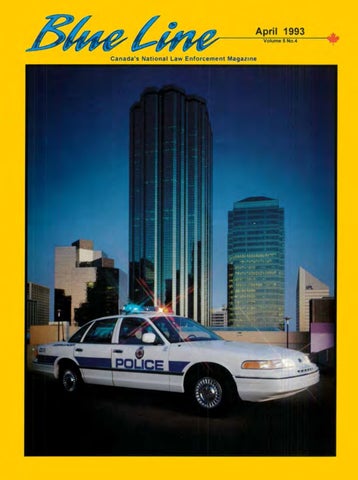
This month we feature the Edmonton Police Service on our front cover. Edmonton will be hosting this annual conference of the Commission on Accreditation for Law Enforcement Agencies. This organization inspects law enforcement agencies and certifies that they comply by an extensive set of criteria set out by the commission. The process enters a police force into an extensive self assessm en t. Th is sel f assessm ent can be cri tical in times of budget constraints when each government agency is trying to win dollars from the public coffers and attempting to quantify the value of the money spent. Edmonton was the flfSt Canadian police force to become accredited and many more are following its lead. This month we present you with our usual pot pourri of law enforcement delights. We will introduce you to guest editorialist Gary Miller and also to our new Law and Legal Editor Gino Arcaro. With Gino's assistance we will be doing some pretty exciting things in the near future. Stay tuned. Also this issue we are happy to present stories from Manitoba, St. John, N .B. and Victoria, B.C. [n addition you will have the pleasure of reading three book rev iews presented by our Editor. You will, of course, be treated to our normal fair of Case Law, Supervisory Principles and a History of The Criminal Code. Jim Dalueg, our Weapons & Tactics Editor, will enlighten you further on our Seminar to be presented this fall. Sit back, read and enjoy!
April 1993, _ _ __ __ _ _ _ _ _ _ _ _ _~3~_ __ _ _ _ _ _ _ _ _ _____"'~~~~~~~~ .. ~
-
l~tt"$ To TI~ £'ilor
Blue Line Magazine 12A·4981 Hwy.7 East, Ste.254, Markha m, Ont. L3R 1N1
Renewed faith in credits
What goes around ... I am writing in regard to your response to a letter in the February Issue ("Blue Line Acting As Censor" Vol.5 No.2) It is interesting to note that the author is married and has an II-year-old boy. I wonder what his reaction would be ifhe discovered his son hooked on illegal drugs supplied by students of his drug manual? S.A . MacLeod Port Alberni, British Columbia Editor 's Note: Aha! You obviously read the book. Poetic justice indeed. But f wouldn't wish it on even his son.
I wanted to write about a recent article in the February i ue of Blue Line. It was titled "The Firing Line". My comment was on the photography. It wa uperb. The photographer has great kill when hooting his/her subject. The fa t th at th man in the photo is overweight by a g d 25 pound was expertly conealed. he man looks no more than 5 p und overweight in the photo. I incerely hope you paid this photograph r w II. Th i i by far the best work I have een t date. Thi p r on has restored my faith in th e quality of your magazine while at th ame tim e aving the ego of the author in the photo. Ke p up th e good work! abri Ie Dalu eg Mi i auga ntario Editor' ote Wh n I received thi letter f recalled I left the photo credit off the picture. 0 here it i ... credit and all. On another note I was curiou about the name... then f realized wher I heard it before... there 's a murfby that name i n't there?
Reading Enjoyment Your magazine has provided me with numerous hours of reading enjoyment. Keep up the good work! Todd C. Mosher Hamilton, Ontario
How about a story on MP's I have enjoyed your magazine since receiving a copy at the Metro Toronto Police exual Assault Squad's Profile 2000 last September. Being with the Military Police at CFB Petawawa, I have often dealt with people who are unfamiliar with our role at Canadian Forces Bases. [ would really enjoy seeing an article within your magazine that would improve awareness of our function. This includes enforcement of the Criminal Code, Highway Traffic Act and other fed-
eral statutes . Our operation at CFB Petawawa includes about 70 persons and boasts the first general police services dog in the military. Marc Picard Petawawa, Ontario Editor 's Note Corning soon Marc!
Investment in future I am a student enrolled in the Law & Security program offered at Loyalist College in Belleville, Ontario. Your magazine was first introduced to me in July 1992 at the OPP Detachment where I was working for the summer. [ very much enjoyed reading it, as [ found it to be quite interesting as well as informative. Upon completion of my course, I intend to pursue a career in law enforcement. I feel that your magazine will help keep me informed of what is going on around me in the particular area of work. Tawnya Florence Trenton, Ontario Editor's ote We have been trying to make in-roads into colleges but it appears to be a tough nut to crack. We may have to start one ofour own.
As good as the first I have received Blue Line since its inception and am glad to find it still as informative as the first issue. Robert E. Johnson Etobicoke, Ontario
Is Blue Line Coming To Your Place Too Slow? ( or not at all? )
Last October Blue Line was required by Canada Post to re-sort its mailing list Getting a kick out of Mag and change all addresses to conform with Ju t a quick note to thank you for your Post Office standards. To keep our second II nt ervice and to commend you for class mail status we were required to check the ffort you place into each and every each and every mailing label to ensure each diti n. one read properly. To help us along we he article are very well written up to utilized a computer program (approved by date and informative. I also get a kick outof Canada Post) that would read all the adth c mic . nce again, keep up the good dresses and postal codes and re-write them w rk ! in a proper format... 0 surprises here ... it Eric Rammeloo fouled up. But we don't know how bad. Watford, Ontario We have found many people have not
4
been getting their subscriptions since last October or ovember. ow it just could be because they forgot to pay up but in too many cases it was because addresses were changed. Do us a favour and look at your label. Let us know if the address is wrong. Common problems appear to be apartment numbers left off or postal codes changed. ome have had street names changed and in one case an entire community was re-named by the "Approved" program . Check your label. Ifit's wrong we'll yell at them for you.
April 1993
Volume 5 Number 4· April 1993
- EDITOR I PUBLISHER Morley S. Lymburner Phone (416) 640·3048· FAX (416) 640·7547
- Contributing Editors Weapons & Tactics
James Dalueg
Survival Tactics
Craig Best
Case Law
Gino Arcaro
Supervisory Principles
Robert Hotston
Peer Counselling
Neil V. Thompson
Computers & Technology
Tom Rataj
- ADVERTISING Allan W. Stiver (Toronto) Phone (416) 294-5502 FAX (416) 294-8952 Ron Ganton (Vancouver) Phone (604) 274-3849 FAX (604) 274-9091
- CONTRIBUTING WRITERS Dave Langstroth Richard DuPlain Craig Best Andrew Smith Neil Thompson Morley Lymburner
- ILLUSTRATION Tony MacKinnon Bette Clark Dave Sills Dave Bluestein
BUSINESS ADMINISTRATION Mary K. Lymburner, M.Ed . Blue Une Magazi ne is published monthly, September 10 June, by Blue Une Magazine Incorporated with a mailing address ot. 12A· 4981 Hwy. 7 E..~ Ste. 2504, Mar1o.ham, Onllno, L3R 1N1. Editorial and copy is considered completely separate from advertising sales. No commitment for editorial coverage can form any part of a sale agreement. All articles ate protected by
copyright. No part of this publication may be reproduced or transmitted in any form or by any means, electronic or mechanical, including photocopying and recordingorby any information storage or retrieval system without permission from the pub-
lisher.
The authors, advisors and publisher accept no liability whatsoever lor any Injuri .. to personl or property resulting from the appUmon or adoption 01 any 01 the procedures, IIcticl or conllderatlonl pre.. nted In thil magazine. Readers are cau· tioned and Idviled that articlel prelented herei n are edited and l upplied lor your personal awaren ..1 and ahould not be used lor lurther Iction until approprlate advice and guidance Is received from a supervisor or Crown Attorney. Blue Unl Magazine II an Independant publication d.ligned to entertlin, educat,"nd upgrade the l killaol tho.elnvolvedinth. law enlorcement prole.. lon. ~ hu no direct control from a law .nforcement agency and Its opinlonl and articlel do not neceslar· Ily reflect thl opinionl 01 any government or police agency. Blue Lin. Magazine II prlnted In Canida.
-MemberInternational Alsociation 01 Lew Enlorcement Planners Canadian AdverUllng Rat.. & Data Periodical PubUa hers Exchange
Ii
ISSN #0847 8538 Canada Post Canadian Publications Mail Sales Product Agreement No. 176796
Introducing Our Legal Editor Mr. Gino Arcaro has agreed to become Blue Line's new Case Law and Legal Editor. Gino is presently a Professor with Niagara College of Applied Arts and Technology in the Law & Security Program. Gino comes with a wealth ofcredits and experience under his belt. He spent 15 years with the Niagara Regional Police Force where he worked on a wide variety of details culminating in the Criminal Investigation Branch. He also qualified as an acting sergeant and has had previous experience with the Emergency Task Force Unit. Gino left the Police Force in 1990 to pursue a teaching career but is presently finishing off his Bachelor of Science Degree with Empire State College in Buffalo, New York. With fmgers crossed he expects to acquire his degree in Police Science in the next few months. As well as student, teacher and ex-cop, Gino is a lso a writer. His newest title, presently being distributed by Blue Line Magazine, is called "Criminal Investigation and the Fonnulation of Reasonable Grounds". You wi ll fmd a review of this
Response:
book in this issue. It is a phenomenal book and brings a street-wise Canadian cop's knowledge to the list of legal books and references available today. In addition to keeping you in touch with current case law Gino encourages you to send in any legal questions you may have which may be confusing to you or which you wish to be up-dated on. We hope to answer all your questions and will place them on a high priority. Send your questions to Blue Line Magazine by mail or fax. When we publish the answer we will place only the writer's initials at the end ofthe question. However we would prefer to have your full name and phone number supplied with the question so we may get further clarification on the question if that should be necessary. The new area for answering these inquirieswill be called "Legal Notes- Q&A". You will find the first instalment in this issue. The case law written in this issue is Gino's first contribution. We would like to welcome Gino on board and hope he enjoys the ride .
By Morley Lymburner
In the February issue of Blue Line Far too extensively in my estimation. Magazine I wrote an editorial in which I Blue Line is not a scandal sheet and wanted to speak on the issues of practical does not intend to cause anyone gr ief. This jokes that go too far, the relationships which should go without saying but there it is for officers must develop and cultivate in this what it's worth. On the other hand we are day of cooed policing and the manner in not a "Polyanna Press". If there is somewhich female officers should carry their thing which needs to be said then this is role within the policing function. where itwill besaid. But it will be said with I received several calls from those clos- a view to improving the profession of law est to the officer convicted. Two were enforcement. Blue Line's position in the editorial was relatives and one a close friend. All were indignant about the use of this officer's to simply use this as an example of a unfortunate circumstance to make my situation that others could be getting themselves into right now . To have the reader points. It is not Blue Line's position to embar- make a re-evaluation of his/her relationrass anyone. In circumstances such as these ships with their co-workers and to remind we do not use the officer's name because each of us that this unfortunate story could the officer's name is of no relevance to the very well be our own if we do not heed its message. Unfortunately in this case the message. Blue Line's mandate could notdo local media did not have any such consid- anything less. eration. The story was broadcast widely in To the officer and his relatives I can the television, radio and newspapers the only send along my sympathy for the stress month before the editorial in Blue Line this situation has brought them. Some conappeared. The officer's name, and that of solation can be had in the high esteem in the female officer, was used extensively. which many hold for him.
April 1993. _ _ _ _ _ _ _ _ _ _ _ _ _ _---'5=--_ _ _ _ _ _ _ _ _ _ _-"-g;==::.!!_~ ~~~~~e>!P-'E-
Commentary:
by Gary Miller
The Implications Of Employment Equity It all seemed rather curious. The police supervisor directed us into the room and sat us down. It was explained to us that we were required to fill out a form, or at least acknowledge receipt of a form that was purportedly for the benefit of us all. The " form " was innocuously titled "Police Services Workforce Infor-
mation Form n. Accompanying the form was a rambling lett r from police headquarters which disarmingly began "Dear Member". It explained that under the Police Services Act of Ontario our police force was required to file our Employment EqUity "plans" by May of 1992 revealIng our balance of (1) women, (2) racial minorities, (3) members with disabilities and (4) aboriginal persons. In artfully arranged language, which valIantly tried to dance around the ominous implications of what was being set out, the letter pondered "how well we are doing " In achieving "employment equity". We apparently could help out the process simply by filling out this form . (Regardless, the Force is "aiming for 100% compliance". ) How well are we doing? There we sat, men and women, taken away from our essential duties In order to examine a form that had taken on even greater importance than our police work. The "Police Services Workforce Information Form n sought out these categories:
Disability (under several categories) Aboriginal Person WHO CAN QUALIFY? The bean counters who were measuring our societal correctness had successfully identified the females and the visible minorities within our ranks. But who among us qualified for the other two categories? I listened to the snorts of derision around me. In spite of the conciliatory tone and ref rences to an "opportunity for the Force" , those present knew the seemingly innocent Initiatives masked something else. Eligibility for advancement (or even being hired) dep nded on one's ability to factor oneself into the "disadvantaged" categories. Even more Importantly, few of us could improve the Force's statistical "equity" position. We were called upon to be unwitting party to the Irrevocable discrimination against p rsons who did not fit one of the four disadvantaged groups on the Force. Even now, police forces in Ontario are speCifically advertising only for those groups. The women among us were as cynical as the men. One by one police personnel around
~
me drew a diagonal line through the form , signed it as required, and strode from the room. I sat there, racking my brain for some way to qualify. Did a frequent twinge from an arthritic hip and foot qualify me for disabled? Could I find aboriginal persons in my family tree? I concluded that I too was racially and physically unqualified. Since there was no point in addressing any portion of the form which had been plunked down in front of us, I drew my diagonal line through the page and signed as required. I knew that since I was not a member of a so-called "disadvantaged group", I had been required to be a partiCipant in my own marginalization. This process was not about integration of different groups, but about segregation, no matter what the prattle about rights. This did not address every person 's rights to be "free from discrimination " as the Ontario Human Rights Code would want us to believe. It ENSURED discrimination against ALL persons not legally defined as disadvantaged. DISABLED QUOTAS Incredibly, a vocation which cries out for only the fittest, most alert persons because of the rigours of police duties is now required to hire a quota of disabled persons to reflect the proportion of disabled in the community. (proponents of this legislation hotly protest use of the word "quotas" preferring the softer expressions "guidelines" or "targets" ... but a quota is a quota.) The justification for hiring quotas for disabled persons is that they "suffer up to 80% unemployment". These unfortunate souls receive government and private disability pensions precisely because their unemployment arises out of the fact that many are UNEMPLOYABLE, espeCially as police officers. Now we must accom modate them; but not in the high risk, physically demanding front line assignments. Safe, indoor desk jobs have to be reserved for them . The disabled are to be made such a permanent part of the work place that their work environment will be custom designed around them and job descriptions will be tailored to their limitations. Will these be cost effective, contributing members in these times of slash-to-the-bone budget cuts? Or is this externally imposed social engineering? In the meantime, the police service "uses up" an increasing proportion of the healthy, able bodied police officers who are injured and/or traumatized in violent daily inCidents, but not given the "disabled" tag. Where will 6
they now go? Will a working agreement protect them? Or is employment equity, with all the weight of the law behind it, in the highest authority? In the past these police personnel have been moved into "light duty" jobs during their recovery period. With an enforced quota of disabled persons permanently on staff, there will be no "light duties" open to uniform members who have suffered permanent or temporary disabling physical or emotional damage while in the line of duty. All those positions, well back of the front line, but where police experience is still useful, will have been filled by disabled persons. The choice for our injured or recuperating street heroes? Back on the road or onto the sick list and eventually off the job! Employment equity: a cruel policy which is masquerading as benevolent and caring. It will hurt more police personnel than it will ever help.
Next Month Coming Straight to the point Gary Miller is a regular columnist for the Metro Toronto Police Association News & Views Magazine. Gary will be an occasional editorial writer for Blue Line. Your comments are welcome.
ACCIDENT RECONSTRUCTION SOFTWARE
EDC offers law enforcement the only integrated package of validated accident analysis software for reconstruction, simulation, visualization and presentation. For more information, call, fax or write:
E @
ENGINEERING DYNAMICS CORPORATION
8625 S.w. Cascade Blvd., Suite 200 Beaverton, OR 97005, USA 503-644-4500 Fax 503-526-0905 EDC. If you really NEED to know.
April 1993
=_ 1r.
Blauer.
FEDERAL SIGNAL CORPORATION Emergency Products
Uncompromising Performance
I . " ",:[ : 1
VECTORTM V-SHAPED LIGHTING SYSTEM
The VectorT" light system out performs conventionallightbars, and offers you a wider variety of options . The ultra modular capabilities, combined with the V-shaped design, allow you to effectively direct warn ing power where you need it most - to the front and sides of your vehicle , providing you with added protection at intersections where most emergency vehicle accidents occur. Seven modular pods allow you to design a light system that meets your specific needs. The modules are designed to accommodate the optional features, wh ich include rotators (95 and 175 FPM), oscillating lights (front, sides and rear), takedown , alley lights, MeteorT " traffic cleari ng lights, alternating flashing lights, steady-burn lights, and mirrors . CALL FOR FULL DETAILS ON THESE AND OTHER PRODUCTS
FALCON MARINE RADAR
Introducing the Blauer GTX 9690 The latest in hi-tech rainwear featuring a three layer one-ply system of Gore-Tex™ which fights to keep the rain out and allow your body to breath and stay dry through the toughest of jobs. A high-tech, lightweight, 3-layer, single·ply construction with completely waterproof, breathable Gore·TexT " fabric laminated between reversible outer-shells of US-101 fabric (in department colour) and fluorescent-orange knit; seams factory sealed with Gore-SeamT" tape. Raglan shoulder design for freedom of movement and comfort, snapover storm fly front, go-through hook & loop side openings, 1 %" Scotchlite™ retro-reflective trim (orange side only) around chest/back and sleeve cuffs , sleeve take -ups to adjust open ings. Badge tabs on both sides. 49 " long . Colou rs: Fluorescent orange with Police blue, black or brown Sizes : X-small to XXX-large, reg ular and long
BIOKINETICS CANADIAN POLICE RIOT HELMET CSA
APPROVED
THE NEW KUSTOM PRODUCT MANUFACTURED ESPECIALLY FOR POLICING YOUR MARINE AREAS. W ith a Falcon Marine from Kustom Signals, your patrolling is more complete and effective. The Falcon Marine targets careless and incompetent boaters, and helps prevent personal property damage, and worse : boating accidents. The Falcon Marine is a hand-held, stationary K-Band radar unit. Designed specifically to enforce the speed limit on waterways , it is
• • • ".bI. '"
k"O"{(<<((((('"'
of mil., PO' ho",
KUITOM SIGNALS, INC.
l!l
The CANADIAN Police Riot Helmet is the culmi~ation of a five year joint effort between Biokinetics and the RCMP (Science and Technology Branch). Designed to meetthe reqUirements olthe CSA Standard for Police Riot Helmets and Faceshield Protection. A combination offibre reinforced resin and fou r d ifferent polymers has resulted in a helmetthat provides protection against a steel pipe to the face as well as it does to the rest of the head . T he CANADIAN Police Riot Helmet is also impervious to caustic liquids and flam ing hydrocarbons, and possesses a facesh ield with optical properties equalled only in NATO aircrew helmets.
THESE AND A WIDE VARIETY OF OTHER PRODUCTS ARE AVAILABLE FROM
NICHOLLS
LONGUEUIL, QUE. MISSISSAUGA, ONT. EDMONTON, AB. FREDERICTON, N.B. GOULDS, NFLD. TRURO, NOVA SCOTIA
TEL: (514) 442-9215 TEL: (416) 828-1942 TEL: (403) 973-3999 TEL: (506) 385-2484 TEL: (709) 368-0999 TEL: (902) 893-3288
FAX: (514) 442-9581 FAX: (416) 828-7749 FAX: (403) 973-3291 FAX: (506) 385-2499 FAX: (709) 368-0991 FAX: (902) 893-3227
- - Reconsidered- By Allison MacKenzie As anadian police administrators prepare to enterthe21 stcentury, they face an ever-increa ing pandora' s box ~1.~~lAIiM( of re trictions, requirements and scrutiny . From the Atlantic to the Pacific, p lice e ecutives are under the gun l balance decreasing dollar and manp wer with e calating demand for service and increa ing public crutiny. However de pile the tough economic and cial time , a record number of anadian police agencie have entered into, or are con idering entering into, the mmi ion on Accreditation for Law · nforcement Agencie ( . .L. .A.) ccreditation Program. Why? pponents of accreditation argue convincingly that law enforcement accreditation i an overrated, expensive merican program which offers little l anadian police agencie . They view accreditation a entrenching additi nal regulations on a profession that ha already been everely limited by go ernmentre triction andpublicscrutiny. urther, they e pound, accreditati n connicts dir ctly with the community policing philo ophy currently in vogue acro anada. 0 why are poIi e e e utive committing diminishing re ource to a program that yields u h que tionable re ults?
dmonton
anadian Fir t
' Accreditation has never been more timely," ay In pector Roger imms, Audit fficer, ofthe dmonton Police ervice (th fir t accredited Canadian policy agency). ' Those who advance these argum nt ju t haven ' t done their homework." imm ha participated as an assessor in b th anadian and American law enforcement ag ncy accreditations, and is urrently navigating the Edmonton Police er ice through re-accreditation . A leading anadian proponent of accreditation,
imms says his involvement with the program has reinforced his belief that it is the way of the future: "Accreditation is synonymous with professionalism - it promotes law enforcement excellence. It fosters organizational efficiency and effectiveness, and ultimately leads to 'good business' within the agency," explains Simms. "To become accredited an agency must undergo a critical self-assessment period where all aspects of policy and procedure
are reviewed and challenged. Numerous standards are targeted to reinforce community policing philosophies and to meet the ever increasing burden placed on police agencies. And as police agencies face greater public and legal scrutiny, professionalism and standards within the Canadian police community will become more and more important."
pate their future direction . By undergoing accreditation, an agency voluntari ly scrutinizes their manpower allocations and staffing to ensure they meet organizational needs. Instead of developing policies based on hindsight, accredited agencies strive to develop pro-active policy based on careful evaluation of current and projected needs. The end result is better service to their community, fewer wasted tax dollars and the ability to deal effectively with emergent situations. C.A.L.E.A. was formed as a non-profit, tax exempt corporation in 1979, by a grass roots coalition of American law enforcement officials. Their objective was to develop a set of standards, and to establish and administer an accreditation process by which law enforcement agencies could demonstrate voluntarily that they meet professional criteria. Currently there are over 900 standards, organized into 49 chapters of the Accreditation tandards manual. These standards relate to all facets of policing, including recruiting, patrol, criminal investigations, career development, training, internal affairs, communications and community relations. While the standards originated in the United tates, they have been adapted as necessary to meet Canadian law and procedural requirements. Improved delivery oflaw enforcement services is the overall goal of accreditation. The standards are directed at encouraging law enforcement agencies to increase their capabilities to prevent and control crime; enhance effectiveness and efficiency in the delivery of law enforcement services; improve cooperation and coordination with other law enforcement agencies and other components of the criminal justice system; and increase citizen and staff confidence in agency goals, objectives, policies and practices.
Cost of Accreditation
Depending on the size of the agency, the cost of being accredited ranges from $7,000 to $28,000, less than the cost of one squad car. (Fees for agencies with mUltiple Anticipating The Future districts, precincts or substations may be Accreditation leads to pro-active polic- higher.) imms says the Edmonton Police ing. Through critical analysis, exploration Service has kept manpower costs to am iniand long range planning, agencies antici- mum by staffing the Accreditation Office 8
April 1993
with members who are on light duties. However, the benefits and the cost savings far outweigh the initial expenditures. There are three major steps in the accreditation process. Once an agency has applied for accreditation, they must submit an agency profile questionnaire outlining size, responsibilities, functions performed, organization, management, etc. This information is used to confirm the agency's eligibility and to determine which standards are applicable. The second step is the self-assessment phase, during which the agency conducts its own assessment to determine the extent to which it meets applicable standards and assembles the necessary proofs of compliance. Th is step usually takes 12 to 18 months, depending on the agency ' s size and experience. During the on-site assessment, the third step, a team of C.A .L.E.A. assessors visit the agency to verify proofs of compliance and interview staff and the public about agency performance. The assessors' report then is forwarded to the Commission and accredited status is either granted or deferred based on this report. Accredited status is granted for a five year period, during which the agency is expected to remain in compliance with the standards.
A Growing Trend In Canada The Edmonton Police Service was accredited in 1988. Since then, accreditation interest and momentum have grown across Canada: The Winnipeg Police Service became accredited in July 1992. Currently Camrose, Brandon, and Peel Regional Police Services are working towards accredited status. Numerous other Canadian agencies have made preliminary enquiries into the accreditation process. The Edmonton Police Service is hosting the first international C.A.L.E.A. meeting from Ju Iy 28 to 31 , 1993. It is anticipated that more than 700 delegates from Canada, the United States and Europe will attend the conference.
ALERT! Belt Buckle Knife Also known as the "Constant Companion", The belt buckle knife is allegedly manufactured by a company in Arcadia , California. The weapon costs from $25 to $150, and is made in a variety of sizes, colours, and shapes. The stainless steel weapon is curved to fit the waist and slips easily out of the belt for immediate use.
In drinking driving cases, there is a critical need for evidence that can stand up against the toughest defence ... now you have it with the Intoxi/yzer 5000C. This infrared, hightech instrument offers speed, ease of operation and accurate results. Simple, one-button operation initiates the entire breath test sequence.
The eMI Intoxi/yzer 5000 instrument is the established leader in the alcohol breath test industry!
Full Maintenance and Leasing Terms Available
For information on Accreditation or the C.A.L.E.A. Conf erence contact: I nspector Roger Simms, Edmonton Police Service, P hone (403) 421-2297
Fax (403) 425-9963. April 199.J___________________________________~~____________________________~~~~~~~~
July 28 - 31 , 1993
te.254, Markham, Ont. L3R INI - FAX (4 16) 640-7547
April 27 - 29, 1993
treet urvival '93 Portland - Maine treet urvival '93 , presented by Calibre Press, offers up-to-the-minute technical and tactical information on staying alive and uninjured while dealing with dangerous people and situations. Officers may enro l for the entire 3-day seminar or just the first 2 day. all Toll-Free (800) 323-0037 or use ax at (708) 498-6869. Ma 3 - 6,1993
ci ntific
ontent Analy is
Brampton - ntario he Law and ecurity Administration section of heridan College is hosting this fourday eminaronthe" CAN"technique for obtaining information and detecting deception by means of verbal and written communication . A must for anyone involved in investigation of crime including polygraph examiners. For further info contact atherine Bertram or Angie pafford at(416)459-7533 x5350 or~5349 or AX (4 16)451-9096. Ma 19 - 21, 1993 ational Aboriginal Youth onference Winnipeg - Manitoba Winnipeg ity Police and the RCMP will b holding this conference which will invite ir t ations Youth to attend a series of work hop s de s ig ned to engage a nd challenge their understanding of social i ue and the justice system. This year's theme i " haring Visions - haring Our World." For further details contact Bob Bangs at (204) 983-0972 or Fax (204) 9843637. Jun 7 - 11 , 1993
dvanced Homicide eminar Toronto - Ontario The M tropolitan Toronto Police Homicide quad will be hosting this seminar at the oronto kydome Hotel. This wi ll be the II th year for this seminar. For further in formation call (416) 324-6150 or Fax (416) 324-6 151. ~
June 14 - 19, 1993
NorthwestPoliceiFirefighter Games Calgary - Alberta The 16th Annual Games will be hosted by the Calgary Police Service. The games are open to all sworn police officers and auxil iary/reserve officers with two years service. For further detai ls contact Jim McCaw (403)280-7342.
Commission On Accreditation for Law Enforcement Agencies Conference Edmonton - Alberta The Edmonton Police Service is proud to host the first C.A.L.E.A. Conference to be held outside the United States, with several Canadian and American Police agencies seeking accreditation status, and the E.P.S. striving to be re-accredited at the meeting. The Conference will include seminars, workshops and displays . For further information contact Insp. Roger SIMMS (403) 421-2297 or FAX (403) 425-9963 . August 29 - 31 , 1993
C.A.C.P. Trade Show
Halifax - Nova Scotia June 24 - 26, 1993 The Canadian Association of Chiefs of Canadian Police Officers Police will present their Trade Show which Motorcycle Championships will feature over 90 companies displaying products and services of interest to the law hannonville - Ontario This annual event wi ll be held at the enforcement community. The Trade fair is Shannonville Race Track with the assistance open to all law enforcement officers on the of the FAST Racing School. This year will last day of the event only. For further be a Canadians only race and members of information contact Sgt. R. O'Neill at (902) Canadian Forces are encouraged to compete 421-6854 as the winners will go on to the international eptember 21 - 26, 1993 series. Contact Dave Stewart (416) 8312013. 14th Crime Stoppers Conference Calgary - Alberta "Success Through Co-Operation" is the June 28 - 30,1993 theme for this years Crime Stoppers O.A.C.P. Trade Show International Conference to be held in Huntsville - Ontario Calgary. For further details call (403) 260The Ontario Association ofChiefs of Police 1900 or FAX (403) 260-1180. present their annual Trade Show. This annual show is associated with their annual eptember 20 - 24, 1993 conference. The Trade Show is open to all Profile 2000 - Sex Crimes Conference law enforcement personnel and consists of Toronto - Ontario over 80 companies showing a wide array of The Metro Toronto Police Sexual Assault products and services of specific interest to Squad is hosting its 3rd annual sex crimes law enforcement personnel. For further conference at the Sky Dome in Toronto, detai ls call (416) 965-6429. home of the 1992 World Series Toronto Blue Jays. Mark this date in your calendar July 12 - 16, 1993 (The Jays will be in town). For more 1993 C.I.S. Conference information contact Det. Wendy Lever or Vancouver - British Columbia Det.Cst. Terry Green (416) 324-6060, Fax The Canadian Identification Society will (416) 324-0697. be hold ing its annual convention at the Vancouver Ramada Renaissance Hotel. Its September 20 - 24, 1993 theme this yea r is "Tenacity a nd Canadian Tactical Training Seminar Technology". A number of distinguished experts will be speaking . For further details C.F.B. Borden - Ontario contact Hugh Waterton (604) 665-5089 or Blue Line Magazine presents its first annual Tactical Training Seminar. The seminar is Fax (604) 665-2171. limited to 130 applicants. This Seminar 10
April 1993
will present the latest in weapons training techniques and is suited to those involved in tactical weapons response. Guest speakers will present demonstrations and lectures on a variety of issues. For further details or to register FAX (416) 640-7547 or write Blue Line Magazine. September 22 - 23
1993 Canadian Tactical Trade Show C.F.B. Borden - Ontario Blue Line Magazine will be holding Canada's first ever Trade Show dedicated to law enforcement tactical equipment, services and supplies. This two day event is open to all law enforcement personnel and will feature the latesttechnology in weapons and equipment of interest to tactical weapons response un its. For further detai Is use our 24-hour FAX line at (416) 2948952 or phone (416) 294-5502 . September 24 - 26,1993
5th International Police Diver Symposium Hamilton - Ontario Once again the Hamilton Wentworth Region Police will host the International Police Diver Symposium. This has become the largest symposium of its kind in the world and guest speakers are scheduled from New Zealand, Ireland, Great Britain and the U.S . For further details ' contact Rick Rozoski PhonelFax (416) 575-1434 October 31 - November 5,1993
Interntational Association of Women Police Conference Vancouver- British Columbia The Canadian Branch of the LA.W.P. will be hosting the 31 st Annual Training Conference to be held in the Hotel Vancouver. The theme of the session will be "Global Policing: A spirit of unity". For further details call (604) 681-5226 or FAX (604) 68\-2503.
Earn extra money selling security products that enable people to resist, in a non-violent fash ion, becom ing victims ofcrime. Contact Bob Hinchcliffe, 1622 Lee PI., Regina, SK S4V OS7 Phone (306) 789-7499
April
Unique Conference Opens Doors To Canadian Aboriginal Youth
,u"rlolNG VIS"O~I . . 'l~
. V" "Sharmg ISlOns- Youth Career Awareness Committee and ~ ~ Sharing Our World" the Winnipeg Police Department. The conference, to be held at the camwill be the theme for the pus of the University of Manitoba, will ~ National Aboriginal , . ' / YouthConferencetobe consist of 22 workshops over the three ~~l ;JO~lV held In Winnipeg from days. The focus will be on social issues, personal development, management of fiNG OUR" May 19 to 21. The annual conference is designed to nances as well as education, career and bring Aboriginal youth a forum for the employment opportunities. A major focus of the conference will be detailing of educational and career choices, with an examination of life skills and social placed on an examination of the judicial issues that will prepare young people for system, community policing and policing the challenges of the future . In addition it in a multicultural society. The RCMP will will provide the stimulation of dialogue present sessions targeted toward Aborigithat will form the basis for long term solu- nal Candidate Development and the "Stay tions to concerns with the justice system In School" program. Other topics will centre on self-governthat impact on youth. In addition the conference will provide ment, chemical dependency, a panel of all participants with the opportunity to ex- elders, suicide, Aboriginal youth perspecperience the unique and diverse nature of tives and personal development skills. For further information contact the Aboriginal culture and traditions. This conference will be ajoint venture RCMP - Robert Bangs or Bob Wasicuna at hosted by the Royal Canadian Mounted (204) 983-0972 or Winnipeg Police - Bob Police in conjunction with the Manitoba Irwin at (204) 983-0972.
l
~~
~
'PEA CEMAKER' Blue Line Classified is a Free service to law enforcement agencies and related personnel support groups. Other persons and organizations may place their notices in this section at a price of $40.00 per insertion up to 25 words. (paid subscribers pay $30.00) Add $2.00 per word over this amount. Word count does not include phone number or heading. Editor reserves the right to revise, edit or refuse any notice not deemed to be appropriate. Payment ,to accompany copy for insertion, may be by cheque, Visa or MasterCard number (include expiry date please) Deadline is the first ofthe month prior to publication. (eg. October 1st for November issue) Mail to : Blue Line Classified 12A-4981 Hwy. 7 East Ste.254 Markham, Ontario L3R lNl
or FAX (416) 640-7547
It's your occupation .... Now let it be your publication! The PEACEMAKER is published quarterly by the Canadian Fellowship of Christian Peace Officers (CFCPO), a federal nonprofit corporation which encourages peace officers locally, nationally and internationally to join in fellowship. If you would like to be placed on the mailing list, or would like to receive more information about CFCPO membership, send your request with your name, occupation, address and phone number to:
Sharing the Truth and the Way and the Life Our Lord Jesus Christ
1993=====================================101==============================~~~~~~~~
Joint Forces Operation Marine Waterways Unit By K.I. opeland
III recognition of numerous waterway violations in the St. JO/III, New Brunswick area
ofthe Bay of Fundy,four local la w enforcement agencies joinedforces, manpower and f acilitie to head off certain tragedy. Th e program worked far better than expected. aint John New Brunswick has a regional population of approximately 150,000. It is served by two Fed\ c.... eral and three Municilit/ iO ° hn Po\l'~ pal Police Forces. ituated on the outhern coast of the province, aint John is a major seaport and inland, lhe aintJohn and the Kennebecasis Rivers ar home to a great many pleasure craft. aint John Police Chief David herwood, re ponding to stories of unsafe boating, made inquiries, and learned that little en~ rc mentwa takingplaceonthewaterway . Port an ada Police hadjurisdiction within harbour limits only, and pI. Keith Lar en, R MP ederal Enforcement eclion (F ) wa olely responsible for the re t. mplaints led Chief herwood to believe that a tragedy was in the offing. Inth all of 1991 , preliminarydiscusion were held with uperintendentWayne Parlee, Port an ada Police; Chief Tom ladn y, Rothesay Regional Police; and uperintendent 1. Boulac, Royal Canadian Mounted Police "J" Division . From these initial talk came the concept of anada's fir t Joint Force ' Operation Marine Wat rway nit (JFO HWU). Port an ada Police would provide wa-
.r."
~~~~~~~
Members had their hands full learning boat operation skills in this environment. Patrol work commenced on June 19th, 1992. Routine patrols were assigned on Friday, Saturday and Sunday with a member from Ports Canada, Saint John, and Rothesay Police aboard. Additional patro ls were made as required to cover special events such as the arrival of the Queen Elizabeth II in Saint John Harbour. Initial response to the unit was very good. Local media provided good coverage throughout the training phase, and generated a great deal of public interest. The " Muskrat" is used for general patrol work. A 35' aluminium hull houses a forward cabin , the wheelhouse, and the open afterdeck with arecoverywinch/boom. She is equipped with Radar, Loran C depth sounder, two VHF radios, cellular phone and local police frequencies. Twin turbo diesels drive independent screws generating 700hp that will push the " Muskrat" to a top speed of28 knots (45 mph) .
Impressive Statistics tercraft and four operators. Rothesay Regional would provide four members for patrol work, and aint John wou ld provide six members for patrol work, as well as training faci lities. The RCMP would provide training to all personnel , as well as instructors for the eight day In land Water Transport (IWT) Course. App lications were solicited for members from each Force, and after initial screening, successful applicants completed aquatic proficiency testing demonstrating life saving ability, co ld water survival skills etc.
Training A High Priority Instructors for the IWT course were drawn from RCMP FES detachments throughout the Province. Four boats were used during the training. Three RCMP whalers, and the Ports Canada Patrol Boat "Muskrat". The IWT course was most comprehensive, coveri ng everything from navigation to trailering; fue ll ing to docking. The course combined classroom and practical work, and included a night cruise for practical navigation lights. As an added attraction/distraction, the Saint John Harbour has a difference of 25' between low and high tide, among the worlds highest.
Throughout the course of the summer, 125 vessels were stopped and checked. Six criminal charges were laid from Breathalyzer to hit and run. There were II charges laid under the Liquor Control Act. Two charges were laid under the Canada Shipping Act. 40 warnings were given from minor equipment violations to not displaying registration numbers . otwithstanding this, MWU members were overwhelmed by the support shown by the boating public. Members claim that this has been the most positive, sustained response they have ever felt as Police Officers. During the course of the 13 weekends that the " Muskrat" plied the Saint John and the Kennebecasis Rivers, crew members responded to 15 vessels in distress. A wind surfer suffering from hypothermia and exhaustion unable to return to shore. A capsized sailboat, its occupants clinging to the upturned hull. Boats adrift without power in danger of floundering. Throughout the summer, regular meetings were held to identify and resolve problems. As a result of this, in August, Canada Customs joined the JFO MWU . A large number of American boats cruise New Brunswick's inland waterways. Customs Officers were able to assist them with dec-
______________________________~12~___________________________________ April 1993
laration of goods etc. It also gave the MWU enhanced capabilities to check registrations etc. Five Customs seizures/arrests were effected. The MWU has now wrapped up its initial season. Response far exceeded all expectations. Sgt. J.K. McDonald of the SJPF Training Section states, "This is the most productive unit that I've seen in my Police career." Co-operation between the two Federal Forces, two municipal Forces and Customs has been unsurpassed. Support has been strong from all quarters and the media interest has remained high . Inquiries have been made from as far away as British All RCMP Whaler is shadowed by the Ports Canada Patrol Vessel "Muskrat" in the Columb ia. Bay of Fundy exercises last May. Members of the St. John Police Force where joilled Canada' s first Joint Forces Operation on traillillg exercises with members of the Royal Canadiall Mounted Police, Rothesay Marine Waterways Unit has put down a Police Force and Ports Canada Police as they practice patrol tactics. III an area that solid foundation in the Saint John Region. boasts one ofthe highest tides in the world simple navigation call become a considerable Budget proposals have been made for next and risky task to the untrained. Impaired navigation and drug smuggling are just two years operation, and there are plans to of the more serious offellders the Joint Forces Operation keeps in check. implement additional patrols utilizing other Ports Canada Police boats supplemental to tial for inshore work and beach landings is from the public has made this unit an undethe "Muskrat". An example of this would unlimited. niable success. This is a shining example of be the 28' Zodiac FRC (Fast Rescue Craft). Enthusiasm of the members and agen- a Joint Forces Operation working toward With an inboard dieseljet drive, the poten- cies involved combined with the support public safety.
You think e's funny ... Wait till yo see yourself in a
Out Of The Blue... ... Just For You! Perfect for that lasting momento of that very special event. Drawn by Blue Line's political cartoonist, Dave Bluestein , in hilarious black and wh ite. Ideal for that transfer, retirement, awards, anniversary or just for the fun of it. Send along a photograph and a description of the person's job description or scenario of the event to be depicted and we will send back the photo with an 8 X 10 original drawing suitable for framing or mounting . Send along cheque, money order or Visa/ MasterCard number With expiry date to
Blue Line Marketing 12A - 4981 Hwy .7 East, Markham, Ontario L3R 1N1
ALCOLMETER S·L2 BREATH ALCOHOL SCREENING Now introducing the latest in small handheld screening devices for police security and public safety. ALCOHOL COUNTERMEASURE SYSTEMS
Alcohol Countermeasure Systems Corp 14·975 Midway Boulevard Mississouga, Ontario L5T 2C6 Telephone (416) 670·2288 Fox (416) 670·8211
~ =_r::.>::..£:..~~~01~~
April 1993_ _ _ _ _ _ _ _ _ _ _ _ _ _ _---=1'-'3 _ _ _ _ __ _ _ _ _ _ _ _.....
Manitoba Female Officers Form Association
Early in 1992 a group offemale officers from tile Roy al Calladiall Moullted Police and tile Willllipeg Police Departmellt organized tlle fir: t annual M allitoba Women Peace Officers COllference. S ixty-Ilille f emale officers attellded. Til e response was o great tllat til e origillators of tile cOllference recelltly formed Mallitoba Women ill Law Ellforcemellt Ille., alld plall to II old a imilar cOllferellce every year. Work i currelltly under way 011 a secolld cOllferellce to be II eld ill September 1993. By Pam Reimer i ty-nine female peace officers from across Manitoba, including three from askatchewan , attended the fir t provincial women p ace officer ' conference at Gull Harbour, Manitoba on October 13 and 14, 1992. Pre ntatthe conference were member of the R. .M .P., Brandon City Police, u tom and Immigration, C.N. Police, Military Police, Manitoba Youth Centre, and Winnipeg Police Department. While it i recognized that Vancouver has hosted th Int rnational ssociation of Women Police onference in 1983, it is believed that thi is one of the first such conferences organized on a provincial level. Th purpose inplanningsuchaconfernce were to provide further training in area of interest to female peace officers and to provide a social setting in which women from the various agencies within the province could meet and begin to network with each other. With these goals in mind, a few women met in pril of J 992 and began planning for the con ference. nough interest was generated to e tabli h a planning committee coni ting of eleven officers from the RCMP nd WPD. uestionnaires were circulated to the female members of both departments to a certain if there was sufficient interest and to identify areas of common interest for I cture topics. The re ponse was favourable and the
planning committee received the support of the administrations of both the RCMP and WPD. On the first day of the conference, Constable Randy LaHaie (WPD) presented a one-day seminar on the subject of defensive tactics. The seminar included a lecture in the morning and a practical hands-on session in the afternoon with the assistance of gt Don Moore (WPD). This seminar was very well received by all who attended . The enthusiastic students kept the instructors on overtime infl icting brachial stuns! For those who chose not to participate in the rigorous afternoon session, Corporal Kathie King (RCMP) provided a fascinating and controversial alternative. She introduced many officers to the field of satan ism, currently a debated and contested topic with police departments and the media. As seminars and expertise are limited to few members within the RCMP and WPD, Corporal King 's insights as the RCMP provincial expert were appreciated . That same evening a hospitality night was held and a Chinese Auction helped kick things off and offset conference expenses. Local businesses and sponsors ensured the success of the auction by contributing valuab le items such as Winnipeg Symphony Orchestra tickets, fitness passes, and a Second Chance fanny pack with built-in holster and kev lar panel. On the second day, Dr Bi ll Davis, psychologist for the WPD, presented a stress 14
management workshop in the morning geared towards female officers. Continuing in the afternoon on the subject of psychology of sex differences was Dr David Martin from the University of Manitoba. The two lectures inspired a great deal of audience participation. Critiques received by committee members from the participants indicate that the conference was indeed a success. A majority of officers indicated that they would favour attending similar conferences in the future and commented that they felt the length of the conference should be extended to facilitate more intensive seminars and to enhance the networking aspect. The goals of the conference were successfully achieved. With the assistance of the RCMP, WPD, and the Department of the Secretary of State and through the enthusiastic efforts of the organizing committee, the first Manitoba Women Peace Officers ' Conference brought women from across the province together primarily in the interests offurther learning. The casual, informal setting of Gull Harbour allowed everyone to become acquainted with each other and to form a professional network as a future resource. That so many women in the area of law enforcement in the provinces of Manitoba and askatchewan wou ld at their own time and expense attend such a conference speaks highly of the degree of professionalism of women in law enforcement. April 1993
42ND
1l®®S3 (Q)o&oCCoJFo ilIf~cdl® §Iffi@w at
Deerhurst Inn Huntsville, Ontario
June 28th to 30th View the latest in Law Enforcement technology, equipment, supplies and services from over 80 exhibitors. .. Computer Hardware and Software .. Investigative Aids .. Weapons Transportation .. Telecommunications and much more
I,. I,. ....
Admission is free to all law enforcement personnel daily 8:00 A.M. to 5:00 P.M. (Wednesday to 3:00 P.M.) For further details call Bob Fitches
(416) 965-6429
... news beat ... news beat ... news beat ... International Crime Prevention Centre To Set Up Shop In Montreal Montreal has been selected as the location for an International Centre for Prevention of rime. The Minister of Justice and Attorney eneral of Canada, Pierre Blais, the Quebec Minister of Public ecurity, laude Ryan the President of the executive committee ofthe Montreal Urban Community, Michel Hamelin , and the Ministre d la Ville of the Government of France, Bernard Tapie made the joint announcement on March 18, 1993 . Th creation of the Centre, planned for early 1994, comes out of the final declaration of the econd International Conference on Urban afety, Drugs and Crime Pre ention, held in Paris in 1991. "The creation ofan Executive Committee in charge of making preparations for
establishing the International Centre for the Prevention of Crime confirms the importance attached by governments, municipal as well as provincial and federal , to crime prevention," said Justice Minister Blais. "Furthermore, the Standing Committee on Justice and Solicitor General recognizes that Canada has experience in crime prevention and that it has had successes in this field that could be shared with other countries," he added. For his part, the Minister of Public ecurity, Claude Ryan, indicated that " the project to create the Centre showed the Quebec government' s readiness to promote any and all actions that would enhance crime prevention and security within the community". The Department of Pub-
Medicine Hat Police Converting To Pistols
lic Security has taken an active role in this project by designating one ofits officials to serve as liaison between the Centre and the Department. Michel Hamelin stressed that "the International Centre will be a precious resource for the municipalities, allowing them to, enrich the substance and scope of local crime prevention efforts". In addition to the Governments of France, Canada and Quebec, the Montreal Urban Community, the Federation of Canadian Municipalities, the European Forum for afer Cities and the Montreal International Conference Centre Corporation will be represented on the Executive Committee. The chairman will be Gilbert Bonnemaison, President of the European Forum for afer Cities. The Committee must report to the sponsoring governments by December 31 , 1993. The Centre is expected to become a home for crime prevention expertise, cooperative efforts and will provide international assistance for cities, non-governmental organizations and interested governments. It is hoped that its work may be coordinated with the work of the United Nations.
Youths Charged While Trying To Start Riot Four young whites have been charged with setting fires , painting racist graffiti at a high school and shooting a 19-year-old black youth in the hopes of starting a race riot in ashville, orth Carolina. When the four youths were arrested by olin Grant (left) and Glen Motz of the Medicine Hat Police Service police they told officers that they commitpractice firing their newly issued semi-automatic service weapons. Medicine Hat began ted the acts in the hopes of starting a race to convert it members to the mith and Wesson 9mm handguns in 1990. Inspector Gerry riot similer to those in California. Kipta reports the full implementation should be complete by the end of next year. "They wanted to start trouble like in "Although we are not as large as many police forces," Kipta writes, "we pride ourselves California so they could go in stores and in bing the pioneer of weapons transition in Canada." Medicine Hat Police Service has steal what they wanted to," heriff Frank Brown said. appro imately 50 police officers. 16
April 1993
... news beat ... news beat ... news beat ... Traffic Fatalies In Canada On Decline Over Past 20 Years Fatalities 1972 - 1991 -
,... Canadian Motor Vehicle Traffic Collision ,... Statistics
en en
OJ
Fatality Rate (Per t 0,000 Motor Vehicles Registered) Fatalities (thousands of persons)
7 ~~
________________________ 1
61
.1
1972
Collected In cooperation with the Canadian Council of Motor Transport Administrators TP 3322
Statistics recently released by Transport Canada indicate that although the number of injuries occurring in motorvehicle collisions have remained stable over the past 20 years the number of people actually killed has been declining. The report indicates that 3,684 people lost their lives in motor vehicle collisions in 1991 . This figure was down by almost 7 per cent overthe year previous and is almost 60 per cent less than 20 years ago . In 1972 motor vehicle collisions took the lives of 6,221 people. The following year that figure rose to 6,706 and was the highest figure reported in the past20 years. Since that date the picutre has improved dramatically. The most interesting figure indicates that the number of collisions involving injuries has remained relatively constant over the same period. Also remaining constant was the acutal numbers of persons
199 1
injured. The year 1989 appears to be the worst year for numbers of injured people. The reason for the decline in the death rate has been attributed mostly to the introduction of seat belt legislation. Other factors have included better car design, greater public awareness, and the stepped up antidrinking driving campaigns started in the early 1980's. Other statistics indicate the highest number of injury collisions occur during the summer months and the most likely times are between 3:00 and 6:00 PM. Another statistic indicates that British Columbia has the highest rate of injury collisions reported per 10,000 registered motor vehicles. They are followed by Manitoba, Ontario and New Brunswick.
Support Needed For Police Memorial Fund The Canadian Association of Chiefs of Police and the Canadian Police Association have received final approval to reconstruct the "Speaker's Pavilion" on Parliament Hill and to dedicate it as a Police Memorial. This national memorial will commemorate the more than 200 Police Officers killed in the line of duty since Confederation. The Pavilion will house a plaque which will show the Officers' name, police service and year of death . The Pavilion will be an exact replica of a structure des toyed by fire and never rebuilt. The construction will cost $500,000 and is scheduled to commence this spring with a fall completion. The Pavilion will serve as a lasting tribute to the profession of law enforcement in Canada. Your help is needed to financially support this memorial construction. All donations over $20.00 will receive a tax receipt. Send your donations to;
Police Memorial Pavilion Fund, 141 Rue Catherine Street, Ottawa, Ontario K2P lC3.
FLASHES By Tony MacKinnon
"J guess we know now why they recommend that you don't practice with the new expandable batons in the cruiser!"
April 1993,_ _ __ _ __ __ _ __ __ _----=1:..:....7_
____________
..,;~ ~=~~~~~ .. ~
A History Of The Crimina( Code By Richard Duplain . Part 6
1 8 9 2 ~ 1992 rintinal Law R ealWe
reckoning. For all the respect we pay to justice and equality, we still have one law tati tic show that Canada is one of the for the rich and another for the poor," fmds h r he t we tern countries when it comes the commission. to u of pri on entences. Imposing jail "Our criminal law must be reshaped . entences on 97 of every 100000 people, it For this we need three things: full awarei third in the world behind the United ness of the limits to the criminal law role, tate and witzerland. true understanding of the nature of that role The law Reform ommission reports and fmn determination to make law play that "Many terms imposed are far too long, that role." half the p ople in prison should never be Commission studies say that the nonthere, and 0 many are injail that those few commission of crimes must result from the needing real care and attention cannot get view that crimes should not be committed. it. "[n short, we want a society where people "Inde d the whole system resembles a think they ought not to be criminals." va t machine ucking people in one end, In truth, the criminal law is fundamenp wing them out the other and then suck- tally a moral system . "We have to see that ing them back in again - a self-generating parents, families , schools, churches, local mechani m, certainly not a human proc- communities and all other socializing agene "the Commiss ion added . cies do their job of teaching and instilling he anadian riminal Code contains fundamental values. Too often when these 700 ection . itizens are also faced with abandon their responsibilities, the cry is 20,000 fed eral offences and 20,000 provin- heard for law to do the task. The truth is, cial law not to mention the welter of however, that theirs is the primary responmunicipal law on the books. Of the federal sibility. Criminal law is but a last resort," of~ nce ,70 percentare strict liability ones says the Commission. and need no proof offault; prove the act and "We have too much criminal law. "Naonviction follows automatically. ive belief that every problem can be solved " ince ignorance of the law is no ex- by having a law against it has proliferated u , th citizen can never be sure he is not statutes, regulations and offences. We have br aking th e law," reports the commission. too many acts qualifying as crimes, too Prin ipl s of freedom , justice and human- many criminal charges, too many criminal ity b ar little re emblance to reality. cases in our courts, too many people in our "[n theory crimes are crimes and pun- prisons ... they threaten the whole criminal i h d equally no matter who commits them. justice system with collapse." In practice the penalty after depends, not on "For this the remedy is restraint. We th nature of the crime, but on the person must keep regulatory offences in their who commit it. ur prison population, for proper place and confine real criminal law ampl , contains an unrepresentative pro- to it own proper job," offers the commisportion of poor, of disadvantaged and of sion report. native offenders. ertainly more poor than "What counts is not the number of bodrich ar prosecuted even on a proportional ies processed through the system, but rather 18
the nature of those processes. The key is quality, not quantity. More means worse and less means better. " "I f crim inallaw's function is to reaffmn fundamental values, then it must concern itselfwith real crimes only and not with the plethora of regulatory offences found throughout our laws. Real crimes need a criminal regime, violation a non-criminal regime ." " otall wrongful acts should qualify as real crimes. The criminal law should be confmed to wrongful acts seriously threatening and infringing fundamental social values. Essential values are those without which social life would be impossible." "All social life commits its members to such values as the sanctity of life, the inviolability of the person, the virtue of truth and the necessity of order. Transgressions of these essential values are crimes of violence, crimes offraud and crimes against peace, order and good governrnent. Transgressions of freedom , justice, tolerance, human dignity and equality are crimes like false imprisonment, interfering with justice and hate propaganda.
ext Month You've Come A Long Way Baby!
Facts To Consider A total of$766.3 million was spent in the Canadian court system in 1990-91, of which $709 million (93%) were spent in the provinces and territories, and $57.3 million in the courts of federal jurisdiction . There were 11,888 staff employed in the Canadian court system in 1990-91. The majority (11,284) worked in the provincial and territorial court systems, with the rest (604) employed by the Federal Court systems. There are 747 permanent court locations in Canada of which 23 are federal, 14 are locations for provincial and territorial courts ofappeal, 228 are provincial and territorial superior court locations, 346 are provincial and territorial court locations, and 136 are municipal court locations - 133 of which are located in the province of Quebec. April 1993
Victoria To Host International Police Chorus Festival The members of the Greater Victoria Police Chorus invite members of law enforcement agencies from across the country to join them as they host the fLrst ever International Police Music Festival next month . This energectic group has worked hard to bring this ten-day event to the City of Victoria and area. The event will run from May 5th to May 16th and will be primarily held at the campus facilities of the University of Victoria. The event will feature concerts performed by the Royal Hong Kong Police Chorus, Essex Constabulary Choir, The England Folklore Group, the Bedford Constabulary and the Greater Victoria Police Chorus. The week long event will also include a wide variety of police displays for public
viewing and a series of public concerts and banquets. "We would certainly welcome visitors from across the country," said the Chorus Secretary, Ray Adrian, "and we would be pleased to assist in securing accommodation for all visitors and their families ." The Greater Victoria Police Chorus was founded in 1984 and has performed
over 300 concerts and has toured England, Wales and the Netherlands twice. The choir is made up of currently serving and retired members of police forces from Central Saanich, Esquimalt, Oak Bay, Saanich and Victoria. The forty members of this chorus will be happy to welcome visitors to this unique festival.
{-al~HtllSJI«M
{-a'= NI'll~ rrllL'(;I'I~ll®
Today's smallest, lightest and brighte t spotlight with 800,000 C Po 50% smaller than most spotlights with a quartz halogen bulb that's 8 times brighter than a car headlight. Weighs Ie s than 1 lb.! The rugged coil cord can be plugged into any 12V power source including the optional LSI battery pack. Made in U.S.A.
500,000 CP! The most powerful, totally portable, cordles spotlight available anywhere. Ten times brighter than a car headlight with its own built-in rechargeable power supply, shatter-proof Lexan® lens and momentary trigger switch. AC/DC' chargers included. Made in U.S .A. For more information write, call or fax:
For more information write, call or fax:
LSI C/o Intennark, 632 Green Bay Road, Kenilworth, IL 60043
LSI C/o Intennark, 632 Green Bay Road, Kenilworth, IL 60043
1·800·453-2101 • 708-256-6500 • 708-256-8542 FAX
1-800-453-2101 · 708-256-6500· 708-256-8542 FAX
April 1993_
_
_ _ _ _ _ _ __
-------------""-:&=...£:=~~~~ "';,II;;!~
_ _ _ _---.!.1::..., 9
f
Case Law By Gino Arcaro
\
Search And Seizure Of Narcotics Factors affecting admissibility everal1992 case law decisions determined the admissibility of narcotics seized a the re ult of searches that reflected routine ituations confronting police officers. vidence was adm issible in three cases and excluded in one. Explanation begins with the case regarding inadmiss ibility.
Rea onable ground during random "Check- top" Program Regina v . Mellenthin (1993) 76 (3d) p.4 1 (.. . .)
c.c.c.
Thi ca e pertains to the issue of reaonable grounds formulation in relation to the earch of vehicles for narcotics, arising from random "Check-stop" police programs. The circum tances were as follows : At 12:3 0 a.m ., R.C.M .P. officers were conducting "Alberta Check top", a program de igned to randomly check vehicles. Th accu ed was seen by an officer operating a car. The accused was not wearing his eatbelt, but his condition and driving were normal. Officer directed him to stop at the check point and a ked him to produce his driver's licence, ownership and insurance. The accu ed complied. An officer visually e amin d the vehicle 's interior as he shone a fla hlight in it. The officer's intention was to determ in e the presence of narcotics and to en ure safety. arcotics were not vis-
ible, but the officer saw an open gym bag on the front seat, beside the accused . A brown bag, with a plastic baggie in it, was situated in the gym bag. The officer questioned the accused about the contents of the bag, while the accused remained seated in the car. The accused opened the bag and said there was food inside the bag. The officer saw a reflection that he believed was glass and developed a SUSPICION that narcotics were contained there. The officer questioned the accused about the contents of the brown bag. The accused removed the plastic baggie, that contained glass vials. At this point, the officer believed that REASONABLE GROUNDS existed that narcotics were in the car. The accused was asked to exit the car. After the accused complied, the brown bag was searched and some cannabis resin was found . The accused was arrested for Possession of Narcotics and was informed of his right to counsel. A search of the car followed , resulting in the seizure of vials of hash oil and cannabis resin cigarettes. Later at the police station, the accused made an inCUlpatory statement to the police. The Supreme Court excluded the narcotics as evidence, resulting in an acquittal. The reasons included the following: I. Random "check-stops" by police constitutes justified detention that does not violate the Charter. However, the driver can "reasonably be expected to feel com-
CHAMP/OIVSH/PS
pelled to respond to questions by police." 2. Visual inspection of a car's interior, aided by a flashlight, is necessary and justified at any time, either before or after a request for required documents. 3. 0 suspicion existed that the accused had possession of drugs or alcohol. The production of the gym bag and its contents by the accused was not the product of the accused's consent. The Crown has an onus to prove that consent is based on an awareness that consent and answering questions can be refused . The Crown failed to produce such evidence. 4. The circumstances surrounding this search did not constitute reasonable grounds. The unreasonableness contravened section 8 of the Charter of Rights . 5. The evidence was excluded because of section 24(2), Charter. The admission of narcotics, seized as the result of this unreasonableness, would have brought the administration of justice into disrepute. SUMMARY: The Supreme Court defined random stop programs as being primarily aimed to check for "sobriety, licences, ownership, insurance and mechanical fitness of cars". Additionally, it ruled that the police cannot extend the use of these programs into a means of conducting unfounded general questioning or unreasonable searches. Finally, consent searches require evidence that the accused is aware that a refusal can be made.
For registration Information contact Dave Stewart
733 Leaside St., Pickering, Ontario, L1W 2X2 Phone: (416) 831-2013 20
April 1993
Seizure of narcotics after stop for traffic violation Reginavs. G.A.E. (1993) 77C.C.C. (3d)p. 60 (Ont. C.A.) This case pertains to the seizure of narcotics after a police officer's demand to a motorist that a glove compartment be opened to check for documents. The circumstances were as follows: A police officer stopped a car driven by the accused person, at 1:30 a.m. , regarding the offence of " no validation tag". When asked to produce his driver's licence, the accused produced only a photocopy of a temporary driver's licence. The absence of a photo on the driver's licence created uncertainty about identification. The officer almost simultaneously asked the accused for other identification and asked him to accompany the officer to the cruiser, parked directly behind the accused.
Q - Can an officer make an ALERT demand of a driver who he suspects has been drinking, if the driver is found outside of his vehicle? (eg. scene of an accident) I understand court decisions have been ping-ponging across the board on this one.
-c.P. (Ontario)
After they both entered the cruiser, the officer asked for production of ownership and insurance. The accused replied that those documents were in the car. The officer returned to the accused's car and asked a passenger, seated in the front seat, for the documents. The passenger checked a console but the documents were not found. The officer asked the passenger to open the glove compartment. The passenger complied and a quantity of cocaine and money was seized, resulting in a charge of Possession for the Purpose of Trafficking. The trial judge excluded the evidence, ruling that section 8 of the Charter was violated and acquitted the accused. On appeal by the Crown, the Ontario Court of Appeal allowed the appeal and ordered a new trial. The reasons were as fo llows: I . The officer had the right to stop the accused and request the documents . 2. The officer's request to open the glove compartment was an order and it
constituted a search. 3. The search was reasonable because the documents were neither private nor confidential. 4. The officer's action was not deemed to be "conspicuously wrong" . Instead, the actions were ruled to be "reasonable and sensible". 5. The narcotics were "real" evidence and the offence was serious in nature. The admission of the evidence would not bring the administration ofjustice into disrepute. SUMMARY: The narcotics were not excluded because the appeal court saw "an element of unfairness", relating to these circumstances.
A An approved screening device test can
when the demand was made 15 minutes AFTER the accused had stopped driving but remained in the car during that time. (Regina vs Johnson (1987) Man. C.A.) An Approved Screening Device demand has been ruled as valid in an incident when the demand was made 25 minutes AFTER the accused had operated the car and had not "relinquished" care and control ofthe car. (Regina vs Lackovic (198 8) Ont. C.A.) A general rule can be found in Regina vs Campbell (1988) Ont. C.A.: A time lapse between the ending of care and control of a car and a demand into an Approved Screening Device is justified only when it is no longer than reasonably necessary. The demand should be made as soon as is "reasonably possible after a motorist no longer has care or control of a car."
be made when reasonable suspicion exists that alcohol is in a person's body who is: • operating a motor vehicle, OR • has care or control of a motor vehicle. The demand can be made if the reasonable suspicion is formulated after the motorist has left the vehicle and if evidence exists that the person "had been" driving the car. (Letkeman vs the Queen (1983) Sask.) An Approved Screening Device demand is lawful if: • a motorist is standing near his vehicle AND • identifies himself as having been the driver. These circumstances constitute care and control. (Regina vs Drapeau (1985) N.S .S.C.) An Approved Screening Device demand has been ruled as valid in an incident
ODD
Next Month Narcotics Seizure Common Law Search After Arrest Private Property Search of Vehicle
IntelliMap/911 Map-based , Artificially Intelligent computer systems for Canadian Law Enforcement . "The Only Intelligent Solution"
CrISp
Bull -
M ---
(416) 895-3911
April 1993_ _ _ _ _ _ _ _ _ _ _ _ _ _---=2~ 1 _ _ _ _ _ _ _ _ _ _ _ _....>i!.jj=_<:C.\!:.~~~~ g-
..
W
Book Re\'ieW5
A Police Academy In One Text Book rimi" all" ve figatio" a" d the Formulation of R ea onable Grounds EM Publication Ltd. 274 page - 34.95 Reviewed by: Morley Ly mburner In pite of it unwieldy title, "Criminal Inve tigation and the Formulation of Reasonable Grounds" (which I will abbreviate to " IA TF R ") by Gino Arcaro is a uperb te t which combines a good undertanding of the riminal Code, investigative kill and a treet-wise cop ' s intuition. This book is a paper police academy and it i too bad it do s not come with a diploma for ju t reading it. Arcaro doe not simply " lay down the law" and leave you with a lot of useless or fruitle reading. This book consists offive part broken down into 15 Chapters which are further broken down to over 70 subchapter and uncountable subjects. Arcaro, howev r, ha added an entire new dimenion to thi te t. He brings each subject to life with real-life case studies which best empha ize the point to be made in each chapter. [ have taken an e cerpt of one SUCD case tudy found on page 25 and under a chapter ntitled " Sa ic Inve tigative Concepts." In thi hapter rcaro was making the point that offi er hould be aware that many people are victims of persons who know them . With this awareness officers can, in many ca e , elicit very important details ab ut a uspect. ometimes information that even the victims, in the shock of the moment do not even realize themselves. Th hine e owner of a variety store wa robb d by a masked man and police w re called to attend the scene .. . "A search of the neighbouring area was conducted. A knife wa found and seized between houses that were approximately 50 metres from the tore, on the arne side of the street. A ba ball cap wa found and seized on the c ntr of the roadway, on the same street, appro imately 75 metres from the store. ho print were found on the front lawn of an apartment hou e situated 100 yards from the tore . The arne shoeprints were found on a tairway leading to the upper apartment. The identity of the occupant was ~~~~~~~====
determined. A photo line-up was shown to the complainant. The line-up included a photo of the occupant. The line-up was based on the fact that the complainant recognized the offender's voice as being that ofa regular customer who purchased cigarettes there on a daily basis. Despite the complainant' s inability to recognize the offender, because of his disguise, she was able to identify a photo of the regular customerwhose voice she had recognized. She gave the officers a statement that she recognized the offender's voice as being that of the customer she had identified by photo. The offender was arrested . The knife and baseball cap were determined to be his property. The offender chose the victim because of the victim's gender and immigration status combined with his familiarity with the store ' s layout and operation." Although "CIA TFORG" (told you I would call it that!) has an excellent table of contents it does lack a comprehensive index. Careful study of the table of contents can overcome this shortfall but I always feel more comfortable when I have an index. I fyou have ever taken college classes in Police Sciences or Criminology you will recognize the style of delivery. This is because Mr. Arcaro is indeed a professor with the Law and Security Administration
__________________________
W Program at iagara College of Applied Arts and Technology. The author has developed his own teaching materials based largely on his 12 years' experience with a police force in southern Ontario. This text is a result ofhis viewing the police officer's functional role with the eye of an academic and with the view to instructing in a manner that will attract the attention of the law enforcement practitioner. The concluding sentence of the introduction pretty well sums up Arcaro's attitude toward teaching and cops. "There is no substitute for personal experience and the wisdom it brings." This book will go a long way towards assisting officers to determine what is mere suspicion and what is "reasonable grounds". The former is for the media and public consumption, the latter is the meat and potatoes of law enforcement. Arcaro has managed to write a text book which puts true professionalism into law enforcement. This book brilliantly depicts law enforcement as a true profession and one in which much knowledge and skill is necessary to become proficient. In this day and age too many view it as much less. This text book would be of intense interestto all law enforcement personnel or anyone interested in the profession. Itshould be a required text for all students of Law Enforcement and indeed Criminology courses at the University level.
Blue Une Magazine will be adding these tittes to its list of available books To order end cheque or VisalMasterCard Number with expiry date in the amount list~d and add on 7% GST then mail to
Blue Line Magazine 12A-4981 Hwy. 7 East, Ste.254,
Markham, ON, L3R INI
or use our 24 hour Fax
(416) 640-7547
~ 22~___________________________________ April
1993
m
Book Re\'ieW5
m
Many Topics By Many Authors Makes This Book Required Reading Total Survival Compiled & Edited by Ed Nowicki Reviewed by Morley Lymburner Published by Performance Dimensions Publishing 524 pages $35.95 "Oh no! Not another' Survival' book!" That was my first impression when I received a reading copy of "Total Survival" . The black and white cover did not quite attract me either. I was about to set it on the back burner when I noticed the cover said it was "Compiled and Edited by Ed Nowicki". I must admit that it was Ed's reputation and the fact that it was a compilation which got my curiosity aroused . I know Ed is well known for his abilities as a trainer and instructor with the Milwaukee Area Technical Co1\ege and a former director of the American Society of Law Enforcement Trainers (ASLET). He is also the survivor of six shootings and is a declared expert on law enforcement training and the use of force. When I got into the book I quickly realized that this is indeed a compilation of articles and subjects from 45 sepatate authors on a whole bunch of topics. Every-
thing from "Contact & Cover" to "Principles of Police Report Writing" are covered in the 45 chapters of this book. It is further enhanced with 150 photographs and illustrations and Goy of joys) a comprehensive 2000 word index. I wi1\ just list some of the chapters and you be the judge:
Body Armour, Off Duty Survival, The Police Shotgun, Law Enforcement Liability, Dealing With Fear and Danger, Law Enforcement Applications of Chemical Agents, Tactical Principles and Concepts, Psychological Survival for Police Officers, Stress of the Gunfight, Personal Development, Police Fitness, Burnout in Law Enforcement, Reading the Streets, The Law Enforcement Rifle, Handle Your Handgun Correctly, The Law Enforcement Attitude, How To Stay On The Team, Building Searches, Vehicle Stop Survival, Field Interviews, Handgun Retention, Patrol Response to Hazardous Materials Incidents, Courtroom Demeanor and Testimony, Crowd Confrontation Management. This is only a sampling of the subjects touched upon in this amazing text. I am most impressed with "Total Survival" because it consists of so many contributors on so many varied topics. It simply can't help but have something for everybody. My on Iy disappointment was not fmding a chapterwritten by EdNowicki himself. Perhaps modesty forbids him to speak. I am so impressed with it I have added it to Blue Line's mail order reading list.
Pioneer Mounty's Fascinating Story Of Northern Policing Yukon Memories Jack "Tich" Watson & Gray Campbell Reviewed by Morley Lymburner Published by Whitecap Books $12.95 A young rookie Mounty, fresh out of Regina, gets his first posting. Dawson City, in the Yukon, is not exactly the most desirable posting for many young officers graduating from that class of 1932 but this officer is bent on adventure and is certainly physically ready for the demands which lay ahead. But first things first. He takes the train to Winnipeg to become engaged. Nellie says yes and knows she will wait seven years before they can marry by the Force regulations. The young officer arrives at the Dawson Detachment of 22 members and gets his first detail immediately. He is directed to guard a man sentenced to death . Through this initial
contact with policing he is introduced to the reality of life and death . Young Watson then becomes curious about handling dog teams and sleds and is given an adventerous training session which takes him and a Corporal across country to seek a lost sourdough . Shortly after returning he is given a vote of confidence by his commander and posted to Miller detachment near the Canada/Alaska border. It is a one-man detachment with the only means of transportation being on foot in the summer and a six dog sled in the winter with no phone or radio. How he makes out under these conditions is for you to find out but from the time you pick up this book you will not be bored. If you were ever despondent about working conditions in your department or detachment, reading this book will cure what ails you. This book has been added to Blue Line's mail order reading list.
April 1993_ __ __ _ _ _ _ __ _ _ _ _---=2:..:.. 3 _ _ __ _ _ __ _ _ _ _ _-"'~ ~=~~~~"'~o;-
Canadian Tactical Training Seminar By Jim Dalueg On eptember 20th through the 24th, 1993 the Canadian law enforcement and military police community will be focusing their attention on Canadian Forces Ba e Borden. Taking place will be the first annual anadian Tactical Training Seminar ho ted by Blue Line Magazine. I am not going to dwell upon the state or tandard of training, or the lack thereof, in anadian law enforcement. We are going to be hifting gears at Blue Line in the Weapons & Tactics area in particular. This will mean more emphasis on finding solution to e i ting and future problems. Kind ofa Pro ctive approach to the Weapons & actic field . A lot of it will simply consist of bringing anadian police officers together for a common purpose and provide an opportunity to train and network with world recognized e perts first hand .
.T. T.S. '93 The anadian Tactical Training eminar ha been put together as a three part event. ir t offitwill be a training eminar. h 20th being a Monday will see the participant getting settled into the Base. It mu t be recognized that we are grateful to the anadian Armed Forces for cooperating in making their facilities available. The Training portion is broken down into vening pre entations and training blocks. A of pre time we have confirmed for ur In tructional adre the following : John M Y RJr. oftheHeckler&Kochlnternationa 1 raining Division , Andrew A A VA T of the Midwest Tactical Training Institiute, William BURROUGH of the igarm Academy, Lt. tewart R· RY of the Fulton ounty Sheriffs ffice , eorgia. vening speakers will be announced. These primary instructors will present four blocks of in truction each on the foII wing topic. H & K: MP-5 , MITI: Tacti al over Utilization, igarms Academy: dvanced Handgun Techniques, Lt. RY : olt Firearms/Olympic Arms: Practical Handguns & houlder Fired Weapons; Training to urvive.
Should enough interest be generated we can arrange to have officers participate in O.c. Spray certification and other non lethal response alternatives. As indicated above the Instructional cadre is 'world class' . We at Blue Line are committing ourselves to providing the Canadian law enforcement officer and military police officer a chance to participate and network together and with recognized i agencies.
Pllase II The second phase of the Seminar for participants will be two shooting competitions which will be held on the Thursday. The first is the Blue Line Challenge Cup. This event is a four stage competition. The techniques that will be learned during the prior two days wi ll be put to the test in practical range scenarios placing emphasis on correct tactical doctrine instead ofgamesmanship. The second shooting event is the Canadian Tactical Research Institutes 'Man on Man Steel Challenge' . This event will place emphasis on speed and accuracy. By competing against each other the participants will induce their own pressure and stress. Trophies, medals, firearms and plaques will be awarded to finalists in the marksmanship events.
Pllase III The third phase of C.T.T.S '93 will consist of a Trade Show which will demonstrate the latest in equipment and training avai lable to law enforcement officers and trainers. To date response from the Industry has been exceptional. This Trade Show will be open to all law enforcement and military personnel who produce proper identification at the gatehouse.
Participant Requirements Consideration for selection will be given to all active law enforcement and military police officers in Canada. To conduct the 24
training in an orderly and efficient manner we have put a ceiling on active training participantsto 130. ThefeeforC.T.T.S ' 93 will be $450.00. This fee includes tuitions, accommodations, meals, books, competition registration , awards, prizes, hand-outs and materials. Officers are encouraged to submit the following information as soon as possible to be placed on the eligibility list. arne, Department, address/ phone/fax , length of service, present position . Personal equipment list would be as follows: Your working uniform, leathergear and issue sidearm. Body Armour, foul weather gear, flash light. Basically what you use for your duties on a daily basis. After hours clothes should include shirts with collars (golf shirts), trousers/ slacks for evening presentations and Mess functions. (Given the quality of the facilities we will be using, T-Shirts and jeans are not considered appropriate attire). Participants are encouraged to bring a supply of business cards and shoulder flashes ifavailable. Ammunition requirements for the week are tentative. It would be safe to acquire 400 rounds of.9mm factory hardball for the MP-5 , and 500 rounds of ammunition for your duty sidearm .
Conclusion TheC.T.T.S ' 93 will bea uniqueopportunityto interact with officers Canada wide. In doing so it will provide the officers a chance to voice their concerns and solutions to problems they ' ve encountered. If a police force in Atlantic Canada has successfully initiated tactics or training techniques to problems facing officers in Ontario, why reinvent the wheel? But if we don't network and interact with each other as officers and agencies we'll never know will we? I am looking forward to working and training with you in eptember. For more detailed participant registration information mail or fax the soon. 130 openings won't last long. For further information see the ad on the back cover. April 1993
Supervisory Principles
relating to high risk vehicles stops and associated safety issues. All responses to high risk situations contain four basic components: communication, containment, control and intelliBy Robert Hotston gence. The order in which they come into play and the importance of each, is deterA supervisor must sometimes step on mined by the circumstances of the event. Not all situations that police officers respond to toes in order to protect his officers from While enroute to a high risk call, the are emergencies. For the themselves. A supervisor who cares about supervisor should be on the radio comost part, officers go his men will aggressively deal with those ordinating with all other responding officabout the business of keeping the peace and situations that he knows can get them hurt ers. Proper co-ordination through commuhelping to maintain order in the community or killed, and work to provide them with the nication can go a long way toward the in a routine and often mundane fashion. training and equipment they need to work successful and safe resolution of a call. If Police work has been characterized as long safely. Although the situation may be un- the supervisor discovers that the officers periods of boredom punctuated by mo- comfortable for the supervisor (as people, are not properly co-ordinating their rewe all want to be liked,) if it is handled sponse to the call or have failed to identify ments of intense activity. Although routine police activities ac- properly, the officer may realize that the a possible danger, the supervisor should count for the majority of an officer's time, supervisor is acting as someone who cares immediately address the problem. it is those brief moments of urgency that about him and his future . Upon arrival, the supervisor should In the field , the supervisor should be contactthe handling officer(s) and assist by have the most potential for trouble. This isn't because the officer(s) are incapable or prepared to assist in the handling of any either being available as additional mannot up to performing the task but usually high risk call and if the situation requires, poweror by supervising the handling of the because the public, through the media, be- take over control of the call. This doesn't call, as the situation dictates. The supervicomes focused on these events and very mean that the supervisor must take control sor directs his actions to ensure that the of every call. A supervisor who does this situation is contained (ie. preventing its critical of even the smallest error. Often the supervisor arrives after such will soon be left by his men to handle every "spread") and controlling the movement an incident has been stabilized and the call. Instead, it means that the supervisor and deployment of police personnel (and probability of it escalating into a "high risk" should offer his experience and expertise to the public). He must also ensure that all situation has lessened. It is the exception the responding officers. Only if the situa- information which is necessary to successrather than the rule for the supervisor to be tion is beyond the capabilities of his offic- fully deal with the situation is gathered and the first officer at the scene. How then can ers should he take control. While the super- evaluated. a supervisor control what happens before visor is still responsible for the situation If the handling officers are doing the and how it is handled, he should allow his job properly, letthem continue. This builds he arrives? The truth of the matter is that he can't. officers to continue if they are handling the their confidence and helps make them betBut he can do things proactively to ensure situation properly. ter officers. They can use this experience to In order to do this, the supervisor must build upon for the next high risk situation. there is a high probability that the proper action will be taken by his officers, prior to have an intimate knowledge of his officers, If the event deteriorates, the supervisor their strengths and limitations, their skills should immediately assume control. Since his arrival. Training is one part of the supervisor's and training (or lack thereof). He must also the supervisor is ultimately responsible, he responsibilities to his officers. A supervi- know himself and what his strengths are. has a duty to take charge in those situations sor must constantly train his officers, both An example of this was related to me by a where common sense demands it. formally (such as at roll-call) and infor- friend who is a retired New York State A supervisor must use his knowledge mally (during the shift). A supervisor should police captain. A sergeant was responding and experience in order to handle high risk be in the field and available to his officers. to a high risk vehicle stop involving armed situations effectively. He must possess the This availability includes assisting and su- offenders. Arriving at the scene, the ser- ability to think quickly and tactically in pervising the officers during the course of geant found two rookie Troopers engaged what may be a rapidly changing situation. various calls. in the stop. His initial reaction, based on his Ultimately, it is the supervisor's abilities The supervisor's priorities should be knowledge oftheir experience, was to take which allow him to resolve a high risk directed at improving the officers' per- charge, to direct the operation himself. incident and keep the public, his officers formance and safety. When circumstances However, he realized that havingjust com- and himself, safe. dictate, a supervisor must be willing and pleted their training, the rookies were more able to make an unpopular decision that is aware of proper tactics. He allowed them to Blue Line Magazine wants in the best interest of the officers' safety. continue, and the three of them successto hear from you. This may be something as minor as coun- fully concluded the high risk stop, with the selling an officer about his driving habits or sergeant acting as a backup to the rookies. Help us to keep you ensuring that all necessary protective equip- Following this event, the sergeant made informed. ment is carried by the officer. sure that he updated himself on procedures
Supervising the "High Risk" Call ~
~
April 1993_ _ _ _ _ _ _ _ _ _ _ _ _ _-----=25= --_ _ _ _ _ _ _ _ _ _ _
-----=lS=..!.:.-"'-'~,.~~"'~
Defence counsel must have donea bangup job on this witness: Q. Are you sure this is the man who stole your car last Thursday? A. Well, [ was. But now, after crossexamination, I'm not sure I ever owned a car.
Canada sLawyers and Ju~
Tak the tand ~ Relate Their Funniest tories PETER V. MA DoNALD, Q.c. Her's an amu in' but confusin' chunk of dialogue from an American courtroom: Q. Wh ere wa he? A. In the living room. Q. I that where you placed her under arrest al o? A.Ye . Q. id you then unarrest the defendant? A.Ye . Q. How did you communicate that to her? A. I told her he wasn't under arrest no more. · And then did you arrest her again? A. Ye. · When did the econd unarresttake place? A. When the captain told me I was going to b reprimanded . · For arre ting her or unarresting her? A. No. Arre ting her. you arre ted the lady, the captain told you to unarre t her, and the captain told you you would be reprimanded for arresting her, th n you arre ted her again? A. I arre ted her, the captain told me to unarre t her, and knowing that the captain wa wrong I arrested her again, then he told me, "Well, you'd better unarrest her." And I unarre ted her. In another ca e involving a drinking driver we get this snappy courtroom dialogue: · fficer, do you think two years' experince a a police officer qualifies you to tat definitely that this man was drunk? A. 0 ir. · Upon what, then, do you base your a umption that the accused was drunk? A. wenty-one years of bartending.
We zip now to the Edmonton courthouse, where the defence lawyer in a robbery case is grilling a Crown witness. Q. When did the robbery take place? A. I think ... Q. We don't care what you think, sir. We want to know what you know. A. If you don't want to know what I think, I might as well leave the stand. I can't talk without thinking. What do you think I am, a lawyer? Pelly Crossing ain't exactly a metropolis. It's a tiny settlement located about two hundred miles north of Whitehorse in the Yukon Territory, and at last count only 177 folks called it home . "There's little or nothing to do there," court reporter Sharon Cately reports, "and it's the place that the court staff least likes to go to." haron sent me a short transcript that certainly confmns her assessment. "A trial was being held in Whitehorse before Territorial Court Judge Dwayne Rowe, and a member of the Royal Canadian Mounted Po ljce was testifying," Sharon says by way of introduction. "Whitehorse lawyer P.S. O'Brien was just concluding his cross-examination of the Mountie and the Crown Attorney, D.R. Beardall, also of Whitehorse, was ready to call the next witness." Now, let's take asquintatthe transcript: MR. OBRIE : Thank you, Corporal. Those are my questions . MR. BEARDALL: 0 re-examination . JUDGE ROWE: Thank you very much. You are free to go straight back to Pelly now . CORPORAL: Oh, joy, your Honour! MR. BEARDALL: You shouldn't be sentencing the witness, Your Honour! Dorothy Turcotte, a retired court official who live in Grimsby, Ontario, sent me this vivid recollection of how things were down at the office, back in the good old days: "In the late 1940's, I worked in the 26
Court Clerk's office at Central Police Station in Hamilton. One of the staff in our office was a uniformed policeman, Sergeant Jackson, who attended court regularly. He was a tough-looking bird with small steel-rimmed glasses and a shaved head . Handcuffs routinely dangled from his back pocket. " ergeant Jackson always kept a box of cigars in the bottom drawer ofhis desk, and he puffed on them constantly. When the box was empty, he'd unlock the basement door, go downstairs, and reappear with a fresh box. "One day, someone asked him why he got his cigars downstairs, instead of at the store like everyone else. quinting through the smoke as he dragged on a fresh cigar, he replied: "They were confiscated at a carnival. The judge told me to take them out and burn them . 0 that's what I'm doing ... one at a time." Former mag istrate Hugb O'Neill, Q.C., of St.john's, has many stories about Newfoundland courts - especially the tribunals of a century or so ago. In one of several conversations ('ve had with him in person and by phone, Hugh told me about a caper that was pulled - withjudicial sanction, yet! - back in the free wheeling 1890's. In a trial held on a schooner, a magistrate named MacDonnell convicted a man on a charge of smuggling a large quantity of booze into ewfoundland from the nearby island of t.Pierre. His Worship ordered that the confiscated grog be "destroyed." But he didn't say when - or how. In point offact, the hooch was removed to the magistrate's office, where he and the copper who made the bust, a certain SergeantGoodland met regularly to "destroy" it glass by glass. "It took a year to accomplish," lawyer-historian Hugh 0 eill reports.
Peter MacDonald, author of the Court Jesters eries of books is currently seeking humorous stories from police officers across Canada and elsewhere to make a book on Cop humour. If you have a contribution send it along to Peter MacDonald 555 18th Avenue Hall over, Ontario N 4N 3B2 Phone (519) 364-3344 Fax (519) 881-2396 April 1993
YOUR CHOICE OF 3 PHONESl
OKI
4-,;p~~ PHONES
910
PHONE
KEWI.~!'IIiO
UNLIMITED
FREEl 3 MONTHS OF MESSAGE CENTRE
FREEl 3 MONTHS OF DETAILED BILLING
FREEl
~
NO MONTHLY ACCESS CHARGE!
GfT UNUMITED AU WEEKEND LONG FOR MONTHS. BEGINS FRIDAYS AT 8:00 PM UNnL MONOAY AT 7:00 AM! STAY IN TOUCH WITH fAMILY, FRIENDS AND THE OmCE DURING WEEKEND AmVtnfS! DON'T MISS ASINGLE CAU WHILE YOUR PHONE IS BUSt TURNED OFF OR OUTSIDE THE SERVICE AREA. MtlSAGE CENTRE AUOM YOU PERSONAUZED GREmNGS, SECURITY PASSWORDS · AND IT'S EASY TO OPERATE! GfT DfTAlLED INFORMAnON ON EVERY CALl. LOCAL OR LONG DISTANCE, THAT YOU MAKE OR RE(fIVE FROM YOUR (fLWLAR PHONE!
FOR ONLY S' 3.00 ADDInONAL PER MONTH YOU CAN UPGRADE TO OUR
POCKET PLUS PORTABLE ADVANTAGE AND GET 30 PRlME-nME MINUTES EACH MONTH IN ADDInON TO AU THE BENEFITS ABOVEJ
* Off!! AND P1!ICES APPlY WITH NEW AaIWKlHS ON BEll MOIIllITY LOhl; TERM ME GUARANTEE PIAN ONlY, IIOWNPAYMENT AND FiNAl BUYOUT REOUIRED. SYSTEM lIClNSlhI; FEE AND AaI'AnON EXTRA. OA.C. LONG DlSlNCE AND ROMIlhI; I«lT INClUDED. AIR MILES NAilABlE TO GOlD AND MINUM USERS ONLY. TM AIR MILES INTERNifIONAl HOCDINGSN.V. BEll MOBILITY CElLUlAR INC. AUTHORUED USER.
~"-I srmE~ tN('( 401
.......
~
N
ESNAPARK DENISON
.A
Telion Technologies Inc. 170 Esna Park Dr., Unit 8, Markham, Ontario L3R 1E3
Tel: (416) 475-5770
Bell Mobility Cellular Plus Centre
Computers Can Make Accident Reconstruction Easier By rinivasan Ananthanpillai In the not-too-distant past, an engineer inve tigating or reconstructing an accident likely pent long hours filling the trash can with paper wads. But today is the era of the mini and microcomputer, and what used to require burning the midnight oil can now be done in a few hours, thanks to programs like OVAP.
ED VA P: r ite Complete Package
But don't let all this data entry scare you off. All of the EOV AP programs use a feature called autoload, which makes the data-entry chore a little easier by using default! standard va lues for most of the ingle Vehicle imulator, Vehicle Trailer input variables---except for brake force imulator, Recon truction of Accident and steer tables, which the user has to enter. peed on Highways, Simulation Model of On the other hand, the user is not bound by Automobile olli ion and Computerized the default values but has the option to Accident ite Drafting. change any of those values . The output, like the input, is divided ome of you may be thinking, "why hould I have to buy all five programs when into screens. Output can be in either a I am intere ted in only one?" The good complete or abbreviated listing and can be new is that you don ' t have to. The pro- output to the screen or printer. The comgrams are built independently, so the user plete listing gives a list of all warning can buy the entire package or only the messages and all input data, and displays program of interest. the computed results in a tabular format called the variable output; the abbreviated ED V. o V , for ingle Vehicle imulator, listing has only the warning messages and hou es features ranging from data input to the variable output. The variable output animation. 0 V simulates any four- includes information on path, acceleration, wheeled automobile or vehicle with tan- velocity, tire loads and more. EDSVS Graphics dem axle and dual tires. The major advanGranted, seeing a maze of numbers on tage of the simulator program is the flexthe screen is not that exciting. But with ibility available to the user. The user can EOSVS's graphics feature, the numbers keep changing data and study the results come alive. The user has three graphic until it matches the accident site condioptions. Trajectory simulation with stortions. age allows the user to plot a path or trajecThe 0 V input screen is easy to tory of the vehicle CG . The vehicle remains understand and neatly segregated. on the screen as each successive time interThe types of input required are simulaval displays the new position and heading. tion data (vehicle class, initial position of In other words, each vehicle display is the vehicle, initial velocity), general vehistored on the screen along with skid marks, cle data, dimensional and inertial data tire data, payload data, and wheel force' and depending on the user's input. Simultanesteering tables . The user is expected to ously, a window on the right-hand side of e tablish the table of driver inputs of wheel the screen displays some of the important force and steering; the program will then numerical data, such as time, position of determine the vehicle response based on vehicle, velocity and acceleration. Trajectory simulation without storage th input values. If the user is not satisfied is similar to the "with storage" option exwith the path , he can adjust the values until cept that the vehicle disappears from the the de ired path is established. OVAP, acronym for ngineering Dynamic Vehicle Analysis Package, is developed by ngineering Dynamics Corpor tion . It has five component programs:
screen after each time slice, giving the appearance of an animated movie. In other words, only one vehicle outline is seen on the screen at any instance of time.
ED VrS Vehicle Trailer Simulator. This program is similar to EDSVS except that it deals with a passenger car pulling a standard trailer or a commercial tractor-trailer vehicle. With EDVTS, the user can determine how a driver might have lost control; by repeated adjustments in the wheel force and steering input tables, the user will converge on the exact accident situation. Like EDSV . the trajectory of the vehicle can be viewed in a graphical form and as an animated movie. The number of inputs for EDVTS is slightly more than for EDSVS due to the trailer attachment to the vehicle.
EDCRASH EDCRA H deals with single and twovehicle accident speed reconstruction . EDCRASH has the same input, processing and output features as the previous two programs. The " look" or the user interface of the programs is the same, while the information required by the modules varies. For example, EDCRASH's simulation data requires, instead of the initial vehicle position, the Collision Deformation Classification (CDC). CDC is a seven-character field code describing the vehicle damage. The characters in the code represent the principal direction of force (PDOF), impact surface, shape of damage profile and extent of maximum penetration. As output, EDCRASH gives the impact speeds, the velocity changes and the energy dissipation due to damage , if any . EDCRASH generates some useful graphics: a) a site drawing, which displays the vehicles at the impact and rest positions, depending on the data entered, key data is displayed on the right side of the screen. b) a damage profile, which uses the data entered by the user to display vehicle damage. On the right side of the screen, crush width, depth and offset dimensions of the vehicle are displayed . The user can also enter information inside the graphic area on the screen, such as vehicle names.
EDSMAC EDSMAC is a simulation module dealing with single- and two-vehicle accidents. EDSMAC uses a set of estimated and assumed initial conditions, including velocity and position of vehicles at impact and,
~~~~~~~==============================~2~8==================================== April 1993
based on the input infonnation, predicts the outcome of the accident. The output is time-based vehicle kinematics with tire skid marks, damage profiles and more. EDMAC 's graphics offer a mix between EDCRASHandEDSVS: atrajectorysimulation, a damage profile and a data graph.
EDCAD Engineering Dynamics Computerized Accident site Drafting program (EDCAD) is a drafting program designed especially for accident investigators. On invoking EDCAD, a blank screen with a menu window in the upper, right-hand corner of the screen appears. To use EDCAD effectively, you need a mouse. The program is simple to understand and use. For those familiar with AutoCAD, EDCAD is similar except that it has fewer functions and has its own accident site templates. EDCAD's standard templates are what I consider its best feature, enabling you to draw an accident site within minutes. EDCAD allows you to create new shapes that you can add to the template directory for later use.
What really happened in James Dean's Accident EDV AP software was recently used to detennine what really happened when actor James Dean was killed in a 1955 car-to-car crash. As depicted on NBC's "What Happened?" television series on March 16, 1993, engineers at Failure Analysis Associates reconstructed the actual crash. The data for the reconstruction was gathered using historical documents and photographs. This information was fed into EDC's EDSMAC software to simulate the crash based on skidmarks, rest positions and other physical evidence. The results of several EDSMAC simulations showed that both vehicles were travelling around 55 to 60 mph (the posted speed limit was 55), and that the oncoming car had attempted to turn left onto a side road, apparently not seeing the Dean vehicle. The reconstruction also showed the Dean vehicle was clearly visible. For further information contact Cynthia Canzoneri Engineering Dynamics Corp. (50)) 6-'-'--'500 or FAX (50)) 526-0905
Second Chance body armor work harder.
Credibility. "Save" after "save," when looking over the Dupont Survivor's Club roster, there's one consistent leader. Second Chance body armor. Almost one out of every two armors listed as the product worn by over 1300 'saves,' Second Chance was cited as 'their' armor. More than just a soft, concealable armor. More than just a soft, comfortable armor. More than just a soft, dependable armor. Credibility. Second Chance body armor The ultimate life .. protecting value. A value earned by consistent wear, day after day, night after night, year after year. Second Chance body armor. Believe in it. Tens of thousands of your co ..workers already do. ~
SECOND CHANCE
'V.
It works. P.O. BOX 578' CENTRAL LAKE, MI 49622' 800.253.7090 Second Chance holds the original U.S. P atents for concealable soft body armor: Nos. 3783449, 3829899, 3855632 & 3894472
April 1993 _ __ _ __ _ _ _ _ _ _ _----=2"9 _ _ _ __
~p, ~==~~~.,~
______
Product News and Views Reduce Lead Pollution
The all anadian" oft Bullet Trap" is de igned to prevent the shattering and plintering of lead or copper jacketed bullet fired in range . The bullets are "captured" in the upended tough rubber lamella and may ea ily be collected for di po al or recycling. significant amount of money may be recovered from commercial recycling sources for these valuable m tals. It would appear that 'lead free' soft bullet traps will oon be legislated for all indoor range and all new ranges being con tructed. For further information contact lvor MacLeod Training ystems . Phone/Fa (705) 726-5091 .
Computerized CPR Training
Draeger Canada Ltd. announces the introduction of a new line of technically advanced CPR training manikins, including adult, youth and baby models, that combine realistic appearance and hygenic operating principles for professional health education. The new manikins are designed to better assist students and instructors in all
phases of CPR training and testing. The three sizes have basic models which provide training in chest compression, mouth to mouth ventilation, mouth to nose and mouth to mask ventilation. The adult version, designated CPRMAX, is available in torso or full body which also comes in LED and computerized versions. The LED model offers a signal box with lighted electronic tutoring in ventilation and chest compression. The computer models offer self evaluation on a computer screen and storage of complete exercises on disc.Optional accessories provide defibrillation and IV drug administration capabilities. For further information contact Wes Kenneweg (416) 564-2844 or FAX (416)564-2860.
Fast and Easy Drug Test Kit
Two-In-One Baton Also A Flashlight
Armament ystems and Procedures (A P) ha introduced a Patent Pending d ign that combines an A P F21 Baton in ide a standard Mag-Lite 6 C-cell flashlight. Available independently as a connector for an exi ting Mag-Lite and F2l Baton, the A P Tac-Lite is machined from ordnance grade 6061 T6 aluminum . The unit add only one inch to an existing Mag-Lite f1 hlight, yet e pands to a full 30 inches. Th A P Tac-Lite adapter is available for U $25.00 from authorized A P Distribut r .
or further details contact A P at(414) 735-6242.
~
A new surface drug test kit for detecting cocaine and opiates, based on a reliable enzyme-based immunoassay "EIA" technology, which is accurate, fast, simple, and safe to use is being introduced by Thermedics Detection Inc. of Woburn, Mass . AccuPRESS Surface Drug Test Kits are said to be capable of detecting the presence of "one-millionth of a gram" of cocaine or opiates on any surface such as steering wheels, tables, suitcases, paper and hands . Fully portable, safe and simple to use, the kits are self-contained, require no instruments of any kind and provide 30
totally accurate results in under 10 minutes. Utilizing a pure antibody specific to the narcotic substance(s) being tested, AccuPRESS is not cross-reactive and will not be falsely triggered by other dilutents, interferents, or compounds. Consisting ofa test module, two small vials, test swabs and easy directions, users can obtain proof, with GCMS confirmable results. The kits are packaged with 25 per box and are priced around US$15.00 per kit, depending on the substance requirement. Formore information contact Biosensor Products (617) 93 8-4460 or FAX (6179383639. April 1993
The tools of the trade Law enforcement is no fool's game! Modern law enforcement professionals need all the tools at their disposal. The biggest and most basic tool is Knowledge.
Required Reading For The Law Enforcement Professional ~ Described as a "Paper Police College" , this unique and comprehensive Canadian text book is designed to instruct you in the workings of the Criminal Code of Canada in a logical, easy to read fashion . It concludes each issue with a true investigation which underscores the issues discussed in each chapter.
$34.95 One of the most unique books ever ~ written about the important topic of officer survival. Ed Nowicki brings together the combined knowledge of 47 experts in a wide variety of fields related to your physical, emotional and professional survival.
C=========== Order Form =$=34=.95========~ o Street Survival $ 34.95 o Criminal Investigation &Formulation of R.G. o Five Minute Policeman $ 34.95 o Total Survival o Boss Talk $ 37.95 o The Rodney King Case (Video) o Case Manager (Single User Version) $ 75.95 o Ultimate Survivors (Video) o Yukon Memories· A Mountie's Story $ 65.95 o Surviving Edged Weapons (Video) o Police Crowd Control $ 58.95 o Tactical Edge o One Year Subscription (11 Issues) to Blue Line Magazine - $25.00 (G.S.T. Included) o Binder to hold one year subscription - $12.95 (G.S.T. included) Name:
-------------------
Address:
Subscribers $10.95
$ 46.95 $ 13.70 $ 15.70 $150.00 $ 12.95 $ 19.95
Sub Total G.S.T.
-------------------------------Ont. Sales Tax
Municipality ______________ Province _____ _ Phone: (
~~---------------
Postal Code: _ _ __ _
Total
7% Goods & Services Tax Extra No Ontario Sales Tax on Books Prices include Shipping & Handling
o Send Invoice with product (Available to Paid Subscribers, Law Enforcement Agencies, and Educational Facilities Only) o Please charge my VISA or MasterCard account #----------------------------------------------Exp. Signature: o Cheque Enclosed
1f~tK~~'~~~~~--~ 12A-4981 Hwy.7 East, Ste.254, Markham, Ontario, L3R 1N1- (416)640-3048
IiltJ][f/k(f)(/Jjf!JJ/J!
Use our convenient 24-hour Fax line
(416) 640-7547
Neller lIefore seen In Ctlntldtl
C.T.T.S. '93
Canadian Tactical Training Seminar " What is the latest methods in firearm tactics and response?" " What is the best met/rod to prepare today's law enforcement officers in responding to armed encounters?" " Wllat is the late tin teac/1inll skills necessary to adequately train law enforcement profe sionals In tile care and use of their firearms ?" " What is tile most currentfirearms and related equipment available to law enforcement?"
These are just a few of the questions you have been asking for many years. The demand ha been 0 great for this type of knowledge that Blue Line Magazine will pre ent it first annual Canadian Tactical Training Seminar and Trade how.
September 20 to 24, 1993 Canadian Forces Base Borden, Ontario In co-operation with Canadian Forces School of Intelligence & Security Team Smith & Wesson H eckler Koch International Training Division Sigarms Academy Midwest Tactical Training Institute Lt. Stewart Gregory - Colt Firearms
Registration for the seminar is limited to the first 130 applicants. The registration fee of $450.00 will include all meals and accommodation. (Thi may be tax deductible for some registrants. Check with your accountant.) Attendees will receive books, literature and a certificate upon completion. There will be competitions, prizes and awards presented on the last day. (A valid FAC will be required to qualify for some prizes) Applications will be held In strict confidence. CFB Borden is located in Central Ontario, close to major transportation links, one hour drive to Toronto Pearson International Airport. Complete directions will be supplied upon application approval.
~'The Trade '~h'o ~ wiU~',p'~esent M~d I~~~9~ ~t~~J~;Th e I~~~sJ ~~i;.fire·~ r;m~ ; an cj '~l related equipment for· the l~w · enf9 r.c~!l'.e~~;~~9,~f.lcer. anct.tramer. It wal,1 be open Septel'!1ber 22 and ,23 · fro'rh 1O:oPA..ryt to 6:00 : P.M~ to ,a.1LI a)", ~ersonnel upon: productiori ~ of:Jormal rjdentificat io'n at !the Military Police Gatel For further information and registration use our 24-hour FAX Line at
(416) 640-7547 or write to Blue Line Magazine at 12A-4981 Hwy.7 East, Markham, Ontario L3R 1N1