When you're on the street, benefit from these: THE ANNOTATED CANADA EVIDENCE ACT AND RELATED PROVINCIAL STATUTES
by David E. Beach A portable, current, annotated consolidation of the Canada Evidence Act and its provincial counterparts. The fu ll text of each ection of the Act is set out in numerical order, followed by co mmentary; digests of all relevant and important criminal and civil judicial decisions; cross-references to related provisions of the anada Evidence Act and other federal legislation , as well as the relevant provisions of the common law provincial Evidence Acts. For use in civil, cri minal and administrative proceedings. I B : 0-459-55660-6/ hardcover / N ovember 1991 /400 pp. $62 (+ GST) CANADIAN TAX HANDBOO K 1992
HUMAN RIGHTS IN ONT ARIO, 2nd Edition
Judith Keene This is a detailed examination of human rights law in Ontario. The book reviews the jurisprudence of the Ontario Human Rights Code, which came into force in 1982, and comments on all subsequent amendments up to May 1991. Plus it deals with various authorities from other jurisdictions which have affected the interpretation of the Ontario legislation. Human Righ ts in O ntario, 2nd Edi tion also provides a stepby-step review of evidence, practice, and procedure before administrative tribunals such as the Boards of Inquiry under the Ontario Human Rights Commission, and review the range of monetary and other remedies awarded by these boards. ISBN: 0-459-55676-2/ hardcover / February 1992/480 pp. $70 (+ GST)
Harold Chmara, Ted Hall and Janet Hobbs Here's the ultimate time-saver for tax professionals. The new an adian Tax H andbook gives you: ompletely updated tax rate tables, month-by-month tax calendars and listings of key personnel. • A review of the 1991 tax law changes - legislation and case law. • An overview of foreign tax rules for Canada's major trading partners. • ... and much more! an adi an Tax H andbook is the perennial choice for tax professionals who need reliab le answers fast. IBN : 0-459-57320-9 / softcover / January 1992/ 650 pp. $50 (+ G T) F D E RAL
THE LEGAL DESK B O OK 1992
Editor: Barbro E. Stalbecker-Pountney A general compendium of information useful to the Ontario lawyer and to anyone dealing with legal matters. It includes: a legal research summary, descriptions of the courts, the legislative process, how to obtain copies of judgments, the legal profession, admission to the practice oflaw in Ontario. The D esk Book includes a special directory section by subject area and addresses and phone numbers of courts and government offices throughout. And a detailed table of statutory limitation periods, with keys for each reference. ISBN: 0-459-36303-4/ softcover / D ecember 199 1 /700 pp. $ 108.00 (+ GST)
O U RT PRACTICE 1991- 1992
David Sgayias, Q.c., Meg Kinnear, David j. Rennie and Brian mmdus
O NTARIO TITLE SEARCHING HANDBOOK 1992
Provides a comprehensive guide for the conduct of actions in the Federal ourt. This up-to-date consolidation contains the full text of the Federal Court Actand Rules, Forms, Tariffs and the Federal ourt Immigration Rules. Accompanied by expert ommentary, cros -reference , case annotations and secondary re earch ources. Provides practical guidance on thorny jurisdictional issues such as the choice between federa l and provincial courts for commencing proceedings and locus sta ndi. In orporates the major changes to the Federal Court Act bro ugh t about by Bill -38. IBN: 0-459-3578 1-6/ hardcover / November 1991/1000 pp. $87 (+ G T)
Here's step-by-step guidance for land registration searches under the Registry System, the Land Titles System and the
Daniel Haden
Condominium Act. Ontario T itle Searching H andbook 1992 provides an explanation of every step in the title search process - from locating the lot and plan number to abstracting tirle from the abstract book to examining the individual documents. It also gives you helpful samples of title searches and key documents that illustrate the various searches you conduct. ISBN: 0-459-35 87 1-5 / September 199 1 / softcover /224 pp. $38 (+ GST)
The above tides are available for a 30-Day Risk-Free Examination. TO ORDER· CALL TOLL-FREE
1-800-387-5164
Tilomson Professional Publisiling Canada
CARSW ELL
IN TORONTO: (416) 609-3800 FAX: (416) 298-5094
RDERI NG ADDRESS: Thomson Professional Publishing Canada, One Corporate Plaza, 2075 Kennedy Road, Scarborough. Ontario MIT 3V4 Prius sub}rct to changt withoUl noria. Shipping and handling art txtra.
03192
April 1992
This Issue FEATURES 3 4 5 6
Cover Story Letters To The Editor Commentary: Speed Kills
The Violence Of Velocity Is It Speed Or Speed Variation That Kills? Speed Really Is the Biggest Killer Innovative Technology Helping To Reduce Speed
7
8 9 10 11
Calendar Of Upcoming Events
A Cure For Your Dependance On Glasses Smoking Or Non-Smoking
12
Product News
13
Pedal Power And Training
14 19
Court Briefs Book Review: The Law On Speeding And Radar Police Principles : The Problem - Chris Braiden
22 24
26
BANG: A Sound That Can Save A Life Systems In Review: Micro Law Software Mechanisms Of Failure - Neil V. Thompson
28 30
NEWS 16 16 16 16
Canada's Murder Rate Up 14 Percent Break-In Suspect Dials 9-1-1 The Speeder Was Really Fiuing Winds Of Change Coming To British Police Attempt Impaired Driving Conviction Police Killer Convicted Police Radar Sets Pass The Test
17 17 17
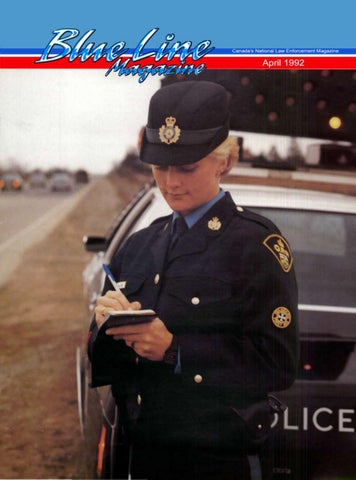
We selected Kathryn Lyons of the Milton Detachment of the Ontario Provinical Police to symbolize this month's topic. The officers who patrol the freeways and expressways of our country are only too familiar with the tragedy of speed. They are also familiar with how fragile life can be. It is an unfortunate reality that speed really kills. Another unfortunate reality is that only you can make the difference.
CASE LAW 20
Confession To Jail Visitor Tossed Spouse May Testify Supreme Court Rules
Out Of The Blue
21
By David Bluestein
lJlft\f r0Af1~ eu NEEDS ON A~fA·F~r PATROL iIl1iJl(0II1() : ~
H;~ Vtsi!
A ril, 1992
3
This issue we focus a great deal on speeding and all that surrounds it. We have a story from a parent who lost his children, an analysis of the hazards of speeding and a story on what some jurisdictions are doing about it. If any officer wishes to copy any of this material for lectures, handouts or community group meetings, you are welcome to do so. Please leave credits were they are due.
Also this month we present part one of a series on pedal power. With the coming of spring many officers are gearing up to bicycle patrols. Garry Coles and Mike Dunn of the Halton Regional Police have given us a nice three part photo essay on bicycle patrol tactics. We are sure you will enjoy reading about this new strategy in policing the community.
-
Letters To The Editor Blue Un. Magazine tZA·49tH Hwy.7 Bait Ste.2S4, Mart:ham. Ool L3R INl
Glad about Glocks I was very happy to read an article on the Glock pistols in your January 1992 issue. This confirmed for me that Blue Line is keeping in touch with the latest in technology and reporting on it. I, myself, have just recently purchased a Glock pistol and I'm immensely pleased with its performance. As well, I bought mine with tritium self-illuminating sights (that are available already installed) fornightshooting. I'm glad your author put a lot of rhetoric and rumours to rest by covering them in his column. It never ceases to amaze me how much ignorance and disinformation there is in Canadian law enforcement towards firearms . Many of our supposed "experts" are not aware of the studies and products coming out of the United States. Policing in Canada always seems to be several years behind in taking advantage of the wealth of knowledge south of the border. I'm delighted to see that Metro T0ronto P.F. has taken the initiative (in changing Canadian police sidearm beliefs) by choosing the Glock 9MM pistol. However, after doing a lot of research on my own, I bought the .40 caliber version (the Glock model 22) instead. This pistol has the same frame dimensions and nearly the same magazine capacity of the 9MM, but its stopping power is near that of the .45 caliber. Presently, the B.C. Police Commission is looking at allowing B.C. police departments to issue pistols to their members in general duties (ie. patrol) . I'd appreciate hearing from any Canadian police officers who (a) already use the Glock or a .40 caliber pistol, or (b) are interested in convincing their own department. I look forward to exchanging information and experiences. Once again, thank you for another interesting and well-researched article. I look forward to more in the future.
Rob Halverson New Westminster, British Columbia
Gives us reason to rejoice
very sorry for Constable Brian Rapson of the Metro Toronto Police Force. Both he and I have had a very bitter pill to swallow Please change the mailing address on and we will never get the taste out of our my husband's subscription. I don't want mouths. to miss an issue as I enjoy the magazine What happened to he and I is someimmensely. It helps me understand the thing that always happens to the other problems my husband faces each day guy somewhere far away. I use to believe and it occasionally gives us reason to that too, but not anymore. rejoice when something goes right for the Now Constable Rapson and I are old men and women who preform such a news and many around us don't want to thankless job. hear about it anymore. First it is really not And we love those cartoons! nice table talk. It reminds many of the other officers of death, pain and sufferMrs. Julia Augustus ing, and their own mortality. Not very Corner Brook, Newfoundland happy stuff to dwell on. Secondly it is not like Christmas that comes and goes. Long Cover most inappropriate after the incident there are still matters to be dealt with. Most of the time, you the victim, have to carry others through this and be strong for them. You have to be the tower of strength even though sometimes you would rather dig a hole and hide in it. Fortunately I am a Christian and it is this belief that has certainly carried me Let me assure you, before I go on to over these low spots. I have also been the next item, that I really enjoy your blessed with a caring wife and a Christian magazine and I like what you're doing and understanding Sergeant at the office. with it. Both have given me great support. HO\AIever, the cover photo of the JanuDon't get me wrong I believe that it is ary '92 issue disturbed me. The image you chose was completely in-appropri- unhealthy to dwell on the shooting and let ate. Most police officers (and military . your life stop there, but it is not a forbidpersonnel) associate the image of an of- den subject either. In a small town like this ficers hat over his gloves on a black I still get to see the shooter and meet his drape cloth (or flag) with the death of that relatives. Not an ideal situation but I have officer not with a joyful occasion like a beerl transferred and when I sell my house I'll be "out of here." department's anniversary. Mr. Lymbumerthe next article I would I showed the magazine around at like to see in your magazine is what work and found that every officer I shO\Aled rehabilitation is going on for all these it to reacted the same way. I found the image first upset me thinking yet another police officers that were beaten shot or police officer had been killed and sec- wounded last year. I counted ove~ a ondly ruined my appreciation for the dozen last year and that was just from the papers. I would be interested to know article. how other officers are coping and what Please be more careful with your their police department is doing to help. choice of images. As a side note I was shot through the hip and because of the Pro Carry Systems D.A Cross advertisement in Blue Line Magazine, I Winnipeg, Manitoba have been in touch with Chris Raines. They manufacture lightweight holsters Thanks for support and belts that should help people with injuries such as mine. I would like to stop and take the time to thank you for remembering me in your Terry Fehr article "Putting It All Behind You", (Vol. 3 Maple Creek, Saskatchewan No.10) in your December '91 issue. I feel
4
A ril, 1992
Vol. 4 No.4 - April1992 • EDITOR I PUBLISHER·
Commentary: Morley Lymbumer Speed Kills!
Morley S. Lymburner Phone (416) 293-2631 FAX (416) 293-0526
And Only You Can Make A Difference
• Contributing EdHors • Weapon. " Tactics James Dalueg
SUrvival Tactics Craig Best
Ammunition" Firearms Dave langstroth
SUpervisory Principles Peer Councillng
Robert, Hotston Neil V. Thompson ,
• ADVERTISING· Allan W. Stiver (Toronto) Phone (416) 294-5502 FAX (416) 294-8952
Ron Ganton (Vancouver) Phone (604) 274-3849 FAX (604) 274-9091
• CONTRIBUTING WRITERS· Chris Braiden Geoff Cates Craig Best Andrew Smith Neil Thompson Morley Lymbumer • ILLUSTRATION· Tony MacKinnon Bette Clark Dave Sills Dave Bluestein BUSINESS ADMINISTRATION Mary K. Lymburner, M.Ed. BI .. Li•• M.c.zin. i. publisbed monthly, Septembec 10 June, by Blue Une Magazine Incorporated with a maUing addre.. oC: UA - 4,.1 Hwy. 7 E..I, 51 •• 254, Mar1iuom, OnlarM, UK tN1. Editorial and copy is considered 10 be completely separate from advertising .al... No commitment for editorial coverage can form any part of a .ale agreement All articl.. are protected by cowrlgbt No panorthi. publation may be reproduoed or transmitted in any rorm or by any means, elec:tronic or mec:lIanical, including photocopying and recording or by any InCormation .torage or retrieval system without permission Crom the publisber. The authors, advisors and publisber accept no liability wbabloever for any injuries to person. or property resulting Crom the appUcation or adoption oC any of the procedures, 18CUCSor consideratlooo pres<!nted inthis magazine. Readers are cautioned and advised that articl.. pre""'ted berein ate edited and supplied for your penonalawaren... and should DOl be used for further action until appropriate advice and guidance is received Crom a supeI'Jisor or Crown Attorney. Blue Une Magaline is an independant publicadon designed to eoterl8in, educate and upgrade the .kill. of those involved in the law enforcement profession. It bas no direct control fro", • law enforcement agency and its opinions and articl.. do ootnecessarily reflect tbeopinions oC any government or police agency. Blue Une MagazIne is ptfnled in Canada bv ProArt Graphics Umitsd.
-Memberlnlcm.lionol .u-Ioli.n
.n",.. EJ.(.«....nl PI un ....
P.ri041e.ol , •• Uslt.... Ez.ba~
ISSN #08478538 Second Class Mall Registration NO.8242
A ril, 1992
It's a sorry fact of life in this modem stipulation the amount was not to be age. We have sacrificed more people to disclosed. the car god than we have to any war. The Okay! So what is the bottom line numbers are staggering. The cause of here? Can any right thinking people commost accidents boils down to what I call pete with the multi-million dollar adver"The Three I's". Ignorance, Intolerance tising agencies? I don't even profess to and Impatience. You could add a fourth have the answer to that question. As one as well. That one says "I am the police officers, however, you only one that really counts out here." do have a duty to get your act It is a shame we together and your heads on can't get highway straight. safety across to the When dealing with trafpublic as strong as the _ .' , ', - - =t\ fic violations you car companies can sell ~ have the toughest job in the profesus on the idea that speedissexy.Onepar- =:-_~ I. sion.Youhaveto ticular car company ~ bring charges has been repeatedly =:Ic.::::c against "good censuredfortheirpro- _ ~C-- - guys ." That's vocative commercials ~ right! Well over 90 that sell the notion of ~ percent of the peospeed and power 'f. __ pie you give tickmore than the car it~ \ __ _ ~..o,.~·ets to are "good self. T \\ guys". They are people like you And if you analyse \ \ J. ~ and me. Just like that neighmost motorvehicle colli\ \J bour who helped you when sions you would find speed plays a big you needed it. But even good guys (like part. I'm not talking about the charge laid good kids) need a little discipline now and in the accident. We all know that a speed- again. And you just took on the job of ing charge is almost as impossible to being society's parent. prove in an accident as disobeying an Get your head on straight. Human amber light. It is certainly easier to prove lives depend on it. It is your job to keep anillegalleftturnthanthespeedofthecar good guys from their own mis-adven-
j .'
\
1: 2
I,
1\
Aw
.
"
r-"1f '
~M~ .
~m~~~b~~~
Several years back General Motors and Burt Reynold's Enterprises were sued by a California mother for several millions of dollars. Her son died in a car accident involving a Camaro. Her action indicated her son died because he was trying to emulate things with his Camaro which it was never designed nor intended to do. The notion that this chunk of metal on rubber wheels could actually fly , she claimed, was propagated by the car industry to sell cars and the movie industry to sell fantasy. Her son was just another human sacrifice. A sacrifice to be ignored by the living and high flying survivors amongst us. The companies settled the action out of court and with a
good guy yourself. But now you're thinking of only yourself. Many officers who feel they are being "forced" into writing out tickets really haven't been bloodied up enough with innocent blood. The only way they can issue a ticket is to talk a motorist into being a bad guy. Then he feels great about shoving the ticket to the guy. The officer, however, has merely refocused the motorist's "mistake" onto a mean cop. Try to remember you're just life's referee and quite often the length of the game can be in your hands. Three minutes in the penalty box can be qUickly forgotten .. . but not the sound of the whistle.
5
The Violence of Velocity "Our live were changedforever on March 20, 1991 when a vehicle going more than 130km/h broadsided our car where our children were itting." Pat and Wayne Loder of Commerce, Michigan, told the In urance Institute for Highway Safety, their experience with highpeed motor vehicle travel. This is not a pretty story and certainly one that every officer eventually experiences. It is a story repeated far too often and the prevention of such incidents is in your hands. YOU can make the difference!
I don't know if you have children, but just imagine you get a call at work telling you you'd better get home because your wife has been in a car accident by your street. Your heart starts pounding. "How bad is it?" you ask. "Do you have children?" the voice a ks. You say you do. "Then you'd better g t here now," the voice says. You race out the door and jump in your car, but when you get to your street fire trucks and police cars are blocking the road . You're a quarter mile away, so you run down the street as everyone watches you. Suddenly you spot your wife's car facing you on the wrong side of the street. You see the passenger side is mangled from the impact. An officer tells you your wife and kids have been taken by ambulance to a hospitalless than a mile away, so you run back to your car, thinking over and over, "How is my family? How is my family?" When you finally reach the hospital and find yourwife, she's surrounded by nurses. She spots you as you get closer. Then she grabs you and shouts, "How are the kids? How are the kids?" Your daughter is eight. Your son just celebrated his fifth birthday a week before. "Your daughter had a pulse," a nurse outside the room tells you , her eyes eludIng your stare. "They're working on your son." You go back to let your wife know what you found out. She sobs, "Why did the motorcycle speed up? Why did he speed up?" After what seems like an eternity back in the waiting room, even though it has only been a few minutes, a female doctor comes in. "Your daughter has been stabi-
Sliephanle Loder, JanulllY 21, 1983 - March 20, 1991 S1ephen Loder, March 14, 1966 - MaJCh 20, 1991
lized," she says, "but your son didn't make it." The room goes from complete silence to wails of grief. "No," you yell repeatedly, "it can't be." You cry and cry and cry. Time passes. You realizeyou've goHo be the one to tell your wife, but you wait, trying to find the right words. Finally you go in and tell her, "Our son didnt make it." She collapses. Nurses pump her full of Valium, while someone else in the room asks if you want to see your son. "Yes," you say and follow in half steps down the hallway, aided by nurses. You dont have enough strength to take full steps. The door swings open. Your son is wearing the same clothes he had on when he gave you your goodbye kiss that morning. But he isn't moving. He isn't breathing. This can't be. You whisper, "Son, son, 1m sorry." You say goodbye wondering if his spirit might still be in the room. By this time your daughter is being
6
wheeled outside to a helicopter and a new friend , a young minister, drives you to the hospital where your daughter's being transferred. You're ushered into yet another waiting room. A nurse asks if you want to see your daughter. "Don't be surprised if she looks different from when you saw her last." As you are led to her room, you see why. Her face has swollen up tremendously from all the liqUids being pumped into her. Blood is pushing out ofthe pores in her face. The nurse says the blood collecting in her eyes isn't hurting her. The doctors explain that they're warming up your daughter. Her brain shows no activity. "Daddy loves you ," you tell her, tears streaming down your cheeks. You stroke your daughter's hair, unable to look at her swollen face. Back in the waiting room you call your wife, not wanting to tell her how bad things are. Until you know for sure, you're not going to give up hope. Finally, hours later, the doctors come in. "I'm sorry," says one. "We know for sure there is no brain activity. Weve run all the tests." You call your wife. "She didn't make it," you sob into the phone. After comforting her, you tell her about the need to decide about transplants. "Shewould have wanted that," you tell your wife. She agrees. You sleep for five minutes that night on a bed at the hospital. When you wake up from the brief sleep, you keep repeating, "Not my children, not my children." You still can't believe it. You kissed them goodbye yesterday morning. Now they're dead. You're practically in shock. Lots of things happen. Reporters want your story, and police want information. You have to arrange the funeral. You decide to go with a single casket, a closed casket. Many children from your daughters second grade class will be coming to say goodbye, and you don't want them to see her body the way it is. You instruct the funeral director to have your daughter's arm around your son. She watched over him in life, and now she'll watch over him in death.
(;ood (;11~'" ~iIIing (;ood (;11~"'! ()Ill~ 'Ol L':IIlIl1,lkL' it din~IL'llt
April, 1992
Is It Speed Or Speed Variation That Kills? Proponents of higher speed limits often claim speeding isn't hazardous. Slow drivers, they say, pose the greatest crash risk. They cite research indicating that crash likelihood increases with the difference between a vehicle's speed and the average on the road . Central to this so-called "speed variation" argument is a mid-1950s study by David Solomon of crash involvement on 2- and 4-lane rural roads. Solomon found that crash involvement increases for vehicles traveling both faster and slo.ver than the average. According 10 the Solomon study, crash likellhood i<; aU-shapi!furdbn of speed, with the
fe..vest crashes occurring between the average speed and 5-10 mph aOOve the speed limit. The highest crash rates am for cars traveling much slower than the average speed, Solomon reported . Similar relationships were reported in 1%8 by Julie Anna Cirillo, who studied speed and crashes on interstate highways in the
1%0s. However, in both studies pre-crash travel speeds were obtained from driver estimates and police reports - this despite the fact that drivers exceeding speed limits are likely to underestimate their speed, which can account for the apparent under involvement of moderately high-speed drivers in crashes. Two researchers demonstrated in 1976 that, if the travel speeds of crash-involved drivers are underestimated by an average 7 mph, then a crash involvement curve like Solomon's is the mathematical result - even if the true involvement rates are actually the same for all speeds. Another problem with the Solomon study is that it mixes the crashes of free flowing, through traffic with the crashes of much slower, non-through traffic such as turning cars. The effect is to indicate
A ril, 1992
higher crash involvement than actually is the case for slow ·traffic. A 1970 Research Triangle Institute study of speeds and crashes removed crashes involving intersections and turning maneuvers, finding crash rates equal for the fastest and slowest drivers. This corrects the earlier finding of higher crash rates for the slowest drivers. Compared with Solomon's study, Cirillo's shouldn't have had as many problems with turning vehicles at intersections
because it was conducted on
interstates.Faclors like disa-
bled vehicles slopped at, entering, or leaviry1herooclsrle probably explaintheexcess ofslcM1vehicles in crashes.
Cirillo also limited her study to multiple-vehicle crashes, although more than half of all fatal crashes on interstate highways are Single-vehicle. Solomon had already reported that Single-vehicle crashes represent an increasingly greater proportion of involvements as speed increases - particularlyas it increases to 70 mph or more. So Cirillo's study underestimates the total crash involvement of higher-speed traffic by eliminating Single-vehicle crashes. Although often ignored by proponents of higher speed limits, Solomon also reported that crash severity is a direct exponential function of speed, not speed variation. As pre-crash speed increases from 0 to 40 mph, for example, the rate of injury increases by 50 percent and doubles again from 40 to 60 mph. What all this means is that, although other faster and slower speeds increase crash likelihood, faster travel results in both more crashes and more severe crashes. So high speed alone, regardless of speed variation, really does kill.
7
Speeding is significant traffic safety problem report says Speeding is a growing problem on the nation's highways. The American based National Highway Traffic Safety Administration recently submitted its findings to the U.S. Congress that graphically emphasized this point. Focus group sessions held with motorists reveal that few regard speeding as a seious offence. Speed limits are viewed as "guidelines" and not as a threshold which, when exceeded, consititutes an outright risk to safety. Motorists do not perceive speeding to be an immediate risk to theIr safety. Similar discussions with law enforcement officials revealed they believe speeding tends to "create a more universal disregard for all traffic laws". On the whole officers agreed that speeding represents a Significant traffic safety problem and that more law enforcementand public information should be directed to this issue. The report emphasized five points which explained the role of high speed in vehicle crashes.
o Speeding increases the distance a vehicle travels before a driver can react to a perceived emergency.
o The relationship between speed and crash severity increases with the square of the speed. When a driver increases his speed from 30 to 130 km/h, there is a fourfold increase In speed, but the energy released in an impact rises by a factor of 16.
o Speeding increases the distance needed to halt a vehicle.
o Because of centrifugal force, higher speeds reduce the ability of a car to negotiate curves safely_
o Higher crash speeds reduce the ability of safety devices such as seat belts
to protect occupants.
Speed Really Is The Biggest Killer High peed really does kill. This is why it's disturbing that peeding hasn't yet become socially unacceptable like drinking and driving.
Some speed advocates even claim speeding isn't hazardous at all- it's speed variation that's the real problem, they insist. So what are the facts? Here's what Insurance Institute for Highway Safety researchers have learned from recent studies - and how researchers explain the issue of speed versus speed variation:
Which Drivers Speed Most? Drivers 16 to 24 years old - especially teenagers 16-19 - are cited for speeding far more often than older drivers. This is the major finding of a 1991 report from the California Department of Motor Vehicles. The link between speeding violations and driver age holds true both per licensed driver and per mile traveled. The rate of speeding violations per mile traveled is at least three times as high for drivers 16-19 years old as it is for drivers
30 and older. This link between driver age and speeding violations parallels the known link between age and motor vehicle deaths. Compared with older drivers, those 16-24 years old have much higher death rates and rates of involvement in fatal crashes. "What we know is that young drivers speed more often and they die more often in crashes," says Insurance Institute for Highway Safety President Brian O'Neill. "There's no question that some of this over involvement is because of young people's propensity to drive at high speeds."
How Fast Are Cars Traveling? When speed limits on most rural interstate highways were raised from 55 to 65 mph, beginning in 1987, many who supported the change said motorists wouldn't
8
go faster - they'd simply drive the same speeds as always, but their speeds would be legal. This hasn't happened. More vehicles are going 70 mph and faster in states with 65 mph speed limits than in states that have retained 55 mph speed limits. For example, the proportion of cars going 70 and faster on rural interstate highways in Virginia and West Virginia during the daytime varies from 15 to 27 percent, depending on the road. This compares with 1to 9 percent of cars going faster than 70 mph on the same interstate highways in Maryland and Pennsylvania. "The principal difference among these stretches of road is the speed limit," says Institute President Brian O'Neill. The limit on rural inter-states in Virginia and West Virginia is 65. Maryland and Pennsylvania have retained 55. "Overall, more than four times as many cars are exceeding 70 mph in the states with 65 mph limits, compared with states with 55." These comparisons result from a May 1991 Institute study of the speeds of about 3,800 free-flOlNing vehicles on continuous stretches of rural interstate highways in the four states. The findings confirm earlier studies in other states with 55 and 65 mph speed limits. "Speeders do pay attention to posted limits. Theyre putting a foot down harder on the accelerator when the speed limit changes from 55 to 65 mph - even on the same stretches of road, as on 1-81 through Virginia, Maryland, West Virginia, and Pennsylvania," O'Neill points out. "We hope these findings put to rest the idea that, when 65 mph speed limit signs go up, speeders start obeying speed limit laws. They dont," O'Neill explains, adding that "many of them keep speeding. As a result, overall travel speeds go up. So do the percentages of motorists traveling at very high speeds - that is, 70 mph and faster." . Earlier Institute research, conducted over a longer period of time in Maryland and Virginia, corroborates the findings of this four-state study. The history of travel speeds over three years indicates that up to six times as many cars are exceeding 70 mph on Virginia's rural interstate highways, where speed limits for cars are 65 mph, compared with Maryland, where the maximum speed limit still is 55 mph.
A ril,1992
Innovative Technology Helping Police To Reduce Speed Everywhere using In terceptor VG-2 radar detector detectors, many of which were provided by the Insurance Institute for Highway Safety First used in Canada, the Interceptor VG-2 is manufactured by Technisonic Industries of Ontario, CA. It's a receiver designed to pick up microwave signals from operating radar detectors. Motorcycles like the one that broadsided Pat Loder's car are far from the only vehicles on U.S. streets and highways that can go much faster than the maximum speed limit. Car and Driver, Road and Track, and Automobile have tested 84 cars in 1991 that clock top speeds in excess of 120 mph. Twenty-six cars topped out at 150 mph or more. How fast is fast enough? And what are the costs of high speed in tenns of not only safety but also fuel consumption? Highspeed travel is especially wasteful of gas. For both safety and environmental reasons, law enforcement officials across the United States and around the world are turning to new technology to reduce speeding. For example:
Virginia:
Radar detector owners crossing Virginia's borders better believe it when they read signs announcing that radar detectors are illegal across the state. Between July 1990 and August 1991, nearly 24,000 vehicles were stopped and $30 summonses issued to more than 23,500 drivers by Virginia state troopers
A ril, 1992
Charleston, South Carolina: Speeders apprehended by police using new laser devices were four times as likely to have radar detectors as motorists apprehended by officers using conventional radar. This is a major finding of a new Insurance Institute for Highway Safety study conducted in cooperation with law enforcement officials in Charleston, South Carolina. Another major finding of the Charles ton study involves the relative effectiveness of conventional versus laser radar devices. Police issued 41 speeding tickets per 1,000 vehicles using lasers compared with 33 per 1,000 using conventional radar. Many speeders with radar detectors were able to slow down enough to avoid detection by Charleston police who were using conventional radar. A total of 23 motorists with radar detectors were ap prehended using conventional radar units. None of the 23 was going more than 20 mph faster than the posted speed limit. In contrast, 110 motorists with radar detectors were apprehended during a comparable enforcement period by police using laser deviCes, and 5 percent of these were going more than 20 mph faster than the speed limit. The newly developed speed control device uses a narrow band of infrared laser light instead of a microwave beam to measure motorists speeds. The frequency of the laser beam cannot be picked up by the radar detectors in motorists*cars. Garland, Utah: Enforcing speed limits involves more than keeping motorists on open roads
9
under 55 or 65 mph. The small town of Garland in northern Utah used photo radar to bring speeds down from an aver age 36 to 22 mph in a school zone with a 20 mph limit when children are present. From November 1989 through May of the following year, 17 crashes with three injuries occurred in Garlands school zone, and many citizens complained about high speeds. The city council au thorized the use of photo radar, beginning the program in November 1990.
During the first month, speeders were photographed and sent letters of warning to slow down. There was plenty of media coverage, and city officials campaigned for public acceptance of the system. In the eight months following installation, there were fewer traffic crashes and not a single injury accident in the school zone, Garland Police Chief Bruce Johnson reports. Garland spent not a dime of taxpayers money on photo radar. The program is paid by and only by, those found guilty of violating speed limits, Johnson says. Photo radar is being used to enforce speed limits not only in Garland, Utah, but also in Paradise Valley, Arizona, and Pasadena, California, as well as other U.S. jurisdictions. The Canadian experience with photoradar is not particularly inspiring. In Alberta several courts have thrown out the evidence for reasons which include lack of continuity, identity of the driver, identity of the vehicle's plate number. Alberta is further hampered by a requirement to prove the accuracy of the tuning forks before the evidence can be admitted. Given the legal and technical problems encountered in this country the Utah experience and usage may well be an appropriate answer to the use of this technology.
Calendar Of Up-Coming Events April 12 - 16
Homicide Investigator's Seminar Toronto - Ontario Th M tropolitan Toronto Police, Homicide Squad is proud to host the 10th Annual Advanced Homicide Inv tigator's Seminar. This seminar brings together the for most Canadian and American experts in the field of Homicide Investigation. This year's event will be held at the Skydome Hotel. For further details contact DtSgt. Tweedy at (416)324-6150 Fax (416)324-0697
April 13 - 14
Certified Fraud Examiner's Seminar North York - Ontario Th Canadian Chapter of the National Association of Certified Fraud Examiners will be presenting the first of a s ries of seminars designed to upgrade the skills of persons involved in the examination and inv ligation of Fraud offences. This course will be part of an on-going training session preparing participants for certification by the Association. For furth r information about this and future seminars contact th Canadian Region office of NACFE at (416) 221-8470.
June 1 - 4
July 12 - 17
Traffic Crime Seminar
Asian Organized Crime Conference
Toronto, Ontario The Metropolitan Toronto Police Trafflc Operations will be hosting their third annual Traffic Crime Seminar. This event will include a week long series of seminars related to Hit and Run and serious accident investigations. Members attending this years event will be broken up into investigative teams and carry outa detaUedinvestigationof a fatal Hit& Run incident. Number of attendees is limited. For further information and registration contact Christina Stambulski at (416) 324-0557 or FAX (416) 324-
The RCM? and Calgary Police Service will be hosting the 14th International AsianOrganizedCrime Conference. The conference will include key-note speakers and a full agenda of social events and companion activities. Contact Darrell Wilson or CarrnenMcKnightat (403) 268-8530 or FAX (403)
1902.
August 2 -7,
June 8 - 11
Toronto - Ontario
Canadian Explosive Technician's Association Ottawa - Ontario Th annual conference of the Canadian Explosive Technician's Association will be held this year at the Canadian Police College in Ottawa. For further d tails contact Bob Shering, Peel Region Police at (416) 453-3311 Ex.347.
May 13 - 15
Drug Enforcement - 2001 International Conference Toronto - Ontario The Metropolitan Toronto Police Force will host the Drug Enforcement International Conference in Toronto. The theme is to provide a futuristic overview of international drug enforcement problems and solutions. For further information contact: NOet. Supt. Leo CampbeUat (416) 324-0509, 447-8470 or FAX 324-0503.
RadioComm is Canada's only trade show dedicated to mobil communications. This event will be held in th Exhibition Hall South, Place Bonaventure in Montreal. Th RadioComm Association of Canada will hold its annual convention at the same time. For furth r information contact Peter McLean or Carole Mey rat (416) 252-7791 FAX (416) 252-9848
The Metropolitan Toronto area police forces will be hosting the International Association of Auto Theft Investigators 1992 training seminar. AU police agencies in and around the Metropolitan Toronto area will be assisting with this intemational event. The convention will include seminars, workshops and exhibitor displays related to the auto theft prevention industry. Contact person is D.Sgt. Chris Hobson (416)324-6260 or Roger Overton (416)2525215.
August 3 - 7 June 22 - 26
Blue Knight's Convention
O.A.C.P.41st Annual Conference
Prince Albert - Saskatchewan
The York Region Police Force will be hosting the 41st Annual Conference of the Ontario Association of Chiefs of Police. Although the conference is restricted to members the trade show affiliated with the event will be open to all emergency services personnel from June 22 to 24. The event will be held at the Sheraton Hotel at Highways 4D4 and 7 in Markham.
June 25 - 27
Canadian Police Officers Motorcycle Championships ShannonviUe - Ontario
RadioComm '92 Montreal, Quebec
265-6330
I.A.A.T.I . Discovery 1992
Markham - Ontario April 21 - 23
"Strategies for the 1990's" Calgary - Alberta
For the first time the Canadian Police Motorcycle Championships are going international. The event, to be held at the Shannonville Race Track near BeUevillie, Ontario, will be presenting the best Canadian Riders and the best International Riders. The three day eventwillinclude officers from Canada, U.S ., Eire, France, Northern Ireland, Belgium and Norway. Participation will be limited to 40 riders. Members wishing to participate may call Dave Stewart at (416) 831 -2013.
10
The Prince Albert Branch of the Blue Knights are proud to host this years convention to be held in Prince Albert, Saskatchewan. This event is open to all members of the club from across Canada and the United States. For further information contact Ed Herr, RR.#5, Site 28, Box 31 , Prince Albert, Sask. S6V5R3.
August 22 - 27
C.A.C.P Convention VictOria, British Columbia The Canadian Association of Chiefs of Police will hold their 87th Annual convention at the Victoria Convention Centre. The trade fair will be open to all law enforcement officers from August 23 to 25.
September 21 - 25
Profile 2000 Toronto - Ontario The Metropolitan Toronto Police Sexual Assault Squad will present a four day sex crimes seminar. Several experts and international key-note speakers will be featured. For further details contact Sgt. Wendy Lever at (416) 324-6060 or FAX (416) 3240697.
A ril, 1992
A cure for your dependance on glasses
A North York, Ontario, hospital has received some staie-o/-the-arl laser technology thai can eliminaie the use of eye glasses for many people. The project has gaihered much attention from people involved in emergency services due to the high activity level ofthe professions involved. Police officers in particular are seen as vulnerable to the necessity of wearing glasses. ThefoRowing article explains more.
York-Finch General Hospital recently acquired an excimer laser for use by ophthalmologists. The laser is seen as a tremendous advance in the treatment of some glaucomas and superficial diseases of the cornea such as corneal scars, and some chronically painful corneal disorders. Its greatest appeal to the general population however, is the ability to alter the refractive surface ofthe cornea. Since the cornea is responsible for about 70 per cent of the eyes refractive power, altering the surface alters the need for glasses or contact lenses. Since the days of Benjamin Franklin, the public has come to accept the use of glasses (and now contact lenses) as a way of correcting refractive errors, and a regu1ar visit to the optician has become routine practice for most people. The introduction of this new technology into ophthalmic practice has the potential to revolutionize present methods of correcting refractive problems. Since a large proportion of the population is myopic (i.e. nearsighted, can see close up but need glasses to see far way) , there is a huge
A ril,1992
potential demand for this type of treatment. Excimer lasers have been used around the world in normally Sighted human eyes for about three years, and in that time, over 4000 patients have been treated. The results to date have been excellent, as the physician is able to program into the laser the necessary correction and after the treatment the patients cornea is re-shaped with great precision. Most patients will not need glasses after their laser treatment. Occasionally patients may still require optical aids after treatment, because their problem was not one that could be totally alleviated by laser therapy. Ophthalmologists can determine who are good candidates. York-Finch General Hospital made the decision to proceed with this program, which is on the forefront of technology, providing a new and previously unavailable service to the public. The surgery is considered, by York-Finch, to be a non-cosmetic functional-altering procedure for those 20 to 40 years old. As this technology is new, Health and
11
Welfare Canada has decided that for now, the two companies selling excimer lasers may only sell nine machines each in Canada, and each site is requested to participate in a clinical trial. Patients are followed with frequent eye examinations after the procedure, and collected data is submitted to the company and to Health and Welfare Canada. York-Finch is contributing Significantly to the international excimer trials, hoping that this will achieve better refractive results for their patients and all future patients. The hospital has been appointed as one of the Canadian Study sites and is the only hospital in Canada to participate in the international clinical trials to date. Dr. Steve Arshinofffrom York-Finch Eye Associates is the Principal Investigator at York-Finch General Hospital. For the first time in history, people can now choose their own refraction, rather than having to adjust their lifestyle to what nature has given them. York-Finch may help put Ben Franklin, and his glasses to rest finally . For more information, please call Lesley Mansfield, Manager, Public Relations, 416.744.2500 ext 2670.
"PEACEMAKER" It's your occupation .... Now let It be your publication! The PEACEMAKER is published quarterly by the Canadian Fellowship of Christian Peace Officers (CFCPO), a federal nonprofit corporation which encourages peace officers locally, nationally and internationally to join in fellowship. If you would like to be placed on the mailing list, or would like to receive more information about CFCPO membership, send your request with your name, occupation, address and phone number to: ~
~..sl\sT':4-\o
d'~~' .... ~
:~~.~ ~
(g\ ill
P.0. Box 520
Stn. "A" .1/) Scarborough,
~~~ ~::~~3
-
Sharing the Truth and the Way and the Life Our Lord Jesus Christ
Smoking Or Non-Smoking Whatls The Difference? By Tom Rataj Actually very little. Obviously, if you do smoke (active) , the health risks are somewhat greater then if you don'tsmoke. But if you don't smoke but work and/or live with smokers (making you a passive smoker) the risks aren't that much less. Recent figures published in the United States ranked active smoking and alcohol as the two leading preventable causes of death in the country, and passive smoking as the third leading preventable cause of death in the country. The actual figures are staggering; around 50,000 non-smokers die each year from the effects of passive smoke. Of those, almost half succumb to some type of cancer, while the remaining half become victims of heart disease. A study on the costs of smoking released by the City of Toronto Health Department in mid-February 1992 con~!':a CO N [U N = = CO MPUTER ~~ SERVICES
cluded that the cost to taxpayers was $193 million annually (health care costs, lost productivity, and lost income).
Job Stress and Smoking We are already all quite aware of the causes, symptoms, and effects of work related stress, and being in a fairly stressful work environment, we feel their effects more often then not. The problem with combining job stress and smoking is that you end up with a double edged sword.
What To Do Many of our drug related programs targeted at youths stress the "Positive" or "Alternative" Lifestyles concept. This concept applied to the smoking issue as well as the overall physical and mental health
S Caioo......lt c..rt Mldty. O..... . LJRIW' Telephone (416) 543-1127
FacsimHle (416) 875-0693
HOW 10 IMPROVE YOUR COLLAR APPEAL
$1799.00
..
E omote your Department with high-quality customde igned neckwear, for men & women. Choo e from an as ortment of colours. Your in ignia or cre t is woven into the fabric. Ideal for wear to ocial events, conventions, trades how , pecial functions. Call or write Lynn Schranz for your free brochure.
Jl
519-886-5410
POWER PACK 386 SX-16 0386 X l6Mhz. mother board " Meg. Ram expandable to 8 Meg.
POWER PLU PACK386DX-33
$1999.00
03 6 OX 33Mhz. mother board with 64k Cache. " Meg. Ram expandable to 32 Meg.
UPER POWER PACK 486 DX-33
S2499.00
04 6 OX 33Mhz. mother board with 64k Cache. Math Q·processor. and 8 Meg. Ram expandable to 32 Meg. '-l
.....
INCLUDES
issues could provide measurable results in just a few short years. A permanent "Positive Lifestyle" strategy should be put into place to encourage positive actions and attitudes towards physical and mental health. Included in this should be a program to get current smokers to quit, while adding a condition to the hiring requirements that the applicant must be a non-smoker (and remain that way) . Results would soon manifest themselves in the reduction of sick days, as well as all those other minor and major (read complaints) symptoms that occur when we are not happy campers. If you are an active smoker and want to quit, contact your organization's doctor or medical bureau, and make inquiries about what kind of smoking cessation assistance they can provide. If you are a passive smoker make inquiries about what work place smoking policy or municipal by-law is in effect where you work, and then politely request that the active smokers respect that policy. Remember, you have the right to work in a smoke free environment.
E9
SVGA U· MONITOR (H1/c) Bdu u" III ICBYBOARD
Mlcr•••jl I PCco"'P.tilH.MOUSB P • .,.,. 6., '''''~ I MPU.6• .,.
111 M". If.,,, Drl.. Jlil A D.,,,lty J 111 " S114 DUI< Drl..
wi,.
P.,,, . 1 S ...loJ, 1 P.,.u" " 1 c.... P",
Dill<
f-o
-<
.=-
~
::E
SI.,.,. COl. ~o DOS S.' U
111 W.n P..... SNPP/y
-
IH4.,.'C... .,M;"IT.....
TM,.AI~U.' Swltcltu wldt .9••.,tlllc~"I" 1tk:A
~
~
e:~
.-.~ ~
:-=-
Add GSf 10 all orders Ontario CuslOmers add PST
::
" 2! ~
~. . . . . . . . . . . . . . . . . . . . . .Mi=ib.l.99.2.~i·=i·i·uib·.~.IO.c~ ii.·.~ '_
co
12
A ril,1992
Flashlight For Dangerous Environments
Simple Disk Drive Security For All Personal Computers
Digital Signal System Designed to Save Lives
Safety-UnkSystems announced a nevJ portable alarm system for workers in hazardous or isolated locations. The SafetyUnk portable radio indicates to other radios whether a worker has stopped moving, has manually initiated a distress call, has gone out of the protected operating range, or has a damaged unit. For further information contact Mr. Mark Taylor (604) 327-8339
Strearnlight's nevJ law enforcement "Survivor" light is a black, right-angle, rechargeable flashlight designed for use by officers in extreme smoke-fIlled areas, pitch darkness, or in hazardous, potentiallyexplosive environments. The unit is made of rugged nylon and water resistant. It provides up to 15,000 candlepower. The Ni-cad batteries provide up to 1 1/2 hours of continuous light. By snapping it into a convenient, compact charger, the Survivor can also be "fastcharged" in less than an hour without removing the battery. For more information contact Maribeth Roman Schmidt at (215) 941-0395 or Lori Hare (215)631-0600.
"File-Lok" is a new Qualtec Data Products computer security device distributed by InChek Ltd. "File-Lok" prevents unauthorized use of a floppy d isk drive, such as copying data from your hard disk or viewing data from your data diskettes. It can also lock the d isk into the drive, preventing accidental or intentional removal. "File-Lok" fits virtually all floppy disk drives and installs in less than two minutes with no tools required. It will not void any manufacturer's warranty when installed. The "File-Lok" sells for less than thirty dollars and is available from InChek Ltd., 435 Unit D Berry St., Winnipeg, Manitoba, R3J 1N6. Phone 1-800-563-
5566.
Personal Alarm Doubles As Flashlight
FLASHES By Tony MacKinnon
Intersolar, of the "Sonic Guard" is the latest and most sophisticated entrY in the growing personal security market. The nevJ "Sonic Guard" includes a built in flashlight, wrist strap and detachable belt clip for joggers, cyclists etc. For furthe r information contact Intersolarat(514)633-1498orFAX: (514) 633-1499.
"Caught Little Jack Horner here pulling out more than a plum in front of some women at the bus stop!"
April, 1992
13
Pedal Power and Training Make Effective Bicycle Patrols By Garry Coles Halton Region Police Service
Police Con table Garry Cole and Mike Dunn of the Halton Regional Police Service have made great strides in training and assisting many police agencies in e tablishing an effective bicycle patrol program. In this two part series they will demon trate some of the techniques developed to make the patrol officer more effective while minimizing inj urie . Inmy iastarticle, "PolicingByBicycle", [Summer, 1991], I gave you a general overvievJ of our program and its successes. I also discussed our eqUipment. Now, I would like to address some questions that have arisen since then as well as take you pictorially through one of Halton's police riding courses.
Officer Safety Q. Is an officer on a bicycle more likely to be hurt than a general car officer? A. If trained properly, the bike officer is much more attuned to the environment. Visibility and hearing are greatly enhanced when outside a vehicle. Because of this, the officer has the ability to get out of potentially dangerous situations much faster. Q. Can a bicycle officer be used to educate the public? A. We conducted over 40 bicycle safety talks to various groups this past season. Topics discussed included rules of the road, proper equipment and safety tips. We brought in the bicycle as well as
all of our personal eqUipment for people to inspect. We encourage you to conduct these types of talks. Q. Should the officer wear reflective equipment during night patrols? A. We feel that this can place the officer in danger. The clothing should not be reflective nor should the helmet; however, the bicycle should be totally reflective. Danger is inherent with night time bike riding, but it is minimized with the reflective bike. We do not recommend reflective clothing because we are too noticeable as police; this can take away any chance of surprising a suspect or make us more vulnerable to attack. Q . Wh at colour should the aI/-weather riding gear be? A. Our experience has pointed us towards a bright yellow water repellant riding jacket. The yellow colour is supported by numerous cycling associations. The word POUCE, in black, should be prominent on the back! front of the jacket. Navy or black dermoflex pants that are affixed with a
14
red stripe should also be worn. Q . Should a mountain bike or a cross bike be used? A. According to market research, more than 50% of the Ontario bicycle market in 1992 will consist of cross bikes. This was the first year we used this so we were a bit suspect; however, we were impressed with the increased speed. We also were able to expend less energy than was required by the mountain bike to maintain the same efficiency. The cross bike is a lighter bike which makes it much more versatile. Q. What are BAR ENDS? A. These are aluminum attachments that are placed to the ends of the handlebars. They facilitate the rider when climbing hills as well as when accelerating. They give the rider more hand positions which improves comfort when riding for long durations. Even though they cost extra, they are standard equipment on our bikes and we would not ride without them. Q . Whatisthepurposeojathird brake?
A. My partner, Mike DUNN, and I were trying to solve the problem of controlling the rear brake and being left handed. We came up with an independent side pull rear brake that was attached to the left bar end. Little did we know that this would give us an incredible ability to grab running suspects with either the left or right hand and bring them down with a rear wheel lockup. It also made it safer to have a brake at our disposal when having our hands on the bar ends. Another benefit was that in the rain, while doing property checks we could use both brakes at the same time, one would push off the rim water while the other could grip. The front brake tends to be noisy in A ril,1992
the wet weather. The final benefit occurs when you are conducting property checks at malls, the officer can pull with either left or right hand and still maintain control of the back of the bike. This is a must for your bicycle. Q. Why is a shoulder carrier useful? A. The shoulder carrier is essential for carrying the bike up obstacles like steep stairs. It doubles as an extra carrying pouch. We feel this inexpensive piece of equipment is one of the most useful things on the bike. Q. Should a hard shell or a soft shell bag be used on the rear? A. Until this year, we felt a hard shell bag was the proper choice, but we have since found a soft bag that meets our needs. It is black and we have added police in reflective letters. The bag is easily taken off and has a shoulder strap so it can be carried. It is quieter, can hold as much equipment as a hard shell and is very durable. Q. What type of light system should be used? A . Up until last year we used a rechargeable front and rear light. This year we cut the cost down by using the flashing red strobe light on the rear. These really increase visibility for approaching motorists. Two M batteries last each light approximately 500 hrs. Ours lasted longer. We have gone to two front lights that can be removed . We use one as our flashlight and the second as a running light. You can use rechargeable C batteries or regular batteries. We found this system to be the best and the most cost efficient. Some lighting systems costing over $100.00 tend to take up to much room and are heavy. They are also the first thing to brake when the bike is dropped. Q . What type of shoe should be used? A. A black shoe that has good metatarsal support is the ideal. It should be flexible so you can run after suspects if need be. We recommend a Cross Trainer shoe. You can use a liqUid black polish to keep the shoes looking shiny. Q. Should fenders be used? A. We originally used them, but we found them to be noisy as well as dangerous off-road. If it is muddy twigs and vines get caught in them and the rider can fall. Now, we use no fenders, but instead we use a splash pad on the front
A ril,1992
down tube and utilize the bag at the rear to keep us dry. This has worked fine. The cost of the pad is $4.00. Q. Should toe clips be used? A. They are a must. We use the plastic clip without the strap. The straps are not a good idea if you have to exit the bike quickly. The plastic clip gives you increased power as well as keeps you more secure on the bike. Q. What type of equipment is a must for the officer? A. We strongly recommend Hard Shell Helmets, riding glasses with day and night lens and riding gloves. The glove that we use is filled with gel and encased with leather and cloth so you can wipe the sweat off your face. The pictures that follow over the next two issues show numerous techniques that cannot be covered by the written word. As you can see these photos were taken at the beginning of 1991 when we still used the hard shell bag. We strongly suggest that if you try anything illustrated that you wear proper equipment.
Rear Wheel Defence
The officer locks the rear tire and pulls back. The bike can be moved forward and then while locking the rear tire, you can extend the front tire into the chest area. This works very effectively. If the accused attempts to grab the front tire, it results in a great deal of pain to the accused.
NEXT MONTH Patrol and Dynamic Arrest Techniques
Two Wheel Defence
Canada's Fitweek. May 22-31 , is the largest annual celebralion of
physical activity In the world. Join
lhe action and
The officer grabs underneath the shoulder carrier and pulls the bike up and balances it by placing the seat on the upper thigh. This can be used in a very aggressive mode. The accused is unable to get close to you and you can apply maximum force by pushing the bike towards the accused.The front wheel is controlled by keeping your hand on the handle bar.
15
make physical activity a regular part of your life. Participate on
your own, or wilh friends and famify, or join
one of over 16,000 Fitweek
-
events across lhe country . .
...
... news beat ... news beat ... news beat ... Canada's Murder Rate Up 14 Per Cent Homicide In Canada Provinces Reporting Increases 300 250 200 150 100 50
o Alta .
B.C.
Sourc . : St.t. C.n.d.
_
Onto
1990 Homicides
Stats Canada reported a 14 per cent increase in homicides last year. This figure also is an 11 per cent average increase over the last ten years. Ontario had the biggest rise in homicides, with 246 compared with 182 in 1991. British Columbia also increased from 110 in 1990 to 132 in 1991. All other provinces reported significant increases as well including Newfoundland. This province recorded 11 homicides during 1991 while they reported none for 1990. As far as homicides per l00,OOOpopulation, British Columbia reported the high-
N.B.
NFLD.
N.S.
A 23 year-old man who broke into a liquor store called the Los Angeles Police to report he couldnt get out. The man had climbed to the roof of a liquor store and cut a hole in the roof and crawled through the hole and fell to the floor. It was only then he realized he had no way to get back out again as he had broken his leg. The suspect located a telephone and called the L.A police to get him out. Police arrived and found the suspect sitting on the floor in front of the counter smoking a cigarette and drinking a beer.
~ 1991 Homici des
est count at 4.11. Of the major cities Sudbury, Ontario, reported the biggest ratio of homicides with a count of 4.65 per 100,000 population. Montreal came in as Canadas murder capital with 109 homicides while Toronto came a close second with 103 or 31 higher than the year previous. And for those who like to compare our apples with their oranges Canadas homicide rate is one quarter to one third that of the United States. However when you have 11 times the population base this figure should not make us so smug.
Winds of Change Coming to British Police North American style policing is gaining rapid favour with police "Over 'Orne". Some of the changes include the re-titling of Woman Police Constable (WPC) to Police Constable, the use of the PR24 side handle night stick and the adoption of the shift cycles known by British police as "The Ottawa". The title of WPC was determined to be sexist and tended to be segregationist. To date over half the police forces in the UK have dropped the letter W from the title but some resistence to the name
Break-In Suspect Calls 9-1-1
change has come from the federation of Police Women. Several large police forces are exp[ erimenting with various types of night sticks with the PR24 side handle style being the most popular. Presently the official stick is a 12 inch piece of hardwood. Gaining in popularity is the 10- hour shift cycle system first created by the Ottawa Police Force. English Bobbies find the extra days off and shift cycles wonderful and "almost human-like."
16
The Speeder Was Really Fluing An Edmonton police officer pursued a car for speeding and managed to get it pulled over. The red faced driver complained to the officer he could take his wallet, his car, his keys but just let him go to a washroom. In his defence the man complained in court he told the officer if he didn't get to the toilet "there would be a real accident". The officer continued to write the ticket and there was a "real accident." The presiding justice dismissed the charge saying there was quite a flue epidemic going around at that time and the common defence of necessity (Section 171 in Albertas Traffic Act) would dictate the dismissal. The defence of necessity is one available in each Province in Canada. If the accused in a Traffic charge can show the offence was committed purely by accident, without negligence, and could not have been avoided the charge can be dismissed.
Oh Canada? "Canada is usefol only to provide me with fors. " Madame dePompadour On the fall of Quebec
A ril,1992
... news beat ... news beat ... news beat ... Attempt Impaired Driving Conviction In what is believed to be a first in Canada a provincial court judge has convicted a man of Attempted Impaired Driving in a Brantford, Ontario, Provincial Court. In July 1991 some Brantford residents were awakened in the early morning by the sound of a car's engine revving excessively. Upon looking out their windows they saw two men trying to dislodge a Camaro on an underground garage ramp. The vehicle had become stuck on some concrete such that the rear wheels were off the ground and spinning. The second man was attempting to help by pushing the rear bumper up and down. Police were notified to attend and a Grzegorz Dembowy, 31, was arrested while still attempting to dislodge the vehicle. Breathalyzer tests later revealed the accused to have 220mgs. of alcohol in his blood. The usual charges of Impaired Driving and Driving while over 80mgs. were laid. Seven months to the day the accused came to trial and the Crown, hearing of a possible Askov defence, stayed the Impaired Driving charge and proceed edon a new charge of Attempt to Drive While Impaired. At trial Provincial Court Judge Ken Lenz agreed with the Crown's prosecution of the matter. In his decision the judge stated the car was not inoperable and had the car become unstuck there was no doubt that damage to other property in the area would have resulted and the accused would have accomplished what he clearly wanted to do, drive while his ability to do so was impaired by alcohol. Judge Lenz added the charge of Attempted Impaired Driving differed from Care or Control because the latter charge can be proven without proving the accused intended to drive. The accused was fined $750.00 and prohibited from driving for three months. The question that begs to be asked. What about a charge of aiding and abetting against the second man who was helping to get the car off the ramp?
1992
Police Killer Convicted After two mistrials Ronald York was found guilty of the 1984 killing of Constable Douglas Tribbling of the York Regional Police Force. The court did not waste any time in sentencing the Toronto man to life in prison with no hope of parole for the next 25 years. In 1984 Constable Tribbling was patrolling a Markham industrial section just north of Metro Toronto, when he responded to an alarm call at a computer warehouse. Upon arrival the officer entered the business through a broken front door and began to search the premises when he was shot five times in the chest. His gun was still holstered at the time. York Region police worked on the case for over four years and came up with a suspect who had been arrested for break and enter and armed robbery. An under cover officer gave evidence that York had confessed to him about the killing ofTribbling and boasting he would never be convicted because police simply could never get enough evidence. The weapon used to shoot the officer was never found . Among others to give evidence at the trial were two brothers of Yorks live-in girlfriend who confirmed similar statements as given by the under cover police officer. At the final trial, however, both
FLASHES By Tony MacKinnon
"Want to have a real gas? For free home delivery ca1l9-1-l".
men recanted their original statements saying they were trying to make deals with police on charges pending against them. Tribbling, the first officer killed in the line of duty with the York Regional Police, left behind three daughters, an exwife and a fiance. At the time of his death Tribbling had served 28 years with the police and was only two years from pension.
Police Radar Sets Pass The Test The Metropolitan Toronto Police in conjunction with the Ontario Provincial Police and the Ministry of the Solicitor General have received the results of radar equipment foremmissions. The Ministry of Labour Ontario conducted extensive testing of police radar equipment . All radar equipment not only passed the testing but came in at 500 times less than the Ontario standards. The report indicated the emmissions can be compared to levels released by domestic microwave ovens. Concerns were voiced by U.S. officers regarding radar emissions. The Ontario report states Canadian equipment is not only different in design but used in a different manner.
41st Annual O.A.C.P. Conference 1992 The York Regional Police invite you to view the exhibits at the
Sheraton Parkway Hotel 600 Highway 7 East (At Highway 404)
Richmond Hill, Ontario (416) 881-2121
Monday, June 22, 1992 8:00 A.M. to 5:00 P.M. Tuesday, June 23, 1992 8:00 A.M. to 5:00 P.M. Wednesday, June 24, 1992 8:00 A.M. to 3:00 P.M. Exhibits Relating To Public Safety Include ... Computer Equipment Safety Equipment Investigative Aids Consultants Transportation Telecommunications
~r.. AND YOU IN "92"
cated the accused , although in company with the known drug trafficker, was never seen at any time to exchange anything with the suspect. In his summation Justice Oliver wrote, "To allow investigating officers to adopt shortcuts by making arrests and searches based on suspicion, even strong suspicion, rather than reasonable and probable grounds, would tend to lead to a lowering of the investigatory standards required by law and of a resultant erosion of our liberties which in the final analysis would be seen by thoughtful members of the community as more shocking than the rejection by the court of the evidence unlawfully obtained in the present case."
Cops Withheld Evidence Assault Bodily Harm charges against two Owen Sound, Ontario men were stayed after a court determined the police investigating the case withheld evidence crucial to the defence. The two men were charged after a man was beaten in a hotel parking lot. Police arrived and later took photographs of the victim. They later took statements from the victim and about six months later took another statement from a cousin of the victim who saw the assault. At the original trial the Crown did not call the victims cousin to give evidence and did not admit into evidence the photographs. Upon cross examination by defence it was discovered this extra evidence existed. The Crown was given time to get the evidence together for a full disclosure to defence but the Crown was unable to get the information from police. The court ruled the charges stayed because a full answer and defence was not afforded the accused. The court pointed out that the Supreme Court of Canada has ruled all evidence obtained must be disclosed to the defence not just the evidence it intends to prod uce at trial.
Call To Counsel Does Make a Difference A charge of Impaired Driving was dismissed against a motorist in Manitoba because she was advised a call to a lawyer would do her no good because the
April, 1992
Breathalyzer test would still have to be performed. Upon being told this by the Breath Technician the suspect supplied samples of her breath and was charged accordingly. At trial the judge found that when the woman was taken to the police station she asked if calling a lawyer would make a difference on the Breathalyzer test. The officer responded that it wouldn't make any difference, she would still have to blow. When throwing out the charges Mr. Justice Morse said what the officer said in response to the question "clearly interfered with her understanding of her right to counsel and derogated from that right." The Justice continued by adding "It is imperative that the words of police officers should not be capable of discouraging arrested or detained persons from exercising their right to counsel."
Arrest By Association Not Permitted Court Rules Guilt by association cannot be used to justify an arrest stated B.C. Supreme Court Justice H. Oliver. In 1989 a man was arrested by a joint forces task force in a Vancouver parking lot. At the time the man was talking to a known drug user and trafficker who was under observation by police. Evidence at the trial indicated that the accused was found to have a syringe and a quantity of cocaine when arrested by police. However evidence at trial indi-
Run Down Drug Dealer Can't Collect Insurance A New Westminster, B.C., drug dealer will not be allowed to collect on a motorists insurance claim when he was run over after a drug rip-off. The victim in this case was a well known area drug dealer who worked out of a local pool hall. One day in 1990 the dealer was selling his wares to a man who, when getting the drugs in hand, ran to his car and started to drive off. The dealer ran in front of the car in an attempt to stop the man and was struck by the car. The drug dealer brought a claim against the vehicle's insurance company but the B.C. Supreme Court ruled the company did not have to pay. The judge relied on the principle of "ex turpi causa." Literally translated this means no disgraceful matter can give rise to an action. According to the doctrine, a plaintiff who has been engaged in criminal activity when injured will be denied recovery for damages. The judge summed up the case by saying "in effect in fighting over the closing of an illegal transaction, he was injured. To put it colloquially, Boyd was injured while attempting to avoid being ripped off in a drug deal." The judgment cited previous case law that stated "wherever the conduct of the plaintiff giving rise to the claim is so tainted with criminality or culpable immorality that as a matter of public policy the court will not assist him to recover."
19
- -- - - -- - - --- - - - - -- -- -- - - -- -- - - - - -- - - -
j
Case Law (1133-014A - 41 Pages)
\
Confession To Jail Visitor Tossed By Supreme Court Regina Vs. Broyles Evidence incriminating an accused to murder was tossed by the Supreme Court of Canada after police had set up and body packed a friend of the accused to get a statement. This Alberta case involved considerable circumstantial evidence. The accuseds grandmother was found dead and stuffed into a garbage bag under a stair well in the family house. On the day of the womans death her grandson was seen driving her car around town and was later arrested for using her credit cards. Police evidence also revealed the accuseds palm prints were found on the plastic bags and laser fingerprint evidence revealed the prints where placed on the bag while the bag had something contained in It. The accused had given several contradictory statements and was charged with the murder of his grandmother. One of the statements included a previous conversation the accused had with a friend . This friend was approached by police and asked to wear a body pack on a visit to the jail to be set up by police investigators. Police did not ask the friend to elicit a statement or confession but simply wear the tape recorder to record the conversation. The taped evidence revealed the friend continued to lead the accused back to the subject of his grandmothers death and , as the court determined, carried out an interrogation of the accused. It was the
Supreme Court of Canadas decision that the witness was clearly acting as an agent of the state and the evidence obtained clearly breached the accuseds rightto be silent. In his judgment, Supreme Court Justice Frank Iacobucci stated the court must consider a simple test to determine the admissibility of the evidence. Would the exchange between the accused and the informer have taken place, in the form and manner in which it did take place, but for the intervention of the state or its agents? Given this test the court determined there was little doubt the witness was an agent for the state because the visit was set up and facilitated by police. The friend was able to have an open visit with the accused that permitted a free-ranging conversation with no specific time limit. The witness advised the court he was not afraid of the visit with the accused because it had been set up by the police. On a second test the court must ask if the witness had elicited information from the accused. The Supreme Court ruling stated the determination of this question must include two considerations. 1. Did the witness actively seek out information such that the exchange could be characterized as akin to an interrogation or did he conduct his part of the conversation as the accused would normalty think the conversation would go. The focus should not be on the form of the conversation, stated Iacobucci, but rather on whether the relevant parts of
the conversation were the functional equivalent of an interrogation. 2 . Did the witness exploit any special characteristics of the relationship to extract the statement? Was there a relationship of trust between the witness and the accused? Was the accused obligated to the witness? Did the witness manipulate the accused to bring about a mental state in which the accused was more likely to talk? In the ruling the Supreme Court determined the witness had purposely directed the conversation to areas where the police needed answers. The ruling also stated the accused was manipulated by the witness by undermining the trust the accused had in his lawyer. In his final decision Mr. Justice Iacobucci stated the agents ploy was not only an obvious attempt to elicit a confession from the accused, but it also undermined the accuseds right to counsel. Although this decision severely restricts the ability of police to use agents after arrest it has been pointed out it does not restrict pre-arrest conversations or post-arrest situations where the agent does not direct the subject specifically to the offence. In other words it will probably take a lot longer undercover operation to get the same evidence because the admission must come completely on the volition of the accused. The judgement ruled the taped evidence inadmissible and ordered a new trial.
For
20
April,1992
j
Case Law
(1134-006A 41 pages)
1
..._ _ _ _ _ _ _ _ _ _ _ _ _ _ _ __ _
~
Spouse May Testify Supreme Court Rules Regina Vs. Salituro Where spouses are irreconcilably separated, there is no marriage bond to protect and we are faced only with a rule which limits the capacity of the individual to testify. With these words the Supreme Court of Canada upheld a lower court Ontario decision to admit the evidence of a woman against her estranged husband on a forgery charge. The decision wipes out the commonlaw rule that a wife is incompetent to give evidence against her husband. There are also statutory exceptions under the Canada Evidence Act affected by this ruling. In the ruling the Supreme Court stated unanimously that to give paramountcy to the marriage bond over the value of
The Best Little Jail House In Texas The town of Raymondville, Texas, has put itself on the map. The town of 10,000 boasts the leakiest jail in the country. There have been so many escapes from the building that the sheriff has no record of the exact number. "I guess we've had about the happiest inmates around," said Sheriff Larry Spence. At least a dozen have escaped since August, most by kicking holes through the jailhouse roof. Some of the inmates broke into the evidence room and helped themselves to seized marijuana. It took several days before deputies realized why all the inmates were smiling all the time. The local judge said when he would sentence people to jail they just smiled."They figured it wasn't such a bad deal when they could get free drugs and leave whenever they wanted." Raymondville is about 80 km from the Mexican Border.
A ril,1992
individual choice in cases of irreconcilable separation may have been appropriate in Lord Cokes time, when a womans legal personality was incorporated in that of her husband on marriage, but it is inappropriate in the age of the Charter. This case developed after the separation of the accused from his wife had taken place. The accused forged his estranged wifes signature on a cheque drawn on a joint account. As the law stood prior to this decision the wife would notbe competentto give evidence against her husband that the signature was not her own and that she did not give permission to take the money. This ruling will permit the Crown some wider latitude to commence prosecutions.
It is felt this ruling may be broadened in future to do away with the rule entirely. In this ruling the wider compellability of the spouse was hinted at when Mr. Justice Iacobucci stated, "The dignity of the person arises not only from the exercise of rights such as the freedom to choose, but also, and just as importantly, from the assumption of the responsibilities that naturally flow from participation in the life of the community. At the level of principle, it is just as much a denial of the dignity of an irreconcilably separated spouse to exempt the spouse from the responsibility to testify because of his or her status as it is a denial of the spouses dignity to deny his or her capacity to testify."
The Unbeatable Crime Fighting Combination
386 SX ;
20 MHz ..Plus
Traveller Computers and CaseManager
2..400 Baud Modem
TraveUer Computers pack high performance and an amazing array of standard features in this special Law Enforcement package. . 1bis powerful 386 computer comes standard with 20, 40, or 60 meg. hard drive, and a 2400 . Baud internal modern. To enhance your investigative abilities we have included a free copy of single user version of CaseManager. ThiS """.we"", currently used by many investigators in help you to complete your case preparations fprcourl . and to print outa complete 'Will Say" suitable for Hi9hCpurt. It will organize your files, track witnesses, prop¢rly'anci exhibits necessary for submission to court. . .-.,. Whether for the office, at horne or at crime sc~nes, this very portable combination is an incredible tool for the modern Law Enforcement Professional. Shipped to you direct and ready to use in its own carrying case, this unit weighs only 6 pounds (battery included) and measures only 11. 7" x 8 .25". The battery works up to 3 hours of continuous operation between charges. Can be plugged into any standard outlet.
[Retail Priced from $2,950.00*1 Order Direct From
KYOTO Technologies Corp. 2800 14th Avenue, Unit #200 Markham, Ontario L3R OE4 Phone (416)940-1100 Fax: (416)940-9310 • Sbipping. P.s. T. and G.S.T. extra
21
Book Review:
Malcolm Murray
The Law On Speeding And Radar Butterworth's Publishing (2nd Edition) by A .Shakoor Manraj and Paul Douglas Haines This book is coauthored and in fact can be considered two books.The first, written by A. Shakoor Manraj , is contained in the first four chapters and deals with the law and legal application of speeding charges. The second, written by Paul Douglas Haines, is contained in Chapters 5 through 9, as well as the appendix. The conclusions in chapter 10 would appear to be a joint effort. My concern here is to address the part written by Paul Douglas Haines, Ph.D. whom I have met on a couple of occasions in the court rooms of Toronto. He has represented accused speeders on several occasions and with his qualifications he has been accepted as an expert witness in the field of electronics and radar. One of his first appearances in T0rontowasonMarch 161987 on behalf of Unda Zuber-Chislett, who was charged with the offence of speeding, 90 krnIhour in a 50 krnIhour zone. The transcript of this case is available and I will make reference to it in this review. It was at that time that the first edition of this book had just been published and in his qualification preamble at the ZuberChisletttrial he says, "1 have written a semi-definitive book on the subject. It's entitled 'The Law on Speeding and Radar'." He goes on to say, "My particular field happens to be In the area of remote sensing. fm fairly familiar with radar and the last half of the book deals very spedfically with the police radar systems which are In use In Toronto and particular the various types of Muni-Qulp devices that are used, and 1 understand that my textbook Is used as a reference book by Aylmer Police college." POINTS Neither Mel Peewer or Terry Blace of O.P.P., who run the Aylmer Radar Instructors Course, have ever used this book for reference.
The only way I would refer to this book would be to warn trainee's that defendants cannot introduce written statements unless the author is present and available for cross examination. Regarding the second edition, although there are some additions and corrections, it seems to still be anti-police. He states in Chapter 5, page 55. that; "An intelligent ch i1d can learn to operate some of today's new radar devices with the same ease and skill as the average police officer... " Then goes on to say when referring to a Handheld radar; ".. .in fact, given the many anomalies (see chapter 8) that occur when using radar, per sa, even being an Olympic gold medalist in shooting would be no guarantee that in using such a gun one would consistently target the correct speed of any vehicle at which one aimed." POINTS Which is it to be? Regarding training he says ".. .for all intents and purposes, there does not appear to be an effective or meritorious training programme for teaching radar operation by any police colleges or academies in Canada." He bases this statement entirely on the standard types of questions and responses by police officers in court and the caliber of inquiry made by both the court and prosecutor (Crown or police) in the review of many cases over the last forty years. POINTS 1. He had no idea of the actual training program in Metro Toronto. 2 . How many cases out of what total? 3 . 40 years of radar cases? 4. We don't teach Crown prosecutors. When discussing the strength of the Beam Power, in Chapter 6, he says; "... the range of target acquisition is kept within reasonable bounds which are typically between 50 and 75 metres." Yet in appendix A, he says; "Radar is usually effective up to 450 metres in detecting the speed of the average North American compact car and good for almost twice that dista~ce i~ identifying the speed of a tractor trOller.. .
22
POINTS Metro will typically use a range of between 100 and 300 metres.
Handheld Radar "Because of the extreme sensitivity of hand-held radar gun, great care must be taken not to trigger the gun while it is in motion ....... the slightest jerk ofthe trigger prematurely creates a sweep that can translate into a high velocity." POINT I have never been able to duplicate this feat. Yet he goes on to say; "Infac!, a police officer can very quickly learn ho~ to make a speed reading appear on hiS unit by coordinating the triggering action with the motion of his arm ."
Batching Effect He seems to be suggesting that the patrol vehicle (the vehicle with the moving radar in it) can accelerate or decelerate so fast that the radar cannot keep up with it. POINT May I remind you that the radar wave is traveling at the speed of light, approx. 300,000 kmlsecond. Maybe the readout display cannot keep up with fast changes of speed but any given readout is the product of the mixing of two signals that are traveling at the speed of light. His definitions of "velocity" and "acceleration" are confusing to say the least.
Reverse Cosine Error Effects (Parallel Moving Mode) He states that "The closing rate of speed (CRS) orthe opening rate of speed (ORS) between the two vehicles can register an inaccurate target vehicle speed (1VS) if the actual speed of either vehicle does not differ by at least 10 km/hour." POINTS He doesnt explain how or why. He goes on to give a formula "1VS = CRS/ORS + PVS" which is meaningless. What it should be is two formulae; 1. If the patrol vehicle (PVS) is traveling faster than the target vehicle (TVS) then the closing rate of speed (CRS) must be subtracted from the patrol vehicle speed; TVS = PVS - CRS 2 . If the patrol vehicle (PVS) is traveling slower than the target vehicle (TVS) then the opening rate of speed (ORS) must be added to the patrol vehicle speed. TVS = PVS + ORS His explanation of the shadow effect April,1992
further on under the same heading is wrong. He says a "shadow effect," previously explained, may be produced. At this point his previous explanation is correct; "When the patrol vehicle speed is obtained from a vehicle moving in the same direction but at a slower speed then an incorrect patrol speed that is slower than the actual patrol speed is subtracted from the closing speed of the patrol vehicle and the oncoming target vehicle."
Faulty Tuning Forks and Improper Usage This seems to be his favourite subject. He starts by saying they are precision instruments and are extremely delicate. Lets take a look at what they are. A tuning fork is of a solid metal construction with the vibrating tynes cut to a specific length. The length of the tynes determine the frequency at which the tynes will vibrate. The only way to alter the vibrating frequency is to either lengthen or shorten the tynes. For X-BAND radar a 50 km/h tuning fork must vibrate at a frequency of 975 Hz. This is because a moving vehicle changes the frequency of an X-Band radar by approx 19.5 Hz for every 1 km/ h. (more on this later) . Now if a 50 km/h fork is oscillating at a frequency of 975 Hz and the radar is dividing this by 19.5 then the result will be shown as 50 km/h. For this to change either the fork must go off frequency by as much as plus or minus 9 .75 Hz (the radar will only read whole numbers), or the radar dividing figure must change by more than plus or minus 0 .3 . If either of this was to happen then a readout different to 50 km/h would show in the readout display and the unit would have failed its accuracy checks. There is no operator calibration to be done. The radar either passes the accuracy checks and can be used or it can fail the accuracy checks and cannot be used. In Metro we have always used two tuning forks (50 km/h and 100 km/h), as an extra precaution. Lets go back to his statement about the tuning forks being precision instruments. To change the frequency suffiCiently so that it will change the readout by 1 km/h we have to me the tynes to change the length of them. In fact this is
April,1992
how the manufacturer fine tunes the tuning forks. The statement he makes "A surface scratch of only 1/20,000 of a centimeter is enough to cause an inaccurate reading by eight kilometers." leaves me baffled. He attributes this statement to "Peter Gilchrist, Fight That Ticket in Ontario (Vancouver International Self-Counsel Press Ltd.,1980), at page 69." Yet in Regina Vs . Linda Zuber-Chislett before His Worship D. Begley, J.P., on March 16 1987 at 3 p.m. he said under oath; "Tuningforks are exceptionally sensitive and delicate instruments. A small scratch, twenty-thousands of an inch can create a variation of8 - 1 0 miles per hour, andFm talking milesper hour in that! was - when I was down in North Carolina seeing these types of tests being done on various tuning forks, we observed one fork that was - that - that - that performed that way." Why would he refer in his book to somebody else's test when he had seen them himself? In Metro Toronto we have approximately 150 radar sets each with a pair of tuning forks. Every time a radar set is in for repair the tuning forks frequency of oscillation is checked and recorded. We have been keeping records of the oscillating frequencies since 1982. We have yet to find ONE that has ever produced a frequency that is outside of its Plus or Minus 9 .75 tolerance. But we still go back to my opening statement, If a radar set fails the tuning fork test then the radar set will not be used . Both the radar and the forks must be sent for repair. There is no operator calibration. His operational do's and don't's in chapter 9 are too lengthy and, in most cases, too absurd to go into. There are basic fundamental errors in his calculations and theories. He makes broad statements without giving reasons for them and some of his explanations are confUSing and ambiguous. He is as vague and evasive in the witness box as he is in his book, (the first edition), and he postulates on many things that have no substance whatsoever. His book has been introduced by defendants on many occasions and our police officers and Crown prosecutors
23
have been told that it cannot be used unless the author is there to be cross examined. When that happens we have and will vigorously cross examine him. Dr Haines states many times that radar is okay as long as it is used properly by properly trained operators and that it is checked and functioning properly. I have no argument with that and we strive to meet these criteria. Dr Haines has never taken the time to find out what our training programme is or to check out our repair and calibration procedure. He asked me once if he could visit the Metro Toronto Telecom and Electronics Unitto see for himself what we did there and I said yes he could. However he never followed up on that request.
About The Author Malcolm Murray Radar Coordinator Metropolitan Toronto Police Joined Royal Air Force as a Boy Entrant in October 1953 a nd attended #2 School for Technical Training, RAF. Cosford. Graduated In May 1955 as a Air Radar Mechanic. Attended #1 School for Technical Training, RAF Yatesbury from November 1958 to October 1959 and graduated as a Air Radar Fitter. Demobbed from Royal Air Force in January 1966 with the rank of Corporal Technician. Employed for Three years at Marconi, Chelmsford, England as a Radar Test Engineer. 1969 employed by International Systcoms, of Montreal as Test Department Supervisor and Pye Electronics of Toronto as Ontario Service Manager. Joined Metro Toronto Police in May 1978 as an Electronic Technician. Promoted to Radar Coordinator February 1990.
Editor's Notes Unfortunately this article had to be cut conSiderably to fit in this issue. It is hoped this review will be ofassistance to officers. Permission is hereby given to copy and pass around.
Policing Principles: By Chris Brafden Part 3
The Problem Specialization By Function The professional model of policing has given us specialization by function. It breaks the art of peacekeeping into a myriad of disconnected law enforcement functions; TraffiC, Drugs, Vice, Fraud, Crime Prevention, to name a few . It focuses on the symptoms and so we never get to the real problem - screwed up families. Henry Thoreau so aptly put it, "There are a thousand people hacking at the branches of evil but no one is striking at the roots". For instance, it is common for detectives from different specialties to be workIng cases involving the same suspect or family but not collaborate because their specialties keep them apart. And then these specialties often sprout families of their own. Within the generic term of Traffic, one might work in Hit and Run, Traffic Flow or Selective Enforcement. In Crime Prevention, one might be assigned to School Liaison, Neighbourhood Watch or Race Relations. There are numerous flaws to this approach, and I will treat them in order.
THE ZEALOT If one is blessed with an energetic, dedicated worker who spends every day of every week mentally and physically immersed in his specialty, focused on the narrow at the expense of the broad picture, over time, the importance of their function blots out the purpose of the exercise. Eventually, people become obsessed with the efficiency (doing things right) of their function at the expense of the effectiveness (doing the right things) of the organization (Bennis 1985). Efficiency produces law enforcement, effectiveness promotes problem-solving. The two definitions of 'right things' begin to part company. But there isa fatal flaw here; no amount of effiCiency can replace a lack of effec-
tiveness. If we are doing the wrong thing, it matters little how well we do it. Peter Drucker described the phenomenon beautifully when he said, "There is nothing so useless as doing efficiently that which need not be done at all". Some parts of the conventional org chart are cosmetic, they need not be done at all. They are there to mollify the public; our job is to protectthem, even when they don't want us to. Police are not in the business of service like a hairdresser; customers always get what they want. Our role more resembles that of a doctor; customers get what is best for them. Hence, most police managers have developed an amazing tolerance for ineffectiveness because they concentrate so much on efficiency. They repeatedly send out efficiency vibes by focusing on the process and so they get more of the same. Fixation on efficiency leads inexorably to obsolescence because people become rooted in convention; no one moves the ball. The ball of police management hasn't moved in 30 years. As well, with the passage of time, another 'virus' develops. This dedication to the cause of the function often becomes counter productive to the original idea. Bertrand Russell had this to say on the subject, "Organizations have a life of their own, independent of their founder. The most striking of these is the Catholic church, of which Christ would be astonished". Mark Twain expanded the same sentiment to include all Christians; he said "If Christ came back today there's one thing he wouldn't be - a Christian". Being Catholic, I have often wondered how we can reconcile the grandeur of Rome and basilica all over the world even in the poorest countries - with the memory of a man who was a simple carpenter, lived with his mother, never owned a house and whose fundamental
24
message was "Do unto others ... ". I cannot imagine magnificent edifices being built to the memory of Mahatma Ghandi or Mother Therese. I picture Christ the same way. We are told that Christ drove the money-lenders out of the temple. Well, today the Catholic Church in Canada alone is a $500 million a year business. God only knows how much the rest of religion makes, in Christ's name. That's drift for you. I think too many religiOUS bureaucrats have set themselves up as brokers through whom we sinners must pass on our way to heaven, whatever we perceive it to be. So too would Sir Robert Peel and the average citizen be astonished if they ever saw the inner workings of a conventional police organization today. They would wonder at the logic of it all. This just seems to be the way of things when people get their hands on something; we have this animal compulsion to make it into our own likeness.
PRODUCTION-LINE MENTALIlY The opposite of the zealot is the plodder, the result of the "Standard Operating Procedures" mentality. These people will give you enough of their specific product in order to stay out of trouble. They are the inevitable product of the drudgery of routine labour which ultimately dulls the brain and saps the spirit. You get what you order up. Sadly, bright people Literally chain their brain at the gate coming in, function through their shift, and pick itup again on the way out. We go out of our way to hire the brightest people we can find, and then we teach them to follow orders, like soldiers. This approach is fostered by the military mindset of bureaucrats who believe that there must be a set-piece for every activity; where the screw-ups of the most inept and dishonest among us provide the spawning ground of policy which then blankets everyone. This means that people's failure - not success drives the organization; the focus is always on failure, and punishment. Oddly enough, these plodders are often very creative in their leisure time. Someone once said, "Tell me what you think about and I'll tell you who you are".
April, 1992
Whenever I need a bright person to help me on a project, I don't look at their resumes, I check out their hobbies. I try to find out as much as I can about their activities off the job. If I am looking for imagination and creativity, a person's automobile will probably tell me more than his resume. This set-piece mentality conjures up visions of the 'production line' approach to quality workmanship that was thrown out years ago by most successful organizations. Unfortunately, because of monopoly, police leadership has not been in the vanguard of creative thinking; most thinkers are qUickly neutralized, one way or another. Convention rewards conformity; convention sets process above task. TUNNEL VISION During my quarter-century in policing, I have watched the impact of Specialization by Function on the organization chart. Its way of dealing with problems is to create a new box, put a few people in it and announce the birth of whatever. In Edmonton we have grown from 40 boxes in 1970 to 121 in 1988. Predictably, human nature comes into play and trips us up, again. If you call something, something, long enough, for sure it will eventually become it. Over time, those involved will identify solely with their specific function, and more importantly, lose sight of the cause of the organization. I tum to Peter Drucker for corroboration on this point; he said, "The degenerative disease of specialization is tunnel vision". My experience in policing tells me the man is right on the button. Organized around the professional model, people do develop ownership - but only of their particular function which obliterates all else. I come back to Ray Kroc once more for help. Kroc sold franchises, but not unconditionally. He didn't sell the farm. He retained enough control to ensure that no franchise strayed too far from the mother ship. He clearly understood that the success of all depended upon the reputation of all. If individual franchises do not maintain a certain standard, they are gone. Individual franchises are not allowed to lose sight of the "Cause" - a
A ril,1992
quality Big Mac in Montreal, Minneapolis or Moscow. This is exactly the opposite of the "Specialization by Function" model; tunnel vision is rewarded. There is no supreme cause that obligates all to each other. The damage done by this specialist approach doesn't end there, however. The term "specialist" has a certain ring to it; it smacks of importance. But what does it say to the non-specialist, the 'Grunt' in the Front. Well, it tells them they are not specialists, and so must be of a lesser sort. The immigrant phenomenon repeats itself here. (I know, I was one.) No one wants to be low rung on the totem pole. The last wave of immigrants can't wait for another to arrive so that they can move up a step on the status ladder and a little farther away from the slums. Being specialists and proud of it, they can now look down their nose at the 'Grunts', who only do ordinary things. THE DUMPING FACTOR Then there is the 'Dumping Factor'. Most people, if allowed, will solve their problem on the backs of others. Many
specialties started out in support of the front end, however, with the shift in definition of 'rightthings', they invariably end up creating work for the very people they were supposed to be helping. Whenever a bureaucrat or specialist solves a problem, that 'solution' will usually translate into more work for the 'Grunt'. Amazingly often, these specialists end up coordinating others in the doing of work originally assigned to them. Crime Prevention specialists will give lectures and make promises that the 'Grunt' will have to fulfill. When we instituted neighbourhood foot patrol in Edmonton, we almost needed a stick to beat detectives away from dumping their work onto the constables working the beat. In fact, one Robbery Detail detective implored me not to move a beat from a particular neighbourhood because "he wouldn't be able to handle his files if I did". I did! Allowed to pass the buck, most of us will. One fundamental rule should be entrenched in all police organizations -Solve your own problem! If it were, I predict most 'problems' would disappear overnight.
Bind Your Copies of Blue Line Magazine The perfect answer to keep Blue Line Magazine handy in your home, station, or office library. Heavy duty blue vinyl looks great, resists stains and washes easily. Issues mount quickly and lay flat for ·no hands· reference.
Holds one Volume (10 issues) of Blue Line Magazine.
Send cheque or money order for $12.95 each. (Blue Line Subscribers pay $10.95) The price includes postage, handling and G.S.T. (Ontario residents add 8% Provincial Sales Tax)
~tHr Marketing Training and upgrading material for the Law Enforcement Community
25
12A-4981 Hwy.7 East, Ste.254, Markham, Ontario, L3R 1N1 - (416)640-3048
You may FAX your order direct tc (416) 640-7547
IIBANG!II A Sound That Can Save A Life How milch do YOIl really know abollt air bags by Ken Jones
Local police, fire and ambulance personnel respond to a motor vehicle collision and find that a relatively minor rearend collision has taken place at a busy intersection. The car with, the front-end damage has a deployed air bag. Emergency personnel, as well as a number of bystanders, come in contact with a powdery substance. Some concern is raised about the powder and its possible effects on the health of the individuals. Calls are made to get more information and the area is cordoned off for several blocks so others don't become contaminated. A "Hazardous Materials Team" is requested to respond. The clothing of twenty people are subsequently removed and each member of the group is decontaminated in showers at the scene and then IndiVidually transported to hospital for treatment. Sound far fetched? The scenario described is a true incident. The responders took the necessary precautions based on information they had on motor vehicle "air bag" systems. This incident resulted in newspaper headlines that read: "SHOWERS F OR ALL CAR AIR BAG EXPLODES" , "AIR BAG UE AuRMEMERGE cyCREw",
R OlJllNE "
RA H
Acnv ATE
AIR BAG, CONFU ING
" How would your agency have acted in the same situation? Do you know how ir bag systems work? Do you know what precautions to take if the air bag has not deployed? Do you know what actions to take if the air bag has deployed? Do you know what the powdery residue on and around the bag is? Do you know what happens to the air bag system and its chemicals in the event of a vehicle fire? These are logical questions that you and other emergency responders should know the answers to. Some misinformation on air bags has been disseminated in the last few years that has raised concern and has caused a great deal of confusion
flgun 3
Courtesy General Motors
for emergency responders. Occasionally, agencies have given written direction to personnel such as: "Do not approach a vehicle with a deployed air bag for 10 to 20 minutes to allow for steering column cooling".
You can see that this would be a real dilemma for emergency personnel if the occupants in the vehicle have life-threatening injuries. Had the emergency responders in the scenario given at the beginning of this article understood the recommended procedures to be followed at an accident involving a vehicle with a deployed air bag, their actions would probably have been quite different. The U.S. Department of Transportation has stated that "some of the information circulating among rescue professionals significantly exaggerates the potential hazards of air bags during rescue operations. Furthermore, some of the guidance being offered could result in unnecessary, and perhaps more hazardous operating conditions for rescue personnel as well as delays in assistance to occupants of cars involved in crashes." The U.S. D.O.T. further states that "deployed air bags are not dangerous and that there is no reason to delay emergency medical treatment in a crash involving an air bag." The purpose of this article is to give you, the emergency responder, some basic information on "air bags" and some contacts for obtaining additional information that could become part of your agency's training program.
26
Air Bag Facts "Air bags" are also known as SIR (Supplemental Inflatable Restraint) , "SIRS" (Supplementary Inflatable Restraint System) , "SRS" (Supplemental Restraint System) etc. Air bags are "supplemental", and are to be used in conjunction with seat belts, not in place of them. There are millions of air-bag -equipped vehicles presently on the highways. The number of air-bag-equipped vehicles will increase dramatically with each model year. Air bags can now be found in various types of vehicles (automobiles and vans) and will be found in light trucks, utility vehicles and small buses, etc, in the conming years. If a vehicle has an air bag, it will be in the steering wheel hub, while some vehicles also have as standard equipment (or an option) an air bag on the passenger side in the dashboard area. Air bags are designed to operate on frontal or near frontal (not side, rear or rollover impacts) with sufficient severity -- comparable to a collision into a solid wall at 10 to 14 mph or above. Air bag systems have been activated on numerous occasions and have reportedly performed as expected in protecting motorists from injury and death in serious frontal collisions General Description of
AIr Bag Operation 1. Sensors (generally located near front of vehicle) detect sudden deceleration. 2 . An electrical current is utilized to initiate a rapid chemical reaction of the propellant (primarily sodium azide) sealed inside the inflator module located in the steering wheel hub that produces nitrogen (the same gas that makes up 80% of the air we breathe) to inflate the air bag. 3. The air bag is inflated in a "blink of an eye" to cushion the forward motion of vehicle driver/occupant. NOTE : A very small number of vehicles (e.g., specific model Jaguars for the U.S. market) utilize a mechanical air bag system ("Breed" air bag) that does not utilize separate/remote sensors and wiring, etc, but rather a system where all components are in the hub of the steering wheel.
A ril,1992
- - - - - - - - - - - -- - - - - - - - - - ,
Other Facts That Should Also Be Understood A. There is a very loud "bang" (much like a gun being fired ) when the bag is deployed . Apparently very few occupants of a vehicle remember hearing the "bang", presumably due to the sound of breaking glass and crumbling metal,etc. B. A white powder (primarily talc powder or com starch) becomes airborne in the vehicle interior. C. There is a slight smell of smoke (the canister containing the chemicals becomes quite hot for a short period of time) D. The air bag deflates almost while it is inflating due to vent holes in the rear of the bag and the forward impact by the vehicle occupant. The bag does not come out and stay like a beach ball as is commonly thought, but rather within a second or two just hangs from the centre of the steering wheel hub very much like a defl~ted beach ball. It is not possible, nor is it the intent, of this article to cover all aspects of air-bagequipped vehicles. Although most vehicle air bags systems operate in the same generic way, it should be fully understood that there are some marked difference in each, system. Emergency responders would be encouraged to further their familiarity with air bags by contacting local automobile dealers to obtain specific information on particular makes and/or models of vehicles. Many of the typical questions and answers that are pertinent to emergency responders will be published over the next few issues with the kind permission of General Motors and the National Highway Traffic Safety Administration.
About the author Ken Jones is a Fire Services Adviser for the office of the Fire Marshal (Ontario). Ken is an active member of the International Association of Fire Chiefs Transportation Emergency Rescue Committee and has been involved in the International Extrication Competition and Learning Symposium. He has been Involved with extrication training and competitions in a number of provinces and states.
April,1992
ALERT! Handlebar Shotgun Reportedly popular among members of motorcylce gangs, the handlebar is modified so a shotgun shell can be fired by simply flipping a switch, manually releasing a spring loaded firing pin attached to the side of the handlebar fires the weapon. In some cases electrical switches have been added so the weapon can be fired with either a hand switch or a foot switch.
Pro Cany Systems Presents:
T~IE DUTY BAG - Slloalder , lnp lo<la " e ble Ia pllee Ia "e froat lelt - Son .. zippered lid • S.toa .. older oa ltd • Cltl r ba. latl. tiro pMket ror easy I.D. - Two llree zippered .tlllty pockets - Fbl kUekl pocket - Tkktlbook pocket - Radio pocket
- Mlde rrom l000D Conlan - All . lnp. orshrdy Poly ..eb - Side., bottom ..d lid r.Uy oaed wi.. klek ImPlct pll. 1k • Larae baa "as 7 " of rue space - Complct ble kl. 5 " or rue space - Ule. top quUty YKK . elr k.. oae :dppen
~
Tkktlboop
CODSttucted of Cordwalfoam laminate with clear pockets for reference materials. Available in book or flip-up styles
CODSttucted of Cordwalfoam laminate with clear pockets for reference materials. Holds pens, two ticl<etbooks and/or
reference books.
For years police officers have suffered with "civilian" briefcases, not designed for the rigors of daily duty use. How many times have your files and equipment ended up dwnped on the floor of your patrol car or lost under the seat where they aren't any good to anyone?
Our duty bag system is designed for patrol officers by a patrol officer. There are handy external pockets for your most used items such as your baton, radio, flashlight and ticketbook. Everything the working police officer needs - organized, efficient and safe.
Pro Carry Systems has the solution.
MERNATIONAL INC.
All Pro Carry Systems products come with: - 30 day money back guarantee - Lifeti me wananty against defects in workmanship and materials - On-going customer support
1541 CHAPMAN AVE., COQUITLAM, D.C- V3J-4A2 TEL: I~04-931-1881 FAX 1~04-931-1884
27
I
Systems In Review
Software Designed To Catch A Thief Micro-Law Software Inc. develops packages for police use only N ote: Th is serIes Is In tended to Introduce th e law eriforcement communIty to computer hard ware and soft ware s ys te m s that could enhance the day to day operatIons of the agen cy. Th ese artIcles are, for the mos t part, un-edlted and wr itte n by th e companIes th em selves. Due to this they may read w Ith a certLJ/n b Ias that ' eans toward t he produc t . R eaders are advised this co'umn Is no t an Independent rev Iew nor a n endorsem ent of these products by Blue LIne MagazIn e.
Personal computers. Over 30 million have been sold in the United States, and thousands are stolen every year. They are a thiers dream and a law enforcement nightmare. About the size and weight of a VCR, usually worth thousands of dollars, they are easy to steal, a breeze to fence and almost impossible to identify. Serial number stickers peel off in seconds. Internal modems, disk drives and other electronic add-ons are changed and altered with a few twists of a screwdriver. Even an amateur can reconfigure today's personal computers and change their identity In just a few minutes. Pretty bleak picture ... .. Butwait - aren't these machines pretty "smart?" What if you could somehow access the "artificial intelligence" of the computer to identify itself and its rightful owner? What if you could have the computer "testify" as to how its valuable electronic components were pieced out? If all this were true, then law enforcement authorities would find it much easier to retrieve stolen computer gear for local businesses, large corporations, universities and John Q. Public. "High Tech" thieves and fences would also be much more wary about such tricky items and law enforcement agencies could truly
POLICING ONTARIO Th. orr lbd.y
provide a valuable service regarding high technology crime prevention. Fortunately we don't have to wait. Just such a program is already in place in many jurisdictions in the United States and Canada. MICRO lAW SOFTWARE, INC. , a group of computer specialists with law enforcement backgrounds, have created a program called MICRO-ID, which is already at work and available to law enforcement agencies for such a purpose. For under $200 most law enforcementagencies can implement a high technology crime prevention program using MICRO-ID in their jurisdictions. It works this way: Police distribute MICRO-ID diskettes to computer owners. The owner loads the program, which accesses the computer and etches the original owner's identification and a listing of attached components deep in the heart of the computer's hard disk drive. The program asks for the name, address and date of birth of the proper owner. It "looks around" the inside of the system for peripheral add-ons (like CPU, serial ports, parallel ports, math-co-processors, DOS Version, and Video Cards) , and hides all this information in severallocations. This process takes only seconds. The data is then stored both in the
POLICING ONTARIO The OPP 1bday by Michael Barnes An easy-reading book full of stories and
anecdotes from the men and women who pr~ law and order in Ontario. From Chatham to Cornwall, Oownsview to Baker Lake, the province comes alive as opp members stake out drug traffickers, patrol backroads and major highways. investigate mysterious occurrences, and protect visiting heads of state, FUll of historic and contemporary b&w photos. 7xlO 'h, hardcover $29.95 ISBN \ -55046-0\5-3
+ GST & POST.
TO ORDER YOUR COPY OF POUCING
ONTARIO The OPP lbday fill in the order form & mail 10, THE BOSTON MILLS PRESS 132 MaIn St. , Erin, Ont. NOB ITO (519) 833 -2407 FAX (519) 833-2195
NAME (Mr. I ..,.. I Ms.)
ADDRESS
OTY
PRDYlNCE
POSTA L CODE
VlSA I MJ:.I
EXPIRY DATE
28
computer and on the MICRO-ID diskette (hundreds of computers can be registered from a single diskette) . The diskette can then be returned to the police station and the information can be downloaded onto the station's computer. If a department chooses to do this, the information can be used to provide proof of purchase for insurance purposes. Along with MICRO-ID comes a companion program for police called COPONLY. Any computer encoded with the MICRO-IDwill respond instantly to COPONLY and reveal the name of the original owner, date of marking, serial number, owner's telephone number, the configuration of the hardware at the time it was marked and the name and telephone number of the law enforcement agency which provided the software to the owner originally. It is likely that this would be the agency to which the theft would be reported. COP-ONLY is made available to any legitimate law enforcement agency for just the cost of shipping and handling, i.e. $7.50. "Essentially, the object of the theft becomes the star witness," says Tom Seipert , the developer of the software. "The machine is almost streaming that it's been stolen, with all the information about itself and who it belongs to! It's better than the license on a lost dog. Unlike the physical marking of social security numbers or drivers license numbers, MICROID information is invisible without COPONLY." Since only law enforcement officers have access to this password protected program, potential high technology thieves are at a real loss. "We license it to the law enforcement agency and after that they can distribute one hundred or a million copies, for just the cost of a floppy diskette in their jurisdiction. It essentially becomes their program with their advertising in it (the name of the agency is embedded into the program) . Within their jurisdictional bounds they are free to distribute it to essentially anyone who has a DOS based computer. COP-ONLY comes with the program. For obvious reasons it can not be distributed to the public. InqUiries, regarding the program, should be directed to MICRO lAW SOFTWARE, INC. , Post Office Box 88, Troutdale, Oregon 97060 or Telephone (503) 666-6599.
A ril,1992
Lose our glasses or pop a can act lens and the only thing youmay see • IS ...
yo . mepassmg before your eyes. 1.:£
If you are a nearsighted police officer, you should know that York Finch General Hospital is the only hospital that is using the Excirner Laser to correct nearsightedness. Over the years, our Ophthalmic Laser Centre has developed a reputation for the successful treatment of many vision related problems. Now, we have expanded the healing potential of this highly specialized department with the introduction of Excirner Laser therapy. By emitting beams of light, the Excirner Laser reshapes the cornea and brings distant objects into focus. This painless procedure only takes 20 seconds and can be safely carried out in one of Ontarids leading health care facilities . This treatment is part of an ongoing study to determine its general application. Call this number now, it could change your life! (416) 747-3893
*
V-fi-rJ~-'K----M-7M-~-W~ OPHTHALMICLASERCENTRE Dedic atedto the Quality o/Sigh!
Please ask us about our professional discount.
Mechanisms of failure
In my first year on the job I'd been in the Rolling Stones Concert Riot, and had The heavy mask of denial seen several suicides. I recall standing in the middle of Maple Tree Square during By Neil V. Thompson the Gastown Riot looking up at the dark night sky and the flickering shapes of the glass bottles raining down on us from the rooftops and wondering "What am I doing here?" However, I managed to handle It was late that night when the call each of these incidents and hundreds of came in. It was a domestic dispute; the others, just like we all do every day. live-in boyfriend was beating up on the It was strange, not feeling more about child's mother and trashing the apartthese things. I was very successful about ment. Shewasamotherofthree. Hewas remaining detached and unfifteen years younger and it was evidently involved with the dead and a very violent relationship. He'd been in dying. It seemed to me I jail two nights previous to this call for actually found it all quite fasassaulting the same woman. cinating. However that was P.e. Frank Spalding was my not so. partner that night. He had I joined poliCing in 1970 a few years under his belt; for two reasons. I liked to I had about one and a half. help people and it was a seWe were the first and , as I cure job. In addition, my recall, the only unit to resimplistic view of the world, spond. As we left the elevavis a vis, the good get retor on the fifth floor, there warded, the bad get punwere kids yelling, "They're ished, was quickly uprooted down there, they're down ..... e ", by myriad adventures in court. there". There was a broken By 1983 my marriage was over, guitar lying in the hall and although it would take four years to end, pieces of furniture scattered and I was, to put it mildly, a mess. Howabout as we ran to the south ever, I don't blame the demise of my stairwell. I was about two marriage on job stress. They were two steps behind Frank when we rounded separate issues. One the product of many that comer and the scene which greeted Frank Spalding has always been a unresolved childhood issues; the other us is one I have never been able to forget. hero to me since that night. I've never told was just an unseen stress. Eventually, I The man had the woman pinned against him that, but I've never seen a police reached rock bottom and realized I needed the wall with his left hand and was stab- officer to this day react so qUickly and help and that's when I went into counselbing her repeatedly with a kitchen knife deCisively in the face of danger. He ling. held in his right. We were all within three should have received some kind of comFrom my experience, many of us put feet of each other. Everything seemed mendation but I don't think he ever did. on a mask to show those around us, the frozen for an instant except for her body The woman died of forty seven stab person we would like them to see. Howslowly sliding down the wall. wounds, three children were left motherever behind the mask there are fears , He looked at us briefly, turned and less. The suspect, who told court authoriinse~urities and things about ourselves ran down the stairs. Frank went after him. ties two days previously that if they rewe don't want others to see. Eventually, I looked at the woman quickly and wanted leased him he would go back and kill her, for some of us the mask gets too heavy to to stay with her, but took off down the hung himself in prison after being conhold up and we succumb. Others manstairs after Frank and the suspect. As we victed of murder. age, with great effort, to hold the mask in ran out into the darkness and around the I often thought about that incident place and never reveal their true selves. building, I couldn't see anything. The over the years, wondering if we could Those who succumb, go into what is suspect turned towards us and Frank was have saved her if we'd driven faster, if the called recovery. Those who hold the between him and me. I couldn't see the call had sounded more serious, or any mask in place remain in denial. knife. Frank quickly kicked him in the number of things. Of course the answer groin and knocked him to the ground. has become clear. We did the best we NEXT MONTH The knife came loose. A citizen and I piled could with what we had and unfortuMechanisms of failure on and the suspect was arrested and nately in this instance, it wasn't good Part 2 cuffed. enough.
30
A ril, 1992
The tools of the trade Law enforcement is no foors game! Modern law enforcement professionals need all the tools at their disposal. The biggest and most basic tool is Knowledge.
Two of the most important books ever written for those involved in law enforcement STREET SURVIVAL Tactics for Anned Encounters .Positive tactics designed to master real-life situations. 403 pages of photos, diagrams, and the hard lessons of real experience. $46.95
THE TACTICAL EDGE Surviving High Risk Patrol Advanced material ideal for academy and departmental training programs and all law enforcement professionals. 544 pages with over 750 photos and drawings. $58.95
o Ultimate Survivors (Video)
$75.95
o Five Minute Policeman
$13.70
o Surviving Edged Weapons (Video) $65.95 o Boss Talk o Tactical Edge $58.95 o CaseManager (Computer Softwear) o Street Survival $46.95 o Case Manager (Single User Version) o One Year Subscription (10 Issues) to Blue Line Magazine - $25.00 (G.S.T. Included) o Binder to hold one year subscription - $12.95(G.S.T. included) Subscribers $10.95 Sub Total Name:
$15.70
$310.00 $150.00
G.S.T.
Address:
Ont. Sales Tax Municipality _ _ __ _ _ Province _ _ _ _ _ Postal Code: _ _ __ Phone: ('--<... ) _ _ __ _ __
Total
7% Goods & Services Tax Extra No Ontario Sales Tax on Books Prices include Shipping & Handling
o Send Invoice with product (Available to Paid Subscribers, Law E nforcmenet Agencies, and Educational Facilities Only) o Please charge my VISA or MasterCard account # Exp. / o Cheque Enclosed Signature:
--------------~----
Training and upgrading material for the Law Enforcement Community
Marketing
12A-4981 Hwy.7 East, Ste.254, Markham, Ontario, L3R 1N1 - (416)640-3048 You may Fax your order direct to (416) 640-7547
BMW SPELLS SAFETY ON THE JOB IN JUST THREE LETTERS: ABS Most motorcycle manufacturers put their engineering skill to work getting you going . At BMW we put our best minds to work getting you stopped . Safely. Anti- lock braking systems (ABS) have been used for years on aircraft and high performance cars. Now, BMW has integrated this state of the art technology into our motorcycles, including the K-series Police models.
HOW IT WORKS The ABS system uses an on board computer to monitor front and rear wheel brakes. When ABS senses the brakes are about to lock, it reduces pressure in the wheel brake cylinder up to 7 times a second , and continues to do so until the risk of lock-up has been eliminated .
The BMW K100LT. The police motorcycle incorporates the ABS system designed to give the oHicer more control in any road cond itIOns, from dry pavement to rain, sleet, sand or oil patches.
Front and rear toot hed sensors are constantly mon itored by an electronic control un it to determ i ne when i ntervent ion by ASS is necessary.
From the officer's perspective, the only change i n sensation is an Incredible increase in straight line stopping ability. Even applying full brakes in an emergency straight line stop, full control of the motorcycle can be maintained .
WE HAVE WHAT YOU NEED TO GET HOME SAFELY BMW motorcycles are in active use by police departments in 100 countries around the world . We know what you ' re fac ing on the streets in congested traff ic areas , and what unexpected demands are put on you and your machine.
The outrigger-equipped motorcyle, without ASS has Tocked up the wheels and lost stability during hard brakin9 on wet pavement (right). The ASS-equipped bike remains upright and controllable under the same cond itions (left).
On rain-slick city streets, BMW can provide that additional edge. And in normal traffic conditions, ABS will give you the confidence to stop consistently in the shortest possible distance.
SMW'S Cataly1ic Converter Technology for Motorcyles.
Contact Tony Fletcher at BMW Canada Inc., 920 Champlain Court, Whitby, Ontario L 1N 6K9 or call (416) 683-1 200. Fax (416) 666-3672
HELPING THE URBAN ENVIRONMENT BMW now offers our Police models with the option of catalytic converter systems. This technology can reduce harmful exhaust emissions by up to 80% without sacrifice to fuel consumption or engine power. As well , the appearance of the motorcycle is unaltered .
RESPONSIBILITY MEANS NO COMPROMISE