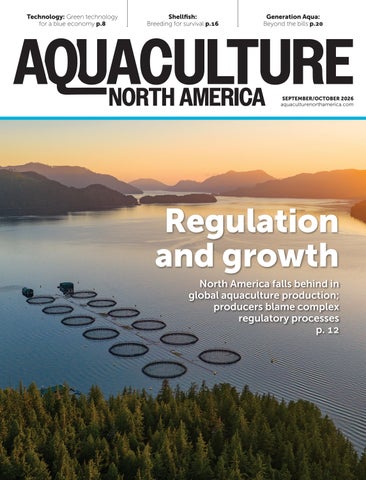
Technology: Green technology for a blue economy p.8
Shellfish: Breeding for survival p.16
Generation Aqua: Beyond the bills p.20
SEPTEMBER/OCTOBER 2026 aquaculturenorthamerica.com
Regulation and growth North America falls behind in global aquaculture production; producers blame complex regulatory processes p. 12
EMPOWERING THE BEST CARE EVERY DAY AQUA CARE365 is a unique internet-based educational and training resource dedicated to assisting the aqua community. We must act ethically and responsibly in our quest to meet the world’s growing demand for fish protein.
Create your free account today. Register online at training.aquacare365.com www.merck-animal-health.com/species/aquaculture Copyright © 2024 Merck & Co., Inc., Rahway, NJ, USA and its affiliates. All rights reserved. Document CA-AQP-230800002
Contents
September/October 2026 Vol. 17, No. 4 aquaculturenorthamerica.com
Features COVER STORY
12 Regulation and growth North America falls behind in world aquaculture production; producers blame complex regulatory processes. By Seyitan Moritiwon
8 Green technology for a blue economy Early adopters jump on board electric boats. The reasons why may surprise you. By Lynn Fantom
16 Breeding for survival
8
Guy Perry leads the development of MSX-resistant oyster seed as as Prince Edward Island battles devastating oyster mortality. By Ben Normand
Departments 6 News 21 Showcase
Columns
COVER PHOTO: MOWI CANADA WEST
5 From the Editor The future is bright 7 Deep Dive Trust but verify By Ben Normand 20 Generation Aqua Beyond the bills By Imani Black 22 Career Fieldnotes Will AI take aquatic food jobs? By Leah Williams Stoker
12
16 aquaculturenorthamerica.com
AQUACULTURE NORTH AMERICA
3
INNOVATION BEYOND MEASURE RESULTS BEYOND EXPECTATION 100% Titanium Heat Exchangers
High-Performance Chillers & Titanium Heat Exchangers
Hot & Cold Water Loop Systems Heat Exchangers in Tube Sheet, Helical Coil, or Plate
CONTACT US TODAY! (704) 774 1391
Compact Designs Easy Installation Salt & Fresh Water Safe
info@aqualogicinc.com sales@aqualogicinc.com http://www.aqualogicinc.com
Chiller & Heat Pump Packages Electric Heaters & Gas Boilers
HI_Aqua Logic _JanFeb26_CSA.indd 1
2806 Gray Fox Road Monroe, NC 28110
® permalon ANA_ELDI_SeptOct26_CSA.indd 1 2025-11-10 7:25 AM
Proven equipment for shellfish producers
BUILT LIKE TANKS.
2026-08-05 1:16 PM
PERMALON® AQUACULTURE LINERS UV stabilized • Resist puncture & tears Lightweight • Custom fabrication Sizes up to an acre
MT Mussel sorter
MT Oyster counter
800-231-6074 • REEFINDUSTRIES.COM
MT Debyssing machine
MT Cone stripper
Formutech Inc.
Charlottetown, P.E.I. Phone 1 855-599-0099 E-mail info@formutech.ca www.formutech.ca ©2026 Reef Industries Inc. Permalon is a registered trademark of Reef Industries Inc.
4
AQUACULTURE NORTH AMERICA
ANA_Reef_SeptOct26_CSA.indd 1
September/October 2026 2026-07-30 ANA_Formutech_JulyAug26_CSA.indd 10:17 AM 1
2026-06-19 11:34 AM
From the Editor BY SEYITAN MORITIWON VOLUME 17 ISSUE 4 | SEPTEMBER/OCTOBER 2026
Reader Service Print and digital subscription inquiries or changes, please contact customer service Angelita Potal Tel: (416) 510-5113 Fax: (416) 510-6875 Email: apotal@annexbusinessmedia.com Mail: 111 Gordon Baker Rd., Suite 400, Toronto, ON M2H 3R1 Editor Seyitan Moritiwon smoritiwon@annexbusinessmedia.com Contributors Imani Black, Lynn Fantom, Ben Normand, Leah Williams Stoker Associate Publisher Jeremy Thain jthain@annexbusinessmedia.com +1-250-474-3982 Brand Sales Manager Patrick Villanueva pvillanueva@annexbusinessmedia.com 416-606-6964 Account Coordinator Barb Vowles bvowles@annexbusinessmedia.com Media Designer Curtis Martin cmartin@annexbusinessmedia.com Audience Development Manager Urszula Grzyb ugrzyb@annexbusinessmedia.com 416-510-5180 Group Publisher Anne Beswick abeswick@annexbusinessmedia.com 416-410-5248 CEO Scott Jamieson sjamieson@annexbusinessmedia.com
PUBLISHED BY ANNEX BUSINESS MEDIA 105 Donly Drive South, Simcoe, ON N3Y 4N5 Aquaculture North America is published five times a year by Annex Business Media. The authority for statements and claims made in Aquaculture North America is the responsibility of the contributors. Reference to named products or technologies does not imply endorsement by the publisher. Subscription rates (five issues) Canada: $39.25 (per year+tax) | Canada: $67.36 (2 years+tax) U.S: $50.92 (CDN per year) | Foreign: $65.77 (CDN per year) To subscribe visit our website at aquaculturenorthamerica.com Printed in Canada ISSN 1922-4117 Publications Mail Agreement #PM40065710 RETURN UNDELIVERABLE CANADIAN ADDRESSES TO 111 Gordon Baker Rd., Suite 400, Toronto, ON M2H 3R1 Annex Privacy Officer Privacy@annexbusinessmedia.com Tel: 800-668-2374 The contents of Aquaculture North America are copyright ©2026 by Annex Business Media and may not be reproduced in whole or part without written consent. Annex Business Media disclaims any warranty as to the accuracy, completeness or currency of the contents of this publication and disclaims all liability in respect of the results of any action taken or not taken in reliance upon information in this publication.
Next Ad Deadline
The future is bright
T
his issue's cover story was in- farmers must go through, I must agree with spired by the recent report from one farmer who described it as a minefield. the UN Food and Agriculture If North America wants to be competiOrganization (FAO). The State tive in aquaculture, the time to address of World Fisheries and Aquaculture these challenges is now. Other continents (SOFIA) reported that global aquaculture have left us behind and we're at this point, production of aquatic animals reached struggling to catch up. Aquaculture has a record 103 million tonnes in 2024. such huge potential to bolster the economy As I pored over the report, one statistic of the United States and even Canada. stopped me in my tracks: Asia accounts for Despite these challenges, there are 89 per cent of global aquaculture reasons for optimism. With production, while North America Aquaculture initiatives like the USDA Office contributes just one per cent. continues to of Seafood, Canada’s first-ever Simply put, the continent expand National Food Security Stratproduced only a small fraction globally. egy and NOAA's Cooperative of global aquaculture produc- But why has Institute Fostering Aquaculture tion. And as a publication that's North Research and Markets (CIFARM), committed to reporting valuable America there is hope for the future. information for the North Amer- been left And that's one of my favourican Aquaculture audience, I behind? ite things about this industry. It's decided to pursue a story on this. the willingness to keep pursuing This story is so important because the goal of growing seafood for the aquaculture continues to expand globally. world to eat despite the hurdles you face. But why has North America been left behind? As I write this column, I'm reminded This question led me to speak with of the Canadian Freshwater Aquaculture both shellfish and finfish producers on the Conference that emphasizes collaboration. continent. Despite the difference in spe- To me, this would entail collaboration in cies and production methods, I heard the different forms: between shellfish, finfish same concern of long permitting processes. and seaweed sectors; land-based farmAnother recent report supports this point. ing and mariculture; younger and older It estimates U.S. aquaculture producers face professionals and even across countries. about 170,000 regulatory restrictions, what So, whenever there's a reason to gather in researchers describe as one of the world’s the aquaculture industry, whether virtually or most stringent regulatory frameworks. in-person, let's be eager to meet. These meetProducing seafood in North America has ing places usually birth so many ideas and solubecome so difficult. And you all know this, tions that the industry needs to stand strong. but I think it becomes so glaring when we see Until we come to this understanding, only the effect of this complexity stated in a report then can we materialize this bright future we in comparison with other continents. all dream of for aquaculture in North America. Before I wrote this story, I knew and I'd like to know your thoughts on the cover had read about how difficult it was to get story and the other topics covered in this issue. permits and licenses to farm fish, but after Please reach out for a chat at smoritiwon@ seeing the number of hurdles seafood annexbusinessmedia.com. | ANA
The advertising deadline for the November/December issue is Sept. 29. Don’t miss the opportunity to be part of this publication. For more information, or to reserve space in the next issue, call our advertising department at +1.250.474.3982 jthain@annexbusinessmedia.com
Next Editorial Deadline The editorial deadline for the Novemeber/December issue is Sept. 14. Contact Seyitan Moritiwon at smoritiwon@ annexbusinessmedia.com for details. Material should be submitted electronically with prior arrangement with the editor.
Aquaculture North America’s Editorial Advisory Board: Jeff Hetrick | Kathleen Hartman | Marcy Cockrell
AquacultureNorthAmerica aquaculturenorthamerica.com
aquaculture-north-america AQUACULTURE NORTH AMERICA
5
News
Washburn High School students show sixth graders how to dissect a fish. PHOTO: EMMA HAUSER / ASC
Wisconsin high schoolers win 3 awards in aquaculture competition Three Wisconsin high schools have won awards in the 2026 Aquaculture Challenge. The Aquaculture Challenge is an annual science competition where
students in grades six to 12 build and monitor aquaponics systems, growing both plants and fish. Team Flow with the Grow from Washburn High School won an award for best outreach initiative. Instead of floating the plants on traditional styrofoam rafts, in their aquaponics system, the team used food-grade, water-resistant material. Students from J&R Tobacco Company from Wabeno High School won the judges’ choice award for developing an aquaponics system to grow tobacco for cultural and ceremonial use in the local tribal community. The students grew carrots, lettuce, tomatoes, basil, and cilantro and raised koi and goldfish in addition to growing three varieties of tobacco. The winners of the tech savvy award for the design and monitoring of their aquaponic system was the Gill-ty as Charged (with
Oyster Trays stacked with quality For over 35 years oyster growers worldwide have trusted our S1000 Oyster Tray and S4000 nursery tray, to produce the highest quality half-shell oyster for today’s demanding consumers.
ENTERPRISES
Cell: 604-833-5311 darksea@shaw.ca
S4000 nursery trays
S1000 oyster trays
Featuring our 6061 T-6 aluminum suspender pole which stands up to the harshest of salt water environments.
6
Sell-fish Intentions) from the School of Options and Applied Research Charter High School. The team grew both plants and tilapia and studied how temperature affected growth. “The challenge is such a great opportunity to get students engaged in aquaculture while supporting creativity, responsibility, and ownership,” said Emma Hauser from Wisconsin Sea Grant.
Newfoundland and Labrador seafood industry generates $2.11 billion in 2025 A preliminary 2025 report released by the Government of Newfoundland and Labrador says the province's combined fisheries and aquaculture sector generated $2.11 billion in market value, one of the highest totals on record. Wild fisheries accounted for $1.66 billion in market value from 230,323 tonnes of landings, while aquaculture generated $453 million with 37,480 tonnes produced at licensed sites across the province. “Our seafood industry continues to be a major economic driver for Newfoundland and Labrador, supporting workers, families and communities throughout the province. Surpassing $2 billion in market value is a significant milestone that reflects the strength of our local fishing and aquaculture industries as well as the global reputation of our quality seafood products,” said Loyola O’Driscoll the province's minister of Fisheries and Aquaculture. The industry also supported more than 16,900 jobs in 2025, including 9,710 registered
AQUACULTURE NORTH AMERICA
ANA_DARKSEA_MarApr25_BAS .indd 1
harvesters, 6,703 fish processing workers, and 584 aquaculture employees, making it one of the largest private-sector employers in the province. Newfoundland and Labrador exported about $1.75 billion, with the United States buying the largest share at $1.26 billion. China ranked second at $221 million, followed by the United Kingdom, Denmark, and Japan.
Foluke Areola becomes World Aquaculture Society president The World Aquaculture Society has elected Foluke Areola as its new president, making her the first African president to lead the society. Areola is a fisheries and aquaculture expert with 40 years of experience. Before taking the role of global leader, she served as the president of the World Aquaculture Society, African Chapter. In her new role, Areola has pledged to strengthen global collaboration while advancing sustainable aquaculture and increasing Africa’s role in shaping the sector’s future. “For me personally, having benefited from the opportunities, education, mentorship, and public service platforms provided by my homeland, Nigeria, from childhood to this day, this moment carries profound humility, gratitude, and responsibility. I want to thank the Ambassador for representing my great country, Nigeria, here today,” Areola said in her speech at the inauguration ceremony in Singapore. “I sincerely thank the membership of the World Aquaculture Society for the confidence reposed in me. I accept this responsibility with a deep sense of duty, commitment, and service to our profession and to humanity,” she added. September/October 2026
2025-02-03 2:28 PM
Deep Dive BY BEN NORMAND
Ben Normand a fish farmer, writer, college instructor, and cheerleader for aquaculture. He has worked with various fin and shellfish species in New Zealand and Canada in production management, compliance, and communications. (ben.r.normand@gmail.com)
Trust but verify when working with AI
I
spend a lot of time thinking about artificial intelligence (AI) these days. I’m sure I’m not alone in this; from Elon’s space-based data centres to the slurping sounds some swear they can hear as data centres consume their water, it’s at the centre of so many stories and discussions. Even recently, I was speaking to a coworker about how many media assets and emails I’ve seen that are clearly generated. I’ll admit freely I’m using it more over time. It’s a powerful search tool, for example. It’s in that role that it performs well as an idea precipitator: something you can just pour your thoughts into and get back a rough plan on how to connect those dots in a productive fashion. From there, you can run with or without it and focus your efforts efficiently. The real issues seem to come when people blindly place their trust in AI to be both accurate and deliver content, solutions, and actions of positive substance. For example, I read a story recently of a Toronto car dealership that had to refund the entire amount for a car to a customer seeking to return a lemon because their AI chat agent agreed to do so. The courts upheld the deal as binding because the dealership was responsible for implementing the agent and not giving it firm boundaries. AI, for me, has been a poor executor so far. As a personal example, when I uploaded one presentation and the new template it needed to adhere to, and asked it to update the colours, graphics, etc., what it spat out almost couldn’t have been more wrong. This was a task that my 12-year-old realistically could have completed. Since then, my approach to using it can be perfectly summed up by the Russian proverb, “trust but verify.” I now do what I can to take what it gives me and then assess it under the glaring light of the wisdom and knowledge gleaned from over 250,000 years of human hard learning. I was speaking to some friends recently who are doing their research to start a trout farming operation. As any farmer can tell you, it’s no small feat. You have to design the farm, build the business case, find the funding, gain the approvals, etc. I was
aquaculturenorthamerica.com
thinking about them as I was preparing to write this column and, for fun, I took a quick stab at getting CoPilot to make a list of action items they could use. I offered it: Give me ten concise points to summarize the steps needed to open a land-based trout farm. It then offered to me: 1. Develop a business plan - define production targets, market, budget, and financing. 2. Select a suitable site - secure reliable water, power, road access, and zoning approvals. 3. Obtain permits and licenses - environmental, water-use, discharge, and aquaculture permits. 4. Design the RAS facility - size tanks, biofilters, oxygenation, disinfection, and waste-treatment systems. 5. Build infrastructure - tanks, piping, pumps, backup power, buildings, and monitoring systems. 6. Establish water-quality management continuously control oxygen, ammonia, nitrite, CO2, and temperature. 7. Source quality trout stock - purchase disease-free eggs, fry, or fingerlings from certified hatcheries. 8. Implement feeding and health programs - optimize feed conversion, growth, biosecurity, and fish welfare. 9. Hire and train staff - RAS operations require skilled technicians and consistent system monitoring. 10. Plan harvesting and sales - secure buyers, logistics, processing, and distribution before harvest. A practical rule: validate market demand and financing before investing in facility construction, since capital and operating costs are usually the biggest hurdles for land-based trout farms. Sounds great, right? It’s literally the steps required. What it’s missing, though, is how to do these things. To be fair, I didn’t ask it to tell me how to do these things, and so I went on to ask it to explain how to do these things and said it can be as detailed as it wants. It, once again, gave me a clear and good answer,
including recommendations of companies to speak with, etc. But something was missing. The most obvious piece that’s missing is action. My friends would still have to go out and do these things. But there was something else. Upon further reflection, I believe it was wisdom. As they would go out and do these things, are they actually speaking to the right person at each company, or are they describing their operations correctly on regulatory application forms in such a way that they are being honest and transparent but not inviting unnecessary scrutiny, for example? This is what, despite what I asked, was missing. And this wisdom can only come from stakeholders who have gone through the process and come out the other side with a clear vision of what is best done or not done. My friends can trust the process described but must verify the details with more experienced and wiser individuals. What I love most about this industry is the community, hand-down. We all come from different backgrounds, have different opinions and beliefs, and yet we find unity around the common goal of farming. To this end, there is trust and no shortage of genuine desire to help one another succeed. The best advice I can give to my friends in this situation is to tap that community to access that wisdom as they more or less follow the process that is offered. By taking a systematic and structured approach, much like the one that CoPilot described, and flexing and adapting to implement the wisdom gleaned by the aquaculture community, my friends could absolutely achieve success. I’m at a point in my career now where I’m starting to be asked by younger folks what they should do to achieve their goals in this industry. I’m so happy to help them, and I know many of you would be too. At the end of the day, there’s no way to only hide behind a screen in our industry; you will have to get out there at some point. Let’s encourage the young people in our industry to trust but verify, and to seek out that wisdom in doing so. | ANA
AQUACULTURE NORTH AMERICA
7
TECHNOLOGY
Green technology for a blue economy Early adopters jump on board electric boats. The reasons why may surprise you. By Lynn Fantom
F
or almost five years now, electric boats have been showing up to work in Maine’s waters. A dinghy shuttling workers and tools to boats around the harbour. A skiff towing lobster crates from moorings to the dock. A 28-foot workboat ready to haul 4,000 pounds of waterlogged kelp and oysters heavy as lead. A high-torque, flat-bottom 24foot aluminum skiff maneuvering to oyster beds and negotiating tight shorelines. These quiet, low-maintenance, zero-emission vessels represent both a leap forward in technology and the determined focus of the Island Institute, a nonprofit that works to sustain Maine’s island and coastal communities. Through its leadership in marine
8
AQUACULTURE NORTH AMERICA
innovation, it is showing North America how electric boats can help lower costs for sea farmers while confronting the realities of climate change. “It’s been private foundations, private donors, and being very scrappy and strategic to get all these boats on the water,” says Lia Morris, senior community development officer at the Island Institute’s Center for Marine Economy based in Rockland, Maine. “We’re a hub and a facilitator to support aquaculturists adopting innovation.” In addition, a grant from Maine Technology Institute (MTI), founded and funded in 1999 by the Maine State Legislature, has been instrumental, particularly in funding a “demonstration boat” program. Builders
Vision has also helped to finance electric boat projects in partnership with the Island Institute.
Aquaculture workboats are major emitters There’s nothing like a cold, hard dataset to focus the mind. An analysis of greenhouse gas emissions among lobstering and aquaculture companies did just that. In July 2025, the Island Institute published Reducing Emissions in Maine’s Seafood Sector, presenting greenhouse gas assessments compiled between 2022 and 2024. Seven seafood companies, including six producers of mussels, oysters, and kelp, opened up their farm operations for analysis. September/October 2026
Nick Planson with the solar-powered refrigerated container called the ShredCube PHOTO: RYAN BROWN
Heron, the all-electric workboat of Maine Ocean Farms, features an enclosed pilothouse for winter operation and a stable open work deck for the daily functions of an oyster farm. PHOTO: ISLAND INSTITUTE
The New Maine Skiff, produced through a collaboration between The Boat Yard and Shred Electric, offers instant torque to get the workboat quickly on plane even under heavy loads. PHOTO: CHRIS CARY
The fuel for farming vessels dominated greenhouse gas emissions across the board. Among oyster farmers, the percentage of total emissions represented by boat fuel use ranged from 19 to 59 per cent. At a mussel producer, 27 per cent of total emissions related to boat fuel, second only to biogenic emissions from the mussels themselves!
Partnerships grew among innovative boatbuilders and marine technology companies specializing in electric outboards and battery systems, including Shred Electric, which developed patent-pending technology to integrate commercial batteries with renewable power sources. With funding from the USDA on one such project, Shred Electric and the Boat Yard spent four years prototyping and refining a line called the New Maine Skiff. “We surveyed lots of farmers to learn what kind of boat, what size, what features would be of interest,” says Nick Planson, founder of Shred Electric. Efforts like this led to better, more successful products for aquaculture’s specific
Electric boats: proof of concept When the Island Institute embarked on this project around 2021, there was limited availability of electric motor technology ready for commercial jobs in Maine’s challenging environment—namely, the torque, durability, and power to haul heavy gear and withstand freezing saltwater temperatures. aquaculturenorthamerica.com
challenges. Then, with funding for “demonstration boats,” word began to spread. For example, the concept developed by the Boat Yard and Shred Electric was adapted for another 26-foot aluminum-hull skiff by Atlantic Marine Boats and launched for Blue Stream Shellfish in Massachusetts in July 2025. “Along with the prospect of reducing carbon emissions, there are many reasons why an all-electric work skiff should be on the wish list of all oyster farms,” wrote owner Dale Leavitt in an article for the East Coast Shellfish Growers Association.
Noise exposure: risks to hearing and social license “When we first started out, we thought that AQUACULTURE NORTH AMERICA
9
TECHNOLOGY
the main reason people would want to head in this direction is because it's better for the environment, or it'll save them money over time, or it aligns with the fact that oysters and mussels are environmentally beneficial sources of food. But the number one reason why people come is how much quieter electric systems are,” Planson explains. “You’re out on this beautiful bay all day, all summer. But, traditionally, you’re standing next to this gasoline-powered generator just blaring.” It can be deafening, literally. A study published in the American Journal of Industrial Medicine in 2017 found that aquaculture had the highest prevalence of noise-induced hearing loss among all sub-sectors of the agriculture, fishing, forestry, and hunting sectors in the dataset. Similarly, occupational noise exposure was identified as a significant risk factor for the health and well-being of commercial fish harvesters in a 2023 study conducted in Newfoundland 10
AQUACULTURE NORTH AMERICA
Attendees at an electric boat training program, hosted by the Island Institute, to equip boat yard technicians and marine service providers with new skills to foster the blue economy. PHOTO: ISLAND INSTITUTE
and Labrador. That review also showed that fish harvesters were among the top groups of workers who filed hearing loss claims. Electric systems can yield lifechanging benefits to workers. Experts also agree that reducing noise can be a boon to getting and keeping social license. In Maine Aquaculture Association’s recommendations on how to be a good neighbour, Christian Brayden notes, “Sound carries wicked far on the water,” whether it’s from a boat engine, generator, tumbler – or, as everyone knows, music. In a study conducted by Emily Whitmore to investigate social license in aquaculture, half of the farmers interviewed cited reducing noise impacts, particularly engine noise and mechanical sorting, as a way to lessen the conflicts that incite public opposition. Plus, as Planson notes, the sound from a generator above the water will carry even more than from a gasoline outboard, where most of the noise – and exhaust – go underwater.
But how to pay for an electric boat, charge it, and fix it? Today, electric boats are more expensive upfront. But gasoline-powered boats require frequent maintenance, fuel, and oil – the cost of which is unpredictable in today’s markets. “Over time, electric power should save operators money in not having to pay fueling costs, with electricity being cheaper per nautical mile and, even more so, way less expensive on maintenance,” says Planson. “Electric motors virtually have zero maintenance.” But to make that initial purchase can be a challenge for farmers. “They don’t necessarily have capital sitting in the bank,” says Morris. She points to the Marine Innovation Grant program run by her Island Institute colleague Phoebe Wheeler. It currently is prioritizing applications to fund electric outboards, shoreside charging infrastructure, and marine electrification for Maine’s coastal and island communities. In September/October 2026
Shred Electric founder Nick Planson, shown here with Lauren Gray of Cranberry Oysters and Sean Linkel of Shred Electric, delivers a custom solar oyster shaker barge, another innovation in electrification. PHOTO: SHRED ELECTRIC
Wattson, the 16-foot electric skiff shown here with Lia Morris and Phoebe Wheeler of the Island Institute, transports crew and equipment to the moorings of commercial boats. PHOTO: ISLAND INSTITUTE
addition, Coastal Enterprises Institute offers a marine innovation loan called the Marine Green Loan, according to Wheeler. In June, Wheeler and Morris were Tech Track presenters at the Home to Overseas Conference in Halifax, Nova Scotia, along with Brent Dancey of the Canadian conservation organization Oceans North. An advocate for the electrification of near-shore workboats in Atlantic Canada, Dancey argues that because the upfront costs for early adopters are steep, both federal and provincial governments must introduce dedicated funding. But the commitment to electric doesn’t have to be all or nothing, Planson adds. Farmers can have an electric kicker motor mounted right next to their gasoline outboard so, for example, they can use the gasoline outboard to get out to their farm and then switch to the electric motor to have quiet while they’re working. Another example: for Butterfield Shellfish in Casco Bay, Shred Electric developed a battery kit to run its hauler, which quietly pulls its vessel down the line on its flip farm. What’s more, charging electric boats is “more flexible than you might think,” Planson says. “You can charge it up with just a regular extension cord if it’s one of the smaller vessels.” Some of them also have removable batteries, so you can charge them at home like a lawn mower battery. Larger work boats can be plugged into standard shore power pedestals (such as 30-amp or 50-amp outlets) at almost all marinas, but recharging at these level-two chargers usually takes overnight. Though currently limited, the marine industry is transitioning to adopt specialized AC and DC fast chargers to serve high-voltage electric vessels. Last March, the Island Institute published Maine’s first statewide analysis of shoreside electric vessel charging to help map out the future of marine electrification along the coast. It identified 373 highly suitable sites for shoreside charging stations. “We have a lot of work now to go back to communities and also start having conversations with state agencies and utilities around the opportunities, gaps, and challenges,” says Morris. But this is another step forward to getting electric technology to scale and supporting the blue economy. As part of that mission, the Island Institute is also working to train electric boat technicians in partnership with Kennebec Valley Community College and Mid-Coast School of Technology. The entry-level course is free. “This course is a first step towards building the workforce pathway needed to support the shift to electric boats,” according to the Island Institute. Two years ago, the Maine legislature created the Maine Blue
Economy Task Force to formalize and grow the state’s sustainable ocean-based economy. One recommendation was to train such a workforce centred around sustainable boatbuilding, including electric outboards, high-capacity batteries, and efficient workboats. The task force also called out aquaculture as one of five high-potential areas. In addition, to align government, academia, and industry, it established the Maine Blue Economy Center, which opened in July. | ANA
FULLY AUTOMATIC OYSTER PROCESSING TECHNOLOGY Better quality oysters, in less time, for less cost.
SED Vision Grader The number 1 labour saving equipment in America. Cleans, measures, sorts, counts and bags oysters fast and automatically.
ACCURATE - high production with minimal labour – average processing speed of 14,000 oysters per hour using only one operator.
Call us today to discuss your grading needs at
Tel. +61 (0)3 6442 1563 Or contact us via our website
www.sedgraders.com AQUACULTURE NORTH AMERICA
aquaculturenorthamerica.com ANA_SEDGraders_QP_JANFEB26_BAS.indd 1
11
2025-11-25 10:20 AM
COVER STORY
Regulation and growth
I
t’s Wednesday, the busiest day of the week at Bodega Bay Oyster Co. The boats are out in the water. One carries vice-president, Whittaker Strain, and five other employees in their life vests as they use long hooks to retrieve 100 bags of oysters from the ocean floor. The crew is cross-docking from boat to truck. The rust-stained truck makes its way to the Bodega processing facility in Valley Ford, where another crew takes over washing, sorting and counting all of the oysters before they go to the wholesalers. The sweat on their brows tells it is hard work, but they have an efficient process. The same can’t be said about the regulatory process for producers in the North American
12
AQUACULTURE NORTH AMERICA
aquaculture industry. While global aquaculture continues to grow, North America has experienced limited expansion in this sector, not because of a lack of demand for seafood, but because obtaining permits has become increasingly difficult. The impact of complex regulatory frameworks is evident in the 2026 United Nations State of World Fisheries and Aquaculture (SOFIA), which reports that aquaculture of aquatic animals reached a new production record in 2024 at 103 million tonnes, with 89 per cent coming from Asia and only one per cent from North America. The United States of America is reported as the world’s largest single importer of seafood
and aquatic animal products. In 2024, the report showed U.S. imports totalling about US$26.9 billion. Strain believes that with this huge deamnd, U.S. producers have a good opportunity to grow their own share within the domestic market. “It's a great shame because America is a huge consumer of seafood,” said Strain. “There's a missed economic opportunity there. There's also a huge environmental impact to that. In terms of the carbon footprint of importing all that seafood, it's a huge loss.” Strain believes farmers are already working hard to meet the demand for seafood but says expanding the industry will require a joint effort from consumers, industry and government. September/October 2026
PHOTOS: DAWN HEUMAN
North America falls behind in global aquaculture production; producers blame complex regulatory processes. By Seyitan Moritiwon
United States aquaculture Founded in 1985, Bodega Bay Oyster Co. is one example of a domestic aquaculture operation already producing seafood for consumers. It grows oysters, clams and mussels in 92 acres of waters in Tomales Bay and Bodega Bay. The small-scale farm leases its growing areas from the state of California through the Department of Fish and Wildlife under 15-year agreements. When the company got its lease to farm shellfish, things were much simpler. There was broad support for aquaculture. Like Bodega Bay, most of the growers got their start in the mid-80s. Today, California has not issued a new license for oyster farming in about 30 years, according to Strain. He attributes this to agency overlap, with no cooperation and communication between agencies responsible for issuing licenses for aquaculture farms. In California alone, shellfish farmers must navigate approvals from multiple state and federal agencies responsible for fisheries, public health, coastal development, environmental protection and navigation. “There's not really a clearly defined pathway towards getting the required permits, and so a lot of times what happens is applicants are just left in the lurch. Their applications aren't approved or rejected,” Strain said, citing an example of an application that has been pending for seven years. “That just speaks to how broken the system is,” he added.
in Canada.” Parker works for the world’s largest salmon farming company, which produces about 550,000 tonnes of salmon annually. Mowi runs farms in Norway, Scotland, Ireland, Iceland, Chile, Canada, and the Faroe Islands. She said some of the countries Mowi operates in regulate similarly to Canada, but
with different policy objectives. But Parker believes that, unlike traditional agriculture, salmon farming in North America is a relatively new industry and could easily get marginalized. “We're not really in the fabric of the culture, and we actually take place in really remote areas. Very few people will look out
Salmon farming in Canada Those challenges are not unique to California. Across North America, producers say lengthy permitting processes and shifting government policies have slowed industry growth. According to the SOFIA report, North American production increased from 584,500 tonnes in 2000 to 627,350 tonnes in 2024, and Canada displayed more pronounced fluctuations, with growth up to 2015, followed by a general decline. Mia Parker, director of environmental performance and certification, Mowi Canada West, attributes this to what she describes as regulators drifting away from evidence-based decision-making. “In Canada, we have the longest coastline in the world. It's ridiculous. And Canadians eat a lot of seafood,” said Parker. “Atlantic salmon is the number one most eaten seafood AQUACULTURE NORTH AMERICA
aquaculturenorthamerica.com ANA_Magic Valley_JanFeb26_CSA.indd 1
13
2025-12-05 9:49 AM
COVER STORY
14
AQUACULTURE NORTH AMERICA
Two salmon farm workers putting a secondary escape prevention net in place prior to handling fish (at Mahatta East).
she said today’s industry is far more tightly regulated. Yet, she said, critics are arguing their points with outdated pictures that no longer reflect current practices. “Every human activity has environmental effects. Positive or negative,” Parker said. “The footprint from salmon farming is temporary, and it's really limited. It's limited to how severe it can be, and it's limited to how big it can be. It's literally within 100 meters of the pen. That's so small,” she said.
The price for growing fish Despite pushback from activists, North American aquaculture producers continue to invest in the work to meet the growing demand for
How the government can help The Marine Aquaculture Research for America (MARA) Act was introduced in 2025 by U.S. senators Brian Schatz and Roger Wicker to advance the development of commercial, openocean aquaculture in U.S. federal waters. The bipartisan bill, if passed, would enable the U.S. to responsibly grow more sustainable seafood domestically. U.S. Rep. Mike Ezell, a House co-sponsor of the MARA Act, said offshore aquaculture, when done right, can help take the pressure off some fisheries and open up some growth September/October 2026
PHOTOS: MOWI CANADA WEST
their window and see a salmon farm,” she said. “So you don't really get embraced and drawn into the center of the food production conversation.” According to Parker, operating a salmon farm requires multiple permits and authorizations. The primary ones include authorization to use marine space from British Columbia's Ministry of Water, Land and Resource Stewardship, an aquaculture licence issued by Fisheries and Oceans Canada, and an authorization under the Canadian Navigable Waters Act. Additional permits are required throughout a farm's operation. Parker said salmon farming has changed significantly over the past several decades. While early operations had environmental impacts,
seafood. In Canada, that investment can take about five years and cost roughly C$500,000 to complete the necessary environmental assessment and site evaluation, according to Cyr Couturier, president of the Aquaculture Association of Canada. “There are upwards of 80 pieces of legislation from municipal, provincial or federal legislation that industry must comply with in order to get a permit to operate,” Couturier said. The challenges are similar in the U.S. Ocean Era’s recently approved Velella Epsilon project took eight years, navigating nine different federal and state laws and 12 agencies. The project, which will raise a small batch of red drum off the coast of Sarasota, Florida, cost the company about US $200,000 in addition to more than US$600,000 in staff time contributed by Ocean Era and Gulfstream Aquaculture, according to founder and CEO Neil Anthony Sims. Although the project was intended to show the Florida fishing and boating communities the benefits of offshore aquaculture, Sims said another objective was to pave the way for permitting offshore aquaculture in federal waters in the Gulf. “As a demonstration project, it has been tremendously successful, in that it has demonstrated with abundant clarity that regulatory reform is sorely needed,” said Sims, who also hopes that Congress will help resolve the current constraints through the MARA Act.
opportunities. Canada is also signalling greater support for expanding domestic seafood production. In June, Prime Minister Mark Carney launched Canada’s first-ever National Food Security Strategy, a C$3-billion plan to strengthen Canada’s food system, including measures to support domestic production in the seafood and aquaculture sectors. Couturier said his association brings industry, academia, and government officials together for annual meetings and planning the development of the aquaculture sector in Canada. “Our mandate actually to foster the development of an aquaculture sector in Canada, is the original mandate of the association,” said Couturier.
The future of North American aquaculture Despite the challenges, North American producers are optimistic about the future of their industry. The UN Food and Agriculture Organsation (FAO) projects that global fisheries and aquaculture production, the availability of aquatic animal foods and trade will continue increasing, although at slower rates compared to previous decades. It projects that global aquatic animal production will reach 214 million tonnes by 2034. Most of that growth is expected to come from aquaculture, which is forecast to expand by 16 per cent to 119 million tonnes. It noted that governance effectiveness is critical in determining these future outcomes.
aquaculturenorthamerica.com ANA_Inwater_SeptOct26_CSA.indd 1
As 2029 approaches, the ban that the federal government placed on net pen salmon farming in British Columbia is becoming an increasingly pressing reality. “They basically have their broodstock; they're ready to go. And three years from now, the federal government's saying, ‘You can't farm fish in the ocean,’” Couturier said. Parker said if the policy remains, Mowi would have to carefully consider the future of its broodstock program and how many fish to put to sea to be in compliance. “The policy that's affecting our longevity, our future right now, it’s not the issue; it's the symptom of the issue. So if Canada was actually considering salmon farming as the economic engine and food production engine that it is, if we were considering salmon farming as part
An underwater view of farmed Atlantic salmon as the pen is readied for harvest
of Canada's food system, we would never have put those policies in place,” Parker added. Yet Parker looks forward to a time when Canada will have smart regulation and suitable conditions for growth to attract national and foreign investment. “We could be doing Arctic char in the Arctic and trout through Ontario, and the prairies and salmon on both coasts, and we've got mussels and oysters, and there's so many other things that could be grown that are resilient to climate change and nutritious,” she said. Back in Bodega Bay, Wednesday's harvest is nearly complete. Another truck of oysters heads for wholesalers while crews prepare for the next day. Strain believes California still holds huge potential for a new generation of aquaculture farmers. "The future is bright.” | ANA
AQUACULTURE NORTH AMERICA
15
2026-08-07 1:08 PM
SHELLFISH
Breeding for survival
P
rince Edward Island’s (PEI) oyster industry is confronting one of the most significant biological threats in its history. Since the discovery of Multinucleate Sphere Unknown (MSX) in PEI waters in July 2024, the oyster industry has been forced to respond to a disease capable of causing extreme mortality (more than 90 per cent) in eastern oysters (Crassostrea virginica). While the PEI oyster fishing and farming industry has a strong history of resilience through
16
AQUACULTURE NORTH AMERICA
disease challenges, the proximity of the abnormally financially difficult Covid years, cost-inflation pressures and trade instability with the United States have created a context within which many farmers and fishers are facing a true existential challenge. But the resilience-ethos of the PEI oyster industry is strong and on full display at the Bideford Shellfish Hatchery (BSH). Located on an estuary of Malpeque Bay, on western PEI, the BSH has become a focal point of hope for the future of the PEI oyster industry. This is because the hatchery,
Guy Perry, a quantitative geneticist, is the manager of Bideford Shellfish Hatchery.
under the careful management of geneticist Guy Perry, has undertaken the arduous mission of using selective breeding and genomics to develop and sell MSX-resistant oyster seed to an industry searching for its next steps. In the spring of 2025, Perry and his team sold the first batch of seed from the MSX-resistance selection program. While the seed grows on Island farms, tended to with bated breath by farmers whose futures depend on their survival, the work of the crew at BSH continues in the second generation. September/October 2026
PHOTOS: GUY PERRY
Guy Perry leads the development of MSX-resistant oyster seed as Prince Edward Island battles devastating oyster mortality. By Ben Normand
The arrival and impact of MSX in Prince Edward Island MSX is caused by the protozoan parasite, Haplosporidium nelsoni. The disease does not pose any risk to human health or food safety, but it can cause near-total mortality in both wild and farmed populations. It is also a longer-term challenge in that its impacts are most pronounced in mature oysters as opposed to juveniles. While a population may seem to have avoided infection one year, the next may bring catastrophic mortality. In Canada, it was first detected in Nova Scotia’s Bras d’Or Lake in 2002. For more than two decades, the disease remained confined to that region. Although the oyster industry in Nova Scotia was relatively small compared to that of PEI at the time, its impact was immense for that industry. In 2001, Nova Scotia harvested 438 metric tons of grown oysters and by 2006 they harvested 0. That changed in July 2024, when MSX was detected in oysters from Bedeque Bay on Prince Edward Island. Subsequent testing identified the disease in additional areas around the province. The Canadian Food Inspection Agency (CFIA), Fisheries and Oceans Canada (DFO), and the Province
of PEI increased surveillance and sampling programs significantly. Initial controls on stock, gear, vessel and infrastructure movements were extremely stringent. MSX is spread by infective parasites released by an unknown secondary host, but there’s no way to tell how many or which oysters will become infected. It was
D Delta H Hydronics, L.L.C.
Algae room at Bideford Shellfish Hatchery
a true lockdown aimed at reducing the extraordinary risk of spreading the disease since it was unclear how it did so. Meanwhile, researchers attempted to better understand the scope of the outbreak as well as the nebulous mode of transmission. In early 2025, the CFIA declared Prince Edward Island an area where
CUSTOM HEAT EXCHANGERS AVAILABLE PACKAGED TITANIUM CHILLERS AND BOILERS AVAILABLE
AQUACULTURE TEMPERATURE CONTROL SPECIALIST
Boilers & Boiler Skids
Titanium Heat Pumps and Chillers
Titanium & Stainless Steel Plate Heat Exchangers
VISIT US AT: WWW.DELTAHYDRO.COM Delta Ads 2025 - 1-3 Ratio.indd 1 aquaculturenorthamerica.com HI_Delta Hydronics_MarApr25_CSA.indd 1
Titanium & Stainless Steel Helical & Grid Coils
CALL US AT: 727-861-2421 2025-01-11 17:02:06 17 AQUACULTURE NORTH AMERICA 2025-01-13 1:17 PM
SHELLFISH • Thirty-four per cent of farmers who have financing have been in touch with their creditors about deferring payments • Twenty-one per cent of farmers do not plan to operate their farms in 2026 • Of the 21 per cent who do not plan to operate in 2026, 73 per cent would change their mind upon confirmation of the availability of disease-resistant seed or new funding. As illustrated by these numbers, the industry is now looking to survivors of MSX for hope.
The development of MSX-resistant seed
MSX is known or highly likely to occur, meaning many of the strictest restrictions on shellfish movements within PEI were lifted, allowing farmers and fishers much more freedom to carry out their work. By September 2025, the waters of PEI, New Brunswick, Nova Scotia, Newfoundland and Labrador and Québec were also declared as such. At the same time, they were declared as the same status for dermo, another deadly and virulent oyster disease. 18
AQUACULTURE NORTH AMERICA
Spawning tray at Bideford Shellfish Hatchery
Although the true scale of impact from the outbreak is still coming into focus over time in PEI, a recent publication of a survey conducted by the Prince Edward Island Aquaculture Association (PEIAA) in early 2026 paints a deeply troubling picture. Some of the key findings were: • Sixty-nine per cent of farmers have reported mortality above 76 per cent • Fifty-five per cent of farmers will be hiring less staff in 2026
Guy Perry, a quantitative geneticist, has been the manager of BSH since November 2024, when he was specifically recruited into the position to support the development of a resistant seed program. Within the context of extreme time sensitivity for delivering a solution to PEI farmers and fishers, Perry and his team have had to employ every means at their disposal and develop a robust program in very short order. He describes their approach as three-pronged. Of the first prong, Perry said, “The first one is the stock-based program, started in 2024, where we went out to Bedeque Bay, collected survivors and spawned them. The seed born of this spawning are out on farms right now, being assessed for survival. It’s tricky to speculate on their success yet because they are only a year old and MSX tends to most impact oysters that are two years or more, but we’re optimistic about its success based on early results.” The second prong of their approach is utilizing genomics, “We collected dead oysters from our broodstock who had died as a result of the water we pull from the bay being MSX positive, as well as Bedeque Bay survivors and some of our stock program seed and they’ve all been sent away for genotyping. Once the results were obtained, we identified the markers most strongly associated with survival. Those which possess these markers are, presumably, MSX-resistant September/October 2026
We just don’t have time to do things another way. oysters. Once we knew those markers, we selected oysters which possessed them, and used them to spawn with the stock from our prong-1 stock program.” The third prong is a more expanded blend of both methods, whereby they expand the scope of recruitment of oysters with these markers from different bays in PEI to bring more genetic variety into the pool of brood for subsequent spawns. He refers to this approach as hybridogenomics. He said, “we want to have several distinct hybrid groups to maintain genetic diversity to support these efforts in the long term.” As to why he chose to employ such a sweeping approach, he said, “We just don’t have time to do things another way. The classic genomics approach would be to try a few things, then wait until the first batch grew full lifecycle, then try a few more, and wait and so on and so forth. While we might be able to achieve our research goal that way, it’s entirely possible the whole industry would have shut down in that timeframe. We had to approach this problem differently.”
Working all angles towards a solution is of critical importance in this situation. As Perry said, “we, or the Mallets, or anyone, don’t have the capacity to solve this on our own. BSH, for example, simply can’t grow enough seed for everyone. As one of the growers I work with said, ‘we need to put all of our cards on the table.’”
On the farm Parker Getson has been farming Oysters in PEI for over 10 years with his brothers and father. They currently have approximately 50 acres spread between Tracadie and Savage Harbour. It’s work that they love and feel good about. However, MSX has taken a real toll on their operations. Regarding the 90 per cent mortality they saw in one of their leases, Parker described it as “absolutely gut-wrenching”.
Through collaboration with, and support from, the BSH, Parker is feeling optimistic about the future of their operation: “The amount of professionalism and enthusiasm we receive from BSH is unmatched. They’ve taken it upon themselves to engage in a relentless pursuit of a solution for the MSX parasite. We have nothing but confidence in BSH. They continuously check in on us and our operations. They are always sharing information or tips on the raising of their seed. With their support, we feel safe thinking about the future of our industry and are positive PEI is on the right track to prevail. We need more people like Adrian and Guy.” Beyond his own operations, he’s highly optimistic about the wild stocks in PEI because BSH is producing diploid seed which can, if they prove to be resistant, continue to spawn and establish resistant wild populations. The PEI oyster industry has a history of resilience, and while this challenge is extraordinary, with stakeholders like Perry and the team at BSH working on a solution, the problem is being shucked, revealing pearls of optimism for all. | ANA
Part of the broader approach The efforts of Perry and his team at BSH are supported and complemented by a broader network of efforts by industry in PEI and beyond to stock farms with MSX-resistant seed. One prominent North American shellfish company has brought seed from their American MSX- and dermo-positive farms to sell to PEI growers. The intention here is that these seed come from waters which have been positive for many years, and so they can be assumed to be resistant. As well, in June 2025, Genome Canada announced a four-year, C$3.1-million project titled Accelerating the Development of MSX-Resistant Oysters in Eastern Canada. The initiative is led by Genome Atlantic in partnership with Génome Québec, Université Laval, and the New Brunswick shellfish hatchery L’Étang Ruisseau Bar/ Mallet Oysters. Similar to the work of Perry and his team, this project seeks to rapidly identify survival-associated markers and breed selectively to generate seed which is MSX resistant.
ANA_Kytola_MarApr26_CSA.indd 1
Poultry By-Product Meal
2026-02-12 9:33 AM
as a PROTEIN SOURCE
FOR FISH
Studies performed at the Oceanic Institute (2001) indicate “poultry meal can replace fish meal at an inclusion level of 45% in shrimp diets without loss of growth.”
www.poultryrenderers.org AQUACULTURE NORTH AMERICA
aquaculturenorthamerica.com ANA_Poultry Protein_Mayjune23_CSA.indd 1
19
2023-03-24 9:21 AM
Generation Aqua BY IMANI BLACK
Imani Black is an aquaculture professional, aquaculture advocate, and industry trailblazer with a decade of experience in oyster farming and hatchery management across Maryland and Virginia. As the founder of Minorities In Aquaculture and a graduate with a Master’s degree in Ecological Anthropology from the University of Maryland Center for Environmental Science, she is dedicated to fostering workforce inclusivity and equity through mentorship, education, and advocacy. (imanib@mianpo.org / www.mianpo.org / @imaniiiblackkk)
Beyond the bills
I
f you ask most aquaculture professionals what the biggest challenge facing our industry is, you'll hear familiar answers: permitting, funding, imported seafood, climate change, feed costs, labour shortages, pollution, or access to capital. These challenges are real, and they affect every corner of the industry. But over the past year, something remarkable has been happening in Washington. Rather than focusing on just individual aquaculture issues, Congress is considering multiple pieces of legislation that collectively address research, workforce development, conservation, infrastructure, offshore production, and producer support. Together, they represent one of the most comprehensive federal conversations about aquaculture in years. While these bills may seem like legislation meant for policymakers, they'll ultimately shape the careers of students, shellfish growers, hatchery managers, researchers, entrepreneurs, and the future workforce entering our industry. More importantly, they tell a much larger story. The question isn't simply what each bill does individually. It's what they collectively reveal about where American aquaculture is headed – and what's still missing. Aquaculture's future will not be shaped by innovation alone. It will also be shaped by legislation: who gets access to funding, who receives training, where farms can operate, how working waterfronts are protected, and whether seafood is recognized as part of our nation's food security strategy.
Current bills on the hill Several major bills illustrate this evolving vision. The Farm, Food, and National Security Act of 2026 expands recognition of aquaculture within USDA programs, increasing opportunities for research, technical assistance, conservation, and producer support. The Supporting Equity for Aquaculture and Seafood (SEAS) Act builds on that momentum by improving producer access to USDA grants, financial assistance, crop insurance, Regional Aquaculture Centers, and agency education surrounding aquaculture. For many producers who have historically struggled to navigate federal programs, these changes could prove to be transformative. 20
AQUACULTURE NORTH AMERICA
The Blue Food Security and Coastal Restoration Act recognizes something shellfish growers have understood for decades: shellfish provide benefits far beyond food production. The Marine Aquaculture Research for America (MARA) Act looks toward the future by supporting offshore aquaculture demonstration projects, Centers of Excellence, research, technology development, workforce initiatives, and working waterfront investments designed to expand America's capacity to grow seafood domestically. Meanwhile, the Advancing Quality U.S. Aquaculture Act seeks to modernize the National Aquaculture Act of 1980 by strengthening the overall federal framework governing aquaculture and improving coordination across agencies.
The missing piece Taken together, these bills represent something bigger than individual policy proposals – they represent a vision for what American aquaculture could become. But legislation is only the beginning. Passing a bill doesn't automatically create new oyster farms, restore shellfish reefs, modernize hatcheries, strengthen supply chains, or prepare communities for the growth these policies envision. Those outcomes depend on implementation – and whether the industry has the partnerships, institutions, leadership, and capacity to turn policy into progress. The recent establishment of USDA's Office of Seafood is an encouraging example. Creating dedicated offices and expanding federal attention signals that aquaculture is finally receiving the recognition it deserves. But new offices alone won't solve longstanding challenges. To be effective, agencies must invest the time to understand the unique nuances of aquaculture – not as a single industry, but as a diverse network of shellfish growers, finfish producers, seaweed farmers, hatcheries, researchers, Tribal communities, commercial fishermen, seafood businesses, educators, workforce organizations, and coastal entrepreneurs. Each interacts with federal programs differently and faces different barriers to success. Without that understanding, even the most well-intentioned legislation risks becoming
another layer of bureaucracy rather than the resource the industry has been waiting for. The success of these bills won't ultimately be measured by how many pages of legislation are passed or how many new offices are created. It will be measured by whether producers can access resources more easily, whether partnerships become stronger, whether coastal communities see real investment, and whether more people choose to build long-term careers in aquaculture.
Looking ahead One of the most encouraging aspects of this legislative momentum is that it reflects a broader shift in how aquaculture is viewed in the United States. For years, advocates across the industry have worked to demonstrate that aquaculture belongs in conversations about agriculture, conservation, food security, economic development, maritime policy, and national resilience. Increasingly, Congress appears to agree. That doesn't mean every bill will pass exactly as written, nor does it mean every challenge facing the industry has been solved. But it does signal something larger: aquaculture is no longer being treated as a niche sector operating on the margins of federal policy. It is becoming part of a national conversation about how America gets fed, restores its coasts, strengthens working waterfronts, and competes in the global blue economy. The legislation introduced over the past year gives us something we haven't had in a long time – a chance to be proactive instead of reactive. Rather than simply responding to the industry's challenges, policymakers are beginning to imagine what a thriving American aquaculture sector could look like, and what it will take to get there. Now it's our responsibility – as producers, researchers, educators, nonprofit leaders, entrepreneurs, agency staff, and industry partners – to help shape what comes next. Good policy isn't created in Washington alone. It's built through continuous collaboration with the people living this work every day. Because the future of American aquaculture won't be defined solely by the bills Congress passes. It will be defined by what we choose to build together after they do. | ANA September/October 2026
Showcase Vinatea will present the keynote lecture: "Economic Efficiency of Electric Aeration in Large Aquaculture Production Units," where he will address one of the most important challenges facing modern aquaculture.
Poseidon appoints new technical procurement specialist
East Coast Innovation launches patent-pending fish loading tool East Coast Innovation has launched a new tool to move large populations of fish quickly and safely. According to the company, patent-pending SmoothMove has been validated during multiple commercial harvests onboard a Napier harvest vessel in Norway and is now fully operational. “Using the SmoothMove, we are able to load fish at lower densities and at a more consistent, desired rate. When the fish are kept in a calm state, it makes it faster and easier for farm and vessel crews to move the population. With the SmoothMove, we aim to transform all crowding events into safe handling events by eliminating the population’s exposure to risk,” said Joel Halse, East Coast Innovation’s CEO. Early trials for the tool were done in New Brunswick, Canada and Scotland. Halse said that by the fall of 2025, SmoothMove was producing strong results onboard the Norwegian Gannet. “Throughout the test period with SmoothMove, we have seen positive aspects related to fish behaviour. Fish are calm throughout the process, making loading operations efficient,” said Kåre Andreas Cederström, Napier’s chief operating officer. The company said it collected a significant initial data set showing positive impacts on fish health when using SmoothMove. Ongoing testing by fish health professionals will continue to expand understanding of those benefits.
ship with the Salvadoran Authority for the Blue Economy (ASEA). It will take place Oct. 27 to 30, in San Salvador, El Salvador. Vinatea has a degree in biology, a master's degree in aquaculture, and a Ph.D. in human sciences from the Federal University of Santa Catarina, Brazil. He’s also completed postdoctoral studies in intensive shrimp farming and recirculating aquaculture systems (RAS) for fish production. He has also supervised many undergraduate and graduate students and advised aquaculture companies and international organizations such as the Food and Agriculture Organization of the United Nations (FAO) As part of the LACQUA26 plenary program,
Canadian aquaculture equipment company, Poseidon Ocean Systems, has appointed Raphael Floriano as its new technical procurement specialist. Floriano brings more than seven years of experience in technical sourcing, direct materials procurement, supplier management, and manufacturing operations. He has a Bachelor of Engineering, an MBA in supply chain, and experience working alongside engineering, quality, and operations teams. In his role, Floriano will support the procurement of engineered components, materials, and services that help drive the delivery of Poseidon's fish life support solutions.
Dissolved Oxygen Simplified Trusted RDO® Technology, intelligent wiping, weighted guard, and salinity compensation.
Scan To Learn More
LACQUA26 announces Luis Alejandro Vinatea as plenary speaker The Latin American and Caribbean Aquaculture Congress (LACQUA26) has announced that Luis Alejandro Vinatea Arana will be one of the event's plenary speakers. LACQUA26 is organized by the Latin American and Caribbean Chapter of the World Aquaculture Society (LACC-WAS) in partnerAQUACULTURE NORTH AMERICA
aquaculturenorthamerica.com ANA_In-Situ_SeptOct26_CSA.indd 1
2026-07-24 HI_FishPros 12:28Network_SeptOct26_CSA.indd PM 1
21
2026-07-20 3:27 PM
Career Fieldnotes BY LEAH WILLIAMS STOKER
Leah Williams Stoker is a recruiter and career strategist focused on aquaculture, natural resources, and sustainability. She is the founder of FishPros Network and a regular columnist for Aquaculture North America. (leah@fishprosnetwork.com)
Will AI take aquatic food jobs? Not if we prepare for the work that is changing.
A
rtificial intelligence (AI) is moving beyond the technology sector and into real workplaces, workflows, and decisions. For aquaculture, seafood, fisheries, processing, feed, distribution, sales, procurement, quality assurance, logistics, and administration, the question is no longer whether AI will affect the aquatic food industry. It will. The better question is how prepared companies and professionals will be. Aquatic food is a people-powered industry. Fish are grown, harvested, processed, sold, transported, inspected, marketed, cooked, and served by people with practical knowledge built over years. Much of that knowledge lives in experience: reading fish behaviour, managing water quality, grading product, keeping the cold chain intact, handling buyers, responding to weather, managing crews, and making judgment calls when conditions change. AI does not easily replace that kind of lived industry intelligence. But it can change the work around it. That is where business leaders need to pay attention. Most jobs are not one task. They are bundles of tasks. Managers, salespeople, quality professionals, hatchery teams, processing leaders, and logistics staff combine technical work, communication, documentation, judgment, and problem-solving. AI is unlikely to take over these whole jobs in one clean move. More realistically, it will begin by supporting pieces of the work: drafting documents, summarizing information, organizing records, preparing customer communication, analyzing patterns, building training materials, supporting scheduling, and helping teams find information faster. That matters because task change eventually becomes job change. The World Economic Forum’s Future of Jobs Report 2025 estimates that 39 per cent of workers’ core skills are expected to change by 2030, with AI and big data among the fastest-growing skill areas. Microsoft Research has also found that common work activities assisted by generative AI include gathering information and writing, with higher applicability in knowledge work, office and administrative support, and 22
AQUACULTURE NORTH AMERICA
sales-related communication roles. For aquatic food businesses, the first major AI impact may not be on the person feeding fish, cutting fillets, maintaining equipment, or unloading product. It may show up first in the office, the sales desk, the quality department, HR, procurement, customer service, and the reporting systems that support the physical business. That does not make the impact small. Administrative and communication work are deeply embedded in aquatic food companies. Every shipment, audit, production run, customer order, corrective action, hiring process, inventory count, and sales forecast depends on information moving accurately. Used well, AI could reduce repetitive burden and allow experienced employees to spend more time on judgment, training, customer relationships, and improvement. Used poorly, it could create confusion, errors, overconfidence, data-security problems, and a false sense that human expertise is less necessary than it really is. This is especially important in aquaculture and seafood because the industry is biological, physical, regulated, perishable, and relationship-driven. Fish health is not solved by a chatbot. Food safety is not protected by automation alone. Customer trust is not built through generic responses. Production problems rarely fit neatly into a template. AI can support decision-making, but it should not become a substitute for accountability. Before adopting AI broadly, companies should ask: What tasks are being repeated? Where are employees overloaded? Where is documentation slowing people down? Which processes depend on tribal knowledge? Which work involves confidential data, food safety, regulatory risk, customer commitments, or employee information? Which tasks could be supported by AI, and which require human review every time? This is not just an IT question. It is a workforce question. Professionals also need to prepare. The safest position in the future will not be “I know nothing about AI.” Nor will it be “AI
can do everything.” The strongest professionals will be those who understand their industry deeply and can use AI carefully to improve their work. There is also a leadership responsibility here. Companies should not wait until employees are quietly using AI on their own without guidance. That creates risk if there are no rules around customer data, supplier information, personnel records, proprietary processes, or regulatory documents. Clear policies matter. Employees need to know what AI tools can be used for, what should never be entered into them, when outputs must be checked, and who is accountable for final decisions. Leaders should avoid presenting AI as a threat before presenting it as a tool. If the first message employees hear is “AI may replace jobs,” fear will shut down learning. A better message is: work is changing, and we are going to learn how to use these tools responsibly. Some tasks will disappear. New responsibilities will emerge. Hiring profiles will change. Entry-level pathways may need to be redesigned if AI takes over routine work where people used to learn. That may be one of the biggest workforce issues ahead. If AI handles basic drafting, organizing, and reporting, companies must be intentional about how new employees gain foundational knowledge. The industry cannot afford to lose the learning ladder. Aquatic food has always adapted to changing conditions: weather, markets, regulations, technology, and consumer expectations. AI will not eliminate the need for people who understand fish, water, food safety, operations, customers, logistics, and markets. But it will change how those people work, what skills they need, and how companies organize information and decisions. The question is not simply, “Will AI take aquatic food jobs?” The better question is: Which parts of the work will change, and are we preparing our people to move with it? AI will change aquatic food work. Preparation will decide whether that change feels like disruption or progress. | ANA September/October 2026
GLOBAL LEADER IN FISH HEALTH SOLUTIONS
Anesthetics Treatments Spawning Biosecurity Antimicrobials Nutrition Transport US (866) 986-1376 / sales@syndel.com CANADA (866) 248-5212 / sales@syndel.ca INTERNATIONAL sales@syndel.com
SEPT 3, 2026 • 11AM EST • ONLINE SUMMIT
HI_Syndel_Mayjune23_MLD.indd 1
VIRTUAL EVENT 2023-04-03 8:55 AM OCT 15, 2026 11 AM EST
ZEBRAFISH HUSBANDRY
2023-03-30 ANA_HexcylSystems_MayJune23_MLD.indd 8:48 AM 1
SUMMIT 2026
2026
Innovation, Intelligence & Impact For North America’s Aquaculture Community
KEYNOTE: ADVANCING U.S. MARINE AQUACULTURE THROUGH NOAA’S CIFARM Speakers: • David Fredriksson, professor, ocean engineering, University of New Hampshire • Linas Kenter, aquaculture and fisheries research scientist, University of New Hampshire
BEYOND FOOD: SEAWEED AQUACULTURE AND OTHER INDUSTRIES Speakers: • Inga Potter, co-founder Cold Current Kelp • Andrea “Trey” Angera, COO and GC Springtide Seaweed • Leila Hayashi, research scientist, technology, Acadian Seaplants
Presented by:
REMOTE SITE CONTROL & AUTOMATION IN FINFISH FARMING Speakers: • Kristine Langaunet, director of product, AKVA Digital • Stephen Budgeon, director of sales and professional services, ScaleAQ • Mike Dobbs, production manager of remote feeding, Mowi Canada West
NEW INTERNATIONAL EVENT FOR RESEARCHERS & LABS
SUPPORTING PARTNER
Zebrafish are the future of research in genetics, neuroscience and toxicology. The goal of this Summit is to share the latest zebrafish husbandry practices and technology from around the world bringing together labs, universities and researchers worldwide to share and discuss innovations and breakthrough findings. Sponsors of this event align with a rapidly growing research community.
Gold Sponsors:
OWNERS NARROW BOLD
LAKE & POND SUPPLIES
Est. 1989
REGISTER TODAY I ANANEXUS.COM
AQUACULTURE SUPPLIES
A FIN-TASTIC WAY TO DEMONSTRATE YOUR SUPPORT TO THE ZEBRAFISH HUSBANDRY COMMUNITY! REGISTER TODAY. ZEBRAFISHHUSBANDRYSUMMIT.COM
AQUACULTURE NORTH AMERICA
aquaculturenorthamerica.com ANA_NEXUS_SEPTOCT26_BAS.indd 1
PRESENTED BY
2026-08-06 HI_ZEBRAFISH_RASL26_BAS.indd 2:16 PM 1
23
2026-07-14 1:38 PM