Viewpoint: Seaweed still has room to grow p.7
Generation Aqua: The PPE problem we keep ignoring p.8
Education: Building knowledge p.16
JULY/AUGUST 2026 aquaculturenorthamerica.com
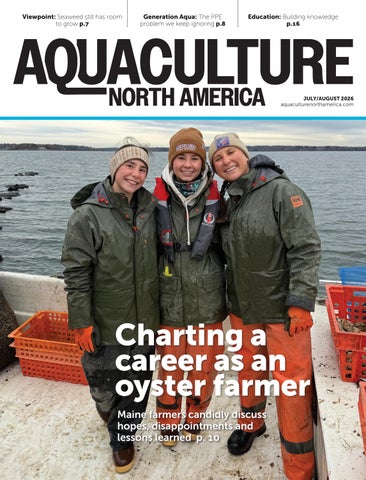
Charting a career as an oyster farmer Maine farmers candidly discuss hopes, disappointments and lessons learned p. 10
P A R T N E R S H I P, T R U S T, A N D I N N O VAT I O N . P R E PA R I N G T O G E T H E R F O R T O M O R R O W ’S WAT E R S .
AQUAFLOR®
(florfenicol) T Y P E A M E D I C A T E D A R T I C L E
PHOTO: CREDIT TK HERE
LEARN MORE ABOUT OUR INDUSTRY LEADING SOLUTIONS. Copyright © 2025 Merck & Co., Inc., Rahway, NJ USA, and its affiliates. All rights reserved. US-AQP-250400001
2
AQUACULTURE NORTH AMERICA
July/August 2026
Contents July/August 2026 Vol. 17, No. 3 aquaculturenorthamerica.com
Custom Nets, Service, Cages, Moorings, Plankton / Lice Tarps, and Underwater Drones
Features VIEWPOINT
7 Seaweed still has room to grow
PRO MAX
By Jordan Hawkswell COVER STORY
10 Charting a career as an oyster farmer Maine farmers candidly discuss hopes, disappointments and lessons learned By Lynn Fantom
The New Flagship
DELIVERING THE DIFFERENCE ™
16 Building knowledge
www.AffordableROV.com
How U.S. Sea Grants are increasing industry literacy across the country By Treena Hein
www.morenot.ca
ANA_MORENOT_JULAUG25_ASK.indd 1
2025-06-19 2:46 PM
INNOVATION BEYOND MEASURE RESULTS BEYOND EXPECTATION 100% Titanium Heat Exchangers
High-Performance Chillers & Titanium Heat Exchangers
Hot & Cold Water Loop Systems Heat Exchangers in Tube Sheet, Helical Coil, or Plate Compact Designs Easy Installation Salt & Fresh Water Safe Chiller & Heat Pump Packages
COVER PHOTO: ALICIA GAIERO
Electric Heaters & Gas Boilers
Columns
Departments
5 From the Editor Changing the narrative 8 Generation Aqua The PPE problem we keep ignoring 14 Deep Dive Open your mind to seaweed farming By Ben Normand 22 Career Fieldnotes Building the bridge between aquaculture education and employment
6 News 20 Showcase
CONTACT US TODAY! (704) 774 1391 info@aqualogicinc.com sales@aqualogicinc.com http://www.aqualogicinc.com 2806 Gray Fox Road Monroe, NC 28110
AQUACULTURE NORTH AMERICA
aquaculturenorthamerica.com HI_Aqua Logic _JanFeb26_CSA.indd 1
3
2025-11-10 7:25 AM
SEPT 3, 2026 • 11AM EST • ONLINE SUMMIT LAKE & POND SUPPLIES
Est. 1989
AQUACULTURE SUPPLIES
Proud to have served the aquaculture industry for 35 years and looking forward to many more!
2026
Innovation, Intelligence & Impact For North America’s Aquaculture Community FEATURING EXPERT PANELS ON EXPANDING SEAWEED AQUACULTURE MARKETS, AI AND AUTOMATION IN FARMS AND MORE.
Presented by: OWNERS NARROW BOLD
Gold Sponsors:
LAKE & POND SUPPLIES
Est. 1989
AQUACULTURE SUPPLIES
116 Bonnie Cres, Elmira, Ontario, Canada Toll Free: (877) 669-1096 www.FishFarmSupply.ca info@FishFarmSupply.ca
REGISTER TODAY I ANANEXUS.COM
Proven equipment for shellfish producers
ANA_NEXUS_JULYAUG26_JLR.indd 1
MT Mussel sorter
MT Debyssing machine
ANA_FishFarmSupply_MarApr26_CSA.indd 1 2026-06-26 11:10 AM
2026-02-13 10:06 AM
MT Oyster counter
MT Cone stripper
Formutech Inc.
Charlottetown, P.E.I. Phone 1 855-599-0099 E-mail info@formutech.ca www.formutech.ca
4
AQUACULTURE NORTH AMERICA
ANA_Formutech_JulyAug26_CSA.indd 1
July/August 2026 2026-06-19 11:34 AM ANA_HexcylSystems_MayJune23_MLD.indd 1
2023-04-03 8:55 AM
From the Editor BY SEYITAN MORITIWON VOLUME 17 ISSUE 3 | JULY/AUGUST 2026
Reader Service Print and digital subscription inquiries or changes, please contact customer service Angelita Potal Tel: (416) 510-5113 Fax: (416) 510-6875 Email: apotal@annexbusinessmedia.com Mail: 111 Gordon Baker Rd., Suite 400, Toronto, ON M2H 3R1 Editor Seyitan Moritiwon smoritiwon@annexbusinessmedia.com Contributors Imani Black, Lynn Fantom, Jordan Hawkswell, Ben Normand, Treena Hein, Leah Williams Stoker Associate Publisher Jeremy Thain jthain@annexbusinessmedia.com +1-250-474-3982 Brand Sales Manager Patrick Villanueva pvillanueva@annexbusinessmedia.com 416-606-6964 Account Coordinator Barb Vowles bvowles@annexbusinessmedia.com Media Designer Graham Jeffrey gjeffrey@annexbusinessmedia.com Audience Development Manager Urszula Grzyb ugrzyb@annexbusinessmedia.com 416-510-5180 Group Publisher Anne Beswick abeswick@annexbusinessmedia.com 416-410-5248 CEO Scott Jamieson sjamieson@annexbusinessmedia.com PUBLISHED BY ANNEX BUSINESS MEDIA 105 Donly Drive South, Simcoe, ON N3Y 4N5 Aquaculture North America is published five times a year by Annex Business Media. The authority for statements and claims made in Aquaculture North America is the responsibility of the contributors. Reference to named products or technologies does not imply endorsement by the publisher. Subscription rates (five issues) Canada: $39.25 (per year+tax) | Canada: $67.36 (2 years+tax) U.S: $50.92 (CDN per year) | Foreign: $65.77 (CDN per year) To subscribe visit our website at aquaculturenorthamerica.com Printed in Canada ISSN 1922-4117 Publications Mail Agreement #PM40065710 RETURN UNDELIVERABLE CANADIAN ADDRESSES TO 111 Gordon Baker Rd., Suite 400, Toronto, ON M2H 3R1 Annex Privacy Officer Privacy@annexbusinessmedia.com Tel: 800-668-2374 The contents of Aquaculture North America are copyright ©2026 by Annex Business Media and may not be reproduced in whole or part without written consent. Annex Business Media disclaims any warranty as to the accuracy, completeness or currency of the contents of this publication and disclaims all liability in respect of the results of any action taken or not taken in reliance upon information in this publication.
Next Ad Deadline The advertising deadline for the September/October issue is July 24 Don’t miss the opportunity to be part of this publication. For more information, or to reserve space in the next issue, call our advertising department at +1.250.474.3982 jthain@annexbusinessmedia.com
Changing the narrative
I
remember my first encounter with fish consumers now believe that wild salmon farming. I didn’t even know the word is better than farmed. They're questioning "aquaculture" then, but every Friday, my what is used to make fish feed. And I am father would bring home some catfish doing my best to educate them even with for us to prepare for dinner. It was our Friday the little I know. But, I am just one person. ritual, you could say. The public relations for farmed fish Several years down the line, I’m working needs to be more proactive and more as the new editor of an aquaculture maga- strategic. You need to take a hold of your zine, something that I never thought was in industry and change the narrative before the cards growing up. more minds get captured by the opposition. I started working at Aquaculture From my perspective, as North America as associate editor someone who's new to aquaculand as I began to learn more A recent ture, I think the industry is doing about this industry, my mind report from great work. Whenever I go to the went back to my father's little the FAO grocery store to pick up some pond farm in Nigeria and how found that salmon, I'm always happy to know that provided food for our family. global that aquaculture professionals are Working at an aquaculture publica- aquaculture hard at work to ensure we have tion is like a full circle moment for production more seafood on our shelves. me, especially as I contributed my of aquatic On the topic of producing more very tiny quota of feeding my dad's animals seafood to meet rising global decatfish at the age where I could reached a mand, the industry must continubarely tell my left from my right. record 103 ally improve to meet this demand. It’s been a few months since million This includes technologies like becoming editor and I can say tonnes in artificial intelligence and remote that it has been eye-opening. I've 2024. site monitoring. Or in line with the spoken to a number of people and theme of this issue, scaling seaweed one thing echoes through – we aquaculture into other industries. need good publicity for farmed seafood. That's why we, at Aquaculture North America, This industry is complex and fascinating. are organizing a virtual event for you! From finfish farming to shellfish production, Aquaculture Nexus will bring together every facet of this industry is working hard to industry experts to talk about these topics produce more seafood for a growing world. and you'll have the opportunity to ask them Those efforts are yielding results. A re- questions. This is the second edition of the cent report from the UN Food and Agricul- event and I can already tell you that this ture Organisation (FAO) found that global year is going to be just as great as last year's. aquaculture production of aquatic animals While I helped feed fish a few times in my reached a record 103 million tonnes in 2024. dad's farm, I am in no way an expert on the So, how do we take this message to the wider subject of aquaculture. I acknowledge that public whom you are working so hard to feed? I’m very new to the world of aquaculture, We're well aware of the work activists so I’ll rely on you, our wonderful readers, to are doing to oppose this industry, especially help steer the conversations that happen on when it comes to open ocean farming. these pages in the right direction. And I can tell you that in some of the conPlease email me to chat about any ideas versations I've been a part of so far, they you might have at smoritiwon@annexbusiare sowing seeds in many hearts. Many nessmedia.com. | ANA
Next Editorial Deadline The editorial deadline for the September/October issue is July 10. Contact Seyitan Moritiwon at smoritiwon@ annexbusinessmedia.com for details. Material should be submitted electronically with prior arrangement with the editor.
Aquaculture North America’s Editorial Advisory Board: Jeff Hetrick | Kathleen Hartman | Marcy Cockrell
AquacultureNorthAmerica
aquaculture-north-america AQUACULTURE NORTH AMERICA
5
News
Glidden Point oyster farmers in September 2025. CREDIT: JACK SULLIVAN, MAINE AQUACULTURE ASSOCIATION
Maine’s aquaculture economic impact grew by 51 per cent over a decade, study finds A new economic study by the Maine Aquaculture Association (MAA) reports $105.9 million in aquaculture sales in 2023, up 44 per cent from 2014. Over the same period, Maine’s total economic contribution increased by 51 per cent from $137.6 million to $208.1 million, while the total number of jobs increased 60 per cent, to 1,720 jobs. The report assesses aquaculture’s economic contributions to the state, while highlighting its three subsectors: finfish, shellfish and seed, and seaweed. It also provides updated industry data for small businesses, policymakers, and other stakeholders. “We’re not just growing seafood, we’re growing small businesses, careers, knowledge, innovation, and community resilience,” said Sebastian Belle, executive director of the Maine Aquaculture Association.
6
The study found that the shellfish and seed subsector more than tripled in sales, with the top three species by sales revenue being Atlantic salmon, eastern oysters, and blue mussels. Glidden Point Oyster Farms is one business that has experienced growth. It employs 22 year-round employees and an additional 15 in the summer. "Maine aquaculture grew the right way,” said Ryan McPherson, owner of Glidden Point Oyster Farms. “It didn't boom. It was built slowly, carefully, with farmers who care about their communities and the waters they're working in.” McPherson added that he’s optimistic about the future of the industry.
University of New Hampshire to lead NOAA's new aquaculture institute The University of New Hampshire has been named the host for NOAA’s new institute aimed at strengthening the American aquaculture industry.
AQUACULTURE NORTH AMERICA ANA_MaineAquaculture_MarApr26_CSA.indd 1
About $13.5 million will be available this year for projects following the establishment of Cooperative Institute Fostering Aquaculture Research and Markets (CIFARM). CIFARM is a five-year cooperative that involves partnerships with researchers to advance American marine aquaculture. Research areas will include marine aquaculture demonstration projects, engineering and technology development, AI for aquaculture, environmental observations and forecasting, risk management and vulnerability analysis, and seafood markets research. “The United States is finally recognizing aquaculture as a vital complement to our world-class fisheries,” said Neil Jacobs, NOAA administrator. “We look forward to collaborating with these exemplary partners to continue to unlock the potential of this industry in the United States.”
Study finds U.S. aquaculture faces 170,000 regulatory restrictions A new report estimates U.S. aquaculture producers face about 170,000 regulatory restrictions, highlighting what researchers describe as one of the world's most stringent regulatory frameworks. "The Complex Regulatory Framework for U.S. Aquaculture," published by The Virginia Seafood Agricultural Research and Extension Center (VSAREC), found that about 29 congressional acts govern aquaculture farm operations. VSAREC found that these regulations are spread across multiple levels of government. Overall, 43 per cent of regulations identified on U.S. aquaculture farms were federal, 47 per cent were state, 2 per cent were state-enforced federal mandates, 6 per cent were local (municipality, county, district), and less than 1 per cent were tribal regulations. The report noted that the national compliance burden in 2023 was $196 million, accounting for 9 per cent to 30 per cent of total annual costs. It stated that the U.S. lost $807 million in revenue as a result of these regulations. Researchers say streamlining the U.S. regulatory framework will enable the country to become more self-sufficient in the production of seafood and benefit from its economic contributions. Regulations include adding sunset clauses to regulations, standardizing applications of regulations to reflect regulatory approaches used in agriculture, relying on the best available science, using participatory rule-making and quantitative risk assessment and establishing clear appeals procedures for inspection decisions. July/August 2026
2026-02-17 4:03 PM
Viewpoint BY JORDAN HAWKSWELL
Jordan Hawkswell is the director of development at the Pacific Seaweed Association, among other aquaculture gigs. She works to explore how aquaculture can provide sustainable opportunities for coastal communities while supporting a thriving ocean ecosystem. (jordan.hawkswell@ seaweedindustry.ca)
Seaweed still has room to grow
CREDIT: NORTH ISLAND COLLEGE
W
e are all still waiting for seaweed to find its groove in the North American market. We know the potential is there, and that there are countless passionate, brilliant people putting in good work to make the seaweed sector into something self-sufficient and thriving in Canada and the U.S. While examples of specific successful seaweed companies or value chains exist throughout North America, as a whole, we are still trying to find our rhythm as a sector and connect the many dots needed to form a cohesive value chain. A compelling pathway was to work towards seaweed as the new soy, to essentially incorporate a little bit of seaweed, via extracted derivatives or intact forms, into dozens and dozens of products, from food to clothing to cosmetics. The idea being that seaweed demand grows as more and more industries adopt seaweed in some form as a part of their process. So far, this method hasn’t come to fruition, though there are still efforts to integrate seaweed components into snacks, shoes, shampoo, and more. But this isn’t the only pathway to success. Maybe North American seaweed can find just one or two avenues to large-scale production and subsequent buyers. Could biomaterials and biostimulants fit the bill? There are certainly some players in B.C. who think so. We heard from them, and many others, at the inaugural Pacific Seaweed Summit (PSS), which took place on May 6-8 in Campbell River, B.C., on the traditional territory of the Ligwiłdaxw people. The event was co-hosted by North Island College, Wei Wai Kum First Nation, Heiltsuk Climate Action, and the Pacific Seaweed Association, each with a deep interest in and broad experiences with seaweed. Over 150 people attended the event, representing Indigenous Nations, businesses, non-profits, government, academia, and others with an interest in B.C.’s developing seaweed sector. The range of people representing various parts of the seaweed sector made for dynamic and interesting discussions, including the ongoing search for sustainable markets for seaweed.
aquaculturenorthamerica.com
There was ample speak of value chain development and market demand for seaweed in B.C. at the PSS. Early comments flagged the lack of consideration of environmental services within the value chain. The gap was quickly remedied in the visual value chain project found along the main room wall, which then illustrated that the environmental and social aspects of the sector can be, and are currently being, integrated into the value chain. With this in mind, there was great discussion from organizations that are doing vital ecosystem monitoring, as well as businesses that are building products that can address important needs, like creating biomaterials and agri-products that are not fossil fuel-derived. These conversations rightfully garnered significant interest as biomaterial science advances and demand for biostimulants grows. There could be a market here for copious volumes of seaweed to support the businesses rising to fill this niche. Lower Mainland- and Vancouver Island-based companies, including PhyCo Technologies, SeaCork Studios, Cascadia Seaweed, and SeaFoam, spoke on panels or showcased their products, allowing attendees to hear about their innovative ideas and product development. It was impressive to see high-quality products, made with Canadian seaweed, addressing real needs in sectors such as construction and agriculture. From fermenting to drying to extracting valuable compounds, these companies are aiming to process a lot of seaweed in the near future. Many of these companies are in early stages of product development, though the proof of concept is definitely there. Biostimulants that may help with drought
resistance in crops and bioplastics that can fully replace petroleum-based plastics and are truly compostable - it’s easy to see the pathways to success for these companies. Several of these products have already secured funding, awards, and investments that showcase the faith that funders have that the products will address important issues. It may be sooner than later that businesses like these are seeking seaweed by the tonne. It is heartening to see these fully seaweed-oriented businesses, and other adjacent ones (i.e., cosmetic brands), looking to incorporate seaweed into their models with great intentions of making their products truly sustainable and accessible at scale. It is also heartening to see some real pathways emerging for farmers to get large volumes of their crop to market. However, to accomplish this goal, a consistent and sufficient seaweed supply is required for both farmers and buyers to thrive. There are still very real challenges in the seaweed production process, including seed supply, crop failures, farming efficiencies with various species, and securing processing facilities, not to mention the regulatory landscape surrounding each. All of these factors and more can affect the consistency of seaweed supply, and while there is work being done to address these, there is a ways to go. The promise of buyers can provide the confidence that existing farmers need to expand their operations, and new farmers need to enter the sector. With this confidence will come the need for financial and regulatory support through the sector to ensure the balance of supply and demand. The Pacific Seaweed Association aims to provide such support and be a connection point between the key actors in making the system work. If biomaterials and biostimulants can create this opportunity for farmers to be assured in their growing operations, there may be a solid foundation for sector growth. While other, smaller markets like food and cosmetics will still be a part of the larger seaweed sector, having a large-scale industry like agriculture or construction behind the growth of the sector may be the boost seaweed has needed to thrive. | ANA AQUACULTURE NORTH AMERICA
7
Generation Aqua BY IMANI BLACK
Imani Black is an aquaculture professional, aquaculture advocate, and industry trailblazer with a decade of experience in oyster farming and hatchery management across Maryland and Virginia. As the founder of Minorities In Aquaculture and a graduate with a Master’s degree in Ecological Anthropology from the University of Maryland Center for Environmental Science, she is dedicated to fostering workforce inclusivity and equity through mentorship, education, and advocacy. (imanib@mianpo.org / www.mianpo.org / @imaniiiblackkk)
The PPE problem we keep ignoring
T
here’s this unspoken rule in a lot of our industries: boatyards, hatcheries, farms, and decks. You figure it out. You make it work. You don’t complain. And sometimes, the thing you’re expected to “just deal with” is your safety gear. Boots that don’t come in your size. Gloves that make your job harder instead of easier. A mask that technically fits, but not enough to actually protect you. And the expectation? Adjust. Adapt. Keep going. But here’s the reality we don’t say out loud. If your personal protective equipment (PPE) doesn’t fit, it’s not protecting you. And if it’s not protecting you, it’s not PPE.
This isn’t isolated, it’s systemic Organizations like Women in Boat Building
have started putting data behind what many of us have experienced for years. Their PPE survey didn’t just highlight a few frustrations; it revealed a pattern. Around 90 per cent of women surveyed reported wearing PPE that doesn’t fit properly. At that point, this stops being about inconvenience. It becomes a system-wide issue. Because when something affects nearly everyone in the same way, it’s not about individuals needing to adjust. It’s about a system that was never designed with them in mind. And yet, the response has been the same for years. Roll the sleeves. Double up the socks. Tape the gloves. Figure it out. We’ve normalized adaptation instead of asking a much more important question: Why are certain people still being asked to adapt in the first place?
“Safety first” only works if it includes everyone We talk about safety constantly in this industry. It’s part of our training, our operations, and recently, even occupational safety. But that commitment breaks down when the equipment itself doesn’t work for everyone using it. Because this isn’t about comfort. It’s about protection. Ill-fitting gloves reduce grip and control, respirators that don’t seal expose people to real harm and gear that restricts movement creates new risks. And in many cases, even basic practices like proper fit testing aren’t standard. So, people are being handed equipment that doesn’t fit and expected to perform safely anyway. We say safety comes first. But if it doesn’t apply equally, then it doesn’t actually come first at all At the core of this issue is a simple question: Who is this gear designed for? Because much of the PPE used across marine and aquaculture industries is still based on male body standards, without fully accounting for the realities of the people actually wearing it. And that shows up in real ways. Sizing that assumes “smaller” is the only adjustment. Proportions that don’t align. Gear that technically exists for women but doesn’t actually work. Because designing for someone is not the same as designing with them in mind.
This is bigger than one industry If I’m being honest, this is something I didn’t even fully think about at first. As a female oyster farmer, I never labelled what I was wearing as “PPE.” It was just my gear—boots, gloves, layers, whatever got me through the day. But that language shift matters. Because the moment we start calling it what it actually is, personal protective equipment, it changes the stakes. This isn’t just about gear. It’s about safety. It’s about protection. It’s about whether or not people are being put at risk just by showing up to do their jobs. And looking back, I was doing what so many women are doing: Adjusting. Making it work. Not questioning it. And while aquaculture might look different than a boatyard, the issue is the same. This isn’t just a maritime problem. It’s not just 8
AQUACULTURE NORTH AMERICA ANA_Magic Valley_JanFeb26_CSA.indd 1
July/August 2026 2025-12-05 9:49 AM
an aquaculture problem. This is a women’s gear problem. Across outdoor industries, fieldwork, and trades, women are navigating equipment that wasn’t built with their bodies in mind. Yes, there are more options now. But let’s be real about what many of those options actually are: Smaller. Tighter. Pink. And for some people, that works. But what about the women who just want gear that performs, who want to show up, do their job, and be taken seriously without having to choose between functionality and perception? Because the reality is, women in these industries are already navigating enough. They shouldn’t also have to fight their gear.
The invisible cost There’s also a quieter side to this. What does it feel like to show up every day knowing something as basic as your safety gear wasn’t built for you? It’s subtle, but constant. The extra time. The extra effort. The constant adjustment. And over time, it wears on you. For some, it becomes background noise. For others, it becomes the reason they leave.
What needs to change If we’re serious about building an industry that people can stay in, not just survive in, this has to move beyond awareness. It has to turn into action: • Involve women directly in PPE design and testing. • Expand sizing and fit options that reflect real bodies. • Standardize proper fit testing and safety practices. • Hold companies accountable for equipment that actually protects everyone. • Treat lived experience as data, not complaints. Because this isn’t about preference. It’s about safety. At a certain point, we have to stop pretending this is just about gear. Because it’s not. It’s about design. It’s about who gets considered. It’s about whose experiences are built into the systems we rely on every day. We talk a lot about growing this industry. About bringing in new people, new voices, new energy. But if the systems those people
are entering haven’t changed, then we’re not building something new. We’re just asking more people to tolerate the same problems.
The smallest detail can say the most We like to think innovation in this industry is big. Complex. Transformational. But sometimes the clearest sign of progress is something much simpler. Like, whether or not someone can show up to work and have gear that actually fits their body. Because if we’re still getting that wrong. If we’re still asking people to compromise their safety just to participate. Then we’re not as far along as we think we are. And it’s time we start acting like we want to be. We pride ourselves on being tough in this industry. But toughness shouldn’t mean accepting systems that don’t work. It shouldn’t mean adjusting to things that put us at risk. And it shouldn’t mean staying silent about it. Because safety is not negotiable. And if it doesn’t work for everyone, then it doesn’t work at all. | ANA
AQUAMESH
®
M a n u fa ct u r e d b y R iv e r d ale M ill s
TRUSTED DURABLE AMERICAN MADE
www.riverdale.com | sales@riverdale.com | 1.800.762.6374
aquaculturenorthamerica.com ANA_Riverdale_JulyAug26_CSA.indd 1
AQUACULTURE NORTH AMERICA
9
2026-02-09 3:31 PM
COVER STORY
Charting a career as an oyster farmer
W
hen five-year-old Alicia Gaiero went out to dinner with her parents, she liked to order a pound of mussels and a salad with blue cheese. Now, at 28, the founder of Nauti Sisters Sea Farm is still precocious. Gaiero has taken a seat at the table of Maine aquaculture leadership and, more specifically, set the pace in workforce diversity, boat tours to increase social license, and solar-powered farming. Yet, she has decided not
The Gaiero sisters (L to R: Amy, Chelsea, and Alicia) launched Nauti Sisters Sea Farm in 2020 in Yarmouth, Maine, growing oysters which have won awards in blind taste tests.
to expand her small, award-winning oyster farm. In February of 2025, she took a full-time position at Maine Sea Grant supporting research of on-demand fishing gear for the lobstering industry. The decision came down to time and money. “I don't want to wait another two to four years to get a [larger] lease and then another two to three to bring a product to market,” Gaiero says. “And how will I ever be financed to grow a business, buy property, and scale?” Her six-year foray in aquaculture also begs the question: How much must farms scale for owner-operators to make a living wage? It comes at a time when Graham Platner – a Maine oyster farmer – is running for U.S. Senate, on a platform of affordability. He is seeking property tax relief for low-and middle-income residents and bans to prevent corporations from buying up single-family homes as rental investments. Maine, which is known as “Vacationland,” also has the highest percentage of seasonal homes of any U.S. state, including Florida. Owners of coastal properties have mounted some of the fiercest pushback against new leases enabling oyster farms to scale.
How a dream started It may not be surprising that Alicia Gaiero, a native of Belfast, Maine, 10
AQUACULTURE NORTH AMERICA
became involved in aquaculture. Shortly after she started college, Nordic Aquafarms announced plans to build a US$500 million, land-based Atlantic salmon farm in her hometown. That became the focus of her sophomore-year paper on environmental policy planning. Also, during college, an internship exposed her to oyster farming. But it wasn’t until her junior year at the University of Maine that this seafood-lover actually ate an oyster. A year later, she started her own surface-culture farm in Yarmouth. “It was a pretty bold move. I also had this impression I was going to put 100,000 oysters in the water and within two years make a $100,000,” she laughs. In 2020, with the Covid-driven hiatus, she developed a business plan for a farm with a catchy name and three revenue streams – selling July/August 2026
PHOTO: ALICIA GAIERO
Maine farmers discuss hopes, disappointments and lessons learned By Lynn Fantom
PHOTOS: ALICIA GAIERO
oysters, merchandise, and tours. With her Geographic Information Systems (GIS) skills, Gaiero kept herself afloat with a side hustle consulting on aquaculture applications. Her two younger sisters also joined her full- and part-time. In three years, Nauti Sisters Sea Farm’s entry at the Freeport Oyster Festival was voted the second-best oyster in Maine. Top awards for the farm’s boat tours followed from DownEast magazine, among others. Today, Gaiero reflects on how these tours have attracted a diverse group, ranging from families looking for an activity to people who come with written questions. Conversations run the gamut, from salmon farming to scaling aquaculture. “I try to meet people where they’re at, changing minds one customer at a time,” she says with satisfaction. aquaculturenorthamerica.com
Leasing a life on the water Gaiero and her sisters launched their oyster farm via five Limited Purpose Aquaculture (LPA) licenses, renewable each calendar year. Each license allows a grower to farm a location of up to 400 square feet. Maine’s Department of Marine Resources (DMR) devised this permit to encourage individuals to try farming or test a new species before committing to apply for a “standard” lease, which authorizes cultivation of identified species for up to 20 years in areas up to 100 acres. The demanding process requires a rigorous application, public scoping sessions, and mandatory public meetings. LPAs help people “learn and experiment,” says Christian Brayden, project manager at Maine Aquaculture Association. “The LPA is not meant to support a commercial business.
At center, team members on Nauti Sisters’ solarpowered work barge, alongside the vessel, left, dubbed Tidal IX, in honour of the law prohibiting sex-based discrimination in school programs. At right, tourists arrive for a farm tour.
Financially, it just probably would not work because the space is so limited.” Studies support Brayden. For example, an economic analysis of off-bottom oyster culture published in June 2024 concluded that the average small-scale operation is not expected to be profitable. “We estimate that it is generally necessary to operate at or above levels of 720,000 oysters planted on three acres to realize a positive average annual profit,” wrote David R. Petrolia in Aquaculture Economics & Management. This conclusion was consistent with the findings of other studies. Yet, the aquaculture sector in Maine is dominated by small- and medium-scale producers. What’s more, women hold roughly a third of all LPA licenses, a percentage that decreases among holders of standard leases, according to 2020 research AQUACULTURE NORTH AMERICA
11
COVER STORY
conducted by Colby College and the Gulf of Maine Research Institute. “The female-owned small business works well for grant funding and looks sexy for a lot of places which people want to support,” says Gaiero, speaking from her own experience. “But it is not actually a reflection of what is really needed for a viable industry.” That requires scale. “I decided that, for me, I couldn't get to where I needed to be fast enough,” she reasons, acknowledging the pull to buy a house and travel. Nauti Sisters, with an annual harvest of about 70,000 oysters, will continue its tours, tastings, and sunset cruises, ranging from US$155 to $180 per person. “Doing the tours and having innovative workforce development partnerships is what makes this fun and exhilarating and rewarding for me,” Gaiero says. “I haven't quite figured out the part about how to really earn a living, but we're working towards it.”
When does a side hustle become enough to live on? About 80 nautical miles northeast of Yarmouth is Deer Isle. Here in 2015 Abigail Barrows purchased a three-acre oyster farm, which had been dormant. Then employed as a marine scientist, Barrows was 31 and had never farmed before. Christening it the Deer Isle Oyster Company, she reseeded and began working it while still focusing professionally on microplastics pollution research. Oyster farming may be “alluring,” she says now, “but don’t quit your day job.” Barrows worked out of her rowboat for two years to give her time to assess her situation and learn. Oyster farming can be cold, hard, and muddy—and also complex. It took Barrows time to get systems in place and evaluate stocking densities, fouling dynamics, seasonality, and tending protocols on her farm. “You can fail with 80,000 oysters as easily as one million. You’re going to make mistakes,” she says, “so I’m glad I took it slowly and had time to figure things out.” She advises that ocean farming isn’t for people who like to be told what to do. “There’s always some level of chaos.” “I fell in love with it,” she adds. That must be the scientist in her speaking. Two or three years later, as the oysters were reaching market size, she had gained confidence in the business as a going concern. Then she got “jazzed up” about marketing. “I always wanted to have that opportunity 12
AQUACULTURE NORTH AMERICA
Abigail Barrows grows oysters and kelp on 7.6 acres by holding two standard leases, which also authorize her to farm sea urchin and sea scallops in the future. PHOTO: KATHERINE EMERY
Alicia Gaiero and Nate Henninger are using a knuckle boom boat to raise Nauti Sisters' cages after overwintering on the bottom of Casco Bay. PHOTO: JACK SULLIVAN, MAINE AQUACULTURE ASSOCIATION.
July/August 2026
PHOTO: CREDIT TK HERE
Abigail Barrows, a marine biologist, holds three oysters demonstrating the differences between surface and bottom culture at Deer Isle Oyster Company. PHOTO: KATHERINE EMERY
for community connection. I was intrigued about the chance to educate people about the environmental impact of oyster farming. In fact, I felt it was my duty.” Life then took a couple of big turns. In 2018, her daughter was born. And in early 2019, Barrows left her position as principal investigator at Adventure Scientists, with the satisfaction that she and the team had created the world’s largest microplastics data set. Now eager to talk about the ecosystem benefits of oysters, Barrows ventured out into a broader public arena beyond the local coffee shop – museums, colleges, and garden clubs. In a way that was educational, but “not preachy,” she blended aquaculture information with the importance of preserving Maine’s working waterfront and the opportunities to create plastic-free fishing gear. But after launching an application for another standard lease of 4.6 acres, the waters became a little choppy. In 2024, a conservation committee formally intervened with concerns about predation of larval clams by cultured oysters.
“In a fishing town that historically has welcomed commercial enterprises on the water from wild harvesting to aquaculture, pushback is rare,” wrote the Mount Desert Islander. After three months of site reports and public hearings, however, the DMR granted approval. Just this year, Barrows also received approval to go beyond oysters and kelp to grow green sea urchin, sea scallops, and sea lettuce, using new gear. This change required a 27-page “amendment” report, dense with charts, maps, drawings, and photographs. The leasing process is “arduous, lengthy, and expensive,” Barrows says. She offers a tip on something she wishes she had done. “Take the extra time to think about what else you might want to do during the next twenty years, what different gear types, what other species. You want to give yourself enough wiggle room for later on.” Despite the burdensome paperwork, polyculture farming holds much promise. “It is good for the environment, complementary for the different species, and good for business to diversify risk,” she says. | ANA
In her Maine workshop, Abigail Barrows holds a coil of manila and basalt rope which she is testing as part of her effort to develop plastic-free aquaculture equipment. PHOTO: KATHERINE EMERY
Oyster Trays stacked with quality For over 35 years oyster growers worldwide have trusted our S1000 Oyster Tray and S4000 nursery tray, to produce the highest quality half-shell oyster for today’s demanding consumers.
ENTERPRISES
Cell: 604-833-5311 darksea@shaw.ca
S4000 nursery trays
S1000 oyster trays
Featuring our 6061 T-6 aluminum suspender pole which stands up to the harshest of salt water environments.
AQUACULTURE NORTH AMERICA
aquaculturenorthamerica.com ANA_DARKSEA_MarApr25_BAS .indd 1
13
2025-02-03 2:28 PM
Deep Dive
Ben Normand a fish farmer, writer, college instructor, and cheerleader for aquaculture. He has worked with various fin and shellfish species in New Zealand and Canada in production management, compliance, and communications. (ben.r.normand@gmail.com)
BY BEN NORMAND
Open your mind to seaweed farming
14
AQUACULTURE NORTH AMERICA
At its core, this is farming that focuses on providing habitat in the ocean.
Unlike Quaid, when the sugar kelp reached its own slimy, wet arms out to me, I did not open my mind, and the truth of what to do with it was not revealed. I was bound by my own pre-conceived notions of what it could be used for, which were themselves based largely on a genuine lack of knowledge and familiarity with the product, its chemistry, and the potential applications. Sugar kelp simply isn’t part of the thinking that informs my understanding of modern aquaculture supply chains, because it had not been previously. The cycle perpetuates itself. This experience is not unique in the burgeoning seaweed sector. In preparing for this article, I reached out to one of my colleagues at Skretting, Tim Harder. You might know him from his "How Great is Aquaculture" post series on LinkedIn (another recommendation for you, if you’re unfamiliar). I did this because Tim owned a small seaweed farm in a previous life. He agreed on the relative ease of farming compared to more capital-intensive marine farming, such as salmon farming. He said, “At its core, this is farming that focuses on providing
habitat in the ocean, as opposed to providing habitat, food, health interventions, etc. The farmer places seeds in the habitat, and if the site is good and the habitat is at the right depth, the seaweed can grow quite rapidly.” Of the ecosystem benefits, he said, “Seaweeds can reduce the acidity of the water by removing carbon dioxide and increasing oxygen. Researchers have even suggested a ‘halo effect’ where local water and ecosystem quality is improved through reduced acidity and through the provision of habitat for fish and shellfish, particularly small and juvenile organisms.” Of the health benefits of eating seaweed he said, “It’s really very good for you as a food source. A serving of sugar kelp has more fibre than a serving of brown rice, more calcium than a glass of milk, and it contains several micronutrients such as iodine and manganese.” While his assessment on the merits of cultivation and consumption of seaweed is certainly true, the picture he painted of his experience was not all rosy. The growing period is short, with seeding happening in October/ July/August 2026
PHOTO: WIRESTOCK / ISTOCK / GETTY IMAGES
O
ne of the great joys in life for me is rewatching my favorite movies. From Forrest Gump to Goodfellas, in opposition to their inherent invariability, I am always changing and thus I can get something new from them with each rewatch. One such movie that I watched recently is the 1990 sci-fi hit, Total Recall (if you haven’t seen it, I highly recommend you do). In this movie, the protagonist, Douglas Quaid, is on a quest to unlock his memories to help uncover a conspiracy. In pursuit of this, he is introduced to the leader of a gang of mutants, named Kuato. Kuato is a slimy, discolored lumpy sort of baby-adult that consists of a head and arms growing out of the stomach of his brother, and he possesses the power to reach into Quaid’s mind and unlock those memories. In one of the most iconic scenes in the movie, Kuato begins the process of unlocking these memories by reaching his slimy arms out to Quaid and repeatedly saying, “Open your mind to me.” As a younger person, I felt a sense of wonder, discomfort and awe at the majestic possibilities of the universe beyond our world, including mind-reading mucous wart people. As an adult, it surprisingly made me think of seaweed. While working in the Prince Edward Island mussel industry, I was once tasked with trying to sell seaweed. One of the company owners had several long lines of fully grown sugar kelp with no home. These were the product of collaboration between government and industry to assess the biological potential of sugar kelp cultivation in Nova Scotia. Of course, I gave it my best shot by researching how sugar kelp is used, and then pursuing leads for producers of the products mentioned. Guess what? The kelp could be easily grown, it could be easily harvested, it could be easily landed and transported, but it couldn’t be easily sold.
November and harvest happening in April/May, meaning most of the work is happening during the coldest months of the year, when storms are most prevalent. Of the challenges of selling seaweed reliably and in bulk, he said, “In some ways, seaweed has the opposite problem of say, salmon farming. People love to eat salmon, and they’re comfortable handling and preparing salmon because it’s familiar to them. Through misinformation campaigns, though, opponents of salmon farming have been able to muddy the story of salmon farming in the forum of public opinion. To some, the story is bad, but the demand for the product is high. Conversely, seaweed is almost universally seen as the next great sustainability success story in our industry, even by those who denigrate other forms of aquaculture, but demand remains low. People in many countries are not so familiar with how to prepare it. It’s not a center-of-the-plate item.” Taking a higher-level view of the status of seaweed farm-to-consumer supply chains, Andrea Angera, CEO of Springtide Seaweed and leading voice on the American seaweed sector, recently posted on LinkedIn, expressing a grounded take on the status of sectoral development. In it, he says, “The data from 2026 tells a story that glossy press releases often omit. We are seeing a massive disconnect between non-profit revenue and actual farm-gate value… While the hype machine is in high gear, the actual harvest numbers for 2025 remain startingly low for an industry touted as the ‘next big thing’… [<490,000 lbs]… to put that in perspective, a single mid-sized land farm can produce that same weight in potatoes or corn on a fraction of the budget and with significantly less fanfare.” He goes on to further elaborate on this disconnect between fanfare and reality, “The most telling
FULLY AUTOMATIC OYSTER PROCESSING TECHNOLOGY
metric of the year comes from GreenWave, the high-profile Better quality oysters, in less time, for less cost. non-profit leading the seaweed change. The 2025 financials reveal a troubling disparity: GreenWave Revenue: Over SED Vision Grader US$9.1 million (largely from The number 1 labour saving grants and donations). Farmer equipment in America. support: They paid out $264,700 Cleans, measures, sorts, to seaweed farmers to grow seacounts and bags oysters fast weed. Market sales: GreenWave and automatically. sold $42,933 worth of seaweed itself – effectively competing for ACCURATE - high production with minimal labour – average sales against the very industry it is processing speed of 14,000 designed to support. The critical oysters per hour using only question: If a non-profit must one operator. pay farmers to grow a product that the market isn’t yet buying at scale, do we have a viable industry – or do we have a perpetual, grant-funded experiment?” In Total Recall, Kuato helps Call us today to discuss your grading needs at Quaid to unlock his memories Tel. +61 (0)3 6442 1563 about the truth of what’s going Or contact us via our website on in their colony, and I can tell www.sedgraders.com you it’s out of this world to a degree that only sci-fi and fantasy can achieve. But seaweed isn’t sci-fi or 1 2025-11-25 10:20 AM fantasy. It’s real, it’s proven ANA_SEDGraders_QP_JANFEB26_BAS.indd as a low-impact and low-input candidate for cultivation, and the benefits to the ecosystem of this cultivation are known. So far, the sector simply has not achieved the potential we know it to have because the path to that success is unfamiliar and we simply cannot seem to get there. Kuato is reaching his slippery kelp arms out towards us, saying, “Open your mind to me,” and we have our minds open only a sliver. I know we’ll get there – we’re smart, innovative and optimistic creatures by nature. If you’re motivated to make your mark in the seaweed sector, I would strongly advise you to solve the sales bottleneck Our complete mooring systems ensure before running even a single maximum stability and longevity for the line in the ocean. Once that is aquaculture industry. From anchor to buoy, we provide everything you need for a secure achieved, you will be part of the and efficient operation. brave few illuminating the path to our bright, seaweedy future. Tidal Enterprises Ltd But until you do, his arms will 120 Fry Street, Nanaimo, BC, V9R 4Y9, CA continue to sway in front of us, Call 250 753 0247 or email info@tidalropes.com to discuss your seaweed and kelp farming needs. tidalropes.com and he will repeat his mantra of encouragement. | ANA
Let us help you
GROW KELP!
AQUACULTURE NORTH AMERICA
aquaculturenorthamerica.com ANA_TIDAL_JulyAug26_MLD.indd 1
15
2026-06-19 7:07 AM
EDUCATION
Building knowledge How U.S. Sea Grants are increasing industry literacy across the country By Treena Hein
A
s everyone in the aquaculture sector well knows, promoting public awareness and building aquaculture literacy is a critical effort, one to which everyone in the industry should contribute. As with any sector of food production, relying on the science to defend itself while activists aim to control the public narrative is not a wise path forward. But while everyone in aquaculture should be involved in public education, there are many programs under the NOAA National Sea Grant Network that are laser-focused on this 16
AQUACULTURE NORTH AMERICA
goal. These programs are regional, yes, but through many types and levels of collaboration, along with individual state initiatives, they all contribute to boosting national public awareness on the whole. “The cross-cutting work that each Sea Grant program performs touches every aspect of the industry and works to educate people about those aspects,” explains Devin Fitzgerald, who leads aquaculture public awareness efforts for California Sea Grant and its West Coast project group states, California, Oregon, Hawaii and Alaska. “Sea Grant programs help create and facilitate curriculum like
'Aquaculture in the Classroom,' disseminate research to industry professionals, support the monitoring methods used by aquaculturists and fishers, inform policymakers about aquaculture and more.” Indeed, as Emily Riewestahl, aquaculture communications specialist at Florida Sea Grant, explains, the strength of the National Sea Grant Network is that while the regional programs around the country share common goals, this same regional structure allows the flexibility needed to adapt to the unique needs of each area. She explains that in Florida, for example, the aquaculture sector
Emily Riewestahl listens as Robert Clark, hatchery manager of North Carolina State University's Pamlico Aquaculture Field Laboratory, explains the striped bass egg incubation system and hatching process. PHOTO: BRIAN YURASITS, NEW HAMPSHIRE SEA GRANT
July/August 2026
Emily Riewestahl listens to Dr. IJ Won, the owner of Marshallberg Farm in Marshallberg, North Carolina, where she gained insights into marketing high-value aquaculture commodities like the farm's Ossetra sturgeon caviar. PHOTO: BRIAN YURASITS, NEW HAMPSHIRE SEA GRANT
“This includes shared national focus areas, regional ‘Collaboratives’ to address issues that span across state borders, and statewide programs working with communities to address local needs,” she says. “This approach is extremely beneficial to building national public awareness for the aquaculture industry, which varies from state to state. We can adapt unifying messages, like ‘Aquaculture is Agriculture,’ to our own communities, to help the national messages resonate at a local level.”
purchases, while also fostering regional partnerships to promote locally grown seafood. Similarly, Fitzgerald and his colleagues at California Sea Grant have collected stories and other information about
sustainable fisheries and aquaculture in another online resource called "Discover California Seafood." It includes the history of aquaculture in California, and introduces the website’s visitors to farmers, fishers and
Inside collaboratives
is “incredibly diverse,” but the majority of production is ornamental fish (Florida produces more ornamentals than any other state). Florida Sea Grant research, education and extension programming therefore has a very strong focus on the ornamental sector, raising awareness through tours, educational programs, publications and the press. Riewestahl adds, however, that the biggest strength of the national Sea Grant program lies in its multi-level approach.
As mentioned, NOAA’s three regional aquaculture ‘Collaboratives’ are large initiatives that span across multiple states to address shared issues, seize communication opportunities and develop exciting focus areas. Let’s first look at the Southeast Aquaculture Communication Collaborative, launched in 2025. One of its three main projects is SoutheastAquaculture. org, a digital hub highlighting high-quality aquaculture literacy resources created through both Sea Grant programs and by organizations across the region. These 200+ curated resources include documentaries, lesson plans and seafood guides, helping people of all ages learn about aquaculture and make informed
HOSTED BY
Ian Roberts
Presented by
Sponsored by
OWNERS NARROW BOLD
AVAILABLE TO DOWNLOAD ON
APPLE PODCASTS, GOOGLE PODCAST AND SPOTIFY AQUACULTURE NORTH AMERICA
aquaculturenorthamerica.com ANA_SALMONPODCAST_QP_JulyAug26_MLD.indd 1
17
2026-06-17 3:36 PM
EDUCATION
"In order for aquaculture to become a household name, we have to meet audiences where they are." all the species that are part of the California seafood system. In its second main project, the Southeast Collaborative is designing awareness campaigns tailored to specific audiences about aquaculture in that region. Lastly, this Collaborative is working with the National Sea Grant Law Center to develop an online course for city and county government officials to learn about aquaculture, federal/ state regulatory processes and the role of local government in aquaculture regulation. As Riewestahl explains, “we recognize that local governments have a unique and often overlooked role in aquaculture policy, such as through local zoning codes and ordinances.”
Dissolved Oxygen Simplified Trusted RDO® Technology, intelligent wiping, weighted copper-infused guard, and salinity compensation.
Scan To Learn More
18
Similarly, the Great Lakes Aquaculture Collaborative (GLAC), led by Minnesota Sea Grant (MNSG) and established in 2019, is working on education of all those involved in regulating aquaculture across all its eight member states. Dr. Amy Schrank, MNSG associate director, extension program leader, and fisheries and aquaculture extension educator, explains that using the aquaculture regulation summary produced by the National Sea Grant Law Center as a discussion point, “we will convene regulators across states in the next year or two by hosting aquaculture sessions at regional or national conferences they are likely to attend.” GLAC is also increasing aquaculture literacy among legislators and legislative staff by developing fact sheets that give legislators a basic summary of the importance of aquaculture in their states. Among many other initiatives, MNSG, the University of Wisconsin-Stevens Point Northern Aquaculture Demonstration Facility and Wisconsin Sea Grant will also be leading the next National Aquaculture Extension Workshop, scheduled for June 2027 in Duluth, MN. This event is held every five or six years. Schrank explains that it provides support for sustainable aquaculture in several ways, chiefly through opportunities for skill development, information exchange and professional networking among aquaculture extension specialists from across the country. And widening back out to the national picture, Schrank adds that their work within GLAC is amplified by the strong connections that exist through the 34 national Sea Grant programs. “We actively collaborate with other aquaculture specialists throughout the U.S. to exchange ideas and tools we use to support aquaculture,” she explains. “A good example of our national collaboration is that MNSG along with Texas Sea Grant were selected to host the next Aquaculture Leadership Academy, a professional development and training program for early- and mid-career aquaculture extension professionals from
AQUACULTURE NORTH AMERICA
ANA_In-Situ_JulyAug26_CSA.indd 1
across the U.S.”
Building national literacy Beyond the huge amount that is already happening within the state Sea Grant programs and Collaboratives to build aquaculture awareness, we asked Schrank, Riewestahl and Fitzgerald what would make awareness even stronger. Among various ideas, Schrank notes that even more connection is needed. “If organizations don’t collaborate and share products and ideas, aquaculture specialists spend time reinventing the wheel instead of moving our work forward,” she explains. Schrank also notes that broader industry groups such as the National Aquaculture Association and the World Aquaculture Society could make more use of resources such as research-based results from MNSG and GLAC to share messages and build national/ international awareness of aquaculture and its benefits. For her part, Riewestahl believes that “in order for aquaculture to become a household name, we have to meet audiences where they are in the format they are engaging with, whether that be watching TV in their living rooms, scrolling TikTok during their bus July/August 2026
2026-06-09 8:03 AM
PHOTO: CREDIT TK HERE
commute, taking a day trip to the local aquarium, or deciding what to buy for dinner at the seafood counter. We need to start inviting communicators into our world, to provide opportunities for them to learn about aquaculture first-hand at conferences, farm tours, tasting events, etc.” Riewestahl also points to a need to engage with storytellers of all kinds. She explains that at nearly every conference she’s attended since she began coordinating the Southeast Collaborative, she’s heard many pleas for storytellers to help in building better public understanding of aquaculture. But sadly, “many of those pleas go unanswered,” she says. “This is not for lack of interest, but because there aren’t many communicators, public relations experts, journalists, screenwriters or other media professionals in the room to hear these pleas.” In addition, Riewestahl would like to see more small grants, awards with a stipend, and/or other types of travel support made available to those who are already working hard to build aquaculturenorthamerica.com
awareness of aquaculture – those who are taking personal time away from their jobs and families for the benefit of the entire sector. “I’ve met shuckers and farmers who weren’t, and still aren’t, comfortable in front of the camera, but they feel compelled to create content dispelling aquaculture myths and building awareness for the industry because they are the ones who are confronted with the public’s questions every day,” Riewestahl explains. “I’ve also met filmmakers who are passionate about telling the story of sustainable seafood, but who struggle to find funding to keep going, despite continued appreciation for their work. We need to better recognize and support those who are already telling the story of our industry on their dime and on their own time.” Fitzgerald is also in favour of more personal connection to build more awareness and support for aquaculture. “In some of our survey findings, we learned that participants rely heavily on personal experience and the people they’re familiar with to
Stakeholders at the new Gulf Integrated MultiTrophic Aquaculture System off the coast of Fort Morgan, Alabama. This pilot demonstration project led by Dauphin Island Sea Lab and the University of South Alabama, is a floating net-pen structure known as the "AquaFort" that raises fish, mollusks, and macro-algae. PHOTO: EMILY RIEWESTAHL
shape their views of aquaculture,” he says. “That’s not incredibly surprising, but it offers some challenges for developing outreach to inform the general public. One way we could build understanding and awareness around aquaculture is to start at the source with specific examples.” That is, Fitzgerald suggests that rather than focusing on large-scale concepts that highlight aquaculture as a fast-growing global industry, instead “start small and point to where we see aquaculture at home.” “We can work with long-time and emerging farmers to help them market themselves and bring attention to the products people enjoy already,” he says. “Encouraging a personal connection with the industry and the food it cultivates will bridge the gap.” Editor's Note: There are many, many initiatives just within these three Sea Grant regional hubs that cannot be mentioned here due to space limitations. Visit individual U.S. Sea Grant websites for more. AQUACULTURE NORTH AMERICA
19
Showcase It has been developed without steel components or welded stopper blocks, resulting in simpler construction, with fewer wear parts and reduced maintenance follow-up during operations.
Nova Scotia to launch educational program to build future seafood workforce ScaleAQ launches pen developed from plastic ScaleAQ has launched Milda, a new pen developed from only plastic, for sheltered sites. The company says the pen is designed to support more efficient operations, reduce maintenance needs, and improve control over lifecycle costs. “Milda has been developed to reduce operational complexity. Fewer components and an all-plastic design result in lower maintenance requirements and more predictable performance over time,” said Lars Andreas Larsen, ScaleAQ’s head of pens. The pen features a patented pipe-in-pipe design with injection-moulded HDPE brackets.
CLEANER FISH BIOLOGY AND AQUACULTURE APPLICATIONS Scan code to buy this book
Nova Scotia is launching an educational program this fall to introduce students to careers in the province’s seafood industry. Coast to Classroom will provide students in grades 7 to 12 with lesson plans, activities and virtual tools that will help them understand the role the ocean plays in the province’s economy. Kent Smith, minister of fisheries and aquaculture, announced the program at Shelburne Regional High School and said the program will enable youth to explore opportunities in the seafood sector while learning about coastal communities. “They build skills, introduce students to career paths and deepen understanding of the important role coastal communities play in our province,” said Smith. “With so many people in
this region working in the seafood industry, this program makes good sense for the students and for local communities.”’
Research highlights Biokos potential for kelp aquaculture The University of British Columbia and the University of Alaska Fairbanks have published research showing that Sundew’s product Biokos® can control parasitic contamination in kelp hatcheries, while maintaining normal growth of the kelp seaweed Saccharina latissima. Seaweed farming is a growing industry, with around 40 million tonnes produced annually worldwide. Ciliate contamination is one of the challenges seaweed farmers face. These findings show that the product can potentially improve reliability and yield in kelp aquaculture. Biokos® is extracted from a naturally occur-
Cleaner Fish Biology and Aquaculture Applications reviews and presents new knowledge on the biology of the utilised cleaner fish species, and provides protocols in cleaner fish rearing, deployment, health and welfare. The latest knowledge is presented on specialist technical areas such as cleaner fish nutrition, genetics, health, immunology and vaccinology, welfare, transport and fisheries. Specific chapters detail cleaner fish developments in the main salmon-producing countries. Contributions from over 60 leading researchers and producers give an exciting mix of information and debate. $350.00 | Item #1912158218
Educational Resources for Industry Professionals | 877-267-3473 | annexbookstore.com
20
AQUACULTURE NORTH AMERICA ANA_BOOKS_JULYAUG26_BAS.indd 1
July/August 2026 2026-06-10 4:03 PM
ring aquatic microbe and was originally developed as a natural alternative to chemicals (such as formaldehyde) used in fish farming. The product eliminated ciliates within 24hours of treatment, and did not appear to impact the vegetative growth of gametophytes. Scientists noted, however, that Biokos® reduced gametophyte densities and may have had an impact on adherence.
Study shows farmed fish can be net producers of edible omega-3 A new study examining the evolution of the Fish In: Fish Out (FIFO) metric has found that farmed Atlantic salmon in the Faroe Islands and tilapia in China can produce more edible omega-3 fatty acids than they consume from wild fish resources. The study explored how FIFO, commonly used to calculate the amount of wild fish required to produce farmed fish, can measure the retention of essential omega-3 fatty acids through the aquaculture production chain.
Life Cycle Assessment (LCA). The tool allows users to compare species diets, benchmark alternative ingredient scenarios, and evaluate performance.
Phibro to begin direct ordering in Canada Phibro Animal Health Ltd. has said it will begin taking orders directly in Canada for select Phibro-branded animal health and nutrition products previously distributed through Bio
Agri Mix (BAM). For the past 17 years, Phibro has partnered with BAM to serve its Canadian customers. Phibro said this change supports its plan to provide customers with a more complete portfolio of solutions through a single ordering channel. From July 1, orders will be processed through Phibro’s centralized U.S. customer service team. The company said its full portfolio is now available for direct ordering through Phibro.
Commercial Filtration Systems Commercial Filtration Systems Commercial Filtration Systems Customized for your fish farm, hatchery or research operation!
Commercial Filtration Customized for your fish farm, hatcherySystems or research operation!
Customized for your fish hatchery farm, hatchery oroperation! research operation! Customized for your fish farm, or research
Our Commercial LSS Packages are custom Our Commercial LSS Packages are custom Our LSSLSS Packages are custom engineered to meet your specific needs. OurCommercial Commercial Packages are custom engineered meet specific needs. engineered to to meet youryour specific needs.
engineered to meet your specific needs.
• Marine and Freshwater • Mechanical filtration Marine and Freshwater •••Mechanical filtration Mechanical filtration Chemicalfiltration filtration •••Chemical Mechanical filtration Chemical filtration Ultraviolet disinfection •• Ultraviolet disinfection Chemical filtration • Ultraviolet disinfection NEMAenclosed enclosed controls •• NEMA controls • NEMA enclosed controls Ultraviolet disinfection •• Bio-filter Bio-filtertowers towers • Bio-filter towers controls NEMA enclosed Marineand and Freshwater •• Marine Freshwater
• De-gassing towers • Wide variety of flow rates • De-gassing • Wide• variety of flow rates Wide variety oftowers flow rates Flow control valves • Flow• control valves • Wide variety of flow rates • Flow control valves • Protein skimmers • Protein •skimmers Flow skimmers control valves • Protein • Variable frequency-drive • Variable frequency-drive pumps pumps • Variable frequency-drive pumps • Protein skimmers • Temperature management • Temperature management • Temperature management pumps • Variable frequency-drive • De-gassing • De-gassing towers towers
All systemstowers are pre-plumbed and fully water tested prior to shipping. • our Bio-filter • Temperature management
All our systems are pre-plumbed and fully water tested prior to shipping. All our systems are pre-plumbed and fully water tested prior to shipping. Call us today at 206.937.0392 All our systems are pre-plumbed and fully water tested prior shipping. Call us today atto206.937.0392 www.AquaticEnterprises.com Call us today at 206.937.0392
www.AquaticEnterprises.com www.AquaticEnterprises.com Call us today at 206.937.0392
www.AquaticEnterprises.com
DESIGN | EQUIPMENT | SOLUTIONS
ANA_Aquatic Enterprises_MayJuen23_MLD.indd 1
2023-03-30 8:39 AM
CARRYING THE FULL LINE OF GENESYS® PUMPS Maximize uptime & efficiency in your recirculating aquaculture system.
PROTEIN FRACTIONATORS
Researchers found that Atlantic salmon farmed in the Faroe Islands and tilapia farmed in China can act as net producers of edible EPA and DHA (neFIFO <1.0) due to the use of marine ingredients derived from seafood byproducts that are not available for direct human consumption. “A unified 'fish-as-feed' sustainability framework moves us from fragmented, unverified claims to credible impact through consistent measurement, clear comparability, and shared transparency. It provides the foundation for a common language the industry can scale across other sustainability priorities," said Wesley Malcorps, study lead, CEO of Blue Food Performance, and research fellow at the Institute of Aquaculture. The study also introduces an accessible FIFO Performance Tool, which allows stakeholders to calculate and optimize the metric in line with industry standards and Product Environmental Footprint Category Rules (PEFCR) compliant
Venturi-driven protein fractionators improve water clarity, oxygen, and waste removal in aquaculture and research systems.
HYDROTECH PRODUCTS Very low operating cost.
Can’t find it? Tell us what you need — if it exists, we can source it. New products added daily. Stay current: Subscribe to our newsletter for new products, industry insights, and updates. Phone: +1 407 995 6490 Web: AquaticED.com
ANA_Aquatic EquipmentandDesign_JulyAug26_CSA.indd 1
2026-06-08 9:30 AM
AQUACULTURE NORTH AMERICA
aquaculturenorthamerica.com ANA_Kytola_MarApr26_CSA.indd 1
21
2026-02-12 9:33 AM
Career Fieldnotes BY LEAH WILLIAMS STOKER
Leah Williams Stoker is a recruiter and career strategist focused on aquaculture, natural resources, and sustainability. She is the founder of FishPros Network and a regular columnist for Aquaculture North America. (leah@fishprosnetwork.com)
Building the bridge between education and employment
O
ne of the most important workforce conversations happening in aquaculture right now is not only about where we will find experienced talent. It is about how we will help create it. Across the country, students are looking for meaningful careers, colleges and universities are building new programs, and employers are wondering where the next generation of professionals will come from. The opportunity is in front of us but it will not happen by accident. If aquaculture companies want a stronger workforce pipeline, the industry has to become more intentional about engaging with education. This became especially clear through recent experiences with the BECAP Summit in California, my visit to the Agri-Aquaculture Center of Excellence in Louisiana, and conversations with students at Bellingham Technical College. Each reinforced the same message: students are interested. Educators are trying. The industry needs people. But the bridge between classroom learning and real-world aquaculture work still needs to be built more deliberately. At the BECAP Summit, California colleges, and blue economy partners were thinking seriously about workforce development across aquaculture, aquaponics, blue technology, ecosystem restoration, conservation, and broader ocean-related career pathways. It shows that education is beginning to recognize aquaculture as part of a larger economy connected to food, climate, technology, infrastructure, and coastal resilience. At the Agri-Aquaculture Center of Excellence in Harvey, La., I saw another version of this future: a closed-loop aquaponic and hydroponic facility designed to showcase sustainable food production while also serving as a business incubator and workforce training center. These programs matter because aquaculture cannot be built on theory alone. The classroom is essential. Science is essential. Systems knowledge is essential. But aquaculture is also hands-on, unpredictable, physical, operational, and problem-solving intensive. Fish do not care what time it is. Weather 22
AQUACULTURE NORTH AMERICA
changes. Pumps fail. Water quality shifts. Harvest schedules tighten. Education opens the door, but experience teaches the reality of the work. That is where employers come in. A degree, certificate, or training program can give a student the foundation, but employers have the opportunity to turn that into capability through tours, guest speaking, internships, seasonal work, job shadowing, site visits, capstone projects, summer roles, and entrylevel opportunities designed with learning in mind. Sometimes, it starts with opening the gate, walking students through the operation, and letting them see what the work actually looks like. I say this from both sides of the equation. Before recruiting, I worked in career services, where I needed employers to see the value in my students. Later, as a recruiter, I needed to find college graduates with specific industry backgrounds and skillsets. I learned quickly that employer engagement with education is not automatic. Many companies do not know how to approach schools, who to contact, what to offer, or how to evaluate early-career candidates. But this is a skill the industry needs to develop. When I spoke with students at Bellingham Technical College, I was struck by how many were interested in kelp farming. Today’s students may not all be drawn to aquaculture through the same door. Some are interested in seafood production. Some are drawn to restoration. Some care about climate solutions. Some want seaweed, shellfish, recirculating systems, hatcheries, genetics, water quality, or blue technology. A seaweed farm may attract a different candidate than a salmon farm, trout hatchery, oyster operation, or RAS facility. That is not a problem. That is an opportunity. For companies, the mindset shift is simple but important: do not only recruit when you are desperate to fill a role. Build relationships before you need them. Find the colleges, technical programs, universities, extension programs, and workforce centers educating students in aquaculture, fisheries, marine science, agriculture technology, environmental science, and related fields. Invite them in. Offer
a tour. Speak to a class. Create a summer role. Build an internship that actually teaches. When evaluating early-career talent, look beyond whether they have already done the exact job. Experience matters, but in a growing industry, employers will also need to hire for foundation, attitude, curiosity, work ethic, adaptability, and willingness to learn. A student may not have two years of hatchery experience yet, but they may have the scientific grounding, physical stamina, problem-solving mindset, and hunger to become excellent if someone gives them the right first step. What is often missing from a graduate’s resume is not intelligence or interest. It is practical exposure. They need to understand the pace, responsibility, labor, teamwork, biosecurity protocols, customer expectations, production pressure, and the fact that living systems require constant attention. That cannot be fully taught in a classroom. But it can be taught through partnership. If aquaculture employers want better-prepared candidates, they have to be part of the preparation. If educational programs want to keep students inspired and employable, they need real industry engagement. If students want careers that move beyond interest into opportunity, they need pathways that give them hands-on proof of what they can do. This is where the future workforce will be built: not only in classrooms, and not only on farms, but in the space between them. I see the talent challenge every day. Companies need people who understand systems, species, operations, sales, production, and leadership. I also see people who want into this industry but do not always know where the door is. Education can help create that door. Employers can help open it. Aquaculture is not going to grow on technology, investment, and innovation alone. It will grow because people choose to build it. Students need to see themselves in this industry. Employers need to help them get there. Colleges need industry partners who are willing to show up before the hiring crisis hits. We need people moving this industry forward. And we are in this together. | ANA July/August 2026
Connecting RAS innovators in Europe Register Now Save $150 with code SAVE150
www.ras-tec.com/europe
Sept 8-9, 2026 Hilton Porto Gaia , Porto, Portugal
EUROPE
FOR SPONSORSHIP OR EXHIBITOR OPPORTUNITIES, PLEASE CONTACT Jeremy Thain | jthain@annexbusinessmedia.com Patrick Villanueva | pvillanueva@annexbusinessmedia.com
Durable. Palatable. Productive Fish feed that delivers.
Dive into a sustainable future with Skretting feed
Contact your local sales representative 1-506-529-5417 | www.skretting.com