C H E M I C A L & M AT E R I A L | I N D U S T R Y O U T L O O K 2 0 2 6 – 2 0 3 5
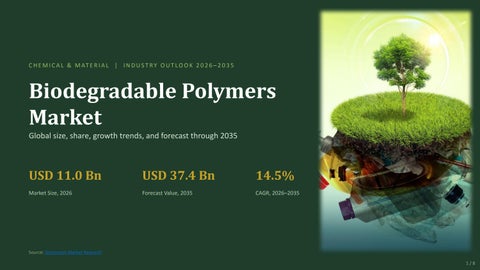
Biodegradable Polymers Market Global size, share, growth trends, and forecast through 2035
USD 11.0 Bn
USD 37.4 Bn
14.5%
Market Size, 2026
Forecast Value, 2035
CAGR, 2026–2035
Source: Dimension Market Research 1/8
Market Snapshot Rapid growth driven by the shift away from petrochemical plastics Global Market Value (USD Billion) 40
37
1
35
Growth Rate 14.5% CAGR through 2035, driven by end-of-life certification demands.
30 25
2
20 15 10
Packaging leads demand as food-safety rules push out single-use plastics.
11
5 0
Top Application
3 2026
2035
Leading Region North America holds 38.2% share on a mature bio-refinery ecosystem.
US market: USD 3.5 Bn (2026) → USD 11.1 Bn (2035) at 13.6% CAGR | Europe: USD 3.2 Bn (2026) → USD 10.4 Bn (2035) at 14.0% CAGR
90%+
of organizations running sustainabilitytargeted packaging programs
344 pg
in-depth report covering type, processing, application & end-use
2021– 2035
historical & forecast data window covered by the study
2/8
What's Fueling the Market Biodegradable polymers are polymeric materials — PLA, PHA, PBAT, PBS, and starch-based blends — engineered to replace persistent petrochemical plastics with compostable, low-ecotoxicity alternatives across packaging, agriculture, and consumer goods.
1
Regulatory Compliance Gap
Compostable-packaging rules (PPWR, EPR, state bans) outpace certified-grade supply.
3
Marine-Biodegradable PHA
Brands seek custom PHA platforms for ocean-safe, organic-recycling end-of-life paths.
2
Multi-Substrate Complexity
Rigid, pouch, and film formats demand specialized blending and multi-layer extrusion.
4
Agricultural Film Demand
Soil-biodegradable PBAT mulch films and PCL matrices tailored to regional farming needs.
3/8
Market Segmentation — Type & Processing By Type
By Processing Method
●
Polylactic Acid (PLA) — leading segment
●
Extrusion — leading method
●
Polyhydroxyalkanoates (PHA)
●
Injection Molding
●
Starch-Based Polymers
●
Blow Molding
●
Polybutylene Succinate (PBS)
●
Thermoforming
●
Polybutylene Adipate Terephthalate (PBAT)
●
Film Processing
●
Cellulose Derivatives
●
Polycaprolactone (PCL)
Why PLA Leads Derived from renewable corn starch and sugarcane, PLA gives manufacturers a low-carbon rigid-packaging pathway with strong commercial availability.
PLA dominates on renewable feedstock (corn starch, sugarcane) and drop-in compatibility with existing injection-molding and film-extrusion lines.
4/8
Market Segmentation — Application & End-Use By Application (illustrative share)
Food & Beverage Largest end-use; regulations on packaging & cutlery drive adoption.
Healthcare Biocompatible, compostable single-use devices and surgical items.
Agriculture Fastest-growing; soil-degradable mulch films replace legacy plastic.
Retail & Textile Cellulose derivatives feed marine-biodegradable fiber innovation. Packaging Textile
Agriculture Healthcare
Consumer Goods Other
5/8
Regional Analysis Regional Share, 2026 (%, illustrative)
North America — Leading
45 40
38.2% share; dense biopolymer production base and aggressive CPG sustainability agendas.
38
35
29
30 25
Asia-Pacific — Fastest Growing 22
Government-led plastic bans across India, China, Japan fuel PLA and starch-blend demand.
20 15 10
6 5 0
Europe 4 PPWR and single-use plastics directive push compostable film and mulch adoption.
N. America
Europe
Asia-Pacific
Latin Am.
MEA
6/8
Competitive Landscape A dynamic mix of chemical majors, bio-polymer divisions, and material-science start-ups; consolidation is accelerating as petrochemical incumbents acquire PLA/PHA specialists.
BASF SE
NatureWorks LLC
Novamont S.p.A.
TotalEnergies Corbion PLA
Mitsubishi Chemical Group
Corbion N.V.
Danimer Scientific
Braskem S.A.
Toray Industries
Eastman Chemical Co.
Arkema S.A.
Kaneka Corporation
Recent move: BASF (Oct 2025) acquired a European seaweed-based polymer start-up to strengthen PBAT and cellulose-derivative blends for agricultural mulch film.
7/8
Get In Touch Reach out for the full report, custom research, or a free sample.
E
P
P
A
Enquiry@dimensionmarketresearch.com PHONE
+1 (732) 629 9444 PHONE
+1 (732) 369 9777 ADDRESS
957 Route 33, Suite 12 #308, Hamilton Square, NJ-08690 USA
Dimension Market Research | dimensionmarketresearch.com
8/8