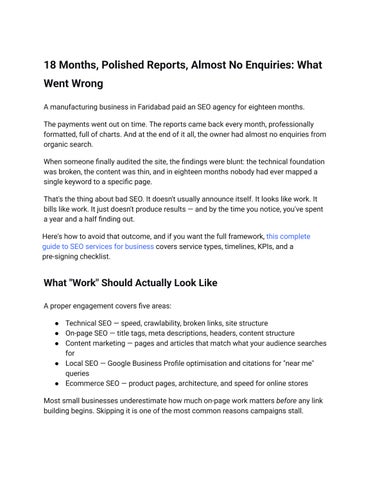
18 Months, Polished Reports, Almost No Enquiries: What Went Wrong A manufacturing business in Faridabad paid an SEO agency for eighteen months. The payments went out on time. The reports came back every month, professionally formatted, full of charts. And at the end of it all, the owner had almost no enquiries from organic search. When someone finally audited the site, the findings were blunt: the technical foundation was broken, the content was thin, and in eighteen months nobody had ever mapped a single keyword to a specific page. That's the thing about bad SEO. It doesn't usually announce itself. It looks like work. It bills like work. It just doesn't produce results — and by the time you notice, you've spent a year and a half finding out. Here's how to avoid that outcome, and if you want the full framework, this complete guide to SEO services for business covers service types, timelines, KPIs, and a pre-signing checklist.
What "Work" Should Actually Look Like A proper engagement covers five areas: ● Technical SEO — speed, crawlability, broken links, site structure ● On-page SEO — title tags, meta descriptions, headers, content structure ● Content marketing — pages and articles that match what your audience searches for ● Local SEO — Google Business Profile optimisation and citations for "near me" queries ● Ecommerce SEO — product pages, architecture, and speed for online stores Most small businesses underestimate how much on-page work matters before any link building begins. Skipping it is one of the most common reasons campaigns stall.
The Tell-Tale Sign of a Failing Campaign If nobody can show you which page targets which keyword, the strategy doesn't exist yet. A keyword list in a spreadsheet is not a plan. A plan assigns one clear target page per intent — so pages on your own site don't compete with each other, and every piece of content has a job. Ask this in month one, and again in month six. If the answer hasn't changed, nothing is being built.
Strategy Changes With Business Type Business Type
Primary Focus
Key Metrics
Small business
Local SEO, GBP, citations
Map pack rankings, calls, directions
Ecommerce
Product pages, structure, speed
Organic revenue, conversion rate
B2B services
Thought leadership, long-tail,
Qualified leads, demo requests
lead magnets National brand
Broad coverage, PR,
Market share, share of voice
high-authority links
A local clinic and a national ecommerce brand need completely different plans. Identical packages for both is a warning sign.
The AI Overview Layer
Google now shows AI Overviews at the top of many results, and users increasingly turn to ChatGPT and Perplexity for direct answers. This doesn't replace traditional SEO — it adds a layer. Content that's clearly structured, factually accurate, and easy to extract is more likely to be cited. The practical steps: FAQ and Article schema, direct answers to common questions, consistent entity information, and no keyword stuffing. Google's guidance confirms that standard indexability and snippet eligibility remain the foundation. A provider claiming a secret technical hack is probably not worth your time.
The Timeline to Judge Against Timeframe
What Should Be Happening
Months 1–3
Audit, fixes, tracking, keyword research. Minor movement on low-competition terms.
Months 4–6
Noticeable traffic improvement. Content live, links building, rankings stabilising.
Months 7–12
Significant growth in traffic, leads, conversions. Scaling what works.
If nothing is moving by month six, the strategy or the execution needs review — not another six months of the same.
KPIs Worth Tracking ● Organic traffic — visitors from search engines ● Keyword rankings — position for target terms ● Conversion rate — percentage who take action ● Organic leads and sales — actual enquiries or transactions ● Domain authority — strength of your backlink profile
If your reports show only the first two, you're seeing half the picture.
Red Flags ● Guarantees a #1 ranking on Google ● Refuses to explain strategy or provide detailed reporting ● Uses spammy link-building, like buying links ● Lacks a clear contract or scope of work ● Promises to submit your site to "thousands of search engines"
Pre-Signing Checklist ● Detailed proposal with clear scope of work ● Case studies from businesses similar to yours ● Confirmation of who manages your account, and their experience ● Verification they follow Google's guidelines ● You retain full ownership of your website and analytics ● Reporting frequency and specific metrics ● Clear communication channels and a named contact
The Bottom Line The Faridabad client's problem wasn't that SEO doesn't work. It's that nobody ever verified whether the invoiced work was the right work — or whether it was happening at all. Choosing the right SEO services for business means asking uncomfortable questions before you sign, and demanding reporting that connects activity to enquiries. A good partner welcomes that scrutiny, because their work holds up. If you want the complete guide — including how SEO differs by business type, what to expect at 3, 6, and 12 months, and the full evaluation checklist — read the full guide to SEO services for business.