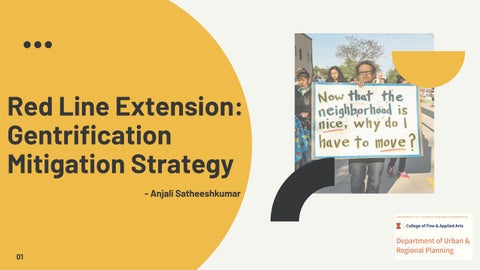
Red Line Extension: Gentrification Mitigation Strategy - Anjali Satheeshkumar
01
Mission The aim is to work out a Community Engagement plan which will involve engaging local residents in the RLE impact area and educating them about the effects of gentrification and propose measures to mitigate its negative effects.
2
Ideal Stakeholders Ideal stakeholders for the developed community engagement strategy will involve community land trust organizations, faith groups and local non-profits. Some of these groups present in the south side of Chicago are identified below ;
Chicago Community Land Trust (CCLT)
The Endeleo Institute
3
WHAT is Gentrification and WHY is it relevant in the case of RLE ?
4
As much as commuters appreciate public transportation, it may have unforeseen consequences. Gentrification is one such consequence. In practice, this implies higher rents and more housing displacement. These changes result in a higherincome population moving in and higher housing rates developing over time. Long-term inhabitants of some of these communities will be forced to leave because rents or the cost of products and services have risen.
5
GENTRIFICATION AND RLE • The RLE is expected to reduce commute times and improve mobility and accessibility by connecting isolated areas. On the other hand, the extension has the potential to spark gentrification that could displace long-term residents. • One should anticipate that property values may possibly go up such that families in these areas will be impacted. • Areas that are prone to higher property values through increased transit station access will thereby receive greater attention as planners are especially interested in guiding growth and development in these station areas.
6
WHO are Impacted ?
7
“They build it up and push everyone out.” - A MICHIGAN RESIDENT’S COMMENTS ON GENTRIFICATION DURING A COMMUNITY MEETING 8
As for identifying groups of residents who are most vulnerable to displacement in gentrifying neighborhoods, there are five primary indicators of vulnerability : –
1 Renters
2
3
4
Low-income
Persons
Households headed
Families (with
households
of color
by resident without
children) in
a college degree
poverty
5
These groups are more vulnerable to displacement from rising housing costs than other groups of residents. 9
7,962 Households Benefitted by the Red Line Extension due to increased access to high frequency transit
A demographic analysis of these households need to be done to determine how many of them fall under the previous 5 indicators of vulnerability.
10
HOW to mitigate the effects?
11
Tools for Addressing Gentrification: Before Gentrification
Mid‐Stage Gentrification
Community Engagement and
Strengthened Rental Protections
Coalition Building Capacity building support and
Tax Abatement Policies Protections Against Condominium
dialogue
incubation of neighborhoodcentered community development corporations
Community Benefit Agreements Tenant or Non‐Profit Developer “Right to Purchase”
Community Land Trusts Inclusionary Zoning Limited Equity Co‐op Housing
for Tenants
Conversion
Rehabilitation & Preservation Late-Stage Gentrification
Employer Assisted Housing Affordable Housing Trust Fund Housing Levies Addressing “not‐in‐my‐backyard” sentiment
12
Communiy Engagement Strategies
13
Engagement Strategy Outline PLAN
ENGAGE, INVOLVE AND ADVOCATE FORM COALITIONS
IMPLEMENT
STRATEGISE
14
Step 1 Plan The first step of this strategy is to chart a course of action involving the following : • Identify and create database of impacted households. • Design and finalize pop pup pavilions/kiosks and the content to exhibit i.e. information about gentrification, information about Community Land Trusts and Community Benefits agreement, Information desks to help residents understand the potential solutions and steps to work towards it. • Finalize date and time for the community engagement event. • Design flyers advertising the event and include contact email/online forum for residents to voice their opinion/feedback. Distribute door to door flyers to the identified households. Advertise the event via other mediums like posters, local newspaper advertisements etc to maximize attendance.
15
Step 2 Engage Set up kiosks or pop-up pavilion in the areas where the new stations are proposed so that the immediate residents get a much more clearer understanding of the potential neighborhood change. These pavillions will contain information about how the station will change the environmnet, station design, potential investments that could come in, how that would affect the home prices. It will provide information about CBA, CLTs 16
... Further, flyers and posters will be distributed to households surrounding the area advertising the pop-up pavilion event. The pamphlet will contain feedback options via scannable QR code where the residents can convey their opinions. It would also contain a 2nd QR code where there would be information about what gentrification is and how it could potentially impact them.
17
Step 3 Coalition Formation Engaging directly with community members also allows organizers to identify local community leaders. Form a group with community leaders and stakeholder representatives that would have periodic meetings at a decided location to discuss matters such as – • Incorporating resident feedback post spreading awareness about gentrification. • Identifying people and organizations such as Community Land Trusts (CLTs) who can ensure long term housing affordability.
18
... • Developing a Community Benefit Agreements model that would be used when developers come into play in the future. • The group should establish ground rules for working together from the beginning and review these agreements regularly. After the coalition gathers feedback from the community, the next step is to organize a meeting with the community, leveraging the influence of community leaders to encourage broad participation.
19
Step 4 Strategize It is critical for a coalition to identify a community’s priorities in order to accurately represent its interests. It is important to refine the community’s list of all relevant concerns to a prioritized needs assessment. After the community coalition is established and has determined its top priorities, 2-4 coalition representatives should contact the elected officials most involved in the proposed project and brief them on the coalition, its priorities, and any engagement it has had or plans to have with the developer. The coalition should research council to determine which members are on committees relevant to the project. The coalition should assess whether it can count on support from a majority of the committee and/or council members.
20
Step 5 Implement After a community benefits coalition is established and it has garnered sufficient community support, the coalition can bring its concern about the development by contacting the developer. It is critical for coalitions to enter negotiations having already determined the issues they will fight for and the concessions they will make. They must be prepared with creative solutions in response to developer pushback. The last and final process in this step would be to sign the CBA. The coalition must maintain continuing oversight to ensure that the terms of the agreement are upheld.
21
Final Thoughts . . . People feel passionately about the space they’re in and are automatically resistant to changes that cause them damage. Tapping into the expertise of community-based organizations, stakeholders, and local residents can foster community-informed programs and initiatives. If you don’t provide a space for them to talk, they will find one themselves and cut you out of the conversation. That’s why community engagement plays a huge role in mitigating the negative effects of gentrification. 22
Thank you! 23