UCLA_PORTFOLIO25'

Page 1


Anisha Khan

anishakhan@g.ucla.edu

anishak2807@gmail.com

310-689-8212

LinkedIn

Instagram

Portfolio

About Me

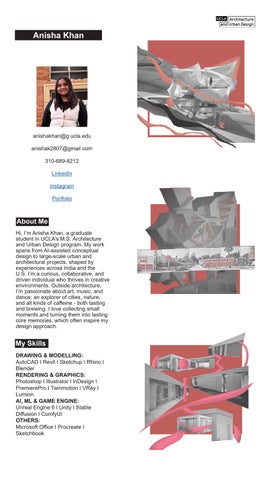
Hi, I’m Anisha Khan, a graduate student in UCLA’s M.S. Architecture and Urban Design program. My work spans from AI-assisted conceptual design to large-scale urban and architectural projects, shaped by experiences across India and the U.S. I’m a curious, collaborative, and driven individual who thrives in creative environments. Outside architecture, I’m passionate about art, music, and dance; an explorer of cities, nature, and all kinds of caffeine - both tasting and brewing. I love collecting small moments and turning them into lasting core memories, which often inspire my design approach.

My Skills

DRAWING & MODELLING: AutoCAD I Revit I Sketchup I Rhino I Blender

RENDERING & GRAPHICS: Photoshop I Illustrator I lnDesign I PremierePro I Twinmotion I VRay I Lumion

Al, ML & GAME ENGINE: Unreal Engine 6 I Unity I Stable Diffusion I ComfyUI

OTHERS: Microsoft Office I Procreate I Sketchbook

BEYOND BASE

The studio explores the convergence of historical desert architecture, contemporary technologies, and sustainable design practices. Joshua Tree Desert serves as a premier destination for adventure enthusiasts, attracting visitors for activities such as hiking, trail running, mountain biking, and bouldering. Our project builds upon this spirit, envisioning a dynamic environment that fosters both physical activity and recovery.

The concept was developed around the idea of an active lifestyle brand establishing an extreme living experience compound. This vision prioritizes a balance of high-energy engagement, community-driven interaction, and spaces designed for rest and recovery, creating an integrated environment that supports both adventure and well-being.

In the living spaces like the cabins and villas as well we wanted to provide niches like gear docks, desert living console etc. The cabins being small living pods.

With these forms and ideas we started studying into the fabric as material, specifically 3D knit fabrics. The advantages of this being that it can be manufactured to the required sizes, density porosity and layers colors built in sleeves within a single fabric.

TEAM

Sowjanya Madhira

CLASS Technology Studio MSAUD

The Adventure Pavilion is a flexible indoor space for strength training, activity monitoring, and recreation. Inspired by natural rock formations, its interior features climbing and bouldering elements. Centrally located, it also serves as the main dining and kitchen hub for all guests, anchoring the site both functionally and socially. A 3D-knitted fabric supported by a stainless steel airbeam structure is used for its flexibility, porosity, and adaptability. The system allows for customization and future evolution of the form, responding to both environmental and programmatic needs.

The cabins are elevated on stilts, responding to the natural topography of the site. Each unit features niche spaces tailored to the resort’s program—such as a mudroom, gear dock, and a desert survival console integrated near the kitchenette for live updates and activity planning. A private lofted bed area allows for spatial separation, while the rest of the cabin maintains an open-plan.
The villas expand upon the spatial and programmatic logic of the cabins, incorporating similar niches—mudroom, gear dock, and desert survival console—at a larger scale. Distributed across multiple levels, the layout offers greater spatial variety and privacy. A larger private pool and deck area enhance recovery and rejuvenation after intense activities, while materials and design language remain consistent with the rest of the resort.

GENERATIVE RENDERS

This visual study explores generative rendering as a design tool using Stable Diffusion 1.5 in ComfyUI, supported by custom Python scripts. Source images of architectural models were used to generate high quality renders via a LoRA (Low-Rank Adaptation) model trained on a curated dataset developed specifically for this project.

Two distinct styles were applied - realistic rendering and color-pop artistic stylization, to illustrate the range of visual outcomes achievable through targeted prompt engineering and model training. The process demonstrates how custom-trained AI models can extend design representation, enhance storytelling, and open up new aesthetic possibilities within architectural workflows.

Generative Renders V.2

ARCTIC REEF

Augmented Reality as Sensory Interface Revealing Invisible Systems Through Computation and Cuisine

This project explores augmented reality as a technological layer of perception—a tool for revealing hidden infrastructures embedded within our material world. Using Unity, we developed an interactive AR dining interface that transforms a physical food plate into a computational blueprint, unlocking a speculative ecological narrative.

The dish, titled “Arctic Reef”, visualizes melting polar systems, supply chain data, and food ecology. An overlay reveals data-encoded ingredients, visual simulations, and embedded media through a custom mobile interface.

AR-enabled plate design functions as a trigger for layered storytelling

Unity-based app built with marker-based spatial recognition

Blends culinary design, ecological speculation, and mixed reality interfaces

Bridges sensing, scanning, and perception into a single interactive system

Keywords: Augmented Reality | Unity | Speculative Interface | Ecological Storytelling | Design as Perception | XR + Material Culture

TEAM

Anisha Khan

Juan Carlos Duarte

Kadambari Chavhan

CLASS

FUTURE OF FOOD

Digital Ecologies + Spatial Interfaces

ECHOES IN TRANSITION

This project explores the transformation of soundscapes by capturing a live performance in a theater and gradually remapping it onto a personal setting to an individual relaxing in a rooftop jacuzzi. Using spatial audio recording and TouchDesigner, we create an immersive transition from collective experience to solitary reflection. The project highlights how sound, memory, and setting shape spatial perception and emotional resonance.

TEAM

Alex Morris

Anisha Khan

Juan Carlos Duarte

Sowjanya Madhira

CLASS

SOUND ARCHITECTURE

Space x Acoustics x Technology

MSAUD- Technology Seminar

Instructed By Matt Conway

OTHER WORKS

MSAUD- Entertainment Studio

Instructed By Liam Denhamer

Instructed

Animation frames created in Unreal Engine, inspired by Lewis Baltz’s photographs.
Fabrication of Sunset Strip, using Rhino and Grasshopper
Animation frames created in Blender and enhanced using Stable Diffusion 1.5 to visualize a walkthrough of a carnival along Sunset Blvd.
MSAUD- Urban Strategy Studio
By Tucker van Leuwen-Hall

Turn static files into dynamic content formats.

Create a flipbook
UCLA_PORTFOLIO25' by ANISHA KHAN - Issuu