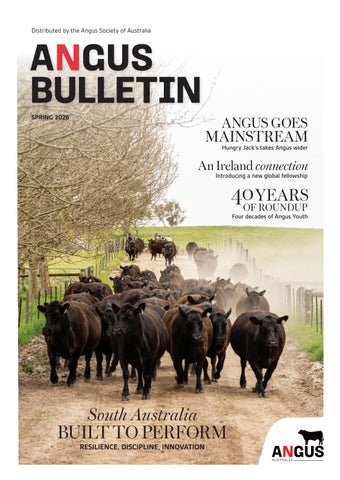
Distributed by the Angus Society of Australia
ANGUS BULLETIN SPRING 2026
ANGUS GOES
MAINSTREAM Hungry Jack's takes Angus wider
An Ireland connection Introducing a new global fellowship
40 YEARS OF ROUNDUP
Four decades of Angus Youth
South Australia
BUILT TO PERFORM RESILIENCE, DISCIPLINE, INNOVATION
The Angus Bulletin - Spring 2026
| 1
Bendigo, Victoria | 13 - 17 January 2027
REGISTRATIONS OPEN MONDAY 12 OCTOBER 2026 The Roundup is open to all Angus Australia junior members aged 8-25 years Registrations close Monday 2 November 2026
CLICK HERE TO REGISTER
angusaustralia.com.au 2
WORLD WIDE SIRES
®
COMBINING STRUCTURAL INTEGRITY WITH BREED-LEADING DATA BULL OAK WELL
VEZINA V48
• High percentile calving ease with growth and docility • Big-time rib and rump EBVs • Excellent claw and angle • Eye appeal; free moving and high-end fertility
BLACKROCK
BREAKING GROUND U177
• Calving ease with elite growth • Top 5% or better for an amazing nine traits • Top 1% scrotal and top 4% docility • Breed-leading structural scores
CLUDEN NEWRY
VAN WILDER • Phenotypic excellence • Structural integrity • High end growth/CW and docility • Positive rib and rump
®
WORLD WIDE SIRES Phone (03) 5831 5559 • info@wwsaustralia.com
wwsaustralia.com
Dale Edwards: 0427-806-672 • dedwards@wwsaustralia.com Tim Wright: 0400 028 606 • twright@wwsaustralia.com
Product of the USA The Angus Bulletin - Spring 2026
| 1
CONTENTS Spring 2026 2
Contents
LAND & STEWARDSHIP
4
Editor's Note
46 Quality in, quality out: Nutrition for the months ahead
5
President's Report
49 Improving heifer performance and whole-herd productivity
7
CEO's Report
10 Angus Australia Board Outcomes - August 2026 INDUSTRY & HERITAGE
13 Record Falls at Millah Murrah as Wyatt W50 sells for $420,000
REGIONAL FEATURE
16 The discipline behind commercial performance 21 Eye on the herd at Granite Ridge 26 Genomics driving decisions at Lake Ellen Pastoral GENETICS & INNOVATION
32 Bringing global innovation home 36 Practical data: Using information after sale day 39 Angus GenetiQ™ updates: Introducing the new Temperament EBV
42 DNA Direct: Making genomic testing simpler, faster and
with fixed time AI
PEOPLE & COMMUNITY 52 From DNA to Discovery
54 Research that moves the industry forward REGIONS & SYSTEMS
59 Building Angus Systems for a Moving Target 62 Beyond the bull: Building breeding programs with purpose 64 Building on a generational legacy at Shenley Station, New Zealand
68 Bred for the Hills: Arohiwi Station's genetics-led beef system
84
more flexible
21 72
MARKETS & SUPPLY CHAIN
72 When premium goes mainstream 76 Looking towards 2027: What market trends mean for Angus producers
80 Closing the feedback loop: Angus for Every System Feedlot & Carcase Trial
NEXT GENERATION
84 The road to Roundup 89 Global opportunities for the next generation BACK OF BOOK 92 The Angus Shelf 95 Staff Directory
ADVERTISERS INDEX
58 ABS 94 Achmea Farm Insurance 88 Bongongo Angus 91 Cairnbrae Angus 35 Elanco BC KO Angus 14 Pacific Vet 44 Raff Angus 79 Shearwell Data 25 Weatherbys Scientific 1 World Wide Sires
Cover image supplied by GB Creative Publisher: Angus Australia Locked Bag 11 Armidale NSW 2350 P: 02 6773 4600 | F: 02 6772 3095 E: office@angusaustralia.com.au W: www.angusaustralia.com.au Editor: Caroline Laine Layout: Ellie Dunlevy Printer: Print Graphics Print Green Advertising Opportunities contact: marketing@angusaustralia.com.au
26
Disclaimer: Opinions expressed in this publication are not necessarily those of the Editor or of the Board of Angus Australia. Neither the Editor nor Angus Australia takes any responsibility for the accuracy of the information contained within this publication, nor for the outcome (including consequential loss) of any action taken by readers or others based on information contained therein. The publishers reserve the right to refuse or cancel without notice any advertisement in a publication issued by them.
| 3
EDITOR’S NOTE CAROLINE LAINE | Marketing & Communications Manager
At Granite Ridge Angus, Scott Finlay demonstrates another form of progress. His stockman’s eye remains fundamental, but increasingly sits alongside performance data and a clear understanding of what commercial clients require. His objective is balance: cattle with the phenotype, functionality and genetic information to perform for the people who buy them. And at Lake Ellen Pastoral, we see a system very much in motion. After two difficult drought seasons, the business is rebuilding while using genomics, performance recording and structural assessment to make more informed decisions about the cattle that will take the herd forward. Those stories reinforce something that runs throughout this edition: growth does not necessarily mean getting bigger. It can mean becoming more efficient, more resilient or more informed. It can be improving the feedback between breeding decisions and commercial outcomes or adopting technology that allows an existing system to work better. We see that thinking in our Genetics & Innovation section, from the introduction of the Temperament EBV in Angus GenetiQ™ to DNA Direct and the practical use of information after sale day. We also follow the Angus for Every System Feedlot & Carcase Trial, which is connecting genetics with individual feedlot performance and eventual carcase outcomes to create information producers can take back into future breeding decisions. SPRING IS A SEASON of movement. Across the cattle industry, it brings changing conditions, new calves on the ground and another cycle of decisions about genetics, production and the direction of the business. It is also an appropriate lens through which to consider an industry that is itself constantly moving. Movement, Growth & Leadership is the theme of this Spring edition of The Angus Bulletin, exploring how Angus businesses and the wider industry are adapting across seasons, people and markets. Throughout these pages, that movement takes many forms: changing production systems, new technologies, better use of information, emerging opportunities and the development of the people who will lead Angus into the future. Our regional focus takes us to South Australia, where the diversity of Angus production provides a particularly strong illustration of systems adapting to their environment and their markets. At Radford Pastoral, Nick Radford has built a commercial system around consistency and discipline. Genetics, pasture, infrastructure and market feedback are considered together, with resilience coming from preparing for difficult seasons rather than simply reacting when they arrive.
Leadership is equally important, and it does not always come from the people with the loudest voices. It can be found in producers prepared to change a system when the evidence tells them to, researchers and industry partners opening new opportunities and people willing to share their experience so others can learn from it. This edition also looks outward. The inaugural Eurofins Genomics Angus Fellowship creates a new connection with Ireland and Scotland and an opportunity for an Angus Australia member to experience international developments in genomics first-hand. Closer to home, registrations are open for the 2027 Angus Youth National Roundup in Bendigo, continuing almost four decades of developing skills, confidence, friendships and leadership among young people in our industry. Perhaps that is what connects the stories in this edition most strongly. Movement creates opportunity, growth comes from what we do with it and leadership is about helping determine where we go next. As we experience another spring, I hope this edition provides ideas worth considering, experiences worth sharing and perhaps a different perspective on where your own Angus system is heading. Enjoy the Spring edition. CAROLINE LAINE Editor / Marketing & Communications Manager
DON'T MISS THE NEXT EDITION The Angus Bulletin is published quarterly and distributed across our membership and wider Angus community. The next edition will be available mid-December as our Summer edition. If you would like to discuss advertising opportunities, partnerships or have feedback, please direct all queries to marketing@angusaustralia.com.au
4
President’s Report PETER COLLINS | President
DEAR MEMBERS, It has been a very busy few months since I took on the role of President following our conference, workshops and AGM in Ballarat at the end of May. Firstly, I would like to thank all members who made the effort to attend Ballarat. It was an important gathering for the breed and for Angus Australia. I want to acknowledge and thank our immediate past President, Sinclair Munro, for his contribution and leadership and Vice President Simone Bond for the support she has provided since I stepped into the role. I was fortunate to take an overseas holiday with my wife during this period, which took me away from Angus Australia for a few weeks. I am particularly grateful to Simone for stepping in and taking on the President’s responsibilities while I was away. We have now completed our August Board meeting, held by Zoom on 28 August. I want to be open with members: there are some significant issues in front of the Angus breed at present and some important decisions will need to be made over the coming months, particularly around the future of genetic evaluation. Recently, I attended an Australian Registered Cattle Breeders Association workshop in Brisbane with CEO Scott Wright and COO Carel Teseling. We heard from MLA Managing Director Mick Crowley, AGBU Director Stephen Miller, ABRI Managing Director Dave Christie and our own CEO, Scott Wright. It was a valuable day and gave me, as President, a much clearer understanding of the issues being considered across the registered cattle industry. There is considerable discussion across breeds about MLA’s proposed multi-breed genetic evaluation and particularly, how such a system might ultimately be commercialised. Questions remain about what the future business model might look like for breed societies, how breed data may be used and whether commercial genomic products developed from these systems could ultimately compete with registered cattle breeders and breed organisations themselves. These are important questions and they deserve proper answers. At the associated annual meeting, constitutional changes were also adopted and Scott Wright was subsequently elected President of the Australian Registered Cattle Breeders Association. I believe this gives Angus Australia an important opportunity to contribute constructively to the wider industry discussion. Following those discussions, the Angus Australia Board held a substantial strategy session at our August meeting. I would like to thank every member who contributed to the recent Angus Breed Survey. The information provided was valuable and helped Directors understand the range of views held across the membership. There is no single view across our membership on the future of genetic evaluation and I acknowledge that. There are genuine concerns, genuine opportunities and some complex decisions ahead. Our job as a Board is to work through those issues
carefully and determine what best serves Angus Australia members and the Angus breed in the years ahead. One very positive development is the continued progress of Angus GenetiQ™. The Board received an update on the remaining seven traits currently under development, with the intention of having that work completed later this year and presented to the Board. The Board also approved development of an Angus GenetiQ™ selection index, which will be another important component of the system. There is a great deal of work happening behind the scenes, and the Board has asked that we increase communication with members about Angus GenetiQ™, including what the traits mean, how the evaluation works and how breeders can use the information effectively. The Board also considered an issue relating to poll status, following genetic testing that identified a small number of animals within Angus Australia registers that do not carry two copies of the expected poll mutation. Affected members have been contacted directly and staff are working carefully with them to understand the implications for individual animals and their progeny and determine the appropriate way forward. While this affects a relatively small number of members, it is important that we address the issue properly and maintain confidence in the integrity of the Angus breed. The Board also spent considerable time examining the financial position of Angus Australia. It is another tight financial year, with revenue softening in some areas due to seasonal conditions and the timing of DNA testing and other activity. Accountant Elliott Connors and CEO Scott Wright presented five-year financial projections and a number of possible scenarios for 2027. There is no cause for alarm, but we cannot ignore the need to ensure Angus Australia has a sustainable financial model for the future. As part of that work, management will review the way female inventory is billed, including whether the current volumebased model remains appropriate and whether there are better The Angus Bulletin - Spring 2026
| 5
and Angus Australia’s information systems during his time with the Society. On behalf of the Board and membership, I extend our sincere condolences to Gerard’s family and acknowledge his contribution to Angus Australia. Looking ahead, there is plenty happening across the organisation. Our Spring Bull Night has been well supported and, at the time of writing, has received more than 5,000 views. Thank you to the participants and to the Angus Australia team for putting together a professional and useful resource. If you have not yet seen it, I encourage you to have a look at some of the genetics being offered this spring.
ways to recognise and reward breeders who make substantial contributions through pedigree, performance and genomic data. This work will come back to the Board as part of planning for 2027. The Board also agreed that males entering through the base APR pathway will be more clearly identified as Base APR animals, distinguishing them from APR cattle backed by generations of recorded pedigree and performance information. The Base APR Male fee will increase to $400 including GST. We believe these changes provide greater transparency and better recognise the value of the Angus Australia system and the contribution made by breeders who have invested in recording data over many years. The Board also considered how Angus Australia data is provided to external organisations through APIs, including platforms such as AuctionsPlus. As our data becomes more valuable and widely used, we need to ensure appropriate controls, attribution and commercial arrangements are in place. Management will continue developing an appropriate framework for those relationships. There was also some very positive operational news. Member Services has improved turnaround times following an increase in staff capacity and we have received encouraging feedback from members about Angus Online and DNA Direct. Weatherbys Scientific has also come on board as an additional DNA provider, giving members another high-quality option at competitive pricing. I would like to congratulate the Member Services team and welcome our two new Member Services Officers. It is pleasing to see the department moving strongly in the right direction. Our Finance team has also undertaken significant work implementing Xero and improving the way Angus Australia accounts are managed. Members have rightly told us in the past that our statements and billing information could be better. Increased automation between angus.tech and the accounting system should provide clearer information while improving efficiency. I thank Elliott Connors and his team for the work involved in making that transition. On a much sadder note, former angus.tech Software Manager Gerard Hammond passed away shortly before our August Board meeting, on his 60th birthday. Gerard had recently completed his employment with Angus Australia after approximately six years of service and made an important contribution to angus.tech 6
Our Masterclass program is also continuing, including events around Tamworth and Armidale led by Brad Hine, with further events to follow. These are valuable opportunities for members to get together, learn and make better use of the tools and resources available through Angus Australia. Planning is also well underway for the Angus Youth Roundup in Bendigo in January 2027, with Lilli Stewart leading the Roundup Organising Committee as Chair, working alongside Event Coordinator Zoe Sparks as preparations for the event gather pace. It is shaping up to be an exciting event, I encourage families to start getting the kids and their heifers ready for Bendigo. During September, I headed west to attend the Western Australia Spring Walk, where I had the pleasure of meeting more of our WA members and visiting operations, including the Harvey Beef feedlot and catching up with members at the dinner and associated activities. One of the things I have most enjoyed since becoming President is the opportunity to speak directly with members from across Australia. Seasonally, conditions remain mixed. Much of southern Australia is enjoying a very good season. Northern New South Wales has improved, although more rain would still be welcome, and parts of southern Queensland remain patchy. We understand that conditions are very different from one region to another and this has a real impact on members and their businesses. There is a great deal in front of Angus Australia. The decisions around genetic evaluation are substantial, our financial model requires careful attention and technology and commercial genomics continue to change quickly. I want members to know that your Board is working hard. I speak regularly with Directors, members, staff and senior management and there is a genuine commitment to making decisions that protect and advance Angus Australia and the Angus breed. We will not make every decision without debate and that is healthy. What matters is that we ask the hard questions, listen to members, use the best information available and keep the long-term interests of the Angus family at the centre of what we do. Please feel free to contact me at any time. For those still in the middle of the spring selling season, I wish you every success with your upcoming sales. Yours sincerely, PETER COLLINS President, Angus Australia
CEO’s REPORT SCOTT WRIGHT | Chief Executive Officer
MLA has sought Angus Australia’s participation, including access to data for research associated with that initiative. The Board and management have approached this cautiously. I have become increasingly candid in asking questions about the proposed model because, while considerable discussion has occurred around the technical ambition, we still require greater clarity about how any future multi-breed evaluation would be commercialised and what that would mean for Angus Australia, our members and the wider registered cattle breeding sector. These are legitimate questions. Angus breeders have invested in pedigree recording, performance measurement, genomics and genetic improvement over many generations. Our members have made an enormous contribution to the reference populations and data infrastructure that underpin increasingly accurate breeding values. We therefore need to understand how that investment would be used and protected in any future model. In particular, we need to understand whether high accuracy breeding values could ultimately become available to seedstock producers operating outside established breed society systems, and whether commercial organisations (such as multi-national companies) could derive value from data generated through decades of investment by registered breeders and breed societies.
DEAR MEMBERS, It’s another busy and consequential period at Angus Australia. There seems to be no end to the pace of change confronting our organisation and the broader beef industry. Important decisions lie ahead, but there is also good reason for confidence in Angus and its future. I want to begin by congratulating Ross Thompson and the Millah Murrah team on the extraordinary result achieved at their recent sale, including the Australian beef record price of $420,000 for Wyatt W50. It is an exceptional achievement and a testament to their breeding program, the reputation they have built over many years and, more broadly, the strength and value of the Angus breed. Results such as this remind us that despite the challenges and uncertainty surrounding parts of our industry, there remains real confidence in high quality Angus genetics. AN IMPORTANT PERIOD FOR GENETIC EVALUATION I also want to address directly one of the most significant issues currently before Angus Australia: the rapidly changing genetic evaluation landscape. I recognise there is a diversity of views among our members about the direction Angus Australia should take. Thank you to everyone who responded to our recent member survey. The information and views you provided were valuable to the Board in its deliberations at the August meeting. One of the major developments is Meat & Livestock Australia’s “Bold Ambition” to establish a multi-breed genetic evaluation.
We need to ensure we do not create a situation where breeders who have not made the same investment in registration, recording and breed improvement are able to compete on an equivalent basis using the intellectual capital created by those who have. Nor should we inadvertently enable others to capture disproportionate commercial value from an asset our members have spent generations building. This does not mean Angus Australia is opposed to innovation, research or multi-breed evaluation. Far from it. But before committing the assets of the Society and its members, we need to understand the business model, governance, ownership, access arrangements and the long-term implications. If Angus Australia has appeared cautious in its approach, that is why. These issues extend beyond Angus. In August, I was elected President of the Australian Registered Cattle Breeders Association. I am grateful for the confidence placed in me by my peers, particularly at a time when registered cattle breeding in Australia is undergoing considerable change. THE ANGUS VALUE STORY Amid these discussions, I think it’s worth reminding ourselves what we are actually seeking to protect and strengthen. Angus is one of relatively few livestock breeds in the world where the name of the breed itself carries substantial commercial value. No single organisation owns that value. It’s not owned by Angus Australia, seedstock breeders, commercial producers, feedlots, processors, beef brands, retailers or restaurants. Brand Angus has been built collectively. The Angus value chain begins with research and genetic improvement. Seedstock breeders invest in genetics, recording, genomics and selection. Commercial producers use those genetics to produce productive and valuable cattle. Backgrounders and feedlots value Angus cattle because of
The Angus Bulletin - Spring 2026
| 7
their performance and reliability. Processors and beef brands use Angus to underpin their premium programs. Retailers, restaurants and food-service businesses recognise Angus as a powerful proposition to consumers and price it accordingly. Ultimately, the consumer sees the word Angus and associates it with an expectation of quality. That is an extraordinarily valuable form of provenance. Consumers do not need to understand genomics, EBVs, feeding systems, carcass measurements, MSA grading or the complexity of the beef supply chain. The proposition is much simpler: Angus means a high-quality beef eating experience. That expectation has been earned over decades through genetic improvement, production performance, consistent eating quality and the collective efforts of thousands of people throughout the Angus value chain. The power of this system flows in two directions. Genetic improvement and performance flow down the supply chain towards the consumer. Consumer trust, demand and economic value flow back through the chain towards producers. It is a self-reinforcing Angus flywheel (as pictured). Every participant in the flywheel contributes to the value of Angus. Every participant has an opportunity to capture value from
8
Angus. And therefore, every participant has an interest in protecting what Angus represents. Angus is a collective brand and a collective responsibility. Angus Australia’s role is not to own the word Angus. Our role is to be a custodian of the breed and the systems that underpin its value: protecting breed integrity, driving genetic improvement, supporting research and providing our members with the tools they need to breed better Angus cattle. Our collective task is straightforward: Protect what Angus means. Improve what Angus delivers. Keep the value of Angus flowing through the entire supply chain. Angus is quality without unnecessary complexity. It is a breed, a brand, a source of provenance and a shared value system. I encourage members to reflect on that as we consider some of the important decisions ahead. BUILDING A STRONGER ANGUS AUSTRALIA There is also a great deal happening operationally across Angus Australia. We have financial challenges to address and the Board and management are working carefully through our five-year financial projections and the necessary changes to put the Society on a stronger and more sustainable footing for 2027 and beyond. This includes reviewing our inventory model, continuing
to examine competition and value in DNA services, progressing our genetic evaluation strategy and planning our presence at Beef Australia 2027. I also want to acknowledge that earlier this year we experienced unacceptable service delays in some areas of the organisation. We have worked hard to address those issues and I believe we have turned a corner. Our Member Services team have developed into an enthusiastic and capable group of young people committed to providing good service to members. It was pleasing to receive correspondence from a member recently, commending the service they had received from the Society. We are also continuing to give members better tools to do business with us. Angus Online is now available, giving members considerably greater ability to manage their own information and transactions. I acknowledge that it took us longer than it should have to deliver, but it represents an important improvement. DNA Direct provides another streamlined option for members, while the addition of Weatherbys Scientific brings greater competition and choice to our DNA services. We are progressing Angus beef verification by DNA and the Angus for Every System Feedlot & Carcase Trial is also underway. Thank you to the members who have entered teams and supported this important program. Looking further ahead, preparations are underway for the 2027 Angus Youth National Roundup in Bendigo and for Beef Australia 2027. These programs, together with our research, extension, genetic improvement and commercial initiatives, demonstrate that while we are dealing with significant strategic questions, the everyday work of strengthening Angus continues.
THANK YOU I want to thank our Board for its commitment during a demanding period and to particularly acknowledge Peter Collins and Simone Bond as they undertake their leadership roles as President and Vice President, respectively. I also thank Sinclair Munro for his considerable contribution as President and for the important work he continues to undertake, particularly in relation to genetic evaluation. We also welcome our new directors, Mark Muir and Stuart Halliday. In addition, I enjoyed spending time with our Western Australian members in September.. Finally, I want to personally thank the many members who contacted me following my recent health incident, which prevented me from attending the AGM, associated workshops and Board meeting. I greatly appreciated those messages and the support provided to me and the Society during that period. There is much to do between now and the end of the year. There will undoubtedly be difficult decisions and members will not always agree on every issue. That is healthy in a member owned organisation when dealing with matters of genuine consequence. But amid all the complexity, we should not lose sight of the asset we collectively hold. Angus is a remarkable Australian agricultural success story. Our responsibility is to protect it, continue improving it and leave it stronger for the generations of breeders who follow us. As always, if you have questions, concerns or ideas, please reach out to me. SCOTT WRIGHT Chief Executive Officer, Angus Australia
A podcast featuring industry insights, stories and ideas that matter
NEW EPISODES AVAILABLE WEEKLY
Click here to listen now
The Angus Bulletin - Spring 2026
| 9
Angus Australia Board Outcomes Report AUGUST 2026 BOARD MEETING SCOTT WRIGHT | Chief Executive Officer
THE ANGUS AUSTRALIA Board met via Zoom on Friday, 28 August 2026, for its August Board meeting. The August meeting provides Directors with a comprehensive update across all areas of Angus Australia’s operations, together with consideration of key strategic matters facing the organisation. The Board periodically meets by Zoom to reduce meeting and travel costs. A virtual meeting is also particularly appropriate during the spring bull-selling season, when many Directors have significant commitments within their own businesses. The meeting was constructive and covered a number of important operational, financial and strategic matters. ANGUS GENETIQ™ The Board received a detailed update on the continued development of Angus GenetiQ™. Work is progressing on the remaining suite of traits required to complete the genetic evaluation system. The current objective is to have this work substantially completed by the end of 2026, with the intention of presenting a full suite of traits to the Board later in the year. The Board was advised that development is progressing well under the leadership of COO Carel Teseling, supported by the Angus Australia genetic evaluation team and specialist technical expertise. Directors also emphasised the importance of increasing communication with members as development progresses. This will include providing greater background on the traits, the science underpinning Angus GenetiQ™, how the evaluation operates and how members can use the information in their breeding programs. ANGUS GENETIQ™ SELECTION INDEX The Board approved the development of a new Angus GenetiQ™ selection index. This work is an important component of the continued development of Angus GenetiQ™ and will provide members with scientifically robust selection tools designed specifically around the Angus GenetiQ™ evaluation. Management will now progress this work with specialist external expertise. POLL STATUS AND DNA TESTING The Board received an important briefing from management regarding DNA testing for poll status within the Angus Australia registers. A small number of registered animals have been identified through DNA testing as not carrying two copies of the poll mutation expected within a polled Angus population. These animals may appear physically polled but have the potential to produce horned progeny, particularly when mated to horned animals.
10
Members associated with the identified animals have been contacted and Angus Australia is continuing to work through the issue with those affected. This includes consideration of retesting, the status of individual animals, the treatment of progeny and the application of Angus Australia’s existing regulations. The Board noted this is an ongoing process and that further work is required before a final position is reached on the appropriate regulatory treatment of affected animals. While the number of directly affected members is relatively small, the Board recognised that this is a significant issue for those involved and an important matter for the integrity of the Angus breed. Management will continue the investigation and provide further advice to the Board as the process develops. FINANCIAL POSITION AND FIVE-YEAR PLANNING The Board reviewed the organisation’s financial performance and considered five-year financial projections, including preliminary planning for 2027. The Board noted that revenue in some areas has been affected by seasonal conditions across parts of Australia and the timing of DNA testing and associated revenue recognition. Directors considered a range of scenarios designed to ensure Angus Australia maintains a strong and sustainable financial position into the future. The Board remains focused on ensuring the organisation has an appropriate financial buffer and a sustainable operating model while continuing to invest in genetic evaluation, member services, research, marketing and commercial development. Further work will be undertaken as part of the 2027 budget process. FEMALE INVENTORY REVIEW The Board approved a process to review the female inventory charging structure during September. The current inventory system provides increasing volume discounts as herd size increases. Over time, the structure and distribution of the Angus Australia membership and registered female population have changed considerably. The review will therefore consider whether the existing volume-based structure remains the most appropriate and equitable model for the organisation and its members. Management will undertake detailed modelling during September, with any proposed changes to be considered as part of planning for the 2027 financial year. BASE APR DESIGNATION AND FEE The Board considered how animals entering the APR through the base-entry pathway should be identified.
The Board agreed that the designation Base APR should be used within angus.tech to provide a clearer distinction between recently introduced base animals and APR animals supported by generations of recorded pedigree and performance information. This change is intended to provide greater transparency and better recognise the significant investment made by members who have contributed pedigree, performance and genomic information over many generations. The Board also reviewed the fee applying to Base APR males and agreed that it will increase to $400 including GST. The revised fee is intended to better reflect the value of the Angus Australia registration and genetic evaluation system while retaining an appropriate pathway for animals entering the APR through the base-entry process. DATA APIS AND EXTERNAL DATA USE The Board considered Angus Australia’s increasing use of application programming interfaces, or APIs, to provide approved data to external platforms and service providers. As the volume and commercial importance of Angus Australia data increases, the Board considers it important that appropriate standards are established around its use, presentation, security and attribution. Management has been authorised to engage with organisations accessing Angus Australia data through APIs to develop appropriate agreements and a consistent framework for future access. The objective is to ensure Angus Australia information is accurately represented, appropriately protected and clearly attributed wherever it is used. MEMBER SERVICES The Board received a positive update on Member Services. Additional staff capacity has improved turnaround times and management reported encouraging feedback from members regarding interactions with the Member Services team. There has also been positive feedback regarding the continued development of Angus Online and DNA Direct. The Board recognised the work undertaken by the Member Services and Information Systems teams to improve member experience and operational efficiency. BUSINESS DEVELOPMENT AND COMMERCIAL GENOMICS The Board noted continued progress in Angus Australia’s commercial genomic activities. Interest continues to build in Angus HeiferSELECT and other commercial genomic products. The Board also received an update on the strong level of interest in the Angus For Every System Feedlot Trial, which will operate through the summer of 2026–27. These activities are increasingly important components of Angus Australia’s The Angus Bulletin - Spring 2026
| 11
strategy to extend the value of Angus genetics throughout the commercial beef supply chain. MARKETING AND COMMUNICATIONS The Board received an update on continued improvements across Angus Australia’s marketing and communications activities. Recent developments include improvements to the Angus Bulletin and progress towards the launch of an updated Angus Australia website. Work is also continuing to improve the organisation’s use of HubSpot and its integration with member communications and database information. FINANCE SYSTEMS AND AUTOMATION The Board noted significant progress in modernising Angus Australia’s finance and accounting systems. The implementation of Xero during 2026 represents an important change in the organisation’s financial processes. Work is continuing to improve member statements and the overall member experience associated with invoicing and accounts. The Finance team is making increasing use of automation and AI-supported processes to improve efficiency and reduce unnecessary manual administration. The Board acknowledged Elliott Connors and the Finance team for their work in implementing these changes. VALE GERARD HAMMOND The Board was advised of the passing of former angus. tech Software Manager Gerard Hammond. Gerard made an important contribution to Angus Australia during approximately six years of service with the organisation. The Board and staff of Angus Australia extend their condolences to Gerard’s family and acknowledge his contribution to the Society. MLA MULTI-BREED GENETIC EVALUATION A significant component of the Board’s strategic discussion concerned MLA’s proposed multi-breed genetic evaluation. President Peter Collins, CEO Scott Wright and COO Carel Teseling recently attended an Australian Registered Cattle Breeders Association workshop in Brisbane, where the future of genetic evaluation and MLA’s multi-breed proposal were discussed. The Board continues to carefully consider MLA’s requests for access to Angus Australia-related data. Directors have instructed the CEO to continue discussions with MLA and seek further information before the Board reaches any final position. The Board considers this a significant issue for the future of genetic evaluation in Australia. In particular, Angus Australia is seeking greater clarity regarding: • the proposed commercialisation model; • the treatment and ownership of breed and project data; • protection of intellectual property; • the technical structure of a multi-breed evaluation; • the long-term business model for participating breeds; and • how the proposed system will deliver value to Angus Australia members and the wider beef industry. 12
The Board is particularly conscious that Angus Australia members have invested substantially over many decades in pedigree recording, performance measurement, genomic testing and genetic improvement. Any future model needs to appropriately recognise and protect that investment. The Board will continue to work constructively with MLA and other industry organisations while seeking satisfactory answers to these important questions. ANGUS BREED SURVEY The Board thanked Angus Australia members who participated in the Angus Breed Survey conducted during July. The information provided through the survey has given the Board valuable insight into the views and priorities of the membership and will assist Directors in determining future strategic direction. Member feedback is particularly important as Angus Australia considers significant issues relating to genetic evaluation, technology, commercial genomics and the future services provided by the Society. LOOKING AHEAD The August meeting involved detailed and constructive discussion across a number of significant issues. The Board remains positive about the direction of Angus Australia and the Angus breed while recognising that the organisation is entering an important period of change.
INDUSTRY & HERITAGE
Image by Studstock Sales
Record Falls at Millah Murrah as Wyatt W50 sells for $420,000 SARAH HORROCKS
MILLAH MURRAH ANGUS, based near Bathurst in the NSW Central Tablelands, rewrote the record books on September 3rd after stud sire Millah Murrah Wyatt W50 sold for $420,000 at the stud's annual spring sale, the highest price ever paid for a beef animal in Australia. The result for Wyatt W50 eclipsed the previous bull record for the Angus breed and for all breeds combined, which stood at $360,000 and was set by Texas Thunderstruck T383 at the Texas Angus sale in July 2023. It also surpassed the national seedstock record of $400,000, which had stood since Wagyu donor heifer Sunnyside S0014 sold at the AWA Elite Wagyu Sale in Melbourne in May 2022. Wyatt W50 was knocked down to a syndicate of Jason Little (and manager David Croker) of Gundungarra Angus, on the NSW Southern Tablelands, and Jeremy and Julie Schaw of JS Grazing in Injune, Queensland. Millah Murrah has retained a 20 per cent share in the bull and will work alongside the buyers to assist in managing the very strong demand for his semen. ABS Australia has been appointed as semen agent. Auctioneer Paul Dooley described the atmosphere in the room as the bidding climbed. "You can hear the buzz in the crowd as the numbers go up," he said after the sale. "It certainly speaks to the confidence in the cattle industry.”
Millah Murrah stud principal Ross Thompson had no doubts about the bull's quality. “I’ve never said that a bull is the best I’ve ever bred or anything like that, and I didn’t say it pre-sale, but the closer the sale got, I realised my reservations were only pre-sale jitters. When he sold, I just said from the rostrum that on balance, he was the best bull we’ve ever put forward for sale,” says Ross. Wyatt W50 weighed 834kg at 19 months of age and backed up his presence in the ring with figures to match. His EBVs included +10.4 for eye muscle area and +68 for carcase weight, +3 for intramuscular fat, along with growth figures of +95 for 400 day weight and +125 for 600 day weight. Ross says the bull's appeal lay in the breadth of his genetics, combining calving ease with strong weight gains, traits he said that both commercial and stud breeders are chasing. "His skin, head, structure and meat pattern are beautiful. And he also has a lot of genetic diversity." “He’s got a really sensible data balance. Such a beautiful example of what we want from an Angus animal.” Wyatt W50 was among the first sons offered by Millah Murrah Ulsterman U145, with his dam, Millah Murrah Kerry U68, tracing back to Millah Murrah Ricky R45. His full ET brother, MM Weston W20, also sold strongly for $120,000. The Angus Bulletin - Spring 2026
| 13
INDUSTRY & HERITAGE
Wyatt W50 and Weston W20 were standouts on phenotype by 12 months old, when they were given names honouring Ross’ late father, Wyatt Weston Thompson. This added additional emotion during the bidding frenzy.
The result came at a time when 2026 had been tipped as a challenging season for selling bulls, following a period in which large numbers of cattle were sold out of northern NSW due to drought earlier in the year.
“I did have my sunnies on, but apparently you could see the tears."
When asked to sum up what sort of impact a bull like Wyatt W50 could have on the wider beef industry, Ross had only one word for it…
With Millah Murrah retaining a 20% stake in Wyatt W50, semen sales are expected to become a significant part of the bull's legacy. Ross said that interest came in from well beyond Australia, including New Zealand and the USA, within hours of the hammer falling. “He’s a multi-million semen selling bull in the making, if all the ‘ifs’ that go along with semen play out well.” Owning an animal of such value is not without its pressures, but Ross has been pretty careful. “I’ve got 250 high-quality semen straws stored, so if he drops dead tomorrow that semen would become extremely valuable.” Ross thinks that the fact that the bull had already been collected gave bidders more confidence.
14
“Massive.” The broader Millah Murrah sale reflected an incredible strength in their program, with all 121 bulls selling for an average of $37,578, among the highest averages recorded for any breed sale in Australian history. Another standout bull in the sale was Woodruff W48, who was knocked down for $200,000 to a syndicate that includes Heart Angus, Shepwok Angus and Hallmark Genetics. For the Angus breed, the headline remains Millah Murrah Wyatt W50, a bull whose name will be etched into the history books after he not only reset the national price record, but has done so in a way that underscores the strength of Angus genetics on the world stage.
REGIONAL FEATURE South Australia
South Australia’s Angus systems are moving with the times. Across the South East, producers are combining genetics, data, pasture, infrastructure and market insight to build more resilient businesses, sharpen performance and prepare for what comes next.
The Angus Bulletin - Spring 2026
| 15
REGIONAL FEATURE
The discipline behind COMMERCIAL PERFORMANCE Across 4,450 hectares in SA's South East, Nick Radford treats genetics, pasture, infrastructure and market feedback as parts of one commercial equation. The result: a 2,600 cow Angus herd built for consistency, rather than one single, exceptional year. WORDS ANNA D’SOUZA | IMAGES KRISTY JANEWAY
A STRONG COMMERCIAL cattle business is rarely defined by one outstanding season, one exceptional sire or one favourable market. More often, its performance is built through a series of decisions that continue to hold their value over time, particularly when seasons tighten, costs rise, and market conditions become less predictable. That principle sits at the centre of Radford Pastoral in South Australia’s South East, where Nick Radford has developed a production system shaped by practical breeding choices, close attention to market requirements and a willingness to prepare for conditions before they arrive. Across approximately 4,450 hectares, the business is calving more than 2,600 cows this year, with Angus now forming almost the entire herd after a transition that began in the mid-1990s. The shift into Angus was initially influenced by market demand, but the breed’s ability to perform across very different environments reinforced the decision. Having transitioned from the pastoral country of western New South Wales to the higher rainfall conditions of South Australia, Radford Pastoral has placed increasing value on cattle that combine fertility, growth,
16
temperament and marketability without losing sight of the production system they need to work within. The result is an operation where genetics, pasture, infrastructure and market feedback are treated as parts of the same commercial equation. The objective is not to chase maximum performance in isolation, but to produce cattle that perform consistently, suit the customer and allow the business to remain responsive when conditions change. Angus has remained commercially relevant within the operation because it combines adaptability with strong market acceptance. Nick says they’re just good all round cattle, pointing to their ability to perform in both the pastoral country the family previously operated and the higher rainfall environment of South Australia’s South East, while still producing the quality of animal buyers are seeking. BREEDING WITH A COMMERCIAL OBJECTIVE Radford Pastoral’s breeding objective begins with a straightforward commercial question: what does the animal need to do within the production system?
The answer is not identical across the herd. Heifers require bulls that can moderate birth weight without sacrificing future performance, while mature cows can be joined to heavier, more powerful sires selected for growth and performance. Fertility, eye muscle and growth remain important considerations, but Nick is reluctant to treat individual figures as an end in themselves. “In a perfect world, we want a bull that does everything, from low birth weight to heavy growth,” he says. The reality is more practical, which is why the operation effectively selects two styles of bull according to the females they will join and the job their progeny must ultimately perform. The principal market is feedlot oriented, with steers and dry heifers entering feedlot programs, so genetic decisions are made with that end point firmly in view. There have also been genetics that have left a particularly visible mark on the herd. Nick recalls Stoney Point Equator Y28 and progeny sourced through Yerwal Estate Angus as genetics that had a particularly strong influence on the herd, producing the consistency and all round performance he values. Ultimately, however, the measure of a breeding decision is what happens after the paperwork and sale catalogues are put away. “The proof’s in the pudding,” he says. He looks for cows producing strong weaning weights, cattle reaching feedlot specifications at a younger age and increasingly even lines of animals across the herd. Those results are rarely immediate. Genetic progress reveals itself over successive joining and calving cycles, which makes discipline in female selection particularly important. Radford Pastoral joins 100 per cent of its heifers for a five week period, retaining reproductive pressure within the replacement herd and continually bringing younger females through the system. Over time, Nick says that approach has contributed to greater maturity, quality and consistency across the cattle. FERTILITY, TEMPERAMENT AND FUNCTION Fertility is one of the clearest examples of the relationship between genetics and commercial discipline at Radford Pastoral. Short joining periods are not simply a management preference, but a method of selecting females that can perform within the timetable required of them. The benefits flow further than conception alone. A tighter joining period supports a more concentrated calving, which in turn can
“
You’ve got to stick to your guns and stick to your plan. The minute you change drastically, it seems to have a bit of a snowball effect in a bad way rather than a good way. create more even groups of calves and greater consistency later in the production cycle. Temperament is viewed through a similarly commercial lens. Easy-handling cattle are, in Nick’s view, “a big profit driver”, particularly when the consequences of poor temperament extend into labour requirements, safety, cattle performance and feedlot suitability. Radford Pastoral combines genetic selection with a deliberate weaning program. Weaners are worked through the yards repeatedly over seven days, while cows remain nearby for several days to help reduce stress and allow calves to settle. Nick regards temperament as both inherited and manageable, with selection reinforcing the work undertaken at weaning. “No one’s going to keep a bull if he is fizzy anyway, even if he has got big figures.” It is a simple observation but one that captures the commercial philosophy behind the operation. Performance on paper has value only when the cattle themselves remain functional within the system. CONTROL ACROSS THE PRODUCTION CYCLE Radford Pastoral breeds its own replacements and remains closely involved throughout the full production cycle, from joining and calving through to the point cattle leave for the feedlot at around 480 to 500 kilograms. Nick describes it as a “front door to back door operation”, a phrase that reflects more than physical involvement. Staying
The Angus Bulletin - Spring 2026
| 17
REGIONAL FEATURE
Pasture quality is therefore treated as one of the major drivers of cattle performance, rather than as a separate part of the farming operation. Radford Pastoral measures feed availability and average feed cover to understand what the property can realistically support and what cattle will require in the months ahead. Irrigation provides another layer of flexibility, functioning as what Nick describes as a form of insurance against dry conditions and giving the operation greater control over feed availability when rainfall is less dependable. That preparation became particularly important through the two difficult seasons preceding 2026. Nick describes them as among the worst the South East had experienced, requiring the business to wean earlier, give cows additional recovery time and move some cattle to alternative country. Importantly, Radford Pastoral was able to maintain herd numbers rather than being forced into a major reduction. Much of that resilience had been planned years earlier through hay storage infrastructure and a deliberate focus on maintaining reserves. Last year alone, the operation baled 4,898 bales of hay from its irrigated country, deliberately trading some immediate cattle performance for greater security in the seasons ahead.
close to each stage of production gives the business visibility over where value is being created and where adjustments may be required. “We’re with that calf from the day it’s born to the day it goes in the truck,” he says, adding that he will often drive the truck to the feedlot himself. Understanding the end market is fundamental to the way Radford Pastoral makes breeding and management decisions. The business maintains close contact with its buyers and actively asks what could be improved, whether that relates to cattle performance, vaccination programs or other aspects of preparation before the animals arrive. “If you don’t know your market, you shouldn’t be doing it.” Increasing access to feedlot performance information has added another layer to that feedback. The business can see how cattle are performing after they leave the property and use that information to assess whether the breeding and management program is continuing to meet buyer requirements. The conversation is ongoing rather than transactional. Nick’s view is that if the cattle arrive as expected and perform for the customer, the commercial relationship becomes stronger and repeat business follows. Quality, therefore, is not confined to one trait. It is the quality of the cattle, the uniformity of the line and the management behind the product being offered. TURNING PASTURE INTO PERFORMANCE Genetics may establish the potential of an animal, but Nick is equally direct about what determines whether that potential is realised. “You can have the best animal in the world, but if you haven’t got the right grass going down their neck, you’re not going to do any good anyway.” 18
Nick acknowledges the balance involved. Cattle could not utilise all of that irrigated feed while hay was being conserved, which affected weight gain, but the decision was made with the next difficult season in mind. “You’ve got to balance one, being profitable and two, still preparing for the future.” STAYING THE COURSE THROUGH MARKET CHANGE That same balance shapes the way Radford Pastoral responds to cattle markets. Nick prefers consistency over dramatic changes in direction, particularly when external factors such as drought elsewhere, increased cattle supply or temporary price movements create volatility. The principle is to understand the plan, remain prepared to act when circumstances genuinely require it and avoid allowing short term market movements to dismantle a production strategy built for the longer term. “You’ve got to stick to your guns and stick to your plan. The minute you change drastically, it seems to have a bit of a snowball effect in a bad way rather than a good way.” That doesn’t mean the business is inflexible. Nick sees one of the advantages of a focused operation as the ability to make decisions quickly, particularly around feeding and seasonal management. The distinction is between adapting the system when conditions change and abandoning the broader commercial direction each time the market moves. That combination of consistency and flexibility is central to how the business operates. EFFICIENCY AS A COMMERCIAL ADVANTAGE With input costs continuing to rise, efficiency has become an increasingly important focus across the operation.
REGIONAL FEATURE
19
The Angus Bulletin - Spring 2026
| 19
REGIONAL FEATURE
“
Do everything once, do it right and just do it properly.
Radford Pastoral is spread across four locations, which means infrastructure and cattle movement can have a significant influence on labour and operating costs. Nick’s approach is to remove unnecessary work wherever possible and invest in systems that allow tasks to be completed properly, the first time. Cameras, cattle grids, road trains, double-deck loading ramps and improved cattle yards all form part of that approach. Nick sums it up simply: “Do everything once, do it right and just do it properly.” A new set of yards completed during the recent dry period has already demonstrated its value, with the team pregnancy testing around 900 heifers in a day while maintaining good cattle flow. Further investment in yards and internal roads is planned as the business continues to improve movement between its properties. At Radford Pastoral, resilience is closely tied to a willingness to keep investing through difficult periods. Even through consecutive poor seasons, the business continued fencing and building infrastructure so that it would be positioned to capture the benefit when conditions improved. It is the same philosophy that runs through its genetics, pasture management and market strategy. Long term value is rarely created through one exceptional decision. More often, it comes from making a succession of practical decisions well and continuing to make them when conditions are less favourable. BUILDING CONSISTENCY FOR THE NEXT FIVE YEARS After acquiring additional country several years ago, the
20
operation chose to build its numbers internally rather than purchase large numbers of replacement females. The operation has now reached the production capacity Nick had been working towards, making the immediate objective less about expansion and more about proving that performance consistently over the next five years. “I’d like to see five good years of this capacity. That was our plan all along, to get to these numbers and be consistent over those five years.” Fertility will remain a priority, as will improving infrastructure and efficiency across the four operating locations. Beyond that period, Nick expects another strategic decision about the future scale and shape of the business, although he is in no hurry to define it before the current system has had time to demonstrate what it can deliver. That measured approach is perhaps the clearest expression of Radford Pastoral’s commercial discipline. Genetics are selected for a defined purpose, females are expected to earn their place, pasture is measured against what the cattle require and infrastructure is assessed according to the work it can remove from the system. Markets and seasons will continue to move, but the objective remains much more stable: produce consistent Angus cattle that fit the customer, manage the resources available and maintain enough resilience to keep making good decisions when conditions are less than ideal. Long term performance at Radford Pastoral is built not by trying to control every variable, but by maintaining discipline over the factors the business can influence.
Eye on the herd at Granite Ridge Scott Finlay may have come to Angus breeding by an unconventional route, but there is nothing accidental about the program he has built at Granite Ridge. From the back of the cattle yards in South Australia’s Lower South East, he has quietly built a successful Angus operation by watching, learning and always looking for ways to make the next generation better. WORDS KATHRYN DUDDY | Senior Business Manager | IMAGES GB CREATIVE
FOR SCOTT FINLAY, some of the best decisions at Granite Ridge Angus are made from the back of the cattle yards. It’s where he prefers to be, pushing up cattle, watching them move and quietly making mental notes. While others work at the crush, Scott is looking at the herd. He says he’d rather be at the back where he can run his eye over them. “You can see how they’re looking, pick up any issues and make decisions as you go. I suppose I get to admire the cattle a bit more [from] back there too.” It says something about the man behind Granite Ridge Angus. Scott is much more comfortable talking cattle than talking about himself, and happier on the farm than promoting what he’s achieved. Yet over the years, Granite Ridge Angus has developed into a substantial seedstock operation, running around 600 breeders across 2,800 acres (1,130 hectares) in South Australia’s Lower South East, with an even split between autumn and spring calving. Behind it is a breeding program with a clear objective: to produce Angus cattle that work for the people who buy them. FROM POULTRY TO ANGUS Scott’s pathway into the seedstock industry could be considered somewhat unconventional. Before Granite Ridge he built a successful career in the poultry industry. However, Angus cattle were already part of life through
a commercial herd run alongside the poultry business. “When I needed to de-stress from the chickens, I’d go down to the farm and play with the cattle. It was stress relief. It was getting back to something I really enjoyed.” Once the poultry operation had reached the scale Scott wanted, the opportunity arose to diversify. He began looking further south for country with reliable rainfall and water, eventually finding Granite Ridge, which was offered as an established operation. Seedstock breeding was not necessarily the original plan. The attraction was simply the opportunity to breed better cattle. It was a contrast to poultry, where many of the decisions around genetics and production were determined elsewhere in the supply chain. “With the cattle, we could make those decisions ourselves. We could improve pastures, play around with feed and work with the genetics.” Angus made sense too. Scott had watched the breed’s commercial presence grow and saw the strength of the Angus name in the marketplace. “Even in those earlier days, you could see the marketing happening, things like the Angus burger, and see where it was going. Scott says they were good, easy-doing cattle and there was a good market for them. “The amount of black cattle you see when you drive from town to town is incredible.” FUNCTION FIRST Ask Scott what defines the Granite Ridge breeding program and the answer quickly comes back to functionality. Feet are high on the list, and he’s been targeting good feet for years. “If the feet aren’t good, it flows through your herd. If you retain a female with that problem, you’re potentially carrying that trait forward again.” Granite Ridge country is not particularly abrasive, so foot issues are unlikely to be disguised by natural wear. Scott watches them closely, particularly when introducing genetics from elsewhere. Temperament is another non-negotiable and something that he doesn’t want to breed on in the herd.
The Angus Bulletin - Spring 2026
| 21
REGIONAL FEATURE
22
REGIONAL FEATURE
“If a bull is in the yards and he’s not settled and not right, he’s gone. I don’t want to breed that on.” Scott likes growth to sit above breed average but has little interest in chasing extremes. Recent dry seasons have also sharpened his focus on fat. After drought conditions in the region, he noticed a pattern among females that failed to get back in calf. “A lot of the girls that missed and ended up on the truck were negative for fats,” he says. They have now put a bit more focus on fats, with breed average as the target.
“
I know the numbers are important, but the cattle need to be able to move, walk and do the basic things first.
Another deliberate shift has been moderating frame. “A few years ago, we decided to pull the frame back a bit.” He says if he would put a score on his frame target, that it would be around six. “There’s still enough frame there, but it’s not excessive. They mature and fill out sooner.” THE ANIMAL STILL COMES FIRST Granite Ridge collects plenty of data. Growth weights are recorded, cattle are scanned and structurally assessed, with information captured through Tru-Test equipment and maintained as a lifetime record for each animal.
you might really like an animal, if the data isn’t going to work when the progeny come through, you can make life pretty hard for yourself. The aim is to have the cattle and the figures telling the same story. CATTLE FOR THE COUNTRY Granite Ridge sits around 20 kilometres from the coast in a Mediterranean-style, winter dominant climate, averaging about 650 millimetres of rainfall per annum.
Scott has also started exploring Angus Online and how it can simplify the recording and data management within the business.
The property includes lower-lying country, with a shallow underground water table and sandier rises that become particularly useful during a wet winter.
But for all the information available, selection still begins with the animal in front of him.
“The low country can get quite wet, so the higher ground gives us somewhere to put cattle during those times.”
“We do our selections on eye.”
Winter can be cold and cattle may make relatively little weight gain through the coldest months, but spring is a different story.
The retained heifers are selected visually first. Scott makes sure they’re structurally correct, and then they start looking at the numbers afterwards. “I know the numbers are important, but the cattle need to be able to move, walk and do the basic things first.” That doesn’t mean figures are secondary in the eventual breeding decision. In fact, Scott believes the market is increasingly making balanced data essential. He's seen a noticeable change in the way commercial producers approach bull selection. More of them are arriving having already worked through the catalogue and narrowed their choices according to breeding values.
“When spring comes, away they go.” Irrigation helps carry production through summer, while reliable underground water is another advantage. But Scott doesn’t spend much time trying to define the ideal animal for the region. “I tend to look at my own place and work out what I need the cattle to do here.” Staying Close to the Customer Around 90 per cent of Granite Ridge bulls are sold within 100 to 150 kilometres of the property, with clients across the South East and into Victoria.
“The data is definitely more sought after.”
It means Scott regularly sees the people using his genetics, often well away from the sale ring.
People are coming through after having looked at the catalogue and saying to Scott that these are the bulls that fall within the parameters they’re looking for, and these are the ones they want to see.
“In country towns you bump into people everywhere,” he says. “You might have a beer at the footy and catch up on how things are going or what they’re doing with their program.”
At home, that has meant making some tough decisions. “We’ve had to leave bulls behind that might have excellent structure and phenotype simply because the breeding numbers aren’t going to be something our clients are looking for.” Scott says you have to think three years ahead because although
Granite Ridge also delivers its own bulls where possible. For Scott, it’s a chance to see the client’s farm and have the conversation that there’s rarely time for on sale day. “They get to know who you are, and if there’s something they need help with later, hopefully they’re comfortable picking up the phone.” The Angus Bulletin - Spring 2026
| 23
REGIONAL FEATURE
“There isn’t one right answer for every program,” Scott says. “You need to understand where they’re heading and what they’re trying to achieve.” THE BUSINESS BEHIND THE BULLS For all the enjoyment Scott gets from breeding cattle, he’s realistic about the economics of seedstock production. The sale result is the visible end of a process that begins years earlier. Genomics, AI and embryo programs all carry a cost, as do performance recording, bull preparation and marketing. “A fair chunk of what you turn over has already gone out the door before you sell a bull.” Scott’s poultry background means measurement is never far from his thinking, although cattle bring variables that don’t exist inside a climate controlled poultry operation. Experience is also allowing him to see patterns within his own herd, especially with the structural information and the numbers coming through. Recent results have also given Scott confidence in the direction of the herd. At Granite Ridge’s autumn sale in February, Granite Ridge Velocity V42 sold for $235,000 to Sara Park Angus at Glen Innes, setting a South Australian record.
“I’ve always been one of those people who keeps to myself and flies under the radar,” says Scott. He has, however, come to accept that breeding the cattle is only part of the job. “You can’t sell a secret. You’ve got to put yourself forward and tell people about your program.” That’s not something Scott is super comfortable with. He’d prefer not to talk about himself. Ask where he would like Granite Ridge to be in another 10 years and there is no grand ambition to be the biggest operation or chase a particular headline. He simply wants to keep breeding the type of cattle he likes to see in the paddock, with the performance behind them to do the job. “The numbers don’t have to be top of the tree for any one trait, they just need to be well balanced. He says that if they can get the balance right between the numbers and the phenotype and keep their gates open, it’s happy days. His advice for someone starting out in seedstock breeding is equally uncomplicated. “Buy that one really good cow rather than five average ones.”
While the price attracted plenty of attention, Velocity was also the type of bull Scott had been working towards, combining the phenotype he wants to see in his cattle with the performance data increasingly sought by buyers.
Scott also encourages newcomers to ask questions and draw on the experience of other breeders. He regularly exchanges ideas with a small network of breeders and values opportunities to attend industry events whenever he can get away from the farm.
“When you get the right type of bull come through and people recognise it, you know the work you’re putting in is paying off.” he says.
“If you walk away having learnt one thing, it’s worthwhile,” he says.
QUIETLY GETTING ON WITH IT For someone running a seedstock business, self-promotion does not come naturally. 24
For all the data and the decisions that now come with breeding seedstock cattle, Scott is still happiest on the farm, among the cows, quietly working out how to make the next generation better. “It’s my passion. I love what I do.”
Better genetics create a stronger legacy. Angus Legacy reveals the genetic traits in your older, proven breeding females at our most costeffective entry point to the advanced VERSA 85K SNP chip.
Every high-density test strengthens the Angus reference population, lifting the accuracy of genetic predicition for your herd, and the breed, for generations to come. Angus Legacy is a special partnership between Weatherbys Scientific and Angus Australia to improve the accuracy of genetic evaluation for Angus Australia members. Order now through DNA Direct. The Angus Bulletin - Spring 2026
| 25
REGIONS & SYSTEMS
Genomics driving decisions at Lake Ellen Pastoral
With margins tightening across the industry, Lake Ellen Pastoral manager Lyle Whitehead argues that the one percenters matter more now than ever, and he’s turning to genomic testing and data collection to make sure every animal on the Tintinara property earns its place. WORDS SARAH HORROCKS | IMAGES SARAH CUNNINGHAM
26
REGIONAL FEATURE
LOCATED NEAR THE Thomas Foods International Tintinara feedlot in South Australia's Upper South East, Lake Ellen Pastoral runs a 4,400 hectare grazing operation on light, sandy to loamy country. The landscape can be gently rolling but is largely flat, easily worked with a tractor from end to end. It’s threaded with wetland lake systems, clay pans, salt pans and tea tree country that give the property its name. It’s this combination of accessible country and its proximity to one of the region's major processing operations that shapes much of the decision making on the property. Manager Lyle Whitehead has been at the helm for two years, arriving into what he describes as the worst back to back drought seasons on record. He inherited 1,150 EU accredited cows, all calved down, and with minimal feed reserves. “Once the drought hit, we were reliant on buying feed in,” says Lyle. Cow numbers are currently sitting at 860 as the operation rebuilds, with a target to get back to the pre-drought herd size of well above 1,100. This will be done by retaining more home-bred heifers and buying in females as the opportunity arises. Lake Ellen runs a 100 percent Angus cow-calf enterprise, split between a commercial herd and a smaller elite, APR registered stud herd of 140 females (roughly 100 MA cows currently, with heifers coming through behind them). It is the interplay between these two herds, and the genomic tools Lyle has brought in to utilise, that offers useful lessons for other operations weighing up where genomics fits into a commercial breeding program.
The bulls are run exactly the same as any other animal in the operation. They’re home bred, grass fed and not sale prepped, which Lyle sees as an important part of keeping the system honest and the herd closed.
A HERD WITH NO HISTORY When Lyle arrived at Lake Ellen, the elite herd carried little by way of formal records for pedigree, performance or genetic merit. His first move was to genomic test the entire elite herd and register the females on Angus Australia's APR registry as base females, in an effort to reconstruct as much pedigree information as possible.
Lyle is careful to point out that the elite herd is being managed for balance rather than extremes. Because the operation retains its own females and breeds its own bulls, those animals need to suit Lake Ellen's environment and system as much as any end market specification.
That decision has become the foundation for everything that’s followed. The elite herd is now run through a synchronised AI joining each year, both to lift the genetic gain available to the operation and to keep calving tight. Bull calves born out of that herd are selected on phenotype and genomics for use across the main commercial herd, effectively closing the breeding system and removing the need to purchase bulls each year.
Young sires are used over heifers of the same age, so calving ease and maternal traits carry real weight alongside carcass merit, since the ultimate target is the 150 day fed program at Thomas Foods International.
"I can run an AI program with a bit of labour and do some recording for a lot less," Lyle says of the cost, when comparing it with buying in 10-15 bulls annually. The bull calves from the elite mob are all HD50k tested and are structurally assessed independently by Jake Phillips and Dick Whale. Once this data and assessment is combined with phenotype, they’re classed into A, B and C grades, which narrows an elite drop of bulls back to about 30 that are either retained for use in the commercial herd or sold by private sale. “We may look to increase the number of bulls sold by private sale in the future.”
"Because we're self replacing, it's a balance across all traits," he says.
A cross section of the current elite herd shows strong results for birth and growth traits, with Lyle identifying carcass traits, particularly eye muscle area and intramuscular fat, as the area needing a little more emphasis going forward. Getting that balance right without chasing any single trait too hard is, in his words, simply part of breeding cattle that need to work in his own paddocks as well as in the feedlot. HEIFERSELECT GATHERING THE DATA The most significant genomic initiative Lyle has introduced is the use of HeiferSELECT, a genomic selection tool used as part of the Optimised Heifer Selection project, an MLA project facilitated by neXtgen Agri that integrates genomic tools with visual and physical on farm assessments to improve replacement heifer retention in commercial Australian beef herds. The Angus Bulletin - Spring 2026
| 27
Lake Ellen is one of 11 core commercial demonstrator sites across Southern NSW, South Australia, and Northern Victoria that are contributing to this research effort. Lyle is candid about the role his herd plays in that wider program. "We're simply a data collection herd," he says. This year, 346 of the ‘W’ heifers from both the elite (68) and commercial (278) herds were retained and joined. All were HeiferSELECT tested, with parentage and estimated breeding values recorded alongside the genomic results. At this stage, those heifers only carry a calf marking weight, a weaning weight and a joining weight as physical performance data, with the genomic information adding an additional layer that will build over time as more data is collected. The replacement heifer selection process itself was staged. Heifers were first assessed visually on structure, temperament and phenotype, and only 90% of the group from that first cut went on to have HeiferSELECT testing applied. "I took out what was structurally sound after the first visual assessment," Lyle explains, describing the process of narrowing the group before committing to the cost of genomic testing on the retained heifers.
It’s essentially a reminder that genomic tools generate information faster than some operations can act on it within a single season, particularly where labour is limited. Lyle works alongside two others to run the entire operation. Contractors are only used for harvesting and baling. He’s open about the fact that another team member would be useful, especially during busy periods. He jokes that the ‘busy period’ is usually 365 days of the year. Despite the modest labour resource, calf losses from scanning through to marking sit at around 1.5 percent thanks to calving ease, which is one of the traits the operation has prioritised through its breeding decisions. THE DECISION TO MAKE THE SHIFT Lyle's rationale for investing time and money into genomic testing comes back to margins. "The technology is available, so in the current environment and with the way the industry is heading, those one percenters are becoming more important with margins.”
One complication this year was timing. The HeiferSELECT results were not fully analysed before the bulls needed to go out for joining.
His view is that it costs just as much to feed an animal that is not well suited to the target market as it does to feed one that is well suited, so the value in genomic selection lies in identifying which animals are worth that feed input before committing resources to them.
"The program had to keep progressing before I had time to analyse everything.”
"If you have the information available to identify the well suited animals, you're far better off breeding from those animals.”
28
“
The [genomic testing] technology is available, so in the current environment and with the way the industry is heading, those one percenters are becoming more important with margins.
That logic has not, however, extended to blanket testing across the whole herd. Genomic testing across the entire commercial cow herd has been discussed at Lake Ellen, but the cost of just under fifty dollars per animal has kept it off the table for now. “Replacement heifers would be the priority for testing.” This year HeiferSELECT has been a one off information gathering exercise for Lake Ellen rather than an annual fixture, reflecting the balance every operation has to strike between the value of additional data and the cost of collecting it. The elite herd remains the primary vehicle for genetic improvement at Lake Ellen, and Lyle sees the potential for this to expand. But for now, the focus is on using the information already available - genomics, phenotype and independent structural assessment to keep improving the animals that are bred from it. THE TARGET MARKET None of this genomic work happens in isolation from the rest of the operation. Lake Ellen's breeding program is built around a clear endpoint: cattle that suit the 150 day fed program at Thomas Foods. Every selection decision is made with that target in mind. Steers and surplus cattle leave the property at 14 to 18 months old, weighing between 450 and 500 kilograms, with care taken not to exceed the feedlot's maximum entry weight. Calves are tracked on farm from birth and then into the feedlot with tags using Sapien technology. The aim is to have the individual
carcase data coming back to Lake Ellen once those animals are processed, closing the feedback loop between the genetics being selected and the carcass outcomes those genetics deliver. Lyle has also made changes to the calving pattern since arriving, shifting Lake Ellen from what was historically an autumn calving herd to a late winter pattern, with most cows now calved by early September. The move had cashflow implications, as Lyle readily acknowledges, but it has also had an unexpected benefit after the recent droughts… Because the cows had more time to recover their condition before being joined again, conception rates held up better through the dry seasons than they might have under a standard calving pattern. Conception rates currently sit above 95 percent across the cow herd and 80-85 percent across the heifers. Heifers are joined for six weeks, one cycle ahead of the cow herd, which is joined for eight to nine weeks. Feed security has become a major focus for Lyle since weathering two drought seasons. The pasture renovation system totals 1,100 hectares and is run through what Lyle hopes will be a ten year policy. Barley is grown for two years as a clean up and then lucerne and veldt pasture goes in for eight years. “The development cost is high, but lucerne is a deep-rooted legume that’s well suited to our deep sandy soils.” The cost of lucerne and perennial veldt can be substantial for development, but some of this is recovered with the grain and hay cut from 600 of barley crop the remainder is recovered with the vastly improved stocking rate. The Angus Bulletin - Spring 2026
| 29
REGIONAL FEATURE
All silage and hay is now retained on farm rather than sold, building the feed wedge that was missing when Lyle first arrived, while all grain continues to be sold to the Thomas Foods feedlot. The silage is fed to the young stock post-weaning, to keep them moving forward through the late autumn and winter. OWNERSHIP AND PARTNERSHIPS Lake Ellen Pastoral is owned by Bob and Pam McCabe, who remain involved through regular meetings with Lyle and enjoy visiting the property to see the progress made over the past two years. At the same time that Lyle took over as Manager, Bob and Pam passed the overseers baton to their daughter and son in law, Kylie and Peter Bidstrup and their son Max. The Bidstrups run an aerial agriculture and firefighting operation in the Northern Territory. Their location makes the use of digital technology in all aspects of the business even more important, ensuring they stay up to date with what’s happening on the farm. Partnerships play a very important role in the Lake Ellen operation, with Jono Spence from Spence Dix and Co acting as a steady hand in the marketplace. Acting as Lyle’s stock agent, Jono helps organise the purchase and sale of any trade stock and is the main go-between with Thomas Foods. On the Thomas Foods side, Lyle is also in the process of conducting a compost trial on the farm. Compost created from waste excrement at the feedlot is spread on the paddock at two varying rates - 2 tonnes per hectare and 5 tonnes per hectare. The compost has been applied prior to the second year of barley
30
and Lyle says they are trying to see whether it will improve the germination result of the lucerne pasture that goes in next year. “Satellite NDVI mapping is showing a difference across the two rates, so it’s looking positive.” This trial is being overseen by Soil Sunlight Strategists, who focus heavily on regional soil health, smarter grazing management, and climate resilience strategies. For Lyle, all these tools combine to make a better farming operation, with further opportunities ahead, including the potential to take part in an embryo transplant program, that would fast-track genetic improvement. The value of genomic tools like HeiferSELECT is not in replacing the visual and structural assessment that has always underpinned good cattle breeding, but it’s adding another layer of information to sit alongside it. When combined with independent structural assessment, careful record keeping through digital platforms and a clear understanding of the target market, genomics is helping Lake Ellen Pastoral make more informed decisions about which animals to keep, which bulls to breed from, and where the herd's genetics are heading. Put simply, Lyle believes that without that information, operators risk simply “flying by the seat of their pants.” For an operation rebuilding out of drought and working within a lean labour structure, that additional certainty is proving hard to put a value on.
GENETICS & INNOVATION
Better information. Better decisions. New tools, new traits and new technology are expanding the genetic information available to breeders. The value lies in how that information is applied to make more informed decisions and drive genetic progress.
The Angus Bulletin - Spring 2026
| 31
GENETICS & INNOVATION
Bringing global innovation home
What the world’s leading livestock genetics conference means for Angus producers AUDREY McPHERSON | Marketing Assistant
The future of livestock breeding is being shaped by more data, more precise measurement and an expanding understanding of what makes an animal productive, efficient and resilient. IN JULY 2026, Angus Australia’s Dr Malshani Samaraweera travelled to Madison, Wisconsin, to attend the 13th World Congress on Genetics Applied to Livestock Production (WCGALP). Held every four years, WCGALP brings together researchers, genetic evaluation organisations, breeding companies and technology providers from around the world and is regarded as the premier international meeting for animal breeding and genetics. For Angus Australia, attending the Congress provided more than an opportunity to hear about the latest research. It offered a window into where livestock genetics is heading globally, how Australia's genetic evaluation systems compare internationally and which emerging developments could ultimately deliver practical benefits to Angus breeders and commercial producers. Dr Samaraweera describes WCGALP as the “World Cup” or “Olympics” of animal breeding and genetics. “What makes it particularly valuable is the breadth of the meeting,” she says. “Rather than focusing on one species or a technology, it brings together research across beef, dairy, sheep, pigs, poultry, aquaculture and other species. It provides an opportunity to see where the science is heading globally and to consider which developments are most relevant to us.” TWENTY-FIVE YEARS OF GENOMIC SELECTION One of the major themes at this year’s Congress was the future of genomic selection, with 2026 marking 25 years since the landmark 2001 paper by Meuwissen, Hayes and Goddard that laid the foundation for genomic prediction. In the decades since, genomics has fundamentally changed livestock breeding. But rather than signalling that the industry has reached the end of that transformation, discussions in Wisconsin highlighted how much potential remains. Other prominent themes included automated phenotype collection, sustainability and methane emissions, animal health and resilience, reproductive efficiency, machine learning and artificial intelligence, as well as genetic prediction, breeding objectives, gene editing and functional genomics. 32
Underlying those conversations was a broader challenge: how can breeding continue to contribute to producing highquality food more efficiently, while responding to changing environmental, animal welfare and societal expectations? For Australian and New Zealand Angus producers, that increasingly means looking beyond traditional measures of production alone. “The definition of the breeding objective will continue to broaden,” says Dr Samaraweera. “Selection has traditionally concentrated heavily on production traits, but greater emphasis is being placed on efficiency, fertility, health, resilience, animal behaviour and environmental outcomes.”
MEASURING WHAT WAS ONCE DIFFICULT TO MEASURE Among the developments with significant potential for livestock breeding are technologies that make it possible to collect information that has traditionally been difficult, expensive or labour intensive to record.
AI: ANOTHER TOOL, NOT A REPLACEMENT FOR GOOD DATA As livestock industries collect larger and increasingly complex datasets, artificial intelligence and machine learning technologies could play a greater role in processing information and identifying patterns.
Sensors, activity monitors, imaging technologies and other automated systems can provide repeated measurements throughout an animal’s life without relying solely on intensive manual recording.
However, one of the clearest messages Dr Samaraweera brought home was that sophisticated technology cannot compensate for poor-quality information.
The possibilities extend across traits including fertility and reproductive behaviour, grazing behaviour, feed intake, health and resilience, methane emissions and other measures of efficiency. Dr Samaraweera believes these technologies could have a significant impact over the next five to ten years. “Automated recording technologies allow us to measure traits that have traditionally been too expensive, difficult or labourintensive to measure,” she says. “They also create opportunities to define new traits and explore new ways of measuring and interpreting existing traits, providing information that was previously difficult or impractical to collect.” For producers, the significance lies not simply in collecting more information, but in whether that information can ultimately contribute to useful and reliable genetic predictions. WCGALP INSIGHT 1: Phenotypes remain fundamental Genomics, AI and automated technologies are rapidly advancing, but their value still depends on high quality information about animals. For Angus breeders, accurate and consistent performance recording remains a critical contribution to genetic evaluation. Useful EBVs depend on populations of animals that have both genomic information and reliable phenotypes.
“There is enormous enthusiasm around AI, machine learning and the use of very large datasets.” However, the conference also reinforced that more data does not automatically lead to better genetic predictions. Understanding exactly what is being measured, ensuring phenotypes are biologically meaningful and consistently defined and aligning recording practices with those definitions remain essential. WCGALP INSIGHT 2: More data does not automatically mean better data AI and machine learning will increasingly help analyse complex datasets, but they are additional tools rather than replacements for accurate phenotype recording. The opportunity lies in combining new analytical capability with high quality, biologically meaningful data. Sustainability enters the breeding conversation Environmental outcomes were another important focus, including the role genetics could play in reducing methane emissions. While methane has been discussed as an emerging trait for some time, Dr Samaraweera said WCGALP demonstrated how far the research has progressed towards collecting reliable phenotypes and applying that information to genetic improvement. Recent work from New Zealand was particularly notable, demonstrating that selection for reduced methane emissions is becoming increasingly practical. The Angus Bulletin - Spring 2026
| 33
GENETICS & INNOVATION
Angus Australia continues to enhance the quality and scope of its genetic evaluation services, including through Angus GenetiQ™, HeiferSELECT and SteerSELECT, incorporating a broader range of traits relevant to the future of beef production while continuing to improve existing evaluations and software. Participation in forums such as WCGALP allows Angus Australia to compare its approaches with international developments, identify research relevant to Australian evaluation systems and build relationships with researchers and industry experts that could lead to future collaboration. For members, the long term benefits could include genetic predictions for traits that are currently difficult to evaluate, as well as improved definitions and greater precision for existing traits. WCGALP INSIGHT 5: Genetic gain needs to be balanced Genomic selection has helped accelerate genetic gain and reduce generation intervals, but more intensive selection can also increase inbreeding and reduce genetic diversity. It reflects the broader expansion of breeding objectives internationally. Future genetic improvement is increasingly considering how animals perform across a combination of production, efficiency, health, resilience and environmental traits.
That reinforces the importance of balancing progress with responsible management of genetic diversity. Tools such as MateSEL use optimum contribution selection to help balance genetic gain while managing inbreeding and maintaining diversity.
WCGALP INSIGHT 3: Breeding objectives are broadening The definition of a high performing animal continues to evolve.
LOOKING TO THE NEXT GENERATION If the previous 25 years demonstrate anything, it is how rapidly livestock genetics can evolve.
Production will remain important, but efficiency, fertility, health, resilience, behaviour and environmental outcomes are becoming increasingly significant within breeding objectives.
Genomics has already transformed genetic evaluation and selection, but Dr Samaraweera believes that the scope for further development is still considerable.
BRINGING MORE INFORMATION TOGETHER Another clear direction from the Congress was increasing integration between different sources of information.
“AI and machine learning could also play an important role, particularly in processing increasingly complex datasets and improving how genetic information is interpreted and delivered to producers,” she says.
Pedigree, genomic and performance information are already central to genetic evaluation, but sensor information and potentially, other biological data are expected to become increasingly integrated into evaluation systems.
“It will be fascinating to see what the next generation of genomic technologies brings and how these advances can be translated into practical tools for livestock breeding.”
At the same time, DNA sequencing technologies are becoming more practical at scale, opening further questions and opportunities around how genomic information could be incorporated into future genetic evaluations as sequencing becomes increasingly affordable. WCGALP INSIGHT 4: The future is integrated Future genetic evaluation is likely to draw on an increasingly diverse combination of pedigree, genomic, performance, sensor and other biological information.
For Angus producers, perhaps the most important lesson from WCGALP is that the technologies surrounding livestock genetics may be becoming more sophisticated, but the fundamentals remain remarkably familiar. Reliable recording matters. Clearly defined breeding objectives matter. Genetic diversity matters and ultimately, innovation is valuable when it provides producers with better information on which to make breeding decisions.
The challenge will be turning that growing volume of information into reliable, practical tools producers can use to make breeding decisions.
By maintaining strong connections with the international genetics community, Angus Australia can continue to assess emerging science through an Australian lens and identify the developments with the greatest potential to deliver meaningful outcomes for members.
WHAT DOES IT MEAN FOR ANGUS AUSTRALIA? Importantly, the international developments discussed at WCGALP align closely with work already underway through Angus Australia and its local and international genetic evaluation partners.
The future may involve sensors, sequencing, artificial intelligence and datasets on a scale previously unimaginable. But at its heart, the goal remains the same: using better information to make better breeding decisions and achieve sustainable genetic improvement.
34
Scan here for full details
The power of orange. With increasing resistance to older drenches, including whites, clears and mectins1,2, it’s time to switch to the power of Zolvix™ Plus. Only Zolvix Plus delivers the power of monepantel in combination with abamectin. Monepantel is the only member of the ‘orange’ drench class3 and the first new broad spectrum drench class to be registered for use in beef and non-lactating dairy cattle in Australia in nearly 40 years! Contact Elanco or your rural supplier and put the power of orange to work in your worm control program. Always read and follow label directions. Good agricultural practice is essential for optimal worm control. Reference: 1. Allworth, B. et al. (2023). Comparison of the efficacy of macrocyclic lactone anthelmintics, either singly or in combination with other anthelmintic(s), in nine beef herds in southern NSW. Aust Vet J 101(8):293-295. 2. Bullen, S. et al. (2016). Anthelmintic resistance in gastrointestinal nematodes of dairy cattle in the The Angus Bulletin - Spring 2026 | 35 Macalister Irrigation District of Victoria. Aust Vet J 94(1-2):35-41. 3. Monepantel is a member of the amino-acetonitrile derivative (AAD or ‘orange’) family of anthelmintics. Zolvix Plus contains 25 g/L monepantel and 2 g/L abamectin. Zolvix™, Elanco and the diagonal bar logo are trademarks of Elanco or its affiliates. ©2024 Elanco or its affiliates. EAH24592. PM-AU-24-0443.
GENETICS & INNOVATION
PRACTICAL DATA
Using information after sale day Sale catalogues are studied, bulls are compared, and EBVs are scrutinised in the lead-up to sale day. But what happens to all that information once the bulls are unloaded at home? HANLIE JANSEN | Genetic Improvement Specialist
THE INFORMATION USED TO make a purchase decision on sale day can continue to provide value long after the sale. Good breeding decisions start with understanding the herd: what genetics are currently being used, how the herd is performing, and where the breeding program needs to go next. Answering these questions requires information and that information will look different from one operation to another. For some producers it might be as simple as knowing how the herd is performing based on records for fertility, growth, temperament or structural soundness. Others may have additional genetic information such as genomic predictions from HeiferSELECT, while seedstock herds also have pedigree, EBVs, selection indexes and additional performance records. Together, this information can help build a clearer picture of where the herd is today, identify opportunities for future improvement and guide future breeding decisions. SALE DAY IS THE STARTING POINT, NOT THE FINISH LINE Sale day is one point in an ongoing cycle of breeding decisions. Before purchasing genetics, producers can use information about their own herd to identify where they are performing well and where there may be opportunities for improvement. At sale time, this provides context for interpreting EBVs, selection indexes, pedigree and other information available on the animals being considered. Once an animal is purchased, that information does not need to be left behind. The animal becomes part of the herd's genetic base and may contribute to future generations alongside genetics purchased in previous years, homebred animals and genetics introduced in the future. 36
Keeping a record of the purchase provides context when the herd is reviewed in future years. Rather than viewing each purchase as an isolated decision, producers can build a history of the genetics that have contributed to the herd and the breeding decisions made over time. “Every breeding decision becomes the starting point for the next one,” Hanlie Jansen, Angus Australia Genetic Improvement Specialist said. KNOWING WHAT YOU BOUGHT A sale catalogue can contain a considerable amount of information about an animal. EBVs, selection indexes, pedigree, genetic condition status and other details can all help producers assess whether the genetics fit their breeding objective. Once the animal is purchased, it is worth retaining the information that helped inform that decision. This does not mean maintaining a detailed record of every piece of information in the catalogue. At a minimum, arrange for purchased animals to be transferred into your Angus Australia membership and retain their animal IDs. This provides an ongoing link to the animal’s information through angus.tech, including EBVs, selection indexes, pedigree, genetic condition status and other animal details. The reason for keeping this information is simple: the genetics purchased today can influence breeding decisions for years to come. KNOWING YOUR GENETICS Once new genetics have entered the herd, the next step is to understand how they fit into the genetic base already being used. A producer may have several bulls contributing to the next calf drop, including animals purchased in different years, home-bred
sires, or bulls selected for different purposes. Looking at each animal individually provides useful information, but looking at the group can provide a different perspective. Utilising the angus.tech Report Centre – Results Summary feature, breeders can analyse a group of animals and determine the average, minimum and maximum EBVs within the search listing. This can provide a snapshot of the genetic merit represented by the animals currently being used. For example, when purchasing bulls to join to heifers, analysing the average EBVs of the sires of those heifers can provide an indication of the genetic merit of the resulting replacement females. This can help breeders assess the genetic merit of their heifers and consider how the bulls they purchase may complement the genetics already represented in their herd. The same principle can be applied more broadly across the herd using the information available to the herd within angus.tech. ANALYSE RESULTS WITH ANGUS DATABASE SEARCH This might include: • Analysing the current bull team • Analysing the replacement females retained • Analysing the HeiferSELECT genomic predictions • Reviewing genetic benchmarking reports, particularly current genetic positions of calves and dams The objective is not to create a complicated data system or use every available source of information. It is to answer a simple question: what genetics am I currently using?Understanding this provides a reference point for future breeding decisions. Connect genetic information with on-farm performance Genetic information is one part of understanding a breeding program. The other is understanding how the herd is performing within its production environment. Depending on the operation, this may include fertility, calving ease, calf survival, weaning weights, growth, temperament, structural soundness, longevity or carcase and eating quality feedback. The aim isn't to collect information simply because it is available. The most useful records are those that help producers understand their herds and make better decisions about their future. These records can help producers understand where the herd is performing well and where there may be an opportunity to redirect future genetic selection. However, herd performance is influenced by genetics, management, nutrition, environment and other factors, so it needs to be considered in the context in which it was achieved. Genetics are one influence, but management, nutrition, seasonal conditions, drought, stocking rates, disease, pasture availability and other environmental factors can also affect the results observed in a herd. When reviewing herd performance, producers should consider not only the results but also the conditions under which those results were achieved. This helps distinguish between an opportunity that may warrant a change in genetic selection and an outcome that may have been strongly influenced by the conditions in a particular season or production environment and may instead benefit from a change in management practices. For example, a producer may identify that fertility has become
“
Knowing what you already have makes it easier to identify what you need next. HANLIE JANSEN
a greater priority after reviewing several years of herd performance, particularly if this remains an area of opportunity across different seasonal conditions. Another may determine that growth and carcase performance are already strengths and that further selection pressure in these areas is less important than maintaining them while improving another trait. The important point is that information generated on farm, when considered alongside the management and environmental conditions affecting the herd, can help shape the priorities for the next breeding decision. USE THE INFORMATION TO SHAPE THE NEXT DECISION Knowing what genetics are currently being used, together with an understanding of herd performance and the breeding objective, provides a stronger starting point for the next selection decision. The next decision might involve purchasing a bull, retaining replacement females or planning future matings. The objective is not necessarily to find an animal that is higher for every trait. Instead, the current genetic position can help identify: • What should be maintained? • Where could greater selection emphasis be useful? • What requirements must continue to be met? For example, a producer reviewing the current bull team and female herd may find that growth and carcase traits are already at appropriate levels for their production system, while fertility is an area where they want to increase selection emphasis. This provides a more objective basis for the next bull purchase. TURN INFORMATION INTO BETTER CONVERSATIONS Knowing the genetic profile of the herd can also make conversations with seedstock suppliers more useful. Rather than approaching a sale looking for a “good” bull, producers can use the information they have collected to clearly communicate where their herd sits, what their breeding objective requires and where they want to place greater selection emphasis. For example, a producer could say: “We've reviewed the average EBVs of our current bull team against our breeding objective. Growth and carcase traits are currently meeting the levels we've identified as appropriate for The Angus Bulletin - Spring 2026
| 37
GENETICS & INNOVATION
KEEP IT SIMPLE: Five questions to consider Producers do not need a complicated data system to make better use of breeding information. Before the next sale season, ask:
1 3
WHAT GENETICS AM I CURRENTLY USING? Identify the bulls, females and other genetics contributing to the next generation.
2 4
HOW IS MY HERD PERFORMING? Review the available genetic data and production records to benchmark the genetics of the herd.
WHERE DO I WANT MY HERD TO GO? Consider the longer term breeding objective and which traits are most important for the herd.
WHAT SHOULD I INCREASE, DECREASE OR MAINTAIN? Identify where greater selection pressure could help move the herd towards its objective, while recognising the traits that are already strengths and should be maintained.
5
DOES MY NEXT DECISION SUPPORT THAT DIRECTION? Whether selecting a bull, retaining replacement females or planning a mating, use the relevant genetic information, performance records and visual assessment to determine whether the decision builds on the direction already established.
38
our production system, while fertility is an area where we'd like to increase selection emphasis. For the next sire, we're therefore placing greater emphasis on fertility and temperament, while setting minimum requirements for growth and carcase traits.” This provides the seedstock supplier with objective information to work with: • Breeding objective – the overall direction the producer wants the herd to move • Selection priorities – traits where greater selection emphasis is required • Minimum requirements – traits that should remain at an appropriate level • Current genetic position – the EBVs and selection indexes of the animals currently contributing to the herd, where applicable for commercial breeders This helps move the conversation from: “Which bull is best?” to: “Which genetics best fit the current genetic position and breeding objective of this herd?” The aim is not to prescribe exactly which animal should be purchased. It is to use the information available to inform selection decisions which will positively contribute to the herd. KEEP BUILDING By retaining relevant information from each purchase, understanding the genetics currently being used and continuing to record the performance information that matters, producers can build a clearer history of their breeding program over time. That history can help identify strengths, highlight opportunities and provide a more informed starting point for the next selection decision. The goal is not simply to buy a good bull or select a good replacement female. It is to understand what genetics are already in the herd, what the herd needs next and how each breeding decision contributes to the direction of the herd over time.
ANGUS GENETIQ™ UPDATES Introducing the new Temperament EBV
Temperament remains one of the most important traits for cattle producers – and now Angus breeders have another tool to help make genetic progress for it. HANLIE JANSEN | Genetic Improvement Specialist
ANGUS GENETIQ™ CONTINUES to expand throughout 2026, with the recent release of the Temperament EBV adding another trait to the growing suite of genetic information available to Angus breeders. Additional traits will continue to be released as they are evaluated and confirmed for publication. The release of the Temperament EBV is another step in Angus Australia's ongoing development of Angus GenetiQ™, the Society's next-generation genetic evaluation platform. By combining pedigree, performance and genomic information, Angus GenetiQ™ provides breeders with practical genetic information to support selection decisions and ongoing genetic improvement. The addition of Temperament is particularly relevant because it is a trait that producers experience every day, yet like all traits, the behaviour we observe in an individual animal is influenced by both its genetics and its environment. Angus GenetiQ™ provides breeders with an opportunity to consider the genetic component of temperament alongside the other traits important to their breeding objectives. WHY DOES TEMPERAMENT MATTER? Temperament describes the way an animal responds when it is confined, handled or placed in an unfamiliar or challenging situation. Ask a group of cattle producers what they look for when selecting a bull and temperament is likely to come up quickly. In the 2024 Beef Breeding Insights Survey, temperament was again ranked as the number one bull selection criterion by Australian beef producers, as well as being rated among the most important EBVs considered by producers. This is hardly surprising. Temperament has implications well beyond what happens when cattle are in the yards. Cattle with favourable temperament are generally easier to muster, handle and move, helping to reduce the time and labour required to manage them. Better temperament can also reduce the risk of injury and stress to both cattle and people, as well as the likelihood of damage to yards, fences and other infrastructure. However, the benefits can also extend further along the production chain. Research has identified favourable relationships between temperament and factors including feedlot performance, transport and meat quality. Poor
“
Temperament is not just a trait for the yards. It is a breeding decision that can have an impact from paddock to plate. temperament can increase the stress experienced by cattle during handling and transport, with implications for carcase performance and eating quality. For a breeder regularly handling cattle through yards, temperament can influence the safety of staff and cattle, the time required for handling and the likelihood of damage to infrastructure. For a producer in an extensive grazing environment, cattle that are easier to muster and handle can reduce the difficulty and risk associated with routine management. For cattle entering feedlots or moving through the broader supply chain, temperament can influence how cattle respond to transportation and unfamiliar environments which can impact on their performance and the eating quality of the final output.
The Angus Bulletin - Spring 2026
| 39
GENETICS & INNOVATION
For beef producers this means temperament is not simply about having cattle that are pleasant to work with but also that perform better for the whole supply chain. From good management to genetic progress.
WHERE CAN MEMBERS FIND THE TEMPERAMENT EBV?
While good stockmanship, handling practices and management will always play an important role in how cattle behave, genetics also influences temperament.
Angus GenetiQ™ EBVs, including the new Temperament EBV, can be viewed through Angus Database Search on angus.tech.
What we observe in an individual animal is influenced by both genetics and environment. Previous handling, management and experience can all affect how an animal behaves when it enters the crush or is handled in yards.
After searching for an animal, select the Angus GenetiQ™ tab on the animal's results page to view its current Angus GenetiQ EBVs.
This means that selecting a quiet animal based solely on what we observe does not necessarily tell us how strongly that animal will influence the temperament of its progeny. For breeders, the opportunity is therefore not only to identify cattle that are suitable to handle today, but to consider the genetics that they will contribute to the temperament of the next generation. This is where the Angus GenetiQ™ Temperament EBV provides another piece of information for selection decisions. WHAT IS THE TEMPERAMENT EBV? The Temperament EBV estimates genetic differences between animals in temperament. In practical terms, it provides an estimate of an animal's genetic merit for temperament and the contribution its genetics are expected to make to the temperament of its progeny. Temperament EBVs are calculated using subjective assessments of temperament measured either in a crush or in a yard when animals are between 60 and 400 days of age. Assessing animals at a younger age helps minimise the influence of management and handling, providing a better indication of their underlying temperament. Higher Temperament EBVs indicate an animal is expected to produce a higher proportion of progeny with acceptable temperament. It is important to remember that the Temperament EBV is not a prediction of how an individual animal will behave every time it is handled. It is an estimate of the genetic merit for the trait. An animal's behaviour can still be influenced by its environment, management and previous experience or training. This distinction is important. An older bull that has been handled regularly may present as calm and easy to work with, but some of that behaviour may be the result of its previous management and experience. The Angus GenetiQ™ Temperament EBV helps breeders focus on the genetic component of the trait rather than relying solely on the animal's own observed behaviour. The EBV therefore provides information that cannot be obtained by simply observing an animal’s behaviour. It helps breeders consider the genetic component of temperament alongside the
40
Angus GenetiQ™ EBVs are displayed separately from TACE EBVs, providing clarity around which evaluation system the information comes from. Additionally, for Angus Australia members they are also able to view their herds Angus GenetiQ™ Temperament EBVs in their Angus GenetiQ™ EBV Extended csv files located in the “Download Files” section of angus.tech. If you would like assistance in locating this information, please contact our Member Services or Extension Team on 02 6773 4600 or at office@angusaustralia.com.au. ANGUS GENETIQ™ TEMPERAMENT EBV AND TACE DOCILITY EBV Breeders who are familiar with the TACE Docility EBV will be familiar with the use of subjective assessments of temperament, measured either in a crush or in a yard, to assess the genetic merit of an animal’s temperament. Angus GenetiQ™ also uses these types of temperament records to calculate its Temperament EBV. While both the Angus GenetiQ™ and TACE EBVs relate to the genetic differences in temperament, and both use the same raw data collection method, the data contributing to each evaluation may differ depending on the records available for the evaluation. Further, Angus GenetiQ™ and TACE are separate genetic evaluation systems using different models and analytical methods. The Angus GenetiQ™ Temperament EBV should therefore not be directly compared with a TACE Docility EBV. Instead, breeders should interpret and compare animals within the same evaluation system.
animal’s own performance and other available information. This allows breeders to compare the genetic merit of animals and select those that are more likely to pass on genetics associated with favourable temperament to their offspring. HOW TO USE THE TEMPERAMENT EBV IN BULL SELECTION? The value of an EBV comes from how it is used in selection as part of a broader breeding objective.
“
A quiet animal is valuable today. Understanding and selecting based on the genetics behind that temperament can help build a better-tempered herd. A breeder may consider temperament alongside growth, fertility, mature cow traits, carcase performance, structural soundness and other traits that are important to their herd and market.
The decision is therefore not simply: “Which bull is quietest today?” It becomes: “Which bull combines the temperament I want to see with the genetics I want to pass on?”
As with all EBVs, the Temperament EBV should be used alongside visual assessment and a considered breeding objective, rather than in isolation. It is most powerfully applied by comparing animals to the breed average or by using percentile bands.
The Temperament EBV does not replace good stockmanship or visual assessment. Instead, it adds an objective measure of genetic merit for temperament, helping breeders make selection decisions based on both what they can see in an animal and the genetics that animal is likely to pass on to its progeny.
When assessing potential sires or replacement females, breeders can first consider how an animal behaves and whether it is suitable for their production system. The Temperament EBV can then be used to compare the animals on their genetic merit for temperament. Comparing EBVs between animals, or considering their position within the breed’s percentile bands, can help identify animals with more favourable temperament genetics. Consider two bulls that are both visually acceptable for temperament. Both may be quiet and easy to handle, and both may be suitable for a breeder's production system. If the bulls are also similar for the other traits important to the breeding objective, their Temperament EBVs can provide additional information to help differentiate their genetic merit for temperament. For example, two bulls may both appear quiet and easy to handle when assessed visually. However, their Temperament EBVs may indicate that they differ in their genetic merit for temperament. Where temperament is an important part of the breeding objective, this additional information can help a breeder decide which bull is more likely to contribute favourable temperament genetics to the next generation.
ANGUS GENETIQ™ – CONTINUING TO BUILD THE TOOLBOX The release of the Temperament EBV is another step in the ongoing expansion of Angus GenetiQ™ throughout 2026. As additional traits are evaluated and confirmed for publication, the range of genetic information available to Angus breeders will continue to grow. The aim is to provide breeders with relevant, breed-specific information that can be considered alongside their own knowledge, visual assessment and used to help achieve their breeding objectives. For a trait that matters every time cattle are moved, handled or exposed to something unfamiliar, the Angus GenetiQ™ Temperament EBV provides another opportunity to make informed selection decisions and contribute to the genetic progress of future generations of cattle. Angus GenetiQ™ is continuing to build the toolbox – giving breeders more information to help select the cattle they want to see in the herd of the future.
The Angus Bulletin - Spring 2026
| 41
GENETICS & INNOVATION
DNA DIRECT
Making genomic testing simpler, faster and more flexible Angus Australia’s new DNA Direct platform is reshaping how members access and manage genomic testing, bringing ordering, sample management and future testing options together in one streamlined system. CAROLINE LAINE | Marketing & Communications Manager
GENOMIC INFORMATION IS becoming an increasingly important part of breeding and management decisions, but accessing that information should not add unnecessary complexity.
For members, the aim is straightforward: less complexity around the process and more opportunity to focus on how the resulting information can be used.
That thinking sits behind DNA Direct, Angus Australia’s new online DNA test ordering and genotype management platform, designed to make genomic testing simpler, more efficient and more flexible for members.
SUPPORTING BETTER-INFORMED BREEDING DECISIONS The development of DNA Direct is part of a much broader shift in the way genetic information is being used within Angus breeding.
Launched at the Angus Australia Annual General Meeting in Ballarat in May, DNA Direct is powered by the globally recognised Helical platform. Importantly, DNA Direct is not a DNA testing provider. Instead, it provides the digital connection between Angus Australia members and participating laboratories, creating a centralised system through which members can order and manage DNA testing. ONE PLACE TO MANAGE DNA As genomic technology has advanced, so too has the range of information producers can access from a DNA sample. Parent verification, genetic condition testing and genomic information can all play a role in breeding decisions, while genomic tools are increasingly being used across commercial production and the wider beef supply chain. DNA Direct has been developed to make accessing those services easier. It also enables samples to move more directly through the testing process with participating laboratories, reducing administrative handling and helping create a more efficient pathway from ordering through to results. 42
Genomic information does not replace phenotypic recording. Rather, it adds another source of information that strengthens genetic evaluation and provides an indication of an animal’s genetic potential earlier in life. As Angus Australia continues to develop and improve its genetic analysis capabilities including Angus GenetiQ™, HeiferSELECT and SteerSELECT and services like MateSel, access to quality genomic information becomes an increasingly important part of connecting DNA, performance data and practical breeding decisions. Eurofins Weatherbys’ genomic testing technology also provides significant Angus-specific genomic coverage together with Brahman content, increasing its application for members breeding Brangus and Ultrablack cattle. DNA Direct has been designed with that changing environment in mind, providing infrastructure capable of supporting increasingly sophisticated genomic services while keeping the member experience as simple as possible. MORE CHOICE, MORE CAPABILITY Eurofins Weatherbys was selected as the first testing provider on DNA Direct following Angus Australia’s move to broaden competition and capability within its DNA services.
“
As genomic technology has advanced, so too has the range of information producers can access from a DNA sample. The partnership has already produced several Angus-specific genomic applications, including Angus Legacy, which encourages genomic testing of older breeding females; genomic technology supporting Verified Angus; and neXtPredict Heifer, combining genomic predictions from Angus GenetiQ and specialist advice from neXtgen Agri. DNA Direct itself has been developed as a multi-provider platform, with Neogen now live and Zoetis to be incorporated soon. This will allow members to, within DNA Direct, have the option to decide which DNA testing provider best suits their testing requirements. That approach is important. As genomic technologies continue to evolve, members need access not only to competitive testing options but to a system capable of accommodating new tests, new applications and new ways of using genetic information. DNA Direct provides the framework through which those opportunities can be delivered. CONNECTING AUSTRALIAN ANGUS WITH GLOBAL GENOMICS The partnership with Eurofins Weatherbys also connects Angus Australia members with a much broader international genomics network. That relationship will be explored further in this edition of the Angus Bulletin through the inaugural Eurofins Genomics Angus Fellowship, which will give one Angus Australia member the opportunity to travel to Ireland and Scotland in 2027 and gain first-hand insight into some of the organisations, people and technologies shaping the future of cattle genomics. For members using DNA Direct today, however, the innovation begins much closer to home: making genomic testing easier to access, easier to manage and more adaptable to the decisions they will need to make tomorrow. The Angus Bulletin - Spring 2026
| 43
44
LAND & STEWARDSHIP Productive herds are built long before the result is measured. Nutrition, fertility and reproductive management all play a part in setting cattle up to perform, with careful preparation and consistent decisions helping turn good seasons into lasting productivity.
45
The Angus Bulletin - Spring 2026
| 45
LAND & STEWARDSHIP
QUALITY IN, QUALITY OUT Nutrition for the months ahead
As cattle move through calving, joining and, in some systems, early weaning, nutrition can have a significant impact on reproductive performance, growth and herd productivity. AgSolutions’ Philip Stacy outlines the key nutritional considerations for cows, bulls and calves in the months ahead. PHILIP STACY | AgSolutions
DEPENDING ON WHERE you are and how the season is unfolding, the next few months are likely to include some of the most important stages in the annual breeding cycle: calving, joining and, for some producers, early weaning. These stages can have a significant impact on the productivity and profitability of the herd. Herd performance is influenced by both genetics and nutrition. Just as important as having enough feed available is making sure cattle will eat it and that it provides the right nutritional balance. Remember, ‘Quality in equals quality out.’ As cows calve, their nutritional requirements increase as they begin producing milk for their calves. Minerals including phosphorus, calcium and magnesium, along with other important minerals and trace minerals, all have a role to play during this period.
46
PREPARATION FOR JOINING In preparation for joining, most cows in your current breeding herd will likely have calves at foot. At this stage, their nutritional requirements are around 2% of their body weight (BW) on a dry matter (DM) basis. This helps the cow maintain condition while also producing milk for her calf. As a guide, the diet should also contain around 12-13% protein. For example, a 600kg cow consuming 2% of her BW requires 12kg of feed on a DM basis. If the available feed is 70% DM, she will need to consume approximately 17kg of feed to achieve the required intake. As the calf becomes less dependent on its mother’s milk and starts relying more on pasture, it should also be working
BREEDING COW 2% OF BW
INTAKE / HEAD / DAY DM
PASTURE INTAKE @ 70% DM
PASTURE INTAKE @ 50% DM
500kg
10kg
14.3kg
20kg
600kg
12kg
17.1kg
24kg
towards consuming up to 2% of its BW on a DM basis. If your breeders are meeting these requirements and are in good condition, they should be in good order heading into joining. If they are not, then increasing their feed intake before joining can help improve the opportunity to achieve high conception rates. Ideally, cows should be on a rising plane of nutrition for around six weeks leading into joining. Importantly, a rising plane of nutrition does not simply mean green feed. It means the feed available is meeting the cow’s nutritional requirements and allowing her condition to improve. Minerals also play an important role in fertility. Selenium, zinc, potassium, phosphorus, manganese, iodine, copper and boron are among the minerals associated with reproduction, so it is worth considering whether supplementation is needed in the lead-up to joining. Other minerals required for ruminant production are also still required at the same time. Even in a good season, when there is plenty of green and/or soft pasture available and the cattle appear to be doing well, it is important not to assume all of their nutritional requirements are being met. If you are unsure what your pasture is providing, I recommend having a feed test done. This can help identify any potential deficiencies that may impede your reproduction and joining results. Remember, no pasture will supply your animals with 100% of their dietary requirements all of the time.
DON'T FORGET THE BULLS The same principle of a rising plane of nutrition applies to your bulls. Ideally, bulls should be in good store to forward-store condition and receiving adequate nutrition for around six weeks before joining. Their mineral requirements also need to be considered if you want them performing throughout the joining period. This is particularly worth considering with newly purchased bulls that may have been through sale preparation, transport and a change of environment before arriving on farm. Stress can affect semen quality, and recovery can take up to two months. We put a considerable investment into the genetics of our bulls, but the return on that investment ultimately depends on getting cows in calf. Nutrition of both the females and the bulls deserves attention before joining begins. THE CALVES As young calves become less reliant on milk, their intake of other feed will increase. Again, they should be working towards consuming up to 2% of their BW on a DM basis. Pasture palatability is particularly important for young cattle, as the softness and flavour of the feed will affect how readily they eat it. Remember, palatability is king. If calves like the feed, they are more likely to eat more of it to meet their requirements. Protein is also critical for young, growing cattle.
PROTEIN REQUIREMENTS FOR YOUNG CATTLE Calves 100kg – 200kg
Calves 200kg - 350kg
16% - 18%
14% - 16%
CREEP FEEDING Where you have the right facilities, creep feeding can be very beneficial. It allows you to provide calves with a higher protein and energy ration targeted specifically to their requirements. Calves up to 150kg liveweight can also handle higher levels of grain in the ration. Creep feeding can also take some of the nutritional pressure off the cow as the calf becomes less reliant on her milk. This can reduce the amount of feed required by the cow while still meeting the calf’s growing nutritional needs. WHEN EARLY WEANING BECOMES AN OPTION When available feed becomes limited, early weaning is another option worth considering. It can be more cost effective to feed the calf separately than to continue feeding the cow to support both herself and a calf. While a calf ration may cost more per tonne, calves consume considerably less feed, while the cow’s requirements fall once she is no longer producing milk.
There are two things to think about here. If the cow is losing condition because she is being pulled down by the calf, we need to look after her. At the same time, if her milk production is falling because nutrition is limited, the calf may no longer be getting what it needs to grow and develop. If you are going to wean early, however, you need to have a feeding program ready for those calves. Protein is particularly important because it provides the building blocks for growth and development. For calves around 150kg, look at a ration containing approximately 16-18% protein. Remember too that weaning is a stressful time. Consider whether additional supplementation, including magnesium, chromium and protein, is required to support calves, reduce stress and meet the correct protein levels required by weaners. DRY MATTER MATTERS! One of the important things to understand when assessing any feed is its dry matter percentage. A dry cow’s maintenance intake is approximately 1% of her BW on
The Angus Bulletin - Spring 2026
| 47
LAND & STEWARDSHIP
Supplement Selector Manure is a good indicator of what the animal is consuming and how it is processing the feed. If the manureGrazing is stacking up and Cattle Pasture fibrous, then more protein is required. If the manure is quite soft or loose, then protein levels are good, maybe a little high. Also, the feed will have a high water content and will need a roughage source too. The below product selector is a guide only, for more information on products to benefit your current feed situation or your Ideally, the production manure padgoals shouldcontact look like a ‘chocolate cake’. current your local AgSolutions’ field advisor.
Pasture
Lots
Some
Some
Destock or Substitute Feed
How much pasture do you have?
What is the quality of your feed?
None
Hay, Balanced Grain Ration or Other. Beware impact on recovery of pastures.
Dry Feed
Good Feed
Green Feed
(High Fibre / Low Protein)
(Balanced Fibre & Protein)
(Low Fibre / High Protein)
Stacked Up Manure
Ideal Pat Manure
Loose Manure
Protein
How would you describe your cattle manure?
Image source: MegaMin 'Supplement Selector Cattle Grazing Pasture', AgSolutions Australia, agsolutions.com.au.
Correct Methods to Correct Limiting Nutrition And when feeding calves that are still on their mothers, don’t a DMLimiting basis. For a 600kg cow, that is around 6kg of DM per day, forget palatability. A mature cow may be able to make use of withNutrition protein levels of around 9-10%. Once she calves, her requirements increase significantly to Is Protein, around 1.8-2.2% of BW on a DM basis. Using 2% as our guide, Correct Protein + or cow now requires thatMinerals same 600kg around 12kg DM per day and bothlevels limiting? protein of around 12-13%.Mineral Deficiency But 12kg of DM does not necessarily mean 12kg of feed. Is the soil
in If thedeficient feed or combination of feeds is 60% DM and the cow minerals? requires 12kg of DM per day, she needs to consume around 20kg Phosphorus of that (Notfeed. sure?...then Deficient Country carry out a soil test)
This is why looking at a green paddock and assuming cattle have plenty to eat can sometimes be misleading. The amount of feed is important, but so is what is actually in it. If a lactating cow cannot consume enough to meet her Dry ultimately Feed Block Grazewill & Grow requirements, milk production be affected and MegaMin 6% Phosphorus there will be less available for her calf. Graze & Grow
Products Energy and protein supplementation may therefore be required Breeder Blend Dry Season quality mineral whenOurpasture alone is not meeting requirements. Dry Season
supplements help
Range
Breeder Blend
the nutrient The replace important thing is to know what you are feeding, consider Protein amongrequires at that particular stage50% whatshortfalls the animal of production Meal livestock in almost and any make up any shortfall where needed. circumstance!
48
lower-quality roughage such as cereal straw, but a young calf will not perform as well on it.
Correct Mineral
Hay or Fibre Source +
At the end of the day, there are two areas where good nutrition Correctoperation: Mineral Deficiency canDeficiency really return money to a breeding reproduction and weight gain. The aim is not simply to have cattle standing in a green paddock and assume they are getting what they need. It is to make sure the feed in front ofWinter them is allowing them to Summer perform. Temperate Pasture Tropical Pasture Over the next few months, that means keeping a close eye on cows as they calve and prepare for joining, making sure your bulls are ready to work, and having a plan for your calves if conditions mean early weaning becomes the better option. Mineral Blend Range Extra Phosphorus
Extra Magnesium Range
Mineral Blend Range
BovaMag Range
Extra Phosphorus
Phos8 Philip Stacy | AgSolutions Australia
ExtraStacy Sulphur Range Philip and AgSolutions Australia have decades ofPhos8 experience in SulPhos the agricultural raises Range and animal nutrition fields. If this article SulPhos Range any questions, Philip can be contacted on 0439 794 077 or at 10% Protein Meal Philip.stacy@agsolutions.com.au. For more information on MegaMin scan here!
1800 81 57 57 agsolutions.com.au
IMPROVING HEIFER PERFORMANCE and whole-herd productivity with fixed time AI MEGAN BROWN (MAgBus, GCAgBus, BAppSci) | National Sales Manager, Minitube Australia
FOR BEEF PRODUCERS, the success of a breeding season is often measured by final pregnancy rates. While that is certainly important, focusing solely on the end result can overlook where the real profitability lies. The most valuable pregnancy in a beef herd is not simply the one that occurs, but the one that occurs early. Advances in Fixed Time Artificial Insemination (FTAI) are giving producers new opportunities to tighten calving patterns, improve weaning weights and increase kilograms of calf produced per cow joined. However, achieving consistent results requires far more than following a synchronisation protocol. Nutrition, heifer development, herd health, environmental conditions and attention to detail all play critical roles.
Calves born earlier simply had more days available to grow before weaning. In the data collected, average weaning weights increased substantially when FTAI was incorporated into a breeding program: • Natural mated group: calves averaged 183.7 kg • FTAI plus bulls: calves averaged 211.3 kg
WHY EARLY PREGNANCIES MATTER The primary objective of AI programs should be to ‘front-load' the breeding season. A cow that calves today has a surprisingly short window to become pregnant again if she is to maintain a 12-month calving interval. Following calving, the uterus requires approximately 30 days to involute and recover. By around day 85 post-calving, the cow ideally needs to have conceived again, leaving only about 55 days, or roughly two and a half oestrous cycles, to get back in calf. This window is shortened further if there are any questions regarding body condition or health status. This narrow reproductive window explains why early conception is so important. Cows that become pregnant earlier calve earlier the following season. Their calves are older and heavier at weaning as they are born to cows in better body condition who produce better milk, while the tighter calving spread makes herd management significantly easier. You also have the opportunity to achieve genetic gain through the use of superior sires in AI. In recent trial work comparing natural joining with bulls against synchronisation and FTAI programs, the difference was dramatic: • Bull only systems achieved 25.5% pregnancy within the first 24 days • FTAI plus bull programs achieved 58.1% pregnancy within the first 24 days • Final pregnancy rates after three months were also higher, increasing from 83.9% to 96.2%. (Source: Cristian Burtre, Thesis of IRAC Specialisation.) • While the final pregnancy rate improvement is valuable, the major economic benefit comes from bringing pregnancies forward. The value of earlier pregnancies becomes easier to appreciate when viewed in terms of production, as was evidenced by further measurements in the same trial by Burtre. The Angus Bulletin - Spring 2026
| 49
LAND & STEWARDSHIP
When these gains are assessed by averaging out the weaning weights across the total number of cows joined in each system, not just the average weight of the calves produced from pregnant animals, the total kilograms achieved from a calf weaned per cow joined moved from 125 kg in bull only systems to 194 kg in FTAI plus bull systems. That is an extra 69kg per cow, a substantial difference for any producer.
survival and uterine function. Importantly, nutrition's influence begins very early in life. Research examining pre weaning and post weaning feeding strategies found that better fed heifers developed larger reproductive tracts, larger ovarian follicles and reached puberty earlier than animals on lower nutritional planes (Bruinjél, et. al. 2018, WCDS Advances in Dairy Technology Conference (2018)).
Beyond the extra kilograms sold, producers also benefit from a more compact calving period. Vaccinations, branding, parasite treatments and supplementation programs become easier to schedule and manage when calf ages are more uniform.
This finding supports an increasingly recognised principle in beef production: fertility is being programmed well before heifers enter their first joining season. Interestingly, another study by Tadich et. al. (2024) suggested that short term feeding increases immediately before AI may have less impact than producers expect. Environmental conditions and overall heifer development appeared to influence pregnancy outcomes more strongly than short-term nutritional boosts alone.
SETTING REALISTIC EXPECTATIONS Many producers hear reports of very high conception rates and assume these outcomes are the norm. In reality, global data from more than 431,000 synchronisation programs show an average AI pregnancy rate of approximately 51%, with a range of 10-82% (Source: Syntex, SA). What this benchmark highlights is that numerous biological and management factors influence outcomes and making comparisons between your results and someone else’s can be fraught with danger, leading to unrealistic expectations. Pregnancy rates differ between breeds, production systems and classes of stock. Factors such as cycling status, body condition score, reproductive maturity and environmental conditions all affect success rates. The goal should therefore be to not chase unrealistic numbers, but rather to identify the factors influencing your herd’s fertility and maximise the reproductive potential in each season. This means a 40% pregnancy rate could be either an underwhelming outcome or an outstanding result, depending on the specific situation. THE HEIFER ADVANTAGE Heifer preparation starts long before joining. Successful AI programs begin with reproductively mature heifers. Recent research across many breeds demonstrated clear relationships between reproductive tract development and pregnancy outcomes. Heifers with larger uterine diameters and evidence of active cycling consistently achieved higher conception rates than less developed or non-cycling animals. In one study, pregnancy rates increased from approximately 39% in less developed heifers to nearly 60% in those with larger, more mature reproductive tracts (Cutaia, et. al. 2006). The presence of a corpus luteum (CL), indicating active cycling, also significantly improved conception outcomes (38.1% Vs. 61.3%) (Cutaia, et. al. 2006). NUTRITION: THE BIGGEST DRIVER OF SUCCESS Nutrition affects every reproductive process, including hormone production, follicle development, egg quality, ovulation, embryo
50
Moral of the story? Getting nutrition right early in life has more impact than last minute feeding before joining. ATTENTION TO DETAIL MATTERS Even the best designed synchronisation program can quickly lose effectiveness if handling protocols are not followed precisely. Small compliance losses compound across multi step programs. For example, a five-handling program completed with 90% compliance at each step results in overall compliance falling to only 59%. Considering the global average pregnancy rate to AI is approximately 50%, this means lower compliance rates such as this would lead to an expected pregnancy rate of 29.5% — this is why compliance investigation is something the team at Minitube assist vets and farms with when they achieve an unexpectedly low outcome. Timing of interventions, staff training, facilities and animal flow are so important. Every missed treatment, delayed handling or protocol deviation reduces the likelihood of achieving the desired outcome. Good reproductive performance is often the result of many small details executed consistently well. THE BOTTOM LINE Artificial insemination is far more than a genetics tool. When used strategically, it is a management tool that allows producers to bring pregnancies forward, tighten calving patterns and increase kilograms of calf produced per cow joined. However, successful AI outcomes depend on much more than the insemination itself. Heifer development, long term nutrition, herd health, stress management and strict program compliance are all critical components. Perhaps the most important takeaway is that fertility is built, not bought. The heifers that receive sound nutrition and management from an early age are the animals most likely to become productive, profitable breeding females for years to come. For further information, contact Minitube Australia at megan@minitube.com.au
PEOPLE & COMMUNITY Investing in people. Building the future. Research, education and professional development all play a role in strengthening the Angus community. By backing emerging researchers, creating new learning opportunities and connecting people with ideas from across the industry and around the world, these programs help build the knowledge, capability and relationships that will shape the future of Australian beef.
The Angus Bulletin - Spring 2026
| 51
PEOPLE & COMMUNITY
FROM DNA TO DISCOVERY
The $15,000 Eurofins Genomics Angus Fellowship Program The inaugural Eurofins Genomics Angus Fellowship will take one Angus Australia member on an international journey connecting the breed’s remarkable heritage with the technologies shaping its future. WORDS EUROFINS GENOMICS WEATHERBYS | IMAGES IRISH ABERDEEN ANGUS ASSOCIATION
FOR ONE ANGUS AUSTRALIA member, their next routine DNA order could be the beginning of an unforgettable journey – from Ireland’s world leading genomics laboratories and cattle testing centres to the Angus heartland and show rings of Scotland. Taking place in June 2027, the inaugural Eurofins Genomics Angus Fellowship is a specially curated professional development experience created by Eurofins Genomics Weatherbys and Angus Australia, valued at up to $15,000. Angus Australia Chief Executive Officer Scott Wright says the two organisations were excited to offer an experience that would deliver practical value long after the Fellow returned home. “We wanted to create an opportunity that goes beyond the results on a page and allows one of our members to see where genomic technologies are heading,” says Scott. “It will bring the science, history, and future of Angus together in a way few people have ever had the opportunity to experience.” GENOMICS AT SCALE IN IRELAND In Ireland, the Fellowship will provide a close look at how genomic information is being generated and applied at scale. At the Irish Cattle Breeding Federation (ICBF), the Fellow will learn about the National Genotyping Program and the vast data 52
infrastructure behind Ireland’s cattle breeding industry. More than 7.3 million genotypes are held in the national database, which ICBF describes as the world’s largest beef genomics database. The program will also take the Fellow to the Tully Progeny Test Centre in County Kildare, Ireland’s only bull performance test centre. Here, animals are assessed under consistent conditions to help reveal their genetic potential. A visit to the Weatherbys Scientific laboratory, part of Eurofins Genomics Ireland, will show how multi-species samples from global clients are processed and converted into usable genomic information. This will be complemented by a tour of an Irish farm. “Genomics is most powerful when the information leads to a better decision,” says Eurofins Genomics Weatherbys Business Development Manager ANZ, Michael-John Barry. “This trip will help the Fellow understand the path from sample to result and see how genomic information is applied in national breeding programs.” BACK TO THE HOME OF ANGUS A journey across the Irish Sea to Scotland will offer the Fellow a different perspective on genetic progress, grounded in the history, herds and landscapes that have shaped the Angus breed.
“
We wanted to create an opportunity that goes beyond the results on a page and allows one of our members to see where genomic technologies are heading. SCOTT WRIGHT, CEO ANGUS AUSTRALIA
The Fellow will visit the Aberdeen-Angus Cattle Society in Perth, which marked the 150th edition of its Herd Book in 2026 and travel to leading Scottish Angus farms to meet breeders and see their cattle and production systems first hand. Walking through the cattle alongside breeders will create time for practical conversations about breeding objectives and selection decisions. It will also allow the Fellow to compare approaches and consider which ideas could be applied within their own Angus operation. The itinerary will also include a day at the iconic Royal Highland Show in Edinburgh, one of Scotland’s great celebrations of livestock, agriculture and rural life. For the inaugural Fellow, it promises to be a journey that will shape how they view genomics and their own breeding program for years to come. HOW TO ENTER To enter, Angus Australia members simply need to order any DNA test or bundle from Eurofins Genomics Weatherbys through Angus Australia’s new DNA Direct platform. After each eligible order, the member will receive an entry link and need to answer one question about the importance of genomics and what they hope to gain from the international experience. Accessible through angus.tech, DNA Direct allows members to quickly and easily order and manage their genomic testing online. The streamlined process is designed to deliver results faster than ever before. Members only pay for the results they want, but also retain the ability to reveal extra trait results they may need in the future, without having to submit another sample. To order through DNA Direct and enter the Eurofins Genomics Angus Fellowship, visit: angusaustralia.helicalco.com/
ABOUT WEATHERBYS SCIENTIFIC Weatherbys Scientific is a specialist genomics laboratory providing DNA parentage verification, genetic testing and DNA testing services to breeders, owners and registry organisations internationally. Weatherbys Scientific's genomics operations became part of Eurofins Genomics upon completion of the transaction on 15 June 2026.
ABOUT EUROFINS GENOMICS Eurofins Genomics represents the genomic division within the Eurofins Scientific Group. With facilities in Europe, the United States and Asia, Eurofins Genomics is an internationally leading provider of DNA sequencing and genotyping services, DNA synthesis products and bioinformatics services for pharma, diagnostics, food, agriculture, biotechnological and research markets. The European branch is headquartered in Ebersberg, Germany. For further information, please visit eurofinsgenomics.com The Angus Bulletin - Spring 2026
| 53
PEOPLE & COMMUNITY
Research that moves the industry forward From new knowledge to practical industry outcomes, the Angus Foundation Research Grant is supporting emerging researchers to investigate questions that could help shape the future of Angus genetics and Australian beef production. AUDREY McPHERSON | Marketing Assistant
PROGRESS IN THE beef industry rarely comes from one decision, one technology or one season.
underway, creating an opportunity to extend the value and industry relevance of existing research.
It comes from continually asking questions. Can we measure this better? Can we make this system more efficient? What does the data tell us? How can genetics be used more effectively? And what will producers need from their cattle and production systems in the years ahead?
RESEARCH WITH AN INDUSTRY PURPOSE Projects are expected to be scientifically robust, address current industry needs and demonstrate the potential to deliver practical value to users of Angus and Angus-influenced genetics.
Research has an important role in answering those questions. Through the Angus Foundation Research Grant, Angus Australia is supporting emerging researchers to investigate questions relevant to Angus genetics and beef production, connecting scientific research with the challenges and opportunities facing Australian beef businesses. That investment is currently supporting three researchers, Jack Wood, Mehrnush Forutan and Manjul Gautam, whose projects provide another example of the role research can play in building knowledge for the future of the industry. Applications for the 2027 Angus Foundation Research Grant will open this spring, providing eligible undergraduate and postgraduate students with the opportunity to access funding of up to $20,000 toward research applicable to the Australian beef industry. The grant can support an entirely new project, or enable a researcher to extract additional findings from work already 54
As beef businesses respond to seasonal variability, labour and productivity pressures, emerging technology and an increasing volume of genetic and production data, research can provide the evidence needed to support decisions that are more well informed. Angus Australia Extension Officer Dr Brad Hine says that research is important because we need the science behind the action. “It helps us develop and validate strategies industry needs to continue improving,” he says. “When selecting projects for the research grants, we look closely at how relevant the research is to the current focus and needs of industry, as well as the quality of the science underpinning the proposal.” CONNECTING RESEARCH AND INDUSTRY For research to create meaningful change, its findings need to move beyond the research environment and contribute to knowledge that can be applied by industry.
“
When selecting projects for the research grants, we look closely at how relevant the research is to the current focus and needs of industry, as well as the quality of the science underpinning the proposal. DR BRAD HINE
That may mean improving the understanding of important traits, developing better ways to collect or interpret data, or providing evidence that supports breeding and management decisions. Applications are considered competitively against the proposed area of study, the researcher and research team, scientific methodology, alignment with Angus Australia’s priority areas and the project’s potential value to industry. SUPPORTING RESEARCH WITH INDUSTRY RELEVANCE From reproductive efficiency and resilience to heat stress through to animal health and disease management, the three current projects demonstrate the breadth of research required to support productive and adaptable beef production systems. JACK WOOD Improving Embryo Survival in Recipient Angus Cattle Through Nutritional Supplementation Jack Wood’s research is focused on reproductive efficiency and improving embryo survival outcomes in Angus cattle. Reproductive performance remains an important driver of herd productivity, particularly where conception or pregnancy establishment can be affected by challenging seasonal conditions. Jack’s project is investigating whether nutritional supplementation during
the early stages of pregnancy could improve embryo survival in recipient Angus cattle. By examining the relationship between nutrition and reproductive outcomes, the research has the potential to provide further evidence to support practical management decisions around recipient cattle and early pregnancy. MEHRNUSH FORUTAN Genomic and Performance Tools for Heat Resilience in Angus Cattle Mehrnush Forutan’s research is investigating the ability of Angus cattle to maintain performance under heat stress, with a focus on identifying cattle that demonstrate greater resilience. As Angus genetics continue to be used across a diverse range of Australian production environments, understanding differences in how animals respond to challenging climatic conditions is increasingly important. The project utilises genomic and performance data to investigate heat resilience and identify animals able to maintain performance as temperatures rise. In the longer term, this knowledge could contribute to more informed breeding decisions and support productivity and animal welfare as production environments continue to change. The Angus Bulletin - Spring 2026
| 55
PEOPLE & COMMUNITY
MANJUL GAUTAM Innate Immunity and Moraxella in Infectious Bovine Keratoconjunctivitis
That cycle of questioning, testing and applying new knowledge is one of the ways the beef industry continues to move forward.
Manjul Gautam’s research focuses on infectious bovine keratoconjunctivitis (IBK), commonly known as pink eye and the role of the immune response in both controlling Moraxella infection and contributing to damaging inflammation.
Angus Australia’s investment in research is about ensuring continued industry progress is backed by sound science. Supporting high-quality research that responds to the needs of industry helps build the knowledge required to develop new traits, improve animal management and provide Angus breeders and beef producers with better information to support their decision making.
His research connects fundamental studies of immune cell responses with preclinical testing of potential treatment strategies. By understanding the pathways involved in the disease, the project aims to contribute to targeted, non-antibiotic approaches that could improve cattle health and welfare while supporting responsible antibiotic use.
THE NEXT RESEARCH QUESTION As the 2026 recipients continue their work, the Angus Foundation is looking towards the next group of researchers and research questions capable of creating value for Angus breeders and Australian beef production.
“Ultimately, we hope this work will improve cattle health and welfare, reduce the burden of IBK on Angus producers and the wider Australian beef industry and support more responsible use of antibiotics,” says Manjul.
Applications for the 2027 Angus Foundation Research Grant opened on Monday 21 September 2026 with applications closing Friday 30 October 2026.
Together, the three projects show how research can support industry improvement across reproductive efficiency, environmental resilience and animal health, while maintaining a common focus on practical application. INVESTING IN EMERGING RESEARCHERS The research grant invests in people who will help build the industry’s future research capability. Open to eligible undergraduate and postgraduate students, the program can expand the scope of a project, support additional data collection or analysis and strengthen connections between emerging researchers and industry. Previous recipients have highlighted the practical value of that support. In 2022, Jena Alexopoulos used the grant to collect valuable commercial data, while Nantapong Kamprasert said the funding helped him focus on his research and progress his project goals. The benefit is two-way: researchers gain resources, experience and industry connections, while the beef industry gains new knowledge and a growing network of scientists investigating relevant production challenges.
The grant is available to eligible undergraduate and postgraduate students undertaking research applicable to the Australian beef industry and capable of enhancing and promoting the value of Angus genetics and beef. Funding of up to $20,000 is available, although Angus Australia may award an alternate value where more than one suitable application is received. Applicants are required to outline their proposed research and methodology and provide an itemised project budget. For emerging researchers with an idea capable of delivering meaningful outcomes, the grant provides a pathway to connect strong science with industry impact. The future of Angus production will not be shaped by genetics, technology, data or management alone; it will also be shaped by people willing to ask the next question and by an industry willing to invest in finding the answer.
2027 Angus Foundation Research Grant
“I am sincerely grateful to the Angus Foundation for supporting our work and for investing in research that addresses important challenges facing Australian cattle producers.” — Manjul Gautam, PhD Candidate, The Australian National University
Applications open: Monday 21 September 2026
BUILDING KNOWLEDGE FOR CHANGING SYSTEMS The questions facing beef producers will continue to evolve as production systems, markets, technology and the information available to decision makers change.
Eligibility: Undergraduate and postgraduate students enrolled in a higher degree at a university or other recognised educational institution.
Research helps turn that change into useful knowledge by testing assumptions, understanding relationships and determining whether new approaches can create genuine value. A project may begin with one specific question, but its value can extend further by contributing data to future work, challenging existing thinking or identifying the next question worth investigating.
56
Applications close: Friday 30 October 2026 Funding: Up to $20,000 AUD
For further information: Brad Hine Extension Officer, Angus Australia E: brad.hine@angusaustralia.com.au M: 0460 319 832 Scan here to apply:
REGIONS & SYSTEMS From Central Australia to the hill country of New Zealand, Angus systems are constantly evolving. Genetics, grazing, technology and local knowledge come together in different ways, but the goal is shared: cattle that fit the environment, meet the market and keep the business moving forward.
The Angus Bulletin - Spring 2026
| 57
REGIONS & SYSTEMS
Forged from Industry-Leading Cow Families Built to Deliver Commercial Performance
Two of the most exciting Angus sires available globally, DAMASCUS and BLACK BARREL bring together proven maternal excellence, industry-leading performance and commercial relevance. They offer Australian producers powerful genetics, helping drive greater productivity and profitability for generations to come.
29AN2388 | USA21230826
DAMASCUS
Order for Spring now!
BROWN JR DAMASCUS 8308M
MILL BRAE IDENTIFIED 4031
BROWN JR DEVOTION 9846K JNSR MS BARBARA 212Z
CONNEALY CONFIDENCE PLUS
JR MS BARBARA 1246K
MR MS BARBARA 766E
29AN2392 | USA21246931
BLACK BARREL
Fletch Kelly 0419 383 341 Kim Hodder 0438 418 113 Kieran Howie 0428 621 957
BASIN BLACK BARREL 5017
BASIN DEPOSIT 6249
BASIN JAMESON 1076 BASIN JOY 9140
BROOKS GDAR BARDOLIER 0239
GDAR BLACKCAP LADY 2258
GDAR BLACKCAP LADY 9117
Profit from Genetic Progress | 1800 ABS BULL | ABSglobal.com/au/ 58
Rhiannon Schellekens 0458 227 277
©2026 ABS Global ®. All Rights Reserved.
BUILDING ANGUS SYSTEMS FOR A MOVING TARGET Seasons shift, labour changes, and technology keeps moving. Across Australia and New Zealand, Angus producers are building systems designed not around an average year, but around adaptability. ANNA D’SOUZA
ACROSS AUSTRALIA AND NEW ZEALAND, the conditions that shape Angus production are changing, but geography alone no longer dictates the differences between one cattle system and another. Producers operating thousands of kilometres apart may work with vastly different rainfall, pasture, scale and market requirements, yet many are confronting the same fundamental questions around seasonal variability, labour availability and the growing need for timely, useful information. The result is a gradual but significant shift in the way cattle enterprises are being designed and managed. Rather than building a production system around the assumptions of what an average season may look like, the reliability of labour or established management routines, producers are increasingly creating businesses that can respond when those assumptions don’t play out as planned. For some, that means reconsidering joining periods or stocking rates when seasonal conditions change. For others, it involves redesigning cattle handling systems to make better use of limited labour, collecting more meaningful performance information or introducing technology that removes manual work and provides earlier warning when something is changing. The common thread is adaptability. The strongest systems are increasingly those that allow producers to adjust without compromising the breeding objectives, cattle performance and commercial outcomes that underpin the business. MANAGING GREATER SEASONAL VARIABILITY Seasonal variability has always been part of agriculture, but its influence reaches well beyond whether a year is described as good or difficult. For cattle producers, the timing and distribution of feed, rainfall and pasture growth can alter decisions across the entire production calendar. Joining windows, breeder condition, stocking rates, feed budgeting, pasture recovery and turnoff timing are closely connected, which means pressure in one area can quickly influence another. A delayed seasonal break, reduced pasture
growth or changing water availability can affect how long breeders are joined, when calves are weaned and whether cattle are carried into a period when feed becomes increasingly expensive. The response is not necessarily to predict the season more accurately but to build greater flexibility into the production system. That may involve monitoring breeder condition earlier, setting clearer decision points around supplementary feeding or destocking and maintaining enough flexibility in joining and turnoff decisions to respond before seasonal pressure becomes costly. Water security, pasture recovery and feed reserves also become part of risk management rather than issues addressed only when conditions deteriorate. Producers who know where their pressure points sit can respond earlier, while those working to a fixed production calendar may find that the season has already moved before the management system does. The implications also extend to genetics. Fertility, maternal performance, structural soundness and adaptability become particularly important when cattle are expected to maintain performance under changing feed and environmental conditions. The objective is not necessarily to breed cattle for the most difficult possible year, but to develop cattle that are more adaptable to seasonal conditions and stresses. LABOUR CHANGES THE PRODUCTION EQUATION Labour availability is having an equally important influence on the design of modern cattle systems, particularly as skilled staff become harder to secure and the cost of inefficient handling becomes more apparent. A management process that requires several people, repeated yarding or unnecessary stock movements may have been manageable when labour was readily available. Under tighter workforce conditions, the same process can become expensive, difficult to schedule and potentially unsafe. The Angus Bulletin - Spring 2026
| 59
“
The strongest systems are increasingly those that allow producers to adjust without compromising the breeding objectives, cattle performance and commercial outcomes that underpin the business.
This is changing the way producers think about infrastructure, cattle handling and even breeding objectives. Better designed yards and laneways can reduce the number of people required for routine work, while improved weighing and recording systems can minimise double-handling. Contractors may provide specialist capability at particular times of the year, while clearer joining, calving and recording procedures can make the business less dependent on knowledge held by one individual. Temperament is a clear example. Quiet cattle have long been valued for handling and safety, but in a labour-constrained business the economic implications become more obvious. Cattle that move calmly through yards, require fewer people to handle and place less pressure on staff can contribute directly to operating efficiency. For producers, the question is increasingly not only whether a management practice works, but whether it can continue to work with the people and time realistically available. TECHNOLOGY WITH A PRACTICAL PURPOSE Technology is becoming part of that response too, although its value depends less on how sophisticated it appears than on whether it solves a genuine production problem. Paddock weighing on farm, such as Optiweigh, can provide more frequent information about animal performance without requiring cattle to be repeatedly brought in and put through the yards. Remote water monitoring for the farmer can reduce unnecessary travel while providing earlier warning of infrastructure problems. Electronic identification and improved recording systems can strengthen data capture, while carcase feedback from the processor can create a clearer connection between decisions made on farm and outcomes further through the supply chain. Technology adopted without a clear management objective can easily create additional complexity. More data does not automatically lead to better decisions, particularly when producers are collecting information that is difficult to interpret or has no direct connection to a breeding or management objective. The more useful approach begins with the problem… If pasture allocation and stock movement are limiting grazing flexibility, emerging virtual fencing technologies may offer another option. Platforms such as Halter illustrate how this area is developing through the use of smart collars and app-based tools that can support virtual boundaries, animal monitoring and remote stock movement. Their relevance to cattle businesses lies less in the technology itself than in the management problems they may help address. As with any technology, its usefulness will depend on the individual production system, economics and the particular problem being solved. The principle remains straightforward. Technology is most valuable when it allows a producer to make a better decision sooner or complete necessary work with fewer manual processes.
60
REGIONS & SYSTEMS
GENETICS DESIGNED AROUND THE SYSTEM While management systems are becoming more flexible, breeding objectives remain central to determining how well cattle perform within them. The breadth of Angus genetics gives producers scope to select cattle for markedly different environments and market requirements, which is particularly important when production systems vary significantly across Australia and New Zealand. In Australia, a producer operating in a northern environment may place considerable emphasis on reproductive performance, structural soundness and adaptability under heat and nutritional pressure. A southern pasture-based enterprise may place different weight on maternal performance, growth, pasture utilisation and the ability to match production with seasonal feed availability. In New Zealand’s South Island, the main focus may be an animal’s ability to walk in the high country and produce a calf every year for fundamental profitability. None of those systems requires the same animal. The practical value of genetic information is therefore not simply the ability to identify animals with higher figures, but the opportunity to make more deliberate selection decisions around the cattle a particular business actually needs. Clear breeding objectives allow producers to determine which traits deserve emphasis rather than pursuing genetic progress without considering whether that progress fits the wider system. Genomics, EBVs and other selection tools can strengthen those decisions by providing additional information, but they remain most useful when combined with a clear understanding of environment and commercial objective. Good genetics cannot compensate for a production system that asks cattle to perform beyond the resources available to them,
just as strong management cannot completely overcome cattle that are poorly suited to their environment. DIFFERENT REGIONS, SIMILAR DECISIONS The practical expression of these changes will continue to differ across regions. In Western Australia, scale, distance and labour efficiency might mean that more value is put on remote monitoring and cattle that are straightforward to manage. Northern Australian systems bring their own pressures around heat, distance, reproductive performance and adaptability, while southern producers may concentrate more heavily on pasture utilisation, joining decisions, feed planning and detailed performance recording. BUILDING SYSTEMS THAT CAN RESPOND The future of Angus production is unlikely to be defined by one management model, one technology or one set of genetics. Its strength will instead depend on the ability of producers to combine cattle, management and information in ways that suit their own environment while remaining flexible enough to adjust when conditions change. Seasonal variability is dictating the need for earlier decision making and greater flexibility. Labour pressure is placing a higher value on simplicity, temperament and efficient infrastructure, while technology is creating new opportunities to collect information and reduce unnecessary work. Genetics provide the foundation for matching cattle more deliberately to each of those systems. For Angus producers across Australia and New Zealand, that ability to adapt may ultimately become one of the most important measures of performance. As seasons, labour requirements and information expectations continue to move, the enduring advantage will be a system capable of moving with them. The Angus Bulletin - Spring 2026
| 61
Pictured Jade Fogarty and Rory Skinner, Palmer Valley Station, Alice Springs.
BEYOND THE BULL
Building breeding programs with purpose A three part learning series in Central Australia has helped producers connect breeding objectives, bull selection, replacement females and genomic tools into a practical decision making framework for commercial herd improvement. JAKE PHILLIPS
GENETIC PROGRESS RARELY comes from one outstanding bull, one set of estimated breeding values (EBVs) or one good workshop. It comes from a connected decision making system that is applied consistently over time. That is the central lesson from Beyond The Bull, a three-part series delivered by Angus Australia in partnership with the Centralian Beef Breeders Association (CBBA). Across three events: October 2025, January 2026 and July 2026, producers worked through the full breeding cycle. They first defined the direction of the herd, then selected bulls to move it there, and finally decided which females should carry that progress forward. The value of that sequence is relevant well beyond Central Australia. Good breeding programs are deliberate. Each decision needs to connect to the one before it, and to the production system the cattle are expected to perform within. START WITH THE ENVIRONMENT AND THE MARKET For Central Australian cattle businesses, the starting point is not a catalogue. It is the environment and the market. Fertility, structure, temperament and the ability to remain productive under extensive farming conditions are fundamental. At the same time, progeny may need to travel thousands of kilometres to reach their target market. That means breeding decisions have to balance adaptation and function with the performance traits that create value further down the supply chain. The first Beyond The Bull workshop was held in Alice Springs in 2025 and focused on that foundation. Producers were challenged to define the cow they needed, the progeny they wanted to produce and where those cattle ultimately had to fit. Only then did the discussion turn to which traits deserved selection pressure and where the balance was required. There was no universal set of EBV targets and no attempt to create one ideal animal. The objective was to give each business a clearer direction of its own ideal. TURN THE OBJECTIVE INTO BULL SELECTION A breeding objective only matters if it changes what happens when bulls are shortlisted, inspected and purchased. The second session in January was hosted online, and was deliberately timed ahead of the autumn bull selling season. Producers took the breeding direction developed in October and converted it into a practical selection strategy using sale 62
catalogues, EBVs, selection indexes, pedigrees and physical assessment. The emphasis was on identifying the traits that genuinely mattered to the business, setting non-negotiable traits, and avoiding the temptation to chase individual figures in isolation. A bull still had to fit the cows, the environment and the market. Structure, temperament, maturity pattern, muscling and capacity remained part of the decision. Just as importantly, the goal was not to find one bull capable of fixing every weakness. Sustainable progress is more likely to come from building a team of bulls that moves the herd in a consistent direction while managing risk and avoiding unnecessary extremes. FEMALES CARRY THE DIRECTION FORWARD The last workshop completed the cycle by shifting the focus from the bulls entering the herd to the females that determine how much of that genetic progress is retained and multiplied. Presented by Jake Phillips, Jake Bourne from Angus Australia and Lachlan Ayoub from Zoetis, the day explored replacement heifer selection, functional female assessment and the role genomic tools can play in commercial breeding programs. Heifers from Palmer Valley Station were used in a practical selection exercise. Participants first assessed the heifers on phenotype, considering structure, temperament, maturity pattern, capacity, frame and their likely suitability for Central Australian conditions. They then compared those observations with the animals’ genomic information.
Left Ross Stanes, Lyndavale Station; Right Jake Bourne, Angus Australia.
That comparison brought the breeding program together. Phenotype describes the animal standing in front of you and how she (a heifer in this instance) has developed in her environment. Genomic information adds another layer by providing greater insight into the genetic potential she may pass to the next generation. Neither should be used in isolation. A visually impressive heifer may not have the genetic strengths needed to move the herd towards its breeding objective. Equally, attractive genomic results do not remove the need for a female to be structurally sound, functional and adapted to the conditions in which she must perform. The exercise gave producers the opportunity to see where phenotype and genomic information agreed, where they differed and how both could be used to make better replacement female decisions. LOCAL LEADERSHIP MATTERS The strength of Beyond The Bull was also in the partnership behind it. Angus Australia contributed technical knowledge, genetic evaluation resources and experience in breeding program development, while CBBA ensured the series remained grounded in the realities of Central Australian production. CBBA members helped shape the discussions, brought producers together and maintained momentum between sessions. Their involvement meant the program was not simply delivered to producers, but developed around the decisions they were actually making within their own businesses.
sales and how to set yourself up well for heifer selection,” says Ellen. Her comments reflect one of the key strengths of the series. Rather than treating breeding objectives, bulls, females and genomics as separate topics, producers were able to see how those decisions connect over time. Zoetis supported the third workshop at Palmer Valley Station, providing genomic expertise and helping demonstrate how modern selection tools can be applied practically within extensive commercial herds. MEASURE, LEARN AND REFINE The strongest breeding programs do not stop once the bulls are bought, or the replacement heifers are selected. They measure what happened and use that information to sharpen the next round of decisions. That is where the Beyond The Bull approach becomes a repeatable framework: Know the environment. Understand the market. Define the breeding objective. Select bulls that move the herd towards it. Retain females capable of sustaining that progress. Measure the results and refine the direction. It is a simple sequence, but it demands discipline. It also moves breeding away from single-point decisions and towards a system where phenotype, genetic information, market requirements and practical experience all have a role.
CBBA member Ellen Easy from Alcoota Station says the extended format across three sessions gave producers the opportunity to build knowledge across the full breeding cycle.
Beyond The Bull may have been the name of the three workshop series, but the bigger message is that progress comes from looking beyond any single bull, female, sale catalogue or set of numbers.
“The 12-month program was well rounded and more in depth than the usual one or two day workshops we get in our area. We learnt about EBVs and bull selection, support when going to bull
The opportunity is to build a breeding program with purpose, make each decision in the context of the whole system and keep moving the herd in a deliberate direction over time. The Angus Bulletin - Spring 2026
| 63
REGIONS & SYSTEMS
Building on a generational legacy at Shenley Station, New Zealand
From a snow that "nearly broke" her parents to a genetics program chasing the top 10% of the breeding index, Kate Hughes is carrying Shenley Station's low-input, high-performance philosophy into a fourth generation — with husband John, two young sons, and a run of seasons kind enough to let them dream bigger. WORDS AND IMAGES VICTORIA RUTHERFORD
64
THERE HAVE BEEN a few bumper seasons recently at Shenley Station, a sheep and beef hill country property near Albury in South Canterbury, New Zealand. Kate and John Hughes farm here, with their children, Toby (4) and Gus (3 months). "The seasons have been amazing here; we've had so much rain at all the right times," says Kate. Kate is a fourth-generation Fisher to farm Shenley. She and John have progressively taken over from Kate’s parents, Rit and Sara Fisher, working their way to ownership of the stock and plant. They lease the 4000ha property and Rit and Sara, who still reside on the station, are realising their dream of building a new house on the site of the old Shenley homestead. Kate's brother Nick and family also live on Shenley. “Succession remains ongoing really,” Kate says. “Dad is a councillor for Mackenzie District Council and Mum is very much the amazing grandmother. She is still busy helping out and looks after Toby on the days we can’t take him with us.” Kate and John’s management ethos is simple — a low cost, low input, holistic grazing system, adapted by Rit and Sara following a devastating snow in 1992, which Kate says “nearly broke them”. While Shenley is traditionally considered snow-prone, the seasons have been kind over the past nine years. They work on 120-day winters but have been experiencing close to 90 days in recent years. “We have been so lucky to have very wet winters, but without the cold. However, we don’t know how long this weather is going to last, and you have to protect yourself a bit. Since we have been back on farm, we haven’t had a snow, and in nine years there’s only been one that’s stuck around longer than a week but… but it can’t last forever!” The property rises to 1370masl and stretches back towards the Hakataramea Valley, in the lower central South Island. Much of the action goes on deeper into the property, with the cattle yards and a woolshed almost 20km over a hill range. They run about 900 head of Angus breeding cattle and 120–150 top line replacements, along with 2200 merino sheep. The good seasons have meant they’ve been able to increase sheep numbers, and they’re excited to have moved their wool supply to Devold. “They were offering contracts, and being new, we needed a bit of continuity and a four-year contract gives the bank a bit of surety as well,” says Kate. During the summer, the ewes graze the high parts of the property, while the cattle are rotated on the mid-to-low hills. Two mobs of 350–370 mixed-age cows are run on a 48-hour rotation, while all the first calvers and replacement heifers are run on the station’s front country, the 472ha Golden Hill, where they are shifted every 12 to 24 hours. At least 40% of the
trampled pasture is left behind to aid pasture regeneration and reseeding, with excrement providing the fertiliser needs. Stock classes are swapped post-weaning, with a single cattle mob moving out the back, eventually wintering over 750m, while the sheep move to the lower country. “In the summer it works to have the sheep up high with their lambs, where they are healthy — in the wind with no flies — and where they grow out well. Then it’s a complete swap, because it’s much easier to get that mob of 800 cows moved than sheep, with the way they spread out. The cattle will look after themselves in a big mob like that; they are amazing, while the sheep… you really have to go cuddle them!” Heifers and replacements winter on the lower hills and are supplementary fed. The couple make baleage for young stock, and have traditionally bought in hay, straw and lucerne for the cattle, as well as sheep nuts. “Over a nine-year period it’s normally cheaper to buy in hay, and then you are bringing in fertility as well. Making baleage also helps with pasture renewal.” Regenerative pasture management has been part of the Shenley system for years, adapted when times were tough. “We had to find a cheap, simple way to run a system that was more natural for the animals,” says Kate. John says a wide mix of species ensures choice is plentiful, and the strength lies in the adaptability to the seasons. Some of the pastures are 25 years old and, “full of clover and other goodies”. The Angus Bulletin - Spring 2026
| 65
REGIONS & SYSTEMS
“Different things grow depending on the timing and seasons. If we have a dry year, then something will pop its head up; in a wet year, it’ll be something else,” says John. The secret sauce at Shenley is the mineral cart, which the cattle have become very fond of. It allows for easy shifting, and the constant interaction means the calves and cows are very quiet, something their buyers appreciate. In the past it had just been used with the heifers, but Kate says they’ve adapted it further. “The heifers [on Golden Hill] are shifted with the mineral cart, and we thought, well, bugger it, we might as well use the mineral cart with the cows too. The cows pick up their calves, feed them and then follow the mineral cart, while it’s not fast, it’s a lot easier. When you come back 12 hours later, you’ll only be tidying up 30 cows through the gate,” says Kate. Herbage, soil and blood tests are taken to ensure the mineral mix is correlated with the herd’s needs. The family has been doing this for almost 20 years now and Kate says she and John are lucky to be reaping the benefits of time when it comes to the overall condition and fertility of the animals. BENDING THE CURVE Angus were brought to Shenley by Kate’s grandfather in the 1950s and the herd was based on Te Mania NZ and Stern Angus genetics. They are dedicated to producing efficient and hardy animals with good temperaments. Cows are expected to raise calves that wean close to half their bodyweight, and with the management system designed for ‘survival of the fittest’: if they don’t perform in the environment, they are out the door. Kate is carrying on the family’s passion for genetics, with a goal to reach estimated breeding values (EBVs) in the top 10% of the breeding index.
“EBVs have gotten easier because bulls are getting better and we have a lot to choose from at Kakahu and Twin Oaks. With them shifting their data to Australia with AngusPRO, you can really see what’s happening – there are so many more animals to compare against with the bigger reference population. We don’t so much go for family lines any more like we used to – we did that for many years because they were the choices we had.” The couple do a raw data scan for IMF and EMA production traits on the heifers every year, and while HD50K genomic testing is high on the wish list, it will have to wait until the interest rate pressure is off. “I think this would take us to the next level; it would be bloody great,” says John. Heifers are picked on phenotype and size and they are looking for an even line. With good seasons for the past few years, they’ve been spoilt for choice. Golden Hill is split between the replacement heifers and the first calvers. Heifers begin on 12-hour rotations, and once the grass kicks off in spring, they move to 24 hours. “They’re so quiet because we handle them so often,” says Kate. First calvers are moved out the back for weaning, where they join with the mixed-age cow herd for winter. Mean calving is in November, with all AngusPure Source & Trace tagged progeny sold at the Temuka Saleyards in April. In 2018 the decision was made to test the open market rather than continue supplying Five Star Beef feedlot, as the family felt the Shenley herd was reaching the upper end of its genetic threshold. Going to the market allowed them to explore the breed’s potential and find an appreciation for the herd’s quality data EBVs.
She references the ‘curve bender’ moment when everything changed for Shenley – the introduction of Paramount lines into the herd through an embryo transfer program with Five Star Beef in 2001. Embryos were sourced from Lawsons Angus in Australia, which had a connection to Gardiner Ranch in Kansas. With Shenley cows as recipients, the Fishers bought back the bull calves, mostly flush brothers, to use over their own herd.
John says their focus is building a reputation for the depth and breadth of the Shenley progeny available, and the sale remains a good way to get their name out there and build the Shenley brand.
“I was looking back at the IMF [intramuscular fats] of the Paramount brothers and holy smokes they really were curve benders!” says Kate. Bulls are now sourced from the Hargreaves family at Kakahu Angus and from Roger and Susan Hayward at Twin Oaks Angus, with an emphasis on IMF and carcass weight. Bulls above 180 for $PRO Index keep the genetic program moving forward. Kate remarks on how good it’s been to have access to wider data when comparing estimated breeding value (EBV) performance in the Angus Australia database.
“After we kept our top cut of 150 heifers, the remaining 210 Heifers sold to $1350 with an average of $1130/hd.
66
They also remain committed to hitting the premium grades with their calves. The 2024 calf sale was one for the record books. The top steers made $1970/hd, ranging $1250-$1970 over 379 steers (141- 261 LW). The average was $1675.
One of the biggest challenges for Kate and John was dropping a labour unit and juggling the management between them. Traditionally, a lot of the cattle work has been done on foot, horseback and by ute. The addition of a side-by-side has helped with speed and access, though John was sceptical at first. “We got it to make things easier when Kate was pregnant with Toby,” he says.
“
We are always looking at ways to move forward... we want to be in the position to expand the operation if the opportunity comes up.
“For the first month I was trying to work out how to get rid of the bloody thing, but then I worked out how I could use it and what it could do… and now I wonder how we did without it, especially with the two wet years we had – we wouldn’t have been able to get a truck through a lot of the county.” With the addition of Gus to the family in June this year, Kate and John have finally employed someone full-time. This is helping with getting a lot of fencing done and it’s also taking the pressure off Kate.
“We are always looking for ways to move forward… we want to be in the position to expand the operation if the opportunity comes up.” He says they are open to all options, but they would both love to be able to experience the fruits of the family’s labour – finishing their own genetics.
As for the future, Kate and John are working hard to set themselves up.
Kate and John are also both active in the rodeo scene; Kate was the 2026 New Zealand Barrel Racing champion, and John was 2026 Pick Up Man of the Year, so it’s been a very successful year for them. “It makes the days quite busy,” says Kate.
“We wanted to save money and pay off as much debt as we can and get ahead as quickly as we can,” says John.
Something tells me this hard-working couple wouldn’t have it any other way. The Angus Bulletin - Spring 2026
| 67
REGIONS & SYSTEMS
BRED FOR THE HILLS
Arohiwi Station's genetics-led beef system On Hawke's Bay's steep, wet hill country, Arohiwi Station has built a breeding and management system around Angus genetics that thrives on tough conditions, and it's paying off. The percentage of prime beef meeting Silver Fern Farms' premium eating-quality targets has climbed from 20 to 70 percent in five years. WORDS SANDRA TAYLOR | IMAGES SARAH HORROCKS
THE COMBINATION OF Angus genetics, feeding and management is proving successful for Arohiwi Station, and the carcase results coming in are setting new standards for hill country farming in New Zealand.
Arohiwi Station, which is 56 kilometres north-west of Napier in the North Island of New Zealand, is owned by Presbyterian Support Trust East Coast. It runs 400 Angus breeding cows (which includes first calving heifers) alongside 4200 Romney ewes.
Since switching to Storth Oaks genetics five years ago, the station has lifted the percentage of prime beef hitting Silver Fern Farm’s premium-paying EQ (eating quality) targets from 20 percent to 70 percent, and for Arohiwi Station’s manager Robbie Schaw, this is money in the bank.
Typically, all progeny born on the farm are finished, although they may sell a small number of store lambs if it’s a tough season.
“It makes a big difference at the end of the day,” says Robbie.
The cattle play an important role in maintaining pasture quality on the summer-safe property, which has an annual rainfall of over 1500mm, but they also contribute significantly to the bottom line by producing fast growing calves that are generating a premium for eating quality.
Robbie says one of their steers had one of the highest marbling scores in the country, made even more impressive by the fact Robbie says the calves are weaned in April, drafted according to that they focus on maternal traits when selecting their bulls sex and then rotated around saved pasture until spring, often and don’t use terminal sires. behind a wire.
68
A small number of lighter calves may be wintered on crop. In spring, the yearlings are given a bit more scope and allowed to make the most of the spring flush, with 90 percent of them being finished at 18-20 months to a target carcase weight of 300kg. The balance will be carried through winter and sold in early spring. This year, Robbie is trialling Halter collars on half of the weaner steers to see what difference the technology can make to weight gains, the kilograms of dry matter grown, and potentially, stocking rates. In early summer, he intends to transfer the collars to the cows as he likes to give the yearlings more space at that time of the year, but wants to ensure the cows are doing the job of cleaning up pastures without compromising the pre-weaning growth rates of their calves at foot. After weaning, the mixed-age breeding cows spend their winter preparing pastures for spring and cleaning up some of the station’s steeper country. They are often integrated into the ewe flock, or grazed ahead or behind them, until calving in spring. As the farm sits at 460-750m above sea level, Robbie says they do experience long winters and the cows can do it tough – but they want cows that can look after themselves through winter, calf unassisted, produce a fast-growing calf and get back in calf – and the Storth Oaks genetics are ticking all of these boxes.
The Angus Bulletin - Spring 2026
| 69
REGIONS & SYSTEMS
Robbie says he is looking for a medium frame cow with positive fats that can produce a growthy calf, but fertility is his number one priority when selecting bulls, followed by calving ease.
The performance Arohiwi Station is getting out of their Angus genetics is good, so they have no need to consider terminal sires or bulls specifically for heifer mating.
“This is big for us. Our cows are just left to it, so we can’t have any calving issues.”
Robbie says the two-year-old bulls they buy for heifer mating are then used across the mixed-age cows, so they are getting a good return on their investment.
The improvement in carcase characteristics has been a huge bonus, and this has been reflected in the premium payments for eating quality, as well as their success at the World Steak Championships in the Netherlands. KEEPING HEIFERS FIT All yearling heifers are mated, going to a two-year-old Angus bull, in the first week of December. Mating in the mixed-age cows starts on 20 December. After mating, the heifers are run onto the steeper parts of the farm but managed so their ongoing growth is not compromised. “We still want them to be gaining weight as we want them to be in good condition going into spring. I believe this sets them up for life.” Robbie has a philosophy of feeding the heifers well while keeping them fit on hill country pre-calving. “This really helps with calving; we haven’t pulled a calf in over two years.” The focus is then on ensuring the heifers are in good condition before going to the bull for their second mating. The best of the female calves from the heifers are retained as replacements, as this helps speed genetic gain.
70
THE RIGHT BALANCE The farm runs a sheep to cattle ratio of 60:40 and Robbie finds this is just the right balance. The cattle complement their 4200 Romney ewe flock, a proportion of which are put to a Suftex terminal sire. The ewes are lambing around 155 percent. Robbie says he has no plans to significantly change sheep or cattle numbers; rather, the focus will be on continuing to incrementally improve the performance of their existing stock. Probability in this system is about utilising the farming system to its maximum potential through the use of genetics, feed management and adopting new technologies as they come to hand. He is excited about the potential of wearable technologies and is looking forward to seeing if they make a difference to their productivity. With so many new technologies emerging in the agricultural sector, Robbie says it is a great time to be working in the industry, especially this season with such strong returns for both beef and cattle.
MARKETS & SUPPLY CHAIN Understanding demand. Delivering value. Market signals travel through every stage of the beef supply chain, from global trade and cattle prices to feedlot performance and the choices consumers make at the counter. Understanding where demand is heading, what markets reward and how Angus performs beyond the farm gate helps connect production decisions with the value ultimately delivered to the consumer.
The Angus Bulletin - Spring 2026
| 71
GENETICS & INNOVATION
WHEN PREMIUM GOES MAINSTREAM Once closely associated with butcher counters, branded beef programs and formal dining, Angus now occupies a far broader place in the consumer market. Increasingly, the name is appearing in everyday settings where convenience, price and familiarity carry as much influence over purchasing decisions as provenance or occasion. ANNA D’SOUZA.
72
THAT SHIFT IN INFLUENCE matters because it says something about the maturity of the Angus name in the market. Once a breed description becomes recognisable to consumers outside specialist food environments, it begins to operate as something more than a technical reference. It becomes a quality cue capable of influencing how a customer interprets a product before they have even tasted it. The shift is increasingly visible at national scale, including within the quick service market. Hungry Jack’s Grill Masters range has featured Angus for more than a decade, demonstrating how premium beef positioning can extend into more accessible, everyday dining environments. A spokesperson from Hungry Jack’s describes Angus as “a clear premium-quality cue”, reflecting the company’s view that customers understand the name as a straightforward signal that the product sits above a standard beef offer. The broader significance lies not in the burger itself, but in what this kind of mainstream exposure reveals about the strength of consumer recognition and the expectations that now sit behind the Angus name. Hungry Jack’s experience offers an insight into what happens when a premium breed name becomes part of everyday consumer choice and why consistency and confidence behind the claim matter right through the supply chain. ANGUS' RECOGNITION BEYOND PREMIUM DINING For much of its consumer facing history, Angus has been strongly associated with premium positioning, whether through restaurants, butcher led retail or dedicated branded beef programs. That association remains important, but the boundaries around premium have changed considerably. Consumers no longer expect quality to exist only within formal dining environments. Convenience and premium positioning increasingly sit alongside each other, which means a product can carry a stronger quality proposition without requiring the setting or ceremony that traditionally came with it. Hungry Jack’s experience reflects that broader change. Demand for its Angus Grill Masters range has remained consistent since its introduction, which the company sees as evidence that consumers are comfortable with premium quality sitting inside the quick service category. In the company’s words, “premium quality extends beyond traditional dining settings and customers increasingly expect choice, quality and convenience to coexist.” For the Angus industry, that is an important signal because it suggests the value of the name is not dependent on one particular food environment. Angus can remain a premium marker while moving into more accessible channels, provided the product experience continues to support the expectation attached to it. QUALITY CUE WITH COMMERCIAL WEIGHT The value of a consumer facing cue lies partly in how quickly it communicates meaning. In food service, customers often make decisions in a matter of moments. This means there is limited opportunity to explain breeding systems, specifications or the history behind a product, which makes recognition particularly important.
“
One of the more interesting aspects of Angus in the quickservice market is the way it challenges the assumption that premium and value sit at opposite ends of the spectrum. Hungry Jack’s views Angus primarily as 'a marker of premium quality beef', giving customers a simple and recognisable cue when choosing from the menu. As a value conscious category, that recognition allows Angus to distinguish a quality led offer without requiring a lengthy explanation of what sits behind it. That has broader relevance for breeders and the beef supply chain because consumer recognition ultimately influences demand. When customers associate Angus with a particular expectation around quality, expectation travels back through the market and helps give commercial weight to the name. The strength of Angus, therefore, is not simply that consumers recognise the word. It is that the word carries an expectation and that expectation can support differentiated products, stronger market positioning and greater confidence throughout the chain, but only while the experience consistently justifies the claim.
The Angus Bulletin - Spring 2026
| 73
CONSISTENCY AT SCALE This is where scale changes the equation. Offering an Angus product through one restaurant or one butcher counter is very different from offering it through a national quick service network, where customers expect the same experience regardless of location. Once a quality cue is used at scale, consistency becomes fundamental because every transaction either reinforces or weakens the meaning attached to the name. Hungry Jack’s describes consistency as 'fundamental' to delivering an Angus product across a national quick-service network. The company works closely with supplier partners to maintain consistent fat and protein levels, reliable supply and product performance through its flame grilling process, helping ensure customers receive the same Grill Masters experience across the restaurant network. That point has implications beyond food service. For Angus breeders and commercial producers, consistency has always been part of the commercial discussion, but greater consumer visibility raises the stakes because the name is increasingly being judged further down the chain by people who may have no direct connection to the production system behind it. The wider the Angus name travels, the more important it becomes that the product associated with it continues to meet a recognisable standard. CONFIDENCE BEHIND THE CLAIM Mainstream visibility also places greater emphasis on integrity. When a product is sold using a specific breed based claim, the value of that claim depends on whether the business making it has confidence in what sits behind it. Hungry Jack’s describes sourcing confidence and transparency as essential when using the claim 100% Aussie Angus beef. 74
The company says it works closely with supplier partners to maintain clear visibility across the process, from sourcing through to the finished product, with that traceability providing confidence that the beef supplied meets its Angus requirements. For the broader Angus industry, this is where mainstream visibility brings both opportunity and responsibility. The more frequently Angus appears as a consumer-facing description, the more important it becomes that the systems behind those claims remain credible. Recognition can build demand, but only integrity can protect the meaning of the name over time. This becomes particularly important as Angus continues to extend across different food channels, price points and market segments. A consumer may encounter Angus at a restaurant, in a supermarket, at a butcher or through a quick-service outlet and each interaction contributes to an accumulated understanding of what the name represents. The responsibility therefore extends beyond any single brand because every use of the Angus name becomes part of the broader market perception that breeders and commercial producers ultimately rely on.
PREMIUM AND VALUE CAN COEXIST One of the more interesting aspects of Angus in the quick-service market is the way it challenges the assumption that premium and value sit at opposite ends of the spectrum. Hungry Jack’s operates several product ranges designed around different customer needs, occasions and budgets, with Grill Masters occupying a distinct quality-led position. The company’s approach is that value does not always mean choosing the cheapest product but rather giving customers an option that fits the occasion and delivers the experience they are looking for. As Hungry Jack’s puts it, “value is about giving customers the right choice for the occasion”, which allows premium quality and value to sit within the same menu without competing directly for the same role. This matters because it broadens the commercial role of Angus. The breed does not need to exist solely at the top end of the market to retain a premium association. It can also function as a way for everyday consumers to trade up within a familiar environment. That ability to move across occasions while maintaining recognition is a sign of considerable brand strength and suggests Angus has developed enough consumer equity to remain meaningful even when the surrounding context changes. WHAT MAINSTREAM VISIBILITY MEANS FOR ANGUS The presence of Angus in national food service is therefore less a departure from premium positioning than an extension of it.
Hungry Jack’s believes Angus on a national quick-service menu demonstrates the strength of the name as a premium-quality cue in Australia, with customers recognising the term and seeing value in selecting a more elevated beef offer within a convenient format. For breeders and commercial producers, that broader recognition should matter because it expands the number of consumers encountering Angus and reinforces the connection between the breed name and expected quality. Greater visibility can support demand, but it also places more responsibility on the industry to maintain the consistency and credibility that allowed that recognition to develop in the first place. The opportunity is substantial but so is the discipline required to protect it. Hungry Jack’s sees continued opportunity for Angus and other meaningful quality cues within quick service, but its view is that those cues keep their value only when the product continues to deliver on the promise behind the name. As the company notes, “quality cues endure when they are supported by a distinctive, trusted product experience.” That principle reaches well beyond one menu or one restaurant network. Angus has become more than a description of breed because, in the consumer market, it increasingly carries an expectation around quality and the fact that expectation now extends into everyday food service is a measure of how far the name has travelled. The next challenge is ensuring that recognition continues to mean something. As Angus moves further into mainstream consumer environments, its long-term value will depend on the same fundamentals that built its reputation in the first place, including consistency, confidence and a supply chain capable of supporting the promise attached to the name. The Angus Bulletin - Spring 2026
| 75
MARKETS & SUPPLY CHAIN
LOOKING TOWARDS 2027
What market trends mean for Angus producers HARRY LYNN | Economic Research Assistant to CEO
SUPPLY AND DEMAND MAY be one of the simplest principles in economics, but in cattle and beef markets the equation becomes considerably more complicated. In this article, we will look at the market trends at play as we prepare for 2027 through this lens of supply and demand.
This short-term impact of weather can be seen in Figure 1 which shows the Online Young Cattle Indicator and the rainfall event experienced in Eastern Australia during May. With the mention of El Niño in the long-range forecasts, weather will remain a key variable to watch for beef supply in Australia.
BEEF SUPPLY Domestic Supply: Surging supply and shifting seasons Australian beef supply is surging at the moment, with cattle slaughter figures for the 2025-26 financial year the highest since the 1970s, all while maintaining a strong domestic herd size. If this high level of slaughter and strong herd size continue into 2027 the domestic supply of beef in Australia should remain robust.
Global Supply: Rising Brazilian rivalry, restricted US rebuild Brazil's expanding beef production and export volumes are increasing competition in international markets, particularly in highly competitive segments like manufacturing beef. At the same time, growing Brazilian feedlot capacity means its competition with Australia is increasingly extending into highervalue grain-fed markets. Growing Brazilian competition has the potential to place downward pressure on Australian beef prices in markets serviced by both countries, reinforcing the importance of differentiation, consistency and supplying highervalue market specifications.
Supply of beef in Australia will always depend heavily on the weather. In the short-term, favourable weather conditions often boost producer confidence and result in fewer animals being offered and more buyers being interested in them. If favourable conditions continue, however, increased retention and improved production capacity will eventually lead to greater cattle and beef supply.
76
Another major player is the US, where a slow herd rebuild is limiting domestic beef production and keeping the country reliant on imports. This should continue to support demand for Australian beef through 2027.
Figure 1 shows the Online Young Cattle Indicator and rainfall event experienced in Eastern Australia during May.
The Angus Bulletin - Spring 2026
| 77
MARKETS & SUPPLY CHAIN
“
Big factors to watch that are impacting global beef demand in 2027 include the Chinese Tariff Rate Quota (TRQ) on beef. BEEF DEMAND Global Demand: Tariffs and tight US production Big factors to watch that are impacting global beef demand in 2027 include the Chinese Tariff Rate Quota (TRQ) on beef. Australia hit this quota of 205,000 tonnes on June 18 in 2026, meaning that for the rest of the calendar year we are exposed to an additional 55% tariff for beef imports into China. This has significantly increased the cost of Australian beef entering China, thereby reducing its competitiveness and then significantly reducing its competitiveness once the quota is exhausted. This does not impact the underlying demand for Australian beef by individuals in China, but it does impact the quantity of beef demanded, meaning less beef will be imported. Australian beef that might otherwise have entered China during the second half of the year will therefore need to find alternative markets, adding competition in those destinations and potentially placing downward pressure on global beef prices. The resetting of the quota at the start of 2027 could also support demand for Australian cattle and beef towards the end of 2026, as exporters position themselves to utilise the new quota as soon as it opens. However, if the quota is exhausted again during 2027, Australian exporters will once again face the higher tariff, creating another reduction in the competitiveness of Australian beef in the Chinese market. During 2027, the United States will continue to play a large role in global beef demand as its domestic consumption continues to outpace production. The almost fairytale conditions experienced by Australian beef in the U.S. during late 2025 and early 2026 have slowed down due to the increased competition with Brazil and will further ease at the reopening of the United States border for Mexican live cattle imports. This market, however, will remain a key destination for Australian beef throughout 2027, while still experiencing multi-decade high import prices. Domestic Demand: Cost pressures, steady consumption The brakes have been pumped on Australia’s domestic beef consumption due to our persistently high inflation; however other factors such as shifting diet trends should see 2027 domestic consumption remain steady. As we look ahead to 2027, Australia's domestic fundamentals remain generally favourable, while the global outlook is more mixed. Strong US demand should continue to provide support, although increasing Brazilian competition and uncertainty surrounding access to China remain important factors to watch.
78
Overall, these conditions should continue to support a relatively sound beef market heading into 2027. Enough about beef, what about cattle? I’ve reported a lot about beef markets, and not much about cattle markets. This is because the beef market is what underpins all cattle markets, as the point where the consumer's money enters the system. It is the money paid by the consumer which is ultimately shared by every upstream player in the cattle industry, whether you are breeding high-quality genetics for more efficient beef production or you are producing that high-quality beef itself; everyone shares the price paid by the consumer. The factors impacting the beef market are therefore factors which will end up impacting all players in the cattle industry. As I have previously mentioned, Angus Australia members have no control over major supply and demand factors like weather and global geopolitics. What we do have control over is production. I encourage you to keep thinking strategically in your production decisions, not letting short-term market movements steal your focus from the main game: breeding and producing high-quality Angus beef and genetics. In other words, breeding cattle that produce valuable beef efficiently and consistently. Disclaimer: This market report is ultimately the view of the author, and does not constitute professional advice for business decisions.
The Angus Bulletin - Spring 2026
| 79
MARKETS & SUPPLY CHAIN
CLOSING THE LOOP
Angus for Every System Feedlot & Carcase Trial The Angus for Every System Feedlot & Carcase Trial is following 230 steers from genetic insight through feedlot performance to final carcase, creating a valuable feedback loop for commercial producers. JAKE BOURNE | Business Development Executive & BRETT TINDAL
WITH 230 STEERS from across four states, the Angus for Every System Feedlot & Carcase Trial is bringing together genetics, feedlot performance and carcase results to give commercial producers a clearer picture of how their cattle perform beyond the farm gate.
When the SteerSELECT information is considered alongside individual animal growth, feedlot performance and eventual carcase results, producers can begin to understand not only how cattle performed, but some of the genetic variation sitting behind those outcomes.
Entries for the inaugural trial have now closed, attracting cattle from Queensland, New South Wales, Victoria, South Australia.
This creates a valuable feedback loop from the breeding program, through feeder steer performance, to the final carcase.
Sixteen vendors will take part, creating a diverse national dataset across Angus and Angus-infused cattle and providing an opportunity to follow individual animals through a commercial feedlot environment and ultimately to processing.
For participating producers, those insights extend well beyond the competition result. They can help assess whether current breeding objectives are delivering the desired commercial outcomes, identify potential trade-offs between growth and carcase traits and support more informed decisions about future sire selection and the type of cattle produced for a target market.
But the trial is about much more than finding a winning team. Its real value lies in connecting information that often sits in separate parts of the production chain and returning that information to the producers who made the breeding decisions in the first place. CONNECTING GENETICS TO PERFORMANCE One of the distinguishing features of the trial is the combination of several different sources of information. Participating feeder steers will be assessed through Angus SteerSELECT, adding genomic insight to the individual animal growth, feedlot performance and objective carcase data collected throughout the trial. Rather than treating the genomic information as a competition result in its own right, its value lies in helping producers build a longer-term understanding of the genetic variation within their cattle and how genetic potential translates into commercial performance. During the feeding period, individual animal performance will also be monitored using Optiweigh technology. Optiweigh units in the feedlot will allow vendors to follow average daily gain throughout the approximately 120-day feeding period, providing regular insight into how their cattle are progressing. It is the first time Optiweigh units have been used in a trial of this nature in Australia, giving participating producers access to realtime average daily gain information across their cattle during the feeding phase.
80
PREPARING CATTLE FOR FEEDLOT PERFORMANCE Preparation before cattle enter the feedlot is also an important part of the trial. Through Angus Australia's partnership with Zoetis, cattle are being pre-vaccinated before feedlot entry. Pre-vaccination has become an increasingly important component of preparing cattle for the feedlot, particularly in helping manage the risk of bovine respiratory disease. For trial participants, the process also provides a practical demonstration of the preparation increasingly expected by feedlots and processors when cattle enter intensive feeding programs. Beyond supporting animal health through the trial, it gives producers exposure to management practices that can help prepare cattle for future commercial feedlot markets. MORE THAN A COMPETITION For participating producers, one of the greatest opportunities will be the ability to benchmark their cattle in a controlled commercial environment. Animals that appear relatively similar on farm may perform very differently once they enter the feedlot. Differences in growth rate, health, feedlot performance and eventual carcase characteristics can reveal variation that is difficult to identify within a commercial breeding program alone. Following processing, carcases will be assessed using both MSA and AUS-MEAT grading systems.
FEEDLOT & CARCASE TRIAL
Information collected will include carcase weight, P8 fat depth, lean meat yield, dentition, meat colour, fat colour, marbling and MSA Index. Those characteristics will then be considered against the trial specifications and each animal's ability to meet those requirements at processing. The result will be a much deeper understanding of not simply which cattle performed, but how and where they performed throughout the production chain. Importantly, combining that information with SteerSELECT can also help producers explore whether differences in commercial performance reflect genetic variation within their team and whether their existing breeding direction is producing the balance of traits required by their target market. FEEDBACK PRODUCERS CAN TAKE HOME A major focus of the trial is ensuring the information collected finds its way back to participants in a useful form. Each vendor will receive a detailed feedback booklet providing an in-depth evaluation of their trial cattle. The booklet will follow individual animals from induction through the feeding period and processing, incorporating entry information, feedlot performance and health data and carcase evaluation results.
“
The trial's real value lies in connecting information that often sits in separate parts of the production chain and returning that information to the producers who made the breeding decisions in the first place. The aim is to give producers information they can take back into their own businesses and consider alongside their existing breeding objectives.
It will also include photographs of the cattle as they leave the feedlot together with eye muscle photographs of each carcase in the chiller.
Together with the genetic insight provided through SteerSELECT, the results can help producers examine whether the traits they are selecting for are translating into the growth, feedlot and carcase outcomes they want.
Importantly, participants will not be limited to looking at their own cattle in isolation.
That may help inform future sire selection, breeding objectives, joining decisions, replacement strategies and market targeting.
Each vendor's booklet will include a one-page data summary for every other team in the trial, allowing producers to benchmark their cattle against the broader field of 230 steers. With cattle entered from different regions and production systems and representing varying levels of Angus content, that comparison should provide valuable context for individual results.
CLOSING THE FEEDBACK LOOP For many commercial producers, one of the biggest information gaps begins when cattle leave the farm. They may have detailed knowledge of the breeding program behind a mob and understand how those cattle have performed The Angus Bulletin - Spring 2026
| 81
MARKETS & SUPPLY CHAIN
on farm, but visibility often becomes limited once cattle move further along the supply chain. The Angus for Every System Feedlot & Carcase Trial is designed to help close that loop. By starting with the breeding program and genetic information, following individual animals through feedlot growth and performance and then capturing the final carcase result, producers can see a much clearer connection between the decisions being made today and the commercial outcomes delivered further along the supply chain.
TRIAL TIMELINE PRE-ENTRY Cattle undergo pre-vaccination and Angus SteerSELECT assessment before entering the trial. 16 SEPTEMBER 2026 Induction at Teys Condamine Feedlot.
The inclusion of Angus SteerSELECT strengthens that connection.
3 DECEMBER 2026 Trial field day at Teys Condamine Feedlot, providing vendors with the opportunity to view cattle during the feeding period and select cattle for the AMPC National Carcase Competition.
It allows producers to consider genetic variation within a team alongside the actual performance of those animals and ask whether their breeding objectives are producing the type of cattle required by their market.
21 JANUARY 2027 Scheduled processing across the two Angus content groups.
It may also highlight trade-offs. Cattle with strong growth performance, for example, may not always deliver the same balance of carcase traits, while other animals may offer a combination of attributes that better aligns with a producer's target specifications. Understanding those relationships provides information that can be carried forward into subsequent breeding decisions. FROM INFORMATION TO BETTER BREEDING DECISIONS The real opportunity created by the trial is not simply the volume of information collected, but the ability to connect it. Genetic insight on its own provides one part of the picture. Feedlot growth tells another story and the final carcase result adds another layer again. Bringing those elements together helps producers move beyond simply asking which cattle performed best. It allows them to begin asking why variation occurred, whether their breeding objectives are translating into the commercial outcomes they intended and what they might adjust in future. Over time, using genomic tools such as Angus SteerSELECT alongside commercial performance information can strengthen that feedback loop within a breeding business. Rather than breeding decisions ending when cattle leave the property, information from further along the production chain can come back and help shape the next generation. THE JOURNEY TO BEEF AUSTRALIA 2027 The trial will continue through the summer, with cattle processed across two exits in January.
LATE FEBRUARY 2027 Trial presentation event, where vendors will receive their individual feedback packs and trial results. MAY 2027 Selected cattle represented in the AMPC National Carcase Competition at Beef Australia 2027.
Cattle are scheduled for processing on January 21. Participating vendors will also have the opportunity to nominate cattle from their teams for automatic entry into the AMPC National Carcase Competition at Beef Australia 2027. For vendors, this extends the trial journey beyond the feedlot and processing phases and provides an opportunity for their cattle to be represented on a national stage. However, the competition remains only one part of the story. The broader value lies in giving producers greater visibility of what happens after cattle leave the farm and connecting those results back to the breeding program that produced them. For participating producers, that means information that can help refine future breeding and marketing decisions. For Angus Australia, the trial creates an opportunity to demonstrate how genetics and objective performance information can be brought together across a commercial production system. And for the broader Angus industry, it reinforces the importance of following cattle beyond the farm gate and using what is learned to make better-informed breeding decisions for the future.
The Angus For Every System Feedlot Trial is made possible thanks to the following sponsors
82
NEXT GENERATION
Building skills. Creating opportunities. From the Roundup ring to international study, Angus Youth and Angus Foundation programs are creating opportunities for young people to learn, connect and grow. These experiences build confidence, broaden knowledge and help equip the next generation to contribute to the future of the beef industry.
The Angus Bulletin - Spring 2026
| 83
NEXT GENERATION
THE ROAD TO ROUNDUP The road to Bendigo has begun, with registrations opening for the 2027 Angus Youth National Roundup, to be held 13-17 January in Victoria. The event continues a proud tradition that began with the first event bearing the Roundup name in Glen Innes, New South Wales, in 1987. AUDREY McPHERSON | Marketing Assistant
YOUNG BEEF INDUSTRY enthusiasts from across Australia will descend on Bendigo, Victoria, in January 2027 for five days of education, competition, leadership development, industry engagement and of course, cattle. For almost four decades, Roundup has provided young people with a place to learn, test their skills, build friendships and discover opportunities within the Australian beef industry. In 2027, another generation will become a part of that story. A PROUD ROUNDUP HISTORY The Roundup story began in 1987, when a group of Northern breeders decided to hold a four-day youth heifer show in Glen Innes, New South Wales. While the event would culminate in a Heifer Show and Paraders Competition, its focus extended beyond competition. Education and relationship building were incorporated into the program, with sessions covering areas such as breeding and livestock management. The name ‘Roundup’ was selected for the event from a number of suggestions at the time. It was a concept that would help shape one of Angus Australia’s most enduring youth initiatives. By the early 1990s, the Angus Youth movement was looking to broaden its approach to developing young people. The National Junior Angus Heifer Show and Herdsman’s Contest evolved into the National Junior Angus Roundup, with an increased focus on bringing Angus Youth members together over several days and developing skills that could be carried into the beef industry. The first National Roundup was held in Glen Innes in January 1993 and was regarded as an “unqualified success”. Now almost four decades after that first Roundup in 1987, the event continues to evolve while remaining grounded in the same principles: education, opportunity, competition and connection.
84
DEVELOPING THE NEXT GENERATION Today, Roundup is Angus Australia’s flagship youth development event and one of the largest youth cattle events in Australia. Roundup combines education and leadership development with cattle handling, judging competitions, industry engagement and networking opportunities, creating an experience that stretches well beyond the show ring. Typically attracting approximately 280-300 competitors aged between 8 and 25, alongside sponsors, volunteers, families and industry supporters from across Australia, Roundup brings together people with vastly different levels of cattle experience. For some, Bendigo will be the latest in a long line of Roundups. And for others, it will be their first. One of the enduring strengths of the event is the support of returning competitors from previous years. Participants do not need years of showing experience to become involved. Roundup provides a learning platform for anyone aged 8 to 25 with an interest in the Australian beef cattle industry, with competitions in cattle preparation, handling, showing and judging complemented by educational sessions and team building activities designed to encourage and inspire young people to remain active within the industry. Recent Roundups have exposed participants to topics spanning the entire beef supply chain, from animal preparation and junior judging through to genetics, DNA technology, commercial beef production, processing, product quality, marketing and career opportunities. The result is an event where participants can develop practical skills while also gaining a greater understanding of where they might fit within the wider industry. MORE THAN THE SHOW RING While the cattle competitions remain a much loved part of Roundup, some of its greatest impacts can be found outside the ring.
The Angus Bulletin - Spring 2026
| 85
NEXT GENERATION
“
While the cattle competitions remain a much loved part of the Roundup, some of its greatest impacts can be found outside the ring. It’s the friendships formed in the sheds, the conversations with breeders, sponsors and industry professionals. The opportunity to lead an animal into the ring, speak in front of a group or learn about a career that had never previously been considered.
Over the years, countless participants have arrived at Roundup knowing very few people and left with friendships, contacts and experiences that remain with them long after the event concludes. THE ROAD TO BENDIGO The 2027 Angus Youth National Roundup will take place in Bendigo, Victoria from 13-17 January, bringing the event south as Roundup approaches four decades since its beginnings in Glen Innes. The event is expected to welcome hundreds of competitors alongside their families, volunteers, breeders, sponsors and supporters. The Gala Dinner will once again form an important part of the week, with the event typically attracting more than 600 attendees, bringing together participants, families and representatives from across the beef industry.
Roundup brings together young people with a shared interest in agriculture and provides an environment where they can learn from one another, as well as from some of the Australian beef industry’s leading professionals.
Across the five days, participants can expect the familiar mix of competition, education and industry engagement that has become synonymous with Roundup, supported by Angus Australia staff, volunteers, sponsors, industry partners and the Angus Youth National Roundup Organising Committee.
For participants who don’t have cattle of their own, ballot animals have traditionally provided another pathway to participate, thanks to breeders who prepare and provide cattle for young people to ‘borrow’ during the event.
And while the program has expanded considerably since those early events in Glen Innes, the purpose remains familiar: to create opportunities for young people to learn, build confidence and remain connected with the beef industry.
86
Meet the 2027 Roundup Organising Committee
Zoe Sparks
Lilli Stewart
Sophie Halliday
James Paton
Micquella Grima
Emily Machar
Monique McKinnon
Event Coordinator
Ella Christie
Behind every Roundup is a dedicated organising committee helping turn months of planning into several action-packed days.
Each event has looked a little different, but the objective has remained remarkably consistent.
The Angus Youth National Roundup organising committee works collaboratively with Angus Australia and the event coordinator, providing knowledge, guidance and recommendations throughout the planning and delivery of the event.
YOUR ROUNDUP STORY STARTS HERE For anyone considering Roundup for the first time, the message is simple: you do not need to be an expert to take part.
Committee members provide input into the Roundup program, assist with volunteer engagement, support the participant experience and provide important continuity and historical knowledge from one event to the next.
Roundup is designed to provide a learning platform for young people with an interest in the beef cattle industry, regardless of whether they arrive with years of cattle experience or are only beginning to find their feet.
Their role also extends across areas including event activities, the Gala Dinner, prizes, catering, sponsorship and partnership opportunities, marketing and promotion.
For returning competitors, Bendigo offers another opportunity to reconnect with friends, build on existing skills and challenge themselves.
For the committee guiding the 2027 event, there is additional significance, given they will help deliver a Roundup that builds on a Roundup tradition stretching back to 1987, while helping determine what the experience looks like for the next generation of Angus Youth. BUILDING ON A STRONG LEGACY The scale of the modern Roundup is a far cry from the early Angus Youth events. The National Junior Angus Heifer Show and Herdsman’s Contest held in 1983 featured just 13 entrants in each competition. Four years later, breeders came together in Glen Innes to create an event combining cattle competition with education and relationship building, and Roundup was born. Roundups have since been held across Australia, including Glen Innes, Wodonga, Armidale, Mount Gambier, Toowoomba and Tamworth, creating opportunities for generations of young people to become involved as the Roundup concept continued to grow.
Registrations are now open DATES: 13–17 January 2027 LOCATION: Bendigo, Victoria WHO: Young beef industry enthusiasts aged 8–25 REGISTRATIONS CLOSE: Monday 2 November 2026 SCAN THE QR CODE TO REGISTER:
The Angus Bulletin - Spring 2026
| 87
NEXT GENERATION
FROM THE ROUNDUP ARCHIVES: LOOKING BACK For those who were involved in Roundup’s formative years, looking back provides an opportunity to reflect not only on how much the event has grown, but on the people, ideas and enthusiasm that established its foundations. Cherry Steel remembers the first Roundup held in Glen Innes as an exciting and enjoyable occasion brought together by a group of Angus breeders who recognised the value of creating an event specifically for young people. Her husband Bruce, Jack Atkins of Sandton Angus at Chinchilla, Queensland and several breeders from the North Coast were among those who helped establish the event. “My memories of the first Roundup we had in Glen Innes are fading, but I do remember it was a very exciting and fun time,” says Cherry. From those early years, many of the activities now synonymous with Roundup were already taking shape. Junior judging and parade competitions formed an important part of the program, while young participants also heard from industry members on structural correctness, EBVs, bull selection and marketing. A mock auction was another popular activity, alongside practical sessions such as rope halter making, where participants could take home the halters they had made.
88
The success of the early Roundup events relied heavily on the generosity of Angus families and industry members. People willingly volunteered their time and expertise; parents helped in the kitchen and with cattle, and the ribbons and prizes were largely donated. Among Cherry’s fondest memories is Roger Boshammer arriving with a trailer loaded with rockmelons and watermelons, a contribution that made him particularly popular with young participants. Beyond the competitions and learning opportunities, Cherry remembers Roundup as a place where people genuinely enjoyed coming together. “It was a very fun time, and everyone was excited to be there, either to compete or for the parents, it’s a time to catch up,” she says. Decades later, Cherry is delighted to see many of the traditions established in those early years continuing and particularly enjoys seeing a new generation become involved. I look at the children attending now who are children of the first lot of participants, and that makes me very happy. I’m so pleased the Roundup continues to this day and hope it has many, many years to come.”
Global opportunities for the next generation Two young Angus Australia members will take their experience, ambition and passion for agriculture to the United States in 2027, after being selected for two of the Angus Foundation’s flagship international scholarship opportunities. NANCY CRAWSHAW | Extension Manager
JOHN CAFFERY AND DOMONIQUE WYSE will each receive $15,000 in support from the Angus Foundation to undertake a semester of study in the United States, gaining exposure to new production systems, industry networks and ideas they can bring back to Australian agriculture. John has been named the 2027 Kansas State University Scholarship recipient and will spend the spring Semester (January to May) at Kansas State University in Manhattan, Kansas. The 2027 University of Illinois Scholarship was awarded to Domonique, who will spend the same semester at the University of Illinois in Champaign, Illinois, where livestock judging and exposure to the broader United States livestock industry will form a major part of her experience. While their interests and career paths are different, both recipients reflect the purpose of the Angus Foundation’s development programs, those being to create opportunities for young people to broaden their knowledge, challenge their thinking and build connections that can support both their own careers and the future of the Australian beef industry. JOHN CAFFERY - KANSAS STATE For John Caffery, the Kansas State University Scholarship comes at an important stage in a career already focused on the intersection of livestock production, technology and commercial decision making. A Bachelor of Agribusiness graduate from the University of Queensland, John currently works with the North Australian Pastoral Company as Livestock Stock Data Systems Coordinator. Across fifteen stations and a feedlot, his role includes coordinating livestock performance data, developing and implementing livestock data systems and producing analysis to support cattle and business decisions. John says that studying at Kansas State would provide an opportunity to explore how American beef businesses are using technology, genetics and data across the supply chain. “I want to gain perspective into the efficiencies of their systems and the current processes they have in place around traceability and biosecurity,” says John. “I believe learning from the American systems will give me knowledge I can take back and implement within my current role, with the broader aim of helping the beef industry improve production and connect that more directly with consumers.” His long term ambition is to work alongside producers to improve the sustainability, traceability and productivity of Australian beef production.
John is particularly interested in emerging technologies that can better connect cattle performance information from breeding and production through to processing and ultimately, the consumer. Kansas State University’s strong links with the American beef industry were a major attraction, providing opportunities to learn from seedstock producers, commercial cattle businesses, feedlots and researchers. His studies will build on an already broad base of industry experience. At university, John completed electives in finance, agricultural science and sustainability and graduated with a GPA of 6.25. He also participated in intercollegiate meat judging, with the University of Queensland team winning the 2023 Rockhampton competition. His professional development has included the Australia-China Agricultural Youth Program, MLA’s BredWell FedWell program, Bush Agribusiness’ Business EDGE course and the Marcus Oldham Rural Leadership Program, which he attended through an Australian Beef Industry Foundation scholarship. He sees the Kansas State experience as an opportunity not only to develop his own skills but to share new ideas with the industry when he returns. “I see this opportunity as a key stepping stone in my career and one that will make me a better asset for the beef industry. My goal is not only to share what I learn but to put those lessons into practice and help improve productivity and sustainability at a grassroots level.”
The Angus Bulletin - Spring 2026
| 89
NEXT GENERATION
“
My goal is not only to share what I learn but to put those lessons into practice and help improve productivity and sustainability at a grassroots level JOHN CAFFERY
judging, passing on the skills and knowledge she has developed through her own involvement in youth and industry programs. Beyond judging, Domonique remains actively involved in the agricultural show movement. Since 2022, she has served as Vice President of the Agricultural Societies Council of NSW Next Generation group and in 2024 became a Director of AgShows NSW. She is also an active member of several local show societies.
DOMONIQUE WYSE - ILLINOIS For University of Illinois Scholarship recipient Domonique Wyse, agriculture has been shaped by a combination of education, practical cattle experience, livestock judging and a strong involvement in youth development and the agricultural show movement. A graduate of the University of New England with a Bachelor of Education in Secondary Science, Domonique currently works as an agricultural teacher at Macquarie Anglican Grammar School, following previous teaching roles at Yanco Agricultural High School and Tamworth High School. She has also completed a Certificate II in Primary Industries and Certificate IV in Training and Assessment. Her involvement with cattle extends well beyond the classroom. Domonique has worked with Weller Herefords, Topline Showstock and KJ Hill Speckle Park, gaining practical experience in cattle preparation, showing, animal husbandry and stock handling. Livestock and meat judging have also been significant parts of Domonique’s agricultural journey and have provided an important connection with Angus Australia’s youth programs. Domonique has participated in the Angus Youth National Roundup, where she was named Champion Meat Judge at the 2025 event. She went on to achieve further success as Champion Meat Judge at the 2026 Limousin Youth National Show and has over-judged cattle competitions at agricultural shows across NSW and Queensland. Her involvement has also progressed from competing to helping develop other young people. As an agricultural educator, Domonique coaches secondary students in livestock and meat 90
Domonique was named The Land Sydney Royal AgShows NSW Young Woman 2024, and in 2025 she participated in the Sydney Royal Mission to Botswana, further broadening her exposure to agriculture, leadership and rural communities. Her progression from participating in programs such as Roundup to receiving one of the Angus Foundation’s flagship international scholarships highlights the development pathways available to young Angus Australia members who remain actively engaged in the industry. The University of Illinois Scholarship has been supported by the Angus Foundation for more than four decades and is designed to give young members extensive exposure to livestock evaluation and the United States beef industry. Domonique’s experience will begin at the renowned National Western Stock Show in Denver, Colorado, before she travels to Champaign for the university semester. During her time in Illinois, she will participate in the university’s livestock judging program, travel throughout the United States to compete at judging contests and visit leading livestock enterprises and production systems. She hopes the experience will broaden her understanding of meat science, livestock evaluation and US beef production systems, while providing insight into how Angus genetics are applied across different supply chains. Importantly, Domonique also sees the scholarship as an opportunity to bring new knowledge home. Through her work as an agricultural educator, she plans to share what she learns through classroom teaching, livestock judging coaching and her broader involvement in the agricultural show movement. For Domonique, the timing of the scholarship represents an important next step in both her professional and personal development. “I know I am ready to make the absolute most of it,” she said.
INVESTING IN FUTURE INDUSTRY LEADERS Angus Australia CEO Scott Wright said the two scholarships provide different but complementary development pathways for young Angus Australia members. “The strength of these programs is that they give young people the opportunity to step outside the production systems and environments they know, see how another major beef producing country approaches similar challenges, and build networks that can stay with them throughout their careers,” he said. “John already has a strong interest in livestock data, commercial cattle production and how information can be used to improve decision-making across a beef business. Kansas State will give him an opportunity to explore those areas within a very different production environment and bring new ideas and perspectives home to Australia." The University of Illinois Scholarship provides an unparalleled opportunity to develop livestock evaluation skills while building international networks and gaining exposure to different production systems. “Recipients return with greater confidence, broader industry knowledge and experiences that continue to influence their careers long after they return home.”
For the Angus Foundation, the scholarships are about more than international travel. They are an investment in young people who are already contributing to agriculture and who have the potential to influence how the beef industry develops in the years ahead. John and Domonique will depart for the United States in early January 2027. Their journeys may take them into different areas of the industry, but both will return with new knowledge, new networks and a broader view of what is possible. The Angus Foundation supports education, development and research opportunities designed to benefit Angus Australia members and the wider beef industry. The Kansas State University Scholarship provides $15,000 towards travel and study expenses and enables recipients to tailor their semester to their individual interests and career direction. The University of Illinois Scholarship provides a $15,000 bursary towards travel and accommodation, with recipients participating in the university’s livestock judging program while gaining extensive exposure to the United States livestock industry.
CAIRNBRAE ANGUS - Breeding Future Genetics Today
INAUGURAL BULL & FEMALE SALE
FRIDAY 20 TH NOVEMBER 2026 @ 11AM – ONLINE VIA MERRIDALE VICKY S101
Purchased for $40,000 at the 2023 Merridale Annual Sale.
��25 HIGH PROFILE FEMALES
Featuring Progeny from our exclusive dams BALDRIDGE BLACKBIRD E123, MERRIDALE VICKY S101 and MERRIDALE VICKY S108.
�� 8 BULLS Sired by
7 OAKS BOLD RULER, HART SHOWCASE, ELLINGSON PROFOUND (Sire of Prolific) and LVVF TANKER.
�� EMBRYO PACKAGES Available from some of our Exclusive Donors OPEN DAY SUNDAY 25 TH OCTOBER 2026 11AM – 1PM SALE DAY - FRIDAY 20 TH NOVEMBER 2026
CATTLE VIEWING FROM 10AM - SALE TO COMMENCE @ 11AM – ONLINE VIA
Enquiries Welcome
CAIRNBRAE ANGUS - ‘Breeding Future Genetics Today’
JAMES BREEN ✆ 0429 402445
715 Thomahawk Creek Road, Irrewillipe East Vic 3249
www.cairnbraeangus.com.au
* tim.carson@bigpond.com.au Tim Carson ✆ 0434 690 930 | Alan Carson ✆ 0400 529 966
ROSS MILNE ✆ 0408 057558
The Angus Bulletin - Spring 2026
| 91
THE ANGUS SHELF Spring 2026
A selection of books exploring land, systems and the decisions that shape performance over time. SPRING IS A SEASON of movement. Across Angus production systems, it is a time of shifting feed, joining decisions, sale planning, new calves, young leaders stepping forward and businesses looking ahead. This edition’s Angus Shelf brings together books that speak to momentum in different ways: physical movement, systems thinking, business growth, calculated risk and people-first leadership.
92
NG
FP
P I CK A
ICK
A
US S HE
LF
NG
US S HEL
Move!
Thinking in Systems
CAROLINE WILLIAMS
DONELLA H. MEADOWS
Abundance: How We Build a Better Future
For producers, advisors and anyone who spends long days balancing physical work with mental load, Move! is a timely reminder that movement is not just about fitness. Caroline Williams explores how the body influences the mind, drawing on research into the link between movement, thinking, mood and resilience. It is a fitting Spring read for an edition focused on forward motion, energy and renewal.
Few books speak more directly to agriculture than Thinking in Systems, even though it is not written specifically for farming. Meadows’ classic primer helps readers look beyond isolated decisions and consider the wider relationships, feedback loops and pressure points that shape outcomes. For Angus producers managing genetics, pasture, markets, labour, environment and family goals, this is a practical lens for long-term growth.
Abundance is a current and thoughtprovoking read about growth, progress and the need to build systems that can deliver more of what communities need. While its focus is broader than agriculture, the themes are relevant to regional Australia: infrastructure, innovation, bottlenecks, productivity and the challenge of turning good intent into practical outcomes.
EZRA KLEIN AND DEREK THOMPSON
Right Kind of Wrong
Unreasonable Hospitality
Angus Shelf pick
AMY C. EDMONDSON
WILL GUIDARA
Growth requires experimentation, and experimentation brings the possibility of failure. In Right Kind of Wrong, Amy Edmondson examines how people and organisations can distinguish between preventable mistakes and intelligent failures that create learning. For farm businesses, boards, teams and young leaders, the message is useful: the goal is not to celebrate failure for its own sake, but to create cultures where people learn quickly, speak honestly and make better decisions.
At first glance, a book from the restaurant world might seem an unusual Angus Shelf inclusion. But Unreasonable Hospitality is really a book about leadership, service and creating memorable experiences. Will Guidara uses his hospitality background to show how people-first cultures can lift performance, loyalty and pride in a business. For Angus businesses dealing with clients, staff, sale-day visitors, or the next generation, it is a fresh and accessible leadership read.
If you only choose one book this Spring, start with Thinking in Systems. It is the strongest fit for an Angus audience because it reflects how producers already think: not in single decisions, but in connected systems. Genetics, feedbase, markets, people, seasonal conditions and long-term goals all interact. This book gives language to that complexity and encourages readers to look for leverage points that create meaningful progress.
Book cover images are reproduced for editorial purposes. All rights remain with the respective publishers and authors.
The Angus Bulletin - Spring 2026
| 93
Bought a bull? Insure it online now
from quote to policy in five easy steps
scan to arrange cover online
Request a farm insurance quote Connect with your local Achmea Farm Insurance Specialist 1800 724 214 ACHMEA.COM.AU Insurance issued by Achmea Schadeverzekeringen N.V. (Achmea) ABN 86 158 237 702 AFSL 433984. The information in this advertisement or article is general advice only and does not take into account your individual objectives, financial situation or needs (your personal circumstances). Before using this information to decide whether to purchase the insurance policy, you should consider your personal circumstances and the relevant Product Disclosure Statement, Target Market Definition and Stud 94 Stock Policy Wording available from the ‘Important Documents’ section of our website www.achmea.com.au
Staff Directory Scott Wright, Chief Executive Officer P: 02 6773 4636 · M: 0428 221 008 E: scott.wright@angusaustralia.com.au
Jake Bourne, Business Development Executive P: 02 6773 4633 · M: 0456 792 504 E: jake.bourne@angusaustralia.com.au
Carel Teseling, Chief Operating Officer P: 02 6773 4640 · M: 0439 368 283 E: carel.teseling@angusaustralia.com.au
Mel Strasburg, Executive Assistant to the CEO and Events Coordinator P: 02 6773 4651 · E: mel.strasburg@angusaustralia.com.au Harry Lynn, Economic Research Assistant to CEO P: 02 6773 4610 · E: harry.lynn@angusaustralia.com.au
FINANCE Elliott Connors, Accountant P: 02 6773 4624 · E: Elliott.Connors@angusaustralia.com.au
Carole Johns, Accounts Officer P: 02 6773 4628 · E: carole.johns@angusaustralia.com.au
Christine Kirkman, Accounts Officer P: 02 6773 4612 · E: christine.kirkman@angusaustralia.com.au
Susan Webeck, Accounts Officer P: 02 6773 4606 · E: sue@angusaustralia.com.au
MARKETPLACE & ADMINISTRATION Kathryn Duddy, Company Secretary & Senior Business Manager P: 02 6773 4614 · E: kathryn.duddy@angusaustralia.com.au M: 0447 332 202 · E: communications@angusaustralia.com.au
Caroline Laine, Marketing & Communications Manager P: 02 6773 4620 · M: 0419 408 065 E: caroline.laine@angusaustralia.com.au
Robyn Kelly, Administration Officer P: 02 6773 4615 · E: robyn@angusaustralia.com.au
Ellie Dunlevy, Graphic Designer P: 02 6773 4627 · E: ellie.dunlevy@angusaustralia.com.au
Heather Rocks, Marketing Officer P: 02 6773 4621 · E: catalogues@angusaustralia.com.au
Nadia Scanlon, Marketing Coordinator P: 02 6773 8710 · E: marketing@angusaustralia.com.au Audrey McPherson, Marketing Assistant P: 02 6773 4625 E: marketing@angusaustralia.com.au
office@angusaustralia.com.au | (02) 6773 4600 | Angus Australia Locked Bag 11, Armidale NSWBulletin 2350 - Spring 2026 The Angus
www.angusaustralia.com.au
| 95
Staff Directory OPERATIONS GENETIC IMPROVEMENT Dr Liam Mowbray, Research and Development Specialist P: 02 6773 4603 E: liam.mowbray@angusaustralia.com.au
Nick Butcher, Project Officer, ASBP P: 02 6773 4638 · M: 0427 701 236 E: nick@angusaustralia.com.au
Dr Malshani Samaraweera, Geneticist P: 02 6773 4622 E: malshani@angusaustralia.com.au
Hanlie Jansen, Genetic Improvement Specialist Please direct all enquiries to carel.teseling@angusaustralia.com.au
INFORMATION SYSTEMS Ryan Birch, Computer Programmer E: ryan.birch@angusaustralia.com.au
Dale Curtis, Computer Programmer E: dale.curtis@angusaustralia.com.au
Chris Hocking, Computer Programmer E: chris.hocking@angusaustralia.com.au
Lei Qian, Computer Programmer E: lei.qian@angusaustralia.com.au
EXTENSION Nancy Crawshaw, Extension Manager P: 02 6773 4643 · M: 0436 337 652 E: nancy.crawshaw@angusaustralia.com.au
Dr Brad Hine, Extension Officer P: 02 6773 4613 · M: 0460 319 832 E: brad.hine@angusaustralia.com.au
MEMBER SERVICES Tammy McLeod, Member Services & Data Specialist P: 02 6773 4604 · E: tammy.mcleod@angusaustralia.com.au
Georgia Daley, Senior Member Services Officer P: 02 6773 4623 · E: georgia.daley@angusaustralia.com.au
Rachael Constable, Member Services Officer P: 02 6773 4615 · E: rachael.constable@angusaustralia.com.au
Andrew Brennan, Member Services Officer P: 02 6773 4611 · E: andrew.brennan@angusaustralia.com.au
Raelene Mold, Member Services Officer P: 02 6773 4605 · E: raelene.mold@angusaustralia.com.au
Courtney Watt, Member Services Officer P: 02 6773 4645 · E: courtney.watt@angusaustralia.com.au
Lou Wood, Member Services Officer P: 02 6773 4617 · E: office@angusaustralia.com.au
Symantha Hewitt, Member Services Officer P: 02 6773 4644 · E: symantha.hewitt@angusaustralia.com.au
96
office@angusaustralia.com.au | (02) 6773 4600 | Angus Australia Locked Bag 11, Armidale NSW 2350
www.angusaustralia.com.au
The next evolution in
Angus Genetics
“
Take the time to see how your animals stand out on Angus GenetiQ™
“
- DR BRAD HINE
TO LEARN MORE
Angus GenetiQ™. Advanced analytics. Intelligence for genetic progress.
angusaustralia.com.au
The Angus Bulletin - Spring 2026
| 97
HERD DISPERSAL 600+ LOTS ON PROPERTY 1139 KANGALOON RD, KANGALOON NSW 2576
2 DECEMBER ‘26 INSPECTION DAY 3 DECEMBER ‘26 DAY 1 SPRING HERD DISPERSAL 4 DECEMBER ‘26 DAY 2 AUTUMN HERD DISPERSAL 98
Tim Lord, K.O. Angus 0417 406 036 | Ryan Bajada, Elders Stud Stock 0435 411 536