THE TRANSPORT AND MACHINERY MAGAZINE OF WESTERN AUSTRALIA | Since 1994 ISSN 2202-6193 100007516 November 2026 | price $8.95
PAGE 13
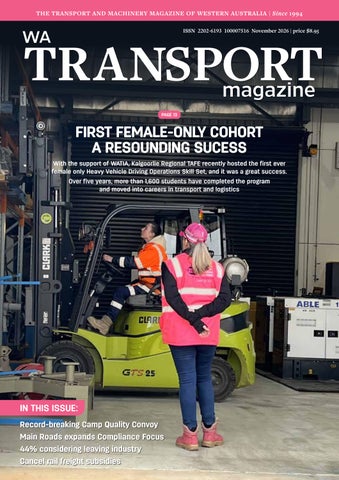
FIRST FEMALE-ONLY COHORT A RESOUNDING SUCESS With the support of WATIA, Kalgoorlie Regional TAFE recently hosted the first ever female only Heavy Vehicle Driving Operations Skill Set, and it was a great success. Over five years, more than 1,600 students have completed the program and moved into careers in transport and logistics
IN THIS ISSUE: Record-breaking Camp Quality Convoy Main Roads expands Compliance Focus 44% considering leaving industry Cancel rail freight subsidies
WATM • November 2026
Our Heavy Vehicle Helpdesk is available Monday to Friday. Talk to us about: Permits
Accreditation
OSOM movements
Route Assessments
Traffic Escort bookings
Compliance
The Heavy Vehicle Helpdesk is open from: 7am to 6pm Monday to Friday, and WA Public Holidays. On weekends the Main Roads Customer Information Centre will receive telephone calls on behalf of the Heavy Vehicle Helpdesk on 138 HVO (138 486) and email enquiries can be sent to hvs@mainroads.wa.gov.au
Main Roads Heavy Vehicle Services 525 Great Eastern Highway REDCLIFFE 6104
Tel: 138 486 Fax: 9475 8455 Email: hvs@mainroads.wa.gov.au www.mainroads.wa.gov.au 3 WATM • October 2021
WA
TRANSPORT
FROM THE PUBLISHER
magazine
VOLUME 32 | NUMBER 10
I
t never ceases to amaze me the generosity of the Western Australian transport industry. You are an amazing bunch of people who never fail to reach into your pockets and give time you don’t have in order to help medical research and families and children who are facing the worst time of their lives. From the massive funds raised by NTI and the WA Mack Muster for medical research to the annual funds raised from the LRTAWA Auctioneers Tie Auction that go to the Perth Children’s Hospital Foundation to the recent Camp Quality Convoy Perth. Whilst recent research into what drivers think (Page 19) cites that 68% of drivers feel undervalued by the public you would not know this as you see the people lined up on the streets to watch the trucks go by and give them a fist pump and a wave, or the massive amount of people from the public
who attend the truck related events. Talking about what drivers think… For all the fleet operators and regulators please read Russel Walsh’s column on page 17. I found this particularly interesting with regards to forward facing cameras and privacy and how this is being addressed already in other countries. We all understand safety and how technology can assist but there seems to be a grey area concerning the privacy of drivers that other countries are already addressing in their legislation. As always, my sincere thanks to everyone who reads, supports and helps me put the magazine together each month. WA Transport Magazine is approaching its 33rd birthday, not bad for a home grown state publication. Best,
Karen
A Trucks Hit the Road for a Record-breaking Camp Quality Convoy 3.................................. W
4.................................. M ain Roads expands compliance focus across WA following successful regional operations 5.................................. t ransport and logistics operators urged to review weather plans amid El Niño ew heavy vehicle industry report reveals 30 per cent drop in serious 8.................................. N
crashes involving inattentive or distracted drivers
ABN: 35 486 530 095
PUBLISHER / COMMISSIONING EDITOR Karen-Maree’ Kaye T: 0430 153 273 Email: karen@angrychicken.com.au WRITERS Karen-Maree’ Kaye, Russell McKinnon CONTRIBUTORS Jan Cooper, Cam Dumesny, Cliff Graham, Bronwyn Falconer, Lara Jensen, Carol Messenger, Ray Pratt, Kevin Toovey, Russel Walsh ADVERTISING ENQUIRIES Angry Chicken Head Office T: 0430 153 273 E: karen@angrychicken.com.au
ACCOUNTS T: 0430 153 273 E: karen@angrychicken.com.au PRINTER Daniels Printing Craftsmen SUBSCRIPTIONS Subscriptions available directly from the Publisher. T: 0430 153 273 E: karen@angrychicken.com.au Australia: 1 year $130 (inc GST) Overseas subscribers: Airmail postage will be added to subscription rate.
10............................... The Government must act on soaring fuel prices 11.................................. W ATIA offers practical measures to ease cost-of-living pressures 13............................... W estern Australia Transport Industry Association - First female-only cohort a resounding success 15............................... Remember When - Hooking up in Lochiel in the 1990’s 16............................... How can I get more output from every hour my people work? 17................................ Walshy’s Perspective - When is Australia going to wake up? 18............................... S uperannuation – Common questions about Insurance in your Super 19............................... 4 4% of logistics professionals are considering leaving the industry 20............................. Cancel rail freight subsidies 21............................... W here risk meets safety - Your Farm Gate Isn't Just a Gate: It's a Road Safety Interface
Every Month 23............................. HVCV
Telephone 0430 153 273 www.angrychicken.com.au
DESIGN / PREPRESS Cally Browning | Bare Creative
Contents
6.................................. Fair Go for the Owner Driver
Angry Chicken Publishing Pty Ltd
Endorsed by
Editorial Submissions: The Publisher welcomes editorial submissions. Once received they will become the property of the Publisher who reserves the right to edit the or adjust the content to fit with the format of our publication. West Australian Transport Magazine (WATM) is published by Angry Chicken Publishing Pty Ltd ABN: 35 486 530 095 All rights reserved. No part of this publication may be reproduced, adapted or transmitted in any form by any process (graphic, electronic, mechanical or storage and retrieval system) or sold, resold or otherwise exploited for any purpose without consent of the Publisher. The publisher, contributors, editors and consultants disclaim any and all liability and responsibility to any person or party, be they a purchaser, reader, advertiser or consumer of this publication in regards to consequences and outcomes of anything done or omitted, or being in reliance whether partly or solely on the contents of this publication. No person, organization or party should rely on or on any way act upon any part of the contents of this magazine without first obtaining the advice of a fully qualified person. The Publisher shall have no responsibility for any action or omission by contributor, consultant, editor or related party for content within WATM. The opinions and content within WATM does not necessarily reflect those of the Publisher, editor or their agents. No responsibility is accepted for damage or loss of material supplied to the publisher.
24............................. Toots – Woman in a man’s world
WATM • October 2026 1
Focus
WA Trucks Hit the Road for a Record-breaking Camp Quality Convoy
P
erth’s trucking community hit the road in force on Sunday 4 October, with 235 trucks taking part in Camp Quality’s Convoy Perth, and thanks to the incredible efforts of our WA truckies and community $360,000 (and still counting) was raised for kids and families facing cancer. Among those taking part was six-yearold cancer survivor Kalynda, whose family has joined every Convoy Perth since the event began. This year’s event carried an extra special meaning: Convoy fell on Kalynda’s seventh birthday. For her family, it is a milestone they once weren’t sure they would see. Kalynda was just seven months old when doctors discovered a tumour filling her
2
WATM • November 2026
chest cavity and compressing her spine. After four rounds of chemotherapy, she responded better than her family had ever imagined and is now six years in remission. “For a child that we weren’t even sure would see her first birthday, and after all she’s been through, every year is a huge milestone,” says Kalynda’s mum, Kareena. Her treatment began as COVID-19 restrictions were introduced across Western Australia, making an already frightening experience incredibly isolating for the family. After Kalynda entered remission, the family discovered Camp Quality. “Camp Quality has supported us by allowing us to be with families that understand. Families we can chat to and not feel alone.”
Convoy Perth demonstrates the incredible generosity of Western Australia’s trucking community
“They have given us amazing opportunities, weekends away and little getaways for our family to reconnect and make some incredible memories.” The family has taken part in every Convoy Perth since it began, with their 2019 659 Kenworth proudly displaying Kalynda’s fight across its bug deflector. “Convoy Perth is an amazing day out for our family, but it is also our chance to give back to an amazing organisation that has done so much for us.” On Sunday 4th October, a record breaking 235 trucks departed from Perth Motorplex, and travelled a 43km route through Perth, creating an impressive spectacle for supporters along the way before returning to the Motorplex for a free Family Festival. The convoy was led by the individual fundraisers who earned their spot at the front of Convoy Perth 2026. On last count, Dan Ross raised $43,202, Craig and Kareena Peters raised $17.752 and Ross
Cunningham raised $15,486 The top fundraising teams who went above and beyond were at last count Highest Fundraising Community Team – Team Kalynda who raised $31,229, Team Sands who raised $25,815 and the highest Fundraising Corporate Team - Dantranz Logistics who raised $52,531.
Running from 10am to 2pm, the festival featured food vans, kids’ rides, face painting, entertainment, live music and the popular Show ’n’ Shine. Camp Quality CEO Deborah Thomas says Convoy Perth demonstrates the incredible generosity of Western Australia’s trucking community.
WATM • November 2026
3
Main Roads News
Main Roads expands compliance focus across Western Australia following successful regional operations
M
ain Roads Heavy Vehicle Services (HVS) Compliance continues to improve road safety outcomes across Western Australia through targeted compliance activities, industry engagement, and intelligence-led operations designed to reduce risks for all road users. Recent multi-agency operations conducted throughout the Goldfields and Mid-West regions have delivered significant road safety benefits, helping address compliance issues that posed risks to both the freight industry and the wider community. Following the implementation of Operations HELIX, ORBIT and STRIDE, reports of compliance issues and offences within the Kalgoorlie and Coolgardie regions have reduced dramatically. These coordinated operations successfully addressed a range of long-standing concerns, including inappropriate use of Road Train Assembly Areas, unlawful parking practices, vehicle maintenance activities within designated facilities, and other compliance issues impacting industry and local communities. While the Goldfields remains an area of ongoing focus, the sustained improvement in compliance outcomes has allowed HVS to direct resources and attention towards emerging issues and priority areas across the State. In recent months, HVS Compliance has undertaken a number of targeted operations and industry engagement activities: • Operation DRIFT in the Pilbara region during August.
• Operation TRUCKSAFE conducted throughout the Perth metropolitan area. • Operation TEMPO - A joint Main Roads and Department of Transport and Major Infrastructure (DTMI) caravan safety operation, focusing on vehicle and trailer safety, load restraint requirements, towing compliance, and educating recreational road users on safe towing practices. • Indian Ocean Drive - In partnership with the Western Australia Police Force, HVS conducted a joint speed enforcement operation focussed on compliance with Restricted Access Vehicle (RAV) speed limits prescribed under Network Conditions. It was supported by the deployment of Variable Message Signs (VMS) at key locations to educate and provide advance warning to operators. This coordinated enforcement and education initiative was designed to increase awareness of speed compliance requirements and discourage unsafe driving behaviours. • Compliance and industry engagement activities at the Dowerin Field Days in August. • Community and industry engagement at the Perth Boat Show in September. These initiatives form part of HVS's ongoing commitment to supporting a safe, productive and sustainable freight industry. By combining education,
engagement and enforcement, HVS works closely with operators to promote compliance, reduce road trauma risks, and improve safety outcomes for heavy vehicle drivers and other road users. As HVS continues to grow its capability across the State, a recruitment campaign for Transport Inspectors was recently undertaken to strengthen frontline compliance and enforcement operations. The additional resources will enhance HVS's presence across metropolitan and regional areas, increasing our ability to engage with industry, conduct compliance activities, and support safer outcomes on WA roads. The recruitment process represents a significant investment in the future of heavy vehicle compliance and will help ensure HVS remains well positioned to meet the demands of a growing transport network. HVS Compliance initiatives remain reliant on strong partnerships with industry, government agencies and the community. Through intelligence-led operations, targeted education, and a collaborative multi-agency approach, HVS will continue working to improve safety outcomes, support compliant operators, and maintain efficient freight movement across Western Australia. Road safety remains a shared responsibility. Main Roads encourages transport operators, drivers and members of the public to report heavy vehicle safety concerns and compliance breaches by contacting Main Roads on 138 486.
Reminder - HVS Help Desk CoBrowse Screenshare functionality available
O
ur Heavy Vehicle Help Desk officers have access to ‘Co-Browse’ Screenshare functionality. Co-Browse allows our Help Desk Team, when on a call with our customers and via secure access arrangements, to visually guide customers through our website to locate permit application templates, guidelines and operating conditions. Feedback on this functionality has been positive, and users have found it to be an effective and efficient tool.
4
WATM • November 2026
News
T
Transport & Logistics Operators Urged To Review Weather Plans Amid El Niño
ransport and logistics operators are encouraged to review and familiarise themselves with their severe weather and business continuity plans (BCP) as Australia heads towards summer. With El Niño underway and expected to strengthen through spring, Australia’s largest specialist transport and logistics insurance provider, NTI, says now is the time for operators to consider how prepared they are for Australia’s variable and oftentimes severe weather conditions. The Bureau of Meteorology indicates El Niño is firmly established and expected to strengthen through spring, with further warmings forecast and expected to persist into autumn 2027. NTI Logistics Risk Engineer Chelsea Neely said while more broadly the impacts of El Niño extend beyond Australia, there are things we can do at home to prepare. “The Australian Summer can be unpredictable, and the potential impact on a business depends on its location, operations and individual circumstances,” Ms Neely said. “This isn’t about assuming what disruption will occur, but moreso about using the lead-up to summer to revisit existing plans, update emergency checklists and contacts, and make sure they are communicated and understood across the business, in case things suddenly change.” “Disruption to everyday processes could mean changes to routes, longer journeys, shifting schedules, and more pressure to
keep deliveries moving,” she said. “Extreme weather can also impact the types and volumes of goods being moved. For example, reduced rainfall may impact crop yields, while prolonged dry conditions can place pressure on livestock producers and influence the timing and volume of livestock movements.” “Businesses might consider how these shifts could affect their own supply chains and be prepared for the ebbs and flows in freight demand that may come with changing seasonal conditions. Knowing your alternative routes, suppliers, and contacts before something happens can save valuable time when conditions change quickly.” NTI is encouraging businesses to: • Review key freight routes and identify alternatives if roads or major routes are disrupted. • Review driver and workplace safety procedures for extreme heat and changing road conditions. • Review and test emergency and business continuity plans for use in case of disrupted business operations. • Check emergency equipment is in working order. • Plan for freight delays, including diversifying suppliers and preparing for changes to delivery schedules. • Review insurance cover and declared values to ensure they reflect current freight costs and stock values.
24 HR / 7 DAY ACCESS 3 MINUTE EXPRESS WASH
New CCTV security rebate for WA small businesses
T
he State Labor Government is helping to strengthen security for Western Australian small businesses with a new CCTV security rebate. The WA Small Business Resilience Program - CCTV Rebate will provide matched funding of up to $2,000 per property, to help eligible businesses purchase and install new or upgraded CCTV systems to protect their premises. The program aims to empower small businesses to take a proactive approach to crime prevention, and in doing so, help deter crimes including theft, vandalism, break-ins, and staff assaults. All new security systems will be added to the WA Police's CamMap WA database of registered CCTV systems across Western Australia to support increased public and business safety. Applications for the WA Small Business Resilience Program - CCTV Rebate will open on Monday, 19 October. For more information, visit www.smallbusiness.wa.gov.au/CCTV
• Road train friendly • Full chassi rinse standard • Credit card facility • Fleet accounts available
QUICK DRIVE THRU FULLY AUTOMATED TRUCK WASH www.twepicton.com.au Roadtrain / truck & dog $150 inc gst Semi $125 inc gst 6 Wheel Trucks / Bus $95 inc gst 2 Nicholson Road, East Picton T: Darren 0417 909 128 | E: info@twepicton.com.au
WATM • November 2026
5
Over to you A FAIR GO FOR OWNER DRIVERS by Ray Pratt
The Truck Stops when the Driver Stops
W
e spend a lot of time talking about road safety, fatigue, driver behaviour, heavy vehicle crashes and the importance of taking breaks. But there is one part of the equation that doesn’t get nearly enough attention - where is the driver supposed to stop? For the long-distance truck driver travelling across Western Australia, finding somewhere suitable to pull up can be a challenge in itself. A road train driver may need to stop for a proper rest after spending hours behind the wheel so they need somewhere safe to park a long combination, get out of the cab, stretch their legs, have something to eat, use a toilet and get some decent sleep. That shouldn’t be too much to ask yet too often, the reality is a dusty truck bay, a gravel shoulder or an overcrowded rest area with trucks parked wherever they can fit, no toilets, shower, rubbish bin, lights or food. And sometimes barely enough room to safely get a truck off the road. Truck drivers are told that fatigue management is their responsibility. Of course, it is but responsibility has to work both ways. The government mandates adequate rest breaks whilst not providing adequate facilities. A thought for our female truck drivers. It’s bad enough that male truck drivers have to use a tree to go to the toilet but it’s hardly acceptable to expect females to become truck drivers and not give them basic facilities. No other industry would allow this so why should we be any different?
6
WATM • November 2026
Anyone who has spent days and weeks travelling Australia’s highways knows that driving a heavy vehicle is physically and mentally demanding. You sit for long periods concentrating constantly, deal with traffic, weather and road conditions and when the opportunity comes to stop, you need to be able to properly switch off. A decent rest area is not a luxury, it’s part of the road safety system. This is particularly important in WA, where distances can be enormous and there can be hundreds of kilometres between major centres, mobile phone coverage can disappear, weather can change and road conditions can deteriorate. Once you're out there, the truck driver can't simply pull into the next service station five kilometres down the road. We seem to understand the importance of facilities in almost every other workplace. Imagine telling a factory worker there was no toilet at their workplace or telling someone working a twelve-hour shift that there was nowhere suitable to sit down and eat or rest? Yet for truck drivers, we often seem to accept exactly that and the problem is bigger than driver comfort – it is about safety. A tired driver needs somewhere to stop before fatigue sets in and if suitable facilities are available, that decision becomes much easier. If the only option is an uncomfortable, unsafe or overcrowded truck bay, the temptation to keep driving can become very real. That’s when fatigue management becomes
more than a policy written on paper. It becomes a matter of life and death. Truck drivers aren’t just passing through areas, they are keeping the country supplied - every supermarket shelf, building site, mine site, machinery dealer and business depends on trucks. Yet when that driver needs somewhere to stop, they are often treated as an inconvenience and that attitude needs to change. Many years ago, when I started driving long distances customers were appreciative of the effort we made to deliver their freight in good condition and on time. The reward was many mine sites were happy to allow you use of their facilities - showers, canteens and even an air conditioned room which was great to help combat fatigue. We need to start thinking of Australia’s highways as workplaces and the facilities along them as workplace infrastructure. Adequate truck parking, clean toilets, showers, lighting, rubbish facilities and somewhere safe to rest aren’t extravagant demands - they are basic requirements for an industry that operates around the clock. Perhaps the next time governments, regulators and industry leaders sit around a table talking about fatigue, they should ask a very simple question. Where can the driver actually stop? Because ultimately, the truck doesn’t stop when the paperwork says it should - it stops when the driver stops and we need to give them somewhere safe to do so. Keep it safe, Ray Pratt.
Victoria
Queensland
Western Australia
Tel - (03) 9369 0000
Tel - (07) 3372 2223
Tel - (08) 9350 6470
13-21 Bliss Court, Derrimut VIC, 3026
1/15 Seeana Place, Heathwood QLD, 4110
5 Freight Road, Kenwick WA, 6107
WATM • November 2026 7
News
New heavy vehicle industry report reveals 30 per cent drop in serious crashes involving inattentive or distracted drivers
T
he number of major truck crashes involving inattentive or distracted drivers on Australian roads has fallen by 32 per cent in the past 12 months, according to the 2026 National Truck Accident Research Centre (NTARC) Major Incident Investigation Report. The new report found several positive safety trends including “notable reductions” in driver fatigue (56.9 per cent) and in failure to give way (60.8 per cent). “In a positive development, the inattention/distraction incident rate is declining - from 25.4 incidents per 10,000 heavy vehicles in 2023 to 17.0 in 2025, a 33.1 per cent decrease,” the report found. “While the overall rate remains a concern, this downward trend may indicate early signs of progress in addressing this key risk area.” The report, developed in partnership by Australia's leading specialist transport and insurance provider, NTI, with the National Road Safety Partnership Program (NRSPP), and the Monash University Accident Research Centre (MUARC), also found: • Major loss claims exceeding $50,000 fell 22.3 per cent in 2025. • Human factor-related incidents fell 17.6 per cent in 2025, to 67.6 incidents per 10,000 heavy vehicles. • Inattention/distraction remained the leading human factor, accounting for 13.8 per cent of all major incidents in 2025. While these incidents generally trend upward in recent years, these crashes fell 32 per cent to 17 incidents per 10,000 heavy vehicles. • Nearly two-thirds (63.5 per cent) of inattention/distraction crashes involved a single vehicle. • Geographically, inattention/ distraction crashes were slightly under-represented in major cities (36.8 per cent) relative to their overall crash share (40 per cent) and slightly over-represented in inner regional areas (27.3 per cent). • Articulated combinations had the highest inattention/distraction crash rate at 24.2 per 10,000 vehicles, with crashes most common in outer regional areas and major cities. This reflects their
8
WATM • November 2026
Major Incident Investigation Report
NTARC Major Incident Investigation Report
1
In a positive development, the inattention/distraction incident rate is declining - from 25.4 incidents per 10,000 heavy vehicles in 2023 to 17.0 in 2025, a 33.1 per cent decrease greater exposure to long-haul driving conditions, and in major cities, possibly due to the prevalence of environmental distractions, the high density of vulnerable road users, and frequent stopping. • Fatigue-related incidents fell 56.9 per cent, from 5.8 to 2.5 per 10,000 vehicles, while failure-to-give-way incidents fell 60.8 per cent and inappropriate vehicle positioning fell 8.9 per cent. NTI’s Transport Research Manager Adam Gibson said that understanding the causes of serious heavy vehicle incidents allowed organisations to focus safety efforts where “they will have the greatest impact”. “The NTARC report is a powerful resource to inform strategies to address safety challenges facing Australia’s heavy vehicle sector,” Mr Gibson said.
“The decline in some key human factor risks shows the value of continued focus on these issues, while it remains critical that road safety interventions and initiatives continue to target these hazards, particularly inattention/distraction, given their continued prevalence and potential for severe consequences.” NTI’s Chief Executive Officer Janelle Greene said the NTARC report helped take the “guesswork” out of improving driver wellbeing and road safety. “This vital research provides the transport sector and decisionmakers with the practical insights needed to help save lives,” Ms Greene said. “The 2026 findings show that progress is being made in some areas of human factor risk, while also highlighting where further work is needed.” “The sustained focus on human factors in major crash events such as inattentive or distracted drivers demonstrates the importance of the work being done across the industry, from driver training and safety education to systemic and behavioural interventions.” “The decrease in heavy vehicle incidents involving inattentive or distracted drivers provides a positive indication that these efforts are making a difference,” she said. Australian Trucking Association Chief Executive Officer Mathew Munro said the NTARC report – which breaks data down to each State and Territory – was essential for “driving change” to help the sector reduce heavy vehicle crash frequency and severity. “This important research delivers clear and timely evidence that helps us better understand why major crashes happen, and how they are trending over time,” Mr Munro said. “Developing a strong safety culture right across the industry is critical, and the findings show the importance of continuing the work already being led by industry and government, from tailored education and awareness campaigns to policy and technology innovations.” To download the full 2026 report visit https://media.nrspp.org.au/wp-content/ uploads/2026/10/07092540/NTARC-MIIR.pdf
BUILT FOR WA’S TOUGHEST CONDITIONS Looking for a competitively priced commercial battery without compromising on quality or reliability? Product Data Sheets Available for All Models
S8D-1500SMF (N200 Case Size) Leading the range, the S8D-1500SMF delivers an impressive 1500 Cold Cranking Amps (CCA) and 200Ah capacity, making it ideal for high-demand commercial applications. Featuring thicker expanded grid plates, it is engineered to provide exceptional durability, reliability and extended service life in some of Australia's toughest working conditions. S4D-1400MF / S4D-1400RMF (N150 Case Size) These premium maintenance-free heavy-duty batteries provide 1400 Cold Cranking Amps (CCA) and are designed to meet or exceed original equipment specifications. Built for dependable performance and long-term reliability, they are ideally suited to demanding fleet and commercial operations. ACDelco Commercial Batteries, backed by General Motors, deliver the performance, reliability and value demanded by Western Australia's harsh operating conditions. Now available from Battery Mart's Belmont and Geraldton locations, this new range has been designed specifically for demanding commercial, transport, agricultural and mining applications.
S105D31LHD / S105D31RHD (N70ZZ Case Size) A popular 300mm case size widely used throughout the transport and mining industries. Delivering 780 Cold Cranking Amps (CCA), these batteries offer the same proven engineering, durability and reliability credentials found across the larger commercial range.
Key Features & Benefits ✔ Anchor Bonding Technology for superior vibration resistance ✔ Enhanced grid design for greater durability and longer service life ✔ Heavy-duty construction for demanding commercial applications ✔ Maintenance-free convenience
Battery Mart - Belmont Head Office
✔ Proven resilience in harsh Australian environments
Gus Simonetta Unit 1/112 Belgravia Street, Belmont ✆ 08 6223 0880
✔ Reliable performance under heavy electrical loads
Battery Mart - Geraldton Branch
✔ Fewer interruptions and greater operational confidence
Andrew Halton 100 Flores Road, Geraldton ✆ 08 9964 8404
✔ Competitive pricing backed by a globally recognised automotive manufacturer
BATTERY MART - Powering Western Australia's Commercial Industry • batterymartwa.com.au •
WATM • November 2026 9
News
Transport Future Leaders T
he ATA, Geotab and Volvo Group Australia have announced the participants in the 2026-27 Future Leaders Forum (FLF) an award-winning leadership program that gives young leaders in the trucking industry the tools and training they need to become strong, effective industry advocates. “We are excited to continue working with the ATA to support the long-term success and resilience of the transport sector. Developing strong industry leaders today will help ensure the industry is well positioned to meet the challenges and opportunities of tomorrow,” Associate Vice President of Heavy Transport, Geotab APAC, Andrew Hintz said. “Australian industry is crying out for talented young leaders equipped to tackle rapid change and technology head on,” Vice
President People and Culture, Volvo Group Australia, Jane Humphreys said. One of the chosen is Dimity Andrews from North West Quarries in Western Australia. Dimity works at the intersection of policy, industry research and strategic development for North West Quarries, focusing on workforce, freight and emerging
transport challenges across the sector. Her role is to turn industry evidence, stakeholder insight and operational realities into practical policy positions, targeted workforce initiatives and longer-term strategic responses that strengthen the productivity, resilience and future capability of Western Australia’s transport industry.
The Government must act on soaring fuel prices
T
he Australian Government must put in place a new support package to address soaring fuel prices, ATA CEO Mathew Munro said. “The Government has previously demonstrated that it is prepared to provide targeted relief when circumstances warrant, through its reduction in fuel excise and the road user charge,” Mathew said. “The ATA supported the Government’s decision to apply these temporary measures, and we supported a staged withdrawal when the situation and outlook stabilised. These were the right decisions at the time, but circumstances have changed. “The Government needs to cut fuel excise again and return the road user charge to zero. If the Government cannot reduce fuel excise, it should zero the road user charge. “The planned 1 January 2027 increase in the underlying road user charge rate should be held to no more than CPI, with no catch up adjustment later. Businesses need certainty and should not face another cost shock.
10
WATM • November 2026
“The Government also needs to extend the availability of the zero interest loans under the Economic Resilience Program. The program must continue to be available to new applicants. “As the international situation worsens, the Government needs to step up its engagement with industry. It needs to reinstate its weekly fuel security meetings, which should be chaired at ministerial level. “The Government must also share its level 3 and 4 fuel security plans with its industry partners. Road freight must be designated as an essential industry and prioritised in these plans,” he said. The Fair Work Commission held a hearing on Friday 9 October to consider reenlivening its fuel cost recovery order. Meanwhile, the ATA has welcomed the Coalition’s proposal to automatically reduce fuel taxes when global oil prices spike, saying a clear trigger would give trucking operators greater certainty when managing one of their biggest business costs. Under the proposed Fuel Price Shield, fuel excise would halve automatically when
the two-week average price of Brent crude was above US$100 a barrel. The proposal would reduce the heavy vehicle road user charge to zero while the measure was operating. ATA Chair Mark Parry said the tax relief measure was critical to trucking operator sustainability and that the automatic nature of the proposal was particularly important. “Operators need certainty. If fuel prices spike, they shouldn’t be left in the dark wondering what support will be available to them and when it will take effect. “An automatic trigger would give that certainty. Operators would not have to wait for a government to make on-the-fly decisions. Once the trigger was reached, they would know the mechanism would apply. Mr Parry said the Fuel Price Shield was one measure that could alleviate pressure on operators, but that businesses and consumers needed to be ready to pay more. “Trucking businesses need to have open conversations with their customers about the need to raise freight rates or increase their fuel levy if they have one,” he said.
News
WATIA offers practical measures to ease cost-of-living pressures
T
he Western Australian transport industry is offering to work with the State Government on practical, rapidly implementable measures to reduce freight costs and help ease cost-of-living pressures for WA businesses and households. Pressures that were reported in a CCIWA report published in The Sunday Times, citing that 60% of West Australian’s being in financial stress. The Western Australia Transport Industry Association (WATIA) says rising fuel prices, combined with increasing operating costs across the freight sector, are placing significant pressure on transport operators – costs that ultimately flow through the supply chain to businesses and consumers. WATIA’s staff have been talking to stressed operators including one transport operator who had just paid nearly $6,000 to fill his long-haul truck – a crippling 40% of the total payment for the load, before other operating costs, insurances, wages and overheads. The need for action is becoming increasingly urgent, with the harvest and
Christmas peak freight and a high-risk season this summer on transnational and intrastate freight routes approaching, combined with uncertainty around fuel prices and supply. WATIA is proposing to work collaboratively with the State Government to identify and rapidly implement low-cost productivity measures that can remove unnecessary costs and delays from WA’s freight network. The productivity measures WATIA is seeking to discuss with Government include: • removing last-mile freight barriers; • addressing disconnects and inefficiencies across the freight network; • reducing intermodal delays; and • eliminating ineffective and unnecessary red tape. Improving freight productivity would reduce fuel consumption, lower operating costs and ease pressure on drivers, while helping contain the transport costs embedded in the price of goods across WA. WATIA is also offering to partner with
the State Government on industry-led initiatives to accelerate the electrification of light and medium freight vehicles operating in the metropolitan area, reducing the sector’s exposure to volatile fuel prices over the longer term. The State Government has previously demonstrated that practical regulatory changes can deliver immediate productivity benefits, including initiatives allowing more efficient heavy vehicle combinations to transport agricultural inputs and supply regional communities along the Great Northern Highway. WATIA believes a similar collaborative and pragmatic approach can deliver further productivity improvements across the freight network. Reducing unnecessary freight costs is not simply an issue for the transport industry. A more efficient freight network benefits every WA business and household that relies on goods being moved safely, reliably and affordably across the State.
SUPER THAT WORKS AS HARD AS YOU DO. Australia’s top specialist fund for transport, energy and mining workers.
Talk to us about super, pension, insurance and financial advice.
13 64 63 teamsuper.com
Issued by Team Super Pty Ltd ABN 70 003 566 989 AFS licence 246864 trustee for the Team Superannuation Fund ABN 16 457 520 308. Refer to the PDS and TMDs on our website at teamsuper.com when considering if our financial products are right for you. Financial planning services are provided by Team Super Financial Advice a trading name of Team Super Services Pty Ltd ABN 49 051 315 014 AFS licence 502700. Past investment performance isn’t necessarily an indication of future performance. Zenith CW Pty Ltd ABN 20 639 121 403 AFSL 226872/AFS Rep No. 1280401 Chant West Awards issued May 2026 are solely statements of opinion and not a recommendation in relation to making any investment decisions. Awards are current for 12 months and subject to change at any time. Awards for previous years are for historical purposes only. Full details on Chant West Awards at chantwest.com.au/fund-awards/about-the-awards
WATM • November 2026 11
Over to you WESTERN AUSTRALIA TRANSPORT INDUSTRY ASSOCIATION By Natalie Grinceri
First female-only cohort a resounding success
T
he Kalgoorlie campus of Central Regional TAFE recently hosted the first ever Female Only Heavy Vehicle Driving Operations Skill Set, and it was a great success. The Heavy Vehicle Driving Operations Skill Set is delivered by TAFEs across Western Australia with the support of Industry and the Western Australia Transport Industry Association (WATIA). Over the past five years, more than 1,600 students have completed the program and moved into careers in transport and logistics. This was the first time it had been run as a female-only group. The students were trained by seasoned driver trainer Colin Dyne. Supporting him were Heather Jones from the Pilbara Heavy Haulage Girls, who is a passionate supporter of women in the transport and logistics industry, and Julie Davies, an experienced Skills for Study lecturer who has been involved with this specialised program for over six years. It was a fantastic team, and the students had a lot of
12
WATM • November 2026
knowledge and support to lean on. Over the course, students worked through lectures and assessments along with a range of practical activities and challenges. Part of the course also involved training for their High Risk WorkSafe forklift licence. Amber from TI Training brought her training operation to Kalgoorlie for three days to deliver and assess this unique group of students.
have been mocked for, scoffed at or had eyes rolled at. In this group she could just ask, and get an answer. Another appreciated not being rushed through things. Colin, Heather and Julie were happy to slow things down and go over things when needed, and they seemed to have endless patience. It made a real difference to how confident the students felt by the end.
Why female only?
A visit to Sykes Transport
The feedback from the students says it all. Again and again, they told us how much they valued being able to do this type of training in a female-only environment. One student talked about how supported she felt, particularly during the forklift training. When she was having a hard time and struggling, her fellow students cheered her on and offered encouragement from the sidelines. That’s exactly the kind of team spirit you want to see. Another appreciated being able to ask questions that she felt she might otherwise
On the final day of the course, the group met at Sykes Transport at 7am to see the industry in action. They sat in on a toolbox meeting, watched a B-double from Perth being unloaded and had a tour of the busy yard. One of the highlights was seeing a real-life example of ‘ugly freight’, the kind of awkward, hard-to-secure load they had talked about in their secure cargo lecture. Everyone was really impressed by the driver’s strapping skills. It was great for the students to see what they had learnt in the classroom put into practice on the job.
What’s next? All of the students are now looking forward to their driving lessons in Heavy Rigid synchro trucks. As you’d expect in Kalgoorlie, there was plenty of interest in working on the mines. It was also really refreshing to see a 22-year-old student who is keen to follow in her dad’s footsteps and eventually move into long haul in road trains.
This first cohort has shown what can happen when women are given the chance to train in an environment where they feel supported, comfortable to ask questions and able to learn at their own pace
Building on a great start This first cohort has shown what can happen when women are given the chance to train in an environment where they feel supported, comfortable to ask questions and able to learn at their own pace. These women didn't just walk away with tickets and skills. They walked away with real confidence that they belong in this industry. The transport and logistics industry needs good people, and there are so many capable women out there ready to give it a go. Well done to Central Regional TAFE, Colin, Heather, Julie, Amber from TI Training and the team at Sykes Transport for making this happen, and congratulations to all of the students. Hopefully this is the first of many.
WATM • November 2026 13
History
ER
IN G
TIM
T WES
ES
Remember When ... N
AU K STR UC R T A L I AN
Hooking up in Lochiel in the 1990s
By ROD SIMMONDS
L
ochiel is a small town in the Mid North of South Australia around 125 km north of Adelaide. The town lies beside on the western edge of Lake Bumbunga and at the eastern foot of the Hummocks Range. The Augusta Highway, a section of Highway 1, runs on a strip between the township and the lake but for truckies in the 1990s it was the place to hook up or unhook your second trailer and head off. Long before general access Road Trains were allowed into Wingfield and wider areas of Adelaide the “pads” at Lochiel were busy day and night with trucks
14
WATM • November 2026
shuttling trailers back and forth including livestock. The amenities were basic, the pot holes seemed to grow bigger overnight and the dust and flies were constant. Just like the other end in the West the Northam pads that worked the same way. Camaraderie was still common back then, other drivers helping others hook up, tighten the tarp ropes, change tyres and fix anything they could. This was before the corporates and strict rules, white trucks and ill prepared and equipped drivers…. The trip across ‘The Paddock’ may have started back in Adelaide or Melbourne originally but once the second trailer was hooked up, it felt the real start and the pressure was on. The roadhouses, the sun, then wind, the dust, wandering stock, loose ropes, mozzies and roo’s playing chicken all became part the journey. The metal battle, what to eat for dinner, the worry about paying the bills, missing family occasions, the next load or that one loose rope blowing in the wind on
the very end of the trailer all played on the driver’s mind, hour after hour, mile after mile. The Nullabor provided the time and space to think about nothing and everything, getting over to ‘The West’ was the mission and every trip, every week was different or the same. In writing about Eyre’s voyages in 1865, Henry Kingsley wrote that the area across the Nullarbor and Great Australian Bight was a “hideous anomaly, a blot on the face of nature, the sort of place one gets into in bad dreams”! Most seasoned drivers would have similar unprintable comments along the same lines! The Highly versatile Multi Trailer Combinations are now common place and with that higher productivity but the legends, the actual drivers driving day and night, who made up the loads and trailers before they even started ‘cracking into it’ or ‘leaning forward’ paved the way for what is happening today.
The Nullabor provided the time and space to think about nothing and everything, getting over to “The West” was the mission and every trip, every week was different or the same
WATM • November 2026 15
Focus
How can I get more output from every hour my people work?
A
ustralian businesses need to find ways to produce more from the people, equipment and resources they already have as rising costs and growing resistance to price increases put further pressure on margins, according to Earlypay CEO James Beeson. Mr. Beeson said productivity was too often discussed as an abstract economic problem when, for an individual business, the principle was relatively simple. “When we hear about Australia's productivity problem, we're generally talking about labour productivity – how much economic output we generate for every hour worked,” Mr. Beeson said. “For a small, medium enterprise (SME), it's essentially the same question: how can I get more output from every hour my people work? “Rather than asking people to work longer or harder, it's about giving them better equipment, better technology, better skills and better processes so they can produce more value from the same hour of work.” Latest ABS figures show labour productivity was flat in the June quarter and fell 0.2 per cent over the year, while the Reserve Bank's August business liaison found increasing customer price sensitivity was limiting businesses' ability to pass higher costs on. Mr. Beeson said the opportunity would look different across industries. “For a manufacturer, it might be
16
WATM • November 2026
machinery that allows an employee to produce more. For a transport company, it could be technology that improves scheduling and vehicle utilisation. For a professional services business, it could be using AI to remove hours of repetitive administration. “The question business owners should be asking is: what are my people spending time doing today that better equipment, technology, skills or processes could do more efficiently?” Founder of commercial finance specialist Nexus Advisory, Stephen Mitchell, said cash pressures were pushing some larger businesses to seek finance after previously relying on their own reserves to cover the gap between spending money and receiving payment. “We're seeing more and more businesses with a lot less cash on the balance sheet,” Mr. Mitchell said. He said transport and construction businesses were particularly exposed where agreed contract prices prevented them from recovering increases in operating costs. “Yet as tough as the economy is, there are businesses growing,” Mr. Mitchell said. He said businesses performing well understood their costs and had avoided taking on too much debt. Investment was continuing, with more spending directed towards efficiency rather than expansion, including automation, AI and improvements to technology systems.
Mr. Beeson said Australia needed to encourage business owners to make productivity-enhancing investments. “The productivity dividend comes after the investment,” he said. “The current $20,000 instant asset writeoff doesn't go very far when you're talking about serious plant, machinery or automation. The government should look at stronger incentives that encourage business owners to bring forward investments that increase their productive capacity. “Investment in equipment also needs to go hand-in-hand with skills. Better equipment in the hands of better-trained people is where the real productivity gain comes from.” Mr. Beeson said businesses also needed to consider how productivity investments would affect cash flow before committing capital. “A business might invest in new machinery, technology, AI or training today, but it could take months or years before the full financial benefit flows through,” he said. “In the meantime, the business still has to pay wages, suppliers and its other operating costs. That's why working capital needs to be part of the productivity conversation from the beginning.” Mr. Mitchell said businesses needed to match the way an investment was funded to both the expense itself and the timing of their income. “If there is a cash flow need in a business, it’s important to get the finance that is going to match that cash flow need,” he said. This could mean trade finance to pay suppliers, invoice finance to cover lengthy customer payment terms, or a term loan for technology investment. According to Mr. Mitchell, some businesses were accessing unsuitable loans, adding pressure to already stretched finances. He said funding arrangements should be reviewed over time as a business's needs and financial position changed. Mr. Beeson said the objective should be to make productivity investments without weakening the underlying business. “A good investment can still create cash flow pressure if it is funded the wrong way,” he said. “Businesses need to understand what the investment will cost, when the productivity benefits are expected to arrive and how much working capital they will need in the meantime.
Over to you
Walshy's PERSPECTIVE
When is Australia going to wake up?
T
he whole idea of me writing these articles is to put some perspective on the Road Transport Industry from a driver’s point of view. So much of what we read in the media is from the management, compliance or sales side of the industry promoting new technology or some new regulation or legislation that will impact us drivers with no consultation from the driver group. As the industry becomes more corporatised there is an increase in micro managing and less opportunity for input from drivers, many whom feel like they have become a number instead of a valued employee. I have spoken about excessive regulation and compliance including the invasive nature of live driver facing cameras. A lot of this is being pushed by the insurance and corporate world in a bid to distance themselves from any liability under the Chain of Responsibility Laws.
Recent Dash Cam Mandates Since my last article on forward facing camera’s, I have found some successful test cases in Canada and I have a feeling it won’t be long before Australian laws are tested if the boundaries are pushed too far. Here are some examples of what has been going on over there. Whilst there is no blanket ban on driver facing cameras and in cabin audio there are a large number of hoops to jump through in Canada when it comes to driver facing cameras and recording in cabin audio. Under Canadian Privacy Laws, the use of in-cab cameras falls under the privacy legislation PIPEDA (Personal Information Protection and Electronic Documents Act) or provincial equivalents. The legal precedent is that Court and arbitration rulings (notable cases in Quebec) have frequently found continuous driverfacing monitoring to be an illegal invasion of privacy and a violation of worker privacy rights under privacy charters.
In Canada, recording in-cab audio or pointing cameras toward private sleeping berths is strictly prohibited and can carry severe legal penalties under federal privacy provisions. British Columbia passed Bill M217 (the Dashboard Cameras in Commercial Vehicles Act). This mandate specifically requires forward-facing cameras (1080p resolution, night vision, and 72-hour storage) and explicitly excludes in-cab or driver-facing cameras to protect driver privacy.
The driver shortage In my opinion, Australia is going the wrong way about correcting the driver shortage by choosing to put a band-aid on a wound instead of preventing the wound from happening in the first place. This issue started many years ago and we could all see it, and when we gave our thoughts, it fell on deaf ears. For me, hands on training is a key problem followed by low remuneration, poor working conditions and lack of facilities Australia wide. If we fix these problems then so many issues will be resolved and safety will come naturally the industry would start to retain older drivers and attract new drivers. Let’s get into hands on training and lack of it. Here is a quick example. Recently we had what was very clearly an untrained foreign driver coming down the South Eastern Freeway in Adelaide hills with his brakes smoking. It was his first time down that hill and he was in a loaded B double.
If you look at the interview you see he had absolutely no idea what he was doing and add to that, apparently the truck had a number of defects. Companies that operate like this are seemingly let slip through the system untouched by the regulatory and policing bodies and yet well established, successful Australian owned enterprises seem to be intercepted continually. This is becoming extremely noticeable and people are talking about it. Why are the regulatory and policing bodies becoming detached from what is really going on? I will briefly touch on OH&S as well. This has gone way over the top here in Australia with endless inductions and safety teams watching everyone like a hawk. Both Liberal and Labor have been guilty of pushing this crap then add the big corporates, in particular the big miners who I’m sure are from another planet. Meanwhile the US has wound OH&S right back “unleashing prosperity through deregulation” as they learnt how restrictive and costly this over the top crap is to the country’s economy and it requires a lot of valuable workers to implement and monitor. Meanwhile in Australia we have a shortage of workers. Is Australia not watching the mistakes made by more developed countries? The ignorance and arrogance by our corporates and politicians astound me. Cheers, Walshy.
If we fix these problems then so many issues will be resolved and safety will come naturally - the industry would start to retain older drivers and attract new drivers WATM • November 2026 17
Superannuation
COMMON QUESTIONS ABOUT INSURANCE IN YOUR SUPER
M
ost super funds, including Team Super, offer a range of insurance options designed to protect you and your family in the event something happens to you. If you’re a Team Super member and have a super account, this insurance is automatically added when you become eligible (and you can change or cancel it at any time). If you haven’t needed to make a claim before, you may not have given much thought to exactly what type of cover you have or how much, and whether it suits your needs. In this article we look at four common questions that people ask about insurance through super.
1. IS IT WORTH HAVING INSURANCE? Insurance in Superannuation provides a financial safety net for you and your loved ones. It can help you keep up with medical costs and living expenses if you get sick or injured, as well as enabling your family to maintain their standard of living if you pass away. If and how much cover you’ll need depends on your personal situation. Team Super offers members: • Death and Terminal Illness (DTI) Cover – provides a lump sum payment if you die or become terminally ill. • Total and Permanent Disablement (TPD) Cover – provides a lump sum payment if you’re unlikely to ever work again due to an illness or injury. • Income Protection (IP) insurance – provides a temporary income if you’re unable to work due to an illness or injury. Team Super tip: Under the law, super funds will cancel insurance on inactive super accounts that haven’t received
contributions for at least 16 months. Your super fund should contact you before your insurance is about to end.
2. WHAT ABOUT DANGEROUS OCCUPATIONS? While most super funds offer insurance cover to their members, they may not cover people working in a job that’s considered ‘dangerous’. If you work in transport, mining, or a related industry, jobs commonly excluded from insurance cover include miners, truck drivers, loaders, mechanics, flight crew, store persons. At Team Super, our insurance caters for members working in such high risk or ‘dangerous occupations’, who can find it hard to obtain adequate and reasonably priced insurance elsewhere, due to their jobs.
4. CAN I CHANGE MY COVER? Yes! You can (and sometimes should) change your cover, as it’s not set and forget. And things like your salary and the type of job you have can have flow on impacts to how much you pay and what you’re covered for. Team Super members can update their insurance at any time to change things like your Occupation Group or reducing or cancelling your cover. You can also apply for new insurance or top up your existing cover; or take advantage of special offers to increase your cover (if eligible within a specified period). Remember, it’s important to regularly review your insurance cover to ensure it’s right for your needs.
3. HOW MUCH DOES INSURANCE COST? The cost of your insurance depends on the type and amount of cover you have, as well as other factors including your age, gender and smoker status (as applicable). For Team Super members, it also depends on which insurance Division you’re in and the type of job you do. One of the main benefits of insurance through super is hassle free payments – your insurance is easier to manage as the premiums are automatically deducted from your super account, so you don’t need to worry about budgeting or making payments.
Already a member of Team Super? You can view and manage your insurance online! Simply grab your member number from your last statement and log in via teamsuper.com/login. Not yet a member? Learn about the benefits of joining Australia’s top specialist fund for transport, energy and mining at teamsuper.com/join.
Team Super is Team Super Pty Ltd AFS licence 246864, the trustee for the Team Superannuation Fund. Refer to the PDS and TMDs on Team Super’s website at teamsuper.com when considering if their financial products are right for you. Any financial advice in this article does not take into account your financial situation, needs or objectives, and you should consider these factors before taking any action.
18
WATM • November 2026
Focus
44% of logistics professionals are considering leaving the industry
M
icrolise, the leading supplier of innovative transport technology in Australia and New Zealand, has released new research revealing 44% of Australian transport and logistics professionals are considering leaving the industry within the next five years. Furthermore, 42% say working in the sector has impacted their mental health. The report, titled Australian Fleet Safety & Compliance Benchmark 2026, surveyed 200 senior transport and logistics professionals in Australia about their realworld experiences managing health, safety and compliance across their fleets. The findings point to a systemic mental health issue in the sector.
The growing workforce challenge According to the Australian Logistics Council (ALC) we have a rapidly ageing workforce – with driver shortages currently estimated at 28,000 with 60% of drivers over 50 and 15% over 65. Long working hours are the biggest reason professionals are considering leaving the industry (29%), reflecting the serious impact that demanding working conditions can have on physical and mental wellbeing. Difficulty keeping on top of compliance is the second-biggest reason (25%), highlighting the immense pressure that Australia’s evolving compliance regulations are placing on fleet operators. The research also exposes the broader challenge around workforce retention – 68% of respondents say their drivers feel undervalued by the public, revealing a strong disconnect between public perception and the vital role that truck drivers play in keeping Australia's economy moving.
Evolving compliance regulations While most fleet operators are confident in their compliance processes, the findings reveal a significant disconnect between perception and reality. 89% of respondents say it is “fairly easy” or “very easy” to manage compliance, while 68% say they “no longer worry about compliance complexity as technology removes the burden”. Despite this confidence, over a third admit they still rely on manual processes for critical tasks like license and qualification checks and vehicle maintenance records. This suggests a sense of overconfidence in
What’s putting the most pressure on fleet operations? As part of our research, we explored the biggest pressures currently facing fleet operations. Fuel costs topped the list at 23%, followed by driver health and wellbeing at 19%. Evolving compliance regulations, driver shortages, and recruiting and retaining skilled staff were also key concerns, each cited by 15% of respondents.
23% - Fuel costs 19% - Driver health & wellbeing 15% - Evolving compliance regulations 15% - Driver shortages 15% - Recruiting/ retaining skilled staff 12% - Insurance Premiums
compliance management, highlighting that many fleet operators still underestimate the risks associated with manual compliance management despite the reality of regulatory penalties, operational inefficiencies and reputational damage. Manual processes are also placing unnecessary pressure on staff, with 22% of respondents citing an overreliance on paperwork and other manual methods as the top reason they are considering leaving the industry. The research also reflects a growing concern over cyber security – 49% of respondents are worried about a cyberattack on their organisation and only 41% are fully prepared to face one, highlighting that confidence in managing day-to-day compliance tasks does not always extend to data security.’
Technology is transforming safety and compliance Australian fleet operators believe technology adoption is key to transforming health and safety in their operations, with 81% saying technology is essential to keep their drivers safe. 83% also say advances in technology have made their drivers feel safer compared to five years ago. Given truck drivers are 15 times more likely to suffer a fatal workplace incident than the average employee, technology will continue to play a vital role in making the Australian logistics industry safer. When asked to identify which technologies are having the greatest impact on driver safety, fleet operators point to a broad mix of solutions. ADAS and active vehicle systems top the list, cited by 16%
of respondents, followed closely by multi-camera systems (16%), daily vehicle defect checks (15%) and telematics and driver behaviour monitoring (14%). Businesses that embrace this technology early will demonstrate their commitment to driver safety, giving them a competitive advantage as labour shortages continue. Camera technology, in particular, is driving measurable safety and performance increases across fleets. 100% of respondents are utilising cameras in some capacity, with an average of 2-3 per vehicle, and 99% of respondents say that in-cab cameras have improved driver performance. Furthermore, 85% of respondents say AI distraction cameras prevented their drivers from having a serious road traffic accident, highlighting the critical role that camera technology plays in improving driver safety and the significant return on investment businesses are gaining from adopting this. Shaun Gray, Head of Operations APAC at Microlise, says, “The future of Australia’s logistics sector is clearly tech-driven, and for many businesses, this is a now-or-never moment. Adopting this technology early is crucial to attract and retain the best talent amidst worsening labour shortages. Businesses that invest in the right technology today will be better placed to succeed in the challenging logistics environment of tomorrow.” To read the Australian Fleet Safety & Compliance Benchmark 2026 report visit https://hello.microlise.com/en-au/ inbound/industry-preport-1-2026-p?hs_ preview=OXMPxhcN-451566508260 WATM • November 2026 19
News
WATIA pushes for joint Civil-Defence plan to protect freight routes
T
he Western Australian Transport Industry Association (WATIA) is calling for Australia’s civilian freight networks and Defence logistics to be planned together, as it brings Western Australia, South Australia and the Northern Territory together ahead of the high-risk wet season. Disruptions to the long-distance freight routes that supply both Western and Northern Australia are becoming more frequent, threatening supply to communities and businesses and driving up costs. At the same time, Defence’s shift in focus to northern Australia means its forces must increasingly be sustained along the same routes from the industrial heartland in the south.
“These challenges should not be considered separately. Australia has an opportunity to develop transport, freight and logistics capability that strengthens civilian supply-chain resilience while also supporting Defence when needed,” said WATIA CEO Cam Dumesny. Mr Dumesny is a former long-serving Army logistics officer and a director of a Western Australian Defence industry manufacturer and exporter.
bringing together industry, emergency services, road and rail agencies and national bodies from all three jurisdictions to coordinate the response when those routes are disrupted. The initiative builds on work already under way within WA, including the industry and government WA Supply Chain group that is led and established by WA’s Department of Fire and Emergency Services (DFES).
Three jurisdictions, one freight triangle
Lessons from the Nordic countries
WATIA hosted an online High-Risk Season Briefing on Thursday 15 October focusing on the vulnerability of the critical freight routes connecting WA, SA and the NT
Cancel rail freight subsidies
T
he Australian Government must cancel its rail freight subsidies once its Transport Resilience and Capacity Kickstart (TRACK) pilot ends, ATA Chief of Staff Bill McKinley said. Bill was releasing the ATA submission to the 2026-27 review of the Government’s Safeguard Mechanism, which applies to the 208 facilities that emit more than 100,000 tonnes of carbon dioxide each year. Round 1 of the TRACK pilot offers rail operators a share of up to $26 million in incentive payments to increase rail freight volumes above an agreed baseline and reduce diesel use. Bill said the only value of the pilot was that it would confirm that the relative price between road and rail was only one of the factors that non-bulk freight customers consider. “The best way the Government could increase the use of rail would be to reform the rail sector and make it more productive, instead of pouring money into subsidising its existing inefficiencies,” Bill said. “The TRACK subsidies must
20
WATM • November 2026
not continue beyond the current program.” The Government paper looks at two changes that would increase the number of trucking businesses in the Safeguard Mechanism, based on the argument that the mechanism could distort competition between non-bulk road and rail freight. “The Government should not implement either change,” Bill said. “Attempting to address the non-existent competitive distortion between road and rail would create genuine competition issues between the trucking businesses covered by the mechanism and smaller businesses that are not covered. “The changes would also push up the cost of living for households and costs for exporters. “Instead, the Government should support trucking businesses to buy electric vehicles where feasible, replace five per cent of Australia’s liquid fuel supply with low carbon fuel and increase access for high productivity vehicles,” he said.
WATIA has commissioned a joint industry and university study into how the Nordic countries design logistics systems and infrastructure to serve both civilian and Defence needs, and whether that dualpurpose approach could work in Australia’s most vulnerable regions. The study will also examine whether such investment could create local economic opportunity, adding value that strengthens the business case for funding.
Transport operators will be needed not only during construction, but also to support the ongoing operation of expanded Defence facilities and capabilities Defence investment brings opportunity for WA operators
AUKUS-related activity and Defence investment in northern bases and supporting infrastructure are expected to create substantial new freight and logistics demand. Transport operators will be needed not only during construction, but also to support the ongoing operation of expanded Defence facilities and capabilities. WATIA is helping WA transport and logistics businesses understand these opportunities and position themselves to join the Defence supply chain.
Safety & Risk Management By Bronwyn Falconer
Your Farm Gate Isn't Just a Gate: It's a Road Safety Interface
H
arvest is upon us, and with it comes an increase in traffic on regional roads. Add road trains carting the grain, agricultural machinery movements, dust and corrugations, the setting sun, tired workers travelling home after a day’s work. That and more is added to the normal traffic including school buses. Together, these factors increase the potential for a serious incident when exiting and entering the farm gate. For those of us who live in regional areas, many of these risks are familiar. But harvest also brings people who may be unfamiliar with WA's vast distances, unsealed roads and the size and capability of agricultural and heavy vehicles.
Sometimes, having the controls in place isn’t enough A couple of years ago, on a property we worked on, a young seasonal farm worker used Google Maps to find another part of the property. She became disorientated when the directions took her along an unfamiliar route. She panicked and, without indicating or checking her mirrors, turned right into a farm gateway. The vehicle behind her attempted to pass as she slowed, resulting in a T-bone collision. Thankfully, she was uninjured but very shaken. The farm ute was a write-off. She had been inducted, had a detailed farm map, completed orientation and received vehicle and equipment training. The business had provided the expected training and information. But the incident demonstrated something important: providing information and training does not
automatically mean a person can apply it safely when circumstances change.
To inspect or not to inspect your gateways and paddock setups Familiarity with your own property can create complacency for locals, while the same environment may be completely unfamiliar to a new worker or visitor. The risk may not be the highway itself, but the 50 metres before the vehicle reaches it. Consider these in your inspection: Road sight distance & visibility – Is there sufficient visibility in both directions for a vehicle to enter or leave the gateway safely without conflicting with approaching road users? Gateway dimensions and alignment – Is the width adequate for a road train to access safely; does the angle to the road enable clear visibility and controlled turning? Signage – has suitable clear signage been placed either side of the gateway to provide adequate warning to road users? Paddock access and loading areas – Are truck loading areas stable and suitable for the vehicles being used? A driver experienced on sealed highways may have limited experience manoeuvring a road train through soft or uneven ground, managing steep slopes or determining where a combination can safely turn around. Where mother bins are used, consider whether the location provides a stable, level and suitable area for loading and truck movements.
Traffic management doesn’t stop at the farm gate Road trains manoeuvring around sheds, workshops, fuel areas or mechanical pits need clearly understood routes and procedures. Everyone entering the area – including workers, visitors and contractors – needs to understand vehicle movements, exclusion or no-go zones and where they should not be.
Training and verifying competency Is this necessary? Training is an important part of managing risk, but it should be more than a tick-and-flick exercise or a video that assumes the information has been understood. Every operator needs appropriate training before commencing work, including truck drivers. Competency should be verified against the actual task, vehicle, equipment and operating environment. In Summary: As harvest approaches, take the opportunity to inspect your access points, review your traffic management arrangements, verify worker and driver competency and confirm which roads and routes vehicles are permitted to use. A farm gate may look like a simple access point, but during harvest it becomes an interface between farm operations, heavy vehicles, agricultural machinery, workers, visitors and public road users.
That interface deserves the same risk assessment and attention as any other critical part of the harvest operation. Safe production isn’t just about getting the crop off the paddock. It's about getting everyone home safely. WATM • November 2026 21
Over to you
The Bus Preservation Society of Western Australia By KEVIN TOOVEY
O
ne of our members organised a visit to the Bus Preservation Society of Western Australia. The society is run by volunteers, with a workshop at Whiteman Park where they work on restoration and maintenance of heritage buses. On the day we all assembled at Kings Square in Guilford then travelled in a group to Whiteman Park. Upon arrival the volunteers had a good look at our trucks and then put the kettle on for morning tea. We were then shown some of the buses under restoration and
given a good history record of them. The volunteers work on a wide age range of buses including a horse drawn bus from 1900 up to a Hydrogen fuel cell trial bus from 2004-2007. Buses take a lot of room making it difficult for most people to undertake at home in the garage, a large area is required. The society use their own classification for its buses, Operational, Restorable or Spares. The Operational buses are used as shuttle buses at Whiteman Park at certain times and you may have seen them around
1962 Leyland Royal Tiger Worldmaster
Morning tea with the buses
In the back paddock collecting moss
22
WATM • November 2026
at different motor shows as well. One of the restored buses would often be found on display at the Revolutions Transport Museum in Whiteman Park. The paddock out the back held a lot of unrestored buses, either waiting their turn for restoration or as spare parts. After a full tour we then had a barbecue lunch and continued on with more truck and bus talk. A great day out and the HCVC really appreciates the Bus Preservation volunteers for hosting us. Thank You.
Fremantle Municipal Tramways bus
Cooking the barbecue lunch
A line up from many eras
1950 Leyland Tiger tow wagon that was cut down from a donated Melbourne bus
(This picture and left) Some of the members’ trucks outside the Bus Preservation Society sheds
1950 AEC Regal Mark III over the service pit
Rear view of 1951 Guy Arab III with the pram hooks
HCVC members line up at Kings Square Guilford
HCVC members with a 1929 Leyland Lion and a 1938 International D35B buses
WATM • November 2026 23
History
A B O O K B Y D O N N A VAW D R E Y
TOOTS
– Woman in a Man's World Follow the inspiring and at times devastating journey through Toots Holzheimer’s life. Australia’s most recognised truck driver battling non-existent roads and no telephones from the 1960s to 1990s. • To purchase Toots’ inspiring book and merchandise visit toots-thebook.com.au •
T
oots loved waking to the sounds of birds and beautiful sunrises, swimming and sky-larking with the boys. Sitting around a camp fire at night watching the setting sun and sharing a yarn or two were treasured memories. There were fresh water crocodiles in the creeks and the occasional salty. Crocodiles have a very distinct smell so the boys knew if one came too close to their campsite. Confident in their ability to spot crocs, everyone swam in the rivers to cool off up until Peter Reimers was taken by a crocodile on the 25th of April 1975. Peter and two of his mates, Doug Goeldner and Bob Kirby, decided to go camping and do a bit of fishing and shooting on Mission River about 45km from Weipa. Doug and Bob went fishing and when they came back to camp they could not find Peter. They knew he planned to go upstream a bit to do some fishing. Doug fired a couple of shots into the air, but there was no response. With the tide going out they decided to stay at the campsite hoping that Peter was safe. In the morning, after a restless night, they went back to the swamp where they found Peter’s Landrover and his clothes. His rifle was leaning on the mangroves. They saw his boot marks where he had walked into the water, probably to cool off. They could see from the footprints that Peter had run down the bed of the creek towards his rifle. There was one boot mark a metre up the bank and scratch marks from his fingers clawing the bank as he was dragged into the river. They figured that Peter must have put his rifle down to wash himself, saw the crocodile, tried to grab
24
WATM • November 2026
his rifle but was pulled back into the river before he could reach it. Bob and Doug headed into town to notify the police. Returning to the scene Doug retched when he saw a leg floating near where Peter’s rifle had been left on the bank of the river. A few minutes later the police found his other leg. Further upstream one of his shoes was found. While they were searching a crocodile surfaced and watched them. Convinced this was the croc that took Peter, Bob and Doug, galled by the croc’s insolence, threw gelignite into the spot in an attempt to stun or kill the croc. They had to use a 4WD to drag the carcass onto the bank as the croc was five metres long. The police cut the croc open and were startled to find the rest of Peter’s body inside, largely intact. While this story disturbed the extended
Holzheimer family for a short time it was not until they heard about the experience of Mick Thorburn and his wife that they stopped swimming in the rivers and creeks around Weipa. Mick and his wife went fishing near the causeway at Myall Creek, near Merluna. Mick walked along the river bank while his wife stayed near the bridge. He saw an old croc swimming back and forth in the middle of the river. The croc would only go about 100 metres turn around and swim back. Mick turned to call out to his wife. When he did he saw a second croc swimming close to the bank near his wife. Mick screamed at his wife who ran. Never before had they known crocs to work in pairs like this. After that whenever Toots or Ron heard the bellow of crocs, or smelt them, they moved on.
This space could be yours
The Livestock and Rural Transport Association of Western Australia (Inc) is the only transport association in WA specifically representing rural transporters. We are a strong voice for rural WA, ensuring that policy decisions support the viability and safety of rural transporters, primary industry and the communities they service.
for only $225 + gst per edition.
Members of the Management Committee are hands on business people, most of whom would drive a truck weekly and travel on nearly every road in WA’s 150,000 km road network in the course of a year. This close proximity between transporting operations and the advisory role means that representatives of the Association are at the coal face and as such are able to provide that all too rare practical hands on advice in committees, consultative forums and meetings.
Book for six editions and we will extend a full page of editorial on your business.
MEMBERSHIP ENQUIRIES Ph 08 9208 0320 or email admin@lrtawa.org.au www.lrtawa.org.au
To secure it please email karen@angrychicken.com.au
ON THE ROAD TRUCKS
Midlan
F = food
rook O Cranb O Albany
& drink.
Border Village Eucla O O
t/o
T.S
Hills
Wogarno Meeline Park Iowna Jumbulyer Hills BP Mt Magne t Roadhouse
Wandarrie
East
609 617
624
Park Hills
Kirkalocka Cooloaloo
Swagman
Both
606
T = toilets.
Narndee Cooladar
Gravel Pit
Mt Magne
Fu
t Creek
Fu.T.S
Mt Magne
571
pO Manjimu
Norsem
an O
O Lake King horpe Ravenst O O ce Esperan ning
O Katan
hO
Fu = fuel.
Perth
s:
Paynes Find Thundelarra Pass Oudabunna
West East
T.
Hills
Mt Eden
West
East
Shelter
t/o
Mt Gibson Mt Single
ton
West
West East West
553
O Bunbury nO Busselto
service
Mandura
ton
orlie O Kalgo alda O O Kamb die Coolgar
O Laver O Leonora
n
LeinsterO Key to
502 522 524
Shelter Shelter
Park
Ninghan Nyounda
West
East
548 551 552
t Roadhouse
t/o
Austin Towns
West
Lake Austin
West
Mainland
West
ite ( Ute Park
8.6m
)
Station
Dairy Flat
S = shower
s.
A = accomm
odation
. W= worksh
op
11:13 AM
Exmouth
Coral Bay
Australia. PRE-ORDER A HARDcopies COPYleft POSTED TO YOU Hurry Limited Last published in 2010 (note, no updates – this is a reprint only), On the Road – Trucks gives you the distances (pegs) Only $30 plus postage 22/11/10
3 On the
On the
Road Trucks
5
Road Trucks
22/11/10
OTR 2010
e
Fu.F.T.S Wubin
Mt Harry
East West
484
New Norcia
O Merredin
Souther Cross O
O
arra O dd 5
Mt Magnet
Meekath rvon O Carna
O
O
Final.in
Mullewa O nO Geraldto O Dongara O Wubin
an O Newm
O Marbl Bar
Tom Price O O doo Parabur O Onslow
Karratha O
Wubin Dalwallinu Pithara Miling Walebing
Mt Gibson
East West East
478
NORTH
on Warburt O
O Telfer
e
Port Hedland O
407 420 438
r
Fu.F.T.S.Phon
Wubin
The Wells
West East East
446 463
95
a O Pithar Moora OO Bindoon
orough
O Maryb
chydore O Maroo ngo O Miles O Nana O Caboolture O Roma ne Dalby O Brisba h mba O O Ipswic Toowooan Heads Millmerr O O Tweed OSt George Warwick O a OO Ballin Lismore indi O U¿HOG Goondiw O 7HQWH O Hebel O Moree O Innes O Grafton Glen Harbour O Coffs OWalgett bri O Narra Bourke O Pedy orth O Tamw O Coober rie O Port Macqua an O Coonanarabr dra ia NynganO O Gilganunedoo Wilcann ellbrook O Musw O era ne O O OD O Woom astle Narromi n O Newc Dubbo O O Singleto Broken Hill O Mudgee w Yunta O Lithgo O O O Ceduna O Forbes O Sydney O rough Bathurst Port Augusta Peterbo O O O Port O Burra O Goulburn ld Wyalong Wudinna Pirie k Balrana Wagga O Renmar O O Hay Wagga Elliston O O era O Canberra r O Narrand Swan Hill ans O Gawle O O Batem roo Tumut O Port Lincoln Bay O Pinna OHopetoun AdelaideO al O Tocumw a O Albury O O Coom Murray Bridge Keith Bordertown O Shepparton O OO Wangaratta Corryong O Hoesham O O Mallacoota Kingston rne Melbou dale O Bairns O O rO Sale Mt Gambie O Geelong Portland O bool Warrnam
ndo
nO
ulla O
Barringu
Cunnam
lla O Augathe O Charleville
ra
O Marla
Springs
O Alice
Kirkalocka
Wydge e Oudab unna Paynes Find
Tennant
eO
337 357
402
Goodlands
West East
370 386 398
t
Iona
O Kulge
O Mackay
ont
ampton od Westwo O Rockh tone O O O Glads Emerald a O Biloel re O
O Clerm
O Belya
Springsu O
Blackall
ville O Towns
ne
Barcaldi ch O O
O Lynd Junction
Longrea
Winton O
Towers O Charters O d Richmon
nO Mossma O O Cairns Mount Molloy
anton
O Norm
eal Camoow Cloncurry O O Mt Isa O Three Ways O Creek O
O Daly Waters astle Waters O Newc
Nannine
Tuckanarra
Cue
Mt Magne
T Shelte
Road
Roadhouse
Train Area Symes Crossi ng Jibberding
East
300 316
s
Wegners
East
288
Katalundie
nts & Service
BP Wubin Jimberding Wubin Road
East
275
Meekatharra
Nugudong
West East N/East North
WA
Comme
Fu
Piper Mc Neill Road Pithara Grain Solo Courtlea Road Dallwallinu
East
248
254 255 260
95
OTR 2010
West West
253
Kumarina Roadhouse
Katherin
Fitzroy Crossing O
Road Trucks
228 233
Hwy 95. 1.
Arkell Park
East East
241 Great Norther n Hwy
NORTH
O Derby
1 On the
Caprico rn Roadhouse
Northern
Place
Bindi Bindi Colvins Road Miling Hotel
East
204
Newman
Great Northern Hwy
West Both
220
Name /
West
177 184 190
Munjina Roadhouse
Great Norther n Hwy
Side of Road
167
95
O
Broome
120
1
Km Peg
Great Norther n Hwy
Halls Creek O
Darwin
O Kununurra
mO
Final.indd
ndham Great
Route Guide page Midland Route to Wyndh am 3 Wyndham NSW/Vic Border Albury to WA/NT border (Victori 4-12 page to Sydne Muchea Sydney to y a Hwy) to Gerald Tweed Heads ton 74-75 13 NSW/Qld Geraldton Tocumwal Border to Port Hedla NSW/Vic border to 13-15 76-77 nd Bindoon Dubbo Dubbo to to Donga Barringun ra NSW/Qld 15-18 78-79 Wubin to Border NSW/SA border Mullewa Mildura to 19-20 Cooma 79 North West Narrabri to Bourke Hwy to Onslow 20-21 80 North West Ballina to Hwy to Exmou Boggabilla 21 th 81 Nanutarra Gilgandra to Tom Price to St Georg & Parab 21 e Queen 82 Tom Price Bathurst urdoo sland Ring Road to Hay 22 83 Great Northe Albury to Wyalong rn Hwy to Paraburdoo 22 84 The Lakes Batemans to Merred Bay to Yass in via York 23 85 Northam %HUHVÀHOG WR to Pithara 7HQWHUÀHOG 23-24 NSW/Qld 85 Geraldton Lithgow Border to Gilgan to Leinste dra r via Mt Magne 25 86 Newman NT/WA Border t to Gt Northe to Kather 26-27 rn Hwy via ine 87 Marble Bar Darwin to Nullagine to Telfer NT/SA Border via Wood via Alice 28 88 Perth to Three Ways ie Wood Springs Kalgoorlie ie to NT/Qld Border 89-90 28 Order Form Mount Isa to Rockha for OTR mpton 29-32 91 Coolgardie Camooweal to Espera Qld/NT border nce 32 92 Norseman to Cloncu Coolangatta rry to WA/SA Qld/NSW Border 93-94 border 33 Kambalda , Border Brisbane to Brisban Village to Cairns to Meeka e tharra 34 95 Leonora Brisbane to Warbu to Townsv rton via Laverto ille 35-36 96-97 Kelmscott Cloncurry n to Raven to Townsv sthorpe ille 37 98 Roelands Charters Towers to Lake King to Emeral via Collie 37-38 d 99 Free Updat Caboolture es for OTR to Nanan 39-40 go 100 Perth to Barcaldine Albany to Brisban e 40 100 Northam Goondiwindi to Cranb Qld/NSW rook 41-43 Border 101 Albany to to Toowoo Barringun Esperance Qld/NSW mba Border to 43-45 102 Rockingham Augathella Nanango to Rockh (Perth) to 46-47 ampton Bunbury 102 Armadale Lynd Juncti via Mandu to Alban on to Mount rah y via Pinjarra 47 103 Molly Border Village Gladstone & Bunbury to Spring SA/WA Border 48-50 sure 104 Ceduna to Port Augus Goondiwindi to Port Lincoln ta to Westw 51-53 ood 104 Port Augus Clermont ta to Port to Macka Lincoln 53-54 y 105 Port Augus Cairns to ta to SA/NT Mossman Border via 54 106 Port Augus Dalby Coober Pedy to St Georg ta to Adela e ide 55 106 Warnertown Dalby to Goomeri to Monas 56-57 h Renmark 107 Warnertown Wallangarra SA/NSW Border to Peterb to Nanan orough via 57 go 107 Gawler to Cloncurry Jamestown Cockburn to Norma SA/NSW nton 58 108 Adelaide Dinmore Border to Paring to Goond a SA/Vic iwindi 59-60 109 Tailem Bend Border Mungindi to Roma to SA/Vic border Pinnaro 61 110 Adelaide Cunnamulla to SA/Vic o to St Georg Border Mt 61-62 111 e Tailem Bend Vic/SA border Gambier to SA/Vic via Warma border Border 62 111 mbool to Keith to Mt Vic/SA border Geelong town Gambier via Horsha 63 112 m to Melbo Cockburn Melbourne urne NSW/SA to Wodo Border to nga Vic/NSW 63 113 Nevertire Nyngan Melbourne Border to Coona to Tocum barabran 64-66 wal Vic/NSW 114 Nyngan Melbourne Border to Narrom to Bairnsd ine 67-68 ale 115 Coonabarab Vic/NSW border via ran to NSW/Q Genoa to 68 116 ld Border Singleton Portland Bairnsdale Goondiwindi to Dubbo to Sunray sia Hwy Junctio 69-70 117 Cobram n via Hopeto to Swan wn Hill 71-73 118 Cobram to Corryo ng 119 OTR 2010
d to Wy
Continued
Wyndha
AUSTRALIAN The ‘must have’ book for transport operators giving you the locations PARKING BAYS, (distances) of Transport Parking BRIDGES Bays, Bridge information, roadside ANDfacilities ROADSIDE and their services throughout mainland regional FACILITIES
INDEX Route
22/11/1
11:13 AM
0 11:13 AM
d 3
Final.ind
of truck parking facilities, bridges and roadside facilities nationally plus suitable dirt tracks in Western Australia. st areas? e incanrekeep acyou spso ding on finwritten trou Printed with a hard cover, wire bound A4 format, the internal beble easily your own notes. ving can Hapages ition
EL TRACKS in this ed GRAV WAWestern $65 plus TO postageORDER within Australia * Can be picked up from Henley Brook, Australia.
visit www.angrychicken.com.au karen@angrychicken.com.au Ph 08 9296 4488 Can be printed or stored on your phone and is emailed to•you in PDF format ALSO AVAILABLE IN DIGITAL FORMAT – $45
To receive either option, email karen@angrychicken.com.au with your name, company name and postal details (hard copy), or nominate the PDF copy and you will receive a tax invoice with EFT details www.angrychicken.com.au | Angry Chicken Publishing Pty Ltd | M 0430 153 273
WATM • November 2026 25
Bridge Size
WA Transport Magazine has always endeavoured to make the publication ‘free’ to readers. News
DIGITAL EDITIONS ~ (11 per year) FREE OF CHARGE Our digital editions (11 per year) are available at ‘no cost’ and to subscribe please email karen@angrychicken.com.au You will receive a monthly email from us and be given a link to a high quality Flip Book that you can download and access any links within the publication.
HARD COPIES ~ (11 per year) $130 We do not make any profit on our subscriptions. Due to the rising costs of postage and producing the magazine we charge only ‘what it costs us’ to print and post your publication to you. To receive the hard copies, please email karen@angrychicken.com.au with the following details and you will receive an invoice with EFT details: Name ................................................................................................................................ Company ...................................................................................................... Postal Address ........................................................................................................................................................................................................................................... ..................................................................................................................... Phone............................................................................................................................................ Email......................................................................................................................................................................................................................................................................
WANT TO PAY BY CREDIT CARD? Visit www.isubscribe.com.au/wa-transport-magazine-subscription.cfm Note, this option costs $140 (one year) and the price includes ISUBSCRIBE fees on top of $130 base cost (printing and postage only). Thank you for your understanding and support of an independent publisher who has been producing the WA Transport Magazine for 30 years
Angry Chicken Publishing Pty Ltd www.angrychicken.com.au 26
WATM • November 2026
T 0430 153 273
26