THE TRANSPORT AND MACHINERY MAGAZINE OF WESTERN AUSTRALIA | Since 1994 ISSN 2202-6193 100007516 Jan-Feb 2026 | price $8.95
IN THIS ISSUE: • The call for better roads • Technology trends for 2026 • Is your Super on track? • Transport role in national security threat
PAGE 15
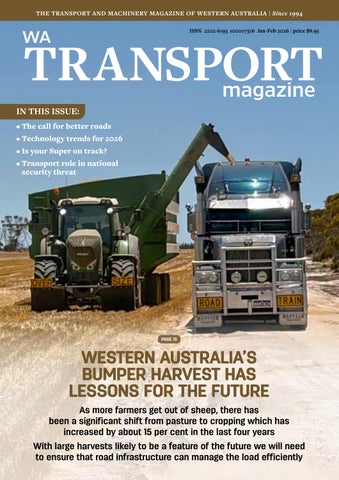
WESTERN AUSTRALIA’S BUMPER HARVEST HAS LESSONS FOR THE FUTURE As more farmers get out of sheep, there has been a significant shift from pasture to cropping which has increased by about 15 per cent in the last four years With large harvests likely to be a feature of the future we will need to ensure that road infrastructure can manage the load efficiently WATM • January-February 2026
TRAN SP
TWU
UN
IO
WO RK
S‘ ER
T OR
N
A STRONG & POWERFUL VOICE FOR TRANSPORT WORKERS’ At the TWU, we are relentless in the And set the standard for transport workers Income Protection and Group pursuit of building and exercising worker into the future. Accident and Sickness cover power, guided by clear, strong principles. Collective purchasing power of We are committed to earning and keeping TWU Members also benefit from a range UnionShopper to provide members our members’ trust and bargaining collec- of services available only to members with discounts on a range of tively. We aim to hold corporations to Legal Services restaurants, gift cards, white goods account, empowering the workforce with a Wage increases and improved and more conditions through collective bargaining strong and powerful voice. You should be a member of your union, the Enforcement of your agreement and TWU if you enjoy these benefits like: The TWU has a number of Enterprise workplace rights Annual Leave Representation for incidents or Agreements in a myriad of transport Maternity Leave companies. If you work for a company that disciplinaries Long Service Leave has an EA with the TWU, you, along with Job Security and protection Sick days all transport workers benefit from the years $5,000 Funeral benefits Leave loading Free Wills of struggle and collective action of union Penalty rates members before you. Extraordinary Driver’s License Superannuation Health and safety and workers’ compensation Allowances (meal allowances, shift allowances) Rest breaks Unfair dismissal protection
NOT A MEMBER? JOIN TODAY
www.twu.com.au/join
Becoming a member of the TWU ensures you can maintain these rights into the future.
Our Heavy Vehicle Helpdesk is available Monday to Friday. Talk to us about: Permits
Accreditation
OSOM movements
Route Assessments
Traffic Escort bookings
Compliance
The Heavy Vehicle Helpdesk is open from: 7am to 6pm Monday to Friday, and WA Public Holidays. On weekends the Main Roads Customer Information Centre will receive telephone calls on behalf of the Heavy Vehicle Helpdesk on 138 HVO (138 486) and email enquiries can be sent to hvs@mainroads.wa.gov.au
Main Roads Heavy Vehicle Services 525 Great Eastern Highway REDCLIFFE 6104
Tel: 138 486 Fax: 9475 8455 Email: hvs@mainroads.wa.gov.au www.mainroads.wa.gov.au 3 WATM • October 2021
Focus
Better roads save lives - Better roads reduce crashes
T
he Albanese government commissioned a regulatory impact analysis early 2025 as part of a proposal to reduce Australia’s default speed limit for non-built up areas by as much as 30km/h. Under the proposal, the speed limit for all non-signed posted roads across regional Australia would drop from 100 km/h to 70 km/h. This proposal caused obvious backlash from regional communities, the greater public and the transport industry. Well done to everyone who spoke up – public consultation received 11,000 submissions, and as one WA Transport Magazine reader said, “Who comes up with this stuff?” In a backflip the federal government abandoned the plan to drop the speed limit in November, but it leaves many questioning why this proposal was actioned in the first place, when money could be better spent fixing Australia’s road
2
WATM • January-February 2026
infrastructure. “At the infrastructure and transport ministers' meeting in November 2025, states and territories raised concerns to a blanket approach to speed limits and reiterated their responsibility for setting speed limits in their jurisdictions," a spokesperson for federal Transport Minister Catherine King said. "All ministers agreed to ensure no further work would be done to progress it." CEO of Western Roads Federation Cam Dumesny said the change would not have been workable and it was a smart decision to scrap the idea. "We support road safety, but the blanket approach was not appropriate," he said. The consultation on dropping the speed limit on roads without posted speed limits had been part of the federal government's national road safety action plan however some including the deputy director of the WA Centre for Road Safety Research, Paul Roberts, feel it was a missed opportunity
and that driver attitude is shaped by the speed limit. Without doubt, a head on collision at a lower speed leaves more chance of survival, but common sense tells you that improving the safety of the roads themselves should be the first consideration to road safety. The federal member for Durack, Melissa Price, said the government's decision to drop the plan amounted to "crab-walking away from an idea it should never have entertained". "I've been fighting hard on this issue because it was clear from day one that this proposal made no sense for regional Australia," she said. Nationals Senator and shadow infrastructure minister Bridget McKenzie welcomed the backdown, claiming the “badly conceived proposal” should never have seen the light of day – despite it having originated when the Coalition was last in government. “Regional communities, local councils,
It should never have taken this long. The government wasted months pushing a policy that punished regional motorists instead of repairing the roads that endanger them.”
and Liberal and National MPs mounted a powerful grassroots campaign against Labor’s plan – and common sense has finally prevailed,” Senator McKenzie said in a statement. “It should never have taken this long. The government wasted months pushing a policy that punished regional motorists instead of repairing the roads that endanger them.” The Nationals Senator said regional communities had been calling for safer roads “through investment, not slower speed limits”. “Cutting speed limits was a lazy substitute for doing the hard work,” she said. However, all is not as it seems in politics. The proposal to reduce the speed limit on regional and remote roads was originally set out in a series of national road safety reports developed when the portfolio was held by Nationals leaders Barnaby Joyce and Michael McCormack and the National Plan included the action for governments to ‘review speed limits on high risk regional and remote roads and more specifically that this will be done through a combination of measures, including “reducing speed limits”. The National Road Safety Strategy of 2021-30 which was released in December
2021 states that it is “vitally important” to increase public acceptance of “the need to reduce speed limits” and goes on to include a commitment to “Develop a Regulation Impact Statement on reducing the default speed limit for unsealed roads across both remote and regional areas”. However, it was not until the National Road Safety Action Plan 2023–25 that all governments agreed that the Australian Government would develop a Regulatory Impact Analysis (RIA) on reducing the default speed limit outside of built-up areas. The development of this RIA could lead to changes to the Australian Road Rules, which is a model law that states and territories base their own road rules on. The implementation of this change would give states and territories the opportunity to reduce default speed limits as appropriate. Some roads in Australia do not have sign-posted speed limits. This means that a default speed limit applies on those roads. The Australian Road Rules state that the default speed limit on roads outside of built-up areas is 100km/h. The Australian Road Rules do not specify a default speed limit for unsealed roads. One transport body who has been most vocal in the need for the current government to scrap this idea is the Australian Livestock and Rural Transporters Association (ALRTA). ALRTA President Gerard Johnson said the decision is “common sense prevailing” after a deeply flawed concept failed to address the real drivers of road safety. “This was never a road safety solution — it was a distraction from the real issue,” Mr Johnson said. Mr Johnson said ALRTA looks forward to working with all levels of government to progress practical, evidence-based safety
measures that address the true causes of serious incidents on rural roads — including chronic under-maintenance, deteriorating pavement conditions, and limited funding for regional renewal. “If we want safer roads, we need to invest in them. That’s how you get real safety outcomes.” The Australian Trucking Association (ATA) has also been vocal with Chair Mark Parry saying, “Australia’s governments should leave rural speed limits alone. Instead, they should improve safety by fixing black spots and spending more on road upgrades and maintenance.” In a submission to the Australian Government infrastructure department’s consultation paper on reducing default speed limits outside built-up areas the ATA suggested that the preferred option would be to reduce the speed limit where there are no signs to 80 km/h. In most states, the default speed limit outside built-up areas is 100 km/h. Mr Parry said there were more effective ways to improve road safety. “According to the consultation paper, reducing speed limits would generate $2.20 in benefits for every dollar it would cost,” he said. “For the same dollar, we could get $9.60 in benefits by placing more warning signs at dangerous locations on rural roads or $6.60 in benefits through line marking,” he said. Mr Parry said the Australian Government should spend more on road upgrades and maintenance. “Maintaining non-urban roads better and upgrading them would support the industry’s productivity, reduce maintenance costs and improve the resilience of the road system,” he said. WATM • January-February 2026
3
WA
TRANSPORT
magazine
VOLUME 32 | NUMBER 1 Angry Chicken Publishing Pty Ltd Telephone 0430 153 273 www.angrychicken.com.au ABN: 35 486 530 095
PUBLISHER / COMMISSIONING EDITOR Karen-Maree’ Kaye T: 0430 153 273 Email: karen@angrychicken.com.au WRITERS Karen-Maree’ Kaye, Russell McKinnon CONTRIBUTORS Jan Cooper, Cam Dumesny, Cliff Graham, Carol Messenger, Ray Pratt ADVERTISING ENQUIRIES Angry Chicken Head Office T: 0430 153 273 E: karen@angrychicken.com.au DESIGN / PREPRESS Cally Browning | Bare Creative ACCOUNTS T: 0430 153 273 E: accounts@angrychicken.com.au
FROM THE PUBLISHER
I
hope you all had a good Christmas and a break to spend with your families. As we enter 2026 the call is becoming louder around Australia for better roads particularly after the rural speed limit debacle has been dropped. For years, you have read our columnists – seasoned transport professionals when they speak about the problems, they encounter that impact their health, safety and their lives - whilst just trying to do their jobs. In this edition, ALRTA Executive Director Anthony Boyle starts talking numbers. He talks about how much the heavy transport industry invests in our roads and what the actual return is. (Page 10). The LRTAWA bring this into focus with WA’s bumper harvest season and with large harvests likely to be a feature of the future, they say, ‘We will need to
Overseas subscribers: Airmail postage will be added to subscription rate. Editorial Submissions: The Publisher welcomes
editorial submissions. Once received they will become the property of the Publisher who reserves the right to edit the or adjust the content to fit with the format of our publication.
West Australian Transport Magazine (WATM) is published by Angry Chicken Publishing Pty Ltd ABN: 35 486 530 095 All rights reserved. No part of this publication may be reproduced, adapted or transmitted in any form by any process (graphic, electronic, mechanical or storage and retrieval system) or sold, resold or otherwise exploited for any purpose without consent of the Publisher. The publisher, contributors, editors and consultants disclaim any and all liability and responsibility to any person or party, be they a purchaser, reader, advertiser or consumer of this publication in regards to consequences and outcomes of anything done or omitted, or being in reliance whether partly or solely on the contents of this publication. No person, organization or party should rely on or on any way act upon any part of the contents of this magazine without first obtaining the advice of a fully qualified person. The Publisher shall have no responsibility for any action or omission by contributor, consultant, editor or related party for content within WATM. The opinions and content within WATM does not necessarily reflect those of the Publisher, editor or their agents. No responsibility is accepted for damage or loss of material supplied to the publisher.
WATM • January-February 2026
Karen
2.................................. Better roads save lives-Better roads reduce crashes 5.................................. Manage risk and safety with Video Telematics ain Roads WA Heavy Vehicle Services (HVS) takes a 8.................................. M look back at 2025
10............................... The call for better roads estern Roads Federation - Transport Role in Growing 12............................... W National Security Threat
14............................... Fremantle Traffic Bridge to close on 1 February 2026 15............................... L RTAWA - Western Australia’s Bumper Harvest Has Lessons for the Future 16............................... L ittle room for error for small and medium sized transport operators riving the future of Australia’s fleet management in 18............................... D 2026 and beyond
19............................... Is your Super on track?
Every Month 6.................................. Fair Go for the Owner Driver 17................................ This is the Outback 20............................. Fighting rail safety reform 22............................. HCVC 24............................. Toots – Woman in a Man’s world
4
Best,
Contents
PRINTER Daniels Printing Craftsmen SUBSCRIPTIONS Subscriptions available directly from the Publisher. T: 0430 153 273 E: karen@angrychicken.com.au Australia: 1 year $130 (inc GST)
ensure that infrastructure can manage the load efficiently.” (Page 15). With the advent of AI and improved technology there is also a lot of talk about what operators can do to improve their operations and bottom lines by adopting all the latest technologies and stream lining their businesses and it is encouraging that many are talking about how adoption of it can lead to driver improvement and retention. If you would like your say on any subject relative to transport in our State, we welcome your thoughts – just email karen@angrychicken.com.au As always, thank you to everyone who supports the magazine – now in its 32nd year of publication.
Endorsed by
News
Manage risk and safety with Video Telematics
2
025 brought a lot of innovative solutions with the focus on understanding insights, analytics and more through a new lens. With video telematics, you get footage provided alongside data – essential for modern fleet management to improve safety. Having Video telematics as part of your fleet plan adds a powerful layer of insight alongside telematics data that prove to be an effective risk and incident management tool. As your business grows, your operating conditions grow more complex and the need for scrutiny increases. The investment of telematics alongside dashcams together create a more complete and verifiable account on your operation. This shift is important as it safeguards your workforce, protects your brand and reduces the opportunities for fraud. The integration and communication of these systems stitch together telematics, video footage and maintenance data in one coherent view for your clarity. With clear
practices in place, you visibly benefit from safety outcomes with empathetic communication across your business turn initial scepticism into broad acceptance. The recent Risk and Exoneration report for 2025 found that while 65% cite concerns for implementing video telematics, 87% of respondents experienced positive driver sentiment post-deployment. The use of technology to improve safety is universal across industries as its adopted by many to monitor behaviour, provide coaching opportunities, and reward safer driving. While it’s becoming more common for telematics and dashcams to be paired together, it shows the growing demand for data-rich safety solutions amongst transport and other fleet-based businesses, providing full-context around driving events and performance metrics. But technology alone is not the answer. Implementing new technology is
a multifaceted process that requires careful planning, communication, and ongoing support. By appointing a knowledgeable project lead, involving your team early, collaborating with your provider, investing in training, piloting solutions, monitoring outcomes, and managing risks, including privacy concerns with video telematics, you set the stage for a successful implementation for the future of the business. • Be transparent about what data is captured, how it is stored, and who has access • Comply with local and national privacy laws and regulations • Involve drivers in discussions about privacy safeguards and usage policies • Use video data primarily for safety coaching and incident review, not punitive measures Embracing change thoughtfully not only enhances technology adoption but also strengthens your fleet’s performance and resilience in 2026 and beyond.
WA OWNED AND RUN 24 HR / 7 DAY ACCESS
WA’s premier brake and clutch specialists proudly servicing the states industrial clutch and brake applications. From major truck workshops, heavy haulage, cranes, the mining industry and more… our team of knowledgeable and qualified technicians share over 100 years combined experience and focus on delivering prompt service alongside the supply of top name brakes and clutches throughout Australia and Asia. With over 20 years in the industry we have a well-earned reputation for the development, manufacture and supply of quality standard and customised designs to suit a wide range of applications. For the best advice and friendly service contact us today. +61 8 9353 4411 ■ sales@knightbrakeandclutch.com.au knightbrakeandclutch.com.au
3 MINUTE EXPRESS WASH
• Road train friendly • Full chassi rinse standard • Credit card facility • Fleet accounts available
QUICK DRIVE THRU FULLY AUTOMATED TRUCK WASH www.twepicton.com.au Roadtrain / truck & dog $150 inc gst Semi $125 inc gst 6 Wheel Trucks / Bus $95 inc gst 2 Nicholson Road, East Picton T: Darren 0417 909 128 | E: info@twepicton.com.au
4 Hopetoun Place, Welshpool, WA 6106
WATM • January-February 2026
5
Over to you A FAIR GO FOR OWNER DRIVERS by Ray Pratt
It’s in that silence that fatigue slips in like a predator
W
estern Australians like to talk about toughness, we brag about big distances, brutal heat, long roads, and the sheer grit it takes to keep this state moving. But there’s a silent group of people carrying a burden the public rarely sees - the truck drivers running through the night, continuously across some of the most isolated roads on earth. And for many Owner Drivers, that darkness isn’t just outside the cab – It gets inside you. Ask any WA driver who has faced the Eyre Highway or the Great Northern Highway after midnight. It doesn’t matter how experienced you are – the highway at 3am has a way of stripping you down. There’s no traffic, no lights, no voices on the radio, just heavy loads and multiple trailers of freight behind you - the hum of tyres, and black sky stretching forever. It’s in that silence that fatigue slips in like a predator. You don’t feel it at first, your eyes blink a little slower, your thoughts wander and the white lines blur. Suddenly you realise you’ve driven ten kilometres you can’t remember. Some drivers describe it as being awake inside a dream; others say it feels like drowning with your eyes open and its terrifying. Because you know that one micro-sleep – one single second – can put a road train into the scrub, or into oncoming headlights, with no chance of recovery. In WA, where distances are savage,
6
WATM • January-February 2026
fatigue is a killer hiding in plain sight. Nationally, fatigue is linked to roughly a third of serious truck crashes but WA drivers know the real number here is worse, but no one wants to admit it. Not when a customer is expecting their load to be delivered as soon as possible or when an Owner Driver’s entire livelihood depends on making regular deliveries. Owner Drivers carry a weight that employee drivers don’t. They aren’t just running a truck – they’re running a business. Every hour they stop is an hour not earning and every delay is a customer who might switch contractors. Every missed delivery window is a contract that might disappear so they push - they push through midnight. They push through the early hours when the brain wants to shut down. They push because if they don’t, someone else will take the load. And two-up driving? That’s sold as a solution. But I can tell you from experience sleeping in a moving truck isn’t sleep. It’s a shaky, restless halfconscious state that leaves your body running on fumes. Two exhausted drivers in one cab do not make one safe truck. They make two humans slipping deeper into a fog they’re too proud – or too scared – to admit is beating them. Then there’s what happens at home. WA’s isolation doesn’t just stretch across land; it stretches across families. Kids grow up celebrating birthdays without their fathers there. Partners hold
households together alone. Arguments simmer because someone is always overtired. Drivers walk through the front door after a long run like ghosts – present, but not really there. The family eats dinner while the driver collapses into bed. The weekend comes and goes before the driver’s body clock catches up. Many relationships crack under the pressure and some shatter completely. Drivers often say the road takes something from you. But night shift in WA doesn’t just take – it devours. It eats at your health. It eats at your marriage. It eats at who you were before exhaustion became a way of life. And for what? Because a supermarket wants to unload before sunrise? Because a freight forwarder builds unrealistic schedules? Because customers expect ;overnight delivery’ in this huge state of ours. WA depends on its truckies. But right now, too many are paying with their health, their sleep, and their families so the rest of us never have to think about what it takes to move a load from east to west or even north in this vast country. Night driving will never disappear in WA. But it’s time to ask whether we’re demanding more from drivers than any human body – or human heart – can safely give. While driving through the night I often use to wonder why is this freight so important that I have to risk everything just to make a delivery. Keep it safe, Ray Pratt.
Victoria
Queensland
Western Australia
Tel - (03) 9369 0000
Tel - (07) 3372 2223
Tel - (08) 9350 6470
13-21 Bliss Court, Derrimut VIC, 3026
1/15 Seeana Place, Heathwood QLD, 4110
5 Freight Road, Kenwick WA, 6107
WATM • January-February 2026 7
Main Roads News
Main Roads WA Heavy Vehicle Services (HVS) takes a look back at 2025 OFFICIAL Specified Journey (Single Trip) Permit Application In order to apply for a Permit, you must be a registered Operator with Main Roads WA. If you do not have an Operator Number, please complete the Restricted Access Vehicle Operator and WA Heavy Vehicle Accreditation Registration form available on our website. Prior to submitting your application, refer to Main Roads Movement of High Risk OSOM Vehicles Policy and if applicable Guidelines for Preparing a Transport Management Plan for an Oversize Overmass Movement on our website.
Operator Details Operator Number
Operator Name
Registered Business Name
Permit Details Permit Type:
(select one)
Oversize
Overmass
Oversize & Overmass
Number of Identical Permits Required (max 10) Movement Start Date Are you Travelling in Convoy? Movement Time
Permit Cost Oversize Only - $25 Overmass - the greater of $25 or 1 cent per tonne per kilometre (rounded to the nearest 5 cents) of the vehicle and its permitted load.
Traffic Escort Booking Complete this section if your movement requires a Traffic Escort Warden. To determine when a Traffic Escort Warden is required, please refer to the Single Trip OSOM Vehicle Standard Operating Conditions available on our website. Where a Traffic Escort Warden is required a Traffic Escort Booking must be confirmed (paid) prior to submitting a Specified Journey (Single Trip) Permit Application.
Over Size Over Mass (OSOM) Block Truck Concessions Traffic Escort Work Order Number
Entitlement Number
Is this a Port Hedland Pre-Dawn Movement?
For Main Roads to issue a single trip permit at least 4 business days prior to the time the Traffic Escort Warden services are to be provided, the single trip permit application must be submitted a minimum 7 business days prior to the time the Traffic Escort Warden services are required.
W
Vehicle Details
e made changes to the Single Towing Vehicle Type Prime Mover / Rigid Vehicle Trip OSOM Vehicle Standard Vehicle Registration Number(s) Operating Conditions to clarify block truck Steer Axle Drive Axle Ground Contact requirements and provide concessions Width (m) relating to the overall length of the Block Truck Registration Number(s) Restricted Access Vehicle (RAV) when Total Combination Length including Block Truck consisting of twoLoad or Details more towing vehicles. A summary ofLoadthe changes is as follows: Description and Model • Where theMakeRAV consists of more Plus or Minus Equipment than one towing vehicle, e.g. two block trucks, or a prime mover and a block truck, an OSOM Transport Management Plan (TMP) is not required unless the RAV exceeds 55 metres in length (refer sub-clause 5.4.3). • Where an additional block truck is specified on the permit, the additional block truck forms part of the RAV and is included in the overall length measurements (refer sub-clause 8.6.1). • When connecting an additional block truck (in accordance with the
operating conditions) that is not Trailer / Platform specified on the permit, the length of the RAV may exceed the maximum Dolly Trailer length specified on the permit by the length of the additional block truck (refer sub-clause 8.6.8). • Where the RAV is travelling outside the Metropolitan Area, or within the Mass of the Load only (t) Metropolitan Area during Approved Night Hours, and consists of more than one towing vehicle, e.g. two block trucks, or a prime mover and a block truck, an escort vehicle is not required unless the RAV exceeds 55 metres in length (refer sub-clause 13.8.8). • For the purpose of night curfews, if a RAV consists of two towing vehicles (e.g. two block trucks, or a prime mover and a block truck), the second towing vehicle (block truck) is excluded from the length measurement (refer sub-clause 14.1.2). In addition, convoy provisions have been extended on Goldfields Highway Dolly
Only complete this if you require the Block Truck for the duration of the journey due to insufficient GCM of the towing vehicle. If the Total Combination Length including the Block Truck exceeds 55m, an OSOM TMP will be required for the movement.
Public Awareness
HVS Policies, Processes & Guidelines available on our website
W
e published all relevant Policies, Processes and Guidelines on the Industry Resources and Information at mainroads.wa.gov.au/heavy-vehicles/ industry-resources-information ✔ Permit Policies & Guidelines ✔ RAV Access Policies & Guidelines ✔ Traffic Escort Policies & Processes ✔ WA Heavy Vehicle Accreditation Policies, Business Rules and Standards ✔ WA Heavy Vehicle Certified Auditors Policies and Guidelines ✔ WA Heavy Vehicle Licenced Pilots Code of Conduct and Business Rules ✔ HVS Compliance - Measurement Adjustments for the Enforcement of Mass Requirements Having this information located on one page on our website makes it readily available to our customers. Industry is encouraged to take the time to become familiar with these documents. They provide critical information and underpin our business practices and work processes. (refer Appendix 7) and access added to the BP Truck Stop Norseman from Coolgardie Esperance Highway (refer to clause 5.10). For further information, please refer to the Over Size Over Mass (OSOM) at www. mainroads.wa.gov.au/heavy-vehicles/ permit-order-scheme/osom-single-trippermits/ or contact the Heavy Vehicle Helpdesk on 138 486 or email hvs@mainroads.wa.gov.au
We are developing new public education campaigns to raise driver awareness of Traffic Escort Wardens, Pilots, and Compliance staff. Our existing heavy vehicle awareness campaigns #RoadTrainDomain and #BiggerThanYou that promote safe interaction with road trains, agricultural equipment and OSOM loads, were re-run prior to and during school vacation periods, the harvest season and key public holidays. We again attended a wide range of local events State-wide from Kununurra to Dowerin, and from Karratha to Albany and Esperance to further engage with the community and share important tips on safely interacting with road trains and OSOM loads on our roads.
8
WATM • January-February 2026
Main Roads News
HVS PATH-Ways project
Heavy Vehicle Pilot Information Portal on ‘My Say Transport’ website
T
o strengthen communication and collaboration with the pilot community, we launched the Heavy Vehicle Pilot Hub, a platform available through My Say Transport. This initiative invites pilots to sign up and be part of ongoing discussions, updates and feedback opportunities. This dedicated portal has been developed specifically for heavy vehicle pilots as a “one stop shop” for all industry-related updates, resources and direct communication with the HVS team. Through this portal, you’ll be able to: • Stay up to date with the latest industry news and regulatory changes; • Access important documents and
guidelines in one central location; and • Communicate directly with HVS for support and feedback. For further information or to report any issues with your Pilot Hub access, please email pilots@mainroads.wa.gov.au It has been pleasing to see the pilot industry taking up this access, and we encourage all pilots to register to take full advantage of this new resource. Your feedback is always welcome as we continue to improve the tools and support available to you. General information for pilots can be found on the Main Roads website at mainroads. wa.gov.au/heavy-vehicles/pilots
Development work continues on the HVS PATH-Ways project, which will replace our core systems RAVS and MOVES. PATH-Ways will deliver an improved customer portal, empowering users to self-manage their business information, such as vehicle lists, and control account access by adding or removing users of their accounts. The platform will also streamline the application and payment process for all HVS permits, Heavy Vehicle pilot services, and WA Heavy Vehicle Accreditation requirements, while simplifying the management of renewals and audits.
HVS Help Desk Co-Browse Screenshare functionality
Our Heavy Vehicle Help Desk officers now have access to ‘Co-Browse’ Screenshare functionality. Co-Browse allows our Help Desk Team, when on a call with our customers and via secure access arrangements, to visually guide customers through our website to locate permit application templates, guidelines and operating conditions. Feedback on this functionality has been positive, and users have found it to be an effective and efficient tool.
MY TEAM MAKES RETIRING EASIER. Australia’s top specialist fund for transport, energy and mining workers.
Talk to us about super, pension, insurance and financial advice.
13 64 63 teamsuper.com
Issued by Team Super Pty Ltd ABN 70 003 566 989 AFS licence 246864 trustee for the Team Superannuation Fund ABN 16 457 520 308. Refer to the PDS and TMDs on our website at teamsuper.com when considering if our financial products are right for you. Financial planning services are provided by Team Super Financial Advice a trading name of Team Super Services Pty Ltd ABN 49 051 315 014 AFS licence 502700. Past investment performance isn’t necessarily an indication of future performance.
WATM • January-February 2026
9
News
The CALL for BETTER ROADS R
oad safety isn’t only about the pavement. Bridge capacity is one of the biggest freight constraints in regional Australia and investment in bridge strengthening, replacement and higher mass limits unlocks safer access, fewer detours, higher productivity combinations, reduced fuel use and emissions and better network resilience during weather events,” says ALRTA Executive Director Anthony Boyle. “These are the kinds of initiatives are ones that deliver real, measurable safety outcomes and help Australia move toward its net-zero objectives without undermining freight efficiency. “Where the equation breaks is what we pay versus what is delivered and to have an honest national conversation about road safety, we must look at the numbers. “Heavy vehicles contribute several billion dollars per year through the Road User Charge and registration fees and this is set to increase by 6% in 2026. “The NTC estimates the “heavy vehicle cost base” at $6.3 billion - but this figure is based on the 2014–15 asset assumptions and assumes that States maintain roads to engineering standards. “The reality is the states are not delivering those standards and falling dramatically short of their own engineering requirements. States themselves
10
WATM • January-February 2026
acknowledge they must invest around 12–15% of their road networks annually just to stand still. “Between routine resealing (7–8%) and pavement rehabilitation (1.7–2%), plus shoulder, drainage and structural upkeep, state engineering guidelines are clear about what it takes to maintain a safe, serviceable network. “Yet very few jurisdictions even come close to meeting these benchmarks. Victoria, for example, is now delivering barely 1–2%, a fraction of its own engineering requirement - a gap so large it virtually guarantees accelerating road failure. This is not an industry accusation; it is a government-determined standard that governments are not meeting. “Imagine if the transport industry did that in regard to a regulatory safety requirement like fatigue management. “In real terms most states renew a fraction of their networks with Victoria delivering just 1–2% renewal (instead of 8–10%), Queensland facing a $8.6 billion maintenance backlog and NSW,
SA and WA all having deferred bridge and pavement works. Seal and pavement cycles are lengthening across the nation and planned maintenance is being replaced by emergency patching. “In other words, Heavy vehicles are being charged for maintenance and renewal that governments are not actually delivering. “The real gap is not between what we pay and what roads cost, the real gap is between revenue collected and infrastructure delivered. “Modern, well-maintained roads and bridges are not just a safety issue - they are a productivity and emissions issue. Poor roads limit vehicle capacity, increase fuel consumption, increase travel time, increase tyre and brake wear, force more trips for the same freight task and increase emissions across the supply chain. “Better roads and bridges enable higher productivity vehicles, reduce fuel burn, lower the carbon footprint per tonne, support Australia's net-zero ambitions, improve safety by reducing exposure hours and strengthen regional economic resilience. “If governments are serious about emissions reduction - heavy vehicles are not the problem. Under-investment in road and bridge infrastructure is. “The decision to drop the rural speed-limit proposal was sensible and welcomed but the next step must be a renewed national focus on rural road maintenance, bridge strengthening, freight-route upgrades, resilient pavements, elimination of renewal backlogs strategic and investment aligned with productivity and emissions goals. “The ALRTA’s message is clear. We support real safety improvements, investment in rural roads and bridges and we are willing to pay our fair share… But we expect the money we pay to be invested in the infrastructure we rely on,” finishes Mr Boyle.
The real gap is not between what we pay and what roads cost, the real gap is between revenue collected and infrastructure delivered.
CONTACTS: 7 Tipper Crt, Hazelmere WA Office: (08) 9274 6355 Mobile: 0418 802 007 Rentals: 0488 003 228 Email: alan@haulmore.com.au Website: www.haulmore.com.au
VISIT OUR WEBSITE
GOOD NEWS!! We have the following units currently in stock available for sale or hire: Quad 4 Rows of 8 Full Axle Widening Low Loader with Hydraulic Suspension Quad 4 Rows of 4 Full Axle Widening Low Loader with Hydraulic Suspension Tri Axle Drop Deck Widener with Bi Fold Ramps Dollys: 3x4 Low Loader Dolly – 2x8 Low Loader Dolly – 2x4 Low Loader Dolly Side Tippers and Water Tankers Flat Top Semi Trailers and Flat Top Extendables
WATM • January-February 2026 11
Over to you WESTERN ROADS FEDERATION by Cam Dumesny, CEO
Transport Role in Growing National Security Threat Our transport and logistics Industry has a key role to play in helping to rebuild Australia’s strategic onshore logistics resilience, and in doing so it can also help our industry.
R
umours of another Chinese Naval flotilla heading Australia’s way, is a reminder that the comparative peace Australia has enjoyed since World War Two is coming to an end. Defence analysts point towards the threat of Australia facing increased economic and military coercion from such foreign actors rather than direct invasion. To meet the threat, the federal government, albeit far too slowly, is building up Australia’s defence capability
12
WATM • January-February 2026
both offensive and defensive. The build-up is driven by the National Defence Strategy 2024. A core pillar of which is the Strategy of Denial. This is a cornerstone pillar, to deter potential adversaries from projecting power against Australia by having hard hitting force projection from our northern bases.
So Where Do We Fit In? Well Defence has realised that is great to have powerful hard-hitting forces in our Northern bases ‘but’ they are useless unless we can keep the equipment and the people who operate them resupplied. So, in the largest logistics investment since WW2, over $11 Billion is to be spent improving Northern Australian defence logistics capability and capacity. But what about the resilience and capacity of our resupply routes from our southern bases and industrial heartlands in South East Australia and Perth where most of the supplies will come from?
And that is where we come in… Defence logistics capabilities have generally always focused on delivery and support within the Combat Zone. For continental defence, it has generally been assumed that civilian transport would handle supply and delivery right up to the edge of the combat zone. That assumption makes sense since our industry has a far greater depth of capacity and experience to do that than defence. Especially as we do it every single day of the year to our civilian communities and businesses.
But… There is always a but, over recent years our industry has faced an increased frequency of freight route disruptions to the North and to the East from weather related events. Disruptions that have challenged our ability to supply northern communities, let alone sustain large scale defence support needs.
Defence Must Support Our Needs So, I have been advocating to Defence that they need to support our industry identified needs to maintain northern and eastern resupply. This is not a radical idea, its aligned with how the Nordic countries think. For example, we need more rest areas and higher quality ones. Defence also needs convoy packet rest areas. Given the new heavy Rheinmetall Vehicle they have; these rest areas need to be sealed ‘and’ to meet convoy rules these rest areas must be far more frequent. So, why not think like the Nordics who dual purpose highways as fighter runways and start thinking about what we could dual purpose in our existing infrastructure for example things like rest areas. There are multiple other examples of potentially dual purposing stuff we need that also benefits defence.
Knowledge and Skills My cousin Steve and I both joined the Army at the same time, I went to Duntroon and he went to Kapooka because he lacked my good looks and charm. Steve however went on to become a
Given the new heavy Rheinmetall Vehicle they have; these rest areas need to be sealed ‘and’ to meet convoy rules these rest areas must be far more frequent
Warrant Office Instructor at the Army School of Transport, then took a similar role as a civilian after he left. In total he had something like 20 years in that role or associated roles. He just retired. Recently I called him, as the Northern Territory Road Transport Association noticed that during the recent 19 nation Exercise Talisman Sabre in the NT, that ADF logistics personnel did not understand or have the basic skills in remote area transport requirements. Steve said, that is because Defence stopped teaching those driver and logistics skills a decade or more ago to save time and money on courses. But the loss of defence skills goes further. Knowledge about remote area transport
equipment design and maintenance has also been lost. That knowledge has always resided primarily in the civilian industry, but the Defence facility that use to connect to those knowledge sources was closed in the 1990s.
Reconnect There is a growing acceptance amongst those in Defence I liaise with that there is a need to reconnect Defence and Civilian industry, to share knowledge and skills. I am still working on gaining acceptance of the need for them to support our investment needs which can also benefit them. But, I feel it’s starting to gain traction. However, it does show we have a role to play in the transport industry.
MAKE YOUR VOICE HEARD
YOUR INDUSTRY, YOUR FUTURE JOIN TODAY admin@westernroads.com.au
OUR MEMBERS DRIVE THE WA ECONOMY
WATM • January-February 2026
13
Over to you LRTAWA by Ben Sutherland President, Livestock and Rural Transport Association of Western Australia (Inc)
Western Australia’s Bumper Harvest Has Lessons for the Future
W
As more farmers get out of sheep altogether, due in part to the live sheep export ban, there has been a significant shift from pasture to cropping. According to the Grain Industry Association of WA, the cropped area has increased by about 15 per cent in the last four years. Our harvest is expected to account for around 40 per cent of Australia's total
winter grain crop, with WA being the biggest wheat producer in Australia. The value of the crop is an estimated $7.8 billion, which is less than the value of previous bumper crops due to an oversupply of grain in the Northern Hemisphere. With the cost of inputs such as fertiliser remaining high, the profit margins for harvest will be reduced.
Fremantle Traffic Bridge to close on 1 February 2026
months, with the construction schedule to be reviewed on an ongoing basis and the program expedited where possible. In October, the State Government announced its full suite of initiatives to reduce peak-hour vehicle usage and keep Stirling Highway moving during the closure period. To keep traffic on Stirling Highway moving, Main Roads is modifying 15 intersections, with 18 new devices being installed to provide enhanced real-time monitoring of traffic movements so the information can be relayed immediately to road users.
Incident response teams will also be permanently stationed alongside Stirling Highway in the area to respond immediately to any issues that occur on the road network. The State Government will continue to work with stakeholders and industry to explore further measures to minimise traffic disruptions. Resources, including factsheets and an interactive map, are available on the Main Roads website to help road users familiarise themselves with the changes, and pocket guides were
News
estern Australian farmers are harvesting one of the state's biggest grain crops, forecast to reach 25.4 million tonnes notwithstanding frost and hail damage in some areas and a few interruptions from bad weather. Around nine million hectares are planted to grain in WA, with wheat being the biggest commodity.
T
he State Government has confirmed the Fremantle Traffic Bridge will close on 1 February 2026, to enable completion of a new and iconic bridge for the port city. The bridge will be closed for up to 12
14
WATM • January-February 2026
The majority of WA's grain growers span a 1,200-kilometre distance from Geraldton at the top and Esperance at the bottom. With harvest volumes so large, logistics is under serious pressure. Growers are increasingly relying on strategies like on-farm storage and investing in their own trucks to compensate for a shortfall in offfarm infrastructure. The heightened activity from this years’ harvest is a welcome shot in the arm for rural transporters facing uncertainty because of the live sheep export ban, however there is no doubt it is an intense and pressurised period, not just because of the volume, but in scheduling with peak demand over short periods, tight deadlines, risk of bottlenecks, access to drivers and trucks. According to Cooperative Bulk Handling, WA’s largest grain handler, over the past decade the average size of trucks delivering grain to its sites has grown from 38 tonnes to 48 tonnes but in reality it is closer to 50 -75 tonnes, while the speed of deliveries has increased by approximately 25 per cent. These figures provide an insight to
Trucks lined up to unload
the challenge of the task for growers, transporters, grain receivers and road owners and managers. With large harvests likely to be a feature of the future we will need to ensure that infrastructure can manage the load efficiently. A broader Accredited Mass Management (AMMS) road network would improve productivity significantly and reduce the number of truck movements. There are a number of routes that are not included in the AMMS network with local road owners resisting closing the gaps. Key regional freight routes were showing signs of strain before harvest, and they are likely to be in a worse state by mid next year. The solution is not to demonise trucks as the root of all evil when in comes to road conditions, but to ensure the roads are constructed and maintained at a standard that will stand up to the essential requirements of the freight task. This must form part of regional freight policy going forward. Despite the challenge a large harvest brings, it is also a time of camaraderie and new friendships with the grain handling staff, who can either make or break your
Happy CBH staff at Mount Madden
day. When you are on your third load for the day, it makes a big difference to be greeted by a smiling face at the sample shed. Thank you to the more than 1500 harvest casuals that work through demanding weather and conditions and greet we transporters with enthusiasm.
distributed to over 40,000 residences in Fremantle and surrounding areas. Main Roads has also released a new mobile phone app, which can provide drivers in the Fremantle area with realtime alerts on traffic conditions and congestion. The Live Traffic WA app is based on the Traffic ALT app, which was successfully piloted during the full closure of the Armadale train line in 2023. The Fremantle Bridges Alliance is hosting a series of community pop-up sessions between now and February to share information about the changes. WATM • January-February 2026 15
News
Little room for error for small and medium sized transport operators
A
ustralia’s small to medium transport operators are under growing financial pressure as rising costs, tighter margins and tougher enforcement from creditors and the ATO combine to push more businesses to the brink, according to leading invoice financing specialists Earlypay. ASIC data shows insolvencies in the sector are climbing, reflecting an industry characterised by intense competition, low barriers to entry and a heavier reliance on lower-paid subcontractors. Smaller transport operators are
particularly exposed as costs rise and cash flow slows. Earlypay Chief Operating Officer Paul Murray said many transport businesses are currently operating with little room for error. “The transport sector has been hit by a combination of rising input costs and tightening liquidity,” Murray said. “Operators are carrying higher insurance, fuel and maintenance expenses, while cashflow is being squeezed by slower customer payments and stricter ATO compliance activity,” Mr Murray said. “For an industry that’s often asset-light,
MTAA Welcomes Right to Repair Extension and Calls for Broader Reform
T
he Motor Trades Association of Australia (MTAA) has welcomed the Federal Government’s announcement to extend Right to Repair reforms to agricultural machinery, while calling for the initiative to be broadened to include heavy vehicles and motorcycles and other vehicle categories. The announcement, made following a meeting of Federal and State Treasurers, represents a significant step forward in ensuring equipment owners have access to fair and competitive repair options. “Farmers and agricultural businesses deserve the freedom to choose where and how their equipment is repaired,” said Peter Jones, Interim Executive Director of MTAA.
16
WATM • January-February 2026
However, Mr Jones emphasised that the reforms should extend further across the automotive and transport sectors. “It’s essential that other sectors, such as heavy vehicles are also included in Right to Repair protections” he said. “Right to Repair isn’t just about consumer choice – it's about competition, productivity, and supporting the thousands of independent automotive businesses across Australia and the MTAA will continue to engage with federal and state governments to advocate for the expansion of Right to Repair protections across all vehicle categories.
even small disruptions can trigger defaults that quickly spiral.” “Margins are wafer-thin, costs keep rising, and when customers take longer to pay, there’s not much buffer left,” he said. “Once a fuel supplier or the ATO raises a flag, it can be hard for these businesses to recover because they don’t have the assets or cash flow flexibility of larger operators.” Corporate insolvency specialist Neil Mitchell, director of B&T Advisory, said his firm has seen a notable increase in transport restructures, administrations and liquidations over the past 18 months. “Larger players are ensuring it’s a race to the bottom on price, which is squeezing smaller operators already under stress,” Mr Mitchell said. “Smaller operators are being undercut or they’ve been locked into tight contracts with thin margins while wages and other costs rise. “With this in mind, they are prioritising finance repayments on their fleet over tax payments, for example, and their ATO debts creep up.” Moreover, Murray said key suppliers such as fuel and replacement parts companies are quick to withdraw credit if payments are late, and unfortunately, this debt spiral eventually ensures the numbers just don’t stack up. To help operators manage these risks, Murray said Earlypay has overhauled and relaunched its debtor protection offering, which sits alongside its invoice finance facilities. Under the refreshed product, clients can nominate specific debtors – or their entire ledger – and request a protection limit. Where Earlypay approves cover, invoices issued while that protection is in place are insured up to the agreed limit in the event of a formal insolvency or, in extreme cases, protracted default where undisputed invoices remain unpaid for an extended period. “It’s all about peace of mind,” Mr Murray said. “Instead of getting a surprise call from an administrator and wondering how to fund next week’s payroll, operators can continue to draw on their invoice finance facility while we work through the recovery process. “In an environment where thin margins, rising costs and slower payments are the norm, that safety net can be the difference between surviving and shutting the doors,” Murray said.
This is ‘The Outback’ By Cliff Graham
Perhaps our road rules need rewriting
H
appy New Year everyone. Have you noticed that just about every media outlet portrays accidents that involve a truck as the truck driver’s fault? Even if the truck was just in the area and had nothing to do with the accident. The media, except our own never report on truck drivers actually being the first responders to a huge amount of accidents on Western Australian roads. I was driving a road train on a designated road train street in a Midwest town and came onto a three car accident; the police were directing traffic down side streets towards a roundabout which had no chance of me getting around safely, so I waited in the street we were designated to be on until the accident was cleared. It wasn’t long before I started receiving phone calls asking if I had caused the accident. WA’s bumper harvest is going to mean extra heavy transport on the roads so we need to drive for everyone, taking into account all the usual selfish dangerous activities that are bound to occur from travellers in a hurry to get to or return from their destinations. I am still regularly seeing vehicles travelling at least 20 kph or more under the speed limit without any consideration for other road users, never looking in their
mirrors – and who still insist in driving in the right hand lane of over-taking lanes oblivious of the build-up of traffic behind them. In WA, it is only on a freeway that it is illegal to drive without reason at a speed greater than 20 km/h below the speed limit. On other roads, you must not unreasonably obstruct the path of another driver or go at an ‘abnormally’ slow speed where there is no need. Perhaps our road rules need some rewriting and enforcing as there are zero consequences for drivers who are inconsiderate on our main roads. Another thing that has always intrigued me is how clueless some drivers are. I’m driving up a hill in a triple doing 30/40 kph to be overtaken by slower vehicles, usually caravans at the top of the climb then I am left behind them as they drop their speed back to 75/80 kph with no chance of overtaking them or getting back up to speed. How do we educate road users to consider heavy vehicles if they lack consideration or common sense? Recently, I was heading south to Perth on a left hand fairly blind corner where trees and branches blocked the view and there was a police car pulled up behind a car on the south bound side of the road. I
Why didn’t the police let this car drive to a safer location with clear visibility for all, further down the road where it did not impact all the other traffic? slowed as much as I could but could not pull up as the shoulders were too steep to get off the road. The approaching traffic all met us where the police car was parked and if it had been two oversized vehicles meeting there it would have been a close encounter. Why didn’t the police let this car drive to a safer location with clear visibility for all, further down the road where it did not impact all the other traffic? There are ever increasing numbers of heavy vehicles involved in road incidents in WA that are usually none of their causing. When will our governments wake up to the reality that the road rules and enforcement are severely lacking to where so many drivers just think they are entitled and have the right to do whatever they want – whilst it is the transport industry that are the villains and must drive for everyone so we can all get home safely. WATM • January-February 2026 17
Focus
2026 Fleet Management Trends vehicle health stats and environmental data, to provide a much richer view of the safety risks facing their fleets.
Driver satisfaction will be key
By LUKE OLSEN Managing Director APAC, Microlise
A
ustralians are now ordering more items online than ever before, leading to a record number of deliveries for transport companies to manage. Between 1st November and 31st December alone, Australia Post carried almost 103 million parcels, setting a new record for its busiest year. This is placing a huge strain on fleet managers, who struggle to keep up with the sheer volume of deliveries. Sustainability and compliance regulations are further adding to this pressure, with nearly half (48%) of fleet managers admitting they feel overwhelmed by the complexity of fleet compliance1. Here are the most important technology trends changing the face of fleet management in 2026.
Approaches to safety and compliance will evolve Promoting safe driving behaviours and using technology to anticipate and manage risks will be a critical and we will see compliance become more than just a box-ticking exercise, with fleet managers taking a more proactive risk approach. Technologies such as distraction cameras monitor drivers for common signs of distraction, like mobile phone use and eating. Driver-monitoring technology records behaviours like speeding and harsh braking. Together, these tools help fleet managers identify hazards before incidents occur and can be taken one step further by combining multiple data sources, including driver behaviour metrics, camera footage,
Improving driver experience is critical – and in 2026, this will become a key competitive advantage as the industry faces worsening driver shortages and tighter delivery timeframes. Fatigue, tight deadlines and excessive workloads make driving a tough job, both physically and mentally. The organisations that invest in technology will have happier, more fulfilled drivers, which should lead to higher retention. For example, smarter navigation and routing systems can allow companies to plan around delays, helping to reduce journey times, driver frustration and the pressure of being late for customer collections or deliveries. Furthermore, replacing manual, paper-based tasks such as physical delivery slips with streamlined digital alternatives like ePOD (electronic proof-of-delivery) can significantly reduce the workload on drivers.
Digital leaders vs laggards While AI is starting to reshape the industry, adoption remains inconsistent across the sector, with research showing only 50% of fleet managers are currently using AI tools.2 However, in the coming years, we will see more fleet managers adopt AI-powered technologies and leverage data analytics to make more informed business decisions. For example, intelligent route planning and optimisation technology monitors traffic patterns and manages last-minute orders in real-time to actively avoid delays, saving drivers valuable hours per week. Meanwhile, automated vehicle health monitoring can predict when maintenance is required, which helps fleet managers avoid unexpected, costly breakdowns and extend the life of their fleet overall. Advanced data analytics also enable fleet managers to give customers more up-to-date information on their shipments, potential delays and estimated arrival times.
Sustainability – a competitive advantage With the pressure to reduce carbon emissions, lower fuel consumption and improve sustainability, Australia has seen the rollout of mandatory climaterelated disclosures for large companies and in 2026, stakeholders will continue to demand transparency when it comes to ESG reporting and reducing environmental impact. This means the transport companies that can quantify and communicate their environmental impact, from fuel efficiency and route optimisation to reduced idling and emissions, will gain an edge in tenders and partnerships. A recent industry report revealed 38% of transport managers are already using route optimisation to reduce fuel use and emissions, while 30% are monitoring fuel wastage and vehicle loads to avoid empty miles.3
Having a single source of truth As transport operations increasingly go digital, it’s essential for fleet managers to have one centralised system that fully integrates all their critical software and unifies all data sources to give them an accurate, full picture of their operations. In a recent survey, fewer than 40% of transport managers reported using a fully integrated, ‘all-in-one’ platform4 . Those using multiple systems described a range of challenges, with 72% saying it slows down task completion and 66% believing it leads to more frequent errors. In 2026, more transport managers will seek out a “one-stop shop” – a centralised system where all critical tools and information are live under one digital roof.
The takeaway The fleets that will lead in 2026 are those taking a unified approach to safety, sustainability, driver experience and digital transformation. Rather than treating these as standalone initiatives, operators are shifting toward proactive risk management, prioritising driver wellbeing, adopting AI-enabled insights and consolidating fragmented systems.
1,2,3,4 - https://145722537.fs1.hubspotusercontent-eu1.net/hubfs/145722537/UK-Reports/UK_Industry%20Report%202025_V1.1.pdf 18
WATM • January-February 2026
Superannuation
Pension. Table 2 below shows what ASFA research2 suggests people will need in their super balance for retirement at age 67. The balance needed for a modest lifestyle is relatively low, as it takes in consideration the Age Pension, as well as various pension supplements, and as a result both couples and singles would need the same savings. The balance required for a comfortable retirement assumes you’ll draw down on all your super and receive a part Age Pension. Team Super tip: Check out the Industry SuperFunds How much super should I have calculator at industrysuper.com to see how much super you should have today to reach a comfortable retirement by age 67.
HOW TO BOOST YOUR SUPER
N
o matter where you are in your working life, there are benefits to giving your super a little boost. But how do you know what the end goal should be and therefore, how much of a boost is needed? In this article, our friends at Team Super look at average balances by age and how much you might need to retire. A general rule of thumb is not to compare yourself to others, but when it comes to your super balance, comparison can be a very strong motivator. According
to the Association of Superannuation Funds of Australia (ASFA), the mean super balance for a male aged between 40 to 44 years is about $107,0001. When you consider the current aged pension doesn’t kick in until 67 years and that a single person will need more than $52,0002 per year to live comfortably, the numbers speak for themselves. Check out table 1 below to see how your balance stacks up against others your age.
HOW MUCH MONEY WILL YOU NEED?
Table 1
Mean super balance1
Talk about a million-dollar question! There are lots of factors which influence what this magic number could be, such as what age you want to retire at, what sort of lifestyle you have or want to have, whether you own your home, or if you still have dependants. And of course, it also depends on whether you have any other assets outside of super and if you’re eligible to receive a (part) Age
If you want to grow your balance faster, there are a few ways to boost your super savings. It’s also worthwhile to check if you have any lost super you’ve forgotten about, and think about combining your super if you have more than one account. You can also use online calculators or talk to your super fund to get general advice over the phone.
Already a member of Team Super? You can view your balance and manage your account online. Simply grab your member number from your last statement and log in via teamsuper.com/login
Age group
Male
Female
18 to 24 years
$4,617
$4,275
25 to 29 years
$17,545
$17,840
30 to 34 years
$39,796
$34,327
35 to 39 years
$70,181
$54,391
40 to 44 years
$101,231
$74,066
45 to 49 years
$133,616
$93,471
50 to 54 years
$162,146
$111,063
55 to 59 years
$186,255
$128,675
Modest Retirement
Comfortable Retirement
60 to 64 years
$205,385
$153,685
Single
$100,000
$595,000
65 to 69 years
$206,091
$191,475
Couple
$100,000
$690,000
Not yet a member? Learn about the benefits of joining Australia’s top specialist fund for transport, energy and mining. To find out more visit teamsuper.com
Table 2
1 Source: An update on superannuation account balances, ASFA, September 2024, page 2 2 Source: ASFA Retirement Standard, March quarter 2025 Team Super is Team Super Pty Ltd AFS licence 246864, the trustee for the Team Superannuation Fund. Refer to the PDS and TMDs on Team Super’s website at teamsuper.com when considering if their financial products are right for you. Any financial advice in this article does not take into account your financial situation, needs or objectives, and you should consider these factors before taking any action.
WATM • January-February 2026 19
Fighting Rail Safety Reform
The eight of the most common myths around train visibility
By LARA JENSEN
E
very year approaching Christmas time, videos of brightly lit ‘Christmas trains’ with coloured lights adorning locomotives and rolling stock light up social media. It is an annual spectacle of bright lights that showcases dazzling and readily available lighting technology that the rail industry indulges in once a year before promptly retreating back to the Dark Ages. Over several decades, our families of rail crash victims have heard every conceivable excuse under the sun at least a dozen times as to why mainline passenger and freight rail operators can’t and won’t adequately illuminate their trains and rolling stock commensurate with the hazard, they represent to the regional motorist that interacts with them. This is despite coronial recommendations, and the findings of parliamentary inquiries and governmentappointed committees dating back to 1968 in Western Australia that have all reinforced the need for trains to have safety and visibility lighting in addition to bright livery on rolling stock to enhance safety and visibility on and around the rail network. Making trains and rolling stock more visible can be done and without great difficulty – look no further than the Puffing Billy train that lights up the Dandenong Ranges in a spectacular light show as part of the annual Train of Lights event in Victoria every year. There are around 19,000 level crossings in Australia that only have Stop or Give Way signs in place for traffic control and at these crossings the road user is expected to
20
WATM • January-February 2026
see and identify trains as well as estimate a safe gap to cross the railway line. It sounds incredibly simple, but it isn’t. Drivers commonly don’t identify oncoming trains as a hazard, partly because trains are not clearly identifiable as hazards in the same way that road trains, mine and construction vehicles are legally obligated to be. Trains are bereft of flashing beacon lights, side lighting and clearance lighting and alarmingly, there are still no mandatory laws or regulations for train visibility in Australia today. So, with that, it is time to dispel eight of the most common myths around train visibility and confront the excuses head on with the facts.
MYTH 1 Train headlights are adequate Trains have narrow beam headlights that are designed to light the track ahead for train drivers. As a single point of light, they are not designed to help the road user see the train or estimate the speed and distance to an oncoming train.
Myth 2 Ditch lights flash and are enough to attract a road users’ attention to a train Ditch lights (also called crossing or visibility lights) aren’t pointed towards traffic approaching a railway crossing. These lights can be invisible when obscured by low undergrowth, high grass, bushes and other vegetation. Some ditch
lights don’t flash while others are too dim, and their flash rate is too slow.
MYTH 3 Reflectors on wagons are sufficient Reflectors used on rail rolling stock are substandard compared to the high-quality reflectors and lights on road vehicles like trucks and caravans. The most common reflective stickers that rail companies use do not work at angles that aren’t perpendicular to a train. Many level crossing approaches are also curved or parallel to an approaching train which subsequently renders the reflectors ineffective. In addition, reflectors are often, dirty, damaged or missing altogether. Truck trailers and caravans all require a specific number of clearance lights to comply with Australian Design Rules (ADR) so it’s not satisfactory or safe that rail wagons remain hard to see.
MYTH 4 It’s too hard to install lights on rolling stock and too difficult to maintain them There are ways that lights can be installed on the sides of wagons, carriages and containers, particularly with new technology such as LED lights or solar lighting products that are completely self-contained, self-charging and readily available. While train crews would need to check lights on a lengthy train, the same is true
for truck drivers who are required to ensure all their lights are operational on trucks that add up to a similar length.
MYTH 5 Flashing beacons on locomotives are a distraction to train drivers Flashing beacons have been in use on sugar cane trains in Queensland for decades to improve visibility and safety. These affordable beacons, operate constantly all day and night, and cane train drivers do not consider them a distraction. Interestingly, flashing beacons apparently aren’t distracting for truck drivers, forklift drivers, mine workers or emergency services drivers either. Nor do rail workers complain about flashing beacons on rail track machines, rail company owned trucks or rail company personnel vehicles that are all fitted with flashing beacons. The point of flashing lights is to attract attention. It helps alert the motorist that there is something (a hazard) ahead that needs their attention. They have been universally mandated for the road transport industry for decades (during day and night) for this reason, but they have not been for the largest, most hazardous and slowest-tostop of all land vehicles – trains.
MYTH 6 Most rail crashes happen during daylight hours, so extra lights on trains aren’t needed There is almost no data available regarding the ambient light conditions at the time of
level crossing crashes. The widely quoted statistic that only a third of crashes occur at night is so simplistic that it is factually incorrect but has been continuously repeated without any credibility for more than 25 years. The data behind this statistic comes largely from crash reports that mostly have two categories, ‘day’ and ‘nighttime’ which ignores poor light conditions like dawn, dusk, fog, dark clouds, rain, dust and sun glare. It is deeply concerning that government policies around train visibility specifically are based on incomplete data. This has led to a poor understanding of risks, inaccurate safety assessments and ultimately no effective interventions or improvements.
MYTH 7 The cost of lighting up trains is prohibitive Installing flashing lights and side lights on new locomotives would cost less than $25,000 per train which is a trivial expense when you consider that a new locomotive costs $6 million dollars. It’s a minimal spend for a multi-billion-dollar high-risk industry. It’s also a trivial cost compared to multimillion-dollar train crashes or the loss of even one human life and the lifelong impact on many other people.
MYTH 8 Current rolling stock livery standards are adequate There are rail operators hauling iron ore in containers that are black in colour and almost invisible at night and trains and
rolling stock operating in WA that have the same livery colours as the sky and the rail line ballast they run on which makes them quite camouflaged in agricultural environments. Some rail operators have started painting their locomotives and wagons bright yellow or other high visibility colours which is good safety practice, but it is no longer sufficient for some operators to rely on the work of graffiti artists alone for their rolling stock to be even remotely visible to oncoming motorists. It is indisputable that the rail industry can and must do better. Improving train visibility requires both better train livery (paint colours and patterns) as well as safety and visibility lighting for locomotives and rolling stock. We know that for a range of conditions the safest option would be flashing beacon lights on locomotives visible for 360 degrees to attract road users’ attention and identify the train as a hazard as well as lights on the front and sides of locomotives and wagons to enable road users to estimate the speed and distance of a train. It is time railways stopped recycling hollow myths and presenting flimsy excuses around why train lighting improvements cannot be made. In the words of my dear friend and rail safety co-campaigner David Broad who lost his beautiful daughter Jess 25 years ago, ‘we can fly a man to the moon and stick a new heart in someone, so we can most definitely light up a train.”
WATM • January-February 2026
21
Over to you More beautiful vintage cars
Grey Fergie and fuel bowsers
A fine vintage Collection
I
n 2025 HCVC Members had a great field trip that involved inspecting an amazing car collection in a comfortable shed. Maurice McGregor has a wide range of restored vintage cars, tractors and motorbikes. One vehicle that caught my eye was a light yellow 1929 Chrysler, an American car but this vehicle had its body built in Perth by Campbell and Mannix a company that operated in the mid-20th century. The
Maurice McGregor far left showing some of the HCVC members the Hudson super six
22
WATM • January-February 2026
By KEVIN TOOVEY
company was known for building bodies for buses. William Barret and sons, undertakers from Bunbury had the body commissioned and then it was used as a hearse in Bunbury for many years. The Chrysler later ended up in a wrecking yard in Busselton. This is of course before it was spotted and restored. It has now done what you could call a full circle as it has been used at weddings for transporting the bride. The American made Hudson Super
Six, was another interesting looking car. There was a little oiler for every cylinder on the rocket cover, it also had a handbrake outside the driver’s side. We paid a small entry fee to view the collection, and this included a magnificent morning tea and the proceeds from this are then donated to Wheelchairs for Kids, a nonprofit organisation that make and send wheelchairs all over the world. Thanks, Maurice, for a great day out.
Hudson Super Six individual oilers
Motorbikes and memorabilia
Holden one tonner
More fine cars
Two-door Buick
Part of the first shed line up
Humber Taxi
Immaculate Ford Model T
Hudson Super Six unique hand brake
Rolls Royce and the 1929 Chrysler hearse
WATM • January-February 2026 23
History
A B O O K B Y D O N N A VAW D R E Y
TOOTS
– Woman in a Man's World Follow the inspiring and at times devastating journey through Toots Holzheimer’s life. Australia’s most recognised truck driver battling non-existent roads and no telephones from the 1960s to 1990s. • To purchase Toots’ inspiring book and merchandise visit toots-thebook.com.au •
T
oots like all of us had her faults. She lacked tact, called a spade a spade and didn’t suffer fools gladly. She could be curt and abrupt because she hated wasting time and couldn’t see the sense in long-winded explanations. Toots was always in a hurry, ever mindful of the next load. But despite her shortcomings the people of the Cape came to love her for who she was and admired her for what she did, making her a household name throughout the northern tip of Australia. Television documentaries, newspaper and magazine articles extended her reputation across the country. Fan mail poured in and Toots in her usual inimitable style, purchased a typewriter and replied to every single letter she received. Many songs and poems were written about Toots and her life. ‘The Lady is a Truckie’ was recorded by Slim Dusty on his album ‘Making a Mile’ winning him the Golden Guitar Award in 1998 for Bush Ballad of the Year. Lyrics used by kind permission of Slim Dusty Enterprises Pty Limited Barefoot in the cabin ‘cause she lost her shoes in mud When tying on a tow rope and the heavens opened up With the track all wet and slippery as a pork chop in the rain She kicked the motor over, and had another go again. The old truck groaned and tried to move but didn’t have a chance Bogged down to the axles, so Toots got out the axe Chopped down some branches to put underneath the tyres
Toots like all of us had her faults. She lacked tact, called a spade a spade and didn’t suffer fools gladly Left to right: Cheryl - Toots' daughter, Joy McKean, Slim Dusty and Mary Booth
Got to work with spade and hands, ankle deep in mire. I’m telling you it’s true, the truckie was a lady Everybody knew her; from Weipa to the Gulf. From Cairns to Edward River And on all the Cape York stations Toots, the lady truckie, is a legend in the North. The lady was a truckie, and they say she loved the life She helped to make ends meet, for she was mother and a wife Her old flat top would battle on beneath its heavy load Carting forty-four’s of fuel on tracks you wouldn’t call a road. ‘Yeah, she’s a bit of a character’ you’d hear the bush folk say She laughed and joked at Weipa as she loaded up one day. Standing by the wheels and yarning, Toots ran out of luck A crane went wild and crushed her, up against her sturdy truck. I’m telling you it’s true, the truckie was a lady Everybody knew her; from Weipa to the Gulf. From Cairns to Edward River And on all the Cape York stations Toots, the lady truckie, is a legend in the North.
24
WATM • January-February 2026
TRADER
Save time and energy changing tyres The Livestock and Rural Transport Association of Western Australia (Inc) is the only transport association in WA specifically representing rural transporters. We are a strong voice for rural WA, ensuring that policy decisions support the viability and safety of rural transporters, primary industry and the communities they service.
Truck tyre changer Easy to use semi-automatic - electro hydraulic powered
Members of the Management Committee are hands on business people, most of whom would drive a truck weekly and travel on nearly every road in WA’s 150,000 km road network in the course of a year. This close proximity between transporting operations and the advisory role means that representatives of the Association are at the coal face and as such are able to provide that all too rare practical hands on advice in committees, consultative forums and meetings. MEMBERSHIP ENQUIRIES Ph 08 9208 0320 or email admin@lrtawa.org.au www.lrtawa.org.au
car & 4WD tyre changer
wheel balancer
Four different models available – Single phase, variable speed motor with assisting arms
Ergodynamic design, 40mm shaft with foot brake and laser
18/9 Inspiration Drive Wangara WA 6065 Ph: Neville Baker - 0419 515 151 • sales@tyreequipment.com.au
www.tyreequipment.com.au
ON THE ROAD TRUCKS
INDEX
Midlan
ndham Great Km Peg
Great Norther n Hwy
nO
orough
O Maryb
chydore O Maroo ngo O Miles O Nana O Caboolture O Roma ne Dalby O Brisba h mba O O Ipswic Toowooan Heads Millmerr O O Tweed OSt George Warwick O a OO Ballin Lismore indi O U¿HOG Goondiw O 7HQWH O Hebel O Moree O Innes O Grafton Glen Harbour O Coffs OWalgett bri O Narra Bourke O Pedy orth O Tamw O Coober rie O Port Macqua an O Coonanarabr dra ia NynganO O Gilganunedoo Wilcann ellbrook O Musw O era ne O O OD O Woom astle Narromi n O Newc Dubbo O O Singleto Broken Hill O Mudgee w Yunta O Lithgo O O O Ceduna O Forbes O Sydney O rough Bathurst Port Augusta Peterbo O O O Port O Goulburn O Burra ld Wyalong Wudinna Pirie k Balrana Wagga O Renmar O O Hay Wagga Elliston O O era O Canberra r O Narrand Swan Hill ans O Gawle O O Batem roo Tumut O Port Lincoln Bay O Pinna OHopetoun AdelaideO al O Tocumw a O Albury O O Coom Murray Bridge Keith Bordertown O Shepparton O OO Wangaratta Corryong O Hoesham O O Mallacoota Kingston rne Melbou dale O Bairns O O rO Sale Mt Gambie O Geelong Portland O bool Warrnam
West East
East
288
East
300
Tuckanarra
Mt Gibson
East
357
r
Shelter
Mt Gibson
West
Mt Single
T.
ton
East
O Kulge
ra
O Marla
rook
O Cranb O Albany
O Katan
F = food
& drink.
East
East
West
East
Park
Hills t/o
Wogarno
Meeline Park
Iowna
Jumbulyer Hills BP Mt Magne t Roadhouse
Fu
Fu.T.S
Lake Austin
Mainland
t Roadhouse
8.6m
)
Station
Dairy Flat
S = shower
s.
A = accomm
odation
. W= worksh
op
3 On the
On the
Road Trucks
5
Road Trucks
22/11/10
OTR 2010
Gravel Pit
Mt Magne
t Creek
Wandarrie t/o Austin Towns ite ( Ute Park
East
West
West
West
T.S
Hills
Mt Magne
606
Pass
Oudabunna
Narndee
Cooladar
Kirkalocka
Cooloaloo
Swagman
Both
609
617
624
T = toilets.
Thundelarra
West
West
571
pO Manjimu
an O
O Lake King horpe Ravenst O O ce Esperan ning
Norsem
Fu = fuel.
hO
s:
Perth
O Laver O Leonora
ton
orlie O Kalgo alda O O Kamb die Coolgar
service
O Merredin
Souther Cross O
Key to
Paynes Find
East
West
522
524
551
552
Hills
Mt Eden
West
East
548
n
LeinsterO
arra O
O
Meekath
rvon
O Carna
O
O
Exmouth
Mt Magnet
Tom Price O O doo Parabur
O
dd 5
Mullewa O nO Geraldto O Dongara O Wubin
an
O Newm
O Marbl Bar
11:13 AM
Final.in
Coral Bay
22/11/10
Karratha O
Road Trucks
OTR 2010
Onslow
1 On the
438
484
553
O Bunbury nO Busselto
Border Village Eucla O O
on
Warburt O
O Telfer
e
Port Hedland O
120
1
West
West
502
New Norcia
Mandura
Tennant
eO
Katherin
Fitzroy Crossing O
Great Northern Hwy
O Derby
O
Broome
Final.indd
407
478
Wubin
Dalwallinu Pithara Miling Walebing
Nyounda
Mt Harry
East
420
463
95
NORTH
a O Pithar Moora OO Bindoon
Springs
O Alice
Three Ways O Creek O
O Daly Waters astle Waters O Newc
Wydge e Oudab unna Paynes Find
Ninghan
West
East
402
446
Halls Creek O
Darwin
O Kununurra
mO
Wyndha
OTR 2010
386
398
t
Iona
e
Wubin Shelter Shelter
Park
t/o
(distances) of Transport Parking Australian Parking bridges roadside Bays, BridgeBays, information, and roadside facilitiesfacilities and their services throughout mainland regional Australia. HARD Hurry COPY Limited POSTED TO YOU copies left Last published in 2010 (note, no updates – this is a reprint only), On the Road – Trucks gives you the distances (pegs) Only $30 plus postage Great Norther n Hwy
Mt Magne
Kirkalocka
Fu.F.T.S.Phon Fu.F.T.S
The Wells
East
370
Cue
Goodlands
West
316 337
T Shelte
Road
Wegners Jimberding Roadhouse Wubin Wubin Road Train Area Symes Crossi ng Jibberding
North East
275
95
Katalundie
Nannine
s
BP Wubin
N/East
260
Meekatharra
Nugudong
West East
254 255
nts & Service
Fu
Neill Road Pithara Grain Solo Courtlea Road Dallwallinu
East
233
248 253
Kumarina Roadhouse
WA
Comme
Arkell Park Piper Mc
West
241 Great Norther n Hwy
NORTH
Barringu
ndo
220
Hwy 95. 1.
Miling Hotel
East
228
Caprico rn Roadhouse
Northern
Place
Bindi Bindi Colvins Road
Both East
204
Newman
Name /
West West
184 190
Munjina Roadhouse
ulla O Cunnam
O Mackay
ampton od Westwo O Rockh tone O O O Glads Emerald a O Biloel re O
ont O Clerm
O Belya
Springsu O
Blackall
ville O Towns
ne
Barcaldi ch O O
O Lynd Junction
Longrea
Winton O
Towers O Charters O d Richmon
nO Mossma O O Cairns Mount Molloy
anton
O Norm
eal Camoow Cloncurry O O Mt Isa O
Side of Road
167 177
95
lla O Augathe O Charleville
page Midland Route to Wyndh am 3 Wyndham NSW/Vic Border Albury to WA/NT border (Victori 4-12 page to Sydne Muchea Sydney to y a Hwy) to Gerald Tweed Heads ton 74-75 13 NSW/Qld Geraldton Tocumwal Border to Port Hedla NSW/Vic border to 13-15 76-77 nd Bindoon Dubbo Dubbo to to Donga Barringun ra NSW/Qld 15-18 78-79 Wubin to Border NSW/SA border Mullewa Mildura to 19-20 Cooma 79 North West Narrabri to Bourke Hwy to Onslow 20-21 80 North West Ballina to Hwy to Exmou Boggabilla 21 th 81 Nanutarra Gilgandra to Tom Price to St Georg & Parab 21 e Queen 82 Tom Price Bathurst urdoo sland Ring Road to Hay 22 83 Great Northe Albury to Wyalong rn Hwy to Paraburdoo 22 84 The Lakes Batemans to Merred Bay to Yass in via York 23 85 Northam %HUHVÀHOG WR to Pithara 7HQWHUÀHOG 23-24 NSW/Qld 85 Geraldton Lithgow Border to Gilgan to Leinste dra r via Mt Magne 25 86 Newman NT/WA Border t to Gt Northe to Kather 26-27 rn Hwy via ine 87 Marble Bar Darwin to Nullagine to Telfer NT/SA Border via Wood via Alice 28 88 Perth to Three Ways ie Wood Springs Kalgoorlie ie to NT/Qld Border 89-90 28 Order Form Mount Isa to Rockha for OTR mpton 29-32 91 Coolgardie Camooweal to Espera Qld/NT nce border to 32 92 Norseman Coolangatta Cloncurry to WA/SA Qld/NSW Border, Border 93-94 border to 33 Kambalda Brisbane Brisbane Village to Cairns to Meeka tharra 34 95 Leonora Brisbane to Warbu to Townsv rton via Laverto ille 35-36 96-97 Kelmscott Cloncurry n to Raven to Townsv sthorpe ille 37 98 Roelands Charters Towers to Lake King to Emeral via Collie 37-38 d 99 Free Updat Caboolture es for OTR to Nanan 39-40 go 100 Perth to Barcaldine Albany to Brisban e 40 100 Northam Goondiwindi to Cranb Qld/NSW rook 41-43 Border to 101 Albany to Barringun Toowoomba Esperance Qld/NSW Border to 43-45 102 Rockingham Augathella Nanango to Rockh (Perth) to 46-47 ampton Bunbury 102 Armadale Lynd Juncti via Mandu to Alban on to Mount rah y via Pinjarra 47 103 Molly Border Village Gladstone & Bunbury to Spring SA/WA Border 48-50 sure 104 Ceduna to Port Augus Goondiwindi to Port Lincoln ta to Westw 51-53 ood 104 Port Augus Clermont ta to Port to Macka Lincoln 53-54 y 105 Port Augus Cairns to ta to SA/NT Mossman Border via 54 106 Port Augus Dalby to Coober Pedy ta to Adela St Georg e ide 55 106 Warnertown Dalby to Goomeri to Monas 56-57 h Renmark 107 Warnertown Wallangarra SA/NSW Border to Peterb to Nanan orough via 57 go 107 Gawler to Cloncurry Jamestown Cockburn to Norma SA/NSW nton 58 108 Adelaide Dinmore Border to Paring to Goond a SA/Vic iwindi 59-60 109 Tailem Bend Border Mungindi to Roma to SA/Vic border Pinnaro 61 110 Adelaide Cunnamulla to SA/Vic o to St Georg Border Mt 61-62 111 e Tailem Bend Vic/SA border Gambier to SA/Vic via Warma border Border 62 111 mbool to Keith to Mt Vic/SA border Geelong town Gambier via Horsha 63 112 m to Melbo Cockburn Melbourne urne NSW/SA to Wodo Border to nga Vic/NSW 63 113 Nevertire Nyngan Melbourne Border to Coona to Tocum barabran 64-66 wal Vic/NSW 114 Nyngan Melbourne Border to Narrom to Bairnsd ine 67-68 ale 115 Coonabarab Vic/NSW border via ran to NSW/Q Genoa 68 116 ld Border Singleton Portland to Bairnsd Goondiwindi to Dubbo to Sunray ale sia Hwy Junctio 69-70 117 Cobram n via Hopeto to Swan wn Hill 71-73 118 Cobram to Corryo ng 119
FRESH OFF The ‘must have’ book for transport giving you the locations THEoperators PRESS
d to Wy
Continued
Route Route Guide
22/11/1
0 11:13 AM
11:13 AM
d 3
Final.ind
of truck parking facilities, bridges and roadside facilities nationally plus suitable dirt tracks in Western Australia. st areas? e incanrekeep acyou spso ding on finwritten trou Printed with a hard cover, wire bound A4 format, the internal beble easily your own notes. ving can Hapages ition
EL TRACKS in this ed GRAV WAWestern $50 plus TO postageORDER within Australia * Can be picked up from Henley Brook, Australia.
visit www.angrychicken.com.au karen@angrychicken.com.au Ph 08 9296 4488 Can be printed or stored on your phone and is emailed to•you in PDF format ALSO AVAILABLE IN DIGITAL FORMAT – $30
To receive either option, email karen@angrychicken.com.au with your name, company name and postal details (hard copy), or nominate the PDF copy and you will receive a tax invoice with EFT details www.angrychicken.com.au | Angry Chicken Publishing Pty Ltd | M 0430 153 273
WATM • January-February 2026
25
Bridge Size
WA Transport Magazine has always endeavoured to make the publication ‘free’ to readers. News
DIGITAL EDITIONS ~ (11 per year) FREE OF CHARGE Our digital editions (11 per year) are available at ‘no cost’ and to subscribe please email karen@angrychicken.com.au You will receive a monthly email from us and be given a link to a high quality Flip Book that you can download and access any links within the publication.
HARD COPIES ~ (11 per year) $130 We do not make any profit on our subscriptions. Due to the rising costs of postage and producing the magazine we charge only ‘what it costs us’ to print and post your publication to you. To receive the hard copies, please email karen@angrychicken.com.au with the following details and you will receive an invoice with EFT details: Name ................................................................................................................................ Company ...................................................................................................... Postal Address ........................................................................................................................................................................................................................................... ..................................................................................................................... Phone............................................................................................................................................ Email......................................................................................................................................................................................................................................................................
WANT TO PAY BY CREDIT CARD? Visit www.isubscribe.com.au/wa-transport-magazine-subscription.cfm Note, this option costs $140 (one year) and the price includes ISUBSCRIBE fees on top of $130 base cost (printing and postage only). Thank you for your understanding and support of an independent publisher who has been producing the WA Transport Magazine for 30 years
Angry Chicken Publishing Pty Ltd www.angrychicken.com.au 26
WATM • January-February 2026
T 0430 153 273
26